

Submitted:
02 May 2025
Posted:
07 May 2025
You are already at the latest version
Abstract
Blazars are a subclass of active galactic nuclei (AGNs) with relativistic jets aligned closely to the observer’s line of sight, producing non-thermal spectral energy distributions (SEDs) characterized by two broad components: a low-energy peak (radio to UV/X-rays) and a high-energy peak (X-rays to gamma rays). While the low-energy emission is attributed to synchrotron radiation from relativistic electrons in the jet, the origin of the high-energy component remains debated, with both leptonic and hadronic processes under consideration. In this work, we present updated models of the spectral energy distributions (SEDs) for two high-frequency-peaked BL Lac objects (HBLs): 1ES 0414+009 and 1ES 1959+650. The hard gamma-ray spectra observed during their flaring states suggest the presence of an additional emission component beyond the standard synchrotron self-Compton (SSC) scenario. We explore the possibility that this hard gamma-ray emission arises from inverse Compton (IC) scattering by Bethe-Heitler pairs produced along the line of sight, pointing to a more complex high-energy emission mechanism in these sources.
Keywords:
High-synchrotron peaked BL Lacs
; Spectral energy distribution
; Bethe-Heitler pair production
1. Introduction
Active galactic nuclei (AGNs) are among the most numerous extragalactic objects in astronomy, with blazars representing an extreme subclass of radio-loud AGNs. Blazars exhibit non-thermal continuum emission originating from jetted AGNs, with the jet axis closely aligned to the observer’s line of sight [1]. Moreover, they are characterized by distinctive characteristics such as rapid variability, high luminosity, and strong polarization [2,3,4,5,6]. Blazars are classified into two subclasses: flat-spectrum radio quasars (FSRQs) and BL Lac objects. FSRQs are distinguished by their strong, broad emission lines, whereas BL Lac objects exhibit weak or nearly absent emission lines [7]. Their multiwavelength spectral energy distributions (SEDs) typically feature a characteristic double-hump structure [3,4,8,9,10,11]. The low-energy hump, spanning from the radio to the X-ray bands, is well explained by synchrotron radiation. However, the origin of the high-energy hump, which falls within the MeV-TeV energy range, remains an open question. Two theoretical models describe the high-energy photon emission in blazars: the leptonic model and the hadronic model. In the leptonic model scenarios, the high-energy component may result from IC scattering of relativistic electrons, either on synchrotron photons (Synchrotron Self-Compton, SSC [12,13]) or on external photon fields (External Compton, EC [4,14,15]), such as the broad-line region (BLR), accretion disk, or the external torus. In contrast, the hadronic model suggests that high-energy gamma-rays are generated either through proton synchrotron radiation in sufficiently strong magnetic fields [16,17,18] or via meson and lepton production in cascades triggered by proton-proton or proton-photon interactions [19,20,21,22].
The position of the first peak in SEDs, (synchrotron peak frequency), classifies the sources as low-frequency peaked BL Lacs (LBLs; e.g., < Hz), intermediate-frequency peaked BL Lacs (IBLs; e.g., Hz < < Hz), and high-frequency peaked BL Lacs (HBLs; e.g., > Hz) [8]. Several studies [12,23,24] have shown that the SEDs of BL Lac objects, particularly HBLs, are well described by a pure SSC model. The formation of relativistic jets in AGNs remains an open question, with various models proposed to explain their origin. Two of the most well-established theories are the Blandford-Znajek mechanism [25], in which the jet derives energy from the black hole’s rotation, and the Blandford-Payne mechanism [26], where the jet primarily extracts rotational energy from the accretion disk. In both scenarios, magnetic fields play a crucial role in channeling energy from the black hole or disk into the jet [27]. Initially, the jet’s energy is primarily carried by Poynting flux, which progressively converts into the kinetic energy of the plasma as the flow accelerates [28]. Theoretical studies on energy dissipation suggest that, in this scenario, the emitting electrons and the electromagnetic field may share an equal distribution of energy [29]. Understanding the strength of the magnetic field within the jet is essential for unraveling its formation and energy distribution. By analyzing the frequency-dependent position of the optically thick jet core [30], Zamaninasab et al. [31] found that the jet’s magnetic flux on parsec scales correlates with the power of the corresponding accretion current, aligning with predictions from magnetohydrodynamics. Another reliable approach for estimating the magnetic field in the innermost emission region of the jet is through modeling the SEDs of blazars [3,32,33,34].
Comparing multi-wavelength emission from blazars with numerical models that simulate radiative emission and transfer under specific assumptions about particle content and emission region characteristics is a key method for investigating the source’s microphysics and physical parameters. Data from the very high-energy (VHE) segment of the SED is essential for constraining model parameters of high-frequency peaked BL Lac objects, which emit a significant portion of their radiation in this energy range. Additionally, VHE observations are valuable for softer sources, as they probe the extreme limits of particle acceleration and are particularly sensitive to photon-photon absorption within internal or external radiation fields [35]. An essential element for understanding the high-energy gamma-ray emission is the Bethe-Heitler pair production (also called the proton-photon () pair production process), which occurs when relativistic protons interact with soft photons (ambient synchrotron or external photons), leading to the production of electron-positron pairs [36,37]. The generated electron-positron pairs then undergo synchrotron and IC processes, contributing to the broadband gamma-ray emission observed from blazars. It is worth mentioning that this process is typically subdominant compared to proton synchrotron or pion decay (which predict correlated neutrino and gamma-ray emissions) mechanisms in hadronic models but can still play a role in shaping the observed SED of blazars.
In this work, we investigate the SED of two distant blazars detected at TeV energies: 1ES 0414+009 and 1ES 1959+650. These high-energy sources provide valuable insights into particle acceleration mechanisms and emission processes. By modeling their multiwavelength emission, we aim to constrain the physical properties of their jets and explore the contribution of leptonic and hadronic processes to their observed radiation. In Section 2, we introduce our samples. In Section 3 and Section 4, we present the fitting tools and the fitting process. Section 5 describes the results and provides a discussion. Finally, we present the conclusion of this work in Section 6. Throughout the paper, we assume the Hubble constant = 75 km , the matter energy density = 0.27, the radiation energy density = 0, and the dimensionless cosmological constant = 0.73.
2. Distant TeV Blazars: 1ES 0414+009 and 1ES 1959+650
In this section, we are going to present a brief description of the two distant TeV blazars studied in this work and the set of data used in our analysis.
2.1. 1ES 0414+009
The BL Lac object 1ES 0414+009 was first detected by the HEAO 1 satellite [38] in the 0.2 keV–10 MeV energy range and later identified in X-ray images from the Einstein Observatory [39]. Situated at a redshift of z = 0.287 [40], it is powered by a supermassive black hole (SMBH) with a mass of approximately 2 × [41]. According to the scheme proposed by [42], 1ES 0414+009 belongs to the class of HBLs, which exhibit a synchrotron-emission peak at UV/soft X-ray frequencies. In such sources, X-ray emission is primarily dominated by synchrotron radiation. In the VHE gamma-ray domain, data from the HEGRA experiment were used to establish an upper limit on the flux of 1ES 0414+009, corresponding to 13.5 × above 910 GeV [43]. Costamante & Ghisellini [44] identified 1ES 0414+009 as a strong candidate for VHE emission based on its high X-ray and radio flux. Its detection became even more probable following blazar gamma-ray spectrum analyses, which suggested a low intensity of the diffuse extragalactic background light (EBL) [45].
The H.E.S.S. array of Cherenkov telescopes has detected significant VHE gamma-ray emission from 1ES 0414+009. With an average flux of ∼0.6% of the Crab Nebula flux above E > 200 GeV, this blazar is among the faintest extragalactic sources observed in the TeV range. Additionally, 1ES 0414+009 was detected by the Fermi-LAT instrument during its first 20 months of operation (2008–2010), exhibiting very faint emission in the high-energy (HE) domain as well [46]. The HE and VHE spectra of 1ES 0414+009, corrected for absorption using an EBL model close to the lower limits, exhibit a best-fit power law with an index harder than 2, classifying it as a hard-TeV BL Lac object. The overall SED is averaged over five years, though there is no strict simultaneity between Swift and H.E.S.S. observations. With this limitation, the SED properties, particularly an IC peak energy above 1–2 TeV, are challenging to explain within the framework of a pure one-zone SSC model, unless unusual parameter values are assumed [47].
The study of 1ES 0414+009 has implications beyond its characterization, extending to the broader context of AGN and their role in multi-messenger astronomy [48]. This blazar, along with others, has been proposed as a potential source of ultra-high-energy cosmic rays [49]. These investigations collectively enhance our understanding of the extreme environments surrounding supermassive black holes and their relativistic jets, contributing to advancements in high-energy astrophysics [50,51].
2.2. 1ES 1959+650
The object 1ES 1959+650 [52], with a redshift of z = 0.047, was classified as a BL Lac in 1993 using a specialized radio/optical/X-ray technique [53]. Its first detection at TeV energies was reported by the Utah Seven Telescope Array collaboration during the 1998 observational season [54], revealing an excess with a statistical significance of 3.9 above 600 GeV after 57 hours of observation. In May 2002, 1ES 1959+650 experienced a powerful TeV outburst, observed by the VERITAS [55], HEGRA [56] collaborations. Significant flux variations were recorded, reaching levels up to three times the Crab Nebula flux [57].
As a HBL source, 1ES 1959+650 is generally faint in the Fermi-LAT energy range (20 MeV–300 GeV) compared to nearby low-energy-peaked BL Lacs (LBLs) and exhibits weaker variability in this band than in the X-ray and VHE ranges [58]. Notably, the 0.3–10 GeV flux did not display significant long-term flares, with the photon flux derived from two week binned data rarely exceeding 4 × photons [59,60,61]. However, the source remained mostly above this threshold between August 2015 and August 2016, during which two strong, long-term HE flares were observed [62,63].
During intense X-ray flares in 2016–2017, the source exhibited very hard X-ray spectra, with the 0.3–300 GeV photon index also remaining hard during the same periods [63]. Notably, achieving a hard gamma-ray spectrum is more naturally explained within hadronic scenarios, whereas reproducing such a spectrum with leptonic models is significantly more challenging [64]. For instance, the proton blazar model, introduced by Mannheim [20], predicts X-ray spectra with a photon index of 1.5–1.7 and an uncorrelated X-ray–TeV variability, a characteristic observed in our target, which is more easily accounted for by hadronic models [58].
3. Multiwavelength SED Fitting of Jetted AGNs
Modeling the spectral energy distributions (SEDs) of jetted active galactic nuclei (AGNs) across the electromagnetic spectrum, from radio to gamma rays, is essential for understanding the physical mechanisms governing relativistic jets. Through multiwavelength SED fitting, we can investigate particle acceleration, energy dissipation, and radiative processes responsible for the observed emission.
3.1. SED Leptonic Modelling
We employed the JetSeT software package [65,66,67] for leptonic SED modeling. JetSeT is an open-source C/Python framework designed to simulate radiative and particle acceleration processes in relativistic jets and galactic sources, both beamed and unbeamed. It supports various leptonic emission mechanisms, including synchrotron radiation, synchrotron self-Compton (SSC), and external Compton (EC) scattering of photons from the accretion disk, broad-line region (BLR), dusty torus (DT), and the cosmic microwave background (CMB). The framework also includes absorption based on established extragalactic background light (EBL) models [68,69,70].
To ensure consistency across sources, we adopted a one-zone synchrotron+SSC scenario, where the emission originates from a spherical region of radius [71], with set to one day [72,73]. The region moves relativistically with Doppler factor , where is the bulk Lorentz factor and the viewing angle. Electrons are assumed to follow a broken power-law distribution [12,23,28]:
where , , and are the minimum, break, and maximum electron Lorentz factors, and is the normalization constant.
JetSeT employs a two-stage fitting procedure. First, a phenomenological characterization of the SED is performed using the SEDShape module, which applies power-law and log-parabolic fits to binned data spanning the radio to TeV range. This step provides initial constraints on the synchrotron and SSC components, helping to define parameter boundaries. Next, the ObsConstrain module is used to derive input parameters for the physical modeling, where we adopt the broken power-law electron distribution defined in Equation (1). A Bayesian approach is adopted for the final model fitting, incorporating prior constraints to ensure that all parameters remain within physically meaningful bounds.
Model parameters are implemented as Astropy quantities, allowing seamless integration with other Python-based astrophysical tools. JetSeT supports both frequentist and Bayesian fitting approaches. For frequentist optimization, plugins are available for iminuit [74] and SciPy’s bounded least squares method [75]. Bayesian inference is carried out using an MCMC sampler through integration with the emcee package [76]. In all cases, the redshift is fixed, and we assume a cold proton to relativistic electron ratio of 0.1 [77].
3.2. SED Lepto-Hadronic Modelling
To explore scenarios involving hadronic contributions, we used the (Astrophysical Multi-Messenger Modeling) framework [78], an open-source software package designed to simulate time-dependent lepto-hadronic interactions in astrophysical sources. computes the coupled evolution of photon, electron, positron, proton, neutron, and neutrino populations, along with intermediate products, within an isotropic magnetic field. It includes non-linear processes such as electromagnetic cascades and secondary particle feedback, providing a self-consistent description of particle interactions.
The emission region is modeled as a spherical blob of radius moving with bulk Lorentz factor along the jet. Primary electrons and protons are injected isotropically into this region. Electrons follow a broken power-law energy distribution, while protons follow a single power-law extending up to . These high-energy protons interact with ambient photon fields following the framework of Hümmer et al. [79], producing charged and neutral pions. The decay of pions gives rise to secondary gamma rays, neutrinos, electrons, and positrons, which in turn participate in electromagnetic cascades.
incorporates several key processes: synchrotron emission and self-absorption, IC scattering by both electrons and protons, Bethe–Heitler pair production (), photon-photon pair production and annihilation, and the evolution of secondary particles. The magnetic field is assumed to be randomly oriented within the blob, and its turbulence plays a significant role in shaping the resulting SED and multi-messenger signatures.
This approach allows us to assess the hadronic contribution to the SED and explore scenarios where neutrino and gamma-ray emission arise from the same physical region, providing insight into possible associations between high-energy astrophysical neutrinos and blazar flares.
4. Results and Discussions
Based on the methods presented in Section 3.1 and Section 3.2, it was possible to perform the non-thermal multiwavelength modeling of the blazars 1ES 0414+009 and 1ES 1959+650. For this, data from space and ground-based observatories, ranging from radio to VHE gamma-rays, were extracted from the Space Science Data Center (SSDC)1 and Firmamento2. Firstly, the multiwavelength observations were fitted using the MCMC method in JetSeT, and after the best-fitting parameters were used as input in the lepto-hadronic modeling via . Table 1 and Table 2 summarize the observatories employed in the modeling of the sources 1ES 0414+009 and 1ES 1959+650, respectively, together with the corresponding energy ranges covered by the data collected at each facility.
4.1. SSC SED Fitting
In the fitting method, each free parameter has a specific physical boundary. We can fix specific parameters and set the fitting range of the remaining parameters to speed up the convergence of the fitting process. Given that all our samples are HBLs and we adopt the one-zone lepton model Syn+SSC, we fix the redshift and the distance of the radiation region from the central black hole, - cm (default value for JetSeT). To prevent biased results, ensure that output parameters remain within physically meaningful ranges (based on the literature [81] and [107]), and improve convergence, we define fitting ranges for the radius of the emission region R, magnetic field strength B, , , , and the spectral indexes (p and ). The best-fitting values are described in Table 3.
Figure 1 shows the modeling via the SSC physical process for the 1ES 0414+009 source. The first peak in the figure represents the synchrotron emission, which occurs at lower frequencies, peaking at Hz, thus indicating that 1ES 0414+009 is a HSP BL Lac. The second peak, at Hz, represents the emission due to IC scattering. According to the residual plot at the bottom of the figure, the model fits the data well by plotting the difference between actual and predicted values, with only one discrepancy in the TeV region of the energy spectrum.
In addition to this, the blazar jet contains both the energy density () of relativistic electrons and the energy density of the magnetic field () at the blob rest frame. For 1ES 0414+009, under the simple one-zone lepton Sync+SSC model, erg/ and erg/. Moreover, the radiation energy density of synchrotron photons is erg/. In JetSeT, jet power can be readily estimated by fitting the spectral energy distributions. The jet kinetic power is carried by electrons, magnetic fields, and cold protons [28,71,108], and is expressed as , where represents the energy density of each component (). Consequently, the total jet kinetic power is given by . The derived energy densities and luminosities for the source 1ES 0414+009 are summarized in Table 4. The total radiative power is calculated as , where and are the powers emitted through synchrotron and synchrotron self-Compton processes, respectively [13]. For 1ES 0414+009, we find erg and erg , resulting in a total radiated power of erg . Based on the energy densities, the jet kinetic power is estimated as erg .
The comparison between the parameters of the SSC model for 1ES 0414 + 009 obtained in this work and those reported by Aliu et al. (2012) [109] reveals important similarities despite differences in the modeling approaches and data selections. Both studies find a comparable size for the emitting region, with cm, consistent with a compact emission zone typical of high-frequency peaked BL Lac objects. In addition, the viewing angle () and the general SSC framework adopted for the SED modeling are similar, indicating a shared assumption of a relativistic jet closely aligned with the observer’s line of sight. Both works also conclude that purely leptonic models face challenges in fully reproducing the broadband SED, particularly in explaining the hard TeV spectra, thus motivating the consideration of more complex scenarios, such as lepto-hadronic contributions. Although there are differences in specific parameter values, such as the minimum Lorentz factor, magnetic field strength, and bulk Lorentz factor, these arise naturally from the focus of each study: Aliu et al. emphasized modeling the TeV emission with extreme parameters, while our work provides a global fit to a broader, multiwavelength dataset. Overall, both studies reinforce the notion that 1ES 0414+009 exhibits characteristics requiring detailed modeling beyond the simplest SSC assumptions.
Similarly to the previous source, Figure 2 shows the modeling of 1ES 1959+650 using the SSC physical process, considering also the presence of the host galaxy component (emission peak at approximately Hz). As indicated by the figure, the synchrotron emission peaks at Hz, classifying the source as an extreme high-frequency-peaked BL Lac object (EHBL) with Hz. The second peak, located at higher energies, is attributed to IC scattering. For 1ES 1959+650, the best-fitting parameters are , , , G, and cm, with a relativistic particle number density of . The low- and high-energy spectral indices are and , respectively, as summarized in Table 3.
At the blob, the electron energy density is erg , the magnetic energy density is erg , and the synchrotron photon energy density is erg . The corresponding synchrotron and SSC radiative powers are erg and erg , respectively, resulting in a total radiated power of erg . These quantities are listed in Table 4. The jet kinetic power is estimated as erg . As found for most HBLs, the kinetic powers carried by electrons and protons ( and ) dominate over the magnetic contribution [28].
A comparison between Table 3 and Table 4 from this work and Table 1 from Aliu et al. (2013) [59] highlights similarities in the physical parameters derived for 1ES 1959+650. Both studies model the broadband emission using a one-zone leptonic scenario dominated by synchrotron and SSC processes, adopting similar assumptions for the jet composition and emission region structure. The magnetic field strength (– G) and the size of the emission region (– cm) are consistent across the studies, suggesting comparable estimates for the energy balance within the jet. Additionally, both works report high minimum Lorentz factors for the relativistic electrons (–) and relatively hard injected electron spectral indices (–), indicative of efficient particle acceleration. The inferred jet kinetic powers are also similar, with both analyses concluding that the power carried by particles (electrons and protons) largely exceeds the magnetic contribution, a common characteristic of high-frequency-peaked BL Lac objects. These similarities reinforce the model of the one-zone SSC interpretation for the quiescent state of 1ES 1959+650, as presented in both studies.
4.2. Lepto-Hadronic SED Modelling
The lepto-hadronic SED modelling was performed using the open-source software. The non-thermal lepton distribution in the source came from the JetSeT fitting process (section above), where the electron luminosity in the jet is erg/s for 1ES 0414+009 and erg/s for 1ES 1959+650. For the hadronic interaction process, the proton luminosity was estimated to be less than or equal to the Eddington luminosity () [110], where erg/s. Assuming that for 1ES 0414+009 [82], erg/s. For 1ES 1959+650 we also assumed [110], where [111] and the resulting Eddington luminosity is erg/s. Although jet loading at super-Eddington rates may occur during brief episodes of flaring activity, it is unrealistic to expect such conditions to persist during extended periods of steady, quiescent emission [110]. For both sources the injection of protons follows a simple power-law distribution with , and (spectral index).
Figure 3 and Figure 4 display the multiwavelength SED for the blazars 1ES 0414+009 and 1ES 1959+650 along with observational data from several catalogs, including BeppoSAX, VERITAS, Fermi-LAT and others, covering frequencies from radio to gamma rays. The dark blue and red lines correspond to synchrotron emission and IC scattering of primary electrons (best fitting parameters from JetSeT). The black line represents synchrotron emission and IC scattering of protons. The light blue line represents Bethe-Heitler pair production () from eV to eV (in the case of 1ES 0414+009) and eV (in the case of 1ES 1959+650). The green line refers to the synchrotron emission and IC scattering of electron-positron pair production (), which is observed in the energy range from eV to eV (in the case of 1ES 0414+009) and eV (in the case of 1ES 1959+650). The yellow line corresponds to the multi-wavelength emission from proton-photon interaction generating charged pions () in the range from eV to eV (in the case of 1ES 0414+009) and eV (in the case of 1ES 1959+650). The purple dotted curve illustrates the gamma-ray emission resulting from the decay of neutral pions produced in proton–photon interactions () observed in the range from eV to eV (in the case of 1ES 0414+009) and eV to eV (in the case of 1ES 1959+650). The gamma-ray emission from the decay of neutral pions produced in proton–proton interactions () is illustrated by the dark blue dashed line, which is observed in the range eV to eV (in the case of 1ES 0414+009) and eV to eV (in the case of 1ES 1959+650).
In Figure 3, the model suggests a possible hadronic contribution within the energy range of to eV. In this framework, Bethe–Heitler pair production, resulting from the interaction of ultra-high-energy protons with ambient photon fields, leads to the generation of secondary electron–positron pairs. These secondary pairs emit synchrotron radiation as they spiral around magnetic field lines, producing the observed X-ray fluxes in the model. In addition to synchrotron emission, the same Bethe–Heitler secondary pairs also undergo IC scattering, transferring energy to low-energy ambient photons and boosting them into the gamma-ray regime. This IC emission gives rise to the high-energy bump seen in the blue curve, which accurately reproduces the gamma-ray flux of erg at eV, as measured by the Fermi-LAT and reported in the 2FHL catalog [88]. Furthermore, the high-energy flux of erg at approximately eV, detected by the ARGO-YBJ observatory (ARGO2LAC catalog) [112], is attributed to IC scattering by secondary electron–positron pairs produced through interactions. Thus, both the synchrotron and IC emissions from Bethe–Heitler secondaries, combined with IC scattering from -induced pairs, contribute significantly to the broadband emission of the source, offering a coherent and self-consistent interpretation of the multiwavelength observations.
In Figure 4, the model indicates a potential hadronic contribution that fills the "gap" between the two characteristic broadband emission features. In this scenario, Bethe–Heitler pair production by ultra-high-energy protons accounts for the X-ray fluxes observed in this intermediate region. These X-ray emissions originate from synchrotron radiation produced by secondary electron–positron pairs generated through the Bethe–Heitler process. Additionally, the IC component, represented by the high-energy bump in the same blue curve, contributes significantly to explaining the observational data between approximately eV and eV. This energy range corresponds to VHE gamma rays detected during flaring activity by the Whipple observatory. Notably, on June 4, 2002, the source exhibited a dramatic gamma-ray flare without a simultaneous increase in the X-ray band, marking the first clear detection of an “orphan” gamma-ray flare from a blazar [96]. The analysis of such sources underscores the necessity of adopting a lepto-hadronic framework to fully account for their high-energy emission behavior. This approach has important implications, as it suggests the potential for future neutrino detections and provides strong support for the existence of nuclear acceleration processes in these environments [113,114,115,116].
5. Conclusions
We employed the open-source softwares JetSeT and to model the SEDs of two high-frequency-peaked BL Lac (HBL) sources: 1ES 0414+009 and 1ES 1959+650. We determined the best-fit model parameters by matching the predicted multi-wavelength emission to publicly available observational data for both sources. Since the overlapping of different instruments, some points have multiple values. So we averaged our multiband data in this work for the fitting process. The derived results have indicated that a purely leptonic model is insufficient to explain the high-energy gamma-ray emissions observed in both sources. Therefore, we used a lepto-hadronic model and analyzed the interactions between high-energy protons and ambient photons within blazar jets to investigate gamma-ray emission from charged particles. The inclusion of hadronic interactions ( and ) significantly improves the fit of the model for the two HBLs, suggesting a substantial contribution of hadronic processes to their high-energy emission in a flare state. For both sources, the Bethe-Heitler pair production () by protons describes the X-ray and very high-energy gamma-ray fluxes. Bethe-Heitler pair production injects secondary electrons and positrons into the radiation zone. These secondaries spiral in magnetic fields (producing synchrotron radiation) and scatter soft photons via IC, contributing to the high-energy part of the SED. This process complements the emission from primary electrons. In conclusion, the lepto-hadronic framework effectively reproduces the multiwavelength observations across a broad energy spectrum for the two sources, underscoring the importance of incorporating hadronic processes to achieve a comprehensive understanding of BL Lac emission.
Author Contributions
All authors contributed equally.
Funding
L.A.S.P. gratefully acknowledges financial support from FAPESP under grant numbers 2024/02267-9 and 2024/14769-9. R.C.A. acknowledge the financial support from the NAPI “Fenômenos Extremos do Universo” of Fundação de Apoio à Ciência, Tecnologia e Inovação do Paraná. The research of R.C.A is supported by the CAPES/Alexander von Humboldt Program (88881.800216/2022-01), Conselho Nacional de Desenvolvimento Científico e Tecnológico (CNPq) grant numbers (307750/2017-5) and (401634/2018-3/AWS), Araucária Foundation (698/2022) and (721/2022) and FAPESP (2021/01089-1). She also thanks L’Oreal Brazil for the support, with the partnership of ABC and UNESCO in Brazil.
Acknowledgments
The authors acknowledge the AWS Cloud Credit/CNPq and the National Laboratory for Scientific Computing (LNCC/MCTI, Brazil) for providing HPC resources of the SDumont supercomputer, which have contributed to the research results reported in this paper. URL: https://sdumont.lncc.br.
Conflicts of Interest
The authors declare no conflicts of interest.
References
- Urry, C.M.; Padovani, P. Unified Schemes for Radio-Loud Active Galactic Nuclei. 1995, 107, 803, [arXiv:astro-ph/astro-ph/9506063]. [CrossRef]
- Wills, B.J.; Wills, D.; Breger, M.; Antonucci, R.R.J.; Barvainis, R. A Survey for High Optical Polarization in Quasars with Core-dominant Radio Structure: Is There a Beamed Optical Continuum? 1992, 398, 454. [CrossRef]
- Ghisellini, G.; Tavecchio, F.; Foschini, L.; Ghirlanda, G.; Maraschi, L.; Celotti, A. General physical properties of bright Fermi blazars. Monthly Notices of the Royal Astronomical Society 2010, 402, 497–518, [https://academic.oup.com/mnras/article-pdf/402/1/497/18583477/mnras0402-0497.pdf]. [Google Scholar] [CrossRef]
- Kang, S.J.; Chen, L.; Wu, Q. CONSTRAINTS ON THE MINIMUM ELECTRON LORENTZ FACTOR AND MATTER CONTENT OF JETS FOR A SAMPLE OF BRIGHT FERMI BLAZARS. The Astrophysical Journal Supplement Series 2014, 215, 5. [Google Scholar] [CrossRef]
- Fan, J.H.; Yang, J.H.; Liu, Y.; Luo, G.Y.; Lin, C.; Yuan, Y.H.; Xiao, H.B.; Zhou, A.Y.; Hua, T.X.; Pei, Z.Y. THE SPECTRAL ENERGY DISTRIBUTIONS OF FERMI BLAZARS. The Astrophysical Journal Supplement Series 2016, 226, 20. [Google Scholar] [CrossRef]
- Yang, J.H.; Fan, J.H.; Liu, Y.; Tuo, M.X.; Pei, Z.Y.; Yang, W.X.; Yuan, Y.H.; He, S.L.; Wang, S.H.; Wang, X.C.; et al. The Spectral Energy Distributions for 4FGL Blazars. The Astrophysical Journal Supplement Series 2022, 262, 18. [Google Scholar] [CrossRef]
- Cao, G.; Wang, J. The Hadronic Origin of the Hard Gamma-Ray Spectrum from Blazar 1ES 1101-232. 2014, 783, 108, [arXiv:astro-ph.HE/1401.3970]. [CrossRef]
- Abdo, A.A.; Ackermann, M.; Agudo, I.; Ajello, M.; Aller, H.D.; Aller, M.F.; Angelakis, E.; Arkharov, A.A.; Axelsson, M.; Bach, U.; et al. THE SPECTRAL ENERGY DISTRIBUTION OF FERMI BRIGHT BLAZARS. The Astrophysical Journal 2010, 716, 30. [Google Scholar] [CrossRef]
- Zhou, R.X.; Zheng, Y.G.; Zhu, K.R.; Kang, S.J. The Intrinsic Properties of Multiwavelength Energy Spectra for Fermi Teraelectronvolt Blazars. The Astrophysical Journal 2021, 915, 59. [Google Scholar] [CrossRef]
- Zhou, R.X.; Zheng, Y.G.; Zhu, K.R.; Kang, S.J.; Li, X.P. Modeling the Multiwavelength Spectral Energy Distributions of the Fermi-4LAC Bright Flat-spectrum Radio Quasars. The Astrophysical Journal 2024, 962, 22. [Google Scholar] [CrossRef]
- Hu, H.B.; Wang, H.Q.; Xue, R.; Peng, F.K.; Wang, Z.R. The physical properties of Fermi-4LAC low-synchrotron-peaked BL Lac objects. Monthly Notices of the Royal Astronomical Society 2024, 528, 7587–7599, [https://academic.oup.com/mnras/article-pdf/528/4/7587/58385529/stae522.pdf]. [Google Scholar] [CrossRef]
- Tavecchio, F.; Ghisellini, G.; Ghirlanda, G.; Foschini, L.; Maraschi, L. TeV BL Lac objects at the dawn of the Fermi era. Monthly Notices of the Royal Astronomical Society 2010, 401, 1570–1586, [https://academic.oup.com/mnras/article-pdf/401/3/1570/3811367/mnras0401-1570.pdf]. [Google Scholar] [CrossRef]
- Zheng, Y.G.; Long, G.B.; Yang, C.Y.; Bai, J.M. Verification of the diffusive shock acceleration in Mrk 501. Monthly Notices of the Royal Astronomical Society 2018, 478, 3855–3861, [https://academic.oup.com/mnras/article-pdf/478/3/3855/25077266/sty1323.pdf]. [Google Scholar] [CrossRef]
- Dermer, C.D.; Schlickeiser, R. Model for the High-Energy Emission from Blazars. 1993, 416, 458. [CrossRef]
- Sikora, M.; Begelman, M.C.; Rees, M.J. Comptonization of Diffuse Ambient Radiation by a Relativistic Jet: The Source of Gamma Rays from Blazars? 1994, 421, 153. [CrossRef]
- Aharonian, F.A. TeV gamma rays from BL Lac objects due to synchrotron radiation of extremely high energy protons. 2000, 5, 377–395, [arXiv:astro-ph/astro-ph/0003159]. [CrossRef]
- Mücke, A.; Protheroe, R.J.; Engel, R.; Rachen, J.P.; Stanev, T. BL Lac objects in the synchrotron proton blazar model. Astroparticle Physics 2003, 18, 593–613, [arXiv:astro-ph/astro-ph/0206164]. [Google Scholar] [CrossRef]
- Petropoulou, M. The role of hadronic cascades in GRB models of efficient neutrino production. 2014, 442, 3026–3036, [arXiv:astro-ph.HE/1405.7669]. [CrossRef]
- Mannheim, K.; Biermann, P.L. Gamma-ray flaring of 3C 279 : a proton-initiated cascade in the jet ? 1992, 253, L21–L24.
- Mannheim, K. The proton blazar. 1993, 269, 67–76, [arXiv:astro-ph/astro-ph/9302006]. [CrossRef]
- Pohl, M.; Schlickeiser, R. On the conversion of blast wave energy into radiation in active galactic nuclei and gamma-ray bursts. 2000, 354, 395–410, [arXiv:astro-ph/astro-ph/9911452]. [CrossRef]
- Atoyan, A.; Dermer, C.D. High-Energy Neutrinos from Photomeson Processes in Blazars. 2001, 87, 221102, [arXiv:astro-ph/astro-ph/0108053]. [CrossRef]
- Zhang, J.; Liang, E.W.; Zhang, S.N.; Bai, J.M. RADIATION MECHANISMS AND PHYSICAL PROPERTIES OF GeV–TeV BL Lac OBJECTS. The Astrophysical Journal 2012, 752, 157. [Google Scholar] [CrossRef]
- Fan, J.; Xiao, H.; Yang, W.; Zhang, L.; Strigachev, A.A.; Bachev, R.S.; Yang, J. Characterizing the Emission Region Properties of Blazars. The Astrophysical Journal Supplement Series 2023, 268, 23. [Google Scholar] [CrossRef]
- Blandford, R.D.; Znajek, R.L. Electromagnetic extraction of energy from Kerr black holes. Monthly Notices of the Royal Astronomical Society 1977, 179, 433–456, [https://academic.oup.com/mnras/articlepdf/179/3/433/9333653/mnras179-0433.pdf]. [Google Scholar] [CrossRef]
- Blandford, R.D.; Payne, D.G. Hydromagnetic flows from accretion discs and the production of radio jets. Monthly Notices of the Royal Astronomical Society 1982, 199, 883–903, [https://academic.oup.com/mnras/article-pdf/199/4/883/2880142/mnras199-0883.pdf]. [Google Scholar] [CrossRef]
- Maraschi, L.; Tavecchio, F. The Jet-Disk Connection and Blazar Unification. The Astrophysical Journal 2003, 593, 667. [Google Scholar] [CrossRef]
- Zhao, X.Z.; Yang, H.Y.; Zheng, Y.G.; Kang, S.J. The Energy Budget in the Jet of High-frequency Peaked BL Lacertae Objects 2024. [arXiv:astro-ph.HE/2406.01046]. [CrossRef]
- Sironi, L.; Petropoulou, M.; Giannios, D. Relativistic jets shine through shocks or magnetic reconnection? Monthly Notices of the Royal Astronomical Society 2015, 450, 183–191, [https://academic.oup.com/mnras/article-pdf/450/1/183/18504917/stv641.pdf]. [Google Scholar] [CrossRef]
- Lobanov, A.P. Ultracompact jets in AGN. Astron. Astrophys. 1998, 330, 79, [astro-ph/9712132]. [Google Scholar]
- Zamaninasab, M.; Clausen-Brown, E.; Savolainen, T.; Tchekhovskoy, A. Dynamically important magnetic fields near accreting supermassive black holes. t 2014, 510, 126–128. [Google Scholar] [CrossRef]
- Ghisellini, G.; Celotti, A.; Fossati, G.; Maraschi, L.; Comastri, A. A theoretical unifying scheme for gamma-ray bright blazars. Monthly Notices of the Royal Astronomical Society 1998, 301, 451–468. [Google Scholar] [CrossRef]
- Tavecchio, F.; Maraschi, L.; Ghisellini, G. Constraints on the Physical Parameters of TeV Blazars. The Astrophysical Journal 1998, 509, 608. [Google Scholar] [CrossRef]
- Tavecchio, F.; Ghisellini, G.; Bonnoli, G.; Ghirlanda, G. Constraining the location of the emitting region in Fermi blazars through rapid γ-ray variability. Monthly Notices of the Royal Astronomical Society: Letters 2010, 405, L94–L98, [https://academic.oup.com/mnrasl/articlepdf/405/1/L94/54673273/mnrasl_405_1_l94.pdf]. [Google Scholar] [CrossRef]
- Sol, H.; Zech, A. Blazars at Very High Energies: Emission Modelling. Galaxies 2022, 10, 105, [arXiv:astroph.HE/2211.03580]. [Google Scholar] [CrossRef]
- Kelner, S.R.; Aharonian, F.A. Energy spectra of gamma rays, electrons, and neutrinos produced at interactions of relativistic protons with low energy radiation. 2008, 78, 034013, [arXiv:astro-ph/0803.0688]. [CrossRef]
- Karavola, D.; Petropoulou, M. A closer look at the electromagnetic signatures of Bethe-Heitler pair production process in blazars. 2024, 2024, 006, [arXiv:astro-ph.HE/2401.05534]. [CrossRef]
- Gursky, H.; Bradt, H.; Doxsey, R.; Schwartz, D.; Schwarz, J.; Dower, R.; Fabbiano, G.; Griffiths, R.E.; Johnston, M.; Leach, R.; et al. Measurements of X-ray source positions by the scanning modulation collimator on HEAO 1. 1978, 223, 973–978. [CrossRef]
- Giacconi, R.; Branduardi, G.; Briel, U.; Epstein, A.; Fabricant, D.; Feigelson, E.; Forman, W.; Gorenstein, P.; Grindlay, J.; Gursky, H.; et al. The Einstein (HEAO 2) X-ray Observatory. 1979, 230, 540–550. [CrossRef]
- Halpern, J.P.; Chen, V.S.; Madejski, G.M.; Chanan, G.A. The Redshift of the X-ray Selected BL Lacertae Object H0414+009. 1991, 101, 818. [CrossRef]
- Falomo, R.; Carangelo, N.; Treves, A. Host galaxies and black hole masses of low- and high-luminosity radio-loud active nuclei. 2003, 343, 505–511, [arXiv:astro-ph/astro-ph/0304190]. [CrossRef]
- Padovani, P.; Giommi, P. A sample-oriented catalogue of BL Lacertae objects. 1995, 277, 1477–1490, [arXiv:astro-ph/astro-ph/9511065]. [CrossRef]
- Aharonian, F.A.; Akhperjanian, A.G.; Barrio, J.A.; Bernlöhr, K.; Bojahr, H.; Calle, I.; Contreras, J.L.; Cortina, J.; Daum, A.; Deckers, T.; et al. HEGRA search for TeV emission from BL Lacertae objects. 2000, 353, 847–852, [arXiv:astro-ph/astro-ph/9903455]. [CrossRef]
- Costamante, L.; Ghisellini, G. TeV candidate BL Lac objects. 2002, 384, 56–71, [arXiv:astro-ph/astro-ph/0112201]. [CrossRef]
- Aharonian, F.; Akhperjanian, A.G.; Bazer-Bachi, A.R.; Beilicke, M.; Benbow, W.; Berge, D.; Bernlöhr, K.; Boisson, C.; Bolz, O.; Borrel, V.; et al. A low level of extragalactic background light as revealed by γ-rays from blazars. t 2006, 440, 1018–1021, [arXiv:astro-ph/astro-ph/0508073]. [Google Scholar] [CrossRef] [PubMed]
- Volpe, F.; Ohm, S.; Hauser, M.; Kaufmann, S.; Gérard, L.; Costamante, L.; Fegan, S.; Ajello, M. Discovery of VHE and HE emission from the blazar 1ES 0414+009 with H.E.S.S and Fermi-LAT. arXiv e-prints 2011, p. arXiv:1105.5114, [arXiv:astro-ph.HE/1105.5114]. [CrossRef]
- H. E. S. S. Collaboration.; Abramowski, A.; Acero, F.; Aharonian, F.; Akhperjanian, A.G.; Anton, G.; Balzer, A.; Barnacka, A.; Barres de Almeida, U.; Becherini, Y.; et al. Discovery of hard-spectrum γ-ray emission from the BL Lacertae object 1ES 0414+009. 2012, 538, A103, [arXiv:astro-ph.HE/1201.2044]. [CrossRef]
- Zhang, B.; Zhao, X.; Cao, Z. TeV Blazars as the Sources of Ultra High Energy Cosmic Rays. International Journal of Astronomy and Astrophysics 2014, 4, 499–509. [Google Scholar] [CrossRef]
- Acciari, V.A.; Ansoldi, S.; Antonelli, L.A.; Engels, A.A.; Asano, K.; Baack, D.; Babić, A.; Banerjee, B.; Barres de Almeida, U.; Barrio, J.A.; et al. New Hard-TeV Extreme Blazars Detected with the MAGIC Telescopes. s 2020, 247, 16, [arXiv:astro-ph.HE/1911.06680]. [Google Scholar] [CrossRef]
- Piner, B.G.; Edwards, P.G. First-Epoch VLBA Imaging of 20 New TeV Blazars. Astrophys. J. 2014, 797, 25, [arXiv:astro-ph.HE/1410.0730]. [Google Scholar] [CrossRef]
- Pueschel, E. The Extragalactic Background Light: Constraints from TeV Blazar Observations. PoS 2017, ICRC2017, 1107. [Google Scholar] [CrossRef]
- Elvis, M.; Plummer, D.; Schachter, J.; Fabbiano, G. The Einstein Slew Survey. s 1992, 80, 257. [Google Scholar] [CrossRef]
- Schachter, J.F.; Stocke, J.T.; Perlman, E.; Elvis, M.; Remillard, R.; Granados, A.; Luu, J.; Huchra, J.P.; Humphreys, R.; Urry, C.M.; et al. Ten New BL Lacertae Objects Discovered by an Efficient X-Ray/Radio/Optical Technique. 1993, 412, 541. [CrossRef]
- Nishiyama, T.; Chamoto, N.; Chikawa, M. in Proc. of the 26th ICRC. Salt Lake City 1999, 3, 370.
- Holder, J.; Bond, I.H.; Boyle, P.J.; Bradbury, S.M.; Buckley, J.H.; Carter-Lewis, D.A.; Cui, W.; Dowdall, C.; Duke, C.; de la Calle Perez, I.; et al. Detection of TeV Gamma Rays from the BL Lacertae Object 1ES 1959+650 with the Whipple 10 Meter Telescope. The Astrophysical Journal 2002, 583, L9. [Google Scholar] [CrossRef]
- Horns, D. Multi-wavelength Observations of the TeV Blazars Mkn 421, 1ES1959+650, and H1426+428 with the HEGRA Cherenkov Telescopes and the RXTE X-ray Satellite. In Proceedings of the High Energy Blazar Astronomy; Takalo, L.O.; Valtaoja, E., Eds., 2003, Vol. 299, Astronomical Society of the Pacific Conference Series, p. 13, [arXiv:astro-ph/astro-ph/0209454]. [CrossRef]
- Aharonian, F.; Akhperjanian, A.; Beilicke, M.; Bernlöhr, K.; Börst, H.G.; Bojahr, H.; Bolz, O.; Coarasa, T.; Contreras, J.L.; Cortina, J.; et al. Detection of TeV gamma-rays from the BL Lac 1ES 1959+650 in its low states and during a major outburst in 2002. 2003, 406, L9–L13. [CrossRef]
- Kapanadze, B.; Dorner, D.; Romano, P.; Vercellone, S.; Tabagari, L. The TeV blazar 1ES 1959+650 - a short review. 04 2018, p. 033. [CrossRef]
- Aliu, E.; Archambault, S.; Arlen, T.; Aune, T.; Beilicke, M.; Benbow, W.; Bird, R.; Böttcher, M.; Bouvier, A.; Bugaev, V.; et al. Multiwavelength Observations and Modeling of 1ES 1959+650 in a Low Flux State. 2013, 775, 3, [arXiv:astro-ph.HE/1307.6772]. [CrossRef]
- Aliu, E.; Archambault, S.; Arlen, T.; Aune, T.; Barnacka, A.; Beilicke, M.; Benbow, W.; Berger, K.; Bird, R.; Bouvier, A.; et al. Investigating Broadband Variability of the TeV Blazar 1ES 1959+650. 2014, 797, 89, [arXiv:astro-ph.HE/1412.1031]. [CrossRef]
- Kapanadze, B.; Romano, P.; Vercellone, S.; Kapanadze, S.; Mdzinarishvili, T.; Kharshiladze, G. The long-term Swift observations of the high-energy peaked BL Lacertae source 1ES 1959+650. 2016, 457, 704–722. [CrossRef]
- Kapanadze, B.; Dorner, D.; Vercellone, S.; Romano, P.; Kapanadze, S.; Mdzinarishvili, T. A recent strong X-ray flaring activity of 1ES 1959+650 with possibly less efficient stochastic acceleration. 2016, 461, L26–L31. [CrossRef]
- Kapanadze, B.; Dorner, D.; Vercellone, S.; Romano, P.; Hughes, P.; Aller, M.; Aller, H.; Reynolds, M.; Kapanadze, S.; Tabagari, L. The second strong X-ray flare and multifrequency variability of 1ES 1959+650 in 2016 January-August. 2018, 473, 2542–2564. [CrossRef]
- Shukla, A.; Chitnis, V.R.; Singh, B.B.; Acharya, B.S.; Anupama, G.C.; Bhattacharjee, P.; Britto, R.J.; Mannheim, K.; Prabhu, T.P.; Saha, L.; et al. MULTI-FREQUENCY, MULTI-EPOCH STUDY OF Mrk 501: HINTS FOR A TWO-COMPONENT NATURE OF THE EMISSION. The Astrophysical Journal 2014, 798, 2. [Google Scholar] [CrossRef]
- Tramacere, A.; Giommi, P.; Perri, M.; Verrecchia, F.; Tosti, G. Swift observations of the very intense flaring activity of Mrk 421 during 2006. I. Phenomenological picture of electron acceleration and predictions for MeV/GeV emission. 2009, 501, 879–898, [arXiv:astro-ph.HE/0901.4124]. [CrossRef]
- Tramacere, A.; Massaro, E.; Taylor, A.M. Stochastic Acceleration and the Evolution of Spectral Distributions in Synchro-Self-Compton Sources: A Self-consistent Modeling of Blazars’ Flares. 2011, 739, 66, [arXiv:astro-ph.HE/1107.1879]. [CrossRef]
- Tramacere, A. JetSeT: Numerical modeling and SED fitting tool for relativistic jets. Astrophysics Source Code Library, record ascl:2009.001, 2020.
- Dominguez, A.; et al. Extragalactic Background Light Inferred from AEGIS Galaxy SED-type Fractions. Mon. Not. Roy. Astron. Soc. 2011, 410, 2556, [arXiv:astro-ph.CO/1007.1459]. [CrossRef]
- Franceschini, A.; Rodighiero, G.; Vaccari, M. The extragalactic optical-infrared background radiations, their time evolution and the cosmic photon-photon opacity. Astron. Astrophys. 2008, 487, 837, [arXiv:astro-ph/0805.1841]. [CrossRef]
- Finke, J.D.; Razzaque, S.; Dermer, C.D. Modeling the Extragalactic Background Light from Stars and Dust. Astrophys. J. 2010, 712, 238–249, [arXiv:astro-ph.HE/0905.1115]. [Google Scholar] [CrossRef]
- Ghisellini, G.; Tavecchio, F.; Maraschi, L.; Celotti, A.; Sbarrato, T. The power of relativistic jets is larger than the luminosity of their accretion disks. Nature 2014, 515, 376, [arXiv:astro-ph.HE/1411.5368]. [Google Scholar] [CrossRef]
- and.; and. The gamma-ray Doppler factor determinations for a Fermi blazar sample. Research in Astronomy and Astrophysics 2013, 13, 259. [CrossRef]
- Nalewajko, K. The brightest gamma-ray flares of blazars. Monthly Notices of the Royal Astronomical Society 2013, 430, 1324–1333, [https://academic.oup.com/mnras/article-pdf/430/2/1324/9383405/sts711.pdf]]. [Google Scholar] [CrossRef]
- Dembinski, H.; Ongmongkolkul, P.; Deil, C.; Schreiner, H.; Feickert, M.; Burr, C.; Watson, J.; Rost, F.; Pearce, A.; Geiger, L.; et al. scikit-hep/iminuit, 2024. [CrossRef]
- Virtanen, P.; Gommers, R.; Oliphant, T.E.; Haberland, M.; Reddy, T.; Cournapeau, D.; Burovski, E.; Peterson, P.; Weckesser, W.; Bright, J.; et al. SciPy 1.0: Fundamental Algorithms for Scientific Computing in Python. Nature Methods 2020, 17, 261–272. [Google Scholar] [CrossRef]
- Foreman-Mackey, D.; Hogg, D.W.; Lang, D.; Goodman, J. emcee: The MCMC Hammer. 2013, 125, 306, [arXiv:astro-ph.IM/1202.3665]. [CrossRef]
- Ghisellini, G. Electron—positron pairs in blazar jets and γ-ray loud radio galaxies. Monthly Notices of the Royal Astronomical Society: Letters 2012, 424, L26–L30, [https://academic.oup.com/mnrasl/articlepdf/424/1/L26/54665037/mnrasl_424_1_l26.pdf]. [Google Scholar] [CrossRef]
- Klinger, M.; Rudolph, A.; Rodrigues, X.; Yuan, C.; de Clairfontaine, G.F.; Fedynitch, A.; Winter, W.; Pohl, M.; Gao, S. AM3: An Open-source Tool for Time-dependent Lepto-hadronic Modeling of Astrophysical Sources. Astrophys. J. Suppl. 2024, 275, 4, [arXiv:astro-ph.HE/2312.13371]. [Google Scholar] [CrossRef]
- Hümmer, S.; Rüger, M.; Spanier, F.; Winter, W. SIMPLIFIED MODELS FOR PHOTOHADRONIC INTERACTIONS IN COSMIC ACCELERATORS. The Astrophysical Journal 2010, 721, 630. [Google Scholar] [CrossRef]
- Giommi, P.; Capalbi, M.; Fiocchi, M.; Memola, E.; Perri, M.; Piranomonte, S.; Rebecchi, S.; Massaro, E. A catalog of 157 X-ray spectra and 84 spectral energy distributions of blazars observed with BeppoSAX. arXiv preprint astro-ph/0209596 2002.
- Aliu, E.; Archambault, S.; Arlen, T.; Aune, T.; Beilicke, M.; Benbow, W.; Boettcher, M.; Bouvier, A.; Bugaev, V.; Cannon, A.; et al. Multiwavelength observations of the AGN 1ES 0414+ 009 with VERITAS, Fermi-LAT, Swift-XRT, and MDM. The Astrophysical Journal 2012, 755, 118. [Google Scholar] [CrossRef]
- Abramowski, A.; Acero, F.; Aharonian, F.; Akhperjanian, A.; Anton, G.; Balzer, A.; Barnacka, A.; De Almeida, U.B.; Becherini, Y.; Becker, J.; et al. Discovery of hard-spectrum γ-ray emission from the BL Lacertae object 1ES 0414+ 009. Astronomy & Astrophysics 2012, 538, A103. [Google Scholar]
- Bartoli, B.; Bernardini, P.; Bi, X.J.; Bolognino, I.; Branchini, P.; Budano, A.; Calabrese Melcarne, A.K.; Camarri, P.; Cao, Z.; Cardarelli, R.; et al. TeV GAMMA-RAY SURVEY OF THE NORTHERN SKY USING THE ARGO-YBJ DETECTOR. The Astrophysical Journal 2013, 779, 27. [Google Scholar] [CrossRef]
- Abdo, A.A.; Ackermann, M.; Ajello, M.; Allafort, A.; Antolini, E.; Atwood, W.; Axelsson, M.; Baldini, L.; Ballet, J.; Barbiellini, G.; et al. Fermi large area telescope first source catalog. The Astrophysical Journal Supplement Series 2010, 188, 405. [Google Scholar] [CrossRef]
- Nolan, P.L.; Abdo, A.; Ackermann, M.; Ajello, M.; Allafort, A.; Antolini, E.; Atwood, W.; Axelsson, M.; Baldini, L.; Ballet, J.; et al. Fermi large area telescope second source catalog. The Astrophysical Journal Supplement Series 2012, 199, 31. [Google Scholar] [CrossRef]
- Acero, F.; Ackermann, M.; Ajello, M.; Albert, A.; Atwood, W.; Axelsson, M.; Baldini, L.; Ballet, J.; Barbiellini, G.; Bastieri, D.; et al. Fermi large area telescope third source catalog. The Astrophysical Journal Supplement Series 2015, 218, 23. [Google Scholar] [CrossRef]
- Abdollahi, S.; Acero, F.; Baldini, L.; Ballet, J.; Bastieri, D.; Bellazzini, R.; Berenji, B.; Berretta, A.; Bissaldi, E.; Blandford, R.D.; et al. Incremental fermi large area telescope fourth source catalog. The Astrophysical Journal Supplement Series 2022, 260, 53. [Google Scholar] [CrossRef]
- Ackermann, M.; Ajello, M.; Atwood, W.B.; Baldini, L.; Ballet, J.; Barbiellini, G.; Bastieri, D.; Gonzalez, J.B.; Bellazzini, R.; Bissaldi, E.; et al. 2FHL: the second catalog of hard Fermi-LAT sources. The Astrophysical Journal Supplement Series 2016, 222, 5. [Google Scholar] [CrossRef]
- Cusumano, G.; La Parola, V.; Segreto, A.; Ferrigno, C.; Maselli, A.; Sbarufatti, B.; Romano, P.e.; Chincarini, G.; Giommi, P.; Masetti, N.; et al. The Palermo Swift-BAT hard X-ray catalogue-III. Results after 54 months of sky survey. Astronomy & Astrophysics 2010, 524, A64. [Google Scholar]
- Wright, A.E.; Griffith, M.R.; Troup, E.; Hunt, A.J.; Burke, B. The Parkes-MIT-NRAO (PMN) Surveys. VIII: Source Catalog for the Zenith Survey (–37.0< d<–29.0).
- Boller, T.; Freyberg, M.; Trümper, J.; Haberl, F.; Voges, W.; Nandra, K. Second ROSAT all-sky survey (2RXS) source catalogue. Astronomy & Astrophysics 2016, 588, A103. [Google Scholar]
- Voges, W.; Aschenbach, B.; Boller, T.; Braeuninger, H.; Briel, U.; Burkert, W.; Dennerl, K.; Englhauser, J.; Gruber, R.; Haberl, F.; et al. The ROSAT all-sky survey bright source catalogue. arXiv preprint astro-ph/9909315 1999.
- Levine, A.; Lang, F.; Lewin, W.; Primini, F.; Dobson, C.; Doty, J.; Hoffman, J.; Howe, S.; Scheepmaker, A.; Wheaton, W.; et al. The HEAO 1 A-4 catalog of high-energy X-ray sources. Astrophysical Journal Supplement Series (ISSN 0067-0049), vol. 54, April 1984, p. 581-617. 1984, 54, 581–617. [Google Scholar] [CrossRef]
- Evans, P.A.; et al. . 1SXPS: A Swift XRT Point Source Catalog. Astrophys. J. Suppl. 2014, 210, 8. [Google Scholar] [CrossRef]
- Cusumano, G.; et al. The Palermo Swift-BAT hard X-ray catalogue. Astron. Astrophys. 2010, 524, A64. [Google Scholar] [CrossRef]
- Daniel, M.; Badran, H.; Bond, I.; Boyle, P.; Bradbury, S.; Buckley, J.; Carter-Lewis, D.; Catanese, M.; Celik, O.; Cogan, P.; et al. Spectrum of very high energy gamma-rays from the blazar 1ES 1959+ 650 during flaring activity in 2002. The Astrophysical Journal 2005, 621, 181. [Google Scholar] [CrossRef]
- Aleksić, J.; Ansoldi, S.; Antonelli, L.A.; et al. The major upgrade of the MAGIC telescopes, Part I: The hardware improvements and the commissioning of the system. Astroparticle Physics 2016, 72, 61–75. [Google Scholar] [CrossRef]
- Bartoli, B.; Bernardini, P.; Bi, X.J.; et al. ARGO-YBJ Observation of the Blazar Markarian 421 during the 2008 July Flaring Episode. The Astrophysical Journal 2015, 798, 119. [Google Scholar] [CrossRef]
- Baumgartner, W.H.; Tueller, J.; Markwardt, C.B.; et al. The 70 Month Swift-BAT All-sky Hard X-Ray Survey. Astrophys. J. Suppl. 2013, 207. [Google Scholar] [CrossRef]
- Oh, K.; Koss, M.; Markwardt, C.B.; et al. The 105-Month Swift-BAT All-sky Hard X-Ray Survey. Astrophys. J. Suppl. 2018, 235. [Google Scholar] [CrossRef]
- Segreto, A.; Cusumano, G. The Fourth Palermo Swift-BAT Hard X-Ray Catalogue: 100 months of survey. Astrophys. J. Suppl. 2013, 207. [Google Scholar]
- Cusumano, G.; La Parola, V.; Segreto, A.; et al. The Palermo Swift-BAT Hard X-Ray Catalogue. II. Results after 39 months of survey. Astron. Astrophys. 2010, 511. [Google Scholar]
- Matsuoka, M.; Kawasaki, K.; Ueno, S.; et al. The MAXI Mission on the ISS: Science and Instruments for Monitoring All-Sky X-Ray Images. Publ. Astron. Soc. Jpn. 2009, 61. [Google Scholar] [CrossRef]
- Webb, N.A.; Coriat, M.; Traulsen, I.; et al. 4XMM-DR9: The latest XMM-Newton serendipitous source catalogue. Astron. Nachr. 2020, 341. [Google Scholar]
- Saxton, R.D.; Read, A.M.; Esquej, P.; et al. The XMM-Newton Slew Survey: XMMSL1. Astron. Astrophys. 2008, 480. [Google Scholar] [CrossRef]
- Boella, G.; Butler, R.; Perola, G.C.; et al. BeppoSAX: The Wide Field Cameras. Astron. Astrophys. Suppl. 1997, 122. [Google Scholar]
- Acciari, M.C.V.; Ansoldi, S.; Antonelli, L.; Arbet Engels, A.; Babić, A.; Banerjee, B.; Barres de Almeida, U.; Barrio, J.; Becerra González, J.; Bednarek, W.; et al. An intermittent extreme BL Lac: MWL study of 1ES 2344+ 514 in an enhanced state. Monthly Notices of the Royal Astronomical Society 2020, 496, 3912–3928. [Google Scholar] [CrossRef]
- Singh, K.K.; Bisschoff, B.; van Soelen, B.; Tolamatti, A.; Marais, J.P.; Meintjes, P.J. Long-term multiwavelength view of the blazar 1ES 1218+304. Monthly Notices of the Royal Astronomical Society 2019, 489, 5076–5086, [https://academic.oup.com/mnras/article-pdf/489/4/5076/30047576/stz2521.pdf]. [Google Scholar] [CrossRef]
- Aliu, E.; Archambault, S.; Arlen, T.; Aune, T.; Beilicke, M.; Benbow, W.; Böttcher, M.; Bouvier, A.; Bugaev, V.; Cannon, A.; et al. Multiwavelength Observations of the AGN 1ES 0414+009 with VERITAS, Fermi-LAT, Swift-XRT, and MDM. 2012, 755, 118, [arXiv:astro-ph.HE/1206.4080]. [CrossRef]
- Rodrigues, X.; Paliya, V.S.; Garrappa, S.; Omeliukh, A.; Franckowiak, A.; Winter, W. Leptohadronic multi-messenger modeling of 324 gamma-ray blazars. Astronomy & Astrophysics 2024, 681, A119. [Google Scholar]
- Wani, K.; Gaur, H.; Patil, M. X-Ray Studies of Blazar 1ES 1959+ 650 Using Swift and XMM-Newton Satellite. The Astrophysical Journal 2023, 951, 94. [Google Scholar] [CrossRef]
- Bartoli, B.; Bernardini, P.; Bi, X.; Bolognino, I.; Branchini, P.; Budano, A.; Melcarne, A.C.; Camarri, P.; Cao, Z.; Cardarelli, R.; et al. TeV gamma-ray survey of the northern sky using the ARGO-YBJ detector. The Astrophysical Journal 2013, 779, 27. [Google Scholar] [CrossRef]
- Sahakyan, N. Lepto-hadronic γ-Ray and Neutrino Emission from the Jet of TXS 0506+056. The Astrophysical Journal 2018, 866, 109. [Google Scholar] [CrossRef]
- Aguilar-Ruiz, E.; Galván-Gámez, A.; Fraija, N. Testing a Lepto-Hadronic Two-Zone Model with Extreme High-Synchrotron Peaked BL Lacs and Track-like High-Energy Neutrinos. Galaxies 2023, 11. [Google Scholar] [CrossRef]
- Aguilar-Ruiz, E.; Fraija, N.; Galván-Gámez, A. High-energy neutrino fluxes from hard-TeV BL Lacs. Journal of High Energy Astrophysics 2023, 38, 1–11. [Google Scholar] [CrossRef]
- Sasse, R.; Costa, Jr., R.; Pereira, L.A.S.; dos Anjos, R.C. Blazars Jets and Prospects for TeV-PeV Neutrinos and Gamma Rays Through Cosmic-Ray Interactions. Braz. J. Phys. 2025, 55, 60, [arXiv:astro-ph.HE/2501.09108]. [Google Scholar] [CrossRef]
| 1 | |
| 2 |
Figure 1.
Broadband SED of 1ES 0414+009 modeled using a one-zone model. The solid red line is the best fit for the SED and the filled gray area corresponds to the 1 statistical error of the fit.
Figure 1.
Broadband SED of 1ES 0414+009 modeled using a one-zone model. The solid red line is the best fit for the SED and the filled gray area corresponds to the 1 statistical error of the fit.
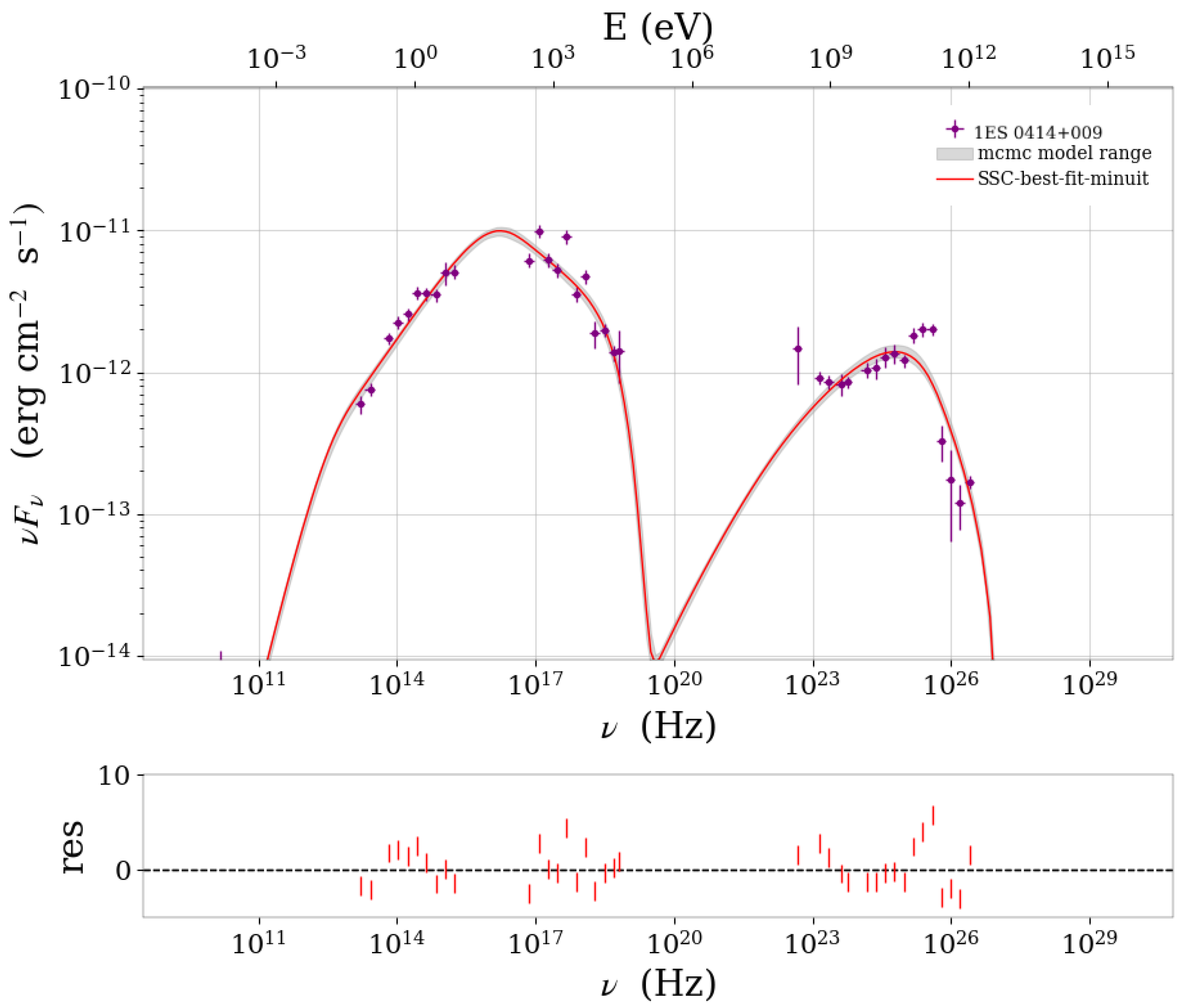
Figure 2.
Broadband SED of 1ES 1959+650 modeled using a one-zone model. The solid red line is the best fit for the SED and the filled gray area corresponds to the 1 statistical error of the fit.
Figure 2.
Broadband SED of 1ES 1959+650 modeled using a one-zone model. The solid red line is the best fit for the SED and the filled gray area corresponds to the 1 statistical error of the fit.
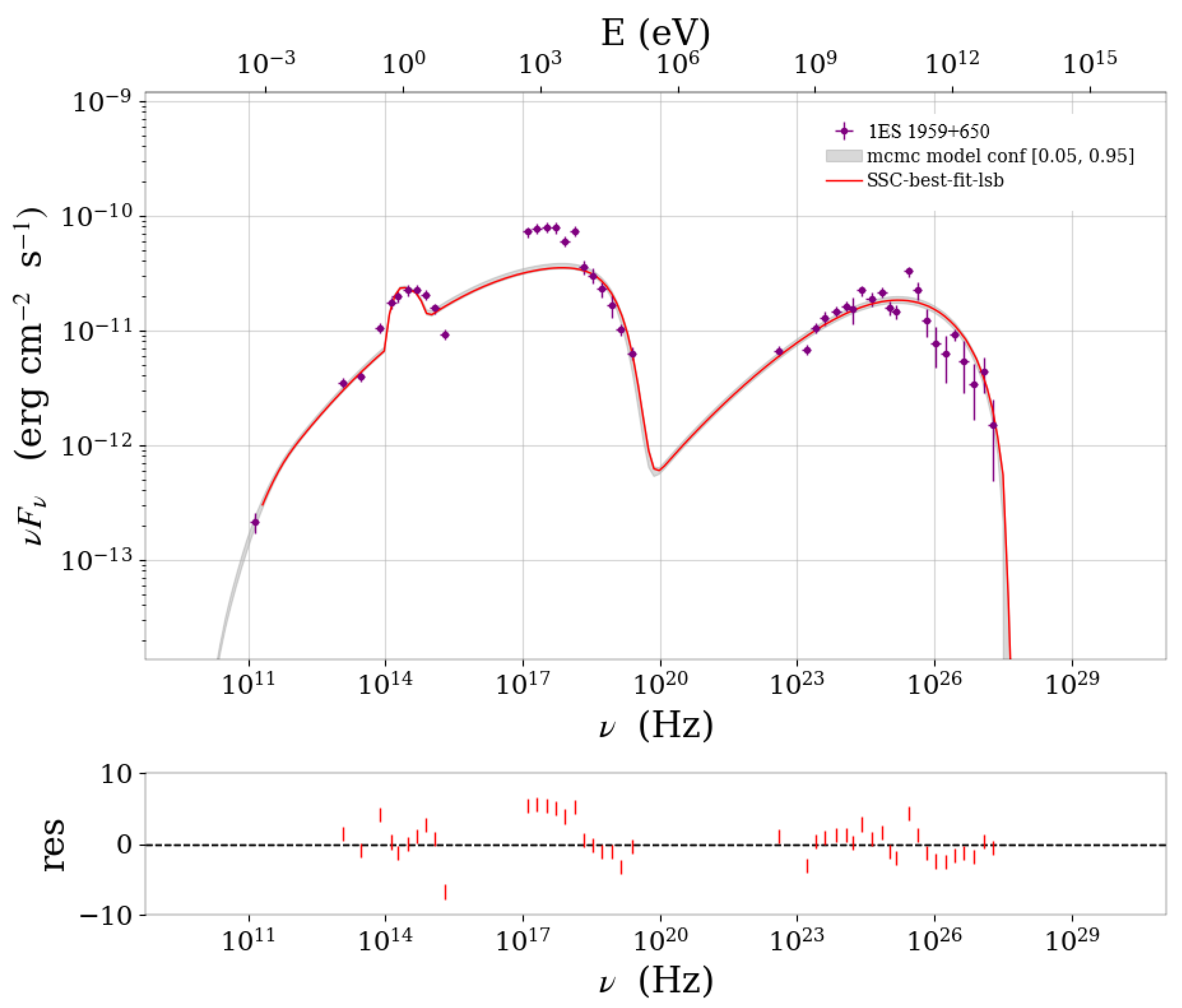
Figure 3.
Lepto-hadronic SED modelling and multi-wavelength data of 1ES 0414+009. In comparison to the purely leptonic model, the lepto-hadronic model is characterized by the dominant contributions to the emissions of high-energy photons and neutrinos. These processes originate from the following interactions: proton-photon interactions (p, dotted pink curve) are observed from eV to eV. Pion production from proton-proton interactions (pp → , dark blue dashed curve) is mainly observed from approximately to eV, while proton-driven SSC processes (black curve) are significant from to eV.
Figure 3.
Lepto-hadronic SED modelling and multi-wavelength data of 1ES 0414+009. In comparison to the purely leptonic model, the lepto-hadronic model is characterized by the dominant contributions to the emissions of high-energy photons and neutrinos. These processes originate from the following interactions: proton-photon interactions (p, dotted pink curve) are observed from eV to eV. Pion production from proton-proton interactions (pp → , dark blue dashed curve) is mainly observed from approximately to eV, while proton-driven SSC processes (black curve) are significant from to eV.
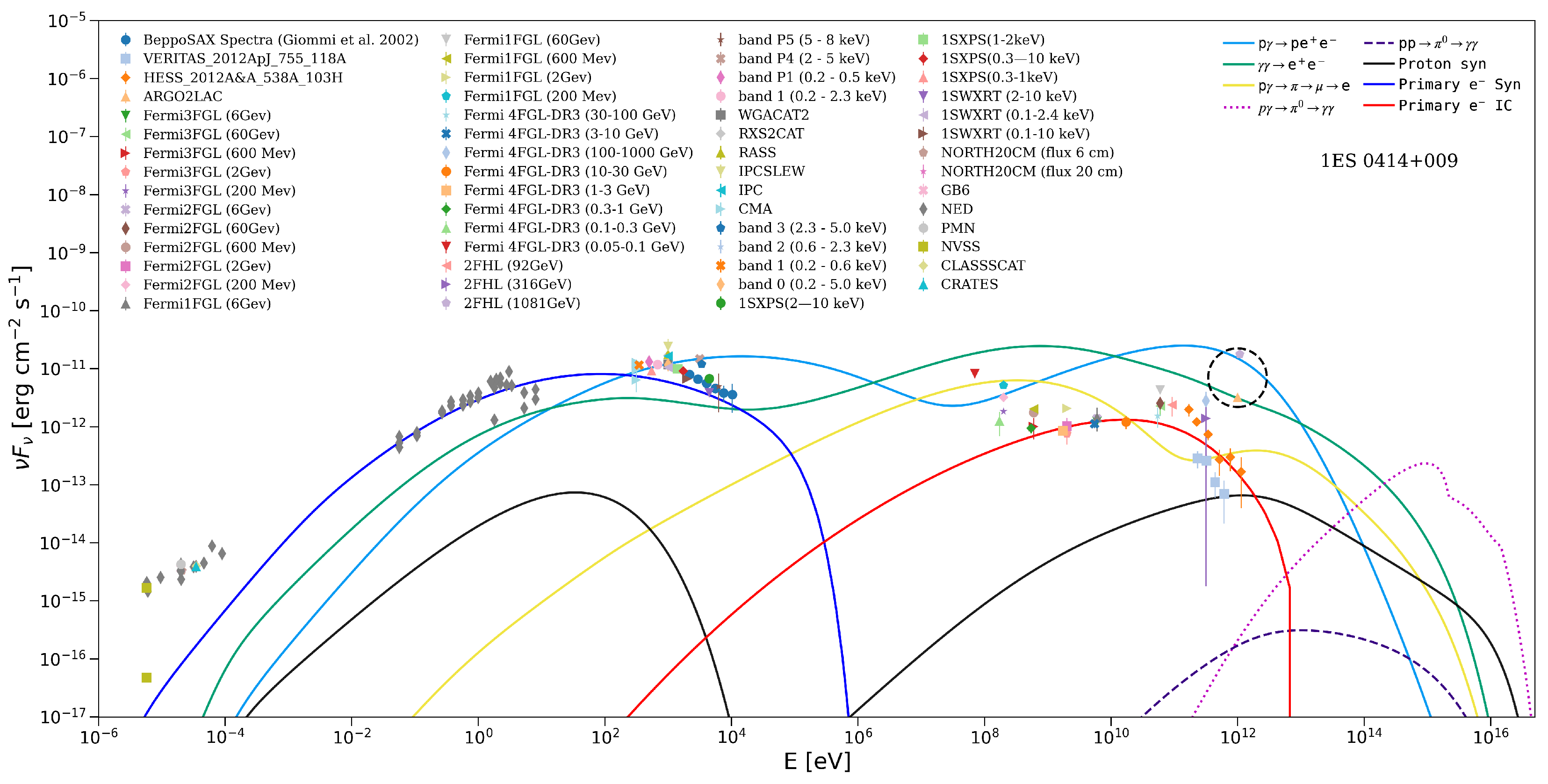
Figure 4.
Lepto-hadronic SED modelling and multi-wavelength data of 1ES 1959+650. In comparison to the purely leptonic model, the lepto-hadronic model is characterized by the dominant contributions to the emissions of high-energy photons and neutrinos. These processes originate from the following interactions: proton-photon interactions (p, dotted pink curve) are observed from eV to eV. Pion production from proton-proton interactions (pp → , dark blue dashed curve) is mainly observed from approximately to eV, while proton-driven SSC processes (black curve) are significant from to eV.
Figure 4.
Lepto-hadronic SED modelling and multi-wavelength data of 1ES 1959+650. In comparison to the purely leptonic model, the lepto-hadronic model is characterized by the dominant contributions to the emissions of high-energy photons and neutrinos. These processes originate from the following interactions: proton-photon interactions (p, dotted pink curve) are observed from eV to eV. Pion production from proton-proton interactions (pp → , dark blue dashed curve) is mainly observed from approximately to eV, while proton-driven SSC processes (black curve) are significant from to eV.
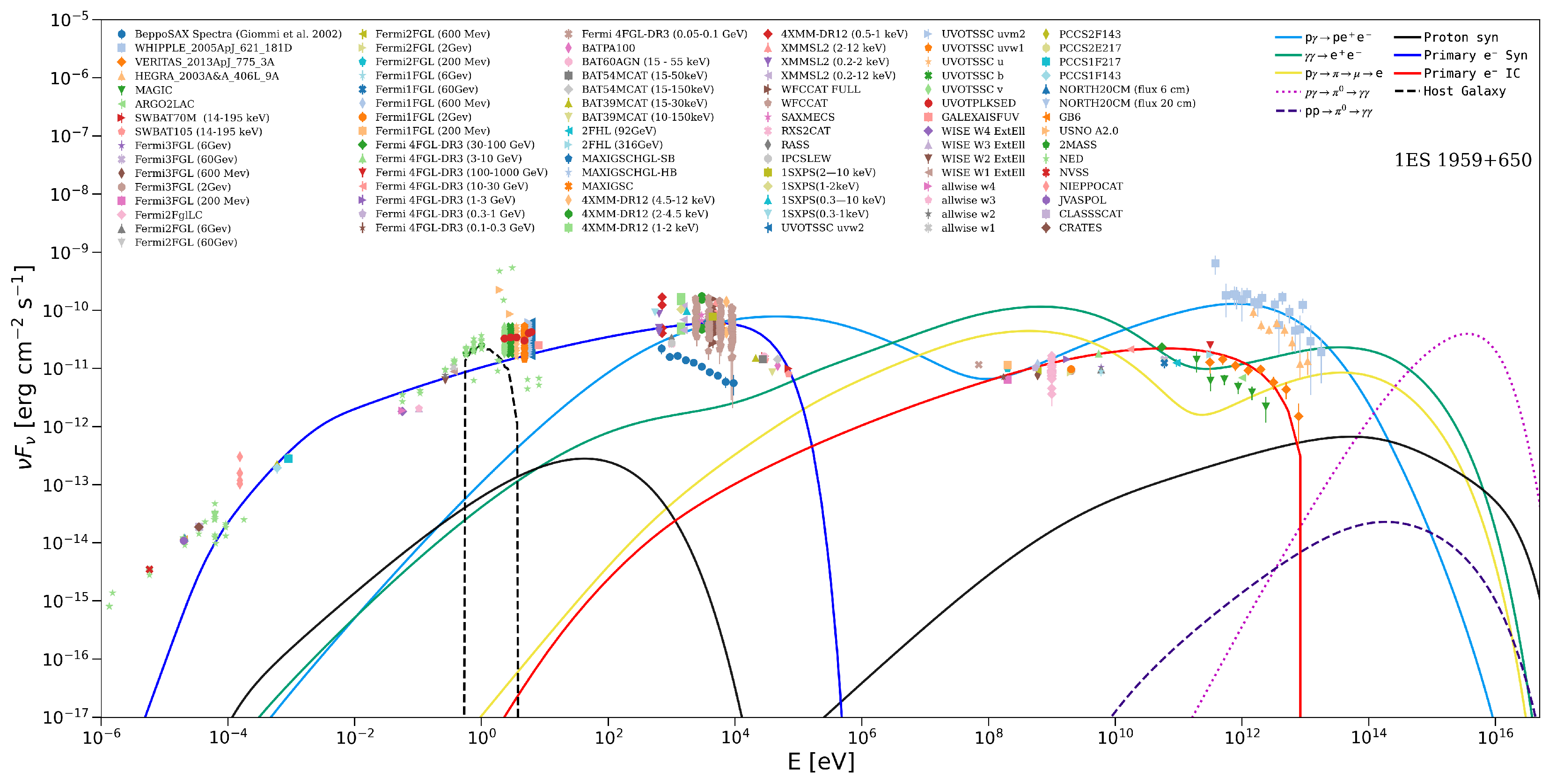

Table 1.
Observatory data used in the modeling of the source 1ES 0414+009.
| Observatory | Energy range (eV) | Reference |
|---|---|---|
| BeppoSAX | - | [80] |
| VERITAS | - | [81] |
| H.E.S.S. | – | [82] |
| ARGO | – | [83] |
| Fermi | – | [84,85,86,87,88] |
| Burst Alert Telescope (BAT) | - | [89] |
| Röntgensatellit (ROSAT) | – | [90,91,92] |
| Einstein (HEAO-2) | – | [39,52,93] |
| XRT (Swift) | - | [94,95] |
Table 2.
Observatory data used in the modeling of the source 1ES 1959+650.
| Observatory | Energy range (eV) | Reference |
|---|---|---|
| BeppoSAX | - | [80] |
| WHIPPLE | [96] | |
| VERITAS | [59] | |
| HEGRA | [57] | |
| MAGIC | - | [97] |
| ARGO | – | [98] |
| Fermi | - | [84,85,86,87,88] |
| Burst Alert Telescope (BAT) | - | [89,99,100,101,102] |
| Monitor of All-sky X-ray Image | - | [103] |
| XMM-Newton (ESA) | - | [104,105] |
| SAX-MECS | - | [106] |
Table 3.
SSC model parameters for 1ES 0414+009 and 1ES 1959+650.
| Symbol | Description | 1ES 0414+009 | 1ES 1959+650 |
|---|---|---|---|
| Minimum electron Lorentz factor | |||
| Break electron Lorentz factor | |||
| Maximum electron Lorentz factor | |||
| B [G] | Magnetic field strength | ||
| R [cm] | Radius of emitting region (blob) | ||
| [deg] | Viewing angle | ||
| N [] | Particle number density | ||
| p | Spectral index below | ||
| Spectral index above | |||
| Bulk Lorentz factor |
Table 4.
Derived physical quantities for 1ES 0414+009 and 1ES 1959+650.
| Symbol | Description | 1ES 0414+009 | 1ES 1959+650 |
|---|---|---|---|
| [erg ] | Electron energy density | ||
| [erg ] | Magnetic energy density | ||
| [erg ] | Synchrotron photon energy density | ||
| [erg ] | Synchrotron radiative power | ||
| [erg ] | SSC radiative power | ||
| [erg ] | Total radiated power | ||
| [erg ] | Jet kinetic power |
Disclaimer/Publisher’s Note: The statements, opinions and data contained in all publications are solely those of the individual author(s) and contributor(s) and not of MDPI and/or the editor(s). MDPI and/or the editor(s) disclaim responsibility for any injury to people or property resulting from any ideas, methods, instructions or products referred to in the content. |
© 2025 by the authors. Licensee MDPI, Basel, Switzerland. This article is an open access article distributed under the terms and conditions of the Creative Commons Attribution (CC BY) license (http://creativecommons.org/licenses/by/4.0/).
Copyright: This open access article is published under a Creative Commons CC BY 4.0 license, which permit the free download, distribution, and reuse, provided that the author and preprint are cited in any reuse.


