
Submitted:
03 May 2025
Posted:
05 May 2025
You are already at the latest version
Abstract
Geothermal energy, with a global installed capacity of 16.7 GW by 2023 and an annual generation of more than 97 TWh, is consolidating its position as a key pillar in the energy transition. From the pioneering Lardarello plant (1913) to The Geysers complex in California—the largest in the world with 1.5 GW of capacity—this energy source has demonstrated its potential to supply baseload electricity 24 hours a day, with a carbon footprint up to 10 times lower than fossil fuels. The article explores how the architectural design of these plants integrates geological, environmental, and technological factors. Systems such as binary cycles—which operate at 90°C and reduce emissions by 95%—allow the exploitation of low-temperature resources, expanding their applicability to non-volcanic regions. However, challenges remain: reservoir exploration is 30-40% uncertain, and initial costs exceed $4,500 per installed kW, according to the U.S. Department of Energy. Iconic cases like The Geysers illustrate innovative solutions. Since 2003, its recharge project with treated wastewater (11 million gallons/day) has revitalized the reservoir, extending its lifespan by decades. This circular economy approach not only optimizes resources but also reduces water conflicts in arid areas. The future points to disruptive designs: Enhanced Geothermal Systems (EGS), which could increase global potential tenfold by enabling dry reservoirs, and urban heating districts with heat pumps, capable of providing heating at -20°C. By 2030, drilling innovations—such as smart drill bits and robotics—could reduce costs by 50%, accelerating adoption. In a world that needs to double clean energy by 2040, geothermal energy is emerging not only as a renewable source, but as an architectural canvas where engineering and sustainability converge to redefine the energy landscape. Its evolution will depend on creatively overcoming technical barriers, transforming the Earth's heat into the cornerstone of a decarbonized era.
Keywords:
Architectural design
; construction
; Geothermal Plants
; Electricity Generation
1. Introduction
The architectural design of geothermal plants for electricity generation involves the strategic integration of environmental, geological, and technical factors to optimize the extraction and utilization of geothermal energy. As a renewable energy source, geothermal energy harnesses the Earth's internal thermal resources to produce electricity sustainably, distinguishing itself from conventional fossil fuelbased power generation methods. Notable advancements in geothermal technology, including various types of power plants such as dry steam, flash steam, and binary cycle systems have significantly enhanced the efficiency and environmental performance of geothermal operations, with a global installed capacity of approximately 15.96 GW as of the early 21st century.[1,2,3]
The historical evolution of geothermal energy began with the establishment of the first commercial geothermal power plant in Lardarello, Italy, in 1913, and has since expanded globally, particularly in regions rich in geothermal resources like the United States, Philippines, and Indonesia. The Geysers in California remains the largest geothermal power complex, showcasing the viability of this energy source as a reliable and continuous form of electricity generation.[4,5,6] The architectural design considerations for geothermal plants emphasize site selection, resource assessment, and environmental impact assessments, all of which are crucial for maintaining operational efficiency and minimizing ecological disruption.[7,8,9]
Despite the promising potential of geothermal energy, its development faces several challenges, including technical issues related to resource assessment, thermal stress management, and compliance with environmental regulations. Moreover, the economic viability of geothermal projects often hinges on overcoming significant upfront investment barriers and navigating complex regulatory frameworks.[10,11,12] As the demand for renewable energy continues to grow in the context of climate change, the architectural design of geothermal plants must evolve, embracing innovations in technology and sustainability to ensure their role in a diversified energy future.[13,14]
Future trends in the architectural design of geothermal facilities point towards the incorporation of advanced drilling techniques, improved efficiency through enhanced geothermal systems (EGS), and the development of geothermal district heating systems. These innovations not only aim to enhance the operational performance of geothermal plants but also support broader sustainability initiatives by optimizing resource utilization and minimizing environmental impacts associated with energy production.[7,14,15]
History of Geothermal Energy
Geothermal energy has been harnessed for thousands of years, with its earliest uses dating back to ancient civilizations that utilized hot springs for bathing and cooking. The systematic exploitation of geothermal energy for power generation began in the 20th century, marking a significant advancement in the field of renewable energy.
Early Developments
The first commercial geothermal power plant, Lardarello, was established in Italy in 1913, utilizing steam from the Earth to generate electricity[1,4]. This pioneering plant set the stage for future developments in geothermal energy technology. In 1958, New Zealand followed suit with the Wairakei Power Station, which further demonstrated the viability of geothermal power generation on a larger scale[1,4].
Expansion in the United States
The Geysers in California, opened in 1960, marked a significant milestone as it became the largest geothermal power complex in the world[5,6]. These early plants showcased the potential of geothermal energy as a reliable and sustainable source of electricity, contributing to the growing interest in renewable energy solutions during the mid 20th century.
Global Growth
Following the success of initial geothermal plants, the technology expanded globally. Countries such as the Philippines, Indonesia, and Mexico developed their geothermal resources, recognizing the long term sustainability and low environmental impact of geothermal energy[2,16]. By the early 21st century, the global installed geothermal capacity had reached approximately 15.96 GW, reflecting the increasing adoption of this renewable resource[3].
Modern Advances
Today, geothermal energy continues to evolve with advancements in technology, enabling more efficient extraction and utilization methods. Geothermal power plants are recognized for their small environmental footprint and ability to provide continuous baseload power, making them a crucial component of the transition to sustainable energy systems[17,18]. As research and development continue, the future of geothermal energy looks promising, with potential applications expanding beyond electricity generation to include direct heating and cooling solutions.
Types of Geothermal Power Plants
Geothermal power plants are classified into three main types based on their operational mechanisms and the state of geothermal resources utilized: dry steam, flash steam, and binary cycle plants. Each type harnesses geothermal energy in distinct ways to generate electricity.
Binary Cycle Power Plants
Binary cycle power plants represent a more advanced and environmentally friendly approach to geothermal energy generation. In these systems, geothermal water is used to heat a secondary working fluid with a lower boiling point, typically isobutene or isopentane. This process occurs in a closed loop system, where the geothermal fluid does not come into direct contact with the atmosphere, thus resulting in minimal emissions[19]. Binary cycle plants are increasingly popular due to their ability to operate effectively at lower temperatures and their lower environmental impact compared to dry and flash steam plants[19,20].
Dry Steam Power Plants
Dry steam power plants are the oldest type of geothermal power generation technology, first developed in Italy in 1904. These plants utilize hydrothermal fluids that are primarily in the form of steam. The steam is extracted directly from geothermal reservoirs and directed to a turbine, which drives a generator to produce electricity. After the steam is used, it condenses back into water and is often reinjected into the reservoir to maintain pressure and sustainability[21,22]. Notably, the Geysers in northern California, the world's largest single source of geothermal power, operates using this technology[23].
Flash Steam Power Plants
Flash steam power plants are the most common type of geothermal power plant in operation today. These facilities tap into high temperature geothermal reservoirs, specifically those with water temperatures exceeding 360°F (182°C)[17,24]. In this type of system, high pressure geothermal water is brought to the surface, where the pressure is reduced (or "flashed"), causing a portion of the water to convert to steam. This steam is then used to drive a turbine. The remaining water can be reinjected into the reservoir, making this process efficient and sustainable[25].
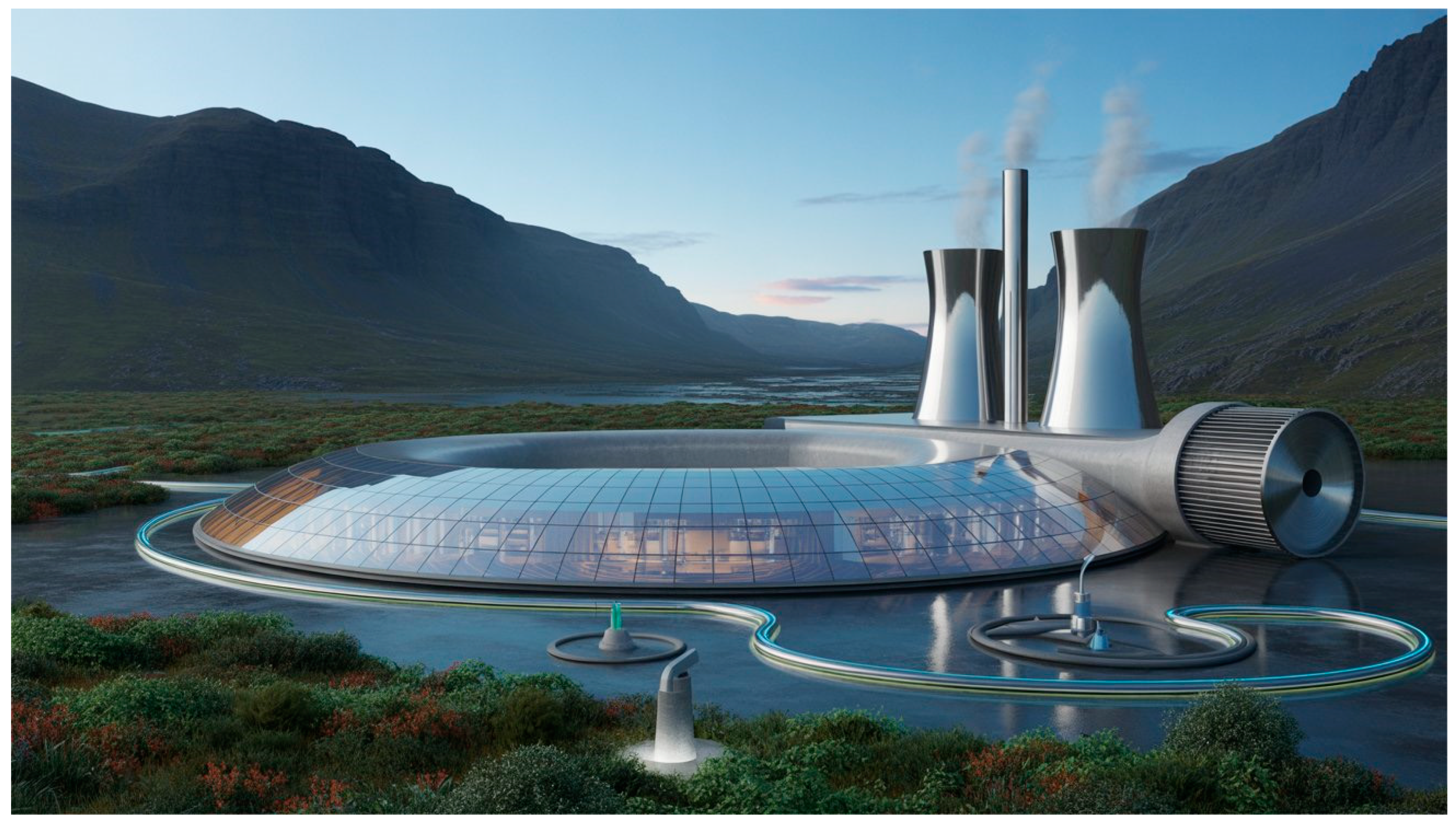
Figure 1.
Geothermal plant model applying architectural design.
2. Methods
Architectural Design Considerations
The architectural design of geothermal plants for electricity generation involves a careful integration of environmental and geological factors to optimize efficiency and sustainability. Key considerations include the geological features of the site, which significantly influence the suitability and performance of geothermal systems. These factors include lithology, faults, heat flow, and earthquake density, which help in determining the ideal location for power plants and drilling wells[7,26,27].
Site Selection Criteria
To effectively select sites for geothermal energy production, several criteria must be established. These criteria focus on geological characteristics, such as the presence of open faults and hydrothermal veins, which are essential for tapping into geothermal resources[8,28]. The conventional site selection process is multi disciplinary, incorporating surface exploration and precise analysis of subsurface data to ensure optimal conditions for geothermal extraction[29,30].
Environmental Impact Assessments
Before construction, an environmental review is often required to assess potential impacts on local wildlife and vegetation. This process ensures that habitat disruption and ecological balance are considered, particularly in areas with sensitive ecosystems[9,31,32]. Furthermore, the permitting process under environmental regulations, such as the National Environmental Policy Act, can be extensive and requires comprehensive documentation of potential environmental impacts, including groundwater contamination, land subsidence, and induced seismicity associated with geothermal extraction[33].
Passive Solar Greenhouse Design
A notable architectural feature in the context of geothermal applications is the design of passive solar greenhouses. These structures utilize perforated tubing systems that maximize soil contact to enhance energy exchange[5,34]. The design typically includes horizontal piping arranged at various depths to achieve efficient thermal regulation within the greenhouse. Rigid foam insulation is employed to optimize the performance of these systems, ensuring minimal heat loss[34,35]. This simplicity in design allows for easier installation and maintenance, making geothermal energy accessible to a broader range of users.
Key Components of Geothermal Plants
Geothermal power plants are designed to harness the Earth's internal thermal energy to generate electricity. The fundamental components of these plants are similar to those found in traditional coal or nuclear power facilities, but with notable differences in their heat sources and operational processes.
Basic Structure
The core of a geothermal power plant consists of a turbine building, where the steam or hot water extracted from the Earth is used to drive a turbine connected to an electricity generator. Additionally, the plant includes a cooling tower, which dissipates excess heat, and an electrical switchyard, where generated electricity is distributed to the power grid[36,37].
Water Extraction and Management
Hot water or steam is extracted from geothermal reservoirs through a network of wells. This geothermal fluid is directed to the power generation system, where its thermal energy is converted into electricity. After passing through the turbine, the geothermal fluid is typically reinjected into the subsurface to maintain reservoir pressure and sustainability, although some make up water may be required to compensate for losses[30,37,38].
Heat Exchange Systems
Geothermal plants may utilize various heat exchange methods. In dry steam plants, steam is directly extracted and utilized, while in flash and binary cycle plants, the hot water is brought to the surface, where it is either flashed to produce steam or passed through a secondary fluid in a heat exchanger to drive the turbine. These systems effectively maximize energy extraction from geothermal resources[24,36].
Environmental Management Features
Geothermal plants often include environmental management components to address emissions and ecological impact. For instance, units may incorporate hydrogen sulfide abatement systems to mitigate harmful gas emissions produced during operation. Advanced scrubbing technologies, like the Stretford System, are employed to process and neutralize these emissions before they are released into the atmosphere[37,39].
Innovative Designs
Recent advancements in geothermal technology have led to the exploration of closed loop systems for residential heating and cooling, where pipes are installed in geothermal aquifers. These systems circulate a heat transfer fluid through a closed loop, efficiently transferring thermal energy without directly extracting groundwater. Such innovations enhance the sustainability and efficiency of geothermal energy utilization[2,24].
3. Results and Discussion
Challenges in Design and Implementation
Geothermal energy has long been recognized for its potential as a renewable energy source, but the architectural design and implementation of geothermal plants present unique challenges. These challenges arise from various technical, environmental, and regulatory factors that must be navigated to successfully develop geothermal resources.
Technical Challenges
Resource Assessment and Exploration
One of the primary challenges in geothermal plant development is the accurate assessment and exploration of geothermal resources. As noted by Mike Long from POWER Engineers, institutional efforts are being made to improve the success rate of identifying new areas with significant geothermal potential.[10,40,41] However, the uncertainty associated with resource development can lead to increased costs and risks. Effective exploratory activities are essential to mitigate these uncertainties and ensure the viability of new power plant projects.
Thermal Stress Management
Another significant technical challenge is managing thermal stress within the geothermal systems. Flexible couplings and specialized completion techniques are critical in mitigating these stresses, which can preserve well integrity and reduce long term operational costs.[42] The design of geothermal plants must account for these stresses to maintain efficient and reliable operation.
Economic Considerations
The economic viability of geothermal projects has seen a renewed interest, particularly due to a cultural shift towards renewable energy solutions in response to climate change concerns.[13] However, the initial capital investment required for the construction and implementation of geothermal plants can be a barrier to entry. Architectural design must not only be efficient but also cost effective to attract investors and ensure the long term sustainability of geothermal energy initiatives.
Environmental and Regulatory Challenges
Site Constraints
Geothermal plants are often subject to strict environmental regulations, especially when located on federally protected lands or sites managed by the U.S. Department of Defense, where development is highly restricted.[8,11,43] These constraints limit the potential resource areas and add layers of complexity to the planning and design processes.
Climate Variability
The variability of climate conditions, particularly with regards to temperature fluctuations during winter months, poses challenges in predicting geothermal energy output. Although a certain volume of heat may be considered guaranteed, these variables need to be factored into economic projections for investments.[7,12,27] Calculations based on worst case scenarios are necessary to provide financial stability for investors and predictable pricing for consumers, complicating the design process further.
Case Studies
Overview of Geothermal Power Plants
Geothermal power plants harness the Earth's internal thermal energy to generate electricity, operating similarly to traditional coal or nuclear power plants, with the primary distinction being the heat source. In geothermal facilities, hot water or steam is extracted from the Earth through wells, which then feeds the power generation process. The extracted water is typically reinjected back into the subsurface to maintain reservoir sustainability; however, the withdrawal rate often exceeds the reinjection, necessitating additional water supplies for optimal operation[44,45].
The Geysers Case Study
One prominent example of geothermal energy implementation is The Geysers in California, which has undergone significant infrastructure enhancements to support its geothermal operations. In 1990, a collaboration between The Geysers, Lake County, and the California Energy Commission led to the development of the Southeast Geysers Effluent Pipeline, initially stretching 29 miles but later extended to 40 miles. This pipeline facilitates the delivery of approximately 9 million gallons per day of treated wastewater to the geothermal field[45,46].
Further improvements came in 2003 when the City of Santa Rosa partnered with Calpine to construct the Santa Rosa Geysers Recharge Project (SRGRP). This 42 mile pipeline has since delivered about 11 million gallons per day of tertiary treated wastewater, effectively replenishing the geothermal reservoir and ensuring the longevity and efficiency of The Geysers' operations[45,46,47].
Design Premises in Geothermal Plant Development
The design and operational strategies employed in geothermal power plants, including those observed in The Geysers, underscore the importance of maintaining reservoir pressure and sustainability. The success of recharging projects demonstrates that careful planning and innovative solutions are critical in adapting geothermal facilities to changing environmental and operational conditions. This adaptability is essential for ensuring that geothermal energy remains a viable and sustainable resource for electricity generation in the long term[45,48].
4. Conclusions
Future Trends and Innovations
Technology Innovation Scenarios
The architectural design of geothermal plants for electricity generation is expected to evolve significantly by 2030, influenced by various technology innovation scenarios. Two primary scenarios have been identified: the Conservative Technology Innovation Scenario and the Moderate Technology Innovation Scenario.
Conservative Technology Innovation Scenario
In the Conservative Technology Innovation Scenario, the geothermal industry is anticipated to continue with current trends in drilling and enhanced geothermal systems (EGS). This scenario suggests only minor efficiency improvements with little to no increase in the rate of penetration (ROP) and limited advancements in flow rate and stimulation success rates. Consequently, this scenario is expected to yield only minor capital expenditure (CAPEX) improvements by 2030[15,27,49].
Moderate Technology Innovation Scenario
Conversely, the Moderate Technology Innovation Scenario envisions more substantial advancements in drilling technology. According to this scenario, innovations detailed in the GeoVision report could lead to a doubling of the ROP, improved bit life, and a reduction in the number of casing intervals and associated drilling materials. These advancements are projected to result in significant cost improvements achievable by 2030[7,12].
Geothermal District Heating Systems
Another critical area of focus in the architectural design of geothermal plants is the adaptation of geothermal district heating systems. Future designs are likely to incorporate ultralow temperature district heating systems (ULTDH) that utilize heat pumps, as well as low temperature district heating systems (LTDH). This shift is supported by EU funded projects aimed at optimizing temperature for low temperature district heating across Europe. Although still seen as a conceptual novelty in some regions, these systems are becoming increasingly relevant, emphasizing the need for limited heating temperature parameters in future district heating architectures[14].
Sustainability and Resource Utilization
The architectural evolution of geothermal plants will also be closely tied to sustain ability efforts. The continuous heat flow from the Earth's core, combined with the ability to draw on underground reservoirs, makes geothermal energy a sustainable resource. Moreover, the extraction of valuable materials such as zinc, silica, and sulfur from geothermal processes could enhance the economic viability of these systems, thereby promoting innovation in plant design[14,24,39].
References
- How geothermal energy boosts sustainability.
- Geothermal - Governor's Office of Energy and Mineral Resources.
- Approaches and sustainability of geothermal energy in the industrial ...
- Geothermal Energy | U.S. Fish & Wildlife Service.
- Geothermal Heating: Equans' Path to Sustainable Energy Solutions.
- All the Advantages of Geothermal.
- Performance of geothermal power plants (single, dual, and binary ...
- Geothermal Electricity Production Basics - NREL.
- The environmental impacts and the carbon intensity of geothermal ...
- Geothermal power plants: advantages and disadvantages | Avenston.
- Types of Geothermal Power Plants - California Energy Commission.
- Binary cycle power plants | Geothermal Systems Engineering Class ...
- [PDF] Geothermal power plant design maximising netpower output.
- Flash steam power plants | Geothermal Systems Engineering Class ...
- Geothermal Energy Factsheet | Center for Sustainable Systems.
- Varieties of Geothermal Power Plants | Engineering Influencers to ...
- Criteria and geological setting for the generic geothermal ...
- Catalog of geothermal play types based on geologic controls.
- Global map to identify areas suitable for geothermal power plants.
- [PDF] Geothermal Well Site Suitability Selection Using Geographic ...
- Site Selection for Geothermal Power Plants - Dynamic Graphics, Inc.
- Site Selection for Geothermal Power Plants - DGI.
- Exploring geothermal energy as a sustainable source of energy.
- [PDF] Environmental Impacts of Geothermal Energy.
- Environmental, economic, and social impacts of geothermal energy ...
- [PDF] Environmental Impact Of Geothermal Energy - Back Lot Classifieds.
- New study provides insight on power plant design for superhot ...
- Geothermal Energy for Architects: A Design Guide - LinkedIn.
- Environmental impact of using geothermal clean energy (heating ...
- Geothermal power plants - Energy Education.
- Geothermal Power Plants - Frequently Asked Questions.
- Geothermal power plants - U.S. Energy Information Administration ...
- A review of grout materials in geothermal energy applications.
- [PDF] Environmental aspects of geothermal energy utilization.
- Influences of climatic environment on the geothermal power ...
- Environmental aspects of geothermal energy utilization.
- Sustainable Geothermal Energy: A Review of Challenges ... - MDPI.
- Geothermal energy and the environment - EIA.
- Geothermal | Electricity | 2021 - ATB | NREL.
- Geothermal - Utah Geological Survey.
- Where geothermal energy is found - EIA.
- Environmental Analysis | Department of Energy.
- Harnessing the earth's energy: Pros and cons of geothermal power ...
- [PDF] Geothermal Energy and its Impacts on the Environment - NSUWorks.
- [PDF] Life Cycle Environmental Impacts of Geothermal Systems.
- [PDF] Geothermal Binary Power Plants - ESMAP.
- Geothermal Power Plant Site Selection Using Gis in Sabalan Area ...
- Analysis of criteria for the selection of geothermal powerplant ...
- Geothermal FAQs - Department of Energy.
Disclaimer/Publisher’s Note: The statements, opinions and data contained in all publications are solely those of the individual author(s) and contributor(s) and not of MDPI and/or the editor(s). MDPI and/or the editor(s) disclaim responsibility for any injury to people or property resulting from any ideas, methods, instructions or products referred to in the content. |
© 2025 by the authors. Licensee MDPI, Basel, Switzerland. This article is an open access article distributed under the terms and conditions of the Creative Commons Attribution (CC BY) license (http://creativecommons.org/licenses/by/4.0/).
Copyright: This open access article is published under a Creative Commons CC BY 4.0 license, which permit the free download, distribution, and reuse, provided that the author and preprint are cited in any reuse.