

Submitted:
03 May 2025
Posted:
06 May 2025
You are already at the latest version
Abstract
The accelerated penetration of digital technology into natural ecosystems has led to the digital transformation of forest ecological spaces. Smart forestry, as a key pathway for digital-intelligence-enabled ecological governance, plays an important role in global sustainable development and multilevel governance. However, due to differences in functional positioning, resource capacity, and policy translation mechanisms, semantic shifts and disconnections arise between central policies, local policies, and practical implementation, thereby affecting policy execution and governance effectiveness. Fu-jian Province has been identified as a key pilot region for smart forestry practices in China, owing to its early adoption of informatization strategies and distinctive ecolog-ical conditions. This study employs the Latent Dirichlet Allocation (LDA) topic mod-eling method to construct a corpus of smart forestry texts, including central policies, local policies, and local media reports from 2010 to 2025. Seven potential themes are identified and categorized into three overarching dimensions: technological empow-erment, governance mechanisms, and ecological goals. The results show that central policies emphasize macro strategy and ecological security, local policies focus on plat-form construction and governance coordination, and local practice features digital in-novation and ecological value transformation. Three transmission paths are summa-rized to support smart forestry policy optimization and inform digital ecological gov-ernance globally.
Keywords:
smart forestry
; topic modeling
; LDA
; policy–practice gap
; multilevel governance
; ecological digitalization
; policy transmission
1. Introduction
1.1. Background
Forests represent the terrestrial ecosystems with the widest coverage and the most complex structure on Earth, shouldering the important mission of maintaining the global ecological balance [1]. However, with the accelerating degradation of global forests, the rapid decline of biodiversity, and the worsening of ecological security, the conventional forestry governance system—relying on manual patrols and static management approaches—requires urgent transformation towards intelligent and efficient management. In the context of the accelerated integration of digital technologies into natural ecosystems, forests are undergoing a gradual transformation into highly digitalized ecological spaces [2]. The Forestry 4.0 revolution is driving a reconfiguration of the forestry governance system. This transformation is characterized by the emergence of "smart forestry". Its core feature is the comprehensive integration of digital technologies—such as artificial intelligence, remote sensing monitoring, the Internet of Things (IoT), and big data—across the entire process of forest resource monitoring, management, and protection[3]. As the foundational practice of Forestry 4.0, smart forestry endeavors to expand the technological boundaries of ecological governance while promoting the integration of ecosystems into digital governance networks through the integration of digital technologies into forest management protection . The integration of digital technologies into forestry practices can play a pivotal role in addressing the global ecological crisis. It can also contribute to the achievement of the Sustainable Development Goals (SDGs) and accelerate progress toward the climate-neutral vision 2050 [4] . This trend opens new pathways for the digital transformation of national forestry policies.
As a vast nation with substantial global forest resources, China has elevated forest ecological security to the level of a national strategy, actively promoting the digital and intelligent transformation of forestry governance. At the national level, a series of policies and documents continue to promote the establishment of smart forestry, and the evolution of forestry from the traditional management mode to a novel governance system characterized by system integration, real-time sensing, and intelligent decision-making. At the local level, Fujian Province has become an important pilot area for China's smart forestry practice by virtue of its early launch of information technology strategy and unique geographical and ecological advantages. Fujian is one of the first batch of ecological civilization pilot zones in China, with a high forest coverage and extensive mountainous area. The province has accumulated rich experience in the reform of the collective forest rights system and ecological protection. Since the implementation of the 'Digital Fujian' strategy at the beginning of this century, Fujian has continued to promote the construction of digital infrastructure in the field of forestry, introduced a number of local policies and measures, and explicitly proposed the construction of 'a forestry big data center, two service platforms, and three business systems.' In 2023, Fujian established China's inaugural one-stop forestry drone service platform, thereby achieving the digitalization of the entire forest supervision process. Fujian's local exploration has two key benefits. Firstly, it enriches the implementation path of smart forestry governance. Secondly, it provides an important observation window to study the landing mechanism and technology transformation of national policies at the grassroots level.
1.2. Literature Review
Smart forestry represents a major step forward in applying digital governance to ecological management. Some scholars argue that smart forestry is not only a reflection of technological integration in forest resource management. Rather, it has the potential to reshape power structures, governance models, and mechanisms of democratic participation in forest spaces, thereby revealing the underlying politics embedded in the process of digital transformation [2].In examining the technological architecture of smart forestry, it is also essential to pay close attention to the governance logic and institutional adaptation support its development. Recent studies in the field of digital technology pathways for smart forestry has yielded significant progress. In the area of sensing and monitoring, studies have contributed to the design of IoT-based systems that integrate modules such as data collection, remote monitoring, cloud computing, and energy efficiency optimization. These modules can be employed to address critical issues including forest fires, logging, and habitat monitoring [5]. Moreover, some scholars have attempted to integrate the Internet of Things (IoT) and enterprise blockchain technologies to develop unmanned forest monitoring systems. They have also examined the complex relationships among infrastructure deployment, system maintainability, and technology selection trade-offs [6] .
Many governments have incorporated digitalization into their forestry policies at the regional level. For example, the Italian National Forestry Strategy highlights digitalization as a key factor. It supports both sustainable forest management and collaborative governance [7,8,9]. A study compared rural development programs (RDCs) across different regions in Italy. It found clear differences in the degree of activation, the allocation of funds, and the implementation pathways of digitalization measures. These differences are shaped by two main factors: political will and the strength of local technology infrastructure [10]. A study in Fujian Province, China, looked at how Internet access affects forest farmers. It found that better access to information helps increase household income and improves life satisfaction. This finding reflects the socio-economic spillover effects of smart forestry [11].
Some scholars have introduced the concept of "smart green governance" when studying smart cities in Latin America. This concept highlights the role of cooperation between local governments and the public, supported by remote sensing and data analytics, in forest monitoring and urban ecological governance. These studies provide valuable cross-disciplinary references for advancing smart forestry [12].
Smart forestry is shifting from simply integrating technologies to promoting joint governance among multiple actors. And the transmission and implementation mechanism in the multi-level policy system still needs to be further study. Current research focuses on policy and institutional innovation [13], transformation of ecological product value [14] , and system and capacity [15], which have gradually outlined the institutional landscape of the integrated governance of “wisdom + ecology.” However, information asymmetry, ambiguous division of responsibilities, and inefficient communication between different levels of government are still key obstacles to the implementation of policies [16] ; the participation of multiple actors in ecological governance is still uneven, and the roles of the public and enterprises in policy formulation and implementation need to be strengthened; and there is a cognitive gap between ecological policy design and public acceptance, which may lead to deviations in the implementation of policies [17]. There is a cognitive gap between the design concepts of ecological policies and public acceptance, which may lead to deviations in policy implementation effects, thus forming a fault line of “hot at the top, warm at the middle, and cold at the bottom” [18].
At the methodological level, scholars have introduced the Latent Dirichlet Allocation (LDA) topic modeling tool to identify and compare potential topic structures within policy texts, thereby addressing the limitations of previous policy analyses that relied heavily on qualitative induction [19].The method has been widely used in the analysis of research integrity policies, open science strategies, and climate governance texts [20,21,22], and has demonstrated strong adaptability in China's policy research in the field of ecology [23,24].The LDA topic modeling helps to reveal semantic overlap and structural deviation among the policies and is suitable for analyzing the transmission path and structural logic of smart forestry policies in the three-dimensional structure of central-local-practice.
The development path of smart forestry has gradually formed a synergistic pattern of technology, practice, and policy. However, quantitative research on policy texts in the field of smart forestry is still scarce, especially in terms of semantic synergies, thematic deviations, and structural differences among the three types of texts: central policies, local policies, and grassroots practices, and there is a lack of systematic modeling and empirical assessment. Building upon previous studies, this study constructs a corpus of smart forestry texts covering central policies, local policies and practice reports in Fujian; conducts cross-source semantic modeling and comparative analysis based on the LDA topic model; and systematically identifies structural differences and potential faults in the synergistic transmission of smart forestry policies. The aim is to offer quantifiable empirical evidence to support the optimization of the eco-governance system.
1.3. Research Objectives and Questions
Despite the fact that central policies, local policies, and grassroots practices are all centered on the deployment and exploration of 'smart forestry,' there may be some differences in policy expression, theme focus, and practice paths between different levels. It is evident that the multi-level and multi-body governance pattern is conducive to the systematic promotion of smart forestry. However, it is important to note that the lack of semantic synergy and effective transmission may also result in policy implementation bias, goal alienation, and other problems in the field.
In order to explore the vertical consistency and practical appropriateness of smart forestry policies in the chain of formulation, implementation, and feedback, this study takes three types of texts, namely, central policies, local policies in Fujian Province, and practice reports in Fujian, as the object of study.
It constructs a corpus of smart forestry research, introduces the Latent Dirichlet Allocation (LDA) topic modeling method, and systematically explores the potential semantic structure of texts from different sources to reveal the potential semantic structure of policies from different sources. LDA, a typical unsupervised machine learning algorithm, has been shown to automatically identify potential themes in large-scale texts, thus avoiding subjective interpretation bias. In recent years, the applicability of LDA has been demonstrated in policy analysis, urban governance, and other research domains. The present study is centered on the following core questions:
- What are the similarities and differences in the thematic structures of smart forestry policies at the national level and the local level in Fujian Province?
- To what extent do practice reports in Fujian reflect the intended policy orientation, and is there evidence of a "fault line" at the implementation level?
- Which policy themes are more readily translated into actionable practices in the development of smart forestry?
To address these questions, this study applies Latent Dirichlet Allocation (LDA) topic modeling and theme distribution visualization to quantify semantic associations across different policy sources.
2. Materials and Methods
2.1. Data Sources and Sample Construction
This study constructs a text corpus to examine the formulation and implementation of smart forestry policies, from three primary sources:
The first source consists of central-level policy documents on digital and smart forestry, including normative documents and guiding opinions on smart forestry, digital forestry, and forestry informatization. They were issued by the State Council, the National Forestry and Grassland Administration, and other relevant central agencies from 2010 to 2025. The second source is Local policy documents from Fujian Province, including regional smart forestry plans, implementation programs, and pilot guidance documents issued by the Fujian Provincial Government and the Provincial Forestry Bureau. And the third source is Practice reports collected from mainstream media outlets such as Fujian Daily, Southeast China Network, People's Daily Fujian Channel, and Guangming Online, focusing on the implementation of smart forestry initiatives, technological applications, and grassroots governance practices. They provide insights into local-level execution and response.
The materials reflect both the top-down policy design and the bottom-up practical response. They help explain how policy flows through different levels of government. All texts were obtained from official websites and mainstream media, ensuring the reliability and completeness of the data. The texts were converted into the .txt format, with original metadata such as titles, release dates, and sources retained for subsequent processing and modeling analyses., a total of 100 documents had been collected, including 21 national policies, 13 provincial policies, and 66 media reports from 2010 to February 2025.
2.2. Text Preprocessing
To improve the performance of the LDA topic model, this study establishes a standardized text preprocessing workflow for Chinese-language documents within a Python-based environment. The process includes the following steps:
(i) Data cleansing and tokenization: Raw policy texts are segmented using the Jieba lexical tool. A custom dictionary containing more than 300 domain-specific terms related to smart forestry is applied, ensuring accurate recognition of compound expressions such as "forestry informatization," "ecological restoration," and "forest management system".
(ii) Sub-word elimination: To avoid semantic overlap caused by redundant stems such as "smart" and "smart forestry", sub-word elimination is applied. improving topic separability during modeling.
(iii) Stop-word removal: A customized stop-word list was developed by combining generic Chinese stop-words with frequently occurring structural phrases commonly found in policy texts. Examples include "comprehensively promote," "effectively strengthen," "to this end," "work task," and "work plan." These structural expressions, which offer limited semantic value, are filtered out to reduce noise and sharpen thematic focus.
(iv) Text standardization: Texts are standardized by unifying the Simplified Chinese character format and removing non-informative elements, including special characters, English punctuation, full-width spaces, pure numbers, and meaningless words, while retaining keywords that are with meaningful.
By implementing the above preprocessing steps, the study constructs a cleaner and more semantically consistent corpus, thereby facilitating more effective LDA topic modeling.
2.3. LDA Topic Modeling Approach
At present, the majority of large-scale text semantic analysis studies are based on statistical empirical methods [25]. Representative techniques include latent semantic analysis (LSA) [26], probabilistic latent semantic analysis (PLSA) [27], and latent Dirichlet allocation (LDA) [28]. In comparison with LSI and PLSI models, the LDA model has been shown to possess a number of significant advantages. These include a clear inner structure, high algorithmic efficiency, unsupervised training, and a training process that is independent of the number of training samples. These advantages are drawn from the PLSI generative model, while the disadvantages of overfitting are overcome [29]. LDA has been demonstrated to exhibit superior semantic extraction capabilities and enhanced interpretability when confronted with more extensive and intricate policy documents.
Text mining technology has the capacity to identify latent associations, legal principles, and patterns within extensive textual corpora, subsequently converting these into structured knowledge. Topic modeling represents a significant technique within the domain of text mining. This approach, predicated on the notion of ''letting the text speak,'' has the capacity to mine potential topic distributions in large-scale texts under unsupervised conditions [30]. Furthermore, it has the ability to reveal probabilistic relationships between documents and topics [31,32,33]. As Yang Hui (2023) asserts, policy texts are typically distinguished by their structured, normalized, and extensive nature [34]. In this study, the LDA topic model is employed to analyze the semantic structure of smart forestry policy texts. The LDA model uses probabilistic methods to model documents as random mixtures of latent topics, where each topic is represented by a probability distribution over words. This approach follows the bag-of-words assumption, which states that the significance of a word within a document is determined by its frequency [35,36] .
In order to ascertain a reasonable number of topics, previous studies have proposed various evaluation methods, including perplexity [28,37,38], Jensen-Shannon scatter [39,40,41], topic coherence, and so on. The objective of these methods is to enhance the stability and differentiation of topic delineation by preventing excessive clustering and topic overlap. In light of the aforementioned considerations, this study integrates the perplexity and theme consistency indicators to systematically ascertain the optimal number of themes. This approach is undertaken to ensure that the model output possesses high explanatory power and empirical validity.
In this study, the model results were interactively visualized using the pyLDAvis toolkit (Figure 1), which is based on the Multidimensional Scaling (MDS) algorithm to map the topic distributions in the high-dimensional space to the two-dimensional plane. The size of the circles intuitively reflects the importance of each topic, and the distance between the circles indicates the semantic similarity between topics. As illustrated in Figure 1, the seven themes exhibit a discernible distribution pattern in the two-dimensional semantic space, characterized by a moderate degree of independence and a concomitant degree of intrinsic correlation.
3. Results
3.1. Topic Number Selection and Structural Characterization of LDA Results
In the context of topic modeling, this study employs a combination of two metrics, coherence score and perplexity, to ascertain the optimal number of topics. As shown in Figure 2, the trends of the two variables are not precisely congruent under varying numbers of topics. When the number of topics is 7, the coherence score reaches its peak, indicating that the model has stronger semantic cohesion and interpretability under this setting.
It has been posited that in probabilistic language models, perplexity functions as an indicator of the model's strengths and weaknesses [42]. A reduced perplexity is indicative of enhanced prediction capability for novel texts [38]. Conversely, the coherence score places greater emphasis on the semantic coherence between high-frequency words. It is evident that semantic coherence holds greater evaluative value in the analysis of policy texts, wherein the primary objective is interpretability, particularly within the context of multi-level policy language accompanied by implicit topic induction. In such scenarios, the interpretability of themes is directly associated with the validity of the research conclusions.
Despite the fact that the seven themes corresponding to the degree of confusion are not the lowest, given their substantial advantages in coherence scores, seven themes were ultimately selected in this study. This was achieved by taking into account the explanatory power and stability of the model, with the objective being to ensure that the themes are well-structured and the semantic expressions are clear.
On this basis, the present study semantically summarizes and integrates the high-frequency keywords of the seven themes, dividing them into three dimensions: technological enablement (T1, T3, T5), governance mechanisms (T2, T6), and ecological goals (T4, T7). The foundation for the subsequent exploration of different types of themes at the policy and practice levels is established, ranging from semantic identification to structural summarization, as illustrated in Table 1. This table enumerates the characteristics of each theme and its high-frequency keywords, as derived from the LDA modeling results.
Among them, the technology empowerment dimension focuses on the foundations of informatization and digital support in smart forestry, covering three main themes: T1 shows the importance of information flow, system integration, and building service platforms, with core keywords like "internet," " data collection," and "data integration"; T3 highlights the role of forestry informatization, platform supervision, and system coordination, based on keywords such as "forestry informatization," " institutional support," and "regulatory framework "; T5 emphasizes the realization of ecological product value, empowerment, and the development of new quality productivity, shown by keywords like "new quality", "ecological product value realization" and "empowerment" .Together, these three themes form the "digital foundation" of smart forestry development, highlighting the supportive role of technological platforms, information systems, and digital applications for better forestry governance.
The governance mechanism dimension relates to policy implementation, organizational cooperation, and the operation of multiple actors, covering two themes: T2 focuses on forestry policy execution and multi-actor cooperation, with keywords like "leadership," "forest rights," and "alignment."; and T6 relates to collaborative governance in forest areas based on institutional innovation, with keywords such as "forest farmers," "forest manager system," and "rural areas." The dimension highlights the dual driving forces of " technology and institutional mechanisms" in forestry governance.
The ecological goals dimension focuses on the final goals of smart forestry, such as ecosystem restoration, biodiversity protection, and sustainable forestland management, covering two themes: T4 reflects policy attention to forestland restoration and ecosystem management, with keywords like "natural forest," "governance," and "wildlife."; T7 emphasizes national-level planning under the strategy of ecological security, with keywords such as "national," "governance," and "greening." The dimension reflects the view that smart forestry is part of national strategies for ecological protection and highlights the high priority placed on ecological security at the national level.
3.2. Comparative Analysis of Central and Fujian Provincial Smart Forestry Policy Themes
In order to gain a deeper understanding of the thematic structural differences between central and local policies in smart forestry governance, this section provides a comparative analysis. The analysis focuses on three dimensions: thematic focus of attention, structural features, and degree of consistency by visualizing the results of LDA thematic modeling.
Firstly, an analysis of the thematic keywords reveals notable differences in the focus of attention across the three types of texts. As shown in Figure 3, a comparison of keyword word clouds highlights notable distinctions between the central policy, the Fujian policy, and media reports.
Central policies place emphasis on terms such as "policy," "governance," "conservation," "protection," and "biodiversity." This reflects a top-level strategy focused on ecological protection, resource management, and strategic security, with an emphasis on ecological resource management and national governance.
The word cloud for Fujian Province's local policies features terms such as "platform," "data," "monitoring," and "smart forestry." This suggests a focus on platform building, data-driven approaches, and technological deployment, with an emphasis on technology-oriented features.
This discrepancy highlights the core issues in the discourse system of smart forestry policy between the central and local governments. The central government focuses more on establishing systems and frameworks to provide strategic guidance, while local governments emphasize the application of tools and practices.
Secondly, an analysis of the structure of theme distribution further reveals a significant difference between central and local policies in terms of topic focus and expression density. As shown in Figure 4, the central policy is predominantly focused on two themes, T4 and T7, which collectively account for over two-thirds of the total, thereby underscoring the central policy's emphasis on macro-strategic layout, ecosystem security, and integrated resource management. The centralized theme structure reflects the policy logic of the central government’s overall strategic guidance and institutional framework for smart forestry.
In contrast, the thematic distribution of policies in Fujian Province is more diversified, covering areas such as T1, T3, and T6. This reflects a shift in the structural transformation of policy content, from strategy to implementation and from framework to tools.
The diversified distribution is indicative of a high degree of localization and optimization of technical paths. This emphasizes a high degree of attention to policy implementability, data connectivity, and collaborative governance mechanisms.
Finally, the thematic similarity measure provides quantitative support for the structural relationship among the three types of texts. As shown in Figure 5, the cosine similarity of the thematic distribution between the three types of texts is illustrated: central policies, Fujian provincial policies, and media reports.
The highest similarity, 0.77, is observed between Fujian provincial policies and media reports. This high degree of consistency suggests that local practices and media reports align with the direction of local policies, or both have focused on regional topics such as smart forestry implementation, ecological transformation, and technology pilots.
The similarity between the central policies and the Fujian provincial policies is 0.29, which is at a low level. This indicates that while local policies are guided by the national top-level design, they also integrate local practical experience, needs, and adaptive adjustments. Furthermore, the local government plays the roles of 'interpreter' and 'redesigner' in the implementation of central policies.
The similarity between central policies and media reports is negligible, with almost no thematic overlap, suggesting a clear disconnection between the two in terms of thematic concerns.
3.3. Responsiveness and Gaps in the Local Implementation of Smart Forestry Policies in Fujian Province
3.3.1. Concerns Regarding Policy and Their Corresponding Responses in Practice
The thematic response between smart forestry policies and practices in Fujian Province reveals the structural interaction and mismatches between policy advocacy and local implementation. This study quantitatively compares the thematic consistency between policy texts and media reports in Fujian Province using LDA topic modeling. As shown in Figure 6 and Figure 7, the distribution and trend of each theme are visualized. The key findings are as follows:
First, T6 (Forest Governance and Local Response) is prominent in both policy and practice texts. It indicates the formation of a relatively stable policy-practice loop, reflecting strong grassroots responsiveness and effective policy transmission in the areas of forest patrol and collaborative governance.
Second, although T1 (Platform and Data Integration), T2 (Tenure and Grassroots Governance), T3 (Information-Based Supervision and System Support), and T7 (National Strategy and Ecological Security) occupy a large proportion in policy texts, they are largely absent from practice reports. It suggests a significant policy-practice gap. The differences illustrated in Figure 7 further confirm a time lag in translating institutional frameworks into concrete actions or behavioral changes.
Third, T5 (Digital Innovation and Value Transformation) is more active in practice than in policy, with local initiative and technological innovation capacity despite the limited space in the policy text. The “practice-first” phenomenon suggests that policymaking should be more fully informed by the technical accumulation and practical experience of the grassroots and that a bottom-up feedback mechanism should be established.
3.3.2. Typical Cases
To further explore the policy-practice response path of China's smart forestry, this study integrates the thematic response structures presented in Figure 6 and Figure 7 and selects three typical practice cases for in-depth analyses, corresponding to the key themes of T6, T5, and T3, respectively, with the relevant details provided in Table 2.
Case 1 is the Miscanthus management project in Xiapu County, which focuses on the ecological control of invasive species. The project employs a “sky-ground integration” platform that integrates UAV sensing, monitoring, and feedback in a closed loop, which focuses on the ecological control of invasive species. The project employs a “sky–ground integration” platform that combines UAV sensing, real-time monitoring, and feedback in a closed-loop system. This case is associated with T6 (Forest Governance and Local Response).
Case 2 is a wildlife monitoring system based on infrared cameras and AI recognition in Zhouning County, which realizes long-term monitoring of rare species through front-end sensing and intelligent identification. It aligns with T5 (Digital Innovation and Value Transformation).
Case 3 involves the construction of a forest fire early warning platform in Putian City. The system integrates AI algorithms, IoT devices, and a coordinated air–ground response mechanism to improve real-time forest fire response. It intersects with both T3 (Information Regulation and System Support) and T6.
These three cases demonstrate varying characteristics in terms of response content, technology path, and the degree of policy-practice alignment. The specific path types and transformation mechanisms will be further discussed in Section IV.
4. Discussion
4.1. Structural Differentiation of Themes in Multi-Level Policies
This study reveals a significant structural differentiation between the central and local smart forestry policy themes through LDA modeling. The differentiation reflects not only the institutional division of policymaking functions but also the functional translation path of the ecological governance paradigm within a multi-level institutional system.
On the one hand, the central policies exhibit a concentrated thematic structure, which mainly focuses on T7 (national strategy and ecological security) and T4 (ecological governance and forest land protection). These themes emphasize macro-level objectives such as the construction of ecological security barriers, the improvement of the national parks system and the integration of natural resources. The central strategic thematic structure indicates that the central government, as a top-level designer, is responsible for establishing overall frameworks, governance goals, and resource allocation plans. However, central policy is typically characterized by high abstraction, limited operability, and unclear implementation pathways, serving more as directional guidance than task-specific instruction.
On the other hand, local policies in Fujian Province are diversified, engineered, and operational, and technically oriented. They focus on themes such as T1 (Platform and Data Integration), T3 (Information Regulation and System Support), and T6 (Forest Governance and Local Response), which exhibit instrumental, systematic, and practical features. This is closely related to the dual role of local governments: they are both implementers of central strategies and active organizers of smart forestry initiatives. Local policy language frequently presents engineering terms such as “platform integration,” “data convergence,” and “unified supervision map,” emphasizing the feasibility and systemic nature of implementation. In addition, the frequent use of expressions such as “integration,” “sharing,” and “pilot” reflects the local ambition to build ecological collaborative governance networks. Under the constraints of policy resources and technical conditions, local policies often focus on specific governance scenarios, such as pest monitoring, digital forest management, etc., demonstrating localized adaptation and bottom-up innovation in local translation of the national strategies.
The structural differentiation of central-local policy themes reflects not only a strategic–technical divide but also the structural tension between the division of responsibility allocation, functional positioning, and language system in the multi-level ecological governance system. To achieve effective transmission and synergistic promotion of smart forestry, it is necessary to clarify the operational translation mechanisms of the central policy. Improving semantic alignment between national strategies and local policy responses will promote better goal coordination and discourse consistency across governance levels.
4.2. Practice Response Patterns and Policy Fallout Mechanisms
Fujian Province exhibits strong policy responsiveness and obvious thematic disparities in the implementation of smart forestry practices. Based on the comparison of LDA theme proportions between policy texts and media reports, some policy themes have been effectively implemented in practice, showing high consistency; in contrast, other themes exhibit significant implementation gaps, indicating structural obstacles between policy design and local execution.
First, T6 (Forest Governance and Local Response) exhibits the highest level of responsiveness, with a strong presence in both policy documents and media reports, forming a relatively stable policy–practice feedback loop. This theme focuses on the forest manager system, grassroots patrols, and local response. Its successful implementation is mainly attributed to three factors: (i) the institutional mechanism is relatively mature, with the operation path of policy, platform, and promotion; (ii) local governments possess a degree of autonomy and practical experience, enabling quick policy adaptation and adjustment; and (iii) the low threshold for technological inputs facilitates the rapid demonstration and replication of governance models. Therefore, the T6-related issues are characterized by clear tasks, operational paths and stable mechanisms and have a natural advantage in implementation.
Second, T1 (Platform and Data Integration), T2 (Tenure and Grassroots Governance), and T3 (Information Regulation and System Support) show strong policy emphasis but limited practice, creating a significant policy–practice gap. The causes behind the three themes vary, leading to different patterns of policy–practice gaps. T1 and T3 focus on technical support and platform coordination, but the threshold for implementation is high, involving cross-system data governance and system docking, which local governments often lack the operational capacity to decompose and undertake. T2 concerns deep-rooted institutional reforms, including forest rights adjustment and multi-stakeholder governance. Challenges such as blurred power divisions and difficulties in multi-actor coordination have slowed its grassroots implementation.
Third, T5 (Digital Innovation and Value Transformation) shows an inverse pattern: it is highly active in local practice but underrepresented in policy texts. It reflects the strong spontaneity and experimental drive of local actors in eco-product transformation and technology integration. However, the lack of timely institutionalization and effective vertical feedback mechanisms limits the potential for scaling up these grassroots innovations into policy.
Three distinct practice response patterns are observed in Fujian: (i) a coherent synchronous path where policy and practice advance together, represented by T6; (ii) a directive–fallout path where policy emphasis is strong but practical implementation lags, typified by T1, T2, and T3; and (iii) a spontaneous practice-led path where local innovation precedes formal policy support, represented by T5.
These patterns reflect the local differences in resources, capacity, and path design. They also highlight the limitations of the current smart forestry policy expression system in terms of transmission efficiency and operational adaptability. In the future, policy design should further optimize the relationship between structural expression and practical transformation, (i) improve task clarity and the operability of division of labor in policy language, and (ii) establish feedback channels based on local pilot experiences, thereby enhancing the adaptability and absorptive capacity of the policy system.
4.3. Landing Ability and Transmission Path of Policy Topics
Achieving the effective transformation from central directives to local actions is the core challenge in advancing the smart forestry policy system and improving the effectiveness of ecological governance. By analyzing typical cases in Fujian Province, as shown in Table 2, this study proposes three types of policy-practice transmission paths, reflecting the transformation potential and adaptive mechanisms of different themes in the process of system development and local implementation.
First, the normative directive path, represented by T6, is characterized by clear policy objectives, specific implementation methods, well-defined pathways, and explicit assignment of responsibilities at the local level. It reflects policy guidance and consistency and corresponds to the “policy clarity-local response” matching type summarized in Table 2. And it is suitable for themes with stable institutional foundations, high technological maturity, and established governance mechanisms.
Second, the flexible exploration-type path, represented by Theme T5. In this path, policies typically offer directional principles without specifying concrete technical pathways or platform configurations. Local actors explore solutions by leveraging governance capacity, technological adaptability, and pilot resources. This bottom-up innovation reflects local adaptability and serves as a feedback channel, corresponding to the “policy generalization-locally initiated” type identified in Table 2.
Third, the integration and expansion path is represented by T3 and T6. In this path, policies provide basic principles and target directions, and local actors integrate technologies and platforms based on specific scenarios. It emphasizes cross-sectoral synergy and platform building and corresponds to the “policy framework–technical deepening” type described in Table 2.
The three paths constitute the conduction mechanism that drives the local implementation of smart forestry policies. The effectiveness of a policy theme depends not only on its emphasis in the policy text on clarity of its expression, local resource mobilization capacity, and technological adaptability.
In future smart forestry policy design, greater attention should be paid to constructing thematic expression mechanisms that balance task clarity, diversified pathways, and flexible responses. Specifically: (i) for the directive theme, a hierarchical implementation guide and platform support should be provided; (ii) for the exploratory theme, the system should be given room for error and a channel for absorbing the results; and (iii) for the integration theme, the platform co-construction and governance synergy mechanism should be strengthened so as to promote the steady progress of smart forestry.
5. Conclusions
5.1. Research Conclusion
This study systematically analyzes the policy theme structure and its transmission paths within the smart forestry policy system, based on three types of texts: central policies, Fujian provincial policies, and local media reports, using the LDA topic modeling method. The following conclusions are drawn:
First, there is a significant distinction between national-level and local-level smart forestry policies in terms of thematic concerns and language styles. Central policies focus on national strategy and ecological security, with a high degree of concentration and directional guidance, while local policies focus on platform construction, information-based regulation, and collaborative governance, showing a stronger technical implementation orientation. This structural difference reflects the multi-level governance logic of strategic leadership and technical implementation in the policy system.
Second, there are variations in how local practices respond to different themes: T6 forms a more complete closed loop between policy and practice, while T1, T2, and T3 have a disconnection between policy emphasis and practice response. Additionally, exploratory themes such as T5 are more prominent in local practices, indicating an innovation-driven mechanism within local governance.
Third, three types of policy and practice transmission paths are summarized through typical cases: normative directive, flexible exploratory and integrated expansion. These paths are suitable for different types of policy issues, revealing the combined influence of task clarity, local resource mobilization capacity, and technology suitability in the process of implementing smart forestry policies.
5.2. Marginal Contribution
This study provides new research perspectives and practical insights for the multi-level analysis of smart forestry policy systems and the transformation of global digital ecological governance, mainly with the following marginal contributions:
First, in terms of research methodology, this study innovatively constructs a cross-level thematic mapping framework for the three types of texts: central policy, local policy, and local practice, systematically reveals the thematic evolution characteristics and semantic translation mechanisms of smart forestry policies between different governance levels, expands the perspective of multi-level comparative analysis of the smart forestry policy system, and makes up for the inadequacies of the existing literature on the evolution mechanisms of the digital ecological governance policy chain. shortcomings of the research.
Second, theoretically, this study proposes a differentiated model of the transmission path of smart forestry policies and practices, deepens the understanding of the differentiated characteristics of the policy landing mechanism, and provides new theoretical support for the structural analysis of the digital ecological governance policy system.
Third, in terms of practical insights, based on the empirical analysis of the evolution of themes and transmission paths of China's smart forestry policy system, this study proposes that in the process of the digital transformation of global ecological governance, the multilevel governance experience, which is centered on the combination of strategic leadership and local adaptation, and the precise alignment of policy issues and local innovations, is of significant international reference value. In particular, it provides a reference path and inspiration for the transformation of global digital ecological governance, especially for the construction of ecological governance systems in developing countries.
5.3. Research Limitations and Future Prospects
While this study has made initial progress in analyzing the smart forestry policy system, there are still some limitations: first, the practice samples are mainly from Fujian Province, with limited regional representativeness and diversity, and the future study can be extended to different regions for cross-provincial comparisons to test the differences in policy adaptability under different ecological and administrative contexts. Second, the case study is mainly based on media texts and lacks first-hand interviews and field data. In the future, combining field surveys and multi-source data could enhance empirical support for policy implementation and its practical effects.
Additionally, future research could explore the dynamic evolution of smart forestry policies, cross-level synergies, and multi-stakeholder governance networks, promoting a more scientific, systematic, and adaptive development of the smart forestry policy system and supporting the global digital transformation of eco-governance.
Author Contributions
Conceptualization, Y.C. and Y.Z.; methodology, software, data curation, writing—original draft preparation, and visualization, Y.Z.; validation, formal analysis, and investigation, Y.Z., Y.S., and Y.R.; resources, supervision, project administration, funding acquisition, Y.C.; writing—review and editing, Y.S., and Y.R. All authors have read and agreed to the published version of the manuscript.
Funding
Please add: This research was funded by the National Social Science Foundation Youth Program (23CGL063) “Study on the Path of Enhancing the Efficiency of Ecological Protection and Restoration in State-owned Forest Areas by Digital Empowerment”.
Data Availability Statement
The data that support the findings of this study are available from the corresponding author upon reasonable request.
Conflicts of Interest
The authors declare no conflicts of interest.
References
- Li, Z.; Xie, H. The basic logic, core mechanism and mode of realising the value of forest resources ecological products in China. Acta Ecologica Sinica, 202–204, 44(12) : 5351 ⁃ 5366. Acta Ecologica Sinica, 202. 4, 44(12) : 5351 ⁃ 5366.
- Gabrys, J. Smart forests and data practices: From the Internet of Trees to planetary governance[J]. Big data & society, 2020, 7, 2053951720904871. [Google Scholar]
- Ehrlich-Sommer, F.; Hoenigsberger, F.; Gollob, C.; et al. Sensors for digital transformation in smart forestry[J]. Sensors 2024, 24, 798. [Google Scholar] [CrossRef] [PubMed]
- Ceccherini, G.; Duveiller, G.; Grassi, G.; et al. Abrupt increase in harvested forest area over Europe after 2015[J]. Nature, 2020, 583, 72–77. [Google Scholar] [CrossRef] [PubMed]
- Singh, R.; Gehlot, A.; Akram, S.V.; et al. Forest 4.0: Digitalization of forest using the Internet of Things (IoT)[J]. Journal of King Saud University-Computer and Information Sciences, 2022, 34(8): 5587-5601. [CrossRef]
- Henriques, J.; Westerlund, W. Digitalization of forest management: Next generation unsupervised monitoring using Internet of Things and Blockchain[J]. 2020.
- Corona, P.; Marchi, E.; Chirici, G.; et al. Prospettive e potenzialità della digitalizzazione del settore forestale in Italia[J]. 2022.
- D'Amico, G.; Chirici, G.; Corona, P.; et al. Differenze locali e prospettive globali per le foreste italiane: la definizione di bosco nel prossimo Sistema Informativo Forestale Nazionale[J]. L'Italia forestale e montana, 2023, 78(1): 15-29. [CrossRef]
- Barbarese, F.; Oreti, L.; Bascietto, M.; et al. The Impact of Digitalization on the Italian Forestry Sector: An Analysis Based on Socio-Economic Indicators[J]. Forests, 2024, 15(12): 2077. [CrossRef]
- Di Stefano, V.; Paletto, A.; Cortignani, R.; et al. Fostering Digitalization: How Local Policies Are Transforming Rural Areas in Italy[J]. Forests, 2025, 16(2): 260. [CrossRef]
- Hong, Y.Z.; Chang, H.H. Does digitalization affect the objective and subjective wellbeing of forestry farm households? Empirical evidence in Fujian Province of China[J]. Forest Policy and Economics, 2020, 118: 102236. [CrossRef]
- Neves, F.R.; de Aquino, A.C.B. Bringing the Green into the Screen: Remote Sensing and Smart Green Governance in Urban Forest Management[M]//Mobile Crowdsensing and Remote Sensing in Smart Cities. Cham: Springer Nature Switzerland, 2024: 51-71.
- Fu Y, To, C. ; Liu, J. New Trial of Local Forest Policy Experimentation under Background ofEcological Civilization: Case Study on Commercial Forest Purchasing Reform in Yong’an [J]. Environmental Protection, 2017, 45, 59–64.
- Yu, M.; Tan, T. ‘How ‘green content’ empowers ‘gold content’: the theoretical logic and realisation mechanism of ecological product value transformation--an analysis based on the policy of L city in Zhejiang province [J]. Theoretical Logic and Realisation Mechanism of Ecological Product Value Transformation: Based on the ‘Combination of Policies’ of L City, Zhejiang Province [J]. Journal of Nanjing Tech University (Social Science Edition) 2025, 24, 97–110. [Google Scholar]
- Cheng, B.; Peng, X. The governance framework of China's ecological civilisation construction and its test[J]. China Population-Resources and Environment 2022, 32, 29–39. [Google Scholar]
- Roengtam, S.; Agustiyara, A. Collaborative governance for forest land use policy implementation and development[J]. Cogent social sciences, 2022, 8(1): 2073670. [CrossRef]
- Zhu, X. Multiple synergies in ecological governance:The case of the Taihu Lake Basin[J]. Reform 2017, 96–107. [Google Scholar]
- Zhou, Q.; Zhang, Z.; Ding, S. Research on ecological governance of watersheds from policy and residents' perspectives-an integrated analysis of rootedness theory and choice experiments[J]. Arid Zone Resources and Environment 2024, 38, 45–54. [Google Scholar]
- Jelodar, H.; Wang, Y.; Yuan, C.; et al. Latent Dirichlet allocation (LDA) and topic modeling: models, applications, a survey[J]. Multimedia tools and applications, 2019, 78, 15169–15211. [Google Scholar] [CrossRef]
- Hu, L.; Tang, L. Analysis of the LDA thematic model of research integrity and security policy in the United States[J/OL]. Studies in Science of Science,1-22[2025-04-27]. [CrossRef]
- Jiang, X.; Hou, Y. Multidimensional quantitative evaluation analysis and revelation of open science policy texts in European countries[J/OL]. Journal of Modern Information,1-23[2025-04-27]. http://kns.cnki.net/kcms/detail/22.1182.g3.20241115.1620.002.html.
- Yang, H.; Yang, J. Quantitative analysis of policy texts by integrating LDA models - empirical evidence based on the international climate domain[J]. Journal of Modern Information,2016,36(05):71-81.
- Wu, Y.; Shi, L.; Zhang, M. Transmutation and development: content theme mining and analysis of central and local policy texts on open data management of the Chinese government[J]. Information Science,2024,42(04):79-88. [CrossRef]
- Ren, Y.; Li, B.; Tan, K. Research on the protection policy of traditional villages in China based on the three-dimensional framework of ‘theme-tool-effectiveness’[J/OL]. Information Science,1-31[2025-04-27]. http://kns.cnki.net/kcms/detail/22.1264.G2.20241023.1729.012.html.
- Qin, C.; Zhu, T.; Zhao, H.; et al. Research progress in natural language semantic analysis[J]. Library and Information Service,2014,58(22):130-137. [CrossRef]
- Dumais, S.T.; Furnas, G.W.; Landauer, T.K.; et al. Using latent semantic analysis to improve access to textual information[C]//Proceedings of the SIGCHI conference on Human factors in computing systems. 1988: 281-285.
- Hofmann T. Probabilistic latent semantic indexing[C]// Proceed-ings of the 22th Annual International SIGIR Conference on Re-search and Development in Information Retrieval. Berkeley: Asso-ciation Computing Machinery. 5: 1999, 1999.
- Blei, D.M.; Ng, A.Y.; Jordan, M.I. Latent dirichlet allocation[J]. Journal of machine Learning research, 2003, 3(Jan): 993-1022.
- Shan, B.; Li, F. A Review of LDA-based Topic Evolution Research Methods[J]. Journal of Chinese Information Processing, 2010, 24, 43–49. [Google Scholar]
- DMimno, H.M. Wallach, E. Talley, M. Leenders, A. McCallum Optimizing semantic coherence in topic models Proceedings of the conference on empirical methods in natural language processing, Association for Computational Linguistics (2011), pp. 262–272.
- Ruan, G. A study on topic discovery of online comments based on LDA[J]. Journal of Intelligence 2014, 33, 161–164. [Google Scholar]
- Koltcov, S.; Ignatenko, V. Renormalization analysis of topic models. Entropy 2020, 22, 556. [Google Scholar] [CrossRef]
- Yang, H. Policy text analysis in social science research:Methodology and methodology[J]. Journal of Social Science,2023(12):5-15.
- Zhang, D.; Zhang, M. A review of the progress of research on the application of LDA topic modelling in the field of graphical intelligence[J]. Documentation, Information & Knowledge 2022 39, 143-157. [CrossRef]
- Pavlinek, M.; Podgorelec, V. Text classification method based on self-training and LDA topic models[J]. Expert Systems with Applications, 2017, 80: 83-93. [CrossRef]
- Kandemir, M.; Kekeç, T.; Yeniterzi, R. Supervising topic models with Gaussian processes[J]. Pattern Recognition, 2018, 77, 226–236. [Google Scholar] [CrossRef]
- Griffiths, T.L.; Steyvers, M. Finding scientific topics[J]. Proceedings of the National academy of Sciences, 2004, 101, 5228–5235. [Google Scholar] [CrossRef] [PubMed]
- Guan, P.; Wang, Y. Identifying optimal topic numbers from Sci-Tech information with LDA model[J]. Data Analysis and Knowledge Discovery 2016, 32, 42–50. [Google Scholar]
- Lin, J. Divergence measures based on the Shannon entropy[J]. IEEE Transactions on Information theory, 1991, 37, 145–151. [Google Scholar] [CrossRef]
- Arun, R.; Suresh, V.; Veni Madhavan, C.E.; et al. On finding the natural number of topics with latent dirichlet allocation: Some observations[C]//Advances in Knowledge Discovery and Data Mining: 14th Pacific-Asia Conference, PAKDD 2010, Hyderabad, India, -24, 2010. Proceedings. Part I 14. Springer Berlin Heidelberg, 2010: 391-402. 21 June.
- He, J.Y.; Chen, X.S.; Du, M.; Jiang, H. Topic evolution analysis based on improved online LDA model. J. Cent. South Univ. Sci. Technol. 2015, 46, 547–553. [Google Scholar]
- Grossman, D.A.; Frieder, O. Information retrieval: Algorithms and heuristics[M]. Springer Science & Business Media, 2004.
Figure 1.
Visualization of LDA model output using the pyLDAvis tool.
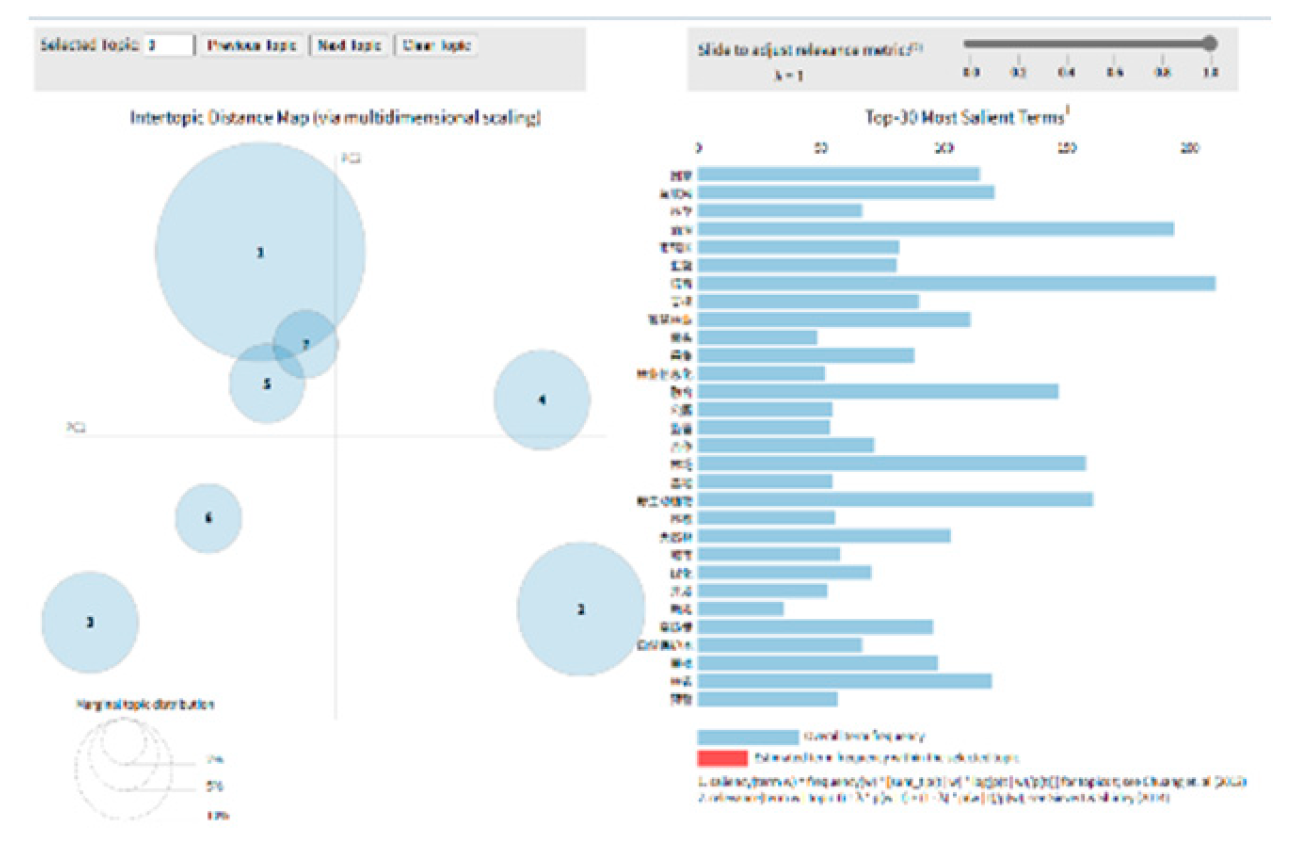
Figure 2.
Impact of topic number on coherence and perplexity.
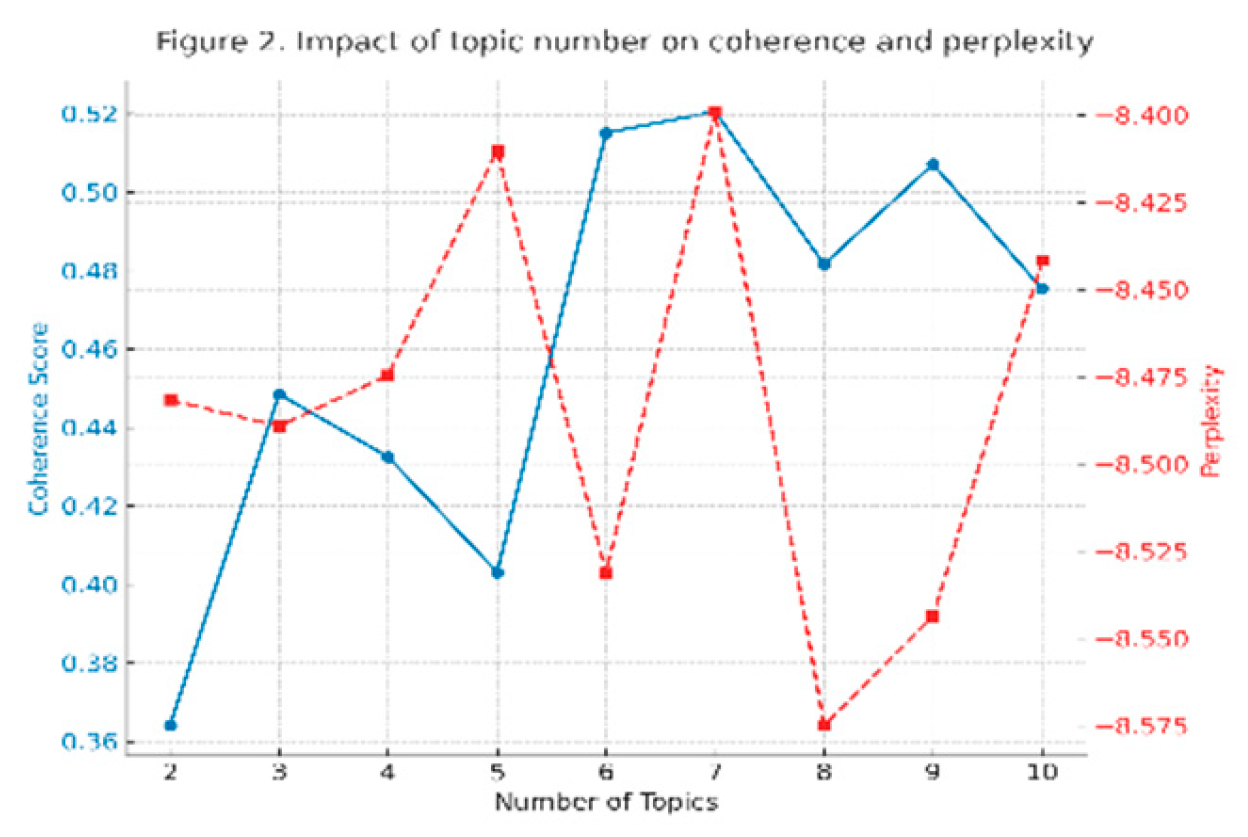
Figure 3.
Keyword Cloud Comparison of Central Policies, Fujian Policies, and Media Reports (a) Keyword cloud of central policies; (b) Keyword cloud of Fujian Province's local policies; (c) Keyword cloud of media reports.
Figure 3.
Keyword Cloud Comparison of Central Policies, Fujian Policies, and Media Reports (a) Keyword cloud of central policies; (b) Keyword cloud of Fujian Province's local policies; (c) Keyword cloud of media reports.
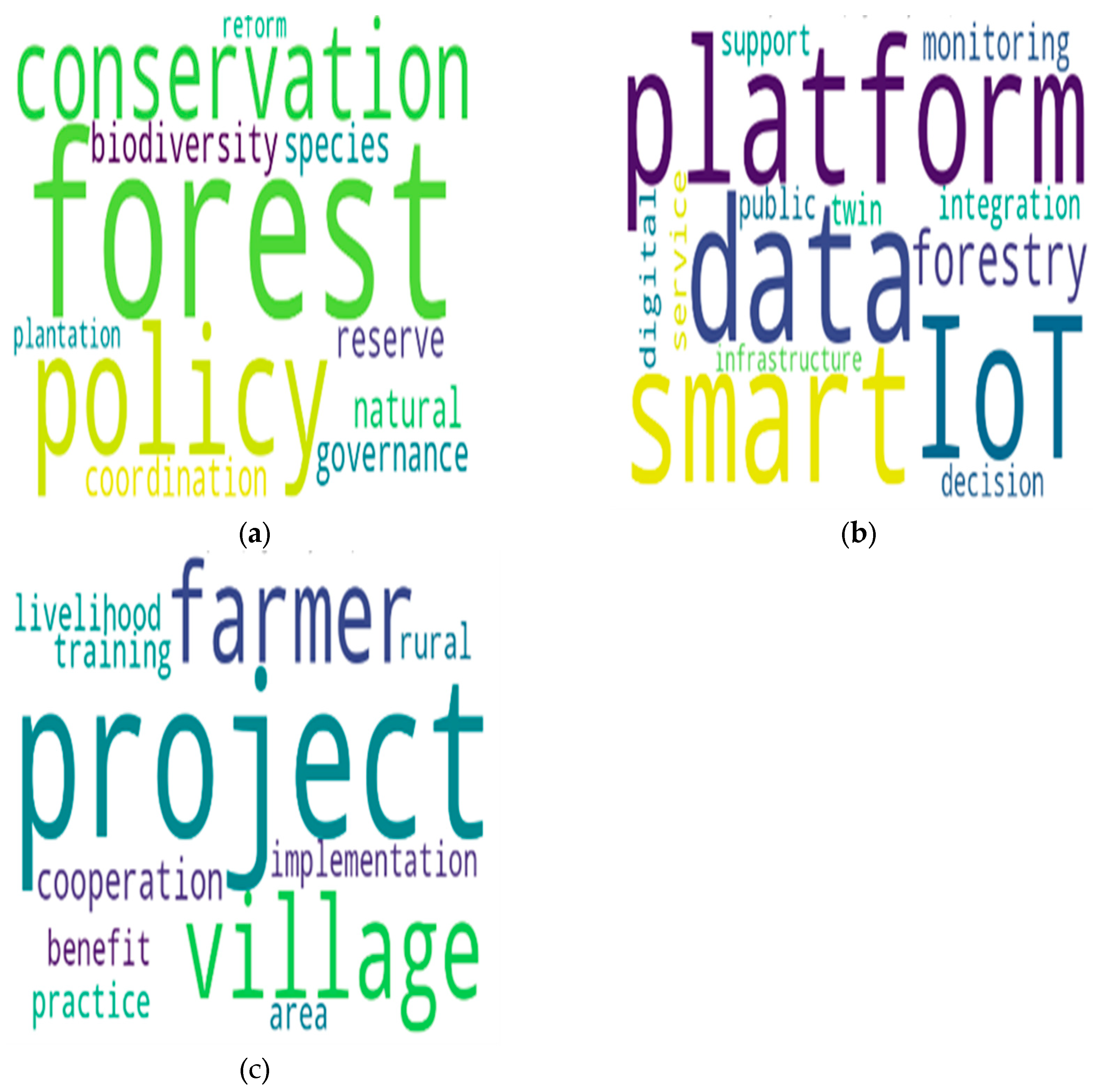
Figure 4.
Topic Proportions across Central Policies, Fujian Policies, and Media Reports.
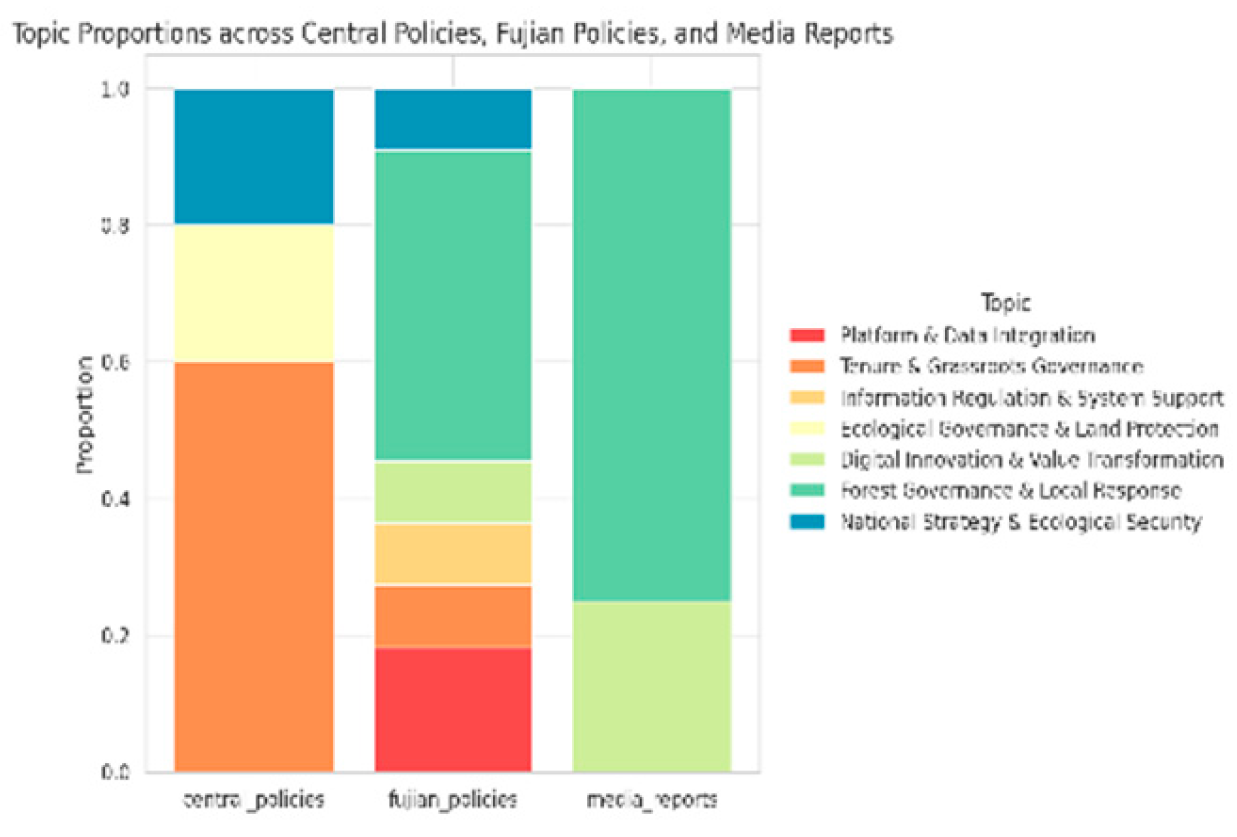
Figure 5.
Thematic Similarity Heatmap among Central Policies, Fujian Provincial Policies, and Media Reports.
Figure 5.
Thematic Similarity Heatmap among Central Policies, Fujian Provincial Policies, and Media Reports.
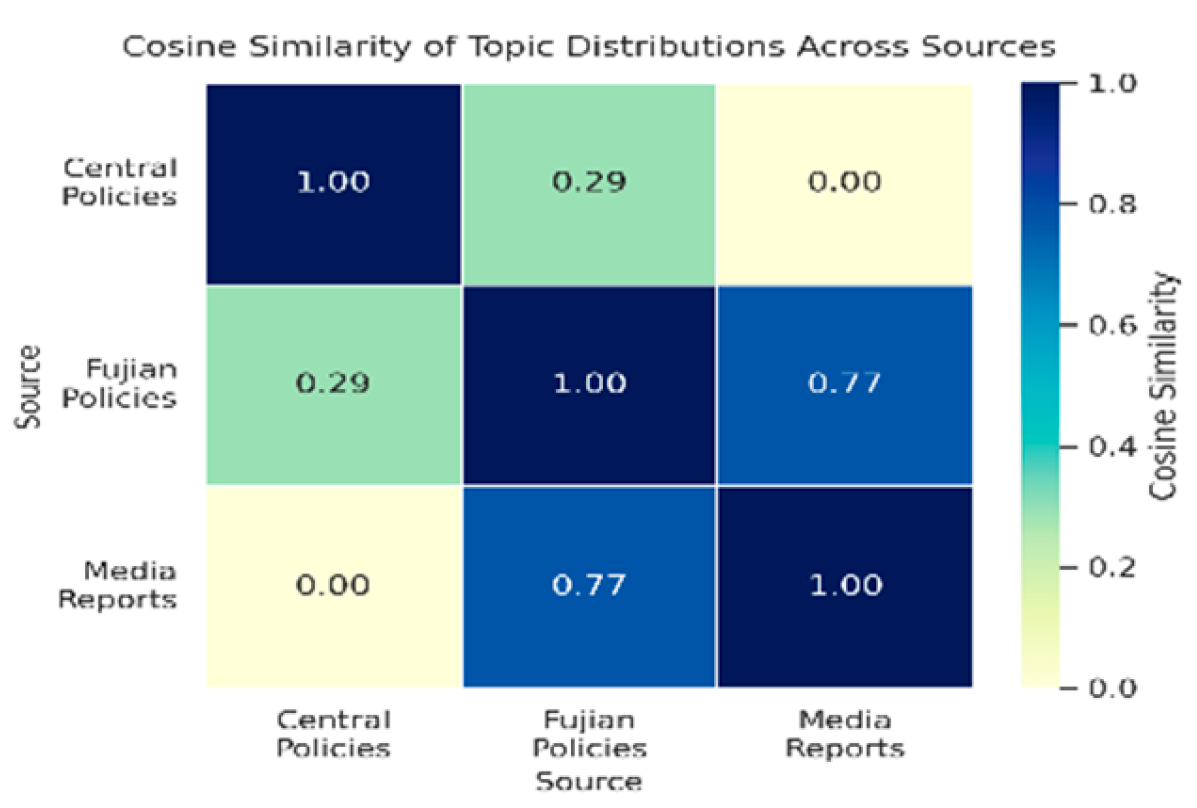
Figure 6.
Back-to-Back Comparison of Media vs. Policy by Topic.
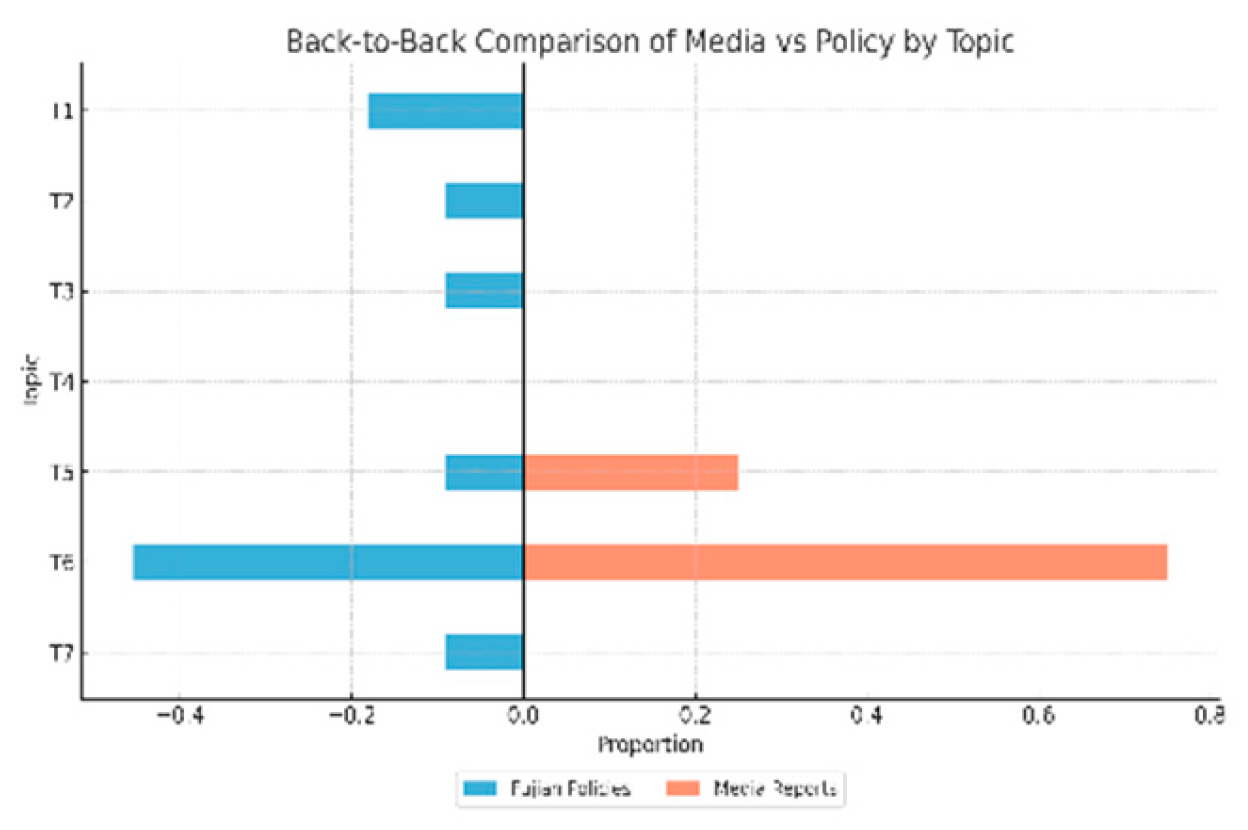
Figure 7.
Policy–Practice Gap by Topic.
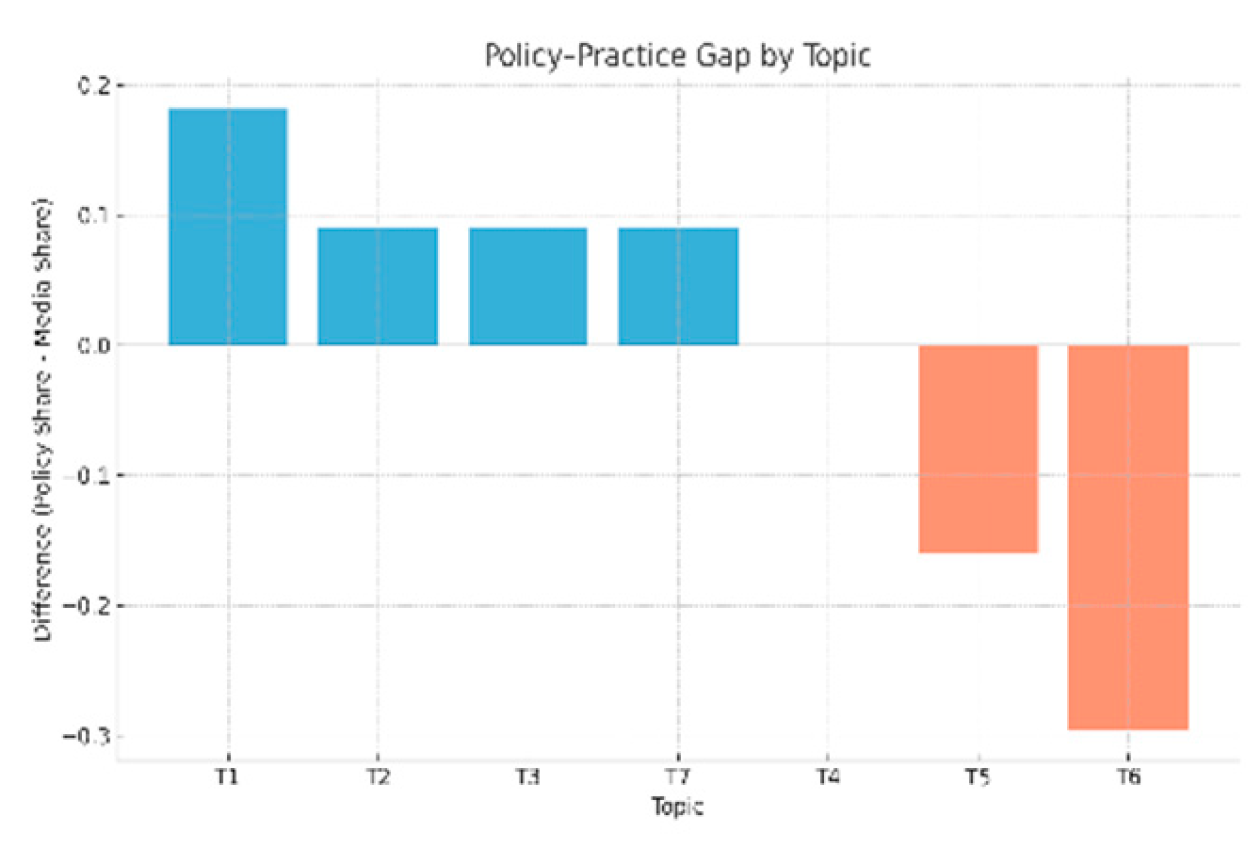

Table 1.
This is a table. Tables should be placed in the main text near to the first time they are cited.
Table 1.
This is a table. Tables should be placed in the main text near to the first time they are cited.
| Theme Label | Top 5 High-Frequency Keywords | Dimension |
|---|---|---|
| Theme 1: Platform and Data Integration | Internet, Data Collection, Data Integration, Data Convergence, Public Service | Technological Enablement Dimension |
| Theme 3: Information Regulation and System Support | Forestry Informatization, Institutional Support, Regulatory Framework, Data Convergence, Approval Processes | |
| Theme 5: Digital Innovation and Value Transformation | New Quality, Smart Forestry, Ecological Product Value Realization, Empowerment, High Quality | |
| Theme 2: Tenure and Grassroots Governance | Forestry and Grassland, Leadership, Forest Rights, Forest Farm, Alignment | Governance Mechanisms dimension |
| Theme 6: Forest Governance and Local Response | Forest Farmers, Forest Manager System, Rural Areas, Nature Reserves, Forest Resources | |
| Theme 4: Ecological Governance and Land Protection | Natural Forest, Governance, Wildlife, Ecological Protection, Vegetation | Ecological Goals Dimension |
| Theme 7: National Strategy and Ecological Security | National, Governance, Parks, Greening, Ecological Protection |
Table 2.
Typology of Policy–Practice Response Paths in Smart Forestry: Evidence from Fujian Cases.
| Case name | Time&place | Content | Theme | Terms and Conditions | Media Reporting | Matching Type |
|---|---|---|---|---|---|---|
| Miscanthus management project in Xiapu County | 2022-2023, Xiapu County | Drones + Video Sensing + Multi-Segment Management Processes | T6 | 'Fujian Province Intelligent Forestry “123”Project Construction ' (2022): “Establish an integrated sky–earth monitoring system.” | “In this “battle” without smoke, digital scientific and technological means such as satellite remote sensing, drones, and video surveillance have been unveiled. The employment of drones is of particular significance in this context, as it enables the acquisition of enhanced flexibility, acuity of vision, and the establishment of a “sentinel.”” | Policy clarity-local response |
| AI-Based Wildlife Monitoring in Zhouning County | 2023, Zhouning County Forestry Bureau | Infrared Cameras + AI Recognition for Biodiversity Database Construction | T5 | 14th Five-Year Plan for Forestry Informatization (2021): “Establish a wildlife monitoring system.” (No specific technical route specified) | “Network infrared cameras, through infrared sensing and AI recognition technology, have photographed Grade II national protected animals such as white pheasants and leopard cats, providing first-hand information for biodiversity protection” | Policy generalization-locally initiated |
| Intelligent Forest Fire Early Warning Platform in Putian City | 2023, Xitianwei Town, Putian | AI Algorithms + UAV Coordination for Fire Monitoring | T3 T6 | 14th Five-Year Plan for Forestry Informatization (2021): “Develop an intelligent forest fire early warning system.” | “The platform combines artificial intelligence, the Internet of Things, cloud computing, and other technologies to automatically monitor forest fires and issue early warnings” | Policy framework-technical deepening |
Disclaimer/Publisher’s Note: The statements, opinions and data contained in all publications are solely those of the individual author(s) and contributor(s) and not of MDPI and/or the editor(s). MDPI and/or the editor(s) disclaim responsibility for any injury to people or property resulting from any ideas, methods, instructions or products referred to in the content. |
© 2025 by the authors. Licensee MDPI, Basel, Switzerland. This article is an open access article distributed under the terms and conditions of the Creative Commons Attribution (CC BY) license (http://creativecommons.org/licenses/by/4.0/).
Copyright: This open access article is published under a Creative Commons CC BY 4.0 license, which permit the free download, distribution, and reuse, provided that the author and preprint are cited in any reuse.


