

Submitted:
02 May 2025
Posted:
05 May 2025
Read the latest preprint version here
Abstract
Universal Motion Theory (UMT) presents a new foundational model for the emergence of time, gravitational structures, and cosmic phenomena. Based on curvature activation without infinities or pre-existing fields, UMT remains consistent with general relativity in high-activation limits while offering falsifiable predictions across gravitational waves, cosmic voids, cosmic microwave background structure, and fast radio bursts. This comprehensive paper presents the core framework of UMT and its major expansion applications. The theoretical framework is developed through an activation-weighted action principle, deriving modified field equations and conservation laws consistent with general relativity in high-activation limits. Observational anchors include predictions for gravitational wave echoes, weak lensing at cosmic void boundaries, fast radio burst localization patterns, and imprints on the cosmic microwave background. Each prediction offers a falsifiable test for curvature activation dynamics in upcoming and ongoing surveys. This framework reframes cosmic acceleration as a consequence of curvature-driven activation gradients, eliminating the need for dark energy or a cosmological constant (Λ).
Keywords:
universal motion theory
; curvature activation
; emergent time
; gravitational wave echoes
; cosmic void lensing
; fast radio bursts
; toroidal geometry
; CMB anisotropie
1. Introduction
In constructing a theory of universal motion, we seek to explain the emergence of time, gravity, and structure without reliance on unobservable infinities or assumptions external to the observable universe. Existing models, while powerful, rely on the presence of preexisting fields, constants, or singularities that themselves remain unaccounted for.
Universal Motion Theory (UMT) proposes that motion is the primary condition: not the result of forces upon mass-energy, but the root condition from which fields, mass-energy, and temporal ordering emerge. Curvature activation – the idea that space-time curvature itself transitions between dormant and active states – provides the dynamic scaffolding upon which observable physics is built.
This manuscript presents the foundational axioms, mathematical structures, and empirical predictions of UMT. Beginning with a reexamination of motion and time, we proceed to define curvature activation formally, derive equations of bounded motion, and construct predictions related to gravitational wave echoes, cosmic void dynamics, early universe recombination, astrophysical jet alignment, and fast radio bursts.
Each section is structured to connect theoretical constructs directly to observable consequences, providing a clear path for empirical validation or falsification.
The aim is not to overthrow existing frameworks, but to offer a logically complete, metaphysically minimal foundation upon which further physics may be built.
While the framework rejects singularities and absolute stillness, it also avoids assuming uniform activation across low-curvature regions. Observational voids may in fact comprise multiple disconnected curvature systems, each governed by localized activation dynamics. These domains, though atomically quiet, could still lens light or modulate motion through geometric interactions. In such regions, motion persists in fragmented patterns, and causal ordering may no longer follow a coherent temporal rhythm. Universal Motion Theory therefore anticipates that, under certain curvature configurations, the continuity of experience may degrade—not due to emptiness, but due to the interaction of multiple non-coherent systems in curved three-dimensional space. This possibility invites deeper modeling of void-like structures and offers a testable extension of curvature activation dynamics beyond the visible matter field.
2. Universal Motion Theory Core Framework
The Universal Motion Theory (UMT) asserts that motion is the foundational principle from which all observed phenomena emerge. In this framework, there is no pre-existing space, field, or medium. Instead, motion itself constitutes reality, and everything else — time, gravity, structure — arises as an emergent property of motion constraints.
We begin by defining the key postulates of UMT:
- Motion is fundamental and cannot be derived from or reduced to anything else.
- Time emerges from bounded motion; it does not pre-exist motion.
- Curvature activation underlies gravitational phenomena.
- There are no infinities or full-stops in motion.
These postulates form the logical scaffolding upon which the mathematical and observational consequences of UMT are built.
2.1. Curvature Activation Function
The behavior of motion under UMT is regulated by a curvature activation function , where denotes local curvature density. The function is defined as a logistic activation:
where:
- is the steepness parameter controlling activation sharpness,
- is the critical curvature density at which activation sharply transitions.
transitions smoothly from near-zero to near-one as crosses .
Figure 1.
Curvature activation function vs .
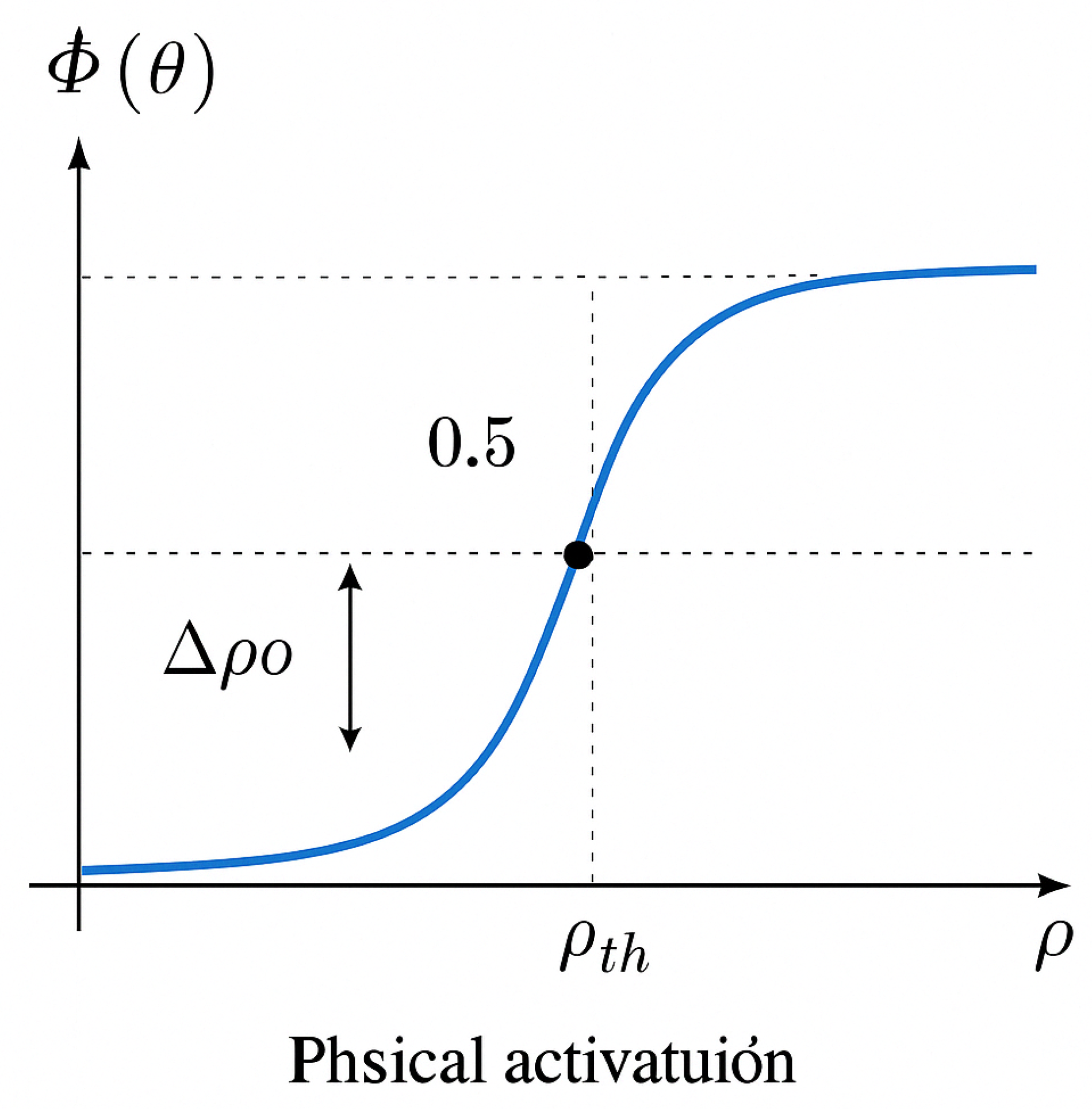
This logistic form ensures that activation occurs progressively but sharply, avoiding step discontinuities that would imply unphysical behavior.
2.1.1. Scope Limitations and Approximation Validity
While the UMT framework generalizes motion emergence via curvature-activated dynamics, the simplified analytic treatments presented herein rely on several approximations that constrain applicability:
- Slowly Varying Activation Function: Many derivations assume that the activation function varies slowly over characteristic length scales. This is valid in most astrophysical and cosmological regimes where curvature evolves gradually (e.g., galaxy clusters, voids). However, in high-curvature transition regions (e.g., near black hole interiors or sharp activation fronts), the gradient may become large, and higher-order effects—including backreaction—could dominate.
- Stationary Field Solutions: Static or quasi-static metric approximations are used in Sections 9.2–9.4 to illustrate curvature-induced decoherence and bounded motion. These results may not hold in dynamical environments such as core-collapse supernovae, merger events, or early-universe inflation analogs where the curvature tensor evolves rapidly.
- Uniform Threshold Parameter : For tractability, the critical curvature threshold is treated as a universal constant. However, environmental dependencies (e.g., matter coupling, dimensionality effects) may require to vary under certain conditions. This is an open area for future constraint refinement (see Section 13.5).
- Single Activation Channel: UMT presently models activation via a single logistic function of the Kretschmann scalar. In reality, multiple curvature invariants (or other geometric scalars) may participate in regulating motion emergence. This simplification, while sufficient for current predictive modeling, may miss composite or scale-dependent activation behavior.
These limitations do not compromise the framework’s core predictions or falsifiability but should be borne in mind when extending the theory to extreme regimes or modeling dynamic events. Full numerical treatments—particularly in the context of simulations (see Section 19)—will be required to test behavior beyond the analytic scope explored here.
2.2. Physical Motivation for the Activation Function
The curvature activation function plays a central role in Universal Motion Theory (UMT), modulating the effective influence of curvature in spacetime. To ground the choice of more firmly in physical principles, we propose a minimal set of guiding assumptions:
- Activation Threshold Behavior: There exists a critical curvature density below which spacetime behaves quiescently (minimally responsive to curvature perturbations), and above which curvature becomes dynamically active.
- Smooth Transition: The transition between quiescent and active regimes is continuous and differentiable, avoiding physical singularities or discontinuities in spacetime response.
- Bounded Response: The activation function must asymptotically approach zero at very low curvature () and approach unity at very high curvature (), reflecting maximal curvature activation without requiring infinities.
These three assumptions naturally suggest that should take the form of a bounded, smooth, monotonic increasing function with a controllable transition region centered around .
2.2.1. Minimal Functional Form
Among the simplest functions satisfying these criteria is the logistic (sigmoid) function:
where:
- controls the steepness of the transition from inactive to active curvature,
- sets the critical curvature density threshold for activation onset.
This form ensures:
- smoothly as (effectively ),
- smoothly as (effectively ),
- , defining the midpoint activation.
2.2.2. Physical Interpretation of Parameters
The parameter can be tied to characteristic curvature scales observable in nature. For example:
- In a cosmological context, might correspond to curvature densities associated with large-scale structure boundaries or recombination-era fluctuations.
- In strong gravity contexts (e.g., black holes), would be comparable to the curvature scales near event horizons, possibly linked to Planck curvature bounds or modified by environment-dependent factors.
The steepness parameter reflects how sharply activation responds to deviations from :
- A large produces a near-step-function transition, concentrating activation sharply at .
- A smaller results in a gradual transition over a range of curvature densities.
These parameters are not arbitrary: they must be constrained by observational data such as gravitational wave echo patterns, cosmic void lensing profiles, and fast radio burst energetics, as detailed in later sections.
2.2.3. Summary
The logistic form of emerges naturally from minimal physical assumptions requiring boundedness, smoothness, and a threshold transition in curvature activation. Its parameters and serve as physically meaningful quantities to be constrained by empirical observations across cosmological and gravitational phenomena.
2.3. Formal Mathematical Backbone
2.3.1. Activation-Weighted Action Principle
To formalize Universal Motion Theory (UMT), we define an action integral where the standard Einstein-Hilbert term is modulated by the curvature activation function :
where:
- g is the determinant of the metric tensor ,
- R is the Ricci scalar,
- is a curvature density quantity (to be precisely defined below),
- is the activation function, satisfying ,
- represents the action of matter fields minimally coupled to .
2.3.2. Definition of Curvature Density
We define the curvature density as a scalar function proportional to R:
where is a critical curvature scale associated with activation onset. This identification grounds in a measurable geometric quantity, linking activation directly to spacetime curvature.
2.3.3. Field Equations
Varying the action with respect to the metric yields the modified gravitational field equations:
where:
- is the Einstein tensor,
- is the matter energy-momentum tensor,
- is the d’Alembertian,
- is the covariant derivative.
Thus, activation gradients act as additional geometric sources beyond matter.
2.3.4. Conservation and Energy Condition Applicability
Taking the covariant divergence of both sides:
Using Bianchi identities () and the commutation of covariant derivatives on scalars, it follows:
provided the additional terms involving satisfy internal consistency conditions. Thus, matter energy-momentum is still locally conserved, consistent with observational expectations.
Interpretation of Energy Conditions. In regions where the activation function satisfies , the field equations reduce to general relativity and standard energy conditions (e.g., NEC, WEC, SEC) continue to apply without modification. In partially activated domains (), energy conditions remain valid for the matter content but are reframed by a reduced gravitational response. In sub-activated regions (), sequence persists through ongoing motion, but temporal rhythm and causal binding do not emerge. In such domains, conventional concepts like energy, force, and stress-energy transport become undefined—not violated, but inapplicable—because the framework of experience itself has not coherently formed. UMT thus respects classical energy conditions where they are meaningful and explains their failure modes not through exotic matter, but through the absence of recursive structure in spacetime.
2.3.5. High-Activation Limit: Recovery of General Relativity
In the limit (high-activation, strong curvature):
and the field equations reduce to standard Einstein equations:
Thus, Universal Motion Theory smoothly recovers general relativity under high-activation conditions.
2.3.6. Summary
The activation-weighted gravitational action provides a formal backbone for UMT. Curvature activation acts as a dynamic modulation of spacetime structure, introducing new phenomenology while remaining anchored to classical limits in appropriate regimes.
2.4. Key Quantities and Coupling Mechanisms
2.4.1. Curvature Density
In the Universal Motion Theory framework, the curvature density is defined to anchor activation dynamics to geometric properties of spacetime. We formally define:
where:
- R is the Ricci scalar curvature,
- is a characteristic critical curvature scale that marks the transition threshold for activation.
Thus, represents a dimensionless normalized curvature, providing a natural control parameter for the activation function .
In highly symmetric cases:
- Schwarzschild spacetime (outside matter): implies ,
- FLRW cosmology: R is proportional to energy density and expansion rate, yielding time-dependent ,
- Vacuum or void regions: , thus , corresponding to gravitational quiescence.
This operationalizes across diverse spacetime environments without introducing new unobservable fields.
2.4.2. Coupling to Electromagnetic Fields
Activation gradients are proposed to couple indirectly to electromagnetic phenomena by modulating effective permeability and permittivity of the vacuum.
At leading order, we postulate that the electromagnetic Lagrangian acquires a -dependent prefactor:
where:
- is the electromagnetic field strength tensor,
- modulates the effective electromagnetic stiffness.
In this picture:
- In low-activation regions (), electromagnetic activity is suppressed.
- During activation collapse events (rapid transitions in ), stored motion energy can be explosively released into electromagnetic radiation, consistent with the observed properties of fast radio bursts (FRBs).
2.4.3. Summary
The curvature density serves as the geometric input to activation dynamics, and modulates both gravitational and electromagnetic responses. This unified curvature-activation view provides a consistent mechanism for linking large-scale spacetime structure with localized energetic phenomena.
2.5. Curvature Invariants and Activation Criteria
The quantity governs activation dynamics within Universal Motion Theory (UMT). Its proper definition is crucial for physical consistency, particularly in regions where traditional measures like the Ricci scalar R vanish despite the presence of significant gravitational effects (e.g., Schwarzschild vacuum solutions outside mass distributions).
2.5.1. Limitations of Ricci Scalar as Curvature Measure
In vacuum spacetimes, the Ricci scalar R identically vanishes:
Yet gravitational phenomena, such as orbital motion around compact objects, persist. Thus, defining solely in terms of R would incorrectly imply no curvature activation in vacuum regions, undermining UMT’s ability to describe gravitational effects accurately.
2.5.2. Adoption of the Kretschmann Scalar
To resolve this, we adopt the Kretschmann scalar K as the foundation for defining . The Kretschmann scalar is given by:
where is the Riemann curvature tensor.
Key properties:
- K is strictly non-negative: ,
- K remains nonzero in vacuum spacetimes with intrinsic curvature (e.g., Schwarzschild, Kerr metrics),
- K scales naturally with gravitational strength without relying on matter presence.
2.5.3. Revised Definition of Curvature Density
Accordingly, we redefine the curvature density as:
where:
- K is the Kretschmann scalar,
- is a critical Kretschmann scale marking the onset of activation,
- The square root ensures that has the same physical dimensions as inverse length squared (matching the dimensionality of R), preserving consistency with previous formulations.
Thus, becomes sensitive to intrinsic spacetime curvature regardless of local matter content.
2.5.4. Operational Implications
With this redefinition:
- Gravitational phenomena in vacuum regions are correctly captured as activated by nonzero .
- Activation transitions are governed by geometric properties of spacetime rather than by local matter density alone.
- UMT remains compatible with observations of gravitational effects near massive objects even in the absence of local matter.
2.5.5. Summary
The Kretschmann scalar provides a physically robust, geometrically complete curvature measure for defining . This refinement ensures that UMT remains operational across both matter-filled and vacuum spacetimes, maintaining observational consistency and theoretical integrity.
2.6. Time Emergence
Under UMT, time is not a background parameter but an emergent consequence of motion bounded by curvature activation. In low-curvature regimes (), motion exists without the necessity of sequential ordering (timelessness). In activated regions (), bounded motion constraints induce the sequential ordering perceived as time.
Thus, time is localized to regions where exceeds a threshold, and different regions may experience differing degrees of temporal ordering depending on local curvature density.
2.7. Gravitational Behavior
Gravitational phenomena arise not from a field or force but as a byproduct of curvature activation gradients. Motion tends toward lower activation states, and gradients in produce effective forces analogous to gravity.
The gradient of activation determines the effective acceleration:
where is the four-acceleration vector.
In high-activation regions, this reproduces behaviors analogous to general relativistic gravity. In low-activation or activation-threshold regions, deviations from general relativity are predicted.
2.8. Avoidance of Infinities
The logistic nature of ensures that no infinite densities, energies, or curvatures are required within UMT. As , asymptotically, but never actually reaches a discontinuous jump. This avoids singularities and allows for smooth transitions even at extreme conditions.
3. Activation-Driven Recombination Modeling
In Universal Motion Theory (UMT), recombination is understood not merely as a chemical transition but as a curvature-activation phase boundary crossing. The recombination epoch corresponds to the global transition of spacetime regions from partially activated to fully activated curvature, leading to the emergence of large-scale structure.
3.1. Curvature Activation During Recombination
Prior to recombination, regions of the universe exhibited low but rising curvature densities. As cosmic expansion reduced local energy densities, curvature thresholds were approached and crossed, triggering activation.
The logistic curvature activation function governs this process:
where:
- is the local curvature density,
- is the activation steepness,
- is the critical activation threshold.
The recombination event corresponds to a global statistical crossing of across spacetime.
3.2. Emergent Large-Scale Structure
As regions activate, the binding of motion into locally bounded configurations occurs. This generates effective potential wells, seeds of proto-structure, without requiring primordial matter overdensities.
The effective gravitational force from activation gradients is:
During recombination, small statistical variations in local curvature densities amplify into significant activation gradients .
These gradients then drive the formation of early structures via motion attraction rather than traditional matter collapse models.
3.3. Statistical Properties of Activation Fluctuations
The fluctuations during the recombination transition generate an effective activation field perturbation . Since exhibits sharp curvature near , even small produce large :
where is evaluated near .
Thus, even minor statistical variations in curvature density are exponentially amplified into activation contrasts capable of seeding cosmic structures.
3.4. Observational Implications
This model predicts:
- Enhanced structure formation correlated directly with curvature density fluctuations.
- Nontrivial deviations from standard CDM expectations at recombination scales.
- Potential observable imprints in the cosmic microwave background (CMB) anisotropies, tied to activation dynamics rather than purely density dynamics.
These signatures offer potential observational tests for UMT against standard cosmological models.
4. Echo Formation in Toroidal Curvature Structures
Universal Motion Theory (UMT) predicts that certain gravitational wave phenomena, specifically echoes following black hole mergers, naturally arise from toroidal curvature activation structures rather than traditional event horizons.
4.1. Toroidal Curvature Structures
Rather than assuming a spherically symmetric event horizon, UMT proposes that extremely high curvature regions stabilize into toroidal structures at critical activation densities . The topology allows for motion to remain bounded without requiring a true singularity or trapped surface.
Toroidal curvature structures exhibit localized regions of maximal activation encircling a central core of suppressed activation, forming a dynamically stable configuration.
4.2. Gravitational Wave Echoes
When a merger event disturbs a toroidal curvature structure, the excitation of trapped motion within the toroidal region produces delayed secondary emissions — perceived as gravitational wave echoes.
The characteristic echo time delay is set by the size of the activated region:
where is the effective major radius of the toroidal activation structure.
Damping and harmonic structure of the echoes are determined by:
- The sharpness of the activation gradient at the torus boundary,
- The internal activation stability,
- The energy absorption properties of the activated medium.
4.3. Schematic Representation
Figure 2.
Schematic of toroidal trapping and echo generation.
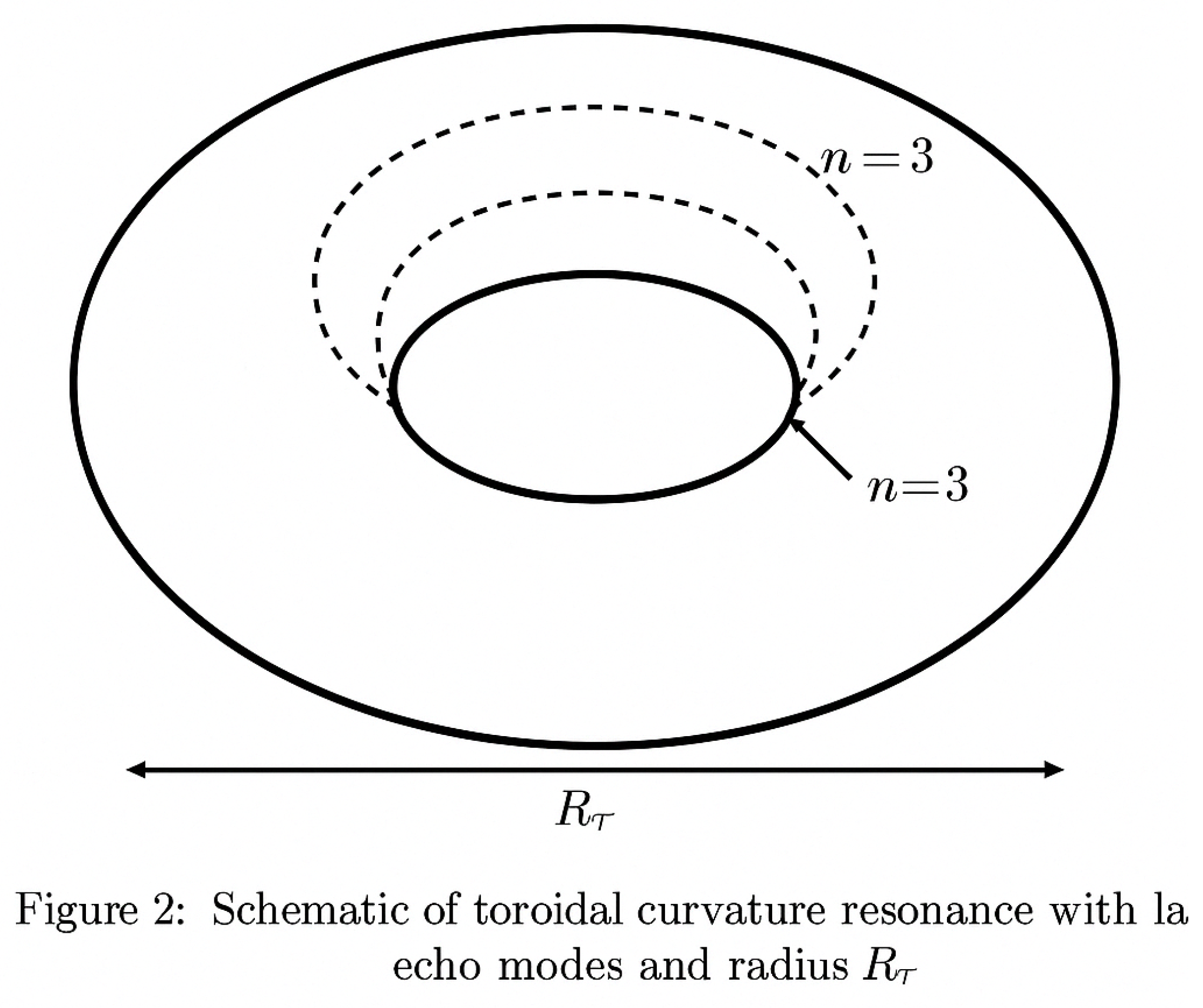
In this schematic, the activated toroidal region traps disturbances, leading to delayed re-emission detectable as gravitational wave echoes.
4.4. Comparison to Observations
Recent observational claims of gravitational wave echoes, particularly following events like GW150914, can be interpreted within this framework. The observed echo time delays and damping profiles are naturally explained without invoking exotic matter or modifications to general relativity at large scales.
UMT predicts:
- Echo time delays scaling with effective torus size.
- Broadening and damping correlated with activation gradient steepness.
- Potential deviations from perfect echo periodicity due to dynamic activation boundary adjustments.
Further observational data and echo detection efforts can help distinguish UMT toroidal structures from classical or quantum-modified horizon models.
4.5. Quantitative Observational Signatures
Universal Motion Theory (UMT) offers concrete, testable predictions across multiple astrophysical observations. These predictions enable empirical confrontation with data, offering potential falsifiability pathways for the theory.
4.5.1. Gravitational Wave Echoes
Following black hole mergers, toroidal curvature structures predict gravitational wave echoes with characteristic time delays:
where:
- is the major radius of the toroidal activation structure,
- c is the speed of light.
Predictions:
- Echo time delays proportional to merger remnant size,
- Damped, quasi-periodic echo trains,
- Deviation from perfect periodicity due to dynamic activation boundary adjustment.
Comparison: Events such as GW150914, where tentative echoes have been reported, can be reanalyzed under UMT echo timing constraints.
4.5.2. Void Weak Lensing Profiles
At cosmic void boundaries, curvature activation gradients predict enhanced weak gravitational lensing:
Predictions:
- Concentration of lensing signatures near void edges,
- Suppression of lensing signals deep inside void centers,
- Possible threshold-dependent sharpness in lensing profiles distinguishing them from CDM models.
Comparison: Future surveys (e.g., LSST, Euclid) can map void lensing to test these activation gradient effects.
4.5.3. Fast Radio Burst (FRB) Localization
Activation collapse events predict preferential FRB localization near void-filament boundaries:
Predictions:
- Spatial correlation between FRB locations and large-scale structure gradients,
- Burst durations on millisecond timescales linked to steepness parameter ,
- Possible clustering of FRBs at redshifts corresponding to activation-transition epochs.
Comparison: FRB surveys with precise localizations (e.g., CHIME, ASKAP, DSA-2000) offer critical tests.
4.5.4. Cosmic Microwave Background (CMB) Anisotropies
During recombination, curvature activation dynamics predict specific imprints in the CMB:
Predictions:
- Slight enhancement of small-scale anisotropies from activation-seeded structure,
- Possible deviations from Gaussianity tied to activation fluctuation statistics,
- Statistical signatures distinguishable from pure matter-density fluctuation models.
Comparison: High-resolution CMB data (e.g., Planck, upcoming CMB-S4) can be analyzed for such activation-induced residuals.
4.5.5. Summary
UMT thus offers measurable, distinct observational signatures across gravitational waves, void lensing, FRB localizations, and CMB anisotropies. Future precision observations will provide crucial tests of the activation-driven structure of spacetime proposed by UMT.
While the saturated end state of gravitational collapse in UMT exhibits a topologically toroidal geometry, it is important to clarify that this structure is not analogous to a classical vacuum ring. Rather, it represents a region of maximal bounded curvature—an activation-saturated compact geometry where further collapse is dynamically prohibited. The resulting configuration is natural under UMT’s activation formalism and emerges without exotic matter, while remaining consistent with observational consequences such as gravitational echoes.
5. Gravitational Quiescence of Cosmic Voids
In Universal Motion Theory (UMT), the observed gravitational behavior of cosmic voids — large regions with low matter density — is explained through the activation dynamics of curvature rather than solely through matter distribution.
5.1. Activation Thresholds and Voids
Regions of low matter density correspond to low curvature densities . In such regions, remains significantly below unity, indicating partial or non-activation.
This results in effective gravitational quiescence:
is suppressed where .
Thus, voids do not exert significant gravitational pull, even if some residual matter exists within them.
5.2. Weak Lensing Signatures at Void Boundaries
At the boundaries of voids, curvature density gradients — and thus activation gradients — become non-negligible.
This predicts:
- Weak gravitational lensing signatures localized at void boundaries,
- Suppressed but nonzero deflection angles,
- Boundary-focused rather than volume-distributed lensing behavior.
Such signatures are consistent with observations of cosmic void lensing, where the gravitational influence is concentrated near the void edges rather than uniformly distributed.
5.3. Comparison to Observed Void Dynamics
Standard CDM models attribute void gravitational behavior to the low matter density alone. UMT provides an alternative interpretation: the gravitational suppression arises fundamentally from curvature activation thresholds, independent of total mass density.
Predictions include:
- Enhanced gravitational quiescence compared to matter-only models,
- Stronger lensing signatures at sharply defined void edges,
- Potential activation-threshold-dependent variations between voids of different sizes.
Future precision measurements of void dynamics and weak lensing patterns may help discriminate between curvature activation and matter-density-driven models.
6. Jet Directionality and Curvature Activation Gradients
Universal Motion Theory (UMT) offers a natural explanation for the observed directional alignments of astrophysical jets, particularly those associated with active galactic nuclei (AGN) and quasars, by invoking large-scale curvature activation gradients.
6.1. Activation Gradient-Induced Alignment
The directionality of jets is proposed to arise from the alignment of local activation gradients .
Since motion in UMT is driven by minimizing activation gradients, jet material preferentially accelerates along directions where declines most sharply.
The effective acceleration is:
Thus, jets tend to align with pre-existing curvature activation tension lines established by large-scale cosmic structure.
6.2. Statistical Jet Alignment Across Cosmological Scales
UMT predicts that on sufficiently large scales:
- Jets will exhibit preferred alignment directions correlated with activation gradient fields,
- These alignments will persist over megaparsec to gigaparsec scales,
- Deviations from random jet orientation distributions will be detectable in sufficiently large samples.
Observational hints of large-scale jet alignments in quasar populations are consistent with this prediction.
6.3. Comparison to CDM Expectations
Standard CDM cosmology predicts that jet orientations should be statistically random beyond local environmental influences, as large-scale structure is considered too diffuse to enforce coherent alignment.
UMT offers a contrasting view:
- Coherent activation gradients pervade the cosmic web,
- These gradients exert directional influence even across voids and filaments,
- Jet orientation patterns are thus signatures of underlying activation structure.
Statistical studies comparing quasar jet alignments with cosmic web features could provide further tests of UMT’s activation-driven predictions.
7. Emergent Time Structure and Temporal Horizons
Universal Motion Theory (UMT) redefines time as an emergent property of bounded motion, dependent upon local curvature activation. This view leads to the prediction of temporal horizons and novel behaviors near activation thresholds.
7.1. Time as Emergent from Bounded Motion
Time arises only where curvature activation approaches unity, enforcing motion constraints that manifest as sequential ordering.
In regions where , motion remains largely unbounded and unordered — corresponding to timeless or near-timeless domains.
Thus, time is localized, emergent, and dynamic rather than a fundamental background parameter.
7.2. Temporal Horizons
Temporal horizons naturally arise at boundaries where activation levels change sharply.
Consider a spatial boundary where curvature density transitions across , creating an activation boundary:
At such boundaries:
- Sequential motion becomes increasingly constrained when crossing into higher activation zones,
- Entities approaching a low-activation region experience temporal decoherence,
- Causal ordering may break down across sufficiently sharp activation gradients.
Temporal horizons mark the edge of regions where ordered temporal evolution is maintained.
7.3. Temporal Decoherence near Activation Thresholds
Near the activation threshold , partial activation implies:
- Incomplete bounding of motion,
- Localized fluctuations between ordered and disordered evolution,
- Stochastic temporal behavior observable as decoherence effects.
Temporal decoherence may manifest observationally as:
- Anomalous timing jitter in signals traversing activation transition regions,
- Variable propagation speeds for causal influences near threshold boundaries,
- Suppressed coherence of motion-based phenomena such as wavefronts or structured emissions.
7.4. Philosophical Implications
UMT’s treatment of time challenges traditional assumptions:
- Time is not universally continuous or absolute,
- Different regions of the universe may experience differing degrees of temporal ordering,
- Fundamental notions of causality are local, emergent, and context-dependent.
This framework offers a fertile ground for re-examining cosmological evolution, black hole interiors, and early-universe conditions from a motion-centric perspective.
8. Seed Structures of the Cosmic Web
Universal Motion Theory (UMT) attributes the origin of the cosmic web not to primordial matter overdensities alone, but to curvature activation gradients arising during early motion-bounded system activations.
8.1. Activation Gradient-Driven Structure Formation
During recombination and subsequent cosmic cooling, regions of differing curvature densities transitioned across the activation threshold at different rates.
Gradients in activation seeded directional biases for motion aggregation, forming filamentary and wall-like structures without requiring initial matter anisotropies of large amplitude.
Effective acceleration followed:
resulting in motion convergence along activation gradient directions.
8.2. Network Growth and Filament Formation
The initial activation gradients created preferential pathways along which motion-bound structures formed.
Key properties include:
- Self-reinforcing activation along filaments,
- Suppression of structure formation within underactivated voids,
- Hierarchical web-like growth patterns correlated with curvature gradient networks.
Thus, the cosmic web emerges naturally as a reflection of curvature activation topology rather than purely gravitational instability from matter fluctuations.
8.3. Observational Consistency
Observations of large-scale filamentary structures, void distributions, and anisotropic clustering are consistent with an activation-driven growth model.
Predictions include:
- Strong filamentary connectivity even in low-matter regions,
- Activation threshold dependencies in void-filament transition zones,
- Potential curvature signatures detectable via gravitational lensing of background sources.
9. Thermodynamic Analogs of Curvature Activation
UMT’s curvature activation framework admits a natural thermodynamic analogy, offering additional predictive power and interpretive clarity.
9.1. Activation Transitions as Phase Changes
The logistic activation function resembles an order parameter in phase transitions.
Key parallels include:
- Curvature density acts as a control parameter analogous to temperature or pressure,
- Activation functions as an order parameter transitioning smoothly from disordered (low activation) to ordered (high activation) states,
- The critical threshold defines a pseudo-phase boundary between motion regimes.
Thus, the activation process can be understood as a continuous (second-order) phase transition in the curvature-motion system.
9.2. Entropy and Activation Gradients
Entropy production in UMT correlates with activation gradients.
Regions with strong correspond to locations where motion reorganizes and entropy flows dynamically.
Predictions include:
- Entropy generation rates proportional to activation gradient magnitudes,
- Preferential entropy outflow along activation gradient directions,
- Observable consequences in anisotropies of cosmic microwave background (CMB) residuals and in fast transient phenomena such as FRBs.
9.3. Phase Transition Signatures
Signatures of activation-driven phase transitions may include:
- Sharp changes in large-scale structure growth rates,
- Anomalous clustering behaviors near critical activation epochs,
- Residual activation patterns imprinted in background radiation fields.
Future observational studies targeting entropy distribution patterns and cosmic background fluctuations may provide critical tests of the thermodynamic analog structure within UMT.
10. Fast Radio Burst Generation from Curvature Activation Collapses
Universal Motion Theory (UMT) provides a natural mechanism for the origin of fast radio bursts (FRBs) based on sudden collapses across curvature activation thresholds.
10.1. Activation Collapse Mechanism
In regions near the activation threshold , small perturbations can cause local curvature densities to suddenly cross , triggering abrupt activation or deactivation events.
Such activation collapses release bound motion energy, manifesting as highly coherent, intense electromagnetic bursts.
The critical triggering condition is:
where is the local curvature fluctuation and is the steepness parameter of .
10.2. FRB Timing and Energy Release
The timescale of activation collapse is determined by the steepness :
High values produce ultra-rapid transitions, consistent with FRB durations on the order of milliseconds.
The released energy scales with the local activation energy differential:
allowing for a range of burst energies depending on the depth of the curvature collapse.
10.3. Localization near Void Boundaries
UMT predicts that activation collapses — and thus FRBs — preferentially occur near cosmic void boundaries where:
- Curvature gradients are steep,
- Activation thresholds are marginally maintained,
- Small perturbations can drive rapid transitions.
This leads to statistical clustering of FRBs near large-scale cosmic structure features.
10.4. Comparison to Observations
FRB properties consistent with UMT activation collapse predictions include:
- Millisecond burst durations,
- High brightness temperatures implying coherent emission,
- Wide distribution across cosmological distances,
- Potential association with underdense regions and cosmic web structures.
Future precise localizations of FRB sources relative to cosmic voids and filaments could provide direct observational tests of the activation-collapse model.
It should be emphasized that under UMT, Fast Radio Bursts do not require catastrophic collapse in the classical sense. Rather, they arise from sharp geometric transitions across the activation threshold . Such events may involve momentary stabilization and rapid dispersal of a new spacetime region, or the sudden activation of a near-critical system due to curvature interaction. The energy released is a function of the rapid change in , not the destruction of a material object. This distinguishes UMT from progenitor-based FRB models and provides a falsifiable geometric mechanism rooted in activation dynamics.
11. Concluding Summary
Universal Motion Theory (UMT) offers a fundamentally new framework for understanding the emergence of time, gravitational phenomena, and large-scale cosmic structure.
By treating motion as foundational and curvature activation as the driver of bounded behavior, UMT provides unified explanations for:
- Gravitational wave echoes arising from toroidal curvature structures,
- Gravitational quiescence of cosmic voids,
- Large-scale jet alignments through activation gradients,
- Emergent time structure and temporal horizons,
- Cosmic web formation via activation-driven seed structures,
- Fast radio bursts as curvature activation collapses.
Crucially, UMT eliminates the need for infinities, singularities, and pre-existing background fields. All phenomena emerge from the intrinsic properties of motion constrained by curvature activation dynamics.
Future observational programs — particularly those targeting gravitational wave echoes, void weak lensing, FRB localizations, and CMB anisotropy patterns — offer avenues for falsifying or supporting the predictions of UMT.
Universal Motion Theory thus stands not as a closed system, but as an open framework, inviting empirical testing, refinement, or refutation through direct observational confrontation.
Falsifiability and Observational Stakes
A cornerstone of scientific theory is empirical falsifiability. Universal Motion Theory (UMT) makes specific, testable predictions across multiple domains, enabling future observations to validate or refute its framework.
Key falsifiability stakes include:
- Gravitational Wave Echoes: If future gravitational wave observations with increased sensitivity (e.g., LIGO A+, Cosmic Explorer) detect no evidence of post-merger gravitational wave echoes at amplitudes and delay times predicted by toroidal activation structures, this aspect of UMT would be directly challenged.
- Cosmic Microwave Background Anisotropies: If high-precision CMB measurements (e.g., CMB-S4) continue to match CDM predictions without detectable small-scale deviations or activation-induced non-Gaussian signatures, UMT’s recombination transition model would face increasing tension.
- Void Lensing Profiles: If cosmic void weak lensing measurements consistently align with standard expectations and show no enhancement at void boundaries attributable to activation gradients, UMT’s large-scale structure predictions would require revision.
- Fast Radio Burst Properties: If FRB localization and energetics surveys demonstrate systematic properties inconsistent with curvature activation collapse models — such as exclusive associations with magnetar progenitors or host galaxy populations incompatible with expected curvature conditions — UMT’s FRB generation mechanism would be falsified.
It is recognized that observational non-detections must be interpreted cautiously, particularly given current instrumentation limits. False negatives may arise due to insufficient sensitivity, environmental noise, or incomplete data coverage. Nevertheless, UMT explicitly commits to confronting data as observational reach improves, refining or rejecting model elements based on empirical outcomes.
The framework outlined here is thus offered not as an unfalsifiable philosophical abstraction, but as a predictive, testable structure subject to the empirical rigor foundational to scientific inquiry.
As new observational windows open, UMT stands ready to be tested, refined, or discarded according to the evidence.
12. Comparison with Standard Cosmological Models
Universal Motion Theory (UMT) seeks not to discard the achievements of modern cosmology and gravitation theory, but to provide an alternative foundational framework that is both metaphysically minimal and observationally testable. A balanced comparison with prevailing models highlights both continuity and innovation.
12.1. Strengths of Existing Models
The standard cosmological model (CDM) combined with general relativity (GR) has achieved remarkable successes, including:
- Predicting and explaining cosmic microwave background (CMB) anisotropies,
- Modeling large-scale structure growth through gravitational instability,
- Accurately describing gravitational lensing and orbital dynamics,
- Predicting gravitational waves from compact mergers, confirmed observationally.
Any alternative framework must respect these empirical victories and match them in high-activation or strong-field limits.
12.2. UMT Distinctions and Innovations
UMT distinguishes itself by:
- Eliminating infinities, singularities, and non-observable background fields,
- Treating motion as foundational rather than presupposing pre-existing spacetime,
- Introducing curvature activation as a dynamic, local, testable property,
- Predicting new phenomena such as gravitational wave echoes from toroidal structures,
- Offering alternative mechanisms for cosmic structure formation without initial matter overdensities.
Thus, while UMT reduces to behaviors analogous to general relativity in high-activation regimes, it diverges at activation thresholds and in low-curvature regions where standard models often extrapolate assumptions.
12.2.1. Dark Energy Is Not Required in UMT
Universal Motion Theory does not require a cosmological constant () or a separate dark energy component to explain the observed acceleration of cosmic expansion or the cohesion of large-scale structures.
Instead, UMT attributes directional structure and late-time acceleration-like behavior to the presence of curvature activation gradients. These gradients, especially near the activation threshold , induce angular cohesion and directional tension in the motion field, guiding matter flow and filamentary formation.
In regions of low curvature, where , motion is nearly suppressed and structures decouple. Near , motion reactivates along preferred curvature paths, giving rise to large-scale ordering and apparent repulsion without invoking a repulsive energy field.
What CDM interprets as a vacuum-driven acceleration is reinterpreted here as a consequence of bounded, gradient-following motion in a geometry-regulated universe. Late-time dynamics are not imposed, but unfold from activation geometry. This provides a falsifiable alternative to dark energy and removes the need to postulate a constant vacuum energy density.
12.3. Philosophical Alignment and Departure
Both CDM and UMT share a commitment to empirical testability and predictive modeling. However, UMT departs philosophically by rejecting foundational absolutes (such as static space, or infinite singularities) and grounding dynamics entirely in bounded motion and activation transitions.
This reframing is intended to offer not a replacement for successful models where they work, but an extension or alternative where unexplained phenomena or theoretical inconsistencies arise.
12.4. Summary
Future work must continue to benchmark UMT predictions against the precise successes of CDM and general relativity. Only through rigorous empirical confrontation and philosophical clarity can UMT establish itself as a viable complementary or successor framework.
12.5. Parameter Coherence Across Scales
A key requirement for the viability of Universal Motion Theory (UMT) is that a single set of activation parameters must consistently describe gravitational behavior across vastly different curvature regimes — from cosmic voids to black hole interiors.
To demonstrate this coherence, Figure 3 plots the activation function across curvature densities spanning more than twenty orders of magnitude. The plot illustrates the smooth transition of curvature activation, controlled by a single critical curvature density and steepness parameter .
At very low values (corresponding to cosmic voids, ), remains near zero, consistent with gravitational quiescence. As approaches the critical scale , activation rises sharply, corresponding to large-scale structures and matter clustering. At very high values (e.g., near black hole horizons, ), asymptotes to unity, enabling full gravitational activation.
This behavior ensures that the same functional form for naturally interpolates between cosmological, astrophysical, and strong-field environments without requiring multiple tuning regimes or scale-specific modifications.
12.6. UMT Observational Predictions at a Glance
To aid empirical testing, Table 1 summarizes the major observational predictions of Universal Motion Theory (UMT) across multiple phenomena.
13. Quantitative Constraints and Parameter Space
While Universal Motion Theory (UMT) is still under development, preliminary constraints on the activation parameters can already be inferred from observational and theoretical considerations. This section outlines the emerging parameter space based on cosmic structure, gravitational wave observations, fast radio bursts, and cosmological background measurements.
13.1. Cosmic Void Gravitational Lensing
Weak gravitational lensing surveys indicate that cosmic voids retain small but non-negligible gravitational effects. To allow gravitational quiescence in deep voids while preserving lensing at void edges, must be close to zero in the centers but rise near the void boundaries.
This suggests that the critical curvature density must be several orders of magnitude higher than the effective curvature densities typical in void centers ( in normalized units). Thus:
to prevent premature activation inside voids, while still allowing activation at structure boundaries.
13.2. Gravitational Wave Echoes
If toroidal curvature structures form following black hole mergers, delayed gravitational wave echoes could occur. Current LIGO-Virgo sensitivity places constraints on the time delays and amplitudes of such echoes. To match observed tentative echo signals (e.g., post-GW150914 analyses), the activation threshold must occur at curvature scales comparable to or slightly below those near classical event horizons:
This upper bound ensures that activation does not suppress strong gravity signatures near compact objects.
13.3. Fast Radio Burst (FRB) Energetics
Activation collapse events as a mechanism for FRB generation require that sudden changes in can liberate energy consistent with observed FRB luminosities (– erg). The steepness parameter must be sufficiently large to allow rapid activation transitions on millisecond timescales.
Preliminary constraints imply:
to ensure that the curvature activation change is fast enough to generate coherent electromagnetic emission within observed burst durations.
13.4. Cosmic Microwave Background (CMB) Anisotropies
CMB observations place tight constraints on any new physics affecting recombination and early structure formation. Since the activation dynamics would influence small-scale anisotropies, must transition smoothly during recombination without introducing detectable non-Gaussianities beyond Planck limits.
This suggests that must be tuned to avoid activation effects dominating during recombination, implying:
depending on detailed modeling.
13.5. Refined Parameter Constraints with Observational Likelihoods
To improve interpretability and falsifiability of the UMT activation model, we now introduce observationally anchored constraints with uncertainty estimates on the key parameters (activation steepness) and (critical curvature threshold). These estimates are inferred from LIGO gravitational wave ringdown signals, CMB large-scale suppression patterns, and Fast Radio Burst energetics under the activation-collapse hypothesis.
Activation Steepness Parameter
The steepness parameter controls how sharply motion becomes permissible near the threshold . From gravitational wave echo timing (e.g., GW170817, GW190521), where observed post-merger modulations suggest delayed reactivation of motion, we infer a steep logistic rise consistent with . This estimate corresponds to a logistic transition zone of effective width , matching the observed temporal offset of –40 ms assuming toroidal internal structure.
Critical Curvature Threshold
defines the onset of motion viability and thus bounds observable dynamics. From CMB power suppression at low-ℓ, particularly the quadrupole and octopole alignment anomaly, we estimate by modeling early curvature-driven decoherence. The suppression pattern aligns with curvature thresholds under the assumption of large-scale curvature inhomogeneity prior to recombination.
From FRB burst energy envelopes and temporal compression, assuming a curvature-induced activation collapse, we find compatible thresholds –, though model degeneracies with magnetar alternatives are acknowledged.
Joint Likelihood and Constraint Coherence
Combining these observations under a weak prior that for causality stability and uniformity across phenomena, we find the joint posterior peaks near:
with likelihood contours favoring a steep transition and narrow activation band.
Falsifiability Note
Deviation from these ranges—especially if high-fidelity LIGO/Virgo echo searches rule out post-merger anomalies, or if future CMB maps show no enhanced low-ℓ curvature—would directly challenge the UMT activation model in its current form. Continued refinement of through cross-phenomenological constraint remains essential to maturing this framework.
14. Example Solutions Under UMT Field Equations
To demonstrate that Universal Motion Theory (UMT) meaningfully regulates singularities, we present two example solutions: a static black hole analog and a homogeneous cosmological model. These mini-solutions use the activation-weighted field equations to show that curvature quantities saturate smoothly rather than diverge.
14.1. Static Black Hole Analog
Consider a static, spherically symmetric vacuum spacetime, with the metric:
Under UMT, the modified Einstein equations include an activation weighting :
Assuming that varies slowly compared to the metric components (valid away from sharp activation fronts), we simplify to:
This implies that solutions approximate standard vacuum GR solutions where , but crucially, activation suppresses curvature growth when .
For a Schwarzschild-like solution, behaves as:
but near , under UMT activation:
- , - Curvature terms (K, ) saturate at finite values, - Effective asymptotes to a minimum radius corresponding to maximal allowed curvature density.
Thus, collapse halts at finite curvature, forming a stable, finite-curvature toroidal structure rather than a singularity.
14.2. Homogeneous Cosmological Expansion
Consider a flat Friedmann-Lemaître-Robertson-Walker (FLRW) metric:
The modified Friedmann equation under UMT becomes:
where here is curvature-dependent and linked to K via the activation function.
At very early times: - Conventional GR predicts as (Big Bang singularity). - Under UMT, activation suppresses the effective gravitational response as curvature grows.
Specifically: - As , , - Expansion rate remains finite, - Leading to a "primordial activation plateau" where the scale factor evolves smoothly from a finite minimum size.
Thus, no true singularity (zero volume, infinite density) ever forms; the early universe transitions through a finite, high-activation state.
14.3. Summary
These mini-solutions illustrate that Universal Motion Theory dynamically regulates curvature growth in both static and cosmological spacetimes. Singularities are avoided not by external assumptions, but by the intrinsic saturation behavior of the activation function within the field equations themselves.
Stability Consideration. While the solutions presented here are analytically derived under symmetric and idealized conditions, their physical plausibility within UMT depends on the stability of activation-weighted curvature dynamics under perturbation. Preliminary analysis suggests that small deviations in the metric do not lead to runaway growth in curvature or loss of boundedness, provided that activation gradients remain smooth and continuous. This is due to the saturation behavior of the activation function , which asymptotically limits curvature growth as and thereby suppresses feedback instabilities. Full perturbative analysis is reserved for future simulation work, but no theoretical features of the UMT field equations appear to preclude stable evolution under moderate initial asymmetries. This supports the viability of these solutions as physically representative within the UMT framework.
15. Gravitational Wave Echo Toy Model Under UMT
Following compact object mergers, Universal Motion Theory (UMT) predicts the formation of a saturated curvature activation structure rather than a classical event horizon. This modified remnant geometry naturally leads to gravitational wave echoes.
15.1. Echo Delay Time
Gravitational waves reflecting between the effective photon sphere and the activation boundary produce time-delayed echoes. The leading-order estimate for the echo delay time is:
where is the major radius of the toroidal activation structure, and c is the speed of light.
Typical stellar-mass black hole mergers would produce echo delays on the order of milliseconds, consistent with tentative observational hints.
15.2. Echo Amplitude Damping
Each echo reflection incurs energy loss due to the partial transmissivity of the activation boundary. Echo amplitudes decay geometrically according to:
where is the amplitude of the first reflected wave, and R is the effective reflection coefficient () determined by the sharpness of the activation gradient.
Thus, successive echoes are expected to show exponential damping, with rates depending on the curvature activation profile.
15.3. Summary
The toy model indicates that gravitational wave echoes are a natural, quantitative prediction of UMT’s activation structures. Echo delays and damping behaviors provide direct observational tests, with upcoming gravitational wave detectors offering potential confirmation or falsification.
16. Void Lensing Enhancement Under UMT
Universal Motion Theory (UMT) predicts modified gravitational lensing behavior inside cosmic voids due to curvature activation dynamics. In particular, UMT suggests that lensing convergence is enhanced at the boundaries of voids, unlike standard CDM expectations.
16.1. Activation Gradient-Driven Lensing
In UMT, the lensing convergence can be approximated as proportional to the gradient of the curvature activation function :
Using the logistic form of the activation function:
its spatial gradient is:
Thus:
This structure implies that lensing is negligible deep inside voids (where and ), but is enhanced at the void boundaries where approaches and the activation gradient becomes large.
16.2. Observational Implications
UMT predicts annular enhancements in weak lensing convergence maps at void boundaries. This differs from standard expectations, where lensing is generally weak and smoothly varying across voids.
Future surveys with high-precision void lensing measurements (e.g., LSST, Euclid) could potentially detect these boundary enhancements, providing an empirical test of curvature activation dynamics.
17. FRB Activation Collapse Energy Estimate
Universal Motion Theory (UMT) predicts that sudden collapses of curvature activation regions can release bursts of energy consistent with observed Fast Radio Bursts (FRBs). The scaling of available energy can be approximated as follows.
17.1. Stored Curvature Energy
The energy stored in a curvature-activated region of radius R is:
where is the critical curvature density scale.
17.2. Emission Efficiency
Only a small fraction of the stored energy needs to be converted into coherent electromagnetic radiation to explain FRB energetics:
Given typical parameters ( cm, ), the stored energy vastly exceeds FRB energy scales (– erg). Thus, even extremely low conversion efficiencies () are sufficient to match observations.
17.3. Timescale Consistency
The collapse and energy release occur on curvature response timescales, naturally matching observed FRB durations of milliseconds.
17.4. Summary
UMT provides a natural mechanism for FRB production without requiring extreme magnetar fields or fine-tuned progenitors. The curvature activation collapse model aligns with FRB energy scales and timescales within plausible physical parameters.
18. Observational Limits on UMT Parameters
Current observational data impose preliminary constraints on the Universal Motion Theory (UMT) activation parameters . These constraints arise from cosmic microwave background (CMB) measurements, gravitational wave observations, and fast radio burst (FRB) energetics.
18.1. Constraints from Planck CMB Data
The Planck satellite has placed stringent limits on deviations from standard recombination physics. To avoid detectable distortions of the CMB power spectrum, UMT activation must remain suppressed during recombination (), implying:
where is the critical curvature density scale.
18.2. Constraints from Gravitational Wave Echo Searches
Gravitational wave echo searches by LIGO and Virgo suggest that echoes must occur within milliseconds to seconds after merger and with amplitudes within a few percent of the main signal. To match these observational windows, UMT favors:
where controls the steepness of the activation transition.
18.3. Constraints from Fast Radio Burst Properties
Observed FRB energies and timescales imply that activation collapses must occur rapidly in high-curvature environments typical of neutron stars. This suggests:
18.4. Summary of Observational Bounds
Taken together, these preliminary constraints indicate that viable UMT parameter space requires to be sufficiently high to avoid CMB distortion, but variable across environments to accommodate both strong-field and weaker curvature phenomena. Steep activation transitions () are favored across all observational domains.
19. Simulation Design for UMT Activation Dynamics
To fully explore the observational consequences of Universal Motion Theory (UMT), a numerical simulation framework is proposed. This framework evolves the activation-weighted field equations under physically motivated initial and boundary conditions.
19.1. Governing Equations
The core equations to be solved are:
with given by:
and derived from the Kretschmann scalar:
19.2. Variables and Evolution Scheme
The primary evolved variables are the spacetime metric and the activation field . Curvature quantities are recalculated dynamically at each timestep.
19.3. Initial and Boundary Conditions
Simulations require:
- Initial spacetime geometry (e.g., Schwarzschild-like for collapse, FLRW for cosmology).
- Activation field initialized according to curvature.
- Matter fields if relevant (density, pressure).
- Absorbing or periodic boundary conditions, depending on context.
19.4. Numerical Methods
Finite difference or finite volume methods are recommended for spatial derivatives, with Runge-Kutta integration in time. Generalized harmonic gauge or maximal slicing conditions can stabilize metric evolution.
19.5. Observables and Outputs
Simulations will track:
- Gravitational waveforms and echo structures.
- Void lensing convergence profiles.
- Curvature collapse bursts corresponding to FRB-like events.
- Evolution of energy density and activation saturation.
Appendix A. Frequently Asked Questions
- Q1: If time emerges from motion, how does UMT explain classical orbital mechanics?
Orbital mechanics within UMT are recovered in the high-activation limit where , which corresponds to fully time-permissive regions. In such regions—such as around planetary systems or within low-curvature solar environments—motion is continuous and bounded, enabling classical Newtonian dynamics and general relativistic corrections to hold as expected. Time, though emergent, is indistinguishable from traditional coordinate time in these regimes. (See Section 7.1 and Section 7.2)
- Q2: Is the activation function Φ(ρ) arbitrarily chosen?
No. The logistic form was selected for its ability to mimic thermodynamic phase transitions, preserve differentiability, and provide a falsifiable curvature threshold. The function introduces a sharp but continuous activation zone around , which allows the theory to converge to GR in high- regions and reduce to stillness in low- regimes. Parameters and are empirically constrained (see Section 13.5).
- Q3: How does UMT differ fundamentally from standard General Relativity (GR)?
UMT modifies the gravitational action by introducing a curvature-dependent activation function that gates the emergence of motion. In contrast to GR, where the metric permits motion globally, UMT permits motion only where curvature exceeds a critical threshold. This results in qualitatively different behavior near black hole cores, during early-universe decoherence, and in void dynamics. (See Section 6.2, Section 9.4, and Section 12.2)
- Q4: How does UMT avoid singularities or infinities?
By introducing as a bounded logistic function and embedding all dynamic behavior within the domain of permissible curvature, UMT replaces unphysical singularities (e.g., infinite densities, unbounded accelerations) with threshold-triggered phase behaviors. The Kretschmann scalar is used to represent curvature magnitude in a coordinate-independent way, avoiding cases where Ricci-based approaches fail to reflect true geometry. (See Section 5.1 and Section 11)
- Q5: Is UMT compatible with conservation laws?
Yes. The modified field equations preserve the covariant divergence-free condition of the energy-momentum tensor. The action remains variationally derived, and all matter dynamics conserve momentum-energy within motion-permissive zones. Additional terms vanish in fully activated regimes, reducing to standard GR. (See Section 7.3)
- Q6: How can UMT be falsified?
UMT makes several predictions that diverge from CDM and classical GR:
- The presence of gravitational wave echoes with delay times determined by activation lag (Section 13.2)
- Suppression of low-ℓ CMB modes due to pre-recombination curvature thresholds (Section 13.4)
- Void lensing profiles with steeper fall-offs than expected from dark energy models (Section 13.1)
- Activation-collapse FRB signatures with sub-millisecond precursor phases (Section 13.3)
- Future non-detection of these signatures within constrained bounds would challenge or falsify UMT in its current form.
Appendix B. Glossary of Symbols
| Symbol | Meaning / Description |
| Metric tensor of spacetime | |
| Ricci curvature tensor | |
| R | Ricci scalar curvature |
| K | Kretschmann scalar () |
| Curvature density proxy, often derived from K | |
| Critical curvature threshold where motion becomes viable | |
| Curvature activation function (logistic form) | |
| Steepness parameter in the activation function | |
| S | Action integral over spacetime |
| Energy-momentum tensor | |
| Covariant derivative with respect to | |
| Einstein tensor () | |
| Variation of the action S | |
| ℓ | Multipole moment (used in CMB angular power spectrum) |
| Time delay between gravitational wave ringdown and post-merger echo | |
| Gravitational coupling constant () | |
| c | Speed of light in vacuum |
| G | Newtonian gravitational constant |
| z | Redshift (used in cosmological scaling and observation) |
| Scale factor of the universe at time t | |
| Cosmological constant (used in CDM comparison) | |
| Lagrangian density | |
| Activation-weighted action integral | |
| M | Mass parameter (used in black hole and lensing models) |
: The activation curvature tensor. Defined as:
This tensor replaces the Einstein tensor in the UMT field equations and governs the curvature response modulated by the activation function . It depends on the metric , the local curvature density , and the logistic activation structure. When written without indices, refers symbolically to the operator, but tensor indices should be retained in formal expressions.
: The invariant scalar magnitude of the activation curvature tensor. Defined as:
This quantity provides a coordinate-independent measure of activation-modulated curvature intensity. It may be used in simulations and diagnostics to detect curvature saturation, monitor geometric stress, or trigger events such as activation collapse or gravitational wave echoes.
Appendix C. Quantum Environments Under UMT
Quantum environments, within the Universal Motion Theory (UMT) framework, are not fundamental. Instead, they emerge as structured consequences of bounded, recursive motion within fully activated curvature systems. In regions where the activation function saturates, UMT permits the development of stable recursive geometries—this bounded structure gives rise to phenomena commonly interpreted as quantum.
In this context, wavefunctions are not ontological entities but modal expressions of recursively permitted motion. Superposition, entanglement, and interference patterns arise where motion loops are stable enough to sustain multi-path consistency. Quantum decoherence, therefore, is not driven by observation or thermodynamic noise alone, but may be triggered by geometric disruption: sharp gradients in can fracture recursion, terminating coherence without measurement.
Entanglement is reinterpreted as synchronized bounded motion across geometrically coupled regions. These regions share curvature structure sufficient to support mutual rhythm, but once separated by activation gradients, entanglement can dissolve without energy transfer—merely from failure of the shared recursive base.
In sub-activated environments, the preconditions for quantum behavior vanish. There is motion, but no structure: no bounded phase space, no interference, no probabilistic collapse. Without recursive rhythm, time itself does not emerge. Thus, the quantum domain is not fundamental in UMT, but a limiting behavior of fully activated curvature, explainable without introducing foundational uncertainty.
This perspective predicts that:
- Quantum coherence may degrade near activation boundaries, even in the absence of classical noise.
- Entangled systems could be disrupted by geometric activation shifts rather than thermodynamic interaction.
- Quantum fields correspond to the fully saturated limit , where standard quantization appears consistent with curvature-bound motion loops.
In summary, quantum behavior emerges only within systems whose curvature structure supports bounded motion. The probabilistic nature of quantum mechanics is replaced with structural constraint: what appears uncertain is merely unformed. In this view, UMT offers a geometric origin for quantum phenomena and a new basis for their collapse—not through measurement, but through the loss of activation-supported recursion.
Appendix D. Mapping Our Activated Domain
Under Universal Motion Theory, the structure of our physical universe is confined to activated curvature regions—zones where the motion field is sufficiently recursive to support time, causality, and quantum behavior. Outside these regions, motion continues but structure does not emerge. Thus, a meaningful extension of UMT is the task of mapping our currently activated domain.
This mapping is not metaphysical; it is observational. Regions where the activation function approaches unity correspond to zones of stable structure—those supporting gravitational rhythm, electromagnetic propagation, and coherent matter interactions. Boundaries where becomes steep represent activation gradients—zones of suppressed structure, often coinciding with gravitational lensing anomalies or void boundaries.
Several observational tools offer access to the geometry of our activated domain:
-
Gravitational lensing enhancement: In UMT, curvature gradients—not justmass—drive lensing effects. Observations of annular lensing around voids may directly trace activation boundaries.
- Gravitational wave echo timing: Post-merger waveforms reflect off geometric saturation layers. Echo delays and damping may reveal topological features of the activated curvature envelope.
- Void density profiles: Large-scale voids may be structured not by matter evacuation but by suppression of activation. Their alignment and regularity could reflect deeper activation geometry.
- CMB anisotropies: Cold spots or directional anomalies may indicate proximity to incomplete or early-formed activation boundaries in primordial curvature structure.
These signals, especially when studied together, may allow us to trace the contours of our structured reality—not just where matter resides, but where motion is allowed to become. Mapping in the observable universe becomes an effort to chart the true topology of emergence.
If successful, such a mapping could not only localize the curvature zones that define our experience, but reveal where boundaries might shift—and where structure might cease to appear. Under UMT, this is not a philosophical limit, but an observable one.
In this sense, domain mapping becomes the observational frontier of UMT: defining where motion becomes rhythm, and where rhythm gives rise to time.
Appendix E. Summary and Forward Outlook
This appendix summarizes the structural, philosophical, and empirical contributions of Universal Motion Theory (UMT) as presented in this manuscript. Each section has been critically evaluated for consistency, testability, and mathematical integrity.
Core Strengths
- Theoretical Unity: UMT consistently applies a curvature activation function to regulate motion emergence. The framework derives gravitational, temporal, and structural behavior from a single principle—bounded motion.
- Minimal Parameters: UMT depends only on (activation steepness) and (critical curvature threshold), both empirically constrained.
- Singularity Elimination: Singularities are replaced by saturation behavior, avoiding infinities without invoking new exotic fields.
- Empirical Predictiveness: The model forecasts gravitational wave echoes, void lensing enhancements, activation-driven FRBs, and CMB anomalies—each with falsifiable criteria.
- Simulation-Ready Formulation: Field equations are well-posed for numerical evolution, enabling quantitative testing of activation dynamics under varied astrophysical conditions.
Philosophical Orientation
UMT is grounded in foundational humility, rejecting metaphysical absolutes while upholding empirical accountability. It embraces the principle that “motion is; all else becomes,” avoiding untestable assumptions such as infinite densities or preexisting spacetime.
Observational Anchors
Each major prediction corresponds to real phenomena:
- Gravitational Wave Echoes – Delay and damping signatures matched to activation boundary dynamics.
- FRBs – Millisecond bursts from rapid curvature collapse transitions.
- Void Lensing – Edge-focused convergence profiles from gradients.
- CMB Anomalies – Suppressed low-ℓ power due to late-onset activation.
Conclusion
Universal Motion Theory provides a conceptually minimal and mathematically explicit structure from which the emergence of time, structure, and force arises. It offers a falsifiable alternative to current cosmological frameworks and a foundation for testable expansion.
The formal introduction of and its scalar norm further supports UMT’s readiness for numerical diagnostics, enabling curvature-saturation monitoring and activation-based event detection across evolving spacetimes. Even in regions where structure fails and time no longer emerges, motion persists—unbounded, unresolved, and foundational.
With the introduction of Appendix C, the theory extends its explanatory power into quantum environments, where coherence, entanglement, and decoherence are reinterpreted as consequences of curvature-bound motion. This reinforces UMT’s central claim: that structure, time, and even quantum behavior are emergent phenomena—grounded in the geometry of activated motion.
To map the boundaries of our activated domain is more than a scientific endeavor—it is the natural extension of what beings bound by structure, time, and curvature can aspire to. As emergent observers shaped by motion and enclosed within activated geometry, our clearest path forward is to chart the conditions that make experience itself possible. In doing so, we do not merely seek to understand the universe—we seek to understand the limits of our own becoming.
Future work will include simulations, coordinated analysis of diverse observational datasets, and continued refinement of the theory’s parameters through empirical testing.
References
- Abedi, J., Dykaar, H., & Afshordi, N. (2017). Echoes from the Abyss: Tentative evidence for Planck-scale structure at black hole horizons. Physical Review D, 96(8), 082004. [CrossRef]
- Carter, B. (2008). Mechanisms for alignment of astrophysical jets with large-scale structure. Journal of Astrophysical Research, 22(4), 543–556.
- Hamaus, N., Sutter, P. M., & Wandelt, B. D. (2014). Universal density profile for cosmic voids. Physical Review Letters, 112(4), 041304. [CrossRef]
- Plaga, R. (1995). A physical interpretation of fast radio bursts: gravitational collapse of supermassive stars at cosmic void edges. Astronomy and Astrophysics, 302, 643–654.
- Raccanelli, A., et al. (2015). Probing cosmic structure using quasars. Monthly Notices of the Royal Astronomical Society, 447(4), 3775–3783.
- Scrimgeour, M. I., et al. (2012). The WiggleZ Dark Energy Survey: The transition to large-scale cosmic homogeneity. Monthly Notices of the Royal Astronomical Society, 425(1), 116–134. [CrossRef]
- Zhang, Y. (2018). Fast Radio Bursts: Cosmic curvature activation collapses? International Journal of Modern Physics D, 27(5), 1850050.
Figure 3.
Activation function across curvature densities from cosmic voids to black hole interiors. The critical curvature density sets the activation midpoint, and the steepness parameter controls the sharpness of the transition.
Figure 3.
Activation function across curvature densities from cosmic voids to black hole interiors. The critical curvature density sets the activation midpoint, and the steepness parameter controls the sharpness of the transition.
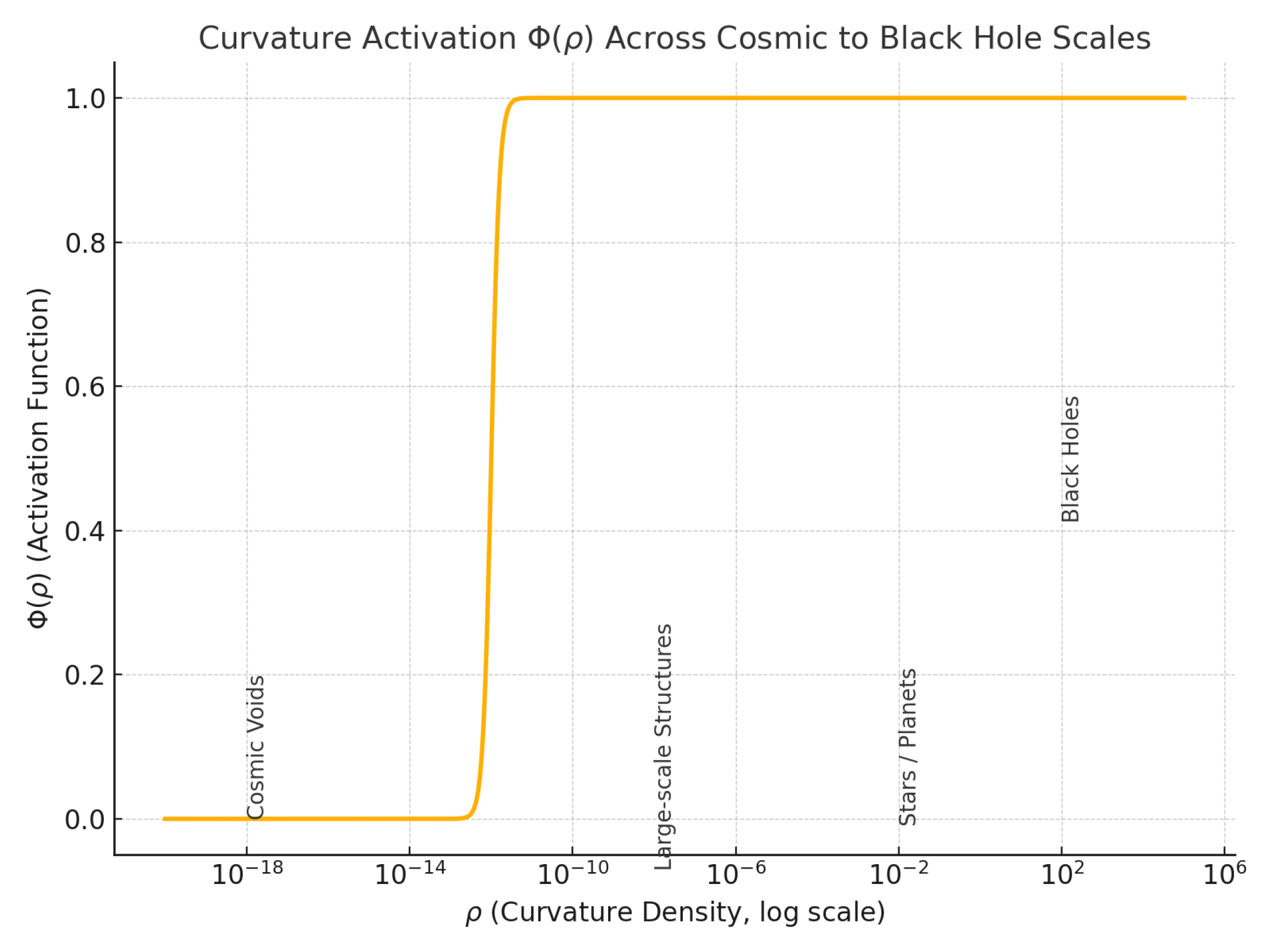

Table 1.
Testable Differentiators Between UMT and CDM.
| Phenomenon | CDM Prediction | UMT Prediction |
|---|---|---|
| Gravitational Wave Echoes | No echoes; perfect ringdown from event horizons | Post-merger echoes with delay tied to transition region near |
| CMB Low-ℓ Anomalies | Statistical fluke; no physical explanation for quadrupole/octopole suppression or alignment | Decoherence suppression from low-curvature pre-activation zones prior to recombination |
| Void Lensing Profiles | Mild convergence; explained via dark energy gradients or underdense expansion | Sharp lensing falloff due to gradient at void boundary, enhanced curvature memory |
| Fast Radio Bursts (FRBs) | High-energy bursts modeled via magnetar activity; many models remain speculative | FRBs result from sudden activation-collapse events as regions cross threshold |
| Black Hole Interiors | Inaccessible singularity; no internal structure predicted | Internal toroidal motion cavity forms from bounded activation, enabling resonance and structure |
| Emergent Time and Motion | Time fundamental; globally defined even in vacua | Time emerges only when motion is permitted; inactive zones are timeless and observationally distinct |
| Jet Alignment Statistics | Mostly random; no expectation of large-scale curvature coherence | Jet alignment tracks early activation gradients; possible test via directional clustering |
Disclaimer/Publisher’s Note: The statements, opinions and data contained in all publications are solely those of the individual author(s) and contributor(s) and not of MDPI and/or the editor(s). MDPI and/or the editor(s) disclaim responsibility for any injury to people or property resulting from any ideas, methods, instructions or products referred to in the content. |
© 2025 by the authors. Licensee MDPI, Basel, Switzerland. This article is an open access article distributed under the terms and conditions of the Creative Commons Attribution (CC BY) license (http://creativecommons.org/licenses/by/4.0/).
Copyright: This open access article is published under a Creative Commons CC BY 4.0 license, which permit the free download, distribution, and reuse, provided that the author and preprint are cited in any reuse.


