

Submitted:
30 April 2025
Posted:
02 May 2025
You are already at the latest version
Abstract
High Andean ecosystems face increasing pressures that threaten the sustainability of rural livelihoods, prompting communities to demand culturally appropriate governance responses. This study examines the structure of environmental concern in two rural communities, Riobamba and Guaranda, in the central Ecuadorian Andes. Applying a tripartite model of egocentric, altruistic, and biocentric concern, we assess its validity through Confirmatory Factor Analysis (CFA) and evaluate the influence of age, gender, ethnicity, and economic activity using Structural Equation Modeling (SEM). The results reveal distinct patterns: biocentric concern predominates in the more urbanized Riobamba, while Guaranda shows a stronger egocentric orientation, accompanied by moderate altruistic concern. Agricultural activity and residence in less urbanized environments are associated with lower levels of environmental concern, whereas age, gender, and ethnicity show no significant effects. Strong intercorrelations among concern types suggest a culturally embedded environmental worldview, consistent with Andean relational ontologies. These findings question the epistemological adequacy of Western frameworks for interpreting environmental concern and underscore the need for systemic, intercultural approaches to environmental policy. Through the integration of quantitative modeling and rural worldviews, this study contributes to a more comprehensive understanding of sustainability in mountain socioecological systems and offers critical insights for rethinking environmental governance in Latin America.
Keywords:
environmental concern
; Andean worldview
; socioecological systems
; environmental values
; confirmatory factor analysis
; structural equation modeling
; intercultural environmental governance
1. Introduction
High-Andean ecosystems provide key ecosystem services such as water regulation, carbon sequestration, and erosion prevention. [1]. In addition to their ecological importance, high-Andean ecosystems are home to indigenous and rural farming communities whose livelihoods directly depend on these services [2]. Currently, these systems face multiple threats, including climate change, the intensification and expansion of the agricultural frontier, overgrazing, and mining activities [3]. Environmental pressures and development constraints in rural areas exacerbate food and water insecurity in these populations [4].
This situation is also evident in the central Andes of Ecuador, where rural communities are continually challenged to maintain a balance between ecosystem conservation and the sustainability of their livelihoods [5]. In response, both governmental and non-governmental organizations have promoted the implementation of public policies and projects aimed at environmental conservation. However, many of these initiatives have been perceived as intrusive, generating conflicts and limiting the effectiveness of these interventions [2]. To design effective and culturally appropriate public policies, it is essential to understand how communities perceive environmental issues[6].
Environmental concern can serve as a crucial starting point for understanding environmental culture and may constitute a key factor in predicting pro-environmental behaviors [7,8]. Understanding this relationship could help overcome barriers that hinder environmental action [9]. Studies in environmental psychology indicate that environmental concern differentially influences three constructs: egocentrism, biocentrism, and altruism [10,11]. Research on environmental concern has primarily focused on countries in Europe, North America, and Asia, with particular emphasis on nations such as China, the United States, and the United Kingdom, as well as in urban contexts [12,13,14,15]. However, in rural areas, the relationship with the environment is more direct and tangible, whereas in cities, concern tends to be more abstract and shaped by global discourses. Therefore, it is important to assess environmental concern within these territorial contexts [16].
In Andean communities, intervention approaches that consider their social dynamics and worldview are often lacking. Moreover, limited attention has been given to how factors such as age, gender, ethnicity, and primary economic activity might influence environmental concern, thereby shaping the design and implementation of successful development programs in these communities. Addressing this gap is essential, as their interpretations of the environment, rooted in principles such as Pachamama and Ayni (reciprocity), may differ significantly from Western narratives, which tend to separate society from nature and prioritize technocratic approaches to conservation [17,18].
Given the central role these ecosystems play both in the Andean worldview and in the daily livelihoods of rural communities, it is essential to understand how people perceive environmental issues from their own territorial and cultural realities. In this context, two study areas were selected in the central Ecuadorian Andes: Riobamba (Chimborazo) and Guaranda (Bolívar). These locations were chosen not only for their geographical proximity but also because they share relevant sociodemographic characteristics, such as a high rate of Indigenous self-identification [19], significant engagement in agricultural activities, and high levels of poverty and malnutrition [20,21]. Moreover, both are surrounded by high-value environmental ecosystems located above 3,000 meters above sea level. However, they differ significantly in their urbanization processes, with Riobamba exhibiting a higher degree of urbanization compared to Guaranda [22].
This research adopts a pre-existing theoretical framework developed and applied in Western contexts [10,11,23,24] with the aim of analyzing its validity within the sociocultural context of Riobamba and Guaranda. To this end, the model's fit is evaluated through Confirmatory Factor Analysis (CFA). Additionally, the influence of sociodemographic variables—such as age, gender, ethnic identity, and predominant economic activity—on different forms of environmental concern is assessed using Structural Equation Modeling (SEM). In parallel, the study critically examines whether this model is truly capable of capturing the lived realities of these communities and explores the extent to which the dimensions of environmental concern relate to the Andean worldview. This approach provides empirical evidence to challenge and adapt Western conceptual frameworks for the analysis of environmental culture in the Andes, thus contributing to the design of intercultural environmental policies that recognize epistemic diversity and community-based practices of nature stewardship.
2. Materials and Methods
2.1. Study Area
Ecuador is territorially organized into three hierarchical levels: provinces encompass cantons, and cantons in turn contain parishes, forming the country’s administrative structure. Figure 1 shows the study area, covering the cantons of Riobamba (Chimborazo Province) and Guaranda (Bolívar Province), located in the central Ecuadorian Andes. In these locations, rural zones are more extensive than urban ones, with low population density and a significant presence of high Andean ecosystems. In Riobamba, rural parishes are situated closer to the cantonal capital, whereas in Guaranda they are more dispersed and located farther from the urban center. Within the San Juan parish, part of the Riobamba canton, lies the Chimborazo volcano, which reaches an elevation of 6,310 meters above sea level and is considered the highest snow-capped peak in Ecuador. Its presence shapes the region’s topography and contributes to the diversity of local ecosystems. The high-Andean ecosystem covers 394.53 km² (40.15%) of Riobamba’s rural area and 710.85 km² (37.57%) of Guaranda’s rural territory [2]. The geographical proximity of both cantons facilitates a comparative and integrated analysis of their sociocultural and ecological characteristics.
2.1.1. Riobamba
Riobamba exhibits a heterogeneous population distribution that reflects its demographic and cultural diversity. Of the total population, 47.22% are men and 52.78% are women. In terms of poverty measured by unmet basic needs (UBN), there is a pronounced gap between ethnic groups: 54.12% of the Indigenous population lives in poverty, compared to only 13.02% of the mestizo population, highlighting the greater socioeconomic vulnerability of Indigenous communities [19].
The age distribution shows that 7.04% of the population is under 6 years old, 7.90% is between 6 and 11 years, 18.81% belongs to the 12 to 18-year age group, 15.80% is between 19 and 26 years, 33.53% falls within the 27 to 59-year group, and 16.92% are older adults over 59 years of age. The largest concentration of inhabitants is found in the 27 to 59-year age group. Regarding ethnic self-identification, the rural population of Riobamba consists primarily of Indigenous people (68.80%) and mestizos (30.31%) [19].
2.1.2. Guaranda
The rural population is composed of 48.42% men and 51.58% women. Poverty, measured through the Unsatisfied Basic Needs (UBN) index, affects nearly two-thirds of the population. This reality is even more pressing among Indigenous communities, where 85% of individuals face at least one unmet basic need, a clear indication of heightened socioeconomic vulnerability. In comparison, 35% of the mestizo population is affected by UBN, reflecting marked inequalities between ethnic groups [19].
Regarding the age distribution, 8.30% of the population is under 6 years old, 8.99% is between 6 and 11 years, 22.31% falls within the 12 to 18-year age group, 14.58% is between 19 and 26 years, 30.26% belongs to the 27 to 59-year group, and 15.56% are older adults over 59 years of age. The largest concentration of inhabitants is found in the 27 to 59-year age group, followed by the 12 to 18-year group. In terms of ethnic self-identification, the rural population of Guaranda is composed predominantly of Indigenous people (57.12%) and mestizos (41.52%) [19].
2.2. Study Design
This study employs a quantitative and comparative design to analyze the structure of environmental concern in the rural communities of Riobamba and Guaranda. Due to prevalent distrust and time constraints among participants, a pre-validated survey instrument based on Wesley Schultz’s (2001) work was selected. The instrument is grounded in a tripartite model comprising Egocentric Concern (EC), focused on self-interest; Biocentric Concern (BC), directed toward non-human life; and Altruistic Concern (AC), related to the well-being of others. While this structure has demonstrated empirical robustness in Western contexts [25,26,27], its applicability in Andean settings requires reassessment through holistic and intercultural frameworks.
In this instrument, participants rate their level of concern for: aquatic fauna, aerial fauna, terrestrial fauna, plants, community members, humanity, children, my parents, my future, my lifestyle, and my health, using a Likert scale from 1 (not important) to 7 (extremely important). Additionally, the survey collected sociodemographic data, including gender (male, female), ethnic self-identification (indigenous, mestizo), and primary economic activity (engaged or not engaged in agriculture). An age classification was also established based on biological, psychological, and social development criteria, comprising five groups: childhood (6–11 years), adolescence (12–18 years), youth (19–26 years), adulthood (27–59 years), and older adulthood (over 59 years).
2.3. Sample and Data Collection
Guaranda has a rural population of 35519 inhabitants, while Riobamba has a rural population of 71991 inhabitants. In both cases, the sample size is determinate by the usual equation for finite populations.
where: n: sample size; N: population size; Z: critical value of the standard normal distribution for a 95% confidence level (Z = 1.96); p: expected proportion of the characteristic of interest; q: complement of p; e: margin of error (5%).
As a result, a sample of 381 individuals was obtained for Guaranda and 383 individuals for Riobamba.
2.4. Data Analysis
Data analysis was conducted using the R programming environment (version 4.4.3) [28]. The data matrix was constructed from 16 observed variables collected through the survey. To ensure compliance with the required statistical assumptions, a process of identifying and handling missing values was carried out; these cases were excluded from the analysis to avoid potential biases in the results [29]. Given that the variables of interest were measured using Likert scales, which do not meet normality assumptions, polychoric correlations were used, as they are more robust for ordered categorical data [15,30,31,32]. The suitability of the data for CFA was assessed using Bartlett’s test of sphericity and the Kaiser-Meyer-Olkin (KMO) measure of sampling adequacy.
2.4.1. Confirmatory Factor Analysis (CFA)
CFA allows testing whether the observed data fit the predefined theoretical model. Its general equation is as follows:
where: X is the vector of observed variables; Λ is the factor loading matrix that links the observed variables with the latent factors (dimensions of environmental concern); ξ is the vector of latent factors (EC, BC, AC); and δ is the vector of measurement errors. For the CFA, the lavaan package [33] was used, to assess the fit of the three-dimensional model. To assess model adequacy, standard fit indices were employed. Table 1 provides their threshold values and corresponding interpretations.
The dominant environmental concern profile in Guaranda and Riobamba was identified by constructing the latent variables from the observed variables. The population of each city was then divided according to their sociodemographic characteristics. For each group, the means of the observed variables associated with the EC, BC, and AC profiles were calculated. This procedure allowed for determining the dominant profile in each study site and understanding how these profiles vary within each social group. Additionally, the original measurement scale was maintained to ensure that all variables were treated equitably. From a methodological standpoint, this approach is consistent with recommendations in psychometrics and the social sciences, which suggest using weighted means to construct latent variables from ordinal scales, thereby ensuring a valid and comparable representation of the theoretical constructs [38,39].
2.4.2. Mean Comparison
To identify whether there are significant differences in environmental concern levels between Guaranda and Riobamba, Welch's t-test for mean comparison was applied, as it is suitable when group variances are unequal, and sample sizes are large. This statistical analysis allows for evaluating whether the observed differences in the dimensions of environmental concern are statistically significant or attributable to random chance. A p-value of less than 0.05 was considered indicative of significant differences. The formula used is as follows:
where: are the environmental concern dimensions; : sample variances and sample sizes corresponding to Guaranda and Riobamba, respectively.
2.4.3. Structural Equation Modeling (SEM)
SEM was used to analyze the relation between EC, BC, AC, and the sociodemographic factors. SEM combines factor analysis and multiple regression, allowing the evaluation of causal relation between latent variables and observed variables [40]. The structural equation is as follows:
where: η is the vector of endogenous variables (EC, BC, AC); B is the matrix of coefficients representing the relation among endogenous variables; is the matrix of coefficients linking the exogenous variables (sociodemographic factors) to the endogenous variables; and is the vector of residual errors.
3. Results
3.1. Sample Description
The sociodemographic distribution of the surveyed population in Guaranda and Riobamba is presented in Table 2.
3.2. Confirmatory Factor Analysis (CFA)
The KMO values for Riobamba and Guaranda were 0.88 and 0.93, respectively, indicating sampling adequacy for factor analysis. Bartlett’s test of sphericity confirmed the suitability of the data for CFA in both communities. In Riobamba, the test yielded χ² = 2173.54, df = 66, p < 0.001, indicating that the correlation matrix is significantly different from an identity matrix, with substantial correlations. In Guaranda, the test was also significant (χ² = 2003.74, df = 66, p < 0.001), validating the factorial structure. The magnitude of χ² indicates a slightly stronger correlation structure in Riobamba compared to Guaranda; the path diagram is shown in Figure 2.
3.2.1. Riobamba
The CFA for Riobamba yielded a CFI of 0.97 and a TLI of 0.97, indicating a good model fit. The SRMR was 0.08, suggesting an acceptable representation. The RMSEA was 0.10, exceeding the conventionally accepted threshold; however, this index is sensitive to model complexity and sample size [39]. In this case, structural coherence and comparability with previous studies [30,41,42] justify retaining the model in its current form.
In Riobamba, as shown in Figure 2(a), the model identified three underlying dimensions of environmental concern: EC, BC, and AC, along with their respective factor loadings. The AC dimension consisted of items related to concern for the well-being of others, including people in my community (0.82), humanity (0.86), children (0.78), and parents (0.59). The BC dimension reflected the valuation of nature, with items such as: aquatic animals (0.77), aerial animals (0.80), terrestrial animals (0.75), and plants (0.92). The EC dimension corresponded to variables including: my future (0.73), myself (0.82), my lifestyle (0.80), and my health (0.81). The correlations between the latent factors were as follows: EC ↔ BC = 0.74; EC ↔ AC = 0.92; BC ↔ AC = 0.76, indicating substantial interrelation among the constructs.
Figure 3(a) shows the percentage distribution of dominant profiles in Riobamba, where BC predominates (45%), reflecting an intrinsic valuation of nature, followed by EC (42.7%), which denotes a focus on individual interests. Meanwhile, AC is the least represented (12.3%), indicating few individuals who prioritize the well-being of others without expecting personal benefit.
Figure 4 shows the distribution of dominant environmental concern profiles in Riobamba by gender, ethnicity, agricultural activity, and age. The BC profile is most common, particularly among men (48.3%), mestizos (48.2%), and adolescents (59.1%). The EC profile prevails among women (45.7%), children aged 6–11 (46.1%), and older adults (45.9%). Although the AC profile is less frequent overall, it is more pronounced among Indigenous participants (16.8%), older adults (13.5%), and those involved in agriculture (13%).
3.2.1. Guaranda
The CFA model for Guaranda indicates a solid factorial structure, with the latent factors adequately explaining the observed variance in the data. In this regard, the model showed excellent fit values, with a CFI of 0.95 and a TLI of 0.93. The SRMR was 0.05, indicating low discrepancy between the observed and estimated covariance matrices. The RMSEA was 0.06, below the 0.08 threshold, indicating a good fit. Figure 2(b) shows the latent variables with their respective factor loadings. The AC dimension consists of people in my community (0.74), all people (0.82), children (0.75), and parents (0.78). The BC dimension showed relationships with variables such as aquatic animals (0.70), aerial animals (0.73), terrestrial animals (0.79), and plants (0.75). Finally, the EC factor includes variables such as: my future (0.77), myself (0.79), my lifestyle (0.75), and my health (0.81).
The correlations between the latent factors are high (EC ↔ BC = 0.91; EC ↔ AC = 0.95; BC ↔ AC = 0.89), suggesting that, as in Riobamba, these constructs are not independent but rather interrelated. Figure 3(b) illustrates the percentage distribution of dominant profiles in Guaranda, where the EC profile predominates (58.6%), followed by BC and AC (20.7%).
Figure 5 presents the percentage distribution of the dominant profile by sociodemographic categories. The EC profile is most prevalent, especially among men (59.2%), mestizos (60.4%), individuals not engaged in agriculture (61.1%), and adults (67.7%). The BC profile is more prevalent among older adults (42%). Although the AC profile remains a minority in most groups, it shows a higher presence among women (24%), farmers (21.7%), and youth (22.2%).
3.3. Comparison of Environmental Concern Levels Between Riobamba and Guaranda
The results of Welch’s t-test show that the levels of environmental concern among residents of Riobamba are higher across all evaluated dimensions compared to those of Guaranda (p < 0.001). As shown in Figure 6, for EC, Riobamba has a mean score of 4.7 compared to 4.1 in Guaranda. For BC, Riobamba reaches an average of 4.6, while Guaranda records 3.9. Finally, for AC, Riobamba achieves a mean of 4.5 compared to 3.9 in Guaranda.
3.4. Structural Equation Modeling (SEM)
The model showed adequate fit indices, with CFI = 0.98, TLI = 0.99, RMSEA = 0.06, and SRMR = 0.05, indicating a good overall fit of the model to the observed data. Table 3 presents the standardized regression coefficients (β) and the statistical significance values (p-value) obtained from the SEM analysis. This analysis examines the relationship between sociodemographic variables and the three dimensions of environmental concern.
Gender showed no significant association with EC (β = -0.050, p = 0.207) or AC (β = -0.063, p = 0.116), but had a significant negative effect on BC (β = -0.124, p = 0.002), indicating higher biocentric concern among men. Participation in agriculture was negatively and significantly associated with all three dimensions: EC (β = -0.233, p < 0.001), BC (β = -0.218, p < 0.001), and AC (β = -0.235, p < 0.001), suggesting lower levels of concern among those engaged in agricultural activities. No significant differences were discovered by ethnicity (p > 0.05) or age category (p > 0.05) across any of the concern dimensions, indicating that EC, BC, and AC remain stable across ethnic groups and life stages.
City of residence had a positive and significant effect on all three dimensions of environmental concern. Residents of Riobamba reported higher levels of concern than those in Guaranda, with significant effects for EC (β = 0.205, p < 0.001) and AC (β = 0.145, p = 0.001).
4. Discussion
This study revealed significant differences in environmental concern between Guaranda and Riobamba, despite their geographical proximity, as shown in Figure 1. Residents of Riobamba exhibited higher levels of environmental concern (EC, BC, AC) compared to those in Guaranda. The CFA results for both Andean communities showed adequate model fit, although the fit was stronger in Riobamba. BC was the dominant profile in Riobamba (45%), whereas EC prevailed in Guaranda (58.6%), as illustrated in Figures 3(a) and 3(b). Previous studies have determined that cultural and social differences, as well as local historical contexts, can influence environmental concern and pro-environmental behaviors [8]. The predominance of the BC profile in Riobamba may be linked to processes of urbanization and access to formal education [41]. In contrast, the prevalence of EC in Guaranda could represent an adaptive strategy in response to urgent socioeconomic needs, a characteristic commonly observed in rural contexts [42].
Although the dominance of the AC profile was lower in both rural localities, it is necessary to reconsider its meaning through Andean epistemological frameworks, as values such as solidarity, communal labor (minga), and reciprocity have long been pillars of the social fabric in high-Andean communities [43]. In this context, the level of AC observed in Guaranda is not only statistically relevant but also symbolically meaningful. The population has led community-based territorial defense efforts, such as the creation of the Quinllunga Water Protection Area [44]. This collective engagement contrasts with the lower AC levels in Riobamba and highlights how altruism, though less prominent in standard metrics, can be strongly expressed through collective action.
Understanding which type of concern prevails in Guaranda and Riobamba, allows for more meaningful engagement, helping to focus efforts, build trust, and use resources more effectively [6]. These findings offer a valuable starting point for developing multilevel policy interventions that combine environmental education, community organization, and institutional reform with a focus on intercultural sustainability [45]. While not all variables analyzed were strong direct predictors of environmental concern, the identification of dominant concern profiles, illustrated in Figure 4 and Figure 5, makes it possible to design communication and education strategies that are more culturally relevant and tailored to the specific realities of each community[11,23].
The high correlation observed between the latent variables may indicate that the proposed three-factor structure does not fully capture the way Andean communities conceptualize environmental concern. It is important to note that the measurement instrument was previously validated in urban and Western contexts [15,30,31], where perceptions of the relationship between the individual and nature tend to be more distinct. However, in the Andean context, these dimensions appear to be more holistically integrated. From the worldview of Abya Yala, for example, what is defined as "EC" may not be conceived as a separate dimension, but rather as an expression of Sumak Kawsay, where personal well-being is deeply intertwined with collective welfare and balance with Pachamama. This integrative perspective places the individual within a network of spiritual, communal, and ecological interdependencies [46].
This integrated approach is empirically reflected in the high correlations found in the analysis. In Riobamba, for example, correlations between egocentric and altruistic concern (EC ↔ AC) reached 0.92, between egocentric and biocentric concern (EC ↔ BC) were 0.74, and between altruistic and biocentric concern (AC ↔ BC) were 0.76. Even more notably, in Guaranda, the correlations were EC ↔ AC (0.95), EC ↔ BC (0.91), and AC ↔ BC (0.89). According to the methodological literature, correlations above 0.85 may indicate substantive associations between latent factors, reflecting expected conceptual overlaps within certain cultural contexts [47].
These findings support the idea that environmental concern operates as a unified construct in contexts shaped by integrative value systems [48]. The strong correlations among the three dimensions suggest they form a holistic structure, connecting self, others, and nature. This should not be seen as a methodological issue, but as a reflection of the Andean worldview, where environmental concern is experienced in an integrated and complementary way. As a future line of research, it is proposed to evaluate bifactor models that allow capturing the possibility of an “integrated environmental concern,” rather than separable components, as suggested by recent approaches in intercultural environmental psychology [49].
The SEM-based analytical framework identified some significant relationships between sociodemographic factors and levels of environmental concern. However, these relationships should be interpreted within a broader framework that links individual-level factors to community and institutional structures [45]. SEM analysis revealed that living in Riobamba predicts higher levels of environmental concern, as evidenced by EC (β = 0.205, p < 0.001) and AC (β = 0.145, p = 0.001). Participation in agriculture was negatively associated with all three dimensions of environmental concern in both localities, as demonstrated by EC (β = -0.233, p < 0.001), BC (β = -0.218, p < 0.001), and AC (β = -0.235, p < 0.001).
A particularly relevant finding is the lower level of environmental concern reported by individuals engaged in agriculture—an observation that may seem paradoxical given their direct relationship with the environment. This result contrasts with studies that associate agricultural work with greater ecological connectedness; however, it may be explained by the implementation of agricultural policies that prioritize productivity over conservation [50]. These policies, historically shaped by technocratic approaches in the Andes, have often excluded local knowledge systems and reinforced the separation between environmental and productive spheres [51]. It reflects a structural disconnect rooted in technocratic policies that have historically separated production from conservation, illustrating a systemic failure in Andean environmental governance that requires integrated, intercultural solutions [52].
As shown in Table 3, no significant effects were found for ethnicity or age, and gender showed a negative effect only on BC. Contrary to studies conducted in urban contexts, where women and certain ethnic groups express higher levels of environmental concern [53,54], this study found no significant differences based on gender or ethnicity. This could be explained by the historical coexistence of Indigenous and mestizo populations in the Ecuadorian highlands, where shared knowledge and common environmental challenges prevail [2].
These results provide insights for rethinking public policies in the Andean region. The fact that living in Riobamba is associated with higher levels of environmental concern could be linked to the proximity of rural areas to urban centers, greater access to environmental information, or formal education. In contrast, the negative association between agricultural activity and environmental concern may reflect the impacts of an agricultural model focused on productivity, which has undermined traditional sustainable practices [50].
Therefore, it is essential that public policies in high-Andean ecosystems recognize and strengthen ancestral agriculture as a pathway to sustainability, not only through incentives for agroecology and local markets, but also by integrating community knowledge (Yachay). Likewise, the absence of significant differences by ethnicity and age underscores the importance of strategies that promote community cohesion and collective action, rather than segmented approaches. Policies that strengthen reciprocity, territoriality, and food sovereignty can help restore the connection between communities and their environment, fostering sustainability built upon Andean realities.
A limitation of this research is the use of conceptual categories developed in Europe, North America, and Asia to interpret environmental concern within Indigenous and mestizo Andean communities. Although statistical validations have been applied, it cannot be ruled out that notions such as "altruism" or "biocentrism" may not fully capture the Andean epistemological frameworks. Future research could incorporate methods that explore environmental perceptions through community-based narratives. In this regard, it is recommended to expand this analysis toward an intercultural approach in the development of measurement instruments. Additionally, it is suggested to examine the influence of access to environmental education and territorial governance systems on the formation of environmental attitudes.
5. Conclusions
This study evaluated the three-factor structure of environmental concern (EC, BC, AC) in two Andean localities with distinct socio-territorial contexts and examined how sociodemographic factors influence environmental concern. Riobamba exhibited higher levels of environmental concern across all dimensions, with BC predominating, while Guaranda showed a predominance of EC but with a notable expression of AC compared to Riobamba. The SEM analysis revealed that the urbanization of rural areas and not participating in agricultural activities are associated with higher levels of environmental concern, whereas ethnicity and age showed no significant effects. Furthermore, the high correlations between factors suggest an integrated, rather than fragmented, perception of the environment, reflecting relational worldviews characteristic of the Andes.
Despite the high correlations observed among the latent variables, the overall model fit indices confirmed an adequate structural validity of the model. This finding reinforces the notion that, in the context of Andean communities, the dimensions of environmental concern are deeply interrelated, aligning with a holistic view of the environment, without compromising the statistical validity of the model. Nonetheless, although these results are supported by statistical validation, they invite critical reflection on the direct applicability of Western environmental analysis models in Andean contexts, where concerns about the "self," the "other," and "nature" are inseparably intertwined under principles such as reciprocity (ayni) and Sumak Kawsay.
In this regard, public policies should recognize that ancestral agricultural practices and community-based forms of organization are not obstacles to sustainability, but rather strategic resources that reflect an integrated relationship with the territory. It is important to note that this study relied on instruments developed within Western conceptual frameworks; therefore, future research could focus on developing indicators of environmental concern that are adapted to Indigenous worldviews, explicitly integrating the symbolic and spiritual values that these communities attribute to nature. In a context where conservation policies are often designed and implemented based on external logics, this study contributes to highlighting the importance of understanding environmental concern from the perspective of Andean communities themselves.
Author Contributions
Conceptualization, M.F.R.-V., C.G.C.-S., and D.P.V.-N.; Methodology, M.F.R.-V. and C.G.C.-S.; Validation, M.F.R.-V., and V.S.S.-P.; Formal analysis, C.G.C.-S., C.M.L.-A., and V.S.S.-P.; Investigation, D.P.V.-N. and V.S.S.-P.; Data curation, C.M.L.-A.; Writing—original draft preparation, M.F.R.-V., C.G.C.-S., Writing—review and editing, M.F.R.-V.; Visualization, C.M.L.-A.; Supervision, M.F.R.-V. All authors have read and agreed to the published version of the manuscript.
Data Availability Statement
The data that support the findings of this study including the survey responses, sociodemographic variables, and statistical data matrices employed for the Confirmatory Factor Analysis (CFA) and Structural Equation Modeling (SEM), are available from the corresponding author upon reasonable request.
References
- Mosquera, G.; Célleri, R.; Wilcox, B.P.; Crespo, P. Progress in understanding the hydrology of high-elevation Andean grasslands under changing land use. Sci. Total Environ. 2022, 804, 150112. [Google Scholar] [CrossRef]
- Mena, P.; Buytaert, W.; Ochoa-Tocachi, B.F.; Crespo, P. Los páramos del Ecuador: Pasado, presente y futuro. USFQ Press 2023. [CrossRef]
- Rolando, J.L.; Turin, C.; Ramírez, D.A.; Mares, V.; Monerris, J.; Quiroz, R. Key ecosystem services and ecological intensification of agriculture in the tropical high-Andean Puna as affected by land-use and climate changes. Agric. Ecosyst. Environ. 2017, 236, 221–233. [Google Scholar] [CrossRef]
- IPCC. AR6 Synthesis Report: Climate Change 2023. Available online: https://www.ipcc.ch/report/ar6/syr/ (accessed on 25 September 2023).
- Monar, C.; et al. Positive impacts in soil and water conservation in an Andean region of South America: Case scenarios from a US Agency for International Development multidisciplinary cooperative project. J. Soil Water Conserv. 2013, 68, 25A. [Google Scholar] [CrossRef]
- Sales, R.G.; et al. Degree of importance of demographic and socio-cultural factors in environmental perception: Bases for the design of public policies in Argentina and Spain. Environ. Dev. Sustain. 2024, 26, 9005–9024. [Google Scholar] [CrossRef]
- Oreg, S.; Katz-Gerro, T. Predicting pro-environmental behavior cross-nationally. Environ. Behav. 2006, 38, 462–483. [Google Scholar] [CrossRef]
- Gifford, R.; Nilsson, A. Personal and social factors that influence pro-environmental concern and behaviour: A review. Int. J. Psychol. 2014, 49, 141–157. [Google Scholar] [CrossRef]
- Clayton, S.; et al. Expanding the role for psychology in addressing environmental challenges. Am. Psychol. 2016, 71, 199–215. [Google Scholar] [CrossRef]
- Imaningsih, E.S.; Tjiptoherijanto, P.; Heruwasto, I.; Aruan, D.T.H. Linking of egoistic, altruistic, and biospheric values to green loyalty: The role of green functional benefit, green monetary cost and green satisfaction. J. Asian Finance Econ. Bus. 2019, 6, 277–286. [Google Scholar] [CrossRef]
- Markowitz, E.M.; Goldberg, L.R.; Ashton, M.C.; Lee, K. Profiling the ‘pro-environmental individual’: A personality perspective. J. Pers. 2012, 80, 81–111. [Google Scholar] [CrossRef]
- Ni, L.; et al. Investigating the role of green curriculum in shaping pro-environmental behaviors and environmental values orientation for sustainability. Int. J. Sustain. High. Educ. 2024. [CrossRef]
- Marshall, N.A.; et al. Our environmental value orientations influence how we respond to climate change. Front. Psychol. 2019, 10, 938. [Google Scholar] [CrossRef]
- Siddiqi, M.U.A.; Wolters, E.A. Group identities, value orientations, and public preferences for energy and water resource management policy approaches in the American West. Soc. Nat. Resour. 2023, 36, 1302–1323. [Google Scholar] [CrossRef]
- Zheng, L.; Zhang, R. Pro-environmental behaviors and environmental value orientation of vocational college students in China. Sustainability 2024, 16, 9694. [Google Scholar] [CrossRef]
- Berenguer, J.; Corraliza, J.A.; Martin, R. Rural-urban differences in environmental concern, attitudes, and actions. Eur. J. Psychol. 2006, 21, 128–138. [Google Scholar] [CrossRef]
- MAATE. Plan de Acción Nacional para la Conservación, Restauración y Uso Sostenible de Páramos. Available online: https://www.ambiente.gob.ec/wp-content/uploads/downloads/2023/11/PLAN-DE-ACCION-NACIONAL-PARA-LA-CONSERVACION-RESTAURACION-Y-USO-SOSTENIBLE-DE-LOS-PARAMOS.pdf (accessed on 11 September 2024).
- Ciavattone, D. Bridging knowledge systems in the Peruvian Andes: Plurality, co-creation, and transformative socio-ecological solutions to climate change. 2023. Available online: https://digitalcollections.sit.edu/capstones (accessed on 4 February 2025).
- INEC. Censo de Población y Vivienda Ecuador. Available online: https://www.censoecuador.gob.ec/ (accessed on 23 March 2025).
- Secretaría Técnica Ecuador. Estrategia Nacional Ecuador Crece sin Desnutrición Infantil. 2023. Available online: https://www.infancia.gob.ec/wp-content/uploads/downloads/2023/11/BasePoliticaNov2023V16FINAL.pdf (accessed on 3 April 2025).
- Rivera, J.; Olarte, S. The evolution of child malnutrition in Chimborazo: Between progress and challenges. La Ciencia al Servicio de la Salud y la Nutrición 2020, 11, 1–11. Available online: https://docs.bvsalud.org/biblioref/2020/07/1103610/11-1-4.pdf (accessed on 3 April 2025).
- Mosquera, G.; et al. Frontiers in páramo water resources research: A multidisciplinary assessment. Sci. Total Environ. 2023, 892, 164373. [Google Scholar] [CrossRef]
- Sothmann, J.N.; Menzel, S. A Scale for Differentiating Affective and Cognitive Nature Connection Dimensions, Externally Validated in Terms of Self-Transcendence and Environmental Concern. Int. J. Environ. Sci. Educ. 2017, 12, 1847–1869. Available online: https://www.ijese.net/makale_indir/IJESE_1946_article_59eb17161a9fd.pdf (accessed on 16 April 2025).
- Beery, T.H. Establishing reliability and construct validity for an instrument to measure environmental connectedness. Environ. Educ. Res. 2013, 19, 81–93. [Google Scholar] [CrossRef]
- Ni, L.; et al. Investigating the role of green curriculum in shaping pro-environmental behaviors and environmental values orientation for sustainability. Int. J. Sustain. High. Educ. 2024, 25, 1537–1557. [Google Scholar] [CrossRef]
- Waris, I.; Iqbal, A.; Ahmed, R.; Hashim, S.; Ahmed, A. Values and information publicity shape tourists’ intentions to visit green hotels: An application of the extended value-belief norms theory. Manag. Environ. Qual. 2024, 35, 780–798. [Google Scholar] [CrossRef]
- Jacobs, T.P.; McConnell, A.R. Gratitude letters to nature: Effects on self-nature representations and pro-environmental behavioral intentions. J. Environ. Psychol. 2024, 96, 102319. [Google Scholar] [CrossRef]
- R Core Team. R: A language and environment for statistical computing. R Foundation for Statistical Computing. Available online: https://www.r-project.org/ (accessed on 7 April 2025).
- Enders, C. Applied Missing Data Analysis. The Guilford Press: New York, NY, USA, 2010. Available online: https://pzs.dstu.dp.ua/DataMining/preprocessing/bibl/enders.pdf (accessed on 12 February 2025).
- Schultz, P.W. The structure of environmental concern: Concern for self, other people, and the biosphere. J. Environ. Psychol. 2001, 21, 327–339. [Google Scholar] [CrossRef]
- Schultz, P.W.; Gouveia, V.V.; Cameron, L.D.; Tankha, G.; Schmuck, P.; Franěk, M. Values and their relationship to environmental concern and conservation behavior. J. Cross-Cult. Psychol. 2005, 36, 457–475. [Google Scholar] [CrossRef]
- Morata-Ramírez, M.Á.; Holgado-Tello, F.P. Construct validity of Likert scales through confirmatory factor analysis: A simulation study comparing different methods of estimation based on Pearson and polychoric correlations. Int. J. Soc. Sci. Stud. 2013, 1. [Google Scholar] [CrossRef]
- Rosseel, Y. lavaan: An R package for structural equation modeling. J. Stat. Softw. 2012, 48, 1–36. [Google Scholar] [CrossRef]
- Bentler, P. M., “Comparative fit indexes in structural models,” Psychol. Bull., vol. 107, no. 2, pp. 238–246, 1990. [CrossRef]
- Tucker, L. R., and Lewis, C., “A reliability coefficient for maximum likelihood factor analysis,” Psychometrika, vol. 38, no. 1, pp. 1–10, Mar. 1973, https://link.springer.com/article/10.1007/BF02291170.
- Steiger, J. H., “Structural model evaluation and modification: An interval estimation approach,” Multivariate Behav. Res., vol. 25, no. 2, pp. 173–180, 1990. [CrossRef]
- Jöreskog, K. G., and Sörbom, G. D., LISREL V: Analysis of linear structural relationships by the method of maximum likelihood. Chicago, IL, USA: National Educational Resources, 1981.
- Kline, R.B. Principles and Practice of Structural Equation Modeling, 4th ed.; The Guilford Press: New York, NY, USA, 2015. [Google Scholar]
- Hair, J.F.; Black, W.C.; Babin, B.J.; Anderson, R.E. Multivariate Data Analysis, 8th ed.; Cengage Learning: Andover, United Kingdom, 2019. [Google Scholar]
- Laroche, F.; Froidevaux, J.; Larrieu, L.; Goulard, M. Structural equation models for the study of ecosystems and socio-ecosystems. In Statistical Approaches for Hidden Variables in Ecology; Wiley: Hoboken, NJ, USA, 2022; pp. 203–227. [Google Scholar] [CrossRef]
- Chao, C.M.; Yu, T.K.; Yu, T.Y. Understanding the factors influencing recycling behavior in college students: The role of interpersonal altruism and environmental concern. Int. J. Sustain. High. Educ. 2023, 24, 969–985. [Google Scholar] [CrossRef]
- Stern, P.C.; Dietz, T.; Kalof, L. Value orientations, gender, and environmental concern. Environ. Behav. 1993, 25, 322–348. [Google Scholar] [CrossRef]
- Gudynas, E. Buen vivir: Germinando alternativas al desarrollo. ALAI 2011, 1–20. Available online: https://www.flacsoandes.edu.ec/en/agora/buen-vivir-germinando-alternativas-al-desarrollo (accessed on 20 March 2025).
- MAATE. Establecimiento y delimitación del Área de Protección Hídrica Quinllunga San Simón-Guaranda. Guaranda, Ecuador, 2021.
- Voulvoulis, N.; Arpon, K.D.; Giakoumis, T. Systems thinking as a paradigm shift for sustainability transformation. Glob. Environ. Chang. 2022, 75, 102544. [Google Scholar] [CrossRef]
- Vásquez Bustamante, J.P.; Orellana Yáñez, J.; Rodríguez Teixeira, J. Del Sumak Kawsay al debate por el Buen Vivir: significados en disputa y disputa por los significantes. Si Somos Am. 2021, 21, 120–145. [Google Scholar] [CrossRef]
- Kline, R. Principles and Practice of Structural Equation Modeling; The Guilford Press: New York, United States of America, 2016; pp. 1–xx. Available online: https://dl.icdst.org/pdfs/files4/befc0f8521c770249dd18726a917cf90.pdf (accessed on 10 April 2025).
- Milfont, T.L.; Duckitt, J. The Environmental Attitudes Inventory: A Valid and Reliable Measure to Assess the Structure of Environmental Attitudes. J. Environ. Psychol. 2010, 30, 80–94. [Google Scholar] [CrossRef]
- Tam, K.-P.; Milfont, T.L. Towards Cross-Cultural Environmental Psychology: A State-of-the-Art Review and Recommendations. J. Environ. Psychol. 2020, 71, 101474. [Google Scholar] [CrossRef]
- Ministerio de Agricultura, Ganadería, Acuacultura y Pesca (MAGAP). La Política Agropecuaria Ecuatoriana: Hacia el desarrollo rural sostenible 2015–2015; MAGAP: Quito, Ecuador, 2016. Available online: https://www.competencias.gob.ec/wp-content/uploads/2021/03/01-06PPP2015-POLITICA01.pdf (accessed on 20 March 2025).
- Bebbington, A.; Abramovay, R.; Chiriboga, M. Social Movements and the Dynamics of Rural Territorial Development in Latin America. World Dev. 2008, 36, 2874–2887. [Google Scholar] [CrossRef]
- Voulvoulis, N.; Arpon, K.D.; Giakoumis, T. The EU Water Framework Directive: From Great Expectations to Problems with Implementation. Sci. Total Environ. 2017, 575, 358–366. [Google Scholar] [CrossRef]
- Nagy, S. The Impact of Socio-Demographic Variables on Pro-Environmental Behaviour. Period. Polytech. Soc. Manag. Sci. 2024, in press. [CrossRef]
- Yarosh, J.H. Does racial and gender bias shape perception: Examining how other’s pro-environmental behaviors are viewed. Environ. Sociol. 2024, in press. [CrossRef]
Figure 1.
Geographical location of the study area in the Riobamba and Guaranda cantons, central Andes of Ecuador.
Figure 1.
Geographical location of the study area in the Riobamba and Guaranda cantons, central Andes of Ecuador.
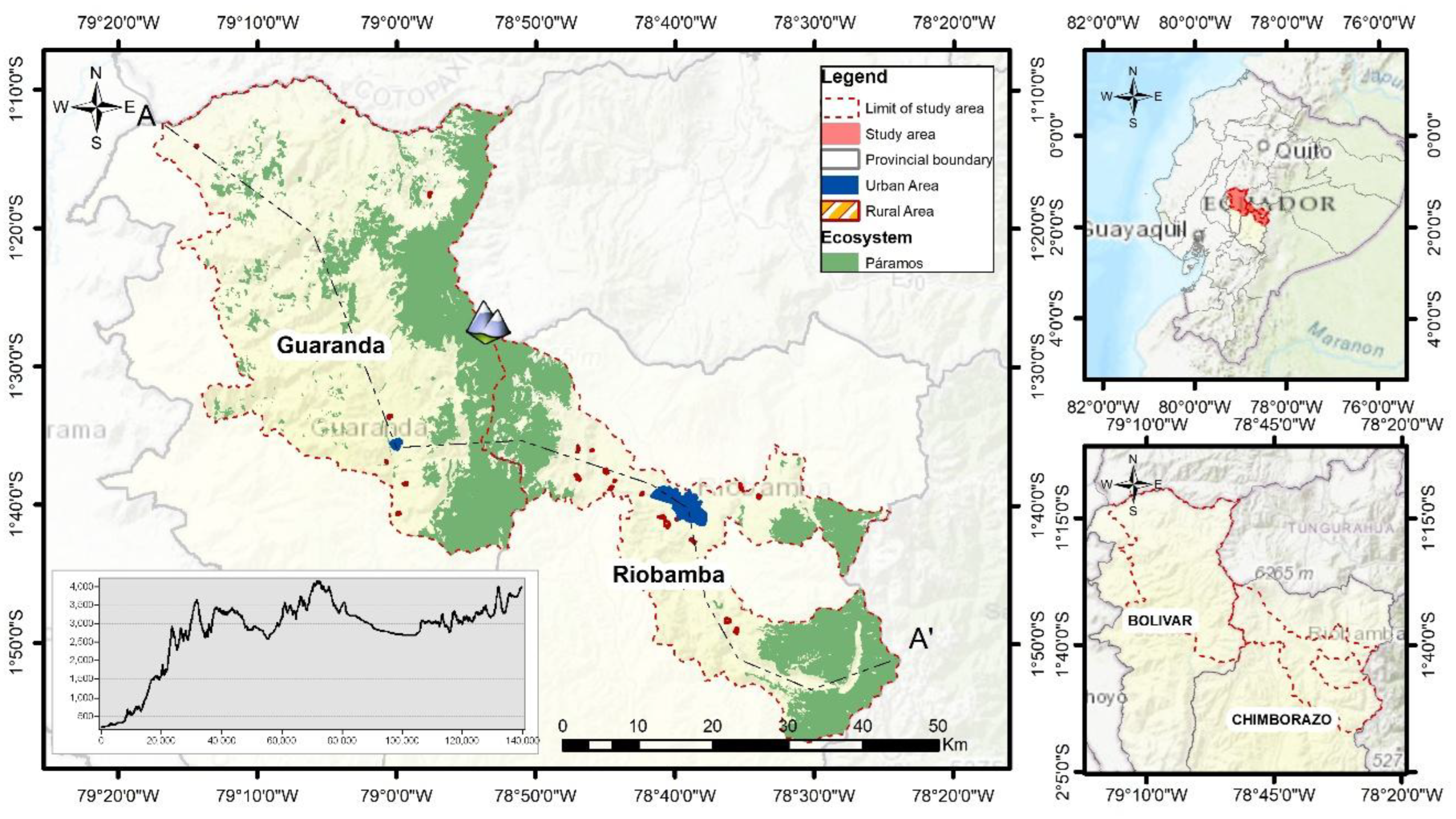
Figure 2.
Model of Relationships Between Latent Factors and Observed Variables (a) Riobamba; (b) Guaranda.
Figure 2.
Model of Relationships Between Latent Factors and Observed Variables (a) Riobamba; (b) Guaranda.
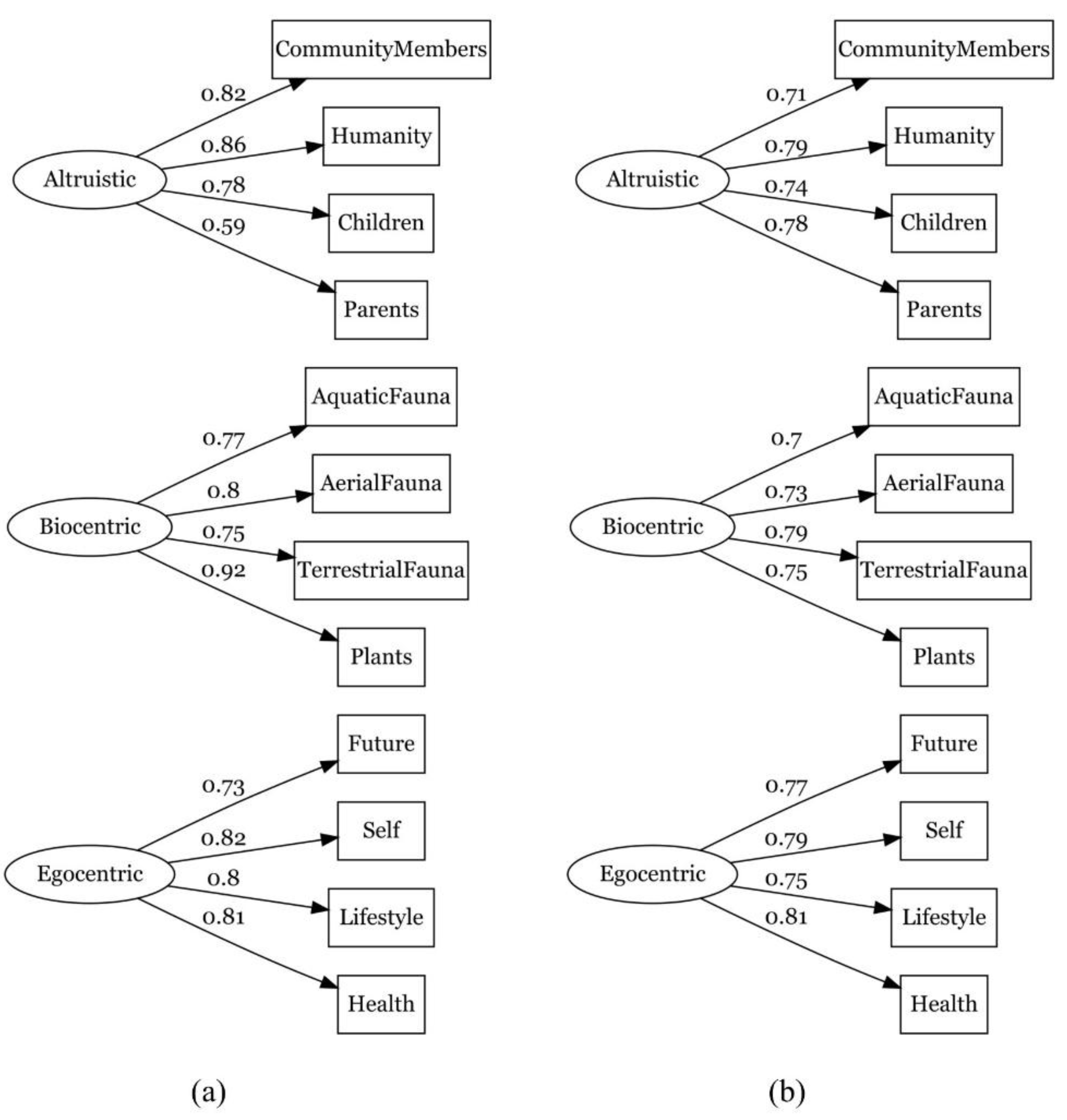
Figure 3.
Distribution of Individuals by Dominant Profile (a) Riobamba; (b) Guaranda.
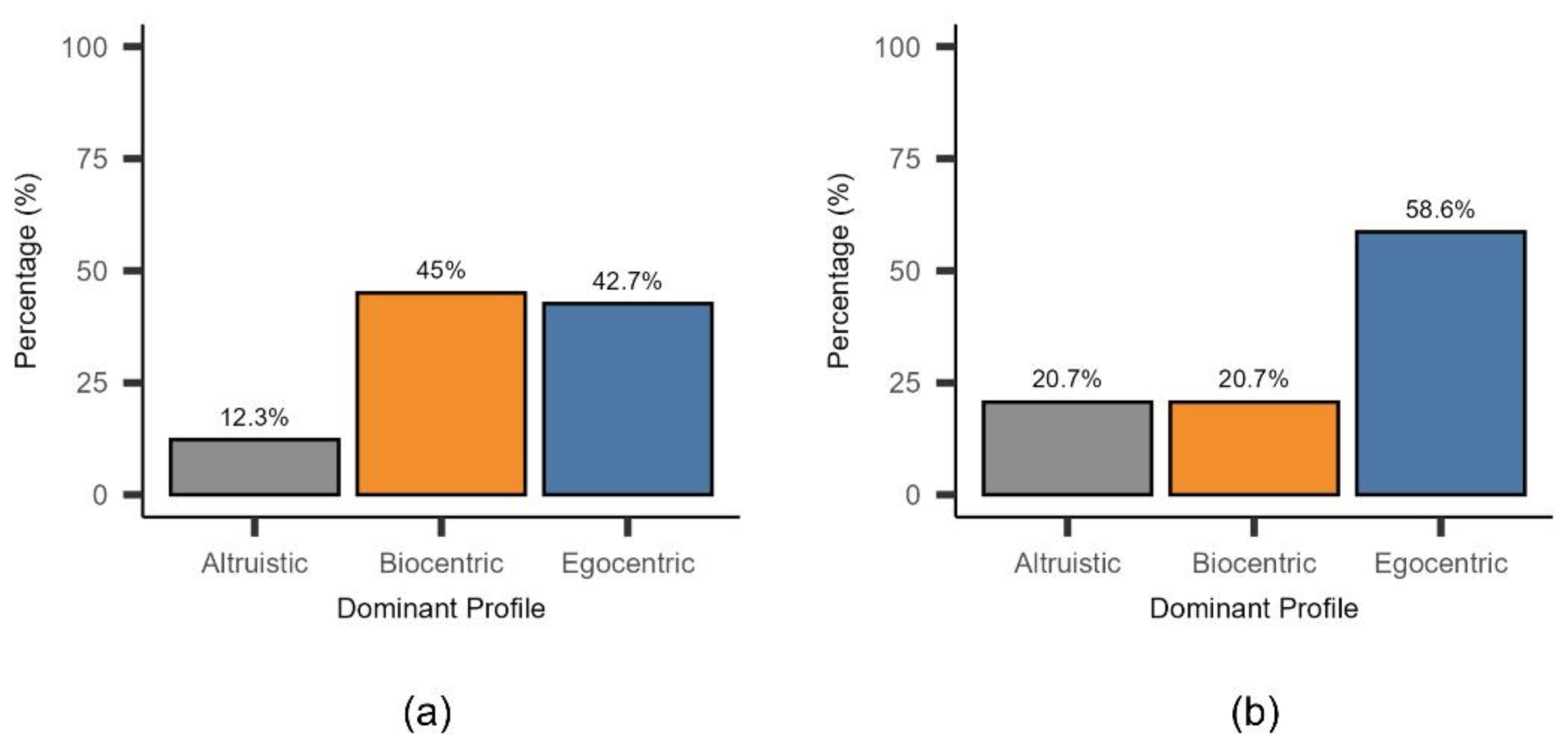
Figure 4.
Dominant Profile by Sociodemographic Categories in Riobamba.
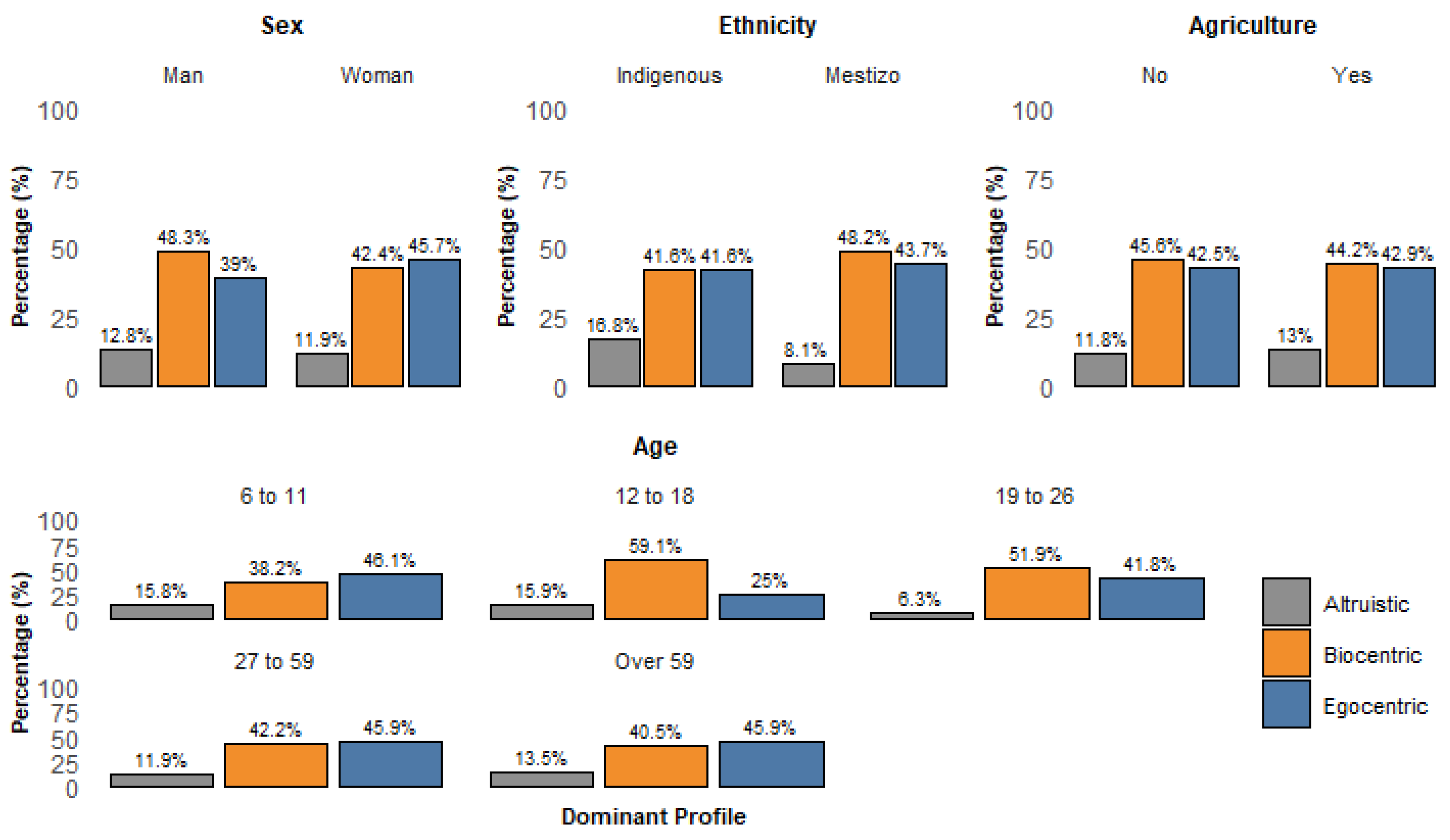
Figure 5.
Dominant Profile by Sociodemographic Categories in Guaranda.
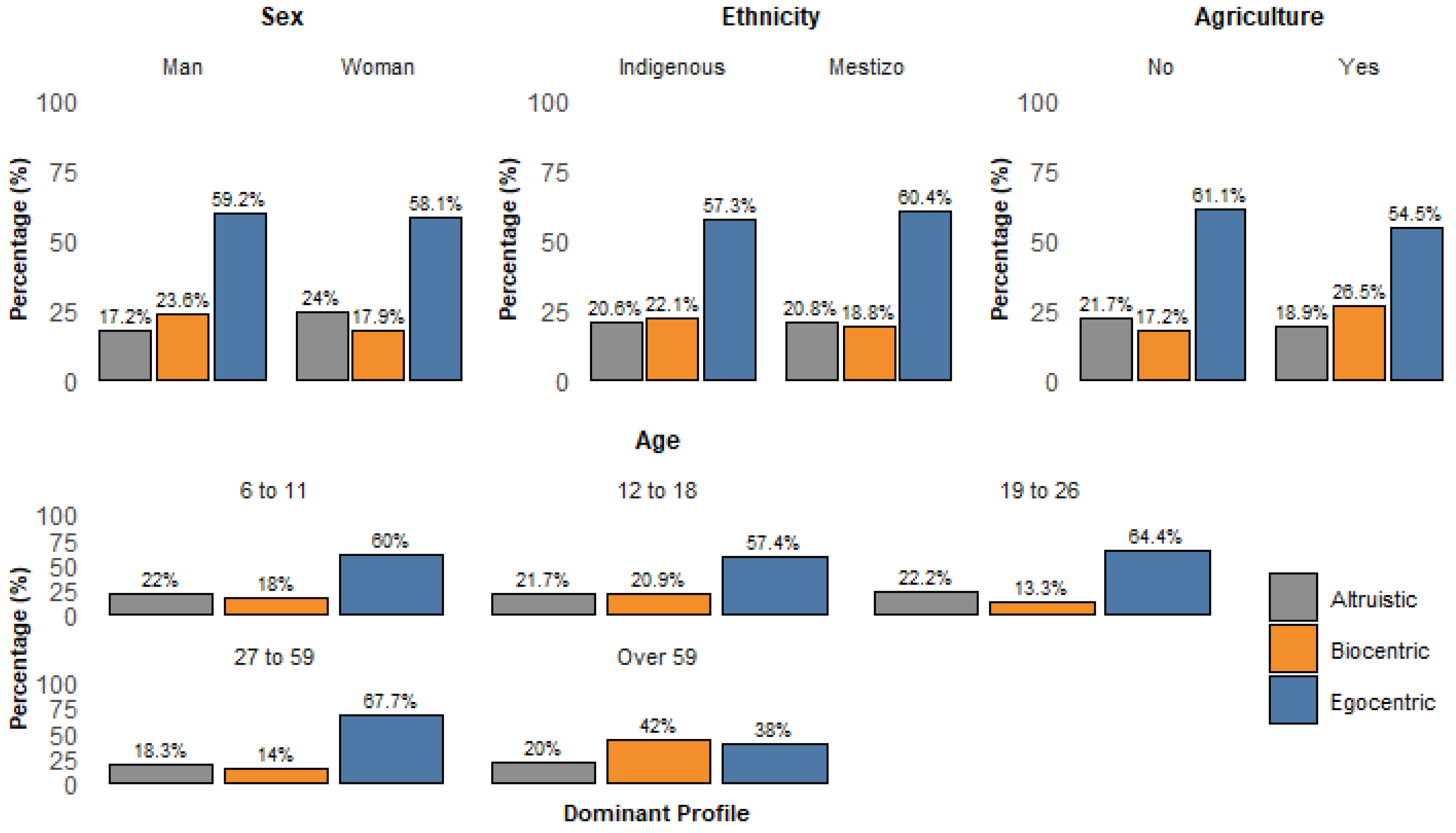
Figure 6.
Environmental Concern Dimensions in Riobamba and Guaranda.
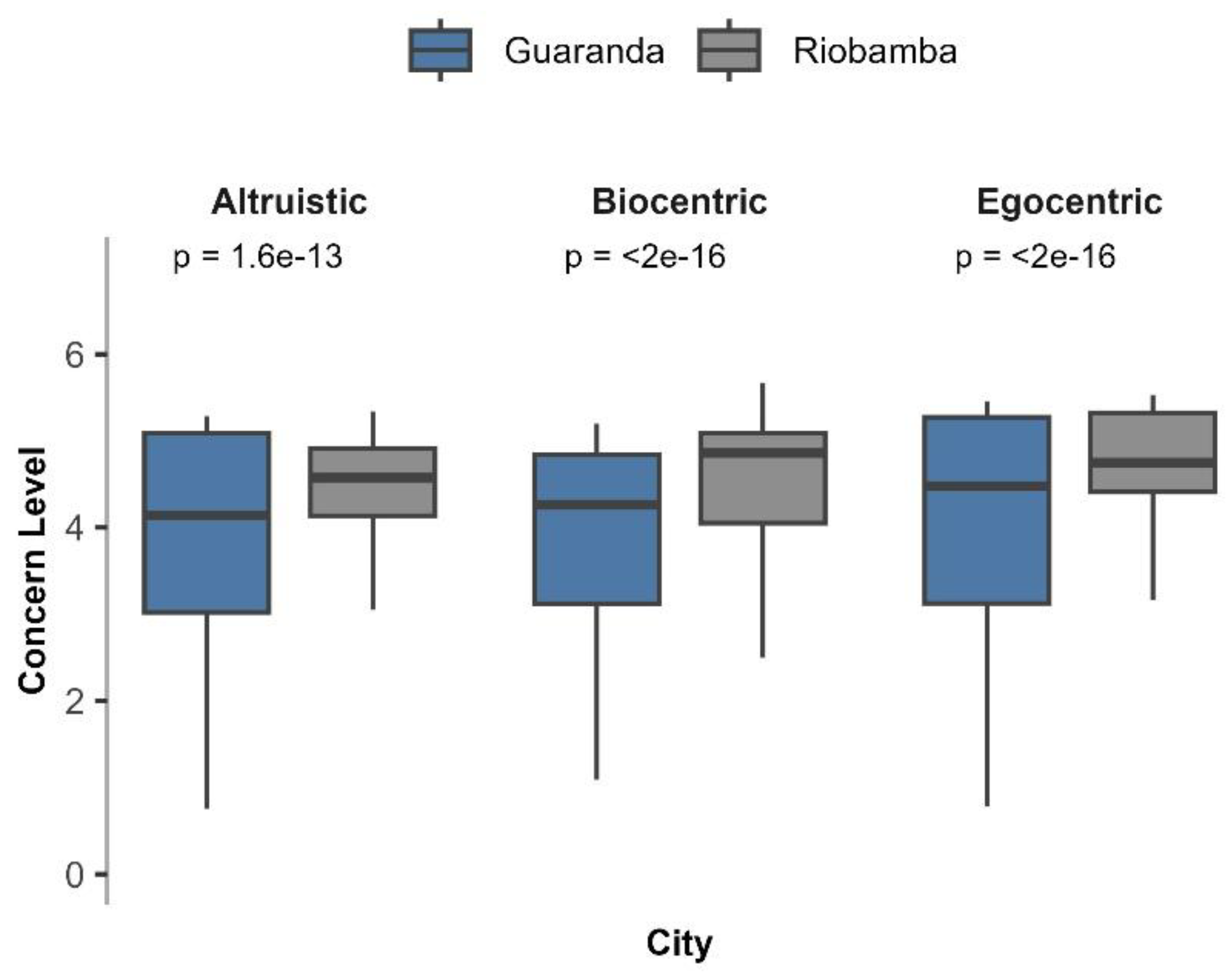

Table 1.
Model Fit Indices and Interpretation Guidelines.
| Fit Index | Threshold | Interpretation | Reference |
| Comparative Fit Index (CFI) | > 0.95 | Good fit | [34] |
| 0.90–0.95 | Acceptable fit | ||
| < 0.90 | Poor fit | ||
| Tucker-Lewis Index (TLI) |
> 0.95 | Excellent fit | [35] |
| 0.90–0.95 | Acceptable fit | ||
| < 0.90 | Poor fit | ||
| Root Mean Square Error of Approximation (RMSEA) | < 0.05 | Optimal fit | [36] |
| 0.05–0.08 | Acceptable fit | ||
| 0.08–0.10 | Marginal | ||
| > 0.10 | Poor fit | ||
| Standardized Root Mean Square Residual (SRMR) |
< 0.08 | Good fit | [37] |
| 0.08–0.10 | Marginal fit | ||
| > 0.10 | Poor fit |
Table 2.
Percentage distribution of the sample by gender, ethnicity, age, and agricultural activity in Guaranda and Riobamba.
Table 2.
Percentage distribution of the sample by gender, ethnicity, age, and agricultural activity in Guaranda and Riobamba.
| Sociodemographic characteristic | Guaranda (%) |
Riobamba (%) |
|
|---|---|---|---|
| Sex | Man | 49.34 | 46.74 |
| Woman |
50.66 |
53.26 | |
| Ethnic self-identification | Indigenous | 56.43 | 48.56 |
| Mestizo | 43.57 | 51.44 | |
| Age | Children | 14.17 | 9.40 |
| Adolescents |
32.55 |
15.14 | |
| Youth | 12.86 | 20.10 | |
| Adults | 26.25 | 41.25 | |
| Older adults |
14.17 |
14.10 | |
| Agricultural activity | Yes | 37.27 | 39.16 |
| No | 62.73 | 60.84 | |
Table 3.
SEM Coefficients for Sociodemographic Predictors of Environmental Concern.
|
Independent Variable |
Reference Category | EC | BC | AC | |||
| β | p | β | p | β | p | ||
| Sex | Man | -0.050 | 0.207 | -0.124 | 0.002 | -0.063 | 0.116 |
| Agriculture | No | -0.233 | < 0.001 | -0.218 | < 0.001 | -0.235 | < 0.001 |
| Ethnicity | Indigenous | -0.013 | 0.754 | 0.022 | 0.572 | 0.007 | 0.868 |
| Childhood | Young- Adult | -0.017 | 0.704 | -0.025 | 0.589 | -0.029 | 0.547 |
| Adolescence | 0.026 | 0.583 | 0.079 | 0.105 | 0.012 | 0.814 | |
| Youth | -0.017 | 0.729 | 0.011 | 0.836 | -0.008 | 0.863 | |
| OlderAdult | -0.068 | 0.171 | -0.028 | 0.554 | -0.054 | 0.262 | |
| City | Guaranda | 0.205 | < 0.001 | 0.088 | 0.047 | 0.145 | 0.001 |
Disclaimer/Publisher’s Note: The statements, opinions and data contained in all publications are solely those of the individual author(s) and contributor(s) and not of MDPI and/or the editor(s). MDPI and/or the editor(s) disclaim responsibility for any injury to people or property resulting from any ideas, methods, instructions or products referred to in the content. |
© 2025 by the authors. Licensee MDPI, Basel, Switzerland. This article is an open access article distributed under the terms and conditions of the Creative Commons Attribution (CC BY) license (http://creativecommons.org/licenses/by/4.0/).
Copyright: This open access article is published under a Creative Commons CC BY 4.0 license, which permit the free download, distribution, and reuse, provided that the author and preprint are cited in any reuse.


