
Submitted:
29 April 2025
Posted:
30 April 2025
You are already at the latest version
Abstract
This study presents a Social Life Cycle Assessment (S-LCA) of the F-CUBED Production System, an innovative process that converts wet biogenic residues - specifically paper bio-sludge, olive pomace, and orange peel - into intermediate bioenergy carriers via hydrothermal treatment (TORWASH®), palletisation, and anaerobic digestion. Hydrothermal carbonization of low quality, wet biogenic residues into intermediate bioenergy carriers potentially contribute to a more flexible and stable renewable energy system and reduce environmental impacts compared to current residue disposal practices. Through the S-LCA, this study intends to evaluate both potential risks and benefits of this novel technology for key stakeholder categories (e.g., workers, local communities, value chain actors) in three EU contexts: Sweden, Italy, and Spain. The assessment applies the 2020 UNEP S-LCA Guidelines and leverages the Social Hotspots Database (SHDB) to evaluate the cradle-to-gate social and socio-economic impacts of the system. The study integrates quantitative modeling in SimaPro and data from stakeholder surveys. By integrating experimental data and process modeling, the study emphasizes the necessity of considering social dimensions alongside environmental impacts to ensure societal acceptance and policy relevance. Results reveal that, while the technology offers social benefits such as employment and economic development, particularly in Sweden and Spain, moderate social risks persist, especially in the Italian case (olive pomace), related to sectors like Electricity generation and Biopellets production. The findings underscore the importance of holistic sustainability assessments for emerging bioenergy technologies and provide actionable insights for stakeholders and policymakers aiming to advance sustainable and socially responsible bioenergy systems.
Keywords:
waste biomass
; waste-to-energy
; social life cycle assessment
; social impacts categories
; hydrothermal carbonization
; industrial biogenic residues
; pulp and paper biosludge
; virgin olive pomace
; orange peel
; pellets
1. Introduction
In order for the EU to become less reliant on outside energy sources and reach carbon neutrality by 2050, renewable biofuels for Electricity generation will be essential [1], particularly in view of the increased direct demand for electricity from various end-use sectors and for the creation of fuels like hydrogen. Renewable energy sources like solar or wind power must be matched with complementary energy systems that are dispatchable, or ready to go when needed, throughout the day and year because they provide electricity that fluctuates during the day due to weather variations [2]. The quest for sustainable energy solutions has never been more critical, with climate change posing unprecedented challenges to our global ecosystem and human societies.
In this framework, the sustainable use of biogenic residues and wastes for bioenergy gives a crucial contribution to a more flexible and stable renewable energy system and reduces environmental impacts compared to current residue disposal practices. Biogenic wastes and residues play an important role, although they are frequently challenging to use as energy sources because of a number of issues, such as low energy density, high moisture content, poor biological stability, heterogeneity of the material, impurities [3,4,5,6], and social prejudices. Moreover, access to residual biomass is very likely to become increasingly challenging [7], and the biomass bioeconomic potential is expected to become a relevant constraint by 2030 and beyond, particularly because the risk of competition is most pronounced for biomass uses for bioenergy [8]. Therefore, conventional biomass sources alone will hardly meet future energy needs and satisfy sustainability criteria [6]. One of the solutions to address biomass competition is generating bioenergy from wet waste streams (such as sewage sludge, pulp and paper bio-sludge, and industrial agro-food residues). Resource recovery from wet wastes is more challenging and energy-intensive than resource recovery from other types of waste and residual biomasses because of their complex composition and high moisture content [9,10]. Nevertheless, it is an inevitable challenge that must be met in order to ensure waste management and environmental sustainability.
Research conducted within the F-CUBED Project has demonstrated the feasibility and environmental benefits of hydrothermal conversion of biomass for generating bioenergy and bioproducts at an industrial scale. However, social concerns and uncertainties surrounding the adoption of these technologies persist, highlighting the importance for studies on their social impacts and acceptance. In fact, the environmental effects of hydrothermal biomass conversion have only been the subject of a relatively small number of societal impacts studies to date [11].
Iribarren et al. [12] affirm that the Social Life Cycle Assessment (S-LCA) methodology, which was created to assess possible social benefits and drawbacks along a production supply chain [13], is acknowledged as a crucial tool in sustainability sciences and is applicable to both public and private organizations. By exposing potential social impacts across product supply chains, preventing burden shifting between impacts and geographical regions, and combining environmental and economic data to present a comprehensive sustainability picture, the S-LCA results are becoming more relevant to support policy decisions and business strategies. Indeed, during the last years there was a growing trend in the energy sector for analysts to evaluate the social life-cycle performance of energy products such electricity, hydrogen, solar fuels, and biofuels [12,14]. Zarauz et al. (2025) [15] indicates in its review paper that technical scientists are more likely than social scientists to use S-LCA to measure social sustainability and that numerous assessments have been carried out to complement earlier environmental results for bio-based goods. Furthermore, research that integrated S-LCA with economic and/or environmental evaluations was more likely to incorporate fewer social indicators, indicating that environmental and economic factors were given higher weight in overall evaluations of bioenergy [16]. The majority of the reviewed studies in [16] indicates that the S-LCA is carried out following the LCA methodology and the [13]. A potential step in making sure that precise and pertinent social indicators are considered is the inclusion of stakeholder consultations and input in different works [15,16]; however, details on the sample size and the type of stakeholder engagement were frequently lacking. The studies utilize a variety of social indicators, but the most often used ones are employment and working conditions, followed by health and safety [16]. This might be because certain indicators (for example wages, hours worked, and the number of work-related injuries) are easier to measure than others, which are sometimes harder to measure or less measurable. Also Zarauz et al. [15] highlight that the highest percentage of indicators was associated to workers in the 48% of the literature sources analysed, followed by local community (34%), society (9%), consumer (5%), value chain actors (3%) and children (1%).
In addition, the chosen S-LCA indicators often rise as a result of the analysed green system's more complex supply chain. As concluded also in [12], this results in a very positive performance for the biofuel in terms of its contribution to economic development, but a negative performance in terms of forced labor, women in the sectoral labor force, health spending, social responsibility promotion, and fair compensation. In this sense, the creation of particular regulatory frameworks that ensure risk-free working conditions throughout global supply chains is essential due to the increased complexity of this kind of system. In fact, the results reported in [17] indicates that the employment created by the manufacturing of advanced biofuels, which may have positive social effects, is the most pertinent social component of the case study's findings. This source reports also that the poor working conditions and outsourced risks in global supply chains as a result of rising energy demand are frequently cited as reasons for the bad economic effects of Germany's forestry and agriculture industries. The risk is raised by longer working hours, even when the actual working conditions are no worse than those associated with fossil fuels.
Anyway the 35% of the examined publications by Zarauz et al. [15] used a social database for their assessments, and the majority of studies had a cradle-to-gate (45%) or cradle-to-grave (37%) approach; moreover these studies evaluated its global influence using several social databases (SHDB or PSILCA) and the usage of these databases was 95% consistent with research done in the Global North. Concerning the geographical area of S-LCA implementation, despite the fact that human wants are universal, meeting them varies depending on the situation as well as the contexts and cultures of stakeholders limit their perspectives on human dignity and its preservation. These limitations demonstrated the bioeconomy's strong regional reliance, particularly in terms of society. Globally, local indicators had more trouble gathering social data related to particular value chains, while national indicators hardly ever provided information on particular social performance as affirmed in [15].
The current paper focuses on the S-LCA results of the F-CUBED (Future Feedstock Flexible Carbon Upgrading to Bio Energy Carriers) Horizon 2020 project funded by the European Commission (G.A. 884226). The project aims to convert wet biogenic residues into intermediate bioenergy carriers (fuel pellets) via hydrothermal treatment. The concept consists of an integrated process for mild hydrothermal carbonization (i.e., TORWASH®, manufactured at TNO, Petten, The Netherlands) with low-temperature conversion of the biomass and full utilization of both the solids stream and the liquids stream, as well as compares three feedstocks using direct input from experiments and process modelling [18,19,20]. The F-CUBED Production System includes the integration of the hydrothermal pretreatment with densification of the solid fraction, i.e., palletization, to improve the logistics and sustainability aspects of the supply chain [6,21] and the anaerobic digestion of the liquid fraction. By utilising the flexibility of CHP and biogas conversion systems, the F-CUBED Production System makes it easier to integrate intermittent renewable electricity into a decarbonised energy system.
This ambitious project does not merely focus on the technological advancements in bioenergy but also deeply engages with the socio-economic ramifications of its widespread adoption. The primary objective of the LCA study conducted in the F-CUBED project extends beyond merely assessing the environmental impacts of the F-CUBED Production System , which have already been detailed in a previous publication, and seeks to evaluate the social and socio-economic impacts of the novel technology using a life cycle assessment approach. A S-LCA has been conducted to forecast and preliminary evaluate the future potential social impacts (negative as risk or positive as benefit) for the full-scale applications of the actual TRL5 F-CUBED technology. By adopting an LCA approach, it provides a holistic understanding of the system’s implications, addressing its broader social dimensions. This focus, combined with the previously published assessment of environmental impacts, highlights the critical importance of integrating both environmental and social dimensions to comprehensively evaluate the sustainability and societal acceptance of the innovative F-CUBED value chain.
In fact, the introduction of such a novel technological solution necessitates a comprehensive understanding of its potential social footprints. The S-LCA methodology, leveraging the insights from the Social Hotspots Database (SHDB), provides a robust framework for this analysis. It allows for an in-depth examination of supply chain interactions, labor conditions, community impacts, and broader socio-economic effects. This approach underscores the project's commitment to not only advancing bioenergy technology but also ensuring that its deployment enhances socio-economic conditions, mitigates risks, and fosters a more sustainable and equitable future. The study illustrates the S-LCA approach summarised in the Materials and Methods section via description of the case studies considered in the LCA for the F-CUBED Production System and reference cases. The S-LCA methodological phases are also described, including goals and scope, S-LCA inventory, S-LCA impact assessment. In the Results section, the results of the inventory analysis and impact assessment, as well their interpretation are reported. In the Conclusion, a thorough summary and discussion of the results of the study and outlook for the future is finally reported.
2. Materials and Methods
In this section, the case studies of F-CUBED Production System and reference cases are briefly described. The S-LCA of the case studies is performed according to the methodology defined by ISO standards [25,26]; methodological description of the S-LCA phases matches for many aspects with the LCA methodology, described in a previous publication [22], which should be consulted for further details.
To model products and systems from a life cycle perspective, SimaPro 9.1 was chosen as the LCA software tool, incorporating the environmental databases, i.e., Ecoinvent 3, version 3.7 and the modular social hotspots database (SHDB). According to [23] S-LCA and the SHDB provide the necessary elements to conduct an assessment of supply chain due diligence. The SHDB database has been used to set up the models of the F-CUBED supply chain for the analysis of the socio-economic aspect of the cradle-to-gate life cycle of the F-CUBED products (pellets, electricity and heat). The purpose, the object, as well as the methodological phases have been subjected to further optimizing reiterations, as set out in the Guidelines procedures. The LCA modeling of the system has been based on conceptual process design and modeling study for the systems considered [19], based on experimental work at pilot scale [18,20]. Allocation, when possible, has been avoided by “system expansion” consisting in the extension of the system boundaries by including secondary processes that would be needed to make a similar output in respect to the co-product.
2.1. Case Studies Considered in the LCA for F-CUBED
The F-CUBED system proposes the novel TORWASH® technology integrated with other technologies in a process flow that aims to improve the conversion steps of secondary biomass to intermediate bioenergy carries in an environmental efficient and cost-effective manner. For comparison, the Reference Cases (RCs) are developed to highlight the potential improvements brought by the F-CUBED Production system. F-CUBED project aims to convert wet biogenic residues into intermediate bioenergy carriers (fuel pellets) via hydrothermal treatment (TORWASH®). The selected biogenic residues include paper bio-sludge (DM 3.5%), olive pomace (DM 19.4%), and orange peel (DM 20.0%). TORWASH® treatment and filter press dewatering make up the core process of the F-CUBED process, which yields a solid product subsequently dried and transformed into fuel pellets and a liquid product, which is anaerobically digested to produce biogas. The block flow diagram for the F-CUBED Production System is reported in Figure 1.
2.2. S-LCA Methodology for F-CUBED Production System Analysis
Social Life Cycle Assessment (S-LCA) is a process to assess the social impacts of products and services across their life cycle e.g. from extraction of raw material to the dispatch of the products, in the case of the system scope “cradle-to-gate” [13]. Moreover S-LCA offers a systematic assessment framework that combines quantitative as well as qualitative data.
S-LCA Methodology applied to F-CUBED Production System is based on 2020 UNEP Guidelines for Social Life [Cycle Assessment for Products and Organizations [13]. Similarly to the E-LCA, 2020 UNEP Guidelines suggests to develop the four phases according to the definitions provided by the International Organization of Standardization (ISO) through 14040:2021—Principles and Framework [24] and ISO 14044:2021—Requirements and Guidelines [25]: (1) goal and scope definition; (2) life cycle inventory (LCI), (3) life cycle impact assessment (LCIA), and (4) interpretation of the obtained results.
2.2.1. Goal and Scope Definition
In this section, goal, functional unit (FU), system boundaries, and allocation approach are reported and analysed for the S-LCA study. The present S-LCA study aims to define the social impact of F-CUBED Production System for three selected biogenic residue streams in term of benefits and eventual potential risks for relevant stakeholders involved in the life cycle of the system. The results contribute to the technology development evaluation in social term, to support the sustainability design forecasting potential Hotspots of the products, emissions and waste. The life cycle stages taken into account in the assessment have been assumed as general macro-processes belonging to the main economic sectors for the specific EU countries of the biogenic residues streams productive sites i.e. Sweden, Italy and Spain. This approach allows to unify in a single study the three stream flow scenarios of residues treatment (pulp & paper bio-sludge, olive pomace and orange peels) and social context (different EU State Members).
The target audience of the study also includes members of the agro-food industries and forest-based products as the pulp and paper industry. Moreover, this study will be available for the interested public (technical and non-technical), while the findings of the research can serve as valuable information for decision-makers in the above-mentioned industrial sectors.
2.2.2. Functional Unit and System Boundaries
In the present study, 1 kWh of produced electricity was chosen as functional unit. One kWh of produced electricity is a quantifiable description of the performance of the production system under analysis, to which all inputs and outputs from the system are related. The functional unit (FU) used, similarly to the E-LCA, is output unit related and based on physical attribute (1kWh of produced electricity) that is, for the S-LCA analysis, translated into economic value form using prices.
Depending on the goal of the LCA, the limits of the system are referred to the cradle-to-gate option. This approach is suitable to compare options to make the same bioenergy from different feedstock [26], thus covering all production steps from raw materials point of extraction (i.e., biogenic residues) up to the finished product (i.e., renewable electricity) ready to be dispatched. The system boundaries include (1) upstream processes: residue extraction, with eventual transport to the F-CUBED plant and preconditioning of the residues; (2) main stream processes related to the F-CUBED integrated plant: TORWASH® hydrothermal treatment, dewatering, drying, and pelletizing; and (3) downstream processes related to the end-uses: transport to the power plant and biomass to energy conversion system. Secondary liquid fraction processing is also considered.
Figure 2 generically outlines, from socio-economic perspective, all the different feedstocks scenarios with a generic biogenic residues input indication. The whole process avoids the field production of biomass, the transport of the biomass to an industrial plant where residues are generated, and start from the point of the extraction of the residue itself, feedstock of the F-CUBED Production System, where they are processed and then dispatchable final products (pellet, heat or electricity) to the end-users.
This simplification allows to focus more specifically on socio-economic impacts, avoiding the wide factors of influence and variability that would be introduced considering also the upstream biomass production. As it is displayed in Figure 2 the analysis of the socio-economic aspects emphasises the processes and nodes of the production system that can better translated in economic and social indicators.
Regarding the geographical limitations, the currently investigated system assumes that the plant is located either in Northern Sweden for the pulp and paper bio-sludge scenario, in Spain for the fruit and vegetable residue case study, and in Italy, for the virgin olive pomace case study.
2.2.3. Allocation Approach
Although allocation approach is traditionally more emphasized in Environmental LCA (E-LCA), it is highly pertinent to S-LCA theory. S-LCA also deals with multi-functional processes, particularly when assessing social impacts of co-products and byproducts. In S-LCA, allocation is needed to distribute social impacts across different products or functions when a process produces multiple outputs. The choice of allocation method can influence how social burdens or benefits are attributed within a product system, especially in bioenergy contexts where labor conditions, community effects, and stakeholder engagement can vary for different co-products [13]. F-CUBED represents a multifunctional bioenergy production system in which co-products occur as outputs. These co-products include intermediate energy carriers (e.g., pellets), electricity, and biogas. Therefore, the distribution of social impacts within the process must be carefully allocated across these different outputs to ensure an accurate assessment of social sustainability. According to the International Organization for Standardization [24], allocation in LCA refers to the partitioning of input or output flows of a process or a production system between the product system under study and one or more other product systems. This definition applies to both environmental and social LCA, though in S-LCA, the partitioning concerns social indicators such as worker well-being, fair wages, human rights, and community development.
Given the complexity of allocating social impacts in bioenergy production systems, the present S-LCA, in compliance with [24,25] and [13] on S-LCA, follows the principle of avoiding allocation by employing system expansion. This approach extends the system boundaries by including secondary social processes, ensuring a holistic evaluation of how different co-products interact with society.
For example, in the case of anaerobic digestion of the filtrate after the dewatering step, the social impact assessment extends beyond the bioenergy production facility. It includes the labor conditions, wages, and potential social benefits associated with the management of anaerobic digestion byproducts. This approach allows for a more accurate representation of social externalities, particularly when detailed foreground social data is available from project partners.
However, when avoiding allocation is not feasible, a systematic allocation approach is necessary. In this study, social impact allocation is based on a physical relationship, such as mass or energy content of the outputs, ensuring that social burdens are proportionally assigned. An example is the olive stones separated from the feedstock in the upstream processes of the Olive Pomace case study. Here, the allocation of social risks and benefits follows the distribution of labor and working conditions associated with the separation, processing, and potential economic value of the co-product.
Addressing multi-functionality in S-LCA remains one of the most significant sources of uncertainty, as also highlighted in [27] for environmental LCA. The complexity arises from:
- the variability of social conditions in different production stages;
- differences in labor intensity and worker exposure to risks across co-products;
- unclear boundaries in assessing social spillover effects, such as job creation or loss due to byproduct valorization.
2.2.4. Social Life Cycle Inventory
The social life cycle inventory (S-LCI) is based on a quantitative approach, and consists, as for E-LCA of the inventory of all flows of the F-CUBED Production System normalized per functional unit.
During the Social Life Cycle Inventory (S-LCI) phase, data collection focused on two main components: the activity variables and the social flows. Social flows refer to the social indicators that reflect the potential social impacts linked to the production system. These indicators are connected to the broader socio-economic system through the activity variables—such as the number of worker-hours— which represent quantifiable measures of the effort or input associated with a given process or operation, and act as a bridge between the technical aspects of the process and the assessment of its social implications. In this way, collecting accurate data on activity variables enables a meaningful analysis of how a product system interacts with society throughout its life cycle.
S-LCI data have been categorised into two types: (i) primary/foreground data, collected from questionnaires to the partners involved in the F-CUBED project, on-site measurements from pilot plant testing, and (ii) secondary/background data, derived from calculations, estimations, databases, scientific reports, statistics, and scientific literature.
To validate and enhance the completeness of the Social Life Cycle Inventory (S-LCI), a stakeholder engagement and survey activity was carried out. This process aimed to integrate primary data and contextual insights from actors directly or indirectly involved in the product system under study. A substantial body of socio-economic and social science literature supports the use of survey-based methods to improve data quality and reduce systemic biases that may arise from the informational limitations inherent in life cycle assessments. In this context, survey research, including the use of questionnaires and interviews, as well as survey methodology as a scientific discipline, provide essential contributions to empirical social analysis [28]. These approaches allow for the collection of nuanced, stakeholder-specific data, thereby strengthening the social dimension of life cycle assessment.
Beyond the process-based model approach, the F-CUBED Production System has also been segmented into sectors, which are interconnected through economic flows expressed in a common monetary unit (USD, base year 2011). The economic values of all inputs—originally expressed in euros, pounds, or yen—have been converted to USD (base year 2011), in alignment with the current version of the Social Hotspots Database (SHDB), which uses USD 2011 as its reference currency.
In the S-LCA, databases such as the Social Hotspots Database (SHDB) adopt a specific reference year and currency to ensure consistency and comparability across data. The use of USD (2011) as the standard reference is based on several key considerations, including the need for a defined base year, control over inflation and exchange rate effects, and methodological consistency. Selecting a reference year—2011 in this case—provides a fixed baseline for data collection, capturing a snapshot of socioeconomic conditions that enables meaningful comparisons over time. Using a constant currency like USD 2011 helps eliminate the distorting effects of inflation and currency fluctuations, which can otherwise complicate the analysis of social impacts across different time periods. Standardizing all data to a single reference year and currency ensures coherence across datasets and studies using the SHDB. This methodological alignment is essential for making reliable comparisons between products, processes, or systems. Ultimately, S-LCA aims to support the assessment and comparison of social impacts associated with different activities or products. A shared reference framework—such as USD 2011—enhances the credibility and comparability of findings, allowing researchers and practitioners to draw more robust and meaningful conclusions about social performance.
Secondary and primary data for the stakeholders and impact subcategories have been collected for the economic sectors and sites related to the value chain.
A first analysis has been conducted using SHDB and SimaPro software to identify the social hotspots of the product system and specific social issues significant and consistent with the system investigated. Social hotspots are unit processes located in a region (e.g. country) where a situation occurs that may be considered a problem, a risk, or an opportunity, in relation to a social issue that is considered to be threatening social well-being or that may contribute to its further development [13].
Primary data have been gathered through direct contact with organizations and companies through questionnaires and survey, interviews or assisted questionnaire compilation with affected stakeholders (e.g. workers, local inhabitants, other target groups). The selected target groups were located in one of the specific countries of interest for the S-LCA (Sweden, Italy and Spain) and distributed among the categories of stakeholder interested and potentially affected by the development of the novel production system implemented with F-CUBED project. The data collection of primary data conducted by these methods allowed to provide “evidence-based” data for a double purpose: 1) refining the first hotspots assessment using generic data and by SHDB and identifying data gaps; 2) to verify the risk and be able to analyse impacts, focusing on the most important subcategories and indicators.
Secondary data has been also considered for each of the impact categories and subcategories selected by the identification of corresponding social inventory indicators that provide the most direct evidence of a social condition (e.g. salary, number of accidents at workplace) [29].
2.2.5. Social Life Cycle Impact Assessment
In the present research, the Social Life Cycle Impact Assessment (S-LCIA) is defined as the phase of S-LCA, used to quantify, comprehend, and assess the potential social consequences of a product system over the course of the product's life cycle. S-LCIA can be used to estimate future potential social impacts connected to an emerging or non-existent system. Potential social impact is defined as the likelihood that a social impact will occur as a result of both the consumption of the product and the actions/behaviours of organizations connected to its life cycle [13]. Impact indicator, in the same way of the impact category potential in E-LCA, reflects the extent of the social impact and belongs to a certain impact (sub)category. The impact category potential, related to a certain characterization factor, in S-LCA are represented by worker hours, related to labor hour intensity factors . These factors allow, used together with the social risk level characterizations, to express social risks and opportunities in terms of work hours, by sector and country [23].
The integration of S-LCA databases, such as the Social Hotspots Database (SHDB), streamlines and automates numerous steps within the Social Life Cycle Impact Assessment (S-LCIA) phase. Specifically, the procedures associated with the Reference Scale (RS) approach to S-LCIA are inherently executed within the framework of database-driven analysis [13]. Within the SHDB model architecture, Life Cycle Inventory (LCI) data are acquired in their unprocessed quantitative form and subsequently subjected to characterization via LCIA procedures. The model estimates the labor intensity of each unit process by calculating the number of worker-hours required across the supply chain to meet a defined final demand—typically represented by the functional unit or the delivery of a specific good or service. Social flow data, or "sociosphere flows," are normalized as worker-hours per 2011 US dollar of economic input, modulated by a context-specific risk indicator. These flows are then converted into medium risk hour equivalents (mrheq), a unit that quantifies potential social impacts by accounting for both the magnitude of labor inputs and the associated risk levels. Risk characterization in SHDB is operationalized through a weighting scheme that reflects the relative likelihood of occurrence of adverse social conditions, benchmarked against a medium risk scenario (assigned a reference value of 1.0). This probabilistic scaling enables comparative assessments across sectors, regions, and impact categories.
In this S-LCA, the Social Hotspot 2022 Category Method was used. This method follows the Reference Scale Assessment (formerly known as Type I or RS S-LCIA) and is designed to assess social performance or social risk. The Social Hotspot 2022 Category Method includes characterization of different risk levels within each subcategory, followed by a damage assessment step that aggregates subcategory results to the category level. All subcategories within a category are given equal weight in determining the overall category-level risk. These weights are calibrated to prevent results from being skewed by the number of subcategories included. The method supports the aggregation of work-hours across different risk levels, either within a detailed set of up to 30 social risk subcategories or within a broader set of five social risk categories (damage categories), which were considered in the data collection process. In each case, the "characterization step" multiplies the worker-hours at a given risk level by a factor that reflects the relative probability of occurrence of the adverse working condition or community condition, for that indicator.
The probability levels are expressed relative to the likelihood of the adverse condition occurring when the risk level is medium. A low risk indicates approximately one-tenth the likelihood of occurrence compared to medium risk; therefore, its characterization factor is 0.1 medium risk-hour equivalents. A Very high risk reflects a likelihood roughly ten times greater than that of medium risk, corresponding to a characterization factor of 10 medium risk-hour equivalents per very high risk-hour. High risk represents approximately half the likelihood of very high risk—or five times that of medium risk—resulting in a characterization factor of 5 medium risk-hour equivalents per high risk-hour.
Using these characterization factors enables the user to: (1) determine a total quantity of risk (in medium risk-hour equivalents) for each indicator, and (2) identify which country-specific sectors and which social inventory flows contribute to the overall risk for each indicator, thereby highlighting social hotspots for each indicator itself.
An ordinal scale with 1 to 4 Performance Reference Points (PRPs), ranging from "low risk" to "very high risk," serves as the reference scale for impact assessment in this study. PRPs are context-dependent thresholds, targets, or objectives that define various levels of social risk or performance. They support the estimation of the scope and significance of potential social impacts on target groups within the product system.
These criteria are reflected in the Medium Risk-Hour (Mrh) factors used in the SHDB Impact Assessment Method, as outlined in Table 2. When appropriate inventory indicator data is compared to the defined levels, it becomes possible to assess whether the data reflects poor or strong performance.
During the impact assessment phase, there are multiple opportunities for aggregation and weighting. For example, social subcategory results can be aggregated into broader impact categories to produce a set of stakeholder-level performance outcomes. This process helps synthesize complex phenomena—especially in Social Life Cycle Impact Assessment (S-LCIA)—enhancing both understanding and communication of findings. Given the significant influence of location-specific factors, aggregation was conducted with great care to avoid misinterpretation or loss of contextual detail. As a result, global supply chains were handled cautiously to ensure that contextual meaning was preserved. To express performance at the impact indicator or subcategory level, weighting is required. The relative importance (or contribution) of each indicator to the performance of a specific impact subcategory is represented through weights. In the SHDB database, weighting reflects the proportionate probability of an unfavourable scenario, based on the assessed level of risk. These relationships between relative probabilities and the Medium Risk Hour (MRH) level are explicitly expressed [30].
Social Life Cycle Interpretation is the final phase of an S-LCA, in which the findings from the S-LCIA phase are thoroughly reviewed and analysed to support conclusions and recommendations, in alignment with the defined Goal and Scope.
3. Results and Discussion
This section presents the results of the social life cycle inventory (S-LCI) and social life cycle im-pact assessment (S-LCIA) phases to describe the magnitude and significance of the environmental impacts of the F-CUBED Production System applied to the target biogenic residue streams, i.e., pulp and paper bio-sludge (PPB), virgin olive pomace (OP), and fruit and vegetable residue stream—orange peel (ORP). Positive indications show a stress on the environment, whilst negative indicators show positive impacts.
3.1. Social Life Cycle Inventory (S-LCI) Results
In the present section, the social life cycle inventory phase (S-LCI) for the F-CUBED Production System is described for the target biogenic residue streams. The LCI refers to the SHDB model that was developed based on the existing environmental LCA [22] by identifying the unit processes representative of the F-CUBED Production System, using the most relevant country-specific sectors (CSS) available in SHDB. The F-CUBED Production System is designed to exclude upstream stages such as the biomass field production and the associated logistics of transporting biomass to industrial facilities where residues are generated. Instead, the system boundary commences at the point of residue extraction and comprises: (i) residue pre-treatment; (ii) hydrothermal treatment and mechanical dewatering via the TORWASH® process; (iii) solid fraction conditioning and palletisation; and (iv) generation of dispatchable end-products—namely Biopellets, thermal energy, and/or electricity—delivered to final users.
The Social Life Cycle Inventory (S-LCI) phase for the above-mentioned processes within the F-CUBED Production System is delineated in Table 3. The objective of the S-LCI exercise is to quantify, for each of the three case studies under investigation, the economic value (in constant 2011 USD) of inputs sourced from relevant Country-Specific Sectors (CSS) within SHDB that are required to produce the F-CUBED outputs.
Several unit processes included in the Social Life Cycle Inventory (S-LCI) phase were modelled using Social Hotspot (SH) processes derived from the Social Hotspots Database (SHDB). These SH processes were selected based on the country-specific context (i.e., Sweden, Italy, or Spain) and the type of biogenic residue stream involved—namely pulp and paper bio-sludge, olive pomace, or orange peels.
In line with the Guidelines for Social Life Cycle Assessment of Products and Organizations, an SH process is defined as a unit process or life cycle stage characterized by a high potential for social or environmental impact, significantly contributing to one or more impact subcategories.
The inclusion of SH processes serves to strengthen the inventory phase by addressing data gaps, such as the unavailability of specific indicators or their respective weightings, and by improving the completeness and representativeness of the social life cycle dataset. This approach ensures alignment with data quality requirements related to coverage, consistency, and transparency, which are critical for comparative or consequential S-LCA applications.
The corresponding social LCI datasets applied in the three case studies are detailed in Table 4. For every case study, the assessment builds upon primary data sourced from the Environmental Life Cycle Assessment (E-LCA), which served as the foundation for developing the S-LCA model. Specifically, the E-LCA provided detailed information on the composition of the supply chain, enabling the identification of all relevant stages of the F-CUBED Production System required to generate electricity from the wet biogenic residue stream of pulp and paper bio-sludge, olive pomace residues and orange residues. The pulp and paper biosludge case study is geographically contextualized in Sweden, reflecting the location of the industrial partner participating in the Torwash pilot testing—specifically, Smurfit Kappa. The economic sectors selected for this assessment correspond to key activities in the system, including paper manufacturing, machinery and equipment, wood pellet production, and electricity generation. The case study of olive pomace is geographically situated in Italy, at the Frantoio Oleario Chimienti, a facility affiliated with the APPO farmers’ association, located in Bari, in the Apulia Region. The economic sectors refer to the specific industrial sector of the vegetable oil production in Italy, machinery and equipment, wood pellets and electricity generation. Finally, the case study of orange peels is geographically situated in Spain, in the Delafruit facility, located in La Selva del Camp, Tarragona. The economic sectors refer to the specific industrial sector of the industrial sector of the vegetables, fruits, nuts growing in Spain, machinery and equipment, wood pellets and electricity generation.
The complete data collection for the S-LCI phase of each case study is presented in Table 5, along with a detailed description of the underlying assumptions. These elements collectively provide a comprehensive overview of the inventory modeling approach applied to this case study.
The unit processes defined as outputs of the production system were derived from the Life Cycle Inventory (LCI) of the Environmental Life Cycle Assessment (E-LCA), as previously described. Conversely, the input unit processes required for modeling the upstream supply chain were identified from secondary data sources, as detailed in Table 6. All economic values used in the S-LCI are expressed in constant 2011 U.S. dollars (USD 2011). For currency conversion, an exchange rate of 1.33 EUR/USD—corresponding to the rate in January 2011—was applied.
In the case of pulp and paper bio-sludge, conventional disposal via landfilling—within defined environmental safety parameters—has been considered the baseline reference scenario. Accordingly, an avoided cost was introduced to reflect the economic benefit associated with diverting the residue from landfill. In the Olive Pomace case study, the economic value attributed to the residue generated by the two-phase olive oil extraction process—which produces wet pomace—was based on the authors’ expertise and reflects typical market values observed in Italy. The economic value assigned to the residue generated from orange processing—specifically during orange juice production—was based on the market value of orange peels used as feed in Ecuador. Nevertheless, it is important to note that the reference supply chain for residue extraction is situated nationally, with operations occurring in Spain.
The economic value attributed to the solid fraction produced through the TORWASH® hydrothermal treatment and subsequent dewatering was based on the market value of wood chips, selected as a substitutable good due to its functional equivalence in energy applications. Similarly, the economic value of Biopellets, manufactured from the F-CUBED solid fraction, was estimated using the market price of wood pellets as the surrogate reference.
For the sake of clarity and transparency, Table 6 presents an overview of the production and unit processes included in the assessment, along with their corresponding economic sectors and data sources used to obtain prices or surrogate values. Where primary data were not available, surrogate values were employed to estimate input costs. The surrogate value represents the monetary value of a substitute good or service that delivers a comparable level of utility to the end-user or performs an equivalent function within the production system. This methodological approach follows the definition proposed by [31], ensuring consistency in the representation of economic flows across the social inventory.
The prices of wood chips and densified wood fuels were sourced from official energy statistics published by the Swedish Energy Agency, based on national energy balances presented in Sweden Facts and Figures 2022 [33]. The reported prices for 2021 are 192 SEK/MWhₜₕ for wood chips and 324 SEK/MWhₜₕ for wood pellets, as also illustrated in Figure 3.
To convert these values into euros per ton (€/t), the following lower heating values (LHVs) were applied: 2.91 MWh/t for wood chips and 5.12 MWh/t for wood pellets. An exchange rate of 0.084 €/SEK was used to complete the conversion.
3.2. Results of the Survey on Socio-Economic Aspects
To assess the potential social impacts of the F-CUBED Production System at the local level, a targeted stakeholder survey was designed and implemented as part of the Life Cycle Inventory. This activity aimed to explore how the introduction of the novel production system might influence key dimensions such as quality of life, working conditions, and broader socio-economic well-being across different stakeholder groups. Drawing from established research in socio-economics and survey methodology [28,39,40], the approach was grounded in best practices to mitigate informational bias and ensure robust, comparable data. In line with the UNEP Guidelines for Social Life Cycle Assessment [13], the survey focused on a defined set of social performance indicators, known as impact subcategories, enabling benchmarking against other biomass conversion technologies. The method of engagement was adapted to meet the varying needs and expectations of stakeholders, using a combination of tools—including online questionnaires, phone interviews, and video calls—applied flexibly and iteratively throughout the data collection process. The socio-economic assessment survey aimed to explore stakeholder perspectives on the potential social impacts of implementing the F-CUBED Production System across the three case studies’ countries: Italy, Spain, and Sweden. The survey targeted 44 stakeholders, selected for their relevance to the project and geographical diversity, and was administered between June and early August 2023, with multiple follow-up waves to encourage participation. In the end, 19 responses were collected, corresponding to a 43% response rate. This figure was considered statistically acceptable given the specificity and complexity of the subject matter. Stakeholder representation was spread across several European countries, with a majority from Italy, followed by respondents from the Netherlands, Ireland, Spain, Germany, and Sweden.
The survey results show a generally positive reception toward the F-CUBED Production System, especially concerning economic development, employment opportunities, and sustainability alignment. However, less attention was given to ethical and deep social dimensions, highlighting a possible area for future communication and stakeholder engagement. The survey aimed to determine which categories of stakeholders might be most affected by the new production system. According to the UNEP 2020 Guidelines [13], six stakeholder groups were considered: Value Chain Actors, Local Community, Workers, Society, Consumers, and Children. The survey results revealed that the Value Chain Actors were perceived as the most significantly impacted, followed closely by the Local Community and Workers. Children, on the other hand, were ranked much lower, largely due to the limited direct relevance of the F-CUBED system to this group. Some respondents even noted concerns over potential health risks in this category, highlighting a future area that might warrant closer investigation. When examining the Value Chain Actors category, the focus was largely on economic implications. Survey participants emphasized the importance of technological advancement, new market opportunities, and the economic viability of the technology. Employment perspectives were also considered relevant. However, ethical and social concerns such as fair competition and broader social responsibility were given less importance, suggesting a predominant focus on practical economic outcomes.
In contrast, the Local Community category received a more balanced evaluation, with both economic and social dimensions considered important. Economic opportunity and the availability of local resources were ranked highly, alongside environmental factors such as air and water quality, and the potential for local job creation. Notably, even respondents from environmental NGOs reported no significant concerns regarding environmental impacts, which suggests a broadly favourable perception of the system’s integration into local settings.
The Workers category, although ranked third overall, attracted considerable attention due to the direct impacts anticipated on work conditions, career prospects, and job satisfaction. Training needs were also acknowledged. Yet, aspects such as equal opportunity and long-term job stability were not highlighted as major concerns. This result may suggest a generally favourable expectation of the new system’s integration into existing employment structures, or a lack of perceived risk among workers.
The Society category revealed an optimistic view of the system’s contribution to broader sustainability goals. Many participants recognized the F-CUBED system as aligned with policy and societal interests, and potentially valuable in addressing future social challenges. Despite this, explicitly ethical concerns such as societal values were less frequently cited, indicating a possible gap between technological promise and its perceived ability to influence ethical behaviour or broader cultural shifts.
Although the Consumers category was not highly ranked, yet the responses pointed to high expectations in terms of service quality. Reliability of bioenergy products and the affordability of energy emerged as important concerns, along with accessibility and perceived benefits of the new technology. This suggests that, although consumers may not be the primary focus of the system’s implementation, their expectations remain critical to its perceived success.
3.3. Social Life Cycle Impact Assessment (S-LCIA) Results
This section illustrates the results provided by the S-LCIA based on two main methodological adjustments: 1) harmonization between the impact categories of SHDB database and UNEP 2020 Guidelines; 2) selection of the Social Hotspots Database (SHDB) subcategories that are most representative and relevant for the F-CUBED Production System.
The Social Hotspots Database (SHDB) impact assessment methodology organizes social performance indicators into five principal impact categories: Labor Rights and Decent Work, Health and Safety, Human Rights, Local Community, and Governance. This categorization is broadly consistent with the updated 2020 UNEP Guidelines for Social Life Cycle Assessment of Products and Organizations [13]. However, it is important to acknowledge key discrepancies due to the Social Hotspots Database's (SHDB) partial alignment with the subcategories recommended in the Guidelines. As a result, harmonization efforts are necessary to ensure a comprehensive and coherent application across assessments [23].
In the SHDB framework, these five impact categories are derived through the aggregation of 30 distinct subcategories, forming the core of the S-LCIA phase. In contrast, the 2020 UNEP Guidelines propose a broader structure comprising six stakeholder-related impact categories: Human Rights, Working Conditions, Health and Safety, Cultural Heritage, Governance, and Socio-economic Repercussions, subdivided into a total of 40 subcategories.
This structural divergence implies that while SHDB offers a practical and operational framework for early-stage or large-scale social risk screening, it may require supplementary subcategory-level analysis and mapping to fully conform with the UNEP Guidelines in more comprehensive S-LCA studies. Therefore, careful methodological alignment and correspondence mapping are essential when applying SHDB within studies adhering to UNEP’s normative framework. Table 7 presents the Social Impact Categories assessed during the Social Life Cycle Impact Assessment (S-LCIA) of the F-CUBED Production System, alongside the selected subcategories derived from stakeholder survey outcomes, as detailed in Section 3.2.
The table also includes a preliminary harmonization map between the subcategories adopted by the Social Hotspots Database (SHDB) and those recommended in the UNEP Guidelines for Social Life Cycle Assessment of Products and Organizations and Methodological Sheets for Subcategories in S-LCA [13,41].
To ensure a more comprehensive and context-relevant analysis, two additional subcategories have been incorporated into the original list of the SHDB:
- Injuries & Fatalities (2B): this subcategory is critical for assessing occupational health and safety, particularly in relation to labour intensity and exposure to risk factors throughout the value chain. Its inclusion strengthens the representativeness of the Working Conditions impact category;
- Democracy & Freedom of Speech (4C): in the current geopolitical context, where energy system resilience is increasingly influenced by global supply dependencies, this subcategory becomes especially relevant. It allows for the assessment of systemic risks associated with countries where severe restrictions on civil liberties, such as freedom of expression and peaceful assembly, may signal broader governance and human rights concerns.
The extended set of subcategories enables a more holistic assessment of social risk and opportunity, aligned with both SHDB's operational structure and UNEP's normative S-LCA framework.
Building upon these methodological foundations, a comprehensive and multi-dimensional data visualization strategy was implemented to effectively communicate the S-LCIA findings. Four key types of visualization were developed: 1) Aggregate Social Impact by Category. This table provides a synthesized overview of the social risks or benefits associated with each harmonized impact category. It integrates risk characterization results across economic sectors and life cycle stages, allowing for high-level comparisons across case studies and facilitating initial prioritization of areas of concern; 2) Disaggregated Impact by Economic Sector. Sector-specific contributions to overall social impact were presented both numerically and through bar charts, detailing the relative weight of each economic activity (e.g., TORWASH® treatment, palletisation, biogas generation) within the supply chain. This visualization is critical for identifying sectoral hotspots and informs targeted intervention strategies; 3) Subcategory Level Analysis. The selected subcategories —mapped from SHDB to the UNEP typology—were examined to understand their distribution across economic sectors. A combined table and figure presentation illustrates both the absolute and relative contributions to social risk, enabling a granular analysis of how specific themes such as “Labor Rights,” “Smallholders vs. Commercial Farms,” or “Access to Material Resources” are influenced by each phase of the production process; 4) Risk Characterization. This table translates numeric impact scores into qualitative performance levels (low, medium, high, very high risk) using SHDB’s ordinal Performance Reference Point (PRP) system. The mapping consolidates category and subcategory level assessments across geographic contexts, supporting the prioritization of social risk mitigation and stakeholder engagement actions.
3.3.1. Aggregate Social Impact by Category
This visualization provides a synthesized overview of the social risks or benefits associated with each harmonized impact category. It integrates risk characterization results across economic sectors and life cycle stages, allowing for high-level comparisons across case studies and facilitating initial prioritization of areas of concern. As detailed in Table 8, the social footprint of the F-CUBED Production System was assessed by aggregat-ing the social impacts associated with each country-specific sector (CSS), into a consolidated score for each damage category.
In this context, a damage category refers to an "area of protection"—a conceptual construct that represents domains considered to hold intrinsic or societal value (e.g., human well-being, community cohesion, institutional stability) and which are intended to be preserved or enhanced through sustainability-oriented interventions. These categories serve as the final aggregation level in the impact assessment, capturing the potential long-term consequences of social risks across the product system's life cycle.
The scores are expressed in medium risk hours equivalent (mrheq), providing complementary metric to quantify social performance within the S-LCIA framework. The aggregated social impact results for each case study represent the cumulative risk contributions of each economic sector across all life cycle stages of the F-CUBED system. These results offer a high-level synthesis of the social risk landscape, supporting comparative assessments and guiding stakeholder-specific mitigation strategies.
The results from the Social Life Cycle Impact Assessment (S-LCIA) of the F-CUBED Production System applied to three biogenic residue streams—pulp & paper biosludge, olive pomace, and orange peels—reveal a nuanced picture of how social impacts unfold across different European industrial contexts.
The social performance of the F-CUBED system varies widely depending on the socio-economic and institutional context of its implementation. The Swedish case demonstrates stability and modest gains in an already favourable environment; the Italian case reveals considerable potential but is hindered by systemic social risks that require active mitigation; and the Spanish case stands out as a highly successful integration of technology and social sustainability.
In the case of pulp & paper biosludge, treated within the Swedish industrial setting, the F-CUBED Production System demonstrates an overall beneficial social footprint. All five categories register slightly negative mrheq values, meaning the implementation of the technology contributes to a net reduction in social risks. The most significant improvements are observed in the areas of Health and safety and Governance. These results are in line with Sweden’s generally strong institutional frameworks and well-enforced labour standards. The production stages that influence these outcomes the most are the electricity generation phases—both from pellets and biogas—where robust occupational health and safety standards and good labor practices significantly mitigate risks. Furthermore, the Governance category benefits from the high regulatory compliance and low corruption indices characteristic of the Swedish industrial and energy sectors. While the absolute impact values are modest, the consistency of the beneficial signals across all categories affirms the social viability of the F-CUBED system in this context, albeit with a relatively limited scale of benefit due to the already high base-line of social performance in Sweden.
A starkly different situation emerges with olive pomace in the Italian context. Here, the F-CUBED system generates the highest social impact values—positive in sign, and thus indicative of risk—among the three case studies. The most critical areas are Health and safety and Labor rights with Health and safety presenting the most concerning figure. This can be attributed to the relatively higher exposure to occupational hazards in the energy generation phases, as well as the labor-intensive nature of pellet production in small and medium-sized enterprises in southern Italy. The sector’s reliance on seasonal or informal labor, together with disparities in enforcement of workplace safety regulations, contributes to these results. In terms of Governance, the risk reflects persistent concerns over regulatory efficacy, bureaucratic inefficiencies, and localized issues of transparency and accountability. The community category also reveals areas of vulnerability, particularly in relation to access to infrastructure and utilities, although some mitigating effects are observed due to the involvement of smallholders and the promotion of local employment. Overall, the Italian case study portrays a complex scenario where economic opportunities generated by the F-CUBED system—especially in terms of job creation and valorisation of agricultural by-products—coexist with persistent structural challenges that elevate social risk.
In contrast, the Orange Peels case study, centred in Spain, presents an exceptionally positive social profile. All five impact categories display strongly negative mrheq values, signifying substantial social benefits. The standout performance lies in the categories of Health and safety and Labor rights where the introduction of the F-CUBED system appears to markedly reduce social risks. These findings suggest that the Spanish agri-food and renewable energy sectors involved in this case are well-regulated and characterized by relatively safe and stable employment conditions. The positive outcomes also reflect the effective integration of the F-CUBED production chain into the existing industrial ecosystem, which benefits from high levels of automation and technological maturity. Governance is another area where the Spanish case study performs exceptionally well, with strong institutions and adherence to EU labor and environmental norms reinforcing the social sustainability of the system. Community-level benefits are also evident, driven by improved access to services, employment, and a cleaner environmental footprint. The scale of these benefits suggests that the F-CUBED system not only fits seamlessly within the Spanish socio-economic framework but actively enhances it, making this case a model of socially sustainable bioenergy valorisation.
These outcomes reflect effective corporate policies, responsible value chain management, and alignment with international social standards. Particularly Health & Safety impact category presents the most favourable condition, strong performance in ensuring workplace safety, likely with good prevention measures and low accident rates. Governance score also indicates effective governance practices, such as transparency, anti-corruption, and regulatory compliance.
3.3.2. Disaggregated Impact by Economic Sector
This section presents sector-specific contributions to overall social impact. The detailed breakdown of the Social Life Cycle Impacts for each F-CUBED case study—Pulp & Paper biosludge, Olive Pomace, and Orange Peels—across various production phases and impact categories, offers a nuanced picture of how these systems interact with the socio-economic contexts in which they are deployed. These figures, expressed in medium risk hour equivalents (mrheq), capture both risks and benefits, with negative values reflecting social benefits and positive values indicating social risks.
The visualization of social impacts disaggregated by economic sector, as displayed in Table 9, is critical for identifying sectoral hotspots, enabling the identification of process-specific contributions to overall social risk, and enhancing the interpretive resolution of the assessment and supporting targeted risk mitigation strategies.
Table 9 presents the sector-wise distribution of social impacts for the Pulp & Paper Biosludge, Olive Pomace and Orange Peels case studies. The impacts are reported across five social impact categories —Labor Rights & Decent Work, Health & Safety, Society, Governance, and Community—and are expressed in medium risk hours equivalents (mrheq). Each production phase of the F-CUBED system is linked to its corresponding economic sector, including preconditioning, TORWASH® hydrothermal treatment coupled with dewatering, Biopellets production, and electricity generation from both pellets and biogas.
For the Pulp & Paper Biosludge case study in Sweden, the overall picture is one of modest but consistent social benefit. The most substantial positive contributions stem from the electricity generation phases—particularly electricity from pellets and biogas—which produce significantly negative scores across all five im-pact categories. This suggests that these steps contribute to reducing social risks, likely due to Sweden’s ad-vanced energy infrastructure, strong enforcement of labor and safety standards, and relatively low social tensions around energy production. For instance, the electricity from pellets phase alone exhibits notably beneficial values in Labor rights and Governance, indicating not only job quality and safety but also institutional robustness. The upstream steps, including enhanced biosludge treatment and the Torwash and dewatering phases, show slight positive scores, suggesting minimal risks introduced by these technologies. However, their impact is largely offset by the stronger benefits downstream. The pellet production step introduces minor social risks across the board, possibly reflecting labor intensity or supply chain dependencies that are less socially optimized. Nevertheless, the total aggregated results confirm that the F-CUBED system applied to pulp and paper biosludge offers a socially beneficial pathway, albeit with modest absolute impacts due to the already favourable Swedish context. These results are likely attributable to the strong regulatory framework and high social performance of the electricity generation sector in Sweden.
The graphical depiction in Figure 4 confirms this, emphasizing that electricity production from Biopellets alone accounts for a dominant share of the total benefit, ranging from –90% to –97% depending on the impact category. This is a strong indication that the Swedish energy sector—characterized by high regulatory standards, strong worker protections, and integrated energy efficiency strategies like heat recovery—transforms what might otherwise be neutral processes into socially advantageous operations.
Conversely, the histograms chart highlights that Biopellets production and the Torwash and dewatering steps are the primary contributors to the remaining social risks. These account respectively for 8–11% and 4–7% of the total impact. Although these figures are modest in absolute terms, their consistent presence across categories points to localized, sector-specific risks, possibly related to labor intensity or technical labor demands in machinery operation. The minimal contributions from the enhanced biosludge treatment process further support the conclusion that upstream operations in Sweden present limited social risk, in line with the country’s overall strong socio-economic baseline.
In contrast, the Olive Pomace case study, centred in the Italian region of Apulia, reveals a markedly different social profile. Every phase of the production chain—from preconditioning to final energy conversion—contributes positively to the overall social risk profile, culminating in substantial total impacts across all categories. The most striking findings relate to the bio-pellet production and electricity generation steps, which con-tribute disproportionately to the total social risks. These stages alone are responsible for large increases in social impact values, particularly in Labor rights and Health and safety. This is indicative of structural vulnerabilities within the local production environment, which may include precarious employment arrangements, variable en-forcement of occupational safety regulations, and limitations in governance mechanisms. The high scores in the Governance and community categories suggest challenges not only in transparency and institutional trust, but also in ensuring equitable access to resources and public infrastructure. Preconditioning and TORWASH processes also register moderate positive scores, signalling that even the upstream stages are embedded in eco-nomic sectors with medium to high social risks. This pattern paints a picture of a technologically promising system being deployed in a socio-economic environment that lacks the resilience or safeguards to fully capitalize on its benefits without introducing significant social burdens. While the economic opportunities associated with the F-CUBED system may be present, the current deployment context in southern Italy appears to exacerbate existing vulnerabilities rather than alleviate them.
The combination of tabular data and graphical representation, in Figure 5 reveals a more risk-intensive profile, dominated by two critical production phases: Biopellets production and electricity generation from pellets, which together contribute between 80% and 86% of the total social impact across all categories.
Specifically, Biopellets production accounts for 44–47%, while electricity generation contributes 36–39%. This clear concentration of social risks underscores the vulnerabilities present in the relevant Italian industrial sec-tors, including exposure to variable labor conditions, limited automation, and moderate regulatory compliance in workplace safety and environmental governance. These vulnerabilities may reflect broader regional disparities in socio-economic infrastructure, particularly in Southern Italy, where the case study is situated.
Meanwhile, upstream phases like preconditioning and Torwash & dewatering have minimal social impact, each contributing only around 1–1.5% of the total in most categories. Their limited contribution aligns with low-er labor intensity and mechanization during these earlier stages. However, the fact that even these steps are not entirely impact-neutral reinforces the systemic nature of the social risks embedded in this value chain. This holistic view signals the need for targeted social safeguards and potentially a revision of workforce management practices, particularly in downstream energy operations and pellet manufacturing.
The Orange Peels case study, implemented in Spain, offers a compelling contrast, standing out as a clear example of how favourable socio-economic conditions can transform the same technology into a socially beneficial intervention. The initial stages of preconditioning and TORWASH® treatment introduce moderate social risks, particularly in Labor rights Health and safety, and Governance. These results are likely influenced by the agricultural and food processing sectors’ typical labor patterns, which may involve seasonal or low-paid work. However, once the system moves into the bio-pellet and energy generation phases, the impact profile shifts dramatically. The electricity generation phases—both from pellets and from biogas—exhibit extremely negative mrheq values across all categories, indicating large social benefits. These values suggest not only the displacement of higher-risk energy production methods but also the presence of mature regulatory environments, decent labor conditions, and robust local infrastructure. The enormous negative scores, particularly in Labor rights and Governance, reflect the ability of the Spanish system to convert industrial bioenergy production into a source of social value—improving working conditions, enhancing transparency, and providing community-level benefits. Un-like in the Italian case, where the system appears to amplify risks, the Spanish case demonstrates the potential for F-CUBED to deliver wide-reaching social co-benefits when embedded in a supportive context. The numerical data is echoed powerfully in the chart in Figure 6, where electricity production from Biopellets emerges as the most socially beneficial phase, contributing between −62% and −40% to the total social risk reduction in several categories. This substantial benefit reflects the efficiency, maturity, and social responsibility embedded in Spain’s renewable energy infrastructure.
The Biopellets production and preconditioning phases, by contrast, contribute only marginally to the overall im-pact—0.8% and 0.5%, respectively— rendering them virtually negligible in the system’s social risk profile. These low-risk values suggest effective risk management and limited worker exposure in these phases. The Torwash & dewatering steps follow a similar pattern, contributing minimally to social risks, indicating that Spain's machinery and equipment sector operates within acceptable risk thresholds for Labor Rights and Safety.
Perhaps most interestingly, the graphical insights emphasize the specific categories that reap the most benefit in this case—namely Health & Safety and Governance. These gains go beyond process efficiency and touch on broader structural benefits: for example, domestic renewable electricity production contributes to energy sovereignty, reduces reliance on potentially unstable or undemocratic energy-exporting regions, and thus strengthens national governance frameworks. This creates a virtuous cycle where energy policy, labor standards, and community stability align to generate robust social co-benefits.
Taken together, the integrated analysis of table data and chart visualizations makes it evident that the F-CUBED Production System performs very differently depending on the economic sectoral composition and geographic deployment. In Sweden, the social benefits are driven by a highly optimized energy sector. In Italy, systemic labor and governance challenges translate into substantial social risks, particularly in the labor-intensive, energy-producing segments of the value chain. In Spain, the system functions as a net contributor to social welfare, thanks to its robust institutional and infrastructural conditions.
This cross-case comparison underscores the importance of context-aware deployment strategies. While the technology behind F-CUBED is constant, the social outcomes are not. The combination of numerical data and relative impact visualization not only reveals hidden hotspots within each sector but also points toward the strategic leverage points for mitigating social risk and enhancing benefit: targeted improvements in labor conditions in Italy, continued optimization of machinery operation in Sweden, and maintaining policy alignment in Spain. Ultimately, the integrated interpretation affirms that social sustainability in bioenergy systems must be locally tailored, even when the technological core remains the same.
3.3.3. Subcategory Level Analysis
The disaggregated results of the Social Life Cycle Impact Assessment (S-LCIA) by subcategory provide an even more detailed picture of the social sustainability performance of the F-CUBED Production System across the three case studies—Pulp & Paper Biosludge in Sweden, Olive Pomace in Italy, and Orange Peels in Spain. Subcategories —mapped from SHDB to the UNEP typology—were examined to understand their distribution across economic sectors. Table 10 combined with Figure 7, Figure 8 and Figure 9 presentation illustrates both the absolute and relative contributions to social risk, enabling a detailed analysis of specific social dimensions, such as wage levels (1A), labor laws (1J), occupational health & safety (2A, 2B), society environmental justice (3F, 3G), governance (4A, 4B), and community-level indicators (5A–5G), expressed in medium risk hour equivalents (mrheq). This disaggregated approach facilitates the identification of sector-specific social risks and co-benefits, enabling stakeholders to more precisely target interventions aimed at improving social sustainability. It also strengthens the interpretive depth of the S-LCIA by linking aggregated results to underlying social dynamics, such as the enforcement of Labor rights or the inclusiveness of value chains. . These results underscore stark contrasts between contexts, highlighting how deeply the local socio-economic and institutional landscape shapes the social consequences of technological deployment.
For the Pulp & Paper Biosludge case study, the data show a consistent pattern of low to moderate social benefits across almost all subcategories. Negative mrheq values throughout the board signal a reduction in social risks. In the Labor rights category, subcategories like Wage assessment (1A), Workers in poverty (1C), Forced Labor (1E), and Excessive Working Time (1F) all display slight to moderate negative values, confirming the overall strength of the Swedish labor system. These conditions reflect a labor market characterized by fair wages, strong union presence, and adherence to international labor standards. Occupational safety indicators (2A, 2B) reinforce this perspective: both exposure to toxic substances (2A) and risk of injuries and fatalities (2B) are associated with small but tangible benefits, reflecting Sweden’s rigorous health and safety regulations, especially in energy and industrial sectors. On the community level, additional benefits are observed in access to services like sanitation (5B), healthcare (5D), and water (5A)—factors which, although marginal in their relative scores, indicate the presence of strong social infrastructure. The scores for Governance, particularly regarding legal systems (4A) and democracy (4C), are also negative, suggesting that the implementation of F-CUBED in this region does not encounter the systemic fragilities seen elsewhere. Overall, while the absolute values may be limited, they accumulate into a coherent picture of a socially stable and beneficial deployment context with minimal risk amplification across any social dimension.
Among the assessed subcategories , the greatest net social benefits are observed for Democracy & Freedom of Speech (4C), Injuries & Fatalities (2B), and Wage assessment (1A). This scenario is supported by Figure 7, that depicts the disaggregated impacts across individual subcategories, and provides a clearer visualization of how the specific social themes of the subcategories are influenced by each production phase.
These benefits are predominantly associated with the electricity production phases, particularly from Biopellets, which are linked to the highly regulated and socially robust Swedish electricity sector. Conversely, the Biopellets production and Torwash with dewatering phases exhibit the highest positive contributions to social risk within the same subcategories (1A, 2B, and 4C). These phases are related to more labor- and process-intensive operations, and to economic sectors with relatively lower social performance indicators when compared to energy generation.
In sharp contrast, the Olive Pomace case study in Italy reveals substantial social risks across almost every subcategory as reported in Table 10 and depicted in Figure 8. The data show high positive mrheq values, indicating elevated risk levels particularly in the Labor rights health, Governance, and Community categories.
The labor-related subcategories—such as Wage assessment (1A), Worker poverty (1C), Forced Labor (1E), and Excessive Working Time (1F)—stand out significantly, with values ranging from approximately 4 to over 5 mrheq. These results suggest precarious employment conditions, likely exacerbated by informal or seasonal labor patterns in the agricultural and pellet production sectors of Southern Italy. The scores on Social Benefits (1I) and Unemployment (1L) similarly point toward systemic weaknesses in the social safety net, contributing to a context of economic vulnerability and limited career stability.
The health and safety subcategories (2A, 2B) also reveal severe risks. Both Occupational Toxics and Hazards (2A) and the incidence of workplace Injuries & Fatalities (2B) present the highest values within their category, indicating that workers in the olive pomace value chain face significant exposure to hazardous conditions, insufficient protective measures, and possible shortcomings in enforcement. This paints a concerning picture of operational safety in both processing and energy production phases.
According to European statistics on accidents at work (ESAW) administrative data collection exercise [42], Italy shows, as fatal accidents at work in 2019, an incidence rate (per 100,000 persons employed) of 2.1 against the average of 1.7 in EU. Moreover, at national level, the National Institute for Occupational Accident Insurance (INAIL ) reports that as of 2022 December 31st, the number of accidents occurred in 2022 was 697,773, an increase of 25.7% compared to 2021, and of 25.9% compared to 2020. At the national level, the data show, in particular, an increase compared to 2021 both of the cases occurred at work (+28.0%) and those in transit, that is, occurred on the return journey between home and work (+11.9%) [43].
From a societal standpoint, Poverty and Inequality (3F) emerge as acute problems, reinforcing the socio-economic fragility in the region. Meanwhile, Environmental Sustainability scores (3G) suggest challenges in aligning industrial innovation with broader ecological goals and assess the potential environmental risks related to supply chains. This subcategory relates to the Environmental Performance Index (EPI) indicator [30] used to rank 180 countries on environmental health and ecosystem vitality and provide a gauge at a national scale of how close countries are to established environmental policy targets.
In terms of Governance, both the effectiveness of the legal system (4A) and corruption risks (4B) are high-lighted as major concerns, pointing to the limited institutional capacity to ensure fair and transparent implementation of new technologies.
At the Community level, the Democracy &Freedom of Speech (4C) registers the highest score in this category, underscoring latent socio-political tensions, , while essential services such as sanitation (5B), healthcare (5D), education (5C), and electricity (5F) all reflect medium to high social risks. Access to land and property rights (5G) is also a concern, likely reflecting land tenure issues or unbalanced development dynamics between smallholders and larger commercial operators (5E).
Particularly the subcategory 4C (Democracy &Freedom of Speech) relates to freedom of expression which is a fundamental Human Right, as stated in Article 19 of the Universal Declaration of Human Rights. The risks related to this subcategory is determined through the application of three indices: Economist Intelligence Unit's Democracy Index, and the indices produced by The Freedom House and by the IDEA. They evaluate the state of democracy worldwide on the basis of criteria such as electoral process and pluralism, the functioning of government, political participation, political culture and civil liberties [30]. Five attributes of democracy are investigated: Representative Government, Fundamental Rights, Checks on Government, Impartial Administration, Participatory Engagement. Three groups of countries are accordingly distinguished: Free, Partly Free, and Not Free. Italy undoubtedly belongs to the first group.
A likely explanation in this view is the European experience of local communities and energy cooperatives, which demonstrate that energy democracy is the route to resolving a number of socio-economic concerns and addressing climate change [38]. Cities and local communities around the globe have been reclaiming public services or redesigning them to meet people's needs, realize their rights, and jointly address social and environmental concerns [45]. In Italy, although the introduction of the free market in the energy sector, ENEL is still the main producer of electricity detaching a share of 33.8% and ENI is the main producer of natural gas with a share of 62.6%, based on data provided by ARERA [46,47].
The electricity generation stages from pellets and biogas represent the most significant contributors, typically comprising 65%–85% of total risk across most subcategories. Biopellets production often adds 20%–30%, while upstream steps (Preconditioning and TORWASH®) usually contribute less than 10%, rarely exceeding that threshold. This breakdown confirms that downstream interventions are essential to improve the social performance of the F-CUBED system in the Olive Pomace pathway. These include targeted strategies in energy-related supply chains, improved labor practices, and attention to local community infrastructure and legal protections.
In summary, the cumulative interpretation is that the F-CUBED system, while promising technologically, is deeply embedded in a context of socio-economic fragility in the Italian case study, and without careful mitigation, it risks reinforcing or even exacerbating existing social inequalities.
The situation in the Orange Peels case study, implemented in Spain, is markedly different and positive in social terms. Here, the impact scores across all subcategories are substantially negative—often strikingly so—signifying robust social benefits. In the Labor Rights category, every subcategory from Wages (1A) to Labor Law compliance (1J) to Unemployment (1L) reflects significant risk reduction. Forced Labor (1E) and Excessive Working Time (1F), two critical global labor concerns, show particularly large negative values, suggesting that Spain’s institutional environment for labor governance is not only functional but able to turn potentially vulnerable labor-intensive sectors into socially secure and compliant workplaces. Health and safety indicators (2A, 2B) follow the same trend. The subcategories assessing Occupational Toxics and Hazards (2A) and Injuries & Fatalities (2B) both show extremely negative values, highlighting high occupational safety performance, particularly in the energy generation and biomass handling processes.
Societal indicators (3F, 3G) echo this pattern, with Poverty and Inequality (3F) registering considerable improvements, likely reflecting the integration of marginalized residues (such as orange peels) into a productive and economically beneficial value chain. The category State of Environmental Sustainability (3G) also shows strong performance, underscoring how the valorisation of agri-food residues can contribute to broader sus-tainable development goals in practice, rather than theory.
Governance-related scores (4A, 4B) are also impressively positive. The Legal System (4A) subcategory and the indicator for Corruption (4B) both show strong risk reductions, affirming institutional reliability and transparency. These institutional strengths are further complemented by dramatic positive values in Community-related subcategories (4C, 5A–5G), especially in Democracy and Freedom of Speech (4C). These results are highly relevant in today’s geopolitical context, where domestic renewable energy production can be a lever to promote not only environmental resilience but also democratic integrity. Improved access to basic services, such as electricity (5F), water (5A), and healthcare (5D), further reinforces the positive narrative. The benefit extends even to more context-specific indicators like Property Rights (5G) and the balance between small-holder and commercial agriculture actors (5E), suggesting that this specific bioenergy pathway does not marginalize smaller producers or generate land-use conflict. Instead, it appears to operate in a socially integrative and structurally sound manner.
The visual format of the data in the Figure 9 highlights at a glance the areas of strongest performance and those where potential improvements may be targeted. The most favourable social performance is observed in the Electricity generation stages (from both pellets and biogas), particularly in the areas of Occupational Health and Safety and Fair Salary. These stages benefit from low-risk profiles typically associated with regu-lated energy sectors in Spain.
In contrast, higher social risks—though still within favourable ranges given the negative scoring system—are associated with the Preconditioning and Torwash & Dewatering stages. This can be attributed to the relatively higher labor intensity and upstream supply chain dependencies of these processes, which may involve material or labor inputs from higher-risk sectors.
In the Biopellets production phase, a moderate performance is recorded, with notable positive contributions in the subcategories of Community Engagement and Value Creation. This suggests a potential for localized economic development and social inclusion, aligning with circular economy principles.
In conclusion, the comparative analysis of the subcategory-level results illustrates how the same technological system—F-CUBED—can produce profoundly different social outcomes depending on the deployment con-text. In Sweden, the system adds marginal but steady value in a setting that is already socially secure. In Italy, it exposes and potentially deepens systemic vulnerabilities in Labor Rights, Public Health, Governance, and Community access to basic services. In Spain, however, it emerges as a strong enabler of social progress, delivering tangible and wide-ranging benefits across all assessed dimensions. These findings reinforce the essential role of social context in life cycle assessment and underline the need for tailored implementation strategies that go beyond technological efficiency to ensure inclusive, equitable, and socially sustainable innova-tion.
3.3.4. Risk Characterization
This section describes the risk characterization of the numeric impact scores into performance levels (low, medium, high, very high risk) using SHDB’s ordinal Performance Reference Point (PRP) system. These models apply performance reference points and severity-based weighting factors to translate raw impact values into qualitative risk levels. It represents an fundamental step to consolidate category and subcategory level assessments across geographic contexts, supporting the prioritization of social risk mitigation and stakeholder engagement actions. The characterization thresholds and algorithms used in this analysis are transparently documented in the SHDB framework and have been detailed in the Section 2.2.5.
For the Pulp & Paper Biosludge case study in Sweden, based on the Social Life Cycle Impact Assessment (S-LCIA), all subcategories —even those with the highest absolute impacts—are classified as “Low Risk”, indicating that the observed social issues fall within an acceptable range from a sustainability perspective.
These results demonstrate a generally low-risk social profile across all evaluated subcategories and align with Sweden’s robust social protection frameworks, high labor standards, and democratic institutions.
The Electricity from pellets phase consistently shows the strongest social benefits, and supports the earlier finding that in Sweden, bioenergy valorisation contributes positively not only to environmental goals but also to social sustainability, particularly when embedded in a well-regulated energy economy.
The upstream processes (Preconditioning/Enhanced Biosludge) and Torwash show almost neutral or marginally positive values—expected given their limited exposure to systemic labor or governance risks. The Biopellets phase, while showing some low positive values, still falls within safe limits and does not indicate any critical hotspot. These characterization results confirm that the implementation of the F-CUBED Production System in the Swedish pulp and paper sector is socially low-risk and institutionally aligned. Social impacts are well managed across all process steps, and the most mature downstream sectors, particularly Electricity generation, contribute to risk reduction. This makes the Sweden-based biosludge case study a benchmark for best-practice social integration in circular bioenergy systems.
For the Olive Pomace case study in Italy, despite all processes being situated within the same national context, the social risk levels vary significantly depending on the production phase, with downstream activities—especially Biopellets and Electricity generation from pellets—emerging as the most socially vulnerable. The most critical social risks are concentrated in the Biopellets and Electricity from pellets phases, which consistently reach Medium Risk levels across the key subcategories: Forced Labor (1E), Occupational Toxics and Hazards (2A), Injuries & Fatalities (2B), Environmental Sustainability (3G), and Democracy &Freedom of Speech (4C).
Preconditioning, TORWASH & Dewatering, and Electricity from biogas remain generally low in risk, showing that upstream and more mechanized or closed-loop phases pose minimal social concern. The medium risks are not extreme, but their repetition across categories and concentration in specific phases suggest clear hotspots for social performance improvement, especially: worker safety and protective measures, formalization and transparency in labor contracts, stakeholder engagement in local environmental and governance issues. In addition to the social risks identified in the subcategories already discussed (i.e. 2A, 2B and 4C) for the Italian case study, some comments have to be added for the Forced Labor (1E) and Occupational Toxics and Hazards (2A). The subcategory Forced Labor (1E), according to [30] constitutes a violation of fundamental human rights. It deprives societies of developing skills and human resources and educating children for the future labour market. The ILO Conventions also provides that forced labour shall be punishable as a penal offense [30]. Here the occurrence of a medium risk level in the economic sectors of the Biopellets production and electricity sector, respectively, requires further investigations and accuracy in monitoring these production steps of the F-CUBED supply chain in Italy. The existence and effective application of a comprehensive anti-trafficking law and criminal accountability are essential elements that have to be looked upon.
The medium risk level in the subcategory 2A is also a relevant issue. The subcategory of Occupational Toxics and Hazards deals with the exposure of humans to various risks, such as hazardous noise levels, carcinogenic substances, and airborne particles that may cause respiratory or other health diseases. Therefore it means that these economic sectors of the F-CUBED supply chain in Italy doesn’t comply the average level of risk of Europe.
Nevertheless, in the whole picture of the Olive Pomace Case Study, the two subcategories Smallholder vs Commercial Farms (5E) and Labor Laws (1J) showing low risk in all the involved economic sectors can be read as opportunities. Particularly the Smallholder vs Commercial Farms impact subcategory is noteworthy. Smallholder farms should be considered a unit within the local economy, community, and agricultural environment, contributing significantly to economic growth, poverty reduction, and the local population's food security when supported with initiative from their local governments and communities. This translates to the potential of the F-CUBED Production System to represent a theoretical alternative technical solution deployable at mill level (or associates mills) differently from the conventional olive pomace exploitation involving a third party industrial entity, such as olive pomace mills. Therefore the Low Risk level reflects likelihood of the existence and prosperity of smallholders.
This characterization reinforces the need for context-aware, phase-specific social risk mitigation strategies, particularly in regions where economic precarity overlaps with industrial innovation. Addressing these risks early will strengthen both the social license to operate and the broader sustainability credentials of the F-CUBED technology in Italy. Mitigation strategies tailored to the olive pomace context are recommended, such as emphasizing the enhancement of supply chain transparency through blockchain traceability, which could reduce corruption risks by 30–40% [48]. Additionally, strengthening labor rights enforcement and promoting stakeholder engagement are proposed as key measures to address the identified social risks. These strategies align with the broader goal of improving social sustainability within the F-CUBED Production System while maintaining compliance with relevant international standards.
The characterization results for the Orange Peels case study in Spain, evaluated through the Social Hotspot 2022 Category Method, provide valuable insight into which production phases of the F-CUBED system are responsible for social risks across specific subcategories. Although the overall system demonstrates a strong social sustainability profile—highlighted by significant negative values (i.e., social benefits) in the Electricity generation phases—the Biopellets production phase consistently emerges as the main source of social risk across nearly all categories.
Indeed all the social impact subcategories are affected, although with varying magnitude, by favourable influence on the overall social risks from the development of the F-CUBED Production System in the Orange Peels case study in Spain and the values range from -1.1 to -166.0 mrheq for all the subcategories.
Nevertheless the economic sector of Lumber and Wood Products Production which include and represent the production phase of Biopellets production phase in Spain is the primary economic sector responsible for concentrated social risks It is the only phase classified as Medium Risk across all evaluated subcategories—ranging from Labor Rights and Occupational Safety to Environmental and Governance dimensions. This indicates a need for: improved labor protections, including monitoring of working hours, contract fairness, and workplace safety measures; greater transparency and social responsibility in the pellet supply chain; integration of sustainability standards, especially regarding environmental stewardship and fair benefit distribution to local communities.
Meanwhile, the Electricity generation phases—both from pellets and biogas—consistently demonstrate negative impact scores, suggesting they are strong enablers of social benefit and constitute a model of good social practice within the F-CUBED system. These benefits are likely due to the high regulatory standards and modernization of Spain's energy infrastructure.
The risk landscape of the Orange Peels pathway confirms that social risks are highly phase-dependent, and in this case, are isolated primarily to the Biopellets production sector. Addressing these risks through policy, monitoring, and stakeholder engagement would further strengthen the social sustainability of the F-CUBED system in Spain, turning an already high-performing value chain into a best-practice benchmark for bio-based innovation in the EU.
4. Conclusions and Outlook of the S-LCA
The findings of this study underscore the critical importance of tailoring deployment strategies to local social conditions. They also highlight the value of Social Life Cycle Assessment (S-LCA) as a decision-support tool for guiding future bioenergy projects toward genuinely sustainable outcomes.
Conducting a S-LCA for a novel technology such as the F-CUBED Production System requires a structured, iterative, and stakeholder-informed approach. In this study, the assessment employed the Social Hotspots Database (SHDB) characterization models, which enable the assignment of risk or opportunity levels to country- and sector-specific activities. This approach facilitated the identification of critical sectors within the supply chain where social performance can be improved or validated.
Through the use of characterization factors, the severity of risks or the magnitude of opportunities was quantified, allowing for a more comprehensive interpretation of results across different social dimensions. The S-LCA was applied to three case studies in Sweden (Pulp & Paper Biosludge), Italy (Olive Pomace), and Spain (Orange Peels).
The social performance of the F-CUBED system in each context was analysed through a multi-layered visualization approach.
In Sweden and Spain the treatment of the respective residues, Pulp & Paper Bio-sludge and Orange Peels, de-livers substantial benefits with minimal risk. The only exceptions were identified in Spain, where the economic sectors associated with Biopellets production and Electricity generation were classified as medium risk. In contrast, the Italian case study concerning Olive Pomace presents a more complex social profile, with adverse contributions across most social impact subcategories. Nevertheless even in this case, the social risk does not exceed the medium risk threshold.
In Sweden, the F-CUBED Production System demonstrates consistently favourable social performance. The Electricity production stages (via both Biopellets and biogas) provide the greatest social benefits, especially due to the recovery of heat in energy conversion processes. These stages contribute up to -97% of the total social impact across categories such as Governance, Health & Safety, and Labor Rights & Decent Work.
Subcategories that benefit the most include Democracy & Freedom of Speech (4C), Injuries & Fatalities (2B), Wage assessment (1A) corresponding respectively to the Governance, Health and Safety, and Labor Rights & Decent Work impact categories. The significant relevance of Governance aligns with the current geopolitical climate, in which the European Union has actively worked to reduce its energy dependence on Russia following recent geopolitical tensions and conflicts. This strategic shift reflects a broader political and ethical stance, as continued reliance on energy imports from a regime perceived as antithetical to democratic values could be seen as socially and politically counterproductive. Therefore, reducing this dependency is not only a matter of energy security but also yields clear social benefits. It supports greater alignment with democratic principles and strengthens resilience in governance-related dimensions of sustainability, thus constituting a positive social impact in the Governance category.
While the Biopellets production and the Torwash & Dewatering processes contribute minor adverse effects (8–11% and 4–7% respectively), the associated risk levels remain low and within acceptable thresholds.
These results reflect Sweden's strong governance, high labor standards, and safety regulations, indicating that the potential benefits of the F-CUBED Production System would reinforce existing strengths rather than introduce entirely new social benefits.
In Italy, the Biopellets production and Electricity generation from pellets account for 44–47% and 36–39% of the total social impact, respectively depending on the social category. These phases were associated with medium-risk levels in critical subcategories such as: Injuries & Fatalities (2B), Forced Labor (1E), Occupational Toxics and Hazards (2A), Environmental Sustainability (3G), Democracy & Freedom of Speech (4C). Despite these risks, none exceeds the medium threshold.
Moreover, subcategories such as Smallholder vs Commercial Farms (5E) and Labor Laws (1J) consistently score in the low-risk/opportunity range, pointing to potential for local empowerment and social innovation.
This profile reflects structural issues in the vegetable oil production sector in Italy, characterized by small-scale operations and proximity to agricultural activities. These conditions imply elevated social risks in areas like worker safety, wage fairness, and labor conditions. Nonetheless, the introduction of the F-CUBED system presents a significant opportunity to shift the sector toward circular economy principles, reducing risks and improving sustainability outcomes over time.
Therefore the introduction of the F-CUBED Production System should contribute to the improvement of the current scenario and the comparison between the conventional practices with the circular economy models may determine benefits, significantly reducing the social impacts.
For the Orange Peels Case Study in Spain, the Biopellets production and the Preconditioning phase, connected to the economic sector of Lumber and wood products production in Spain and to the Vegetables, fruits, nuts growing in Spain, respectively, provide a relatively minor adverse contribution to the social impacts. Indeed their values have a magnitude of 0.8% and 0.5% of total social impact. Even Torwash and dewatering treatment can be considered negligible.
The most notable benefits arise again from Electricity generation from Biopellets and biogas, referring to the economic sector of the Electricity generation in Spain, delivering strongly favourable performance across Governance, Labor rights and safety-related categories. Indeed the benefits are determined by the heat recovery from the conversion processes of the Biopellets and biogas into energy.
A deeper analysis reveals medium-risk contributions in the Biopellets production sector (Lumber and wood products), across subcategories including: Wage assessment (1A), Forced Labor (1E), and Excessive Working Time (1F), Occupational Toxics and Hazards (2A) and Injuries & Fatalities (2B), access to material resources with Poverty and inequality (3F), Environmental Sustainability (3G), Legal System (4A) and Democracy &Freedom of Speech (4C). These risks warrant mitigation strategies to ensure alignment with ethical labor standards and governance expectations.
In conclusion, the deployment of the F-CUBED Production System in Spain demonstrates the potential to de-liver notable positive contributions across several key social impact categories. Specifically, improvements are observed in the Governance domain—particularly within the subcategory of Democracy and Freedom of Speech—as well as in Health and Safety (Injuries and Fatalities) and Labor Rights & Decent Work (Wage Assessment and Fair Contractual Conditions). These benefits include the reinforcement of democratic and trans-parent business practices, the promotion of safer working environments, and the safeguarding of labor rights, all of which are fundamental to enhancing the ethical and social sustainability profile of the F-CUBED system within the Spanish socio-economic landscape.
Furthermore, the alignment of the F-CUBED system with Spain’s broader socio-economic objectives—such as regional employment generation, compliance with advanced labor legislation, and promotion of industrial di-versification—highlights its potential as a socially responsible and context-sensitive innovation. By contributing to both local development and national sustainability targets, the system offers a pathway for integrating circular economy principles into agri-food valorisation chains, thereby fostering long-term resilience and ethical value creation within the Spanish context.
The cross-country comparison highlights how contextual differences in socio-economic structures and sec-toral characteristics shape the social performance of the F-CUBED Production System. The Swedish model demonstrates how high-performing national frameworks can amplify the benefits of sustainable technologies. In contrast, the Italian case underscores the importance of aligning novel technologies with regional de-velopment needs and regulatory improvements. The Spanish case offers a hybrid picture—largely favourable but with targeted areas requiring policy and supply chain interventions.
This divergence across contexts underscores the critical importance of coupling technological innovation with supportive social infrastructure. The F-CUBED system itself is not inherently risk-generating or risk-reducing—it is the socio-economic and institutional environment into which it is deployed that ultimately shapes its social footprint. Consequently, future efforts to replicate or scale the system should consider not only technical and environmental feasibility, but also the social readiness and resilience of local ecosystems. Measures such as worker training, participatory planning, and regulatory reform could be pivotal in transforming high-risk scenarios into opportunities for inclusive, sustainable development.
To maximize the social sustainability of F-CUBED, the following recommendations are proposed:
- develop sector-specific mitigation plans in regions showing medium risk, especially for labor and governance categories;
- enforce labor standards, build capacity among workers, and engage local communities through participatory governance;
promote supply chain transparency (e.g., blockchain tools), particularly in sectors prone to corruption or forced labor risks;
collaborate with NGOs and public authorities to monitor performance and continuously update mitigation measures following the iterative logic of S-LCA.
These strategies should be implemented in partnership with stakeholders—including workers, municipalities, and technology adopters—to enable an adaptive, inclusive, and accountable deployment of F-CUBED technology.
This study also represents a methodological advancement by integrating the SHDB approach with UNEP's S-LCA Guidelines, adapting it to the circular economy context of the F-CUBED system. Stakeholder engagement played a crucial role in validating sub-category selection and result interpretation. Survey feedback confirmed overwhelming optimism regarding the social potential of F-CUBED, with expectations for positive impact across nearly all social dimensions.
Future assessments could benefit from improved outreach and clearer guidance for respondents, to enhance the quality and depth of stakeholder-derived insights.
For these purposes the Stakeholders engagements have provided a consistent validation of the methodological choices that have been done in the development of the Social Life Cycle Assessment both in the selection of the most relevant subcategories to analyse and in the interpretation of the final results.
It is significant to note that an overwhelming majority of respondents expects a positive impact by the intro-duction of the F-CUBED technology on almost every possible social ground. Repeating a similar survey in the future, with a more comprehensive description of the novel technology and a clearer, more user-friendly guide for respondents, might provide even more robust results.
It is significant to note that an overwhelming majority of respondents expects a positive impact by the introduction of the F-CUBED technology, on almost every possible social ground. Repeating a similar survey in the future, with a more comprehensive description of the novel technology, and with a better and easier guide to its compilation by respondents might provide even clearer results.
Based on the detailed social life cycle assessment (S-LCA) of the F-CUBED Production System in Sweden (pulp & paper biosludge), Italy (olive pomace), and Spain (orange peels), several favourable subcategories emerged. These reflect social benefits closely aligned with the Sustainable Development Goals (SDGs), as mapped in the UNEP 2021 Methodological Sheets for Subcategories in S-LCA.
The alignment between the most favourable subcategories identified in the S-LCA and the UN Sustainable Development Goals (SDGs) highlights the F-CUBED system’s social sustainability potential—particularly when implemented in contexts with strong regulatory environments and participatory governance structures.
The most positively impacted goals include SDG 8 (Decent Work and Economic Growth), SDG 3 (Good Health and Well-being), and SDG 16 (Peace, Justice and Strong Institutions), confirming that worker safety, Labor rights and democratic values are critical indicators of successful implementation. Notably, Spain and Sweden show robust social benefits due to institutional strength and energy sector regulation, whereas Italy, despite its medium-risk profile, presents opportunities for impact improvement, especially through smallholder inclusion and labor reform.
These results underscore the context-sensitive nature of S-LCA: the F-CUBED technology itself does not inherently produce social benefits or risks, but rather amplifies the qualities of the environment in which it is embedded. Therefore, ensuring the system's alignment with SDGs requires deliberate integration with local labor protections, environmental policies, and governance mechanisms. This approach not only supports techno-logical innovation but also reinforces global development goals, helping transform circular bioeconomy models into vehicles for inclusive, ethical, and resilient development.
Author Contributions
Conceptualization, M.U. and L.R.; methodology, M.U. and L.R.; software, M.U.; validation, M.U. and C.A.; formal analysis, M.U.; investigation, M.U. and L.R.; resources, M.U. and L.R.; data curation, M.U., L.R., and C.A.; writing—original draft preparation, M.U., L.R. and C.B.Y.; writing—review and editing, M.U., L.R., C.A. and C.B.Y.; visualization, L.R. and M.U.; supervision, M.U.; project administration, M.U.; funding acquisition, M.U. and C.A. All authors have read and agreed to the published version of the manuscript.
Funding
This project has received funding from the European Union’s Horizon 2020 research and innovation program under grant agreement No. 884226.
Data Availability Statement
The data supporting the findings of this study are available on the official website of the F-CUBED Horizon 2020 Project at https://www.f-cubed.eu. This includes publicly accessible information on experimental activities, process modelling, and social assessment frameworks developed within the project. Additional data related to the Social Life Cycle Assessment (S-LCA) and stakeholder survey results may be available from the corresponding author upon reasonable request, subject to confidentiality agreements with project partners.
Acknowledgments
The authors would like to thank Ingemar Lundstrom, Laura Fernandez, Ana Rodriguez, Gianvito Chimienti, and Gianni Acquaviva for refining the data collection of the specific biogenic residue streams and reference cases; Frank Kruip, Peter Coad, Eddie O’Callaghan, Tim Hendrickx, and Gero Becker for the information related to the integrated technologies; and Eleonora Della Mina for her preliminary support to the methodological approach of the Social Lyfe Cycle Assessment.
Conflicts of Interest
The authors declare no conflicts of interest. The funders had no role in the design of the study; in the collection, analyses, or interpretation of data; in the writing of the manuscript; or in the decision to publish the results. The authors declare that the research was conducted in the absence of any commercial or financial relationships that could be construed as a potential conflict of interest.
References
- EEA. Trends and Projections in Europe 2022—EEA Report No 10/2022; Publications Office of the European Union, Luxembourg, 2022.
- IEA. How Biogas Can Support Intermittent Renewable Electricity. 2021. Available online: https://www.iea.org/articles/how-biogas-can-support-intermittent-renewable-electricity (accessed on 23 August 2023).
- Toscano, G.; Pizzi, A.; Pedretti, E.F.; Rossini, G.; Ciceri, G.; Martignon, G.; Duca, D. Torrefaction of Tomato Industry Residues. Fuel 2015, 143, 89–97.
- Oh, Y.-K.; Hwang, K.-R.; Kim, C.; Kim, J.; Lee, J.-S. Recent Developments and Key Barriers to Advanced Biofuels: A Short Review. Bioresour. Technol. 2018, 257, 320–333.
- Aravani, V.; Sun, H.; Yang, Z.; Liu, G.; Wang, W.; Anagnostopoulos, G.; Syriopoulos, G.; Charisiou, N.; Goula, M.; Kornaros, M.; et al. Agricultural and Livestock Sector’s Residues in Greece & China: Comparative Qualitative and Quantitative Characterization for Assessing Their Potential for Biogas Production. Renew. Sustain. Energy Rev. 2022, 154, 111821. [CrossRef]
- Toscano, G.; Alfano, V.; Scarfone, A.; Pari, L. Pelleting Vineyard Pruning at Low Cost with a Mobile Technology. Energies 2018, 11, 2477.
- E4tech. Advanced Drop-in Biofuels: UK Production Capacity Outlook to 2030; Final Report SPATS Work Package 1-045, PPRO 04/75/17; Department for Transport of UK Government: London, UK, 2017.
- EC. Sustainable and Optimal Use of Biomass for Energy in the EU beyond 2020—Final Report; DG Energy: Brussels, Belgium, 2017.
- Li, J.; Suvarna, M.; Li, L.; Pan, L.; Pérez-Ramírez, J.; Ok, Y.; Wang, X. A review of computational modeling techniques for wetwaste valorization: Research trends and future perspectives. J. Clean. Prod. 2022, 367, 133025.
- Lachos-Perez, D.; Torres-Mayanga, P.; Abaide, E.; Zabot, G.; De Castilhos, F. Hydrothermal carbonization and Liquefaction: Differences, progress, challenges, and opportunities. Bioresour. Technol. 2022, 343, 126084.
- Hussin, F.; Hazani, N.N.; Khalil, M.; Aroua, M.K. Environmental life cycle assessment of biomass conversion using hydrothermal technology: A review. Fuel Process. Technol. 2023, 246, 107747.
- Iribarren, D.; Calvo-Serrano, R.; Martín-Gamboa, M.; Galán Martín, Á.; Guillén Gosálbez, G. Social life cycle assessment of green methanol and benchmarking against conventional fossil methanol. Science of the Total Environment 824, 2022, 153840. [CrossRef]
- Benoît Norris, C.; Traverso, M.; Neugebauer, S.; Ekener, E.; Schaubroeck, T.; Russo Garrido, S.; Berger, M.; Valdivia, S.; Lehmann, A.; Finkbeiner, M.; Arcese, G. “UNEP, 2020. Guidelines for Social Life Cycle Assessment of Products and Organizations 2020.” Life Cycle Initiative, UN Environment Prorgamme, Social Alliance, 2020.
- Gannan I.; Kubaji H.; Siwale W.; Frodeson S.; Venkatesh G. Streamlined Social Footprint Analysis of the Nascent Bio-Pellet Sub-Sector in Zambia. Sustainability 15, 2023, 5492, doi.org/10.3390/su15065492.
- Zarauz I.; Sanz-Hernandez A.; Rivera-Lirio J.M. Social sustainability in a good bioeconomy paradigm: A systematic review of social life cycle assessment (S-LCA). Journal of Cleaner Production 486, 2025, 144570, doi.org/10.1016/j.jclepro.2024.144570.
- Fionnuala M.; Egle G. Review of literature on social life cycle assessment of bioenergy. IEA Bioenergy: Task 36, December 2024, ISBN: 979-12-80907-46-2.
- Gan Yupanqui K.R.; Zeug W.; Thraen D.; Bezama A. A regionalized social life cycle assessment of a prospective value chain of second-generation biofuel production. Journal of Cleaner Production 472, 2024, 143370, doi.org/10.1016/j.jclepro.2024.143370.
- Zijlstra, D.; Cobussen-Pool, E.; Slort, D.; Visser, M.; Nanou, P.; Pels, J.; Wray, H. Development of a Continuous Hydrothermal Treatment Process for Efficient Dewatering of Industrial Wastewater Sludge. Processes 2022, 10, 2702.
- Shah, S.; Dijkstra, J.; Wray, H. Process evaluation of mild hydrothermal carbonization to convert wet biomass residue streams into intermediate bioenergy carriers. Biomass Bioenergy 2023, submitted.
- Zijlstra, D.; Visser M.; Cobussen-Pool, E.; Slort, D.; Nanou, P.; Pels, J.; Wray, H.; Continuous hydrothermal carbonization of olive pomace and orange peels for the production of pellets as an intermediate energy carrier. Sustainability submitted.
- Toscano, G.; Feliciangeli, G.; Rossini, G.; Fabrizi, S.; Pedretti, E.F.; Duca, D. Engineered Solid Biofuel from Herbaceous Biomass Mixed with Inorganic Additives. Fuel 2019, 256, 115895.
- Ugolini, M.; Recchia, L.; Wray, H.E.; Dijkstra, J.W.; Nanou, P. Environmental Assessment of Hydrothermal Treatment of Wet Bio-Residues from Forest-Based and Agro-Industries into Intermediate Bioenergy Carriers. Energies 2024, volume number, x. [CrossRef]
- Benoît Norris, C., and G.A. Norris. “Chapter 8: The Social Hotspots Database Context of the SHDB.” In The Sustainability Practitioner’s Guide to Social Analysis and Assessment. Common Ground, 2015.
- UNI EN ISO 14040:2021; Gestione Ambientale—Valutazione del ciclo di vita—Principi e Quadro di Riferimento. ISO: Geneva, Switzerland, 2022.
- UNI EN ISO 14044:2021; Gestione Ambientale—Valutazione del ciclo di vita—Requisiti e Linee Guida. ISO: Geneva, Switzerland, 2023.
- Hosseinzadeh-Bandbafha, H., M. Aghbashlo, and M. Tabatabaei. “Life cycle assessment of bioenergy product systems: A critical review.” e-Prime - Advances in Electrical Engineering, Electronics and Energy, 2021.
- Cherubini, E., D. Franco, G.M. Zanghelini, and S.R. Soares. “Uncertainty in LCA case study due to allocation approaches and life cycle impact assessment methods.” The International Journal of Life Cycle Assessment volume, 2018: 2055-2070.
- Couper, M.P. “New Developments in Survey Data Collection.” Annual Review of Sociology, 2017: 121-145.
- Muthu, S.S. Social Life Cycle Assessment. An insight. Hong Kong: Springer, 2015.
- Bennema, M., G. Norris, and C. Benoit Norris. THE SOCIAL HOTSPOTS DATABASE - Update 2022 (V5). New Earth, 2022.
- Bonfanti, P., et al. Mauale dell'Agronomo. VI Edizione. Reda Edizioni per l'Agricoltura, 2018.
- European Commission, COMMISSION STAFF WORKING DOCUMENT EXECUTIVE SUMMARY OF THE EVALUATION Council Directive 86/278/EEC of 12 June 1986 on the protection of the environment, and in particular of the soil, when sewage sludge is used in agriculture, 2023, SWD(2023) 158 final.
- Swedish Energy Agency. Swedish Energy Agency, Facts and figures, Statistics. 2022. https://www.energimyndigheten.se/en/facts-and-figures/statistics/ (accessed September 2023).
- Argus, Argus Biomass Market; Weekly biomass markets news and analysis, no. 23-1. 2023. https://www.argusmedia.com/(accessed September 2023).
- The underfloor heating store. Heating In Europe. 2022. https://www.theunderfloorheatingstore.com/blogs/latest/the-european-heating-index (accessed August 2023).
- Sorgenia. Costo Kwh: Prezzo dell’elettricità in Italia e in Europa. 2023. https://www.sorgenia.it/guida-energia/costo-kwh-prezzo-dellelettricita-italia-e-europa-sorgenia (accessed August 2023).
- Mackliff, L.G., Efectos de la harina de cascara de naranja en la dieta de cuyes (Cavia porcellus), en etapa de crecimiento, Examen Complexivo-Doctor Veterinario. UNIVERSIDAD TÉCNICA DE BABAHOYO FACULTAD DE CIENCIAS, 2021.
- Rodríguez, J.,Biomasa forestal: precio, coste y casos prácticos, Projecto: e-for-own;. CTFC (ES), 2019.
- Groves R.M., Fowler F.J.Jr., Couper M.P., Lepkowski J.M., Singer E., Tourangeau R. Survey Methodology, 2nd Edition. Wiley Series in Survey Methodology, ISBN: 978-0-470-46546-2.
- Bryman A. Social Research Methods, 5th revised Edition. Oxford University Press, 2015, 1-16, ISBN 10: 0198755953 / ISBN 13: 9780198755951.
- UNEP, 2021. Methodological Sheets for Subcategories in Social Life Cycle Assessment (S-LCA ) 2021. Traverso, M., Valdivia, S., Luthin, A., Roche, L., Arcese, G., Neugebauer, S., Petti, L., D’Eusanio, M., Tragnone, B.M., Mankaa, R., Hanafi, J., Benoît Norris, C., Zamagni, A. (eds.). United Nations Environment Programme (UNEP).
- Eurostat. Eurostat Statistics Explained - Accidents at work statistics. 2022. https://ec.europa.eu/eurostat/statistics-explained/index.php?title=Accidents_at_work_statistics (accessed September 2023).
- INAIL. Infortuni sul lavoro, nel nuovo numero di Dati Inail il bilancio provvisorio del 2022. 2023. https://www.inail.it/cs/internet/comunicazione/news-ed-eventi/news/news-dati-inail-infortuni-mp-2022.html (accessed September 2023).
- Patrucco, D. Quale Energia.it - L’energia fuori dalle logiche di mercato: democrazia e (ri)municipalizzazione. 2020. https://www.qualenergia.it/articoli/energia-fuori-dalle-logiche-di-mercato-democrazia-e-rimunicipalizzazione/ (accessed Agosto 2023).
- Kishimoto, S., L. Steinfort, and O. Petitjean. The Future is Public: Towards Democratic Ownership of Public Services. Transnational Institute (TNI), 2020.
- ARERA – Autorità di Regolazione per Energia Reti e Ambiente. ARERA: I numeri dei servizi pubblici. Comunicato stampa, 19 aprile 2024. Disponibile su: https://www.arera.it/comunicati-stampa/dettaglio/arera-i-numeri-dei-servizi-pubblici (consultato il 24 aprile 2025).
- ARERA – Autorità di Regolazione per Energia Reti e Ambiente. Quote di mercato per tipologia di cliente – Gas. Dati e statistiche. Disponibile su: https://www.arera.it/dati-e-statistiche/dettaglio/quote-di-mercato-per-tipologia-di-cliente-gas (consultato il 24 aprile 2025).
- Mustafa, I. M., Norta, A., & Normak, P. (2023). Blockchain-Based Governance Models Supporting Corruption-Transparency: A Systematic Literature Review. Journal of Innovation & Knowledge, 8(3), 100385. [CrossRef]
Figure 1.
Representation of main processes in the F-CUBED Production System . Dashed arrows indicate water input or output, depending on the specific case study.
Figure 1.
Representation of main processes in the F-CUBED Production System . Dashed arrows indicate water input or output, depending on the specific case study.
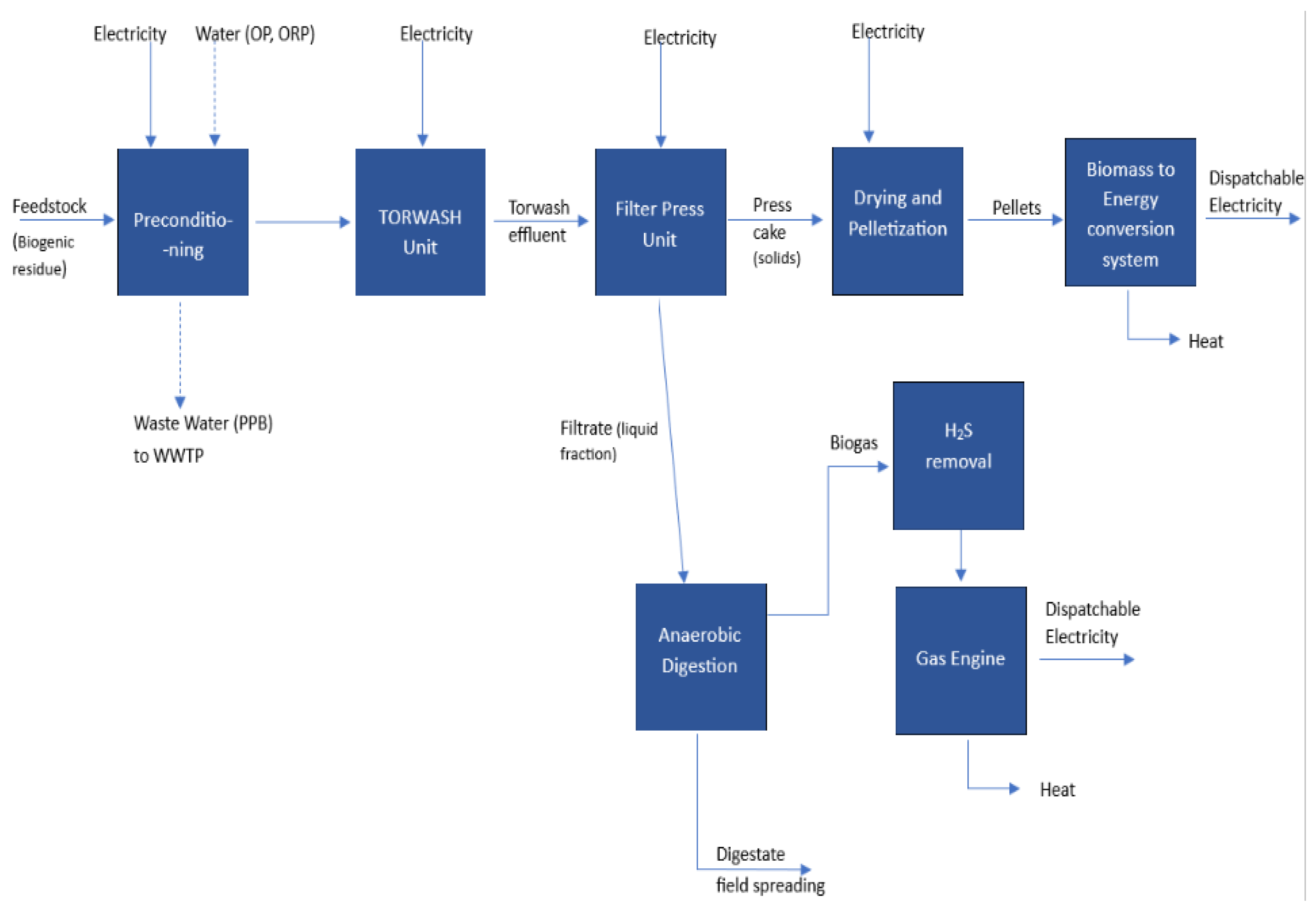
Figure 2.
System boundary scheme of the F-CUBED Production System.
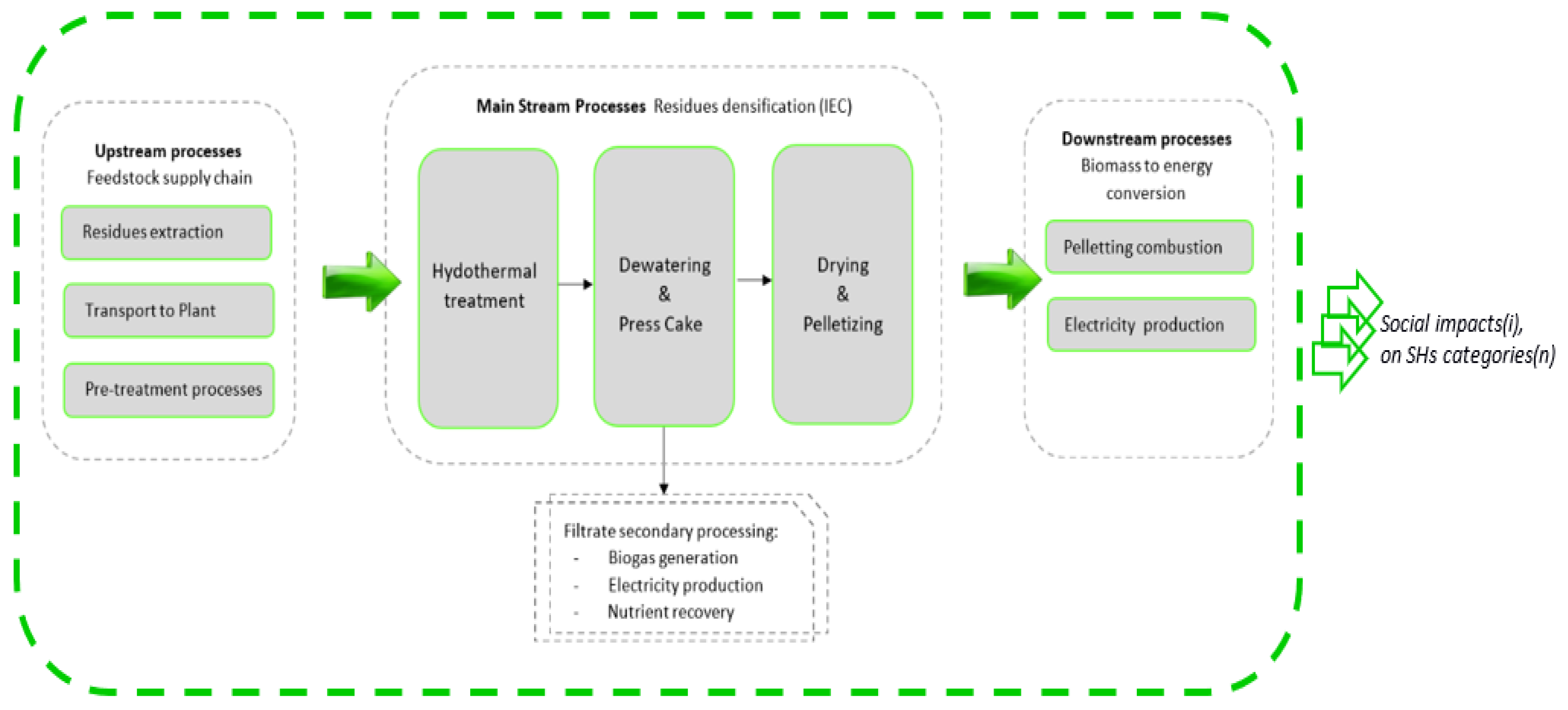
Figure 3.
Wood fuel and peat prices for heating plants, nominal prices in SEK/MWh [33].
Figure 3.
Wood fuel and peat prices for heating plants, nominal prices in SEK/MWh [33].
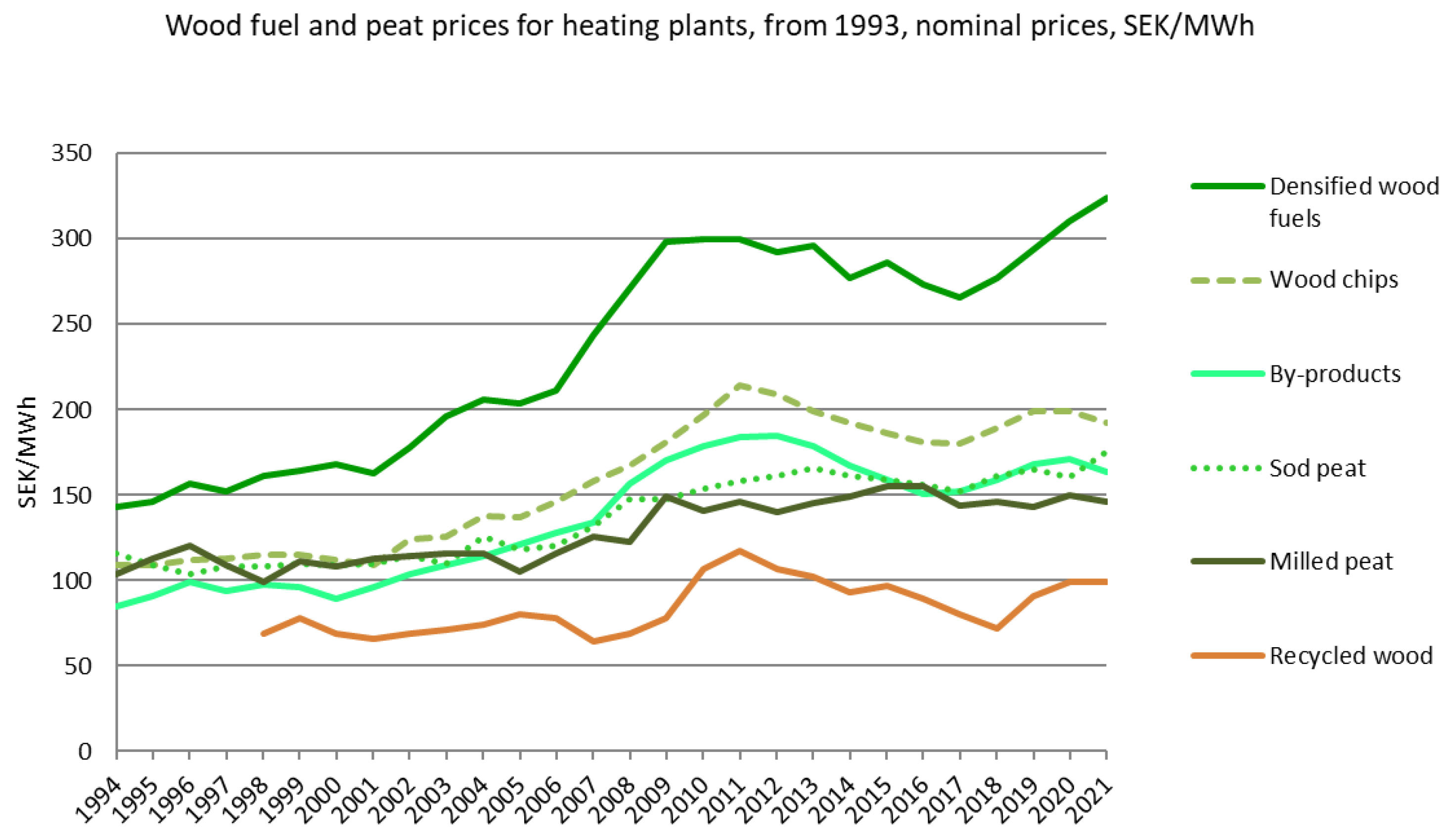
Figure 4.
Contribution of each economic sector to the total social impacts of the Pulp & Paper Bo-sludge Case Study by social impact category.
Figure 4.
Contribution of each economic sector to the total social impacts of the Pulp & Paper Bo-sludge Case Study by social impact category.
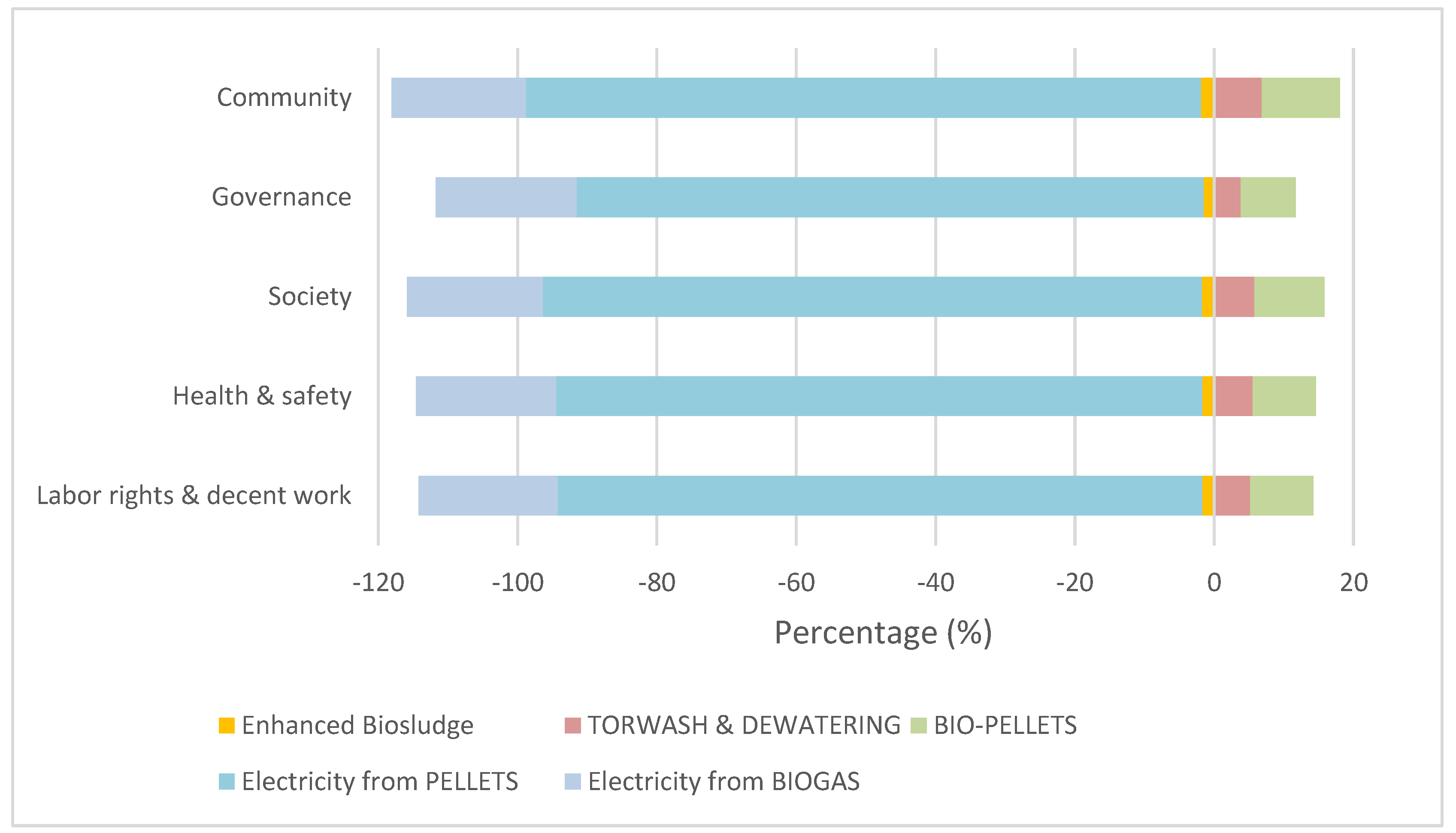
Figure 5.
Contribution of each economic sector to the total social impacts of the Olive Pomace Case Study by social impact category.
Figure 5.
Contribution of each economic sector to the total social impacts of the Olive Pomace Case Study by social impact category.
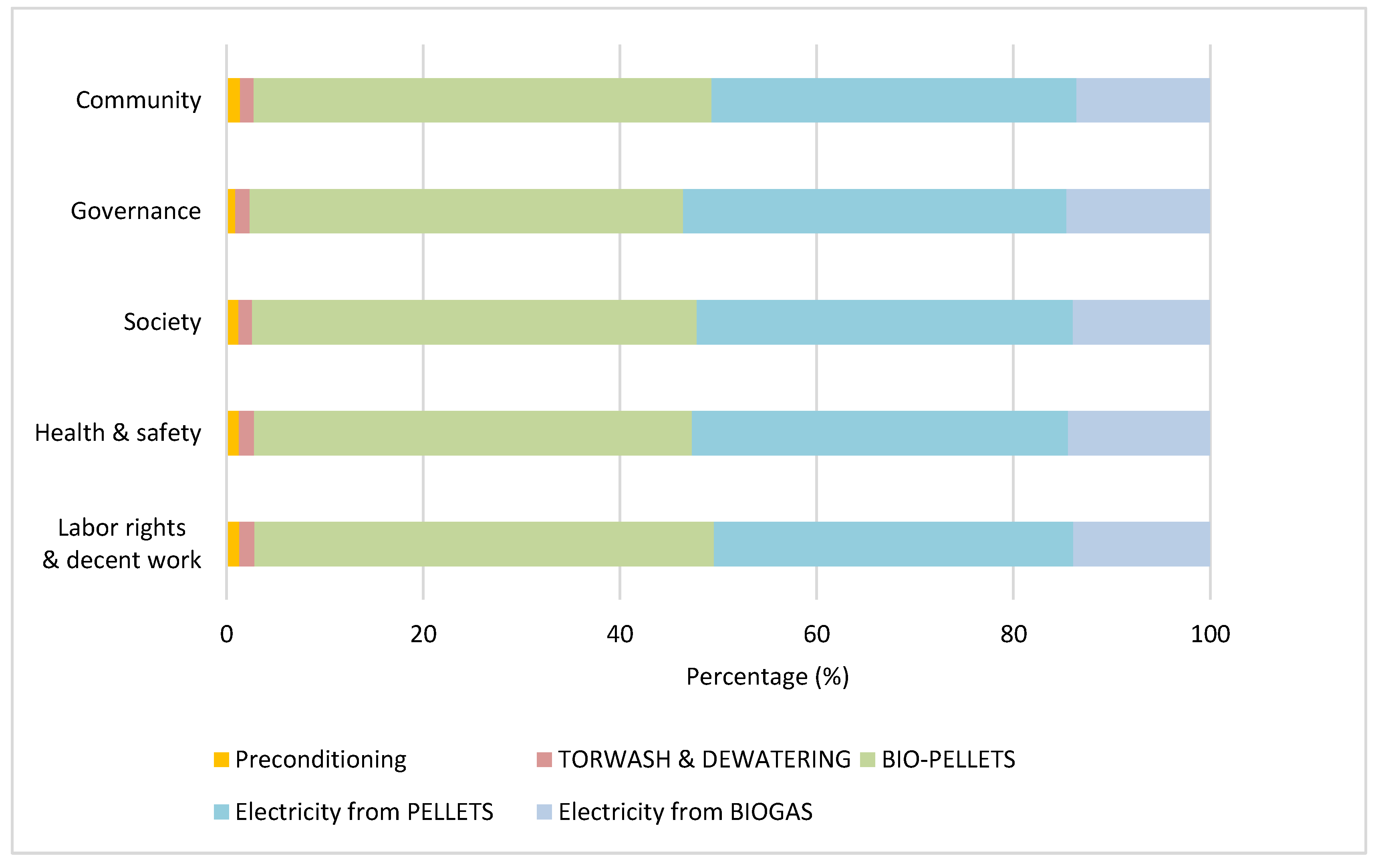
Figure 6.
Contribution of each economic sector to the total social impacts of the Orange Peels Case Study by social impact category.
Figure 6.
Contribution of each economic sector to the total social impacts of the Orange Peels Case Study by social impact category.
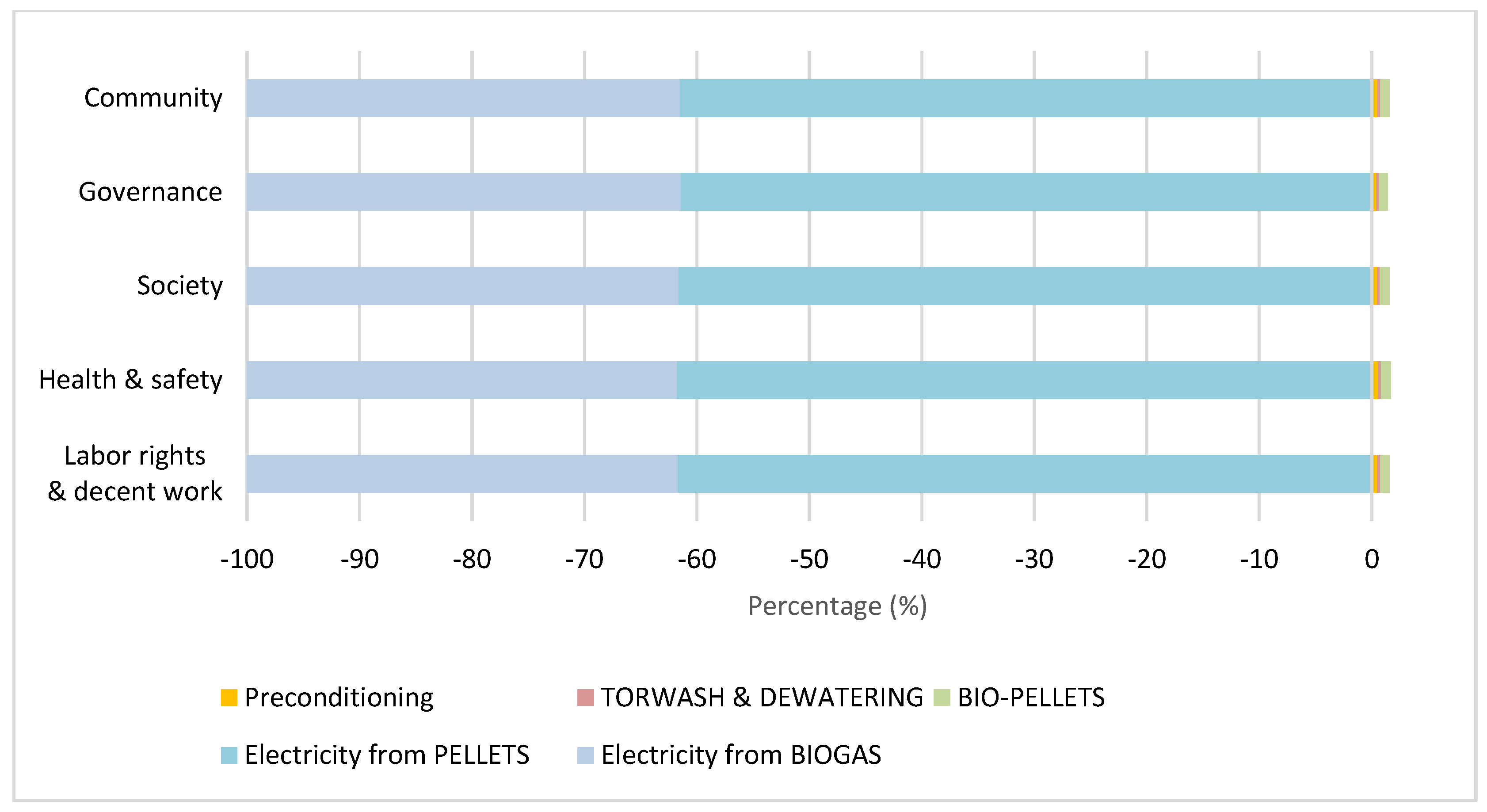
Figure 7.
Contribution analysis in the Pulp & Paper Biosludge case study of economic sector of each production phases to the total social impacts of F-CUBED Supply Chain by social impact subcategory.
Figure 7.
Contribution analysis in the Pulp & Paper Biosludge case study of economic sector of each production phases to the total social impacts of F-CUBED Supply Chain by social impact subcategory.
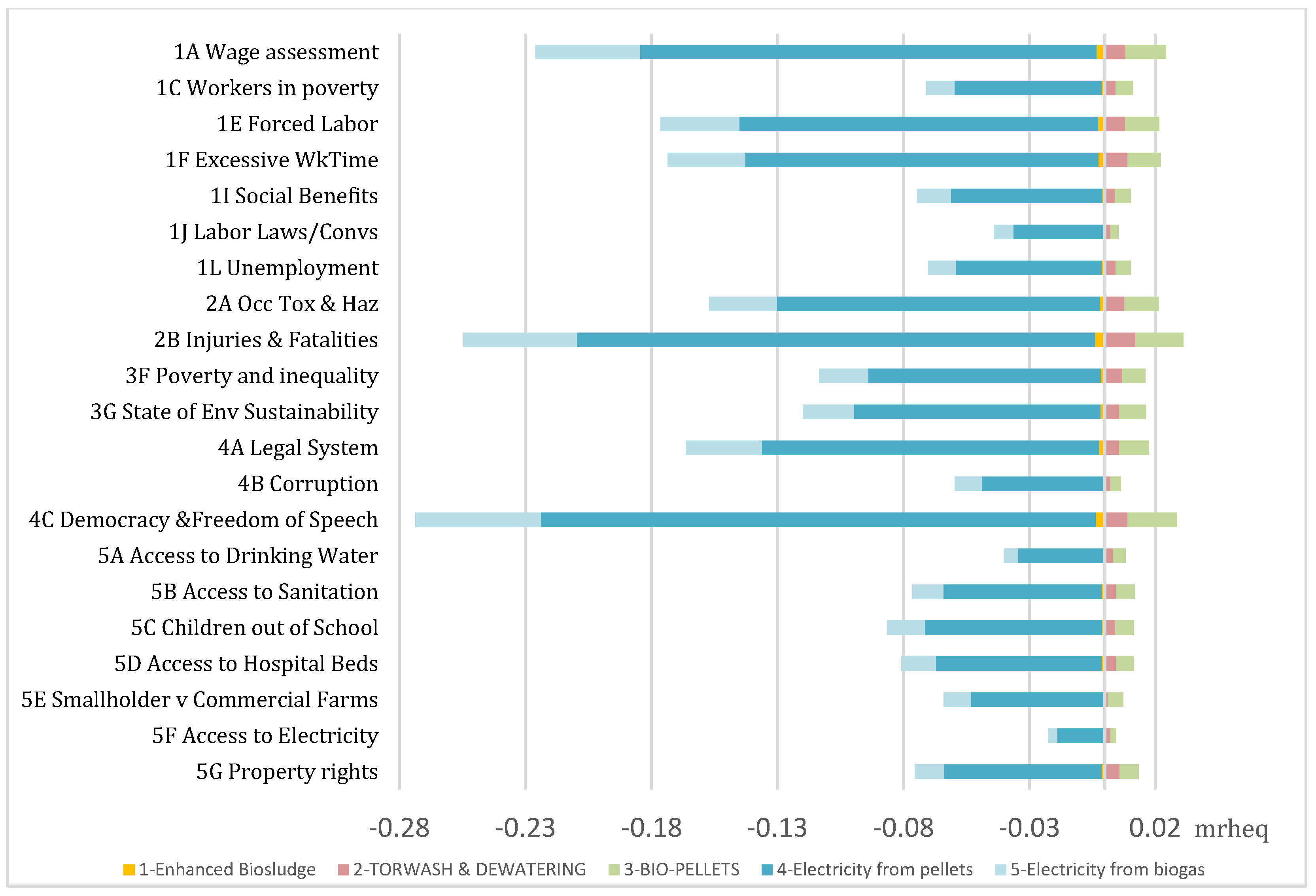
Figure 8.
Contribution analysis in the Olive Pomace case study of economic sector of each production phases to the total social impacts of F-CUBED Supply Chain by social impact subcategory.
Figure 8.
Contribution analysis in the Olive Pomace case study of economic sector of each production phases to the total social impacts of F-CUBED Supply Chain by social impact subcategory.
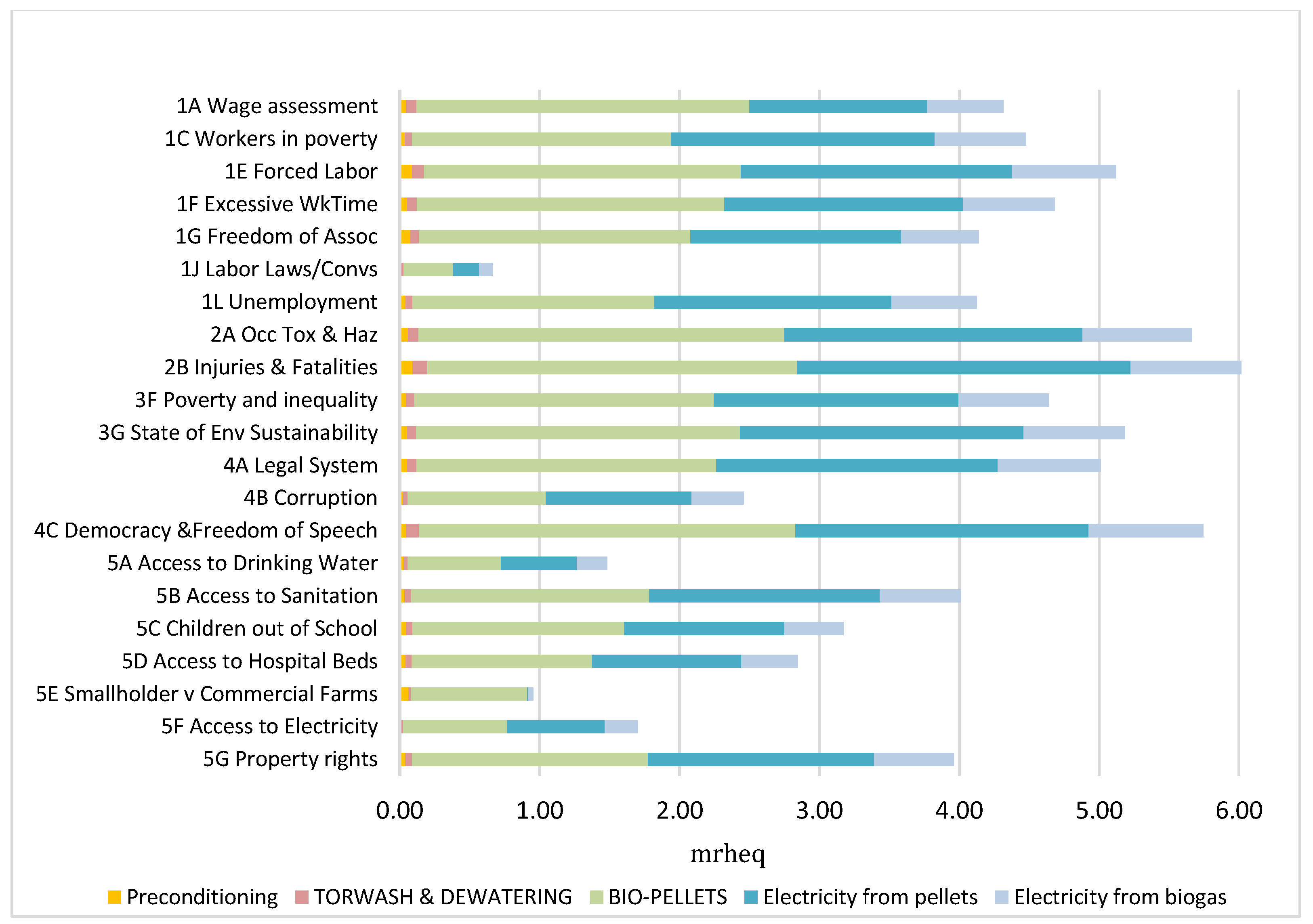
Figure 9.
Contribution analysis of each economic sector, related to the production phases to the total social impacts of F-CUBED Supply Chain in the Orange Peels Case Study, by social impact sub-category.
Figure 9.
Contribution analysis of each economic sector, related to the production phases to the total social impacts of F-CUBED Supply Chain in the Orange Peels Case Study, by social impact sub-category.
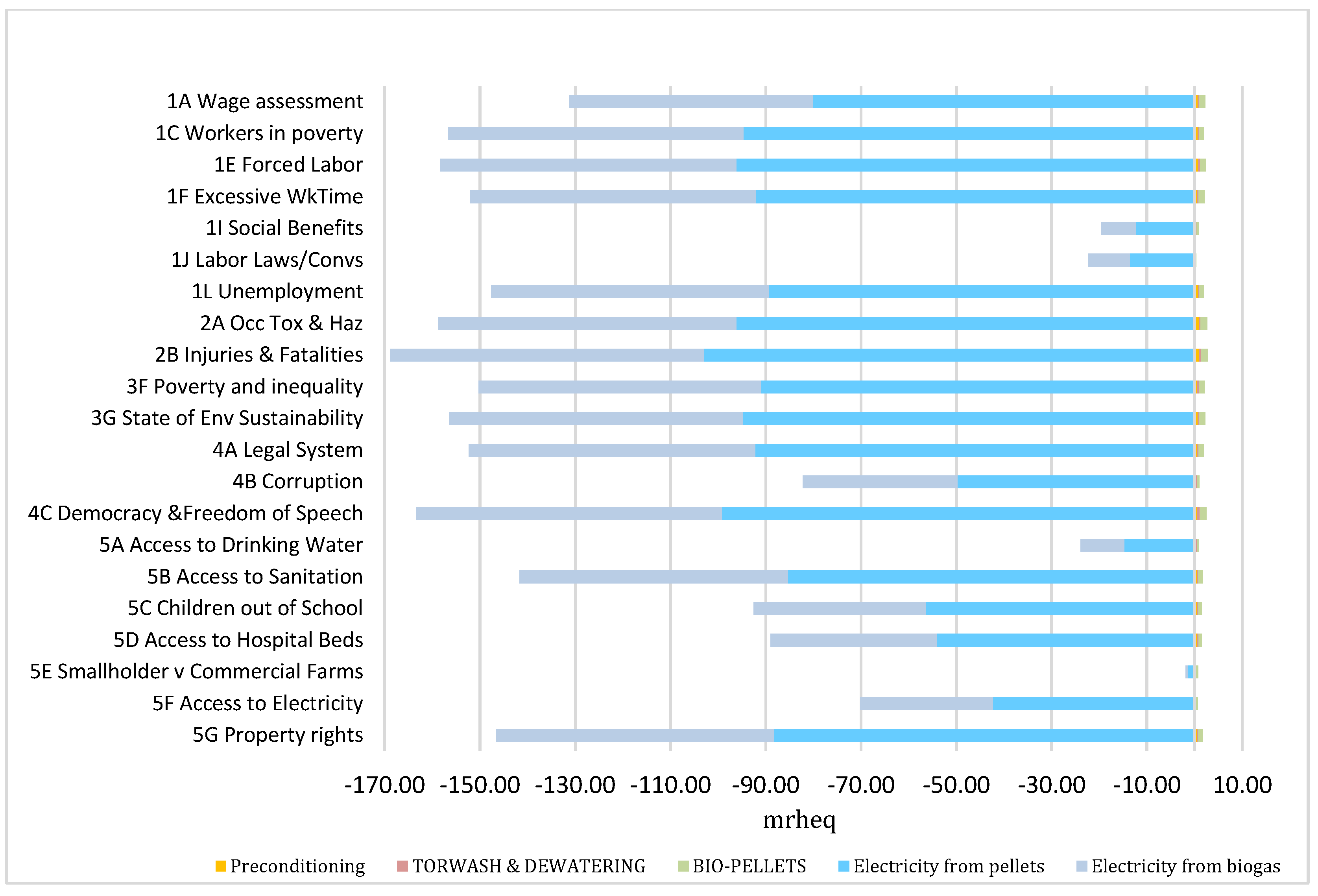

Table 1.
Description of the case studies considered in the S-LCA.
| Biogenic Residue Stream | Object of Investigation |
Description |
|---|---|---|
| Treatment of pulp and paper bio-sludge (DM 3.5%) | Reference case | Smurfit Kappa (SK) Kraftliner paper mill in Piteå, Sweden. The mill produces kraftliner as the main product. The wastewater streams from this mill are sent to the wastewater treatment plant (WWTP). |
| F-CUBED Production System | Integration of the F-CUBED technology at the site of Smurfit Kappa (Piteå, Sweden) paper mill, for operational application with pulp and paper sludge (bio-sludge) as feedstock. Industrial scale operational scenario. | |
| Treatment of virgin olive pomace (DM 19.63%) | Reference case | APPO olive mill, in Sannicandro di Bari, Italy. In the mill, the cleaned olives are pressed for the extraction of the extra virgin olive oil. The olive pomace is sent to the AD reactor for biogas generation. |
| F-CUBED Production System | Integration of the F-CUBED technology at the site of APPO olive mill, for operational application with virgin olive pomace as feedstock. Industrial scale operational scenario. | |
| Treatment of orange peel (DM 20%) | Reference case | Delafruit’s food processing plant, in Reus, Spain. In the plant, the fresh oranges are squeezed to obtain orange juice, which is used for different purposes. The orange peels are sent to the AD reactor for biogas generation. |
| F-CUBED Production System | Integration of the F-CUBED technology at the site of Delafruit’s facility, for operational application with orange peels as feedstock. Industrial scale operational scenario. |
Table 2.
SHDB Impact Assessment Method: Mrh factors.
| Scale level | Description | Value (mrheq) |
|---|---|---|
| 4 | Very High risk | 10 |
| 3 | High risk | 5 |
| 2 | Medium risk | 1 |
| 1 | Low risk | 0.1 |
Table 3.
Input production processes selected for the S-LCA and the respective sector of economy.
| Input Process | Sub-process | Sector of the Economy |
|---|---|---|
| Pre-conditioning | - | Specific industrial sector generating the residues |
| TORWASH® treatment and Dewatering step | - | Other machinery and equipment manufacturing (except transport and electronic equipment) |
| Biopellets production | - | Lumber and wood products production |
| Electricity production (PELLETS) | Electricity production | Electricity production |
| Avoided heat production | Gas extraction | |
| Electricity production (BIOGAS) | Electricity production | Electricity production |
| Avoided heat production | Gas extraction |
Table 4.
Social LCI datasets for the country-specific economic sectors linked to the case studies A) Pulp & Paper Biosludge in Sweden; B) Olive Pomace Case Study in Italy; C) Orange Peels in Spain. The unit USD 2011 is referred to a single ton of residue (USD 2011/tresidue).
Table 4.
Social LCI datasets for the country-specific economic sectors linked to the case studies A) Pulp & Paper Biosludge in Sweden; B) Olive Pomace Case Study in Italy; C) Orange Peels in Spain. The unit USD 2011 is referred to a single ton of residue (USD 2011/tresidue).
| Process | Case study | Co-Products | Economic sector | Values (USD 2011) |
|---|---|---|---|---|
| Feedstock pretreatment | A | Enhanced Bio-sludge | Paper products, publishing (ppp)/SWE U | -0.186 |
| B | Olive pomace destoned & diluted | Vegetable oils and fats (vol)/ITA U | 1.51 | |
| C | Orange peels grinded and diluted | Vegetables, fruit, nuts (v_f)/ESP U | 33.67 | |
| TORWASH® pretreatment | A | Solids produced | Other machinery and equipment manufacturing (except transport and electronic equipment) | 0.403 |
| B | 5.211 | |||
| C | 25.05 | |||
| Biopellets production | A | Biopellets | Lumber and wood products production | 0.550 |
| B | 35.05 | |||
| C | 36.06 | |||
| Electricity production (PELLETS) | A | Avoided heat production | Gas extraction | 8.378 |
| B | 506.68 | |||
| C | 1,033.33 | |||
| A | Dispatchable Electricity | Electricity production | 1.214 | |
| B | 281.50 | |||
| C | 398.82 | |||
| Electricity production (BIOGAS) | A | Avoided heat production | Gas extraction | 2.150 |
| B | 84.31 | |||
| C | 732.76 | |||
| A | Electricity production | Electricity production | 1.028 | |
| B | 82.18 | |||
| C | 494.96 |
Table 7.
SHDB Social Categories investigated in the F-CUBED Production System LCIA, selected impact subcategories and proposed correspondence with the UNEP Guidelines subcategories.
Table 7.
SHDB Social Categories investigated in the F-CUBED Production System LCIA, selected impact subcategories and proposed correspondence with the UNEP Guidelines subcategories.
| Social Impact Categories | Subcategories | SHDB - ID | UNEP 2020 harmonization |
|---|---|---|---|
| Labor rights and decent work | Wage assessment | Labor rights | Career prospects Employment Prospects |
| Workers in poverty | 1C | Economic opportunities | |
| Forced Labor | 1E | Work conditions | |
| Excessive Working Time | 1F | Work conditions | |
| Social Benefits | 1I | Job satisfaction | |
| Labor Laws/Convs | 1J | Training requirements | |
| Unemployment | 1L | Job stability | |
| Health and safety | Occupational Health and Safety (Occ Tox & Haz) | 2A | Children, Health and well-being Children, Exposure to pollutants or hazardous substances: |
| Society | Poverty and inequality | 3F | Local employment Broader Social Acceptance Social Challenges and Energy Demands |
| State of Env Sustainability | 3G | Availability of local resources Contribution to Sustainable Development |
|
| Governance | Legal System | 4A | Market Opportunities Alignment with Societal Goals and Policies |
| Corruption | 4B | Future prospects | |
| Community | Access to Drinking Water | 5A | Air and water quality |
| Access to Sanitation | 5B | Alignment with Societal Goals and Policies | |
| Children out of School | 5C | Children, Health and well-being | |
| Access to Hospital Beds | 5D | Alignment with Societal Goals and Policies | |
| Smallholder v Commercial Farms | 5E | Economic Viability Market Opportunities | |
| Access to Electricity | 5F | Energy Affordability Accessibility of Bioenergy Products Perceptions of Technology and its Benefits or Drawbacks |
|
| Property rights | 5G | Technological Advancements Reliability of Bioenergy Products |
Table 8.
Single score social impacts of the Pulp & Paper, Olive Pomace and Orange Peels Case Studies by impact category.
Table 8.
Single score social impacts of the Pulp & Paper, Olive Pomace and Orange Peels Case Studies by impact category.
| Damage Category |
Social Impact Indicator Damage assessment (mrheq) |
||
| Pulp & Paper Biosludge | Olive Pomace | Orange Peels | |
| 1) Labor rights & decent work | -0.103 | 3.661 | -108.217 |
| 2) Health & safety | -0.180 | 5.907 | -161.077 |
| 3) Society | -0.061 | 2.933 | -85.303 |
| 4) Governance | -0.149 | 4.405 | -130.811 |
| 5) Community | -0.054 | 2.589 | -79.562 |
| Total | -0.546 | 19.496 | -564.970 |
Table 9.
Social impacts of the F-CUBED Production System of the Pulp & Paper Biosludge, Olive Pomace and Orange Peels case studies by economic sectors. Values are expressed in medium risk hours equivalents (mrheq).
Table 9.
Social impacts of the F-CUBED Production System of the Pulp & Paper Biosludge, Olive Pomace and Orange Peels case studies by economic sectors. Values are expressed in medium risk hours equivalents (mrheq).
| Case study | Economic sector/ Production phase |
Labor rights & decent work | Health & safety | Society | Governance | Community |
|---|---|---|---|---|---|---|
| Pulp & Paper Biosludge | 1-Enhanced Biosludge | -0.002 | -0.003 | -0.001 | -0.002 | -0.001 |
| 2-Torwash & Dewatering | 0.005 | 0.010 | 0.004 | 0.006 | 0.004 | |
| 3-Biopellets | 0.009 | 0.016 | 0.006 | 0.012 | 0.006 | |
| 4-Electricity from pellets | -0.095 | -0.167 | -0.057 | -0.134 | -0.052 | |
| 5-Electricity from biogas | -0.021 | -0.036 | -0.012 | -0.030 | -0.010 | |
| Total | -0.103 | -0.180 | -0.061 | -0.149 | -0.054 | |
| Olive Pomace |
1-Enhanced Biosludge | 0.048 | 0.075 | 0.036 | 0.040 | 0.036 |
| 2-Torwash & Dewatering | 0.056 | 0.091 | 0.040 | 0.063 | 0.036 | |
| 3-Biopellets | 1.710 | 2.630 | 1.325 | 1.941 | 1.204 | |
| 4-Electricity from pellets | 1.339 | 2.258 | 1.122 | 1.718 | 0.961 | |
| 5-Electricity from biogas | 0.509 | 0.853 | 0.410 | 0.642 | 0.351 | |
| Total | 3.661 | 5.907 | 2.933 | 4.405 | 2.589 | |
| Orange Peels | 1-Enhanced Biosludge | 0.538 | 0.894 | 0.427 | 0.514 | 0.427 |
| 2-Torwash & Dewatering | 0.267 | 0.436 | 0.194 | 0.305 | 0.175 | |
| 3-Biopellets | 0.920 | 1.415 | 0.713 | 1.044 | 0.648 | |
| 4-Electricity from pellets | -66.778 | -99.570 | -52.594 | -80.402 | -48.959 | |
| 5-Electricity from biogas | -43.163 | -64.253 | -34.042 | -52.273 | -31.854 | |
| Total | -108.217 | -161.077 | -85.303 | -130.811 | -79.562 |
Table 10.
Contribution analysis of economic sectors to the total social impacts of the Pulp & Paper Biosludge (A), Olive Pomace (B), and Orange Peels (C) Case Studies by impact subcategory.
Table 10.
Contribution analysis of economic sectors to the total social impacts of the Pulp & Paper Biosludge (A), Olive Pomace (B), and Orange Peels (C) Case Studies by impact subcategory.
| Social Impact Category | Social Impact Subcategory | Impact assessment by Social Hotspot 2022 Category Method (mrheq) | ||
|---|---|---|---|---|
| A | B | C | ||
| Labor rights & decent work | 1A Wage assessment | -0.202 | 4.316 | -128.981 |
| 1C Workers in poverty | -0.060 | 4.478 | -154.812 | |
| 1E Forced Labor | -0.155 | 5.122 | -155.865 | |
| 1F Excessive Working Time | -0.151 | 4.681 | -149.980 | |
| 1I Social Benefits | -0.064 | 4.141 | -18.567 | |
| 1J Labor Laws/Convs | -0.039 | 0.663 | -21.892 | |
| 1L Unemployment | -0.060 | 4.125 | -145.715 | |
| Health & safety | 2A Occ Tox & Haz | -0.136 | 5.665 | -156.115 |
| 2B Injuries & Fatalities | -0.224 | 6.149 | -166.040 | |
| Society | 3F Poverty and inequality | -0.097 | 4.642 | -148.193 |
| 3G State of Env Sustainability | -0.104 | 5.185 | -154.280 | |
| Governance | 4A Legal System | -0.149 | 5.012 | -150.366 |
| 4B Corruption | -0.053 | 2.457 | -81.214 | |
| 4C Democracy &Freedom of Speech | -0.245 | 5.747 | -160.855 | |
| Community | 5A Access to Drinking Water | -0.032 | 1.481 | -23.008 |
| 5B Access to Sanitation | -0.064 | 4.009 | -140.005 | |
| 5C Children out of School | -0.075 | 3.172 | -91.019 | |
| 5D Access to Hospital Beds | -0.069 | 2.845 | -87.493 | |
| 5E Smallholder vs Commercial Farms | -0.057 | 0.955 | -1.101 | |
| 5F Access to Electricity | -0.018 | 1.700 | -69.430 | |
| 5G Property Rights | -0.062 | 3.962 | -144.880 | |
Table 5.
Social LCI of F-CUBED Production System for the A) Pulp & Paper Biosludge Case Study in Sweden; B) Olive Pomace Case Study sited in Italy; C) Orange Peels Case Study in Spain.
Table 5.
Social LCI of F-CUBED Production System for the A) Pulp & Paper Biosludge Case Study in Sweden; B) Olive Pomace Case Study sited in Italy; C) Orange Peels Case Study in Spain.
| Process | Data | SH Unit process | Units | Case study | ||
|---|---|---|---|---|---|---|
| A | B | C | ||||
| UPSTREAM processes | ||||||
| Feedstock pretreatment | Input | Residues unit process | USD 2011 | -0.18615 1 | 1.51 2 | 33.67 3 |
| Residue’s value | €/kg | -0.215 4 | 0.001 | 0.0065 | ||
| Output | Preconditioned residue | kg/tFU | 32.9 5 | 2,013.5 6 | 5,180 7 | |
| MAIN STREAM processes | ||||||
| TORWASH® pretreatment | Input | Other machinery and equipment manufacturing (except transport and electronic equipment) | USD 2011 | 0.403 | 5.211 | 25.05 |
| Substitution values of solids | €/kg | 0.047 | 0.035 | 0.07 | ||
| Output | Solids from main stream processes | kg/tFU | 11.41 | 198 | 476 | |
| Biopellets production | Input | Lumber and wood products production | USD 2011 | 0.55 | 35.05 | 36.06 |
| Substitution values of pellets (bulk) | €/kg | 0.139 | 0.37 | 0.221 | ||
| Output | Biopellets | kg/tFU | 5.25 | 126 | 217 | |
| DOWNSTREAM processes | ||||||
| Electricity production (PELLETS) | Input (Avoided heat) | Gas extraction | USD 2011 | 8.38 | 506.68 | 1,033.33 |
| Avoided heat scenario 54% | kWh/tFU | 41 | 3,860 | 3,799.78 | ||
| Price of thermal kWh | p/kWh | 23.43 | 15.05 | 31.18 | ||
| Current exchange rate | €/£ | 1.16 | 1.16 | 1.16 | ||
| Input (Electricity) | Electricity production value | USD 2011 | 1.21 | 281.50 | 398.82 | |
| Electricity production | kWh/tFU | 13.3 | 1,600 | 2,326.47 | ||
| Prices of electricity | €/kWh | 0.121 | 0.234 | 0.228 | ||
| Output | Electricity from pellets | p | 1 | 1 | 1 | |
| FILTRATE processing | ||||||
| Electricity production (BIOGAS) | Input (Avoided heat) | Gas extraction | USD 2011 | 2.15 | 84.31 | 732.76 |
| Avoided heat | kWh/tFU | 10.52 8 | 3,860 9 | 2,694.50 8 | ||
| Price of thermal kWh | p/kWhth | 23.43 | 15.05 | 31.18 | ||
| Current exchange rate | €/£ | 1.16 | 1.16 | 1.16 | ||
| Input (Electricity ) | Electricity production value | USD 2011 | 1.03 | 82.18 | 494.96 | |
| Electricity production | kWh/tFU | 11.26 | 467.11 | 2,887,28 | ||
| Prices of electricity | €/kWh | 0.121 | 0.234 | 0.228 | ||
| Output | Electricity from biogas | p | 1 | 1 | 1 | |
1 Paper products, publishing (ppp)/SWE U, considering 1.1515 kg/tADp. 2 Vegetable oils and fats (vol)/ITA U. 3 Vegetables, fruit, nuts (v_f)/ESP U. 4 Disposal cost for landfilling of sewage sludge. 5 Biosludge (wb) DM 3.5%, expressed as kg/tADP. 6 Olive pomace preconditioned, expressed as kg/tOP. 7 Orange peels preconditioned, expressed as kg/tORP. 8 Scenario of heat reuse of 54%. 9 Scenario of heat reuse of 80%.
Table 6.
F-CUBED Production processes provided by SHDB for the Pulp & Paper Biosludge Case Study in Sweden; Olive Pomace Case Study sited in Italy; Orange Peels Case Study in Spain.
Table 6.
F-CUBED Production processes provided by SHDB for the Pulp & Paper Biosludge Case Study in Sweden; Olive Pomace Case Study sited in Italy; Orange Peels Case Study in Spain.
| Process | Co-products | Sector of the Economy | Data Source | |||
|---|---|---|---|---|---|---|
| Pulp & Paper Biosludge Case Study | ||||||
| Pre-conditioning | Enhanced Biosludge | Paper products, publishing (ppp)/SWE U | [23,32] | |||
| TORWASH® treatment and Dewatering step | Solids produced | Other machinery and equipment manufacturing (except transport and electronic equipment)_SE | Wood fuel and peat prices for heating plants, nominal prices, 192 SEK/MWh (2021); in [33] | |||
| Biopellets production | Biopellets | Lumber and wood products production_SE | Price of wood pellets for European Industrial Wood Pellets [34] | |||
| Electricity production (PELLETS) |
Dispatchable Electricity | Electricity production_SE | Electricity price for households, taxes and network price not included; [33] | |||
| Avoided heat production | Gas extraction_SE | [35] | ||||
| Electricity production (BIOGAS) |
Dispatchable Electricity | Electricity production_SE | Electricity price for households, taxes and network price not included; [33] | |||
| Avoided heat production | Gas extraction_SE | [35] | ||||
| Olive Pomace Case Study | ||||||
| Pre-conditioning | Olive pomace destoned & diluted | Vegetable oils and fats (vol)/ITA U | [23] and authors expertise in the sector | |||
| TORWASH® treatment and Dewatering step | Solids produced | Other machinery and equipment manufacturing (except transport and electronic equipment)_IT | Authors expertise in the sector: average price of wood chips M50, 35€/t | |||
| Biopellets production | Biopellets | Lumber and wood products production_IT | Price of wood pellets for European Industrial Wood Pellets from [34] | |||
| In the sector | Electricity production | Electricity production_IT | [36] | |||
| Avoided heat production | Gas extraction_IT | [35] | ||||
| Electricity production (BIOGAS) | Electricity production | Electricity production_IT | [36] | |||
| Avoided heat production | Gas extraction_IT | [35] | ||||
| Orange peels Case Study | ||||||
| Pre-conditioning | Orange peels grinded and diluted | Vegetables, fruit, nuts /ESP U | [37] | |||
| TORWASH treatment and Dewatering step | Solids produced | Other machinery and equipment manufacturing (except transport and electronic equipment)_ESP | Average price of wood chips P45/G50, 70 €/t, from Astillas, precio según tamaño de grano y coste de producción, 2017; in [38] | |||
| Biopellets production | Biopellets | Lumber and wood products production_ESP | Pellets, precio según el tipo de suministro, 2017; in [37] | |||
| Electricity production (PELLETS) | Electricity production | Electricity production_ESP | [36] | |||
| Avoided heat production | Gas extraction_ESP | [35] | ||||
| Electricity production (BIOGAS) | Electricity production | Electricity production_ESP | [36] | |||
| Avoided heat production | Gas extraction_ESP | [35] | ||||
Disclaimer/Publisher’s Note: The statements, opinions and data contained in all publications are solely those of the individual author(s) and contributor(s) and not of MDPI and/or the editor(s). MDPI and/or the editor(s) disclaim responsibility for any injury to people or property resulting from any ideas, methods, instructions or products referred to in the content. |
© 2025 by the authors. Licensee MDPI, Basel, Switzerland. This article is an open access article distributed under the terms and conditions of the Creative Commons Attribution (CC BY) license (http://creativecommons.org/licenses/by/4.0/).
Copyright: This open access article is published under a Creative Commons CC BY 4.0 license, which permit the free download, distribution, and reuse, provided that the author and preprint are cited in any reuse.


