

Submitted:
07 February 2024
Posted:
08 February 2024
You are already at the latest version
Abstract
The Circular Bioeconomy (CBE) combines the concepts of bioeconomy and circular economy. As an alternative concept to the current fossil-based, linear economy, it de-scribes an economy based on the efficient valorization of biomass. It is regional in nature and aims to improve sustainability. An analysis of the transition process, by identifying its success criteria and assessing its impacts through the modelling of technology-specific scenarios is necessary to ensure that CBE concepts are sustainable. However, a compre-hensive consideration of regional influences on both is lacking.
Based on extensive literature research and an expert survey, we (i) present a compre-hensive catalog of CBE success criteria and discuss their region-specific character and (ii) develop a methodology based on evaluation matrices that enable to match CBE technolo-gies with regions. The matrices support the evaluation of technological and regional characteristics influencing the successful CBE implementation.
The results show that the success criteria "biomass resources", "technological", and "social" are perceived as highly important, and that most of the success criteria are both region- and technology-specific, highlighting the relevance of developing matrices to match them. We describe such matrices indicatively for the two broadest and most im-portant success criteria clusters “social acceptance” and “biomass supply chain”.
With this, we substantiate the regional nature of CBE and raise the awareness on the importance of considering regional conditions in CBE transition processes. Furthermore, we provide practical guidance on how regional conditions can be reflected in the selection of technologies, e.g. in regional CBE technology scenarios.
Keywords:
circular bioeconomy
; CBE
; regional
; transition
; technology scenario
; success criteria
; barrier & driver
; social acceptance
; biomass supply chain
1. Introduction
As a long-term target of the European Union (EU) [1] and of many countries worldwide [2,3], the bioeconomy (BE) is promoted as an economic concept that can replace the current fossil based and linear economy with the aim to increase sustainability [1]. The European Bioeconomy Strategy describes the BE as a broad concept that covers all sectors and systems relying on biological resources [1]. In 2012, with the publication of the first BE strategy, the EU has already committed itself to the goal of a transition towards BE. [4]. Since then, the potential negative impacts of the BE have also raised concerns. A main environmental concern relates to the resource base of the BE. It is expected that the growing demand for bio-based resources and the associated increase in primary production will potentially intensify production processes in agriculture, forestry and aquaculture as well as the competition for land [5]. This potentially intensifies environmental and social problems such as land use change, global warming [6], biodiversity loss [7] and threatened food security [8]. To prevent this, in the updated BE strategy of 2018, the EU strengthens the focus on sustainability and circularity and defines it as key success factors of the BE [1]. In parallel, the term circular bioeconomy (CBE) was established in the scientific literature since 2015 to describe the fusion of the two concepts of BE and the circular economy [9]. Stegman et al. derive a definition from the elements that constitute the CBE: “the sustainable, resource-efficient valorization of biomass in integrated, multi-output production chains, while also making use of residues and wastes and optimizing the value of biomass over time via cascading” [9]. Moreover, we hypothesize that CBE is a highly regional concept. For example, CBE concepts based on residual biomass are strongly predefined by their availability, which depends on regional conditions such as agro-climatic environment, industry focus and consumption patterns [10]. Further regional conditions exist, including biomass logistics, technological knowledge, and sensitivity to environmental impacts. Accordingly, the CBE approach of a given region is determined by its geographic location, natural resources and economics [11].
Due to the aforementioned risk that the BE contradicts its vision of being a sustainable economic concept and causes social and environmental damage when implemented, a careful planning of the transition process and its framework conditions is required, also for the CBE; for example, through the development of a comprehensive governance framework [2,12,13]. For this a thorough understanding of the transition process is necessary [12]. Acknowledged methods to analyze the CBE transition process are for example (i) the identification of its drivers and barriers [14] or (ii) the assessment of its possible impacts. Many studies are available that identify drivers and barriers (see Table 1). However, most of them do not reflect regional conditions affecting these drivers and barriers. Possible impacts that a CBE transition process may have on economy, society and the environment, are assessed e.g. through explorative scenario analyses depicting potential CBE pathways [15,16,17,18,19,20]. For a precise modeling of certain development paths, it is necessary to integrate specific technological CBE innovations into the model. For example, Wydra et al. [18] examine possible transition pathways and interactions of distinct bio-based niches, i.e. bioplastics, biolubricants, biofuels for road and aviation; or Tsiropoulos [16] investigate competitive and synergetic biomass uses within the energy, biotechnological and chemical sectors using a technology-rich and technology-explicit model. However, the technology selection process in such CBE technology scenarios is often arbitrary and not sufficiently justified and documented: Examples of rather vague justifications we found in the literature are: a limitation to technologies from certain economic sectors [16,17], a limitation to technologies with a direct substitution potential for fossil products [16,17], or a limitation to technologies with high technology readiness level [20]. Conversely, we argue that in CBE scenario building, the selection of technologies should be based on an appropriate assessment of their potential for a successful sustainable implementation. Furthermore, following our hypothesis that CBE is a regional concept, we suggest that this potential should be assessed taking regional conditions into account. Approaches for the evaluation of the success potential of CBE innovations that consider regional conditions have been proposed: For example, Salvador et al. identify drivers and barriers for CBE businesses and present regional differences in these aspects [21]; Or Croxatto Vega et al. present an approach that allows the selection of an ideal technology for a given region based on economic and environmental criteria [22]. However, concrete guidelines for a region-specific technology selection in the context of CBE scenario building cannot be derived from these studies. For this purpose, the analysis by Salvador et al. is not sufficiently refined in terms of both regionality and success criteria. The quantitative approach of Croxatto Vega et al. is suitable to support an informed choice among a small number of technology options. However, intensive data requirements make it difficult to be applied to a large number of technology options for scenario building.
Accordingly, we address two research gaps: (i) Although there is extensive literature analyzing the potential for a successful CBE transition by identifying barriers and drivers, a comprehensive consideration of the role that regional conditions play in this context is lacking. (ii) Furthermore, we identify a lack in practical guidance for the reflection of regional conditions during the selection of CBE technologies in the context of CBE technology scenario building. Therefore, the objective of this study is twofold: (i) The first objective is to compile a comprehensive catalog of CBE success criteria and to demonstrate the extent to which these success criteria are region-specific. In doing so, we aim to substantiate our hypothesis that the CBE is regional in nature and to broaden and deepen awareness and understanding of the important role that regional conditions play in CBE transition processes. (ii) The second objective of our study is to present a methodology for the selection of CBE technologies based on the reflection of their potential for a successful sustainable implementation under the influence of regional conditions. The methodology is based on evaluation matrices that allow to assess technological and regional conditions influencing the success potential of a specific CBE technology in a given region. A matching of CBE technologies with regions is thereby possible, preparing technology selection for the building of regional CBE technology scenarios.
2. Materials and Methods
The first objective of the study is to demonstrate the importance of the regional context for the successful implementation of CBE technologies. With this in mind, in a first step, we identify success criteria for the implementation of CBE technologies from the literature and categorize them. We adopt a broad perspective that includes among others economic, environmental, and social factors both upstream and downstream of the CBE technology. We explicitly do not limit this first step to region-specific criteria. This allows for a comprehensive set of criteria that may include region-specific factors that have not yet been identified as such. It also allows us to demonstrate later that most of the success criteria are indeed region-specific, which emphasizes the importance of this work. In a second step, we validate the CBE success criteria catalog through an expert survey.
The second objective of this study is to provide practical guidance for the selection of technologies in the context of CBE scenario building. To do this, it is necessary to identify success criteria that are both technology- and region-specific, as these criteria must be carefully considered when selecting a CBE technology for a specific region. Therefore, in the third step, we categorize each CBE success criterion according to its region and technology specificity. The final step considers only CBE success criteria that are both technology-specific and region-specific at the subnational level. In this step, for selected CBE success criteria clusters we develop two evaluation matrices each: the CBE Technology Evaluation Matrix and the CBE Region Evaluation Matrix. These matrices allow a separate evaluation of regional and technological characteristics and their potential influence on the respective success criteria cluster. By comparing the results of the two evaluation matrices, it is possible to match a CBE technology with a region regarding the criteria cluster. Figure 1 visualizes the described procedure.
2.1. Identification of success criteria for the implementation of CBE technologies
To identify criteria that influence the success of the implementation of CBE technologies, we conducted a literature review. By applying the search terms driver and barrier in combination with terms referring to the CBE we received 286 results from the web of science database. We first scanned the titles and identified 28 studies as potentially relevant, from which we then read the abstract to finally select 22 relevant peer reviewed journal publications. Table 1 lists the selected studies, indicating bibliographic information and the context. From the publications, we extract CBE success criteria. We compile the original citations in a comprehensive table (SM2) and add for each study a new column. Related criteria from the different studies are grouped together in one row. For each row, we derive a general term that stands for all quotations from this group and define it as the main criterion. In addition, we derive as sub-criteria general terms for specifications and details given in the studies, which help to deepen the understanding of the main criterion. Each main criterion with its sub-criteria is assigned to a superordinate criteria category. Further, we document the number of studies relating to each main and sub-criterion and sort them in descending order, assuming this provides a first indication of their relevance. The main and sub-criteria, as well as their categorization and sorting are compiled in the CBE Success Criteria Catalog.
2.2. Validation of CBE Success Criteria
To validate and improve the results of the literature research we conducted an expert survey. Five experts from three European countries answered a questionnaire (SM4) in which we present our CBE Success Criteria Catalog, including the categorization of the criteria. The experts provided feedback on whether they agree with the catalog or whether and how they would add to the main or sub-criteria or change their categorization or sorting. We merged the expert feedback into one document and changed the criteria list accordingly.
2.3. Categorization of CBE Success Criteria into Region- and Technology-Specific Criteria
To identify CBE success criteria that are both technology- and region-specific at the subnational level, we created a categorization scheme that classifies CBE success criteria according to their region and technology specificity. Based experience, we decided for each sub-criterion whether it is region-specific and/or technology-specific and justify our choice in the result section. We consider factors to be region- or technology-specific, which can either have different states for different regions/technologies or which can be of different importance for different regions/technologies. We distinguish between factors that are region-specific at the national level and those that are region-specific at the subnational level.
2.4. Development of Evaluation Matrices for regions and technologies to allow a matching of regions and CBE technologies regarding selected CBE success criteria clusters
To demonstrate the evaluation and matching process, we select two success criteria clusters: the first cluster examines the topic of social acceptance & consumer awareness, while the second cluster looks at the topic of the biomass supply chain.
In order to compile the CBE Technology and the CBE Region Evaluation Matrix for the two clusters, we conducted two further literature researches in web of science. For the first cluster we combined search terms referring to social acceptance, region, and the BE. A more specific search referring to the CBE was not successful. We excluded mismatches by scanning titles and abstracts and added further publications from the reference lists of suitable publications during the reading process. The list of publications that was finally considered to compile the matrices is summarized in Table 2. For the second cluster we used a combination of search terms referring to residual biomass, accessibility, and region. Scanning of titles and abstracts helped to exclude mismatches. As this search provided mainly studies on supply chains for forestry and agricultural residues, but few for industrial by-products and wastes, we included publications from another search with terms related to biobased industrial by-products and supply chain. The final list of publications used for the matrices’ compilation can be taken from Table 3.
To construct the matrices, we extract from the literature characteristics of both CBE conversion technologies and regions that influence social acceptance and the biomass supply chain, respectively. For each characteristic, we indicate whether it is more likely to increase or decrease the potential for a CBE.
3. Results
3.1. CBE Success Criteria Catalog
From the literature review and the expert survey, we receive 19 main criteria and 76 sub-criteria that influence the success of CBE (see Table 4). We categorize them into the seven criteria categories: biomass resource, technological, environmental, economic, political & legislation, social, and methodological.
The main criterion we found to be mentioned most frequently in the literature, with 20 studies referring to it, is the biomass availability. This is particularly remarkable as this criterion has a comparatively narrow scope, while other main criteria cover a broader range of sub-criteria. Furthermore, there is a high level of awareness towards the criteria of profitability & markets as well as policies, legislation & standards, with 18 studies relating to each. The two criteria logistic & supply chain and availability of technology are also frequently mentioned, with 17 studies each, demonstrating the high relevance of technological aspects. The social category comprises many criteria with medium to high rankings, which indicates that this category as a whole receives a high level of attention. The social category is the only one for which one of the experts proposed a change in the sorting of the main criteria, stating that here is a lack of consensus in the scientific bioeconomy community. The environmental category seems to be of rather low importance, comprising only two main criteria of medium and low ranking. This is surprising as the transition to a CBE is mainly motivated by the environmental problems associated with a linear and fossil-based economy. It is further remarkable that the potential of CBE to influence the environment (negatively or positively) attracts far more attention than the potential for environmental changes to jeopardize the successful implementation of CBE. Worth mentioning is also that three of the five experts suggest not to rank the environmental indicators, as their relevance is highly biomass specific.
3.2. Categorizsation Scheme - region and technology specificity of CBE success criteria
To identify those success criteria that are both region- and technology-specific, we categorize all sub-criteria accordingly. Figure 2 shows the result of this categorization process. It appears that the vast majority of the criteria are technology-specific; only criteria relating to general socio-economic developments, policy implementation and the culture of businesses and regions were classified as independent of the technology under consideration. The majority of technology-specific factors are found to be region-specific, with more factors being region-specific up to the subnational level than only up to the national level. This demonstrates how important it is to match regions and technologies to increase the success of a CBE transition and to strengthen the plausibility of regional CBE scenarios.
In terms of the biomass resource category, we have on the one hand criteria referring to the locally, sustainably available, and usable biomass potential and its supply chain. We classify these criteria as region-specific at subnational level, as (i) the availability of different biomass categories and their spatial density varies from region to region (see also chapter 3.4) , (ii) the use of biomass, especially biogenic residues, and therefore also competing demands for biomass are region-specific, (iii) the infrastructure and organization of the biomass supply chain vary regionally; including transport and storage capacities and the organization of collection, separation and pre-treatment systems for biogenic residues. On the other hand, there are criteria from the biomass resource category that are rather biomass- than region-specific, such as quality aspects and temporal fluctuations, that we classify as not region-specific.
Criteria from the technological category are partly region-specific at both subnational and national level, but also partly regionally independent. Criteria referring to the regional availability of technological knowledge and experience we classify to be region-specific. Aspects relating to advances in technological development (science, maturity, and efficiency) are classified as regionally independent on the assumption that these advances, once implemented in standard technological solutions, can be applied globally. However, we argue that the complexity and investment costs of a technology is perceived differently in different world regions. For example, highly complex and costly technologies are difficult to be financed, operated, and maintained in rural regions in countries of the Global South, whereas this may be less problematic in the surroundings of a modern industrial park.
Environmental factors are mostly region dependent. Impacts caused or mitigated by CBE technologies can be divided into local impacts such as biodiversity loss, land use change, soil and water quality, etc. and global impacts such as climate change and resource scarcity. Conversely, the environmental changes that influence the success of CBE technology implementation are generally region-specific. For example, while GHG emissions lead to the global effect of climate change, its effects differ regionally: in some regions droughts due to climate change might lead to a deterioration of cultivation conditions for specific crops, in other regions higher temperatures might lead to an expansion of potentially cultivable plants.
Economic success factors mostly depend on national conditions. For example, the cost-effectiveness and the competitiveness of innovative biobased products depend on factors like public subsidies or prices of competing (fossil-based) products. Whether a waste can be used as a resource for specific value chains depends on national legislation. The interest of private investors in innovative projects depends among other factors on the political stability of a country. Furthermore, we argue that market conditions vary usually at national level. However, we also consider that some biobased products might be traded on regional markets. In this case, the market related factors should be seen as regional dependent at the subnational level. Economic benefits through business diversification and multi-product output, for example in biorefineries, seems to be possible independently from the region.
Policies & Legislation are primarily implemented at the national or supranational level, leading to national differences in the supportiveness of policies and legislation. However, some relevant policies or legislations might also be implemented at the subnational level. Regarding social criteria, we argue that the social acceptance for production sites is regional dependent at the subnational level, while the consumer awareness plays a role at national level, in case of international markets. In the case of regional markets, differences in consumer acceptance are also of relevance at subnational level. Finally, we argue that all methodological aspects, that are relevant to assess the economic and environmental potential of CBE technologies are regionally independent.
For our further analysis we consider only those success criteria that are both region-specific at the subnational level and technology-specific. We identify four relevant clusters: (i) a cluster on the regional biomass supply chain, that includes criteria referring to the availability, accessibility, deliverability and costs of biomass and covers also aspects of technological knowledge to process the biomass; (ii) a cluster on regional environmental impacts, (iii) a cluster on regional policies and legislation; and (iv) a cluster on the regional social acceptance and consumer awareness, that includes also selected economic aspects. We acknowledge that all four clusters are highly relevant and recommend their consideration when selecting technologies for modeling CBE at the regional scale. However, the remainder of this paper, is limited to the two criteria clusters i and iv. They are chosen because they constitute the two broadest criteria clusters with highest relevance according to the ranking from Table 4.
3.3. Social acceptance & consumer awareness
CBE concepts aim at a holistic transition that involves technological and economic changes, which affect large parts of the economy and societies’ modes of living. Broad acceptance or rather contribution to this transition by different stakeholders and particularly by the civil society is necessary: as neighbors of CBE plants, as consumers of CBE products and as an active political force. That the acceptance of a technology in general and not only in its concrete implementation is of decisive importance is demonstrated by those cases in which the skepticism of civil society led to the delay or cancellation of projects and to a decrease in political support. In the context of BE, the example of BECCS is of relevance. Although BECCS is applied as a mitigation strategy in all 2°C compatible SSP scenarios, due to public protests several CCS projects have been suspended or terminated, R&D funding has been reduced and the German government has not yet included BECCS in its long-term climate strategy [49].
From a regional perspective, it is important to recognize that the social acceptance of BE concepts and their technologies can vary from region to region. For example, support for forest-based biorefineries in the state of Maine, USA, in general was found to be different than in a subgroup that included only mill towns with existing pulp and paper facilities [56]. Also the comparison of public acceptance of biorefineries and aquaponics in a transition region compared to a non-transition region showed regional differences [55]. Particularly familiarity or previous exposure to similar technologies appears to be a factor that favors support and is strongly region-dependent [43,53,58]. A body of literature furthermore acknowledges that the expression of different socio-demographic factors such as gender, age, level of education and income, size of place of residence etc. or the belonging to certain social groups correlates with the acceptance of BE [47,51,56,58,59]. The prevalence of these factors varies regionally, which is for some factors particularly evident, for example the distinction between eastern and western Germany or between rural and urban areas, as considered in [47]. This suggests that the different ways of how people react to manifestations of the BE is an expression of embodied collective experiences that differ along socio-demographic and regional characteristics.
Important is also to understand that citizens do not assess the BE in a generalized but differentiated way. Their acceptance depends on the specific technology [43,54,55]. The literature distinguishes different BE visions that are supported by different societal or stakeholder groups [44,45,50,51]. The BE visions can be differentiated according to their relationship to nature (controlling/dominating vs. preserving/protecting), their attitude towards growth (rejecting vs. demanding), their trust in technological innovations and their openness to change. Accordingly, these visions differ in terms of the envisaged technologies. For example, genetically modified crops would be supported by a vision that believes in the controllability of nature through technological innovation, while a vision that tends to distrust technological innovation and sees the protection of nature as a priority would reject it. Regarding technology acceptance, also the distinction between different acceptance dimensions is important. Three dimensions of social acceptance were first introduced in [83] and have been referred to frequently since then [48,56,57]: (i) the “socio-political acceptance”, which reflects the acceptance of the idea of the BE in general; (ii) the “community acceptance”, which describes the acceptance of the consequences for oneself and one’s environment and which is closely related to the NIMBYism phenomenon; and (iii) “market acceptance”, which refers to the acceptance of consumer products and services offered by the BE [48].
Since the social acceptance of CBE depends on both technology and region, it is important to consider this factor when matching regions with CBE technologies. The underlying question is whether a specific technology is more likely to experience acceptance or rejection from a specific region.
In the following two sections, we will therefore present an approach that helps to (i) derive statements about the acceptability of a CBE technology from its technological characteristics (section 3.3.1) and (ii) estimate how perceptions of this technology might be shaped in a particular region (section 3.3.2).
3.3.1. CBE Technology Evaluation Matrix - social acceptance & consumer awareness
To enable an evaluation of the acceptability of a given technology we create the CBE Technology Evaluation Matrix (Figure 3). As a first step we derive from literature detailed technological factors that influence social acceptance [21,43,44,49,51,52,53,55,56,58,59]. We define for each factor whether it leads rather to an increase or decrease of acceptability and display this accordingly at the horizontal axis of the matrix. Furthermore, we arrange the factors along the vertical axis that reflects the three dimensions of acceptance (community, socio-political, and consumer). A clear demarcation is not possible and reasonable here. For example, ethical and social aspects can have an influence on both social-political and consumer acceptance.
Based on the assumption that different BE visions also differ in the perception of specific technical aspects, we researched from the studies of Hempel et al. [51,52] and Bugge et al. [44] technological factors on which there is no consensus across the visions. We adapt the categorization of Hempel et al. to build three BE visions: (i) the “sufficiency and close affinity to nature” vision focuses on ecological interrelationships and prioritizes the prevention of negative environmental impacts over economic growth; (ii) the vision “technological progress” believes in the controllability of nature through innovative technologies and thus in the possibility of achieving economic growth within planetary boundaries; (iii) “not at any price” is a vision that gives priority to preserving the current standards of living and opposes anything that potentially compromises this standard and therefore does not appear to endorse any bioeconomic transition [51,52]. In order to harmonize the visions with those of Bugge et al. [44], we assume, as suggested by Eversberg and Fritz, that the vision “sufficiency and close affinity to nature” corresponds with the vision “bio-ecology” and the vision “technological progress” with the “bio-technology” vision [47]. We position the obtained factors within the evaluation matrix by dividing the horizontal acceptance axis into three subsections, each reflecting the different views of the three BE visions. We find that the visions differ primarily in the assessment of factors from the socio-political dimension and partly from the consumer acceptance dimension.
The presented CBE Technology Evaluation Matrix for Social Acceptance can be used to assess the acceptance potential of a particular technology. For each factor, the extent to which the respective technology corresponds to this factor must be indicated. In this way, step by step, an overall picture of the acceptance potential emerges, which differentiates between the three acceptance dimensions and the three BE visions.
3.3.2. CBE Region Evaluation Matrix - social acceptance & consumer awareness
To estimate how the perception of a certain CBE technology might be shaped in a specific region, it is helpful to look at the perception, evaluation, and action patterns that the region’s population applies on post-fossil transformation in general and to relate them to the specific BE visions. The habitually applied patterns are based on internalized dispositions gained from lived experience, also referred to as “mentalities”. Eversberg and Fritz identify eleven types of mentalities and group them into three broader camps: (i) the “ecosocial camp” comprises mentalities that are clearly pro-ecological, pro-transformative und skeptical of economic growth; (ii) the “liberal-escalatory camp” includes mentalities with contented, optimistic views and consumerist attitudes that are positive towards growth; (iii) in the “authoritarian-fossilists camp” mentalities are represented that are dominated by feelings of loss and threat, that unconditionally adhere to the status quo and oppose any kind of change [47]. The different mentalities are plotted within a three-dimensional socio-ecological option space, characterizes by the dimensions “technology”, “growth” and “fossilism”. The first two dimensions range between rejection/skepticism/criticism and support/trust/focus/claim towards high-tech innovation and economic growth, respectively. The third dimension describes a continuum of views ranging from those who acknowledge the need for de-fossilization as a consequence of the need for climate protection to those who reject de-fossilization in principle or as soon as it affects the standard of living [47]. The three mentality camps are further assigned to the BE visions that they support: the “sufficiency and close to nature” vision is supported by the “eco-social camp”, the “technological progress” vision by the “liberal-escalatory camp” and the “not at any price” vision by the “authoritarian-fossilist camp”.
The authors also relate the mentalities to different socio-economic contexts to show how approval and rejection of different transformation options are distributed across different social groups. Considered socio-demographic factors are gender, age, educational level, employment (e.g., parttime, fulltime, retired), occupational group (e.g., workers, professionals, low-grade managers, service occupation, self-employment, never worked), net monthly household income, size of place of residence (e.g., metropolis, city, village), residential status (own/rent flat or house), household type/size (e.g., single-person, shared flat, single-parent, childless couples, families), size of living space [46,47]. Mentalities that favor sufficiency over growth and are skeptical towards technologies (e.g., from eco-social camp) are typically represented by women, older people, people that are retired or work part-time, that have low household incomes and live in cities. Mentalities that support growth and technology (e.g., from liberal escalatory camp) occur often among men, very young people, those still in education, from high-income households, in full-time employment, living in villages. Fossilist mentalities arise strongest among men, people from the age group 30-39, those that live in villages, work full-time and in manual jobs. Detailed information on the mentalities socio-economic characteristics can be taken from Figure 4.
We suggest that an examination of the socio-demographic characteristics of a region and their comparison with the sample average could help to derive at least initial justified assumptions about the distribution of different mentalities within a region. Socio-demographic data at the regional level should be mostly accessible. For Germany for example the census data base [84] provides relevant data at NUTS 2 level. Since mentalities are related to BE visions and since these visions can be linked to the approval/disapproval of technological characteristics, we argue that it is possible to broadly match a CBE technology with a region in terms of social acceptance.
3.4. Biomass supply chain
The successful implementation of CBE technologies depends on an adequate supply of sustainable biomass. While economies of scale favor large conversion plants, biomass supply costs can become a significant cost driver as supply distances increase, favoring smaller conversion plants. Accordingly, there is a need to optimize between plant size and a cost effective biomass supply system [75]. Several studies focus on optimizing the costs (partially including environmental and social costs) of the biomass supply chain in order to find the optimal location and/or size of the plant [69,73,74,82,85,86,87,88]. This indicates the relevance of considering biomass supply chain characteristics in spatial BE planning. Large-scale CBE plants require a secure, preferably year-round supply from a robust, efficient, and cost-effective biomass supply chain to ensure uninterrupted operation [76]. However, biomass supply chains are highly complex [24,30,42]. They involve many processing steps and stakeholders and depend on numerous external conditions. An exemplary corn stover feedstock supply system for cellulosic biorefineries includes harvesting, windrowing, baling, field bale collection, field edge stacking, transportation to and handling at a central storage facility, and transportation to the biorefinery [76]. This complexity, in combination with underdeveloped supply chain logistics, results in high logistics costs for biomass [24,30,66,78,81], which is a major challenge for the economic feasibility of biomass utilization [65,66]. This is especially valid for residual biomass streams, which are often more spatially dispersed, more contaminated, and of lower quality in terms of chemical composition and energy content than first-generation biomass [82].
It is acknowledged that differences occur in the potential of regions to provide sufficient biomass for a given CBE technology, primarily because different residual biomasses are available in different regions. Regions have unique agro-economic productivity patterns due to different agro-climatic conditions [71]. This results in different types of agricultural and forestry residues available in the region. For example, in subtropical and tropical areas, the processing of sugar cane results in the availability of sugar cane bagasse [63]; in Mediterranean regions, the processing of citrus fruits generates significant amounts of citrus waste [72]; or in the boreal region, dense forests have a high potential to provide forest residues [61,77]. In addition, the population density or consumption patterns of a region influence the availability of some municipal waste streams [10], whereas the industrial focus of a region influences the availability and types of industrial wastes and by-products [10]. However, in addition to the regional availability of a particular residual biomass, there are also region-specific factors that influence the accessibility and deliverability of that biomass. Tyndall et al. state that the availability of biomass to a defined market “is a function of several unique, dynamic, and regionally variable technological, environmental, infrastructural, economic, and social factors” [78]. The following examples illustrate the region-specific nature of each factor category: In established and diversified forest regions, there is a high availability of technology such as harvesting equipment and specialized transportation systems [78]; The potential environmental impacts of residue removal, such as erosion, nutrient loss and habitat degradation, vary by location [64,78]; The density and condition of a region’s transportation infrastructure affects the biomass supply chain [62,76,82]; Different levels of competition for biomass lead to different economic situations for new utilization paths in different regions [78,82]; Personnel trained to operate specific equipment are more likely to be available in specialized regions. [78]. These dynamic and region-specific supply chain conditions cumulate into temporally and regionally varying residual biomass prices [89]. For example, in 2017, cereal straw prices varied by about 35% between two German states during certain months [89]. Therefore, it is crucial to consider the regional biomass supply chain conditions in regional CBE planning.
The viability of a biomass supply chain is certainly more influenced by the choice of region than by the characteristics of the chosen CBE technology. However, also the CBE technologies have characteristics that affect supply chain requirements or flexibility. First and foremost, the CBE technology defines what residual biomass is needed. And this selected biomass comes with specific characteristics influencing the supply chain, like seasonality [66], spatial dispersion [62,81] or transportation and storage properties [62,65,66,73,75,81]. In addition, CBE technologies differ in the quality requirements [62,65,66] they place on the biomass and the required biomass amount [65]. For example, low-capacity, high-value conversion pathways, such as biopharmaceuticals, are likely to require lower volumes of higher quality compared to large-scale bioenergy uses. Accordingly, technological characteristics have an impact on the viability of the supply chain.
As demonstrated above, a viable biomass supply chain is dependent on both the region and the CBE technology. Therefore, in the following two sections, we present an approach that allows to match a CBE technology with a region in terms of an adequate supply with biomass. This approach is well suited for supply chains that rely on residual biomass, as this is the focus of the publications considered in the review but is also mostly applicable to first generation biomass supply chains. First, the characteristics of a given CBE technology that affect the biomass supply chain can be evaluated using the CBE Technology Evaluation Matrix for Biomass Supply Chains (Figure 5) (section 3.4.2). In a second step the Region Evaluation Matrix for Biomass Supply Chains (Figure 6) can be applied to evaluate characteristics of a given region in terms of a supply chain for the chosen residual biomass type (section 3.4.3).
From the literature we defined characteristics that influence the biomass supply chain and indicate whether they support or hinder an adequate biomass supply. To illustrate the characteristics, we provide examples about how it might be expressed in a technology or region. We further categorize each characteristic along the vertical axes as affecting either biomass availability, accessibility, or deliverability. We define each term as follows: biomass availability describes the general existence of a biomass at a certain period of time in a certain geographical area; biomass accessibility describes the attainability of an available biomass for a CBE conversion technology in terms of the reachability, extractability, obtainability, and usability; biomass deliverability describes the feasibility of overcoming the discrepancy in space and time between the point of occurrence and the point of utilization of an available and accessible biomass.
By first assessing qualitatively the supply chain characteristics of a CBE technology and then of a region, it is finally possible to compare the results and thereby derive a qualified guess as to whether a CBE technology and a region match in terms of biomass supply chain aspects. We recommend to compare technological and a regional characteristics step by step in terms of biomass availability, accessibility, and deliverability. In this way, it is possible to uncover gradually the potential of a CBE technology to mitigate unfavorable conditions of a region or, conversely, the potential of a favorable region to meet the challenging demands of a CBE technology.
3.4.1. CBE Technology Evaluation Matrix - biomass supply chain
The CBE Technology Evaluation Matrix provides a comprehensive set of technological characteristics that influence the viability of the biomass supply chain. It can be used to qualitatively evaluate a particular CBE technology in terms of biomass supply chain aspects. To demonstrate the value and applicability of the matrix, some of the technological characteristics are discussed in more detail below. We assume that for a given technology, the range of applicable residual biomass types is predefined. Therefore, biomass-specific characteristics are also addressed in this matrix.
One of the technological characteristics that could support a sufficient supply of residual biomass is the potential to adjust the installed conversion capacity. Limiting the capacity in accordance with the regional biomass availability helps to decrease transportation distances, to avoid biomass shortages or to prevent installed overcapacities. As said before it is senseful to optimize the plant size by considering both, economies of scale and the biomass supply distances [75]. If the minimum supply threshold for economic viable production is relatively low for a given CBE technology, the potential to downshift installed capacity in favor of a viable biomass supply increases. A CBE technology may also have the freedom to temporarily adjust the production volume. For instance, a company may produce a product that is demanded only during a specific season, such as domestic heating, and therefore may shut down production outside of that period. If this seasonal demand furthermore coincides with the seasonal availability of a combination of residual biomass types, there is great potential for a suitable configuration of the biomass supply chain.
Another option for the CBE technology to increase the regional availability of its feedstock is to enlarge the range of acceptable biomass types. Either the technology is able to convert a mixture of different biomass types simultaneously, or it can switch between different biomass types from time to time. Depending on the requirements of the CBE technology, chemical-physical characteristics can be derived that must be fulfilled by potential feedstocks. These characteristics can be used to find suitable residual biomass types, e.g. from biomass databases like proposed by Black et al. [63]. The matching process between CBE technology and biomass can also be supported by tools, such as the Bio2Match Tool [90]. It is designed to propose an optimal match between biomass resource and conversion technology. It is backed by databases containing extensive information on the specific requirements of a conversion technology on its feedstock and the characteristics of different types of biomasses.
Particularly in the case of spatially dispersed biomass types, the ability to move a conversion plant could help limit transportation costs. This would eliminate the need for frequent transportation of biomass to the conversion facility. Instead, the mobile plant is moved only once to where the biomass is located. This further allows to increase the overall biomass supply radius. Commercialized mobile conversion plants exists as palletization [75] and pyrolysis plants [81]. For example, Yazan et al. investigate the economic and environmental sustainability of different supply chain designs for a mobile and a fixed pyrolysis plant fed with second-generation lignocellulosic biomass, and find that the mobile plant performs slightly better, but that the number of set-ups for the plant should be kept small [81].
Further technological characteristics influencing the biomass supply chain are shown in Figure 5 in the CBE Technology Evaluation Matrix. For example, biomass specific characteristics, such as seasonality, quality, spatial dispersion, and transportation and storage properties of the demanded residual biomass type are described.
3.4.2. CBE Region Evaluation Matrix - biomass supply chain
Regional characteristics affecting the supply of biomass to a CBE technology are compiled in the CBE Region Evaluation Matrix. Following the approach of the previous section, we discuss below for selected characteristics how they potentially affect a biomass supply chain and to what extend they are region dependent.
As previously stated, different regions provide different residual biomass types. Thus, the initial step in matching a CBE technology with a region is to demonstrate that the regional availability of the demanded biomass is quantitatively sufficient. Methods to quantify the potential of different types of residual biomass at a regional level have been proposed [10,91]. Potential analyses often consider not only the availability of residual biomass, but also various technical, economic, and environmental limitations of its extractability. These are reflected in corresponding terms for the biomass potential, i.e. technical, economic and environmental potential [92]. In our CBE Region Evaluation Matrix, we reflect regionally varying restrictions for the accessibility of the demanded biomass, i.e. environmental, technical, and social constrains. Regional potential analyses often stop at theoretical or technical potential, neglecting economic, environmental, or social constraints [88,91,93]. If environmental constraints are included, they are often not considered as region-specific variables. For instance, when applying a "sustainable extraction rate" for straw, average values from the literature are used [10]. However, Paredes-Sánchez et al. demonstrate that it is possible and relevant to consider region-specific techno-economic and environmental constraints for the extraction of forest residues [94], by applying spatial data on slope, erosion risk and carbon content in soil. These are conditions that are typically reflected in environmental residual biomass potentials (see e.g. also [95]). In our literature analysis, however, we identified further environmental impacts that can be caused by the removal of residues from agricultural or forestry land, i.e. disturbance of water and nutrient cycles, biodiversity losses as well as habitat and travel corridor losses. The sensitivity towards these impacts depends on spatial conditions and should be considered in the calculation of environmental potentials through factors valid for the specific region. Furthermore, it is important to acknowledge, that residual biomass potentials are not static, but can change over time in the long term. For example, changes in agro-climatic production conditions like temperature- and rainfall patterns or changes in the frequency of natural interruptions like droughts, wind- and hailstorms, frost, floods, wildfires etc. has the potential to change a regions agricultural and forestry production focus [62,74,79]. In addition, the implementation of more efficient production methods in agriculture and forestry can lead to increased yields [63,71,75]. For instance, the use of high-quality seeds, potentially including GMOs, or precision farming are methods that are under development and have the potential to increase yields and thus the amount of residual biomass in the future. In certain regions, the latest technology in agriculture and forestry, e.g. in terms of mechanized processes or optimized cropping and fertilization patterns, may not yet be applied. When calculating future regional biomass potentials, it is therefore necessary to consider the possible development of a region towards the use of more modern production techniques. Additionally, it is important to note that literature values on yields have limited applicability to other regions or time periods.
In terms of the accessibility the regional competition for the demanded biomass plays an important role. An increasing competition can result in increased transportation distances or the need to also exploit biomass with limited accessibility. Both results in high biomass prices. If it is not possible to supply all the competing uses of biomass in a cost-effective way, there is a risk of installed overcapacity. Existing uses, especially in-plant uses are often prioritized, making it difficult for new technologies to compete. For example, forest residues are often used by plantation or sawmill owners as feedstock for in-plant CHP facilities so that they do not enter the market in the first place [82]. Zimmer et al. find that an existing demand is a decisive factor for the siting of a biofuel production facility: in some of the regions with highest forest density, they find the lowest potential for biofuel production due to the consumption of forest residues in existing CHP plants. The competitiveness of other uses and their level of biomass demand depends on the regional market for their product. If a competing use serves an expanding market, such as the wood pellet market [78], it is likely that the regional competition for the biomass will increase over time. Conversely, current competition may also come from shrinking industries, such as the pulp and paper industry [80], or from industries that are targeted to be downsized in the future, such as livestock production, making the release of residual biomass likely over time. Competing uses may also be exposed to fluctuating product markets, such as the electricity market. In these cases, a market-driven choice between two competing biomass utilization paths within a flexible and combined production system may be advantageous. For example, Black et al. note that just as some sugar mills currently choose between sugar and ethanol production depending on market conditions, it is likely that future sugarcane bagasse utilization will switch between bioethanol and bioelectricity production [63].
Further regional characteristics influencing the biomass supply chain can be taken from the CBE Region Evaluation Matrix in Figure 6. In the category of biomass accessibility, we further describe regional characteristics that influence the willingness of biomass owners to provide the demanded biomass and the regional supply chain costs. In the deliverability category, we discuss regional characteristics such as the availability of specialized equipment, centralized points for collection, storage and pre-treatment or transportation and production distribution infrastructure.
4. Discussion and Conclusions
We have conducted intensive literature research and an expert survey to (i) develop a comprehensive catalog of CBE success criteria that reflects and substantiates the regional nature of CBE, and contributes to broadening and deepening awareness and understanding of regional conditions of CBE transition; and to (ii) evolve a new methodology based on evaluation matrices that allows to match CBE technologies with CBE regions, thus providing practical guidance for reflecting regional conditions in the selection of technologies, e.g. in regional CBE transition scenarios.
The CBE Success Criteria Catalog we provide reflects a broad spectrum of success criteria from the categories: biomass resource, technological, environmental, economic, political & legislation, social, and methodological. The categories are similar to those of the PESTEL analysis (based on [96]) but are supplemented by the categories biomass resource and methodological. This comprehensive set of categories allows for a thorough analysis of the macro environment along the entire CBE supply chain. The PESTEL analysis is a well-known tool, also applied by some of the studies used to research success criteria (see Table 1) [24,28,33]. Other studies use categorization principles based on the SWOT matrix [29,30,41] or distinguishing internal and external drivers [23,33]. Even though a body of literature exists on success criteria for CBE, our criteria catalog complements the existing literature as it is more comprehensive and detailed than any other that we are aware of in the context of CBE transition.
We used a bottom-up approach to research success criteria from the literature. Accordingly, we did not pre-structure the expected results to ensure that influencing factors from all relevant areas are covered. Criteria categories were created after the research was completed by clustering the identified criteria and deriving for each cluster an appropriate category. This implies the uncertainty that important criteria or entire categories are not covered by our catalog. However, the fact that the derived criteria match those of the established PESTEL method indicates that the most important categories are captured. Furthermore, to validate and complete our catalog, we conducted an expert survey with five experts from three European countries. Although a larger number of experts from a wider geographical area would have been desirable to provide more comprehensive feedback with a more international perspective, the expert survey is a valuable contribution to the validation of our results. Our criteria catalog also adds to the existing literature by suggesting a ranking of criteria by relevance. This ranking is derived from the number of studies and experts relating to each criterion. While we acknowledge that the number of references does not necessarily correlate with its relevance, it can at least be an indicator of the attention it receives in the scientific community. The fact that only for the social criteria category an expert proposed to change the ranking of the main criteria indicates that at least the ranking at the main criteria level is consensual.
Our categorization scheme classifies success criteria based on their technology and regional specificity. The scheme supports the reflection on the importance of regional characteristics for the success of CBE implementations. Since most of the success criteria are indeed found to be technology- and region-specific, we consider the initial hypothesis to be proven: the implementation of CBE technologies depends strongly on regional conditions. This finding highlights the importance of reflecting regional conditions in effective CBE transition planning. We therefore recommend complementing national and transnational BE strategies with regional policies, as they have the potential to address the specific characteristics of a given region. Our set of region-specific CBE success criteria can serve as a starting point for developing regional strategies by supporting a thorough analysis of the regional drivers and barriers that affect CBE transition and by indicating in which areas strategies need to be region-specific.
The determination of whether a criterion is region-specific at the national or subnational level can be subject to ambiguity. For example, we determined the sub-criterion “value creation from waste & by-products” to be region-specific at the national level because the usability of a waste depends on national legislation. However, the potential for value creation from waste is not only determined by the legal framework, but also by economic conditions affecting the profitability, such as regional residual biomass costs. A more systematic categorization approach based on scientific literature that examines and demonstrates regional differences for the criterion under consideration would help to achieve a more valid and verified categorization. In the scope of this extensive literature review with 76 sub-criteria it was not possible to substantiate the decision for each criterion. Still, this could be an interesting topic for future research.
Another point for discussion is the consideration of exclusively region- and technology-specific criteria in the matching process. We argue that only criteria that affect both, technologies and regions, have an impact on the compatibility of a technology with a region. However, some criteria, initially classified to be not region-specific play a role during the matching process. For example, we include the temporal fluctuation of biomass or the biomass quality in the evaluation matrix. The reason for this is that these criteria have in combination with region-specific characteristics an influence on the compatibility of region and technology. For instance, a technology that uses a low-quality, temporally varying biomass, yet requiring a constant supply of biomass pre-treated to a high level of purity, has a greater chance of success in a region where a supply chain for this biomass already exists, with central points for collection, pre-treatment, and storage. Nevertheless, we suggest that an initial focus on region- and technology-specific criteria helps to establish an effective workflow. Examining broad criteria clusters during the development of the evaluation matrices allows to reconsider related criteria that were initially excluded from the further analysis.
With the goal of providing practical guidance in selecting appropriate CBE technologies for a given region, we developed a matching approach based on CBE Technology and Region Evaluation Matrices. It is envisaged to be used for the selection of CBE technologies for regional CBE technology scenarios. However, it could also be useful to support decisions on which CBE technologies receive regional funds or consideration in regional policies. It could further support regional development planning by identifying development needs related to key region-specific success criteria.
One limitation of our matching approach is that the evaluation matrices have only been developed for the two most relevant of the four identified region- and technology-specific criteria clusters. However, we acknowledge the importance of all four clusters and recommend considering them when selecting CBE technologies. Therefore, we suggest addressing the construction of the evaluation matrices for the two clusters “regional environmental impacts” and “regional policies & legislation” in future research.
Another limitation that reduces the practicality of the matching approach is that its application is quite time consuming. Particularly, in the case of building CBE transition scenarios, it is questionable whether a matching of each conceivable technology for each of the four identified criteria clusters is feasible. However, compared to a quantitative assessment approach as proposed for example by Croxatto Vega et al. [22] for singling out an ideal technology for a given region based on TEA and LCA, our qualitative approach is less time and data consuming and therefore more suitable for a selection among a variety of technology options. In turn it lacks the precision of a quantitative method.
Our matching approach is limited to the provision of regional and technological characteristics and their discussion and interpretation. When applying the approach, it is necessary to evaluate technologies and regions based on all characteristics from the evaluation matrices. Future research could provide guidance on how to determine the expression of a particular characteristic in a region or technology. For example, to assess the potential of a region for an adequate biomass supply, it is necessary to examine the regional competition for the desired biomass by investigating the development of current and future uses. Such further practices, though, are not addressed in this study. We do, however, provide some literature recommendations, e.g. on methods for quantifying the availability of residual biomass at regional level or how to proceed when selecting specific biomass types for a given technology.
With our evaluation matrices on the biomass supply chain, we cover a broad criteria cluster, considering the availability, accessibility, deliverability, and quality of biomass in terms of technological, legal, economic, social, and environmental aspects. By comparing evaluation results of a region with those of a technology, it is possible to determine the potential of a CBE technology to compensate for unfavorable conditions in a region or, vice versa, the capability of an advantageous region to cope with the demanding requirements of a CBE technology.
From the interpretation of the matrices, we derive a recommendation for future analysis on regional residual biomass potentials that reflect environmental restrictions: (i) In addition to commonly considered post-removal impacts such as erosion or reduction in soil organic carbon, other impacts are also important and should be considered when determining the environmental potential of residual biomass. These are, for example, the disturbance of water and nutrient cycles, the loss of biodiversity, and the reduction of habitat and migration corridors; (ii) Since the sensitivity to these impacts depends on regional characteristics, region-specific data should be included when calculating the environmental potential of residual biomass. We would also like to underline that the regional availability of residual biomass can change continuously in the long term, e.g. due to changes in agro-climatic production conditions, changes in agricultural and forestry production methods or changes in the markets for competing uses. Therefore, we recommend considering the temporal development in residual biomass potential analysis and being cautious when using data from other time frames.
The evaluation matrices on social acceptance & consumer awareness can be used to assess for a given CBE technology the potential for acceptance and to estimate how the acceptance of a given technology might evolve in a particular region. Summarizing and combining the results from the current literature on social acceptance in the context of BE makes this scientific field more accessible to more technology-oriented stakeholders. By combining the concept of different bioeconomy visions including technological characteristics with the concept of different mentalities of people with certain socio-economic characteristics, the potential acceptance of certain social groups towards certain technological characteristics can be derived.
Since social resistance can prevent the large-scale introduction of technologies in general, its potential occurrence must be considered early in CBE planning and in realistic CBE transition scenarios. This is also important because civil society tends to support different visions of the BE than BE experts from industry, politics and science [45]. For example, Dieken et al. [45] find in their literature review that among various groups such as “government & political actors”, “industry & commerce”, “media” or “research”, only the group “citizens & consumers” supports a “bio-ecology vision” similar to the “sufficiency and close affinity to nature" vision of Hempel et al. [51]. A reason for these differences lies in the way the BE is assessed. While experts apply BE-specific evaluation criteria based on technological and economic details, civil society tends to evaluate the BE not in isolation, but against a system of evaluation patterns that are habitually applied to economic, environmental and social problems [47]. This is also reflected in our technology evaluation matrix. It shows that the various bioeconomy visions differ primarily at the socio-political acceptance dimension. This suggests that social groups, and therefore regions, differ in their acceptance mainly in terms of fundamentally different perceptions. Since these are less amenable to influence than, for example, concerns relating to community acceptance, it is recommended to consider them as serious, possibly well-founded and legitimate criticism, that should be integrated with its region-specific expressions into decision making processes of early CBE planning. The technology evaluation matrix indicates that different social groups have conflicting opinions about certain technological characteristics. For instance, the "sufficiency and close affinity to nature" vision favors small technological scales over large industrial scales to avoid potential environmental impacts, while the "technological progress" vision takes the opposite view and prioritizes the potential for economies of scale. Therefore, it is necessary to identify early in the implementation process of CBE technologies, which acceptance issues can potentially arise in a certain region and to accompany its implementation process accordingly.
The prediction of social acceptance is difficult. Even though we propose an approach to deduce, how mentalities are distributed in a region, it is subject of uncertainties and inaccuracy. The correlation between mentalities and socio-demographic characteristics provided by Eversberg et al. [47] is based on survey data from Germany. Its direct applicability to other countries is very limited. They use this correlation to gain insights about which socio-economic milieus are behind the mentalities; whether the reverse prediction from milieus to mentalities, as proposed in our study, is also plausible is not discussed by them. Furthermore, it is difficult to derive from the distribution of single socio-demographic factors a picture about social milieus. Moreover, the differences of the socio-demographic characteristics between the region and the sample average can be very small not allowing any assumption about the prevalence of specific BE mentalities; this applies particularly to large and diverse regions. Even if it is possible to shed light on the prevalence of mentalities in a region, it is not clear which mentalities will actively articulate their acceptance or resistance, for example in the form of participation or protests. This applies even though we know which mentalities are more likely to actively participate and which are less likely to do so. This is especially true as the acceptance of a person can vary between the individual acceptance dimensions. A technology that is accepted from a socio-political perspective may still face opposition from a community acceptance point of view (NIMBYism). Furthermore, acceptance can be influenced by various measures. This means that the acceptance within a region does not only depend on the initial mentalities of its population, but it can be influenced and change over time, adding uncertainty to any prediction. For example, public participation in planning, equity in decision-making processes, transparent information and co-ownership by the community can improve acceptance [48,53,56].
Therefore, the proposed approach to predict a region’s affinity to one of the three bioeconomy visions should be seen as a first attempt, which has the advantage of being able to be conducted as desktop research. It should, however, be supplemented by more precise approaches such as region- and technology-specific surveys or the investigation of the civil society’s involvement during the implementation of similar technologies in a comparable region.
Author Contributions
Conceptualization, Almut Güldemund and Vanessa Zeller; Investigation, Almut Güldemund; Methodology, Almut Güldemund; Validation, Almut Güldemund; Visualization, Almut Güldemund; Writing – original draft, Almut Güldemund; Writing – review & editing, Almut Güldemund and Vanessa Zeller.
Funding
This research was funded by Federal Ministry of Education and Research, grant number 031B0901A
Data Availability Statement
The original contributions presented in the study are included in the article, further inquiries can be directed to the corresponding author/s.
Acknowledgments
The authors acknowledge the contribution of the five experts in validating the CBE Success Criteria Catalog and Max Göttert for his support in literature research.
Conflicts of Interest
The authors declare no conflict of interest.
References
- Europäische Kommission. A sustainable bioeconomy for Europe: Strengthening the connection between economy, society and the environment: updated bioeconomy strategy; Publications Office of the European Union: Luxembourg, 2018, ISBN 9789279941450.
- Dietz, T.; Börner, J.; Förster, J.; Braun, J. von. Governance of the Bioeconomy: A Global Comparative Study of National Bioeconomy Strategies. Sustainability 2018, 10, 3190. [CrossRef]
- El-Chichakli, B.; Braun, J. von; Lang, C.; Barben, D.; Philp, J. Policy: Five cornerstones of a global bioeconomy. Nature 2016, 535, 221–223. [CrossRef]
- A bioeconomy strategy for Europe: Working with nature for a more sustainable way of living; Publications Office: Luxembourg, 2013, ISBN 9789279308451.
- Lewandowski, I. Bioeconomy; Springer International Publishing: Cham, 2018, ISBN 978-3-319-68151-1.
- Valin, H.; Peters, D.; van den Berg, M.; Frank, S.; Havlik, P.; Forsell, N.; Hamelinck, C. The land use change impact of biofuels consumed in the EU: Quantification of area and greenhouse gas impacts; KOM, European Commission, 2015.
- Immerzeel, D.J.; Verweij, P.A.; van der Hilst, F.; Faaij, A.P.C. Biodiversity impacts of bioenergy crop production: a state-of-the-art review. GCB Bioenergy 2014, 6, 183–209. [CrossRef]
- Souza Ferreira Filho, J.B. de. Food security, the labor market, and poverty in the Brazilian bio-economy. Agricultural Economics 2013, 44, 85–93. [CrossRef]
- Stegmann, P.; Londo, M.; Junginger, M. The circular bioeconomy: Its elements and role in European bioeconomy clusters. Resources, Conservation & Recycling: X 2020, 6, 100029. [CrossRef]
- Güldemund, A.; Schüngel, J.; Schebek, L.; Schaldach, R.; Zeller, V. The Regional Nature of Circular Bioeconomy: Comparing the Availability of Residual Biomass at National, Regional and City Level, 2023.
- Bosman, R.; Rotmans, J. Transition Governance towards a Bioeconomy: A Comparison of Finland and The Netherlands. Sustainability 2016, 8, 1017. [CrossRef]
- Gottinger, A.; Ladu, L.; Quitzow, R. Studying the Transition towards a Circular Bioeconomy—A Systematic Literature Review on Transition Studies and Existing Barriers. Sustainability 2020, 12, 8990. [CrossRef]
- Purkus, A.; Hagemann, N.; Bedtke, N.; Gawel, E. Towards a sustainable innovation system for the German wood-based bioeconomy: Implications for policy design. Journal of Cleaner Production 2018, 172, 3955–3968. [CrossRef]
- Hellsmark, H.; Mossberg, J.; Söderholm, P.; Frishammar, J. Innovation system strengths and weaknesses in progressing sustainable technology: the case of Swedish biorefinery development. Journal of Cleaner Production 2016, 131, 702–715. [CrossRef]
- Kalt, G.; Baumann, M.; Lauk, C.; Kastner, T.; Kranzl, L.; Schipfer, F.; Lexer, M.; Rammer, W.; Schaumberger, A.; Schriefl, E. Transformation scenarios towards a low-carbon bioeconomy in Austria. Energy Strategy Reviews 2016, 13-14, 125–133. [CrossRef]
- Tsiropoulos, I.; Hoefnagels, R.; Jong, S. de; van den Broek, M.; Patel, M.; Faaij, A. Emerging bioeconomy sectors in energy systems modeling – Integrated systems analysis of electricity, heat, road transport, aviation, and chemicals: a case study for the Netherlands. Biofuels Bioprod Bioref 2018, 12, 665–693. [CrossRef]
- Tsiropoulos, I.; Hoefnagels, R.; van den Broek, M.; Patel, M.K.; Faaij, A.P.C. The role of bioenergy and biochemicals in CO2 mitigation through the energy system – a scenario analysis for the Netherlands. GCB Bioenergy 2017, 9, 1489–1509. [CrossRef]
- Wydra, S.; Hüsing, B.; Köhler, J.; Schwarz, A.; Schirrmeister, E.; Voglhuber-Slavinsky, A. Transition to the bioeconomy – Analysis and scenarios for selected niches. Journal of Cleaner Production 2021, 294, 126092. [CrossRef]
- Morland, C.; Schier, F. Modelling Bioeconomy Scenario Pathways for the Forest Products Markets with Emerging Lignocellulosic Products. Sustainability 2020, 12, 10540. [CrossRef]
- Bezama, A.; Hildebrandt, J.; Thrän, D. Analyzing the Potential Environmental and Socio-Economic Impacts of Regional Energy Integration Scenarios of a Bio-Based Industrial Network. Sustainability 2022, 14, 15886. [CrossRef]
- Salvador, R.; Barros, M.V.; Donner, M.; Brito, P.; Halog, A.; Francisco, A.C. de. How to advance regional circular bioeconomy systems? Identifying barriers, challenges, drivers, and opportunities. Sustainable Production and Consumption 2022, 32, 248–269. [CrossRef]
- Croxatto Vega, G.; Voogt, J.; Sohn, J.; Birkved, M.; Olsen, S.I. Assessing New Biotechnologies by Combining TEA and TM-LCA for an Efficient Use of Biomass Resources. Sustainability 2020, 12, 3676. [CrossRef]
- Khan, F.; Ali, Y. Moving towards a sustainable circular bio-economy in the agriculture sector of a developing country. Ecological Economics 2022, 196, 107402. [CrossRef]
- Salvador, R.; Pereira, R.B.; Sales, G.F.; Oliveira, V.C.V. de; Halog, A.; Francisco, A.C. de. Current Panorama, Practice Gaps, and Recommendations to Accelerate the Transition to a Circular Bioeconomy in Latin America and the Caribbean. Circ.Econ.Sust. 2022, 2, 281–312. [CrossRef]
- Morone, P.; Yilan, G.; Imbert, E. Using fuzzy cognitive maps to identify better policy strategies to valorize organic waste flows: An Italian case study. Journal of Cleaner Production 2021, 319, 128722. [CrossRef]
- Ding, Z.; Grundmann, P. Development of Biorefineries in the Bioeconomy: A Fuzzy-Set Qualitative Comparative Analysis among European Countries. Sustainability 2022, 14, 90. [CrossRef]
- Qin, S.; Shekher Giri, B.; Kumar Patel, A.; Sar, T.; Liu, H.; Chen, H.; Juneja, A.; Kumar, D.; Zhang, Z.; Kumar Awasthi, M.; et al. Resource recovery and biorefinery potential of apple orchard waste in the circular bioeconomy. Bioresour. Technol. 2021, 321, 124496. [CrossRef]
- Ossei-Bremang, R.N.; Kemausuor, F. A decision support system for the selection of sustainable biomass resources for bioenergy production. Environ Syst Decis 2021, 41, 437–454. [CrossRef]
- Falcone, P.M.; Tani, A.; Tartiu, V.E.; Imbriani, C. Towards a sustainable forest-based bioeconomy in Italy: Findings from a SWOT analysis. Forest Policy and Economics 2020, 110, 101910. [CrossRef]
- Paes, L.A.B.; Bezerra, B.S.; Deus, R.M.; Jugend, D.; Battistelle, R.A.G. Organic solid waste management in a circular economy perspective – A systematic review and SWOT analysis. Journal of Cleaner Production 2019, 239, 118086. [CrossRef]
- Karuppiah, K.; Sankaranarayanan, B.; Ali, S.M. Towards Sustainability: Mapping Interrelationships among Barriers to Circular Bio-Economy in the Indian Leather Industry. Sustainability 2023, 15, 4813. [CrossRef]
- Yadav, P.; Yadav, S.; Singh, D.; Shekher Giri, B.; Mishra, P.K. Barriers in biogas production from the organic fraction of municipal solid waste: A circular bioeconomy perspective. Bioresour. Technol. 2022, 362, 127671. [CrossRef]
- Donner, M.; Vries, H. de. How to innovate business models for a circular bio-economy? Bus Strat Env 2021, 30, 1932–1947. [CrossRef]
- Näyhä, A. Finnish forest-based companies in transition to the circular bioeconomy - drivers, organizational resources and innovations. Forest Policy and Economics 2020, 110, 101936. [CrossRef]
- Donner, M.; Vries, H. de. Innovative Business Models for a Sustainable Circular Bioeconomy in the French Agrifood Domain. Sustainability 2023, 15, 5499. [CrossRef]
- Lange, L.; Connor, K.O.; Arason, S.; Bundgård-Jørgensen, U.; Canalis, A.; Carrez, D.; Gallagher, J.; Gøtke, N.; Huyghe, C.; Jarry, B.; et al. Developing a Sustainable and Circular Bio-Based Economy in EU: By Partnering Across Sectors, Upscaling and Using New Knowledge Faster, and For the Benefit of Climate, Environment & Biodiversity, and People & Business. Front. Bioeng. Biotechnol. 2020, 8, 619066. [CrossRef]
- Rao, M.; Bast, A.; Boer, A. de. Understanding the phenomenon of food waste valorisation from the perspective of supply chain actors engaged in it. Agric Econ 2023, 11. [CrossRef]
- Kardung, M.; Cingiz, K.; Costenoble, O.; Delahaye, R.; Heijman, W.; Lovrić, M.; van Leeuwen, M.; M’Barek, R.; van Meijl, H.; Piotrowski, S.; et al. Development of the Circular Bioeconomy: Drivers and Indicators. Sustainability 2021, 13, 413. [CrossRef]
- Kapoor, R.; Ghosh, P.; Kumar, M.; Sengupta, S.; Gupta, A.; Kumar, S.S.; Vijay, V.; Kumar, V.; Kumar Vijay, V.; Pant, D. Valorization of agricultural waste for biogas based circular economy in India: A research outlook. Bioresour. Technol. 2020, 304, 123036. [CrossRef]
- Donner, M.; Radić, I. Innovative Circular Business Models in the Olive Oil Sector for Sustainable Mediterranean Agrifood Systems. Sustainability 2021, 13, 2588. [CrossRef]
- Usmani, Z.; Sharma, M.; Awasthi, A.K.; Lukk, T.; Tuohy, M.G.; Gong, L.; Nguyen-Tri, P.; Goddard, A.D.; Bill, R.M.; Nayak, S.; et al. Lignocellulosic biorefineries: The current state of challenges and strategies for efficient commercialization. Renewable and Sustainable Energy Reviews 2021, 148, 111258. [CrossRef]
- Fytili, D.; Zabaniotou, A. Organizational, societal, knowledge and skills capacity for a low carbon energy transition in a Circular Waste Bioeconomy (CWBE): Observational evidence of the Thessaly region in Greece. Sci. Total Environ. 2022, 813, 151870. [CrossRef]
- Brohmann, B.; Feenstra, Y.; Heiskanen, E.; Hodson, M.; Mourik, R.; Prasad, G.; Raven, R. Factors influencing the societal acceptance of new, renewable and energy efficiency technologies: meta-analysis of recen tEuropean projects. EuropeanRoundtableforSustainableConsumptionandProduction, Basel, 20–22. 2007.
- Bugge, M.; Hansen, T.; Klitkou, A. What Is the Bioeconomy? A Review of the Literature. Sustainability 2016, 8, 691. [CrossRef]
- Dieken, S.; Dallendörfer, M.; Henseleit, M.; Siekmann, F.; Venghaus, S. The multitudes of bioeconomies: A systematic review of stakeholders’ bioeconomy perceptions. Sustainable Production and Consumption 2021, 27, 1703–1717. [CrossRef]
- Eversberg, D. Bioökonomie als Einsatz polarisierter sozialer Konflikte?: Zur Verteilung sozial-ökologischer Mentalitäten in der deutschen Bevölkerung 2018 und möglichen Unterstützungs- und Widerstandspotentialen gegenüber bio-basierten Transformationen; Friedrich-Schiller-Universität Jena, Institut für Soziologie, BMBF-Nachwuchsgruppe „Mentalitäten im Fluss", 2020.
- Eversberg, D.; Fritz, M. Bioeconomy as a societal transformation: Mentalities, conflicts and social practices. Sustainable Production and Consumption 2022, 30, 973–987. [CrossRef]
- Farstad, M.; Otte, P.P.; Palmer, E. Socio-cultural conditions for social acceptance of bioeconomy transitions: the case of Norway. Environ Dev Sustain 2023. [CrossRef]
- Fridahl, M.; Lehtveer, M. Bioenergy with carbon capture and storage (BECCS): Global potential, investment preferences, and deployment barriers. Energy Research & Social Science 2018, 42, 155–165. [CrossRef]
- Hausknost, D.; Schriefl, E.; Lauk, C.; Kalt, G. A Transition to Which Bioeconomy? An Exploration of Diverging Techno-Political Choices. Sustainability 2017, 9, 669. [CrossRef]
- Hempel, C.; Will, S.; Zander, K. Societal Perspectives on a Bio-economy in Germany: An Explorative Study Using Q Methodology. 21 - 37 Pages / International Journal on Food System Dynamics, Vol 10, No 1 (2019) 2019. [CrossRef]
- Hempel, C.; Will, S.; Zander, K. Bioökonomie aus Sicht der Bevölkerung: Thünen Working Paper 115; Johann Heinrich von Thünen-Institut: Braunschweig, 2019.
- Kokkinos, K.; Lakioti, E.; Papageorgiou, E.; Moustakas, K.; Karayannis, V. Fuzzy Cognitive Map-Based Modeling of Social Acceptance to Overcome Uncertainties in Establishing Waste Biorefinery Facilities. Front. Energy Res. 2018, 6. [CrossRef]
- Macht, J.; Klink-Lehmann, J.L.; Simons, J. German citizens’ perception of the transition towards a sustainable bioeconomy: A glimpse into the Rheinische Revier. Sustainable Production and Consumption 2022, 31, 175–189. [CrossRef]
- Macht, J.; Klink-Lehmann, J.; Hartmann, M. Don’t Forget the Locals: Understanding Citizens’ Acceptance of Bio-Based Technologies, 2023.
- Marciano, J.A.; Lilieholm, R.J.; Teisl, M.F.; Leahy, J.E.; Neupane, B. Factors affecting public support for forest-based biorefineries: A comparison of mill towns and the general public in Maine, USA. Energy Policy 2014, 75, 301–311. [CrossRef]
- Nagy, E.; Berg Rustas, C.; Mark-Herbert, C. Social Acceptance of Forest-Based Bioeconomy—Swedish Consumers’ Perspectives on a Low Carbon Transition. Sustainability 2021, 13, 7628. [CrossRef]
- Ranacher, L.; Wallin, I.; Valsta, L.; Kleinschmit, D. Social dimensions of a forest-based bioeconomy: A summary and synthesis. Ambio 2020, 49, 1851–1859. [CrossRef]
- Zander, K.; Will, S.; Göpel, J.; Jung, C.; Schaldach, R. Societal Evaluation of Bioeconomy Scenarios for Germany. Resources 2022, 11, 44. [CrossRef]
- Ahmed, W.; Sarkar, B. Management of next-generation energy using a triple bottom line approach under a supply chain framework. Resources, Conservation and Recycling 2019, 150, 104431. [CrossRef]
- Akhtari, S.; Sowlati, T.; Day, K. The effects of variations in supply accessibility and amount on the economics of using regional forest biomass for generating district heat. Energy 2014, 67, 631–640. [CrossRef]
- Auer, V.; Rauch, P. Wood supply chain risks and risk mitigation strategies: A systematic review focusing on the Northern hemisphere. Biomass and Bioenergy 2021, 148, 106001. [CrossRef]
- Black, M.J.; Sadhukhan, J.; Day, K.; Drage, G.; Murphy, R.J. Developing database criteria for the assessment of biomass supply chains for biorefinery development. Chemical Engineering Research and Design 2016, 107, 253–262. [CrossRef]
- Burli, P.H.; Nguyen, R.T.; Hartley, D.S.; Griffel, L.M.; Vazhnik, V.; Lin, Y. Farmer characteristics and decision-making: A model for bioenergy crop adoption. Energy 2021, 234, 121235. [CrossRef]
- Charis, G.; Danha, G.; Muzenda, E. A CRITICAL TAXONOMY OF SOCIO-ECONOMIC STUDIES AROUND BIOMASS AND BIO-WASTE TO ENERGY PROJECTS. Detritus 2018, In Press, 1. [CrossRef]
- Fernández-Puratich, H.; Rebolledo-Leiva, R.; Hernández, D.; Gómez-Lagos, J.E.; Armengot-Carbo, B.; Oliver-Villanueva, J.V. Bi-objective optimization of multiple agro-industrial wastes supply to a cogeneration system promoting local circular bioeconomy. Applied Energy 2021, 300, 117333. [CrossRef]
- Haller, H.; Fagerholm, A.-S.; Carlsson, P.; Skoglund, W.; van den Brink, P.; Danielski, I.; Brink, K.; Mirata, M.; Englund, O. Towards a Resilient and Resource-Efficient Local Food System Based on Industrial Symbiosis in Härnösand: A Swedish Case Study. Sustainability 2022, 14, 2197. [CrossRef]
- Kerby, C.; Vriesekoop, F. An Overview of the Utilisation of Brewery By-Products as Generated by British Craft Breweries. Beverages 2017, 3, 24. [CrossRef]
- Ko, S.; Lautala, P.; Fan, J.; Shonnard, D.R. Economic, social, and environmental cost optimization of biomass transportation: a regional model for transportation analysis in plant location process. Biofuels Bioprod Bioref 2019, 13, 582–598. [CrossRef]
- Morales, M.E.; Lhuillery, S.; Ghobakhloo, M. Circularity effect in the viability of bio-based industrial symbiosis: Tackling extraordinary events in value chains. Journal of Cleaner Production 2022, 348, 131387. [CrossRef]
- Nandi, S.; Gonela, V.; Awudu, I. A resource-based and institutional theory-driven model of large-scale biomass-based bioethanol supply chains: An emerging economy policy perspective. Biomass and Bioenergy 2023, 174, 106813. [CrossRef]
- Raimondo, M.; Caracciolo, F.; Cembalo, L.; Chinnici, G.; Pecorino, B.; D’Amico, M. Making Virtue Out of Necessity: Managing the Citrus Waste Supply Chain for Bioeconomy Applications. Sustainability 2018, 10, 4821. [CrossRef]
- Sánchez-García, S.; Athanassiadis, D.; Martínez-Alonso, C.; Tolosana, E.; Majada, J.; Canga, E. A GIS methodology for optimal location of a wood-fired power plant: Quantification of available woodfuel, supply chain costs and GHG emissions. Journal of Cleaner Production 2017, 157, 201–212. [CrossRef]
- Santibañez-Aguilar, J.E.; Flores-Tlacuahuac, A.; Betancourt-Galvan, F.; Lozano-García, D.F.; Lozano, F.J. Facilities Location for Residual Biomass Production System Using Geographic Information System under Uncertainty. ACS Sustainable Chem. Eng. 2018, 6, 3331–3348. [CrossRef]
- Schipfer, F.; Pfeiffer, A.; Hoefnagels, R. Strategies for the Mobilization and Deployment of Local Low-Value, Heterogeneous Biomass Resources for a Circular Bioeconomy. Energies 2022, 15, 433. [CrossRef]
- Shah, A.; Darr, M. A techno-economic analysis of the corn stover feedstock supply system for cellulosic biorefineries. Biofuels Bioprod Bioref 2016, 10, 542–559. [CrossRef]
- Sjølie, H.K.; Becker, D.; Håbesland, D.; Solberg, B.; Lindstad, B.H.; Snyder, S.; Kilgore, M. Willingness of Nonindustrial Private Forest Owners in Norway to Supply Logging Residues for Wood Energy. Small-scale Forestry 2016, 15, 29–43. [CrossRef]
- Tyndall, J.C.; Schulte, L.A.; Hall, R.B.; Grubh, K.R. Woody biomass in the U.S. Cornbelt? Constraints and opportunities in the supply. Biomass and Bioenergy 2011, 35, 1561–1571. [CrossRef]
- Vacchiano, G.; Berretti, R.; Motta, R.; Mondino Borgogno, E. Assessing the availability of forest biomass for bioenergy by publicly available satellite imagery. iForest 2018, 11, 459–468. [CrossRef]
- Valente, C.; Spinelli, R.; Hillring, B.G.; Solberg, B. Mountain forest wood fuel supply chains: comparative studies between Norway and Italy. Biomass and Bioenergy 2014, 71, 370–380. [CrossRef]
- Yazan, D.M.; van Duren, I.; Mes, M.; Kersten, S.; Clancy, J.; Zijm, H. Design of sustainable second-generation biomass supply chains. Biomass and Bioenergy 2016, 94, 173–186. [CrossRef]
- Zimmer, T.; Rudi, A.; Müller, A.-K.; Fröhling, M.; Schultmann, F. Modeling the impact of competing utilization paths on biomass-to-liquid (BtL) supply chains. Applied Energy 2017, 208, 954–971. [CrossRef]
- Wüstenhagen, R.; Wolsink, M.; Bürer, M.J. Social acceptance of renewable energy innovation: An introduction to the concept. Energy Policy 2007, 35, 2683–2691. [CrossRef]
- Federal Statistical Office Germany. Zensus Datenbank: 2011 Census Results. Available online: https://ergebnisse2011.zensus2022.de/datenbank/online (accessed on 29 November 2023).
- Höhn, J.; Lehtonen, E.; Rasi, S.; Rintala, J. A Geographical Information System (GIS) based methodology for determination of potential biomasses and sites for biogas plants in southern Finland. Applied Energy 2014, 113, 1–10. [CrossRef]
- Ioannou, K.; Tsantopoulos, G.; Arabatzis, G.; Andreopoulou, Z.; Zafeiriou, E. A Spatial Decision Support System Framework for the Evaluation of Biomass Energy Production Locations: Case Study in the Regional Unit of Drama, Greece. Sustainability 2018, 10, 531. [CrossRef]
- Piirimäe, K.; Blonskaja, V.; Loigu, E. Spatial Planning of Biogas Stations in Estonia. In The 9th International Conference "Environmental Engineering 2014". The 9th International Conference "Environmental Engineering 2014", Vilnius, Lithuania, 22–23 May 2014; Cygas, D., Tollazzi, T., Eds.; Vilnius Gediminas Technical University Press “Technika” 2014: Vilnius, Lithuania, 2014, ISBN 9786094576409.
- Sun, Y.; Wang, R.; Liu, J.; Xiao, L.; Lin, Y.; Kao, W. Spatial planning framework for biomass resources for power production at regional level: A case study for Fujian Province, China. Applied Energy 2013, 106, 391–406. [CrossRef]
- Karras, T.; Brosowski, A.; Thrän, D. A Review on Supply Costs and Prices of Residual Biomass in Techno-Economic Models for Europe. Sustainability 2022, 14, 7473. [CrossRef]
- S2Biom. Bio2Match tool.
- Hamelin, L.; Borzęcka, M.; Kozak, M.; Pudełko, R. A spatial approach to bioeconomy: Quantifying the residual biomass potential in the EU-27. Renewable and Sustainable Energy Reviews 2019, 100, 127–142. [CrossRef]
- Brosowski, A.; Thrän, D.; Mantau, U.; Mahro, B.; Erdmann, G.; Adler, P.; Stinner, W.; Reinhold, G.; Hering, T.; Blanke, C. A review of biomass potential and current utilisation – Status quo for 93 biogenic wastes and residues in Germany. Biomass and Bioenergy 2016, 95, 257–272. [CrossRef]
- Gil, M.V.; Blanco, D.; Carballo, M.T.; Calvo, L.F. Carbon stock estimates for forests in the Castilla y León region, Spain. A GIS based method for evaluating spatial distribution of residual biomass for bio-energy. Biomass and Bioenergy 2011, 35, 243–252. [CrossRef]
- Paredes-Sánchez, J.P.; Gutiérrez-Trashorras, A.J.; Xiberta-Bernat, J. Wood residue to energy from forests in the Central Metropolitan Area of Asturias (NW Spain). Urban Forestry & Urban Greening 2015, 14, 195–199. [CrossRef]
- Scarlat, N.; Martinov, M.; Dallemand, J.-F. Assessment of the availability of agricultural crop residues in the European Union: potential and limitations for bioenergy use. Waste Manag. 2010, 30, 1889–1897. [CrossRef]
- Aguilar; F. J. Scanning the business environment. New York: Macmillan 1967.
Figure 1.
Visualization of the overall procedure.
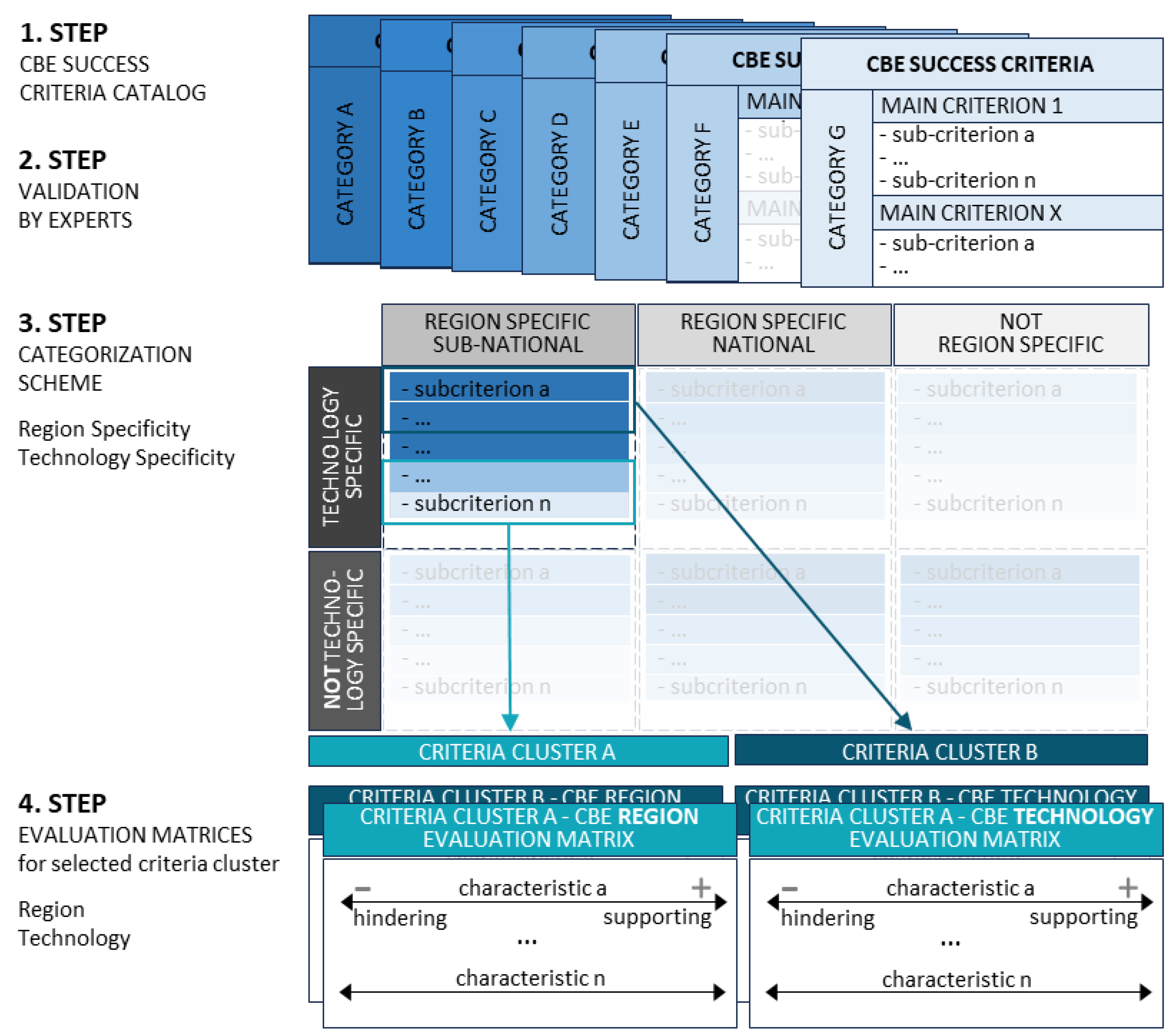
Figure 2.
CBE success sub-criteria categorized according to their region and technology specificity.
Figure 2.
CBE success sub-criteria categorized according to their region and technology specificity.
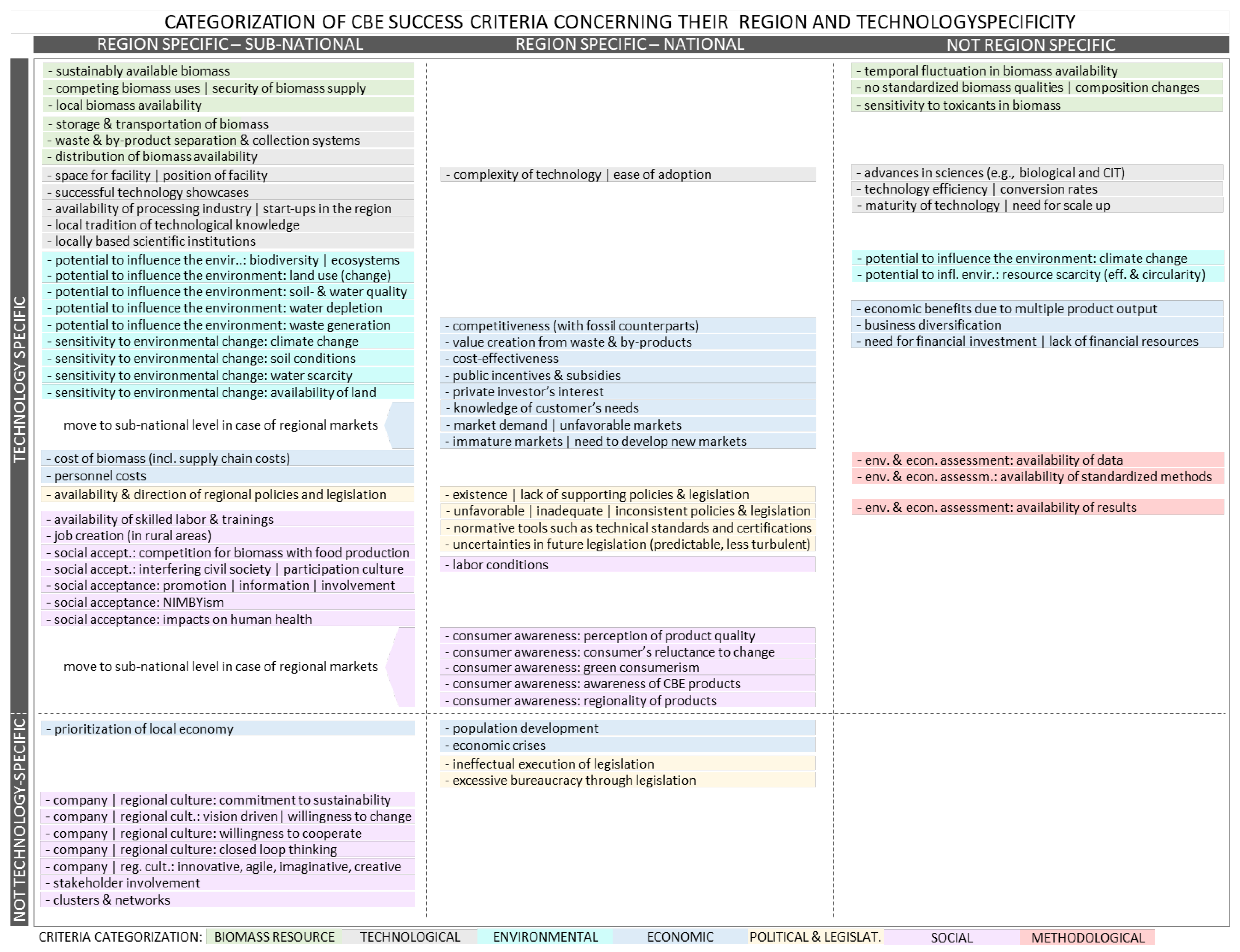
Figure 3.
CBE Technology Evaluation Matrix – Social Acceptance and Consumer Awareness: evaluating the characteristics of a CBE technology that affect its acceptance potential.
Figure 3.
CBE Technology Evaluation Matrix – Social Acceptance and Consumer Awareness: evaluating the characteristics of a CBE technology that affect its acceptance potential.
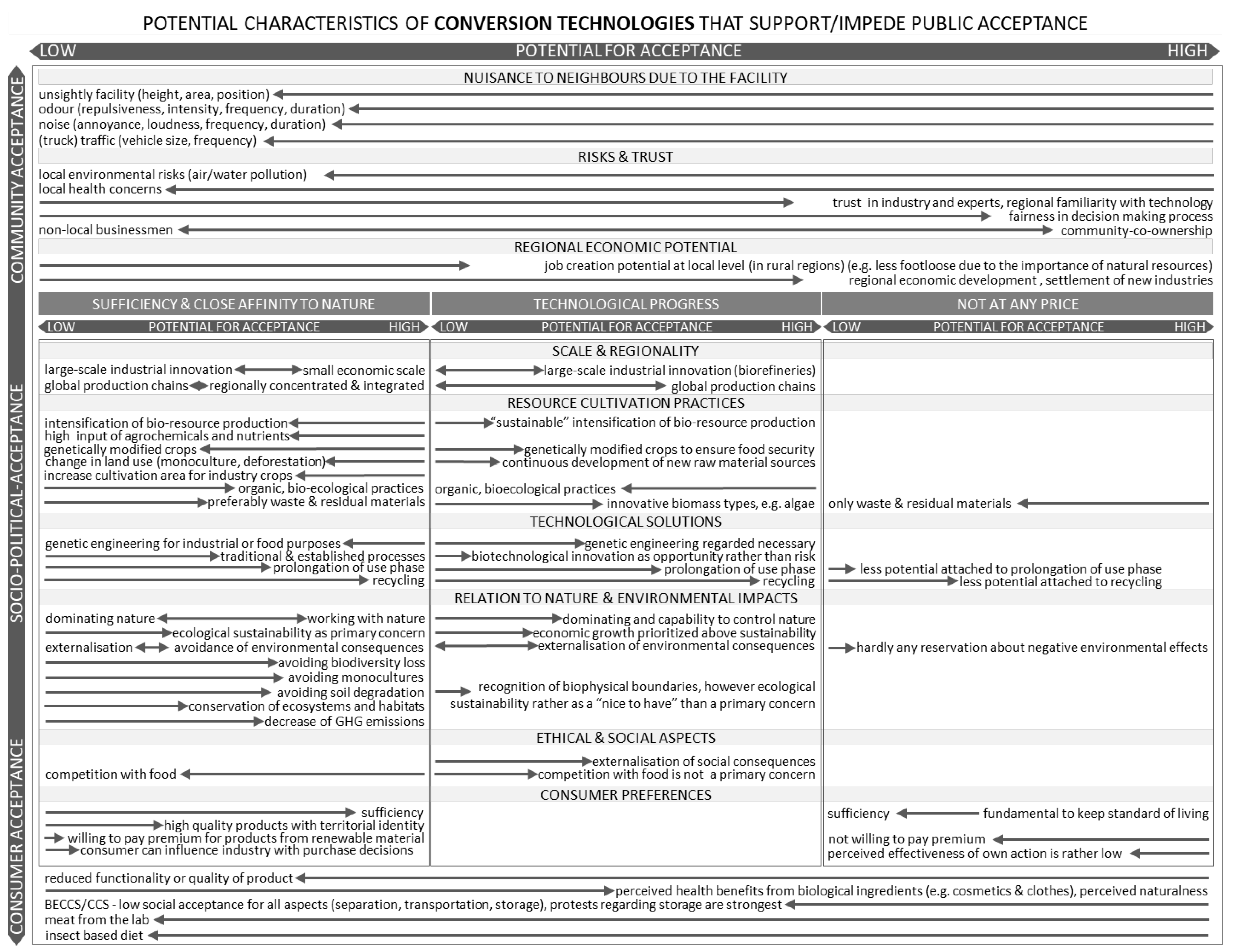
Figure 4.
CBE Region Evaluation Matrix - Social Acceptance and Consumer Awareness: socio-economic characteristics of specific mentalities found in Germany belonging to broader mentality camps and supporting certain BE visions. Percentage numbers give shares in German population. Own compilation of information taken from [47] and [.46]
Figure 4.
CBE Region Evaluation Matrix - Social Acceptance and Consumer Awareness: socio-economic characteristics of specific mentalities found in Germany belonging to broader mentality camps and supporting certain BE visions. Percentage numbers give shares in German population. Own compilation of information taken from [47] and [.46]
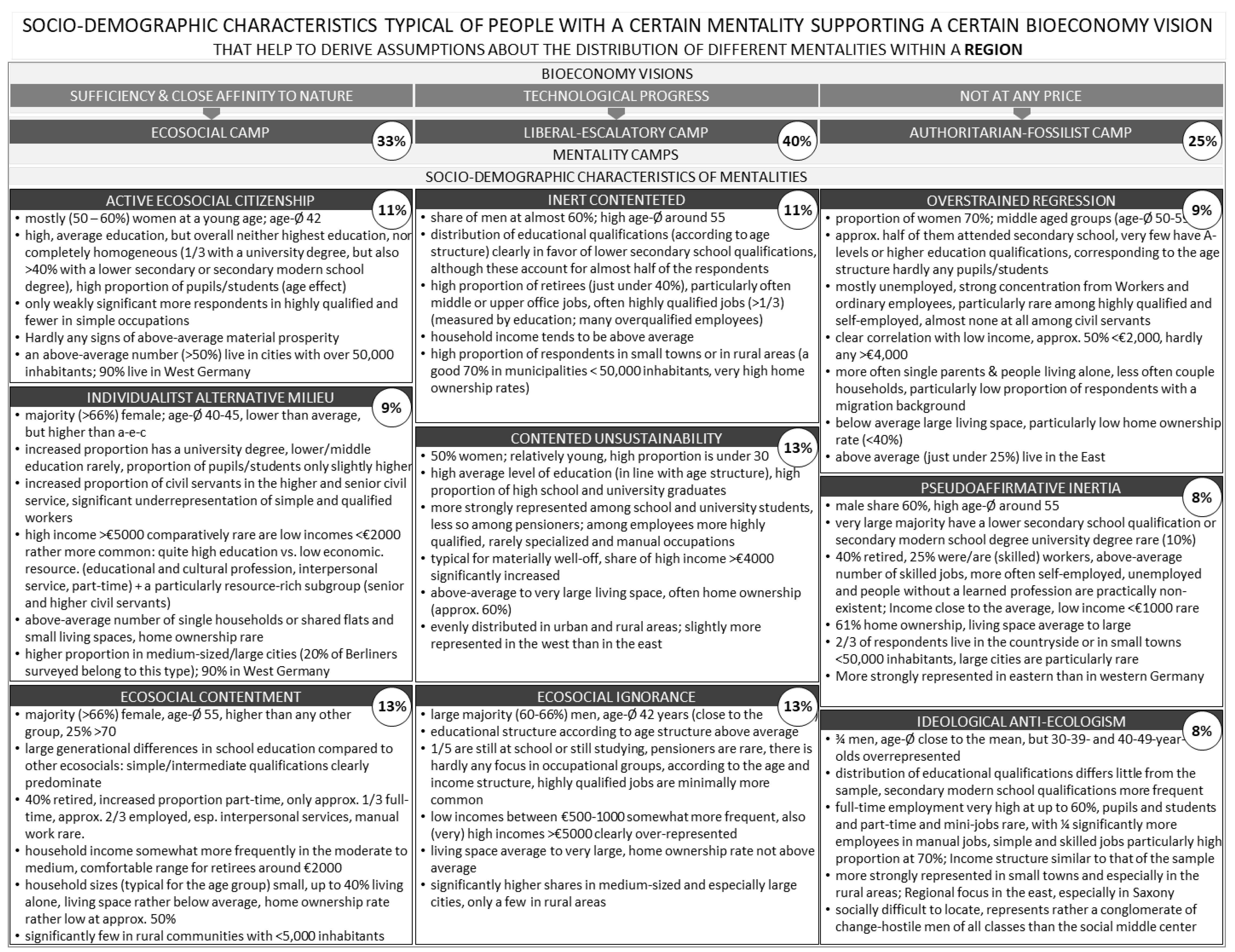
Figure 5.
CBE Technology Evaluation Matrix for Biomass Supply Chains: evaluating the characteristics of a CBE technology that affect the viability of the biomass supply chain.
Figure 5.
CBE Technology Evaluation Matrix for Biomass Supply Chains: evaluating the characteristics of a CBE technology that affect the viability of the biomass supply chain.
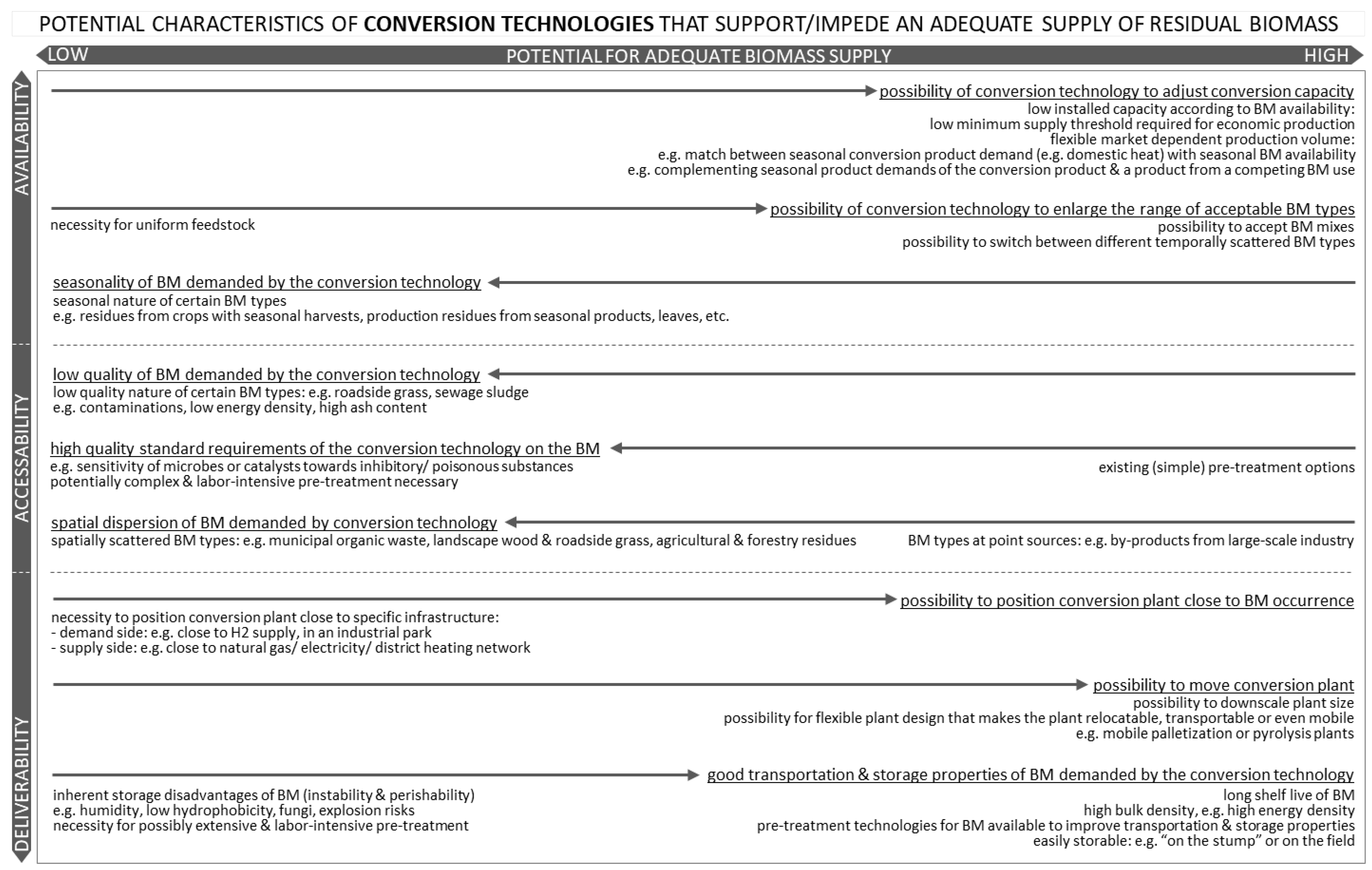
Figure 6.
CBE Region Evaluation Matrix for Biomass Supply Chains: evaluating the characteristics of a region that affect the viability of the biomass supply chain for a given biomass.
Figure 6.
CBE Region Evaluation Matrix for Biomass Supply Chains: evaluating the characteristics of a region that affect the viability of the biomass supply chain for a given biomass.
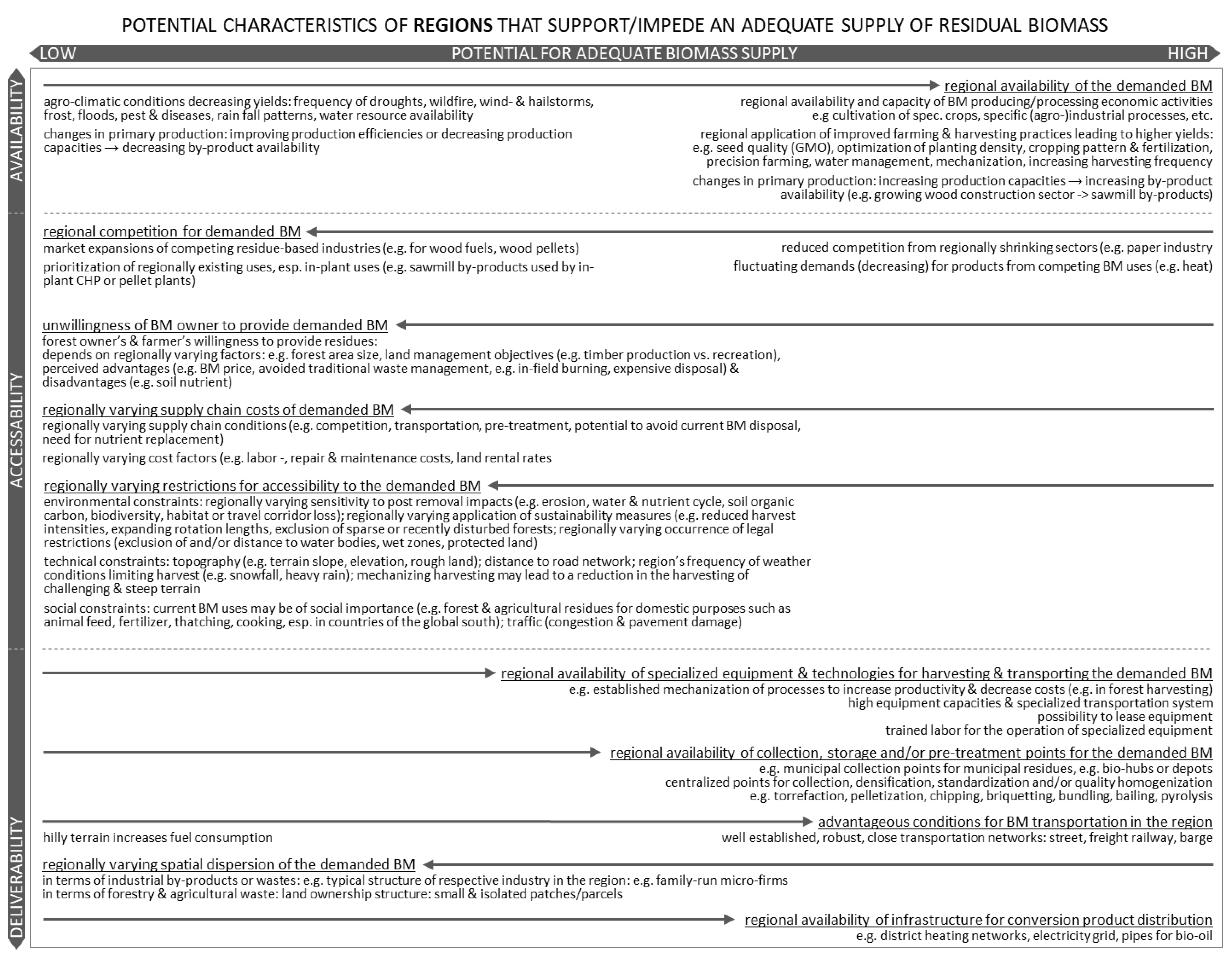

Table 1.
selected peer-reviewed journal publications used to identify success criteria of the implementation of CBE technologies.
Table 1.
selected peer-reviewed journal publications used to identify success criteria of the implementation of CBE technologies.
| Nr. | Reference | First Author | Year | Title | Context |
|---|---|---|---|---|---|
| 1 | [23] | Khan | 2022 | Moving towards a sustainable circular bio-economy in the agriculture sector of a developing country | determination of a sustainable agricultural waste management technique using SWOT & TOPSIS in a country from the Global South |
| 2 | [24] | Salvador | 2022 | Current Panorama, Practice Gaps, and Recommendations to Accelerate the Transition to a Circular Bioeconomy in Latin America and the Caribbean | review: drivers and opportunities for CBE in Latin America & Caribbean |
| 3 | [25] | Marone | 2021 | Using fuzzy cognitive maps to identify better policy strategies to valorize organic waste flows: An Italian case study | understanding barriers to effective adoption of CBE technologies (use of biodegradable MSW as feedstock) and identification of effective policy strategies |
| 4 | [26] | Ding | 2021 | Development of Biorefineries in the Bioeconomy: A Fuzzy-Set Qualitative Comparative Analysis among European Countries | identification and analysis of configurational conditions for the establishment of biorefineries in 20 European countries |
| 5 | [27] | Qin | 2021 | Resource recovery and biorefinery potential of apple orchard waste in the circular bioeconomy | review: environmental & economic feasibility analysis and prospects & challenges of apple orchard waste biorefinery |
| 6 | [28] | Ossei-Bremag | 2021 | A decision support system for the selection of sustainable biomass resources for bioenergy production | multicriteria decision making by FTOPSIS for the selection of sustainable biomass resources for bioenergy in Ghana |
| 7 | [29] | Falcone | 2020 | Towards a sustainable forest-based bioeconomy in Italy: Findings from a SWOT analysis | SWOT multi-level perspective framework: understanding potential drivers and barriers of the transition of the Italian forest sector towards a CBE and derivation of effective transition strategies |
| 8 | [30] | Paes | 2019 | Organic solid waste management in a circular economy perspective - A systematic review and SWOT analysis | review: identification of the state of the art and the SWOT of organic waste management through CE principles |
| 9 | [21] | Salvador | 2022 | How to advance regional circular bioeconomy systems? Identifying barriers, challenges, drivers, and opportunities | review: identification of drivers, opportunities, challenges & barriers for businesses in CBE; regional differences in different continents (Africa, America, Australia, Europe) |
| 10 | [31] | Karuppiah | 2022 | Towards Sustainability: Mapping Interrelationships among Barriers to Circular Bio-Economy in the Indian Leather Industry | identification and evaluation of 25 barriers to CBE practices in the Indian leather industry and their interrelationships |
| 11 | [32] | Yadav | 2022 | Barriers in biogas production from the organic fraction of municipal solid waste: A circular bioeconomy perspective | identification and categorization of 20 barriers for biogas-based CBE (biogas production from organic MSW) in countries from the Global South |
| 12 | [12] | Gottinger | 2020 | Studying the Transition towards a Circular Bioeconomy - A Systematic Literature Review on Transition Studies and Existing Barriers | review: identification and classification of transition drivers and barriers towards a sustainable CBE, global |
| 13 | [33] | Donner | 2021 | How to innovate business models for a circular bio-economy? | investigation of 8 European business model innovations for a sustainable CBE within the agrifood sector through valorization of agricultural waste and by-products. Investigation of innovation drivers and elements. |
| 14 | [34] | Näyhä | 2020 | Finnish forest-based companies in transition to the circular bioeconomy - drivers, organizational resources and innovations | identification of drivers and resources that forest-based companies highlight as significant in the transition to the sustainable and competitive CBE in Finland. |
| 15 | [35] | Donner | 2023 | Innovative Business Models for a Sustainable Circular Bioeconomy in the French Agrifood Domain | investigation of 44 local, collaborative, and small-scale innovative CBE business models in the French agrifood domain concerning main drivers, business model elements, circular economy principles, enablers and barriers, and sustainability benefits. |
| 16 | [36] | Lange | 2021 | Developing a Sustainable and Circular Bio-Based Economy in EU: By Partnering Across Sectors, Upscaling and Using New Knowledge Faste, and For the Benefit of Climate, Environment & Biodiversity, and People & Business | review: overview of the development of the EU CBE through the description of product portfolio and pillars of CBE as well as the analysis of drivers of CBE. |
| 17 | [37] | Rao | 2023 | Understanding the phenomenon of food waste valorisation for the perspective of supply chain actors engaged in it | identification of the current state of the food supply chain and of barriers and enablers in terms of a transition towards CBE through the valorization of surplus food and food processing by-products in the Netherlands |
| 18 | [38] | Kardung | 2021 | Development of the Circular Bioeconomy: Drivers and Indicators | Proposal of a conceptual analysis framework to quantify and analyze the development of the EU BE: identification of driving factors and outline of a set of monitoring indicators linked to objectives of EU BE strategy. |
| 19 | [39] | Kapoor | 2020 | Valorization of agricultural waste for biogas based circular economy in India: A research outlook | review: discussion of the potentials of biogas production from agricultural waste along with the government initiatives and policy regulations as well as barriers that impede the development towards agri-waste to biogas-based CBE in India. |
| 20 | [40] | Donner | 2021 | Innovative Circular Business Models in the Olive Oil Sector for Sustainable Mediterranean Agrifood Systems. | review of Mediterranean entrepreneurial initiatives creating value from olive waste and by-products via CBE approaches: business drivers, value creation mechanisms, and conversion pathways. |
| 21 | [41] | Usmani | 2021 | Lignocellulosic biorefineries: The current state of challenges and strategies for efficient commercialization | review: examination of the global drivers towards the advancements of lignocellulosic biorefineries, technical and operational challenges for industrialization and future directions towards overcoming them. |
| 22 | [42] | Fytili | 2022 | Organizational, societal, knowledge and skills capacity for a low carbon energy transition in a Circular Waste Bioeconomy (CWBE): Observational evidence of the Thessaly region in Greece | exploration of the main barriers, challenges, opportunities, and the context in which agro-biomass and agro-industrial waste valorization can accelerate a low carbon economy in the Thessaly region in Greece. |
* MSW: municipal solid waste; SWOT: strengths, weaknesses, opportunities, and threats; (F)TOPSIS: (fuzzy) technique for order preference by similarity to ideal solution.
Table 2.
selected (peer-reviewed) journal publications used to identify aspects influencing the social acceptance and consumer awareness for a CBE technology within a region.
Table 2.
selected (peer-reviewed) journal publications used to identify aspects influencing the social acceptance and consumer awareness for a CBE technology within a region.
| Nr. | Reference | First Author | Year | Title | Context |
|---|---|---|---|---|---|
| 1 | [43] | Brohmann | 2007 | Factors influencing the societal acceptance of new, renewable and energy efficiency technologies: Meta-analysis or recent European projects | Identification of contextual and process-related factors influencing the level of societal acceptance and techno-economic successfulness achieved in energy projects that aim to mitigate climate change in different geographic, institutional, and cultural contexts. |
| 2 | [44] | Bugge | 2016 | What is the bioeconomy? A review of the literature | Review: Enhancement of the understanding of what the notion of bioeconomy means by exploring the origins, uptake, and contents of the term “bioeconomy” in the academic literature and Identification of three visions of the bioeconomy: bio-technology, bio-resource, and bio-ecology vision |
| 3 | [45] | Dieken | 2021 | The multitudes of bioeconomies: a systematic review of stakeholder’s bioeconomy perceptions | Review: Systematic literature review of stakeholder’s bioeconomy perceptions by means of a mixed-methods approach based on inductive coding of research articles |
| 4 | [46] | Eversberg | 2020 | Bioeconomy as a deployment of polarized social conflicts? On the distribution of socio-ecological mentalities in the German population in 2018 and and potentials for support and resistance to bio-based transformations (German language, Working paper, not peer reviewed) | Development of a typology of eleven different patterns of socio-ecological attitudes of mentalities in the German population to investigate to what extent the transformation to a bioeconomy may cause increasing tensions or conflicts within society by means of factor and cluster analysis of representative survey data |
| 5 | [47] | Eversberg | 2022 | Bioeconomy as a societal transformation: mentalities, conflicts and social practices | Exploration of social conflicts and coalitions for and against bio-based, post-fossil transformation within the general population in GER by mapping different socio-ecological mentalities along three dimensions (growth/suffiecieny, high-tech-focused/techno-skeptical and fossilist/post fossilist) by means of a relational analysis of representative survey data |
| 6 | [48] | Farstad | 2023 | Socio-cultural conditions for social acceptance of bioeconomy transitions: the case of Norway | Identification of critical enabling conditions in Norway that may be necessary to foster social acceptance for a bioeconomy transition in other countries as well. |
| 7 | [49] | Fridahl | 2018 | Bioenergy with carbon capture and storage (BECCS): Global potential, investment preferences, and deployment barriers | Exploration of the influences of expertise, actor type, and origin on the preference to (1) invest in BECCS*, (2) the view on BECCS as mitigation strategy and (3) the assessment of barriers to BECCS by means of statistically analyzing questionnaire data from UN climate change conferences |
| 8 | [50] | Hausknost | 2017 | A transition to which bioeconomy? An exploration of diverging techno-political choices | Identification of different types of narratives constructed around the concept of bioeconomy and mapping of these narratives in a two-dimensional option space (industrial biotechnology/agro-ecology and sufficiency/capitalist growth) by analysis of policy documents, stakeholder interviews, and biophysical modelling scenarios |
| 9 | [51] | Hempel | 2019 | Societal perspectives on a bio-economy in Germany: An explorative study using Q methodology | Empirical assessment of peoples’s perspective on bioeconomy in GER by means of Q-type factor analysis and identification of three perspectives: “sufficiency and close affinity to nature”, “technological progress”, and “not at any price” |
| 10 | [52] | Hempel | 2019 | Bioeconomy from the population’s perspective – Thuenen Working Paper 115 (German language, Working paper, not peer reviewed) | Assessment of people’s opinions, attitudes, and doubts on the transformation to a sustainable, bio-based economy by means of a Q-study about the societal perspectives concenrning bioeconomy in general, focus group discussion with a focus on consumption followed by a representative online survey in GER |
| 11 | [53] | Kokkinos | 2018 | Fuzzy cognitive map-based modeling of social acceptance to overcome uncertainties in establishing waste biorefinery facilities | Proposal of a novel FCM** modeling approach to analyze the socio-economic implications and to overcome uncertainties occurring in waste biorefinery development and implementation |
| 12 | [54] | Macht | 2022 | German citizens’ perception of the transition towards a sustainable bioeconomy: a glimpse into the Rheinische Revier | Exploration of how citizens perceive the transition process toward a bioeconomy and which factors influence their perception in the context of the phasing out of lignite mining in the Rheinische Revier, GER, by means qualitative content analysis of focus group discussions |
| 13 | [55] | Macht | 2023 | Don’t forget the locals: Understanding citizens’ acceptance of bio-based technologies (preprint, not peer reviewed) | Exploration of the level and determinants of citizen’s general and local acceptance of two technologies (biorefineries and aquaponics) in two regions (transition vs. non-transition region in GER) by testing hypothesis based on the data of an online survey with 1989 German participants |
| 14 | [56] | Marciano | 2014 | Factors affecting public support for forest-based biorefineries: A comparison of mill towns and the general public in Maine, USA | Exploration of the social acceptability of forest-based biorefineries in Maine, USA, with focus on the interaction of project attributes and citizens characteristics to affect level of support, by means of random utility modeling to analyze a mail survey with a statewide sample and a subsample of mill towns |
| 15 | [57] | Nagy | 2021 | Social acceptance of forest-based bioeconomy – Swedish consumers’ perspectives on a low carbon transition | Contribution to the understanding of the social acceptance and consumer awareness of the forest-based bioeconomy at the example of wooden multi-story buildings in SE |
| 16 | [58] | Ranacher | 2020 | Social dimension of a forest-based bioeconomy: a summary and synthesis | Exploration of the social dimensions of the forest-based bioeconomy by reviewing literature focusing on discourses and perceptions of different actor groups (political decision makers, stakeholders, experts, public, media, and students) in EUR |
| 17 | [59] | Zander | 2022 | Societal Evaluation of Bioeconomy Scenarios for Germany | Gaining an understanding of how citizens in GER assess possible developments associated with transitioning to a bioeconomy by means of a quantitative online survey, in which German citizens were asked to evaluate scenarios modelling the impacts on people’s day-to-day lives. |
* BECCS: bioenergy with carbon capture and storage; **FCM: fuzzy cognitive map.
Table 3.
selected peer-reviewed journal publications used to identify aspects influencing the availability and the supply chain of biomass for the utilization in a CBE technology within a region.
Table 3.
selected peer-reviewed journal publications used to identify aspects influencing the availability and the supply chain of biomass for the utilization in a CBE technology within a region.
| Nr. | Reference | First Author | Year | Title | Context |
|---|---|---|---|---|---|
| 1 | [60] | Ahmed | 2019 | Management of next-generation energy using a triple bottom line approach under a supply chain framework | A multi-objective model (carbon emission, total costs, jobs) is proposed to structure a sustainable supply chain for second-generation biorefineries |
| 2 | [61] | Akhtari | 2014 | The effects of variations in supply accessibility and amount on the economics of using regional forest biomass for generating district heat | Investigation of the impact of forest biomass availability variability throughout the year on the feasibility of meeting the fuel demand of a district heating system in Williams Lake, CAN |
| 3 | [62] | Auer | 2021 | Wood supply chain risks and risk mitigation strategies: A systematic review focusing on the Northern hemisphere | Review: systematic literature review on risks affecting wood supply security and risk mitigation strategies by quantitative and qualitative data analysis with focus on the Northern hemisphere |
| 4 | [63] | Black | 2016 | Developing database criteria for the assessment of biomass supply chains for biorefinery development | Presentation of a database with key criteria required to develop biomass supply chains covering origin, logistics, technical suitability, and policy criteria with focus on agricultural, forestry and processing by-products used for bioenergy, biofuel and bio-based products conversion in biorefineries. |
| 5 | [64] | Burli | 2021 | Farmer characteristics and decision-making: A model for bioenergy crop adaption | Development of an agent-based model to simulate farmer’s adoption behavior considering the provision of crop residues or energy crops for bioenergy markets in region covering counties in Nebraska, Kansas, and Colorado, USA. |
| 6 | [65] | Charis | 2018 | A critical taxonomy of socio-economic studies around biomass and bio-waste to energy projects | Review: classification of socio-economic studies on biomass or bio-waste to energy systems as “qualitative” vs. “quantitative & systematic” and “viability” vs. “impact” studies. |
| 7 | [66] | Fernández-Puratich | 2021 | Bi-objective optimization of multiple agro-industrial wastes supply to a cogeneration system promoting local circular bioeconomy | Proposal of an optimization model to evaluate the supply of different biomasses (olive pomace, fruit pits, vineyard pruning) to a CHP system in CHL regarding CO2 emission & costs |
| 8 | [67] | Haller | 2022 | Towards a resilient and resource-efficient local food system based on industrial symbiosis in Härnösand: A Swedish case study | Assessing opportunities and challenges of using sub-exploited waste and by-products (lignocellulosic residues, rock dust, food processing wastes) for innovative food production, facilitated by industrial symbiosis; case study in Härnösand, SE |
| 9 | [68] | Kerby | 2017 | An overview of the utilization of brewery by-products as generated by British craft breweries | Investigation of the utilization/disposal methods British craft breweries apply to their by-products by means of surveys and interviews and comparison of urban vs. rural breweries |
| 10 | [69] | Ko | 2019 | Economic, social, and environmental cost optimization of biomass transportation: a regional model for transportation analysis in plant location processes | Building of a MILP* model based on region-specific data to minimize sustainable transportation costs for alternative bioenergy plant locations; case study in Wisconsin, USA. |
| 11 | [70] | Morales | 2022 | Circularity effect in the viability of bio-based industrial symbiosis: Tackling extraordinary events in value chains | Scenario analysis at mesoscale to identify conditions to implement circularity in the sugar-beet value chain in bio-based industrial symbiosis by means of system dynamic with a focus on the impact of extraordinary events (COVID 19, climate change) case study of the Bazancourt-Pomacle biorefinery, FRA |
| 12 | [71] | Nandi | 2023 | A resource-based and institutional theory-driven model of large-scale biomass-based bioethanol supply chains: An emerging economy policy perspective | Feasibility assessment of setting-up large-scale supply chain of bioethanol based on the regional availability of agricultural residues by means of a supply chain model using the lenses of resource-based view and institutional theory; case study of Punjab State, IND |
| 13 | [72] | Raimondo | 2018 | Making virtue out of necessity: Managing the citrus waste supply chain for bioeconomy applications | Analysis of the current management of citrus waste and Identification of the determinants and barriers that affect an entrepreneur’s choice in the destination of citrus waste in south ITA |
| 14 | [73] | Sánchez-Garcia | 2017 | A GIS methodology for optimal location of a wood-fired power plant: Quantification of available woodfuel, supply chain costs and GHG emissions | Establishing a GIS** methodology based on WISDOM database to analyze the viability and optimal location of a new wood-fired power plant in a specific region considering physical and legal accessibility of the resources calculating costs and GHG emissions of the supply chain. |
| 15 | [74] | Santibañez-Aguilar | 2018 | Facilities location for residual biomass production system using geographic information system under uncertainty | Presentation of an GIS-based approach to determine viable facility locations for supply chains based on residual biomass considering environmental, social and geographic restrictions; case study in MEX |
| 16 | [75] | Schipfer | 2022 | Strategies for the mobilization and deployment of local low-value, heterogeneous biomass resources for a circular bioeconomy | Analysis of the challenges and opportunities of feasible strategies for mobilizing and deploying local, low-value and heterogeneous biomass resources for a local circular bioeconomy on the basis on the three assessment levels: the legislative framework, technological innovation, and market creation; with a focus on EUR |
| 17 | [76] | Shah | 2016 | A techno-economic analysis of the corn stover feedstock supply system for cellulosic biorefineries | Stochastic analysis of the techno-economics (resource requirements, like equipment, labor fuel & consumables; and costs) of corn stover supply system for a large scale cellulosic biorefinery in Iowa, USA, using production-scale experimental field data |
| 18 | [77] | Sjølie | 2016 | Willingness of nonindustrial private forest owners in Norway to supply logging residues for wood energy | Investigation of the willingness of nonindustrial private forest owners in NOR to extract logging residues from their forest to supply it to energy production by means of a representative survey. |
| 19 | [78] | Tyndall | 2011 | Woody biomass in the U.S. Cornbelt? Constraints and opportunities in the supply | Exploratory spatial assessment of the availability and accessibility of wood biomass from natural forests and the existing timber industry as well as its potential from short-rotation woody crop plantations in two-ecoregions Mississippi River corridor, USA, using existing forest/timer inventories and in-depth interviews with large regional sawmills |
| 20 | [79] | Vacchiano | 2018 | Assessing the availability of forest biomass for bioenergy by publicly available satellite imagery | Test of an algorithm to predict forest biomass (aboveground live tree volume) using publicly available Landsat satellite imagery and an artificial neural network; case study for the Ligura region, ITA |
| 21 | [80] | Valente | 2014 | Mountain forest wood fuel supply chains: comparative studies between Norway and Italy | Assessment and comparison of two mountain forest wood supply chains, one in NOR and one in ITA considering GHG*** emissions and costs by means of LCA**** and cost analysis |
| 22 | [81] | Yazan | 2016 | Design of sustainable second-generation biomass supply chains | Assessment of the economic and environmental sustainability of different supply chain scenarios for second-generation biomass (lignocellulosic: landscape wood, reed & roadside grass); case study for Overijssel region, NE compares three pyrolysis scenarios (1. mobile pyrolysis & regional upgrading of pyrolysis oil to biofuel; 2. regional pyrolysis & upgrading; 3. mobile pyrolysis & upgrading outside the region) with a biomass-to-electricity plant. |
| 23 | [82] | Zimmer | 2017 | Modeling the impact of competing utilization paths on biomass-to-liquid (BtL) supply chains | Investigation of the impact of established utilization paths on the costs of a large-scale biofuel production value chain by means of a MILP model. For a case study on six regions in CHL, the model first allocates biomass to established CHP plants & domestic consumers and then determines the optimum configuration of the biofuel supply chain (location & capacities of conversion plants, feedstock procurement and transportation) |
* MILP: mixed integer linear programming; ** GIS: Geographical Information System; ***GHG greenhouse gas emissions; **** LCA: Life Cycle Assessment.
Table 4.
CBE Success Criteria Catalog: criteria that influence the success of the implementation of CBE technologies sorted by relevance; result from literature review and expert survey.
Table 4.
CBE Success Criteria Catalog: criteria that influence the success of the implementation of CBE technologies sorted by relevance; result from literature review and expert survey.
| CRITERIA CATEGORY |
main criterium (no. of publications mentioning criterium) {expert comments (no. of experts)} - sub-criterium (no. of publications mentioning criterium) {expert comments (no. of experts)} |
| BIOMASS RESOURCE |
biomass availability (20) - sustainably available biomass (5) {should be first (2)} - temporal fluctuation in biomass availability (7) - competing biomass uses | security of biomass supply in long term (7) - local biomass availability (1) {is important (1); should be fourth (1)} |
|
biomass quality (6) - no standardization of qualities | changes in composition (1) {is important (1)} - sensitivity to toxicants in biomass (1) | |
| TECHNOLOGICAL |
logistic & supply chain (17) - storage and transportation (5) - bulk density of biomass {should be added (1)} - loading and offloading of biomass {should be added (1)} - space for/ position of facility (4) - waste | by-product separation and collection systems (4) - distribution of biomass availability (point vs. non-point sources*) (1) {should be moved from biomass availability to here (1)} |
|
availability of technology (17) - technology efficiency | conversion rates (5) {should be first (1)} - complexity of technology | ease of adoption (1) {should be second after maturity (1)} - successful technology showcases (3) {should be ranked higher (1)} - maturity of technology | need for scale up (7) - availability of processing industry & start-ups in the region {should be added (1)} | |
|
availability of knowledge/expertise | R&D (11) - local tradition of knowledge (1) {should be first (2)} - locally based scientific institutions (2) - advances in sciences (e.g., biological and CIT) (1) | |
| ENVIRONMENTAL |
potential to mitigate/increase environmental issues** (14) {sub-criteria should not be ranked (3)} - climate change - biodiversity | ecosystems - land use (change) - soil- and water quality - resource scarcity (resource efficiency | circularity) - water depletion {should be added (1)} - waste generation |
|
sensitivity towards environmental changes/ issues*** (3) - climate change - potential for adapting to climate change through plant breeding {should be added (1)} - soil conditions - water scarcity - land availability {should be added (1)} | |
| ECONOMIC |
profitability & markets (18) - knowledge of customer’s needs (3) {should be first (1)} - market demand | unfavorable markets (6) {should be second (1)} - competitiveness (with fossil counterparts) (7) {should be third (1)} - fluctuations in fossil fuel’s prices (1) - value creation from waste/ by-products (4) {should be fourth (1)} - cost-effectiveness (6) {should be fifth (1)} - economic benefits due to multiple product output (3) {should be sixth (1)} - immature markets | need to develop new market (4) {should be seventh (1)} - business diversification (3) {should be eighth (1)} |
| investment (15)- need for financial investment | lack of financial resources (11)- public incentives and subsidies (8)- private investor’s interest (5) | |
|
operational costs (9) - costs of raw material, esp. biomass (6) - costs of harvesting biomass {should be added (1)} - supply chain costs, esp. logistic costs (4) - costs of loading/offloading {should be added (1)} - costs of storing and handling biomass {should be added (1)} - costs of waste disposal {should be added (1)} - personnel costs {should be added (1)} | |
|
general socio-economic development (3) - population development (2) - economic crises (1) {should be equal to first (1)} - prioritization of local economy {should be added (1)} | |
| POLITICAL & LEGISLATIVE |
policies, legislation & standards (18) - existence | lack of supporting policies and legislation (15) - carbon costs {should be added (1)} - blending mandates {should be added (1)} - unfavorable | inadequate | inconsistent policies and legislation (10) - normative tools such as technical standards and certifications (1) - availability and direction of regional policies and legislation (1) |
|
policy implementation (8) - uncertainties in future legislation (predictable, less turbulent) (3) {should be first (1)} - ineffectual execution (4) - excessive bureaucracy (2) | |
| SOCIAL |
jobs & labor (15) {should be first (1)} - availability of skilled labor & trainings (10) {is important (1)} - job creation (in rural areas) (6) - labor conditions (1) |
|
social acceptance (production) (12) {should be second (1)} - competition for biomass with food production (5) - interfering civil society | culture of participation (3) - promotion | information | involvement to increase acceptance (3) - NIMBYism (2) - impacts on human health (1) | |
|
company culture | regional culture (11) {should be third (1)} - commitment to sustainability, esp. environ. protection (4) - vision-driven culture | willingness to change (4) - willingness to cooperate (2) - closed-loop thinking (2) - innovative, agile, imaginative & creative (1) | |
|
consumer awareness (product) (14) {should be fourth (1)} - consumer’s perception of product quality (e.g., non-primary cycle) (4) {should be first (1)} - consumer reluctance to change (1) {should be second (1)} - green consumerism (bio-based and waste valorization) (9) - willingness to pay a premium for “green” products {should be added (1)} - awareness of CBE products (6) - regionality of products (2) | |
|
cooperation (16) {should be fifth (1)} - stakeholder involvement (7) - cooperation between primary producers {should be added (1)} - clusters & networks (7) | |
| METHODOLOGICAL |
uncertainties in environmental & economic assessment (3) - availability of data for econ./ environ. evaluation (2) {should be first (1)} - availability of (standardized) methodologies (3) - availability of results (1) |
* e.g., beet pulp from a big sugar factory as point source vs. biowaste from households as non-point source; ** e.g., a CBE product has the potential to replace a fossil-based product and thereby to reduce climate change impacts; experts suggest not to rank different environmental impacts as their relevance depends on the type of biomass; *** e.g., the production of a CBE product is threatened by climate change, as the crops whose residues are valorized can no longer be cultivated under changing climate conditions; experts suggest not to rank different environmental impacts as their relevance depends on the type of biomass.
Disclaimer/Publisher’s Note: The statements, opinions and data contained in all publications are solely those of the individual author(s) and contributor(s) and not of MDPI and/or the editor(s). MDPI and/or the editor(s) disclaim responsibility for any injury to people or property resulting from any ideas, methods, instructions or products referred to in the content. |
© 2024 by the authors. Licensee MDPI, Basel, Switzerland. This article is an open access article distributed under the terms and conditions of the Creative Commons Attribution (CC BY) license (http://creativecommons.org/licenses/by/4.0/).
Copyright: This open access article is published under a Creative Commons CC BY 4.0 license, which permit the free download, distribution, and reuse, provided that the author and preprint are cited in any reuse.


