

Submitted:
24 April 2025
Posted:
24 April 2025
You are already at the latest version
Abstract
Citizen observatories (COs) have emerged as essential research infrastructures that support data collection and community engagement in participatory sciences, empowering communities to monitor their environments while generating valuable data for scientific research and policy-making. Despite their growing importance, COs remain conceptually fluid, with varying interpretations across disciplines and contexts. This paper examines the evolution of COs from their origins in the early 2010s to their current multifaceted roles, revealing three key dimensions: descriptively as socio-technical systems, instrumentally as research infrastructures, and normatively as advanced participatory science initiatives. We specifically highlight the critical yet underexplored role of COs as research infrastructures and propose a set of essential functions and characteristics that define COs in this infrastructure role. These functions range from providing technical capabilities for data collection and quality assurance to social dimensions including community building and governance frameworks. Our analysis identifies two operational models: tailored COs designed for specific projects and open COs supporting multiple initiatives. Reframing COs as research infrastructures rather than isolated initiatives emphasizes the need for long-term institutional support, shared services, and coordinated policies to ensure their sustainability and maximize their contribution to both scientific knowledge and public participation, ultimately strengthening the foundations of participatory sciences.
Keywords:
research infrastructures
; citizen science platforms
; socio-technical systems
; participatory sciences
; environmental monitoring
; open science
Introduction
Citizen observatories (COs) play a key role in providing the digital spaces, technological platforms, and methodological standards that enable citizens to systematically monitor and document their environments, contributing valuable data for scientific research, policy-making [1], and the monitoring of indicators related to sustainable development goals (SDGs) [2,3,4,5,6]. These infrastructures support participants throughout the entire data collection process, facilitating public engagement while ensuring scientific rigor. Platforms like iNaturalist, eBird, MINKA, CitSci.org, and Observation.org host a diverse range of participatory science initiatives that have collectively generated millions of biodiversity and environmental observations transcending geographical boundaries and temporal scales.
The field of participatory sciences includes a broad spectrum of projects, each characterized by different epistemological stances on how knowledge is produced and validated [7]. These initiatives can vary significantly in their approach, ranging from bottom-up, community-led efforts to top-down, institution-driven endeavors. In community-driven models, local participants, sometimes in collaboration with credentialed scientists, work together on specific projects, integrating both scientific expertise and local knowledge [7], including approaches like community science [8] and community-based monitoring [9]. On the other hand, organisation-driven projects, often referred to as citizen science, typically involve large groups of geographically dispersed participants who collect data about their local environment. This combination of approaches in participatory sciences fosters both scientific progress and strengthens the agency of individuals and communities, supporting a more inclusive and collaborative model of knowledge production [7].
The field of participatory sciences includes a broad spectrum of projects, each characterized by different epistemological stances on how knowledge is produced and validated [7]. While COs are strongly linked to citizen science in the literature, we adopt the broader term participatory sciences in this paper as it covers citizen science and related terminological variants, while acknowledging the complexity and definitional debates explored by scholars like Haklay et al. in "What is Citizen Science? The Challenges of Definition" [10]. This approach also reflects the reality that COs already provide support to a diverse spectrum of participatory initiatives beyond citizen science. These initiatives can vary significantly in their approach, ranging from bottom-up, community-led efforts to top-down, institution-driven endeavors. In community-driven models, local participants, sometimes in collaboration with credentialed scientists, work together on specific projects, integrating both scientific expertise and local knowledge [2], including approaches like community science [3] and community-based monitoring [4]. On the other hand, organisation-driven projects, often referred to as citizen science, typically involve large groups of geographically dispersed participants who collect data about their local environment. This combination of approaches in participatory sciences fosters both scientific progress and strengthens the agency of individuals and communities, supporting a more inclusive and collaborative model of knowledge production [2].
Table 1 presents nine of the world's largest COs that provide open, free services for participatory science projects focused on biodiversity and environmental monitoring. These platforms excel in supporting onsite data collection and management, and community engagement, and are distinguished by their extensive number of users, projects, or observations. Notably, while Zooniverse stands as an iconic citizen science platform [11], it has been intentionally excluded from this analysis as it falls into a different category—platforms designed primarily for online data processing rather than field-based data collection which characterizes the COs examined in this paper.
Despite their widespread use, COs remain an evolving concept with two major interpretations. One perspective views COs as advanced community-based monitoring systems or evolved citizen science initiatives designed to create social and political impact [23,24,25]. The other frames them as research infrastructures that enable the sustained generation, management, and integration of citizen-contributed data into formal research and policy ecosystems [26,27]. While much literature focuses on COs as advanced citizen science initiatives, this article argues that their role as research infrastructure is equally vital yet underexplored. We make the case for understanding COs as infrastructures by examining their origins, conceptual evolution, functions, characteristics and typology, highlighting the importance of sustaining them as open platforms that make possible the expansion and impact of participatory sciences.
COs Concept: Origin and Roots
The term CO gained traction in the early 2010s, particularly within Europe, through a series of projects funded by the European Commission, including Citclops, Omniscientis, CITI-SENSE, COBWEB, and WeSenseIt [28]. This momentum has continued with more recent initiatives such as GROW, LandSense, SCENT, and Ground Truth 2.0 [29], along with infrastructure-oriented projects like Cos4Cloud [30], which aim to develop services to enhance COs platforms. This European investment positioned COs as key platforms for strengthening environmental and biodiversity monitoring systems through the integration of community-contributed data [29]. Even though citizens have been involved in environmental monitoring for decades, the specific term and framing of COs came with a double purpose: to empower communities [23,31] and to complement formal earth observation systems [32]. This dual focus connects COs to both the social sciences and earth system sciences.
However, CO-like initiatives -those involving multiple stakeholders to address social challenges and inform decision-making through monitoring mechanisms- have existed since the 1970s as mechanisms for public participation in research and public affairs [33,34,35]. They have been implemented in areas such as mobility [36], medicine, language, and the social sciences [37], in regions beyond Europe, with notable examples from Central and South America [38]. Their role has become even more important with the rise of digital technologies, which have made participation easier and more widespread —enabling unprecedented scales in the range, speed, and nature of participation. At the same time, these technologies have introduced new ethical, legal, and social challenges [39] Over time, COs have become closely connected to areas like community-based monitoring (CBM) and volunteered geographic information (VGI) [29]. They have also been adopted in fields such as earth observation, environmental governance, environmental justice, and citizen science. Each of these areas brings something different to how COs are shaped and used, but they also share common functions and characteristics—which we explore in the next sections.
These developments highlight the interdisciplinary foundations of COs. The social sciences offer concepts and practices related to public participation, co-production of knowledge, and community engagement—key to how observatories are designed to empower citizens. Environmental and earth sciences contribute methods for participatory monitoring and provide frameworks to integrate local observations into environmental assessment and governance. Meanwhile, the field of information and communication technologies (ICT) supplies the tools—sensors, geospatial platforms, and data management systems—that make the technical operations of observatories possible. More recently, the concept of COs has also been shaped by developments in open science and the growing recognition of research infrastructures as essential to knowledge production. In this light, COs are increasingly seen not only as projects or platforms but as ongoing services that support a wide range of citizen science initiatives over time. This convergence of disciplinary influences places COs in a rich epistemological space—at the intersection of community action, scientific inquiry, and technological innovation [40].
This complexity also explains why there is no single, universally accepted definition of what a CO is [28,32,41]. As Hager et al. (2021) [42] pointed out, the term CO has not equivalent outside Europe, even though similar platforms and initiatives exist globally. Within Europe itself, the concept is interpreted and applied in multiple ways, particularly within the citizen science community [28]. What the European context has offered is a space where social, environmental, and technical elements were brought together under a common framework. However, the relevance of COs extends far beyond this context, as initiatives around the world continue to develop their own models—often under different names—that reflect similar purposes and values. In the following sections, we examine how these diverse interpretations have shaped the conceptual evolution of COs and what they mean for their future as research infrastructures.
COs over Time: A Multifaceted Conceptual Trajectory
The meaning of COs continues to evolve, with various definitions highlighting different aspects of the concept—ranging from methods and monitoring systems to their role as infrastructures. To better understand this evolution, Table 2 presents a curated set of 18 definitions selected specifically for their relevance and diversity. This is not a full inventory, but a deliberate selection aimed at capturing the range of interpretations that have emerged. The definitions span from 2012 to 2021 and were drawn from both peer-reviewed and grey literature, with a focus on publications related to citizen science.
Based on the 18 selected definitions, an analysis was carried out to identify how COs have been described by researchers and practitioners. The goal was to examine how the concept has evolved over time (2012–2021) and how the definitions reflect the different roles COs perform within the context of participatory sciences. The analysis reveals seven main conceptual approaches to defining COs. These include:
COs as complementary earth observation systems (2012–2017): Early definitions (e.g., by the European Commission [43] and Grainger [32]) frame COs as novel extensions of earth observation networks. In this view, citizens act as a distributed network of sensors, providing community-based in-situ observations that complement remote sensing and monitoring systems. The emphasis is on technical integration of citizen data into existing earth observation infrastructures for improved environmental information.
COs as methodological framework (2013–2015): Authors as Ciravegna [44,45], European Commission Hunt et al. [46] and Hunt et al. [46] describe COs as a framework or method for organizing citizen participation and data flows. This view emphasizes the structured process aspects: defining what data to collect, how citizens participate, and how data is managed and used. A CO in this sense is a socio-technical workflow for citizen science, lowering barriers for public participation while ensuring scientific rigor.
COs as tool for monitoring and environmental governance (2014–2017): Several definitions (e.g., Liu et al. [41], Wehn et al. [47]) situate COs within community-based environmental monitoring and decision-making processes. COs are seen as instruments for communities to observe, understand, protect, and manage their local environment. They are essential tools for environmental stewardship and empower citizens to participate in environmental management and policy. This governance-centric view stresses local knowledge, collective action, and the use of citizen-generated evidence to influence decisions – connecting grassroots monitoring to institutional frameworks.
COs as information systems (2016–2017): Related definitions (e.g., Montargil & Santos [48]; Palacin-Silva [48]) emphasize COs as open information systems and social computing applications that facilitate mass collaboration. COs are portrayed as data-intensive systems characterized by large volumes of observations “coming and going” to potentially millions of users. The focus here is on information flow and interaction, with citizens and scientists sharing data in near-real-time, enabled by web and mobile technologies. This approach highlights the big data aspect of COs and their reliance on ICT connectivity.
COs as research infrastructure (2015–2020): Another approach, highlighted by Momino et al. [27] and Hunt et al. [46], defines COs as platform-based research infrastructures that support the implementation of citizen science projects. Here, COs are essentially technological platforms (web portals, mobile apps, sensor devices) offering data collection, management, and sharing services. The focus is on the infrastructural capacity – providing tools and standardized processes to sustain citizen science activities and data over multiple projects or long timeframes. Hunt et al. [46] liken COs to a geospatial cyberinfrastructure – combining computational resources and services to bring people together for science.
COs as socio-technical systems (2019-2020): COs from this perspective are defined by Rathnayake et al. [1] and Hemment et al. [51] as socio-technical systems that bring together people, technologies, data, organisations, and processes within a dynamic framework. The term socio-technical highlights this integrated nature, where tools like sensors, mobile apps, and databases are closely tied to the practices, values, and relationships that shape how data is generated, shared, and used. Viewing COs through this lens also draws attention to the need for strong governance models, clear participation protocols, and long-term sustainability—not only of the digital infrastructure, but also of the human networks involved. Issues such as data quality, accessibility, and reusability are therefore not just technical matters, but also social and ethical ones.
COs as advanced participatory science initiatives (2015–2021): The definitions by the WeObserve consortium [25], When et al. [47], and Grainger [32] characterize COs as a specific form of citizen science focused on environmental monitoring and collective action. COs are transdisciplinary, participatory initiatives that engage citizens alongside scientists to co-produce knowledge and drive advocacy or behavioral change. This approach synthesizes prior aspects, depicting COs as innovations connecting people, science, and technology to create collaborative data, knowledge, and action.
The seven approaches to defining COs show that the concept has evolved significantly over the past decade. Early definitions described COs primarily as technical tools, often focusing on their role in data collection through ICT-based platforms. Over time, however, the concept has expanded to encompass more complex socio-technical systems and research infrastructures. This shift reflects a growing recognition of the interdependence between the social and technical dimensions of COs. Initially, participation was often framed through a top-down lens, where citizens contributed data defined by institutional needs. In contrast, recent approaches emphasize COs as platforms for collective action, citizen empowerment, and transformative societal change. This evolution also mirrors broader trends and discussions within the participatory sciences community, where the growing influence of the social sciences and humanities has brought equity, inclusion, governance, and the ethics of participation to the forefront—highlighting the increasingly intertwined nature of technical systems and social values [7,55,56].
To better understand this evolution, we applied a framework developed by Haklay’s (2021) [10] for categorizing the definitions in citizen science—descriptive, instrumental, and normative. The descriptive aspect refers to how a definition attempts to explain the type of activity. Instrumentalist aspect highlights how definitions are often shaped by the goals and objectives of the actors or organisations providing them, definitions can be instrumental in achieving specific aims. Normative aspect encompasses the expectations, assumptions, and values embedded within a definition. These normative elements can set expectations for the various actors involved in a project. This framework helps to explain the multiplicity of CO definitions and the challenges in reaching a single, unified understanding. It also shows how COs, as part of the broader citizen science landscape, reflect similar conceptual tensions. The approaches and dimensions of CO definitions are summarized in Figure 1.
Descriptive definitions present COs as socio-technical systems that bring together digital tools (e.g., apps, sensors, platforms) and social practices (e.g., collaboration, community engagement) to co-produce knowledge. These definitions highlight the integrated nature of COs, where technology and society interact dynamically to enable data collection, sharing, and use.
Instrumental definitions focus on COs as research infrastructures—technological platforms that support the development of participatory science projects by providing tools, services, standards and also hosted online communities. This view often emphasizes scalability, interoperability, and the capacity of COs to facilitate distributed data collection across projects, geographies, and disciplines.
Normative definitions place COs as advanced participatory science initiatives. Here, the role of COs extends beyond data collection to include fostering local empowerment, supporting evidence-based decision-making, and promoting environmental justice. In this framing, COs act as mechanisms for community-based environmental governance, enabling citizens not only to observe and report issues but also to use this evidence to drive local action and influence policy.
Previous attempts to analyze the concept of COs, such as those by Gold et al. [28], have debated whether COs are a subset of citizen science or represent a distinct model. What this analysis shows is that the concept of COs is used across all three definitional dimensions—descriptive, instrumental, and normative. The lack of clarity often stems not from conceptual weakness, but from the varied use of different facets in different contexts and for different purposes. The challenge, then, is not to impose a single definition, but to acknowledge that COs are multi-dimensional and that each dimension serves specific functions depending on the context.
This article focuses primarily on the instrumental definition: COs as research infrastructures. Understanding COs from this perspective allows us to examine what are the functions, characteristics and typologies of these infrastructures.
COs as Research Infrastructures: Essential Functions
COs are essential research infrastructures, as they serve as complex systems integrating both technological and social elements to enable long-term, large-scale citizen participation in scientific research and policy-making. COs comprise a set of facilities that provide resources and services —including platforms and networks—for the research communities to conduct research and foster innovation in their fields [27,57,58]. They offer the technological backbone for data collection, visualization, and sharing, as well the construction of on-line communities; and they shape how citizens, scientists, and organisations collaborate [59].
COs support ongoing citizen participation across thematic areas and geographies, beyond individual projects timelines or closing [27]. They blend human participation with technology, creating systems in which social and technical elements are deeply intertwined. Modern COs are not mere data-collection apps or sensor networks; they are complex constellations of people, devices, data flows, and organisations [55]. The design and operation of a CO must integrate community dynamics (interests, motivations, trust, local knowledge) with technical components (platform architecture, data standards, analytical tools) [60]. This socio-technical integration is what enables COs to function as sustainable, adaptive systems [55].
From this socio-technical perspective, COs are evolving systems that recognize the need for both technological and social integration. Albagli et al. (2020) [59] argue that infrastructure is a relational entity that exists at the intersection of diverse actors and knowledge systems, which is exactly the case for COs, as they bring together citizens, scientists, and other stakeholders in a co-productive manner. Similarly, Corsín (2014)'s [61] notion of the "right to infrastructure" resonates with the idea that COs provide citizens with access to the tools and data necessary for participation in environmental governance, further reinforcing the importance of COs as a public resource.
In their role as research infrastructures, COs are shaped by multiple factors. COs are shaped by social, environmental, and organizational factors [62]. Environmentally, they are influenced by legal norms and political discourses, such as data protection laws and science policies. Socially, they integrate into research practices by engaging users and stakeholders. Organizationally, they depend on operational models and internal resources, like team structure and funding, to adapt and succeed.
To fulfill their role as research infrastructures, COs must perform essential functions for the participatory science community that span both technical and social dimensions. In this article we propose a spectrum of functions that range from the technical to social side as shown in Figure 2. On the technical side, they provide tools for data collection e.g., smartphone apps, sensors), and management, ensuring interoperability, data quality, and adherence to standards. Socially, COs focus on recruiting and training participants, moderating interactions, and maintaining motivation through feedback and recognition. They also establish governance frameworks, ensure ethical practices, and align projects with community interests and policy needs.
Technical Functions
Providing base technical infrastructure: Establishes and maintains a stable and reliable technical infrastructure, including servers, databases, and applications, for data storage, long-term preservation, and high-performance processing. This infrastructure must be resilient enough to support large volumes of citizen-generated data while enabling secure backup and integration with other systems.
Facilitating data-driven research through data collection and management: Develops user-friendly tools, such as mobile apps, sensors, and web interfaces, to make data collection accessible and accurate. These tools ensure that data is properly recorded and stored, providing a seamless experience for participants while facilitating the management and organization of the collected data.
Ensuring data quality: Implements systems for validating and ensuring the quality of data, including collaborative validation, automated checks and expert review mechanisms. Data quality controls are essential to maintain the integrity and reliability of the collected information, allowing for effective scientific use and integration with other data sources. Offering tools that allow for coordinated data validation, enhancement, and integration.
Supporting communication, interaction, and co-creation of knowledge: Provides platforms for effective communication between participants, scientists, and other stakeholders, fostering collaboration, knowledge exchange, and co-creation. These platforms enable users to interact, share insights, and discuss data, enriching the scientific value of the observations and ensuring that the project aligns with community needs.
Supporting open science, data interoperability and mobilization: Facilitates the sharing and integration of CO data with other systems ensures interoperability. Adhering to established standards (such as Darwin Core or others), COs ensure that the data collected can be integrated into regional, national, and global systems or repositories, contributing to broader scientific efforts and policy discussions.
Social Functions
Creating and sustain online communities: Facilitates the development of active, engaged online communities where participants can collaborate, share knowledge, and support each other. This involves moderating interactions, fostering a sense of collective purpose, and creating spaces for ongoing communication and collaboration among citizens, scientists, and other stakeholders.
Provides training to participants: Ensuring they understand how to collect data, interact with the platform, and contribute effectively to the scientific process. This function is essential for empowering citizens, ensuring they are equipped with the necessary skills and knowledge to contribute meaningfully to CO activities.
Moderating community interactions: Facilitates positive, respectful, and productive communication between citizens, scientists, and other stakeholders within the CO platform. This includes managing discussions, preventing conflicts, and creating a collaborative environment that fosters knowledge exchange and a collective sense of purpose.
Sustaining motivation through feedback and acknowledgment: Maintains long-term engagement by providing ongoing feedback to participants on their contributions, acknowledging their efforts, and highlighting the significance of their involvement. Recognition can include public acknowledgment, rewards, data citation or notifications about how the data collected is contributing to scientific knowledge, further motivating participants to stay active.
Establishing governance and ensuring ethical practices: Defines the framework for decision-making within the CO, ensuring transparency in how data is used, managed, and shared. This governance structure addresses ethical considerations, such as safeguarding participants' privacy, respecting cultural sensitivities, and aligning with both national and international regulations (e.g., data protection laws and intellectual property rights). It also determines who has authority over data access and how data will be utilized for research, ensuring all practices align with community values and ethical standards.
COs as Infrastructures: Essential Characteristics
Drawing from the literature on infrastructures, particularly the works of Star and Ruhleder (1996) [63] and Heaton (2022) [55], COs exhibit the key characteristics of infrastructures: they are embedded in social practices, often become transparent in use, and have a broad reach across different geographic areas and over extended periods. As Fecher et al. (2021) [62] suggest, research infrastructures are relational systems, and COs are no exception, as they rely on both technical components and social actors working in concert. They are also built upon existing systems and technologies, utilizing open data standards and protocols that enable integration with professional scientific networks, further enhancing their role in the research landscape. Considering this theoretical background a set of essential characteristics is proposed as show in Figure 3.
An essential characteristic of COs is the development and use of technologies that respond to societal needs. These technologies are designed for non-experts, ensuring that anyone, regardless of technical background, can engage with data collection and analysis processes. Central to this idea is the integration of ICTs as enablers of openness, interoperability and accessibility. COs often employ user-friendly mobile apps, web portals, and low-cost sensors that enable citizens to gather and submit data effortlessly, such as georeferenced images or environmental measurements. These platforms are not only tools for engagement but also serve as open data repositories, allowing for real-time data aggregation and analysis.
From an information infrastructure perspective, COs are large-scale systems that co-evolve alongside their users and organizational contexts. They unite diverse actors—citizens, scientists, and policymakers—each with distinct goals and knowledge, facilitating their interactions through technology. As Heaton (2022) [55] notes, COs create “chains of participation” that redefine scientific work, blurring the lines between data collection and decision-making. A CO’s data platform not only stores data (technical function) but also shapes how participants collaborate and communicate (social function). Similarly, the policy interface involves both technical integration and a social negotiation of trust and data credibility. CO designers focus on user experience and community management, as technologies influence participation, access, and data sharing. This creates a dynamic relationship where citizens co-create technologies while also being shaped by the available functionalities and flows.
In operational terms, COs establish multidirectional information flows between citizens, decision-makers and scientists. Participants actively contribute data and information – reporting observations, submitting data via mobile phones or web forms – while receiving feedback, analysis results, or responses from authorities. This continuous exchange builds a sense of collaboration and ensures data relevance. The communication framework of a CO is often as important as the data collection framework. Many COs include dashboards, alerts, or discussion forums to facilitate this ongoing dialogue.
COs thus operate as dynamic learning environments that can accommodate a range of participation models – from highly structured campaigns led by authorities (top-down) to organic initiatives arising from citizen groups (bottom-up). They are often designed to be adaptable across different thematic areas and scales. For example, the same platform architecture might support a biodiversity mapping project in one region and a water quality monitoring project in another, simply by configuring different protocols and engagement strategies.
COs Types: Tailored and Open COs
COs can operate under different models, ranging from tailored, project-specific platforms to open, multi-project platforms, depending on their purpose and how they are designed. This distinction is primarily based on the creation of the infrastructure—whether it is built to address specific, localized needs or to serve as a broader infrastructure that supports multiple projects over time.
In the tailored CO model, a platform is specifically developed for a particular community or project. It focuses on addressing local challenges, such as monitoring air quality or noise pollution in a city, with custom features to meet the project's needs. The data collected, such as observations or sensor readings, are processed and used for immediate, localized outcomes, such as community reports or decisions about local actions. While this model allows for high relevance and effective results during the project’s lifespan, it faces challenges in sustainability. Once funding or initial enthusiasm fades, maintaining the technology and engaging the community can become difficult, which may result in the platform becoming inactive or unable to scale beyond its initial scope. The key risk of this approach is that many tailored COs end up operating as isolated silos, responding only to specific projects and local needs. Without broader integration or long-term support, they may fail to contribute to a larger knowledge ecosystem, and their impact may remain limited, with data or momentum lost once the project concludes [26].
In contrast, the open CO model is designed for long-term scalability and widespread usage. These platforms are typically managed by stable organisations (e.g., universities, museums, or NGOs) and support multiple projects simultaneously. They provide common tools for data entry, storage, visualization, and analysis, which can be customized for various communities or research projects without needing to develop infrastructure from scratch. For instance, platforms like CitSci.org or Observation.org serve as open repositories where many different citizen science projects can upload data, while ensuring that contributions from multiple sources are integrated into a larger database. This model allows for data aggregation at regional or global scales, which can complement formal scientific datasets and inform broader policy decisions. As the data flows through these open platforms, it can contribute to large-scale scientific efforts, such as biodiversity assessments or climate change monitoring. Open platforms also allow for integration with global research infrastructures like GBIF or Copernicus, which amplify the impact of individual observations beyond the local context, they act as “providers, facilitators, mediators, and platforms” for effective data management [64].
These two models—tailored and open—are not mutually exclusive but represent endpoints on a continuum. Some COs begin as tailored platforms and later expand into open systems, while others might start with open infrastructure and support specific, localized projects. The choice between the models often depends on the intended purpose of the CO, the community it serves, and the need for scalability and long-term sustainability.
From an institutional perspective, the models also imply different organizational structures. Tailored COs are typically run by temporary project teams, such as collaborations between universities, community groups, or local authorities. They tend to rely on specific project funding or volunteer efforts for ongoing operation. In contrast, open CO platforms are managed by more stable organisations or consortia, which provide continuous support and resources. These platforms may secure funding through a mix of grants, institutional backing, and user contributions, which helps ensure their longevity [26].
Each model offers distinct advantages and faces its own set of challenges. Tailored COs are highly adaptable, allowing for quick innovation and the ability to address specific local needs by leveraging local knowledge and relationships. However, they often face difficulties with long-term sustainability and community engagement once the initial project concludes. On the other hand, open platforms achieve economies of scale, with shared development and maintenance costs, and facilitate knowledge exchange across multiple projects. However, they must be flexible enough to support diverse projects and standardized enough to ensure data quality and governance, which can be challenging with many contributors and varied needs. Issues such as data sovereignty also arise in open platforms, as communities may be concerned about losing control over their data when it is incorporated into a larger, centralized system. To address this, many open platforms adopt clear data licensing policies, ensuring that contributors are credited, and that data use is transparent.
Ultimately, COs can form an interconnected ecosystem, where tailored and open platforms interact and exchange data. A tailored CO platform could share its data with an open platform, contributing to global research efforts, while the open platform could offer tailored outputs for local actions. This network-of-networks model allows data and knowledge to circulate across various levels, creating a collaborative environment that benefits both local and global research initiatives. Through interoperability and collaboration, COs are becoming an essential part of a larger data ecosystem, where citizen-generated data complements formal scientific research and informs policy decisions at multiple scales. Figure 4 summarizes the core elements of each type[4].
Conclusion
We must emphasize the role of COs as infrastructures, as they already function in this capacity. COs support participation, data generation, and engagement across various projects, themes, and regions, providing the necessary foundation for scaling participatory science. Viewing COs only as individual initiatives underestimates their systemic role. Framing them as research infrastructures shifts the focus to what makes participation sustainable, scalable, and impactful, emphasizing the need for coordination, shared services, and institutional support for long-term success.
Despite their inherent value, many COs face sustainability challenges. Tailored observatories risk obsolescence once specific projects end, while open COs must secure stable funding, adapt to evolving user needs, and maintain consistent data standards. Moreover, few national or regional policies explicitly recognize COs as infrastructures, complicating long-term planning and excluding them from infrastructure roadmaps and science funding schemes. This lack of institutional recognition hinders support and contributes to fragmentation within the ecosystem.
Our conceptual analysis reveals that attempting to impose narrow definitions or rigid structures on COs may limit their potential—adaptability is their strength. This article contributes by clarifying the conceptual dimensions under which COs operate: descriptively as socio-technical systems, instrumentally as research infrastructures, and normatively as advanced participatory science initiatives. We outline the essential social and technical functions and characteristics of COs as infrastructure and proposed an approach of tailored and open COs. Rather than advocating for rigid, one-size-fits-all definitions, we propose context-specific characterizations that acknowledge COs' multifaceted roles.
Looking ahead, future research must expand on the operational models of COs, documenting detailed use cases and examining the data flows within CO networks. Understanding how data moves between different COs—whether tailored or open—is crucial for improving their integration and scalability. This knowledge will be essential for strengthening CO networks and enhancing their collective impact. To support the continued growth of participatory science, it is not enough to focus on individual citizen science projects; we must also invest in the infrastructures—COs—that make them possible and sustainable. This includes further exploration of the terminology used to describe COs. As they increasingly function as research infrastructures for participatory sciences, the term participatory observatory may offer a more accurate and future-oriented conceptualization—an idea that warrants dedicated investigation.
Author Contributions
Conceptualization, Karen Soacha; Writing-original draft preparation, Karen Soacha; Review and editing, Jaume Piera, Fermín Serrano and Alexandre López-Borrull. All authors have read and agreed to the published version of the manuscript.
Funding
The EMBIMOS research group (Karen Soacha, Jaume Piera) was funded by the European Commission through the Cos4Cloud project, supported by the European Union's Horizon 2020 research and innovation program under grant agreement No. 863463, the GUARDEN project funded from the European Union's Horizon Europe program under grant agreements No. 101060693. EMBIMOS as well as Fermín Serrano were funded also by the RIECS-Concept project, supported by the European Union’s Horizon Europe Research and Innovation program under grant agreement No. 101188210. The ICM-CSIC authors acknowledge the institutional support of the 'Severo Ochoa Center of Excellence' accreditation (CEX2019-000928-S). The opinions expressed herein are those of the authors and do not necessarily reflect those of the projects or the European Commission.
Acknowledgments
The authors gratefully acknowledge Maria Masaguer for her significant contributions to the development of this paper. Her expertise in creating the figures strengthened the visual representation of our conceptual framework, while her thoughtful comments throughout the manuscript development process improved the overall quality and coherence of our work.
Conflicts of Interest
The authors declare no conflicts of interest. The funders had no role in the design of the study; in the collection, analyses, or interpretation of data; in the writing of the manuscript; or in the decision to publish the results.
Abbreviations
The following abbreviations are used in this manuscript:
| COs | Citizen Observatories |
| CSPs | Citizen Science Platforms |
| CBM | Community-Based Monitoring |
| VGI | Volunteered Geographic Information |
| ICT | Information and Communication Technologies |
| EC | European Commission |
| EEA | European Environment Agency |
| NGOs | Non-Governmental Organisations |
| EMBIMOS | Environmental and Sustainability Participatory Information Systems |
| ICM-CSIC | Institut de Ciències del Mar Consejo Superior de Investigaciones Científicas |
| UOC | Universitat Oberta de Catalunya (Open University of Catalonia) |
References
- Rathnayake C, Joshi S, Cerratto-Pargman T. Mapping the current landscape of citizen-driven environmental monitoring: a systematic literature review. Sustainability: Science, Practice and Policy. 2020 Dec 10;16(1):326–34. [CrossRef]
- Fraisl D, Campbell J, See L, Wehn U, Wardlaw J, Gold M, et al. Mapping citizen science contributions to the UN sustainable development goals. Sustain Sci. 2020 Nov 1;15(6):1735–51. [CrossRef]
- Fraisl D, See L, Campbell J, Danielsen F, Andrianandrasana HT. The Contributions of Citizen Science to the United Nations Sustainable Development Goals and Other International Agreements and Frameworks. Citizen Science: Theory and Practice. 2023 Jun 27;8(1):27. [CrossRef]
- Woods SM, Daskolia M, Joly A, Bonnet P, Soacha K, Liñan S, et al. How Networks of Citizen Observatories Can Increase the Quality and Quantity of Citizen-Science-Generated Data Used to Monitor SDG Indicators. Sustainability. 2022 Jan;14(7):4078. [CrossRef]
- Ajates R, Hager G, Georgiadis P, Coulson S, Woods M, Hemment D. Local action with global impact: The case of the grow observatory and the sustainable development goals. Sustainability. 2020;12(24):1–17. [CrossRef]
- Fritz S, See L, Carlson T, Haklay M (Muki), Oliver JL, Fraisl D, et al. Citizen science and the United Nations Sustainable Development Goals. Nat Sustain. 2019 Oct;2(10):922–30.
- Cooper C, Hunter DL, Archer JM, Caballero-Gomez H, Hawn C, Johnson V, et al. A Positionality Tool to Support Ethical Research and Inclusion in the Participatory Sciences. Citizen Science: Theory and Practice [Internet]. 2024 Nov 19 [cited 2025 Jan 28];9(1). Available from: https://theoryandpractice.citizenscienceassociation.org/articles/10.5334/cstp.684. [CrossRef]
- Hunter D, Greg N, Balgopal M. What’s in a name? The paradox of citizen science and community science. Frontiers in Ecology and the Environment. 2023 May 3;21. [CrossRef]
- Rathnayake C, Joshi S, Cerratto-Pargman T. Mapping the current landscape of citizen-driven environmental monitoring: a systematic literature review. Sustainability: Science, Practice and Policy. 2020 Dec 10;16(1):326–34. [CrossRef]
- Haklay M (Muki), Dörler D, Heigl F, Manzoni M, Hecker S, Vohland K. What Is Citizen Science? The Challenges of Definition. In: Vohland K, Land-Zandstra A, Ceccaroni L, Lemmens R, Perelló J, Ponti M, et al., editors. The Science of Citizen Science [Internet]. Cham: Springer International Publishing; 2021 [cited 2022 Mar 3]. p. 13–33. Available from: . [CrossRef]
- Liu HY, Dörler D, Heigl F, Grossberndt S. Citizen Science Platforms. In: Vohland K, Land-Zandstra A, Ceccaroni L, Lemmens R, Perelló J, Ponti M, et al., editors. The Science of Citizen Science [Internet]. Cham: Springer International Publishing; 2021 [cited 2021 Sep 14]. p. 439–59. Available from: . [CrossRef]
- CitSci.org [Internet]. [cited 2025 Feb 14]. Available from: https://citsci.org/.
- Anecdata.org [Internet]. [cited 2025 Mar 28]. Available from: https://www.anecdata.org/welcome.
- eBird T. 2023 Year in Review: eBird, Merlin, Macaulay Library, and Birds of the World - eBird [Internet]. [cited 2025 Mar 28]. Available from: https://ebird.org/ebird/news/2023-year-in-review.
- Observation.org [Internet]. Observation.org. [cited 2025 Feb 14]. Available from: https://observation.org/stats/.
- Site Stats · iNaturalist [Internet]. iNaturalist. [cited 2025 Feb 14]. Available from: https://www.inaturalist.org/stats.
- Observations [Internet]. iNaturalist. [cited 2025 Feb 14]. Available from: https://www.inaturalist.org/observations.
- Välkommen till Artportalen - Artportalen [Internet]. [cited 2025 Apr 8]. Available from: https://www.artportalen.se/.
- Liljeblad J. Data about ArtPortalen. 2025.
- Stats - Pl@ntNet identify [Internet]. [cited 2025 Mar 28]. Available from: https://identify.plantnet.org/stats.
- Our Story | Project Noah [Internet]. [cited 2025 Feb 14]. Available from: https://projectnoah.org/our-story.
- Observations [Internet]. MINKA. [cited 2025 Feb 14]. Available from: https://minka-sdg.org/observations.
- Liu HY, Grossberndt S, Kobernus M. Citizen Science and Citizens’ Observatories: Trends, Roles, Challenges and Development Needs for Science and Environmental Governance. In: Ubiquity Press [Internet]. Ubiquity Press; 2017 [cited 2020 Apr 30]. [CrossRef]
- Wehn U, Almomani A. Incentives and barriers for participation in community-based environmental monitoring and information systems: A critical analysis and integration of the literature. Environmental Science & Policy. 2019 Nov;101:341–57. [CrossRef]
- WeObserve consortium. Roadmap for the uptake of the Citizen Observatories’ knowledge base. Report submitted to the European Commission. [Internet]. WeObserve; 2021 [cited 2022 Aug 31]. Available from: https://iiasa.dev.local/.
- Brenton P, von Gavel S, Vogel E, Lecoq ME. Technology infrastructure for citizen science. In: Hecker S, Haklay M, Bowser A, Makuch Z, Vogel J, Bonn A, editors. Citizen Science [Internet]. UCL Press; 2018 [cited 2021 Mar 9]. p. 63–80. (Innovation in Open Science, Society and Policy). Available from: https://www.jstor.org/stable/j.ctv550cf2.12.
- Momino JM, Piera J, Jurado E. Citizen observatories as advanced learning environments. In: ANALYZING THE ROLE OF CITIZEN SCIENCE IN MODERN RESEARCH. 701 E CHOCOLATE AVE, STE 200, HERSEY, PA 17033-1240 USA: IGI GLOBAL; 2017. p. 192–212. (Advances in knowledge acquisition transfer and management (AKATM) book series).
- Gold, Margaret. D2.1 EU Citizen Observatories Landscape Report - Frameworks for mapping existing CO initiatives and their relevant communities and interactions [Internet]. European Citizen Science Association ECSA - WeObserve; 2018 [cited 2019 Nov 4]. Available from: https://zenodo.org/record/3670895#.XpdqKplS_b0.
- Montargil F, Santos V. Communication with citizens in the first EU citizen observatories experiences. In: Dias Rouco J.C. VBJ, editor. Academic Conferences Limited; 2017. p. 96–103. (Proceedings of the European Conference on e-Government, ECEG; vol. Part F129463). Available from: https://repositorio.ipl.pt/bitstream/10400.21/7830/1/Montargil%20and%20Santos_ECDG%202017_Proceedings.pdf.
- Piera J, Justamante Á. Citizen science through Cos4Cloud. EU Research. 2022;33(Winter 2022):27–9.
- Etaligent.NET. EU BON - Citizens’ Observatories: Empowering European Society - Open Conference [Internet]. EUBON. [cited 2025 Apr 1]. Available from: http://www.eubon.eu//news/11597_Citizens%E2%80%99%20Observatories:%20Empowering%20European%20Society%20-%20Open%20Conference.
- Grainger A. Citizen Observatories and the New Earth Observation Science. Remote Sensing. 2017 Feb;9(2):153. [CrossRef]
- Angulo Marcial N. ¿Qué son los observatorios y cuáles son sus funciones? Innovación Educativa. 2009;9(47):5–17.
- Silva R. ¿Qué es un Observatorio Ciudadano? Apuntes para la discusión. Vinculos Sociología, análisis y opinión. 2013;4:189–202.
- Natal A, Díaz O. Observatorios ciudadanos: nuevas formas de participación en la sociedad. 2014.
- Keseru I, Wuytens N, Macharis C. Citizen observatory for mobility: a conceptual framework. Transport Reviews. 2019 Jul 4;39(4):485–510.
- Zooniverse [Internet]. [cited 2020 Jun 7]. Available from: https://www.zooniverse.org/talk/15/8777?comment=89320&page=2.
- O’Grady M, Mangina E. Adoption of Responsible Research and Innovation in Citizen Observatories. Sustainability. 2022 Jan;14(12):7379. [CrossRef]
- Prem E, Sanz FS, Lindorfer M, Lampert D, Irran J. Open Digital Science. Final Study Report. eutema GmbH, ZSI and Universidad de Zaragoza.; 2016.
- mukih. Citizens Observatories: Empowering European Society [Internet]. Po Ve Sham - Muki Haklay’s personal blog. 2014 [cited 2025 Apr 1]. Available from: https://povesham.wordpress.com/2014/12/04/citizens-observatories-empowering-european-society/.
- Liu HY, Kobernus M, Broday D, Bartonova A. A conceptual approach to a citizens’ observatory – supporting community-based environmental governance. Environ Health. 2014 Dec 12;13(1):107. [CrossRef]
- Hager G, Gold M, Wehn U, Ajates R, See L, Woods M, et al. Onto new horizons: insights from the WeObserve project to strengthen the awareness, acceptability and sustainability of Citizen Observatories in Europe. JCOM. 2021 Oct 11;20(6):A01. [CrossRef]
- European Commission. FP7 Cooperation Work Programme 2012: Environment (including climate change) [Internet]. 2012 [cited 2022 Feb 17]. Available from: https://ec.europa.eu/research/participants/data/ref/fp7/89467/f-wp-201201_en.pdf.
- Ciravegna F, Huwald H, Lanfranchi V, Wehn de Montalvo U. Citizen observatories: The WeSenseIt Vision. Inspire Conference; 2013 Jun 23; Florence,.
- Mazumdar S, Lanfranchi V, Ireson N, Wrigley S, Bagnasco C, Wehn U, et al. Citizens observatories for effective Earth observations: the WeSenseIt approach. Environmental Scientist. 2016 Aug 4;25(2):56–61.
- Hunt N, O’Grady M, Muldoon C, Kroon B, Rowlands T, Wan J, et al. Citizen Science: A Learning Paradigm for the Smart City? Interaction Design and Architectures. 2015 WIN;(27):44–65.
- Wehn U, Evers J. The social innovation potential of ICT-enabled citizen observatories to increase eParticipation in local flood risk management. Technology in Society. 2015 Aug;42:187–98. [CrossRef]
- Palacin-Silva M, Seffah A, Heikkinen K, Porras J, Pyhälahti T, Sucksdorff Y, et al. State-of-the Art Study in Citizen Observatories: Technological Trends, Development Challenges and Research Avenues [Internet]. Finnish Environment Institute; 2016 [cited 2019 Nov 4]. Available from: https://helda.helsinki.fi/handle/10138/164810.
- European Commission. Coordination of citizens’ observatories initiatives. TOPIC ID: SC5-19-2017. [Internet]. 2016 [cited 2022 Feb 17]. Available from: https://ec.europa.eu/info/funding-tenders/opportunities/portal/screen/opportunities/topic-details/sc5-19-2017.
- Ferri M, Wehn U, See L, Fritz S. The Value of Citizen Science for Flood Risk Reduction: Cost-benefit Analysis of a Citizen Observatory in the Brenta-Bacchiglione Catchment. Hydrology and Earth System Sciences Discussions. 2019 Dec 17;1–27. [CrossRef]
- Hemment D, Woods M, Ajates R, Cobley A, Xaver A. Enhancing collective intelligence through citizen science: The case of the GROW citizens’ observatory. In: Collective Intelligence 2019 Proceedings [Internet]. Association for Computing Machinery (ACM); 2019 [cited 2020 Apr 18]. p. 1–4. Available from: https://discovery.dundee.ac.uk/en/publications/enhancing-collective-intelligence-through-citizen-science-the-cas-2.
- Ajates R, Hager G, Georgiadis P, Coulson S, Woods M, Hemment D. Local action with global impact: The case of the grow observatory and the sustainable development goals. Sustainability. 2020;12(24):1–17. [CrossRef]
- Wehn U, Pfeiffer E. Guidelines for Citizen Observatories and Future Recommendations [Internet]. Groundtruth 2.0; 2020 [cited 2021 Mar 4]. Available from: https://gt20.eu/wp-content/uploads/2020/06/GT2.0-D1.13-Guidelines-for-Citizen-Observatories-FINAL.pdf.
- Gold M, Wehn U. Mission Sustainable: Fostering an enabling environment for sustainable Citizen Observatories. WeObserve policy brief 2. 2020 [cited 2021 Sep 8]; Available from: https://zenodo.org/record/4001672.
- Heaton L. Chains of Participation in Producing Biodiversity Infrastructures: Digital Reconfigurations of Scientific Work. SCIENCE AS CULTURE. 2022 Jan 21. [CrossRef]
- Spasiano A. Citizen science and socio-technical perspective: Reflection on a possible integration. In: Bednar P., Bednar P., Nolte A., Nolte A., Rajanen M., Islind A.S., et al., editors. CEUR Workshop Proc [Internet]. CEUR-WS; 2021. p. 117–24. Available from: https://www.scopus.com/inward/record.uri?eid=2-s2.0-85120943384&partnerID=40&md5=30f668db460ded9455052648735a4e17.
- UNESCO. Bolstering open science infrastructures for all - UNESCO Digital Library [Internet]. 2022 [cited 2023 Apr 26]. Available from: https://unesdoc.unesco.org/ark:/48223/pf0000383711.
- European Commission. European Research Infrastructures - European Commission [Internet]. 2020 [cited 2024 Dec 21]. Available from: https://research-and-innovation.ec.europa.eu/strategy/strategy-research-and-innovation/our-digital-future/european-research-infrastructures_en.
- Albagli S, Py H, Iwama AY. Data geovisualization and open and citizen science - the LindaGeo platform prototype. DIGITAL HUMANITIES QUARTERLY. 2020;14(2).
- Skarlatidou A, Hamilton A, Vitos M, Haklay M. What do volunteers want from citizen science technologies? A systematic literature review and best practice guidelines. JCOM [Internet]. 2019 Jan 17 [cited 2020 Mar 22];18(01). Available from: https://jcom.sissa.it/archive/18/01/JCOM_1801_2019_A02. [CrossRef]
- Corsín Jiménez A. The Right to Infrastructure: A Prototype for Open Source Urbanism. Environ Plan D. 2014 Apr 1;32(2):342–62.
- Fecher B, Kahn R, Sokolovska N, Völker T, Nebe P. Making a Research Infrastructure: Conditions and Strategies to Transform a Service into an Infrastructure. Science and Public Policy. 2021 Aug 1;48(4):499–507. [CrossRef]
- Star S, Ruhleder K. Steps Toward an Ecology of Infrastructure: Design and Access for Large Information Spaces. Information Systems Research. 1996 Mar 1;7:111–34. [CrossRef]
- Güntsch A, Overmann J, Ebert B, Bonn A, Le Bras Y, Engel T, et al. National biodiversity data infrastructures: ten essential functions for science, policy, and practice. BioScience. 2025 Feb 1;75(2):139–51. [CrossRef]
Figure 1.
The multifaceted trajectory of the CO concept. The figure illustrates the seven conceptual approaches developed over time to define a CO, culminating in three main dimensions that can be categorized according to Haklay’s framework of descriptive, instrumental, and normative. COs, as descriptive, are viewed as socio-technical systems; as instrumental, they serve as research infrastructures; and as normative, they represent an advanced participatory science initiative.
Figure 1.
The multifaceted trajectory of the CO concept. The figure illustrates the seven conceptual approaches developed over time to define a CO, culminating in three main dimensions that can be categorized according to Haklay’s framework of descriptive, instrumental, and normative. COs, as descriptive, are viewed as socio-technical systems; as instrumental, they serve as research infrastructures; and as normative, they represent an advanced participatory science initiative.
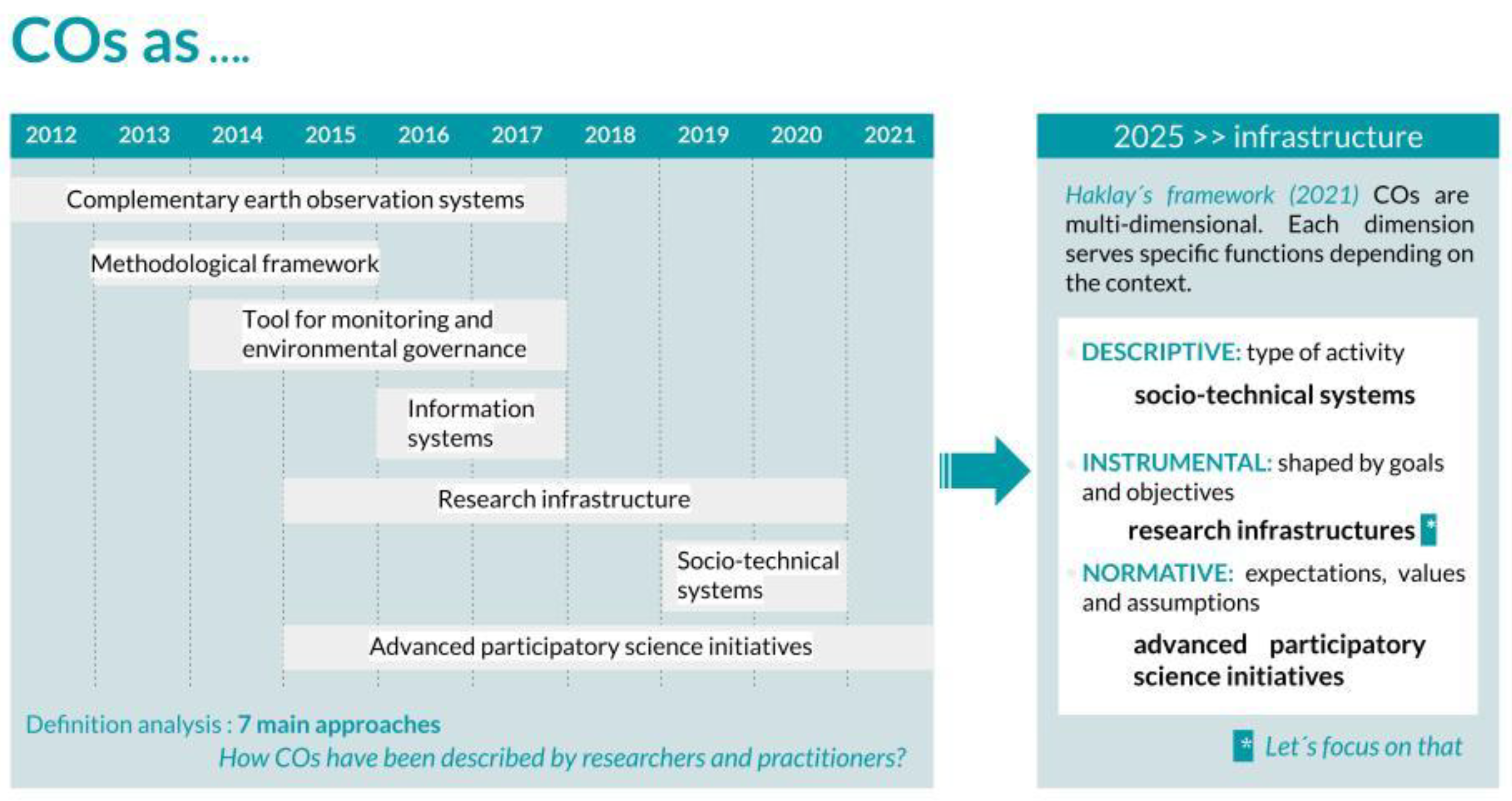
Figure 2.
Essential functions of COs. This figure illustrates the key functions that COs provide to participatory science initiatives, organized into social and technical dimensions.
Figure 2.
Essential functions of COs. This figure illustrates the key functions that COs provide to participatory science initiatives, organized into social and technical dimensions.
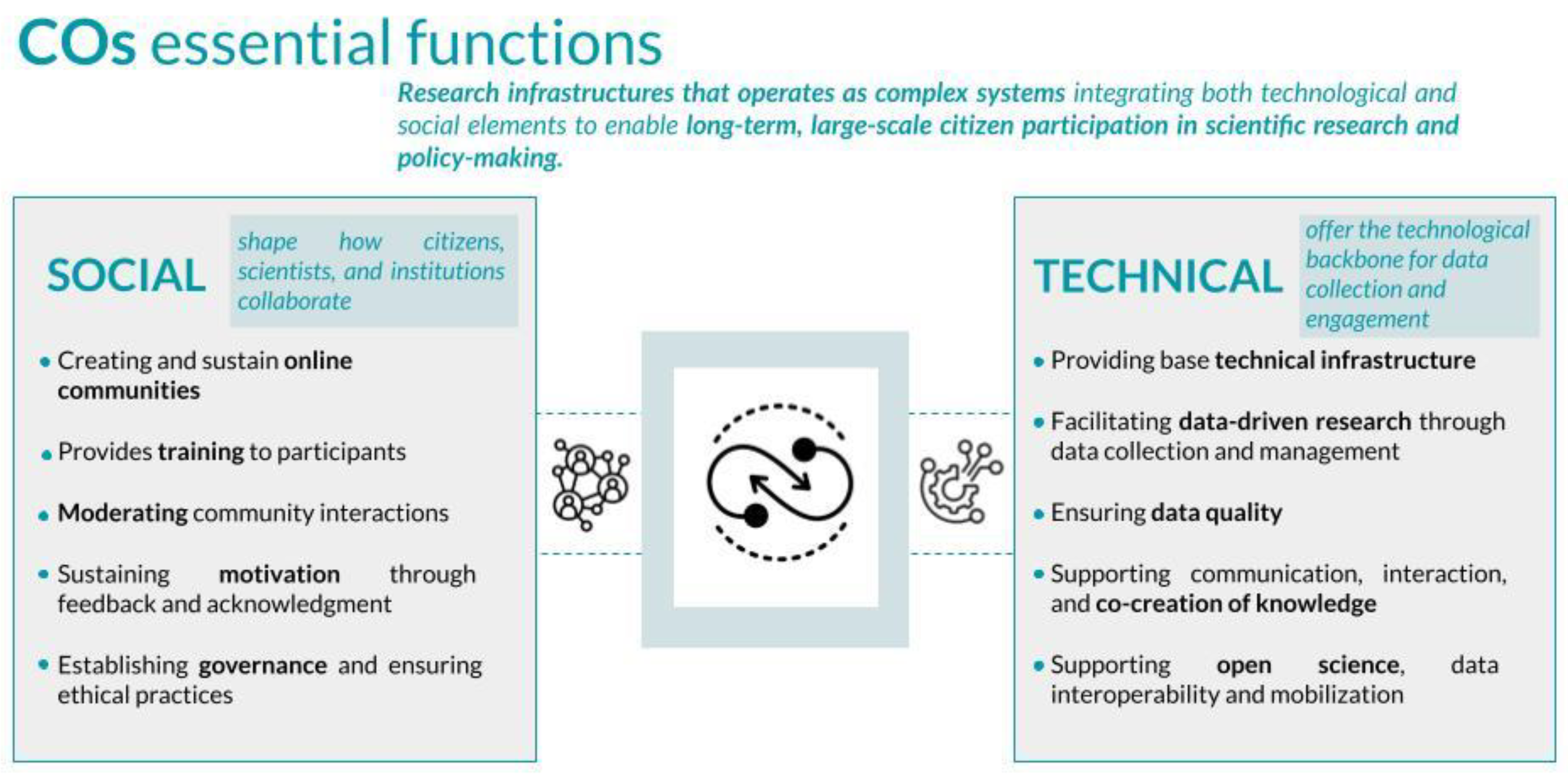
Figure 3.
Essential characteristics of COs. This figure highlights the essential characteristics of COs.
Figure 3.
Essential characteristics of COs. This figure highlights the essential characteristics of COs.
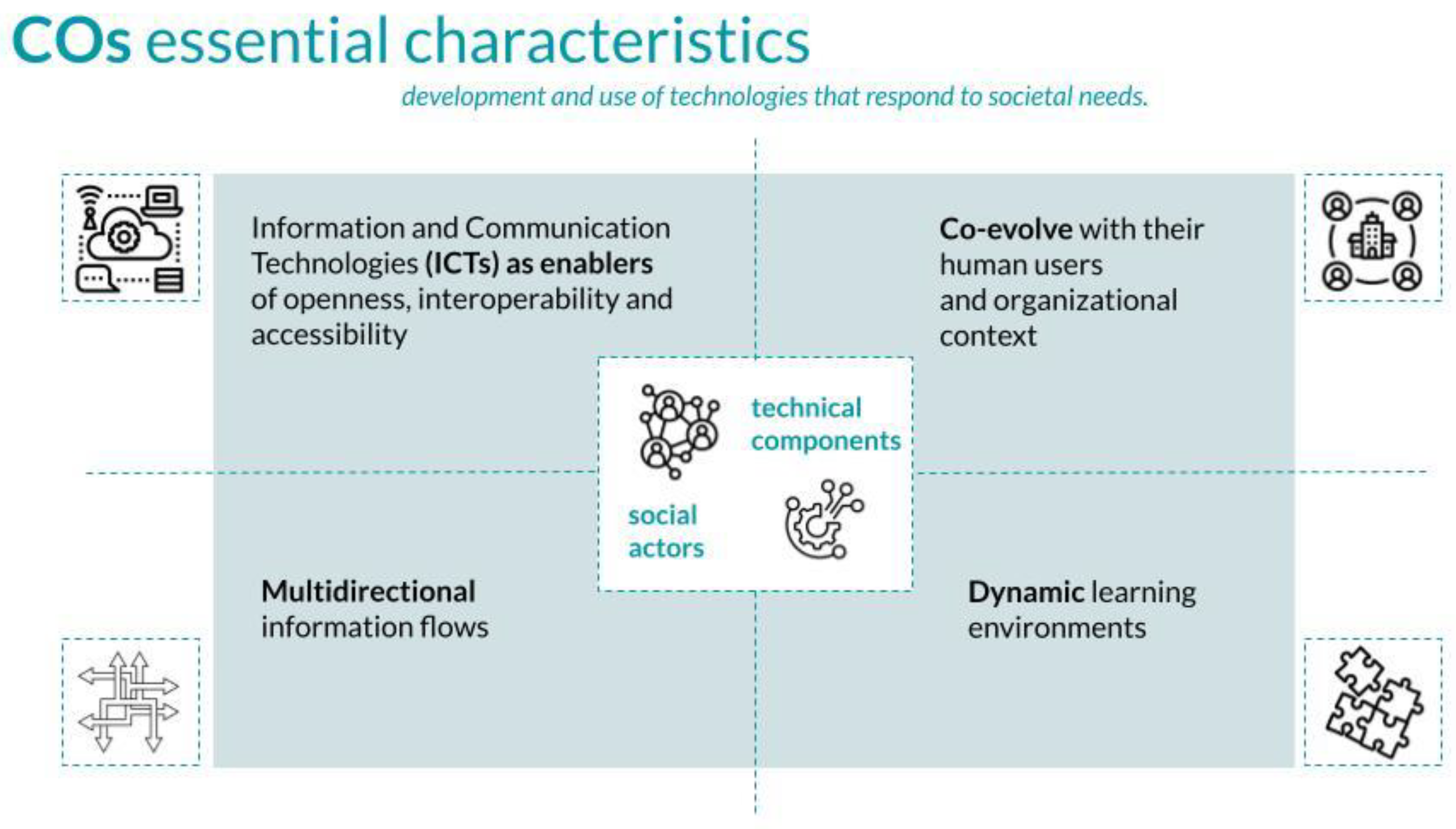
Figure 4.
CO Types. On the left, a tailored CO platform is designed for a specific project or community. On the right, an open CO platform serves multiple projects and communities, allowing various groups to contribute data.
Figure 4.
CO Types. On the left, a tailored CO platform is designed for a specific project or community. On the right, an open CO platform serves multiple projects and communities, allowing various groups to contribute data.
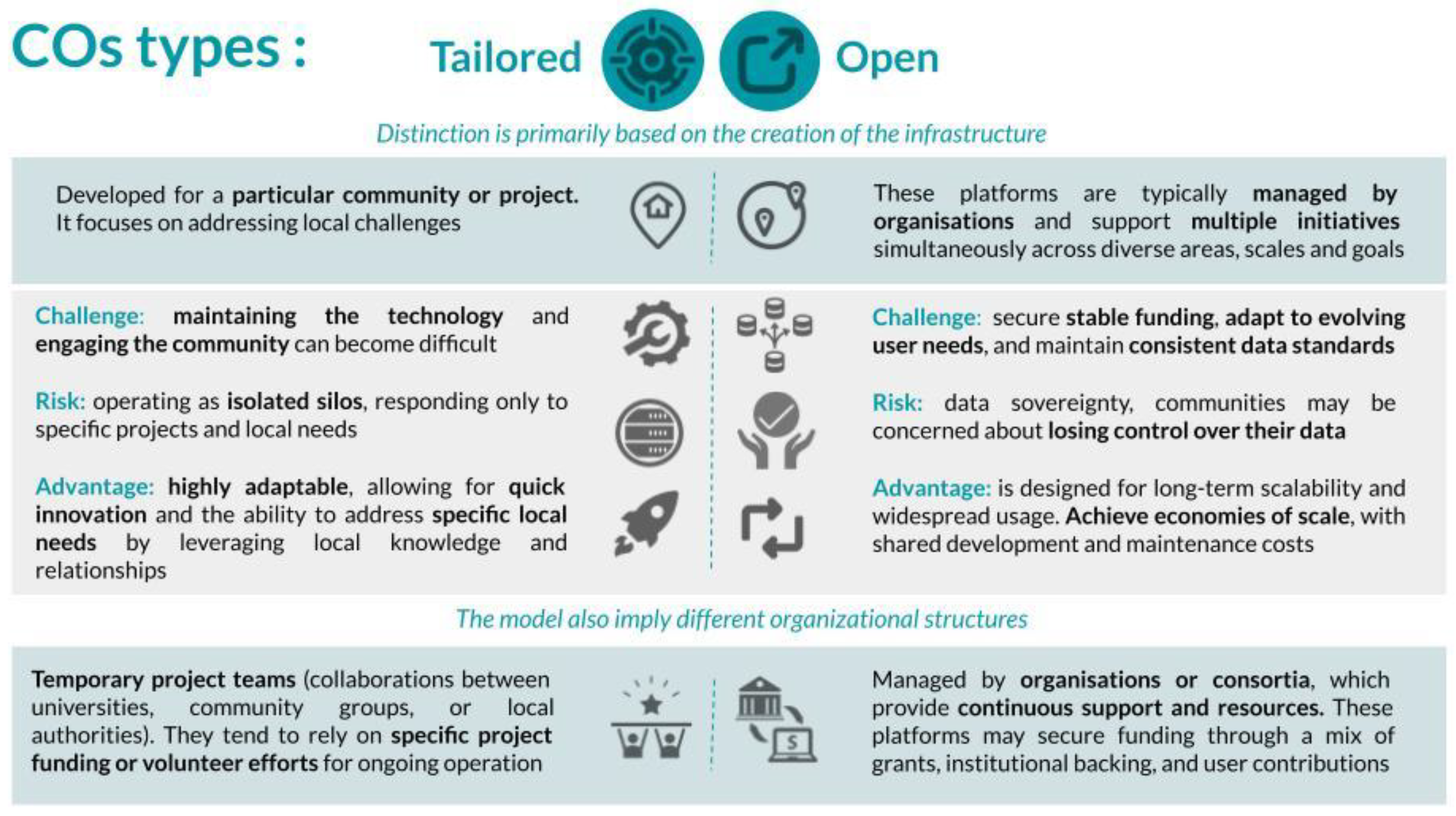

Table 1.
List of selected COs in the biodiversity and environmental field that provide open access and services to citizen science initiatives, mainly facilitating the field-based data collection and the digital engagement.
Table 1.
List of selected COs in the biodiversity and environmental field that provide open access and services to citizen science initiatives, mainly facilitating the field-based data collection and the digital engagement.
| Citizen observatory | Ref. | Host Institution and country | Number of projects hosted | Number of users-accounts* | Number of observations |
|---|---|---|---|---|---|
| Environmental and Biodiversity | |||||
| CitSci.Org | [12] | Colorado State University. USA. | >1.400 | >17.000 | >165.000 observations >2.1 million measurements |
| Anecdata | [13] | MDI Biological Laboratory, Maine, USA. | >340 | >19,400 | >160,600 |
| Biodiversity | |||||
| eBird | [14] | Cornell Lab, Cornell University, USA. | - | >930,000 | >1,6 billion |
| Observation.org | [15] | Observation International. The Netherlands. |
- | >470.000 | >269 million |
| iNaturalist | [16,17] | iNaturalist org. USA. | >180.000 | >3.5 million | >226 million |
| ArtPortalen | [18,19] | SLU, Swedish Environmental Protection Agency, Swedish University of Agricultural Science. Sweden. | >5,000 | >90,000 | >110 million |
| Pl@ntNet | [20] | CIRAD, INRAE, INRIA and IRD. France. | - | >7,6 million* | >25 million |
| Project Noah | [21] | New York University. USA. | >1.000 | >450.000 | >920.000 |
| MINKA | [22] | EMBIMOS research group. Institut of Ciències del Mar (ICM-CSIC). Spain. | >300 | >1.400 | >380.000 |
Table 2.
List of selected definitions for the term CO from 2012 to 2021 focused on the fields of citizen science, environmental monitoring and earth observation.
Table 2.
List of selected definitions for the term CO from 2012 to 2021 focused on the fields of citizen science, environmental monitoring and earth observation.
| Authors | Ref. | Definition focused on COs’ main role | Year |
|---|---|---|---|
| European Commission | [43] |
|
2012 |
| Ciravegna et al. * in Mazumdar et al. | [44,45] |
|
2013 |
| Liu et al. | [41] |
|
2014 |
| Hunt et al. | [46] |
|
2015 |
| Wehn et al. | [47] |
|
2015 |
| Palacin-Silva et al. | [48] |
|
2016 |
| European Commission | [49] |
|
2017 |
| Grainger | [32] |
|
2017 |
| Momino et al. | [27] |
|
2017 |
| Montargil and Santos | [29] |
|
2017 |
| Ferri et al. | [50] |
|
2019 |
| Hemment et al. | [51] |
|
2019 |
| Ajates et al. | [52] |
|
2020 |
| Groundtruth 2.0 | [53] |
|
2020 |
| Gold et al. | [54] |
|
2020 |
| Rathnayake et al. | [1] |
|
2020 |
| Hager et al. | [42] |
|
2021 |
| WeObserve Consortium | [25] |
|
2021 |
Disclaimer/Publisher’s Note: The statements, opinions and data contained in all publications are solely those of the individual author(s) and contributor(s) and not of MDPI and/or the editor(s). MDPI and/or the editor(s) disclaim responsibility for any injury to people or property resulting from any ideas, methods, instructions or products referred to in the content. |
© 2025 by the authors. Licensee MDPI, Basel, Switzerland. This article is an open access article distributed under the terms and conditions of the Creative Commons Attribution (CC BY) license (http://creativecommons.org/licenses/by/4.0/).
Copyright: This open access article is published under a Creative Commons CC BY 4.0 license, which permit the free download, distribution, and reuse, provided that the author and preprint are cited in any reuse.


