

Submitted:
19 April 2025
Posted:
21 April 2025
You are already at the latest version
Abstract
This paper takes the three stages of the generation, spatial separation, and detection of quantum entanglement as the main line, systematically analyzes the formation mechanism, correlation factors, and their action mechanisms of quantum entanglement, and proposes an experimental verification scheme based on Malus' law. The research shows that the formation of quantum entanglement mainly depends on physical conservation laws such as angular momentum conservation. Its correlation factors can be divided into physical local correlations and non - physical non - local correlations. The experimental verification results show that under the existing technical conditions, the polarization detection scheme can be used to distinguish between logical correlations and mysterious correlations, providing new ideas for the improvement of the quantum entanglement theory.
Keywords:
Quantum Entanglement
; Angular Momentum Conservation
; Correlation Factors
; Malus' Law
; Bell's Inequality
; Experimental Verification
1. Introduction
Quantum entanglement, as a core phenomenon in quantum mechanics, its non - local property profoundly challenges the realism and locality concepts of classical physics. Since the Einstein - Podolsky - Rosen (EPR) paradox was proposed in 1935, the nature of quantum entanglement has always been a research focus in the physics community. In recent years, with the loophole - free verification of Bell’s inequality experiments and the breakthrough in high - dimensional entangled state detection technology, the non - classical characteristics of quantum entanglement have been further confirmed. However, there are still disputes regarding the interpretation of its physical mechanism.
This paper starts from the physical origin of quantum entanglement, combines experimental verification techniques, constructs a dichotomous interpretation framework of logical correlation and mysterious correlation, and designs a polarization detection experimental scheme. The aim is to verify the objective existence of non - local mysterious correlation factors through controllable experiments, providing empirical evidence for clarifying theoretical disputes.
2. Formation Mechanism of Quantum Entanglement
2.1. Entanglement Generation Dominated by Angular Momentum Conservation
The formation of quantum entanglement usually originates from the interaction process of microscopic particles.
For example, during the annihilation of an electron - positron pair, the two generated photons are in an entangled state due to the conservation of angular momentum, and their spin directions are always opposite. This entanglement generation mechanism based on conservation laws is universal and can be extended to multi - particle systems.
Experimental evidence shows that for entangled photon pairs generated through the spontaneous parametric down - conversion (SPDC) process, the correlation of their polarization states strictly follows the law of angular momentum conservation.
For instance, when the pump light passes through a nonlinear crystal, the polarization states of the generated signal light and idler light are mathematically represented as the maximum entangled state (such as Bell states).
2.2. The Universality and Limitations of Conservation Laws
Not all physical conservation laws can lead to quantum entanglement. This paper proposes that entanglement can only occur when a conservation law does not depend on the physical correlations between substances.
For example, the spin stability of a mechanical gyroscope does not depend on the space - time environment, and its angular momentum conservation can form correlations similar to quantum entanglement. Conversely, the orbital stability of an Earth satellite depends on gravitational interactions and cannot generate entanglement.
This mechanism explains why angular momentum conservation is the main cause of quantum entanglement, while other laws such as energy conservation usually do not directly lead to entanglement.
For example, in an energy - conservation system, the change of a particle’s state needs to be achieved through energy exchange, and this physical correlation is local.
3. Correlation Factors and Action Mechanisms of Quantum Entanglement
The core essence of quantum entanglement is that quantum particles in an entangled state still maintain a special entangled correlation even after separation. Therefore, the correlation factors of entangled quantum particles are the key to the quantum entanglement problem.
Overall, the entangled correlation factors can be divided into two categories: physical local correlations and non - physical non - local correlations.
3.1. Physical Local Correlations
Physical local correlations refer to the correlation factors that are generated through physical interactions between related objects. For example, the exchange and conversion of matter and energy, as well as changes in physical (spatial) forces. On the premise that the principle of the constancy of the speed of light holds and the speed of light is the currently known ultimate speed in the universe, these correlations caused by physical factors are necessarily local.
For example, mechanical transmissions in the macroscopic world, electromagnetic interactions, and particle scattering processes at the microscopic level all rely on physical media to achieve correlations, and the propagation speed of their effects does not exceed the speed of light.
3.2. Non - physical Non - local Correlations
Non - physical non - local correlations refer to the correlation factors between objects that are generated without physical interactions.
A typical example is the logical causal relationship. Einstein’s “glove metaphor” vividly illustrates this property: even if two gloves are separated to the two ends of the universe, by observing the left - right property of one glove, one can immediately infer the state of the other glove. This kind of correlation transcends space - time limitations.
Non - physical correlations are manifested as quantum entanglement phenomena that transcend space - time limitations.
Among non - physical correlations, the mysterious correlation factors are particularly noteworthy. Mysterious correlation factors refer to those factors that cannot be explained by existing classical physical theories and conventional logic and that create a close connection between entangled quantum particles.
For example, the experimental verification of Bell’s inequality shows that the correlation strength of entangled particles violates classical probability theory, supporting a non - local interpretation. The action mechanism of this correlation involves the wave - function collapse hypothesis, that is, the measurement of one particle will instantaneously affect the state of its entangled partner.
However, the wave - function collapse theory has a logical contradiction: if the correlation is physical, it should follow locality; if it is non - physical, it cannot explain the causal relationship. This paper proposes that the essence of non - physical correlations may be related to the integrity of the quantum state, that is, entangled particles still exist as a unified system after separation.
When one of the quantum particles in an entangled state is measured, causing its superposition state to collapse into a specific eigenstate, the other unmeasured entangled quantum particle will also instantaneously collapse into the corresponding eigenstate, as if there is a “mysterious communication” between them that transcends space - time and conventional physical interactions.
Taking an entangled photon pair as an example, even if the two photons are far apart in space, measuring the polarization state of one photon will cause the polarization state of the other photon to change instantaneously in a related manner. The immediacy and long - distance nature of this change cannot be explained by the limitations on the propagation speed of interactions in traditional physical theories.
4. Experimental Verification of Quantum Entanglement
4.1. Loophole-Free Verification of Bell’s Inequality
The experiments on Bell’s inequality are important milestones in the study of quantum entanglement. In 1982, the Aspect experiment first observed a violation of Bell’s inequality, and in 2015, the team from Delft University achieved a loophole-free verification using diamond color centers. These experiments all support the non-locality of quantum entanglement. However, existing experiments have not clearly distinguished between logical correlations and mysterious correlations - the former is based on pre-determined state correlations, while the latter relies on the instantaneous collapse triggered by measurement. There is an urgent need for targeted experimental designs.
4.2. The Necessity of Experimentally Verifying Mysterious Correlation Factors
Currently, there are two core interpretations in the quantum entanglement theory.
One view holds that the entanglement correlations are pre-determined by physical laws such as the conservation of angular momentum, and measurement merely passively reads the stable state.
The other view argues that the measurement act can actively change the state of the other entangled particle through mysterious correlations.
The essence of the disagreement between the two lies in whether there are non-local correlation factors independent of the initial conditions. If the mysterious correlation is only a theoretical hypothesis, then the interpretation of the reality of quantum entanglement needs to be reconstructed. If it is experimentally confirmed, it is necessary to deeply study its mechanism of action and expand its applications.
Therefore, experimentally verifying the objective existence of mysterious correlations has become the key to resolving theoretical disputes and is also the logical prerequisite for exploring the reality and locality of quantum entanglement.
4.3. Limitations of Existing Verification Experiments
Current experiments mainly focus on Bell’s inequality. Although they have confirmed non-locality, they cannot strictly distinguish between the two correlation patterns. There is an essential difference in the measurement response mechanisms of logical correlations and mysterious correlations: the former is based on the certainty of the initial state, while the latter depends on the state collapse triggered by measurement. Existing technologies have not fully utilized this difference to design targeted experiments, resulting in the verification of mysterious correlation factors still remaining at the theoretical stage.
5. Possibility of Verifying Mysterious Correlation Factors
To verify the objective existence of mysterious correlation factors, the key point lies in clarifying the essential differences in physical mechanisms between logical correlation factors and mysterious correlation factors. The core distinction between the two types of correlation factors is mainly reflected in the differences in the mechanisms for maintaining the certainty of the physical states of entangled quantum particles after spatial separation and their measurement response patterns.
5.1. Essential Characteristics of Logical Correlation Factors
The action mechanism of logical correlation factors is based on the stability of pre - determined physical states.
Specifically, when an entangled quantum pair is separated, physical properties such as its angular momentum and polarization state have already formed definite correlation relationships through conservation laws (such as the conservation of angular momentum), and this relationship does not change depending on subsequent measurement processes.
For example, when a pair of linearly polarized entangled photons are separated, their polarization directions are determined to be either strictly orthogonal (with a 90° difference) or parallel (with a 180° difference), and this stable state is maintained during free propagation. At this time, if one of the photons is measured, it is merely equivalent to “passively reading” its pre - determined state, rather than “actively changing” its state. Even if the measurement process introduces some disturbances (such as the filtering effect of a polarizer), the state of the other photon remains independent of the measurement behavior and only follows the initial correlation logic (for example, “if photon A passes through a 0° polarizer, then photon B must pass through a 180° polarizer”).
From the perspective of statistical laws, the measurement results of logical correlations follow the principle of classical probability superposition. Taking the double - polarizer experiment as an example, when the directions of the two polarizers are the same, the coincidence - counting probability is:
P(a,b) = A(a)×B(b) = 25%
(Assume the probability of a single photon passing through is 50%). This is because the passing probability of each photon is independent. They only establish a logical correspondence through the initial correlation, rather than having an immediate mutual influence.
5.2. Essential Characteristics of Mysterious Correlation Factors
Unlike logical correlations, the core hypothesis of mysterious correlation factors is the non - local state collapse triggered by the measurement act. Under this mechanism, after an entangled quantum pair is separated, it is in a superposition state. Its physical state (such as the polarization angle) is not pre - determined but exists in the form of probability amplitudes. When one of the photons is measured, its superposition state instantaneously collapses into a specific eigenstate (such as 0° polarization). At the same time, the other unmeasured photon will also instantaneously collapse into the corresponding eigenstate (such as 180° or 90° polarization) due to the “mysterious correlation,” regardless of how far apart they are. The “mysteriousness” of this correlation is reflected in two aspects:
Firstly, non - locality: The transmission speed of the correlation effect exceeds the speed of light, violating the classical principle of locality.
Secondly, causal inversion: The measurement act is assumed to directly change the state of the other particle, rather than revealing its pre - existing state, leading to a re - definition of the causal relationship at the quantum level.
From the perspective of statistical laws, the measurement results of mysterious correlations show strong correlations. If the directions of polarizer A and polarizer B are the same and mysterious correlations exist, then the coincidence - counting probability should be P(a,b) = 50% (when the original polarization difference is 180°) or P(a,b) = 0% (when the original polarization difference is 90°), which is significantly different from the 25% probability of logical correlations. This difference stems from the fact that under the hypothesis of mysterious correlations, the measurement act instantaneously and synchronously adjusts the states of both sides, rather than being the product of the probabilities of independent events.
5.3. Theoretical Logic of Experimental Verification
Based on the above - mentioned differences, the core idea of experimental verification is to observe whether the state of one entangled quantum undergoes a non - logically expected synchronous change by artificially interfering with the measurement process of the other entangled quantum. The specific steps are as follows:
The first step is to prepare an entangled state with a determined initial correlation:
For example, generate polarization - entangled photon pairs through spontaneous parametric down - conversion to ensure that their initial polarization correlations are strictly orthogonal or parallel (guaranteed by the conservation of angular momentum).
The second step is to introduce controllable measurement perturbations:
Apply a polarizer A to one of the photons (e.g., photon a) to force its polarization state to align with that of A (equivalent to “artificially changing” its state). On the propagation path of the other photon (photon b), set up a polarizer B with the same direction as A.
The third step is to count the coincidence - counting probability:
If only logical correlations exist, the polarization state of photon b was determined at the time of separation. The probability of it passing through polarizer B depends only on the initial correlation (50% of photon a passing through polarizer A corresponds to 50% of photon b passing through polarizer B). However, because the two events are independent, the joint probability is 50%×50% = 25%.
If there is a mysterious correlation, the measurement of photon a will instantaneously adjust the polarization state of photon b to make it strictly correlated (parallel or orthogonal) with the direction of A. This results in a coincidence - counting probability of either 50% or 0%, depending on the type of initial correlation.
5.4. Key Technical Points
The feasibility of experimental verification depends on two major technical prerequisites:
Firstly, high-precision polarization state control and measurement: It is necessary to ensure the angular accuracy of the polarizer (with an error of less than 1°) and the quantum efficiency of the single-photon detector (higher than 90%) to prevent measurement noise from masking the real correlation signals.
Secondly, long-distance interference-free transmission: During the spatial separation stage (such as a distance of several kilometers), it is necessary to suppress the random disturbances of environmental noise (such as electromagnetic interference and vibration) on the polarization states of photons, and ensure that the observed signals of the “mysterious correlation” do not originate from environmental coupling.
By comparing the measured probability with the theoretical predicted values (25% vs 50%/0%), we can directly determine whether the mysterious correlation factors exist. If the experimental results approach 50% or 0%, it supports the hypothesis of mysterious correlations; if they approach 25%, it indicates that only logical correlations exist.
This discriminant method based on probability statistics provides an operable experimental criterion for the essential interpretation of quantum entanglement.
6. Experimental Scheme for Polarization Detection Based on Malus’ Law
In order to verify the objective existence of mysterious correlation factors, this study has designed an experimental scheme for polarization state detection based on Malus’ Law. By comparing the essential differences in statistical probabilities between logical correlations and mysterious correlations, an operable experimental discrimination framework is constructed.
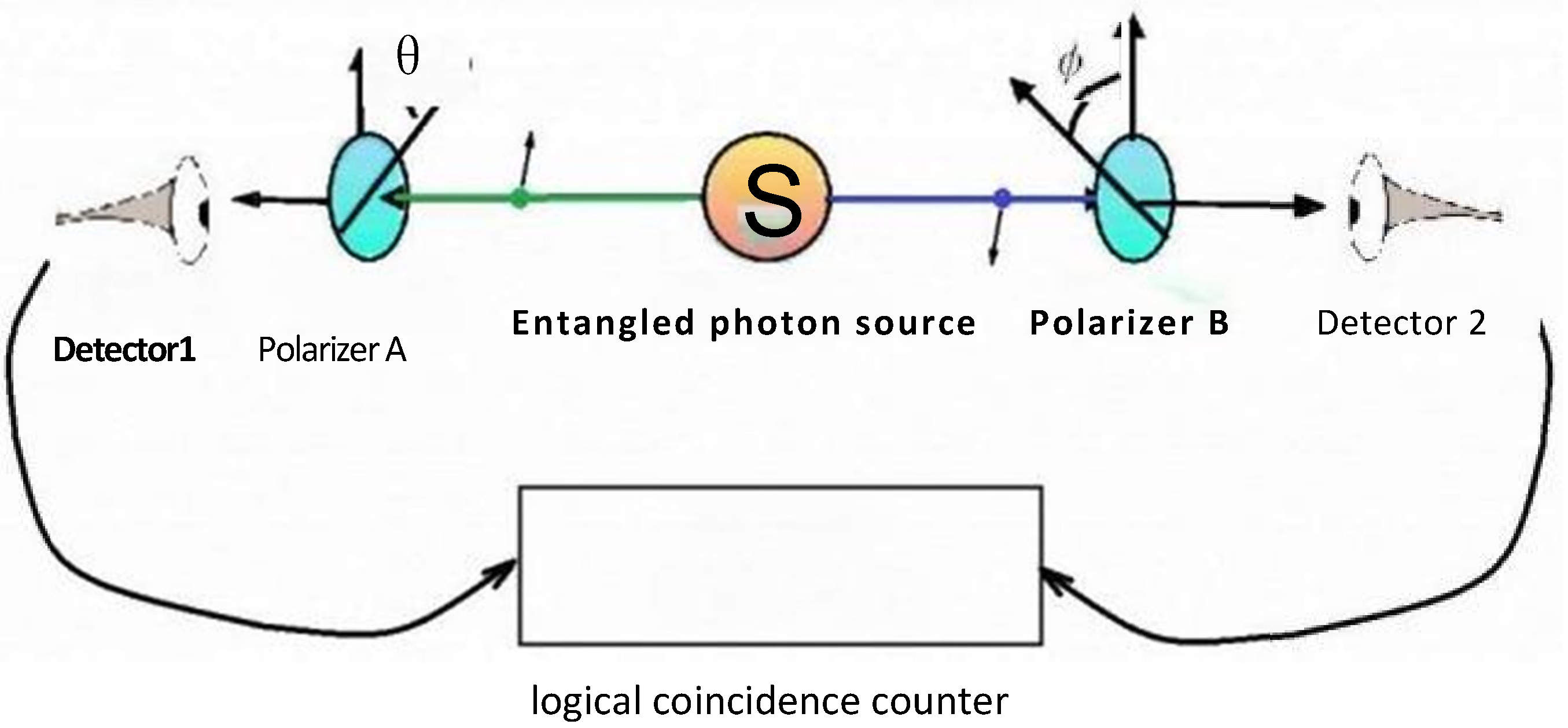
The experimental setup is shown in Figure 1. The core components include an entangled photon source, a linear polarizer array, and a coincidence counting system. Its design principle is compatible with the benchmark experiment for verifying Bell’s inequality, and it has both technical feasibility and theoretical rigor.
6.1. Experimental Setup and Operation Mechanism
The experimental system is composed of three parts (Figure 1):
Firstly, the entangled photon source: The spontaneous parametric down-conversion (SPDC) technology is adopted to prepare polarization-entangled photon pairs (such as the Bell state φ±=(|H>|H>±|V>|V>)), ensuring that the polarization correlation of the initial entangled state strictly follows the law of conservation of angular momentum (the polarization angle is 90° or 180°).
Secondly, the linear polarizer groups (A/B): Tunable linear polarizers are respectively deployed on the two propagation paths of the entangled photon pairs, supporting the precise adjustment of the polarization direction within the range of 0° to 180° (with an accuracy of ±0.1°). When it is necessary to verify the mysterious correlation, the directions of polarizer A and polarizer B are set to be the same (for example, both are at θ°). If the characteristics of the initial correlation are to be studied, the included angle between the two can be adjusted to the target angle (such as 90° or 180°).
Thirdly, the coincidence counting system: It is composed of a single-photon detector (with a quantum efficiency of ≥95%) and a logical coincidence circuit. It records in real time the number of photon pair events N(a,b) that pass through both polarizer A and polarizer B simultaneously, as well as the number of single-channel passing events N(a) and N(b). These data are used to calculate the correlation probability P(a,b) = N(a,b)/Ntotal (where Ntotal is the total number of emitted photon pairs).
6.2. Experimental Hypotheses and Theoretical Expectations
The core hypothesis of the experiment is based on the essential differences between two types of correlation factors:
Logical Correlation Hypothesis (without Mysterious Factors): When the entangled photon pairs are separated, they already have definite and stable polarization states (for example, the linear polarization directions are fixed at θ° and θ ± 180°). The measurement process only passively reads the states without changing their physical properties.
According to classical probability theory and Malus’ law, the probability of a single photon passing through a polarizer is
P(θ) = cos²θ
Since the states of the two photons are independent, the joint passing probability is:
Plogical(a,b) = P(a)×P(b) = 0.5×0.5 = 25%
(It is assumed that the probability of a single photon passing through a single polarizer is 50%, because the initial polarization state is randomly aligned with the direction of the polarizer).
Mysterious Correlation Hypothesis (Existence of Non-local Correlation): After the entangled photon pairs are separated, they are in a superposition state. The measurement act leads to the collapse of the wave function and instantaneously and synchronously adjusts the state of the other photon. If photon a passes through polarizer A (with the direction of θ°), then the polarization state of photon b will instantaneously collapse into a state that is strictly correlated with θ° (parallel or orthogonal), resulting in the joint passing probability being:
Pmysterious(a,b) = 50% (When the original polarization difference is 180°, the directions are the same after the collapse), or:
Pmysterious(a,b) = 0% (When the original polarization difference is 90°, the directions are orthogonal after the collapse).
This result is derived from the non-local hypothesis of the mysterious correlation, that is, the measurement act directly changes the state of the other photon, rather than being the superposition of probabilities of independent events.
6.3. Discrimination Criteria and Error Analysis
The experimental discrimination depends on the significant differences in statistical probabilities:
Conditions for supporting logical correlation: If the measured probability P(a,b) falls within the error range of the theoretical value of the logical correlation, that is:
|P(a,b) - 0.25|≤P(δ)
It indicates that the measurement result is consistent with the assumption of “pre - determined and independent states”, ruling out the mysterious correlation.
Conditions for supporting the mysterious correlation: If the measured probability significantly deviates from 25% and falls within the error range of the theoretical value of the mysterious correlation, that is:
|P(a,b) - 0.5|≤P(δ) or |P(a,b) - 0|≤P(δ)
It indicates that the measurement result is consistent with the assumption of “state synchronization caused by non - local collapse”, supporting the existence of the mysterious correlation.
Among them, δ is the comprehensive error (including the angular error of the polarizer, the dark count rate of the detector, etc.), which can be accurately calibrated through blank experiments (the false count rate when there are no entangled photons) and calibration experiments (the passing rate when the polarization state of the input is known).
7. Conclusions and Prospects
This paper systematically analyzes the formation mechanism, correlation factors, and experimental verification methods of quantum entanglement, and draws the following conclusions:
7.1 The formation of quantum entanglement mainly depends on non-local conservation laws such as the conservation of angular momentum.
7.2 The correlation factors can be divided into physical local correlations and non-physical non-local correlations, and the latter needs to be verified through experiments.
7.3 The polarization detection scheme based on Malus’ law can effectively distinguish between logical correlations and mysterious correlations, and it is completely feasible under the current technical conditions.
Future research directions include:
Exploring the mechanism of action of other conservation laws, such as the conservation of energy, in quantum entanglement.
Combining high-dimensional entanglement detection technologies to verify the universality of non-local correlations.
Developing new experimental schemes to directly observe the process of wave function collapse.
References
- Kumar M. Quantum Theory: Einstein and Bohr’s Epic Debate About the Nature of Reality. Chongqing: Chongqing Publishing House, 2015.
- Zhao Kaihua, Luo Weiyin. *New Concept Physics Course: Quantum Physics* (2nd Edition). Beijing: Higher Education Press, 2008.
- Clauser J F, Horne M A, Shimony A, et al. Proposed experiment to test local hidden-variable theories. Phys. Rev. Lett., 1969, 23(15): 880-884. [CrossRef]
- Aspect A, Grangier P, Roger G. Experimental Realization of Einstein-Podolsky-Rosen-Bohm Gedankenexperiment: A New Violation of Bell’s Inequalities. Phys. Rev. Lett., 1982, 49(2): 91-94. [CrossRef]
- Hanson R, et al. Loophole-free Bell inequality violation using electron spins separated by 1.3 kilometres. Nature, 2015, 526(7575): 682-686. [CrossRef]
- Li Chuanfeng, Liu Biheng, et al. Optimal Detection of High-Dimensional Quantum Entangled States. Physical Review Letters, 2021, 127(7): 070401.
- Chen Lixiang, et al. Verifying the Transformation from Quantum Contextuality to Nonlocality by Utilizing Orbital Angular Momentum Entanglement. Journal of Xiamen University, 2025, 54(3): 494362.
- Doubao.com. Experimental Verification and Technological Development of the Quantum Entanglement Phenomenon. 2023.
- Zhihu. Does Quantum Entanglement Contradict Newtonian Mechanics and the Conservation of Energy?. 2022.
- Douyin Encyclopedia. Bell’s Inequality. 2025.
Figure 1.
Schematic diagram of quantum entanglement correlation factor detection experiment (Image sourced from the internet).
Figure 1.
Schematic diagram of quantum entanglement correlation factor detection experiment (Image sourced from the internet).
Disclaimer/Publisher’s Note: The statements, opinions and data contained in all publications are solely those of the individual author(s) and contributor(s) and not of MDPI and/or the editor(s). MDPI and/or the editor(s) disclaim responsibility for any injury to people or property resulting from any ideas, methods, instructions or products referred to in the content. |
© 2025 by the authors. Licensee MDPI, Basel, Switzerland. This article is an open access article distributed under the terms and conditions of the Creative Commons Attribution (CC BY) license (http://creativecommons.org/licenses/by/4.0/).
Copyright: This open access article is published under a Creative Commons CC BY 4.0 license, which permit the free download, distribution, and reuse, provided that the author and preprint are cited in any reuse.


