
Submitted:
18 April 2025
Posted:
23 April 2025
You are already at the latest version
Abstract
Flooding, exacerbated by climate change, urbanization and poor land use practices, is a growing challenge for rural households in the Volta Basin. This study examines the effectiveness of flood management practices in improving household resilience in Benin and Togo. Using mixed methods, including focus group discussions, individual interviews, and structural equation modeling, we analyze three categories of flood management practices: Endogenous Knowledge-Based Practices (EKP), Community Engagement-Based Practices (CEP), and Agricultural Technology-Based Practices (ATP). The results show significant contributions of CEP to resilience and highlight the role of social cohesion and collective action. EKP also shows a positive impact, reflecting the importance of local knowledge, especially in Benin. However, the acceptance of ATP varies, with greater effectiveness observed in Togo than in Benin. Factors such as age, gender, education, and access to counseling services influence the acceptability and effectiveness of these practices. The findings highlight the need for tailored, integrative interventions that combine traditional knowledge and community participation with modern technologies to strengthen resilience in flood-prone regions. This study provides actionable insights for policymakers and development practitioners aiming to improve disaster risk reduction and climate resilience strategies in the Volta Basin.
Keywords:
flood management
; community engagement
; endogenous knowledge
; resilience
; Volta Basin
1. Introduction
Flooding has emerged as a critical and increasingly serious natural hazard in the Volta Basin, which includes regions in Ghana, Benin and Togo. This phenomenon is primarily caused by the confluence of climate change, rapid urbanization and inadequate land use practices. The Volta Basin’s vulnerability to extreme weather events such as heavy rainfall and coastal storms poses a significant threat to both rural and urban households, often leading to devastating consequences such as loss of life, damage to infrastructure, displacement and long-term economic disruption [1,2]. The Intergovernmental Panel on Climate Change (IPCC) has highlighted the increasing frequency and intensity of such extreme weather events as a direct result of climate change, exacerbating existing vulnerabilities in regions such as the Volta Basin [2]. Furthermore, urbanization is associated with increased flood risk due to unplanned expansion into flood-prone areas, exacerbating challenges for communities in coping with flood hazards [3].
Effective flood management practices are essential to improving household resilience, which is defined as the ability of individuals, families, and communities to withstand, adapt to, and recover from shocks such as floods [4,5,6]. Resilience is a multidimensional concept that includes economic, social, and environmental dimensions and enables households to reduce their vulnerability to floods and recover more quickly after disasters [5,6]. Innovative and inclusive flood management strategies such as early warning systems, improved drainage infrastructure, sustainable land use practices, and digital flood forecasting tools have been identified as critical components for strengthening household resilience [7]. These practices not only help mitigate the immediate impacts of floods, but also strengthen long-term adaptive capacity by minimizing economic losses, sustaining livelihoods, and protecting essential assets [5,7].
However, the implementation and effectiveness of these flood management practices vary significantly across the Volta Basin, influenced by differences in socioeconomic status, education, access to extension services and financial resources [8,9]. Consequently, the impact of flood management practices on household resilience is neither uniform nor guaranteed. While certain households may benefit from timely interventions and a supportive policy environment, others remain vulnerable due to barriers such as limited access to information, inadequate infrastructure and cultural resistance to change [9]. This disparity highlights the need for targeted approaches that take into account the unique vulnerabilities and capacities of different social groups in the Volta Basin [8].
The aim of this paper is to examine the impact of flood management practices on household resilience in the Volta Basin, with particular emphasis on how these practices enhance or limit the adaptive capacities of different social groups in Benin and Togo. In particular, the influence of factors such as gender, education, age and access to extension services on the successful adoption of flood management practices and their subsequent impact on resilience outcomes is examined [6,9]. By addressing these critical questions, this study aims to contribute to the growing literature on climate resilience and disaster risk reduction and provide actionable insights for policymakers and development practitioners committed to improving flood resilience in communities across the Volta Basin.
The results of this study are critical not only for understanding the effective implementation of flood management practices in the Volta Basin, but also for designing interventions that promote equitable access to these technologies. It highlights the importance of integrative, community-focused approaches to disaster risk management that address the different vulnerabilities and capacities of different households across the region. Integrating local knowledge and practices into flood management strategies is critical to promote resilience and ensure interventions are tailored to the specific needs of communities facing the challenges of flooding.
2. Methodology
2.1. Sample and Research Context
The study focuses on the Volta Basin, specifically the district of Boukoumbé in Benin and the districts of Oti Sud and Dakpen in Togo. These locations share similarities in their vulnerability to flooding but also have distinct characteristics shaped by their geographical, socio-economic, and environmental contexts.
Located in the Atacora department of northern Benin, Boukoumbe is known for its hilly terrain and proximity to the Atacora Mountains. The district’s high elevation creates diverse microclimates, but deforestation and soil erosion in the highlands increase surface runoff during heavy rainfall and increase the risk of flooding in low-lying areas. The district’s economy is predominantly agrarian, with an emphasis on subsistence agriculture, which also includes crops such as millet, sorghum and yam. Additionally, the area is culturally significant as the center of the Betamariba people, known for their unique mud tower houses called Takienta. However, reliance on traditional agricultural practices often leads to unsustainable land use, reducing the country’s resilience to flooding. Boukoumbe faces challenges due to limited infrastructure development. Many communities lack access to robust drainage systems, making them more vulnerable to seasonal flooding. In addition, poor road conditions make it difficult to provide timely disaster relief and assistance during extreme events.
Oti Sud is located in northern Togo in the basin of the Oti River, an important tributary of the Volta River. Its flat terrain and proximity to major watercourses make it particularly vulnerable to seasonal flooding. Heavy rainfall often leads to river flooding and affects settlements and agricultural areas along the flood plain. The district’s economy is heavily dependent on agriculture, with crops such as corn, rice and peanuts being the main source of food for most households. Fishing along the Oti River is also important. However, floods impact these livelihoods by damaging crops, displacing households and depleting the resources needed for reconstruction. Oti Sud faces significant infrastructure deficits, including inadequate drainage systems and limited access to early warning systems. Many riverside communities are particularly at risk of displacement during floods, and recovery efforts are often hampered by poor connectivity and resource constraints.
Both Boukoumbe (Benin) and Oti Sud (Togo) face similar challenges, including environmental degradation, limited adaptability and vulnerable populations. Local authorities and NGOs in both countries have initiated community-based disaster risk reduction efforts, but funding and coordination gaps limit their impact. While traditional practices remain central to flood risk management, they are not always effectively integrated into modern approaches, reducing overall resilience. By focusing on these districts, the study provides a regional understanding of how flood management practices shape flood risk and resilience in the Volta Basin.
2.2. Research Design
We implemented the research in two phases.
Identification of flood management practices used in Volta Basin
The first phase is to identify the flood management practices used by the population. We used focus group discussions and unstructured individual interviews with key informants to collect data. These were local institutions and users of the Volta Basin in each study area, including professional agricultural organizations; Local government representatives, elders, farmers, pastoralists, natural resource co-management actors, technicians of structures involved in flood management such as the Red Cross, Météo-Bénin, Direction Générale de l’Eau (DGEau), etc.
To facilitate consideration of gender, a focus group was organized with each stakeholder category: women, youth and men. On average, 15 people took part in each focus group. The unstructured individual interviews in Benin included 68 households represented by household heads, 30% of whom were women. The aim of the unstructured individual interviews was to confirm the various flood management practices identified during the focus groups. To validate these practices, a local workshop was organized in each country to introduce the practices to the community. This workshop helped refine the identified practices and group them into three categories: Endogenous Knowledge-based Practices (EKP), Community Engagement-based Practices (CEP), and Agricultural Technology-based Practices (ATP).
Assessment of the impact of flood management practices on household resilience
The aim of this phase is to assess what flood management practices households use and how these practices contribute to their resilience. Each flood management practice is used as an item to which the respondent indicates agreement on a 5-point Likert scale, ranging from ‘strongly disagree’ to ‘strongly agree’ (Table 1). While the same categories of practices are identified in both countries, there are some differences in the indicator/item for their implementation.
We adopted the household resilience for flood index from as presented in Table 1 [6]. This index includes three properties of households’ resilience to floods: households’ confidence in securing food, income, health, and evacuation during floods and recovery after floods; households’ confidence in securing their homes not being affected by a large flood event; and households’ interests in learning and practicing new flood-based farming practices [6].
The assessment of the impact of flood management practices on resilience involved 312 households represented by the head of household in the Volta Basin, i.e., 156 per country. The respondent profile, including gender (male/female), age, formal education (none, primary, secondary and post-secondary/university), and access to flood management advisory services (Yes/No), is also collected and used as control variables in the evaluation model. In the first sub-section of the results, we provide a description of the household profile involved in the study.
2.3. Data analysis
We assessed the relationships between the household profile, flood management practices and household resilience to floods using structural equation modeling (SEM) in Jamovi 2.3.28.
The estimation method used is Diagonally Weighted Least Squares (DWLS), as this method effectively deals with the problem of non-normal data and accepts ordinal variables [10]. First, we estimated an overall SEM at the Volta Basin scale and second, we used country as a multigroup factor to understand the effect of context on the structural relationships between variables.
Before SEM estimation, we assessed the reliability of all latent variables using the Cronbach’s α and ensured that their value was high than 0.75, indicating strong internal reliability [11]. Then, we estimated the robustness of the estimated model using the Comparative Fit Index (CFI), the Goodness-of-Fit Index (GFI), Adjusted Goodness-of-Fit Index (Adj. GFI), the Standardized Root Mean Residual (SRMR), and the Root Mean Square Error of Approximation (RMSEA). As recommended by [12], CFI and GFI and Adj. GFI must be close to 1. RMSEA is strongly influenced by the sample size and can range between 0.05 and 0.1 [13].
3. Results
3.1. Characteristics of Respondents
Table 2 illustrates the characteristics of the study participants. Male respondents dominate in both countries, constituting 74% of the study population. This distribution is uniform across both Benin and Togo. Female respondents make up 26%, indicating potential gender disparities in representation. A significant proportion of respondents in both countries lack formal education (51% overall), with Benin showing a higher percentage (58%) than Togo (44%). Primary education is more prevalent in Togo (42%) compared to Benin (17%). Respondents in Benin are more likely to have received advisory services (63%) compared to those in Togo (42%). Overall, 53% of respondents have access to advisory services. The age distribution is fairly similar between the two countries, with adults (44%) being the majority group, followed by young (37%) and old (20%).
The data highlights gender disparity and limited access to formal education, particularly among women. The higher percentage of respondents receiving advisory services in Benin could suggest better outreach or access mechanisms compared to Togo.
3.2. Measurement Model
The measurement model is an important part of Structural Equation Modeling (SEM), which examines the relationship between latent variables and their measures. In this research, we used Cronbach’s α to evaluate the reliability of the measurement model (Table 3). The Cronbach values are high than 0.8 thresholds, indicating a high level of reliability for each variable (Table 3).
A good fit was demonstrated across various indices. Table 4 presents the fit indices of the two models (Volta basin scale and multigroup factor analysis). The CFI, GFI and Adj.GFI values are close to 1. This indicates that the user and baseline models demonstrate an excellent fit. The RMSEA values fall within the acceptable range of less than 0.1, and the SRMR is within acceptable limits. The R-squared values elucidate the variance in the dependent variables accounted for by the independent variables in the model.
3.3. Structural Relationships
This section illustrates the results of the structural equation model that shows how the three categories of flood management practices contribute to household resilience in the Volta Basin. The model also illustrates how household characteristics determine the flood management practices adopted. Figure 1 synthetizes the significant structural relationships showing the contribution of flood management practices to household resilience.
The overall results of the SEM are presented in Table 4, showing the structural relationship between the predictors and dependents variables respectively in Volta Basin, Benin and Togo.

Table 5.
Parameter estimates for the overall model.
| Dep | Pred | Volta Basin | Benin | Togo | |||
| Estimate | p | Estimate | p | Estimate | p | ||
| EKP | Sex1 (Male) | -0.01 | 0.971 | 0.02 | 0.93 | -0.06 | 0.783 |
| EKP | Education1 (Primary) | -0.26 | 0.144 | -0.57 | 0.023 | 0.04 | 0.871 |
| EKP | Education2 (Secondary) | -0.10 | 0.647 | -0.15 | 0.616 | -0.38 | 0.353 |
| EKP | Education3 (University) | -0.98 | 0.036 | -0.48 | 0.527 | -1.36 | 0.022 |
| EKP | Advisory1 (Yes) | 0.48 | < .001 | 0.38 | 0.019 | 0.24 | 0.368 |
| EKP | Age | 0.02 | < .001 | 0.01 | 0.023 | 0.03 | 0.001 |
| CEP | Sex1 (Male) | -0.39 | 0.002 | -0.40 | 0.021 | -0.41 | 0.026 |
| CEP | Education1 (Primary) | 0.13 | 0.373 | -0.01 | 0.961 | 0.18 | 0.384 |
| CEP | Education2 (Secondary) | 0.38 | 0.03 | 0.38 | 0.109 | 0.20 | 0.528 |
| CEP | Education3 (University) | 0.16 | 0.654 | 0.18 | 0.687 | -0.08 | 0.875 |
| CEP | Advisory1 (Yes) | 0.82 | < .001 | 1.36 | < .001 | 0.24 | 0.25 |
| CEP | Age | -3.81e−4 | 0.929 | 0.00 | 0.568 | 0.00 | 0.531 |
| ATP | Sex1 (Male) | -0.25 | 0.087 | 0.15 | 0.132 | -0.43 | 0.047 |
| ATP | Education1 (Primary) | -0.26 | 0.131 | -0.21 | 0.071 | 0.12 | 0.596 |
| ATP | Education2 (Secondary) | 0.18 | 0.373 | -0.07 | 0.701 | -0.07 | 0.839 |
| ATP | Education3 (University) | -0.58 | 0.184 | 0.32 | 0.184 | -0.69 | 0.153 |
| ATP | Advisory1 (Yes) | 0.66 | < .001 | -0.08 | 0.315 | 0.45 | 0.062 |
| ATP | Age | 0.01 | 0.1 | 0.00 | 0.755 | 0.02 | 0.039 |
| Resilience | EKP | 1.28 | 0.001 | 1.38 | 0.011 | 1.16 | 0.042 |
| Resilience | CEP | 3.73 | < .001 | 2.42 | < .001 | 5.20 | < .001 |
| Resilience | ATP | 1.44 | 0.002 | -1.50 | 0.194 | 3.34 | < .001 |
Factors Affecting Flood Management Practices in Volta Basin
At the Volta Basin scale, including Benin and Togo, age, formal education, access to flood risk management advice and gender determine the type of management practices developed by households.
Age shows a positive influence on endogenous knowledge-based practices EKP (0.020, p<0.001), suggesting that older individuals develop more EKP than young. The positive influence of age on EKP is the same in both countries. Over time, older people have accumulated a wealth of endogenous knowledge about flood risk management. This helps explain why age is positively associated with EKP in the Volta Basin. In Togo, age is positively associated to agricultural technology-based practices (0.020, p=0.039), indicating that older populations in Togo may engage more in ATP compared to young.
Formal education affects flood management practices developed by the household, particularly EKP and CEP. Higher education negatively affects EKP (-0.98, p=0.036) at the level of the Basin, suggesting that those with advanced education rely less on traditional or local knowledge in developing their flood risk management. The same results come from all countries where people with primary school education (-0.57, p=0.023) and university degree (-1.36, p=0.022) respectively in Benin and Togo rely less on EKP compared to people without formal education are.
Formal education, mainly secondary education positively impacts CEP (0.380.380.38, p=0.03p = 0.03p=0.03), suggesting that moderate formal education encourages community-oriented practices. People with formal education are receptive to collective actions explaining the positive link between formal education and CEP for flood management in Volta Basin.
Advisory services on flood management emerged as a critical driver across all practices. In Volta Basin advisory services shows significant positive impacts across EKP (0.48, p < 0.001), CEP (0.82, p<0.001), and ATP (0.66, p<0.001). These results indicate that access to advisory services encourages widespread adoption of all practices. In the context of our study, advisory services are provided by NGOs (for example ONG Alpha-Omega Environnement AOE in Benin). The positive influence of advisory services on flood management practices, mainly on EKP (0.38, p=0.019) and CEP (1.36, p<0.001) is more perceptible in Benin, but is not significant in Togo while the effects are also positives. Our findings show that the Volta Basin demonstrates the most robust response to advisory services, while Benin relies heavily on them for CEP.
In the Volta Basin, there is a negative association between gender and CEP (-0.39, p=0.002), indicating that male-headed households are less likely to rely on CEP. Similar negative effects of gender are observed on CEP in both countries and on ATP in Togo. This result is particularly interesting and shows that women have confidence in community initiatives and agricultural technologies to reduce the risks of flooding. This highlights gender-based disparities in participation in community and technical practices for flood management in Volta Basin.
In summary advisory services are the strongest drivers across all practices of flood management in Volta Basin. In Benin, advisory services are crucial for EKP and CEP, but ATP engagement is limited. Higher education strongly negatively associated with EKP. In Togo, gender disparities are pronounced, with male-headed households less involved in CEP and ATP, while advisory services have weaker effects compared to other regions, especially for CEP.
Impacts of Flood Management Practices in the Volta Basin and Each Country
Endogenous Knowledge-Based Practices (EKP)
EKP values traditional and local knowledge in dealing with floods and reflects a deep-rooted cultural and ecological understanding.
At the Volta Basin scale, EKP has a moderate positive impact on the household resilience (1.28, p=0.001). This suggests that using local knowledge contributes significantly to preparation and coping strategies. In the Volta Basin, EKP is often rooted in collective memory and long-standing practices adapted to the region’s unique ecological conditions. In Benin, EKP has a similarly positive but slightly stronger effect on resilience (1.38, p=0.011). This reflects the strong role of traditional knowledge in Benin’s rural communities, where access to modern resources may be limited, making indigenous flood management strategies essential. In Togo, the effects of EKP are positive but relatively weaker (1.16, p=0.042) compared to the Volta Basin and Benin. This could indicate an increasing reliance on modern technologies or gaps in the transfer of endogenous knowledge.
Overall, EKP remains a cornerstone of resilience across regions, but its strength varies, likely due to differences in cultural adherence to traditional practices and exposure to modern interventions.
Community-Based Practices (CEP)
CEP emphasizes collective action and social structures to improve flood preparedness and recovery. At the Volta Basin scale, CEP has the strongest impact on the household resilience (3.733, p<0.001), suggesting that community cohesion and participation are critical in coping with floods. Shared responsibility enables effective communication, pooling of resources and mutual help in times of crisis. The same results are recorded for both countries. CEP emerges to be the most effective practice in all regions of Volta Basin, highlighting the importance of promoting strong social networks and collective decision-making in flood-prone areas.
Agricultural Technology-Based Practices (ATP)
ATP focuses on modern agricultural innovations, including flood-resistant seeds, land and water management practices, etc. to mitigate the impact of floods on livelihoods.
At the Volta Basin scale, ATP has a significant positive impact on household resilience (1.44, p=0.002), reflecting the role of adaptive technologies in protecting agricultural productivity. Since agriculture is an important livelihood in the Volta Basin, access to flood-resistant crops, irrigation systems and other technologies can significantly improve household resilience. Unfortunately, the impact of ATP on household resilience in Benin is not significant (-1.50, p=0.194), indicating limited adoption or effectiveness of agricultural technologies. This may be due to financial constraints, lack of technical support or lack of awareness among rural households. In Togo, ATP has a substantial positive effect on household resilience (3.34, p<0.001). This indicates a strong integration of agricultural innovations in flood management, which could be attributed to better dissemination of the technology or targeted interventions in Togo.
4. Concluding Discussion
4.1. Factors Affecting Flood Management Practices in the Volta Basin
This study addresses the diverse factors influencing flood management practices in the Volta Basin, with particular emphasis on endogenous knowledge-based practices (EKP), community engagement-based practices (CEP), and agricultural technology-based practices (ATP). The results show that demographic variables such as age, formal education, extension services and gender play a crucial role in household-level decision-making on flood management. These findings are crucial for the development of context-specific and integrative flood risk management strategies in Benin, Togo and the wider Volta Basin region, as they highlight the need for tailored approaches that take into account local realities and knowledge systems.
Age and Endogenous Knowledge-Based Practices (EKP)
The relationship between age and EKP shows a positive correlation, suggesting that older people are more inclined to use endogenous knowledge when dealing with flood risks. This trend is particularly evident in both Benin and Togo, where traditional wisdom gained through years of experience is highly valued. In Togo, this age-related trend extends to ATP, suggesting that older people may also be more likely to adopt agricultural technologies into their agricultural practices as complementary flood risk mitigation strategies. Such findings highlight the need to integrate traditional knowledge into formal flood management frameworks, thereby promoting intergenerational knowledge transfer that can improve community resilience [14,15].
Furthermore, the preservation of traditional ecological knowledge is essential for effective flood risk management. Traditional ecological knowledge can significantly influence flood risk management strategies and provide insights that are often overlooked in modern approaches [14]. This integration not only respects the cultural heritage of communities, but also increases the effectiveness of flood management practices by leveraging local expertise and adaptation strategies refined over generations.
Formal Education and Flood Management Practices
The impact of formal education on flood management practices paints a nuanced picture. At the basin scale, higher levels of formal education are associated with lower reliance on EKP, as those with advanced education tend to favor scientific and technical knowledge over traditional practices. This trend is consistent in both Benin and Togo, where formal education shows significant negative correlations with CEP. This discrepancy between formal education and indigenous knowledge highlights the need for educational initiatives that promote the integration of traditional practices into formal flood management strategies [15,16].
Conversely, formal education, through secondary education, appears to promote greater community engagement, as individuals with intermediate educational backgrounds are more likely to participate in collective actions related to flood management. This positive relationship between secondary education and CEP suggests that educational programs should not only promote community participation but also aim to harmonize traditional and formal knowledge systems. Such an approach can improve community-oriented flood management practices and ultimately lead to more resilient communities [15].
Advisory Services as Key Drivers of flood management practices
Advisory services have emerged as a critical driver influencing EKP, CEP, and ATP across the Volta Basin. These services, often provided by non-governmental organizations, play a vital role in disseminating knowledge and promoting the adoption of best practices among communities. In Benin, the influence of advisory services on EKP and CEP is particularly pronounced, indicating their essential role in supporting both endogenous and community-based practices. However, in Togo, while advisory services still have a positive impact, their influence on CEP is less significant, highlighting regional disparities in service delivery [15,16].
This disparity in the effectiveness of advisory services calls for targeted interventions to enhance service delivery in regions where it is lacking. By ensuring equitable access to advisory services, communities can be better equipped to adopt effective flood management practices, thereby improving their overall resilience to flood risks. Furthermore, the integration of local knowledge with advisory services can create a more robust framework for flood risk management, as suggested by the work of Hoang et al., who emphasize the importance of combining traditional and modern approaches in flood risk management [17].
Gender Disparities in Flood Management
Gender differences significantly impact flood management practices, with male-headed households generally exhibiting lower levels of trust in CEP and ATP, indicating women’s reliance on collective action and agricultural technologies to reduce flood risk. Promoting gender equality in flood management is not only a matter of social justice, but also a strategic imperative for strengthening community resilience. Research shows that diverse perspectives contribute to more effective decision-making and problem-solving in the context of disaster risk management [15,16]. By promoting an integrative approach that values the contributions of all community members, flood management strategies can be more comprehensive and effective, ultimately leading to better outcomes for vulnerable populations.
Gender differences in flood management practices reveal a complex environment in which, despite numerous challenges, women demonstrate strong confidence in community initiatives and agricultural technologies as effective means of mitigating flood risks. Research shows that women play a critical role in community engagement and decision-making processes related to flood management, often using their unique perspectives and experiences to strengthen resilience within their communities [18,19]. This empowerment is crucial as it not only promotes women’s sense of agency but also contributes to the overall effectiveness of flood risk management strategies.
Women in flood-prone areas often strongly believe that community initiatives have the potential to address the challenges of flooding. Their involvement in local government and community-based organizations allows them to advocate for sustainable practices and technologies that can reduce flood risk. For example, studies have shown that women actively participate in the development and implementation of flood preparedness plans and use their knowledge of local conditions and social networks to strengthen community resilience [18]. This commitment is critical as it ensures that flood management strategies are not only inclusive, but also tailored to the specific needs and vulnerabilities of the community.
Additionally, women’s trust in agricultural technologies as a means to combat flooding is increasingly recognized. Many women farmers are adopting innovative agricultural practices and technologies that improve their adaptability to flood events. For example, the use of drought-resistant crop varieties and improved irrigation techniques have been shown to empower women in agriculture and enable them to maintain productivity even in adverse weather conditions [20]. This adoption of technology not only mitigates the immediate impacts of flooding, but also contributes to the long-term food security and economic stability of their families and communities.
The psychological aspect of women’s trust in these initiatives cannot be overlooked. Research suggests that increased awareness and understanding of flood risks leads to greater support for mitigation efforts among women [21]. This informed risk perception empowers women to take proactive actions in their communities, fostering a culture of preparedness and resilience. By participating in training programs and workshops focused on flood management and agricultural technologies, women are better equipped to make informed decisions that improve the resilience of their households and communities to floods [18,19].
However, it is important to recognize that while women demonstrate confidence and skills in these areas, there are still structural barriers that can hinder their full participation. Societal norms and gender roles often limit women’s access to resources, information, and decision-making platforms [19]. Addressing these barriers through targeted interventions, such as capacity building programs and inclusive policy frameworks, is critical to maximizing women’s potential in flood management. By empowering women and ensuring their voices are heard, communities can develop more effective and comprehensive flood risk management strategies that leverage the strengths and insights of all members.
In conclusion, the factors affecting flood management practices in the Volta Basin are complex and interrelated. Age, formal education, extension services and gender all play a crucial role in household-level decision-making regarding flood risks. By understanding these dynamics, stakeholders can develop more effective, inclusive and context-specific flood risk management strategies that leverage local knowledge and promote community engagement. This holistic approach is essential for building resilience in the face of increasing flood risks exacerbated by climate change and socioeconomic developments [15,16,22].
4.2. Impacts of Flood Management Practices on Household Resilience in Volta Basin
The results of this study highlight the important role that various flood management practices play in improving household resilience in the Volta Basin. In particular, the impacts of Endogenous Knowledge-Based Practices (EKP), Community Engagement-Based Practices (CEP), and Agricultural Technology-Based Practices (ATP) illustrate how these strategies contribute to the adaptive capacity of households exposed to flood risks. By examining these practices, we can better understand their impact on community resilience and the overall effectiveness of flood management strategies in the region.
Endogenous Knowledge-Based Practices (EKP)
The moderate positive impact of EKP on household resilience (1.28, p=0.001) highlights the importance of traditional and local knowledge in flood management. This practice reflects a deep-rooted cultural and ecological understanding that has been passed down through generations. In the context of the Volta Basin, EKP is often rooted in collective memory and long-standing practices adapted to the unique ecological conditions of the region. In Benin, the slightly stronger effect of EKP on resilience (1.38, p=0.011) suggests that traditional knowledge is particularly crucial in rural communities where access to modern resources may be limited. This reliance on indigenous flood management strategies is critical to improving household resilience as it enables communities to effectively prepare for and manage flood events [23,24].
In Togo, EKP still has a positive impact on resilience (1.16, p=0.042), but its effect is relatively weaker compared to Benin and the entire Volta Basin. This may indicate an increasing dependence on modern technologies or gaps in the transfer of traditional knowledge. The varying strength of EKP across the region highlights the need for targeted interventions that promote the preservation and integration of traditional practices into formal flood management systems. By valuing and incorporating local knowledge, stakeholders can increase the effectiveness of flood management strategies and improve household resilience [23].
Community Engagement-Based Practices (CEP)
The results show that CEP has the strongest impact on household resilience across the Volta Basin (3.733, p<0.001). This highlights the crucial role of community cohesion and participation in flood management. The ability to share responsibilities, pool resources and support each other in times of crisis strengthens the adaptability of households. The strong positive correlation between CEP and resilience suggests that promoting social networks and collective decision-making is essential for effective flood management [25]. In both Benin and Togo, the effectiveness of CEP highlights the importance of promoting strong social structures that facilitate communication and collaboration among community members. Involving local communities in flood preparedness and recovery efforts not only strengthens community bonds but also increases overall household resilience. This collective approach to flood management is particularly relevant in the context of climate change, where the frequency and intensity of floods is expected to increase. By prioritizing community engagement, stakeholders can develop more robust flood management strategies that enable households to respond effectively to flood risks [8,25,26,27].
Agricultural Technology-Based Practices (ATP)
ATP also plays an important role in improving household resilience, with a positive impact of 1.44 (p=0.002) on the Volta Basin Scale. This practice focuses on modern agricultural innovations such as flood-resistant seeds and improved land and water management techniques, which are critical to mitigating the impact of floods on livelihoods in the context of climate change [28]. Since agriculture is a primary source of income for many households in the Volta Basin, access to adaptive technologies can significantly improve resilience [29,30].
However, the results suggest a disparity in the effectiveness of ATP between the two countries. In Benin, the impact of ATP on household resilience is not significant (-1.50, p=0.194), suggesting limited adoption or effectiveness of agricultural technologies. This may be due to financial constraints, lack of technical support or inadequate awareness of available technologies among rural households [28]. In contrast, Togo shows a significant positive effect of ATP on resilience (3.34, p<0.001), indicating greater integration of agricultural innovations into flood management. This difference may be due to better technology diffusion or targeted interventions in Togo, highlighting the importance of removing barriers to technology adoption in Benin [29,30].
In summary, the impacts of flood management practices on household resilience in the Volta Basin are diverse and interrelated. EKP, CEP and ATP each contribute uniquely to improving resilience, with community engagement emerging as the most important factor. The results highlight the importance of integrating traditional knowledge, promoting community cohesion and promoting access to modern agricultural technologies in developing effective flood management strategies. By recognizing and addressing the different strengths and challenges associated with these practices, stakeholders can improve household resilience in the Volta Basin, ultimately leading to more sustainable and adaptive communities in the face of increasing flood risks.
Author Contributions
Conceptualization, A.K.H. and S.A.A.; methodology, A.K.H. and S.A.A.; software, A.K.H. and S.A.A.; validation, M.N.B., H.M.B. and E.A.; formal analysis, A.K.H. and S.A.A.; investigation, A.K.H. and S.A.A.; writing—original draft preparation, A.K.H. and S.A.A.; writing—review and editing, M.N.B., H.M.B. and E.A.; supervision, H.M.B. and E.A.
Informed Consent Statement
Informed consent was obtained from all subjects involved in the study.
Data Availability Statement
Data are available on request to the authors.
Acknowledgments
Authors acknowledge the Global Water Partnership West Africa for its administrative and technical support for data collection.
Conflicts of Interest
The authors declare no conflicts of interest.
References
- Adelekan, I. Vulnerability Assessment of an Urban Flood in Nigeria: Abeokuta Flood 2007. Natural Hazards 2010, 56, 215–231, doi:10.1007/s11069-010-9564-z. [CrossRef]
- Salami, R.O.; Meding, J.K. v.; Giggins, H. Vulnerability of Human Settlements to Flood Risk in the Core Area of Ibadan Metropolis, Nigeria. Jàmbá Journal of Disaster Risk Studies 2017, 9, doi:10.4102/jamba.v9i1.371. [CrossRef]
- Olajide, O.; Lawanson, T. Climate Change and Livelihood Vulnerabilities of Low-Income Coastal Communities in Lagos, Nigeria. International Journal of Urban Sustainable Development 2014, 6, 42–51, doi:10.1080/19463138.2013.878348. [CrossRef]
- Bwanali, W.; Manda, M. The Correlation Between Social Resilience and Flooding in Low-Income Communities: A Case of Mzuzu City, Malawi. International Journal of Disaster Resilience in the Built Environment 2023, 14, 495–513, doi:10.1108/ijdrbe-09-2022-0093. [CrossRef]
- Jamshed, A.; Birkmann, J.; Feldmeyer, D.; Rana, I.A. A Conceptual Framework to Understand the Dynamics of Rural–Urban Linkages for Rural Flood Vulnerability. Sustainability 2020, 12, 2894, doi:10.3390/su12072894. [CrossRef]
- Nguyen, V.M.; James, H. Measuring Household Resilience to Floods: A Case Study in the Vietnamese Mekong River Delta. Ecology and Society 2013, 18, doi:10.5751/es-05427-180313. [CrossRef]
- Owusu, K.; Obour, P.B. Urban Flooding, Adaptation Strategies, and Resilience: Case Study of Accra, Ghana. In African Handbook of Climate Change Adaptation; Oguge, N., Ayal, D., Adeleke, L., Da Silva, I., Eds.; Springer International Publishing: Cham, 2021; pp. 2387–2403 ISBN 978-3-030-45105-9.
- Ashenefe, B.; Wubshet, M.; Shimeka, A. Household Flood Preparedness and Associated Factors in the Flood-Prone Community of Dembia District, Amhara National Regional State, Northwest Ethiopia. Risk Management and Healthcare Policy 2017, Volume 10, 95–106, doi:10.2147/rmhp.s127511. [CrossRef]
- Shah, A.A.; Ajiang, C.; Khan, N.A.; Alotaibi, B.A.; Muhammad Atiq Ur Rehman Tariq Flood Risk Perception and Its Attributes Among Rural Households Under Developing Country Conditions: The Case of Pakistan. Water 2022, 14, 992, doi:10.3390/w14060992. [CrossRef]
- DiStefano, C.; Morgan, G.B. A Comparison of Diagonal Weighted Least Squares Robust Estimation Techniques for Ordinal Data. Structural Equation Modeling: A Multidisciplinary Journal 2014, 21, 425–438, doi:10.1080/10705511.2014.915373. [CrossRef]
- Izah, S.C.; Sylva, L.; Hait, M. Cronbach’s Alpha: A Cornerstone in Ensuring Reliability and Validity in Environmental Health Assessment. ES Energy & Environment 2023, 23, 1057.
- Savalei, V. Improving Fit Indices in Structural Equation Modeling with Categorical Data. Multivariate Behavioral Research 2021, 56, 390–407, doi:10.1080/00273171.2020.1717922. [CrossRef]
- Iacobucci, D. Structural Equations Modeling: Fit Indices, Sample Size, and Advanced Topics. Journal of consumer psychology 2010, 20, 90–98.
- Bwambale, B.; Muhumuza, M.; Nyeko, M. Traditional Ecological Knowledge and Flood Risk Management: A Preliminary Case Study of the Rwenzori. Jàmbá Journal of Disaster Risk Studies 2018, 10, doi:10.4102/jamba.v10i1.536. [CrossRef]
- Pandey, C.L.; Basnet, A. Managing Disasters Integrating Traditional Knowledge and Scientific Knowledge Systems: A Study From Narayani Basin, Nepal. Disaster Prevention and Management an International Journal 2022, 31, 361–373, doi:10.1108/dpm-04-2021-0136. [CrossRef]
- Tyler, J.; Sadiq, A.; Noonan, D.S. A Review of the Community Flood Risk Management Literature in the USA: Lessons for Improving Community Resilience to Floods. Natural Hazards 2019, 96, 1223–1248, doi:10.1007/s11069-019-03606-3. [CrossRef]
- Hoang, L.P.; Biesbroek, R.; Trí, V.P.Đ.; Kummu, M.; Michelle T. H. van Vliet; Leemans, R.; Kabat, P.; Ludwig, F. Managing Flood Risks in the Mekong Delta: How to Address Emerging Challenges Under Climate Change and Socioeconomic Developments. Ambio 2018, 47, 635–649, doi:10.1007/s13280-017-1009-4. [CrossRef]
- Echendu, A.J. Women, Development, and Flooding Disaster Research in Nigeria: A Scoping Review. Environmental and Earth Sciences Research Journal 2021, 8, 147–152, doi:10.18280/eesrj.080401. [CrossRef]
- Ochola, E. Impact of Floods on Kenyan Women: A Critical Review of Media Coverage, Institutional Response and Opportunities for Gender Responsive Mitigation. Ardj 2022, 5, doi:10.61538/ardj.v5i1.1050. [CrossRef]
- Giri, S. Seed Priming: A Strategy to Mitigate Flooding Stress in Pulses. International Journal of Environment and Climate Change 2024, 14, 42–55, doi:10.9734/ijecc/2024/v14i34018. [CrossRef]
- Shao, W.; Feng, K.; Lin, N. Predicting Support for Flood Mitigation Based on Flood Insurance Purchase Behavior. Environmental Research Letters 2019, 14, 054014, doi:10.1088/1748-9326/ab195a. [CrossRef]
- Munawar, H.S.; Khan, S.I.; Anum, N.; Qadir, Z.; Kouzani, A.Z.; Mahmud, A. Post-Flood Risk Management and Resilience Building Practices: A Case Study. Applied Sciences 2021, 11, 4823, doi:10.3390/app11114823. [CrossRef]
- Lechowska, E. Approaches in Research on Flood Risk Perception and Their Importance in Flood Risk Management: A Review. Natural Hazards 2021, 111, 2343–2378, doi:10.1007/s11069-021-05140-7. [CrossRef]
- Yi, G.; Gao, Y.; Wang, X.; Dou, W.; Lu, X.; Mao, J. Understanding Risk Perception From Floods: A Case Study From China. Natural Hazards 2021, 105, 3119–3140, doi:10.1007/s11069-020-04458-y. [CrossRef]
- Liao, S. Balancing Flood Control and Economic Development in Flood Detention Areas of the Yangtze River Basin. Isprs International Journal of Geo-Information 2024, 13, 122, doi:10.3390/ijgi13040122. [CrossRef]
- Dewa, O.; Makoka, D.; Ayo-Yusuf, O.A. Measuring Community Flood Resilience and Associated Factors in Rural Malawi. Journal of Flood Risk Management 2022, 16, doi:10.1111/jfr3.12874. [CrossRef]
- Gould, J.A.; Kulik, C.T.; Sardeshmukh, S. Trickle-down Effect: The Impact of Female Board Members on Executive Gender Diversity. Human Resource Management 2018, 57, 931–945, doi:10.1002/hrm.21907. [CrossRef]
- Adéchian, S.A.; Baco, M.N.; Tahirou, A. Improving the Adoption of Stress Tolerant Maize Varieties Using Social Ties, Awareness or Incentives: Insights from Northern Benin (West-Africa). World Development Sustainability 2023, 3, 100112.
- Smiley, K.T.; Wehner, M.; Frame, D.; Sampson, C.; Wing, O. Social Inequalities in Climate Change-Attributed Impacts of Hurricane Harvey. Nature Communications 2022, 13, doi:10.1038/s41467-022-31056-2. [CrossRef]
- Yanadori, Y.; Kulik, C.T.; Gould, J.A. Who Pays the Penalty? Implications of Gender Pay Disparities Within Top Management Teams for Firm Performance. Human Resource Management 2021, 60, 681–699, doi:10.1002/hrm.22067. [CrossRef]
Figure 1.
Significant structural relationships describing the contribution of flood management practices to household resilience in Volta Basin.
Figure 1.
Significant structural relationships describing the contribution of flood management practices to household resilience in Volta Basin.
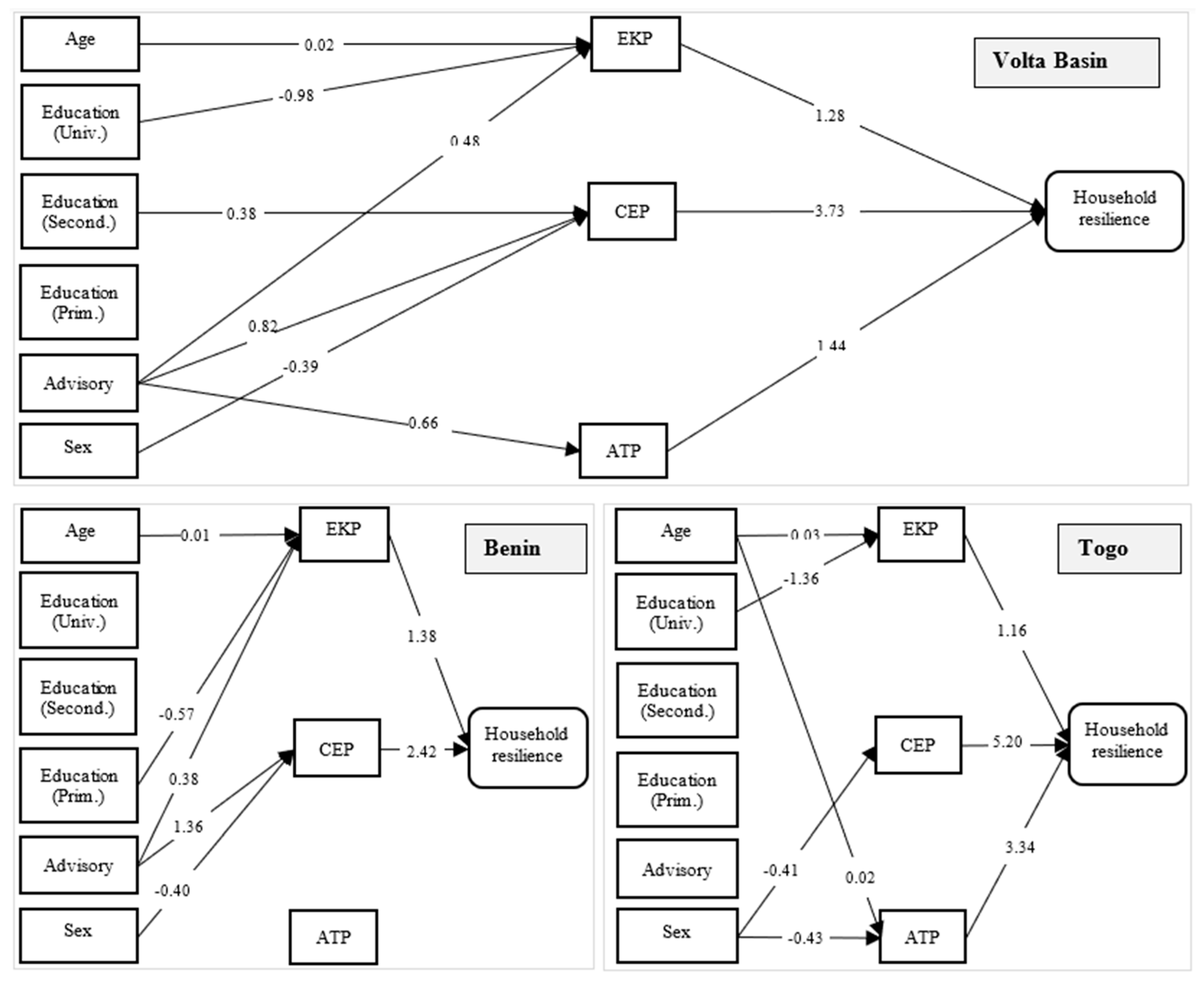
Table 1.
Variable and indicator measurement.
| Variables | Indicators Benin | Indicators Togo | Definition |
|---|---|---|---|
| Endogenous Knowledge-based Practices (EKP) | To prevent and manage flooding, you rely on the following practices in your household:
|
To prevent and manage flooding, you rely on the following practices in your household:
|
A five-point Likert scale variable ranging from 1 strongly disagree to 5 strongly agree. |
| Community Engagement-based Practices (CEP) | To prevent and manage flooding, you rely on the following practices in your household:
|
To prevent and manage flooding, you rely on the following practices in your household:
|
A five-point Likert scale variable ranging from 1 strongly disagree to 5 strongly agree. |
| Agricultural Technology-based Practices (ATP) | To prevent and manage flooding, you rely on the following practices in your household:
|
To prevent and manage flooding, you rely on the following practices in your household:
|
A five-point Likert scale variable ranging from 1 strongly disagree to 5 strongly agree. |
| Household resilience (adapted from [6].) |
|
A five-point Likert scale variable ranging from 1 strongly disagree to 5 strongly agree. | |
Table 2.
Descriptives statistics of respondents.
| Household characteristics | Modalities | Benin | Togo | Study area | |||
|---|---|---|---|---|---|---|---|
| N | % | N | % | N | % | ||
| Sex | Female | 41 | 26 | 40 | 26 | 81 | 26 |
| Male | 115 | 74 | 116 | 74 | 231 | 74 | |
| Total | 156 | 100 | 156 | 100 | 312 | 100 | |
| Formal education | None | 91 | 58 | 68 | 44 | 159 | 51 |
| Primary | 27 | 17 | 66 | 42 | 93 | 30 | |
| Secondary | 34 | 22 | 18 | 12 | 52 | 17 | |
| University | 4 | 3 | 4 | 3 | 8 | 3 | |
| Total | 156 | 100 | 156 | 100 | 312 | 100 | |
| Advisory services | No | 57 | 37 | 91 | 58 | 148 | 47 |
| Yes | 99 | 63 | 65 | 42 | 164 | 53 | |
| Total | 156 | 100 | 156 | 100 | 312 | 100 | |
| Age | Young | 57 | 37 | 57 | 37 | 114 | 37 |
| Adult | 66 | 42 | 70 | 45 | 136 | 44 | |
| Old | 33 | 21 | 29 | 19 | 62 | 20 | |
| Total | 156 | 100 | 156 | 100 | 312 | 100 | |
Table 3.
Assessment of measurement reliability.
| Country | Endogenous variables | Mean | SD | Cronbach’s α |
|---|---|---|---|---|
| Benin | EKP | 3.26 | 1 | 0.92 |
| CEP | 3.33 | 0.94 | 0.88 | |
| ATP | 4.14 | 0.51 | 0.86 | |
| Resilience | 2.93 | 0.58 | 0.89 | |
| Togo | EKP | 2.88 | 1.26 | 0.91 |
| CEP | 2.98 | 1.15 | 0.94 | |
| ATP | 2.96 | 1.21 | 0.89 | |
| Resilience | 2.87 | 0.85 | 0.90 |
Table 4.
Fit indices.
| Model | CFI | GFI | adj. GFI | SRMR | RMSEA |
|---|---|---|---|---|---|
| Volta Basin scale (Overall SEM) | 0.915 | 0.999 | 0.993 | 0.048 | 0.08 |
| Multigroup factor analysis | 0.906 | 0.998 | 0.982 | 0.05 | 0.09 |
Disclaimer/Publisher’s Note: The statements, opinions and data contained in all publications are solely those of the individual author(s) and contributor(s) and not of MDPI and/or the editor(s). MDPI and/or the editor(s) disclaim responsibility for any injury to people or property resulting from any ideas, methods, instructions or products referred to in the content. |
© 2025 by the authors. Licensee MDPI, Basel, Switzerland. This article is an open access article distributed under the terms and conditions of the Creative Commons Attribution (CC BY) license (http://creativecommons.org/licenses/by/4.0/).
Copyright: This open access article is published under a Creative Commons CC BY 4.0 license, which permit the free download, distribution, and reuse, provided that the author and preprint are cited in any reuse.


