

Submitted:
16 April 2025
Posted:
18 April 2025
You are already at the latest version
Abstract
Bee pollen is widely recognized for its health benefits, with its nutritional and bioactive properties varying by botanical origin. This study analyzed twelve bee pollen samples collected from six different apiaries in Uruguay during two seasons (spring and autumn) to determine their botanical composition; nutritional profile (protein, lipids, carbohydrates, dietary fiber, ash, and fatty acid profile); bioactive compound content (total phenols, vitamin C, tocopherols, and carotenoids); antioxidant activity (ABTS and ORAC); color, and its ability to inhibit enzymes involved in carbohydrate and fat digestion.
Among the samples collected in autumn, three were monofloral (one from Casuarina and two from Eucalyptus). The spring samples, however, were all multifloral, except for one monofloral Rapeseed sample. Monofloral samples had higher protein, fiber, tocopherol, and total phenol content, along with higher ABTS and ORAC values, but lower carotenoid levels. In contrast, autumn samples had lower protein and lipid content but higher fiber and vitamin C levels. The predominant fatty acids were palmitic, linolenic, linoleic, and oleic acids, with most samples showing a higher proportion of polyunsaturated fatty acids (40.7–57.9%).
Compared to other food matrices, the α-glucosidase inhibition values of Uruguayan bee pollen are similar to those found in raw citrus pomace. This is the first report on bee pollen's ability to inhibit pancreatic lipase in relation to its anti-obesity properties. Uruguayan bee pollen shows significant potential for combating metabolic syndrome, obesity, and type 2 diabetes.
Keywords:
Bee pollen
; Bioactive properties
; Metabolic syndrome
; Obesity
; Type 2 diabetes
1. Introduction
Pollen is the male gametophyte of plants, collected by worker bees from flowers and mixed with their own secretions. These granules adhere to the bees' hind legs and, upon returning to the hive, are dislodged as the bee passes through a "pollen trap" placed at the hive entrance [1]. Pollen is considered the primary food source for the growth of bee larvae [2,3].
The chemical composition, nutritional profile, and biological activity of bee pollen depend on the plant species from which it originates, as well as geographic and climatic conditions, the collection season, and storage and processing factors [4,5,6].
Bee pollen is a natural source of bioactive compounds and essential micro- and macronutrients, including carbohydrates, proteins, vitamins, amino acids, minerals, lipids, flavonoids, phenolic compounds, and essential oils [3,7,8]. It is also a rich source of essential amino acids (arginine, histidine, lysine, tryptophan, phenylalanine, methionine, threonine, leucine, isoleucine, and valine), macroelements (phosphorus, sodium, calcium, magnesium, and potassium), and microelements (copper, manganese, iron, zinc, and selenium) [1,9].
The potential health benefits of bee pollen are closely linked to its chemical composition, which varies according to its botanical and geographical origin. Evidence suggests that long-term consumption of phenolic compounds from pollen, such as flavonoids (kaempferol, quercetin, and isorhamnetin) and flavonoid glycosides, may reduce the incidence of certain cancers and chronic diseases [6,10,11].
Among the biological properties studied, bee pollen has been found to exhibit antioxidant and anti-inflammatory activity, attributed to its content of flavonoids, carotenoids, phenolic acids, and vitamins C and E [12]. These compounds act synergistically to neutralize free radicals and protect cells from oxidative damage, which is essential for preventing various chronic diseases.
Additionally, bee pollen has been identified as having potential antilipemic and hypoglycemic effects, primarily due to the presence of unsaturated fatty acids, phospholipids, and phytosterols, which help regulate lipid and carbohydrate absorption. Another notable property is its ability to inhibit the growth of pathogenic bacteria, promote the proliferation of beneficial probiotic bacteria, and support gut microbiota recovery, making pollen a valuable ally for digestive health [13,14,15].
Previous studies have highlighted the importance of further research into the chemical composition of different types of bee pollen based on their botanical origins, both in relation to bee health and human health [5,16].
To date, no studies have characterized the physicochemical properties of pollen collected from Uruguayan apiaries. In this context, this study aimed to analyze the nutritional composition, bioactive compound profile, antioxidant activity, and enzyme inhibition capacity related to carbohydrate and fat digestion in Uruguayan bee pollen, considering its floral origin and seasonal variability.
2. Material and Methods
2.1. Bee-Pollen Samples
Bee pollen samples produced by Apis mellifera were collected from six different apiaries during two seasons, with samples taken from the same hives in each season. Samples A1 to A6 correspond to those collected in autumn, while samples S1 to S6 were collected in spring.
The samples were immediately frozen after harvesting and stored at -18°C until drying. Drying was performed using a forced convection oven at 45ºC until the moisture content was reduced to below 8%. The dried samples were then stored in airtight glass containers at -18°C until analysis.
2.2. Reagents
All reagents were of analytical grade. For in vitro bioactivity assays, reagents were purchased from Sigma-Aldrich (St. Louis, MO, USA): 6-Hydroxy-2,5,7,8-tetramethylchroman-2-carboxylic acid (Trolox), 2,2’-azino-bis (3-ethylbenzothiazoline-6-sulfonic acid) diammonium salt (ABTS), 2,2’-azobis (2-methylpropionamidine) dihydrochloride (AAPH), fluorescein (FL) disodium salt, 4-methylumbelliferyl-α-D-glucopyranoside, α-glucosidase from rat intestinal acetone powder, pancreatic lipase, 4-methylumbelliferyl oleate (4-MUO), and dimethyl sulfoxide (DMSO).
2.3. Floral Origin Determination
The pollen sample was separated into individual batches, grouping them by color. From each color group, a subsample was taken with a metal tip and mounted on a microscope slide, hydrated with a drop of water, and covered with a cover slip, following the procedure of Louveaux et al. (1978) [17]. Observation was carried out using an optical microscope with a 40x objective, identifying the natural morphology of the pollen without undergoing acetolysis. For pollen comparison and taxonomic determination, records from the palynotheca of the Faculty of Sciences at the University of the Universidad de la República [UdelaR] were used. The relative frequency of each pollen type was calculated by counting a minimum of 500 pollen grains per slide.
3. Methods
Immediately before each analysis, the samples were ground and sieved through a 0.595 mm mesh.
3.1. Proximate Composition
The moisture content of the pollen samples was determined gravimetrically by drying in a vacuum oven at 70°C and 100 mmHg pressure until constant weight [18]. The protein content was calculated based on the nitrogen content determined using the Kjeldahl method [19], applying a factor of 6.25. The total lipid content was determined by solvent extraction (hexane/isopropanol mixture) according to Hara & Radin [20]. Briefly, 20 mL of the solvent mixture were added to 1 g of sample and stirred magnetically for 90 minutes. After centrifugation, the supernatant was collected and rinsed twice. The solvent was removed by rotary evaporation at reduced pressure. The ash content in the samples was analyzed by incineration in a muffle furnace at 550°C according to de Arruda et al. [21], and determined gravimetrically. Total dietary fiber was determined using the enzymatic gravimetric method [22]. The total carbohydrate content was calculated by difference [23].
3.2. Fatty Acid Profile
The extracted fat was derivatized according to the IUPAC 2.301 technique [24] to obtain the methyl esters (FAME). The derivatized sample was injected into a Shimadzu GC-2010 gas chromatograph (Shimadzu Corporation, Kyoto, Japan), which was equipped with a Supelco SP2560 column (100 m, 0.2 μm, and 0.25 mm) and a flame ionization detector. The temperature program used was as follows: initial temperature of 90°C for 2 minutes, then ramped to 175°C at 20°C/min and held for 35 minutes, followed by a ramp to 240°C at 15°C/min and held for 25 minutes. The identification of fatty acids was carried out by comparison with a standard containing fatty acids with chain lengths ranging from C4 to C24 (Sigma-Aldrich). The results were expressed as g/100 g of fat.
3.3. Vitamin C
The determination of vitamin C content in the pollen samples was carried out through titration with 2,6-dichlorophenolindophenol, according to the method established by AOAC [25].
3.4. Analysis of Tocopherols
The tocopherol content was determined by liquid chromatography (HPLC) following the technique outlined by Andrikopoulos et al. [26]. Briefly, 30 mg of fat were dissolved in 1 mL of isopropanol. The sample (50 µL) was injected into a Shimadzu 20A chromatograph (Shimadzu Corporation, Kyoto, Japan) equipped with a Macherey-Nagel C18 column (250 × 4.6 mm, 100 µm) and a 20AXs fluorescence detector (λex=290 nm and λem=330 nm). Quantification was performed using a calibration curve with α-tocopherol. The results were expressed as µg α-tocopherol/g of fat.
3.5. Total Carotenoids Determination
Total carotenoids were determined spectrophotometrically at 450 nm after extraction with acetone and a pre-extraction in petroleum ether [27]. The content was expressed as β-carotene equivalents (µg/g), calculated using the equation (1), where A is the measured absorbance, the volume of petroleum ether used in the extraction, ,is the absorption coefficient of β-carotene in the solvent at 450 nm (2592 for petroleum ether), and m is the mass of the sample in grams.
3.6. Color
3.7. Antioxidants
Total phenol content (TPC), antioxidant capacity by ABTS, and ORAC-FL were determined as described by Fernández-Fernández et al. [30]. TPC analysis was performed by adding 10 µL of sample/standard to each well of translucent flat-bottom 96-well plates, followed by the addition of 200 µL of Na2CO3 (20 % w/v) and 50 µL of Folin reagent (1/5). After 30 minutes of incubation at room temperature in the dark, absorbance was measured at 750 nm using a Thermo Scientific FC microplate reader. The results were expressed as mg of gallic acid equivalents (GAE)/g pollen through a gallic acid calibration curve (0.05-1.0 mg/mL).
The ABTS method was performed by adding 10 µL of sample/standard to each well of translucent flat-bottom 96-well plates, followed by the addition of 190 µL of ABTS reagent (adjusted to an absorbance of 0.7 with 5 mM phosphate buffer, pH 7.4). After 10 minutes of incubation at room temperature in the dark, absorbance was measured at 750 nm using a Thermo Scientific FC microplate reader. The results were expressed as µmol of Trolox equivalents (TE)/g pollen through a Trolox calibration curve (0-1.5 mM).
The ORAC-FL method was performed by adding 20 µL of sample/standard to each well of black flat-bottom 96-well plates with a lid, followed by the addition of 120 µL of fluorescein solution (0.117 μM) and 60 µL of AAPH (48 mM). The plate was incubated for 80 minutes at 37 °C, and fluorescence was measured every minute (λexcitation = 485 nm, λemission = 520 nm) using a Varioskan Lux (Thermo Scientific) microplate reader. The results were expressed as µmol of Trolox equivalents (TE)/g pollen through a Trolox calibration curve (10-80 µM).
3.8. Inhibition of Enzymes Involved in Carbohydrate and Fat Digestion
The inhibitory capacity of α-glucosidase and pancreatic lipase was assessed by measuring the fluorescent probes 4-MUF-α-D-glucopyranoside and 4-methylumbelliferyl oleate, respectively released by the action of these enzymes [31]. Fluorescence was measured (λexcitation = 360 nm, λemission = 460 nm) using a Varioskan Lux (Thermo Scientific) fluorometer microplate reader
For α-glucosidase inhibition, 100 µL of sample, 100 µL of α-glucosidase solution, and 100 µL of 4-MUF-α-D-glucopyranoside were added to each well of black flat-bottom 96-well plates with lids. The control (maximum enzymatic activity) consisted of phosphate buffer (100 mM, pH 6.9), enzyme, and probe. Sample blanks were measured to subtract from the sample values. The plate was incubated for 30 minutes at 37 °C, and fluorescence was recorded every minute.
For pancreatic lipase inhibition, 50 µL of sample, 50 µL of pancreatic lipase solution, and 100 µL of 4-methylumbelliferyl oleate were added to each well of black flat-bottom 96-well plates with lids. The control (maximum enzymatic activity) consisted of Tris-Cl buffer (10 mM, pH 8-8.4), enzyme, and probe. Sample blanks were also measured to subtract from the sample values. The plate was incubated for 30 minutes at 37 °C, and fluorescence was measured every minute.
In both assays, dose-response curves were constructed (% Inhibition vs. [Sample] (mg/mL)) to express the results as IC50 values (mg/mL).
3.9. Statistical Analysis
The proximate composition, along with the content of vitamin C, total tocopherols, carotenoids, and antioxidant capacity, were analyzed using analysis of variance (ANOVA). Sample, season, and monofloral characteristics were considered as fixed sources of variation. Tukey's post-hoc test was used to compare means and identify significant differences (p ≤ 0.05) between samples across all assays. Principal component analysis (PCA) was applied as a dimensionality reduction technique to visualize the results. All statistical analyses were performed using XL Stat 2021.7 software (Addinsoft, NY, USA).
4. Results and Discussion
4.1. Floral Origin
Table 1 and Table 2 present the botanical origin of the pollen samples collected in autumn and spring, respectively. Among the autumn samples, three were monofloral: A2 (monofloral Casuarina), A5, and A6 (monofloral Eucalyptus) (Table 1).
The spring samples were mostly multifloral, with the exception of sample S4, which was monofloral from Rapeseed, a typical crop at the end of winter in Uruguay (Table 2). Pollen samples from spring had a broader floral spectrum compared to autumn, with an average of 9.5 botanical species per sample, compared to 5.3 in the autumn samples. Pollen typical of Uruguay's landscape was present in all samples, which highlights the importance of cultivated resources in abundant pollen production. Whenever a floral type represented more than 45% of the total analyzed, it corresponded to a cultivated resource, such as Casuarina, Eucalyptus, and Rapeseed. A total of 34 pollen taxa were recorded: 22 native, 11 exotic, and one unidentified. Families such as Salicaceae (willows) and Asteraceae (wild chrysanthemum and carqueja [Baccharis genistelloides]) were particularly abundant among the native resources for their high pollen production and widespread in the areas and collection dates.
4.2. Physicochemical Analysis
According to the results presented in Table 3, all the dehydrated pollen samples had a moisture content of less than 8%, meaning that the pre-treatment of drying at 45°C was effective in meeting the specifications established in national regulations [32]. Lowering the moisture content of freshly collected pollen is important to extend its shelf life at room temperature, as fresh pollen provides an ideal environment for the growth of microorganisms, particularly fungi and yeasts [33]. However, there are currently different criteria regarding the maximum permissible values, ranging from 4% to 8% [34,35,36]. Several countries have established quality standards for pollen (Argentina, Brazil, Poland, Switzerland) that differ in terms of the ranges or maximum limits of certain parameters. Therefore, it would be important to standardize criteria that facilitate the commercialization of this product across different countries, as proposed by Campos et al. [37].
Protein is the second most present macronutrient after carbohydrates, with values that range from 16.77% to 27.26% (on a dry matter basis (DM)), and an average of 21.11%. These results are similar to those reported by Santos et al. [16] in a study conducted in Uruguay, and those reported by Gasparotto Sattler et al. [38] in pollen samples from southern Brazil. Gardana et al. [39], also reported an average protein content of 21.6% and 19.5% for samples of Colombian and Italian origin, respectively. In our study, the protein content was significantly influenced (p=0.0466) by the harvest season, with autumn samples having a significantly lower average protein content (19.24%) compared to spring samples (21.14%). This is consistent with the presence of Asteraceae species typical of the Uruguayan landscape, which in previous studies have shown to contain low protein values [16]. Other authors have reported that one of the factors with the greatest influence on the protein content of pollen is its botanical origin [40]. In our study, monofloral samples had a significantly higher protein content (p=0.0183) than multifloral samples (22.36% vs. 18.88%). However, it is important to highlight that the presence of all essential amino acids in bee pollen is one of the factors contributing to its high nutritional value, and therefore, the nutritional value of multifloral samples should not be underestimated [41].
The total fiber content was significantly influenced by the collection season (p < 0.0001) and by being monofloral (p = 0.0019). The autumn samples had a higher fiber content than the spring samples (15.16% vs. 12.84%), and the monofloral samples had a higher fiber content than the multifloral samples (14.89% vs. 13.11%). All values fall within the range reported by Campos et al. [37], which is from 0.3 to 20 g/100g of pollen.
The total lipid content averaged 8.53% (DM), slightly higher than what was reported for samples from a geographically close region [38], although similar values were reported for pollen samples from Croatia [42]. Lipid content was highly significantly influenced (p < 0.0001) by the collection season, as autumn samples had, on average, a significantly lower lipid content (7.72%) than spring samples (10.91%).
The sample with the highest lipid content (13.17%) was S4*, a 100% monofloral sample from the Brassica sp. genus (rapeseed). These results are consistent with those reported by Mǎrgǎoan et al. [43], who found high lipid content in pollen samples predominantly derived from this genus, confirming a correlation between botanical origin and pollen lipid content. Additionally, sample S4* also had the highest proportion of linolenic acid (C18:3), accounting for 50.7% of the total identified fatty acids (Table 4). Rapeseed is a well-known source of unsaturated fatty acids, particularly oleic (C18:1), linoleic (C18:2), and linolenic (C18:3) acids, which make these results consistent with the findings from pollen analysis. The predominant fatty acids were palmitic (C16:0), linolenic (C18:3), linoleic (C18:2), and oleic (C18:1) acids (Table 4). While variations were observed among the different samples, most showed a higher proportion of polyunsaturated fatty acids (40.7–57.9%), followed by saturated (24.6–37.9%) and, lastly, monounsaturated fatty acids (6.5–14.6%). Similar results were reported by Oroian et al. [44], in pollen samples from Romania. Sample P5, a 100% monofloral Eucalyptus pollen, displayed a different profile, with a predominance of saturated fatty acids (31.9%), followed by monounsaturated fatty acids (27.9%), composed entirely of oleic acid, and finally, 21.1% polyunsaturated fatty acids.
The collection season had no significant impact; however, samples collected in autumn tended to have higher tocopherol content than those collected in spring, with an average content of 3.63 vs. 2.87 µg/g, respectively. Oliveira et al. [45], also reported similar findings, noting higher vitamin E content in samples collected in April compared to October and suggesting a link with the genera Raphanus sp., Eucalyptus sp., and the species Mimosa caesalpineafolia, as these were the most frequently detected in the pollen analysis of the April samples. In this study, pollen analysis indicated that sample A6* consisted of 75.2% Eucalyptus and had the highest tocopherol content, aligning with Oliveira’s findings.
The vitamin C content ranged from 0.13 to 0.49 mg ascorbic acid/g. These results are similar to those reported by Gasparotto Sattler et al. [38], and Pereira De Melo et al. [50]. Vitamin C is recognized as a crucial micronutrient required by the human body, acting as an antioxidant and contributing to the cellular function of the immune system, among other important roles [51,52]. It has been reported that vitamin C content in pollen may decrease after the drying process [53]. Therefore, as with carotenoids, it is essential to properly design pretreatment processes to prevent the loss of these micronutrients. The season had a highly significant impact (p<0.0001) on the vitamin C content of the samples, with autumn pollen showing a higher content than spring pollen (0.36 vs. 0.16 mg AA/g).
Regarding color, lightness ranged from 52.77 to 65.58, chroma from 34.20 to 57.06, and hue from 1.33 to 1.53. The lightness and hue values are similar to those reported by Bleha et al. [54] in Slovakian pollen. The color of Uruguayan bee pollen is more intense due to its higher Chroma value compared to what has been reported by other authors for pollen from regions such as Tunisia and India [41,55], but it is similar to that of Colombian pollen [56]. Monofloral pollens exhibited higher lightness (63.88 vs. 59.14, p <0.0001) and a higher hab value (1.49 vs. 1.41, p=0.0004), which may have been influenced by the lower carotenoid content in these samples, as reported by other authors [28].
4.3. In Vitro Bioactive Properties
The results for total phenol content (TPC) and antioxidant capacity measured by ABTS (Table 6), which assess the electron transfer (ET) antioxidant mechanism, follow the same trend. The A2* pollen sample (75.1% from Casuarina cunninghamiana) exhibited the highest TPC and antioxidant capacity values (p<0.05), followed by P6 (75.2% from Eucalyptus spp.), P10 (monofloral from Brassica spp.), and P12 (multifloral) in terms of TPC values. For ABTS values, P5 (monofloral from Eucalyptus), P6, P10, and P12 showed high antioxidant capacity, with no significant differences among some of these samples (p>0.05). The antioxidant capacity measured by ORAC-FL (Table 6), which evaluates the hydrogen atom transfer (HAT) antioxidant mechanism, revealed a different pattern. The highest antioxidant activity was observed in samples P2, P3 (multifloral), P4 (multifloral), P6, and P10 (p>0.05). When it comes to antidiabetic activity (Table 6), sample P2 exhibited the strongest α-glucosidase inhibitory capacity (lowest IC50 value), followed by P5, P12, P9 (multifloral), and P10, with no significant differences among them (p>0.05). These findings suggest that these samples have the highest potential for α-glucosidase inhibition. In contrast, sample P1 displayed the weakest inhibitory capacity. For anti-obesity activity (Table 6), samples P12, P2, and P6 had the highest pancreatic lipase inhibitory capacity (lowest IC50 value), with no significant differences between them (p>0.05). In contrast, P4 and P3 had the lowest inhibitory capacity.
TPC values of Uruguayan bee pollen seem to be similar to the bee pollen samples reported by Mărgăoan et al. [57], Lawag et al. [58], and some of the samples reported by Aylanc et al. [1]. In contrast, Abdelsalam et al. [59] and Ilie et al. [15] reported lower TPC values, while Castiglioni et al. [60], Feas et al. [61], Soares de Arruda et al. [62], and Gabriele et al. [63] reported higher TPC values than those of Uruguayan bee pollen. Uruguayan bee pollen showed higher antioxidant capacity by ABTS than the samples reported by El Ghouizi et al. [11], but lower values than those reported by Castiglioni et al. [60]. The antioxidant capacity of Uruguayan bee pollen measured by the ORAC-FL method showed lower values than those reported by Castiglioni et al. [60], Gabriele et al. [63], and Soares de Arruda et al. [62]. Monofloral pollen samples had significantly higher TPC content (6.32 vs. 5.03, p=0.0003), as well as higher ABTS values (88.39 vs. 71.62, p=0.0001) and ORAC-FL values (159.12 vs. 132.43, p=0.0074). Few authors have assessed α-glucosidase inhibition capacity. The α-glucosidase IC50 values of Uruguayan bee pollen were similar to those reported by Gonçalves et al. [64](acarbose IC25= 113.81±1.00 µg/mL, IC25=1.19±0.01 mg/mL), but higher than those reported by Khalifa et al. [65] and Laaroussi et al. [66] (lower α-glucosidase inhibition capacity). When compared with other food matrices, the α-glucosidase IC50 values of Uruguayan bee pollen measured by the same method were similar to those of raw citrus pomaces (3.42-10.84 mg/mL) [67]and lower (indicating higher inhibitory capacity) than tannat grape skin (11.67 ± 0.71 mg/mL) [30], strawberry tree extracts, and hawthorn extracts (7.26 ± 0.34 and 8.01 ± 0.27 mg/mL, respectively) [68].
As for antiobesity properties, to our knowledge, this is the first report on bee pollen's pancreatic lipase inhibition capacity. When compared with other food matrices, Uruguayan bee pollen shows lower inhibition capacity than tannat grape skin extracts [69], strawberry tree extracts, and hawthorn extracts (8.14 ± 0.50 and 3.63 ± 0.37 mg/mL, respectively) [68]. The differences in the bioactive properties of bee pollens could be attributed to their distinct composition (vitamins C and E, carotenoids, and phenolic compounds), which may vary due to their geographical origin [11,70], and/or the method of extraction used to measure the bioactive properties. These methods may result in varying extraction efficiencies and/or the extraction of different compounds [2,58]. Differences in the chemical structure of the extracted compounds lead to variations in antioxidant and inhibition capacities [70], resulting in different values compared to those reported by other authors.
Overall, bee pollen A2* exhibited the highest antioxidant, antidiabetic, and antiobesity capacity, possibly due to its content of vitamin C and phenolic compounds, and/or their combination with carotenoids and tocopherols. Uruguayan bee pollen shows great potential for counteracting metabolic syndrome, obesity, and type 2 diabetes, particularly in addressing important factors such as hyperglycemia and dyslipidemia [71]. The results of this study align with previously reported antidiabetic and antiobesity properties [2,8,11,65,72].
4.4. Principal Component Analysis
A principal component analysis was performed on the physicochemical data and bioactive properties. Moisture content was not included in the analysis as it was considered a value specific to drying rather than a characteristic of the evaluated pollens. The first three principal components accounted for 34.04%, 19.93%, and 17.59% of the variance, respectively. As shown in Figure 1, the first principal component is positively correlated with total fiber content, vitamin C, luminosity, total polyphenol content, and antioxidant capacity measured by ABTS, and negatively correlated with carotenoid content and Chroma. Therefore, the samples on the right side of the first PC, such as the three monofloral samples collected in autumn, showed higher antioxidant capacity and higher content of related components like polyphenols and vitamin C, but lower carotenoid content and less color intensity. The second principal component is positively linked to hue, α-glucosidase inhibition capacity, and pancreatic lipase inhibition capacity (Figure 1), while the third principal component is positively correlated with lipid and tocopherol content, as well as antioxidant capacity measured by ORAC (Figure 2).
Figure 1 shows that the samples were quite dispersed along both PC1 and PC2, indicating that they possess different physicochemical characteristics and bioactive properties, particularly the samples collected in spring.
The positive correlation between total polyphenol content (TPC), antioxidant capacity measured by ABTS, and vitamin C content is due to the fact that both polyphenols and vitamin C are compounds with high electron-donating capacity, which contributes to the neutralization of free radicals through the electron transfer (ET) mechanism. Vitamin C, being a water-soluble antioxidant, complements the antioxidant activity of polyphenols, resulting in a synergy that increases the total activity measured by ABTS. Similar studies on the correlation between TPC and ABTS have been found in previous works with different matrices [67,69,73].
Tocopherols are lipophilic antioxidants that protect cellular membranes and lipoproteins from oxidation. They act as antioxidants by donating a hydrogen atom to peroxyl radicals, thereby stopping the lipid peroxidation chain. Since ORAC measures the efficiency of antioxidants that work under the hydrogen atom transfer (HAT) mechanism, tocopherols show a strong correlation with ORAC values [74]. The tocopherol content was also strongly associated with lipid content in component 3 (PC3). This can be explained by the fact that, as previously mentioned, being liposoluble compounds, it is expected to find a higher concentration of tocopherols in pollen samples with higher lipid content.
As expected, a positive correlation was found between Chroma and the total carotenoid content. Higher Chroma values indicate that the sample has a more vivid hue or more intense color [56], which is consistent with a higher concentration of carotenoids. The characteristic presence of a system of conjugated double bonds that absorbs light and acts as a chromophore is responsible for the yellow, orange, or red color that this type of compound imparts to foods that contain them [27]. Moreover, it was observed that the samples closest to the carotenoid variable in the graph were those collected in spring (S), which could be related to a higher production of carotenoids by plants when exposed to higher temperatures and direct solar radiation to protect themselves from photo-oxidation, as suggested by Sarungallo et al. [75].
A negative correlation can be observed between the carotenoid content and the antioxidant activity determined by ABTS. This can be explained by the positive correlation between the total polyphenol content (TPC) and the antioxidant capacity measured by ABTS (Figure 1 and Figure 2), meaning that most of the antioxidant activity is determined by this method. The positive correlation between α-glucosidase inhibition and pancreatic lipase inhibition suggests that the compounds present in the bee pollen samples may act simultaneously on both digestive enzymes. This can be explained by the presence of polyphenols and flavonoids, which have been shown to be effective inhibitors of both enzymes. Flavonoids and certain phenolic acids can interact with both enzymes through similar mechanisms, such as binding to their active sites or altering their tertiary structure, which explains the observed correlation [67].
5. Conclusions
Uruguayan bee pollen, based on its nutritional composition and the presence of bioactive compounds, proves to be an excellent source of proteins, polyunsaturated fatty acids, dietary fiber, vitamin C, tocopherols, and phenolic compounds with antioxidant capacity. The simultaneous inhibition of α-glucosidase and pancreatic lipase suggests a common action of polyphenols on multiple digestive enzymes. This is the first report on the pancreatic lipase inhibition capacity of bee pollen and its antiobesity properties.However, the significant variation in pollen composition, driven by its different botanical origins and harvest periods, remains a challenge for promoting the bee pollen market.
In conclusion, the characterization of the nutritional composition, bioactive compound presence, antioxidant activity, and the inhibition capacity of enzymes involved in carbohydrate and fat digestion in Uruguayan bee pollen samples could be utilized to promote the production and commercialization of this apicultural product, which holds high nutraceutical properties and health benefits. Uruguayan bee pollen shows great potential in combating metabolic syndrome, obesity, and type 2 diabetes.
Author Contributions
Conceptualization, A.G., E.S. and M.M; methodology, I.V., M.M., A.M. A.F.F. and A.G.; validation, E.S. and A.G.; formal analysis, C.D., M.R., M.K., N.U., A.F.F., and I.V.; investigation, C.D., M.R., M.K., N.U., A.F.F., A.M., A.G., and I.V.; writing—original draft preparation, A.F.F. A.M., C.D., I.V. and A.G.; writing—review and editing, C.D., I.V. and A.G; supervision, A.G and I.V. All authors contributed to and approved the final draft of the manuscript.
Funding
This study was funded by Comisión Sectorial de Investigación Científica (CSIC) and PEDECIBA-Química program (Uruguay).
Conflicts of Interest
Authors declare no conflicts of interest.
References
- Aylanc, V.; Tomás, A.; Russo-Almeida, P.; Falcão, S.I.; Vilas-Boas, M. Assessment of Bioactive Compounds under Simulated Gastrointestinal Digestion of Bee Pollen and Bee Bread: Bioaccessibility and Antioxidant Activity. Antioxidants 2021, 10, 651. [Google Scholar] [CrossRef] [PubMed]
- Baky, M.H.; Abouelela, M.B.; Wang, K.; Farag, M.A. Bee Pollen and Bread as a Super-Food: A Comparative Review of Their Metabolome Composition and Quality Assessment in the Context of Best Recovery Conditions. Molecules 2023, 28, 715. [Google Scholar] [CrossRef] [PubMed]
- Keller, I.; Fluri, P.; Imdorf, A. Pollen Nutrition and Colony Development in Honey Bees: Part I. Bee World 2005, 86, 3–10. [Google Scholar] [CrossRef]
- Čeksteryte, V.; Kurtinaitiene, B.; Venskutonis, P.R.; Pukalskas, A.; Kazernavičiute, R.; Balžekas, J. Evaluation of Antioxidant Activity and Flavonoid Composition in Differently Preserved Bee Products. Czech J. Food Sci. 2016, 34, 133–142. [Google Scholar] [CrossRef]
- Kieliszek, M.; Piwowarek, K.; Kot, A.M.; Błażejak, S.; Chlebowska-Śmigiel, A.; Wolska, I. Pollen and Bee Bread as New Health-Oriented Products: A Review. Trends Food Sci. Technol. 2018, 71, 170–180. [Google Scholar] [CrossRef]
- Aylanc, V.; Larbi, S.; Calhelha, R.; Barros, L.; Rezouga, F.; Rodríguez-Flores, M.S.; Seijo, M.C.; El Ghouizi, A.; Lyoussi, B.; Falcão, S.I.; et al. Evaluation of Antioxidant and Anticancer Activity of Mono- and Polyfloral Moroccan Bee Pollen by Characterizing Phenolic and Volatile Compounds. Molecules 2023, 28, 835. [Google Scholar] [CrossRef]
- Hernández-Camacho, J.D.; Bernier, M.; López-Lluch, G.; Navas, P. Coenzyme Q10 Supplementation in Aging and Disease. Front. Physiol. 2018, 9. [Google Scholar] [CrossRef]
- El-Seedi, H.R.; Eid, N.; Abd El-Wahed, A.A.; Rateb, M.E.; Afifi, H.S.; Algethami, A.F.; Zhao, C.; Al Naggar, Y.; Alsharif, S.M.; Tahir, H.E.; et al. Honey Bee Products: Preclinical and Clinical Studies of Their Anti-Inflammatory and Immunomodulatory Properties. Front. Nutr. 2022, 8, 761267. [Google Scholar] [CrossRef]
- Dolezal, A.G.; Toth, A.L. Feedbacks between Nutrition and Disease in Honey Bee Health. Curr. Opin. Insect Sci. 2018, 26, 114–119. [Google Scholar] [CrossRef]
- Rzepecka-Stojko, A.; Kabała-Dzik, A.; Kubina, R.; Jasik, K.; Kajor, M.; Wrze´ sniok, D.; Stojko, J. Protective Effect of Polyphenol-Rich Extract from Bee Pollen in a High-Fat Diet. Molecules 2018, 23, 805. [Google Scholar] [CrossRef]
- El Ghouizi, A.; Bakour, M.; Laaroussi, H.; Ousaaid, D.; El Menyiy, N.; Hano, C.; Lyoussi, B. Bee Pollen as Functional Food: Insights into Its Composition and Therapeutic Properties. Antioxidants 2023, 12, 557. [Google Scholar] [CrossRef] [PubMed]
- Zou, Y.; Hu, J.; Huang, W.; Zhu, L.; Shao, M.; Dordoe, C.; Ahn, Y.J.; Wang, D.; Zhao, Y.; Xiong, Y.; et al. The Botanical Origin and Antioxidant, Anti-BACE1 and Antiproliferative Properties of Bee Pollen from Different Regions of South Korea. BMC Complement. Med. Ther. 2020, 20, 236. [Google Scholar] [CrossRef]
- Pascoal, A.; Rodrigues, S.; Teixeira, A.; Feás, X.; Estevinho, L.M. Biological Activities of Commercial Bee Pollens: Antimicrobial, Antimutagenic, Antioxidant and Anti-Inflammatory. Food Chem. Toxicol. 2014, 63, 233–239. [Google Scholar] [CrossRef] [PubMed]
- Komosinska-Vassev, K.; Olczyk, P.; Kaźmierczak, J.; Mencner, L.; Olczyk, K. Bee Pollen: Chemical Composition and Therapeutic Application. Evidence-based Complement. Altern. Med. 2015, 2015, 297425. [Google Scholar] [CrossRef] [PubMed]
- Ilie, C.I.; Oprea, E.; Geana, E.I.; Spoiala, A.; Buleandra, M.; Pircalabioru, G.G.; Badea, I.A.; Ficai, D.; Andronescu, E.; Ficai, A.; et al. Bee Pollen Extracts: Chemical Composition, Antioxidant Properties, and Effect on the Growth of Selected Probiotic and Pathogenic Bacteria. Antioxidants 2022, 11, 959. [Google Scholar] [CrossRef]
- Santos, E.; Invernizzi, C.; García, E.; Cabrera, C.; Landro, R. Di; Saadoun, A.; Daners, G. Crude Protein Content of Pollen from the Main Botanical Species Used by Honeybees in Uruguay. Agrociencia 2009, 13, 9–13. [Google Scholar] [CrossRef]
- Louveaux, J.; Maurizio, A.; Vorwohl, G. Methods of Melissopalynology. Bee World 1978, 59, 139–157. [Google Scholar] [CrossRef]
- AOAC Official Method 925.09. Moisture - Vac Oven 100 (Food General). In AOAC Official Methods of Analysis; AOAC International, 2023.
- AOAC Official Method 2001.11. Protein (Crude) in Animal Feed, Forage (Plant Tissue), Grain and Oilseeds. In AOAC Official Methods of Analysis; AOAC International, 2019.
- Hara, A.; Radin, N.S. Lipid Extraction of Tissues with a Low-Toxicity Solvent. Anal. Biochem. 1978, 90, 420–426. [Google Scholar] [CrossRef]
- de Arruda, V.A.S.; Pereira, A.A.S.; de Freitas, A.S.; Barth, O.M.; de Almeida-Muradian, L.B. Dried Bee Pollen: B Complex Vitamins, Physicochemical and Botanical Composition. J. Food Compos. Anal. 2013, 29, 100–105. [Google Scholar] [CrossRef]
- AOAC Official Method 985.29. Total Dietary Fiber in Foods Enzymatic-Gravimetric Method. In AOAC Official Methods of Analysis; AOAC International, 1997.
- MERCOSUR MERCOSUR/GMC/RES. No46/03. Reglamento Técnico MERCOSUR Sobre El Rotulado Nutricional de Alimentos Envasados; 2003. 2003.
- IUPAC Standard Method 2. 301, Preparation of Fatty Acid Methyl Ester. In Standard Methods for Analysis of Oils, Fats and Derivatives; Blackwell: Oxford, 1987. [Google Scholar]
- AOAC Official Method 967.21 Ascorbic Acid in Vitamin Preparations and Juices. In AOAC Official Methods of Analysis; AOAC International, 2006.
- Andrikopoulos, N.K.; Brueschweiler, H.; Felber, H.; Taeschler, C. HPLC Analysis of Phenolic Antioxidants, Tocopherols and Triglycerides. J. Am. Oil Chem. Soc. 1991, 68, 359–364. [Google Scholar] [CrossRef]
- Rodriguez-Amaya, D.B. A GUIDE TO CAROTENOID ANALYSIS IN FOODS; ILSI Press: Washington DC, 2001; ISBN 1578810728. [Google Scholar]
- Machado De-Melo, A.A.; Fernandes Estevinho, M.L.M.; Gasparotto Sattler, J.A.; Rodrigues Souza, B.; da Silva Freitas, A.; Barth, O.M.; Almeida-Muradian, L.B. Effect of Processing Conditions on Characteristics of Dehydrated Bee-Pollen and Correlation between Quality Parameters. LWT - Food Sci. Technol. 2016, 65, 808–815. [Google Scholar] [CrossRef]
- Salazar-González, C.Y.; Rodríguez-Pulido, F.J.; Terrab, A.; Díaz-Moreno, C.; Fuenmayor, C.A.; Heredia, F.J. Analysis of Multifloral Bee Pollen Pellets by Advanced Digital Imaging Applied to Functional Food Ingredients. Plant Foods Hum. Nutr. 2018, 73, 328–335. [Google Scholar] [CrossRef] [PubMed]
- Fernández-Fernández, A.M.; Dellacassa, E.; Nardin, T.; Larcher, R.; Ibañez, C.; Terán, D.; Gámbaro, A.; Medrano-Fernandez, A.; Del Castillo, M.D. Tannat Grape Skin: A Feasible Ingredient for the Formulation of Snacks with Potential for Reducing the Risk of Diabetes. Nutrients 2022, 14. [Google Scholar] [CrossRef]
- Iriondo-DeHond, A.; Santillan Cornejo, F.; Fernandez-Gomez, B.; Vera, G.; Guisantes-Batan, E.; Gomez Alonso, S.; San Andres, M.I.; Sanchez-Fortun, S.; Lopez-Gomez, L.; Uranga, J.A.; et al. Bioaccesibility, Metabolism, and Excretion of Lipids Composing Spent Coffee Grounds. Nutrients 2019, 11, 1411. [Google Scholar] [CrossRef]
- MSP Miel y Productos Relacionados. Disposiciones Particulares Para Polen. In Reglamento Bromatológico Nacional; Ministerio de Salud Pública: Montevideo, Uruguay, 1994. [Google Scholar]
- Szczesna, T.; Rybak-Chmielewska, H.; Chmielewski, W. Effect of Infestation of Pollen Loads with Acarid Mites on Amino Acid Content and Organoleptic Characteristics of the Product. Pszczel. Zesz. Nauk. 1999, 43, 235–245. [Google Scholar]
- Bogdanov, S.; Bieri, K.; Gremaud, G.; Iff, D.; Känzig, A.; Seiler, K.; Zürcher, K. Pollen Bienenprodukte, BAG. In Swiss Food Manual; Swiss Federal Office for Public Health: Berne, 2004. [Google Scholar]
- Ministério da Agricultura e Pecuária. Brasil Instrução Normativa SDA N° 03, de 19 de Janeiro de 2001 - Regulamento Técnicos de Identidade e Qualidade de Apitoxina, Cera de Abelha, Geleia Real, Geleia Real Liofilizada, Polén Apícola, Propólis e Extrato de Propólis. 2001.
- PN-R-78893 “Obnóza Pylkowe”—Polish Legislation for Bee-Pollen. In; Ministry of Agriculture and Rural Development: Warsaw, Poland, 2003. [Google Scholar]
- Campos, M.G.R.; Bogdanov, S.; de Almeida-Muradian, L.B.; Szczesna, T.; Mancebo, Y.; Frigerio, C.; Ferreira, F. Pollen Composition and Standardisation of Analytical Methods. J. Apic. Res. Bee World 2008, 47, 156–163. [Google Scholar] [CrossRef]
- Gasparotto Sattler, J.A.; Pereira de Melo, I.L.; Granato, D.; Araújo, E.; da Silva de Freitas, A.; Barth, O.M.; Sattler, A.; de Almeida-Muradian, L.B. Impact of Origin on Bioactive Compounds and Nutritional Composition of Bee Pollen from Southern Brazil: A Screening Study. Food Res. Int. 2015, 77, 82–91. [Google Scholar] [CrossRef]
- Gardana, C.; Del Bo, C.; Quicazán, M.C.; Corrrea, A.R.; Simonetti, P. Nutrients, Phytochemicals and Botanical Origin of Commercial Bee Pollen from Different Geographical Areas. J. Food Compos. Anal. 2018, 73, 29–38. [Google Scholar] [CrossRef]
- Castiglioni, S.; Astolfi, P.; Conti, C.; Monaci, E.; Stefano, M.; Carloni, P. Spectroscopic Properties of Bee Pollen Loads from Di Ff Erent Botanical Origin. Molecules 2019, 24, 3974. [Google Scholar] [CrossRef]
- Thakur, M.; Nanda, V. Composition and Functionality of Bee Pollen: A Review. Trends Food Sci. Technol. 2020, 98, 82–106. [Google Scholar] [CrossRef]
- Prdun, S.; Svečnjak, L.; Valentić, M.; Marijanović, Z.; Jerković, I. Characterization of Bee Pollen: Physico-Chemical Properties, Headspace Composition and Ftir Spectral Profiles. Foods 2021, 10, 2103. [Google Scholar] [CrossRef] [PubMed]
- Mǎrgǎoan, R.; Mǎrghitaş, L. Al; Dezmirean, D.S.; Dulf, F. V.; Bunea, A.; Socaci, S.A.; Bobiş, O. Predominant and Secondary Pollen Botanical Origins Influence the Carotenoid and Fatty Acid Profile in Fresh Honeybee-Collected Pollen. J. Agric. Food Chem. 2014, 62, 6306–6316. [Google Scholar] [CrossRef] [PubMed]
- Oroian, M.; Dranca, F.; Ursachi, F. Characterization of Romanian Bee Pollen—An Important Nutritional Source. Foods 2022, 11. [Google Scholar] [CrossRef] [PubMed]
- Oliveira, K.C.L.S.; Moriya, M.; Azedo, R.A.B.; De Almeida-Muradian, L.B.; De, A.C.; Moreti, C.C. RELATIONSHIP BETWEEN BOTANICAL ORIGIN AND ANTIOXIDANTS VITAMINS OF BEE-COLLECTED POLLEN; 2009; Vol. 32;
- Fatrcová-Šramková, K.; Nôžková, J.; Máriássyová, M.; Kačániová, M. Biologically Active Antimicrobial and Antioxidant Substances in the Helianthus Annuus L. Bee Pollen. J. Environ. Sci. Heal. Part B 2016, 51, 176–181. [Google Scholar] [CrossRef]
- Song, X.D.; Mujumdar, A.S.; Law, C.L.; Fang, X.M.; Peng, W.J.; Deng, L.Z.; Wang, J.; Xiao, H.W. Effect of Drying Air Temperature on Drying Kinetics, Color, Carotenoid Content, Antioxidant Capacity and Oxidation of Fat for Lotus Pollen. Dry. Technol. 2020, 38, 1151–1164. [Google Scholar] [CrossRef]
- Abirached, C.; Bonifacino, C.; Dutto, E.; Velazco, L.; Jorge, F.; Vieitez, I. Study of Sesame Seeds Antioxidant and Emulsifying Properties: Original High-Quality Research Paper. J. Supercrit. Fluids 2020, 166, 104994. [Google Scholar] [CrossRef]
- Dauber, C.; Carreras, T.; González, L.; Gámbaro, A.; Valdés, A.; Ibañez, E.; Vieitez, I. Characterization and Incorporation of Extracts from Olive Leaves Obtained through Maceration and Supercritical Extraction in Canola Oil: Oxidative Stability Evaluation. LWT - Food Sci. Technol. 2022, 160, 113274. [Google Scholar] [CrossRef]
- Pereira De Melo, I.L.; Silva De Freitas, A.; Barth, O.M.; Bicudo De Almeida-Muradian, L. Correlation between Nutritional Composition and Floral Origin of Dried Bee Pollen. Rev. Inst. Adolfo Lutz 2009, 68, 346–353. [Google Scholar]
- Carr, A.C.; Maggini, S. Vitamin C and Immune Function. Nutrients 2017, 9. [Google Scholar] [CrossRef]
- See, X.Z.; Yeo, W.S.; Saptoro, A. A Comprehensive Review and Recent Advances of Vitamin C: Overview, Functions, Sources, Applications, Market Survey and Processes. Chem. Eng. Res. Des. 2024, 206, 108–129. [Google Scholar] [CrossRef]
- Oliveira, K.C.L.S.; Moriya, M.; Azedo, R.A.B.; De Almeida-Muradian, L.B.; De, A.C.; Moreti, C.C. RELATIONSHIP BETWEEN BOTANICAL ORIGIN AND ANTIOXIDANTS VITAMINS OF BEE-COLLECTED POLLEN. Quim. Nova 2009, 32, 1099–1102. [Google Scholar] [CrossRef]
- Bleha, R.; Shevtsova, T.; Kružík, V.; Brindza, J.; Sinica, A. Morphology, Physicochemical Properties and Antioxidant Capacity of Bee Pollens. Czech J. Food Sci. 2019, 37, 1–8. [Google Scholar] [CrossRef]
- Sebii, H.; Karra, S.; Bchir, B.; Ghribi, A.; Danthine, S.; Blecker, C.; Attia, H.; Besbes, S. Physico-Chemical, Surface and Thermal Properties of Date Palm Pollen as a Novel Nutritive Ingredient. Adv. Food Technol. Nutr. Sci. 2019, 5, 84–91. [Google Scholar] [CrossRef]
- Salazar-González, C.Y.; Stinco, C.M.; Rodríguez-Pulido, F.J.; Díaz-Moreno, C.; Fuenmayor, C.; Heredia, F.J.; González-Miret, M.L. Characterization of Carotenoid Profile and α-Tocopherol Content in Andean Bee Pollen Influenced by Harvest Time and Particle Size. LWT 2022, 170, 114065. [Google Scholar] [CrossRef]
- Mărgăoan, R.; Stranț, M.; Varadi, A.; Topal, E.; Yücel, B.; Cornea-Cipcigan, M.; Campos, M.G.; Vodnar, D.C. Bee Collected Pollen and Bee Bread: Bioactive Constituents and Health Benefits. Antioxidants 2019, 8, 568. [Google Scholar] [CrossRef]
- Lawag, I.L.; Yoo, O.; Lim, L.Y.; Hammer, K.; Locher, C. Optimisation of Bee Pollen Extraction to Maximise Extractable Antioxidant Constituents. Antioxidants 2021, 10, 1113. [Google Scholar] [CrossRef]
- Abdelsalam, E.; Foda, H.S.; Abdel-Aziz, M.S.; Abd El-Hady, F.K. Antioxidant and Antimicrobial Activities of Egyptian Bee Pollen. Middle East J. Appl. Sci. 2018, 8, 1248–1255. [Google Scholar]
- Castiglioni, S.; Stefano, M.; Astolfi, P.; Pisani, M.; Carloni, P. Characterisation of Bee Pollen from the Marche Region (Italy) According to the Botanical and Geographical Origin with Analysis of Antioxidant Activity and Colour, Using a Chemometric Approach. Molecules 2022, 27, 7996. [Google Scholar] [CrossRef]
- Feas, X.; Vazquez-Tato, M.P.; Estevinho, L.; Seijas, J.A.; Iglesias, A. Organic Bee Pollen: Botanical Origin, Nutritional Value, Bioactive Compounds, Antioxidant Activity and Microbiological Quality. Molecules 2012, 17, 8359–8377. [Google Scholar] [CrossRef]
- Soares de Arruda, V.A.; Vieria dos Santos, A.; Figueiredo Sampaio, D.; da Silva Araújo, E.; de Castro Peixoto, A.L.; Estevinho, L.M.; de Almeida-Muradian, L.B. Brazilian Bee Pollen: Phenolic Content, Antioxidant Properties and Antimicrobial Activity. J. Apic. Res. 2021, 60, 775–783. [Google Scholar] [CrossRef]
- Gabriele, M.; Parri, E.; Felicioli, A.; Sagona, S.; Pozzo, L.; Biondi, C.; Domenici, V.; Pucci, L. PHYTOCHEMICAL COMPOSITION AND ANTIOXIDANT ACTIVITY OF TUSCAN BEE POLLEN OF DIFFERENT BOTANIC ORIGINS. Ital. J. Food Sci. 2015, 27, 248–259. [Google Scholar]
- Gonçalves, A.C.; Lahlou, R.A.; Alves, G.; Garcia-Viguera, C.; Moreno, D.A.; Silva, L.R. Potential Activity of Abrantes Pollen Extract: Biochemical and Cellular Model Studies. Foods 2021, 10, 2804. [Google Scholar] [CrossRef] [PubMed]
- Khalifa, S.A.M.; Elashal, M.H.; Yosri, N.; Du, M.; Musharraf, S.G.; Nahar, L.; Sarker, S.D.; Guo, Z.; Cao, W.; Zou, X.; et al. Bee Pollen: Current Status and Therapeutic Potential. Nutrients 2021, 13. [Google Scholar] [CrossRef] [PubMed]
- Laaroussi, H.; Ferreira-Santos, P.; Genisheva, Z.; Bakour, M.; Ousaaid, D.; El Ghouizi, A.; Teixeira, J.A.; Lyoussi, B. Unveiling the Techno-Functional and Bioactive Properties of Bee Pollen as an Added-Value Food Ingredient. Food Chem. 2023, 405, 134958. [Google Scholar] [CrossRef]
- Fernández-Fernández, A.M.; Dellacassa, E.; Nardin, T.; Larcher, R.; Gámbaro, A.; Medrano-Fernandez, A.; Del Castillo, M.D. In Vitro Bioaccessibility of Bioactive Compounds from Citrus Pomaces and Orange Pomace Biscuits. Molecules 2021, 26. [Google Scholar] [CrossRef]
- Herrera, T.; Iriondo-DeHond, M.; Ramos Sanz, A.; Bautista, A.I.; Miguel, E. Effect of Wild Strawberry Tree and Hawthorn Extracts Fortification on Functional, Physicochemical, Microbiological, and Sensory Properties of Yogurt. Foods 2023, 12, 3332. [Google Scholar] [CrossRef]
- Fernández-Fernández, A.M.; Iriondo-DeHond, A.; Dellacassa, E.; Medrano-Fernandez, A.; del Castillo, M.D. Assessment of Antioxidant, Antidiabetic, Antiobesity, and Anti-Inflammatory Properties of a Tannat Winemaking by-Product. Eur. Food Res. Technol. 2019, 245, 1539–1551. [Google Scholar] [CrossRef]
- Salonen, A.; Lavola, A.; Virjamo, V.; Julkunen-Tiitto, R. Protein and Phenolic Content and Antioxidant Capacity of Honey Bee-Collected Unifloral Pollen Pellets from Finland. J. Apic. Res. 2021, 60, 744–750. [Google Scholar] [CrossRef]
- Serea, D.; Condurache, N.N.; Aprodu, I.; Constantin, O.E.; Bahrim, G.E.; Stănciuc, N.; Stanciu, S.; Rapeanu, G. Thermal Stability and Inhibitory Action of Red Grape Skin Phytochemicals against Enzymes Associated with Metabolic Syndrome. Antioxidants 2022, 11. [Google Scholar] [CrossRef]
- Giampieri, F.; Quiles, J.L.; Cianciosi, D.; Forbes-Hernández, T.Y.; Orantes-Bermejo, F.J.; Alvarez-Suarez, J.M.; Battino, M. Bee Products: An Emblematic Example of Underutilized Sources of Bioactive Compounds. J. Agric. Food Chem. 2022, 70, 6833–6848. [Google Scholar] [CrossRef]
- Irazusta, A.; Caccavello, R.; Panizzolo, L.; Gugliucci, A.; Medrano, A. The Potential Use of Mentha x Piperita L., Peumus Boldus Mol. and Baccharis Trimera Iless. Extracts as Functional Food Ingredients. Int. J. Food Nutr. Res. 2018, 2. [Google Scholar] [CrossRef]
- Naguib1, Y.M.A.; Hari1, S.P.; Passwater, R.; Huang2, D. Antioxidant Activities of Natural Vitamin E Formulations; 2003; Vol. 49;
- Sarungallo, Z.L.; Hariyadi, P.; Andarwulan, N.; Purnomo, E.H.; Wada, M. Analysis of α-Cryptoxanthin, β-Cryptoxanthin, α -Carotene, and β-Carotene of Pandanus Conoideus Oil by High-Performance Liquid Chromatography (HPLC). Procedia Food Sci. 2015, 3, 231–243. [Google Scholar] [CrossRef]
Figure 1.
Principal component analysis (F1 and F2) carried out on physicochemical data and bioactive properties.
Figure 1.
Principal component analysis (F1 and F2) carried out on physicochemical data and bioactive properties.
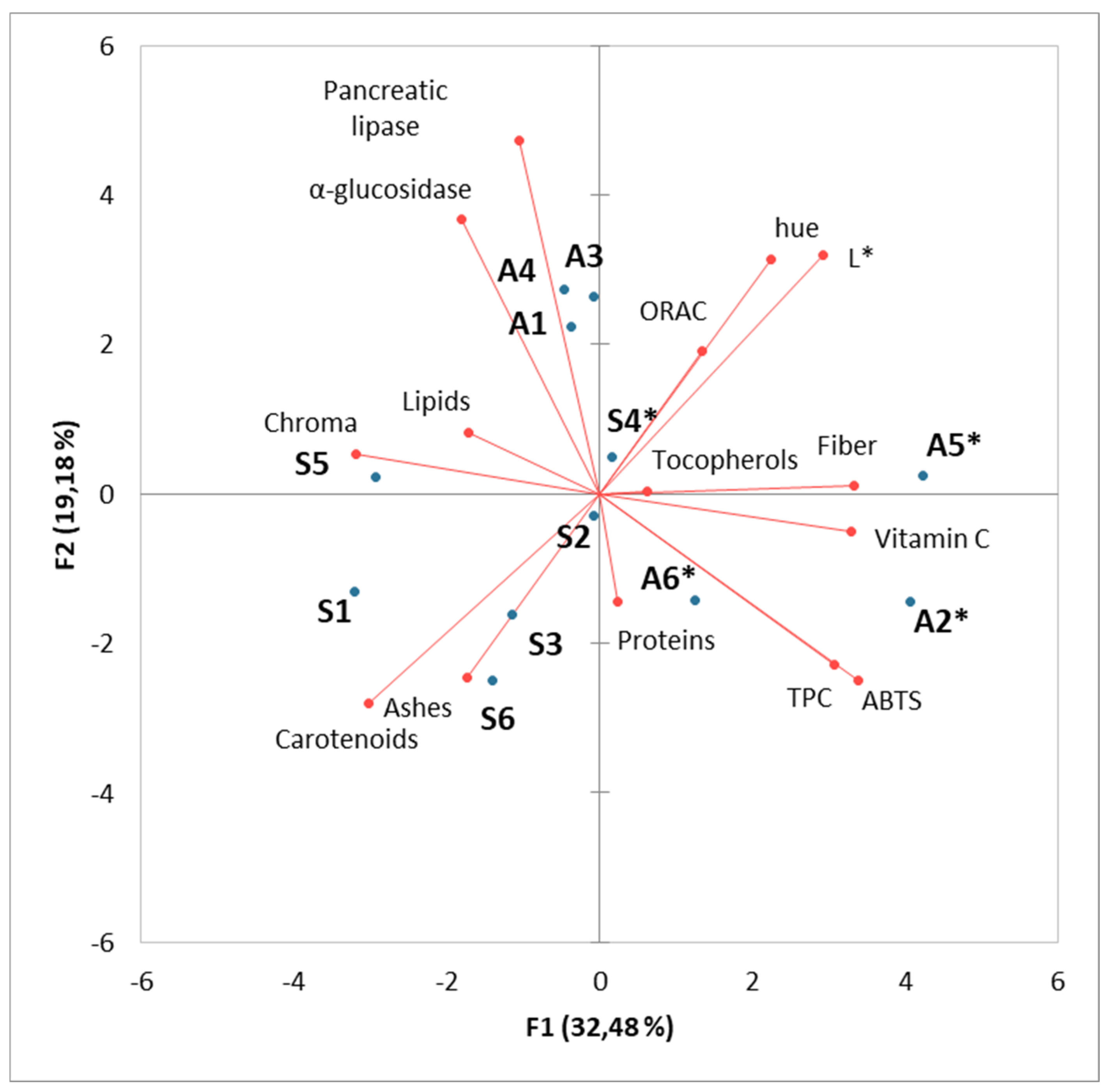
Figure 2.
Principal component analysis (F1 and F3) carried out on physicochemical data and bioactive properties.
Figure 2.
Principal component analysis (F1 and F3) carried out on physicochemical data and bioactive properties.
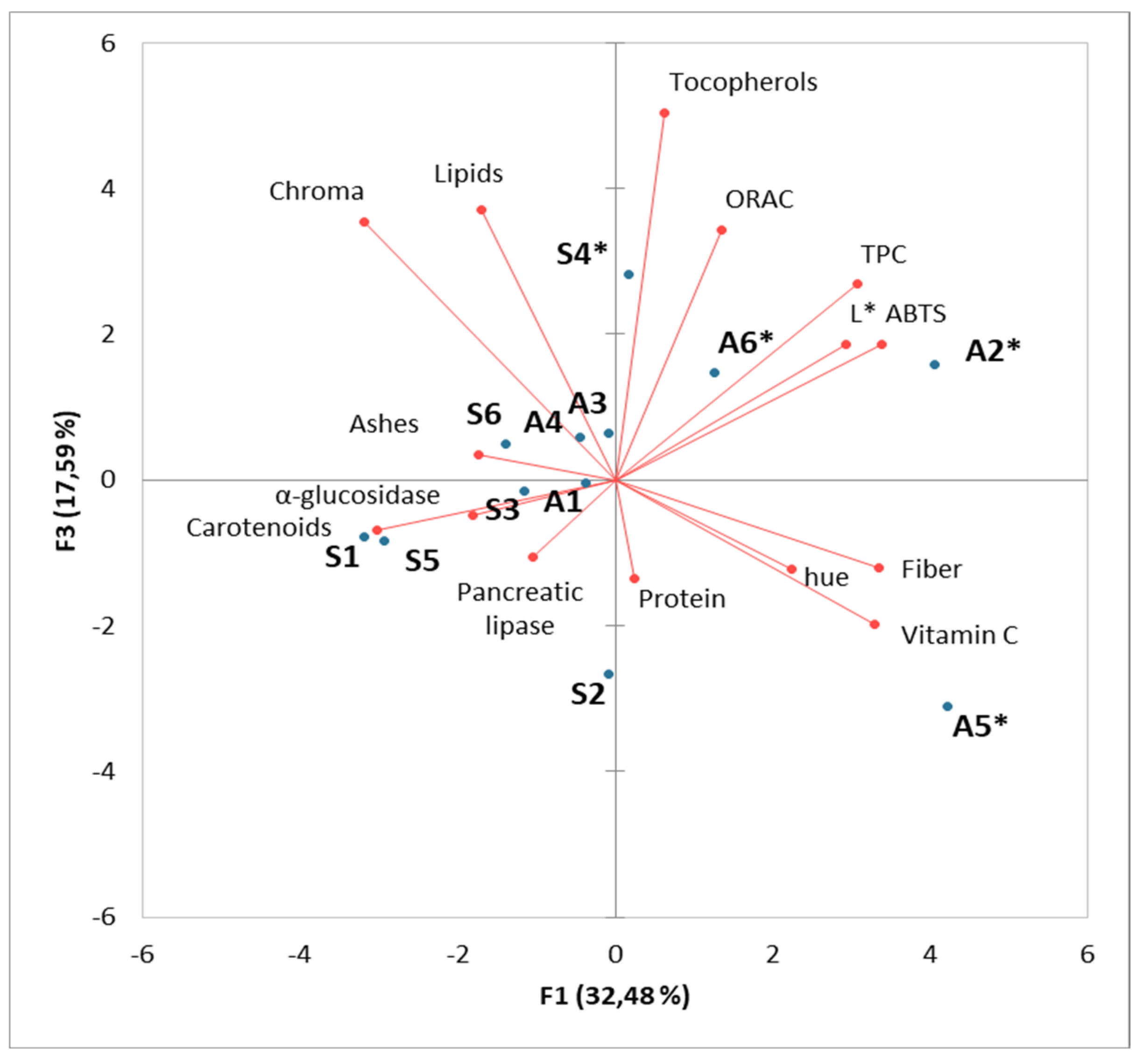

Table 1.
Botanical origin of the six pollen samples collected in the fall (%). Monofloral samples are identified with an asterisk. ni – not identified. T – Type.
Table 1.
Botanical origin of the six pollen samples collected in the fall (%). Monofloral samples are identified with an asterisk. ni – not identified. T – Type.
| Common Name | Scientific Name | A1 | A2* | A3 | A4 | A5* | A6* | |
|---|---|---|---|---|---|---|---|---|
| Asteraceae 1 | Wild Chrysanthemum/Carquejas | Baccharis sp | 18,5 | 9,5 | 24,3 | 31,2 | 8,1 | |
| Asteraceae 2 | Wild Chrysanthemum/Carquejas | Baccharis sp | 19,5 | 16,1 | 28,4 | 9,3 | ||
| Asteraceae 3 | Wild Chrysanthemum/Carquejas | T Eupatorium buniifolium | 30,3 | 14,7 | 28,8 | |||
| Myrtaceae | T. Eucalyptus | T Eucalyptus spp. | 8,5 | 100,0 | 75,2 | |||
| Apiaceae | T. Caraguatá | T. Eryngium sp | 2,2 | 3,6 | ||||
| Asteraceae | Picris | Picris echioides | 21,0 | 5,2 | 7,1 | |||
| Asteraceae | Dandelion | Taraxacum officinale | 8,4 | |||||
| Arecaceae | Palm | Butia capitata | 15,4 | 28,8 | 7,2 | |||
| Lamiaceae | Mint | T. Mentha piperita | 2,4 | |||||
| Casuarinaceae | Casuarina | Casuarina cunninghamiana | 75,1 | |||||
| Brassicaceae | Raddish | Raphanus raphanistrum | 7,3 | 1,2 | ||||
| Poaceae | Grass | - | 0,8 | 3,2 | ||||
| Caprifoliaceae | Honeysuckle | Lonicera japonica | 4,5 | |||||
| Fabaceae | Ibirapitá | Peltophorum dubium | 7,3 | |||||
| Total General (%) | 100 | 100 | 100 | 100 | 100 | 100 |
Table 2.
Pollen origin of the six pollen samples collected in spring (%). The monofloral sample is identified with an asterisk.
Table 2.
Pollen origin of the six pollen samples collected in spring (%). The monofloral sample is identified with an asterisk.
| Common Name | Scientific Name | S1 | S2 | S3 | S4* | S5 | S6 | |
|---|---|---|---|---|---|---|---|---|
| Fabaceae | Lotus | Lotus spp. | 15,5 | 2,0 | 10,2 | |||
| Boraginaceae | Borage | Echium plantagineum | 7,4 | 4,5 | ||||
| Asteraceae | Groundsel | Senecio spp. | 8,1 | 4,8 | 6,7 | |||
| Myrtaceae | Eucalyptus | Eucalyptus sp | 15,6 | 25,6 | 28,3 | 12,1 | 15,9 | |
| Fabaceae | Red Clover | Trifolium pratense | 1,9 | 4,5 | ||||
| Fabaceae | White Clover | Trifolium repens | 18,2 | 17,5 | 1,0 | 6,3 | ||
| Caprifoliaceae | Honeysuckle | Lonicera japonica | 5,7 | 2,4 | 4,5 | 3,2 | ||
| Anacardiaceae | Pink Pepper Tree | Schinus longifolius | 14,2 | 6,4 | ||||
| Arecaceae | Palm | - | 3 | 4,7 | 7,8 | |||
| Rosaceae | - | - | 8,3 | 3,1 | ||||
| Asteraceae | Chicory | Cichorium intybus | 2,1 | |||||
| Asteraceae | Wild Chrysanthemum/Carquejas | Baccharis sp | 10,2 | |||||
| Asteraceae 1 | Wild Chrysanthemum/Carquejas | Baccharis sp | 12,0 | 5,8 | 9,1 | 7,6 | ||
| Asteraceae 2 | Wild Chrysanthemum/Carquejas | Baccharis sp | 5,2 | |||||
| Fabaceae | Locust Tree | Gleditsia triacanthos | 10,4 | 20,2 | 9,8 | |||
| Salicaceae | Willow | Salix spp. | 28,7 | 16,7 | ||||
| Brassicaceae | Raddish | Raphanus raphanistrum | 6,3 | |||||
| Asteraceae | Thistle | T. Cirsium vulgare | 3,4 | 2,0 | ||||
| Unidentified | - | - | 3,5 | |||||
| Fabaceae | Cina cina | Parkinsonia aculeata | 4,8 | |||||
| Apiaceae | T. Caraguatá | T. Eryngium spp. | 8,9 | |||||
| Brassicaceae | Rapeseed | Brassica spp. | 100,0 | |||||
| Liliaceae | - | - | 9,0 | |||||
| Onagraceae | Water Flower | Ludwigia peploides | 2,3 | |||||
| Asteraceae | Picris | Picris echioides | 12,3 | |||||
| Sapindaceae | Chal-chal | Allophylus edulis | 8,2 | 10,2 | ||||
| Cannabaceae | Tala | Celtis Ehrenbergiana | 6,4 | |||||
| Myrtaceae | Surinam Cherry | Eugenia uniflora | 13,1 | |||||
| Fabaceae | Ñapinda | Acacia bonariensis | 2,4 | |||||
| Total General | 100 | 100 | 100 | 100 | 100 | 100 |
Table 3.
Proximal composition of the 12 pollen samples analyzed*.
| Sample | Moisture (%) | Protein (%) | Lipids (%) |
Ash (%) |
Total Fiber (%) |
|---|---|---|---|---|---|
| A1 | 7.69 f | 16.87 b | 8.49 ef | 1,95 ab | 14,98 e |
| A2* | 6.05 a | 16.77 b | 9.15 g | 1,94 ab | 16,76 f |
| A3 | 7.44 ef | 16.87 b | 8.41 def | 2,02 ab | 13,10 cd |
| A4 | 7.45 ef | 17.43 b | 9.01 fg | 1,90 a | 12,95 bc |
| A5* | 6.80 bc | 23.26 c | 4.37 a | 2,06 bc | 18,60 g |
| A6* | 6.73 bc | 24.21 cd | 6.90 b | 2,18 cd | 14,55 e |
| S1 | 7.40 def | 24.72 d | 8.24 cde | 2,70 f | 13,47 cd |
| S2 | 6.51 b | 23.54 cd | 7.69 c | 2,40 e | 13,12 cd |
| S3 | 7.35 def | 24.40 cd | 8.73 efg | 2,93 g | 10,18 a |
| S4* | 7.06 cd | 23.31 c | 13.17 i | 2,80 fg | 13,14 cd |
| S5 | 6.67 b | 17.25 b | 10.73 h | 2,17 cd | 12,46 b |
| S6 | 7.24 de | 13.62 a | 7.86 cd | 2,20 d | 13,52 d |
| Significance Level | <0,0001 | <0,0001 | <0,0001 | <0,0001 | <0,0001 |
Means with a common letter in the same column are not significantly different (p > 0.05) according to the Tukey test.
Table 4.
Fatty acid profile of pollen samples.
| Fatty Acid | ||||||||||||
|---|---|---|---|---|---|---|---|---|---|---|---|---|
| A1 | A2* | A3 | A4 | A5* | A6* | S1 | S2 | S3 | S4* | S5 | S6 | |
| 4:0 | 0.1 | - | 0.2 | 0.3 | 0.1 | 0.1 | 0.1 | 0.2 | 0.2 | 0.1 | 0.1 | 0.1 |
| 6:0 | 0.3 | 0.1 | 0.1 | 0.1 | 0.1 | 0.1 | 0.3 | 0.3 | 0.2 | 0.1 | 0.2 | 0.2 |
| 8:0 | 2.0 | 0.2 | 1.0 | 1.3 | 0.2 | 0.5 | 0.2 | 0.9 | 0.3 | 0.1 | 0.8 | 1.2 |
| 10:0 | 0.4 | 0.1 | 0.2 | 0.8 | 0.8 | 0.5 | 0.8 | 0.8 | 0.5 | 0.2 | 0.4 | 0.2 |
| 12:0 | 1.2 | 0.2 | 0.3 | 0.7 | 0.6 | 2.8 | 2.0 | 1.3 | 1.0 | 0.4 | 2.4 | 0.5 |
| 14:0 | 0.6 | 0.3 | 0.6 | 1.3 | 1.8 | 0.9 | 1.7 | 3.3 | 2.4 | 2.5 | 0.3 | 1.0 |
| 16:0 | 22.6 | 27.9 | 22.1 | 22.8 | 10.4 | 16.2 | 19.3 | 22.5 | 18.8 | 17.9 | 21.3 | 22.5 |
| 17:0 | 1.3 | 0.2 | 1.0 | 1.1 | 1.3 | 2.4 | 3.8 | 2.6 | 2.2 | 5.8 | 2.7 | 1.1 |
| 18:0 | 2.0 | 2.5 | 2.9 | 3.5 | 4.2 | 2.0 | 3.4 | 4.5 | 3.1 | 2.1 | 2.6 | 6.8 |
| 18:1 n-9 | 8.6 | 10.6 | 15.5 | 9.9 | 27.9 | 13.0 | 11.2 | 12.1 | 12.1 | 9.1 | 6.1 | 11.3 |
| 18:2 trans | 1.8 | - | 2.2 | 1.9 | 5.6 | 3.5 | 1.2 | 1.1 | 3.9 | 1.5 | 0.9 | 2.9 |
| 18:2 c n-6 | 19.0 | 39.5 | 17.5 | 19.7 | 15.7 | 16.3 | 15.8 | 14.4 | 11.4 | 5.6 | 14.6 | 24.3 |
| 20:0 | 0.5 | 0.4 | 0.6 | 0.4 | - | 1.0 | 1.0 | 0.5 | 0.5 | 0.4 | 0.9 | 0.7 |
| 18:3 n-3 | 19.2 | 16.2 | 22.0 | 25.4 | 4.8 | 21.3 | 25.2 | 24.4 | 35.7 | 50.7 | 32.3 | 18.8 |
| 20:2 n6 | 0.8 | - | - | - | 1.7 | 2.0 | 1.1 | 0.8 | 0.6 | - | 1.3 | 1.1 |
| 22:0 | 0.6 | 0.3 | 0.7 | 0.7 | - | 0.6 | 0.8 | 0.3 | 0.3 | 0.1 | 0.7 | 0.9 |
| 20:3 n-6 | 0.4 | - | 0.6 | - | 0.4 | 0.5 | - | - | - | - | - | - |
| 20:3 n-3 | 2.2 | 0.1 | 0.7 | 0.4 | - | - | 0.7 | 0.3 | 0.1 | 0.6 | 0.9 | 0.8 |
| 23:0 | 0.4 | 0.1 | 0.5 | 0.4 | 0.4 | 0.6 | 0.8 | 0.2 | 0.2 | 0.2 | 0.2 | 0.2 |
| 22:2 n6 | 1.6 | 0.1 | 0.8 | 0.8 | 0.7 | 2.4 | 1.2 | 0.1 | 0.3 | 0.1 | 0.3 | 0.4 |
| 24:0 | 2.9 | 0.2 | 1.2 | 0.7 | 0.1 | 0.3 | 0.6 | 0.8 | 0.2 | 0.1 | 0.7 | 1.2 |
| 20:5 n-3 | 0.3 | - | 0.4 | 0.2 | 0.7 | 0.4 | 0.9 | 0.4 | 0.2 | 1.0 | 0.3 | 0.2 |
| 24:1 n-9 | 1.2 | 0.1 | 0.2 | 0.1 | 0.1 | 0.3 | 0.6 | 0.5 | 0.1 | 0.2 | 0.4 | 0.2 |
| 22:6 n-3 | 0.6 | 0.1 | 0.9 | 1.2 | 2.0 | 1.2 | 0.4 | 0.4 | 0.1 | 0.1 | 0.5 | 0.4 |
| Total identified | 90.6 | 99.2 | 92.5 | 93.8 | 91.4 | 90.0 | 93.1 | 92.7 | 94.3 | 98.8 | 91.8 | 96.8 |
| Unidentified | 9.4 | 0.8 | 7.5 | 6.2 | 8.6 | 10.0 | 6.9 | 7.3 | 5.7 | 1.2 | 8.2 | 3.2 |
| SFA (%) | 34.9 | 32.3 | 31.6 | 34.2 | 31.9 | 27.9 | 34.9 | 38.1 | 29.8 | 30.0 | 33.4 | 36.5 |
| MUFA (%) | 9.8 | 10.8 | 15.8 | 9.9 | 28.0 | 14.6 | 11.8 | 12.6 | 12.2 | 9.3 | 6.5 | 11.5 |
| PUFA (%) | 41.9 | 55.9 | 42.2 | 47.4 | 25.9 | 44.1 | 45.2 | 40.7 | 48.2 | 57.9 | 49.9 | 45.5 |
| SFA: Saturated Fatty Acids; MUFA: Monounsaturated Fatty Acids; PUFA: Polyunsaturated Fatty Acids. Among the lipid-based compounds, carotenoid content showed the greatest variability, with results reaching up to 690 µg/g in sample S1 (multifloral). In contrast, in samples A5* and S4* (both monofloral, from eucalyptus and rapeseed, respectively), carotenoid presence was nearly undetectable (Table 5). These results suggest that the botanical origin of pollen significantly influences carotenoid content and that monofloral samples tend to have lower concentrations of these compounds. In this regard, Gasparotto Sattler et al. [38], also reported a wide range of total carotenoids (from 5.3 to 1233 μg/g), attributing this variability to the botanical diversity of the analyzed samples. Additionally, Oliveira et al.[45], suggested a relationship between β-carotene content and certain botanical genera and species (Raphanus sp., Mimosa caesalpineafolia, and Macroptilium sp.). Carotenoids are among the key components responsible for the nutritional and functional properties of pollen, as they form an important group of natural antioxidants [46]. Since they are thermolabile compounds, it is crucial that pollen drying conditions are not too harsh to prevent degradation. According to kinetic studies by Song et al. [47], drying temperatures of 40 or 50 °C—such as the one used in this study—are appropriate, as no significant changes in carotenoid content were observed. However, at temperatures of 60 or 70 °C, carotenoid content drops drastically after just two hours of drying. The collection period did not affect the carotenoid content of the analyzed samples (p>0.005). | ||||||||||||
| Tocopherols are a group of fat-soluble compounds that exhibit vitamin E activity and play a crucial role in protecting lipid membranes from oxidative damage. They are naturally present in vegetable oils and are also used as natural antioxidants in food due to their high antioxidant potential [48,49]. The tocopherol content in bee pollen has been reported by various authors, with findings showing varying amounts. For example, Gasparotto Sattler et al. [38], reported α-tocopherol values ranging from 4.7 to 114 µg/g, with this isomer being the most abundant in all samples compared to the β, γ, and δ isomers. Tocopherol content ranged from 1.25 to 5.84 µg/g. Monofloral pollens showed a significantly higher tocopherol content (p = 0.0078) than multifloral pollens (4.23 vs. 2.99 µg/g). Once again, A5* was the sample with the lowest tocopherol content, similar to its carotenoid content, suggesting a possible relationship between monofloral origin and the presence of these micronutrients. | ||||||||||||
Table 5.
Instrumental color parameters (L*, a*, b*) and carotenoid, tocopherol, and vitamin C content in pollen samples.
Table 5.
Instrumental color parameters (L*, a*, b*) and carotenoid, tocopherol, and vitamin C content in pollen samples.
| Sample | L* | Chroma (C*ab) | Hue (hab) | Total Carotenoid (µg/g) |
Tocopherols (µg α-tocopherol/g) |
Vitamine C (mg AA/g) |
|---|---|---|---|---|---|---|
| A1 | 62,49 fg | 54,46 cde | 1,43 c | 95,27 e | 3,54 f | 0,27 d |
| A2* | 63,58 fgh | 45,29 b | 1,49 fg | 50,77 c | 3.97 g | 0.48 g |
| A3 | 63,92 fgh | 53,29 cde | 1,46 de | 99,33 e | 3.27 e | 0.27 d |
| A4 | 61,48 ef | 53,30 cde | 1,44 cd | 78,60 d | 3.97 g | 0.27 d |
| A5* | 64,09 gh | 34,20 a | 1,53 h | 0,67 a | 1.25 a | 0.49 g |
| A6* | 58,.84 d | 50,97 c | 1,37 b | 334,70 h | 5.84 i | 0.40 f |
| S1 | 52,77 a | 52,94 cd | 1,35 ab | 690,53 k | 2.61 c | 0.13 b |
| S2 | 59,16 de | 43,68 b | 1,48 ef | 168,13 f | 1.61 b | 0.40 f |
| S3 | 57,27 cd | 51,07 c | 1,37 b | 210,30 g | 3.23 e | 0.36 e |
| S4* | 65,58 h | 55,96 de | 1,51 gh | 8,03 b | 4,77 h | 0,06 a |
| S5 | 55,55 bc | 56,51 de | 1,37 b | 477,97 j | 1,64 b | 0,28 d |
| S6 | 53,46 ab | 57,06 e | 1,33 a | 455,50 i | 2,85 d | 0,16 c |
| Significance Level | <0,0001 | <0,0001 | <0,0001 | <0,0001 | <0,0001 | <0,0001 |
Means with a common letter in the same column are not significantly different (p > 0.05) according to the Tukey test.
Table 6.
Results of total phenol content (TPC), antioxidant capacity (ABTS and ORAC-FL) and inhibition of digestive enzymes (α-glucosidase and pancreatic lipase) from Uruguayan bee pollen samples collected in autumn and spring.
Table 6.
Results of total phenol content (TPC), antioxidant capacity (ABTS and ORAC-FL) and inhibition of digestive enzymes (α-glucosidase and pancreatic lipase) from Uruguayan bee pollen samples collected in autumn and spring.
| Sample | TPC (mg GAE/g) |
ABTS (µmol TE/g) |
ORAC-FL (µmol TE/g) |
α-glucosidase (IC50, mg/mL) |
Pancreatic lipase (IC50, mg/mL) |
|---|---|---|---|---|---|
| A1 | 5,02 abc | 73,74 bcd | 117,97 bc | 8,38 h | 28,35 fg |
| A2* | 8,49 f | 106,03 f | 154,17 de | 3,88 a | 15,49 ab |
| A3 | 5,16 abcd | 71,61 bc | 182,42 e | 7,24 g | 30,45 g |
| A4 | 4,85 ab | 67,4 0 ab | 170,20 e | 5,71 ef | 40,25 h |
| A5* | 5,70 cde | 87,19 e | 135,53 cd | 4,53 ab | 21,87 cd |
| A6* | 6,32 e | 89,53 e | 184,80 e | 5,12 bcde | 15,84 ab |
| S1 | 4,46 a | 65,36 ab | 134,16 cd | 6,32 fg | 22,11 cd |
| S2 | 4,87 ab | 73,00 bc | 81,64 a | 5,54 cdef | 23,99 de |
| S3 | 5,30 bcd | 81,07 cde | 113,40 bc | 4,72 abcd | 22,35 fg |
| S4* | 5,80 de | 82,53 cde | 160,08 de | 4,76 abcde | 18,61 bc |
| S5 | 4,44 a | 56,15 a | 113,40 abc | 5,71 ef | 26,40 ef |
| S6 | 6,21 e | 86,01 de | 100,19 ab | 4,63 abc | 12,32 a |
| Significance Level | <0,0001 | <0,0001 | <0,0001 | <0,0001 | <0,0001 |
Means with a common letter in the same column are not significantly different (p > 0.05) according to the Tukey test.
Disclaimer/Publisher’s Note: The statements, opinions and data contained in all publications are solely those of the individual author(s) and contributor(s) and not of MDPI and/or the editor(s). MDPI and/or the editor(s) disclaim responsibility for any injury to people or property resulting from any ideas, methods, instructions or products referred to in the content. |
© 2025 by the authors. Licensee MDPI, Basel, Switzerland. This article is an open access article distributed under the terms and conditions of the Creative Commons Attribution (CC BY) license (http://creativecommons.org/licenses/by/4.0/).
Copyright: This open access article is published under a Creative Commons CC BY 4.0 license, which permit the free download, distribution, and reuse, provided that the author and preprint are cited in any reuse.


