
Submitted:
17 April 2025
Posted:
18 April 2025
You are already at the latest version
Abstract
The study of the phytosociology of plants in the territory of the Surif region, which includes Al-Dair Village, Khirbet Dair Musa, Ali Ghoneim's Khalet, Khirbet Abu Shouk, Jabla Village, Khirbet Jamreen, and Khirbet Mishrif, among others, was the subject of this article. As this region represents a distinctive plant diversity, and these plants are part of the flora of the Mediterranean Basin, we conducted this study to identify and describe the plants of that region, in light of the significance of studies on phytosociological and community plants in southern Palestine. Arid, semi-arid, dry, sub-humid, and humid ombrotypes and inframediterranean, thermomediterranean, and mesomediterranean thermotypes are related to the Surif area in Palestine. Seven plots (releves) in a representative area were used to sample the vegetation, which was then analyzed using the Braun-Blanquet method of phytosociological analysis. This revealed one community of forests and maquis vegetation, with 210 species that were documented, 15 of which (7.14%) were endemic to this region. (Pino halepensis-Cupressiom sempervirentis), a class of Quercetea calliprini or palaestini novo (Ighbareyeh et al., 2022) & Quercetea ilicis Br.-Bl. ex. A.& O. Bols 1950, served as a representation of the forest vegetation, and order of Quercetalia ilicis Br.-Bl. ex. Molinier 1934. & Quercetalia calliprini Zohary 1960, with alliance of Pino halepensis-Cupressiom sempervirentis (Ighbareyeh et al., 2022) & Querco - Pistacion lentisci all. nova (Ighbareyeh et al., 2022), which adapted to a variety of soil types, including limestone, brown ruins, and terra rossa.
Keywords:
Palestine
; Hebron
; Surif
; classified
; Phytosociological
; Plants
; Taxonomy
1. Introduction
The plant in Palestine is an important part of the biology in the West Asia region in particular, and the world in general. Palestine’s geographical and strategic location gives it an important advantage as it mediates the three continents of the world (Jehad et al., 2021a). The region of southern Palestine, including the heights, plains, and valleys of Hebron, is of unique vitality due to its geographical location overlooking the Dead Sea from the east, the Sinai desert, the Negev, and the Red Sea to the south, and the Palestinian coastal region and the Mediterranean Sea from the west and north. The region of southern Palestine, including the heights, plains, and valleys of Hebron, is of unique vitality due to its geographical location overlooking the Dead Sea from the east, the Sinai desert, the Negev, and the Red Sea to the south, and the Palestinian coastal region and the Mediterranean Sea from the west and north (Jehad et al., 2021a). This region combines many varieties of plants, including the plants of the Mediterranean basin, the African desert, and North Africa, and other plants that have settled in this region through different eras. For these and other reasons, it was necessary to study the diversity, phytosociology, flora, and assemblages of these plants. The Surif region in the northwest of Hebron Governorate is an important model for conducting this study, as it includes many different plant varieties with a suitable geographical location. Surif climate is moderately Mediterranean, it is hot and dry in the summer and cold and rainy in the winter. Spring begins in late March and early April. July and August are the hottest months of the year, with average temperatures reaching 28.9 °C. January is the coldest month, and it usually rains. Between October and April, the average precipitation is 560 mm, at its highest rate in January and February. The average temperature is 18 degrees Celsius and the average relative humidity is about 16% (MOA, 2006; Palestinian Central Bureau of Statistics, 2009).
However, many studies have been conducted in the neighboring areas of the Hebron region, including Idna, Beit Jibrin (Ighbareyeh et al., 2022), Al-Dawaimah (Ighbareyeh et al., 2022a)., Wadi Al-Qaf (Jehad et al., 2021), and other regions in Hebron (Ighbareyeh & Carmona, 2018; Ighbareyeh et al., 2014b, c; Ighbareyeh et al., 2017; Ighbareyeh et al., 2021a).
There are more than 2780 plant species, 872 genera, and 144 families, of which 162 are indigenous to Palestine (Zohary 1962, 1966, 1972, 1973, 1986, 1987; Dothan, 1978b; Dothan 1986a; Dothan, 1978b, Danin & Feinbrun-Dothan, 1991; Danin, 2004; Ighbareyeh et al., 2014c). Some scholars have also studied the biodiversity and phytosociological plant community (Ighbareyeh et al., 2014b; Ighbareyeh et al., 2017; Jehad et al., 2021; Ighbareyeh et al., 2021a) and bioclimatology & climatology (Jehad et al., 2015; Ighbareyeh et al., 2015a, b, c, d; Ighbareyeh et al., 2016a, Ighbareyeh M.H., 2019; Jehad et al., 2021a) in Palestine and the Mediterranean region. The study aims to determine the phytosociology of plants in the Surif area.
2.1. Study Area
Surif is a Palestinian town located in the northwest of Hebron Governorate, 20 km northwest of Hebron, and 32 km south of Jerusalem. The village of Surif is located on a mountain range that forms walls, which made its location strategic since the days of the Romans when it was inhabited for the first time, and the Roman currency was minted in it, which made it economically important since ancient times (Al-Dabbagh,1991). The town is located to the northwest of the city of Hebron, 25 km away from it. Over a mountainous area 600 meters above sea level. Surif land area is about 31,600 dunums, of which 13,500 dunums are arable land, 400 dunums are forests, and 9, 700 dunums are open lands and pastures, with coordinates (31.6495695°N 35.0734668°E) (MOA, 2006; ARIJ, 2006-2009). It is bordered to the north by the village of Al-Jabaa Bethlehem, to the south by the village of Kharas and the city of Halhul, to the east by the town of Beit Ummar, and to the west by Beit Netif and Beit Shemesh, as in the (Figure 1& 2) (Al-Dabbagh, 1991).
2.2. Vegetation Data Collection
The data of 210 woody plants were chosen and collected from Surif woodlands or its hills and mountains, where the study and sampling were conducted at Al-Dair Village, Jabla village, Khirbet Jamreen (where the shrine of the companion Abu Ubaidah Amer bin Al-Jarrah is located and many old houses that are estimated to be more than 350 years old), Khirbet Mishrif, Khirbet Deir Musa, Ali Ghoneim’s Khalet, Khirbet Abu Shouk, Khirbet Mishrif, Khirbet Alin, Krabin and areas others as in (Figure 3).
Additionally, some scrubland was used as locations to gather biological, as well as plants for the conventional and thermal pattern (Table 1). The Braun-Blanquet approach (1979) was used to collect the data, and Van der Maarel (1979) was used to transform the Braun-Blanquet plant phytosociological markers. To further explain and translate the phytosociological markers of the Braun-Blanquet plant “(+=2, 1=3, 2=5, 4=6, 5=7) to those of Van der Maarel (1979), we created a matrix of 194 x 7 linked columns “(5: covering more than 3/4 of the area; 4: any number of species covering 1/2 to 3/4 of the area; 3: any number of individuals or species covering 1/4 to 1/2 of the area; 2: covering at least 5% of the area; 1: abundant but with low cover value; and + is very little cover)”.
In addition to using the phytosociological nomenclature code to characterize the new syntaxes in the study, we also employed Euclidean distances, cluster, and Detrended correspondence analysis to fill in any data gaps on whole plant analysis (Bols, 1958; Braun-Blanquet & Bols, 1950; Weber et al., 2000; Theurillat et al., 2020). The application XLSTAT Statistical Software for Excel was used to do the analysis.
The plants of Palestine, Syria, Lebanon, Jordan, the Negev Desert, the Sinai Desert, and the Mediterranean coast were used in the study of floristic as cover vegetation of sites in the Hebron area (Ighbareyeh et al., 2014b, Ighbareyeh et al., 2017a; Jehad et al., 2021; Ighbareyeh et al., 2021a; Ighbareyeh et al., 2022, Ighbareyeh et al., 2022a).
Many methodological studies have been conducted to explain the vegetation, including those by Bols et al. (1958), Braun-Blanquet (1979), Biondi (2011), Rivas-Martinez et al. (1999, 2001, 2002, 2017), and Theurillat et al. (2020).
2.3. Statistical Analyses
Data were used to create an Excel table with 210 rows (plants) and 7 columns (relèves) to calculate distance and similarity using the whole correlation approach. The Euclidean distance matrix (DCA) was produced from this table. We then performed detruded correspondence analysis (DCA) ordination analysis after generating two correlation and covariance value matrices. The statistical software program was useful since it generated a suitable, distinct inventory.
However, we have only one association or community, association 1 (ASL1), consisting of forest samples from groups (A, B, C, D, E, F, and G) that were combined using cluster and DCA.
3. Result & Discussion
3.1. Steppe Vegetation, Maquis, and Macchie Forests
Pino Halepensis-Cupression Sempervirenti
The majority of the species in inventories (A, B, C, D, E, F, and G) belonged to Pinus halepensis (L.) Miller (known as the Jerusalem pine and Aleppo pine), Cupressus sempervirens L., Cupressus arizonica Greene, Pinus Pinea L., Pinus brutia Tenore, Juniperus deltoides R. P.Adams (Juniperus oxycedrus L.), Juniperus turbinata Guss. (Juniperus phoenicea L.), Retama raetam (Forssk.) Webb. & Berthel., Spartium junceum L., Thuja occidentalis L., Glycyrrhiza glabra L., Ceratonia siliqua L., Cersis siliquastrum L., Acacia dealbata Link., Acacia salicina Lindl., Acacia cyanophylla Lindl., Calicotome villosa (Poir.) Link., Genista monspessulana (L.) O. Bolós & Vigo., Acacia radiana Savi., Ficus cariaca L., Retama rhodorhizoides (Webb. & Berthel.), Scop., Ficus microcarpa L. F., Prosopis farcta (Banks et Sol.), Morus nigara L., Olea europaea L., Anonis natrix (L.), Morus alba L., Olea europaea var. sylvestris, Quercus calliprinos Webb. or Quercus palaestina Kotschy or Quercus coccifera L., Quercus rotundifolia Lam., Quercus boissieri Reut. or Quercus infectoria Olivier, Quercus inthaburensis Decne., Pistacia saportae Burnat., Rhus tripartita (Ucria) Grande Pistacia khinjuk Stocks, Rhus coriaria L., Schinus molle L., Schinus terebinthifolius Raddi, Rhamnus alaternus L., Sageretia thea (Osbeck) M. C. Johnst., Rhamnus disperma Ehrenb. ex. Boiss., Ziziphus jujuba Miller, Searsia tripartita (Ucria) Moffett, Zizyphus Lotus (L.) Lam., Paliurus spina-christi Miller, Zizyphus Spina-christi (L.) Desf., Populus alba L., Populus euphratica Oliv., Salix alba L., Atraphaxis spinosa L., Sarcopoterium spinosum (L.) Spach, Crataegus oriana (L.) DC., Amygdalus ramonensis Danin, Prunus arabica (Olivier) Meikle., Crataegus monogyna Jacq., Prunus dulcis (Miller) D. A. Webb., Mespilus germanica L., Crataegus azarolus L., Lycium shawii Roem., Malus communis Desf., Prunus korshinskyi Hand. Mazz., Prunus ursina Kotschy, Solanum incanum L., Salvia officinalis L., Lycium europaeum L., Schult., Ballota undulata (Sieber ex. Fresen.) Bentham, Bassia arabica (Boiss.) Maire & Weiller, Lycium depressum Stocks, Phlomis brachyodon (Boiss.) Zohary, Phlomis pungens Willd., Phlomis chrysophylla Boiss., Phlomis platystegia Post., Ballota philistaea Bornm., Lycium schweinfurthii Dammer, Phlomis viscosa Poiret., Teucrium capitatum L., Lycium barbarum L., Salvia fruticosa Miller, Satureja thymbrifolia Hedge & Feinbrun, Stachys palaestina L., Thymbra spicata L., Capparis aegyptia Lam., Satureja thymbra L., Salvia aegyptiaca L., Teucrium creticum L., Salvia palaestina Benth., Thymbra capitata (L.) Cav., Haloxylon salicornicum (Moq.) Bunge ex Boiss., Sarcocornia fruticosa (L.) A. J. Scott., Suaeda palaestina Eig. & Zohary, Salsola cyclophylla Baker, Atriplex halimus L., Haloxylon persicum Bunge, Hyoscyamus aureus L., Iphiona maris-mortui Feinbrun, Echinops philistaeus Feinbrun & Zohary, Cota tinctoria (L.) J. Gay, Crepis reuteriana Boiss., Alkanna tinctoria (L.) Tausch, Doellia bovei (DC.) Anderb., Crepis hierosolymitana Boiss., Achillea aleppica DC., Alkanna strigosa Boiss. & Hohen., Artemisia monosperma Delile, Artemisia sieberi Besser, Alkanna galilaea Boiss., Periploca aphylla Decne., Artemisia arborescens L., Euphorbia hirta L., Heliotropium arbainense Fresen., Alkanna orientalis (L.) Boiss., Euphorbia hierosolymitana Boiss., Echium glomeratum Poir., Heliotropium bacciferum Forssk., Echium angustifolium Miller, Podonosma orientalis (L.) Feinbrun, Euphorbia hirsuta L., Echiochilon fruticosum Desf., Heliotropium rotundifolium Lehm., Erysimum crassipes Fisch. & C. A. Mey., Festuca arundinacea Schreb., Fibigia clypeata (L.) Medik, Glaucium flavum Crantz., Hordeum bulbosum L., Iris vartanii Foster, Verbascum sinaiticum Benth., Gladiolus italicus Mill., Juncus subulatus Forssk., Iris palaestina (Bak.) Boiss., Kickxia aegyptiaca (L.) Nabelek, Capparis sicula Duh., Iris atropurpurea Baker, Juncus acutus L., Clematis cirrhosa L., Capparis spinosa L., Convolvulus dorycnium L., Clematis flammula L., Ipomoea cairica (L.) Sweet, Fagonia orientalis C. Presl., Ferula biverticillata J. Thieb., Convolvulus lanatus Vahl., Fagonia bruguieri DC., Ipomoea imperati (Vahl.) Griseb., Foeniculum vulgare Miller, Fagonia arabica L., Ferula tingitana L., Balanites aegyptiaca (L.) Delile, Fagonia mollis Delile, Ferula orientalis L., Ferula communis L., Conium maculatum L., Ferulago syriaca Boiss., Glaucium grandiflorum Boiss. & A. Huet, Glaucium arabicum Fresen., Cistus creticus L., Fumana thymifolia (L.) Webb., Tamarix nilotica (Ehrenb.) Bunge, Asparagus palaestinus Baker, Parkinsonia aculeata L., Ochradenus baccatus Delile, Styrex officinalis L., Azolla filiculoides Lam., Paeonia mascula (L.) Miller, Melia azedarach L., Ephedra aphylla Forskal, Thymelaea hirsuta (L.) Endl., Erodium arborescens (Desf.) Willd., Rubia tinctorum L., Jacaranda mimosaefolia D. Don., Erodium acaule (L.) Becherer & Thell., Verbascum fruticulosum Post., Erodium crassifolium L’Her., Arbutus andrachne L., Juglans regia L., Globularia arabica Jaub. & Spach, Vitex agnus-castus L., Hibiscus micranthus L., Brachychiton populneus (Schott & Endl.) R.Br., Verbena officinalis L., Arundo micrantha Lam., Arundo donax L., Arundo micrantha Lam. (Arundo mediterranea Danin), Heptaptera anisoptera (DC.) Tutin, Cynodon dactylon (L.) Pers., and Dittrichia viscosa (L.) Greuter accompanied by Pistacia lentiscus L., Rhamnus palaestinus Boiss. (Rhamnus lycioides L.), Pistacia palaestina Boiss., Pistacia atlantica Desf., Crataegus monogyna Jacq., Rhamnus disperma Ehrenb. ex Boiss., Quercus species, and many species of herbaceous plants. In mesomediterranean to thermomediterranean thermotype zones, dry to humid and sub-humid conditions, it finds forests that have evolved to the Mediterranean woods, shrublands, and relict maquis trees, and carbon-rich soils with pH values that are nearly neutral, such as limestone, brown ruins, and light rendzina (terra rossa) (Ighbareyeh & Carmona, 2018; Jehad et al., 2021; Ighbareyeh et al., 2021; Ighbareyeh et al., 2022, Ighbareyeh et al., 2022a). The typical height is 586 meters, and the vegetation is 5-20 m (10 m) tall with a 5-30% slope and a 75% plant cover rate, it gives us proof that the association, which is situated in the Asian portions of the Eastern Mediterranean and belongs to the inframediterrenean, thermomediterranean to mesomediterranean thermotype: Pino halepensis-Cupression sempervirenti (Figure 5 and Figure 6; Table 2: ASL 1- Inventores A, B, C, D, E, F, G, H, typus group 1), therefore, the proposed association is Pino halepensis-Cupression sempervirenti (Figure 4 and 5; Table 2: ASL 1- Inv. A, B, C, D, E, F, G and H).
Furthermore, in terms of flora and vegetation following are: In the life forms’ in this association, 210 species, which of 77 (36.66%) phanerophytes trees, as trees (47), phanerophytes (4), phanerophytes shrubs (14), phanerophytes shrubs geophyte (4), phanerophytes vine (2), phanerophytes shrub vine (2), phanerophytes dwarf-shrub (2); shrubs 19 (9%); chamaephyte 61 (29.04%) as chamaephyte shrubs or semi shrubs (17) and chamaephyte 45 (21.42%); hemicryptophyte 48 (22.85%); geophyte 5 (2.38%) as (geophyte 4, geophyte vine 1(0.47%); and helophyte 1 (0.47%), as shown in the (Figure 6).
On the other side, in this study, more than 46 families were recorded, the most representative of which was Lamiaceae 26 (12.38%), Compositae 14 (6.36%), Rosaceae 13 (6.19%), Amaranthaceae 12 (5.71%), Fabaceae 12 (5.45%), Boraginaceae 10 (4.76%), Rhamnaceae 9 (4.28%), Anacardiaceae 9 (4.28%), and the rest of family as shown in the (Figure 7).
However, of the 600 plant species observed, 210 were woody, and 15 species were endemic to the Surif region (7.14%), including 4 sub-endemics. Herbaceous plants were excluded from analysis in the paper because our focus is on large or woody plants, and thus, they were not included in the study. During our study of this plant community (Pino halepensis-Cupressiom sempervirentis), we found that it is similar to another plant unit or community that was published in the year 2022 in the western region of Hebron, Beit Jibreen (Ighbareyeh et al., 2022), among these varieties are Pinus halepensis Miller (Jerusalem pine), Pinus pinea L., Pinus brutia Tenore, and Cupressus sempervirens L., Cupressus arizonica Greene, Juniperus oxycedrus L., and others species.
Moreover, we found numerous Pinus species in the area, including Pinus brutia Tenore, Pinus pinea L., Pinus halepensis Miller (often known as the Jerusalem pine or Aleppo pine), and Cupressus spp. as, Cupressus sempervirens L., Juniperus deltoides R. P. Adams (Juniperus oxycedrus L.), Juniperus turbinata Guss. (Juniperus phoenicea L.), and other species in dry, subhumid, and humid regions in order Pinetalia halepensis Biondi et al. (2014) and class Junipero phoeniceae-Pinon acutisquamae A.V. Pérez et Cabezudo in A.V. Pérez et al. 1988 corr. Rivas-Mart. et al. 2002 nom. invers. Propos (Rivas-Mart. et al. 2002), and the community is habituated in the class of Quercetea palaestini or calliprini (Ighbareyeh et al., 2022) and Quercetea ilicis Br.-Bl. ex. A.& O. Bolòs 1950, with the order Pinetalia halepensis Biondi et al. (2014), and in alliance of Pino halepensis-Cupressiom sempervirentis (Ighbareyeh et al., 2022).
These associations’ syn-taxonomical interpretation is demonstrated:
Maquis and forest vegetation:
Class: Quercetea ilicis Br.-Bl. ex. A.& O. Bolòs 1950
Class: Quercetea calliprini or palaestini (Ighbareyeh et al., 2022)
Order: Pinetalia halepensis Biondi et al. (2014)
Alliance: Pino halepensis-Cupressiom sempervirentis (Ighbareyeh et al., 2022)
Association: Pino halepensis-Cupressetum sempervirentis
Since Surif is home to more than 210 types of forest plants and shrubs that were investigated and analyzed in this study, it exhibits a different pattern of forest vegetation and biodiversity while being at an appropriate altitude above sea level in comparison to the rest of the Palestinian lands, includes steppes, oak woodlands, shrubs, and other species, Surif region has a dry climate with inframediterranean to thermomediterranean and mesomediterranean thermotypes, with precipitation ranging from 350 to 600 mm.
“Syntaxonomical scheme:
Class: Quercetea ilicis Br.-Bl. ex A. Bolòs et O. de Bolòs in A. Bolòs y Vayreda 1950
Class: Quercetea calliprini or palaestini nova. (Ighbareyeh et al., 2022)
Order: Quercetalia calliprini Zohary 1960
Order: Quercetalia ilicis Br.-Bl. ex Molinier 1934
Order: Pinetalia halepensis Biondi et al. (2014)
Alliance: Pino halepensis-Cupressiom sempervirentis (Ighbareyeh et al., 2022)
Alliance: Querco - Pistacion lentisci all. nova (Ighbareyeh et al., 2022)
Association: Pino halepensis-Cupression sempervirenti *
Class: Quercetea ilicis Br.-Bl. ex A. Bolòs et O. de Bolòs in A. Bolòs y Vayreda 1950
Order: Quercetalia calliprini Zohary 1955,1960
Alliance: Ceratonio-Pistacion lentisci Zohary ex Zohary et Orshan 1959
Alliance: Querco - Pistacion lentisci all. nova (Ighbareyeh et al., 2022)
Ceratonio siliquae - Quercion calliprinae (Jehad et al., 2021)
Pino halepensis-Cupression sempervirenti (Jehad et al., 2021)
Associations:
- Ceratonio siliquae-Quercetum callipinii. (Jehad et al., 2021)
- Pino halepensis-Cupressetum sempervirentis (Jehad et al., 2021)
* Associations in which olive cultivation is possible.
References
- Al-Dabbagh, Mustafa, 1991, Our Country Palestine, Part Five, Section Two, Dar Al-Huda, Afer Qara- Palestine.
- Applied Research Institute - Jerusalem (ARIJ), 2006-2009, GIS database. Bethlehem - Palestine.
- Bolòs, O.; De et Molinier, R. Recherches phytosociologiques dans l’île de Majorque; Collect. Bot. (Barcelona), 1958, V (III): 699-865.
- Braun-Blanquet, J. Fitosociología. Bases para el estudio de las comunidades vegetales. Blume, Madrid 1979; 820 p.
- Braun-Blanquet, J.; Bolòs, O. De. Les groupements végétaux du bassin moyen de l’Ebre et leur dynamisme. Anales Estac. Exp. Aula Dei 1957, 5(1-4): 1-266. Saragossa.
- Braun-Blanquet, J.; de Bolòs, O. Aperçu des Groupements Végétaux des Montagnes tarragonaises. Collect. Bot 1950, 2, 303–342. [Google Scholar]
- Danin, A. Distribution Atlas of plants in Flora Palaestina area. 2nd Edn., Academy of science and Humanities, Jerusalem 2004; PP: 520. ISBN: 9652081671.
- Danin, A.; Feinbrun-Dothan, N. Analytical Flora of Eretz-Israel, CANA Publishing House Ltd., Jerusalem, 1991.
- Dothan, F.N. Flora Palaestina, part four Plates, text Alismtaceae to Orchidaceae. Academy of science and Humanities, Jerusalem 1986a; PP: 525.
- Dothan, F.N. Flora Palaestina, part three, text Ericaceae to Compositae. Israel academy of science and Humanities, Jerusalem 1978b; PP: 481.
- Ighbareyeh, J.M.H. (2019). Bioclimate of Jericho in Palestine. Palestine Technical University Research Journal, 2019, 7(1), 1-7(http://www.ptuk.edu.ps). [CrossRef]
- Ighbareyeh, J.M.H. , Cano-Ortiz A., Cano Carmona E. (2015). Study of Biology and Bioclimatology of Date Palm (Phoenix Dactylifera L.) to Optimize Yield and Increase Economic in Jericho and Gaza Cities of Palestine. International Journal of Research Studies in Biosciences, 3,1-8. http://www.arcjournals.org.
- Ighbareyeh, J.M.H. , Cano-Ortiz A., Suliemieh A. A. A., Ighbareyeh M.M.H. and Cano E. (2015c). Study Effect of Biology and Bioclimatology Applied on Plant in the Area of Hebron at the South of Palestine. International Journal of Research Studies in Biosciences, 3, 56-64. http://www.arcjournals.org.
- Ighbareyeh, J.M.H. , Cano-Ortiz A., Suliemieh A. A. A., Ighbareyeh M.M.H. and Cano E. (2015d). Biology and Bioclimatology Applied on Plant in Palestine. International Journal of Research Studies in Biosciences, 3, 79-86. http://www.arcjournals.org.
- Ighbareyeh, J.M.H. , Cano-Ortiz A., Suliemieh A.A.A., Ighbareyeh M.M.H. and Cano E. (2015a). Assessment of Biology and Bioclimatology of Plant to Increase Economic in Palestine. International Journal of Research Studies in Biosciences, 3,1-8. http://www.arcjournals.org.
- Ighbareyeh, J.M.H. , Cano-Ortiz, A., Suliemieh A.A.A., Ighbareyeh M.M.H. and Cano E. (2016a). Modeling of biology and bioclimatology applied studies on plant in Palestine. International Journal of Development Research 6, 9585-9590. http://www.journalijdr.com.
- Ighbareyeh JMH, Cano-Ortiz A, Cano Carmona E, Suliemieh AAA, Ighbareyeh MMH. Flora endemic rare and bioclimate of Palestine. Open Access Library Journal. 2017;4:e3977. /: Available: https. [CrossRef]
- Ighbareyeh JMH, Cano-Ortiz A, Cano E. (2014b). Case Study: Analysis of the Physical Factors of Palestinian Bioclimate. American Journal of Climate Change. 2014;3;223-231. Available. [CrossRef]
- Ighbareyeh, J. M. H. , Cano-Ortiz, A., & Cano, E. (2021a). Endemic plant species in the west of Hebron, Palestine. European Journal of Applied Sciences, 9(3) 368-385.
- Ighbareyeh, J. M. H. , Suliemieh, A. A.-R. A., Sheqwarah, M., Cano-Ortiz, A., & Carmona, E. C. (2022a). Flora and Phytosociological of Plant in Al-Dawaimah of Palestine. Research Journal of Ecology and Environmental Sciences, 2(1), 58–91. Retrieved from https://www.scipublications.com/journal/index.php/rjees/article/view/202.
- Ighbareyeh, J.M.H. , Cano-Ortiz, A., Carmona, E.C., Ighbareyeh, M.M.H. and Suliemieh, A.A.A. (2015b) Assessing Crop Yield Sustainability under the Climatic and Bioclimatic Change in the Area of Palestine. American Journal of Climate Change, 4, 48-56. [CrossRef]
- Ighbareyeh, J.M.H.; Cano-Ortiz, A.; Cano, E. Phytosociology and Vegetation of Plants of Beit Jibrin in Palestine. Land 2022, 11, 264. [Google Scholar] [CrossRef]
- Ighbareyeh, J.M.H.; Cano-Ortiz, A.; Suliemieh, A.A.A.; Ighbareyeh, M.M.H.; Cano, E. Phytosociology with Other Characteristic Biologically and Ecologically of Plant in Palestine. American Journal of Plant Sciences 5, 3104–3118. [CrossRef]
- Ighbareyeh, J.M.H.; Carmona, E.C. A phytosociological of plant communities and Biodiversity in the East-South of Idna Village-Hebron of Palestine. Int. J. Geosci. 2018, 9, 44–58. [Google Scholar] [CrossRef]
- Jehad M., H. Ighbareyeh, Cano-Ortiz, A., & Cano, E. (2021a). Bioclimate of Hebron city in Palestine. Transylvanian Review of Administrative Sciences, NO. 63 E/2021 pp. 227–238.
- Jehad, M.H. Ighbareyeh, Cano-Ortiz A., Cano Carmona E., Ighbareyeh Mohammed M. H., Suliemieh Asma A. A. (2015). Modeling of Biology and Bioclimatology Applied on Plant in Palestine. Swift Journal of Agricultural Research 1(3), pp. 021–027. http://www.swiftjournals.org/sjar.
- Jehad Mahmoud Hussein Ighbareyeh, Asma Abdel-Raheem Ahmad Suliemieh, Azhar Mousa Abu Ayash, Maen Nimer Sheqwara, Ana Cano Ortiz, Eusebio Cano Carmona, Biodiversity and Phytosociological Analysis of Plants in Wadi Al-Quf Nursery Reserve North - Western of Hebron City in Palestine, Journal of Plant Sciences. Volume 9, Issue 1, 21, pp. 13–24. 20 February. [CrossRef]
- Molinier, R. Études phytosociologiques et écologiques en Provence occidentale. Anales Museo Historia Natural Marseille 1934, 27, 1–273. [Google Scholar]
- Palestinian Central Bureau of Statistics, 2009, General Census of Population, Housing and Establishments, 2007. Ramallah - Palestine.
- Palestinian Ministry of Agriculture (MOA), (2006), Hebron Agriculture Directorate data, Palestine.
- Rivas-Martínez, S.; Díaz, T.E. , Fernández-González, F., Izco, J., Lousã, M.; Penas. A. Vascular plant communities of Spain and Portugal. Addenda to the syntaxonomical checklist of 2001. Itinera Geobotanica 2002, 15 (1): 5-432.
- Rivas-Martínez, S.; Fernández-González, F.; Loidi, J.; Lousã, M.; Penas, A. Syntaxonomical checklist of vascular plant communities of Spain and Portugal to association level. Itinera Geobotanica 2001, 14: 5-341.
- Rivas-Martínez, S.; Penas, A.; del Río, S.; Díaz, G.T; Rivas-Sáenz, S. Bioclimatology of the Iberian Peninsula and the Balearic Islands. In: Loidi J. (eds) The vegetation of the Iberian Peninsula. Plant and vegetation vol. 2017, 12(1): 29–80. Springer, Cham.
- Rivas-Martinez, S.; Sanchez, M.D; Costa, M. North American boreal and western temperate forest vegetation (Syntaxonomical synopsis of the potential natural plant communities of North America, II). Itinera Geobotanica 1999, 12: 5–316.
- Theurillat, J.P. , Willner, W., Fernández-González, F., Bültmann, H., Čarni, A., Gigante, D., et al. International Code of Phytosociological Nomenclature. 4th edition. Applied Vegetation Science 2020;00:e12491. [CrossRef]
- Van Der Maarel, E. Transformation of Cover-Abundance Values in Phytosociology and Its Effects on Community Similarity. Vegetatio 1979, 39, 97–114. [Google Scholar] [CrossRef]
- Weber, H.E.; Moravec, J.; Theurillat, J.P. International Code of Phytosociological Nomenclature. 3rd edition. Journal of Vegetation Science 2000, 1, 739–768. [Google Scholar] [CrossRef]
- Zohary, M. Flora Palaestina 1972; Volume, II. Israel Academy of Sciences and Humanities, 1972.
- Zohary, M. Flora Palaestina 1987; Volume III Israel Academy of Sciences and Humanities, 1987.
- Zohary, M. Flora Palaestina. Part 1, Text Equisetaceae to Moringaceae. Israel academy of science and Humanities, Jerusalem1966; PP: 346.
- Zohary, M. Flora Palaestina1986; Volume, IV. Israel Academy of Sciences and Humanities, 1986.
- Zohary, M. Geobotanical Foundations of the Middle East Vols. I and II. Gustav Fisher Verlag, Stuttgart 1973; 739 pp.
- Zohary, M. Plant Life of Palestine; Ronald Press Company. New York, 1962.
- Zohary, M. ; G. Orshan. The maquis of Ceratonia siliqua in Israel. Palest. J. Bot. Jerusalem 1959, 8:385-397.
- Zohary, M.; Orshan, G. The maquis of ceratonia siliqua in Israel. Vegetatio 1959, 8, 285–297. [Google Scholar] [CrossRef]
Figure 1.
Surif site in Palestine by the satellite.
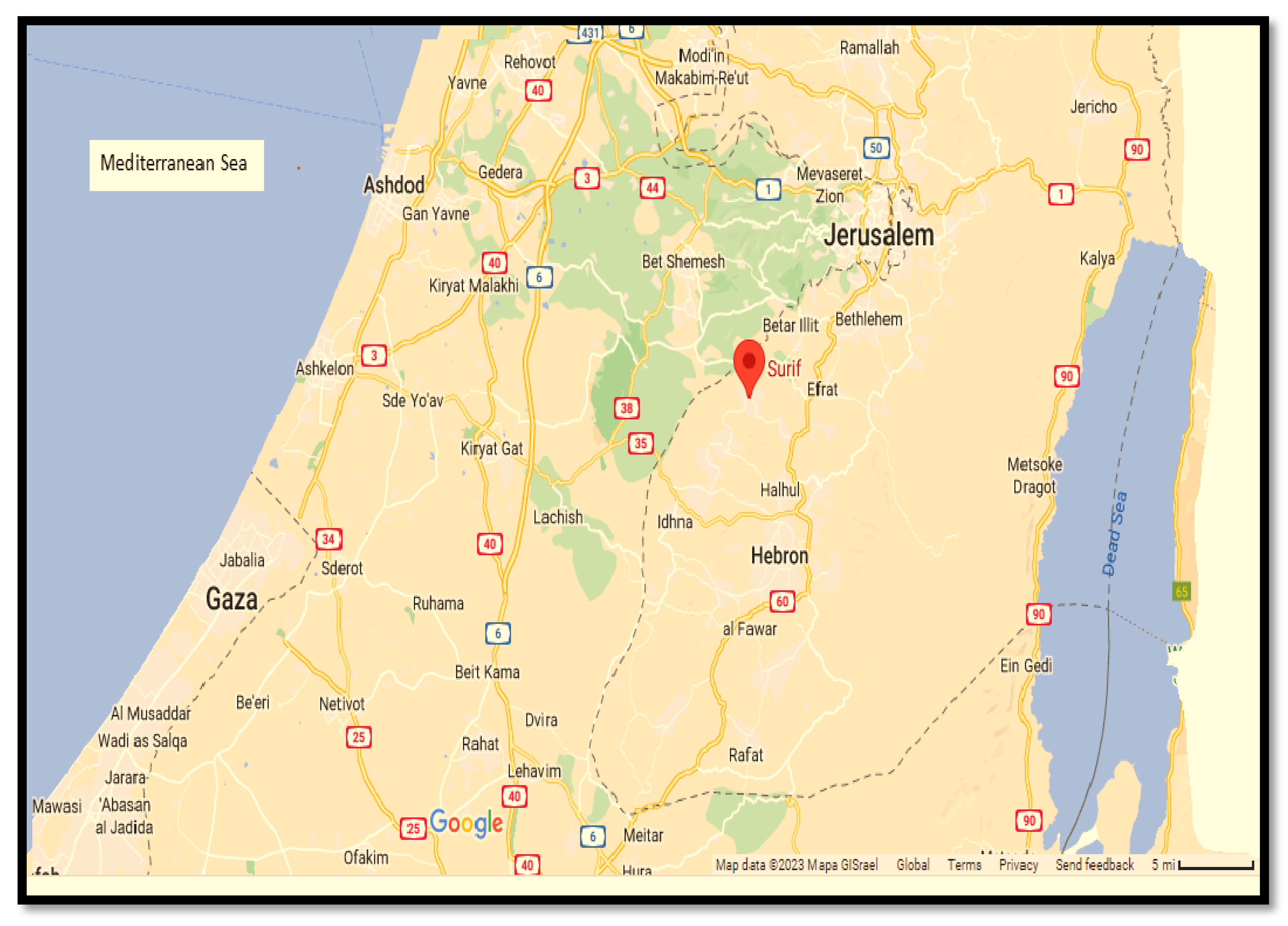
Figure 2.
Surif site and its borders in Hebron Governorate, Palestine (ARIJ, 2006-2009).
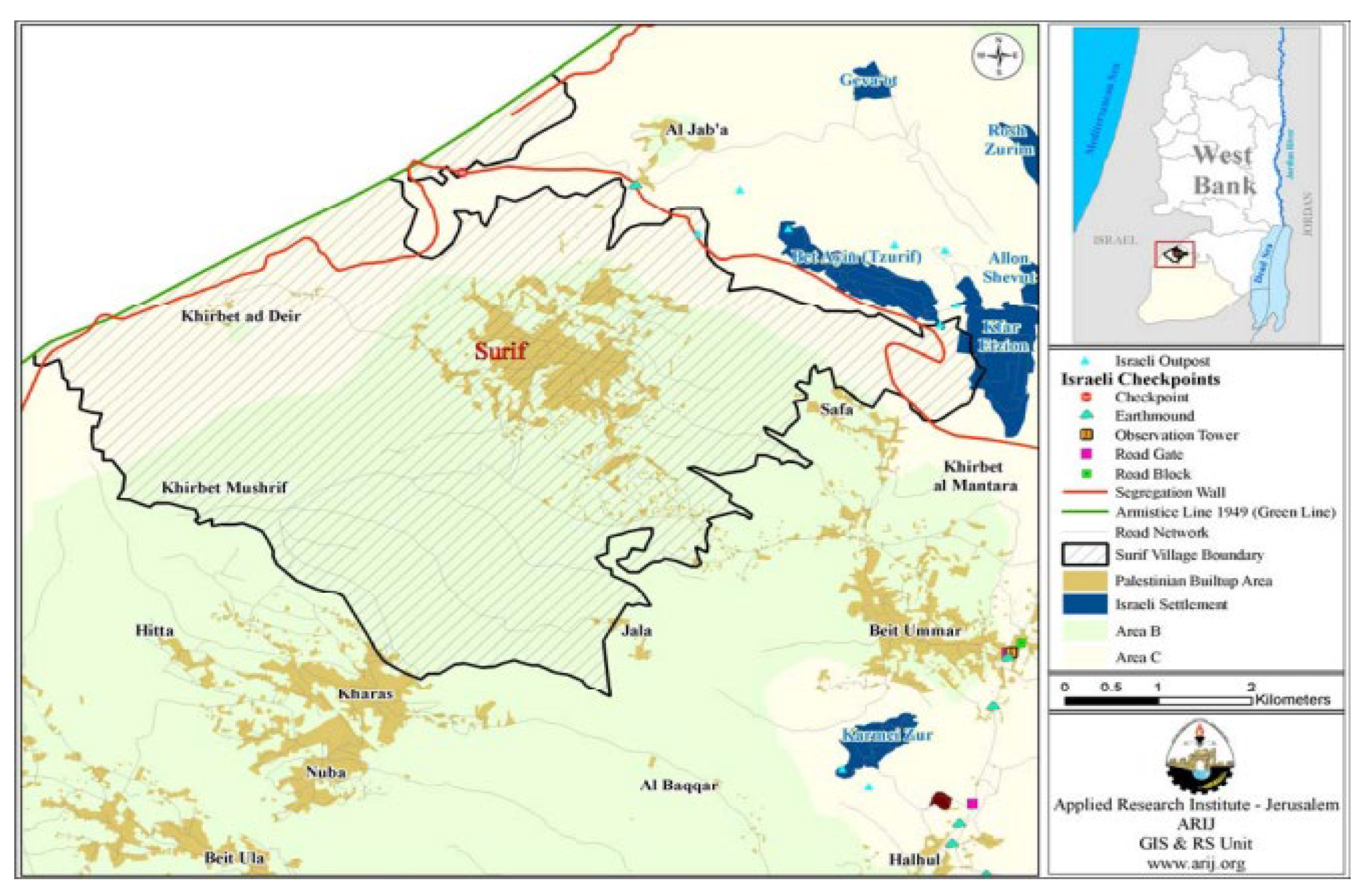
Figure 3.
The research area, where some samples were obtained, is located in the Surif region and includes “Al-Dair Village, Jabla Village, Khirbet Jamreen, Khirbet Mishrif, Khirbet Dair Musa, Ali Ghoneim’s Khalet, Khirbet Abu Shouk” by satellite.
Figure 3.
The research area, where some samples were obtained, is located in the Surif region and includes “Al-Dair Village, Jabla Village, Khirbet Jamreen, Khirbet Mishrif, Khirbet Dair Musa, Ali Ghoneim’s Khalet, Khirbet Abu Shouk” by satellite.
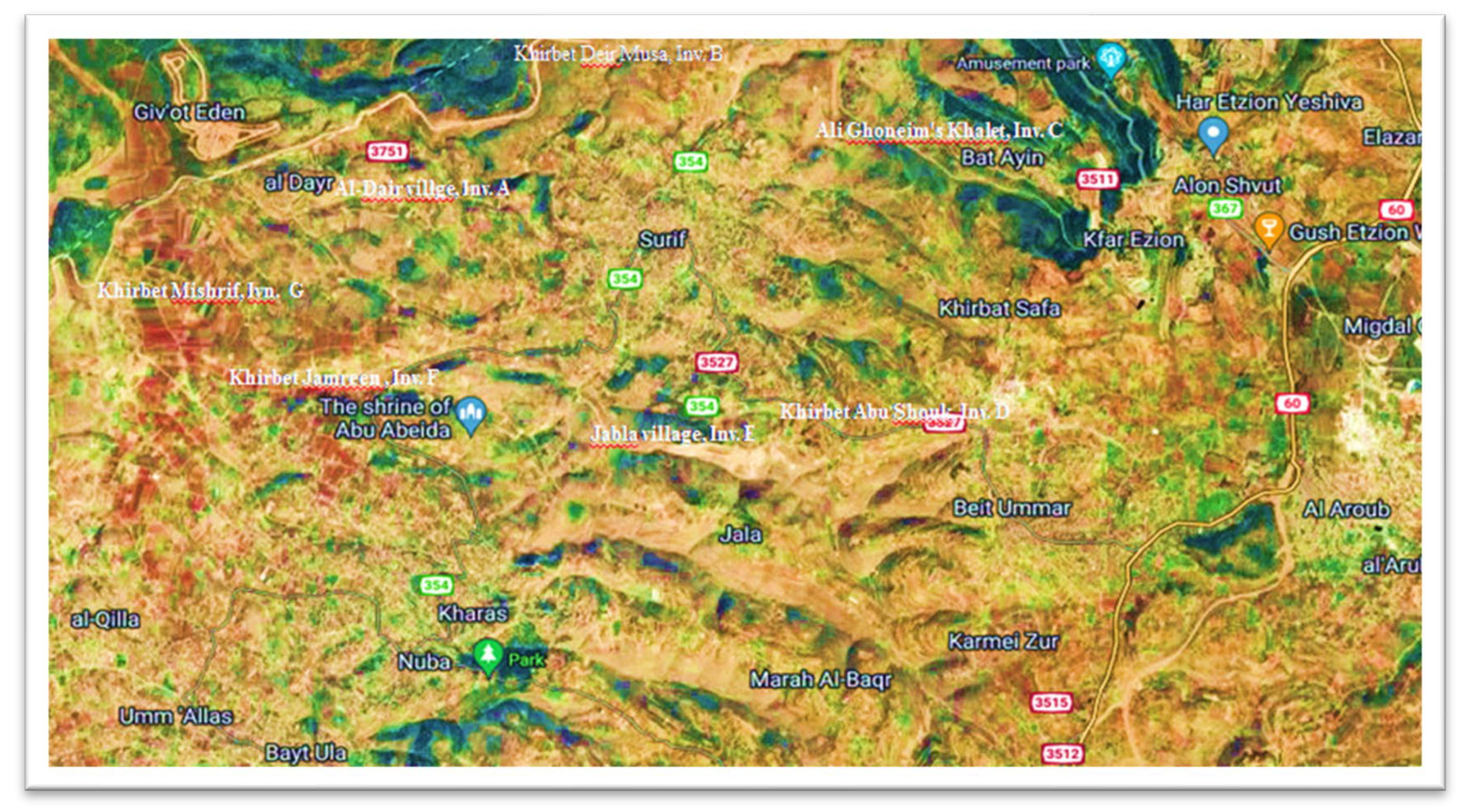
Figure 4.
Detrended correspondence analysis.
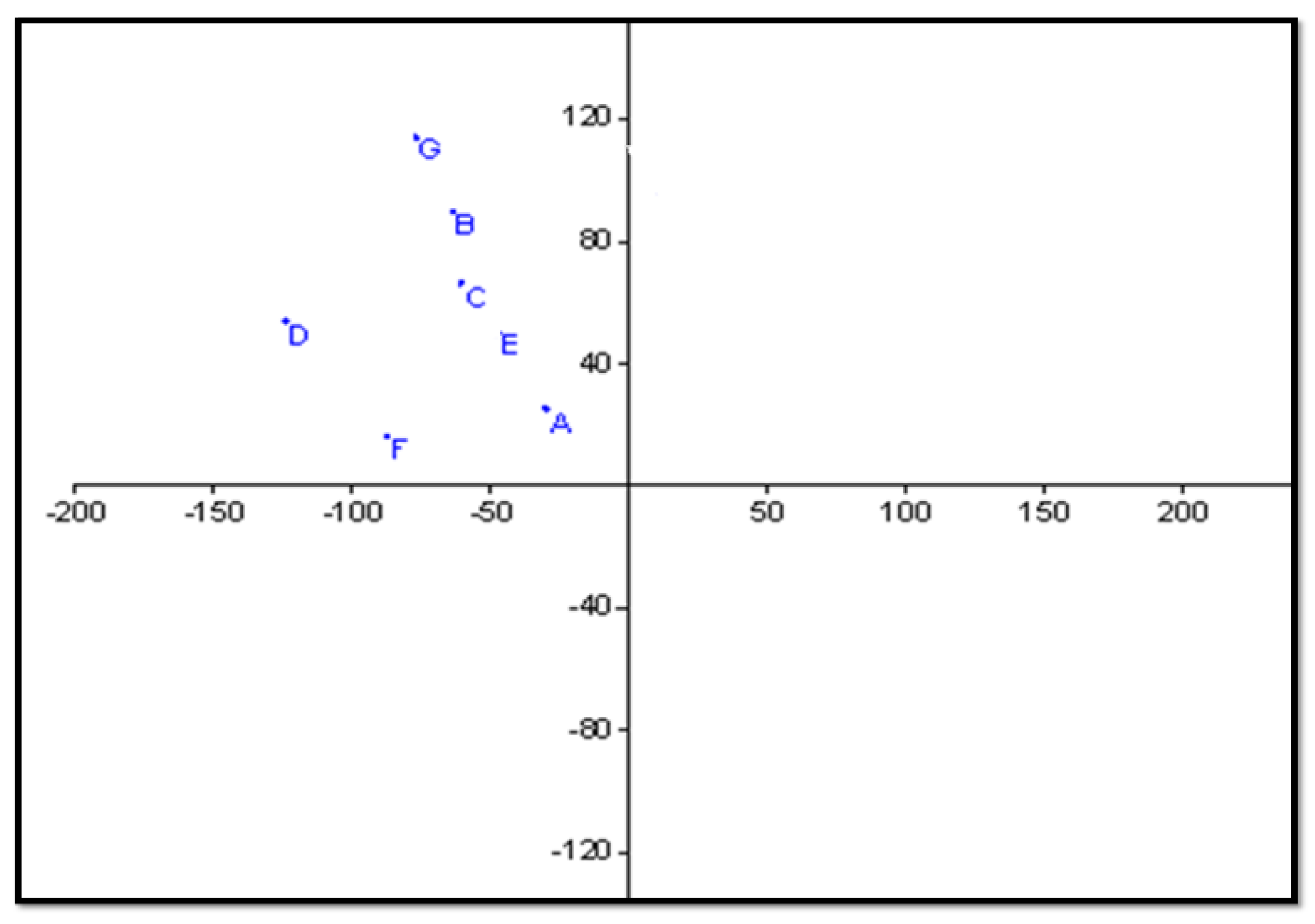
Figure 5.
Cluster denogram analysis in the study.
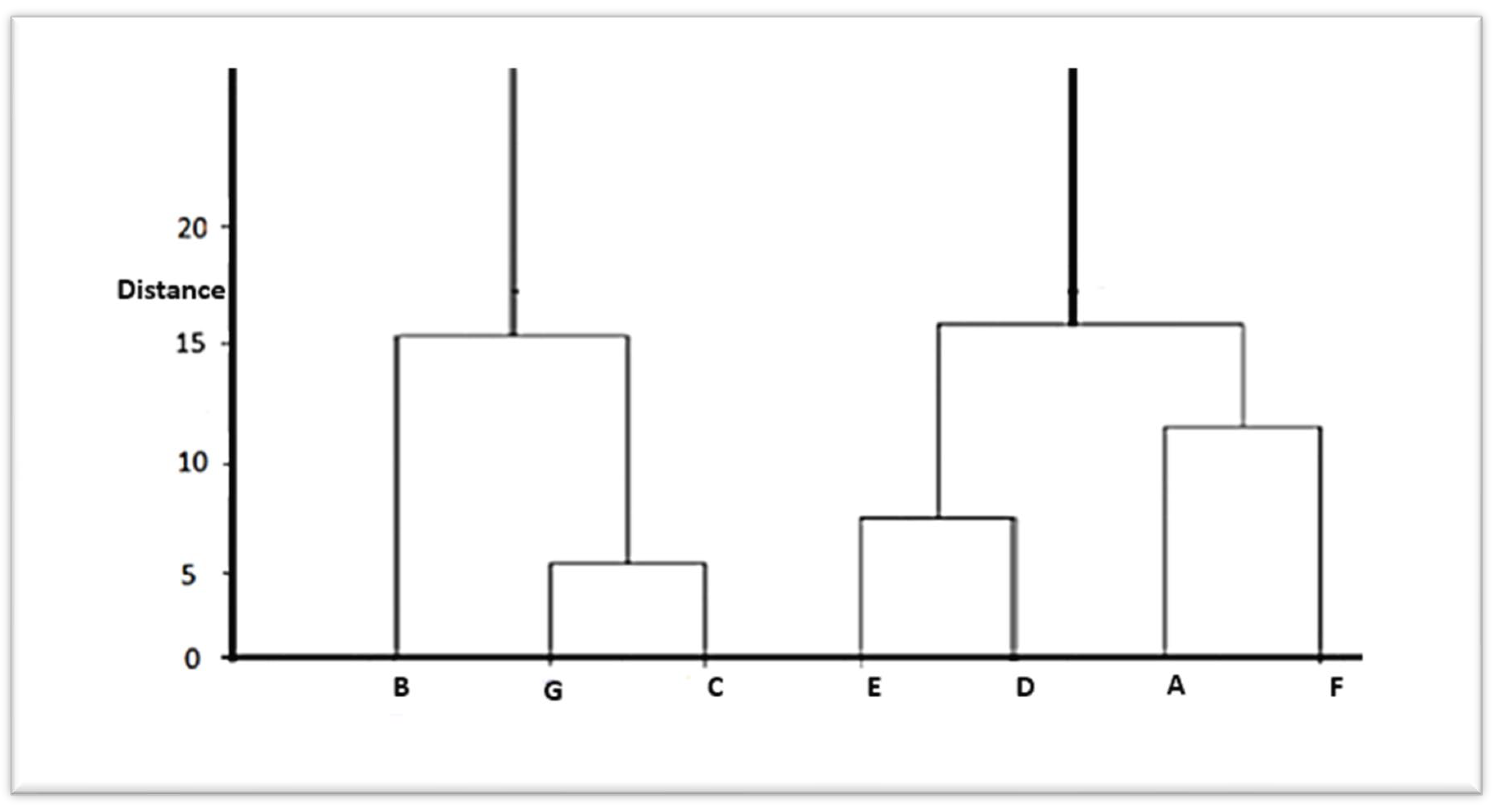
Figure 6.
Figure 6. Plant association’ life forms.
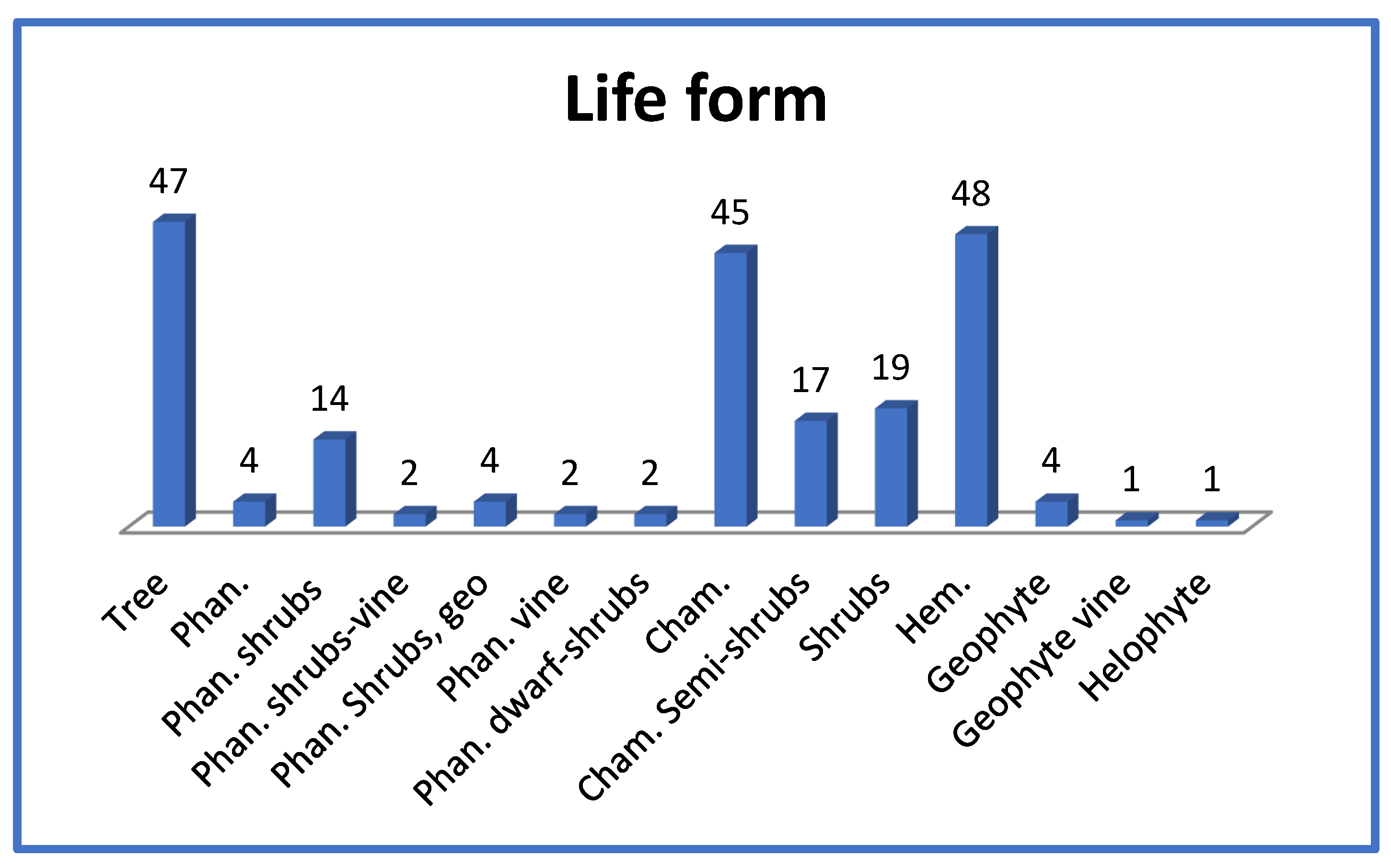
Figure 7.
Proportion of family species in the research.
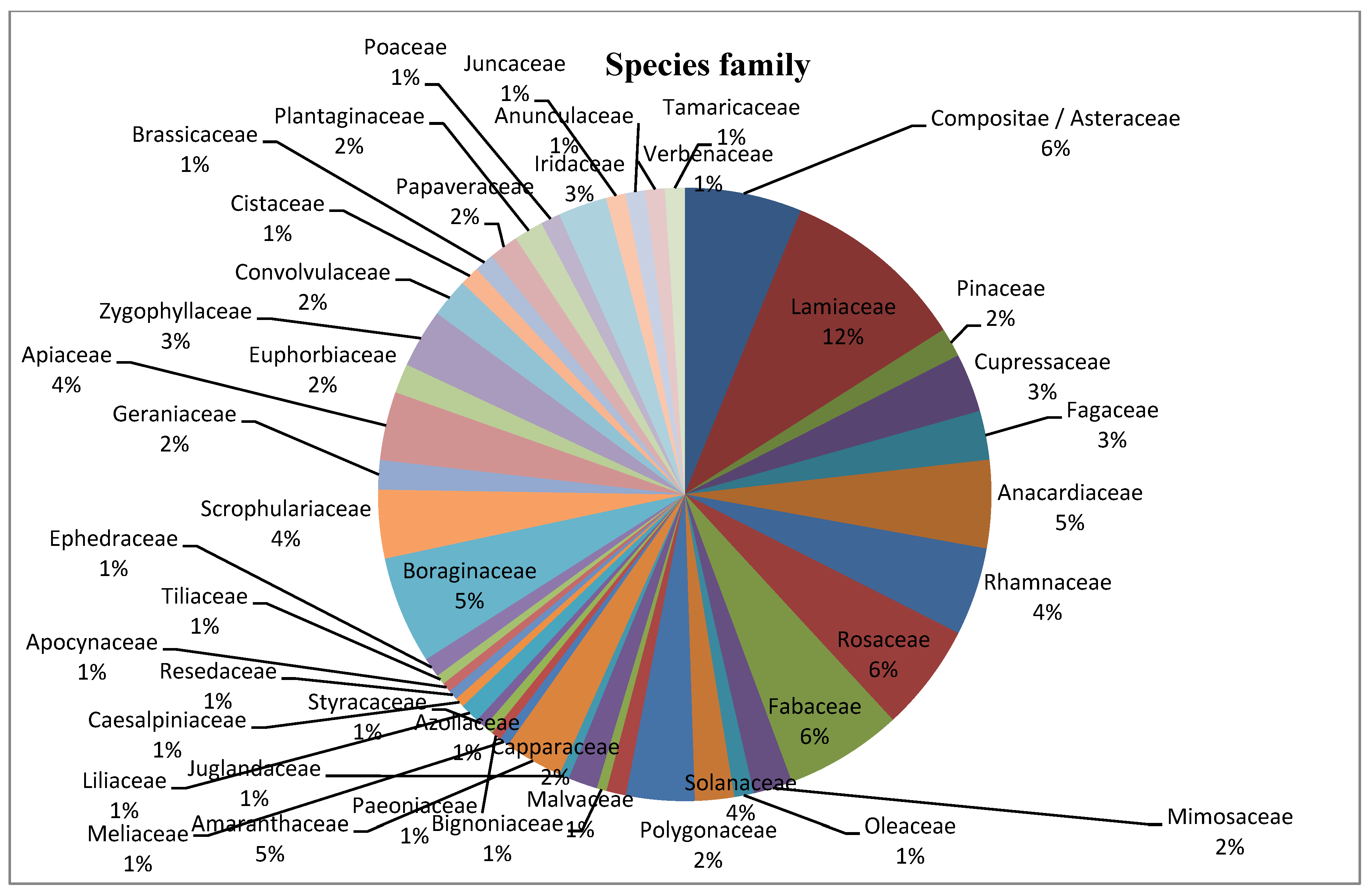

Table 1.
Sampling procedures.
| Inventories | Coordinates | Site | Altitude | Biogeographic unit |
|---|---|---|---|---|
| Inv. A | 31° 35’ 02” | Al-Dair Village, | 570 | Mediterranean basin territories |
| Inv. B | 31° 35’ 06” | Khirbet Dari Musa | 600 | Mediterranean basin territories |
| Inv. C | 31° 35’ 10” | Ali Ghoneim’s Khalet | 605 | Mediterranean basin territories |
| Inv. D | 31° 35’ 09” | Khirbet Abu Shouk | 610 | Mediterranean basin territories |
| Inv. E | 31° 35’ 62” | Jabla village | 550 | Mediterranean basin territories |
| Inv. F | 31° 35’ 03” | Khirbet Jamreen | 577 | Mediterranean basin territories |
| Inv. G | 31° 35’ 63” | Khirbet Mishrif | 590 | Mediterranean basin territories |
Table 2.
Association 1. Pino halepensis-Cupression semperviren.
| Releve of inventories | A | B | C | D | E | F | G | P | Status | Life form | Family |
| Surface in m2 1 = 10 | 750 | 600 | 450 | 650 | 300 | 270 | 500 | R | |||
| Cover rate % | 73 | 65 | 77 | 75 | 70 | 80 | 85 | E | |||
| Altitude in m. | 570 | 600 | 605 | 610 | 550 | 577 | 590 | S | |||
| Average height of vegetation (m.) | 9 | 5 | 17 | 15 | 12 | 20 | 8 | N | |||
| Slope % | 15 | 20 | 30 | 5 | 10 | 7 | 12 | C | |||
| Orientation | E | N | S | W | S | E | W | I | |||
| Order number | 1 | 3 | 4 | 2 | 5 | 7 | 6 | A | |||
| Characteristics of association and higher units | |||||||||||
| Cupressus sempervirens L. | 4 | 4 | 4 | 3 | 4 | 4 | 3 | V | N | Tree | Cupressaceae |
| Pinus halepensis (L.) Miller | 5 | 4 | 4 | 4 | 4 | 4 | 4 | V | N | Tree | Pinaceae |
| Pinus Pinea L. | 3 | 3 | 3 | 1 | 1 | 1 | 1 | IV | N | Tree | Pinaceae |
| Pinus brutia Tenore | 2 | 1 | 1 | 1 | III | N | Tree | Pinaceae | |||
| Juniperus deltoides R.P. Adams | 1 | 1 | I | N | Tree | Cupressaceae | |||||
| Juniperus turbinata Guss. (Juniperus phoenicea L.) | 1 | 1 | I | N | Tree | Cupressaceae | |||||
| Cupressus arizonica Greene | 1 | I | N | Tree | Cupressaceae | ||||||
| Companions | |||||||||||
| Pistacia lentiscus L. | 4 | 4 | 4 | 3 | 2 | 3 | 3 | V | N | Tree | Anacardiaceae |
| Pistacia terebinthus L. | 2 | 1 | 2 | 1 | IV | N | Tree | Anacardiaceae | |||
| Quercus calliprinos Webb. (Quercus palaestina K., Quercus coccifera L.) | 4 | 4 | 4 | 3 | 2 | 3 | 3 | V | N | Tree | Fagaceae |
| Rhamnus palaestinus Boiss. or Rhamnus lycioides L. | 2 | 2 | 2 | 3 | 2 | 1 | 2 | IV | Sub-e | Phan. | Rhamnaceae |
| Rhamnus alaternus L. | 2 | 2 | 2 | 2 | 1 | IV | N | Tree | Rhamnaceae | ||
| Pistacia saportae Burnat. | 2 | 2 | 2 | 1 | III | N | Tree | Anacardiaceae | |||
| Rhamnus disperma Ehrenb.ex. Boiss. | 2 | 2 | 2 | III | N | Phan. | Rhamnaceae | ||||
| Pistacia palaestina Boiss. | 2 | 1 | 2 | III | Sub-e | Tree | Anacardiaceae | ||||
| Ceratonia siliqua L | 1 | 1 | 1 | III | N | Tree | Fabaceae | ||||
| Ficus cariaca L. | 1 | 1 | 1 | III | N | Tree | Moraceae | ||||
| Pistacia atlantica Desf. | 2 | 2 | 1 | III | N | Tree | Anacardiaceae | ||||
| Quercus boissieri Reut. (Quercus infectoria Olivier var. veneris (C.K. Schneider) Meikle) | 1 | 1 | I | N | Tree | Fagaceae | |||||
| Quercus inthaburensis Decne. | 2 | 2 | 1 | III | N | Tree | Fagaceae | ||||
| Rhus tripartita (Ucria) Grande | 1 | I | N | Phan. shrubs | Anacardiaceae | ||||||
| Sageretia thea (Osbeck) M.C. Johnst. | 1 | 1 | 1 | II | N | Phan. | Rhamnaceae | ||||
| Schinus molle L. | 1 | 1 | II | N | Tree | Anacardiaceae | |||||
| Paliurus spina-christi Miller | 1 | 1 | 1 | II | N | Tree | Rhamnaceae | ||||
| Rhus coriaria L. | 1 | I | N | Tree | Anacardiaceae | ||||||
| Zizyphus Spina-christi (L.) Desf. | 1 | II | N | Tree | Rhamnaceae | ||||||
| Schinus terebinthifolius Raddi | 1 | II | N | Tree | Anacardiaceae | ||||||
| Searsia tripartita (Ucria) Moffett | 1 | II | N | Phan. | Rhamnaceae | ||||||
| Crataegus azarolus L. | 1 | I | N | Tree | Rosaceae | ||||||
| Zizyphus Lotus (L.) Lam. | 1 | 1 | 1 | II | N | Shrubs | Rhamnaceae | ||||
| Crataegus monogyna Jacq. | 2 | 1 | 1 | III | N | Tree | Rosaceae | ||||
| Prunus amygdalus (Prunus dulcis (Mill.) D. A. Webb.) | 2 | 1 | 2 | III | N | Tree | Rosaceae | ||||
| Malus communis Desf. | 1 | 1 | I | N | Shrubs | Rosaceae | |||||
| Amygdalus ramonensis Danin | 1 | 1 | I | E | Tree | Rosaceae | |||||
| Mespilus germanica L. | 1 | I | N | Shrubs | Rosaceae | ||||||
| Prunus arabica (Olivier) Meikle. | 1 | 1 | 1 | II | N | Phan. shrubs | Rosaceae | ||||
| Crataegus oriana (L.) DC | 1 | 2 | 1 | II | N | Cham. | Rosaceae | ||||
| Prunus korshinskyi Hand.Mazz. | 1 | 1 | I | N | Tree | Rosaceae | |||||
| Prunus ursina Kotschy | 1 | 1 | 1 | II | N | Tree | Rosaceae | ||||
| Sarcopoterium spinosum (L.) Spach | 1 | 2 | 1 | III | N | Tree | Rosaceae | ||||
| Spartium junceum L. | 1 | I | N | Phan. shrub | Fabaceae | ||||||
| Acacia salicina Lindl. | 1 | I | N | Tree | Fabaceae | ||||||
| Prosopis farcta (Banks et Sol.) | 1 | I | N | Cham. sem-shrubs | Mimosaceae | ||||||
| Calicotome villosa (Poir.) Link | 1 | 1 | I | N | Tree | Fabaceae | |||||
| Cersis siliquastrum L. | 1 | I | N | Tree | Fabaceae | ||||||
| Retama raetam (Forssk.) Webb. & Berthel. | 1 | I | N | Phan. shrub | Fabaceae | ||||||
| Morus nigara L. | 1 | I | N | Tree | Moraceae | ||||||
| Acacia radiana Savi. | 1 | I | N | Tree | Fabaceae | ||||||
| Retama rhodorhizoides (Webb. & Berthel.) | 1 | I | N | Tree | Fabaceae | ||||||
| Acacia cyanophylla Lindl. | 1 | 1 | I | N | Tree | Fabaceae | |||||
| Glycyrrhiza glabra L. | 1 | 1 | I | N | Phan. shrub | Fabaceae | |||||
| Morus alba L. | 1 | 1 | I | N | Tree | Moraceae | |||||
| Genista monspessulana (L.) O.Bolós & Vigo | 1 | I | N | Tree | Fabaceae | ||||||
| Olea europaea L. | 1 | 1 | 2 | III | N | Tree | Oleaceae | ||||
| Anonis natrix (L.) Scop. | 1 | I | N | Cham. | Fabaceae | ||||||
| Olea europaea var. sylvestris | 1 | I | N | Tree | Oleaceae | ||||||
| Lycium shawii Roem. & Schult. | 1 | 1 | I | N | Shrubs | Solanaceae | |||||
| Phlomis chrysophylla Boiss. | 1 | I | N | Cham. semi-shrubs | Lamiaceae | ||||||
| Helichrysum sanguineum (L.) Kostel. | 1 | I | N | Hem. | Compositae | ||||||
| Salvia officinalis L. | 1 | 1 | 1 | II | N | Cham. | Lamiaceae | ||||
| Salvia fruticosa Miller | 1 | 1 | 1 | II | N | Cham. | Lamiaceae | ||||
| Cota tinctoria (L.) J.Gay ex Guss | 1 | I | N | Hem. | Compositae | ||||||
| Salvia aegyptiaca L. | 1 | 1 | I | N | Cham. | Lamiaceae | |||||
| Salvia palaestina Benth. | 1 | 1 | I | Sub-e | Cham. | Lamiaceae | |||||
| Crepis hierosolymitana Boiss. | 1 | I | N | Hem. | Compositae | ||||||
| Phlomis platystegia Post. | 1 | I | E | Cham. semi-shrubs | Lamiaceae | ||||||
| Artemisia monosperma Delile | 1 | 1 | II | N | Cham. | Compositae | |||||
| Artemisia sieberi Besser | 1 | 1 | 1 | II | N | Cham. | Compositae | ||||
| Phlomis viscosa Poiret. | 1 | I | N | Cham. semi-shrubs | Lamiaceae | ||||||
| Achillea aleppica DC. | 1 | 1 | 1 | II | N | Cham. | Compositae | ||||
| Artemisia arborescens L. | 1 | 1 | 1 | II | N | Cham. | Compositae | ||||
| Crepis reuteriana Boiss. | 1 | I | N | Hem. | Compositae | ||||||
| Teucrium capitatum L. | 1 | 1 | 1 | II | N | Cham. | Lamiaceae | ||||
| Doellia bovei (DC.) Anderb. | 1 | I | N | Cham. | Compositae | ||||||
| Teucrium creticum L. | 1 | 1 | II | N | Cham. | Lamiaceae | |||||
| Thymbra capitata (L.) Cav. | 1 | 1 | II | N | Cham. | Lamiaceae | |||||
| Lycium barbarum L. | 1 | I | N | Shrubs | Solanaceae | ||||||
| Bassia arabica (Boiss.) Maire & Weiller | 1 | I | N | shrubs | Lamiaceae | ||||||
| Solanum incanum L. | 1 | I | N | Cham. semi-shrubs | Solanaceae | ||||||
| Lycium europaeum L. | 1 | I | N | Shrubs | Solanaceae | ||||||
| Satureja thymbra L. | 1 | I | N | Cham. semi-shrubs | Lamiaceae | ||||||
| Lycium depressum Stocks | 1 | I | N | Phan. shrubs | Solanaceae | ||||||
| Lycium schweinfurthii Dammer | 1 | I | N | Phan. shrubs | Solanaceae | ||||||
| Satureja thymbrifolia Hedge & Feinbrun | 1 | I | E | Cham. semi-shrubs | Lamiaceae | ||||||
| Phlomis brachyodon (Boiss.) Zohary | 1 | I | N | Cham. semi-shrubs | Lamiaceae | ||||||
| Stachys palaestina L. | 1 | 1 | I | E | Cham. semi-shrubs | Lamiaceae | |||||
| Ballota undulata (Sieber ex. Fresen.) Bentham | 1 | I | N | shrubs | Lamiaceae | ||||||
| Phlomis pungens Willd. | 1 | I | N | Cham. semi-shrubs | Lamiaceae | ||||||
| Hyoscyamus aureus L. | 1 | I | N | Cham. | Solanaceae | ||||||
| Gundelia tournefortii L. | 1 | I | N | Hem. | Compositae | ||||||
| Heliotropium arbainense Fresen. | 1 | 1 | I | N | Cham. Semi-shrubs | Boraginaceae | |||||
| Haloxylon persicum Bunge | 1 | I | N | Phan. Shrubs | Amaranthaceae | ||||||
| Suaeda palaestina Eig. & Zohary | 1 | I | E | Cham. | Amaranthaceae | ||||||
| Heliotropium bacciferum Forssk. | 1 | I | N | Cham. Semi-shrubs | Boraginaceae | ||||||
| Haloxylon salicornicum (Moq.) Bunge ex Boiss. | 1 | 1 | 1 | II | N | Cham. | Amaranthaceae | ||||
| Salsola cyclophylla Baker | 1 | 1 | 1 | II | N | Shrubs | Amaranthaceae | ||||
| Echium angustifolium Mill. | 1 | I | N | Cham. | Boraginaceae | ||||||
| Heliotropium rotundifolium Lehm. | 1 | I | N | Cham. | Boraginaceae | ||||||
| Echiochilon fruticosum Desf. | 1 | I | N | Cham. | Boraginaceae | ||||||
| Sarcocornia fruticosa (L.) A.J.Scott | 1 | 1 | 1 | II | N | Cham. | Amaranthaceae | ||||
| Echium glomeratum Poir. | 1 | I | N | Hem. | Boraginaceae | ||||||
| Podonosma orientalis (L.) Feinbrun | 1 | I | N | Cham. | Boraginaceae | ||||||
| Fagonia arabica L. | 1 | I | N | Shrubs | Zygophyllaceae | ||||||
| Atriplex halimus L. | I | N | Shrubs | Amaranthaceae | |||||||
| Fagonia orientalis C. Presl. | 1 | I | N | Shrubs | Zygophyllaceae | ||||||
| Alkanna orientalis (L.) Boiss | 1 | 1 | 1 | II | N | Cham. | Boraginaceae | ||||
| Alkanna strigosa Boiss & Hohen. | 1 | 1 | 1 | II | N | Cham. | Boraginaceae | ||||
| Alkanna tinctoria (L.) Tausch | 1 | 1 | II | N | Cham. | Boraginaceae | |||||
| Ferula communis L. | 1 | I | N | Hem. | Apiaceae | ||||||
| Fagonia bruguieri DC. | 1 | I | N | Shrubs | Zygophyllaceae | ||||||
| Ferula biverticillata J. Thieb | 1 | I | E | Hem. | Apiaceae | ||||||
| Fagonia mollis Delile | 1 | I | N | Shrubs | Zygophyllaceae | ||||||
| Ferulago syriaca Boiss. | 1 | I | N | Hem. | Apiaceae | ||||||
| Ferula orientalis L. | 1 | I | N | Hem. | Apiaceae | ||||||
| Capparis spinosa L. | 1 | 1 | II | N | Shrubs | Capparaceae | |||||
| Foeniculum vulgare Miller | 1 | I | N | Hem. | Apiaceae | ||||||
| Ferula tingitana L. | 1 | I | N | Hem. | Apiaceae | ||||||
| Capparis aegyptia Lam. | 1 | 1 | 1 | II | N | Shrubs | Capparaceae | ||||
| Conium maculatum L. | 1 | I | N | Hem. | Apiaceae | ||||||
| Capparis sicula Duh. | 1 | 1 | II | N | Shrubs | Capparaceae | |||||
| Ipomoea imperati (Vahl.) Griseb. | 1 | I | N | Hem. | Convolvulaceae | ||||||
| Clematis cirrhosa L. | 1 | I | N | Phan. vine | Anunculaceae | ||||||
| Atraphaxis spinosa L. | I | N | Cham. | Polygonaceae | |||||||
| Convolvulus dorycnium L. | 1 | I | N | Hem. | Convolvulaceae | ||||||
| Tamarix nilotica (Ehrenb.) Bunge | 1 | I | N | Tree | Tamaricaceae | ||||||
| Clematis flammula L. | 1 | I | N | Phan. vine | Anunculaceae/Ranunculaceae | ||||||
| Convolvulus lanatus Vahl. | I | N | Cham. | Convolvulaceae | |||||||
| Ipomoea cairica (L.) Sweet | 1 | I | N | Hem. | Convolvulaceae | ||||||
| Kickxia aegyptiaca (L.) Nabelek | 1 | II | N | Cham. | Plantaginaceae | ||||||
| Verbascum sinaiticum Benth. | 1 | 1 | 1 | II | N | Hem. | Scrophulariaceae | ||||
| Euphorbia hierosolymitana Boiss. | 1 | I | N | Shrubs | Euphorbiaceae | ||||||
| Periploca aphylla Decne. | 1 | I | N | Phan. shrubs | Apocynaceae | ||||||
| Euphorbia hirta L. | 1 | I | N | Shrubs | Euphorbiaceae | ||||||
| Iris vartanii Foster | 1 | I | E | Geophyte | Iridaceae | ||||||
| Iris palaestina (Bak.) Boiss. | 1 | I | E | Geophyte | Iridaceae | ||||||
| Euphorbia hirsuta L. | 1 | I | N | Hem. | Euphorbiaceae | ||||||
| Tamarix aphylla (L.) Karsten | 1 | I | N | Tree | Tamaricaceae | ||||||
| Glaucium arabicum Fresen. | 1 | I | N | Hem. | Papaveraceae | ||||||
| Glaucium flavum Crantz | 1 | 1 | I | N | Hem. | Papaveraceae | |||||
| Glaucium grandiflorum Boiss. & A.Huet | 1 | I | N | Hem. | Papaveraceae | ||||||
| Thymelaea hirsuta ( L.) Endl | 1 | I | N | Phan. dwarf -shrub | Scrophulariaceae | ||||||
| Ephedra foeminea Forssk | 1 | I | N | Phan. shrubs vine | Ephedraceae | ||||||
| Verbascum fruticulosum Post. | 1 | 1 | I | N | Phan. dwarf -shrub | Scrophulariaceae | |||||
| Ephedra aphylla Forskal | 1 | I | N | Phan. shrubs vine | Ephedraceae | ||||||
| Juncus subulatus Forssk. | 1 | I | N | Hem. | Juncaceae | ||||||
| Hordeum bulbosum L. | 1 | I | N | Hem. | Poaceae | ||||||
| Erysimum crassipes Fisch. &C.A.Mey. | 1 | I | N | Hem. | Brassicaceae | ||||||
| Juncus acutus L. | 1 | I | N | Hem. | Juncaceae | ||||||
| Fibigia clypeata (L.) Medik | I | N | Hem. | Brassicaceae | |||||||
| Festuca arundinacea Schreb. | 1 | I | N | Hem. | Poaceae | ||||||
| Erodium crassifolium L’Her. | 1 | 1 | I | N | Hem. | Geraniaceae | |||||
| Asparagus palaestinus Baker | 1 | I | Sub-e | Geophyte vine | Liliaceae | ||||||
| Erodium arborescens (Desf.)Willd. | 1 | 1 | 1 | I | N | Hem. | Geraniaceae | ||||
| Cistus creticus L. | 1 | I | N | Cham. semi-shrubs | Cistaceae | ||||||
| Erodium acaule (L.) Becherer &Thell. | 1 | 1 | I | N | Hem. | Geraniaceae | |||||
| Asparagus horridus L. | 1 | 1 | 1 | II | N | Geophyte | Liliaceae | ||||
| Parkinsonia aculeata L. | 1 | I | N | Phan. shrubs | Caesalpiniaceae | ||||||
| Fumana thymifolia (L.) Webb. | 1 | 1 | I | N | Cham. semi-shrubs | Cistaceae | |||||
| Ochradenus baccatus Delile | 1 | I | N | Phan. shrubs | Resedaceae | ||||||
| Azolla filiculoides Lam. | 1 | I | N | Helophyte | Azollaceae | ||||||
| Melia azedarach L. | 1 | I | N | Tree | Meliaceae | ||||||
| Paeonia mascula (L.) Mill. | 1 | 1 | I | N | Geophyte | Paeoniaceae | |||||
| Styrex officinalis L. | 1 | 1 | I | N | Phan. shrubs | Styracaceae | |||||
| Vitex agnus-castus L. | 1 | 1 | I | N | Cham. semi-shrubs | Verbenaceae | |||||
| Juglans regia L. | 1 | I | N | Tree | Juglandaceae | ||||||
| Globularia arabica Jaub. & Spach | 1 | I | N | Cham. semi-shrubs | Plantaginaceae | ||||||
| Verbena officinalis L. | 1 | I | N | Hem. | Verbenaceae | ||||||
| Hibiscus micranthus L. | 1 | I | N | Cham. semi-shrubs | Malvaceae | ||||||
| Tamarix palestina Bertol. | 1 | I | I | E | Tree | Tamaricaceae | |||||
| Achillea arabica Kotschy | 1 | I | N | Hem. | Compositae | ||||||
| Achillea fragrantissima (Forssk.) Sch.Bip. | 1 | I | N | Hem. | Compositae | ||||||
| Achillea membranacea DC. | 1 | I | N | Cham. | Compositae | ||||||
| Achillea wilhelmsii K. Koch | 1 | I | N | Hem. | Compositae | ||||||
| Cotoneaster nummularius Fisch. & C.A.Mey. | 1 | I | N | Phan. Shrubs | Rosaceae | ||||||
| Astragalus aleppicus Boiss. | 1 | I | N | Hem. | Fabaceae | ||||||
| Salsola gaetula (Maire) Botsch. | 1 | I | N | Cham. | Amaranthaceae | ||||||
| Salsola imbricata Forssk. | 1 | I | N | Phan. Shrubs | Amaranthaceae | ||||||
| Salsola incanescens C.A.Mey. | 1 | I | N | Cham. | Amaranthaceae | ||||||
| Salsola oppositifolia Desf. | 1 | I | N | Cham. | Amaranthaceae | ||||||
| Acanthus syriacus Boiss. | 1 | I | N | Hem. | Acanthaceae | ||||||
| Atriplex glauca L. | 1 | I | N | Cham. | Amaranthaceae | ||||||
| Haloxylon scoparium Pomel | 1 | I | N | Cham. | Amaranthaceae | ||||||
| Kickxia acerbiana (Boiss.) Taeckh. & Boulos | 1 | I | N | Hem. | Plantaginaceae | ||||||
| Kickxia floribunda (Boiss.) Taeckh. & Boulos | 1 | I | N | Cham. | Plantaginaceae | ||||||
| Kickxia macilenta (Decne.) Danin | 1 | I | N | Cham. | Plantaginaceae | ||||||
| Kickxia spartioides (Brouss. ex Buch) Janch. | 1 | I | N | Cham. | Plantaginaceae | ||||||
| Salvia ceratophylla L. | 1 | I | N | Hem. | Lamiaceae | ||||||
| Salvia lanigera Poir. | 1 | I | N | Cham. | Lamiaceae | ||||||
| Salvia samuelssonii Rech.F. | 1 | I | N | Hem. | Lamiaceae | ||||||
| Salvia spinosa L. | 1 | I | N | Hem. | Lamiaceae | ||||||
| Salvia verbenaca L. | 1 | I | N | Hem. | Lamiaceae | ||||||
| Cistus salviifoliusL. | 1 | I | N | Cham. | Cistaceae | ||||||
| Solanum elaeagnifolium Cav. | 1 | I | N | Hem. | Solanaceae | ||||||
| Solanum nigrum L. | 1 | I | N | Hem. | Solanaceae | ||||||
| Solanum villosum (L.) Mill. | 1 | I | N | Hem. | Solanaceae | ||||||
| Teucrium decaisnei C.Presl | 1 | I | N | Cham. | Lamiaceae | ||||||
| Tamarix tetragyna Ehrenb. | 1 | I | N | Tree | Tamaricaceae | ||||||
| Thymbra spicata L. | 1 | I | N | Cham. | Lamiaceae | ||||||
| Stachys viticina Boiss. | 1 | I | N | Hem. | Lamiaceae | ||||||
| Stachys aegyptiaca Pers. | 1 | I | N | Cham. | Lamiaceae | ||||||
| Cyperus alopecuroides Rottb. | 2 | I | N | Hem. | Cyperaceae | ||||||
| Arundo micrantha Lam. | 1 | I | N | Phan. Shrub, Geo. | Poaceae | ||||||
| Arundo donax L. | 1 | I | N | Phan. Shrub, Geo. | Poaceae | ||||||
| Arundo micrantha Lam. (Arundo mediterranea Danin) | 1 | I | N | Phan. Shrub, Geo. | Poaceae | ||||||
| Heptaptera anisoptera (DC.) Tutin | 1 | I | N | Hem. | Apiaceae | ||||||
| Cynodon dactylon (L.) Pers. | 1 | 1 | II | N | Phan. Shrub, Geo. | Poaceae | |||||
| Dittrichia viscosa (L.) Greuter | 2 | II | N | Cham | Compositae | ||||||
| Astragalus bethlehemiticus Boiss. | 1 | I | N | Cham | Fabaceae | ||||||
| Origanum syriacum L. | 1 | I | N | Cham | Lamiaceae | ||||||
| Verbascum agrimoniifolium (K.Koch) Hub.-Mor. | 1 | I | N | Hem. | Scrophulariaceae | ||||||
Abbreviations: T.: tree; Phan: phanerophyte, Phan. Shrubs: phanerophyte shrubs, Phan. shrubs vine: phanerophyte shrubs vine; Phan. vine: phanerophyte vine; Phan. dwarf shrubs: phanerophyte dwarf shrubs; Cham.: chamaephyte; Cham. semi-shrubs: chamaephyte semi-shrubs; Cham., chamaephyte; Cham. Shrubs: chamaephyte shrubs; Hem.: hemicryptophyte; Geo.: geophyte, Geo. vine: geophyte vine; H.: Helophyte. Percentage of plant species present in the sample studies and communities: V = 100%, IV = 60.1-80%, III = 40.1-60%, II = 20.1-40% and I = 0.1-20%. N: native, E: endemic, ASL: Association, and ASL1: association 1.
Disclaimer/Publisher’s Note: The statements, opinions and data contained in all publications are solely those of the individual author(s) and contributor(s) and not of MDPI and/or the editor(s). MDPI and/or the editor(s) disclaim responsibility for any injury to people or property resulting from any ideas, methods, instructions or products referred to in the content. |
© 2025 by the authors. Licensee MDPI, Basel, Switzerland. This article is an open access article distributed under the terms and conditions of the Creative Commons Attribution (CC BY) license (http://creativecommons.org/licenses/by/4.0/).
Copyright: This open access article is published under a Creative Commons CC BY 4.0 license, which permit the free download, distribution, and reuse, provided that the author and preprint are cited in any reuse.


