

Submitted:
16 April 2025
Posted:
17 April 2025
You are already at the latest version
Abstract
Biological invasions are one of the main causes of biodiversity loss globally, affecting the quality of ecosystem services, economy and public health. Research on the presence, distribution, impacts and introduction pathways of invasive alien species is essential for understanding and tackling the invasion process. Continental, coastal and marine aquatic ecosystems of the Yucatan Peninsula concentrate a high number of native species richness; however, the states that are in the region (Campeche, Yucatan and Quintana Roo) also have the largest loss of natural capital at the national level. The presence of aquatic invasive species has contributed to this downward trend, mainly in protected areas. For this research, an analysis in the national biodiversity information system, the global biodiversity information facility, and the specialized scientific literature was carried out to determine the presence of aquatic invasive species within the protected areas of the Yucatan Peninsula and adjacent marine zone. The results indicate that there are 22 documented aquatic invasive species in 25 protected areas, which were classified into the following taxonomic groups: marine macroalgae (3 species), plants (2), inland and marine fish (11), crustaceans (2), mollusks (2) and hydrozoans (2). Fifteen of these species had a very high invasiveness score, six were high and one had a medium score. This research will be useful to strengthen regional public policy and guide decision makers on the management of aquatic invasive species, mainly for those that are seriously affecting aquatic ecosystems such as Pterygoplichthys disjunctivus and P. pardalis in freshwater protected areas and Pterois volitans in marine protected areas.
Keywords:
biological invasions
; Caribbean Sea
; freshwater protected areas
; Gulf of Mexico
; introduction pathways
; invasive species management
; marine protected areas
; risk assessment
1. Introduction
Invasive alien species are a threat to global biodiversity, ecosystem services, economies and public health [1,2,3]. Ecological impacts of invasive alien species include the disruption of food webs, competition for resources and space, changes in nutrient cycling and modifications in physical characteristics, with cascading effects on biodiversity at all trophic levels, from individuals (including extinctions) to ecosystems [1,4,5]. Economic costs caused by invasive alien species can arise through a wide variety of impacts, such as damage to productive activities, infrastructure and public health, and extend to the costs of prevention, control or eradication [6,7]. According to the Intergovernmental Science-Policy Platform on Biodiversity and Ecosystem Services, the global economic cost of invasive alien species exceeded US$423 billion annually in 2019, with costs having at least quadrupled every decade since 1970 [3].
Invasions interact synergistically with other environmental problems, increasing their global impact, such as changes in land and sea use, and climate change [3]. In recent decades, climate change has compounded the effects of species redistribution [8] such that, in the future, invasive alien species will continue to establish and spread and be a significant cause of biodiversity loss worldwide [3]. The number of invasive alien species is expected to increase 36% over the next three decades [6,9], requiring enormous resources to manage their impacts [2].
Aquatic ecosystems can be severely threatened by invasive alien species; as they can substantially change the structure of native communities and alter ecosystem functioning [6; 10]. Aquatic invasive species can alter community composition; reduce species’ richness and therefore diminish the ability of biotic resistance [11]. In the freshwater ecosystems; biodiversity is depleting alarmingly due to the introduction of invasive species; which cause; among other things; alteration of food webs [12,13]. Invasions of nonnative fish could also interrupt resource flows and have far reaching effects on interconnected ecosystems [14]. Marine invasive species may negatively impact coastal societies; affecting ecosystem services such as food provision; tourism and recreation [15] and they can decrease economic production of activities based on marine environments and resources such as fisheries; aquaculture; and marine infrastructure [3,16]. These effects have related social impacts through decreases in employment in economic activities directly affected by marine invasive species but also through decreases in people’s welfare from the reduced quality of their surroundings [16]. Aquatic invasive species are therefore a major challenge for people in all regions and countries [3,11]
Biological invasions are regarded as one of the most critical threats to protected areas, as they disrupt the proper functioning of ecological systems, the main reason why they were established [17,18,19]. However, in many cases, protected areas are changing to modified landscapes due to anthropogenic activities, providing pathways for the introduction of invasive species [12,17]. One of the most significant problems in the management of biological invasions is that when the presence of a species is noticeable, it is generally already widely distributed in the receiving ecosystem. An early detection and rapid response strategy is cost effective for managers and having an updated system of the presence of species and their impacts helps determine the best strategy for their management, control or eradication. This paper presents a diagnosis of the presence of aquatic invasive species in the protected areas of the Yucatan Peninsula and the adjacent marine areas, which include the southeastern Gulf of Mexico and the Mexican Caribbean, which may be useful for decision-making on the restoration and conservation of the region’s aquatic ecosystems.
2. Methods
2.1. Study Area
The Yucatan Peninsula in southeastern Mexico includes three states (Campeche, Yucatan and Quintana Roo), bordered by the Caribbean Sea, the Gulf of Mexico, and Guatemala and Belize. In this region of high biodiversity, there are several priority regions for conservation: 1) biogeographic provinces (Peten and Yucatan) [20]; 2) hydrological regions (Laguna de Terminos, Sur de Campeche, Calakmul, Anillo de cenotes, Contoy, Isla Mujeres, Corredor Cancun-Tulum, Cozumel, Cenotes Tulum-Coba and Sian Ka’an) [21]; 3) marine regions (Laguna de Terminos, Cayos Campeche, Escarpe Campeche, Arrecife Alacranes, Sonda de Campeche, Dzilam-Contoy, Punta Maroma-Nizuc, Tulum-Xpuha, Sian Ka’an, Xcalak-Majahual, Cozumel and Banco Chinchorro) [22] and 4) terrestrial regions (Petenes-Ria Celestun, Dzilam-Ria Lagartos-Yum Balam, Sian Ka’an-Uaymil-Xcalak and Silvituc-Calakmul) [23]. In this territory there are 40 protected areas of federal jurisdiction, classified into four protection categories: Biosphere Reserve, Flora and Fauna Protection Area, National Park and Wildlife Sanctuary [24]. In these protected areas, there are diverse aquatic ecosystems, among which the following stand out: rivers, lakes, waterholes, cenotes, petenes, mangroves, lagoons, seagrass meadows and coral reefs [20,21,22,23,24].
2.2. Information Analysis
To determine the presence of aquatic invasive species in protected areas of the Yucatan Peninsula and adjacent marine zone, we analyzed the National Biodiversity Information System [25]; the Global Biodiversity Information Facility [26]; scientific papers consulted on electronic platforms Springer Nature Lync, SciELO, redalyc, PubMed and Google Scholar with combinations of the following keywords: “aquatic invasive species, invasive alien macroalgae, invasive alien plants, invasive alien hydroids, invasive alien mollusks, invasive alien crustaceans, invasive alien fish, protected areas, peninsula of Yucatan, Campeche, Yucatan, Quintan Roo, Mexican Caribbean and southeast Gulf of Mexico”, as well as the conservation and management programs of the protected areas [27,28,29,30,31,32,33,34,35,36,37,38,39,40,41,42,43,44,45,46] and the taxonomic lists in white papers of Arrecifes del Golfo de Mexico-Sur and Bajos del Norte National Parks [47,48]. Also, the introduction pathways of aquatic invasive species were identified with references to their presence in the protected areas, the IUCN’s Global Invasive Species Database [49] and the Compendium Invasive Species of the Centre for Agricultural Bioscience International [50].
For this research, aquatic invasive species were considered those found in freshwater and marine ecosystems that have been analyzed through the Rapid Invasiveness Assessment Method (MERI for its acronym in Spanish), which determines the invasiveness risk of alien species for Mexico [51]. The determination of the MERI value is based on the following considerations: a) invasiveness documented in other regions of the world, b) relationship with nearby invasive taxa, c) vector of other invasive species, d) risk of introduction, e) risk of establishment, f) spread risk, g) health impacts, h) economic and social impacts, i) ecosystem impacts and j) impacts on biodiversity [51].
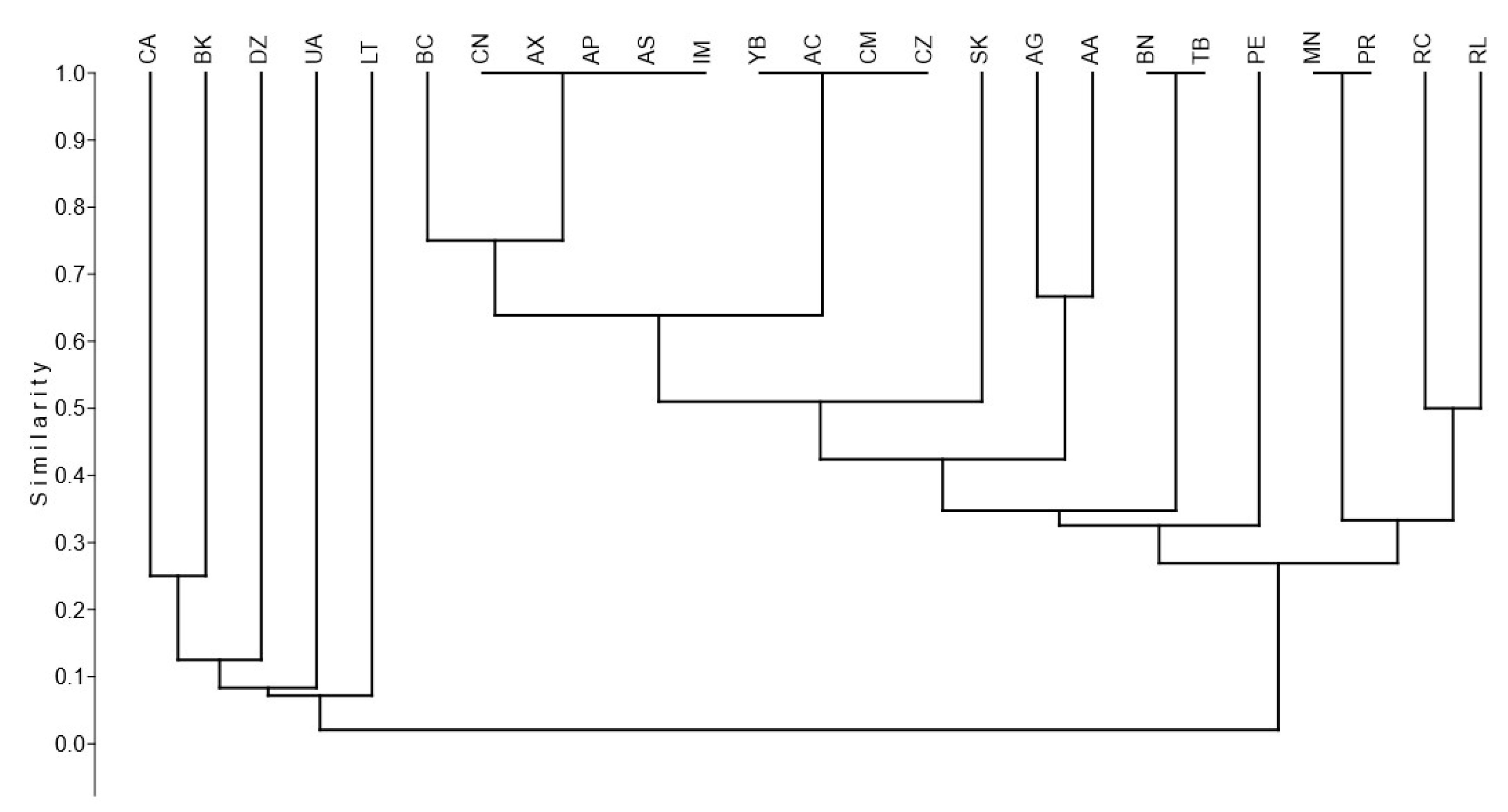
To determine similarity of species in protected areas and identify potential connectivity regions, we generated a dendrogram using the Jaccard index with the PAST statistical program [52]. Jaccard’s index varies between 0 and 1; a value of 0 indicates no species in common, while a value of 1 indicates that the sites have maximum similarity in species composition.
3. Results
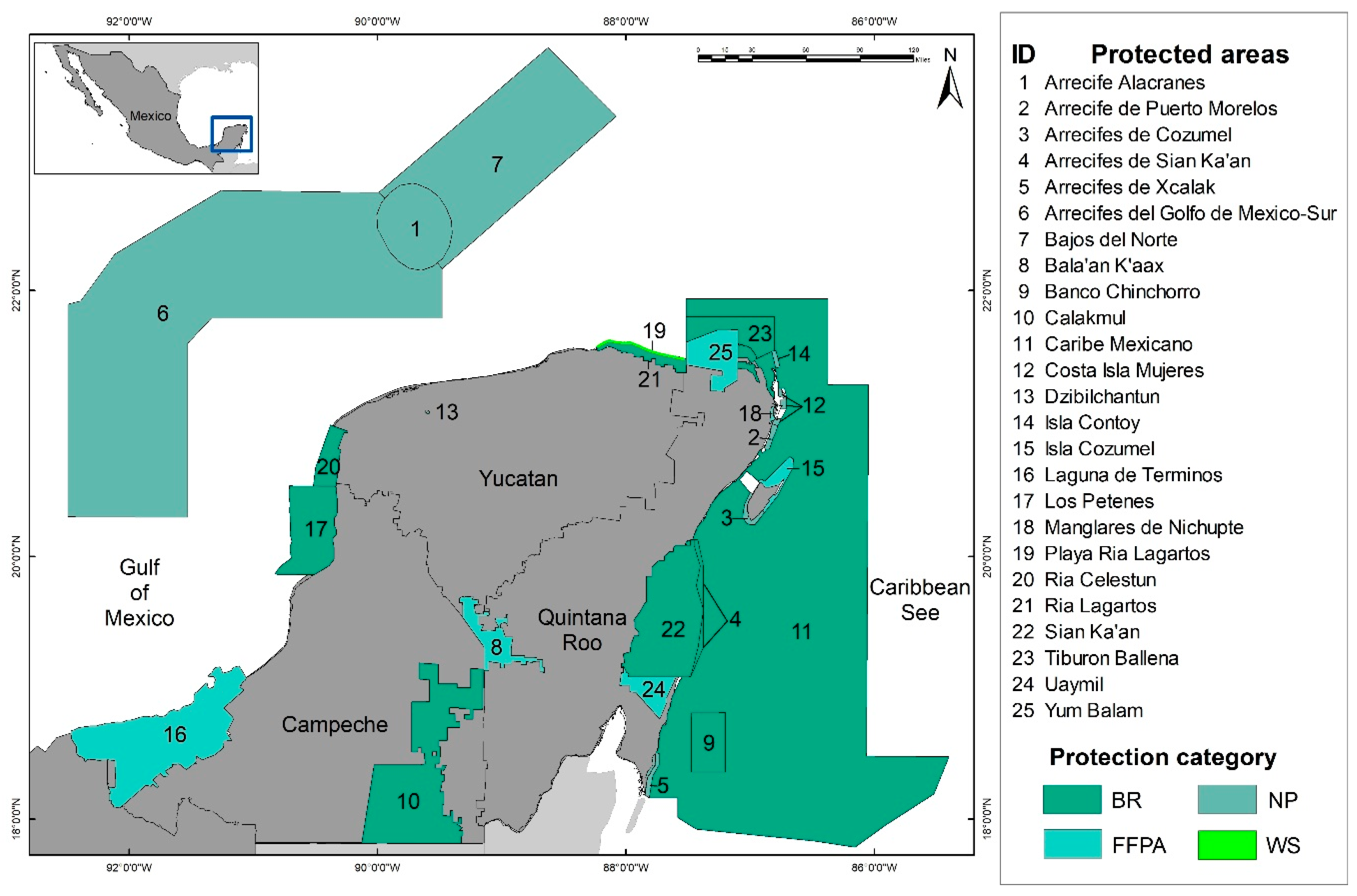
Twenty-two aquatic invasive species were found in 25 of the 40 protected areas (9 Biosphere Reserves, 6 Flora and Fauna Protection Areas, 9 National Parks and a Wildlife Sanctuary; Figure 1). These species were classified into six taxonomic groups: a) macroalgae, b) plants, c) hydrozoans, d) mollusks, e) crustaceans, and f) fish (Table 1). The 25 protected areas have a total surface of 14,682,654.45 ha, of which 12,491,665.27 correspond to marine surface and 2,190,989.18 to terrestrial surface and inland waters (CONANP 2025). According to the Convention on Biological Diversity [53] categorization, the introduction pathways of aquatic invasive species focused on: a) Release in nature (fishery in the wild, including game fishing); b) escape from confinement (aquaculture, aquaria, ornamental purpose, live food); c) transport – stowaway (fishing equipment, ship/boat ballast water, ship/boat hull fouling); e) corridor (interconnected waterways/basins/seas; Table 2).
Regarding the invasiveness index, 15 species have a very high level of invasiveness, six at high level, and one with a medium level (Table 1), representing a severe threat to the aquatic ecosystems of protected areas of the region. The species Caulerpa taxifolia, Eichhornia crassipes, Oreochromis mossambicus and Cyprinus carpio, in addition to having a very high level of invasiveness, are species listed among the 100 worst invasive alien species in the world (Table 2).
Laguna de Terminos Flora and Fauna Protection Area (Figure 1), which contains coastal, marine, and freshwater ecosystems, was the protected area with the highest presence of aquatic invasive species (N=13, Figure 2), The aquatic invasive species with the highest presence in protected areas were: Caulerpa verticillata in 18 areas, and Pterois volitans in 16. (Figure 2), which is evidence of their wide distribution in the marine environment. The most representative taxonomic group was fish, with nine freshwater species and two marine species (Table 1; Figure 1).
According to the similarity analysis, high similarities we found for Arrecife de Puerto Morelos-Arrecifes de Sian Ka’an-Arrecifes de Xcalak-Costa Isla Mujeres-Isla Contoy, with the species Caulerpa verticillata, Ulva lactuca and Pterois volitans; Arrecifes de Cozumel-Caribe Mexicano-Isla Cozumel-Yum Balam, with the species Caulerpa verticillata and Pterois volitans; Bajos del Norte-Tiburon Ballena, with the specie Pterois volitans, and Manglares de Nichupte-Playa Ria Lagartos with the specie Caulerpa verticillata (Table 1; Figure 2; Figure 3). Among the protected areas with intermediate values, we found: Arrecife Alacranes-Arrecifes del Golfo de Mexico-Sur, with the species Caulerpa taxifolia, Caulerpa verticillata, Plumularia setacea and Pterois volitans, and Ría Celestun-Ria Lagartos, with the species Panaeus monodon and Caulerpa verticillata (Table 1; Figure 2; Figure 3). The protected area with the least similarity was Laguna de Terminos, which concentrates 59% of the aquatic invasive species reported for the region, of which 61.53% are found only in this protected area [Tarebia granifera, Charybdis (Charybdis) helleri, Parachromis motaguensis, P. managuensis, Ctenopharyngodon idella, Cyprinus carpio, Pterygoplichthys disjunctivus and P. pardalis; Table 1; Figure 2; Figure 3].

Table 1.
Presence of aquatic invasive species in protected areas of the Yucatan peninsula and adjacent marine zone. Protected areas are represented by the following identification keys: Arrecife Alacranes (AA), Arrecife de Puerto Morelos (AP), Arrecifes de Cozumel (AC), Arrecifes de Sian Ka’an (AS), Arrecifes de Xcalak (AX), Arrecifes del Golfo de Mexico-Sur (AG), Bajos del Norte (BN), Bala’an K’aax (BK), Banco Chinchorro (BC), Calakmul (CA), Caribe Mexicano (CM), Costa Isla Mujeres (IM), Dzibilchantun (DZ), Isla Contoy (CN), Isla Cozumel (CZ), Laguna de Terminos (LT), Los Petenes (PE), Manglares de Nichupte (MN), Playa Ria Lagartos (PR), Ria Celestun (RC), Ria Lagartos (RL), Sian Ka’an (SK), Tiburon Ballena (TB), Uaymil (UA), Yum Balam (YB). The invasiveness levels are represented by the following symbols: very high (▲), high (■), medium (●).
Table 1.
Presence of aquatic invasive species in protected areas of the Yucatan peninsula and adjacent marine zone. Protected areas are represented by the following identification keys: Arrecife Alacranes (AA), Arrecife de Puerto Morelos (AP), Arrecifes de Cozumel (AC), Arrecifes de Sian Ka’an (AS), Arrecifes de Xcalak (AX), Arrecifes del Golfo de Mexico-Sur (AG), Bajos del Norte (BN), Bala’an K’aax (BK), Banco Chinchorro (BC), Calakmul (CA), Caribe Mexicano (CM), Costa Isla Mujeres (IM), Dzibilchantun (DZ), Isla Contoy (CN), Isla Cozumel (CZ), Laguna de Terminos (LT), Los Petenes (PE), Manglares de Nichupte (MN), Playa Ria Lagartos (PR), Ria Celestun (RC), Ria Lagartos (RL), Sian Ka’an (SK), Tiburon Ballena (TB), Uaymil (UA), Yum Balam (YB). The invasiveness levels are represented by the following symbols: very high (▲), high (■), medium (●).
| Taxonomic Group | Family | Taxon | Protected Areas | Reference number |
| Macroalgae | Caulerpaceae |
Caulerpa taxifolia ▲ (M.Vahl) C.Agardh 1817 |
AA, AG | 25, 29, 48 |
|
Caulerpa verticillata ■ J. Agardh, 1847 |
AA, AP, AC, AS, AX, AG, BC, CM, IM, CN, CZ, PE, MN, PR, RC, RL, SK, YB | 25, 28, 29, 34, 35, 37, 38, 40, 41, 44, 45, 48, 54-56 |
||
| Ulvaceae |
Ulva Lactuca ● (Linnaeus, 1753) |
AA, AP, AS, AX, BC, IM, CN, RL, SK | 25, 26, 28, 29, 32, 34, 35, 44, 45, 56 |
|
| Plants | Hydrocharitaceae |
Egeria densa ▲ Planch. |
CA, DZ | 25, 39, 46 |
| Pontederiaceae |
Eichhornia crassipes ▲ (Mart.) Solms |
CA, LT, PE, SK, UA | 25, 34, 46, 57 | |
| Hydrozoans | Cordylophoridae |
Cordylophora caspia ▲ (Pallas, 1771) |
AG | 25, 26, 48 |
| Plumulariidae |
Plumularia setacea ■ (Linnaeus, 1758) |
AA, AG | 25, 26, 48 |
|
| Mollusks | Thiaridae |
Melanoides tuberculata ▲ (O. F. Müller, 1774) |
LT, SK |
25, 34, 58 |
|
Tarebia granifera ▲ (Lamarck, 1816) |
LT | 25, 58, 59 | ||
| Crustaceans | Penaeidae |
Penaeus monodon ▲ (Fabricius, 1798) |
LT, RC, RL | 25, 26, 56, 58, 60-63 |
| Portunidae | Charybdis (Charybdis) helleri ■ (A. Milne-Edwards, 1867) |
LT |
25, 64 |
|
| Fish | Cichlidae |
Oreochromis aureus ▲ (Steindachner, 1864) |
LT, PE | 25, 26, 65 |
|
Oreochromis mossambicus ▲ (Peters, 1852) |
CA |
25, 66 |
||
|
Oreochromis niloticus ▲ (Linnaeus, 1758) |
BK, CA, LT, PE, RC | 25, 31, 56, 65-68 |
||
|
Parachromis managuensis ■ (Günther, 1867) |
LT |
25, 58, 67, 69 | ||
|
Parachromis motaguensis ■ (Günther, 1867) |
25, 58 |
|||
| Cyprinidae |
Ctenopharyngodon idella ▲ (Valenciennes, 1844) |
25, 58, 67, 69 | ||
|
Cyprinus carpio ▲ (Linnaeus, 1758) |
25, 58 | |||
| Loricariidae |
Pterygoplichthys disjunctivus ▲ (Weber, 1991) |
25, 58, 67, 69-73 | ||
|
Pterygoplichthys pardalis ■ (Castelnau, 1855) |
25, 58, 67, 69-74 | |||
| Scorpaenidae |
Pterois miles ▲ (Bennett, 1828) |
BC | 75 | |
|
Pterois volitans ▲ (Linnaeus, 1758) |
AA, AP, AC, AS, AX, AG, BN, BC, CM, IM, CN, CZ, PE, SK, TB, YB |
25, 35-38, 40, 41, 47, 48, 72, 76-81 |
Table 2.
Pathways and vectors of the aquatic invasive species [49,50,83]. ► Species listed among the 100 worst invasive alien species in the world [82].
| Taxon | Pathways and vectors |
|
Caulerpa taxifolia ► |
Fishing nets, boat anchors, fishing equipment, pets trade, intentional release, improperly disposed waste from aquaria, internet sales |
| Caulerpa verticillata | Fisheries, boat anchors, trade for use in aquaria, intentional release |
| Ulva Lactuca | Ship ballast water and sediment, intentional release |
|
Egeria densa |
Trade for use in aquaria, improperly disposed waste from aquaria, it spreads by moving waters that carry whole plants or stem fragments to new locations |
|
Eichhornia crassipes ► |
Internet sales, popular ornamental plant for ponds, canoes and boats, unwanted plant material is discarded into creeks, rivers and dams |
| Cordylophora caspia | Aquaculture stock, ship hulls, ballast water, floating plant material, commercial oysters, dumping aquaria |
| Plumularia setacea | Fisheries, aquaculture, ballast water, dry ballast, biofouling, packing material |
| Melanoides tuberculata | Trade in aquarium plants and fish, aquaculture, ornamental purposes, flooding, internet sales |
| Tarebia granifera | Trade for use in aquaria, improperly disposed waste from aquaria |
| Penaeus monodon | Aquaculture, breeding and propagation, ship ballast water and sediment, research |
| Charybdis (Charybdis) helleri | Interconnected waterways, ship ballast water and sediment, hull fouling |
| Oreochromis aureus | Aquaculture, escape from confinement or garden escape, intentional release, live food trade, pet trade |
|
Oreochromis mossambicus ► |
Sport fishing, aquaculture, escape from confinement or garden escape, weed and midge control, research, intentional release, food for game fishes |
| Oreochromis niloticus | Fisheries, aquaculture, live food trade, escape from confinement or garden escape, intentional release |
| Parachromis managuensis | Trade for use in aquaria, aquaculture, escape from confinement or garden escape |
| Parachromis motaguensis | |
| Ctenopharyngodon idella | Weed control, aquaculture, sport fishing |
|
Cyprinus carpio ► |
Fisheries, aquaculture, intentional release, sport fishing, interconnected waterways, ornamental purposes, pet trade, escape from confinement or garden escape |
| Pterygoplichthys disjunctivus | Escapes from aquaculture farms, aquarium trade, intentional release, live food trade |
| Pterygoplichthys pardalis | |
| Pterois miles | Pet trade, intentional release, ship ballast water and sediment (eggs and larvae), hurricanes |
| Pterois volitans |
References of information according to Table 1.
Figure 2.
Presence-absence relationship of aquatic invasive species in the protected areas of the Yucatan peninsula and adjacent marine zone. The bigger the circle, the greater the presence. Identification keys for protected areas according to Table 1.
Figure 2.
Presence-absence relationship of aquatic invasive species in the protected areas of the Yucatan peninsula and adjacent marine zone. The bigger the circle, the greater the presence. Identification keys for protected areas according to Table 1.
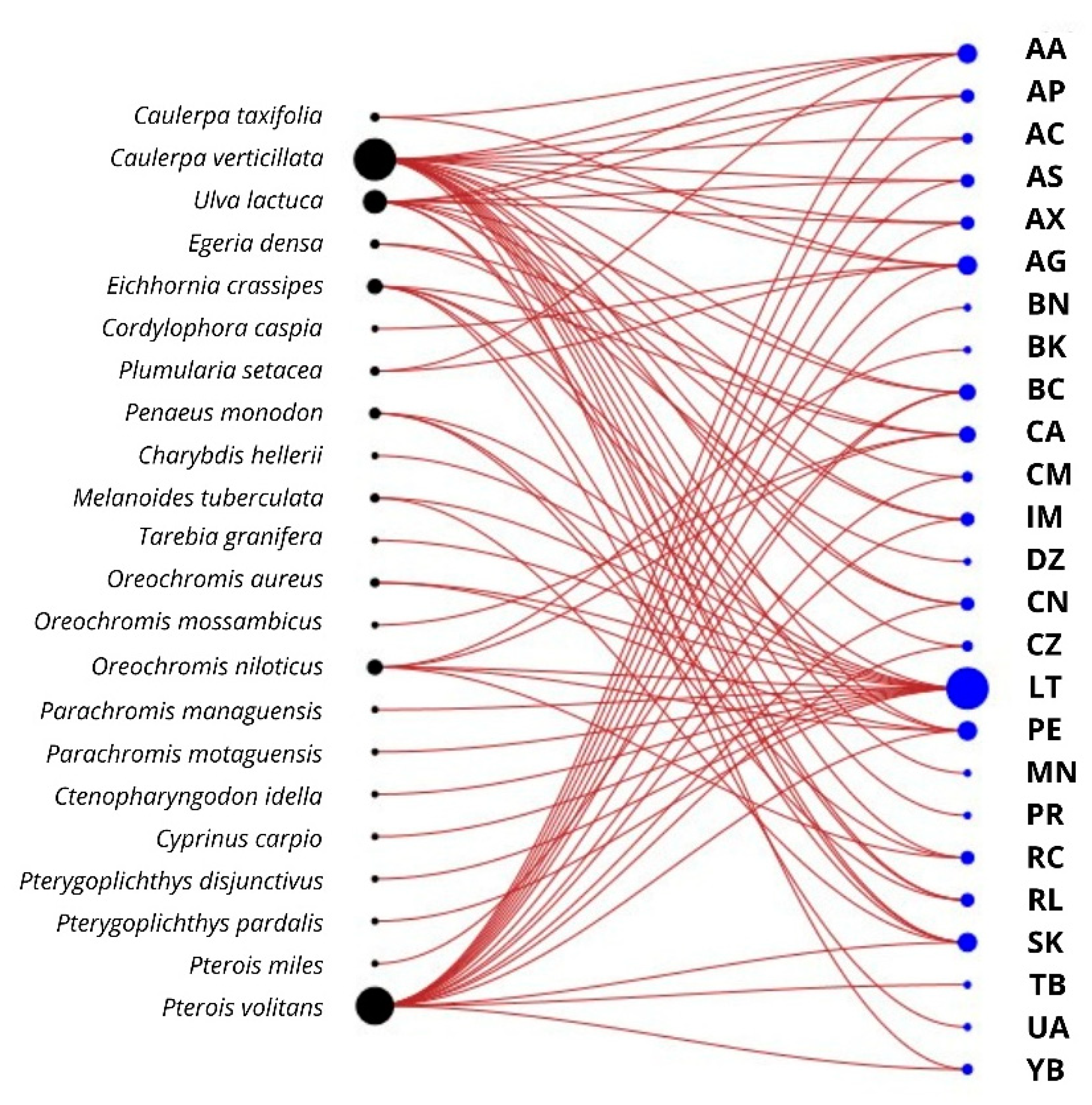
Figure 3.
Dendrogram of similarity of aquatic invasive species in protected areas of the Yucatan peninsula and adjacent marine zone. Identification keys for protected areas according to Table 1.
Figure 3.
Dendrogram of similarity of aquatic invasive species in protected areas of the Yucatan peninsula and adjacent marine zone. Identification keys for protected areas according to Table 1.
4. Discussion
The arrival of alien species is unsure; yet possible modes as to how the species will have arrived can form some basis for practical management [84], taking as a reference the pathways and methods of propagation of species that arrived in the past [85,86]. A single pathway may not be responsible for an introduction, as a relay of different pathways and their vectors could be involved [86]. The introduction pathways identified in Table 2 show that, for both inland aquatic and marine species, intentional releases, ballast water and biofouling are the most significant means by which alien species reach ecosystems, therefore, management the pathways through which alien species arrive and spread is important to reduce the threat of biological invasions [85,87,88].
In this article we take an important step towards establishing a baseline on the presence of aquatic invasive species in protected areas in the Yucatan Peninsula and adjacent marine zone. Updating species lists and distribution data is crucial for successful long-term management [17]. Specifically, the information generated in protected areas on invasive species must be given the same importance as the information generated for species at risk, since, depending on the level of knowledge available, the best decisions can be made for the restoration and conservation of ecosystems.
Although the region’s protected areas present diverse ecosystems, protection categories, extension and problems, the Laguna de Terminos Flora and Fauna Protection Area (Figure 1) stand out due to the 13 aquatic invasive species distributed there, 70% of which have a very high invasive risk. The species that represent the greatest risk in this protected area are invasive fish: Pterygoplichthys disjunctivus and P. pardalis, which have been widely studied for their effects on the trophic chains of freshwater ecosystems [58,69,70,71,73], these effects are characterized by alterations in the structure of the fish community, positioning them as dominant species in estuarine systems, as occurs in the Palizada-Del Este area [2014]; adaptive capacity to brackish environments competing for space with native fish, as has been documented at the mouth of the Chumpan River [70]; incidence on siltation and erosion processes [73], and destruction of fishing gear, causing a decrease in the catch of commercially important species [58,73].
In the marine environment, the lionfish (Pterois volitans) represents the species with the largest geographical range, since it is found in all the protected areas of the northern Yucatan Peninsula and the Mexican Caribbean. Pterois volitans is a threat to the marine ecosystems, mainly for coral reefs [77,78,79,80,81,89] because individuals reproduce fast [77,81], reach high population densities [77,79], consume a wide range of native fish and invertebrate species [78,79,80,89] and can potentially compete for shelter with native species [89]. In addition, lionfish have economic risks because its diet habits not only include juveniles of commercially important species such as lobsters, but because it also competes with snappers (Lutjanidae) and grouper (Serranidae) for food and habitat [79].
The similarity analysis determined that the groups: Bajos del Norte-Tiburon Ballena, Arrecifes de Cozumel-Caribe Mexicano-Isla Cozumel-Yum Balam, and Arrecife Puerto Morelos-Arrecifes de Sian Ka’an-Arrecifes de Xcalak-Costa Isla Mujeres-Isla Contoy (Figure 3) present the same species composition in each group; all areas are marine, and Pterois volitans is present in all these areas. Banco Chinchorro has a similarity of 0.75 (Figure 3) with the group Arrecife Puerto Morelos-Arrecifes de Sian Ka’an-Arrecifes de Xcalak-Costa Isla Mujeres-Isla Contoy, the difference is that Banco Chinchorro has an additional species: Pterois miles, which was the only species that had a single record in a protected area [75] (Guzmán-Méndez et al. 2017). In the Arrecife Alacranes-Arrecifes del Golfo de Mexico-Sur group, it is noteworthy that they are adjacent areas (Figure 1, Figure 3), and that together they conserve a marine surface of 4,443,433 ha [24]. The Ria Celestun-Ria Lagartos cluster (Figure 3) stands out because both biosphere reserves share characteristics of shape, extension, ecosystems and problems [56], although they are located at opposite ends of the coastal zone of the state of Yucatan (Figure 1). Similarity results can guide management measures for invasive species, since, by sharing species, protected area managers must implement coordinated actions at a regional level, mainly in marine areas with high connectivity. The key elements to achieve this coordination could be trained personnel, standardized control and notification methods per species or taxonomic group, systematic monitoring, early detection, rapid response and long-term maintenance programs [17].
5. Conclusions
It is urgent to coordinate management strategies for aquatic invasive species in protected areas, since they are key sites for the conservation of a wide variety of ecosystems and biodiversity, and they maintain fundamental ecological characteristics for greater biotic resistance to biological invasions. Early detection and rapid response will be decisive to avoid the effects that some species have already shown to have on aquatic ecosystems and the economy of the communities in the region. The lionfish (Pterois volitans) invasion has been shown to have significant repercussions not only on the structure and functioning of coral reef systems, but also on the tourism and fishing sector [77-81; 89]. The sailfin catfishes (Pterygoplichthys disjunctivus and P. pardalis), have significantly altered the food webs of inland aquatic ecosystems, caused the reduction of biomass of commercially important species and damaged the fishing gear of local fishermen [58,69,70,71,73].
Systematic monitoring will significantly strengthen prevention strategies and generate information on new or established species, including their distribution, abundance, and impacts, which will provide information to redirect economic resources towards management, control or eradication. The information generated in this work can be useful for decision makers in the protected areas of the Yucatan Peninsula and the adjacent marine zone, as it provides an update on the presence of aquatic invasive species, introduction pathways and their level of invasion.
Author Contributions
Conceptualization: ERH, LAAP, JG.; Data curation: ERH.; Formal analysis: ERH, JG, RTL.; Funding acquisition: ERH, LAAP.; Investigation: ERH, LAAP, JG, RTL, BIVR.; Methodology: ERH, LAAP, JG.; Project administration: ERH.; Resources: ERH, LAAP, JG, RTL, BIVR.; Software: ERH, BIVR.; Supervision: ERH.; Validation: ERH, LAAP, JG, RTL, BIVR.; Visualization: ERH.; Writing – original draft: ERH, LAAP.; Writing – review & editing: ERH, LAAP, JG, RTL, BIVR. All authors have read and agreed to the published version of the manuscript.
Funding
ERH was supported by a PhD grant from the Ministry of Science, Humanities, Technology and Innovation (SECIHTI, Mexico). LAAP was funded by the Metropolitan Autonomous University–Xochimilco, through the project “Ecology models and fish population dynamics in tropical coastal estuarine systems”.
Institutional Review Board Statement
Not applicable.
Informed Consent Statement
Not applicable.
Data Availability Statement
The original contributions presented in this study are included in the article. Further inquiries can be directed to the corresponding author.
Acknowledgements
The authors thank the Division of Biological and Health Sciences of the Metropolitan Autonomous University–Xochimilco for their support in producing this paper. We further thank comments provided by reviewers.
Conflicts of Interest
The authors have declared that no competing interests exist.
References
- Blackburn TM, Bellard C, Ricciardi A (2019) Alien versus native species as drivers of recent extinctions. Frontiers in Ecology and the Environment 17(4): 203–207. [CrossRef]
- Pyšek P, Hulme PE, Simberloff D, Bacher S, Blackburn TM, Carlton JT, Dawson W, Essl F, Foxcroft LC, Genovesi P, Jeschke JM, Kühn I, Liebhold AM, Mandrake NE, Meyerson LA, Pauchard A, Pergl J, Roy HE, Seebens H, van Kleunen M, Vilà M, Wingfield MJ, Richardson DM (2020) Scientists’ warning on invasive alien species. Biological Reviews of the Cambridge Philosophical Society 95(6): 1511–1534. [CrossRef]
- IPBES (2023) Thematic assessment report on invasive alien species and their control of the Intergovernmental Science-Policy Platform on Biodiversity and Ecosystem Services. IPBES secretariat, Bonn, Germany. [CrossRef]
- Gallardo B, Clavero M, Sánchez MI, Vilà M (2016) Global ecological impacts of invasive species in aquatic ecosystems. Global Change Biology 22: 151–163. [CrossRef]
- Meira A, Carvalho F, Castro P, Souza R (2024) Applications of biosensors in non-native freshwater species: a systematic review. NeoBiota 96: 211–236. [CrossRef]
- Cuthbert RN, Pattison Z, Taylor NG, Verbrugge L, Diagne C, Ahmed DA, Leroy B, Angulo E, Briski E, Capinha C, Catford JA, Dalu T, Essl F, Gozlan RE, Haubrock PJ, Kourantidou M, Kramer AM, Renault D, Wasserman RJ, Courchamp F (2021) Global economic costs of aquatic invasive alien species, Science of The Total Environment 775, 145238. [CrossRef]
- Rico-Sanchez AE, Haubrock PJ, Cuthbert RN, Angulo E, Ballesteros-Mejia L, Lopez-Lopez E, Duboscq-Carra VG, Nunez MA, Diagne C, Courchamp F (2021) Economic costs of invasive alien species in Mexico. In: Zenni RD, McDermott S, Garcia-Berthou E, Essl F. (Eds) The economic costs of biological invasions around the world. NeoBiota 67: 459–483. [CrossRef]
- Perrin SW, Lundmark C, Wenaas CP, Finstad AG (2024) Contrasts in perception of the interaction between non-native species and climate change. NeoBiota 96: 343–361. [CrossRef]
- Seebens H, Bacher S, Blackburn TM, Capinha C, Dawson W, Dullinger S, Genovesi P, Hulme PE, van Kleunen M, Kühn I, Jeschke JM, Lenzner B, Liebhold AM, Pattison Z, Pergl J, Pyšek P, Winter M, Essl F (2021) Projecting the continental accumulation of alien species through to 2050. Global Change Biology 27: 970-982. [CrossRef]
- Vitousek PM, D’Antonio CM, Loope LL, Rejmánek M, Westbrooks R (1997) Introduced species: A significant component of human-caused global change. New Zealand Journal of Ecology 21(1): 1-16. http://www.jstor.org/stable/24054520.
- Havel JE, Kovalenko KE, Thomaz SM, Amalfitano S, Kats LB (2015) Aquatic invasive species: Challenges for the future. Hydrobiologia 750: 147–170. [CrossRef]
- Saunders DL, Meeuwig JJ, Vincent AC (2002). Freshwater protected areas: Strategies for conservation. Conservation Biology 16(1): 30–41. [CrossRef]
- Kiruba-Sankar R, Praveen J, Saravanan K, Lohith K, Raymond J, Velmurugan A, Dam S (2018) Invasive species in freshwater ecosystems – threats to ecosystem services. In: Sivaperuman C, Velmurugan A, Kumar A, Jaisankar I (Eds). Biodiversity and climate change adaptation in tropical islands, 257–296. [CrossRef]
- Baxter CV, Fausch KD, Murakami M, Chapman PL (2004) Fish invasion restructures stream and forest food webs by interrupting reciprocal prey subsidies. Ecology 85(10): 2656–2663. [CrossRef]
- Dimitriadis C, Fournari-Konstantinidou I, Sourbès L, Koutsoubas D, Katsanevakis S (2021) Long term interactions of native and invasive species in a marine protected area suggest complex cascading effects challenging conservation outcomes. Diversity 13(71). [CrossRef]
- Bax N, Williamson A, Agüero M, Gonzalez E, Geeves W (2003) Marine invasive alien species: A threat to global biodiversity, Marine Policy 27(4): 313-323. [CrossRef]
- Foxcroft LC, Richardson DM, Pyšek P, Genovesi P (2013) Invasive alien plants in protected areas: Threats, opportunities, and the way forward. In: Foxcroft LC, Richardson DM, Pyšek P, Genovesi P (Eds) Plant invasions in protected areas, invading nature - Springer Series in Invasion Ecology 7: 621–639. [CrossRef]
- Braun M, Schindler S, Essl F (2016) Distribution and management of invasive alien plant species in protected areas in Central Europe. Journal for Nature Conservation 33, 48–57. [CrossRef]
- Holenstein K, Simonson WD, Smith KG, Blackburn TM, Charpentier A (2021) Non-native species surrounding protected areas influence the community of non-native species within them. Frontiers in Ecology and Evolution, 8:625137. [CrossRef]
- CONABIO [Comisión Nacional para el Conocimiento y Uso de la Biodiversidad] (1997) Provincias biogeográficas de México, escala 1: 4,000,000. Available online: http://geoportal.conabio.gob.mx/descargas/mapas/imagen/96/rbiog4mgw (accessed on 7 January 2025).
- Arriaga L, Aguilar V, Alcocer J (2002) Aguas continentales y diversidad biológica de México. CONABIO, México. https://www.biodiversidad.gob.mx/pais/regiones-hidrologicas-prioritarias-de-Mexico.
- Arriaga L, Vázquez E, González J, Jiménez R, Muñoz E, Aguilar V (1998) Regiones marinas prioritarias de México. CONABIO, México. https://www.biodiversidad.gob.mx/pais/regiones-marinas-prioritarias-de-mexico.
- Arriaga L, Espinoza-Rodríguez JM, Aguilar-Zúñiga C, Martínez-Romero E, Gómez-Mendoza L, Loa E (2000) Regiones terrestres prioritarias de México. CONABIO, México. https://bioteca.biodiversidad.gob.mx/janium-bin/detalle.pl?Id=20250103185318.
- CONANP [Comisión Nacional de Áreas Naturales Protegidas] (2025) Listado de las áreas naturales protegidas de México. Available online: https://sig.conanp.gob.mx/General (accessed on 7 January 2025).
- CONABIO [Comisión Nacional para el Conocimiento y Uso de la Biodiversidad] (2025) Sistema Nacional de Información sobre Biodiversidad. Available online: https://www.snib.mx/ (accessed on 6 January 2025).
- GBIF [Global Biodiversity Information Facility] (2025) GBIF México.
- Available online: https://www.gbif.org/ (accessed on 6 January 2025).
- CONANP [Comisión Nacional de Áreas Naturales Protegidas] (2000) Programa de Manejo Reserva de la Biosfera Ría Celestún. CONANP, México. https://www.conanp.gob.mx/que_hacemos/pdf/programas_manejo/celestun.pdf.
- CONANP [Comisión Nacional de Áreas Naturales Protegidas] (2004) Programa de Manejo Parque Nacional Arrecifes de Xcalak. CONANP, México, 161 pp. https://www.conanp.gob.mx/que_hacemos/pdf/programas_manejo/Xcalak_ok.pdf.
- CONANP [Comisión Nacional de Áreas Naturales Protegidas] (2006a) Programa de Conservación y Manejo Parque Nacional Arrecife Alacranes. CONANP, México, 165 pp. https://www.conanp.gob.mx/que_hacemos/pdf/programas_manejo/alacranes_ok.pdf.
- CONANP [Comisión Nacional de Áreas Naturales Protegidas] (2006b) Programa de Conservación y Manejo Reserva de la Biosfera Los Petenes. CONANP, México, 203 pp. https://www.conanp.gob.mx/que_hacemos/pdf/programas_manejo/petenes_final.pdf.
- CONANP [Comisión Nacional de Áreas Naturales Protegidas] (2007a) Programa de Conservación y Manejo Área de Protección de Flora y Fauna Bala’an K’aax. CONANP, México, 169 pp. https://www.conanp.gob.mx/que_hacemos/pdf/programas_manejo/Final_BallanKaxx.pdf.
- CONANP [Comisión Nacional de Áreas Naturales Protegidas] (2007b) Programa de Conservación y Manejo Reserva de la Biosfera Ría Lagartos. CONANP, México, 266 pp. https://www.conanp.gob.mx/anp/consulta/PCM_RiaLagartos.pdf.
- CONANP [Comisión Nacional de Áreas Naturales Protegidas] (2014a) Programa de Manejo Área de Protección de Flora y Fauna Manglares de Nichupté. CONANP, México, 137 pp. https://www.conanp.gob.mx/que_hacemos/pdf/programas_manejo/2015/Manglares_de_Nichupt%C3%A9.pdf.
- CONANP [Comisión Nacional de Áreas Naturales Protegidas] (2014b) Programa de Manejo Complejo Sian Ka’an: Reserva de la Biosfera Sian Ka’an, Área de Protección de Flora y Fauna Uaymil y Reserva de la Biosfera Arrecifes de Sian Ka’an. CONANP, México, 481 pp. https://www.conanp.gob.mx/que_hacemos/pdf/programas_manejo/2015/Complejo_Sian_Ka_an.pdf.
- CONANP [Comisión Nacional de Áreas Naturales Protegidas] (2015a) Programa de Manejo Parque Nacional Isla Contoy. CONANP, México, 215 pp. https://www.conanp.gob.mx/que_hacemos/pdf/programas_manejo/2015/Isla_Contoy_completo.pdf.
- CONANP [Comisión Nacional de Áreas Naturales Protegidas] (2015b) Programa de Manejo Reserva de la Biosfera Tiburón Ballena. CONANP, México, 162 pp. https://www.conanp.gob.mx/que_hacemos/pdf/programas_manejo/2015/Tiburon_Ballena_Libro.pdf.
- CONANP [Comisión Nacional de Áreas Naturales Protegidas] (2016a) Programa de Manejo Área de Protección de Flora y Fauna La Porción Norte y la Franja Costera Oriental, Terrestres y Marinas de la Isla de Cozumel. CONANP, México, 243 pp. https://www.conanp.gob.mx/que_hacemos/pdf/programas_manejo/2017/Isla%20Cozumel%20(completo).pdf.
- CONANP [Comisión Nacional de Áreas Naturales Protegidas] (2016b) Programa de Manejo Parque Nacional Costa Occidental de Isla Mujeres, Punta Cancún y Punta Nizuc. CONANP, México, 228 pp. https://www.conanp.gob.mx/que_hacemos/pdf/programas_manejo/2017/Isla%20Mujeres%20Punta%20Canc%C3%BAn.pdf.
- CONANP [Comisión Nacional de Áreas Naturales Protegidas] (2016c) Programa de Manejo Parque Nacional Dzibilchantún. CONANP, México, 171 pp. https://www.conanp.gob.mx/acciones/pdf/PMDZIBILCHANTUNCompleto.pdf.
- CONANP [Comisión Nacional de Áreas Naturales Protegidas] (2019a) Programa de Manejo Área de Protección de Flora y Fauna Yum Balam. CONANP, México, 284 pp. https://www.conanp.gob.mx/programademanejo/PMYumBalam.pdf.
- CONANP [Comisión Nacional de Áreas Naturales Protegidas] (2019b) Programa de Manejo Reserva de la Biosfera Caribe Mexicano. CONANP, México, 366 pp. https://www.conanp.gob.mx/programademanejo/PMCaribeMexicano.pdf.
- INE [Instituto Nacional de Ecología] (1997) Programa de Manejo del Área de Protección de Flora y Fauna Laguna de Términos. INE, México, 167 pp. https://www.conanp.gob.mx/que_hacemos/pdf/programas_manejo/APFFTerminos.pdf.
- INE [Instituto Nacional de Ecología] (1998) Programa de Manejo Parque Marino Nacional Arrecifes de Cozumel. INE, México, 164 pp. https://www.conanp.gob.mx/que_hacemos/pdf/programas_manejo/cozumel.pdf.
- INE [Instituto Nacional de Ecología] (2000a) Programa de Manejo Parque Nacional Arrecife de Puerto Morelos. INE, México, 223 pp. https://www.conanp.gob.mx/que_hacemos/pdf/programas_manejo/puerto_morelos.pdf.
- INE [Instituto Nacional de Ecología] (2000b) Programa de Manejo Reserva de la Biosfera Banco Chinchorro. INE, México, 189 pp.https://www.conanp.gob.mx/que_hacemos/pdf/programas_manejo/chinchorro.pdf.
- INE [Instituto Nacional de Ecología] (2000c) Programa de Manejo Reserva de la Biosfera Calakmul, México. INE, 268 pp.https://www.conanp.gob.mx/que_hacemos/pdf/programas_manejo/calakmul.pdf.
- CONANP [Comisión Nacional de Áreas Naturales Protegidas] (2023) Estudio Previo Justificativo para el establecimiento del Área Natural Protegida Parque Nacional Bajos del Norte, Golfo de México. CONANP, México, 171 pp.https://www.conanp.gob.mx/pdf/separata/EPJ-PN-BajosDelNorte.pdf.
- CONANP [Comisión Nacional de Áreas Naturales Protegidas] (2024) Estudio Previo Justificativo para el establecimiento del Área Natural Protegida Arrecifes del Golfo de México-Sur, México. CONANP, México, 383 pp. https://www.conanp.gob.mx/pdf/separata/EPJ-PN-ArrecifesDelGolfoDeMexico-Sur.pdf.
- GISD [Global Invasive Species Database] (2025) Global Invasive Species Database. Available online: https://www.iucngisd.org/gisd/ (accessed on 8 January 2025).
- CABI [Centre for Agricultural Bioscience International] (2025) Compendium Invasive Species. Available online: https://www.cabi.org/ (accessed on 8 January 2025).
- CONABIO [Comisión Nacional para el Conocimiento y Uso de la Biodiversidad] (2015) Método de Evaluación Rápida de Invasividad (MERI) para especies exóticas en México. https://www.biodiversidad.gob.mx/media/1/especies/Invasoras/files/Instrutivo_MERI_2020.pdf.
- PAST Core Team (2025) PAST: A software for scientific data analysis. https://www.nhm.uio.no/english/research/resources/past/.
- CBD [Convention on Biological Diversity] (2014) UNEP/CBD/SBSTTA/18/9/Add.1. Pathways of introduction of invasive alien species, their prioritization and management. https://www.cbd.int/doc/meetings/sbstta/sbstta-18/official/sbstta-18-09-add1-en.pdf.
- Collado-Vides L, González-González J, Ezcurra E (1995) Patrones de distribución ficofloristica en el sistema lagunar de Nichupté, Quintana Roo, México. Acta Botánica Mexicana 31: 19-32. [CrossRef]
- Espinoza-Avalos J, Aguilar-Rosas LE, Aguilar-Rosas R, Gómez-Poot JM, Raigoza-Figueras R (2015) Presencia de caulerpaceae (Chlorophyta) en la Península de Yucatán, México. Botanical Sciences 93(4): 845-854. [CrossRef]
- Rendón-Hernández E, Ayala-Pérez LA, Golubov J, Torres-Lara R (2024) Especies exóticas invasoras y sus implicaciones sobre los bosques de manglar en las Reservas de la Biosfera Ría Celestún y Ría Lagartos. Madera y Bosques 30(4). [CrossRef]
- Endañú-Huerta E, López-Contreras JE, Amador-Del Ángel LE, Guevara-Carrió E, Alderete-Chávez A, Brito-Pérez R (2015) Flora exótica naturalizada e invasora del Área de Protección de Flora y Fauna Laguna de Términos, Campeche: Estado actual, impactos, necesidades y perspectivas. In: Amador-Del Ángel LE, Frutos-Cortés M (Eds) Problemas contemporáneos regionales del Sureste Mexicano El caso del estado de Campeche. Universidad Autónoma del Carmen, México, 280-307.
- Amador-Del Ángel LE, Endañú-Huerta E, López-Contreras JE, Wakida-Kusunoki AT, Guevara-Carrió E, Brito-Pérez R (2015) Fauna exótica establecida e invasora en el Área de Protección de Flora y Fauna Laguna de Términos, Campeche: Estado actual, impactos, necesidades y perspectivas. In: Amador-Del Ángel LE, Frutos-Cortés M (Eds) Problemas contemporáneos regionales del Sureste Mexicano El caso del estado de Campeche. Universidad Autónoma del Carmen, México, 128-154.
- Trinidad-Ocaña C, Juárez-Flores J, Sánchez AJ, Barba-Macías E (2018) Diversidad de moluscos y crustáceos acuáticos en tres zonas en la cuenca del Río Usumacinta, México. Revista Mexicana de Biodiversidad, 89: S65-S78. [CrossRef]
- Gómez-Ponce MA, Bolaños-Martínez N, Díaz-Jaimes P, Bortolini-Rosales JL, Castellanos P (2020) A new record of a tiger shrimp Penaeus monodon Fabricius, 1798 breeding female in the coast of Campeche, Mexico. Latin American Journal of Aquatic Research 48(1): 150-155. [CrossRef]
- Wakida-Kusunoki AT, Rojas-González RI, González-Cruz A, Del Ángel A, Sánchez-Cruz JL, López NA (2013) Presence of giant tiger shrimp Penaeus monodon Fabricius, 1798 on the Mexican coast of the Gulf of Mexico. BioInvasions Records, 2(4): 325–328. [CrossRef]
- Wakida-Kusunoki AT, De Anda-Fuentes D, López-Téllez NA (2016) Presence of giant tiger shrimp Penaeus monodon (Fabricius, 1798) in eastern Peninsula of Yucatan coast, Mexico. Latin American Journal of Aquatic Research 44(1): 155-158. [CrossRef]
- Wakida-Kusunoki AT, Cruz-Sánchez JL, López-Téllez NA (2021) A review of recent sightings and reports of the giant tiger shrimp Penaeus monodon (Decapoda: Penaeidae) on the Mexican coast of the Gulf of Mexico (2012-2019). Revista de Biología Marina y Oceanografía 56 (1): 83-88. [CrossRef]
- Simoes N, Wakida-Kusunoki AT, Cruz-Sánchez JL, Alvarez F, Villalobos-Hiriart JL (2019) On the presence of Charybdis (Charybdis) hellerii (A. Milne-Edwards, 1867) on the Mexican coast of the Gulf of Mexico. BioInvasions Records 8(3): 670–674. [CrossRef]
- Torres-Castro IL, Vega-Cendejas MA, Schmitter-Soto JJ, Palacio-Aponte G, Rodiles-Hernández R (2009) Ictiofauna de sistemas cárstico-palustres con impacto antrópico: Los petenes de Campeche, México. Revista de Biología Tropical 57(1-2): 141-157.https://www.scielo.sa.cr/scielo.php?pid=S0034-77442009000100014&script=sci_arttext.
- Vega-Cendejas MA (2010) Estudio de caso: los peces de la Reserva de Calakmul. In: Villalobos-Zapata GJ, Mendoza J (Coord) La Biodiversidad en Campeche: Estudio de Estado. Comisión Nacional para el Conocimiento y Uso de la Biodiversidad, Gobierno del Estado de Campeche, Universidad Autónoma de Campeche, El Colegio de la Frontera Sur. México, 729 pp.https://bioteca.biodiversidad.gob.mx/janium/Documentos/7371.pdf.
- Amador-Del Ángel LE, Wakida-Kusunoki AT, Guevara-Carrió EC, Brito-Pérez R, Cabrera-Rodríguez P (2009) Peces invasores de agua dulce en la región de la Laguna de Términos, Campeche. UNACAR Tecnociencia 3(2): 11-28.https://biblat.unam.mx/hevila/UNACARtecnociencia/2009/no2/2.pdf.
- Ayala-Pérez LA, Ramos-Miranda J, Flores-Hernández, D (2003) La comunidad de peces de la Laguna de Términos: estructura actual comparada. Biología Tropical 50(3-4): 783-793. https://www.redalyc.org/articulo.oa?id=44911882020.
- Amador-Del Ángel LE, Guevara E, Brito R, Wakida-Kusunoki AT, Cabrera-Rodríguez P (2012) Aportaciones recientes al estudio de la ictiofauna del Área de Protección de Flora y Fauna Laguna de Términos, Campeche. In: Ruíz A, Canedo Y, Zavala JC, Campos SC, Sabido MY, Ayala LA, Amador-Del Ángel LE (Eds) Aspectos hidrológicos y ambientales en la Laguna de Términos. Universidad Autónoma del Carmen, México, 128-154.
- Álvarez-Pliego N, Sánchez AJ, Florido R, Salcedo MA (2015) First record of South American suckermouth armored catfishes (Loricariidae, Pterygoplichthys spp.) in the Chumpan River system, southeast Mexico. BioInvasions Records 4(4): 309–314. [CrossRef]
- Ayala-Pérez LA, Pineda-Peralta AD, Álvarez-Guillen H, Amador-Del Ángel LE (2014) El pez diablo (Pterygoplichthys spp.) en las cabeceras estuarinas de la Laguna de Términos, Campeche. In: Low A, Quijón P, Peters E (Eds) Especies Invasoras Acuáticas: Casos de Estudio en Ecosistemas de México. Secretaría de Medio Ambiente y Recursos Naturales, Instituto Nacional de Ecología y Cambio Climático, University of Prince Edward Island, México, 313-336. https://agua.org.mx/biblioteca/especies-invasoras-acuaticas-casos-de-estudio-en-ecosistemas-de-mexico-2/.
- Rendón E, Bernal JF, Hernández B, Müller E (2017) Estrategias de atención a especies exóticas invasoras en áreas naturales protegidas de competencia federal en México. In: Born-Schmidt G, de Alba F, Parpal J, Koleff P (Coord) Principales retos que enfrenta México ante las especies exóticas invasoras. Centro de Estudios Sociales y de Opinión Pública, Cámara de Diputados, México, 209-224.http://www5.diputados.gob.mx/index.php/esl/Centros-de-Estudio/CESOP/Novedades/Libro.-Principales-retos-que-enfrenta-Mexico-ante-las-especies-exoticas-invasoras.
- Wakida-Kusunoki AT, Amador-Del Ángel LE (2008) Nuevos registros de los plecos Pterygoplichthys pardalis (Castelnau 1855) y P. disjunctivus (Weber 1991) (Siluriformes: Loricariidae) en el Sureste de México. Hidrobiológica 18(3): 251-256. https://hidrobiologica.izt.uam.mx/index.php/revHidro/article/view/916.
- Toro-Ramírez A, Wakida-Kusunoki AT, Amador-Del Ángel LE, Cruz-Sánchez JL (2014) Common snook [Centropomus undecimalis (Bloch, 1792)] preys on the invasive Amazon sailfin catfish [Pterygoplichthys pardalis (Castelnau, 1855)] in the Palizada River, Campeche, southeastern Mexico. Journal of Applied Ichthyology 30: 532–534. [CrossRef]
- Guzmán-Méndez IA, Rivera-Madrid R, Díaz-Jaimes P, García-Rivas MC, Aguilar-Espinosa M, Arias-González JE (2017) First genetically confirmed record of the invasive devil firefish Pterois miles (Bennett, 1828) in the Mexican Caribbean. BioInvasions Records 6(2): 99–103. [CrossRef]
- Aguilar-Perera A, Tuz-Sulub A (2010) Non-native, invasive red lionfish (Pterois volitans [Linnaeus, 1758]: Scorpaenidae), is first recorded in the southern Gulf of Mexico, off the northern Yucatan Peninsula, Mexico. Aquatic Invasions 5(1): S9-S12. [CrossRef]
- Aguilar-Perera A, Quijano-Puerto L, Hernández-Landa RC (2017) Lionfish invaded the mesophotic coral ecosystem of the Parque Nacional Arrecife Alacranes, Southern Gulf of Mexico. Marine Biodiversity 47: 15–16. [CrossRef]
- Arias-González JE, González-Gándara C, Cabrera JL, Christensen V (2011) Predicted impact of the invasive lionfish Pterois volitans on the food web of a Caribbean coral reef. Environmental Research 111(7): 917–925. [CrossRef]
- Arredondo-Chávez AT, Sánchez-Jiménez JA, Ávila-Morales OG, Torres-Chávez P, Herrerias-Diego Y, Medina-Nava M, Madrigal-Gurdi X, Campos-Mendoza A, Domínguez-Domínguez O, Caballero-Vázquez JA (2016) Spatio-temporal variation in the diet composition of red lionfish, Pterois volitans (Actinopterygii: Scorpaeniformes: Scorpaenidae), in the Mexican Caribbean: Insights into the ecological effect of the alien invasion. Acta Ichthyologica Et Piscatoria 46(3): 185–200. [CrossRef]
- Cobián-Rojas D, Schmitter-Soto JJ, Aguilar CM, Aguilar-Perera A, Ruiz-Zárate MA, González-Sansón G, Chevalier PP, Herrera R, García A, Corrada RI, Cabrera D, Salvat H, Perera S (2018) The community diversity of two Caribbean MPAs invaded by lionfish does not support the biotic resistance hypothesis. Journal of Sea Research 134: 26–33. [CrossRef]
- Loreto-Viruel RM, Rendón-Hernández E, Espindola S (2023) Plan de acción nacional para el manejo y control del pez león en México. Comisión Nacional de Áreas Naturales Protegidas. Amigos de Sian Ka’an, A.C. Mesoamerican Reef Fund, México, 77 pp.https://marfund.org/es/wp-content/uploads/2023/03/Mexico-Plan-Accion_Pez-leon_feb23_opt.pdf.
- Lowe S, Browne M, Boudjelas S, De Poorter M (2004) 100 of the World’s Worst Invasive Alien Species A selection from the Global Invasive Species Database. World Conservation Union, New Zealand, 12pp.https://www.iucngisd.org/gisd/pdf/100English.pdf.
- JTMD [Japanese Tsunami Marine Debris] (2025) JTMD Species Summary (Plumularia setacea). Available online: https://invasions.si.edu/nemesis/jtmd/species_summary/plumularia%20setacea (accessed on 6 January 2025).
- Hulme PE, Bacher S, Kenis M, Klotz S, Kühn I, Minchin D, Nentwig W, Olenin S, Panov V, Pergl J, Pyšek P, Roques A, Sol D, Solarz W, Vilà M (2008) Grasping at the routes of biological invasions: a framework for integrating pathways into policy. Journal of Applied Ecology 45: 403–414. [CrossRef]
- CBD [Convention on Biological Diversity] (2025) Understanding pathways of introduction and their identification. Available online: https://www.cbd.int/invasive/toolkit/doc/pathways-training-en.pdf (accessed on 9 January 2025).
- Lipinskaya T, Semenchenko V, Minchin D (2020) A pathways risk assessment of aquatic non-indigenous macroinvertebrates passing to, and through, the Central European invasion corridor. Management of Biological Invasions 11(3): 525–540. [CrossRef]
- Pergl J, Brundu G, Harrower CA, Cardoso AC, Genovesi P, Katsanevakis S, Lozano V, Perglová I, Rabitsch W, Richards G, Roques A, Rorke SL, Scalera R, Schönrogge K, Stewart A, Tricarico E, Tsiamis K, Vannini A, Vilà M, Zenetos A, Roy HE (2020) Applying the Convention on Biological Diversity Pathway Classification to alien species in Europe. In: Wilson JR, Bacher S, Daehler CC, Groom QJ, Kumschick S, Lockwood JL, Robinson TB, Zengeya TA, Richardson DM (Eds) Frameworks used in Invasion Science. NeoBiota 62: 333–363. [CrossRef]
- Turbelin AJ, Diagne C, Hudgins EJ, Moodley D, Kourantidou M, Novoa A, Haubrock PJ, Bernery C, Gozlan RE, Francis RA, Courchamp F (2022) Introduction pathways of economically costly invasive alien species. Biol Invasions, 24: 2061–2079. [CrossRef]
- Côté IM, Green SJ, Hixon MA (2013) Predatory fish invaders: Insights from Indo-Pacific lionfish in the western Atlantic and Caribbean. Biological Conservation, 164: 50–61. [CrossRef]
Figure 1.
Map of the protected areas of the Yucatan Peninsula and adjacent marine zone with presence of aquatic invasive species. The acronyms of the protection categories correspond to: BR-Biosphere Reserve, FFPA-Flora and Fauna Protection Area, NP-National Park, WS-Wildlife Sanctuary.
Figure 1.
Map of the protected areas of the Yucatan Peninsula and adjacent marine zone with presence of aquatic invasive species. The acronyms of the protection categories correspond to: BR-Biosphere Reserve, FFPA-Flora and Fauna Protection Area, NP-National Park, WS-Wildlife Sanctuary.
Disclaimer/Publisher’s Note: The statements, opinions and data contained in all publications are solely those of the individual author(s) and contributor(s) and not of MDPI and/or the editor(s). MDPI and/or the editor(s) disclaim responsibility for any injury to people or property resulting from any ideas, methods, instructions or products referred to in the content. |
© 2025 by the authors. Licensee MDPI, Basel, Switzerland. This article is an open access article distributed under the terms and conditions of the Creative Commons Attribution (CC BY) license (https://creativecommons.org/licenses/by/4.0/).
Copyright: This open access article is published under a Creative Commons CC BY 4.0 license, which permit the free download, distribution, and reuse, provided that the author and preprint are cited in any reuse.


