

Submitted:
16 November 2024
Posted:
19 November 2024
You are already at the latest version
Abstract
A Species richness is a critical measure in biodiversity studies, providing insights into the diversity and conservation value of ecosystems. This research presents an exhaustive inventory of crustaceans and fish species from the Yucatan Peninsula's epicontinental, underground, and anchialine aquatic systems. Spanning records from 1936 to 2024, the study analyzed over 2,600 entries across 670 aquatic systems, including cenotes, flooded caves lakes, springs, and wetlands. A total of 325 species were recorded, comprising 113 fish and 212 crustacean species. The richness and endemism of these species were assessed through a completeness analysis, utilizing non-parametric models (Chao 2, Jackknife 1, Bootstrap) to estimate potential species richness. Notably, the region exhibits high endemism, especially among crustaceans, with up of 50 species and 2 endemic families unique to the Yucatan Peninsula. The study underscores the importance of the eastern YP for crustaceans and central YP for fish, highlighting areas critical for conservation. These findings emphasize the need for further exploration, as the diversity of aquatic species remains incompletely understood. This comprehensive synthesis aims to inform future conservation strategies, environmental management, and regional planning efforts, particularly highlighting the vulnerability of these unique aquatic systems to environmental degradation.
Keywords:
Caribbean
; Vertebrata
; Crustacea
; endemism
; species richness
1. Introduction
Species richness is a fundamental biological concept, not only for understanding the alpha diversity that can potentially be found in the environment but also because of its relevance as an indicator of research priorities or conservation areas and for the identification of critical faunas or detection of complementary regions between protected areas [1]. The species is considered a hierarchical level to quantify biodiversity; if this quantification is also mapped, a valuable and indispensable tool is generated to make conservation and management decisions [2].
The Yucatan Peninsula (YP) harbors high aquatic species richness. The karst aquifer of the Yucatán Peninsula includes Cozumel Island and is considered the largest karstic aquifer in Mexico and in the worldwide [3], forming networks of underground aquatic systems, drainage channels, caves and underground conduits. These elements can be interconnected at different levels with cenotes, lagoons, springs and caves [4], which can be flooded with freshwater, or, as they approach the coast, they can form anchialine systems due to marine influence [5].
All these aquatic ecosystems constitute the habitats of various species of crustaceans and fish [6,7], are the main sources of water that support human activities in the region and are highly vulnerable to contaminants [4,5].
Efforts have been made to communicate the diversity, or indicators related to the existing diversity of aquatic organisms that inhabit the Yucatan Peninsula [5]. However, these have been directed mainly towards the knowledge of marine species [8,9]; the most complete reviews, focused on the aquatic inhabitants of interior systems of the Peninsula, have been directed towards the knowledge of the distribution, classification or taxonomic re-arrangement of some genera [10,11].
In addition, the known biodiversity of aquatic organisms that inhabit the aquifer of the YP has increased substantially in the last two decades [12]. The local efforts to synthetize this information are still fragmented, especially in the most widely distributed and biodiverse groups, such as crustaceans and fish, which have colonized a wide range of habitats, both freshwater, brackish and anchialine.
The definition of biological patterns such as the location and distribution of species and the status of each species based on its distribution (v. gr. cosmopolitan, endemic, areas of endemism), are considered indispensable hierarchical elements that reflect evolutionary patterns and mechanisms. Understanding these patterns is necessary to systematically guide and focus the conservation of the organisms [13].
Therefore, it is important to organize and systematize the information related to the current and potential diversity that inhabit the aquifer of the YP to make informed decisions regarding its conservation, management, environmental planning, or even territorial planning. According to the Convention on Biological Diversity, the sustainability and the knowledge of attributes such as diversity, composition and structure are fundamental to ensuring the functioning and stability of natural ecosystems [14].
An evaluation of the records of fish and crustaceans that inhabit the YP will allow us to define areas with greater species richness and with the most highly endemic biota that characterize the conspicuous ecosystems of the region. It has not been explored whether the biodiversity of these organisms is fully known or whether there could potentially be more species. Despite the enormous biodiversity that has been observed in recent years, the knowledge we have about the biodiversity of the inhabitants of the aquifer of the YP is still limited, and this idea will be explored through a completeness analysis.
2. Materials and Methods
Through an exhaustive selection of published records between 1936 and 2024 (nearly nine decades), a total inventory of crustaceans and fish inhabitants of epicontinental, underground and anchialine aquatic systems of the Yucatan Peninsula (YP) was carried out.
The Yucatan Peninsula is located between the coordinates 17°49’00” – 21°36’00” N and 86°45’00” – 91°20’00” W (Figure 1). In the region, high temperatures and humid climates dominate, and the region is geologically similar to southeastern Mexico and northern Guatemala and Belize. This platform is dominated by calcite and dolomite from the Eocene [15] and does not exceed 300 m above sea level.
Sources of information were obtained from databases such as the Zoological Abstract and the ISI Web of Science and/or were requested directly from the researchers/authors of the records. The main publications on which the inventory is based were Wilson [16], Reddel [17] Castro-Aguirre [18], Hobbs [19] Reid [20], Suárez-Morales & Elías-Gutiérrez [21], Iliffe [22], Suárez-Morales et al. [23], Castro-Aguirre et al. [24], Rocha et al. [25], Elías-Gutiérrez et al. [26], Miller [27], Brandorff [28], Cohuo et al. [29] Ceballos et al. [30], Macario et al. [31].
To include the records in the inventory, a detailed review process was followed, including a review of the synonymy(s) of each species, a review of primary sources of information, and the exclusion of records of introduced species. Taxonomic reviews were mainly based upon Botosaneanu & Iliffe [32], Dumont et al. [33], Sinev et al. [34], Schmitter-Soto [11,36], Bruce [35], Miller [27], and Barrientos-Villalobos et al. [37]. In cases where there were doubts regarding the classification, it was decided to include only those verified records (Supplementary Table S1), for example, by reviewing the geographical distribution (local, regional or global) of the genus to which the species belongs. The classification of crustacean species to the order level was based on the proposal of Martin and Davis [38], whereas that of fish was based on Nelson et al. [39]. This information was used to define the geographical position of each record, the known endemic species or genera, and the number of records by system.
A completeness analysis was carried out from a presence‒absence matrix to obtain an approximation of the richness of fish and crustaceans in the YP. Each aquatic system within the inventory was considered the minimum unit of analysis in this study (sampled units). The potential richness of the studied area for each group of organisms was estimated using the non-parametric species accumulation models of Chao 2 Jacknife 1 and Bootstrap [40], with EstimateS V. 7.0 software (accessible at http://viceroy.eeb.uconn.edu/estimates Copyright R. K. Colwell):
Chao2 = S + (L2 / 2M),
- S = Species richness
- L = Species number, present only in one sample
- M = Species number present in two samples
Jack 1 = S + L (m – 1 / m),
- S = Species richness
- L = Species number, present only in one sample
- M = Sample number
Bootstrap = S + (1 - pj)n,
- S = Species richness
- pj = Proportion of sampled units where the jth species is present
A Kruskal‒Wallis’s test was developed in Minitab V.21 to determine the integrity of the currently known inventory. Was tested the null hypothesis: H0 = the specific richness estimated, which is similar to the inventoried specific richness of fish and crustaceans observed in the Yucatan Peninsula.
3. Results
3.1. Records
Approximately 2600 records were organized in the study area in 670 aquatic systems between sinkholes, lakes, springs, groundwater, anchialines, wetlands, and some superficial, small currents. Compared with fish records, crustacean records are more evenly distributed in the YP (Figure 1). In total, 325 species were recorded (Supplementary Table S1): 113 fish species in 13 orders and 31 families (Table 1) and 212 crustacean species in 13 orders and 40 families. The records number considering the surveyed time, was almost twice in vertebrata (~ 1750) than in Crustacea (~ 925).
3.2. Species and Taxonomic Categories
In the region, the most specious order was Diplostraca, with 58 species, and the more specious orders (> 19 species) were Calanoida, Cyclopoida, Podocopida, Decapoda, Cyprinodontiformes, and Perciformes (Table 1).
3.3. Frequency of Richness
More than 10 species (a maximum of 36) were recorded in 50 aquatic systems. Aquatic ecosystems with inventories of one to seven species were highly frequent (86.3% of the systems), followed by sites with inventories of eight to 15 species (9.85% of the systems). In six systems (0.88%), more than 24 aquatic species were recorded. In each aquatic system in the Yucatan Peninsula, 6.6 species of both fish and crustaceans were found on average.
Aquatic systems with relatively high crustacean species richness (14 - 38) are located in the eastern YP; whereas the highest species richness of fish (9 – 30) are located in the central toward the North and Eastern YP (Figure 2).
3.4. Endemic Species
Up to 60 endemics of fish and crustaceans have been recorded in the surveyed area (Table 2). The species in the table correspond to 21.9% of the crustacean species and 10.2% of the fish species recorded; therefore, endemism is more common for crustaceans in the region (~ 60 aquatic free-living species) because two families and 9 genera are endemic to the Yucatan Peninsula, whereas two crustacean genera recorded here, are endemic to the Caribbean.
Twelve species of fish are endemic: O. infernale and T. pearsei are strict inhabitants of currents into caverns.
3.5. Richness Estimators
According to the estimators, it is highly probable that the inventory of aquatic organisms that inhabit the PY will increase as the number of study units increases too: potentially, it will be possible to identify up to 5% more different species of fish and up to 20% more crustaceans. In fact, the number of actual species inventoried is significantly lower than the potential specific richness, calculated by the estimators sensu the Kruskal-Wallis test (HCrustacea = 375.7, p < 0.00; HFish = 275.81, p < 0.00).
4. Discussion
The karst aquifer of the Yucatan Peninsula is one of the largest in the world [3]. It is located in the states of Campeche, Yucatan and Quintana Roo (in Mexico), extends towards Belize and northern Guatemala, and is located in a biogeographical environment dominated by humid or rainy tropical forests and high temperatures.
Geologically, the dominant sediments in the Yucatan Peninsula are limestone and dolomite from the Eocene. This aquifer includes networks of underground aquatic systems, some of which are interconnected at different levels with cenotes, lagoons, springs and epicontinental caves that, as they approach the coast, can form anchialine systems due to marine influence.
The central-southeastern region of this aquifer is geologically oldest, with sediments from the Palaeocene and Eocene [41,42]. The northern Yucatán and the entire eastern strip of Quintana Roo are formed by more recent Miocene, Pliocene and Quaternary sediments. Therefore, two main morphological units are recognized geologically across the entire Peninsula [42].
In the southern portion of the Yucatan Peninsula, in the ancestral zone, which is in the province of Petén [43], the occurrence of fish is recorded most frequently in areas where superficial currents or where lagoons are present (e.g., currents in Escarcega, Candelaria, Calakmul or lagoons in Chichancanaab, Bacalar, or Guerrero). Therefore, the distribution and diversity of fish respond to the surface relief of the Yucatan Peninsula, and in agreement with the findings of Schmitter-Soto et al. [44], we found that fish richness decreased from south to north and from the coast to inland areas.
New investigations have improved the classification of some taxonomically complex fish genera. The complexity in the organization of these organisms has been related to the lack of knowledge of actual phenetic differences, the lack of knowledge of genetic differences, or the assumption that the diversity of aquatic organisms in tropical environments is low.
However, systematic research has generated a re-arrangement of species and genera recorded in the Yucatan Peninsula, such as for Oreochromis, Chuco, Rocio, Parachromis, Vieja, Thorychthys, and Rhamdia [11,27].
The analysis revealed a total of 113 fish species, equivalent to 22% of the epicontinental fish recorded in Mexico (~ 505). The found number is proposed as a stable indicator of the fish richness in the YP because an asymptote appears to be reached over time and with the considered sampled units in the completeness analysis. Among the fish, 12 species are endemic to the YP, classified into the Families Cyprinodontidae, Cichlidae, and Poeciliidae which inhabit superficial systems and are widely distributed. But the fish O. infernale and T. pearsei are strictly groundwater and its distribution is limited to eastern margin of the YP (Miocenic-Pliocenic area). Additionally, 5 of the endemics exclusively inhabit Chichancanab Lagoon, in the Municipality of Dziuché, México and are classified as Cyprinodon artifrons, C. esconditus, C. labiosus, C. maya and C. savium.
Since 2000, the careful observations of numerous individuals, and detailed taxonomic, ecological morphological and genetic studies [45] have allowed an increase in the known number of crustaceans in the world and in the analyzed region. The first regional records in the YP were made at the beginning of the 20th century; thus in the recent years, at least a fifth or sixth of the known species have been described and catalogued in the region.
The level of crustacean endemism is high: there are two endemic families (Tulumellidae and Anchialocarididae), the Caribbean endemics are represented by two genera (Balinella and Halicyclops), and several genera are endemics in the YP: Prehendocyclops, Creaseriella, Yucatalana, Creaseria, Mayaweckelia, Tuluweckelia, Tulumella, Anchialocaris, Yagerocaris, Mexicophria [46]; then, up of 50 crustacean species are endemics in the area.
The number of recorded crustacean species here, is not stable; thus, the probability of increasing the number of recorded crustacea species with unknown forms is high according to the completeness performed results. Based upon the accurate areas where inhabit endemic species, and because the highest species richness, the aquatic systems of central and eastern YP are critical to preserve the fish and crustaceans known and inventoried in the region, according to Raven [47].
Currently, several areas harbour endemic species, including the northern and eastern portions of the YP in the case of crustaceans, but in the central area of the YP in the case of fish. According to Alvarez et al. [46], the description of crustaceans is increasing in Mexico and in the analysed region. The groups with higher number of species recently described and catalogued were Ostracoda, Copepoda and Decapoda. In addition, some groups with revisited, or revised taxonomies have proposed rearranges (even new combinations) such as in the valid genera Biapertura [48], Cirolana, Metacirolana [35], Humphreysella or Macrothrix.
As proposed by Cohuo et al. [29] for crustaceans, the geological component is fundamental for explaining the level of endemism and specific richness. Then the crustacean distribution on the Yucatan Peninsula corresponds closely to the geological features of the coastal region. On the other hand, following the distribution of fish, the ecoregions proposed by Morrone [43] for other taxonomic groups were found to be homologous. This has already been proposed for the distribution patterns of fish, which correspond to ancient geological features and not to modern hydrography [27]. The distribution of fish appears to be more closed to surface relief, whereas that of crustaceans responds to both the surface and subterranean reliefs.
The Yucatan Peninsula is considered as a biogeographic province by Barrera, and latter recognized by Morrone [43]. With the exhaustive analyses carried out here, it was possible to verify that the levels of endemism of fish and crustacean species (10.2 and 21.9 %, respectively) are high and are probably equivalent to those found for mammals (17%) and reptiles (26%) previously recorded in the province.
In the more geologically recent region (northeast of YP), are located both: the Ox-Bel Há system, which is considered the longest flooded underground cave in the world, and the anchihaline systems of Cozumel Island [5]. As a result of the current analysis, it is now known that this region also hosts the greatest wealth of fish and crustaceans in the Yucatan Peninsula, as well as the largest number of endemic species (Table 2); according to Álvarez et al. [6], crustaceans are the organisms with the greatest diversity in this type of system. Additionally, crustacean’s fauna is shared between the northwest of the YP and the Cozumel island, such as the species Mastogodiaptomus ha, or the genera Xibalbanus.
Observing the crustacean’s distribution in the Peninsula, it can be determined that it corresponds closely to the geological features of the coastal region. This had already been proposed for the distribution patterns of fish, which correspond to most ancient geological features and not so much to modern hydrography [27].
5. Conclusions
The level of endemism of fish and crustaceans inhabiting of the aquatic systems surveyed here appears to be equivalent to the levels of endemism reported for mammals and reptiles of the biogeographic province of the Yucatan Peninsula. Approximately 2,600 records from 670 aquatic systems in the Yucatan Peninsula were analyzed, revealing 325 species: 113 fish and 212 crustaceans. Crustaceans are more evenly distributed than fish, with higher species richness in the eastern region. The study found that up of 60 species, are endemic, with endemism higher among crustaceans. Geological features heavily influence species distribution, especially for crustaceans. Fish richness declines from south to north. While species inventory is substantial, estimators suggest up to 5% more fish species and 20% more crustaceans remain to be discovered, particularly in understudied areas.
Supplementary Materials
The following supporting information can be downloaded at the website of this paper posted on Preprints.org.
Author Contributions
Conceptualization; methodology; formal analysis; investigation and writing-review and editing M.A.G.A.; A.C.M.; and E.S.M. Data curation, E.S.M. All authors have read and agreed to the published version of the manuscript. Ecological indicators and estimators of fish and crustacean diversity in the Yucatan Peninsula.
Funding
This research received no external funding.
Institutional Review Board Statement
Not applicable.
Data Availability Statement
Not applicable.
Acknowledgments
I thank Uhu Yam W. and Jaime S. who contributed with the preparation of an image and a fraction of the database. To Universidad Autónoma del estado de Quintana Roo for the support provided in infrastructure and materials to prepare the manuscript.
Conflicts of Interest
The authors declare no conflicts of interest.
References
- Vane-Wright, R.I.; Humpries, C.J.; Williams, P.H. (1991). What to protect? – Systematics and the agony of choice. Biological Conservation 1991, 55, 235–254. [Google Scholar] [CrossRef]
- Meffe, G.K.; Carrol, C.R. Principles of conservation Biology, Sinauer Associates, Sunderland, 1994.
- Perry, E.; Velázquez-Oliman, G.; Marín, L. The hydrogeochemistry of the karst aquifer system of the northerns Yucatan Peninsula, Mexico. International Geology Review 2002, 44, 191–221. [Google Scholar] [CrossRef]
- Yañez-Mendoza, G.; Zarza-González, E.; Mejía-Ortíz, L.M. Sistemas Anquihalinos. In Biodiversidad Acuática de la Isla de Cozumel Mejía-Ortíz, L.M. Ed; Plaza y Valdés, México, 2008, pp. 418.
- Álvarez, F.; Iliffe, T. Fauna anquihalina de la península de Yucatán. In Crustáceos de México, Estado actual de su conocimiento; Álvarez, F., Rodríguez Almaraz, G., Eds.; Universidad Autónoma de Nuevo León, programa de Mejoramiento del Profesorado (PROMEP), Secretaría de Educación Pública: Nuevo León, México, 2008; pp. 379–418. [Google Scholar]
- Álvarez, F.; Iliffe, T.; Benítez, S.; Brankovits, D.; Villalobos, J.L. New records of anchialine fauna from the Yucatan Peninsula, Mexico. Check List 2015, 1, 1–10. [Google Scholar] [CrossRef]
- Chumba-Segura, L.; Hernández-Betancourt, S.; Sélem-Salas, C.; Barrientos-Medina, R. Colección Ictiológica. Bioagrociencias 2015, 8, 16–22. [Google Scholar]
- Llorente-Bousquets, J.; García Aldrete, A.; González Soriano, E. (Eds.) Biodiversidad, taxonomía y biogeografía de artrópodos de México: hacia una síntesis de su conocimiento Vol. II: Facultad de Ciencias, Museo de Zoología: México D.F., México, 1996; pp. 674.
- Llorente-Bousquets, J.; Morrone, J.J. (Eds.) Biodiversidad, taxonomía y biogeografía de artrópodos de México: hacia una síntesis de su conocimiento Vol. III: Facultad de Ciencias, Museo de Zoología: México D.F., México, 2002; pp. 690.
- Suárez-Morales, E.; Elías-Gutiérrez, M. Cladoceros (Crustacea: Branchiopoda) de la reserva de la biosfera de Sian Ka’an, Quintana Roo y zonas adyacentes. In Diversidad biológica en la reserva de la biosfera de Sian Ka’an Quintana Roo, Mexico; Navarro, D., Suárez-Morales, E., Eds.; Centro de Investigaciones de Quintana Roo (CIQRO): Chetumal Quintana Roo, Mexico, 1992: Volume II, pp. 145–162.
- Schmitter-Soto, J.J. A systematic revision of the genus Archocentrus (Perciformes: Cichlidae), with the description of two new genera and six new species. Zootaxa 2007, 1603, 1–78. [Google Scholar] [CrossRef]
- Cervantes-Martínez, A.; Durán Ramírez, C.A.; Elías-Gutiérrez, M.; García-Morales, A.E.; Gutiérrez-Aguirre, M.A.; Jaime, S.; Macek, M.; Maeda-Martínez, A.; Martínez-Jerónimo, F.; Mayén-Estrada, R.; Medina-Durán, J.H.; Montes-Ortíz, L.; Olvera-Bautista, J.F.Y. Romero-Niembro, V.M.; Suárez-Morales, E. Freswater diversity of zooplankton from Mexico: historical review of some of the main groups. Water 2023, 15, 858. [Google Scholar] [CrossRef]
- Margules, C.R.; Sarkar, S. Systematic conservation planning; Cambridge University Press, Union Kingdom, 2009; p. 278.
- Abud Hoyos, M.M.; Germán Naranjo, L.; Guerrero, J.; Guevara, O.; Suárez, C.F.; Prüssmann, J. Conservación de la biodiversidad en un contexto de clima cambiante: experiencias de WWF en los últimos 10 años. Biodiversidad en la práctica 2019, 4, 111–140. [Google Scholar]
- Moreno-Gómez, M.; Liedl, R.; Stefan, C.A. New GIS-Based model for karst dolines mapping using LiDAR: application of multidepth threshold approach in the Yucatan karst, Mexico. Remote Sens. 2019, II, 1147. [Google Scholar] [CrossRef]
- Wilson, C.B. Copepods from the cenotes and caves of the Yucatan Peninsula, with notes on Cladocerans. In The Cenotes of Yucatan A zoological and Hydrographic survey; Pearse, A.S., Creaser, E.P., Hall, F.G., Eds.; Carnegie Institution of Washington: Washington, DC, USA, 1936; pp. 77–88. [Google Scholar]
- Studies on the caves and cave fauna of the Yucatan Peninsula. Association for Mexican Cave Studies. 1977, 6: 296pp. Reddel, J.R. (Ed.).
- Castro-Aguirre, J.L. Catálogo sistemático de los peces marinos que penetran a las aguas continentales de México, con aspectos zoogeográficos y ecológicos. Depto. Pesca México, Ser. Cient. 1978, 19, xi–298. [Google Scholar]
- Hobbs, H. III. Additional notes on cave shrimps (Crustacea: Atyidae and Palaemonidae) from the Yucatan Peninsula, Mexico. Proc. Biol. Soc. Was. 1979, 92, 618–633. [Google Scholar]
- Reid, J.W. Continental and coastal free-living copepoda (Crustacea) of Mexico, Central America and the Caribbean region. In Diversidad biológica en la reserva de la biosfera de Sian Ka’an Quintana Roo, Mexico; Navarro, D., Robinson, J.G., Eds.; Centro de Investigaciones de Quintana Roo (CIQRO): Chetumal Quintana Roo, Mexico, 1990: Volume I, pp. 145–162.
- Suárez-Morales, E.; Elías-Gutiérrez, M. ladoceros (Crustacea: Branchiopoda) de la reserva de la biosfera de Sian Ka’an, Quintana Roo y zonas adyacentes. In Diversidad biológica en la reserva de la biosfera de Sian Ka’an Quintana Roo, Mexico; Navarro, D., Suárez-Morales, E., Eds.; Centro de Investigaciones de Quintana Roo (CIQRO): Chetumal Quintana Roo, Mexico, 1992: Volume II, pp. 145–162.
- Iliffe, T.M. An annotated list of the troglobitic anchialine and freshwater fauna of Quintana Roo. In Diversidad biológica en la reserva de la biosfera de Sian Ka’an Quintana Roo, Mexico; Navarro, D., Suárez-Morales, E., Eds.; Centro de Investigaciones de Quintana Roo (CIQRO): Chetumal Quintana Roo, Mexico, 1992: Volume II, pp. 145–162.
- Suárez-Morales, E.; Reid, J.W.; Iliffe, T.; Fiers, F. Catálogo de los copépodos (Crustacea) Continentales de la Península de Yucatán, Mexico. Comisión Nacional para el Conocimiento y Uso de la Biodiversidad (CONABIO), El Colegio de la Frontera Sur (ECOSUR): Chetumal Quintana Roo, Mexico, 1996; 296 pp.
- Castro-Aguirre, J.L.; Espinosa, H.; y Schmitter-Soto, J.J. Ictiofauna estuarina, lagunar y vicaria de México: Limusa, México, 1999.
- Rocha, A.; Peralta, L.; Alcocer, J. Anfípodos e isópodos de aguas continentales de México. In Crustáceos de México, Estado actual de su conocimiento; Álvarez, F., Rodríguez Almaraz, G., Eds.; Universidad Autónoma de Nuevo León, programa de Mejoramiento del Profesorado (PROMEP), Secretaría de Educación Pública: Nuevo León, México, 2008; pp. 53–80. [Google Scholar]
- Elías-Gutiérrez, M.; Suárez-Morales, E.; Gutiérrez-Aguirre, M.; Silva-Briano, M.; Granados-Ramírez, J.G.; Garfias-Espejo, T. Cladocera y Copepoda de las aguas continentales de México. Universidad Nacional Autónoma de México, Comisión Nacional para el Conocimiento y uso de la biodiversidad, El Colegio de la Frontera Sur, Consejo Nacional de Ciencia y Tecnología, Secretaría de Medio Ambiente y Recursos Naturales: Ciudad de México, México, 2008; p. 322. [Google Scholar]
- Miller, R.R. Peces dulceacuícolas de México. Comisión Nacional para el Conocimiento y Uso de la Biodiversidad, Sociedad Ictiológica Mexicana, A.C., El Colegio de la Frontera Sur, Desert fishes Council: Ciudad de México, Mexico, 2009; pp. 559.
- Brandorff, G.-O. Distribution of some Calanoida (Crustacea: Copepoda) from the Yucatan Peninsula, Belize and Guatemala. Rev. Biol. Trop. 2012, 60, 187–238. [Google Scholar] [CrossRef] [PubMed]
- Cohuo, S.; Macario-González, L.; Pérez, L.; Schwalb, A. Overview of Neotropical–Caribbean freshwater ostracode fauna (Crustacea, Ostracoda): identifying areas of endemism and assessing biogeographical affinities. Hydrobiologia 2016. [Google Scholar] [CrossRef]
- Ceballos, G.; Díaz-Pardo, E.; Martínez-Estévez, L.; Espinosa-Pérez, H. Peces dulceacuícolas de México en peligro de extinción; Fondo de Cultura Económica: Ciudad de México, Mexico, 2017. [Google Scholar]
- Macario-González, L.; Cohuo, S.; Angyal, D.; Pérez, L.; Mascaró, M. Subterranean waters of Yucatan Peninsula, Mexico reveal epigean species dominance and intraspecific variability in freshwater ostracodes (Crustacea: Ostracoda). Diversity 2021, 13, 44. [Google Scholar] [CrossRef]
- Botosaneanu, L.; Iliffe, T.M. Stygobitic isopod crustaceans, already described por new, from Bermuda, Bahamas, and Mexico. Bull. Inst. Roy. Sci. Nat. Bel. 2002, 72, 101–111. [Google Scholar]
- Dumont, H.; Silva-Briano, M.; Subhash Babu, K.K. A re-evaluation of the Macrothrix rosea-triserialis group, with the description of two new species (Crustacea Anomopoda: Macrothricidae). Hydrobiologia 2002, 467, 1–44. [Google Scholar] [CrossRef]
- Sinev, A.; Kotov, A.; Van Damme, K. Morphology of a Neotropical cladoceran Alona dentifera (Sars, 1901), and its position within the Chydoridae Stebbing, 1902 (Branchiopoda: Anomopoda). Arth. Sel. 2004, 13, 99–107. [Google Scholar]
- Bruce, N.L. New species and a new genus of Cirolanidae (Isopoda: Cymothoida: Crustacea) from groundwater in calcretes in the Pilbarra, northern Western Australia. Zootaxa 2008, 1823, 51–64. [Google Scholar] [CrossRef]
- Schmitter-Soto, J.J. A revision of Astyanax (Characiformes: Characidae) in Central and North America, with the description nine new species. J. Nat. Hist. 2017, 51, 1331–1424. [Google Scholar] [CrossRef]
- Barrientos-Villalobos, J.; Schmitter-Soto, J.J.; Espinoza de los Montes, A.J. Several subspecies or phenotypic plasticity? A Geometric Morphometric and Molecular analysis of variability of the mayan cichlid Mayaheros urophthalmus in the Yucatan. Copeia 2018, 106, 268–278. [Google Scholar] [CrossRef]
- Martin, J.W.; Davis, G.E. An updated classification of the recent Crustacea; Natural History Museum of Los Angeles County, Science Series: Los Angeles, CA, USA, 2001; p. 132. [Google Scholar]
- Nelson, J.S.; Crossman, E.J.; Espinosa-Pérez, H.; Findley, L.T.; Gilbert, C.R.; Lea, N.R.; Williams, J.D. Common and Scientific names of fishes from the United States, Canada and Mexico. American Fisheries Society: Bethesda, United States of America 2004, 6, 29. [Google Scholar] [CrossRef]
- Walther, B.A.; Morand, S. Comparative performance of species richness estimation methods. Parasitology. 1998, 116, 395–405. [Google Scholar] [CrossRef] [PubMed]
- Gondwe, B.R.N.; Lerer, S.; Stinen, S.; Marín, L.; Rebolledo-Vieyra, M.; Merediz-Alonso, G.; Bauer-Gottwein, P. Hydrogeology of the south-eastern Yucatan Peninsula: New insights from water level measurements, geochemistry, geophysics and remote sensing. J. Hydrol. 2010, 389, 1–17. [Google Scholar] [CrossRef]
- Moreno-Gómez, M.; Liedl, R.; Stefan, C.A. New GIS-Based model for karst dolines Mapping Using LiDAR; Application of Multidepth Threshold approach in the Yucatan Karst, Mexico. Remote Sens 2019, 11, 1147. [Google Scholar] [CrossRef]
- Morrone, J.J. Regionalización biogeográfica y evolución biótica de México: encrucijada de la biodiversidad del Nuevo mundo. Rev. Mex. Bio. 2019, 90. [Google Scholar] [CrossRef]
- Schmitter-Soto, J.J.; Comín, F.A.; Escobar-Briones, E.; Herrera-Silveira, J.; Alcocer, J.; Suárez-Morales, E.; Elías-Gutiérrez, M.; Díaz-Arce, V.; Marín, L.E.; Steinich, B. Hydrogeochemical and biological characteristics of cenotes in the Yucatán Peninsula (SE Mexico). Hydrobiol. 2002, 467, 215–228. [Google Scholar] [CrossRef]
- Kotov, A.; Gololova, M. Traditional taxonomy Quo vadis? Int. Zool. 2016, 11, 490–495. [Google Scholar] [CrossRef]
- Álvarez, F.; Durán, B.; Meacham, S. Anchialine fauna of the Yucatan Peninsula: diversity and conservation challenges. In Mexican Fauna in the Antropocene; Jones, R.W., Ed.; Springer Nature: Switzerland, 2014; pp. 287–301. [Google Scholar]
- Raven, P.H. Tropical floristics tomorrow. Taxon 1988, 37, 549–560. [Google Scholar] [CrossRef]
- Sinev, A.Y. Re-evaluation of the genus Biapertura Smirnov, 1971 (Cladocera: Anomopoda: Chydoridae). Zootaxa 2020, 4885, 301–335. [Google Scholar] [CrossRef]
- Bruce, N.L.; Olesen, J. Cirolanid isopods from the Andaman Sea off Phuket, Thailand, with description of two new species. P. Mar. Biol. Center 2002, 23, 109–131. [Google Scholar]
Figure 1.
Yucatan Peninsula, records of fish or crustaceans.
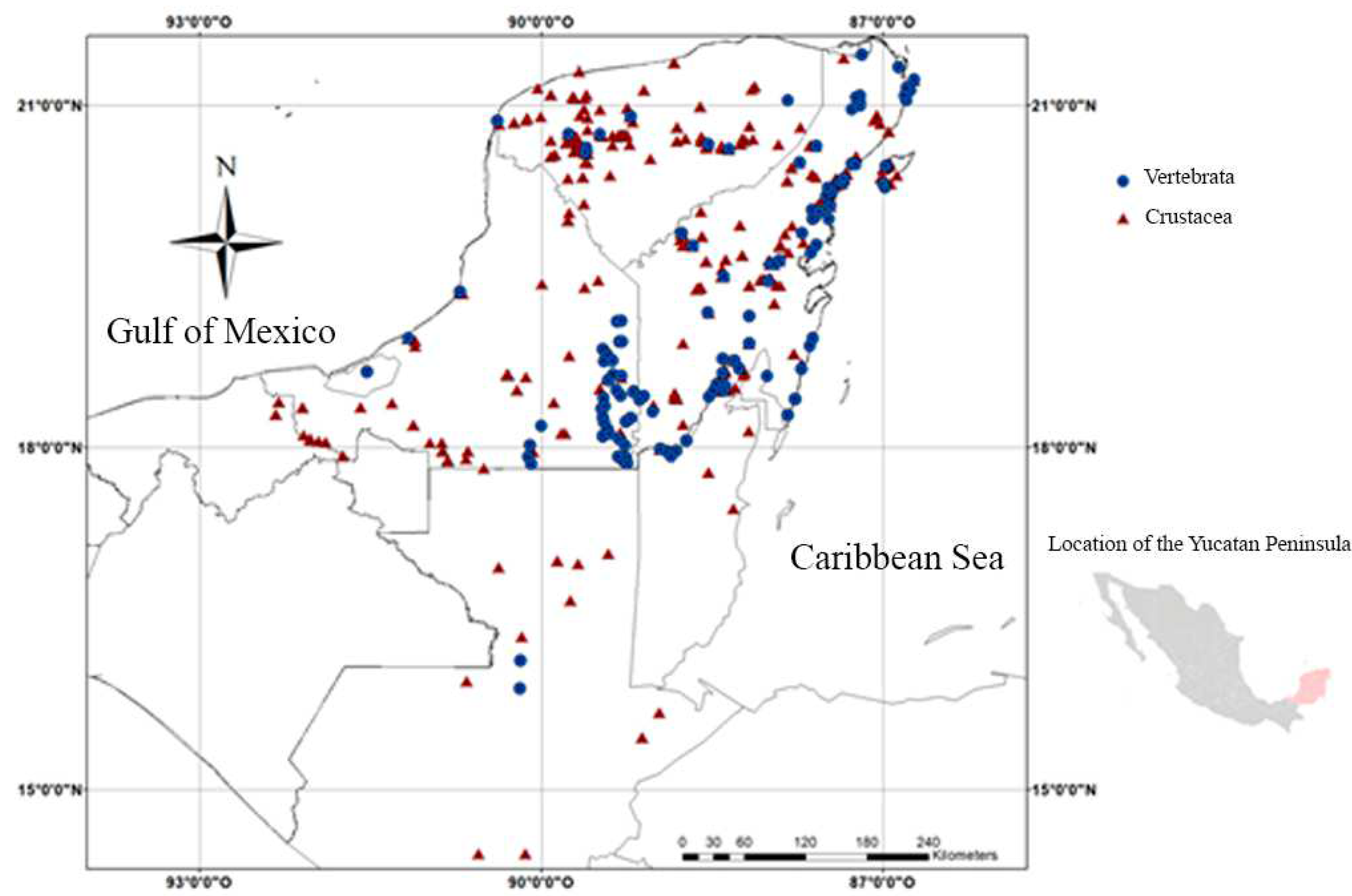
Figure 2.
Ranges of species richness of Crustacea (red) and Vertebrata (blue) for each site.
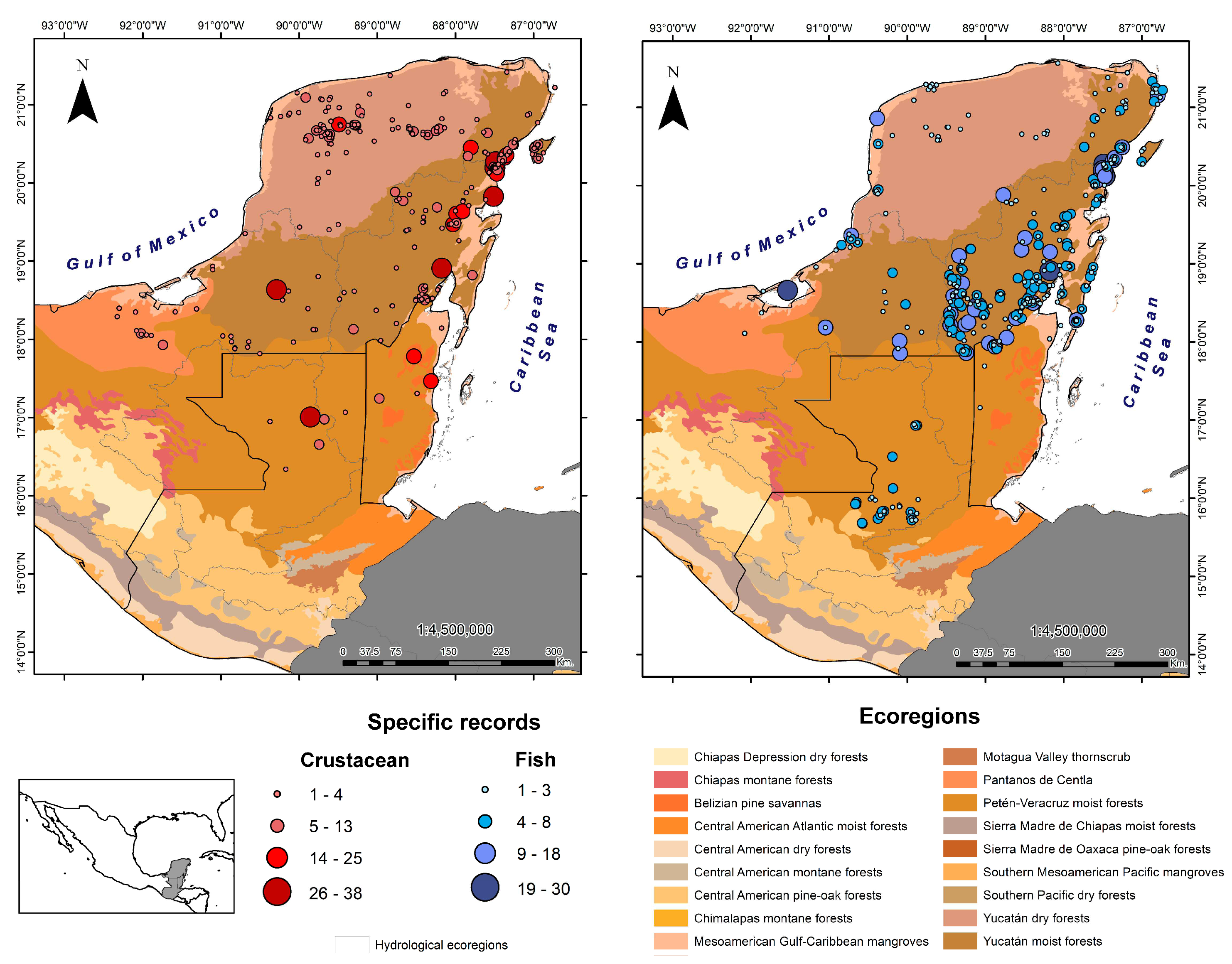
Figure 3.
Species richness estimators: (a) crustaceans and (b) fish of the Yucatan Peninsula, Mexico.
Figure 3.
Species richness estimators: (a) crustaceans and (b) fish of the Yucatan Peninsula, Mexico.
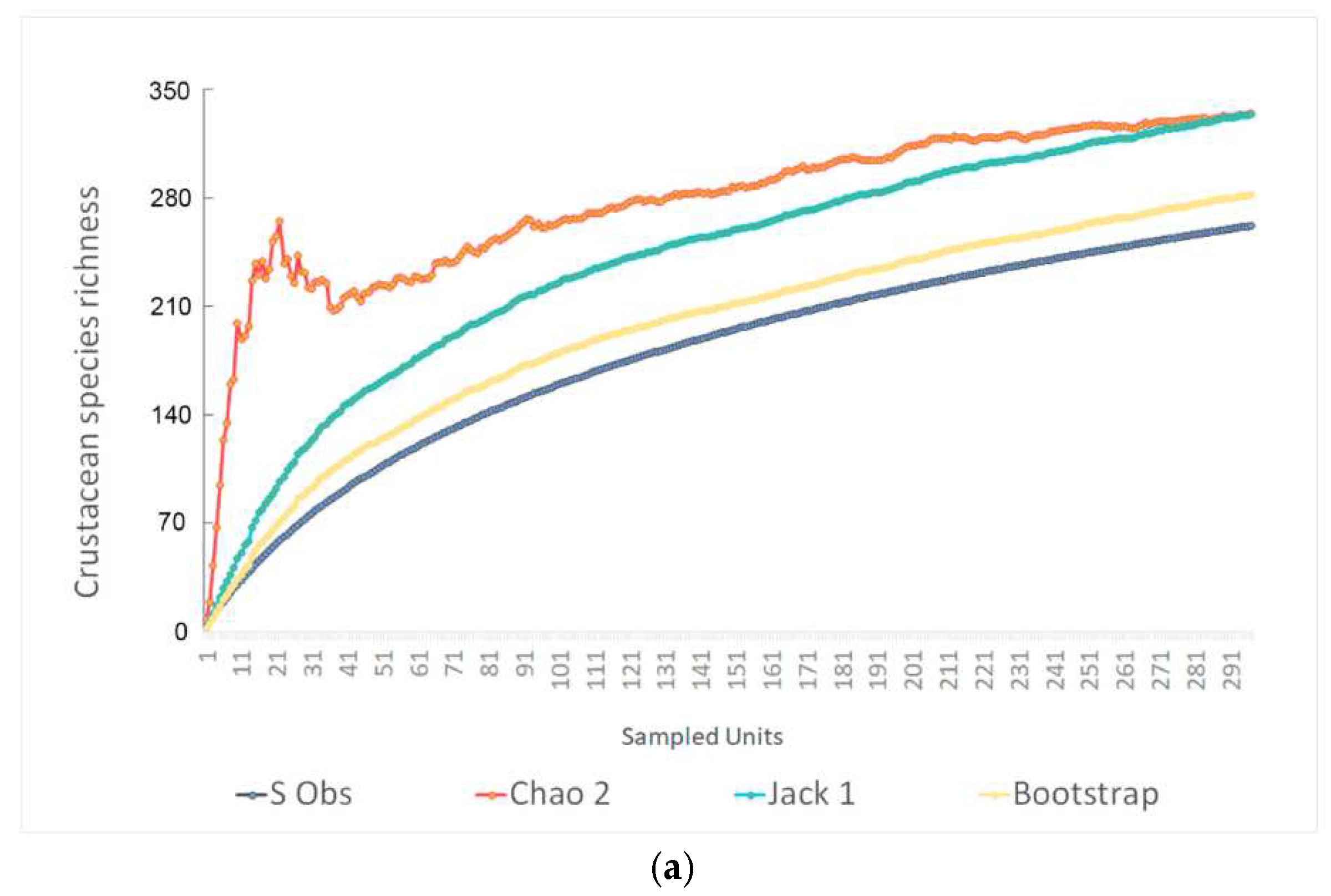
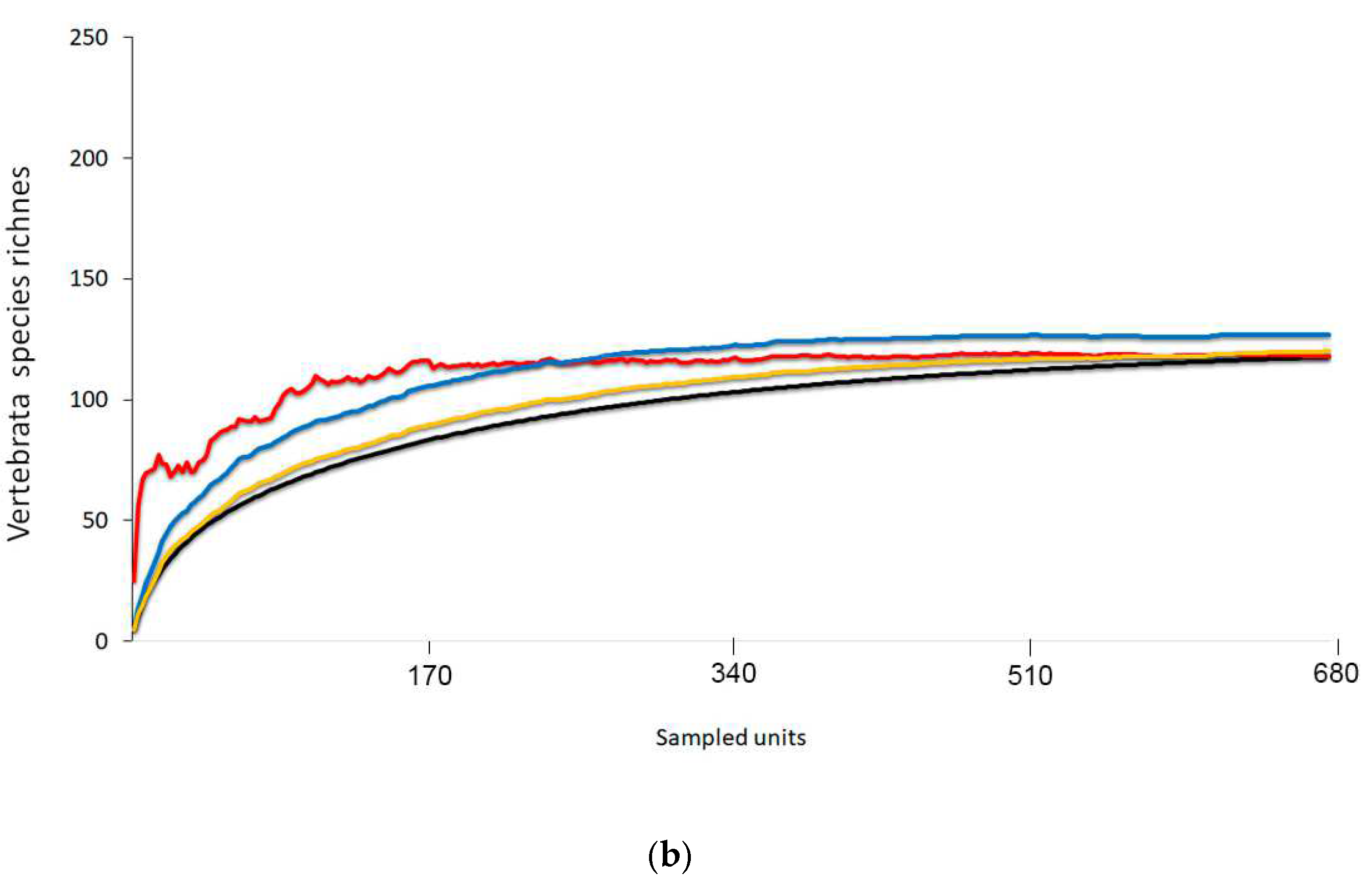

Table 1.
Taxa inventoried in cenotes, lagoons, springs and anchialine systems of YP.
| Families | Species | |
|---|---|---|
| Phylum: Arthropoda | ||
| Subphylum: Crustacea | ||
| Class: Branchiopoda | ||
| Order: Diplostraca | 7 | 58 |
| Class: Remipedia | ||
| Order: Nectiopoda | 1 | 3 |
| Class: Maxillopoda | ||
| Subclass: Copepoda | ||
| Infraclass: Neocopepoda | ||
| Superorder: Gymnoplea | ||
| Order: Calanoida | 7 | 19 |
| Superorder: Podoplea | ||
| Order: Misophrioida | 1 | 2 |
| Order: Cyclopoida | 2 | 42 |
| Order: Harpacticoida | 4 | 9 |
| Class Ostracoda | ||
| Order Podocopida | 5 | 34 |
| Subclass: Myodocopa | ||
| Order: Halocyprida | 2 | 2 |
| Class Malacostraca | ||
| Subclass: Eumalacostraca | ||
| Superorder: Peracarida | ||
| Order: Thermosbaenacea | 1 | 1 |
| Order: Mysida | 2 | 5 |
| Order: Amphipoda | 6 | 9 |
| Order: Isopoda | 1 | 9 |
| Superorder: Eucarida | ||
| Order: Decapoda | 9 | 20 |
| Phylum: Chordata | ||
| Subphylum: Vertebrata | ||
| Class: Actinopterygii | ||
| Order: Anguiliformes | 1 | 1 |
| Order: Atheriniformes | 3 | 11 |
| Order: Batrachoidiformes | 1 | 2 |
| Order: Beloniformes | 2 | 4 |
| Order: Characiformes | 2 | 7 |
| Order Cichliformes | 1 | 7 |
| Order: Clupeiformes | 3 | 6 |
| Order: Cyprinodontiformes | 4 | 24 |
| Order: Elopiformes | 1 | 1 |
| Order: Gadiformes | 1 | 1 |
| Order: Perciformes | 7 | 39 |
| Order: Synbrachiformes | 1 | 3 |
| Order: Siluriformes | 3 | 6 |
| Class: Chondrichthyes | ||
| Order: Myliobatiformes | 1 | 1 |
Number of Families and species of each order.
Table 2.
Endemic, aquatic species inhabitants from Yucatan Peninsula.
| Family | Species |
|---|---|
| Epacteriscidae | ++ Balinella yucatanensis |
| Ridgewayiidae | Exumella tsonot |
| Barbouriidae | Barbouria yanesi |
| Xibalbanidae | Xibalbanus tulumensis |
| Hyppolytidae | Calliasmata nohochi |
| Diaptomidae | Mastigodiaptomus siankanaensis, M. reidae, M. ha, M. maya |
| Stephidae | Stephos fernandoi |
| Speleophriidae | + Mexicophria cenoticola, Speleophria germanyanezi |
| Cyclopidae | Acanthocyclops rebecae, A. smithae, ++ Halicyclops cenoticola, H. caneki, H. tetracanthus, H. venezualensis, + Prehendocyclops monchenkoi, P. boxshalli, P. abbreviatus, Mesocyclops yutsil, M. chaci, Diacyclops chakan, D. puuc |
| Candonidae | Cypria petenensis, Cypridopsis niagranensis, Keysercypria xanabanica |
| Darwinulidae | Alicenula yucatanensis |
| Thaumatocyprididae | Humphreysella mexicana |
| Cyprididae | Cypretta campechensis, C. maya, Cypria petenensis, Neocypridopsis yucatanensis, Strandesia intrépida |
| Ampithodea | Cymadusa herrerae |
| Hadziidae | Bahadzia bozanici, Bahadzia setodactylus |
| Cirolanidae | + Creaseriella anops, Metacirolana mayana, Cirolana (Anopsilana) adriani, C. (A.) yucatana, C. yunca, C. bowmani, C. belizana, + Yucatalana robustispina |
| Palemonidae | + Creaseria morleyi |
| Hadziidae | +Mayaweckelia cenoticola, M. troglomorpha, M. yucatanensis, + Tuluweckelia cernua |
| Tulumellidae* | + Tulumella unidens |
| Anchialocarididae* | + Anchialocaris paulini |
| Procarididae | Procaris mexicana |
| Alpheide | + Yagerocaris cozumel, Triacanthoneus akumalensis |
| Spelephriidae | + Mexicophria cenoticola |
| Mysidae | Antromysis cenotensis |
| Amphipoda | Hyalella maya, H. cenotensis |
| Agostocarididae | Agostocaris bozanici, A. zabaletai |
| Stygiomysidae | Stygiomysis cokei |
| Atyidae | Typhlatya mitchelli, T. pearsei |
| Cyprinodontidae | Floridichthys polyommus, Cyprinodon artifrons, C. esconditus, C. labiosus, C. maya, C. simus, C. savium, Garmanella pulchra |
| Synbranchidae | Ophisternon infernale |
| Cichlidae | Thorichthys meeki |
| Poeciliidae | Poecilia velífera |
| Bythitidae | Typhlasina pearsei |
The asterisk indicates endemic families, the cross (before the name) represents the endemic genera from the Yucatan Peninsula, and the double cross represents the endemic genera from the Caribbean.
Disclaimer/Publisher’s Note: The statements, opinions and data contained in all publications are solely those of the individual author(s) and contributor(s) and not of MDPI and/or the editor(s). MDPI and/or the editor(s) disclaim responsibility for any injury to people or property resulting from any ideas, methods, instructions or products referred to in the content. |
© 2024 by the authors. Licensee MDPI, Basel, Switzerland. This article is an open access article distributed under the terms and conditions of the Creative Commons Attribution (CC BY) license (https://creativecommons.org/licenses/by/4.0/).
Copyright: This open access article is published under a Creative Commons CC BY 4.0 license, which permit the free download, distribution, and reuse, provided that the author and preprint are cited in any reuse.


