

Submitted:
11 April 2025
Posted:
14 April 2025
You are already at the latest version
Abstract
This paper explores the hypothesis that human perception evolved not to experience planetary motion, but to nullify it. Through geometric adaptation, our sensory systems resolve the Earth’s velocity into a perception of stillness. The paper argues that this is not a biological oversight, but a structured adaptation to a moving environment. By examining how entropy, time, and acceleration interact with rotational planetary systems, we propose that perception is a structured filter—a geometric equilibrium that renders motion undetectable at the meso-scale. The result is a reframing of stillness not as an illusion, but as an evolved perceptual output. The implications of this hypothesis open avenues for reconceptualizing time perception, planetary-scale cognition, and the biological interface between environment and motion.
Keywords:
Perception
; Entropy
; Time
; Rotational Motion
; Geometry
; Planetary Systems
; Human Cognition
1. The Illusion of Stillness
Despite Earth’s immense velocity—both its axial rotation and its orbit around the Sun—human experience is overwhelmingly defined by the perception of stillness. This stillness is so complete, so structurally ingrained in perception, that most people never consider the possibility that they are hurtling through space at unimaginable speed. Classical explanations invoke Newtonian physics and relativity: the motion is constant and thus undetectable; the body, being part of the same system, experiences no internal resistance.
But this view, while mechanically sufficient, is perceptually incomplete.
Stillness is not just what we feel—it is what we see, hear, balance, and respond to. These faculties are not passive—they are evolved. And what they evolved to do was solve the problem of motion. This paper begins from a different assumption: stillness is not a byproduct of motion—it is a biological accomplishment. Human perception evolved in a dynamic environment and resolved that environment into stable form. Stillness, in this view, is a resolution structure—not an environmental truth.
2. Geometric Filtering and Sensory Equilibrium
The human sensory system evolved within the context of persistent planetary motion. Earth spins on its axis at roughly 1,000 miles per hour at the equator and orbits the Sun at approximately 67,000 miles per hour. Despite these immense velocities, human beings perceive their environment as still. This paradox is not the result of neurological failure or adaptation alone—it is a product of perceptual geometry.
We propose that sensory stillness emerges from an evolved geometric filtering mechanism. Rather than perceiving the raw acceleration vectors of planetary motion, human cognition encodes equilibrium as the default. Motion is interpreted only when local inconsistencies violate that geometric baseline. This suggests that biological systems form a kind of negative space—a structured blind spot—to exclude background motion on scales that exceed local sensory domains.
2.1. Nullification Through Structured Perception
The concept of “perceived stillness” can be modeled as a cancellation field: an evolved structure that neutralizes background motion by integrating directional data into a static perceptual template. In this view, humans do not “fail” to detect Earth’s movement—they are actively structured to resolve and nullify it.
If motion were perceived without this filtering, the spinning of Earth would result in visual field distortions, persistent vertigo, or equilibrium dissonance. Instead, life evolved to synchronize with the motion source, encoding its rhythm at a foundational biological level. We are not simply adapted to Earth’s movement—we are formed by it. Stillness is not a default—it is a resolution product.
3. Perception as a Geometric Filter
Perception is often understood as a passive process: light enters the eye, is processed by the brain, and produces an image. But this simplification ignores the layered, evolution-shaped architecture that filters, resolves, and prioritizes incoming sensory data. The perceptual field is not a raw intake—it is a structured reconstruction. Within the context of a rotating Earth, we propose that human perception evolved not simply to interpret information, but to actively geometrize it into stability.
3.1. Motion Cancellation as Evolutionary Output
In high-motion environments, such as the rotational frame of Earth, biological systems would not benefit from sensitivity to persistent, unresolvable forces. Instead, organisms that evolved to resolve away that motion—converting it into perceptual stillness—would benefit from clearer local decision-making. The eyes, vestibular system, and cognitive processing architecture form a perceptual funnel that compresses large-scale motion into biologically negligible equilibrium. In this way, perceptual stillness is not an absence—it is an engineered filter.
3.2. Structured Nullification
We describe this phenomenon as structured nullification: the evolved ability to cancel or ignore specific categories of background motion by embedding them into the perceptual baseline. Much like noise-canceling headphones create a “silence” by producing inverted sound waves, the perceptual system may generate a form of spatial stillness by encoding Earth’s motion into a static interpretive scaffold. That scaffold becomes the foundation on which all other movement is detected.
4. Made from Motion
To understand human perception as a response to planetary motion is to redefine the relationship between biology and environment. Life did not arise in spite of the Earth’s motion—it arose within it, shaped by it, and filtered through it. From the earliest cellular formations to the complex neurology of humans, biological systems formed on a rotating, orbiting body and inherited its rhythm.
We propose that perception did not merely tolerate motion—it encoded it. Over evolutionary timescales, organisms that synchronized with this constant motion were more likely to survive. In this sense, perception became a geometric adaptation to motion—absorbing, resolving, and nullifying external acceleration into equilibrium.
4.1. The Spinning Scaffold of Evolution
Consider the analogy of a 3D printer operating on a spinning platform. Though the material is laid down by the printer’s toolhead, the underlying surface continuously moves. The resulting form is not simply deposited in space—it is defined by the relationship between deposition and rotation. Similarly, we argue that human biology—especially perceptual systems—formed as a kind of slow-print geometry upon the scaffold of Earth’s motion. The body and mind were shaped from motion, not in resistance to it.
4.2. Perceptual Symmetry as Nullification Product
The apparent symmetry and balance found in sensory experience may be the echo of motion canceled. If stillness is perceived, it is not because motion is absent—but because perception has resolved it perfectly. Stillness is not a state of the universe—it is a perceptual achievement. In this way, we are the geometric counterweight to Earth’s rotation, born of it and designed to still it.
5. Implications and Theoretical Extensions
If perception is a geometric filter, and if human biology is shaped by the inertial forces of a rotating planetary system, then the implications reach beyond cognition—they speak to structure itself.
One model for visualizing this relationship is the act of dripping liquid at fixed intervals onto a rotating surface. As each drop falls, it splatters outward—slightly displaced by the motion of the platform. Over time, these discrete splashes form a spiral or conical pattern. The resulting geometry is not random; it is the accumulated product of timed interaction between motion and deposition. This mirrors how evolution shaped organisms over time on a spinning Earth: not all at once, but in spaced biological intervals, forming structure from repeated encounter with rotation.
We propose that evolution itself may follow conical pathways—stacking environmental response into layered geometry. What we perceive as form is not just a biological record of survival, but a slow-motion imprint of planetary dynamics encoded into cellular structure.
5.1. Future Considerations
This model invites interdisciplinary inquiry:
- Can artificial perception systems replicate biological nullification of background motion?
- Might architectural design benefit from equilibrium-based sensory geometry?
- Could new physics models emerge from treating perceptual fields as dynamic cancellation zones?
At minimum, this theory suggests a radical shift: perception is not separate from planetary motion—it is sculpted by it. Human beings are not simply on Earth. We are shaped by it, filtered through it, and resolved within it.
Figure Caption
Figure 1.
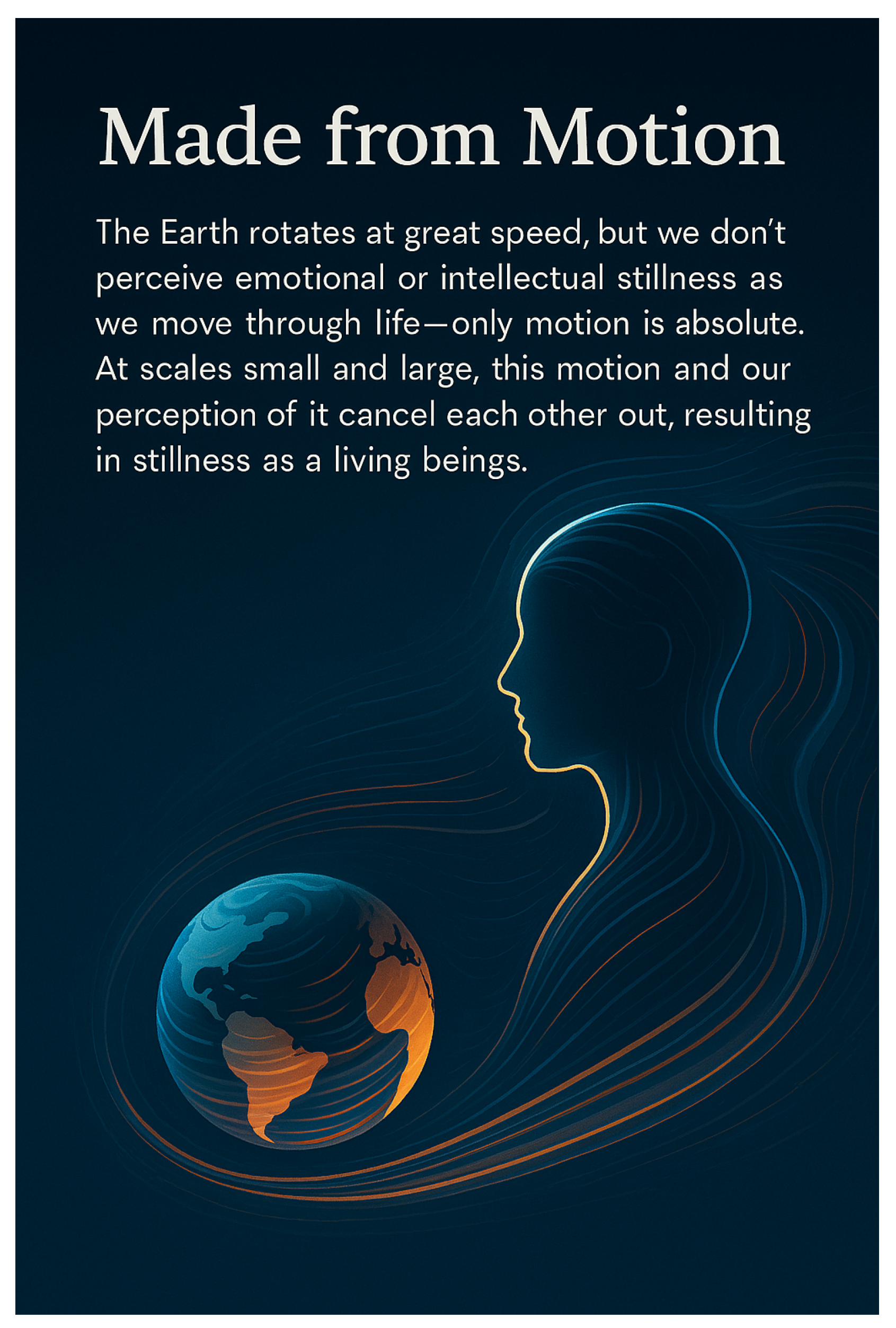
A conceptual illustration of human perception forming as a geometric countermeasure to Earth’s motion. The field around the figure symbolizes nullification—showing that stillness is not passive, but resolved.
Figure 1.
A conceptual illustration of human perception forming as a geometric countermeasure to Earth’s motion. The field around the figure symbolizes nullification—showing that stillness is not passive, but resolved.
Glossary
Geometric Nullifier: A structural system—biological or artificial—that filters and cancel spersistent motion to maintain a baseline of equilibrium perception.
Structured Nullification: The evolved biological process of converting background motion into perceptual stillness via spatial encoding.
Conical Evolution: The theoretical notion that biological development occurs in stacked, spiraling
layers influenced by planetary motion and environmental rhythm.
References
- Gibson, J. J. (1979). The Ecological Approach to Visual Perception, Houghton Mifflin.
- Mittelstaedt, H. (1996). Somatic graviception. Biological Psychology, 42(1-2), 53–74. [CrossRef]
- Merfeld, D. M. , et al. (1999). Humans use internal models to estimate gravity and lineara cceleration. Nature, 398(6728), 615–618. [CrossRef] [PubMed]
Disclaimer/Publisher’s Note: The statements, opinions and data contained in all publications are solely those of the individual author(s) and contributor(s) and not of MDPI and/or the editor(s). MDPI and/or the editor(s) disclaim responsibility for any injury to people or property resulting from any ideas, methods, instructions or products referred to in the content. |
© 2025 by the authors. Licensee MDPI, Basel, Switzerland. This article is an open access article distributed under the terms and conditions of the Creative Commons Attribution (CC BY) license (http://creativecommons.org/licenses/by/4.0/).
Copyright: This open access article is published under a Creative Commons CC BY 4.0 license, which permit the free download, distribution, and reuse, provided that the author and preprint are cited in any reuse.


