

Submitted:
09 April 2025
Posted:
10 April 2025
You are already at the latest version
Abstract
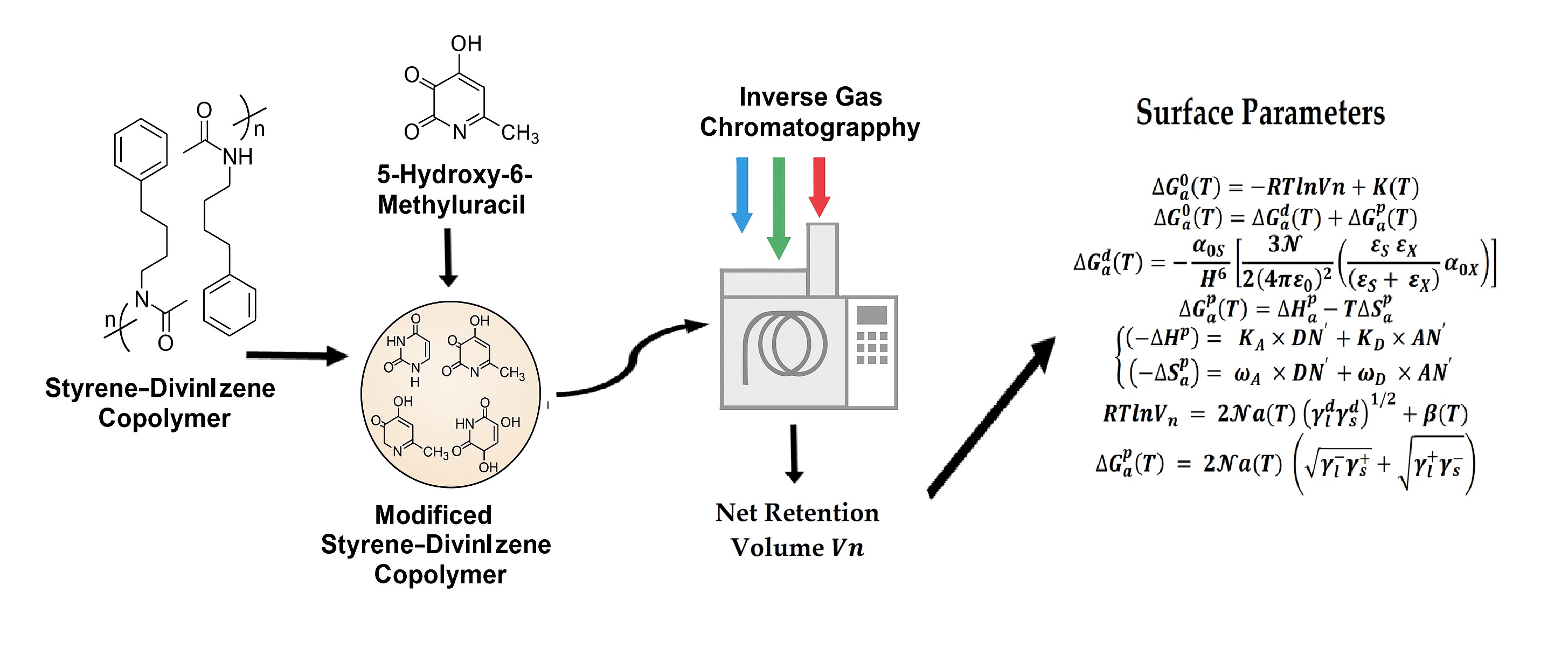
The London dispersive and polar surface properties of solid materials are very important in many chemical processes, such as adsorption, coatings, catalysis, colloids, and mechanical engineering. One of materials such as styrene–divinylbenzene copolymer modified by 5-hydroxy-6-methyluracil at different percentages, was not deeply characterized in literature, and especially, it is very crucial to determine their London dispersive and polar properties. The new recent research in the inverse gas chromatography (IGC) technique allowed a full determination of the surface properties of styrene–divinylbenzene copolymer modified by 5-hydroxy-6-methyluracil by choosing well-known polar and non-polar organic solvents and varying the temperature. Applying the IGC technique at infinite dilution led to the retention volume of adsorbed molecules on styrene–divinylbenzene copolymer modified by 5-hydroxy-6-methyluracil at different percentages using the Hamieh thermal model and our new recent results on the separation of the two polar and the dispersive contribution of the free energy of interaction. The surface properties of these materials, such the surface free energy of adsorption, the polar acid and base surface energy, and the Lewis acid–base parameters were obtained as a function of temperature and for different percentages 5-hydroxy-6-methyluracil. The obtained results proved that the polar free energy of adsorption on styrene–divinylbenzene copolymer increased when the percentage of 5-hydroxy-6-methyluracil (HMU) increased. However, a decrease of the London dispersive surface energy of copolymer was observed for higher percentage of 5-hydroxy-6-methyluracil. A Lewis amphoteric character was shown for the copolymer with highest acidity, while the basicity linearly increased when the percentage HMU increased.
Keywords:
Surfaces
; interfaces
; adsorption
; Hamieh thermal model
; London dispersive surface energy
; Lewis acid–base parameters
; polar acid–base surface energy
; intermolecular separation distance
1. Introduction
Styrene–divinylbenzene (S-DVB) copolymers are widely employed in various applications due to their chemical robustness, thermal stability, and tunable porosity. These crosslinked polymers serve as versatile platforms for ion exchange resins, adsorbents, and catalysts, particularly in fields such as water purification, chromatography, and catalysis [1,2,3]. However, the intrinsic hydrophobicity and limited functional diversity of the base S-DVB matrix often necessitate chemical modification to enhance selectivity, reactivity, and biocompatibility [4]. Incorporating biologically active or heterocyclic compounds into S-DVB matrices has proven effective in enhancing their physicochemical properties. Among such modifiers, 5-hydroxy-6-methyluracil (HMU)—a derivative of uracil—is of particular interest due to its hydrogen-bonding capability, antioxidant activity, and nucleobase-like structural features. These properties open avenues for molecular recognition, metal ion coordination, and biological interfacing [5,6,7]. The functionalization of S-DVB with HMU is expected to introduce hydrophilic groups and aromatic nitrogen heterocycles, thereby altering the surface chemistry and potentially the sorption characteristics, swelling behavior, and thermal stability of the polymer matrix. Previous work has shown that nucleobase-modified polymers exhibit enhanced metal-binding capacities and increased interaction with biomolecules [8,9], suggesting similar enhancements might be observed upon HMU grafting.
Other researches were interested in studying the two-dimensional network supramolecular structures [1,2,3,4,5,6,7,8,9,10,11,12,13,14]. The use of 5-hydroxy-6-methyluracil modifying the S-DVB copolymer at different percentage of the supported modifier is very important to constitute supramolecular network structures used for selective adsorption of several molecules [14,15,16,17,18].
Knowing that the surface properties of polymeric materials are of paramount importance in applications ranging from chromatography and sorption technologies to biomedical and catalytic systems, it is therefore crucial to determine these properties, such as the surface energy components, particularly the London dispersive (γᵈ) and specific polar (γˢ) contributions, that govern a material’s interactions with gases, liquids, and biological species. Precise characterization of these components is essential for understanding interfacial phenomena such as adhesion, wettability, sorption behavior, and chemical reactivity [19,20,21,22,23,24].
Inverse gas chromatography (IGC) has emerged as a powerful and sensitive technique for assessing the thermodynamic surface properties of solids, especially polymers, in their native dry state. Unlike traditional techniques such as contact angle measurements, IGC enables the evaluation of surface energy under well-controlled and reproducible gas–solid interaction conditions, even for porous, irregular, or finely powdered materials [25,26,27].
In this study, we investigated the London dispersive and specific polar components of the surface energy of a styrene–divinylbenzene (S-DVB) copolymer modified by 5-hydroxy-6-methyluracil at different percentages. Using inverse gas chromatography at infinite dilution (IGC-ID) by applying our new methodology [22,23,24,28,29,30,31], we determined the surface free energy parameters, assess the acid–base character of the surfaces, and examined how HMU grafting affects the thermodynamic affinity of the polymer toward various probe molecules. This analysis provided critical insight into the physicochemical transformation of S-DVB surfaces following functionalization and their potential suitability for selective adsorption, separation, or biomedical applications.
2. Materials and Methods
2.1. Adsorbent and Materials
The styrene–divinylbenzene copolymer (Dowex L-285, from Dow Chemical, Midland, USA) used in this study was the same as that studied in a previous work [32]. S-DVB copolymer exhibited a specific surface area of 800 m2/g and the particle sizes varied from 250 μm to 500 μm. The chosen surface modifier was 5-hydroxy-6-methyluracil (from Vecton, St. Petersburg, Russia, 97%), varying the percentage mass from 1% to 10%, impregnated into the adsorbent surface by evaporation of aqueous solutions at 70 °C. Organic solvents with highest purity, such as n-hexane, n-heptane, n-octane, n-nonane, benzene, toluene, ethanol, i-propanol, n-butanol, i-butanol, i-pentanol, dichloromethane, and ethyl acetate (Chimreactivsnab, Russia) were used as the probes.
2.2. Inverse Gas Chromatography
The net retention time of adsorbed organic molecules on S-DVB copolymer modified by HMU was determined using inverse gas chromatography at infinite dilution with the help of a Chromos GC-1000 chromatograph (from Chromos, Russia) equipped with a flame ionization detector (FID). The solid particles were packed into stainless steel columns of 30 cm length and 3 mm internal diameter. The temperature of the column was 200 °C and the temperatures of the injector and detector were 280°C. The flow rate of the nitrogen carrier gas was 30 mL/min. The mass of the sorbent packed into the column was equal to 1 g. All chromatographic columns were conditioned overnight at 200 °C to remove any residual impurities. The probes in the vapor phase were injected with microsyringes at different temperatures to realize the infinite dilution and to satisfy Henry’s law. The experiments were repeated three times and the error in the value of the retention volume did not exceed 2%.
2.3. Thermodynamic Methods
2.3.1. Dispersive and Polar Energies, and Lewis Acid–Base Parameters
The values of the free energy of adsorption of the adsorbed organic molecules on S-DVB/HMU system at different HMU percentages were obtained as a function of temperature using the following equation:
where is the absolute temperature, the perfect constant gas, and a constant depending on the temperature and the solvent–sorbent interaction.
The free energy of adsorption of organic solvents is composed by the summation of the London dispersive energy and the free polar energy of adsorption for all temperatures:
The separation of the two dispersive and polar contributions was obtained using our new methodology [30,31] giving the Expression (3) of London dispersion interaction energy:
where is the Avogadro number, the dielectric constant of vacuum, and are the respective deformation polarizabilities of the solid material denoted by S and the organic molecule denoted by X, separated by a distance , and and are their corresponding ionization energies.
The combination of Equations (1) and (3) allowed writing Equation (4):
The interaction parameter used as chromatographic index was given by Equation (5):
For n-alkanes, can be written as:
where is the slope of the n-alkane straight line de pending on and .
The determination of the free polar energy of an adsorbed polar molecule was obtained by taking the distance between the representative point of a polar molecule and the hypothetical point located on the straight line of n-alkanes (Equation 7):
While, the polar enthalpy and entropy of adsorption of polar probes was deduced from Relation (8) when the linearity of was confirmed:
2.3.2. London Dispersive Surface Energy, and Lewis Acid–Base Surface Energies
The Fowkes relation [35] and the Hamieh thermal model [22,23,24,28,29,30,31] were applied to determine the London dispersive surface energy of the modified copolymer using the following relation:
Where is the surface area of organic molecules given by Hamieh [22] as a function of the temperature, the London dispersive component of the surface energy of the solvent, and a constant depending only on the temperature and the solid material.
Supposing the total polar (or acid–base) contribution of the surface energy, Equation (11) can then give the total surface energy of the copolymer.
where represents the total polar (or acid–base) contribution of the surface energy.
The determination of and the Lewis acid , and base surface energies of the different materials was performed using Van Oss et al.’s method [36], considering two monopolar solvents such as ethyl acetate (B) and dichloromethane (A), and applying the following expression of the polar free energy of solvents:
This allowed obtaining the polar (or acid–base) surface energy and the total surface energy of the modified copolymers using Equation (15):
3. Results
3.1. Variations of the Free Energy of Adsorption
The evolution of the free energy or of different adsorbed organic solvents at various temperatures for different percentages of 5-hydroxy-6-methyluracil modifying the styrene–divinylbenzene copolymer, was represented in Figure 1.
The curves given in Figure 1 show an important effect of the organic solvents as a function of temperature and also a large effect of the percentage of 5-hydroxy-6-methyluracil on the porous copolymer S-DVB-L285. Figure 1 also showed a linear decrease of when the temperature increases. The highest values of were obtained for 10% of 5-hydroxy-6-methyluracil. Therefore, the increase of the modifier percentage led to the increase of the free energy of adsorption.
To better describe the dispersive and polar interactions, it is important to determine the London dispersive surface energy and the surface acid-base interactions, because the variations of the free energy of interaction versus the temperature cannot alone give the required information. This will be developed in the next sections.
3.2. London Dispersive Surface Energy of the System S-DVB-L285 with Different Percentages 5-hydroxy-6-methyluracil Percentages
The Hamieh thermal model [22,24] gave the variations of the surface area of organic molecules. Equation (10) was used to draw the variations of of n-alkanes adsorbed on S-DVB-L285 for different percentages of 5-hydroxy-6-methyluracil, as a function of (the expressions of of n-alkanes were taken from the Hamieh works [22,23,24]). The London dispersive surface energy of the various porous copolymers for different temperatures was obtained from the slope of of n-alkane-straight-lines.
Figure 2 gave the variations of of different copolymer surfaces as a function of the temperature (Figure 2.a) and the percentage of 5-hydroxy-6-methyluracil (Figure 2b). An excellent linearity in was shown with a decrease of when the temperature increased (Figure 2a). However, a slight increase in the London dispersive surface energy was observed for 1% of 5-hydroxy-6-methyluracil followed by an important decrease in when the modifier percentage increased for all temperatures (Figure 2.b).
To better understand the thermodynamic behavior difference in the modified copolymers, Table 1 was resumed the different values of of S-DVB-L-285 modified by 5-hydroxy-6-methyluracil percentages, including the London dispersive surface entropy , the extrapolated values of London dispersive surface energy at 0 K and at 298.15 K, and the temperature maximum of surfaces.
Table 1 showed that the different values of -, , and , increased when the percentage of 5-hydroxy-6-methyluracil increased. This also showed an important effect of the surface groups of the copolymer on the London dispersive surface parameters. However, a decrease was observed in the values of when the modifier percentage increased certainly due to the decrease of for higher temperatures.
The above results obtained using the Hamieh thermal model are very different from those obtained by applying the classical Dorris-Gray method [37]. Indeed Dorris and Gray determined the London dispersive component of the surface energy of a solid by defining the increment
(Relation 14):
where and represents the general formula of two consecutive n-alkanes. was determined by Equation (15):
Dorris and Gray [85] supposed the surface area of methylene group equal to 6 Å2 and the surface energy of given by Equation (16)
Applying the Dorris-Gray method, it was possible to give the results in Table 2.
The comparison between Table 1 and Table 2 clearly showed the superiority of the Hamieh thermal model relative to the Dorris-Gray method. Indeed, the Dorris-Gray method was based on the hypothesis supposing the surface area of the methylene group did not depend on the temperature, while Hamieh recently proved that this surface area strongly depended on the temperature. This explained the errors obtained by the Dorris-Gray method that showed negative values in the extrapolated London dispersive surface energy at room temperature and at 0 K. The thermal model was proved to be the most accurate method and corrected the errors in the values of committed by Dorris-Gray method that exceeded 100% in several cases.
3.3. Polar Free Interaction Energy of Dowex L-285 Modified by 5-hydroxy-6-methyluracil with the Polar Probes
Applying Equations (4) to (7), it was easy to determine the free polar energy of adsorption of polar organic probes adsorbed on the copolymer surfaces as a function of temperature. The obtained values were given in Table S1.
The variations of of the various polar solvents adsorbed on the copolymer surfaces were plotted in Figure 3 as a function of temperature for various 5-hydroxy-6-methyluracil percentages. Linear variations were obtained allowing giving the values of polar enthalpy ( and entropy ( of adsorption. Table S1 and Figure 3 showed that the highest interaction was obtained with the highest percentage of 5-hydroxy-6-methyluracil (10%) showing that the polar free energy increased with the modifier percentage for all polar solvents. whereas, the lowest interaction was obtained with the S-DVB copolymer meaning that the addition of 5-hydroxy-6-methyluracil on the copolymer certainly increased the interaction capacity of the copolymer with the polar molecules. It can be also deduced that the lowest interaction for all materials was obtained with benzene and toluene solvents, whereas, the highest adsorption was shown in Table S1 and Figure 3 for i-pentanol and i-butanol solvents thus proving the highest effect of the hydroxyl group on the free polar interaction.
These conclusions can be obviously shown by Figure 4 giving the variations of presented as a function of the percentage of 5-hydroxy-6-methyluracil on the copolymer. at different temperatures, where the maximum of the free interaction energy is shown for all polar solvents. The effect of the modifier percentage showed in Figure 4 non-linear variations in the polar free energy of adsorption, with an evident increase of the polar interaction with the 5-hydroxy-6-methyluracil percentage increased.
The determination of the polar enthalpy and entropy of adsorption for the different copolymers was obtained using Equation (8). The obtained results allowed determining the surface polar enthalpy and the entropy of adsorption, as well as the Lewis acid–base constants of the solid materials, as it was shown in the next section.
3.4. Polar Enthalpy and Entropy of Adsorption, and Lewis Acid–Base Parameters of Dowex L-285 Modified by 5-hydroxy-6-methyluracil
The linear variations of giving in Table S1 and Figure 3 as a function of temperature allowed giving the values of the polar enthalpy ( and entropy ( of the adsorbed polar solvents for the different modifier percentages, using Equation (9). The representation of the variations of and versus of the polar solvents adsorbed on the different surfaces led to the values of the Lewis enthalpic and and entropic and acid–base constants of S-DVB-L-285 with different 5-hydroxy-6-methyluracil percentages (from 1% to 10%). The obtained values were given in Table 3. The results proved the amphoteric character of the different copolymers. A stronger Lewis acidity than the Lewis basicity was observed in the case of the S-DVB copolymer and for a modifier percentage equal to 1%. However, this tendency was inversed for a HMU percentage higher than 3% where the Lewis basicity was shown to be two times higher than their Lewis acidity.
Table 3 clearly showed that the basicity of the copolymer linearly increased with the HMU percentage from to (about 10 times higher for 10% HMU on the copolymer). However, the acidity of S-DVB-copolymer gradually decreased from to showing a decrease of about 60% for 10% HMU on S-DVB copolymer. The same conclusions were confirmed for the entropic Lewis acid-base parameters and . Table 3 showed that total Lewis acid-base parameters and highlighted an important increase when the HMU percentage increased also confirming the previous conclusion relative to the stronger polar interaction for higher HMU percentage.
The previous results allowed to give in Table 4 the different equations of Lewis acid-base parameters as a function of HMU percentage with the linear regression coefficients.
3.5. Polar Acid–Base Surface Energies of S-DVB Copolymer Modified by HMU
Using Equations (11) to (13), the polar acid and base surface energies of S-DVB copolymer modified by 5-hydroxy-6-methyluracil for different percentages were determined with the help of the values of the free polar energy of dichloromethane and ethyl acetate polar solvents given in Table 5.
The obtained results were plotted in Figure 7.
The polar acid–base surface energy was obtained using Equation (11), while the total surface energy was determined from Equation (13) as a function of temperature. The values of the different surface polar parameters such as , , , , and of modified copolymer were given in Table S2. The variations of the different surface polar parameters were plotted in Figure 7 as a function of temperature. Linear variations of the different polar surface energy versus the temperature were shown in Figure 7. The results show that the highest polar surface energy values were obtained for the highest HMU percentage again confirming the important role of the modifier in increasing the polarity of the copolymer and consequently its use in many industrial applications such as catalysis and selective adsorption of several organic molecules.
The results given in Table S3 and Figure 7 allowed drawing in Figure 8 the polar surface energy of the adsorbed polar probes against the temperature using the Fowkes relation and the Hamieh thermal model. It seems that the adsorbed ethanol and i-propanol polar solvents the highest values of the polar surface energy, while the lowest values were obtained in the case of adsorption of toluene and benzene. Identical results were obtained when the S-DVB copolymer was modified by melamine in a previous study [32].
3.6. Determination of the Average Separation Distance H
Our new methodology was applied to determine the separation distance between the organic molecules and the modified copolymer as a function of the temperature. The results were represented in Figure 9. It was showed a certain effect the HMU percentage on the separation distance between solvents and copolymer. A net difference in the values of H between the S-DVB copolymer and the corresponding modified copolymer.
4. Conclusions
This study constituted a new contribution on the determination of the London dispersive surface energy, the polar surface energy and Lewis acid-base properties of styrene–divinylbenzene copolymer (Dowex L-285) modified by 5-hydroxy-6-methyluracil at different percentages from 1% to 10%, using the inverse gas chromatography technique at infinite dilution and applying our new methodology allowing a net separation between the dispersive and polar contributions of the interaction between the polar solvents and the copolymer. The determination of the London dispersive surface energy of the different surfaces showed a linear decrease of when the temperature increased and proved that the modification of the copolymer by 5-hydroxy-6-methyluracil led to a net decrease in the values of . The application of the Hamieh thermal model using the London dispersion interaction allowed an accurate determination of the Lewis acid–base parameters of the modified copolymer. An amphoteric character of the different copolymers was highlighted with more acidic character for the copolymer and for 1%HMU and a stronger basicity when the percentage of the modifier is higher than 3%. The highest basicity was observed for 10%HMU. An important effect of the modifier percentage on the dispersive and polar surface energy of the styrene–divinylbenzene copolymer was highlighted with highest values of the different surface parameters for the copolymer modified by 10% of 5-hydroxy-6-methyluracil.
Supplementary Materials
The following supporting information can be downloaded at the website of this paper posted on Preprints.org. Table S1. Variations in of different polar solvents adsorbed on Dowex L-285 and various 5-hydroxy-6-methyluracil percentages as a function of temperature. Table S2. Values of , , , , and of Dowex L-285 and the different percentages of 5-hydroxy-6-methyluracil on the copolymer.
Author Contributions
Conceptualization, T.H. and V.Y.G.; methodology, T.H.; software, T.H.; validation, T.H. and V.Y.G.; formal analysis, T.H. and V.Y.G.; investigation, T.H. and V.Y.G.; resources, V.Y.G.; data curation, V.Y.G.; writing—original draft preparation, T.H.; writing—review and editing, T.H.; visualization, T.H. and V.Y.G.; project administration, T.H. and V.Y.G.; funding acquisition, V.Y.G. All authors have read and agreed to the published version of the manuscript.
Funding
This research received no external funding.
Data Availability Statement
The data presented in this study are available in the article and Supplementary Materials.
Conflicts of Interest
The authors declare no conflicts of interest.
References
- Helfferich, F. Ion Exchange. Dover Publications Inc., New York. USA, 624p., 1962.
- Kunin, R. Ion Exchange Resins. Wiley-Interscience. New York. USA 504p., 1972.
- Guo, X.; Zhang, S.; Shan, X. Adsorption of metal ions on lignin, Journal of Hazardous Materials, 2008, 151 (1), 134-142, https://doi.org/10.1016/j.jhazmat.2007.05.065. [CrossRef]
- Dąbrowski, A. Adsorption—from theory to practice. Advances in Colloid and Interface Science, 2001, 93(1–3), 135–224.
- Vashurin, A. S.; Barabanov, V. M. Coordination and Sorption Capabilities of 5-Hydroxy-6-Methyluracil-Based Compounds. Russ. J. Gen. Chem. 2015, 85(10), 2287–2292.
- Pałasz, A.; Cież, D. In search of uracil derivatives as bioactive agents. Uracils and fused uracils: Synthesis, biological activity and applications, European Journal of Medicinal Chemistry, 2015, 97, 582-611, https://doi.org/10.1016/j.ejmech.2014.10.008. [CrossRef]
- Samuilov, P. Modified uracils in medicinal chemistry. Russian Chemical Reviews, 2016, 85(4), 374–390.
- Epure, E.L.; Moleavin, I.A.; Taran, E. Nguyen, A.V.; Nichita, N.; Hurduc, N. Azo-polymers modified with nucleobases and their interactions with DNA molecules. Polym. Bull. 2011, 67, 467–478, https://doi.org/10.1007/s00289-010-0436-1. [CrossRef]
- Lee, K.M.; Kim, K.H.; Yoon, H.; Kim, H. Chemical Design of Functional Polymer Structures for Biosensors: From Nanoscale to Macroscale. Polymers 2018, 10, 551. https://doi.org/10.3390/polym10050551. [CrossRef]
- Lehn, J.-M. Supramolecular Chemistry. Concepts and Perspectives; VCH: Weinhiem, Germany, 1995; pp. 271. https://doi.org/10.1002/3527607439.index. [CrossRef]
- Singh, U.P.; Kashyap, S.; Singh, H.J.; Mishra, B.K.; Roy, P.; Chakraborty, A. Effect of adenosine on the supramolecular architecture and activity of 5-fluorouracil. J. Mol. Struct. 2012, 1014, 47–56. https://doi.org/10.1016/j.molstruc.2012.01.035. [CrossRef]
- Zaitsev, S.Yu.; Vereschetin, V.P.; Gromov, S.P.; Fedorova, O.A.; Alfimov, M.V.; Huesmann, H.; Möbius, D. Photosensitive supramolecular systems based on amphiphilic crown ethers, Supramol. Sci. 1997, 4, 519–524. https://doi.org/10.1016/S0968-5677(97)00037-0. [CrossRef]
- Gus’kov, V.Y.; Bilalova, R.V.; Kudasheva, F.K. Adsorption of organic molecules on a 5-hydroxy-6-methyluracil -modified porous polymer. Russ. Chem. Bull. 2017, 66, 857–861. https://doi.org/10.1007/s11172-017-1818-4. [CrossRef]
- Sukhareva, D.A.; Gus´kov, V.Y.; Karpov, S.I.; Kudasheva, F.K. Adsorption of organic molecules on the highly ordered MCM-41 sorbent modified by different amounts of 5-hydroxy-6-methyluracil. Russ. Chem. Bull. 2017, 66, 958–962. https://doi.org/10.1007/s11172-017-1838-0. [CrossRef]
- Gainullina, Y.Y.; Gus’kov, V.Y.; Timofeeva, D.V. Polarity of Thymine and 6-Methyluracil-Modified Porous Polymers, According to Data from Inverse Gas Chromatography. Russ. J. Phys. Chem. 2019, 93, 2477–2481. https://doi.org/10.1134/S0036024419120082. [CrossRef]
- Gus’kov, V.Y.; Gainullina, Y.Y.; Ivanov, S.P.; Kudasheva; F.K. Thermodynamics of organic molecule adsorption on sorbents modified with 5-hydroxy-6-methyluracil by inverse gas chromatography. Journal of chromatography. A, 2014, 1356, 230-235.
- Gus’kov, V.Y.; Gainullina, Y.Y.; Ivanov, S.P.; Kudasheva, F.K. Porous polymer adsorbents modified with uracil. Prot. Met. Phys. Chem. Surf. 2014, 50, 55–58.
- Gus’kov, V.Y.; Ivanov, S.P.; Khabibullina, R.A.; Garafutdinov, R.R.; Kudasheva, F.K. Gas chromatographic investigation of the properties of a styrene-divinylbenzene copolymer modified by 5-hydroxy-6-methyluracil. Russ. J. Phys. Chem. A 2012, 86, 475–478.
- Schultz, J.; Lavielle, L.; Martin, C. The Role of the Interface in Adhesion. J. Adhes. 1987, 23, 45–60.
- Mittal, K. L. Contact Angle, Wettability and Adhesion; VSP: Leiden, 2003.
- van Oss, C. J. Interfacial Forces in Aqueous Media, 2nd ed.; CRC Press: Boca Raton, FL, 2006.
- Hamieh, T. Study of the temperature effect on the surface area of model organic molecules, the dispersive surface energy and the surface properties of solids by inverse gas chromatography. J. Chromatogr. A 2020, 1627, 461372. https://doi.org/10.1016/j.chroma.2020.461372. [CrossRef]
- Hamieh, T.; Ahmad, A.A.; Roques-Carmes, T.; Toufaily, J. New approach to determine the surface and interface thermodynamic properties of H-β-zeolite/rhodium catalysts by inverse gas chromatography at infinite dilution. Sci. Rep. 2020, 10, 20894. https://doi.org/10.1038/s41598-020-78071-1. [CrossRef]
- Hamieh, T. New methodology to study the dispersive component of the surface energy and acid–base properties of silica particles by inverse gas chromatography at infinite dilution. J. Chromatogr. Sci. 2022, 60, 126–142. https://doi.org/10.1093/chromsci/bmab066. [CrossRef]
- Davankov, V. A.; Tsyurupa, M. P. Highly Crosslinked Macroporous Polymers: Synthesis, Properties, Applications. React. Funct. Polym. 2006, 66, 846–856.
- Hamieh, T.; Schultz, J. New approach to characterise physicochemical properties of solid substrates by inverse gas chromatography at infinite dilution. Some new methods to determine the surface areas of some molecules adsorbed on solid surfaces. J. Chromatogr. A 2002, 969, 17–47. https://doi.org/10.1016/S0021-9673(02)00368-0. [CrossRef]
- Samuilov, P. D. Modified Uracils in Medicinal Chemistry and Biopolymer Functionalization. Russ. Chem. Rev. 2016, 85(4), 374–390.
- Hamieh, T. Inverse Gas Chromatography to Characterize the Surface Properties of Solid Materials. Chem. Mater. 2024, 36, 2231–2244. https://doi.org/10.1021/acs.chemmater.3c03091. [CrossRef]
- Hamieh, T. Some Irregularities in the Evaluation of Surface Parameters of Solid Materials by Inverse Gas Chromatography. Langmuir 2023, 39, 17059–17070. https://doi.org/10.1021/acs.langmuir.3c01649. [CrossRef]
- Hamieh, T. New Progress on London Dispersive Energy, Polar Surface Interactions, and Lewis’s Acid–Base Properties of Solid Surfaces. Molecules 2024, 29, 949. https://doi.org/10.3390/molecules29050949. [CrossRef]
- Hamieh, T. London Dispersive and Lewis Acid-Base Surface Energy of 2D Single-Crystalline and Polycrystalline Covalent Organic Frameworks. Crystals 2024, 14, 148. https://doi.org/10.3390/cryst14020148. [CrossRef]
- Hamieh, T.; Gus'kov, V.Y. Surface Thermodynamic Properties of Styrene–Divinylbenzene Copolymer Modified by Supramolecular Structure of Melamine Using Inverse Gas Chromatography. Chemistry 2024, 6, 830-851. https://doi.org/10.3390/chemistry6050050. [CrossRef]
- Gutmann, V. The Donor-acceptor Approach to Molecular Interactions. Springer: New York, NY, USA, 1978; pp. 279.
- Riddle, F.L.; Fowkes, F.M. Spectral shifts in acid-base chemistry. Van der Waals contributions to acceptor numbers, Spectral shifts in acid-base chemistry. 1. van der Waals contributions to acceptor numbers. J. Am. Chem. Soc. 1990, 112, 3259–3264. https://doi.org/10.1021/ja00165a001. [CrossRef]
- Fowkes, F.M. Volume 1 Surface Chemistry and Physics. In Surface and interfacial aspects of biomedical polymers; Andrade, J.D., Eds.; Plenum Press: New York, USA, 1985; pp. 337–372.
- Van Oss, C.J.; Good, R.J.; Chaudhury, M.K. Additive and nonadditive surface tension components and the interpretation of contact angles. Langmuir. 1988, 4, 884. https://doi.org/10.1021/la00082a018. [CrossRef]
- Dorris, G.M.; Gray, D.G. Adsorption of n-alkanes at zero surface coverage on cellulose paper and wood fibers. J. Colloid Interface Sci. 1980, 77, 353–362.
Figure 1.
Effect of the percentage of 5-hydroxy-6-methyluracil modifying the styrene–divinylbenzene copolymer, on the values of of different adsorbed organic solvents at various temperatures: porous copolymer S-DVB-L-285 (a), 1% of 5-hydroxy-6-methyluracil (b), 3.5% of 5-hydroxy-6-methyluracil (c), and 10% of 5-hydroxy-6-methyluracil (d).
Figure 1.
Effect of the percentage of 5-hydroxy-6-methyluracil modifying the styrene–divinylbenzene copolymer, on the values of of different adsorbed organic solvents at various temperatures: porous copolymer S-DVB-L-285 (a), 1% of 5-hydroxy-6-methyluracil (b), 3.5% of 5-hydroxy-6-methyluracil (c), and 10% of 5-hydroxy-6-methyluracil (d).
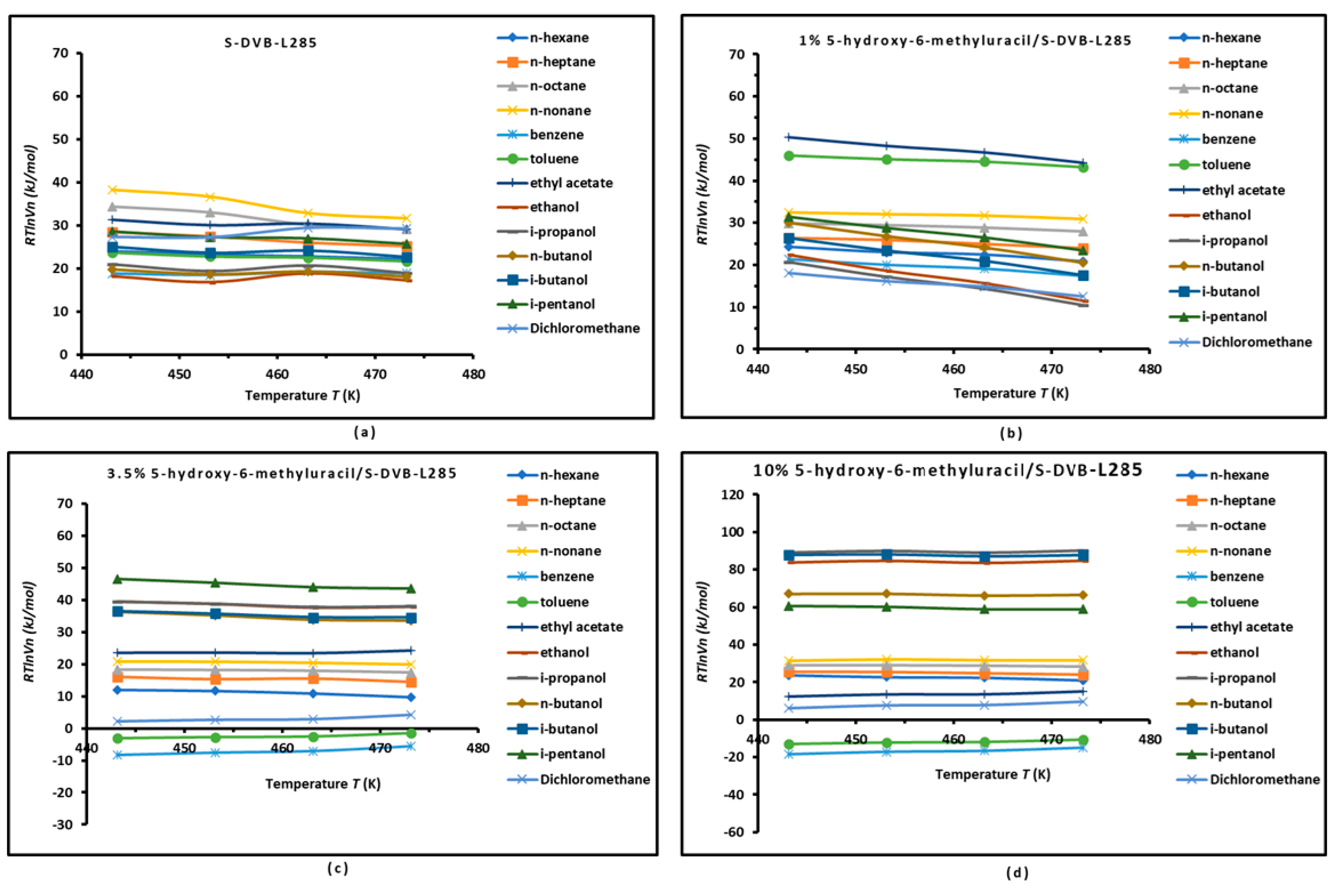
Figure 2.
Variations in the London dispersive surface energy of materials as a function of the temperature (a) and the percentage of 5-hydroxy-6-methyluracil (b).
Figure 2.
Variations in the London dispersive surface energy of materials as a function of the temperature (a) and the percentage of 5-hydroxy-6-methyluracil (b).
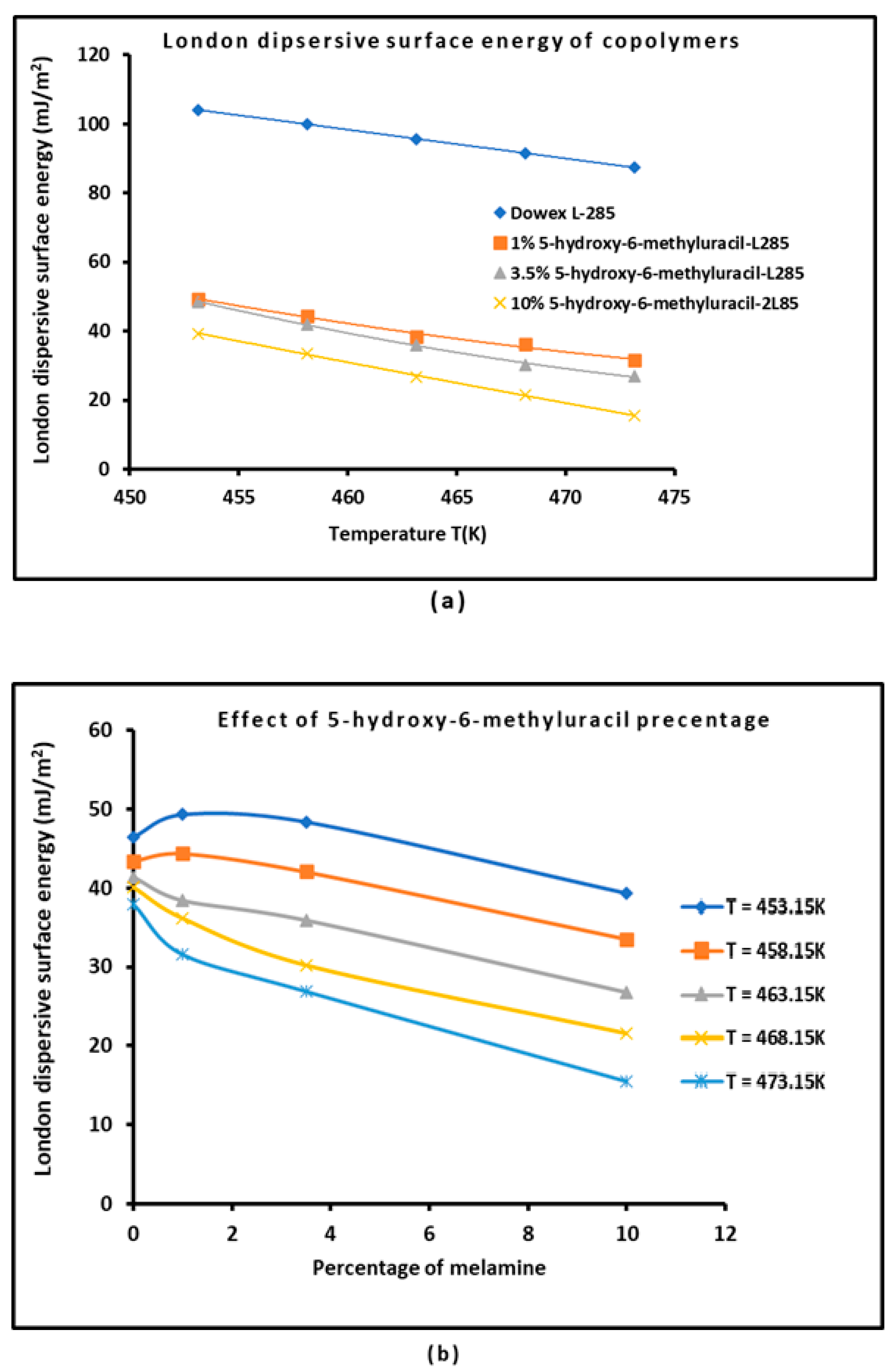
Figure 3.
Evolution of the free polar energy of the various polar organic probes adsorbed on the different solid materials as a function of temperature for different 5-hydroxy-6-methyluracil percentages. (a) Dichloromethane, (b) cyclohexane, (c) benzene, (d) toluene, (e) ethyl acetate, (f) ethanol, (g) n-propanol, (h) i-propanol, (i) n-butanol, and (j) i-butanol.
Figure 3.
Evolution of the free polar energy of the various polar organic probes adsorbed on the different solid materials as a function of temperature for different 5-hydroxy-6-methyluracil percentages. (a) Dichloromethane, (b) cyclohexane, (c) benzene, (d) toluene, (e) ethyl acetate, (f) ethanol, (g) n-propanol, (h) i-propanol, (i) n-butanol, and (j) i-butanol.
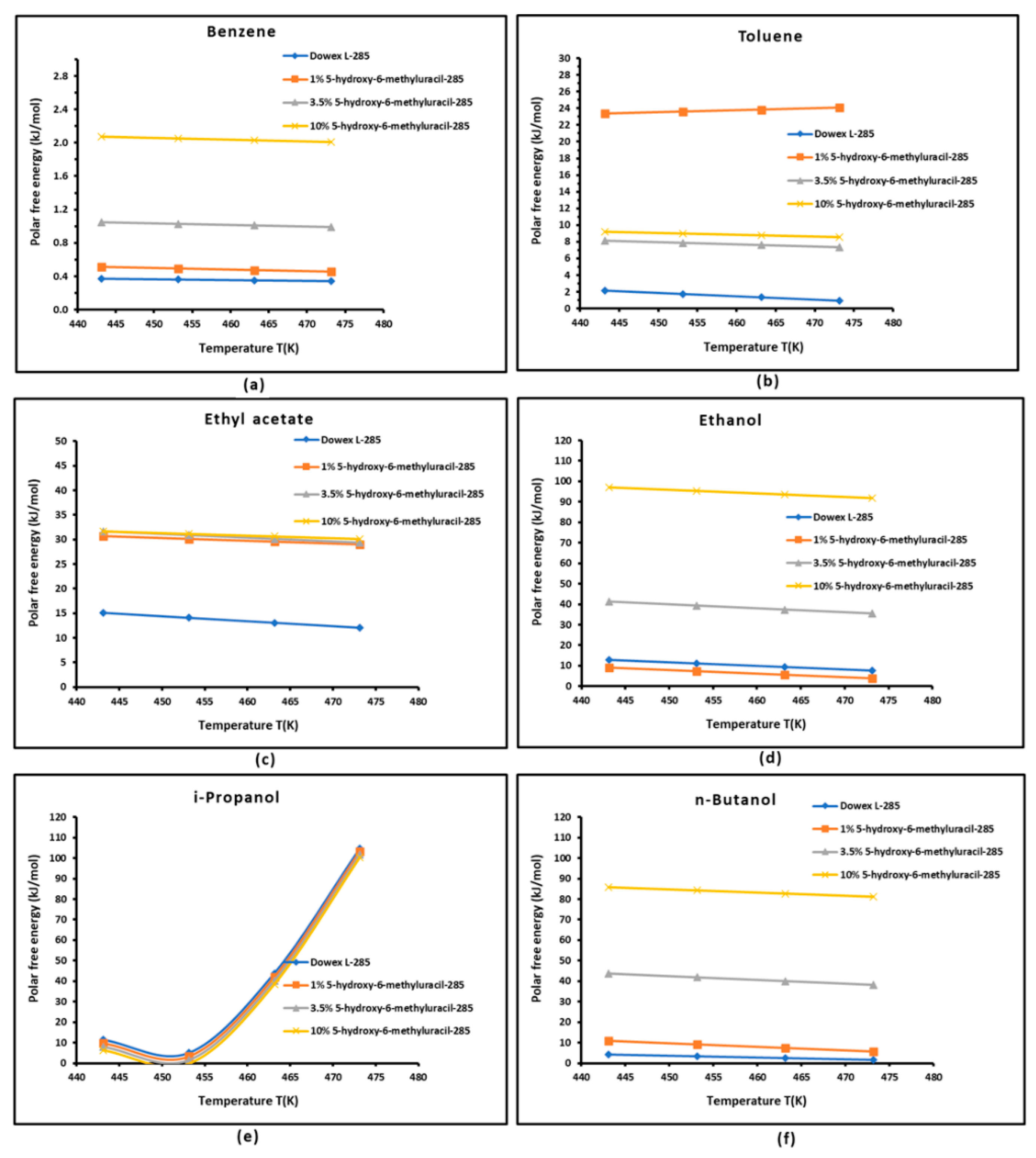
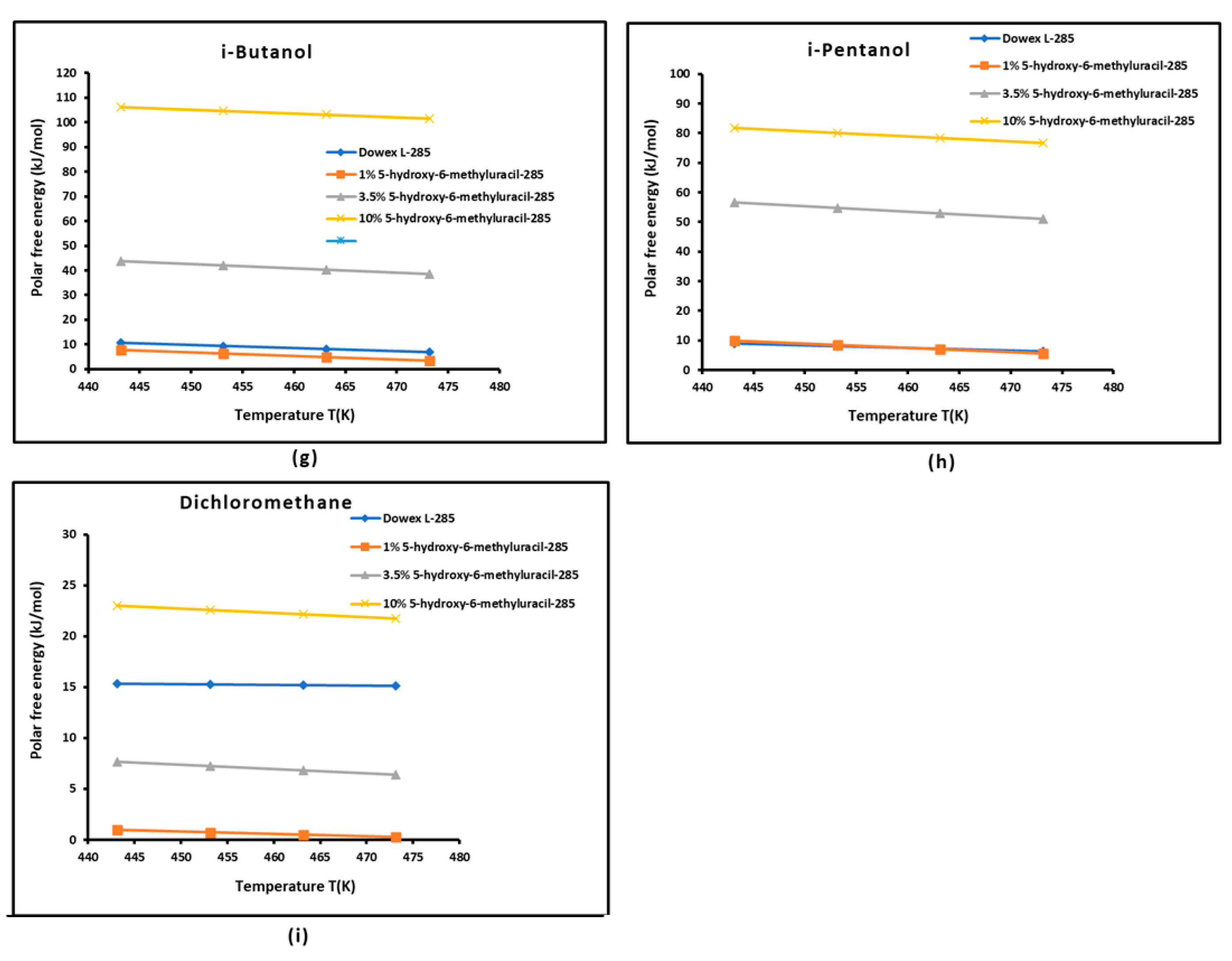
Figure 4.
Variations in the free polar energy of polar organic probes adsorbed on the different solid materials as a function of 5-hydroxy-6-methyluracil percentage on Dowex L-285 at various temperatures. (a) Dichloromethane, (b) cyclohexane, (c) benzene, (d) toluene, (e) ethyl acetate, (f) ethanol, (g) n-propanol, (h) i-propanol, (i) n-butanol, and (j) i-butanol.
Figure 4.
Variations in the free polar energy of polar organic probes adsorbed on the different solid materials as a function of 5-hydroxy-6-methyluracil percentage on Dowex L-285 at various temperatures. (a) Dichloromethane, (b) cyclohexane, (c) benzene, (d) toluene, (e) ethyl acetate, (f) ethanol, (g) n-propanol, (h) i-propanol, (i) n-butanol, and (j) i-butanol.
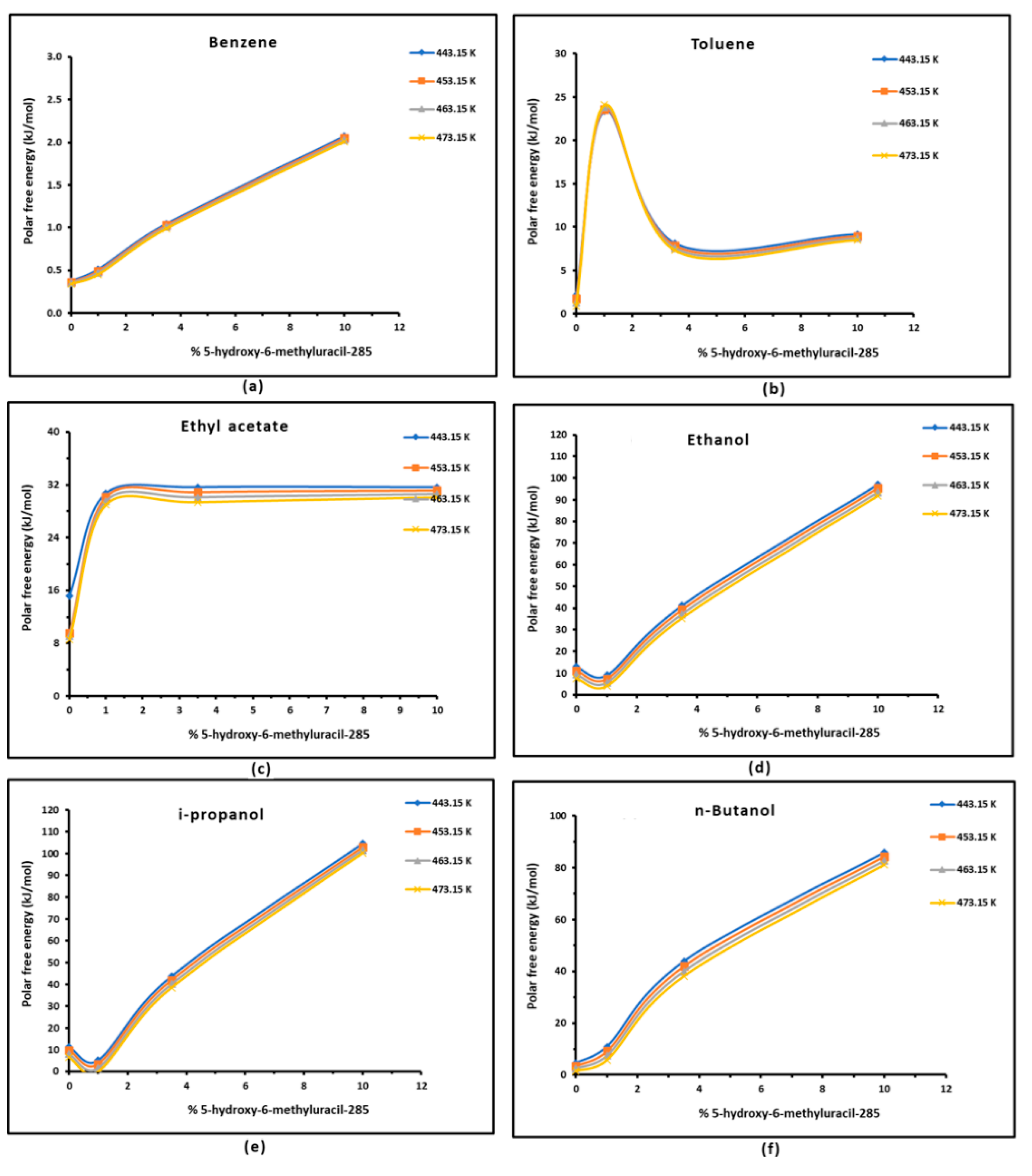
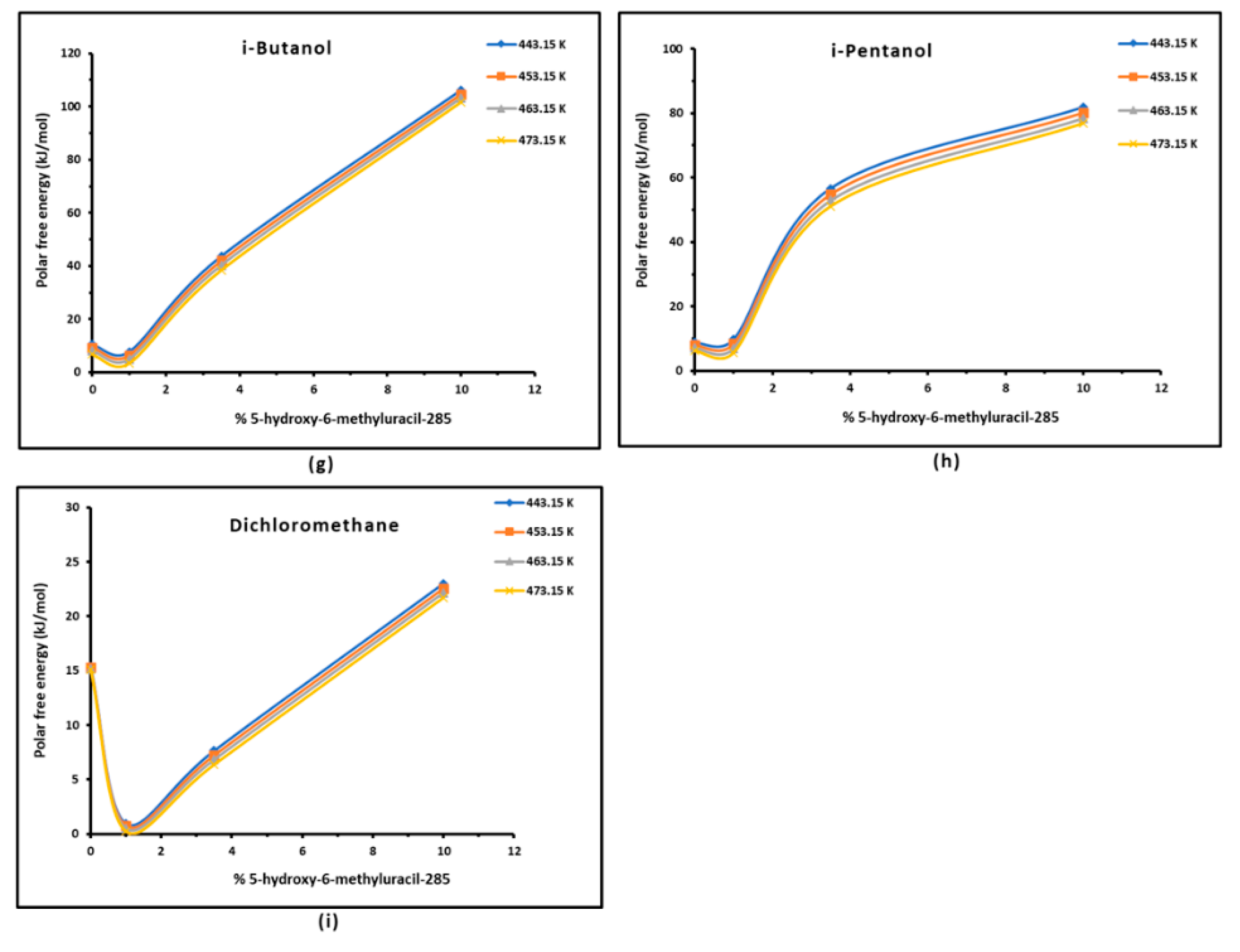
Figure 5.
Variations in and against of polar solvents adsorbed on S-DVB-L-285 modified by different percentages of 5-hydroxy-6-methyluracil (HMU).
Figure 5.
Variations in and against of polar solvents adsorbed on S-DVB-L-285 modified by different percentages of 5-hydroxy-6-methyluracil (HMU).
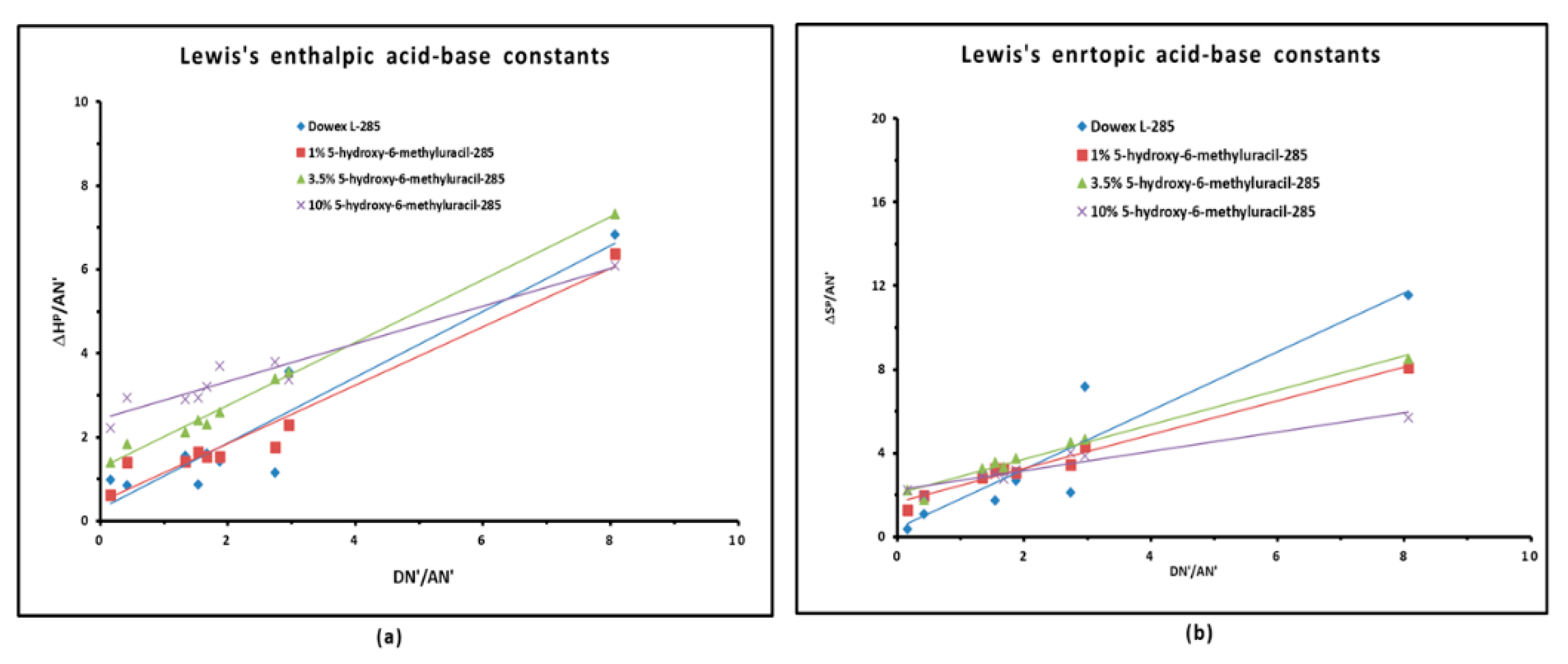
Figure 6.
Curves of the Lewis acid–base parameters , , , /, the parameters as a function of 5-hydroxy-6-methyluracil percentage (%HMU).
Figure 6.
Curves of the Lewis acid–base parameters , , , /, the parameters as a function of 5-hydroxy-6-methyluracil percentage (%HMU).
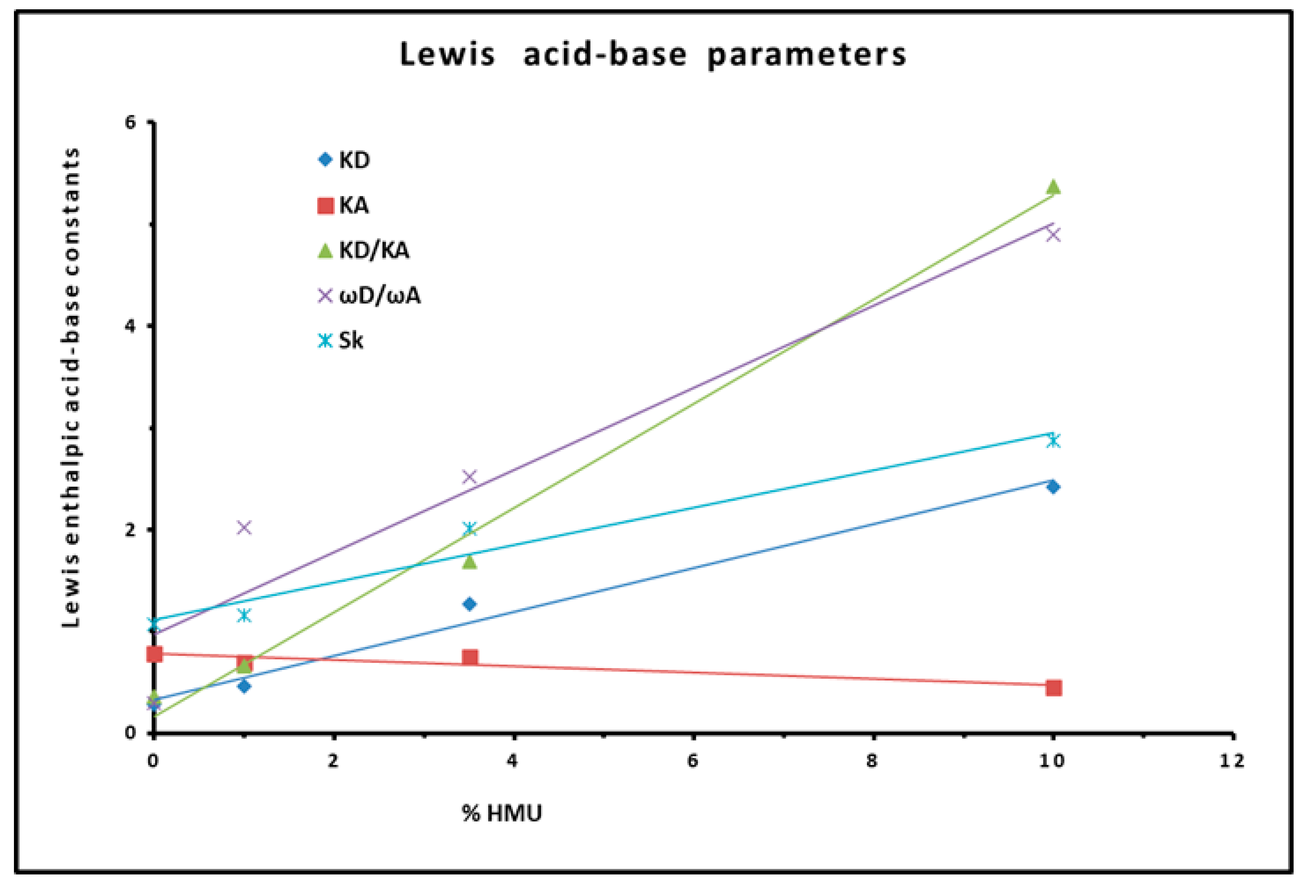
Figure 7.
Variations in acid and base surface energy components, and total energy () of Dowex L-285 modified by different 5-hydroxy-6-methyluracil percentages as a function of temperature: Dowex L-285 copolymer (a), 1% HMU (b), 3.5% HMU (c), 10% HMU (d), base surface energy (e), acid surface energy (f), acid–base surface energy (g), and total surface energy (h).
Figure 7.
Variations in acid and base surface energy components, and total energy () of Dowex L-285 modified by different 5-hydroxy-6-methyluracil percentages as a function of temperature: Dowex L-285 copolymer (a), 1% HMU (b), 3.5% HMU (c), 10% HMU (d), base surface energy (e), acid surface energy (f), acid–base surface energy (g), and total surface energy (h).
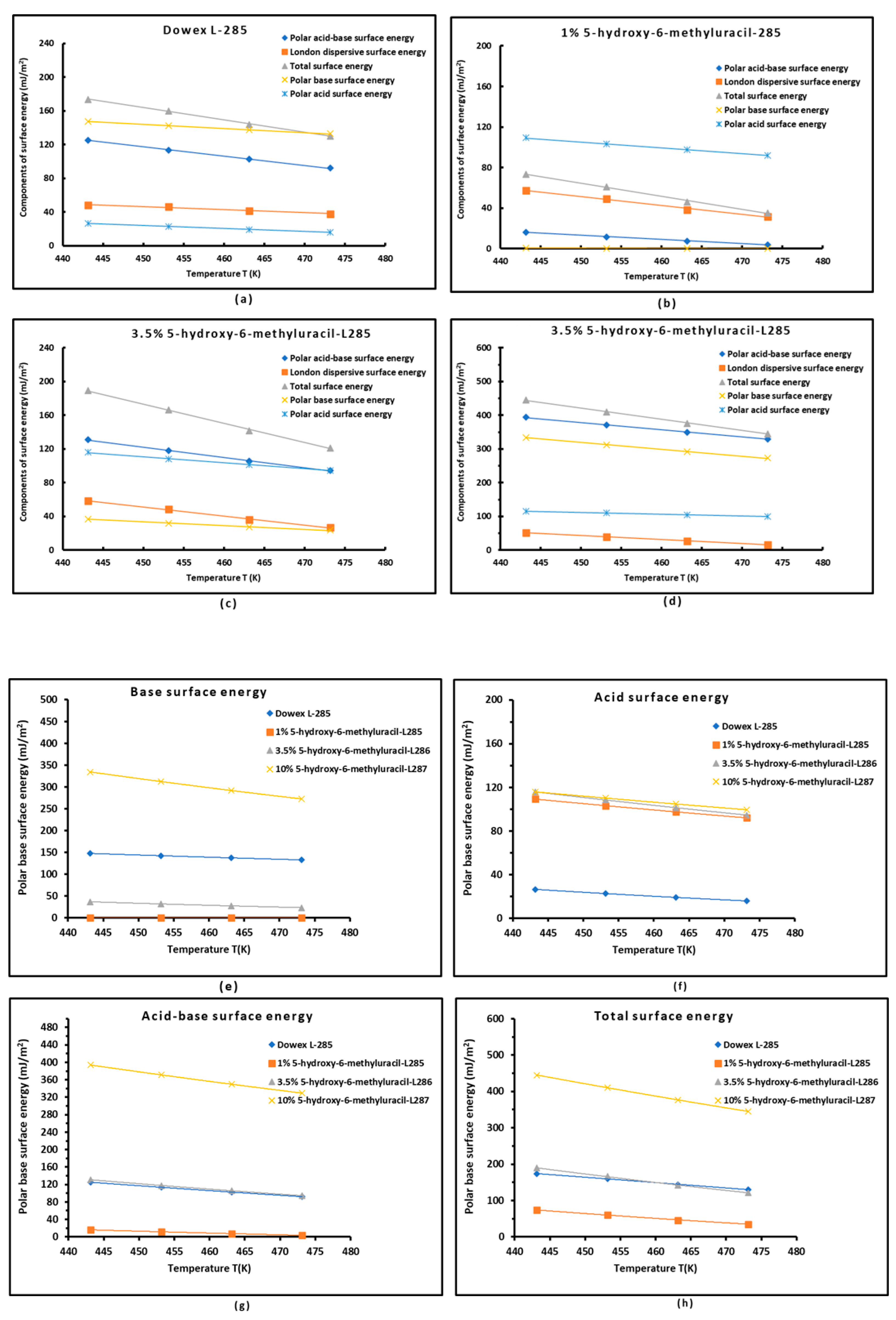
Figure 8.
Variations in polar surface energy () of the different polar solvents adsorbed on Dowex L-285 modified by varying the HMU percentage as a function of temperature: Dowex L-285 (a), 1% HMU (b), 3.5% HMU (c), and 10% HMU (d).
Figure 8.
Variations in polar surface energy () of the different polar solvents adsorbed on Dowex L-285 modified by varying the HMU percentage as a function of temperature: Dowex L-285 (a), 1% HMU (b), 3.5% HMU (c), and 10% HMU (d).
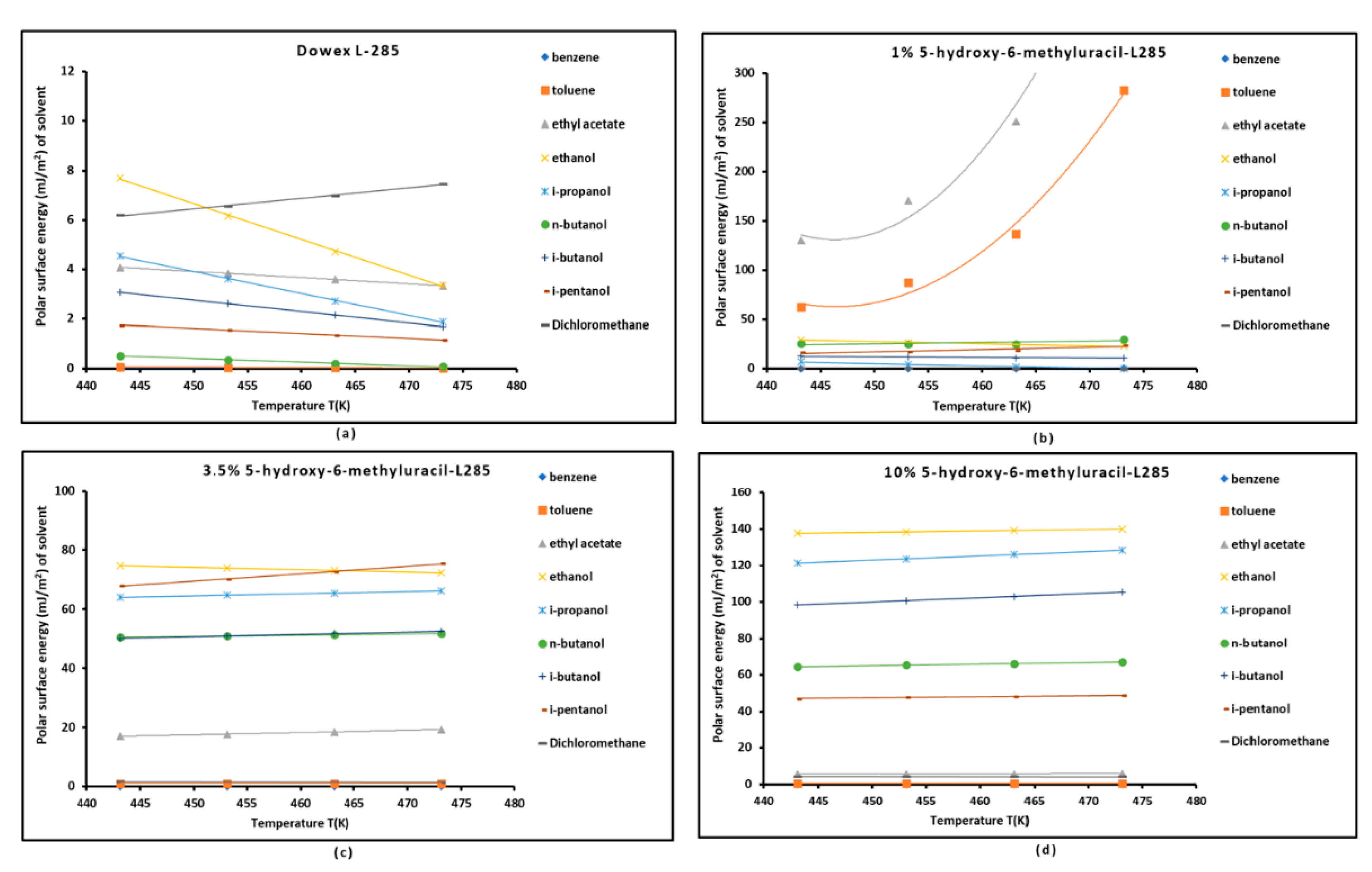
Figure 9.
Evolution of the separation distance (in Å) between the organic solvents and Dowex L-285, modified by HMU, as a function of the temperature.
Figure 9.
Evolution of the separation distance (in Å) between the organic solvents and Dowex L-285, modified by HMU, as a function of the temperature.
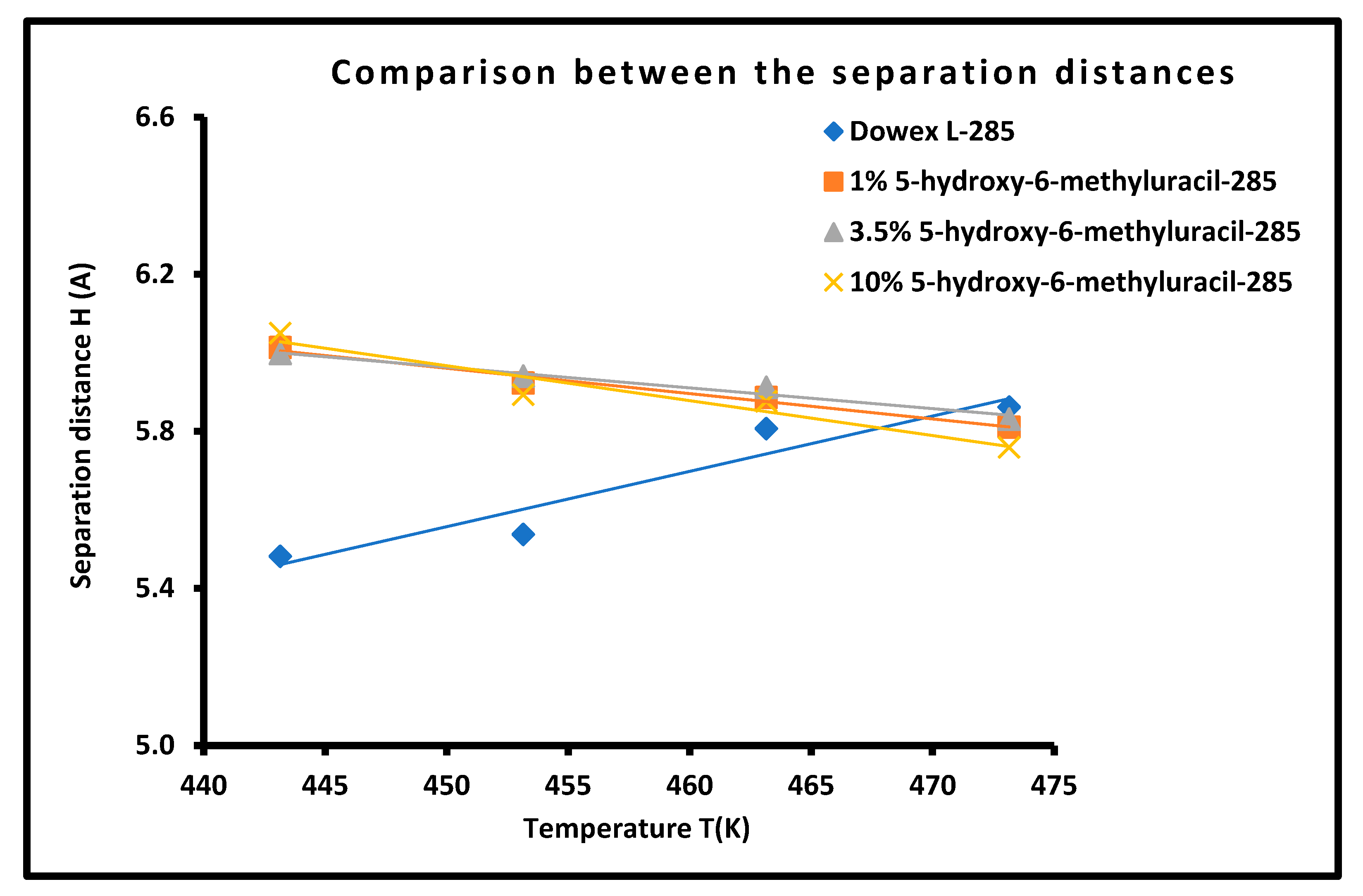

Table 1.
Linear expressions of of S-DVB-L-285 modified by different percentages of 5-hydroxy-6-methyluracil, regression coefficients, London dispersive surface entropy , extrapolated values of London dispersive surface energy at 0 K and 298.15 K, and the temperature maximum , using the Hamieh thermal model.
Table 1.
Linear expressions of of S-DVB-L-285 modified by different percentages of 5-hydroxy-6-methyluracil, regression coefficients, London dispersive surface entropy , extrapolated values of London dispersive surface energy at 0 K and 298.15 K, and the temperature maximum , using the Hamieh thermal model.
| Copolymer | (mJ/m2) | R2 | (mJ m−2 K−1) | (mJ/m2) | (mJ/m2) | (K) |
| S-DVB-L-285 | = -0.835 T + 482.43 | 0.9980 | -0.835 | 482.43 | 233.47 | 577.8 |
| 1% HOMU/ S-DVB-L-285 | = -0.874 T + 444.68 | 0.9837 | -0.874 | 444.68 | 184.16 | 508.9 |
| 3.5% HOMU/ S-DVB-L-285 | = -1.096 T + 544.23 | 0.9886 | -1.096 | 544.23 | 217.52 | 496.7 |
| 10% HOMU/ S-DVB-L-285 | = -1.198 T + 582.13 | 0.9973 | -1.198 | 582.13 | 224.95 | 485.9 |
Table 2.
Linear expressions of of S-DVB-L-285 modified by different percentages of 5-hydroxy-6-methyluracil, regression coefficients, London dispersive surface entropy , extrapolated values of London dispersive surface energy at 0 K and 298.15 K, and the temperature maximum , using the Dorris-Gray method.
Table 2.
Linear expressions of of S-DVB-L-285 modified by different percentages of 5-hydroxy-6-methyluracil, regression coefficients, London dispersive surface entropy , extrapolated values of London dispersive surface energy at 0 K and 298.15 K, and the temperature maximum , using the Dorris-Gray method.
| Copolymer | (mJ/m2) | R2 | (mJ m−2 K−1) | (mJ/m2) | (mJ/m2) | (K) |
| S-DVB-L-285 | = 3.250 T + 1610.5 | 0.9037 | -3.25 | 1610.5 | 641.51 | 495.54 |
| 1% HOMU/ S-DVB-L-285 | = 1.065 T - 416.4 | 0.9855 | 1.065 | -416.4 | -98.87 | 390.99 |
| 3.5% HOMU/ S-DVB-L-285 | = 1.091 T - 421.2 | 0.9493 | 1.091 | -421.2 | -95.92 | 386.07 |
| 10% HOMU/ S-DVB-L-285 | = 1.474 T - 600.3 | 0.9413 | 1.474 | -600.3 | -160.83 | 407.26 |
Table 3.
Values of the Lewis acid–base constants , , , and the acid–base ratios; and the linear regression coefficient R2 relative to S-DVB-L-285, modified by different HMU percentages with the corresponding parameters and .
Table 3.
Values of the Lewis acid–base constants , , , and the acid–base ratios; and the linear regression coefficient R2 relative to S-DVB-L-285, modified by different HMU percentages with the corresponding parameters and .
| Material | R2 | 10−3 | 10−3 | / | 10−3 () | R2 | ||||
| S-DVB-L-285 | 0.283 | 0.786 | 0.36 | 1.069 | 0.886 | 0.43 | 1.41 | 0.30 | 1.83 | 0.871 |
| 1% HMU on S-DVB-L-285 | 0.459 | 0.696 | 0.66 | 1.155 | 0.9561 | 1.64 | 0.81 | 2.02 | 2.45 | 0.975 |
| 3.5% HMU on S-DVB-L-285 | 1.265 | 0.75 | 1.69 | 2.015 | 0.994 | 2.07 | 0.82 | 2.52 | 2.89 | 0.9806 |
| 10% HMU on S-DVB-L-285 | 2.425 | 0.451 | 5.38 | 2.876 | 0.9397 | 2.25 | 0.46 | 4.89 | 2.71 | 0.9277 |
Table 4.
Equations of Lewis acid-base parameters as a function of %HMU with the corresponding linear regression coefficients.
Table 4.
Equations of Lewis acid-base parameters as a function of %HMU with the corresponding linear regression coefficients.
| Parameter | Equation | R² |
| Acid constant | = 0.22 %HMU + 0.33 | 0.9839 |
| Basic constant | = -0.031 %HMU + 0.79 | 0.8638 |
| Ratio | = 0.51 %HMU + 0.17 | 0.9926 |
| Ratio / | / = 0.40 %HMU + 0.97 | 0.9165 |
| Parameter | = 0.18 %HMU + 1.11 | 0.9561 |
Table 5.
Values of for dichloromethane and ethyl acetate adsorbed on Dowex L-285 modified with different 5-hydroxy-6-methyluracil percentages at different temperatures.
Table 5.
Values of for dichloromethane and ethyl acetate adsorbed on Dowex L-285 modified with different 5-hydroxy-6-methyluracil percentages at different temperatures.
| Dichloromethane | ||||
| T(K) | Dowex L-285 | 3.5% HOMU/Dowex L-285 | 1% HOMU/Dowex L-285 | 10% HOMU/Dowex L-285 |
| 453.15 | 15.274 | 15.609 | 24.349 | 9.737 |
| 458.15 | 15.239 | 15.559 | 24.294 | 9.352 |
| 463.15 | 15.204 | 15.509 | 24.239 | 8.967 |
| 468.15 | 15.169 | 15.459 | 24.184 | 8.582 |
| Ethyl Acetate | ||||
| T(K) | Dowex L-285 | 3.5% HOMU/Dowex L-285 | 1% HOMU/Dowex L-285 | 10% HOMU/Dowex L-285 |
| 453.15 | 10.106 | 8.503 | 9.667 | 10.567 |
| 458.15 | 9.593 | 8.378 | 9.507 | 10.314 |
| 463.15 | 9.079 | 8.253 | 9.347 | 10.06 |
| 468.15 | 8.566 | 8.128 | 9.187 | 9.807 |
Disclaimer/Publisher’s Note: The statements, opinions and data contained in all publications are solely those of the individual author(s) and contributor(s) and not of MDPI and/or the editor(s). MDPI and/or the editor(s) disclaim responsibility for any injury to people or property resulting from any ideas, methods, instructions or products referred to in the content. |
© 2025 by the authors. Licensee MDPI, Basel, Switzerland. This article is an open access article distributed under the terms and conditions of the Creative Commons Attribution (CC BY) license (http://creativecommons.org/licenses/by/4.0/).
Copyright: This open access article is published under a Creative Commons CC BY 4.0 license, which permit the free download, distribution, and reuse, provided that the author and preprint are cited in any reuse.


