

Submitted:
03 April 2025
Posted:
03 April 2025
You are already at the latest version
Abstract
Previous research has explored the link between social support and well-being extensively. However, there is limited focus on how perceived social support (PSS) influences internalizing (INT) and externalizing (EXT) problems, as well as prosocial behaviors (PB), particularly during early adolescence. Moreover, the specific mechanisms through which PSS impacts adolescent mental health remain unclear. This study aimed to investigate how school belonging (SB) mediates the relationship between perceived social support and internalizing/externalizing problems and prosocial behaviors. A total of 807 seventh and eighth grade students (373 boys and 434 girls) from six schools in İstanbul, Turkey were recruited using convenience sampling. Participants were asked to complete a series of questionnaires. Results indicated that PSS influenced adolescent well-being through SB as a mediator. Family support enhanced school belonging (β = 0.284), which led to lower internalizing (β = -0.401) and externalizing problems (β = -0.269) while increasing prosocial behaviors (β = 0.232). Friend support was directly linked to higher externalizing problems (β = 0.132). Support from significant others strengthened school belonging (β = 0.247) and prosocial behaviors (β = 0.073) while reducing internalizing (β = -0.140) and externalizing problems (β = -0.216). Indirect effects confirmed family and significant other support influenced behavioral outcomes through school belonging, with all indirect effects statistically significant (p < 0.001). PSS explained 21% of the variance in school belonging, while internalizing, externalizing, and prosocial behaviors were explained by 22%, 14%, and 7%, respectively. These findings underscore the protective role of school belonging, emphasizing its importance in adolescent emotional and behavioral development.
Keywords:
perceived social support
; school belonging
; internalizing and externalizing problems
; prosocial behaviors
; early adolescence
Introduction
Adolescence is a critical developmental period characterized by notable physical, cognitive, social and emotional changes. Nonetheless, early adolescence, covering ages 10 to 14, frequently remains overlooked (Blum et al., 2014). Notably, approximately 50% of all psychological disorder cases emerge during this period, particularly before reaching the age of 14 (Kågström et al., 2023). The World Health Organization (2021) reports that about 14% of adolescents suffer from mental health conditions, which account for 13% of the global disease burden in this age group. The primary causes of illness and disability among teenagers are depression, anxiety, and behavioral disorders. High schools are pivotal in shaping adolescents’ development, providing not only academic instruction but also essential social and emotional support (Allen et al., 2018). Moreover, research indicates that inclusive and supportive high school environments can mitigate the adverse effects of social stressors, promoting better mental health outcomes (Arslan, 2018). Therefore, high schools are essential in fostering adolescents’ overall development and addressing mental health challenges.
Internalizing and externalizing problems are two broad categories of psychological issues that manifest differently in individuals. Internalizing problems are inwardly directed and include conditions such as depression, anxiety, and social withdrawal. On the other hand, externalizing problems are outwardly directed and encompass behaviors such as aggression, delinquency, and hyperactivity (Forns et al., 2011). These issues often result in significant emotional distress and poor outcomes across life including criminal convictions, alcohol use disorders, and suicidal ideation (Clapham & Brausch, 2024; Commisso et al., 2024; Meque et al., 2019). Adolescence also presents a key period for fostering prosocial behaviors, which involve voluntary actions intended to benefit and assist others (Van der Graaff et al., 2018). These behaviors are crucial in shaping positive interpersonal relationships among adolescents (Carlo, 2013). Studies have indicated that factors such as the quality of relationships with parents, family members, and friends, social support, psychological flexibility, and positive affect can significantly predict prosocial behaviors in adolescents (Haller et al., 2022; van Meegen et al., 2024)
The mental health status of children and adolescents in Turkey has emerged as a significant concern. Findings from a meta-analysis and systematic review on the prevalence of psychological disorders in Europe indicate that Turkish children and adolescents exhibit higher rates of anxiety disorders (9.13%) and attention deficit hyperactivity disorder (ADHD) (21.8%) compared to their counterparts in other European countries (Sacco et al., 2022). In a comprehensive epidemiological study, it was determined that the prevalence of psychopathology among children and adolescents in Turkey is 37.6% when the impairment criterion is excluded, and 17.1% when it is included. These figures are slightly higher than those reported in previous global and national studies, highlighting the specific challenges Turkish adolescents face (Ercan et al., 2019).
The ecological systems theory (Bronfenbrenner, 2005) emphasizes the multiple environmental systems that influence an individual’s development, including the microsystem (e.g., family, school), mesosystem (interactions between microsystems), exosystem (external environments that indirectly affect development), and macrosystem (cultural and societal influences). Additionally, the Self-Determination Theory (SDT) posits that fulfilling the basic psychological needs for autonomy, competence, and relatedness is essential for optimal development and well-being (Ryan & Deci, 2000). In this context, social support plays a crucial role because of its association with mental health (Acoba, 2024). More specifically, evidence suggests that school belonging acts as a mediator between social support and mental health outcomes including academic involvement and resilience (Allen et al., 2018; Li & Li, 2024; Vargas-Madriz & Konishi, 2021). However, there remains a gap in our understanding regarding the role of school belongingness in the relationship between social support from various sources (friends, family, and significant others) and more proximal variables to mental health, such as internalizing, externalizing, and prosocial behaviors among adolescents. Accordingly, the current research aimed to explore how school belonging mediates the relationship between social support and adolescents’ emotional-behavioral outcomes.
The Mediating Role of School Belonging
School belonging refers to the extent to which students feel personally accepted, respected, included, and supported by others in the school social environment (Goodenow & Grady, 1993). School belonging significantly influences adolescent development, particularly in terms of identity formation, psychosocial adjustment, and the transition to adulthood (Allen et al., 2016). Research has indicated that higher levels of school belonging during adolescence are linked to better psychological adjustment, fewer physical symptoms, and better grades (Vang & Nishina, 2022), lower levels of depressive symptoms (Haddadi Barzoki, 2024), greater academic achievement and emotional well-being (Song et al., 2024).
Given the significant psychosocial implications of school belonging, there is growing attention toward implementing programs that enhance students’ sense of belonging (Sanders & Munford, 2016) and identifying the key determinants (Högberg et al., 2021). For instance, adolescents who perceive support from their family, friends, and other social connections tend to experience greater security and acceptance. This positive perception can contribute to their sense of belonging within a group or school context (Chemers et al., 2001). In contrast, prior studies have indicated that enhancing the sense of school belonging is linked to reduced internalizing and externalizing problems among adolescents (Yıldırım et al., 2023).
However, although the associations between social support and school belonging, and between school belonging and mental health, have been well documented, only recently attention has shifted to the indirect effects of school belonging as a potential mediator. Additionally, existing studies have often overlooked the distinct roles of perceived social support from family versus friends. This separation is crucial because different sources of support may impact mental well-being differently. Moreover, the relationship between perceived social support and mental health has been explored broadly, without sufficient attention to specific components. For instance, internalizing problems (such as emotional difficulties and peer-related issues) and externalizing problems (including hyperactivity and behavioral challenges) have not been thoroughly investigated concerning social support. Additionally, the study of prosocial behaviors as a protective outcome remains relatively understudied. To address these gaps, innovative research should delve into the nuanced effects of social support from various sources on specific mental health outcomes, providing insights for targeted interventions.
The Current Study
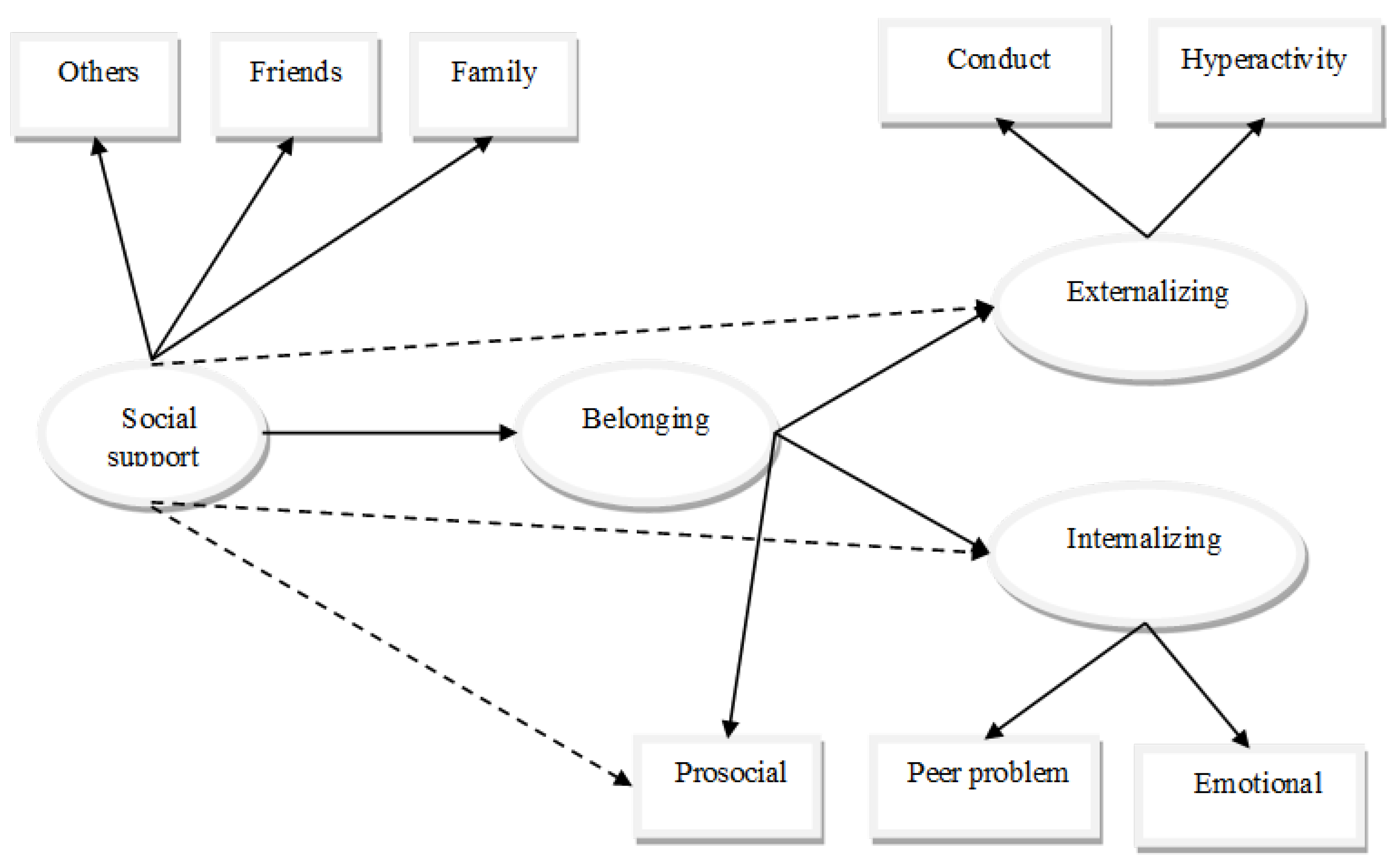
This study aimed to investigate the mediating role of school belonging in the relationship between perceived social support and specific mental health outcomes. Our central hypotheses posit that higher levels of perceived social support will be associated with reduced internalizing problems (i.e., emotional and peer problems), fewer externalizing problems (i.e., hyperactivity and conduct problems), and increased prosocial behaviors. Furthermore, we anticipate that school belonging will serve as a significant mediator, linking social support to these mental health outcomes. By examining these dynamics, our research aims to contribute valuable insights for targeted interventions and promote adolescent well-being.
Figure 1.
Conceptual model. Note. Solid lines indicate hypothesized mediating paths and dashed lines indicate direct paths from social support to mental health.
Figure 1.
Conceptual model. Note. Solid lines indicate hypothesized mediating paths and dashed lines indicate direct paths from social support to mental health.
Method
Participants and Procedure
According to Kline (2023) that the sample size for path analysis should be 10 times the number of parameters, our study included 780 participants. To ensure robustness and account for potential attrition, we increased the sample size to 807 participants. The final sample included 807 volunteer students from some middle schools in Turkey, selected through convenience sampling. A total of 807 seventh and eighth-grade students (373 boys and 434 girls) with an average age of 13.13 years and an age range of 11 to 14 were included in our study. Among them, 104 were immigrants (35 girls and 69 boys), 692 were Turkish, and data for 11 participants were missing. Of the participants, 562 (69.6%) were enrolled in public schools, while 245 (30.4%) were in private schools. The breakdown by school type showed that 236 (29.2%) attended girls’ schools, 212 (26.3%) attended boys’ schools, and 290 (35.9%) attended mixed-gender schools. Additionally, 69 participants (8.6%) attended the same school but were in separate classes for girls and boys.
First, ethical approval was obtained from the Ibn Haldun University Institutional Review Board. Then, the Provincial İstanbul Education Board was contacted, and the research instruments, procedures, and processes were submitted in writing. Upon receiving written permission, middle school principals were approached, and meetings were held to discuss the project. Schools that agreed to participate were selected as candidates. An invitation letter explaining the study’s purpose and process was sent to parents, who were asked to sign a parental consent form if they agreed to participate. Professional school counselors administered the paper-pencil questionnaires to the students. Participants were informed about the voluntary nature of the study and assured of confidentiality. They were instructed not to write their names or any identifiable information on the questionnaires and to place the completed surveys in an envelope on the classroom table. Completing the questionnaires took approximately one class period (40 minutes). School counselors were available to provide assistance or explanations as needed. Data collection was conducted simultaneously across all schools during the 2022-2023 academic year. Participation was voluntary, and students did not receive any incentives or penalties based on their participation.
Measurement
Perceived social support. We administered the Multidimensional Scale of Perceived Social Support (MSPSS) to measure perceptions of support from three sources, family, friends and significant other. This scale was constructed by Zimet et al. (1988), and Başol (2008) translated and revised it to be suitable for Turkish people. It consists of 12 items, with each subscale containing 4 items, rated on a 7-point Likert scale ranging from ’very strongly disagree’ (1) to ’very strongly agree’ (7). Scoring is done by summing the responses for each subscale, with higher scores indicating greater perceived social support. The MSPSS has demonstrated good internal consistency, test-retest reliability, and construct validity (Başol, 2008; Zimet et al., 1988). Example items include “My family really tries to help me” or “I can talk about my problems with friends”. Cronbach’s alpha values for the total scale and subscales (family, friends, significant others) in this study were 0.86, 0.72, 0.68, and 0.67, respectively.
School belonging: We adopted the Turkish version of the Psychological Sense of School Membership Scale (PSSM), developed by Goodenow (1993) and translated by Sari (2012), to evaluate subjective sense of school membership in early- and mid-adolescent students. It assesses the extent to which students feel like an accepted, respected, and valued part of their school context. PSSM consists of 18 items divided into two subscales: "Belonging" and "Rejection". Responses are scored on a 5-point Likert scale ranging from ’not at all true (1) to ’completely true (5). Negatively worded five items (items 3, 6, 9, 12, and 16) are reverse scored. The item scores are summed and then divided by 18 to yield an average item score. The PSSM includes items that involve not only perceived liking, personal acceptance, and inclusion (e.g., “Most teachers at this school are interested in me”, “I feel like a real part of this school”) but also respect and encouragement for participation (e.g., “People here notice when I’m good at something”, “Other students in this school take my opinions seriously”). Cronbach’s alpha internal consistency coefficients of the scale were ranging from .77 to .88 for different samples (Goodenow, 1993). The PSSM scale was found to be reliable for other cultures and languages as much as the original English version. For example, alpha values ranged from .71 to .94 for English versions; alpha value was .77 for Spanish version, .84 for Turkish version, and it was .89 for Chinese version (Cheung, 2004; Sari, 2012). Cronbach’s alpha values for the total scale in this study was 0.70.
Internalizing, externalizing and prosocial behaviors: We used the self-report version of the Strengths & Difficulties Questionnaire (SDQ), developed by Goodman (1997) and translated into Turkish by Güvenir et al. (2008), to measure child and adolescent mental health and behavioral problems. The SDQ aims to identify behavioral problems and strengths to assist in the early diagnosis and intervention of developmental, emotional, and behavioral issues. It consists of 25 items divided into five subscales: Emotional Symptoms, Conduct Problems, Hyperactivity/Inattention, Peer Relationship Problems, and Prosocial Behavior. Each item is scored on a 3-point Likert scale (0 = not true, 1 = somewhat true, 2 = certainly true), resulting in a total difficulty score and a prosocial score. A small number of items are reversed scored. A total difficulties score is obtained by adding the scores for all but the prosocial behavior scale. The possible range of scores for each of the subscales is 0–10, and for the total difficulties score it is 0–40. Cut-off scores distinguishing normal, borderline, and abnormal adjustment vary between informant versions, and across subscales and the total difficulties score. The SDQ has demonstrated good psychometric properties, including reliability and validity, across different cultures (Bourdon et al., 2005; Goodman, 1997; Güvenir et al., 2008). Example items include “I try to be nice to other people” (Prosocial Behavior), “I am often unhappy, depressed, or tearful” (Emotional Symptoms), or “I am restless, I cannot stay still for long” (Hyperactivity/Inattention). Cronbach’s alpha values for the total scale and subscales (internalizing, externalizing, prosocial) in this study were 0.71, 0.73, 0.72, and 0.69, respectively.
Analysis
The data were analyzed using SPSS. 27 and AMOS.24. The normality of the variables was assessed prior to conducting the statistical analysis. The findings demonstrated that all variables followed a normal distribution. Accordingly, the data analysis was conducted in several sequential steps. First, the descriptive statistics and correlation coefficients between the variables were analyzed. Second, constructed a Path Analysis to analyze the relationship between perceived social support and internalizing and externalizing problems and prosocial behaviors as well as the mediating roles of school belonging. The bias-corrected percentile bootstrap method (n = 5000) to test the 95% confidence interval (CI) of the indirect effect was applied. Model fit was evaluated by CMIN/DF lower than 5; RMSEA lower than 0.05; and GFI, CFI, IFI, and AGFI higher than 0.90.
Results
Descriptive Analysis and Correlation Analysis
Table 1 shows the results of descriptive statistics and correlation matrix. The results indicated that perceived support from family, friends, and others, school belonging, and prosocial behaviors were positively correlated with each other. The relationship between these variables and internalizing and externalizing problems is negative (p < 0.001).
Mediation Model
Path analysis was employed to examine the mediating role of school belonging in the relationship between perceived support from family, friends, and others, and internalizing problems, externalizing problems, and prosocial behaviors. First, the direct effects of perceived support from family, friends, and others, and school belonging on internalizing and externalizing problems, as well as prosocial behaviors, were examined. The goodness-of-fit of the model was not acceptable (CMIN/DF = 30.527, RMSEA = 0.191, GFI = 0.970, CFI = 0.944, IFI=0.945, AGFI = 0.724). The perceived support from family did not have a significant direct effect on internalizing and externalizing problems as well as prosocial behaviors. The perceived support from friends did not have a significant effect on school belonging, internalizing problems, and prosocial behaviors (p > 0.05). In addition, there was covariance between the error of internalized problems and externalized problems, as well as between externalized problems and prosocial behaviors. Therefore, the model was revised by eliminating nonsignificant paths and introducing covariances between error terms (Figure 1). The revised model fit was excellent with CMIN/DF = 1.195, RMSEA = 0.016, GFI = 0.997, CFI = 0.999, IFI= 0.999, AGFI = 0.988.
Figure 2.
The revised mediation model.
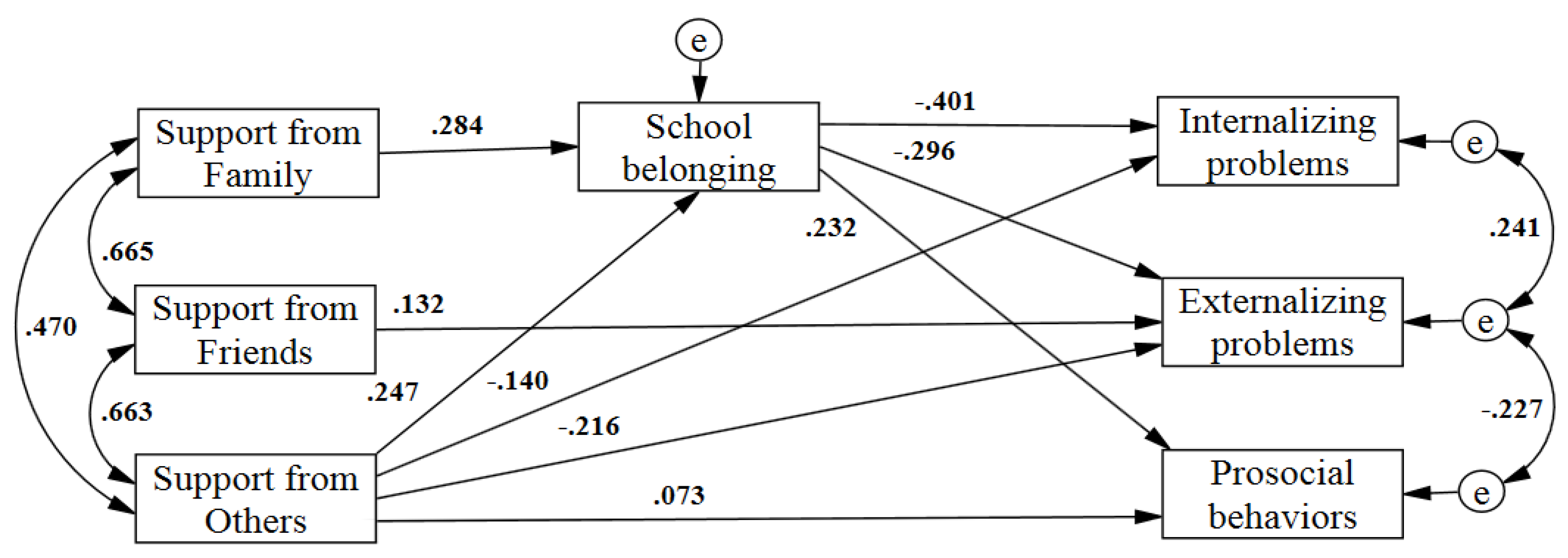
The figure illustrates that perceived support from family has a direct and positive effect on school belonging (β = 0.284). Perceived support from friends exerts a direct and positive influence on externalizing problems (β = 0.132). Perceived support from significant individuals has a direct positive effect on both school belonging (β = 0.247) and prosocial behaviors (β = 0.073), while demonstrating a direct negative effect on both internalizing (β = -0.140) and externalizing problems (β = -0.216). Furthermore, school belonging showed a direct negative effect on internalizing (β = -0.401), and externalizing problems (β = -0.269), but a direct positive effect on prosocial behaviors (β = 0.232). Then, the indirect effects of perceived support from family, friends, and others on internalizing and externalizing problems and prosocial behaviors, mediated by school belonging, were examined (Table 2).
Table 2 shows that the indirect effects of perceived support from family on internalizing problems (β = -0.114), externalizing problems (β = -0.084), and prosocial behaviors (β = 0.066) are significant. the indirect effects of perceived support from others on internalizing problems (β = -0.099), externalizing problems (β = -0.073), and prosocial behaviors (β = 0.057) are significant, also. All indirect effects are statistically significant (p < 0.001). Perceived support from family, friends, and significant others could explain 21% of the variance in school belonging. The explained variance of internalizing problems, externalizing problems, and prosocial behaviors based on perceived social support and school belonging was 22%, 14%, and 7%, respectively.
Discussion
The findings of this study underscore the critical role of perceived social support in shaping adolescents’ emotional and behavioral outcomes. Support from family emerged as a key factor in fostering a sense of school belonging, which, in turn, was linked to lower internalizing and externalizing problems and increased prosocial behaviors. While support from friends contributed directly to externalizing problems, support from significant individuals played a more complex role, positively influencing school belonging and prosocial behaviors while simultaneously reducing both internalizing and externalizing problems. Additionally, school belonging itself served as a significant protective factor, mitigating internalizing and externalizing problems and enhancing prosocial behaviors. The indirect effects further highlight the intricate pathways through which social support influences adolescent well-being, emphasizing the mediating function of school belonging in these relationships. These findings will be discussed in greater depth in the following sections.
Social Support and Adolescents’ Well-Being
Perceived support from family had a significant positive effect on school belonging and indirectly reduced internalizing and externalizing problems while fostering prosocial behaviors. This aligns with previous research emphasizing the stabilizing role of familial support in adolescent development (Attar-Schwartz et al., 2019; van Meegen et al., 2024; Xin et al., 2024). A strong sense of family support contributes to school belonging, which acts as a protective factor against negative emotional and behavioral outcomes (Li & Li, 2024). Family support fosters emotional security, allowing adolescents to navigate social and academic challenges more effectively, reinforcing healthy coping mechanisms in the presence of stressors (Lyell et al., 2020; Schüürmann & Goagoses, 2022).
Unlike family support, perceived support from friends was directly associated with externalizing behaviors. This pattern reflects previous findings indicating that peer relationships, particularly in adolescence, may encourage risk-taking behaviors and social dominance, leading to more externalizing problems (Fortuin et al., 2015; Korol et al., 2020). While friendships offer emotional support, they may also involve social reinforcement of aggressive or defiant behavior, particularly in environments where peer influence is strong. This suggests that adolescents may prioritize peer acceptance, even at the expense of behavioral regulation.
Support from significant individuals (e.g., mentors, teachers, or extended family) played a dual role. It positively influenced school belonging and prosocial behaviors while mitigating internalizing and externalizing problems. This finding is consistent with previous studies demonstrating that non-parental adult support contributes to resilience and adaptive functioning in adolescents (Beam et al., 2002; Bowers et al., 2014). The ability of significant others to act as social buffers may help adolescents feel emotionally supported beyond their immediate family environment, reinforcing prosocial behavior and reducing maladaptive responses to stress.
The results align well with Ecological Systems Theory (Bronfenbrenner, 2005), which posits that different layers of social influence interact to shape adolescent development. Family, friends, and significant others represent micro-level social systems that influence emotional adjustment, school belonging, and behavioral regulation. According to social learning theory, adolescents who receive consistent emotional support from family, friends, or significant others are more likely to adopt and exhibit similar altruistic and prosocial behaviors in their interactions. Recent longitudinal research has documented this connection, demonstrating that adolescents with strong social support networks tend to engage in more prosocial behaviors (van Meegen et al., 2024). A six-year study of Dutch adolescents found that those with supportive family members and friends who modeled prosocial behavior exhibited higher levels of such behaviors themselves (van Meegen et al., 2024). Adolescents with a reliable support system experience a greater sense of acceptance and emotional security, which facilitates open communication and emotional expression. This increased psychological stability serves as a protective factor, reducing the likelihood of emotional and behavioral difficulties. The role of school belonging as a mediator aligns with Self-Determination Theory (Ryan & Deci, 2000), which highlights the importance of relatedness in fostering well-being and engagement in social environments.
The Mediating Role of School Belonging
Our findings emphasize the crucial mediating function of school belonging in the relationship between perceived social support and internalizing, externalizing, and prosocial behaviors in adolescents. Specifically, adolescents who perceive stronger support from family and significant others are more likely to develop a sense of belonging within their school environment, which, in turn, influences their emotional and behavioral outcomes. This finding aligns with previous research (Reyes & Reyes, 2023; Tomás et al., 2020; Vargas-Madriz et al., 2023) and is well-supported by attachment theory. Adolescents who perceive strong social support from friends, family, and significant others develop a solid foundation for building healthy relationships and a sense of security across different environments, including school. This supportive network fosters feelings of self-worth and usefulness within the school setting, reinforcing their perception of school as a positive space for personal growth.
School belonging was found to negatively predict internalizing and externalizing behaviors while positively influencing prosocial behaviors. This suggests that when adolescents feel emotionally connected to their school, they experience fewer symptoms of anxiety and depression (internalizing problems) and engage in fewer aggressive or disruptive behaviors (externalizing problems). Instead, they demonstrate more prosocial behaviors, such as helping and cooperating with peers. These findings align with Goodenow and Grady’s (1993) seminal work on school belonging, which has shown that a strong sense of belonging to the school community serves as a protective factor against psychological distress. The results also parallel research by Allen et al. (2018), which found that higher levels of school belonging are associated with reduced emotional and behavioral problems, highlighting its role in fostering a positive developmental trajectory for adolescents.
A particularly noteworthy finding is that family support did not directly influence internalizing, externalizing, or prosocial behaviors but instead operated entirely through school belonging. This suggests that while family support fosters a sense of security and connection in adolescents, its impact on behavioral outcomes is largely dependent on how well adolescents feel integrated into their school environment. In other words, adolescents who perceive strong family support may internalize positive values and emotional resilience, but unless they feel a sense of belonging in school, they may not fully translate these benefits into external behavioral adjustments. This finding is consistent with the Bioecological Model of Human Development (Bronfenbrenner & Morris, 2007), which posits that developmental outcomes result from the dynamic interactions between microsystems, such as family and school. While the family serves as an initial source of emotional support, the school context plays a critical role in shaping adolescents’ broader social and behavioral experiences. Previous studies, such as those by Wilkinson-Lee et al. (2011) and Yao (2024), similarly report that adolescents with strong familial ties but weak school belonging continue to experience lower prosocial behavior, underscoring the necessity of school engagement in translating parental support into positive behavioral outcomes.
The study’s findings can be best understood within the framework of Self-Determination Theory (Ryan & Deci, 2000), which highlights belonging as a core psychological need essential for emotional and behavioral well-being. According to this theory, adolescents require meaningful connections within their environment to experience psychological growth. While family support lays the foundation for emotional health, school belonging provides the external social validation necessary to regulate emotions and behaviors effectively. Without a sense of belonging in school, adolescents may struggle to apply the benefits of family support to their broader social interactions.
Moreover, the Social Support Theory (Cohen & Wills, 1985) helps explain why different sources of support (family, friends, and significant others) have varied effects on adolescent behavior. While family support fosters emotional stability, it must be complemented by peer and institutional support to fully protect against maladaptive behaviors. The fact that friend support was linked directly to externalizing behaviors suggests that peer influence can both reinforce and challenge behavioral norms, consistent with previous research highlighting the dual effects of peer relationships on adolescent development (Fortuin et al., 2015).
Implications
This study offers novel insights into the intricate relationships between perceived social support, school belonging, and adolescent behavioral outcomes, highlighting the mediating role of school belonging as a key mechanism shaping internalizing, externalizing, and prosocial behaviors. Unlike prior research that primarily examines direct effects of social support, this study emphasizes how school belonging serves as a critical pathway through which family and significant others exert their influence. The findings suggest that while family support does not directly impact behavioral outcomes, it fosters a stronger sense of belonging, which in turn reduces psychological distress and maladaptive behaviors while enhancing prosocial tendencies. Similarly, support from significant individuals plays a dual role in shaping both emotional well-being and positive behavioral engagement. The practical implications are substantial—educators, policymakers, and mental health professionals can leverage these insights to design targeted interventions that enhance school belonging as a protective factor against emotional and behavioral difficulties. Strengthening school bonding initiatives and fostering supportive peer and mentor relationships may serve as effective strategies to mitigate externalizing and internalizing problems while promoting prosocial behavior. By demonstrating that school belonging mediates these relationships, this study provides a refined theoretical framework for understanding adolescent development and underscores the necessity of incorporating school climate considerations into social support research and intervention programs.
Limitations and Future Research Directions
While this study provides valuable insights into the role of perceived social support and school belonging in adolescent behavioral outcomes, several limitations should be acknowledged. First, the use of convenience sampling may introduce selection bias, potentially limiting the representativeness of the sample. Additionally, the cross-sectional nature of the study prevents causal interpretations, as the relationships observed cannot confirm longitudinal effects. The reliance on self-report instruments may be subject to social desirability bias, influencing participants’ responses regarding their experiences of support and school belonging. Furthermore, as the study was conducted in one area of Istanbul, the findings may not be generalizable to adolescents in other regions or cities with varying socio-cultural contexts. Another limitation is the lack of control for demographic variables, such as socioeconomic status, academic performance, and cultural background, which may shape adolescents’ perceptions of social support and behavioral tendencies
Future research should address these limitations by employing longitudinal designs to examine the long-term influence of social support and school belonging on adolescent well-being. Expanding the sample to diverse geographic regions and including adolescents from different educational settings could enhance generalizability. Additionally, integrating multi-informant assessments, such as parent, teacher, or peer reports, may provide a more comprehensive understanding of social support dynamics. Further research could also explore cultural variations in school belonging and social support effects, considering how different cultural norms shape adolescent relationships and behavioral responses. Investigating potential moderators, such as personality traits or coping strategies, could deepen the understanding of individual differences in how social support influences developmental outcomes.
Conclusions
The findings of this study emphasize the critical role of perceived social support in shaping adolescent emotional and behavioral outcomes, with school belonging acting as a key mediating factor in these relationships. While family and significant others foster a sense of school connectedness, this belonging, in turn, contributes to lower internalizing and externalizing problems while reinforcing prosocial behaviors. Interestingly, friend support was directly linked to externalizing behaviors, highlighting the complex influence of peer relationships. The indirect effects further support the idea that social support influences adolescent well-being through the school environment, underscoring the importance of fostering supportive academic and social spaces. These findings not only expand theoretical understandings of adolescent development but also offer practical implications for educators, policymakers, and mental health professionals, emphasizing the need for targeted interventions to strengthen school belonging as a protective factor against psychological distress and behavioral challenges. By illustrating the nuanced pathways through which social support operates, this study contributes to both the academic discourse and the development of comprehensive strategies for enhancing adolescent well-being.
Funding
This research was funded by Ibn Haldun University, Scientific Research Fund (BAP).
Acknowledgements
The authors express their sincere gratitude to all the students who participated in this study, as well as the counselors and school administrators who facilitated data collection.
Statement on Ethics Approval
An ethical permission form was obtained from the Ibn Haldun University Institutional Review Board prior to conducting this study (Approval Number: 2020/03-2).
Declaration of Conflicting Interests
The authors declare that there are no conflicts of interest regarding the research, authorship, or publication of this study.
References
- Acoba, E. F. (2024). Social support and mental health: the mediating role of perceived stress. Frontiers in Psychology, 15, 1330720. [CrossRef]
- Allen, K.-A., Vella-Brodrick, D., & Waters, L. (2016). Fostering school belonging in secondary schools using a socio-ecological framework. The Educational and Developmental Psychologist, 33(1), 97-121. [CrossRef]
- Allen, K., Kern, M. L., Vella-Brodrick, D., Hattie, J., & Waters, L. (2018). What schools need to know about fostering school belonging: A meta-analysis. Educational psychology review, 30, 1-34. [CrossRef]
- Arslan, G. (2018). Social exclusion, social support and psychological wellbeing at school: A study of mediation and moderation effect. Child indicators research, 11, 897-918. [CrossRef]
- Attar-Schwartz, S., Mishna, F., & Khoury-Kassabri, M. (2019). The role of classmates’ social support, peer victimization and gender in externalizing and internalizing behaviors among Canadian youth. Journal of Child and Family Studies, 28, 2335-2346. [CrossRef]
- Azpiazu, L., Antonio-Aguirre, I., Izar-de-la-Funte, I., & Fernández-Lasarte, O. (2024). School adjustment in adolescence explained by social support, resilience and positive affect. European Journal of Psychology of Education, 1-20. [CrossRef]
- Başol, G. (2008). Validity and reliability of the multidimensional scale of perceived social support-revised, with a Turkish sample. Social Behavior and Personality: an international journal, 36(10), 1303-1313. [CrossRef]
- Beam, M. R., Chen, C., & Greenberger, E. (2002). The nature of adolescents’ relationships with their “very important” nonparental adults. American journal of community psychology, 30(2), 305-325. [CrossRef]
- Bernasco, E. L., Nelemans, S. A., van der Graaff, J., & Branje, S. (2021). Friend support and internalizing symptoms in early adolescence during COVID-19. Journal of Research on Adolescence, 31(3), 692-702. [CrossRef]
- Bhui, K., Silva, M. J., Harding, S., & Stansfeld, S. (2017). Bullying, social support, and psychological distress: Findings from RELACHS cohorts of East London’s White British and Bangladeshi adolescents. Journal of Adolescent Health, 61(3), 317-328. [CrossRef]
- Blum, R. W., Astone, N. M., Decker, M. R., & Mouli, V. C. (2014). A conceptual framework for early adolescence: a platform for research. International journal of adolescent medicine and health, 26(3), 321-331. [CrossRef]
- Bourdon, K. H., Goodman, R., Rae, D. S., Simpson, G., & Koretz, D. S. (2005). The Strengths and Difficulties Questionnaire: US normative data and psychometric properties. Journal of the American Academy of Child & Adolescent Psychiatry, 44(6), 557-564. [CrossRef]
- Bowers, E. P., Johnson, S. K., Buckingham, M. H., Gasca, S., Warren, D. J., Lerner, J. V., & Lerner, R. M. (2014). Important non-parental adults and positive youth development across mid-to late-adolescence: The moderating effect of parenting profiles. Journal of Youth and Adolescence, 43, 897-918. [CrossRef]
- Brendgen, M., & Poulin, F. (2018). Continued bullying victimization from childhood to young adulthood: A longitudinal study of mediating and protective factors. Journal of abnormal child psychology, 46(1), 27-39. [CrossRef]
- Bronfenbrenner, U. (2005). Making human beings human: Bioecological perspectives on human development. sage publications.
- Bronfenbrenner, U., & Morris, P. A. (2007). The bioecological model of human development. Handbook of child psychology, 1. [CrossRef]
- Carlo, G. (2013). The development and correlates of prosocial moral behaviors. In Handbook of moral development (pp. 208-234). Psychology Press.
- Chaudhry, S., Tandon, A., Shinde, S., & Bhattacharya, A. (2024). Student psychological well-being in higher education: The role of internal team environment, institutional, friends and family support and academic engagement. PLoS ONE, 19(1), e0297508. [CrossRef]
- Chemers, M. M., Hu, L.-t., & Garcia, B. F. (2001). Academic self-efficacy and first year college student performance and adjustment. Journal of Educational psychology, 93(1), 55. https://psycnet.apa.org/doi/10.1037/0022-0663.93.1.55.
- Cheung, H. Y. (2004). Comparing Shanghai and Hong Kong students’ psychological sense of school membership. Asia Pacific Education Review, 5, 34-38. [CrossRef]
- Clapham, R., & Brausch, A. (2024). Internalizing and externalizing symptoms moderate the relationship between emotion dysregulation and suicide ideation in adolescents. Child Psychiatry & Human Development, 55(2), 467-478. [CrossRef]
- Cobo-Rendón, R., López-Angulo, Y., Pérez-Villalobos, M. V., & Díaz-Mujica, A. (2020). Perceived social support and its effects on changes in the affective and eudaimonic well-being of Chilean university students. Frontiers in Psychology, 11, 590513. [CrossRef]
- Cohen, S. (2004). Social relationships and health. American psychologist, 59(8), 676.
- Cohen, S., & Wills, T. A. (1985). Stress, social support, and the buffering hypothesis. Psychological bulletin, 98(2), 310. https://psycnet.apa.org/doi/10.1037/0033-2909.98.2.310.
- Commisso, M., Geoffroy, M.-C., Temcheff, C., Scardera, S., Vergunst, F., Côté, S. M., Vitaro, F., Tremblay, R. E., & Orri, M. (2024). Association of childhood externalizing, internalizing, comorbid problems with criminal convictions by early adulthood. Journal of psychiatric research, 172, 9-15. [CrossRef]
- Demaray, M. K., & Malecki, C. K. (2002). The relationship between perceived social support and maladjustment for students at risk. Psychology in the Schools, 39(3), 305-316. 3). [CrossRef]
- Ercan, E. S., Polanczyk, G., Akyol Ardıc, U., Yuce, D., Karacetın, G., Tufan, A. E., Tural, U., Aksu, H., Aktepe, E., & Rodopman Arman, A. (2019). The prevalence of childhood psychopathology in Turkey: a cross-sectional multicenter nationwide study (EPICPAT-T). Nordic Journal of Psychiatry, 73(2), 132-140. [CrossRef]
- Fakhrou, A. A., Adawi, T. R., Ghareeb, S. A., Elsherbiny, A. M., & AlFalasi, M. M. Role of family in supporting children with mental disorders in Qatar. [CrossRef]
- Fortuin, J., van Geel, M., & Vedder, P. (2015). Peer influences on internalizing and externalizing problems among adolescents: A longitudinal social network analysis. Journal of Youth and Adolescence, 44, 887-897. [CrossRef]
- Fu, W., Wang, C., Chai, H., & Xue, R. (2022). Examining the relationship of empathy, social support, and prosocial behavior of adolescents in China: A structural equation modeling approach. Humanities and Social Sciences Communications, 9(1), 1-8. [CrossRef]
- Gariepy, G., Honkaniemi, H., & Quesnel-Vallee, A. (2016). Social support and protection from depression: systematic review of current findings in Western countries. The British Journal of Psychiatry, 209(4), 284-293. [CrossRef]
- Goodenow, C. (1993). The psychological sense of school membership among adolescents: Scale development and educational correlates. Psychology in the Schools, 30(1), 79-90. [CrossRef]
- Goodenow, C., & Grady, K. E. (1993). The relationship of school belonging and friends’ values to academic motivation among urban adolescent students. The journal of experimental education, 62(1), 60-71. [CrossRef]
- Goodman, R. (1997). The Strengths and Difficulties Questionnaire: a research note. Journal of Child Psychology and Psychiatry, 38(5), 581-586. [CrossRef]
- Güvenir, T., Özbek, A., Baykara, B., Arkar, H., Şentürk, B., & İncekaş, S. (2008). Psychometric properties of the Turkish version of the Strengths and Difficulties Questionnaire (SDQ). Turk J Child Adolesc Ment Health, 15(2), 65-74.
- Haddadi Barzoki, M. (2024). School belonging and depressive symptoms: the mediating roles of social inclusion and loneliness. Nordic Journal of Psychiatry, 78(3), 205-211. [CrossRef]
- Haller, E., Lubenko, J., Presti, G., Squatrito, V., Constantinou, M., Nicolaou, C., Papacostas, S., Aydın, G., Chong, Y. Y., & Chien, W. T. (2022). To help or not to help? Prosocial behavior, its association with well-being, and predictors of prosocial behavior during the coronavirus disease pandemic. Frontiers in Psychology, 12, 775032. [CrossRef]
- Högberg, B., Petersen, S., Strandh, M., & Johansson, K. (2021). Determinants of declining school belonging 2000–2018: The case of Sweden. Social indicators research, 157(2), 783-802. [CrossRef]
- Kågström, A., Pešout, O., Kučera, M., Juríková, L., & Winkler, P. (2023). Development and validation of a universal mental health literacy scale for adolescents (UMHL-A). Psychiatry Research, 320, 115031. [CrossRef]
- Kline, R. B. (2023). Principles and practice of structural equation modeling. Guilford publications.
- Korol, L., Bayram Özdemir, S., & Stattin, H. (2020). Friend support as a buffer against engagement in problem behaviors among ethnically harassed immigrant adolescents. The Journal of Early Adolescence, 40(7), 885-913. [CrossRef]
- Li, J., Wisnivesky, J., Gonzalez, A., Feder, A., Pietrzak, R. H., Chanumolu, D., Hu, L., & Kale, M. (2025). The association of perceived social support, resilience, and posttraumatic stress symptoms among coronavirus disease patients in the United States. Journal of affective disorders, 368, 390-397. [CrossRef]
- Li, Q., & Hu, G. (2023). Positive impacts of perceived social support on prosocial behavior: the chain mediating role of moral identity and moral sensitivity. Frontiers in Psychology, 14, 1234977. [CrossRef]
- Li, Z., & Li, Q. (2024). How Social Support Affects Resilience in Disadvantaged Students: The Chain-Mediating Roles of School Belonging and Emotional Experience. Behavioral Sciences, 14(2), 114. [CrossRef]
- Lyell, K. M., Coyle, S., Malecki, C. K., & Santuzzi, A. M. (2020). Parent and peer social support compensation and internalizing problems in adolescence. Journal of School Psychology, 83, 25-49. [CrossRef]
- Mancini, V. O., Rigoli, D., Heritage, B., Roberts, L. D., & Piek, J. P. (2016). The relationship between motor skills, perceived social support, and internalizing problems in a community adolescent sample. Frontiers in Psychology, 7, 543. [CrossRef]
- McLean, L., Gaul, D., & Penco, R. (2023). Perceived social support and stress: A study of 1st year students in Ireland. International Journal of Mental Health and Addiction, 21(4), 2101-2121. [CrossRef]
- Meque, I., Dachew, B. A., Maravilla, J. C., Salom, C., & Alati, R. (2019). Externalizing and internalizing symptoms in childhood and adolescence and the risk of alcohol use disorders in young adulthood: A meta-analysis of longitudinal studies. Australian & New Zealand Journal of Psychiatry, 53(10), 965-975. [CrossRef]
- Mu, Y., & Du, B. (2024). Peer factors and prosocial behavior among Chinese adolescents from difficult families. Scientific Reports, 14(1), 815. [CrossRef]
- Petersen, K. J., Qualter, P., Humphrey, N., Damsgaard, M. T., & Madsen, K. R. (2023). With a little help from my friends: Profiles of perceived social support and their associations with adolescent mental health. Journal of Child and Family Studies, 32(11), 3430-3446. [CrossRef]
- Reyes, J. D., & Reyes, J. B. (2023). Effect of social support from family on an individual’s loneliness when mediated by one’s sense of belongingness. International Journal of Advances in Social and Economics, 5(1), 21-30. [CrossRef]
- Roksa, J., & Kinsley, P. (2019). The role of family support in facilitating academic success of low-income students. Research in Higher Education, 60, 415-436. [CrossRef]
- Ryan, R. M., & Deci, E. L. (2000). Self-determination theory and the facilitation of intrinsic motivation, social development, and well-being. American psychologist, 55(1), 68. https://psycnet.apa.org/doi/10.1037/0003-066X.55.1.68.
- Sacco, R., Camilleri, N., Eberhardt, J., Umla-Runge, K., & Newbury-Birch, D. (2022). A systematic review and meta-analysis on the prevalence of mental disorders among children and adolescents in Europe. European Child & Adolescent Psychiatry, 1-18. [CrossRef]
- Sanders, J., & Munford, R. (2016). Fostering a sense of belonging at school––five orientations to practice that assist vulnerable youth to create a positive student identity. School Psychology International, 37(2), 155-171. [CrossRef]
- Sari, M. (2012). Sense of School Belonging Among Elementary School Students. Çukurova University Faculty of Education Journal, 41(1).
- Schacter, H. L., Lessard, L. M., Kiperman, S., Bakth, F., Ehrhardt, A., & Uganski, J. (2021). Can friendships protect against the health consequences of peer victimization in adolescence? A systematic review. School Mental Health, 1-24. [CrossRef]
- Scholte, R. H., Van Lieshout, C. F., & Van Aken, M. A. (2001). Perceived relational support in adolescence: Dimensions, configurations, and adolescent adjustment. Journal of Research on Adolescence, 11(1), 71-94. [CrossRef]
- Schreiber, J. B., Nora, A., Stage, F. K., Barlow, E. A., & King, J. (2006). Reporting structural equation modeling and confirmatory factor analysis results: A review. The Journal of educational research, 99(6), 323-338. [CrossRef]
- Schüürmann, A., & Goagoses, N. (2022). Perceived Social Support and Alcohol Consumption during Adolescence: A Path-Analysis with Internalizing and Externalizing Behaviour Problems. Emotional and Behavioural Difficulties, 27(4), 297-309. [CrossRef]
- Song, S., Martin, M. J., & Wang, Z. (2024). School belonging mediates the longitudinal effects of racial/ethnic identity on academic achievement and emotional well-being among Black and Latinx adolescents. Journal of School Psychology, 106, 101330. [CrossRef]
- Tandon, S. D., Dariotis, J. K., Tucker, M. G., & Sonenstein, F. L. (2013). Coping, stress, and social support associations with internalizing and externalizing behavior among urban adolescents and young adults: revelations from a cluster analysis. Journal of Adolescent Health, 52(5), 627-633. [CrossRef]
- Tomás, J. M., Gutiérrez, M., Pastor, A. M., & Sancho, P. (2020). Perceived social support, school adaptation and adolescents’ subjective well-being. Child indicators research, 13(5), 1597-1617. [CrossRef]
- Vaitsiakhovich, N., Landes, S. D., & Monnat, S. M. (2025). The role of perceived social support in subjective wellbeing among working-age US adults with and without limitations in activities of daily living. Disability and Health Journal, 18(1), 101705. [CrossRef]
- Van der Graaff, J., Carlo, G., Crocetti, E., Koot, H. M., & Branje, S. (2018). Prosocial behavior in adolescence: Gender differences in development and links with empathy. Journal of Youth and Adolescence, 47(5), 1086-1099. [CrossRef]
- van Meegen, M., Van der Graaff, J., Carlo, G., Meeus, W., & Branje, S. (2024). Longitudinal Associations Between Support and Prosocial Behavior Across Adolescence: The Roles of Fathers, Mothers, Siblings, and Friends. Journal of Youth and Adolescence, 53(5), 1134-1154. [CrossRef]
- Vang, T. M., & Nishina, A. (2022). Fostering School Belonging and Students’ Well-Being Through a Positive School Interethnic Climate in Diverse High Schools. Journal of School Health, 92(4), 387-395. [CrossRef]
- Vargas-Madriz, L. F., & Konishi, C. (2021). The relationship between social support and student academic involvement: The mediating role of school belonging. Canadian Journal of School Psychology, 36(4), 290-303. [CrossRef]
- Vargas-Madriz, L. F., Zhang, M., Wang, Z., Long, Y., & Konishi, C. (2023). Social support and traditional bullying perpetration among high school students: The mediating role of school belonging. International Journal of Bullying Prevention, 1-13. [CrossRef]
- Wilkinson-Lee, A. M., Zhang, Q., Nuno, V. L., & Wilhelm, M. S. (2011). Adolescent emotional distress: The role of family obligations and school connectedness. Journal of Youth and Adolescence, 40, 221-230. [CrossRef]
- Xin, B., Yao, Z., & Ouyang, M. (2024). Impact of family cohesion and adaptability on students’ sense of school belonging: Chain mediating effects of self-support and selfesteem. Social Behavior and Personality: an international journal, 52(4), 1-10. [CrossRef]
- Yan, Z., Yu, S., & Lin, W. (2024). Parents’ perceived social support and children’s mental health: the chain mediating role of parental marital quality and parent‒child relationships. Current Psychology, 43(5), 4198-4210. [CrossRef]
- Yao, Z. (2024). Cumulative family risk and rural-to-urban migrant adolescent prosocial behavior: The moderating role of school belonging. School Psychology International, 45(6), 616-640. [CrossRef]
- Yıldırım, M., Yıldırım-Kurtuluş, H., Batmaz, H., & Kurtuluş, E. (2023). School belongingness and internalizing and externalizing problems in adolescents: Exploring the influence of meaningful school. Child indicators research, 16(5), 2125-2140. [CrossRef]
- Zimet, G. D., Dahlem, N. W., Zimet, S. G., & Farley, G. K. (1988). The multidimensional scale of perceived social support. Journal of personality assessment, 52(1), 30-41. [CrossRef]
- World Health Organization. (2021). Adolescent mental health. https://www.who.int/news-room/fact-sheets/detail/adolescent-mental-health.

Table 1.
Descriptive statistics and Pearson correlations of the study variables (n = 806).
| Variables | 1 | 2 | 3 | 4 | 5 | 6 | 7 |
| 1. Perceived support- Family | 1 | ||||||
| 2. Perceived support- Friends | 0.67** | 1 | |||||
| 3. Perceived support- Others | 0.47** | 0.66** | 1 | ||||
| 4. School belonging | 0.40** | 0.37** | 0.38** | 1 | |||
| 5. Internalizing problems | -0.27** | -0.28** | -0.29** | -0.45** | 1 | ||
| 6. Externalizing problems | -0.18** | -0.13** | -0.24** | -0.33** | 0.36** | 1 | |
| 7. Prosocial behaviors | 0.17** | 0.15** | 0.16** | 0.26** | -0.12** | -0.30** | 1 |
| M | 4.66 | 4.16 | 5.01 | 62.06 | 6.27 | 6.94 | 7.82 |
| SD | 1.44 | 1.55 | 1.31 | 12.30 | 3.50 | 2.97 | 1.68 |
** P < 0.01; * p < 0.05.
Table 2.
Indirect effects of PSS on Int and Ext Probs and prosocial behaviors.
| Indirect paths | Effect values |
P |
Boot LLCI |
Boot ULCI |
| Perceived support- Family → School belonging → Internalizing problems | -0.114 | < 0.001 | -0.149 | -0.082 |
| Perceived support- Family → School belonging → Externalizing problems | -0.084 | < 0.001 | -0.117 | -0.057 |
| Perceived support- Family → School belonging → Prosocial behaviors | 0.066 | < 0.001 | 0.042 | 0.095 |
| Perceived support- Others → School belonging → Internalizing problems | -0.099 | < 0.001 | -0.104 | -0.070 |
| Perceived support- Others → School belonging → Externalizing problems | -0.073 | < 0.001 | -0.133 | -0.049 |
| Perceived support- Others → School belonging → Prosocial behaviors | 0.057 | < 0.001 | 0.037 | 0.084 |
Note: LLCI = Lower limit confidence interval; ULCI = Upper limit confidence interval.
Disclaimer/Publisher’s Note: The statements, opinions and data contained in all publications are solely those of the individual author(s) and contributor(s) and not of MDPI and/or the editor(s). MDPI and/or the editor(s) disclaim responsibility for any injury to people or property resulting from any ideas, methods, instructions or products referred to in the content. |
© 2025 by the authors. Licensee MDPI, Basel, Switzerland. This article is an open access article distributed under the terms and conditions of the Creative Commons Attribution (CC BY) license (http://creativecommons.org/licenses/by/4.0/).
Copyright: This open access article is published under a Creative Commons CC BY 4.0 license, which permit the free download, distribution, and reuse, provided that the author and preprint are cited in any reuse.


