

Submitted:
02 April 2025
Posted:
03 April 2025
You are already at the latest version
Abstract
This study introduces the “exbodiment” concept derived from Embodied Cognition and Enaction Theories (Gallagher, 2012). Unlike embodiment’s top-down cultural interaction process, exbodiment represents a bottom-up approach through agentivity and self-expression. Drawing from Pierre Bourdieu’s capital theory, it examines erotic capital’s power dynamics, as Hakim elaborated (2010a). The concept of “erotic dividends” is taken into account for a future search about the benefits and social outcomes derived from erotic capital exposed in social media. The study offers insights into the power dynamics and psychological factors influencing self-presentation in the digital era. Employing two original tests – the Body Image and Schema Test (BIST) and the Erotic Capital Grid (ECG) – the study aims to validate these tools and understand their implications, which could significantly contribute to our understanding of body image and self-perception. Results show gender differences in judging erotic capital, with females exhibiting more competence and value. Accessories correlate with self-image, while “provocative individuals” prioritise self-esteem over sociability. Those termed “soap and water” exhibit less developed ego skin but excel in psychomotor factors. Lastly, subjects with high erotic capital scores display BIST results in line with others, except for a heightened emphasis on male and female sex images.Complete Tables and the texts of the new psychological instruments, Body Image and Schema Test and Erotic Capital Grid, are consultable at Open Science Framework (OSF) URL: https://osf.io/8hwtf/?view_only=f45c98bbb61e4be28ada2a513b16024d.
Keywords:
social media
; body image
; female self esteem
; erotic capital
1. Introduction
1.1. What is Exbodiment?
The term “exbodiment”, a groundbreaking concept introduced in this study, is derived from the frame theory inspired by the Embodied Cognition and Enaction Theory (Stewart et al., 2010). It can be seen as a specular meaning of “embodiment”. The embodiment can be intended as the top-down process of the interaction between subjects and cultures. “Exbodiment” is the bottom-up process with peoples’ agentivity and self-expression.
According to the Perception Theory (Purves, Wojtach, & Lotto, 2011), a “top-down process of social models” is how subjects direct their behaviour based on cultural solicitations. Our social–psychological perspective constantly confronts her or himself with the “collective-mind” point of view (H. Mead, 1999). However, it is crucial to note that the interaction between subject and culture is not a one-way street. It is a profound, two-way process: the top-down influences, embodied by people, and the bottom-up one, “exbodied” by them when they express particularly in the social arena.
The “bottom-up” process, exbodiment, is a function of the body schema structure (Tiemersma 1989). It indicates how subjects “enact” their embodied cultures and how the body expresses their intentionality (Zahavi, 2000; Ziemke, Zlatev, & Frank, 2007) toward their world. This occurs in the Peripersonal Symbolic Sphere, a key concept in social psychology, also called “the life space” (Lewin, 1939; Reed, 1951), where culture is seen as the framework from which people conceive (top-down) norms as a continuous strength to cope with the cultural influence.
Exbodiment indicates how subjects enact their embodied cultures as agents rather than simply as “puppets.” For example, exbodiment refers to the process applied by anorexic girls to organise their social echo system to control their attempt to represent the “fitting form” detected in cultural symbols. Embodiment relates to the incoming shape from a culture to a subject. At the same time, exbodiment refers to the never-ending process by which subjects express their mostly contrasted acceptance of a cultural and social model.
Figure 1 presents a graphic representation of the general relationship model within embodied and exbodied processes.
In Figure 1, dashed external lines stand like a porous border between the global cultural milieu and what has been here called the “peri-personal symbolic sphere” (not all the possible cultural contents affect an individual!). In a certain way, the Social Representation System is an “engine” that pulses from the general cultural milieu values, images, and symbols into the personal sphere. At the core of it, we find the subject so written because we assume, also, if not verifiable, it is the source or origin of psychological processes. Around the issue are traced lines into the two more relevant psychological processes for our discourse: imagination – facing cultural intentions – and simulation – facing personal enaction –. Individual imagination constitutes a sort of “glue” that captures cultural contents because perception and personal representation become personal beliefs when emotional reactions occur. Conversely, enaction via simulation and direct-action experiences gives access to a unique way to be in the world, called Exbodiment.
Following neurological research (Csordas, 2001; Lionel, Benoit, Guillaume, & Nicolas, 2016), it is possible to consider embodiment as an effect of cultural pressure that originates from the image of oneself, in other words, called “body image”. On the other hand, exbodiment, the word that stays here for personal skills or expressiveness, is a function of body schema because exbodiment results from the specialisation and integration of the sensory-motor body systems. It is possible to sustain (Stewart et al., 2010) that body schema refers to neural systems implicated in movement, while body image refers to the visual-affective beliefs of oneself. The body image can represent the self according to the cultural pressure in a specific society.
1.2. Erotic Capital
In the 1980s, the sociologist Pierre Bourdieu (Jenkins, 1992) introduced a distinction between three types of capital: 1) economic capital, consisting of financial resources and real estate that produce rent; 2) cultural capital, consisting of knowledge and know-how derived from education and experience; 3) social capital, consisting of a person’s relational network such as relatives, friends, professional contacts, etc. Each capital constitutes a power base for an individual: 1) to purchase means, goods and services with economic capital; 2) be able to create services, products, and processes, in the case of cultural capital; 3) have the ability to count on the “right” people to carry out one’s projects. These three forms of power capital are interchangeable: with economic capital, one can access the most prestigious schools; with cultural capital, you can access better and better-paid professional positions; with relational capital, one can establish advantageous give-and-take exchanges.
Expanding on Bourdieu’s analysis, Catherin Hakim introduced the concept of Erotic Capital (2010a). This term refers to a fourth resource that is deeply personal and tied to one’s appearance. Erotic capital is not just a form of power but also a tool that can shape the behaviour of others. It is the social power that an individual gains or cultivates through their attractiveness and charm. Importantly, erotic capital can serve as a pathway for individuals who may lack economic, cultural, and relational capital to access higher socio-economic classes. As Hakim points out, for many women, erotic capital has historically been one of the few, if not the only, avenues for social advancement (Hakim, 2010b).
Even in the present day, erotic capital continues to be a lever for improving one’s social condition. The factors that constitute erotic capital, as identified by the London sociologist, act as a catalyst for social success, a means to collect the economic “coupons” that come from “good relationships”. Erotic capital, therefore, stands as the fourth pillar of power, in circular association with the other three links already analysed by Bourdieu: economic capital, cultural capital, and relational capital. Together, these four forms of capital create an effective and, at times, decisive ”wheel of power” in the acquisition of prestige and social influence.
In past as well as present history, erotic capital has been and is the prerogative, especially of the female gender. Even for the male gender, we can speak of an erotic capital that is based on many of the factors identified by Hakim. In any case, the analysis of the English sociologist and the present research focuses on the female gender, in which, for the socio-historical reasons mentioned, erotic capital constitutes, for many women, especially those from disadvantaged social classes, a resource for socio-economic improvement (Bassetti, 2013).
Hakim defines erotic capital through seven fundamental factors, four of which will be discussed in this research, those that we can define as “available” to the action of individuals. The eminently feminine factor, i.e., fertility, and the beauty factor are understood according to the parameters of harmony, symmetry, “health”, etc., which psycho-neurobiological research has highlighted as universal references with which human beings judge a face (Zaidel & Cohen, 2005) must be excluded (Sprecher & Hatfield, 2022). This last factor is innate because it depends on the genetic heritage to which the individual cannot access. Although not consistently successful, only cosmetic surgery can pursue the “universal” beauty model highlighted by psychological research (Gangestad & Scheyd, 2005).
The remaining factors of erotic capital, on the other hand, are acquired through different arts, such as social communication, fashion, embellishment, seductive behaviour, etc. The research presented here assumes four factors accessible to public inquiry, thus excluding also the factor “sexual competence”, defined by Hakim as energy, erotic imagination, playfulness and everything that derives from the sexual fulfilment of the partner.
The spread of social media has exponentially multiplied the so-called “culture of the image” (Croes, Antheunis, Schouten, & Krahmer, 2019; Jackson & Luchner, 2018; Manago, Graham, Greenfield, & Salimkhan, 2008). In recent decades, the presentation of oneself (Goffman, 2009) carried out through social media has put an individual in front of a worldwide audience. The care for one’s image, the communicative intentions and the availability of cameras integrated into smartphones are the elements that have increased self-presentation through photographic images. It is well known that recruitment companies themselves explore the web to create a complete and reliable profile of a possible candidate. People’s private lives are now exposed in social media, where individuals show themselves as if in a “showcase”. Researchers have shown that it is possible to accurately define an individual’s personality from what they post on Facebook, even better than what can be reconstructed by acquaintances themselves (Youyou, Kosinski, & Stillwell, 2015).
Erotic capital combines social and physical appeals. An irrefutable result is that attractive men and women can interact more positively with others. Beautiful men and women consistently enjoy small perks from everyone they deal with. Physical and social attractions are fundamental resources for the individual and are decisive for success, such as education, intelligence, and social contacts. All aspects of erotic capital can be developed, just as one does with intelligence, says Hakim (Bassetti, 2013).
The American sociologist Arlie Hochschild (2012) developed the concepts of “emotional control” and “emotional work” to describe the management of one’s behaviours and feelings to influence the behaviours and feelings of others. For both females and males, social and emotional skills are of considerable importance in sectors such as entertainment and hospitality, but in general, in all economic sectors. Norbert Elias (Smith, Elias, & Foucault, 1999) analysed the social history of manners in Europe, noting how the norms that first prevailed in the royal courts gradually spread throughout the various segments of society. His studies show that in all societies, the central element of civilisation is the internalisation of emotions and the development of courtesy and pleasant presence.
Erotic capital is becoming increasingly important in more advanced societies, where interpersonal social skills are more sophisticated and essential for social exchange. Understood this way, eros, as the management of emotions in social relationships, is a crucial factor in social dynamics and does not have much to do with female or gender objectification (Hatton & Trautner, 2011). This well-studied social phenomenon fails to consider that public judgement is a constraint and a conditional rule for social integration. Most people who desire to please and work for it do not necessarily mean they objectify themselves. While “Self and hetero objectification” implies a passive subject, “Erotic capital theory” implies a subject that can actively use their power to appear for their scopes pleasantly.
The interesting concept of “erotic dividends” introduced by (Montemurro & Hughes, 2024) complete in some way the original concept of “erotic capital”, because take in count the outcome generated from erotic capital. However, this exploring research can not explore how erotic capital generate dividends represented by tangible or intangible benefits derived from possessing such capital. The realization of dividends is highly situational and contingent on various factors such as gender, race, and cultural norms.
1.3. The Body Image and Schema Test
The Body Image and Schema test (BIST) is a projective test. It investigates a subject’s representation of their body schema and body image. The test is based on the symbolic meaning of the images. The authors understand the symbol as a sign in analogical relation to its meaning. The ambiguous stimuli of projective tests allow the subject to “leave a trace” of their mental categories, in which the emotional background can be detected.
The test is culture-independent, consisting of 25 items only composed of drawings. The general principles of the logical progression “from the simplest to the most complex” of the drawing were conceived. The subject chooses which of the four images that make up a strip “strikes him the most”. The items were selected considering the manifestation of bodily phenomena according to an ontogenetic order.
The factor analysis of the BIST identified five factors consistent with the theoretical premises with which the Test was constructed. These factors are 1) Internal Body Model, 2) Body Image, 3) Psycho Motor Model, 4) Ego Skin, and 5) Self Image.
- (1)
- The Internal Body Model Factor is divided into three dimensions: 1) bio-psycho-drive, as the ability to metabolise and process reality; 2) libidinal-desiring, understood as the ability to express one’s energy; and 3) relational of the original bonds, the relational basis (bonding) that supports the subject’s expression. In this Super Factor, we find the basic structuring of a subject as animated by a vital force (drive), oriented towards a goal (libido), and placed in a relational network (bonds).
- (2)
- The Body Image factor investigates the subjective experience of female and male body image, exploring the presence of a self-perception of the body as totality or partiality.
- (3)
- The Psychomotor factor’s focal points are static and dynamic proprioceptive, the quality of the preferential object, and the relational horizon. It collects the stages of psychomotor development: the postures according to the horizontal and vertical axes of the body in space, the relationship with the object, and the other.
- (4)
- Ego Skin Factor. The skin indicates the boundary between the inside and outside of the body: the threshold. It is proper for the egoic instance to act as an interface between the so-called internal and external worlds, presiding over a controlled exchange with them. The skin has a sensory, protective, filter-exchange function and, again, a thermal self-regulation function. The skin also has a series of “communicative” functions, the surface with which the body makes itself visible to external eyes. The skin is a shell that communicates seductive valences when it is shown. The skin is also an erothema because of the sensory pleasure activated by the stimulation of the skin and the excitement it produces in the other.
- (5)
- The Self-Image factor consists of items referring to the process of structuring the Self: from the introjecting drives of the mouth to the placement of the self within the cycle of life to the symbolic synthesis of the overall Self (the house) representation. The Self-Image factor is completed with symbols of the complex interweaving of self and animals, representing an archaic-totemic potent self symbol.
2. Methods
This study has a twofold macro objective: 1) to quantify the erotic capital exposed in the social photos of a sample of people (exbodiment side); 2) to elaborate a psycho-somatic description of the different traits body with which people “depict” their erotic capital (embodiment side).
These macro objectives were pursued thanks to two ad hoc tools: the Erotic Capital Grid and the Body Image and Schema Test (BIST). The erotic Capital Grid (ECG) is a grid specially built by the authors of this article, extrapolating from Catherin Hakim’s theory of those factors that are most available to the individual and that can best be identified through photographs posted on social media. The Body Image and Schema Test consists of 25 strips of four images each, designed to collect a subject’s projections of their own experience of the body image and schema (Manual in print).
2.1. Participants
The sample is entirely female (143; 79.7 % 20 - 32 years old; 11.9% 33 - 49 years old; 2.8 % 50 - 99 years old). Eight judges, four male and four female, compiled the Erotic Capital Grid (Table 1).
Each of the eight judges assigned a score to the sample photos by filling in the entire Grid. Each of the 143 women in the research had to fill out the Body Image and Schema Test. Using a confidential code, the evaluation of the judges’ erotic capital could be combined with the Test of each subject.
2.2. Procedures
Participants were recruited through the university network and via social media by asking if they would complete the Body Image and Schema Test (BIST) Google Forms. The program randomly presented the items to avoid anchoring phenomena in a predetermined sequence. At the end of the same Form, they were requested to leave a photograph of themselves, their profile picture. The one hundred forty-three subjects eligible to participate signed the authorisation to participate in the study.
The photographs were then evaluated for each subject by the judges. Four women judges and four men judges reviewed the photos and assigned a score on the Erotic Capital Grid scale to each of them. The results obtained from the measurements of the eight judges gave a correlation index of 0.87. For the entire study from here to below, the proposed figure will be the proceeds of the average of the measurements of the eight independent judges.
2.3. Measures
The Erotic Capital Grid is in its third version. It takes its cue from the factors of the theory of Erotic Capital that can be deduced from a static image. The purpose of the Grid is to measure female erotic capital through the judgment assigned by human judges to a social profile photo of 143 women on a numbered scale.
The model on which the grid was built is divided into two main axes: 1) Axis of Style and 2) Axis of Seduction. At the vertices of each axis, there are two factors: A) Embellishment and B) Fashion (Styling Axis); C) Sex Appeal and D) Communication & Charm (Seduction Axis). Each factor comprises items: Makeup, Hair Style (factor 1), Total Look, Accessories (factor 2), Naked Skin, Eroteme Skin (erogenous zones), Lip Expression (factor 3), Eye Contact, and Posing (factor 4). The nine items are articulated on a five-valued Likert scale. Human judges are called upon to assign a score, even with decimals, with the definitions of each variable as a reference point according to what is written in the grid itself .
The Erotic Capital Grid is at an early stage of validation. On the other hand, the Body Image and Schema Test is a well-established tool, although it still needs to expand its application. The BIST is based on a baseline sample of more than 9500 subjects, from whom the norms were calculated based on gender and three age groups.
2.4. Objectives
Three specific objectives have been investigated:
- To check the differences in the Capital Erotic Grid between female judges and male judges.
- To verify the conceptual validity of the ECG and BIST instruments.
- To check for any schema and body image structures underlying self-presentation as erotic capital.
2.5. Statistical Analysis
Data were analysed using simple descriptive methods, including means, standard deviations, frequencies, and percentages. We tested for significant differences between subjects on all survey items through independent samples t-tests, and Pearson’s correlations at p-values ≤ .01 and ≤ .05 were deemed significant. All analyses were performed with SPSS version 25.
3. Results
3.1. Hypothesis 1. Gender Differences in the Valuation of Erotic Capital
The statistically significant differences that emerge from Student’s tests between male and female judges may shed initial light on the characteristics that the men and women consider when assessing how a girl presents herself in her social media profile.
The judges who participated in the evaluation of Erotic Capital by applying the Grid were four females (average age 29 years) and four males (average age 32 years). The small number of judges makes it possible to draw only provisional conclusions from comparing the two sub-samples. In any case, the following ECG items were statistically significant based on the Student’s T statistics. The T-test was calculated on all the raw scores expressed by the judges, corresponding to 1144 repeated cases (eight judges for 143 subjects to be evaluated = 1144 values).
For the Styling axis, the female judges assigned a higher average to the Makeup1 and Accessories2 items, while the men recorded a higher average only in the Total look item3.
Moving on to the items constituting the Seduction axis, only the female judges record a higher average in those items that fall under this axis, including the axis itself as a general average: Eye contact, Skin erothema, and Lip expression4.
3.2. Hypothesis 2. ECG – BIST Cross-Validation
Through the statistically significant correlations that will emerge between the items of the two instruments, it will be possible to test the relative epistemological assumptions of the Grid and the Test. In other words, by calculating Pearson’s correlation, crossovers between BIST items and ECG items sizes will be statistically enlighted. Then, the significant correlations will be evaluated in coherence with the respective theoretical frameworks of the two instruments: Catherin Hakim’s Theory of Erotic Capital (2011) and, for the Body Image and Schema Test, the Theory of Embodied Cognition (Gallagher, 2012; Zahavi, 2000). Results could help understand how self- and hetero-perception of one’s self and body fit together.
The data was analysed by calculating the correlation between the factors and items of the Body Image and Schema Test and the scores assigned by the judges to the photos of the 143 female subjects. The BIST and ECG both aim to quantify specific dimensions of corporeality. In the case of the Erotic Capital Grid, evaluation is extrinsic, i.e., external subjects assign a value to a subject’s image. In the case of BIST, on the other hand, evaluation is intrinsic in the sense that it is the subject himself who chooses between the four images presented by the 25 strips that make up the test (images whose symbolic value allows one to give expression to the psychic representations of one’s body).
The present research hypothesises that using two instruments that share a common object, the body, and cross-referencing the data obtained with the two instruments, the BIST and the ECG, could help clarify the relationship between one’s presentation of oneself and the psycho-somatic-affective characteristics of a subject’s representation of their corporeality.
The values of Pearson’s correlations between the Ego Skin factor and its Ego Sensitivity and Self Intention items with all the variables of Erotic Capital in which the Seduction axis is at play are as follows (Table 2): Ego Skin Factor is strongly positively two tail correlated (d.f. 143, sig. .01) with Seduction axis (p. . 244), Sex appeal (p. . 223), Naked skin (p. . 232) and significantly correlated (sig. .05) with Skin erothema (p. . 190), Posing (p. . 167). Item Ego Sensitivity is strongly positively two tail correlated (d.f. 143, sig. .01) with Naked skin (p. . 224) and significantly correlated (sig. .05) with Sex appeal (p. . 166). Item Self intention is strongly positively two tail correlated (d.f. 143, sig. .01) with Seduction axis (p. . 222), Posing (p. . 218) and significantly correlated (sig. .05) with Sex appeal (p. . 169), and Communication & charm (p. .198).
Table 3 shows the correlations between the factor and the items that compose the BIST called the Libidinal Sub factor. The libidinal subfactor correlates significantly negatively (d.f. 143, sig. .05) with Skin erothema (p. -.167). Item Female sex imago is significantly negatively correlated (d.f. 143, sig. .05) with Accessories (p. -.185). Item Male sex imago is significantly positively correlated (d.f. 143, sig. .05) with Accessories (p. . 169). Item Self aspiration is strongly negatively two tail correlated (d.f. 143, sig. .01) with Seduction axis (p. -.217), Skin erothema (p. -.234), and significantly negatively correlated (sig. .05) with Sex appeal (p. -.196).
The correlations between the items of the BIST constituting the Self-image factor and the Embellishment Axis and its constituent factors and items of the Erotic Capital Grid (Table 4) Self Image Factor is positively two-tail correlated (d.f. 143, sig. .05) with Accessories (p. . 177). Item Life Cycle Phase is strongly negatively two tail correlated (d.f. 143, sig. .01) with Style axis (p. -.251), Embellishment (p. -.236), and significantly negatively correlated (sig. .05) with Fashion (p. -.191), and Total look (p. -.171). Item Self-Expression is positively two-tail correlated (d.f. 143, sig. .05) with Fashion (p. . 195) and Accessories (p. . 182).
The statistically significant correlations between the Psychomotor factor of the BIST, with the item Social development, and the Seduction axis and the Sex Appeal factor, an association valid particularly for male judges, are reported (Table 5). The psychomotor factor is negatively two-tail correlated (d.f. 143, sig. .05) with Sex appeal (p. -.174) and Skin erothema (p. -.179). The item Social development is negatively two-tail correlated (d.f. 143, sig. .05) with Sex appeal (p. -.181) and Skin erythema (p. -.169).
3.3. Hypothesis 3. Somato-Psychic Structure and Erotic Capital
The question here is: are there any structures of the BIST schema and body image that are associated with styles of Erotic Capital as assessed by the judges? The hypothesis according to which the presentation of oneself in social media, let us also say the exposure of one’s erotic capital in the public space of the web (the exbodiment), follows from a non-random structure of the body (an embodiment) will be put to the test in this third part of the research.
The hypothesis that self-presentation (Goffman, 2009; Jackson & Luchner, 2018; Seidman, 2013) also depends on the expression of bodily structure is particularly suggestive. Social psychology has shown how first impressions influence people’s relationships. Social patterns of the self and the other (Lindblom, 2015; Otten, Seth, & Pinto, 2017; Willis & Todorov, 2006), categorical biases (Tajfel, 1969; Tajfel, Billig, Bundy, & Flament, 1971), and personality and cognitive biases (Kahneman & Tversky, 2000) are well-known psychological processes. Each individual, some more consciously, some less, manages the image he gives of himself to others. Social class affiliations (Attwood, 2007) and social and individual aspirations and imagery affect how a person dresses, behaves, communicates, etc.
The research aims to test whether the body structure, the personal embodiment, is also an important component that influences how a person places himself on the social scene, his exbodiment. It is very likely to be expected that one’s body pattern and image will affect how one individual addresses another. The theory of erotic capital emphasises the dynamic-excitatory nature of interacting bodies and their power to show themselves. Depending on how it dresses up and presents itself to the other, a living body generates an almost magnetic influencing current in interacting with the other. Based on these considerations, it is hypothesised that the Body Image and Schema Test may detect schema and body image structures with some degree of association with the characteristics of the Erotic Capital of the sample.
To test this hypothesis by numbers, those factors and items of the Body Image and Schema test that were statistically correlated with the factors and items of the Erotic Capital Grid were used (see the previous paragraph).
A first cluster analysis was then calculated with the SPSS K-means program, setting four clusters as output and entering as data the four factors of erotic capital (Embellishment, Fashion, Sex appeal, Communication & Charme) and the four factors of BIST (Libidinal factor, Psychomotor factor, Ego Skin factor, Self-Image factor). After nine iterations, the program returned the Table 6.
A second cluster analysis was calculated using the four factors of the Erotic Capital Grid, and the BIST items statistically correlated with the ECG factors. The results shown in Table 7 here graphically represented in Figure 2 overlap with those in Table 1 in the text. Analysing the two Graphs allows us to better assign a title to clusters, which receive a name based on which factors or items stand out positively or negatively in each group. Four classes of erotic capital have been identified: 1) prevalence of sex appeal, 2) high, 3) low and 4) medium erotic capital (clusters 1, 2, 3 and 4). They find an emphasis in the body image detected by BIST in individualism (cluster 1); in a self-image contrasted between youthfulness and grandiosity (cluster 2); in a self-image oscillating between desire and shyness (cluster 3); in an embodiment based above all on willpower in the dimension of the group (cluster 4). From these observations, the typologies of femininity were elaborated as follows: 1) Provocative individualists with a modest Self-image; 2) High overall erotic capital and youthful self-esteem; 3) Low overall erotic capital and ambivalent and ambitious self-image; 4) “Soap and water” erotic capital with strong-willed and group (see Figure 2).
4. Discussion
4.1. Hypothesis 1
From the comparison between female and male judges, it emerges that women attribute an average higher score to the social photos of the sample through the Erotic Capital grid in the items Makeup, Accessories, Eye contact, Skin erothema and Lip expression. The superior appreciation of female judges of five of the nine items of which the Erotic Capital Grid is composed could depend on a greater competence of the women themselves in evaluating the parameters of style and attractiveness of the female gender. The male judges are especially impressed by the overall appearance of the girls’ clothing in the photos, exemplified by the total look item. The well-known critical attention of the female gender (Segal, 2018) already highlighted by the psychoanalytic literature (Lemma, 2010) seems to be confirmed by these results. The comparison between the levels of judgment of female erotic capital and that of female judges appears decidedly more competent and valuing.
4.2. Hypothesis 2
The correlations between Ego Skin and the variables of the Erotic Capital Seduction axis are all positive. This means that Sex appeal and Charme are grafted onto a corporeality in which the sensitivity of the largest sensory organ of the human body, the skin, plays a central role. Just as central is a self-presentation with a vigilant and active intentionality, as indicated by the correlation between the item depicting a snake (willing self), the axis of Seduction, and its components: Sex appeal, Communication and Charme.
The correlations between the BIST Libidinal Sub factor and its items and ECG items as Skin erothema, Accessories, and Sex appeal are negative. An exception is the correlation between the image of the male sex (the phallus) and the item of the erotic capital, Accessories. The same item, Accessories, marks a negative correlation with the image of the vulva (this is due, in particular, to the sub-sample of female judges). The inverse correlation between the Self Aspiration item and the size of the Seduction Axis and its components is particularly marked.
In the latter case, one could propose an interpretation according to which, for the sample of girls, an aspiration to self-affirmation would be contrary to a seductive posture of self-attraction. In other words, seduction, like attracting the other to oneself, would not be compatible with a highly ambitious desire for self-affirmation.
The Accessories generally synthesise the Self-Image expressed by the sample with the BIST. The BIST items most statistically correlated with erotic capital values for the Style axis are the Life Cycle and Self-Expression items.
It should be noted that high values of erotic capital for embellishment correlate negatively with the point of the life cycle at which the subject is placed as if to say that fashion and youth are syntonic, while maturity and look are not. The correlation becomes positive in the association between Self-expression, depicted by the house, and in particular, the Fashion and Accessories component, as if to signify that a glorious representation of oneself goes well with an investment in fashion in general.
The focal points of the psychomotor factor are static and dynamic proprioceptivity, the quality of the preferential object, and the relational horizon. The development of social skills that start from the dyadic relationship with the mother figure and then lead to the development of increasingly articulated relationships is negatively correlated with Seduction and Sex appeal axes. One could interpret this negative correlation by saying that the more a woman is perceived as capable of attracting to herself, the more she develops a regressive position concerning psychomotor dynamics, particularly participation in a peer comparison group.
4.3. Hypothesis 3
The analysis of Figure 2 here in the text highlights how the group of “provocative” girls is the least oriented to group sociability, as evidenced by the low score in the Social development item of the Psychomotor factor. This group, in which only the item sex appeal stands out, has very low self-esteem in contrast with a high self-enhancement: on the one hand, an intense self willing but, on the other hand, a compressed and poorly articulated expression of oneself.
Subjects who were aggregated in the group were recognised as having high overall erotic capital report values on the BIST Test without any particular acuteness. The only, but perhaps decisive difference between them and the other three groups is their high value on both female and male sex imago; that is to say that this group testify a decisive and complete embodiment of the two main symbols of force: female (yin) and male (yang).
The group of girls that obtains a score in the lowest overall erotic capital sign a high score in Postural attitude, which means openness, but the lowest in the item of Intentional Self. This group, little recognised in erotic capital by the judges, describes itself with a very normal Self-image in all three items that make up the factor, that is, in the sense of maturity, expression and mostly in the complexity of the Self.
It should also be noted that the group of girls called “soap and water” results in a less developed ego-skin, especially in the item intended for the function of “covering”, as a defence and as a communication of oneself, as can be seen from the reported Figure 2. The libidinal dimension variables are also below the values recorded by the other groups. This group achieves scores in the psychomotor factor, such as the development of the symbolic and the relationality of the group, but very high is their stress on the BIST item Complexity of the self.
5. Conclusion and Future Perspectives
The testing of the two tools developed by the authors, the Erotic Capital Grid and the Body Image and Schema test, on their ability to create a quantitative profile of young women’s exbodiment (ECG) and personal representations of the body schema and self-image (embodiment) have achieved promising but still partial results. In future research, it will be necessary to increase the number of subjects to confirm to what extent the analyses carried out on the differences in the judgment of erotic capital by male and female judges and on the statistically significant correlations that emerged between the two instruments (ECG and BIST) can converge in an understanding of the embodiment and exbodiment processes.
We can summarise the indications emerging from the analyses presented in this article by underlining, first of all, how women judge erotic capital by attributing higher average values and, above all, on more parameters than men. This would confirm greater female competence in evaluating the image of other women and their relatively greater critical verve, which perhaps should be interpreted more as an ability to judge complexity rather than as an exercise in envy between women (Reenkola, 2021).
The positive correlations between the items of the Ego Skin factor of the BIST and the ECG underlined how the skin as an erotic object and a metaphor for the Ego (Lemma, 2010) is closely connected with Erotic Capital. The negative correlations between the Libidino factor of the BIST and the ECG could mean that showing oneself to the best of one’s erotic capital does not necessarily imply sexual desire. For the women in the sample, a high erotic capital would not necessarily also translate into a natural proposal. sexual.
In this regard, it is significant that the item of the Erotic Capital Grid that occurs most in the correlations with the factors of the Body Image and Schema Test is Accessories, in association with the Self-Image factor but surprisingly also with the Libidinal factor, with item Imago of the male sex understood as an expansive force (Yang). In short, the presence of accessories does not simply represent an additional connotation, but it is they that give impulse and value to erotic capital.
The Self-Image factor of the BIST correlates fully with the Embellishment and Fashion factors of the ECG. Items of Makeup, Hairstyle, Total look and Accessories correlate with the Self-Image factor items. Of these items, the correlation is positive with the image of the house, referring to a classic symbolic association between the Self as covered by multiple shells: the skin (Ego Skin factor), clothes, the second skin for the human being, and the house, third skin for humanity (Eliade, 2017; Marienberg, 2017).
The negative correlations with the Psychomotor factor of the Sex appeal factor could be interpreted as a manifestation of how eroticism as a power of attraction based on a static social positioning does not necessarily imply an assumption of passivity. In other words, the power of Erotic Capital lies in its calling for attention by guiding the gaze of the other and directing their interactions, but from a central and firm position. An exbodiment, therefore, metaphorically resembles the influence of a sun (or a black hole), which causes the elements that enter its event horizon to orbit around itself.
Coming now to the typologies of girls identified according to the mix of erotic capital and pattern and image of the body, that is, the articulation between exbodiment and embodiment, it should be noted that the girls classified as “provocative” are such because they above all exhibit large parts of themselves of a naked body. They appear on the BIST with a low self-concept, together, however, with a high desire to assert themselves. This allows us to understand how, due to this underlying ambivalence, they focus on an almost basic, instinctual power of attraction, such as nudity.
The girls judged to have a high erotic capital are the only ones at BIST to have assigned a positive evaluation to both the female and male imago, thus expressing a complete representation of the erotic energies attributable to the female and male codes.
Girls with a low erotic capital assessment have a coherent and normal self-concept but lack, in addition to conciliation between openness and a sense of deficit in the will, also a greater consideration of the symbolic level of reality, of which fashion is certainly an important example of this.
Finally, the soap and water girls are in the field of erotic capital positioned in the middle of the parameters of the Body Image and Schema Test. They are always a little below the values of the other girls in libido, in the items of the Ego skin factor and also in self-image. Only the characteristic “complexity” of the Self unites them with the other groups of girls (except the provocative ones, who instead place themselves on a non-complex level of the Self).
| 1 | Student”s test: t = -4.405, df = 1129, p <.0005 = 99%, Conf. Int (-0.443, -0.170), in the sample Female Judges M = 2.73, SD = 1.23, compared to Male Judges M = 2.42, SD = 1.11. |
| 2 | Student”s test: t = -3.728, df = 1140, p <.001 = 99%, Conf. Int (-0.334, -0.104), in the sample Female Judges M = 2.43, SD = 1.03, compared to Male Judges M = 2.21, SD = 0.95 |
| 3 | Student”s test: t = 1.971, df = 1126, p < 0.000 = 99%, Conf. Int (0.000, 0.170), in the sample Male Judges M = 3.14, SD = 0.751, compared to Female Judges M = 3.06, SD = 0.70. |
| 4 | Student”s test: t = -7.688, df = 1135, p < 0.001 = 99%, Conf. Int (-0.554, -0.329), in the sample Female Judges M = 2.92, SD = 1.07, compared to Male Judges M = 2.48, SD = 0.85. |
References
- Attwood, F. (2007). Sluts and Riot Grrrls: Female Identity and Sexual Agency. Journal of gender studies, 16(3), 233-247. [CrossRef]
- Bassetti, C. (2013). Da Anna Bolena a Francesca D’Addario. Femminile e femminismo tra vecchi e nuovi moralismi. Studi culturali, ANNO X, N. 3, dicembre 2013, 549-558. [CrossRef]
- Croes, E. A. J., Antheunis, M. L., Schouten, A. P., & Krahmer, E. J. (2019). Social attraction in video-mediated communication: The role of nonverbal affiliative behavior. Journal of social and personal relationships, 36(4), 1210-1232. [CrossRef]
- Csordas, T. J. (2001). Embodiment and experience : the existential ground of culture and self / edited by Thomas J. Csordas. Cambridge: Cambridge : Cambridge University press.
- Eliade, M., Couliano, Ioan Petru (a cura di). (2017). Dizionario dei simboli. Milano: Jaca book.
- Gallagher, S. (2012). The phenomenological mind (2nd ed.. ed.). London ; New York: London ; New York : Routledge.
- Gangestad, S. W., & Scheyd, G. J. (2005). The Evolution of Human Physical Attractiveness. Annual review of anthropology, 34(1), 523-548. [CrossRef]
- Goffman, E. (2009). The Presentation of Self in Everyday Life. The Times higher education supplement(1893), 40.
- Hakim, C. (2010a). Erotic Capital. European sociological review, 26(5), 499-518. [CrossRef]
- Hakim, C. (2010b). Erotic capital... and why it is being underestimated. Internationale Politik (Bonn, Germany : 1995), 65(3), 110-119.
- Hakim, C. (2011). Honey money : the power of erotic capital / Catherine Hakim. London: Allen Lane.
- Hatton, E., & Trautner, M. N. (2011). Equal Opportunity Objectification? The Sexualization of Men and Women on the Cover of Rolling Stone. Sexuality & culture, 15(3), 256-278. [CrossRef]
- Hochschild, A. R. (2012). The managed heart : commercialization of human feeling / Arlie Russell Hochschild ; update with a new preface. Berkeley [etc: University of California.
- Jackson, C. A., & Luchner, A. F. (2018). Self-presentation mediates the relationship between Self-criticism and emotional response to Instagram feedback. Personality and Individual Differences, 133, 1-6. [CrossRef]
- Jenkins, R. (1992). Pierre Bourdieu (1 ed.). Oxford: Routledge.
- Kahneman, D., & Tversky, A. (2000). Choices, values, and frames / edited by Daniel Kahneman, Amos Tversky. Cambridge: Cambridge University press.
- Lemma, A. (2010). Under the skin : a psychoanalytic study of body modification. Hove, East Sussex ;: Routledge.
- Lewin, K. (1939). Field Theory and Experiment in Social Psychology: Concepts and Methods. The American journal of sociology, 44(6), 868-896. [CrossRef]
- Lindblom, J. (2015). Embodied social cognition / Jessica Lindblom. Chan: Chan : Springer.
- Lionel, B., Benoit, R., Guillaume, T. V., & Nicolas, V. (2016). Dynamics of Sensorimotor Interactions in Embodied Cognition: Frontiers Media SA.
- Manago, A. M., Graham, M. B., Greenfield, P. M., & Salimkhan, G. (2008). Self-presentation and gender on MySpace. Journal of applied developmental psychology, 29(6), 446-458. [CrossRef]
- Marienberg, S. (2017). Symbolic articulation: image, word, and body between action and schema. Berlin: De Gruyter.
- Montemurro, B., & Hughes, E. (2024). Erotic capital and erotic dividends. Sexualities. [CrossRef]
- Otten, M., Seth, A. K., & Pinto, Y. (2017). A social Bayesian brain: How social knowledge can shape visual perception. Brain and Cognition, 112, 69-77. [CrossRef]
- Purves, D., Wojtach, W. T., & Lotto, R. B. (2011). Understanding vision in wholly empirical terms. Proceedings of the National Academy of Sciences - PNAS, 108(Supplement 3), 15588-15595. [CrossRef]
- Reed, R. (1951). Field Theory in Social Science. In (Vol. 12, pp. 103-104): American Catholic Sociological Society.
- Reenkola, E. (2021). Envy between women. The Scandinavian psychoanalytic review, 44(1-2), 59-66. [CrossRef]
- Segal, H. (2018). Klein (First edition. ed.). London: Routledge.
- Seidman, G. (2013). Self-presentation and belonging on Facebook: How personality influences social media use and motivations. Personality and Individual Differences, 54(3), 402-407. [CrossRef]
- Smith, D., Elias, N., & Foucault, M. (1999). “The Civilizing Process” and “The History of Sexuality”: Comparing Norbert Elias and Michel Foucault. Theory and society, 28(1), 79-100. [CrossRef]
- Sprecher, S., & Hatfield, E. (2022). Ratings of the physical attractiveness of an interaction partner after a g etting-acquainted interaction. Personal relationships, 29(2), 366-385. [CrossRef]
- Stewart, J., Gapenne, O., Paolo, E. A. D., Rohde, M., Jaegher, H. D., Barbaras, R., . . . Sheets-Johnstone, M. (2010). Enaction: Toward a New Paradigm for Cognitive Science (1 ed.). Cambridge: MIT Press.
- Tajfel, H. (1969). Cognitive Aspects of Prejudice. Journal of social issues, 25(4), 79-97. [CrossRef]
- Tajfel, H., Billig, M. G., Bundy, R. P., & Flament, C. (1971). Social categorization and intergroup behaviour. European journal of social psychology, 1(2), 149-178. [CrossRef]
- Tiemersma , D. (1989). Body schema and body image: an interdisciplinary and philosophical study / Douwe Tiemersma. Lisse: Swets & Zeitlinger.
- Willis, J., & Todorov, A. (2006). First Impressions: Making up Your Mind after a 100-Ms Exposure to a Face. Psychological Science, 17(7), 592-598. [CrossRef]
- Youyou, W., Kosinski, M., & Stillwell, D. (2015). Computer-based personality judgments are more accurate than those made by humans. Proceedings of the National Academy of Sciences - PNAS, 112(4), 1036-1040. [CrossRef]
- Zahavi, D. (2000). Exploring the Self: Philosophical and psychopathological perspectives on self-experience (1 ed.). Philadelphia: John Benjamins Publishing Company.
- Zaidel, D. W., & Cohen, J. A. (2005). THE FACE, BEAUTY, AND SYMMETRY: PERCEIVING ASYMMETRY IN BEAUTIFUL FACES. International journal of neuroscience, 115(8), 1165-1173. [CrossRef]
- Ziemke, T., Zlatev, J., & Frank, R. M. (2007). Phenomenological and experimental contributions to understanding embodied experience. In (Vol. 35.1). Germany: De Gruyter, Inc.
Figure 1.
Embodied and Exbodied Mind Schema.
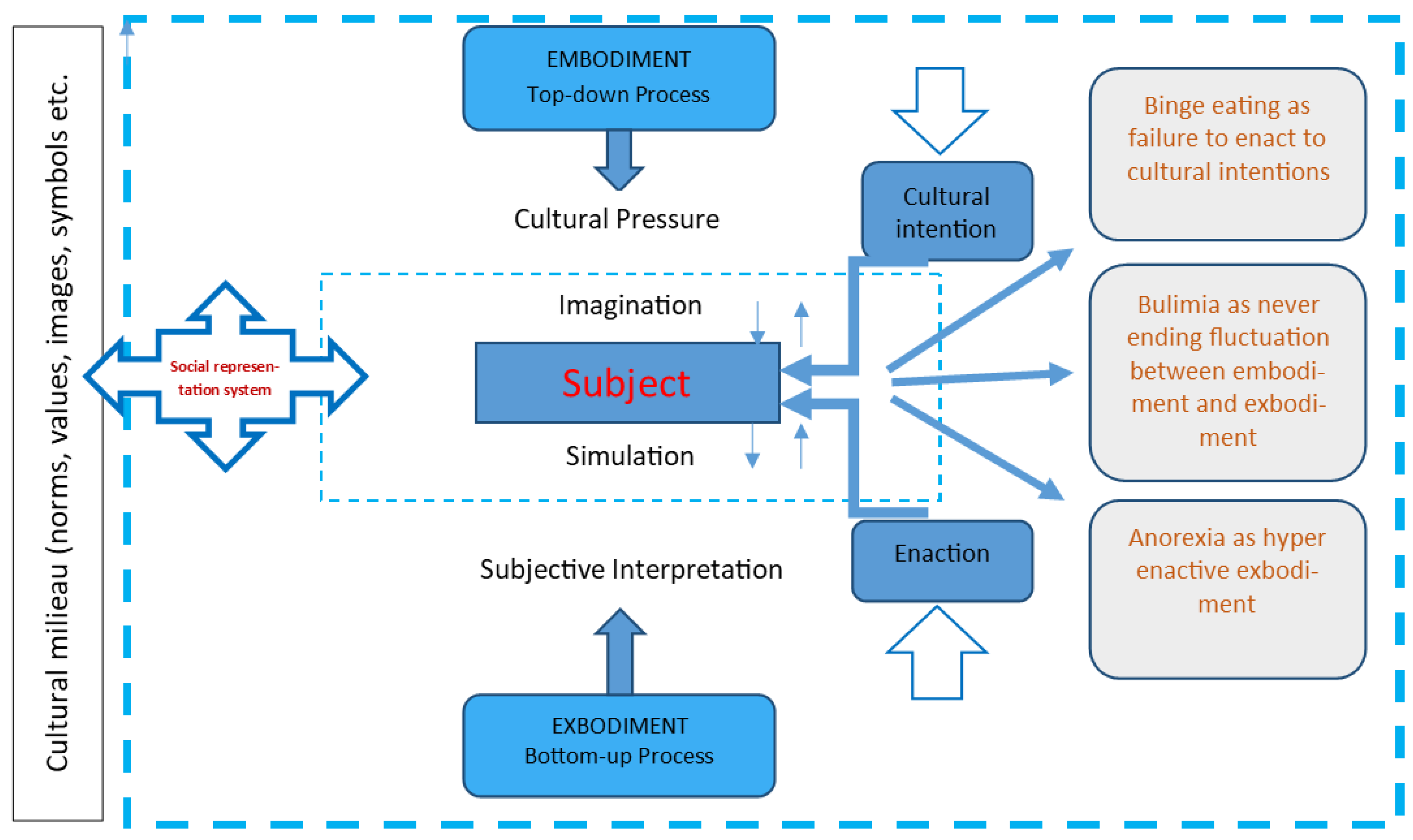
Figure 2.
Graphic Representation of the Clusters.
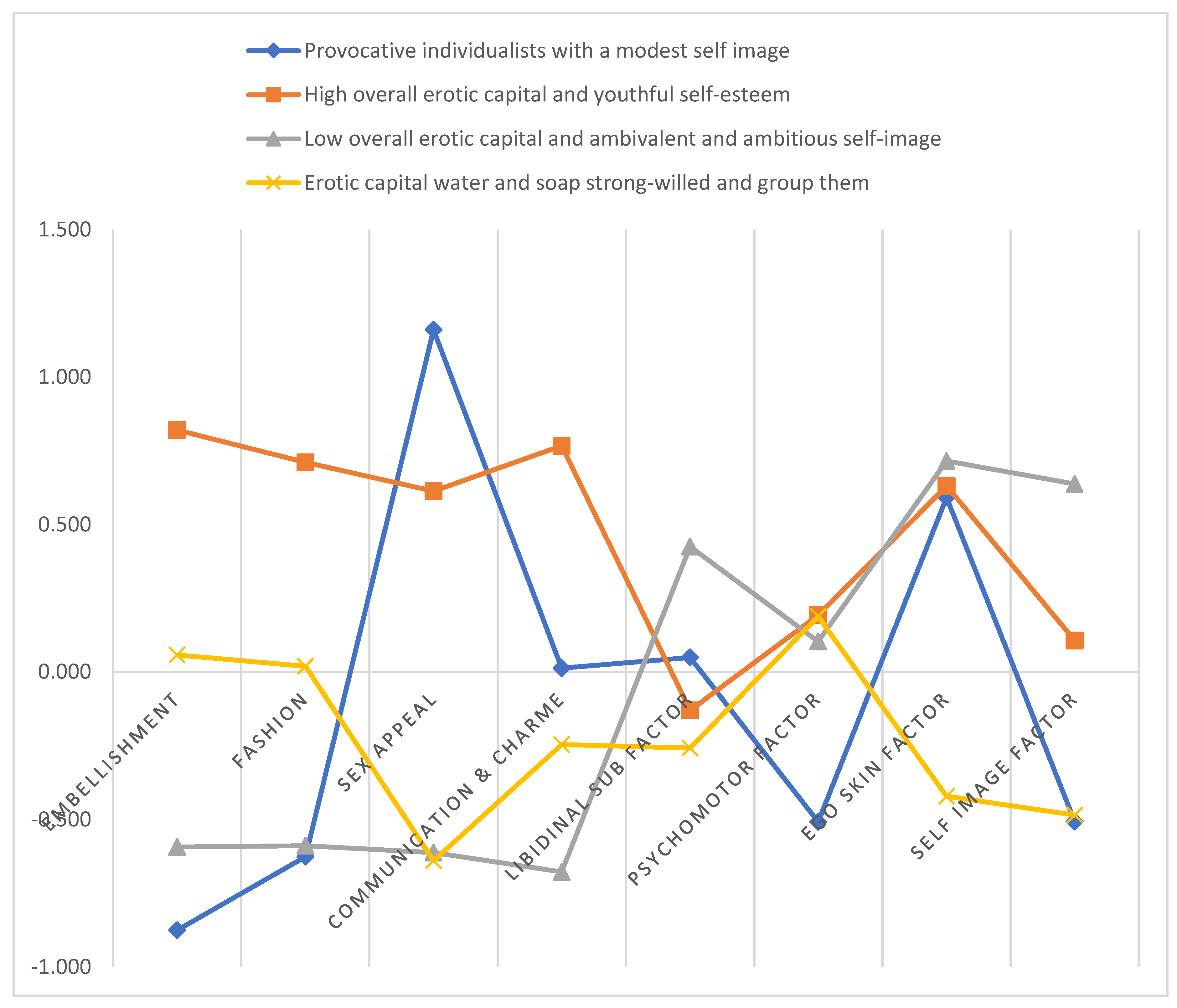
Figure 3.
Graphic Representation of the Clusters and BIST Factors and Items.
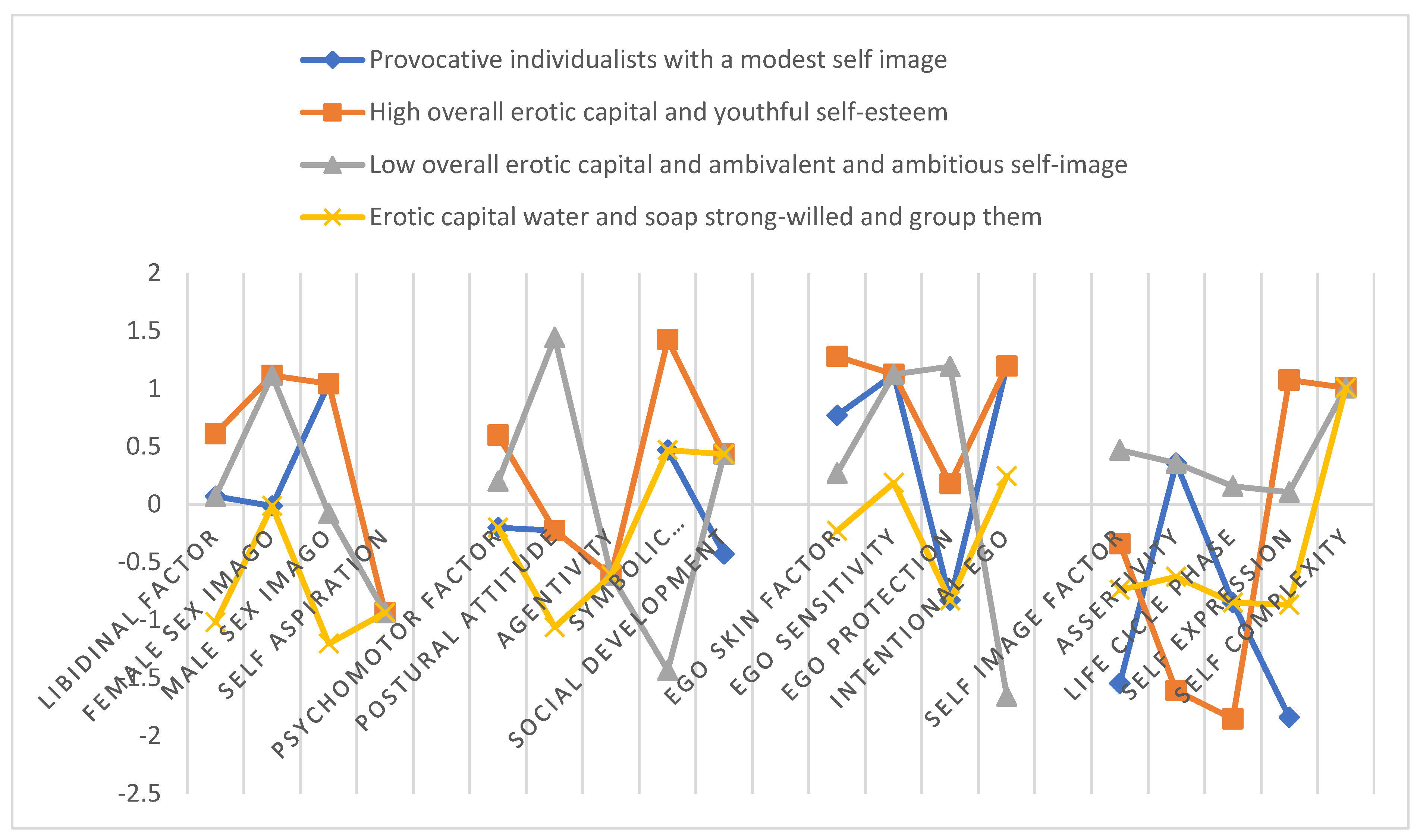

Table 1.
Sample.
| N. | % | |
|---|---|---|
| 20 - 32 years old | 114 | 79,7 |
| 33 - 49 years old | 17 | 11,9 |
| 50 - 99 years old | 4 | 2,8 |
| Sub Total | 135 | 94,4 |
| Missing | 8 | 5,6 |
| Total | 143 | 100,0 |
Table 2.
Correlation between BIST Ego skin factor and ECG items. * means a p. = .05 (two-tailed). ** means a p. = .01 (two-tailed).
Table 2.
Correlation between BIST Ego skin factor and ECG items. * means a p. = .05 (two-tailed). ** means a p. = .01 (two-tailed).
| SEDUCTION AXIS = SEX APPEAL & CHARME | SEX APPEAL = Naked Skin & Skin Erothema & Lip Expressive | COMMUNICATION & CHARM = Eye Contact & Posing | Naked SKIN | Skin erothema | Posing | ||
|---|---|---|---|---|---|---|---|
| Ego Skin Factor | Pearson Corr. | ,244** | ,223** | 0,16 | ,232** | ,190* | ,167* |
| P. (two-tailed) | 0,00 | 0,01 | 0,05 | 0,01 | 0,02 | 0,05 | |
| N | 143,00 | 143,00 | 143,00 | 143,00 | 143,00 | 143,00 | |
| Item Ego Sensitivity. | Pearson Corr. | 0,13 | ,166* | 0,02 | ,224** | 0,16 | 0,02 |
| P. (two-tailed) | 0,12 | 0,05 | 0,82 | 0,01 | 0,06 | 0,85 | |
| N | 143,00 | 143,00 | 143,00 | 143,00 | 143,00 | 143,00 | |
| Item Self Presentation. | Pearson Corr. | ,222** | ,169* | ,198* | 0,10 | 0,15 | ,218** |
| P. (two-tailed) | 0,01 | 0,04 | 0,02 | 0,25 | 0,07 | 0,01 | |
| N | 143,00 | 143,00 | 143,00 | 143,00 | 143,00 | 143,00 |
Table 3.
Correlation between BIST Libidinal Sub factor and ECG items. * means a p. = .05 (two-tailed). ** means a p. = .01 (two-tailed).
Table 3.
Correlation between BIST Libidinal Sub factor and ECG items. * means a p. = .05 (two-tailed). ** means a p. = .01 (two-tailed).
| Accessories | SEDUCTION AXIS = SEX APPEAL & CHARME | SEX APPEAL = Naked Skin & Skin Erothema & Lip Expressive | Skin erothema | ||
|---|---|---|---|---|---|
| LIBIDINAL SUBFACTOR | Pearson Corr. | -0,13 | -0,15 | -0,14 | -,167* |
| P. (two-tailed) | 0,13 | 0,08 | 0,09 | 0,05 | |
| N | 143,00 | 143,00 | 143,00 | 143,00 | |
| Item Female Sex Imago. | Pearson Corr. | -,185* | -0,04 | -0,01 | -0,03 |
| P. (two-tailed) | 0,03 | 0,68 | 0,86 | 0,73 | |
| N | 143,00 | 143,00 | 143,00 | 143,00 | |
| Item Male Sex Imago. | Pearson Corr. | ,169* | 0,05 | 0,01 | 0,03 |
| P. (two-tailed) | 0,04 | 0,54 | 0,90 | 0,71 | |
| N | 143,00 | 143,00 | 143,00 | 143,00 | |
| Item Self Aspiration. | Pearson Corr. | -0,16 | -,217** | -,196* | -,234** |
| P. (two-tailed) | 0,05 | 0,01 | 0,02 | 0,00 | |
| N | 143,00 | 143,00 | 143,00 | 143,00 |
Table 4.
Correlation between BIST Self Image factor and ECG items. * means a p. = .05 (two-tailed). ** means a p. = .01 (two-tailed).. .
Table 4.
Correlation between BIST Self Image factor and ECG items. * means a p. = .05 (two-tailed). ** means a p. = .01 (two-tailed).. .
| STYLE AXIS = EMBELLISHMENT & FASHION | EMBELLISHMENT = Makeup & Hairstyle | FASHION = Total look & Accessories | Makeup | Hairstyle | Total look | Accessories | Skin erothema | ||
|---|---|---|---|---|---|---|---|---|---|
| Self Image Factor | Pearson Corr. | 0,06 | -0,04 | 0,16 | -0,04 | -0,02 | 0,05 | ,177* | 0,01 |
| P. (two-tailed) | 0,51 | 0,68 | 0,06 | 0,65 | 0,80 | 0,55 | 0,03 | 0,89 | |
| N | 143,00 | 143,00 | 143,00 | 143,00 | 143,00 | 143,00 | 143,00 | 143,00 | |
| Item Life Cycle Phase. | Pearson Corr. | -,251** | -,236** | -,191* | -,202* | -,231** | -,171* | -0,14 | -0,01 |
| P. (two-tailed) | 0,00 | 0,00 | 0,02 | 0,02 | 0,01 | 0,04 | 0,08 | 0,92 | |
| N | 143,00 | 143,00 | 143,00 | 143,00 | 143,00 | 143,00 | 143,00 | 143,00 | |
| Item Self-Expression. | Pearson Corr. | 0,13 | 0,05 | ,195* | 0,03 | 0,07 | 0,11 | ,182* | 0,02 |
| P. (two-tailed) | 0,13 | 0,58 | 0,02 | 0,76 | 0,41 | 0,18 | 0,03 | 0,81 | |
| N | 143,00 | 143,00 | 143,00 | 143,00 | 143,00 | 143,00 | 143,00 | 143,00 |
Table 5.
Correlation between BIST Psychomotor factor and ECG items. * means a p. = .05 (two-tailed). ** means a p. = .01 (two-tailed).
Table 5.
Correlation between BIST Psychomotor factor and ECG items. * means a p. = .05 (two-tailed). ** means a p. = .01 (two-tailed).
| SEX APPEAL = Naked Skin & Skin Erothema & Lip Expressive | Skin erothema | ||
|---|---|---|---|
| PSYCHOMOTOR FACTOR | Pearson Corr. | -,174* | -,179* |
| P. (two-tailed) | 0,04 | 0,03 | |
| N | 143,00 | 143,00 | |
| Item Form Dyad to Group. | Pearson Corr. | -,181* | -,169* |
| P. (two-tailed) | 0,03 | 0,04 | |
| N | 143,00 | 143,00 |
Table 6.
Clusters.
| Cluster Final Centre | ||||
|---|---|---|---|---|
| Provocative Individualists with a Modest Self Image | High overall erotic capital and youthful self-esteem | Low overall erotic capital and ambivalent and ambitious self-image | Erotic Capital: Strong-willed and group soap and water | |
| Embellishment | -0,876 | 0,820 | -0,593 | 0,057 |
| Fashion | -0,626 | 0,711 | -0,588 | 0,019 |
| Sex appeal | 1,160 | 0,613 | -0,613 | -0,640 |
| Communication & Charme | 0,012 | 0,767 | -0,678 | -0,246 |
| Libid Factor | 0,049 | -0,130 | 0,425 | -0,257 |
| Psychomotor Factor | -0,508 | 0,192 | 0,103 | 0,188 |
| Ego Skin Factor | 0,592 | 0,631 | 0,715 | -0,421 |
| Self Image Factor | -0,507 | 0,106 | 0,638 | -0,485 |
| Number of cases in each cluster | ||||
| Cluster | 1 | 18,000 | ||
| 2 | 43,000 | |||
| 3 | 37,000 | |||
| 4 | 36,000 | |||
| Valid | 134,000 | |||
| Missing | 9,000 | |||
Table 7.
Cluster ECG and BIST Items.
| Final Cluster Centre | ||||
|---|---|---|---|---|
| Low overall erotic capital and ambivalent and ambitious self-image | Provocative individualists with a modest self-image | High overall erotic capital and youthful self-esteem | Erotic capital water and soap strong-willed and group them | |
| Embellishment | -0,467 | -0,963 | 0,898 | 0,402 |
| Fashion | -0,282 | -0,600 | 1,026 | -0,179 |
| Sex appeal | -0,581 | 0,776 | 0,855 | -0,386 |
| Communication & Charme | -0,609 | -0,119 | 0,728 | 0,274 |
| Female Sex Imago | 0,095 | 0,148 | -0,218 | 0,200 |
| Male Sex Imago | 0,007 | 0,188 | 0,295 | -0,171 |
| Self Aspiration | 0,222 | -0,372 | -0,607 | -0,189 |
| Social Development | 0,203 | -0,840 | -0,141 | 0,809 |
| Ego Sensitivity | 0,205 | 0,499 | 0,329 | 0,466 |
| Intentional Self | -0,597 | 0,697 | 0,157 | 0,938 |
| Life Cicle Phase | 0,120 | 0,686 | -0,421 | -0,032 |
| Self Expression | 0,347 | -0,544 | 0,311 | -0,211 |
| Numbers | ||||
| Cluster | 1 | 52,000 | ||
| 2 | 21,000 | |||
| 3 | 33,000 | |||
| 4 | 37,000 | |||
| Missing | 143,000 | |||
Disclaimer/Publisher’s Note: The statements, opinions and data contained in all publications are solely those of the individual author(s) and contributor(s) and not of MDPI and/or the editor(s). MDPI and/or the editor(s) disclaim responsibility for any injury to people or property resulting from any ideas, methods, instructions or products referred to in the content. |
© 2025 by the authors. Licensee MDPI, Basel, Switzerland. This article is an open access article distributed under the terms and conditions of the Creative Commons Attribution (CC BY) license (http://creativecommons.org/licenses/by/4.0/).
Copyright: This open access article is published under a Creative Commons CC BY 4.0 license, which permit the free download, distribution, and reuse, provided that the author and preprint are cited in any reuse.


