Author’s Note
The present manuscript does not contain any form of medical or clinical advice, and strongly recommends readers to continue following any indicated pathways of medical treatment. The study constitutes a literature review, aimed at researching the supplementary roles that holistic approaches like revised practices of enhancing human connection play in a potential catalysis of a social and psychological recovery in areas of the human population affected by various psychological burdens.
Research Question
May an integration of platonic intimacy into daily life, broader societal practice and human rest proportionally tackle the common modern-day problems of love deprivation, social isolation, mental health crises, promiscuity and paraphilias?
Conceptual Scope and Definitions
The present manuscript employs the term platonic intimacy to describe forms of consensual, non-sexual emotional and physical closeness that operate within clearly articulated boundaries and ethical safeguards. Such a concept does not seek to replace, nor eclipse existing medical therapies; rather, it functions as a relational framework through which humans may explore safe co-regulation, trust reconstruction and social belonging. Within such a context, practices including structured cuddle environments, informed consent-based workshops or shared nurturing rituals are presented as exploratory social prototypes rather than prescriptive interventions. The present study therefore adopts an interdisciplinary lens that integrates psychological theory, philosophical reflection and cultural symbolism while raising a full extent of awareness that such constructs require empirical validation before any large-scale implementation may be considered.
Introduction
During the recent three decades, first-world countries have been experiencing steep declines in the rates of both extent and quality of human relationships, with reports of abuses, break-ups, divorce and “cheating” having skyrocketed. Consequently, the phenomenon of increasing trust issues has become a dilemma, severely impacting the average and median quality of mental and emotional wellbeing due to rising levels of loneliness and isolation. The consequence of a widespread practice of hypersexuality has been the loss of balance between solitude and platonic human bonding, as well as the distribution of psychological cases of paraphilias, which describe a set of preoccupations and orientations that are not normative according to societal standards. Simultaneously with such a distribution of excessive sexual preoccupations throughout the world, mankind has paradoxically been experiencing an unprecedented level of affective touch deprivation, which led to a subsequent distribution of significant emotional wellbeing and mental health-related problems, which in turn led to the increase of incidences of clinical depression and even of the frequency of committed suicide. Such a loss of balance in attempted buildup of profound human connections implicated the distribution of two extreme approaches in human psychology and behaviour; one in which rapid physical gratification has become a societal norm, and another in which people have been urged to refrain from even experiencing the first, healthy steps of platonic intimacy, subsequently losing the apprehension of the fact that abstinence may only be practiced “in a form of motion”, and not whilst “standing still”, not making any progress in social and platonic bonding-related human activities. Consequently, a phenomenon of segregation has developed and spread, and the gap of human trust issues and frictions in their connection has continued to widen during the past several years. In other words, we have been “ghosted” and become “ghosts” ourselves, when we all came from the same soil and have a real soul aspiring for the “mathematical” limit of infinite love as described through a paradoxical calculus analogy based on Gabriel’s Horn (also known as Torricelli’s Trumpet), in which the volume of the liquid filling the created structure is finite and the surface of the structure is infinite. Such a paradox is possible because, from the reader’s point of view, the drawn curves of the Gabriel’s Horn surface are themselves finitely visible in the viewer’s eyes and they are thereby seen to intersect at a point, despite the fact that they continue their curved extension until the point of infinity. Such a paradox is explained by Albert Einstein in his views on the existence of a Universal Creator, as he once stated “God works behind the curtains of coincidences”, given that paradoxes technically consist of coincidences whose “correlation” cannot be found using scientific or statistical measures of analysis. According to a well-known family therapist worldwide, Virginia Satir, who is also known as “the Mother of Family Therapy” humans need 4 hugs a day for survival, 8 for maintenance and 12 for growth. Likewise, there is an increasing number of valid reasons to believe that practicing regular platonic intimacy has a degree of importance that is equivalent to the importance of eating and drinking water for the purpose of survival and maintaining an optimal quality of life.
It is important to note that the core foundation of human life is represented by upbringing and education. Popular concepts include a notion of “First Seven Years at Home” that explains how the first years of a person’s existence shape the rest of a human’s life critically. Likewise, it could be very much important for mainstream educational curricula to include courses on platonic relational education and emotional literacy, alongside the existing plans for schools to implement mandatory courses on respecting girls and women, given the deepening crisis of human trust, safe connection and establishment of healthy boundaries in modern-day societies. The clear establishment of safeguarding for children in First-World countries represents a major first step in helping children experiencing emotional and intellectual growth in a safe and orderly environment. Such a potential next step of helping the young generations learn theoretical and practical ways to form platonic relationships with one another more broadly could ultimately shape tomorrow’s societies by raising profound awareness on how human relationships do not represent a form of luxury, but a necessity as major as clean water, safe food, effective education and good healthcare. A full extent of results could be fully detected within a couple of generations, and positive impacts could cover widespread areas of society as a result of a projected rise in levels of human solidarity and support. Levels of scientific progress could experience a sharpened level of growth amidst also the rising level of Artificial Intelligence integration into mainstream societal systems. Currently, human society could be situated at a cross-roads of opportunity to support increased levels of empathy, peer-level support and solidarity, as AI is effectively connecting systems more quickly and broadly than initially expected.
Furthermore, an implementation of projects like “Urban Wombs”, “Embraced Housing”, “Touch Plazas” and “The Lullaby Revolution” could effectively transform modern-day megalopolises, which are currently under silent epidemics of loneliness, isolation, financial inequality, domestic violence and housing instability, into cities reconciled with Nature and Harmony at rates perhaps not broadly imagined before. The concept of “Touch Plazas” would help people new in the area of social connection or struggling in the domain of socialising to safely experience “sips” of human greeting or even be able to talk to another human without any pressure to “perform” or “mask”. Moreover, big cities could experience a blossoming of Nature from within, fully safeguarded houses designed for platonic intimacy could be built for families and strangers alike, peers and new University colleagues could move in apartments or houses to experience boundary-based platonic connection at day and night, and a significant number of people could become volunteers and/or facilitators for safe experiences of human harmony. Finally, the concept of “Lullaby Revolution” would implement gentle singing into the area of expanded platonic intimacy, by having consenting participants expressing themselves melodically and singing various silent songs to one another as a way of supporting their nervous systems to relax. It is important to mention that such imagined changes would most likely be best implemented in phased manners, rather than immediately or robustly, to ensure that levels of informed consent and public trust would be maintained consistently. For example, concepts of “mental health first aid”, “touch plazas”, “embraced cafes” and “cuddled bed & breakfast” would likely be necessary to be implemented as intermediary steps before a broader implementation of “cuddled” or “embraced housing” would be possible.
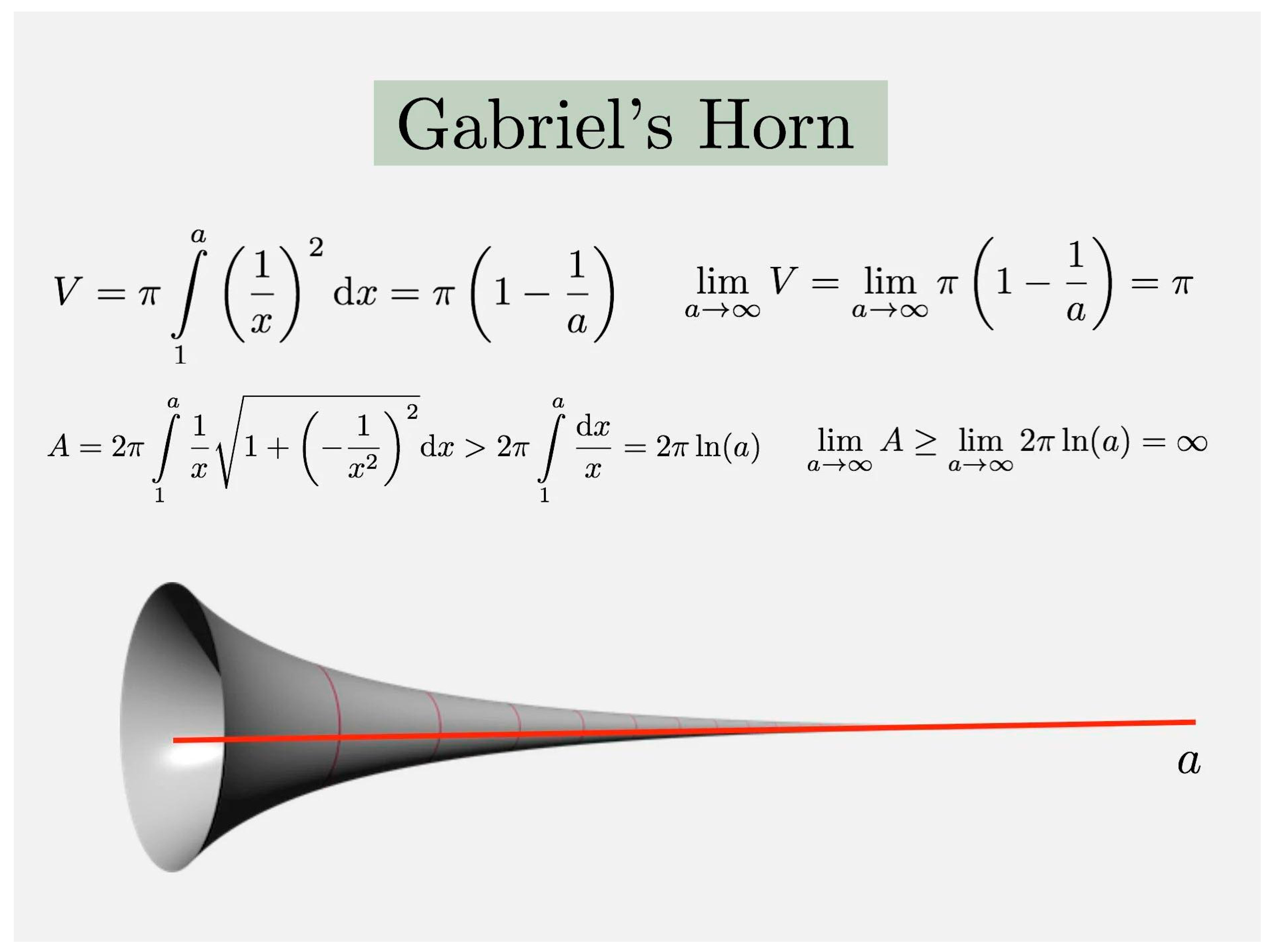
Figure 1.
Gabriel’s Horn, also known as Evangelista Torricelli’s Trumpet (Math is Visual, 2024).
Figure 1.
Gabriel’s Horn, also known as Evangelista Torricelli’s Trumpet (Math is Visual, 2024).
In the above figure, a mathematical principle covering derivative functions and limits is explained via four formulae, pointing to the paradoxical co-existence of an infinite structural surface [2 * pi * ln (a)] and a finite liquid volume [pi * (1 - 1 / a)] filling such a structure with two lines being infinite in nature. Interestingly enough, the curvature of Gabriel's Horn is shaped in a similar manner with the curvature of the human hug, ultimately pointing to the infinite value of human unconditional love, whence true affection emerges from. Such an analogy may represent an important example of the manner coincidences operate outside of the system of scientific and statistical forms of measurements, in spite of their highly advanced stages. For a person to become a living Cross means to open their heart as they accept the possibility of going through a self-sacrificial kind of suffering, in the same manner that a living tree grows, opening up her arms (branches). As the growing tree continues to open her branches, leaves grow and cover the tree, becoming a structure filled with the life of spring. Just as rain is needed for plants, flowers and trees to grow, and for the natural environment to experience a cleansing form of washing, regardless of the extent of uncertainty with regards to when the rain would end, so people grow their good fruits through trials and suffering, which leads to the washing and renewal of their souls. According to Eastern Orthodox Christian Philosophy, the spiritual adversary cannot be humble and display unconditional love, for his horns that make a shape of the capital letter “Y” cannot transform into pure arms that may then help him become a living Cross. Such an analogy shows that it is only through humility that a human being can become a tree of Life and Love, opening up his shape to make the straight angles of the shape of the Cross. Likewise, one’s heart and arms ought to become completely open, “in a 90-degree, perpendicular shape” in order to express genuine love, and it is online humility that may completely “open the gate of heart” with abundant, unconditional and pure love. Platonic intimacy herself represents a highly sophisticated form of emotional art that covers all known forms of art and makes them “one”, meaning that it may actually be the most fundamental type of art in the material world. Currently, there is an “eclipse” of misinterpretation over the high beauty of human oneness as a result of large groups of people having paid attention to extremes, rather than balanced approaches that occur in complete accordance with the existing steps of human intimacy, according to scientific evidence regarding human psychology and emotional wellness in human bonding. Such an “eclipse” has brought large sections of the human population into a “profound darkness” of perpetual isolation, indifference and deprivation of life-sustaining affection and currently, humanity actually risks sliding into a state of a general “prison in open-air” as a consequence. It is often said that eyes do not “realise” the extent of darkness until light is present again. A similar analogy applies to warmth and cold air, as people may underestimate the extent of a frozen environment until warmth is felt again. Nonetheless, if positive change occurs, is widely implemented and is thoroughly and constantly maintained, then Paradise may be experienced, “on Earth as it is in Heaven”.
Younger generations have been continuously warned by their wise parents and elderly that the end of the world will come when the footpaths between households cease to exist, and it is possible that humanity has been approaching such an irreversible state of human destruction. Furthermore, it seems that natural phenomena have started “rebelling” against the worst type of oppression, which represents human indifference. It is indeed worse for someone to be left to die in internally agonising states than for someone to be physically abused, for it is such an occult form of oppression that is the worst, just as the enemy is the most powerful when one lacks knowledge regarding the direction whence his attacks come from. We have become emotionally, mentally and physically blind, and the love for the neighbour is now in a state of coma. How may then God still pour down His love, in the vertical plane of His Cross, when the horizontal plane of His Cross is continuously being cut off? Despite the fact that true love does fight hard until the end, she does not break through the ultimate law of human free will, created by God to “morally” select His people. Will this lead to the final end of the world, or does this mark a prelude of a final metamorphosis of mankind, promised in the Book of Matthew in the Holy Scriptures? Will this mark the absolute end, or is it the darkest moment of a grand, full solar eclipse preventing numerous people from receiving the rays of manifested unconditional love? It is the full expression of the human free will that will determine the true course of events in the future, as humans represent icons of God who can become perfected once again. Divine love is expressed on Earth via the three types of unconditional love that live in a perfect state of interconnection and oneness: love for God, love for the neighbour and love for oneself. The rise of mental blockages via the occurrence of various mental health difficulties has led to the isolation of the human soul in the prison of the rationalistic mindset, and it might have originated due to a breakage of such a link between the three, triune levels of unconditional love. The escape from such a cell is not horizontally or upward, but actually in a descending manner, toward the heart, just as the righteous people from the Old Testament were peacefully descended into Abraham’s Bosom before Christ finally descended into Hades and conquered death for good. In such a manner, we ought to descend into our hearts and fully overcome negativity from within, rather than using a rationalistic perspective. Likewise, it may now be time for humanity to create a plan of response that will aim to proportionally tackle the modern-day dilemma of isolation, loneliness, trust issues, promiscuity, break-ups and divorce. It may be that it is now time to ease the focus upon an existing widespread objective to avoid physical contact at all times, according to guidances that it would be better not to touch a woman, given the current context that radically differs from the context of the Ancient era, where people would experience fully proportional and balanced extents of platonic intimacy. At the same time, the objective of avoiding immorality should be treated with the same, utmost importance. Apostle Paul once said that he would rather break rules if such an action led to the genuine salvation of people’s souls. The only way to defeat evil is from within, and not from without, meaning that people may need to re-learn the structure of building up a healthy hierarchy of human connection and platonic intimacy through practicing it correctly, rather than through complete abstinence. Certainly, the time for human solitude is sacred and needs to be respected in such a manner. At the same time, there ought to be an existence of a 10-20% time of expressing human connection and intimacy, for it is such moments that may be as sacred as solitude and, whose inexistence may affect one’s perception upon the importance of solitude and/or even its healthy rates of practice. In other words, the theme of the discussion would be an emphasis upon the importance of re-shifting to an overall balanced way of perspective and lifestyle to attenuate the modern-day problems that have become well-known in the disciplines of psychology, medicine and even morality. Mankind lives in such times that love now needs to leave the one sheep to find the lost ninety-nine sheep, compared to the times when love had to leave the ninety-nine sheep to find the one lost sheep. In other words, true love has now reached a minority in society, but hope should not be lost, for even a 0.1% extent of light makes a 99.9% extent of darkness flee by itself. Light does not need force to occupy a room, just like rainy weather does not need to stop necessarily through a change or evaporation of clouds, but actually a gentle transformation of the rain into snowfall, helping labouring, broken hearts prepare for their healing Christmas. In the same manner, true love does not need to be expressed by force, but by her gentle and patient, natural course. Likewise, it may now be time to academically support the scientific evidence that healthy boundary-based sessions of platonic intimacy expression among volunteers leads to an effective reversion of the emotional problems seen in modern-day society. The objective of such a broader academic recognition could help such an overall movement evolve into states that would bring healthy and consensual platonic intimacy spread in normative, day-to-day life of a population majority, effectively helping members of society not feel excluded from their needed social encounters any more. For example, the movement of occasional, weekly or monthly “cuddle workshops” could evolve into a movement of regular “cuddled bed & breakfast” and eventually perhaps even “cuddled housing”, in which participating volunteers could eventually begin cohabitating in both short- and long-term manners. Animals have evolved by living close to each other and resting with one another, even if they were not constituting a biological, reproductive family. In the same manner, humans could return to their natural origins by exploring their boundaries and depth of affinities for platonic intimacy. Such an action may not only reconcile humanity with herself, but also with her Mother Nature and other members of her constituted family. Just as the process of human evolution does not exclude the embrace of scientific and technical progress, it also does not cease from embracing human origins, which are embodied into the infinite nature of unconditional love, as described through Gabriel’s horn, which may be displaying a paradox of finite needs with infinite love. Physically, chemically and biologically speaking, animals are also known to display their own healthy boundaries and social selection processes, and both animals and humans emerge from the same bacterial species in the soil. Likewise, what would the difference be for humans? Would it be possible that humans have actually at least slightly drifted from their healthy evolutionary trajectory? The overall scope of such project initiatives covers the key word of “re-creation” via helping human participants return to their natural origins and reach a state of balance again, which constitute the sole methodology of ensuring that humans will continue their journey of evolutionary growth.
Literary-Conceptual Foundations of Urban Intimacy
The concepts of the “Urban Womb,” the “Lullaby Revolution,” and the “Touch Plaza” may be understood not merely as architectural or social proposals, but as symbolic frameworks emerging from a broader cosmopoetic narrative interpreted through the lens of environmental psychology and relational theory. Within this literary-psychological perspective, the city is reimagined as an affective ecosystem shaped by rhythms of descent, gestation, and rebirth – themes often explored through metaphors of exile, sacred pregnancy, and collective transformation. Rather than functioning as literal urban blueprints, these constructs operate as narrative archetypes that encourage reflection on how built environments might support co-regulation, emotional safety, and consent-based interaction. The Urban Womb therefore represents more than a physical environment; it evokes a symbolic threshold of psychological containment, suggesting spaces where vulnerability may be held within clear ethical boundaries while preserving individual autonomy and agency. Similarly, the Lullaby Revolution draws from literary traditions in which sound, repetition, and rhythm function as mechanisms of memory and restoration. When interpreted through contemporary research on affect regulation and sensory modulation, lullaby-like practices may be understood as metaphors for environments that reduce overstimulation and encourage nervous-system settling. Rather than implying regression, the concept symbolises a recalibration of relational tempo within fast-paced urban settings, proposing atmospheres where shared quietness, gentle auditory textures, and predictable social cues can contribute to perceived safety. Such symbolic framing aligns with trauma-informed perspectives that emphasise choice, pacing, and the restoration of emotional cadence within communal spaces. The Touch Plaza extends relational-cultural theory into spatial imagination by proposing civic environments where platonic greeting and embodied presence become visible aspects of everyday life. As an interpretive construct, it invites inquiry into how spatial design might facilitate mindful proximity without pressure, allowing individuals to engage in varying degrees of social interaction according to personal comfort. By integrating these literary constructs into a psychological framework, the manuscript situates its proposals within interdisciplinary dialogue rather than fixed planning models. Urban Wombs, Lullaby practices, and Touch Plazas therefore function as conceptual lenses through which future research might explore how architecture, sensory atmosphere, and cultural symbolism intersect to foster ethical closeness, resilience, and collective wellbeing within evolving urban landscapes (Carp T. N., 2026).
New Havens of Re-Blossomed Nature
The concept of cities as New Havens of Re-Blossomed Nature emerges as an extension of cosmopoetic urbanism, where ecological restoration and relational healing are understood as interdependent processes rather than parallel ambitions. Within this framework, urban nature is not treated merely as aesthetic decoration or functional infrastructure, but as a relational medium capable of shaping emotional experience, social rhythms, and ethical interaction. Green corridors, communal gardens, and water-centred environments become symbolic thresholds between human intimacy and ecological renewal, suggesting that environments designed for biodiversity may simultaneously foster psychological containment and collective care. In this sense, the Urban Womb, Touch Plaza, and Lullaby Revolution are situated within a broader vision of cities as regenerative ecosystems in which emotional safety, sensory balance, and environmental stewardship intersect. From an environmental-psychology perspective, the reintroduction of nature into urban design extends beyond sustainability metrics to include its potential role in nervous-system regulation, attention restoration, and the cultivation of perceived safety. Natural textures, soft lighting, and gentle auditory landscapes may contribute to slower patterns of movement and interaction, encouraging individuals to engage with one another at a more contemplative pace. Water features, shaded pathways and quiet communal spaces can be interpreted both as symbolic invitations toward stillness and as physiological supports for stress reduction. These environments therefore act as mediators between private introspection and public presence, softening the boundaries between solitude and shared experience while respecting individual autonomy. By imagining cities as havens where re-blossomed nature coexists with consent-based social environments, the manuscript invites interdisciplinary dialogue between urban ecology, environmental psychology, relational-cultural theory, and ethical design. The emphasis remains exploratory: these constructs are not presented as prescriptive planning models, but as narrative frameworks through which future research might examine how ecological renewal influences social cohesion, emotional resilience, and communal wellbeing. Through this lens, restored natural environments become more than passive settings; they are understood as active participants in shaping relational atmospheres, offering spaces where human connection may unfold alongside the rhythms of ecological regeneration.
Methodology
Scientists, psychologists and talk therapists could devise an extensive and international plan for the gradual creation of bubbles and networks of people offering the levels of emotional support described in the manuscript, all in accordance with the laws of nature, individual and social psychological receptivity, informed consent and healthy boundary, which may be as the extensive set of layers covering an onion, which is regarded as one of the healthiest vegetables. First, surveys could be created and distributed to samples of hundreds of participants in various national and international areas to assess the psychological, cultural and religious backgrounds of people before creating estimations of rates of receptivity to such potential implementations. Then, statistical pools and tests could be created to thoroughly confirm whether a positive difference will be made and then to determine the extent of difference occurring as a direct or less direct result of it. Chi-squared tests and T-tests could be created to determine whether the null hypothesis that there will be no positive difference made can be accepted (p-value ≥ 0.05) or rejected (p value < 0.05) based on the responses of the sample populations and on scientific projections, and whether there is any existing probabilities of significance that any collateral damage would be resulted from such actions. Namely, sample experiments may occur in which a group of volunteers can experience a trial session of “cuddled housing”, with the purpose of verifying whether such an update crosses the threshold levels of safety and efficacy with regards to tackling both levels of human loneliness and hypersexuality. During such an experiment, there will be participants, supervisors and leaders, and the supervisors will be responsible with gathering the scientific data that generally covers affirmative/negative answers, survey responses and calculated statistical data through chi-squared and paired/unpaired T-tests and, if the p value is determined to be lower than 0.05 following an extensive and long-term process of testing, then the experiment will be deemed as both safe and effective for such purposes. In such a case, there may be a repetition and extension of such a testing procedure and, if the same nature of results are returned after the same careful and highly rigorous process of scientific and clinical scrutinisation, then it may be finally determined that updates of such nature in facilitating healthy and boundary-based human connections are effective in tackling loneliness, high level of trust issues, verbal and physical abuse and promiscuity throughout society. Throughout the entire process, it is crucial to thoroughly comply with the GDPR laws and regulations, as well as UK Data Protection Act 2018, which oblige all third-party agencies to keep the data of all participants in any form of clinical or scientific experiment safe and private. All participants, supervisors and leaders would therefore be required in any setting - whether experimental or in practices already clinically proven to be safe - to sign legally-binding documents that mention all points of responsibility from all parties to ensure compliance with such laws, and would clarify the nature of imminent legal consequences for any act of non-compliance that would be proportional with the gravity of such a breach, regardless of the position of the offending party. Furthermore, all participants in related activities must agree not to contact each other outside of the safe space unless there is informed consent expressed by all involved parties and any supervisor and/or the leader is informed about it in advance. The same analogy must be applied with supervisors, as they would be required to inform the leader about any reciprocal desire for a conversation outside of the safe space. Any breach of the established rule would be met with a Zero Tolerance policy, in which the offending person would be removed and other safe spaces would be informed about such an offence. It may be important to use utmost care if Artificial Intelligence (AI) models are introduced for the purpose of catalysis of data entry and processing to ensure that all personal information is encrypted to the utmost strict rigour. Double-blinded clinical trials may also be organised for environments where children and vulnerable people perform their daily activities of intellectual self-edification and/or reside, with the purpose of ensuring that such an implementation is safe and effective for all areas of human society, which include the youth and the vulnerable.
To investigate the safety and efficacy of organised interventions implicating boundary-based platonic intimacy, volunteers and leaders will likely be assigned with the organisation of a mixed-methods experimental design. In such a case, specific community centres and online platforms will be used as means to recruit a number of participants between 100 and 200, making sure that the sample pool of participants will be diverse with regards to age, gender, socioeconomic status, cultural and religious backgrounds. The assignment of the participants into two intervention groups will be randomly performed. The first group will undergo the experimental method under a structure that will involve eight weekly sessions of cuddle therapy with the chronological length of 90-120 minutes, which will be supervised and led by trained facilitators based on a standardised set of rules and guidelines emphasising non-sexual touch, attentive listening and mutual, informed consent. The second group will be placed on a wait-list, control group, meaning that its randomly selected members will undergo no structured intervention during the study period of time. Validated forms of measurement will be utilised to collect the necessary, qualitative data, via the University of California - Los Angeles (UCLA) Loneliness Scale and the Warwick-Edinburgh Mental Wellbeing Scale (WEMWBS) offered before and after the intervention. Furthermore, semi-structured interviews will occur after the final experimental session to collect further, more conclusive qualitative data, capturing more profound perspectives of the participants as they would have developed their subjective experiences of boundary-based human connection via structured and consensual platonic intimacy. The process of data analysis and interpretation (DAI) will comprise repeated measures of Analysis of Variance (ANOVA) to verify if there are any differences in the quantitative variables over a specific amount of time between the assigned groups, as well as the analysis of the responses collected from the final interviews. All steps will occur in full accordance with the ethical guidelines, by placing the importance of informed consent, which will be collected from each participant, as well as strict measures to make sure that there will be full compliance with the GDPR, Data Protection Act 2018 and local, institutional requirements.
If all the experimental results indicate a statistically significant induction of positive changes which would include the UN’s Agenda of Sustainable Development Goals that are set to be met by 2030, as the need for the natural environment to recover is proportional with the need for the current state of human connection to undergo such recovery, and an inexistence of risks of unwanted effects upon human biology and psychology, as well as the integrity of the environment, volunteers could gather in virtual and physical groups to start physically devising a strategic plan of gradual and consensual human reconnection in careful steps. For example, it may be wise for project leaders and volunteers to first begin a process of “positive infiltration” into the well-known “AirBnB” international project, by clearly mentioning the plan of offering night-time safe spaces for people who have underwent deeply traumatic experiences in the past due to abuse, physical violence, violation of consent and/or perpetual, severe deprivation of physical affection. For the sake of human safety and informed consent, such “AirBbB”-related projects would involve at least three people per room. A potential instance of activities as such would implicate volunteering participants in engaging in gentle stroking, head hugging, putting and singing each other to sleep, and swinging each other gently throughout the process, as potentially viable methods to foster emotional integrity, with qualitative analysis of observed affectionate interactions, having ensured that a full extent of informed consent was clearly reached beforehand. Some volunteers and leaders could be assigned as night-time security officers to ensure that all the rules are respected to the letter. Following a night of consensual comforting among participants, the last stage of the session would involve a harmonious breakfast and an optional “cuddle cafe”-centred rest of 30-60 minutes, before the session officially ends. It is important to accurately calculate the value of financial goods, which are regarded as “an important symbol of freedom”. Simultaneously, it would be most critical to place the purpose of the mission in the highest spot, with an immediate second spot being an openness to the unspoken principle of “the compound interest”, which was regarded by Albert Einstein as “the Eighth Wonder of the world” and may also be regarded as the principle of abundance. Such a principle represents a viable extension of the First Law of Thermodynamics that states energy can neither be created, nor destroyed, from within the physical world, indicating that the Universe consists of a limitless number of energy exchange processes. If the two principles are correctly joined together and applied in the real-world, people become fully capable of easily achieving true prosperity, which is both emotional and material in nature. In the end, if all such projects are positively received within society, the movement of “Cuddled Housing” may be finally implemented, in which like-minded and like-hearted people may have the opportunity to gradually connect and relocate into house sharing types of rented accommodation with the purpose of relocating into a permanent safe space of boundary, consent, privacy and voluntary platonic intimacy. Furthermore, licensed psychologists, therapists and volunteers could ensure that suggestions to attend courses and workshops are extended to the general public, at either low costs or even for free, particularly to vulnerable people, as the purpose would be to develop theoretical and practical education pathways for numerous people to develop informed consent-based initiatives of emotional healing for their neighbour and themselves, perhaps by obtaining funding and organisational support from various non-governmental organisations (NGOs) for a potentially grand charitable cause - potentially turning many people into “emotional and platonic intimacy-based therapists” and substantially helping society become a far more qualitative and nature-friendly environment. Such an overall process is preliminary estimated to considerably reduce the excessive rates of physical abuse, relationship and family breakups, promiscuity and pornography, thereby having the potential of successfully helping people return to their natural and nature-friendly origins, which know no immorality, deprivation and adultery. The overall innovation would be centred around a redeveloping culture of positive consciousness, awareness of biological and environmental wellbeing, respect, boundaries, consent, privacy and accountability. It is also essential to mention that none of the proposed approaches substitute recommended pathways of medical treatment, and that the present manuscript does not contain any form of medical or clinical advice.
Use of Artificial Intelligence as Editorial Support
During the preparation and update of this manuscript, ChatGPT-5.2 was used in a limited editorial capacity to assist with language refinement, structural clarity and stylistic consistency across interdisciplinary sections. The AI tool did not originate the research questions, theoretical frameworks, interpretations or conclusions presented in this study. All intellectual content, analytical decisions and final revisions remain the responsibility of the author. The inclusion of AI support is disclosed to maintain transparency and to acknowledge the evolving role of digital editing tools within contemporary academic writing practices.
Discussion
Throughout the past several decades, scientists have gathered increasing amounts of evidence that platonic bonding and snuggling results in significant improvements in the general state of human health in the long run, with effects of major improvement in mental and emotional wellbeing, immune integrity and competency, cardiovascular health and possibly even aging. Namely, platonic bonding is known to stimulate the synthesis of oxytocin and endorphins, which is a neurotransmitter responsible for generating and increasing human feelings of social belonging, safety and recovery from past experiences of discomfort and tension, respectively. Secondly, such bonding is known to activate the parasympathetic nervous system, which in turn lowers the synthetic rates of the cortisol hormone, brings anxiolytic effects and stimulates the generation of more profound feelings of relaxation. It is important to apprehend that oxytocin represents a neurotransmitter that is a precursor of reproductive hormones, and not vice versa, as it may only be through healthy, long-term secretion of oxytocin that human beings will eventually become fulfilled in their reproductive life, at moments that better match threshold levels of human, cognitive and emotional maturity. Moreover, non-sexual human bonding has displayed beneficial regulatory effects upon rates of pulse and blood pressure, decreasing risks of the onset of cardiovascular diseases that usually occur later in human life, and improving the quality and proportionality of generated immune responses, which in turn may indirectly contribute to the modern-day fight against the high rate of incidences in which people experience clinical onset of various problematic diseases that include malignant tumour-induced cancers, Type II Diabetes Mellitus and various forms of chronic illnesses. Evolutionary pieces of evidence reinforce the strength of arguments that humans are in a high need to embrace the idea of regular practices of platonic hugging and snuggling, given that animals are known to practice such behaviours regularly whilst placing a proportional emphasis upon boundaries and following the necessary steps to gradually increase the extent of intimacy. Psychological and philosophical evidence also point toward the importance of a regular practice of healthy bonding, given the subsequent production of a high stimulation of intense and useful academic and professional activity, as well as of a unique generation of artistic ambitions by such practices, and intellectual works by Plato (Aristocles), Aristotle and Immanuel Kant bring an echo whose extent of power breaks the barrier of time. Sadly, the idea of platonic human connection has been undergoing significant stigmatisation, which led to a general erosion of human connection and consequently, to a Universal impoverishment of authentic human experience. The present paper presents a collection of proposed solutions with the objective of reconstructing the structures of trust and conscious, thorough presence in human relationships, which include: snuggle therapy, consent and intimacy workshops, and cuddled housing and retreat spaces, with an overall purpose of extending a regenerated, profound level of platonic intimacy to daily life in both urban and rural areas of the world.
UN’s Sustainable Development Goals through the Lens of Human Needs
Human inclusivity represents one of the central topics discussed and implemented in professional activities of applied revisions of conscious human connection. It may be that increasing lacks of inclusivity throughout the world have played major roles in the creation of societal and even cultural discrepancies that led to the development of frictions, tensions and even warfare, due to the fact that such discrepancies resulted in the perpetual creation of imbalances that involve human affection, as well as availability of resources that are necessary for physical survival (i.e. clean water, safe food, healthcare and education). It may be that an increasing lack of inclusivity throughout the world has significantly contributed to the continuous rise in the levels of socio-economical and even geopolitical conflicts between regions and whole nations. Such an aspect points to a core problem of society, which is human ego and which is fuelled by such increasing imbalances in given inclusivity. It may be critical for the current topic of psychological and social scientific research to be presented to organisations like the United Nations and the World Health Organisation for the purpose of assessing the potential impact that increasingly imbalanced human inclusivity displayed throughout the world, as well as any existence of interdependent relationships that such imbalances have with increased levels of pollution that affected the integrity of the natural environment and faunas. The author proposes that an implementation of the ideas academically suggested throughout the present study, coupled with novel efforts to rebuild natural environments and faunas where damage has been performed, should constitute central objectives in the United Nations’ Sustainable Development Goals for 2030. Through collective efforts as such, mankind could effectively reverse the current pattern of climate change induced by increasing environmental hazards, as well as current risks that specific geopolitical tensions will extend into broader and even irremediable conflicts, which the global societies are likely not able to cover in financial expenditure.
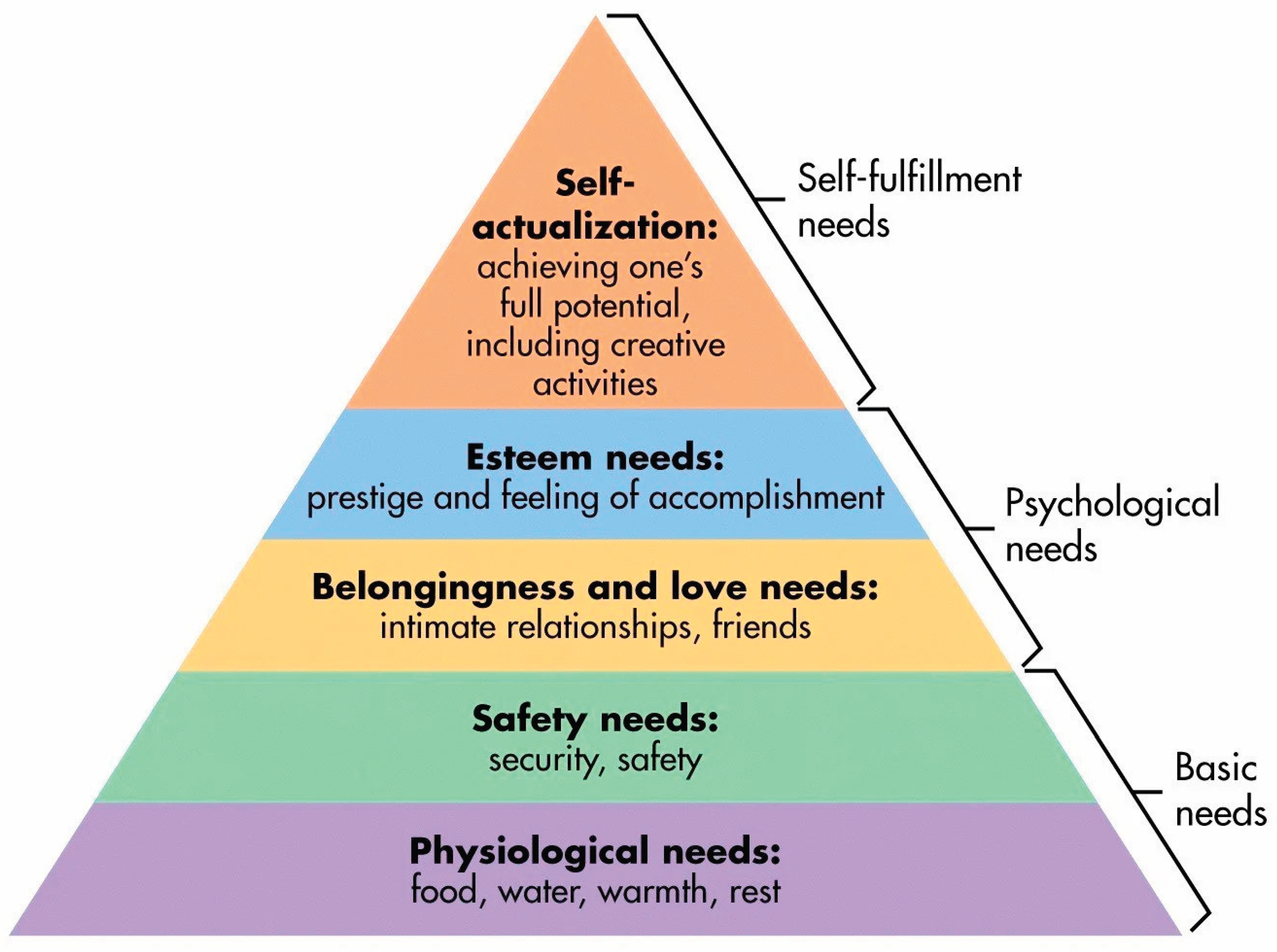
Figure 2.
The Pyramid of Human Needs, according to psychological research performed by Abraham Maslow (McLeod S., 2007).
Figure 2.
The Pyramid of Human Needs, according to psychological research performed by Abraham Maslow (McLeod S., 2007).
The current work is based on the foundations of well-known psychological research. A first reference is the Attachment Theory of John Bowlsby, in which it is stated that the quality and depth of early bonds created with caregivers of newborn babies play crucial roles in the determination of emotional wellbeing, mental health and social growth, bringing life-long influences upon the quality of one’s ability to form deeper, authentic human connections. A second reference is the theory of person-centred therapy presented by Carl Rogers, in which it is stated that emotional wellbeing and security is profoundly dependent upon the extent and quality of touch, presence and unconditional acceptance, which involves a positive regard that is not based upon the barriers of social conditioning. The Pyramid of Maslow further emphasises upon the psychological importance of a widespread and regular practice of abundant human bonding, as this leads to the fulfilment of the most important hierarchy of human needs: security and cover. Two major perspectives in human philosophy (Martin Buber’s “I and Thou” and Erich Fromm’s “Art of Loving”) support the statement that love, affection and moral bonding constitute the foundation of authentic human experience. It may be important to analyse the recent developments into psychological research surrounding the Pyramid of Human Needs assembled by Abraham Maslow, given the fact that psychological experiments obtained novel scientific evidence in which humans typically seek to fulfill multiple hierarchies of needs at the same time. Given that the needs of health, safety, belonging, intimacy, family and friendship represent highly important needs that were simultaneously not placed at the most fundamental level of the pyramid, alongside the need for food, water, shelter, rest and reproduction, it has become increasingly likely that platonic intimacy does represent a fundamental human need that has been underexplored for several decades, and the present argumentation would only be rational in nature, given the existence of multi-faceted dependent relationships between the mentioned elements, like health with food and water, shelter, food and water with professional work, as well as intimacy with family, friendships, and reproduction respectively. Initially, the need for platonic intimacy was already placed at the foundational level of psychological needs, making it more likely that it does represent a highly important human need that simultaneously may be even more profound than previously projected. Although platonic intimacy is not directly related to reproductive needs, it can play a major role in supporting people to gradually find qualitative pathways of reproduction that would thoroughly match their personality, ultimately resulting not only in the fulfillment of one of their most basic, physiological needs, but in favouring the conception and development of an offspring that matches the visible qualities of the personality of both new parents, which represents the most important reason why Abraham Maslow placed “reproduction” as one of the most basic human needs (Kendrick D. T. et al., 2010). The evident existence of a multidimensional set of interdependencies between multiple layers of such hierarchies may represent a viable example in which all major elements surrounding biological existence and major elements of the natural environment are themselves in a relationship of “oneness”. Likewise, it may only be rational that any misinterpretation and abuse of major human needs would likely result in consequences with regards to the perception of and resulted abuse on or deprivation from other major human needs.
Positioning Within Existing Relational and Psychological Research
The present framework emerges within a broader landscape of relational scholarship that has long examined how human beings establish safety, negotiate closeness, and regulate emotional and physiological states within interpersonal contexts. Central to this literature are attachment theory, trauma-informed practice, relational-cultural theory, and contemporary research on loneliness and social isolation. Each of these traditions recognises, in different ways, that wellbeing is not solely an individual achievement but is deeply shaped by relational environments, embodied experiences, and the presence or absence of safe connection. Attachment theory highlights the foundational role of early relational experiences in shaping expectations of safety, intimacy, and autonomy across the lifespan. Trauma-informed approaches extend this understanding by emphasising how disruptions to relational safety – particularly those involving boundary violations, neglect, or chronic unpredictability – can dysregulate nervous system functioning and impair trust in later relationships. Relational-cultural theory further underscores that growth and psychological resilience arise not from radical independence, but from relationships characterised by mutuality, empathy, and responsiveness. Meanwhile, contemporary loneliness research has increasingly reframed social isolation as a public-health concern, linking relational deprivation to elevated risks of mental illness, cardiovascular disease, and premature mortality.
Rather than proposing a replacement for these established paradigms, the present study seeks to explore how boundary-based platonic intimacy may function as a complementary lens through which existing insights can be integrated and extended. Concepts such as graduated intimacy hierarchies, layered consent, and shared emotional environments build upon existing models of co-regulation by making explicit the processes through which individuals may safely approach, negotiate, and withdraw from closeness. In this sense, intimacy is treated not as an all-or-nothing state, but as a continuum of relational proximity shaped by consent, context, and individual nervous-system capacity. Importantly, the framework distinguishes between intimacy and obligation, emphasising that ethical closeness requires the continuous preservation of autonomy alongside connection. Consent literacy is therefore positioned as a core relational competency, enabling individuals to articulate boundaries, recognise internal signals of comfort or overwhelm, and adjust relational engagement accordingly. By foregrounding consent as an embodied, dynamic process rather than a static agreement, the model aligns with trauma-informed principles that prioritise choice, predictability, and empowerment.
The notion of shared emotional environments further extends relational-cultural perspectives by examining how collective spaces – such as workshops, communal housing models, or facilitated group settings – can be structured to support mutual regulation without collapsing into enmeshment. These environments are not proposed as therapeutic replacements, but as social laboratories in which relational skills may be practiced, reflected upon, and refined within clearly defined ethical parameters. By situating its proposals alongside recognised theoretical traditions, the manuscript frames boundary-based platonic intimacy as an exploratory extension of existing discourse rather than a departure from scientific consensus. The contribution of this framework lies not in rejecting established psychological knowledge, but in synthesising relational, embodied, and ethical insights into a coherent conceptual model that invites further empirical investigation.
Philosophical Perspectives
The philosophy behind such analyses and ideas is Christianity, with the Cross representing the central symbol. Namely, the human hug has the shape of the Cross, which reminds Christians of the ultimate, sacrificial love of God expressed upon the Cross on the Golgotha Hill through His ultimate, divine hug of love and forgiveness for the entire mankind. The Cross represents a lively and manifesting symbol of death to one’s own ego and resurrection of one’s inner icon of God. The Cross covers the two most important commandments in the Holy Scripture; on the vertical plane, to love God with one’s utmost might, and on the horizontal plane, for people to love their neighbours as themselves. The Cross not only represents God’s divine Hug for mankind, but also the divinely-inspired hug between each person. Such an analogy explains that it is not sufficient for a person to express self-love, whilst depriving their neighbour from love, given the fact that every person expresses the same reflection of the image and likeness of God, essentially meaning that, when a person looks at their neighbour, it is the same as the person looking in the mirror. Given that faith without works is dead, so love without physical expression is dead. Likewise, self-love without the love for the neighbour is dead, for it reflects a false, egotistical “love” that leads to the “mathematical” limit of the infinite agony of hate if a change of mind does not occur. When we truly love our neighbours, we become crucified because we suffer with them. Suffering is allowed for the purpose of endurance and transformation of a heart “of stone” into a soft heart. Many times, such a process involves inner crucifixion, as people themselves undergoing a transfiguration at the level of their soul experience suffering and abandonment from many other people. Such a process may only teach the participating person about the ultimate suffering that Jesus Christ endured on the Cross, and the fact that He, being God, shouted: “My God, My God, why have You forsaken Me?” shows the Universal nature of suffering, how it is inevitable for any living inhabitant of the Earth, and how it is suffering that is the fire that either refines gold or turns fallen branches of an unfruitful tree into ashes. It may also be important to point to the manner Jesus Christ Himself was feeling deeply saddened before His betrayal by one of His own, having foreseen His exclusion from His own people, torture and death through Crucifixion, as it is mentioned in Matthew 26:38: ‘Then Jesus said to them, “My soul is deeply grieved, to the point of death. Stay here and watch with Me”’. The Cross is regarded as a bridge to eternal joy and involves a journey through depths of sacrifice and suffering, just as there is usually a bridge between sunny weather and snowy weather through the tears of rain, which lead to the forgiveness of God via the transfiguration of rain drops into snowflakes.
Through tears of divinely-allowed and ultimately managed suffering, the Seed of Salvation is planted into the human heart, which is made from the Earth, and if the soul endures the challenges until the end, a beautiful tree of life will grow, and joy will spread to many. A similar pattern is observed when a tomato is placed onto the ground and allowed to undergo its natural expiration, leading to its alteration and natural “burial” into the soil, before its seeds start growing into living and “lovable” plants, particularly when the weather expresses its “tearful” sadness that symbolises emotional cleansing from the toxins of past negative experiences and even traumas. When people truly seek to be in touch with their origins and Creator, they will experience a similar path of sacrifice and suffering as He did, undergoing a phase of rejection and even brutal persecutions, becoming “outcasts” of society, but they will ultimately acquire a state of absolute joy as a result of such an experience, of suffering with Him, like Him and in Him. The ground is then finally covered in a deep, golden bright layer of snow, as divine forgiveness wholly covers the heart purified via suffering and tear drops. Events as such often occur on Christmas Eve, when mankind prepares to remember the Birth of God on Earth through the Virgin Mary. Through the Path of the Cross, people become born in the next, eternal life with the eternal and infinite God, in a deep, wholly communion with the other inhabitants of Heaven. Homelessness is not only about the lack of a roof above a person’s head, but also about the lack of heat in one’s own heart, as loneliness represents the worst type of homelessness. All mankind is made of soil and has a soul gravitating towards the absolute point of unconditional love. All people are like trees, dancing together under the gentle breeze, and their shadows cover each one’s weaknesses. All people are like trees, but in order to manifest their gifted image as an individual tree filled with life and emanating life, they need to open their arms and practice affectionate embraces, for a tree is not dead, but on the contrary, a living manifestation of love- and life-giving. Large groups of people are like forests, covering, dancing with and finally embracing each other under the slow music of the soft evening breeze. It may be important to reiterate the critical importance forests play in the maintenance of life on Earth, given the fact that the greatest forest in the world is regarded as “the Earth’s Lung”. In the same manner, only a great unity of people will maintain the function of the lung of unconditional love, gathering millions of breaths of life. All people are as uniquely beautiful as the countless stars observable during clear nights. People’s strengths cover each other’s weaknesses. God Himself became an Earthly tree, died for mankind on a wooden cross shaped like a tree, resurrected on the third day, made mankind whole and one again, and made Himself available as the Tree of Life. Mankind shall be as a living Body, a Temple with all building materials united in one. All people shall dance with each other under such gentle breeze, and eat from the Tree of Life, so all people may truly eat and be merry, and live eternally. We are all like uniquely valuable musical instruments, and we need to “play” each other according to our tunes (needs) to maintain the melodic harmony of the Earth. We are all like uniquely valuable paintings, and we need to paint each other’s faces, hair and emotions according to our unique colours (personality), through gentle and fine strokes, as well as platonic caressing, to make the overall paint of mankind powerfully and deeply colourful. In the same way that such paintings often need washing, so we occasionally need a platonic “bath” of embraces and oneness. Afterward, a “long snuggle” of background colouring, surrounding the face and head of the unique human can occur, creating the overall picture of the Icon of God. Throughout the present life, the cycle ought to be repeated, as it constitutes a form of pregnancy for the next, eternal life with infinitely expressed feelings of love and joy throughout the New Realm. Just as there is no actual summit in the journey of personal development, so there is no summit in the melodic harmony and manual picture of humans and community-related oneness.
Why the COVID-19 Pandemic Raised the Urgency for a Discussion
The SARS-CoV-2-induced COVID-19 pandemic of March 2020 - May 2023 has substantially aggravated the second, indirectly visible pandemic of human loneliness, whose principal “symptoms” include isolation, trust issues, frequent relationship separation and false, intermittent hope. During the COVID-19 pandemic, it seems that the memory of healthy human bonding has fades in many cases, given that acts of unconditional love and affection seem to have been widely forgotten, as people have isolated themselves in a bubble of individual “work from home”, having placed an excessive emphasis upon technology and artificial intelligence-based work and interaction catalysis, rather than proportionately using such mediums to catalyse healthy processes of human reconnection with each other and with nature. Likewise, in spite of the evident end of the COVID-19 pandemic, it seems that the loneliness pandemic is still ongoing and has become chronic in nature, with a recovery not seen anywhere near in sight. Even though the light at the end of the tunnel has physically been reached, it seems that the other light at the end of the tunnel that covers needs of the human states of emotion and soul has still not been reached, and there may be pessimistic perspectives in which a reach of such an immaterial light is as possible as physically reaching the state of infinity in the Gabriel’s Horn surface. Nevertheless, it may be important to remember the existing rule of the paradox, where infinity is actually reachable, just as there is a finite volume of a liquid that may fill in the interior space of Gabriel’s Horn. The difference that can be made likewise is a successful change of mind and perspective, which is at least as powerful as crossing through metaphysical portals, given Albert Einstein’s emphasis upon its importance in reaching major scientific breakthroughs, which is as major as reaching such a limit of mathematical infinity. It may also be that humanity has still not reached a desired event of a major vaccine discovery that would not only prevent the onset of a future major epidemic, but successfully induce a reversing process in the evolution of pathogenic agents of potential public health concern, as a result of us not having reached a threshold level of occasional change of mind, which may be as important as the performance of occasional updates in computers to preserve their qualitative and safe functioning. In the same manner, mankind needs safe change of mind occasionally to ensure her continuous qualitative functioning on Earth.
Why a Gradual Implementation Would Be Most Suitable
The central scope of the movement of creating conscious, boundary-based human connections is to facilitate and ensure a full extent of freedom of choice, consent and expressing positivity within one’s own self, in order to become capable of reflecting such light to other people automatically, in a “mirror reflection” manner. People will not be able to love their neighbour if they are not willing to truly love themselves in a humble manner, just as people will not be able to love themselves truly if they do not love their neighbour as themselves. Behind such a paradox lies the absolute state of societal health and wellbeing. It may be important to first create a few surveys for greater population samples to assess the dilemma of people being deprived from genuine platonic intimacy that involve pure acts of stroking, hair playing, long hugs and embraces, as well as hand holding, to assess the depth of such a dilemma and help trained volunteers prepare to individually and collectively start addressing it to its utmost core, with the important groups of people representing the younger adult generations, as they can be positively influenced into potential emerging role leaders for such a conscious human connection movement to be gradually extended into day-to-day life. It may be that the concept of cuddle therapy and “cuddle cafes” have started losing traction as a result of its failure to reach the need of many people to experience such kind acts of offering platonic intimacy in their daily lives. Another reason why such a concept may have started losing traction lately is because financial hardship has impacted an increasing number of people and may have prevented many of them from affording such services. An effective extension of such human connection-providing acts into daily life may not only reignite public interest in the concept, but even increase it to record levels, as there would be a much wider availability of such emotional resources, leading to an effective decrease in price, as well as to an increase in the availability of new spots for new entrepreneurs and volunteers in teams providing safe spaces as such.
Given the gradual isolation of people within the cells of their mind, which occurred as a result of a widespread increase of trust issues, bullying, isolation, family, relationship and friendship breakdown, as well as a subsequent distribution of mental health conditions that include autism spectrum disorder, attention deficit hyperactivity disorder, obsessive-compulsive disorder, and mixed anxiety and depressive disorders, it is possible that an increased body of the world populations experienced a form of loss of emotional memory, in which they would require a “re-learning” process with regards to “emotional walking” and “climbing of the stairs” that resemble the nine hierarchies of human intimacy. It may be essential even for children, teenagers and young adults to attend classes that teach them about the importance of theoretical and practical knowledge with regards to successfully creating meaningful academic and friendship-related human connections in their Schools or Universities, as well as more profound familial connections with the members of their household, given that such an aspect alone represents a golden gateway, not only to emotional fulfilment and an optimal functioning in potentially creating meaningful and lifelong, precious human bonds, but to academic and professional success, given that human connection constitutes the basic unit of good societal functioning. In short, it may be important for educational authorities to consider the possibility of introducing related educational reforms if all the guidelines with regards to children safeguarding, health, safety, privacy, informed parental consent, respect and responsibility are met by the letter following highly rigorous and extensive testing procedures. The existence of meaningful human relationships is essential even for gaining a major advantage in fundamental areas of life, like finding good academic and professional opportunities, housing and utmost accessibility to leisure activities. The broad existence of human connections filled with unconditional love, consideration and respect is as important as the existence of the respiratory and of the circulatory systems of organs in the human organism, whose life expectancy directly depends on their optimal activities. In short, the most proportional type of solution to such complex modern-day problems is the development of an educational plan whose complexity is proportional and which include theoretical and practical steps of learning that have a high complexity in their extent and a relatively low complexity in their difficulty level. Such a plan would not have as an objective the modification of healthy, foundational values of human emotion, cognition and behaviour, but the finding and addition of the “missing pieces of the puzzle” back into the big, colourful image of human oneness.
Genuinely listening to each other, practicing honesty, communicating to each other, respecting each other’s needs for boundaries and consent, comforting one another in our tough times, being there for one another until the end, putting each other to sleep, healing each other’s emotional wounds through continuous hugging at night, having breakfast together, and potentially repeat the cycle. This is more than just a project, it is a creation of lasting human connections. It aims for us to return to our origins of practicing regular, deep platonic verbal, non-verbal and physical communication. It may be that such updates in conscious human connection will even start reversing the ongoing process in which clinical cases of various mental health conditions have increased experimentally within the past several years and few decades. Interestingly, deprivation of physical affection during early stages of human life may be associated with higher incidences of the onset of neurodevelopmental delays, which themselves may favour the onset of various mental health conditions, like obsessive-compulsive disorder, attention-deficit hyperactivity disorder, generalised anxiety disorder, depression and bipolar disorder. A recent sharp increase in the number of patients prescribed with selective serotonin reuptake inhibitors may represent an important sign that society may need an easier accessibility to informed consent with regards to availability and provision of human affection. The continuous rise in the number of people experiencing collateral forms of damage as a result of various mental health conditions is indeed concerning for the population, authorities, doctors and scientists, and does represent a considerable factor for the stimulation of creating a proportional plan of resolution that would involve an effective reversing of such devastating effects upon people, whose initial intentions may not have been negative in nature. Initially, the implementation of revised, conscious human connection could be performed into local communities, before it would gradually extend to the point of creating whole village, town and city-level changes as such, turning whole residential and even urban areas into towns and cities of wisdom. In other words, the current study proposes a gradual transformation of human society via a refining metamorphosis that favours exponential growths in general levels of empathy, reciprocally-offered affection, emotional intelligence, intellectual creation and gain of wisdom. Throughout such a process, humanity may undergo a general, regenerative “Reset” in which human relationships would be rebuilt from scratch, via the philosophical, Christian model of “Destroy the Temple and rebuild It afterward.” Interestingly, the secretion of oxytocin occurs during both processes of healthy human bond formation and birth giving, suggesting that the formation of healthy human bonds is as valuable as giving life. Oftentimes, the process of finding suitable partners for such healthy human bonding may implicate plenty of suffering, reminding humans of the particularly high level of physical suffering mothers undergo during birth giving. Throughout such a regeneration of human connections, families and communities will successfully be rebuilt, develop and thrive even in a more qualitative manner than beforehand, as people will be more aware of their unique, individual roles that they truly feel they are inclined to play. The notion of “Smart Cities” would only reach its perfection if emotional intelligence, wisdom and empathy are included in such novel schemes, which would include an extensive scheme of rebuilding Nature in areas where levels of pollution have exceeded the threshold level of causation of harm. Such a notion may also be known as “Cities of Wisdom”, which could perhaps better match the objectives set for the overall improvement of human society and her surrounding environment within the next few years. Only through an extensive revision in the relationship between humanity and her natural origins may a state of true and indefinite progress be reached, which is therefore only possible if a threshold level of communion, community and cooperation is reached at the societal level.
Cosmopoetic Urbanism and the Ethics of Shared Space
The literary analysis presented in Reintegrating Platonic Intimacy offers a deeper interpretive framework through which concepts such as Urban Wombs, Touch Plazas, and the Lullaby Revolution may be understood as expressions of what might be termed cosmopoetic urbanism. Rather than functioning as conventional design proposals or policy interventions, these ideas emerge from a narrative tradition that interprets cities as living texts – spaces in which architecture, ritual, memory, and emotional atmosphere converge. Within this perspective, the city becomes not only a site of economic exchange or logistical movement, but an affective environment capable of shaping how individuals experience safety, belonging, and relational possibility. The Urban Womb, in particular, symbolises a shift away from purely transactional public space toward environments that can hold emotional presence without collapsing into intrusion or obligation. Drawing upon literary motifs of gestation, exile, and renewal, the concept frames containment not as confinement, but as an ethically structured holding space in which vulnerability may be acknowledged while autonomy is preserved. When interpreted through psychological and relational lenses, such spaces invite inquiry into how built environments might support co-regulation and trust reconstruction in populations increasingly affected by isolation and relational fatigue.
The Lullaby Revolution extends this symbolic language into the domain of sound, rhythm, and repetition, drawing on poetic traditions in which cadence functions as a vehicle for transformation. In this context, lullaby-inspired environments are not intended to evoke regression or infantilisation, but rather to explore how predictable, gentle sonic atmospheres may support nervous-system regulation and social trust. Contemporary urban life is often characterised by sensory overload and temporal acceleration; against this backdrop, lullaby symbolism offers a counter-narrative that foregrounds slowness, attentiveness, and shared calm as ethical values. As a conceptual construct, it invites interdisciplinary research into how auditory environments influence emotional regulation, collective mood, and the willingness to engage in relational proximity. Similarly, the Touch Plaza represents a literary reimagining of public squares as relational thresholds rather than sites of performance or consumption. Within cosmopoetic urbanism, such spaces are envisioned as environments where platonic greeting, shared stillness, or facilitated co-regulation may occur within clearly articulated ethical boundaries. Importantly, the Touch Plaza does not presume uniform participation; instead, it symbolises the possibility of public spaces that acknowledge embodied presence while preserving choice, consent, and graded engagement. This framing aligns with relational-cultural and trauma-informed perspectives that emphasise autonomy, pacing, and the avoidance of coercive social norms.
Crucially, these constructs remain speculative and interdisciplinary in nature. Their role within the present manuscript is not to prescribe urban policy or advocate for immediate implementation, but to invite sustained dialogue between literary studies, psychology, environmental design, and ethics. By acknowledging their symbolic origins, the discussion reframes Urban Wombs, Lullaby Revolutions, and Touch Plazas as narrative experiments – tools for thinking rather than fixed solutions. Through such narrative experimentation, cultures may begin to interrogate how intimacy, autonomy, and belonging are negotiated within shared environments, particularly in urban contexts marked by fragmentation, displacement, and accelerated living. Viewed together, these concepts suggest that the ethics of shared space cannot be reduced to questions of access or efficiency alone. Instead, they point toward a more expansive inquiry into how cities might cultivate relational atmospheres that support emotional safety, consent-based interaction, and collective resilience. Cosmopoetic urbanism thus functions as a theoretical bridge between imagination and empirical inquiry, opening pathways for future research into how symbolic design languages can inform ethically grounded approaches to urban wellbeing.
While cosmopoetic urbanism foregrounds the symbolic and relational dimensions of shared space through constructs such as Urban Wombs, Lullaby Revolutions, and Touch Plazas, its trajectory naturally extends toward ecological considerations that reshape how cities sustain emotional and sensory life. If relational urbanism explores how environments may hold vulnerability through ethical proximity, ecological renewal examines how natural rhythms and restorative landscapes can support these relational processes at a broader environmental scale. In this sense, the movement from symbolic architecture to re-blossomed nature represents not a conceptual departure but a widening of the same inquiry: how built and natural environments might co-operate in fostering consent-based interaction, nervous-system regulation, and collective wellbeing. By situating ecological design within the same cosmopoetic framework, the discussion emphasises continuity between relational imagination and environmental responsibility, suggesting that compassionate urban futures may emerge where symbolic narratives of renewal intersect with tangible practices of ecological restoration.
Ecological Renewal and Relational Urban Design
The notion of cities as New Havens of Re-Blossomed Nature extends the symbolic language of Urban Wombs and Touch Plazas into an ecological dimension that aligns with contemporary discussions in environmental psychology, regenerative design, and relational urbanism. Drawing from the cosmopoetic narrative explored in Reintegrating Platonic Intimacy, urban environments are envisioned not as static technological landscapes but as living ecologies capable of reflecting cycles of growth, rest, and renewal. Within this framework, re-naturalised spaces – including gardens integrated into communal housing, quiet sensory corridors, and water-centred gathering areas – are interpreted as relational infrastructures that invite slower rhythms of interaction and shared reflection. Rather than positioning nature as an aesthetic backdrop, the discussion situates ecological design as a medium through which emotional safety, attentional restoration, and ethical proximity may be cultivated simultaneously.
Importantly, the concept does not advocate for idealised or prescriptive city planning. Instead, it functions as a speculative research model exploring how environmental restoration might intersect with consent-based social practices. By framing green environments as thresholds between solitude and collective presence, the manuscript invites inquiry into how ecological spaces may support varying degrees of engagement without imposing expectations of participation. This perspective aligns with trauma-informed and relational-cultural frameworks that emphasise autonomy, pacing, and the importance of environments that allow individuals to regulate their level of exposure to social stimuli. In such contexts, nature is not merely restorative in a passive sense; it becomes an active participant in shaping relational atmospheres, offering cues that encourage gentleness, attentiveness, and mutual awareness. The presence of nature is therefore understood as both metaphorical and physiological. Metaphorically, re-blossomed landscapes evoke narratives of renewal, continuity, and cyclical transformation that resonate with the broader cosmopoetic themes of gestation and rebirth explored throughout the manuscript. Physiologically, exposure to natural textures, diffused light, and flowing water has been associated with reduced stress responses, improved attention regulation, and enhanced perceptions of safety. Within relational urban design, these elements may contribute to environments where platonic greeting, shared stillness, or contemplative movement become more accessible forms of civic participation. Such spaces invite individuals to inhabit the city not only as consumers or commuters but as participants in a shared ecological rhythm that acknowledges both human and non-human presence.
By framing ecological renewal as an ethical companion to platonic intimacy, the manuscript suggests that future interdisciplinary studies could examine how green urban environments influence perceptions of belonging, trust, and collective resilience. For instance, research might explore how sensory-attuned landscapes affect willingness to engage in community rituals, how water-centred plazas shape patterns of social interaction, or how regenerative design practices influence emotional attachment to place. These inquiries remain exploratory, acknowledging that the translation of symbolic frameworks into lived environments requires careful ethical governance and cultural sensitivity. Ultimately, the discussion positions New Havens of Re-Blossomed Nature as imaginative scaffolds rather than definitive solutions. They offer a conceptual bridge between architecture, psychology, ecology, and literary symbolism, inviting scholars and practitioners to reconsider how urban spaces might nurture both environmental regeneration and relational wellbeing. In this sense, ecological renewal becomes inseparable from questions of ethical design, suggesting that compassionate urban futures may emerge not solely through technological advancement but through the gradual re-integration of natural rhythms into the emotional and social life of the city.
Consideration of Analogies from Medical and Pharmaceutical Philosophy
Implemented medical plans for the effective combat of the rising of mental health conditions have proven to decrease symptomatology, with patients experiencing loosened states of anxiety and depression, and stronger mental and emotional connection to their surrounding environment. For example, selective serotonin reuptake inhibitors, which are abbreviated as SSRIs, have played a notable role of “serotonin traffic redistribution” due to an existing problem of excessive reabsorption of the neurotransmitter into the same neuron, which is chemically responsible for the amplification of various mental health disease symptoms, according to the principle of interest described by Albert Einstein, which amplifies any engaging pattern of activities, whether positive or negative. In the case of such medical treatment, the SSRIs have been responsible for a redistribution of proportional amounts of serotonin to more widespread areas of the cerebral neuronal system, which has resulted in improved symptoms of anxiety, obsessive thinking, depressive symptoms, as well as repetitive and even self-harming behaviours. Such an aspect may be described as an effective resolution of traffic jams by various police officers, which may first be perceived as a negative experience due to the rise of further inconveniences, before all people experience their desired freedom of movement on the roads again. In the same manner, the organism may first resist patterns of SSRI agents blocking the reabsorption of serotonin into the same neuron, as it may experience physiological inconvenience due to the need for a chemical effort of inducing a wider and more proportional redistribution of the neurotransmitter throughout the encephalon. Such an aspect points to the high importance of maintaining discipline and humility, which helps people increase their level of tolerance to unexpected and unwanted environmental changes, given the need for their endurance in order to experience their needed breakthrough in the end. In short, suffering is inevitable and, if the right mindset and emotional state are reached, then the suffering will be used as a bridge to indefinite joy, as the participating person will be as gold refined by fire. According to Albert Einstein, a problem cannot be resolved using the mindset a person had when it occurred, meaning that change of mind should be as inevitable as suffering. The entire theme covering the purpose of life is transformation via suffering and “resurrection” via refinement, given that ancient religious texts regarded the first day as a night, with its beginning being marked by the evening and its end being marked by the following morning, and Christian Churches have kept such a tradition in their liturgical practices, by regarding the full night as a “Liturgical Day”. The central symbol of Christianity is the Cross, which is known as the bridge of suffering and refinement between destructive, temporary “life” and eternal life. Such an entire aspect may reflect the divine knowledge of a Universal Creator, Who operates from a perspective that is “outside” of physical time. Another important symbol of Christianity is the Fish, which has a shape similar to the one of the “infinity” sign, and which is known to live underwater and swim against the flow of a river to maintain its life. Water is regarded as an important symbol of generation and maintenance of both natural and spiritual life. Interestingly, life proceeded from the water, where the first species of bacteria began existing, before such bacteria were eventually blown by circulating air into the soil nearby shores. Additionally, it is known that the first macroscopic living organisms were marine, not terrestrial. It is through such a manner that life emerged, indicating that living organisms “came from the dust”, and that the Spirit of God, Who is known to be life-giving, initially “hovered over the waters”, indicating that, in the autonomous, natural realm, life began existing in the Earth’s large basins of water, which are the oceans and the seas. Such an aspect may reflect the chronology of human existence, given that, during the first nine months of life, humans live in their mother’s womb, which is filled with amniotic water. Immediately after physical birth, when separation from the amniotic water occurs, the baby is united with the mother in a long and profound hug. Likewise, human affection is as important for life sustainment as water, and deprivation of human affection, which is mainly driven by the worst type of oppression - indifference - may actually represent the worst type of human treatment. In a nutshell, the mathematical analogy of Gabriel’s Horn may apply into the potential bridging of Charles Darwin’s Theory of Evolution with Albert Einstein’s Theory of Relativity, given that, if a Universal Created were to create the entire Universe in seven days, time itself would be created and “matured” during such a process (Carp T. N., 2025).
Religious Interpretations, Relational Ethics and the Need for Balance: Addressing Any Impediments to Scientific and Societal Progress
The reflections presented in this subsection are offered as a philosophical and psychological critique of certain interpretive trends within contemporary religious discourse, rather than as theological prescriptions. Religious traditions are internally diverse, and many faith communities already engage in nuanced discussions concerning touch, consent, embodiment, and relational ethics. The analysis that follows therefore does not address religion as a whole, but focuses on specific misinterpretations of religious teachings that, in some contexts, have been argued to contribute to social withdrawal, legalistic moral frameworks, and tensions between spiritual ideals and everyday relational wellbeing.
In particular, certain expressions of religious hypocrisy have been criticised for placing excessive emphasis on the avoidance of physical touch prior to marriage, without sufficiently acknowledging the developmental and emotional dimensions of human connection. Within such frameworks, marriage may be perceived as a distant or financially unattainable milestone, often delayed by economic pressures or expectations surrounding ceremonial practices. From a relational and psychological perspective, however, marriage may also be understood more fundamentally as the gradual formation of committed partnership, mutual recognition, and integration into extended family structures. In contemporary contexts where formal weddings are increasingly difficult to organise, it becomes relevant to reconsider how relational commitment, ethical intimacy, and social acknowledgement are experienced within everyday life. Within this framing, the conscious and safeguarded offering of human affection may be interpreted as a relational bridge rather than a moral transgression. Platonic forms of closeness, when clearly bounded and consent-based, can support the development of meaningful relationships – whether friendships or partnerships – without pre-empting romantic or sexual involvement. Allowing relational development to unfold gradually respects both human agency and the natural progression of intimacy. Within several theological interpretations, ethical concern is often understood to arise not from the existence of connection itself, but from its distortion, coercion, or exploitation.
Analogies drawn from religious texts further illuminate this principle of balance. The Apostle Paul’s advice to one of his disciples to consume a small amount of wine for health-related reasons, while cautioning against drunkenness, may be interpreted as an ethical orientation grounded in discernment rather than absolute prohibition. Applied to relational life, this analogy suggests that moderation and context-sensitive guidance may be more constructive than blanket restrictions. In this sense, structured and clearly bounded forms of platonic intimacy – such as non-sexual affectionate contact – may reduce rather than increase vulnerability to harmful relational environments by addressing unmet needs for safe and unconditional connection. From a psychological standpoint, this perspective aligns with distinctions between neurochemical processes associated with bonding and those associated with sexual arousal. Oxytocin, commonly linked to trust, attachment, and emotional closeness, does not deterministically imply sexual intent or activation of reproductive hormones. Its presence is therefore not causally dependent upon the secretion of oestrogen, progesterone, or testosterone, reinforcing the principle that correlation does not equate to causation. Misinterpretations that conflate platonic intimacy with sexual immorality may obscure the role of non-sexual bonding in emotional regulation and social wellbeing. Such conflations have been identified as contributory factors to loneliness, social exclusion, and deprivation of genuine human affection, which are, in turn, associated with increased vulnerability to depression, self-harm, and suicidal ideation. From many religious-philosophical perspectives, these outcomes are viewed as deeply concerning, reinforcing the need for relational frameworks that prioritise compassion, encouragement, and developmental support over condemnation. Ethical guidance – whether religious or secular – may therefore be more effective when oriented toward accompaniment and growth rather than punitive rebuke, much as emotional support benefits a developing child more than continual correction for inevitable mistakes.
Interdisciplinary studies and experiential accounts have suggested overlapping psychological and neurological correlates between experiences of platonic intimacy and spiritual practices such as prayer, fasting, or nature-based rituals, including religiously organised mountain climbing. While such findings remain exploratory, they invite reflection on shared human capacities for connection, meaning-making, and transcendence. From this perspective, it is not intimacy or embodied connection that conflicts with ethical or spiritual values, but their misapplication or coercive distortion. When interpreted through relational and ethical lenses, religious traditions may be understood as supporting healthy hierarchies of boundary, consent, and interpersonal care. Linguistic and cultural interpretations further reinforce this perspective. The Romanian word for God, “Dumnezeu,” contains the element “eu,” meaning “me,” which has been interpreted within cultural-philosophical discourse as symbolically aligning divinity with personal agency and free will. Within such interpretations, a Universal Creator is not positioned as an obstacle to human flourishing, but as affirming the integrity of human relationality and the pursuit of genuine wellbeing. In this sense, the restoration of balanced, boundary-based human connection may be viewed not as a departure from spiritual values, but as one of their possible expressions within contemporary society. In short, a Universal Creator would in no way stand in the way to human true happiness, given that humans are deemed as His living and loving Icons.
Limitations, Safeguarding and Ethical Reflexivity
Despite its aspirational scope, the framework presented here acknowledges significant ethical, cultural, and practical limitations that must be addressed before any form of real-world application could be responsibly considered. Human touch and experiences of intimacy vary widely across cultures, belief systems, neurotypes, and personal histories. Practices that may be perceived as nurturing or restorative by some individuals may evoke discomfort, vulnerability, or distress for others. For this reason, any exploration of shared nurturing environments must remain strictly voluntary, grounded in informed and ongoing consent, and adaptable to diverse boundary preferences. Participation should never be framed as a normative expectation, and non-touch forms of connection must remain equally valid pathways within relational spaces.
In addition, the risk of misinterpretation presents an important limitation. Concepts such as platonic intimacy or communal co-regulation may be misunderstood as prescriptive social ideals rather than exploratory models, potentially leading to pressure, idealisation, or emotional dependency within group settings. Ethical practice therefore requires clear communication regarding the optional nature of engagement, transparent facilitation guidelines, and structures that encourage autonomy alongside connection. Power dynamics represent another critical area of concern, particularly in environments involving facilitators, caregivers, or individuals perceived as emotionally authoritative. Safeguarding measures – including boundary training, reflective supervision, and explicit grievance procedures – would be necessary to minimise the risk of coercion, role confusion, or boundary erosion.
Furthermore, the present framework remains largely conceptual and interdisciplinary in nature, drawing from psychological theory, philosophical reflection, and cultural symbolism. As such, it does not claim empirical validation at scale, nor does it advocate for immediate implementation within institutional settings. Instead, the proposals outlined throughout this manuscript are intended to function as theoretical starting points for dialogue, pilot research, and ethically guided experimentation. Recognising these limitations is essential not only for maintaining scholarly integrity but also for ensuring that the pursuit of deeper human connection remains aligned with principles of safety, dignity, and respect for individual autonomy.
Within this context, symbolic or visionary elements presented elsewhere in the manuscript – such as metaphors drawn from theology, nature, or urban imagination – should be interpreted as philosophical reflections rather than operational directives. Their inclusion aims to explore the emotional and cultural dimensions of human connection, not to prescribe uniform behavioural norms or institutional mandates. By maintaining a distinction between conceptual inspiration and empirical validation, the study seeks to preserve both creative inquiry and academic responsibility. Future iterations of this framework would therefore prioritise incremental pilot research, interdisciplinary ethical review, and ongoing dialogue with diverse communities to ensure that any potential application remains grounded in consent, inclusivity, and psychological safety.
Conclusion
The reflections offered in this conclusion are presented within a symbolic and philosophical register intended to complement, rather than replace, the interdisciplinary analysis developed throughout the manuscript. Metaphorical language drawn from spirituality, ecology, and cultural narrative is used here as a reflective lens through which the relational and ethical implications of the study may be contemplated. While the imagery that follows may appear devotional in tone, its purpose within this research context is interpretive and exploratory, inviting dialogue between psychological insight, ecological awareness, and cosmopoetic imagination.
The time may have come for a general, scientific-layman set of discussions and plan development to occur, in order to thoroughly address modern-day societal and natural problems to their utmost core, given that much of the erroneous way of human life not only has been impacting the human society, but also her natural surroundings, and it seems that Mother Nature has started scolding humanity, as her phenomena have started actions of “rebellion” against perpetual societal corruption, conflicts from within the family unit and subsequent en-masse exclusions and isolation. It is both trees and humans that emerge from the soil and likewise, it is important for the human soul not to become intoxicated with falsehood and suffer from insufficiencies, but to reconnect with the source of his existence, which is the state of unconditional love. How may we ever eat from the Tree of Life if we become rotten trees, with our branches worthy to be thrown into the fire? For purity and corruption are two states of matter that can never mix or co-exist in the same spot, just as darkness cannot be present where light is present, just as fire and water cannot exist in the same molecular spot, and just as ice and water cannot co-exist in the same molecular spot without the water fleeing from its frozen state. The principle of “conquest from within” represents the secret of true and lasting success, just as life was restored through the direct address of, tackle and defeat of death by the Universal Creator, according to Christian Philosophy.
Such a principle may be illustrated via the example of a flight of a military jet aircraft into the eye of a problematic hurricane in order to release a meteorological spray that would favour the gradual dissolution of the hyperstorm network. Such an example is currently hypothetical and only aims at describing the importance of inducing final defeat from within the very core of the adversary team, given that scientists have not yet discovered such methods of extreme weather management. In other words, approaches as such may reflect the Romanian saying “Fă rai din ce ai”, which can be translated as: “Make Heaven from what you are having.” In the mentioned context, the “defeat” against immorality would be represented by the implementation of healthy, widespread practices of bonding and gain of platonic intimacy. Boundary is like the several layers covering the core of an onion, it is absolutely necessary for the maintenance of human wellbeing and healthy borders of human personality. Such numerous layers covering the shells of an onion exist to encourage like-minded and like-hearted people to perform a journey of genuine discovery of someone else’s personality that likely matches theirs. The gradual creation of longer term safe spaces for human boundary, consent and profound, platonic bonding could bring profound effects of societal restoration, through an effective, gradual reconstruction of the emotional household that will itself ultimately start considerably decreasing the incidences of homelessness, deprivation, isolation and mental health conditions at both national and international levels.
In short, it may be that the very missing piece of the puzzle that prevents mankind from reaching states of profound joy and unconditional affection for themselves and their neighbour is the lowered concentration upon the need for a perpetual gain of human wisdom, which is like the summit of a mountain. Intelligence represents the forested sections of a beautiful mountain, whilst wisdom represents the unforested summit of such a mountain, which is often covered in snow coloured in golden white as a result of the shining sun in the centre of the clear, blue skies. In other words, intelligence without wisdom, whilst still being significant in nature, is simply incomplete and prevents people from feeling emotionally and even psychologically fulfilled. It is as an airplane lacking a wing, and as a cross lacking a lateral arm, symbolising an incomplete hug that deprives half of the population surrounding it from uplifting affection. The chronology of human existence reflects the hierarchy of emotional needs, placing affection on a scale of importance equal to water, oxygen, shelter and rest. True love not only is alive, but fights continuously and consistently for the Universal human, animal and natural wellbeing, competency and happiness. True love fights in a sacrificial manner until all life forms are safe and well. Oh, true love, where are you now, have you forsaken us for our worst sin of indifference?
One may reflect upon a potential transformative journey of humanity and ponder about any existing method of a successful induction of change in a world that seems to actively resist transformation. The current period may be as the Holy Saturday according to Eastern Orthodox Christianity, which is a day of a firm anticipation for Christ’s Resurrection for the few who believed, a day of sadness for many people who doubted His divine promises, and a day of happiness for other many people who rejoiced at His persecution and death through Crucifixion. On such a “Great Sabbath”, God performed His very last labour of defeating death with His Own Death in Hades, offering a hope of renewal to all people. In a similar manner, the biological process of a caterpillar’s metamorphosis into a butterfly reflects such a process of divine transformation of the broken man. Initially, the caterpillar appears to be earthbound and almost lifeless, like a worm, mirroring the state of humanity after the fall of the first human as a result of him accepting deception by the serpent, which was also earthbound. Through Jesus Christ’s Sacrifice and Resurrection via the Holy Cross, humanity has been offered the wings of a butterfly, signifying rebirth and ascension with Him. According to Christianity, such a Metamorphosis placed the Day of Rest on a Sunday, following the Resurrection of Jesus Christ, Who is deemed as God by Christians. When people accept their mission of self-transformation via becoming a living Cross, they are transformed from the worm-like caterpillar into a living butterfly, and their arms that make the shape of the Cross become the wings that bring them into the utmost spots of the clear and blue heavens. Such a process of Metamorphosis occurs in the mourning quietness of the last day of the initially-established week, which represented in such a case the darkest time of the night, right before the light of the dawn would appear from the horizon. In other words, God may have displayed the greatest extent of mercy and love in a time when all good seemed to have ended on Earth, and His “Metamorphosis” not only surprised the entire land of Judeea, but the entire world.
From an academic perspective, the ideas presented throughout this manuscript are not offered as definitive solutions but as conceptual frameworks inviting further empirical and interdisciplinary investigation. Future research may explore how boundary-based platonic intimacy, consent-focused education, and re-naturalised urban environments influence perceptions of safety, belonging, and social resilience across diverse cultural contexts. By bringing together psychological theory, literary symbolism, and ecological imagination, the study proposes a space of inquiry rather than a fixed doctrine. In this sense, the conclusion does not close the discussion, but opens a pathway toward collaborative research capable of examining how ethical relational design and environmental renewal might contribute to more compassionate and sustainable futures.
References
- Miller, G. Social neuroscience. Why loneliness is hazardous to your health. Science (New York, N.Y.) 2011, 331(6014), 138–140. [Google Scholar] [CrossRef] [PubMed]
- Cacioppo, S.; Grippo, A. J.; London, S.; Goossens, L.; Cacioppo, J. T. Loneliness: clinical import and interventions. Perspectives on psychological science: a journal of the Association for Psychological Science 2015, 10(2), 238–249. [Google Scholar] [CrossRef] [PubMed]
- von Känel, R.; Weilenmann, S.; Spiller, T. R. Loneliness Is Associated with Depressive Affect, But Not with Most Other Symptoms of Depression in Community-Dwelling Individuals: A Network Analysis. International journal of environmental research and public health 2021, 18(5), 2408. [Google Scholar] [CrossRef] [PubMed]
- Tillinghast, E. Selected for Solitude: A Case Report of Loneliness. Psychodynamic psychiatry 2024, 52(2), 206–217. [Google Scholar] [CrossRef]
- Loboprabhu, S.; Molinari, V. Severe loneliness in community-dwelling aging adults with mental illness. Journal of psychiatric practice 2012, 18(1), 20–28. [Google Scholar] [CrossRef]
- Hughes, G.; Moore, L.; Hennessy, M.; Sandset, T.; Jentoft, E. E.; Haldar, M. What kind of a problem is loneliness? Representations of connectedness and participation from a study of telepresence technologies in the UK. Frontiers in Digital Health 2024, 6, 1304085. [Google Scholar] [CrossRef]
- Krause-Parello, C. A. Pet ownership and older women: the relationships among loneliness, pet attachment support, human social support, and depressed mood. Geriatric nursing (New York, N.Y.) 2012, 33(3), 194–203. [Google Scholar] [CrossRef]
- Krause-Parello, C. A. The mediating effect of pet attachment support between loneliness and general health in older females living in the community. Journal of community health nursing 2008, 25(1), 1–14. [Google Scholar] [CrossRef]
- Zasloff, R. L.; Kidd, A. H. Loneliness and pet ownership among single women. Psychological reports 1994, 75(2), 747–752. [Google Scholar] [CrossRef]
- Jordan, J. V. Relational-Cultural Theory: Fostering Connection to Heal Trauma. Women & Therapy 2020, 43(3-4), 278–294. [Google Scholar] [CrossRef]
- Kilpatrick, D. G.; Acierno, R. Mental Health Needs of Homeless Populations. Current Opinion in Psychiatry 2020, 33(3), 231–236. [Google Scholar] [CrossRef]
- Lynch, M.; LaSala, M. C. The ethical boundaries of safeguarding in professional and intimate relationships. Journal of Social Work Values and Ethics 2011, 8(1), 14–22. [Google Scholar] [CrossRef]
- Reed, B.; Boddy, J. Safeguarding boundaries in care: A comprehensive framework for ethical practice. Journal of Ethics and Social Work 2016, 20(4), 433–448. [Google Scholar] [CrossRef]
- Tannen, D. You just don't understand: Women and men in conversation; Ballantine Books, 1990. [Google Scholar]
- Lundgren, R. E.; Amin, A. Addressing intimate partner violence and sexual violence: A global health perspective. The Lancet 2015, 385(9977), 155–163. [Google Scholar] [CrossRef]
- Berg, J. H.; McQuinn, C. L. Platonic intimacy: Interpersonal and relational outcomes of non-sexual physical touch. The Journal of Social and Personal Relationships 2009, 26(1), 52–69. [Google Scholar] [CrossRef]
- Bowen, E. A.; Irish, A. A Trauma-Informed Approach to Mental Health Services in Homeless Shelters. Social Work 2021, 66(2), 121–130. [Google Scholar] [CrossRef]
- Brown, B. Atlas of the Heart: Mapping Meaningful Connection and the Language of Human Experience.; Random House, 2021. [Google Scholar] [CrossRef]
- Bryant, J.; Ellard, D. Boundaries in Psychological Treatment: A Review. Clinical Psychology Review 81 2020, 101893. [Google Scholar] [CrossRef]
- Cloitre, M. Trauma Recovery: Research and Practice. Annual Review of Clinical Psychology 17 2021, 1–23. [Google Scholar] [CrossRef]
- DeCandia, C. J.; Guarino, K. Implementing Trauma-Informed Care in Homeless Shelters: A Practice Framework. Journal of Social Distress and Homelessness 2022, 31(1), 43–55. [Google Scholar] [CrossRef]
- Zerger, S.; Bacon, S.; Corneau, S. Mental Health Care for Homeless People: Challenges and Opportunities. Canadian Journal of Psychiatry 2021, 66(5), 416–425. [Google Scholar] [CrossRef]
- Pfohl, M.; Brown, E. The role of physical touch in homelessness services: A review of case studies. Journal of Homelessness & Social Work 2014, 6(2), 85–101. [Google Scholar] [CrossRef]
- Hall, L. A.; Williams, R. C. Effects of nurturing touch in caregiving for the homeless: A field study. Journal of Human Services 2017, 41(2), 93–104. [Google Scholar] [CrossRef]
- Kohrt, B. A.; Mendenhall, E. Global Mental Health: Anthropological Perspectives; Routledge, 2021. [Google Scholar] [CrossRef]
- Levine, P. A. Trauma and Memory: Brain and Body in a Search for the Living Past; North Atlantic Books, 2020. [Google Scholar] [CrossRef]
- Pinals, D. A. Correctional Settings and Trauma-Informed Care. Psychiatric Services 2020, 71(2), 123–129. [Google Scholar] [CrossRef]
- Lewis, S. J.; Wainwright, S. P. Boundaries and Ethical Care in Palliative Settings. Journal of Medical Ethics 2021, 47(9), 630–635. [Google Scholar] [CrossRef]
- Marmot, M. Social Determinants of Health Inequalities. The Lancet 2020, 395(10234), 1129–1140. [Google Scholar] [CrossRef]
- Mollica, R. F. Healing Invisible Wounds: Paths to Hope and Recovery; Harvard University Press, 2021. [Google Scholar] [CrossRef]
- Mueser, K. T.; Gingerich, S. The Recovery Model of Mental Illness: A Comprehensive Guide; Guilford Press, 2020. [Google Scholar] [CrossRef]
- Calati, R.; Ferrari, C.; Brittner, M.; Oasi, O.; Olié, E.; Carvalho, A. F.; Courtet, P. Suicidal thoughts and behaviors and social isolation: A narrative review of the literature. Journal of affective disorders 2019, 245, 653–667. [Google Scholar] [CrossRef]
- McClelland, H.; Evans, J. J.; O'Connor, R. C. The association of family, social and romantic loneliness in relation to suicidal ideation and self-injurious behaviours. Journal of psychiatric research 2023, 158, 330–340. [Google Scholar] [CrossRef]
- Bertram, F.; Heinrich, F.; Fröb, D.; Wulff, B.; Ondruschka, B.; Püschel, K.; König, H. H.; Hajek, A. Loneliness among Homeless Individuals during the First Wave of the COVID-19 Pandemic. International journal of environmental research and public health 2021, 18(6), 3035. [Google Scholar] [CrossRef]
- Cohen, S.; Wills, T. A. Stress, social support, and the buffering hypothesis. Psychological Bulletin 1985, 98(2), 310–357. [Google Scholar] [CrossRef]
- Baumeister, R. F.; Leary, M. R. The need to belong: Desire for interpersonal attachments as a fundamental human motivation. Psychological Bulletin 1995, 117(3), 497–529. [Google Scholar] [CrossRef]
- Lupton, D. The social worlds of the healthcare professional: Exploring the emotional and relational aspects of healthcare practice; Routledge, 2013. [Google Scholar] [CrossRef]
- Hurley, D. M.; McKenna, J. L. Therapeutic touch in trauma recovery: A review of touch therapies for survivors of trauma. Journal of Traumatic Stress 2020, 33(4), 793–801. [Google Scholar] [CrossRef]
- Senn, C. Y.; Radtke, L. Consent and the experience of platonic and sexual intimacy: Perceptions of university students. Journal of Social and Personal Relationships 2010, 27(5), 658–673. [Google Scholar] [CrossRef]
- Lammers, J.; Stoker, J. I.; Jordan, J.; Pollmann, M.; Fischer, A. H. Power increases infidelity among men and women. Psychological Science 2011, 22(9), 1191–1197. [Google Scholar] [CrossRef] [PubMed]
- Beck, J. G.; Clapp, J. D. Posttraumatic stress disorder in survivors of intimate partner violence: Prevalence, correlates, and treatment outcomes. Clinical Psychology Review 2011, 31(3), 389–401. [Google Scholar] [CrossRef]
- Sullivan, H. S. The interpersonal theory of psychiatry; Norton & Company, 1953. [Google Scholar]
- Koelsch, S.; Siebel, W. A. Towards a neuroscience of music and emotion: Implications for music therapy. Music Therapy Perspectives 2005, 23(2), 128–137. [Google Scholar] [CrossRef]
- Seppälä, E. M.; Rossomando, T. A.; Doty, J. R. Social connection and compassion: Important predictors of health and well-being. Social and Personality Psychology Compass 2013, 7(12), 883–894. [Google Scholar] [CrossRef]
- Radfar, A.; Ferreira, M. M.; Sosa, J. P.; Filip, I. Emergent Crisis of COVID-19 Pandemic: Mental Health Challenges and Opportunities. Frontiers in psychiatry 2021, 12, 631008. [Google Scholar] [CrossRef]
- Saha, K.; Torous, J.; Caine, E. D.; De Choudhury, M. Psychosocial Effects of the COVID-19 Pandemic: Large-scale Quasi-Experimental Study on Social Media. Journal of medical Internet research 2020, 22(11), e22600. [Google Scholar] [CrossRef]
- Adikari, A.; Nawaratne, R.; De Silva, D.; Ranasinghe, S.; Alahakoon, O.; Alahakoon, D. Emotions of COVID-19: Content Analysis of Self-Reported Information Using Artificial Intelligence. Journal of medical Internet research 2021, 23(4), e27341. [Google Scholar] [CrossRef]
- Huang, Y.; Liu, H.; Zhang, L.; Li, S.; Wang, W.; Ren, Z.; Zhou, Z.; Ma, X. The Psychological and Behavioral Patterns of Online Psychological Help-Seekers before and during COVID-19 Pandemic: A Text Mining-Based Longitudinal Ecological Study. International journal of environmental research and public health 2021, 18(21), 11525. [Google Scholar] [CrossRef]
- Bowlby, J. A secure base: Parent-child attachment and healthy human development; Routledge, 1988. [Google Scholar] [CrossRef]
- Bath, H. The Three Pillars of Trauma-Informed Care. Reclaiming Children and Youth 2021, 30(1), 5–12. [Google Scholar] [CrossRef]
- Eisenberger, N. I.; Lieberman, M. D. Why rejection hurts: A common neural alarm system for physical and social pain. Trends in Cognitive Sciences 2004, 8(7), 294–300. [Google Scholar] [CrossRef] [PubMed]
- Perry, B. D.; Szalavitz, M. The boy who was raised as a dog: And other stories from a child psychiatrist’s notebook—What traumatized children can teach us about loss, love, and healing; Basic Books, 2017. [Google Scholar] [CrossRef]
- Meherali, S.; Punjani, N.; Louie-Poon, S.; Abdul Rahim, K.; Das, J. K.; Salam, R. A.; Lassi, Z. S. Mental Health of Children and Adolescents Amidst COVID-19 and Past Pandemics: A Rapid Systematic Review. International journal of environmental research and public health 2021, 18(7), 3432. [Google Scholar] [CrossRef] [PubMed]
- Felitti, V. J.; Anda, R. F. The Relationship of Adverse Childhood Experiences to Adult Health. American Journal of Preventive Medicine 2020, 58(3), 345–352. [Google Scholar] [CrossRef]
- Read, J.; Bentall, R. Negative Childhood Experiences and Adult Mental Health. Psychology and Psychotherapy 2020, 93(1), 20–37. [Google Scholar] [CrossRef]
- Walker, P. Complex PTSD: From Surviving to Thriving; Skylight Press, 2021. [Google Scholar] [CrossRef]
- White, R.; Satyen, L. Cross-Cultural Boundaries in Trauma Practice. International Journal of Stress Management 2020, 27(1), 12–24. [Google Scholar] [CrossRef]
- Fisher, J. Transforming the Living Legacy of Trauma: A Workbook for Survivors and Therapists; PESI Publishing, 2021. [Google Scholar] [CrossRef]
- Ghaemi, S. N. The Importance of Humanistic Care in Modern Psychiatry. Journal of Psychiatric Research 2021, 142, 356–361. [Google Scholar] [CrossRef]
- Goodman, L. A.; Fels Smyth, K.; Borges, A. M.; Fallot, R. D. Advancing Trauma-Informed Care for Marginalized Populations. Traumatology 2022, 28(2), 84–95. [Google Scholar] [CrossRef]
- Green, B. L.; Engel, C. C. Trauma-Informed Primary Care: A New Paradigm. Families, Systems, & Health 2020, 38(2), 163–174. [Google Scholar] [CrossRef]
- Harris, M.; Fallot, R. D. (Eds.) Using Trauma Theory to Design Service Systems; Jossey-Bass, 2021. [Google Scholar] [CrossRef]
- Tronick, E. Z. The neurobiology of trauma and the role of human connection in healing. International Journal of Psychoanalysis 2007, 88(4), 785–797. [Google Scholar] [CrossRef]
- Meyer, B.; Luce, K. The psychology of human touch and its implications for therapy. Journal of Humanistic Psychology 2016, 56(2), 123–135. [Google Scholar] [CrossRef]
- Cloninger, C. R.; Zohar, A. H. Personality and the perception of well-being: New insights into the relationship between personality traits and well-being. The Journal of Positive Psychology 2011, 6(6), 466–478. [Google Scholar] [CrossRef]
- Shaver, P. R.; Mikulincer, M. Attachment theory and research: Reshaping the framework for understanding intimate relationships. Current Directions in Psychological Science 2012, 21(5), 275–279. [Google Scholar] [CrossRef]
- Spence, S. H.; Rapee, R. M. Social anxiety disorder and emotional regulation. In The handbook of emotional regulation; Barrett, P. M., Trower, M. P., Eds.; Oxford University Press, 2010; pp. 233–246. [Google Scholar] [CrossRef]
- Chung, M. C.; Lee, S. Y. Caring touch, empathy, and healing in clinical settings: A study of nurses and healthcare professionals. Journal of Clinical Nursing 2017, 26(1–2), 52–63. [Google Scholar] [CrossRef]
- Paluszek, M. M.; Weisberg, R. B. The impact of social connection on emotional well-being and healing after trauma. Journal of Affective Disorders 2014, 166, 50–58. [Google Scholar] [CrossRef]
- Neff, K. D. Self-compassion, self-esteem, and well-being. Social and Personality Psychology Compass 2011, 5(1), 1–12. [Google Scholar] [CrossRef]
- Freeman, L. C.; Damasio, A. R. The role of emotional support and connection in the body’s recovery from trauma. Human Brain Mapping 2016, 37(9), 3451–3462. [Google Scholar] [CrossRef]
- Dunlap, E.; Siegel, A. Psychological and social factors in trauma recovery: Understanding human connection in healing. Trauma and Recovery 2009, 28(2), 131–145. [Google Scholar] [CrossRef]
- Cox, D.; Brissette, I. Attachment and healing: Social bonds and recovery from trauma. Journal of Personality and Social Psychology 2010, 99(4), 696–709. [Google Scholar] [CrossRef]
- Hopper, E. K.; Bassuk, E. L.; Olivet, J. Shelter from the Storm: Trauma-Informed Care in Homelessness Services. Open Health Services and Policy Journal 2020, 13(1), 1–9. [Google Scholar] [CrossRef]
- Rice, C. Trauma-Informed Leadership in Health and Social Care. Leadership in Health Services 2020, 33(1), 73–83. [Google Scholar] [CrossRef]
- Roper, C.; Grey, F.; Cadogan, E. Co-Production and Trauma-Informed Approaches. Mental Health and Social Inclusion 2021, 25(2), 106–117. [Google Scholar] [CrossRef]
- Sweeney, A.; Clement, S.; Filson, B.; Kennedy, A. Trauma-Informed Mental Healthcare in the UK. British Journal of Psychiatry 2022, 220(5), 308–316. [Google Scholar] [CrossRef]
- Treisman, K. A Treasure Box for Creating Trauma-Informed Organizations; Jessica Kingsley Publishers, 2020. [Google Scholar] [CrossRef]
- Harlow, H. F.; Harlow, M. K. The nature of love. American Psychologist 1962, 17(12), 900–909. [Google Scholar] [CrossRef]
- Barnett, M. A. Social touch, stress, and health in adult humans: A review. The Journal of Social Psychology 2002, 142(2), 233–245. [Google Scholar] [CrossRef]
- Field, T. Massage therapy research review. The Journal of Alternative and Complementary Medicine 2001, 7(1), 71–89. [Google Scholar] [CrossRef]
- Field, T.; Diego, M.; Hernandez-Reif, M. Massage therapy reduces anxiety and depression in children with autism. Journal of Autism and Developmental Disorders 2007, 37(4), 647–653. [Google Scholar] [CrossRef]
- McGowan, B.; Kastenbaum, R. The power of touch in restorative practices: Exploring the role of physical touch in rehabilitation. Journal of Restorative Justice 2016, 4(2), 192–204. [Google Scholar] [CrossRef]
- Yim, E. D.; Scherer, L. D. The healing touch: Emotional benefits of human touch in vulnerable populations. Psychological Science 2018, 29(12), 1725–1731. [Google Scholar] [CrossRef]
- Coan, J. A.; Schaefer, H. S. The influence of spouse support on stress and cardiovascular function. Psychological Science 2006, 17(12), 930–937. [Google Scholar] [CrossRef]
- Hertenstein, M. J.; Keltner, D. Touch communicates distinct emotions. Emotion 2006, 6(3), 557–561. [Google Scholar] [CrossRef] [PubMed]
- Porges, S. W. The polyvagal theory: Neurophysiological foundations of emotions, attachment, communication, and self-regulation; Norton & Company, 2011. [Google Scholar]
- Klemm, W. R. Human touch in clinical practice: A review of studies on physical contact in therapy. The Journal of Clinical Nursing 2019, 28(12), 2153–2161. [Google Scholar] [CrossRef]
- Kim, Y.; Lee, H. The impact of physical touch on stress hormones and immune system in patients with chronic illness. Clinical Psychology Review 2016, 46, 25–36. [Google Scholar] [CrossRef]
- Lee, S.; Choi, J. Exploring the relationship between physical touch and emotional regulation in clinical settings. Journal of Clinical Psychology 2020, 76(1), 110–117. [Google Scholar] [CrossRef]
- Fisher, J. B.; Fredrickson, B. L. The role of social support and touch in maintaining health and wellbeing. Psychosomatic Medicine 2008, 70(7), 840–850. [Google Scholar] [CrossRef]
- Smith, R.; Wadsworth, A. Effects of cuddling and emotional support on stress and anxiety levels in adults. Journal of Health Psychology 2017, 22(6), 749–758. [Google Scholar] [CrossRef]
- Panksepp, J.; Burgdorf, J. Neurochemical mechanisms of emotional support: The role of touch in mental health. Psychiatry Research 2003, 120(1), 99–106. [Google Scholar] [CrossRef]
- Porges, S. W. The polyvagal theory: Neurophysiological foundations of emotions, attachment, communication, and self-regulation; Norton & Company, 2011. [Google Scholar]
- Kim, Y.; Lee, H. The impact of physical touch on stress hormones and immune system in patients with chronic illness. Clinical Psychology Review 2016, 46, 25–36. [Google Scholar] [CrossRef]
- Lee, S.; Choi, J. Exploring the relationship between physical touch and emotional regulation in clinical settings. Journal of Clinical Psychology 2020, 76(1), 110–117. [Google Scholar] [CrossRef]
- Klemm, W. R. Human touch in clinical practice: A review of studies on physical contact in therapy. The Journal of Clinical Nursing 2019, 28(12), 2153–2161. [Google Scholar] [CrossRef]
- Harlow, H. F.; Harlow, M. K. The nature of love. American Psychologist 1962, 17(12), 900–909. [Google Scholar] [CrossRef]
- Myers, S.; Snow, B. Snuggle therapy and the mental health effects of secure physical touch in individuals with trauma histories. Journal of Trauma & Stress Disorders 2021, 34(3), 193–205. [Google Scholar] [CrossRef]
- Kinner, S. A.; Wang, M. L. Reentry for people released from prison: The role of supportive relationships. Journal of Offender Rehabilitation 2020, 59(5), 401–420. [Google Scholar] [CrossRef]
- O’Donnell, L.; McHugh, P. Prison reintegration and the role of social bonds in recovery. Journal of Correctional Health Care 2017, 23(4), 351–359. [Google Scholar] [CrossRef]
- Yates, C. Touch therapy as an adjunct in prison reintegration programs. Journal of Offender Rehabilitation 2019, 58(2), 121–135. [Google Scholar] [CrossRef]
- Spencer, P. G.; Kerr, T. The healing power of touch in post-incarceration adjustment. Journal of Human Behavior in the Social Environment 2018, 28(7), 801–815. [Google Scholar] [CrossRef]
- Carson, E. A.; Golinelli, D. Examining the health effects of social touch for vulnerable populations: A longitudinal study. Public Health Reports 2015, 130(6), 582–589. [Google Scholar] [CrossRef]
- Fink, G.; Blanchard, D. C. Physical touch and its impact on psychological distress: A meta-analysis of touch therapy studies. Psychoneuroendocrinology 2007, 32(6), 632–638. [Google Scholar] [CrossRef]
- Gelman, M. A.; Brown, K. The role of emotional touch in reducing cortisol in traumatized individuals. Traumatology 2013, 19(3), 169–177. [Google Scholar] [CrossRef]
- Silverstein, M.; Williams, J. Enhancing wellbeing through human connection: The role of touch in therapy for the incarcerated. Journal of Offender Rehabilitation 2015, 53(2), 140–152. [Google Scholar] [CrossRef]
- Ferguson, A. D.; Wong, S. Exploring how physical comfort and human touch affect post-traumatic stress recovery. Journal of Trauma Recovery 2020, 22(4), 315–325. [Google Scholar] [CrossRef]
- Yang, X.; Yip, B. H. K.; Mak, A. D. P.; Zhang, D.; Lee, E. K. P.; Wong, S. Y. S. The Differential Effects of Social Media on Depressive Symptoms and Suicidal Ideation Among the Younger and Older Adult Population in Hong Kong During the COVID-19 Pandemic: Population-Based Cross-sectional Survey Study. JMIR public health and surveillance 2021, 7(5), e24623. [Google Scholar] [CrossRef]
- Hiemke, C.; Härtter, S. Pharmacokinetics of selective serotonin reuptake inhibitors. Pharmacology & therapeutics 2000, 85(1), 11–28. [Google Scholar] [CrossRef]
- Casarotto, P. C.; Girych, M.; Fred, S. M.; Kovaleva, V.; Moliner, R.; Enkavi, G.; Biojone, C.; Cannarozzo, C.; Sahu, M. P.; Kaurinkoski, K.; Brunello, C. A.; Steinzeig, A.; Winkel, F.; Patil, S.; Vestring, S.; Serchov, T.; Diniz, C. R. A. F.; Laukkanen, L.; Cardon, I.; Antila, H.; Castrén, E. Antidepressant drugs act by directly binding to TRKB neurotrophin receptors. Cell 2021, 184(5), 1299–1313.e19. [Google Scholar] [CrossRef]
- Rantamäki, T. TrkB neurotrophin receptor at the core of antidepressant effects, but how? Cell and tissue research 2019, 377(1), 115–124. [Google Scholar] [CrossRef]
- Sapolsky, R. M. The influence of social hierarchy on primate health. Science (New York, N.Y.) 2005, 308(5722), 648–652. [Google Scholar] [CrossRef] [PubMed]
- Iyer, P. From rakhi to romance: negotiating 'acceptable' relationships in co-educational secondary schools in New Delhi, India. Culture, health & sexuality 2018, 20(3), 306–320. [Google Scholar] [CrossRef]
- Twamley, K. Love and desire amongst middle-class Gujarati Indians in the UK and India. Culture, health & sexuality 2013, 15(3), 327–340. [Google Scholar] [CrossRef]
- Berscheid, E. Love in the fourth dimension. Annual review of psychology 2010, 61, 1–25. [Google Scholar] [CrossRef]
- Bergner, R. M. Love and barriers to love. An analysis for psychotherapists and others. American journal of psychotherapy 2000, 54(1), 1–17. [Google Scholar] [CrossRef]
- Lemay, E. P., Jr.; Spongberg, K. Perceiving and Wanting to Be Valued by Others: Implications for Cognition, Motivation, and Behavior in Romantic Relationships. Journal of personality 2015, 83(4), 464–478. [Google Scholar] [CrossRef]
- Higginbottom, B. The Nuances of Intimacy: Asexual Perspectives and Experiences with Dating and Relationships. Archives of sexual behavior 2024, 53(5), 1899–1914. [Google Scholar] [CrossRef]
- Stromberg, D. Good and Bad: Love and Intimacy From Plato to Melanie Klein. American journal of psychoanalysis 2018, 78(2), 159–181. [Google Scholar] [CrossRef]
- Recht, L. The Wheel and the Ladder: Freudian and Loewaldian Accounts of Individuation. Psychoanalytic review 2017, 104(3), 313–350. [Google Scholar] [CrossRef]
- Austin, B. A. Factorial structure of the UCLA Loneliness Scale. Psychological Reports 1983, 53(3), 883–889. [Google Scholar] [CrossRef]
- Russell, D.W. UCLA Loneliness Scale (Version 3): Reliability, validity, and factor structure. Journal of personality assessment 1996, 66(1), 20–40. [Google Scholar] [CrossRef]
- Neto, F. Psychometric analysis of the short-form UCLA Loneliness Scale (ULS-6) in older adults. European journal of ageing 2014, 11, 313–319. [Google Scholar] [CrossRef]
- Tennant, R.; Hiller, L.; Fishwick, R.; Platt, S.; Joseph, S.; Weich, S. ... Stewart-Brown, S. The Warwick-Edinburgh mental well-being scale (WEMWBS): development and UK validation. Health and Quality of life Outcomes 2007, 5, 1–13. [Google Scholar] [CrossRef]
- Stewart-Brown, S. L.; Platt, S.; Tennant, A.; Maheswaran, H.; Parkinson, J.; Weich, S. ... Clarke, A. The Warwick-Edinburgh Mental Well-being Scale (WEMWBS): a valid and reliable tool for measuring mental well-being in diverse populations and projects. J Epidemiol Community Health 2011, 65 (Suppl 2), A38–A39. Available online: https://jech.bmj.com/content/65/Suppl_2/A38.2. [CrossRef]
- Taggart, F.; Friede, T.; Weich, S.; Clarke, A.; Johnson, M.; Stewart-Brown, S. Cross cultural evaluation of the Warwick-Edinburgh mental well-being scale (WEMWBS)-a mixed methods study. Health and Quality of Life Outcomes 2013, 11, 1–12. [Google Scholar] [CrossRef] [PubMed]
- Keselman, H. J.; Huberty, C. J.; Lix, L. M.; Olejnik, S.; Cribbie, R. A.; Donahue, B. ... Levin, J. R. Statistical practices of educational researchers: An analysis of their ANOVA, MANOVA, and ANCOVA analyses. Review of educational research 1998, 68(3), 350–386. [Google Scholar] [CrossRef]
- Zhou, Y.; Skidmore, S. T. A reassessment of ANOVA reporting practices: A review of three APA journals. Journal of Methods and Measurement in the Social Sciences 2017, 8(1), 3–19. [Google Scholar] [CrossRef]
- Kramer, M.; Schmidhammer, J. The chi-squared statistic in ethology: use and misuse. Animal Behaviour 1992, 44(5), 833–841. [Google Scholar] [CrossRef]
- Hélie, S. Understanding statistical power using noncentral probability distributions: Chi-squared, G-squared, and ANOVA. Tutorials in Quantitative Methods for Psychology 2007, 3(2), 63–69. [Google Scholar] [CrossRef]
- Wetzels, R.; Matzke, D.; Lee, M. D.; Rouder, J. N.; Iverson, G. J.; Wagenmakers, E. J. Statistical evidence in experimental psychology: An empirical comparison using 855 t tests. Perspectives on Psychological Science 2011, 6(3), 291–298. [Google Scholar] [CrossRef]
- Delacre, M.; Lakens, D.; Leys, C. Why psychologists should by default use Welch's t-test instead of Student's t-test. International Review of Social Psychology 2017, 30(1), 92–101. [Google Scholar] [CrossRef]
- Lakens, D. Equivalence tests: A practical primer for t tests, correlations, and meta-analyses. Social psychological and personality science 2017, 8(4), 355–362. [Google Scholar] [CrossRef]
- GROSSMAN, C. M. TRANSFERENCE, COUNTERTRANSFERENCE, AND BEING IN LOVE. The Psychoanalytic quarterly 1965, 34, 249–256. [Google Scholar] [CrossRef]
- Karila, L.; Wéry, A.; Weinstein, A.; Cottencin, O.; Petit, A.; Reynaud, M.; Billieux, J. Sexual addiction or hypersexual disorder: different terms for the same problem? A review of the literature. Current pharmaceutical design 2014, 20(25), 4012–4020. [Google Scholar] [CrossRef]
- Kellett, S.; Simmonds-Buckley, M.; Totterdell, P. Testing the Effectiveness of Cognitive Analytic Therapy for Hypersexuality Disorder: An Intensive Time-Series Evaluation. Journal of sex & marital therapy 2017, 43(6), 501–516. [Google Scholar] [CrossRef]
- Werner, M.; Štulhofer, A.; Waldorp, L.; Jurin, T. A Network Approach to Hypersexuality: Insights and Clinical Implications. The journal of sexual medicine 2018, 15(3), 373–386. [Google Scholar] [CrossRef] [PubMed]
- Stefanska, E. B.; Longpré, N.; Rogerson, H. Relationship Between Atypical Sexual Fantasies, Behavior, and Pornography Consumption. International journal of offender therapy and comparative criminology 2024, 68(9), 915–935. [Google Scholar] [CrossRef] [PubMed]
- Molen, L. V.; Ronis, S. T.; Benoit, A. A. Paraphilic Interests Versus Behaviors: Factors that Distinguish Individuals Who Act on Paraphilic Interests From Individuals Who Refrain. Sexual abuse: a journal of research and treatment 2023, 35(4), 403–427. [Google Scholar] [CrossRef]
- Chan, H. C. Paraphilic interests: The role of psychosocial factors in a sample of young adults in Hong Kong. Sexuality Research and Social Policy, 1-20. 2021. [Google Scholar] [CrossRef]
- Bergmann, M. S. Platonic love, transference love, and love in real life. Journal of the American Psychoanalytic Association 1982, 30(1), 87–111. [Google Scholar] [CrossRef]
- Bergmann, M. S. Transference love and love in real life. International journal of psychoanalytic psychotherapy 1985, 11, 27–51. [Google Scholar]
- Benayah, C.; Stern, M. Transference-countertransference: realizing a love by not actualizing it. The Israel journal of psychiatry and related sciences 1994, 31(2), 94–105. [Google Scholar]
- Cohen, Y. Loving the patient as the basis for treatment. American journal of psychoanalysis 2006, 66(2), 139–155. [Google Scholar] [CrossRef]
- Nordmo, M.; Næss, J. Ø.; Husøy, M. F.; Arnestad, M. N. Friends, Lovers or Nothing: Men and Women Differ in Their Perceptions of Sex Robots and Platonic Love Robots. Frontiers in psychology 2020, 11, 355. [Google Scholar] [CrossRef]
- Fitzroy, A. F.; Kemp, C. L.; Burgess, E. O. I'm not terribly lonely": Advancing the understanding of intimacy among older adults. Journal of aging studies 2022, 61, 101005. [Google Scholar] [CrossRef]
- Marshall, W. L. Intimacy, loneliness and sexual offenders. Behaviour research and therapy 1989, 27(5), 491–503. [Google Scholar] [CrossRef]
- Lau, W. K.; Ngan, L. H.; Chan, R. C.; Wu, W. K.; Lau, B. W. Impact of COVID-19 on pornography use: Evidence from big data analyses. PloS one 2021, 16(12), e0260386. [Google Scholar] [CrossRef] [PubMed]
- Zattoni, F.; Gül, M.; Soligo, M.; Morlacco, A.; Motterle, G.; Collavino, J.; Barneschi, A. C.; Moschini, M.; Moro, F. D. The impact of COVID-19 pandemic on pornography habits: a global analysis of Google Trends. International journal of impotence research 2020, 33(8), 824–831. [Google Scholar] [CrossRef] [PubMed]
- Gazzard Kerr, L.; Human, L. J. Like yourself, and others will follow: The role of target self-esteem in the association between being seen accurately and being liked in platonic and romantic first impressions. Journal of personality and social psychology 2024, 127(4), 936–948. [Google Scholar] [CrossRef] [PubMed]
- Tissera, H.; Gazzard Kerr, L.; Carlson, E. N.; Human, L. J. Social anxiety and liking: Towards understanding the role of metaperceptions in first impressions. Journal of personality and social psychology 2021, 121(4), 948–968. [Google Scholar] [CrossRef]
- Tissera, H.; Mignault, M. C.; Human, L. J. Zooming" in on positive and accurate metaperceptions in first impressions: Examining the links with social anxiety and liking in online video interactions. Journal of personality and social psychology 2023, 125(4), 852–873. [Google Scholar] [CrossRef]
- Watson, J. Love and caring. Ethics of face and hand--an invitation to return to the heart and soul of nursing and our deep humanity. Nursing administration quarterly 2003, 27(3), 197–202. [Google Scholar] [CrossRef]
- Bernick, L. Caring for older adults: practice guided by Watson's caring-healing model. Nursing science quarterly 2004, 17(2), 128–134. [Google Scholar] [CrossRef]
- Helin, K.; Lindström, U. A. Sacrifice: an ethical dimension of caring that makes suffering meaningful. Nursing ethics 2003, 10(4), 414–427. [Google Scholar] [CrossRef]
- Fredriksson, L.; Eriksson, K. The ethics of the caring conversation. Nursing ethics 2003, 10(2), 138–148. [Google Scholar] [CrossRef]
- Fealy, G. M. Professional caring: the moral dimension. Journal of advanced nursing 1995, 22(6), 1135–1140. [Google Scholar] [CrossRef] [PubMed]
- Wiklund Gustin, L. Being mutually involved in recovery". A hermeneutic exploration of nurses' experiences of patient participation in psychiatric care. International journal of qualitative studies on health and well-being 2021, 16(1), 2001893. [Google Scholar] [CrossRef] [PubMed]
- Jordan, W. Philosophisch-psychiatrische Reflexionen zur Liebe. Psychiatrische Praxis 2023, 50(S 01), S7–S14. [Google Scholar] [CrossRef] [PubMed]
- Schäfer, M. L. Die gegenwärtigen Geist-Gehirn-Theorien in der Analytischen Philosophie des Geistes und ihre epistemische Bedeutung für die Psychiatrie [The current mind-brain theories in analytical philosophy of mind and their epistemic significance for psychiatry]. Fortschritte der Neurologie-Psychiatrie 2005, 73(3), 129–142. [Google Scholar] [CrossRef]
- Estany, A. La filosofia en el marco de las neurociencias [Philosophy within the context of neurosciences]. Revista de neurologia 2013, 56(6), 344–348. [Google Scholar] [CrossRef]
- Van Oudenhove, L.; Cuypers, S. E. The philosophical "mind-body problem" and its relevance for the relationship between psychiatry and the neurosciences. Perspectives in biology and medicine 2010, 53(4), 545–557. [Google Scholar] [CrossRef]
- Telles-Correia, D. The mind-brain gap and the neuroscience-psychiatry gap. Journal of evaluation in clinical practice 2018, 24(4), 797–802. [Google Scholar] [CrossRef]
- Brinkmann, S. Towards an expansive hybrid psychology: integrating theories of the mediated mind. Integrative psychological & behavioral science 2011, 45(1), 1–20. [Google Scholar] [CrossRef]
- Gaete, A.; Cornejo, C. The brain is not a tool. Integrative psychological & behavioral science 2014, 48(1), 100–109. [Google Scholar] [CrossRef]
- Harstad, E.; Hanson, E.; Brewster, S. J.; DePillis, R.; Milliken, A. L.; Aberbach, G.; Sideridis, G.; Barbaresi, W. J. Persistence of Autism Spectrum Disorder From Early Childhood Through School Age. JAMA pediatrics 2023, 177(11), 1197–1205. [Google Scholar] [CrossRef]
- Mottron, L.; Bzdok, D. Autism spectrum heterogeneity: fact or artifact? Molecular psychiatry 2020, 25(12), 3178–3185. [Google Scholar] [CrossRef] [PubMed]
- de Giambattista, C.; Ventura, P.; Trerotoli, P.; Margari, M.; Palumbi, R.; Margari, L. Subtyping the Autism Spectrum Disorder: Comparison of Children with High Functioning Autism and Asperger Syndrome. Journal of autism and developmental disorders 2019, 49(1), 138–150. [Google Scholar] [CrossRef] [PubMed]
- Riccioni, A.; Pro, S.; Di Criscio, L.; Terribili, M.; Siracusano, M.; Moavero, R.; Valeriani, M.; Mazzone, L. High Intellectual Potential and High Functioning Autism: Clinical and Neurophysiological Features in a Pediatric Sample. Brain sciences 2021, 11(12), 1607. [Google Scholar] [CrossRef] [PubMed]
- Mikami, K.; Matsumoto, H. Nihon rinsho. Japanese journal of clinical medicine 2007, 65(3), 487–491. [Google Scholar]
- Pinciotti, C. M.; Riemann, B. C.; Abramowitz, J. S. Intolerance of uncertainty and obsessive-compulsive disorder dimensions. Journal of anxiety disorders 2021, 81, 102417. [Google Scholar] [CrossRef]
- Boelen, P. A.; Carleton, R. N. Intolerance of uncertainty, hypochondriacal concerns, obsessive-compulsive symptoms, and worry. The Journal of nervous and mental disease 2012, 200(3), 208–213. [Google Scholar] [CrossRef]
- Gentes, E. L.; Ruscio, A. M. A meta-analysis of the relation of intolerance of uncertainty to symptoms of generalized anxiety disorder, major depressive disorder, and obsessive-compulsive disorder. Clinical psychology review 2011, 31(6), 923–933. [Google Scholar] [CrossRef]
- Segal, S. C.; Carmona, N. E. A systematic review of sleep problems in children and adolescents with obsessive compulsive disorder. Journal of anxiety disorders 2022, 90, 102591. [Google Scholar] [CrossRef]
- Skjold, S. H.; Hagen, K.; Wheaton, M. G.; Kallestad, H.; Hjelle, K. M.; Björgvinsson, T.; Hansen, B. Insomnia as a predictor of treatment outcomes in adolescents receiving concentrated exposure treatment for OCD. BMC psychiatry 2024, 24(1), 702. [Google Scholar] [CrossRef]
- Kramer, D. J.; Johnson, A. A. Apigenin: a natural molecule at the intersection of sleep and aging. Frontiers in nutrition 2024, 11, 1359176. [Google Scholar] [CrossRef]
- Charrière, K.; Schneider, V.; Perrignon-Sommet, M.; Lizard, G.; Benani, A.; Jacquin-Piques, A.; Vejux, A. Exploring the Role of Apigenin in Neuroinflammation: Insights and Implications. International journal of molecular sciences 2024, 25(9), 5041. [Google Scholar] [CrossRef] [PubMed]
- Olasehinde, T. A.; Olaokun, O. O. Apigenin and inflammation in the brain: can apigenin inhibit neuroinflammation in preclinical models? Inflammopharmacology 2024, 32(5), 3099–3108. [Google Scholar] [CrossRef] [PubMed]
- Kasiri, N.; Rahmati, M.; Ahmadi, L.; Eskandari, N. The significant impact of apigenin on different aspects of autoimmune disease. Inflammopharmacology 2018, 26(6), 1359–1373. [Google Scholar] [CrossRef] [PubMed]
- Taylor, S. Early versus late onset obsessive-compulsive disorder: evidence for distinct subtypes. Clinical psychology review 2011, 31(7), 1083–1100. [Google Scholar] [CrossRef]
- Fibbe, L. A.; Cath, D. C.; van Balkom, A. J. Obsessieve-compulsieve stoornis met tics: een nieuw subtype? [Obsessive compulsive disorder with tics: a new subtype?]. Tijdschrift voor psychiatrie 2011, 53(5), 275–285. [Google Scholar]
- Gordon, O. M.; Salkovskis, P. M.; Oldfield, V. B.; Carter, N. The association between obsessive compulsive disorder and obsessive compulsive personality disorder: prevalence and clinical presentation. The British journal of clinical psychology 2013, 52(3), 300–315. [Google Scholar] [CrossRef]
- Eisen, J. L.; Coles, M. E.; Shea, M. T.; Pagano, M. E.; Stout, R. L.; Yen, S.; Grilo, C. M.; Rasmussen, S. A. Clarifying the convergence between obsessive compulsive personality disorder criteria and obsessive compulsive disorder. Journal of personality disorders 2006, 20(3), 294–305. [Google Scholar] [CrossRef]
- Boelen, P. A.; Reijntjes, A. Intolerance of uncertainty and social anxiety. Journal of anxiety disorders 2009, 23(1), 130–135. [Google Scholar] [CrossRef]
- Clark, L. A.; Watson, D.; Mineka, S. Temperament, personality, and the mood and anxiety disorders. Journal of abnormal psychology 1994, 103(1), 103–116. [Google Scholar] [CrossRef]
- Kerstis, B.; Aarts, C.; Tillman, C.; Persson, H.; Engström, G.; Edlund, B.; Öhrvik, J.; Sylvén, S.; Skalkidou, A. Association between parental depressive symptoms and impaired bonding with the infant. Archives of women's mental health 2016, 19(1), 87–94. [Google Scholar] [CrossRef]
- Edhborg, M.; Matthiesen, A. S.; Lundh, W.; Widström, A. M. Some early indicators for depressive symptoms and bonding 2 months postpartum--a study of new mothers and fathers. Archives of women's mental health 2005, 8(4), 221–231. [Google Scholar] [CrossRef] [PubMed]
- Nasreen, H. E.; Pasi, H. B.; Aris, M. A. M.; Rahman, J. A.; Rus, R. M.; Edhborg, M. Impact of parental perinatal depressive and anxiety symptoms trajectories on early parent-infant impaired bonding: a cohort study in east and west coasts of Malaysia. Archives of women's mental health 2022, 25(2), 377–387. [Google Scholar] [CrossRef] [PubMed]
- Ivarsson, T.; Melin, K. Autism spectrum traits in children and adolescents with obsessive-compulsive disorder (OCD). Journal of anxiety disorders 2008, 22(6), 969–978. [Google Scholar] [CrossRef] [PubMed]
- Rutgers, A. H.; Bakermans-Kranenburg, M. J.; van Ijzendoorn, M. H.; van Berckelaer-Onnes, I. A. Autism and attachment: a meta-analytic review. Journal of child psychology and psychiatry, and allied disciplines 2004, 45(6), 1123–1134. [Google Scholar] [CrossRef]
- Lukas, M.; Neumann, I. D. Oxytocin and vasopressin in rodent behaviors related to social dysfunctions in autism spectrum disorders. Behavioural brain research 2013, 251, 85–94. [Google Scholar] [CrossRef]
- Zhang, R.; Zhang, H. F.; Han, J. S.; Han, S. P. Genes Related to Oxytocin and Arginine-Vasopressin Pathways: Associations with Autism Spectrum Disorders. Neuroscience bulletin 2017, 33(2), 238–246. [Google Scholar] [CrossRef]
- Ebstein, R. P.; Knafo, A.; Mankuta, D.; Chew, S. H.; Lai, P. S. The contributions of oxytocin and vasopressin pathway genes to human behavior. Hormones and behavior 2012, 61(3), 359–379. [Google Scholar] [CrossRef]
- Ebstein, R. P.; Israel, S.; Lerer, E.; Uzefovsky, F.; Shalev, I.; Gritsenko, I.; Riebold, M.; Salomon, S.; Yirmiya, N. Arginine vasopressin and oxytocin modulate human social behavior. Annals of the New York Academy of Sciences 2009, 1167, 87–102. [Google Scholar] [CrossRef]
- Comparan-Meza, M.; Vargas de la Cruz, I.; Jauregui-Huerta, F.; Gonzalez-Castañeda, R. E.; Gonzalez-Perez, O.; Galvez-Contreras, A. Y. Biopsychological correlates of repetitive and restricted behaviors in autism spectrum disorders. Brain and behavior 2021, 11(10), e2341. [Google Scholar] [CrossRef]
- Schneider, E.; Hopf, D.; Aguilar-Raab, C.; Scheele, D.; Neubauer, A. B.; Sailer, U.; Hurlemann, R.; Eckstein, M.; Ditzen, B. Affectionate touch and diurnal oxytocin levels: An ecological momentary assessment study. eLife 2023, 12, e81241. [Google Scholar] [CrossRef]
- Seale, J.; Murphy, J.; Mantle, A.; Chan, B. The Beneficence of Cuddle Therapy in Hyperekplexia: A Case Report. Advances in neonatal care: official journal of the National Association of Neonatal Nurses 2020, 20(1), 33–37. [Google Scholar] [CrossRef] [PubMed]
- Molinari, E. Intimacy and autism: an apparent paradox. The Psychoanalytic Quarterly 2020, 89(3), 483–502. Available online: https://www.tandfonline.com/doi/abs/10.1080/00332828.2020.1769990. [CrossRef] [PubMed]
- Martin, A. Autism, Empathy, and Existentialism. Raritan 2008, 27(3), 89. Available online: https://search.proquest.com/openview/a9ea9130f177f79c3536182b25bf829b/1?pq-origsite=gscholar&cbl=30927.
- Sala, G.; Hooley, M.; Stokes, M. A. Romantic intimacy in autism: A qualitative analysis. Journal of autism and developmental disorders 2020, 50(11), 4133–4147. [Google Scholar] [CrossRef]
- Landon, S. Romantic Relationships: An Exploration of the Lived Experiences of Young Women who identify with a Diagnosis of Autism Spectrum Disorder. Doctoral dissertation, University of East London, 2016. [Google Scholar] [CrossRef]
- Ibrahimagic, A.; Patkovic, N.; Radic, B.; Hadzic, S. Communication and Language Skills of Autistic Spectrum Disorders in Children and Their Parents' Emotions. Materia socio-medica 2021, 33(4), 250–256. [Google Scholar] [CrossRef]
- Ingram, J.; Beasant, L.; Odd, D.; Chakkarapani, E. Opportunity to bond and a sense of normality': Parent and staff views of cuddling babies undergoing therapeutic hypothermia in neonatal intensive care: 'CoolCuddle'. Health expectations: an international journal of public participation in health care and health policy 2022, 25(4), 1384–1392. [Google Scholar] [CrossRef]
- Odd, D.; Okano, S.; Ingram, J.; Blair, P. S.; Billietop, A.; Fleming, P. J.; Thoresen, M.; Chakkarapani, E. Physiological responses to cuddling babies with hypoxic-ischaemic encephalopathy during therapeutic hypothermia: an observational study. BMJ paediatrics open 2021, 5(1), e001280. [Google Scholar] [CrossRef]
- Sanders, M. R.; Hall, S. L. Trauma-informed care in the newborn intensive care unit: promoting safety, security and connectedness. Journal of perinatology: official journal of the California Perinatal Association 2018, 38(1), 3–10. [Google Scholar] [CrossRef]
- Feary, A. M. Touching the fragile baby: looking at touch in the special care nursery (SCN). The Australian journal of holistic nursing 2002, 9(1), 44–48. [Google Scholar]
- Gueroult, P. Pratique du peau à peau et attachement en réanimation néonatale [Skin-to-skin practice and bonding in neonatal intensive care]. Soins. Pediatrie, puericulture 2019, 40(308), 44–46. [Google Scholar] [CrossRef]
- Flacking, R.; Lehtonen, L.; Thomson, G.; Axelin, A.; Ahlqvist, S.; Moran, V. H.; Ewald, U.; Dykes, F. & Separation and Closeness Experiences in the Neonatal Environment (SCENE) group (2012). Closeness and separation in neonatal intensive care. Acta paediatrica (Oslo, Norway 1992, 101(10), 1032–1037. [Google Scholar] [CrossRef]
- Cullen, L.; Barlow, J. 'Kiss, cuddle, squeeze': the experiences and meaning of touch among parents of children with autism attending a Touch Therapy Programme. Journal of child health care: for professionals working with children in the hospital and community 2002, 6(3), 171–181. [Google Scholar] [CrossRef] [PubMed]
- Cullen, L. A.; Barlow, J. H.; Cushway, D. Positive touch, the implications for parents and their children with autism: an exploratory study. Complementary therapies in clinical practice 2005, 11(3), 182–189. [Google Scholar] [CrossRef] [PubMed]
- Powell, L.; Stapley, J. Training parents of children with life-long and life-limiting conditions in the art of massage. Complementary therapies in clinical practice 2008, 14(4), 237–243. [Google Scholar] [CrossRef]
- Rao, M. R.; Brenner, R. A.; Schisterman, E. F.; Vik, T.; Mills, J. L. Long term cognitive development in children with prolonged crying. Archives of disease in childhood 2004, 89(11), 989–992. [Google Scholar] [CrossRef]
- Murphy, M. A. The crying infant. Pediatric nursing 1975, 1(1), 15–17. [Google Scholar]
- Schmitt, B. D. Colic: excessive crying in newborns. Clinics in perinatology 1985, 12(2), 441–451. [Google Scholar] [CrossRef]
- Schmitt, B. D. The prevention of sleep problems and colic. Pediatric clinics of North America 1986, 33(4), 763–774. [Google Scholar] [CrossRef]
- Santos, P. Decoupling touch from sex: gender(ed) representations of physical intimacy in the cuddle industry. Frontiers in sociology 2023, 8, 998037. [Google Scholar] [CrossRef]
- van Anders, S. M.; Edelstein, R. S.; Wade, R. M.; Samples-Steele, C. R. Descriptive experiences and sexual vs. nurturant aspects of cuddling between adult romantic partners. Archives of sexual behavior 2013, 42(4), 553–560. [Google Scholar] [CrossRef]
- Yamada, K. Masui. The Japanese journal of anesthesiology 2016, 65(3), 255–261. [Google Scholar] [PubMed]
- Bashor, P. S. Plato and Aristotle on friendship. J. Value Inquiry 1968, 2, 269. Available online: https://heinonline.org/HOL/Page?handle=hein.journals/jrnlvi2&div=30&g_sent=1&casa_token=woVb5B-XjQYAAAAA:nj0sQgHJdyaEEJxwtjDFk1l_zYMop07xE7gFu1BZRMP8jiQ47GhvoQIALmr5XUFtZxaRN-ljG4I&collection=journals. [CrossRef]
- Gadamer, H. G. The idea of the good in Platonic-Aristotelian philosophy; Yale University Press, 1986. [Google Scholar]
- Fistioc, M. C. The beautiful shape of the good: platonic and pythagorean themes in Kant's critique of the power of judgment; Psychology Press, 2002. [Google Scholar]
- Lam, M.; Lam, C.; Lam, J.; Works, W. C. T.; Balance, Y. H.; Closing, I. Cuddle Therapy: How This Underrated Practice Boosts Your Feel-Good Hormones and Health. Available online: https://www.drlamcoaching.com/blog/cuddle-therapy/.
- Häusser, J. A.; Junker, N. M.; van Dick, R. The how and the when of the social cure: A conceptual model of group-and individual-level mechanisms linking social identity to health and well-being. European Journal of Social Psychology 2020, 50(4), 721–732. [Google Scholar] [CrossRef]
- Morrison, I. Keep calm and cuddle on: social touch as a stress buffer. Adaptive Human Behavior and Physiology 2016, 2, 344–362. [Google Scholar] [CrossRef]
- Cohen, S.; Janicki-Deverts, D.; Turner, R. B.; Doyle, W. J. Does hugging provide stress-buffering social support? A study of susceptibility to upper respiratory infection and illness. Psychological science 2015, 26(2), 135–147. [Google Scholar] [CrossRef]
- Neff, K. Self-compassion: An alternative conceptualization of a healthy attitude toward oneself. Self and identity 2003, 2(2), 85–101. [Google Scholar] [CrossRef]
- Dreisoerner, A.; Junker, N. M.; Schlotz, W.; Heimrich, J.; Bloemeke, S.; Ditzen, B.; van Dick, R. Self-soothing touch and being hugged reduce cortisol responses to stress: A randomized controlled trial on stress, physical touch, and social identity. Comprehensive psychoneuroendocrinology 2021, 8, 100091. [Google Scholar] [CrossRef]
- Packheiser, J.; Hartmann, H.; Fredriksen, K.; Gazzola, V.; Keysers, C.; Michon, F. A systematic review and multivariate meta-analysis of the physical and mental health benefits of touch interventions. Nature human behaviour 2024, 8(6), 1088–1107. [Google Scholar] [CrossRef]
- Van Raalte, L. J. The influence of cuddling on relational health for cohabitating couples; Arizona State University, 2017; Available online: https://www.proquest.com/openview/d202fffca01033b84fbc646ccaaa8a2a/1?casa_token=SsEZErOzDPsAAAAA:ffNdKJKQ7r4QWXAM8o66KXuGKafWo2V6xneyBVX-FPySy4HzmA6oKMwWg99rK8BRw9LehPraaCA&cbl=18750&pq-origsite=gscholar.
- Van Raalte, L. J.; Floyd, K.; Mongeau, P. A. The effects of cuddling on relational quality for married couples: A longitudinal investigation. Western Journal of Communication 2021, 85(1), 61–82. [Google Scholar] [CrossRef]
- Grewen, K. M.; Anderson, B. J.; Girdler, S. S.; Light, K. C. Warm partner contact is related to lower cardiovascular reactivity. Behavioral medicine (Washington, D.C.) 2003, 29(3), 123–130. [Google Scholar] [CrossRef]
- Light, K. C.; Grewen, K. M.; Amico, J. A. More frequent partner hugs and higher oxytocin levels are linked to lower blood pressure and heart rate in premenopausal women. Biological psychology 2005, 69(1), 5–21. [Google Scholar] [CrossRef]
- Field, T.; Hernandez-Reif, M.; Hart, S.; Theakston, H.; Schanberg, S.; Kuhn, C. Pregnant women benefit from massage therapy. Journal of psychosomatic obstetrics and gynaecology 1999, 20(1), 31–38. [Google Scholar] [CrossRef] [PubMed]
- Field, T.; Diego, M. A.; Hernandez-Reif, M.; Schanberg, S.; Kuhn, C. Massage therapy effects on depressed pregnant women. Journal of psychosomatic obstetrics and gynaecology 2004, 25(2), 115–122. [Google Scholar] [CrossRef] [PubMed]
- Hernandez-Reif, M.; Field, T.; Ironson, G.; Beutler, J.; Vera, Y.; Hurley, J.; Fletcher, M. A.; Schanberg, S.; Kuhn, C.; Fraser, M. Natural killer cells and lymphocytes increase in women with breast cancer following massage therapy. The International journal of neuroscience 2005, 115(4), 495–510. [Google Scholar] [CrossRef] [PubMed]
- Ferrell-Torry, A. T.; Glick, O. J. The use of therapeutic massage as a nursing intervention to modify anxiety and the perception of cancer pain. Cancer nursing 1993, 16(2), 93–101. [Google Scholar] [CrossRef]
- Okvat, H. A.; Oz, M. C.; Ting, W.; Namerow, P. B. Massage therapy for patients undergoing cardiac catheterization. Alternative therapies in health and medicine 2002, 8(3), 68–75. [Google Scholar]
- McNamara, M. E.; Burnham, D. C.; Smith, C.; Carroll, D. L. The effects of back massage before diagnostic cardiac catheterization. Alternative therapies in health and medicine 2003, 9(1), 50–57. [Google Scholar]
- de Boer, A.; van Buel, E. M.; Ter Horst, G. J. Love is more than just a kiss: a neurobiological perspective on love and affection. Neuroscience 2012, 201, 114–124. [Google Scholar] [CrossRef]
- Kurup, R. K.; Kurup, P. A. Hypothalamic digoxin, hemispheric dominance, and neurobiology of love and affection. The International journal of neuroscience 2003, 113(5), 721–729. [Google Scholar] [CrossRef]
- Kurup, R. K.; Kurup, P. A. Central role of hypothalamic digoxin in conscious perception, neuroimmunoendocrine integration, and coordination of cellular function: relation to hemispheric dominance. The International journal of neuroscience 2002, 112(6), 705–739. [Google Scholar] [CrossRef]
- Saffer, B. Y.; Glenn, C. R.; & David Klonsky, E. Clarifying the Relationship of Parental Bonding to Suicide Ideation and Attempts. Suicide & life-threatening behavior 2015, 45(4), 518–528. [Google Scholar] [CrossRef]
- Goschin, S.; Briggs, J.; Blanco-Lutzen, S.; Cohen, L. J.; Galynker, I. Parental affectionless control and suicidality. Journal of affective disorders 2013, 151(1), 1–6. [Google Scholar] [CrossRef] [PubMed]
- Zaborskis, A.; Sirvyte, D.; Zemaitiene, N. Prevalence and familial predictors of suicidal behaviour among adolescents in Lithuania: a cross-sectional survey 2014. BMC public health 2016, 16, 554. [Google Scholar] [CrossRef]
- Patient, B. A.; Fasting, I.; Feelings, G.; Love, B. I. Health Benefits of Cuddling. Available online: https://drwillcole.com/autoimmune-health/8-reasons-to-cuddle-more-according-to-science.
- Cikara, A. Big spoon or little spoon: Relations of couples’ attachment styles to cuddling, affection, sleep, and relationship satisfaction (Doctoral dissertation, Auburn University). 2019. Available online: https://www.proquest.com/openview/b2c3d201191f76efd59bd3d38199c26e/1?casa_token=OQnSXz29WkIAAAAA:Yi7fnZ3Yn6-binz8DWEvSv_W_6gzaKemSu1-V9ulmzpG3Dx1CLrEeZmMpzQhduR2b5wn9IjQMRk&cbl=18750&diss=y&pq-origsite=gscholar.
- Tidmarsh, C. C. An Exploratory Study on the Effects of the Infant Cuddling Program on Prenatally Exposed and Institutionalized Infants in Hong Kong (Doctoral dissertation, Fielding Graduate University). 2024. Available online: https://www.proquest.com/openview/a8c6f557a025229b746bc49e8c4b6550/1?casa_token=1Uh9wQ3M1OcAAAAA:Rt-kLvHl_bLXmyfaJOmLp6JA2ME1T2AMuRCgRbLFpGp5wjR0VhqRXEdzKOU_qZyfi7TSIoLZjXI&cbl=18750&diss=y&pq-origsite=gscholar.
- McLeod, S. Maslow's hierarchy of needs. Simply psychology 2007, 1, 1–18. Available online: https://www.researchgate.net/publication/383241976_Maslow's_Hierarchy_of_Needs.
- Mikulović, S. C. The Hierarchy of Needs from the'Urge for Motherhood'Perspective. Journal of Experiential Psychotherapy/Revista de PSIHOterapie Experientiala 2020, 23(4). Available online: https://www.researchgate.net/profile/Carmen-Mikulovic/publication/357535315_The_Hierarchy_of_Needs_from_the_'Urge_for_Motherhood'_Perspective/links/61d30059b6b5667157c5900c/The-Hierarchy-of-Needs-from-the-Urge-for-Motherhood-Perspective.pdf.
- Cabanas, E.; Sánchez-González, J. C. Inverting the pyramid of needs: Positive psychology's new order for labor success; Psicothema, 2016; pp. 107–113. Available online: https://reunido.uniovi.es/index.php/PST/article/view/11165.
- Kenrick, D. T.; Griskevicius, V.; Neuberg, S. L.; Schaller, M. Renovating the Pyramid of Needs: Contemporary Extensions Built Upon Ancient Foundations. Perspectives on psychological science: a journal of the Association for Psychological Science 2010, 5(3), 292–314. [Google Scholar] [CrossRef]
- Lam, M.; Lam, C.; Lam, J.; Works, W. C. T.; Balance, Y. H.; Closing, I. Cuddle Therapy: How This Underrated Practice Boosts Your Feel-Good Hormones and Health. Available online: https://www.drlamcoaching.com/blog/cuddle-therapy/.
- Carp, T. N. Reintegrating Platonic Intimacy: A Literary and Interdisciplinary Vision for Healing Human Fragmentation. Preprints 2026. [Google Scholar] [CrossRef]
- Carp, T. N. Did the Natural Selection of Humans and of Animals Occur During a “Pregnancy” of Time, Space, Matter and Life? Preprints 2025. [Google Scholar] [CrossRef]
- Math is Visual (2024). Available online: https://www.facebook.com/photo/?fbid=1422147295368865&set=a.1042809029969362.
|
Disclaimer/Publisher’s Note: The statements, opinions and data contained in all publications are solely those of the individual author(s) and contributor(s) and not of MDPI and/or the editor(s). MDPI and/or the editor(s) disclaim responsibility for any injury to people or property resulting from any ideas, methods, instructions or products referred to in the content. |
© 2026 by the authors. Licensee MDPI, Basel, Switzerland. This article is an open access article distributed under the terms and conditions of the Creative Commons Attribution (CC BY) license (http://creativecommons.org/licenses/by/4.0/).