

Submitted:
01 April 2025
Posted:
02 April 2025
You are already at the latest version
Abstract
Aedes albopictus (Skuse, 1894) (Diptera: Culicidae) is considered as vector of emerging arboviruses, such as dengue, chikungunya, zika, and yellow fever virus. Although this mosquito has been described in Guatemala since 1995, there are few reported about this species in the country. The objective of this study was to describe the spatial distribution and breeding site of Ae. albopictus in the Department of Santa Rosa during the year 2024. A cross-sectional study was performed during dry season (November-April) and rainy season (May-October) of the Santa Rosas’ Department. The data analysis was performed with EPIDAT, version 4.2. 67 samples of Ae. albopictus were selected. The presence of the vector was identified in 12 (85.71%) of the 14 municipalities of the department. 31.34% (21/67) of the samples were collected during the dry season and 60.66% (46/67) during the rainy season. Ten deposits tested were positive for Ae. albopictus larvae with predominance of artificial deposits of 61.19% (41/67), among them, tires (34.33%) and cans (16.42%) stand out. Ae. albopictus is described in the rural area of the majority of the municipalities of the Department with a variety of the breeding sites, mainly in the non-useful artificial deposits. A wider amount of studies about Ae. albopictus that provide information about the bionomy of the vector, its relation with viruses and the transmission of diseases are necessary.
Keywords:
Aedes albopictus
; breeding sites
; spatial distribution
; non-useful artificial deposits
; Guatemala
1. Introduction
Aedes albopictus (Skuse, 1894) also known as “Asian tiger” has generated great concern during the last years due to its fast propagation and easy adaptability in the environment [1,2]. Originary from southeast Asia, is currently considered as the most invasive mosquito in the world and it is reported as one of the vectors with a wide geographic expansion [3].
This insect transmits emerging arboviruses, such as dengue (DENV), chikungunya (CHIKV), zika (ZIKV), and yellow fever virus (YEV) [4-6]. In Europe, the presence of Ae. albopictus has not been common and it is involved in the transmission of dengue in countries such as France, Italy, and Spain [7-9]. Rey et al. [10] showed the pivotal role of “Asian Tiger” in the transmission of DENV in Colombia, Brazil, Costa Rica, and Mexico.
More evidence of the medical importance of this mosquito are exposed by García-Rejón et al. [11] These authors isolated and identified virus of eastern equine encephalitis, keystone, cache valley, la Crosse, west Nile, DENV (all the serotypes), YFV, ZIKV, and CHIKV in specimens of Ae. albopictus.
The “Asian Tiger” possesses a high efficiency to transmit DENV both horizontally and vertically, which transforms it into a silent reservoir of the virus, modifying the local epidemiological pattern of the disease [11]. In the same sense, this species can disseminate zoonotic viruses in urban and peri-urban environments from the wide range of animals from which it ingests blood [11]. In facts, investigation done in Brazil, where the detection of DENV-3 was made in the years during which no autochthonous human cases with this serotype were recorded [12]. Furthermore, YFV was isolated in Ae. albopictus females in the state of Rio de Janeiro, which could imply that this species is acting as an additional vector of disease with wild and rural cycles causing a possible bridge to the urban area [13]. In the same way, Ae. albopictus participates in the natural cycle of the horizontal transmission of DENV along with Ae. aegypti and could be useful as sentinel species to monitor the virus interepidemic periods [11].
In 1995, Ae. albopictus was reported for the first time in the Comunidad de Puerto Barrios in the Department of Izabal, Guatemala [14]. Since then, this species has been documented in 11 out of the 12 Departments of the country [15]. However, there are very few reported specifically in the Department of Santa Rosa. For this reason, the objective of this study is to describe the spatial distribution and breeding site of Ae. albopticus in the Department of Santa Rosa during 2024.
2. Materials and Methods
- Study Design
A cross-sectional study was performed during the dry season (November-April) and the rainy season (May-October) in the Department of Santa Rosa during 2024.
- Area of Study
The Department of Santa Rosa is located in the southeast region of Guatemala, being Cualiapa the main municipality. The coordinates of the location are: 14° 16´42´´ N, 90° 18´00´´ S. According to the census performed in 2024, the Department has an estimated population of 462, 019 inhabitants and a territory extension of 2, 955 km². Santa Rosa is bordered to the north with the Departments of Guatemala and Jalapa, to the east with Jutial, to the South with the Pacific Ocean, and to the West with the Department of Escuintla. (Figure 1).
From: Map of the Department of Santa Rosa, Guatemala.
The geographic configuration is wide, with altitude ranging from 0 meters above sea level (m.a.s.l.) to 2,400 (m.a.s.l). The Department has a tropical savanna climate according to the Köppen classification [16]. (Table 1).
- Household inspection, collection, and identification of Ae. albopictus larvae.
The biological material was collected according to the norms and techniques established in the Operational Manual on Vector Surveillance and Control for Guatemala (MOVCVEG, Spanish acronyms) [17]. The surveys were conducted as part of the Entomological Vigilance during the dry season (November- April) and the rainy season (May-October). The deposits in the bedrooms, halls, yards, and gardens were carefully inspected.
The collection of larvae (only 4 instar, according to the MOVCVEG) was conducted with the use of Pasteur pipettes, flashlights or mirrors, and plastic trays. After that, the captured larvae were fixed in 70% ethanol in vials, to which labels were attached with the established model in the MOVCVEG that contains the following information:
Health Area (Department), Municipality, Locality (village, district, neighborhood, colony). Date of sample collection, deposit type (e.g. tires: artificial deposit), Location in the Household (intra or peridomicile), Utility of the Deposit (useful, not useful), Departmental Laboratory Diagnosis, Date of Diagnosis, Number of the Larvae and Pupae, Name of the Head of Household, Name of Collector.
The samples were transported to the Departmental Entomology Laboratory (LED) of the Vector-Borne Diseases Program of the Department of Santa Rosa. These were identified using stereoscopes (Olympus SZ2- ST, Japan) and Standard Taxonomic Key [18]. Once classified the samples, the results were put on the label and the referred data of each of them was transcribed into the Book of Entomological Samples. It is worth mentioning that 10% of the entomological samples registered and classified monthly at LED (randomly selected) are sent to the Taxonomy and Medical Entomology Laboratory of the Vector-Borne Diseases Program of the Ministry of Public Health and Social Assistance (MSPAS) of Guatemala for quality control.
- Sample Selection
✔ The population of study was confirmed by 81 mosquito samples recorded during the study period in the Entomological Sample Book, where the species Ae. albopictus was diagnosed.
Inclusion Criteria in the sample
✔ Samples testing positive with larvae Ae. albopictus or with coexistence of other mosquito populations.
Exclusion criteria
✔ Labeled samples that contain duplicated information
✔ Samples in which identification of the species is not allowed (fragmented or deteriorated larvae)
✔ Deposits only with pupae.
✔ Samples that present partial or total absence of the information or that it is unreadable.
- Classification of the deposits
Useful Artificial Deposits (UAD): remain with water for human or animal consumption (e.g. barrels, water tanks, buckets, basins, and toilets).
Non-Useful Artificial Deposits (NUAD): they are found with or without water and have no use value for the inhabitant (e.g. bottles, cans, and tires).
Natural Deposits (ND): these are not man-made and can contain water (e.g. three hallows, solid cavities, coconut or egg shells, and plat axils).
- Classification according to the area
The information that defined an urban or rural area was taken from the classification performed by the Department of Surveillance and Control of Health Regulations (DVCRS) which belongs to the Departmental Directorate of Integrated Health Services Networks (DDRISS) of the Department of Santa Rosa.
- Data Analysis
A database was done with the application of Excel, version 2501 for Microsoft 365 and Google Earth with the information of the municipality, locality, and coordinates, which was incorporated to the Arcgis Program Pro 2023 for the elaboration of the spatial distribution map of Ae. albopictus. It used the EPIDAT Statistical Program, version 4.2 for the calculation of Absolute and Relative frequency, as well as percentage. The non-parametric Wilcoxon rank test with significance level p<0.05 was used for statistically significant differences between the number of deposits described as positive to Ae. albopictus in the rainy and dry season.
The databases of temperature and precipitation were taken from conventional and automatic stations of INSIVUMEH, (ICC) and (ANACAFÉ).
- Ethical Considerations
The Vector Coordinator of the Department of Santa Rosa, Mr. Joel Sarceño Cardona, permitted the use of the LED database. The samples were taken from the households by the vector's workers in compliance with their duties and obligations established in the MOVCVEG, after receiving the approval of the dwellers. The authors attest to the transparency and veracity of the data shown.
3. Results
82% (67/81) of the total of the samples collected with Ae. albopictus diagnosis during the study period conforms to the samples of this investigation. These samples come from the 26 localities (24 rural and 2 urban) pertaining to 12 (85.71%) municipalities. In Pueblo Nuevo de Viña and Santa Cruz Naranjo no presence of the vector has been reported.
46.27% of the samples collected come from the Northern municipalities of Santa Rosa de Lima, San Rafael de Flores, Casillas, and Nueva Santa Rosa. To the South in Chiquimulilla and San Juan de Tecuaco 10 and 6 samples of Ae. albopictus were collected respectively. This represents the second and fifth best Absolute Frequency registered in the study. Furthermore, the municipalities of Guazacapán (Center) and Oratorio (East) stand out in terms of samples collected (Figure 2).
On the other hand, in the research 12 samples with larvae are identified of the species Ae. aegypti, Culex quinquefasciatus and Culex coronator coexisting with Ae. albopictus.
Table 3 described that 31.34% (21/67) of the samples were collected during the dry season and 60.66% (46/67) during the rainy season. In 8 of the 12 municipalities Ae. albopictus larvae were collected in both seasons.
According to Figure 3, the highest percentage of Ae. albopictus breeding sites were identified in the peridomiciliary. In parallel, 100% (14/14) and 96.23% (51/53) of the samples were collected in the urban and rural sectors, respectively, came from this area of the house.
In Table 4 appear the 10 positive deposits to the species Ae. albopictus reported during the study. DANU predominated with 61.19% (41/67), among them: tires with 34.33% (23/67) and cans with 16.42% (11/67). This was followed by DAU and DN with 31.34% (21/67) and 7.46% (5/67), respectively. The coexistence of Ae. aegypti and Ae. albopictus was reported in 7 tires and 2 barrels. No statistically significant differences (p=0.14) were detected between the Ae. albopictus positive deposits described in the rainy and dry season.
4. Discussion
The monitoring of arbovirus transmitting mosquitoes are necessary strategies for the control and prevention of possible epidemic outbreaks that affect Public Health [3]. Among the essential aspects for the achievement of that purpose is the knowledge of the spatial distribution and the vector’s breeding sites [20].
Lepe et al. [15] reported in 2017 for the first time the Ae. albopictus for the Department of Santa Rosa [15]. In this way, vector capture points are described in the center and north of the Department of Jutiapa, with which Santa Rosa shares a long border that allows extensive traffic of vehicles and merchandise.
In the current study, the annual average values of temperature, precipitation and altitude for the municipalities justify the presence of Ae. albopictus. In that sense, it can be mentioned that Lepe et al. [15] in the research about the distribution of Ae. abopictus in Guatemala, show the tolerance range of the mentioned species in terms of the values of the climate variables, similar result to the described in the actual investigation.
The low amount or absence of the collected samples of Ae. albopictus during the season in the municipality could be associated with the combination of various factors. The Operational Manual for Entomological Surveillance and Control of Guatemala establishes only actions for Ae. aegypti [19]. This is not completely effective for the surveillance of Ae. albopictus, due to it can coexist along with Ae. aegypti [20], and it is generally found away from the houses and frequently in rural areas. Other elements worth highlighting is the implementation of surveys only twice a year and it is indicated just the collection of fourth-instar larvae, mainly in the breeding sites for Ae. aegypti [17]. These aspects demonstrate the possible breaches and weaknesses that can appear for the control of Ae. albopictus.
The most detailed investigations about Ae. albopictus in Guatemala was done by Ogata et al. [14] and Monroy et al. [22]. These authors have been based in the search of the species in situ. Nevertheless, Lepe et al. [15], similar to what was done in the current study, bases the study on the work of operators, which are moderated by the MOVCVED. In both studies, territories with similar conditions appear, to which the species is reported without registration. Hence, the importance of designing surveillance strategies aimed at detecting the mosquito.
Between 1995 - 2025, only three studies referred to Ae. albopictus have been published in Guatemala (two about the Department of Izabal and one of all Guatemala) [14,15,22]. This result shows irrefutably the need to promote more studies that expand the knowledge of the species in the country.
On the other hand, between 2023 and 2024, the number of dengue cases was exceeded in comparison to the epidemic years. In the period January-May 2024, there was an incidence rate of dengue cases in the Department equal to 353.2 per 100,000 inhabitants, which placed it in third place in the country [23]. Dengue was the only disease caused by arbovirus during 2024 in the 14 municipalities of the Department of Santa Rosa. 5,096 cases were reported with 14 deaths.
As a result, to control Ae. aegypti, from 2023 onwards, intensive dechatting (elimination of disposable containers from backyards), abatization of [15] deposits and fogging were carried out in most of urban and peri-urban areas of the Department. This, probably, impacted the reduction of Ae. albopictus breeding sites, since this species can be found sharing the same habitats as Ae. aegypti. This is corroborated in the present investigation and other studies carried out in different parts of the world [14,24-26].
Pérez et al. [24] suggest the decrease of the number of larvae of Ae. albopictus at the end of 2012 compared to 2011 in various municipalities of the Havana could be due to a rise in the frequency of the chemical adulticide treatments against Ae. aegypti.
Juliano et al. [25] concluded in their study that the eggs of Ae. albopictus, when subjected to desiccation for 30 days have a high mortality rate. Hence, when the rainy season arrives, there is a notable reduction in the abundance of larvae of the species. According to the average precipitation value for each municipality, drought predominated in 2024 in the Department of Santa Rosa, which could have influenced the low collection of Ae. albopictus larvae. The present study also revealed that breeding sites located in the peridomiciles predominated for the species Ae. albopictus, which coincides with the results obtained in Cuba, Colombia, Dominican Republic, Congo, and Cameroon studies [26-31].
It is important to mention that the majority of samples of Ae. albopictus were found in the rural sector, which is consistent with other studies [32-35]. The municipalities where samples were collected, there is a wide rural portion of the territory. According to Rey et al. [10] Ae. albopictus predominates in rural areas because females need to feed on nectar and prefer to lay eggs, rest, and bite outdoors. In addition, this species is opportunistic in the selection of blood food sources, in contrast Ae. aegypti prefers fundamentally blood of human origin.
On the other hand, Monroy et al. [22] show in the Department of Izabal, Guatemala, that Ae. albopictus habitat mainly in the urban sector, the species was found in 55.6%. In the same way, other authors show the presence of this species in the urban environment [29,30,36]. One possible explanation is the fact that in these areas there are sectors with abundant vegetation covered with favorable conditions for the habitat of this species. This was evidenced by the collection of Ae. albopictus larvae in the parks and green areas of Ibagué, capital of the Department of Tolima, Colombia [3]. Evidently, this fact increases the possibilities of Ae. albopictus contact with humans, since large numbers of population are concentrated in urban areas and, given the presence of another vector (Ae. aegypti). The situation could complicate the transmission and control of arbovirus.
In the current study, the diversity of breeding sites for Ae. albopictus with predominance of DANU was demonstrated, in particular tires and cans, similar results were obtained in other studies developed in Guatemala [14,22], Cuba [24] and Cameroon [31]. The predominance of positive DANU of Ae. albopictus in the peridomiciliary suggests that is that area where families have less action with respect to sanitation. Similar results were obtained by Rodríguez et al. [30] in one research carried out in the Dominican Republic. In the totality of the analyzed municipalities can be observed average values of low annual precipitation [16], which could have influenced the reduction of the breeding sites for Ae. albopictus.
In relation to tires, it constitutes one of the fundamental tracks for the dispersion of immature phases of the species [24], especially eggs [3]. Egid et al. [37] identified that, possibly, these sites are less vulnerable to perturbation than other recipients such as cans and coconut shells. Furthermore, internal conditions of reduction of lights and humidity make them especially attractive for the Aedes mosquitoes.
In the Department of Santa Rosa there is wide circulation of tires on the inside and outside of the territory, which constitutes an important risk factor for the propagation of the mosquito. It is stated the preference of Ae. albopictus larvae in the breeding sites where there is water turbidity that indicates the presence of organic materials that can supply food resources and serve to hide aquatic stages from predators [30]. This justifies the majority of these breeding sites in the current study have been highlighted by the found deposits coexisting with Ae. aegypti.
The fact that no significant statistical difference was found between the positive deposits of Ae. albopictus detected during the rainy and dry season indicate the importance of establishing rules in the program of surveillance and control vector for the species that are sustainable over time. In this context, it is important to mention that the dry season constitutes a crucial moment for preventive actions, because the Ae. albopictus eggs have the characteristic of being resistant to adverse conditions and hatch when these improve, as it happened during the rainy season [34].
Among the limitations of the study are the analyzed sample of Ae. albopictus is small and variable. Likewise, other variables such as light, food, air strength, and more should be studied to provide a holistics picture of this phenomenon. However, this study shows interesting results that need to be analyzed for the control of Aedes albopictus in the Department of Santa Rosa.
5. Conclusions
In conclusion, the presence of Ae. albopictus was found in the majority of the municipalities of the Department. At the same time, it is corroborated by other authors about the ecological plasticity of this species [1,3,6,9], which allows the propagation in rural and urban areas, occupying a broad range of breeding sites, especially the DANU, many which have been guaranteed as a result of human activity. Finally, the coexistence of Ae. albopictus with other species of medical importance is described, opening the doors to new lines of research.
Detailed studies of Ae. albopictus are necessary in neighborhoods, colonies, hamlets, and farms that provide information about the bionomy of the vector, its relation with viruses and implication in the transmission of diseases. In the same sense, it is of great importance the establishment of surveillance and control measures for the “Asian tiger” population through the Vector-Borne Diseases Program of Guatemala.
Supplementary Materials
No supporting information was downloaded.
Author Contributions
“Conceptualization, A.C.P. and Y.A.R.; methodology, V.C. and J.P.M.; software, C.L.C.A. and M.C.X.; validation, H.R.P.G, E.J.C and Y.A.R.; formal analysis, A.C.P., J.P.M and Y.A.R.; investigation, V.C. and M.X.C.; resources, A.C.P and J.P.M; data curation, C.L.C.A. and M.C.X; writing—original draft preparation, A.C.P., J.P.M, and C.L.C.A; writing—review and editing, H.R.P.G and E.J.C.; visualization, C.L.C.A and M.C.X.; supervision, H.R.P.G and V.C.; project administration, Y.A.R.; funding acquisition, E.J.C. All authors have read and agreed to the published version of the manuscript.”.
Funding
This research received no external funding.
Data Availability Statement
Data Availability Statements are available in section “MDPI Research Data Policies” at https://www.mdpi.com/ethics.
Acknowledgments
To the Cuban Medical Mission (BMC) in Guatemala for promoting and supporting this research. To the members of the BMC in Santa Rosa for their support, important contributions and unconditional accompaniment. To the vector Coordinator in the Department of Santa Rosa, Guatemala, Mr. Joel Sarceño Cardona and the Computer Engineer Eliane Solares for their valuable cooperation in providing information for the research. To the Health Technician, Juventino Ambrosio Toj for his service in the elaboration of the distribution map of Ae. albopictus in the Department.
Conflicts of Interest
“The authors declare no conflicts of interest.”.
Abbreviations
The following abbreviations are used in this manuscript:
| DENV | Dengue virus |
| CHIKV | Chikungunya virus |
| ZIKV | Zika virus |
| YEV | Yellow fever virus |
| MOVCVEG | Operational Manual on Vector Surveillance and Control for Guatemala |
| LED | Departmental Entomology Laboratory |
| MSPAS | Ministry of Public Health and Social Assistance of Guatemala |
| UAD | Useful Artificial Deposits |
| NUAD | Non-Useful Artificial Deposits |
| ND | Natural Deposits |
| DDRISS | Departmental Directorate of Integrated Health Services Networks of the Department of Santa Rosa. |
| DVCRS | Department of Surveillance and Control of Sanitary Regulations |
References
- Beleri, S.; Balatsos, G.; Tegos, N.; Papachristos, D.; Mouchtouri, V.; Hadjichristodoulou, C.; et al. Winter survival of adults of two geographically distant populations of Aedes albopictus in a microclimatic environment of Athens, Greece. Acta Trop. [Internet] 2023 [cited on January 20 of 2025]; 240: 106847. [CrossRef]
- Ivanescu, L.M.; Bodale, I.; Grigore-Hristodorescu, S.; Martinescu, G.; Andronic, B.; Matiut, S.; Azoicai et al. The risk of emerging of dengue fever in Romania, in the context of global warming. Trop Med Infect Dis. [Internet] 2023 [cited on January 20 of 2025]; 8:65. [CrossRef]
- Canizales, C.C.; Carranza, J.C.; Vallejo, G.A.; Urrea, D.A. Distribution of Aedes albopictus in Ibagué: potential risk of arbovirosis outbreaks. Biomédica. [Internet] 2023 [cited on February 5 of 2025]; 43:506-19. [CrossRef]
- Figuerola, J.; Martínez-de la Puente, J. Methodological procedures explain observed differences in the competence of European populations of Aedes albopictus for the transmission of Zika virus. Acta Trop. [Internet] 2023 [cited on February 5 of 2025]; 237: 106724. [CrossRef]
- Kubacki, J.; Flacio, E.; Qi, W.; Guidi, V.; Tonolla, M.; Fraefel, C.; Viral metagenomic analysis of Aedes albopictus mosquitos from Southern Switzerland. Viruses. [Internet] 2020 [cited on February 5 of 2025]; 12:929. [CrossRef]
- McKenzie, B.A.; Wilson, A.E.; Zohdy, S. Aedes albopictus is a competent vector of Zika virus: A meta-analysis. PLoS One. [Internet] 2019 [cited on February 5 of 2025]; 14(5): e0216794. [CrossRef]
- La Ruche, G.; Souarès, Y.; Armengaud, A.; Peloux-Petiot, F.; Delaunay, P.; Desprès, P.; et al. First two autochthonous dengue virus infections in metropolitan France. Eurosurveillance. [Internet] 2010 [cited on February 5 of 2025] ;15(39):19676. Available online: https://www.eurosurveillance.org.
- Lazzarini, L.; Barzon, L.; Foglia, F.; Manfrin, V.; Pacenti, M.; Pavan, G.; et al. First autochthonous dengue outbreak in Italy, August 2020. Eurosurveillance. [Internet] 2020 [cited on February 5 of 2025]; 25(36):2001606. [CrossRef]
- Monge, S.; García-Ortúzar, V.; Hernández, B.L.; Pérez, M.Á.L.; Delacour-Estrella, S.; Sánchez-Seco, M.P.; et al. Characterization of the first outbreak of autochthonous dengue in Spain (August-September 2018). Acta Trop. [Internet] 2020 [cited on February 5 of 2025]; 205:105402. [CrossRef]
- Rey, J.R.; Philip, L. Ecology of Aedes aegypti and Aedes albopictus in the Americas and disease transmission. Biomédica. [Internet] 2015 [cited on February 5, 2025]; 35(2):177-185. [CrossRef]
- Garcia-Rejon, J.E.; Navarro, J.C.; Cigarroa-Toledo, N.; Baak-Baak, C.M. An Updated Review of the Invasive Aedes albopictus in the Americas; Geographical Distribution, Host Feeding Patterns, Arbovirus Infection, and the Potential for Vertical Transmission of Dengue Virus. Insects. [Internet] 2021 [cited on February 5 of 2025]; 12(11):967. /. [CrossRef]
- Ferreira-de-Lima, V.H.; dos Santos Andrade, P.; Thomazelli, L.M.; Marrelli, M.T.; Urbinatti, P.R.; de Sá Almeida, R.M.M.; et al. Silent circulation of dengue virus in Aedes albopictus (Diptera: Culicidae) resulting from natural vertical transmission. Sci Rep. [Internet] 2020 [cited on February 5 of 2025]; 10(1): 3855. [CrossRef]
- Alencar, J.; Ferreira de Mello, C.; Brisola, C.; Érico, A.; Toma, H.K.; Queiroz, A.; et al. Natural Infection and Vertical Transmission of Zika Virus in Sylvatic Mosquitoes Aedes albopictus and Haemagogus leucocelaenus from Rio de Janeiro, Brazil. Trop. Med. Infect. Dis. [Internet] 2021 [cited on February 5 of 2025]; 6(2): 99. [CrossRef]
- Ogata, K. & Lopez, S.A. Discovery of Aedes albopictus in Guatemala. J. Am. Mosq. Control Assoc. [Internet] 1996 [cited on February 5 of 2025];12(3 Pt 1):503-506. Available online: https://pubmed.ncbi.nlm.nih.gov/8887235/.
- Lepe, M.; Dávila, M.; Canet, M.; López, Y.; Flores, E.; Dávila, A.; et al. Distribution of Aedes aegypti and Aedes albopictus in Guatemala. Ciencia, Tecnología y Salud [Internet] 2017 [cited on February 5 of 2025]; 4(1). [CrossRef]
- Köppen, W. Climate Classification. Meteo Navarra. [Internet] [cited on February 11 of 2025]. [CrossRef]
- Operational Manual for Surveillance and Entomological Control of Aedes aegypti vector of Dengue and Chikungunya in Guatemala. [Internet] 2015 [Cited on February 11 of 2025]. Available online: https://iris.paho.org/handle/10665.2/54945.
- González, R. Culícidos de Cuba (Diptera:Culicidae). La Habana: Editorial Científico Técnica; 2006. p. 184.
- Chapter 4. Processes in Surveillance and Vector Control. In: Manual de normas y procedimientos en vigilancia y lucha antivectorial. Ministry of Public Health: Calle 23, Esquina Plaza de la Revolución, La Habana, Cuba; 2012.
- Chapter 2. General. In: Manual de normas y procedimientos en vigilancia y lucha antivectorial. Ministry of Public Health: Calle 23, Esquina Plaza de la Revolución, Havana, Cuba; 2012.
- Gil; G.; Keller, A.; Sourou, A.; Mahouton, D.; Ossè, R.; Sovi, A. Distribution and Abundance of Aedes aegypti and Aedes albopictus (Diptera: Culicidae) in Benin, West Africa. Trop Med Infect Dis. [Internet] 2023 [cited on February 11 of 2025]; 8(9): 439. [CrossRef]
- Monroy, C.; Yuichiro, T.; Rodas, A.; Mejía, M.; Pichilla, R.; Mauricio, H. Distribution of Aedes albopictus (Diptera: Culicidad) in Guatemala, follow-up to a 1995 colonization. Revista Científica. [Internet] 1999 [cited on February 15 of 2025]; 12(1), 29-32. Available online: https://rcientifica.usac.edu.gt/index.php/revista/article/view/346/489.
- SIGSA Web, Ministry of Public Health and Social Assistance of the Republic of Guatemala. [Internet], Guatemala City [Cited on February 11 of 2025]. Available online: https://swsantarosa.mspas.gob.gt.
- Pérez, M.; Mendizábal, M.E.; Peraza, I.; Molina, R.E.; Marquetti, M.C. Spatial and temporal distribution of Aedes albopictus (Diptera:Culicidae) breeding sites in Havana, Cuba. Rev Cubana Med Trop. [Internet] 2014 [Cited on February 15 of 2025]; 66(2):252-262. Available online: http://scielo.sld.cu/pdf/mtr/v66n2/mtr10214.pdf.
- Juliano, S.A.; O'Meara, G.F.; Morrill, J.R.; Cutwa, M.M. Desiccation and thermal tolerance of eggs and the coexistence of competing mosquitoes. Oecología [Internet] 2002 [cited on February 15 of 2025]; 130 (3):458–469. [CrossRef]
- Valdés, V.; Marquetti, M.C.; Pérez, K.; González, R.; Sánchez, L. Spatial distribution of Aedes albopictus (Diptera: Culicidae) breeding sites in Boyeros, Havana City, Cuba. Rev Biomed. [Internet] 2009 [Cited on February 15 of 2025]; 20:72-80. Available online: https://dialnet.unirioja.es/servlet/articulo?codigo=6061249.
- Carvajal, J.J.; Moncada, L.I.; Rodríguez, M.H.; Pérez, L.P.; Olano, V.A. Preliminary characterization of Aedes (Stegomyia) albopictus (Skuse, 1894) (Diptera: Culicidae) breeding sites in the municipality of Leticia, Amazonas, Colombia. Biomédica [Internet] 2009 [cited on February 15, 2025]; 29(3). [CrossRef]
- Ortiz-Canamejoy, K.; Carolina, A. First evidence of Aedes albopictus in the department of Putumayo, Colombia. MEDUNAB [Internet] 2018 [Cited on February 18 of 2025];21(1):10-15. [CrossRef]
- Rodríguez, M.A.; Diéguez, L.; Borge de Prada, M.; Vásquez, Y.E.; Alarcón-Elbal, P. Mª. Breeding sites of Aedes albopictus (Skuse) (Diptera: Culicidae) in the domestic environment in Jarabacoa, Dominican Republic. Chilean Journal of Entomology. [Internet] 2019 [Cited on February 18 of 2025];45 (3): 403-410. [CrossRef]
- Wilson, T.A.; Kamgang, B.; Lenga, A.; Wondji, C.H.S. Larval ecology and infestation indices of two major arbovirus vectors Aedes aegypti and Aedes albopictus (Diptera: Culicidae), in Brazzaville, the capital city of the Republic of Congo. Parasites & Vectors. [Internet] 2020 [cited on February 18 of 2025]; 13(1):492. [CrossRef]
- Tedjou, A.N.; Kamgang, B.; Yougang, A.P.; Wilson-Bahun, T.A.; Njiokou, F.; Wondji, C.H.S. Patterns of Ecological Adaptation of Aedes aegypti and Aedes albopictus and Stegomyia Indices Highlight the Potential Risk of Arbovirus Transmission in Yaoundé, the Capital City of Cameroon. Pathogens. [Internet] 2020 [cited on February 18 of 2025]; 9(6): 491. [CrossRef]
- Dalpadado, R.; Amarasinghe, D.; Gunathilaka, N.; Ariyaratne, N. Bionomic aspects of dengue vectors Aedes aegypti and Aedes albopictus at domestic settings in urban, suburban and rural areas in Gampaha District, Western Province of Sri Lanka. Parasites & Vectors. [Internet] 2022 [cited on February 18 of 2025]; 15:148. [CrossRef]
- Obame-Nkoghe, J.; Roiz, D.; Ngangue, M.F.; Costantini, C.; Nil Rahola, N., Jiolle, D.; et al. Towards the invasion of wild and rural forested areas in Gabon (Central Africa) by the Asian tiger mosquito Aedes albopictus: Potential risks from the one health perspective. PLoS Negl Trop Dis. [Internet] 2023 [cited on February 18 of 2025]; 17(8): E0011501. [CrossRef]
- Marquetti, M.C.; Bisset, J.; Leyva, M.; García, A.; Rodríguez, M. Seasonal and temporal behavior of Aedes aegypti and Aedes albopictus in Havana, Cuba. Rev Cubana Med Trop. [Internet] 2008 [cited on February 18 of 2025]; 60:62-7. Available online: http://scielo.sld.cu/pdf/mtr/v60n1/mtr09108.pdf.
- De Lima-Tamara, T.N.; Honório, N.A.; Lourenco-de-Oliveira, R. Frequency and spatial distribution of Aedes aegypti and Aedes albopictus (Díptera, Culicidae) in Rio de Janeiro, Brazil. Cad. Saúde Pública. [Internet] 2006 [cited on February 18 of 2025]; 22: 2079-84. [CrossRef]
- Ablio, A.P.; Abudasse, G.; Luciano, J.; Kampango, A.; Candrinho, B.; Luciano, J. Distribution and breeding sites of Aedes aegypti and Aedes albopictus in 32 urban/peri urban districts of Mozambique: implication for assessing the risk of arbovirus outbreaks. PLoS Negl Trop Dis. [Internet] 2018 [cited on February 18 of 2025]; 12(9): E0006692. [CrossRef]
- Egida, B.R.; Coulibalyb, M.; Dadziec, S.K.; Kamgangd, B.; McCalla, P.J.; Seddae, L.; et al. Review of the ecology and behaviour of Aedes aegypti and Aedes albopictus in Western Africa and implications for vector control. CRPVBD. [Internet] 2022 [cited on February 18 of 2025]; 2, 100074. [CrossRef]
Figure 1.
Localization and distribution of the 14 municipalities (represented with different colors) of the Department of Santa Rosa, Guatemala.
Figure 1.
Localization and distribution of the 14 municipalities (represented with different colors) of the Department of Santa Rosa, Guatemala.
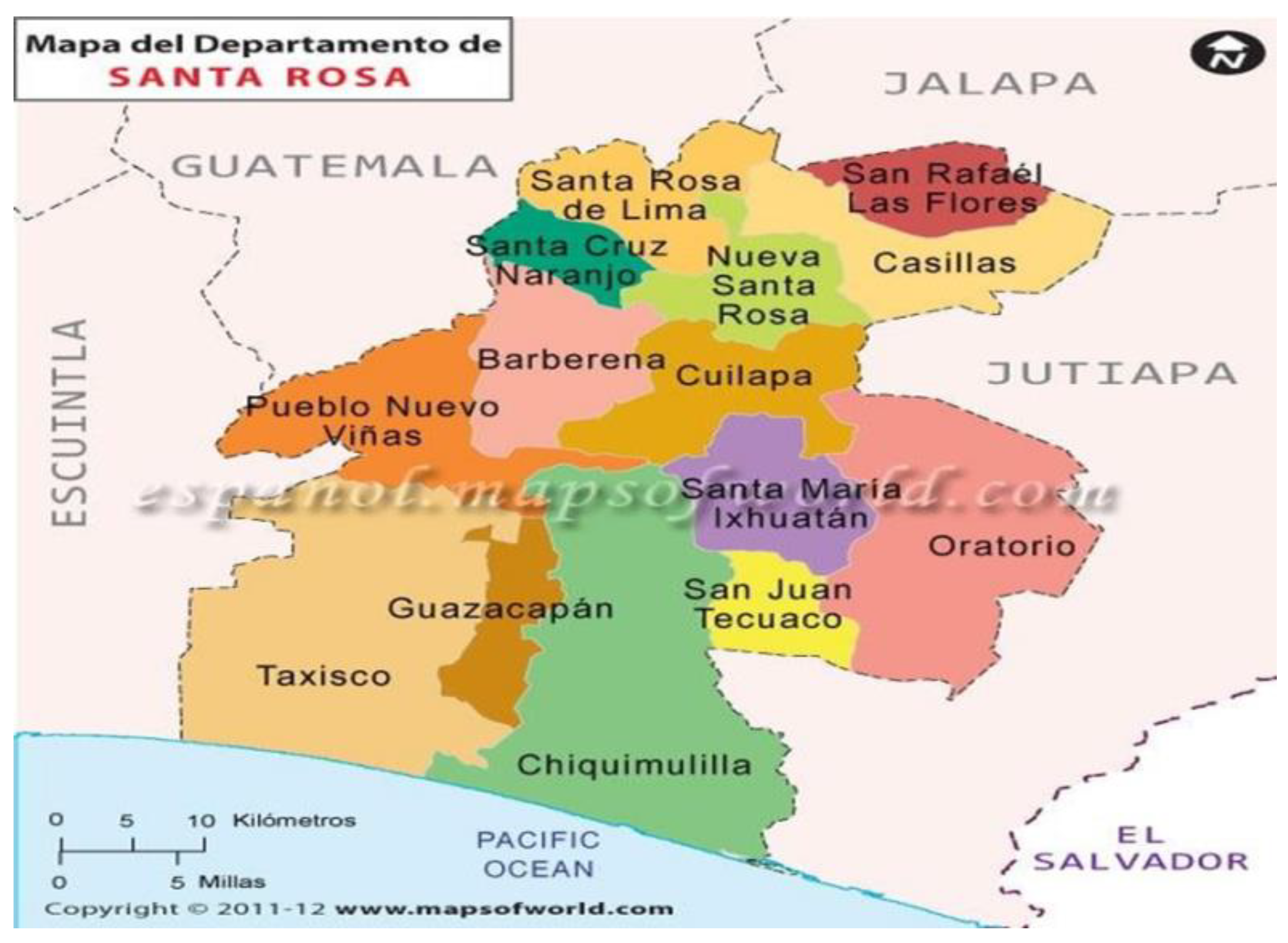
Figure 2.
Location of Ae. albopictus, positive municipalities and localities in the Department of Santa Rosa during 2024.
Figure 2.
Location of Ae. albopictus, positive municipalities and localities in the Department of Santa Rosa during 2024.
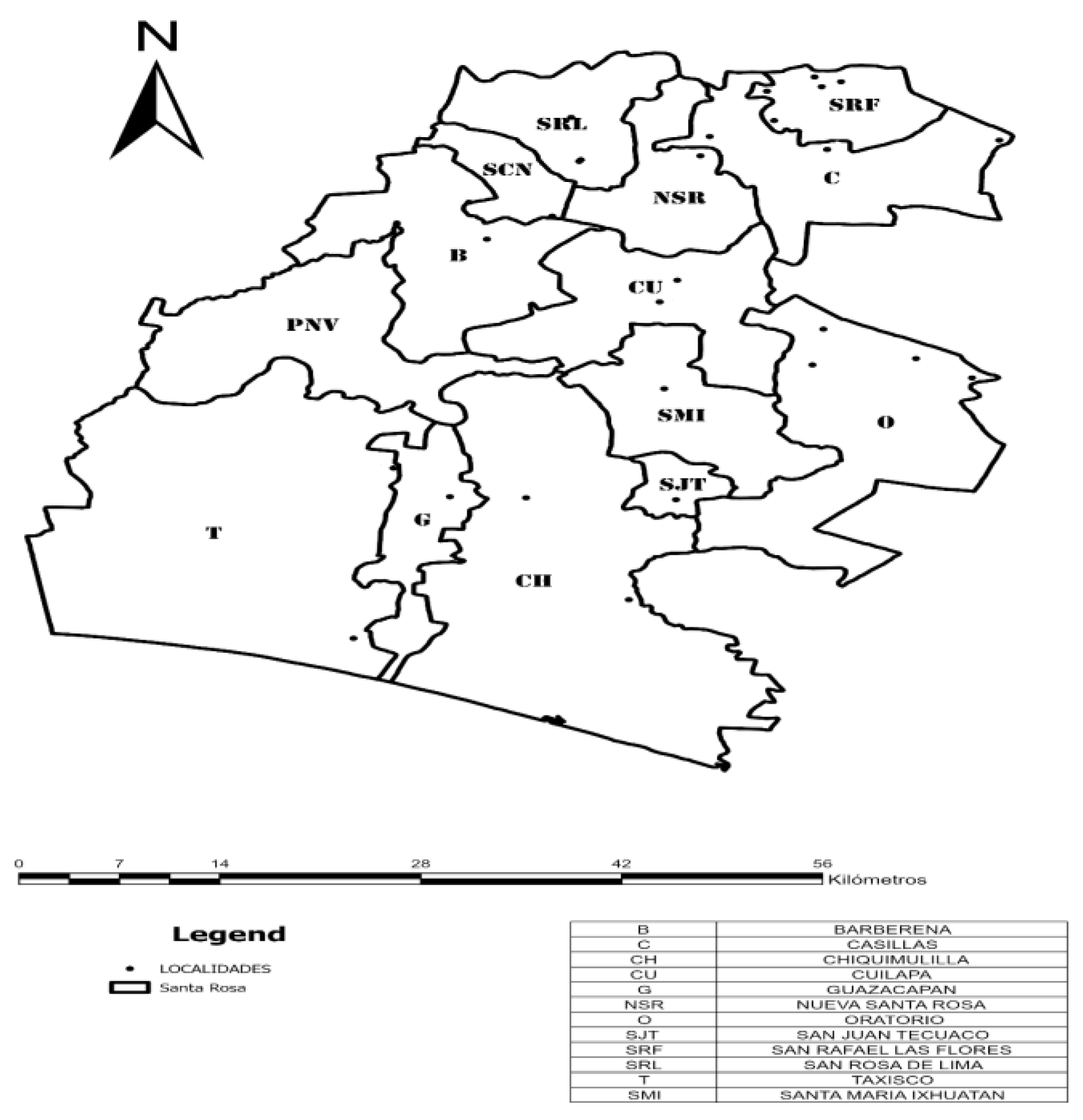
Figure 3.
Proportion of the samples collected according to the location of the deposits in the dwelling in the rural and urban sector.Source: LED Entomological Samples Books
Figure 3.
Proportion of the samples collected according to the location of the deposits in the dwelling in the rural and urban sector.Source: LED Entomological Samples Books
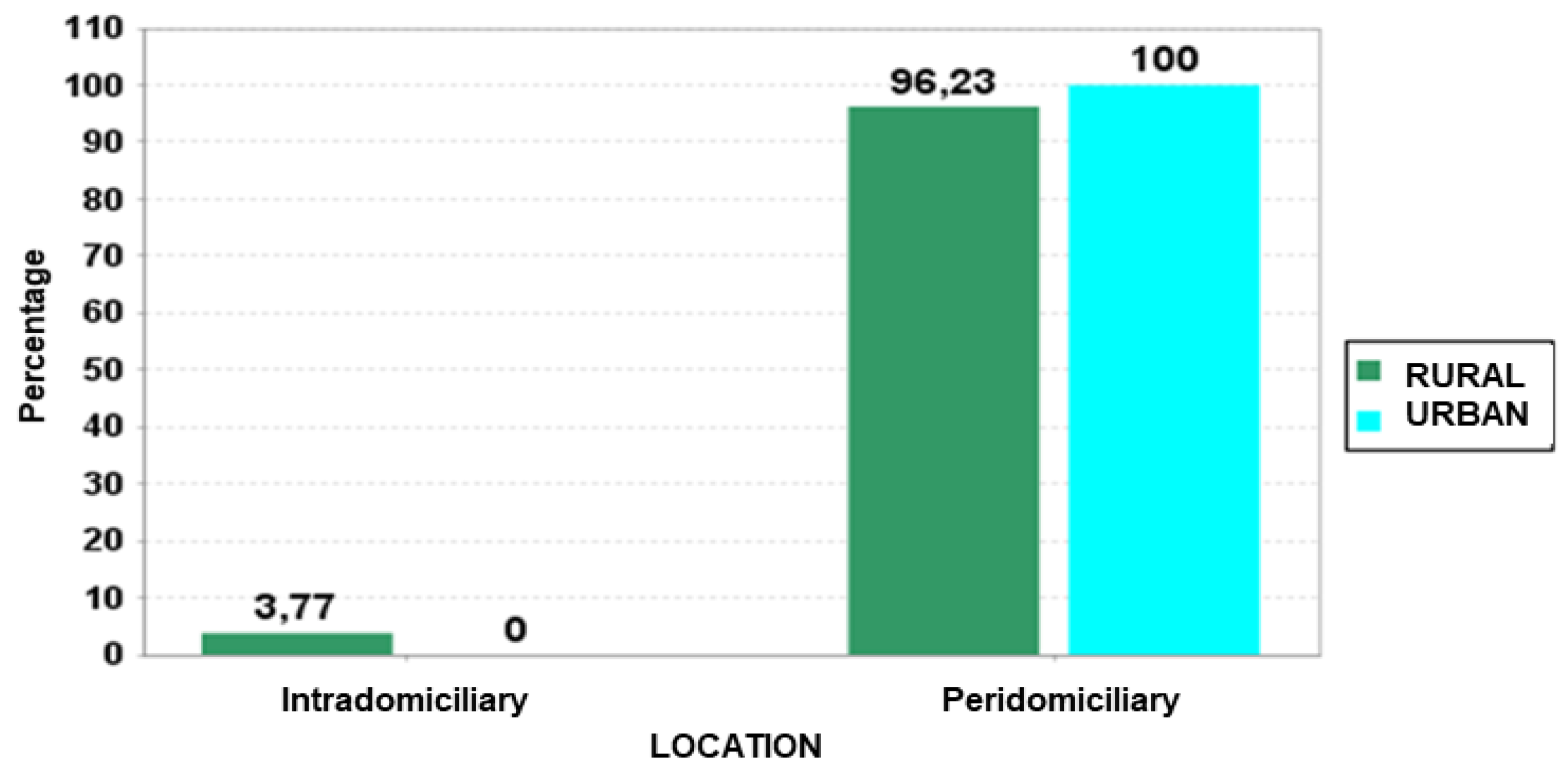

Table 1.
Values of the temperature, precipitation and altitude for each municipality of the Department of Santa Rosa, Guatemala, 2024.
Table 1.
Values of the temperature, precipitation and altitude for each municipality of the Department of Santa Rosa, Guatemala, 2024.
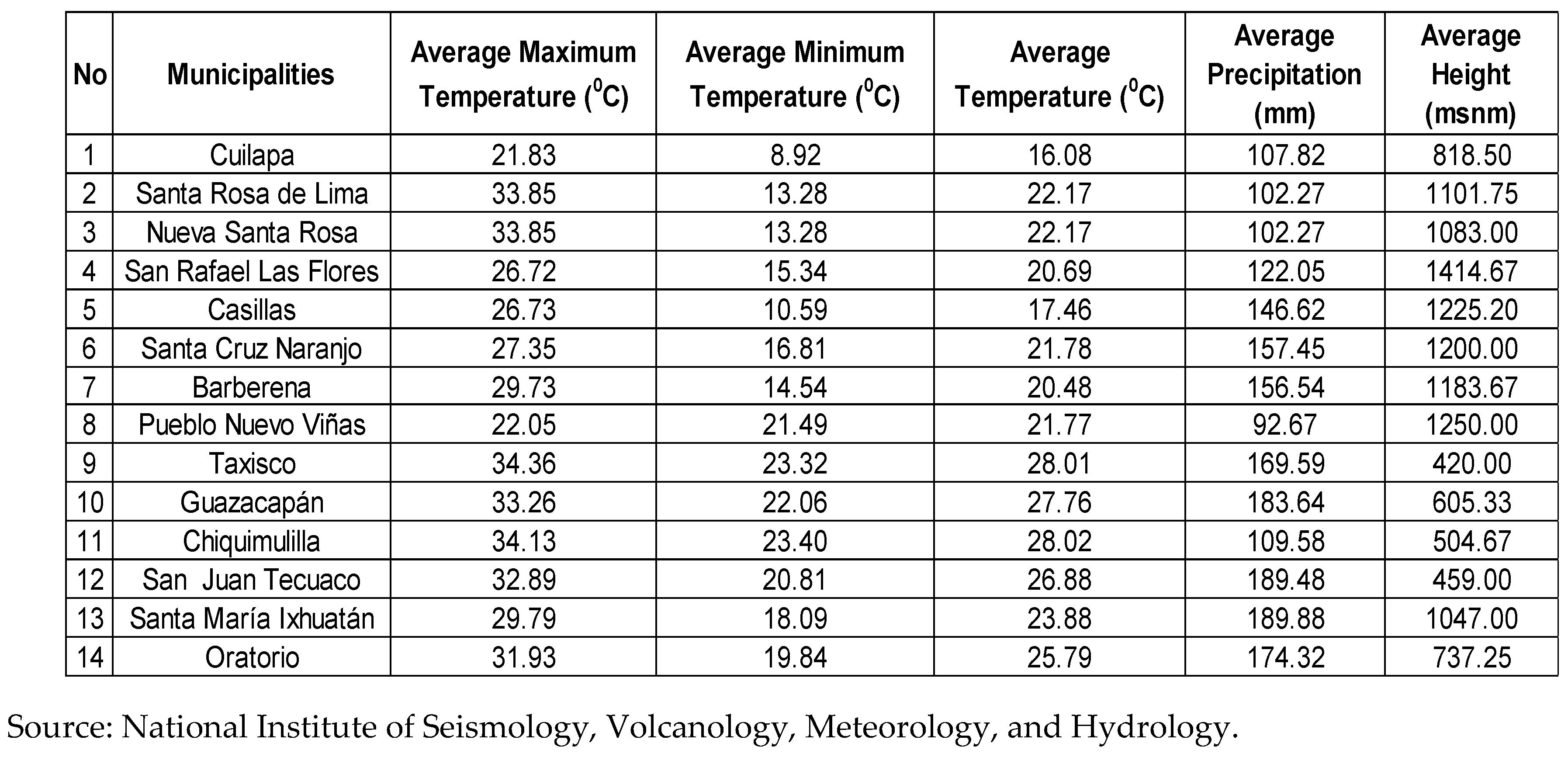
Table 2.
Distribution of the samples of Ae. albopictus collected by municipalities and sector of the Department of Santa Rosa, Guatemala, 2024.
Table 2.
Distribution of the samples of Ae. albopictus collected by municipalities and sector of the Department of Santa Rosa, Guatemala, 2024.
| Municipalities | Absolute frequency |
Relative Frequency (%) |
Sector* | |
|---|---|---|---|---|
| Urban (%) |
Rural (%) |
|||
| Santa Rosa de Lima | 11 | 16,42 | 18 | 82(2)** |
| Chiquimulilla | 10 | 14,93 | 35 | 65(7) |
| Casillas | 9 | 13,43 | 31 | 69(6) |
| San Rafael de Flores | 8 | 11,94 | 29 | 71(4) |
| San Juan de Tecuaco | 6 | 8,96 | 30 | 70(5) |
| Guazacapán | 5 | 7,46 | 65 | 35(9) |
| Oratorio | 5 | 7,46 | 40 | 60(8) |
| Barberena | 4 | 5,97 | 81 | 19(10) |
| Nueva Santa Rosa | 3 | 4,48 | 37 | 63(8) |
| Taxisco | 3 | 4,48 | 31 | 69(6) |
| Cuilapa | 2 | 2,99 | 95 | 5(11) |
| Santa María de Ixhuatán | 1 | 1,49 | 19 | 81(3) |
| Pueblo Nuevo de Viña | 0 | 0,00 | 15 | 85(1) |
| Santa Cruz Naranjo | 0 | 0,00 | 35 | 65(7) |
| Total | 67 | 100,00 | ||
Source: LED Entomological Samples Book. *From the Department of Surveillance and Control of Sanitary Regulations (DVCRS) of the DDRISS of Santa Rosa, Guatemala. **Place in terms of the proportion of the Rural Sector.
Table 3.
Samples collected by municipalities in different seasons in the Department of Santa Rosa, Guatemala, 2024.
Table 3.
Samples collected by municipalities in different seasons in the Department of Santa Rosa, Guatemala, 2024.
| Municipality | Samples collected during the dry season (Nov-Apr.) |
Sampled collected during the rainy season (May- Oct.) |
Total |
|---|---|---|---|
| Santa Rosa de Lima | 4 | 7 | 11 |
| Chiquimulilla | 2 | 8 | 10 |
| Casillas | 1 | 8 | 9 |
| San Rafael de Flores | 0 | 8 | 8 |
| San Juan de Tecuaco | 1 | 5 | 6 |
| Guazacapán | 1 | 4 | 5 |
| Oratorio | 3 | 2 | 5 |
| Barberena | 2 | 2 | 4 |
| Nueva Santa Rosa | 2 | 1 | 3 |
| Taxisco | 3 | 0 | 3 |
| Cuilapa | 2 | 0 | 2 |
| Santa María de Ixhuatán | 0 | 1 | 1 |
| Total | 21 | 46 | 67 |
Source: LED Entomological Specimen Book.
Table 4.
Deposits testing positive to Ae. albopictus in the different rainy and dry season in the Department of Santa Rosa, Guatemala, 2024.
Table 4.
Deposits testing positive to Ae. albopictus in the different rainy and dry season in the Department of Santa Rosa, Guatemala, 2024.
| Deposits | Rainy period (Nov- Apr.) |
Dry season (May- Oct.) |
Type of deposit |
|---|---|---|---|
| Tires | 14 | 9 | 23DANU |
| Barrels | 9 | 3 | 12DAU |
| Cans | 5 | 6 | 11DANU |
| Bottles | 7 | 0 | 7DANU |
| Pila | 4 | 0 | 4DAU |
| Coconut shell | 3 | 1 | 4DN |
| Basin | 3 | 0 | 3DAU |
| Three hole | 1 | 0 | 1DN |
| Vase | 0 | 1 | 1DAU |
| Tank | 0 | 1 | 1DAU |
| Total | 46 | 21 | 67 |
Source: LED Entomological Samples Books.
Disclaimer/Publisher’s Note: The statements, opinions and data contained in all publications are solely those of the individual author(s) and contributor(s) and not of MDPI and/or the editor(s). MDPI and/or the editor(s) disclaim responsibility for any injury to people or property resulting from any ideas, methods, instructions or products referred to in the content. |
© 2025 by the authors. Licensee MDPI, Basel, Switzerland. This article is an open access article distributed under the terms and conditions of the Creative Commons Attribution (CC BY) license (http://creativecommons.org/licenses/by/4.0/).
Copyright: This open access article is published under a Creative Commons CC BY 4.0 license, which permit the free download, distribution, and reuse, provided that the author and preprint are cited in any reuse.


