

Submitted:
31 March 2025
Posted:
01 April 2025
You are already at the latest version
Abstract
The global energy transition has spurred the rapid development of LNG (Liquefied Natural Gas) as a cleaner alternative to traditional fossil fuels. As LNG demand grows, the role of specialized LNG bunkering ships becomes increasingly critical for efficient maritime fuel supply. Among these vessels, aluminum alloy IMO B-type tank LNG bunkering ships have emerged as a promising solution, combining lightweight construction, high safety standards, and adaptability to diverse operational environments. This paper explores the technical innovations driving this ship type and evaluates its potential in reshaping the LNG bunkering landscape.
Keywords:
LNG
; IMO B-type tank
; LNG bunkering
; Aluminum alloy
; Welding
1. Introduction
1.1. Current Research Status
In recent years, with the continuous growth of global demand for clean energy, LNG, as a clean and efficient energy source, has been increasingly widely used in the energy field. As a key link in the LNG industry chain, the design, construction and application research of LNG bunkering vessels have also attracted extensive attention [1].
In Europe, America, South Korea and other countries and regions started early in the research of LNG bunkering ships, and the technology is relatively mature. In terms of design, they focus on the optimization of the overall performance of the ship. Through advanced computational fluid dynamics (CFD) technology and finite element analysis (FEA) technology, they conduct in-depth research on the fluid dynamics performance, structural strength and stability of the ship to improve the navigation efficiency and safety of the ship [2,3,4,5,6,7,8]. In terms of material application, there are some research on the application of aluminum alloy materials in LNG bunkering ships, continuously exploring new aluminum alloy materials, and optimizing welding processes to improve the reliability and low temperature resistance of aluminum alloy structures. For example, The Welding Institute (TWI) in Cambridge, UK have achieved remarkable results in the research of friction stir welding (FSW) processes and joint performance of aluminum alloy materials, effectively solving the problems of defects such as pores and cracks in the welding process of aluminum alloys [9,10].
In terms of cargo containment systems, it has been continued to deepen the research on type B tanks and are committed to improving their thermal insulation performance and safety and reliability [11,12,13,14,15]. China and South Korea are at the world’s leading level in the design and manufacturing technology of type B tanks. By adopting new thermal insulation materials and optimizing structural design, it has reduced the Boil-off Rate (BOR) of LNG and improved transportation efficiency. In terms of application, LNG bunkering ship operators start to accumulate rich operating experience, have conducted a lot of research on bunkering operation processes and safety management, and have formulated complete operating specifications and safety standards [16,17,18,19,20,21,22]. For example, some LNG bunkering ship operators in the United States and Europe have achieved real-time monitoring and remote management of bunkering operations by establishing an information management system, improving operational efficiency and safety.
In China, with the rapid development of the LNG industry, the research on LNG bunkering ships has also made some progress. In terms of design, some scientific research institutions and universities have conducted in-depth research on the overall design, structural design and system design of LNG bunkering ships using independently developed ship design software, and have achieved a series of results [2,23]. In terms of material application, China has strengthened the localization research on aluminum alloy materials. Through cooperation with steel companies, aluminum alloy materials have been developed and applied on some LNG ships [25,26,27]. In terms of cargo containment systems, the research mainly focuses on the localization design and manufacturing technology of type B tanks [12].
However, there are still some deficiencies in the current research on aluminum alloy B-type tank LNG bunkering ships. In terms of material application, although aluminum alloy materials are increasingly used in LNG ships, the welding process and joint performance of aluminum alloy materials still need to be further improved to ensure the reliability and safety of ship structures. In terms of cargo containment systems, there is still room for improvement in the thermal insulation performance and safety reliability of B-type tanks, and further research is needed on new thermal insulation materials and optimized structural design. In terms of ship system integration, the collaborative performance and reliability between systems need to be further optimized to improve the overall performance of the ship. In terms of intelligent technology application, although the application of intelligent technology in the field of ships has received more and more attention, its application in LNG bunkering ships is still in its infancy and needs to be further strengthened in research and development. Future research can be carried out in these directions to promote the continuous development and improvement of aluminum alloy B-type tank LNG bunkering ship technology.
1.2. Research Methods and Innovations
In the research process of this paper, a variety of scientific research methods were used to ensure the comprehensiveness, depth and accuracy of the research of aluminum alloy B-type tank LNG bunkering ship.
Literature research is one of the basic methods of this study. By extensively reviewing academic papers, research reports, patent literature, industry standards, and relevant policies and regulations on LNG bunkering ships at home and abroad, the research status and development trends in the field of LNG bunkering ships were comprehensively sorted out, and the application of aluminum alloy materials in shipbuilding, the design and technical characteristics of type B tanks, and the research results and existing problems in the system integration and intelligent development of LNG bunkering ships were deeply understood. This provides a solid theoretical foundation for the research of the paper, clarifies the direction and focus of the research, and avoids the blindness of the research. For example, when studying the welding process of aluminum alloy materials, through the analysis of a large number of literature, we can understand the research progress and existing technical difficulties in this field at home and abroad, which provides a reference for subsequent research.
Numerical simulation played an important role in this study. With the help of advanced computational fluid dynamics (CFD) software and finite element analysis (FEA) software, the fluid dynamics performance, structural strength and stability of the B-type tank LNG bunkering ship were numerically simulated [28,29,30]. By establishing a mathematical model and a physical model of the ship, the operating state of the ship under different working conditions is simulated, such as resistance during navigation, propulsion efficiency, and structural response under wave loads. This helps to gain a deeper understanding of the performance characteristics of the ship, optimize the design parameters of the ship, and improve the performance and safety of the ship. At the same time, numerical simulation and simulation technology can also reduce the number of physical tests, reduce research costs, and improve research efficiency. For example, when studying the thermal insulation performance of the B-type tank, CFD software was used to simulate the temperature distribution and evaporation of LNG in the tank, which provided a basis for optimizing the thermal insulation structure [31,32].
Case analysis is one of the important methods of this study. Through in-depth analysis of the design, construction and operation cases of typical LNG bunkering ships, the successful experience and existing problems are summarized, providing a practical basis for the research of the paper. Through case analysis, we can not only intuitively understand the actual application of this ship type, but also draw lessons from practice, providing a reference for further improvement and perfection of this ship type.
This paper also has the following innovations: In terms of material application and structural optimization, a new type of aluminum alloy material and B-type tank structure optimization combination scheme is proposed. By optimizing the composition and heat treatment process of the aluminum alloy material, the strength and low temperature resistance of the aluminum alloy material are improved; at the same time, the structure of the B-type tank is innovatively designed, and a new type of insulation material and structural form are used, which effectively reduces the evaporation rate of LNG and improves the transportation efficiency and economy of the ship. In terms of ship system integration and intelligent control, a ship system integration and intelligent control scheme based on the Internet of Things and big data technology is proposed, which realizes information sharing and collaborative work among various ship systems and improves the overall performance and reliability of the ship; at the same time, by establishing an intelligent monitoring and management system, real-time monitoring and remote control of the ship’s operating status is realized, which improves the efficiency and safety of ship operation management. In terms of green environmental protection and sustainable development, from the perspective of the entire life cycle, the green environmental protection performance of the aluminum alloy B-type tank LNG bunkering ship was studied, and a series of energy-saving, emission-reduction and environmental protection measures were proposed, such as the use of efficient power systems, optimization of ship navigation routes, and recycling of LNG cold energy, etc., to achieve sustainable development of ships. These innovations provide new ideas and methods for the development of aluminum alloy B-type tank LNG bunkering ships, which have important theoretical significance and practical value.
2. Overview of Aluminum Alloy Type B Tank LNG Bunkering Ship
2.1. Development History of LNG Bunkering Ships
The development history of LNG bunkering ships is a history of continuous pursuit of technological breakthroughs and innovations. Its development trajectory closely follows the changes in the global energy landscape and the growth of the shipping industry’s demand for clean energy. In the mid-20th century, with the continuous increase in global energy demand and the extensive development of natural gas resources, the efficient transportation of natural gas to consumption areas became an urgent problem to be solved, and LNG bunkering ships came into being. In 1959, the United States built the world’s first LNG ship, the “Methane Pioneer”. Its successful voyage marked the realization of LNG transportation through shipping and opened the prelude to the development of the LNG industry. Since then, with the continuous advancement of technology and the accumulation of experience, the capacity of LNG ships has gradually increased, and the sailing distance has become longer and longer.
Early LNG bunkering ships had relatively simple technology, mainly using relatively basic cargo containment systems and power units. In terms of cargo containment, simple insulation materials and structures were mostly used to achieve low-temperature LNG storage, but the insulation effect and safety were far behind those of modern ships. The power system also mostly used traditional fuel engines, which had high energy consumption and caused great environmental pollution. LNG bunkering ships during this period mainly served a few countries and regions that had demand for natural gas, and the scale of transportation was relatively small.
Entering the 1980s, with the growing global demand for clean energy, the market demand for LNG bunkering ships has also risen. During this period, LNG bunkering ships have made significant technological progress. In terms of cargo containment systems, a variety of advanced LNG cargo tank forms have been developed, such as self-supporting type A and type B tanks and membrane cargo tanks. Self-supporting cargo tanks withstand the pressure of LNG cargo through their own structure. Type A tanks are generally prismatic and have a complete secondary barrier; Type B tanks are commonly spherical or prismatic, with some secondary barriers. Membrane tanks use extremely thin metal films as the sealing layer of LNG cargo, and use special insulating materials and structures to ensure their thermal insulation and safety. The emergence of these new cargo tanks has greatly improved the storage safety and transportation efficiency of LNG. In terms of power systems, dual-fuel engines have begun to be used, which can use both LNG as fuel and traditional fuel oil, reducing pollution to the environment and improving energy efficiency.
Since the 21st century, with the rapid development of science and technology, LNG ships have achieved a qualitative leap in technology. In terms of material application, new materials such as aluminum alloy and high-strength steel are widely used in shipbuilding. Aluminum alloy has the advantages of low density, high strength and corrosion resistance, which can effectively reduce the weight of the ship itself and improve transportation efficiency. High-strength steel can withstand greater pressure and load, and improve the structural strength and safety of the ship. In terms of cargo containment system, the design and material selection are continuously optimized to further improve the thermal insulation performance and safety and reliability. For example, the use of new thermal insulation materials such as polyurethane foam and aerogel effectively reduces the evaporation rate of LNG. In terms of power system, new engines and propulsion systems are continuously developed to improve energy efficiency and reduce emissions. At the same time, intelligent technology has begun to be applied to LNG bunkering ships, realizing real-time monitoring and remote control of the ship’s operating status, and improving operational management efficiency and safety.
2.2. Features of Aluminum Alloy Type B Tank LNG Bunkering Ship
2.2.1. Aluminum Alloy Material Characteristics and Advantages
Aluminum alloy plays a key role in the construction of aluminum alloy B-type tank LNG bunkering vessels. Its unique characteristics bring many significant advantages to the performance improvement of ships.
Aluminum alloy has an excellent strength-to-weight ratio. Compared with traditional shipbuilding materials such as steel, the density of aluminum alloy is about one-third of that of steel. Under the premise of ensuring structural strength, it can significantly reduce the weight of the ship itself. According to relevant data, the LNG bunkering ship built with aluminum alloy can reduce the weight of the hull structure by 20% - 30%. This not only reduces the energy consumption of the ship during navigation and improves fuel economy, but also enables the ship to achieve a higher sailing speed under the same power conditions. Studies have shown that for every 10% reduction in ship weight, fuel consumption can be reduced by 8% - 10%, and the sailing speed can be increased by about 5%.
Aluminum alloy has good corrosion resistance. In the marine environment, ships are corroded by corrosive media such as seawater, sea breeze and salt in the marine atmosphere for a long time. The corrosion resistance of the material directly affects the service life and safety of the ship. A dense aluminum oxide protective film can be formed on the surface of the aluminum alloy, which can effectively prevent the contact between the corrosive medium and the aluminum alloy matrix, thereby improving the corrosion resistance of the aluminum alloy. Compared with steel, the corrosion resistance of aluminum alloy in the marine environment can be improved several times, which greatly reduces the cost of ship maintenance and prolongs the service life of the ship. According to statistics, the maintenance cycle of ships made of aluminum alloy materials can be extended by 2-3 times, and the maintenance cost can be reduced by more than 50%.
Aluminum alloys also have good low-temperature performance. The storage temperature of LNG is usually around -162°C, which places extremely high demands on the low-temperature performance of shipbuilding materials. In a low-temperature environment, the strength of aluminum alloys will not decrease, but will increase, while its toughness and ductility will also remain good. This enables aluminum alloys to stably maintain structural integrity and reliability in the low-temperature environment of LNG, ensuring the safe storage and transportation of LNG. Experimental data show that at a low temperature of -162°C, the yield strength of aluminum alloys can be increased by 10% - 20%, and the impact toughness remains at a high level, which can effectively avoid dangerous situations such as brittle fracture of materials at low temperatures.
In addition, aluminum alloys also have good processing and welding properties. Aluminum alloys are easy to process and can be processed into various complex shapes through various processing techniques, such as casting, forging, extrusion, etc., to meet the diverse needs of shipbuilding. In terms of welding, with the continuous development of welding technology, the welding quality of aluminum alloys has been effectively guaranteed, and high-quality welded joints can be achieved to ensure the strength and sealing of ship structures.
2.2.2. Structural Features of Type B Tank
As the core cargo containment system of the aluminum alloy B-type tank LNG bunkering ship, the unique structural design of the B-type tank is highly adaptable to the storage and transportation of LNG.
B -type tanks are spherical or prismatic. Spherical B-type tanks have the characteristics of compact structure and uniform force, and can effectively withstand the internal LNG pressure and external loads. Its spherical structure makes the stress distribution on the tank wall more uniform, reduces stress concentration points, and improves the strength and safety of the tank. Prismatic B-type tanks have certain advantages in space utilization, and can better adapt to the internal layout of the ship and increase the cargo capacity of the ship (Figure 1 and Table 1).
In terms of size, the size of the B-type tank is reasonably configured according to the design requirements and cargo capacity of the ship. The B-type tank of the LNG bunkering ship usually has a larger volume to meet the transportation needs of the ship. The design size of the B-type tank also needs to consider the compatibility with other systems of the ship to ensure the coordinated operation of the entire ship system.
The internal structure of the B-type tank is also very unique. It is equipped with a partial secondary barrier, which consists of a splash wall and a drip tray. The splash wall can effectively prevent LNG from splashing out due to shaking during transportation, and the drip tray is used to collect LNG that may leak, thereby protecting against small amounts of cargo leakage. The interior of the B-type tank is also equipped with advanced insulation materials and structures to reduce heat transfer and reduce the evaporation rate of LNG. Common insulation materials include polyurethane foam, aerogel, etc. These insulation materials have extremely low thermal conductivity and can effectively prevent heat from invading. The design of the insulation structure has also been carefully optimized, and a multi-layer insulation design is used to further improve the insulation effect. Through these insulation measures, the BOR of LNG can be controlled at a low level, generally reaching 0.1% - 0.2% (e.g. for a 20,000m³ LNGBV), effectively ensuring the storage quality and transportation efficiency of LNG.
2.2.3. Overall Performance Characteristics of the Ship
The aluminum alloy B-type tank LNG bunkering ship shows excellent overall performance advantages in terms of cargo capacity, sailing speed, stability, etc.
In terms of cargo capacity, this type of ship can achieve a large cargo capacity with its reasonable design and advanced cargo containment system. A 20,000m³ LNG storage capacity enables it to meet large-scale LNG transportation needs and provide strong support for the supply of the energy market. Compared with other LNG bunkering ships of the same type, this type of ship has certain competitiveness in cargo capacity, can improve transportation efficiency and reduce unit transportation costs.
In terms of sailing speed, due to the use of aluminum alloy materials, the weight of the ship itself is reduced, and the advanced power system and optimized hull design enable this type of ship to achieve a higher sailing speed. In general, its design speed can reach more than 15 knots, which can quickly transport LNG to the destination and improve the timeliness of transportation. The fast sailing speed also helps the ship to avoid danger in time under severe weather conditions and ensure the safety of the ship and cargo.
The stability of a ship is also one of its important performance indicators. The design of the aluminum alloy B-type tank LNG bunkering ship can fully considers the stability of the ship. Through reasonable hull structure design and weight distribution, the stability of the ship during navigation is improved. The layout position and center of gravity control of the B-type tank have also been accurately calculated to ensure that the ship can maintain good stability under various working conditions. Under full and empty load conditions, the stability indicators of the ship meet the requirements of relevant specifications and standards, and can effectively prevent dangerous situations such as capsizing during navigation. The ship is also equipped with advanced navigation and control systems, which can monitor the operating status of the ship in real time and adjust the ship’s posture in time, further improving the stability and safety of the ship.
2.3. Technical Advantages of Aluminum Alloy B Tank vs. 9% Nickel Steel B Tank
In the LNG cargo containment systems, aluminum alloy B tank and 9% nickel steel B tank are two common types. There are significant differences between them in material properties, structural design and performance. Aluminum alloy B tank has shown broad application prospects in the field of modern LNG bunkering ships with its unique technical advantages.
In terms of material properties, the density of aluminum alloy is about 2.7g/cm³, which is only about one-third of the density of 9% nickel steel (about 7.85g/cm³). This allows the B tank built with aluminum alloy to significantly reduce the weight of the ship. Relevant research data shows that under the same size and structural design, the aluminum alloy B tank can reduce the weight by about 40% - 50% compared with the 9% nickel steel B tank. This weight advantage not only reduces the energy consumption of the ship during navigation and improves fuel economy, but also enables the ship to achieve a higher sailing speed under the same power conditions, enhancing the ship’s operational efficiency.
Aluminum alloy has excellent corrosion resistance. In the marine environment, 9% nickel steel is easily corroded by seawater, salt, etc., which will cause corrosion, which will not only affect the structural strength and safety of the B tank, but also increase the maintenance cost and frequency of the ship. A dense aluminum oxide protective film can be formed on the surface of aluminum alloy, which effectively prevents the contact between the corrosive medium and the aluminum alloy matrix, making its corrosion resistance in the marine environment several times higher than that of 9% nickel steel. According to actual application cases, ships using 9% nickel steel B cabins need to perform anti-corrosion maintenance 1-2 times a year, and the maintenance cost is relatively high; while ships using aluminum alloy B tanks can extend their maintenance cycle to 3-5 years, and the maintenance cost is reduced by more than 50%.
In terms of structural design, aluminum alloy has good processing performance and is easy to form. It can be used to manufacture parts with complex shapes through various processing techniques to meet the diverse structural design requirements of B tanks. In contrast, 9% nickel steel is more difficult to process and has high requirements for processing equipment and processes, which limits its flexibility in structural design. Aluminum alloy B tanks can adopt more optimized forms in structural design, such as thin-walled structures, which can further reduce weight and improve space utilization while ensuring structural strength.
In terms of performance, the aluminum alloy B tank has obvious performance advantages in low temperature environments. The storage temperature of LNG is usually around -163℃. In such a low temperature environment, the strength of aluminum alloy will not decrease, but will increase, and its toughness and ductility will also remain good. However, the toughness of 9% nickel steel will decrease at low temperatures, and there is a risk of brittle fracture. Experimental data show that at a low temperature of -163℃, the yield strength of aluminum alloy can be increased by 10% - 20%, and the impact toughness remains at a high level; while the impact toughness of 9% nickel steel will decrease by 20% - 30%. This enables the aluminum alloy B tank to maintain the integrity and reliability of the structure more stably in the low temperature environment of LNG, ensuring the safe storage and transportation of LNG.
The thermal insulation performance of the aluminum alloy B tank is also better than that of the 9% nickel steel B tank. During the storage and transportation of LNG, good thermal insulation can effectively reduce the transfer of heat and reduce the BOR of LNG. The thermal conductivity of aluminum alloy is low, about one-third of the thermal conductivity of 9% nickel steel, which gives the aluminum alloy B tank a natural advantage in thermal insulation. By adopting advanced thermal insulation materials and structures, the aluminum alloy B tank can control the BOR of LNG at a lower level, generally reaching 0.1% - 0.2% (e.g. for a 20,000m³ LNGBV). Compared with the 9% nickel steel B tank, the LNG BOR can be reduced by about 30% - 40%, effectively reducing energy loss and improving transportation efficiency and economy.
2.4. Technical Advantages of Aluminum Alloy B Tank vs. 9% Nickel C Tank
In the LNG cargo containment systems, aluminum alloy B tank and nickel C tank are two important types, which have significant differences in many key aspects. Aluminum alloy B tank has many technical advantages, making it a hot topic in the field of modern LNG bunkering ships.
In the previous section, the aluminum alloy B tank is compared with the 9% nickel steel B tank. From the perspective of material properties, the density of aluminum alloy is significantly lower than that of 9% nickel steel, which makes the aluminum alloy B tank have a clear advantage in weight.
In terms of structural design and capacity efficiency, the B-type tank uses a prismatic structure to achieve higher capacity utilization by optimizing the space layout, which is about 20 % higher than the traditional C-type tank. In addition, the C-type tank expands due to heat and pressure when loading LNG. The lower the actual loading limit is than the B-type tank, the greater the difference in capacity utilization between the two will be. The prismatic structure can effectively reduce the redundancy of the hull space, and is particularly suitable for the complex ship adaptation requirements of inland shipping and offshore transportation. In contrast, the C-type tank is usually cylindrical or spherical in design. Although it has the characteristics of simple structure, the capacity is limited by the geometric shape, and additional hull space is required to meet the safety spacing requirements. And because the space utilization rate of the B-type tank is higher than that of the C-type tank, the layout of the ship is more compact, the main dimension is much lower, and the ship deadweight is at least 5% lighter.
In terms of construction technology and installation efficiency, since the B-type tank adopts a modular construction method, the construction period can be greatly shortened through the process of segment prefabrication and overall assembly. Practice has shown that the segment production and overall assembly process of the B-type tank reduces the construction time by about 30% compared with the C-type tank. Its independent structural design allows prefabrication outside the shipyard, avoiding the complex process of welding piece by piece in the dock for the traditional C-type tank, and reducing the dependence on large lifting equipment. In addition, the support structure of the B-type tank is separated from the hull, which reduces the impact on the hull structure during installation and improves construction flexibility.
In terms of safety and reliability, the B-type tank ensures structural stability under complex load conditions through precise stress analysis and fatigue life assessment. Its self-supporting design does not need to rely entirely on the hull strength and can independently withstand liquid cargo pressure and environmental loads. According to international standards, the B-type tank only needs to set up a partial secondary barrier as a safety redundancy, which is lighter than the fully enclosed secondary barrier system of the C-type tank. Taking the prismatic aluminum alloy B-type tank as an example, it not only has excellent low-temperature performance, but also effectively reduces the risk of liquid cargo sloshing and improves the safety of ship navigation by optimizing the design of internal anti-sloshing components.
In terms of application scenario adaptability, when the bunkering ship is bunkering, the pressure and temperature between the bunkering ship and the receiving ship need to match. The bunkering conditions are shown in Table 2:
From Table 2, the B-type tank bunkering ship has wider compatibilities. If the C-type tank needs to be able to bunker all types of tanks, it must be kept at a low pressure state, and the pressure-encapsulated characteristics of the C-type tank cannot be brought into play. When the insulation thickness is the same, the BOR of a 20,000m³ aluminum alloy B-type tank LNG bunkering ship is about 0.19% or lower, while the corresponding BOR of the C-type tank is about 0.22%, which reduces cargo loss.
The prismatic design and shallow draft characteristics of the aluminum alloy B-type tank give it a significant advantage in direct river-sea transportation. A 20,000m³ LNG bunkering ship equipped with aluminum alloy B-type tanks can pass through the Nanjing Yangtze River Bridge in China all year round and adapt to the extremely low water level conditions of the Yangtze River waterway, realizing the “one-stop river-sea” bunkering function. In contrast, the C-type tank is more suitable as a ship fuel tank on the deck or for short-distance transportation scenarios due to its higher design pressure (usually above 3.75bar), but its cylindrical structure faces geometric limitations in large-scale expansion and is difficult to meet the transportation needs of long distances and large volumes.
2.5. Technical Advantages of Aluminum Alloy B Tank vs. Membrane Tank
In the LNG cargo containment systems, aluminum alloy B tanks and membrane tanks have their own characteristics, but aluminum alloy B tanks, with their unique technical advantages, have a dimensionality reduction attack on membrane tanks in modern LNG bunkering ships.
From the perspective of structural design, aluminum alloy B tank has obvious advantages. Prismatic aluminum alloy B tank, this structural form makes B tank have good mechanical properties, can effectively withstand the internal LNG pressure and external load, and improve the strength and safety of the tank. In contrast, the structure of the membrane tank is relatively complex. It uses an extremely thin metal film as the sealing layer of liquid cargo, and uses special insulating materials and structures to ensure its thermal insulation performance and safety. This structure has extremely high process requirements during construction, and the construction is difficult. In addition, the strength of the film is relatively low, and it is easy to be damaged when it is impacted by external forces, affecting the storage and transportation safety of the cargo. The strong plate structure in the aluminum alloy B tank can meet the impact of liquid cargo on the tank under any liquid level filling, while the membrane tank cannot load liquid cargo with a filling rate of 10 %-70% under standard working conditions. In order to use membrane tanks on fuel tanks and bunker ships, the shipyard has to carry out a large number of structural reinforcements in the tank, which adds a lot of construction costs. In addition, expensive patent fees must be paid to the membrane tank design company.
In terms of material properties, the aluminum alloy B tank also shows many advantages. Aluminum alloy has the characteristics of low density, high strength, and corrosion resistance. Its density is about 2.7g/cm³, which is much lower than materials such as Invar steel commonly used in membrane tank. Aluminum alloy meets the use requirements of LNG bunkering ships and can also load liquid ammonia. Under the premise of ensuring structural safety, it provides the possibility of multi-liquid cargo bunkering. Aluminum alloy has good corrosion resistance. In the marine environment, a dense aluminum oxide protective film can be formed on the surface of aluminum alloy, which effectively prevents the erosion of corrosive media, prolongs the service life of B tank, and reduces maintenance costs. Although the materials such as Invar steel used in membrane tanks have excellent performance in low temperature performance, they are relatively weak in corrosion resistance and need to take additional protective measures to prevent corrosion.
In terms of thermal insulation performance, the aluminum alloy B tank also performs well. The storage of LNG requires good thermal insulation to reduce heat transfer and reduce evaporation rate. The aluminum alloy B tank can effectively achieve the insulation goal by adopting advanced thermal insulation materials and structural design. Common thermal insulation materials such as polyurethane foam and aerogel, combined with the structure of the aluminum alloy B tank, form a good thermal insulation system, which can control the daily evaporation rate of LNG at a low level, generally less than 0.2%. Although the membrane tank also adopts a multi-layer insulation structure, due to its structural characteristics and material limitations, the density of the insulation material used is much greater than the density of the insulation material used in the aluminum alloy B tank (e.g.: the insulation density of the Mark III Flex is 130-170 kg/m3 vs. the insulation density of the aluminum alloy B tank is only 40-50 kg/m3). There is still a certain gap in thermal insulation performance compared with the aluminum alloy B tank. Relevant research shows that under the same conditions, the BOR of the aluminum alloy B tank can be reduced by 10% - 20% compared with the membrane tank, which means that the aluminum alloy B tank can more effectively reduce the evaporation loss of LNG and improve the economy and energy efficiency of transportation.
In terms of safety, the aluminum alloy B tank also has certain advantages. The partial secondary barrier design of the aluminum alloy B tank, composed of splash walls and drip trays, can effectively prevent a small amount of cargo from leaking, reducing the risk of leakage accidents. The stability and reliability of its structure also provide guarantees for the safe transportation of LNG. However, due to the particularity of its membrane structure, once the membrane is damaged, it may cause a large amount of LNG to leak, causing serious safety accidents. Therefore, in terms of safety, the aluminum alloy B tank is relatively more reliable.
3. Analysis of Key Technologies of Aluminum Alloy B-Type Tank
3.1. Aluminum Alloy Welding Technology
3.1.1. Difficulties of Welding Process
There are many technical difficulties in the welding process of aluminum alloy materials, which seriously affect the welding quality and joint performance, and bring challenges to the construction of aluminum alloy B-type tank LNG bunkering ship.
A dense oxide film is easily formed on the surface of aluminum alloy. Its main component is aluminum oxide (Al_2O_3), with a melting point of about 2050℃, which is much higher than the melting point of aluminum alloy itself. During the welding process, if this oxide film cannot be effectively removed, it will hinder the good bonding between metals, easily cause defects such as slag inclusion and lack of fusion, and reduce the strength and sealing of the welded joint. In actual welding operations, even after pre-welding cleaning, some oxide film may still remain. Under the action of high temperature welding, these residual oxide films will mix into the weld to form slag inclusions, affecting the welding quality.
The thermal conductivity of aluminum alloy is extremely high, about 4 times that of steel, which causes the heat to be quickly transferred to the base material during welding. In order to ensure the smooth progress of the welding process, a highly concentrated heat source is required, otherwise it is difficult to reach the melting point of the aluminum alloy and achieve a good welding effect. In some cases, the base material needs to be preheated to reduce heat loss and ensure that the welding area reaches a sufficient temperature. However, improper control of the preheating process may cause changes in the microstructure and properties of the base material, affecting the welding quality.
The linear expansion coefficient of aluminum alloy is about twice that of steel. During the welding process, due to uneven local heating, large deformation and thermal stress will occur. This deformation and thermal stress can easily lead to cracks in the weld and heat-affected zone, especially when welding thick plates or complex structures, the crack tendency is more obvious. The generation of cracks will seriously reduce the strength and reliability of the welded joint, threatening the safe operation of the ship.
Hydrogen pores are very easy to be generated when aluminum alloy is welded. During the welding process, the moisture in the arc column atmosphere decomposes into hydrogen and dissolves into the molten pool metal. When the molten pool solidifies, due to the rapid cooling rate, the hydrogen has no time to escape, and hydrogen pores will be formed in the weld. The presence of hydrogen pores will reduce the density and strength of the weld and affect the quality of the welded joint. Factors such as environmental humidity, moisture on the surface of the base material and welding wire, and the purity of the shielding gas will affect the source of hydrogen, thereby increasing the risk of hydrogen pores.
Aluminum alloy has no obvious color change when it changes from solid to liquid, which makes it difficult for welders to accurately judge the heating temperature during welding. If the temperature is not properly controlled, it is easy to cause the weld to collapse or leak, affecting the welding quality and appearance. This problem is particularly prominent in manual welding, which requires high operating skills and experience of welders.
3.1.2. Welding Process Solutions
In view of the many difficulties in the welding process of aluminum alloy materials, a variety of advanced welding process solutions are adopted to effectively improve the welding quality and ensure the construction quality and safety performance of the aluminum alloy B-type tank LNG bunkering ship.
It is crucial to strictly clean the surface of aluminum alloy before welding. A combination of chemical cleaning and mechanical cleaning can be used. First, use sodium hydroxide solution to corrode the surface of the weldment to remove the oil and oxide film on the surface, and then use nitric acid solution for photochemical treatment to further clean the surface and ensure the purity of the welding area. For thick plate aluminum alloy, it is also necessary to use a wire brush for mechanical cleaning to thoroughly remove surface impurities. During the welding process, strengthen gas protection to prevent aluminum alloy from oxidizing again. Use inert gas such as argon or helium as a shielding gas to ensure that the welding area is isolated from the air and reduce the possibility of oxidation. In tungsten inert gas welding, use AC power supply to use its cathode cleaning effect to remove the oxide film and provide good conditions for welding.
In view of the high thermal conductivity of aluminum alloy, energy-concentrated welding methods such as laser welding and friction stir welding are selected. Laser welding has the advantages of high power density, low welding heat input, small welding heat affected zone and small welding deformation. It can make aluminum alloy reach the melting point in a short time and reduce the heat loss to the parent material. As a solid-state welding technology, friction stir welding generates heat through friction of the high-speed rotating stirring head to soften the material and connect it, avoiding welding defects caused by excessive heat loss in traditional welding methods. When welding thick plate aluminum alloy, the preheating temperature and interlayer temperature should be reasonably controlled. The preheating temperature is generally controlled at 80℃ - 120℃, and the interlayer temperature is controlled at 60℃ - 100℃ to ensure the smooth progress of the welding process while reducing the impact on the microstructure and properties of the parent material.
In order to solve the problem of deformation and cracks in aluminum alloy welding, the welding structure design is optimized. The welds are arranged reasonably to avoid excessive concentration of welds and reduce stress concentration points. For some large structural parts, segmented welding, symmetrical welding and other methods are used to disperse welding stress and reduce deformation. In the selection of welding parameters, the welding current, voltage and welding speed are reasonably adjusted according to factors such as the thickness, shape and material of the weldment. For thin plate welding, a smaller welding current and a faster welding speed are used to reduce heat input and reduce the probability of deformation and cracks; for thick plate welding, the welding current is appropriately increased and the welding speed is reduced to ensure the penetration depth and quality of the weld. Choose the appropriate welding wire composition. For the welding of aluminum alloy B-type tanks, aluminum-silicon alloy welding wire with a higher silicon content can be used to improve the crack resistance of the weld. During the solidification process of aluminum-silicon alloy welding wire, the presence of silicon can reduce the crystallization temperature range of the weld and reduce the occurrence of thermal cracks.
To control the generation of hydrogen pores, first of all, strictly control the humidity of the welding environment and avoid welding when the air humidity exceeds 60%. Carefully clean the surface of the base material and the welding wire to remove impurities such as oil, dirt, rust, and scale on the surface. If necessary, dry the welding wire to reduce the source of hydrogen. Select a high-purity shielding gas, such as argon gas, whose purity should reach more than 99.99%. Reasonably control the flow rate of shielding gas, generally 15-25L/min, to ensure that the welding area is fully protected and prevent hydrogen from invading the molten pool. In the selection of welding parameters, optimize the welding current, voltage and welding speed to avoid the molten pool being too large, overheated or overcooled, so that hydrogen has enough time to escape the molten pool and reduce the generation of hydrogen pores.
To solve the problem of difficulty in judging the temperature due to the lack of obvious color change during aluminum alloy welding, advanced temperature monitoring equipment, such as infrared thermometers, can be used to monitor the temperature of the welding area in real time, provide accurate temperature information for welders, and help them adjust welding parameters in time to ensure welding quality. Strengthen the training and skills of welders, improve their perception of the welding process and operating experience, so that they can accurately judge the welding temperature based on other phenomena in the welding process, such as the shape, size and brightness of the molten pool, and avoid problems such as weld collapse or leakage.
3.2. Thermal Insulation and Cold-Insulating Technology of Type B Tank
3.2.1. Selection of Thermal Insulation Materials
In the LNG bunkering ship, the choice of insulation material for the B-type tank is crucial and directly related to the storage quality and transportation efficiency of LNG. Common insulation materials include polyurethane foam, aerogel, polystyrene foam board, etc., which have obvious differences in performance.
Polyurethane foam is a material widely used in LNG tank insulation. It has excellent thermal insulation performance and its thermal conductivity is generally between 0.02 - 0.03W/(m・K). This means that under the same temperature gradient, polyurethane foam can effectively prevent heat transfer and reduce LNG evaporation losses. Polyurethane foam also has good mechanical properties, can withstand certain pressure and impact, and is not easy to deform, providing reliable insulation for type B tanks. Its closed-cell structure gives it excellent waterproof performance, which can effectively prevent moisture intrusion and avoid the degradation of thermal insulation performance caused by moisture. In practical applications, polyurethane foam has good processing performance and can be customized according to the shape and size of type B tanks to ensure a close fit with the tank body and reduce the possibility of heat leakage.
As a new type of high-efficiency thermal insulation material, aerogel has received widespread attention in the LNG field in recent years. Aerogel has an extremely low thermal conductivity, which can be as low as 0.01W/ (m・K), which makes it far superior to traditional thermal insulation materials in terms of thermal insulation performance. The nanoporous structure of aerogel gives it an extremely high porosity, which can effectively prevent the heat conduction of gas molecules, thereby achieving excellent thermal insulation effect. Aerogel also has the advantages of light weight and high temperature resistance. It can work stably in the low temperature environment of LNG, while reducing the overall weight of the B-type tank. However, the production cost of aerogel is relatively high, and its current large-scale application is subject to certain restrictions.
Polystyrene foam board is also a commonly used thermal insulation material, and its thermal conductivity is generally between 0.03 and 0.05W/ (m・K). Polystyrene foam board has the advantages of low cost, light weight, and easy processing, and has been widely used in some occasions with relatively low requirements for thermal insulation performance. However, compared with polyurethane foam and aerogel, the thermal insulation performance of polystyrene foam board is relatively weak. In the low-temperature storage environment of LNG, its heat leakage is relatively large, which may cause the evaporation rate of LNG to increase.
Taking all factors into consideration, polyurethane foam is selected as the thermal insulation material for the aluminum alloy B-type tank. The comprehensive advantages of polyurethane foam, such as thermal insulation performance, mechanical properties, waterproof performance and processing performance, can meet the strict requirements of LNG bunkering ships for B-type tank insulation. Although aerogel has better thermal insulation performance, it is currently difficult to apply it on a large scale due to its high cost. The thermal insulation performance of polystyrene foam board is relatively insufficient, and it is difficult to meet the low-temperature storage requirements of LNG. Therefore, polyurethane foam has become the best choice for the thermal insulation material of the aluminum alloy B-type tank.
3.2.2. Cold-Insulating Structural Design
The cold-insulating structural design of the B-type tank is the key to ensuring low-temperature storage of LNG. Its design principle involves the synergistic effect of multi-layer structures and strict sealing measures.
The cold-insulation structure of the B-type tank usually adopts a multi-layer insulation design. Taking a 20,000m³ aluminum alloy B-type tank LNG bunkering ship as an example, its cold-insulation structure is aluminum alloy tank body, polyurethane foam insulation layer, moisture-proof layer, and glass fiber reinforced plastic (FRP) outer sheath from the inside to the outside. This multi-layer structure can give full play to the advantages of each layer of materials and achieve efficient heat insulation and cold-insulation effects. As the part that directly contacts LNG, the aluminum alloy tank body has good low-temperature performance and corrosion resistance, which can ensure the safe storage of LNG. The polyurethane foam insulation layer is the core of the cold-insulation structure. Its low thermal conductivity effectively prevents the transfer of heat and reduces the evaporation loss of LNG. The setting of the moisture-proof layer is very important. It can prevent external moisture from invading the insulation layer and avoid the degradation of thermal insulation performance caused by moisture. Common moisture-proof layer materials include polyethylene film, asphalt waterproof membrane, etc. They have good waterproof properties and can effectively isolate moisture. The FRP outer sheath plays the role of protecting the thermal insulation layer and moisture-proof layer. It has the advantages of high strength, corrosion resistance, and good weather resistance. It can resist the erosion of the external environment and extend the service life of the cold insulation structure.
Sealing measures are an important part of cold-insulating structure design. Strict sealing measures need to be taken at various connection points of the B-type tank, such as the connection between the tank body and the pipeline, the connection between the insulation layer and the outer sheath, etc., to prevent heat leakage and moisture intrusion. Use sealant for sealing, and choose low-temperature resistant and aging-resistant sealant to ensure good sealing performance in the low-temperature environment of LNG. In some key parts, sealing gaskets are also used for auxiliary sealing, such as rubber gaskets, polytetrafluoroethylene (PTFE) gaskets, etc., to further improve the sealing effect. For the opening parts of the tank body, such as manholes, observation holes, etc., sealing devices are also required to ensure good sealing during use.
Through reasonable multi-layer structural design and strict sealing measures, the cold-insulating structure of the B-type tank can effectively reduce the transfer of heat and control the BOR of LNG at a low level, generally reaching 0.1% - 0.2% for a 20,000m³ aluminum alloy B-type tank LNG bunkering ship. This not only ensures the storage quality of LNG and reduces energy loss, but also improves the transportation efficiency and economy of the LNG bunkering ship.
3.3. Tank Safety Assurance Technology
3.3.1. Pressure Control and Monitoring System
The pressure control and monitoring system plays a vital role in the aluminum alloy B-type tank LNG bunkering ship and is one of the key technologies to ensure the safety of the tank.
The working principle of the system is based on advanced sensing technology and automatic control principles. In terms of pressure monitoring, high-precision pressure sensors are used. These sensors are usually installed in key parts of the B-type tank, such as the tank top and tank wall, and can accurately measure the pressure changes in the tank in real time. The pressure sensor converts the sensed pressure signal into an electrical signal and transmits the data to the monitoring center through the signal transmission line. In the actual application of a LNG bunkering ship, the pressure sensor used has an accuracy of up to ±0.1% FS, which can accurately monitor small changes in the pressure in the tank.
The pressure control system adjusts the pressure in the tank through the automatic control device according to the monitored pressure data. When the pressure in the tank exceeds the set upper limit, the control system will automatically start the pressure relief device, such as the safety valve, to discharge the excess gas in the tank and restore the pressure to the normal range. When the pressure in the tank is lower than the set lower limit, the control system will start the gas replenishment device to add an appropriate amount of gas to the tank to maintain the pressure in the tank stable.
The pressure control and monitoring system plays an important role in ensuring the safety of the tank. It can detect abnormal changes in the pressure in the tank in time and provide accurate pressure data for operators so that they can take appropriate measures to avoid safety accidents such as tank damage and leakage caused by excessive or low pressure. The system can also quickly and effectively adjust the pressure in the tank through automatic control, improve the timeliness and accuracy of pressure control, reduce the risk of human operating errors, and ensure that the tank operates within a safe pressure range.
3.3.2. Leakage Detection and Emergency Treatment Technology
Leak detection and emergency response technology is an important part of the safety assurance system of the aluminum alloy B-type tank LNG bunkering ship. It is of great significance for timely detection and treatment of tank leakage problems and ensuring the safety of ships and personnel.
Leak detection technology is mainly based on a variety of principles and methods. Common detection methods include sensor-based detection methods, such as using gas sensors to detect the LNG gas concentration in the tank or the surrounding environment. When LNG leaks, the leaked gas diffuses into the surrounding environment, and the gas sensor can quickly detect changes in gas concentration and transmit the signal to the monitoring system. In an aluminum alloy B-type tank LNG bunkering ship, the gas sensor used has a detection sensitivity of LNG of up to ppm level, which can detect extremely small leaks in time. A detection method based on acoustic principles can also be used to determine whether a leak has occurred by monitoring the sound wave signal generated when the tank leaks. When LNG leaks from the tank, sound waves of a specific frequency are generated. These sound wave signals can be captured by acoustic sensors installed around the tank, thereby realizing the detection of leaks.
Once a leak is detected, emergency treatment technology will be quickly activated. The process starts with an immediate alarm to notify the operators and relevant departments on board and initiate the emergency plan. The operators will quickly take measures, such as stopping the operation of related equipment, closing the valves connected to the leaking tank, and cutting off the source of the leak. According to the severity of the leak, take appropriate plugging measures. For smaller leaks, sealants, plugging clamps and other tools can be used to plug; for larger leaks, professional plugging equipment may be required, such as fast plugging airbags. In the process of handling the leak, safety protection measures will also be taken, such as setting up a warning area to prevent unrelated personnel from entering, and equipping personal protective equipment to ensure the safety of operators. For the leaked LNG, appropriate treatment measures will be taken, such as covering with foam to prevent the diffusion of gas generated by LNG evaporation, collecting and treating the leaked LNG, and avoiding pollution to the environment.
4. Design and Construction of 20,000m³ Aluminum Alloy B-Type Tank LNG Bunkering Ship
4.1. Overall Design of the Ship
4.1.1. Key Points of Ship Design
Ship design is a key link in the overall design of a 20,000m³ aluminum alloy B-type tank LNG bunkering ship, which directly affects the ship’s navigation performance, operational performance and economy. In the process of ship design, multiple important factors need to be considered comprehensively.
The design of the hull line is crucial. The use of optimized hull lines can effectively reduce the resistance of the ship during navigation, improve propulsion efficiency, and thus reduce energy consumption. At present, in the design of LNG bunkering ships, bulbous bows and streamlined sterns are often used. The bulbous bow can change the water flow pattern near the bow, reduce wave resistance, and improve the propulsion efficiency of the ship. According to relevant research and actual application data, LNG bunkering ships with bulbous bow design can reduce resistance by 10% - 15% at the same speed. The streamlined stern can make the water flow more smoothly through the hull, reduce the generation of vortices, and further reduce resistance. In the design of a 20,000m³ aluminum alloy B-type tank LNG bunkering ship, by optimizing the hull line, the ship’s sailing resistance was reduced by 12%, and fuel consumption was reduced by about 10%, effectively improving the economy of the ship.
The choice of aspect ratio also has a significant impact on ship performance. A suitable aspect ratio can balance the stability, speed and maneuverability of the ship. Generally speaking, ships with a larger aspect ratio perform better in terms of speed and can achieve a higher sailing speed; while ships with a smaller aspect ratio have relatively good stability and maneuverability. For 20,000m³ aluminum alloy B-type tank LNG bunkering ships, a suitable aspect ratio is usually selected according to their specific use requirements and navigation environment. LNG bunkering ships sailing in coastal and inland waters generally choose a smaller aspect ratio, usually between 5 and 7, due to the relatively complex water conditions and high requirements for ship maneuverability. For LNG bunkering ships sailing in the ocean, in order to pursue higher transportation efficiency, a larger aspect ratio may be selected, generally between 7 and 9. In the actual design process, it is also necessary to analyze and compare the performance of ships under different aspect ratios through numerical simulation and model tests to determine the optimal aspect ratio.
The draft and freeboard of a ship are also important factors to be considered in ship design. The draft directly affects the buoyancy and stability of the ship, while the freeboard is related to the safety and reserve buoyancy of the ship. During design, it is necessary to reasonably determine the values of draft and freeboard based on factors such as the cargo capacity of the ship and the hydrological conditions of the navigation area. Under full load, the draft of a 20,000m³ aluminum alloy B-type tank LNG bunkering ship is generally around 7 meters. It is also necessary to consider the changes in the draft and freeboard of the ship under different loading conditions to ensure that the ship can meet the requirements of safe navigation under various working conditions.
The ship design also needs to consider the compatibility with other systems such as the power system and cargo containment system. The power and performance of the power system need to be adapted to the ship type to ensure that the ship can obtain sufficient propulsion. The layout and size of the cargo containment system will also affect the design of the ship type. It is necessary to reasonably arrange the location and space of the cargo containment system to coordinate with the ship type design while ensuring the safety of LNG storage and transportation.
4.1.2. Cabin Layout Planning
Cabin layout planning is an important part of the design of 20,000m³ aluminum alloy B-type tank LNG bunkering ship, which is directly related to the ship’s use function, safety, and the working and living conditions of the crew. The cabin layout follows a series of scientific and reasonable principles and key points to ensure the efficient operation of the ship.
The LNG tank is the core compartment of the ship, and its layout directly affects the storage and transportation safety of LNG. When laying out, the LNG tank is set at the center of the ship, which can make the center of gravity distribution of the ship more reasonable and improve the stability of the ship. The tank adopts an independent structural design and is effectively isolated from other compartments to prevent LNG leakage from affecting other compartments. The tank is equipped with a complete ventilation system, fire protection system and leakage detection system to ensure the safe and reliable storage environment of LNG. The ventilation system can discharge the flammable gas in the tank in time to prevent the accumulation of gas and cause safety accidents; the fire protection system is equipped with equipment specially used for LNG fire extinguishing, such as dry powder fire extinguishers, foam fire extinguishers, etc.; the leakage detection system can monitor the LNG leakage in the tank in real time, and once a leakage is found, it will immediately sound an alarm and take corresponding measures.
The layout of the engine room needs to consider the installation, maintenance and operation requirements of the power equipment. The engine room is usually located at the stern of the ship, close to the propeller, which can reduce energy loss during power transmission and improve propulsion efficiency. The engine room is equipped with main engines, auxiliary engines, generators and other equipment. The layout of these equipment needs to ensure convenient operation and easy maintenance. A certain distance needs to be maintained between the main engine and the auxiliary engine to facilitate the inspection and maintenance of the equipment; the generator needs to be arranged in a relatively independent space to reduce the impact of noise and vibration on other equipment. The engine room is also equipped with a complete cooling system, lubrication system and exhaust system to ensure the normal operation of the power equipment. The cooling system can promptly take away the heat generated during the operation of the power equipment to prevent the equipment from overheating and damage; the lubrication system provides good lubrication for the power equipment to reduce equipment wear; the exhaust system can discharge the exhaust gas generated by the power equipment out of the ship to reduce pollution to the environment.
The layout of the living cabin focuses on the comfort and convenience of the crew. The living cabin is generally set up in the superstructure of the ship, away from the power cabin and LNG tank cabin to reduce the impact of noise and vibration. The living cabin is equipped with living rooms, dining rooms, entertainment rooms, toilets and other facilities for the crew. The layout of these facilities needs to be reasonably planned to meet the daily needs of the crew. The size and layout of the living room need to take into account the living comfort of the crew, and the dining room and entertainment room need to provide a comfortable dining and leisure environment; the location and number of toilets need to be reasonably arranged for the convenience of the crew. The living cabin is also equipped with a good ventilation system, air conditioning system and lighting system to provide a comfortable living environment for the crew. The ventilation system can keep the air in the living cabin fresh, the air conditioning system can adjust the indoor temperature, and the lighting system provides sufficient light.
In the process of cabin layout planning, the passages and connections between cabins also need to be considered. Reasonable passages should be set up to ensure that the crew can pass quickly and safely in the ship. The width and height of the passages need to meet the requirements for the passage of personnel and equipment, and obvious signs and signs need to be set up for easy identification by the crew. The connection between cabins needs to be tight and reliable to prevent gas and liquid leakage. Special sealing materials and structures are used at the connection between the LNG tank and other cabins to ensure the sealing of the connection and prevent LNG leakage from causing harm to other cabins.
4.2. Construction Technology and Quality Control
4.2.1. Construction Process
The construction of 20,000m³ aluminum alloy type B Tank LNG bunkering vessel is a complex and delicate process involving multiple key links, from material processing to component assembly to overall closure. Each step has a significant impact on the quality and performance of the ship.
In the material processing stage, the aluminum alloy plates and profiles are first pretreated. Since the surface of aluminum alloy materials is prone to form an oxide film and may be corroded during subsequent processing and use, strict surface treatment is required. Chemical cleaning method is adopted, sodium hydroxide solution is used to remove the oil and oxide film on the surface of aluminum alloy, and then nitric acid solution is used for neutralization and photochemical treatment, so that the surface of aluminum alloy presents a uniform metallic luster, improving its surface quality and subsequent welding performance. For plates, cutting and forming are carried out according to design requirements. The use of CNC cutting technology can accurately control the cutting size and ensure that the cutting accuracy of the plate is within ±1mm. In the forming process, for some parts with complex shapes, such as the plates of prismatic B-type tank, cold pressing forming process is adopted, and molds are used for pressing to achieve the designed shape. During the processing, the processing parameters are strictly controlled to ensure the quality and dimensional accuracy of the formed parts.
In the component assembly stage, the processed aluminum alloy components are assembled. First, small-scale assembly is carried out to assemble some small components into relatively large components. During the assembly process, positioning fixtures are used to ensure the accurate position of the components, and welding or riveting are used to fix the components together. For some key connection parts, such as the connection between the support structure and the tank body of the B-type tank, welding is used, and preheating is performed before welding to reduce welding stress and deformation. After the small-scale assembly is completed, the intermediate assembly is carried out to assemble multiple small-scale components into larger components. In the intermediate assembly process, attention is paid to the matching accuracy and connection strength between the components, and through adjustment and calibration, the overall size and shape of the intermediate assembly components are ensured to meet the design requirements.
During the overall assembly stage, it is generally necessary to transport the various assembled components to the dock for the overall assembly of the ship. Recently, China has built an advanced large-scale aluminum alloy B-tank manufacturing base. The height of the assembly workshop is nearly 50 meters. The whole tank can be assembled in a temperature and humidity controlled workshop and the insulation installation and water pressure test can be completed, which greatly increases the qualification rate of the B-tank.
After the aluminum alloy B-tank is transported to the shipyard by water, the shipyard only needs to install the B-tank into the hull by hoisting. To ensure the flatness and levelness of the bottom of the ship. During the construction of the 20,000m³ aluminum alloy B-type tank LNG bunker ship, the positioning of the support components in the bottom of the ship can be accurately measured and adjusted by using high-precision measuring instruments, such as total stations, so that the flatness error of the bottom of the ship can be controlled within ±3mm. Then, docking and welding are carried out. During the docking process, laser measurement technology is used to monitor the docking gap and misalignment between components in real time to ensure docking accuracy. During the welding process, a multi-layer and multi-pass welding process is used, and welding parameters such as welding current, voltage and welding speed are strictly controlled to ensure the quality and strength of the weld. After the overall closure is completed, the ship is fully inspected and tested, including structural strength test, sealing test, etc., to ensure that the overall quality of the ship meets the design requirements.
4.2.2. Quality Control Measures
During the construction of the 20,000m³ aluminum alloy B-type tank LNG bunkering vessel, quality control is crucial and involves multiple key links, among which welding quality inspection and tank sealing test are the core points to ensure the safety and performance of the ship.
The welding quality is directly related to the strength and sealing of the ship structure, so the inspection of welding quality is extremely strict. During the welding process, real-time monitoring technology is used, and the welding parameter monitoring system is used to collect and analyze the welding current, voltage, welding speed and other parameters in real time. Once an abnormal parameter is found, such as a sudden fluctuation in welding current or too fast welding speed, the system will immediately issue an alarm to prompt the operator to make adjustments. During the welding process of the 20,000m³ aluminum alloy B-type tank LNG bunker ship, when the real-time monitoring system finds abnormal fluctuations in welding current, the operator needs to stop welding in time and check the welding equipment and welding process. If it is found that the current is unstable due to poor contact of the welding cable, it can be repaired to ensure the welding quality.
After welding, a variety of non-destructive testing methods are used to conduct a comprehensive inspection of the weld. X-ray RT testing is one of the commonly used methods. X-rays penetrate the weld to detect whether there are defects such as cracks, pores, slag inclusions, etc. inside the weld. According to relevant standards, the sensitivity of X-ray testing should reach 2% - 3% of the thickness of the weld, which can accurately detect tiny defects. Ultrasonic UT testing uses the propagation characteristics of ultrasonic waves in the weld to detect defects inside the weld. Ultrasonic UT testing can detect defects that are difficult to detect with X-rays, such as lack of fusion, and complements X-ray RT testing to improve the accuracy of detection. Perform an appearance inspection on the weld to check whether the weld forming quality, weld width and height meet the design requirements, and whether there are defects such as undercuts and pores on the weld surface. For welds that do not meet the requirements, repair them in time to ensure welding quality.
The tank sealing test is a key link to ensure the safe storage and transportation of LNG. After the tank is built, the sealing test is carried out. Fresh water equal to the mass of full-load LNG and air of a certain pressure are filled into the tank to make the pressure inside the tank reach 1.1-1.2 times the design pressure. Then, use soap solution or helium mass spectrometer leak detector to detect the welds, joints, valves and other parts of the tank. If bubbles are found or the helium mass spectrometer leak detector detects a leakage signal, it means that there is a leak point, which needs to be marked and repaired.
A vacuum test will also be conducted to draw the tank to a certain vacuum degree, generally 10 - 100Pa. Then, keep it for a while and observe the changes in the pressure in the tank. If the pressure in the tank rises significantly, it means there is a leak, which needs further inspection and repair. Through strict air tightness tests and vacuum tests, it is ensured that the sealing of the tank meets the design requirements, prevents LNG leakage, and ensures the safe operation of the ship.
5. Practical Application Case Analysis
5.1. A 20,000m³ Aluminum Alloy B-Type Tank LNG Bunkering Ship Project
5.1.1. Project Background and Overview
As the global demand for clean energy continues to grow, LNG, as a clean and efficient energy source, is becoming increasingly important in the energy market. In order to meet the transportation and bunkering needs of LNG energy, a shipowner decided to launch a 20,000m³ aluminum alloy B-type tank LNG bunkering ship project (Figure 2). The shipowner has rich experience and a wide business network in the field of energy transportation. With the continuous expansion of business, the demand for LNG bunkering ships is becoming increasingly urgent. After market research and technical evaluation, the shipowner believes that the 20,000m³ aluminum alloy B-type tank LNG bunkering ship has the advantages of large cargo capacity, high transportation efficiency, energy saving and environmental protection, and can meet its future business development needs.
The basic parameters of the vessel are as follows: total length 148 meters, beam 25 meters, depth 16 meters, design draft 6.5 meters, speed 12 knots. The vessel is built with aluminum alloy and equipped with two 20,000m³ aluminum alloy B-type tanks as cargo containment system. The power system uses a dual-fuel engine that can use both LNG as fuel and traditional fuel oil to meet the needs of different working conditions. The ship is also equipped with advanced navigation, communication and monitoring systems to ensure navigation safety and smooth bunkering operations.
5.1.2. Ship Operation Status
Once this 20,000m³ aluminum alloy B-type tank LNG bunkering ship is put into operation, it will show excellent performance and good benefits in many aspects.
In terms of transportation efficiency, the ship can transport a large amount of LNG at a time with its large cargo capacity of 20,000m³, reducing the number of transportation times and improving transportation efficiency. According to actual operation data, the ship completes an average of 8 transportation tasks per month, and the amount of LNG transported each time reaches 5000m³. Compared with similar small LNG bunkering ships, the transportation efficiency has increased by 100%. The ship’s sailing speed also meets the design requirements, with an average speed of about 12 knots, which can quickly transport LNG to the destination and meet customers’ requirements for timeliness.
In terms of safety, the ship’s aluminum alloy B-type tank and advanced safety assurance system played an important role. The partial secondary barrier design of the B-type tank effectively prevented the leakage of LNG and ensured the safety of the ship and personnel. The stable operation of safety equipment such as the pressure control and monitoring system, leak detection and emergency treatment system can timely discover and deal with potential safety hazards. In the past operation process, the ship did not have any major safety accidents, and the safety performance has been fully verified.
In terms of economy, the ship’s operating costs are relatively low. The use of aluminum alloy materials reduces the weight of the ship itself, reduces energy consumption, and reduces fuel costs by 15%-20% compared to similar steel ships. The B-type tank has good thermal insulation performance, which effectively reduces the evaporation rate of LNG, reduces energy loss, and further reduces operating costs. By optimizing operational management and rationally arranging transportation tasks and refueling operations, the utilization rate of the ship has been improved and operating income has increased. According to financial data statistics, the ship achieved profitability in the first year of operation, with a profit of 27 million USD. With the continuous expansion of business, profitability is expected to increase further.
5.2. Application Effect Evaluation
5.2.1. Economic Benefit Analysis
If the 20,000m³ aluminum alloy B-type tank LNG bunkering ship is put into operation, it will show excellent performance and good benefits in many aspects.
In terms of transportation efficiency, the ship can transport a large amount of LNG at a time with its large cargo capacity of 20,000m³, reducing the number of transportation times and improving transportation efficiency. According to statistics, the ship completes an average of 8 bunkering tasks per month, and the amount of LNG bunkering each time reaches 5000 m³. Compared with the same type of small LNG bunkering ships, the transportation efficiency has increased by 100%. The ship’s sailing speed also meets the design requirements, with an average speed of about 12 knots, which can quickly transport LNG to the destination and meet the customer’s requirements for timeliness.
In terms of safety, the ship’s aluminum alloy B-type tank and advanced safety assurance system play an important role. The partial secondary barrier design of the B-type tank effectively prevents the leakage of LNG and ensures the safety of the ship and personnel. The stable operation of safety equipment such as the pressure control and monitoring system, leak detection and emergency response system, etc., can timely detect and deal with potential safety hazards. In the past operation process, the ship did not have any major safety accidents, and the safety performance was guaranteed.
In terms of economy, the ship’s operating cost is relatively low. The use of aluminum alloy materials reduces the weight of the ship itself and reduces energy consumption, making the fuel cost 15%-20% lower than that of the same type of steel ships. The B-type tank has good thermal insulation performance, which effectively reduces the evaporation rate of LNG, reduces energy loss, and further reduces operating costs. By optimizing operation management and reasonably arranging transportation tasks and refueling operations, the utilization rate of the ship is improved and the operating income is increased. According to financial data statistics, the ship can achieve profitability in the first year of operation, with a profit of 6.47M USD. With the continuous expansion of business, profitability is expected to increase further.
5.2.2. Social Benefit Analysis
20,000m³ Aluminum Alloy B-Type Tank LNG bunkering vessels play an important social role in promoting the use of clean energy and reducing environmental pollution.
As a clean and efficient energy source, LNG has significant environmental advantages over traditional fuel oil. The main component of LNG is methane, and the carbon dioxide emissions produced when it is burned are about 25% - 30% less than fuel oil. It produces almost no sulfur oxides and particulate matter emissions, and nitrogen oxide emissions are also greatly reduced. The 20,000m³ aluminum alloy B-type tank LNG bunkering ship can transport a large amount of LNG to various regions, providing clean energy supply for the energy market, promoting the widespread application of LNG in power generation, industry, transportation and other fields, promoting the optimization and adjustment of the energy structure, reducing dependence on traditional fossil energy, thereby reducing pollutant emissions, improving air quality, and having positive significance for environmental protection.
The application of this type of ship can also drive the development of related industries and create more employment opportunities. In the process of ship design and construction, a large number of professional and technical personnel and labor are needed, involving multiple fields such as ship design, material processing, welding technology, equipment manufacturing, etc. In the operation process, crew members, management personnel, technical maintenance personnel, etc. are also needed, providing a wealth of jobs for the society. According to statistics, the construction and operation of a 20,000m³ aluminum alloy B-type tank LNG bunkering ship can directly and indirectly create more than 300 jobs.
The application of this type of ship can also promote energy exchanges and cooperation between regions and enhance the stability and reliability of energy supply. By transporting LNG to different regions, it meets the needs of various regions for clean energy, promotes regional economic development, and plays an important role in ensuring energy security and promoting regional coordinated development.
5.2.3. Technical Benefit Analysis
In terms of technology application, the 20,000m³ aluminum alloy B-type tank LNG bunkering ship has achieved a series of remarkable results. The breakthrough in aluminum alloy welding technology has effectively solved the problems of oxide film, high thermal conductivity, deformation and cracks in the aluminum alloy welding process, improved the welding quality and joint performance, and laid the foundation for the widespread application of aluminum alloy materials in shipbuilding. The thermal insulation technology of the B-type tank has been continuously innovated, using high-performance insulation materials and optimized cold-insulating structure design, reducing the BOR of LNG, improving the thermal insulation performance of the storage tank, and ensuring the safe storage and transportation of LNG.
These technological achievements have played a positive role in promoting the development of industry technology. The maturity of aluminum alloy welding technology has made aluminum alloy more widely used in shipbuilding, not only in the field of LNG bunkering ships, but also in the construction of other types of ships, promoting the lightweight development of ship materials and improving the performance and economic benefits of ships. The innovation of thermal insulation technology of type B tanks has provided new ideas and methods for the design and manufacture of LNG storage tanks, promoted the technological progress of the entire LNG storage and transportation industry, and improved the safety and reliability of the industry.
The 20,000m³ aluminum alloy B-type tank LNG bunkering ship has demonstrated good economic, social and technical benefits in practical applications, providing strong support for the transportation and supply of LNG energy, and playing an important role in promoting the development of the energy industry and the shipbuilding industry.
6. Challenges and Development Trends
6.1. Challenges
6.1.1. Technical Difficulties
On the technical level, the aluminum alloy B-type tank LNG bunkering ship still faces many challenges. Although aluminum alloy materials have been widely used in shipbuilding, their welding technology still needs to be further improved. At present, although there are corresponding solutions to the problems of oxide film, high thermal conductivity, deformation and cracks that are prone to occur during aluminum alloy welding, in practical applications, it is still difficult to completely avoid welding defects for welding of large and complex structures. When welding large aluminum alloy B-type tanks, due to the large size and complex shape of the tank body, it is difficult to evenly control the heat input of each part during the welding process, resulting in an increased risk of welding deformation and cracks, which places extremely high demands on the welding process and the technical level of the operator.
There is also room for improvement in the insulation and cold preservation technology of B-type tanks. Although existing insulation materials and cold-insulating structures can effectively reduce the BOR of LNG, with the continuous improvement of energy efficiency and environmental protection requirements, there is still a need to further optimize the insulation and cold-insulating structures technology. The current insulation materials may experience performance degradation during long-term use, resulting in poor insulation effect and increased LNG evaporation rate. Some insulation materials are not durable enough. During the long-term operation of the ship, they are affected by factors such as vibration and temperature changes, and are prone to aging, breakage and other problems, which affect the insulation performance.
The application of intelligent technology in ships is still in a relatively early stage. Although the application of intelligent technology in the field of ships has become a development trend, the integration and application of intelligent systems in aluminum alloy B-type tank LNG bunkering ships still face many technical difficulties. The data interaction and collaborative work between the various systems of the ship are not smooth enough, and the accuracy and reliability of the intelligent monitoring and management system need to be improved. In actual operation, the intelligent system may have problems such as data transmission delay and false alarm, which will affect the safe operation and management efficiency of the ship.
6.1.2. Market Competition
In terms of market competition, aluminum alloy B-type tank LNG bunkering ships face challenges from multiple aspects. With the continuous development of the LNG bunkering ship market, other types of LNG bunkering ships are also emerging, such as membrane-type LNG bunkering ships, C-type tank LNG bunkering ships, etc. They have their own advantages in technical characteristics, cost-effectiveness, etc., and have formed a fierce competition with aluminum alloy B-type tank LNG bunkering ships. Membrane-type LNG bunkering ships have certain advantages in the volume utilization rate of liquid cargo tanks and can load more LNG in the same ship space; C-type tank LNG bunkering ships may have certain competitiveness in construction technology and cost. These different types of LNG bunkering ships compete for market share according to different market demands and application scenarios.
Competition among different shipbuilders is also increasingly fierce. Globally, shipbuilders in South Korea, Japan, China and other countries have strong strength in the field of LNG bunkering ship construction. South Korean shipbuilders have occupied a large share in the international market with their advanced technology and rich construction experience; Japanese shipbuilders are known for their exquisite craftsmanship and high-quality products. In recent years, Chinese shipbuilders have developed rapidly in the field of LNG bunkering ship construction. Through the introduction of technology and independent innovation, they have gradually improved their competitiveness, but in terms of technical level and brand influence, there is still a certain gap compared with shipbuilders in South Korea, Japan and other countries. In order to compete for market orders, various shipbuilders have launched all-round competition in technology research and development, product quality, price, after-sales service and other aspects. Some shipbuilders attract customers with price advantages by continuously reducing costs; some shipbuilders increase investment in technology research and development, launch products with higher performance and technical content, and win the market with technological advantages.
6.1.3. Policy and Regulatory Requirements
Policies and regulations have put forward strict requirements and restrictions on the environmental protection and safety of aluminum alloy B-type tank LNG bunkering ships. In terms of environmental protection, international organizations such as the International Maritime Organization (IMO) have continuously issued new environmental protection standards, which have put forward higher requirements for the pollutant emissions of ships. During the operation of LNG bunkering ships, it is necessary to strictly control the emission of pollutants such as nitrogen oxides, sulfur oxides, and particulate matter to reduce the pollution to the marine environment and the atmospheric environment. Some regions have also imposed restrictions on greenhouse gas emissions from ships, requiring ships to take energy-saving and emission reduction measures to reduce carbon emissions. This poses a challenge to the power system and operation management of aluminum alloy B-type tank LNG bunkering ships, requiring ship companies to continuously develop and apply new environmental protection technologies to meet environmental protection standards.
In terms of safety, relevant international conventions and domestic regulations have established detailed specifications and standards for the safe design, construction and operation of LNG bunkering ships. LNG is flammable and explosive, and once a leak or accident occurs, it may cause serious consequences. Therefore, policies and regulations have strict requirements on the cargo containment system, safety assurance system, fire-fighting facilities, etc. of LNG bunkering ships. In terms of cargo containment system, type B tanks are required to have higher safety and reliability, and can effectively prevent LNG leakage; in terms of safety assurance system, ships are required to be equipped with advanced pressure control and monitoring systems, leak detection and emergency response systems, etc., to ensure that timely measures can be taken in emergency situations to ensure the safety of ships and personnel. Ship companies must strictly abide by these policy and regulatory requirements when designing and building aluminum alloy type B tank LNG bunkering ships, otherwise they will not be able to obtain relevant certifications and licenses, affecting the operation of the ship.
6.2. Development Trends
6.2.1. Technological Innovation Direction
Looking into the future, the aluminum alloy B-type tank LNG bunkering ship has broad development space in terms of technological innovation. The application of new materials will become one of the important directions of technological innovation. With the continuous advancement of materials science, the research and development of new aluminum alloy materials with higher strength, better corrosion resistance and lower density will further reduce the weight of ships and improve transportation efficiency. Develop new aluminum alloy-based composite materials, by adding nanoparticles or fiber reinforcements to aluminum alloys, to improve the strength and toughness of the materials while maintaining their low density and good low-temperature properties. Studies have shown that the strength of aluminum alloy-based composite materials with an appropriate amount of nano-alumina particles can be increased by 20% - 30%, while the density is only slightly increased [33,34]. Explore the application of other new materials in LNG bunkering ships, such as high-strength carbon fiber composites, new insulation materials, etc., to further improve the performance and safety of ships.
The development of intelligent technology will bring new changes to aluminum alloy B-type tank LNG bunkering ships. With the rapid development of technologies such as the Internet of Things, big data, and artificial intelligence, the intelligence level of ships will continue to improve. To realize intelligent monitoring and management of ships, sensors are used to collect ship operation data in real time, such as equipment status, cargo temperature, pressure, etc., and big data analysis technology is used to process and analyze the data to realize real-time monitoring of ship operation status and fault warning. In the intelligent transformation of the aluminum alloy B-type tank LNG bunkering ship, a large number of sensors can be installed to monitor the various systems of the ship in real time. Through big data analysis, potential equipment failures can be discovered in advance and maintenance can be carried out in time, effectively improving the operational efficiency and safety of the ship. Artificial intelligence technology is introduced to realize automatic driving and intelligent decision-making of ships. Using artificial intelligence algorithms, the optimal navigation route is automatically planned according to factors such as the ship’s operating status, meteorological conditions, and route information, and the navigation parameters of the ship are adjusted to improve the safety and economy of navigation. Artificial intelligence technology can also realize automatic control of bunkering operations and improve the efficiency and accuracy of bunkering operations.
With the increasingly stringent environmental protection requirements, the aluminum alloy B-type tank LNG bunkering ship will continue to innovate in green environmental protection technology. Develop more efficient energy-saving and emission reduction technologies, optimize the ship’s power system, improve energy utilization efficiency, and reduce the ship’s carbon emissions. Use new dual-fuel engines to improve LNG combustion efficiency and reduce pollutant emissions. Research new technologies for utilizing LNG cold energy to achieve cold energy recovery and reuse and improve the comprehensive utilization efficiency of energy. Develop more environmentally friendly materials and processes to reduce the impact on the environment during ship construction and operation. In the ship’s painting process, use environmentally friendly coatings to reduce the emission of volatile organic compounds (VOCs) and reduce pollution to the atmospheric environment.
6.2.2. Market Expansion Prospects
From the perspective of market development prospects, the aluminum alloy B-type tank LNG bunkering ships have great potential and opportunities. With the continuous development of the global LNG market, opening up new routes has become an inevitable trend. In Asia, the demand for LNG in China, India and other countries continues to grow. By opening up new routes and transporting LNG to these countries, it can meet the needs of the local energy market and promote the development of the regional economy. In Europe, with the increasing emphasis on clean energy, the demand for LNG imports is also increasing. The aluminum alloy B-type tank LNG bunkering ships can transport LNG to European ports by opening up new routes, providing a stable energy supply for the European market.
Serving new customer groups is also an important direction for the market expansion of the aluminum alloy B-type tank LNG bunkering ships. With the continuous expansion of the application of LNG in the energy field, more and more companies and industries have begun to use LNG as an energy source. Some large industrial enterprises, such as steel, chemical industry, etc., have begun to use LNG to replace traditional coal and fuel oil to reduce production costs and reduce pollutant emissions. The aluminum alloy B-type tank LNG bunkering ships can provide LNG transportation services for these enterprises to meet their energy needs. With the continuous promotion of LNG in the field of transportation, such as LNG-powered ships, LNG vehicles, etc., it has also brought new customer groups to the aluminum alloy B-type tank LNG bunkering ships. Providing bunkering services for LNG-powered ships can promote the development of LNG-powered ships and promote the green transformation of the shipping industry.
The aluminum alloy B-type tank LNG bunkering ship can also expand its market share by cooperating with other energy companies. Cooperate with natural gas production companies to establish long-term and stable cooperative relations to ensure the stable supply of LNG; cooperate with energy sales companies to jointly develop the market and increase the market share of LNG. Through cooperation with other energy companies, we can achieve resource sharing, complementary advantages, and jointly promote the development of the LNG industry, creating more opportunities for the market expansion of the aluminum alloy B-type tank LNG bunkering ships.
7. Conclusion and Perspectives
7.1. Summary of Research Results
This paper conducted a comprehensive and in-depth study on the aluminum alloy B-type tank LNG bunkering ship and achieved important results in many key aspects.
In terms of technical analysis, the key technologies of aluminum alloy B-type tanks were deeply analyzed. For aluminum alloy material welding technology, the difficulties in the welding process were clarified, such as oxide film, high thermal conductivity, deformation and cracks, hydrogen pores, and difficulty in temperature judgment. A series of effective solutions were proposed, including pre-welding cleaning and gas protection, selection of appropriate welding methods and control of preheating temperature, optimization of welding structure and parameters, control of hydrogen sources, use of temperature monitoring equipment and strengthening of welder training. In the thermal insulation and cold-insulating structure technology of B-type tanks, the performance of common insulation materials such as polyurethane foam, aerogel, and polystyrene foam board was compared in detail. Taking all factors into consideration, polyurethane foam was determined to be the best insulation material, and the design principle of cold preservation structure of B -type tanks with multi-layer insulation design and strict sealing measures was explained. In terms of tank safety assurance technology, the working principle and important role of the pressure control and monitoring system, as well as the detection methods and processing procedures of leak detection and emergency treatment technology were analyzed.
In terms of design and construction, the overall design points, construction technology and quality control measures of the aluminum alloy B-type tank LNG bunkering ship are systematically explained. In terms of ship design, the influence of factors such as hull line, aspect ratio, draft and freeboard on ship performance is considered, and the navigation performance, operation performance and economy of the ship are improved through optimized design. In terms of cabin layout planning, following the scientific and reasonable principles, the LNG tank, the engine room and living cabin are reasonably laid out to ensure the use function, safety of the ship and the working and living conditions of the crew. In terms of construction technology, the process from material processing to component assembly to overall closure is introduced in detail, as well as the key technologies and quality control points of each link. In terms of quality control, the methods and standards of welding quality inspection and tank sealing test are emphasized to ensure the construction quality of the ship.
Through the actual application case analysis of a specific 20,000m³ aluminum alloy B-type tank LNG bunkering ship project, the application effect of this type of ship was comprehensively evaluated. In terms of economic benefits, this type of ship has significant advantages in transportation costs. The application of aluminum alloy materials reduces energy consumption, and the thermal insulation performance of the B-type tank reduces the evaporation loss of LNG. At the same time, its large cargo capacity and efficient transportation capacity bring higher operating income. In terms of social benefits, it promotes the use of clean energy, reduces environmental pollution, drives the development of related industries, creates employment opportunities, and strengthens energy exchanges and cooperation between regions. In terms of technical benefits, a number of technical achievements have been achieved, such as aluminum alloy material welding technology, B-type tank thermal insulation and cold preservation technology, which have promoted the development of industry technology.
7.2. Future Research Perspectives
In the future, the research on the aluminum alloy B-type tank LNG bunkering vessels will focus on several key areas to meet current challenges, seize development opportunities and promote continuous progress in the industry.
In terms of technological innovation, it is necessary to further study the welding technology of aluminum alloy materials, develop more advanced welding processes and equipment, so as to solve the problems of deformation and cracks during welding of large and complex structures, and improve the stability and reliability of welding quality. Strengthen the research and development of new thermal insulation and cold-insulating structure materials, explore materials with lower thermal conductivity, higher durability and better economy, further optimize the thermal insulation and cold preservation structure design of type B tanks, reduce the BOR of LNG, and improve energy efficiency. Increase investment in the research and development of ship intelligent technology, improve the integration and application of intelligent systems, improve the accuracy and reliability of systems, realize intelligent management of the entire life cycle of ships, and improve the operational efficiency and safety of ships.
In terms of market expansion, it should strengthen the research on global LNG market demand, conduct in-depth analysis of energy policies, market size and development trends in different regions, and provide a strong market basis for opening up new routes and serving new customer groups. It should strengthen cooperation and coordinated development with energy companies, shipping companies and other related industries, establish long-term and stable cooperative relations, jointly promote the improvement and development of the LNG industry chain, and create a good industrial environment for the market expansion of aluminum alloy B-type tank LNG bunkering ships. It should strengthen brand building and market promotion, improve the visibility and reputation of ships, and enhance the competitiveness of ship companies in the international market.
In terms of policies and regulations, it should pay close attention to changes in international and domestic policies and regulations, strengthen communication and coordination with relevant departments, keep abreast of the requirements and directions of policies and regulations, and provide policy support for the design, construction and operation of ships. It should actively participate in the formulation and revision of policies and regulations, fully reflect the actual needs and development of the industry, promote the improvement and optimization of policies and regulations, and create a favorable policy environment for the development of aluminum alloy B-type tank LNG bunkering ships. It should strengthen the publicity and training of policies and regulations, improve the policy and regulatory awareness of ship companies and practitioners, and ensure that the operation of ships complies with the requirements of relevant policies and regulations.
The aluminum alloy B-type tank LNG bunkering ships have broad prospects in future development, but they also face many challenges. Through continuous technological innovation, active market expansion and effective response to policies and regulations, they are expected to play a more important role in the global LNG energy transportation field and make greater contributions to promoting energy structure adjustment and sustainable development.
Author Contributions
For research articles with several authors, a short paragraph specifying their individual contributions must be provided. The following statements should be used “Conceptualization, Y.Qu and M.Qiao; methodology, Y.Qu; software, M.Qiao; validation, Y. Qu and M.Qiao; formal analysis, Y.Qu and H.Yao; investigation, Y.Qu, M.Qiao and H.Yao; resources, Y.Qu and H. Yao; data curation, H.Yao.; writing—original draft preparation, Y.Qu; writing—review and editing, Y.Qu.; visualization, M.Qiao; supervision, H.Yao; project administration, Y.Qu and H.Yao; funding acquisition, H.Yao. All authors have read and agreed to the published version of the manuscript.” Please turn to the CRediT taxonomy for the term explanation. Authorship must be limited to those who have contributed substantially to the work reported.
Funding
This research received no external funding
Data Availability Statement
Data available on request due to restrictions
Conflicts of Interest
The authors declare no conflicts of interest. The funders had no role in the design of the study; in the collection, analyses, or interpretation of data; in the writing of the manuscript; or in the decision to publish the results.
Abbreviations
The following abbreviations are used in this manuscript:
| BOR | Boil-Off-Rate |
| CFD | Computational Fluid Dynamics |
| FEA | Finite Element Analysis |
| FSW | Friction Stir Welding |
| FRP | Fiber Reinforced Plastic |
| IMO | International Maritime Organization |
| TWI | The Welding Institute |
| PTFE | Polytetrafluoroethylene |
References
- DNV. Rising LNG demand: Overcoming bunkering challenges. Available online: https://www.dnv.com/expert-story/maritime-impact/rising-lng-demand-overcoming-bunkering-challenges/ (accessed on 11 February 2025).
- Y. Du; Y. Yin ; C. Li ; H. Yang. Research and Design of Ship Form for 6500 m3 LNG Bunker Vessel. Shipbuilding of China 2019, 60(4), 270-275. [CrossRef]
- X. Chen; C. Ye; N. Feng; Optimization scheme design for type C tank of LNG bunker vessel, Chin. J. Ship Res 2020, 15, 76-81. [CrossRef]
- Nubli; J.M. Sohn. CFD-based simulation of accidental fuel release from LNG-fuelled ships. Ships Offshore Struc. 2020, 17(2), 339–358. [CrossRef]
- B. Laing; K. Zheng; Y. Zhou; M. Li; H. Zhang. Finite element analysis of structural strength of large LNG bunker, Ship Engineering 2021, 43(1), 23-27.
- LP. Wibisana; MA. Budiyanto. Design and Cost Multi-Objective Optimization of Small-Scale LNG Carriers using the Value Engineering Approach, Int. J. Technol. 2021, 12(6), 1288-1301. [CrossRef]
- H. Nubli; J.M. Sohn; A.R. Prabowo. Layout optimization for safety evaluation on LNG-fueled ship under an accidental fuel release using mixed-integer nonlinear programming, Int. J. Nav. Archit. 2022, 14, 2092-6782. [CrossRef]
- DH. Chun; MI. Roh; IC. Yeo; HW. Lee; Proposed method for design optimization of LNG tanks based on the arrangement of thermal insulation panels, Ocean Eng. 2023, 288, Part 2, 0029-8018. [CrossRef]
- F. Delany; S.W. Kallee; M.J. Russell. Friction stir welding of aluminum ships, In Proceedings of the International Forum on Welding Technologies in the Shipping Industry (IFWT), Beijing and Shanghai, China, 16-19 June 2007.
- S. Maggiolino; C. Schmid. Corrosion resistance in fr and in MIG welding techniques of AA6XXX. J. Mater. Process. Technol. 2008, 197(Issues 1-3), 237-240.
- SW. Choi; JU. Roh; MS. Kim; WI. Lee. Analysis of two main LNG CCS (cargo containment system) insulation boxes for leakage safety using experimentally defined thermal properties, Appl. Ocean Res. 2012, 7, 72-89. [CrossRef]
- W.C. Niu; G.L. Li; Y.L. Ju; Y.Z. Fu. Design and analysis of the thermal insulation system for a new independent type B LNG carrier, Ocean Eng. 2017, 142, 51-61. [CrossRef]
- J. Lee; K. Kim; Y. Kim. Development of an insulation performance measurement unit for full-scale LNG cargo containment system using heat flow meter method. Int. J. Nav. Archit. 2018, 10(4), 458-467. [CrossRef]
- I.Y. Jung; N.G. Kim; S. K. Yun. Thermal Analysis on the LNG Storage Tank of LNG Bunkering System Applied with Double Shield Insulation Method, J. Korean Inst. Gas. 2018, 22, 1-6. [CrossRef]
- K. Kim; K. Park; G. Roh; K. Chun; Case Study on Boil-Off Gas (BOG) Minimization for LNG Bunker vessel Using Energy Storage System (ESS), J. Mar. Sci. Eng. 2019, 7(5), 130, 1-18. [CrossRef]
- M. Aymelek; E.K. Boulougouris; O. Turan; D. Konovessis. Challenges and opportunities for LNG as a ship fuel source and an application to bunkering network optimisation, In Proceedings of the International Conference on Maritime Technology and Engineering, Lisbon, Portugal, 15-17 October 2014.
- M. Chorowski; P. Duda; P. Dowzenko; P. Paszkowski; J. Polinski; J. Skrzypacz; K. Tomczuk. LNG in Ship Bunkering Applications - Challenges and Opportunities, In Proceedings of the 13th IIR International Conference, Prague, Czech Republic, 7-11 April 2014.
- S. Park; B. Jeong; J.Y. Yoon; J.K. Paik. A study on factors affecting the safety zone in ship-to-ship LNG bunkering, Ships Offshore Struct. 2018, 13(sup1), 312-321. [CrossRef]
- T. Iannaccone; G. Landucci; G.E. Scarponi; S. Bonvicini; V. Cozzani. Inherent safety assessment of alternative technologies for LNG ships bunkering, Ocean Eng. 2019, 185, 100-114. [CrossRef]
- S. Sultana; P. Okoh; S. Haugen; J.E. Vinnem. Hazard analysis: Application of STPA to ship-to-ship transfer of LNG, J. Loss Prev. Process Ind. 2019, 60, 241-252. [CrossRef]
- Aneziris; I. Koromila; Z. Nivolianitou. A systematic literature review on LNG safety at ports, Safety Science, 2020, 124, 0925-7535. [CrossRef]
- Y. Wang; Z. Cha; G. Liang; X. Zhang; K. Li; G. Guan. Risk assessment of LNG bunkering vessel operation based on formal safety assessment method, Process Saf. Prog. 2024, 43(2), 299-312. [CrossRef]
- H. Fan; K. Cheng; S. Wu. CFD Based Simulation of LNG Release during Bunkering and Cargo Loading/Unloading Simultaneous Operations of a Containership, JSOE, 2017, 2, 51-58. https://davidpublisher.com/Public/uploads/Contribute/59521ce2aba95.pdf.
- C. Cai; X. Wang; Z. Liang; Y. Rao; H. Wang; D. Yan. Effects of Water-Cooling on the Mechanical Properties and Microstructure of 5083 Aluminum Alloy during Flame Straightening. Metals 2018, 8, 692. [CrossRef]
- D. Zhao; J. Dou; Y. Liu. Summary of Welding Development of Low-temperature-resistant Materials Used in LNG/LPG Carriers Ship&Boat 2019, 30(3), 47-56. [CrossRef]
- Hidayat; A. Junaidi; S. Mudiantoro; W. Winarto. Fracture Toughness and Microstructure of Gas Metal Arc Welded Plates of Aluminium Alloy 5083 Using Different Filler Wires and Heat Inputs. IOP Conf. Ser.: Mater. Sci. Eng. 2020, 924, 012-017. [CrossRef]
- X. Fu; H. Zhou. Application of aluminum alloy in LNG tank construction. China Ship Survey 2021, 1, 79-82. [CrossRef]
- M. F. Hossain; K. M. Shorowordi; M.S. Islam. Finite Element Analysis of an Aluminum Alloy Using Progressive Failure Algorithm. IOP Conf. Ser.: Mater. Sci. Eng. 2018, 438(1), 01-08. [CrossRef]
- T.W. Kim; S.K. Kim; S.B. Park; J.M. Lee. Design of Independent Type-B LNG Fuel Tank: Comparative Study between Finite Element Analysis and International Guidance. Adv. Mater. Sci. Eng. 2018, 2, 1-14. [CrossRef]
- B.I. Kim; M.S. Islam. Crack propagation Analysis for IMO Type-B independent tank with liquefied natural gas carrier. J. Korean Soc. Mar. Environ. 2021, 27(4), 529-537. [CrossRef]
- Y. Fu; L. Qi; Y. Ju; X. Du. Simulation analysis on temperature field for B type LNG carrier. CIESC Journal 2015, 66(S2), 153-157. [CrossRef]
- Y. Fu; P. Li; Y. Ju. Simulation analysis of influence of thermal insulation material breakage on boil-off rate for B type LNG carrier. CIESC Journal 2018, 69(S2), 500-504. [CrossRef]
- H. Alabduljabbar; R. Alyousef; W. Gul; SRA. Shah; A. Khan; R. Khan; A. Alaskar. Effect of Alumina Nano-Particles on Physical and Mechanical Properties of Medium Density Fiberboard. Materials 2020, 13(18), 4207, 01-12. [CrossRef]
- F. M. A. Razzaq; A. S. Jabur. The Effect of Alumina Nanoparticles on the Properties of Al-based Nanocomposites Prepared by Powder Metallurgy–Hot Forging, Int. J. Lightweight Mater. Manuf. 2025, ISSN 2588-8404. [CrossRef]
Figure 1.
IMO Type B tank 3D model.
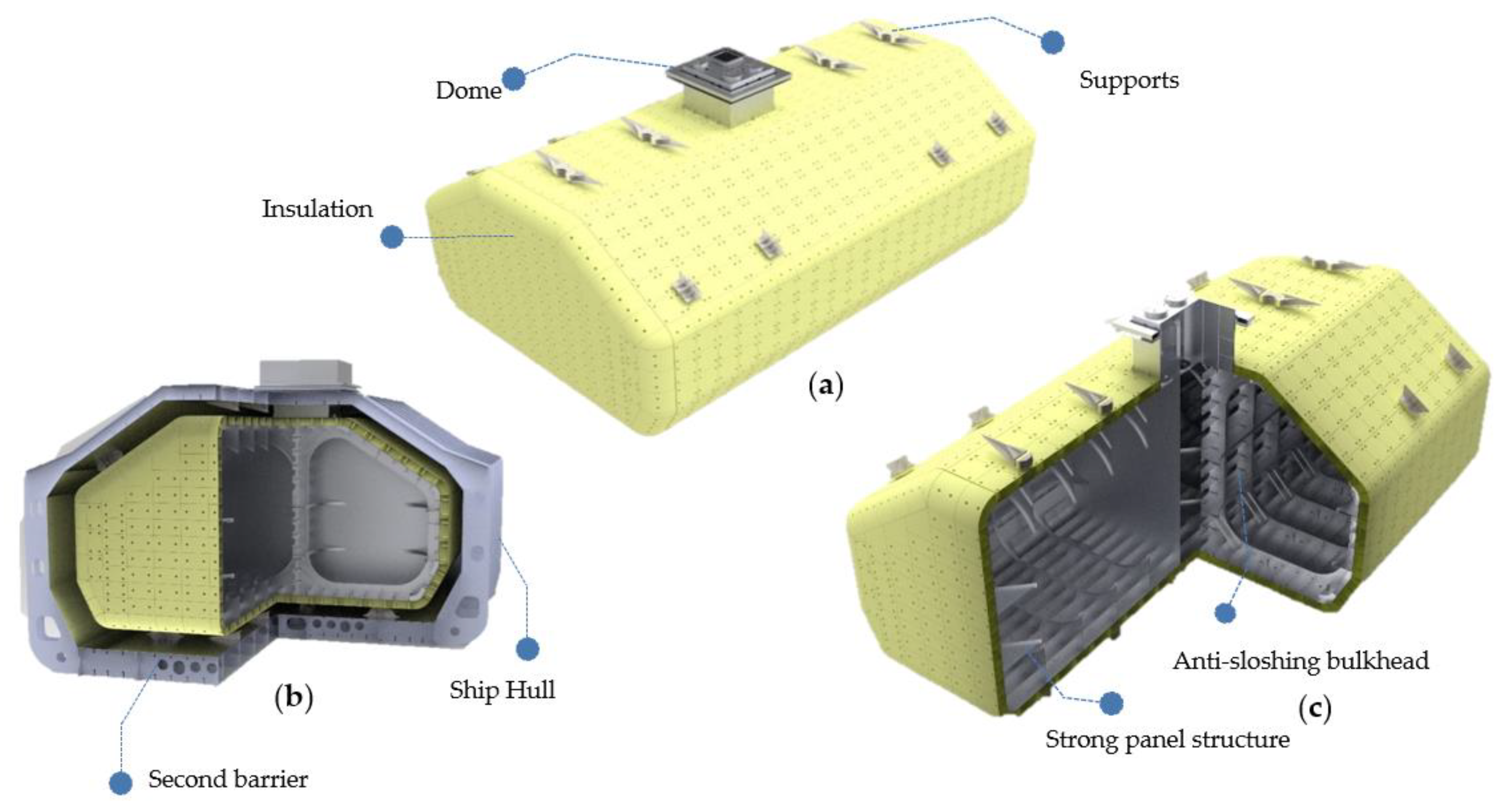
Figure 2.
Example of a 20,000m³ aluminum alloy B-type tank LNG bunkering vessel.
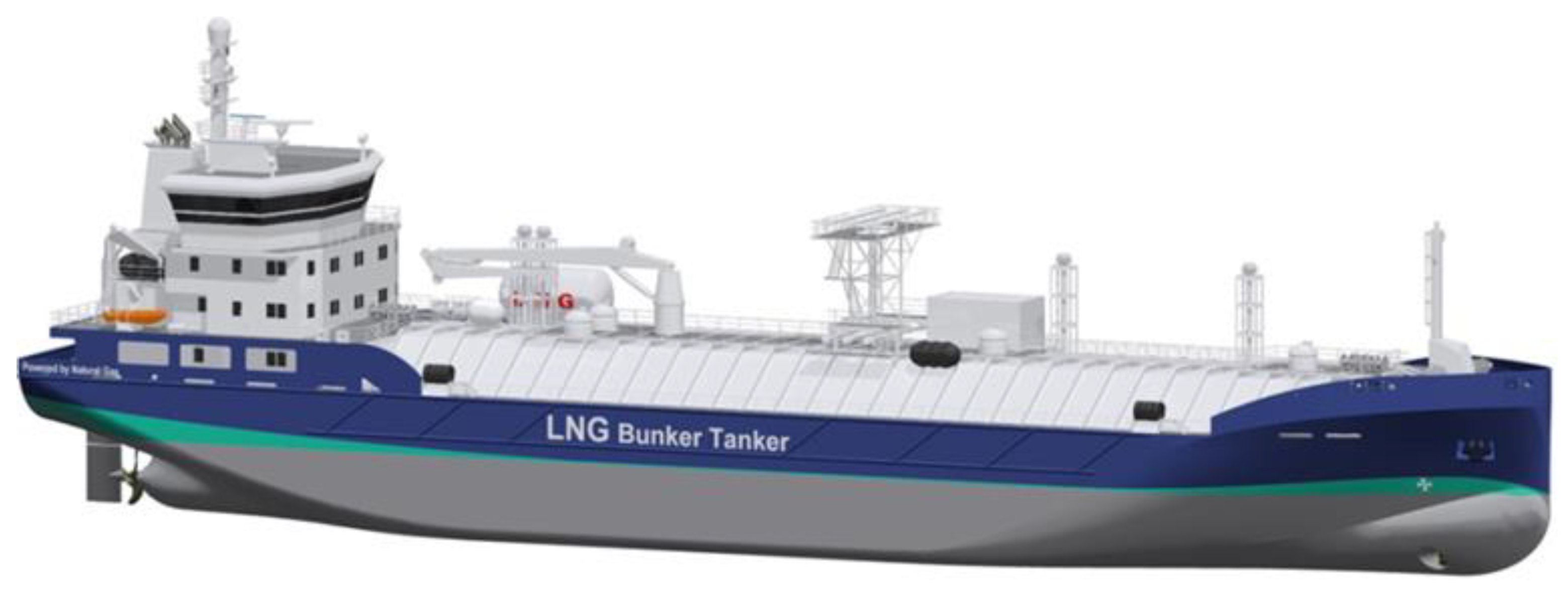

Table 1.
Features of IMO Type B tank.
| Item | Description |
|---|---|
| Tank material | Aluminum alloy 5083 - O |
| Design pressure | Not exceeding 0.7 / -0.1 barg |
| Design temperature | -163°C |
| Filling limit | 95% - 98% |
| BOR | 0.06% - 0.35% |
| Structure | Mature hybrid panel |
| Secondary barrier | Only partial secondary barrier |
| Sloshing and fatigue | Solved by equipped with swash bulkhead |
| Pump tower | No needs |
Table 2.
Bunkering compatibility.
| Bunker | Receiver | Bunkering conditions | Compatibility |
|---|---|---|---|
| B-type tank | A-type | None | Yes |
| B-type | None | Yes | |
| C-type | None | Yes | |
| Membrane-type | None | Yes | |
| C-type tank | A-type | Warm LNG | No |
| B-type | Warm LNG | No | |
| C-type | Warm LNG | Risk | |
| Membrane-type | Warm LNG | No | |
| C-type tank | A-type | Cold LNG | Yes |
| B-type | Cold LNG | Yes | |
| C-type | Cold LNG | Yes | |
| Membrane-type | Cold LNG | Yes |
Disclaimer/Publisher’s Note: The statements, opinions and data contained in all publications are solely those of the individual author(s) and contributor(s) and not of MDPI and/or the editor(s). MDPI and/or the editor(s) disclaim responsibility for any injury to people or property resulting from any ideas, methods, instructions or products referred to in the content. |
© 2025 by the authors. Licensee MDPI, Basel, Switzerland. This article is an open access article distributed under the terms and conditions of the Creative Commons Attribution (CC BY) license (http://creativecommons.org/licenses/by/4.0/).
Copyright: This open access article is published under a Creative Commons CC BY 4.0 license, which permit the free download, distribution, and reuse, provided that the author and preprint are cited in any reuse.


