
Submitted:
27 March 2025
Posted:
31 March 2025
You are already at the latest version
Abstract
A century ago, Einstein revolutionized physics with his theory of relativity, showing that space and time are not the same for everyone. They can be altered depending on gravity and speed an object experiences. Previous studies argued that human space and time perception also work according to Einstein's general relativity theory by proving that in weightlessness astronauts tended to underestimate distances and time durations due to the absence of the gravitational reference. The current research was intended to further support this argument by assessing whether the subtle changes in gravity, such as made by the moon’s orbital period, can alter human time perception on Earth during everyday activities. The results of the experiments showed that relative to the time when the moon is in medium distance from Earth, there is underestimation of perceived time duration, when the moon’s position is close to perigee.
Keywords:
relativity
; time perception
; human brain
; gravity
Introduction
With his theory of relativity, Einstein revolutionized physics, by suggesting that time is not the same for all objects in the universe, but is relative depending on physical factors, such as gravity and speed experienced by an object (Einstein, 1908). We, as human beings perceive the universe as a mental representation of sensory inputs from the visional, somatosensory and vestibular systems. The neurovestibular system, which processes these sensory inputs, inherently takes gravity into account while constructing the mental representation of space and time. Previous studies concluded that the adaptive behaviour of the neurovestibular system in weightlessness can cause underestimation of distances and time durations (Clément et al., 2012, 2015; Morales et al., 2023). This implies that the changes in the gravity level not only affect physical time but also human time perception.
Climent et al. conducted an experiment to estimate changes in time perception during long space flights, comparing a control group on Earth with a group of astronauts aboard the International Space Station for 6-8 months. The tests showed that there is a significant underestimation of time durations ranging from 1 minute to several hours made by the astronauts in weightlessness due to changes in stimulation of the vestibular system. The percentage of the underestimation was the same as for the underestimation of distances in microgravity (Morales et al., 2023).
As several studies have previously shown, stress, high-performance demand, unstable schedules and slowed motion that the astronauts experience during the space flights, are known to affect their psychological and physiological states (Clement et al., 2009; Casler et al., 2009). Morales et al. reported that the results of their study were unlikely to be influenced by these factors (Morales et al., 2023). Because, normally during car or plane accidents, people tend to overestimate time durations (Nijhawan & Khurana, 2010), while their study showed a significant underestimation of perceived time durations. Thus, our team assumed that similar underestimation would occur on Earth, even without the factors produced in microgravity.
In our everyday lives, we are hardly or never exposed to weightlessness. But there are constant changes in gravity levels caused by the moon's position, tidal motions, geological differences, and so on, which are more subtle compared to the radical changes during space flights (from 1g to 0g). Considering the previous studies, which suggest that space and time perceptions are altered in microgravity (Clément et al., 2012, 2015; Morales et al., 2023), our team hypothesized that such alterations could similarly occur during our everyday activities, due to more subtle changes in gravity on Earth. Existence of such shifts in time perception would suggest that Einstein’s theory is true not only for the physical phenomena in the universe (Einstein, 1908), but also for the processes in a human brain.
Methods
Participants
The experiment was conducted in a form of surveys during the discussion hour sessions that were held at the Dashoguz American Corner from December 11th and through January. We did not have a fixed group of participants, but generally they were individuals aged 12 to 25, most of whom were middle and high school students.
Experimental Protocol
The distance between Earth and the moon changes as the moon progresses through its orbital period. Thus the gravity force that the moon exerts on Earth also changes. In our study those alterations acted as the subtle changes in gravity that we hypothesized can affect time perception. Overall, 4 surveys were conducted to determine whether there are changes in time perception of the participants during the different times of the moon’s orbital period around Earth. 2 surveys were conducted on January 3rd and 5th, when the moon was in medium distance from Earth; other 2 were conducted on January 11th and 12th, when the moon was close to the perigee, when its distance from Earth was the lowest.
During the discussion hour sessions on January 3rd and 11th, we emulated a usual environment where participants were free to discuss any topics such as adolescence, life after school and social media, which generally are the part of the discussions that participants have everyday. On the other hand, during the discussion hour sessions on January 5th and 12th, we tended to create an unusual environment, where there was a guest speaker and the participants needed to get out of their comfort zone by performing various tasks such as public speaking and discussing unusual topics like life in the United States, philosophy and time travelling.
Participants were placed in a circle, and generally had group discussions uninterrupted by either the survey questioning or external influences. Each of the surveys consisted of answering a question dedicated to document changes in participants' time perception throughout the discussion hour sessions. While sitting in an upright position, participants answered a multiple choice question in the form of paper cards. Our team assured that the participants did not use any time-tracking devices. The following question was given at the beginning and at the end of the sessions: How much time do you feel passed since the beginning of the session?
Statistical Analysis
Mean time relative errors were calculated in terms of percentage for each survey. Then, a series of Welch’s two independent samples’ two-tailed t-tests was performed to compare the results of surveys that were made under psychologically similar conditions, but differed by the moon’s position relative to Earth. A second set of Welch's t-test was used to compare the survey results that were made under psychologically different conditions, but were similar by the moon’s position relative to Earth. The final set of tests was used to determine whether generally the perception of time was dependent on the moon’s position relative to Earth throughout all the sessions. Because of the less sensitive nature of the human time perception on Earth, all the tests were performed and assumptions were made considering that the significance level (α) is equal to 0.1. Statistical Analysis was performed by using Python programming language and the following websites: statology.org; graphspad.com.
Results
During 4 discussion hour sessions, the question was first given 15-20 minutes after the start of a session (M = 15.75, SD = 4.57 minutes), then 45-50 minutes from the start of a session (M = 46, SD = 2 minutes).
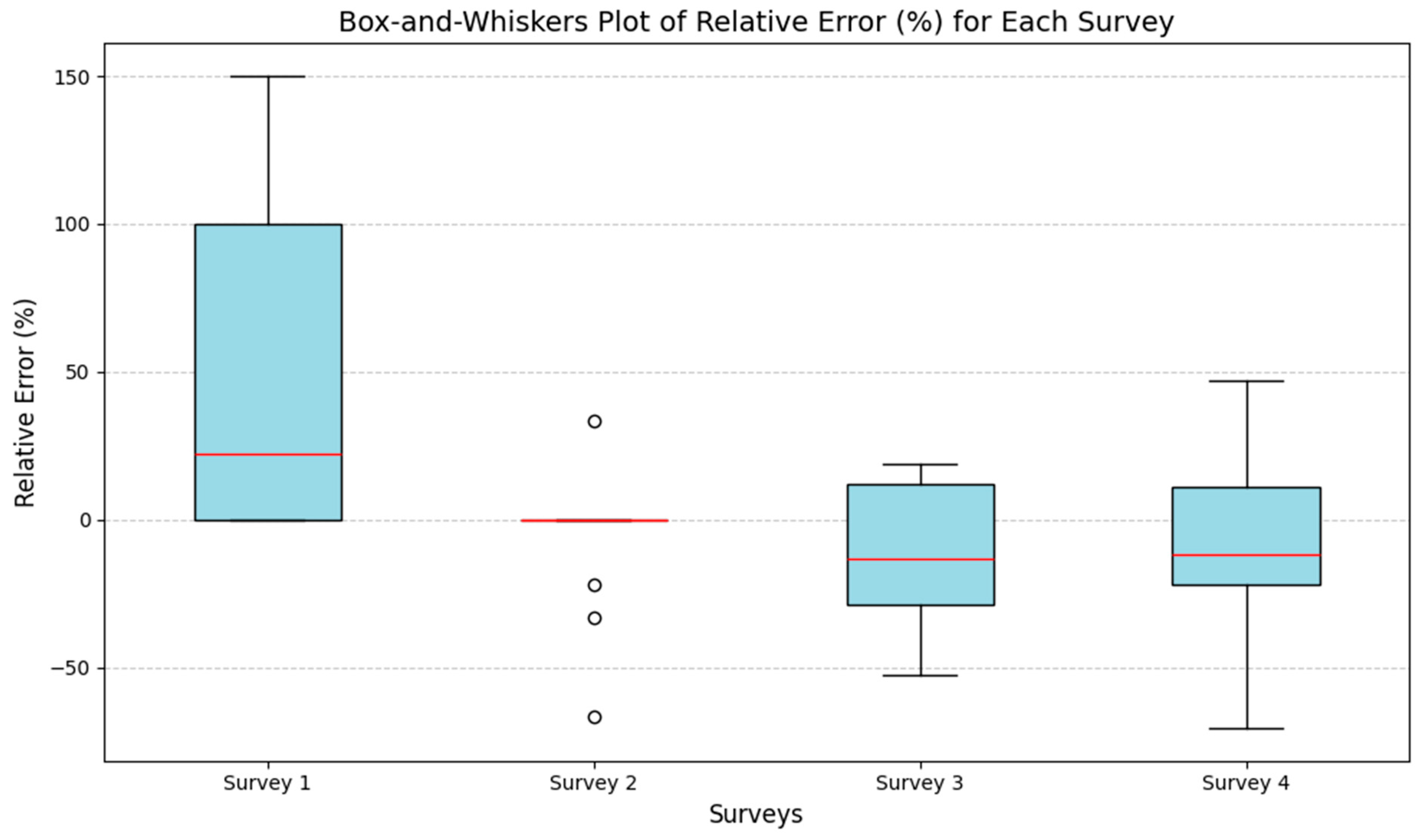
The first survey was conducted when the moon was in medium distance from Earth and the participants were placed in usual conditions, where they were having discussions about everyday topics. The participants tended to overestimate time durations by +40.48% (SEM = 20.74%). The second survey was performed when the moon was at a normal distance from Earth, and the participants were placed in unusual conditions where they had to perform storytelling in front of the public. This resulted in an underestimation of time durations by -5.56% (SEM = 10.81%). The third survey was made when the moon was close to the perigee point and the participants were placed under the same conditions as in the 1st survey. It resulted in general underestimation of the time durations for -14.23% (SEM = 7.12%). Finally, the fourth survey was conducted when the moon was close to the perigee point and the participants were placed in unusual conditions, where they were having a discussion with a psychological expert. The relative time error was -12.53% (SEM = 10.08%), suggesting a general underestimation in the perceived time duration (Figure 1).
Two Welch’s independent samples' t-tests indicated no significant difference in perceived time duration, between 2 sessions during different points of the moon’s orbital period but in similar psychological conditions (t = 0.471, p = 0.6428, df = 18), and between 2 sessions during similar points of the moon’s orbital period but in different psychological conditions (t = 0.1378, p = 0.891, df = 32). However, three similar t-tests indicated a significant difference in perceived time duration. First, between the 2 sessions with the different points of the moon’s orbital period, but similar psychological conditions (t = 2.495, p = 0.03, df = 11). Second, between 2 sessions during similar points of the moon’s orbital period but in different psychological conditions (t = 1.969, p = 0.071, df = 13). The final one-tailed t-test was performed to determine whether the moon’s position generally caused an underestimation of perceived time duration throughout all the sessions, and it resulted in a significant difference (t = 1.727, p = 0.056, df = 12).
Figure 1.
The relative time duration error for each survey. Box and whiskers plots of the time durations errors for each of 4 surveys in percentages. Red lines represent the mean time relative error for each session, bounds of the box represent first and the third quartiles, whiskers represent the minimum and maximum values of a set, and the circles represent the outliers of a set. .
Figure 1.
The relative time duration error for each survey. Box and whiskers plots of the time durations errors for each of 4 surveys in percentages. Red lines represent the mean time relative error for each session, bounds of the box represent first and the third quartiles, whiskers represent the minimum and maximum values of a set, and the circles represent the outliers of a set. .
Discussion
The results of the current study show that there is a relative underestimation between the subjects’ perceived time duration with the moon’s position closer to the perigee point, than when the moon is in medium distance from Earth (-23.37%). We assumed that when the moon is closer, its gravitational pull slightly alters the more dominant gravitational pull of Earth.
While organizing the first and third survey discussion hour sessions, we attempted to imitate normal psychological conditions. For as indicated in the study by Jokic et al., people’s time perception tends to change when they are entertained or bored (Jokic, Zakay, & Wittmann, 2018). On the other hand, while organizing the second and fourth surveys, we tried to create a more demanding and entertaining environment for the participants in order to assess whether the changes in the moon’s gravitational tilt are more superior in altering human time perception compared to the changes in the psychological states of subjects.
As seen by the results of the second survey, most of the subjects tended to be more accurate, with the mean relative error close to zero. This could be due to the demanding task they performed – public speaking in front of an audience. It was the same for the fourth survey session, when the participants discussed unusual topics with a psychological expert. We believe that the unusual psychological conditions in which we placed the subjects were more dominant in defining their time perception than the moon’s gravity. However, another pattern can be seen: the third and fourth surveys that were held when the moon was closer, but differed by the psychological conditions, follow a similar pattern of underestimation of perceived time duration.
Vicario et al. (Vicario, Caltagirone, & Oliveri, 2007) indicated that when the subjects are exposed to optokinetic stimulations, they tend to overestimate time durations more, after the stimulation than before it. The optokinetic stimulations closely interact with the vestibular system. And as indicated in studies by Binetti et al., the stimulation of the vestibular system caused by whole-body rotations resulted in overestimation of time durations.
The vestibular system has a great role in constructing spatial maps and in processing memory, as shown in many studies. Previous research indicated that astronauts tend to underestimate distances in weightlessness because of the adaptive changes made by the central neurovestibular system that takes gravity into account while constantly updating our spatial maps (Clément et al., 2012, 2015). Further studies indicated a similar level of underestimation when measuring the perceived time duration of astronauts (Morales et al., 2023). The results of our research align with the conclusions made in the previous studies of the time perception in astronauts on orbit, that the microgravity causes underestimation, due to lower stimulation of the vestibular system (Morales et al., 2023). However, the physical conditions in which our study was conducted did not include the total absence of the gravitational reference, suggesting that more gentle changes in gravity, as those made by the moon, can also cause changes in human time perception.
According to the results of the present study, we can assume that the subtle changes in gravity caused by the changes of the distance from the moon to Earth can cause underestimation in perceived time durations, and that Einstein's relativity theory (Einstein, 1908) truly works for perception of space-time not only in weightlessness, but also during our daily activities on Earth.
Limitations we faced while conducting the experiments were inability to fully isolate the subjects from external influences or account for their health and emotional stability. Additionally, in some ways we could not arrange psychological conditions during the experiments as desired, because as amateur researchers, we lacked some equipment and permissions.
In our further studies, inspired by the research made by Neil P McAngus et al. (Todd et al., 2008), which showed that the human vestibular system is extremely sensitive to low frequency and infrasound vibrations, we plan to investigate whether the gravitational waves caused by the collisions of black holes and neutron stars can trigger changes in human time perception.
Acknowledgements
The author thanked the Dashoguz American Corner and subsequent organizations for providing the place to conduct the experiments; all the participants of the surveys for their invaluable contribution to the study; and the co-author members of InsightfulAstronomy team, for their time and effort given to this research.
References
- Einstein, A. Über das Relativitätsprinzip und die aus demselben gezogenen Folgerungen Jahrb. Radioakt. 4, 411–462 (1908).
- Clément, G., Skinner, A., Richard, G. & Lathan, C. Geometric illusions in astronauts during long-duration spaceflight. NeuroReport 23, 894–899 (2012). [CrossRef]
- Clément, G. et al. Long-duration spaceflight increases depth ambiguity of reversible perspective figures. PLoS ONE 10, e0132317 (2015). [CrossRef]
- Morales, D. C. N., Kuldavletova, O., Quarck, G., Denise, P., & Clément, G. (2023). Time perception in astronauts on board the International Space Station. Npj Microgravity, 9(1). [CrossRef]
- Nijhawan, R. & Khurana, B. Space and Time in Perception and Action (Cambridge University Press, Cambridge, 2010).
- Jokic, T., Zakay, D. & Wittmann, M. Individual differences in self-rated impulsivity modulate the estimation of time in a real waiting situation. Timing Time Percept. 6, 71–89 (2018). [CrossRef]
- Vicario, C., Caltagirone, C. & Oliveri, M. Optokinetic stimulation affects temporal estimation in healthy humans. Brain Cogn. 64, 68–73 (2007). [CrossRef]
- Todd, N. P. M., Rosengren, S. M., & Colebatch, J. G. (2008). Tuning and sensitivity of the human vestibular system to low-frequency vibration. Neuroscience Letters, 444(1), 36–41. [CrossRef]
- Clément, G. & Reschke, M. F. Neuroscience in Space (Springer, New York, NY, 2008).
- Casler, J. G. & Cook, J. R. Cognitive performance in space and analogous environments. Int. J. Cogn. Ergon. 3, 351–372 (1999). [CrossRef]
Disclaimer/Publisher’s Note: The statements, opinions and data contained in all publications are solely those of the individual author(s) and contributor(s) and not of MDPI and/or the editor(s). MDPI and/or the editor(s) disclaim responsibility for any injury to people or property resulting from any ideas, methods, instructions or products referred to in the content. |
© 2025 by the authors. Licensee MDPI, Basel, Switzerland. This article is an open access article distributed under the terms and conditions of the Creative Commons Attribution (CC BY) license (http://creativecommons.org/licenses/by/4.0/).
Copyright: This open access article is published under a Creative Commons CC BY 4.0 license, which permit the free download, distribution, and reuse, provided that the author and preprint are cited in any reuse.


