

Submitted:
31 March 2025
Posted:
31 March 2025
You are already at the latest version
Abstract
Although the topic of trampling of alpine vegetation has been addressed by many authors in recent years, there are still many unanswered questions. Areas unsuitable for enormous numbers of tourists are particularly problematic. Such an area is the limestone Belianske Tatras, closed to tourists since 1978, with the exception of a trail that has been accessible in one direction since 1993 and in both directions since 2008 as an educational trail. Since there is renewed discussion about making the Belianske Tatras accessible to tourists, we sought answers to the hypotheses: (1.) whether regenerated communities are more resistant to trampling than the native ones, (2.) whether all individual species in different communities react to trampling in the same way, and (3.) whether some species can become extinct after being trampled. We conducted the research in the form of experimental research in three communities – in 2008 in the native ones and in 2022 in the regenerated ones, with a modification of the methodology from the study by Cole and Bayfield (1993). Regenerated communities respond as more resistant, but at the expense of the extinction of some species in the form of a delayed response. Individual species respond differently in different communities.
Keywords:
experimental human trampling
; native associations
; regenerated associations
; NNP Belianske Tatras
; Tatra National Park
; Tatra Biosphere Reserve
1. Introduction
Alpine areas in protected areas have recently faced not only climate change but also an enormous number of tourists. Therefore, understanding the impacts of human trampling on the alpine environment is essential for the use and management of recreational areas [1]. The impact of human trampling is extensive and can easily lead to the degradation of natural systems [2]. Several studies have shown that recreational trampling can have a range of effects on vegetation and soil in alpine ecosystems [3,4,5]. Soil compaction leads to an increase in soil bulk density and a decrease in soil porosity, changing the water and temperature regime and altering the soil nutrient composition [6,7]. These effects on vegetation and soil may increase the surface runoff, which in turn contributes to soil erosion [8,9].
While we can study the impacts of trampling on abiotic components based on soil properties, geological setting, and terrain characteristics, plants are living organisms and their responses to trampling are much more complicated. There are no studies that can generalize how individual species, life forms, and the same communities in different parts of the world respond to trampling.
However, the topic of changes in vegetation cover dominates the first studies on the ecological consequences of tourism [10,11]. The most intuitive result is that trampling reduces the cover, height, and species density of ground vegetation [12,13]. Pressure on vegetation from also the number of flowers, and thus seed production of plants [14]. These changes lead to reduced viability, less successful reproduction, and consequently to the death of some less-resistant plant species, especially in the rough environments [15,16].
Vegetation destruction has a serious consequence. It can adversely impact natural habitats, leading to the loss of vegetation and eventually ground degradation [17,18]. For example, tundra vegetation in the Colorado Rocky Mountains, which has been damaged for only a few seasons, will take hundreds of years to recover, or may never recover at all [19]. What is more, the impact of tourists contributes to increased trampling and tearing, as well as the displacement of the vegetation and soil cover in the immediate vicinity of the footpaths, and leads to erosion [20,21,22,23].
Most researchers therefore use experimental vegetation trampling methods that investigate the relationship between tourism intensity (trampling) and vegetation response [24,25]. Many experimental trampling methodologies are based on the standard protocol of Cole and Bayfield [26], although authors often adapt them for local research needs. Initially, most such studies were conducted as part of an investigation of the relationship between tourism and vegetation in mountains [24], later, numerous studies analyzed vegetation trampling due to recreation in various areas [27,28]. Only a few studies focused on high-altitude environments [4,29,30].
This study focuses on changes in vegetation cover caused by trampling in three communities, in 2008 as native and in 2022 as regenerated. The research was conducted in a very rare location, namely in the NNP BelianskeTatras, which has been closed since 1978 due to damage by mass tourism. The communities are located around a trail that was granted an exemption to reopen to tourists, was opened as a one-direction trail in 1993 and as a two-directions educational trail. The research was conducted with the consent of the Ministry of the Environment of the Slovak Republic, the State Protection of the Slovak Republic and the Tatra National Park Administration. The research was conducted in the Juncetum trifidi community Szafer et al. 1923 em. Krajina 1933, which is not among the endangered phytocenoses, contains endemic taxa and as a pioneer community has an important protective soil. Another community studied was the Junco trifidi-Callunetum vulgaris (Krajina 1933) Hadač ex Šibík et al. 2007, with a small-scale and rare occurrence in the Western Carpathians. The Seslerietum tatrae community Domin 1929 kor. Kliment et al. 2005 is located in a narrow altitude range of 1900 – 2000 m, with long-lasting high snow cover. Our research was based on the methodology of Cole and Bayfield [26], but we had to adapt it for the needs of investigating small-scale alpine communities in topographically diverse environments [31], because several endangered or rare alpine communities inhabit such areas.
In the research, we addressed three hypotheses: (1.) whether regenerated communities are more resistant to trampling than the native ones, (2.) whether all individual species in different communities react to trampling in the same way, and (3.) whether some species can become extinct after being trampled. Regenerated communities respond as more resistant, but at the expense of the extinction of some species in the form of a delayed response. Individual species respond differently in different communities. We recommend monitoring vegetation recovery in the monitoring areas and verifying in the future whether there will be further delayed responses of vegetation to trampling and the extinction of other species.
2. Materials and Methods
2.1. Study Area
This study was conducted in the Tatra National Park (established in 1949), which is also the Tatra Biosphere Reserve (since 1993), specifically in the Belianske Tatras National Nature Reserve (established in 1991) (Figure 1). Experimental human trampling was carried out in the communities: Juncetum trifidi Szafer et al. 1923 em. Krajina 1933 (49 13.751 N; 20 13.179 E), Junco trifidi-Callunetum vulgaris (Krajina 1933) Hadač ex Šibík et al. 2007 (49 13.591 N; 20 13.313 E) and Seslerietum tatrae Domin 1929 cor. Climent et al. 2005 (49 23.467 N; 20 21.780 E).
The Juncetum trifidi community Szafer et al. 1923 em. Krajina 1933 is not among the endangered phytocenoses, although it contains endemic taxa (Campanula tatrae, Leucanthemopsis tatrae, Soldanella carpatica). The Junco trifidi-Callunetum vulgaris (Krajina 1933) Hadač ex Šibík et al. 2007 community, with a small-scale and rare occurrence in the Western Carpathians, is rare, not yet threatened. The community Seslerietum tatrae Domin 1929 cor. Climent et al. 2005 is located in a narrow altitude range of 1,900 – 2,000 m ASL, with long-lasting high snow cover. The selection of plant associations for experimental research was carried out based on discussions with employees of the Tatra National Park Administration, as this is a destructive form of research.
The Kopské saddleback with the Juncetum trifidi association. The substrate consists of limestone, dolomite and slate, the soils are ranger cambisols and dystric cambisols. The experimental block was established on a NW site with a slope of 22°, at an altitude of 1,754 m ASL. The tourist trail passing near the experimental blocks has a low carrying capacity [32].
The Predné Kopské saddleback with the Junco trifidi-Callunetum vulgaris association. The substrate consists of limestone, dolomite and slate, with rank-cambisols and dystric cambisols. The experimental block was established on a NE site with a slope of 4°, at an altitude of 1,778 m ASL. The tourist trail passing near the experimental blocks has a middle carrying capacity [32].
The Vyšné Kopské with the Seslerietum tatrae community. The substrate consists of limestone, dolomite and slate, the soil is carbonate lithosoil. The community is spread on carbonate lithosoils. The experimental block was established on a SW site with a slope of 39°, at an altitude of 1,924 m ASL. The tourist trail passing near the experimental blocks has a middle carrying capacity [32].
2.2. Experimental Block Design
Although following the standard procedure of Cole and Bayfield [26], we adapted the experimental block design for small-scale alpine plant communities and varied topographic relief [31]. One experimental block was established in each plant community. The experimental block consisted of three trampling areas (0.5 m wide and 0.5 m long) separated by 0.5 m wide impact zones [31]. Each plot was divided into 25 subplots, and each subplot was 0.1 m wide and 0.1 m long (Figure 2). The subplots should be selected using a botanical grid (on the right side of the picture).
One plot was a control plot and received no pedestrian pressure, while other plots experienced progressive trampling intensities. The trampling treatment should depend on the average traffic on the road in sunny and adverse weather. Each pass represents one footprint [26]. In the study area, we implemented a 150-passage and 450-passage traversal, i.e., a crossing area with 75 and 225 pedestrians on the same day [31]. The trampling direction should simulate a road, so trampling should occur in two directions. The trampling process was conducted in June, July, August and September in 2008 and 2022 [31].
The parameters measured in each subplot are as follows:
- Cover (%) of vascular plant species (E1 layer), mosses and lichens (E0 layer). Only green photosynthetic material should be included in the cover estimates (visual estimates of the highest cover perpendicular to each subplot; and visual estimates of the cover of each species). Lichens and mosses should be determined by a lichenologist and bryologist.
- Bare ground cover (%) (bare ground can be either mineral or soil (visual estimates of the top cover of bare ground perpendicular to each subplot; and visual estimates of the ground cover of the surface).
- Litter cover (%) (including litter from recently trampled plants (visual estimates of the top litter cover perpendicular to each subplot; and visual estimates of litter cover per subplot).
To characterize the vulnerability of different vegetation types, we use the formula for calculating relative cover - RC [26]. RC was calculated as follows:
Where cf is the correction factor:
In the absence of any change in coverage caused by a trampling, the RC will be 100%. Therefore, we evaluated resistance in the range: 0.00–20.00%, very low; 20.01–40.00%, low; 40.01–60.00%, medium; 60.01–80.00%, high; and 80.01–100.00%, very high.
To describe changes in relative coverage over time, we used linear regression models. The time variable represents the number of days since the first day of the first month (June) of each sampling session. Due to the nonlinear nature of some of the relationships, second-order polynomial regression models were used. The adjusted coefficient of determination (R2) was used to determine which model best and most simply described the collected data (i.e., linear or polynomial). All analyses were performed in R [33].
3. Results
3.1. Hypothesis 1: Regenerated Plant Communities Are More Resistant to Trampling Than Native Ones
When all three communities are considered, the resilience of the regenerated alpine communities to trampling was 6.47% higher than the resilience of the native, undisturbed ones. In the regenerated communities, we noted the absence of some moss, lichen and hemicryptophyte species before the repeated trampling experiment in 2022. These became extinct years after the trampling in 2008. This means that even though regenerated communities may appear more resistant to repeated trampling after years, this is due to the absence of some moss, lichen or vascular plant species.
The Juncetum trifidi and Junco trifidi-Callunetum vulgaris communities, which contain the most hemicryptophytes and less than a quarter of chamaephytes, resisted trampling by 75 tourists as more resistant in the regenerated state. However, the Seslerietum tatrae community, which is dominated by hemicryptophytes but chamaephytes make up a quarter of the community, was more resistant to trampling by 75 tourists in the native state (Figure 3). However, the communities reacted differently to trampling by 225 tourists. The regenerated Juncetum trifidi community reacted worst, with a weaker resistance. The Seslerietum tatrae community, with the occurrence of woody and herbaceous chamaephytes, was surprising, with an unexpectedly increased resistance. The regenerated Junco trifidi-Callunetum vulgaris community also resisted trampling as more resistant.
75 tourists in the Juncetum trifidi: If tourists walked through the native, undisturbed community, the community would respond with middle resistance in July and low resistance in August and September (Figure 4, Supplementary Materials File S1). The regenerated community was more resistant to trampling. The difference between the native and regenerated states is: an increase of 1 resistance level in July, almost 2 resistance levels in August and 1 resistance level in September (Figure 4, Supplementary Materials File S1). The E0 layer was significantly more resistant in the regenerated state, the resistance increased by 2 resistance levels in all months (Figure 5, Supplementary Materials File S2). The lichen Thamnolia vermicularis is absent in the regenerated community. However, even the E1 layer appears to be much more resistant in the regenerated state. The resistance to trampling increased by 2 resistance levels in all months (Figure 5, Supplementary Materials File S2). The species Bistorta officinalis, Campanula tatrae and Hieracium alpinum were absent in the regenerated state.
225 tourists in the Juncetum trifidi: The community response is approximately the same in the native and regenerated states (Figure 4, Supplementary Materials File S1). The E0 layer appears to be more resistant and the E1 layer less resistant in the regenerated state. Both layers show different changes in individual months (Figure 5, Supplementary Materials File S2). The E0 layer responded in the regenerated state by almost 1 resistance level more resistant in July, by more than 0.5 resistance level in August, and its resistance was slightly higher in September (Figure 5, Supplementary Materials File S2). The lichens Alectoria ochroleuca and Thamnolia vermicularis were absent in the regenerated community. The E1 layer appears to be less resistant in the regenerated state. The resistance of the layer decreased by 0.5 resistance level in July, it increased slightly in August, but it decreased again by 0.25 resistance level in September (Figure 5, Supplementary Materials File S2). The species Bistorta officinalis, Campanula tatrae and Hieracium alpinum were absent in the regenerated state.
75 tourists in the Junco trifidi-Callunetum vulgaris: The native community responded with high resistance in July and middle resistance in August and September (Figure 4, Supplementary Materials File S1). The regenerated community was roughly as resistant to trampling as the native. The difference between the native and regenerated state is: an increase of 0.5 resistance level in July, almost the same in August and a 0.25 resistance level lower in September (Figure 4, Supplementary Materials File Figure S1). The resistance of the E0 layer decreased by 1 resistance level in July, and by 0.5 resistance level in August and in September (Figure 5, Supplementary Materials File S2). The lichen Alectoria ochroleuca and mosses Pleurozium schreberi and Polytrichastrum alpinum were absent in the regenerated community. However, the E1 layer appears to be more resistant in the regenerated state. The resistance to trampling increased by 0.5 resistance level in July, by almost 2 resistance levels in August and by more than 0.5 resistance level in September (Figure 5, Supplementary Materials File S2). The species Bistorta officinalis, Campanula alpina, C. tatrae, Hieracium alpinum, Juncus trifidus and Pulsatilla alpina subsp. alba were absent in the regenerated state.
225 tourists in the Junco trifidi-Callunetum vulgaris: The native community responded with middle resistance in July and low resistance in August and September (Figure 4, Supplementary Materials File S1). Although vegetation resistance levels remained the same in the regenerated state in each month, RC values in July and August were higher within the range of resistance levels. The resistance of the E0 layer decreased by 1 resistance level in July, by 0.5 resistance level in August and by 1 resistance level in September (Figure 5, Supplementary Materials File S2). The lichens Thamnolia vermicularis and mosses Pleurozium schreberi and Polytrichastrum alpinum were absent in the regenerated state. However, the E1 layer appears to be more resistant in the regenerated state. Resistance to trampling increased by more than 1 resistance level in July, by almost 0.5 resistance level in August and only slightly in September (Figure 5, Supplementary Materials File S2). The species Bistorta officinalis, Campanula alpina, C. tatrae, Hieracium alpinum, Juncus trifidus and Pulsatilla alpina subsp. alba were absent in the regenerated state.
75 tourists in the Seslerietum tatrae: In the native community, the community resistance to trampling was middle in all months (Figure 4, Supplementary Materials File S1). The regenerated state was roughly as resistant to trampling as the native one, only slightly less resistant in August and September. The resistance of the E0 layer increased by 1.5 resistance levels in July and August and by less than 1 resistance level in September (Figure 5, Supplementary Materials File S2). However, the E1 layer appeared to be slightly less resistant in the regenerated state. The resistance to trampling decreased by 0.5 resistance level in all months (Figure 5, Supplementary Materials File S2). The species Thymus pulcherrimus was absent in the regenerated state.
225 tourists in the Seslerietum tatrae: In the native community, the resistance to trampling was middle in July, low in August and very low in September (Figure 4, Supplementary Materials File S1). The regenerated state was significantly more resistant to trampling than the native one, by 2 resistance levels in each month. The resistance of the E0 layer increased by 2.5 resistance levels in July and August and by 1 resistance level in September (Figure 5, Supplementary Materials File S2). The E1 layer also appeared to be more resistant in the regenerated state. The resistance to trampling increased by 2 resistance levels in all months (Figure 5, Supplementary Materials File S2). The species Thymus pulcherrimus was absent in the regenerated state.
3.2. Hypothesis 2: Do Individual Species Found in Different Communities Defend Themselves with the Same Resistance to Trampling?
Each species creates a certain life form, i.e. its buds are located in different positions on the plant at different heights from the ground. We therefore assumed that these species resist trampling with at least approximately the same resistance in different communities. However, this hypothesis was not confirmed. This means that it depends on the composition of the community, i.e. the combination of different life forms and the coverage of individual life forms. In some cases, however, it also depends on the intensity of trampling. The initial vegetation of the Juncetum trifidi association before the trampling in 2008 consisted of higher plants with 42% cover, bryophytes with 41% cover and lichens with 39% cover. The initial vegetation of the Junco trifidi-Callunetum vulgaris association before the trampling consisted of higher plants with 66% cover, lichens with 31% cover and bryophytes with 13% cover. The initial vegetation of the Seslerietum tatrae association before the trampling consisted of higher plants with 86% cover and bryophytes with 23% cover, lichens were missing. While the Juncetum trifidi community is dominated by hemicryptophytes (88%) and woody chamaephytes are less common (12%), the Junco trifidi-Callunetum vulgaris community is composed of 86% hemicryptophytes and 14% woody chamaephytes. The Seslerietum tatrae community has a wider range of life forms, but hemicryptophytes dominate (67%), followed by woody and herbaceous chamaephytes (26%), annual terophytes (4%) and geophytes (3%).
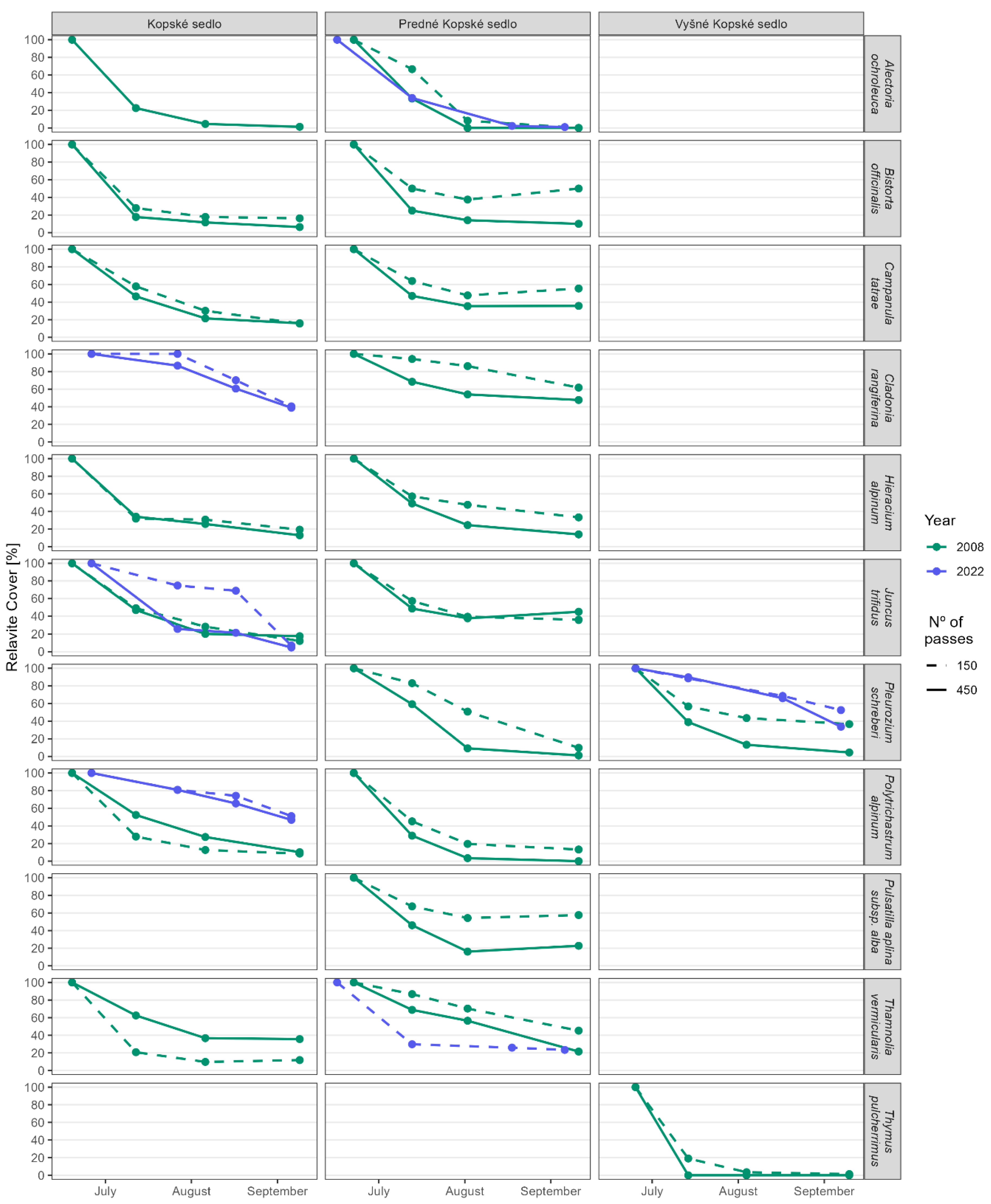
Bistorta officinalis Delarbre – a perennial herb with serpentine coiled rhizome. It forms a geophyte/hemicryptophyte life form. Its seeds are spread by autochory, epichory (e.g. on animal fur), endochory (through the digestive tract of animals), or hemerochory (by human contamination). In the native Juncetum trifidi community, trampled by 75 tourists, this species was less resistant to trampling than in the Junco trifidi-Callunetum vulgaris community. However, it responded similarly to trampling by 225 tourists (Figure 6, Supplementary Materials File S3).
Campanula alpina Jacq. – an endangered species of Slovakia, forms the hemicryptophyte life form. It is a biennial to perennial herb. Its seeds are spread by boleochory (wind blast). Its reactions to trampling are surprising. We recorded the regeneration of this species in September 2008 before trampling in the Juncetum trifidi community, on an area trampled by 225 tourists (Figure 7). In 2013 and 2014, the species was completely absent during the monitoring of regeneration. In 2022, this species occurred in the community again. Based on the botanical grid, we found that these were new plants. Their resistance was higher precisely on the area trampled by 225 tourists in the regenerated Junco trifidi-Callunetum vulgaris community. No other species reacted this way. We recorded this species in the regenerated Junco trifidi-Callunetum vulgaris community. Looking at the surroundings, it was mainly found on areas trampled in 2008. It reacted more resistant to 75 tourists than to 225 tourists (Figure 6, Supplementary Materials File S3).
Campanula tatrae Borbás – a Endemic of the Western Carpathians, a perennial herb whose fruit is a drooping capsule. It forms a hemicryptophyte life form. Its seeds are spread by boleochory (wind gusts) and endochory (through the digestive tract of animals). In both native communities Juncetum trifdi and Junco trifidi-Callunetum vulgaris, it reacted to trampling more resistantly on areas trampled by 75 tourists than by 225 tourists (Figure 6, Supplementary Materials File S3).
Hieracium alpinum L. – a perennial plant whose seeds spread by trichometeochory (they have flying devices). It forms the life form hemicryptophyte. This hieracium occurred in the native Juncetum trifidi and Junco trifidi-Callunetum vulgaris communities, where it reacted as more resistant to trampling by 75 tourists (Figure 6, Supplementary Materials File S3).
Juncus trifidus L. – a perennial, densely tufted herb with a creeping rhizome. Its seeds are spread by cystometeorochory (they are very tiny, but swollen). It forms the life form hemicryptophyte. This grass grew in the native Juncetum trifidi and Junco trifidi-Callunetum vulgaris communities. In both communities, it responded more resistant to trampling by 75 tourists in July and August, but in September, it appeared stronger against trampling by 225 tourists (Figure 6). The species Juncus trifidus is the second species (apart from Campanula alpina) whose regeneration we recorded in the process of experimental trampling in 2008, specifically before trampling in September (Figure 7). However, it was absent in the regenerated Junco trifidi-Callunetum vulgaris community. In the regenerated Juncetum trifidi community, it resisted trampling by 75 tourists more than by 225 tourists (Figure 6, Supplementary Materials File S3).
Vaccinium vitis-idaea L. – an evergreen and densely branched shrub, the fruit of which is a berry. This species is a woody chamaephyte and its seeds are spread through the digestive tract of animals. We recorded the occurrence of the species in both native and regenerated Juncetum trifidi and Junco trifidi-Callunetum vulgaris communities. In both the native and the regenerated Junco trifidi-Callunetum vulgaris community, the species responded similarly, but slightly more resistant, to 225 tourists (Figure 6, Supplementary Materials File S3). In the regenerated Juncetum trifidi community, the species was more resistant to trampling by 75 tourists (Figure 6, Supplementary Materials File S3).
Alectoria ochroleuca (Hoffm.) Massal. – a fruticose lichen, we recorded this lichen species in the native Juncetum trifidi community, on an area trampled by 225 tourists. It was absent in the regenerated community. However, by 2014 it had been recorded on an area of 20. It became extinct due to a delayed response to trampling. Its resistance to trampling was already very low in August and September 2008 (Supplementary Materials File S3). In the Junco trifidi-Callunetum vulgaris community, this species was present on both trampled areas. It did not survive on the area trampled by 75 tourists. However, it survived on the area trampled by 225 tourists, and even responded with higher resistance in July (native association under 75 tourists. (Figure 6, Supplementary Materials File S3).
Cetraria islandica (L.) Ach. – a fruticose lichen, which responded more resistant to trampling in the regenerated Juncetum trifidi community than in the native one, in all months and on all plots. However, it was less resistant to trampling in the regenerated Junco trifidi-Callunetum vulgaris community than in the native one (Figure 6, Supplementary Materials File S3).
Cladonia rangiferina (L.) F. H. Wigg. – a fruticose, cup lichen lichen. This species was recorded with the regenerated Juncetum trifidi community and in the native Junco trifidi-Callunetum vulgaris community (Figure 5). In both cases it was less resistant to trampling by 225 tourists (Figure 6, Supplementary Materials File S3).
Thamnolia vermicularis (Swartz) Ach. Ex Schaerer – a fruticose lichen. We recorded its presence in the native Juncetum trifidi and Junco trifidi-Callunetum vulgaris communities. While in the Juncetum trifidi community it reacted more resistant to trampling by 225 tourists, in the Junco trifidi-Callunetum vulgaris community it was more resistant to 75 tourists (Figure 6, Supplementary Materials File S3). After regeneration, we recorded it only in the Junco trifidi-Callunetum vulgaris community, in a plot trampled by 75 tourists. However, its resistance in July, August and September was only low (Figure 6, Supplementary Materials File S3).
Pleurozium schreberi (Brid.) Mitt. – a moss, a rarely fertile dioecious species. We recorded its presence in the native Junco trifidi-Callunetum vulgaris community and in the native and regenerated Seslerietum tatrae community. In the native communities, it reacted more resistantly in the Seslerietum tatrae community, especially in August and September. After the regeneration of the communities, it responded to trampling more resistant in the Seslerietum tatrae community (Figure 6, Supplementary Materials File S3). This species was absent in the regenerated Junco trifidi-Callunetum vulgaris community.
Polytrichastrum alpinum (Hedw.) G. L. Sm. – a moss, a dioecious species, which bears fruit fairly often, with spores maturing in summer. We recorded its occurrence in the Juncetum trifidi and Junco trifidi-Callunetum vulgaris communities (Figure 6, Supplementary Materials File S3). In the native communities, on a plot trampled by 75 tourists, it appeared to be more resistant in the Junco trifidi-Callunetum vulgaris community. To trampling by 225 tourists, it restored in both communities approximately equally. In the regenerated Juncetum trifidi community, the moss reacted to both numbers of tourists more resistant. This species was absent in the regenerated Junco trifidi-Callunetum vulgaris community.
3.3. Hypothesis 3: Can Trampling Cause Species Extinction?
Several species of hemicryptophytes, bryophytes, and lichens in the communities became extinct, as a delayed response to trampling. This hypothesis was confirmed, although we only considered it in the case of mosses and lichens. The reasons for the extinction of specific species are not known. We discuss these reasons in the discussion.
In the regenerated Juncetum trifidi community, the lichens Alectoria ochroleuca and Thamnolia vermicularis and the hemicryptophytes Bistorta officinalis, Campanula tatrae and Hieracium alpinum were absent. These species were absent in the area trampled by 75 tourists and 225 tourists. A new species, the lichen Cladonia rangiferina, was also added to both trampled areas (Figure 8, Supplementary Materials File S4).
In the regenerated Junco trifidi-Callunetum vulgaris community, the lichen Cladonia rangiferina, the mosses Pleurozium schreberi and Polytrichastrum alpinum, and the hemicryptophytes Bistorta officinalis, Campanula tatrae, Hieracium alpinum, Juncus trifidus and Pulsatilla alpina subsp. alba were absent. These species were absent in the plot trampled by 75 tourists, as well as 225 tourists. The lichen Alectoria ochroleuca was absent in the regenerated area trodden by 75 tourists, and the lichen Thamnolia vermicularis was absent in the area trodden by 225 tourists (Figure 8, Supplementary Materials File S4).
The herbaceous chamaephyte Thymus pulcherrimus was absent in the regenerated Seslerietum tatrae community (Figure 8, Supplementary Materials File S4).
4. Discussion
We searched the literature for various claims that would confirm our conclusions. However, it seems that claims about the effects of trampling cannot be generalized. We realize that certain patterns of assumptions can be found when researching the effects of trampling on the abiotic components of the environment. When examining the biotic component, some general claims are only beginning to emerge.
Pescott and Stewart [25] conducted a systematic review focused on assessing the impact of human trampling on vegetation. The study argues that vegetation dominated by hemicryptophytes and geophytes, life forms with greater protection for their permanent buds [34], recovers to a greater extent than vegetation dominated by other life forms and could therefore potentially be trampled more intensively, provided that monitoring is carried out to provide early warning of deterioration or unsustainable use. This statement is probably not generalizable. Probably, it is necessary to consider the intensity of visitation. In the case of the Juncetum trifidi and Junco trifidi-Callunetum vulgaris communities, which are dominated by hemicryptophytes and contain less than 15% chamaephytes, these communities in the regenerated state respond more resistant to 75 tourists. However, this is not the case when 225 tourists pass through. Although the Junco trifidi-Callunetum vulgaris community remains more resistant to trampling in the regenerated state, the regenerated Juncetum trifidi community is less resistant than in the native state. The Junco trifidi-Callunetum vulgaris community responds to the intensity of trampling by 75 and 225 tourists approximately the same in both the native and regenerated state. However, when regenerated, it achieves higher resistance. In contrast to these two communities, the Seslerietum tatrae community, dominated by hemicryptophytes, but with woody and herbaceous chamaephytes making up a quarter of the vegetation, reacts differently. While it responds to trampling by 75 tourists as more resistant in its native state, it responds to trampling by 225 tourists significantly more resistant than. This probably implies that if the vegetation is dominated by hemicryptophytes and less than a quarter of chamaephytes, these communities regenerate well with lower numbers of tourists. However, vegetation dominated by hemicryptophytes but containing at least a quarter of chamaephytes responds better to higher numbers of tourists. However, this statement needs to be verified with a larger number of communities. In reality, however, these changes in resistance are related to a decrease in the resistance of several species and, in particular, the likely extinction of some species of mosses, lichens, and hemicryptophytes.
Pescott and Stewart [25] also argue that even mild disturbances can have significant impacts on plant communities. Simple indicators, such as the life form of the dominant community, can then be useful for quickly assessing a community's vulnerability to recreational pressure. We do not consider this statement to be general either. When we look closely at the behavior of some hemicryptophytes in different communities, their reaction is not uniform. For example, these are the hemicryptophytes Campanula alpina and Juncus trifidus, but also the woody chamaephyte Vaccinium vitis idaea. However, some species of mosses and lichens in particular behave differently in different communities (Alectoria ochroleuca, Cestraria islandica, Pleurozium schreberi, Polytrichastrum alpinum and Thamnolia vermicularis). Therefore, dividing recreation into high- and low-intensity zones with “honey-pots” located away from vulnerable vegetation, which according to [13] may be a more effective conservation strategy than encouraging moderately intensive but more widespread recreational use, is probably not feasible.
Pescott and Stewart [25] tested a positive correlation between recovery time and resilience, which showed that after dieback, limited recovery may occur if there is a period without further disturbances. We agree with this statement. However, we also specify that such recovery is probably not long-term. We see this in species that were absent from the regenerated communities in 2022. The community as a whole showed RC values close to complete regeneration, but at the expense of the extinction of some species, e.g. in the Juncetum trifidi community - hemicryptophytes Bistorta officinalis, Campanula tatrae and Hieracium alpinum, and lichens Alectoria ochroleuca and Thamnolia vermicularis.
These authors further argue [25] that the negative correlation of recovery time for the hemicryptophyte subgroup is the fact that where recovery is not observed in the short term, other factors, such as changes in soil characteristics, may reduce the potential for full recovery. We agree with this statement because, for example, the hemicryptophyte Juncus trifidus regenerated during trampling in the native Juncetum trifidi community and was also present in the regenerated community. However, although it survived trampling in the native Junco trifidi-Callunetum vulgaris community, its regeneration was weaker compared to Juncetum trifidi and it eventually became extinct.
Another claim by these and other authors [25,35] is that hemicryptophytes and geophytes will be more resistant to the impacts of trampling compared to other life forms. In contrast, chamaephyte-dominated communities die after trampling, despite their initially high resistance [35,36]. However, this statement cannot be generalized. As mentioned above, many species of hemicryptophytes react differently to trampling in different communities. In addition, while e.g. in the Juncetum trifidi community the hemicryptophytes Campanula aplina, C. tatrae, Hieracium alpinum, and Bistorta officinalis (hemicryptophyte/geophyte) did not survive trampling, the creeping willows Salix. kitaibeliata and S. retuculata were recorded in the regenerated community and trampled again.
Older work suggests that herbs and graminoids show little response to short-term trampling, and their recovery rate is linked to photosynthesis and growth rate, which is higher in graminoids, herbs and deciduous dwarf shrubs than in evergreens [37,38]. However, under prolonged trampling, herbs completely disappear [39], suggesting that their tolerance is reduced by their low resistance to trampling. Based on our observations, we agree with this statement.
Jahns [40] and [41] argue that lichens tolerated trampling quite well and their coverage increased above their native level, which may be a result of the lichen tissue breaking down into smaller particles. After drying, lichens break very easily into small pieces and these have the ability to grow. We cannot generalize this statement either. It does not apply to all lichen species. For example, while Cetraria islandica tolerates trampling well, species such as Cladonia rangiferina in the Junco trifidi-Callunetum vulgaris community or Thamnolia vermicularis in the Juncetum trifidi community did not survive trampling.
According to [39,41,42], bryophytes showed a delayed response to trampling. This is probably due to their slower growth [43,44] compared to vascular plants. This claim is debatable because, as mentioned above, many species of both hemicryptophytes and lichens have become extinct as a result of a delayed response to trampling.
There are many unresolved questions in the field of trampling. For example, the hypothesis that vegetation vulnerability to trampling may be related to primary productivity [45], which was not confirmed by Prescott and Stewart [25]. We therefore recommend continuing, especially in long-term research with repeated experimental trampling. These results of long-term work can be used by managers of protected areas.
5. Conclusions
There has been much discussion recently about the reopening of hiking trails in the Belianske Tatry National Nature Reserve. The limestone NPP Belianske Tatras has been closed since 1978, with the exception of the trail leading through Monková valley through Široké saddleback to Kopské saddleback, due to destruction by mass tourism. Therefore, in this study, we address three basic hypotheses.
The first hypothesis is that regenerated plant communities are more resistant to trampling than native ones. This hypothesis was not confirmed. When all three communities are considered, the resistance of the regenerated alpine communities to trampling was 6.47% higher than the resistance of the native, undisturbed ones. In the regenerated communities, we noted the absence of some moss, lichen and hemicryptophyte species before the repeated trampling experiment in 2022. These became extinct years after the trampling in 2008. This means that even though regenerated communities may appear more resistant to repeated trampling after years, this is due to the absence of some moss, lichen or vascular plant species.
The second hypothesis is that individual species found in different communities defend themselves with the same resistance to trampling. Each species forms a certain life form, i.e. its buds are located in different positions on the plant at different heights from the ground. Therefore, we assumed that these species resist trampling with at least approximately the same resistance in different communities. However, this hypothesis was not confirmed. This means that it depends on the composition of the community, i.e. the combination of different life forms and the coverage of individual life forms. In some cases, however, the intensity of trampling also matters.
The third hypothesis was whether some plant species could become extinct as a result of trampling of vegetation. Unfortunately, this hypothesis was confirmed. Several species of hemicryptophytes, bryophytes and lichens in the communities became extinct as a result of a delayed response to trampling. This hypothesis was confirmed, although we considered it only in the case of mosses and lichens. The reasons for the extinction of specific species are not known.
The results of the experimental trampling research in the NPP Belianske Tatras, which we had the opportunity to carry out in both native and regenerated alpine communities, indicate that some previous statements in other studies cannot be generalized. The research opens up many other unresolved questions. The research results will be submitted to the Tatra National Park Administration.
Supplementary Materials
The following supporting information can be downloaded at the website of this paper posted on Preprints.org., Table S1. Relative cover (%) of regenerated (2022) and native (2008) plant communities under trampling by 75 and 225 tourists in three study areas: Kopské saddleback (Juncetum trifidi). Predné Kopské saddleback (Junco trifidi-Callunetum vulgaris) and Vyšné Kopské saddleback (Seslerietum tatrae); Table S2. Relative cover (%) of E0 and E1 layers in regenerated (2022) and native (2008) plant communities under trampling by 75 and 225 tourists across three study areas: Kopské saddleback (Juncetum trifidi). Predné Kopské saddleback (Junco trifidi-Callunetum vulgaris) and Vyšné Kopské saddleback (Seslerietum tatrae); Table S3. Relative cover (%) of regenerated (2022) and native (2008) plant communities under trampling by 75 and 225 tourists across three study areas: Kopské saddleback (Juncetum trifidi). Predné Kopské saddleback (Junco trifidi-Callunetum vulgaris) and Vyšné Kopské saddleback (Seslerietum tatrae), for selected species (2nd hypothesis); Table S4. Relative cover (%) of regenerated (2022) and native (2008) plant communities under trampling by 75 and 225 tourists across three study areas: Kopské saddleback (Juncetum trifidi), Predné Kopské saddleback (Junco trifidi-Callunetum vulgaris) and Vyšné Kopské saddleback (Seslerietum tatrae), for selected species (3rd hypothesis).
Author Contributions
All authors contributed meaningfully to this study. VP. – research topic; V.P., M.S., A.S., J.H. – methodology, data acquisition and analysis; F.P. – methodology sup-port; writing—native draft preparation V.P.; writing review and editing M.S., J.H., F.P. All authors have read and agreed to the published version of the manuscript.
Funding
This research was funded by Scientific Grant Agency of the Ministry of Education, Sci-ence, Research and Sport of the Slovak Republic and the Slovak Academy of Sciences, grant number VEGA 2/0031/23 Analysis and evaluations of the environmental history of selected types of Slovak landscape from the early prehistory to the present; by project KEGA 037UKF-4/2025 Integration of modern technologies and procedures into the teaching of spatial ecology; by the Project APVV-20-0108 Implementation of Agenda 2030 through biosphere reserves.
Acknowledgments
The research was conducted with the consent of the Ministry of the Environment of the Slovak Republic, the State Protection of the Slovak Republic and the Tatra National Park Administration.
Conflicts of Interest
The authors declare no conflict of interest.
Abbreviations
The following abbreviations are used in this manuscript:
| NPP | National Nature Preserve |
| RC | Relative Cover |
References
- Li, Y., Chen, K., Liu, Z., Cao, G. Short-term impacts of trampling on selected soil and vegetation properties of alpine grassland in Qilian Mountain National Park, China. Global Ecology and Conservation, 2022, 36, e02148. [CrossRef]
- Hill, W., Pickering, C. M. Vegetation associated with different walking track types in the Kosciuszko alpine area, Australia. Journal of Environmental Management, 2006, 78, 24–34.
- Growcock, A. J. Impacts of camping and trampling on Australian Alpine and Subalpine vegetation, 2005. Doctoral dissertation, PhD Thesis. Gold Coast, Australia: Griffith University.
- Pickering, C. M., Growcock, A. J. Impacts of experimental trampling on tall alpine herbfields and subalpine grasslands in the Australian Alps. Journal of Environmental Management, 2009, 91, 532–540.
- Li, Z., Siemann, E., Deng, B., Wang, S., Zhang, L. Soil microbial community responses to soil chemistry modifications in alpine meadows following human trampling. Catena, 2020, 194, Article 104717.
- Kozlowski, T. T. Soil compaction and growth of woody plants. Scandinavia. Journal of Forest Research, 1999, 14, 596–619.
- Yüksek, Y. Effect of visitor activities on surface soil environmental conditions and aboveground herbaceous biomass in Ayder natural park. Clean Soil Air Water, 2009, 37, 170–175. [Google Scholar]
- Marion, J. L., Cole, D.N. Spatial and temporal variation in soil and vegetation impacts on campsites. Journal of Applied Ecology, 1996, 6, 520–530. [CrossRef]
- M. Rutherford, J. M., Arocena, S. K., Nepal, M. Rutherford Visitor-induced changes in the chemical composition of soils in backcountry areas of Mt Robson Provincial Park, British Columbia, Canada. Journal of Environmental Management 2006, 79, 10–19.
- Meinecke, E. P. A Report on the Effect of Excessive Tourist Travel on the California Redwood Parks; California State Printing Office: Sacramento, CA, USA, 1928. [Google Scholar]
- Bates, G. H. The vegetation of footpaths, sidewalks, cart-tracks and gateways. Journal of Ecology, 1935, 23, 470–487. [Google Scholar] [CrossRef]
- Kutiel, P., Zhevelev, Y. Recreational use impact on soil and vegetation at picnic sites in Aleppo pine forests on Mount Carmel, Israel. Israel Journal of Plant Sciences, 2001, 49, 49–56. [CrossRef]
- Roovers, P. Roovers, P., Verheyen, K., Hermy, M., Gulinck, H. Experimental trampling and vegetation recovery in some forest and heathland communities. Applied Vegetation Science, 2004, 7, 111–118. [Google Scholar]
- Speight, M. C. Outdoor Recreation and Its Ecological Effects: A Bibliography and Review; University College: London, UK, 1973. [Google Scholar]
- Dale, D. , Weaver, T. Trampling effects on vegetation of the trail corridors of north Rocky Mountain forests. Journal of Applied Ecology, 1974, 11, 767–772. [Google Scholar]
- Cole, D. N. Minimizing conflict between recreation and nature conservation. In Ecology of Greenways: Design and Function of Linear Conservation Areas; Smith, D.S., Hellmund, P.C., Eds.; University of Minnesota Press: Minneapolis, MN, USA, 1993. [Google Scholar]
- Tomczyk, A. M. , Ewertowski, M. Quantifying short-term surface changes on recreational trails: The use of topographic surveys and ‘digital elevation models of differences’ (DODs). Geomorphology, 2013a, 183, 58–72.
- Tomczyk, A. M. , Ewertowski, M. Planning of recreational trails in protected areas: Application of regression tree analysis and geographic information systems. Applied Geography, 2013b, 40, 129–139.
- Komarkova, V. Alpine vegetation of the Indian Peaks area, Front Range, Colorado Rocky Mountains. Ph. D. Dissertation, University of Colorado, 1976, 655 pp.
- Zachar, D. Soil Erosion; Elsevier: New York, NY, USA, 2011.
- Fidelus, J. Slope transformations within tourist footpaths in the northern and southern parts of the Western Tatra Mountains (Poland, Slovakia). Zeitschrift für Geomorphologie, 2016, 60, 139–162. [Google Scholar]
- Klug, B., Scharfetter-Lehrl, G., Scharfetter, E. Effects of trampling on vegetation above the timberline in the eastern Alps, Austria. Arctic, Antarctic, and Alpine Research, 2002, 34, 377–388.
- Hill, R. Hill, R., Pickering, C. M. Differences in resistance of three subtropical vegetation types to experimental trampling. Journal of Environmental Management, 2009, 90, 1305–1312. [Google Scholar]
- Cole, D. N. Impacts of hiking and camping on soils and vegetation: A review. In Environmental Impacts of Ecotourism: Ecotourism Series; Buckley, R., Ed.; CABI Publishing: New York, NY, USA, 2004. [Google Scholar]
- Pescott, O. L., Stewart, G.vB. Assessing the impact of human trampling on vegetation: A systematic review and meta-analysis of experimental evidence. PeerJ, 2014, 2, e360.
- Cole, D. N.; Bayfield, N. G. Recreational trampling of vegetation: Standard experimental procedures. Biological Conservation, 1993, 63, 209–215. [Google Scholar] [CrossRef]
- Kycko, M., Zagajewski, B., Lavender, S., Romanowska, E., Zwijacz-Kozica, M. The impact of tourist traffic on the condition and cell structures of alpine swards. Remote Sensing, 2018, 10, 220.
- Hertlová, B., Popelka, O., Zeidler, M., Banaš, M. Alpine plant communities responses to simulated mechanical disturbances of tourism, case study from the High Sudetes Mts. Journal of Environmental Engineering and Landscape Management, 2016, 7, 16–21.
- Willard, B. E., Cooper, D. J., Forbes, B. C. Natural regeneration of alpine tundra vegetation after human trampling: A 42-year data set from Rocky Mountain National Park, Colorado, USA. Arctic, Antarctic, and Alpine Research, 2007, 39, 177–183.
- Chardon, N. I., Rixen, C., Wipf, S., Doak, D. F. Human trampling disturbance exerts different ecological effects at contrasting elevational range limits. Journal of Applied Ecology, 2019, 56, 1389–1399.
- Piscová, V., Ševčík, M., Hreško, J., Petrovič, F. Effects of a Short-Term Trampling Experiment on Alpine Vegetation in the Tatras, Slovakia. Sustainability. 2021, 13, 2750. [CrossRef]
- Piscová, V. Changes in the vegetation of the Tatras at selected locations influenced by humans. Bratislava, VEDA, Slovak Academy of Sciences, 2011. 300 pp. ISBN 978-80-224-1220-9.
- R Core Team. R: A Language and Environment for Statistical Computing; R Foundation for Statistical Computing: Vienna, Austria, 2022; Available online: https://www.R-project.org/ (accessed on 3 March 2025).
- ent, M. Vegetation description and data analysis: a practical approach. 2nd edition. Chichester: Wiley-Blackwell; 428. 2012, Available at http://www.amazon.co.uk/dp/0471490938 (accessed on 13 March 2025).
- Cole, D. N. Cole, D. N. Experimental trampling of vegetation. II. Predictors of resistance and resilience. Journal of Applied Ecology, 1995, 32, 215–224. [Google Scholar] [CrossRef]
- Cole, D. N. Trampling disturbance of high-elevation vegetation, Wind river mountains, Wyoming, USA. Arctic, Antarctic, and Alpine Research. 2002, 34, 365–376. [Google Scholar] [CrossRef]
- Chapin, F. S., Chapin, M. C. 1980: Revegetation of an arctic disturbed site by native tundra species. Journal of Applied Ecology, 1980, 17, 449–456.
- Karlsson, P. S. In situ photosynthetic performance of four coexsisting dwarf shrubs in relation to light in a subarctic woodland. Functional Ecology, 1989, 3, 485–487. [Google Scholar]
- Pesonen, E. M. Kokeellisen virkistyskäytön kasvillisuusvaikutukset Oulangan kansallispuistossa. M.Sc. thesis, Department of Biology, University of Oulu, 2003.
- Jahns, H. M. Sanikkaiset, sammalet ja jäkälät. Otava, Helsinki, 1996.
- Törn, A., Rautio, J., Norokorpi, Y., Tolvanen, A. Revegetation after shortterm trampling a subalpine heath vegetation. Annales Botanici Fennici. 2006, 43, 129–138.
- Callaghan, T. V. , Emanuelsson, U. Population structure and processes of tundra plants and vegetation. In. White, J. (ed.), The population stucture of vegetation, 1985, 399–439. Junk, Dordrecht, The Netherlands.
- Ukkola, R. Trampling tolerance of plants and ground cover in Finnish Lapland, with an example from the Pyhätunturi National Park. In: Heikkinen, H., Obrebska- Starkel, B., Tuhkanen, S. (eds.), Environmental aspects of the timberline in Finland and in the Polish Carpathians, 1995, 91–110. Uniwersytet Jagiellonski, Kraków, Poland.
- Rydgren, K., Økland, R. H., Økland, T. Population biology of the clonal moss Hylocomium splendens in Norwegian boreal spruce forests. IV. Effects of experimental fine-scale disturbance. Oikos, 1998, 82, 5–19.
- Liddle, M. J. A theoretical relationship between the primary productivity of vegetation and its ability to tolerate trampling. Biological Conservation, 1975, 8, 251–255. [Google Scholar]
Figure 1.
Study area.
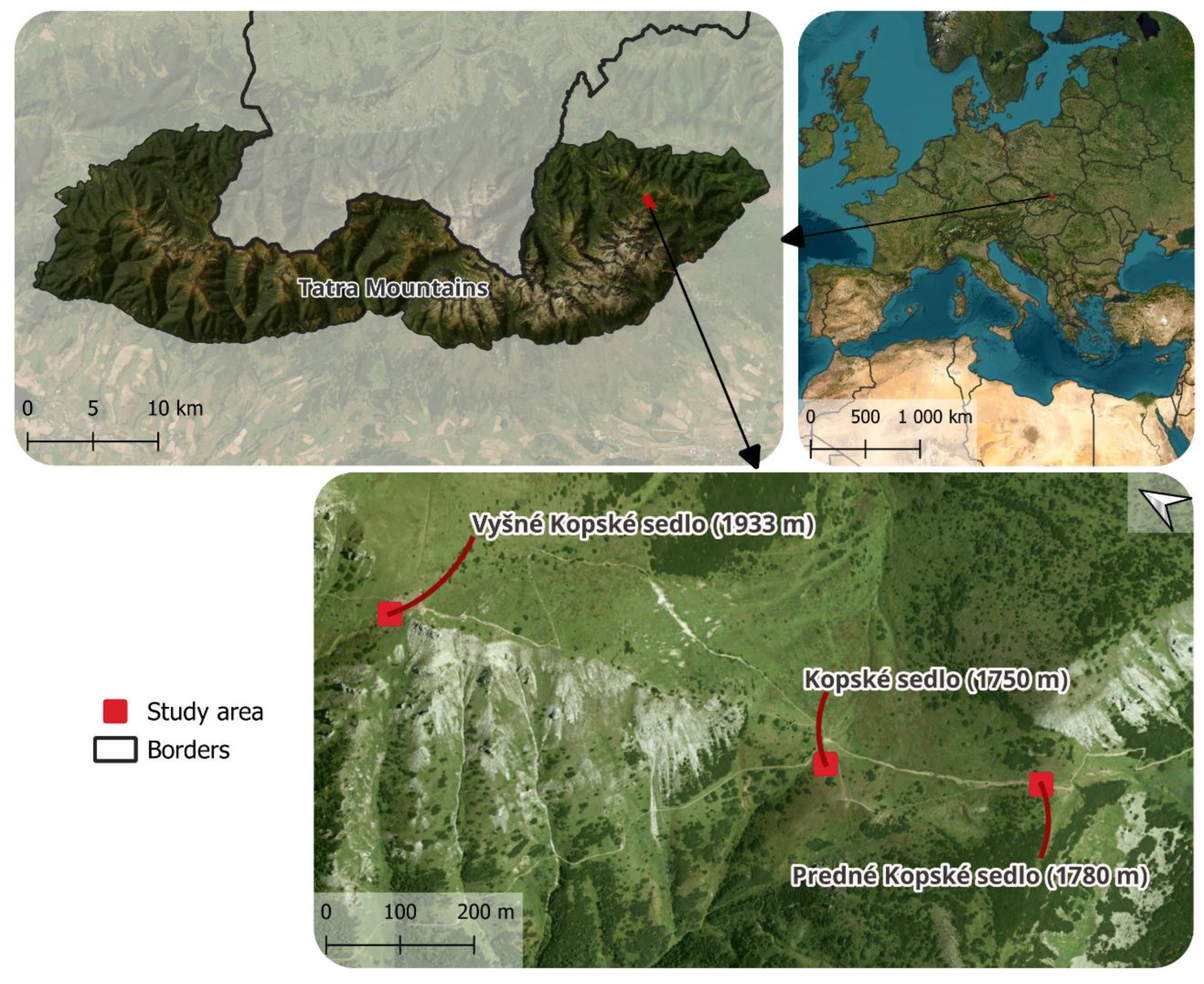
Figure 2.
Experimental block design. The numbers 11, 21, 31, etc. represent the relevé numbers.
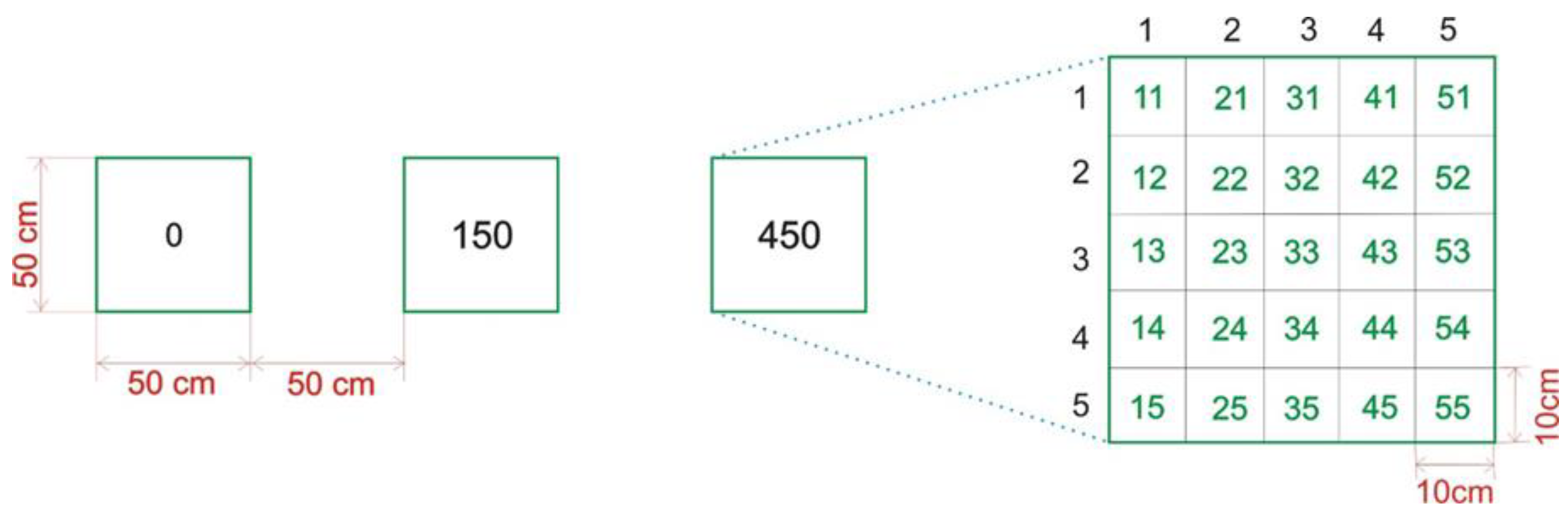
Figure 3.
Average RC values of individual communities in the native and regenerated state.
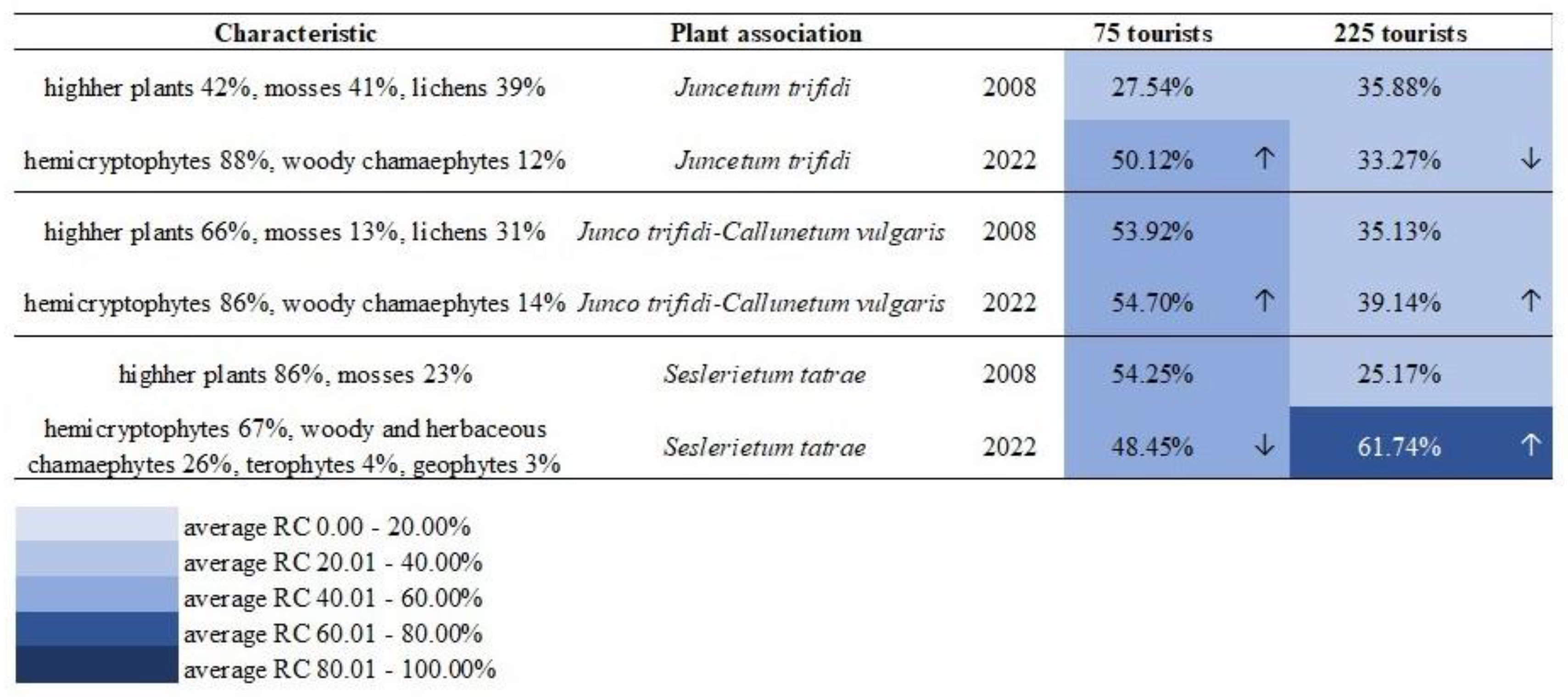
Figure 4.
Relative cover of the communities Juncetum trifidi (Kopské saddleback), Junco trifidi-Callunetum vulgaris (Predné Kopské saddleback) and Seslerietum tatrae (Vyšné Kopské saddleback) in 2008 and 2022.
Figure 4.
Relative cover of the communities Juncetum trifidi (Kopské saddleback), Junco trifidi-Callunetum vulgaris (Predné Kopské saddleback) and Seslerietum tatrae (Vyšné Kopské saddleback) in 2008 and 2022.
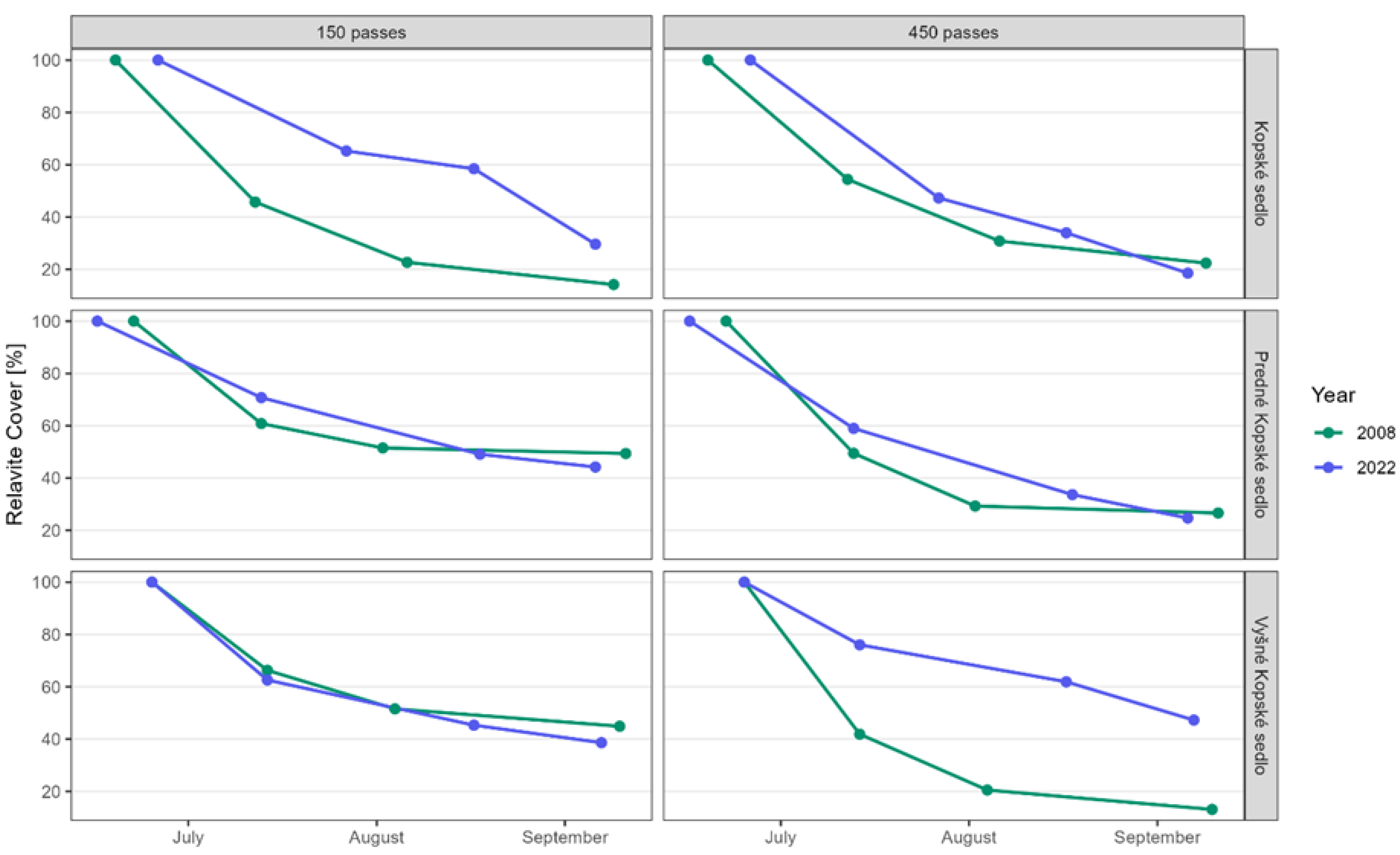
Figure 5.
Relative cover of the E1 and E0 layers of the communities Juncetum trifidi (Kopske saddleback), Junco trifidi-Callunetum vulgaris (Predne Kopske saddleback) and Seslerietum tatrae (Vysne Kopske saddleback) in 2008 and 2022.
Figure 5.
Relative cover of the E1 and E0 layers of the communities Juncetum trifidi (Kopske saddleback), Junco trifidi-Callunetum vulgaris (Predne Kopske saddleback) and Seslerietum tatrae (Vysne Kopske saddleback) in 2008 and 2022.
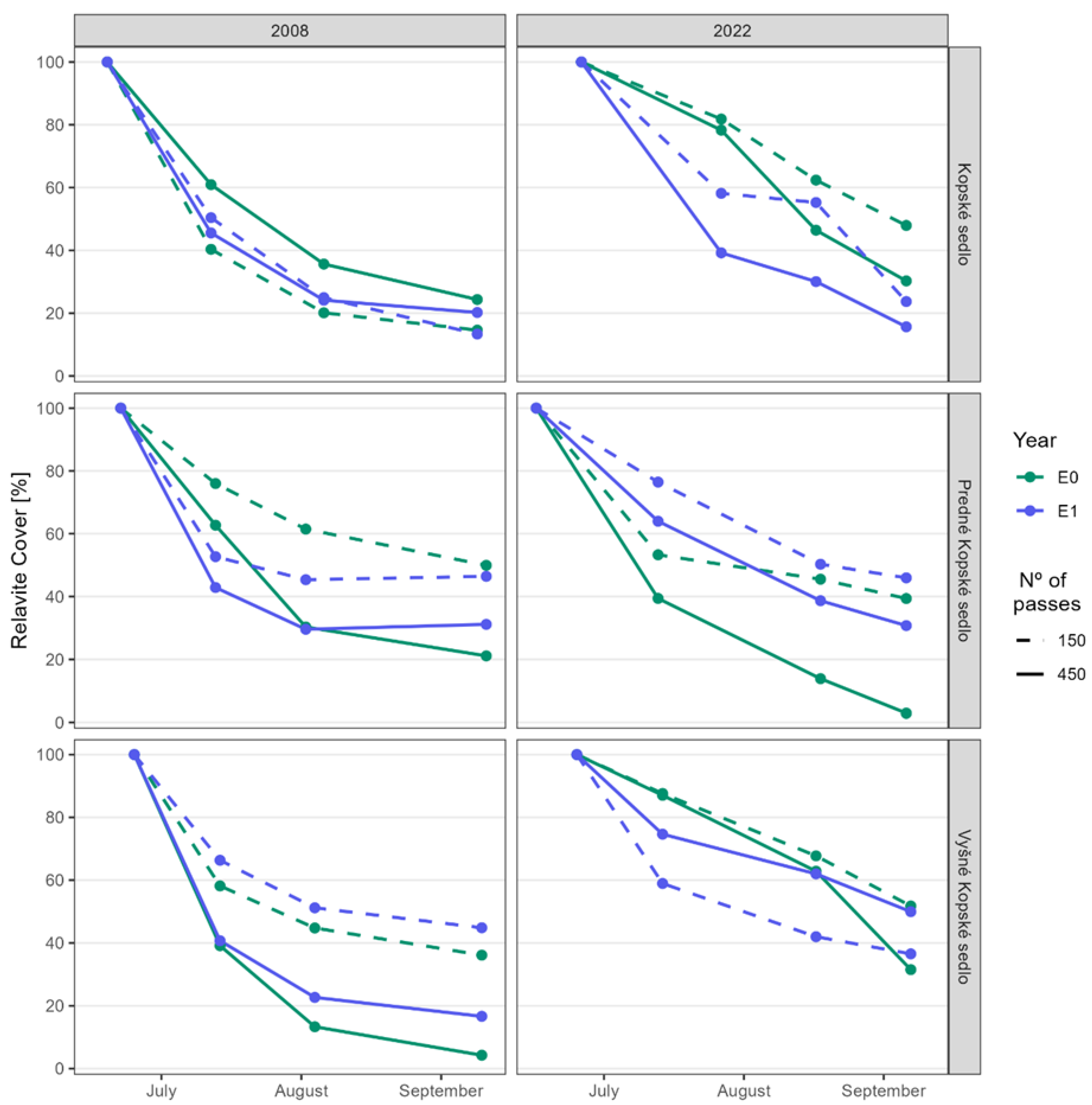
Figure 6.
Relative cover (RC) of individual species occurring in different communities.
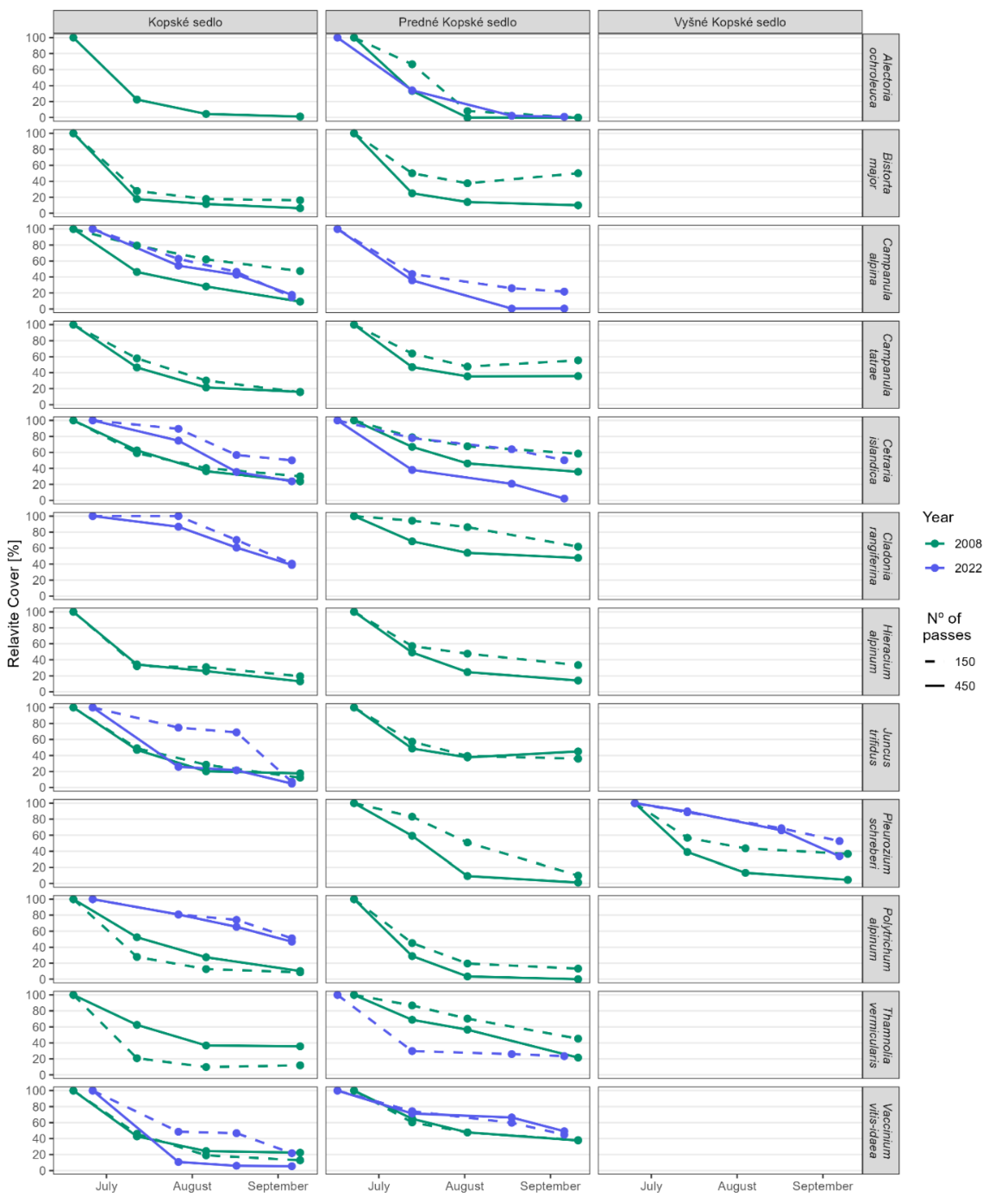
Figure 7.
Regeneration of Campanula alpina herb (detail top right) and Juncus trifidus grass (detail bottom right) on a trampled plot (left) by 225 tourists in the Juncetum trifidi community during a trampling experiment, September 2008 (Source: Piscová et al. [31]).
Figure 7.
Regeneration of Campanula alpina herb (detail top right) and Juncus trifidus grass (detail bottom right) on a trampled plot (left) by 225 tourists in the Juncetum trifidi community during a trampling experiment, September 2008 (Source: Piscová et al. [31]).
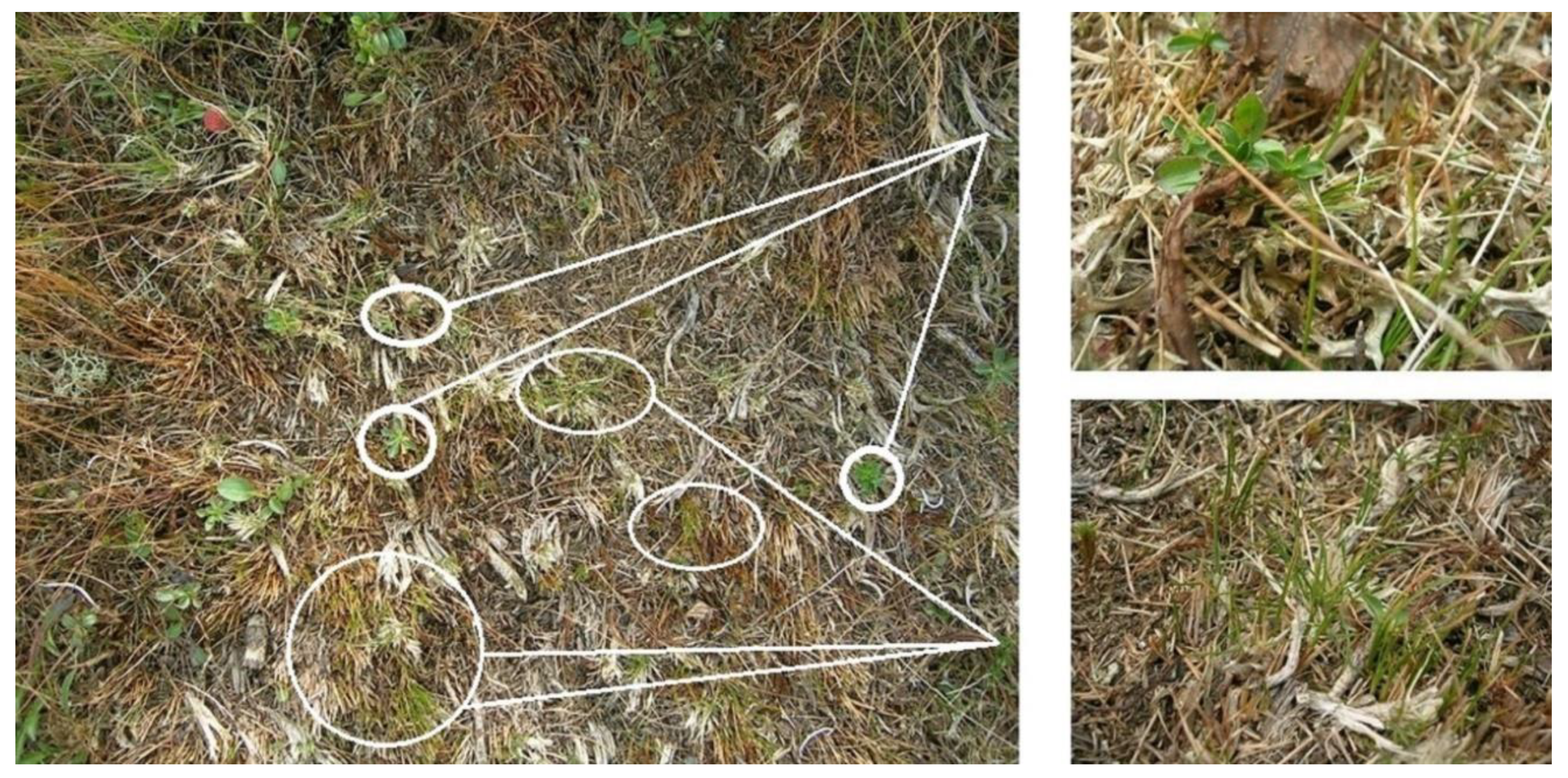
Figure 8.
RC values in June, July, August and September in 2008 and 2022 of selected species that became extinct in trampled areas as a delayed response to experimental trampling of vegetation.
Figure 8.
RC values in June, July, August and September in 2008 and 2022 of selected species that became extinct in trampled areas as a delayed response to experimental trampling of vegetation.
Disclaimer/Publisher’s Note: The statements, opinions and data contained in all publications are solely those of the individual author(s) and contributor(s) and not of MDPI and/or the editor(s). MDPI and/or the editor(s) disclaim responsibility for any injury to people or property resulting from any ideas, methods, instructions or products referred to in the content. |
© 2025 by the authors. Licensee MDPI, Basel, Switzerland. This article is an open access article distributed under the terms and conditions of the Creative Commons Attribution (CC BY) license (http://creativecommons.org/licenses/by/4.0/).
Copyright: This open access article is published under a Creative Commons CC BY 4.0 license, which permit the free download, distribution, and reuse, provided that the author and preprint are cited in any reuse.


