

Submitted:
27 March 2025
Posted:
27 March 2025
You are already at the latest version
Abstract
Background/Objectives: Eye tracking technology has gained increasing attention in sports science as it provides valuable insights into visual attention, decision-making, and motor planning. This systematic review examines the application of eye-tracking technology in basketball, highlighting its role in analyzing cognitive and perceptual strategies in players, referees and coaches. Methods: A systematic search was conducted following PRISMA guidelines. Studies published up December 2024 were retrieved from PubMed and Web of Science using keywords related to basketball, eye tracking and visual search. Inclusion criteria focused on studies using eye-tracking technology to assess athletes, referees, and coaches. A total of 1706 articles were screened, of which 19 met the eligibility criteria. Results: Eye-tracking studies have shown that expert basketball players exhibit longer quiet eye (QE) durations and more efficient gaze behaviors compared to novices. In high-pressure situations, skilled players maintain more stable QE characteristics, leading to better shot accuracy. Referees rely on efficient gaze strategies to make split-second decisions, although less experienced referees tend to neglect key visual cues. In coaching, eye-tracking studies suggest that guided gaze techniques improve tactical understanding in novice players, but have limited effects on experienced athletes. Conclusions: Eye tracking is a powerful tool for studying cognitive and behavioral functioning in basketball, offering valuable insights for performance enhancement and training strategies. Future research should explore real-game settings using mobile eye trackers and integrate artificial intelligence to further refine gaze-based training methods.
Keywords:
eye movements
; gaze behavior
; visual search
; sports
; cognitive functions
1. Introduction
Eye tracking is a technique that measures the point of gaze or the motion of an eye relative to the head, providing insights into visual attention and cognitive processes [1]. By capturing data on where and how long individuals look at specific stimuli, researchers can infer underlying mental states and decision-making processes [2] This technology has been instrumental in fields such as psychology, neuroscience, marketing, and human-computer interaction, offering a window into the intricate relationship between visual attention and behavior [3].
Recent advancements have made eye tracking more accessible and affordable, broadening its research applications. Innovations in machine learning and computer vision have improved the accuracy of eye-tracking systems, enabling more detailed analyses of visual behavior. These developments have opened new avenues for exploring the complex dynamics of attention and perception in real-world settings [4].
The applications of eye tracking in psychology and neuroscience are extensively used to study cognitive processes such as attention, perception, and memory [1]. Moreover, it provides real-time data on how individuals process visual information, aiding in the understanding of various psychological phenomena [5].
Eye tracking has emerged as a pivotal technology in sports science, offering researchers and practitioners a window into the visual and cognitive processes that underpin athletic performance. By precisely recording where and for how long an athlete fixates on specific visual cues during training or competition, eye tracking enables a detailed analysis of perceptual strategies, decision-making, and motor planning. This technology has been applied across various sports—from basketball and soccer to tennis and golf—helping to elucidate the mechanisms that differentiate expert performers from novices [6].
Modern eye tracking systems range from head-mounted mobile devices to remote, screen-based systems (see Figure 1 for some examples). Originally developed for psychological research, eye tracking has evolved considerably with advances in sensor technology and computer vision. Modern mobile eye trackers, for instance, allow for unobtrusive, in situ analysis of players during live games or training sessions. This technological progress has enhanced the ecological validity of studies, enabling researchers to capture data in realistic environments rather than in laboratory settings. These tools measure key metrics such as fixation duration, saccadic movements, and gaze dispersion, which are critical in understanding how athletes allocate their visual attention in dynamic and complex environments [2]. The advancement of sensor technology and computer vision has led to more unobtrusive and accurate devices that can capture real-world performance data. This progression has enhanced the ecological validity of studies, allowing research to move from controlled laboratory settings to the authentic contexts of competitive sport.
Eye tracking has proven invaluable across several key areas. In decision-making, analyzing where athletes direct their gaze during game situations helps researchers understand how they process spatial and temporal information—an essential component for making split-second decisions. Additionally, eye tracking enhances training and feedback; coaches can use the data to offer targeted advice, such as refining gaze strategies to improve shot selection in basketball or to enable more efficient field scanning in soccer. Comparative studies also reveal distinct differences in gaze patterns between expert and novice athletes, with experts typically exhibiting more efficient visual search strategies that correlate with better anticipation and performance in high-pressure situations.
The aim of this review is to explore the current state of knowledge regarding the application of eye tracking technology in basketball.
2. Materials and Methods
The current systematic review was carried out based on the guidelines and principles outlined by the Preferred Reporting Items for Systematic Reviews and Meta-Analyses (PRISMA) statement 2020 and checklist [7].
2.1. Search Strategy and Study Selection
We searched the PubMed and Web of Science databases for studies published between January 2004 and December 2024, as technology prior to this period may be difficult to compare with more recently advanced technology. The research utilized a search string containing the following keywords: (basket OR basketball) AND (eye-tracker OR eye tracker OR eye tracking OR eye-tracking OR visual search OR gaze OR fixation OR vision OR quiet eye OR visual).
2.2. Inclusion and Exclusion Criteria
We included the studies about basketball using the eye tracker device. In the first step (identification) we excluded reviews, systematic reviews, meta- analysis and animal’s studies from the final database. In the second step (screening) we excluded studies in which there was no basketball themes and researches without eye tracker support. In the end (included), we included articles that studied basketball from different point of view with the eye tracker. We included studies on basketball players, referees and coaches about how they analyze the match or the single actions like free throws, passing the ball, making a shot etc.
2.3. Data Extraction and Analysis
PRISMA recommendations for systematic literature analysis have been strictly followed. Studies were independently selected by two different authors, who first analyzed titles and abstracts and subsequently selected the full papers meeting the inclusion criteria, resolving disagreements through consensus.
3. Results
From 1706 studies found at the beginning, 19 articles have been included in the review.
Literature analysis and selection is summarized in a PRISMA-like diagram (see Figure 2). Each study has been analyzed and a summary is reported in Table 1. In organizing Table we considered: the participants, cognitive domain assessed with regard to executive functions, the type of measures and materials used, methodological comments and relevant results.
3.1. Literature Search
At the beginning we selected 1706 articles. First, we removed the duplicates and all the reviews, systematic reviews and meta-analysis. We had at that point 1234 articles. Then, we excluded all the articles that were not relevant and we selected 74 studies. At the end we again excluded the studies in which there were no eye tracker employment and we started our study with 19 articles.
3.2. Participant’s Characteristics
In this review we wanted to evaluate behavior and cognitive functioning related to basketball through the use of eye tracker technology.
We found 14 studies examining the basketball players’ point of view, 2 studies on referees’ perspectives, and 3 studies on coaches’ perspectives. In the section dedicated to basketball players, we categorize the studies based on the game situation examined (free throws, three-point shots, and jump shots). A separate paragraph is dedicated to studies analyzing specific cognitive functions in basketball players through computerized tasks. The last two sections focus on studies describing referees and coaches in various game situations.
3.3. Athletes
3.3.1. Free Throws
One study [8] wanted to investigate the visual tracking strategies of expert and amateur basketball players during free throw shooting. Specifically, it aims to: (1) compare the accuracy of free throws between 11 expert and 11 amateur players; (2) analyze the duration of the “quiet eye” (QE) during accurate and inaccurate free throws; (3) determine whether expert players exhibit longer QE durations and better visual strategies than amateur players; and (4) explore how these visual strategies can be taught to amateur players to enhance their performance." QE refers to the final fixation on a target, such as the hoop, immediately before a player initiates a shot. The study found that expert players had more accuracy for free throws compared to amateur players. During accurate throws, expert players had longer QE duration compared to amateur players. For inaccurate throws, the durations were again longer for experts and shorter for amateurs. Expert players spent more time fixating on the hoop compared to amateurs during accurate throws. For inaccurate throws, experts had fixation time longer than amateurs. The findings suggest that expert players have longer QE durations and better visual strategies, which contribute to their higher accuracy in free throws.
Another study [9] tried to investigate the eye movement characteristics exhibited by 20 female basketball players during free throws at varying exercise intensities and to explore the relationship between these eye movement characteristics and free throw percentage. The study aims to understand how different levels of exercise intensity affect players’ visual focus and how these changes correlate with their free throw success rates. They found that the average number of fixations on the hoop and net showed significant differences across different exercise intensities: high-intensity free throws required more fixations compared to low and moderate intensities. The fixation durations on the hoop, backboard, and net also exhibited significant differences: the hoop had the highest proportion of overall fixation duration, with longer durations needed for high-intensity free throws. For moderate-intensity free throws, there was a significant negative correlation between the number of fixations on the hoop and free throw percentage. For high-intensity free throws, there was a significant positive correlation between the fixation duration on the hoop and free throw percentage. These results suggest that exercise intensity affects players’ visual focus and processing, impacting their free throw success rates.
An interesting study [10] investigates the relationship between “especial skill” and QE duration in basketball free throws. The “especial skill” mentioned in the study refers to a phenomenon observed in basketball free throws. It describes how players perform significantly better at the free-throw line than would be predicted based on their performance from other nearby distances. This effect is attributed to the extensive practice and repetition of free throws, which creates a highly specific and dense sub-space of task solutions within the general skill of set shots. This specialized practice leads to higher accuracy and longer QE durations at the free-throw distance compared to other distances. Specifically, this study aims to test the inhibition hypothesis, which suggests that longer QE durations in expert athletes are due to increased inhibition requirements over movement parametrization. The study examines whether prolonged QE durations are necessary to shield the optimal task solution against alternative solutions in the highly practiced skill of basketball free throws. The study found that participants, 15 male and 1 female basketball players, showed higher shooting accuracy from the free-throw line than predicted based on performance from nearby distances, QE durations at the free-throw distance were significantly longer than predicted. These findings support the inhibition hypothesis, suggesting that prolonged QE durations are necessary to inhibit alternative task solutions and optimize performance in highly practiced skills like basketball free throws.
Another study [11] wanted to determine how two types of practice (constant and variable) affect gaze behavior in basketball free throws. The researchers hypothesized that different practice conditions might lead to different gaze behaviors, which could explain why variable practice gives an advantage in novel situations and constant practice in trained conditions. The study also aimed to explore whether constant practice would result in the development of an “particular skill”, that is a variation of a skill that is significantly better performed compared to other variations, even all variations are practiced equally. This phenomenon is observed when a specific variation of a skill, such as a basketball free throw from a standard distance, is predicted extensively in constant conditions, leading to superior performance at that specific distance compared to other distances. Twenty males without experience in basketball took part at this study. In the experiment there were two conditions: pre-test and post-test. The study found that the total fixation duration on the basket rim significantly increased in the post-test compared to the pre-test, regardless of practice conditions (constant or variable); the number of fixations also increased significantly in the post-test; the average fixation duration increased in both groups, the increase was not statistically significant; there were no significant differences in gaze behavior between the constant and variable practice groups; the study did not find evidence of the development of an “especial skill” in the constant practice group. These results suggest that both constant and variable practice conditions lead to similar improvements in gaze behavior, but neither condition resulted in the development of a highly refined skill variation.
Regards to practice and training, another study [12] tried to evaluate an augmented reality (AR)-based training system for basketball free-throws. The system projects the optimal shot trajectory using a head-mounted display (HMD) based on the shooter’s release point. The study aims to assess the efficacy of this AR training system by comparing changes in success rates and eye-gaze behavior (QE duration) between novice shooters using AR training and novice shooters using conventional training methods. Twenty novice basketball players took part at the experiment, 10 in the AR training group and 10 in the conventional training methods group. The goal is to determine if the AR system can improve free-throw shooting performance and visual attention in novice basketball players. The study found that the AR training system for basketball free-throws had some interesting results: the success rate of free-throws increased significantly in the post-training phase for the AR group. In contrast, the control group showed no significant change in success rate; the AR group exhibited a longer QE duration during the AR training phase compared to the pre- and post-training phases. The control group showed no change in QE duration across all phases; the AR training system improved free-throw performance and visual attention (QE duration) in novice shooters, suggesting that the system can enhance basketball free-throw shooting performance. These results indicate that the AR-based training system positively impacted both the shooting performance and visual attention of novice basketball players.
3.3.2. Three-Point Shots
The objective of this study [13] is to understand the role of QE during basketball three-point shots, particularly under high-pressure game conditions. The researchers aimed to examine the impact of time and performance pressure on QE characteristics and shot accuracy, investigate how QE contributes to attentional control and performance, especially in critical game moments, all of these comparing the QE behavior between 12 competitive elite and 9 semi-elite basketball players. The results showed that competitive elite players had a longer QE online duration and a shorter QE preprogramming duration compared to semi-elite players, especially under high-pressure conditions; time and performance pressure significantly affected the QE characteristics. Semi-elite players showed more unstable QE under pressure, while competitive elites maintained more stable QE characteristics. Despite the pressure, competitive elites maintained higher shooting accuracy than semi-elites, indicating their ability to use QE effectively to cope with high-pressure situations. These findings suggest that QE plays a crucial role in attentional control and performance, particularly for elite players in high-pressure game scenarios.
Connecting to the previous study, another research [14] wanted to investigate the efficacy of the QE training on improving the accuracy of basketball three-point shots under pressure. It aims to determine whether QE training can help players maintain their visual attention and performance in under pressure situations. The study involves 18 expert male basketball players and examines their gaze behaviors and shooting accuracy through various tests. The study found that QE training significantly improved the performance and accuracy of basketball three-point shots under pressure: the QE trained group showed significantly better accuracy in pressure test compared to the control group.
3.3.3. Jump Shots
The objective of this study [15] is to examine the visual patterns in 10 male novice youth and 10 professional adult basketball players while performing a jump shot. The study aims to identify differences in visual strategies, such as QE time, number of fixations, and fixation durations, between these two groups. Authors found that: youth players had lower shooting accuracy compared to professional players at both long and middle distances; professional players had longer QE times than youth players at both long and middle distances; professional players had longer total fixation durations at both long and middle distances; youth players had a greater number of fixations compared to professional players at long distances. These results suggest that professional players use more efficient visual strategies, which could be beneficial for training youth players to improve their shooting performance.
3.3.4. Shot Deception
Another study [16] wanted to examine the sources of deceptive information during the anticipation of shot fakes in basketball. The study aims to investigate the effects of shot deception on players’ anticipation behavior and to compare the gaze behavior and anticipation performance of 15 expert and 16 novice basketball players when defending against genuine and faked basketball shots. In particular, they wanted to identify the body regions that convey genuine and deceptive shot information, focusing on how gaze fixations on different body parts (e.g., hip, legs, ball, head) influence anticipation accuracy. It emerges that experts had higher accuracy in anticipating shot fakes compared to novices, especially for ball fakes. Concerning the gaze behavior, more fixations on the hip and legs were associated with successful anticipation, more fixations on the ball and head were linked to unsuccessful anticipation. These findings suggest that focusing on the hip and legs can improve anticipation accuracy and that experts use more effective gaze strategies to counteract deception in basketball.
3.3.5. One-on-One Defenders
This study [17] aim to examine the use of defensive gaze strategies by defensive players in basketball evaluating the on-field gaze behavior of basketball players defending in one-on-one situations, comparing the gaze behavior of expert and novice players. The study involved interviews with 4 national-level expert basketball coaches and a field study using mobile eye-tracking devices on 16 expert and 16 novice players for assessing the alignment between coaching instructions and the gaze behavior of players. It emerges a discrepancy between coaches’ advices and players behavior: coaches recommended focusing on the torso to avoid fakes, expert players mainly fixated on the head during the receiving and dribbling phases, and on the ball during the shooting phase. There was also a difference between expert and novice players: experts primarily fixated on the head during the receiving and dribbling phases, novices focused more on the ball across all phases. Fixating on the ball or head potentially leaves defenders vulnerable to deceptive movements, as shown by video-based research. These findings highlight the need for more research on defensive gaze strategies and their practical implications for coaching.
3.3.6. Cognitive Functioning and Visual Search Behaviors
One study [18] wanted to compare the saccadic eye movement ability of 8 female professional basketball players with that of 8 non-athletes. The researchers hypothesized that professional basketball players would exhibit more accurate saccadic eye movements compared to non-athletes. During the experiment, the subjects were tracking a visual target that moved continuously in a regular triangular wave-like pattern horizontally for 20 seconds. The visual target moved at a speed of 100 degrees per second, and the subjects were instructed to track the visual targets with maximum accuracy. They found that female professional basketball players exhibited significantly more accurate and consistent saccadic eye movements compared to non-athletes. These findings suggest that professional basketball players may use predictive saccades to track moving targets more accurately, even outside of actual competition.
Another study [19] tried to examine the differences in the performance of visual search tasks among 42 basketball players of different skill levels, considering the influence of different object working memory loads. The study aims to explore the impact of object working memory load on the eye movement processes involved in visual search tasks among basketball players, analyze cognitive differences in visual search between basketball players of different skill levels, differentiate elite athletes from novices based on their visual search performance under varying working memory loads. The study found that object working memory load significantly impacts the performance of visual search tasks among basketball players. The accuracy of visual search decreased with the inclusion of object working memory load; reaction times increased significantly with object working memory load; the number of gaze fixation points increased, and gaze trajectories became more complex under object working memory load; competitive elite athletes had shorter reaction times and fewer gaze fixation points compared to semi-elite and novice players, indicating superior visual search abilities. These findings suggest that higher working memory load negatively affect visual search performance, with elite athletes showing better resilience to these effects.
Another study [20] examined visual search strategies of 48 skilled basketball players during an anticipation task. Specifically, it aims to compare visual search behaviors between experienced and inexperienced basketball players, analyzing response time, accuracy, and eye movements during decision-making tasks involving offensive patterns in basketball and investigating the differences in fixation counts and durations on key areas of interest between expert and novice players. They wanted to understand how visual search strategies contribute to better anticipation and decision-making in basketball. They found that experts players had faster response times and higher accuracy in predicting offensive plays compared to novices; experts players spent a greater percentage of fixation duration and counts on relevant areas and less on irrelevant areas than novices. Them demonstrated also more concise fixation trajectories, focusing mainly on key information areas, while novices had scattered and irregular fixation points. These results indicate that experienced basketball players employ more efficient and effective visual search strategies, leading to better anticipation and decision-making in game situations.
Finally, this study [21] wanted to investigate the role of top-down and bottom-up processes during a sports strategy called “no-look passes” and how microsaccades and small saccades modulate these processes. They divided the 24 subjects into 12 expert and 12 amateur basketball players and they leaded two experiments. The first experiment examined the role of expertise in modulating the shift of covert attention with the bottom-up procedure; the second experiment wanted to investigate the shift of covert attention between top-down and bottom-up conditions in a group of expert basketball players.
Top-down process is driven by higher-level cognitive functions such as goals, prior knowledge and expectations. Expert basketball players use their knowledge and experience to decide where to pass the ball without external cues. Bottom-up process is driven by external stimuli that captures attention. Players respond to a visual signal like a teammate that raises the hand to call for the ball. The findings aim to provide insights into how athletes use visual attention and eye movements to perform deceptive strategies in sports. In experiment 1 it emerges that amateurs exhibited more saccades with greater amplitude and faster peak velocity compared to experts; there were no significant differences in microsaccade characteristics (rate, amplitude, peak velocity, and duration) between amateurs and experts. In experiment 2 they found that during the bottom-up condition, athletes made more microsaccades due to peripheral stimulation. In the top-down condition, athletes made more small saccades to decide where to send the ball. Athletes were faster in making passes during the top-down condition compared to the bottom-up condition. These results suggest that expertise influences eye movement patterns, with experts showing more stability during fixation. The type of attentional process (top-down or bottom-up) affects the frequency and type of eye movements made during a deceptive sports strategy like no-look passes.
3.4. Referees
One study [22] aimed to analyze how basketball referees' gaze behavior and stimulus selection vary based on visual angle perspective, comparing lead and trail positions, as well as level of expertise, comparing expert and novice referees. The study examined 16 basketball referees and the researchers found that referees in the lead position focused more on the attacking player with the ball, while those in the trail position had a broader visual focus; expert referees showed more efficient gaze patterns, focusing on critical areas more quickly and accurately than novices; referees used a visual pivot on the players’ trunk to maintain awareness of the game dynamics. These findings suggest that both the position on the court and the level of expertise significantly influence how referees visually process the game.
Another study [23] aimed to evaluate the gaze behavior and positioning of 9 high-class basketball referees during three-point shots. Specifically, it aims to assess the extent to which referees fulfill their assigned tasks and responsibilities during three-point shots, determine the effectiveness of referees’ gaze allocation and how it aligns with International Basketball Federation (FIBA) recommendations. Furthermore, the researchers wanted to investigate the overlap in gaze behavior among referee teams to understand their coordination and decision-making processes. They found that referees positioned near the ball covered their primary areas of responsibility more effectively than those farther away. Lead referees focused more on players inside the shot zone and less on the basket. Center and Trail referees near the ball looked at the basket more often, aligning with FIBA guidelines. Referees farther from the ball tended to watch the shooter more, potentially neglecting other responsibilities. Referees rarely directed their gaze at the same area simultaneously, indicating effective distribution of visual attention. Gaze behavior varied across the three phases of the shot, with referees adjusting their focus from the shooter to the basket and players fighting for rebounds. These findings suggest that referees farther from the ball may need to improve their focus on non-ball-related actions to enhance decision-making accuracy.
3.5. Coaches
The objective of this study [24] is to investigate how coaches’ pointing gestures affect the allocation of players’ visual attentional resources and their memorization of tactical information in basketball. The study examines the differences in the effectiveness of these gestures between 48 expert and 48 novice players. The study found that coaches’ pointing gestures significantly improved the performance of novice basketball players but had no effect on expert players. It emerges that novices had better recall accuracy when coaches used pointing gestures, they invested less mental effort in the with-gesture condition. Novices showed more efficient visual search patterns with pointing gestures. Experts performed similarly in both with-gesture and no-gesture conditions; their mental effort remained the same regardless of the condition. Experts’ visual attention patterns did not change with the use of pointing gestures. These findings suggest that the effectiveness of coaches’ pointing gestures depends on the players’ level of expertise.
Another study [25] wanted to investigate whether a coach’s gaze guidance can enhance the memorization of tactical movements in basketball. The term ‘gaze guidance’ refers to the coach’s use of eye movements to direct players’ attention during instructional sessions. It involves the coach shifting their gaze between the players and the relevant elements on a board or diagram. This method is used to redirect players’ attention to specific areas of information, enhancing their focus and memorization of tactical movements in basketball. Specifically, this study examines how different gaze behaviors (direct gaze, guided gaze, and fixed gaze) affect players’ visual attention and recall performance, considering their level of expertise (72 novice vs. 72 expert players). The study found that the coach’s guided gaze significantly improved the recall performance and reduced the mental effort of novice basketball players. Novice players showed higher recall accuracy and lower mental effort compared to direct and fixed gaze conditions; they focused more on relevant diagrams and less on the coach’s face. On the other hand, for the expert players recall performance and mental effort were similar across all gaze conditions. These results suggest that guided gaze is particularly beneficial for novices, helping them focus on key elements and improve their learning outcomes.
Finally, the last study [26] examines the visual search strategies of 8 basketball coaches with different performance levels (4 top level and 4 bottom level). The study aims to identify patterns in how coaches visually explore the game during a normal basketball practice situation. They tried to understand how coaches’ visual search sequences vary depending on their performance level. The study found that top coaches prefer to start their visual search sequences with the interpersonal space category, using a variety of categories, including attacker on the side of the ball, defender on the side of the ball, and attacker with the ball. There were recurrences in their visual search patterns, indicating more consistent and repeated sequences. Bottom coaches often begin their visual search sequences with the attacker with the ball category, tending to focus more on the attacker on the side of the ball in their sequences. Top coaches exhibit more complex and varied visual search strategies, while bottom coaches tend to have more repetitive patterns. These differences highlight that top coaches have more systematic and varied visual search patterns, which may contribute to their effectiveness in coaching.
4. Discussion
This systematic review underscores the great contribution of eye-tracking technology to understand the cognitive and behavioral processes underlying performance in basketball. Eye-tracking is a powerful tool for investigating how athletes, coaches, and referees visually process and interpret different game situations. Eye-tracking provides objective, real-time data on gaze patterns, fixation durations, and saccadic movements. This allows researchers to directly infer cognitive processes such as attention allocation, decision-making, and anticipation, offering insights that would be difficult to obtain otherwise.
The ability to precisely quantify visual behavior makes eye-tracking uniquely suited for examining the cognitive differences that distinguish expert performers from novices. The studies reviewed demonstrate the utility of eye-tracking in identifying key differences in visual strategies between individuals of varying skill levels. Whether comparing youth players to professionals in jump shots [15], expert versus semi-elite players in three-point shots under pressure (Giancamilli et al., 2022),or expert versus novice referees [22], eye-tracking reveals distinct patterns of visual attention that correlate with performance outcomes. For example, the finding that expert players often exhibit longer QE durations and more efficient visual search strategies highlights the importance of attentional control to have better results. Moreover, eye-tracking is crucial in assessing training interventions and providing targeted feedback. The AR-based training system shows improvements in free-throw success rate and QE duration in novice shooters [12], demonstrating the potential of eye-tracking to refine gaze strategies and optimize athletic performance.
In the coaching domain, eye-tracking has shown that pointing gestures and guided gaze are significantly beneficial for novice players but have less effect on expert players [24,25]. This suggests that the role of the coach shifts from direct instruction to aspects of individual management, group cohesion, and motivation as athletes become more skilled.
Concerning to the referees, referees' gaze behavior varied based on their court position and expertise. Expert referees exhibited more efficient gaze patterns, focusing on critical areas more quickly and accurately. However, referees farther from the ball often neglected non-ball-related actions, highlighting a need for improved visual attention distribution [22,23].
The current literature reveals a noticeable gap: a scarcity of eye-tracking studies conducted in live game situations. Most of the reviewed studies focused on controlled training scenarios or simulated game environments. While these settings offer valuable experimental control, they may not fully capture the complexity and unpredictability of real competitive matches. Future research should prioritize the use of mobile eye-tracking devices to investigate visual behavior in ecologically valid contexts for a more comprehensive understanding of how athletes, coaches, and referees perform under the pressures of live competition. Additionally, integrating eye-tracking technology with other physiological and cognitive measures could provide a more comprehensive understanding of the factors influencing basketball performance.
Looking ahead, the integration of eye-tracking technology with other emerging technologies could be promising. Virtual reality and AR can provide immersive training environments. When combined with machine learning and artificial intelligence for data analysis, eye-tracking data can be used to develop predictive models of performance, personalize training programs, and maybe even identify potential risks for injury. These advancements could revolutionize the way athletes are trained and coached. As the technology continues to evolve, eye-tracking could become an indispensable tool for unlocking the secrets of athletic expertise.
4.1. Limitations
Our review shows some limitations. First, the heterogeneity in study designs, sample sizes, devices used and methodologies, limits the generalizability of the results. For instance, some studies focused on specific game situations (i.e. free throws), while others examined cognitive functions, making direct comparisons challenging. Second, the reliance on laboratory settings in some studies may reduce ecological validity, as real-game dynamics differ from controlled environments. Third, the small sample sizes in certain studies may limit the robustness of the findings. Finally, the absence of longitudinal studies makes it difficult to assess the long-term impact of eye-tracking-based training interventions on performance.
5. Conclusions
In conclusion, the findings highlight the critical role of visual attention and gaze behavior in enhancing performance, decision-making, and tactical understanding across different levels of expertise. Eye-tracking technology has proven to be a powerful tool for understanding and enhancing visual attention and performance in basketball. However, addressing the current limitations and expanding the scope of research will be essential for maximizing its potential in both academic and practical contexts.
Author Contributions
Conceptualization, MA, SM, GC; methodology, MA, SM, GC; formal analysis, X.X.; investigation, X.X.; resources, X.X.; data curation, MA, IDP, MM, DC.; writing—original draft preparation, MA, SM, GC; writing—review and editing, MA, SM, GC, IDP, MM, DC; supervision, SM, GC; funding acquisition, SM, GC. All authors have read and agreed to the published version of the manuscript.
Funding
This study was funded by “Progetto di Ateneo” (07_PROGETTI_ATENEO_2024) awarded by the University of L'Aquila.
Conflicts of Interest
The authors declare no conflicts of interest.
References
- Cullipher, S.; Hansen, S.J.R.; VandenPlas, J.R. Eye Tracking as a Research Tool: An Introduction. In Eye Tracking for the Chemistry Education Researcher; ACS Symposium Series; American Chemical Society, 2018; Vol. 1292, pp. 1–9 ISBN 9780841233423.
- Holmqvist, K., N. N., A.R., D.R., J.H., & V. de W.J. Eye Tracking: A Comprehensive Guide To Methods And Measures. 2011.
- Hessels, R.S.; Nuthmann, A.; Nyström, M.; Andersson, R.; Niehorster, D.C.; Hooge, I.T.C. The fundamentals of eye tracking part 1: The link between theory and research question. Behav. Res. Methods 2024, 57, 1–18. [Google Scholar] [CrossRef]
- Valliappan, N.; Dai, N.; Steinberg, E.; He, J.; Rogers, K.; Ramachandran, V.; Xu, P.; Shojaeizadeh, M.; Guo, L.; Kohlhoff, K.; et al. Accelerating eye movement research via accurate and affordable smartphone eye tracking. Nat. Commun. 2020, 11, 1–12. [Google Scholar] [CrossRef] [PubMed]
- Brunyé, T.T.; Drew, T.; Weaver, D.L.; Elmore, J.G. A review of eye tracking for understanding and improving diagnostic interpretation. Cogn. Res. Princ. Implic. 2019, 4, 1–16. [Google Scholar] [CrossRef]
- Kredel, R.; Vater, C.; Klostermann, A.; Hossner, E.-J. Eye-Tracking Technology and the Dynamics of Natural Gaze Behavior in Sports: A Systematic Review of 40 Years of Research. Front. Psychol. 2017, 8, 1845. [Google Scholar] [CrossRef]
- Page, M.J.; McKenzie, J.E.; Bossuyt, P.M.; Boutron, I.; Hoffmann, T.C.; Mulrow, C.D.; et al. he PRISMA 2020 statement : an updated guideline for reporting systematic reviews. BMJ 2021, 372, 71. [Google Scholar] [CrossRef]
- Kanat, E.A.; Şimşek, D. The 'Quiet Eye' and motor performance in basketball free throw shooting. Phys. Educ. Stud. 2021, 25, 103–109. [Google Scholar] [CrossRef]
- Zhao, C.; Liu, N.; Li, S.; Zhao, X. Investigation of eye movement characteristics during free throws at varying intensities among basketball players and its correlation with free throw percentage. PLOS ONE 2024, 19, e0299938. [Google Scholar] [CrossRef]
- Klostermann, A. Especial skill vs. quiet eye duration in basketball free throw: Evidence for the inhibition of competing task solutions. Eur. J. Sport Sci. 2019, 19, 964–971. [Google Scholar] [CrossRef]
- Czyż, S.H.; Zvonař, M.; Borysiuk, Z.; Nykodým, J.; Oleśniewicz, P. Gaze Behavior in Basketball Free Throws Developed in Constant and Variable Practice. Int. J. Environ. Res. Public Heal. 2019, 16, 3875. [Google Scholar] [CrossRef]
- Ueyama, Y.; Harada, M. Basketball free-throw training with augmented reality-based optimal shot trajectory for novice shooters. Sci. Rep. 2024, 14, 1–9. [Google Scholar] [CrossRef]
- Giancamilli, F.; Galli, F.; Chirico, A.; Fegatelli, D.; Mallia, L.; Palombi, T.; Lucidi, F. High-Pressure Game Conditions Affect Quiet Eye Depending on the Player’s Expertise: Evidence from the Basketball Three-Point Shot. Brain Sci. 2022, 12, 286. [Google Scholar] [CrossRef]
- Moeinirad, S.; Abdoli, B.; Farsi, A.; Ahmadi, N. Training visual attention improves basketball three-point shot performance under pressure. Sport Sci. Heal. 2022, 18, 853–861. [Google Scholar] [CrossRef]
- Marques, R.; Martins, F.M.L.; Gomes, R.; Martinho, D.V.; Mendes, R.; Moore, S.A.; Coelho-E-Silva, M.J.; Dias, G. Visual Information in Basketball Jump-Shots: Differences between Youth and Adult Athletes. J. Hum. Kinet. 2023, 89, 65–75. [Google Scholar] [CrossRef]
- Meyer, J.; Smeeton, N.J.; Fasold, F.; Schul, K.; Schön, T.; Klatt, S. Shot deception in basketball: Gaze and anticipation strategy in defence. Hum. Mov. Sci. 2022, 84, 102975. [Google Scholar] [CrossRef]
- Meyer, J.; Fasold, F.; Schul, K.; Sonnenschein, M.; Klatt, S. The Defender’s Vision—Gaze Behavior of One-on-One Defenders in Basketball. J. Sport Exerc. Psychol. 2022, 44, 127–137. [Google Scholar] [CrossRef] [PubMed]
- Tatara, S.; Toda, H.; Maeda, F.; Ito, A.; Handa, T. Comparison of the Saccadic Eye Movement Ability of Female Professional Basketball Players and Non-Athletes. Appl. Sci. 2024, 14, 1108. [Google Scholar] [CrossRef]
- Nian, Q.; Lu, W.; Xu, Y. Effects of object working memory load on visual search in basketball players: an eye movement study. BMC Psychol. 2023, 11, 1–11. [Google Scholar] [CrossRef]
- Jin, P.; Ge, Z.; Fan, T. Research on visual search behaviors of basketball players at different levels of sports expertise. Sci. Rep. 2023, 13, 1–10. [Google Scholar] [CrossRef]
- Piras, A. The role of the peripheral target in stimulating eye movements. Psychol. Sport Exerc. 2024, 76, 102744. [Google Scholar] [CrossRef]
- Ruiz, A.J.; Albaladejo, C.; Reina, R.; Moreno, F.J. Basketball referee's gaze behavior and stimulus selection in relation to visual angle perspective and officiating mechanics and expertise. Eur. J. Hum. Mov. 2023, 50, 4–18. [Google Scholar] [CrossRef]
- Klatt, S.; Noël, B.; Nicklas, A.; Schul, K.; Seifriz, F.; Schwarting, A.; Fasold, F. Gaze Behavior and Positioning of Referee Teams during Three-Point Shots in Basketball. Appl. Sci. 2021, 11, 6648. [Google Scholar] [CrossRef]
- Ben Chikha, H.; Zoudji, B.; Khacharem, A. Coaches’ pointing gestures as means to convey tactical information in basketball: an eye-tracking study. Int. J. Sport Exerc. Psychol. 2022, 22, 236–249. [Google Scholar] [CrossRef]
- Ben Chikha, H.; Zoudji, B.; Khacharem, A. The role of coach’s gaze guidance on memorization of tactical movements in basketball: an eye tracking study. Ger. J. Exerc. Sport Res. 2023, 54, 374–382. [Google Scholar] [CrossRef]
- Damas, R.S.; Ferreira, A.P. Patterns of Visual Search in Basketball Coaches. An Analysis on the Level of Performance. 2013, 22, 199–204. [Google Scholar]
Figure 1.
Some examples of mobile and fixed eye-tracker devices.
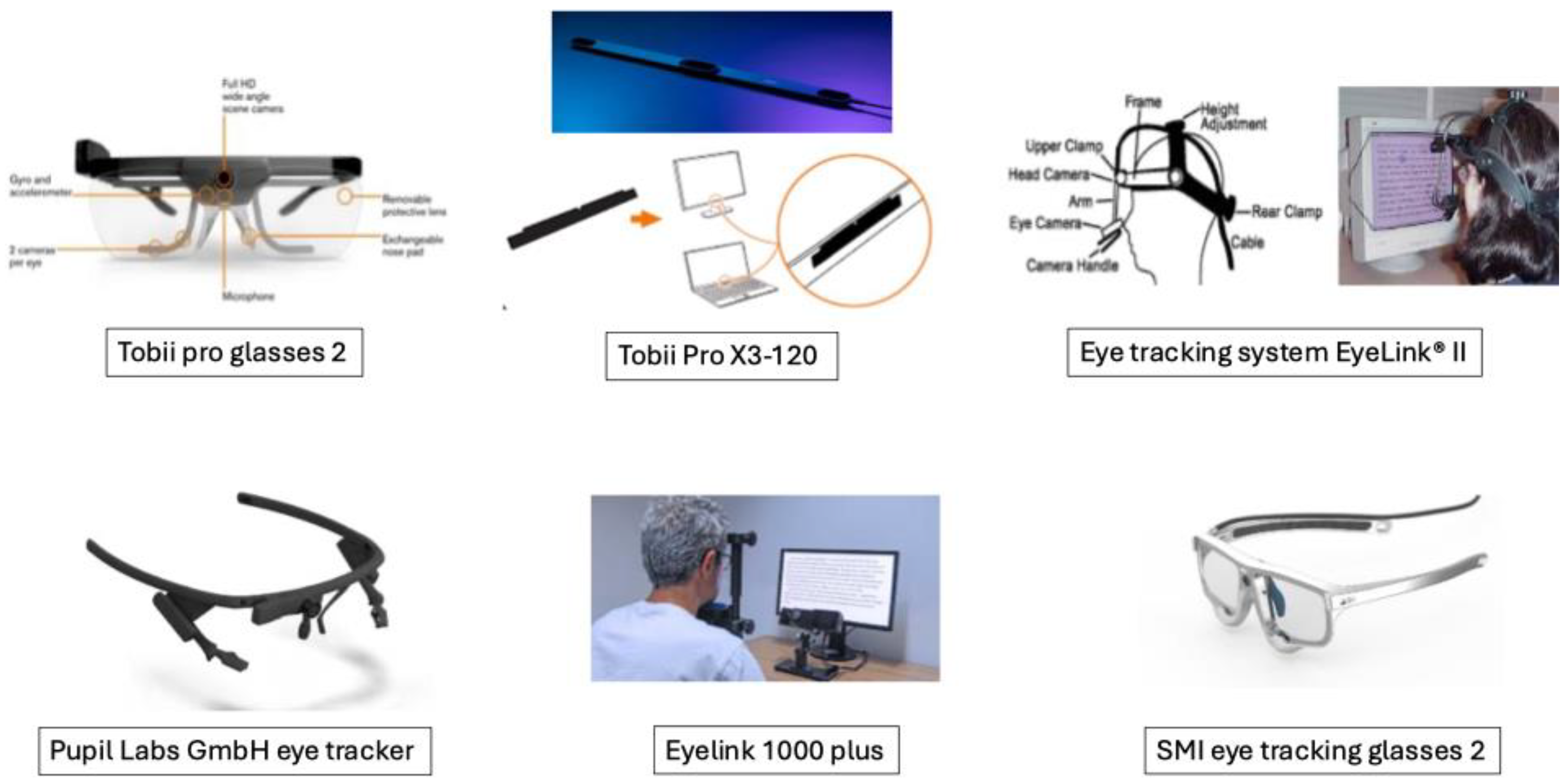
Figure 2.
Preferred Reporting Items for Systematic Reviews and Meta-Analyses (PRISMA) diagram demonstrating search strategy.
Figure 2.
Preferred Reporting Items for Systematic Reviews and Meta-Analyses (PRISMA) diagram demonstrating search strategy.
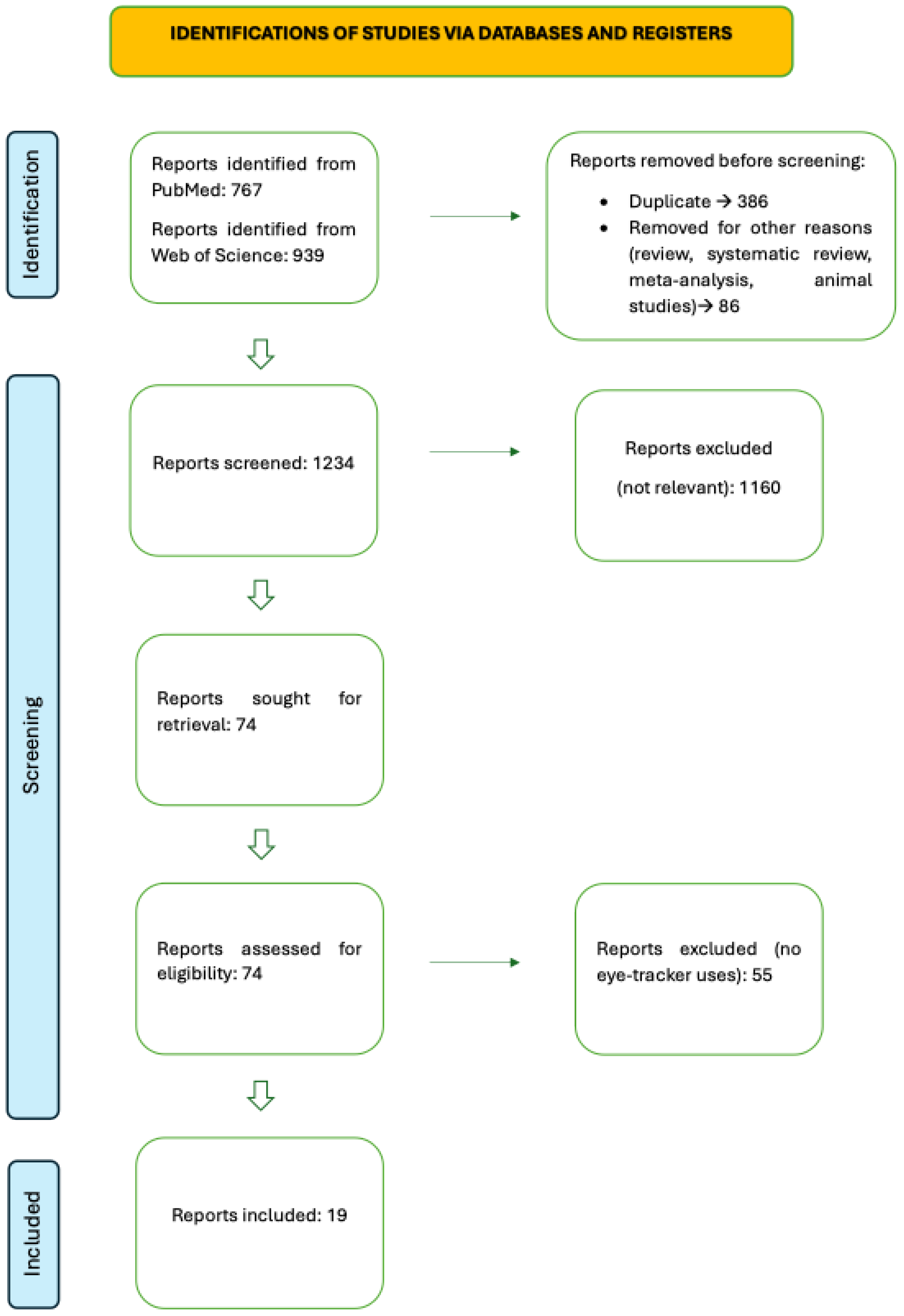

Table 1.
All studies related to basketball and eye-tracker technology.
| Reference | Participants | Cognitive domains assessed | Device | Type of visual analysis | Methodological comments | Results |
|---|---|---|---|---|---|---|
|
24 male basketball players
|
Visual search behaviour | eye tracking system EyeLink® II, | microsaccadic movements | Comparisons between groups | Movement time initiation showed no significant differences between groups nor for passing direction. Analysis showed no significant differences in microsaccade characteristics for expertise or passing direction. Significant difference between groups for small saccade rate, amplitude and peak velocity were found. Amateurs showed more saccades of greater amplitude and faster peak velocity than experts. Results showed no significant difference between groups/passing direction for microsaccade and small saccade orientations. |
|
15 male and one female basketball players (M age = 23.3 years, SD age = 6.4 years) |
Visual search behaviour | Pupil Labs GmbH eye tracker | Quiet eye duration | Comparisons within group | Regards to the comparison of the predicted and the actual QE duration at the free throw distance, participants actual QE durations were longer as the predicted QE durations. When comparing shooting accuracy as a function of QE duration, participants were slightly more accurate in long vs. short QE-duration trials. |
|
basketball referees (1 F):
|
Visual search behaviour | ASL SE5000 Gaze Tracking System | Specific point of gaze on the scene | Comparisons between groups | No statistically significant differences were found between the expert and novice groups in the number of fixations. According to the spatial locations of play, all the referees showed a greater number of fixations and total fixation time on the attacking player with the ball. Novice referees showed longer fixation time on the defensive player of the ball than experts. Novice referees dedicated more fixations to the ball's flight than experts. |
|
20 female basketball players (mean: 21.56; SD: 2.47 years) | Visual search behaviour | Tobil Glasses 3 eye tracker | Number and duration of fixations | Comparisons within group | The moderate intensity free throw elicited the lowest average total number of fixations, while the high intensity free throw resulted in the highest average total number of fixations. The average number of fixations of the hoop in the three exercise intensities constituted the largest proportion of the total average number of fixations. These findings suggest that players primarily focused their attention on the hoop during free throw. The total average fixation duration was significantly shorter for the moderate intensity free throw, followed by the low intensity condition, and reached its maximum duration during the high intensity free throw |
|
22 basketball players
|
Visual search behaviour | Eye tracking device Tobii Pro Glasses 2 | Quiet eye duration Average fixation time |
Comparisons between groups | In this study emerges that the quiet eye duration of the accurate and the inaccurate throws of expert basketball players was longer than the amateurs. Thw average fixation time spent on the hoop for the accurate shots was longer in the expert group when the average fixation time spent on the backboard was longer in the amateurs. For the inaccurate throws there were the same results. |
|
21 male basketball players
|
Visual search behaviour | Eye Tracking Glasses 2 (SMI ETG 2, SensoMotoric Instruments GmbH | Gaze behavior | Comparisons between groups | The large effect sizes of expertise on QE late components (i.e., QE offset and QE online duration) and the small effect size on QED and QE early components (i.e., QE onset and QE preprogramming duration) seems to suggest a relevant role of QE late components on maintaining goal-directed attention during a three-point shot. In this regard, it is interesting to note that competitive elites performed a longer QE online duration than semi-elites, especially when time and performance pressure occurred. |
|
96 participants (48 novices male, age= 22.4 years, SD = 3.33; 48 experts male age= 24.3 years, SD = 1.97) 48 participants in the no-gesture condition (24 experts and 24 novices) 48 participants in the with-gesture condition (24 experts and 24 novices) |
Visual search behaviour | Tobii Pro Glasses 2 eye tracker | Visual attention location | Comparisons between groups | Novice participants paid greater attention to AOI1 than expert participants. Novice participants in the with gesture condition paid greater attention to AOI1 than those in the no-gesture condition. Expert participants showed no difference on AOI1 between the two conditions. Novice participants in the with-gesture condition switched less times between the AOI1 and AOI2 (coach) compared to those in the no-gesture condition. Expert participants showed no difference in saccade count between the two AOIs. |
|
144 male
|
Visual search behaviour | Tobii Pro-Glasses 2 eye tracker | Gaze behavior | Comparisons between groups | Novice Players: Guided Gaze Condition: More efficient visual search, focusing on relevant diagrams and less on the coach. Direct Gaze Condition: Higher number of fixations on the coach and more frequent saccades between the coach and diagrams. Expert Players: Visual search patterns were consistent across all conditions, with a focus on relevant diagrams and minimal attention to the coach. |
|
31 adult participants (6 female, 25 male):
|
Visual search behaviour | Pupil Core mobile eye-tracking system | Gaze behaviors | Comparisions between groups | The study investigated the effects of shot deception on players’ anticipation behavior in basketball. For the gaze behaviour successful anticipations involved more fixations on the hip and legs. Unsuccessful anticipations involved more fixations on the ball and head. Fixating on the hip and legs was the most effective strategy for distinguishing between genuine and fake shots. Experts were better at anticipating deceptive actions but were still susceptible to high shot fakes. |
|
16 expert basketball players (M age = 24.44) 16 novice basketball players (M age = 20.25) |
Visual search behaviour | Eye tracker from Senso Motorik Instruments | Gaze behaviours | Comparisions between groups | The study investigated the gaze focus and it found that experts primarily fixated on the head during the receiving and dribbling phases and novices mainly focused on the ball throughout all phases. Coaches emphasized the importance of peripheral vision for defenders. These findings suggest a discrepancy between coaching instructions and actual gaze behavior, |
|
48 male basketball players
|
Visual search behaviour | Tobii Pro X3-120 eye tracker | Fixation Fixation duration Fixation count |
Comparisons between groups | Expert players and novice players spent more time fixated on K-AOI (key area of interest). There were no differences between the two groups. The study found that expert players demonstrated a greater percentage of fixation duration in R-AOI (related area of interest) than novice players. The results also show that the expert group had a greater percentage of fixation counts in R-AOI than novice players. |
|
42 subjects
|
Visual search behaviour | eye-tracker Eyelink 1000plus | visual search, total reaction time, search initiation time, scanning time, verification time, and number of gaze fixation points | Comparisons between groups | Competitive elite athletes exhibit a visual search advantage compared to semi-elite athletes and novices. The eye movement trajectories of the novice group appear complex and disorganized, whereas those of the competitive elite and semi-elite groups are simple and straightforward. This observation suggests that athletes with higher sport levels possess superior abilities in strategy-based searching and information integration. observed significant differences in the number of gaze fixation points among basketball players of different skill levels across all experimental conditions, with the novice group having the highest count, followed by the semi-elite group, and then the competitive elite group. |
|
20 male basketball players
|
Visual search behaviour | SMI ETG 2W | QE times Fixation duration |
Comparisons between groups | QE time was longer and the same occurred for the total fixation duration among professional players. The last fixation duration was shorter in youth players compared to professional adult participants at both distances. Under-16 youth players had a greater number of fixations in the long, but not the middle distance. Professional players evidenced fewer fixations and longer time of the final fixations compared with youth players. |
|
8 team coaches of under-18 male participants
|
Visual search behaviour | eye tracker system, instrument mobile eye 1.35 | Gaze direction | Comparisons between groups | Top Coaches exhibit more deterministic and varied visual search patterns, focusing on multiple points of interest. Preferentially, use the interpersonal space category to begin their visual search sequences. They utilize a variety of categories, including attacker on the side of the ball, defender on the side of the ball, and attacker with the ball. Bottom Coaches tend to focus more on the attacker with the ball, showing less variation in their visual search sequences. |
|
18 expert male basketball players (Mage=20.0±4.75 years) | Visual search behaviour | Senso Motoric Instruments (SMI) eye-tracking glasses | Quiet eye duration | Comparisons within group | Performance accuracy results indicate that QE-trained group showed a more accurate performance during post and pressure tests compared to the pre-test. The results of the total QE duration of hits indicate that the QE-trained group had a longer total QE duration in the post-test and the pressure test compared to the control group, and that no significant differences were reported in the total QE duration of the control group in the post and pressure tests. According to the early QE duration results, the QE-trained group exhibited longer total QE duration in post and pressure test compared to the control group, and no significant differences were observed in the early QE duration of the control group in the post and pressure test. |
|
8 F professional baskeball players, 24.3 ± 2.4 8 F non professional |
Visual search behaviour | ORTe EYENAC | Eye movements | Comparisions between groups | Compared to the non-athlete subjects, basketball players executed more accurate and consistent eye movements in response to the regularly repeating movements of the visual target. In the basketball player group, the timing of saccades is more concentrated than in the non-athlete group. |
|
20 males without experience in basketball
|
Visual search behaviour | Eye-tracking system Dikabilis | Gaze behaviors | Comparisons between groups | An analysis of gaze behaviour revealed that the total fixation duration significantly increased in the posttest compared to the pretest. CG and VG groups did not differ one from another in either pre and post test. The number of fixation significantly increased in the posttest. |
|
9 male basketball referees (M = 33.6 years, SD = 4.5 years) | Visual search behaviour | eye-tracking system Pupil Core binocular | Gaze behavior | Comparisons within group | In phase 1 and phase 2, referees looked more at the shooter when in a far-away position compared to a position nearby the ball, whereas this was not the case in phase 3. For the offense, no differences in the fixation times were observed for phase 1 and 2 between the referees’ roles, but the fixations significantly increased for the Center role compared to the Trail and Lead referee. Furthermore, the referee/referees near the ball, spent more time looking at the basket in phase 3 in comparison to the referees in a position further away from the ball. When it came to the shooters, fixation times of the referees decreased during the trajectory of the ball/shot. |
|
20 partecipants (5 F; age range 20-23)
|
Visual search behaviour | Eye tracker AR HMD | Gaze behaviors | Comparisions between groups | The efficacy of the training system was assessed in novice shooters by comparing changes in success rates and eye-gaze behaviour (quiet eye) between AR-training and control training groups. The success rate during the AR training with the optimal trajectory did not differ from the pre-training rate; in post-AR training, the success rate increased. AR training increased the QE duration compared with that recorded during pre- and post-training blocks. The control group showed no change in the success rate or QED. These findings imply that AR training system affected QE behaviour and improved free-throwing shooting performance after training. |
Disclaimer/Publisher’s Note: The statements, opinions and data contained in all publications are solely those of the individual author(s) and contributor(s) and not of MDPI and/or the editor(s). MDPI and/or the editor(s) disclaim responsibility for any injury to people or property resulting from any ideas, methods, instructions or products referred to in the content. |
© 2025 by the authors. Licensee MDPI, Basel, Switzerland. This article is an open access article distributed under the terms and conditions of the Creative Commons Attribution (CC BY) license (http://creativecommons.org/licenses/by/4.0/).
Copyright: This open access article is published under a Creative Commons CC BY 4.0 license, which permit the free download, distribution, and reuse, provided that the author and preprint are cited in any reuse.