

Submitted:
26 March 2025
Posted:
27 March 2025
Read the latest preprint version here
Abstract
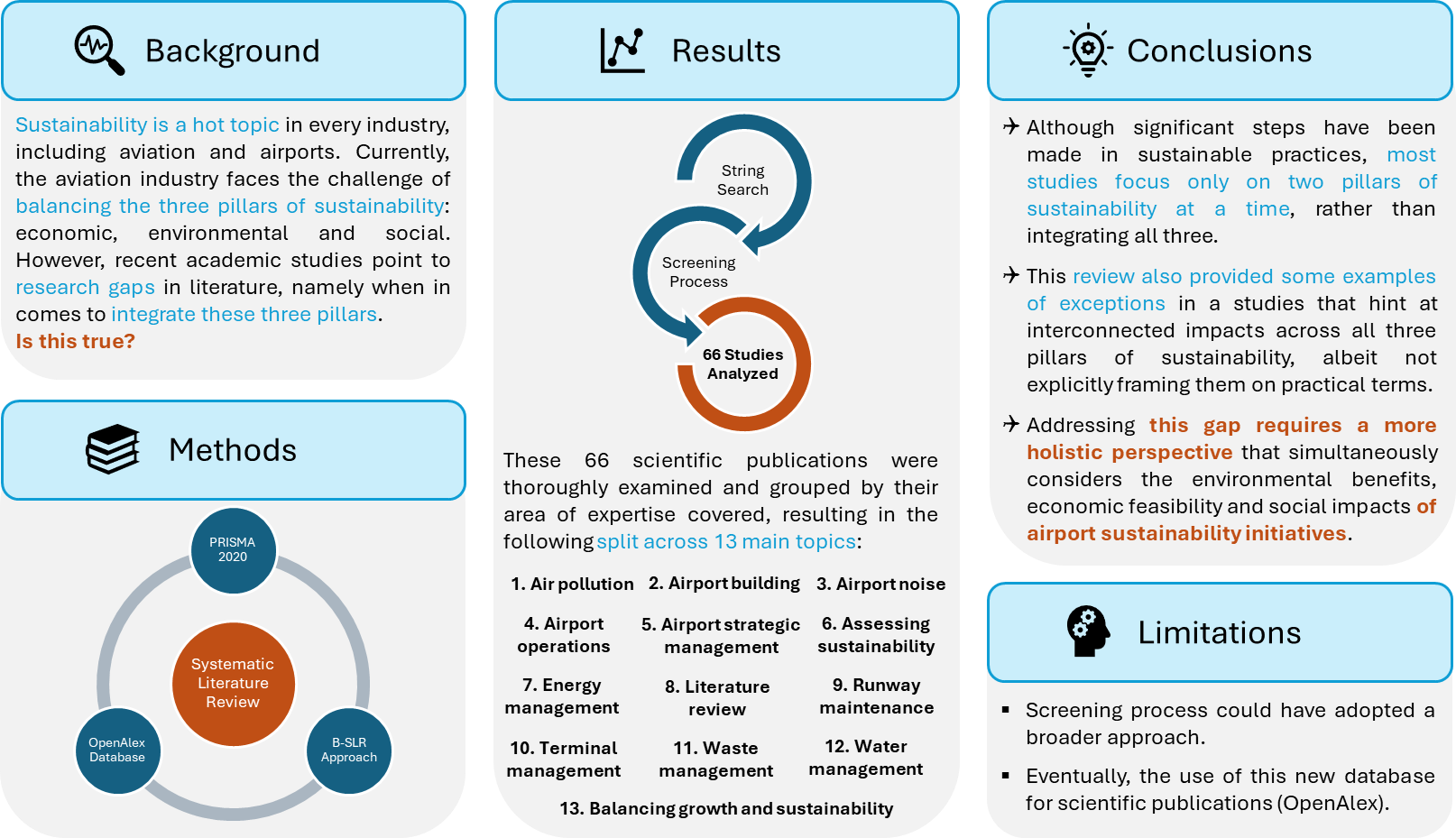
Airport sustainability has gained increasing attention as the aviation industry faces the challenge of balancing economic growth, environmental responsibility and social standards. This study conducts a systematic literature review (SLR) using the OpenAlex database. The PRISMA 2020 (Preferred Reporting Items for Systematic Reviews and Meta-Analyses) methodology was applied to refine the selection process, resulting in 66 relevant studies. Then, a bibliometric-systematic literature review (B-SLR) approach was employed to analyze trends and identify research gaps. Findings indicate that most studies often focus on two sustainability pillars at a time, while neglecting a fully integrated perspective. Not many research works simultaneously address all three dimensions of sustainability (economic, environmental and social), leading to fragmented insights into sustainable airport management. Notably, some industry-driven reports are starting to suggest emerging holistic approaches, but the majority of academic literature remains segmented. Hence, this study highlights the need for a more comprehensive research framework that considers environmental, economic, and social factors concurrently. Future research should integrate these dimensions to develop practical and well-balanced sustainability strategies. While methodological limitations may exist in this work, such as language constraints and dataset selection criteria, this review provides valuable insights into airport sustainability and lays the groundwork for further studies.
Keywords:
sustainability
; airports
; systematic literature review
; PRISMA
; OpenAlex
1. Introduction
The topic of sustainability has been in vogue for several years and has been increasingly explored and deepened in a wide variety of sectors and industries. The aviation and airports industry is no exception and airport sustainability is a hot topic that is being raised in different international platforms [1]. However, regardless of the area of study, when it comes to sustainability its definition always involves the following basic notion: development that meets the needs of the present without compromising the future, which incorporates three fundamental dimensions: environmental, social and economic [2].
Nowadays airports are vital to global connectivity and economic growth, nevertheless rising air traffic demand poses significant sustainability challenges for airport managers. While the emerging air travel demand induces airport expansions, it often also conflicts with environmental goals, increasing emissions, noise and community disruptions. Balancing economic, social, and environmental priorities has become critical, as stricter regulations demand sustainable practices. As airports face difficult trade-offs in defining clear strategies for the future, innovative approaches are needed to align airport development with sustainability goals.
As evidenced by the research work of Raimundo, Baltazar and Cruz (2023) [3], who carried out a systematic literature review focused on sustainability in the airports ecosystem, this topic is not only on the current agenda, but its interest is still growing, and much research is still needed in this area. According to the conclusions of the authors of this study, when addressing airport sustainability issues airport managers should link environmental impacts to their on-site ecosystem effects, which would help the aviation and airports industry address key challenges worldwide [3]. These conclusions stem from the fact that most studies and publications on airport sustainability focus mainly on the environmental pillar, sometimes disregarding its interconnection with the other two pillars of sustainability.
In order to delve deeper into this essential topic of airport sustainability (which will also be the main topic of a master thesis published later in the present year) and to be able to properly understand and present the context of its current development, a systematic literature review on this topic was carried out. As mentioned above, Raimundo, Baltazar and Cruz (2023) [3] have already carried out a systematic literature review that is deeply related to the topic of sustainability in airports, so a course of action that differs from the work of these authors was sought.
2. Materials and Methods
Raimundo, Baltazar and Cruz (2023) [3] developed their work based on Web of Science (WoS) and Scopus, which are two bibliographic databases that have been the foundation for research in this kind of bibliometric analysis [4]. Hence, in order to develop an investigation that could be complementary, it was decided to use the OpenAlex bibliographic database.
OpenAlex, whose name is inspired by the Library of Alexandria, is a new bibliographic database that aims to centralize all research information in one place and that indexes a miscellaneous type of research output (including articles, books, datasets and dissertations) across all different areas of academic activity, even including academic fields that may be underrepresented in other databases [5]. OpenAlex was launched as a replacement for Microsoft Academic Graph, which was discontinued in the beginning of 2022, and offers much better literature coverage than other databases, as shown below in Figure 1.
According to the research of Maddi, Maisonobe and Boukacem-Zeghmouri (2024) [6], OpenAlex indexes significantly more journals compared to Scopus and WoS and, geographically, while WoS and Scopus favor journals from Europe, North America, and Oceania, OpenAlex offers a much more balanced worldwide coverage. Despite being relatively new, OpenAlex has been widely studied and used in scientific research and, moreover, it has already been scrutinized by authors such as Ortega and Delgado-Quirós (2024) [7], that studied the indexation of retracted literature in seven principal scholarly databases and considered OpenAlex and, on the other hand, Culbert et al. (2024) [8], who analyzed the reference coverage of OpenAlex compared to WoS and Scopus.
Since OpenAlex is quite new and a fully open source of scholarly metadata, of course it still has some limitations and a latent potential to improve the transparency of research evaluation, navigation, representation, and discovery [9]. However, it is worth highlighting the work developed by Alperin et al. (2024) [4] which focused on the suitability of OpenAlex for bibliometric analyses and concluded that OpenAlex is indeed useful for bibliometric analyses and can already be used as a replacement for traditional bibliographic databases for a limited set of analysis. In other words, the authors approved of OpenAlex as a valid literature review database, nonetheless leaving some warnings regarding some limitations and the need of complementing with other data sources for more accurate results.
Bearing in mind that this systematic literature review was carried out as a complement to the research work developed by Raimundo, Baltazar, and Cruz (2023) [3] and, in addition, given the usefulness of using different databases from the previous authors, OpenAlex appeared to be a viable option and that is the reasoning behind this choice. On the other hand, the methodology chosen for the literature review approach was the same one employed by the aforementioned authors: PRISMA (Preferred Reporting Items for Systematic Reviews and Meta-Analyses).
The PRISMA statement, which was first introduced in 2009, was developed to assist researchers in systematically reporting the purpose, methodology, and findings of their reviews [10]. Due to improvements in systematic review techniques and terminology, an updated version named PRISMA 2020 was introduced to enhance reporting practices [10]. PRISMA 2020 incorporates improved methods for study identification, selection, evaluation, and synthesis while restructuring the guidelines for easier application [10]. This updated statement includes a 27-item checklist, an extended version with detailed reporting recommendations, an abstract checklist, and revised flow diagrams for both original and updated reviews [10].
Consequently, the systematic literature review started with the search string “airport sustainability” being present at the full text of scientific publications in OpenAlex. This resulted in a wide variety of works (136 700 works) across very different types of scientific fields. As a result, the final search string was duly complemented to provide more up-to-date and precise results: “airport sustainability” being present at the full text, combined with the Boolean term “AND” and the years from “2010 to 2023”, combined with the Boolean term “AND” and “airport sustainability” being present at the title of the scientific publications. It is important to mention that the year 2024 was purposely left out as this research work began during that same year and it was decided to limit the work to full years in order to have a clear definition of the period of analysis.
As presented in Figure 2, the search string aforementioned resulted in a total of 399 publications in 1 database (OpenAlex). From these 399 potentially relevant contributions that were identified, the screening process was developed as follows:
- An automation tool was employed to automatically retrieve all relevant bibliographic information from the publications, namely the title, the authors, the DOI and the journal of publication. In 100 of the cases, there was relevant information missing, so these publications were marked as ineligible;
- Of the other 299 potentially relevant contributions that remained, 192 were removed during the screening process due to other reasons, namely: 163 were not publicly accessible and 29 were not published by any scientific journal, which resulted in the elimination of these 192 publications;
- The steps mentioned above resulted in 107 relevant contributions that were identified and manually screened. From these 107 publications, 4 of them were excluded for not being in English, remaining 103 publications sought for retrieval;
- During the retrieval process from OpenAlex, 37 publications were impossible to retrieve, despite being identified as “publicly accessible”. Henceforth, the initial screening process was concluded with 66 reports assessed for eligibility;
- The actual number of studies included in this systematic literature review was the aforementioned 66, since the deepen further analysis of these publications did not result in any subsequent elimination, as shown in Figure 2 below.
Subsequently, the process followed the steps defined in the methodology presented by Marzi et al. (2024) [11] for carrying out Bibliometric-Systematic Literature Reviews (B-SLR), which is composed of 10 steps, as presented in Table 1. Hence, after obtaining a refined dataset, it was developed a bibliometric approach with a respective analysis of clusters regarding trending topics, which therefore was followed by a final sample selection that was the basis for the holistic analysis that materialized in the actual systematic literature review.
3. Literature Analysis: Trending Topics
Before moving on to the more in-depth analysis that was carried out on the 66 publications that resulted from the screening process, the VOSviewer scientific software was used to visualize the relationship between co-occurrence of keywords across all publications. VOSviewer is a software tool designed for creating and visualizing bibliometric networks, which can include journals, researchers, or publications. These networks are built using relationships such as citation links, bibliographic coupling, co-citation, or co-authorship and, additionally, the software features text mining capabilities that allow for the extraction and visualization of the presently used co-occurrence networks of key terms from scientific literature [12].
Hence, the bibliometric study was conducted to analyze and uncover key indicators of scientific information dynamics and evolution. By utilizing VOSviewer software, this research work focused on identifying the most relevant keywords in studies related to airport sustainability, with the main goal of understanding the main areas of expertise involved. In order to limit the number of clusters formed by the analysis in VOSviewer and to allow a more precise analysis, a condition of co-occurrence of 5 keywords was used, which resulted in the formation of four main clusters.
As it was expected given the greater scope of OpenAlex compared to other scientific databases, the clusters formed in VOSviewer turned out to be more diverse in areas of expertise than those analyzed by Raimundo, Baltazar and Cruz (2023) [3], which were much more focused on the aviation industry, as presented in Figure 3 (despite using more clusters and different inputs both for VOSviewer and for the string search to the systematic literature review).
Nevertheless, as it was intended to assess, the analysis of the clusters formed in the present bibliometric study somehow confirms the conclusions of the study performed by Raimundo, Baltazar and Cruz (2023) [3] and that partially motivated this research work. As can be observed in Figure 4 below, there is a great focus on the environmental pillar of sustainability, while the other two pillars (social and economic) are not that well represented in the clusters.
For a more focused analysis of the aviation sector, Figure 4 also highlights the relationship between the term “aviation” and other keywords. Once again, this analysis confirms that the environmental component ends up being the most recurrent in these airport sustainability publications, namely through the relationship between “aviation” with the following terms:
- Environmental science;
- Environmental planning;
- Environmental resource management;
- Environmental engineering;
- Greenhouse gas;
- Waste management.
However, although less frequent, it is also worth mentioning that the analysis of Figure 11 shows some co-occurrences of keywords related to other pillars of sustainability, namely: “social sustainability”, “economics” and other operational terms such as “operations research”, “runway” and “air traffic control”. This analysis already provides a slightly different and broader view than what was presented in the work of Raimundo, Baltazar and Cruz (2023) [3], probably due to the influence of the search string that was used (more focused on sustainability while the authors focused on entrepreneurship) and, additionally, due to the influence of using OpenAlex.
Nonetheless, at a first glance analysis, the same recommendation would be maintained as suggested by these authors regarding the need for more studies covering other pillars of sustainability and the respective relationship between each other, as it is intended with the research being developed by the author of the present in a master’s thesis.
4. Discussion: Theoretical Perspectives
As already mentioned above, the final dataset included 66 articles representative of the topic of airport sustainability in several areas of the aviation and airports industry and with a wide variety of case studies all across the globe. These publications were thoroughly examined and grouped by their area of expertise covered, resulting in the following split across 13 main topics:
- 7 publications on air pollution;
- 7 publications on airport building (2 that also cover energy management);
- 1 publication on airport noise;
- 9 publications on airport operations;
- 6 publications on airport strategic management;
- 9 publications on assessing sustainability;
- 3 publications on balancing growth and sustainability;
- 3 publications on best practices / literature review;
- 7 publications on energy management (2 that also cover airport building and 1 that also covers water management);
- 4 publications on runway maintenance;
- 6 publications on terminal management;
- 4 publications on waste management;
- 5 publications on water management (1 that also covers energy management).
These published articles in question also covered a lot of different geographies all around the world and resorted to a multitude of methodologies do delve into each one of the research topics. To summarize all this information regarding the articles analysed, tables below from Table 2, Table 3, Table 4, Table 5, Table 6, Table 7, Table 8, Table 9, Table 10, Table 11, Table 12, Table 13 and Table 14 are presented, showing the case studies and the main methods that were used for each one of the 13 expertise areas aforementioned.
4.1. Air Pollution
In the field of airport sustainability, numerous studies have focused on mitigating air pollution through innovative solutions. As an example, Baxter (2020) [13] investigated the use of sustainable aviation biofuels at Oslo Airport Gardermoen, the first airport globally to offer biofuels to all airlines, and his study revealed that the adoption of biofuels resulted in a 10-15% reduction in greenhouse gas emissions, highlighting the environmental benefits of this approach. Similarly, Sharma et al. (2021) [14] examined the potential of sustainable aviation fuel (SAF) production at Memphis International Airport and this author’s findings showed that supplying 136 million gallons of SAF annually could reduce greenhouse gas emissions by 62.5% compared to conventional jet fuel, with the integration of carbon credits further enhancing emissions reductions to 65%, while also generating substantial economic benefits. Expanding on alternative energy solutions, Ochoa Robles et al. (2019) [15] explored a hydrogen airport ecosystem in Hautes-Pyrénées, France, using a multi-objective optimization model to design a hydrogen infrastructure that meets the airport’s energy needs sustainably and this research emphasized the adaptability of this model for other hydrogen ecosystems aiming to reduce environmental impacts.
On the operational side, technological innovations have shown promise in reducing emissions, such as the work developed by Postorino, Mantecchini and Gualandi (2017) [19] that assessed the environmental and financial benefits of using semi-robotic TaxiBots for aircraft taxiing at a medium-sized airport in Northern Italy, proving that integrating TaxiBots in taxi-out procedures not only reduced local emissions but also provided cost savings for airlines. Similarly, Hubbard, Baxmeyer and Hubbard (2021) [18] examined automated mowing at Purdue Airport, which employs electric-powered mowers to reduce emissions and demonstrated that this innovation, particularly if enhanced with solar-powered mowers, presents a sustainable alternative to traditional mowing, though its applicability depends on site-specific conditions such as terrain and power availability. Additionally, it is worth mentioning the work by Ryley et al. (2013) [17], which focused on surface access emissions at Manchester Airport, and evaluated technological solutions like telepresence systems, improved public transport, and ride-sharing options. This study emphasized the need for enhanced data collection and long-term policy measures to reduce carbon emissions from airport-related travel, also considering the economic context of implementing such measures.
Lastly, and shifting focus to local air pollution, Rangel-Alvarado, Pal and Ariya (2022) [16] conducted a decadal analysis of PM2.5 and co-pollutants near major Canadian airports, revealing that colder climates exacerbate pollutant accumulation during fall and winter. In contrast, the authors also concluded that airports in milder climates do not experience such disproportionate pollutant build-up, therefore underscoring the role of environmental factors in influencing the effectiveness of air quality management strategies at airports. Together with the articles aforementioned, all these studies illustrate a broad spectrum of approaches to mitigate air pollution at airports, from sustainable fuels and energy solutions to technological and operational innovations, all contributing to the overarching goal of airport sustainability.
4.2. Airport Building
In the field of airport sustainable building, a variety of innovative approaches have been explored to improve energy efficiency, material use and overall environmental impact. Dalkiran (2023) [21], in a case study on airports in Turkey, emphasized the importance of using sustainable materials throughout airport construction and maintenance and this research highlighted that materials like plastic, paper, and those used in airport projects significantly affect sustainability, reinforcing the need for a broader approach to resource conservation. This work also aligns with the review by Bak (2018) [22], which assessed sustainable development solutions, including green walls, renewable energy and water-saving devices, for their applicability at passenger airports. In this case, findings suggested that simple and cost-effective investments, such as efficient faucets and the maintenance of green roofs, can substantially improve environmental outcomes, emphasizing the importance of proper operation and ongoing maintenance to ensure sustainability goals are met.
Similarly, the work of Kareem, Abd and Zehawi (2021) [20] on Baghdad Airport used Building Information Modeling (BIM) technology to identify optimal construction materials and energy-efficient systems and found that elements like building orientation, window-to-wall ratios and shading can influence energy consumption. The research also highlighted the significance of energy-efficient lighting systems and HVAC systems, the latter of which were identified as the largest energy consumers. Moreover, this study also demonstrated that the use of photovoltaic panels showed to significantly reduce energy intensity, supporting the overall sustainability of airport buildings. On the other hand, on a different perspective, the research work of de la Fuente et al. (2017) [23] on the rail extension to Barcelona’s El Prat Airport used the MIVES method to assess sustainability in tunnel lining and, by integrating economic, environmental and social factors, the study demonstrated how multi-criteria decision-making can optimize sustainability in airport infrastructure projects.
One other example is the research work developed by Yulia et al. (2023) [25], which focused on the thermal-cooling loads within airport buildings, showing that managing peak cooling demands (particularly during afternoon hours) can reduce energy consumption. This research work contributed to sustainable building practices by advising in the design of HVAC systems, which is crucial for improving energy efficiency and ensuring thermal comfort for passengers and staff. In addition, it is also worth mentioning the research work of Keskin and Salman (2018) [26] on the Istanbul Grand Airport Project, which explored how BIM tools can streamline energy analysis and optimize energy efficiency in retrofitting airport buildings. The authors’ findings showed that integrating BIM with Building Energy Modeling (BEM) allows for significant cost and time savings in energy analysis, further emphasizing the role of advanced technologies in sustainable building practices.
Finally, the study developed by Xie et al. (2023) [24] in Xuancheng, China, used a combination of Life Cycle Assessment (LCA), Emergy, and Artificial Neural Networks (ANN) to assess the sustainability of an airport building system and found that material and operational stage emergy were the primary contributors to the building’s environmental impact, thus proposing an optimization strategy to improve long-term sustainability. This comprehensive approach to sustainability emphasizes the importance of evaluating not just energy use, but also broader lifecycle impacts in building systems. Once again, together with the articles mentioned above, these studies demonstrate a range of innovative strategies that contribute to the development of more sustainable and environmentally friendly airport infrastructure.
4.3. Airport Noise
As presented earlier in this research work, the management of airport noise has become a critical aspect of sustainable aviation, especially in densely populated areas near airports. In this context, Iemma and Centracchio (2022) [27] focused on a community-oriented approach to optimizing takeoff and landing procedures for commercial aircraft, aiming to minimize both the SEL exceeding 60 dBA around the airport and the amount of fuel burned during the procedures. It is important to recall here that the SEL metric is crucial as it quantifies the noise impact on surrounding communities, while fuel consumption is directly linked to environmental emissions. Hence, this multi-objective optimization not only addressed noise reduction but also contributed to reducing the chemical emissions associated with aviation operations.
This research work highlighted the need for innovative approaches in managing airport operations, suggesting a shift toward more sustainable procedures. By employing a global and deterministic optimization method, the study also provided numerical results for different aircraft types, offering valuable insights into balancing operational efficiency and noise reduction. These findings indicate that optimizing takeoff and landing procedures can significantly reduce the environmental footprint of airports while also mitigating noise pollution affecting nearby residents. Nonetheless, as previously mentioned, this study on airport noise focuses a lot on the environmental and social pillars of sustainability, but does not account for the economic one, thus demonstrating the gap in the literature that motivated the present work.
4.4. Airport Operations
In the field of airport operations, a variety of innovative solutions have been explored to improve efficiency, mitigate risks and ensure sustainability in day-to-day operations. González, López and Martínez (2016) [28] focused on the case study of the Spanish dual-use airport in San Javier (Murcia), combining both civilian and military flights and their study highlighted the application of falconry as a wildlife control technique to manage bird strikes, a major safety concern for airports. The findings by these authors demonstrated the effectiveness of falconry, a natural approach, in maintaining safety without harming the environment, presenting an alternative to traditional methods. Similarly, Carpitella et al. (2023) [29] worked on enhancing risk management within airport operations in Italy, focusing on Occupational Stress Risks (OSRs) among airport staff by using a recommendation system implemented through Python, that also employed Fuzzy Cognitive Maps (FCMs) to assess OSRs and provide prioritized recommendations for mitigating risks. This system proved highly reliable and adaptable, offering significant improvements in the airport’s ability to manage staff stress, thereby contributing to overall airport efficiency and personnel well-being.
On the other hand, in another area of airport operations, Weiszer, Chen and Locatelli (2015) [30] introduced a multi-objective optimization model in Doha (Qatar) for their case study aimed to optimize various airport functions, including aircraft routing, runway scheduling and airport bus coordination. By integrating these factors into a unified framework, these authors’ study showed that operational efficiency could be improved while minimizing fuel consumption and environmental impact and, more important, this approach effectively allowed airports to make informed decisions that balance economic, environmental and operational goals. In a similar tone, Forster and Pansinger (2018) [31] explored the spatial development of airport areas, particularly at Graz Airport in Austria, through the concept of SmartAIRea. This study also focused on integrating ecological, economic and technological synergies in the spatial design of the airport and its surrounding areas and the case study demonstrated that this innovative approach could not only enhance the airport’s operational efficiency but also contribute to regional development, turning the airport environment into a resilient and interconnected area. It is noteworthy that both studies underscore the importance of integrated models that account for multiple operational factors to improve efficiency and sustainability at the same time.
On a more operational side, Di Mascio, Moretti and Piacitelli (2020) [34] analyzed the design and level of service (LoS) of terminal areas in an international airport, specifically in the context of adapting to the new challenges posed by the COVID-19 pandemic. This study is particularly interesting because it used IATA’s Airport Development Reference Manual (ADRM) as a basis, which helped finding out that many terminal subsystems were over-designed to accommodate social distancing measures. These findings emphasized that a flexible terminal infrastructure is essential for adapting to future operational needs, particularly in light of public health concerns. Moreover, this theme of adaptability was also explored in Di Mascio, Rappoli and Moretti (2020) [35] study in the USA, which focused on runway capacity and developed a calculation model to assess runway system efficiency, concluding that using simulation software could provide valuable insights into runway optimization.
Further contributing to the assessment of airport operations, it is important to mention the work by Ripoll-Zarraga (2015) [36] that explored the technical efficiency of Spanish airports through non-parametric models like DEA (Data Envelopment Analysis). This author’s case study revealed that larger airports like Barcelona and Madrid showed significant improvements in gross margin over time, but this was largely attributed to centralized management decisions, rather than a true reflection of operational performance. In addition, the study also highlighted that medium-sized airports experienced greater efficiency improvements when competing with similarly sized airports, suggesting that competition drives operational efficiency. It is noteworthy that this study aligns with the findings of Kelemen et al. (2020) [33], who developed an educational model for airport network and information systems risk assessment in Slovakia and, through a fuzzy logic-based approach, aimed to improve airport information security and risk management, emphasizing the importance of continuous education and adaptation of risk management processes to improve overall efficiency and safety in airport operations.
Lastly, in the context of logistics and sustainability, Lima et al. (2010) [32] studied the logistics platforms in Campinas (Brazil), focusing on balancing logistics activities with environmental constraints. While sustainability was not always the central goal, their research demonstrated that implementing energy-efficient building practices and water conservation measures can still lead to significant economic and environmental benefits and their findings contributed to a broader understanding of how airport operations can integrate sustainability into logistics and infrastructure management.
4.5. Airport Strategic Management
In the field of airport strategic management, several studies explore various aspects of airport operations, competitiveness, sustainability and corporate governance. Piedade, Marques and O’Neill (2023) [37], in their study of Lisbon Airport, investigated how sustainable business practices can be embedded into daily operations and, by surveying employees and performing quantitative analysis, found that a clear motivation for sustainable practices exists among staff, but a more comprehensive action plan is needed to engage employees further and ensure widespread adoption of sustainable measures. This study also supports the findings of Pishdar et al. (2019) [38], who focused on Iranian airports and revealed that airport resilience plays a critical role in enhancing sustainability and reputation and showed that sustainability positively affects airport reputation, which in turn influences passenger behavior and encourages self-promotion, leading to both financial and non-financial benefits. Both these studies highlight the growing importance of sustainability and corporate reputation in strategic airport management.
Similarly, the study by Szaruga and Załoga (2022) [39] on 12 Polish airports used advanced spatial econometrics to analyze energy consumption, passenger movement and airport competition. These two authors identified inefficiencies in airport operations and demonstrated that airports tend to compete with each other rather than cooperate. This conclusion also aligns with the research work of Liao, Cao and Li (2019) [42] on the competition between airports in China’s Greater Bay Area (GBA), that concluded that while domestic routes in this China MAS are mature, international markets remain underdeveloped. Additionally, this study emphasized the importance of understanding airport competition in multi-airport systems, not just focusing on single airports or airlines and how this competition impacts passenger choice. The conclusions of both these studies contributed to a broader understanding of how airport strategy should account for both internal efficiencies and external competitive dynamics.
On a different note, the case study on Indonesian airports by Setiawan et al. (2018) [41] explored the relationship between local government budgets and airport sustainability. The authors found that cooperation agreements between local governments and airport management can benefit both parties: airport managers improve services, while local governments gain financial contributions, emphasizing the importance of strategic partnerships in achieving mutual goals. In some way, this also reflects the findings of Heyes et al. (2020) [40], who highlighted the challenges faced by airport retailers in adopting sustainable business models, since this study pointed out that the current logistical and political constraints make it difficult for retailers to implement sustainable practices, although there is significant potential to reduce carbon emissions by reevaluating product offerings and business operations.
Together with all the publications mentioned above, these studies illustrate the multi-faceted nature of airport strategic management, emphasizing the need for sustainability initiatives, strategic collaborations and an understanding of competitive dynamics in multi-airport regions to optimize airport performance and reputation. From improving internal operations to navigating external challenges, strategic management in airports requires a holistic approach that accounts for both operational efficiency and long-term sustainability goals, that is, a holistic approach that accounts for all pillars of sustainability at the same instead of focusing on just one or two of them like it is usually done in the vast majority of the scientific publications on airport sustainability.
4.6. Assessing Sustainability
In the field of assessing airport sustainability, a wide range of approaches has been proposed to evaluate and improve environmental and operational performance, such as the work of Wan et al. (2020) [46], for example, which used a synthetic evaluation index model to assess the sustainability of Guangzhou Baiyun International Airport over a ten-year period, identifying key factors influencing airport sustainability. This study highlighted that the method could be applied to other airports, offering a standardized approach for evaluating sustainability across diverse locations. In a similar vein, Jia, Macário and Buyle (2023) [50] reviewed 33 academic papers on airport sustainability, categorizing methodologies like Data Envelopment Analysis (DEA), Multiple-Criteria Decision Making (MCDM) and composite index-based assessments and suggested a shift towards a more holistic sustainability modeling, integrating systems thinking to address complex interactions within sustainability systems.
A complementary approach to sustainability is found in the work of Eid et al. (2022) [48], who systematically examined the relationship between airport sustainability knowledge, attitudes and behaviors. This research underscored the need for further exploration of sustainability awareness at airports to improve behaviors and align practices with sustainable development goals. Meanwhile, Kucukvar et al. (2021) [51] presented an optimization-based approach that utilized eco-efficiency analysis on 30 major international airports, highlighting the discrepancy in sustainability data reporting across airports and proposing that consistent and real-time data could enable better comparison of sustainability performance. These studies also align with the work of Dimitriou and Karagkouni (2022) [45], which emphasized the role of sustainability in strategic management, demonstrating that environmental awareness in airport operations directly influences business resilience and competitiveness.
Further on this topic, Janic (2010) [44] explored the development of an indicator system for assessing airport sustainability, incorporating economic, environmental and social dimensions. This methodology was tested through a practical application, proposing it as a valuable tool for ongoing sustainability assessments. Additionally, it is also worth mentioning another research by Dimitriou and Karagkouni (2022) [47], which focused on the global airport ecosystem, and that complemented this by demonstrating that strategic management plays a critical role in overcoming barriers to sustainability, particularly in a competitive and economically sensitive climate. These authors’ results underscored the challenges airports face in aligning sustainability with business performance, a point that is further reinforced by the same authors, Karagkouni and Dimitriou (2022) [49], when they found that regional airports in Mediterranean islands are not prioritizing environmental management despite their heavy reliance on tourism.
Finally, Uzule (2023) [43], investigating the use of integrated reporting (IR) at Northeastern European airports, found that these airports are not yet fully adopting IR, though a shift towards this approach could enhance sustainability reporting practices. This finding aligns with the emerging trend of combining financial and non-financial information to evaluate long-term sustainability targets, as demonstrated in one more similar research on European airports by Dimitriou and Karagkouni (2022) [45]. It is noteworthy that all these studies illustrate the breadth of methodologies that are contributing to the evolving understanding and management of airport sustainability, highlighting a growing recognition of the need for standardized frameworks and a comprehensive data reporting to improve sustainability practices across the global airport industry.
4.7. Balancing Growth and Sustainability
Balancing growth and sustainability in airport operations is one of the key motivations of the present research and, as previously introduced, this balancing presents complex challenges for the aviation sector, especially in Europe, where the intersection of environmental sustainability and economic growth is a central issue. On this topic, the work developed by Regan (2014) [52] is noteworthy, since it explored how Europe grapples with reconciling air transport liberalization with its environmental obligations, emphasizing the conflict between the economic and social benefits from a competitive aviation market while ensuring environmental sustainability. The author’s findings suggested that the capacity constraints imposed by environmental concerns will increasingly shape the development of air transport in Europe, as economic growth must align with sustainability goals.
Similarly, the case study of Schiphol Airport in the Netherlands, as discussed by Boons, Van Buuren and Teisman (2010) [53], examined how airports can shift from narrow, growth-focused perspectives to broader, more sustainable approaches. By using a conceptual framework grounded in complexity theory, the study highlighted the need for a more dynamic system of knowledge production, where government, stakeholders and experts collaboratively explore alternatives to traditional growth models and, in addition, advocates for a paradigm shift that integrates economic viability with social and ecological considerations, recommending interdisciplinary research to break free from the dichotomy of growth versus environmental impact.
In Italy, Carlucci, Cirà and Coccorese (2018) [54] applied the DEA method to assess the efficiency and sustainability of 34 airports between 2006 and 2016, particularly focusing on the role of airport size, privatization and low-cost carriers. These author concluded that privatization and deregulation could enhance the efficiency and economic sustainability of regional airports, underscoring the positive impact of market mechanisms on sustainability in the aviation industry. It is noteworthy that all these above underscore the delicate balance airports must strike between fostering growth and pursuing sustainability. Hence, these findings are particularly relevant to the research topic of the present research work, as they highlight various approaches and strategies to align growth objectives with sustainable practices in airport operations and, as aforementioned, exploring this balance will be crucial for developing a comprehensive strategy for sustainable airport management in the future.
4.8. Best Practices and Literature Review
The examination of best practices in airport sustainability highlights numerous initiatives from different airports, offering valuable insights for future improvements in the sector and, in particular, for the development of a case study that the present author aims to address in his master’s thesis. For instance, Naples International Airport, in Italy, stands out for its pioneering efforts in addressing aircraft noise by Miedico (2018) [55], since it was the first airport in Italy to install a noise monitoring system in 2005, significantly reducing its noise footprint by more than 26% and minimizing the population exposed to noise by 52%. Furthermore, the airport has adopted smart mitigation actions, such as delocalizing general aviation traffic by creating the Campania Airport Network, thereby promoting sustainable growth, which could be a good example to take into consideration in the analysis of the Bologna Airport case study later on.
Furthermore, the already mentioned systematic literature review conducted by Raimundo, Baltazar and Cruz (2023) [3] is another study synthesizes current environmental sustainability practices in airports worldwide. The review, that is also based on the PRISMA guidelines as previously mentioned, consolidates knowledge on key sustainability areas, including greenhouse gas emissions, energy management, water conservation and waste management, thus emphasizing the growing importance of sustainability in airport operations and underscoring the need for further research to deepen understanding and enhance sustainability efforts across airports.
There are also good examples from the United Kingdom (UK), where airports have responded to environmental challenges with a variety of green and sustainable practices aimed at reducing their direct operational impacts, as demonstrated by the research work of Budd, Budd and Ison (2015) [56]. For instance, the adoption of green energy solutions and sustainable working practices has led to immediate environmental and economic benefits. The diversity of initiatives observed across UK airports indicates a promising trend that could be replicated globally and, as more airports implement such measures, there will be an increased potential for knowledge sharing and continuous improvement in sustainable practices.
All these findings reflect a growing commitment across airports to implement best practices that align with sustainability goals, thereby contributing to the broader environmental objectives of the aviation sector. Such practices not only help mitigate negative environmental impacts but also provide long-term economic benefits, marking them as critical components for future airport development strategies. This topic is especially relevant to the research focus of the present research work, as it directly addresses the integration of sustainability practices within the broader strategic planning and efficient operations of airports.
4.9. Energy Management
The management of energy consumption and the adoption of sustainable practices are one of the crucial components of airport sustainable operations, with a particular focus on reducing environmental impact and improving energy efficiency. Several studies have addressed energy management strategies across different airports, shedding light on the importance of energy optimization and its contribution to sustainable airport operations, as presented below.
As already analyzed before in airport building publications, Yulia et al. (2023) [25] conducted a study analyzing thermal-cooling loads in an airport building, specifically focusing on enhancing energy efficiency and ensuring thermal comfort. By evaluating cooling load dynamics, it is important to recall that this study found that peak energy consumption occurred in the afternoon, emphasizing the need for effective energy management to reduce consumption during these high-demand periods and, in addition, highlighted the importance of energy management systems in airport building design and operation, contributing to the broader goal of sustainable infrastructure.
Similarly, the also previously analyzed study by Keskin and Salman (2018) [26] examined the role of BIM in energy analysis and retrofitting strategies at Istanbul Grand Airport and it showed that BIM can improve the retrofit planning process, offering time and cost savings while also enabling efficient selection of energy-saving measures. On this particular topic, it is important to reiterate that this study underscores how advanced digital tools like BIM can significantly enhance energy efficiency in airport facilities, paving the way for more sustainable airport management practices.
On the other hand, Baxter (2021, 2023) [57,58] has been providing valuable insights into energy management practices at major international airports. This author’s study of London Gatwick Airport identified electricity and natural gas as the primary energy sources, with various energy-saving measures being implemented over time [57], including energy-efficient lighting and heating systems, that contributed to significant reductions in energy consumption. Similarly, this author’s case study of Oslo Gardermoen Airport highlighted a variety of energy sources, including renewable options such as sustainable aviation fuels [58]. In this case, Oslo’s success in mitigating environmental impact was attributed to the implementation of energy conservation measures and technological innovations, such as the introduction of biofuels and other sustainable aviation fuels, as it was mentioned above in the analysis of publication on air pollution.
The focus on energy sustainability was further examined by Papagrigoriou, Palantzas and Nalmpantis (2023) [59], who analyzed the environmental and energy achievements of airports in Greece and internationally, highlighting best practices in energy management and emphasizing the exchange of successful sustainability strategies between airports worldwide. It is noteworthy that the integration of these practices could potentially accelerate global efforts toward sustainable energy use in airport operations.
Furthermore, in the Adriatic region, Mancinelli et al. (2021) [61] evaluated the greenhouse gas savings and economic benefits associated with sustainable water and energy management at six small-to-medium airports and, in their study, the authors identified positive sustainability measures, including the adoption of green electricity tariffs and the use of natural gas for heating. Notably, the research found that CO2 emissions from motor fuels were significantly lower compared to emissions from electricity and heating energy, reinforcing the need for continued efforts to decarbonize transport fuels and improve energy efficiency in airport operations.
Finally, there is one other study on Copenhagen Airport by Baxter, Srisaeng and Wild (2018) [60], which examined energy management practices and energy-saving initiatives aimed at reducing CO2 emissions from both airside and landside operations. This research demonstrated that Copenhagen’s use of technological solutions, process enhancements, and stakeholder collaboration led to notable energy savings while simultaneously mitigating environmental impact.
In summary, all these studies above collectively demonstrate that energy management is a critical component of sustainable airport operations and, at the same time, that airports are increasingly adopting innovative practices, from advanced energy modeling tools to renewable energy sources, to optimize energy use and reduce environmental impact. This growing body of research provides a valuable framework for airports looking to enhance their sustainability efforts and contribute to the broader goal of environmental stewardship in the aviation sector, which is particularly relevant to the research topic of the present work, as they contribute to understanding the strategies and methodologies that airports can adopt to balance operational efficiency and sustainability.
4.10. Runway Maintenance
Runway maintenance is a crucial aspect to ensure both safety and sustainability of airport operations. Hence, it is understandable that several studies have focused on innovative methods for runway maintenance, particularly in terms of assessing and modeling runway condition. As an example, Sever, Doler and Kovačič (2021) [62] conducted an in-depth study at Edvard Rusjan Airport in Maribor, Slovenia, focusing on the detection of runway evenness and compared five different approaches to modeling runway evenness, including regression plane approximation, inverse distance weighted interpolation and triangulated irregular network interpolation (TIN). These authors’ findings revealed that the TIN-based linear interpolation method yielded the most accurate results, making it highly useful for runway management systems, particularly in smaller, regional airports. By offering precise geodetic measurements, it is important to note that this approach can help ensure the safety and operational efficiency of runway activities.
In addition, Kovačič, Doler and Sever (2021) [64] also further explored runway condition monitoring by developing an enhanced process for determining runway defectiveness. In this study, the authors integrated geodetic surveys with a management information system prototype to evaluate runway conditions and suggest appropriate maintenance actions. It is noteworthy that this system enables the graphical and tabular display of runway irregularities, facilitating timely and informed decision-making and, consequently, this methodology can prevent unexpected runway closures by supporting the planning of maintenance works, which in turn reduces related operational costs.
Another work that is worth mentioning is the one by Babashamsi et al. (2016) [63], which provided an important contribution by exploring the sustainability aspect of runway pavement management. This study examined various sustainability assessment tools, such as life-cycle cost analysis and multi-criteria decision-making, and their relevance to pavement management projects and, in conclusion, the study highlighted the need to integrate sustainability factors into the standard assessment process, as traditional evaluations often overlook environmental impacts.
Together, all these studies emphasize the importance of advanced modeling techniques, efficient maintenance planning systems and sustainability considerations in the management of airport runways, contributing to both the operational resilience and environmental sustainability of airport infrastructure. It is important to reiterate that, by incorporating sustainability into runway maintenance practices, airports can reduce their environmental footprint while maintaining safe and efficient operations, which is particularly relevant in the context of the present research work that focuses on the much needed balance between growth and sustainability.
4.11. Terminal Management
In the context of terminal management, there are several studies that explore a wide variety of factors, from passenger behavior to environmental considerations, all aimed at optimizing efficiency and sustainability. One good example is the study developed by Tłoczyński, Szmelter-Jarosz and Susmarski (2022) [65], who conducted a survey in Gdańsk, Poland, focusing on passengers’ commuting choices and the factors influencing their decision to use more sustainable transportation. These authors’ research highlighted the role of travel time in these decisions and found that passengers were more willing to accept longer travel times when they had no choice but to use less sustainable transport modes. Additionally, the study also mentions that factors such as the purpose of the trip, location and job status influenced these choices too.
On a different perspective, Zanni et al. (2018) [66] explored the importance of indoor air quality (IAQ) in airport terminals, more specifically at Bologna Airport, in Italy. These authors studied monitored IAQ parameters, such as gaseous contaminants and micro-climatic comfort, and concluded that the airport’s current ventilation system was adequate, although it suggested that an integrated real-time air management system could further improve sustainability and cost-effectiveness.
Shifting focus to the design and management of airport systems, Xu et al. (2018) [67] applied a Monte Carlo based method to develop a sustainable queuing network model at an airport in the USA. The proposed model aimed to enhance throughput, reduce passenger wait time variance and maintain security standards and, after its application through case studies, suggested that sustainable queuing design could benefit both airport staff and passengers. Similarly, Kim, Costello and Lee (2019) [68] explored the factors behind resistance to adopting sustainable technologies at airports in Korea, through the examination of the perceived risks and benefits of innovations like biometric security. This study concluded that perceived risks and lack of perceived benefits were the main barriers to technology adoption, thus providing valuable insights for airport managers looking to maintain service quality while integrating sustainable technologies.
Further research by the same authors, Kim, Lee and Costello (2020) [69], and also in Korea, delved into passenger intentions regarding the use of biometric security technology. Through survey data, their study found that both perceived benefits and risks had a significant impact on passengers’ willingness to adopt biometric security measures and, later, emphasized the need for airport managers to address these perceptions to ensure the successful implementation of sustainable technologies while creating value for passengers. Consequently, together with all the studies mentioned above, these works highlight the need for integrated, user-focused approaches to sustainability in airport terminal management, addressing a lot of aspects from transportation choices to air quality and technological innovations.
4.12. Waste Management
Waste management strategies at airports are vital to achieving sustainability and several airports have been recognized for their progressive approaches to minimizing environmental impacts through efficient waste handling systems. A prominent example is Kansai International Airport in Japan, which implemented world-class waste management practices from 2002 to 2015. This case is duly demonstrated through an in-depth case study, quantitative analysis by Baxter, Srisaeng and Wild (2018) [72], which revealed significant improvements in waste reduction per passenger and aircraft movement in this particular airport, with notable reductions in waste sent to landfills. Additionally, the airport also saw a marked increase in recycling rates, supporting the airport’s sustainability goals, with all these results underscoring the transferability of Kansai’s waste management approaches to other airports and suggesting a global potential for waste reduction.
Similarly, another study by Baxter, Srisaeng and Wild (2018) [73] on Copenhagen Airport in Denmark adopted a mix of qualitative and quantitative case study methods to assess its waste management systems from 1999 to 2016. In this case, the airport’s waste generation primarily stemmed from aircraft operations and ground activities, with waste volume increasing in line with passenger and aircraft growth. Copenhagen Airport managed waste by sorting it into categories for recycling, incineration, or landfill disposal and, notably, waste from passenger terminals and airport facilities was centrally processed and sorted to mitigate environmental impact, with all these efforts being a key component in reducing the environmental footprint of its operations.
In contrast, the research work by Dinu, Zaharia and Pietreanu (2019) [70] on Henri Coanda International Airport, in Romania, took a more targeted approach to specific waste streams by focusing on the de-icing process during the winter months. In this case, the airport analyzed the effectiveness of its waste management system related to the collection and treatment of de-icing fluids, with these authors’ study emphasizing the creation of a specialized platform to manage the de-icing process more efficiently, thus preventing harmful chemical compounds from contaminating local water sources. It is important to note that this initiative not only benefited the environment but also provided collateral benefits such as converting resulting sludge into usable fertilizer for agriculture.
Additionally, it is also worth mentioning the study by Lam et al. (2018) [71] on Hong Kong’s airport, which took a life-cycle approach to food waste management by integrating life-cycle cost-benefit analysis (LC-CBA) with life-cycle assessment (LCA). This framework enabled the airport to evaluate various waste management scenarios, ultimately finding on-site incineration to be the most sustainable option, which consequently resulted in significant economic and environmental savings, highlighting the broader applicability of such a model to other airports globally.
All these case studies collectively show that airports worldwide are adopting diverse strategies for waste management, ranging from enhanced recycling practices to specialized waste treatment systems, all contributing to their overall sustainability efforts. By employing both qualitative and quantitative approaches, these authors demonstrated that airports have achieved significant reductions in waste generation and disposal, with the potential to transfer these best practices across the aviation and airports industry.
4.13. Water Management
Finally, water management has gained significant attention in the context of airport sustainability, with several airports implementing strategies to reduce water consumption, improve water quality and manage water resources efficiently. Quite a few studies have explored the diverse approaches to water management, emphasizing both environmental benefits and operational efficiency.
One notable study is the one by Baxter (2022) [74] focused on Hong Kong International Airport, highlighting its comprehensive water management system, which integrates municipal water, seawater and treated wastewater. In this case, the airport’s "triple water system" has been designed to optimize the use of these resources, ensuring the efficient handling of water for irrigation and other non-potable uses, with this author’s case study emphasizing the importance of an integrated approach to water sourcing with an aim to reduce the environmental impact of water consumption at airports.
Similarly, one other study by Baxter, Srisaeng and Wild (2018) [76] on Kansai International Airport has made substantial progress in reducing water consumption despite increased passenger traffic. In this particular case, the airport has adopted sustainable water management practices, including water reclamation and regular quality testing. The authors’ study, which combined qualitative and quantitative data, showed that the airport’s strategic focus on water conservation has not only led to a reduction in total water consumption but has also improved the ratio of reclaimed water over the years. Additionally, this also study demonstrated that the implementation of a dedicated wastewater processing center further contributed to the airport’s sustainability goals by ensuring proper treatment of wastewater before it is discharged into the Osaka Bay.
On the other hand, in Europe the research work of Baxter, Srisaeng and Wild (2019) [77] on Copenhagen Airport has also focused on sustainable water management. Over a period of ten years, from 2006 to 2016, the airport’s water consumption increased in line with passenger volume. However, the airport has implemented various water-saving initiatives to mitigate this increase, such as an aquifer thermal energy system, while also using separate sewer systems for handling surface and wastewater, ensuring the protection of local water quality. In addition, this study also demonstrated that Copenhagen Airport regularly monitored drinking, ground and surface water quality, which is a key factor allowing the airport to mitigate environmental risks and enhance its water sustainability practices.
Moreover, the already mentioned research on Adriatic region’s small-to-medium airports by Mancinelli et al. (2021) [61] have also shown positive strides in water management. These airports, focusing on both water and energy sustainability, have taken significant steps toward reducing CO2 emissions and enhancing resource efficiency. It is important to recall here that the data from six airports in the Adriatic region revealed that these facilities had incorporated sustainable water practices, such as using green electricity tariffs and focusing on natural gas for heating. Consequently, this study concluded that these airports, while still working toward zero-emission targets, demonstrated promising results in terms of energy and water consumption efficiency.
Lastly, in the context of regional airports, a study by Somerville et al. (2015) [75] on Mildura Airport in Australia explored the potential for rainwater harvesting as part of a sustainable water management strategy, through the implementation of image processing techniques to estimate the water harvesting potential of airport rooftops, thus showing that regional airports could significantly reduce their reliance on municipal water by capturing rainwater. This research estimated that Mildura Airport could harvest a considerable amount of potable water per year, which would be particularly valuable in some particularly arid regions prone to drought.
Collectively, all these studies aforementioned underscore the importance of comprehensive water management systems at airports, illustrating how both large and regional airports can adopt innovative methods to reduce water consumption, enhance sustainability, and mitigate environmental impacts. From advanced water recycling systems to rainwater harvesting and energy-efficient water management practices, airports worldwide are moving toward more sustainable operations and, through these efforts, airports are not only enhancing their operational efficiency but also contributing to global sustainability goals.
5. Conclusions
This systematic review of airport sustainability literature reveals a notable pattern: although significant steps have been made in advancing sustainable practices, most studies focus only on two pillars of sustainability at a time, rather than integrating all three (environmental, economic and social) into a cohesive framework. Specifically, it is noteworthy that some studies emphasize environmental and social sustainability, while others concentrate on environmental and economic aspects, but none of them simultaneously address the three dimensions all at once.
For instance, the research works analyzed on terminal management and water management frequently examined environmental and social impacts, such as indoor air quality for passenger well-being or water conservation for community benefit; nonetheless, these studies often overlook the economic implications of implementing such sustainable practices. On the contrary, some other scientific publications analyzed tend to prioritize environmental and economic outcomes, as an example assessing the cost-effectiveness of recycling programs or energy recovery solutions, nevertheless often neglecting social factors like community engagement or worker welfare.
This systematic literature review also provided some examples of exceptions in a few studies that hint at interconnected impacts across all three pillars of sustainability, albeit not explicitly framing them on practical terms. There are some remaining exceptions that come from the industry, as large aviation and airports organizations have recently been demonstrating some advances in holistic approaches to sustainability, such as ACI (2021) [78] covering the three pillars of sustainability in a compatible way in its Sustainability Strategy for Airports Worldwide, or IATA (2022) [79] stating on its Airport Environmental Sustainability Policy that green investments should be properly complemented by assessing their respective impact on operations and considering all types of costs involved and eventual financial return through detailed cost-benefit analysis.
Concluding, this fragmented approach aforementioned reiterates the gap in the literature identified by Raimundo, Baltazar and Cruz (2023) [3] that partially motivated the present research work, where the complex interdependence between environmental stewardship, economic viability and social responsibility are not fully explored. Hence, addressing this gap requires a more holistic perspective that simultaneously considers the environmental benefits, economic feasibility and social impacts of airport sustainability initiatives, which could lead to more comprehensive strategies that better support the long-term sustainability of airports. That is exactly one of the main goals of the research work that the present author aims to develop in his master’s thesis: addressing a real-world problem experienced by the industry, that will be represented by a case study, and then analyze the relationship between three essential aspects of sustainable airport development that duly represent the three pillars of sustainability.
In terms of limitations, it can be mentioned that the screening process could have adopted a broader approach, considering more publication years, less restrictions regarding the string search that was used and more refined processes that could allow to increase the final database size. However, given the scope of the present research, which was part of a master’s thesis, there was not enough time available to go much deeper into the screening process (not least because the systematic literature review is not the only objective of the master’s thesis being developed). Additionally, other aspects such as considering articles only in English (or other languages dominated by the author) or even the use of this new database for scientific publications (OpenAlex) may also have been a limitation due to not always allowing to have a global reach, which can induce some gaps when an extensive characterization of all the existing literature is sought.
Author Contributions
Conceptualisation, J.C. and M.E.B.; methodology, J.C. and M.E.B.; software, J.C.; validation, M.E.B.; formal analysis, J.C.; investigation, J.C.; resources, J.C. and M.E.B.; data curation, J.C.; writing—original draft preparation, J.C.; writing—review and editing, J.C. and M.E.B.; visualisation, J.C. and M.E.B.; supervision, M.E.B.; project administration, J.C. and M.E.B. All authors have read and agreed to the published version of the manuscript.
Funding
This research received no external funding.
Institutional Review Board Statement
Not applicable.
Informed Consent Statement
Not applicable.
Data Availability Statement
Not applicable.
Acknowledgments
ISEC Lisboa, Higher Institute of Education and Sciences and VTM Global supported the authors.
Conflicts of Interest
The funders had no role in the design of the study; in the collection, analyses, or interpretation of data; in the writing of the manuscript, or in the decision to publish the results.
References
- Sreenath, S.; Sudhakar, K.; Yusop, A.F. Sustainability at Airports: Technologies and Best Practices From ASEAN Countries. Journal of Environmental Management 2021, 299. [CrossRef]
- World Commission on Environment and Development. Our Common Future. Oxford University Press 1987.
- Raimundo, R. J.; Baltazar, M. E.; Cruz, S. P. Sustainability in the Airports Ecosystem: A Literature Review. Sustainability (Switzerland) 2023, 15(16). [CrossRef]
- Alperin, J. P.; Portenoy, J.; Demes, K.; Larivière, V.; Haustein, S. An Analysis of the Suitability of OpenAlex for Bibliometric Analyses. 2024. [CrossRef]
- OpenAlex. What Content Does OpenAlex Include and How Does It Compare to Other Databases?. 2024. Available online: https://help.openalex.org/hc/en-us/articles/27190301279127-What-content-does-OpenAlex-include-and-how-does-it-compare-to-other-databases (accessed on 7 January 2025).
- Maddi, A.; Maisonobe, M.; Boukacem-Zeghmouri, C. Geographical and Disciplinary Coverage of Open Access Journals: OpenAlex, Scopus and WoS. 2024. [CrossRef]
- Ortega, J. L.; Delgado-Quirós, L. The Indexation of Retracted Literature in Seven Principal Scholarly Databases: a Coverage Comparison of Dimensions, OpenAlex, PubMed, Scilit, Scopus, The Lens and Web of Science. Scientometrics 2024, 129(7), 3769–3785. [CrossRef]
- Culbert, J.; Hobert, A.; Jahn, N.; Haupka, N.; Schmidt, M.; Donner, P.; Mayr, P. Reference Coverage Analysis of OpenAlex compared to Web of Science and Scopus. 2024. [CrossRef]
- Priem, J.; Piwowar, H.; Orr, R. OpenAlex: A Fully-Open Index of Scholarly Works, Authors, Venues, Institutions and Concepts. In 26th International Conference on Science and Technology Indicators 2022. [CrossRef]
- Page, M. J.; McKenzie, J. E.; Bossuyt, P. M.; Boutron, I.; Hoffmann, T. C.; Mulrow, C. D.; Shamseer, L.; Tetzlaff, J. M.; Akl, E. A.; Brennan, S. E.; Chou, R.; Glanville, J.; Grimshaw, J. M.; Hróbjartsson, A.; Lalu, M. M.; Li, T.; Loder, E. W.; Mayo-Wilson, E.; McDonald, S.; Moher, D. The PRISMA 2020 Statement: An Updated Guideline for Reporting Systematic Reviews.The BMJ 2021, 372. [CrossRef]
- Marzi, G.; Balzano, M.; Caputo, A.; Pellegrini, M. M. Guidelines for Bibliometric-Systematic Literature Reviews: 10 Steps to Combine Analysis, Synthesis and Theory Development. International Journal of Management Reviews 2024. [CrossRef]
- Centre for Science and Technology Studies. Welcome to VOSviewer. 2025. Available online: https://www.vosviewer.com/ (accessed on 7 January 2025).
- Baxter, G. The Use of Aviation Biofuels as an Airport Environmental Sustainability Measure: The Case of Oslo Gardermoen Airport. MAD - Magazine of Aviation Development 2020, 8(1), 6–17. [CrossRef]
- Sharma, B. P.; Yu, T. E.; English, B. C.; Boyer, C. N. Economic Analysis of Developing a Sustainable Aviation Fuel Supply Chain Incorporating With Carbon Credits: A Case Study of the Memphis International Airport. Frontiers in Energy Research 2021, 9. [CrossRef]
- Ochoa Robles, J.; Giraud Billoud, M.; Azzaro-Pantel, C.; Alfonso Aguilar-Lasserre, A. Optimal Design of a Sustainable Hydrogen Supply Chain Network: Application in an Airport Ecosystem. ACS Sustainable Chemistry & Engineerings 2024, 7(21). [CrossRef]
- Rangel-Alvarado, R.; Pal, D.; Ariya, P. PM2.5 Decadal Data In Cold vs Mild Climate Airports: COVID-19 Era and A Call for Sustainable Air Quality Policy. Environmental Science and Pollution Research 2022, 29(38), 58133–58148. [CrossRef]
- Ryley, T.; Elmirghani, J.; Budd, T.; Miyoshi, C.; Mason, K.; Moxon, R.; Ahmed, I.; Qazi, B.; Zanni, A. Sustainable Development and Airport Surface Access: The Role of Technological Innovation and Behavioral Change. Sustainability (Switzerland) 2013, 5(4), 1617–1631. [CrossRef]
- Hubbard, S.; Baxmeyer, A.; Hubbard, B. Case Study of An Automated Mower to Support Airport Sustainability. Sustainability (Switzerland) 2021, 13(16). [CrossRef]
- Postorino, M. N.; Mantecchini, L.; Gualandi, E. Integration Between Aircraft and Handling Vehicles During Taxiing Procedures to Improve Airport Sustainability. International Journal of Transport Development and Integration 2017, 1(1), 28–42. [CrossRef]
- Kareem, F.M.; Abd, A.M.; Zehawi, R.N. Utilize BIM Technology for Achiveing Sustainable Passengers Terminal in Baghdad International Airport. Diyala Journal of Engineering Sciences 2021, 14(4), 62–78. [CrossRef]
- Dalkiran, A. An Investigation and Benchmarking Model for Developing Sustainable Material Use Among Turkish Airport Operators. Journal of Aviation 2023, 7(1), 93–99. [CrossRef]
- Bak, J. The possibility of Implementing Solutions for Selected Sustainable Development Goals at Passenger Airports. In E3S Web of Conferences 2018, 45. [CrossRef]
- de la Fuente, A.; Blanco, A.; Armengou, J.; Aguado, A. Sustainability based-approach to determine the concrete type and reinforcement configuration of TBM tunnels linings. Case study: Extension line to Barcelona Airport T1. Tunnelling and Underground Space Technology 2017, 61, 179–188. [CrossRef]
- Xie, F.; Zhang, J.; Wu, G.; Zhang, C.; Wang, H. The Environmental Sustainability Study of an Airport Building System Based on an Integrated LCA-Embodied Energy (Emergy) - ANN Analysis. Sustainability (Switzerland) 2023, 15(9). [CrossRef]
- Yulia, F.; Harianja, V.; Bonadharma, N.; Pajri, N.; Irsan, N. Advancing Energy Conservation and Sustainable Building Practices Through Comprehensive Thermal-Cooling Load Analysis in Airport Building. In 7th International Building Physics Conference Proceedings 2018, 5(1), 34. [CrossRef]
- Keskin, B.; Salman, B. Building Information Modeling (BIM) Implementation for Sustainability Analysis: A Mega Airport Project Case Study. MAD - Magazine of Aviation Development 2020, 8(1), 6–17. [CrossRef]
- Iemma, U.; Centracchio, F. Sound-Quality-Based Decision Making in Multiobjective Optimisation of Operations for Sustainable Airport Scenarios. Aerospace 2022, 9(6). [CrossRef]
- González, J.L.R.; López, J.A.V.; Martínez, M.F. Raptor’s “Right Hunger” Characterization to Develop Sustainable Exclusion Areas for wildlife at Civil & Military Airports. Applied Mathematics and Nonlinear Sciences 2016, 1(2), 335–344. [CrossRef]
- Carpitella, S.; Brentan, B.; Certa, A.; Izquierdo, J. A Recommendation System Supporting the Implementation of Sustainable Risk Management Measures in Airport Operations. Algorithms 2023, 16(11). [CrossRef]
- Weiszer, M.; Chen, J.; Locatelli, G. An Integrated Optimisation Approach to Airport Ground Operations to Foster Sustainability in the Aviation Sector. Applied Energy 2015, 157, 567-582. [CrossRef]
- Forster, J.; Pansinger, S. Airport Neighbourhoods as Future regional Development Areas for Resource Awareness and Gestalt Sustainability: Smartairea. WIT Transactions on Ecology and the Environment 2018, 217, 259–268. [CrossRef]
- Lima, O.F.; Rutkowski, E.W.; De Carvalho, C.C.; Lima, J.C.F. Sustainable logistics platform in a regional Brazilian airport. International Journal of Sustainable Development and Planning 2010, 5(2), 163-174. [CrossRef]
- Kelemen, M.; Polishchuk, V.; Gavurová, B.; Andoga, R.; Szabo, S.; Yang, W.; Christodoulakis, J.; Gera, M.; Kozuba, J.; Kalavskỳ, P.; Antoško, M. Educational Model for Evaluation of Airport NIS Security for Safe and Sustainable Air Transport. Sustainability (Switzerland) 2020, 12(6). [CrossRef]
- Di Mascio, P.; Moretti, L.; Piacitelli, M. Airport Landside Sustainable Capacity and Level of Service of Terminal Functional Subsystems. Sustainability (Switzerland) 2020, 12(21), 1–21. [CrossRef]
- Di Mascio, P.; Rappoli, G.; Moretti, L. Analytical Method for Calculating Sustainable Airport Capacity. Sustainability (Switzerland) 2020, 12(21), 1-15. [CrossRef]
- Ripoll-Zarraga, A.E. The Spanish Airport-System: Lessons of Efficiency and Sustainability. Universal Journal of Accounting and Finance 2015, 3(2), 52–82. [CrossRef]
- Piedade, L.; Marques, M. I.; O’Neill, A. Sustainability Management and Practical Implications for Employees: ANA (Vinci Airports) Case Study. . International Journal of Professional Business Review 2023, 8(12), e04120. [CrossRef]
- Pishdar, M.; Ghasemzadeh, F.; Maskeliūnaitė, L.; Bražiūnas, J. The Influence of Resilience and Sustainability Perception on Airport Brand Promotion and Desire to Reuse of Airport Services: The Case of Iran airports. Transport 2019, 34(5), 617-627. [CrossRef]
- Szaruga, E.; Załoga, E. Sustainable Development Programming of Airports by Identification of Non-Efficient Units. Energies 2022, 15(3). [CrossRef]
- Heyes, G.; Thomas, C.; Hooper, P.; Urquhart, C. The Implications of Sustainable Development for Airport Duty-Free Business Models. Journal of Airport Management 2020, 1(14). [CrossRef]
- Setiawan, M.I.; Dhaniarti, I.; Hasyim, C.; Atmaja, W.M.T.; Sugeng Utomo, W.M.; Sukoco, A.; Mudjanarko, S.W.; Suyono, J.; Nyoman Sudapet, I.; Nasihien, R.D.; Restuti Wulandari, D.A.; Ade, R.T.; Prasetijo, J.; Kurniasih, N.; Wajdi, M.B.N. Correlations Analysis of Airport Sustainability and Local Government Budget. International Journal of Integrated Engineering 2018, 10(2), 71-76. [CrossRef]
- Liao, W.; Cao, X.; Li, S. Competition and Sustainability Development of a Multi-Airport Region: A Case Study of the Guangdong-Hong Kong-Macao Greater Bay Area. Sustainability (Switzerland) 2019, 11(10). [CrossRef]
- Uzule, K. Integrated Reporting as a Model for Sustainability Management Reporting: the Case of Northeastern European Airports. Aviation 2023, 27(4), 259–271. [CrossRef]
- Janic, M. Developing an Indicator System for Monitoring, Analyzing, and Assessing Airport Sustainability. EJTIR 2010, 10(3), 206-229. [CrossRef]
- Dimitriou, D.; Karagkouni, A. Airports’ Sustainability Strategy: Evaluation Framework Upon Environmental Awareness. Frontiers in Sustainability 2022, 3. [CrossRef]
- Wan, L.; Peng, Q.; Wang, J.; Tian, Y.; Xu, C. Evaluation of Airport Sustainability by the Synthetic Evaluation Method: A Case Study of Guangzhou Baiyun International Airport, China, From 2008 to 2017. Sustainability (Switzerland) 2020, 12(8). [CrossRef]
- Dimitriou, D.; Karagkouni, Assortment of Airports’ Sustainability Strategy: A Comprehensiveness Analysis Framework. Sustainability (Switzerland) 2022, 14(7). [CrossRef]
- Eid, A.; Salah, M.; Barakat, M.; Obrecht, M. Airport Sustainability Awareness: A Theoretical Framework. Sustainability (Switzerland) 2022, 14(19). [CrossRef]
- Karagkouni, A.; Dimitriou, D. Sustainability Performance Appraisal for Airports Serving Tourist Islands. Sustainability (Switzerland) 2022, 14(20). [CrossRef]
- Jia, X.; Macário, R.; Buyle, S. Expanding Horizons: A Review of Sustainability Evaluation Methodologies in the Airport Sector and Beyond. Sustainability (Switzerland) 2023, 15(15). [CrossRef]
- Kucukvar, M.; Alawi, K.A.; Abdella, G.M.; Bulak, M.E.; Onat, N.C.; Bulu, M.; Yalçıntaş, M. A Frontier-Based Managerial Approach for Relative Sustainability Performance Assessment of the World’s Airports. Sustainable Development 2021, 29(1), 89–107. [CrossRef]
- Regan, P. Open Skies or Closed Airports? Europe’s Dilemma for a Sustainable Aviation Strategy. Journal of Management and Sustainability 2014, 4(2). [CrossRef]
- Boons, F.; Van Buuren, A.; Teisman, G. Governance of Sustainability at Airports: Moving Beyond the Debate Between Growth and Noise. Natural Resources Forum 2010, 34(4), 303-313. [CrossRef]
- Carlucci, F.; Cirà, A.; Coccorese, P. Measuring and Explaining Airport Efficiency and Sustainability: Evidence From Italy. Sustainability (Switzerland) 2018, 10(2). [CrossRef]
- Miedico, M. Sustainable Growth Management at Naples International Airport, Italy. WIT Transactions on Ecology and the Environment 2018, 7(1), 233-240. [CrossRef]
- Budd, T.; Budd, L.; Ison, S. Environmentally Sustainable Practices at UK Airports. Proceedings of the Institution of Civil Engineers: Transport 2015, 169(2), 116-123. [CrossRef]
- Baxter, G. An Assessment of Sustainable Energy Management at a Major United Kingdom Based Hub Airport: A Case Study of London Gatwick Airport. International Journal of Environment, Agriculture and Biotechnology 2023, 8(2). [CrossRef]
- Baxter, G. An Assessment of Sustainable Energy Management at a Major Scandinavian Hub Airport: The Case of Oslo Airport Gardermoen. International Journal of Environment 2021, 6(6). [CrossRef]
- Papagrigoriou, N.; Palantzas, G.; Nalmpantis, D. Airports and Environmental Sustainability: a Review. Transport 2019, 34(5), 617-627. [CrossRef]
- Baxter, G.; Srisaeng, P.; Wild, G. An Assessment of Airport Sustainability, Part 2-Energy Management at Copenhagen Airport. Resources 2018, 7(2). [CrossRef]
- Mancinelli, E.; Canestrari, F.; Graziani, A.; Rizza, U.; Passerini, G. Sustainable Performances of Small to Medium-Sized Airports in the Adriatic Region. Sustainability (Switzerland) 2021, 12(23). [CrossRef]
- Sever, D.; Doler, D.; Kovačič, B. Modelling of Evenness of Runways as an Element of Sustainable Airport Maintenance. Applied Sciences (Switzerland) 2021, 11(18). [CrossRef]
- Babashamsi, P.; Md Yusoff, N.I.; Ceylan, H.; Md Nor, N.G.; Jenatabadi, H.S. Sustainable Development Factors in Pavement Life-Cycle: Highway/Airport Review. Sustainability (Switzerland) 2016, 8(3), 233-240. [CrossRef]
- Kovačič, B.; Doler, D.; Sever, D. The Innovative Model of Runway Sustainable Management on Smaller Regional Airports. Sustainability (Switzerland) 2021, 12(11), 1-20. [CrossRef]
- Tłoczyński, D.; Szmelter-Jarosz, A.; Susmarski, S. Analysis of Sustainable Transport Systems in Service of Selected SEA-EU Consortium Countries’ Airports—A Pilot Case Study of Passenger Choices for Gdańsk Airport. International Journal of Environmental Research and Public Health 2022, 19(2). [CrossRef]
- Zanni, S.; Lalli, F.; Foschi, E.; Bonoli, A. Indoor Air Quality Real-Time Monitoring in Airport Terminal Areas: An Opportunity for Sustainable Management of Micro-Climatic Parameters. Sensors (Switzerland) 2018, 18(11). [CrossRef]
- Xu, X.; Zhou, Z.; Dou, Y.; Tan, Y.; Liao, T. Sustainable Queuing-Network Design for Airport Security Based on the Monte Carlo Method. Sustainability (Switzerland) 2018, 10(2). [CrossRef]
- Kim, C.; Costello, F.J.; Lee, K.C. Integrating Qualitative Comparative Analysis and Support Vector Machine Methods to Reduce Passengers’ Resistance to Biometric e-Gates for Sustainable Airport Operations. Sustainability (Switzerland) 2019, 11(19). [CrossRef]
- Kim, C.; Lee, K.C.; Costello, F.J. The Intention of Passengers Towards Repeat Use of Biometric Security for Sustainable Airport Management. Sustainability (Switzerland) 2020, 12(11). [CrossRef]
- Dinu, C.; Zaharia, E.; Pietreanu, C.V. Considerations on Aircraft On-Ground De-Icing and Sustainable Airport Development. Revista de Chimie 2021, 91. [CrossRef]
- Lam, C. M.; Yu, I.K.M.; Medel, F.; Tsang, D.C.W.; Hsu, S.C.; Poon, C.S. Life-cycle Cost-Benefit Analysis on Sustainable Food Waste Management: The Case of Hong Kong International Airport. Journal of Cleaner Production 2018, 187, 751-762. [CrossRef]
- Baxter, G.; Srisaeng, P.; Wild, G. Sustainable Airport Waste Management: The Case of Kansai International Airport. Recycling 2018, 3(1). [CrossRef]
- Baxter, G.; Srisaeng, P.; Wild, G. An Assessment of Airport Sustainability, Part 1-Waste Management at Copenhagen Airport. Resources 2018, 7(1). [CrossRef]
- Baxter, G. Sustainable Airport Water Management: The Case of Hong Kong International Airport. International Journal of Environment, Agriculture and Biotechnology 2022, 7(5). [CrossRef]
- Somerville, A.; Baxter, G.S.; Richardson, S.; Wild, G.Sustainable Water Management at Major Australian Regional Airports: The case of Mildura Airport. Journal of Cleaner Production 2018, 187, 751-762. [CrossRef]
- Baxter, G.; Srisaeng, P.; Wild, G. An Assessment of Sustainable Airport Water Management: The Case of Osaka’s Kansai International Airport. Infrastructures 2018, 3(4). [CrossRef]
- Baxter, G.; Srisaeng, P.; Wild, G. An Assessment of Airport Sustainability: Water Management at Copenhagen Airport. Resources 2019, 8(3). [CrossRef]
- ACI. Sustainability Strategy for Airports Worldwide With Selected Case Studies; Airports Council International; Publications Department ACI World: Montreal, Canada, 2021.
- IATA. Airport Environmental Sustainability; 2022. Available online: https://www.iata.org/contentassets/d1d4d535bf1c4ba695f43e9beff8294f/airport-environmental-sustainability-policy.pdf (accessed on 21 March 2025).
Figure 1.
Number of works covered and available in different bibliographic databases.
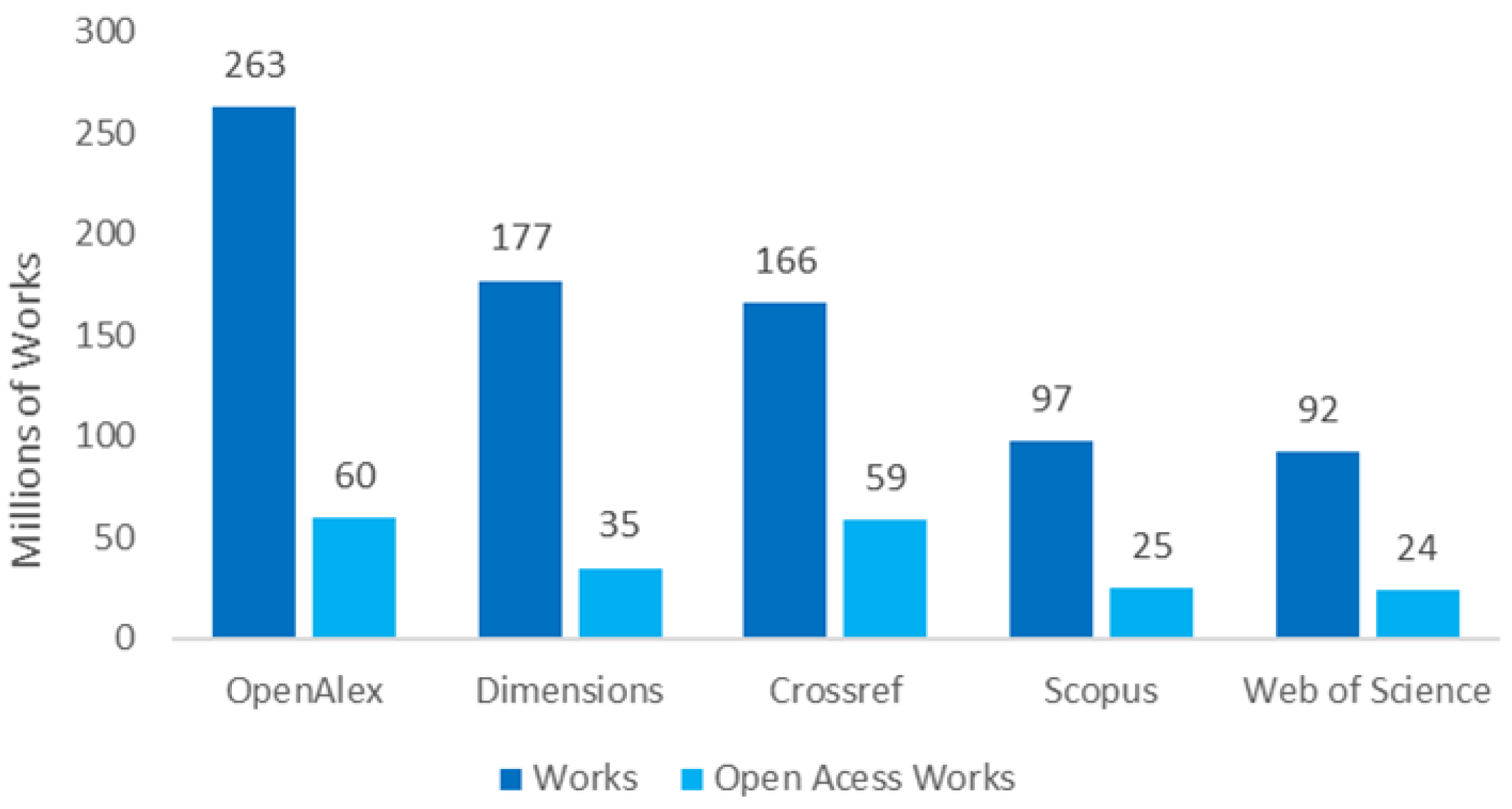
Figure 2.
PRISMA 2020 flow diagram (source: own based on [10]).
Figure 2.
PRISMA 2020 flow diagram (source: own based on [10]).
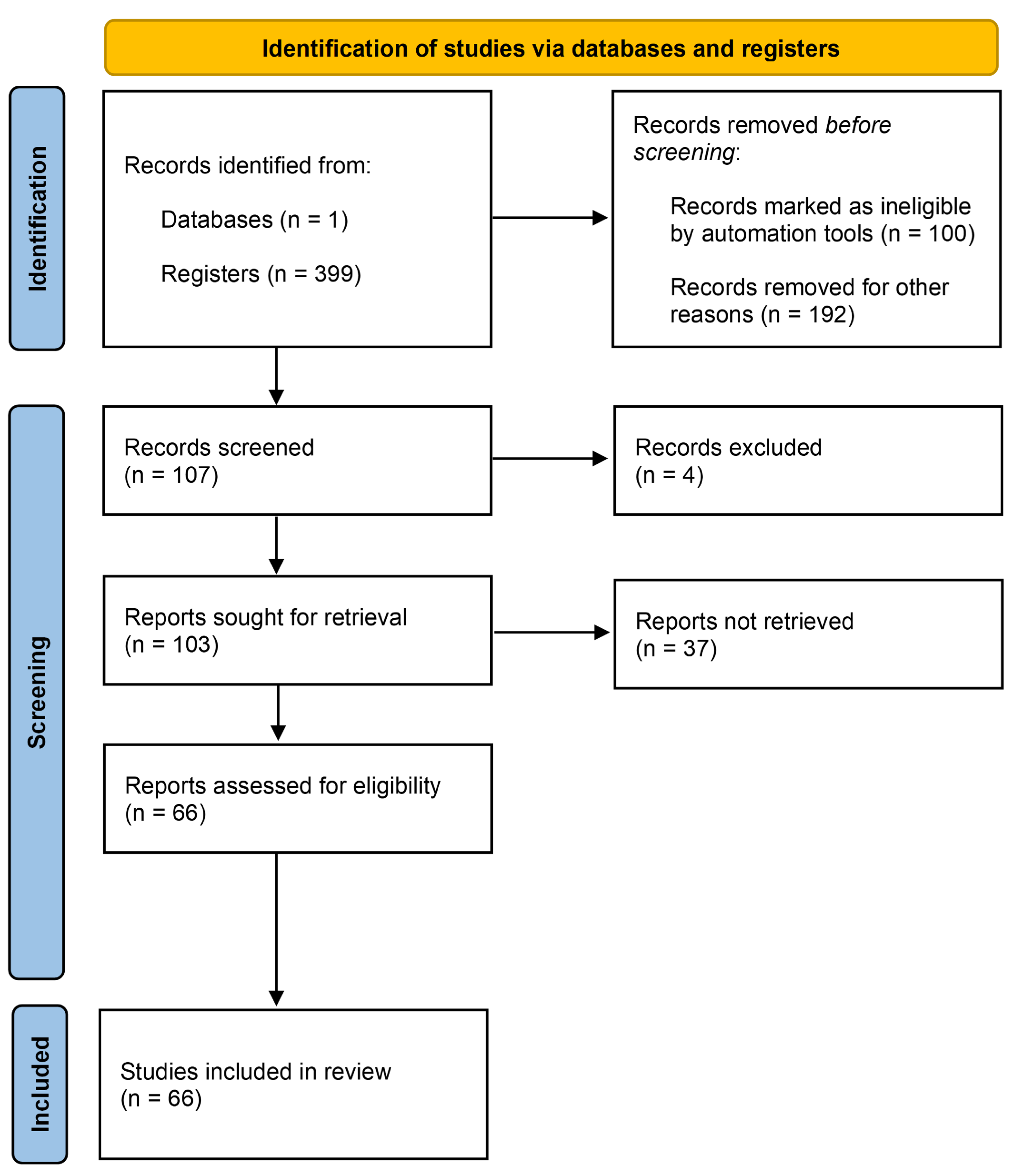
Figure 3.
Network of all keywords from Raimundo, Baltazar, and Cruz (2023) [2].
Figure 3.
Network of all keywords from Raimundo, Baltazar, and Cruz (2023) [2].
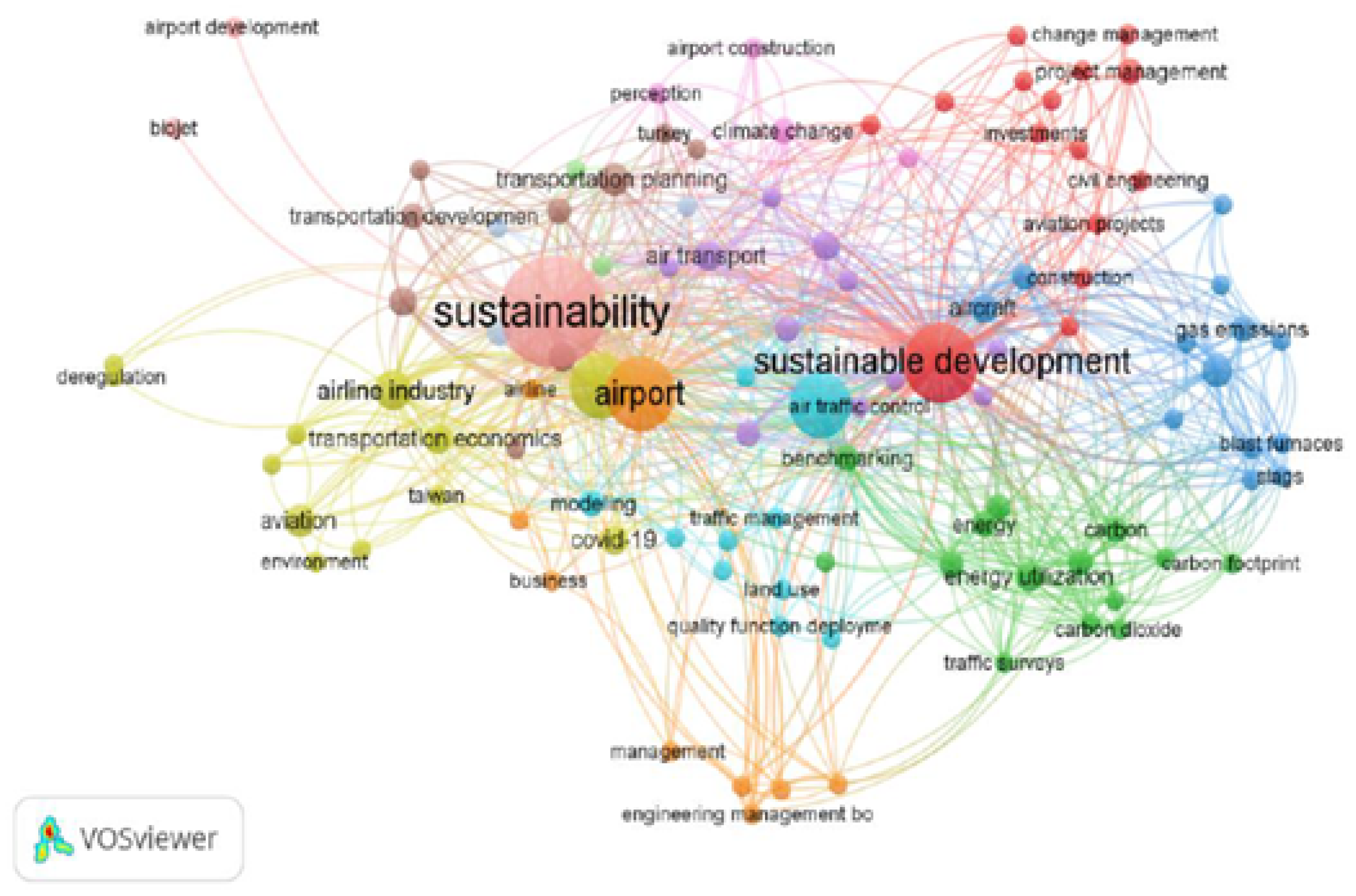
Figure 4.
Network of co-occurrence of keywords (source: own elaboration via VOSviewer).
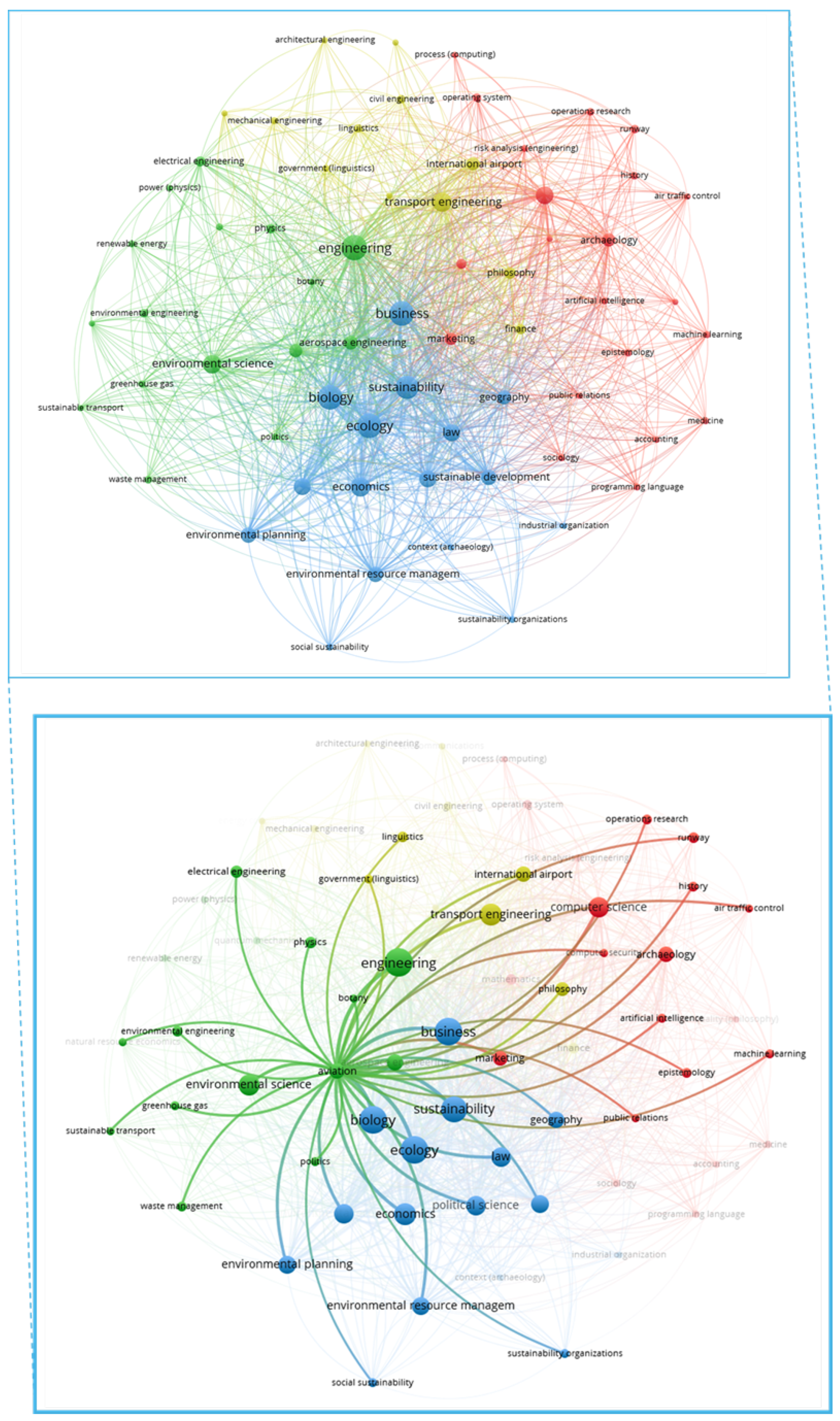

Table 1.
Methodology used in the systematic literature review (source: own based on [11]).
Table 1.
Methodology used in the systematic literature review (source: own based on [11]).
| Step | Task | Main outcome |
|---|---|---|
| Step 1 | Research question | Inclusion criteria |
| Step 2 | Search definition | Search string |
| Step 3 | Database selection | Selected database |
| Step 4 | Data screening | Raw dataset |
| Step 5 | Data cleaning and export | Refined dataset |
| Step 6 | Bibliometric approach | Preliminary bibliometric analysis |
| Step 7 | Analysis of clusters | Graphical representation |
| Step 8 | Sample selection | Ordered dataset |
| Step 9 | Systematic literature review | Holistic analysis |
| Step 10 | Theoretical contribution | Research agenda |
Table 2.
Case studies and main methods used in the publications on air pollution (source: own based on [13,14,15,16,17,18,19] - according to the order below).
| Case study | Main methods |
|---|---|
| Oslo (Norway) | Instrumental qualitative case study research design through document analysis |
| Memphis (USA) | Stackelberg leader-follower model that accounts for economic interaction between SAF processor and feedstock producers |
| Hautes-Pyrenees (France) | Model based on a multi-objective optimization framework designed to consider four levels: energy sources, hydrogen production, transport and storage |
| Canada | Statistical analysis of 10-year data of PM2.5 and selected emitted co-pollutants (CO, NOx, and O3) |
| Manchester (UK) | Evaluation of three technological innovations that will enable sustainable transport solutions for surface access and of the role of behavioral change from a theoretical perspective, using empirical data |
| Purdue (USA) | Evaluation of impacts of automated mowing |
| Italy | Simulation of the benefits, both environmental and monetary effects, obtained by using the TaxiBot system |
Table 3.
Case studies and main methods used in the publications on airport building (source: own based on [20,21,22,23,24,25,26] - according to the order below).
| Case study | Main methods |
|---|---|
| Baghdad (Iraq) | Building Information Modelling (BIM) technology and the associated programs (such as Autodesk Revit 2021 and Autodesk Insight 360) in order to determine optimal strategies |
| Turkyie | Airport benchmarking |
| Not applicable | Critical review of the feasibility of selected sustainable development goals through solutions in the field of environmental engineering. Then, an analysis of their application at airports was carried out |
| Barcelona (Spain) | Sustainable analysis of different concrete and reinforcement configurations for segmental linings of TBM tunnels via MIVES method (a multi-criteria decision making approach for assessing sustainability) |
| Xuancheng (China) | Designed and adopted the LCA (Life Cycle Assessment) - Emergy - ANN (Artificial Neural Network) framework to assess and analyze an airport building system for sustainability |
| Not identified | Analyzed and assessed thermal-cooling loads within an airport building using Panasonic software |
| Istanbul (Turkyie) | Building Information Modeling (BIM) for energy analysis. A heuristic optimization incentivizes transforming BIM to Building Energy Modeling (BEM) for decision-making processes of retrofitting |
Table 4.
Case studies and main methods used in the publications on airport building (source: own based on [27]).
Table 4.
Case studies and main methods used in the publications on airport building (source: own based on [27]).
| Case study | Main methods |
|---|---|
| Not applicable | Community-oriented approach to the multi-objective optimisation of sustainable takeoff and landing for commercial aircrafts. The objective functions are defined as the measure of area surrounding the airport where the Sound Exposure Level (SEL) is higher than 60 dBA, and the amount of fuel burned during the procedure |
Table 5.
Case studies and main methods used in the publications on airport building (source: own based on [28,29,30,31,32,33,34,35,36] - according to the order below).
| Case study | Main methods |
|---|---|
| Murcia (Spain) | Raptor’s “Right Hunger” Characterization |
| Italy | Recommendation system to enhance sustainable risk management in airport operations, with a special focus on Occupational Stress Risks (OSRs), via Python code and Fuzzy Cognitive Maps (FCMs) |
| Doha (Qatar) | Multi-objective integrated optimisation problem incorporating the newly proposed Active Routing concept. A holistic economic optimisation framework is also included from a Pareto front |
| Graz (Austria) | Transform spatial complexity in the airport environment into a sustainably integrated spatial development for city, region and neighbouring communities into SmartAIRea |
| Campinas (Brazil) | Development of a concept with design guidelines that establish a balance between the logistics activities and the environmental constraints on business viability |
| Slovakia | Educational information model and software for an airport network and information systems risk assessment. The solution is based on the application of the fuzzy logic method |
| Not identified | A calculation tool in Microsoft Excel was implemented to assess the capacity and dimension of the facilities for each functional subsystem of an airport terminal |
| USA | Calculation model to assess runway capacity, calibrated by comparing outputs of different airport configurations with the circular of the Federal Aviation Administration Airport Capacity and Delay |
| Spain | Methodology to calculate the technical efficiency level of airports based on non-parametric DEA (Data Envelopment Analysis) models |
Table 6.
Case studies and main methods used in the publications on airport building (source: own based on [37,38,39,40,41,42] - according to the order below).
| Case study | Main methods |
|---|---|
| Lisbon (Portugal) | Questionnaire surveys to airport employees, with a quantitative analysis and testing the efficiency of the proposed measures to improve sustainability practices in business management and daily routines |
| Iran | Partial Least Squares Structural Equation Modelling (PLS-SEM) is used for analysing data and testing hypotheses |
| Poland | An innovative extension of the Data Envelopment Analysis (DEA) method using methods from spatial econometrics and artificial intelligence |
| Not identified | Defines the role of retail, before considering the carbon consequences of business models. Analysis of products that increase aircraft weight and fuel burn and are sources of emissions for duty-free retailers |
| Indonesia | Analyses the correlation between airport sustainability and local government budget in Indonesia. The method used in this research is mixed method research |
| China | Explores the competition between airports in a multi-airport region based on route level and its impact on passenger airport choice using three liner models |
Table 7.
Case studies and main methods used in the publications on airport building (source: own based on [43,44,45,46,47,48,49,50,51] - according to the order below).
| Case study | Main methods |
|---|---|
| Europe | The aim was to determine if airports apply the integrated reporting IR framework to their annual sustainability communications with stakeholders |
| Europe | Indicator system that consists of indicators and their measures reflecting the airport operational, economic, social, and environmental dimension of performances |
| Europe | Assessment tool for airport strategic plans and environmental reports, addressing how to promote sustainability. Methodology based on a comparative analysis between airports and regulatory authorities |
| Baiyun (China) | Synthetic evaluation index model of airport sustainability (AS) constructed based on the benefit of the doubt (BoD) model |
| Worldwide | Assessment tool for airport strategic plans based on a comparative analysis between airports and regulatory authorities. Sustainability in the airport ecosystem depicted with a systemic approach |
| Not applicable | Investigation of Airport Sustainability Awareness (ASA) through knowledge, attitudes and behavior of airport sustainability practices, based on a systematic literature review and bibliometric analysis |
| Mediterranean Islands | In-depth assessment of the environmental sustainability performance of airports based on the identification of evidence about key management performance aspects in environmental reports |
| Not applicable | Comprehensive review of 33 academic articles specific to airport sustainability, to delve into a detailed analysis of 16 papers that implement specific methodologies |
| Multiple | Combining the optimization-based frontier approach with the Global Report Initiative’s comprehensive sustainability database. Eco-efficiency analysis carried out with four input-oriented models |
Table 8.
Case studies and main methods used in the publications on balancing growth and sustainability (source: own based on [52,53,54] - according to the order below).
| Case study | Main methods |
|---|---|
| Europe | "How to reconcile the conflicting objectives of air transport liberalisation and environmental sustainability?" - assessment of the the current strategy in light of recent capacity status of airports |
| Amsterdam (The Netherlands) | Conceptual framework building on complexity theory to shed light on the balance between growth and sustainability. Application of the framework to recommend ways forward to broaden the debate about the sustainable development of airports |
| Italy | DEA (Data Envelopment Analysis) method to investigate how a number of factors impact on the efficiency and economic sustainability of regional airports |
Table 9.
Case studies and main methods used in the publications on best practices and literature review (source: own based on [2,55,56] - according to the order below).
| Case study | Main methods |
|---|---|
| Naples (Italy) | Identification of best practices for sustainable growth |
| Not applicable | Summarises the current state of airport environmental sustainability practices through a systematic literature review using PRISMA (Preferred Reporting Items for Systematic Reviews and Meta-Analyses) |
| United Kingdom | Drawing on specific examples, examines the ways in which airports have responded to the challenge of reducing the environmental impacts of operations for which they are directly responsible |
Table 10.
Case studies and main methods used in the publications on airport building (source: own based on [25,26,57,58,59,60,61] - according to the order below).
| Case study | Main methods |
|---|---|
| Not identified | Analyzed and assessed thermal-cooling loads within an airport building using Panasonic software |
| Istanbul (Turkyie) | Building Information Modeling (BIM) for energy analysis. A heuristic optimization incentivizes transforming BIM to Building Energy Modeling (BEM) for decision-making processes of retrofitting |
| London (UK) | In-depth longitudinal research design |
| Oslo (Norway) | In-depth longitudinal research design |
| Greece | Theoretical approach complemented with an analysis of the main environmental and energy achievements of different airports |
| Copenhagen (Denmark) | Exploratory qualitative and quantitative case study research approach to empirically examine sustainable airport energy management practices and energy-saving initiatives |
| Adriatic Region | Benchmarks where the most plausible predictive variables were selected according to literature. Stepwise linear regression method was used to select significant predictive variables |
Table 11.
Case studies and main methods used in the publications on runway maintenance (source: own based on [62,63,64] - according to the order below).
| Case study | Main methods |
|---|---|
| Maribor (Slovenia) | Comparison between five different approaches to modelling runway evenness: approximation with regression plane, inverse distance weighted interpolation (IWD) and interpolation based on a triangulated irregular network (TIN)–linear and cubic |
| Not applicable | General depiction of the major sustainability appraisal tools, namely cost-benefit analysis, life-cycle cost analysis, life-cycle assessment, multi-criteria decision-making, environmental impact assessment and social life-cycle assessment |
| Maribor (Slovenia) | Geodetic survey and management information system prototype, which enables evaluating results and suggesting the runway maintenance measures |
Table 12.
Case studies and main methods used in the publications on terminal management (source: own based on [65,66,67,68,69] - according to the order below).
| Case study | Main methods |
|---|---|
| Gdansk (Poland) | Passenger survey on travel choices regarding commuting to airport |
| Bologna (Italy) | A one-month monitoring was performed on Indoor air quality (IAQ). Four strategic areas were equipped with electronic monitoring platforms, with different contaminants and two microclimatic sensors |
| Chicago (USA) | Monte Carlo method to design the queuing network for sustainable development. A network diagram is used to determine the critical working point and design a functionally sustainable network |
| Korea | Survey data from 339 airport users with a support vector machine (SVM) model to classify resistance causes correctly and csQCA (crisp set Qualitative Comparative Analysis) to understand causes |
| Korea | Based on 327 survey responses, complemented with the use of Structural Equation Models (SEM) to extract first- and second-order constructs |
Table 13.
Case studies and main methods used in the publications on waste management (source: own based on [70,71,72,73] - according to the order below).
| Case study | Main methods |
|---|---|
| Bucharest (Romania) | Analytical assessment of an airport flight schedule and a series of data from a handling company, presenting the ADF/AAF (aircraft de-icing fluids/aircraft anti-icing fluids) quantities resulting from different weather conditions |
| Hong Kong (China) | Life-Cycle Cost-Benefit Analysis (LC-CBA) framework, with integration of the life-cycle assessment (LCA) and cost-benefit analysis (CBA), to guide decision-making in sustainable waste management |
| Kansai (Japan) | In-depth case study research design. The qualitative data gathered for the study were analysed using document analysis. The quantitative data were analysed using t-tests |
| Copenhagen (Denmark) | Qualitative and quantitative case study research approach to examine waste management strategies and systems |
Table 14.
Case studies and main methods used in the publications on water management (source: own based on [61,74,75,76,77] - according to the order below).
| Case study | Main methods |
|---|---|
| Hong Kong (China) | In-depth longitudinal research design |
| Mildura (Australia) | Determine the potential water harvesting capability of airports with processing of satellite imagery, combined with the image processing functionalities of Matlab, and some basic mathematics |
| Kansai (Japan) | Exploratory research to examine sustainable water management strategies and systems. Qualitative data from document analysis and quantitative used for regression analysis on a longitudinal study |
| Copenhagen (Denmark) | Longitudinal qualitative research design to analyse annual water consumption at an airport |
| Adriatic Region | Benchmarks where the most plausible predictive variables were selected according to literature. Stepwise linear regression method was used to select significant predictive variables |
Disclaimer/Publisher’s Note: The statements, opinions and data contained in all publications are solely those of the individual author(s) and contributor(s) and not of MDPI and/or the editor(s). MDPI and/or the editor(s) disclaim responsibility for any injury to people or property resulting from any ideas, methods, instructions or products referred to in the content. |
© 2025 by the authors. Licensee MDPI, Basel, Switzerland. This article is an open access article distributed under the terms and conditions of the Creative Commons Attribution (CC BY) license (http://creativecommons.org/licenses/by/4.0/).
Copyright: This open access article is published under a Creative Commons CC BY 4.0 license, which permit the free download, distribution, and reuse, provided that the author and preprint are cited in any reuse.


