

Submitted:
24 March 2025
Posted:
25 March 2025
You are already at the latest version
Abstract
The integration of Artificial Intelligence (AI), Internet of Things (IoT), edge computing, and satellite-based connectivity is revolutionizing modern agriculture by enabling real-time monitoring, data-driven decision-making, and optimized resource management. The AGRARIAN architecture presents a hybrid AI-driven framework designed to enhance precision farming, livestock management, and sustainable agriculture. The system integrates multispectral sensors, UAVs, remote sensing satellites, and ground-based IoT devices, leveraging 5G and satellite networks for seamless connectivity. Data collected from these sources is processed through edge AI and cloud-based analytics, feeding into an Advanced Decision Support System (ADSS) that provides real-time insights for farmers, policymakers, and researchers. This paper presents the AGRARIAN system architecture, detailing its sensor, network, data processing, and application layers, alongside its horizontal and vertical integration approaches. Comparative analysis with existing digital agriculture frameworks highlights AGRARIAN’s scalability, resilience, and efficiency in supporting smart farming practices. The findings suggest that hybrid AI-driven agricultural systems have the potential to improve crop yield predictions, irrigation efficiency, and disease prevention, offering sustainable and scalable solutions for modern agriculture.
Keywords:
Smart Agriculture
; AI-Driven Decision Support Systems
; Precision Farming
1. Introduction
The global agricultural sector is undergoing a fundamental transformation, driven by rapid advancements in digital technologies, artificial intelligence (AI), and the Internet of Things (IoT). These innovations are reshaping traditional farming methods, optimizing resource efficiency, productivity, and sustainability in response to increasing food demand and climate change challenges. The European Commission has emphasized that digitalization in agriculture is a critical component for improving competitiveness, fostering sustainable practices, and ensuring food security in the European Union (EU) and beyond [1].
Modern agricultural systems are increasingly relying on connected infrastructures, including smart sensors, AI-driven decision-making tools, and cloud-based agricultural platforms, to enhance real-time monitoring, automated farm management, and precision agriculture techniques. This transition aligns with the Agriculture 4.0 paradigm, which integrates big data analytics, robotics, and advanced network communication protocols to optimize agricultural operations [2].
The Common Agricultural Policy (CAP) has been a cornerstone of the EU’s agricultural strategy, focusing on sustainability, productivity, and the socio-economic well-being of farmers [3]. Recent CAP Strategic Plans for 2023–2027 emphasize the role of digital tools, AI, and IoT in improving decision-making for farmers while promoting climate-resilient agricultural practices [4]. Additionally, EU-backed initiatives on smart farming provide targeted support for the adoption of cloud computing, AI-driven analytics, and blockchain technologies to ensure traceable, transparent, and efficient agricultural supply chains [5]. Despite the potential benefits of precision farming technologies, many farmers still face economic and technical barriers to adoption. According to Eurostat, agricultural labor input in the EU has continued to decline, highlighting the need for automation and smart agricultural solutions to compensate for workforce shortages [6].
Driven by the challenges of climate change, resource constraints, and the growing demand for sustainable food production, the AGRARIAN architecture introduces a hybrid AI-driven framework that seamlessly integrates IoT sensors, UAVs, satellite-based remote sensing, edge computing, and AI-powered decision support systems (DSS) to transform precision farming, livestock management, and agricultural sustainability. Unlike conventional systems reliant on centralized cloud processing, AGRARIAN decentralizes data analysis through edge AI and federated learning, significantly reducing latency, bandwidth consumption, and dependency on continuous connectivity. Its four-layered structure—Sensor, Network, Data Processing, and Application Layers—ensures a scalable and modular system, where multimodal sensors capture real-time environmental, soil, and livestock data, processed through AI-driven analytics at the edge or in the cloud.
The structure of this paper is organized as follows: Section 2 presents an overview of related technologies, focusing on IoT-based irrigation systems, AI-driven crop protection, decision support systems (DSS), and satellite-enabled precision agriculture. Section 3 introduces the AGRARIAN system architecture, detailing its horizontal and vertical architectural models, along with the integration of edge computing, hybrid networking, and cloud-based AI analytics, an in-depth analysis of the four-layered structure of AGRARIAN, comprising the sensor, network, data processing, and application layers, describing their role, interaction, and impact on smart agriculture. Finally, Section 4 concludes with key findings, potential limitations, and future research directions in hybrid AI-driven agricultural frameworks.
2. Related Technologies
The integration of Internet of Things (IoT) devices and 5G networks is transforming smart irrigation management by enabling real-time monitoring and automated water control. IoT-based sensors, combined with cloud-based decision support systems (DSS), allow precise irrigation scheduling based on soil moisture levels, weather conditions, and crop water demand. The use of 5G connectivity enhances data transmission speed, ensuring low-latency, AI-powered water management solutions that contribute to efficient water resource allocation and climate resilience [9]. Beyond irrigation, DSS also play a critical role in agrarian policy-making and economic planning, as seen in Ukraine, where data-driven accounting tools are used to align agricultural strategies with European integration frameworks. These systems analyze farm productivity metrics, subsidy allocations, and rural development trends to optimize policy interventions [10].
AI-based decision support technologies are also reshaping crop protection and disease management. Modern deep learning models, when combined with satellite imagery and IoT sensors, enable real-time disease prediction and early detection, reducing the dependency on excessive pesticide use. AI-driven DSS can process historical weather data, pathogen distribution models, and soil health indicators to provide targeted, proactive recommendations for farmers [11]. Satellite technology, particularly CubeSats and GIS-based remote sensing, is revolutionizing precision agriculture by offering high-resolution environmental monitoring. These small satellites provide frequent, real-time imaging, allowing farmers to track crop health, soil moisture levels, and land-use changes, which are then integrated into DSS platforms to facilitate data-driven decision-making for sustainable farming [12].
Water management in agriculture remains a pressing challenge, and DSS frameworks are being developed to guide groundwater resource allocation, especially in drought-prone regions. AI-powered decision tools enable multi-stakeholder collaboration, integrating hydrological models, water demand forecasting, and climate impact assessments to ensure sustainable irrigation practices [13]. In precision livestock farming, AI-driven DSS are being deployed to monitor animal welfare, detect diseases, and optimize feed efficiency. Machine vision, biometric sensors, and predictive analytics allow for real-time tracking of livestock health, reducing operational costs and improving farm productivity [14]. These advancements are not only enhancing individual farm operations but are also influencing renewable energy production in agriculture. DSS frameworks are now used for biogas facility planning, optimizing locations based on geospatial data, waste production metrics, and sustainability indicators. This application supports circular bioeconomy models, where agricultural waste is converted into biofuels and organic fertilizers, reducing carbon footprints and environmental impact [15].
Decision support technologies also play a crucial role in circular bioeconomy strategies, ensuring efficient resource recycling and sustainable food production systems. AI-powered DSS facilitate agricultural waste management by optimizing the bioconversion of crop residues into bioenergy and minimizing resource wastage [16]. Recent developments in digital agriculture and AI-driven decision systems show that fine-tuned natural language processing (NLP) models outperform traditional chatbot-based farm management solutions. These AI-powered DSS provide context-aware recommendations for crop management, pest control, and supply chain logistics, improving farm productivity and sustainability [17]. Additionally, digital technologies are increasingly being commercialized for nature conservation and ecosystem service provisioning in agriculture. By integrating remote sensing, AI-based environmental modeling, and cloud-based analytics, these tools help farmers balance economic profitability with ecological preservation, ensuring that agriculture remains both productive and environmentally responsible [18].
As agriculture continues to evolve towards a data-driven, digitally connected ecosystem, the integration of AI, IoT, and DSS technologies is becoming essential. From smart irrigation management and CubeSat-based environmental monitoring to precision livestock farming and biogas facility optimization, DSS are empowering farmers and policymakers with real-time insights for sustainable decision-making. The convergence of edge computing, cloud-based AI analytics, and stakeholder collaboration is paving the way for a resilient, efficient, and sustainable agricultural future.
Enhancing digital infrastructure and hybrid communication technologies is therefore a key priority in ensuring widespread accessibility to smart farming solutions across Europe.
While digital agriculture offers significant opportunities for growth and sustainability, several challenges must be addressed:
- Connectivity Gaps: Many rural farming areas suffer from limited broadband access, restricting the adoption of real-time IoT monitoring and AI-driven decision systems [19].
- Interoperability Issues: The diverse range of agricultural IoT devices, cloud platforms, and AI models creates integration challenges, requiring standardized data exchange protocols [20].
Scalability and Computational Demand: AI-driven edge computing is increasingly being explored to reduce the burden on cloud infrastructure, enabling localized, real-time data processing for smart agriculture [23].
To address these challenges, next-generation networking protocols such as Recursive InterNetwork Architecture (RINA) are being explored to replace traditional IP-based architectures, improving network scalability, data security, and real-time processing capabilities for large-scale agricultural IoT systems [24].
A critical technological enabler for precision farming is edge computing, which facilitates real-time data analysis at the farm level without the need for continuous cloud connectivity [23]. By deploying localized AI models on edge devices, UAVs (drones), and satellite nodes, latency is minimized, bandwidth consumption is reduced, and real-time decision-making is enhanced. Recent studies suggest that federated learning and AI-driven edge computing can significantly improve agricultural supply chain efficiency, reducing costs and optimizing farm management strategies [23].
3. AGRARIAN Architecture
The AGRARIAN architecture is designed to provide a robust, scalable, and intelligent agricultural technology ecosystem, integrating sensor networks, AI-driven decision support, hybrid communication networks, and cloud-based analytics. This system is structured into multiple layers to ensure seamless functionality, interoperability, and efficient data flow between different components. The architecture is conceptualized through two complementary views: the horizontal and vertical architectures, each detailing the organization of system elements and their interactions.
Figure 1.
AGRARIAN high level approach.
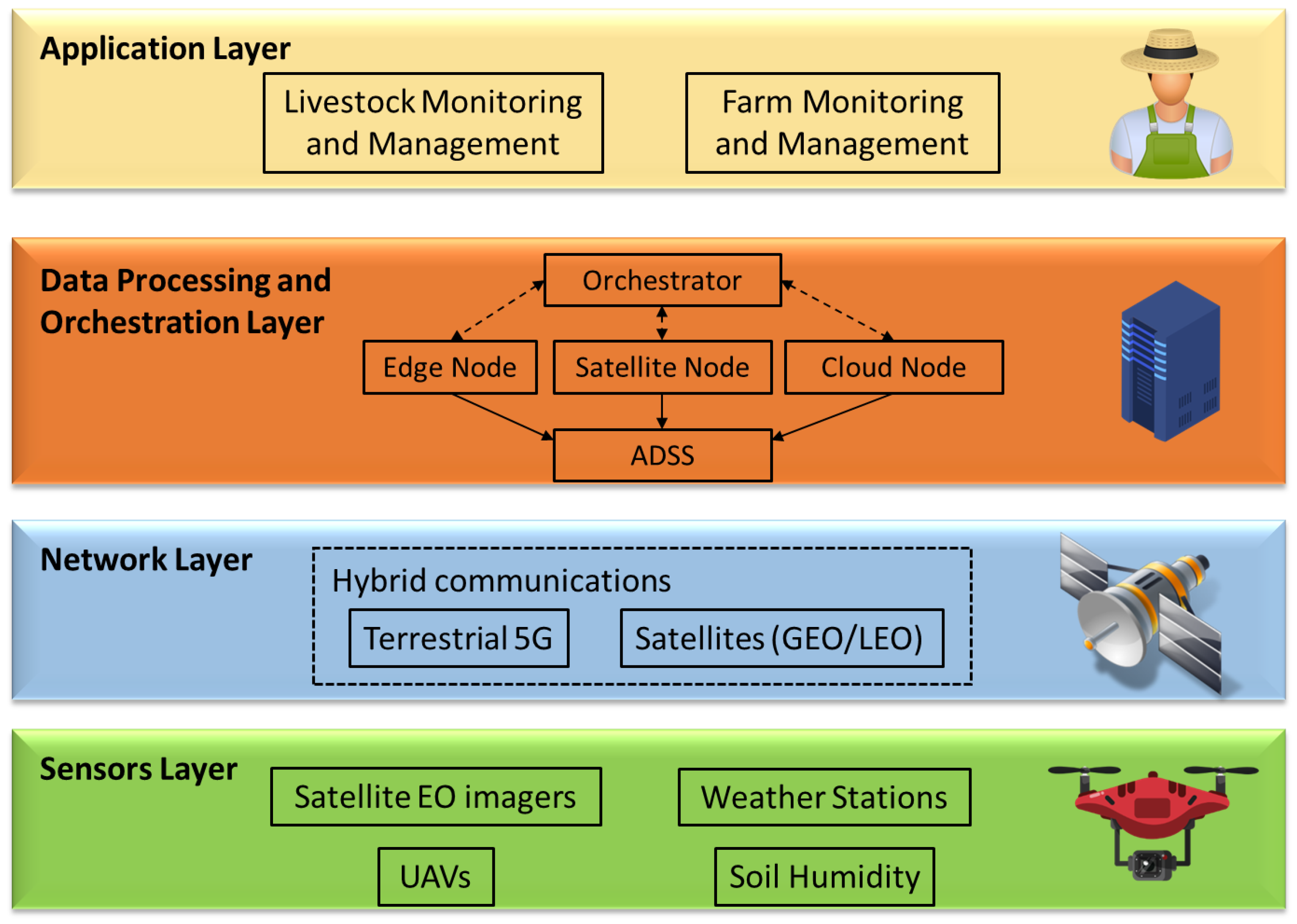
The AGRARIAN architecture is designed to support precision farming, livestock monitoring, vineyard management, and environmental sustainability. It is composed of multiple interconnected layers that facilitate sensor data acquisition, edge computing, satellite communications, and AI-driven analytics. The horizontal architecture provides an end-to-end view of how different components interact, while the vertical architecture focuses on the service-oriented structure of the system. The horizontal architecture emphasizes the interaction between the customer portal, decision support systems (ADSS), infrastructure, and external data sources. The vertical architecture, on the other hand, categorizes these functionalities into four major layers: Sensor Layer, Network Layer, Data Processing Layer, and Application Layer.
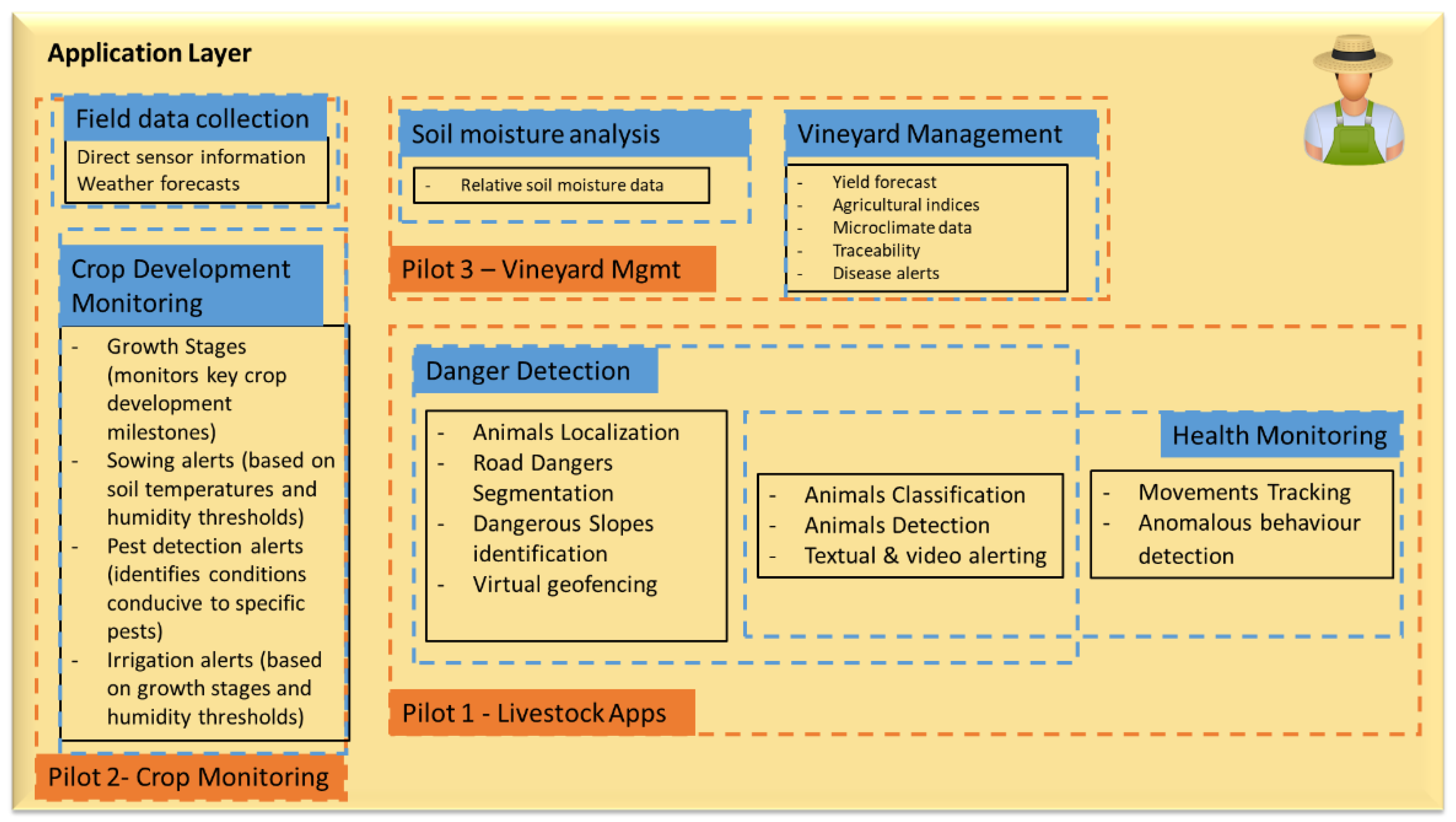
Application Layer
The Application Layer provides user-facing tools that allow farmers, policymakers, and researchers to interact with the AGRARIAN system, offering AI-powered agricultural insights, decision support, and precision farming applications.
- Agricultural Decision Support System (ADSS): Analyzes sensor, satellite, and UAV data to provide actionable insights on crop health, livestock management, and irrigation scheduling.
- Livestock Monitoring & Anomaly Detection: Uses AI-driven video analytics and GPS tracking to identify anomalous animal behavior, potential health risks, and missing livestock.
- Crop Growth & Yield Forecasting: Predicts crop productivity, pest risks, and optimal harvesting times based on machine learning algorithms and real-time environmental data.
- Smart Irrigation & Water Management: Uses soil moisture analytics, weather forecasts, and AI-based optimization to ensure efficient water usage and minimize waste.
- Disease & Pest Alert Systems: AI models process multispectral and SAR data to predict disease outbreaks and recommend timely interventions.
- Supply Chain Traceability & Food Safety: Blockchain-enabled traceability solutions ensure transparent farm-to-market logistics, improving food safety and regulatory compliance.
By integrating advanced analytics, real-time alerts, and predictive modeling, this layer empowers users with intelligent decision-making tools for sustainable and efficient farming.
Figure 2.
Application layer.
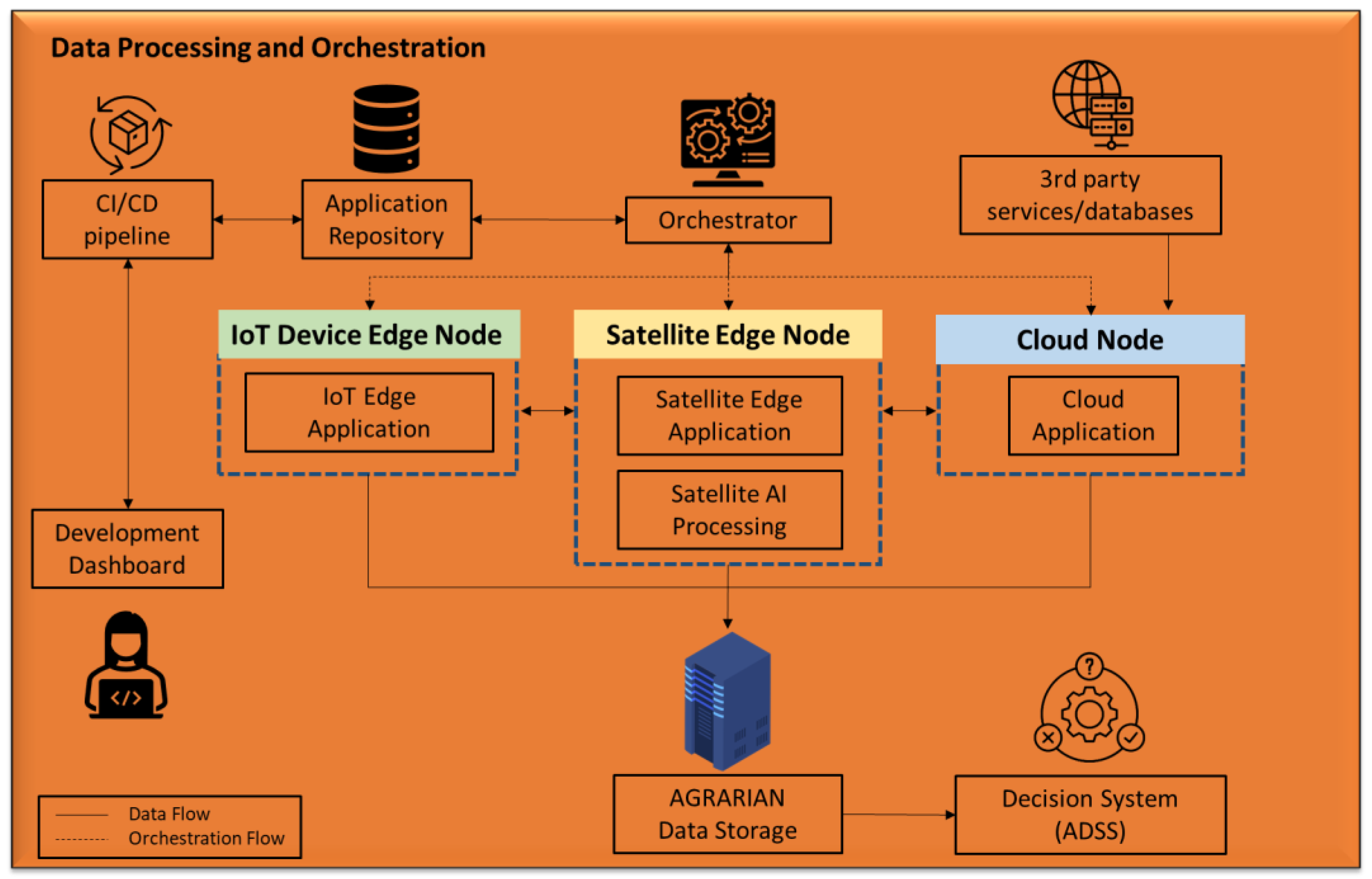
Data Processing and Orchestration Layer
The Data Processing Layer acts as the computational hub of the AGRARIAN system, processing, analyzing, and distributing agricultural data across the network. This layer leverages edge computing, cloud processing, and AI-based analytics to extract meaningful insights from raw sensor data.
- Edge AI and Federated Learning: Distributed AI models are deployed on satellites, UAVs, and farm-based edge nodes, allowing real-time inference for disease detection, irrigation control, and crop monitoring.
- CI/CD Pipelines for AI Model Deployment: Continuous integration and deployment pipelines ensure real-time AI model updates for improved analytics and decision-making.
- Cloud-Native Orchestration (Kubernetes, KubeEdge, and K3s): Supports scalable, fault-tolerant, and distributed AI computing for precision farming applications.
- Satellite AI Processing: Enables onboard AI inference on CubeSats, reducing latency and bandwidth consumption while providing actionable insights directly from space-based monitoring.
- Data Storage and Integration with External Sources: Ensures secure, efficient storage and retrieval of environmental, livestock, and field data, integrating external climate databases, weather APIs, and agricultural knowledge repositories.
By leveraging advanced AI and edge computing technologies, this layer enhances decision-making efficiency and scalability.
Figure 3.
Data Processing and Orchestration layer.
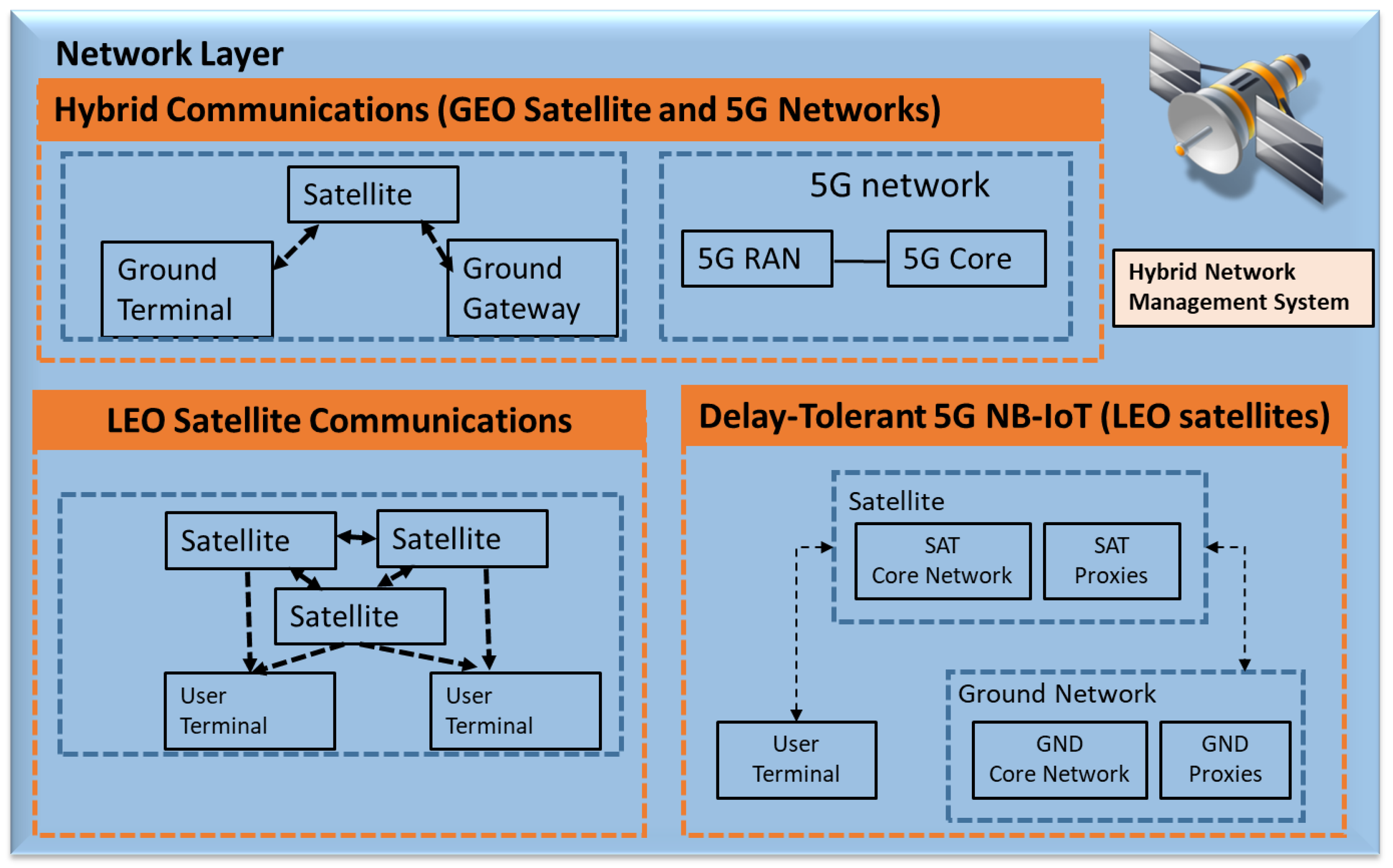
Network Layer
The Network Layer enables seamless connectivity across all AGRARIAN components, ensuring reliable communication between sensors, computing nodes, and cloud-based systems. It integrates terrestrial and satellite communication networks to provide uninterrupted connectivity in remote agricultural areas.
- 5G-Based Communication: Provides high-speed, low-latency connectivity for real-time sensor data transmission and remote farm monitoring.
- Hybrid Satellite Communications (LEO & GEO): LEO satellites facilitate low-latency broadband access, while GEO satellites provide continuous global coverage.
- Edge Network Infrastructure: Supports real-time AI model deployment and inference at the farm level, reducing dependency on centralized cloud computing.
- Delay-Tolerant Networking (DTN) and IoT Protocols: Allow efficient data transmission in rural and disconnected environments, ensuring that time-sensitive agricultural data is not lost.
- Ground Network Infrastructure: Includes 5G base stations, ground terminals, and IoT gateways, allowing seamless integration of AGRARIAN’s sensor networks with cloud-based decision support systems.
This layer ensures uninterrupted connectivity, which is essential for real-time agricultural monitoring and automated farming solutions.
Figure 4.
Network layer.
Sensor Layer
The Sensor Layer is the foundation of the AGRARIAN system, comprising various data acquisition technologies that capture environmental, soil, and livestock data. These sensors are deployed in-situ, on UAVs, and in satellite-based observation systems, ensuring continuous real-time monitoring of agricultural parameters.
- IoT and Ground Sensors: Measure soil moisture, temperature, air humidity, and precipitation, providing critical data for precision irrigation and crop health analysis.
- UAV-Based Sensors: Equipped with multispectral cameras, RGB cameras, and real-time kinematic (RTK) sensors to provide high-resolution field images and topographical mapping.
- Weather and Climate Stations: Monitor meteorological parameters such as wind speed, temperature, solar radiation, and frost prediction, supporting weather-based agricultural decision-making.
- Satellite Earth Observation (EO) Systems: Utilize Sentinel-based multispectral imaging and Synthetic Aperture Radar (SAR) to provide wide-area, high-resolution monitoring for crop health, soil moisture levels, and yield estimation.
- Livestock Tracking Devices: Sensors embedded in wearables and drones to track animal movement, health status, and anomaly detection.
This layer ensures real-time, accurate data collection for informed decision-making within the AGRARIAN ecosystem.
Figure 5.
Sensors layer.
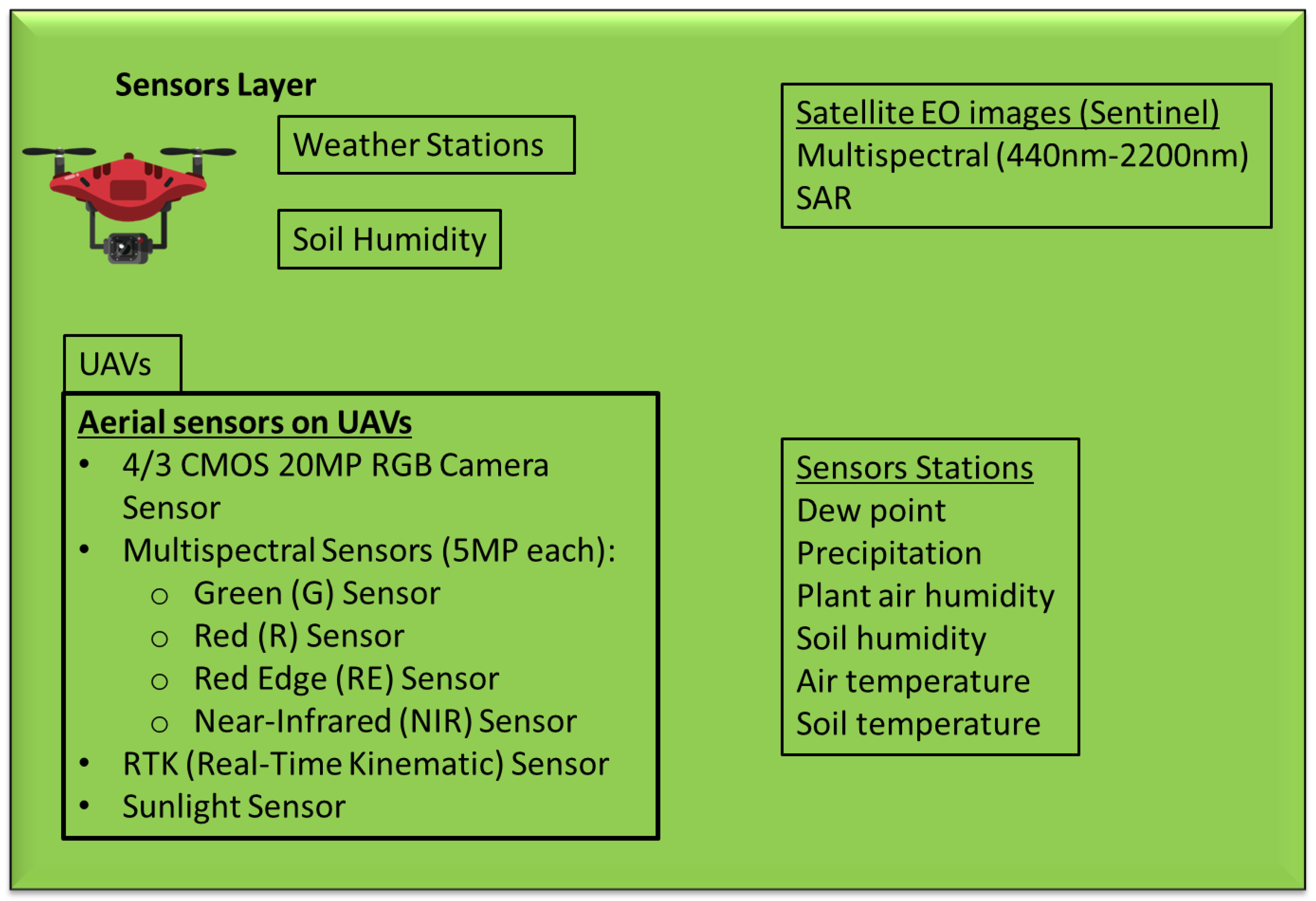
This layer ensures real-time, accurate data collection for informed decision-making within the AGRARIAN ecosystem by integrating a diverse range of sensors deployed across agricultural fields, UAVs, and satellites. Ground-based IoT sensors continuously monitor soil moisture, temperature, humidity, and nutrient levels, providing granular insights into crop health and water needs. UAV-mounted multispectral and thermal sensors capture high-resolution imagery, detecting early signs of crop stress, pest infestations, and irrigation inefficiencies. Weather and climate stations collect atmospheric data, including wind speed, solar radiation, precipitation, and frost risk, enabling microclimate analysis for precision farming. Satellite Earth Observation (EO) systems, leveraging multispectral imaging (Sentinel) and Synthetic Aperture Radar (SAR), offer wide-area crop monitoring, soil moisture assessments, and predictive yield modeling, even under cloud cover and adverse weather conditions. For livestock applications, wearable biometric sensors track movement patterns, body temperature, and feeding behavior, facilitating real-time animal health monitoring and anomaly detection. By ensuring seamless integration of these diverse sensing technologies, the AGRARIAN architecture enables data-driven, AI-enhanced decision-making, fostering sustainable resource management and improved farm productivity.
The AGRARIAN architecture leverages a diverse set of AI-driven technologies, IoT connectivity, and hybrid networking to transform modern agricultural practices. The Table 1 below highlights how different components of AGRARIAN align with key advancements in smart agriculture, mapping each technology to its impact on various domains such as precision irrigation, crop protection, livestock monitoring, and sustainable resource management. By associating AGRARIAN’s sensor, network, data processing, and application layers with emerging decision support systems (DSS), AI models, and satellite-based remote sensing, this comparison demonstrates how AGRARIAN enhances efficiency, sustainability, and productivity across the agricultural sector.
The table illustrates AGRARIAN’s role in improving precision farming by integrating IoT and 5G for irrigation, AI-based disease detection, and satellite-powered monitoring. Through real-time sensor data collection, AI-powered decision-making, and seamless connectivity, AGRARIAN enhances resource management, reduces operational costs, and promotes environmental sustainability. Key findings indicate that edge AI and federated learning enable more localized and responsive agricultural intelligence, reducing reliance on centralized cloud computing while improving latency-sensitive applications like livestock health monitoring and irrigation control. By combining AI-enhanced DSS, machine learning-driven crop management, and satellite-based remote sensing, AGRARIAN provides a scalable, modular, and resilient digital agriculture platform that supports data-driven farming, climate adaptation, and food security initiatives.
4. Conclusions
The AGRARIAN architecture represents a comprehensive, AI-driven framework for modern agriculture, integrating IoT sensors, UAVs, satellite-based Earth observation, edge computing, and hybrid communication networks to enhance precision farming and sustainable agricultural practices. By leveraging real-time data collection, AI-powered analytics, and cloud-based decision support systems (ADSS), AGRARIAN facilitates data-driven decision-making for farmers, agronomists, and policymakers, improving resource efficiency, crop yield predictions, and livestock monitoring. The horizontal and vertical architectures of AGRARIAN provide a scalable and modular system design, ensuring seamless data transmission, processing, and user accessibility. The integration of 5G, low-Earth orbit (LEO) satellite communications, and edge computing enables low-latency, real-time monitoring, addressing key challenges in rural connectivity and decentralized AI processing. Comparative analysis with existing agriculture technology frameworks highlights AGRARIAN’s enhanced decision-making capabilities, improved interoperability, and adaptability to various agricultural environments.
The findings from this study suggest that hybrid AI-driven agricultural systems have the potential to mitigate the effects of climate change, optimize water and resource management, and support sustainable food production. Future research will focus on enhancing AI model adaptability, improving federated learning approaches for distributed AI processing, and expanding AGRARIAN’s deployment across diverse farming ecosystems. Further real-world implementation and validation will be key in demonstrating the scalability, cost-effectiveness, and long-term impact of AGRARIAN on the future of precision agriculture.
Author Contributions
Conceptualization, M. Batistatos; methodology, T. deCola.; formal analysis, G. Xilouris; writing—original draft preparation, M. Batistatos and M.A. Kourtis; writing—review and editing, N. Sagias.; visualization, V. Apostolopoulou.; project administration, M. Batistatos; funding acquisition, M.A. Kourtis and V. Apostolopoulou. All authors have read and agreed to the published version of the manuscript.” Please turn to the CRediT taxonomy for the term explanation. Authorship must be limited to those who have contributed substantially to the work reported.
Funding
This research was funded by the Horizon Europe AGRARIAN project, grant number 101134128.
Institutional Review Board Statement
“Not applicable”
Data Availability Statement
We encourage all authors of articles published in MDPI journals to share their research data. In this section, please provide details regarding where data supporting reported results can be found, including links to publicly archived datasets analyzed or generated during the study. Where no new data were created, or where data is unavailable due to privacy or ethical restrictions, a statement is still required. Suggested Data Availability Statements are available in section “MDPI Research Data Policies” at https://www.mdpi.com/ethics.
Conflicts of Interest
The authors declare no conflicts of interest.
Abbreviations
The following abbreviations are used in this manuscript:
| AI | Artificial Intelligence |
| DSS | Decision Support System |
| IoT | Internet of Things |
| UAV | Unmanned Aerial Vehicle |
| LEO | Low Earth Orbit |
| GEO | Geostationary Earth Orbit |
| SAR | Synthetic Aperture Radar |
| 5G NTN | 5G Non-Terrestrial Network |
| RINA | Recursive InterNetwork Architecture |
| NETCONF | Network Configuration Protocol |
| YANG | Yet Another Next Generation |
| DTN | Delay-Tolerant Networking |
| MCDA | Multi-Criteria Decision Analysis |
| GIS | Geographic Information System |
| EO | Earth Observation |
References
- European Commission. The Digitalisation of the European Agricultural Sector. Available online: https://digital-strategy.ec.europa.eu/en/policies/digitalisation-agriculture (accessed on 6 September 2024).
- De Clercq, M.; Vats, A.; Biel, A. Agriculture 4.0: The Future of Farming Technology. In Proceedings of the World Government Summit, Dubai, UAE, 2018; pp. 11–13.
- European Union. Common Agricultural Policy. Available online: https://agriculture.ec.europa.eu/common-agricultural-policy_en (accessed on 6 September 2024).
- European Commission. Explore Farm Incomes in the EU, Farm Economics Overview Based on 2021 FADN Data; Brussels, Belgium, November 2023.
- European Commission. Report from the Commission to the European Parliament and the Council—Summary of CAP Strategic Plans for 2023–2027: Joint Effort and Collective Ambition; Brussels, Belgium, November 2023. Available online: https://agriculture.ec.europa.eu/document/download/6b1c933f-84ef-4b45-9171-debb88f1f757_en?filename=com-2023-707-report_en.pdf (accessed on 6 September 2024).
- Latruffe, L. Competitiveness, Productivity and Efficiency in the Agricultural and Agri-Food Sectors; OECD Food, Agriculture and Fisheries Papers, No. 30; OECD Publishing: Paris, France, August 2010. [Google Scholar] [CrossRef]
- Eurostat. Agricultural Labour Input (Annual Rate of Change, 2022–2023). Available online: https://ec.europa.eu/eurostat/statistics-explained/index.php?title=File:F4rv_Agricultural_labour_input_(%25,_annual_rate_of_change,_2022-2023).png (accessed on 6 September 2024).
- Directorate-General for Agriculture and Rural Development. Catalogue of CAP Interventions. Available online: https://agridata.ec.europa.eu/extensions/DashboardCapPlan/catalogue_interventions.html (accessed on 6 September 2024).
- Oppong, R.A. Integration of IoT-Based Sprinklers, Embedded Systems, Data, and Cloud Computing for Smart Irrigation Management. Comput. Electron. Agric. 2025. Available online: [accessed on 19 March 2025].
- Vasylishyn, S. FADNFSDN as a Tool for Accounting Information and Statistical Support of Ukraine’s State Agrarian Policy in the Context of European Integration. J. Agric. Econ. 2025. Available online: [accessed on 19 March 2025].
- Jensen, A.; Brown, P.; Groves, K.; Morshed, A. Next Generation Crop Protection: A Systematic Review of Trends in Modelling Approaches for Disease Prediction. Comput. Electron. Agric. 2025. Available online: [accessed on 19 March 2025].
- Calka, B.; Szostak, M. GIS-Based Environmental Monitoring and Analysis. Appl. Sci. 2025. Available online: [accessed on 19 March 2025].
- Firoozzare, A.; Dourandish, A.; Sabouhi, M. Group Decision-Making of Agricultural Stakeholders Towards Sustainable Groundwater Resources Management: A Case Study in North Khorasan. J. Environ. Agric. Dev. 2025. Available online: [accessed on 19 March 2025].
- Distante, D.; Albanello, C.; Zaffar, H.; Faralli, S. Artificial Intelligence Applied to Precision Livestock Farming: A Tertiary Study. Smart Agric. Syst. 2025. Available online: [accessed on 19 March 2025].
- Kaynak, T.; Gümüş, M.G. Biogas Potential Estimation and Geospatial Decision-Making: A Hybrid MCDA Approach to Optimizing Biogas Facility Locations. Environ. Dev. Sustain. 2025. Available online: [accessed on 19 March 2025].
- Nguyen, T.H.; Wang, X.; Utomo, D.; Gage, E.; Xu, B. Circular Bioeconomy and Sustainable Food Systems: What Are the Possible Mechanisms? Clean. Circ. Econ. 2025. Available online: [accessed on 19 March 2025].
- De, S.; Sanyal, D.K.; Mukherjee, I. Fine-Tuned Encoder Models with Data Augmentation Beat ChatGPT in Agricultural Named Entity Recognition and Relation Extraction. Expert Syst. Appl. 2025. Available online: [accessed on 19 March 2025].
- Krachunova, T.; Geppert, F.; Lemke, N. Digital Technologies Commercially Available in Germany in the Context of Nature Conservation and Ecosystem Service Provisioning in Agriculture. Front. Sustain. Food Syst. 2025. Available online: [accessed on 19 March 2025].
- McKeown, N.; Anderson, T.; Balakrishnan, H.; Parulkar, G.; Peterson, L.; Rexford, J.; Shenker, S.; Turner, J. OpenFlow: Enabling Innovation in Campus Networks. ACM SIGCOMM Comput. Commun. Rev. 2008, 38, 69–74. [Google Scholar] [CrossRef]
- Enns, R.; Björklund, M.; Bierman, A.; Schönwälder, J. Network Configuration Protocol (NETCONF). RFC Editor, June 2011. [CrossRef]
- Björklund, M. YANG—A Data Modeling Language for the Network Configuration Protocol (NETCONF). RFC Editor, October 2010. [CrossRef]
- Smith, J.D.M.T.D.L.K.; Grasa, E. Next Generation Protocols (NGP); An Example of a Non-IP Network Protocol Architecture Based on RINA Design Principles, 2019.
- Maffione, V.; Salvestrini, F.; Grasa, E.; Bergesio, L.; Tarzan, M. A Software Development Kit to Exploit RINA Programmability. In Proceedings of the 2016 IEEE International Conference on Communications (ICC), Kuala Lumpur, Malaysia, 22–27 May 2016; IEEE: Piscataway, NJ, USA, 2016; pp. 1–7. [Google Scholar] [CrossRef]
- He, Q.; Zhao, H.; Feng, Y.; Wang, Z.; Ning, Z.; Luo, T. Edge Computing-Oriented Smart Agricultural Supply Chain Mechanism with Auction and Fuzzy Neural Networks. J. Cloud Comput. 2024, 13, 66. [Google Scholar] [CrossRef]

| AGRARIAN Component | Author, Year, Ref. No. | How AGRARIAN Benefits the Field | Mapped AGRARIAN Layer(s) | Benefit to Agriculture |
|---|---|---|---|---|
| IoT and 5G for Smart Irrigation | Oppong, R.A. (2025) [9] | Enhances precision irrigation by leveraging real-time sensor data. | Sensor Layer, Network Layer | Enhances irrigation efficiency, prevents overwatering, and improves water conservation. |
| Decision Support Systems (DSS) for Agrarian Policy | Vasylishyn, S. (2025) [10] | Provides AI-driven policy recommendations based on real-time agricultural data. | Application Layer, Data Processing Layer | Optimizes agricultural resource allocation, policy effectiveness, and economic sustainability. |
| AI-Based Crop Protection and DSS | Jensen, A. et al. (2025) [11] | Enables early disease detection and pest management through AI-powered analytics. | Data Processing Layer, Sensor Layer | Reduces pesticide use, increases farm productivity, and enhances sustainability. |
| CubeSats for Agricultural Monitoring | Calka, B.; Szostak, M. (2025) [12] | Offers high-resolution environmental monitoring for precision farming. | Sensor Layer, Network Layer | Provides real-time insights into soil health, crop growth, and environmental conditions. |
| Smart Agriculture & DSS for Water Resource Management | Firoozzare, A. et al. (2025) [13] | Improves sustainable water resource management using AI-driven climate data. | Application Layer, Data Processing Layer | Ensures sustainable water allocation, mitigates drought impacts, and supports climate resilience. |
| AI for Precision Livestock Farming | Distante, D. et al. (2025) [14] | Enhances livestock welfare via real-time biometric monitoring and disease detection. | Sensor Layer, Data Processing Layer | Reduces livestock mortality, increases efficiency, and improves farm profitability. |
| Sustainable Agricultural Planning using DSS | Kaynak, T.; Gümüş, M.G. (2025) [15] | Supports energy-efficient agriculture through AI-driven biogas plant planning. | Application Layer, Network Layer | Supports renewable energy integration and reduces the carbon footprint in agriculture. |
| Circular Bioeconomy & DSS in Agriculture | Nguyen, T.H. et al. (2025) [16] | Facilitates circular agriculture by optimizing waste recycling. | Application Layer, Data Processing Layer | Promotes waste reduction, circular economy strategies, and resource-efficient food production. |
| Digital Agriculture & AI Decision Systems | De, S.; Sanyal, D.K.; Mukherjee, I. (2025) [17] | Improves real-time farm management with AI-enhanced automation tools. | Application Layer, Data Processing Layer | Enhances farm decision-making with AI-driven insights and real-time analytics. |
| Digital Technologies for Sustainable Agriculture | Krachunova, T. et al. (2025) [18] | Enables sustainable farming through AI-integrated remote sensing and DSS tools. | Application Layer, Sensor Layer, Network Layer | Encourages climate-smart farming through AI, IoT, and sustainable land management practices. |
Disclaimer/Publisher’s Note: The statements, opinions and data contained in all publications are solely those of the individual author(s) and contributor(s) and not of MDPI and/or the editor(s). MDPI and/or the editor(s) disclaim responsibility for any injury to people or property resulting from any ideas, methods, instructions or products referred to in the content. |
© 2025 by the authors. Licensee MDPI, Basel, Switzerland. This article is an open access article distributed under the terms and conditions of the Creative Commons Attribution (CC BY) license (http://creativecommons.org/licenses/by/4.0/).
Copyright: This open access article is published under a Creative Commons CC BY 4.0 license, which permit the free download, distribution, and reuse, provided that the author and preprint are cited in any reuse.


