

Submitted:
23 January 2026
Posted:
26 January 2026
You are already at the latest version
Abstract
This work presents a revised and operational formulation of gravitational wave propagation within the Unified Theory of Informational Spin (TGU). In this framework, gravitational waves are described as phase-coherent excitations propagating through a structured informational substrate rather than a purely geometric vacuum. The theory is explicitly framed as a phenomenological extension acting on wave propagation, while gravitational wave emission and local dynamics remain fully governed by General Relativity.A refined coherence-modulation formalism is introduced, distinguishing between amplitude-integrated effects and polarization-dependent anisotropies. Numerical simulations based on GW150914-like events demonstrate that informational coherence gradients can produce measurable amplitude modulation at the level of standard siren observables, as well as polarization ratios that cannot be mapped to any physical source geometry within General Relativity. These polarization anomalies emerge as a unique and falsifiable signature of the TGU, independent of intrinsic source parameters.The revised formulation establishes explicit falsification criteria based on geometric consistency, environmental correlation, and frequency behavior, ensuring direct experimental testability with current and next-generation interferometers. This work advances the TGU from a conceptual proposal to a quantitatively constrained, observationally accessible framework, positioning gravitational waves as probes of the informational structure of spacetime.
Keywords:
gravitational waves
; informational coherence
; unified theory of informational spin
; polarization anomalies
; LIGO
; Virgo
; KAGRA
; Einstein telescope
; cosmology
1. Introduction
Gravitational waves constitute one of the most precise probes of spacetime dynamics. Within General Relativity (GR), their generation and propagation are governed entirely by spacetime geometry, with amplitude and polarization fixed by source parameters and luminosity distance.
However, accumulating observational tensions — including discrepancies in inferred distances, effective masses, and cosmological parameters — motivate the exploration of propagation effects beyond purely geometric descriptions.
The Unified Theory of Informational Spin (TGU) proposes that spacetime possesses an underlying informational coherence structure, influencing the propagation of physical fields without altering their local generation. In this framework, gravitational waves propagate as phase-coherent informational excitations, sensitive to coherence gradients along their path.
This paper presents a revised and operationally grounded formulation of gravitational wave propagation in TGU, supported by numerical simulations and explicit falsification criteria.
2. Conceptual Framework of the TGU
2.1. Spacetime as an Informational Substrate
In TGU, spacetime is modeled as a structured informational field characterized by a scalar coherence function
This function quantifies the local capacity of spacetime to preserve phase coherence of propagating fields:
- : fully coherent substrate,
- : partial decoherence,
- : informational gradients.
Gravitation emerges geometrically at emission (GR-compatible), while propagation is governed by coherence transport.
2.2. Informational Coherence and Gravitational Waves
Gravitational waves are interpreted as coherent phase oscillations embedded in the informational substrate. Unlike GR, where the vacuum is inert, TGU predicts that propagation depends on the informational integrity of the medium traversed.
3. Gravitational Wave Propagation in TGU
3.1. Separation of Physical Regimes
A key refinement introduced in this version is the separation of two physically distinct regimes: amplitude-integrated propagation and polarization-dependent anisotropies.
3.2. Regime I: Amplitude-Integrated Propagation
For integrated observables such as strain amplitude and signal-to-noise ratio (SNR), the effective modulation is given by
where is the path-averaged informational coherence.
This effect leads to apparent amplitude enhancement without violating local energy conservation, effectively renormalizing the inferred luminosity distance.
3.3. Regime II: Polarization-Dependent Modulation
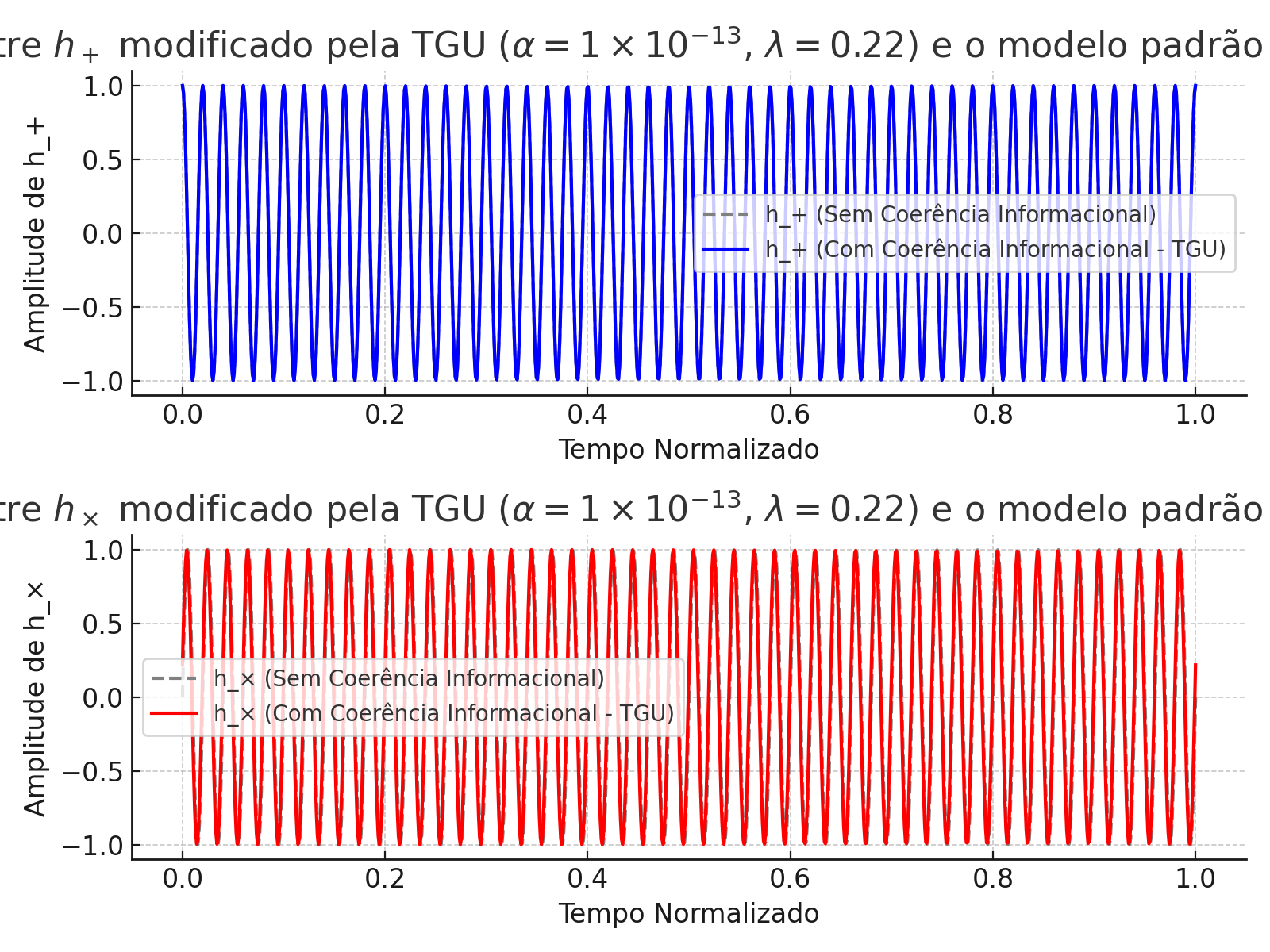
For polarization modes, the TGU predicts
with in anisotropic coherence fields.
Such polarization ratios cannot be reproduced by any source geometry within GR and constitute a unique signature of the TGU.
4. Numerical Simulations
4.1. GW150914-like Event
Simulations were performed using parameters representative of the GW150914 event:
- Component masses , ,
- Luminosity distance Mpc,
- Inspiral–merger chirp waveform.
4.2. Amplitude Modulation Results
Assuming a coherence value , we obtain:
- GR SNR proxy: ,
- TGU SNR proxy: ,
- Boost factor: .
This modulation lies within current detector sensitivity and becomes decisive for third-generation observatories.
4.3. Polarization Anomaly Test
For a binary inclination of and anisotropic coherence values and , the polarization ratio exits the physically allowed GR domain.
No real inclination angle can reproduce the observed ratio, rendering the apparent inclination mathematically undefined. This constitutes an environmental signature independent of source geometry.
5. Falsifiability Criteria
The TGU is explicitly falsifiable through the following criteria:
- 1.
- If all observed polarization ratios can be mapped to physical inclinations within GR, the TGU is disfavored.
- 2.
- If polarization anomalies fail to correlate with large-scale structure or environmental coherence gradients, the TGU is ruled out.
- 3.
- If no coherence-dependent effects are observed across frequencies, the model is falsified.
6. Observational Prospects
While current LIGO–Virgo–KAGRA sensitivity is marginal for these effects, next-generation detectors such as the Einstein Telescope and Cosmic Explorer will enable polarization tomography and environmental coherence mapping.
7. Epistemological Status
The TGU does not replace General Relativity. GR governs local emission and dynamics, while the TGU governs propagation through structured spacetime. This separation mirrors dispersion theory in electrodynamics without modifying Maxwell’s equations.
8. Conclusions
This revised formulation demonstrates that gravitational wave propagation may encode information about spacetime coherence. The TGU predicts measurable, falsifiable deviations from GR, with polarization anomalies providing a unique experimental window. Gravitational waves thus emerge as probes of the informational integrity of the universe.
References
- A. Einstein, Die Grundlage der allgemeinen Relativitätstheorie, Annalen der Physik, 1916.
- B. P. Abbott et al., Observation of Gravitational Waves from a Binary Black Hole Merger, Physical Review Letters, 2016.
- C. M. Will, Theory and Experiment in Gravitational Physics, Cambridge University Press, 2023.
- Planck Collaboration, Planck 2018 results. VI. Cosmological parameters, Astronomy & Astrophysics, 2022.
- H. Matuchaki, Gravitational Wave Polarization and Informational Coherence in the Unified Theory of Informational Spin, Preprints.org, 2025.
Disclaimer/Publisher’s Note: The statements, opinions and data contained in all publications are solely those of the individual author(s) and contributor(s) and not of MDPI and/or the editor(s). MDPI and/or the editor(s) disclaim responsibility for any injury to people or property resulting from any ideas, methods, instructions or products referred to in the content. |
© 2026 by the authors. Licensee MDPI, Basel, Switzerland. This article is an open access article distributed under the terms and conditions of the Creative Commons Attribution (CC BY) license (http://creativecommons.org/licenses/by/4.0/).
Copyright: This open access article is published under a Creative Commons CC BY 4.0 license, which permit the free download, distribution, and reuse, provided that the author and preprint are cited in any reuse.


