
Submitted:
21 March 2025
Posted:
21 March 2025
You are already at the latest version
Abstract
A 5% salt solution was used to make sponge dough from wheat flour. We devised a new starter (wheat flour saline culture) by adding 5% saline to wheat flour and incubating it for 24 hours. By adding wheat flour saline culture to the dough, the dough's rise was promoted. And the specific volume of the bread increased from 2.2 cm3/g in the control to 2.7-3.4 cm3/g without adding sugar or other auxiliary ingredients. Wheat flour saline culture contained a large number of halotolerant bacteria. The addition of wheat flour saline culture resulted in larger air bubbles in the crumbs, with the most common bubbles measuring 2 mm in diameter. This sponge dough method can be used to make healthy bread with reduced sugar and fat content.
Keywords:
wheat flour
; 5% saline
; halotolerant bacteria
; bread
; specific volume
1. Introduction
The sponge dough method for bread is a method in which some or all of the wheat flour used is fermented and ripened before the actual preparation [1]. The liquid dough method is a method in which a dough is made with a portion of the flour used (30-40%), water, baker's yeast, etc., which is fermented at low temperature, and the remaining flour and other ingredients are added to this fermented dough to complete the actual dough. The liquid dough method can also be considered a type of sponge dough [2]. The sponge dough method is said to be suitable for mechanized production because the dough becomes extensible and flexible through fermentation and ripening, making it easier to handle [3,4]. The sponge dough method is usually carried out without salt or with the addition of about 0.5% salt [3,4,5]. The key factors in making sponge dough and sourdough have been considered to be the raw materials and the fermentation process (temperature, retarding time, pH, water activity, additive, etc.) [6,7,8,9]. The addition of NaCl during the fermentation process has been shown to have a detrimental effect on yeast growth [10]. However, we have attempted to add 2–10% salt to the flour cultures. It was found that salt-tolerant yeasts could grow when cultured in liquid medium containing 10% salt from wheat flour [11]. In the case of traditional dried Inaniwa udon noodles, a medium containing 5% salt was more suitable for the growth of salt-tolerant yeasts than a medium containing 10% salt [12]. Furthermore, to make a liquid starter, it was necessary to add sugars and peptones to the medium. The purpose of this study is to investigate whether salt-tolerant yeasts can be accumulated by a simple method of culturing wheat flour in 5% salt solution, and to confirm whether this method can be applied to sponge dough for bread.
2. Materials and Methods
2.1. Experimental Materials
Strong flour A (Nippn Co., Ltd.; carbohydrate 72%, protein 12%, lipid 1.5%), strong flour B (Nippn Co., Ltd.; carbohydrate 71%, protein 13%, lipid 1.1%), strong flour C (Nissin Flour Milling Co., Ltd.; carbohydrate 72%, protein 12.5%, lipid 1.4%) were used. Baker's yeast (Nissin Foods Co., Ltd., Super Camellia dry yeast) and salt (Japan Salt Co., Ltd.) were used as bread-making materials.
2.2. Noodle Dough Culture
To make the noodle dough, 6 g of wheat flour (three types) and 3 ml of 5% saline were thoroughly mixed and packed into a 50 ml graduated centrifuge tube. This was left at 28℃ to observe the change in volume over time.
2.3. Wheat Flour Cultured in Saline (Wheat Flour Saline Culture)
6g of wheat flour (three types) was mixed with 6ml of 5% saline and incubated at 28℃ for 24 hours. 14g of wheat flour B, 7ml of tap water and 0.1g of dry yeast were added to 12g of this wheat flour saline culture to make dough. This was placed in a 200ml measuring cylinder and left at 30℃ to observe the change in volume over time. When the flour salt culture was used in bread making, the mixing ratio was the same. The preparation of sponge dough is shown in Figure 1. Unlike traditional sponge dough, no yeast was added initially.
2.3. Measurement of Microbial Count
To measure the microbial count during wheat flour culture, we used PetrifilmTM medium (3M Healthcare) plates for rapid mold and yeast count (TM plates), plates for measuring lactic acid bacteria count (LAB plates), and plates for measuring viable bacteria count (AC plates). Flour culture was serially diluted with sterilized 5% saline solution, and 1 ml of each was applied to the TM and AC plates. Flour culture was also serially diluted with sterilized water, and applied to the LAB and AC plates. In the case of no 5% salt added, the plates were left to stand at 30°C for 2 days, and the number of colonies that appeared was counted (triplicate). In the case of salt-tolerant bacteria and salt-tolerant yeast, the plates were left to stand for 1 week.
2.4. Bread with a Simple Composition
The dough was prepared with 196 g of wheat flour, 168 g of wheat flour-saline culture, 96 g of distilled water, and 1.4 g of dry yeast. The dough was mixed, kneaded, and fermented using a Mochi pounding machine (PFC-20FK, Toshiba) with the bread program (room temperature). Approximately 90 g of dough was taken and rolled. The dough was placed in a paper cup (13.4 cm in diameter) and fermented for 2-3 hours in an incubator (MI-100G, Sansho Co., Ltd.) set at 30°C. Finally, the fermented dough was baked at 200°C for 13 minutes in an electric oven (ER-C7 microwave oven, Toshiba Lifestyle Products Co., Ltd.).
The prototype bread was left to cool naturally for 1.5 hours, and after the internal temperature had dropped to almost room temperature, it was placed in a polyethylene bag (Ziploc, Asahi Kasei Home Products Co., Ltd.) [13]. After storing at room temperature for 24 hours, the weight and volume of the bread were measured. The volume was calculated using the rapeseed replacement method, and the specific volume of the bread (cm3/g) was calculated (n = 3-4) [14].
The cross-section of the bread was photographed with a digital camera (Cyber-shot WX350, SONY). Four cross-sectional photographs were enlarged and printed, and the minor diameters of the air bubbles were measured with a scale. The occurrence rate (percentage) was calculated from the number of minor diameters.
2.5. Home Bakery
Bread was made according to a program in an automatic home bakery (HBK-100, MK Seiko Co., Ltd.). The recipe was 196g flour, 168g flour salt culture, 98g water, and 1.4g dry yeast. The control recipe was 280g flour, 4.2g salt, 182g water, and 1.4g dry yeast.
The prototype bread was stored for 24 hours and cut into 2 cm thick pieces, and the physical properties of the crumb were examined using a creep meter (RE2-3300C, Yamaden Co., Ltd.). The stress when the crumb was pressed 40% from the top was taken as the hardness (kPa). The measurement conditions were a disk-shaped plunger (diameter 25 mm), a load cell of 10 kg, and a bite speed of 2 mm/s.
The lightness (L*), redness (a*), and yellowness (b*) of the breadcrumbs were measured using a spectrophotometer (CM-7000, Konica Minolta Japan, Inc.). The moisture content was measured at 135°C for 3 hours under normal pressure.
2.6. Statistical Processing
Using Excel 2017 (Windows version), the differences in the mean values of bread specific volume were tested using one-way analysis of variance and Tukey's multiple comparison test.
3. Results
3.1. Wheat Flour Cultured in Saline
When a preliminary noodle dough was made by adding 5% saline to wheat flour and keeping it warm, the dough gradually expanded after 20 hours. It was thought that the microorganisms in the wheat flour could be active even when 5% saline was added.
The fermentation ability of wheat flour cultured in 5% saline was tested. Figure 2 shows the results of tracking the volume change of dough made from the wheat flour culture. It was found that the dough expanded more quickly when wheat flour cultured in saline was added than when only dry yeast was used. The dough expansion promotion effect was observed in all three types of strong wheat flour cultured in saline.
The results of the investigation of the microbiota of wheat flour cultured in saline are shown in Table 1. The salt-tolerant yeasts were less than 103 cfu/g, and the lactic acid bacteria (LAB) were between 105 and 106 cfu/g. The aerobic bacteria (2.7-4.7 × 10⁸ cfu/g) were almost equal to the salt-tolerant bacteria (2.6-4.0 × 10⁸ cfu/g), indicating that wheat flour cultured in 5% saline is mainly composed of salt-tolerant bacteria.
However, contrary to expectations, the salt-tolerant yeast could not grow even when wheat flour was cultured in 5% saline for 24 hours. It was thought that the addition of sugar and the extension of the culture time were necessary to increase the number of salt-tolerant yeast.
3.2. Bread Made Using Wheat Flour Saline Culture
Wheat flour cultured in saline was added to the dough to produce a prototype bread. The specific volume of prototype bread is shown in Table 2. With only wheat flour and dry yeast, the specific volume was only 2.25 cm3/g, but when wheat flour cultured in saline was added, the specific volume increased to 2.73-3.47 cm3/g. Cross-sections of bread showed a tendency for air bubbles inside the bread containing wheat flour cultured in saline to become larger. Measurements from cross-sectional photographs showed that 75% of the control bubbles had a short diameter of 1.3 mm or less. In the bubbles of strong flours A and B, the most common short diameter was 2.0 mm, but larger bubbles measuring 2.7 to 5 mm were also observed. It is believed that adding strong flour cultured in saline to the dough increased the size of the air bubbles and the specific volume of the bread.
The results of the experiment using the home bakery were summarized. The specific volume of the control was 2.43 cm3/g, but when the wheat flour culture was added, the specific volume increased to 3.23 cm3/g. The hardness of the bread crumbs was 36.3 kPa in the control, but 4.8 kPa when the wheat flour culture was added, and the hardness was significantly reduced. The addition of the wheat flour culture increased the specific volume of the bread by about 33%, which seems to have reduced the hardness of the bread. The redness (a*) of the bread crumbs did not change, the lightness (L*) became slightly lighter, and the yellowness (b*) decreased.
4. Discussion
The key factors in making sponge dough and sourdough have been considered to be the raw materials (flour type, quality) and the fermentation process (temperature, pH, water activity, additive, etc.) [6,7,8]. Fujimoto studied the behavior of microorganisms in sourdough used in Japan [15,16,17]. They found that when cultured at 28°C, Gram-negative bacteria attached to the raw materials rapidly proliferated on the first day, LAB reached a maximum on the second day, and yeast increased from the third day onwards [15,17]. To make bread using only flour and water, we focused on the day-one culture of sourdough [18]. The day-one culture contained total bacteria more than 109 /g, while yeast cell numbers were low at 103 cfu/g. Kosakonia cowanii was frequently isolated from four types of the day-one culture with the next commonest species being Pantoea sp. Bread could be made using Kosaconia cowanii SB and flour without adding sugars and yeast, and the specific volume was 2.54-2.64 cm3/g. Kosakonia cowanii is a rod-shaped, Gram-negative, facultative anaerobic bacterium, commonly found in soil and water as well as internally in plants, animals, and humans [19,20]. However, there were hesitations about its use in actual bread making.
Possible methods to eliminate enterobacteria and microorganisms associated with food poisoning include temperature control and the addition of salt. Menezes et al. aimed to determine how temperature changes during the propagation of sourdoughs affect the dynamics of the bacterial ecosystem [21]. At 21°C, LAB were predominant at the end of the fermentation and transplanting steps. Otherwise, the temperature of 30 °C favored the persistence of atypical bacteria, as Pseudomonas and Enterobacteriaceae. Therefore, the temperature of 21 °C was more suitable for sourdough propagation in Brazil.
Adding salt is also effective in controlling the microbial ecosystem. In Japan, salt (5%–20%) has long been used to control the fermentation of foods such as miso, soy sauce, and Inaniwa handmade noodles [22,23,24]. Inaniwa udon is made by adding 5% salt water to wheat flour, leaving it overnight, and then stretching it by hand. These steps make the dough more flexible and allow salt-tolerant yeast to grow in the flour, which then creates air bubbles in the noodles [24]. Using this salt-tolerant yeast (Hyphopichia burtonii), a primitive type of bread with a specific volume of 2.42-2.62 cm3/g could be made [25]. When the yeast was cultivated in a 5% saline medium as an Inaniwa udon starter culture, the number of salt-tolerant yeast increased [12]. However, this study found that yeast did not increase when wheat flour was cultivated in saline for one day, and salt-tolerant bacteria prevailed (Table 1).
The enterobacterium Kosaconia kowanii SB had difficulty growing in 5% salt medium [18]. A low level of NaCl (up to 0.7%) stimulated LAB growth but higher levels dcreased LAB growth drastically [10]. The growth of L. sanfranciscensis LTH1729 and LTH2581, the main LAB in sourdough, was completely inhibited by 4% NaCl [9].
The sponge dough proposed here is different from traditional sponge dough in that yeast is not added first: Wheat flour is cultured in 5% saline to make the sponge dough, and normal yeast is used for the main fermentation. In this study, when wheat flour was cultured in 5% saline, salt-tolerant yeast and LAB were inferior, and salt-tolerant bacteria were dominant (Table 1). It was thought that the addition of sugar and a long incubation time were necessary to increase yeast [11,12]. We reported that bread with a specific volume of 2.73 to 3.47 cm3/g can be produced by the sponge dough method using 5% saline. This is a primitive type of bread made only with wheat flour, salt, yeast and water, and can be used as a new method for producing healthy bread with reduced sugar and fat content.
Supplementary Materials
The following supporting information can be downloaded at the website of this paper posted on Preprints.org.
Author Contributions
Study conception and design, O.N.; data collection, O.N. and E.M., analysis and interpretation of results, O.N., E.M. and K.T.; draft manuscript preparation, O.N. and K.T. All authors reviewed the results and approved the final version of the manuscript.
Data Availability Statement
The original contributions presented in this study are included in the paper/Supplementary Material. Further inquiries should be contacted to the corresponding author.
Conflicts of Interest
There are no conflicts of interest to disclose in relation to this paper.
References
- Yoshino, S. Science of Bread, 1st ed.; Kodansha: Tokyo, Japan, 2018; pp. 149–181. [Google Scholar]
- Tanaka, Y. , Matsumoto, H. Science of Bread-Making Ingredients, 1st ed.; Korin: Tokyo, Japan, 1992; pp. 99–166. [Google Scholar]
- Esaki, O. Easy-to-Understand Bread-Making Techniques, 1st ed.; Shibata Bookstore: Tokyo, Japan, 1996; pp. 9–28. [Google Scholar]
- Hironaka, Y. Effect of fermentation conditions on the quality of white bread produced by sponge dough method. J. Jpn. Soc. Food Sci. Technol. 1984, 31, 360–363. [Google Scholar] [CrossRef]
- Morita, A.; Hayakawa, F. Visualization of aroma by component analysis and color evaluation of bread made with commercially available baker's yeast. J. Jpn. Soc. Food Sci. Technol. 2022, 55, 105–112. [Google Scholar] [CrossRef]
- Lever, T.; Kelly, A.; Faveri, J.D.; Martin, D.; Sheppard, J.; Quail, K.; Miskelly, D. Australian wheat for the sponge and dough bread making process. Aust. J. Agri. Res. 2005, 56, 1049–1057. [Google Scholar] [CrossRef]
- Wang, X.; Zhao, R.; Yuan, W. Type I sourdough steamed bread made by retarded sponge-dough method. Food Chem. 2020, 311, 126029. [Google Scholar] [CrossRef] [PubMed]
- Salovaara, H.; Valjakka, T. The effect of fermentation temperature, flour type, and starter on the properties of sour wheat bread. Int. J. Food Sci. Technol. 1987, 22, 591–597. [Google Scholar] [CrossRef]
- Gänzle, M.G.; Ehmann, M.; Hammes, W.P. Modeling of growth of Lactobacillus sanfranciscensis and Candida milleri in response to process parameters of sourdough fermentation. Appl. Environ. Microbiol. 1998, 64, 2616–2623. [Google Scholar] [CrossRef] [PubMed]
- Simonson, L.; Salovaara, H.; Korhola, M. Response of wheat sourdough parameters to temperature, NaCl and sucrose variations. Food Microbiol. 2003, 20, 193–199. [Google Scholar] [CrossRef]
- Ohisa, N.; Sugawara, Y.; Mohri, S. Breads prepared by using a salt-tolerant yeast enrichment culture and dry yeast. J. Jpn. Soc. Food Sci. Technol. 2020, 67, 514–518. [Google Scholar] [CrossRef]
- Ohisa, N.; Nakamura, K.; Cho, T.; Mohri, S. Bread fermentation seed prepared from Inaniwa udon dough in saline medium. J. Cookery Sci. Jpn. 2022, 55, 295–298. [Google Scholar] [CrossRef]
- Wang, Y.; Morishima, H.; Seo, Y.; Sagara, Y.; Imou, H. Studies on rheology of white bread (part 2). J. Jap. Soc. Agric. Mach. Food Eng. 1992, 54, 75–82. [Google Scholar] [CrossRef]
- Ohba, K.; Kawabata, A. Cooking Science Experiments, 1st ed.; Gakuken Shoin: Tokyo, Japan, 2003; pp. 12–13. [Google Scholar]
- Fujimoto, A.; Ito, T.; Imura, S. Good taste produced by traditional baker's yeast and its relation with the bacteria contained in the yeasts. Seibutsu-kogaku Kaishi 2012, 6, 329–334. [Google Scholar]
- Fujimoto, A.; Ito, K.; Itou, M.; Narushima, N.; Ito, T.; et al. Microbial behavior and changes in food constituents during fermentation of Japanese sourdoughs with different rye and wheat starting materials. J. Biosci. Bioeng. 2018, 125, 97–104. [Google Scholar] [CrossRef] [PubMed]
- Fujimoto, A. Fundamental studies on leavening agents for bread making. Fundamental studies on leavening agents for bread making., Kyushu University doctoral dissertation, Fukuoa-city, Japan, 2018; pp. 40–82. Available online: https://hdl.handle.net/2324/2236295.
- Ohisa, N.; Cho, T.; Komoda, T. Yeast-free bread using Kosakonia cowanii SB isolated from day-one culture of wheat flour. Quest Traditional food, in press.
- Mosquito, S.; Bertani, I.; Licastro, D.; Compant, S.; Myers, M.P.; et al. In planta colonization and role of T6SS in two rice Kosakonia endophytes. Mol. Plant-Microbe Interact. 2020, 33, 349–363. [Google Scholar] [CrossRef] [PubMed]
- Petrzik, K.; Brázdová, S.; Krawczyk, K. Novel viruses that lyse plant and human strains of Kosakonia cowanii. Viruses 2021, 13, 1418–1432. [Google Scholar] [CrossRef] [PubMed]
- Menezes, L.A.A.; Savo Sardaro, M.L.; Duarte, R.T.D.; Mazzon, R.R.; Neviani, M.; Gatti, M.; Lindner, J.D.D. Sourdough bacterial dynamics revealed by metagenomic analysis in Brazil. Food Microbiol. 2020, 85, 103302–103313. [Google Scholar] [CrossRef] [PubMed]
- Ito, H.; Do, E. Microorganisms in miso and soy sauce. J. Jpn. Soc. Food Microbiol. 1994–1995, 11, 151–157. [Google Scholar] [CrossRef]
- Ura, T.; Inamori, K.; Uchida, I. Classification and properties of newly isolated halotolerant lactic acid bacteria, J. Brew. Soc. Jpn. 1989, 84, 588–593. [Google Scholar] [CrossRef]
- Ohisa, N.; Suzuki, N.; Miura, M.; Endo, K.; Fujita, Y. Halotolerant yeast participates in the cavity formation of hand-pulled dry noodles. J. Jpn. Soc. Food Sci. Technol. 2012, 59, 442–446. [Google Scholar] [CrossRef]
- Ohisa, N.; Hoshi, Y.; Komoda, T. Bread prepared using Hyphopichia burtonii M2 isolated from ‘Inaniwa Udon’, J. Cookery Sci. Jpn. 2019, 52, 109–113. [Google Scholar] [CrossRef]
Figure 1.
Preparation of sponge dough. No yeast was added at the beginning.

Figure 2.
Volume change of dough made by adding wheat flour cultured in saline. 5% saline. ●:Strong flour A, ▲:Strong flour B , □:Strong flour C, 〇:Control.
Figure 2.
Volume change of dough made by adding wheat flour cultured in saline. 5% saline. ●:Strong flour A, ▲:Strong flour B , □:Strong flour C, 〇:Control.
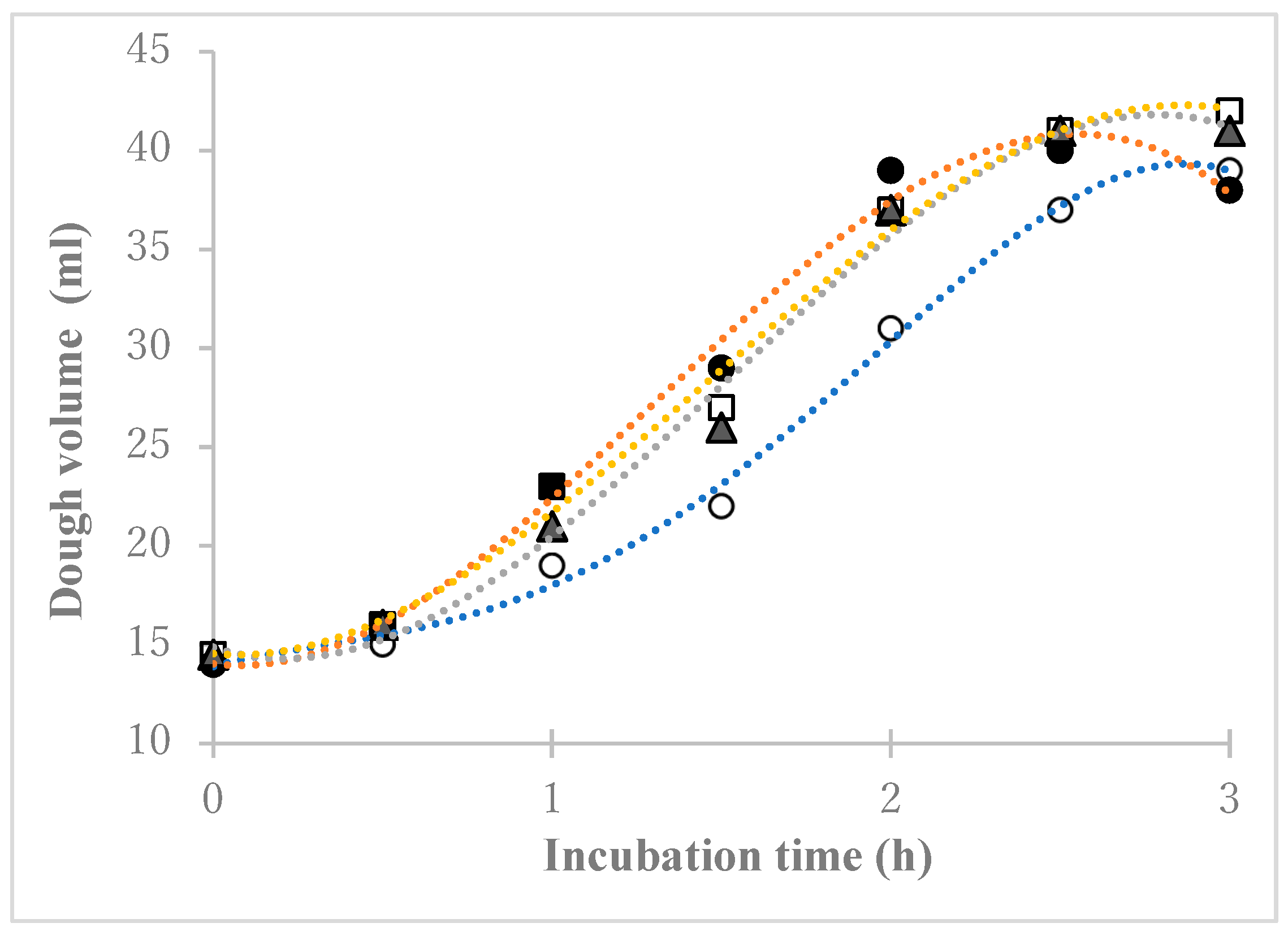

Table 1.
Microbial flora of wheat flour saline culture.
| Microflora1 | Strong A (cfu/g) | Strong B (cfu/g) | Strong C (cfu/g) |
|---|---|---|---|
| Aerobic bacteria | 4.7±2.1 (×108) | 4.5±1.0 (×108) | 2.7±0.4 (×108) |
| Salt tolerant bacteria | 2.6±0.9 (×108) | 4.0±0.2(×108) | 2.6±0.2 (×108) |
| Lactic acid bacteria | 4.6± 0.4 (×105) | 1.1± 0.1(×106) | 3.3± 1.6(×105) |
| Salt-tolerant yeast | <103 | <103 | <103 |
1 measured with 3 M film medium. n=3.
Table 2.
Specific volume of bread made from wheat flour saline culture.
| Flour saline culture | Specific volume (cm3/g) |
|---|---|
| Cont. | 2.25 ± 0.07 a |
| Strong A | 2.73 ± 0.12 b |
| Strong B | 3.07 ± 0.07 c |
| Strong C | 3.47 ± 0.10 d |
Different letter within rows were significant at p = 0.01 by Tukey's multiple comparison test. n=3.
Disclaimer/Publisher’s Note: The statements, opinions and data contained in all publications are solely those of the individual author(s) and contributor(s) and not of MDPI and/or the editor(s). MDPI and/or the editor(s) disclaim responsibility for any injury to people or property resulting from any ideas, methods, instructions or products referred to in the content. |
© 2025 by the authors. Licensee MDPI, Basel, Switzerland. This article is an open access article distributed under the terms and conditions of the Creative Commons Attribution (CC BY) license (https://creativecommons.org/licenses/by/4.0/).
Copyright: This open access article is published under a Creative Commons CC BY 4.0 license, which permit the free download, distribution, and reuse, provided that the author and preprint are cited in any reuse.