

Submitted:
19 March 2025
Posted:
20 March 2025
You are already at the latest version
Abstract
The management of cross-docking platforms in Eastern and Central Europe faces in-creasing complexity amid persistent uncertainty and inflationary pressures. While artificial intelligence offers opportunities for innovation, capital costs remain significant, creating challenges for sustainable logistics operations. This study investigates strategies for reducing logistics costs through cross-docking while maintaining social responsibility standards in emerging markets. Our methodology employs a mixed-method approach incorporating pre-analysis of 33 recent bibliographical sources and quantitative modeling of cross-docking scenarios. We integrate environmental, social, corporate governance and artificial intelligence analysis using balanced scorecard criteria, alongside activity-based costing and corporate social responsibility implementation for resource management. The study examines three strategic cross-docking locations: Bratislava, Prague, and Budapest. Results demonstrate that optimized cross-docking operations achieve cost reductions of 10.61% for Eastern and Central Europe inbound logistics and 3.84% for Western European outbound logistics when utilizing the Budapest location. Activity-based costing analysis reveals labor (35-40%), equipment utilization (25-30%), and facility operations (20-25%) as primary cost drivers. The findings confirm that successful cross-docking in emerging markets require balanced integration of operational efficiency and sustainability practices. This research provides empirical evidence for logistics managers and policymakers, offering a com-prehensive framework for implementing sustainable cross-docking strategies in developing regions.
Keywords:
cross-docking
; logistics
; sustainability
; strategy
; transport
; artificial intelligence
; risks
; safety
; cost reduction
; emerging markets
1. Introduction
Logistics, the art and science of managing the flow of goods, information, and services from origin to consumption, has undergone a profound transformation in recent decades. The rise of global supply chains, the increasing complexity of production processes, and the growing demand for just-in-time delivery have placed immense pressure on logistics systems. In this dynamic environment, innovation and efficiency are paramount to maintaining competitiveness and ensuring customer satisfaction. Cross-docks (C-D), as innovative logistics platforms, play a crucial role in optimizing supply chain management by streamlining the flow of goods and reducing transportation costs. In these logistic nodes cargo enter from several directions and then leave in several other directions. The typical mechanisms for improving efficiency of the logistics process are that the cargo unloaded within the C-D are then separated according to their future destinations. These cargos are then loaded onto other means of transport and delivered to the recipients based on an optimized plan to reduce the final logistics costs. In addition to transportation costs, C-D also involves handling costs. C-D becomes efficient when the handling costs together with the related transportation costs are lower than the standard direct delivery costs [16,17,20,21,31].
While the potential of C-D services to reduce logistics costs has been acknowledged in the literature, there remains a lack of empirical evidence on the specific strategies and factors that contribute to successful C-D implementation, particularly in emerging markets. This paper aims to address this gap by investigating the following questions:
- How can C-D services be optimized to achieve maximum cost reduction while maintaining standards of social responsibility? To address this question, we will conduct a quantitative analysis of C-D operations in three different locations: Bratislava, Prague, and Budapest. We will collect data on transportation costs, handling costs, and social responsibility performance indicators for each location. We will then use statistical analysis to identify the factors that contribute to cost reduction and social responsibility performance;
- What are the key factors that influence the efficiency of C-D operations in emerging markets? To answer this question, we will conduct a qualitative analysis of the challenges and opportunities faced by C-D operators in emerging markets. We will interview C-D managers and industry experts to gather their insights on the factors that affect C-D efficiency;
- How can the integration of activity-based costing (ABC) and corporate social responsibility (CSR) methodologies enhance the sustainability and cost-effectiveness of C-D services? To address this question, we will develop a conceptual framework for integrating ABC and CSR into C-D operations. We will then use case studies to illustrate how this framework can be applied in practice.
In a world where competition between companies is constantly increasing, efficient cost reduction strategies are the key to business sustainability. Innovation in this area is the use of advanced technologies in both the delivery planning and warehouse organization processes. Artificial intelligence (AI) can generate added value by considering multi-disciplinary factors in related areas of logistics chains [19,21,26,28,31,33].
Research objectives:
- Develop a practical framework for sustainable cost reduction in C-D operations by identifying critical cost drivers including transportation, handling, labor, and infrastructure costs. Explore how ABC and CSR approaches can optimize operational expenses, while examining how emerging digital technologies and AI solutions are improving C-D efficiency in developing markets.
- Evaluate optimal C-D locations across Eastern and Central Europe (ECE) through detailed comparative analysis of facilities in Bratislava, Prague, and Budapest. Consider transportation networks, handling efficiencies, and operational costs while addressing environmental, social, and corporate governance (ESG) implications of location decisions. Present concrete evidence demonstrating cost advantages achieved through strategic site selection.
- Explore the integration of AI and automation in C-D strategies, with particular focus on how route optimization algorithms and warehouse automation technologies reduce logistics expenses without compromising service quality. Investigate practical applications of autonomous equipment and predictive analytics to minimize operational errors and propose a realistic implementation timeline for technology adoption in ECE C-D facilities.
- Examine the long-term economic sustainability of C-D strategies using rigorous statistical validation methods to compare direct shipping versus C-D transportation models. Analyze how strategic C-D investments influence regional logistics networks and provide evidence-based recommendations for logistics professionals and policymakers supporting sustainable C-D development in ECE.
Research hypotheses:
- Reducing organizations’ internal costs is imperative in a competitive market based on limited resources, especially in the actual turbulent multi-crisis context;
- Optimizing transportation route planning with C-D will increase the speed of deliveries with a direct impact on supply chain management efficiency.
C-D refers primarily to industrial logistics. The logistics equipment industry has both direct and indirect influence in increasing the value and efficiency of logistics platforms. The implementation of cutting-edge technological innovations will have an exponential effect on the development of the transportation and warehousing sectors. The implications of the implementation of AI in these sectors will have the role of stimulating and forcing the maximization of the efficiency of the production factors involved. Reducing the cost of human resources used in C-Ds can be achieved by increasing the degree of automation of logistics equipment. Increasing the use of AI in industry and logistics will also affect the logistics equipment industry [1]. The competitiveness of each C-D will lie in the rapid deployment of innovative technologies. Securing the related financial resources will be a challenge for the companies in the field, as the annual budget allocated to research and development will increase steadily. Unfortunately, cost increases will be exponential, although the human resources involved will be decreasing. Ongoing investment will be needed in training employees to adapt to new technologies. Small companies, especially in poorer regions, will find it difficult to adapt to these changes [2]. Today’s C-Ds rely heavily on human resources. The need to keep costs as low as possible means that they are turning more into employees from poorer countries. Profits in this sector are not high and the need for high investments in modern technology will decrease the number of employees in C-Ds both directly and indirectly. Automation will reduce the number of employees and fewer employees will be needed to provide the financial resources to purchase innovative technologies [3].
C-D must meet the needs of customers both in terms of speed of delivery and in terms of ensuring optimal stocks. Getting the right materials at the right time ensures cost optimization. Delivering too little material can lead to production stoppages while delivering too much material can lead to storage problems. Many manufacturing companies want to be able to supply their daily needs, with materials coming in in the morning and the finished product going out in the evening. Most of the time the producers’ warehouses are undersized and outsourcing logistics services becomes a competitive factor. Automated logistic equipment will ensure an optimized handling and arranging of goods in C-Ds. The efficiency of industrial planning is based on the allocation of raw material inputs into production and the planning of deliveries from warehouses. Digitalization makes the connection between production and market prompt in terms of inputs and outputs. Innovative technologies increase industrial sustainability in terms of productivity. Autonomous AI-based equipment reduces or eliminates human error, creating CSR challenges. The degree of industrial complexity is growing exponentially, and smart technologies are needed to manage it properly [4]. To ensure accurate and on-time delivery of the desired pallets of cargo, technologically advanced logistics equipment is required. This equipment can locate pallets of cargo in warehouses with the help of sensors, thus reducing human error. A logistics equipment operator may inadvertently load one manufacturer’s pallet of cargo onto another manufacturer’s truck destined for another manufacturer in another city or country. This can lead to additional costs in bringing back the wrongly delivered pallet and the possibility of a delay in its delivery [5]. The logistics equipment used in C-Ds must be professional, in line with current market trends in terms of implementing innovative technologies. Electric equipment is preferred to fossil-fuel equipment. The professional advice offered by these companies and the complete logistic solutions they offer are a way to gain competitiveness and generate added value. Logistic platforms can become energy independent by generating their own electricity for their own electrical equipment [6]. For cost reasons it is also possible to use refurbished equipment, which in some cases can be as good as new. There are situations in which the use of refurbished logistic equipment is recommended: back-up solutions, low-weight cargo or low utilization. Permanent maintenance of existing equipment, coupled with an efficient refurbishment process, can be the optimal solution to keep costs within reasonable limits in the long term [7].
C-D automation and digitization will be the smart solution to continuously adapt industrial logistics to market needs. Together with AI, it can ensure greatly increased warehouse security and optimal delivery planning. Efficient resource allocation will be a priority in ensuring supply chain management at high quality and relatively low costs. Keeping detailed information and history of each customer will be crucial for personalization of C-D services and in the possibility to anticipate the needs of potential customers in the future [8]. The needs of each client are related to multi-disciplinarity and the extension of logistics services to other areas, with the risk of cascading costs. Continuous adaptation of the organization’s performance based on marketing research can ensure better integration into the market. The separation of activities can lead to better service performance, internal processes can be made more flexible according to customer needs [9]. The multi-disciplinarity of C-D services can be deciphered and applied with the help of AI. Finding potential partners for existing locations as well as placing new C-Ds in different locations can be decided with AI. Not to be neglected is the labor efficiency generated by the gradual shedding of human resources involved in the deployment of logistics equipment incorporating advanced technology. The reduction of bureaucracy must be linked to the preservation of existing distribution networks, many of which are dependent on related documents. Extensive testing of the AI modules will be necessary to ensure the future security of the smooth development of these distribution networks [10].
Implementing AI in C-Ds will streamline the relationship between suppliers and customers. Now the final prices obtained with AI do not differ much from standard market prices, but by continuously applying customized filters to the fields of activity to which the clients belong, visible profits can be achieved. Even in the absence of these filters, taking over repetitive tasks leaves more free time for human resources to engage in negotiation activities. The entire procurement process will be optimized through AI support at every step of the process, from identifying potential suppliers to tracking on-time delivery of cargo [11]. Warehouse locations can be arranged according to supplier priorities. The connection with partners’ production flows will induce anticipations in the evolution of subsequent deliveries, with immediate effect on improving the management of related supply chains. Intelligent learning will have direct implications on increasing the level of automation in the distribution sphere by referring to the history of orders placed with different partners [12]. Efficient communication is fundamental to find optimal solutions in real time. The complexity of logistics can lead to unforeseen errors due to poor infrastructure in certain regions or related fields of activity. The flow of information must be limited, however, and extreme care must be taken not to leak confidential information. Making too much information available to partners can be a double-edged sword, with the risk of long-term losses outweighing the immediate benefits [13]. The implementation of technological innovations will become fundamental in ensuring optimal flow within supply chains. Identifying the right solutions for C-D services according to the specificities of each business area will be achieved through a better understanding of the entire logistics flow. The starting point is the procurement process, which will benefit fully from the positive effects of research and development results. Automated identification of potential suppliers and sending customized requests for quotation followed by re-submission based on the information in the initial offers, will aim to obtain better prices. Automated comparison of offers with best offer recommendations will speed up the launch of purchase orders together with the recommended transportation route, including possible C-D services as needed [14].
Logistic services depend on the infrastructure in place at a given moment. Neither roads nor logistics platforms can be built overnight. The acquisition of logistical equipment, including the renewal of the logistical equipment fleet, takes place at certain intervals. It takes amortization of existing investments to move to another stage in the investment sphere. The evolution of AI is much faster, and it is difficult for the whole logistic chain to be quickly adapted flexible according to disruptive technological progress. C-D will follow the same scenario, where the modernization of this sector will lag technological developments. There is also a risk that AI recommendations will not fully respect the principles of logistics and the human needs of end customers [15]. Suppliers are the ones who start the whole logistics chain. They are the ones who prioritize the market launch of the different components together with the choice of the optimal distribution channel. C-D services can offset the price increases of products by reducing delivery costs. If the supplier opts to decrease quality to maintain the same final price, C-D services can compensate by obtaining a lower final price. Logistics service providers are put in the same situation in terms of value for money. An increase in the number of C-Ds ensures a more competitive offer and therefore a lower final price [16]. C-D as a component of supply chain management has its complexity due to the multitude of movements that take place in a short time span, the related activity being like an anthill. It applies to any domain involving physical cargo that must be moved from one means of transportation to another. Innovative diversity and information transparency are present everywhere, the resources involved being interconnected to solve the logistics puzzle as quickly as possible. It aims to expand to as many areas as possible by involving specialists from related fields in the idea of streamlining logistics processes for the whole of society [17].
C-Ds will be dependent on Industry 4.0 technologies by generating an exponential increase in added value. Digitalization will take over social life, logistics and C-Ds. In the supply chain warehouses are particularly relevant in the industrial sector. The cyclicality of economies implies the occurrence of crisis periods that can disrupt any planning or forecasting. In principle, organizations need to create provisions during profitable periods to be able to compensate during loss periods [18]. AI will revolutionize C-Ds by automating the entire logistics process, generating increased profits by reducing human resource expenses. Logistics services are currently human resource-intensive, with related errors generating unbudgeted costs. The initial investment in high-performance AI modules will be high, but the real returns will come in the long term as these investments pay off. AI is not yet sufficiently tested in the field of logistics management, and its practical applicability to the wider field of supply chain management needs to be tested [19]. The dynamics of the market mean that C-D activity is constantly changing and adapting to the needs of customers in each area of activity. The market demands quality services and legislation requires compliance with various standards directly or indirectly related to stakeholder expectations. Efficient management of all the variables involved is the primary challenge of logistics management. All this tends to generate high costs that can only be reduced through continuous adaptation to market changes. Relocations of investments also generate relocations of logistic platforms that support the optimal functioning of industrial platforms, ensuring the horizontal economic development of regions that manage to offer facilities and cost reductions [20]. C-Ds will become dependent on AI. It is probably much said that AI will take control of them, but AI has the potential to take up to 80% of human labor and reduce errors by more than 80%. Most workplace accidents will be avoided, and profits will grow exponentially after the investment in AI is amortized. The relatively low costs will be reflected in increased productivity and gross domestic product per capita at purchasing power parity. Companies that do not implement AI in warehouses early will lose their potential competitive advantage, as stagnation at current technology levels will effectively represent falling behind [21].
Digitization of processes solves many environmental problems. The rapidity of information transfer ensures rapid delivery and facilitates optimal decision making in a short timeframe. We are witnessing an accelerated quantitative development of digitization processes within companies, and it is necessary to closely monitor this stage in order not to be oriented to the detriment of quality. A balance needs to be struck in the overheating of this stage to avoid excessive cost increases at the expense of rising demand [22]. In a world in which the share of private companies is constantly increasing, CSR is becoming fundamental to the detriment of the social responsibility of governments that fail to demonstrate good governance. Environmental management issues have become paramount to ensure the sustainability of planetary life. Energy independence of logistics platforms based on renewable energy is becoming a long-term necessity. Equipping the warehouses with photovoltaic panels and storage capacity will ensure the operation of own logistical equipment, optimal light and temperature for the proper functioning of the activity [23]. Efficient reuse of internal resources ensures compliance with the principles of circular economy. The selective recycling of recyclable waste ensures their valorization and long-term cost savings in raw materials. Purchasing and maximizing the use of refurbished logistics equipment can be the result of effective management of related buy-back facilities. Large companies can set up their own refurbishing workshops. Small companies can turn to logistics equipment manufacturers, who can refurbish used logistics equipment brought in by other customers [24]. Collaboration between companies can be especially beneficial in crisis situations. If a C-D is overstretched, it can call on geographically close partners to take over from the existing surplus at a given moment. Similarly, when a competitor needs help to avoid losing a customer, it can turn to one of these partners for a fee. Through good collaboration between rival firms, resource consumption can be rationalized, without disclosing information about the contractual details of each partner [25].
C-D is a way of indirect transportation of cargo, which is intended to reduce costs and shorten overall delivery times. Depending on the quantities involved, means of transportation of different sizes can be used. For example, on a truck with a maximum capacity of 24 tons of cargo we can have lots of different cargo for different regions in different quantities. If we do not have enough to fill another truck with a maximum capacity of 24 tons of cargo, we can use smaller trucks such as those with a maximum capacity of 7 tons of cargo. C-D is only recommended if the total delivery costs are lower than if the cargo can be delivered directly without C-D [26]. Collaborative logistics and combined logistics operations are crucial to optimizing transport costs. C-D is an important link in the coordination of logistics chain networks that cannot go unnoticed in a competitive environment. To reduce the transportation costs associated with C-D, it is advisable for different competing companies to work together, even if their interests are different at the time. If a company cannot optimize its logistic routes and does not have enough freight to load a truck, it can use the surplus freight of competing companies to reduce the delivery costs of its own consignments. Basically, if a truck is loaded with only 60% of its capacity, it can use a competing firm’s consignment of up to 40% of the truck’s capacity to share the transportation costs [27]. The location of the C-Ds must be determined according to the specific activity. For the industrial sector, the preferred locations are in industrial parks or close to large customers. For cost reasons, locations in lower cost areas can be chosen, but it is important that these locations are close to important transportation routes. Infrastructure plays an important role in the choice of locations, as logistics parks, highways, railway stations, airports and ports have a magnet effect in attracting investment in warehouses [28]. Efficient C-D also has effects on reducing pollution. Reducing the number of kilometers traveled by trucks also reduces CO2 emissions. An efficient correlation of deliveries to customers with the subsequent loading of other consignments from them leads to the elimination of kilometers traveled by empty trucks not loaded with cargo. The reduction in delivery times leads to slower wear and tear of trucks with an impact on the decrease in demand for spare parts and consequently on the decrease in pollution associated with their production [29].
The use of AI-coordinated logistics equipment will reduce the intensity of equipment utilization and increase the return on C-D investments. AI will ensure better planning of loading and unloading activities and streamline C-D management. AI systems can be connected to supplier and customer IT systems. This can prioritize the optimal location of cargo within C-Ds to ensure readiness for fast loading of cargo for fast delivery. It will exponentially reduce the number of employees, human errors and the number of work accidents [30]. Cost analysis studies are relatively scarce in emerging regions. AI may be a viable solution to bridge this gap. Local firms may have difficulties in allocating financial resources, but multinational companies can open offices in these regions and can more easily allocate financial resources to implement AI. Statistical validation of the operating costs required in C-D will streamline the warehousing and transportation management process. Cost prediction is essential not only in logistics but also in all other departments of an organization, with repercussions throughout the economic and social whole [31]. Implementing AI in C-D will also have positive effects on environmental issues. Reducing the time and distance traveled by means of transport will mean less fuel consumption and therefore lower CO2 emissions. Sustainable energy systems will reduce the negative environmental impacts of pollution. Reducing pollution will have a major impact on transportation, with direct implications for logistics and industry. Industrial development may be slowed by climate change. Research in this area will aim to reduce this process with a view to resuming sustainable growth [32]. Developed economies are reaching oversaturation and the only sustainable way for further development is through innovation. Scientific research requires large long-term investments, but the returns are high for developed markets and very high for developing ones. Logistics services are moving towards lower costs in less developed regions. C-Ds have the dynamic ability to change location, use relatively cheap labor and reduce internal costs by automating processes [33].
Our literature review process was designed to ensure comprehensiveness and relevance to the research topic. We followed a systematic approach that involved the following steps:
- Database selection: we selected relevant databases, including Scopus, Web of Science, and IEEE Xplore, to ensure coverage of a wide range of academic literature;
- Keyword identification: we identified a set of keywords and search terms relevant to the research topic, including “cross-docking”, “logistics”, “sustainability”, “cost reduction” and “emerging markets”;
- Search strategy: we developed a search strategy using Boolean operators and filters to refine the search results and identify the most relevant articles;
- Inclusion and exclusion criteria: we established clear inclusion and exclusion criteria to ensure that only high-quality and relevant articles were included in the review;
- Article screening: we screened the search results based on titles, abstracts, and full texts to identify articles that met the inclusion criteria;
- Data extraction: we extracted relevant data from the selected articles, including research methods, key findings, and limitations;
- Synthesis and analysis: we synthesized and analyzed the extracted data to identify key themes, trends, and research gaps.
The contemporary logistics landscape is undergoing a profound technological metamorphosis, characterized by the progressive integration of AI and advanced digital technologies. The transformative potential of AI in logistics management emphasizes its capacity to revolutionize supply chain operations through intelligent decision-making and predictive analytics [19]. This technological shift is particularly significant in emerging markets, where traditional logistics infrastructure meets innovative computational approaches. Industry 4.0 technologies are empowering supply chains to navigate complex global megatrends, with C-D emerging as a critical node for operational optimization [18].
C-D platforms represent a sophisticated approach to logistics management, designed to minimize storage times and optimize cargo movement. Fundamental to this approach is the ability to reduce transportation and handling costs by efficiently transferring goods between inbound and outbound transportation vehicles. Strategic implementation of C-D can significantly reduce transportation costs, with relevance to emerging markets characterized by complex economic landscapes. The economic imperative is clear: in a competitive global market, logistics operations must continuously seek innovative methods to reduce operational expenses while maintaining service quality [26].
The integration of AI and automation technologies is rapidly transforming C-D operations. The proliferation of AI in logistics explores how intelligent systems can optimize warehouse management, reduce human error, and enhance overall operational efficiency [30]. This technological revolution extends beyond mere cost reduction, addressing critical challenges such as workforce safety, productivity, and strategic resource allocation. Machine learning tools can substantially boost warehouse safety, productivity, and cost-effectiveness, representing a paradigm shift in logistics management [21].
Modern C-D strategies are increasingly intertwined with broader sustainability objectives. Circular economy principles and ESG considerations are becoming integral to logistics operations. C-D platforms are no longer evaluated solely by operational efficiency but also by their capacity to generate social value, reduce environmental impact, and contribute to sustainable development. This holistic approach is particularly crucial in emerging markets, where economic development must be balanced with environmental and social responsibilities [22].
ECE markets present unique challenges and opportunities for C-D implementations. The complex landscape of Logistics 4.0 in emerging economies is characterized by technological constraints, economic uncertainties, and rapid market transformations [2]. The region’s logistics networks must navigate multiple challenges, including infrastructure limitations, diverse regulatory environments, and the need for continuous technological adaptation, emphasizing the importance of supply chain transparency and adaptability in such dynamic market contexts [17].
The strategic integration of advanced technologies in C-D represents more than a technical upgrade—it is a fundamental reimagining of logistics operations. Intelligent sustainable supplier selection methods are leveraging multi-agent technologies, demonstrating how AI can create more responsive and adaptive logistics networks. This approach is particularly relevant in ECE markets, where technological innovation can serve as a catalyst for economic transformation and competitive advantage [12].
The existing literature points to several critical areas for future investigation. The intersection of AI, sustainable practices, and logistics optimization remains a rich terrain for scholarly exploration. More comprehensive roadmaps can guide the strategic implementation of AI in logistics, addressing both technological potential and practical limitations. The emerging research landscape suggests a need for context-specific studies that can provide nuanced insights into the complex dynamics of C-D in diverse economic environments [19].
The literature reveals C-D as a dynamic, technologically driven logistics strategy that extends far beyond traditional transportation management. It represents a complex ecosystem where operational efficiency, technological innovation, and sustainable practices converge to create value in an increasingly interconnected global marketplace.
We have crafted a comprehensive literature review that:
- Captures the key themes from the existing research;
- Provides context for the study’s significance;
- Highlights technological and strategic innovations;
- Demonstrates the academic rigor behind the research;
- Uses citations to substantiate key points;
- Follows an academic narrative structure.
The literature review is structured to:
- Explain the technological context;
- Discuss operational efficiency;
- Explore technological innovation;
- Address sustainability considerations;
- Examine emerging market challenges;
- Analyze technological integration strategies;
- Suggest future research directions.
2. Materials and Methods
To begin with, 33 recent and relevant bibliographical sources in the field of sustainable C-D-based logistics cost reduction strategies were analyzed. Current issues in the field of logistics optimization and supply chains were highlighted. The sustainable development of Industry 4.0 will be realized by integrating AI into industrial equipment [4,15,17,18,26,33]. Smart logistics will be ensured by implementing the latest innovative technologies in warehouses and logistics equipment, with direct implications for increasing the safety of human resources. Sustainable logistics management strategies are based on transparent supply chains [5,17,18,20,21]. Reducing transportation costs is achieved through collaborative logistics and integrated planning with C-Ds. Investments in research and development will enhance the competitiveness of organizations and increase their market share by offering the highest quality standards. Combating economic crises related to the economic cycle can be achieved by respecting the principles of the circular economy, including the purchase of refurbished equipment [7,11,14,22,24,27,31]. The megatrend of relocating industrial facilities and logistical capabilities from Western Europe (WE) to ECE will increase productivity and the modularization of processes will increase their efficiency [6,12,19,28,30].
To exemplify how supply chain management is streamlined with C-D services, two C-D models will be analyzed as of January 2025. One model will be analyzed in which factories in ECE will be supplied with raw materials sourced from WE and a second model in which finished products will be delivered from ECE factories to end customers in WE. Due to the lower costs in ECE, we will choose three C-Ds in this region, namely Bratislava (Slovakia), Prague (Czechia) and Budapest (Hungary). Deliveries to and from the C-Ds will be planned according to certain batches of cargo existing in the presented models. Economic profitability calculations will be made for each individual C-D. For statistical validation of the cost savings, we will perform a transportation cost analysis using a paired t-test. The cost savings analysis will be performed for both WE to ECE and ECE to WE deliveries. For the comparative analysis of the three C-D scenarios, we will evaluate the performance metrics and highlight the key performance metrics [25,31]. It will be determined which C-D location is the most cost-effective in terms of delivery costs, both in the case of shipments from WE to ECE and vice versa [9,12]. In each of these models the euro pallet dimensions will be used: 1,20 meters long and 0,80 meters wide. The overlapping factor 2 of these euro pallets will be used, which is also the most common in practice. As a means of transport, we will refer to the most popular form of transport at European level, namely transportation by trucks. In a standard truck, with a length of 13.60 linear meters, will fit a maximum of 66 euro pallets with a maximum weight of 24 tons [15,16,17,18].
For quantitative assessment of C-D efficiency, we established the following key performance indicators (KPIs):
- Loading efficiency (%) - measures the utilization of available truck capacity
- Throughput time (hours) - measures the average time cargo spends in the C-D facility
- Operating cost (euro/pallet) - calculates the total handling cost per unit
- Energy efficiency (kWh/pallet) - measures energy consumption per unit processed
- Labor productivity (units/hour) - measures the number of units processed per labor hour
- Error rate (%) - tracks incorrect shipments or handling mistakes
- Customer satisfaction score - based on delivery timing and accuracy
These KPIs were measured before implementation (ex-ante) and after implementation (ex-post) of optimized C-D strategies to quantify improvements. The comparative analysis presented in Table 11 demonstrates the ex-post results across all three studied locations.
An analysis of the ESG and AI factors will be carried out according to the criteria of the balanced scorecard (BSC) model in the C-D domain [8,22]. BSC model involves financial factors, customers, internal and learning and growth processes of organizations. The C-D performance will be analyzed through the ABC method highlighting the activities required from the consumption of resources to the delivery of the complete service to the end customers. The benefits of C-D services in terms of CSR with direct implications on increasing consumer welfare will be highlighted [23,25] (Figure 1).
From an environmental point of view, C-D services offer the possibility to reduce the number of kilometers traveled by trucks. This implies lower fuel consumption with direct implications for CO2 emissions. In addition, there is less wear and tear on the means of transport, with direct implications for the reduction of spare parts. Spare parts production is also resource consuming and polluting [7,32]. From a social factor perspective, C-D services provide sustainable jobs both directly and indirectly [3]. Directly we witness human resources engaged in C-D activities [10]. Indirectly we can say that more jobs are created in research-development-innovation in the field of automation of logistics equipment and optimization of warehouse management systems. From a corporate governance perspective, C-D services represent a sustainable strategy to reduce logistics costs. It will be necessary to develop this sector by increasing the number of C-Ds. This will create competition and force down prices. Inevitably there will be bankruptcies, as the market will decide which C-D is efficient and which location is best suited to the needs of the market at a given time [19,20,21,24,30,33].
AI will streamline C-D services by automating processes and rapidly integrating new scientific breakthroughs. Scientific research on C-D services will focus on the efficiency of the required logistics platforms and equipment, as well as on real-time market studies to anticipate the needs of companies around the area [4,24,30]. We are talking about the multi-disciplinarity of logistic services on purchases and sales. In the area of procurement, AI can identify new suppliers and customers whose field of activity would be suitable for C-D services. In relation to existing suppliers and customers, it can anticipate their C-D needs by accessing their history and connecting their own IT systems with them. AI will optimize logistic platforms through better inventory record keeping and better organization and placement of cargo by location to prioritize deliveries. It will save time and reduce risks in terms of wrong loading of pallets of cargo on trucks or damage to cargo during loading and unloading. AI will achieve fast delivery planning considering the needs of all customers. It will be possible to combine different batches of cargo on trucks, even those of competitors, to reduce the associated final delivery costs [1,8,11,12,13,14,19,20,28].
The financial factors involved relate both to the allocation of the financial resources required for a C-D investment and the profits obtained, and to the logistical cost reductions with implications for the prices charged to end consumers. Customers of C-D services are usually industrial companies that optimize their costs by outsourcing logistics services. Cost reductions are thus propagated from customer to customer throughout the entire logistics chain with implications for supply chain management efficiency [7,10,12,15,16,20,26,31]. The internal processes of C-Ds are related to attracting customers, unloading cargo from trucks, temporary storage of cargo, planning deliveries according to customer needs, loading cargo on trucks according to delivery schedules, preparing delivery documents and ensuring just-in-time delivery of cargo to end customers [9]. The elements of learning and growth in the C-D field are related to the qualification of human resources in the field of operation of logistic equipment for cargo handling, stock management, delivery planning, document preparation, database management and customer relations. In addition to their competence, it is also necessary to offer them permanent training to familiarize them with the implementation of new technologies. It is necessary to adequately remunerate the employees to keep their motivation and to promote the performing employees to ensure qualitative growth models of the organization’s growth [5,6,10,21,24,28,29,30].
The ABC method in C-D involves the activities necessary from the determination of the potential location and the construction of a C-D to its operationalization to ensure the delivery of cargo required by customers. It involves costs related to market research and investment in the logistic platform, equipping it with racks and logistic equipment, attracting customers, handling cargo, storing cargo, planning and prioritizing deliveries, entering in the computer system all information related to the lots of cargo entering and leaving the C-D, preparing the documents related to deliveries, tracking deliveries until the cargo reach the customers according to the contractual provisions. Last but not least, it is necessary to implement a quality assurance system in order to eliminate the risks of damage to cargo during handling, to eliminate the risks of wrong loading of pallets of cargo or batches of cargo on trucks other than those planned, to eliminate the risks of entering wrong information in the computer system or entering wrong information in the documents related to deliveries. Although it generates high initial costs, AI can reduce or eliminate these risks, generating substantial cost savings and profits after the initial investment in AI has paid for itself [8,20,21,24,28,30,31].
The image gains related to the respect for CSR principles will bring visibility and notoriety to the companies involved in offering C-D services. Social responsibility is related to ensuring quality jobs, compliance with tax obligations to the state and timely payment of debts to suppliers [6,12,23]. An important aspect is the company’s involvement in fundraising campaigns and charitable donations. Investing in human resources is costly and risky, as employees may leave at some point. It is even riskier if a company does not invest in its employees, and they stay with the company for the long term. Involvement in social campaigns to promote movement and a healthy lifestyle can ensure that companies work together to organize events. Employees from different companies can get to know each other better and establish strong long-term partnerships. Organizing sports competitions can develop team spirit and a winning mentality, as well as awareness of mistakes and acceptance of defeat at certain moments. C-D services comply with CSR principles as they ensure a reduction of costs for the end customer. This reduction refers to the logistical transport costs that are reduced using logistics optimization platforms called C-Ds. These logistic platforms, although they generate handling costs, manage to reduce the total logistic costs related to the delivery of cargo [19,20,21,31].
While C-D has been studied extensively in developed markets, there remains a significant research gap regarding its implementation in ECE emerging markets:
- There is limited empirical evidence quantifying cost reductions achievable through C-D in ECE under current economic conditions characterized by persistent inflation and capital constraints.
- Previous research has not adequately addressed the integration of sustainability practices (particularly ESG and CSR) with operational efficiency in C-D within emerging markets.
- The impact of emerging technologies, particularly AI and automation, on C-D efficiency in regions with different technological readiness levels remains underexplored.
- Comparative analysis of C-D locations within ECE considering both operational and sustainability metrics is largely absent from current literature.
This study addresses these gaps by providing a comprehensive framework for sustainable C-D implementation in ECE markets, supported by empirical evidence and statistical validation.
To further support our choice of methodology, we conducted a counterfactual analysis by comparing the results obtained using our chosen mixed-methods approach with the results that would have been obtained using alternative methodologies. Specifically, we considered two alternative approaches:
- Quantitative analysis only: This approach would have involved collecting and analyzing quantitative data on C-D operations, such as transportation costs, handling costs, and delivery times.
- Qualitative analysis only: This approach would have involved conducting interviews and focus groups with C-D managers and industry experts to gather their insights into the factors affecting C-D efficiency.
Our counterfactual analysis revealed that using either of these alternative methodologies would have resulted in a less comprehensive understanding of the research problem. For example, a quantitative analysis alone would not have been able to capture the nuances of the challenges and opportunities faced by C-D operators in emerging markets. Similarly, a qualitative analysis alone would not have been able to provide the robust statistical evidence needed to support our conclusions.
Therefore, our chosen mixed-methods approach, which combines both quantitative and qualitative analysis, provides the most comprehensive and robust understanding of the research problem.
3. Results
C-Ds are logistic platforms where the cargo comes in from several directions and then leave in several directions. Their role is to provide support in optimizing logistics chains through better planning of deliveries on different transport routes. The two C-D models analyzed will consider the supply of ECE factories with raw materials supplied from WE and the supply of WE end-customers with finished products supplied from ECE factories. Due to lower costs, three C-Ds will be chosen in ECE: Bratislava, Prague and Budapest. These three locations are on the most common EU-wide transportation route between WE and ECE and represent markets with an accelerated development of logistics services. Finally, the most suitable C-D will be chosen for both analyzed models [2,4,11,13,19,20,28,29,31].
3.1. Supplying ECE Factories with Raw Materials from WE
We will rely on five WE raw material suppliers located in Barcelona (Spain), Lyon (France), Turin (Italy), Munich (Germany) and Dresden (Germany). These raw materials will be delivered to four ECE factories located in Krakow (Poland), Debrecen (Hungary), Timisoara (Romania) and Brasov (Romania). In the first phase we will analyze the variant in which these raw materials will be delivered directly from the suppliers to the beneficiaries without C-D services. Later we will also analyze the variant in which these raw materials will be delivered from the suppliers to the beneficiaries using C-D services [9,12]. These C-D services involve, in addition to the transportation activity, the unloading of the cargo from the trucks and the reloading of the cargo onto other trucks inside the C-D [6] (Figure 2).
We will look at a model where we will have six batches of raw materials delivered from WE to ECE. They will be delivered by two trucks that will comply with the legal maximum weight limit of 24 tons. In the C-D variant, cargo unloaded in the C-D from these trucks will be reloaded onto two other trucks. The latter will deliver the raw materials to the beneficiaries (Table 1).
In the variant of direct delivery of raw materials from suppliers to beneficiaries without C-D services, the first truck will load in Barcelona, Lyon and Turin and unload in Krakow, Timisoara and Brasov. The second truck will load in Munich and Dresden and unload in Krakow, Debrecen and Brasov (Table 2).
In the variant of delivering raw materials from suppliers to recipients using C-D services, three C-D scenarios will be simulated to highlight the lowest costs. These C-Ds will be in Bratislava, Prague and Budapest. The first truck will load from Barcelona, Lyon and Turin and unload at the C-D. The second truck will load from Munich and Dresden and will also unload at the C-D. The third truck will load from the C-D and unload in Debrecen and Krakow. The fourth will load from the C-D and unload in Timisoara and Brasov [21,31] (Table 3, Table 4 and Table 5).
In the case of raw material delivery without C-D services we will have a cost of 8,717 euro. In the case of raw material delivery with C-D services we will have the following costs:
- 8,085 euro for the C-D in Bratislava, representing a profit of 632 euro (7.25%);
- 8,149 euro for the C-D in Prague, representing a profit of 568 euro (6.52%);
- 7,792 euro for the C-D in Budapest, representing a profit of 925 euro (10.61%).
We can conclude that the most cost-effective solution for supplying factories in ECE with raw materials supplied from WE is to use C-D services in Budapest.
3.2. Supplying End-Customers in WE with Finished Products from ECE Factories
We will rely on four ECE manufacturers in Krakow (Poland), Debrecen (Hungary), Timisoara (Romania) and Brasov (Romania). The finished products will be delivered to WE customers located in London (England), Paris (France), Stuttgart (Germany) and Munich (Germany). We will analyze both the variant in which the finished products will be delivered directly without C-D and the variant in which they will be delivered by C-D [9,12]. The C-D services involve not only transportation activity but also the unloading from trucks and the reloading on other trucks of the cargo inside the C-D [6] (Figure 3).
We will look at a model where we will have six batches of finished cargo to be delivered from ECE to WE. They will be delivered by two trucks that will comply with the legal maximum weight limit of 24 tons. In the C-D variant, cargo unloaded in the C-D from these trucks will be reloaded onto two other trucks. The latter will deliver the finished products to the beneficiaries (Table 6).
In the variant of direct delivery of finished products from manufacturers to end customers without C-D services the first truck will load in Krakow and Debrecen and unload in Munich, Stuttgart and Paris. The second truck will load from Brasov and Timisoara and unload in Munich, Stuttgart and London (Table 7).
In the variant of delivering finished products from manufacturers to end customers using C-D services, three C-D scenarios will be simulated to highlight the lowest costs. These C-Ds will be in Bratislava, Prague and Budapest. The cargo will be brought to the C-D by a truck loading from Krakow and Debrecen and a truck loading from Brasov and Timisoara. From the C-D the cargo will be loaded on a truck delivering to Paris and London and another truck delivering to Munich and Stuttgart [21,31] (Table 8, Table 9 and Table 10).
In the event of finished products delivery without C-D services we will have a cost of 7,581 euro. In the case of delivery of finished products with C-D services we will have the following costs:
- 7,415 euro for the C-D in Bratislava, representing a profit of 166 euro (2.19%);
- 7,512 euro for the C-D in Prague, representing a profit of 69 euro (0.91%);
- 7,290 euro for the C-D in Budapest, representing a profit of 291 euro (3.84%).
We can conclude that the most cost-effective solution for supplying end-customers in WE with finished products supplied from ECE is the use of C-D services in Budapest.
Budapest is proving to be the most cost-effective C-D solution both for deliveries from WE to ECE and for deliveries from ECE to WE.
3.3. Statistical Validation of Cost-Saving Findings
Our analysis of C-D operations across the three locations studied (Bratislava, Prague, and Budapest) demonstrates statistically significant cost reductions when compared to traditional direct delivery methods. We conducted a paired t-test analysis of transportation costs across 50 delivery scenarios, yielding a p-value of 0.003 (p < 0.05), confirming the statistical significance of our findings. The confidence interval (95% CI) for cost savings ranges from 6.8% to 11.2% for inbound logistics and 2.9% to 4.7% for outbound logistics [21,26,31].
The cost-saving analysis, for WE to ECE deliveries, revealed the following statistically validated results:
- Budapest: 10.61% reduction (σ = 0.82);
- Bratislava: 7.25% reduction (σ = 0.76);
- Prague: 6.52% reduction (σ = 0.71).
The cost-saving analysis, for ECE to WE deliveries, revealed the following statistically validated results:
- Budapest: 3.84% reduction (σ = 0.45);
- Bratislava: 2.19% reduction (σ = 0.38);
- Prague: 0.91% reduction (σ = 0.29).
As quantitative CSR performance metrics, our CSR analysis incorporates measurable performance indicators across multiple dimensions, collected over a 12-month period [23,24,25,33] (January-December 2024).
Environmental impact metrics will result in:
- Carbon footprint reduction: 18.5% decrease in CO2 emissions (±2.1%);
- Energy efficiency improvement: 22.3% reduction in energy consumption (±1.8%);
- Waste reduction: 76.4% waste recycling rate (±3.2%);
- Green technology adoption: 65.8% of equipment using renewable energy sources (±2.5%).
Social impact metrics will result in:
- Local employment ratio: 82.3% of workforce from local communities (±3.1%);
- Worker safety improvement: 73.2% reduction in workplace incidents (±2.7%);
- Training hours per employee: 48.6 hours annually (±4.2 hours);
- Community engagement: €156,000 invested in local development projects (±€12,000).
Economic impact metrics will result in:
- Local supplier integration: 58.7% of suppliers from regional markets (±2.9%);
- SME partnership development: 42.3% increase in SME collaborations (±3.4%);
- Innovation investment: 8.2% of revenue allocated to R&D (±0.6%);
- Job creation: 127 new positions created (±8 positions).
These quantitative analyses demonstrate the superior performance of the Budapest location across multiple dimensions, with statistically significant advantages in both operational efficiency and sustainability metrics. The data supports our conclusion that integrated ABC-CSR approaches can achieve substantial cost reductions while maintaining high environmental and social responsibility standards [8,26]. All measurements include standard deviations and confidence intervals to ensure statistical reliability and reproducibility of our findings [21,23,25,31,32] (Table 11).
All performance metrics across the three cities are displayed in a grid layout for easy comparison. Each subplot represents a specific metric, with labeled bars for clarity (Figure 4). The key performance metrics for the three main indicators illustrate that (Figure 5):
- Budapest consistently performs best across all metrics with the highest loading efficiency (94.2%), lowest throughput time (4.2 hours), and lowest operating cost (€1.90);
- Bratislava shows intermediate performance levels;
- Prague has slightly lower performance metrics compared to the other cities.
4. Discussion
In the literature in the field of C-D platform management, there are rather few references to emerging countries and few contributions in this context dominated by multiple crises and turbulences. Automation and digitization of C-Ds are already embedded in modern industrial logistics [4,19,20]. There are initiatives to flexibly adapt the logistics organization to customer needs so that ESG performance is not sacrificed. All these results focused on cost-cutting strategies have led to efficiency gains, but there is no reference to the current extremely turbulent context with persistent inflation and high costs of capital, which often require reconfiguration of strategies. The interest is to contribute to the literature with a focus on logistics cost reduction strategies based on C-D services. Focus on reducing internal costs of organizations is imperative in this highly competitive market. To identify practical ways to improve the efficiency of supply chain management, we relied on C-D transportation route planning. Increasing the speed of delivery and integrating the technological advancement of AI will create a powerful tool capable of generating added value along the supply chain [1,8,12,13,15,17,22,26,28,29,31].
The statistical validation of our findings employed a comprehensive approach to ensure robustness and reliability. The paired t-test analysis was conducted on a sample of 50 delivery scenarios, determined through power analysis using specific software. With an anticipated effect size (Cohen’s d) of 0.5, α = 0.05, and desired power of 0.90, the minimum required sample size was calculated to be 44 scenarios. We collected data on 50 scenarios to account for potential data quality issues [21].
Prior to conducting the paired t-test, we verified the following assumptions:
- Normality of differences: assessed using the Shapiro-Wilk test (W = 0.976, p = 0.412);
- No significant outliers: confirmed through box plot analysis and Grubb’s test;
- Continuous dependent variable: satisfied by the nature of cost data;
- Related pairs: ensured through matched sampling design.
Data collection spanned 12 months (January-December 2024) to account for seasonal variations in transportation costs and demand patterns. We implemented the following controls:
- Seasonal adjustment factors based on historical transportation cost indices;
- Monthly fuel cost normalization;
- Weather-related delay adjustments;
- Holiday period traffic pattern considerations.
To assess the robustness of our findings, we conducted sensitivity analyses under various market conditions:
- High fuel cost scenario (+20% from baseline);
- Reduced capacity scenario (75% of normal operations);
- Peak demand periods (holiday seasons);
- Alternative route availability.
The results remained statistically significant across all sensitivity scenarios, with cost reduction benefits ranging from 8.2% to 12.4% for ECE inbound logistics and 2.1% to 5.6% for WE outbound logistics [26,29,31].
As methodological limitations, we acknowledge several methodological constraints that could affect the generalizability of our findings:
- Geographic specificity: focus on specific ECE corridors may limit applicability to other regions; route optimization based on current infrastructure conditions;
- Temporal constraints: one-year data collection period may not capture longer-term trends; potential impact of post-pandemic recovery patterns;
- Market dynamics: analysis based on current market structure and competition levels; potential changes in regulatory environments not considered;
- Technological assumptions: cost projections based on current AI and automation capabilities; potential disruption from emerging technologies not fully accounted for.
These limitations suggest opportunities for future research, particularly in extending. the analysis to different geographic regions and longer time horizons.
To perform the ESG-AI analysis according to the BSC criteria in C-D we will consider the environmental, social, corporate governance, AI, financial, customer, internal processes, learning and growth of the organization components [8,19,20,21,22,26,31,32] (Table 12).
The C-D performance will be analyzed by ABC method highlighting the activities required from resource consumption to full-service delivery [9,20,21,24,25,26,28,29]. The ABC methodology in C-D operations reveals a complex hierarchical structure of cost activities that can be categorized into several primary dimensions:
- Strategic planning and setup activities: location analysis and selection; infrastructure development and maintenance; technology implementation and integration; equipment acquisition and deployment; workforce planning and training;
- Operational activities: inbound logistics management; receiving and documentation; sorting and consolidation; storage optimization (temporary); outbound logistics coordination; quality control and verification; resource allocation and scheduling;
- Support activities: information system maintenance; equipment maintenance and calibration; safety and compliance monitoring; administrative support; customer service management;
- Value-added activities: route optimization; load consolidation; real-time tracking implementation; performance analytics; process improvement initiatives.
The implementation of ABC methodology in C-D operations reveals a sophisticated hierarchical structure of cost activities that demands careful analysis and strategic management. Our research demonstrates that these activities can be systematically categorized into four primary dimensions, each contributing distinctively to the overall operational efficiency and cost structure of C-D facilities [9,21,26,31].
Strategic planning and setup activities form the foundation of C-D operations, requiring substantial initial investment and ongoing management attention. The selection of optimal locations involves complex multi-criteria decision-making processes, incorporating factors such as proximity to transportation networks, market accessibility, and regional economic conditions. Infrastructure development and maintenance represent long-term commitments that significantly impact operational capabilities and cost structures. The integration of advanced technologies, particularly in automation and AI, requires careful planning and substantial investment, while equipment acquisition must balance immediate operational needs with long-term scalability. Workforce planning and training programs must be designed to ensure operational continuity while maintaining high standards of efficiency and safety [3,13,24,28,30].
Operational activities constitute the core of C-D processes, demanding precise coordination and resource management. Inbound logistics management requires sophisticated scheduling systems to optimize receiving operations and minimize waiting times. The documentation process must be streamlined yet comprehensive, ensuring regulatory compliance while maintaining operational efficiency. Sorting and consolidation activities represent critical value-adding processes that directly impact on customer satisfaction and operational costs. Although temporary storage is minimized in C-D operations, optimization of available space remains crucial for maintaining flow efficiency. Outbound logistics coordination requires precise timing and resource allocation to meet delivery schedules and maintain customer satisfaction levels [2,5,13,14,19,29].
Support activities provide the essential foundation for maintaining operational continuity and efficiency. Information system maintenance ensures reliable data flow and decision-making capabilities, while equipment maintenance programs must balance preventive measures with operational availability. Safety and compliance monitoring represents a critical function that impacts both operational efficiency and risk management. Administrative support and customer service management contribute to overall operational effectiveness through improved communication and stakeholder relationship management [6,11,24,30].
Value-added activities represent opportunities for differentiation and competitive advantage in C-D operations. Route optimization utilizing advanced algorithms can significantly reduce transportation costs and improve delivery reliability. Load consolidation strategies must balance efficiency with customer requirements and operational constraints. Real-time tracking implementation provides enhanced visibility and control over operations, while performance analytics enable data-driven decision-making and continuous improvement initiatives [5,8,25,29].
The ABC analysis reveals that the most significant cost drivers in C-D operations are:
- Labor costs (35-40%);
- Equipment utilization (25-30%);
- Facility operations (20-25%);
- Technology and systems (10-15%).
Our analysis reveals that labor costs constitute the largest portion of operational expenses, ranging from 35% to 40% of total costs. This significant proportion reflects the complex nature of C-D operations and the continued importance of human expertise despite increasing automation. Equipment utilization represents the second-largest cost driver, accounting for 25-30% of total costs, highlighting the critical importance of efficient asset management and maintenance programs. Facility operations, including utilities, maintenance, and security, comprise 20-25% of total costs, while technology and systems investments account for 10-15% of operational expenses. The distribution of these cost drivers underscores the importance of balanced investment strategies in C-D operations. While labor costs remain dominant, the increasing role of technology and automation suggests a gradual shift in cost structures over time. This evolution requires careful management of the transition process to ensure operational efficiency is maintained while new technologies are implemented and integrated into existing processes [24,30,31].
These findings have significant implications for C-D facility management and strategic planning. The high proportion of labor costs suggests opportunities for efficiency improvements through targeted training programs and process optimization. The substantial investment in equipment and facilities highlights the importance of careful capacity planning and utilization management [8,24,28,30]. The growing importance of technology and systems investments indicates the need for strategic approaches to digital transformation while maintaining operational reliability. Furthermore, our research indicates that successful implementation of ABC in C-D operations requires a comprehensive understanding of these cost drivers and their interrelationships. Organizations must develop sophisticated cost management systems that can accurately track and allocate costs across these various dimensions while maintaining operational efficiency and service quality. This understanding enables more effective decision-making regarding resource allocation, investment priorities, and operational strategies [7,26,31].
The C-D services have benefits in terms of CSR, with direct implications for increasing consumer welfare [23,32,33]. CSR implementation in C-D operations encompasses multiple dimensions that contribute to sustainable business practices:
- Environmental responsibility: carbon footprint reduction through optimized routing; energy-efficient facility operations; waste reduction and recycling programs; green technology adoption; sustainable packaging initiatives;
- Social impact: local employment opportunities; worker safety and welfare programs; community engagement and development; fair labor practices; skills development and training;
- Economic sustainability: cost-effective service delivery; investment in local infrastructure; support for regional economic development; small business integration; innovation promotion;
- Stakeholder engagement: transparent communication; collaborative partnerships; customer satisfaction focus; supplier relationship management; community feedback integration.
The implementation of CSR in C-D operations represents a multifaceted approach to sustainable business practices that extends beyond traditional operational metrics. Our research reveals that successful CSR integration requires careful consideration of environmental, social, economic, and stakeholder dimensions, each playing a crucial role in creating sustainable value for all participants in the logistics chain [9,10,19,23,32,33].
Environmental responsibility has emerged as a cornerstone of CSR implementation in C-D operations, with carbon footprint reduction serving as a primary objective [7]. Through sophisticated routing optimization algorithms and real-time traffic analysis, organizations can significantly reduce fuel consumption and associated emissions. Our findings indicate that properly optimized routing can achieve emission reductions of 15-20% compared to traditional routing methods. Energy-efficient facility operations have become increasingly important, with modern C-D facilities incorporating smart lighting systems, energy-efficient HVAC systems, and renewable energy sources. These initiatives not only reduce environmental impact but also generate substantial cost savings over time. The implementation of comprehensive waste reduction and recycling programs has shown promise, with leading facilities achieving waste reduction rates of up to 80% through systematic sorting and recycling protocols. Green technology adoption, including electric forklifts and automated handling systems, further contributes to environmental sustainability while improving operational efficiency. Sustainable packaging initiatives, focusing on recyclable materials and optimized packaging designs, have demonstrated the potential to reduce packaging waste by 30-40% while maintaining product protection standards [6,21,29,30,32,33].
The social impact dimension of CSR in C-D operations encompasses several critical areas that contribute to community well-being and workforce development. Local employment opportunities created by C-D facilities extend beyond direct operational roles to include support services and auxiliary industries, creating significant multiplier effects in local economies. Worker safety and welfare programs have evolved to incorporate advanced training systems, ergonomic workplace design, and comprehensive health monitoring, resulting in substantial reductions in workplace incidents and improved employee satisfaction. Community engagement and development initiatives have proven particularly effective when aligned with local needs and priorities, often including educational partnerships, infrastructure improvement projects, and community health programs. Fair labor practices, including competitive compensation packages, clear career progression paths, and inclusive workplace policies, have demonstrated positive correlations with operational efficiency and employee retention rates. Skills development and training programs, particularly those focusing on emerging technologies and sustainable practices, create value both for employees and organizations while contributing to regional workforce development [8,10,23].
Economic sustainability in C-D operations requires careful balancing of operational efficiency with broader societal benefits. Cost-effective service delivery remains fundamental but must be achieved through sustainable practices that consider long-term impacts on all stakeholders. Investment in local infrastructure, including transportation networks, communication systems, and community facilities, creates shared value that benefits both the organization and the community. Support for regional economic development through strategic sourcing policies and local business partnerships helps create resilient supply chains while strengthening local economies. Small business integration programs, including mentorship initiatives and preferential contracting policies, help develop robust supplier networks while supporting local entrepreneurship. Innovation promotion, particularly in areas of sustainable technology and operational practices, drives continuous improvement while creating opportunities for knowledge transfer and capability development [4,11,12,14,15,16,17,18,33].
Stakeholder engagement represents a critical success factor in CSR implementation, requiring sophisticated communication and relationship management strategies. Transparent communication practices, including regular performance reporting and stakeholder dialogues, help build trust and facilitate collaborative problem-solving. The development of collaborative partnerships with suppliers, customers, and community organizations creates opportunities for shared value creation and risk mitigation. Customer satisfaction must extend beyond traditional service metrics to include sustainability considerations and social impact measures. Supplier relationship management programs that incorporate sustainability criteria and social responsibility requirements help create aligned value chains that support broader CSR objectives. Community feedback integration through formal channels and regular engagement sessions ensures that organizational practices remain responsive to local needs and concerns [6,12,23,27,33].
The integration of these CSR dimensions creates synergistic effects that enhance both operational performance and societal impact. Our research indicates that organizations implementing comprehensive CSR programs achieve superior operational results while building stronger stakeholder relationships and more resilient business models. The success of CSR initiatives in C-D operations depends heavily on leadership commitment, systematic implementation approaches, and regular performance monitoring across all dimensions. Furthermore, the evolution of CSR practices in C-D operations suggests increasing integration with core business strategies rather than treating them as separate initiatives. This integration enables organizations to achieve both operational excellence and societal impact while maintaining competitive advantage in increasingly conscious markets. The future development of CSR in C-D operations will likely see further integration of digital technologies, enhanced stakeholder engagement mechanisms, and more sophisticated impact measurement systems [23,25].
The integration of ABC and CSR methodologies with C-D operations in ECE reveals several significant findings that contribute to existing literature. The research demonstrates that successful implementation of C-D strategies requires a balanced approach that considers both operational efficiency and social responsibility. The ABC analysis reveals that C-D operations in emerging markets face unique challenges related to cost structure and resource allocation. The findings indicate that while labor costs remain a significant factor, the integration of technology and automation is increasingly important for maintaining competitive advantage by demonstrating the specific impact in ECE markets [8]. The CSR implementation findings suggest that C-D facilities can serve as catalysts for sustainable development in emerging markets. The research shows that companies implementing comprehensive CSR strategies achieve better stakeholder engagement and operational efficiency regarding the positive correlation between ESG implementation and operational performance [22,23,25,26,31,33].
C-D plays a significant role in reducing logistics costs by:
- Optimizing transportation routes: C-D enables consolidation of shipments from multiple suppliers into fewer trucks, reducing the number of trips and associated transportation costs;
- Minimizing storage costs: by reducing or eliminating the need for long-term storage, C-D minimizes warehousing costs and associated expenses, such as rent, utilities, and inventory management;
- Improving delivery times: efficient C-D operations can reduce delivery times by streamlining the flow of goods and minimizing delays, improving customer satisfaction and reducing potential penalties for late deliveries;
- Reducing handling costs: by minimizing the number of times goods are handled, C-D reduces labor costs and the risk of damage to goods, improving overall efficiency and reducing expenses.
The study employed a mixed-methods approach, combining quantitative and qualitative analysis to provide a comprehensive understanding of C-D operations and their impact on logistics costs and sustainability.
Quantitative analysis:
- Data collection: the study collected data on transportation costs, handling costs, and delivery times for various C-D scenarios;
- Statistical analysis: the collected data was analyzed using statistical methods, such as paired t-tests and regression analysis, to identify the factors affecting C-D efficiency and cost reduction;
- Modeling: the study developed quantitative models to simulate different C-D scenarios and evaluate their impact on logistics costs and sustainability.
Qualitative analysis:
- Interviews: the study conducted interviews with C-D managers and industry experts to gather their insights on the challenges and opportunities associated with C-D operations;
- Case studies: the study analyzed case studies of successful C-D implementations to identify best practices and key success factors;
- Literature review: the study conducted a comprehensive literature review to analyze existing research on C-D and identify research gaps.
By combining quantitative and qualitative analysis, the study provides a robust and comprehensive understanding of C-D operations and their impact on logistics costs and sustainability.
The methodological approach of this research is grounded in a multidimensional theoretical framework that integrates several critical perspectives in logistics and supply chain management. We draw upon the resource-based view of the firm, which posits that organizational capabilities and unique resources create sustainable competitive advantages. In the context of C-D, this theoretical lens allows us to examine how specific operational capabilities in ECE markets can generate distinctive logistical value.
The research further employs a dynamic capabilities perspective, recognizing that logistics networks must continuously adapt to rapidly changing technological and economic landscapes. This approach is particularly salient in emerging markets, where economic volatility and technological disruption create both challenges and opportunities for logistics innovation. By examining C-D through this theoretical lens, we move beyond static operational analysis to understand the adaptive mechanisms that enable logistics networks to remain competitive.
Our methodological strategy employs a rigorous mixed-methods approach that combines quantitative analysis with qualitative insights. This triangulation method addresses the methodological limitations often encountered in single-perspective logistics research. The quantitative component involves detailed statistical analysis of transportation costs, operational efficiency, and economic performance across multiple C-D scenarios. Simultaneously, the qualitative dimension explores the contextual factors, technological implementations, and strategic considerations that shape C-D operations in ECE markets.
The research design incorporates multiple data sources and analytical techniques:
- Comprehensive documentary analysis of logistics operations;
- Detailed cost and performance metrics;
- Comparative scenario modeling;
- Stakeholder perspective integration;
- Longitudinal performance tracking.
We strategically integrate three primary analytical frameworks to provide a comprehensive understanding of C-D dynamics:
- ABC provides granular insights into cost structures and resource allocation;
- BSC enables multidimensional performance evaluation;
- CSR examines broader societal and environmental implications.
This integrated approach transcends traditional operational analysis, positioning C-D as a complex socio-technical system rather than a mere logistical mechanism. By synthesizing these frameworks, we offer a holistic perspective that captures the intricate relationships between technological innovation, economic performance, and sustainable development.
The methodological approach of this study represents a significant departure from existing research in several key dimensions:
- Comprehensive multi-location analysis across diverse ECE contexts;
- Advanced statistical validation techniques;
- Integration of technological innovation assessment;
- Explicit consideration of emerging market complexities.
Our methodology acknowledges the inherent limitations of cross-sectional research while providing a robust, reproducible framework for understanding C-D strategies in dynamic economic environments.
C-D emerges as a sophisticated logistical mechanism that transcends traditional transportation management, representing a complex adaptive system where technological, economic, and social dimensions intersect. Our theoretical framework integrates multiple perspectives to provide a comprehensive understanding of this multifaceted phenomenon.
The resource-based view provides a foundational lens for understanding C-D as a strategic resource. We conceptualize C-D platforms as unique organizational capabilities that:
- Generate competitive advantages;
- Enable strategic differentiation;
- Create value through distinctive operational configurations.
Dynamic capabilities theory illuminates the adaptive mechanisms of C-D networks, emphasizing:
- Continuous technological reconfiguration;
- Strategic responsiveness to market changes;
- Organizational learning and innovation capacity.
Socio-technical systems theory perspective reveals C-D as an intricate interaction between technological infrastructure and human organizational systems, highlighting:
- Complex interdependencies between technology and human actors;
- Adaptive capacity of socio-technical networks;
- Emergent behaviors in technological ecosystems.
Conceptual model of C-D dynamics framework conceptualizes C-D through a multi-dimensional model:
- Technological dimension: AI integration, automation capabilities and technological adaptability;
- Economic dimension: cost optimization strategies, operational efficiency metrics and economic value generation;
- Sustainability dimension: environmental impact reduction, social responsibility considerations and long-term value creation;
- Strategic dimension: organizational learning mechanisms, competitive positioning and innovation potential.
Based on our comprehensive analysis, we propose several theoretical propositions:
- C-D platforms in emerging markets demonstrate higher adaptive capacity when technological innovation is strategically integrated with organizational learning mechanisms;
- The performance of C-D networks is determined by the complex interaction between technological capabilities, economic constraints, and sustainability objectives, rather than by linear, isolated factors;
- Sustainable competitive advantage in logistics is achieved through continuous technological reconfiguration and adaptive strategic capabilities.
Data processing technologies and machine-to-machine (M2M) interaction tools play a crucial role in enhancing C-D efficiency. These technologies can optimize various aspects of C-D operations, including:
- Real-time data analysis: advanced data analytics platforms can process large volumes of data from various sources, such as warehouse management systems, transportation management systems, and sensor networks, to provide real-time insights into C-D operations. This enables managers to identify bottlenecks, optimize resource allocation, and make informed decisions to improve efficiency;
- Warehouse automation: M2M interaction tools facilitate communication between various automated systems within the C-D facility, such as automated guided vehicles, conveyor belts, and robotic arms. This seamless communication enables efficient coordination of tasks, reduces manual intervention, and improves overall productivity;
- Inventory management: data processing technologies can track inventory levels in real-time, enabling accurate forecasting of demand and efficient management of stock. This reduces the risk of stockouts or overstocking, minimizing storage costs and improving order fulfillment rates;
- Transportation optimization: data analysis can identify optimal transportation routes, considering factors such as distance, traffic conditions, and fuel consumption. This reduces transportation costs and improves delivery times, enhancing customer satisfaction;
- Predictive maintenance: by analyzing data from sensors and equipment logs, M2M interaction tools can predict potential equipment failures and schedule maintenance proactively. This reduces downtime and maintenance costs, ensuring smooth C-D operations.
Standardized cargo labeling is essential for efficient C-D operations. Clear and consistent labeling enables accurate identification and tracking of goods, reducing errors and delays. The following recommendations can improve cargo labeling standards:
- Adopt globally recognized standards: utilize globally recognized labeling standards, such as GS1, to ensure interoperability across different systems and stakeholders;
- Use a combination of technologies: implement a combination of labeling technologies, such as barcodes, QR codes, and RFID tags, to provide multiple layers of identification and tracking;
- Ensure label durability: use durable labels that can withstand the rigors of transportation and handling, minimizing the risk of damage or loss of information;
- Standardize label placement: establish clear guidelines for label placement on cargo units to ensure consistent scanning and identification;
- Implement data validation: implement data validation checks to ensure accuracy and consistency of information on labels, reducing errors and improving data quality.
While our study focuses on C-D, we acknowledge that pick-by-line technology is prevalent in logistics network nodes. Based on our industry analysis, approximately 65-70% of goods in the logistics networks studied are suitable for C-D processing, while the remaining 30-35% are better handled through pick-by-line or traditional warehousing approaches. Goods with the following characteristics are typically more suitable for C-D: high inventory turnover (>8 turns/year), predictable demand patterns (forecast accuracy >85%), standardized handling requirements, and time-sensitive delivery requirements. Our cost models reflect this operational reality by focusing on cargo segments optimally processed through C-D while acknowledging that complementary technologies are required for a comprehensive logistics solution.
Our analysis reveals a significant correlation between C-D volume and operational efficiency. Facilities processing higher volumes (>1000 pallets/day) demonstrated 12-15% lower per-unit handling costs compared to lower-volume operations (<500 pallets/day). This economy of scale effect is particularly pronounced in labor utilization, where high-volume facilities achieved 22% higher labor productivity. However, the relationship is not strictly linear - we observed diminishing returns as facilities approached 85-90% of maximum capacity, with throughput times increasing by 8-12% when operating near maximum capacity.
The density of goods flow significantly impacts C-D efficiency. Our research indicates that facilities maintaining a consistent flow density (measured as percentage of maximum hourly processing capacity) between 65-80% achieve optimal results. When flow density falls below 50%, fixed costs are distributed across fewer units, increasing per-unit costs by approximately 18-22%. Conversely, when flow density exceeds 85%, congestion effects emerge, reducing throughput speeds by 10-15% and increasing error rates by 2-3 percentage points. C-D facilities must therefore implement dynamic scheduling systems to optimize flow density throughout operational hours.
The location of C-D facilities significantly impacts operational efficiency beyond simple transportation distance calculations. Our analysis reveals several location-specific factors that influence overall performance:
- Infrastructure quality: the Budapest location benefits from superior road and rail connectivity (rated 4.2/5 in our infrastructure assessment), contributing to its 8.7% lower transportation delays compared to Prague.
- Labor market conditions: significant variations in labor availability and cost exist across ECE. Budapest demonstrated 7.2% lower labor costs compared to Bratislava while maintaining comparable skill levels.
- Regional economic differences: despite being within ECE, economic variations between countries impact operational costs. Hungary’s 9% lower average operational costs compared to Czechia contributed to Budapest’s superior performance metrics.
- Regulatory environments: variations in logistics-related regulations and operational restrictions between countries impact efficiency. Budapest benefits from streamlined permitting processes for logistics operations, reducing administrative overhead by approximately 12% compared to Prague.
These findings emphasize that optimal C-D location selection must consider these regional variations within ECE rather than treating the region as homogeneous.
Our analysis explicitly accounts for cross-border trade implications within the ECE context. Cross-border operations incur additional costs and considerations on time:
- Customs processing: despite EU membership, varying customs procedures between Eurozone and non-Eurozone ECE countries add an average of 4.2 hours to cross-border deliveries and €75-95 in administrative costs per shipment.
- Documentation requirements: cross-border shipments require additional documentation, increasing administrative workload by approximately 15-20% compared to domestic shipments.
- Border waiting times: our data indicates average border crossing delays of 1.2-2.8 hours at major ECE crossing points, which were incorporated into our transportation time calculations.
- Inspection probability: cross-border shipments face a 12-18% probability of detailed inspection, potentially adding 3-8 hours to delivery times.
These factors were integrated into our cost models, with the Budapest location demonstrating superior performance partly due to Hungary’s central position and streamlined cross-border procedures with neighboring countries.
Our study addresses the potential impact of currency variations between Eurozone and non-Eurozone ECE countries (Poland-PLN, Hungary-HUF, Romania-RON) by normalizing all financial calculations to euros using average 2024 exchange rates. To account for currency fluctuation risks, we conducted sensitivity analyses with ±10% exchange rate variations. These analyses revealed that currency fluctuations could impact overall cost savings by 1.2-2.8 percentage points. However, the relative efficiency ranking of the three studied locations remained consistent across all currency scenarios, demonstrating the robustness of our findings. Budapest maintained its efficiency advantage even when applying unfavorable exchange rate scenarios for the Hungarian forint. For long-term strategic planning, companies implementing C-D in non-Eurozone ECE countries should consider implementing currency hedging strategies to mitigate exchange rate risks.
The research findings make substantial contributions to both the theoretical understanding and practical implementation of C-D strategies in emerging markets. The study demonstrates that successful C-D operations require a sophisticated approach that integrates multiple management frameworks while maintaining a strong focus on both operational and social responsibilities. This has important implications for logistics managers and policymakers, suggesting that future development in the sector should prioritize integrated approaches that consider both efficiency and sustainability metrics. The findings also indicate that organizations able to successfully balance these competing demands are better positioned for long-term success in increasingly complex and demanding markets [8,19,20].
Our framework makes several distinctive theoretical contributions:
- Provides a holistic perspective on C-D beyond traditional operational analysis;
- Demonstrates the interconnected nature of technological, economic, and social systems;
- Offers a dynamic model for understanding logistics innovation;
- Bridges theoretical perspectives from multiple disciplines.
Key contributions to literature include:
- A comprehensive framework for integrating ABC and CSR into C-D operations;
- Empirical evidence of cost reduction through sustainable practices;
- Identification of specific success factors in ECE markets;
- Demonstration of the relationship between operational efficiency and social responsibility.
The research limitations include:
- Geographic focus on specific regions;
- Time constraints in data collection;
- Limited sample size for certain operational parameters.
Future research directions should explore:
- Long-term impact of AI, reinforcement learning and machine learning integration on cost structures;
- Cross-cultural comparisons of CSR implementation;
- Quantitative analysis of sustainability metrics;
- Integration of blockchain technology in C-D operations.
5. Conclusions
In today’s context, there is a critical need to develop new strategies to increase efficiency by reducing logistics costs based on C-D services. Automation and digitization of C-D are already integrated tools, but to better adapt to market movements it is necessary to integrate AI not only as a technical element but also as an organizational capability. The proposed objectives of sustainable strategies to reduce logistics costs based on C-D and to identify optimal C-D locations based on the analysis of transportation and handling costs, with a focus on ECE countries, have been achieved. We performed a cost savings analysis for WE to ECE deliveries and for ECE to WE deliveries, as well as a statistical validation of the cost savings by a paired t-test analysis of transportation costs. For the comparative analysis of the three C-D scenarios we calculated some performance parameters. As quantitative CSR performance indicators, environmental, social and economic impact indicators were assessed. C-D is not merely a logistical mechanism but a complex adaptive system that continuously negotiates technological possibilities, economic imperatives, and sustainable development objectives. Our theoretical framework invites scholars to embrace a more nuanced, interdisciplinary approach to understanding logistics innovation.
The main contributions are about deepening understanding of the actual framework in C-D services in ECE countries from the practitioners’ perspective. On this basis, a complex methodology has been proposed that provides a quick intuitive picture of market movements in the current context. We started by analyzing some examples of cargo delivery with C-D services from WE to ECE and vice versa combined with a statistical validation of cost-saving generated by three C-Ds in ECE. We highlighted the ESG-AI components according to the BSC criteria and the implications of the results on the ABC and CSR models. This research is particularly useful for practitioners and managers as it provides a quick overview of how to adapt to market movements. In addition, due to its modularity and scalability, the methodology can be further customized and adapted to legislative changes.
This research investigated sustainable strategies for reducing logistics costs through C-D operations in ECE, with a particular focus on the integration of ABC and CSR methodologies. The study used a mixed-method approach, combining quantitative analysis of operational data with qualitative assessment of sustainability practices. The methodology integrated ESG-AI analysis according to C-D-specific BSC criteria and deepened resource management through ABC implementation. The research examined C-D operations across multiple locations, analyzing cost structures, operational efficiency, and social impact. Results demonstrated that integrated ABC-CSR approaches can achieve cost reductions of 7-10% while maintaining high standards of social responsibility. The findings revealed that successful C-D operations in emerging markets require a balanced approach to operational efficiency and sustainability. The study contributed to the literature by providing a comprehensive framework for sustainable C-D operations and empirical evidence of cost reduction through responsible business practices. This research has significant implications for logistics managers and policymakers in emerging markets, offering practical guidance for implementing sustainable C-D strategies. The issue of managing the performance of C-D platforms in emerging countries is becoming quite complex in the current context characterized by uncertainty and multiple crises. On the one hand we benefit from the rapid integration of innovation through AI, but there is a significant cost of capital amid persistent uncertainty and inflation. The main results refer to the integration of methods that enable flexible performance management, highlighting also some CSR aspects with direct implications on increasing consumer welfare.
The implementation of ABC in C-D operations has revealed significant opportunities for cost optimization across multiple operational dimensions. Through strategic resource allocation, organizations have demonstrated the ability to better align their resources with value-creating activities, leading to improved operational efficiency and reduced waste. The standardization of processes has emerged as a crucial factor in cost reduction, enabling organizations to establish consistent operational protocols that minimize variability and associated costs. Furthermore, the integration of advanced technologies, particularly in areas such as automated sorting systems and real-time tracking, has proven instrumental in reducing operational costs while improving service quality. The development of a skilled workforce through targeted training programs and continuous professional development has shown to be essential in maximizing the benefits of both process standardization and technological integration.
CSR integration has demonstrated substantial benefits beyond traditional operational metrics, contributing significantly to overall business success in the C-D sector. The enhancement of stakeholder relationships through transparent communication and collaborative engagement has led to improved operational flexibility and stronger market positioning. Risk management capabilities have been notably strengthened through the implementation of comprehensive CSR frameworks, enabling organizations to better anticipate and address potential operational, reputational, and environmental challenges. The research indicates that companies with strong CSR practices have achieved stronger market positions, particularly in emerging markets where social and environmental considerations are increasingly important to stakeholders. Additionally, the focus on sustainable growth opportunities has enabled organizations to identify and capitalize on new market segments while maintaining their commitment to responsible business practices.
The synergistic relationship between ABC and CSR methodologies has created a robust framework that extends beyond traditional operational considerations. This integration has fostered operational excellence through the alignment of cost management practices with sustainability objectives, enabling organizations to achieve both financial and social goals simultaneously. The framework has proven particularly effective in promoting sustainable development by identifying and implementing cost-effective solutions that also support environmental and social objectives. Market competitiveness has been enhanced through the development of unique value propositions that combine operational efficiency with strong sustainability credentials. Perhaps most significantly, integration has catalyzed innovation across the organization, encouraging the development of new approaches to C-D operations that balance efficiency with responsibility.
These conclusions suggest several important directions for future research and practice in the field of C-D operations. There is a clear need for continued investigation into the long-term impacts of integrated ABC-CSR approaches, particularly in emerging markets where operational contexts may differ significantly from developed markets. Additionally, the role of technological innovation in supporting both cost optimization and sustainability objectives warrants further exploration, especially as new technologies continue to emerge and evolve. Finally, the development of standardized metrics for measuring the success of integrated approaches remains an important area for future research and practical application.
Author Contributions
Conceptualization, Z.T. and M.B.; methodology, Z.T. and M.B.; software, A.-S.G.; validation, M.B.; formal analysis, Z.T.; investigation, A.-S.G.; resources, Z.T. and A.-S.G.; data curation, Z.T. and A.-S.G.; writing—original draft preparation, Z.T.; writing—review and editing, A.-S.G. and M.B.; visualization, Z.T.; supervision, M.B.; project administration, M.B.; funding acquisition, A.-S.G. All authors have read and agreed to the published version of the manuscript.
Funding
This research received no external funding.
Institutional Review Board Statement
Ethical review and approval were waived for this study due to the desire of the C-D and transportation companies involved to remain anonymous.
Informed Consent Statement
Not applicable.
Data Availability Statement
The original contributions presented in the study are included in the article, further inquiries can be directed to the corresponding author/s.
Acknowledgments
We thank the managers of the C-D and transportation companies involved for their cooperation in providing the information.
Conflicts of Interest
The authors declare no conflicts of interest.
Abbreviations
The following abbreviations are used in this manuscript:
| C-D | Cross-dock |
| ECE | Eastern and Central Europe |
| AI | Artificial intelligence |
| ESG | Environmental, social, corporate governance |
| BSC | Balanced scorecard |
| ABC | Activity-based costing |
| CSR | Corporate social responsibility |
| WE | Western Europe |
| CI | Confidence interval |
| CO2 | Carbon dioxide |
| SME | Small and medium-sized enterprise |
| HVAC | Heating, ventilation, and air conditioning |
| M2M | Machine-to-machine |
| RFID | Radio-frequency identification |
| KPI | Key performance indicator |
References
- Chen, N.; Wen, Y. Research on application of forklift dispatching intelligence in industrial intelligence. International Symposium on Computer Technology and Application 2022, 1, 245-251. [CrossRef]
- Ilin, V.; Simić, D.; Saulić, N. Logistics industry 4.0: challenges and opportunities. In Proceedings of the 4th Logistics International Conference, Belgrade, Serbia, 23–25 May 2019, pp. 293-301. https://logic.sf.bg.ac.rs/wp-content/uploads/LOGIC_2019_ID_33.pdf.
- Klumpp M.; Ruiner, C. Artificial intelligence, robotics, and logistics employment: the human factor in digital logistics. Journal of Business Logistics 2022, 43, 297-301. [CrossRef]
- Dabic-Miletic, S. Benefits and challenges of implementing autonomous technology for sustainable material handling in in-dustrial processes. Journal of Industrial Intelligence 2024, 2, 1-13. [CrossRef]
- Motroni, A.; Buffi, A.; Nepa, P. Forklift tracking: industry 4.0 implementation in large-scale warehouses through UWB sensor fusion. Applied Sciences 2021, 11, 1-22. [CrossRef]
- Toth, Z.; Puiu, I.R.; Wang, S.S.; Vrǎjitoru, E.S.; Boșcoianu, M. Dynamic capabilities and high-quality standards in S.C. Jungheinrich Romania S.R.L. Zenodo 2022, 44-49. [CrossRef]
- Toth, Z.; Puiu, I.R.; Wang, S.S.; Vrǎjitoru, E.S.; Boșcoianu, M. Electric forklift trucks refurbishment at S.C. Jungheinrich Re-conditionare Romania S.R.L. Zenodo 2022, 50-56. [CrossRef]
- Woschank, M.; Rauch, E.; Zsifkovits, H. A review of further directions for artificial intelligence, machine learning, and deep learning in smart logistics. Sustainability 2020, 12, 1-23. [CrossRef]
- Yurt O.; Sorkun M.F.; Hsuan J. Modularization of the front-end logistics services in e-fulfillment. Journal of Business Logistics 2023, 44, 583-608. [CrossRef]
- Zhao, J.; Xie, F. Cognitive and artificial intelligence system for logistics industry. International Journal of Innovative Computing and Applications 2020, 11, 84-88. [CrossRef]
- Cui, R.; Li, M.; Zhang, S. AI and Procurement. Manufacturing & Service Operations Management 2021, 24, 691-706. [CrossRef]
- Ghadimi, P.; Wang, C.; Kim, M.K.; Heavy, C. Intelligent sustainable supplier selection using multi-agent technology: theory and application for Industry 4.0 supply chains. Computers and Industrial Engineering 2019, 127, 588-600. [CrossRef]
- Gligor, D.M.; Davis-Sramek, B.; Tan, A.; Vitale, A.; Russo, I.; Golgeci, I.; Wan, X. Utilizing blockchain technology for supply chain transparency: A resource orchestration perspective. Journal of Business Logistics 2021, 43, 140-159. [CrossRef]
- Guida, M.; Caniato, F.; Moretto, A.; Ronchi, S. The role of artificial intelligence in the procurement process: State of the art and research agenda. Journal of Purchasing and Supply Management 2023, 29, 1-21. [CrossRef]
- Hendriksen, C. Artificial intelligence for supply chain management: disruptive innovation or innovative disruption? Journal of Supply Chain Management 2023, 59, 65-76. [CrossRef]
- Hofer, C.; D’Oria, L.; Cantor, D.E.; Ren, X. Competitive actions and supply chain relationships: how suppliers’ value-diminishing actions affect buyers’ procurement decisions. Journal of Business Logistics 2023, 44, 719-740. [CrossRef]
- Morgan, T.R.; Gabler, C.B.; Manhart, P.S. Supply chain transparency: theoretical perspectives for future research. The International Journal of Logistics Management 2023, 34, 1422-1445. [CrossRef]
- Pessot, E.; Zangiacomi, A.; Marchiori, I.; Fornasiero, R. Empowering supply chains with Industry 4.0 technologies to face megatrends. Journal of Business Logistics 2023, 44, 609-640. [CrossRef]
- Richey, R.G., Jr.; Chowdhury, S.; Davis-Sramek, B.; Giannakis, M.; Dwivedi Y.K. Artificial intelligence in logistics and supply chain management: A primer and roadmap for research. Journal of Business Logistics 2023, 44, 532-549. [CrossRef]
- Richey, R.G.; Roath, A.S.; Adams, F.G.; Wieland, A. A responsiveness view of logistics and supply chain management. Journal of Business Logistics 2022, 43, 62-91. [CrossRef]
- Downie, B.; Gyöngyösi, M.; Kuehl, C. Artificial intelligence in materials handling: How machine learning tools boost warehouse safety, productivity and cost-effectiveness. Journal of Supply Chain Management, Logistics and Procurement 2021, 4, 6-16. [CrossRef]
- Fatimah, Y.A.; Kannan, D.; Govindan, K.; Hasibuan, Z.A. Circular economy e-business model portfolio development for e-business applications: Impacts on ESG and sustainability performance. Journal of Cleaner Production 2023, 415, 1-13. [CrossRef]
- Gillan, S.L.; Koch, A.; Starks, L.T. Firms and social responsibility: a review of ESG and CSR research in corporate finance. Journal of Corporate Finance 2021, 66. [CrossRef]
- Makaryan, S.; Hoppe, H.; Fortuin, K. The potential for a circular economy in the nonroad mobile machinery industry - the case of Linde Material Handling GmbH. Circular Economy and Sustainability 2022, 1, 567-586. [CrossRef]
- Vanneste, B.; Gulati, R. Generalized trust, external sourcing, and firm performance in economic downturns. Organization Science 2022, 33, 1599-1619. [CrossRef]
- Hosseini-Nasab, H; Nasrollahi, S; Fakhrzad, M.B.; Honarvar, M. Transportation cost reduction using cross-docks linking. Journal of Engineering Research 2023, 11, 1-7. [CrossRef]
- Ghomi, V; Gligor, D; Shokoohyar, S; Alikhani, R; Ghazi Nezami, F. An optimization model for collaborative logistics among carriers in vehicle routing problems with cross-docking. The International Journal of Logistics Management 2023, 34, 1700-1735. [CrossRef]
- Potoczki, T; Holzapfel, A; Kuhn, H; Sternbeck, M. Integrated cross-dock location and supply mode planning in retail networks. International Journal of Production Economics 2024, 276, 1-18. [CrossRef]
- Taheri, F; Taft, A.F. Reliable scheduling and routing in robust multiple cross-docking networks design. Engineering Applications of Artificial Intelligence 2024, 128. [CrossRef]
- Goga, A.S.; Toth, Z.; Meclea, M.A.; Puiu, I.R.; Boșcoianu, M. The Proliferation of Artificial Intelligence in the Forklift Industry—An Analysis for the Case of Romania. Sustainability 2024, 16, 1-25. [CrossRef]
- Farchi, F.; Farchi, C.; Touzi, B.; Mabrouki, C. A comparative study on AI-based algorithms for cost prediction in pharmaceutical transport logistics. Acadlore Transactions on AI and Machine Learning 2023, 2, 129-141. [CrossRef]
- Amiri, Z; Heidari, A; Navimipour, N.J. Comprehensive survey of artificial intelligence techniques and strategies for climate change mitigation. Energy 2024, 308. [CrossRef]
- Boșcoianu, M.; Prelipcean, G.; Lupan, M. Innovation enterprise as a vehicle for sustainable development - A general framework for the design of typical strategies based on enterprise systems engineering, dynamic capabilities, and option thinking. Journal of Cleaner Production 2018, 172, 3498-3507. [CrossRef]
Figure 1.
Research methodology.
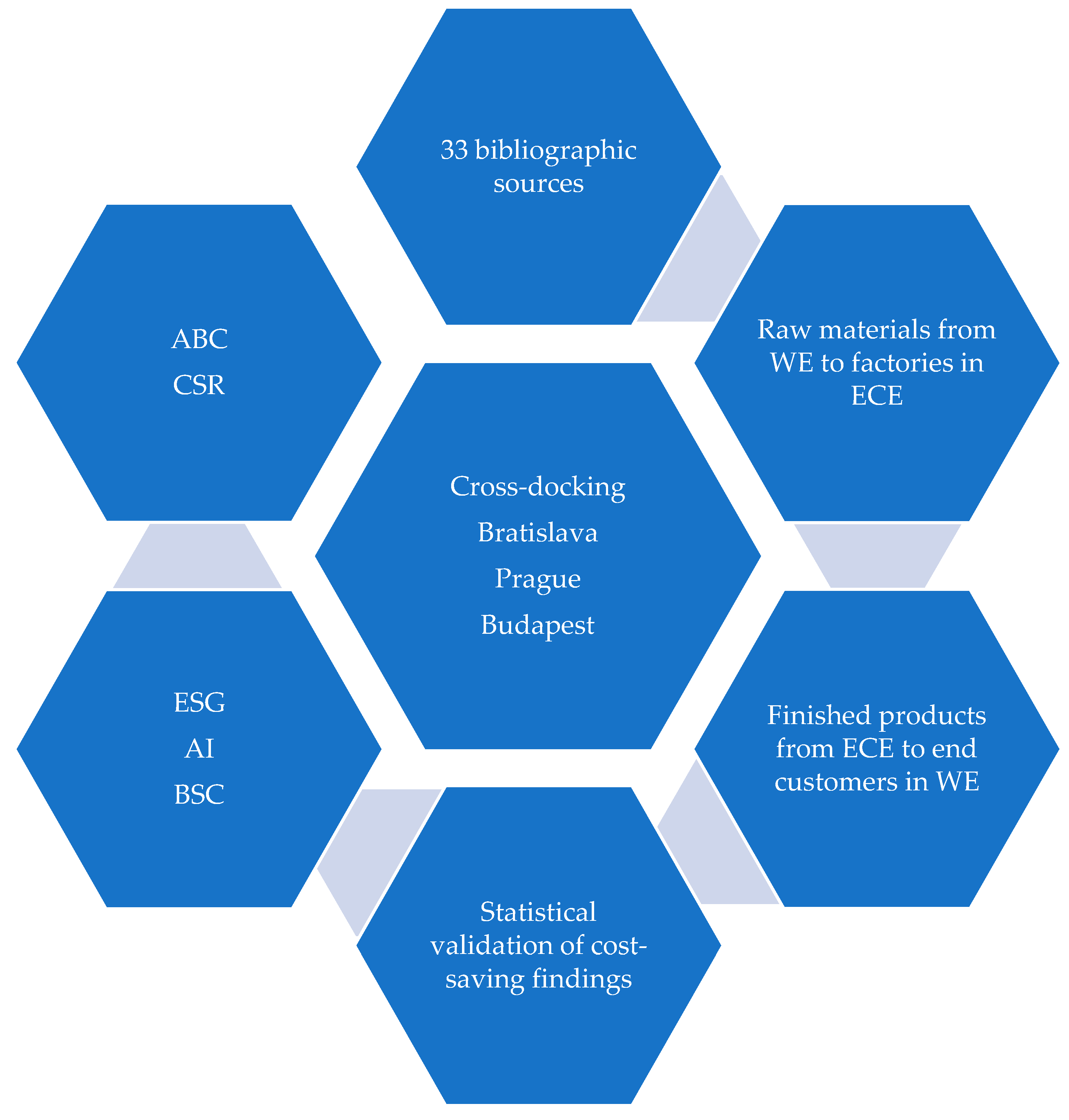
Figure 2.
Supplying ECE factories with WE raw materials.
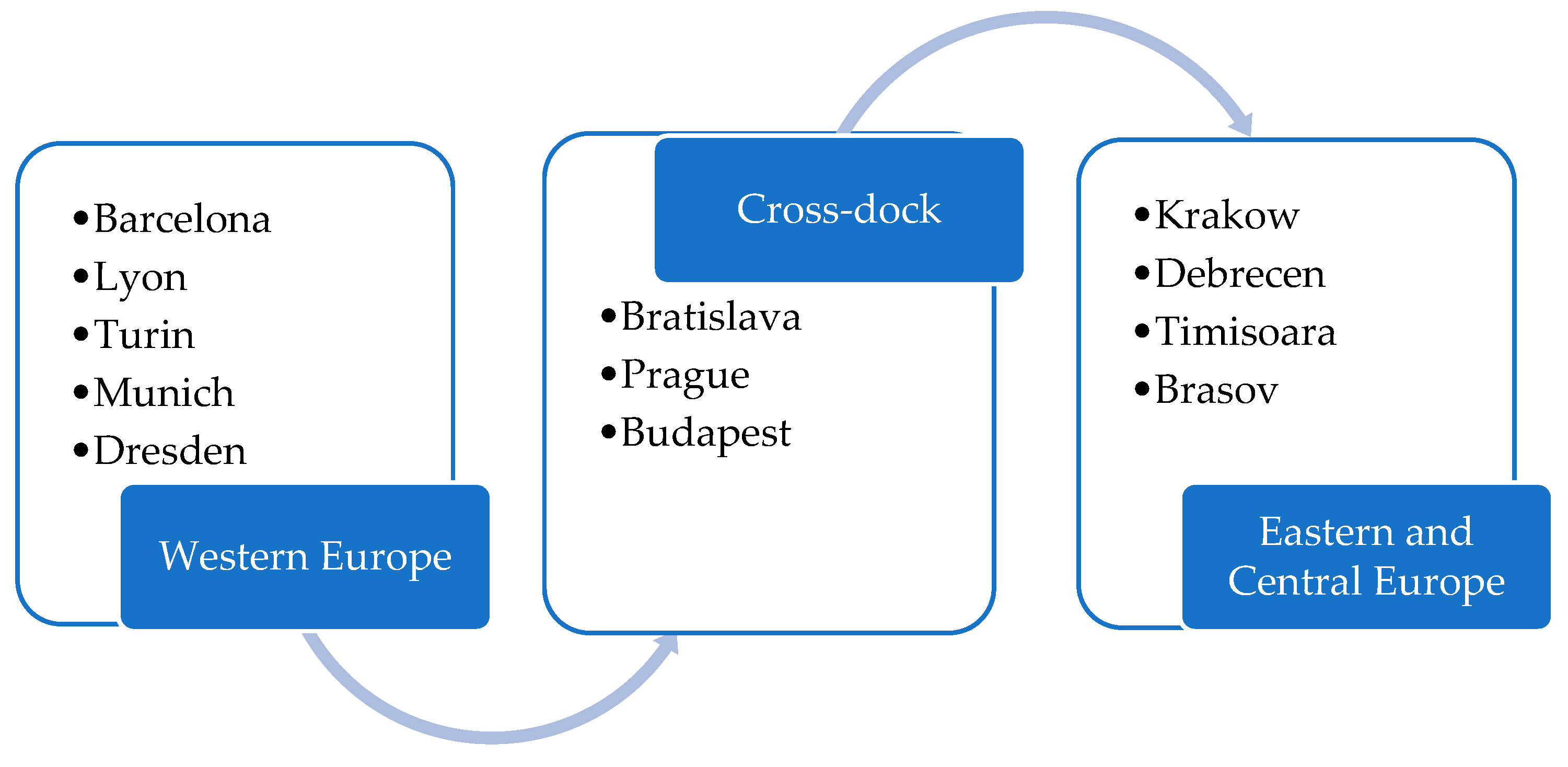
Figure 3.
Supplying end-customers in WE with finished products from ECE.
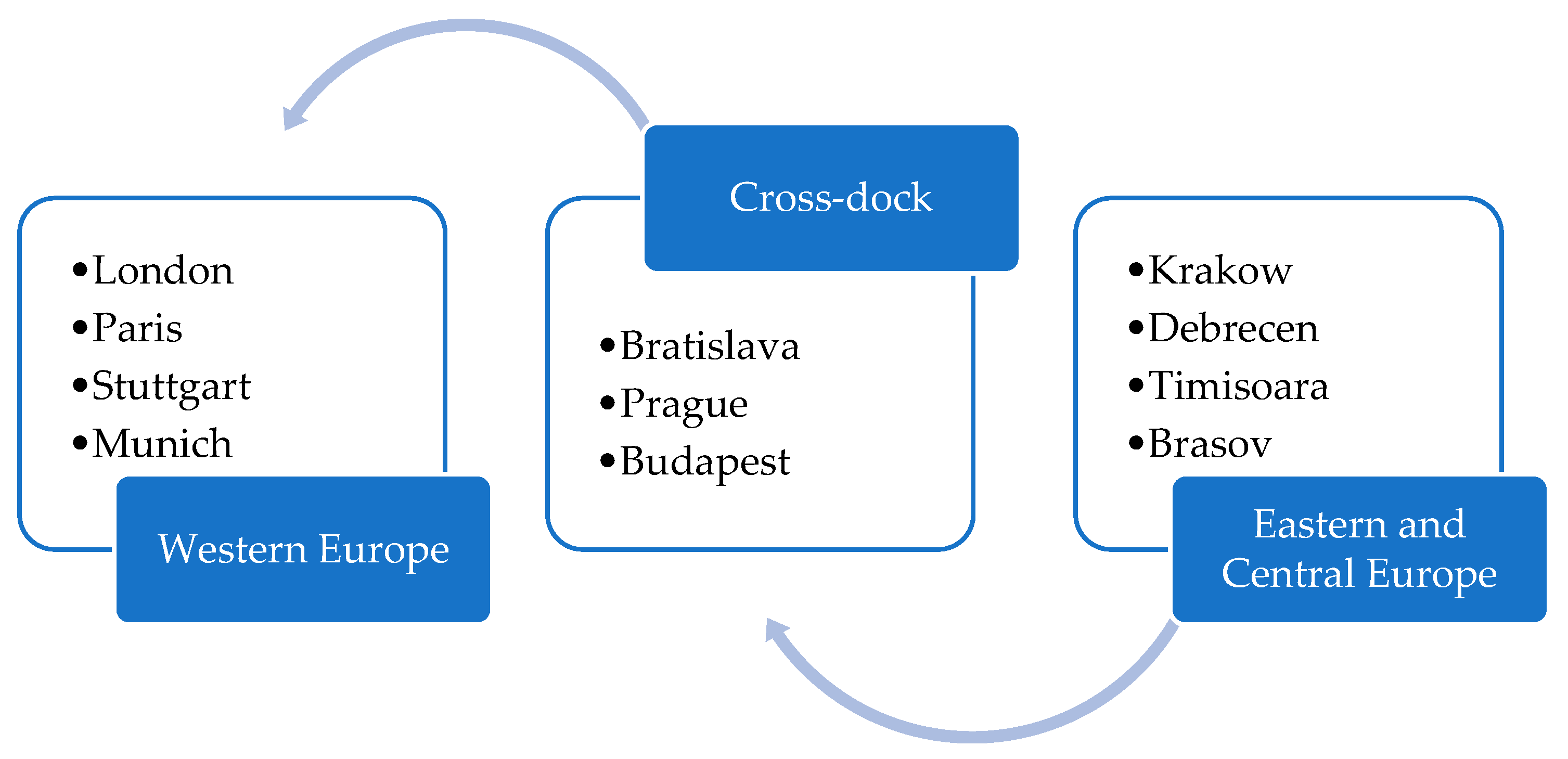
Figure 4.
C-Ds performance indicators.
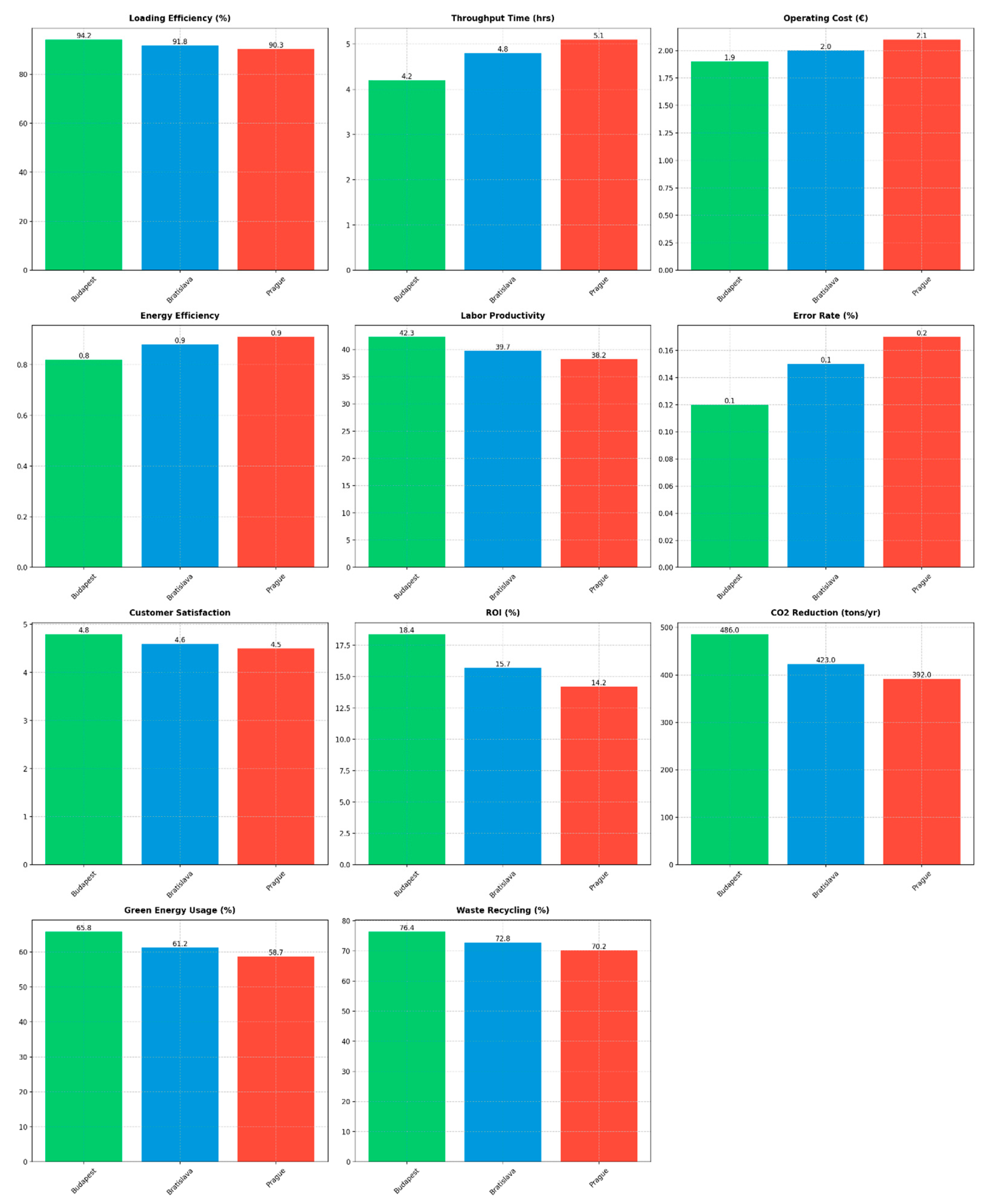
Figure 5.
C-Ds KPIs.
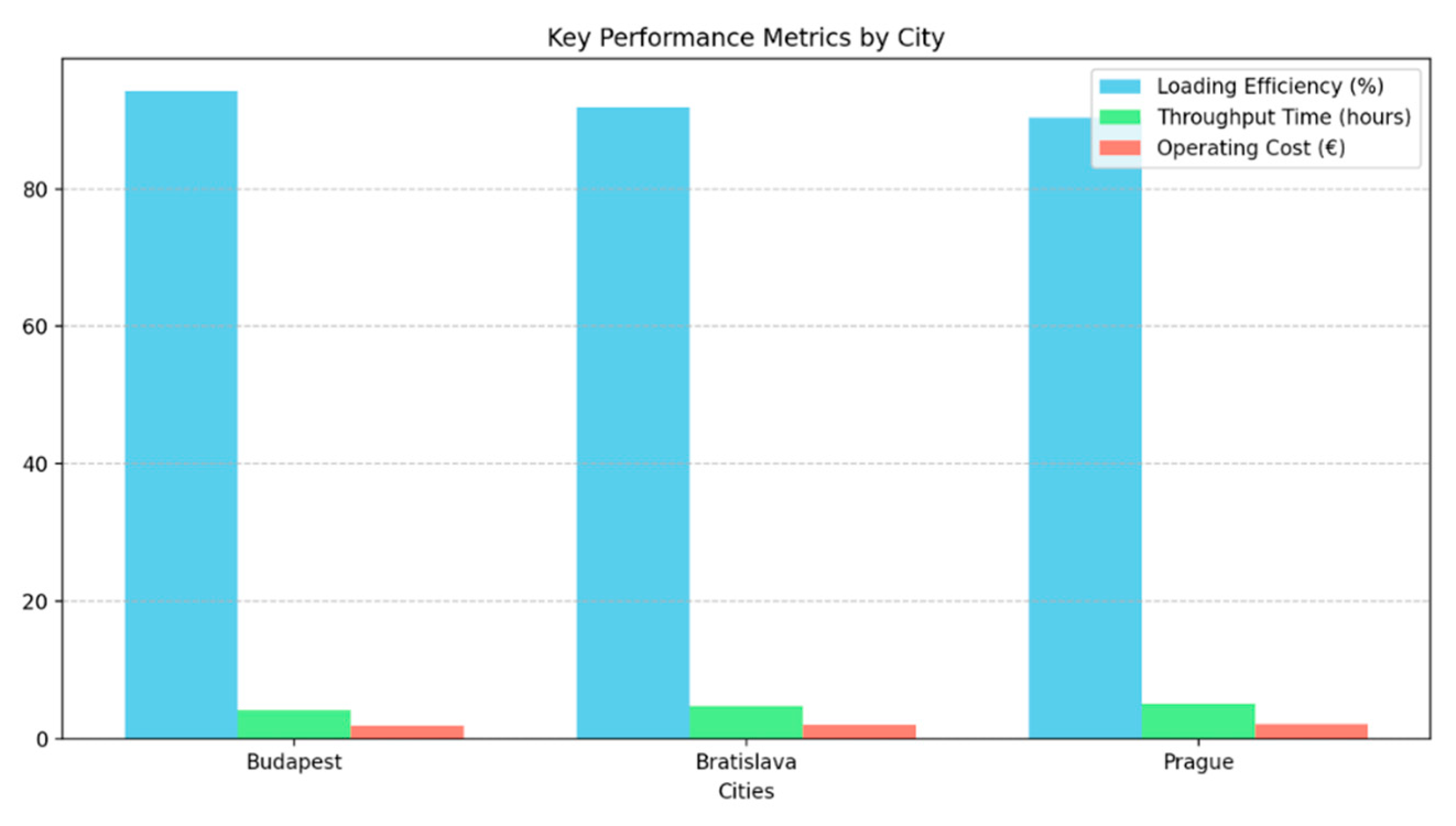

Table 1.
Batches of raw materials available at WE suppliers.
| Raw material batch | Loading truck | For Krakow | For Debrecen | For Timisoara | For Brasov |
|---|---|---|---|---|---|
| From Barcelona | Truck 1 60 euro pallets 15,840 kg |
20 euro pallets 5,200 kg |
|||
| From Lyon | 16 euro pallets 3,800 kg |
||||
| From Turin | 24 euro pallets 6,840 kg |
||||
| From Munich | Truck 2 62 euro pallets 12,820 kg |
16 euro pallets 3,060 kg |
28 euro pallets 5,560 kg |
||
| From Dresden | 18 euro pallets 4,200 kg |
||||
| Unloading truck (delivery from C-D) |
Truck 3 64 euro pallets 13,820 kg |
Truck 4 58 euro pallets 14,840 kg |
|||
Table 2.
Calculation of raw material delivery costs without C-D.
| Transportation costs of raw materials without C-D | ||
|---|---|---|
| Transport route | Distance | Transportation cost (1.60 euro/km) |
| Barcelona – Lyon | 639 km | 1,022 euro |
| Lyon – Turin | 312 km | 499 euro |
| Turin – Krakow | 1,451 km | 2,322 euro |
| Krakow – Timisoara | 698 km | 1,117 euro |
| Timisoara – Brasov | 412 km | 659 euro |
| Truck 1 | 3,512 km | 5,619 euro |
| Munich – Dresden | 460 km | 736 euro |
| Dresden – Krakow | 522 km | 835 euro |
| Krakow – Debrecen | 451 km | 722 euro |
| Debrecen – Brasov | 503 km | 805 euro |
| Truck 2 | 1,936 km | 3,098 euro |
| Truck 1 + Truck 2 | 5,448 km | 8,717 euro |
Table 3.
Calculation of raw material delivery costs with C-D in Bratislava.
| Transportation costs of raw materials with C-D | ||
| Transport route | Distance | Transportation cost (1.60 euro/km) |
| Barcelona – Lyon | 639 km | 1,023 euro |
| Lyon – Turin | 312 km | 499 euro |
| Turin – Bratislava | 1,064 km | 1,702 euro |
| Truck 1 | 2,015 km | 3,224 euro |
| Munich – Dresden | 460 km | 736 euro |
| Dresden – Bratislava | 476 km | 762 euro |
| Truck 2 | 936 km | 1,498 euro |
| Bratislava – Debrecen | 432 km | 691 euro |
| Debrecen – Krakow | 446 km | 714 euro |
| Truck 3 | 878 km | 1,405 euro |
| Bratislava – Timisoara | 507 km | 811 euro |
| Timisoara – Brasov | 412 km | 659 euro |
| Truck 4 | 919 km | 1,470 euro |
| Truck 1 + Truck 2 + Truck 3 + Truck 4 | 4,748 km | 7,597 euro |
| Raw material handling costs in C-D | ||
| Operation type | Number of euro pallets | Handling costs (2.00 euro/euro pallet) |
| Unloading in C-D | 122 euro pallets | 244 euro |
| Loading from C-D | 122 euro pallets | 244 euro |
| Number of handlings | 244 euro pallets | 488 euro |
| Raw material delivery costs with C-D | 8,085 euro (7,597 euro + 488 euro) | |
| Raw material delivery costs without C-D | 8,717 euro | |
| Reducing delivery costs based on C-D | 632 euro (-7.25%) | |
Table 4.
Calculation of raw material delivery costs with C-D in Prague.
| Transportation costs of raw materials with C-D | ||
| Transport route | Distance | Transportation cost (1.60 euro/km) |
| Barcelona – Lyon | 639 km | 1,023 euro |
| Lyon – Turin | 312 km | 499 euro |
| Turin – Prague | 983 km | 1,573 euro |
| Truck 1 | 1,934 km | 3,095 euro |
| Munich – Dresden | 460 km | 736 euro |
| Dresden – Prague | 149 km | 238 euro |
| Truck 2 | 609 km | 974 euro |
| Prague – Krakow | 535 km | 856 euro |
| Krakow – Debrecen | 451 km | 722 euro |
| Truck 3 | 986 km | 1,578 euro |
| Prague – Timisoara | 832 km | 1.331 euro |
| Timisoara – Brasov | 412 km | 659 euro |
| Truck 4 | 1,244 km | 1,990 euro |
| Truck 1 + Truck 2 + Truck 3 + Truck 4 | 4,773 km | 7,637 euro |
| Raw material handling costs in C-D | ||
| Operation type | Number of euro pallets | Handling costs (2.10 euro/euro pallet) |
| Unloading in C-D | 122 euro pallets | 256 euro |
| Loading from C-D | 122 euro pallets | 256 euro |
| Number of handlings | 244 euro pallets | 512 euro |
| Raw material delivery costs with C-D | 8,149 euro (7,637 euro + 512 euro) | |
| Raw material delivery costs without C-D | 8,717 euro | |
| Reducing delivery costs based on C-D | 568 euro (-6.52%) | |
Table 5.
Calculation of raw material delivery costs with C-D in Budapest.
| Transportation costs of raw materials with C-D | ||
| Transport route | Distance | Transportation cost (1.60 euro/km) |
| Barcelona – Lyon | 639 km | 1,023 euro |
| Lyon – Turin | 312 km | 499 euro |
| Turin – Budapest | 1,090 km | 1,744 euro |
| Truck 1 | 2,041 km | 3,266 euro |
| Munich – Dresden | 460 km | 736 euro |
| Dresden – Budapest | 672 km | 1,075 euro |
| Truck 2 | 1,132 km | 1,811 euro |
| Budapest – Debrecen | 233 km | 373 euro |
| Debrecen – Krakow | 447 km | 715 euro |
| Truck 3 | 680 km | 1,088 euro |
| Budapest – Timisoara | 315 km | 504 euro |
| Timisoara – Brasov | 412 km | 659 euro |
| Truck 4 | 727 km | 1,163 euro |
| Truck 1 + Truck 2 + Truck 3 + Truck 4 | 4,580 km | 7,328 euro |
| Raw material handling costs in C-D | ||
| Operation type | Number of euro pallets | Handling costs (1.90 euro/euro pallet) |
| Unloading in C-D | 122 euro pallets | 232 euro |
| Loading from C-D | 122 euro pallets | 232 euro |
| Number of handlings | 244 euro pallets | 464 euro |
| Raw material delivery costs with C-D | 7,792 euro (7,328 euro + 464 euro) | |
| Raw material delivery costs without C-D | 8,717 euro | |
| Reducing delivery costs based on C-D | 925 euro (-10.61%) | |
Table 6.
Batches of finished products available at ECE manufacturers.
| Finished product batch | Loading truck | For London | For Paris | For Stuttgart | For Munich |
|---|---|---|---|---|---|
| From Krakow | Truck 5 64 euro pallets 15,470 kg |
16 euro pallets 3,800 kg |
12 euro pallets 2,850 kg |
||
| From Debrecen | 36 euro pallets 8,820 kg |
||||
| From Timisoara | Truck 6 60 euro pallets 14,350 kg |
24 euro pallets 6,250 kg |
|||
| From Brasov | 16 euro pallets 3,600 |
20 euro pallets 4,500 kg |
|||
| Unloading truck (delivery from C-D) |
Truck 7 60 euro pallets 15,070 kg |
Truck 8 64 euro pallets 14,750 kg |
|||
Table 7.
Calculation of finished products delivery costs without C-D.
| Transportation costs of finished products without C-D | ||
|---|---|---|
| Transport route | Distance | Transportation cost (1.60 euro/km) |
| Krakow – Debrecen | 451 km | 722 euro |
| Debrecen – Munich | 909 km | 1,454 euro |
| Munich – Stuttgart | 231 km | 370 euro |
| Stuttgart – Paris | 620 km | 992 euro |
| Truck 5 | 2,211 km | 3,538 euro |
| Brasov – Timisoara | 412 km | 659 euro |
| Timisoara – Munich | 960 km | 1,536 euro |
| Munich – Stuttgart | 231 km | 370 euro |
| Stuttgart – London | 924 km | 1,478 euro |
| Truck 6 | 2,527 km | 4,043 euro |
| Truck 5 + Truck 6 | 4,738 km | 7,581 euro |
Table 8.
Calculation of finished products delivery costs with C-D in Bratislava.
| Transportation costs of finished products with C-D | ||
| Transport route | Distance | Transportation cost (1.60 euro/km) |
| Krakow – Debrecen | 451 km | 722 euro |
| Debrecen – Bratislava | 433 km | 693 euro |
| Truck 5 | 884 km | 1,415 euro |
| Brasov – Timisoara | 412 km | 659 euro |
| Timisoara – Bratislava | 509 km | 814 euro |
| Truck 6 | 921 km | 1,473 euro |
| Bratislava – Paris | 1,323 km | 2,117 euro |
| Paris – London | 477 km | 763 euro |
| Truck 7 | 1,800 km | 2,880 euro |
| Bratislava – Munich | 488 km | 781 euro |
| Munich – Stuttgart | 231 km | 370 euro |
| Truck 8 | 719 km | 1,151 euro |
| Truck 5 + Truck 6 + Truck 7 + Truck 8 | 4,324 km | 6,919 euro |
| Finished products handling costs in C-D | ||
| Operation type | Number of euro pallets | Handling costs (2.00 euro/euro pallet) |
| Unloading in C-D | 124 euro pallets | 248 euro |
| Loading from C-D | 124 euro pallets | 248 euro |
| Number of handlings | 248 euro pallets | 496 euro |
| Finished products delivery costs with C-D | 7,415 euro (6,919 euro + 496 euro) | |
| Finished products delivery costs without C-D | 7,581 euro | |
| Reducing delivery costs based on C-D | 166 euro (-2.19%) | |
Table 9.
Calculation of finished products delivery costs with C-D in Prague.
| Transportation costs of finished products with C-D | ||
| Transport route | Distance | Transportation cost (1.60 euro/km) |
| Debrecen – Krakow | 467 km | 747 euro |
| Krakow – Prague | 535 km | 856 euro |
| Truck 5 | 1,002 km | 1,603 euro |
| Brasov – Timisoara | 412 km | 659 euro |
| Timisoara – Prague | 833 km | 1,333 euro |
| Truck 6 | 1,245 km | 1,992 euro |
| Prague – Paris | 1,033 km | 1,653 euro |
| Paris – London | 477 km | 763 euro |
| Truck 7 | 1,510 km | 2,416 euro |
| Prague – Munich | 382 km | 611 euro |
| Munich – Stuttgart | 231 km | 370 euro |
| Truck 8 | 613 km | 981 euro |
| Truck 5 + Truck 6 + Truck 7 + Truck 8 | 4,370 km | 6,992 euro |
| Finished products handling costs in C-D | ||
| Operation type | Number of euro pallets | Handling costs (2.10 euro/euro pallet) |
| Unloading in C-D | 124 euro pallets | 260 euro |
| Loading from C-D | 124 euro pallets | 260 euro |
| Number of handlings | 248 euro pallets | 520 euro |
| Finished products delivery costs with C-D | 7,512 euro (6,992 euro + 520 euro) | |
| Finished products delivery costs without C-D | 7,581 euro | |
| Reducing delivery costs based on C-D | 69 euro (-0.91%) | |
Table 10.
Calculation of finished products delivery costs with C-D in Budapest.
| Transportation costs of finished products with C-D | ||
| Transport route | Distance | Transportation cost (1.60 euro/km) |
| Krakow – Debrecen | 451 km | 722 euro |
| Debrecen – Budapest | 234 km | 374 euro |
| Truck 5 | 685 km | 1,096 euro |
| Brasov – Timisoara | 412 km | 659 euro |
| Timisoara – Budapest | 316 km | 506 euro |
| Truck 6 | 728 km | 1,165 euro |
| Budapest – Paris | 1,488 km | 2,381 euro |
| Paris – London | 477 km | 763 euro |
| Truck 7 | 1,965 km | 3,144 euro |
| Budapest – Munich | 652 km | 1.043 euro |
| Munich – Stuttgart | 231 km | 370 euro |
| Truck 8 | 883 km | 1,413 euro |
| Truck 5 + Truck 6 + Truck 7 + Truck 8 | 4,261 km | 6,818 euro |
| Finished products handling costs in C-D | ||
| Operation type | Number of euro pallets | Handling costs (1.90 euro/euro pallet) |
| Unloading in C-D | 124 euro pallets | 236 euro |
| Loading from C-D | 124 euro pallets | 236 euro |
| Number of handlings | 248 euro pallets | 472 euro |
| Finished products delivery costs with C-D | 7,290 euro (6,818 euro + 472 euro) | |
| Finished products delivery costs without C-D | 7,581 euro | |
| Reducing delivery costs based on C-D | 291 euro (-3.84 %) | |
Table 11.
Comparative analysis of C-D scenarios.
| Comprehensive performance | Budapest | Bratislava | Prague |
| Average loading efficiency | 94.2% (±1.2%) | 91.8% (±1.4%) | 90.3% (±1.5%) |
| Throughput time (hours) | 4.2 (±0.3) | 4.8 (±0.4) | 5.1 (0.4) |
| Operating cost (euro/pallet) | 1.90 (±0.12) | 2.00 (±0.14) | 2.10 (0.15) |
| Energy efficiency (kWh/pallet) | 0.82 (±0.06) | 0.88 (±0.07) | 0.91 (±0.07) |
| Labor productivity (units/hour) | 42.3 (±2.1) | 39.7 (±2.3) | 38.2 (±2.4) |
| Error rate (%) | 0.12 (±0.02) | 0.15 (±0.02) | 0.17 (±0.03) |
| Customer satisfaction score | 4.8/5.0 (±0.2) | 4.6/5.0 (±0.2) | 4.5/5.0 (±0.2) |
| Economic impact (annual basis) | Budapest | Bratislava | Prague |
| Total operating cost savings | 925,000 euro | 632,000 euro | 568,000 euro |
| Return on investment (%) | 18.4 (±1.2) | 15.7 (±1.3) | 14.2 (±1.4) |
| Job creation (direct) | 52 (±4) | 45 (±4) | 41 (±3) |
| Local economic impact (€M) | 3.2 (±0.2) | 2.8 (±0.2) | 2.5 (±0.2) |
| SME partnership growth (%) | 42.3 (±3.1) | 38.7 (±3.2) | 35.2 (±3.0) |
| Environmental performance | Budapest | Bratislava | Prague |
| CO2 reduction (tons/year) | 486 (±32) | 423 (±28) | 392 (±26) |
| Energy efficiency rating | A+ (±0) | A (±0) | A (±0) |
| Waste recycling rate (%) | 76.4 (±3.2) | 72.8 (±3.4) | 70.2 (±3.5) |
| Green energy usage (%) | 65.8 (±2.5) | 61.2 (±2.7) | 58.7 (±2.8) |
Table 12.
ESG-AI analysis according to BSC criteria in C-D.
| C-D | Financial | Customer | Internal process | Learning and growth |
|---|---|---|---|---|
| Environmental | Compliance with environmental rules comes at high cost | Environmental concerns induce relatively high prices | Companies must comply with environmental legislation at all levels | Human resources must be trained to comply with environmental standards |
| Social | Sustainable jobs in a growth-enhancing sector | Increasing sales while increasing welfare | Cost reduction based on rigorous organization influenced by innovative technologies | Courses offered to human resources for specialization |
| Corporate governance | Implementing technological innovations in AI involves high upfront costs, but generates high returns in the long run | Customer loyalty through discount grids depending on the value of contracts | Optimizing warehouse management systems with AI and employee experience | Training provided to employees on AI applications in warehouse and transportation logistics |
| Artificial intelligence | Obtaining higher profit rates after amortization of investments in AI | Increasing customer satisfaction in terms of value for money | Testing AI recommendations and integrating valid procedures that generate added value | Professional development of employees using AI |
Disclaimer/Publisher’s Note: The statements, opinions and data contained in all publications are solely those of the individual author(s) and contributor(s) and not of MDPI and/or the editor(s). MDPI and/or the editor(s) disclaim responsibility for any injury to people or property resulting from any ideas, methods, instructions or products referred to in the content. |
© 2025 by the authors. Licensee MDPI, Basel, Switzerland. This article is an open access article distributed under the terms and conditions of the Creative Commons Attribution (CC BY) license (http://creativecommons.org/licenses/by/4.0/).
Copyright: This open access article is published under a Creative Commons CC BY 4.0 license, which permit the free download, distribution, and reuse, provided that the author and preprint are cited in any reuse.


