

Submitted:
18 March 2025
Posted:
18 March 2025
You are already at the latest version
Abstract
Positive psychology interventions in higher education can be pivotal in reducing depression rates among university students while also enhancing their optimism and well-being. This study aims to examine the effectiveness of implementing a 15-week group intervention on a sample of 194 students who were assigned to either the intervention group (N=126) or the control group (N=68). Utilizing a quasi-experimental design with experimental and control conditions, pre- and post-intervention measures were administered to assess depression, optimism, pessimism, and perseverance towards long-term goals. Specifically, the Life Orientation Test-Revised (LOT-R), the Center for Epidemiologic Studies Depression Scale (CES-D), the Attributional Style Questionnaire (ASQ), and the Grit Scale were employed. The results indicate that students in the experimental group reported significantly higher levels of optimism and reduced depression rates compared to the control group, where no significant differences were observed between pre- and post-intervention outcomes. In conclusion, the implementation of the Hallenges group intervention program may be effective in contributing to the well-being of university students. However, further research is needed to refine and enhance this intervention and to apply it across different university grades and courses.
Keywords:
Positive Psychology Interventions
; Wellbeing
; Depression
; Optimism
; University students
1. Introduction
The 2020 World Happiness Report (The State of Happiness in a COVID World, 2020) highlights significant international differences in youth happiness perception. In Spain, only 38% of young people self-identify as happy, placing the country in the lower range of the global happiness spectrum, alongside Peru (32%), Chile (35%), Argentina (43%), Hungary (45%), and Mexico (46%) (Helliwell et al., n.d.). In contrast, approximately 87% of the population in the Netherlands reports being happy, ranking the country second worldwide in terms of subjective well-being. In Europe, around 16.6% of young people express dissatisfaction with their lives, though with significant differences: while only 6.7% of 15-year-old adolescents in the Netherlands report low life satisfaction, this figure rises to 25% in the United Kingdom (OECD, 2020). These findings underscore the need for evidence-based public policies to enhance youth well-being (Helliwell et al., n.d.).
Youth happiness results from a multidimensional interaction of economic, social, psychological, and cultural factors (Azpiazu Izaguirre et al., 2021; Diener et al., 2018; Oishi & Diener, Ed, 2021). Variables such as economic instability, youth unemployment, and job insecurity have been identified as significant stressors contributing to lower subjective well-being among young people in Spain (Montalvo & Reynal-Querol, 2020). Likewise, family support and community cohesion play a fundamental role in promoting happiness and life satisfaction (Huppert, 2009).
Previous studies have indicated that access to educational opportunities, job prospects, and environmental quality are critical determinants of youth well-being (Blanchflower & Oswald, 2019). A global study involving 10,000 young people aged 16 to 25 revealed that 59% express deep concern about climate change, with nearly half reporting that this environmental anxiety negatively affects their daily lives (Hickman et al., 2021).
Differences in happiness levels between Spain and the Netherlands can be attributed to structural factors such as work-life balance, the strength of social support systems, and overall quality of life (OECD, 2020). The Organisation for Economic Co-operation and Development (OECD) emphasizes that physical and mental health, the quality of personal relationships, and satisfaction with living conditions are universal determinants of happiness. Furthermore, evidence suggests that investing in mental health services and positive psychology interventions can significantly enhance youth well-being (Kalamatianos et al., 2023; Ma et al., 2024; Siriaraya et al., 2024), reducing symptoms of anxiety and depression (Aknin et al., 2022; Kern et al., 2015; Seligman et al., 2009).
Generation Z, which primarily includes university students and recent graduates, faces significant challenges affecting their mental health (Liu, 2022). During the COVID-19 pandemic, the incidence of anxiety, depression, and stress within this group increased markedly, exacerbating economic uncertainty and difficulties in accessing psychological support (Aknin et al., 2022; Renfrew et al., 2021; Sanilevici et al., 2021). The World Health Organization (WHO) defines mental health as a state of well-being in which individuals can cope with daily stressors, work productively, and contribute to their community (García-Carrión et al., 2019). However, globally, more than 13% of adolescents aged 10 to 19 are diagnosed with a mental disorder, and approximately 46,000 adolescents die by suicide each year, equating to one death every 11 minutes (UNICEF, 2021). Stressors affecting Generation Z include gun violence, political instability, discrimination, and economic pressures (American Psychological Association, 2020). These elements have contributed to a higher prevalence of mental health issues among this generation compared to previous cohorts. Nevertheless, they also demonstrate a greater willingness to seek professional help, presenting an opportunity to strengthen the provision of mental health services (American Psychological Association, 2020).
This data indicates a growing dissatisfaction among Spanish youth, necessitating the implementation of education and public health strategies based on positive psychology. Mental health literacy, understood as the ability to recognize disorders, reduce stigma, and seek help effectively, is essential for addressing these challenges (Sequeira et al., 2022). The disparity in happiness levels between Spain and the Netherlands points to a structural issue requiring sustainable interventions. Early detection of mental health problems in young people can facilitate the development of effective policies and improve their resilience (Nguyen et al., 2022). In this context, educational institutions play a crucial role in implementing prevention programs and reducing the stigma associated with mental disorders (Cefai et al., 2022; Sibanda et al., 2022).
In response to the growing concern over the deterioration of youth mental health, a positive psychology-based intervention, termed Hallenges, derived from the concept of Happy Challenge, is proposed. This program, grounded in validated principles of positive psychology (Kounenou et al., 2022; Lomas et al., 2014; Talić et al., 2023), aims to foster optimism (Kalamatianos et al., 2023; Scheier & Carver, 1985), resilience (Fredrickson et al., 2003; Kalamatianos et al., 2023; Luthar et al., 2000), and overall well-being (Kalamatianos et al., 2023; Kounenou et al., 2022; Lomas et al., 2014; Ma et al., 2024; Talić et al., 2023), in addition to reducing the incidence of depressive symptoms among young people (Blanco et al., 2020; Siriaraya et al., 2024). Hallenges integrates empirically validated methodologies (Layous et al., 2011), such as journaling and gratitude letters, identifying personal strengths, three good things (Kalamatianos et al., 2023; Siriaraya et al., 2024) and practicing mindfulness (Kounenou et al., 2022). Its implementation in a semester-long university course could contribute to greater psychological and academic well-being among students (Deng et al., 2024; Kalamatianos et al., 2023; Sin & Lyubomirsky, 2009; Siriaraya et al., 2024; Talić et al., 2023).
1.1. Positive Psychology Interventions to Promote Optimism and Well-Being
Positive Psychology Interventions (PPIs) comprise a set of theoretically based and empirically validated activities designed to promote the development of beneficial psychological experiences (Kalamatianos et al., 2023; Siriaraya et al., 2024) and a full and prosperous existence (Deng et al., 2024; Sin & Lyubomirsky, 2009; Talić et al., 2023). In essence, PPIs are essential tools within the field of positive psychology, aimed at promoting well-being, increasing cognitive (Phan et al., 2025) and emotional engagement (Ma et al., 2024), and improving the quality of life in a holistic way (Kalamatianos et al., 2023). These interventions aim to strengthen resilience, well-being (Kalamatianos et al., 2023; Siriaraya et al., 2024) and the construction of a sense of life purpose, while alleviating depressive symptoms (Carr et al., 2021; Siriaraya et al., 2024). In depression, there is a strong and active network of negative emotions, cognitions and behaviors, in contrast to a weak network of positive nodes (Hayes et al., 2015), suggesting that a positive psychology intervention can contribute to a significant change in the reorganization of these variables (Blanco et al., 2020). Furthermore, a meta-analysis of positive psychology interventions concluded that these interventions significantly increase well-being and alleviate depressive symptoms in both clinical and non-clinical samples (Bolier et al., 2013; Chakhssi et al., 2018; Sin & Lyubomirsky, 2009). Siriaraya et al. (2024), in addition to improving self-esteem and subjective well-being, while reducing self-criticism, especially in highly dependent individuals (Deng et al., 2024). Positive Psychology Interventions (PPIs) are characterized by their multifaceted nature and focus on promoting happiness (Siriaraya et al., 2024) and building character strengths through practices such as expressing gratitude, practicing optimistic thinking (Kalamatianos et al., 2023), building on personal strengths, focusing on the positive aspects of life, reliving positive experiences, and socializing (Bolier et al., 2013; Carr et al., 2021; Kounenou et al., 2022). These practices facilitate a more holistic and profound change in participants (Hendricks et al., 2020; Van Agteren et al., 2021). Among these practices, the consistent expression of gratitude is positively correlated with greater happiness (Kalamatianos et al., 2023), greater energy, greater hope for the future, and more positive emotions (Lyubomirsky et al., 2005). Incorporating diverse practices into a positive psychology intervention increases the likelihood of a positive outcome (Salois, n.d.) by better accommodating individual differences. Furthermore, group interventions provide a safe and supportive environment that meets relational needs and helps develop greater interpersonal security (Slemp et al., 2021). Positive Psychology Interventions (PPIs) also contribute to the development of optimism (Kalamatianos et al., 2023), defined as the generalized expectation of good life outcomes (Scheier & Carver, 1985) and reflecting positive expectations for the near future (Carver et al., 2010). Furthermore, dispositional optimism is positively correlated with decision-making styles in adolescence (Magnano et al., 2015).
Several studies have shown that Positive Psychology Interventions (PPIs) generate sustainable impacts by increasing happiness and reducing depressive symptoms, serving as an effective complement to conventional mental health treatment methodologies (Seligman et al., 2005). Furthermore, these interventions help people experience positive emotions (Kalamatianos et al., 2023). , which contributes to an upward spiral that improves resilience and well-being (Fredrickson et al., 2003; Kounenou et al., 2022) and enables the accumulation of resources to face new challenges (Kounenou et al., 2022) and improve happiness (Cohn et al., 2009). Furthermore, these interventions are low-cost, easy to implement, non-stigmatizing, and free from side effects (The State of the World’s Children 2021: On My Mind – Promoting, Protecting and Caring for Children’s Mental Health, n.d.). Specialized programs such as the "Penn Resilience Program" and the "Strath Haven Positive Psychology Curriculum" have proven exceptionally effective in fostering resilience and encouraging positive emotions in students, leading to improvements in engagement, behavior, and academic performance (Seligman et al., 2009), thus highlighting the transformative potential of PPIs in educational contexts.
University students often face challenges as they transition from adolescence to adulthood, a period requiring significant learning and adaptation (Arnett, 2000). This represents a peak in academic stress and a significant period of personal adjustment (Trigueros et al., 2020), where positive psychology interventions could be highly beneficial and are receiving increasing attention (Lambert et al., 2019). Although these interventions are often not applied in higher education (Norrish et al., n.d.) due to the emphasis on knowledge acquisition and academic performance (Kounenou et al., 2022), few studies have been applied at the university level. Among them, a notable study is the 5-week group intervention focusing on positive psychology for university students in Greece (Kounenou et al., 2022). This intervention led to significant improvements in positive emotions, resilience, and self-esteem, although the impact on self-esteem was less pronounced. In the study by Lambert et al. (2023), a PPI intervention was conducted with university students in the United Arab Emirates, which also concluded that students experienced an increase in positive emotions and greater emotional balance, resulting in more positivity compared to the control group. The intervention by Siriaraya et al. (2024) demonstrated that the use of technology can facilitate daily reflection exercises, improving stress management in university students. Also, interactivity in mental health interventions improved user adherence and long-term impact. This study is one of the first to examine tangible user interfaces for positive psychology interventions (Siriaraya et al., 2024). Phan, Jennings & Gloeckner's (2025) intervention examined the impact on self-efficacy and self-confidence of a University Preparation course among 72 Vietnamese first-year university students (Experimental group n=50 and Control group n=22). The results obtained highlight that the experimental group showed a significant increase in self-efficacy and the effects were maintained at the six-week follow-up. In relation to self-confidence, significant improvements were observed in the experimental group in critical thinking, creativity, greater ability to set and achieve learning goals and greater confidence in the use of digital tools (Phan et al., 2025). Kalamatianos et al. (2023) research evaluated the impact of a positive psychology group intervention focused on gratitude on the subjective well-being, optimism and resilience of undergraduate engineering students (experimental group n = 34 and control group n = 35). The results show significantly higher levels of gratitude, impact on psychological well-being, optimism, improved student engagement and academic success (Kalamatianos et al., 2023). This intervention provides practical recommendations for higher education institutions to implement gratitude-based interventions. Finally, Ma et al. (2024) intervention focused on training 25 English language instruction (EMI) teachers in positive psychology engagement strategies, based on Seligman's (2011) PERMA model. The IPPs empowered EMI teachers to integrate engagement strategies that improved their students' learning and psychological well-being (Ma et al., 2024).
1.2. Aim and Hypotheses
This study aims to examine the effects of a psychoeducational program based on the principles of positive psychology on the psychological variables of optimism and persistence, as well as on the reduction of depressive symptoms in an experimental group. This analysis is grounded in the theoretical and empirical evidence existing in the specialized scientific literature on positive psychology, which posits significant benefits of structured psychoeducational group interventions on these variables.
In this context, our research hypotheses are focused on:
H1: Participants in the experimental group will show a statistically significant increase in post-intervention optimism levels compared to their pre-intervention levels.
H2: Participants in the experimental group will achieve a statistically significant decrease in post-intervention depression levels compared to initial measurements.
H3: Participants in the experimental group will exhibit a statistically significant increase in long-term goal persistence following the intervention.
H4: There will be no statistically significant changes in the measurements of optimism, depression, and long-term goal persistence among students in the control group throughout the intervention (pre- and post-program evaluation).
In response to this emerging challenge, the proposal of a targeted positive psychology program, Hallenges offers a promising avenue to address mental health issues prevalent among university students. Anchored in the core principles of positive psychology, this intervention seeks to cultivate resilience, improve well-being, and decrease the prevalence of depressive symptoms within this cohort. By integrating evidence-based interventions such as gratitude journaling, strengths identification, and mindfulness practices, the program aims to foster a strong psychological framework among young adults, allowing them to thrive academically and personally. The hypothesis driving this initiative postulates that, through the systematic application of the Hallenges program, a measurable improvement in the emotional well-being of university students can be achieved, which could mitigate the incidence of depression and increase their general happiness (Seligman & Csikszentmihalyi, 2000).
2. Materials and Methods
2.1. Participants
A total of 194 first-year students, comprising 76 men and 118 women, were selected from the undergraduate programs in criminology and psychology at ESERP, a center affiliated with the University of Vic - Central University of Catalonia (UVic-UCC) and the University of Barcelona (UB). Prior to the commencement of the study, participants were provided with detailed information about the research objectives, and their informed consent was obtained, ensuring their full understanding of the implications of their involvement. To maintain data confidentiality, students completed the measurement instruments through the online platform www.hallenges.com, which is configured to ensure the confidentiality of responses. It is emphasized that participation was voluntary, and no financial incentives were offered for their collaboration. Additionally, the study design and procedures were reviewed and received favorable approval from the Ethics Committee of UVic-UCC, confirming adherence to ethical research standards as well as the ethical principles of the Helsinki Declaration.
2.2. Procedure
In the initial phase, both the control and experimental groups completed a battery of psychometric questionnaires in person, which included the Life Orientation Test-Revised (LOT-R) (Scheier et al., 1994), the Center for Epidemiologic Studies Depression Scale (CES-D) (Radloff, 1977), the Attributional Style Questionnaire (ASQ) (Peterson et al., 1982), and the GRIT test (Duckworth et al., 2007) for measuring persistence and sustained effort.
The group intervention focused on positive psychology was structured within the regular curriculum, allocating 10 minutes per week during a semester in an undergraduate course. The purpose was to understand and apply fundamental concepts of positive psychology through practical activities tailored to the students' needs. Selected activities included identifying and recording 'three good things,' writing gratitude letters, using personal strengths, practicing savoring, and creating personalized action plans.
In particular, for the experimental group, each session began with a didactic presentation by the instructors, who were previously trained in the program implementation. During these presentations, theoretical content and the practical activities corresponding to the session were introduced. Subsequently, students applied these activities in their daily routines, recording their experiences in specific provided forms. Additionally, the course's online platform served as a repository for materials and a space for the submission of weekly assignments. During the sessions, dialogue among participants was encouraged regarding their reflections and experiences derived from the intervention.
It is important to note that the control group did not receive any intervention during this process. At the end of the intervention period, participants in both groups were re-evaluated using the same initial psychometric instruments to examine the effects of the intervention.
The quasi-experimental design approach used in this research allows for a comprehensive evaluation that integrates both the evolution of participants throughout the intervention and comparisons between the experimental and control groups, providing a deeper understanding of the intervention's effects. This design is particularly valuable for discerning individual variations in response to the intervention, as well as for contrasting these changes with a non-exposed group, thereby strengthening the robustness and internal validity of the findings.
Each student was assigned a unique identifier to ensure traceability throughout the study in both the control and experimental groups. In the control group, evaluations were conducted at two different times, with a fixed interval between them, without introducing any type of positive psychology intervention during this period. The procedure for the experimental group followed a similar scheme; however, between the two evaluations, a 15-week positive psychology intervention called Hallenges was administered. The central hypothesis of the study posits that this intervention can induce significant variations in the psychological metrics evaluated, specifically regarding optimism, perseverance, subjective happiness, and depressive symptoms.
The comparative methodology will involve a cross-analysis of the metrics between the control and experimental groups, using unique identifiers to ensure precise longitudinal evaluation of the participants. It is anticipated that the control group will not show statistically significant differences between the pre-established pre- and post-measurements, given that the intervention was not part of their protocol. This will contrast with the expected data from the experimental group, where the positive psychology intervention is anticipated to modify the study variables.
The control group consists of 68 students, with a gender distribution of 79.4% female and 20.6% male. In terms of marital status, 60.3% of the participants identify as single or in relationships of less than one year, while 39.7% report being in relationships of more than one year. The academic composition of the group includes 92.6% of students enrolled in the criminology program and 7.4% in psychology, from the University of Vic - Central University of Catalonia (UVIC-UCC) and the University of Barcelona (UB), respectively.
On the other hand, the experimental group, consisting of 126 students who participated in the positive psychology intervention Hallenges has a gender distribution of 82.5% female and 17.5% male. Regarding marital status, 68.7% are classified as single or in relationships of less than one year, and 31.3% in relationships of more than one year. The disciplinary distribution for this group is 56.3% criminology students and 43.7% psychology students, with an academic background identical to that of the control group.
It is noteworthy that a non-probabilistic intentional sampling method was used for the selection of the cohorts. The units of analysis consisted of specific undergraduate classes at the university, selected for their relevance to the constructs of interest. Once established, they were deliberately assigned to the control and experimental groups to evaluate the impact of the intervention. This strategic assignment allowed for the control of contextual variables inherent to the academic environment and facilitated the administration of the evaluation measures.
2.3. Measures
In the present study, measurements of key psychometric constructs were conducted using validated instruments. Optimism was measured using the Life Orientation Test-Revised (LOT-R) (Scheier et al., 1994), with scores ranging from 0, indicating the absence of optimism, to a maximum of over 24, representing a high level of optimism. The prevalence of depressive symptoms was determined using the Center for Epidemiologic Studies Depression Scale (CES-D) (Radloff, 1977), which ranges from 0 to 60, with higher scores reflecting greater severity of depressive symptoms. Persistence and sustained effort were evaluated using the GRIT scale (Duckworth et al., 2007), where the range extends from 0 to 5, with 5 indicating the highest possible persistence. Additionally, Seligman's Attributional Style Questionnaire (ASQ) (Peterson et al., 1982) was applied for a multifaceted assessment of optimism, using the PvG, PvB, PmG, and PmB subscales, each with a scoring range from 0 to 8, where lower scores indicate lower optimism. Self-esteem was quantified using the PsB and PsG scales, both with a range from 0 (lowest self-esteem) to 8 (highest self-esteem). Finally, hope was measured by the HoB scale, which ranges from 0 (no hope) to 16 (maximum level of hope), thus providing a detailed profile of this psychological construct.
2.4. Statistical Analysis
The statistical analysis of the data began by verifying linearity using scatter plots. Subsequently, the normality of the distributions was examined through histograms, Q-Q plots, goodness-of-fit tests such as Kolmogorov-Smirnov and Shapiro-Wilk, and analyses of skewness and kurtosis, where no significant deviations were identified.
To compare the evaluated psychological factors —optimism, depression, and persistence— means and standard deviations were calculated, and Student's t-tests for independent samples were performed at two points, before and after the intervention. Additionally, a multivariate analysis of variance (MANOVA) was conducted to contrast positive and negative emotions, resilience, subjective happiness, optimism, and self-esteem between the conditions of positive intervention and the absence of it before the program.
Intragroup comparisons were conducted using the paired-samples t-test, evaluating differences at pre- and post-intervention points. Finally, mixed ANOVAs were applied to determine the effect of the intervention, considering the experimental condition as a between-subjects variable and time (pre-post intervention) as a within-subjects factor.
Data processing was conducted using the statistical software SPSS, version 21, ensuring the traceability and confidentiality of the data through unique codes assigned to each student in both the control and experimental groups. The significance level adopted for all statistical tests was .05, according to standard conventions in psychological research.
This statistical approach was selected to maximize the understanding of the dynamics and effects of the Hallenges training program on the psychological variables of interest, ensuring rigor and precision in the interpretation of the obtained results.
3. Results
Initially, to evaluate the effectiveness of the program, we compared pre- and post-intervention changes in various psychological measures in a sample of 194 university students (N= 126 experimental group and N=68 control group). The results of the non-parametric Mann-Whitney U and Wilcoxon W tests did not reveal significant differences in the control group, confirming the stability in levels of optimism, depression, persistence, and self-esteem in the absence of the program.
Consequently, we validated hypothesis 4. All null hypotheses are accepted, as observed in the non-parametric contrast Table 1, Table 2 and Table 3, with a significance level of .05. Therefore, all students who completed the questionnaire before and after the duration of the Hallenges program, and did not undergo the intervention, show no differences in these factors and no improvement in any indicator of optimism, self-esteem, hope, or persistence.
Measures of Optimism (LOT-R)
An analysis of variance (ANOVA) revealed significant improvements in optimism levels as measured by the LOT-R questionnaire. The post-intervention results showed a higher median compared to the pre-intervention, with a significant increase of 1 point in the mean (p < .048). This validates hypothesis 1, indicating that students who participated in the program experienced an increase in their level of optimism, rising from a mean of 15.54 to 16.54 points, and rejects the null hypothesis that there are no significant differences between the measurements before and after the intervention.
As can be seen in the box plot (Figure 1), the median of the scores in the POST sample is higher than that of the PRE sample (17 vs. 16). Additionally, the 75th percentile in the POST sample is above that of the PRE sample (20 vs. 19), and the 90th percentile also shows an increase (22 vs. 21).
The 95% confidence interval for the pre-intervention scores ranges from 14.77 to 16.30, while the post-intervention scores range from 15.79 to 17.28, indicating a significant improvement in optimism levels following the intervention.
The box plot (Figure 1) illustrates an upward shift in the distribution of scores, visually confirming the improvements observed in the statistical analysis.
Depression Measures (CES-D)
Regarding the CES-D factor, a significant average decrease of 4.7 points in depressive symptoms was observed, from a pre-intervention mean of 21.51 to a post-intervention mean of 16.80 (p < .001). This significant reduction in depressive symptoms is evident in the box plot (Figure 2), where the median decreases from 19 to 15.5, and the 75th percentile drops from 29 to 24.
The confidence interval also shows a notable decrease, shifting from a range of 19.69-23.34 in the pre-intervention to 14.73-18.86 in the post-intervention. This change indicates that the minimum of the pre-intervention range (19.69) is higher than the maximum of the post-intervention range (18.86), highlighting the effectiveness of the program in reducing depressive symptoms. These results validate hypothesis 2 of our study, demonstrating that the intervention produces a significant improvement in the emotional state of the participants.
Persistence Measures (GRIT)
Regarding persistence (GRIT), although there were no statistically significant changes, the box plots suggest a trend towards greater persistence in the group that completed the Hallenges program. Consequently, this refutes hypothesis 3.
Correlation Analysis of Psychological Measures
Finally, the Spearman correlation matrix (Table 4) revealed significant associations, particularly between measures of optimism and hope (PmB and HoB, PvB and HoB). There was also a notable inverse correlation between levels of depression and optimism (CES-D and LOT-R). These correlations support the theory that hope and optimism are interrelated and both inversely associated with depression. Additionally, strong correlations were observed between self-esteem and hope (PsB and HoB, PsG and HoB) and between persistence (GRIT) and positive attributional style (PvG). These findings underscore the interconnected nature of positive psychological constructs and the role of optimism and hope in mitigating depressive symptoms and enhancing overall well-being. The significant negative correlations between depressive symptoms (CESS-D) and both self-esteem (PsB, PsG) and optimism (LOT-R) further validate the effectiveness of positive psychology interventions in reducing depressive symptoms and improving mental health outcomes.
4. Discussion
Given the results obtained, the use of positive psychology interventions (PPIs) is interesting (Kalamatianos et al., 2023; Ma et al., 2024; Phan et al., 2025; Siriaraya et al., 2024), although it is a relatively new development (Kounenou et al., 2022). Regarding trait optimism, the intervention in the experimental group increased by one point, as highlighted by Scheier and Carver (1985) as a benefit of PPIs. Similarly, the study by Huang and Zhao et al. (2021) and Kalamatianos et al. (2023) also demonstrated improvements in participants' optimism compared to a control group. However, Joutsenniemi et al. (2014) did not find any positive impact on optimism in a large community sample of Finnish adults. Positive psychology interventions (PPIs) in higher education should be increased, as suggested by the results obtained and as proposed by Lambert et al. (Lambert et al., 2019), Kalamatianos et al. (2023), Siriaraya et al. (2024), and Phan, Jennings, & Gloeckner (2025). Although these interventions are not commonly implemented in higher education (Norrish et al., n.d.), group interventions provide a safe and supportive environment that helps meet relational needs and increase personal safety, especially in individuals with greater dependency (Slemp et al., 2021).
Regarding the reduction of depressive symptoms through the development of PPIs, a meta-analysis of 51 positive interventions revealed that they significantly increase well-being and alleviate depressive symptoms (Sin & Lyubomirsky, 2009). In this regard, another meta-analysis of positive psychology interventions concluded that these interventions significantly improve well-being and alleviate depressive symptoms in both clinical and non-clinical samples (Bolier et al., 2013; Chakhssi et al., 2018; Kalamatianos et al., 2023; Sin & Lyubomirsky, 2009; Siriaraya et al., 2024). Furthermore, these interventions have been shown to be effective in individuals with high self-criticism and dependency, reducing depressive symptoms, improving self-esteem, and enhancing subjective well-being (Deng et al., 2024; Kalamatianos et al., 2023; Siriaraya et al., 2024). Among the activities included in the PPIs, the practice of gratitude stands out as an effective strategy to improve psychological and emotional well-being (Kalamatianos et al., 2023; Siriaraya et al., 2024), significantly reducing depressive symptoms and increasing life satisfaction (Davis et al., 2016; Dickens, 2017; Kalamatianos et al., 2023). In particular, writing letters of gratitude has been associated with improvements in emotional regulation and general well-being (Boggio, 2019). These findings are in line with the literature that highlights the importance of gratitude practices in fostering an upward growth of positive emotions and resilience (Fredrickson et al., 2003; Kalamatianos et al., 2023; Kounenou et al., 2022; Siriaraya et al., 2024). Furthermore, activities such as recognizing personal strengths and promoting positive interpersonal relationships facilitate a profound and holistic change in the participants (Hendricks et al., 2020; Van Agteren et al., 2021).
Although the results obtained from the intervention are interesting, it is important to highlight several limitations of the study. First, although the sample size is large, it only includes students from two university degree programs, which limits the generalizability of the results to other groups and academic disciplines (Ma et al., 2024; Phan et al., 2025; Siriaraya et al., 2024). Additionally, the design used was quasi-experimental and not randomized, introducing potential biases due to the lack of randomness in sample selection and the assignment of entire classes to control or experimental groups without randomization (Kalamatianos et al., 2023). This methodology may increase the likelihood that uncontrolled variables could influence the results. To strengthen the internal validity and generalizability of the findings, it is preferable to use probabilistic sampling with random assignment in quantitative studies. However, it is worth noting that the existence of an experimental group and a control group in this intervention contributes to greater internal validity of the study (Kalamatianos et al., 2023; Phan et al., 2025).
For future research, it is recommended to explore various avenues to expand and deepen the current findings. First, it would be valuable to broaden the sample to include students from different academic programs and disciplines (Kalamatianos et al., 2023; Phan et al., 2025). This would allow for an assessment of the generalizability of the results to a wider and more diverse student population. Additionally, it is suggested to conduct a longitudinal analysis to examine the long-term impact of Positive Psychology Interventions (PPIs) (Kalamatianos et al., 2023; Phan et al., 2025; Siriaraya et al., 2024). This approach would enable the observation of how the effects of the interventions are sustained over time and whether changes in well-being and other psychological indicators occur at different stages of the educational cycle. Including personality variables in the study design could also provide valuable insights into which personal characteristics modulate the effectiveness of PPIs. Assessing whether these interventions are more suitable for individuals with certain personality traits, such as resilience, self-criticism, or dependency, could help to tailor interventions and maximize their effectiveness. Finally, the incorporation of gamified technological applications as support for PPIs should be considered (Siriaraya et al., 2024). This approach could enhance participant engagement and adherence, especially among the millennial generation, who exhibit a greater affinity for technology and digital platforms. Evaluating the impact of these technological tools on intervention outcomes could offer a promising avenue to increase the efficacy and reach of PPIs. These proposals would not only expand the current knowledge on the effectiveness of PPIs but also contribute to the development of more adapted and personalized interventions, enhancing their applicability in various educational contexts.
Supplementary Materials
The following supporting information can be downloaded at: www.mdpi.com/xxx/s1, Figure S1: title; Table S1: title; Video S1: title.
Author Contributions
Conceptualization, E.T.-P., M.M.-T and Y.J.-P.; methodology, E.T.-P., M.M.-T and Y.J.-P.; validation, C.S.-T.; formal analysis, E.T.-P.; investigation, E.T.-P., M.M.-T and Y.J.-P.; resources, E.T.-P., M.M.-T and Y.J.-P; data curation, M.M.-T.; writing—original draft preparation, E.T.-P.; writing—review and editing, E.T.-P., M.M.-T and Y.J.-P.; visualization, E.T.-P., M.M.-T and Y.J.-P.; supervision, E.T.-P., M.M.-T and Y.J.-P; project administration, E.T.-P. and Y.J.-P.; funding acquisition, E.T.-P. All authors have read and agreed to the published version of the manuscript.
Funding
This work in their initial design was supported by the PIRE Program 2020-2022 (CIFE).
Institutional Review Board Statement
The study was conducted in accordance with the Declaration of Helsinki, and approved by the University of Vic—Central University of Catalonia (protocol code 132/2020 in November 2020).
Informed Consent Statement
Informed consent has been obtained from all subjects involved in the study.
Data Availability Statement
The original data presented in the study and the used questionnaire are openly available in The Open Science Framework repository https://doi.org/10.34810/data1790.
Acknowledgments
This program has received support from the following professors in their initial desing: Armisen-Morell, A.; Grau-Carrion S.; Frigola-Reig, J. and Marca-Frances, G.
Conflicts of Interest
The authors declare no conflict of interest.
References
- Aknin, L. B., De Neve, J.-E., Dunn, E. W., Fancourt, D. E., Goldberg, E., Helliwell, J. F., Jones, S. P., Karam, E., Layard, R., Lyubomirsky, S., Rzepa, A., Saxena, S., Thornton, E. M., VanderWeele, T. J., Whillans, A. V., Zaki, J., Karadag, O., & Ben Amor, Y. (2022). Mental Health During the First Year of the COVID-19 Pandemic: A Review and Recommendations for Moving Forward. Perspectives on Psychological Science, 17(4), 915–936. [CrossRef]
- American Psychological Association. (2020). Manual de Publicaciones de la APA. El Manual Moderno.
- Arnett, J. J. (2000). Emerging adulthood: A theory of development from the late teens through the twenties. American Psychologist, 55(5), 469–480. [CrossRef]
- Azpiazu Izaguirre, L., Fernández, A. R., & Palacios, E. G. (2021). Adolescent Life Satisfaction Explained by Social Support, Emotion Regulation, and Resilience. Frontiers in Psychology, 12, 694183. [CrossRef]
- Blanchflower, D. G., & Oswald, A. J. (2019). Unhappiness and Pain in Modern America: A Review Essay, and Further Evidence, on Carol Graham’s Happiness for All? Journal of Economic Literature, 57(2), 385–402. [CrossRef]
- Blanco, I., Contreras, A., Chaves, C., Lopez-Gomez, I., Hervas, G., & Vazquez, C. (2020). Positive interventions in depression change the structure of well-being and psychological symptoms: A network analysis. The Journal of Positive Psychology, 15(5), 623–628. [CrossRef]
- Boggio, P. S. (2019). Science and education are essential to Brazil’s well-being. Nature Human Behaviour, 3(7), 648–649. [CrossRef]
- Bolier, L., Haverman, M., Westerhof, G. J., Riper, H., Smit, F., & Bohlmeijer, E. (2013). Positive psychology interventions: A meta-analysis of randomized controlled studies. BMC Public Health, 13(1), 119. [CrossRef]
- Carr, A., Cullen, K., Keeney, C., Canning, C., Mooney, O., Chinseallaigh, E., & O’Dowd, A. (2021). Effectiveness of positive psychology interventions: A systematic review and meta-analysis. The Journal of Positive Psychology, 16(6), 749–769. [CrossRef]
- Carver, C. S., Scheier, M. F., & Segerstrom, S. C. (2010). Optimism. Clinical Psychology Review, 30(7), 879–889. [CrossRef]
- Cefai, C., Camilleri, L., Bartolo, P., Grazzani, I., Cavioni, V., Conte, E., Ornaghi, V., Agliati, A., Gandellini, S., Tatalovic Vorkapic, S., Poulou, M., Martinsone, B., Stokenberga, I., Simões, C., Santos, M., & Colomeischi, A. A. (2022). The effectiveness of a school-based, universal mental health programme in six European countries. Frontiers in Psychology, 13, 925614. [CrossRef]
- Chakhssi, F., Kraiss, J. T., Sommers-Spijkerman, M., & Bohlmeijer, E. T. (2018). The effect of positive psychology interventions on well-being and distress in clinical samples with psychiatric or somatic disorders: A systematic review and meta-analysis. BMC Psychiatry, 18(1), 211. [CrossRef]
- Cohn, M. A., Fredrickson, B. L., Brown, S. L., Mikels, J. A., & Conway, A. M. (2009). Happiness unpacked: Positive emotions increase life satisfaction by building resilience. Emotion, 9(3), 361–368. [CrossRef]
- Davis, D. E., Choe, E., Meyers, J., Wade, N., Varjas, K., Gifford, A., Quinn, A., Hook, J. N., Van Tongeren, D. R., Griffin, B. J., & Worthington, E. L. (2016). Thankful for the little things: A meta-analysis of gratitude interventions. Journal of Counseling Psychology, 63(1), 20–31. [CrossRef]
- Deng, Y., Zhang, J., Chen, H., Tian, S., Zhang, Y., & Hu, X. (2024). Benefiting Individuals High in Both Self-Criticism and Dependency Through an Online Multi-component Positive Psychology Intervention: Effects and Mechanisms. Journal of Happiness Studies, 25(1–2), 16. [CrossRef]
- Dickens, L. R. (2017). Using Gratitude to Promote Positive Change: A Series of Meta-Analyses Investigating the Effectiveness of Gratitude Interventions. Basic and Applied Social Psychology, 39(4), 193–208. [CrossRef]
- Diener, E., Oishi, S., & Tay, L. (2018). Advances in subjective well-being research. Nature Human Behaviour, 2(4), 253–260. [CrossRef]
- Duckworth, A. L., Peterson, C., Matthews, M. D., & Kelly, D. R. (2007). Grit: Perseverance and passion for long-term goals. Journal of Personality and Social Psychology, 92(6), 1087–1101. [CrossRef]
- Fredrickson, B. L., Tugade, M. M., Waugh, C. E., & Larkin, G. R. (2003). What good are positive emotions in crisis? A prospective study of resilience and emotions following the terrorist attacks on the United States on September 11th, 2001. Journal of Personality and Social Psychology, 84(2), 365–376. [CrossRef]
- García-Carrión, R., Villarejo-Carballido, B., & Villardón-Gallego, L. (2019). Children and Adolescents Mental Health: A Systematic Review of Interaction-Based Interventions in Schools and Communities. Frontiers in Psychology, 10, 918. [CrossRef]
- Hayes, A. M., Yasinski, C., Ben Barnes, J., & Bockting, C. L. H. (2015). Network destabilization and transition in depression: New methods for studying the dynamics of therapeutic change. Clinical Psychology Review, 41, 27–39. [CrossRef]
- Helliwell, J. F., Layard, R., Sachs, J., & Neve, J. E. D. (n.d.). World Happiness Report 2020. New York: Sustainable Development Solutions Network. https://worldhappiness.report/ed/2020/.
- Hendricks, S., Sin, D. W., Van Niekerk, T., Den Hollander, S., Brown, J., Maree, W., Treu, P., & Lambert, M. (2020). Technical determinants of tackle and ruck performance in International Rugby Sevens. European Journal of Sport Science, 20(7), 868–879. [CrossRef]
- Hickman, C., Marks, E., Pihkala, P., Clayton, S., Lewandowski, E., Mayal, E., Wray, B., Mellor, C., & Van Susteren, L. (2021). Climate anxiety in children and young people and their beliefs about government responses to climate change: A global survey. The Lancet Planetary Health, 5(12). https://www.thelancet.com/journals/lanplh/article/PIIS2542-5196(21)00278-3/fulltext?ref=f-zin.faktograf.hr.
- Huang, Y., & Zhao, N. (2021). Mental health burden for the public affected by the COVID-19 outbreak in China: Who will be the high-risk group? Psychology, Health & Medicine, 26(1), 23–34. [CrossRef]
- Huppert, F. A. (2009). A New Approach to Reducing Disorder and Improving Well-Being. Perspectives on Psychological Science, 4(1), 108–111. [CrossRef]
- Joutsenniemi, K. (2014). E-mail-based Exercises in Happiness, Physical Activity and Readings: A Randomized Trial on 3274 Finns. Journal of Psychiatry, 17(5). [CrossRef]
- Kalamatianos, A., Kounenou, K., Pezirkianidis, C., & Kourmousi, N. (2023). The Role of Gratitude in a Positive Psychology Group Intervention Program Implemented for Undergraduate Engineering Students. Behavioral Sciences, 13(6), 460. [CrossRef]
- Kern, M. L., Waters, L. E., Adler, A., & White, M. A. (2015). A multidimensional approach to measuring well-being in students: Application of the PERMA framework. The Journal of Positive Psychology, 10(3), 262–271. [CrossRef]
- Kounenou, K., Kalamatianos, A., Garipi, A., & Kourmousi, N. (2022). A positive psychology group intervention in Greek university students by the counseling center: Effectiveness of implementation. Frontiers in Psychology, 13, 965945. [CrossRef]
- Lambert, L., Passmore, H.-A., & Joshanloo, M. (2019). A Positive Psychology Intervention Program in a Culturally-Diverse University: Boosting Happiness and Reducing Fear. Journal of Happiness Studies, 20(4), 1141–1162. [CrossRef]
- Lambert, L., Warren, M. A., Schwam, A., & Warren, M. T. (2023). Positive psychology interventions in the United Arab Emirates: Boosting wellbeing – and changing culture? Current Psychology, 42(9), 7475–7488. [CrossRef]
- Layous, K., Chancellor, J., Lyubomirsky, S., Wang, L., & Doraiswamy, P. M. (2011). Delivering Happiness: Translating Positive Psychology Intervention Research for Treating Major and Minor Depressive Disorders. The Journal of Alternative and Complementary Medicine, 17(8), 675–683. [CrossRef]
- Liu, S. (2022). Analysis on the literature communication path of new media integrating public mental health. Frontiers in Psychology, 13, 997558. [CrossRef]
- Lomas, T., Hefferon, K., & Ivtzan, I. (2014). Applied Positive Psychology: Integrated Positive Practice. SAGE Publications Ltd. [CrossRef]
- Luthar, S. S., Cicchetti, D., & Becker, B. (2000). The Construct of Resilience: A Critical Evaluation and Guidelines for Future Work. Child Development, 71(3), 543–562. [CrossRef]
- Lyubomirsky, S., Sheldon, K. M., & Schkade, D. (2005). Pursuing Happiness: The Architecture of Sustainable Change. Review of General Psychology, 9(2), 111–131. [CrossRef]
- Ma, Y., Han, J., & Smith, S. (2024). Exploring Chinese EMI lecturers’ pedagogical engagement through the lens of culturally informed positive psychology: An intervention study. System, 125, 103444. [CrossRef]
- Magnano, P., Paolillo, A., & Giacominelli, B. (2015). Dispositional Optimism as a Correlate of Decision-Making Styles in Adolescence. SAGE Open, 5(2), 215824401559200. [CrossRef]
- Montalvo, J. G., & Reynal-Querol, M. (2020, September). Distributional Effects of COVID-19 on Spending: A First Look at the Evidence from Spain. Barcelona GSE Graduate School of Economics; Working Paper no 1201. chrome-extension://efaidnbmnnnibpcajpcglclefindmkaj/https://bse.eu/sites/default/files/working_paper_pdfs/1201.pdf.
- Nguyen, T. T. P., Nguyen, T. T., Dam, V. T. A., Vu, T. T. M., Do, H. T., Vu, G. T., Tran, A. Q., Latkin, C. A., Hall, B. J., Ho, R. C. M., & Ho, C. S. H. (2022). Mental wellbeing among urban young adults in a developing country: A Latent Profile Analysis. Frontiers in Psychology, 13, 834957. [CrossRef]
- Norrish, J. M., Williams, P., O’Connor, M., & Robinson, J. (n.d.). An applied framework for positive education.
- OECD. (2020). How’s Life? 2020: Measuring Well-being. OECD. https://doi.org/10.1787/9870c393-en. [CrossRef]
- Oishi, S., & Diener, Ed, E. (2021). Subjective well-being: The science of happiness and life satisfaction. In The Oxford handbook of positive psychology (3rd ed., pp. 255–264): Vol. 3rd ed., pp. 255–264. Oxford University Press.
- Peterson, C., Semmel, A., Von Baeyer, C., Abramson, L. Y., Metalsky, G. I., & Seligman, M. E. P. (1982). The attributional Style Questionnaire. Cognitive Therapy and Research, 6(3), 287–299. [CrossRef]
- Phan, K., Jennings, L., & Gloeckner, G. (2025). Fostering First-Year Student Retention in Vietnam: A Mixed-Methods Analysis of a Positive Psychology-Based College Readiness Intervention. Journal of College Student Retention: Research, Theory & Practice, 15210251251320373. [CrossRef]
- Radloff, L. S. (1977). The CES-D Scale: A Self-Report Depression Scale for Research in the General Population. Applied Psychological Measurement, 1(3), 385–401. [CrossRef]
- Renfrew, M. E., Morton, D. P., Morton, J. K., & Przybylko, G. (2021). The Influence of Human Support on the Effectiveness of Digital Mental Health Promotion Interventions for the General Population. Frontiers in Psychology, 12, 716106. [CrossRef]
- Salois, D. J. (n.d.). PROMOTING WELL-BEING AMONG COLLEGE STUDENTS: THE EFFECTS OF A POSITIVE PSYCHOLOGY COURSE [Graduate Student Theses, Dissertations, & Professional Papers. 11799]. Retrieved 15 December 2024, from https://scholarworks.umt.edu/etd/11799.
- Sanilevici, M., Reuveni, O., Lev-Ari, S., Golland, Y., & Levit-Binnun, N. (2021). Mindfulness-Based Stress Reduction Increases Mental Wellbeing and Emotion Regulation During the First Wave of the COVID-19 Pandemic: A Synchronous Online Intervention Study. Frontiers in Psychology, 12, 720965. [CrossRef]
- Scheier, M. F., & Carver, C. S. (1985). Optimism, coping, and health: Assessment and implications of generalized outcome expectancies. Health Psychology, 4(3), 219–24747. [CrossRef]
- Scheier, M. F., Carver, C. S., & Bridges, M. W. (1994). Distinguishing optimism from neuroticism (and trait anxiety, self-mastery, and self-esteem): A reevaluation of the Life Orientation Test. Journal of Personality and Social Psychology, 67(6), 1063–1078. [CrossRef]
- Seligman, M. E. P., & Csikszentmihalyi, M. (2000). Positive psychology: An introduction. American Psychologist, 55(1), 5–14. [CrossRef]
- Seligman, M. E. P., Ernst, R. M., Gillham, J., Reivich, K., & Linkins, M. (2009). Positive education: Positive psychology and classroom interventions. Oxford Review of Education, 35(3), 293–311. [CrossRef]
- Seligman, M. E. P., Steen, T. A., Park, N., & Peterson, C. (2005). Positive Psychology Progress: Empirical Validation of Interventions. American Psychologist, 60(5), 410–421. [CrossRef]
- Sequeira, C., Sampaio, F., Pinho, L. G. D., Araújo, O., Lluch Canut, T., & Sousa, L. (2022). Editorial: Mental health literacy: How to obtain and maintain positive mental health. Frontiers in Psychology, 13, 1036983. [CrossRef]
- Sibanda, T., Sifelani, I., Kwembeya, M., Matsikure, M., & Songo, S. (2022). Attitudes and perceptions of teachers toward mental health literacy: A case of Odzi High School, Mutare District, Zimbabwe. Frontiers in Psychology, 13, 1003115. [CrossRef]
- Sin, N. L., & Lyubomirsky, S. (2009). Enhancing well-being and alleviating depressive symptoms with positive psychology interventions: A practice-friendly meta-analysis. Journal of Clinical Psychology, 65(5), 467–487. [CrossRef]
- Siriaraya, P., Tanaka, R., She, W. J., Jain, R., Schok, M., De Ruiter, M., Desmet, P., & Nakajima, S. (2024). Happy Click!: Investigating the Use of a Tangible Interface to Facilitate the Three Good Things Positive Psychology Intervention. Interacting with Computers, 36(4), 240–254. [CrossRef]
- Slemp, G. R., Lee, M. A., & Mossman, L. H. (2021). Interventions to support autonomy, competence, and relatedness needs in organizations: A systematic review with recommendations for research and practice. Journal of Occupational and Organizational Psychology, 94(2), 427–457. [CrossRef]
- Talić, I., Winter, W., & Renner, K.-H. (2023). What Works Best for Whom?: The Effectiveness of Positive Psychology Interventions on Real-World Psychological and Biological Stress and Well-Being Is Moderated by Personality Traits. Zeitschrift Für Psychologie, 231(4), 252–264. [CrossRef]
- The state of happiness in a COVID world (Informe de Encuesta Global Happiness 2020). (2020). Ipsos Global Advisor. https://www.ipsos.
- Trigueros, R., Padilla, A. M., Aguilar-Parra, J. M., Rocamora, P., Morales-Gázquez, M. J., & López-Liria, R. (2020). The Influence of Emotional Intelligence on Resilience, Test Anxiety, Academic Stress and the Mediterranean Diet. A Study with University Students. International Journal of Environmental Research and Public Health, 17(6), 2071. [CrossRef]
- UNICEF. (2021). The State of the World’s Children 2021: On My Mind – promoting, protecting and caring for children’s mental health. United Nations Children’s Fund (UNICEF).
- Van Agteren, J., Iasiello, M., Lo, L., Bartholomaeus, J., Kopsaftis, Z., Carey, M., & Kyrios, M. (2021). A systematic review and meta-analysis of psychological interventions to improve mental wellbeing. Nature Human Behaviour, 5(5), 631–652. [CrossRef]
Figure 1.
Comparison of Pre- and Post-Intervention Optimism Scores (LOT-R).
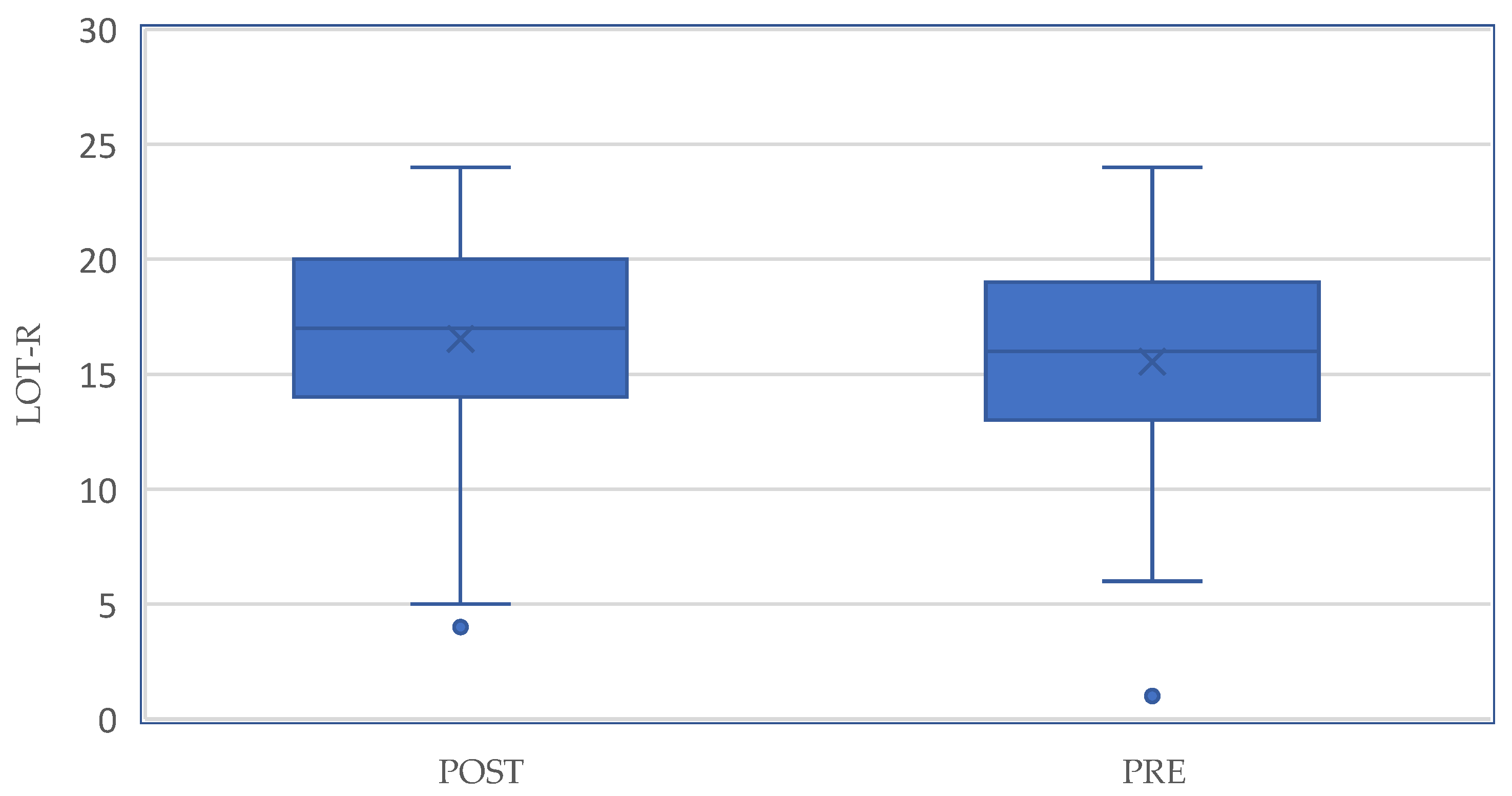
Figure 2.
Comparison of Pre- and Post-Intervention Optimism Scores (CESS-D).
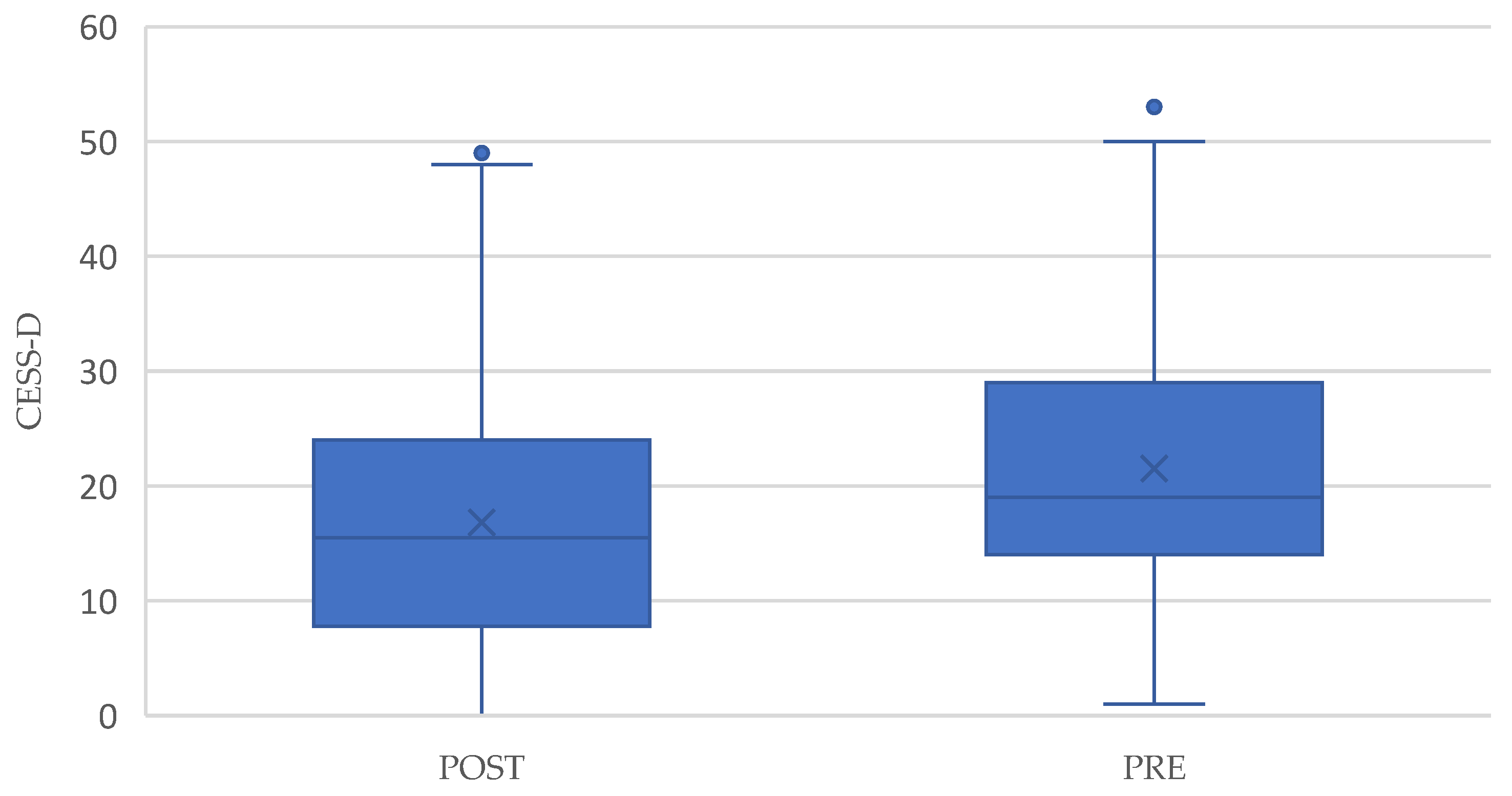

Table 1.
Mann-Whitney U Test Statistics Comparing LOT-R, CESS-D, GRIT and PvG.
| N=136 | LOT-R | CESS-D | GRIT | PvG |
| Mann-Whitney U | 2388.500 | 2383.500 | 2030.000 | 2647.500 |
| Wilcoxon W | 4734.500 | 4729.500 | 4376.000 | 4993.500 |
| Test Statistic | 2388.500 | 2383.500 | 2030.000 | 2647.500 |
| Standard Error | 229.171 | 229.640 | 228.605 | 224.675 |
| Standardized Test Statistic | .334 | .311 | -1.234 | 1.493 |
| Asymptotic Sig.(2-sided test) | .739 | .756 | .217 | .135 |
Table 2.
Mann-Whitney U Test Statistics Comparing PsB, HoB, PvB and PmG.
| N=136 | PsB | HoB | PvB | PmG |
| Mann-Whitney U | 2255.500 | 2557.000 | 2660.000 | 2239.000 |
| Wilcoxon W | 4601.500 | 4903.000 | 5006.000 | 4585.000 |
| Test Statistic | 2255.500 | 2557.000 | 2660.000 | 2239.000 |
| Standard Error | 226.044 | 227.001 | 223.795 | 223.224 |
| Standardized Test Statistic | -.250 | 1.079 | 1.555 | -.327 |
| Asymptotic Sig.(2-sided test) | .803 | .280 | .120 | .744 |
Table 3.
Mann-Whitney U Test Statistics Comparing PmB and PsG.
| N=136 | PmB | PsG |
| Mann-Whitney U | 2378.000 | 2330.000 |
| Wilcoxon W | 4724.000 | 4676.000 |
| Test Statistic | 2378.000 | 2330.000 |
| Standard Error | 222.786 | 223.275 |
| Standardized Test Statistic | .296 | .081 |
| Asymptotic Sig.(2-sided test) | .767 | .936 |
Table 4.
Spearman’s Correlation Coefficients Among Psychological Constructs and Well-being Indicators.
Table 4.
Spearman’s Correlation Coefficients Among Psychological Constructs and Well-being Indicators.
| PsG | PmB | PmG | PvB | HoB | PsB | PvG | GRIT | CESS-D | LOT-R | ||||
| PsG | Correlation Coefficient | 1.000 | -.089 | .163** | -.104 | .055 | -.201** | .192** | -.018 | -.239** | .174** | ||
| Sig. (2-tailed) | . | .158 | .009 | .101 | .385 | .001 | .002 | .771 | <.001 | .006 | |||
| N | 252 | 252 | 252 | 252 | 252 | 252 | 252 | 252 | 252 | 252 | |||
| PmB | Correlation Coefficient | -.089 | 1.000 | -.019 | .148* | .644** | .165** | -.099 | .092 | .140* | -.115 | ||
| Sig. (2-tailed) | .158 | . | .764 | .018 | <.001 | .009 | .117 | .146 | .026 | .067 | |||
| N | 252 | 252 | 252 | 252 | 252 | 252 | 252 | 252 | 252 | 252 | |||
| PmG | Correlation Coefficient | .163** | -.019 | 1.000 | -.118 | .011 | -.098 | .092 | .025 | -.167** | .024 | ||
| Sig. (2-tailed) | .009 | .764 | . | .062 | .864 | .121 | .146 | .693 | .008 | .703 | |||
| N | 252 | 252 | 252 | 252 | 252 | 252 | 252 | 252 | 252 | 252 | |||
| PvB | Correlation Coefficient | -.104 | .148* | -.118 | 1.000 | .579** | .016 | -.058 | -.047 | -.025 | .058 | ||
| Sig. (2-tailed) | .101 | .018 | .062 | . | <.001 | .804 | .359 | .454 | .697 | .360 | |||
| N | 252 | 252 | 252 | 252 | 252 | 252 | 252 | 252 | 252 | 252 | |||
| HoB | Correlation Coefficient | .055 | .644** | .011 | .579** | 1.000 | -.079 | .083 | .152* | .029 | -.061 | ||
| Sig. (2-tailed) | .385 | <.001 | .864 | <.001 | . | .209 | .191 | .016 | .650 | .333 | |||
| N | 252 | 252 | 252 | 252 | 252 | 252 | 252 | 252 | 252 | 252 | |||
| PsB | Correlation Coefficient | -.201** | .165** | -.098 | .016 | -.079 | 1.000 | -.242** | -.073 | .040 | -.029 | ||
| Sig. (2-tailed) | .001 | .009 | .121 | .804 | .209 | . | <.001 | .248 | .527 | .649 | |||
| N | 252 | 252 | 252 | 252 | 252 | 252 | 252 | 252 | 252 | 252 | |||
| PvG | Correlation Coefficient | .192** | -.099 | .092 | -.058 | .083 | -.242** | 1.000 | .135* | -.104 | .092 | ||
| Sig. (2-tailed) | .002 | .117 | .146 | .359 | .191 | <.001 | . | .032 | .099 | .144 | |||
| N | 252 | 252 | 252 | 252 | 252 | 252 | 252 | 252 | 252 | 252 | |||
| GRIT | Correlation Coefficient | -.018 | .092 | .025 | -.047 | .152* | -.073 | .135* | 1.000 | .074 | .025 | ||
| Sig. (2-tailed) | .771 | .146 | .693 | .454 | .016 | .248 | .032 | . | .243 | .694 | |||
| N | 252 | 252 | 252 | 252 | 252 | 252 | 252 | 252 | 252 | 252 | |||
| CESS-D | Correlation Coefficient | -.239** | .140* | -.167** | -.025 | .029 | .040 | -.104 | .074 | 1.000 | -.550** | ||
| Sig. (2-tailed) | <.001 | .026 | .008 | .697 | .650 | .527 | .099 | .243 | . | <.001 | |||
| N | 252 | 252 | 252 | 252 | 252 | 252 | 252 | 252 | 252 | 252 | |||
| LOT-R | Correlation Coefficient | .174** | -.115 | .024 | .058 | -.061 | -.029 | .092 | .025 | -.550** | 1.000 | ||
| Sig. (2-tailed) | .006 | .067 | .703 | .360 | .333 | .649 | .144 | .694 | <.001 | . | |||
| N | 252 | 252 | 252 | 252 | 252 | 252 | 252 | 252 | 252 | 252 | |||
| **. Correlation is significant at the 0.01 level (2-tailed). | |||||||||||||
| *. Correlation is significant at the 0.05 level (2-tailed). | |||||||||||||
Disclaimer/Publisher’s Note: The statements, opinions and data contained in all publications are solely those of the individual author(s) and contributor(s) and not of MDPI and/or the editor(s). MDPI and/or the editor(s) disclaim responsibility for any injury to people or property resulting from any ideas, methods, instructions or products referred to in the content. |
© 2025 by the authors. Licensee MDPI, Basel, Switzerland. This article is an open access article distributed under the terms and conditions of the Creative Commons Attribution (CC BY) license (http://creativecommons.org/licenses/by/4.0/).
Copyright: This open access article is published under a Creative Commons CC BY 4.0 license, which permit the free download, distribution, and reuse, provided that the author and preprint are cited in any reuse.


