

Submitted:
12 March 2025
Posted:
13 March 2025
You are already at the latest version
Abstract
Case Management Model and Notation (CMMN) is a graphical notation used to model less predictable, highly flexible processes that may behave differently in each instance. It uses an event-centred approach and expands on what can be modelled with procedural modelling notations. Nearly a decade since the occurrence of CMMN, its practical use is questionable. We performed this research to identify possible reasons for this and to classify potential advantages and disadvantages of CMMN. With the aforementioned objectives, our research method was a systematic literature review, which provided a broad insight into the state of the investigated object along with techniques for analysing qualitative data, coding and successive approximation. From an initial set of 942 articles, 43 remain relevant. The results of the analysis and synthesis of the obtained data from relevant articles were generalised codes, which were used to explicitly answer the research questions. Results indicate that CMMN has good foundations in the declarative modelling approach and within the Case Management paradigm. Nevertheless, some issues were identified with notation and elements of CMMN and with its complement - Business Process Model and Notation (BPMN).
Keywords:
CMMN
; Case Management
; BPMN
; declarative modelling
; flexibility
; visual language
1. Introduction
Constant changes are a part of everyday life, despite the fact that we are often unaware of them. One great example is climate change, which is happening all around us, but we do not perceive it as impacting our lives. Constant changes occur in nature, between people, and in organisations where the production of a product or service is needed. To be able to respond to changes in the workflow, some kind of monitoring is required. This can be covered with modelling of organisations workflows (or business processes).
There are many reasons why it makes sense to list processes, especially business processes which bring value to organisations, for example: "ability to deliver improvements in organisational performance, regulatory compliance and service quality" [1]. The way people work in organisations has been changing throughout history, evolving from industrial to knowledge societies nowadays.
The assembly line principle was often used in the industrial ages, focusing on routine functioning. However, well-structured, highly predictable, pre-definable processes in organisations, also nowadays, are covered with a systematic approach to manage business processes - Business Process Management (hereinafter referred to as BPM) [2,3,4,5].
In the current knowledge society, which emphasises the role of knowledge and knowledge workers, routine functioning is no longer appropriate to the same extent as before. Nowadays, business processes are commonly less-structured and less predictable and may differ in each instance [3,4]. BPM is less applicable for unstructured business processes, which brought to light a new paradigm - Case Management [6].
Case Management (also Adaptive Case Management or Case Handling) is a paradigm for supporting flexible and knowledge-intensive business processes [6]. It was formed because of shortcomings of BPM, a more restrictive paradigm, with some issues with the introduction of change [6].
Nevertheless, the transition from BPM to Case Management is far from being optimal. BPM is still largely in use, according to the de facto standard of this field - Business Process Model and Notation (hereinafter referred to as BPMN) [7]. BPMN is well accepted and frequently used [7], but it is also quite complex, which is often referred to as its main weakness [8]. Some authors specify that BPMN is more appropriate for structured business processes and less for unstructured ones [9,10]. To fill the identified deficit, the consortium Object Management Group (OMG) published the first version (1.0) of Case Management Model and Notation (hereinafter referred to as CMMN) specification [11] in 2014, a notation dedicated to unstructured, flexible business processes.
The main idea for CMMN was to complement BPMN with unstructured, flexible parts of the process, where BPMN demonstrated some shortcomings [8,9,10,12,13], and vice versa, BPMN can also complement CMMN [11].
However, findings from the literature indicate that CMMN "did not take off" as expected [12,14]. There could be several reasons for this, where we identified two of them.
Firstly, in the paragraph above we mentioned BPMN, which is first and foremost, a complement to CMMN. Nevertheless, BPMN can also be used with modelling of unstructured business processes, which indicated that BPMN and CMMN can be competitors. Further, BPMN was published a few years before CMMN, but still, if we compare the frequency of searching of terms "CMMN" and "BPMN" on Google Trends [15], limited to the last five years and on a worldwide range, we can conclude that the average ratio between search terms is 1:20, in favour of BPMN. To summarize, CMMN has a good starting point within unstructured business processes, but it also has a well-trained and frequently used alternative.
Secondly, the current knowledge society introduced a new, less restrictive and more adjustable approach to function in organisation. But nevertheless, there is still a lot of assembly line functioning, which makes sense, since the transition (from one society to another) cannot be sudden. From this we could conclude that, organisations are not completely ready yet to adopt new way of functioning and consequently, also notations like CMMN are less in use.
To identify other possible reasons for non-intensive use of CMMN, we decided to investigate the current notation. Therefore, our research objectives are to classify potential advantages and disadvantages of CMMN, to identify extensions, upgrades or improvements for the CMMN, and, finally, to find potential follows of practical use.
According to our understanding, CMMN impacts essential human functioning areas, like academic research and practical use within the industry. Therefore, research objectives cover theoretical issues about CMMN, frequently processed by academics and also practical issues, more associated with the industry. As this research is exploratory, the aim is to get a basic overview of the aforementioned issues related to CMMN. The most appropriate research method is thus a systematic literature review.
The remainder of this article is structured as follows. Section 2 reviews the theoretical background of related concepts. In section 3, the research method is presented in detail. Results of the given research are presented and discussed in section 4. Finally, conclusions and implications for future work are given in section 5.
2. Theoretical Background
In this chapter, relevant theoretical foundations of Case Management and CMMN are briefly presented.
2.1. Case Management
Case Management was first introduced in 2004 by authors van der Aalst, Weske, and Grünbauer [6], where they presented a new paradigm for business process support. They first called it Case Handling. Later on, the term Adaptive Case Management was introduced, abbreviated ACM [16,17]. As emphasised in the introduction, Case Management was proposed because of some shortcomings of BPM, which was evidenced as too restrictive and not flexible enough [6,16].
The main concept of Case Management is a case. Numerous domains specify and manage cases: in medicine, law, social security, employment, etc., where each instance of a case can be different. The latter means that the set of activities executed within one case can differ in each instance of a case. Meanwhile, in workflow management systems, “an activity is considered to be atomic and either carried out or not” [6]. In contrast, Case Management offers a less rigid approach - activities are “chunks of work” [6], which are being manipulated by case/knowledge workers. They decide what is relevant in a particular case based on the knowledge they have about the whole case, an essential aspect in Case Management [6].
2.1.1. Business Artifacts
Case management is fundamentally data-centric. The business artifacts (or “business entities with lifecycles”), introduced in 2003 [18,19] ensures a tight connection between data and process, including information and lifecycle models. Declarative approaches, which are data-centric, have roots in the Event-Condition-Action (ECA) rules paradigm, which specify the control of activities formally and derive from the concept of activity pre-conditions [16]. The declarative Guard-Stage-Milestone (GSM) model for business artifacts [20,21] derives from that work and provides the foundation for the CMMN core model [16].
2.2. CMMN
With the introduction of Case Management, a need for standardisation in this field emerged, and in 2014, consortium OMG released the first version (1.0) of CMMN [11,22]. CMMN belongs to the declarative business process paradigm, where the main focus is on capturing the regulations and directives of the organisation and additionally presents a balance between flexibility and support [23]. Therefore, CMMN is suitable for capturing knowledge-intensive, flexible processes [11].
CMMN can provide a standardised way to model and manage a case. It contains a set of elements, graphically presented on Figure 1 and described bellow, according to [11].
- Case Plan Model is the outermost element, within which the whole case is presented and defined.
- Task is a central element that defines a single action, a unit of work, that needs to be performed. There are different types of task: Non-Blocking Human Task (i.e. Manual Task), Blocking Human Task (i.e. User Task), Case Task, Process Task and Decision Task.
- Case File Item is an element that defines data (e.g. document, file) required for case processing.
- Stage may be considered as an "episode" or a "phase" of one case. Elements, like Tasks with Connectors, can be united within one Stage element.
- Milestone represents an achievable target, defined to enable evaluation of progress of the case.
- Event Listeners is an element that waits for an event in a case, to trigger other elements, like Tasks or Stages. There are two different types of Event Listeners: Timer Event Listener and User Event Listener.
- Sentry (Sentries) is a combination of an "event and/or condition". It is not a stand-alone element, it requires to be part of Case Plan Model, Stage, Task or Milestone. It is graphically represented with rhombus: Entry Criterion (for entry condition) with white rhombus and Exit Criterion (for exit condition) with black rhombus (Figure 1).
- Connectors can be used to visualise dependencies between elements but do not have associated execution semantics.
An essential characteristic of CMMN is its ability for discretionary implementation (for Tasks and Stages), which enables the introduction of a higher degree of flexibility into business processes in general. One example of such use is the Discretionary Task, shown in Figure 1.
Furthermore, Figure 1 clearly shows all elements of CMMN mentioned above. Case Plan Model encompasses all elements and is presented by a "folder" shape. Discretionary Task is presented with rectangle shape, with dashed line and it is connected to a regular Task, which has an Entry Criterion, marked with white rhombus. Task is later on connected to Case File Item, depicted by a “document” shape with a broken upper right corner. Element Stage, depicted by a rectangle shape with angled corners, includes an Exit Criterion, marked with black rhombus. At the end, elements Milestone (rectangle shape with half-rounded ends) and Event Listener (circle shape with double line) are contained.
The execution aspect of CMMN involves the use of specialised software components known as execution engines to interpret and enact CMMN models, managing case lifecycles, executing tasks and events, integrating with external systems, and providing monitoring and analytics capabilities.
3. Research Method
Systematic literature review (hereinafter referred to as SLR) is a research method where identification, evaluation and interpretation of all available, relevant research articles are performed [24]. Relevant articles are gathered based on research questions determined at the beginning of the research process. Guidelines to conduct SLR in the field of software engineering were defined in [24] and represent the basis for our research.
According to [24], SLR has been implemented in three phases: planning, conducting and reporting. In the planning phase, several activities were executed: identification of the need for SLR, proposal for the implementation, formation of research questions and research protocol. In the conducting phase, research questions have been dissected, a search string was tested for suitability, relevant research articles have been collected and quality assessments have been made. Further on, with data synthesis, key findings from relevant research articles have been exposed. Finally, in the reporting phase, the method of dissemination was determined and the final report was created [24].
Each step proposed in [24] was discussed and later on thoughtfully included or excluded from our research process, according to the characteristics of our research.
A desktop application to assist in performing SLR (and gathering articles), called Parsifal [25] was used. Parsifal was composed based on guidelines from [24] and therefore very suitable to work with. Some steps of SLR, i.e. evaluation and data synthesis, have been processed manually (with Microsoft Excel).
In the following subsections, greater details of our research are given, i.e. the research questions, search string and digital libraries, the inclusion and exclusion criteria, the search process and evaluation, and finally, the data analysis.
3.1. Research Questions
To formulate research questions, we considered the research objectives and research gap, both presented in Section 1 and PICOC criteria, presented in Table 1. We formulated the following research questions:
- 1.
- (RQ 1) What are the reported advantages and disadvantages of CMMN?
- 2.
- (RQ 2) What extensions, upgrades or improvements for the CMMN exist?
- 3.
- (RQ 3) Is CMMN used in practice?
With the first research question (RQ 1) we want to get acquainted with current advantages and disadvantages of CMMN, associated with its syntax, quality characteristics and any other relevant aspects. With second research question (RQ 2) we want to identify all relevant existing improvements of CMMN, any existing reported extensions or any kinds of upgrades. Our intention with the third research question (RQ 3) is to determine to what extent is CMMN used in practice.
3.2. Search String and Searched Space
The search string was focused on considered technology - CMMN, namely: (“cmmn” OR “case management model and notation”). Search string relates to Intervention (PICOC criteria in Table 1) and was composed of notation’s full name, its abbreviation and expected operator OR between them.
Search string is relatively general and simple; nevertheless, we expect to gain available scientific articles related to this topic. We are also well aware that every article that contains some kind of reference to CMMN could be a relevant source. It also makes sense to point out that a smaller set of articles is generally expected to be identified for CMMN.
Later on, the following digital libraries were included in our research: ACM Digital Library (abbr. ACM) [26], IEEE Xplore Digital Library (abbr. IEEE) [27], Web of Science (abbr. WoS) [28], ScienceDirect (abbr. SD) [29], Scopus (abbr. Sc) [30] and SpringerLink (abbr. SL) [31]. We considered the most relevant digital libraries for the IT field, referred to in [24].
Used digital libraries additionally provide different search options. In all mentioned digital libraries our defined search string was used consistently. We also used additional options, if possible, e.g. time intervals, type of publication (book, journal, etc.), or specific databases within the selected digital library. Since most search engines of the chosen digital libraries have the result sorting option, we used sorting by relevance.
3.3. Inclusion and Exclusion Criteria
According to research questions, the inclusion and exclusion criteria were composed. Criteria were composed and applied over titles, summaries and keywords. If it was impossible to determine whether or not an article was suitable, a complete review of the content was made. Criteria are also in accordance with the research questions, presented in Section 3.1.
The inclusion criteria covered the following: (1) general articles about CMMN, (2) articles proposing extensions, upgrades or improvements of CMMN, (3) articles presenting the use of CMMN, (4) articles presenting a comparison of CMMN and other notations.
The exclusion criteria covered the following: (1) articles unrelated to CMMN, (2) inaccessible articles, (3) articles mentioning CMMN only indirectly, (4) articles older than 2014, when CMMN was first published, (5) grey literature, (6) non-English articles.
3.4. Search Process and Evaluation
Within our SLR, a manipulation with gathered initial articles was performed. The search process was conducted by two researchers, where initial articles of the first researcher were compared to sampled articles by the second researcher. The evaluation of initial articles was performed in the following four phases: (1) pre-evaluation, (2) first evaluation phase, (3) second evaluation phase, and (4) third evaluation phase. In each evaluation phase, irrelevant articles were eliminated based on corresponding conditions for every phase. Evaluation of initial articles is described in detail in Section 4.
3.5. Data Analysis
The evaluation of initial articles was conducted by considering relevant information (or attributes) from each article. Attributes are classified into four attribute groups, altogether presented in Table 2. First attribute group is called Basic information, where attributes Title, Authors, Source, Type of source, Year of publication, Researchers and Domain are contained. For some attributes, possible values are not defined (attribute Title and Authors), while others do have their stock of value (attribute Source, Type of source, Year of publication, Researchers and Domain). Other attribute groups contained are also: Analysis of content, Interpretations of results and Other.
4. Outcomes and Interpretation
4.1. Analysis of All Initial Articles
In the pre-evaluation phase, the total number of identified initial articles was 942, of which 226 passed the relevance threshold (according to the topic). The distribution of articles, according to each digital library and each evaluation phase is given in Table 3.
The pre-evaluation was followed by first evaluation phase, where the inclusion and exclusion criteria were considered. Firstly, we identified and eliminated 67 duplicates. Secondly, 71 articles did not meet the given criteria (see Section 3.3) and were also eliminated from the research, resulting in 82 relevant articles for the first evaluation phase.
In second evaluation phase, seven articles were excluded because of the inadequacy of the content, according to research questions, discovered within the metadata of each article (title, keywords and abstract). Additional seven articles were eliminated because of technical unavailability. This evaluation phase concluded with 68 relevant articles, representing income to the last - the third evaluation phase, where research questions were considered again, but now covering the complete content of each article. This resulted in the exclusion of 25 articles, which did not answer any of the given research questions. There were 43 articles (presented in Table 4) left for further analysis and synthesis of the gathered data, which can serve to fulfill more credible answers to research questions.
4.2. Analysis and Synthesis of Relevant Articles
To get more explicit answers to research questions, further analysis and especially synthesis of the gathered data was required. Here we used coding and successive approximation techniques for analysing qualitative data gained from relevant articles, according to [67].
Firstly, when performing coding, raw data was collected from relevant articles and initial codes emerged. Initial codes "are tags or labels for assigning units of meaning to the descriptive or inferential information compiled during a study" [67]. In our case, the identified initial codes varied in length, the majority of them were sentences or paragraphs. Later on, we established seven categories, which were generated from our research questions. The categories are: (1) advantages, (2) disadvantages, (3) interesting facts, (4) extensions, (5) use in practice, (6) other notations, (7) flexible processes, all referring to CMMN. All initial codes were placed into one of these categories. Further on, 16 concepts were created out of these categories. When reviewing the data for the second time, the main focus was to identify concepts that group together and also to find possible relations between identified concepts. Out of 16 concepts, we assembled four groups of concepts, shown in (Table 5). Within first group of concepts, called Syntax, concepts mainly refer to concrete syntax, except for the concept Metamodel, which is referring to abstract syntax. In the second group, all five of the identified concepts refer to quality characteristics of CMMN. Concerning CMMN, some codes about non-routine work and knowledge workers were identified, which are also grouped together. The last group of concepts unites concepts referring to experiences in use. All concepts are in equivalent positions within their group, or in other words, no hierarchy was identified between concepts.
Secondly, when performing successive approximation, initial codes were verified once again. As a result, we acquired a set of generalised codes, which represent more general form of initial code. Therefore, every generalised code corresponds to one initial code and also has the belonging concept. We assume that generalised codes, combined with initial codes and corresponding concept, present a good foundation for answering research questions.
The described process of our qualitative analysis and synthesis is also presented graphically, with BPMN diagram, in Figure 2, where after a start event (named "Start of data analysis (SLR concluded)"), two sub-processes are included (named "Coding" and "Successive Approximation"), consistently with the techniques used. The process ends with an end event (named "End of data analysis"). In the sub-process "Coding", activities like "Establishing initial codes", "Establishing categories", "Placing initial codes to categories", etc. are used to represents all performed steps. Meanwhile, data objects, such as "43 relevant articles", "3 research questions", "Initial codes", etc. are used to represent input or output documents. Similar presentation of the process is also done in sub-process "Successive approximation".
4.3. Answers of Research Questions
This research aimed to give some basic conclusions about the state of CMMN. In Table 6, columns represent research questions (RQ 1.1, RQ 1.2, RQ2, RQ3), and rows represents relevant articles (S1 to S43). Some of the research questions are also divided into generalised codes, presented in 4.2, which as already stated, presents a good fundation for answering research questions. Codes are the following: (A1) CMMN is promising, (A2) Combined use of CMMN and BPMN is favourable, (A3) Alternatives and complementary notations exist, (A4) The use of hybrid approach is favourable, (D1) Control flow is challenging, (D2) Data modelling capability has weak support, (D3) Roles are poorly defined, (D4) Execution support lacks, (U1) Elements, (U2) Discretionary elements, which help to highlight optional work, (U3) Its early adoption stages by industry vendors, (U4) Complexity.
In Table 6 we explicitly ticked (✓) relevant articles that contain answers for a particular research question (with corresponding generalized code). On the foundations of all collected knowledge gained from articles, associated analysis and synthesis of the data, we can provide answers to research questions.
4.3.1. RQ 1: What Are the Reported Advantages and Disadvantages of CMMN?
With RQ 1 the aim was to identify advantages, and, also, disadvantages of CMMN. For more explicit answers, we performed the synthesis of data, with the following results. Identified advantages and disadvantages are given bellow in generalised codes (already in Table 6, marked bold), following by explicit answers obtained from relevant articles, and, additionally, by a paragraph where the factual statements are interpreted in light of information, external to SLR.
(A1) CMMN is promising. “The interest in CMMN is increasing” S35-[60] and “CMMN is attractive since it promises an increased level of expressibility for modelling of evolving business processes” S1-[13]. It “introduces an additional degree of flexibility as declarative languages rely on an open-world assumption, thus leaving room for supporting situations that cannot be planned at design-time.” S25-[51]. “CMMN model can be used in more specific and realistic scenarios” S38-[63].
Findings from above do not coincide completely with results on Google Trends, when exploring CMMN (search terms on trends.google.com: cmmn, Worldwide, 2004-present, All categories, Web search). We can point out that the demand has been more or less even since the publication. CMMN also has a solid foundation in well established Case Management (introduced in [6]), which is covering knowledge-intensive business processes and is resolving some open challenges of existing Workflow Management. Current work approaches adapted slowly to the knowledge workers, which are in the centre of business processes and determine the activity sequence according to their expertise and/or knowledge. To formally record such a business process, notation like CMMN fits perfectly S3-[32].
(A2) Combined use of CMMN and BPMN is favourable. CMMN was primarily designed to complement BPMN S42-[10], S23-[8], S33-[12]. Many claim that combined use of BPMN and CMMN has major benefits for business process modelling and that this combination is the most optimal possible S43-[9], S22-[49], S42-[10], S2-[3], S1-[13], S8-[37], S19-[48]. It is hard to determine who has a leading role. On one hand, we have supporters of BPMN, where CMMN has a minor role in fixing deficits of BPMN S42-[10]. On the other hand, supporters of CMMN agree that flexibility in business processes is crucial, which is harder to achieve only with BPMN S43-[9], S23-[8].
A fact is that many processes in organisations are not exclusively procedural or declarative – i.e., commonly we can find a combination of both paradigms, structured and unstructured parts of processes. Considering the year of first release of BPMN, we can assume that BPMN has a great advantage over CMMN, arising only from a longer period of existence, disregarding other existing advantages. Nevertheless, possible opportunities to cover unstructured parts of processes are still pending for CMMN. An open question remains, if modelling of processes truly requires two independent, yet related modelling languages, or if these could be resolved with an extension of one of the languages.
(A3) Alternatives and complementary notations exist. Beside BPMN, the most frequently used notation in combination with CMMN is DMN S42-[10]. In S37-[62] authors stated that CMMN along with DMN are very suitable approaches to obtain a flexible model adapted to the context-driven response processes. There are also traces of other notations, more precisely SBVR S22-[49], ConDec S7-[36], EPC S23-[8], UML Activity diagram S23-[8], Statecharts S38-[63], DCR S17-[46].
With BPMN, which has a long period of existence, a good coverage of process concepts, a rich collection of researchers, and many vendors available, etc., we can still identify weak points or possible opportunities for improvements, which can be associated with numerous extensions proposals [68]. The latter can also be supplemented with alternative or complementary notations. Naturally, it requires additional knowledge of the new notation, but the missing gap can be filled. Example from above can be transferred to other notations, where complementary use may for-fill requirements.
(A4) The use of a hybrid approach is favourable. From the last two paragraphs we can assume that shared use of multiple notations or so-called hybrid approach makes a lot of sense, because “many processes in organisations do not neatly fall in one category or the other, they contain both flexible and rigid parts” S39-[64]. In S1-[13] authors state that “more than half of business processes are unstructured and unpredictable in nature”. Hypothetical integration of BPMN, CMMN, and DMN specifications, to build the hybrid model S37-[62], would be a logical consequence.
Nevertheless, a very important question remains the degree of compatibility of notations appropriate for hybrid use. In case compatibility is not guaranteed, analysts can face learning challenges, because of structural and visual differences of languages, issues related to tool support or readability. Still, there are examples of successful hybrid use of notations [69].
(D1) Control flow is challenging. In S5-[34], authors detected “difficulty to figure out what the actual flow of activities” is. It is especially difficult to understand the model when the modeller has some prior knowledge about imperative sequence flows or notations of this type S43-[9]. In CMMN, so-called “seamless modelling” S11-[40] can be quite a mental leap. In some cases, connectors are still used, also sentries can help to “lead the way”. “Routing and control-flow without the use of connectors and sentries can be difficult to understand” S43-[9]. Some authors also state, that “the combination of connector and sentries provides poor readability” S1-[13].
Here we would like to emphasise, that modellers most importantly have to be aware of both approaches, and additionally of their differences, advantages and disadvantages. This way modellers will be able to appropriately use imperative notations with structured parts and declarative notations with unstructured parts of processes.
(D2) Data modelling capability has weak support. Despite the fact that Case File Item is an important element of CMMN, findings from our research state that "CMMN provides a very limited view on data" S1-[13], "with no restrictions about the format and the nature of the represented data" S32-[58]. Additionally, “it is unclear how the intricacies of a Case File and the Case File Items contained, can be included in the model” S43-[9]. Consequently, it “requires improvement on semantics for Case Files” S34-[59]. Similar conclusions about data in CMMN were also given in S25-[51], S14-[43], S7-[36], S5-[34].
CMMN is data-centric. According to identified limitation with data capability, this indicates options for further research and upgrades of existing element. One of the options is to better refine the existing element, which would be capable of carrying different types of data, like: relational database, unstructured data, media files, etc.
(D3) Roles are poorly defined. CMMN does not have any visual presentation for user roles, which are defined only semantically S1-[13]. However, there is one exception: “the modeller can assign roles to human tasks” S21-[14]. In the future, vendors are expected to map users to tasks or roles using proprietary mechanisms S21-[14]. Poorly defined roles are also exposed in S43-[9], S5-[34], S21-[14], S15-[44], S32-[58], S4-[33], S27-[53].
That roles are important within modelling, testifies the fact that with BPMN, pools and lanes are one of the first elements used when making a model. Absence of visual element for roles in CMMN is disturbing, as the content of processes often determines roles. Introduction of a new visual element could be an easy additive, in terms of artefacts for activities, or by introducing lanes as in BPMN.
(D4) Execution support lacks. “While CMMN seems ideal for modelling cases in a declarative manner in design-time, it provides no guidance on how to represent a running case, e.g. a way to ensure that case models could be executable” S33-[12]. “The lack of effective execution support of important notation elements, such as sentries and discretionary items, limits applicability of CMMN” S34-[59], S35-[60]. Nevertheless, “meta-model allows monitoring the execution status of the case as well as all tasks and stages” S21-[14]. In this light, some suggestions for extensions appeared in S33-[12] and S41-[66].
This disadvantage also offers opportunity. With good execution support and a multitude of executions available, machine learning (with characteristics and previously performed cases) can determine the highest probability of performing the following steps.
4.3.2. RQ 2: What Extensions, Upgrades or Improvements for the CMMN Exist?
With RQ 2 the aim was to identify any existing extensions, upgrades or improvements for CMMN. Detailed answers can be found in all relevant articles, presented in Table 6. Our synthesis of the gathered data showed that some improvements would be welcome, especially if we proceed from identified disadvantages.
In S5-[34], “an extension to CMMN in which stages represent states of information items” is proposed. One other given extension “enables the features of assignments to be inferred from the case process model” S4-[33]. In S40-[65] authors proposed to “introduce the concepts of antecedents and consequences” in the meta-model. In S32-[58] authors came up with an extension concerning Case File Items and tasks, where the connection between them would be annotated with the actions performed on the data. There is also some extension proposed in S33-[12], related to executable models. The collection of extensions is very much diverse. Mainly they spring from perceived disadvantages, presented earlier in this section.
Figure 3 presents a minor extraction from UML class diagram-based conceptual model of CMMN. Classes where extensions are proposed, are marked grey and additionally, notes with relevant articles are appropriately added. More specifically, in articles S25-[51], S28-[54] and S32-[58], extensions related to Case File Item are proposed. Further, articles S11-[40], S32-[58] and S40-[65] are dealing with extensions related to class CMMNEdge, which is covering connectors in CMMN. Highlighted suggestions are consistent with two identified disadvantages from Section 4.3. Other articles, which are also proposing extensions, related to certain class, are given in class diagrams notes beside every relevant class (Figure 3).
4.3.3. RQ 3: Is CMMN Used in Practice?
With RQ 3 the aim was to get acquainted with the use of CMMN in practice. Detailed answers can be found in all relevant articles, covered in Table 6.
Firstly, we aimed to discover the use of CMMN at the lowest level - with notations elements (U1) and their characteristics. Some difficulties were already exposed within answers to RQ 2, mainly according to poorly defined data capabilities and roles. The use of roles in CMMN is almost completely absent, which is frequently pointed out as a problem. Some minor shortcomings appeared also with the element Case File Item, which covers the data aspect in CMMN. Modeller can “link Case File Items to Sentries, Milestones, and events” S43-[9], the format of data that can be stored within this element remains indeterminate.
“An advantage in terms of communication and events are milestones, the overall progress of the process can be explicitly conveyed” S43-[9]. Some authors S25-[51] suggest alternative milestones that “can be defined to improve the level of resilience of CMMN models”. Another very important part of CMMN are discretionary elements (U2), which help to highlight optional work and aid flexibility S43-[9], S38-[63], S18-[47].“The discretionary tasks and stages provide a better understanding of which tasks can be skipped during process execution” and can be compared to ad-hoc sub-processes of BPMN S1-[13]. In S20-[22] and S24-[50] evaluations of CMMN elements are extensively presented. In S27-[53], authors pointed out one missing aspect, more precisely: “CMMN does not provide a way to represent an external system”.
Some authors emphasise that CMMN “is still in its early adoption stages” (U3) S38-[63], although quite a few years have passed since its creation (in 2014). Some also expose its complexity (U4) S10-[39], S35-[60], although it is “less complex than BPMN 1.2” S23-[8]. In S29-[55], S36-[61], potential of CMMN to support knowledge-intensive processes, is exposed.
Secondly, we also wanted to briefly determinate, based on relevant articles and other relevant literature, how CMMN fared against other notations for declarative modelling approach, like GSM, Declare, DCR.
Guard-Stage-Milestone (GSM) is one of the alternatives for declarative modelling, but in literature more frequently presented as an approach or a framework [20,21]. Similarly to CMMN, GSM also enables analysts to capture the control flow logic of business processes and identify dependencies, constraints, and decision points within the process flow. While there are about 850 hits in general for CMMN in Google Scholar, the GSM approach has only 600, which somehow makes sense, since it is more established as a approach rather than a notation, and as a result, it is most likely less used.
Another alternative to CMMN is a Declare (or Declare/ConDec), which describes a set of constraints applied to activities, additionally, the control flow and the ordering of the activities are determined implicitly [70]. Beside a possible connection to a ProM framework, there are no noticeable known tools for Declare [71,72].
Quite widespread declarative modelling notation, according to publicity reported in Google Scholar, are Dynamic Condition Response Graphs (DCR Graphs). Here, processes are represented as a network of nodes and directed arcs. Nodes represent activities or states, while arcs represent dependencies or constraints between them [73]. A good foundation in the context of research articles led to a more extensive use in practice, for example [74,75].
5. Conclusions
In this article, we performed SLR of CMMN, above all, to identify potential advantages and disadvantages, and also to find some cases of practical use. Using the aforementioned research method, we obtained 43 relevant articles, out of 942 articles, which were input to the pre-evaluation phase, followed by other evaluation phases (details in Table 3). Information credible for our research was collected according to relevant information (attributes), given in Table 2. Information was systematically analysed and a synthesis was made with two techniques for analysing qualitative data - coding and successive approximation [67]. We obtained highlights to offer answers to research questions (in Section 4.3).
As evident, CMMN has been the subject of many theoretical types of research, where authors are dealing with its notation, its role within the declarative paradigm, and its relationship regarding other notations. There is considerably less available literature on practical aspects of CMMN.
Almost a decade after its publication, we still cannot say that CMMN is generally used for unstructured business processes. According to information obtained from our research, possible reasons can be related to its notation and elements, for example, poorly defined aspect of roles, weak data modelling capability, control flow challenges and lack of execution support. We must also pay attention to the requirement for flexibility, which must be fulfilled in CMMN. On one hand, flexibility is essential for declarative notations, where less complex diagrams are expected. However, on the other hand, there has to be some guard for diagrams not to become too loose and empty.
Nevertheless, we can conclude that CMMN has a good foundation. Firstly, it is part of declarative modelling approach, which is derived from the Event-Condition-Action (ECA) paradigm and consequently also from the Guard-Stage-Milestone (GSM) approach. Secondly, CMMN is part of the Case Management paradigm whose ability is to handle complexity and variability effectively, enabling organisations to achieve better outcomes, improve efficiency, and enhance customer satisfaction in dynamic and unpredictable environments. Based on this, there is enough possibilities for CMMN to demonstrate its potential.
5.1. Limitations and Future Work
The following limitations should be considered when viewing the results of this work. The search string was relatively simple and short, but nevertheless, some adaptations to individual search forms of digital libraries were required. Also, we considered only the most relevant digital libraries for the IT field, according to [24]. Additionally, limited access to some articles may be an issue. Finally, concerning limitations related to Qualitative Data Analysis, we should expose difficulties of verifying results due to the type of data being processed.
Our future work could expand this review by considering especially identified disadvantages and more practical aspects of CMMN. We find particularly interesting areas of potential integration of CMMN with other notations.
References
- Dumas, M.; La Rosa, M.; Mendling, J.; Reijers, H.A. Fundamentals of Business Process Management, 2 ed; Springer: Berlin, Heidelberg, Germany, 2018. [Google Scholar]
- Savage, C.M. Fifth Generation Management: Co-creating Through Virtual Enterprising, Dynamic Teaming, and Knowledge Networking, 2 ed.; Butterworth-Heinemann: Oxford, UK, 1996. [Google Scholar]
- Auer, D.; Hinterholzer, S.; Kubovy, J.; Küng, J. Business Process Management for Knowledge Work: Considerations on Current Needs, Basic Concepts and Models. In Proceedings of the ERP Future 2013 Conference, Vienna, Austria; 2014; pp. 79–95. [Google Scholar]
- Davenport, T. Thinking for A Living: How to Get Better Performance and Results from Knowledge Workers; Harvard Business Review Press: Boston, MA, USA, 2005. [Google Scholar]
- Freund, J.; Rücker, B. Real-Life BPMN: With introductions to CMMN and DMN, 3 ed.; Createspace Independent Publishing Platform: Charleston, SC, USA, 2016. [Google Scholar]
- van der Aalst, W.; Weske, M.; Grünbauer, D. Case Handling: A New Paradigm For Business Process Support. Data Knowl. Eng. 2005, 53, 129–162. [Google Scholar] [CrossRef]
- Kocbek, M.; Jošt, G.; Heričko, M.; Polančič, G. Business Process Model and Notation: The Current State of Affairs. Comput. Sci. Inf. Syst. 2015, 12, 509–539. [Google Scholar] [CrossRef]
- Marin, M.A.; Lotriet, H.; Van Der Poll, J.A. Measuring Method Complexity of the Case Management Modeling and Notation (CMMN). In Proceedings of the Proceedings of the Southern African Institute for Computer Scientist and Information Technologists Annual Conference 2014 on SAICSIT 2014 Empowered by Technology; 2014; pp. 209–216. [Google Scholar]
- Zensen, A.; Küster, J.M. A Comparison of Flexible BPMN and CMMN in Practice: A Case Study on Component Release Processes. In Proceedings of the 22nd International Enterprise Distributed Object Computing Conference (EDOC), Stockholm, Sweden; 2018; pp. 105–114. [Google Scholar]
- Wiemuth, M.; Junger, D.; Leitritz, M.; Neumann, J.; Neumuth, T.; Burgert, O. Application fields for the new Object Management Group (OMG) Standards Case Management Model and Notation (CMMN) and Decision Management Notation (DMN) in the perioperative field. Int. J. Comput. Assist. Radiol. Surg. 2017, 12, 1439–1449. [Google Scholar] [CrossRef]
- OMG (Object Management Group). Case Management Model and Notation 1.1 Specification. 2016. [Google Scholar]
- Routis, I.; Nikolaidou, M.; Anagnostopoulos, D. Modeling Collaborative Processes with CMMN: Success or Failure? In An Experience Report. In Proceedings of the Enterprise, Business-Process and Information Systems Modeling, Tallinn, Estonia; 2018; pp. 199–210. [Google Scholar]
- Allah Bukhsh, Z.; van Sinderen, M.; Sikkel, K.; Quartel, D. How to Manage and Model Unstructured Business Processes: A Proposed List of Representational Requirements. In Proceedings of the 14th International Joint Conference E-Business and Telecommunications (ICETE), Madrid, Spain; 2019; pp. 81–103. [Google Scholar]
- Kurz, M.; Schmidt, W.; Fleischmann, A.; Lederer, M. Leveraging CMMN for ACM: Examining the Applicability of a New OMG Standard for Adaptive Case Management. In Proceedings of the 7th International Conference on Subject-Oriented Business Process Management, Kiel, Germany; 2015; pp. 1–9. [Google Scholar]
- Google. Google Trends. Available online: https://trends.google.com (accessed on 14 February 2025).
- Marin, M.A.; Hull, R.; Vaculín, R. Data Centric BPM and the Emerging Case Management Standard: A Short Survey. In Proceedings of the Business Process Management Workshops (BPM), Tallinn, Estonia; 2013; pp. 24–30. [Google Scholar]
- Swenson, K.D. Mastering the Unpredictable: How Adaptive Case Management Will Revolutionize the Way that Knowledge Workers Get Things Done; Meghan-Kiffer Press: Tampa, FL, USA, 2010. [Google Scholar]
- Nigam, A.; Caswell, N. Business artifacts: An approach to operational specification. IBM Syst. J. 2003, 42, 428–445. [Google Scholar] [CrossRef]
- Kumaran, S.; Nandi, P.; Heath, T.; Bhaskaran, K.; Das, R. ADoc-oriented programming. In Proceedings of the Symposium on Applications and the Internet (SAINT), Orlando, FL, USA; 2003; pp. 334–341. [Google Scholar]
- Hull, R.; Damaggio, E.; Fournier, F.; Gupta, M.; Heath, F.T.; Hobson, S.; Linehan, M.; Maradugu, S.; Nigam, A.; Sukaviriya, P.; et al. Business artifacts with guard-stage-milestone lifecycles: managing artifact interactions with conditions and events. In Proceedings of the 5th ACM International Conference on Distributed Event-based system (DEBS), New York, NY, USA; 2011; pp. 51–62. [Google Scholar]
- Hull, R.; Damaggio, E.; De Masellis, R.; Fournier, F.; Gupta, M.; Heath, F.T.; Hobson, S.; Linehan, M.; Maradugu, S.; Nigam, A.; et al. Introducing the Guard-Stage-Milestone Approach for Specifying Business Entity Lifecycles. In Proceedings of the 7th International Workshop Web Services and Formal Methods (WS-FM), Hoboken, NJ, USA; 2011; pp. 1–24. [Google Scholar]
- Kocbek Bule, M.; Polančič, G.; Huber, J.; Jošt, G. Semiotic clarity of Case Management Model and Notation (CMMN). Comput. Stand. Interfaces 2019, 66, 103354. [Google Scholar] [CrossRef]
- van der Aalst, W.; Pesic, M.; Schonenberg, H. Declarative workflows: Balancing between flexibility and support. Comp. Sci. Res. Dev. 2009, 23, 99–113. [Google Scholar] [CrossRef]
- Kitchenham, B.A.; Charters, S. Guidelines for performing Systematic Literature Reviews in Software Engineering; Technical Report EBSE 2007-001; School of Computer Science and Mathematics, Keele University, 2007. [Google Scholar]
- MIT License. Parsifal. Available online: https://parsif.al (accessed on 14 February 2025).
- ACM. ACM Digital Library. Available online: https://dl.acm.org (accessed on 14 February 2025).
- IEEE. IEEE Xplore Digital Library. Available online: https://ieeexplore.ieee.org (accessed on 14 February 2025).
- Clarivate. Web of Science. Available online: https://apps.webofknowledge.com (accessed on 14 February 2025).
- Elsevier. ScienceDirect. Available online: https://www.sciencedirect.com (accessed on 14 February 2025).
- Elsevier. Scopus. Available online: https://www.scopus.com (accessed on 14 February 2025).
- Springer Nature. SpringerLink. Available online: https://link.springer.com (accessed on 14 February 2025).
- Benzarti, I.; Mili, H.; de Carvalho, R. Modeling and Personalising the Customer Journey: The Case for Case Management. In Proceedings of the 25th International Enterprise Distributed Object Computing Conference (EDOC), Gold Coast, Australia; 2021; pp. 82–91. [Google Scholar]
- Bruno, G. Tasks and assignments in case management models. Procedia CS 2016, 100, 156–163. [Google Scholar] [CrossRef]
- Bruno, G. Extending CMMN with entity life cycles. Procedia CS 2017, 121, 98–105. [Google Scholar] [CrossRef]
- Bule, M.; Polančič, G. Extending CMMN for Effective Management of Data in Knowledge-Intensive Processes. In Proceedings of the Business Process Management: Blockchain, Robotic Process Automation, Central and Eastern European, Educators and Industry Forum (BPM), Krakow, Poland; 2024; pp. 282–296. [Google Scholar]
- de Carvalho, Renata Medeiros; Mili, H.; Gonzalez-Huerta, J.; Boubaker, A.; Leshob, A. Comparing ConDec to CMMN - Towards a Common Language for Flexible Processes. In Proceedings of the 4th International Conference on Model-Driven Engineering and Software Development (MODELSWARD), Rome, Italy; 2016; pp. 233–240. [Google Scholar]
- de Carvalho, Renata Medeiros.; Boubaker, A.; Gonzalez-Huerta, J.; Mili, H.; Ringuette, S.; Charif, Y. On the Analysis of CMMN Expressiveness: Revisiting Workflow Patterns. In Proceedings of the 20th International Enterprise Distributed Object Computing Workshop (EDOCW), Vienna, Austria; 2016; pp. 1–8. [Google Scholar]
- Castellanos, F.; Navascues, N.; Calegari, D.; Delgado, A. CMMN-Based Modeling and Customization of Declarative Business Process Families. In Proceedings of the Business Process Management Forum (BPM), Krakow, Poland; 2024; pp. 144–161. [Google Scholar]
- Cummins, F.A. Next-Generation Business Process Management (BPM). In Building the Agile Enterprise, 2 ed.; Morgan Kaufmann: Boston, MA, USA, 2017; chapter 4; pp. 115–154. [Google Scholar]
- Czepa, C.; Tran, H.; Zdun, U.; Tran, T.; Weiss, E.; Ruhsam, C. Lightweight Approach for Seamless Modeling of Process Flows in Case Management Models. In Proceedings of the Symposium on Applied Computing (SAC), Marrakech, Morocco; 2017; pp. 711–718. [Google Scholar]
- Ferreira, T.; Gonçalves, D.; Vieira, R.; Proença, D.; Borbinha, J. A Case Management Approach to Risk Management. In Proceedings of the Business Modeling and Software Design, Lisbon, Portugal; 2019; pp. 246–256. [Google Scholar]
- van Gaal, S.; Alimohammadi, A.; Karim, M.; Zhang, W.; Sutherland, J. Investigation of treatment delay in a complex healthcare process using physician insurance claims data: an application to symptomatic carotid artery stenosis. BMC Health. Serv. Res. 2024, 24, 1507. [Google Scholar] [CrossRef]
- Gonzalez-Lopez, F.; Pufahl, L. A Landscape for Case Models. In Proceedings of the Enterprise, Business-Process and Information Systems Modeling, Rome, Italy; 2019; pp. 87–102. [Google Scholar]
- Herzberg, N.; Kirchner, K.; Weske, M. Modeling and Monitoring Variability in Hospital Treatments: A Scenario Using CMMN. In Proceedings of the Business Process Management Workshops (BPM), Eindhoven, The Netherlands; 2015; pp. 3–15. [Google Scholar]
- Holz, J.; Pufahl, L.; Weber, I. A Systematic Comparison of Case Management Languages. In Proceedings of the Business Process Management Workshops (BPM), Münster, Germany; 2022; pp. 257–273. [Google Scholar]
- Jalali, A. Evaluating Perceived Usefulness and Ease of Use of CMMN and DCR. In Proceedings of the 22nd International Conference Business Process Modeling, Development and Support (BPMDS), Melbourne, VIC, Australia; 2021; pp. 147–162. [Google Scholar]
- Jalali, A. Evaluating user acceptance of knowledge-intensive business process modeling languages. Softw. Syst. Model. 2023, 22, 1803–1826. [Google Scholar]
- Junger, D.; Just, E.; Brandenburg, J.M.; Wagner, M.; Schaumann, K.; Klenzner, T.; Burgert, O. Toward an interoperable, intraoperative situation recognition system via process modeling, execution, and control using the standards BPMN and CMMN. Int. J. Comput. Assist. Radiol. Surg. 2024, 19, 69–82. [Google Scholar]
- Lantow, B. Adaptive Case Management - A Review of Method Support. In Proceedings of the The Practice of Enterprise Modeling, Vienna, Austria; 2018; pp. 157–171. [Google Scholar]
- Marin, M.A.; Lotriet, H.; Van Der Poll, J.A. Metrics for the Case Management Modeling and Notation (CMMN) Specification. In Proceedings of the Proceedings of the 2015 Annual Research Conference on South African Institute of Computer Scientists and Information Technologists, Stellenbosch, South Africa, 2015; pp. 1–10. [Google Scholar]
- Marrella, A.; Mecella, M.; Pernici, B.; Plebani, P. A design-time data-centric maturity model for assessing resilience in multi-party business processes. Inf. Syst. 2019, 86, 62–78. [Google Scholar]
- Mei, J.; Li, J.; Yu, Y.; Li, X.; Liu, H.; Xie, G. Embracing case management for computerization of care pathways. Stud. Health. Technol. Inform. 2014, 205, 3–7. [Google Scholar] [PubMed]
- Milani, F.; García-Bañuelos, L.; Filipova, S.; Markovska, M. Modelling blockchain-based business processes: a comparative analysis of BPMN vs CMMN. Bus. Process. Manag. J. 2021, 27, 638–657. [Google Scholar]
- Nešković, S.; Kirchner, K. Using Context Information and CMMN to Model Knowledge-Intensive Business Processes. In Proceedings of the 6th International Conference on Information Society and Technology (ICIST), Kopaonik, Serbia; 2016; pp. 17–21. [Google Scholar]
- Nikolaidou, M.; Koukoumtzis, S.; Routis, I.; Bardaki, C. Evaluating CMMN execution capabilities: An empirical assessment based on a Smart Farming case study. In Proceedings of the International Conference on Technology Management, Operations and Decisions (ICTMOD), Marrakech, Morocco; 2021; pp. 1–6. [Google Scholar]
- Nova Arévalo, N.; González, R. A Sociomaterial Design Process Modelling Technique for Knowledge Management Systems. SN Comput. Sci. 2023, 4. [Google Scholar]
- Ozturk Yurt, Z.; Eshuis, R.; Wilbik, A.; Vanderfeesten, I. Guidance for goal achievement in knowledge-intensive processes using intuitionistic fuzzy sets. Expert Syst. Appl. 2025, 260, 125417. [Google Scholar]
- Plebani, P.; Marrella, A.; Mecella, M.; Mizmizi, M.; Pernici, B. Multi-party Business Process Resilience By-Design: A Data-Centric Perspective. In Proceedings of the 29th International Conference Advanced Information Systems Engineering (CAiSE), Essen, Germany; 2017; pp. 110–124. [Google Scholar]
- Routis, I.; Nikolaidou, M.; Anagnostopoulos, D. Empirical evaluation of CMMN models: a collaborative process case study. Softw. Syst. Model. 2020, 19, 1395–1413. [Google Scholar]
- Routis, I.; Bardaki, C.; Dede, G.; Nikolaidou, M.; Kamalakis, T.; Anagnostopoulos, D. CMMN evaluation: the modelers’ perceptions of the main notation elements. Softw. Syst. Model. 2021, 20, 2089–2109. [Google Scholar]
- Routis, I.; Bardaki, C.; Nikolaidou, M.; Dede, G.; Anagnostopoulos, D. Exploring CMMN applicability to knowledge-intensive process modeling: An empirical evaluation by modelers. Knowl. Process Manag. 2023, 30, 33–54. [Google Scholar]
- Ruiz Herrera, M.P.; Sánchez Díaz, J. Improving Emergency Response through Business Process, Case Management, and Decision Models. In Proceedings of the 16th International Conference on Information Systems for Crisis Response and Management (ISCRAM), Valencia, Spain; 2019; pp. 116–125. [Google Scholar]
- Shahrah, A.; Al-Mashari, M. Modelling emergency response process using case management model and notation. IET Softw. 2017, 11, 301–308. [Google Scholar]
- Slaats, T. Declarative and Hybrid Process Discovery: Recent Advances and Open Challenges. J. Data Semant. 2020, 9, 3–20. [Google Scholar]
- Sprovieri, D.; Vogler, S. Run-Time Composition of Partly Structured Business Processes using Heuristic Planning. In Proceedings of the International Conference on Enterprise Systems (ES), Basel, Switzerland; 2015; pp. 225–232. [Google Scholar]
- Sprovieri, D.; Diaz, D.; Mazo, R.; Hinkelmann, K. Run-time Planning of Case-based Business Processes. In Proceedings of the Tenth International Conference on Research Challenges in Information Science (RCIS), Grenoble, France; 2016; pp. 1–6. [Google Scholar]
- Neuman, W.L. Social Research Methods: Qualitative and Quantitative Approaches, 7 ed.; Pearson Education Limited: Harlow, Essex, UK,, 2014; pp. 393–490. [Google Scholar]
- Zarour, K.; Benmerzoug, D.; Guermouche, N.; Drira, K. A systematic literature review on BPMN extensions. Bus. Process. Manag. J. 2020, 26, 1473–1503. [Google Scholar]
- De Giacomo, G.; Dumas, M.; Maggi, F.; Montali, M. Declarative Process Modeling in BPMN. In Proceedings of the 27th International Conference Advanced Information Systems Engineering (CAiSE) 2015, Stockholm, Sweden; 2015; pp. 84–100. [Google Scholar]
- Schützenmeier, N.; Käppel, M.; Ackermann, L.; Jablonski, S.; Petter, S. Automaton-based comparison of Declare process models. Softw. Syst. Model. 2023, 22, 667–685. [Google Scholar]
- ProM. Process Mining Workbench. Available online: https://promtools.org (accessed on 14 February 2025).
- Pesic, M.; Schonenberg, H.; van der Aalst, W. DECLARE: Full Support for Loosely-Structured Processes. In Proceedings of the 11th IEEE International Enterprise Distributed Object Computing Conference (EDOC), Annapolis, MD, USA; 2007; pp. 287–287. [Google Scholar]
- Hildebrandt, T.; Mukkamala, R. Declarative event-based workflow as distributed dynamic condition response graphs. In Proceedings of the 3rd Workshop on Programming Language Approaches to Concurrency and Communication-cEntric Software (PLACES), Pathos, Cyprus; 2011; pp. 59–73. [Google Scholar]
- DCR Solutions. DCR Solutions. Available online: https://dcrsolutions.net (accessed on 14 February 2025).
- KMD. Going from a DCR Graph to a business process in WorkZone. Available online: https://www.kmd.net/en/insights/going-from-a-dcr-graph-to-a-business-process-in-workzone (accessed on 14 February 2025).
Figure 1.
Basic elements of CMMN.
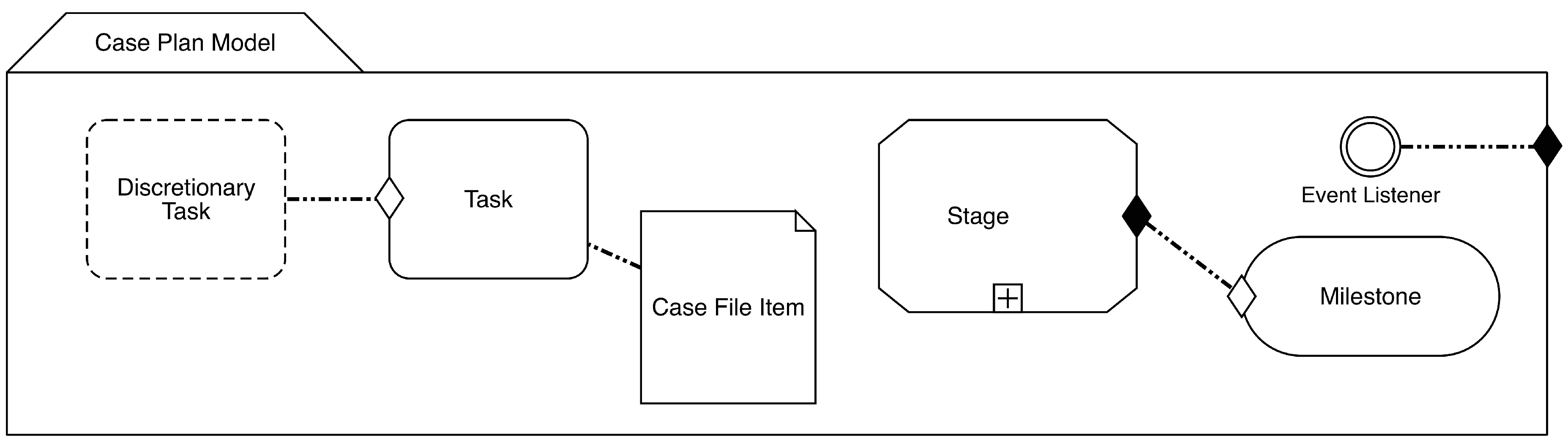
Figure 2.
Process of qualitative analysis and synthesis, presented in a BPMN diagram.
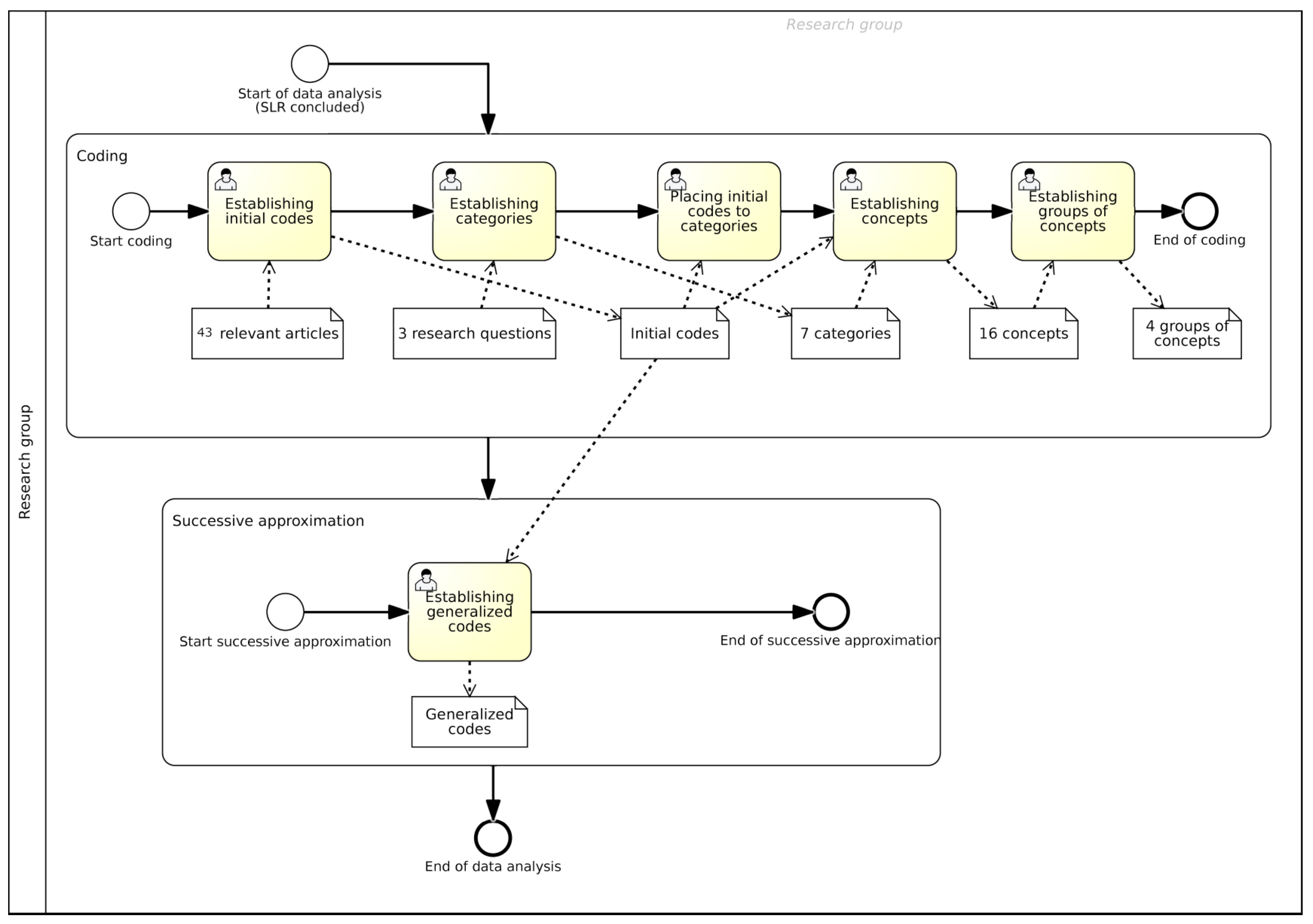
Figure 3.
UML class diagram-based conceptual model of CMMN classes where extensions have been proposed.
Figure 3.
UML class diagram-based conceptual model of CMMN classes where extensions have been proposed.
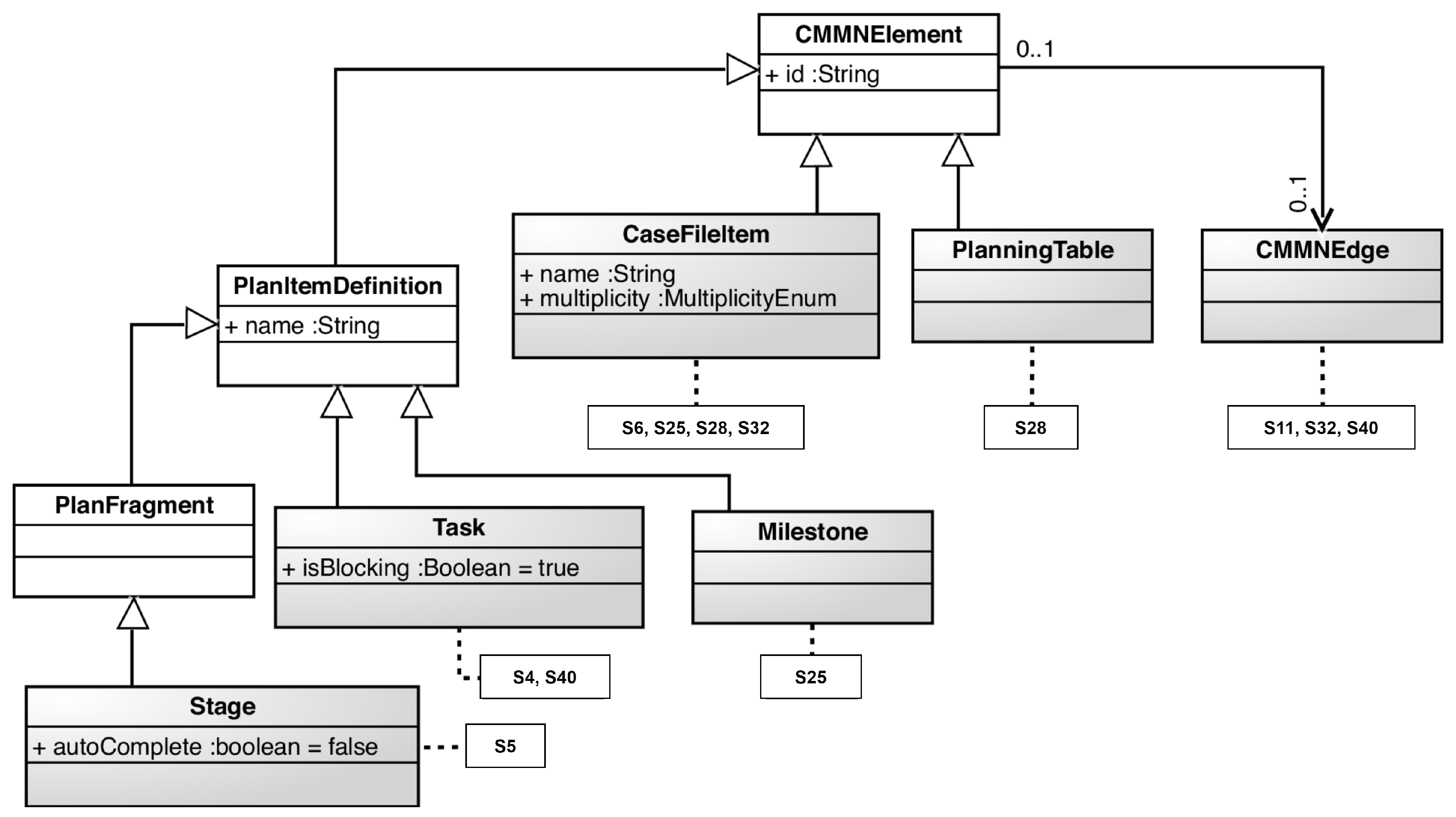

Table 1.
PICOC criteria.
| Criteria | Answers |
| Population | Business analysts, researchers |
| Intervention | CMMN |
| Comparison | Where applicable, compared to BPMN |
| Outcomes | Insight into advantages, disadvantages, extensions, upgrades or improvements and practical use of CMMN |
| Context | All available, existing scientific articles |
Table 2.
Attributes of initial articles.
| Attribute | Possible values |
| Basic information | |
| Title | - |
| Authors | - |
| Source | journal title, conference name, book title |
| Type of source | journal, conference, book chapter, thesis |
| Year of publication | 2014 - 2024 |
| Researchers | academics, business people, both |
| Domain | general article OR article about extensions OR articles about use OR articles about several notations, including CMMN |
| Analysis of content | |
| Purpose | - |
| Problem description | - |
| Proposed solution | - |
| Interpretations of results | |
| Discussions | - |
| Further work | - |
| Other | |
| Notes | - |
| Subjective assessment | excellent, very good, good, poor, very bad |
Table 3.
Results of evaluations.
| Input | Pre | First | Second | Third | |
| ACM | 151 | 31 | 2 | 2 | 2 |
| IEEE | 199 | 20 | 2 | 1 | 0 |
| WoS | 91 | 52 | 21 | 18 | 9 |
| SD | 14 | 12 | 8 | 8 | 4 |
| Sc | 125 | 61 | 34 | 27 | 19 |
| SL | 362 | 50 | 15 | 12 | 9 |
| Total | 942 | 226 | 82 | 68 | 43 |
Table 4.
Relevant articles.
| # | Ref. | Author(s) |
| S1 | [13] | Allah Bukhsh et al. |
| S2 | [3] | Auer et al. |
| S3 | [32] | Benzarti et al. |
| S4 | [33] | Bruno |
| S5 | [34] | Bruno |
| S6 | [35] | Bule and Polančič |
| S7 | [36] | Carvalho et al. |
| S8 | [37] | Carvalho et al. |
| S9 | [38] | Castellanos et al. |
| S10 | [39] | Fred A. Cummins |
| S11 | [40] | Czepa et al. |
| S12 | [41] | Ferreira et al. |
| S13 | [42] | van Gaal et al. |
| S14 | [43] | Gonzalez-Lopez and Pufahl |
| S15 | [44] | Herzberg et al. |
| S16 | [45] | Holz et al. |
| S17 | [46] | Jalali |
| S18 | [47] | Jalali |
| S19 | [48] | Junger et al. |
| S20 | [22] | Kocbek Bule et al. |
| S21 | [14] | Kurz et al. |
| S22 | [49] | Lantow |
| S23 | [8] | Marin et al. |
| S24 | [50] | Marin et al. |
| S25 | [51] | Marrella et al. |
| S26 | [52] | Mei et al. |
| S27 | [53] | Milani et al. |
| S28 | [54] | Nešković et al. |
| S29 | [55] | Nikolaidou et al. |
| S30 | [56] | Nova Arévalo and González |
| S31 | [57] | Ozturk Yurt et al. |
| S32 | [58] | Plebani et al. |
| S33 | [12] | Routis et al. |
| S34 | [59] | Routis et al. |
| S35 | [60] | Routis et al. |
| S36 | [61] | Routis et al. |
| S37 | [62] | Ruiz Herrera and Sánchez Díaz |
| S38 | [63] | Shahrah and Al-Mashari |
| S39 | [64] | Slaats |
| S40 | [65] | Sprovieri and Vogler |
| S41 | [66] | Sprovieri et al. |
| S42 | [10] | Wiemuth et al. |
| S43 | [9] | Zensen and Küster |
Table 5.
Groups of concepts and corresponding concepts.
| Groups of concepts | Concepts |
| Syntax | Elements, Control-flow, Data, Execution, Progress in process, Roles, Metamodel |
| Quality characteristics | Applicability, Complexity, Expressibility, Simplicity, Understandability |
| Declarative aspect | Knowledge workers, Non-routine work |
| Experiences in use | Companions, Vendors |
Table 6.
Answers to research questions.
| RQ 1.1 | RQ 1.2 | RQ 2 | RQ 3 | ||||||||||
| A1 | A2 | A3 | A4 | D1 | D2 | D3 | D4 | U1 | U2 | U3 | U4 | ||
| S1 | ✓ | ✓ | ✓ | ✓ | ✓ | ✓ | ✓ | ||||||
| S2 | ✓ | ||||||||||||
| S3 | ✓ | ||||||||||||
| S4 | ✓ | ✓ | ✓ | ✓ | |||||||||
| S5 | ✓ | ✓ | ✓ | ✓ | ✓ | ||||||||
| S6 | ✓ | ✓ | |||||||||||
| S7 | ✓ | ✓ | |||||||||||
| S8 | ✓ | ||||||||||||
| S9 | ✓ | ✓ | ✓ | ✓ | |||||||||
| S10 | ✓ | ||||||||||||
| A1 | A2 | A3 | A4 | D1 | D2 | D3 | D4 | U1 | U2 | U3 | U4 | ||
| S11 | ✓ | ✓ | |||||||||||
| S12 | ✓ | ||||||||||||
| S13 | ✓ | ✓ | |||||||||||
| S14 | ✓ | ||||||||||||
| S15 | ✓ | ✓ | |||||||||||
| S16 | ✓ | ✓ | ✓ | ✓ | |||||||||
| S17 | ✓ | ||||||||||||
| S18 | ✓ | ✓ | ✓ | ||||||||||
| S19 | ✓ | ||||||||||||
| S20 | ✓ | ||||||||||||
| S21 | ✓ | ✓ | |||||||||||
| S22 | ✓ | ✓ | |||||||||||
| S23 | ✓ | ✓ | ✓ | ||||||||||
| S24 | ✓ | ||||||||||||
| S25 | ✓ | ✓ | ✓ | ✓ | |||||||||
| S26 | ✓ | ||||||||||||
| S27 | ✓ | ✓ | |||||||||||
| S28 | ✓ | ✓ | |||||||||||
| S29 | ✓ | ||||||||||||
| S30 | ✓ | ✓ | |||||||||||
| S31 | ✓ | ||||||||||||
| S32 | ✓ | ✓ | ✓ | ||||||||||
| S33 | ✓ | ✓ | ✓ | ✓ | |||||||||
| S34 | ✓ | ✓ | |||||||||||
| S35 | ✓ | ✓ | ✓ | ||||||||||
| S36 | ✓ | ||||||||||||
| S37 | ✓ | ✓ | |||||||||||
| S38 | ✓ | ✓ | ✓ | ✓ | |||||||||
| S39 | ✓ | ||||||||||||
| S40 | ✓ | ✓ | |||||||||||
| S41 | ✓ | ||||||||||||
| S42 | ✓ | ✓ | |||||||||||
| S43 | ✓ | ✓ | ✓ | ✓ | ✓ | ✓ | |||||||
Disclaimer/Publisher’s Note: The statements, opinions and data contained in all publications are solely those of the individual author(s) and contributor(s) and not of MDPI and/or the editor(s). MDPI and/or the editor(s) disclaim responsibility for any injury to people or property resulting from any ideas, methods, instructions or products referred to in the content. |
© 2025 by the authors. Licensee MDPI, Basel, Switzerland. This article is an open access article distributed under the terms and conditions of the Creative Commons Attribution (CC BY) license (http://creativecommons.org/licenses/by/4.0/).
Copyright: This open access article is published under a Creative Commons CC BY 4.0 license, which permit the free download, distribution, and reuse, provided that the author and preprint are cited in any reuse.


