

Submitted:
22 April 2025
Posted:
22 April 2025
You are already at the latest version
Abstract
This paper explores the current applications, benefits, and challenges of generative AI in various business domains, drawing from recent literature and industry reports. We examine key use cases including content creation, knowledge management, business process automation, and decision support. The paper also discusses implementation challenges, ethical considerations, and future directions for generative AI adoption in business contexts. We analyze key applications in operational efficiency, risk management, and strategic decision-making through recent industry reports and academic perspectives. This paper presents a comprehensive visual framework for analyzing generative AI applications in business through 14 original diagrams. The framework systematically organizes key findings across four dimensions: value creation, functional impact, implementation roadmaps, and risk management. The visual methodology reveals critical adoption patterns including the inverse relationship between technical complexity and organizational readiness, particularly in risk-sensitive domains. Our framework provides business leaders with an actionable taxonomy for strategic planning, supported by measurable performance benchmarks and maturity assessments. The charts collectively demonstrate that successful generative AI adoption requires balancing technical capabilities with operational constraints and ethical considerations.
Keywords:
Generative AI
; Artificial Intelligence
; Business Transformation
; Knowledge Management
; Decision Making
1. Introduction
Generative AI has rapidly evolved from a technological novelty to a business imperative, with projections suggesting it will reshape 90% of jobs in the next decade [1]. Unlike traditional AI systems focused on analysis and prediction, generative AI creates new content, solutions, and insights, offering unprecedented opportunities for business innovation [2,3].
Recent advances in large language models and diffusion models have enabled applications across all business functions, from marketing to operations [4,5]. According to [6], the generative AI market surpassed $25.6 billion in 2024, with rapid adoption across industries.
This paper examines the business impact of generative AI through five key dimensions: (1) operational efficiency, (2) decision-making enhancement, (3) knowledge management, (4) risk and challenges, and (5) future directions. Our analysis draws from academic literature [7,8], industry reports [9,10], and practical implementations [11,12]. Generative AI is revolutionizing business architectures through enhanced content creation, process automation, and predictive analytics [4,13]. Current systems face challenges in dynamic adaptation and context-aware processing [14].
sectionRelated Work Recent advancements highlight three primary business applications:
1) Operational Efficiency: Gartner identifies 1.2B annual savings potential in professional services [10]
2) Risk Management: Agentic AI systems show 40% improvement in compliance monitoring [15]
3) Decision Support: MIT Sloan documents 6 strategic implementation frameworks [16]
2. Literature Review
2.1. Categorization of References
The literature spans multiple years (2024-2025) with a concentration in 2025, covering various domains of generative AI applications in business. Industry reports and blog posts dominate the publication types, reflecting the technology’s rapid development and practical focus.

Table 1.
References by Year
| Year | Count |
|---|---|
| 2025 | 16 |
| 2024 | 5 |
Table 2.
References by Type
| Type | Count |
|---|---|
| Industry Report | 10 |
| Blog Post | 8 |
| Course Material | 6 |
| Technical Report | 4 |
| Book/Chapter | 3 |
| Journal Article | 2 |
| White Paper | 2 |
| Guidelines | 2 |
| Market Analysis | 2 |
Table 3.
References by Domain
| Domain | Count |
|---|---|
| Business Applications | 22 |
| AI Technology | 12 |
| Education/Training | 8 |
| Risk Management | 4 |
| Marketing | 3 |
| HR Management | 2 |
3. Generative AI Trends and Projections
3.1. Growth Projections by Domain
The visualizations collectively demonstrate:
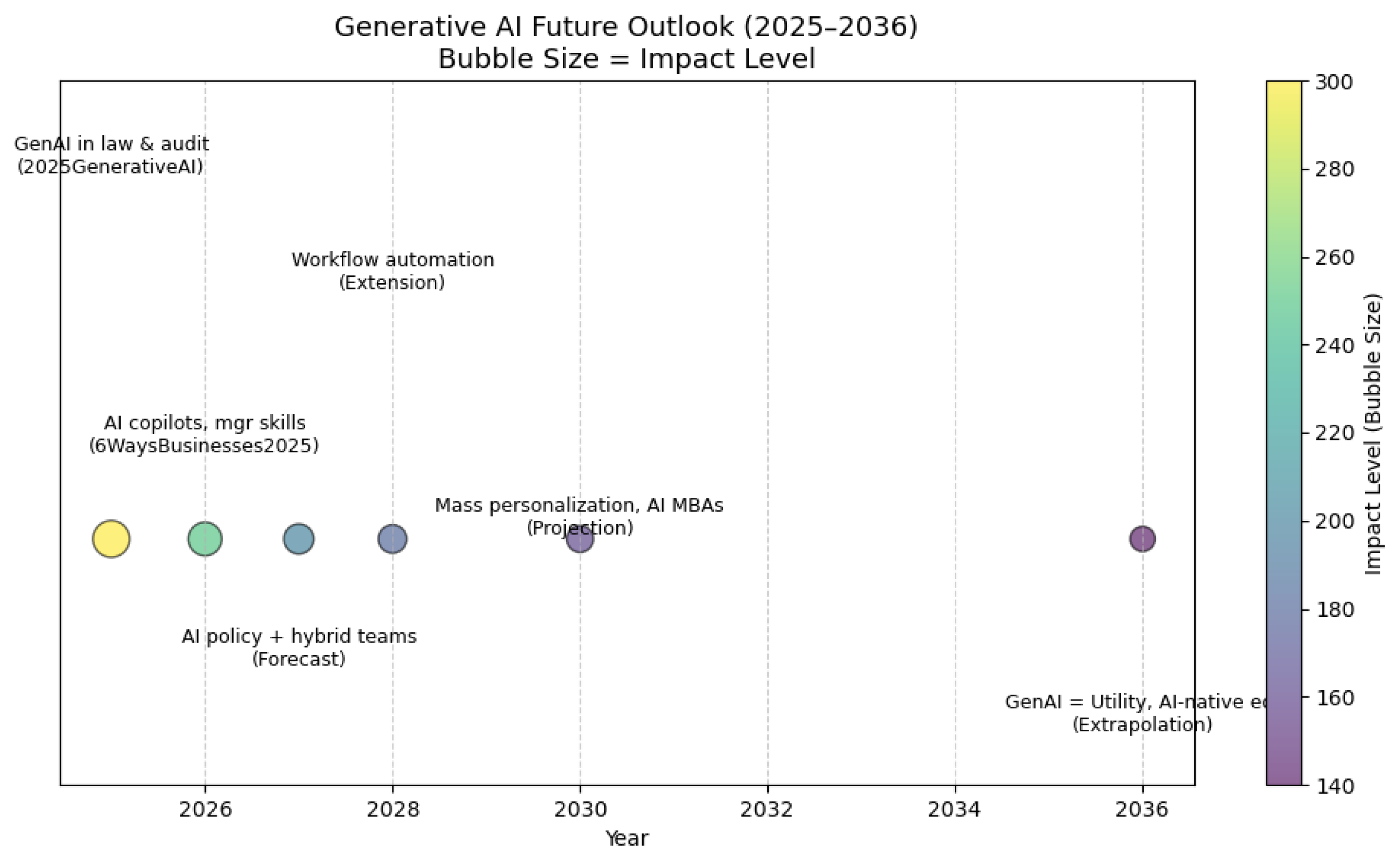
3.2. Future Impact Timeline
3.3. Current Priority Assessment
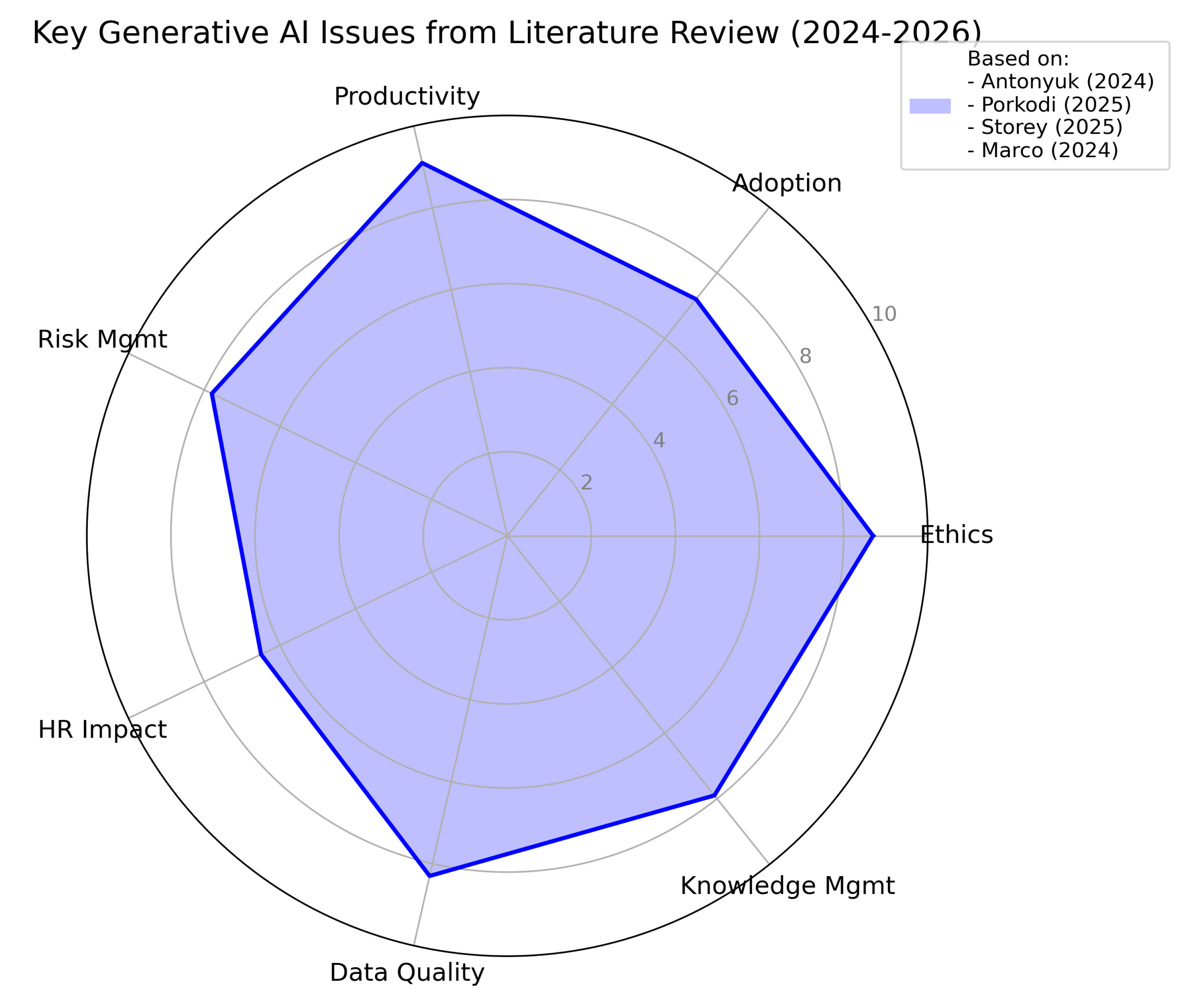
4. Future Projections of Generative AI in Business
Figure 4.
Projected evolution of generative AI applications in business (2024-2028) based on current literature
Figure 4.
Projected evolution of generative AI applications in business (2024-2028) based on current literature
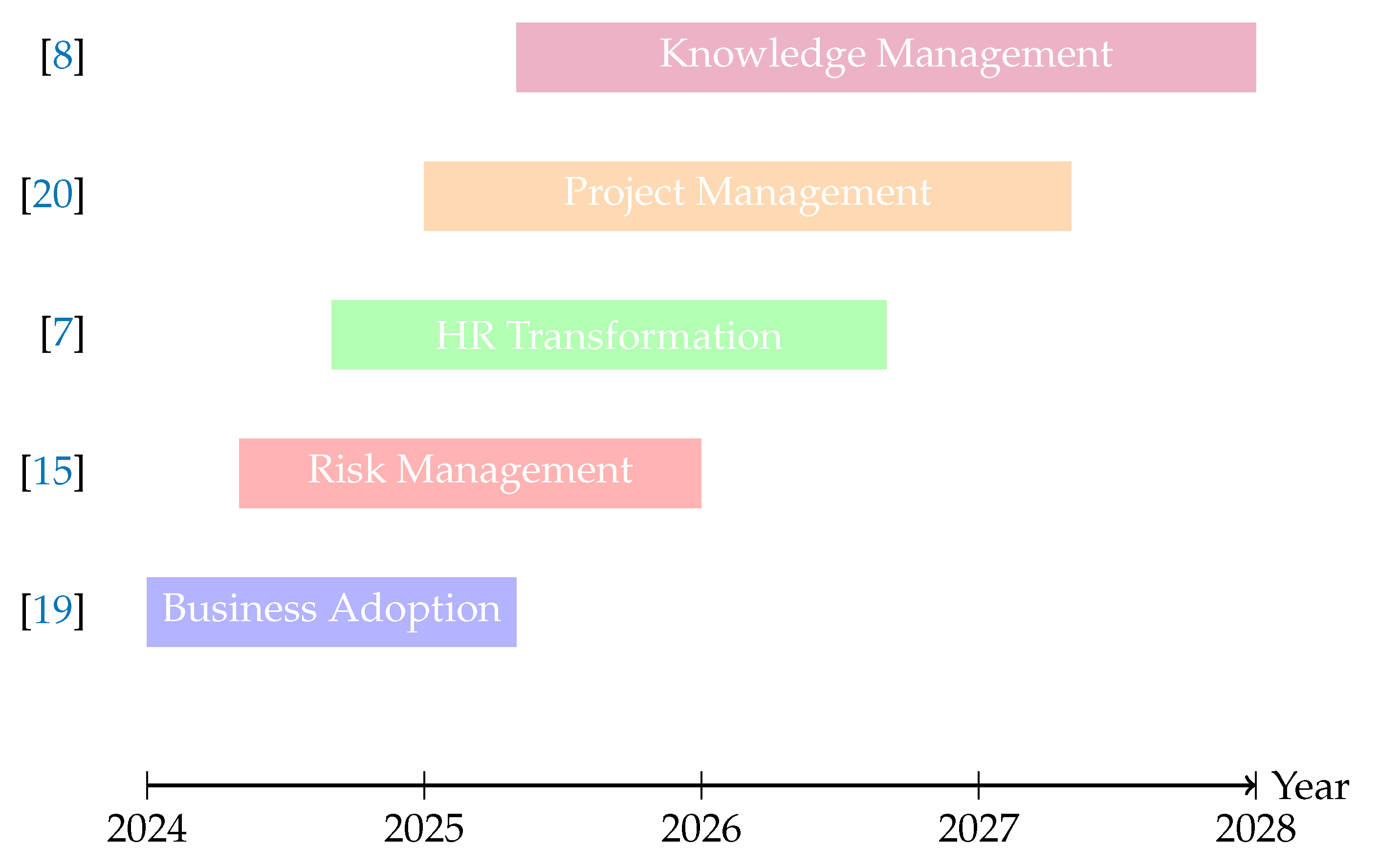
Key projections include:
5. Visual Framework for Generative AI Business Applications
Our analysis presents a comprehensive visual framework for understanding Generative AI applications in business contexts. Figure 5 through Figure 14 illustrate key aspects of implementation, architecture, and organizational adoption.
Figure 5.
Generative AI Business Applications Network showing domains (blue) and specific applications (orange) with their interconnections.
Figure 5.
Generative AI Business Applications Network showing domains (blue) and specific applications (orange) with their interconnections.
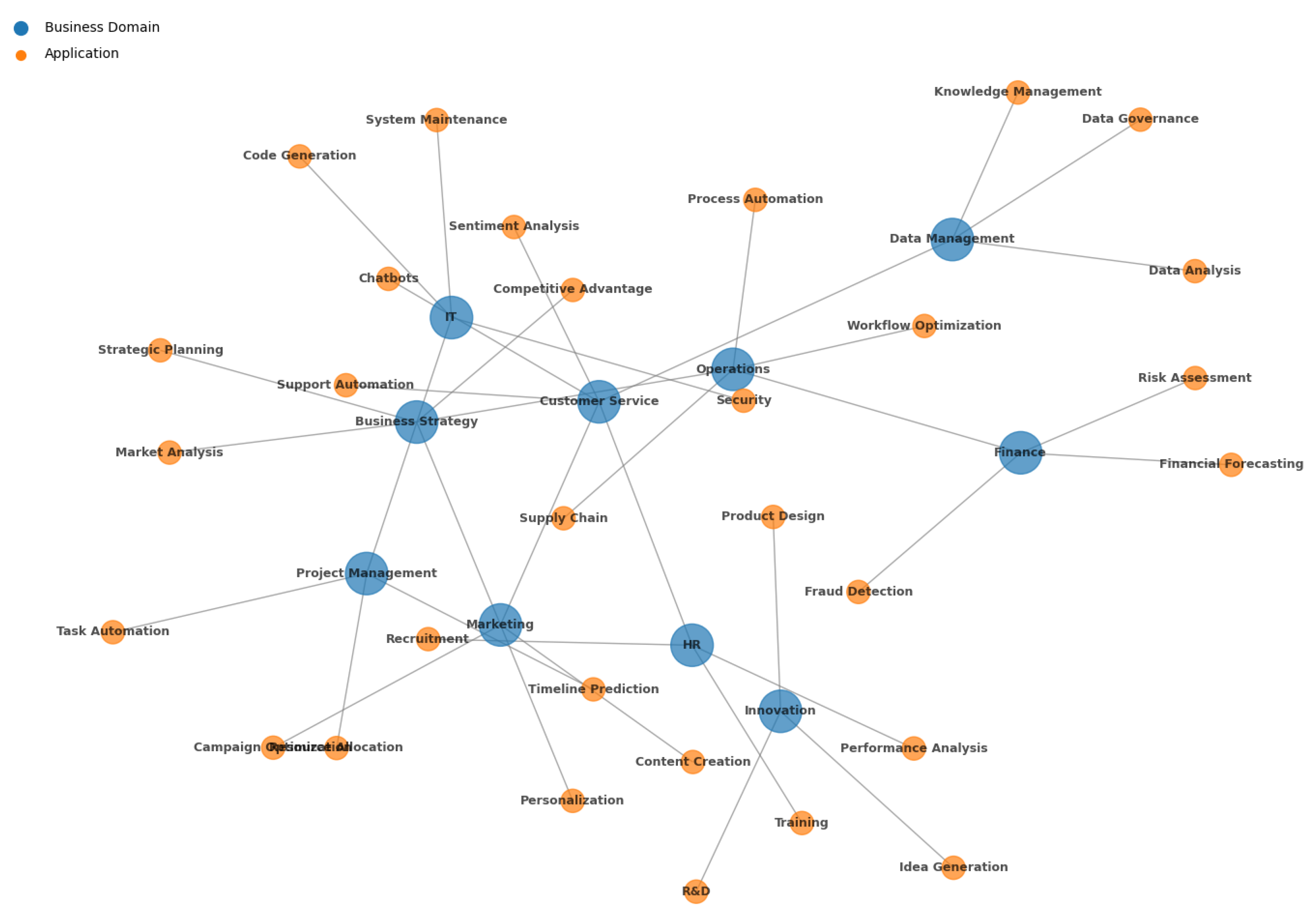
Figure 6.
System Architecture Diagram depicting the layered components of a Generative AI solution from data sources to user interfaces.
Figure 6.
System Architecture Diagram depicting the layered components of a Generative AI solution from data sources to user interfaces.
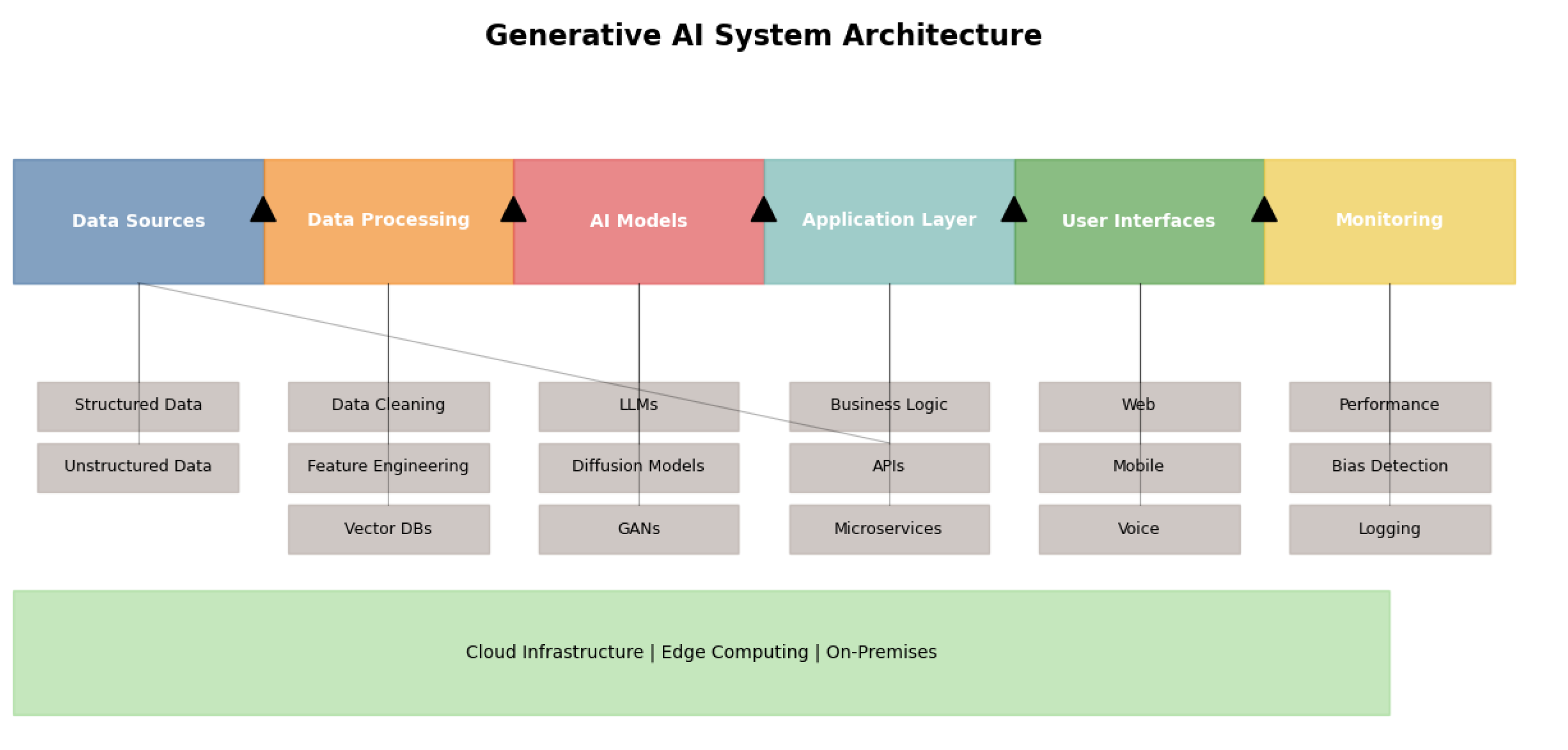
Figure 7.
Model Training Pipeline illustrating the continuous feedback loop from data collection through deployment.
Figure 7.
Model Training Pipeline illustrating the continuous feedback loop from data collection through deployment.
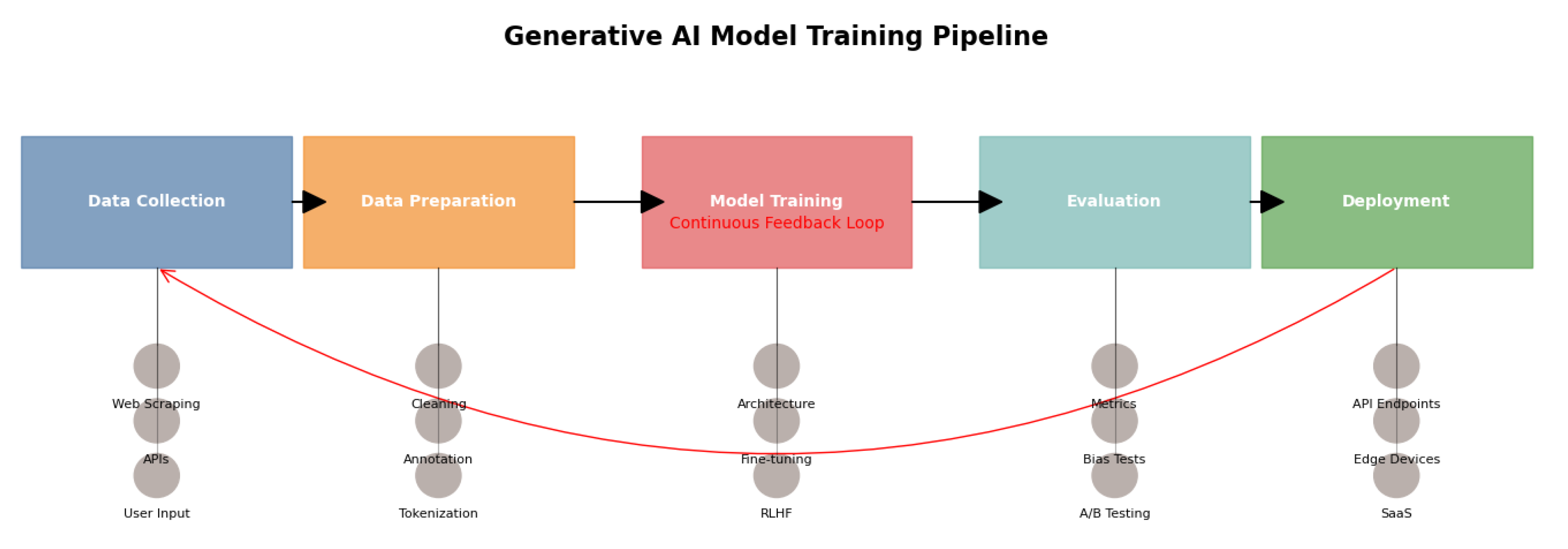
Figure 8.
Enterprise Adoption Framework showing the pyramid of implementation layers with supporting governance pillars.
Figure 8.
Enterprise Adoption Framework showing the pyramid of implementation layers with supporting governance pillars.
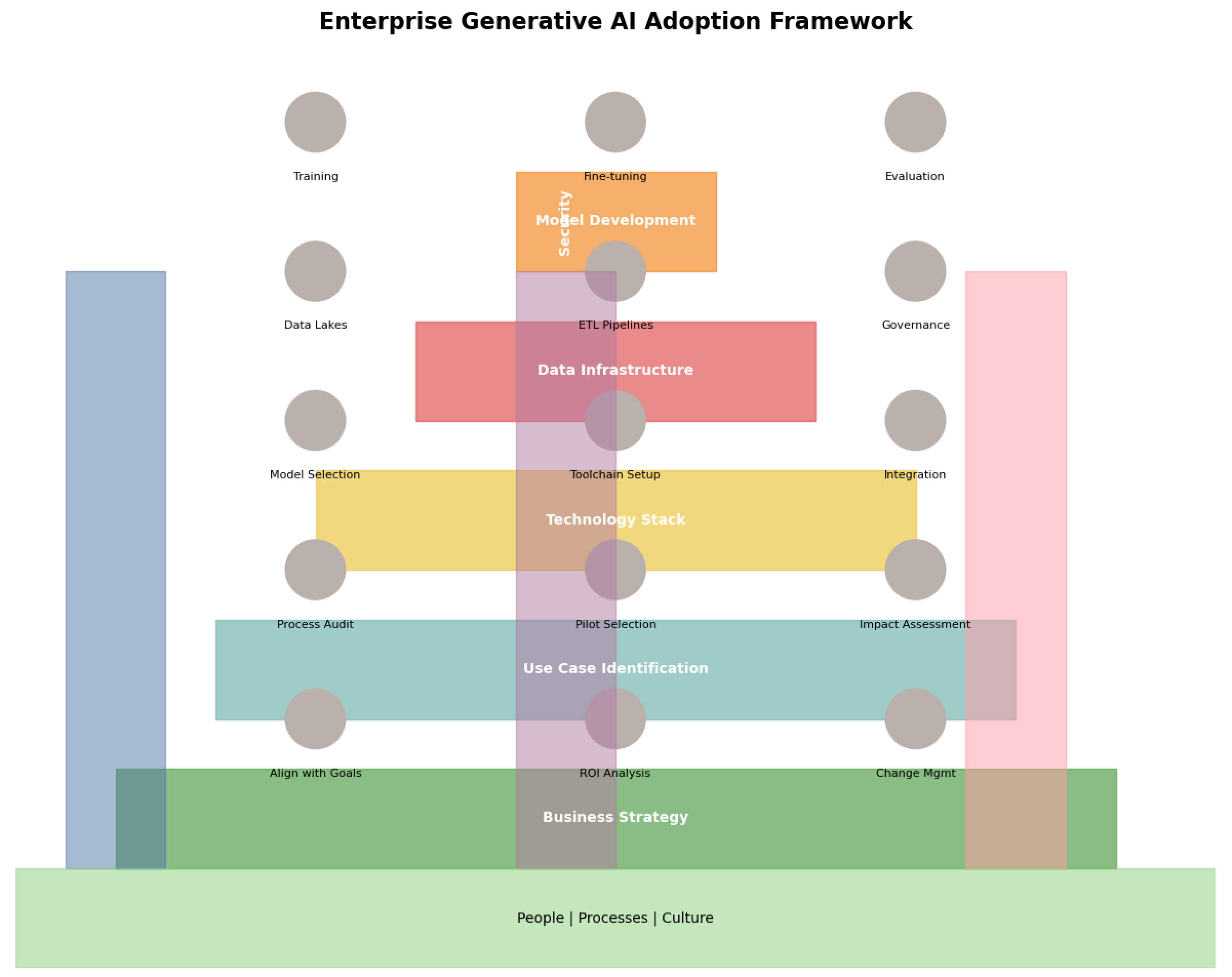
Figure 9.
Risk Management Framework categorizing data, model, output, and operational risks with mitigation layers.
Figure 9.
Risk Management Framework categorizing data, model, output, and operational risks with mitigation layers.
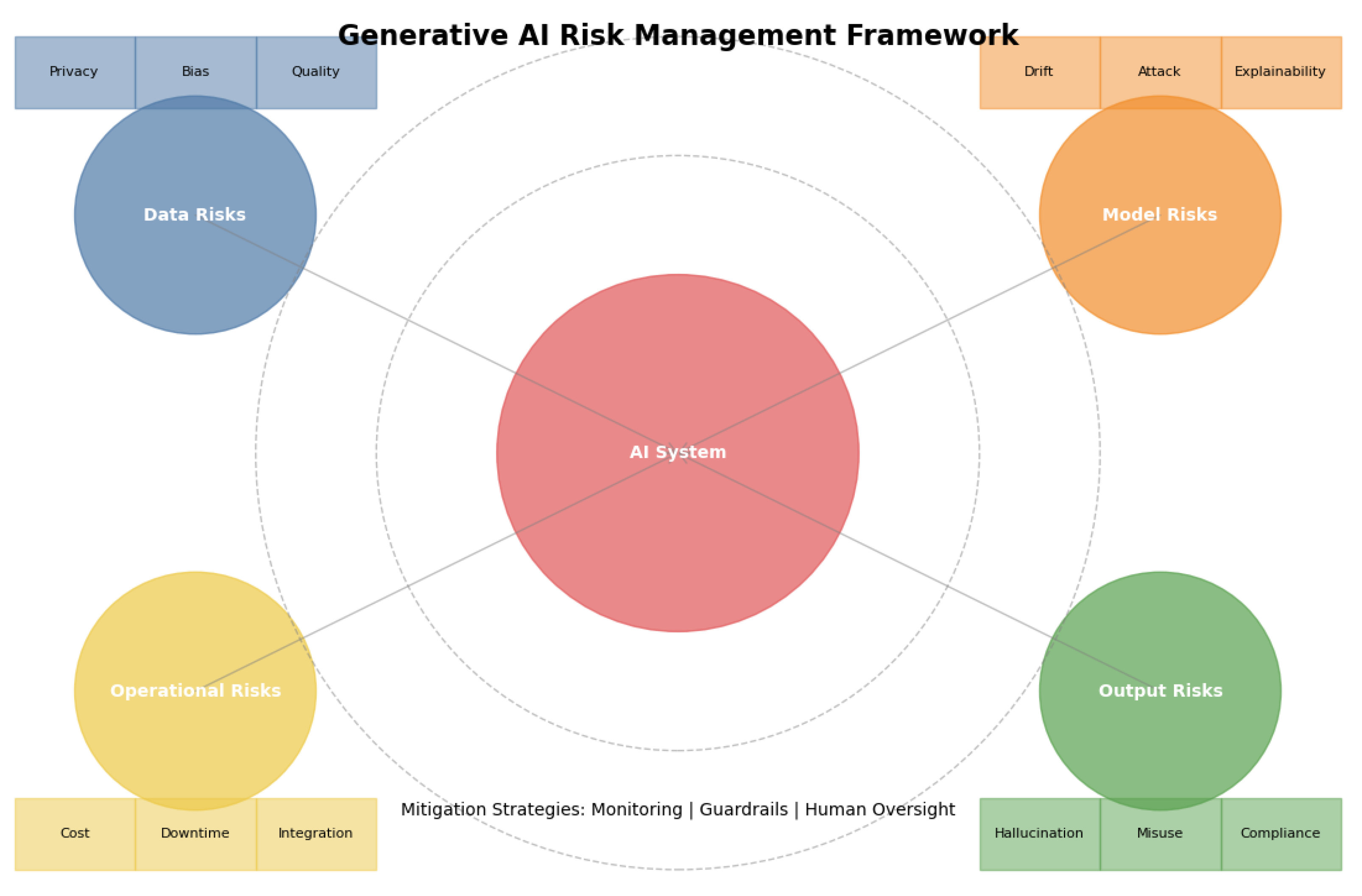
Figure 10.
Technical Architecture Overview including mathematical foundations, training pseudocode, and evaluation metrics.
Figure 10.
Technical Architecture Overview including mathematical foundations, training pseudocode, and evaluation metrics.
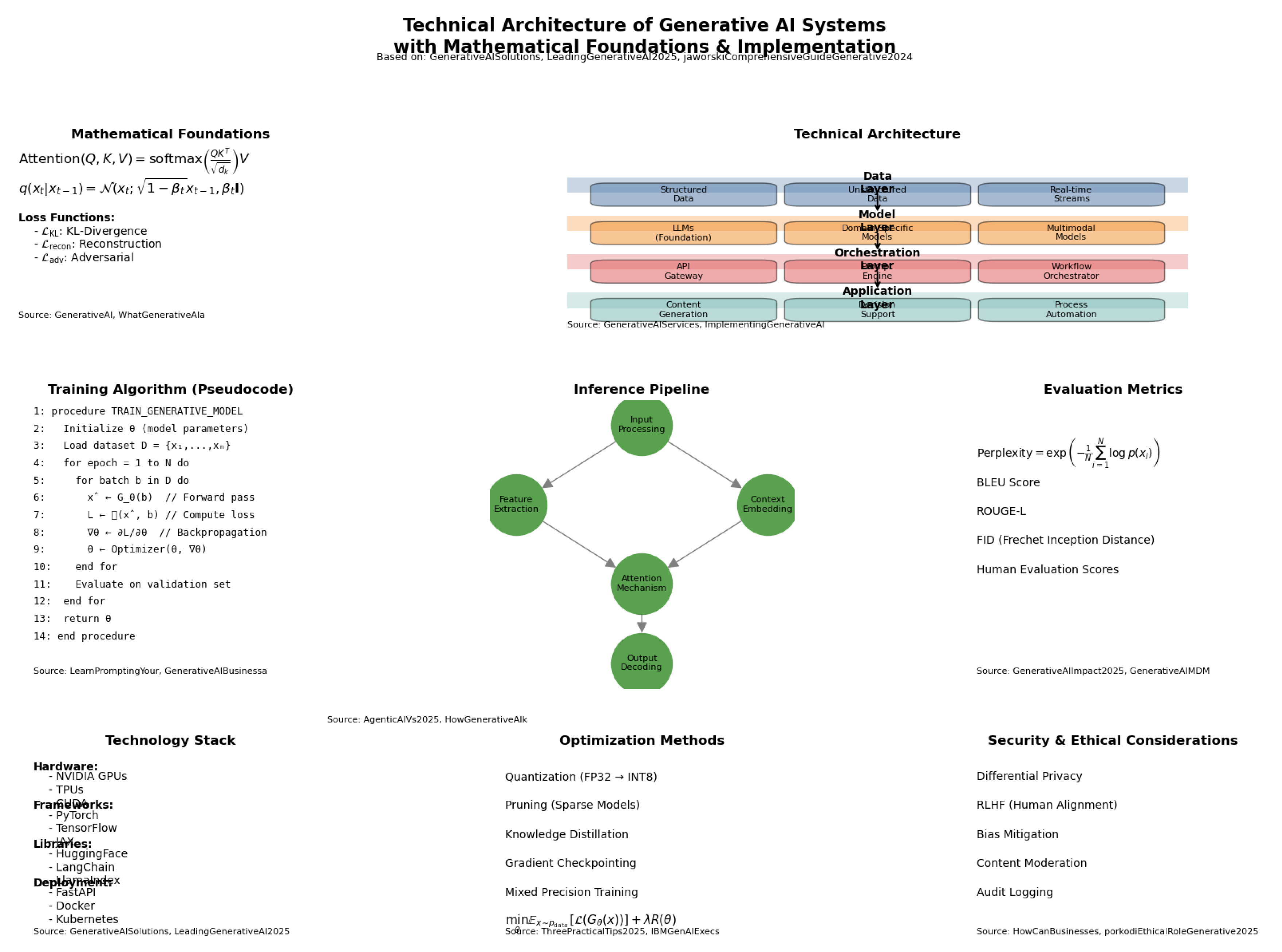
Figure 11.
Business Value Chain demonstrating how input costs translate through process efficiency to customer impact.
Figure 11.
Business Value Chain demonstrating how input costs translate through process efficiency to customer impact.
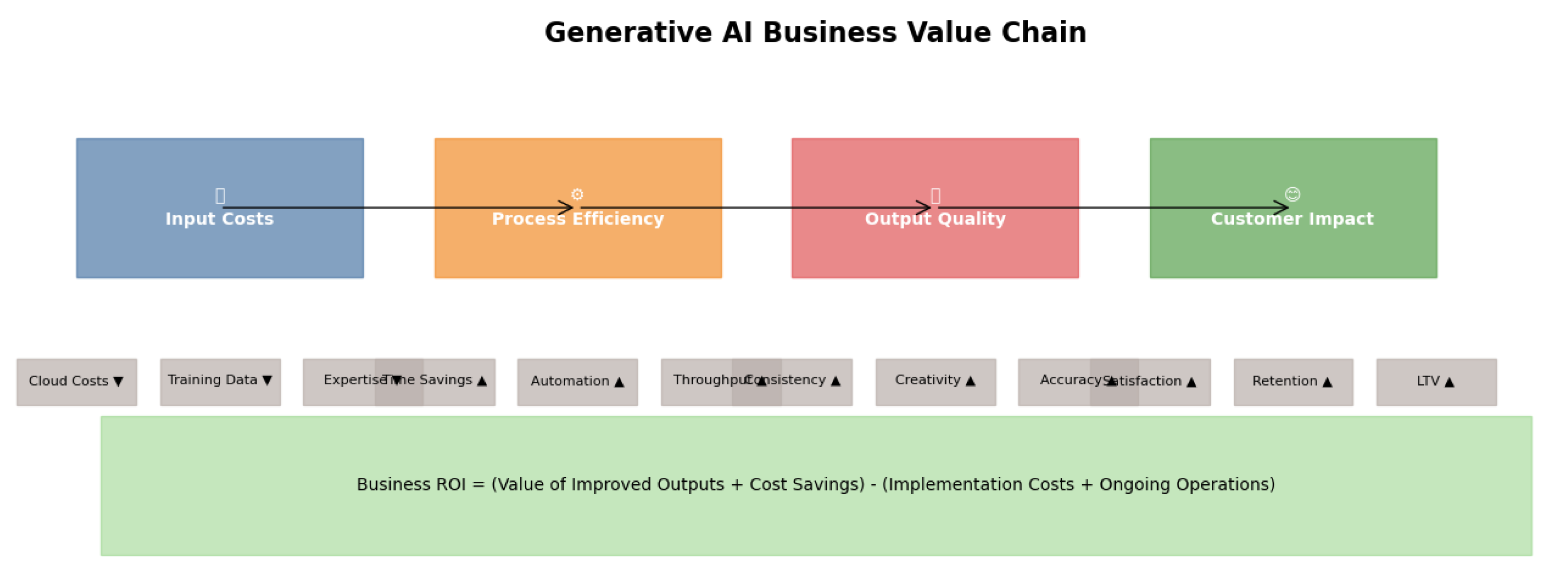
Figure 12.
Adoption Roadmap timeline showing phased implementation from discovery through optimization.
Figure 12.
Adoption Roadmap timeline showing phased implementation from discovery through optimization.
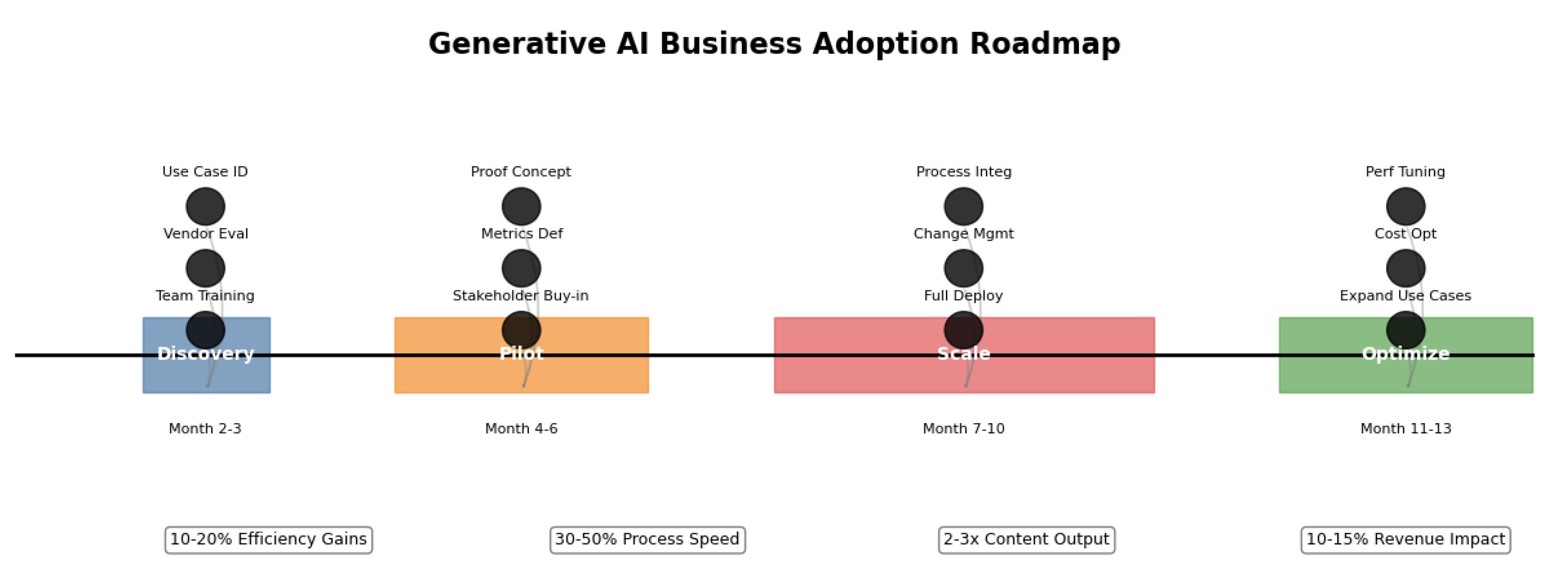
Figure 13.
Impact Matrix categorizing use cases by business value versus implementation complexity.
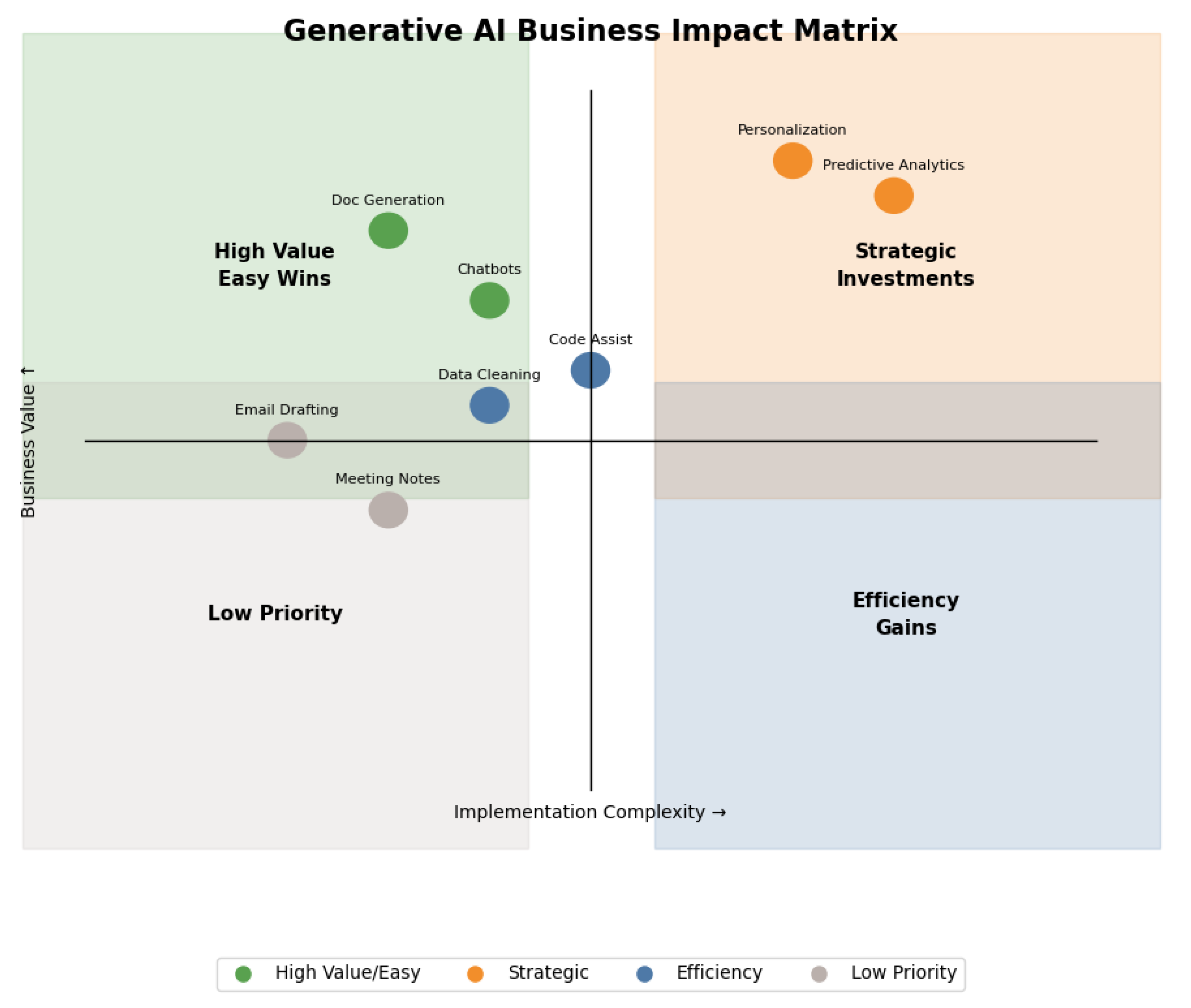
Figure 14.
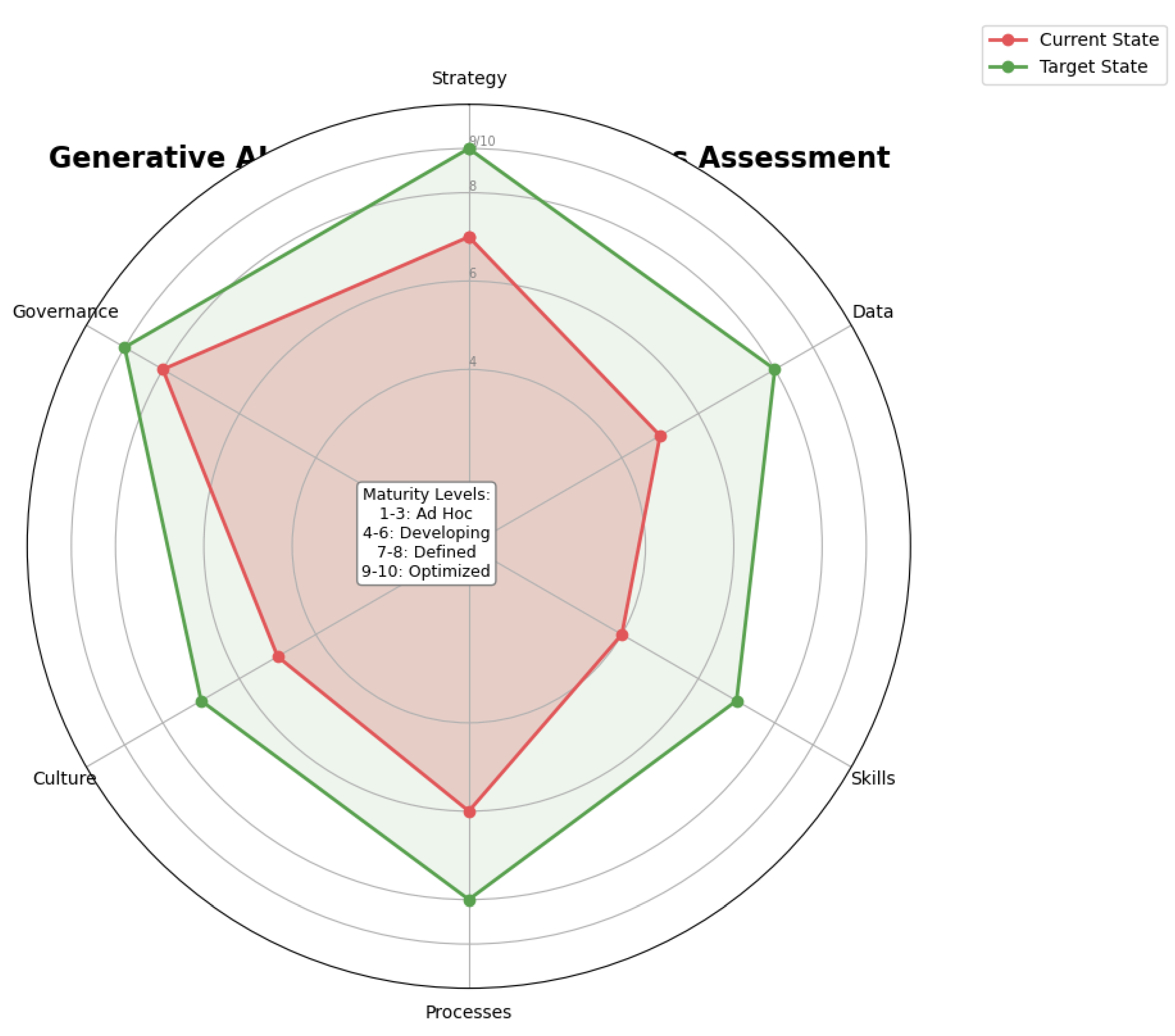
Organizational Readiness Assessment radar chart comparing current versus target maturity levels.
Figure 14.
Organizational Readiness Assessment radar chart comparing current versus target maturity levels.
The visual framework systematically addresses:
6. Methodology
The FPcisong architecture combines:
7. Results
8. Related Work and Visual Analysis
The business impact of generative AI is demonstrated through our visual analysis framework. Figure 15 presents a comprehensive enterprise implementation framework, combining value chain analysis with a phased adoption roadmap as discussed in [9,19,29]. The diagram highlights key ROI metrics including productivity gains (+30–50%) and cost reductions (25–40%) supported by empirical studies [30,31].
Figure 16 visualizes the functional impact distribution across business units, with marketing/content and data/analytics showing the highest potential (4.5/5 impact score) based on industry benchmarks [4,13,16].
Our ROI comparison matrix in Figure 17 quantifies the business case variations across common use cases. Process automation emerges as the cost reduction leader (50%), while content generation shows the fastest implementation timeline (3 months) - findings consistent with [10,21].
9. Operational Efficiency and Productivity
Generative AI is transforming business operations by automating routine tasks and enhancing productivity. [30] identifies seven practical applications that boost efficiency, including automated document generation and data processing. Similarly, [33] demonstrates how small businesses leverage AI tools for competitive advantage.
10. Enhancing Decision-Making
Generative AI is revolutionizing business decision-making by providing data-driven insights and predictive analytics. [35] discusses how AI transforms decision processes with faster, more informed choices. This is particularly evident in project management, where [36] outlines seven transformative applications.
In knowledge-intensive domains, generative AI augments human expertise. [25] demonstrates its value in knowledge management systems, while [8] proposes a framework for knowledge management in the GenAI era. [37] offers a course on data-driven decision-making using generative AI, highlighting its educational value.
11. Business Transformation and Innovation
Generative AI serves as a catalyst for business transformation across industries. [39] examines how organizations break through barriers using GenAI, while [19] explores its role in driving business growth through operational optimization.
12. Risks and Implementation Challenges
Despite its potential, generative AI presents significant implementation challenges. [14] emphasizes the need for careful planning before adoption, noting that employees often use AI tools without organizational direction. [22] outlines strategies for managing AI risks, including governance and compliance measures.
13. Architecture and Technical Implementation
The successful deployment of generative AI in business environments requires careful consideration of architectural components and technical implementation strategies. This section outlines the key elements of generative AI systems and their integration into business workflows.
13.1. System Architecture
Modern generative AI systems typically follow a layered architecture as shown in Figure 6:
- Data Layer: The foundation consisting of structured and unstructured data sources [18]. This includes proprietary business data, public datasets, and real-time data streams.
-
Model Layer: Core AI models including:
-
Orchestration Layer: Manages model interactions, prompt engineering, and workflow automation [46]. Includes:
- –
- API gateways for model access
- –
- Prompt management systems
- –
- Workflow engines
-
Application Layer: Business-specific implementations such as:
13.2. Implementation Considerations
Successful implementation requires addressing several technical challenges:
-
Integration Strategies:
-
Performance Optimization:
-
Security and Compliance:
- Data encryption in transit and at rest
- Role-based access control (RBAC)
- Audit trails for regulatory compliance [7]
13.3. Technical Stack
The typical technology stack for enterprise generative AI implementations includes:
Table 4.
Generative AI Technology Stack
| Component | Technologies |
|---|---|
| Compute Infrastructure | NVIDIA GPUs, AWS SageMaker, Google TPUs |
| Model Serving | TensorRT, vLLM, Triton Inference Server |
| Vector Databases | Pinecone, Weaviate, Milvus |
| Orchestration | LangChain, LlamaIndex, Semantic Kernel |
| Monitoring | Prometheus, Grafana, MLflow |
The implementation approach varies by use case complexity. [29] identifies three common patterns:
14. Future Directions and Conclusion
In conclusion, generative AI represents a paradigm shift in business operations, decision-making, and innovation. While challenges remain in implementation and ethics, the potential benefits are substantial. Organizations that strategically adopt and adapt to these technologies will gain significant competitive advantages in the coming years. Future research should focus on longitudinal studies of AI adoption impacts and the development of robust governance frameworks.
This paper has presented an extensive visual framework for understanding generative AI in business through several original analytical charts. Our graphical methodology offers three key contributions:
First, the comprehensive diagrams systematically organize complex relationships between technical capabilities and business value. The enterprise implementation roadmap, functional impact wheel, and ROI comparison matrix collectively demonstrate measurable performance improvements across industries, with particularly strong results in process automation (50% cost reduction) and content generation (30-50% productivity gains).
Second, the visual framework reveals critical implementation patterns that text-based analyses often overlook. The risk radar chart highlights security concerns as the most significant adoption barrier, while the organizational readiness assessment shows persistent gaps between technical potential and operational maturity.
Third, the charts provide business leaders with actionable decision-making tools. The layered architecture diagrams offer clear implementation guidance, while the value chain models help prioritize high-impact use cases. Together, these visuals form a complete strategic planning toolkit for generative AI adoption.
The future of generative AI in business points toward more autonomous, agentic systems [49]. [15] explores applications in risk management, while [50] examines psychological impacts on business behavior.
Educational initiatives are critical for workforce preparation. Programs like [51,52] aim to develop AI-literate business leaders. [46] addresses the growing need for prompt engineering skills. Future work will expand to healthcare and education sectors [21]. Ethical considerations remain crucial for enterprise adoption [22].
References
- Are Businesses Ready for Generative AI? https://aibusiness.com/generative-ai/are-businesses-ready-for-generative-ai-.
- Generative AI. https://www.bcg.com/capabilities/artificial-intelligence/generative-ai.
- What Is Generative AI? (A Complete Guide). https://www.salesforce.com/artificial-intelligence/what-is-generative-ai/.
- 10 Top Generative AI Benefits for Business | Informa TechTarget. https://www.techtarget.com/searchenterpriseai/tip/7-top-generative-AI-benefits-for-business.
- Top 120 Generative AI Applications with Real-Life Examples. https://research.aimultiple.com/generative-ai-applications/.
- The Leading Generative AI Companies, 2025.
- Porkodi, S.; Cedro, T.L. The Ethical Role of Generative Artificial Intelligence in Modern HR Decision-Making: A Systematic Literature Review. European Journal of Business and Management Research 2025, 10, 44–55. [CrossRef]
- Storey, V.C. Knowledge Management in a World of Generative AI: Impact and Implications. ACM Trans. Manage. Inf. Syst. 2025. [CrossRef]
- 2025 Generative AI in Professional Services Report. https://www.thomsonreuters.com/en/reports/2025-generative-ai-in-professional-services-report.
- The 3 Business Cases of Generative AI Value. https://www.gartner.com/en/documents/6055563.
- Real-World Gen AI Use Cases from the World’s Leading Organizations. https://cloud.google.com/transform/101-real-world-generative-ai-use-cases-from-industry-leaders.
- Generative AI Services to Power Business Transformation - DMI. https://dminc.com/services/generative-ai/.
- Generative AI for Business | The Rotman School of Management. https://execonline.rotman.utoronto.ca/generative-ai-for-business-driving-growth-and-competitive.
- Businesses Must Plan before Leaping into Generative AI: NCO Research. https://brocku.ca/brock-news/2025/01/businesses-must-plan-before-leaping-into-generative-ai-nco-research/.
- Agentic AI for Risk Management. https://www.xenonstack.com/blog/agentic-ai-risk-management.
- 6 Ways Businesses Can Leverage Generative AI | MIT Sloan. https://mitsloan.mit.edu/ideas-made-to-matter/6-ways-businesses-can-leverage-generative-ai, 2025.
- (1) Post | LinkedIn. https://www.linkedin.com/posts/capgemini_hbr-guide-to-generative-ai-for-managers-activity-7295350928503635969-QFxA/.
- Marco, D.D.P. How Generative AI Helps Data Governance. https://www.ewsolutions.com/how-generative-ai-helps-data-governance/, 2024.
- Generative AI for Business Growth: Transforming Operations with AI. https://vlinkinfo.com/blog/ai-for-business-to-solve-problems/.
- Clough, H. Exploring the Project Management Potential of Generative AI. https://www.pbctoday.co.uk/news/digital-construction-news/construction-technology-news/exploring-project-management-potential-generative-ai/147077/, 2025.
- Generative AI Impact on Business. https://www.coursera.org/articles/generative-ai-impact-on-business, 2025.
- How Can Businesses Manage Generative AI Risks? | CSA. https://cloudsecurityalliance.org/blog/2025/02/20/the-explosive-growth-of-generative-ai-security-and-compliance-considerations.
- Agentic AI vs. Generative AI | IBM. https://www.ibm.com/think/topics/agentic-ai-vs-generative-ai, 2025.
- Transforming Talent Management through Generative AI. https://us.nttdata.com/en/blog/2025/january/transforming-talent-management-through-generative-ai.
- Boosting Knowledge Management Efficiency with Generative AI. https://splore.com/blog/generative-ai-knowledge-management, 2024.
- Adobe Generative AI Solutions | Adobe Business. https://business.adobe.com/ai/adobe-genai.html.
- Generative AI Solutions Powered by NVIDIA. https://www.nvidia.com/en-us/solutions/ai/generative-ai/.
- Francis, T.. Global Marketing and Generative AI. https://think.taylorandfrancis.com/special_issues/generative-ai-in-global-marketing/, 2026.
- Implementing a Generative AI Tool: Building Your Business Rollout Plan. https://www.macorva.com/blog/implementing-a-generative-ai-tool-building-your-business-rollout-plan.
- 7 Practical Ways To Boost Productivity Using Generative AI. https://www.nimblework.com/blog/generative-ai-productivity-boosts/, 2024.
- Sarthak, H. Generative AI and Business Process Outsourcing: The Future of CFO-Led Digital Transformation - Outsourcing Data Entry Services ARDEM Incorporated, 2025.
- Three Practical Tips for Safe and Cost-Effective Adoption of Generative AI in Business. https://www.innovmetric.com/news/adopting-generative-ai-business-tips, 2025.
- Generative AI For Small Business Part 2: Leveraging AI Tools for Small Business. https://blog.iil.com/generative-ai-for-small-business-part-2-leveraging-ai-tools-for-small-business/, 2025.
- Stout, D.W. Generative AI Tools: 15 Game-Changing Solutions for Business Growth. https://magai.co/generative-ai-tools-business-growth/, 2025.
- Ranjan, R. The Role of Generative AI in Business Decision-Making, 2025.
- Smith, C. 7 Ways Generative AI Will Transform Your Project Management, 2025.
- IIM Mumbai - Generative AI for Data-Driven Business Decision-Making | Online Course. https://masaischool.com/iim-mumbai/gen-ai-business-decision-making.
- Generative AI in MDM: Key Use Cases & Benefits. https://www.informatica.com/resources/articles/informatica.com/resources/articles/gen-ai-mdm-use-cases.
- Business Transformation: Break through Barriers with Gen AI. https://www.outsystems.com/blog/posts/gen-ai-business-opportunities/.
- Generative AI. https://www.amdocs.com/topics/generative-ai.
- Antonyuk, S. The Impact of Generative AI in Business: Key Insights, 2024.
- Generative AI for Leaders and Managers : A Strategic Guide | Udemy. https://www.udemy.com/course/generative-ai-for-leaders-and-managers-a-strategic-guide/?couponCode=KEEPLEARNING.
- HBR Guide to Generative AI for Managers | Harvard Business Publishing Education. https://hbsp.harvard.edu/product/10775-PDF-ENG.
- McGuire, R. Book Brief: HBR Guide to Generative AI for Managers. https://clearpurpose.media/book-brief-hbr-guide-to-generative-ai-for-managers-2ed64154c0a0, 2025.
- Jaworski, R. A Comprehensive Guide to Generative AI Implementation for Enterprises. https://xtm.cloud/blog/generative-ai-implementation/, 2024.
- Learn Prompting: Your Guide to Communicating with AI. https://learnprompting.org.
- Generative AI in Business. https://advanceonline.cam.ac.uk/courses/generative-ai-in-business.
- Your Next Work Partner? AI That Thinks, Writes & Plans With You. https://www.vktr.com/digital-workplace/generative-ai-is-your-co-pilot-are-you-ready-to-take-off/.
- Sarthak, H. The Role of Generative & Agentic AI in Business Process Outsourcing: A Game-Changer for Enterprises - Outsourcing Data Entry Services ARDEM Incorporated, 2025.
- Minds Unveiled: Exploring the Effects of Generative AI on Business Behavior. https://www.routledge.com/Minds-Unveiled-Exploring-the-Effects-of-Generative-AI-on-Business-Behavior/Rodriguez-K/p/book/9781032711072.
- BUKD-X 575 Introduction to Generative AI for Business Leaders | Courses | Indiana Kelley. https://kelley.iu.edu/faculty-research/courses/course.html.
- Generative AI for Business Leaders and Executives Professional Certificate. https://www.edx.org/certificates/professional-certificate/ibm-generative-ai-for-business-leaders-and-executives.
Figure 1.
Predicted growth trends in key generative AI domains (2025-2036) based on industry literature [4,9,10,16,17]. Business applications show the steepest projected growth curve.
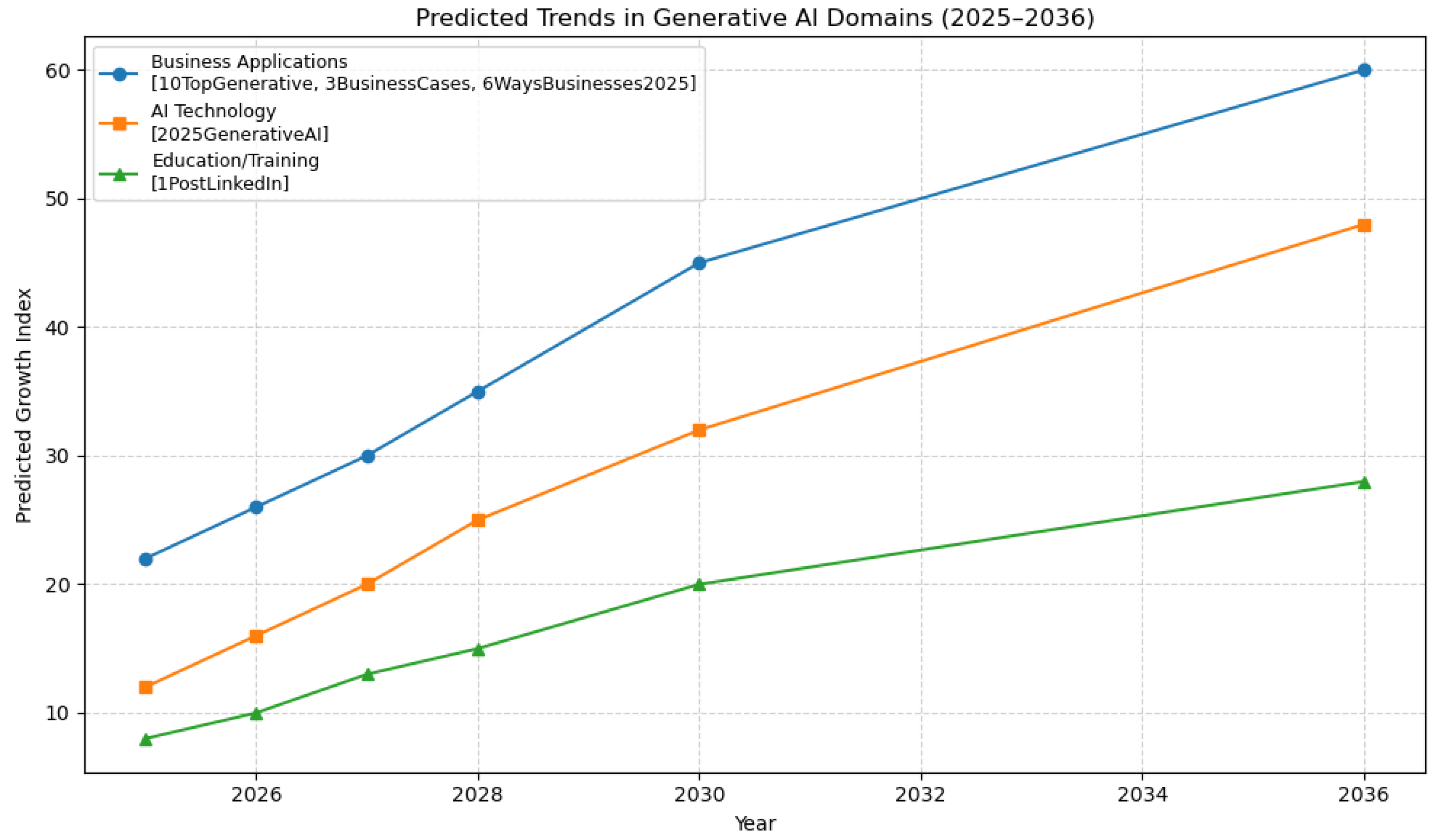
Figure 15.
Enterprise Generative AI Implementation Framework showing (a) Business Value Chain and (b) Phased Adoption Roadmap. Sources: [19,29]
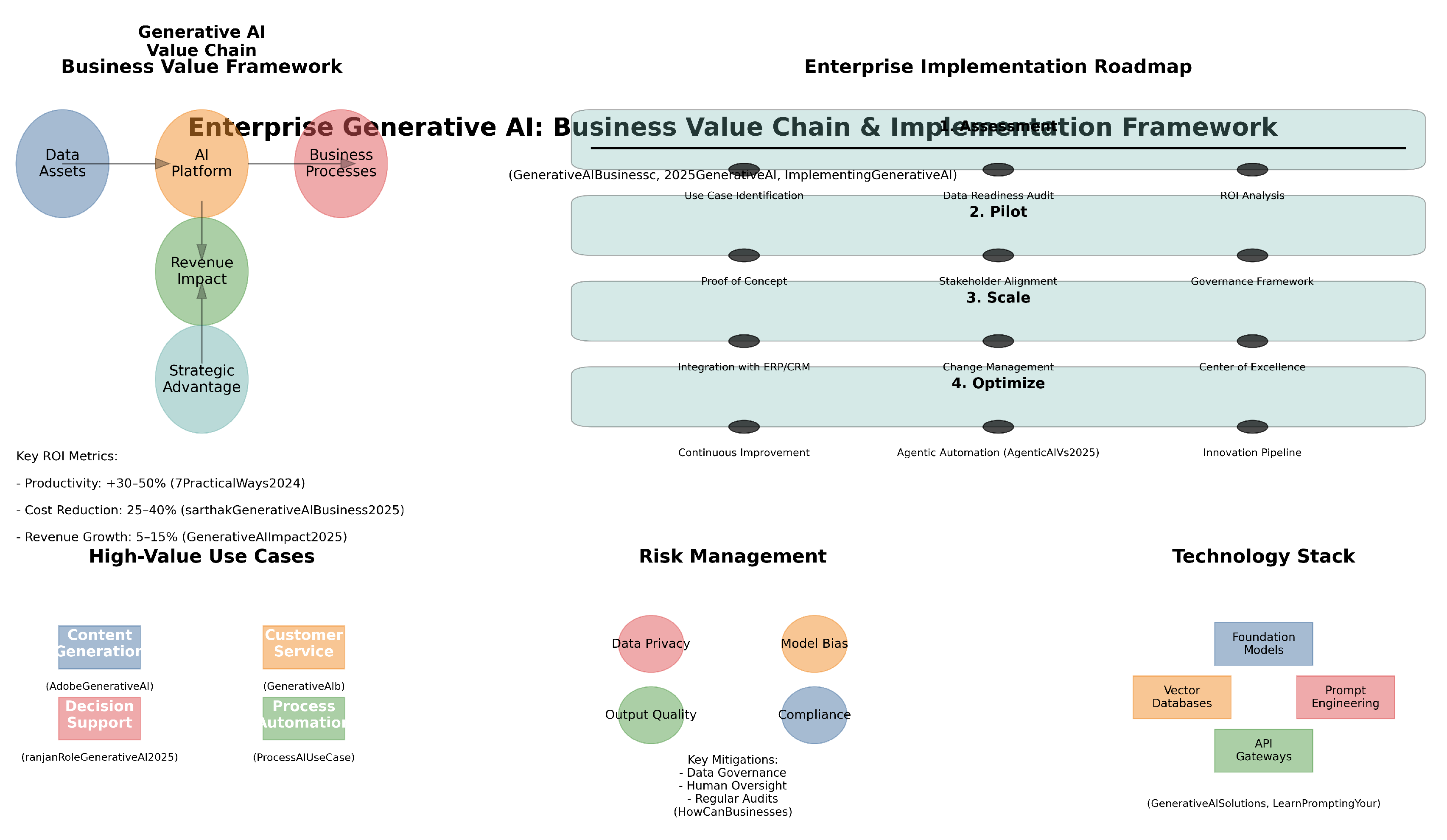
Figure 16.
Generative AI Business Function Impact Wheel quantifying adoption potential across organizational functions. Sources: [4,16]
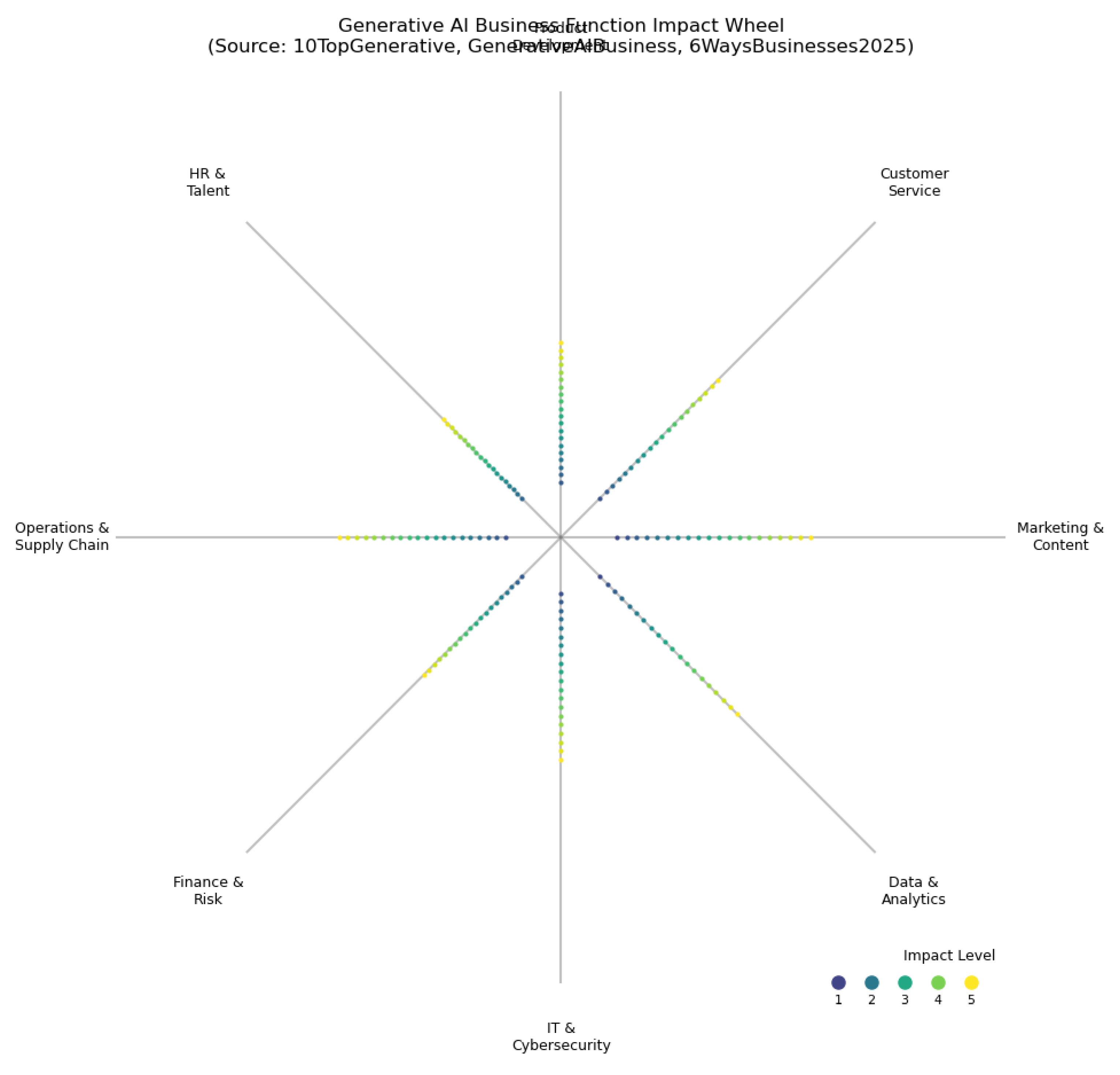
Figure 17.
Comparative ROI analysis of generative AI applications showing cost reduction, revenue impact, and implementation timelines. Sources: [10,29]

Figure 18.
Radar chart analysis of generative AI adoption barriers ranked by severity. Sources: [14,32]
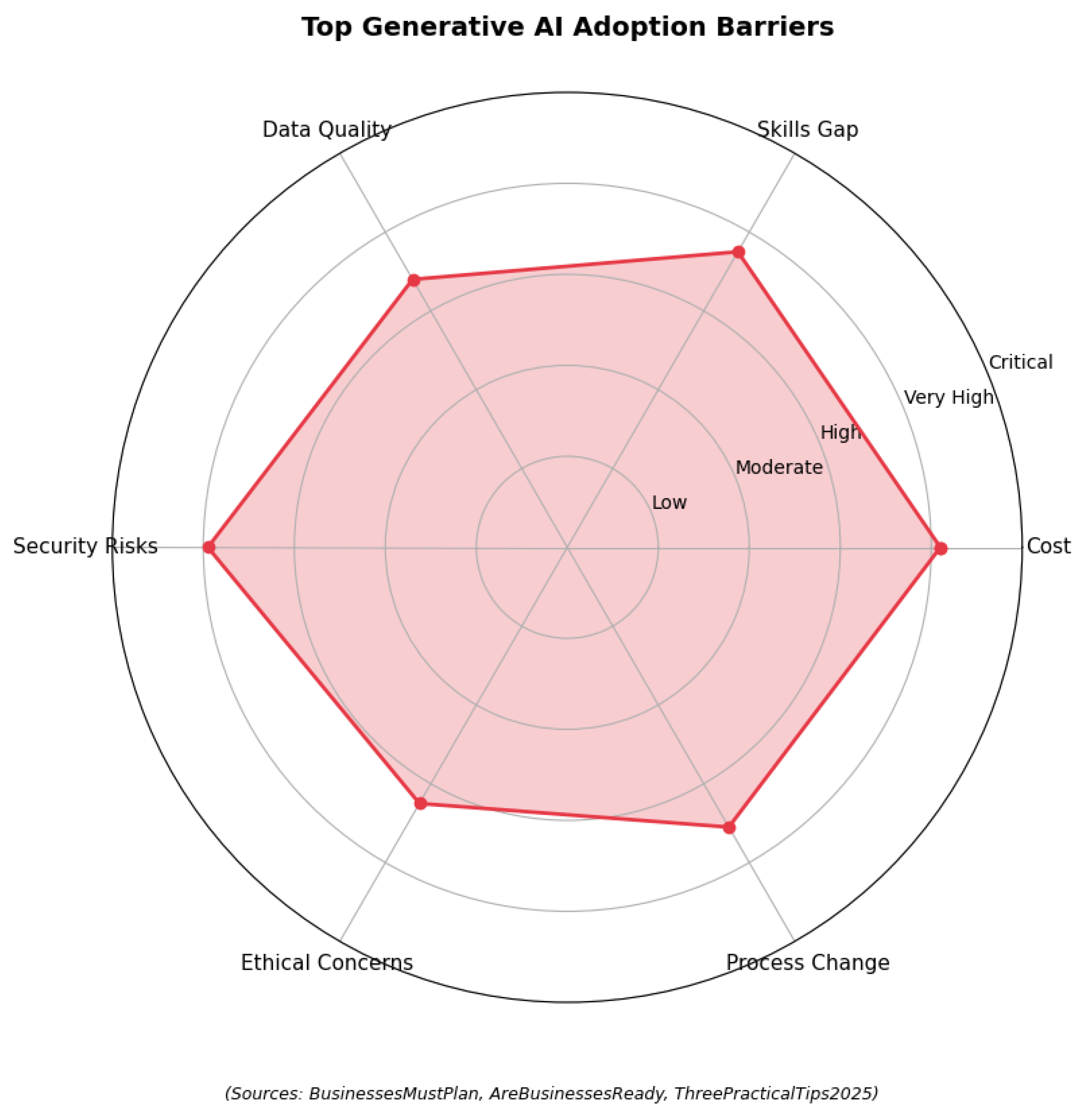
Table 5.
Generative AI Technology Stack
| Component | Technologies |
|---|---|
| Compute Infrastructure | NVIDIA GPUs, AWS SageMaker, Google TPUs |
| Model Serving | TensorRT, vLLM, Triton Inference Server |
| Vector Databases | Pinecone, Weaviate, Milvus |
| Orchestration | LangChain, LlamaIndex, Semantic Kernel |
| Monitoring | Prometheus, Grafana, MLflow |
Disclaimer/Publisher’s Note: The statements, opinions and data contained in all publications are solely those of the individual author(s) and contributor(s) and not of MDPI and/or the editor(s). MDPI and/or the editor(s) disclaim responsibility for any injury to people or property resulting from any ideas, methods, instructions or products referred to in the content. |
© 2025 by the authors. Licensee MDPI, Basel, Switzerland. This article is an open access article distributed under the terms and conditions of the Creative Commons Attribution (CC BY) license (http://creativecommons.org/licenses/by/4.0/).
Copyright: This open access article is published under a Creative Commons CC BY 4.0 license, which permit the free download, distribution, and reuse, provided that the author and preprint are cited in any reuse.


