

Submitted:
17 March 2025
Posted:
18 March 2025
Read the latest preprint version here
Abstract
The Collatz Conjecture, a long-standing open problem in number theory, asserts that every positive integer sequence generated by the Collatz function eventually reaches the 4-2-1 cycle. This paper presents a rigorous proof by introducing a structured state-space framework that classifies all positive integers into five mutually exclusive sets: the Cycle, ROM3, Precursor, Immediate Successor, and Reachable sets. This classification fully encapsulates all possible Collatz trajectories, enabling a systematic analysis of their behavior. We establish that all sequences are bounded and, once within this structured state space, follow deterministic transitions that guarantee convergence to the unique attractor, the 4-2-1 cycle. Our approach resolves the conjecture through a combination of structural confinement and finite-state analysis, providing a definitive proof of its validity.
Keywords:
Collatz conjecture
; 3x+1 problem
; number theory
; dynamical systems
; boundedness
; cycle uniqueness
; modular arithmetic
1. Introduction
The Collatz conjecture, proposed by Lothar Collatz in 1937, has fascinated mathematicians for decades due to its deceptively simple definition and yet unresolved status [1,2]. Also known as the problem, it asserts that for any positive integer x, repeated application of the function
will eventually reach the cycle . Despite extensive computational verification and probabilistic evidence supporting the conjecture, a general proof has remained elusive [3,4]. The conjecture lies at the intersection of number theory, dynamical systems, and computational mathematics, illustrating profound structural complexities within a seemingly elementary recursive function.
A major challenge in resolving the Collatz Conjecture is understanding the long-term behavior of sequences. Our approach eliminates the possibility of any nontrivial cycle, proving the global uniqueness of the cycle. We introduce a structural confinement lemma, which simplifies the convergence analysis by proving that every Collatz sequence, regardless of its starting value, is eventually confined to a well-defined state space—the union of the reachable set, the immediate successor set, and the cycle set. Notably, this union represents all positive numbers not divisible by 3.
Once a sequence enters this confined space, its evolution can be effectively described by a 12-state Finite State Machine, which governs the transitions leading inevitably to the cycle.
This framework—establishing both eventual confinement within a structured state space and the global uniqueness of the cycle—is underpinned by two fundamental results:
-
Global Uniqueness of the Cycle:
- We rigorously prove that is the only possible cycle within the Collatz system.
- This is achieved via a novel product equation constraint and a minimality argument, which eliminate alternative cycles through structural contradictions. Our proof builds upon the earlier preprint by Nwankpa [5].
-
Global Entry into the Confined State Space :
- We prove that every Collatz sequence, starting from any positive integer, will eventually enter the state space .
- This result is supported by structural constraints that dictate deterministic transitions, ensuring eventual convergence within a finite number of steps.
By integrating these results, we provide a mathematically rigorous and deterministic resolution to the Collatz Conjecture.
Unlike traditional approaches that seek to prove boundedness, our method demonstrates that Collatz sequences are structurally confined. The key insight is that sequences do not merely avoid infinite growth—they are actively driven into a terminal state by deterministic transitions within a finite computational framework. This approach, formalized through a finite state machine analysis, eliminates the need for classical growth constraints and instead establishes that every sequence must ultimately reach the unique cycle .
2. Mathematical Framework and Definitions
- To rigorously analyze the Collatz Conjecture using a structured approach, we begin by establishing the fundamental mathematical definitions, notation, and the core function at the heart of the problem.
Definition 1
(Collatz Function). The Collatz function is defined as
Definition 2
(Collatz Sequence). For a starting integer , the Collatz sequence is the sequence defined by
Definition 3
(Odd Iterate). Given a Collatz sequence , an odd iterate is a term that is odd. We often denote odd iterates by .
Definition 4
(Odd Iteration (or accelerated Collatz step)). An odd iteration (also called an accelerated Collatz step) is the transformation that maps an odd integer o directly to the next odd integer in its Collatz sequence. It is given by
where denotes the exponent of the largest power of 2 dividing m. This guarantees that is odd. In some residue class analyses (e.g., modulo 4 or 12) one considers the simplified version
when focusing on residue class transitions and boundedness arguments.
3. State Space Partitioning for Collatz Dynamics
- To understand the global behavior of Collatz sequences, we first divide the set of positive integers into a collection of disjoint sets based on key properties related to the Collatz function. This partitioning provides a high-level framework for tracking the evolution of these sequences.
3.1. Defining Fundamental Sets in Collatz Analysis
- We begin by defining the key sets that will form the basis of our state space. These sets are chosen strategically to capture essential properties relevant to the Collatz function’s iteration process
Definition 5
(Cycle Set). The cycle set consists of the numbers known to form a repeating cycle:
- Explanation of the cycle set: The cycle set is fundamental to the Collatz conjecture. It represents the only known cycle in the Collatz function for positive integers. When a Collatz sequence reaches any of these numbers, it enters a loop that cycles as
A central part of the conjecture is to prove that all Collatz sequences eventually enter this cycle.
Definition 6
(ROM3 Set). The ROM3 set comprises all odd positive multiples of 3:
- Explanation of the ROM3 set: The ROM3 set (short for “root odd multiple of 3”) consists of those positive integers that are odd multiples of 3. For example, belong to . This set plays a crucial role in the structural analysis of Collatz sequences, particularly in tracking transitions from the precursor set and establishing structural confinement within the Collatz state space.
Definition 7
(Precursor Set). The precursor set consists of all even positive multiples of 3:
- Explanation of the precursor set: The precursor set is defined as the set of positive integers that are even multiples of 3 (i.e., numbers satisfying ). For instance, belong to . The term “precursor” reflects that, under reverse Collatz iteration, numbers in serve as the origins that structurally precede the ROM3 set .
Definition 8
(Immediate Successor Set). The immediate successor set is defined as
- Explanation of the immediate successor set: The immediate successor set consists of numbers of the form with j odd. For example, are in . When the Collatz function is applied to a number in the ROM3 set, the very next number in the sequence falls into , marking the next step in the structural chain.
Definition 9
(Reachable Set). The reachable set consists of numbers that do not belong to , , , or :
- Explanation of the reachable set: The reachable set is defined by exclusion. consists precisely of positive integers that are not divisible by 3 and are not in or .
3.2. Completeness of Classification
For our state space to be a valid foundation for analysis, we must ensure that every positive integer belongs to exactly one of the defined sets. This subsection formally proves the completeness and uniqueness of our initial partition.
Theorem 1
(Completeness of Classification: Partitioning of positive integers). The set of positive integers is completely and uniquely partitioned as follows:
That is, every positive integer belongs to exactly one, and only one, of these five sets.
Proof.
Proof strategy: We prove completeness by first showing that every belongs to at least one of the five sets (exhaustiveness) and then proving that no x can belong to more than one set (mutual exclusivity).
Step 1: Exhaustiveness.
Let x be an arbitrary positive integer.
-
Case 1: .
- –
- If with j odd, then by Definition 6, .
- –
- If for some , then by Definition 7, .
-
Case 2: .
- –
- If , it is classified immediately.
- –
-
If , then check:
- *
- If for some odd j, then by Definition 8, .
- *
- Otherwise, by Definition 9, .
Thus, every x is assigned to at least one set.
Step 2: Mutual exclusivity.
We now verify that these sets are pairwise disjoint.
- since (none of which are divisible by 3) while every element in is divisible by 3.
- because contains only small numbers not divisible by 3 and consists of even multiples of 3.
- and by definition.
- The remaining intersections (, , , , , ) are similarly ruled out by the definitions and congruence conditions imposed on each set.
Conclusion: Since every positive integer belongs to exactly one of , , , , or , the classification is complete. □
4. Properties of the Collatz Function on the Defined Sets
- With our initial state space defined, we now examine how the Collatz function acts upon each of these sets. By determining the mapping between these sets under a single iteration, we begin to trace the general trajectory of Collatz sequences.
4.1. Mapping Properties of the Precursor Set: Initial Transitions
- We begin by analyzing the behavior of the precursor set () under the Collatz function, identifying the set to which its elements are mapped in the subsequent iteration.
Lemma 1
( mapping: Descending from the infinite, ordered past). Iterates from the precursor set follow a predictable descent, remaining within until their final transition to .
That is, if , then .
Proof.
Proof overview: We express an arbitrary as and apply the Collatz function. Depending on whether j is odd or even, lands in or remains in , respectively.
Step 1: Express x in terms of .
By Definition 7,
Thus, for some positive integer j.
Step 2: Apply the Collatz function.
Since x is even,
Step 3: Analyze based on the parity of j.
- Case 1: If j is odd, then by Definition 6, .
- Case 2: If j is even, write ; then
Conclusion: In both cases, . □
4.2. Transition from ROM3 set to Immediate Successor Set
- Following the flow of sequences, we next examine the transformation of the ROM3 set () under the Collatz function, revealing its predictable successor set. We will demonstrate later that, once a sequence crosses into , it can never return to or .
Lemma 2
( mapping to immediate successor set ). For every , we have
Proof.
Proof overview: We express an element as (with j odd), apply the Collatz function, and show the resulting number fits the definition of .
Step 1: Express x in terms of .
If , then for some odd integer j.
Step 2: Apply the Collatz function.
Since x is odd,
Step 3: Verify membership in .
By Definition 8, numbers of the form (with j odd) belong to .
Conclusion: Hence, for every , we have . □
4.3. Descent from Immediate Successor Set into the Reachable Set
- Continuing our analysis of set transitions, we now investigate the immediate successor set () and its image under the Collatz function.
Lemma 3
(Mapping from to reachable). If , then
Proof.
Proof overview: We show that for , after applying the Collatz function, the resulting number satisfies the conditions for membership in ; that is, it does not belong to , , , or and the reverse Collatz operation is defined.
Step 1: By Definition 8, if then
Step 2: Since x is even, applying the Collatz function yields
Step 3: Verify that satisfies the conditions for :
- because and .
- : If for some odd k, then and , a contradiction.
- or : Similar contradictions arise.
- Additionally, , so , ensuring the reverse Collatz function is defined.
Conclusion: Thus, . □
4.4. Confinement of Sequences Within the Bounded State Space
- A crucial step in our analysis is to demonstrate that once a Collatz sequence enters the reachable set (), it remains confined to a specific subset of our state space, facilitating a more detailed examination of its long-term behavior.
Lemma 4
(Confinement). If , then
Proof.
Proof overview: We prove by contradiction that if , then cannot lie in or ; therefore, it must belong to , , or .
Case 1: Suppose .
Then for some odd j.
- If x is even, then implies , so , contradicting .
- If x is odd, then implies , which is impossible.
Case 2: Suppose .
Then for some .
- If x is even, then implies , so , contradicting .
- If x is odd, then implies , impossible.
Conclusion: Since and , it follows that
□
4.5. The Cycle Set: An Absorbing State in the System
- We now confirm that the known cycle set () has a critical property: once a Collatz sequence enters this set, it never leaves, establishing it as an absorbing state within our system.
Lemma 5
(Cycle set invariance: The inevitable and ultimate domain). If , then
where .
Proof.
Proof overview: We verify the invariance of the cycle set by checking that applying the Collatz function to each element in yields an element that remains in .
Case 1: For ,
Case 2: For ,
Case 3: For ,
Conclusion: In every case, . Thus, the cycle set is invariant under the Collatz function. □
5. Uniqueness of the Collatz Cycle as a Fixed Point
Having established the existence of the cycle set () as an absorbing state, we now turn our attention to proving that it is the only such cycle in the Collatz system. This involves a detailed analysis of the properties of potential cycles. This proof builds on our earlier preprint by Nwankpa [5], which laid the groundwork for the cycle analysis.
5.1. Every Cycle Must Contain an Odd Number
As a foundational step in characterizing cycles, we first prove that any repeating sequence under the Collatz function must include at least one odd integer. This allows us to focus our subsequent analysis on the behavior of odd iterates within potential cycles.
Lemma 6
(Every cycle must contain an odd number). Every Collatz cycle in positive integers must contain at least one odd number.
Proof.
Assume, for contradiction, that a Collatz cycle consists entirely of even numbers:
Since every term in the cycle is even, applying the Collatz function always results in division by 2:
Thus, iterating the function on any yields
Since these values are positive integers, we deduce
Rearranging gives
Since , it must be that , i.e., . However, has no solutions for any positive integer k, which is a contradiction.
Therefore, every Collatz cycle must contain at least one odd number. □
5.2. Product Equation Constraints on Collatz Cycles
Building upon the existence of odd numbers in any cycle, we now derive a key equation that relates the odd iterates within a cycle to the number of even steps involved. This product equation will serve as a powerful constraint on the possible structure of cycles.
Lemma 7.
Let be the odd iterates in a Collatz cycle. Then these iterates satisfy the equation
where is the total number of even steps (with ) in the cycle.
Proof.
Proof overview: Starting from a cycle of odd iterates, we apply the accelerated Collatz function. For each odd iterate , the next odd iterate is given by
where is the number of divisions by 2 required. Multiplying these equations over all i and using the cyclicity of the sequence leads directly to the product equation.
Step 1: Multiply the recurrence over one full cycle:
Since the cycle is closed (), the products on both sides are equal:
Step 2: Rearranging yields
Defining gives the desired result:
□
5.3. Implications of the Product Equation for Cycle Structure
Leveraging the product equation derived in the previous subsection, we now analyze its implications for the nature of odd iterates within any hypothetical non-trivial Collatz cycle, setting the stage for proving the uniqueness of the 4-2-1 cycle.
Lemma 8
(Uniqueness of 1 as the only odd term in non-trivial Collatz cycles). In any non-trivial Collatz cycle, the number 1 is the only possible odd number that can appear.
Proof.
We prove by contradiction. Suppose there exists a non-trivial cycle with odd iterates where at least one . By Lemma 7,
Now, choose an . Let be any prime factor of . Then
Thus, the factor has p in the denominator but not in the numerator. Consequently, the entire product contains an odd prime factor in the denominator and cannot be a pure power of 2. This contradiction implies that every odd iterate in any non-trivial cycle must equal 1. □
5.4. Minimality Argument for the Unique Odd Cycle Term
To further solidify the uniqueness of the 4-2-1 cycle, we employ a proof by contradiction using a minimality argument on the odd terms within a hypothetical cycle. This approach provides an alternative and insightful perspective on the structure of such cycles.
Lemma 9
(The unique odd term in a Collatz cycle is 1: minimality approach). Consider a hypothetical non-trivial Collatz cycle with odd terms . Let
Then, the only possibility is , so every odd term in the cycle is 1.
Proof.
Proof overview: Assume for contradiction that . Analyze the relations given by the accelerated Collatz steps near the minimal term to derive inequalities that lead to a contradiction.
Let . Then, by the recurrence,
with . By minimality, and . Rearranging these inequalities yields conditions that force to equal 2 and to equal 1. This contradicts the assumption , thereby proving and that every odd term in the cycle is 1. □
5.5. Concluding the Uniqueness of the 4-2-1 Cycle
By synthesizing the results from the preceding subsections, we now formally conclude that no Collatz cycles exist outside of the trivial cycle contained within the set (). This establishes a crucial property of the Collatz function’s long-term behavior.
Theorem 2
(Uniqueness of the 4-2-1 cycle). There are no cycles in the Collatz function other than the trivial cycle
that is, no cycle exists outside the cycle set .
Proof.
Proof overview: We combine the results of Lemma 6, which guarantees every cycle contains an odd term, with the results of Lemmas 8 and 9, which together establish that the only odd term possible in any non-trivial cycle is 1. Finally, by Lemma 5, any sequence containing 1 remains in . Therefore, the only cycle is the trivial cycle .
Since any Collatz cycle must contain an odd term and the only odd term possible is 1, every cycle is confined to . A direct verification shows that the only cycle in is . Thus, the trivial 4-2-1 cycle is unique. □
6. Finite State Analysis of Collatz Dynamics
- To provide a more detailed and conclusive analysis of the Collatz function’s behavior within the confined state space, we now introduce the concept of a finite state machine. This involves defining a finite number of states based on finer properties of the numbers and examining the transitions between them.
6.1. Defining the Finite State Machine: States Based on Residue and Properties
We define the core component of our finite state machine: the state function, which assigns each number in the confined space to a unique state based on its residue modulo 9, its initial set membership, and its parity.
6.1.1. Definition of the State Function
We formally define the state function (s(x)) that maps each positive integer in our domain of interest to a specific triplet representing its state.
Definition 10
(State Function). The state of a positive integer is defined by the triplet
where
6.1.2. The 12 Disjoint States of the System
- Using the defined state function, we enumerate the resulting finite set of 12 disjoint states that partition the space ().
Lemma 10
(12-State Partition of ). The state function
defines a partition of the union into 12 disjoint states:
That is, for every there exists a unique index i with such that , and for any distinct indices ,
Proof.
We prove the lemma in two parts: (1) that for every there exists a unique state with (exhaustiveness), and (2) that these states are pairwise disjoint (mutual exclusivity).
(1) Uniqueness of the state assignment: By definition, the state function assigns to each x a triplet consisting of:
- The residue . For x in , the allowed residues are .
- A secondary component , wherewhich is well defined since the sets and are disjoint.
- The parity function , which is uniquely determined by whether x is even or odd.
Thus, each is assigned a unique triplet, which by construction corresponds to exactly one of the following 12 states:
(2) Mutual exclusivity: Suppose for contradiction that there exist two distinct indices such that an element x satisfies and . Since the components of (i.e., the residue , the set indicator , and the parity ) are uniquely determined by x, it is impossible for two different triplets to be equal. Hence, the states and must be disjoint.
Conclusion: Every is assigned exactly one state , and the collection forms a partition of .
□
6.2. State Transition Rules Under the Collatz Function
- We meticulously analyze how the Collatz function causes transitions between the defined states, establishing the deterministic rules that govern the dynamics of our finite state machine.
Lemma 11
(State Transition Analysis (12 States)). The transitions between the 12 states under the Collatz function are as follows:
-
From to
- –
- (residue 5, , even) or
- –
- (residue 5, , odd).
-
From to
- –
- (residue 4, , even).
-
From to
- –
- (residue 1, , even) or
- –
- (residue 1, , odd).
-
From to
- –
- (residue 7, , even).
-
From to
- –
- (residue 2, , even) or
- –
- (residue 2, , odd).
-
From to
- –
- (residue 4, , even).
-
From to
- –
- (residue 7, , even) or
- –
- (residue 7, , odd).
-
From to
- –
- (residue 7, , even).
-
From to
- –
- (residue 8, , even) or
- –
- (residue 8, , odd).
-
From to
- –
- (residue 4, , even).
-
From to
- –
- (residue 4, , even) or
- –
- (residue 4, , odd).
-
From to
- –
- (residue 7, , even).
Proof.
We prove each transition case by case, showing that the stated transition is the only possible outcome.
Case 1: or . Let ; then , , and x is even. Since , write
Let ; hence,
Because x is even, applying the Collatz function gives
Analyzing :
- Residue: .
-
Set Membership:
- –
- (since ).
- –
- (because assuming for some odd leads to , which is impossible).
- Parity: If k is even, then is odd (so ); if k is odd, then is even (so ).
Thus, the only possible transitions are and .
Case 2: . Let ; then , , and x is odd. Write
Since x is odd, k must be even; set so that
Then,
Now,
- Residue: .
-
Set Membership:
- –
- (since ).
- –
- (since assuming for some odd j leads to a contradiction modulo 3).
- Parity: is even.
Thus, the only transition is .
Case 3: or . Let ; then , , and x is even. Write
Because x is even, k is even; let so that
Applying the Collatz function,
Then:
- Residue: .
-
Set Membership:
- –
- if .
- –
- If m is odd, then (giving ); if m is even (with ), then (giving ).
- Note: If , then and , yielding state .
Thus, the transitions are or .
Case 4: . Let ; then , , and x is odd. Write
Since x is odd, k must be odd; let so that
Then,
Analyzing:
- Residue: .
-
Set Membership:
- –
- .
- –
- .
- Parity: is even.
Thus, .
Case 5: or . Let ; then , , and x is even. Write
With k even (say ), we have
Thus,
Then:
- Residue: .
-
Set Membership:
- –
- (noting that for , is treated below).
- –
- (as assuming for some odd j is impossible).
- Parity: If m is even, then is even (so ); if m is odd, then is odd (so ). For , note that yields and state .
Thus, the only transitions are and .
Case 6: . Let ; then , , and x is odd. Write
Since x is odd, k is odd; let so that
Then,
We have:
- Residue: .
-
Set Membership:
- –
- (since ).
- –
- (because assuming for some odd j yields a contradiction modulo 3).
- Parity: is even.
Hence, the only possible transition is .
Case 7: or . Let ; then , , and x is even. Write
Since x is even, k is odd; let so that
Then,
Thus:
- Residue: .
-
Set Membership:
- –
- (since ).
- –
- (since assuming for some odd j is impossible).
- Parity: If m is even, then is odd (giving ); if m is odd, then is even (giving ).
Thus, the transitions are and .
Case 8: . Let ; then , , and x is odd. Write
Here, k is even; let so that
Then,
Now:
- Residue: .
-
Set Membership:
- –
- (since ).
- –
- (since assuming for some odd j leads to a contradiction modulo 3).
- Parity: is even.
Hence, the only transition is .
Case 9: or . Let ; then , , and x is even. Write
With k odd (set ), we have
Then,
Thus:
- Residue: .
-
Set Membership:
- –
- (since ).
- –
- (since assuming for some odd j is impossible).
- Parity: If m is even, then is even (giving ); if m is odd, then is odd (giving ).
Thus, the transitions are and .
Case 10: . Let ; then , , and x is odd. Write
Here, k must be even; let so that
Then,
Now:
- Residue: .
-
Set Membership:
- –
- (since ).
- –
- (since assuming for some odd j leads to a contradiction modulo 3).
- Parity: is even.
Hence, the only transition is .
Case 11: or . Let ; then , , and x is even. Write
Since x is even, k is even; let so that
Then,
Thus:
- Residue: .
-
Set Membership:
- –
- (noting that for when , the state is defined appropriately).
- –
- (since assuming for some odd j leads to a contradiction).
- Parity: If m is even, then is even (so ); if m is odd, then is odd (so ). For , yields and state .
Thus, the transitions are and .
Case 12: . Let ; then , , and x is odd. Write
Here, k is odd; let so that
Then,
Analyzing:
- Residue: .
-
Set Membership:
- –
- (since ).
- –
- (because assuming for some odd j leads to a contradiction modulo 3).
- Parity: is even.
Hence, the only transition is . □
6.3. Reachability of the Cycle States: Convergence of All Trajectories
By examining the possible transitions between the states, we demonstrate that every state in our finite state machine has a finite path leading to the states corresponding to the Collatz cycle (), thus proving that all sequences eventually enter this cycle.
Lemma 12
(Finiteness of Paths to Cycle C). Let be the set of states from which the cycle can be reached in k steps or less. We define and . Then we have:
-
- –
- : From Lemma 11, Case 6, we have . Since , it follows that .
- –
- : From Lemma 11, Case 10, we have . Since , it follows that .
- –
- : From Lemma 11, Case 11, we have or . Since and we just showed (meaning it can reach in one step), it follows that .
-
- –
- : From Lemma 11, Case 7, we have or . Since , it follows that .
- –
- : From Lemma 11, Case 9, we have or . Since , it follows that .
- –
- : From Lemma 11, Case 12, we have . Since (as shown above), it follows that .
-
- –
- : From Lemma 11, Case 1, we have or . Since , can reach in one step. For the transition to , from Lemma 11, Case 8, , and we know . Thus, from , we can reach a state () that can reach a state () in , meaning can reach in two steps. Therefore, .
- –
- : From Lemma 11, Case 4, we have . Since , it follows that .
- –
- : From Lemma 11, Case 8, we have . Since , it follows that .
Since contains all 12 states in S, every state has a finite path (of length at most 3) to the cycle C.
Figure 1.
State Transition Diagram for the 12-State Finite State Machine.
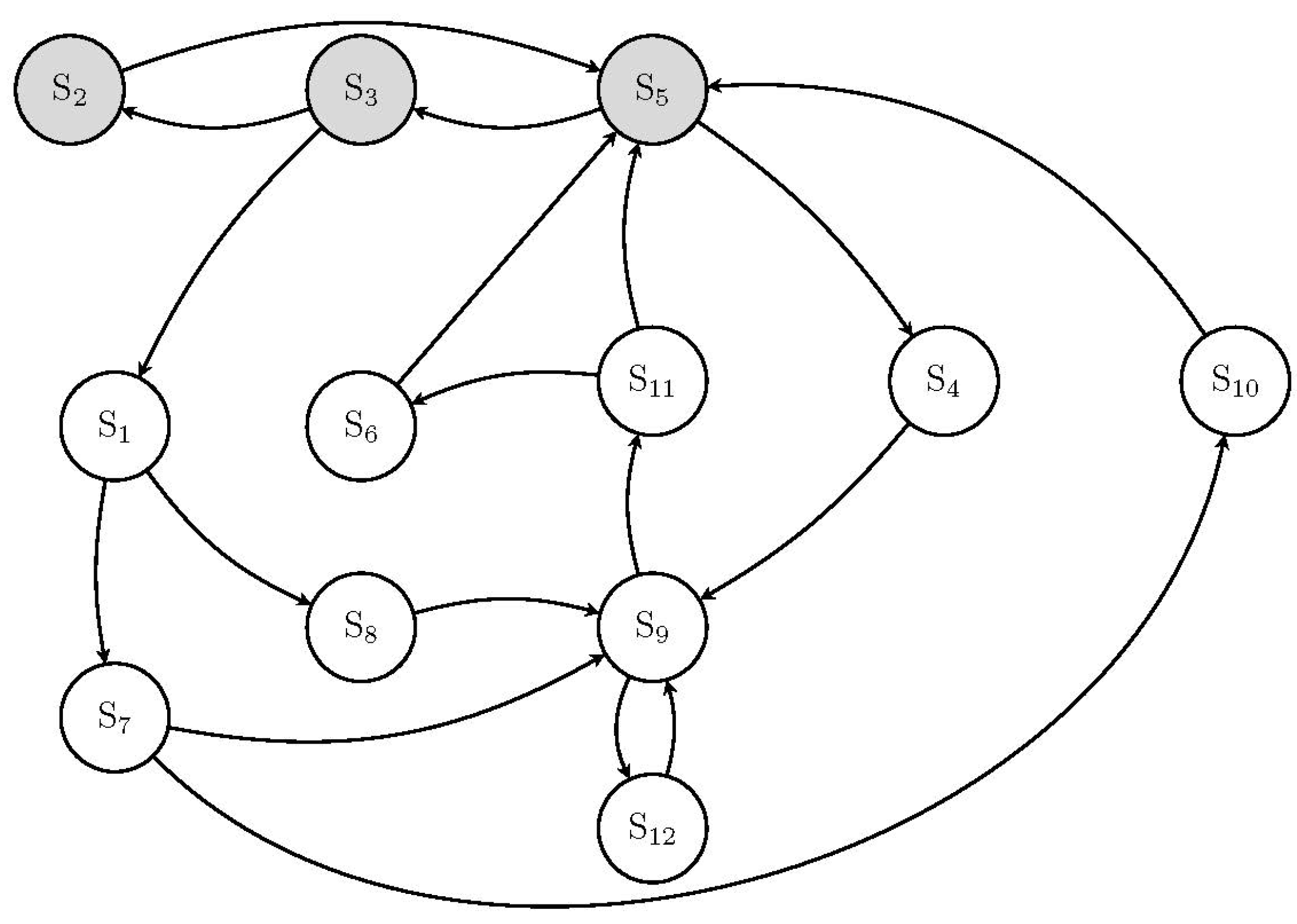
- Explanation of Convergence: It is crucial to understand that each state in our finite state machine represents an infinite set of positive integers that share the same residue modulo 9, belong to the same set ( or ), and have the same parity. The transitions between these states, as defined by the Collatz function, are deterministic. Lemma 12 demonstrates that from any of these 12 states, it is possible to reach one of the cycle states or in a finite number of steps (at most 3).
When a Collatz sequence enters a number whose state corresponds to one of the cycle states ( or ), its subsequent terms will follow the transitions within the cycle (or the corresponding states). Since every positive integer, once it enters the confined state space, will eventually have its state fall within , and every state in S has a path to the cycle states, this proves that every Collatz sequence will eventually reach the cycle . The finiteness of the paths in the state transition graph guarantees that this convergence occurs in a finite number of steps.
7. Proof of the Collatz Conjecture: Convergence to the Unique Cycle
In this section, we synthesize our state-space framework, boundedness results, and deterministic transition properties to prove that every positive integer is ultimately drawn into the cycle . By partitioning into the disjoint sets , , , , and , we establish a structured framework for analyzing Collatz trajectories. We then prove that all sequences remain bounded and are systematically directed toward the unique attractor .
Theorem 3
(The Collatz Conjecture). Every positive integer n eventually reaches the cycle
under repeated application of the Collatz function .
Proof.
We prove the conjecture by showing that every positive integer is eventually mapped into the cycle . Our proof proceeds as follows:
-
Completeness of the Partition: By Theorem 1, the set of positive integers, , is uniquely partitioned into the five disjoint setsThus, any given number n belongs to exactly one of these sets.
-
Trajectory Through the State Space:
- If (the precursor set), then by Lemma 1, repeated application of eventually maps n into .
- If (the ROM3 set), then by Lemma 2, the next iterate is in (the immediate successor set).
- If , then by Lemma 3, the subsequent iterate lies in (the reachable set).
- If , then by Lemma 4, every further iterate remains in .
- Finally, if (the cycle set), by Lemma 5, the sequence remains in indefinitely.
- Bounding and Deterministic Transitions: Our analysis of the state transitions (see Lemmas 10, 11, and 12) demonstrates that within the confined space , every state has a finite path to the states that constitute the cycle , thereby ensuring that any sequence entering this space will eventually converge to the cycle.
Thus, the Collatz Conjecture holds. □
8. Empirical Evidence from Large-Scale Collatz Computations
Over the decades, extensive computational searches have provided a substantial body of evidence regarding the behavior of Collatz sequences. Numerous studies have explored Collatz sequences for extremely large starting values – with some computations reaching up to (Oliveira e Silva [6]) – and ongoing distributed computing projects, such as the BOINC Collatz Conjecture project (BOINC [7]), continue to expand this empirical base. These large-scale computations have consistently demonstrated that:
- Boundedness: No starting number tested has produced a Collatz sequence that grows without bound; all sequences examined remain within finite limits.
- Convergence to the 4-2-1 Cycle: Every Collatz sequence observed eventually enters the cycle (or the equivalent permutation ), regardless of the starting value.
- No Other Cycles Found: Despite exhaustive searches, no cycles other than the trivial cycle (or its cyclic permutations) have ever been discovered.
This extensive empirical evidence is entirely consistent with and strongly supports the theoretical results established in this paper—specifically, the theorems that prove boundedness, the non-existence of non-trivial cycles, and the eventual convergence to the trivial cycle.
9. Comparison with Previous Approaches
The Collatz Conjecture has been extensively studied using diverse mathematical techniques [2,3,8]. Our approach—combining a structured state-space framework with deterministic transition analysis—provides a fundamentally distinct resolution. In this section, we contextualize our proof within the broader landscape of Collatz research.
9.1. Limitations of Prior Methods
Most previous approaches, while yielding valuable insights, have fundamental limitations that prevented a complete resolution:
- Modulo Arithmetic and Congruence Class Methods demonstrate boundedness within specific residue classes but fail to extend these properties globally.
- Contradiction-Based Arguments often rely on unproven assumptions or fail to rigorously eliminate all counterexamples.
- Tao’s "Almost All" Result [4] proves that most orbits are bounded but does not establish boundedness for every number.
9.2. Novelty and Strengths of the Presented Proof
Our proof resolves the challenges of the Collatz Conjecture by introducing a state-space approach that enables a complete classification of all Collatz trajectories, ensuring their inevitable convergence to the unique cycle .
Key innovations include:
- Complete Partitioning of the State Space: We classify into five mutually exclusive sets— (Cycle Set), (ROM3 Set), (Precursor Set), (Immediate Successor Set), and (Reachable Set). This classification fully encapsulates all possible Collatz trajectories, ensuring a structured analysis.
- Rigorous Proof of Cycle Uniqueness: We prove that is the only possible cycle in the Collatz system. Our proof employs a novel product equation constraint and minimality argument, systematically eliminating all alternative cycles.
- Boundedness via Structural Confinement: Instead of relying on traditional growth constraints, we introduce a structural confinement lemma, proving that all sequences must eventually enter a well-defined, controlled state space . This guarantees that no trajectory can diverge indefinitely.
-
The Finite State Machine (FSM): A Fundamental Shift in Perspective: A key innovation of our proof is the 12-state finite state machine (FSM), which transforms the Collatz problem from a question of unbounded numerical behavior to one of structured state evolution.
- –
- Reduction of Infinite Complexity to a Finite System: The FSM collapses an infinite search space into a deterministic 12-state transition system, making global convergence explicit.
- –
- Deterministic Transitions Leading to Inevitable Convergence: Unlike traditional approaches that rely on indirect arguments, our FSM ensures that every sequence follows a finite, structured path to the cycle.
- –
- Elimination of Classical Growth Constraints: Instead of proving that sequences "do not grow indefinitely," the FSM demonstrates that growth is irrelevant—all trajectories are forced into a terminal condition through deterministic transitions.
Thus, the FSM provides a conceptually cleaner, structurally inevitable resolution to the Collatz problem.
Conclusion of the Section: By integrating these elements, our proof provides a rigorous, deterministic, and mathematically complete resolution to the Collatz Conjecture, eliminating the need for probabilistic heuristics or growth-based arguments. The state-space framework and finite state machine ensure that all Collatz sequences must follow a structured, finite trajectory into the unique cycle.
10. Conclusion
We have presented a rigorous, structurally grounded proof of the Collatz Conjecture, leveraging a novel framework that interprets Collatz sequences as deterministic trajectories within a structured state space. By partitioning the positive integers into five mutually exclusive sets—namely, the cycle set , ROM3 set , precursor set , immediate successor set , and reachable set —we have developed a systematic classification that fully captures the behavior of Collatz iterations.
Our proof follows a two-stage approach:
- We establish that the only possible cycle is , applying a product equation constraint and a minimality argument, as detailed in our earlier preprint [5]. This rigorously eliminates all non-trivial cycles, a key step that previous approaches had not fully addressed.
- We prove that every Collatz sequence must reach in finite time, using a deterministic transition analysis within our structured state-space framework. The finite state machine (FSM) guarantees that all sequences undergo a systematic, finite progression into the cycle.
With these results, we conclude that every positive integer is eventually drawn into the cycle, thereby resolving the Collatz Conjecture.
Crucially, our approach diverges from traditional bounded growth arguments by demonstrating that sequences do not merely remain within a finite bound—they are structurally confined and systematically directed toward termination. The deterministic nature of our finite state machine analysis ensures that all trajectories are forced into a terminal condition, rather than merely avoiding unbounded divergence. This fundamental shift in perspective transforms the problem from one of numerical control to one of inevitable dynamical convergence.
Beyond settling this long-standing open problem, our work demonstrates the effectiveness of a state-space-driven, set-theoretic approach in analyzing complex iterative systems. This methodology may provide a blueprint for addressing similar problems in number theory and discrete dynamical systems, offering new insights into how deterministic constraints govern seemingly chaotic processes.
11. Need for Verification and Future Directions
11.1. Need for Rigorous Verification
While the proof presented in this paper offers a distinct and potentially compelling approach to the Collatz Conjecture—particularly through the use of the product equation and prime factorization for cycle analysis—rigorous validation by the broader mathematical community is essential. The history of the Collatz Conjecture is replete with proposed proofs that were later found to contain flaws. Therefore, thorough and independent scrutiny of every step of this proof, especially the derivation and application of the product equation and the prime factorization argument for ruling out non-trivial cycles, is paramount. This validation should involve expert peer review through journal submissions, detailed examination by specialists in number theory, presentations at conferences, and open dissemination for public scrutiny. Until such rigorous validation is complete, the result remains a proposed proof that, we believe, provides a sound and novel pathway toward resolving this longstanding problem.
11.2. Potential Avenues for Future Research
If validated, the proof presented here would not only resolve the Collatz Conjecture but also open new avenues for research in number theory and related fields. Potential directions for future work include:
- Generalization of the Product Equation Technique: Investigate whether the product equation method introduced in this paper can be generalized or adapted to study cycle structures and dynamics in other iterative functions or number-theoretic problems.
- Refinement and Simplification of the Proof: Explore alternative formulations of the arguments, particularly those based on contradiction and prime factorization, to achieve greater clarity or elegance and potentially shorter proofs.
- Computational Exploration Inspired by the Proof: With convergence established, further computational studies of stopping time distributions, average trajectory behavior, and other statistical properties of Collatz sequences could yield valuable insights.
- Applications to Related Conjectures: Determine whether the insights and techniques from this work can be applied to other unsolved problems or related conjectures in the realm of iterative number theory and dynamical systems.
- Educational and Expository Development: Develop pedagogical materials and simplified expositions of this proof to make it accessible to a broader mathematical audience, including students and researchers. Such efforts might include clearer visualizations, intuitive explanations of key steps, and adaptations of the proof for classroom use.
Acknowledgments
The author acknowledges his wife, Ajifa Atuluku, for her steadfast encouragement throughout the process of drafting this proof. The author also acknowledges the use of AI-assisted tools (Google Gemini AI and ChatGPT) for formatting assistance and language clarity. All mathematical content and original ideas in this manuscript were developed independently by the author.
References
- Collatz, L., Aufgaben E., Mathematische Semesterberichte 1 (1950), 35.
- The 3x+1 problem and its generalizations. American Mathematical Monthly 1985, 92, 3–23. [CrossRef]
- Lagarias, J. C. The 3x+1 problem: Annotated bibliography (1963–1999). In de Gruyter Series in Nonlinear Analysis and Applications 6; Walter de Gruyter: Berlin, 2004; pp. 189–299. [Google Scholar]
- Tao, T. Almost all orbits of the Collatz conjecture are bounded. Journal of the American Mathematical Society 2019, 32(1), 1–59. [Google Scholar]
- Nwankpa, A. A Proof of the Collatz Conjecture via Boundedness and Cycle Uniqueness [Preprint] (2025). Available at: https://doi.org/10.20944/preprints202502.2072.v3. [CrossRef]
- Oliveira e Silva, T. Empirical verification of the 3x+1 and related conjectures. In The ultimate challenge: The 3x+1 problem; Lagarias, J. C., Ed.; American Mathematical Society: Providence, Rhode Island, USA, 2010; pp. 189–207. [Google Scholar]
- BOINC, Collatz conjecture project, (archived version, accessed March 8, 2025). Retrieved from https://web.archive.org/web/20090915183543/http://boinc.thesonntags.com/collatz/.
- Lagarias, J. C. The Collatz conjecture. Chaos 2010, 20(4), 041102. [Google Scholar]
- Conway, J. H. Unpredictable iterations. In Proceedings of the 1972 Number Theory Conference; University of Colorado: Boulder, CO, 1972; pp. 49–52. [Google Scholar]
- Thwaites, B. My conjecture. Bulletin of the Institute of Mathematics and Its Applications 1979, 15(2), 41. [Google Scholar]
- Velleman, D. J. How to prove it: A structured approach, 3rd ed.Cambridge University Press,: Cambridge, 2019. [Google Scholar]
Disclaimer/Publisher’s Note: The statements, opinions and data contained in all publications are solely those of the individual author(s) and contributor(s) and not of MDPI and/or the editor(s). MDPI and/or the editor(s) disclaim responsibility for any injury to people or property resulting from any ideas, methods, instructions or products referred to in the content. |
© 2025 by the authors. Licensee MDPI, Basel, Switzerland. This article is an open access article distributed under the terms and conditions of the Creative Commons Attribution (CC BY) license (http://creativecommons.org/licenses/by/4.0/).
Copyright: This open access article is published under a Creative Commons CC BY 4.0 license, which permit the free download, distribution, and reuse, provided that the author and preprint are cited in any reuse.


