

Submitted:
07 March 2025
Posted:
10 March 2025
You are already at the latest version
Abstract
Genetic resistance is a sustainable way to protect crops against diseases and breeding resistant varieties is a significant aim. However, diseases are caused by pathogens which have different life cycles and the importance of individual evolutionary forces plays a key role in the adaptation of their populations. Therefore, strategies in the use of genetic resistance resources in different plant pathosystems can differ. There are numerous ma-jor genes of hypersensitive resistance against powdery mildew, one of the commonest diseases of barley, but these genes conform to the gene-for-gene system of the extremely diverse and adaptable pathogen. When such resistances are transferred into commercial varieties, their efficiency in the field is soon overcome and their replacement with new-ly-developed resistant varieties is slow. Hence, major genes of specific resistance should not be used in barley breeding programs. Only one monogenic, non-hypersensitive, non-specific and durable major resistance Mlo is known. This predominates in central and western European spring varieties and should also be widely adopted by barley breeders elsewhere and in other crops where this type of resistance is found. In this pa-per, relevant aspects of breeding barley against powdery mildew are discussed with conclusions supported by practical examples and future directions of barley improve-ment are proposed.
Keywords:
Blumeria hordei
; ‘boom-and-bust’ cycle
; durable resistance
; Hordeum vulgare
; major resistance genes
; resistance gene postulation
; specific resistance
1. Introduction
To breed varieties resistant to harmful diseases is an important aim in crop breeding. However, pathogens have different life cycles and adaptation mechanisms (evolutionary forces) which are important in the promotion of population diversity and adaptability [1,2,3,4]. These aspects explain why strategies of crop protection, including the use genetic resistance in different plant pathosystems, can differ.
In the Czech Republic (central Europe) an extensive study and practical use of major resistance genes in barley (Hordeum vulgare L.) against powdery mildew caused by Blumeria hordei (M. Liu & Hambl.) has resulted in increased knowledge, experiences and conclusions [5,6,7,8,9,10,11,12,13,14] that are explored in this review.
Despite the drawbacks of major genes of specific resistance against barley powdery mildew described below, some research laboratories and breeding companies are still using these resistances for varietal production. This report will outline why this strategy should be modified in favor of adopting non-specific and durable resistance.
Co-evolution of barleys carrying specific resistances and local powdery mildew populations has created wide pathogen variation. Here is also shown that this reflection major genes of specific resistance in the pathogen population can be utilized for postulating (identifying) major resistance genes and their combinations and a knowledge of the host variation can assist in the uncovering of varietal non-authenticity and genotype heterogeneity including gene bank accessions. Hence, pathotypes selected from populations of the pathogen which caused “bust” (overcome) major genes of specific resistance and resulted in losses on barley production can be a tool for resistance gene postulation and thus prevent losses through the use of non-authentic genotypes in research and breeding.
This paper has three closely linked aims, i) to present convincing examples of the rapid breakdown of race-specific resistances due to great adaptability of the pathogen, which lead to financial losses of growers, seed companies and breeders, ii) to show usefulness of using pathotypes of the pathogen that mostly developed from the breakdown of specific resistances to postulate major genes which can avert financial losses in barley research and breeding, and iii) to recommend the adoption of durable resistances against powdery mildew for barley improvement.
2. Major Genes and Crop Resistance
Many major genes of crop resistances to diseases have been detected. A common feature of genes selected for breeding resistant varieties is their efficiency against tested pathogen populations. Such genes provide resistance to varieties in the field, but usually for a limited time.
Resistance genes are denoted “major” because of their great effectiveness against disease. Major genes of specific resistance have two dimensions, namely resistance to a disease when infected by a limited number of pathotypes or by pathogen populations.
2.1. Non-Durable Major Resistance Genes
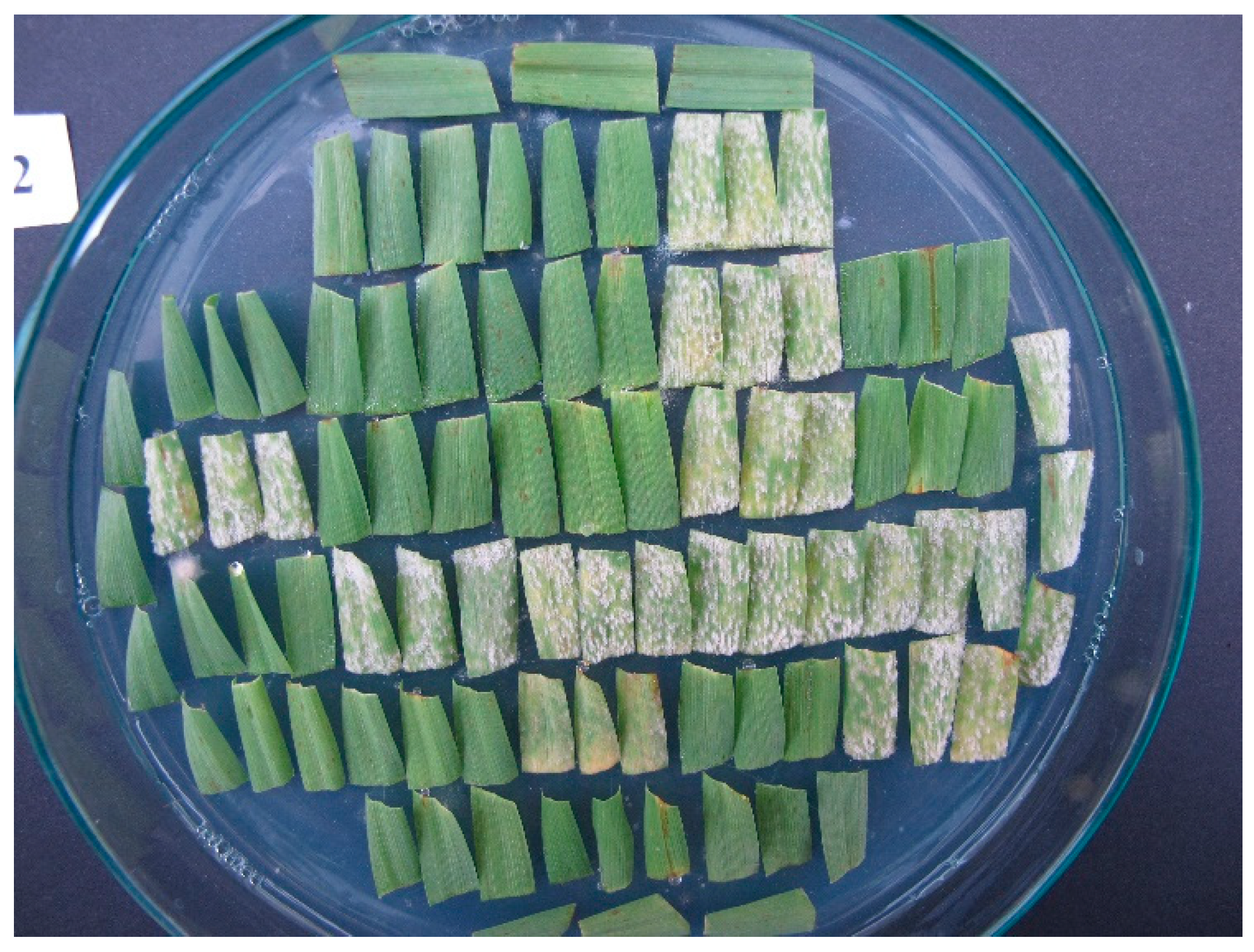
An example of the highest efficiency of a barley major resistance gene against powdery mildew is the allele Mla8 characterized by the lowest phenotype – infection response 0 (IR0), which is manifested by no traces of the disease after inoculation of host genotypes with avirulent pathotypes (Figure 1). However, isolates avirulent to Mla8 are extremely rare (see later) and are absent in the field. Therefore, this gene is ineffective and varieties containing Mla8 are fully susceptible to “natural” pathogen populations worldwide.
There are numerous well-characterised hypersensitive major resistance genes against barley powdery mildew [15,16] and many others are present in wild barley (H. vulgare subsp. spontaneum) [17,18,19]. However, they conform to the principles of the gene-for-gene system whereby each resistance gene of the host corresponds with a virulence gene of the pathogen [20] and their resistance is race-specific (denoted “specific”). When used in commercial varieties their initial resistance is soon overcome as a result of an increasing frequency of virulent pathotypes which are under strong directional selection once varieties carrying such genes are grown [21]. The following examples illustrate the outcomes and conclusions drawn from cultivation of varieties with major resistance genes.
In 1965 a domestic spring barley variety Diamant – an X-ray mutant from an old variety Valticky was registered. It possessed a new semi-dwarf sdw1.d allele [22]; varieties bred from it are characterized by “Diamant (morpho)type” and these semi-dwarf derivatives are often called “Diamant series” (of varieties). Diamant has made a positive contribution to crop breeding worldwide, but is susceptible to powdery mildew. This was the commonest disease of cultivated barley in Europe, especially in central and northwest regions [2,23] until the expansion of spring varieties carrying a nonspecific resistance. Diamant contains the ineffective major resistance gene Mla8 and its average scoring in 161 field trials conducted in 1971–1975 was 3.77 on a nine point scale where 9 is the highest resistance [24]. The high susceptibility of Diamant encouraged breeders to combine desirable agronomical characteristics of this variety with effective resistance against the disease.
In 1977 Spartan – a descendant of Diamant was released that carried a “new” gene Mla9 and also Mlk1 [13] providing an overall resistance of 8.60 in 39 field trials conducted a year before its registration [24]. Three years later Spartan was historically the most widely-grown variety in the Czech Republic occupying 191.000 ha (31.9% of the crop area). The following year, when its area was 190.000 ha, the resistance was overcome (an average field scoring of 4.53) and in 1983 Spartan became the most susceptible (3.38) among all tested varieties. Since Spartan was the only commercial variety possessing Mla9 and because other resistant varieties were already available (see next paragraph) its growing area decreased quickly to 1.2% in 1985. The widespread cultivation of Spartan and progression of its susceptibility demonstrate a typical ‘boom-and-bust’ cycle of varieties with specific major resistance genes against diseases caused by pathogens that rapidly adapt [3].
Another example is Koral released in 1978, in which, similarly to Spartan, Mla8 of its ancestors was substituted with another allele, in this case Mla13 and simultaneously carrying Mlg [13]. Koral was the first central European variety possessing Mla13 [25] and its resistance averaged 8.93 in 105 field trials carried out in 1976–1978 [24]. Until 1985 five varieties having Mla13 were registered in the Czech Republic out of a total of 13 varieties registered in this eight year period [13]. Varieties with Mla13 were the most resistant for a decade (1976–1985) [24] and up to 1985 they were grown on a total of about 1.5 Mha. After some infection in 1985 their resistance fully broke down in 1986 when these varieties occupied the highest proportion (63.5%) of the total crop area 445 000 ha [9]. The years 1987–1989 had the 4th, 1st and 2nd strongest mildew epidemics, respectively, that were recorded on spring barley over a thirty year period (1976–2005) [23], and in 1989–2000 varieties carrying Mla13 were the most susceptible in eight of these 12 years [24]. Although the resistance was already ineffective, susceptible varieties possessing Mla13 were still grown and occupied 61.0% of the crop area in 1990 [9]. In addition more varieties with Mla13 were registered (10 until 1996 and three more up to 2011) because until 1993 there were no other commercial resistant varieties available [13,26]. The total area of Mla13 varieties grown in 1986–2005, when they were fully susceptible, was 2.6 Mha, thus much larger than the area when they were resistant. The rapid spread of airborne spores of pathotypes containing important virulences (Va13 and Vg as well as Va6, Va7, Va9 and Vk1) produced on these widely-grown and already fully susceptible varieties caused strong powdery mildew epidemics in large parts of Europe in the second half of 1980ʼs [27].
In the domestic population virulence against a major resistance gene Mlp was not found before 2012, but soon after the introduction of winter barley varieties carrying this gene the frequency of corresponding virulence reached almost 70% [12]. The fate of varieties possessing other major genes of specific resistance, even those grown on small areas, was similar [24]. It raises questions about the benefit of major genes of specific resistance against barley powdery mildew.
2.2. Durable Major Resistance Genes
Only one durable, non-specific and non-hypersensitive major resistance of barley against powdery mildew that does not conform to the gene-for-gene concept is known [34,35]. It is monogenic, conditioned by one of many recessive genes of similar function [15] and designated Mlo [36] (functional genes are designated mlo). In commercial varieties mlo11 derived from Ethiopian landraces was the first to be exploited and subsequently mlo9 from a mutant SZ 5139 derived from Diamant was adopted by breeders who released Alexis. This was the most widely grown European variety in the latter part of the 1980s [35,37]. Conversely, from the same set of mutants a powdery mildew super-susceptible line SM 4142 was selected and has been used in our laboratory.
Since 1993 164 spring barley varieties bred in nine central and northwest European countries have been registered in the Czech Republic, 114 of them (69.5%) carrying Mlo resistance. During 2021–2023 almost 96% possessed Mlo and in registration trials such varieties have been the most resistant since 1985 [21]. Despite its long-term durability there is some experimental evidence that the pathogen can develop pathotypes partially virulent to Mlo [38,39,40,41]. There could be a higher risk for this to occur in areas where spring and winter barleys with this resistance are concurrently grown.
Jørgensen [35] predicted that Mlo resistance should also be present in other plants and this was confirmed when it was documented in some species in addition to barley [42]. With continuing research the number of plant species with detected Mlo resistance is increasing [43,44,45,46,47,48,49,50,51,52].
2.3. Pathogen Variation
Successful postulation (see section 2.4) of major resistance genes in varieties depends on the use of wide virulence variation of the pathogen as outlined in the following examples.
The first European commercial varieties carrying introduced resistance genes were registered in the 1950s since prior to this date no specific varietal resistance was detected However, isolates avirulent on many varieties including some of European origin were found in Japan and these isolates enabled the discovery of the gene Mla8 [53]. In Denmark, a set of European varieties was tested with one of these Japanese isolates (Race I) and from the results it was concluded that Mla8 is frequently present in old spring barley varieties [54]. In varieties bred subsequently Mla8 was almost always replaced with effective Mla alleles at the same locus [25] as in the cases of Spartan and Koral mentioned above.
Another example relates to discussions held at the International Center for Agriculture Research in the Dry Areas (ICARDA) in 2004. Tadmor, a susceptible barley variety selected from a Syrian landrace Arabi Aswad [S. Ceccarelli, personal communication], was earmarked as a suitable host for powdery mildew experimental research. In resistance tests with about 50 isolates Tadmor was fully susceptible (IR4) to all isolates except Race I, to which it was fully resistant (IR0) and had an identical infection response array (IRA) to varieties possessing Mla8. However, in subsequent tests a few Israeli isolates were included and the set of barleys with IRAs previously indicating the presence of Mla8 was split into two groups. Varieties in the first group had a similar IRA as before when only Race I was avirulent (Mla8), whereas varieties in the other group, including Tadmor, were fully resistant (IR0) to this isolate as well as to two Israeli isolates. Thus, the gene present in the second group differed from Mla8 and this newly-discovered resistance was tentatively named after Tadmor (Ta). Despite this, a commercial winter barley variety Lomerit was present in the same group and it was considered more appropriate to designate the gene accordingly (MlLo). Subsequent research revealed that MlLo is an allele or pseudo-allele of the Mla locus [11,16] and although MlaLo was undetected until recently, tests of gene bank accessions showed that Lo is the most frequent major resistance present alone or in combinations with other powdery mildew resistances in more than 26% genotypes derived from old and current winter barley varieties [Dreiseitl and Nesvadba, unpublished].
Recent research confirmed that the central European barley powdery mildew population contains the widest spectrum of known virulences and their combinations among all regions where barley is grown and that it is one of most diverse populations among plant pathogens [12]. Selected isolates from this population are important for postulating the composition of complex resistance gene combinations. On the other hand, the most frequent genes in spring and winter barley (Mla8 and MlaLo) could be revealed only by using non-European isolates because these avirulences are absent in Europe.
2.4. Postulation of Major Resistance Genes
Classical identification of major resistance genes in host varieties is based on the phenotypic responses of varieties after inoculation with pathogen isolates to obtain a row of IRs for each genotype. Comparing IRAs of tested varieties with IRAs of standard lines possessing known resistance genes can identify genes and their combinations [6,13,30,55,56,57,58] including designating new resistances [59]. This method denoted as the “postulation” of major resistance genes [60] is widely used to characterize genes in cereals against biotrophic pathogens such as powdery mildews and rusts [61,62,63,64,65,66,67]. In the case of mildews the term “postulation” was introduced later, first for mildew on wheat [68,69,70] and subsequently for barley mildew [10,71,72].
An integral part of exploiting major resistance genes is their detection. Molecular markers [73,74,75,76,77] are helpful tools mainly as an aid to select lines with the required gene(s). However, to distinguish new and more complex gene combinations postulation is still the most suitable way, especially if maximum pathogen variation is used. Gene postulation based on a gene-for-gene concept in association with Mendelian genetic analysis was also used to clarify complex resistances in some accessions including highly heterogeneous ones [11]. The host powdery mildew resistance variation [15] was recently updated [16].
2.5. Other uses of Major Resistance Genes
Plant research and breeding depends on accessing a range of diverse plant genotypes that are available in gene banks. Non-authenticity of gene bank accessions due to human error is one of the most serious problems [10,78,79,80,81,82,83,84]. To overcome this shortcoming there are modern efficient methods for verifying the identity of plant varieties including sequencing or protein spectra analyses [85,86]. However, these methods are often unsuitable for older accessions lodged in gene banks as they may be incorrectly labelled or contaminated with other genotypes [87] because of insufficient historical data to compare with results obtained with modern techniques. On the other hand, there is a lot of information about the presence of major resistance genes against powdery mildew in barleys when varieties were registered or collected and for almost 700 European varieties such data were summarized [25]. Therefore, results of current postulation of major resistance genes in accessions, including those from gene banks, can be compared with original data and on this basis varietal authenticity established. The problem is well illustrated in the following three examples resulting from the study of spring barley gene bank accessions.
For resistance gene postulation of accessions maintained in a gene bank five SSPs of each accession were tested. The set of varieties included Abyssinian 1102, an Ethiopian landrace containing mlo11, one of two most important recessive resistance genes against barley powdery mildew and one of numerous sources of Mlo [35]. Three different genotypes were found among its single seed progenies (SSPs) but none of them carried mlo [88]. This proves that this accession was heterogeneous and incorrectly labelled “Abyssinian 1102”.
Second, an accession of Diamant was studied [88]. Three lines (SSPs) were eliminated since they contained mlo and Mla7, both used in breeding barley varieties subsequent to Diamant [25]. Two SSPs carried Mla8 and only these can be considered as the true variety.
The last example is from a recent study comparing accessions from the domestic gene bank with those from foreign gene banks [87]. Asse (HOR 4482), is almost six decades old German variety that contains Mlg [89]. In our studies we found Mla8 in the USA accession and Mlra in the accession from the Czech gene bank. Because no true genotype was present in Asse accessions, a sample of this variety should be obtained from other gene banks, preferably from its country of origin.
These examples clearly demonstrate that a knowledge of major resistance genes present in varieties is crucial. Even those genes whose resistance has broken down and are already ineffective are useful as “markers” or “information tools” for identifying varieties and confirming their pedigree, genotype homogeneity and authenticity.
3. Conclusions
Breeding barley against powdery mildew, especially in Europe, has been based almost exclusively on exploiting major resistance genes. Unlike the later use of non-specific resistance Mlo, genes of specific resistance bring a short-term protective effect terminated by the breakdown of resistance in the field and consequently associated with risk and financial losses for growers and breeding companies.
Other significant errors occur when mislabeled or genetically heterogeneous varieties confound research aims or breeding projects and lead to false scientific results and conclusions. This review presents examples of the first case (‘boom-and-bust’ cycle of varieties with major genes of specific resistance) and summarizes the root causes and dangers using of non-authentic varieties which can be detected by identifying major resistance genes against powdery mildew and highlights ways to avoid associated losses.
4. Future Directions
Most of the known major resistance genes of barley against powdery mildew are race-specific and short-lived. The only exception is a major non-specific resistance Mlo, which has remained durable after almost a half of century of its widespread use mainly in central and western Europe where concurrently grown spring and winter barley is commonly practised and conditions for the pathogen are favorable. In such an environment consisting of an uninterrupted green bridge it is recommended that Mlo should only be present in spring varieties to prevent a possible slow partial adaptation of the pathogen. For winter barley it is advisable to accumulate quantitative (minor) non-specific resistance genes [90,91], or develop effective resistances introgressed from Hordeum bulbosum [92,93,94,95] or, if it were possible, from species in the tertiary genepool of barley that are immune to closely related pathogens.
Author Contributions
AD is the sole author of this study.
Funding
This study was funded by the Ministry of Agriculture of the Czech Republic, institutional support no. MZE-RO1123.
Data Availability Statement
All data are presented in the article.
Conflicts of Interest
The author declares no conflicts of interest.
References
- Bourras, S.; Praz, C.R.; Spanu, P.D.; Keller, B. Cereal powdery mildew effectors: a complex toolbox for an obligate pathogen. Current Opin. Microbiol. 2018, 46, 26−33. [CrossRef]
- Jørgensen, J.H. Erysiphe graminis, powdery mildew of cereals and grasses. In Advances in Plant Pathology, Academic Press London, United Kingdom, 1988; Volume 6, pp. 137−157.
- McDonald, B.A.; Linde, C. Pathogen population genetics, evolutionary potential, and durable resistance. Ann. Rev. Phytopathol. 2002, 40, 349–379. [CrossRef]
- Kusch, S.; Qian, J.Z.; Loos, A.; Kümmel, F.; Spanu, P.D.; Panstruga, R. Long-term and rapid evolution in powdery mildew fungi. Molec. Ecol. 2024, 33, 10. [CrossRef]
- Brückner, F. Powdery mildew (Erysiphe graminis DC.) on barley. Survey of the occurrence of physiological races on the territory of Czechoslovakia in 1960−1961. Rostl. Výr. 1963, 9, 1−8.
- Brückner, F. Powdery mildew (Erysiphe graminis DC.) on barley. V. The resistance of barley varieties to physiological races detected in Czechoslovakia and the possibility to use it in breeding for resistance. Rostl. Výr. 1964, 10, 395−408.
- Brückner, F. A complementary effect of different alleles for mildew resistance in barley. Z. Pflanzenzücht. 1967, 58, 122−127.
- Brückner, F. The breeding of the malting barley cultivar of new morphotype Forum. Genet. Šlecht. 1993, 29, 199−203.
- Dreiseitl, A. Analysis of growing Czechoslovak spring barley varieties resistant to powdery mildew. Rostl. Výr. 1993, 39, 337–344.
- Dreiseitl, A. Powdery mildew resistance in winter barley cultivars. Plant Breed. 2007, 126, 268–273. [CrossRef]
- Dreiseitl, A. A novel way to identify specific powdery mildew resistance genes in hybrid barley cultivars. Scient. Rep. 2020, 10, 18930. [CrossRef]
- Dreiseitl, A. Rare virulences and great pathotype diversity of a Central European Blumeria hordei population. J. Fungi 2023, 9, 1045. [CrossRef]
- Dreiseitl, A.; Jørgensen, J.H. Powdery mildew resistance in Czech and Slovak barley cultivars. Plant Breed. 2000, 119, 203–209. [CrossRef]
- Nover, I.; Brückner, F.; Wiberg, A.; Wolfe, M.S. Races of Erysiphe graminis DC. f. sp. hordei Marchal in Europe. Z. Pfl.-krank. Pfl. schutz 1968, 75, 350−353.
- Jørgensen, J.H. Genetics of powdery mildew resistance in barley. Crit. Rev. Plant Sci. 1994, 13, 97−119. [CrossRef]
- Dreiseitl, A. Specific resistance of barley to powdery mildew, its use and beyond: A concise critical review. Genes 2020, 11, 971. [CrossRef]
- Dreiseitl, A. Heterogeneity of powdery mildew resistance revealed in accessions of the ICARDA wild barley collection. Front. Plant Sci. 2017, 8, 202. [CrossRef]
- Fischbeck, G.; Schwarzbach, E.; Sobel, Z.; Wahl, I. Mildew resistance in Israeli populations of 2-rowed wild barley (Hordeum spontaneum). Z. Pflanzenzücht. 1976, 76, 163–166.
- Moseman, J.G.; Baenzinger, P.S.; Kilpatrick, R.A. Genes conditioning resistance of Hordeum spontaneum to Erysiphe graminis f. sp. hordei. Crop Sci. 1981, 21, 229–232. [CrossRef]
- Flor, H.H. Current status of the gene-for-gene concept. Ann. Rev. Phytopathol. 1971, 9, 275−296. [CrossRef]
- Dreiseitl, A. Mlo-mediated broad-spectrum and durable resistance against powdery mildews and its current and future applications. Plants 2024, 13, 138. [CrossRef]
- Xu, Y.H.; Jia, Q.J.; Zhou, G.F.; Zhang, X.Q.; Angessa, T.; Broughton, S.; Yan, G.; Zhang, W.Y.; Li, C.D. Characterization of the sdw1 semi-dwarf gene in barley. BMC Plant Biol. 2017, 17, 11. [CrossRef]
- Dreiseitl, A. Differences in powdery mildew epidemics in spring and winter barley based on 30-year variety trials. Ann. Appl. Biol. 2011, 159, 49–57. [CrossRef]
- Dreiseitl, A. Adaptation of Blumeria graminis f.sp. hordei to barley resistance genes in the Czech Republic in 1971–2000. Plant Soil Environ. 2003, 49, 241–248. [CrossRef]
- Brown, J.K.M.; Jørgensen, J.H. A catalogue of mildew resistance genes in European barley varieties. In: Integrated Control of Cereal Mildews: Virulence and Their Change. Proceedings of the Second European Workshop on Integrated Control of Cereal Mildews, Risø National Laboratory, Roskilde, Denmark, 23–25 January 1990; Jørgensen, J.H., Ed.; Risø National Laboratory, Roskilde, Denmark, 1991; pp. 263−286.
- Dreiseitl, A. Genes for resistance to powdery mildew in European barley cultivars registered in the Czech Republic from 2011 to 2015. Plant Breed. 2017, 136, 351–356. [CrossRef]
- Wolfe, M.S.; Brändle, U.; Koller, B.; Limpert, E.; McDermott, J.M.; Müller, K.; Schaffner, D. Barley mildew in Europe: Population biology and host resistance. Euphytica 1992, 63, 125–139. [CrossRef]
- Abebe, T.D.; Abate, A.; Leon, J. Genetic diversity within landraces of barley (Hordeum vulgare L.) and its implications on germplasm collection and utilization. Genet. Res. Crop Evol. 2023, 70, 1985−1998. [CrossRef]
- Czembor, J.H. Resistance to powdery mildew in selections from Moroccan barley landraces. Euphytica 2002, 125, 397–409. [CrossRef]
- Czembor, J.H.; Czembor, H.J. Selections from barley landrace collected in Libya as new sources of effective resistance to powdery mildew (Blumeria graminis f.sp. hordei). Rostl. Výr. 2002, 48, 217−223.
- Czembor, J.H.; Czembor, E. Sources of resistance to powdery mildew in wild barley (Hordeum vulgare subsp. spontaneum) collected in Jordan, Lebanon, and Libya. Agronomy 2023, 13, 2462. [CrossRef]
- Czembor, J.H.; Johnston, M.R. Resistance to powdery mildew in selections from Tunisian landraces of barley. Plant Breed. 1999, 118, 503–509. [CrossRef]
- Piechota, U.; Czembor, P.C.; Slowacki, P.; Czembor, J.H. Identifying a novel powdery mildew resistance gene in a barley landrace from Morocco. J. Appl. Genet. 2019, 60, 243–254. [CrossRef]
- Freisleben, R.; Lein, A. Über die Auffindung einer mehltauresistenten Mutante nach Röentgenbestrahlung einer anfälligen reinen Linie von Sommergerste. Naturwissenschaften 1942, 30, 608.
- Jørgensen, J.H. Discovery, characterisation and exploitation of Mlo powdery mildew resistance in barley. Euphytica 1992, 63, 141–152. [CrossRef]
- Favret, E.A. Different categories of mutations for disease reaction in the host organism. In: Mutation Breeding for Disease Resistance. IAEA-PL-412/12, Vienna, Austria, 1971; pp. 107–116.
- Schwarzbach, E. Recessive total resistance of barley to mildew (Erysiphe graminis D.C. f. sp. hordei Marchal) as a mutation induced by ethylmethansulfonate. Genet. Šlecht. 1967, 3, 159–162.
- Kusch, S.; Frantzeskakis, L.; Lassen, B.D.; Kümmel, F.; Pesch, L.; Barsoum, M.; Walden, K.D.; Panstruga, R. A fungal plant pathogen overcomes mlo-mediated broad-spectrum disease resistance by rapid gene loss. New Phytol. 2024, 244, 262–279. [CrossRef]
- Schwarzbach, E. Response to selection for virulence against the ml-o based mildew resistance in barley, not fitting the gene-for-gene hypothesis. Barley Gen. Newsl. 1979, 9, 85–88.
- Schwarzbach, E. Heat induced susceptibility of mlo-barley to powdery mildew. (Blumeria graminis D.C. f.sp. hordei Marchal). Czech J. Genet. Plant Breed. 2001, 37, 82–87.
- Yaeno, T.; Wahara, M.; Nagano, M.; Wanezaki, H.; Toda, H.; Inoue, H.; Eishima, A.; Nishiguchi, M.; Hisano, H.; Kobayashi, K. RACE1, a Japanese Blumeria graminis f. sp. hordei isolate, is capable of overcoming partially mlo-mediated penetration resistance in barley in an allele-specific manner. PLoS ONE 2021, 16, e0256574. [CrossRef]
- Kusch, S.; Panstruga, R. mlo-based resistance: An apparently universal “weapon” to defeat powdery mildew disease. Molec. Plant-Microb. Interact. 2017, 30, 179–189. [CrossRef]
- Bui, T.P.; Le, H.; Ta, D.T.; Nguyen, C.X.; Le, N.T.; Tran, T.T.; Nguyen, P.V.; Stacey, G.; Stacey, M.G.; Pham, N.B. Enhancing powdery mildew resistance in soybean by targeted mutation of MLO genes using the CRISPR/Cas9 system. BMC Plant Biol. 2023, 23, 533. [CrossRef]
- Giuseppe, A.; Raffaella, E.M. The first genome-wide mildew locus O genes characterization in the Lamiaceae plant family. Int. J. Molec. Sci. 2023, 24, 13627. [CrossRef]
- Huang, C.B.; Wang, Y.Q.; Zhang, X.Y.; Zhang, C.H. Cloning and expression analysis of mildew locus O (MLO) genes related to powdery mildew resistance in Vitis pseudoreticulata, and functional characterisation of VpMLO13. N. Z. J. Crop Hortic. Sci. 2023, Early Access. [CrossRef]
- Liu, J.; Wu, Y.P.; Zhang, X.; Gill, R.A.; Hu, M.; Bai, Z.T.; Zhao, C.J.; Zhang, Y.; Liu, Y.Y.; Hu, Q. Functional and evolutionary study of MLO gene family in the regulation of Sclerotinia stem rot resistance in Brassica napus L. Biotechnol. Biofuels Bioprod. 2023, 16, 86. [CrossRef]
- Li, W.; Deng, Y.; Ning, Y.; He, Z.; Wang, G.L. Exploiting broad-spectrum disease resistance in crops: From molecular dissection to breeding. Ann. Rev. Plant Biol. 2020, 71, 575–603. [CrossRef]
- Sirangelo, T.M. NLR- and mlo-based resistance mechanisms against powdery mildew in Cannabis sativa. Plants 2024, 13, 105. [CrossRef]
- Tek, M.I.; Calis, O.; Fidan, H.; Shah, M.D.; Celik, S.; Wani, S.H. CRISPR/Cas9 based mlo-mediated resistance against Podosphaera xanthii in cucumber (Cucumis sativus L.). Front. Plant Sci. 2022, 13, 1081506. [CrossRef]
- Traore, S.M.; Han, S.; Binagwa, P.; Xu, W.; Chen, X.G.; Liu, F.Z.; He, G.H. Genome-wide identification of mlo genes in the cultivated peanut (Arachis hypogaea L.). Euphytica 2021, 217, 61. [CrossRef]
- Wang, J.; Wu, X.H.; Wang, Y.; Wu, X.Y.; Wang, B.G.; Lu, Z.F.; Li, G.J. Genome-wide characterization and expression analysis of the MLO gene family sheds light on powdery mildew resistance in Lagenaria siceraria. Heliyon 2023, 9, e14624. [CrossRef]
- Xu, J.P.; Naing, A.H.; Kang, H.H.; Lee, S.Y.; Li, W.L.; Chung, M.Y.; Kim, C.K. CRISPR/Cas9-mediated editing of PhMLO1 confers powdery mildew resistance in petunia. Plant Biotech. Reports 2023, 17, 767–775. [CrossRef]
- Hiura, U.; Heta, H. Studies on the disease resistance in barley. III. Further studies on the physiologic races of Erysiphe graminis hordei in Japan. Berichte Ohara Inst landwirtschaft. Biol. 1955, 10, 135–156.
- Jørgensen, J.H.; Jensen, H.P. Powdery mildew resistance gene Ml-a8 (Reg1h8) in northwest European spring barley varieties. Barley Genet. Newslet. 1983, 13, 51–52.
- Czembor, J.H.; Czembor, E. Sources of resistance to powdery mildew in barley landraces from Turkey. Agriculture 2021, 11, 1017. [CrossRef]
- Czembor, J.H.; Czembor, H.J. Resistance to powdery mildew in selections from Moroccan barley landraces. Euphytica 2002, 125, 397−409. [CrossRef]
- Jensen, H.P.; Christensen, E.; Jørgensen, J.H. Powdery mildew resistance genes in 127 Northwest European spring barley varieties. Plant Breed. 1992, 108, 210–228. [CrossRef]
- Moseman, J.G. Genes for specific resistance-powdery mildew of barley. Phytopathology 1971, 61, 617–620. [CrossRef]
- Dreiseitl, A. Resistance of ‘Roxana’ to powdery mildew and its presence in some European spring barley cultivars. Plant Breed. 2011, 130, 419–422. [CrossRef]
- McVey, D.V.; Roelfs, A.P. Postulation of genes for stem rust resistance in the entries of the Fourth international winter wheat performance nursery. Crop Sci. 1975, 15, 335–337. [CrossRef]
- Dreiseitl, A.; Steffenson, B.J. Postulation of leaf rust resistance genes in Czech and Slovak barley cultivars and breeding lines. Plant Breed. 2000, 119, 211–214. [CrossRef]
- Kaur, H.; Kaur, J.; Bala, R.; Sharma, A.; Kumari, J.; Mavi, G.S.; Kaur, S. Postulation of leaf rust resistance genes in Indian and exotic wheat germplasm using near-isogenic lines (NILs) and molecular markers. Crop Prot. 2023, 174, 106431. [CrossRef]
- Mebrate, S.A.; Dehne, H.W.; Pillen, K.; Oerke, E.C. Postulation of seedling leaf rust resistance genes in selected Ethiopian and German bread wheat cultivars. Crop Sci. 2008, 48, 507–516. [CrossRef]
- Randhawa, M.; Bansal, U.; Lillemo, M.; Miah, H.; Bariana, H. Postulation of rust resistance genes in Nordic spring wheat genotypes and identification of widely effective sources of resistance against the Australian rust flora. J. Appl. Genet. 2016, 57, 453–465. [CrossRef]
- Singh, D.; Park, R.F.; McIntosh, R.A. Postulation of leaf (brown) rust resistance genes in 70 wheat cultivars grown in the United Kingdom. Euphytica 2001, 120, 205–218. [CrossRef]
- Xu, X.D.; Feng, J.; Lin, R.M.; Hussain, K.; Xu, S.C.; Lin, F. Postulation of stripe rust resistance genes in 44 Chinese wheat cultivars. Int. J. Agric. Biol. 2011, 13, 665–670.
- Yang, H.L.; Diao, W.D.; Yan, X.C.; Gebrewahid, T.W.; Li, Z.F.; Yao, Z.J. Identification of genes for leaf rust resistance in seedlings of wheat cultivars from the Yellow-Huai Basin in China and slow rusting observations in field trials. Czech J. Genet. Plant Breed. 2023, 59, 219–234. [CrossRef]
- Liu, S.B.; Wang, H.G.; Zhang, X.Y.; Li, X.F.; Li, D.Y.; Duan, X.Y.; Zhou, Y.L. Molecular cytogenetic identification of a wheat-Thinopyron intermedium (Host) Barkworth & DR Dewey partial amphiploid resistant to powdery mildew. J. Integr. Plant Biol. 2005, 47(6), 726−733. [CrossRef]
- Hysing, S.C.; Merker, A.; Liljeroth, E.; Koebner, R.M.D.; Zeller, F.J.; Hsam, S.L.K. Powdery mildew resistance in 155 Nordic bread wheat cultivars and landraces. Hereditas 2007, 144, 102−119. [CrossRef]
- Yang, G.T.; Tong, C.Y.; Li, H.W.; Li, B.; Li, Z.S.; Zheng, Q. Cytogenetic identification and molecular marker development of a novel wheat-Thinopyrum ponticum translocation line with powdery mildew resistance. Theor. Appl. Genet. 2022, 135, 2041–2057. [CrossRef]
- Silvar, C.; Flath, K.; Kopahnke, D.; Gracia, M.P.; Lasa, J.M.; Casas, A.M.; Igartua, E.; Ordon, F. Analysis of powdery mildew resistance in the Spanish barley core collection. Plant Breed. 2011, 130, 195–202. [CrossRef]
- Surlan-Momirovic, G.; Flath, K.; Silvar, C.; Brankovic, G.; Kopahnke, D.; Knezevic, D.; Schliephake, E.; Ordon, F.; Perovic, D. Exploring the Serbian GenBank barley (Hordeum vulgare L. subsp vulgare) collection for powdery mildew resistance. Genet. Res. Crop Evol. 2016, 63, 275−287. [CrossRef]
- Brown, J.K.M. The choice of molecular marker methods for population genetic studies of plant pathogens. New Phytol. 1996, 133, 183−195. [CrossRef]
- Czembor, P.C.; Czembor, J.H. Identification of RAPD marker for the Mlat powdery mildew resistance gene in barley. Mikol. Fitopatol. 2005, 39, 66−73.
- Hinze, K.; Thompson, R.D.; Ritter, E.; Salamini, F.; Schulze-Lefert P. Restriction fragment length polymorphism-mediated targeting of the ML-O resistance locus in barley (Hordeum vulgare). Proc. Nat. Acad. Sci. USA 1991, 88, 3691−3695. [CrossRef]
- Schuller, C.; Backes, G.; Fischbeck, G. RFLP markers to identity the alleles on the Mla locus confering powdery mildew resistance in barley. Theor. Appl. Genet. 1992, 84, 330–338. [CrossRef]
- Piechota, U.; Slowacki, P.; Czembor, P.C. Identification of a novel recessive gene for resistance to powdery mildew (Blumeria graminis f. sp. hordei) in barley (Hordeum vulgare). Plant Breed. 2020, 139, 730−742. [CrossRef]
- af Sätra, J.S.; Troggio, M.; Odilbekov, F.; Sehic, J.; Mattisson, H.; Hjalmarsson, I.; Ingvarsson, P.K.; Garkava-Gustavsson, L. Genetic status of the Swedish central collection of heirloom apple cultivars. Scientia Hortic. 2020, 272, 109599. [CrossRef]
- Girma, G.; Korie, S.; Dumet, D.; Franco, J. Improvement of accession distinctiveness as an added value to the global worth of the yam (Dioscorea ssp) genebank. Int. J. Cons. Sci. 2012, 3, 199–206.
- Hempel, P.; Hohe, A.; Trankner, C. Molecular reconstruction of an old pedigree of diploid and triploid Hydrangea macrophylla genotypes. Front. Plant Sci. 2018, 9, 429. [CrossRef]
- Jreisat, C.S.; Laten, H.M. Ribosomal RNA internal transcribed regions identify possible misidentification or mislabeling among Trifolium (Clover) specimens from germplasm collections. Crop Sci. 2017, 57, 322–326. [CrossRef]
- Shan, F.; Clarke, H.C.; Plummer, J.A.; Yan, G.; Siddique, K.H.M. Geographical patterns of genetic variation in the world collections of wild annual Cicer characterized by amplified fragment length polymorphisms. Theor. Appl. Genet. 2005, 110, 381–391. [CrossRef]
- van de Wouw, M.; van Treuren, R.; van Hintum, T. Authenticity of old cultivars in genebank collections: A case study on Lettuce. Crop Sci. 2011, 51, 736–746. [CrossRef]
- Zhang, W.; Sun, Y.Z.; Liu, J.; Xu, C.; Zou, X.H.; Chen, X.; Liu, Y.L.; Wu, P.; Yang, X.Y.; Zhou, S.L. DNA barcoding of Oryza: conventional, specific, and super barcodes. Plant Mol. Biol. 2021, 105(3), 215–228. [CrossRef]
- Mascher, M.; Wicker, T.; Jenkins, J.; Plott, C.; Lux, T.; Koh, C.S.; Ens, J.; et al. Long-read sequence assembly: a technical evaluation in barley. Plant Cell 2021, 33, 1888−1906. [CrossRef]
- Pont, L.; Compte, I.; Sanz-Nebot, V.; Barbosa, J.; Benavente, F. Analysis of hordeins in barley grain and malt by capillary electrophoresis-mass spectrometry. Food Anal. Meth. 2020, 13, 325−336. [CrossRef]
- Dreiseitl, A.; Zavřelová, M. Non-authenticity of spring barley genotypes revealed in gene bank accessions. Plants 2022, 11, 3059. [CrossRef]
- Dreiseitl, A.; Zavřelová, M. Identification of barley powdery mildew resistances in gene bank accessions and the use of gene diversity for verifying seed purity and authenticity. PLoS ONE 2018, 13, e0208719. [CrossRef]
- Nover, I.; Lehmann, Ch.O. Resistenzeigenschaften im Gersten- und Weizensortiment Gatersleben. 17. Prüfung von Sommergersten auf ihr Verhalten gegen Mehltau (Erysiphe graminis DC. f. sp. hordei Marchal). Kulturpflanze 1973, 21, 275−294.
- Silvar, C.; Casas, A.M.; Igartua, E.; Ponce-Molina, L.J.; Gracia, M.P.; Schweizer, G.; Herz, M.; Flath, K.; Waugh, R.; Kopahnke, D.; Ordon, F. Resistance to powdery mildew in Spanish barley landraces is controlled by different sets of quantitative trait loci. Theor. Appl. Genet. 2011, 123, 1019–1028. [CrossRef]
- Czembor, J.H.; Czembor, E.; Suchecki, R.; Watson-Haigh, N.S. Genome-wide association study for powdery mildew and rusts adult plant resistance in European spring barley from Polish gene bank. Agronomy 2022, 12, 7. [CrossRef]
- Pickering, R.A.; Rennie, W.F.; Cromey, M.G. Disease resistant material available from the wide hybridization programme at DSIR. Barley Newsl. 1987, 31, 248–259.
- Pickering, R.A.; Hill, A.M.; Michel, M.; Timmerman-Vaughan, G.M. The transfer of a powdery mildew resistance gene from Hordeum bulbosum L. to barley (H. vulgare L.) chromosome 2 (2I). Theor. Appl. Genet. 1995, 91, 1288–1292. [CrossRef]
- Xu, J.; Kasha, K.J. Transfer of a dominant gene for powdery mildew resistance and DNA from Hordeum bulbosum into cultivated barley (Hordeum vulgare). Theor. Appl. Genet. 1992, 84, 771–777. [CrossRef]
- Hoseinzadeh, P.; Ruge-Wehling, B.; Schweizer, P.; Stein, N.; Pidon, H. High resolution mapping of a Hordeum bulbosum-derived powdery mildew resistance locus in barley using distinct homologous introgression lines. Front. Plant Sci. 2020, 11, 225. [CrossRef]
Figure 1.
Petri dish with triplets of leaf segments of 30 barley lines seven days after inoculation with the powdery mildew isolate Race I; fully resistant (IR0) genotypes carry the Mla8 allele.
Figure 1.
Petri dish with triplets of leaf segments of 30 barley lines seven days after inoculation with the powdery mildew isolate Race I; fully resistant (IR0) genotypes carry the Mla8 allele.
Disclaimer/Publisher’s Note: The statements, opinions and data contained in all publications are solely those of the individual author(s) and contributor(s) and not of MDPI and/or the editor(s). MDPI and/or the editor(s) disclaim responsibility for any injury to people or property resulting from any ideas, methods, instructions or products referred to in the content. |
© 2025 by the authors. Licensee MDPI, Basel, Switzerland. This article is an open access article distributed under the terms and conditions of the Creative Commons Attribution (CC BY) license (http://creativecommons.org/licenses/by/4.0/).
Copyright: This open access article is published under a Creative Commons CC BY 4.0 license, which permit the free download, distribution, and reuse, provided that the author and preprint are cited in any reuse.


