Preprint
Article

This version is not peer-reviewed.

A Framework for Using Coastal Monitoring Data: A Foredune Case Study

A peer-reviewed article of this preprint also exists.

Submitted:

10 March 2025

Posted:

11 March 2025

You are already at the latest version

Abstract

To support coastal practitioners and decision makers manage the complex coastal zone a structured framework was developed to navigate a range of technologies, datasets and data-derived products based on their suitability to monitor the spatial and temporal diversity of coastal processes and morphological indicators. Remote piloted aircraft (RPA) fitted with a LiDAR sensor was used in conjunction with airborne LiDAR and photogrammetry data to undertake foredune change analyses for selected sites in southeastern Australia to validate and demonstrate optimal technology for coastal monitoring. Results were compared with satellite derived coastal change products, including the Digital Earth Australia Coastlines and CoastSat. Foredune volumes from the mid-1900s to 2024 at the highly modified and urbanised Woonona-Bellambi and Warilla Beaches exhibited long-term stability interrupted by large storm events and anthropogenic interventions. Satellite derived data from 1988 onwards showed shoreline regions experiencing the highest rates of seaward extension and landward retreat. The high temporal resolution of this data supports monitoring changes, such as the influence of the El Niño Southern Oscillation on beach rotation. Photogrammetry data with multidecadal temporal coverage provides insights into historical changes. Airborne LiDAR offers three-dimensional data with high spatial resolution to develop accurate terrain models as LiDAR pulses can penetrate foredune vegetation. RPA LiDAR and aerial image data delivered the highest spatial resolution of the beach and foredune region and improves capacity to understand and describe sediment dynamics within a beach or compartment. Rapid deployment capability of RPAs allows for immediate evaluation of impacts from episodic events including storms and management interventions, thereby enhancing hazard mitigation efforts, and improving knowledge of coastal processes. The framework presented in this study emphasises the importance of integrating complimentary monitoring technologies and datasets to improve the temporal and spatial relevance of projections that inform coastal management.

Keywords: 
;  ;  ;  ;  

Introduction

Coasts are dynamic environments shaped by complex processes and sediment dynamics over a range of spatial and temporal scales (Woodroofe & Murray-Wallace 2012). Robust, high-resolution monitoring datasets are essential for identifying underlying processes that influence coastal changes (Harley et al., 2011; Phillips et al., 2017), from extreme storm event impacts and recovery patterns (Davidson-Arnott et al., 2024; Harley et al., 2017; Oliver et al., 2024) to multiannual drivers such as the El Niño Southern Oscillation and climate (Hesp, 2025; Hesp et al., 2021; Ranasinghe et al., 2004; Short et al., 2001). Quantifying rates and trajectories of geomorphological processes such as foredune development (Cohn et al., 2022; Davidson-Arnott et al., 2018; Doyle & Woodroffe, 2023; Strypsteen et al., 2019; Walker et al., 2017) or beach and shoreface morphology (Kinsela et al., 2022; Ludka et al., 2019; O'Reilly et al., 2016) is also improved by using high quality localised data. Furthermore, understanding local and regional variations in wave climate (Kinsela et al., 2024; Liu et al., 2023; Lobeto et al., 2024) and the impacts of sea-level rise (Short, 2022; Woodroffe & Murray-Wallace, 2012) using real-world data is valuable for calibrating and validating shoreline models to project future change scenarios (Hague et al., 2024; Hanslow et al., 2018; Kinsela et al., 2022; Splinter et al., 2018).
Coastal hazards such as erosion, shoreline recession and inundation are predicted to increase or become more severe (Mentaschi et al., 2018; Mentaschi et al., 2017; Reguero et al., 2019; Vos et al., 2023), which will need to be addressed with any future coastal planning (Woodroffe et al., 2012). The application of simplified models and using a single indicator to predict shoreline change can reduce spatial and temporal accuracy. Instead, high spatial and temporal resolution datasets should be integrated with detailed analysis techniques to expand knowledge of the mechanisms of local shoreline change (Cooper et al., 2020). An approach that accounts for local sediment and geological controls (e.g., headlands), geomorphology, and anthropogenic intervention i.e., in the context of coastal sediment compartments, is required (Carvalho & Woodroffe, 2023; Cooper & Pilkey, 2004; Thom et al., 2018).
Coastal monitoring can use a range of survey vehicles that exhibit varying spatial and temporal characteristics (Harley et al., 2011; Splinter et al., 2018), including systematic surveys from Earth observation satellites (Wulder et al., 2022), episodic surveys such as aerial photography (Hanslow, 2007; Moore et al., 2006) and purpose or event-driven surveys using remotely piloted aircraft (RPAs) (Asbridge et al., 2024; Joyce et al., 2023; Turner et al., 2016a). The data derived from sensors attached to satellites, aircraft, marine vessels or used on-ground vary in their spatial resolution, temporal frequency, and coverage. Recent advances in remote sensing technology have the capacity to capture larger areas at higher spatial resolution, and at multidecadal (intermediate) timescales, which are filling critical coastal planning and management data gaps (Vos et al., 2023; Woodroffe et al., 2012).
Globally, multidecadal coastal monitoring programs vary in their spatial coverage and temporal density of data. Some focus on high-frequency, single-profile monitoring, such as the daily surveys at Hasaki, Japan (34 years) (Banno et al., 2020) or the monthly single-profile monitoring at Porsmilin, France (16 years) (Bertin et al., 2022). Others prioritise finer-scale cross-shore coverage, such as the fortnightly measurements of four profiles along ~1 km of coastline at Duck, North Carolina (40 years) (Zhang & Larson, 2021) or the quarterly profiling at 100 m alongshore intervals at three sites in Southern California (15 years) (Ludka et al., 2019). Regional-scale monitoring with lower temporal resolution includes the annual surveys at Noordwijk, Netherlands (8 km at 250 m spacing for ~40 years) (Kroon et al., 2008) and the Baltic Sea Coast, Lithuania (29 sites over 18 years) (Jarmalavičius et al., 2020). At intermediate scales, programs such as those in Rhode Island, USA, include eight profiles covering ~20 km of coastline, measured monthly for 33 years (Lacey & Peck, 1998), and quarterly cross-shore profiles along 3 km in the Pacific Northwest (19 years) (Ruggiero et al., 2016). These diverse approaches highlight the trade-offs between spatial resolution, temporal frequency, and the long-term sustainability of coastal monitoring.
Notably, two of the longest continuous beach surveys globally are in the state of New South Wales (NSW), southeast Australia, including a 50+ year record at Bengello (Moruya) Beach (McLean et al., 2023) and over 40 years at Narrabeen-Collaroy Beach (Splinter et al., 2018; Turner et al., 2016b). Other decadal surveys include a 34-year record at Dark Point in the Myall Lakes National Park, NSW (Hesp, 2013), a 10-year survey concluded in 1985 at Warilla Beach, NSW (Clarke & Eliot, 1988), and several others around Sydney, NSW (Fellowes et al., 2021). These survey datasets represent a small proportion of more than 700 open-coast beaches along the NSW coastline (Short, 2007). As the availability and access to coastal monitoring datasets, techniques, and technologies increase, coastal researchers and managers will need to consider the suitability of the spatial and temporal dimensions of each dataset. Factors such as accessibility, resources, time, and cost will also likely influence the choice of one method or dataset over another. Coastal decision making is improved by data that captures the spatial and temporal variability in coastal landforms and shoreline position (Kinsela et al., 2022). This is particularly important when projecting foredune, shoreline or shoreface morphodynamics in the context of sea-level rise and climate change and should be included within model parameterisation.
This study focuses on the data-rich coast of NSW, southeast Australia, that is exposed to an array of coastal processes and hazards operating over a range of spatial and temporal scales (Doyle et al., 2024; Hanslow et al., 2018; Kinsela et al., 2017; Morris et al., 2016). This makes it an ideal location to assess the suitability of different datasets. The aim of this study is to describe the spatial and temporal suitability of coastal monitoring methods and technologies and characterise their appropriateness for assessing and monitoring the dominant coastal processes and hazards. Findings will be used to inform a data application framework for monitoring different coastal processes, hazards, and trend indicators. This is achieved by comparing and assessing different coastal datasets using remote sensing and geospatial analysis from key NSW sites; demonstrating top performing technologies based on accuracy and suitability to capture coastal landforms and processes by evaluating output datasets; and producing a framework for using coastal data appropriate for the temporal and spatial range of interest, for key processes, hazards and indicators This study will establish a baseline strategy to improve the application of data for coastal monitoring and assist coastal research and planning by identifying the limitations of datasets, as well as recommend data capture and analysis methods to supplement existing options. It also supports developing robust and evidence backed coastal management policy to improve the resilience of coastlines from the anticipated impacts of climate change.

Regional Setting

This study was conducted along the Illawarra coast in south-eastern NSW, Australia (Figure 1). The region features a narrow coastal plain that is bounded to the west by the Illawarra Escarpment and to the east by the South Pacific Ocean. The study sites were selected from two sediment compartments: Woonona-Bellambi Beach in the Illawarra Coast (north) compartment and Warilla Beach in the Illawarra Coast (south) compartment (Thom et al., 2018). Furthermore, the study sites lie within separate local government areas, Wollongong City Council and Shellharbour City Council respectively. The coastline is wave-dominated with swells predominantly from the southeast (114°) and have a semi-diurnal micro-tidal regime with a range of 0.8 m neap tide to 1.2 m spring tide (Short, 2007) and a significant wave height (Hs) of 1.3 metres and a peak wave period (Tp) of 8.4 seconds (Kinsela et al., 2024).
Woonona-Bellambi Beach (-34.35, 150.92) is a 2.2 km long sandy embayment with an easterly aspect between Flat Rock in the north and Bellambi Point in the south (Figure 1). Immediately adjacent to the northern foredune are recreational facilities, roads, and houses as well as the surf lifesaving clubhouse and observation tower. Following works associated with the statewide Beach Improvement Program in 1987 and 1989 (NSW Public Works Department, 1989), which included installation of fencing and planting dune vegetation, the foredune prograded and vegetation expanded seaward, causing community concerns regarding amenity and safety. In response, modification works were conducted in 2014 in which up to 30 m of the seaward foredune vegetation was stripped and a 250 m length of the newly exposed area was reduced in height by up to a metre, aiming to return similar geomorphologic conditions to the dunes experienced prior to the 1980s Beach Improvement Program (Gangaiya et al., 2017).
Warilla Beach (-34.55, 150.87) is a 2 km long sandy embayment with an easterly aspect defined at the northern extent by Windang Island and the southern training wall of the Lake Illawarra entrance (Figure 1). At the southern end, Elliot Lake estuary separates the beach from the Barrack Point headland which defines the embayment boundary. The northern dunes were subject to extensive sand mining during the 1940s and the southern dune system was re-profiled for a housing subdivision which included the instalment of a rock wall revetment (Eliot & Clarke, 1982). During the installation of the Lake Illawarra southern training wall in 2001, the northern end of the beach was nourished with sand dredged from the entrance channel resulting in an extension of the northern foredune and the reinstatement of the tombolo connecting Windang Island (Doyle et al., 2019a). Major works were conducted in 2022 and 2023 to rebuild, and extend, the southern sea wall further toward the shoreline relative to its previous position.

Materials and Methods

Coastal Data Types

Passive optical sensors capturing visible, near-, and shortwave-infrared radiation provide valuable data for coastal monitoring. Satellite programs such as Landsat offer multidecadal, global datasets across visible and multi-spectral bands (Wulder et al., 2022). However, sensor limitations and orbital distance can restrict spatial resolution, making other remote sensing methods preferrable. Aerial photography can provide some of the oldest available observations and extensive temporal records (Hanslow, 2007; Harrison et al., 2017) but lacks the consistency of automated satellite programs. Additionally, image quality, distortion, and displacement vary due to differences in aircraft, flight conditions, and sensors (Moore, 2000).
Active sensing techniques, such as single- or multibeam echo-sounding, or Light Detection and Ranging (LiDAR), provide native three-dimensional data that can be used to understand the topography of the landscape, with high point density and the ability to penetrate water, vegetation and capture multiple returns to capture ground surfaces (Doyle & Woodroffe, 2018; Lin et al., 2019; Wang et al., 2023). Currently, LiDAR surveys completed using aircraft mounted scanners are the most efficient way to capture high-resolution data over large areas, however, the resources required to complete this scale of surveys means they are less frequent than other methods. Similarly, Terrestrial laser scanning (TLS) is relatively resource demanding with infrequent records. Though, terrestrial laser scanning delivers extremely dense points clouds for detailed coastal landform and ecological investigations (Owers et al., 2018). Fixed-position LiDAR systems offer extremely high frequency datasets, enabling continuous data collection to assess beach and berm dynamics over tidal cycles (Splinter et al., 2018). However, due to their fixed nature, this detailed data is for a single location only. The emergence of RPA technology is transforming the coastal monitoring space, by allowing the rapid collection of extremely high-resolution datasets (including aerial photogrammetry, multispectral imagery and LiDAR etc).
Raw survey data is often less accessible and requires considerable processing and analysis, however, using derived data products can minimise user processing requirements. For example, Geoscience Australia developed the DEA (Digital Earth Australia) Coastlines product using satellite data with tidal modelling to determine annually averaged shoreline positions and trends for the entire Australian coastline (Bishop-Taylor et al., 2021). Similarly, CoastSat shoreline analysis product, developed by the University of New South Wales (UNSW) Water Research Laboratory, utilises publicly available Landsat and Sentinel-2 satellite imagery to produce shoreline positions and change statistics (Vos et al., 2019a; Vos et al., 2023; Vos et al., 2019b). Elevation data for coastal areas derived from photogrammetry (and more recently LiDAR), dating back to the mid-1900s is available to create time-series profile data for analysing cross-shore contour and volumetric changes of NSW beaches and dunes (Harrison et al., 2017).
Beach profile surveying technique is a portable, repeatable, and able to be deployed rapidly compared to many remote sensing options. Additionally, technological advancements are enabling citizen science to complement traditional research and monitoring programs worldwide to deliver robust results and community benefits (Roger et al., 2020). CoastSnap is a community-based beach monitoring program that utilises smartphone photography to crowd-source data to monitor coastal change with 200 stations across 21 countries (Harley & Kinsela, 2022). Low-cost RPAs operated by trained citizen scientists can capture survey-grade data to monitor shorelines over spatial and temporal scales that are typically hindered by labour, time, and logistical constraints (Ierodiaconou et al., 2022; Pucino et al., 2021).
Coastal monitoring methods and datasets each feature inherent spatial and temporal characteristics that capture different processes and changes over varying timeframes and areas. These methods and datasets can complement one another, addressing shortfalls in spatial or temporal resolution and coverage. Beyond the sub-aerial datasets considered here, nearshore (surf-zone) data from green LiDAR, bathymetric surveys (including single and multibeam echo soundings (Kinsela et al., 2022), and wave buoys can extend monitoring capabilities and coastal process understanding (Oliver et al., 2024). The diverse range of technologies and datasets requires a structured framework for navigating complexity and identify the most suitable approach for specific research questions, highlighting the importance of developing such a framework.

Spatial and Temporal Criteria

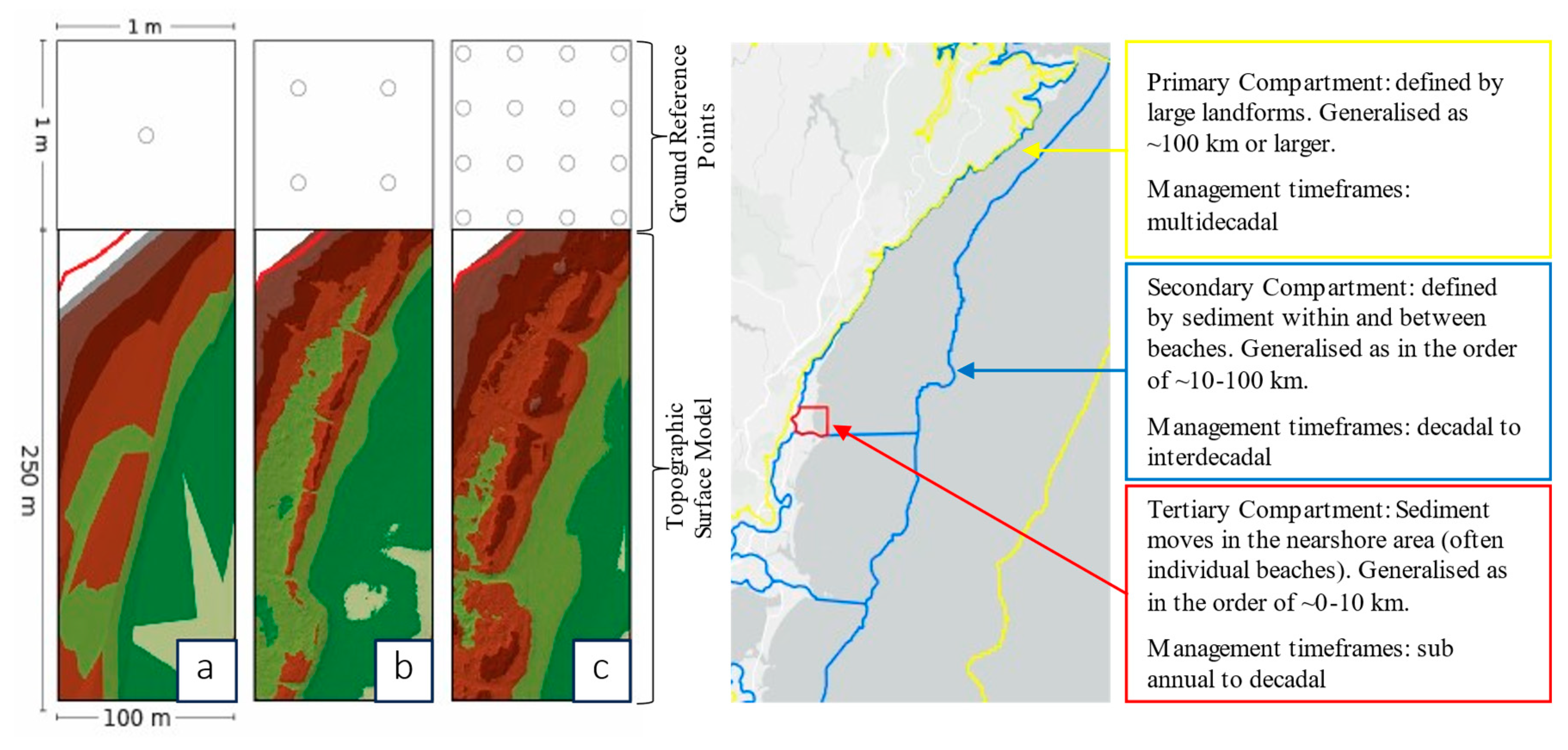
The spatial aspects of each dataset were characterised by resolution and coverage. Resolution refers to the size of the area captured by a single reference point, such as a pixel or LiDAR return point (Figure 2). The variation in spatial resolution from older photogrammetric data to emerging RPA LiDAR is demonstrated in Figure 2. Spatial coverage describes the extent or area a survey type or dataset captures (Figure 2). Spatial aspect may also include strategic sensor positioning to ensure representative data collection across diverse coastal zones, such as estuaries, foredunes, beaches, and offshore areas relevant to the study objectives. An essential factor in spatial data is determining whether vertical data is required in its native form (as with LiDAR) or derived form (as with photogrammetry). For spatial data to be reliable and robust on-ground validation should be performed, typically undertaken using ground control points with independent quantification of their spatial position, allowing for positional accuracy to be determined (Doyle & Woodroffe, 2018). The resolution and coverage for each survey type or dataset were categorised as low, moderate, or high. For spatial resolution, low is defined as >30 m/px ground sample distance (GSD) or <1 pt/m2, allowing course definition of topographic features, moderate <30>1 m/px (GSD) or <6>1 pt/m2, and high <1 m/px (GSD) or >6 pt/m2 which supports highly accurate identification of beach and foredune topography and vegetation. Spatial coverage aligns to the sediment compartment definition (Thom et al. 2018) with low being the equivalent of a tertiary compartment (or up to ~10 km), moderate is secondary (or ~10-100 km) and high is primary (or <100 km) (Figure 2).
To assess the temporal aspects of coastal monitoring data, survey frequency is used (e.g. daily, weekly, seasonal, annual, decadal survey repeats), and here within referred to as temporal resolution, while temporal coverage describes the time range spanned by a particular dataset. High temporal coverage data provides context and long-term trend analysis to improve understanding of historical or current conditions and to inform modelling future scenarios (Splinter et al., 2018). Increased temporal resolution assists in identifying seasonal variability and short-term event changes (Harley et al., 2017; McLean et al., 2023; Oliver et al., 2024). An additional temporal consideration is the synchronisation of data with respect to a coastal process or cycle. Surveys continuously conducted at a particular time of year, month or day may be skewed such as sun-synchronous Earth observation satellites unable to capture the full range of tide cycles at all locations (Bishop-Taylor et al., 2021), or the limitation of using passive or optical sensors at night.
For this study low temporal resolution is considered interannual frequency of records, moderate is annual, and high is monthly (or less). Temporal coverage is considered low for data with a range less than a decade, moderate for a decade of records, and high for multi-decadal. Additionally, other factors potentially influencing data suitability were considered such as availability and accessibility, is the data pre-processed and ‘ready for use’ with supporting literature, is it suitable for user post-processing such as investigating a specific event or trend, or a spatial or temporal range and if there are any user costs associated with accessing datasets (or surveying).

Topographic Data Capture and Analysis

Multiple datasets from aircraft mounted LiDAR surveys conducted by the NSW Government are freely and publicly accessible. Commercial grade point cloud data compliant with Intergovernmental Committee on Surveying and Mapping (ICSM) classification level 3 were accessed. Point cloud files (*.LAS) were imported into ArcGIS Pro (version 3.1) for spatial analysis. Multipoint files were created using points classified as ‘2’ ground, clipped to the area of interest for each site and used to create Triangulated Irregular Network (TIN) surfaces for geomorphic parameters to be calculated. Airborne LiDAR missions completed by the NSW Government Spatial Services report a horizontal and vertical accuracy of 0.3 m and 0.8 m (95% C.I.) respectively. The NSW Marine LiDAR Topo-Bathy 2018 survey report horizontal and vertical accuracies for the merged topographic data at 0.05 m (NSW Office of Environment & Heritage, 2019).
An RPA survey was conducted at Woonona-Bellambi Beach in June 2024. A DJI Matrice 300 RTK enabled aircraft with a Zenmuse L1 LiDAR sensor was used to capture optical imagery and LiDAR simultaneously. The aircraft was connected to the local RTK corrections service to provide centimetre-level real-time positioning with the nearest network station <4 km from the study site. Flight and data capture parameters were programmed with reference to the Matrice 300 data collection protocol TERN document (Sivanandam et al., 2022), settings and parameters are listed in Appendix 1. Ground control points were placed under the flight path and surveyed with an RTK-GNSS system to compare positional accuracy. RPA LiDAR data was pre-processed using DJI Terra software to create LAS files for use in ArcGIS. Colour imagery was processed in DJI Terra to create an orthomosaic image of the survey area for visual reference. The raw LAS point cloud yielded > 350,000,000 LiDAR returns with a density of > 800 pts m-2. The ground sample distance of 1.64 cm pixel-1 of the accompanying image data delivered considerably higher image resolution for assessment of topographical features and foredune boundaries. The raw LAS point clouds were thinned to a manageable density for use in ArcGIS Pro at a target resolution of 0.25 m for horizontal and vertical dimensions using the ‘Thin LAS’ tool. The thinned LAS files were classified using the ‘Classify LAS Ground’ tool with a ‘Standard Classification’ and applying the ‘Latest Detection Algorithm’ to identify ground returns as class ‘2’ ‘ground’. The classified ground returns were used as the input data to generate a multipoint XYZ shapefile which were subsequently used for further analysis.
Terrestrial laser scanning surveys were completed at the two study sites during late May and early June 2023 by NSW DCCEEW. An all-terrain vehicle mounted with a RIEGL VZ-1000 3D laser scanner captured 360° overlapping measurements at between 50 m and 200 m intervals along the beach. Position data of the scanner was collected at each scan location using an RTK-GNSS system. Reference point reflectors were spaced at approximately 200 m intervals along the beach with position coordinate data measured using a secondary RTK-GNSS system to validate position accuracy. The XYZ coordinate files with a 0.3 m point spacing were imported into ArcGIS Pro as multipoint shapefiles using the ‘XY Table to Point’ data management tool. The multipoint was clipped to the beach area of interest and a TIN surface created for comparison with the other data. The instrument accuracy is reported as ±8 mm (RIEGL. 2015).
Vertical data derived from photogrammetry was obtained through the NSW Beach Profile Database (Harrison et al., 2017). Error associated with photogrammetrically derived data was estimated at ±1 to 1.5 m horizontal and ±0.7 m vertically for pre-1960 photography and ±0.5 m horizontal and ±0.2 m vertical post-1960 (Evans & Hanslow, 1996). The data was filtered by ‘Survey Type’ to determine the years of photogrammetry surveys (Table 1). Multipoint XYZ coordinate files were created from the cross-shore transects and clipped to the area of interest for each embayment. The multipoint shapefiles were then used to create TIN surfaces.
Shoreline position from satellite imagery used the DEA Coastlines product version 2.0.0 accessed through the DEA Sandbox. Downloaded rates of change data used the default statistical parameters for significance p ≤ 0.01 and marked with a certainty of “good” or above therefore removing pixels with high MNDWI standard deviation or less than 5 valid satellite observations per year for more than half the entire time series (Bishop-Taylor et al., 2021; Bishop-Taylor et al., 2019). Shapefiles were downloaded for each study site and merged into a single feature to normalise the data range across the study sites for comparison of growth or retreat trends. CoastSat data are provided as cross shore transects and shorelines and were also used in this analysis (Vos et al., 2019a; Vos et al., 2019b). The data was imported for the two study sites, converted to a point (at the intersection of the cross- and alongshore lines), and the rate of change data for each transect was then added to each appropriate point.

Foredune Geomorphic Change Analysis

Foredune volume change analyses were completed using TIN surfaces derived from photogrammetric records, airborne and RPA LiDAR surveys. The analyses were conducted using the protocol developed by Doyle and Woodroffe (2018) to extract foredune geomorphic parameters including volume, height, and width for time series analysis. An area of interest (AoI) polygon feature, inclusive of elevation and distance data, was drawn in ArcGIS Pro to define the foredune extent for every TIN surface. Imagery from Nearmap and NSW Spatial Services online Historical Imagery Viewer were used as a reference for the nearest survey date in conjunction with the TIN surface to improve the accuracy of foredune boundary identification. The foredune AoI was defined at the front of the foredune by significant changes in height and slope and/or an increase in undulation and the presence of primary vegetation (i.e. grasses and succulents). The foredune area included the incipient dune (if present) as distinct from the more variable beach face. The back of the foredune was defined by the presence of a hard engineered structure (or leeward swale of the active foredune). For each year of data, the mean volume, height, and width of the total foredune AoI, as well as for the northern and southern sections of each beach, were calculated to compare and identify trends within and between sites. Foredune volume change rate (FVCR) (m3 m-1 y-1), developed by Zarnetske et al. (2015), and applied by (Doyle et al., 2019b). Doyle et al. (2019b) to Australian foredune systems, was used to determine any increase in sand volume (aggrades/progrades) (>1.5 m3 m-1 yr-1), loss in sand volume (recedes) (<1.5 m3 m-1 y-1), or maintains a similar volume (stable) (1.5 to -1.5 m3 m-1 yr-1) over time.

Results

Coastal Data – Resolution and Coverage

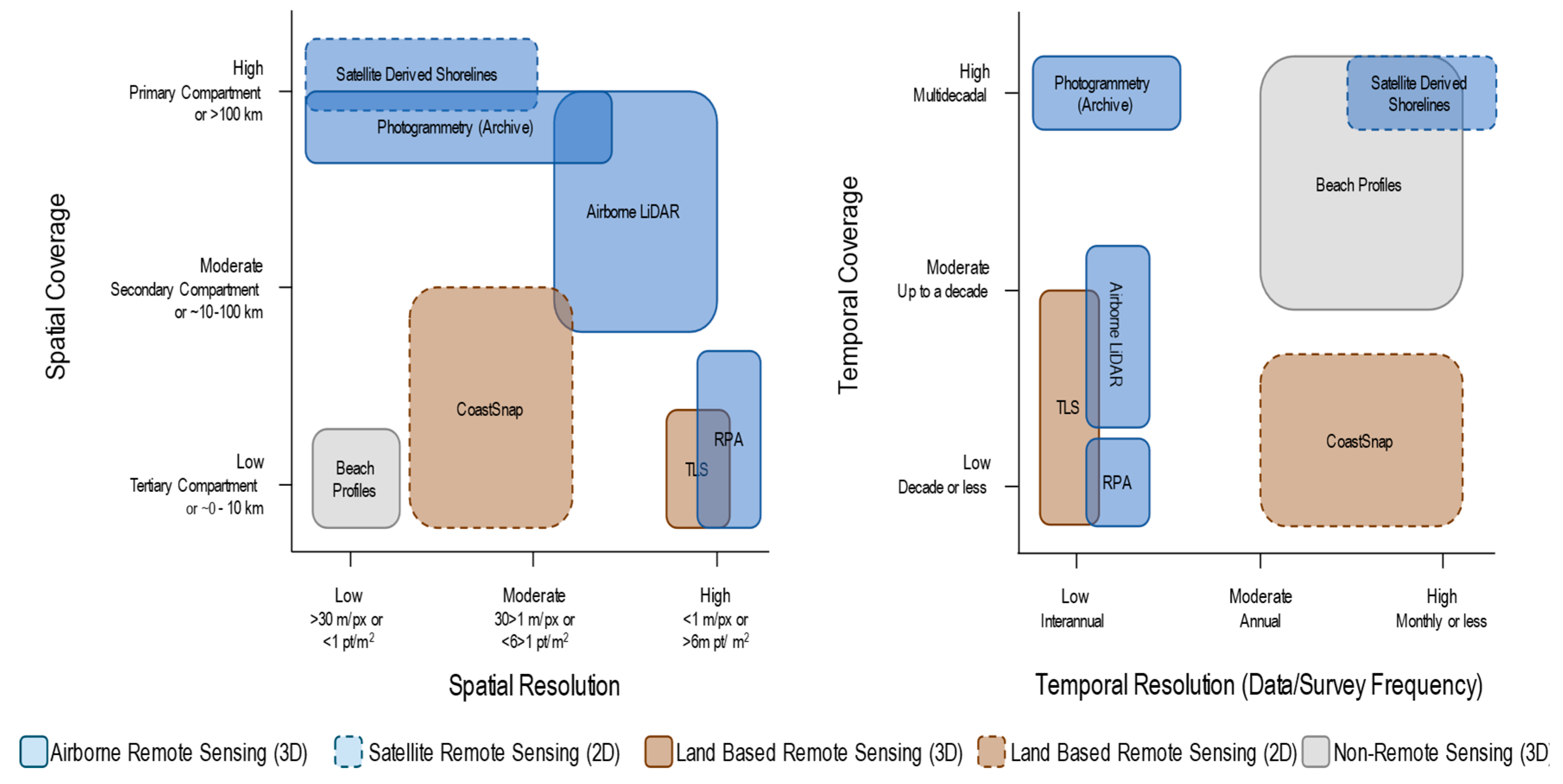
The resolution and coverage, both spatially and temporally, and for each survey type or dataset were categorised as low, moderate, or high (Table 1). Table 1 and Figure 3 lists all the coastal monitoring technology used, and output data available for each study site, as well as illustrating the results of the assessment, and key considerations for coastal managers. RPA LiDAR data provided optimal three-dimensional spatial resolution for analysis of beach and foredune morphology, but datasets are currently of limited temporal resolution and coverage (Table 1 and Figure 3). Terrestrial laser scanning delivered high spatial resolution providing fine detail three-dimensional data of the beach, the incipient and front of the foredune at a tertiary scale. Several repeat survey datasets exist for the study sites however temporal coverage and resolution is highly variable and limited compared to other datasets. Airborne LiDAR datasets featured high spatial resolution and improved from the 2011 to the 2018 survey. These datasets cover the entire NSW coastlines providing high spatial coverage with moderate temporal coverage but with few and infrequent surveys they are of low temporal resolution (Table 1 and Figure 3).
Photogrammetric data provides extensive temporal coverage and can be used for volume, width, and height analyses of foredune change over multi-decadal scales at lower spatial resolution than more recent remote sensing technologies such as LiDAR. On-ground beach surveying tends to be low spatial resolution and coverage with some datasets consisting of high temporal resolution and coverage (Table 1 and Figure 3). However, at these study sites, like most NSW beaches, records are intermittent and do not feature continuous long-term datasets. Data captured through the CoastSnap platform was categorised as having moderate spatial resolution based on smartphone camera limitations. Temporal coverage is currently low however, approximately monthly observations at Warilla are of high temporal resolution. Satellite data and derived shorelines provide extensive spatial coverage which complements site-specific high spatial resolution data that can be sporadic both spatially and temporally (Table 1 and Figure 3).

Coastal Data–Shorelines and Foredunes

Surfaces derived from photogrammetric data exhibited less complex geometry due to the limited spatial resolution available to capture subtle variations in foredune topography (as shown in Figure 3). While there was negligible improvement between earlier and more recent records, this data provided the longest temporal coverage of the study sites. All-terrain vehicle mounted terrestrial laser scanning delivered high spatial resolution data enabling accurate assessment of beach face topography, volume, and width. The foredune extended above the height of the scanner at many areas of the study sites resulting in the capture of a portion of the foredune and not allowing for complete volume calculations. Aircraft-mounted LiDAR missions provided a significant increase in spatial resolution, enabling the production of higher-definition topographic surfaces and separation of the ground from vegetation (Figure 2). The 2018 NSW Government airborne LiDAR point cloud density was approximately 6 pts/m2 and 4 pts/m2 when filtered for ground only points. The RPA captured LiDAR at Woonona-Bellambi had an average point cloud density of ground points of 12 pts/m2 once processed (Figure 2). The thinned point cloud data and RGB orthomosaic from the RPA surveys provided the highest spatial resolution at an average point spacing of 0.25 m. The classification of the point clouds allowed for the differentiations of ground returns from vegetation, resulting in greater surface accuracy.

Woonona-Bellambi Beach

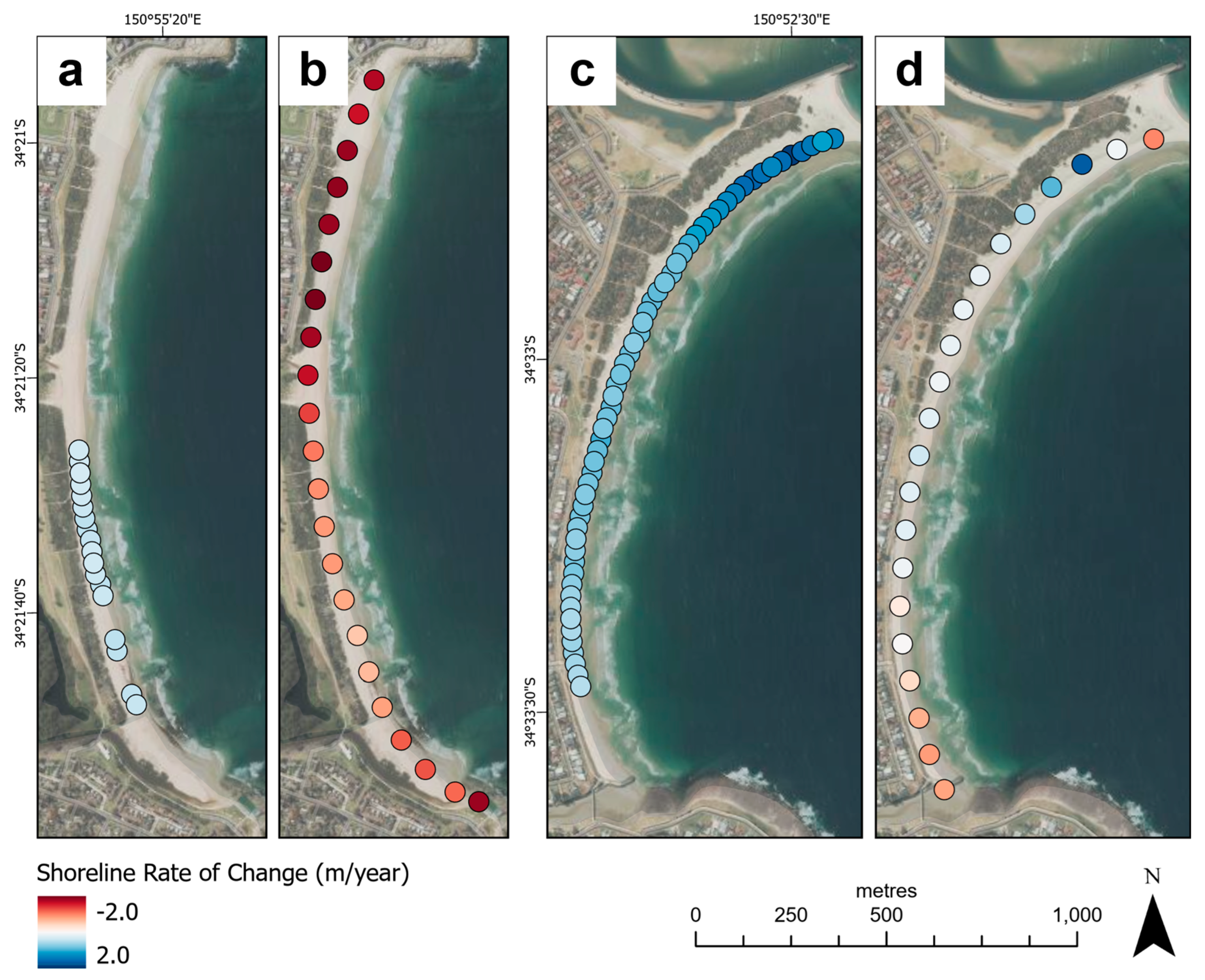
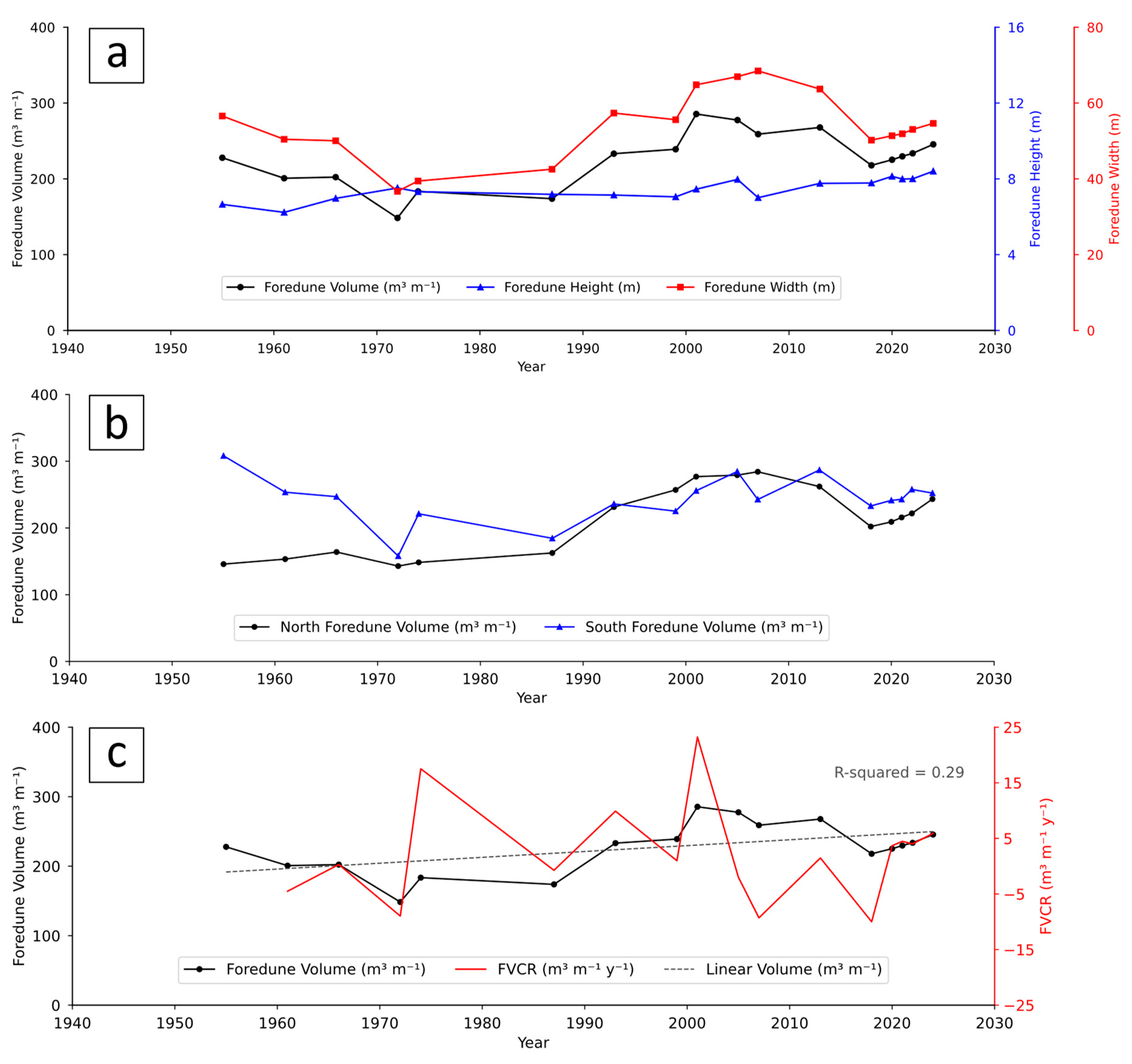
For the range of data available at Woonona-Bellambi Beach, 1956 to 2024, foredune volume, height and width remained relatively stable with episodic storm cut and recovery (Figure 4). Comparatively, rapid accretion occurred between 1987 and 2013 (170 m3 m-1 to 270 m3 m-1), followed by a period of recession which featured a 50 m3 m-1 reduction in dune volume between 2013 and 2018 (Figure 4a). Until the mid-1980s the volume of the southern foredune decreased whereas the northern end remained relatively stable. From this time both ends follow a similar trend aside from a volume decrease at the southern end in 2007 (Figure 4b). Overall, the mean volume of the foredune at Woonona-Bellambi was 220 (±10) m3 m-1 with the linear trend suggesting gradual progradation. This is consistent with the overall volume increase of 17 m3 m-1 over the period (Figure 4c). The foredune volume change rate (FVCR) demonstrates foredune variability over annual, interannual, and decadal scales. The FVCR over the analysis period of 1956 to 2024 was 2 m3 m-1 y-1, which is categorised here as a stable to prograding system (Figure 4c). At Woonona-Bellambi Beach, DEA Coastlines shoreline rates of change for the northern half of the beach has remained stable with minor progradation at the southern end (Figure 6a). In contrast, CoastSat rates of change for the same period exhibited the embayment receding and at greater rates towards the northern half (Figure 6).

Warilla Beach

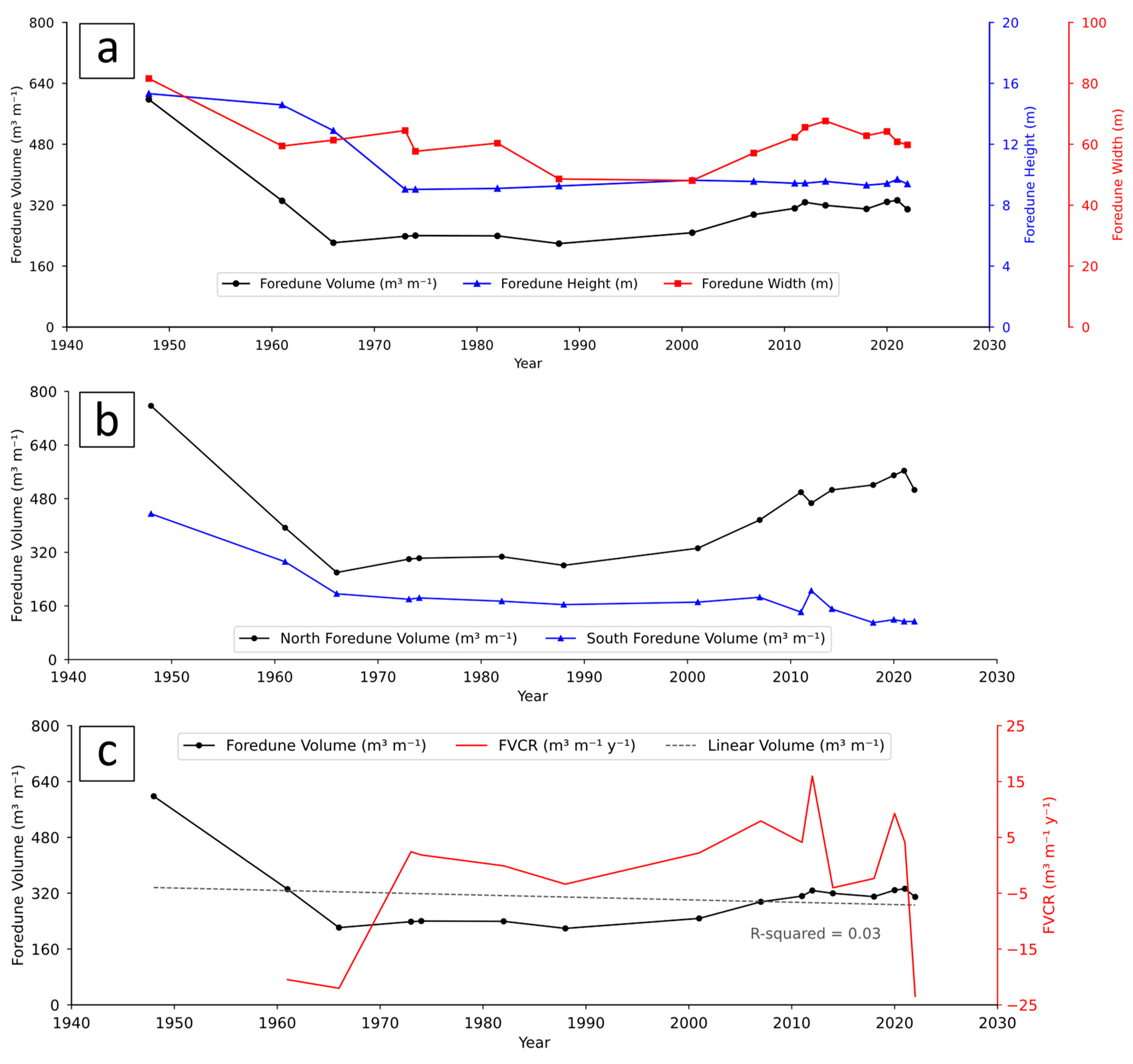
Warilla Beach featured distinct periods of foredune recession, stability, and progradation between 1948 to 2023. Until the mid to late-1960’s the foredune volume was substantially reduced in both height and width compared to earlier records. A period of stability occurred from the mid-1970’s to 2000. From 2000, foredune height remained stable as volume and width increased gradually (Figure 5a). The foredune volume at the northern end decreased from an average of 750 m3 m-1 in 1948 to 260 m3 m-1 in 1966. Limited recovery of the northern foredune is evident until 2001 (Figure 5b). The southern foredune volume was also considerably reduced from 430 m3 m-1 in 1948 to 190 m3 m-1 by 1966 and has remained in a slow decline to 110 m3 m-1 in 2023 (Figure 5b). From the early 2000s to 2022 the northern foredune accreted while the south is close to stable with slight erosion (Figure 5b). The mean foredune volume was 300 (±20) m3 m-1 and the linear trend shows slight recession (Figure 5c). The linear trend is reflected by a foredune volume decrease of 280 m3 m-1 (from 600 m3 m-1 to 300 m3 m-1) over the period of records and an average FVCR of -2 m3 m-1 y-1 indicating stable to receding system (Figure 5c). At Warilla the satellite-derived shoreline datasets were more closely aligned (see Figure 6c,d) showing shoreline progradation along the northern section of the beach becoming stable to slightly receding in the south.
Figure 5. Foredune geomorphic parameters for the temporal range of available survey data for Warilla Beach (a) total AoI, (b) north and south foredune comparison, and (c) total AoI volume, FVCR, and volume linear trend.
Preprints 151813 g005
Figure 6. Shoreline rates of change derived from DEA Coastlines and CoastSat satellite derived data for (a) DEA Coastlines (b) CoastSat for Woonona-Bellambi Beach, and (c) DEA Coastlines (d) CoastSat for Warilla Beach. DEA Coastlines areas with no marker indicates no significant change. Basemap source: NSW Government Spatial Services.
Preprints 151813 g006

Discussion

The coastal monitoring technologies and datasets assessed in this study all have a benefit to coastal science and management, and none are redundant. The spatial and temporal aspects of each dataset means some methods are better suited for capturing different processes and describing long-term trends verses single event impacts. Some datasets provide exceptionally useful data for identifying and comparing past change with more recent data that continues to improve with technology. Additionally, factors such as accessibility, expertise, time, and cost will often substantiate the use of one method or dataset over another. This highlights the need to use the most appropriate monitoring technology or dataset, or combination of several, tailored for the purpose of the research or the information required to inform decision making and coastal management actions.

Coastal Data–Shorelines and Foredunes

Coastal monitoring data applied specifically to beach and foredune morphology within the Illawarra has identified some interesting results, including the contrast between satellite- derived shoreline rates and observed foredune changes. For example, the satellite-derived shoreline rates of change between the similarly aligned Woonona-Bellambi and Warilla Beaches in which a stable to receding trend is observed at the northern end of the former and accretion at the latter, demonstrates impacts associated with both human modification and management, as well as storms. The variation between the two different satellite derived shoreline change rates, especially at the southern end of Woonona Beach reflects the complex nature of these systems. Overall, these satellite-derived rates of shoreline change-rates reveal relative stability in response to sea-level rise and corresponds to findings that the majority of Australian beaches have remained stable over the past 30 years (Short, 2022).
Foredune volume also exhibited some variation, both between sites, and within each embayment. Warilla Beach for example, despite having substantially less foredune volumes (when compared to past conditions), may be in a state of recovery (e.g. from storm impacts or sand mining), rather than exhibiting a sediment budget deficit (Doyle et al., 2019a). The northern foredune volume has slowly recovered over the past 80 years, while the southern foredune has steadily reduced in volume. Alongshore variation of larger foredune volumes related to greater exposure to wind and wave energy (Doyle et al., 2024) is also observed at Warilla. Woonona Beach on the other hand, has had less variation alongshore, but the entire dune seems to have oscillated with storm erosion and slow recovery over time. A considerable foredune volume reduction is evident at the northern and southern end of Woonona-Bellambi Beach following major storms in 2016 suggesting the impacts were compounded by modification works and the effects of foredune interventions or modifications (Gangaiya et al., 2017) are masked by the impacts of large storm events (Harley et al., 2017). Additionally, the only potential indication of the impact of the same storms at Warilla is evident along the southern foredune, which was potentially protected from greater erosion by the hard rock revetment and Windang Island interrupting storm waves arriving from the north-east, demonstrating the spatially variable impacts and responses of beaches to complex drivers.
Variation in morphology of the wider littoral zone, including the shoreline behaviour and foredunes, was evident between datasets. This is especially the case at Woonona where there seems to be relative stability in the dunes, with the satellite-derived shorelines showing the beach is eroding/slowly accreting. This is not consistent with the conceptual model proposed by Psuty (1988) which proposes foredune development is controlled by the beach (nearshore) sediment budget relative to the foredune sediment budget, suggesting more complex interactions are occurring and more research is required to confirm key driving processes. The results more closely reflect Hesp (2002) generalised model which considers the effects of erosional storm events, recovery accretional pathways, as well as the broader trend of a coastline i.e., short term influences and the larger scale erosional or depositional context of the nearshore seabed. At Woonona-Bellambi and Warilla Beaches, foredune evolution appears to transition, at varying magnitudes, between progradation, growth, translation, and decline (Bauer et al., 2025). Future assessments using recent foredune change profile methodologies would improve the definition of these evolutionary patterns. Variations between the northern and southern section further highlight the spatial variability in foredune profiles and evolutionary trajectories.

Coastal Data–Resolution and Coverage

Aerial imagery and photogrammetry records offer a valuable archive of historic changes, providing a long-term perspective of the responses of foredunes and the subaerial beach to significant erosional event and human modification. Photogrammetric data further develops our understanding of longer-term processes and impacts with the addition of three-dimensional data. For example, dune and shoreline changes associated with coastal infrastructure (i.e., estuary training walls at Warilla or Brunswick Heads Beach) (Doyle et al., 2019a; Doyle et al., 2019b). Monitored changes in response to foredune vegetation expansion and subsequent intervention at Woonona-Bellambi Beach, as well the influence of storm events between and within embayments was enhanced using this dataset. The ability to incorporate photogrammetry data with modern high-resolution data for coastal change assessment is highly valuable (Doyle et al., 2019b). Furthermore, the potential for improved accuracy and greater accessibility to data with new photogrammetry techniques, such as Structure from Motion approaches (Carvalho et al., 2021) further increases its future value for coastal monitoring.
All the assessed LiDAR data consisted of superior spatial resolution compared to photogrammetry and satellite data. Terrestrial laser scanning delivered high-spatial resolution; however, spatial coverage was restricted compared to airborne survey techniques due to the height of the scanner relative to the surrounding topography. Large-scale aircraft mounted LiDAR surveys provide baseline data for ongoing comparison and use in hazard studies and modelling (Kinsela et al., 2022). The high spatial resolution three-dimensional data delivers accurate surface models further enhanced by the categorisation of ground points with the ability to penetrate vegetation. The spatial coverage of airborne LiDAR is substantial, with multiple surveys previously completed for the entire NSW coastline and has been applied to understanding more regional scale processes and patterns (Doyle et al., 2024; Doyle & Woodroffe, 2023; Harley et al., 2017). RPA derived LiDAR and RGB image data delivered extremely high spatial resolution of the beach and foredune region with efficiency. The rapid deployment capability and reduced resource demanding RPAs compared to other remote sensing options allows for immediate evaluation of impacts from episodic events including storms and management interventions. This extremely high spatial resolution data of the entire beach and foredune region improves understanding coastal processes, and sediment dynamics within a beach or compartment providing data that directly enhances hazard mitigation (McCarroll et al., 2024).
Satellite derived data require considerable time, labour, and financial resources to develop; however, the data coupled with appropriate analytical techniques provide efficiency and flexibility for end-users. Advanced analysis, processing, and correction techniques such as sub-pixel processing and tidal correction improve the spatial resolution, accuracy and reduce error in determining the waterline to map shoreline position (Bishop-Taylor et al., 2021; Vos et al., 2019a). The datasets allow investigation of cyclic changes including beach width, rotation, and shoreline response to El Nino Southern Oscillation (Vos et al., 2023), nourishment campaigns and the installation of infrastructure such as groins and training walls, and shoreline change trend over a time series (Bishop-Taylor et al., 2021).
Leveraging multiple datasets increases the spatial and temporal scales and supports improved understanding of the dominant processes influencing a coastal location. Additionally, future studies using new sensors and surveying technologies to capture and quantify nearshore sediment change will further assist in developing and reconciling closing sediment budgets at an embayment and compartment scale. The continuous recording of beach profile data since the 1970s at Narrabeen-Collaroy Beach (Turner et al., 2016b) and Bengello Beach (McLean et al., 2023) will continue to be a valuable resource for coastal research to identify and monitor responses from short-term events (Oliver et al., 2024) to multi-decadal forcings (McLean et al., 2023). These types of datasets have assisted researchers to identify and understand processes and drivers of shoreline variation over a range of temporal scales. Additionally, they have provided valuable real-world data, used in developing, calibrating, and validating shoreline models (Chataigner et al., 2022; Splinter et al., 2018). However, for the remainder of NSW beaches, alternative monitoring datasets are required to build a more holistic understanding of the local influences of coastal processes and potential change.
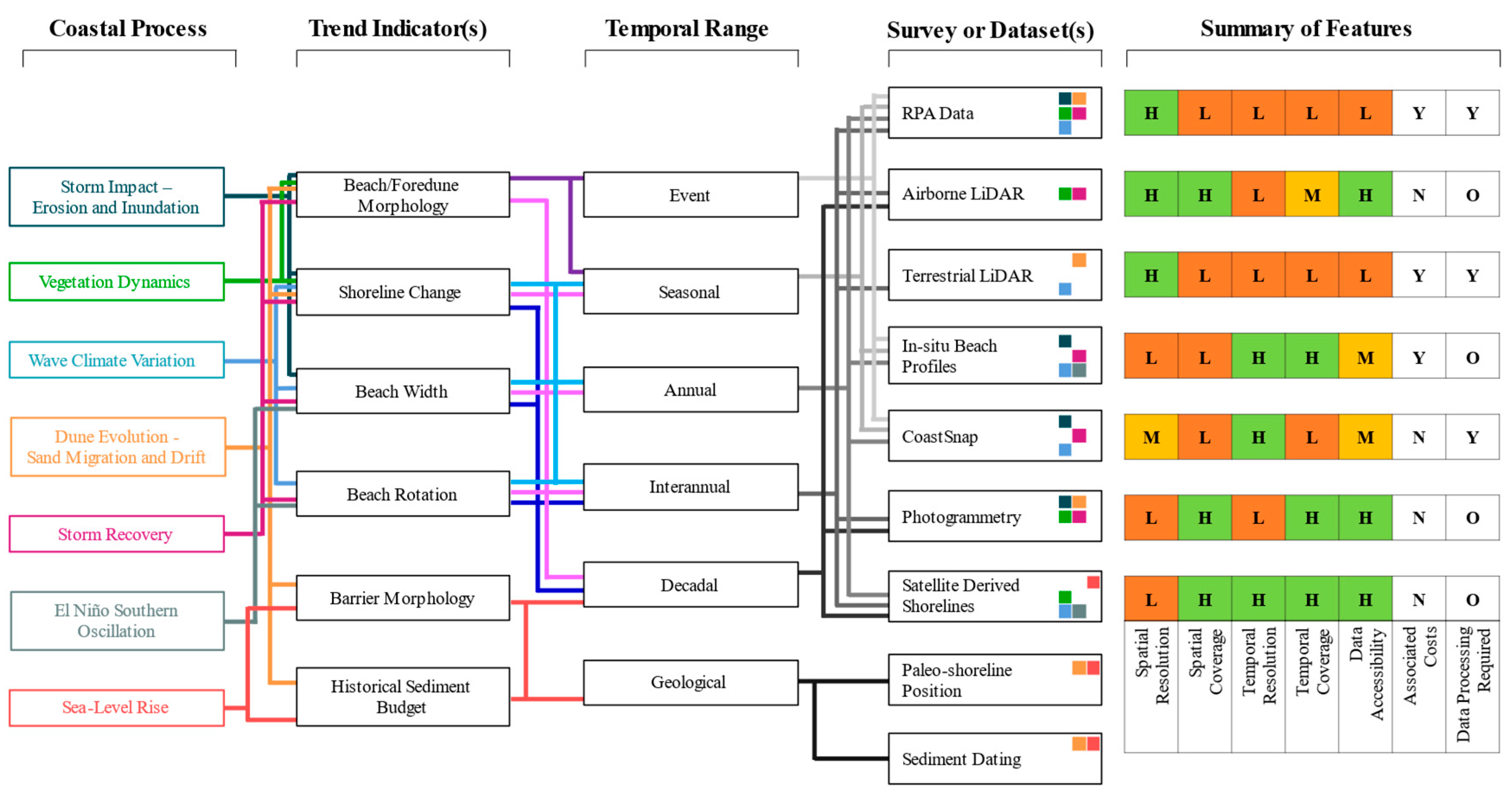
A framework has been developed to support the optimal use of monitoring data for the spatial temporal scales most relevant to key coastal processes/hazards and associated indicators. The recommended application of the framework is presented in Figure 7. Key coastal processes/hazards for the study region were defined with suggested trend indicators and temporal range options to determine the recommended datasets for monitoring coastal change. As an example, storms indicated by changes in beach and/or foredune morphology occur over multiple temporal scales. At the event scale, changes are likely best detected using moderate to high spatial resolution data but do not require considerable spatial coverage. Therefore, data from an in-situ beach profile survey, RPA LiDAR survey or CoastSnap could potentially capture short-term changes. Over decadal scales, photogrammetry and airborne LiDAR data has a greater temporal range to assess longer term change and over a larger spatial area. Alternatively, potential changes associated with the El Niño Southern Oscillation, such as beach width and rotation, occur over interannual to decadal periods and may be monitored using a lower spatial resolution but high frequency dataset such as the satellite derived DEA Coastlines and CoastSat. Each option features accessibility, data processing and cost considerations that will influence the selection of a method or dataset. Moreover, depending on the use of the data (i.e., hazard and risk assessment, coastal management program development or stakeholder communication) different datasets may be more suited and appropriate. As is also evident in the proposed framework, processes occur over multiple temporal and spatial ranges, thus the use of multiple datasets is recommended where available. The framework emphasises the importance of integrating complimentary monitoring technologies and datasets to improve the temporal and spatial relevance of projections that inform coastal management.
Navigating the range of sensors, derivative datasets and products and the variation in their temporal frequency and spatial resolution is complex. Often those tasked with decisions regarding coastal monitoring needs are not well-placed to determine the best way forward or well-resourced to seek advice or conduct the monitoring (e.g., often 1-2 people in local government). Different monitoring approaches were assessed to determine their suitability for capturing trends in beach and foredune morphology and the impact of cyclic changes (ENSO) or episodic events (storms), with the intention of developing a framework to guide decision makers regarding suitable data. This analysis established that products derived from older technology (e.g., photogrammetry and historical aerial photography) remain useful because of their capacity to archive information from the 1940s. Hence, beach profiles derived from on-ground surveys and photogrammetry will remain an important component of coastal monitoring programs, particularly as they provide information needed to develop models that project shoreline behaviour. Recently developed products derived from active sensors, whether on small vehicles (all-terrain vehicle or RPA) or airborne or satellite-derived will become increasingly important due to their enhanced capacity to describe coastal morphology and hazards at a range of spatial and temporal scales relevant for planning and decision making. The benefits of these new technologies and advances in machine learning application to passive imagery and active surveying will mean that more products will become available; assessment of their utility should become a key consideration when developing coastal hazard assessments and management plans.

Appendix

Appendix 1: Flight and sensor parameters for DJI M300 and L1 LiDAR sensor for 2024 surveys.

RPA: DJI Matrice M300 with DJI L1 Zenmuse LiDAR sensor with EP800 camera
Flight Date: Tuesday 28 May 2024
Flight and Sensor Details
Average altitude (m) 60
Area flown (km2) 0.3
Independent GCPs 17
Side Overlap (LiDAR) (%) 50
Return Mode (LiDAR) Triple
Sampling Rate (LiDAR) (KHz) 160
Point Cloud Density (pts/m2) 327
Ortho Ground Sample Distance (GSD) (cm/px) 1.64
Image Bands Red (0.64-0.67µm)
Green (0.53-0.59µm)
Blue (0.45-0.51µm)
RTK Corrections Yes – NSW CORSNet via NTRIP
Processing Parameters
DJI Terra Software Version 3.7.6
Cloud point density High (100%)
Optimize Point Cloud Accuracy Yes
Smooth Point Cloud Yes
Projected Coordinate System (EPSG) 7844
Returns 3
Output Files PNTS file
LAS file

References

  1. Asbridge, E., Clark, R., Denham, P., Hughes, M. G., James, M., McLaughlin, D., Turner, C., Whitton, T., Wilde, T., & Rogers, K. (2024). Tidal Impoundment and Mangrove Dieback at Cabbage Tree Basin, NSW: Drivers of Change and Tailored Management for the Future. Estuaries and Coasts, 47(8), 2190-2208. [CrossRef]
  2. Banno, M., Nakamura, S., Kosako, T., Nakagawa, Y., Yanagishima, S.-i., & Kuriyama, Y. (2020). Long-Term Observations of Beach Variability at Hasaki, Japan. Journal of Marine Science and Engineering, 8(11). [CrossRef]
  3. Bauer, B. O., Ollerhead, J., Delgado-Fernandez, I., & Davidson-Arnott, R. G. D. (2025). Analyzing topographic change profiles in coastal foredune systems: Methodological recommendations. Geomorphology, 472, 109610. [CrossRef]
  4. Bertin, S., Floc’h, F., Le Dantec, N., Jaud, M., Cancouët, R., Franzetti, M., Cuq, V., Prunier, C., Ammann, J., Augereau, E., Lamarche, S., Belleney, D., Rouan, M., David, L., Deschamps, A., Delacourt, C., & Suanez, S. (2022). A long-term dataset of topography and nearshore bathymetry at the macrotidal pocket beach of Porsmilin, France. Scientific Data, 9(1), 79. [CrossRef]
  5. Bishop-Taylor, R., Nanson, R., Sagar, S., & Lymburner, L. (2021). Mapping Australia's dynamic coastline at mean sea level using three decades of Landsat imagery. Remote Sensing of Environment, 267. [CrossRef]
  6. Bishop-Taylor, R., Sagar, S., Lymburner, L., & Beaman, R. J. (2019). Between the tides: Modelling the elevation of Australia's exposed intertidal zone at continental scale. Estuarine, Coastal and Shelf Science, 223, 115-128. [CrossRef]
  7. Carvalho, R. C., Allan, B., Kennedy, D. M., Leach, C., O'Brien, S., & Ierodiaconou, D. (2021). Quantifying decadal volumetric changes along sandy beaches using improved historical aerial photographic models and contemporary data. Earth surface processes and landforms, 46(10), 1882-1897. [CrossRef]
  8. Carvalho, R. C., & Woodroffe, C. D. (2023). Coastal compartments: the role of sediment supply and morphodynamics in a beach management context. Journal of Coastal Conservation, 27(6). [CrossRef]
  9. Chataigner, T., Yates, M. L., Le Dantec, N., Harley, M. D., Splinter, K. D., & Goutal, N. (2022). Sensitivity of a one-line longshore shoreline change model to the mean wave direction. Coastal Engineering, 172, 104025. [CrossRef]
  10. Clarke, D. J., & Eliot, I. G. (1988). Low-frequency changes of sediment volume on the beachface at Warilla Beach, New South Wales, 1975–1985. Marine Geology, 79(3), 189-211. [CrossRef]
  11. Cohn, N., Brodie, K., Conery, I., & Spore, N. (2022). Alongshore Variable Accretional and Erosional Coastal Foredune Dynamics at Event to Interannual Timescales. Earth and Space Science, 9(12). [CrossRef]
  12. Cooper, J. A. G., Masselink, G., Coco, G., Short, A. D., Castelle, B., Rogers, K., Anthony, E., Green, A. N., Kelley, J. T., Pilkey, O. H., & Jackson, D. W. T. (2020). Sandy beaches can survive sea-level rise. Nature Climate Change, 10(11), 993-995. [CrossRef]
  13. Cooper, J. A. G., & Pilkey, O. H. (2004). Sea-level rise and shoreline retreat: time to abandon the Bruun Rule. Global and Planetary Change, 43(3), 157-171. [CrossRef]
  14. Davidson-Arnott, R., Ollerhead, J., George, E., Houser, C., Bauer, B., Hesp, P., Walker, I., Delagado-Fernandez, I., & Van Proosdij, D. (2024). Assessing the impact of hurricane Fiona on the coast of PEI National Park and implications for the effectiveness of beach-dune management policies. Journal of Coastal Conservation, 28(3). [CrossRef]
  15. Davidson-Arnott, R., Hesp, P., Ollerhead, J., Walker, I., Bauer, B., Delgado-Fernandez, I., & Smyth, T. (2018). Sediment budget controls on foredune height: Comparing simulation model results with field data. Earth Surface Processes and Landforms, 43(9), 1798-1810. [CrossRef]
  16. Doyle, T. B., Hesp, P. A., & Woodroffe, C. D. (2024). Foredune morphology: Regional patterns and surfzone–beach–dune interactions along the New South Wales coast, Australia. Earth Surface Processes and Landforms, 49(10), 3115-3138. [CrossRef]
  17. Doyle, T. B., Short, A., & Woodroffe, C. D. (2019a). Foredune evolution in eastern Australia: A management case study on Warilla Beach Coastal Sediments 2019.
  18. Doyle, T. B., Short, A. D., Ruggiero, P., & Woodroffe, C. D. (2019b). Interdecadal Foredune Changes along the Southeast Australian Coastline: 1942–2014. Journal of Marine Science and Engineering, 7(6), 177. https://www.mdpi.com/2077-1312/7/6/177.
  19. Doyle, T. B., & Woodroffe, C. D. (2018). The application of LiDAR to investigate foredune morphology and vegetation. Geomorphology, 303, 106-121. [CrossRef]
  20. Doyle, T. B., & Woodroffe, C. D. (2023). Modified foredune eco-morphology in southeast Australia. Ocean & Coastal Management, 240, 106640. [CrossRef]
  21. Eliot, I. G., & Clarke, D. J. (1982). Seasonal and biennial fluctuation in subaerial beach sediment volume on Warilla Beach, New South Wales. Marine Geology, 48(1), 89-103. [CrossRef]
  22. Evans, P., & Hanslow, D. J. (1996). Take a Long Line -Risk and Reality in Coastal Hazard Assessment 6th NSW Coastal Conference, Ulladulla, Australia.
  23. Fellowes, T. E., Vila-Concejo, A., Gallop, S. L., Schosberg, R., de Staercke, V., & Largier, J. L. (2021). Decadal shoreline erosion and recovery of beaches in modified and natural estuaries. Geomorphology, 390, 107884. [CrossRef]
  24. Gangaiya, P., Beardsmore, A., & Miskiewicz, T. (2017). Morphological changes following vegetation removal and foredune re-profiling at Woonona Beach, New South Wales, Australia. Ocean & Coastal Management, 146, 15-25. [CrossRef]
  25. Hague, B. S., Jakob, D., Kirezci, E., Jones, D. A., Cherny, I. L., & Stephens, S. A. (2024). Future frequencies of coastal floods in Australia: a seamless approach and dataset for visualising local impacts and informing adaptation. Journal of Southern Hemisphere Earth Systems Science, 74(3). [CrossRef]
  26. Hanslow, D. J. (2007). Beach Erosion Trend Measurement: A Comparison of Trend Indicators. Journal of Coastal Research, 588-593. http://www.jstor.org/stable/26481655.
  27. Hanslow, D. J., Morris, B. D., Foulsham, E., & Kinsela, M. A. (2018). A Regional Scale Approach to Assessing Current and Potential Future Exposure to Tidal Inundation in Different Types of Estuaries. Scientific Reports, 8(1). [CrossRef]
  28. Harley, M. D., & Kinsela, M. A. (2022). CoastSnap: A global citizen science program to monitor changing coastlines. Continental Shelf Research, 245, 104796. [CrossRef]
  29. Harley, M. D., Turner, I. L., Kinsela, M. A., Middleton, J. H., Mumford, P. J., Splinter, K. D., Phillips, M. S., Simmons, J. A., Hanslow, D. J., & Short, A. D. (2017). Extreme coastal erosion enhanced by anomalous extratropical storm wave direction. Scientific Reports, 7(1), 6033. [CrossRef]
  30. Harley, M. D., Turner, I. L., Short, A. D., & Ranasinghe, R. (2011). Assessment and integration of conventional, RTK-GPS and image-derived beach survey methods for daily to decadal coastal monitoring. Coastal Engineering, 58(2), 194-205. [CrossRef]
  31. Harrison, A. J., Miller, B. M., Carley, J. T., Turner, I. L., Clout, R., & Coates, B. (2017). NSW beach photogrammetry: A new online database and toolbox Australasian Coasts & Ports 2017: Working with Nature, Barton, ACT.
  32. Hesp, P. (2002). Foredunes and blowouts: initiation, geomorphology and dynamics. Geomorphology, 48(1), 245-268. [CrossRef]
  33. Hesp, P. A. (2013). A 34 year record of foredune evolution, Dark Point, NSW, Australia. Journal of Coastal Research, 65(sp2), 1295-1300, 1296. [CrossRef]
  34. Hesp, P. A. (2025). The role of climate in determining foredune types and modes. Coastal Engineering Journal, 67(1), 3-11. [CrossRef]
  35. Hesp, P. A., Hernández-Calvento, L., Gallego-Fernández, J. B., Miot da Silva, G., Hernández-Cordero, A. I., Ruz, M.-H., & Romero, L. G. (2021). Nebkha or not? -Climate control on foredune mode. Journal of Arid Environments, 187, 104444. [CrossRef]
  36. Ierodiaconou, D., Kennedy, D. M., Pucino, N., Allan, B. M., McCarroll, R. J., Ferns, L. W., Carvalho, R. C., Sorrell, K., Leach, C., & Young, M. (2022). Citizen science unoccupied aerial vehicles: A technique for advancing coastal data acquisition for management and research. Continental Shelf Research, 244, 104800. [CrossRef]
  37. Jarmalavičius, D., Pupienis, D., Žilinskas, G., Janušaitė, R., & Karaliūnas, V. (2020). Beach-Foredune Sediment Budget Response to Sea Level Fluctuation. Curonian Spit, Lithuania. Water, 12(2), 583. [CrossRef]
  38. Joyce, K. E., Fickas, K. C., & Kalamandeen, M. (2023). The unique value proposition for using drones to map coastal ecosystems. Cambridge Prisms: Coastal Futures, 1, 1-26. [CrossRef]
  39. Kinsela, M., Morris, B., Linklater, M., & Hanslow, D. (2017). Second-Pass Assessment of Potential Exposure to Shoreline Change in New South Wales, Australia, Using a Sediment Compartments Framework. Journal of Marine Science and Engineering, 5(4), 61. [CrossRef]
  40. Kinsela, M. A., Hanslow, D. J., Carvalho, R. C., Linklater, M., Ingleton, T. C., Morris, B. D., Allen, K. M., Sutherland, M. D., & Woodroffe, C. D. (2022). Mapping the Shoreface of Coastal Sediment Compartments to Improve Shoreline Change Forecasts in New South Wales, Australia. Estuaries and Coasts, 45(4), 1143-1169. [CrossRef]
  41. Kinsela, M. A., Morris, B. D., Ingleton, T. C., Doyle, T. B., Sutherland, M. D., Doszpot, N. E., Miller, J. J., Holtznagel, S. F., Harley, M. D., & Hanslow, D. J. (2024). Nearshore wave buoy data from southeastern Australia for coastal research and management. Scientific Data, 11(1), 190. [CrossRef]
  42. Kroon, A., Larson, M., Möller, I., Yokoki, H., Rozynski, G., Cox, J., & Larroude, P. (2008). Statistical analysis of coastal morphological data sets over seasonal to decadal time scales. Coastal Engineering, 55(7), 581-600. [CrossRef]
  43. Lacey, E. M., & Peck, J. A. (1998). Long-Term Beach Profile Variations along the South Shore of Rhode Island, U.S.A. Journal of coastal research, 14(4), 1255-1264.
  44. Lin, Y.-C., Cheng, Y.-T., Zhou, T., Ravi, R., Hasheminasab, S., Flatt, J., Troy, C., & Habib, A. (2019). Evaluation of UAV LiDAR for Mapping Coastal Environments. Remote Sensing, 11(24), 2893. [CrossRef]
  45. Liu, J., Meucci, A., Liu, Q., Babanin, A. V., Ierodiaconou, D., Xu, X., & Young, I. R. (2023). A high-resolution wave energy assessment of south-east Australia based on a 40-year hindcast. Renewable Energy, 215, 118943. [CrossRef]
  46. Lobeto, H., Semedo, A., Lemos, G., Dastgheib, A., Menendez, M., Ranasinghe, R., & Bidlot, J.-R. (2024). Global coastal wave storminess. Scientific Reports, 14(1), 3726. [CrossRef]
  47. Ludka, B. C., Guza, R. T., O’Reilly, W. C., Merrifield, M. A., Flick, R. E., Bak, A. S., Hesser, T., Bucciarelli, R., Olfe, C., Woodward, B., Boyd, W., Smith, K., Okihiro, M., Grenzeback, R., Parry, L., & Boyd, G. (2019). Sixteen years of bathymetry and waves at San Diego beaches. Scientific Data, 6(1). [CrossRef]
  48. McCarroll, R. J., Kennedy, D. M., Liu, J., Allan, B., & Ierodiaconou, D. (2024). Design and application of coastal erosion indicators using satellite and drone data for a regional monitoring program. Ocean & Coastal Management, 253, 107146. [CrossRef]
  49. McLean, R., Thom, B., Shen, J., & Oliver, T. (2023). 50 years of beach–foredune change on the southeastern coast of Australia: Bengello Beach, Moruya, NSW, 1972–2022. Geomorphology, 439, 108850. [CrossRef]
  50. Mentaschi, L., Vousdoukas, M. I., Pekel, J.-F., Voukouvalas, E., & Feyen, L. (2018). Global long-term observations of coastal erosion and accretion. Scientific Reports, 8(1). [CrossRef]
  51. Mentaschi, L., Vousdoukas, M. I., Voukouvalas, E., Dosio, A., & Feyen, L. (2017). Global changes of extreme coastal wave energy fluxes triggered by intensified teleconnection patterns. Geophysical Research Letters, 44(5), 2416-2426. [CrossRef]
  52. Moore, L. J. (2000). Shoreline Mapping Techniques. Journal of Coastal Research, 16(1), 111-124. http://www.jstor.org/stable/4300016.
  53. Moore, L. J., Ruggiero, P., & List, J. H. (2006). Comparing Mean High Water and High Water Line Shorelines: Should Proxy-Datum Offsets be Incorporated into Shoreline Change Analysis? Journal of Coastal Research, 2006(224), 894-905, 812. [CrossRef]
  54. Morris, B. D., Foulsham, E., Laine, R., Wiecek, D., & Hanslow, D. (2016). Evaluation of Runup Characteristics on the NSW Coast. Journal of Coastal Research, 75(sp1), 1187-1191. [CrossRef]
  55. NSW Office of Environment & Heritage. (2019). Report of Survey NSW Marine LiDAR Project. Sydney, Australia. Prepared by FUGRO for NSW Government.
  56. NSW Public Works Department. (1989). Coastline hazard program - beach improvement projects. Annual report 1988/89. Sydney, Australia. NSW Government.
  57. O'Reilly, W. C., Olfe, C. B., Thomas, J., Seymour, R. J., & Guza, R. T. (2016). The California coastal wave monitoring and prediction system. Coastal Engineering, 116, 118-132. [CrossRef]
  58. Oliver, T. S. N., Kinsela, M. A., Doyle, T. B., & McLean, R. F. (2024). Foredune erosion, overtopping and destruction in 2022 at Bengello Beach, southeastern Australia. Cambridge Prisms: Coastal Futures, 2, 1-20. [CrossRef]
  59. Owers, C. J., Rogers, K., & Woodroffe, C. D. (2018). Terrestrial laser scanning to quantify above-ground biomass of structurally complex coastal wetland vegetation. Estuarine, Coastal and Shelf Science, 204, 164-176. [CrossRef]
  60. Phillips, M. S., Harley, M. D., Turner, I. L., Splinter, K. D., & Cox, R. J. (2017). Shoreline recovery on wave-dominated sandy coastlines: the role of sandbar morphodynamics and nearshore wave parameters. Marine Geology, 385, 146-159. [CrossRef]
  61. Psuty, N. P. (1988). Sediment budget and dune/beach interaction. Journal of Coastal Research, 1-4. http://www.jstor.org/stable/40928719.
  62. Pucino, N., Kennedy, D. M., Carvalho, R. C., Allan, B., & Ierodiaconou, D. (2021). Citizen science for monitoring seasonal-scale beach erosion and behaviour with aerial drones. Scientific Reports, 11(1). [CrossRef]
  63. Ranasinghe, R., McLoughlin, R., Short, A., & Symonds, G. (2004). The Southern Oscillation Index, wave climate, and beach rotation. Marine Geology, 204, 273-287. [CrossRef]
  64. RIEGL (2015). RIEGL VZ-1000 Datasheet, RIEGL Corporation. Horn, Austria. https://www.rieglusa.com/wp-content/uploads/datasheet-vz-1000-2015-03-24-1.pdf.
  65. Reguero, B. G., Losada, I. J., & Méndez, F. J. (2019). A recent increase in global wave power as a consequence of oceanic warming. Nature Communications, 10(1), 205. [CrossRef]
  66. Roger, E., Tegart, P., Dowsett, R., Kinsela, M. A., Harley, M. D., & Ortac, G. (2020). Maximising the potential for citizen science in New South Wales. Australian Zoologist, 40(3), 449-461. [CrossRef]
  67. Ruggiero, P., Kaminsky, G. M., Gelfenbaum, G., & Cohn, N. (2016). Morphodynamics of prograding beaches: A synthesis of seasonal- to century-scale observations of the Columbia River littoral cell. Marine Geology, 376, 51-68. [CrossRef]
  68. Short, A. D. (2007). Beaches of the New South Wales coast : a guide to their nature, characteristics, surf and safety (2nd ed.). Sydney University Press.
  69. Short, A. D. (2022). Australian beach systems: Are they at risk to climate change? Ocean & Coastal Management, 224, 106180. [CrossRef]
  70. Short, A. D., Trembanis, A. C., & Turner, I. L. (2001, 2001). Beach Oscillation, Rotation and the Southern Oscillation, Narrabeen Beach, Australia.
  71. Sivanandam, P., Turner, D., & Lucieer, A. (2022). Drone Data Collection Protocol using DJI Matrice 300 RTK: Imagery and Lidar Version 3.0.
  72. Splinter, K. D., Harley, M. D., & Turner, I. L. (2018). Remote Sensing Is Changing Our View of the Coast: Insights from 40 Years of Monitoring at Narrabeen-Collaroy, Australia. Remote Sensing, 10(11), 1744. [CrossRef]
  73. Strypsteen, G., Houthuys, R., & Rauwoens, P. (2019). Dune Volume Changes at Decadal Timescales and Its Relation with Potential Aeolian Transport. Journal of Marine Science and Engineering, 7(10), 357. [CrossRef]
  74. Thom, B. G., Eliot, I., Eliot, M., Harvey, N., Rissik, D., Sharples, C., Short, A. D., & Woodroffe, C. D. (2018). National sediment compartment framework for Australian coastal management. Ocean & Coastal Management, 154, 103-120. [CrossRef]
  75. Turner, I., Harley, M., & Drummond, C. (2016a). UAVs for coastal surveying. Coastal Engineering, 114, 19-2. [CrossRef]
  76. Turner, I., Harley, M. D., Short, A. D., Simmons, J. A., Bracs, M. A., Phillips, M. S., & Splinter, K. D. (2016b). A multi-decade dataset of monthly beach profile surveys and inshore wave forcing at Narrabeen, Australia. Scientific Data, 3(1), 160024. [CrossRef]
  77. Vos, K., Harley, M. D., Splinter, K. D., Simmons, J. A., & Turner, I. L. (2019a). Sub-annual to multi-decadal shoreline variability from publicly available satellite imagery. Coastal Engineering, 150, 160-174. [CrossRef]
  78. Vos, K., Harley, M. D., Turner, I. L., & Splinter, K. D. (2023). Pacific shoreline erosion and accretion patterns controlled by El Niño/Southern Oscillation. Nature Geoscience, 16(2), 140-146. [CrossRef]
  79. Vos, K., Splinter, K. D., Harley, M. D., Simmons, J. A., & Turner, I. L. (2019b). CoastSat: A Google Earth Engine-enabled Python toolkit to extract shorelines from publicly available satellite imagery. Environmental Modelling & Software, 122, 104528. [CrossRef]
  80. Walker, I. J., Davidson-Arnott, R. G. D., Bauer, B. O., Hesp, P. A., Delgado-Fernandez, I., Ollerhead, J., & Smyth, T. A. G. (2017). Scale-dependent perspectives on the geomorphology and evolution of beach-dune systems. Earth-Science Reviews, 171, 220-253. [CrossRef]
  81. Wang, J., Wang, L., Feng, S., Peng, B., Huang, L., Fatholahi, S. N., Tang, L., & Li, J. (2023). An Overview of Shoreline Mapping by Using Airborne LiDAR. Remote Sensing, 15(1), 253. [CrossRef]
  82. Woodroffe, C., Cowell, P., Callaghan, D., Ranasinghe, R., Jongejan, R., Wainwright, D. J., Barry, S., Rogers, K., & Dougherty, A. (2012). Approaches to risk assessment on Australian coasts: a model framework for assessing risk and adaptation to climate change on Australian coasts: final report.
  83. Woodroffe, C. D., & Murray-Wallace, C. V. (2012). Sea-level rise and coastal change: the past as a guide to the future. Quaternary Science Reviews, 54, 4-11. [CrossRef]
  84. Wulder, M. A., Roy, D. P., Radeloff, V. C., Loveland, T. R., Anderson, M. C., Johnson, D. M., Healey, S., Zhu, Z., Scambos, T. A., Pahlevan, N., Hansen, M., Gorelick, N., Crawford, C. J., Masek, J. G., Hermosilla, T., White, J. C., Belward, A. S., Schaaf, C., Woodcock, C. E., . . . Cook, B. D. (2022). Fifty years of Landsat science and impacts. Remote Sensing of Environment, 280, 113195. [CrossRef]
  85. Zarnetske, P. L., Ruggiero, P., Seabloom, E. W., & Hacker, S. D. (2015). Coastal foredune evolution: the relative influence of vegetation and sand supply in the US Pacific Northwest. Journal of The Royal Society Interface, 12(106), 20150017. [CrossRef]
  86. Zhang, J., & Larson, M. (2021). Decadal-scale subaerial beach and dune evolution at Duck, North Carolina. Marine Geology, 440, 106576. [CrossRef]
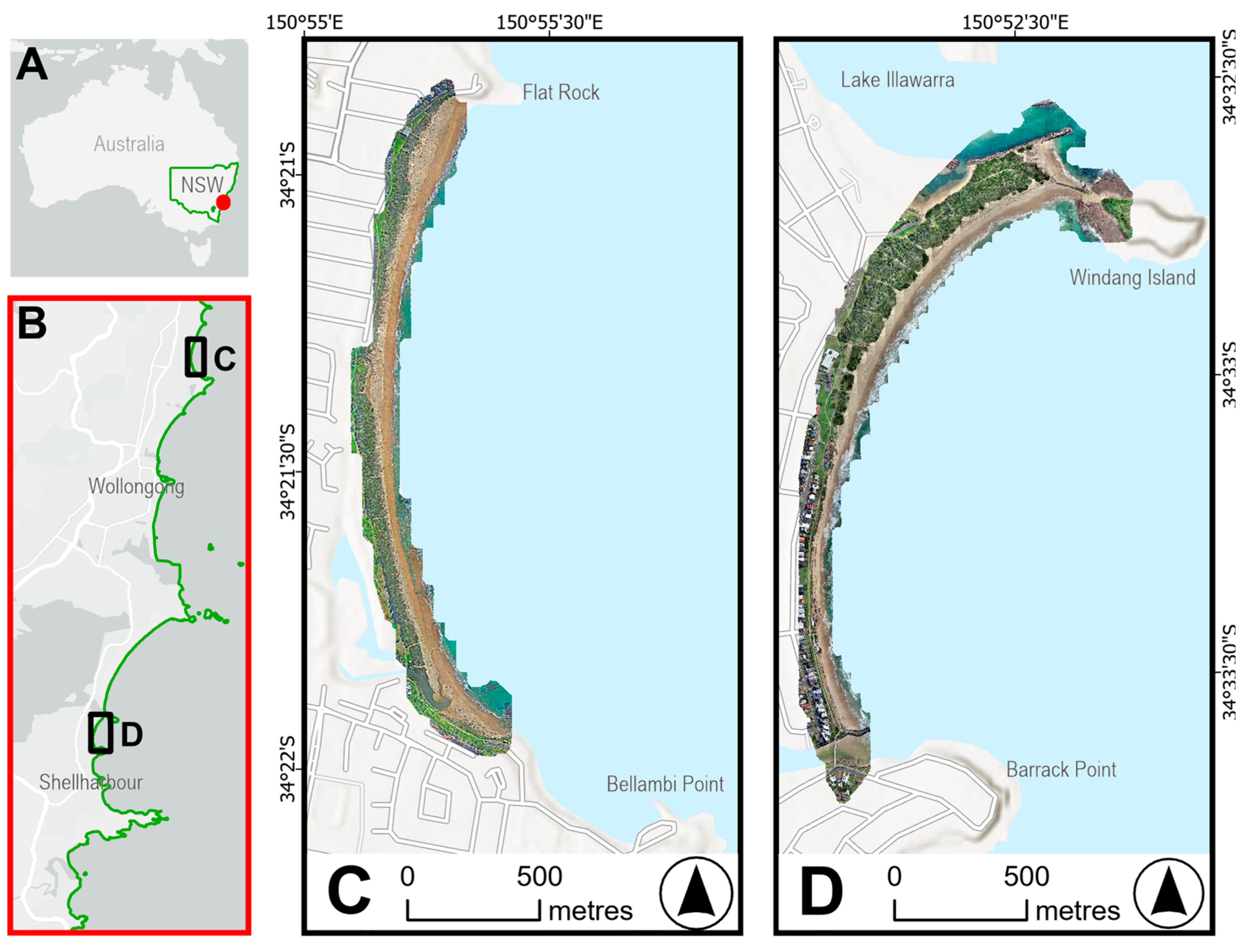
Figure 1. Regional setting and study site location maps, RPA derived orthomosaic image overlayed on ESRI base map. (A) indicates NSW in green on the east coast of Australia (B) indicates the location of the study sites along the Illawarra coast in southeastern NSW. Study site map (C) Woonona-Bellambi Beach, and (D) Warilla Beach. Basemap source: ESRI 2025.
Preprints 151813 g001
Figure 2. Demonstration of spatial resolution, using classified ground point cloud data and derived topographic TIN surface, from (a) photogrammetric data at 1 pt/m, (b) aircraft mounted LiDAR at 4 pts/m, and (c) RPA LiDAR at 12 pts/m. (d) The rationale used to set spatial coverage categories, which primarily used the Australian coastal sediment compartment framework and the mapped size associated with each hierarchy, including management timeframes recommended for each (adapted from Thom et al. 2018).
Preprints 151813 g002
Figure 3. (left) spatial resolution (based on raw point cloud i.e., unclassified) verse spatial coverage and, (right) temporal resolution verse temporal coverage of datasets reviewed for shoreline and foredune change assessment. Note. Solid outline indicates three-dimensional native data, dashed outline indicates two-dimensional data. Grey: non remote sensing. Brown: land based remote sensing. Blue: airborne / aerial remote sensing. TLS: Terrestrial laser scanning. RPA: Remote Piloted Aircraft LiDAR.Foredune Volumes.
Preprints 151813 g003
Figure 4. Foredune geomorphic parameters for the temporal range of available survey data for Woonona-Bellambi Beach (a) total AoI, (b) north and south foredune comparison, and (c) total AoI volume, FVCR, and volume linear trend.
Preprints 151813 g004
Figure 7. Proposed conceptual framework for the application of coastal monitoring data to capture key processes and trends. For each survey type or dataset, the resolution and coverage were simplified as low, moderate or high. Each survey method or dataset includes a colour code referencing the most appropriate coastal process for monitoring. Note. A green coloured box signifies high, yellow is moderate, and orange is low. Y is ‘yes’, N is ‘no’ and O is ‘optional’Conclusion.
Preprints 151813 g007
Table 1. Available records (most recent first) and the categorised spatial and temporal resolution and coverage for the reviewed survey types and datasets including key considerations for each.
Data or Survey Type Woonona-Bellambi Beach Records Warilla Beach Records Spatial Resolution Spatial Coverage Temporal Resolution Temporal Coverage Considerations
RPA LiDAR 2024, 2023 2023 High Low Low Low
  • Limited pre-processed open access data currently available.
  • Surveying and data processing demanding.
  • Licensing and regulations.
  • Resource cost is moderate.
Terrestrial Laser Scan 2023, 2016 (2), 2015 (2), 2014, 2013 2023, 2010 High Low Low Low
  • Limited pre-processed open access data currently available.
  • Surveying and data processing cost.
  • Limited services available to conduct surveys.
  • Resource cost is moderately-high.
Airborne LiDAR 2021, 2018, 2013 2021, 2018, 2011 High High Low Moderate
  • Multiple datasets for NSW coast are open access.
  • User processing is generally required.
  • Infrequent records and datasets.
  • Resource cost is high.
On-ground Beach Profiles 2013 to present 1975 to 1985 Low Low High High
  • Highly accessible survey method.
  • Limited existing long-term datasets are available.
  • May require user processing of data.
  • Resource cost is low.
CoastSnap - 2021 to present Moderate Low High Moderate - Low
  • Installation and pre-processing costs.
  • Raw images available via phone app and website.
  • Relies on community participation.
  • Potential for user error.
  • Resource cost is moderate.
Photogrammetry 2016, 2007, 2001, 1999, 1993, 1987, 1976, 1974, 1972, 1961, 1955 2014, 2011, 2007, 2001, 1988, 1982, 1974, 1973, 1966, 1961, 1948 Low High Low High
  • May require user processing.
  • Pre-processed data for NSW coast open access.
  • Resource cost is low.
Satellite Derived Shorelines 1988 to present 1988 to present Low High High High
  • Several products available and may provide different estimates of tends.
  • Open access for Australian coastline.
  • Resource cost is low.
Disclaimer/Publisher’s Note: The statements, opinions and data contained in all publications are solely those of the individual author(s) and contributor(s) and not of MDPI and/or the editor(s). MDPI and/or the editor(s) disclaim responsibility for any injury to people or property resulting from any ideas, methods, instructions or products referred to in the content.
Copyright: This open access article is published under a Creative Commons CC BY 4.0 license, which permit the free download, distribution, and reuse, provided that the author and preprint are cited in any reuse.
Prerpints.org logo

Preprints.org is a free preprint server supported by MDPI in Basel, Switzerland.

Subscribe

Disclaimer

Terms of Use

Privacy Policy

Privacy Settings

© 2025 MDPI (Basel, Switzerland) unless otherwise stated