

Submitted:
06 March 2025
Posted:
07 March 2025
You are already at the latest version
Abstract
Range expansions driven by climate change are increasingly documented, particularly in birds. The House Bunting, a species native to North Africa, has recently established the first confirmed breeding population in mainland Europe, in Algeciras, southern Spain. This study presents the results of the first systematic census of this population, conducted in December 2024. Using a standardized survey method across a grid of hexagonal sampling units, we recorded a minimum of 18 individuals, including juveniles, indicating both successful reproduction and possible new arrivals. Observations were concentrated in low-rise urban areas, mirroring the species’ preferred habitats in Morocco. The presence of individuals with juvenile plumage in December suggests an extended breeding season, which may facilitate population growth. Given the geographical proximity to North Africa and predicted increases in aridity due to climate change, further expansion into Iberia appears likely. Although no immediate ecological impacts have been detected, potential interactions with resident species warrant continued monitoring. This study provides a baseline for assessing the establishment and growth of this population, contributing to a broader understanding of how climate change influences species distributions and the colonization dynamics of expanding bird populations.
Keywords:
Climate change
; North Africa-Europe connectivity
; Urban colonization
; Range expansion
; Colonization
; Urban habitats
; Ecological interactions
1. Introduction
Range expansion in response to climate change has become a well-documented phenomenon over recent decades (Lustenhouwer & Parker 2022, Zurell et al. 2024), particularly in highly mobile taxa such as birds (Moller et al. 2010, López-Ramírez et al. 2024). These shifts are especially significant in regions serving as biogeographic barriers, such as the Strait of Gibraltar (Elorriaga & Muñoz 2010, 2013). This natural barrier separates the African and European faunas, yet it simultaneously facilitates migration and the colonization of new areas under favourable environmental conditions (Ramírez et al. 2011, Chamorro et al. 2020).
Among the African species recently expanding their range northward, the House Bunting (Emberiza sahari) stands out (López-Ramírez et al. 2023). This species has historically been confined to North Africa but has demonstrated a remarkable northward expansion in recent decades, reaching the north of Morocco and establishing breeding populations in the early 21st century (Thévenot et al. 2003, Amezian et al. 2006, Bergier et al. 2022, Navarrete et al. 2024). Similarly, recent observations indicate an ongoing northward expansion in Algeria, particularly in the northern and high plateau regions (Moulaï 2019). Records of individual vagrant birds in southern Spain date back to the late 20th century (de Juana 2006), with a noticeable increase in records, still of single individuals, since 2021 (García 2024). The breeding of the species in southern Spain was predicted in May 2023 (López-Ramírez et al. 2023) and later confirmed for the first time in August of the same year (Sepúlveda & Ortega 2023). This event not only marks the species' arrival on a new continent but also highlights its ability to establish a new breeding population while utilizing urban habitats similar to those occupied in Morocco.
Monitoring this newly established population provides a unique opportunity to gain insights into colonization dynamics and range expansion under the influence of climate change. Although the House Bunting is not currently threatened and does not raise immediate conservation concerns, its establishment in Europe may contribute valuable information for understanding how environmental shifts influence species distributions. Furthermore, this colonization may lead to novel ecological interactions, including competition or hybridization with resident species, as has been observed in other recently established African bird species in Europe (Chamorro et al. 2017, Muñoz et al. 2024). Despite the recent nature of its establishment, the breeding population of House Bunting in Algeciras appears to be growing, likely supported by the arrival of new individuals from Africa. This influx of individuals could facilitate rapid population growth, potentially enabling the species to spread further into continental Europe. At this early stage of colonization, the population remains relatively concentrated, providing a unique opportunity to estimate changes in the number of individuals over time. Such estimates are crucial for understanding the demographic processes driving this expansion and for evaluating the factors that influence its success, what is essential for advancing our knowledge of colonization dynamics under changing climatic conditions.
This study documents and analyses the first census of the House Bunting in Europe, focusing on the breeding population identified in Algeciras (southern Spain) since 2023. It also explores the biogeographic and ecological implications of this colonization, highlighting the potential for future population growth and the importance of long-term monitoring to understand population dynamics of expanding species and improve our understanding of avian responses to climate change.
2. Material and Methods
Study Area and Survey Method
The study was conducted in the urban area of Algeciras, a city in southern Spain where the House Bunting has recently established the first breeding population in mainland Europe. Algeciras is the largest city in the Bay of Algeciras, with approximately 123,000 inhabitants, and features a mix of residential, commercial, and industrial areas. The city has a Mediterranean climate with mild, wet winters and warm, dry summers. The census focused on the neighbourhood where the species was first detected breeding in 2023 and its adjacent areas, including residential districts with a high density of buildings. This study area is located near the harbour of Algeciras, one of the largest and most important ports in the Mediterranean, which could have facilitated the arrival of individuals here either partially or entirely via ship-assisted dispersal, as has been described for many other passerine species (Lees & Gilroy 2009). The city is located approximately 24 kilometres from the African continent, where the species already has stable populations in northern Morocco, as well as in the Spanish city of Ceuta (Figure 1).
The census was conducted on December 14, 2024, from sunrise to two hours after (8:00 to 10:00 local time), with a total of 15 observers surveying the area. Although this survey was conducted outside the main breeding season, House Buntings maintain territorial behaviour year-round, and their song—distinctive and easily recognizable to trained observers—can be heard even in winter. To account for potential variations in detectability during this period, we expanded the survey area beyond the core breeding zone, ensuring a more comprehensive assessment of the population. As only a year has passed since the species was first confirmed breeding in the area, its establishment remains at a very early stage. Nevertheless, winter surveys provide valuable insight into the species' range expansion and its potential to establish stable populations in newly colonized areas.
Uber's H3 spatial indexing system was used to design the sampling zones for the bird census. The study area was divided into 233 H3 equal-sized hexagons at resolution 11, of 2281 m2 each (Figure 2), which were surveyed to ensure comprehensive coverage. The use of hexagons is particularly important for spatial analysis, as this geometric shape allows for uniform coverage and facilitates the application of analytical methods by ensuring a comparable sampling effort across the study region. This systematic approach not only enhances the reliability of the data collected but also facilitates the analysis of results from future censuses, enabling consistent comparisons over time and a better understanding of temporal trends and spatial patterns.
The area encompassing all observations was determined using a convex hull approach based on geographic coordinates (latitude and longitude) of all observation points. This method computes the smallest convex polygon that encloses all observation points, ensuring a robust estimate of the spatial extent of the recorded locations.
Observers spent between four and eight minutes in each hexagon, with an average of five minutes, focusing on detecting the species’ songs and calls, as well as direct visual observations. For each contact with the species, observers recorded the coordinates, time, number of individuals, and, when possible, the age and sex of the birds. Prior to the survey, all participants were instructed to identify the species both acoustically and visually to ensure consistency in data collection. This training was deemed essential due to the narrowness of the streets within the census area, the behavioural patterns of the species, such as its tendency to be found on rooftops and higher parts of buildings, and its relatively low detectability.
3. Results
The total number of observations analysed was 25, with a minimum of 1 and a maximum of 6 birds observed per event. The average number of birds per observation was calculated as 1.4 (SD=1.04). The cumulative sum of birds across all observations amounted to 35 individuals. After analyzing the data and adjusting for both the timing and coordinates of each observation to prevent double counting, the minimum number of birds was estimated at 18. This conservative estimate ensures a more accurate representation of the population, accounting for potential overlaps in observations due to their spatial and temporal proximity. The area occupied by the observations was calculated as approximately 0.47 km², and the maximum distance between observation points was 1745 m.
The observations were distributed across 16 hexagons, with most detections occurring in the neighbourhood where breeding was first confirmed in 2023 (Figure 3). We recorded birds in areas where the species had not been detected before, particularly in areas of the city closest to the port. The spatial distribution of all records illustrates a concentration of detections in low-rise buildings and flat roofs (Figure 3). No individuals were recorded in non-urban or industrial areas. We observed individuals in adult plumage as well as some individuals still in juvenile plumage.
4. Discussion
The establishment of the House Bunting in southern Spain represents a significant biogeographical event, marking the first confirmed breeding population of this species in mainland Europe. Following earlier records of individual birds, it was in July 2023 when the first breeding event of the species was detected, with a pair raising two chicks (Sepúlveda & Ortega 2023), and by December 2024 the population has grown to at least 18 individuals. This growth suggests both successful reproduction and the potential arrival of new individuals. The geographical proximity between Morocco and Spain, with the shortest distance across the Strait of Gibraltar being just 14 km, likely facilitated the dispersal of the House Bunting. However, despite the short distance between the African continent and the city where the species has established, it is also important to consider the proximity of the breeding nucleus to a major commercial port. This port operates daily crossings connecting Algeciras with North African cities where the species is already present, potentially contributing to its arrival and establishment. This highlights the importance of physical connectivity in enabling biogeographical transitions (Taylor et al 1993, Macdonald et al. 2018). With respect to their possible origin related to pet ownership, there is no evidence suggesting any degree of domestication in the observed individuals. The behaviour of House Buntings in Algeciras is identical to that observed in Moroccan cities where the species has been established for decades, such as Marrakech, Essaouira or Casablanca (pers. obs.), where they commonly approach areas where food is provided by humans.
Climate change models predict increased climatic favorability in the southwestern quadrant of the Iberian Peninsula (López-Ramírez et al. 2023), suggesting that the region could provide suitable conditions for the species’ continued expansion. This colonization aligns with broader trends of natural range expansions by African species, such as the Black-winged Kite (Elanus caeruleus) and the Little Swift (Apus affinis), which have also established populations in Iberia in recent decades (Balbontín et al 2008, Ramírez et al. 2002), and also with future predictions of increasing colonization by North African species as climatic and ecological conditions in southern Europe become progressively more favorable (López-Ramírez et al. 2024).
The ability of the species to utilize urban habitats in Spain, like those it occupies in Morocco (Bergier et al. 2022), likely contributed to its successful establishment. The urban area selected for colonization in Algeciras is structurally the most similar to the breeding sites used in Morocco, consisting primarily of a densely populated neighbourhood with low-rise buildings, flat roofs, and inner courtyards, which provide suitable nesting sites. These areas also offer consistent food availability, further supporting the species' establishment. Urban environments reduce predation risks (Anderies et al. 2007) and provide a favourable ecological setting for colonization (Badyaev 2014). This ecological flexibility highlights the importance of anthropogenic habitats in enabling range expansions, particularly for species already adapted to human-altered landscapes.
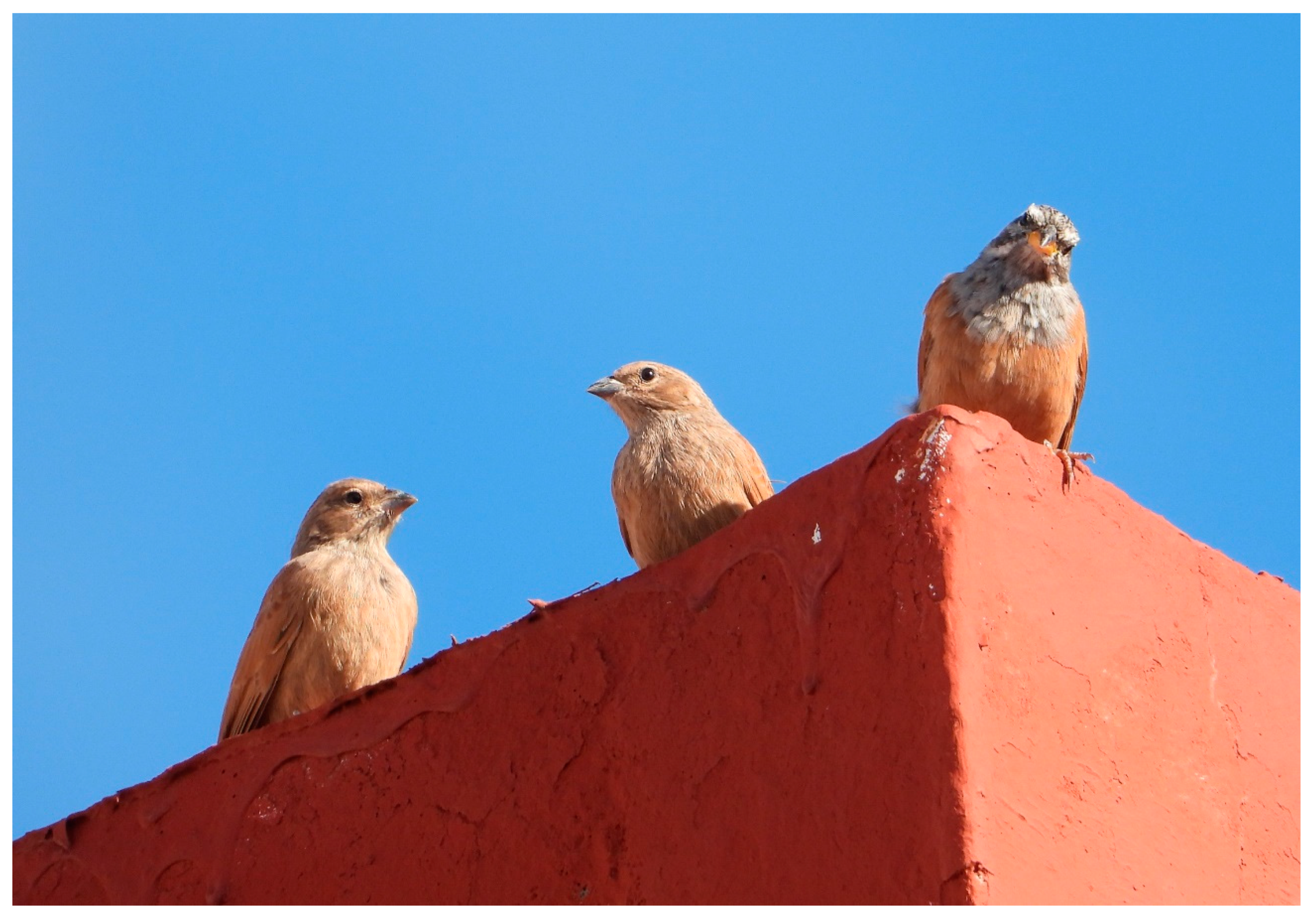
Notably, the observation of birds with juvenile plumage in December (Figure 4) suggests that the House Bunting may also breed in autumn. Typically, birds hatched in spring moult into adult plumage by October (Shirihai & Svensson 2018). Therefore, the presence of individuals with juvenile plumage in December indicates a longer breeding season compared to native species like the House Sparrow, whose breeding activity is usually confined to spring and summer months. This extended breeding period could provide the House Bunting with an adaptive advantage in its colonization process, allowing for increased offspring production throughout the year and facilitating its establishment in new areas. If similar dynamics occur in Algeciras as observed in coastal cities like Ceuta (Spain) and Fnideq (Morocco), both located on the northern coast of Africa, where the House Bunting is now a common species, the population is likely to grow further. Algeciras could then serve as a source population for colonizing nearby cities, such as Los Barrios, San Roque, Gibraltar, or La Línea, among others.
Although the House Bunting primarily occupies urban habitats, its presence could still have ecological implications. Potential interactions include competition with the House Sparrow (Passer domesticus), which shares the same urban environment, or, more rarely, hybridization with the Rock Bunting (Emberiza cia). While the latter is taxonomically similar, hybridization is less likely due to the distinct habitat preferences of the two species. Similar dynamics have been observed in other African species, such as the Long-legged Buzzard (Buteo rufinus cirtensis) (Elorriaga & Muñoz 2013) and Rüppell’s Vulture (Gyps rueppelli) (Muñoz et al. 2024), where successful integration into local communities has depended on habitat overlap and ecological compatibility. These interactions, although subtle, could influence community structures and trophic networks in the region, warranting further investigation.
Climate models predict increasing aridity in Spain (Wang & Zhao 2024), which could further facilitate the expansion of North African species, including the House Bunting. As suitable niches emerge due to climatic shifts, Iberian biodiversity may undergo significant changes, with new colonists potentially altering ecological balances. The House Bunting's establishment underscores how climate change can reshape faunal distributions, providing opportunities for North African species to exploit new habitats in southern Europe. Our study has some limitations, including its single-day survey and single-season dataset, which may constrain broader inferences about population trends and seasonal dynamics. However, despite these constraints, we believe our findings provide a realistic snapshot of the early stages of a continental colonization, offering valuable insights into the establishment process of the House Bunting in mainland Europe. Given the novelty of this colonization, long-term monitoring will be essential to understand the population dynamics of the House Bunting, its expansion and potential ecological impacts. Systematic surveys and the use of citizen science platforms could strengthen monitoring efforts, improve predictions of future expansions, and enhance our understanding of avian responses to climate change and the processes underlying range expansions in a rapidly changing world.
Acknowledgments
Special thanks are owed to the naturalist Juan Carlos Castro, whose decades-long documentation of this species in the newly established breeding area has provided invaluable insights into its presence and temporal distribution. We sincerely thank the Tumbabuey Association for their role in promoting the census and for their unwavering dedication to bird conservation and biodiversity in the region of the Straits.
References
- Amezian, M., K. Bensusam, C. Pérez, and I. Thompson. 2006. Is House Bunting about to colonise Europe? Birding World 19: 163. [Google Scholar]
- Anderies, J.M., M. Katti, and E. Shochat. 2007. Living in the city: Resource availability, predation, and bird population dynamics in urban areas. Journal of Theoretical Biology 247: 36–49. [Google Scholar] [CrossRef] [PubMed]
- Badyaev, A.V. 2014. Reconciling innovation and adaptation during recurrent colonization of urban environments: molecular, genetic, and developmental bases. In Avian Urban Ecology: behavioural and physiological Adaptations. Edited by D. Gil and H. Brumm. Oxford University Press: pp. 155–167. [Google Scholar]
- Balbotín, J., J.J. Negro, J.H. Sarasola, J.J. Ferrero, and D. Rivera. 2008. Land-use changes may explain the recent range expansion of the Black-shouldered Kite Elanus caeruleus in southern Europe. Ibis 150: 707–716. [Google Scholar]
- Bergier, P., M. Thévenot, A. Qninba, and J. R. Houllier. 2022. Oiseaux du Maroc-Birds of Morocco. Paris: Societé d'Etudes Ornithologiques de France. [Google Scholar]
- Chamorro, D., J. Olivero, R. Real, and A.R. Muñoz. 2017. Environmental factors determining the establishment of the African Long-legged Buzzard Buteo rufinus cirtensis in Western Europe. Ibis 159: 331–342. [Google Scholar]
- Chamorro, D., R. Real, and A. R. Muñoz. 2020. Fuzzy sets allow gaging the extent and rate of species range shift due to climate change. Scientific Reports 10: 16272. [Google Scholar]
- De Juana, E. 2006. Aves raras de España. Un catálogo de especies de presentación ocasional. Barcelona: Lynx Edicions. [Google Scholar]
- Elorriaga, J., and & A. R. Muñoz. 2010. First breeding record of North African Long-legged Buzzard Buteo rufinus cirtensis in continental Europe. British Birds 103: 396–404. [Google Scholar]
- Elorriaga, J, and & A. R. Muñoz. 2013. Hybridisation between the Common Buzzard Buteo buteo buteo and the North African race of Long-legged Buzzard Buteo rufinus cirtensis in the Strait of Gibraltar: prelude or preclude to colonisation? Ostrich 84: 41–45. [Google Scholar] [CrossRef]
- García, E. 2024. African birds in Iberia: recent colonists, potential colonists and vagrants. Ardeola 71: 195–228. [Google Scholar] [CrossRef]
- Lees, A. C., and J. J. Gilroy. 2009. Vagrancy mechanisms in Passerines and near-Passerines. In Rare Birds, where and when: an analysis of status and distribution in Britain and Ireland. Volume 1: sandgrouse to New World orioles. Edited by R. Slack. York: Rare Bird Books. [Google Scholar]
- López-Ramírez, S., D. Chamorro, R. Real, and A. R. Muñoz. 2023. Southern Europe is becoming climatically favourable for African birds: anticipating the establishment of a new species. Frontiers in Zoology 20: 18. [Google Scholar] [CrossRef] [PubMed]
- López-Ramírez, S., A. L. Márquez, R. Real, and A. R. Muñoz. 2024. Evaluating the expansion of African species into Europe driven by climate change. Diversity and Distributions, e13840. [Google Scholar]
- Lustenhouwer, N., and I. M. Parker. 2022. Beyond tracking climate: niche shifts during native range expansion and their implications for novel invasions. Journal of Biogeography 49: 1481–1493. [Google Scholar] [CrossRef]
- Macdonald, S. L., J. Llewelyn, and B. L. Phillips. 2018. Using connectivity to identify climatic drivers of local adaptation. Ecology Letters 21: 207–216. [Google Scholar] [CrossRef] [PubMed]
- Moller, A. P., W. Fiedler, and P. Berthold. 2010. Effects of climate change on birds. New York: Oxford University Press. [Google Scholar]
- Moulaï, R. 2019. Expansion du Bruant du Sahara Emberiza sahari dans le nord de l’Algérie. Alauda 87: 170–171. [Google Scholar]
- Muñoz, A. R., J. Ramírez, and R. Real. 2024. A critically endangered African vulture starts breeding in Europe: escaping from extinction or entering a genetic amalgamation trap? Ardeola 71: 131–135. [Google Scholar] [CrossRef]
- Navarrete, J., J. López, and R. El Khamlichi. 2024. Aves de la península tingitana (Tánger, Fahs Anjra, Tetuán y Ceuta). Madrid: Edición Punto Didot. [Google Scholar]
- Ramírez, J., M. Simón, S. Solís, C. Pérez, and E. García. 2002. Vencejo Moro Apus affinis Observaciones de Aves Raras en España. Ardeola 49: 161. [Google Scholar]
- Ramírez, J., A. R. Muñoz, A. Onrubia, A. de la Cruz, D. Cuenca, J. M. González, and G. M. Arroyo. 2011. Spring movements of Rüppell’s Vulture Gyps rueppellii across the Strait of Gibraltar. Ostrich 82: 71–73. [Google Scholar] [CrossRef]
- Sepúlveda, A. J., and J. Ortega. 2023. Primera reproducción constatada del escribano sahariano en España. Quercus 466: 45. [Google Scholar]
- Shirihai, H., and L. Svensson. 2018. Handbook of Western Palearctic Birds. Vol. II. Passerines: Flycatchers to Buntings. [Google Scholar]
- Taylor, P. D., L. Fahrig, K. Henein, and G. Merriam. 1993. Connectivity is a vital element of landscape structure. Oikos 68: 571–573. [Google Scholar] [CrossRef]
- Thévenot, M., R. Vernon, and P. Bergier. 2003. The Birds of Morocco: an annotated Checklist. Tring: The Natural History Museum. [Google Scholar]
- H3: A hexagonal hierarchical geospatial indexing system. GitHub. Retrieved 2024, from https: //h3geo.
- Wang, Q., and X.L. Zhao. 2024. Influence of vegetation pattern and aridity on soil properties related soil available water in the Mediterranean regions. Journal of Environmental Management 366: 121841. [Google Scholar] [CrossRef] [PubMed]
- Zurell, D., K. Schifferle, S. Herrando, V. Keller, A. Lehikoinen, T. Sattler, and L. Wiedenroth. 2024. Range and climate niche shifts in European and North American breeding birds. Phil. Trans. R. Soc. B 379: 20230013. [Google Scholar] [PubMed]
Figure 1.
Location of the study area. The city where the census was conducted, Algeciras, is marked with a dot.
Figure 1.
Location of the study area. The city where the census was conducted, Algeciras, is marked with a dot.
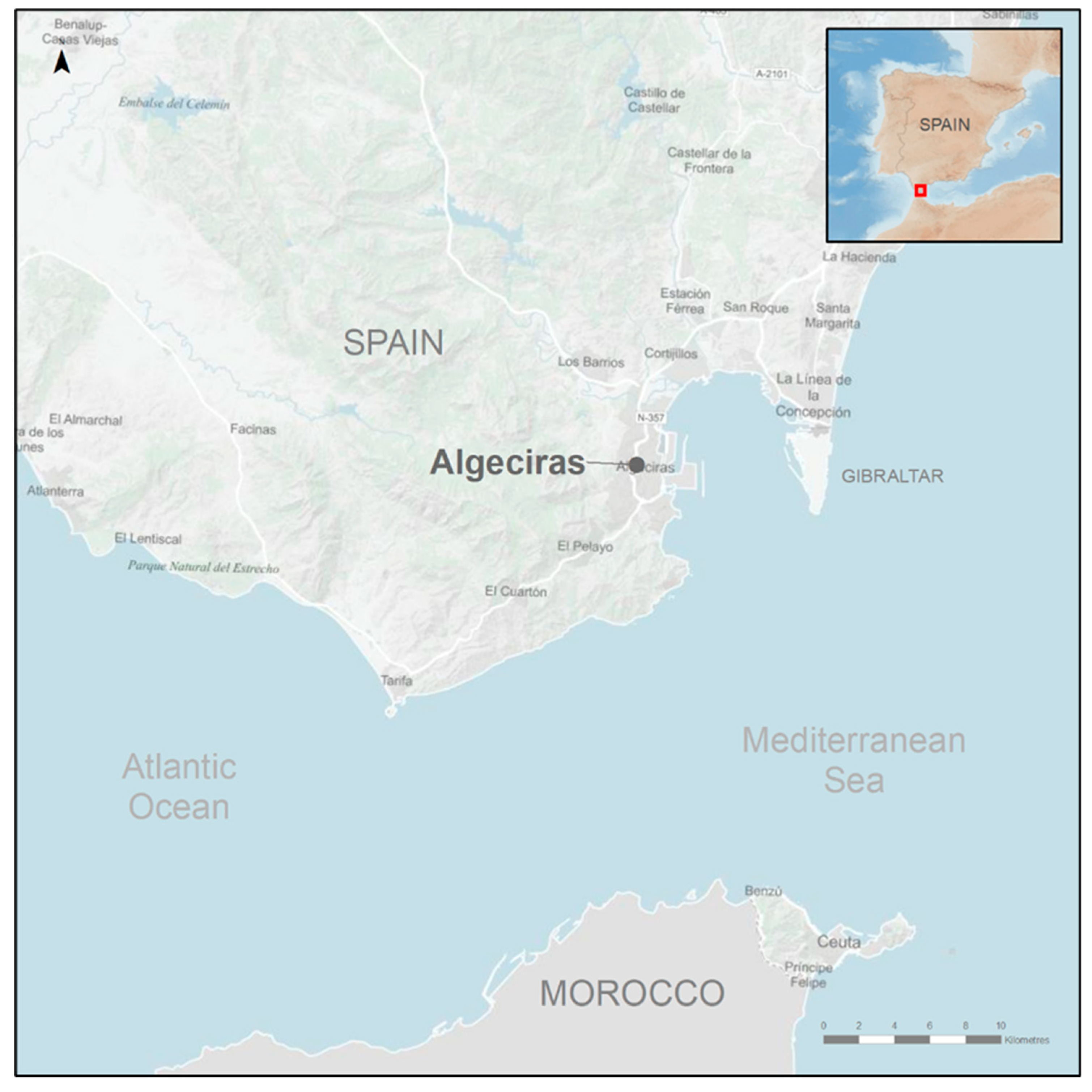
Figure 2.
H3 hexagonal grid used for systematic surveying.
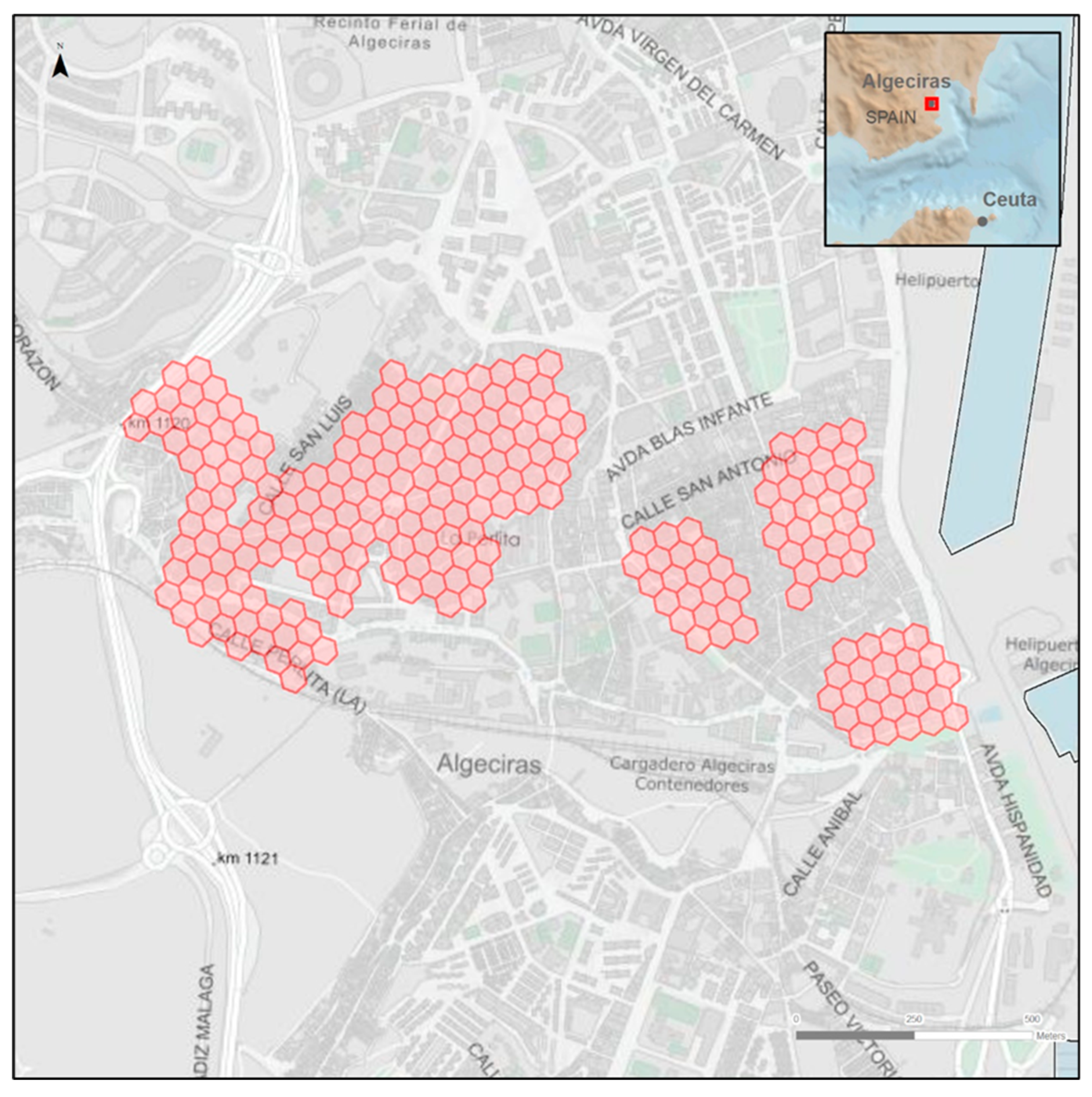
Figure 3.
Spatial distribution of bird observations across 16 hexagons. Different colours indicate the number of birds observed in each hexagon, as shown in the legend.
Figure 3.
Spatial distribution of bird observations across 16 hexagons. Different colours indicate the number of birds observed in each hexagon, as shown in the legend.
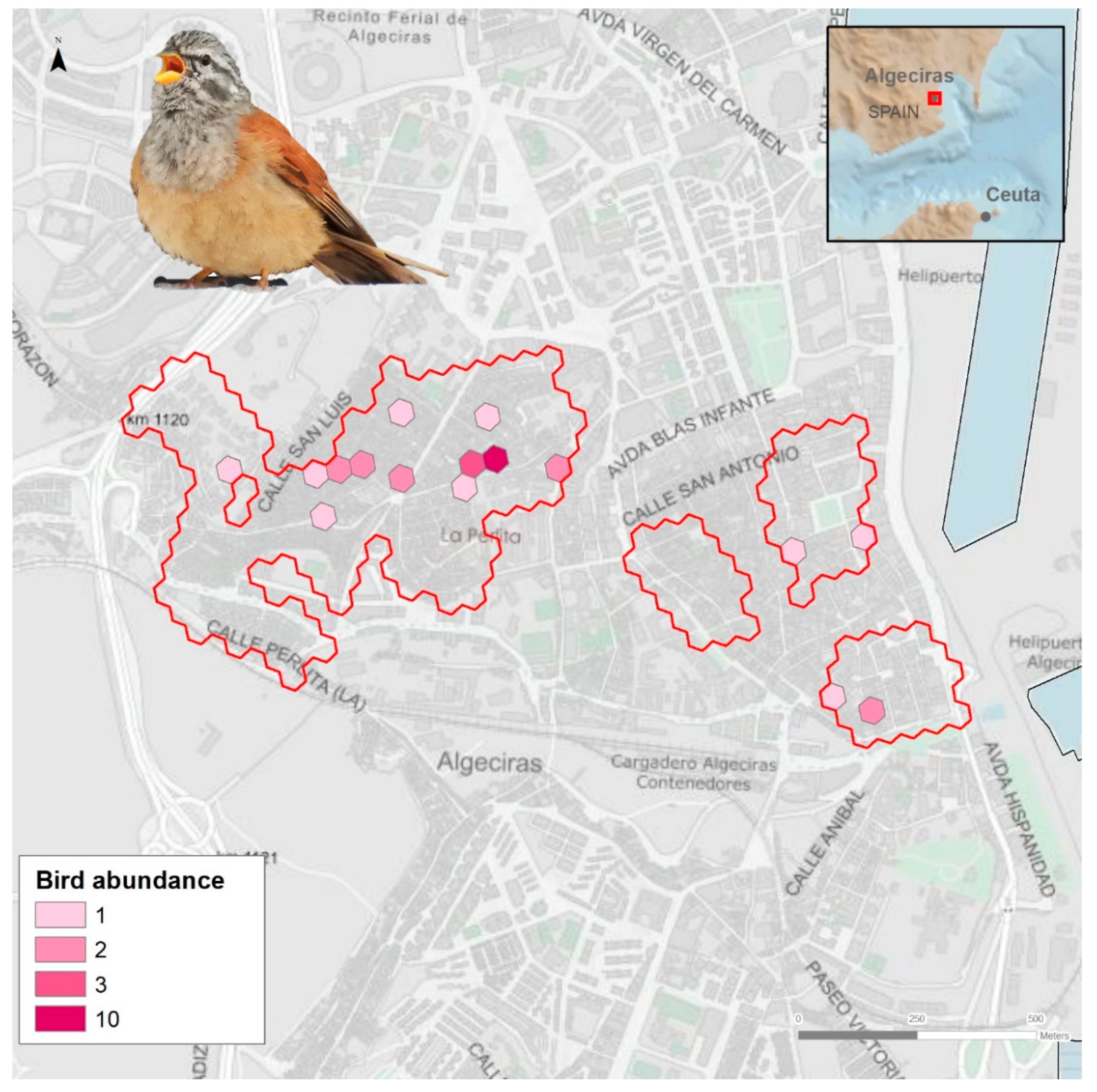
Figure 4.
Adult House Bunting accompanied by two juveniles. The juveniles exhibit brown heads, indicating they have not yet moulted their juvenile plumage (picture by Antonio-Román MUÑOZ).
Figure 4.
Adult House Bunting accompanied by two juveniles. The juveniles exhibit brown heads, indicating they have not yet moulted their juvenile plumage (picture by Antonio-Román MUÑOZ).
Disclaimer/Publisher’s Note: The statements, opinions and data contained in all publications are solely those of the individual author(s) and contributor(s) and not of MDPI and/or the editor(s). MDPI and/or the editor(s) disclaim responsibility for any injury to people or property resulting from any ideas, methods, instructions or products referred to in the content. |
© 2025 by the authors. Licensee MDPI, Basel, Switzerland. This article is an open access article distributed under the terms and conditions of the Creative Commons Attribution (CC BY) license (http://creativecommons.org/licenses/by/4.0/).
Copyright: This open access article is published under a Creative Commons CC BY 4.0 license, which permit the free download, distribution, and reuse, provided that the author and preprint are cited in any reuse.


