
Submitted:
05 December 2025
Posted:
12 December 2025
You are already at the latest version
Abstract
This paper proposes a fractal model of the universe, which includes and the additional dimensions. The universe's fractal is distinct from known fractals, it is adapted to the proposed theory. The cells of each fractal level is the self-similar components of the fractal and they are analogous to galaxies. A direct similarity exists between Hadrons and Galaxies, as they represent the self-similar cells of the fractal structure. These cells coexist in the universe only within groups, known as Atoms on the microscopic scale and Galaxy Groups/ Clusters on the cosmic scale. At each fractal level, the cells are initiated by nodes inspired by the stars. Electrons are the same hadrons, and hadrons's Nodes are formed from undetectable lower fractal levels, which replaces the currently assumed extra dimensions. In this model, quantum energy arises at any fractal level from nodes; they appear as excitations of equilibrium within fractal cells. In the universe, there exists both a fractal structure of matter accumulation and a parallel fractal of quanta. The unification of quanta with matter results in the emergence of material substance, thus requiring multiple frames of reference. Once the self-similar part of the fractal universe is correctly identified, a coherent model of the universe is obtained, one that also applies to undetectable subatomic levels. Through the rigorous definition of reference frames and by dividing the universe into multiple relative surfaces, a Theory of Everything can be derived. At every level of the fractal structure of the universe, there exist nodes (similar to stars) that emit their own sub-particles, which are absorbed by “nests” (molecular clouds). For this reason, the universe is dynamic and regenerative, on each fractal level. But the simple nature of the dynamics is followed by a large amount of different adjacent natures.
Keywords:
Fractal cosmology
; The fifth force
; theory of everything (TOE)
; string theory
; extra dimensions
; cosmology
; particle physic
; electromagnetic interaction
; dark matter
; quarks
1. Introduction
This paper proposes a fractal model of the entire universe, which also includes parts coming from extra dimensions. From the strictly fractal structure one can deduce the self-similar part, and this is presented here as the Theory of Everything (ToE).
Over time many models of the universe have been advanced, yet none has been fully integrated into modern physics. It is possible that many existing Theories of Everything are valid, but only within their limited frames of reference. The complexity of the universe is evident, but current ToE models seem limited because they are derived exclusively from data provided by detectable physics, which represent only a fraction of the reality of the extended universe where additional dimensions also participate.
The fractal model of the universe proposed in this paper is distinguished by the fact that it encompasses the observable universe, detectable physics, and extra dimensions. The nature of the additional dimensions is proposed to be identical to the observable universe. Although the gravitational theory of dark matter is partially replaced and describes the attraction at large cosmic scales as energies that originating from stars and molecular clouds. The hadrons in atoms resemble galaxies and further decompose into many sublevels of matter accumulations, and much of this matter becomes dark matter.
In the context of this model, the Theory of Everything consists in knowing the nature of a single level of the universe’s fractal structure. The known level can be extrapolated to all other levels of the fractal structure. In other words, the entire fractal structure of the universe can be deduced by an in-depth understanding of the characteristics of a single fractal level. In turn, such a level can be correctly described by researching the observable part of the universe and detectable physics. Once a model of one fractal level is available, these models arrange into a multi-level fractal structure that includes extra dimensions. Thus, the whole universe is a hierarchical structure of defined levels. A level includes several hierarchical matter accumulations: the cosmos is formed from a level that begins with stars and extends up to hyperspheroids. The atomic level starts from neutrinos that are part of atoms and extends up to planets. Though hypothetical, this is the model proposed in this paper.
The basic self-similar element of each fractal level is the stars that emit their sub-particles and the molecular nebulae that absorb those particles emitted by the stars. The dynamics between stars and molecular nebulae is the basic system that forms galaxies. In this context, galaxies are called fractal cells and are extrapolated to every fractal level. Thus, on the cosmic scale galaxies are the self-similar components and they form galaxy groups, whereas at the scale of elementary particles hadrons are the self-similar part and they form atoms. Therefore, once it is determined that atoms have similarity to Galaxy Groups/ Clusters, one can analyze them together to reach a common denominator and correctly describe both atoms and groups of galaxies.
This paper proposes and attempts to introduce into physics a fractal model of matter accumulations in the universe (Figure 1), where each fractal level is initiated by matter accumulations similar to stars called level nodes.
Figure 1.
The image represents the hierarchical structure of substance accumulations in the universe. As seen in the image, each fractal level contains cells in which only nests and nodes are highlighted; these elements form local dynamic systems in each cell and, respectively, in each fractal level, which implies the self-similar system of the whole fractal structure. As observed, atoms are similar to Galaxy Groups/ Clusters.
Figure 1.
The image represents the hierarchical structure of substance accumulations in the universe. As seen in the image, each fractal level contains cells in which only nests and nodes are highlighted; these elements form local dynamic systems in each cell and, respectively, in each fractal level, which implies the self-similar system of the whole fractal structure. As observed, atoms are similar to Galaxy Groups/ Clusters.

It is proposed that the universe has fractal levels below atoms, labeled “FL-2”, “FL-3” and “FL-4” (Figure 1). These levels also form the structure of the extra dimensions, which participate in the formation of constants and fundamental parts of physics. Although the entire universe includes many fractal levels, the approach is limited here to “Fractal Level -4 (FL-4)”, because it is sufficient to explain all physics and the nature of the universe.
Each level of the fractal structure is initiated by nodes, which are the stars at the cosmic scale, while at the atomic scale the nodes are taken to be Neutrinos.
Galaxies are the fractal “cells”; they are formed because stars group together through gravitational attraction. This is extrapolated within the hadrons as well: the same process occurs in hadrons; neutrinos, through their local attraction, form hadrons. In this model, electrons are also hadrons because the atoms have similarity to the galaxy groups. And electrons are as small galaxies, but not stars. We can detect electrons only when they are excite, so they are detected together with the waves of atomic imbalance.
But in parallel with the fact that cells are accumulations of matter (grouped by local atractions (by gravity in the galsxies FL+1)), they are also dynamic systems. Nodes (inspired by stars) emit their sub-particles (stellar winds at FL+1), while nests (inspired by molecular nebulae) absorb those particles that come from the nodes’ emissions; thus a dynamic and regenerative part is formed in each cell.
The next hierarchical grouping after cells is the group of cells in FL-1 these are atoms, while in FL+1 these are galaxy groups.
Cells, as self-similar parts inspired by galaxies, are taken as natural closed complex systems in themselves but at the same time are part of the entire fractal universe as cells; therefore they are also called sub-universes. Although most galaxies live only in galaxy groups/ clusters, from these sub-universes(cells) all kinds of adjacent natures and aspects arise.
In a normal fractal system the whole universe would be the self-similar part, but in our complex universe, galaxies and hadrons are the self-similar parts. So they are Subuniverses.
The universe is complex because it is approached differently, but its dynamics within the whole fractal universe are ensured only by the nodes (stars) that disintegrate and reform into nests (molecular clouds). It is important to specify that it is not the atoms but the hadrons ( FL-1), and respectively not the galaxy groups but the galaxies ( FL+1), are the true self-similarity. But this proceses are hidden by gravity in galaxies.
In the present concept, once the self-similar part is inspired by galaxies and hadrons, the self-similar part is considered within the fractal universe not only as mass accumulations but as sub-universes with almost all interactions, orbits, regeneration, solar winds, etc. This fractal, like a map, allows penetration into the nature of the additional dimensions of physics, and navigation between the different interactions of cells from different levels, explaining the fundamental forces and constants of current physics.
Thus, everything that happens within detectable physics is determined by the dynamic and regenerative nature of cells from different subatomic fractal levels (taken as additional dimensions). They are connected to detectable elementary particles by local quanta and form the constants and fundamental parts in detectable physics.
Taking quanta separately represents an approach to the nature of physics, not to the universe. The universe is a continuous redistribution of mass accumulations into different fractal units and segments, and at distinct structural levels different “natures” appear: classical physics, quantum physics, relativity, the perception of organisms, etc. If one can distinguish between these parts of physics, then it becomes apparent that all detectable physics is a relative reality resulting from a limited, accessible and interconnected surface as compared, to the more extended universe. Therefore great attention is paid to the fact that, on the small surface of the universe where our physics is placed, reality is relative to something either known or unknown. In simpler complexities, the frame of reference must be indicated immediately.
From the above, the universe is too complex to be taken within a single frame of reference and a single description. Therefore the paper is divided into as many chapters and themes as possible so that the ToE covers all surfaces that form different local natures in the universe. Because the ToE must explain everything, answers must be sought from all natures adjacent to the ToE. The Modern physics is dedicated for “Nature on Planets”, which is distinct from the nature of the fractal universe.
The present model aims to provide a possibility to extend and complement the current mathematical-physical apparatus, while proposing replacements for the deep current theories that are too sophisticated on bases that are too simple. For this, first the reality beyond the borders of detectable physics must be understood, and then that reality should be used as a basis for the theoretical and mathematical apparatus.
The final goal of this approach is the formulation of the “Theory of Everything.” A correct model of the universe of this kind represents one of the most ambitious task of theoretical physics.
Relevance of Extending the Atomic Level with Smaller Hypothetical Fractal Levels
In the present model, the universe is taken as a fractal entity with many levels below the atomic level, yet similar to it. The properties of these levels below FL-1 are undetectable. However, they are of the same nature as the fractal levels in the detectable universe, with some local adaptations.
As is known, in galaxies, stars regenerate over billions of years; this happens when stars, through stellar winds, eject their atoms, which then form molecular clouds where new stars are born. The regeneration of matter within galaxies is continuous, and these processes should be extrapolated to the all fractal levels such as FL-2, FL-3, FL-4. Because they all have ongoing lifetimes and thus owe to the same process.
The states of matter in black holes, neutron stars, and the matter after collisions in elementary particle accelerators, all these states of matter serve as examples of how detectable levels, such as galaxies and hadrons, transform and divide into their much smaller subcomponents; this is also encountered in supernovae. Thus hadrons, galaxies, and all cells from other Fractal Levels(FL) are formed from stars (Nodes) and molecular clouds (Nests), in which matter is regenerated.
2. Methods
The paper contains numerous analyses placed in different sections, therefore the methodology is integrated into the subsections of the Results and Discussion section, parallel to the results and Discussion.
The general adopted methodology consists of evaluating hypotheses through an iterative process: if a hypothesis remains valid within the analysis applied to the entire universe, it is maintained; otherwise, it is adjusted or discarded.
The use of mathematics is minimized in the initial stage, as the priority is to identify a coherent conceptual framework of reality, upon which appropriate mathematical models can later be applied. This approach facilitates a clearer understanding of fundamental principles, providing a solid foundation for the development of a formalized framework.
3. Results and Discussion
3.1. Beyond this Model of the Universe
The present model encompasses the fractal levels of matter accumulations in the universe from FL-4 up to FL+2 (Figure 1). It does not coincide with the standard scientific model, nor with the “Big Bang” theory, nor with the Standard Model of elementary particles. The present model is a hypothetical theory. Therefore, the following subsections describe how the universe is approached in this framework, addressing aspects of the universe that precede the fractal-universe model proposed in this work.
3.1.1. The Approach to the Universe in This Work
In the scientific community, there are multiple opinions regarding the nature of the universe. Mathematics and other laws, which in some approaches are believed to constitute up to 99% of the governing principles of the universe, represent a reality distinct from our universe. For instance, pressure appearing in matter accumulations, just like mathematics, does not belong to the intrinsic nature of the particles that make up our universe.
The space of our universe differs from absolute space . The space consists of accumulations of matter belonging to levels much lower than the atomic and galactic scales and will be referred to as the “Ether.”
The charge, although weak, of the Neutrinos is still a proof that there exist fractal levels smaller than FL-1, because they have small charge, which appears due to ejections of particles from lower FL. Meaning the stars from FL+1 eject protons, hydrogen, etc, which are from FL-1. Same way the Nodes from FL-1 release particles of a smaller FL which is FL-2.
Since the universe is extremely complex and only partially detectable, our human intelligence approaches it through the detection of “Relative Realities” with respect to other local or relative realities, not the “Absolute Reality.” Therefore, for any theory or approach, alternatives exist, and each is valid within its own frame of reference.
3.1.2. The Primary Particles of the Entire Universe
It is not well known whether the universe formed from fractal matter accumulations is finite in smallness, since the pre-universal space (the absolute vacuum) allows hierarchical geometric reduction. By adding new sub-dimensions, geometric space can shrink indefinitely while remaining self-similar. Mathematically, this can be expressed as:
Ln=L0×10-n
where (L0) is a reference dimension at a known surface for the observer (for example, 1 m though, in the universe’s fractal structure, (L0) should correspond to a self-similar component).
In our fractal universe, it becomes evident that descending through its structure leads to a simplified reference level, whose particles can be considered the primary particles of our universe. It is not necessary to determine exactly which fractal level this corresponds to.
For these particles to form the first accumulations of the fractal structure, they must possess certain properties. However, their nature cannot be directly investigated, as it differs from the nature at our surface level. Our observable level represents a layer where matter accumulations have acquired new characteristics distinct from those of the primary particles. Between these levels, activities occur according to the nature emerging from the accumulations of that level — not from the nature of the primary particles themselves. Thus, our nature exists on a surface far removed from that of the primary particles of the entire universe (Figure 3.1.2).
-
The primary particles of the entire universe are points of energy, not bodies. A body is an accumulation of smaller, unitary components, that is divisible.1.1. The first grouping of primary particles already exhibits corpuscular properties, since “body-like” behavior applies only to entities that can interact similarly (e.g., collide). From here begins the dynamics of our universe, characterized by interactions among accumulations of different levels, unlike the nature of the primary particles themselves (Figure 3.1.2).
- The primary particles constitute all matter in the universe (Figure 3.1 (b)). The fact that they form different groupings, atoms or stars, merely represents accumulations of primary particles. The primary particles are everything; we have access only to the dynamic nature where these particles continuously form matter accumulations within a hierarchical (fractal) structure. Thus, at its depth, the universe possesses intrinsic energy derived from its primary particles.
- The primary particles are constantly redistributed in space due to universal dynamics at higher levels. If one were to explain everything solely through primary particles, one could say that some, gaining higher kinetic energy, carry others with them, just as the Sun, orbiting the galaxy, carries its planets along.
- They are all identical, forming the same matter everywhere in the universe, regardless of distance.
- New primary particles continuously appear, not yet included in accumulations (whether by regeneration or otherwise). There may exist two kinds of primary particles interacting continually. Evidence supporting this lies in the long lifetimes of atoms, suggesting that their sub-scales receive constant replenishment of matter. Matter regenerates, but many particles ejected by nodes eventually leave the universe once they gain sufficient momentum. Stars eject elementary particles even beyond galaxies and the visible universe, meaning that much mass leaves the visible domain, while the inflow of new particles is not directly observed. Yet regeneration in molecular nebulae does not show a decline in star formation, nor do galaxies appear to shrink over billions of years.
- Although the primary particles form a fractal of larger scales, the law of energy conservation reveals that they underlie activities at all levels. The primary particles generate adapted interconnections across various structural surfaces, through known and unknown laws. The universe, being conformed, tends to re-conform wherever deformations appear; energy, entropy, and forces originate from these primary particles.
Figure 3.1.2.
On the left, the image approximately indicates the location of the “Primary Particles of the Entire Universe,” while on the right it shows the “Particles considered primary in the Present Model.”.
Figure 3.1.2.
On the left, the image approximately indicates the location of the “Primary Particles of the Entire Universe,” while on the right it shows the “Particles considered primary in the Present Model.”.
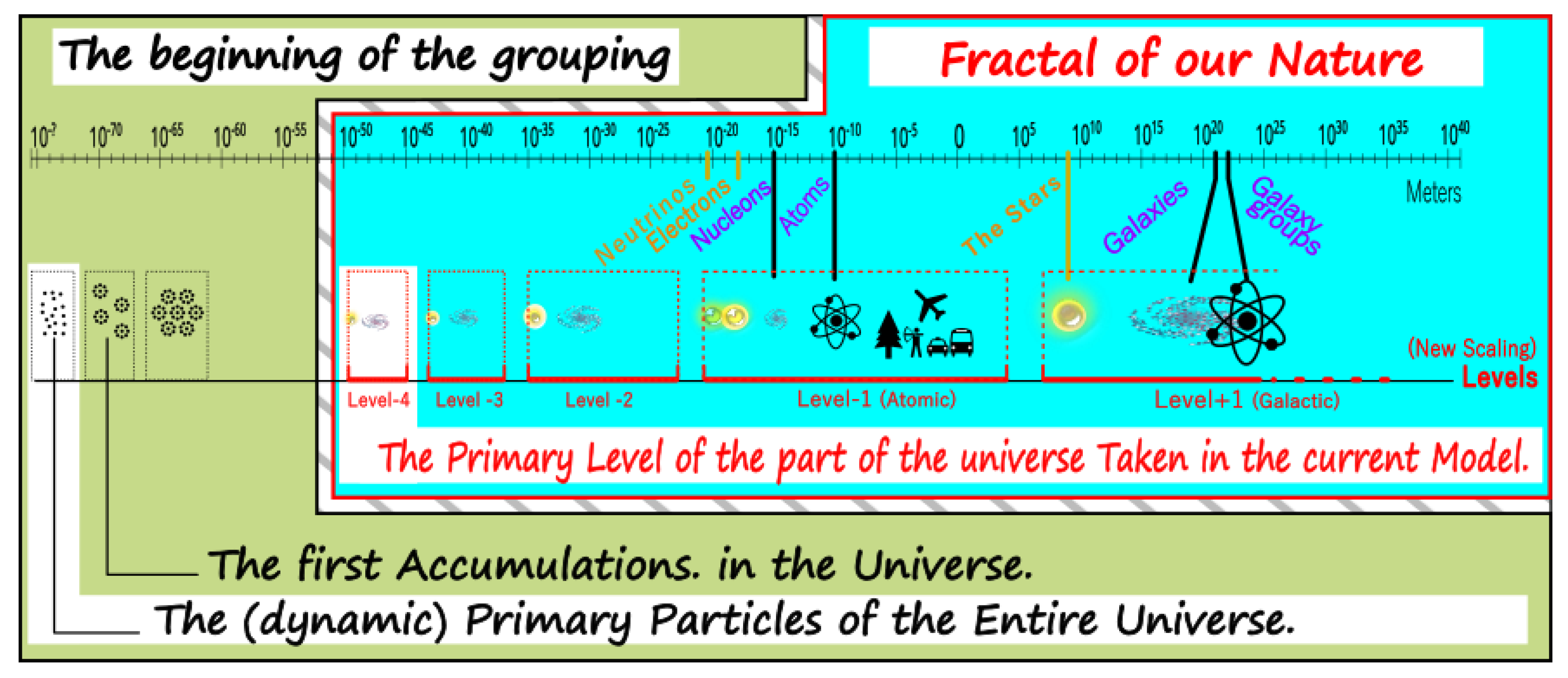
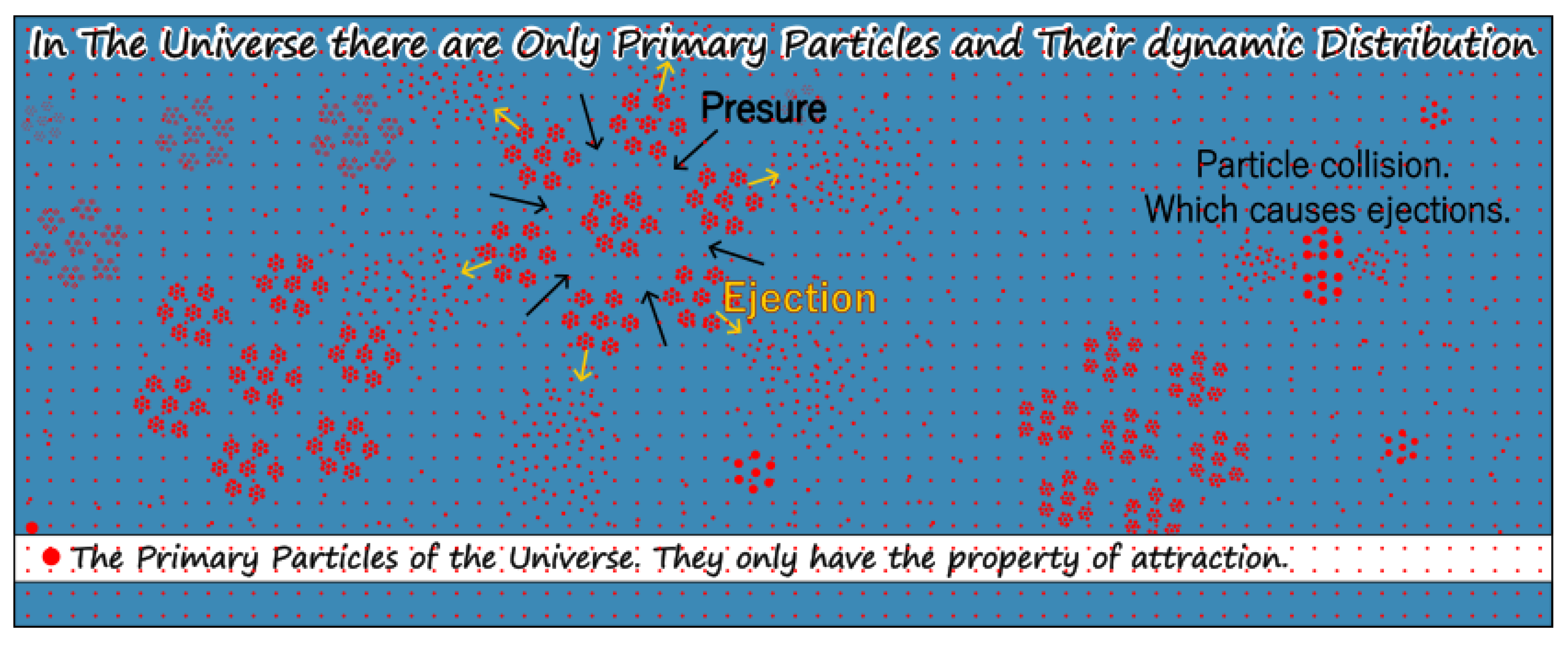
Figure 3.1.2 (b).
The image illustrates only the primary particles of the entire universe, as nothing else exists. All cosmic complexities emerge from the dynamics of these particles combined with mathematics and universal laws. We observe them at various hierarchical surfaces of accumulation.
Figure 3.1.2 (b).
The image illustrates only the primary particles of the entire universe, as nothing else exists. All cosmic complexities emerge from the dynamics of these particles combined with mathematics and universal laws. We observe them at various hierarchical surfaces of accumulation.
In the present model, this remote priority is bypassed: the nodes (such as stars) are taken as local energy-generating centers at each fractal level. Energy is conserved independently of fractal structure, though storage depends on it. In this model, energy itself is also fractalized along with each FL. Energy conservation can be explained only within the natural system under study, since many adjacent natures exist across the universe.
Thus, from the law of energy conservation, it follows that primary particles constitute the foundation of all universal activity.
3.1.3. Adaptation of the Present Model to the Big Bang Theory
Section 3.1.2 presented a theory for the origin of the universe, which appears to contradict the Big Bang theory. However, the Big Bang theory (or its expansion-based alternatives) describes only the portion of the universe discovered so far. In contrast, the present model envisions a far more extensive universe.
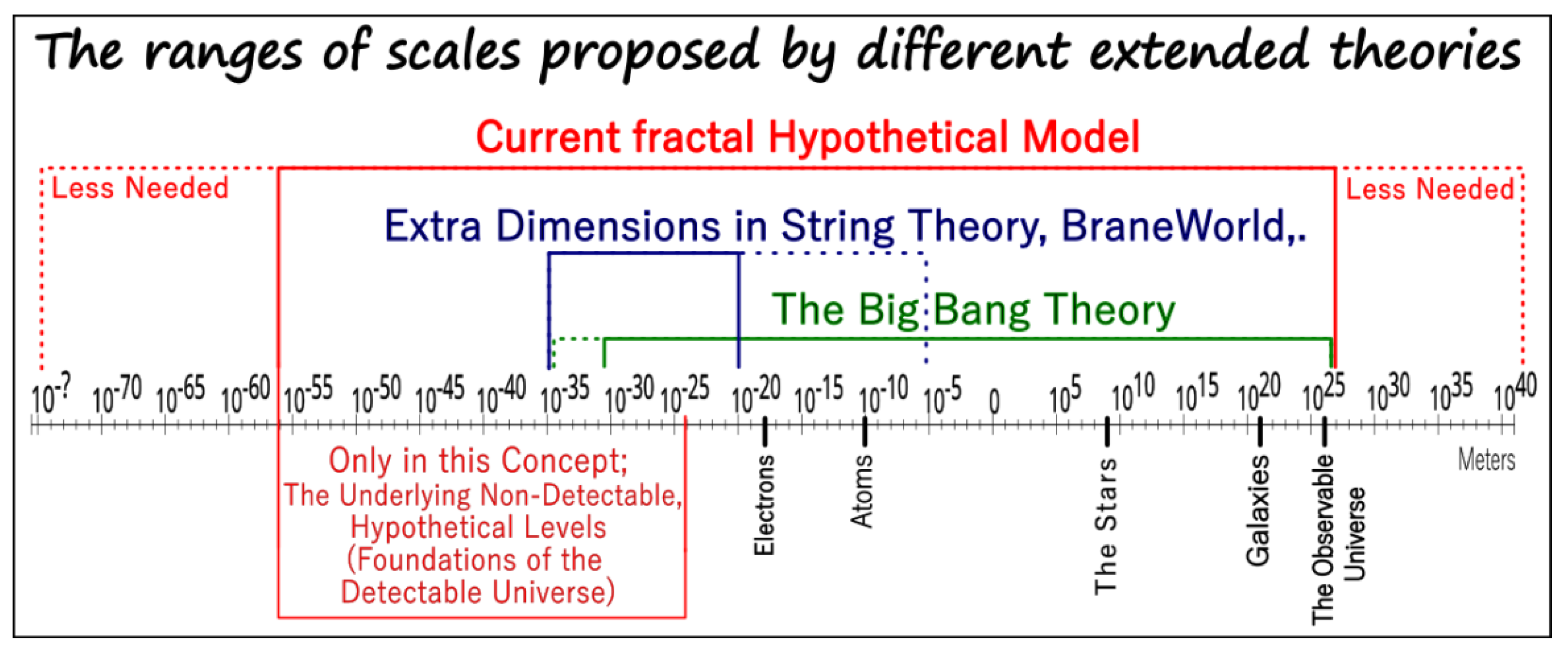
The Big Bang theory does not account for extra dimensions (still hypothetical) proposed by frameworks such as String Theory (Figure 3.1.3, in blue). Theories derived from cosmic expansion as the beginning of all visible reality are not necessarily required in the present model, which instead describes the current structural state of the universe.
Figure 3.1.3.
Illustrates several universal surfaces considered in various deep theories. Each theory’s name is written in its own color, corresponding to a line marking the range of dimensions it covers.
Figure 3.1.3.
Illustrates several universal surfaces considered in various deep theories. Each theory’s name is written in its own color, corresponding to a line marking the range of dimensions it covers.
The accelerated expansion of the universe is only one among many processes occurring at both galactic and atomic levels. Each such process may require theories adjacent to a Theory of Everything.
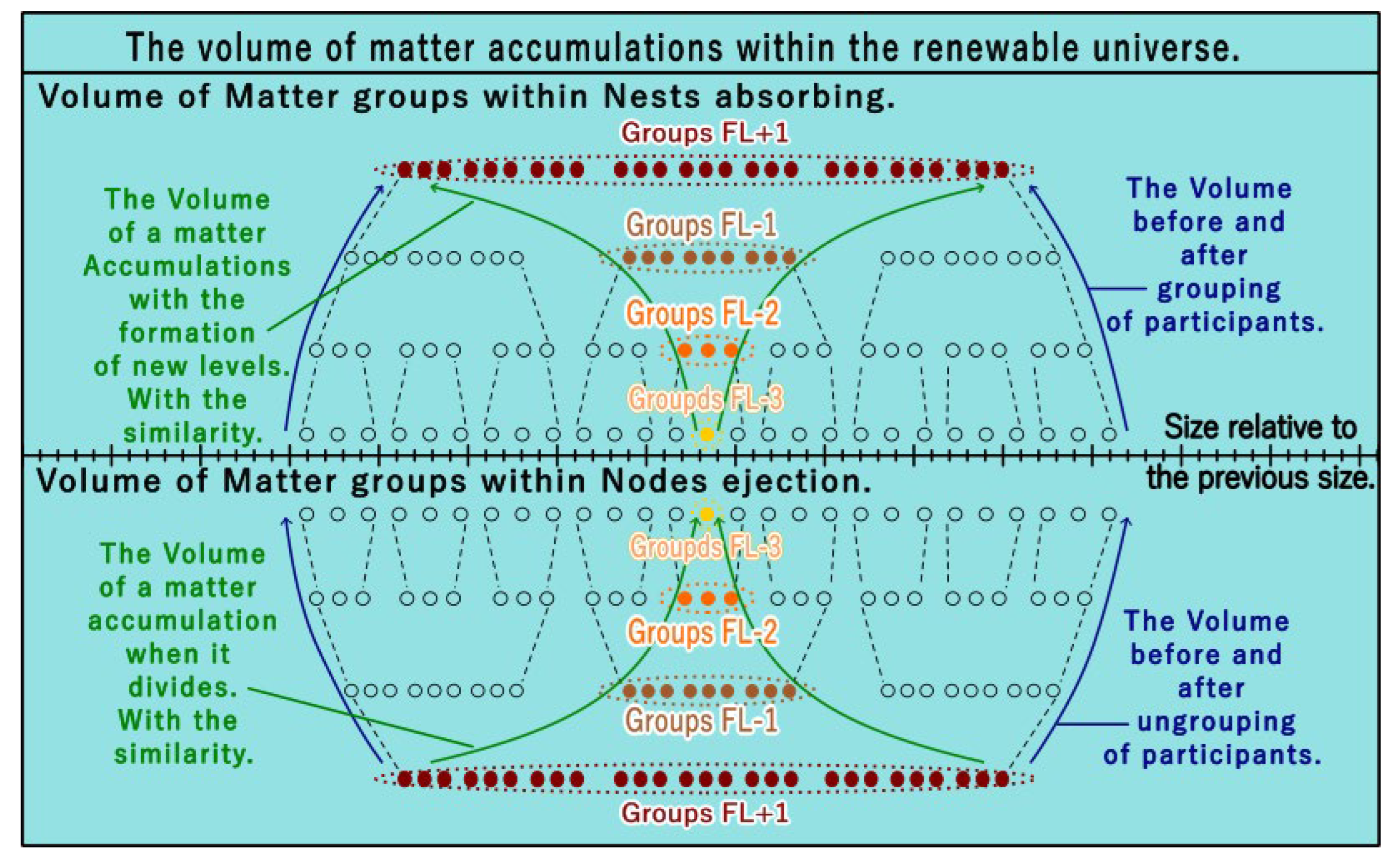
The observable universe represents merely a small portion of a fractal level higher than that of galaxies, that is FL + 1 is part of FL + 2. Therefore, universal expansion is analogous to various extensions observed at the atomic scale, such as thermal or pressure-induced dilation of materials. These volume variations occur because matter regeneration processes take place at every level, for example, as stars eject matter that later regenerates in molecular nebulae. The regeneration of matter accumulations is linked to changes in volume (Figure 3.1.3 (b)).
Thus, the accelerated expansion of the observable universe indicates that it is part of a larger, ongoing process belonging to a greater structure of which the visible universe is only a fraction. This pulsation of the universe inferred from the present model resembles the Cyclic Universe Theory, an alternative to the Big Bang.
Figure 3.1.3 (b).
The image is schematic and it illustrates fluctuations in the reference frames of matter-accumulation volumes at different stages of regeneration.
Figure 3.1.3 (b).
The image is schematic and it illustrates fluctuations in the reference frames of matter-accumulation volumes at different stages of regeneration.
The present model does not explain the cosmic-scale expansion process or its origin. Instead, it analyzes the universe in its current state. This model requires only an understanding of how matter accumulations at different fractal levels regenerate and interact, in order to formulate a prospective “Theory of Everything.” Therefore, explaining cosmic expansion, considered part of the universe’s origin, is unnecessary. Expansion remains unexplained but non-essential, like many other cosmic processes.
Although expansion aligns with this model as an adjacent process, it is assumed that the cosmic scale is far larger and that its expansion is part of a “Hyperspheroid” process, in which massive accumulations undergo cyclic dilations as wholes or as independent sections.
It is known that we appear to be located near the center of the observable universe, a coincidence with a very small probability if the universe were truly limited to what we can see. What we observe through telescopes is the apparent “edge” of the universe roughly equal to its age in light-years, but its structure appears the same because we compare it with the surrounding cosmos. Therefore, the Big Bang theory remains incomplete, while the present model proceeds with the idea that the universe is far more extended, both in size and in scale.
The model presented here envisions the universe as more extensive, in both magnitude and minuteness, than predicted by the Big Bang theory, and it cannot be internally modified without losing relevance. Hence, it anticipates the adaptation of adjacent theories, including the Big Bang. For instance, it is possible that our observable universe was once a Node (a star) within a Hyperspheroid undergoing dilation for unknown reasons.
Further continuation follows in Section 3.4.1 and Section 3.4.1.1.
3.1.4. The part of the Universe taken for current fractal-universe model, and its primary fractal level
The nature of the primary particles of the entire universe are unknown (Section 3.1.2). But the nature of the primary particles in the present model is known because it is similar to that of the Atoms and Galaxy Groups levels (Figure 3.1.2).
The size of the fractal universe remains unknown, whether finite or infinite, but for a “theory of everything” it is sufficient to seek a few FL smaller than the atomic FL. As is known from the galaxy groups and atomic FL, a single level brings many new properties and interactions to the universe. For example, stars produce various quanta of radiation as well as powerful stellar winds, galaxies generate intergalactic particle winds, etc. For this reason, a few sub-atomic FL are sufficient to motivate and explain multiple extra-dimensions, with which current ToE attempts to explain the complex physics at the surface of our nature.
The universe is a fractal structure that contains the galaxy groups level (FL+1), followed by the atomic level (FL-1), and then hypothetical levels similar to galaxy groups or atoms, FL-2, FL-3, FL-4. The abbreviation for this part of the universe is “MFU” - Main Fractal Universe.
To formulate TOE, and to describe the nature of physics, it is sufficient to take a portion of the fractal universe that includes approximately these five listed fractal levels. Thus, from the indicated fractal levels, the smallest level is “FL-4” (Figure 3.1.2 Level -4), and it is taken as the primary level of the part of the universe that forms TOE, and our nature, and represents the present model.
3.2. Molecular Clouds from Any FL; Formation of Stars
Molecular clouds represent vast accumulations of cold and dense matter, constituting the primary sites of star formation within galaxies. The influx of matter into these structures originates predominantly from the ejection processes of active stars—through continuous stellar winds—and from cataclysmic supernova events, which disperse heavy elements into space at supersonic speeds.
The capture mechanism of this high-velocity gas involves complex hydrodynamic interactions; particle fluxes are decelerated and accumulated only when they enter into direct collision with the dense medium of the cloud, dissipating their kinetic energy through shock waves and radiative cooling. However, given the inhomogeneous spatial distribution of these clouds, a significant proportion of the ejected gas fluxes does not directly intersect these accretion zones but passes tangentially alongside them. This uncaptured matter remains suspended in the diffuse interstellar medium or, if it possesses sufficient momentum, can migrate towards the galactic halo, leaving the galactic disc. Since stars act as permanent sources of matter emission, the surplus of cosmic gas and dust that is not immediately integrated into new stellar cycles can travel through intergalactic space, potentially being gravitationally attracted by other galaxies, thus facilitating a substance exchange on a macroscopic scale.
Regeneration of Matter Ejected by Stars (Node) in Molecular Clouds (Nest) from Any FL
“Nodes-Nests” Systems.
Molecular clouds are similar to clouds of water vapor in the atmosphere. From warm or hot surfaces different atoms and molecules evaporate, and in cold zones clouds form, which transform matter from gaseous and dispersed state, into accumulations of different kinds. If the part that releases we call Nodes and the part where clouds form we call Nests, then this regeneration system will be called “Node-Nest”.
In every cell of the fractal universe dynamic systems “Nodes-Nest” are groups of hundreds or thousands of Molecular Clouds (Nests), and billions of stars (Nodes). These “Nodes-Nests” systems are unobservable because one cannot track how the gas ejected by stars circulates with high precision. These systems intersect with one another, and are temporary because their parts orbit with different speeds one relative to another.
These “Node-Nest” systems are found superimposed between them. Matter ejected from stars does not go directly to molecular nebulae but the fluxes that are directed towards them. And galaxies, depending on type, have different number of molecular clouds.
“Node-Nest” systems also overlap with other fluxes or concentrations of matter due to other attractions like gravitational. This is because in the center of galaxy groups much gas and dark matter concentrates due to gravity, and local attractions.
Heavier (Elliptical) galaxies form the nuclei of galaxy groups, and once the nucleus is heavier, it attracts more inter-cellular dust, but this process is not dynamic. The dynamic process is found in the fact that stars (Node) eject stellar winds, then these stellar winds slow down their speed arriving in different galaxies. Then this gas and cosmic dust forms or is attracted by molecular clouds (Nest), where new stars form from it. And therefore at the base of creating charges stand systems “Releasing Nodes - stellar winds - Absorbing Nests”, abbreviated will be “Node - Nest” systems.
Descriptions are extrapolated for any FL. Each cell, and groups of cells, from any fractal level having these exchanges of matter in “Nodes-Nests” systems, form the charge from which electromagnetism appears.
3.3. Nodes of the Fractal Universe, Which Are Inspired by Stars
As can be observed, galaxies are formed from stars. Stars are the building blocks and energy sources for galaxies. In the present model, it is proposed that each fractal level is formed from Cells similar to galaxies which, in turn, are formed from Nodes similar to stars. Thus the stars, and the basic processes in stars (Figure 3.3), are extrapolated to all Nodes at any fractal level (FL) of the universe.
Figure 3.3.
The image illustrates the basic processes in stars which make them fractal nodes.
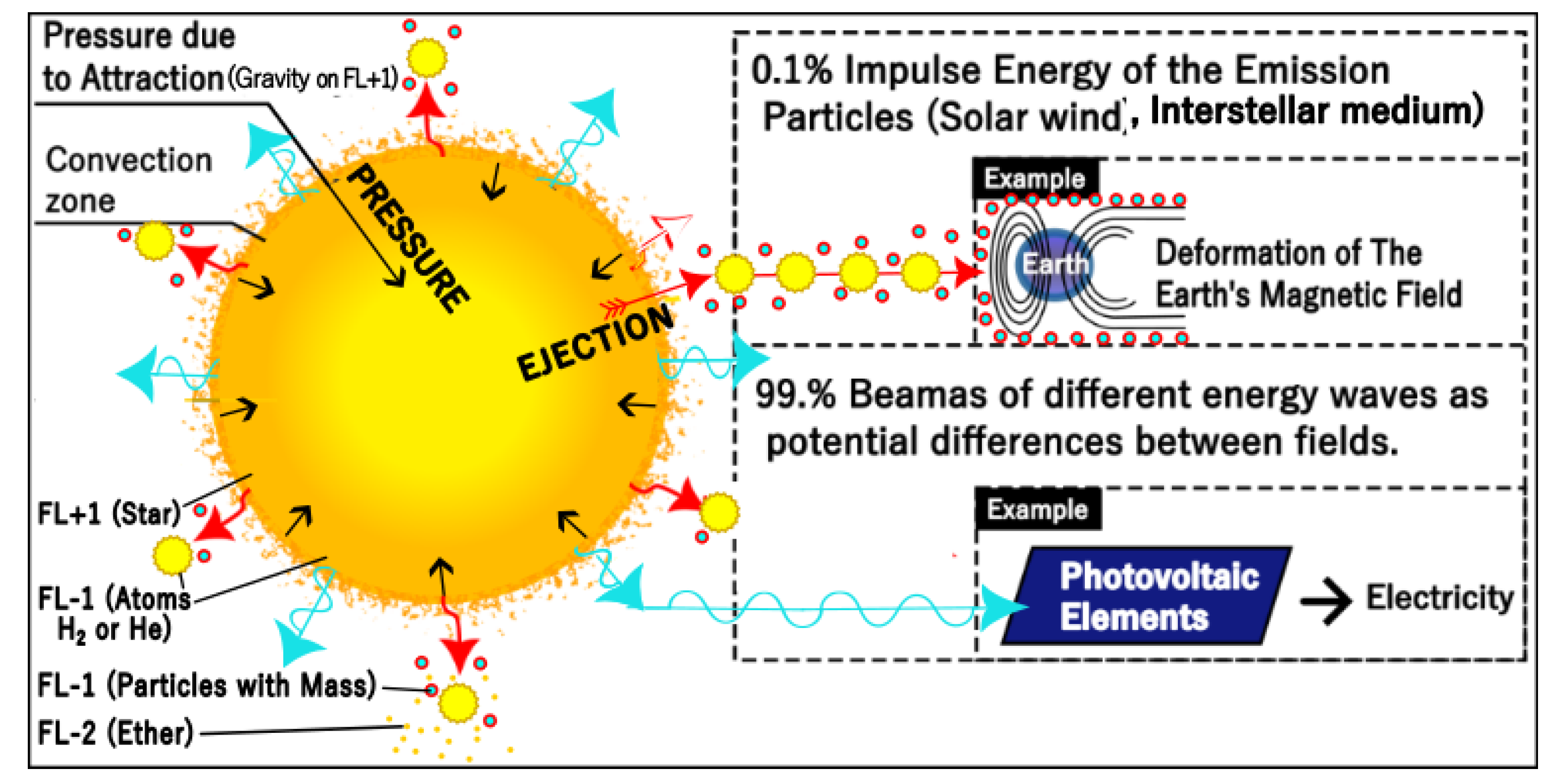
The arrows pointing toward the center represent pressure, and due to this pressure nuclear reactions occur, followed by emissions represented by arrows pointing outward from the star. The ejections take place after a series of complex fusion processes which are not necessarily required to be specified in this image. These characteristics are extrapolated to all nodes of the fractal structure of the universe. In other frames of reference, the universe being dynamic and complex, they are also called “Energy-matter accumulations”. Also, the image on the right illustrates how stars interact.
Stars are different; there exist giant stars, neutron stars, stellar dwarfs as remnants after stars end their life cycle. Therefore, when extrapolating within the similarity framework of galaxies with atoms, in the search for fractal nodes it is proposed approximately that Neutrinos are the nodes that form the hadrons of atoms, just as stars form galaxies. And neutrinos are different; as known, some have charge, but all are fundamental and indivisible within detectable physics. There also exists the probability that pions, kaons, or even some mesons may be nodes for hadrons. But in the present model it is not necessary to specify exactly which are the nodes in hadrons; the important point is that detectable candidates exist.
Stars are taken as fractal Nodes, as initiators of cells in all cells of all FL of the fractal universe, from several observations:
- During star formation from cosmic dust in molecular clouds, once the size of the accumulation increases, internal pressure also increases, initiating fusion reactions and making the Nodes energetic. This means this process is a size-limiter for matter accumulations; therefore it must exist at other levels as well, including in atoms. Theoretically, if nuclear reactions in stars did not appear, they could grow in volume without limit.
- If, under the pressure of gravitational force (or local attraction from different levels), internal reactions of lower levels did not begin, then the entire universe would accumulate into a single giant star. Since atoms have equal dimensions, the hypothesis is that they also are initiated and formed from accumulations similar to stars, which limit the size of local stars.
Once the processes in young stars in molecular nebulae occur, where increasing mass determines increasing internal pressure, this pressure triggers internal fusion reactions. And once nuclear reactions begin in these newly formed stars, they begin ejecting stellar winds; therefore, they can no longer continue to accumulate cosmic dust. Hence, they are the ones that limit the size of stars, making them fractal nodes of approximately equal dimensions relative to their level.
Nodes exist in any FL and they generate local energy, just as stars do. The energy comes from the release of sub-accumulations of matter (if stars are FL+1, then hydrogen in them is FL-1), and to conserve energy and resolve entropy within the whole universe. However, frames of reference may be taken where nodes simply appear as sources of energy, without deeper detail, since Nodes are primary for their fractal level.
Nodes, like stars (FL+1), eject into space their sub-accumulations (FL-1), thus any nodes at any level eject their matter accumulations that belong to lower fractal levels.
Nodes for their surrounding environment are not only energetic and emitters of quanta and sub-particles from their composition. They are complex systems, and depending on the types of Nodes that form the Cells (galaxies), they may become positively or negatively charged (an example is that if a proton absorbs an electron it becomes a neutron, because many Nodes change) Figure 3.3 (b). For example, neutron stars are also nodes, but they have a higher emission percentage than ordinary stars.
Figure 3.3 (b).
In the image, on the left is illustrated the symbol of the node as a system showing the percentage of openness of the system. On the right is shown the openness of Nodes as a system observed at various Nodes. In the middle section of the image, the fusion process in Nodes from any FL is presented schematically.
Figure 3.3 (b).
In the image, on the left is illustrated the symbol of the node as a system showing the percentage of openness of the system. On the right is shown the openness of Nodes as a system observed at various Nodes. In the middle section of the image, the fusion process in Nodes from any FL is presented schematically.
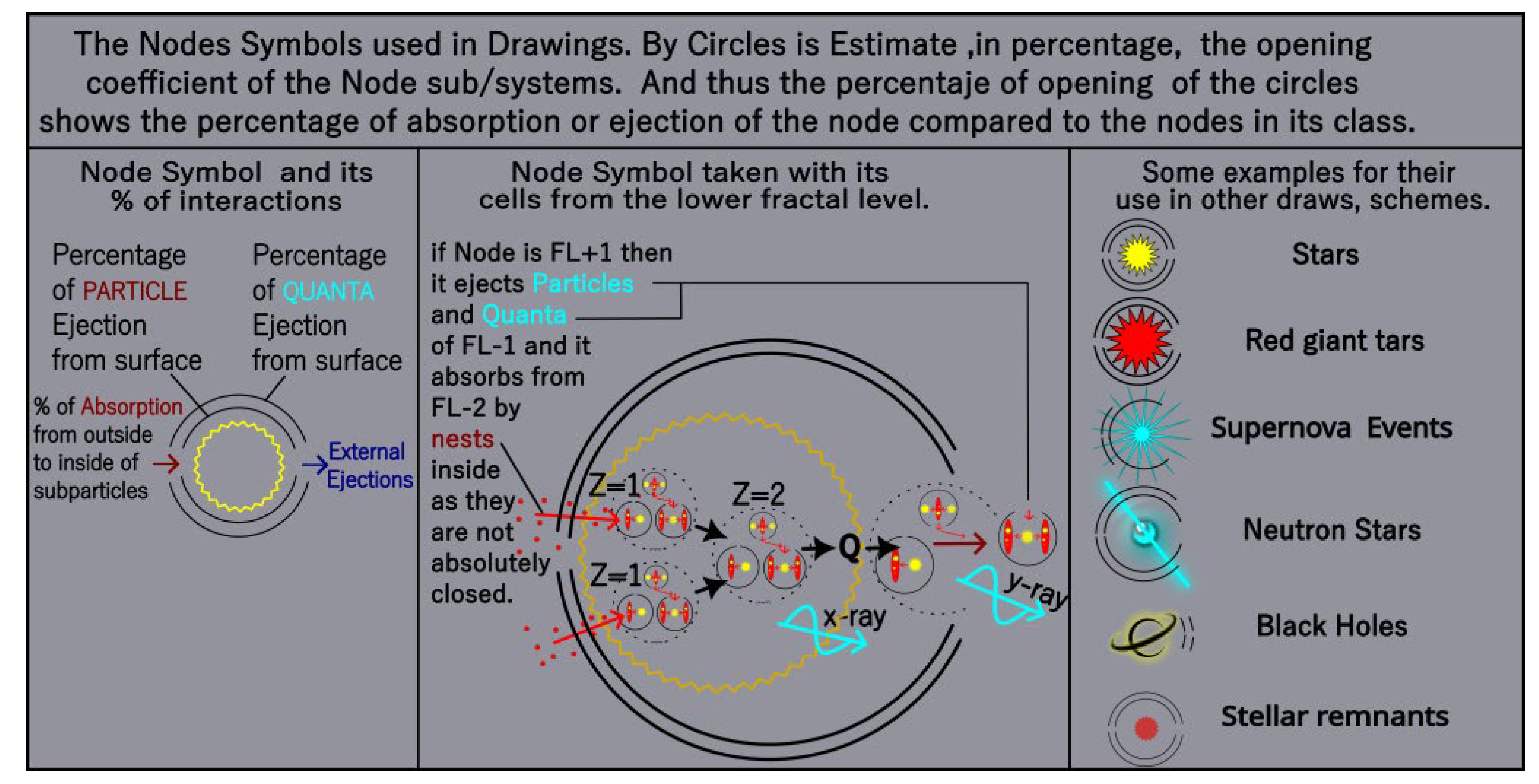
Stars are FL+1 and they emit jets of Hydrogen atoms which are FL-1. But the stars of atoms are FL-1 and they emit local stellar winds which are cells and groups of cells from FL-2. Thus, although there exists similarity among all nodes from all FLs, the nodes in any FL represent a new activation for lower FLs. That is, although the nature of the processes in nodes from all FLs is similar, each FL contains unique Nodes relative to the entire universe.
In stars FL+1, the atoms FL-1 are activated, but in the Nodes of hadrons FL-1 the cells FL-2 are activated; in Nodes FL-2, the groups of cells FL-3 are activated; and in Nodes FL-3, the groups of cells FL-4 are activated. Therefore, the universe is a fractal structure with self-similar parts, but at the same time, taken together with its lower FLs, plus a new activation of a new FL. Thus, the nodes in atoms do not produce the known quanta produced by the nodes in galaxies. Therefore, the known quanta in physics are unique in the universe, and at FL+2 they appear within extra dimensions. For this reason, in atoms, local quanta may only theoretically be found in extra dimensions beyond the nature of detectable physics.
3.3.1. Nodes in the Composition of Atoms
Due to several estimations, the nodes in the composition of atoms are considered to be Neutrinos, and it is believed they have a small negative charge, because they can be detected. Neutrinos are nodes within atoms because no other particle can be, and the manner and place in which they appear coincide with the philosophical analyses of the dynamic universe where nodes from FL-1, in nodes from FL+1, are massively thrown into space together with cosmic dust in stellar winds.
Quarks are the smallest particles of protons and neutrons, and it seems that nodes should be found at the decomposition of quarks. But quarks are not distinct particles made of substance, but systems of “Node-Nests” (Section 3.3.4).
Neutrinos coming from space interact very weakly with atoms because:
- Neutrinos inside the atom are very rarefied relative to penetrating neutrinos, and therefore collisions are rare.
- It is observed that a few stars cannot interact with a galaxy, because stars are relatively small; the same occurs in the example of proposed Neutrino as Nodes in atoms.
- A quantum with lower energy than an Neutrino can interact with atoms because it has a larger surface.
It is observed that the fundamental part forming galaxies as systems are stars and molecular clouds. And therefore hadrons must also have Nodes and Nests. Nodes within hadrons are taken as Neutrinos, but it is not too important which particles are the nodes, but the assertion that they exist. Without Nodes analogous to stars within hadrons, the present fractal universe model cannot be supported.
In the composition of atoms, the most suitable particle to be taken as a fractal Node is the Neutrino, for the following reasons:
- It is the smallest mass particle in the atom. At the same time, it is large enough to be detected, though very weakly.
- Nodes must have negative charge, and this is observed. The charge of Neutrinos is very weak because this is also observed in galactic cells, where a few stars for the whole galaxy have the same insignificant charge, because galaxies contain many billions of stars.
- The property of Neutrinos to detach from hydrogen atoms in reactions within stars shows us that neutrinos are nodes within hadrons just as stars are in galaxies. Because if groups of galaxies decomposed similarly to reactions in stars, then the smallest particle ejected from a group of galaxies could only be stars.
The nodes of atoms have a much shorter lifespan than nodes in FL+1, i.e., stars, because the processes at the atomic fractal level have speeds billions of times higher than in FL+1. And Neutrino, like stars, have a lifespan, and they regenerate only within hadrons.
3.3.2. Searching for Nodes in the Composition of ATOMS by overlapping Their Dimensions with Those of Galaxy Groupss
In the present model, atoms and galaxy groups are groups of cells but of different levels. Galaxy groups are FL+1 and atoms are FL-1, and they have Nodes as their energy sources. The energies that appear in nodes are felt as forces within the cells and groups of cells.
In (Figure 3.3.2), the deduction of the nodes of atoms is made by comparing the order of magnitude between stars and galaxies. On a logarithmic scale, where the intervals between exponents are equal (although real values increase exponentially), these two groups of cells of different levels are mirrored — that is, superimposed — to find dimensional similarity of their internal construction.
Figure 3.3.2.
The scale in the image is logarithmic, where the intervals between exponents are equal (though real values grow exponentially); the components of the atom are mirrored with a medium-sized galaxy to visually analyze size differences between galaxies and atoms.
Figure 3.3.2.
The scale in the image is logarithmic, where the intervals between exponents are equal (though real values grow exponentially); the components of the atom are mirrored with a medium-sized galaxy to visually analyze size differences between galaxies and atoms.
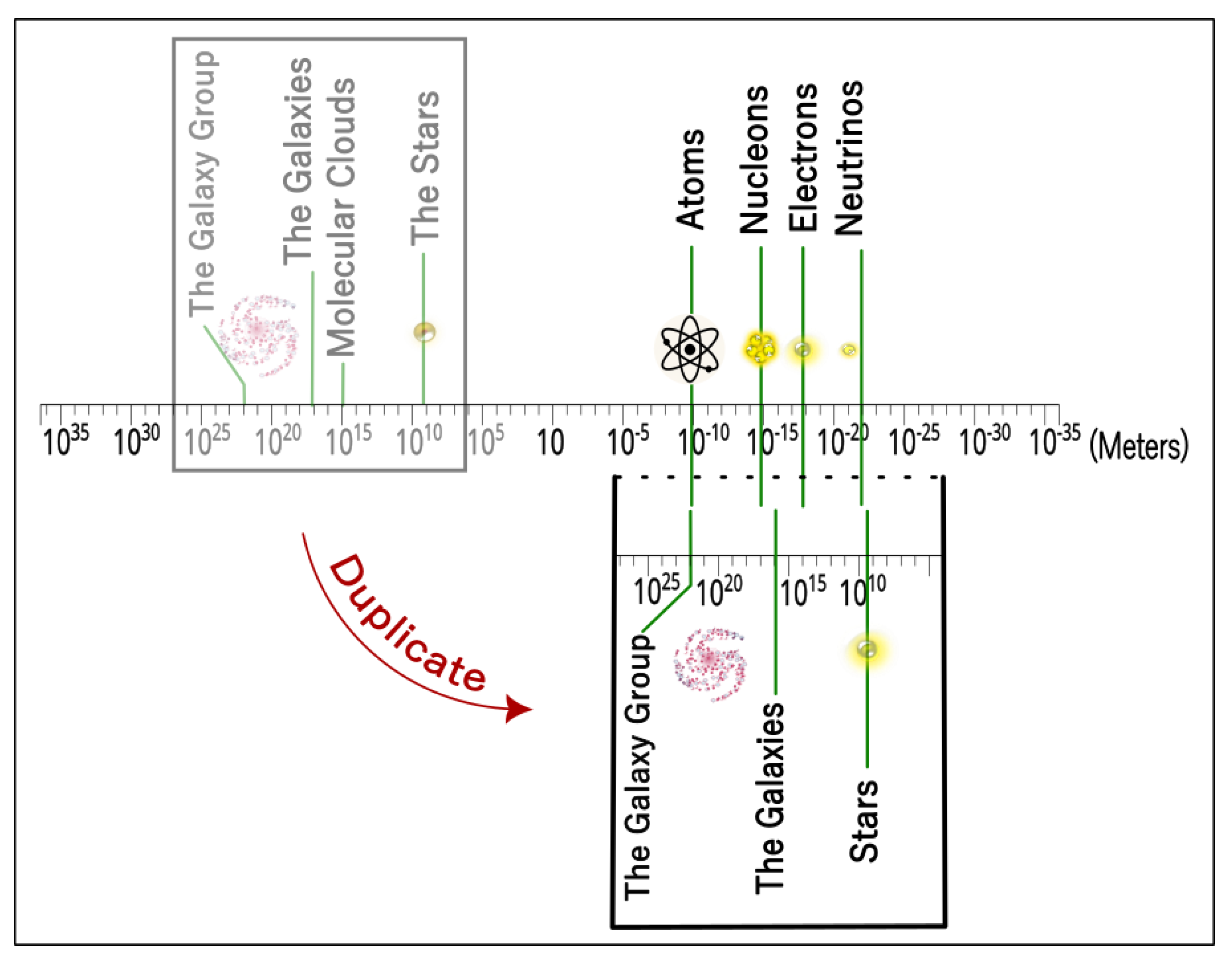
It is observed that the components of the atom extend over an area which coincides with that of the components of galaxy groups. In galaxy groups, from nodes to the galaxy size, there are 13 orders of magnitude, but in atoms, from the smallest particles like neutrinos up to atoms, there are 11 or 13 orders of magnitude. It is known that although the Neutrino’s mass is approximately calculated, its size is deduced from the mass too; therefore errors are not significant. Thus, Neutrinos are the Nodes of atomic cells, as stars in galaxies. And similarity exists for all components of groups of cells, and it results that atoms have similarity with galaxy groups. And electrons appear as hadrons, that is, cells similar to galaxies but of smaller dimensions, which is satisfactory for the present model.
It is known, and deduced from Figure 3.3.2, that stars relative to galaxies are smaller by 12 orders of magnitude from the graduated scale. However, stars also become different supernovae when they end their life cycle, and supernovae can expand over billions of kilometers. And neutrinos likewise are observed to exist in various types. Therefore, the comparison made serves to explain the small discrepancies.
3.3.3. Additional Fractal Nodes: Star Explosions, Black Holes, Neutron Stars
Supernovae and stellar remnants play the role of fractal nodes because they are energetic accumulations that form cells as systems through their emissions of particles that feed the Nests. They also permanently exist within cells, though their lifespan, compared to ordinary stars, is much shorter. Therefore, in the fractal universe, at all levels, nodes vary in size, energetic activation, and interaction influence.
From few and uncertain observations, Black Holes appear within a few seconds; in fact, the disappearance of giant stars has been observed and it is proposed that they collapsed into a black hole. Therefore, black holes are formed from atoms compressed extremely, where they are transformed into particles FL-3, FL-2 not included in FL-1. Black holes are not some “absolute voids” (much emptier than cosmic Voids) that absorb matter and form attraction, because in such a case, one would observe for a long time how matter from the explosion residue leaves that place. Therefore, black holes also participate as nodes in galaxies, and there exists the probability that they exist in cells of other levels (Table 3.3.3).

Table 3.3.3.
Nodes at each level.
| FL/ Matter | Nodes | Cells |
|---|---|---|
| FL+1 | Stars, Stellar dwarfs, Neutron stars, Black holes | Galaxies |
| FL-1 | Neutrinos, Unknown energy sources forming magnetic fields inside atoms that could be local black holes, local neutron stars, etc. | Hadrons, Electrons |
| FL-2, -3,-4 | Similar to other FLs |
Still, ordinary stars are the main nodes in the fractal universe because stars appear even now in intergalactic space, and when galaxies first appeared, they were initiated by stars. Also, once they become active, they stop the accumulation process due to gravitational attraction, and this is done only by ordinary stars because they appear first. If stars at each FL, that is nodes, did not become energetically active, then the primary particles of the universe would form a single accumulation.
3.4. Fractal Cells at All Fractal Levels (Inspired by Galaxies)
Galaxies in the fractal universe are called cells (Figure 3.4). Galaxies are dynamic and regenerative because stars emit their sub-particles, which are then absorbed by molecular nebulae. And this process is extrapolated for all cells at any fractal level. Within the atom, the fractal cells are the Hadrons and Electrons too.
Figure 3.4.
The image illustrates the processes that take place in galaxies, making them dynamic and regenerative, including emission and absorption of particles into intergalactic space. The particle fluxes emitted are shown with yellow and blue arrows. This basic system is extrapolated for all cells at any level.
Figure 3.4.
The image illustrates the processes that take place in galaxies, making them dynamic and regenerative, including emission and absorption of particles into intergalactic space. The particle fluxes emitted are shown with yellow and blue arrows. This basic system is extrapolated for all cells at any level.
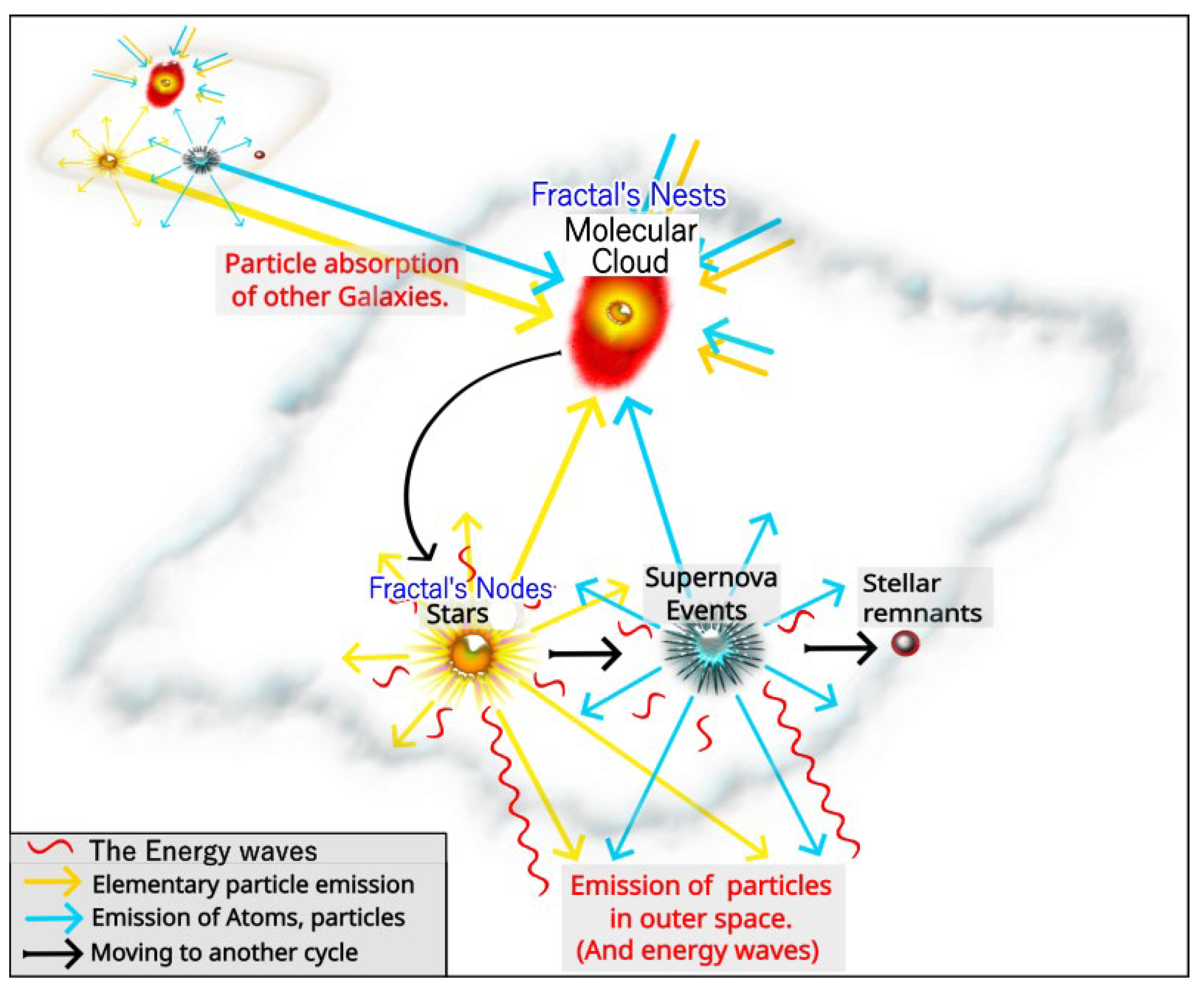
Stars, through their gravitational attraction, form galaxies as accumulations of matter. Likewise, galaxies are systems where stars (nodes) eject particles, and molecular clouds (nests) absorb them. This extrapolates to any cell of any FL.
Cells of any FL are self-similar basic parts of the fractal structure of the entire universe. From them, different groups are formed, and since groups are different but still ordered, they also can be self-similar parts but in a more complex framework.
In Figure 3.4 (b), the symbol of Cells is presented. A medium galaxy contains thousands of Molecular Nebulae and tens of billions of stars; this observation, in the present model, is extrapolated for hadrons and for any cell.
Figure 3.4 (b).
At the top of the image, the Nests of any level are shown (inspired by molecular nebulae) which
absorb particles from Nodes (inspired by stars). Nests are always together in systems with nodes and form
“Node-Nest” systems which are the basis of cells. At the bottom of the image, the cells are illustrated within their simplest group; in FL-1 this is Hydrogen, and in FL+1 this is galaxy groups with the fewest galaxies.
Figure 3.4 (b).
At the top of the image, the Nests of any level are shown (inspired by molecular nebulae) which
absorb particles from Nodes (inspired by stars). Nests are always together in systems with nodes and form
“Node-Nest” systems which are the basis of cells. At the bottom of the image, the cells are illustrated within their simplest group; in FL-1 this is Hydrogen, and in FL+1 this is galaxy groups with the fewest galaxies.
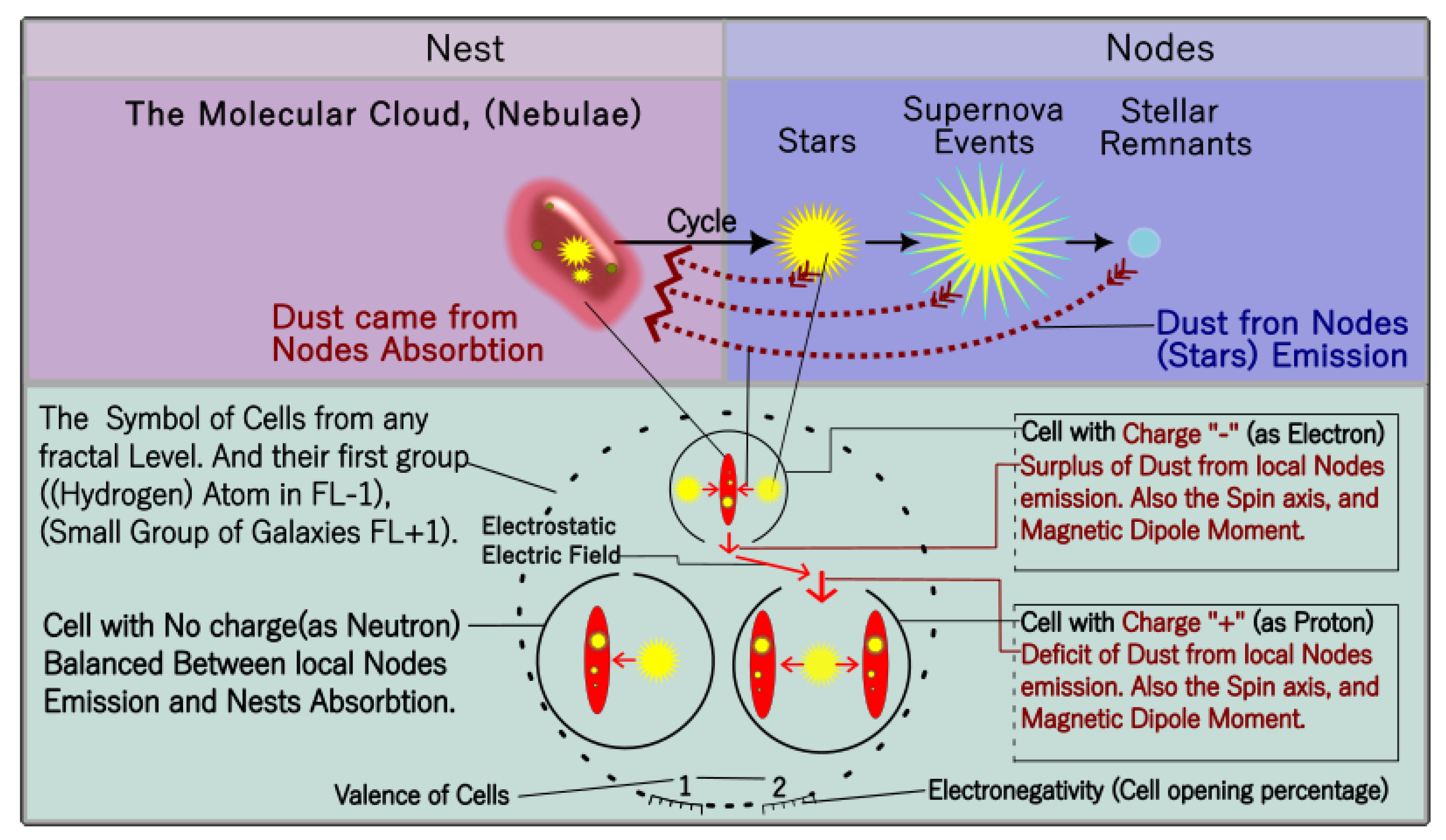
Therefore, in each cell of the fractal universe, the dynamic “Node-Nest” systems are groups of hundreds or thousands of Nests, and billions of Nodes. These “Node-Nest” systems are unobservable because these systems intersect with each other, and are very temporary because their parts orbit at different speeds relative to the cell. These systems are formed due to distances but also due to “interstellar dust saturation”. In groups of cells (atoms, groups of galaxies), the Nests and Nodes take higher-order systems like protons, neutrons, but the primary energy is from the Nodes (similar to stars that eject sub-particles) and Nests (similar to molecular nebulae that absorb stellar winds which then become cosmic dust). Therefore, for simplification, the symbol indicates the minimum participants so that this symbol may later be used in other explanatory drawings.
3.4.1. The Fractal Cells of the Universe Are the Self-Similar Parts Therefore They Are “Subuniverses”
In the present model, the basic self-similar part of the fractalic structure are the Cells. The groups of cells such as atoms and the groups of galaxies are different complex groupings of the self-similar parts. The universe is dynamic, unlike a geometric fractal. As a result, matter groups into these structures, then it is free to circulate easily through space, and to form a dynamic universe in motion. Therefore any cell, even any group of cells, is like a local universe. But once it is included in a larger structure of the universe, they are sub-universes.
And within the Planetary Natures, many natural systems are encountered that are often called “Local Universes”. And this naming is relevant, but it describes processes within planetary natures, which cannot be subuniverses of the entire universe.
Subuniverses are natural systems closed inside themselves ~95%.
The concept “Sub-universe” is a more generalized alternative to the description of the universe in the fractalic framework. It cannot fully represent the dynamic universe only in the fractalic framework, because the dynamics of each level differ according to the speed of the local processes.
The concept “Sub-universe” is inspired by models of complex systems created by engineers, which are formed of “subsystems”, which in turn are formed of other lower “subsystems” and so on. When a galaxy is studied as a separate whole, it is correct to be called a “system”, but when the system is studied as part of the universe it needs the prefix “sub”, meaning it is like a subsystem.
The radiation ejected from black holes, the Big Bang, are cyclic processes of matter transforming from one state into another, and in this context the attribution of the names “Subuniverses” and not “Multiverse” is the most suitable.
3.4.2. “Sub-Universe” but not “Multiverse”; an Alternative to the Big Bang
Most stars at the end of their life explode and transform also into black holes, which produce processes similar to the “Big Bang” and there exist valuable hypotheses that support that the matter from them forms parallel universes. But the universe is a fractalic structure with self-similar parts, and when matter divides into other FL it forms “Sub-Universes” and not “Multiverse”, because the same matter forms sub-universes of different fractalic levels.
The Multiverse hypothesis has a correct foundation, because it follows where the remains of matter from black holes go, but they do not go into Multiverses but into Subuniverses of smaller fractalic levels. Another proof for this is the fact that the universe is regenerable inside itself but not outside itself, just like vegetation or organisms.
The developers of the “String” theory support that the atom represents a mini-galaxy, therefore the self-similar part of the fractalic universe are the galaxies, and not the entire universe. Thus the remains from black holes re-self-organize into cells of smaller fractalic levels, similar to galaxies.
3.4.3. Electrons Are the Same Hadrons, and the Same Fractalic Cells
Astronomy knows that in groups of galaxies, at their periphery there also exist many small elliptical galaxies, therefore a similarity can be searched for Electrons also in them, but the main analogs are the irregular galaxies. For this it is necessary to keep the view that atoms have their similarity in galaxy groups, because:
- Stars (Nodes) are too small to play the role of electrons,.
- It is known that electrons can transform protons into neutrons. But in FL+1 this is valid when a dwarf, or irregular galaxy collides and fuses with a giant galaxy.
- The charge of stars is also negative, but within galaxies or groups of galaxies stars are too small to produce excitations of the size of quanta of FL+1.
- Electrons can transform into positrons, but stars cannot transform into galaxies specifically different, meaning from one type into another and remain as a discrete body. Therefore electrons are some how divisible and similar to Hadrons.
Electrons have negative charge relative to the nucleus of atoms, with which they form electric fields. Therefore electrons can be only of the same class as Hadrons.
3.4.4. The Negative, Positive and Neutral Charges of the Cells
The charge of cells, the groups of cells of any FL, and of the systems of local levels larger than the nodes such as quarks, has its origin from the dynamic systems “Node-Nests” (Section 3.2.1).
The nature of charge can be described from the observations in galaxies and then extrapolated to any FL. There are many types of galaxies, but the main examples are:
- Spiral galaxies are similar to protons. Galaxies with more molecular clouds have positive charge because dynamically they are unsaturated with cosmic gas. They form around themselves a decompression of the local cosmic gas and dust.
- Irregular galaxies, oval dwarfs, are similar to electrons. Galaxies with fewer molecular clouds form or display negative charge, because they permanently expel more cosmic gas than they absorb.
- Giant elliptical galaxies are similar to Neutrons. They are characterized by being heavy and occupying the central place of the groups of galaxies. Due to the hot environment in the nucleus of the galaxy cluster, not many molecular clouds form. Although the stars also do not eject much cosmic gas, because they are old, or thus they appear.
The example when atoms through friction lose electrons and they obtain charge, is taken as a rule where when a system of accumulation of matter loses part of its own with which it was exchanging sub-particles, and the nests become unsaturated, or when it is supplied with particles the nests become supersaturated. This is valid both for charge and for ions, because both properties stand at the basis of the saturation or unsaturation of a natural system (Table 3.4.4).
Table 3.4.4.
Charge and Ionization have the same explanation.
| Charge of Nodes (comes from their sub-levels) | Charge in Cells and their groups | |
|---|---|---|
| Examples | Neutrinos / Stars | Protons, Atoms, Molecules / Galaxies |
| Negative Charge | Due to ejections (solar winds), directly. | “Node-Nest” unsaturated system |
| Positive Charge | – | “Node-Nest” supersaturated system |
The negative charge of cells is formed because they release more than they absorb dust of particles from outside them. This is because inside these cells the ejections from the Nodes dominate.
Nodes or nests, unlike cells, cannot change their charge. Stars eject matter into space and thus they can have only negative charge.
Cells, unlike nodes or nests, can change their state of charge because charge in them is created by the domination of Nodes or nests:
- In unsaturated Cells the Nests dominate and they have positive charge. The example is protons.
- In supersaturated Cells the Nodes dominate and these cells have negative charge. The example is Electrons.
- In neutral Cells there is a balance between Nodes and nests although both are less productive.
Stars in galaxies feed the molecular nebulae with their sub-particles that are ejected, and if a number of stars leave the galaxy or become less active, then the nebulae will become unsaturated as a system, and this would be sensed outside the galaxy as a positive charge similar to protons. But directly similar to protons, the charge of galaxies can be sensed over periods of billions of years, which is satisfactory for the present model (Section 3.7 Time), and thus the charge of galaxy groups is explained in the framework of similarity with atoms.
Electrons have their similarity in galaxies of smaller sizes, and their negative charge is explained as similar to ions, meaning it comes from the remains of the activity of the “Node-Nest” systems.
3.4.5. Quarks Are “Node-Nest” Systems, but not Distinct Particles with Mass
Quarks are the smallest semi-detected particles that form the hadrons (protons, neutrons, mesons, etc.) and it seems that the nodes of atoms must be found in the disintegration of quarks. But in the present approach it is proposed that quarks are not particles formed of substance but dynamic “Node-Nest” systems (section 3.3.4), meaning the regeneration process of the nodes forms these separate systems, found in modern physics as quarks. And quarks can appear only at the disintegration of hadrons, where the new appearing parts form their own charge. But also in the normal state of hadrons.
The description of quarks still needs to be researched, because in galactic cells it is observed that different galaxies contain different black holes, arms, etc. Quarks must also have their similarities in galaxies. But the homogeneity found in quarks inside hadrons cannot appear within galaxies because for this a much larger time scale is required, and a more simplified spatial resolution of the observer.
Quarks are only systems of the “Node-Nest” dynamics, even if protons differ from neutrons by having some local black holes or other differences. This is because quarks form the general characteristic of hadrons, which can be protons or neutrons. Quantum Chromodynamics (QCD) is the theory that describes the strong force by means of quarks and gluons. The “colors” in QCD are quantum charges, not visible colors. This exactly coincides with the present model, and therefore quarks are not like a separate particle with mass. Therefore the current illustration of hadrons with three quarks inside them that look like three balls must be classified as those balls not being substance, but describing only systems of local substance exchange “Node-Nest”, of the dynamics of the processes in hadrons. And another illustration must be made for hadrons, which must show the distribution of matter of the same FL, and which must resemble that of galaxies full of nodes and nests. Therefore it is not correct to search for Nodes and Nests in Quarks, but in hadrons, thus electrons can also be described as hadrons.
Modern physics cannot detect the particle itself as a ball with mass and ejections or absorptions of local gas, but its homogeneous effects and in the ensemble of enormously many cycles, therefore quarks do not have a direct particle. Likewise the Higgs Bosons do not exist as “Accumulation of matter” because they cannot have mass greater than protons, and they are not found in the present model of the fractalic universe, and similarly quarks are only fields resulting from the local dynamics of matter accumulations. The nodes in atoms are the Neutrinos and they are distributed inside hadrons like stars in galaxies, and therefore hadrons have their counterparts in galaxies, while the atom is similar to the groups of galaxies.
Physicists often search for a similarity between the scales of the universe. The description of atoms is currently blocked because quarks, electrons cannot be disintegrated. At the same time, the standard model of the atom does not fit into a fundamental philosophical vision of the entire universe. Quarks are studied indirectly, and the theoretical observations about them are realized through physics, which is a Relative Reality, compared to another reality of the fractalic universe, and modern physics arises from the Observer of Nature on Planets (section 3.6.1).
In modern physics the detectable micro-universe is studied and is viewed from the point of view of detectable physics, especially the differences in speeds between the macro-universe and atoms are not included in the results of the research. The structure of atoms is described as it is detected and how it interacts, but this is incorrect relative to zero speed and a detailed homogeneity.
Therefore atomic and nuclear physics must be divided as:
- a)
- Relative for the research of the fractalic universe, where matter accumulations are similar between FL.
- b)
- Relative for the description of Planetary Sciences, where particles must be described exactly as they appear, because this is the real way they appear in the relative natures encountered on planets.
And thus the mystery of the standard model of the elementary particles will be resolved.
3.5. The Table of All Matter Accumulations in the Present Model (MFU)
A general image showing all the scales of the universe has been attempted by several researchers, but the results are very little satisfactory. In Figure 3.5 a table with the five FL levels of the present fractal model (MFU) is shown. The visualization of the grouping levels of matter from FL-1 as well as from FL+1 allows, by extrapolation, to deduce FL-2, FL-3, and FL-4.
FL levels smaller than FL-1 (atomic) are undetectable; they can only be found theoretically because their dimensions are approximately like atoms compared to galaxies, meaning they are about 35 or 50 orders of magnitude smaller.
In Figure 3.5 the table of all matter accumulations in the fractal universe that participate in the Present Model is shown. The table is presented in a shortened base version, but it can be extended to include absolutely all matter accumulations in the universe. However, the table indicates primarily the essential parts that participate in forming the Theory of Everything, and these are found in all the columns of group “a”. This table represents a fractal that in this model is called the “ToE Fractal”. It is also called the fractal of matter accumulations, but only in contexts where the fractal framework is understood. The other columns represent adjacent groups from which many fractal structures of different natures are formed.
This fractal structure is the basic structure of matter accumulations in the universe; it is the bricks of the universe, from which all interactions originate.
Figure 3.5.
The horizontal groups represent the matter accumulations from the fractal levels, but in the vertical columns are the groups indicating similar accumulations but from different levels.
Figure 3.5.
The horizontal groups represent the matter accumulations from the fractal levels, but in the vertical columns are the groups indicating similar accumulations but from different levels.
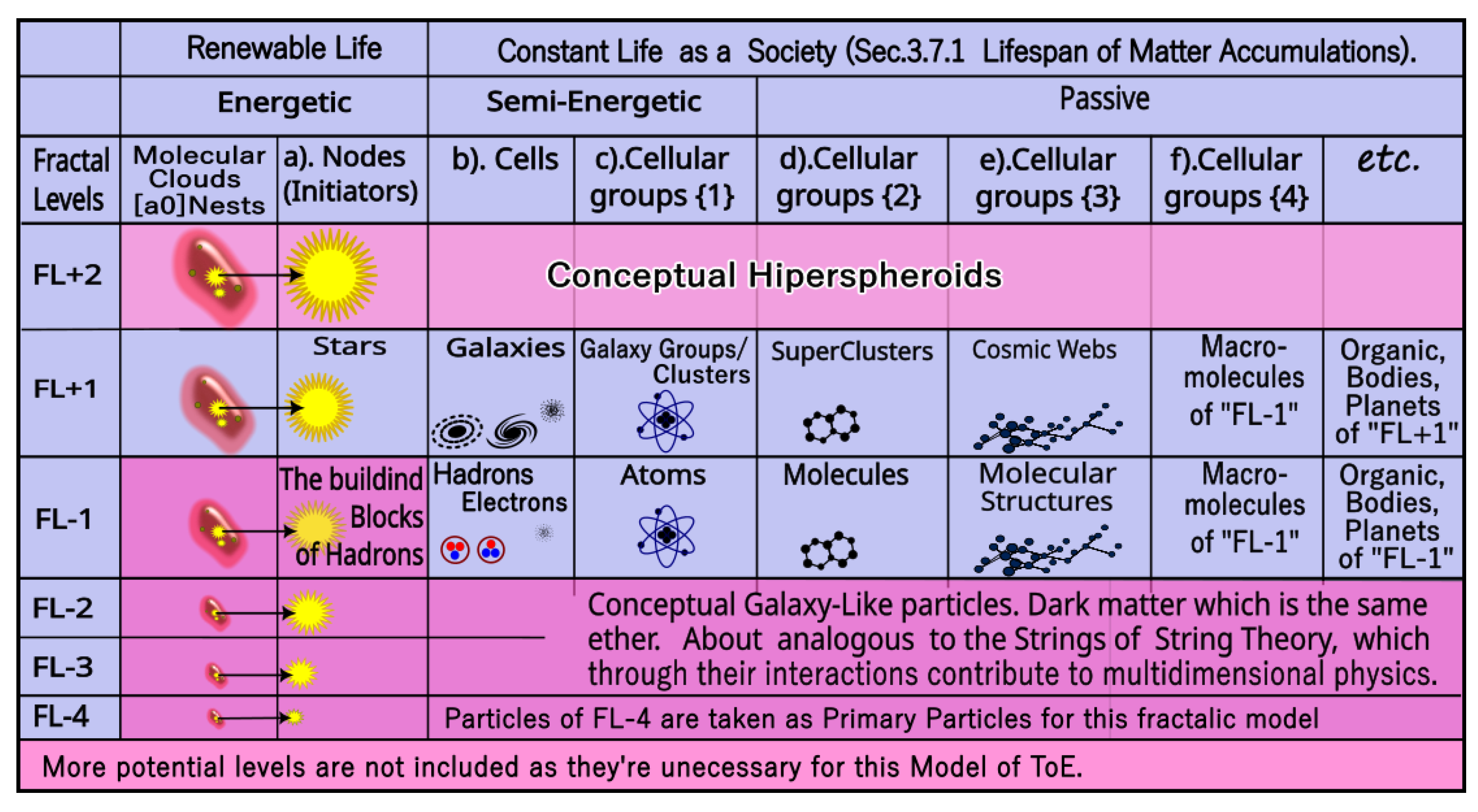
In the table, the fractal levels FL are placed on the horizontal rows. The vertical rows are assigned to the components (that is, the sub-levels of a fractal level, LFL) of each FL and are indicated with letters in alphabetical order. They are the following:
a0 Molecular clouds (Nests) (Section 3.2).
a) Energetic matter accumulations, which are also nodes in the fractal framework, described in more detail in (Section 3.3).
b) The (LFL) level of semi-energetic accumulations, which are the cells in the fractal framework, described in more detail in (Section 3.4).
c) Atoms, Groups of galaxies.
d), e), ... Each LFL contains one or several passive accumulations. At the atomic level (FL-1) the passive accumulations are molecules, bodies, up to planets. And the groups, clusters, superclusters of galaxies, etc., which belong to the level of galaxy groups (FL+1).
The levels are placed on horizontal rows and the numbering is similar to thermometer gradation, so that new levels can be added later because they still exist in the universe. The fractal level of atoms is labeled “FL-1”, and the fractal level of galaxy groups is labeled “FL+1”. At the same time, the FL numbering chosen in Figure 3.5 coincides with the present physics’ use of the meter as a unit of measurement, where the scale of atoms is negative relative to one meter.
The table represents observable and hypothetical matter accumulations of the universe, and for their identification the initials L – for Level, and F – meaning fractal, are used. It is specified that the level is the fractal level, because in physics there exist other levels such as electron levels. These initials (FL – Fractal Level) are followed by the letter indicating the accumulations on the vertical columns. In this table a limited number of three fractal sub-levels relative to the atom are included, formed from matter accumulations from which a functional internal model can be created, and which satisfy the requirements of detectable physics at the surface of our human nature:
- “FL +2” represents the Hyper-spheres already proposed by other authors, where it is assumed that potential cosmic structures larger than the visible universe group together and form a Hyper-spheroid, thus continuing the fractal structure (this under the condition that matter still exists beyond the boundaries of the visible universe).
- “FL +1” represents the level of Groups of galaxies, from which most extrapolations for other levels are inspired. In this model asteroids and planets do not belong to this galactic level but belong to the atomic level, because the boundaries of fractal levels are indicated in Figure 1 on the right side of the image as “Levels, Scales”. In this table the boundaries of levels are implied because each level begins with the energetic accumulations, meaning stars at the galactic level. And everything below stars belongs to the lower level, FL-1.
- “FL –1” is the level of atoms. The similarity between atoms and galaxy groups/clusters is hidden by the differences in time. In atoms the internal dynamics are billions of times faster, and this is described in Section 3.7 “Time”. The similarity is also hidden by the fact that physics detects the quanta of elementary particles and not the matter accumulations themselves.
All atoms are also matter accumulations, and in this table the entire “Periodic Table of Elements” fits. If atoms are placed in the position “FL-1c”, then the different atoms are included based on their order number: “FL-1c1” Hydrogen, “FL-1c2” Helium, “FL-1c3” Lithium, etc. Thus all atoms can be included in this table.
After atoms follow the structures formed from atoms:
- “FL-1 d” Molecules
- “FL-1 e” Bodies, Objects
The table in Figure 3.5 continues with levels below the atomic level.
- “FL –2” are the levels below FL-1. In the present model, the components of FL-2 appear in emissions from stars and black holes, dark matter, particles forming the Higgs field, Aether, etc.
- “FL –3”, “FL –4” are the levels from which FL-2 and FL-1 are constructed, but also appear in the space between local cells as propagation particles of interactions. According to estimates for a complete explanation of the nature of physics, and according to studies of string theory and other ToE theories, the fractal levels FL-2, FL-3, FL-4 provide through their activity all the complexities encountered in nuclear physics, explaining forces and constants. All FL levels smaller than the atomic level form different interactions that create the reality of roughly ten additional dimensions that participate in forming the nature of physics.
The additional dimensions are still in the stage of being introduced into physics, and they are not only geometric, but interaction media of the same nature as the universe. But interactions arise only from matter accumulations shown in this table. These lower levels of “FL-1” also appear as particles from the flux emitted by energetic matter accumulations (similar to solar winds) as “FL-1a” and even “FL+1a”. The energetic accumulations (nodes) in these levels (FL-3, FL-4) eject into their local space matter accumulations of even lower local levels, which form the local interactions of the respective levels. Thus they give the whole universe an elastic character: for bodies, for mechanical waves, and for the propagation of interaction waves.
In conclusion, in the present model there is a fractal segmentation containing the Level +1 (FL+1) of galaxy groups, the Level −1 (FL−1) of atoms, followed by the smaller levels (−2, −3, −4).
The dynamics of the ToE is created by the “Node-Nest” systems (columns a0–a, in Figure 3.5) although distribution systems of this dynamics also form in the semi-energetic accumulations, meaning the cells (column b). The effect of these “Node-Nest” systems also comes from the inferior levels hierarchically, but the nature of these inferior FL is of the same kind, and therefore the universe together with its additional dimensions can be described.
The matter accumulations from FL-2, FL-3, FL-4 are extremely small relative to detectable physics and cannot be detected, not even their interactions directly. They can be found theoretically when explaining the nature of constants and fundamental forces, and the bricks of FL-1 substance. They appear in reference frames with high homogeneity such as energy, forces, constants, etc.
From Figure 3.5 it is seen that FL-1 ≡ FL+1, therefore the theories currently developed for FL-1 entities are valid for the description of entities and processes of FL+1, and vice-versa. Also, the theories of physics are valid for all FL levels because FL+2 ≡ FL+1 ≡ FL-1 ≡ FL-2 ≡ FL-3 ≡ FL-4.
The fractal levels of any FL are identical as natural systems and as matter accumulations. But they are of different scales, and not everything is proportional when switching from one FL to another. In physics and chemistry, dimensional increase produces non-uniform effects. From the table of elementary particles it is known that mass does not increase proportionally with the order number of elements. However, estimates between different dimensions or scales can be made, and modern physics controls these transformations. Thus, in a fractal universe not all properties between levels increase fractally or exponentially.
3.5.1. The Universe Contains Both Normal and Inverse Fractal Parts
The accumulations of matter in the universe are an inverse fractal structure, meaning that the primary particles already exist, and the fractal of the entire universe represents hierarchical groupings of them, and not branching (division) as in a normal fractal.
The process starts from the primary particles of the universe, numerous and identical, which group together until the internal pressure increases and forms the first fractal nodes (Section 3.1.4).
The universe at all FL represents groupings of matter of smaller FL (that is, each accumulation of matter is an accumulation of hierarchical sub-accumulations). This is deduced from the fact that stars are formed from atoms, where the atoms belong to a smaller FL, from which it is evident (by extrapolation) that the universe represents hierarchical groupings. The hierarchical structure is also deduced from the fact that the accumulations of substance of all FL differ by the amount of substance (which participates in the formation of mass). If m is mass, and L represents accumulations of matter at different levels, then approximately:
m(FL − 2) < m(FL − 1) < m(FL + 1).
But if we take the number of particles (Np) from sub-levels of any accumulation, then we have:
Np(FL − 2) > Np(FL − 1) > Np(FL + 1).
Therefore, the universe is an inverse fractal structure, where the primary particles already exist and group themselves hierarchically. (Also, from these observations, the theories claiming that the fundamental elementary particles forming atoms are indivisible energies are rejected.)
If the entire universe taken as a whole is an inverse fractal structure, then because the universe is complex, inside it there also exist inverse, normal, and even regenerable fractal parts (Figure 3.5.1).
Figure 3.5.1.
The image shows the fractal parts only from cells (galaxies). The particles emitted by stars (nodes) or absorbed by molecular nebulae (nests) are also emitters and form their own fractal structures.
Figure 3.5.1.
The image shows the fractal parts only from cells (galaxies). The particles emitted by stars (nodes) or absorbed by molecular nebulae (nests) are also emitters and form their own fractal structures.
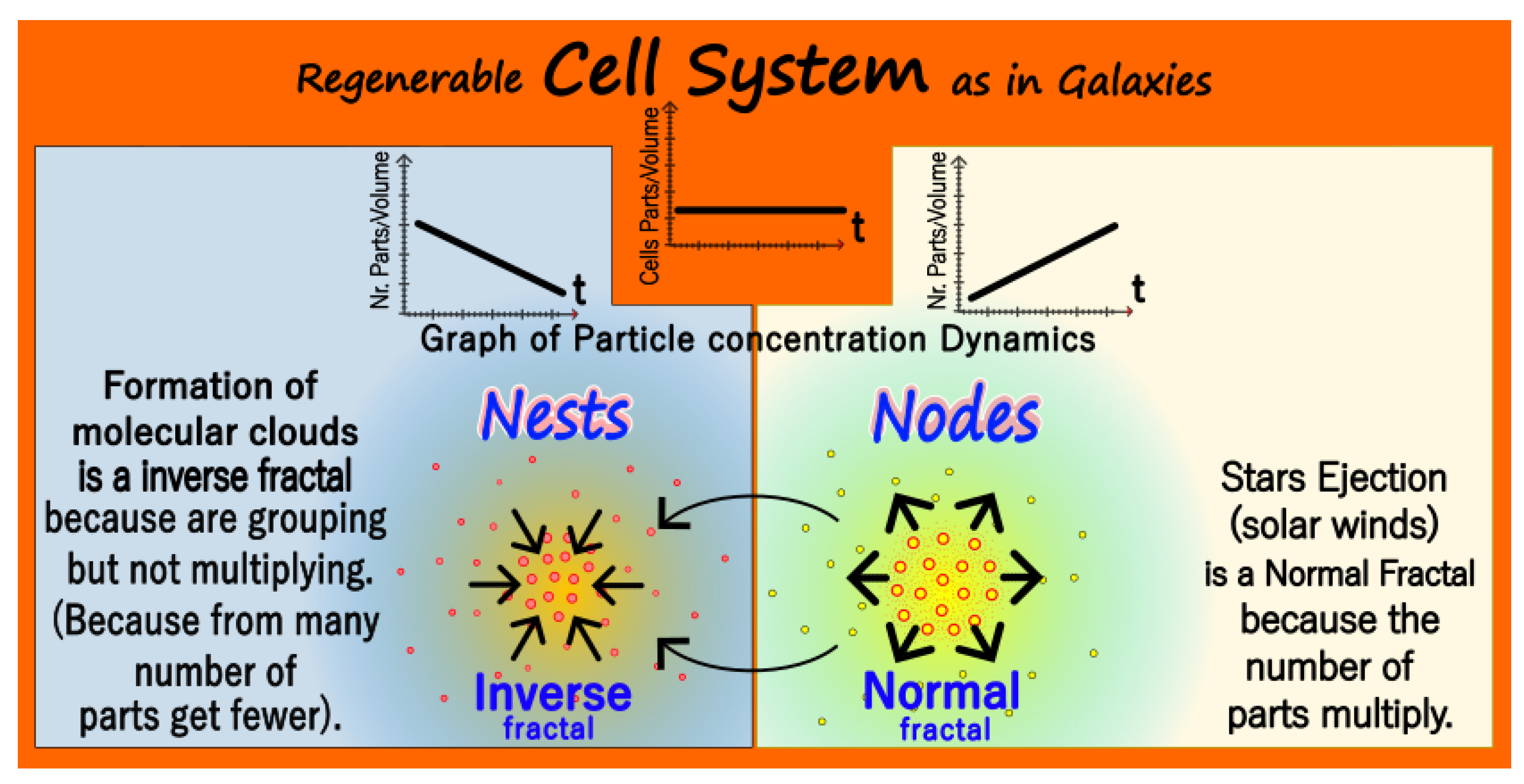
Normal fractal parts are found in the local stellar wind ejections of the nodes from each FL. The nodes (FL−2, FL−1, FL+1) eject particles into space (inspired by solar winds). These emissions are division (branching) processes, therefore they are a normal fractal. This normal fractal structure is an adjacent part of the base fractal (MFU). This fractal part is extremely more dynamic than the MFU. These dynamic fractals also include the Ether.
The quanta emitted from the nodes are not themselves substance, nor fractal structures, because they are waves of fields, but together with the fractal part of the accumulations of matter they form a fractal mix of “matter + quanta.”
3.5.2. Stability According to the Attractive Forces in the Accumulations of Matter.
It is known that atoms and groups of galaxies are very integrable and stable, but the structures formed from them (molecules, etc.) are more unstable (Figure 3.5.2).
Therefore, it is observed that at every level of the fractal universe, the nodes are the most stable as combinations, followed by the cells. And the larger the grouping of matter is in an LFL higher than the nodes, the more unstable it is.
Figure 3.5.2.
The image indicates a very approximate graph of the stability of matter accumulations, regardless of what attractive force they are formed by.
Figure 3.5.2.
The image indicates a very approximate graph of the stability of matter accumulations, regardless of what attractive force they are formed by.
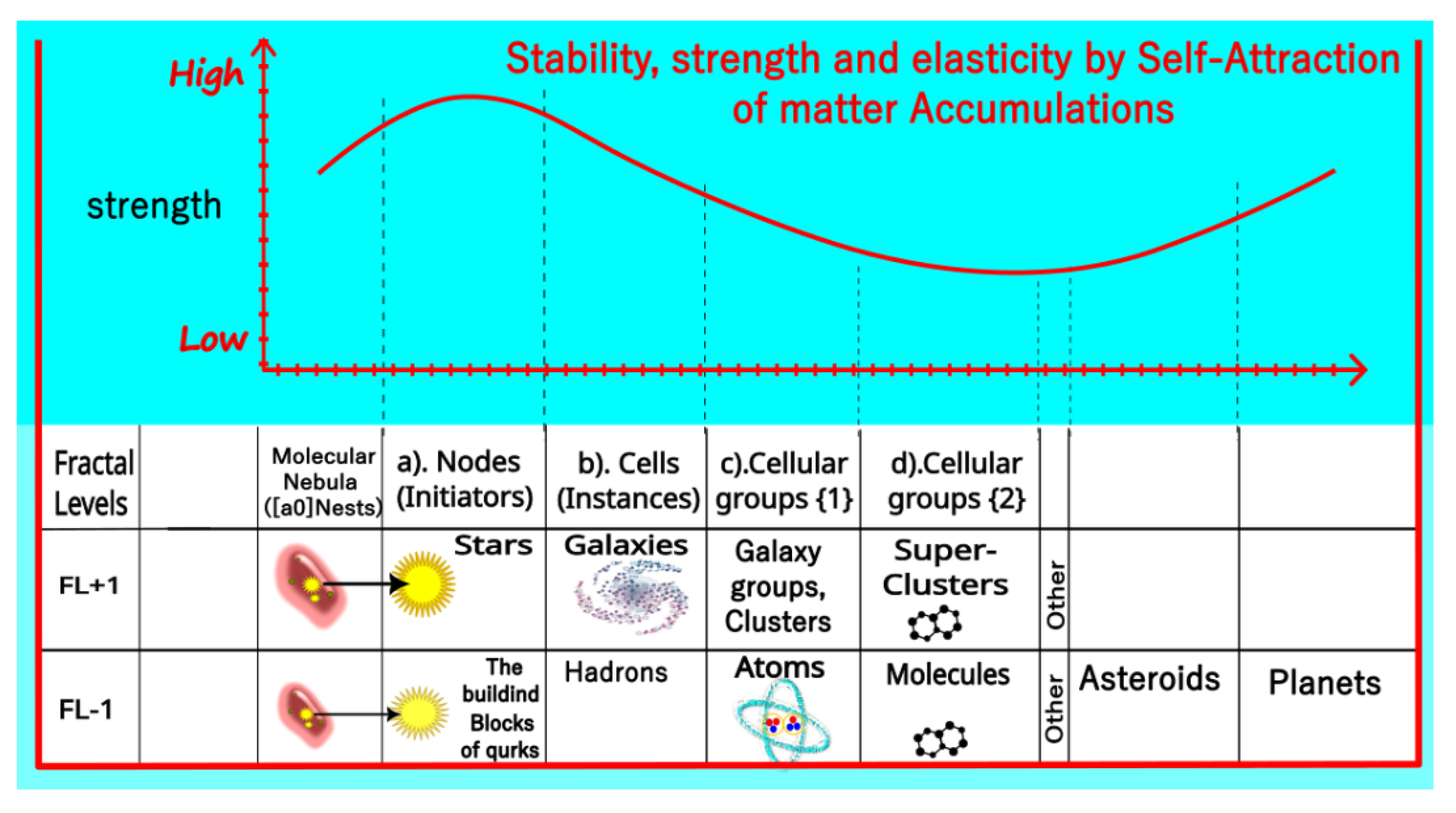
From this section, it is confirmed that matter accumulations have a fractal hierarchy where the self-similar parts are the cells (hadrons, galaxies), because from them a new stability begins. That is, the entire universe is not a single hierarchy of groupings, but a hierarchy of FL with LFL (hadrons, atoms, molecules, etc.). And this is also confirmed by the structure of the FL, which is complex but at the same time similar between any FL, but there is no similarity between LFL according to the Table from Figure 3.5.
The cells are semi-energetic systems. In them, the nodes are engaged with nests (molecular clouds) through the exchange of substance between them, forming the “Node–Nest” system. And it remains acceptable that the nodes are the initiators of the levels, and that at each level the nodes bring a new interaction to the universe. The stars form a Fifth Force, a supplement to gravity that appears in stars and partially replaces the hypothesis of dark matter. And this is observed also from the estimated graph in Figure 3.5.2, which is deduced very approximately from observations, meaning that if galaxies have a 2.1D form, then stars have a perfectly 3D form, etc.
3.5.3. The Uniformity of the Fractal Structure of the Universe
In a normal geometric fractal, the size of the elements (cells) decreases exponentially from one fractal level to another, depending on how many subdivisions are added. If three elements are added, each is three times smaller than at the previous level, etc. This relation remains invariant at all levels of geometric fractals.
But in the fractal structure of the universe, exponential growth has a low probability of being uniform. At each level of organization, from small to large, the components of the FL structure as well as the intervals between components of different FL do not follow the same uniform geometric rule. Instead, with the transition to a higher level, the accumulations form larger than the exponential growth of a theoretical normal fractal. The estimation, first of all, must be made from the fact that the smaller the level is, the closer it is to the primary particles of the entire universe, which have higher active energy. And the accumulations of matter are smaller compared to a normal geometric fractal because they contain fewer sub-accumulations that form the fractal level (Figure 3.5.3).
Figure 3.5.3.
The image shows the growth of the volume of fractal elements with the growth of the fractal level, specifically the difference between the geometric fractal and the fractal of matter accumulations in the universe.
Figure 3.5.3.
The image shows the growth of the volume of fractal elements with the growth of the fractal level, specifically the difference between the geometric fractal and the fractal of matter accumulations in the universe.
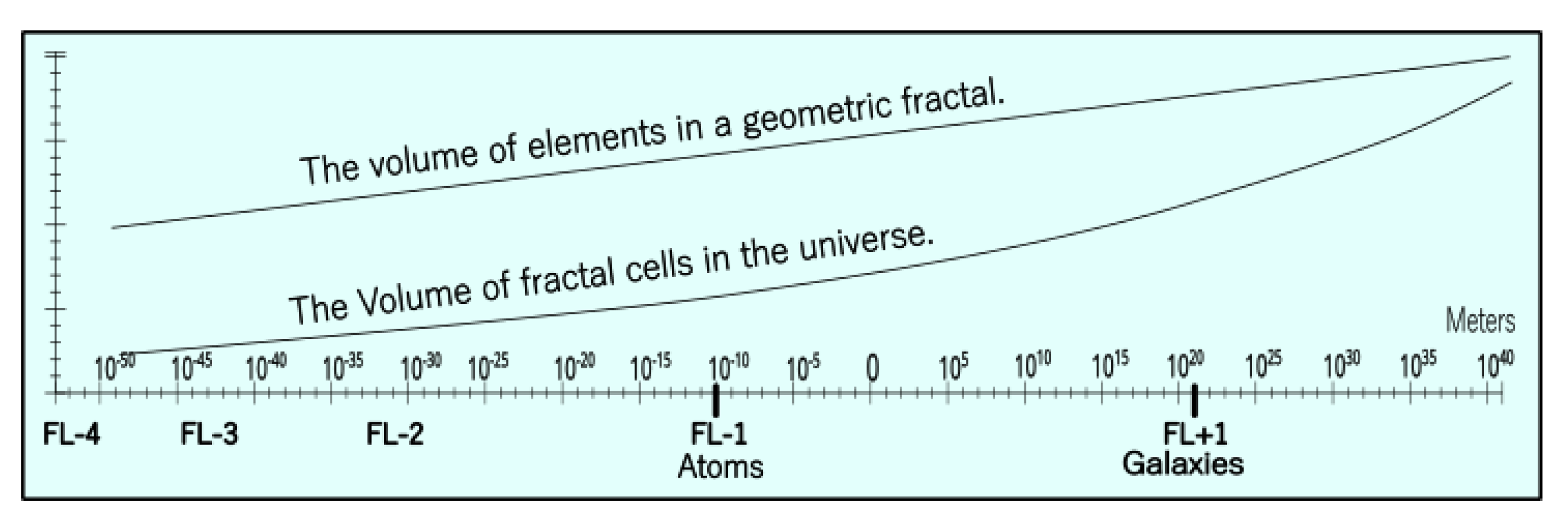
Also, this curve of the fractal structure graph in Figure 3.5.3 appears because it is observed that the potential particles of the universe become more rarefied with the increase in volume, meaning with the increase in the number of fractal levels.
This section may be important for the correct description of the additional dimensions from which most constants in physics appear, and the primary energy of the fundamental forces.
3.5.4. Between the Atom and the Galaxy, There Exists an Almost Absolute Similarity
The observation that between all FL [Fractal Levels] of the universe, once they are initiated by nodes (stars), similarity exists, was realized from estimates described in section 3.3. But the LFL levels within the fractal levels were realized based on other principles. It was necessary to find what atoms are similar to: planetary systems or galaxies, etc. The correct choice of the similarity of atoms with their similar entity from the FL of the cosmos leads to the correct deduction of the other analogies as well, such as molecules, etc.
As observed in Figure 3.5, atoms have their similarity in galaxy groups. Resulting from the present model, the description of atoms must be similar to that of galaxy group. In (Figure 3.5.4) the similarity between these two entities is shown, even if they are of different FLs.
Figure 3.5.4.
The image shows the visual similarity between Atoms and Galaxy group.
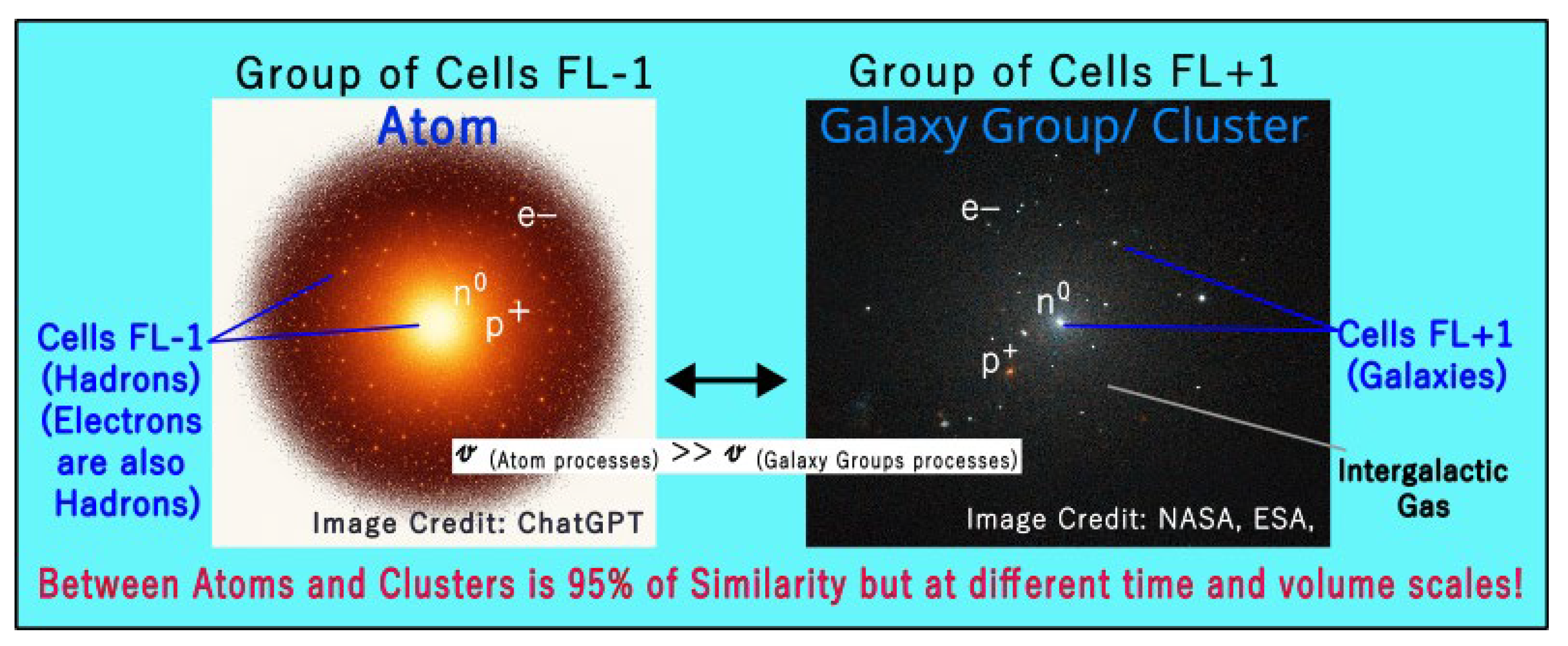
Repulsion in galaxy group and in atoms is due to orbits, but also a small percentage to the fluxes of particles released from stars and supernova. This is deduced from the fact that they are 3D, meaning that between the orbiting parts there also exists repulsion, because if there were only attraction between them, then they would align in billions of years and form a 2D orbiting, as in planetary systems.
Attraction between cells of any FL, in addition to local gravity, is due to the fact that molecular nebulae absorb cosmic dust, and following this process, a complex process of decompression of local cosmic dust and dark matter takes place. But in each cell, Nests of two FLs have their influence. For instance, in galaxies and groups of galaxies, attraction is formed by the Nodes FL+1, but also the Nests FL-1. The Nests FL-1 in atoms close 95% of the matter exchange inside the atoms, but in the nuclear reactions in stars, these systems open up; therefore stars form a supplementary gravity (a fifth Force) which, together with dark matter, forms the size of galaxies and groups of galaxies. Protons and electrons have different charges, but they are framed within the atom as a whole. At the surface of atoms, their charge is almost zero. So the electric fields formed by charges inside atoms are just a system that organizes the “Node - Nest” processes. And this is extrapolated for any FL.
At the same time, particle ejections from stars (Nodes) are the negative charge for the “electric field FL+1”, but molecular clouds make the positive charge for the “electric field FL+1”. Within atoms, the fields are “FL-1 fields”. And, thus, repulsion and attraction are not made directly upon the accumulations of matter that emit and, respectively, the attraction, for those that absorb (the nests), but between fields on large surfaces. Because the particles that are emitted also contain active Nodes and nests that expel particles outside their cells as well.
So once atoms and galaxy groups, in modern physics, are still in the process of study, they can be studied within the framework of their similarity. For this, from galaxy groups information is obtained about their structure at zero velocity, but also the circulation of stellar and intergalactic winds, the forces from the sub-levels of galaxy groups like nest absorption and node ejections. But the speed of processes in galaxy groups multiplied by approximately tens billions shows us atoms as they are detected in physics. Atoms are the result of processes in observable galaxy groups multiplied by a billion repetitions. Therefore, information about atoms shows us how galaxies manifest over periods of tens billions of years. Having at our disposal these two different pieces of information about the same entity, that is the groups of cells from different FLs , we can describe correctly both the atoms and the galaxy groups.
If one analyzes the electric fields in atoms, then it is observed that they originate from the charge; once the charge is permanent within electrons, it means that only nodes similar to stars can create it. So electrons are systems formed of nodes, therefore they are negative cells and are re-encountered at other FLs as well.
And once there is similarity between atoms and galaxy groups, the theories described in one FL are extrapolated also for the FL of atoms, and for all other FLs of the universe. And that is why groups of cells function this way, from all FL of the fractal universe.
3.5.5. The Fractal Level FL+1, and the Size of the Observable Universe Compared to the Entire Level FL+1
The observable universe, in the present model, is taken as much more extended. It is proposed that the observable universe is part of FL+1, which extends from stars (FL+1) to the nodes FL+2.
If we divide the diameter of the visible universe (1026meters) by the diameter of an average group of galaxies (1022 meters) plus the distance between groups of galaxies (1022 meters) we obtain how many groups of galaxies stand in a row on the diameter of the observable universe. And the approximate result is 1500 galaxy groups/clusters standing in a row on the line of the observable universe’s diameter.
Once groups of galaxies are similar to atoms, an analogy can be made that the observable universe is similar to the size of a group of atoms where 1500 atoms are located in the diameter. If an average atom has a diameter of 0.2 nm and the distance between them is also 0.2 nm, then an atom comprises a diameter of 0.4 nm. And multiplied by 1500 atoms, we obtain 600nm. So the observable universe is similar to a sphere formed of atoms with a diameter of 600nm.
FL-1 is similar to FL+1, and an estimate can be made, what percentage the observable universe comprises of the Hyperspheroid FL+1, which can be similar to an asteroid or a planet from FL+1, or a Node from FL+2. And the observable universe is 10-14% of the diameter of the Hyperspheroid(FL+2) formed of the known groups of galaxies. FL+1 are the fractal sublevels of FL+2 and extend throughout the universe as FL+1, over distances as long as the universe exists. Therefore the observable universe must be compared only with the Hyperspheroid of which it is part.
Inside the tectonic plates of planets, in the areas with the lowest temperatures, structures formed of atoms and molecules are similar to the observable universe. The observable universe (FL+1) relative to the surface of planets (FL-1) is very cold and well hidden from the energy coming from the next fractal Node (FL+2).
Once the observable universe is very limited in size, having only 1×10-14% of FL+1, the level FL+1 becomes observable in exactly the same observable percentage. But the greatest task is that an FL contains many sublevels (LFL), which form different natures. As observed in FL-1 atoms form molecules, nuclei of planets, tectonic plates, the surface on planets, atmosphere, etc.
Therefore, from atoms (FL-1) to groups of galaxies (FL+1), there is no directly detectable portion from another FL for “Nature on Planets”(Section 3.6) to be compared. A single portion which “Nature on Planets” detects in two levels is from atoms up to a volume formed of atoms with a diameter of 600nm which is similar to the observable universe, taken from groups of galaxies to the borders of the observable universe. And specifically these atoms, for the analogy with the observable universe, must be taken from the interior of tectonic plates, where the temperature is low.
If the observable universe is not limited to the one detected but is much larger, then an active Hyperspheroid Node from FL+2 - similar to stars) is estimated to appear at the size of 1040 meters. It certainly appears because such a massive accumulation acquires internal pressure and matter activates (Section 3.3), and now there are released not hadrons as from stars, but galaxies. So it is an activation of a higher FL.
3.6. “Nature on Planets”; as a Distinct Complex Subsystem of the Whole Universe
In contemporary physics there are two different domains; planetary science vs. cosmology. Although interconnected, they operate at different conceptual and phenomenological scales:
- Planetary Science deals with the study of planetary bodies – planets, satellites, asteroids – and their physical, geological and atmospheric processes: formation, evolution, chemical composition, local dynamic interactions etc.
- Cosmology studies the universe at large scale: the origin, structure, evolution and fate of the entire universe, including the fundamental laws of physics, matter density, dark energy, inflation, cosmic expansion etc.
These two domains complete each other: the understanding of the universe (cosmology) offers the theoretical framework for the origins of planetary bodies, and the study of planets (planetary science) gives empirical, concrete, local data, which can inspire or test cosmological models.
Thus modern physics made a sub-chapter of the universe which is called “Planetary Science”. And modern physics does not divide these two sciences as absolutely different natures. But the model of the universe from this work is different from the actual cosmology that begins from the Big Bang, and therefore the current category “Planetary Nature” is developed for a non-fractal universe. The concept “Nature on Planets” is a part deviated from the TOE process. Dynamics, energy, entropy, etc., have different reference frames in these two natures.
Once in this approach it is tried to introduce in the sciences about physics and the universe a new view, a new concept appears: “Natures on Planets” (Figure 3.6). It is described by the fact that in its framework appear adjacent natures relative to the universe, and observations, detections, theories of the whole extended universe adapt to this nature and not to other reference frames such as “observations from outside of systems.”
Figure 3.6.
In the image is illustrated the nature on planets like our Earth as a nature different from the nature of the universe.
Figure 3.6.
In the image is illustrated the nature on planets like our Earth as a nature different from the nature of the universe.
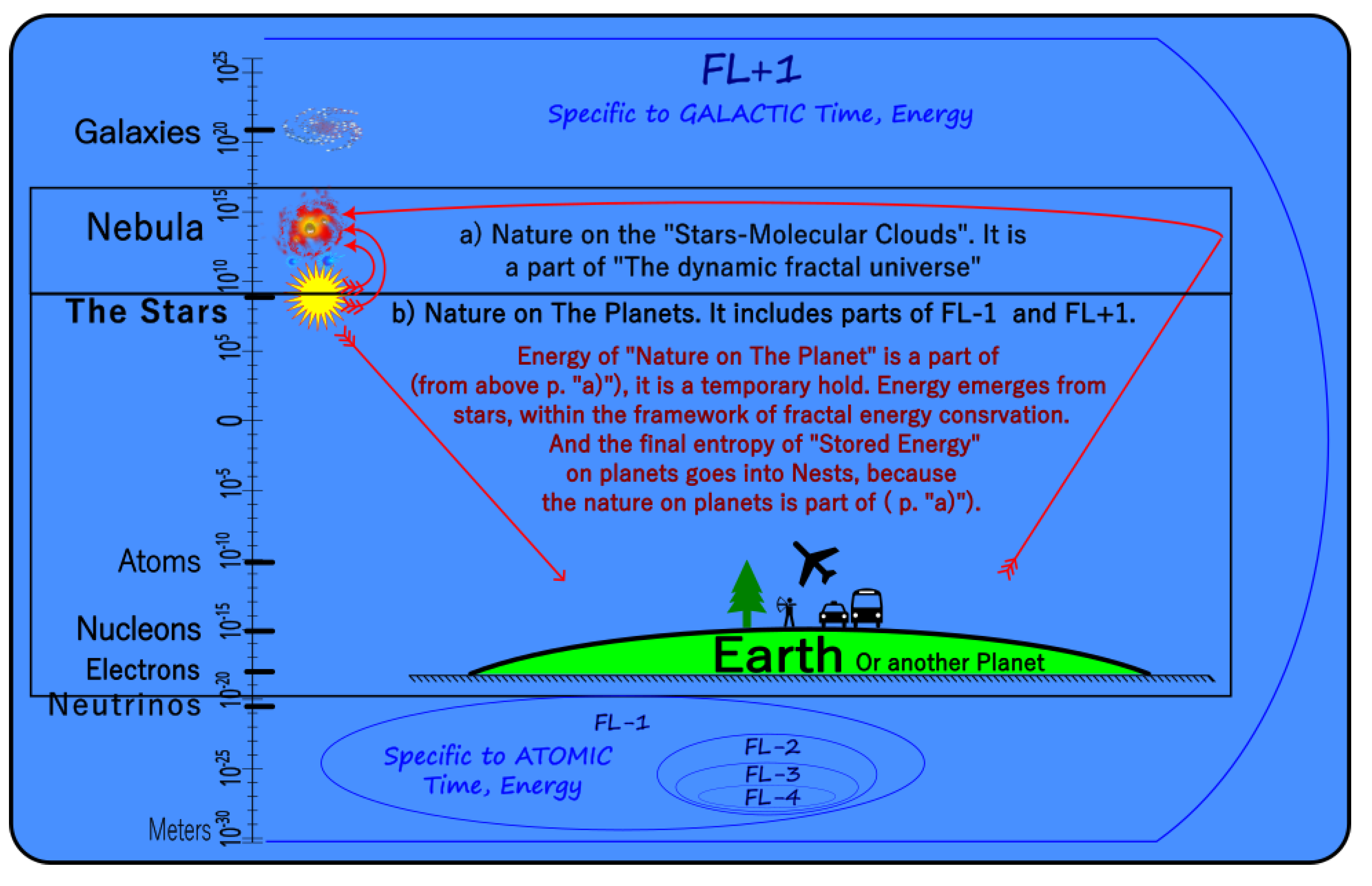
Because planets and exoplanets are near stars they get a place where atoms on the surface of planets have conditions to create complex structures, different from the structure of the fractal universe Figure 3.6. Planets also have different cycles like: their orbits around their star, rotation around their axis, tides from the natural satellite, including collisions from comets. And the energy from the star from FL+1 synthesizes gradually complex forms because of cycles of synthesis and re-synthesis after different reorganizations of molecular substances. And therefore on planets can appear natures deviated and different from the dynamics of the fractal universe like: biology, natural then artificial intelligence, most mechanical events, mechanisms and electric circuits created by intelligence, earthquakes of tectonic plates, etc. But not everything that happens in the “Nature on Planets” can be extrapolated for the nature of the Universe under research.
Processes on the surface of planets belong both to FL-1 and to FL+1. Atoms have properties that come from FL-1 but energy comes from stars, from FL+1. So the Natures on Planets is not just one level from the fractal structure of the universe, but includes and is situated between two fractal levels of the universe, between FL-1 and FL+1.
The present work has as main goal to present the fractal-universe model. But it can be rendered only from the observations and detections made relative from the “Nature on Planets”, because the instruments that detect are part of this nature, and theories tend to formulate the nature of the whole universe for the nature from the surface of planets. For a correct rendering of the nature of the universe it is needed to classify well these two natures Table 3.6. This section has great importance for describing the universe because not all physics encountered on the “Nature on Planets” can be extrapolated for the fractal universe from the present model (for example forces, entropy). And throughout the description of the present model there is often invocation of this section.
Table 3.6.
Nature on the Planets vs. Nature of the fractal universe vs. nature of the entire universe.
Table 3.6.
Nature on the Planets vs. Nature of the fractal universe vs. nature of the entire universe.
| a) The nature of the entire universe | b) Nature from FL-4 to FL+4 | c) Nature on the Planets within “Node - Planet - Nests” | d) Different natures on planets like: Pendulum, Biology, etc. |
| Conservation of Energy comes from the primary parts (Section 3.1.2) | Conservation of Energy is fractal parallel to FL. | Conservation of Energy only within the star in its system. | Conservation of Energy depends on the nature of the System taken. |
| Energy comes from the primary particles of the entire universe. | Energy is stored by fractal Nodes. | Energy is stored by fractal nodes. | Different Energies. |
| Entropy goes to the primary particles of the entire universe. | Active and storage entropies go to FL-4 | Active and storage entropies end in Nests. | Different Entropies |
| The movements of accumulations of matter are part of the dynamic universe, and therefore they are balanced. | The movements of accumulations of matter are part of the dynamic universe, and therefore they are balanced. | The movements of objects are part of the dynamic universe, and therefore they are not conformed to the universe and energies appear. | The movements of objects are not part of the dynamic universe, and therefore are not conformed to the universe and energies appear. |
Planets at different fractal levels; In the present model of the fractal universe, once it contains several similar fractal levels, each level contains “Nature on Planets”, in FL+2 (of the Hyperspheroids) there exist “Planets FL+2”, in FL-1 exist “Planets FL-1” (Figure 3.6 (b)). Therefore, in each FL there is probability that biological life exists, but in the fractal universe all planets and processes on them are delays of the dynamic process “Nodes – Nests”, meaning that solar winds do not transform directly into cosmic dust with reduced speeds in order to form molecular clouds, but they are retained on planets. Thus the number of new stars that appear is reduced, and with a small percent the cells from any FL become more positively charged.
Figure 3.6 (b).
In the image is illustrated the part of the fractal universe that forms the Theory of Everything, and the “Natures on Planets” from any fractal level, which are of a different nature than the nature of the fractal universe.
Figure 3.6 (b).
In the image is illustrated the part of the fractal universe that forms the Theory of Everything, and the “Natures on Planets” from any fractal level, which are of a different nature than the nature of the fractal universe.
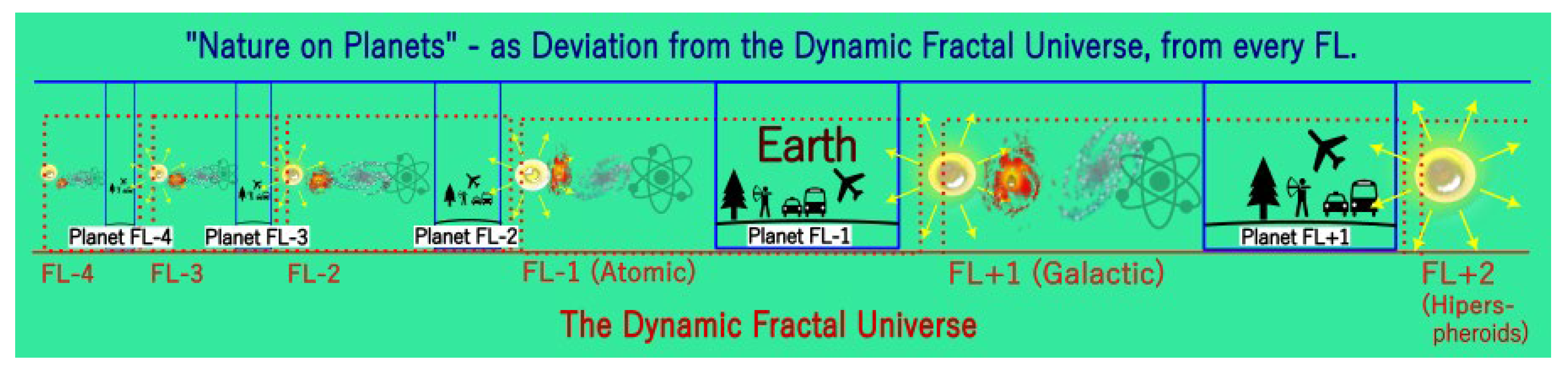
Planets exist at each FL (Figure 3.6 (b)). And the macro observable universe is part of a planet FL+1, but it is not exposed to the energy of the Node FL+2. Meaning that the observable universe is located somewhere inside the tectonic plates of a Hyperspheroid from FL+1 because it is relatively FL+1 cold, and once it expands cold it means it is part of a dynamic process of the potential of the Hyperspheroid. So in the observable universe there are not encountered processes that exist on the surface of planets, therefore analogies cannot be made with different active processes from FL-1.
“Nature on Planets” Is Also the Nature of the “Observer”
The Nature on Planets is simultaneously the limited segment of the entire nature of the universe, through which the detection of the universe across all FL is performed. The Nature on Planets provides a domain of observation and measurement: the instruments we use (telescopes, probes, spectroscopy) are part of that planetary nature, therefore universal theories in Modern Physics are formulated relative to this perspective. And physics as a theoretical science tends to formulate the nature of the universe relative to the Natures on Planets. For example, the additional dimensions in modern physics exist only for the well-detected parts. But for a Theory of Everything, a different reference frame is needed, one that includes at least two complete fractal levels, in order to indicate or invoke the other smaller FL as additional dimensions.
The fractal universe has a hierarchical structure parallel to energy storage (Section 3.14), therefore the storages can be released only in a limited way, and this is part of the limits of the Nature on Planets and also of the Observer.
The Nature on Planets forms the spatial resolution of the Observer relative to parts of the universe smaller than atoms. Therefore, the spatial resolution for the Nature on Planets as Observer is approximately the size of the atom.
Likewise, electrons are indivisible within the “Natures on Planets” because in the Nature on Planets the energy storage is one level higher than electrons (the energy has a lower density). But still, if at high energies electrons disintegrate, then the Spatial Resolution does not allow observation of the sub-elements of electrons.
All constants and fundamental forces in modern physics are relative only to this “Nature on Planets”. And the Observer on Planets uses them as limits, as fixed.
Thus, Modern Physics together with its theories is dedicated to the Natures on Planets, and this forms the Observer within the Natures on Planets. But to create a TOE one must step beyond these fixed approaches of the Planetary Observer. It is impossible to bring the nature of the entire universe to the Observer on Planets, because it would be too complex; instead, a different Observer must be created, one that does not have the requirements of Modern Physics. And this general Observer is found in a large part of this work. For example FL-2, FL-3, etc. In Modern Physics these must be extra-dimensions, but in this work they are described for an Observer that includes the entire physical Universe. Another example is that in the year 2025 some articles appeared (Constructor Theory of Time, etc.), saying that “Time forms the quality of dynamic matter”, and this is correct, but only for the Nature on Planets, because in the fractal universe time is local in each FL, if one considers the speed of dynamic processes within the similarity between FL.
Modern physics detects atomic and galactic levels differently because cosmic bodies are detected directly, while the detection of atomic structure is made at a surface where homogeneity is very high and small details are weakly detected.
Therefore, the Observer of the universe is not only “physicists, detectors, and previous theories”, but any nature in the Planetary Nature with these parameterizations that come from the atoms of FL-1 and extend even to FL+1. But the nature of the TOE includes undetectable natures, and therefore, to create correct theories in physics they do not necessarily need to be confirmed within the detectable nature.
3.7. Time and the Speed of Internal Processes of Matter Accumulations Depending on the Fractal Level
An approximate evaluation of the data about time and speeds of processes within the similarity between different FL is described in Table 3.7. In current physics, speed is measured using a certain unit of measurement, but in the dynamic fractalic universe, for a correct expression, speed had to be measured relative to the accumulation of matter of the FL that is being approached. Because with the same speed, an atom and a group of galaxies are traversed in different time spans.
Table 3.7.
Differences in speed of atomic components vs. components of a galaxy group.
| Speed of matter accumulations relative to some unit of measurement (meter). | Speed of bodies relative to natural systems (not engaged in them, but excited) depending on FL. |
| As FL increases, accumulations of matter move more slowly. And the difference of motion between levels is a few tens of times. The speed of an electron (𝓋ₑ) in FL-1 moves 20 times faster than a galaxy (𝓋_G) in FL+1 when excited: 𝓋ₑ(FL-1) ≈ 20 × 𝓋_G(FL+1) |
Calculations show that electrons, when excited, traverse an atom tens of billions of times faster than a galaxy traverses a group of galaxies. Therefore, within the similarity between atoms and galaxy groups, this is the difference in the speed of their internal dynamic processes: 𝓋ₑ Excited (FL+1) ≈ 10³0 × 𝓋G Excited (FL-1) |
Time and speed are unified through the formula “Speed = Distance / Time”. Time and speed in the universe have two main reference frames and are described in Table 3.7 (b).
Table 3.7 (b).
Time of non-fractalic processes vs. time of fractalic components of the universe.
| a) Time of non-fractalic processes in the universe | b) Time of fractalic components of the universe. |
| It is equal throughout the universe and does not depend on FL. | The smaller the FL, the larger the speeds in local systems. |
| Found in properties related to mass. Motion of comets. Motion of elementary particles, but not within their natural systems. | Found in orbit speeds and the time of a complete orbit. Time required to produce an excitation in natural systems. Lifespan of natural systems. |
| Time dilation appears mathematically in Lorentz transformations. Then Einstein used them as physical basis. | The speed of internal processes in natural systems varies due to temperature, pressure, etc. But (in the present model) the motions within systems like “Sub-universes” do not dilate time. |
The universe has parts that are fractalic and parts that are not included in the fractalic structure, Table 3.7 (c).
Table 3.7 (c).
Time in the universe for mass vs. for dynamics in fractalic levels.
| Time for the mass of bodies of any level. Mass is not dynamic and is not included in the fractalic structure. | Proper time for matter accumulations as a natural system depending on the fractal level. |
| t(FL-4)=t(FL-3)=t(FL-2)=t(FL-1)=t(Fl+1) | t(FL-4)<t(FL-3)<t(FL-2)<t(FL-1)<t(Fl+1) |
Throughout the entire fractalic universe, the differences in speeds between FL cannot be described directly because Nodes are the initiators of FL, but only Nodes from FL+1 are detectable, meaning stars. In our nature, only the speeds of the “solar winds,” originating from FL+1 Nodes, can be detected. Their particles have different speeds, including those close to the speed of light. But there is no data about the speed of “solar winds” from other FL.
Within FL+2 of the Hyperspheroids, “solar winds” can be estimated approximately from the motion speeds of galaxies when they become excited (not their orbital motions). The fastest observed motions for subclusters/galaxies in mergers are ~3000 to 4700 km/s. But the observable universe does not contain large excitations within FL+1 such as those encountered in nuclear processes inside FL-1 stars. That is, we do not have direct data about “Solar Winds” from FL+2 of the Hyperspheroids. Therefore, little information exists about galaxy speeds when they become activated within a Hyperspheroid like hydrogen atoms in stars. Still, an estimation is made in Table 3.7 (d).
Table 3.7 (d).
Speed of “Solar Winds” at Nodes of different FL.
| Nodes FL-1 (Neutrinos) | Nodes FL+1 (Stars) | Nodes FL+2 (Active Hyperspheroid) |
| Neutrinos “eject Cells” (SW) FL-2 | Stars eject Cells FL-1 (Hydrogen atoms, Neutrinos) | Nodes FL+2 eject Galaxies. |
| Speed in the present model is found to be higher than the speed of light. VSW (FL-2) > C | Speed of “particles in jets” (SW) is approx. from 100 km/s to 200,000 km/s. VSW (FL-1) ≤ C | “Fluxes formed of galaxies” (SW) have a speed: VSW (FL+1) > 5000 km/s << C |
The cells within the fractalic universe are complex dynamic systems, but within a “Theory of Everything’’ the cells can be taken as “Subuniverses” of different FL. That is, the general speed of each part is taken in order to work with the part approached, where fractalic sublevels appear as influences not quantum but as forces, and not from dimensions controllable on the surface of the FL being approached, but from additional dimensions (Figure 3.7).
Figure 3.7.
The image illustrates, through symbolically interlocked gears, the time of the universe as a unified system, and in this reference frame each FL has its own speed, which decreases in parallel with the fractalic hierarchy. This suggests that the speed of natural systems of lower levels forms the speed of the next higher levels in the fractalic structure.
Figure 3.7.
The image illustrates, through symbolically interlocked gears, the time of the universe as a unified system, and in this reference frame each FL has its own speed, which decreases in parallel with the fractalic hierarchy. This suggests that the speed of natural systems of lower levels forms the speed of the next higher levels in the fractalic structure.
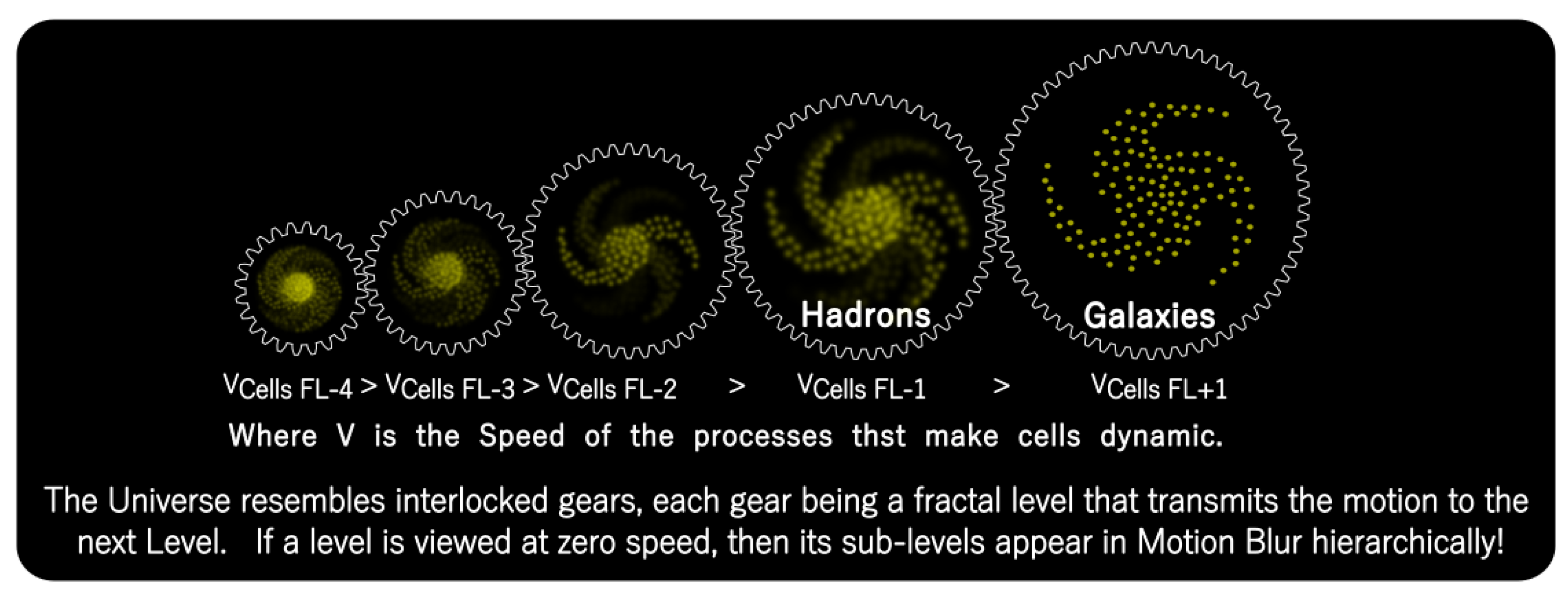
To describe quanta and also time in the fractalic universe, it is necessary to understand how in the hypothetical Nodes of FL+2 quanta also appear. For the appearance of quanta, rapid motion is needed, not the distance of motion. For an atom to release a quantum, the electron must change an energetic level of the atom, but it is not well known how far it moves relative to the nucleus and in what time. Likewise, within galaxy groups, it is not well known what distance a galaxy must travel to release an FL+1 quantum.
However, the gravitational waves that have been detected—from neutron stars or black holes—are also FL+1, and they move with the same speed of light, and they have the nature of excitation of already existing waves. And it is observed that it does not depend on how far the source of the quantum moves but how long (yet with a speed greater than the standard speed in its system), and this travel time forms the wavelength of the FL+1 quantum. Therefore an FL+1 quantum is an excitation of multiple waves from FL-1.
Frequency of gravitational waves and waves coming from black hole mergers.
In FL+1, that is in the cosmos, quanta exist both from FL-1 (separate quanta such as the graviton) and from FL+1 (agglomeration of FL-1 quanta, the gravitational mass of a matter accumulation from FL+1). Quanta are energetic: when an atom produces an electromagnetic quantum, it has energy upon FL-1, but when a star produces an agglomeration of electromagnetic quanta, their energy is already within FL+1 volumes.
The FL-1 quanta for the hypothetical active Hyperspheroids (Fractalic Nodes) of FL+2 remain as part of the extra-dimensions.
Within the internal processes of the cells of the levels of the fractalic universe, time slows down with the increase of the level (Figure 3.7). Because internal processes of cells of any level comprise multiple dynamic natural systems correctly called “Sub-Universe” (Section 3.4.1.1).
To search for similarity between matter accumulations of different levels, it is important to estimate the differences of time of the processes proposed for similarity within the Subuniverses, because similarities between scales are hidden by the differences in the speed of manifestation of similar processes, for example:
- When a particle leaves an atom, for example the emission of an electron, it is much faster than when a galaxy at the edge of a galaxy group leaves a galaxy group. Therefore the similarity between the atom and galaxies must be filtered through estimating the time differences.
- When two atoms unite, the process occurs in milliseconds, whereas collisions between galaxy groups last millions or billions of years.
When studying similarities between matter accumulations of different levels, it is essential to keep in mind that matter accumulations at different levels have different speeds of internal processes.
The time of natural systems is crucial for understanding interactions of matter accumulations. In the present model, electrons orbit like galaxies in a galaxy group and therefore electrons do not fall onto their nucleus. But time in atoms is tens of billions of times faster, and the influences upon atoms observed by physics are extremely slowed down for electrons; therefore they feel only very weakly the influences from the “nature on planets”. Once electrons and their atomic system have high speeds, they can repel pressures because their orbits are restored by the local “Solar Winds”.
Matter accumulations at any scale are characterized by the fact that they can be displaced as whole objects as long as their motion speed does not exceed the speed of their internal processes. For example, if the Sun receives an impulse, it can move together with its planets as a whole object, but this impulse must not be so large that it moves the Sun faster than its gravitational forces can keep the planets on orbit. Thus by impulse a matter accumulation can be moved or penetrated; therefore the differences of time between FL are essential in understanding the universe.
3.7.1. Factor κ (kappa) — The Ratio of Internal Process Speeds: Atom vs. Galaxy Groups
In our fractal proposal, κ expresses the “structural speed” of processes of the small levels compared to the large ones. To keep a realistic scale consistent with relevant physical intervals, we adopt the approximation:
This estimate is made from the observation that everything, regardless of scale, moves at almost the same speed relative to some unit of measurement (meter). Therefore, if the galaxy groups are bigger than atoms, the difference between the speed of these similar but different scale systems are the same 1033. So if the speed of atoms as systems is (𝓋A), and the speed of galaxy groups is (𝓋G), 𝓋A≈1033×𝓋G .
But the factor κ in this complex systems, must also be defined as the ratio between the speed of the internal dynamic processes of the atom and those of galaxy groups. Formally:
This means that the internal processes of the systems (oscillations, mode reorganizations, energy transitions, dynamic interactions at scales of hundreds of light-years), must be rigorously introduced into formulas.
This enormous contrast in time explains why the atom appears as a “blurred” or “aggregated” and “Homogeneous” system when viewed with instruments that have time windows far too large (detected from “Nature on Planets”). By rescaling time with κ, the similarity between Atoms and Galaxy Groups becomes visible and coherent within the fractal proposal, meaning that the structural similarities between atom and galaxy groups become visible only when we observe their processes at zero speed.
3.7.2. Lifespan of Matter Accumulations
The lifespan of energetic accumulations varies depending on scale; the smaller the scale, the shorter the lifespan. However, atoms are semi-energetic accumulations and follow the same continuous cycle of life as galaxies, where stars die and are born randomly, but galaxies continue to exist with new generations of stars.
The lifespan of semi-energetic accumulations, such as galaxies, is similar to that of populations of organisms. At any scale, if:
- N(t) represents the number of individuals in a population or the number of energetic accumulations in a semi-energetic grouping such as galaxies,
- B is the birth rate,
- D is the death rate, then:
- If B = D, the population remains constant.
- If B > D, the population increases.
- If B < D, the population decreases.
And since galaxies and quarks have a very long lifespan, it follows that B = D.
According to Figure 1, molecular clouds form new stars not only from the dust of local galaxies but also from the dust of distant galaxies. Therefore, although galaxies produce energy, their lifespan is not affected. In this model, galaxies are classified as semi-energetic accumulations that are assumed to exist at any scale.
It is observed that galaxies exist younger and older, the old ones contain more dwarfs formed after supernovae, and the hot environment gives them the possibility to form molecular clouds to form new stars. And it seems that these galaxies have limited lifespan. But in the long term, the galaxies (cells) change their stars, etc, (nodes) from outside, depending on their location in the galaxy group.
Also but their life is long because the dwarfs are FL+1 formed from FL-1 atoms. And the atoms in these stellar dwarfs are renewable. And these galaxies can be supplied directly with dwarf stars that arrive through migration, not new stars. Therefore maintaining the groups can be complex, but as observed from galaxy clusters, they are absolutely renewable. And this theory extrapolates also for all FL of the fractal universe.
3.8. Dimensions in the Physical Universe and the Additional Dimensions Resulting from the Present Model
In Figure 3.8 a multidimensional model of the fractalic universe of the present model is proposed. Extra-dimensions in modern physics are still in development; in the present model they are well defined because they are interpreted as the matter accumulations of each FL as separate dimensions. This is because they are distinct dynamic systems and differ by the speed of internal processes as a system.
According to this model and string theories, nature, as described in physics with fundamental forces and constants, has approximately ten additional 1D dimensions. And these dimensions refer to the influences that form constants, etc. These lower 1D dimensions represent quanta originating from three FL smaller than the atomic FL, meaning FL-2, FL-3, FL-4, in which lie the matter accumulations that produce these 1D interactions.
As is known, the FL of atoms produces multiple interactions, and all FL are similar. Therefore the current ~10 extra 1D dimensions are created only by FL-2, FL-3, FL-4, meaning that only three 3D additional dimensions are needed to explain all the nature of physics.
Figure 3.8.
The image illustrates a three-dimensional coordinate system for the fractalic universe (MFU) where each FL has its own assigned coordinates.
Figure 3.8.
The image illustrates a three-dimensional coordinate system for the fractalic universe (MFU) where each FL has its own assigned coordinates.
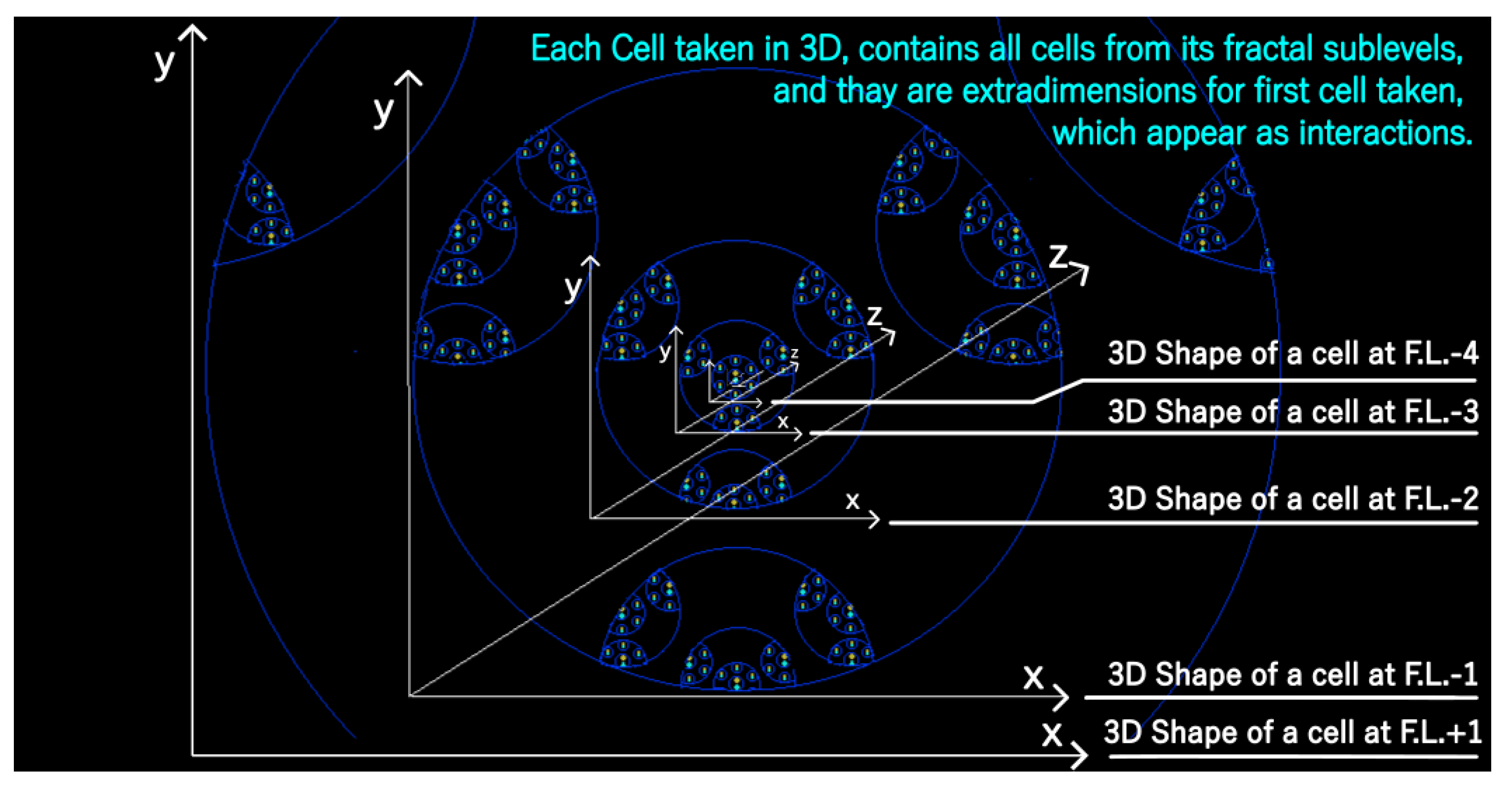
Thus the geometric dimensions of the extra-dimensions must be calculated or approximately estimated separately, and they have the dimensions of each respective FL by number, but the interactions of the forces can only specify from which FL components they appear. For example, the primary repulsion energy appears from supernova ejections, and the Nodes that become supernovae are found within the 3D.
As can be seen in Figure 3.8, each FL has its own separate coordinates. Each FL lower than the FL being approached, although similar, has some differences such as size and the difference of speeds of the processes in systems.
It may seem confusing, but for example quanta in interstellar space are produced in FL+1 stars but by FL-1 atoms. To describe this clearly the space is also indicated: Quanta (3D FL-1) within (3D FL+1).
All cells of each FL contain multiple dynamic natural systems, but each is separate. If a planet with temperatures below zero degrees contains frozen water, then time is stopped for the activity of the water (t(3D FL-1) = 0) while the planet in reference with its solar system in which it orbits does not depend on this temperature (t(3D FL+1) > 0), therefore the subuniverses of different FL must have separate 3D systems plus their own proper time.
This multidimensional model from Figure 3.8 is correct because the universe offers the possibility of using multiple alternatives. The entire universe can be taken as a single 3D, but it will have extremely complex mathematics. Still, in some cases this is convenient.
3.9. The Space Between Matter Accumulations of Any FL
In the Universe there exist two types of space that may be confused (Figure 3.1.1 in diagram [2a]):
- There is the space up to the universe itself, where our universe is located and where other universes of different nature could exist at great distances. In the continuation of this work, this space is not analyzed.
- The second space is the space between matter accumulations at different levels. The vacuum consists of the particles emitted from nodes at all FLs. That is, the same known fractal formed from sub-FLs of the particles emitted by the Nodes. It forms the Higgs field, dark matter, and propagates energetic waves, because in this model all matter has the same fractal nature.
Cosmic space is currently under debate; quantum fluctuations are being discovered, but quantum fluctuations should appear only because matter exists that becomes excited.
However, in interstellar space the Theories of Relativity dominate, where a space-time reference frame is used. But once the Theories of Relativity have a reference frame and are not absolute, they are valid only within their own frame (Section 3.21: “everything is relative to something”). When General Relativity states that space-time curves near massive bodies, this statement is correct within the reference frame of space and time taken together. But in the classical reference frame, only the space formed from FL-2 and FL-3 is curved (dynamically, but not in the space-time ↔ Observer frame), because it consists of particles ordered among themselves. Some of them are continuously attracted by the decompression created by “nests” similar to molecular nebulae at any FL (Figure 3.9).
Figure 3.9.
This image presents the undetectable parts of matter accumulations not included in the matter accumulations of the fractal universe. The image shows a visualization of the dilation of the space between “matter accumulations” due to ejections or absorptions.
Figure 3.9.
This image presents the undetectable parts of matter accumulations not included in the matter accumulations of the fractal universe. The image shows a visualization of the dilation of the space between “matter accumulations” due to ejections or absorptions.
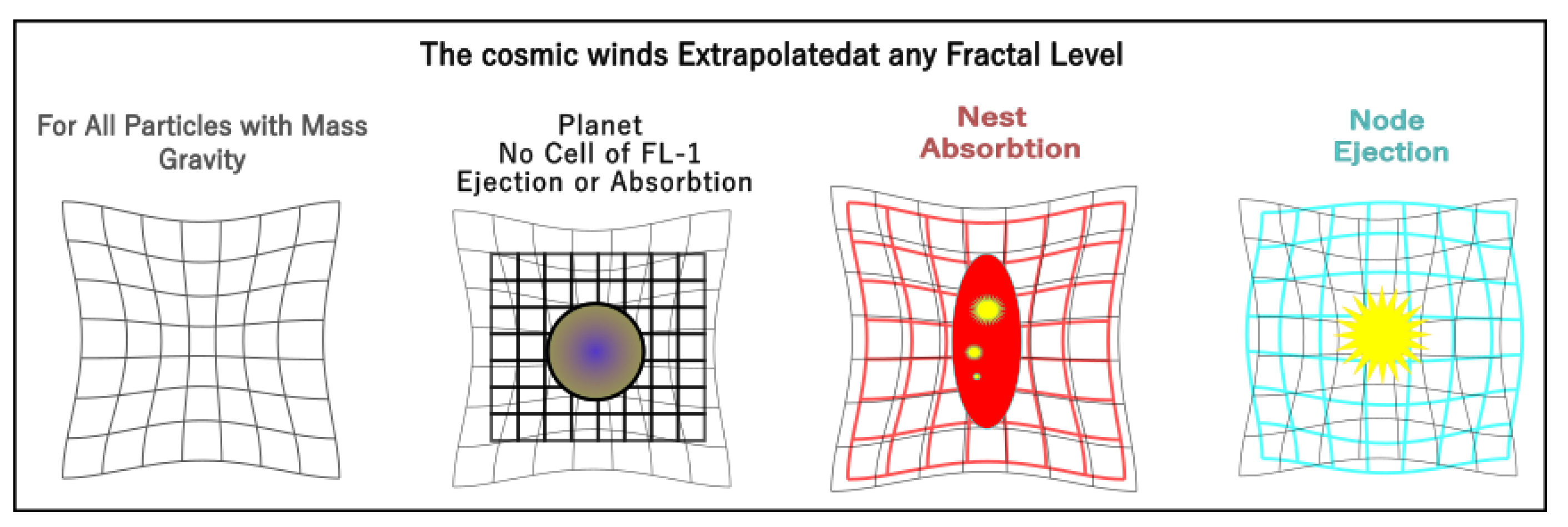
The ejection and absorption of sub-particles performed by Nodes and Nests can be represented as the curvature of space (Figure 3.9), and this curvature is dynamic. This is valid in the present model because the vacuum is formed from groups of local FL Cells (similar to atoms). They balance each other through local laws (in their migratory medium) and form an organized foam, conveniently called Ether, formed from the substance that propagates the field waves (quanta). The ether particles transmit energy to each other (interact) similarly to atomic- or galactic-level FLs.
Modern physics does not accept that the vacuum contains particles responsible for magnetic and electric permeability, but the current model attributes to Einsteinian Relativity that it is correct only in its own reference frame (although it has some inconsistencies). Solar winds of any FL are formed from fractal cells, and they contain nodes that emit and nests that absorb. Thus, the space between matter accumulations represents the same fractal matter accumulations, but naturally undetectable for “Planetary Nature” (Section 3.6.1).
It is known that stars eject about 85% of their mass into interstellar space during their lifetime, over several billion years. Therefore, the space between matter accumulations (the vacuum) at any FL is occupied by local emissions, because each FL has its own Nodes. But the particles emitted also contain Nodes that emit (Figure 3.9 (b)).
And these remnants of emissions, having dynamic sub-levels, are the ones that propagate quanta, not mechanically but through their fields. These vacuum particles are natural systems that organize their space according to their own laws; therefore the medium is elastic, also through the fields of these local particles (Figure 3.9 (b)). Since quanta are propagated by the fields of the Ether, the motion of the ether does not affect the constant “c,” even if the Ether moves at high speeds up to the speed of light.
The fractal universe of matter accumulations begins with the primary particles and forms an inverse fractal structure, that is, one of accumulation. But the “Ether” is a normal fractal structure, that is, of division.
Protons emitted by stars are FL-1, but nodes emit their own “FL-2 solar winds,” thus forming an exponentially multiplying hierarchy creating a series of sub-levels. Therefore, in this model the vacuum between the matter accumulations of the universe contains this (secondary to MFU) dynamic fractal of emissions. This fractal, much more rarified but formed from the same matter, comes from all directions and rarely collides, since they behave like fluxes. Yet the Ether medium forms a pressure similar to gases. These particles are the “Ether,” capable of propagating electromagnetic waves because they are made of the same detectable matter but at lower FLs.
Figure 3.9 (b).
The image represents the structure of the ether, ordered by local laws, but approximately
similar to the detectable part of the fractal (the emitting stars in galaxies).
Figure 3.9 (b).
The image represents the structure of the ether, ordered by local laws, but approximately
similar to the detectable part of the fractal (the emitting stars in galaxies).
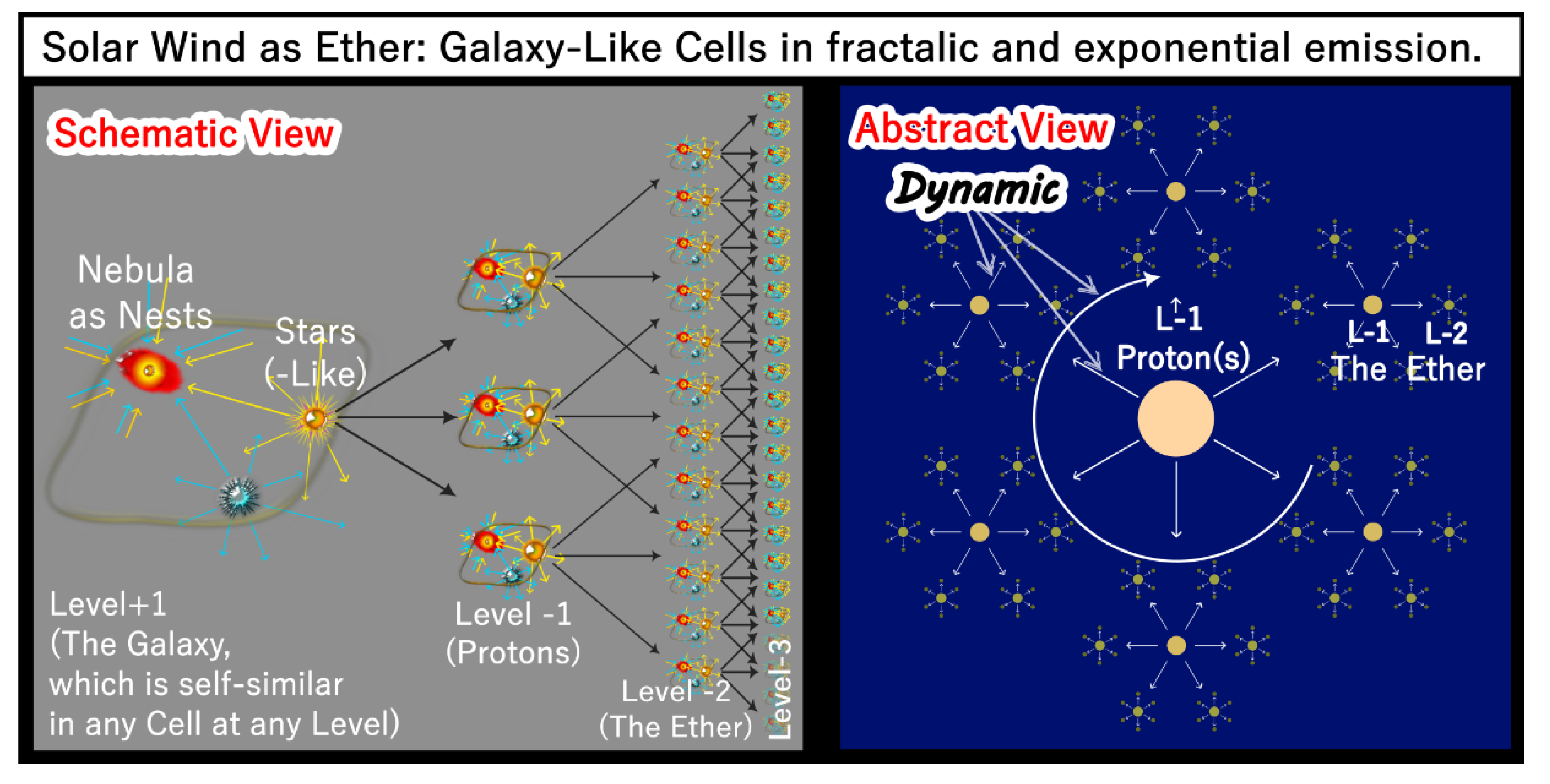
Propagation of Quanta Through the Ether
The propagation of quanta through the Ether fits the nature of the universe (Section 3.12 “An Alternative to the Theories of Relativity”). The propagation of electromagnetic waves through the Ether is satisfactorily and credibly explained. Since the particles of the ether are of the same nature as cells, they also possess fields through which energetic waves propagate.
Solar Winds are part of the FL+2 Ether, that is, in the medium of hypothetical Hyperspheroids. The density of particles in the Solar Wind is about one particle per millimeter. But these particles, since they contain their own nodes, have their own emissions of lower FLs, and can form electric and magnetic fields. And they emit other solar winds from FL-2 (Figure 3.9 (b)).
The propagation of quanta is not carried out mechanically by vacuum particles, but by their fields, which fluctuate differently depending on the type of wave propagated (Figure 3.9.1). All interaction quanta—photons, gravitons, or the Higgs field—differ not as particles but in the nature of the field fluctuations of the same particles. The same vacuum particles can propagate different types of quanta.
Figure 3.9.1.
The image shows how the Ether propagates waves through its fields, and not mechanically. The illustration of the electromagnetic wave does not depict electromagnetism itself, but the idea that the motion of the wave does not depend on the motion of the Ether as particles.
Figure 3.9.1.
The image shows how the Ether propagates waves through its fields, and not mechanically. The illustration of the electromagnetic wave does not depict electromagnetism itself, but the idea that the motion of the wave does not depend on the motion of the Ether as particles.
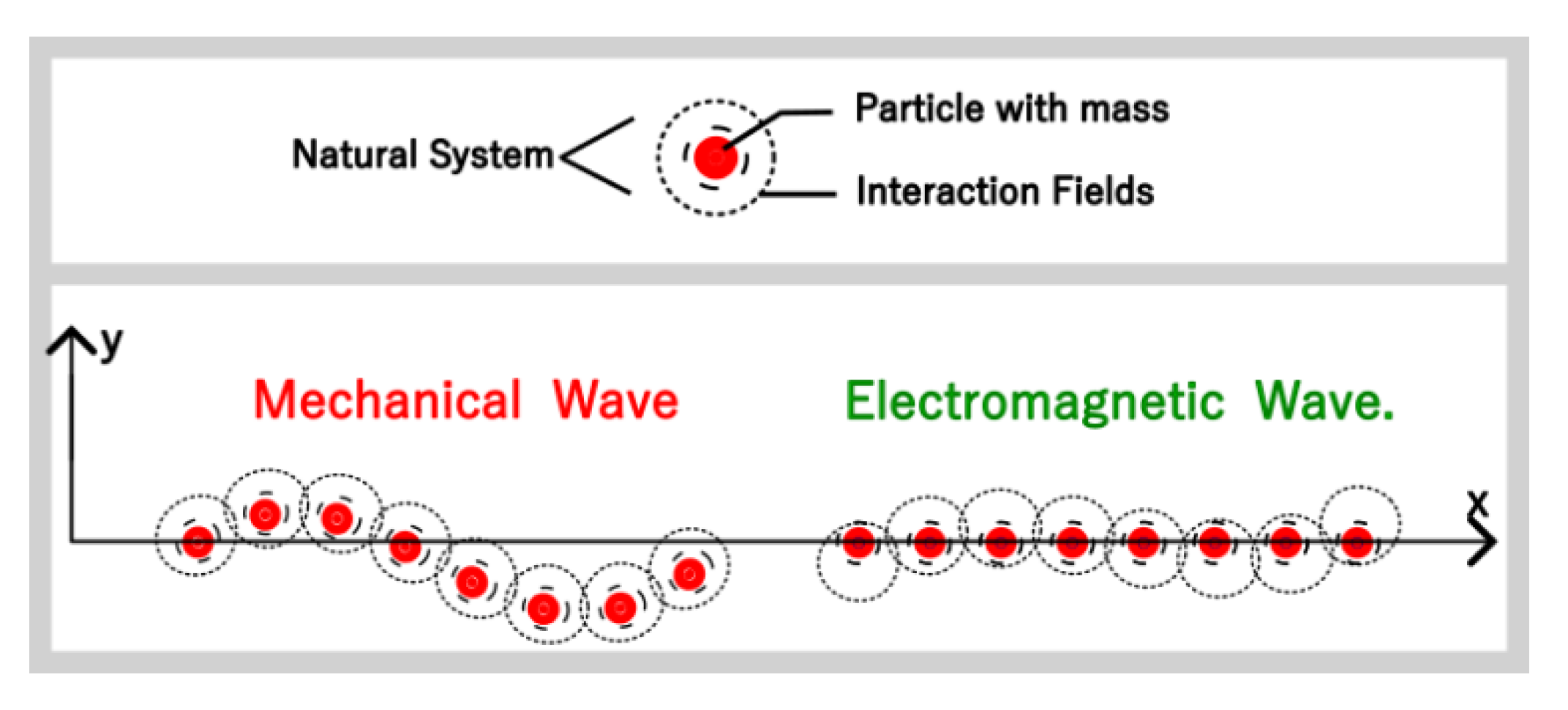
The Universe, though dynamic, is conformed (balanced) by various laws, and electromagnetic waves are de-conformations of different conformations.
Quanta are part of the law of conservation of energy: if some energy is consumed somewhere, that quantity is transmitted to the medium.
Interactions are not propagated by a “luminiferous ether,” but by its fields, which is why propagation does not depend on the motion of the “ether,” except if the ether exceeds the speed of “c” when the universe expands. Therefore, the ether-search experiments of the early 20th century were unsuccessful.
3.10. Mass in the Current Model
In current deep physics, “mass” still has unclear aspects. Kinetic mass, which opposes acceleration, and the mass that is attracted by gravity are unified, but the formation of gravity by mass remains under discussion in present-day physics.
Without a quantity of matter, mass does not exist. Any quantity of matter contains Nests that absorb Ether. When an atom loses an electron, it becomes negatively charged, but when atoms on the entire surface of the star become charged, this star forms a fifth force of attraction. Therefore, in the immediate vicinity of stars, space curves more strongly.
In the present model, accumulations of substance begin from FL-4, so every mass is first a quantity of substance. In the present model, in all FL, the accumulations of substance orbit just like at the cosmic scale, so kinetic energy persists at every sublevel. Therefore mass is strongly linked to kinetic energy. And the universe of fractal accumulations of matter forms a fractalic gyroscope. And if in the present model all attraction forces appear as a result of the “Nodes–Nests” energies of each FL, then gravitation is the “Nodes–Nests” forces of the smaller scales. But the mass that opposes acceleration is the kinetic energy of the universe as a multi-hierarchical gyroscope.
In the development of this work it is believed that in the universe, although it is dynamic, everything is conformed (interconnected) through existing laws, whether known or unknown. And mass is one of the conformations in the universe. And to make changes, such as impulses, in any conformation in the universe, energy is needed (energy can be taken only from the dynamics of the universe (from Nodes, but also from Nests that produce decompression), therefore it is conserved). To give an impulse of motion to an accumulation of matter (or a group of accumulations of matter (a body)) energy is needed because quantities of matter are conformed through the Higgs field (but the Higgs boson does not exist).
Thus the universe is penetrated by a multitude of virtual chains of interconnections (formed by the links between the particles of the ether), and to make a de-interconnection energy is needed; thus mass, besides being a quantity of matter, is one of the interconnections of the universe. Therefore the mass that opposes acceleration is one of the equilibria, one of the conformations in the universe.
But the ether intervenes once the velocities approach “C” and mass changes its values, in the same formulas where time dilates and energy increases. If a quantity of matter were to move in a void outside the universe, then mass (or the internal energy of the mass) would not increase at velocities close to the speed of light, because it does not interact with the ether and does not feel the motion velocity, since there would be nothing relative to which it can be felt, although a mass can move relative to a Universe. Accumulations of matter exist everywhere as fractalic cells of the Ether, interconnected with each other through their interactions. And when a body moves with high velocities, close to the speed of light, energy appears, and time dilation as well.
In the present model there is no Higgs Boson, but the Higgs field exists, and it is due to the fact that all accumulations of matter from any FL rotate around their own axis and orbit, and thus acquire kinetic energy balanced at rest mass. Matter has kinetic energy similar to inverse-hierarchical gyroscopes inside the taken substance. And a mass that opposes acceleration is only kinetic energy that opposes reorientation, like gyroscopes within the “Natures on Planets”.
Even if the primary particles of the universe (Section 3.1.2) are not corpuscles but energies, they occupy volume in space, and these volumes behave according to philosophical laws — two bodies of the same nature, including the volume of their forces, cannot occupy the same space at the same time. And this is valid also for kinetic energy, meaning that multiple influences participate. And when two bodies collide, they tend to occupy the same location in space because of several occurrences of kinetic energy.
The present model, which is formed of 5 levels, still has accumulations of matter of smaller levels down to FL-4; therefore the first characteristic of mass is a quantity of matter that occupies place in space. And even hypothetically, beyond the borders of the universe where the Higgs field of the ether does not exist, the quantity of matter will preserve most of the characteristics of mass because internal interconnection remains. In an absolute void a quantity of matter would no longer be interconnected with other external masses.
If an orbit is accelerated, from a circular form it becomes elongated oval, parallel to the direction of motion; thus, once in the present model all matter of any level orbits, mass opposes acceleration because the portion that elongates in the internal orbitings must change its kinetic moment once the orbits become oval under acceleration. But under deceleration it is the opposite.
Inside the universe the accumulations of matter move and collide under the Conservation of Energy, but to fully understand motion one must begin with the philosophical laws well observed in an imagination from outside the universe, where no external interconnections exist. In the external environment of the universe two accumulations of matter also have kinetic energy, and when they collide there occurs a conflict for occupying the same space, because internal interconnection is not simultaneous but delayed, and thus in a collision damage of the accumulations of matter in the example will occur. And this principle participates also inside the universe, but it is not the only one.
Inertia includes several aspects, and one of them is linked to the fact that mass exists only associated with quantities of matter, where inertia is a quantity of matter that occupies volume in space, which moves and at eventual collisions produces penetration. Philosophical laws participate in the creation of the universe, not only mathematical ones; that is, in a collision a conflict occurs for occupying the same space. An explanation from this philosophy is that any accumulation of matter is formed from sub-accumulations, and when the first wave of sub-accumulations collides, the next layers produce pressure on the first layer.
Another more physical aspect is that inertia uses only the conserved energy of the universe. And for clarity, inertia must be divided into two categories: that of bodies moving within the dynamic universe, such as orbiting, and the inertia of bodies deviated from the standard dynamics of the universe (Table 3.10).
Table 3.10.
Motions framed within the dynamic universe vs. motions not framed within it.
| a) Inertia within the dynamic universe (orbital motion) | b) Inertia deviated from the dynamic universe (Rockets, Comets) |
| Orbits are in equilibrium with the rest of the universe; they are part of the dynamic universe. | These motions are not part of the universe’s dynamics, and energy fluctuates according to Lorentz laws. |
| Physical time does not dilate, regardless of the observer. | Physical time dilates, regardless of the observer. |
3.11. Quanta in the Current Model
Quantum physics studies the behavior of matter and energy at the level of atoms and elementary particles. Quantum physics analyzes the way the world works when the classical laws of physics are no longer valid. Quantum physics is a culture that seeks the way in which energy, matter, and information transform into one another within the invisible world of the atom.
However, quantum physics is still trying to understand how matter emits and absorbs energy in the form of quanta, and what the nature of interactions is. Therefore, although quantum physics theories, based on Planck’s formula, offer extremely precise and useful results in domains such as applied physics, detection of subatomic particles, or even biological detection, these results in their form, and this detection method, although currently the most successful, do not contribute to discovering the nature of the universe.
Once from the “conceptual” point of view Planck’s formula and adjacent theories are correct, this means that the medium in which they are used is limited relative to the universe. Quantum theories cover only a narrow segment of reality, a limited spectrum of manifestations of realities which in the universe are more numerous. For example, the present model proposes that there exists a nature of the fractalic universe and another nature which is the “nature on planets”. This theory does not even cover cosmic phenomena well.
Through current quantum theories an attempt is made to approach the invisible reality of the universe, and they have given rise to a series of theories, models, and interpretations which sometimes contradict each other. Some critics say that quantum models are only mathematical conventions, not a real image of the universe. Also, questions arise regarding the limits of this science when applied to more complex structures, such as accumulations of matter with fractalic behavior or systems at a cosmic scale.
In the present development the nature of the universe is divided into the “Fractalic Nature of accumulations of matter” and the “Nature on planets” (Section 3.6). Therefore quanta belong only to FL-1. But FL+1 has quanta within its own framework. Therefore the quanta of FL-1 form molecules of FL-1 but do not affect, do not act directly upon systems of multiple galaxies, or even stars. Thus quantum physics has a satisfactory mathematical apparatus, but the mistake is that one tries to describe the nature of the universe with it.
In the present model atoms are similar to groups of galaxies, and the answer to what quanta are, with whom they interact, can be followed in our local group of galaxies, and from there extrapolated for atoms. But the observable universe is an inactive part of a hyperspheroid of FL+2, and therefore releases of quanta within FL+1 do not occur; it is similar to trying to study quanta in atoms that do not produce quanta. Still, the so-called “quantum fluctuations” are encountered in inactive environments. And fluctuations for FL+1 examples are: displacement of certain galaxies, deviated from their normal orbiting in their galaxy group, such as the Antennae galaxies (NGC 4038/4039). After fusion, the resulting object (a larger black hole) can receive a gravitational “kick”, that is, a recoil velocity of up to ~5000 km/s (≈0.017c) — enough to be thrown out of its galaxy. Observed examples: GW150914 (first LIGO detection, 2015): two black holes, orbital velocities estimated ≈0.5c before merger. GW170817 (two neutron stars): velocities ≈0.3c, etc.
The Milky Way will collide with Andromeda in 4 billion years, but this is not a fluctuation, and current science has performed calculations in the absence of this model, which sustains that galaxies have charge and that stars form a fifth force which replaces most of the currently proposed dark matter.
To research the nature of quanta within the analogy between atoms and the local group of galaxies, meaning between FL-1 and FL+1, filters must be used, such as the differences in the speeds of processes within these natural systems of different levels (Section 3.7).
At every FL, Nodes eject particles from their components associated with different quanta. Quanta themselves are not fractalic (unlike particles that are ejected). Quanta across multiple levels become a fractalic structure, but parallel with the Nodes of different levels. Therefore when making an analogy between FL-1 and FL+1, it must be well observed that the quanta we know are produced by FL-1, but on the cosmic scale they belong to FL+1 and they form a “Fifth Force” within the interactions between galaxies and clusters of galaxies. In the present model every force originates from groups of active energies, and ejections of particles, energies of stars are felt as interactions at the scale of galaxies because the forces that dominate at the beginning of the fractalic level (coming from sublevels) weaken as the volume of influence increases, but the new energy appearing in nodes takes over the strength and is felt as interaction. Attraction within galaxies and galaxy groups occurs because Nests in galaxies absorb cosmic dust and create decompressions of the Ether.
Extra-dimensions cannot be used in physics unless hypothetical quanta that come from FL-2 are used, because the known quanta fit within the normal dimensions of physics, and their division can be made artificially, but the dynamics of the universe lies only at the base of accumulations of substance plus extra-dimensions. Thus even a fractalic sublevel must be taken as a dimension, but the fractalic sublevels of the level in the example being studied must be taken as sub-dimension, and then galaxy groups will be able to be studied as analogues of atoms. And thus the nature of quanta in current physics will be understood.
Because inside fundamental particles with the mass of atoms there also exist Nodes which permanently produce quanta, but they are felt as electric forces, and magnetism appears from energies plus electric fields. Thus not only the detectable quanta make the atom a dynamic accumulation of matter, but also the extra-dimensions (meaning the interactions coming from the fractalic sublevels FL-2 and even FL-3 must be included in equations for their functionality).
In the present model quanta exist because the periods of energetic waves are impulses of “disequilibrium and re-equilibrium’’ in systems where multiple interactions participate. Even a planet cannot change its orbit slowly and anywhere, because it does not orbit only the Sun but the barycenter of multiple planets, and its characteristics such as motion velocity and weight allow only certain positions. Of course the system of atoms is more complex, but similar levels exist as the levels of electrons, and other oscillations also have similar levels.
Once the groups of galaxies have their similarity in atoms, from within FL+1 everything about quanta can be researched; the quanta of FL+1 are produced by groups of galaxies. The observable universe is cold (does not produce quanta), but theoretical analyses can be made in the absence of direct observations, and then extrapolated to the atomic scale.
Thus in conclusion, quantum physics is well developed and good for the “Nature on Planets”, but for discovering the universe it does not fit directly, and must be adapted to the fractalic universe model of the present work.
The Particle–Wave Duality of Quanta
To solve the duality problem, Huygens’ principle must be adapted to the present model. An answer must be formulated to the fact that a quantity of ether of the size of a quantum can propagate several quantum waves coming from many directions, and this is not similar to mechanical waves.
Feynman’s theory includes only one aspect of quanta; quanta and their properties are much more complex. The present model can describe this problem of duality, but not at the current stage of development. Nevertheless, the search for the answer begins, and the description of some ideas.
Quanta in a laser beam behave similarly to the appearance of quanta as particles when a detector is included in Young’s experiment. Therefore it is possible that the detector in the experiment causes a directioning of the quanta.
Electrons are particles with mass, they are cells similar to galaxies; their direction of motion can be changed with a magnetic field, unlike photons, and they also have this particle–wave duality because their detection does not result from collision of their mass but from interaction with their electric charge. Electrons move parallel to the quanta caused by them when they are accelerated, and they can have duality explained, unlike photons.
As observed in stars, with the production of energetic waves, they also eject FL-1 particles. And the particles of the vacuum receive an impulse of motion in the same directions as the quanta. And when an FL+1 galaxy would produce a quantum resulting from a group of galaxies, meaning a quantum of FL+1 and not FL-1 produced by atoms, these fluxes are part of the quantum. That is, a quantum is “Waves + Particles”. Thus it is also in atoms: within the reference frame of the “Nature on planets”, a quantum is only a wave, but from the point of view of FL-2, it is a fluctuation of the fluxes emitted by Nodes of FL-1 (Atoms). Thus the energy of quanta is a fluctuation of action energy but from a smaller FL. Therefore to explain the behavior of quanta, including the particle–wave duality, the fractalic sublevels must also be used in the explanation.
3.12. The Special Theory of Relativity and an alternative to it.
Physical time dilation occurs together with the appearance of energy, and it comes from the lower FLs of the natural system that moves (accumulation of matter, flux of particles). Physical time dilation appears on exactly the same principle as quanta appear; for this, fast motions are needed, because at small motions natural systems manage in time to adapt to new changes. Therefore, in the Special Theory of Relativity the formula is not directly satisfactory for an observer, and only at high speeds time dilates.
When a natural system moves abruptly (for this it must accelerate), time dilation appears, but immediately energy also appears in the natural system that moves, because a potential difference arises between the newly appeared changes and the normal balanced state of the natural system.
It is known that an outside observer, at speeds close to the speed of light, due to the fact that light has the speed “C”, observes that a train fits entirely inside a tunnel shorter than itself. The example with the tunnel can also be described classically, through visual explanation, because light has its limited speed, and in some visualizations at high speeds the delay of detection creates an image different from reality. Thus, in this example, there is no need to include time dilation (and length contraction).
In the framework of the Special Theories of Relativity, this example and many other similar ones are explained by length contraction and time dilation. A reference frame is taken where space and time are interconnected, but this is only a chosen reference frame, not the absolute reality. Space-time is only a reference frame that can have alternatives. Matter as systems, at each FL, has different speeds, and the space formed by the Ether (FL-2, FL-3) must be taken as “motion blur” when taken in the same reference frame as an object moving at high speeds (Figure 3.7).
But the Special Theory of Relativity appeared because the speed “C” is the same for all observers. And it is a satisfactory theory, and convenient to use. There also exist many theories that take a general reference frame; for example probability theory is also a replacement of reality, because every “Event” has many “Sub-Events” that must be included in the analysis when the Event takes place in order to determine the outcome of the Event.
But in the present model the fields of the Ether are the ones that propagate light. The Ether fields move faster than the Ether itself, therefore the speed of light does not depend on the movement of the Ether. The Ether even moves permanently, and it is also composed of fluxes released from the Nodes.
In the present model of the universe, an alternative reference frame can be taken with respect to the relativistic theories, namely that the motion of the universe is parallel with time, and therefore the spatial coordinates can be taken with the indication of the time when the action was produced. It must be known who moves relative to whom, and from where the light that carries the information being detected was initiated. For this, in the present model, a reference frame called “non-existent historical place that disappears immediately after the moment of detecting the action” must be taken. This is because the universe is dynamic and the source changes its place by the time the emitted light reaches the detector. But physical time dilation can be calculated separately, when necessary.
In elementary particle accelerators, the Special Theory of Relativity is successfully used, because the events take place in the same system (or sub-universe). But in the example where a side observer sees a “V” when a ship emits a light beam toward a mirror of another ship moving parallel to it—this example does not work. This example is valid only outside the boundaries of the universe.
In our universe, the emitter of a spacecraft must calculate where the beam will arrive, taking into account also the motion of the future detector. And current spacecraft determine their position and orientation successfully, using a combination of different methods and detections, such as measuring distance through radio waves emitted toward nearby planets and then receiving the reflection, the Doppler effect, tracking the positions of stars and comparing them with the map already present in the computer.
From what is mentioned above, it is evident who moves relative to whom. Since the universe is dynamic, the starting point of a beam or a body must obtain virtual coordinates resulting from the direction of movement and the distance travelled. A map can be created that simulates the dynamic universe, so that a starting point will remain in the computer’s history, and at moments when the real map of the starting point in the universe is already different, the data can be taken from history.
Thus the Special Theory of Relativity can be replaced also in the following way: an “Intelligent Virtual Radar”, which has in its databases a map with dynamics parallel to the dynamics of the local universe. And an example of how it works is a ground-based radar that tracks airplanes:
The ground radar represents the fixed center of the coordinates, meaning the point (X0Y0Z0), and all events are measured only relative to this unmoving place. The airplane, at the moment of launch, has certain fixed coordinates (XYZ) relative to the radar, and these values remain valid without us caring where the airplane goes further. The rocket starts exactly from this point (XYZ), and its destination is also only another fixed point (XfYfZf) in the same coordinate frame of the fixed radar. Thus, no motion formula is necessary: everything is reduced to two fixed positions relative to the radar—the launch place and the place where the rocket arrives. This system is the most stable and clear, because the radar never moves and all coordinates are defined only in relation to it.
The Ether is the one that propagates light at the speed “C”, which is taken relative to all the galaxies around, in a radius that includes galaxies that are not yet receding faster than the speed of light due to the expansion of the universe.
If an emitter moves away from the receiver, then the quanta will arrive rarified, therefore the Doppler effect appears. But the Ether will also propagate with the speed of light.
If the detector moves away, again the Doppler effect will appear. But in the problem of adding the speed of light with the receding speed of the detector, each quantum must be considered according to when it was emitted and when it was detected, not the beam over some duration of time.
And thus, from the above, the Special Theories of Relativity can be replaced, and the Ether can be brought into the reference system. And thus the formula correctly gives the coordinates of the emitter (although they remain a position from the history of the dynamic universe) relative to the coordinates of the detector, and it also becomes clear who moves relative to whom. And time dilation and length contraction can be calculated separately, when needed.
Relativity theories are beginning to be partially replaced, and in the future they will have alternatives; there exist many critiques which must not be ignored. Micro-satellites will be sent to other planets that will reach speeds below the speed of light, and for them the position will also be controlled, as with current satellites, with which humans have classical connections.
Due to complexity, this has been only an introduction, and it is too early to describe it mathematically, because adjacent aspects are still foreseen.
Time, the speed of dynamic processes, and spatial coordinates can be taken in different reference frames, in separate systems, or together with several subsystems.
The Relativity Theories within the fractal universe
Einsteinian Relativity Theories, although they may have alternatives, cover surfaces only in separate FLs, not in the entire universe.
Relativity, the “space-time” reference frame (although possibly it will have alternatives), is also found at other levels, but first the similar place from the level where similarity is sought must be taken correctly, as well as the size of the participants (Figure 3.12.1).
Figure 3.12.1.
In the image with the green line is indicated where the Theory of Relativity is valid, and which participants in what size range must be included. It is also based on the hypothesis that, once the universe is fractal, the Theory of Relativity is specific to each level. And in the upper part of the image, for each level, the size range of the particles that can participate and the space where local Relativity dominates is indicated, with very high approximation.
Figure 3.12.1.
In the image with the green line is indicated where the Theory of Relativity is valid, and which participants in what size range must be included. It is also based on the hypothesis that, once the universe is fractal, the Theory of Relativity is specific to each level. And in the upper part of the image, for each level, the size range of the particles that can participate and the space where local Relativity dominates is indicated, with very high approximation.
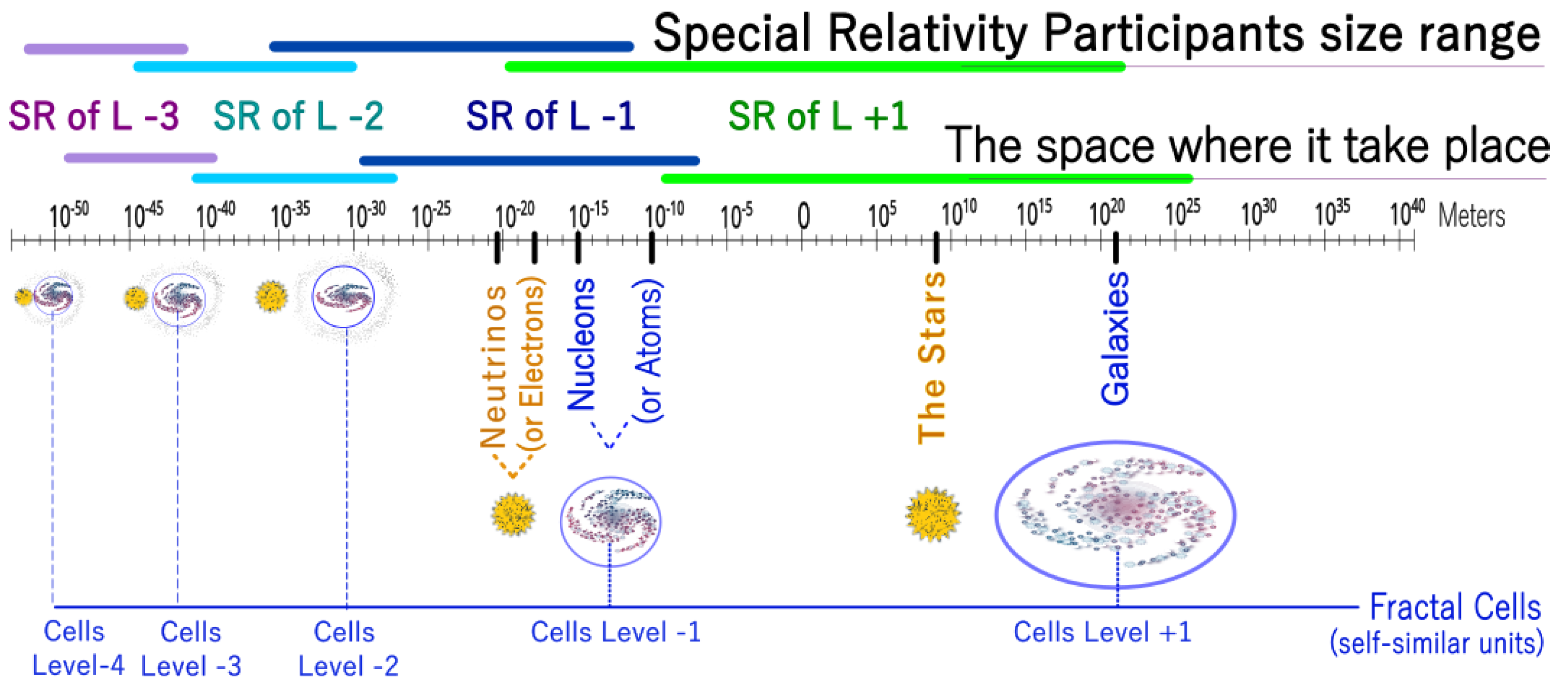
3.13. Orbiting of Bodies; 2D vs 3D Orbiting Systems
The real shape of a galaxy resembles the image of atoms, and they are similar. The largest galaxies are located in the center of galaxy groups, but the smaller ones orbit around the center at large distances. Galaxies have a 3D orbiting shape similar to electrons in atoms. Therefore, based on these observations, the maintenance of electrons on orbits is similar to maintaining the distance of galaxies that orbit around the nucleus of galaxy groups.
Thus, electrons orbit mostly due to orbiting laws. The attractive force is the strong force plus the force between opposite charges. But the repulsion is due to centrifugal force, just as in galaxies that orbit the nucleus of galaxy groups. The repulsion of semi-free electrons happens because they become excited and produce repulsive energy through partial disintegration and then restoration. This happens because the speed of processes in atoms is about ~10³⁰ times faster than the speed of analogous processes in galaxy groups. And electrons have time to recover. At the same time this orbiting speed of electrons does not allow the environment of “Nature on planets” to change their orbits.
In the present model, there is an absolute similarity between atoms and galaxies. This is also supported by the fact that both the orbiting of electrons in atoms and the orbiting of dwarf galaxies within galaxies are 3D.
Orbits in solar systems are 2D because planets form this alignment over hundreds of millions of years, because there is only attraction. And planets attract each other as well, therefore they influence each other to approach and thus they align in parallel.
Orbiting in fractal cells of any FL is well observable in galaxies. Some galaxies, such as spiral ones, have an approximately 2D orbiting shape. This is because stars also have some repulsion through their stellar winds; now and then a star explodes and forms repulsive impulses. Therefore spiral galaxies do not have a flat disc shape, but tend toward forming a 3D structure.
Elliptical and irregular galaxies are more 3D because they generally have similarities with planet formation — that is, they are accumulations of galaxies through attraction, even if they also orbit.
3D orbits appear only if between matter accumulations that orbit there is both repulsion and attraction. And the repulsion in galaxies is due mostly to their orbits, but also to ejections and substance exchanges, since galaxies in clusters do not have regular orbits.
Attraction is because galaxies at the edges of galaxy groups have B, while spiral galaxies have A–C. In the center of large galaxy groups, there are giant neutral elliptical galaxies D. The exchange of substances between galaxies within galaxy groups is complex, but at its depth is due to the “Node–Nest” systems.
3.14. The Universe is a Multi-Fractal Structure
The fact that the universe is fractal was observed by many scientists, but once the fractal structure of matter accumulations is accepted, the question remains which interactions must be included in a fractal level. In the present model, galaxies are taken as fractal cells, and therefore the adjacent aspects of galaxies form fractals parallel to the fractal of matter accumulations (Figure 3.14).
Figure 3.14.
The image presents a diagram showing which parallel fractals the fractal of matter accumulations has. Thus, once galaxies are taken as self-similar within the fractal framework, then all properties and interactions of galaxies occur at any fractal level, except those that appeared in the superior level of the chosen frame.
Figure 3.14.
The image presents a diagram showing which parallel fractals the fractal of matter accumulations has. Thus, once galaxies are taken as self-similar within the fractal framework, then all properties and interactions of galaxies occur at any fractal level, except those that appeared in the superior level of the chosen frame.
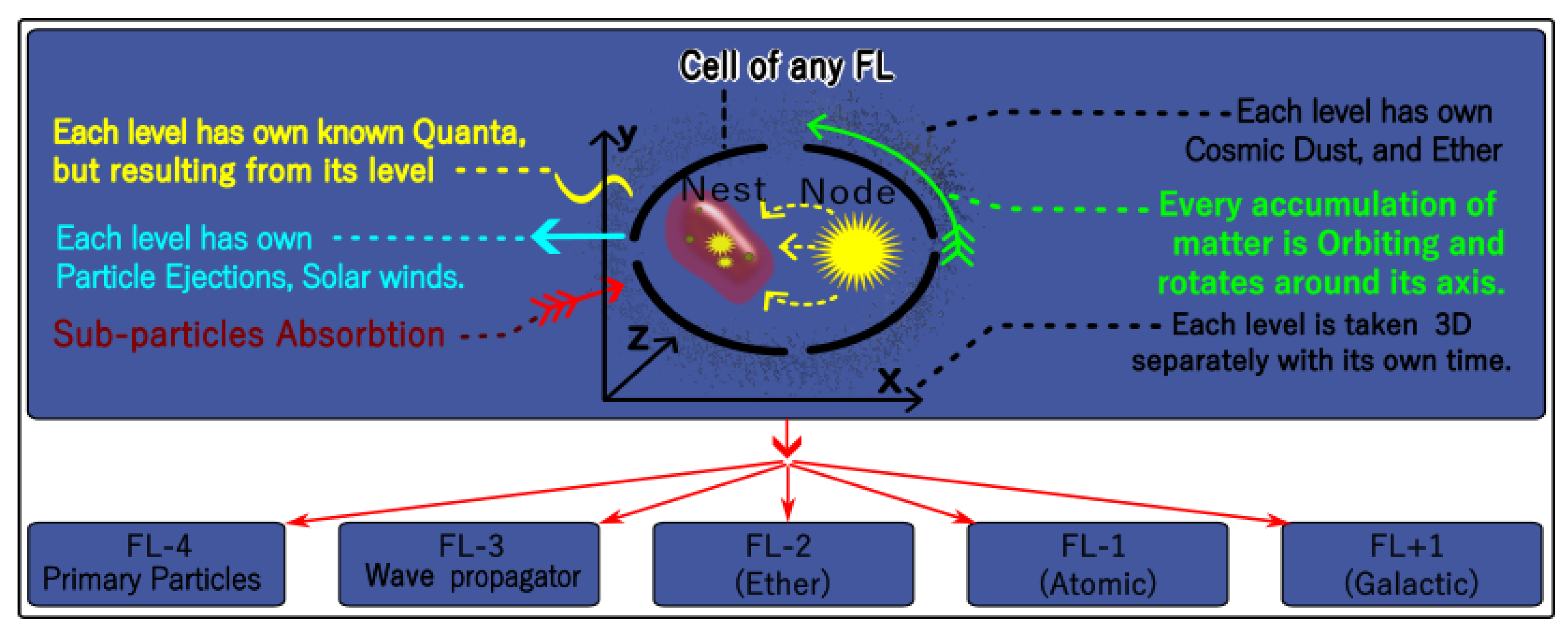
In Figure 3.14, quanta appearing at all levels are shown in yellow, forming a fractal parallel to the fractal of matter accumulations. Quantum fluxes are separated from their sources and can interact with other matter accumulations of different levels. For example, photons float through space, separated from the star where they originated; so it is with the quanta of other fundamental forces. Therefore interstellar vacuum and the space between matter accumulations of any fractal level is not uniform but contains different amounts of quanta. (Quanta of various interactions, in the present model, are initiated by nodes at each fractal level, not only by stars.)
Interactions transmitted at a distance through quanta are not regularly formed alongside fractal levels (for example gravity encompasses multiple levels of the base fractal). Matter of each level (because Nodes are similar to stars) generates interactions, but these interactions extend also to larger levels. Therefore, parallel to the base matter-accumulation fractal, there is also the quantum fractal. And if FL+1 is observed to be influenced by quanta from FL-1, then in the present model the idea is pursued that FL-1 is influenced by FL-2 through its quanta.
For short distances, in quark binding through gluons, in artificial illumination of living rooms for humans, quanta are conveniently taken in the same reference frame as their source.
But cosmic background radiation must be quantified and taken in a reference frame separated from the source because the source is unknown. An electron that absorbs a photon and jumps to a higher energy level cannot be explained by a continuous wave, but only by an interaction with a quantum of energy.
It is little observable, but only at the level of stars waves and stellar winds are produced, not at the level of atoms, because atoms produce these things only when located inside stars. Therefore processes on stars belong to the stellar level FL+1. For this reason it is extrapolated that each fractal node in any level is similar to stars.
Like solar winds, there are quanta that interact locally within the group of their sources, and quanta that leave the group. Therefore galaxies, as cells extrapolated for any level, are not systems but subsystems of the universe or sub-universes. At the same time, cells of levels interact not directly with the entire universe, but with neighboring cells.
The present model is based on “Matter accumulations”, but current physics is based on “Quanta”, though it is observed that quanta are produced only by matter accumulations, and this must be extrapolated also for the undetectable part of the universe, but necessary, such as extra-dimensions or vacuum particles.
Solar winds appear in Figure 3.3 and exist at all levels; according to this model, particles of solar wind have their own stellar wind at their local level. Thus vacuum particles are also a fractal structure of matter accumulations, and they are proposed within the extra-dimensions (section 3.8). (This fractal structure is normal, meaning branching rather than clustering.)
3.15. Energy in the Current Model
Energy is the capacity to produce change or mechanical work. In physics, energy is an abstract quantity associated with motion, interactions, and fields. It is conserved, but it can take diverse forms: kinetic, potential, thermal, quantum, etc.
Energy and the conservation of energy are not found only in a single chapter of physics because unified laws do not exist. Energy appears everywhere in physics, but each chapter describes it from its own point of view.
The energy resulting from E=mc² describes the energy equivalent of mass; it is specific to this reference frame. The formula E=mc² does not explain the origin of energy, but only the relation between energy and mass after this relation exists in unfolding.
In modern physics, it is well stated that energy is conserved because the Lagrangian of the universe does not change in time. This is a fundamental symmetry; through Noether’s theorem, the conserved quantity that appears is energy. The present approach does not contradict entirely these laws of modern physics. The present approach tries to bring, additionally, other deeper reference frames of the universe.
In the present model, the approach is that everything in the universe begins from the primary particles of the entire universe (Section 3.1.2), therefore energy is the “Potential Difference between particles with mass (substance).” However, at larger hierarchical surfaces different reference frames must be taken, because energies are tightly linked to the extra-dimensions, meaning to the fractal sub-levels.
In the present model of the universe, the dynamics is due to the dynamic systems “Release of Nodes - Absorption of Nests,” therefore it is necessary to address the energy resulting from these natural systems. But still, to this dynamics participate several forms of energy, such as the kinetic energy of the flows of particles, stellar thermal energy, energies that generate magnetic fields, etc.
In the present model everything stands on the basis of the accumulations of substance which, due to the dynamics of their lower FL, become accumulations of matter (this includes the fields, but only those associated with the accumulations of substance must be taken) at surfaces of several FL, and not accumulations of substance. Therefore energy is stored in different accumulations of matter and becomes active only when there exists the possibility for potential differences to perform work. The potential difference exists but balances with other potential differences, meaning that the known structure of the universe is a balancing between different interactions, and energy appears as a rebalancing in places where imbalances appear. Although dynamic, the universe can be called balanced, equilibrated, organized, and energy results from affectations of the normal state.
In the present model energy is divided into two basic categories:
a) Energy within the fractalic universe of the accumulations of matter. At known FL the energy is taken from the un-storage of the storages of the lower FL. Any accumulation of matter contains the aspect of energy storage. Another form of energy storage is the orbitals, the rotations around their axes, where accumulations of matter possess kinetic energy. Active energy appears from the un-storage of it from the sub-accumulations of matter that become active, and the conservation of energy remains valid but a more extended reference frame must be taken. The present model begins with and is limited to the “Fractal Level -4,” and the cells from any level are self-similar parts (sub-universes); therefore conservation of energy may be invoked as originating from lower, smaller fractal levels.
The active energy of the universe that exists at each FL and makes the universe dynamic appears in the Nodes (Section 3.3).
It is important to mention that this energy is part of the dynamic universe as a closed system, therefore it is not present in all reference frames. A galaxy taken as a whole does not have energy for its exterior, but a planet like our planet is located between Nodes and Nests; therefore it gains energy.
b) Adjacent energies relative to the energy of the fractalic and dynamic universe encountered in “Natures on planets” (Section 3.15). The dynamics of the universe in general is simple — matter decomposes inside the nodes and moves into the nests where it is reassembled. But this process is not always direct; for example, stellar wind jets and quanta can be absorbed by structures deviated from the universe, such as planets, or can be delayed through temporary storages in them. In accumulations such as planets many unfoldings occur that are adjacent relative to the fractalic universe. On planets there appear adjacent energies relative to the fractalic universe such as:
- Quanta (the energy transmitted by quanta) appear in media where they can be taken and in reference frames separate from their source. That is, the quanta produced by stars are from the natural system of the stars that form the regenerative and dynamic universe, but they can also reach planets where they create other adjacent natural systems. Only ~0.001% of the energy of the general universe deviates and reaches to produce different storages such as chemical and biochemical syntheses.
- On planets, once atoms are passive, the conditions known from classical physics are created where there exist natures separate from the nature of the universe itself.
- The pendulum and its laws are adjacent relative to the nature of the general universe. The pendulum is used to explain the conservation of energy, but this conservation is valid in any system where attraction exists because kinetic energy is a storage of energy in this case. In a potential universe distant from another nature, if attraction exists between accumulations of matter, the pendulum can be reconstructed there as well, but the conservation of energy will be different, namely resulting from some more primary particles.
- Temperature and radioactivity on planets. They are initiated by potential differences in the unfolding of the sub-levels of the atomic level, that is FL-2, and even FL-3.
Although the universe is dynamic, where both known and unknown interactions participate, it may be described as (where the small delta in front of “S” means variation of the action) which shows the state of the natural system that is detected. Thus, although the universe has energies and performs work, everything is part of a closed system; therefore it does not offer energy.
But in the places where we detect parts of the universe, we insert ourselves between some processes in unfolding within the dynamic universe, and between us or our detectors we open the dynamic universe as a closed system, and in that place it acquires the state . And this is the source of energy that the general universe gives to other adjacent systems, even if this energy is used, it is stored somewhere, such as on planets, and the universe later takes it back; exceptions might be interstellar ships that migrate to younger stars.
If systems such as Nodes or Nests from the FL+1 level are studied, then the natural system involved is taken up to FL-1. Thus the conservation of energy may be invoked as originating from the general universe formed from many levels. And for different forms of entropy of the systems, the answer becomes evident once the system is well defined.
The universe is a dynamic conformed system, closed inside itself, but energy consists of different de-conformations of different laws that make the universe conformed. Each law that makes the universe conformed can be de-conformed separately and create a kind of separate energy. For example, the energy obtained from charge appears when atoms lose electrons, meaning some laws of charge that make atoms a conformed system, or enclosed inside themselves, are de-conformed.
The energy of the nodes is like a constant of the dynamic universe. As is known, in the process of star formation energy appears because, once the volume of the accumulation of cosmic dust (hydrogen) increases, internal pressure appears, and the laws that form the particles of cosmic dust (hydrogen) are affected and begin reactions of reorganization to adapt to the new environment, that is, higher pressure (these are fusion reactions). In the present model stars are nodes that form any level of the fractalic universe; therefore the process described is extrapolated for any level of the universe.
3.15.1. Conservation of Energy in a Fractal Context
In classical physics — Newtonian mechanics, ordinary thermodynamics, and electromagnetism — the principle of energy conservation is rigorously respected. However, in cosmology and modern physics there are situations in which energy conservation no longer applies in its strict classical sense. The expansion of the Universe is a clear example: on cosmic scales, the total energy is not conserved in the usual way, because space itself expands and modifies the dynamics of fields. Likewise, in quantum field theory or in phenomena associated with black holes, there appear deviations from the intuitive classical picture of energy conservation.
For this reason, it is useful to discuss energy conservation in connection with the fractal structuring of the Universe. In a fractal model, energy manifests within the nodes of each fractal level, and its appearance can be interpreted as a process of “de-storage” from the higher level. Thus, energy is not created in an absolute sense, but becomes accessible to a given fractal level as the structures (nodes) of that level form.
It is relevant to analyze systems that are restricted strictly to a specific fractal level, without appealing to details from sub-levels or over-levels. Within this framework, one may state that at fractal level FL-1, energy appears through the structures originating from FL+1; for instance, on the cosmic scale of FL-1, energy arises from the physical processes in stars, which are regarded as structures of the higher level FL+1.
3.15.2. Entropy in the Current Model
The notion of entropy appeared in thermodynamics. And all physical systems, however small or simple, have an associated temperature. This temperature, even if very insignificant, dissipates in accordance with the laws of thermodynamics and contributes to the increase of entropy; 1) of the system, 2) of the surrounding environment.
In modern physics, entropy, conservation of energy, and even energy are developed to encompass the universe, as non-fractal. But the universe is fractal, and each level has the self-similar part that forms identical new hierarchies. Also simultaneously with the existence of matter accumulations there is also storage (and information) (Section 3.14, Figure 3.14). Therefore, together with the levels in the fractal universe the physical properties also fractalize, and hence Entropy also.
But on the surfaces of planets different natures deviated from the whole universe appear. And entropy, like other properties, depends on the natural system taken. Systems can be taken within the whole universe, or within the lifetime of the sun.
In modern physics, entropy has subcategories and reinterpretations and is extended into many domains. The present model of the universe appeared later, therefore it is necessary to enumerate which subcategories of entropy are found within this fractal model with many FL and many adjacent natures on the “Nature on Planets (Figure 3.6);
- The present model of the universe contains thermodynamic entropy, because fractal nodes at each FL produce thermal energy once the subparticles of the nodes are ejected into space during their whole lifetime. And this entropy is within the processes only from Nodes which does not include the Nests. Thermodynamic entropy, which includes energy dissipation, the measure of irreversibility of processes, is very well described and mathematically controlled in modern physics.
-
Within the fractal universe from FL-4 to FL+1, which is dynamic and regenerable due to the systems “Node Emission - Nest Absorption”, entropy can be taken in two frameworks;
- (a)
- Within the fractal universe matter is not lost but regenerates and ΔStotal = 0, because; ρPart. Prim(n+1) = ρPart. Prim(n), where ρ is the constant state of the primary particles and (n) is the cycle number. The fractal universe has the platform the primary particles of the universe, and it is an organization of these particles but the fractal structure cannot influence the entropy of the primary particles.
- (b)
-
The regenerable fractal universe within the whole universe; ΔStotal > 0This because in these systems entropy is repetitive or reversible. In modern physics, this entropy varies little depending on small variations of the reference frame, and it is described as; (perfect) periodic, reversible, stationary, informational, etc.
- On the “Nature on Planets” many adjacent natures appear, these natures must be described each separately and the respective entropy must also be classified accordingly. An example is entropy where ice melts, the melting of ice is a nature not similar to the nature of the universe. So to describe entropy in the “Nature on Planets” first the nature must be defined, then the reference frame must be defined. Because many natures exist on the surfaces of planets, they can be part of the universe or many other adjacent natures deviated from the universe.
- The entropy of the primary particles of the whole universe (Section 3.1.2) is ΔStotal(Tobs) = 0. Still this entropy remains unknown as long as these particles remain unknown.
3.16. The Nature of Fundamental Forces
Fundamental forces are well mathematically described and controlled, but their nature is less described. Therefore uncertainties remain regarding dark matter.
Fundamental forces are fundamental for “Nature on Planets” (Section 3.6). But in the proposed fractal universe model, all fundamental forces in their depth arise from the active “Nodes–Nests” systems where, for the same observable fundamental force, different FLs may participate.
Fundamental forces can be described by following the processes in galaxies, then extrapolating this to the atom, taking into account that atoms are similar systems but with a process speed approximately one billion times faster.
Stellar winds from stars generate small direct repulsions through impulses, and they are felt better when stars are in groups. But as the hierarchical group increases, within galaxies and galaxy groups, stellar winds slow down and turn into cosmic dust under pressure, like Earth’s atmosphere. And only afterwards Molecular Clouds form attraction once they absorb interstellar and intergalactic dust. Attraction forms because local decompressions are created by molecular clouds, followed by balancing winds. And these highly simplified descriptions from FL+1 are extrapolated to all FLs. And with the participation of multiple FLs, different local fundamental forces are formed at different FLs.
Particles with mass emitted by nodes, because they interact with each other, once they are emitted from different nodes in different directions, slow down and turn into cosmic dust; then they form Molecular Nebulae (Fractal Nests), or are attracted by already existing Nests, thus forming an attractive force inside cells (Figure 3.16). This force is described as the decompression of space over time. In “Nature on planets” it is not well observed, but forces in the universe appear first in nodes or nests as energies, then over much larger areas they act as forces (Figure 3.16).
In atoms (FL-1), this force is the primary energy of electric forces, but in galaxies (FL+1) it was proposed as a fifth force but currently is confused as dark matter. The weak and strong forces also arise due to nests, but from FL-2, filtered by the cells and cell groups of FL-2. But in physics, fundamental forces appear indirectly, so many things should be mentioned.
If fundamental forces are taken in a single view, then it is observed that in the places where cells of the fractal universe are located, there they appear (Figure 3.16.a). Thus the proposal that Nodes bring into each fractal level at least one new interaction is real in the present model.
Figure 3.16.
The image illustrates a galaxy showing how first “Energy” appears, then transforms into “Forces”.
Figure 3.16.
The image illustrates a galaxy showing how first “Energy” appears, then transforms into “Forces”.
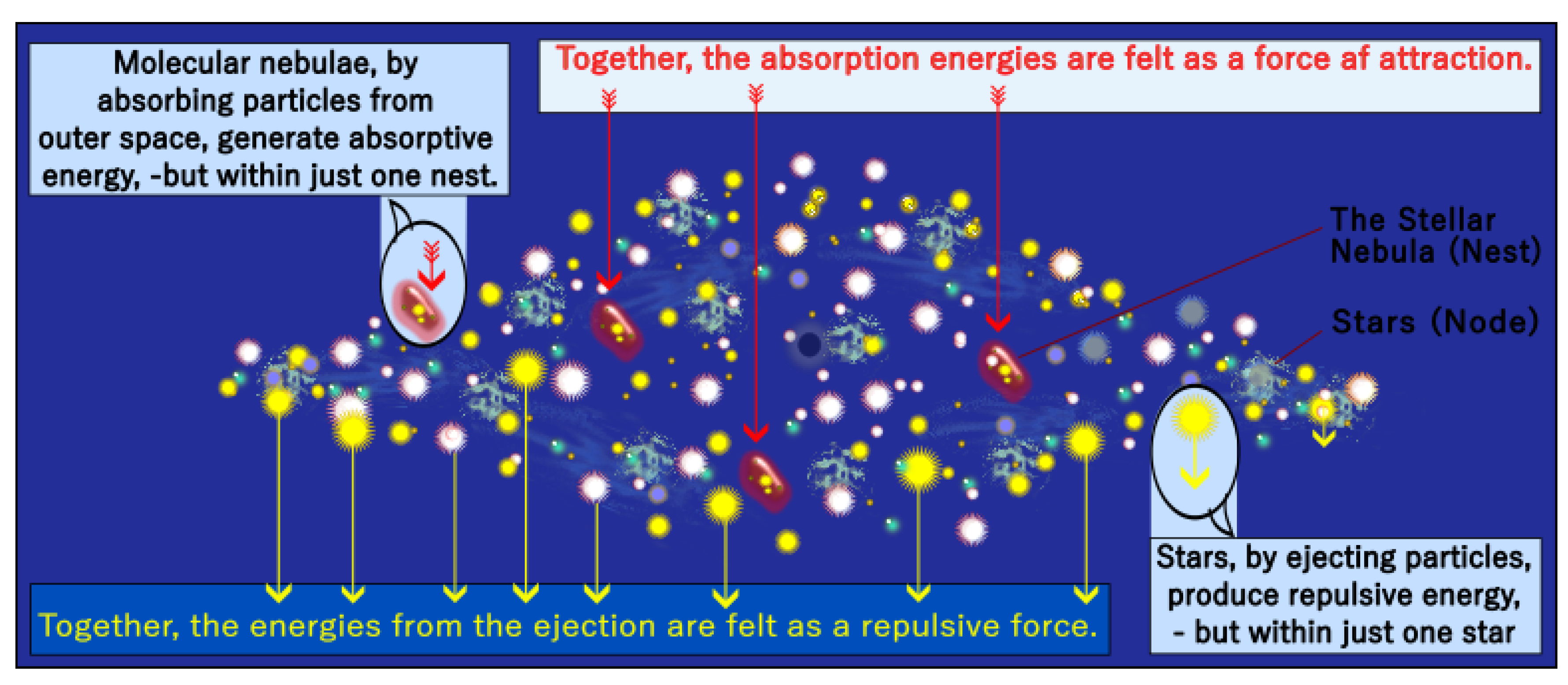
Figure 3.16.a.
The image indicates the dominance surfaces of forces, arranged vertically in order of their strength.
Figure 3.16.a.
The image indicates the dominance surfaces of forces, arranged vertically in order of their strength.
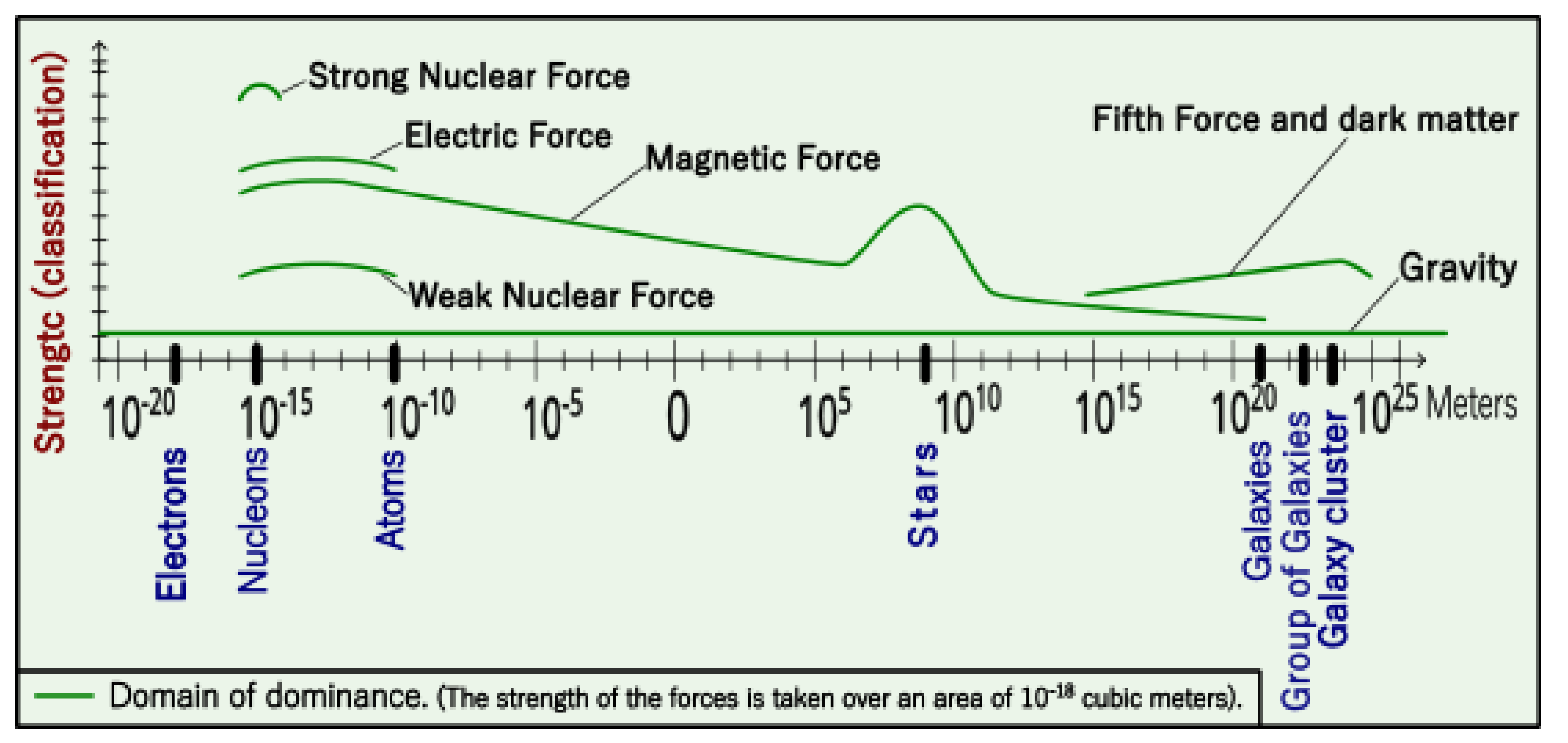
In this concept of the fractal Universe, force fields appear as motions of particle fluxes (but for physics it is correct to use the reference frame of fields, without entering into the description of the nature of fields). Thus a description of forces is proposed through explaining fluxes (although in some explanations the field reference frame is used and fluxes are implied):
1. The current description of gravity — the theory of “space-time curvature” — is a reference frame in physics so that the mathematical apparatus can maintain control in physics, but without describing the nature of “Space-Time”. The term “Space-Time” appeared in Special Relativity, and in this discourse it is a simplified reference frame.
In this discourse gravity is an attractive force between masses, but FL-2 particles also have their own undetectable mass. Therefore gravity exists at any FL.
Gravitational attraction is a force originating from additional dimensions. Matter accumulations of any FL permanently absorb matter from lower FLs. The absorbed matter is from the exterior medium of massive matter and is part of the Ether; thus gravity is due to massive matter absorbing local ether. Therefore gravity is a dynamic curvature of space around mass accumulations.
To the property of mass, and therefore to gravity, is added that once bodies move there appear kinetic aspects and time dilation, which are found in modern physics. They must be adapted to the new discoveries that will be validated.
1.1 In this discourse, since additional gravity is felt in the immediate proximity of the Sun, of stars, and at larger scales such as galaxies, etc., this means that Nodes produce gravity. And up to the scale of stars there is gravity produced by FL-1 Nodes, and in the interstellar medium gravity of FL+1 Nodes (Stars) also intervenes. This happens because in fusion reactions of stars (and in Nodes of any FL), not only stellar winds are ejected, but they also absorb matter of lower FL to restore their affected systems.
When fusion reactions in stars take place, atoms like capacitors remain with a lack of sub-particles, and acquire charge effects, but more complex. Or like oxygen would be O and not O₂. Although the force appears very weak, it is invoked by the large number of participating atoms. For galaxies, as for atoms, this fifth force becomes insignificant for the exterior of the cell group. Therefore in atoms it is similar and namely gravity.
Thus, absorption of Ether by cells of lower FL that form Nodes ⇒ Gravity.
And therefore dark matter is less than current physics believes, and in the cosmos two gravities dominate: Gravity of FL-1 Nodes + Gravity of FL+1 Nodes. Gravity of FL+1 Nodes was in the past suspected by many authors and was called the “Fifth Force”.
2. Charge is not a force, but it initiates electric and magnetic forces. Charge results from the fact that protons and electrons are composed of nests and nodes. And in electrons there is a surplus of local cosmic dust which is ejected into local space, while in protons absorption by nests dominates. Thus inside atoms there are different charges.
Therefore in the cells of each FL such as galaxies or hadrons, charge appears as follows:
Cells FL(X) with surplus of inter-cellular dust FL(X-1) (they eject local dust) ⇒ Negative charge.
Cells FL(X) with deficit of inter-cellular dust FL(X-1) (they absorb local dust) ⇒ Positive charge.
3. The electric field inside cell groups is the potential difference between particles with opposite charges (protons and electrons). This field causes the migration of local inter-cellular dust between cells with opposite charges.
As is known, in atoms and galaxies some charged cells have oval (turbulent, chaotic) orbits. This is due (also to local gravitational forces), but also to the exchange of cosmic dust in close approach — i.e., when approaching, the charge becomes more saturated, but when moving apart, it slightly loses its charge effect.
Thus the migration of gas and dust FL(X-1) from cells FL(X) with negative charge toward cells FL(X) with positive charge ⇒ Electric field inside cell groups of any FL (Atoms, Galaxy Groups).
3.1 The electrostatic field in a circuit is the same field but between groups of cells, not inside them, and appears at potential differences of the circuit. Potential difference specifically of electrons, when cell groups lose or gain semi-free electrons.
Thus, potential difference ⇒ electric field, and the movement of semi-free cells (negatively charged) through multiple cell groups ⇒ electric current.
4. Electricity is movement of negatively charged particles in a circuit composed of many cell groups (atoms). Electricity appears in cell groups due to an “electrokinetic” electric field, meaning the energy to set the charged particles into motion must be external to them. And the source of the potential difference may be an electrical energy source with different poles, or impulse from a magnetic field. Thus semi-free electrons (from any FL) are pulled away from the “electron–proton” system, and when they circulate through many atoms (closed electric circuit) electric current is produced in this circuit, which is the movement of electrons itself.
5. The movement of electric current (semi-free cells) in a circuit leads to the appearance of the electromagnetic field. It appears as a result of the extension of the electric field that is permanent between electron and proton cells. The electromagnetic field around the circuit appears because protons seek to restore the exchange of matter affected because electrons are pulled away. Thus the electromagnetic field is due to an imbalance of the system inside the atom, namely the equilibrium of substance exchange between electron and proton. And protons are excited for short moments, they become unsaturated, and this unsaturation is felt as an electromagnetic field. If protons are permanently deprived of electrons, then they become extended positive charge.
Thus, when the “proton–electron” system is quickly deprived of the electron (faster than it becomes charged) (and the circuit may carry continuous current), the excitations of substance exchange between Proton and Electron cells ⇒ electromagnetic field.
5.1 Electromagnetic waves appear when negative charges move accelerated, and faster than the proton becomes positive together with the atom. Thus an excitation from the acceleration of charges must be produced; for this, a varying current must flow. Excitations in a circuit involving many cell groups ⇒ electromagnetic waves.
6. The magnetic field in atoms appears because between electrons and protons there is an electric field, and therefore charged particles emitted by nodes circulate, forming a weak magnetic field.
6.1 However, some metals have in their atoms a stronger magnetic field because electrons have extended orbital motions accompanied by accelerations. Accelerations of electrons in atoms appear because when they approach protons, or even neutrons, they slightly change their charge. Irregular orbits of electrons appear in atoms because there are also strong and weak forces, and imbalances appear between them and the electrons when electrons perform their non-standard orbits.
This additional energy can be understood from the description of the appearance of Earth’s magnetic field.
6.2 Permanent magnets are produced when some metals are subjected to a strong magnetic field. Therefore within many atoms, magnetic fields of each atom become aligned.
7. The strong force in atoms is due to several causes:
In the nucleus of atoms there is a high concentration of matter that possesses different attraction forces.
One attraction comes from the lower FL.
A second attraction comes from Nodes which, because they eject matter into space, open their systems and produce ejections. The locally high temperature in the nucleus activates matter from sub-fractal levels.
8. The weak interaction is related to radioactive radiation. It refers to multiple links between the complex systems inside the atom.
9. The valence, ionization, etc., forces of atoms — meaning the properties of atoms from outside — are remnants of the forces of the internal systems.
Forces in each FL appear at the beginning of that FL, meaning in nodes. They appear first as energies in nodes; from multiple nodes matter of lower FL is emitted, then nests are formed, and then over a larger surface of time and volume, on “Nature on Planets”, they are detected as forces.
If a reference frame is taken in which forces are analyzed, then a sub-reference frame must be taken where the forces are formed. For example, in galaxies the attraction force is gravity, but processes within molecular nebulae also participate; they form new stars, absorb interstellar and intergalactic particles, and decompress cosmic dust.
Fractal cells are passive because the exchange of substance between nodes and nests balances at the moment when the cells are formed. However, when these internal systems open, they generate forces. And we have the possibility to do this with atoms — when inducing a current, through friction where electrons are torn away and charge appears, etc.
There are observed 2 categories of forces:
- Permanent in the universe: (Gravity, weak and strong forces)
- Resulting from an energy input: (Magnetism, Electromagnetism)
Fundamental forces in the universe originate from the energies of nodes of different FLs, but also from the absorption by nests of gas and dust between matter accumulations. However, many adjacent energies participate in forces, such as the kinetic energy of orbiting.
3.17. Nature of Subatomic Particles
Particle physics describes all known fundamental entities of the Universe within the framework of the Standard Model (SM), which includes particles with mass and particles without mass, each having well-defined interactions. - But still it is observed that matter also exists in extra-dimensions, therefore particles also exist in other FLs.
In the SM, particles are divided into two main categories: A) Fermions – constituents of matter (quarks and leptons, each in three “families”), and B) Bosons – carriers of the fundamental interactions (the photon, the gluons, the W/Z bosons and the Higgs boson). - But in the present model Quarks are “Node–Nest” systems. Bosons must be divided into two categories; a) in the case when atoms are not activated, b) appearing from the activation of the atomic system.
In the SM, fermions are characterized by spin (1/2) and mass (e.g. the electron has mass, the neutrino has very small mass), while bosons can have mass or be massless: the photon and the gluon are massless, and the W and Z are massive due to the Higgs mechanism. - But in the fractal Model here any mass is a quantity of substance, and quanta (the photons) have no mass, but they make use of the mass of the Ether and acquire momentum.
In the present model, fermions are divisible just as galaxies divide into stars from the same (FL+1), then into atoms which are FL-1. Because galaxies are an absolutely identical structure to hadrons, only at different fractal levels. Still, due to the different speeds of their systems, they appear different to the nature on planetary surfaces. But for a correct description of them the same laws that include both galaxies and hadrons must be developed.
In current physics, massive elementary particles are considered excitations of quantum fields, manifesting differently depending on interaction and observation. But in the present approach, massive elementary particles (fermions) are not themselves the quantum excitations (as modern physics believes), rather they produce excitations when they are somehow set in motion and excite the system of which they are a part (although they can also excite themselves). They are part of atomic subsystems bound by interactions and when they are forced from outside the atom to move relative to the atom they make the atom produce excitations. This is because the system affected by the departure of the particle seeks to restore itself, thus gaining excess energies or energy deficits. Therefore, detectable physics detects not the particles as accumulations of matter (as happens at larger-than-atomic scales), but the excitations.
In current physics it is considered that fundamental particles are not “solid balls”, but quantum entities with dual properties: wave and corpuscle. But in the present model they are “balls made of sub-balls” which are balanced with their external media through their interactions.
Elementary particles have two appearances: a) when they produce excitations; b) when they keep the atom functional (theoretically they are found only there).
Massive elementary particles, in an unexcited state, are all from level FL-1. But when they are excited influences from FL-2 also appear. That is, theoretically it is found that the excitation in FL-1 is supported by extra-dimensions, and in the present model they are FL-2, FL-3, FL-4.
Atoms and elementary particles are detected relative to theoretical physics, after detections. But the accumulation of matter itself is not detected as a form, as its properties in its natural, unactivated external environment. Detectable physics does not have access to detect these accumulations of matter.
A single accumulation of matter produces multiple energies and interactions. And upon disintegration the exchange of substances and energies between particles is affected, and additionally they become activated due to collisions; therefore they appear different from how they are inside the atomic system. Even some of them can separate, taking with them only one interaction and/or one stored energy; they are part of the same accumulation as a system.
3.18. The “Groups of Cells” as Atoms and Galaxy Groups from any level of the fractal universe.
In this work, this section discusses atoms where they, just like galaxy groups, within the present fractal model, are “Groups of cells” ( accumulations of semi-active matter Figure 3.5). Therefore it is searched how the similarity is hidden. Actually neither atomic physics nor galaxies are completely researched. And in this section, the “Physics of atoms” are analyzed in the framework of the proposed fractal universe. The similarity is not observed due to the following reasons:
- There exists a difference in the speed of internal systems. For instance, an electron orbits or traverses an atom billions of times faster than a galaxy orbits or traverses a galaxy group.
- Detection is not direct and complete. We observe these cells and groups of cells of different levels from the point of view of “Nature on planets”. If the interior of a galaxy or a galaxy group we can detect and analyze, then less the exterior; but atoms we see from the outside, yet we do not have good access to the its interior. And “Nature on Planets” is actually a nature as a part of the entire universe, and therefore galaxy groups and atoms, although they have similarity, interact differently with the “Nature on Planets”, and they are detected as different natures, as we know.
This approach supports that the study of atoms must be done primarily according to their dynamic properties as a whole that appear in chemistry, ionization, hadrons inside atoms taken as the bricks of atoms, but not according to the disintegration of atoms Table 3.18.
Table 3.18.
The atom as a fractal cell studied as a whole vs. by disintegration.
| 1. Study of the atom as a whole. | 2. Study of the atom by disintegration. |
| Global observable properties. | Particles appear as results of disintegration, but the subsystems that form the atom as a cell do not appear directly. |
| The energy and dynamics of behavior as a whole (body). | The weak force is detected, which appears in nodes. |
| Atoms in the local framework of the neighborhood are semi-active. But in the framework of the universe they are passive. | Particles from stellar winds are studied, which are part of the dynamic universe. |
Atomic physics compared to nuclear physics has priority in researching the fractal universe because:
- The similarity between the group of cells of the universe can be realized more from the behavior of the cells or groups of cells as a whole, that is the interactions between groups of cells, encountered in chemistry, even mechanical physics. Because we cannot theoretically disintegrate galaxy groups similar to how we disintegrate atoms. Physics estimates that collisions between galaxies takes hundreds of millions of years, therefore they cannot be followed.
- Atoms are still not definitively studied, the current theories about them cannot be used fully, but must be selected in order to make similarity between galaxy groups and atoms.
- In particle accelerators many particles appear which do not exist in the normal dynamic state of the atom.
- An elementary particle, in order to be detected, must be activated, and its lifetime is reduced.
- Atoms form stars (FL+1) , therefore galaxy groups must form “Hyperspheroids (FL+2)”, because atoms and galaxy groups are group of cells in the fractal universe. Using atomic physics and the sciences about the structure of molecules on different layers of planets or asteroids, one can also analyze our observable universe, where it is located in the hypothetical Hyperspheroid.
Atoms form molecules due to valence, but valence is the remnant of the exchanges of matter in the natural internal systems, which is specific for each atom.
Universal Device for Detecting and Recalculating the Mass Of Electrons, Quasi-Free Particles
Although it has been demonstrated that electrons are particles with mass, in the scientific community they are still suspected by some to be energetic waves, while they produce waves when they move abruptly, or are somehow excited. For a short period in science it was believed that protons or even quarks are formed from electrons. But in the approach of this work it is proposed that electrons are the same hadrons but of smaller dimensions. Therefore research on the electron must continue by any possible means that give suspicion of new results.
The device in Figure 3.18.1 is a method of detecting electrons by spinning the disc [1] at maximum and braking it abruptly, where electrons will continue motion for a short time due to kinetic energy. Because quasi-free electrons are attracted to the atomic nucleus by local forces, this mechanical detection is almost impossible. Therefore it is proposed to detect currents by using a coil[1] embedded in the rotating disc[1] and connected to a circuit that takes upon itself 99% of the binding of electrons to the atomic nuclei.
Figure 3.18.1.
The image presents a device for researching the mass and the integrity in atomic systems of quasi-free subatomic particles with charge and also without charge. The main parts are a [1] coil connected to power through a computer, which is incorporated in a [1] disc guided by an electric motor. A brake that provides abrupt braking of the [1] disc where charged particles are estimated to continue motion and form a small current. From the voltage of this current one can deduce the mass and integrity in atoms of the charged particles. But quasi-free particles without charge can be investigated by repeating the acceleration after a brake, where time differences are measured.
Figure 3.18.1.
The image presents a device for researching the mass and the integrity in atomic systems of quasi-free subatomic particles with charge and also without charge. The main parts are a [1] coil connected to power through a computer, which is incorporated in a [1] disc guided by an electric motor. A brake that provides abrupt braking of the [1] disc where charged particles are estimated to continue motion and form a small current. From the voltage of this current one can deduce the mass and integrity in atoms of the charged particles. But quasi-free particles without charge can be investigated by repeating the acceleration after a brake, where time differences are measured.
In mechanics, any system with rotating parts rests on bearings or other contact surfaces, which produce frictional forces. At the first start, static friction and the resistance of “cold” lubricant are greater, which makes acceleration slower. After the mechanism has run once, the bearings heat, the lubricant becomes more fluid and internal resistances decrease. From this experience, some observers formulated the hypothesis that the “second acceleration” of a disc takes less time to reach the same speed, invoking the memory of the kinetic energy of the quasi-free particles, which would be only very slightly correct at this scale of precision.
But in high-precision engineering at very small scales these hypotheses can be investigated because modern technologies offer magnetic bearings and clutches to cancel frictional forces and vibrations.
Modern electrical technologies, through high-precision sensors and digital control systems, allow detection of the smallest variations of electric current. And quasi-free electrons can be put into motion with very low energy, because this is observed when starting the rotation of power generators.
In this research it is proposed that electrons possess mass and they acquire kinetic energy together with the other particles that form the atom. And at an abrupt braking of the coil[1], valence electrons must brake with delay, and form an electric current. The coil is estimated to be spun at maximum and then braked abruptly, hence it is expected that electrons continue motion due to their kinetic energy.
To detect these electrons appearing as free charges in motion due to kinetic energy, a Mechano-Electrical method is used. Where an electric circuit from the coil embedded in the rotating disc helps form kinetic energy of the electrons. That is, at braking the electrons in the coil embedded in the disc may not initiate motion because their charges keep them bound in atoms with a force greater than the kinetic energy arising relative to the disc on braking. And for this the coil is fed from a source controlled by software developed for this, which does not put the electrons into motion but only weakens the forces with which they are attached in atoms. Thus at braking the disc the electrons from coil [1] are subjected to 99% kinetic energy and 1% binding in atomic interactions. If they continue motion, they can be detected because the voltage in the circuit will increase.
For investigating quasi-free particles without charge, one can still attempt to measure the acceleration time up to certain rotational speeds, in different conditions such as comparing the acceleration time between a “cold” start and a secondary acceleration after an abrupt brake. Theoretically the second acceleration should be faster because the quasi-particles still move after an abrupt brake. There is unofficial information that the English researcher Eric Lightweight in the 1970s performed this experiment, but at that time there were no magnetic bearings, and sensors did not have today’s precision.
3.19. Constants in Physics
Constants are not just “fixed numbers” in formulae within the whole universe. They are fundamental only in the natures of detectable physics. Thus once the present model is an extension of current physics, constants can be invoked as being residuals (resited) from FL levels lower than the detectable ones. Fundamental constants change value even in detectable physics; this is described in the subsections that follow.
3.19.1. The Speed-of-Light Constant “C”
The current “C” is taken in the reference frame of Einsteinian Relativity Theories. But in this approach we proceed hypothetically using another reference frame because in the universe there is the possibility of choosing different reference frames.
It is proposed that the constant “C” is the result of the Ether’s property to propagate with the respective known speed. Thus electromagnetic waves are “the wave” in the first place, and their energy is the second part of them. A wave propagates at the speed of the medium through which it passes. For example, through liquids the speed of light is smaller because the propagation medium is different. Therefore “C” varies depending on the propagation medium.
In the observable universe, between segments with lengths of several billion years the expansion/recession exceeds even the speed of light, and if one takes such a segment as the coordinate system for calculating “C”, then “C” is even twice smaller although electromagnetic waves propagate through vacuum. In the hypothetical Hyperspheroids such differences are also encountered.
In conclusion the constant “C” is fixed only in some media, or dimensional segments.
3.19.2. The Gravitational Constant
The gravitational constant in general relativity theory appears in another form. Thus gravity is part of the attractions in the universe and it can have multiple causes. At scales of galaxies there are many proposals that not only dark matter makes the gravitational force larger, but there also appear other forces or causes that supplement gravity. Therefore the gravitational constant is the unit with which the strength of interactions of unknown nature is measured. In the present Model it is proposed that attractive forces between accumulations of matter also appear at each Node of each level and “G” thus becomes respectively incorrect for galaxies, because in solar systems for planets only the gravity that appears due to mass dominates (Figure 3.19.2).
The gravitational constant depends on the reference scale. “G” and the gravitational force were developed for satellite systems such as the Moon orbiting the Earth, solar systems (although in the immediate vicinity of the Sun other attractions also appear). If Newton had calibrated the law of gravitation not on the motions of planets but on the motions of stars in galaxies, then the gravitational constant would have been “adjusted” differently and then it would not have seemed that “dark matter” is missing. This is the subject of “Modified Gravity Theories (MOND)”.
Figure 3.19.2.
The image represents how, once accumulations of matter of different scales form, attractions of other natures also appear.
Figure 3.19.2.
The image represents how, once accumulations of matter of different scales form, attractions of other natures also appear.
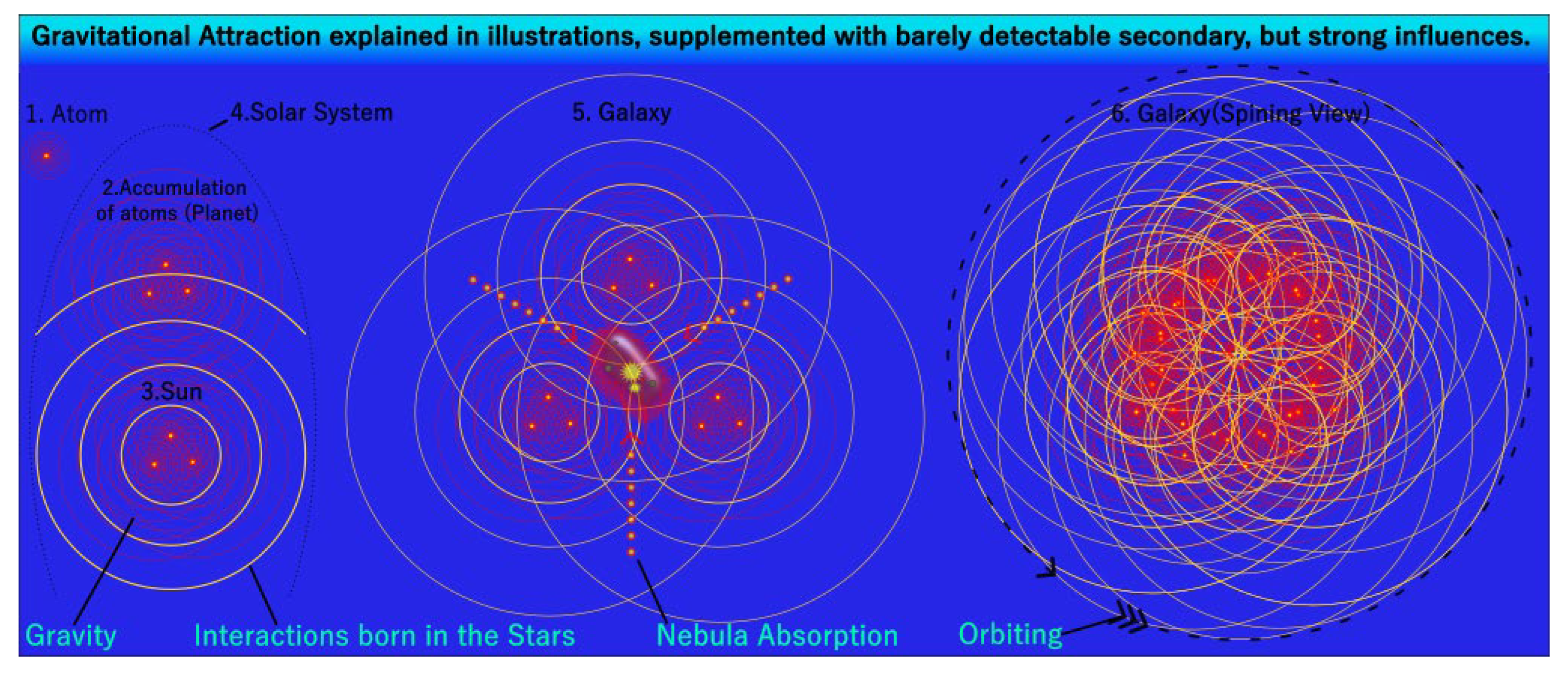
Therefore natures, constants, change (on a slow curve) when passing into another FL. Theories like MOND, including for other constants, should be brought into the whole fractal model of this work.
So physical constants can be seen as “units of measure of local natures”. If the scale changes, constants change too because with a change of FL in the universe the rate of local processes also changes, but “G” for example contains time in its unit of measure — m³/(kg·s²) — and the “s²” time in this constant is in relation to the level “between FL-1 and FL+1”.
In conclusion in current model of Universe, like fundamental forces, constants need (slow) adaptations when the reference frame passes into another FL.
3.20. An Analysis of Current Unification Theories
In this section current TOE are discussed in comparison with the present fractal model. The biggest difference is that current TOEs include scales only starting from ~10⁻³⁵ m, and do not extend the fractal structure of observable hierarchical accumulations as done in the present model. Current theories deepen the theories within the detectable universe, and at the same time the need for extra-dimensions appears.
But it is observed that atoms group and form stars, then these form galaxies, so the universe is a fractal structure of accumulations of matter which can be extended to explain all appearances without using complications such as the current “extra-dimensions”.
3.20.1. The “Root Cause” Theory Within the Present Model
The “Root Cause” theory is finished and correct within its internal system. It is welcome in explaining the universe from its point of view. Everything has a root, but in the present model the roots are the “beginning of the system” because natural systems are many in the universe, or often abstract systems are necessary to exert control over different unfoldings in the universe. Any material or immaterial Reality has roots, and finding the root is most important to understand the nature of any taken reality. In Figure 3.20.1 a hierarchical container-type diagram (or Nested Diagram) with the most primary roots of the universe is proposed, which are useless for the nature of our planet. Therefore one must not search for roots too distant from the system under analysis, and even for our whole universe roots should not be sought too far (sections 3.1 and 3.2). In the approach of this work, for the future the extension of this diagram is foreseen and thus it will include also complex systems of the universe.
Figure 3.20.1.
The cells in each level produce/form new properties of the universe and this diagram shows which levels are influencing the surface of detectable physics (this is evident throughout this paper).
Figure 3.20.1.
The cells in each level produce/form new properties of the universe and this diagram shows which levels are influencing the surface of detectable physics (this is evident throughout this paper).
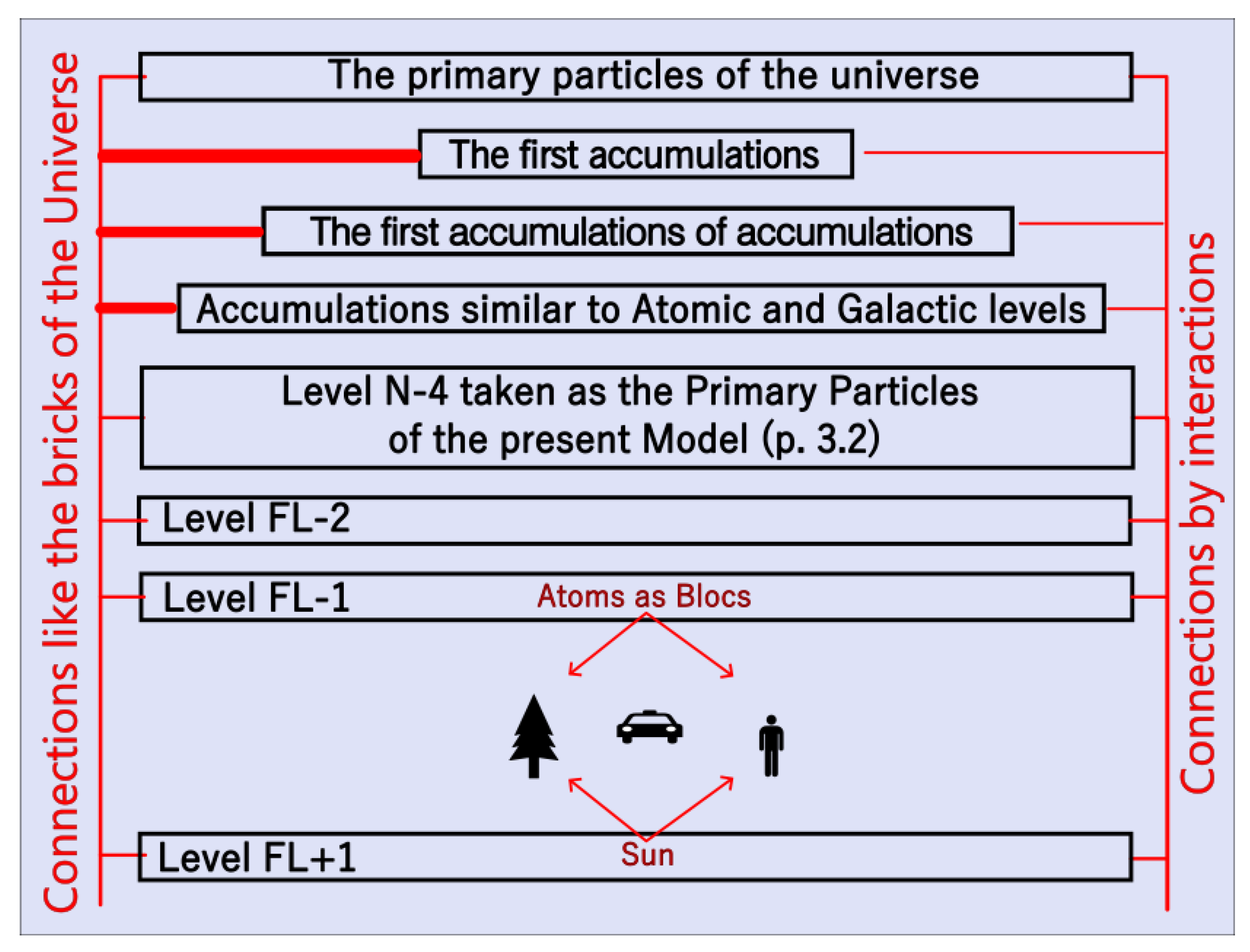
Thus, because the present model proposes the primary particles of the universe (sections 3.1 and 3.2), the “Root Cause” theory implemented in the nature of the universe becomes similar to the “Super Force” theory (section 3.20.5). Because both theories search for the same root of all natural systems present everywhere, in every spatial inclusion of any size in the universe, be it a quantum and the space where it propagates, or an atom or a star.
3.20.2. Theory of Everything (TOE)
TOE should be, after the “Root Theory”, primordial for all natural sciences. The present model proposes that the whole universe is an extremely extended fractal structure of accumulations of matter. Up to the level of atoms there are still many similar levels.
3.20.3. String Theory
String theory attempts to make a TOE using only the detectable particles. Therefore it is very complex and requires extra-dimensions that are more geometric.
3.20.4. M-Theory
It is an extension of string theory, and introduces the idea of membranes and 11 dimensions. Thus String Theory wants to explain the whole universe, but for discussion it uses only parts from detectable physics.
3.20.5. Surface Force / Superficial Force
A concept popularized in the 1970s and discussed by authors such as Paul Davies, based on the philosophical idea that in every place of the universe there exists an omnipresent “superficial” force. This approach is more philosophical than experimentally established; it influenced thinking about force unification before the appearance of modern theories such as GUT and String Theory. But since a TOE does not yet exist, no idea should be excluded.
All reality is relative to something, and in the “Surface Force” theory the proposal of “omnipresence” is valuable. Any point taken of any size from the universe has similarity but one must navigate the fractal layers of the universe and find which cells from which levels are involved.
3.20.6. Grand Unified Theory (GUT)
This research does not include multidimensional extensions, TOE, gravity; therefore even if it succeeds in unifying laws of physics, it will be very complex and incomplete for some approaches where the influence of extra-dimensions must be indicated.
3.20.7. Empirical Background/Fractal-Model Hypotheses
The fractal model hypothesis proposes that large-scale structures in the universe may follow self-similar, fractal-like patterns across different scales. It suggests that matter distribution, galaxy clastering or cosmic networks might not be uniform, but instead repeat similar patterns at various levels. These models aim to explain observed irregularities and scaling laws in cosmic structure formation.
What, current, fractal theories do not do, but they should include;
- They do not describe elementary particles.
- They do not unify quantum physics with cosmology.
- They do not exolain the Big-Bang.
- They do not include extra-dimensions.
- They do not include the theory of general relativity.
- They do not describe the detailed dynamics of individual galaxies.
3.20.8. The Holographic Principle and Verlinde’s Emergent Gravity Theory
The holographic principle states that all physical information inside a volume of the Universe can be fully described by the degrees of freedom located on the surface that surrounds it, an idea originally inspired by the study of black hole entropy. This principle suggests that three-dimensional reality could be an emergent manifestation of information encoded on a two-dimensional boundary, providing a deep framework for the relation between gravity and quantum mechanics. Building on this perspective, Erik Verlinde proposes the theory of emergent gravity, according to which gravity is not a fundamental interaction but an entropic effect produced by the distribution of information in space-time. In this model, gravitational attraction appears as a natural tendency of physical systems to maximize entropy, which succeeds in explaining some cosmic phenomena without introducing dark matter.
So space is taken as an elastic medium, a material with “memory”/information, and this is correct because beyond detectable levels there exist fractal sublevels that form additional dimensions within the dimensions of the surface in physics. And the Ether is the same matter, only not arranged into the basic accumulations of matter (planets, stars, galaxies) of the universe. And when you place objects in this medium, they “deform” something not yet well known but which can be interpreted in different ways:
- In the present model we follow the attractions formed by “Nests” (molecular clouds at any fractal level, including from the ether).
- Eric Verlinde formulates this through the distribution of information/entropy and this medium reacts with a kind of residual force. This reaction explains why the orbits of stars at the outskirts of galaxies seem to be affected by a “force” that you do not see in the visible mass.
The idea is provocative and inspiring, offering a fresh perspective that links information, entropy and gravity, but it still needs a clearer microscopic foundation and stronger observational tests to become widely accepted. However, such experimental evidence can sometimes be theoretically replaced by expanded, well-formulated models that integrate the entire Universe and are grounded in results from other experiments, especially since matter from extra dimensions cannot be directly detected.
3.21. All Realities Have Multiple Relativities
Although still discussed, it is known that all reality is relative to many aspects. In the present approach it is proposed — the “Reality relative to the unknown” which is approximate and can be used where it is difficult to indicate the Reference Frame. All reality is relative to another known or unknown reality because our nature and we humans are a small part of the whole universe, some general laws, mathematics. The “Absolute”, no one knows it. Even the most general axioms are not part of the absolute. And our intelligence is not an analysis between the absolute and unfoldings but local. Therefore for deep sciences primordially one must invoke that reality can also be relative to unknown aspects, which include in themselves;
- The point of view.
- The reference frame and the surface of nature where it is taken.
- The perspective.
- The observer, the detector, the sensor, as consumer. Or as non-consumer, that is the energy consumed by sensors is insignificant compared to what is detected.
- The results obtained only by the observer, or also with their analysis.
- The context, that is adjacent influences.
- The direction of interpretation which also has subjectivity.
Reality that Reality is Relative is applied in the research of the universe in this work. The present model is constructed in itself to be functional, then adaptations are sought for its framing in physics, on the surface of our nature. The surface in the universe where our nature is placed is very small and our nature appears different compared to that of the universe which must be described as fractal. Although, for example, the universe could be described as “the dynamic placement of Primary Particles”, that would be very complex and therefore relative generalizations are made for physics.
Using the rule of invoking the “reality relative to the unknown” which replaces indicating the “reference frame”, the model of this work can be defended; many non-intuitive theories of quantum physics such as particle duality, etc., can be explained.
Reality is absolute where extra-dimensions or the subatomic fractal levels proposed in the present model are included, but at the present time they are still under development. And the same theories made here on Earth become unsatisfactory for the description of the whole universe.
Reality can be absolute but for an intellect with absolute knowledge, who for any question can analyze the absolute.
3.21.1. The Nature of Things Is Relative to the Local Nature
If beyond the observable universe further cosmic structures exist, at a certain volume a Hyperspheroid is formed. The atom level for it is like an additional dimension, this if one analyzes behavior in the local reference frame, or in relation to other Hyperspheroids. Thus the particles from FL-2 are just additional dimensions for the “Nature on Planets”.
3.21.2. Consciousness
In the present model there are no assertions that the cosmos influences consciousness. However the local nature of the solar system influences several aspects of consciousness.
The sensors of organisms and parts of the brain that activate together with them were formed during evolution through the organism’s interaction with its external environment and this is the subconscious. But consciousness is the memory of experiences from the individual past, and in humans it is more developed than in other organisms. But consciousness does not include reflexes. Reflexes are more formed by the subconscious, which also depends on the hormonal state of the organism.
Aspects of the nature of the universe also directly participate in the formation of hormones. Organisms, when exposed to direct solar rays, obtain vitamin “D”. Thus solar rays change consciousness directly, but also the hormones of organisms.
Consciousness is created continuously by the subconscious, but perceives wrongly that it has its own free will. The lack of one’s own free will is seen because each individual has an individual character.
The subconscious depends on the zodiac, but this dependence is not a direct influence of the cosmos on consciousness. One of the influences of the birth date on consciousness is the seasons, because it is observed that the seasons shape the psychological state of organisms. Searches in psychology show that certain character traits coincide with the classical temperaments: choleric, sanguine, phlegmatic and melancholic, and these can be suspected of association with the four seasons. This correspondence is approximate, and has not been experimentally verified, and it serves as an example of how human character and sensitivity to the environment are formed (Figure 3.21.2).
Figure 3.21.2.
The image depicts a diagram linking classical temperaments with the four seasons of the year. The diagram visually illustrates a symbolic correspondence between the psychological states suggested by each season and the traits of character: spring corresponds to the enthusiasm and sociability of the sanguine temperament; summer, to the energy and impulsiveness of the choleric; autumn, to the reflection and sensitivity of the melancholic; and winter, to the calmness and reserve of the phlegmatic, indicating a more “closed” temperament. This diagram does not represent precise measurement, but rather provides a visual metaphor for how seasons may resonate with human character diversity, allowing an intuitive observation of these correspondences.
Figure 3.21.2.
The image depicts a diagram linking classical temperaments with the four seasons of the year. The diagram visually illustrates a symbolic correspondence between the psychological states suggested by each season and the traits of character: spring corresponds to the enthusiasm and sociability of the sanguine temperament; summer, to the energy and impulsiveness of the choleric; autumn, to the reflection and sensitivity of the melancholic; and winter, to the calmness and reserve of the phlegmatic, indicating a more “closed” temperament. This diagram does not represent precise measurement, but rather provides a visual metaphor for how seasons may resonate with human character diversity, allowing an intuitive observation of these correspondences.
Thus it is most likely that the authors and developers of the zodiac err when they say that the sign depends on the influence of the constellations associated with the birth date. The first days of individual life form the first algorithms of consciousness and from there people have characters specific to the sign. But it depends on the season on Earth, not on cosmic influence, because the external environment is adapted mostly to the season. Physicists know that cosmic influence, although it exists through the complexity of quanta, varies little, and accordingly causes minor hormonal changes depending on the zodiac.
The impulses of natural sensors and of nerve cells are detected well also by consciousness and it is observed that the reality we feel coincides with reality only from the nearby, detectable environment. If the universe, through its quantum activities, influenced organisms, then they would feel this as discomfort, because it would not coincide with the perceived reality. Each person observes that they perceive correctly the information detected.
3.21.3. Teleportation in its Depths Is Very Simple, Like the Opposite Synchronization of Two Clocks and Their Separation over Large Distances
Teleportation can be, compared with “the Universe model proposed in this work,” viewed as a form of synchronization between systems — similar to two clocks synchronized at the start of the teleportation process. Teleportation must be expressed as two synchronized (opposed) clocks that preserve synchronization across any distances in space and time. However, in the real environment where we measure and detect these phenomena, numerous secondary interactions come into play (the process of propagation of quanta through the ether and time dilation during acceleration, noise and environmental effects) that make observation much more complex. As theories progress, the “deep” part of teleportation will seem increasingly simple; at present, practical complexity hides that simplicity. Because information does not transmit over large distances without massive quantum interactions.
3.21.4. Religion as a Relative Reality That Appears in Human Intelligence
This section is brought into this work to show the spread and the importance of the fact that reality is relative to something. To the question whether a God exists or not, the answer is that relative to physics – no, but relative to humans – yes. Even if consciousness looks at the surrounding environment from the point of view of physics, the human organism itself needs life in harmony, and religions are part of this.
In science religion must not be affirmed or denied because it was not brought with scientific statements.
Reality is relative to another reality, and this is used for analyses and theories, but there also exist different non-material natures resulted from other natures. The nature of a God for humans is accepted, but people’s opinion that the Earth is flat is not accepted. But it is necessary to invoke that reality is relative, and both belief and the flat Earth are natural perceptions of humans with their intellect created by the harmony of nature in which humans live. Of course, for most people the information is induced by someone, but these complex ideas are the result of what all humans tend to, meaning they need such psychological nourishment.
Humans as consciousness are guests inside their own organism that detects the surrounding environment, different from the reality of physics. Humans interact with their external environment through biological detectors, and this forms a corresponding relative reality. Even if humans know physics, when smelling a flower they do not struggle to translate scientifically that molecules arrive from the flower onto the biological smell receptors that form the respective biological perceptions we all feel, but different from physical reality.
Also human intelligence is a relative reality and not an absolute one. The intellect of each of us is not as we desire but as it formed in each of us from the environments lived through in the past. People perceive that they are conscious, that we have free will, but we contradict this when we say that we are guided by destiny, by character, by zodiac, etc. The intellect of each person is formed individually through the interaction with their external environment, but occupies only a limited part of the whole spectrum of processes that occur in general.
Philosophers Plato and Kant have already defined well that human intelligence is different from absolute reality.
Currently there appear opinions that all reality is relative, and this is supported also in the statements of the present work. Intelligent perception is a reconstruction of reality, but not an exact reflection. It helps us interpret the world, but not always to see it exactly as it is. We need science, instruments, and reasoning to approach as much as possible the objective reality, but an easier alternative is to entrust yourself to a God. Therefore people maintain traditions and live in the harmony of their organisms.
Physicists accept the existence of a “Theory of Everything” from which the dynamics of the whole was created and is maintained by certain laws, many of them still unknown. But people from other fields, if they try to revise the traditions of belief as a relative intelligence of their individuality, find the “Theory of Everything” as a living God who is considered an all-wise being with soul and form. This is a reaction of one’s own organism, and we must know this and let our organism live in its own harmony. This from the point of view of physics is not correct, but then the perception of the surrounding environment by human receptors should also be called an illusion compared to the nature of physics. Therefore a more relevant answer is that in the universe there exist many relative realities relative to many other realities, and one of them is belief.
To say that a “God” for humans does not exist is similar to saying that colors do not exist, but only wavelengths. Although “God” is the rules of life perceived by organisms associated with their intelligence, he does not exist in physics, but in the universe exists as a relative reality resulted from biological life. Thus, in the nature of the universe biological life appears first, then intelligence, and then, after colors and smell, also a God appears. Even saints – some believe in a God and others do not, but both categories are partially wrong because everything is relative, and respectively the answer must contain the mention that reality is relative to another reality.
3.21.5. “Theory of Everything” Formulated Both for the Fractal Universe and for the Nature on Planets
“The Theory of Everything” must be valid not only for the fractal universe but also for the natures on planets. Many people who do not deal with physics believe in a Theory of Everything real and for anything.
To make a correct axiom of the “Theory of Everything” where the natural, material and non-material parts, mathematics etc. are included, they must be named with an abstract name, like in the program “Microsoft Windows”, where the parts are called “Window”, and then, according to realities, we obtain Windows in Windows in Windows,… And the deeper the Windows of reality are analyzed, the better control will be obtained. In the Microsoft Windows program, the software engineers do not analyze the memory but the realities of the inscriptions; the same method of control is proposed here also for any problem in the universe. Thus there is no longer a need to specify which frame of reference and relativity is used, because often they are implied or not well known due to complexity.
A “Window” in our nature is a material or non-material obstacle with which one can interact, but only if a difference of potential appears. These Windows exist and form in any manifestations, but they activate only when the laws of the universe decide. That is, an intelligence cannot control them. An intelligence can only create the correct environment so that, in the future, things proceed according to how the environment of development was created.
The Theory of Everything must answer absolutely everything in our nature, including the Microsoft Windows program, which is a complex reality comparable with the universe. And Bill Gates told us the axiom of this virtual reality, which is: Windows in Windows in Windows... All our nature represents and functions according to this axiom of Bill Gates, or deduced from his program. Even the multidimensional problems of the universe are found in this frame of reference inspired from Microsoft Windows.
In the universe, all unfoldings take place with the participation of several levels, moving toward a final entropy. Although in general the unfolding of the processes in the universe is very complex, for the systems in unfolding the “Theory of Everything” formulated in one sentence is:
“What happens in the present time, in any system of the universe, is an interaction between the Windows formed in the past, and the future will be the interaction of the Windows that are formed in the present and will remain for the future.”
This rule is valid only if a relevant frame of reference of the unfoldings is used, also resulting from the wider description here.
In physics there is an expression that we cannot return to the past because the grandparents died when we had a certain age, but in this work the “Regenerable Entropy” is supported. Thus, the grandparents die in one frame of reference, but in the frame of some contributions of theirs they remain until the end of the entropy of their society, and what remains are the contributions to society.
For applying this rule of everything it is not enough to take a frame of reference only with the internal aspects of the systems. It is known that a country is formed and maintained also under the pressure of its surrounding environment, even under the interests of other distant countries because they also find out the situation and apply political pressure. Thus any system in the universe self-forms. Another aspect is that in the universe, as in computers, there is the part that cannot be modified and the part where modifications can be made by intelligence, described in Table 3.21.4.
Table 3.21.4.
The unalterable and alterable parts of systems.
| System | Unalterable part | Alterable part |
| Computer | Hardware, Source code | User Interface |
| Stars | The star itself | The Light |
| Atoms | The atom itself | Valence electrons, charge |
| Organisms | Genetics, the organism itself | Interaction with the exterior |
In the universe there are systems and also resonances, whose influence is separated from their general system; therefore they must be taken separately from systems. In the activity of systems also participate unknown aspects, but which must be specified as unknown. Therefore the parts participating in the “Theory of Everything” are relevant to be named with an abstraction like “Windows”.
A “Theory of Everything” was foreseen even in the Bible, where it was written that absolutely everything that happens is predetermined. So if it is known how the future is predetermined it can be changed. But in fact it is known only that the future is predetermined and not how it is predetermined. Intelligence can foresee many things, but it does not have a general rule and in complex situations it does not manage. And in this model it is believed that anything that happens remains inevitably in the material memory through its complex distribution, and the future is the unfolding of these inscriptions. And if in simple problems intelligence can intervene and form the future as it wishes, then in complex situations the future is realized according to how the past was memorized.
The memorizing of the present is also complex, but also the dependence of the future on these memories. For humans the manifestations of the present are inscribed in the links of the axons between the nerve cells and in the hormonal change, but it is more difficult to control the future because not the consciousness forms the new ideas but the subconscious, which is influenced by the procedures from the past in interaction with education, the date of birth (the zodiac) etc.
Biological sensors form a nature of perceptions different from the real physics, and as a result this law of the universe of predetermining everything is found by humans as part of a God. Humans, as intellect, are hosts in their own organisms and the organism feels and believes in a God. And humans must let their own organism live in its harmony. Many people think they do not need this psychological food, but faith does not disappear, it only changes. In the universe there are many natures and several Relative Realities from which the complex things are formed, and it is not possible to control the absolute future.
4. Conclusions
In conclusion the model of the universe presented in this work, fits satisfactorily in modern physics. The fractal levels proposed are found in modern physics, but some adaptations in modern physics are necessary.
Modern physics describes atoms and the cosmos without a unification law, therefore they appear as different natures. But the present concept describes them as different fractal levels of the same fractal structure. And the difference is that they are detected differently because, in modern physics detection of the cosmos is done detailed, but detection of atom structure is done at a surface where homogeneity is very high, and small details are little detected.
Another difference between atoms and galaxy groups is that they as natural systems with internal processes although are similar, speeds within atoms are many billions of times faster than within galaxy groups.
To explain the universe using the present model many intermediate theories are necessary such as; The proposal that the nature of physics from the surface of our planet earth, is a separate nature from the nature of the whole universe, and is called “Nature on Planets”. Nature on our planet is at the interaction between two fractal levels, that of atoms and that of galaxy groups.
The universe is complex because it allows many approaches, therefore everything is relative to something. Fundamental forces and constants are fundamental only for nature on our planet. But within the whole universe they appear local at every fractal level, strong force within atoms, is analogous with “Dark Matter” theory in galaxies and galaxy groups.
The self-similar part of the whole fractal universe is a whole fractal level. And they start from stars called nodes and end until exactly before the nodes of the next fractal level. The fractal level of atoms starts from Neutrino and ends at planets.
For us from the surface of the planet the universe appears very complex, because we do not completely detect any fractal level. Even if we detect a satisfactory number of galaxies and clusters, then we do not detect their whole fractal level. Because the observable universe occupies only a small part of this fractal level, similar with a portion of ~1000 Nm (1 µm), from the fractal level of atoms. The level of atoms is detected in all its appearances, and in nuclei, and on stars, but now the structure of the atom is little detectable. Yet the structure of atoms can be deduced from the structure of galaxy groups/ clusters, because they are exactly the same entities just of different fractal levels.
Under the fractal levels of atoms are levels of the same nature, they form the nature of extra-dimensions from which are created and maintained dynamically the fractal level of atoms. Fundamental forces within atoms come included also from these additional dimensions. But they appear also in atoms and their nature can be described by watching how they form in galaxy groups/ clusters, because they are the same processes just of different fractal levels.
At every fractal level exist nodes similar to stars and nests similar to molecular clouds, which form systems of exchange of local particles. And these systems occupy several fractal cells, where a cell can get positive charge being consumer of these particles resulted from local stellar fluxes, other cells become negative, and they form electromagnetic interactions.
It is proposed that gravity at the level of galaxies also is supplied by activity in stars, because in the moment of fusion in stars, atoms open as systems and absorb ether. And everything that is described in a fractal level, is valid for all fractal levels in the universe because they are identical.
The accent is put on the fact that atoms are similar to galaxy groups/ clusters, and this result was achieved by searching TOE. The recognition of this similarity, which is almost total, will bring major benefits in the correct description of physics for researches in the future.
Nomenclature
All terms and respectively abbreviations are invented within this work. Even the fractal structure is modified compared to the standard ones so that it is adapted to the current model of the universe.
| MFU | Main Fractal Universe (Part of the Universe Taken in Current Model) |
| FL | Fractal Level |
| LFL | Internal levels of a Fractal Level. |
| Node | Stars(releasing), and present in any FL. Initiators of FL. |
| Nest | Molecular Clouds (Absorbing), is found at any FL. |
| System “Node - Nest” | Galaxies regenerate their stars(Nodes), because the matter released by stars re-accumulates in Molecular Clouds(Nests). And this Systems makes Universe active. |
| Cell | Inspired by galaxies, but proposed also for Hadrons of atoms. |
| Group of cells | They are Groups/Clusters of galaxies and Atoms. |
| Negative Cell | Electrons/~Irregular galaxies that orbit around the nucleus of galaxies |
| Positive Cells | Protons / ~ Spiral Galaxies |
| Neutral Cells | Neutrons / ~ Giant Elliptical Galaxies |
| Ether | Matter not framed in MFU from any FL. Cosmic dust, and its ejections. |
| “Nature on Planets” | It is an analogy with Planetary Nature, but taken as distinct relative nature. |
References
- Davies, P. (1984). Superforce: The search for a grand unified theory of nature. Simon & Schuster.
- Mandelbrot,B.B. (1982). The Froctal Geometry of Nature.
- Lisi, A. G. (2007). An Exceptionally Simple Theory of Everything. arXiv:0711.0770. https://doi.org/10.48550/arXiv.0711.0770.
- Yock, P. (2018). Newton’s hypotheses on the structure of matter. arXiv:1807.05486. https://doi.org/10.48550/arXiv.1807.05486.
- Gell-Mann, M. (2009). Nature conformable to herself. (World Scientific Series in 20th Century Physics 40, 378 – 381).
- Deutsch, David, and Chiara Marletto. The Constructor Theory. Allen Lane, 2021.
- P. J. E. Peebles - Principles of Physical Cosmology (1993).
- Griffiths, D. (2008). Introduction to Elementary Particles (2nd ed.). Wiley-VCH.
- D. Griffiths, Introduction to Elementary Particles, Wiley-VCH, 1987.
- Richard P. Feynman - The Feynman Lectures on Physics (1964).
- P. J. E. Peebles - Principles of Physical Cosmology (1993).
- H. Yukawa, “On the Interaction of Elementary Particles,” Proc. Physico-Math. Soc. Japan, vol. 17, pp. 48-57, 1935. [CrossRef]
- Prigogine, I. (1980). From Being to Becoming: Time and Complexity in the Physical Sciences. W. H. Freeman.
- Michio Kaku - Hyperspace: A Scientific Odyssey Through Parallel Universes, Time Warps, and the 10th Dimension (1994).
- Price, H. (1996). Time’s Arrow and Archimedes’ Point: New Directions for the Physics of Time. Oxford University Press.
- Peskin, M. E., & Schroeder, D. V. (1995). An Introduction to Quantum Field Theory.
- Lisa Randall - Warped Passages: Unraveling the Mysteries of the Universe’s Hidden Dimensions (2005).
- Brian Greene - The Elegant Universe: Superstrings, Hidden Dimensions, and the Quest for the Ultimate Theory (1999).
- Frank Close - The Infinity Puzzle: Quantum Field Theory and the Hunt for an Orderly Universe (2011).
- David Griffiths - Introduction to Elementary Particles (1987, 2008, 2nd ed.).
- S. Weinberg, Quantum Theory of Fields, vol I, Cambridge university press, 1995.
- A. Pais, Inward Bound: Of Matter and Forces in the Physical World, Oxford University Press, 1986.
Disclaimer/Publisher’s Note: The statements, opinions and data contained in all publications are solely those of the individual author(s) and contributor(s) and not of MDPI and/or the editor(s). MDPI and/or the editor(s) disclaim responsibility for any injury to people or property resulting from any ideas, methods, instructions or products referred to in the content. |
© 2025 by the authors. Licensee MDPI, Basel, Switzerland. This article is an open access article distributed under the terms and conditions of the Creative Commons Attribution (CC BY) license (http://creativecommons.org/licenses/by/4.0/).
Copyright: This open access article is published under a Creative Commons CC BY 4.0 license, which permit the free download, distribution, and reuse, provided that the author and preprint are cited in any reuse.


