Preprint
Article

This version is not peer-reviewed.

Surface Water Contaminants (Metals, Nutrients, Pharmaceutics, Endocrine Disruptors, Bacteria) in the Danube River and Black Sea Basins, SE Romania

A peer-reviewed article of this preprint also exists.

Submitted:

04 March 2025

Posted:

05 March 2025

You are already at the latest version

Abstract

The assessment of surface water quality of Danube river and Black Sea was performed taking into account the amounts of 9 heavy metals (As, Cd, Cr, Cu, Hg, Mn, Ni, Pb, Zn), nutrients (6 N and P compounds, chlorophyll a), emerging contaminants (pharmaceutics and endocrine disruptors) and heterotrophic bacteria and total coliforms (fecal indicator bacteria) in thirty-two locations from the lower Danube sector (starting with km 375 up to the river mouths), the Danube Delta Biosphere Reserve (three Danube branches – Chilia, Sulina and Sf. Gheorghe) and the Romanian coastal area of the Black Sea. The results for heavy metals, nutrients and bacteria were compared with norms set up in the national legislation for good ecological status for surface water. The concentrations of pharmaceutics and endocrine disruptors from various classes (19 quantified compounds, out of 30 investigated chemicals) were compared with values reported for Danube River water in other studies performed in various river sectors. Correlations between contaminant levels and physicochemical parameters of water samples were studied. This is the first study carried out in the connected system Danube River–Danube Delta–Black Sea for a large palette of toxicants classes and microbial pollutants.

Keywords: 
;  ;  ;  ;  ;  ;  

1. Introduction

The Danube River, one of the most significant rivers in Europe, plays a vital role in the hydrological and environmental balance of the continent. Crossing through ten countries before flowing into the Black Sea, the river forms the Danube Delta, a unique and complex wetland ecosystem recognized as a UNESCO Biosphere Reserve. However, due to its vast hydrographic basin, the Danube is highly susceptible to pollution from multiple anthropogenic sources, which ultimately impact the ecological status of both the river and the adjacent Black Sea Basin [1,2,3]. An important waterway for the transport of goods, technological and cooling waters for industries, habitat for commercially valuable fish species and, last but not least, support for biodiversity, are the main services provided by the Danube River along its 2,850 km to its discharge into the Black Sea. At the same time, the Danube River is the main collector and emissary to the Black Sea of all municipal and industrial wastewater from the entire river basin, affecting the quality of the Danube Delta waters, but also the coastal area of the Black Sea. Moreover, the input and diversity of pollution sources increases as the consumer market imposes new requirements to which suppliers must respond with new technologies and processing methods [4]. The end result leads to residual contaminants, which in various chemical combinations and mixtures can have harmful effects on human health, even when individual chemicals are below the “safety level” [5]. The main pollution sources in the receiving water of the large hydrographic basin are numerous and various such as urban sprawl, agricultural practices, human and animal waste, hospital sewage, industrial activities, wastewater treatment effluents, shipping, etc. The expansion of cities, the use of fertilizers, pesticides, and herbicides in agriculture, the improperly managed human waste from septic tanks or untreated sewage, the waste from livestock, the medical and pharmaceutical discharge of hospitals can lead to an increased pollution and harm of the water bodies with contaminants, heavy metals, pathogens, nutrients, endocrine disruptors, pharmaceuticals compounds and their metabolites. These pollution sources collectively contribute to the degradation and contamination of water bodies quality, posing numerous risks to biomes and ecosystems, human health, and overall environmental sustainability [6,7,8]. Among these, heavy metals and metalloids (HMs) are of great concern for the aquatic environment since these metals are highly persistent, toxic at high levels, and have the propensity to bioaccumulate in the food chain and, ultimately, harm the human health [9,10,11].
Nutrients play an important role in the eutrophication process and pose a serious problem to the monitoring and estimation of their effects on water quality in a riverine environment and are expressed in phosphorus (total and dissolved forms) and nitrogen (ammonia, nitrite, nitrate and organic nitrogen). The important sources of nutrients in water bodies are: point sources (municipal, industrial and agricultural facilities) and diffuse sources (erosion and surface runoff, groundwater inflow and atmospheric deposition) throughout the catchment area, with direct or indirect impacts on aquatic life, biomass growth, oxygen concentrations, water clarity, and sedimentation rates [1,12].
Surface waters contamination with heterotrophic bacteria and coliforms is in correlation with the level of the anthropogenic development, as result of human population density, accompanied by the increased growing of the urban, agricultural and industrial activities. Bacteria are considered ideal markers of microbial contamination of surface waters because of their rapid adaptability of the environmental intrinsic, extrinsic and biological factors, being predominant in aquatic environments. Generally, heterotrophic bacteria the most members of the microbiota play role of crucial bio-decomposers, which makes them an essential bio-catalyzers in the aquatic ecosystems. They are responsible for the organic matter’s biodegradation. Fecal and non-fecal coliforms, or total coliforms, are frequently utilized as markers of the overall bacteriological indicators of surface-waters. Total coliforms offer information about the rate of the organic contamination and fecal coliforms are useful indicators for assessing fecal contamination and the potential presence of pathogens [13]. Using culture methods, [14] showed that a high concentration of heterotrophic bacteria in the water makes it difficult to determine the presence of fecal coliforms. In these conditions, the evaluation of the total coliforms can serve as an indicator of water pollution.
In the 1990s, the issue of pharmaceutical residues in water gained attention. Following numerous published reports, only in 2013, three pharmaceutical substances ended high up on the watch list of Directive 39/2013 within the Water Framework (diclofenac, 17-β-estradiol, 17-α-ethinylestradiol). Starting with Directive 2013/39/EU [15] to current Decision 2022/1307 [16], the Watch List mechanism established in 2013 by EU Directive was intended to improve the available information on the substances of greatest concern occurrence. In the context of the great number of reports regarding the occurrence of the contaminants of emerging concern (CECs) in the environment and the continuous updating of the regulation in the field of water policy [15,16,17,18,19,20], there is a need for constant monitoring of these contaminants in the water environment [21,22,23,24,25,26,27]. A better knowledge of pollutants’ occurrence will help to derive prioritisation strategy and development of environmental quality standards.
The Danube River is among the world’s top 10 rivers considered at risk [1]. As the second largest catchment region in Europe, the Danube River Basin was subjected to numerous monitoring campaigns within the Joint Danube Surveys (JDS) coordinated by the International Commission for the Protection of Danube River (ICPDR) [28,29,30,31] or individual surveys [10,12,23,32]. The Joint Danube Survey JDS4 included 51 sampling sites in 13 countries across the Danube River Basin [31], out of which in Romania only 7 sampling sites have been surveyed.
The MONITOX project (JOP Black Sea Basin 2014-2020) [33] has established a complex network of 32 sampling points along the Danube River, Danube Delta and up to the Black Sea littoral on Romanian territory, starting from Ostrov/Silistra at Romania-Bulgaria border (Figure 1), in order to assess the quality of water from a physicochemical, chemical and microbiological point of view. The Black Sea was also selected due to the semi-enclosed sea character, the size of the hydrographical basin, and its hydrobiological features which make the Black Sea a unique ecosystem, extremely sensitive and exposed to organic and inorganic threats [34].
A total of 30 CECs including pharmaceuticals, azolic pesticides, synthetic hormones and endocrine disruptors were selected for monitoring in the present study performed within the MONITOX program [35] using liquid chromatography-tandem high resolution mass spectrometry (LC-HRMS/MS) [36]. The selection of emerging organic contaminants was based on several criteria: (i) ecotoxicological potential; (ii) inclusion on the watch list of the last Decision in the Water Framework; (iii) compounds not routinely monitored; (iv) contaminants which had been previously detected in the Danube River. Besides the selected CECs, the surface water physicochemical parameters (9 metals, 7 nutrient compounds) and two microbiological indicators were investigated in the fluvial, deltaic and marine environments belonging to the connected system Danube River–Danube Delta–Black Sea in SE part of Romania.

2. Material and Methods

2.1. Water Sampling and Analysis of Physicochemical Parameters

To assess the spatial variation of nutrients in dissolved and total forms, water samples were collected in June-July 2020 from a total of 32 sites located in the connected system Danube River–Danube Delta–Black Sea in SE part of Romania. The freshwater sampling started from Ostrov (at the border with Silistra/Bulgaria), and continued until the Danube flows into the sea through its 3 arms (Chilia – Musura bay, Sulina and Sf. Gheorghe); the seawater sampling was done in Sacalin and 7 representative points of the Black Sea, Romanian littoral. The geographical coordinates of the sampling points were recorded and samples were coded sequentially as 1−32 (Figure 1). The target sites included the main localities on the lower, pre-deltaic, deltaic and maritime sector of the system, points of confluence with the main tributaries Siret and Prut, protected areas and several border sites. The expeditions were organized by the project teams of Danube Delta National Institute for Research and Development, Tulcea (DDNI), and Dunarea de Jos University of Galati (UDJG), Romania, by boat and cars.
Surface water samples were collected according to European standards [37], from the water column (0-60 cm) for both monitoring points located along the Danube and in the coastal area. For the Danube, samples were taken from the navigable channel area, as this area captures the maximum degree of homogenization of pollutants, and in the case of the coastal area, sampling was carried out at depths of 1.5 - 2 meters, at a distance of 15 - 25 meters from the shoreline. The containers used were prepared in advance, and at the time of sample collection they were rinsed well with surface water [12].
For dissolved nutrients (nitrates, nitrates, ammonia) and total phosphorus, the samples were taken in 1 L polyethylene containers, labelled from 1 to 32, stored at a temperature of 2 - 5°, to minimize deterioration prior to chemical analysis. For organic nitrogen, the water sample was preserved by acidulation at pH <2, with 1 ml H2SO4 concentrate (for 100 mL sample).
After collecting and preserving the samples, the bottles were sealed to ensure the integrity of the samples. During transport, the samples were protected from light and excessive heat, as the quality of the sample can change rapidly due to gas exchange, chemical reactions and metabolism of the organisms and kept at a temperature of 2 - 5°C (refrigerated box) [37]. The same principle of sample acidification was also used for the preservation of heavy metals, for which 1mL of superpure nitric acid was added to a volume of 100 mL of the sample. The samples selected for microbiological analysis were transported at UDJG by car, in the same day of collection.
For nutrients (N, P) compounds, the measurements of the total forms of nitrogen and phosphorus and dissolved forms of nitrogen (nitrite, nitrate, ammonia) and dissolved phosphorus were performed by validated procedures at DDNI, in a chemistry laboratory accredited since 2005, according to the ISO/IEC 17025:2017, General requirements for the competence of testing and calibration laboratories [38], using molecular absorption spectrometry with the aid of a UV-VIS Lambda 650 Perkin Elmer spectrophotometer and ISO standards, and their quality was controlled through the analysis of blank samples and control standards [12]. All the reagents have very good quality analytical grade. For quality assurance, flow charts were made with the specific certified reference materials.
The N species determined reported in this study as nitrogen are referred to as N-NO3, N-NO2, N-NH4 and total nitrogen (N total), in mg/L. The P forms discussed here are orthophosphates, expressed as P-PO4, and total phosphorous (P total), in mg/L.
Determination of chlorophyll ,,a” (labelled as Chloroph. a) and pH was performed in situ using the submersible multiparameter YSI EXO2 at an approximate depth of 20 cm for 5 minutes. The EXO2 probe is a multiparametric instrument that collects water quality data. The probe collects data with up to six sensors, each sensor measuring its parameters through a variety of electrochemical, optical, or physical detection methods [12].

2.2. Metal Analysis by ICP-MS and CVAAS

In order to evaluate the concentrations of arsenic, cadmium, chromium, copper, manganese, nickel, lead and zinc from surface waters, it was used the inductively coupled plasma mass spectrometry (ICP-MS) technique, using PerkinElmer Elan DRCe II, ICP-MS instrument. The method measures ions produced by a radio frequency source, inductively coupled to plasma. The types of analytes that come from the liquid sample are nebulized, resulting in aerosols that are transported by argon, gas, into the plasma source. The ions produced in plasma are sorted according to the density of the charge unit and quantified by an electron multiplier channel [39].
For mercury analysis it was employed the cold vapor atomic absorption spectrometry (CVAAS) procedure, a physical method based on the absorption of radiation at 253.7 nm by mercury vapor. The Flow Injection Mercury System (FIMS) FIMS 400 Perkin Elmer is a stand-alone mercury analyser that contains a light source and detector specific for mercury, where organic mercury compounds are oxidized and the mercury is reduced to the elemental state and aerated from solution in a closed system [40].
Both instruments were calibrated using the external calibration technique, in which the concentrations for the measured sample set were extrapolated using linear regressions made from: raw counts per second data (ICP-MS) and absorbances (peak height) (FIMS) [41]. The conditions including the instrumental selection were set to validate and regulate the quality of data, accuracy and stability of calibration.

2.3. Analysis of CECs

2.3.1. Chemicals and Reagents

Pharmaceuticals including antibiotics, nonsteroidal anti-inflammatory drugs (NSAIDs), hormones, antiepileptic carbamazepine, endocrine disruptor bisphenol and 5 widely spread azole antifungals were selected as target compounds. Analytical standards of selected compounds were supplied from Sigma–Aldrich – Merck (Darmstadt, Germany). The stock standard solutions were prepared in methanol at 1 mg/L. Working standards were made by diluting the stock solutions in ultrapure water, within the range 250-50 ng/ml. Both stock and working standards were stored at 4 °C until further use. For UHPLC–HRMS analysis, LC–MS-grade methanol and water were purchased from Merck (Darmstadt, Germany) and acetic acid and formic acid LC grade from Fisher Scientific (Loughborough, UK). Solid phase extraction (SPE) Strata-X cartridges (500 mg/6 mL) from Phenomenex (USA) were used for pollutants’ extraction from water samples.

2.3.2. Extraction

Aliquoted volumes of 100 mL of sample were filtered using a glass filter to remove solid components. After the pH adjustment to 3 using concentrated acetic acid, samples were subjected to solid phase extraction using Strata-X cartridges pre-conditioned with 6 ml ACN followed by 6 ml water prior to extraction. Water samples are eluted through the SPE column at a flow rate of 3-5 mL/min. Afterwards, 6 ml of 10% methanol followed of 6 ml of pure water was added to remove water-soluble interferences. The residual water in the column was removed under low pressure vacuum for 10 min. The analytes were eluted from SPE columns with 6 mL methanol with a flow rate of 1 mL/min. The eluent was evaporated in an evaporation unit in stream of nitrogen at 40 °C (Thermo-Scientific). The final extract was reconstituted with 0.250 ml methanol: water (1:9, v/v), and injected in the UHPLC- HRMS/MS system.

2.3.3. Instrumentation

HRMS-MS analyses were performed at MORAS research center of UDJG, with an UltiMate 3000 UHPLC System (Thermo Fisher Scientific), coupled with a Q Exactive-OrbitrapTM mass spectrometer equipped with Heated Electrospray Ionisation (HESI) probe (Thermo Fisher Scientific) [36]. Chromatographic separation used a Syncronis C18 column (50 mm × 2.1 mm, 1.7 μm) at 30 °C. A 15 minutes gradient elution at a 0.3 mL/min flow rate solvent A (water with 0.01 % formic acid) and solvent B (methanol with 0.01 % formic acid) was used for quantitative LC-HRMS-MS analysis.
Full scan MS followed by data dependent MS2 (ddMS2) in bath positive and negative mode was used for quantitative analysis of the selected compounds listed in Table 3. Parameters for MS analysis were set as follow. The applied voltage was 3.6 kV, and the capillary temperature was 320 °C for positive ionisation. Negative mode ionisation used a spray voltage of 2.9 kV and a capillary temperature of 300 °C. The normalised collision energy (NCE) of the cell was set at 35 eV in both positive and negative mode. Nitrogen was used as collision and auxiliary gas, at flow rates of 10 and 40 arbitrary units, respectively with a temperature was of 350°C. Full scan covered the 100–1000 m/z range; data were acquired at a resolving power of 70,000 FWHM at 200 m/z, while for resolution of 35000 was used for MS-MS analysis. The Automatic Gain Control (AGC) target was set to 106, with the maximum injection time of 200 ms. The scan rate was set at 3.7scan/sec. The precursor ions are filtered by the quadrupole which operates at an isolation window of 2 m/z.
Data were processed with the Xcalibur software. The mass tolerance window was set to 5 ppm. The identification of the target compounds was carried out based on accurate mass of the molecular ion, retention time, and the fragmentation pattern resulting from MS-MS analysis (Table 1). Typical chromatograms are presented in Figures S1 and S2. (Supplementary Material).
Calibration solutions were prepared in the 2.5-50 ng/mL concentration range for each compound of interest, by serial dilution with methanol 10% in water of the 1 mg/L standard mixture and the linear calibration curves for each compound were forced through origin. The area of the parent compound in full MS analysis was used for quantitative analysis. The performance of the method was assessed regarding linearity, recovery, limits of detection (LOD) and quantification (LOQ) by several tests performed with spiked aliquots water samples with appropriate amounts of mix standard solution at 2.5; 5; 10 and 50 ng/L. The results of the evaluation are listed in the Table 1.
The statistical analysis was performed with XLSTAT software (version Basic+, 2023.3.0.1415) [42].
Table 1. The exact mass, retention time and method parameters for the selected contaminants.
Compound Class Formula Exact mass [M+H]+ [M-H]- RT
(min)
MS-MS fragments Recovery (%) LOD ng/L LOQ ng/L
Sulfamethoxazole Sulfonamides C10H11N3O3S 253.052113 254.059389 252.04484 5.20 108.4450; 156.0115; 92.0496 90.5 1 3
Trimethoprim Diaminopyrimidinen C14H18N4O3 290.137890 291.145166 289.13061 4.85 230.1162; 123.0665; 245.1032 100.2 1.5 3.7
Cyprofloxacin Quinolones C17H18FN3O3 331.133219 332.14047 330.12597 5.12 245.1086; 288.1508; 207.0653 95 1.9 5.7
Norfloxacine Quinolones C16H18FN3O3 319.133219 320.14047 318.12597 4.12 302.1302; 276.1511; 233.1086 95.4 2.8 6.9
Flumequine Fluoroquinolines C14H12FNO3 261.080121 262.087372 260.07287 6.25 244.0768; 220.0407; 202.0287 91 3.2 9.7
Oxytetracycline Tetracycline C22H24N2O9 460.148179 461.155431 459.14093 5.30 184.0520; 128.0621; 115.0544 50.2 8 24.3
Doxycycline Tetracyclines C22H24N2O8 444.153265 445.160516 443.14601 6.35 168.0571; 152.0621; 139.0542 97 8.8 26.6
Amoxicillin Antibiotic C16H19N3O5S 365.104542 366.111793 364.09729 7.35 160.0433; 114.0378 62.5 6.7 20.1
Cefuroxime Penicillines C16H16N4O8S 424.068885 425.076136 423.06163* 8.12 318.1451; 284.2901; 207.0990 87 3.2 9
Dicloxacillin Penicillines C19H17Cl2N3O5S 469.026597 470.033849 468.01935 6.48 156.9607; 108.9841 96 2.4 6.8
Clindamycin Lincosamides C18H33ClN2O5S 424.179871 425.187122 423.17262 10.25 407.1762; 377.1842; 126.1278 95 5.2 15
Carbamazepine Antiepileptic C15H12N2O 236.094963 237.102214 235.08771 7.45 194.0968; 192.0809; 179.0725 108 2 6.2
Clofibric acid Lipid regulator C10H11ClO3 214.039672 215.046923 213.03242 8.20 126.9957; 85.0295; 169.0661 67.5 1.9 5.7
Pravastatin Lipid-lowering C23H36O7 424.246102 425.253354 423.23885 11.65 321.1703; 303.1601; 101.0607 98 1.2 3.7
Erythromycin Macrolide C37H65NO12 715.450674 716.457926 714.44342 8.12 576.3721; 558.3648; 421.3601 37.2 8.5 25.1
Piroxicam NSAIDs C15H13N3O4S 331.062677 332.069929 330.05543 7.45 95,0605;121.0398; 164.0820 92 3.9 12
Ketoprofen NSAIDs C16H14O3 254.094294 255.101545 253.08704 8.32 138,9949; 129.0102; 174.0915 99.5 4.4 12.5
Indomethacin NSAIDs C19H16ClNO4 357.076785 358.084037 356.06953 9.80 138.9949; 129,0102; 174.0915 78 6.4 19.4
Carprofen NSAIDs C15H12ClNO2 273.055656 274.062907 272.04840 9.65 230.0538; 228.0567; 193.0890 48.8 9.8 29.6
Diclofenac NSAIDs C14H11Cl2NO2 295.016684 296.023935 294.00943 9.70 215.0497; 250.0188; 180.0811 105.1 3.8 11.9
Meclofenamic acid NSAIDs C14H11Cl2NO2 295.016684 296.023935 294.00943 10.25 278.0133; 243.0445 68.8 11.7 35.5
Naproxen NSAIDs C14H14O3 230.094294 231.101545 229.08704 8.60 185.0963; 153.0704; 170.0726 60.9 3.7 11.5
Enilconazole Azole antifungal C14H14Cl2N2O 296.048318 297.055569 295.04107 7.95 255.0099; 158.9765; 109.0762 100.5 1 3
Ketoconazole Azole antifungal C26H28Cl2N4O4 530.148760 531.156011 529.14151 8.45 489.1459; 255.0091; 82.0526 87 0.5 1
Fluconazole Azole antifungal C13H12F2N6O 306.104065 307.111316 305.09681 5.65 238.0791; 220.0685; 169.0459 106.3 1.6 5
Clotrimazole Azole antifungal C22H17ClN2 344.108026 345.115277 343.10077 9.61 278.0835; 165.0689 100.2 4.4 12.3
Miconazole Azole antifungal C18H14Cl4N2O 413.986023 414.993275 412.97877 10.45 281.9769; 156.9766; 69.0449 76.4 0.5 1.7
Drospirenone Synthetic progestin C24H30O3 366.219494 367.226745 365.21224 10.56 349.2163; 257.1532; 171.1154 87.0 0.7 2.0
17-α Ethinylestradiol Synthetic estrogen C20H24O2 296.177629 297.184881 295.17038 12.04 279.1744; 214.1308; 159.1169 69.0 0.5 1.0
Bisphenol A Endocrine disruptor C15H16O2 228.115029 229.122281 227.10778 8.74 219.0901; 147.1170; 95.0857 100.4 0.8 2.1
*in bold – negative ion used for the identification of the compound2.4. Analysis of total coliforms and heterotrophic bacteria.
Heterotrophic bacteria and total coliforms were the microbiological indicators analysed at BioAliment research center of UDJG for the assaying of the bacterial contamination of the analysed samples. The assay for heterotrophic bacterial count was carried out by pour plate method, by cultivating on plate count agar medium, for 48 hours at 37°C. The level of contamination was expressed as colony-forming units/mL of analysed sample (CFU/mL) [43]. The total coliforms count was assayed according to the ISO 4831:2006 (E) guidelines [44] and expressed as the Most Probable Number (MPN) per 100 mL of analysed sample (MPN/100 mL of sample). Data processing was performed by Microsoft Excel 2019, at INPOLDE research center of UDJG.

3. Results and Discussion

3.1. Physicochemical Parameters

Physicochemical parameters were measured in the MONITOX monitoring network and can be considered in the Water Framework Directive as supporting elements governing the development of the biological communities [45]. Water Framework Directive [46] establishes 5 ecological statuses for water bodies: high, good, moderate, poor and bad, transposed in Romanian legislation with Order no. 161 of 16 February 2006 of the Minister of Environment and Water Management for the approval of the Normative on the classification of surface water quality in order to establish the ecological status of water bodies. In this Romanian Order, for all physico-chemical indicators there are established limits values corresponding for 5 quality classes [47]. Our results (parameter values and analytical errors) are presented in Table S1 (Supplementary material), and the water quality classes for each target site in Table 2.
Ammonium may be found in surface waters as a result of degradation of proteins and organic matter from vegetable and animal waste contained in the sediment, industrial and domestic water discharge [48]. The highest value of 0.45 mg/L for ammonia, was obtained in Site 31 (Mangalia) and the lowest of 0.044 mg/L in Site 22 (Musura bay mouth). In accordance with Romanian legislation, from the point of view of ammonium concentrations, water samples have values corresponding to the high ecological status (except Site 31 (Mangalia) with good ecological status).
Along the Danube, up to Ceatal Chilia, in terms of nitrite concentrations, the values are corresponding to the good ecological status, with values between 0.11 and 0.23 mg/L (except from Site 8 (Siret upstream) and downstream with moderate ecological status). In the Danube Delta, water bodies have moderate ecological status, with nitrite concentrations from 0.035 mg/L to 0.050 mg/L. Across the Black Sea Coast, the ecological status varies from good (Site 27 (Corbu), Site28 (Mamaia), Site 29 (Constanta), Site 32 (Vama Veche)) and moderate (Site 30 (Costinesti) Site 31 (Mangalia)).
The presence of nitrates in natural waters can be explained by water contact with the ground watershed or by water discharge from farmland [48]. For nitrate concentrations, expressed in nitrogen, all water bodies are framed in good ecological status (65.6 % of stations) and high ecological status (34.4% of stations). The highest nitrate concentration (1.871 mg/L) was determined at Station 27 (Corbu) and the minimum of 0.716 mg/L corresponded to Site 31 (Mangalia).
Total Nitrogen has a similar trend with nitrate, with good ecological status (53.1% of monitoring points) and high ecological status (46.9% of sites). The Total Nitrogen concentrations ranged between 1.099 mg/L (Site 32 (Vama Veche)) and 3.172 mg/L (Site 8 (Siret Upstream)).
Orthophosphates, expressed in dissolved phosphorus, is 100% bioavailable to plants. The relative contribution of dissolved phosphorus to total phosphorus varied between 12.260 % (Site 11 (Galati Shipyard downstream) and 58.47% (Site 2 (Ostrov, Danube old branch)). All dissolved phosphorus concentrations are above the maximum acceptable limits specific high ecological class of 0.1 mg/L, with maximum value 0.053 mg/L in Site 2 (Ostrov, Danube old branch) and minimum 0.003 mg/L in 3 sites: 30 (Costinesti), 31 (Mangalia), and 28 (Mamaia). Total phosphorus, that represents the sum of dissolved phosphorus and particulate phosphorus (a long-term source for algae and plants) The concentrations obtained for this parameter revealed that surface water in the monitored area corresponds to high ecological class, except Site 8 (Siret R. upstream). Site 21 (Sf. Gheorghe upstream) and site 23 (Sulina mouth), that correspond to good ecological class.
All the values determined for chlorophyll ,,a’’, indicate a high ecological class (quality standard of 25 µg/L), in all 32 sites.
In general, the examined surface waters were in the alkaline pH range. Only 7 surface waters had pH in the recommended domain by Romanian legislation, respective 6.5-8.5. The minimum value (7.77 pH units) was obtained in Site 3 (Fetesti) and maximum (9.23 pH units) in site 31 (Mangalia).

3.2. Metals

In this study, 9 of the 13 elements comprised in the heavy metal and metalloid categories were analyzed as potential toxic elements, for which maximum permissible limits are defined in the Order no. 161 of 16 February 2006 of the Minister of Environment and Water Management for the approval of the Normative on the classification of surface water quality in order to establish the ecological status of water bodies [47]. The metal concentrations (values and analytical errors) are presented in Table S2 (Supplementary material), and the water quality classes for each site in Table 3.
Table 3. Metal concentrations in surface water in the target region and site classification in ecological classes.
No. Sampling sites As
µg/L
Cd
µg/L
Cr
µg/L
Cu
µg/L
Mn
µg/L
Ni
µg/L
Pb
µg/L
Zn
µg/L
Hg
µg/L
1 Ostrov ferry 5.774 0.959 31.124 14.886 320.270 31.159 15.492 43.918 0.019
2 Ostrov, Danube old branch 4.945 0.508 26.028 19.813 283.729 37.685 9.998 59.449 0.018
3 Fetesti 4.631 0.892 34.503 12.671 269.909 40.110 12.349 65.772 0.030
4 Cernavoda bridge 5.223 0.783 39.624 15.152 295.975 44.224 11.838 45.107 0.017
5 Cernavoda Seimeni 4.036 1.320 49.526 23.042 243.699 28.414 9.361 65.772 0.044
6 Braila harbor upstream 5.027 1.120 55.561 21.721 287.366 30.215 10.247 59.449 0.050
7 Braila harbor downstream 5.485 0.996 48.604 28.590 307.536 31.205 8.652 44.741 0.038
8 Siret R. upstream 5.195 1.201 43.098 27.362 294.750 29.307 9.332 56.616 0.028
9 Siret R. downstream 4.962 1.069 61.239 17.933 284.490 30.402 10.128 49.818 0.026
10 Galati downstream 5.440 0.887 55.561 19.721 305.552 27.221 9.235 46.852 0.033
11 Galati shipyard downstream 4.852 1.201 51.641 19.596 279.658 31.256 11.123 45.878 0.029
12 Prut R. upstream Giurgiulesti 4.319 0.820 46.918 27.362 256.183 37.968 8.278 73.245 0.019
13 Prut R. downstream 4.684 1.320 54.332 17.933 272.244 27.816 9.361 44.944 0.045
14 Reni downstream 5.732 1.120 52.422 19.721 318.427 47.674 10.247 55.241 0.033
15 Isaccea downstream 5.884 0.996 48.218 17.933 325.120 32.568 8.652 64.351 0.045
16 Ceatal Chilia 5.032 0.650 51.638 19.721 287.585 27.221 11.328 46.736 0.054
17 Izmail downstream 4.927 0.720 39.282 23.832 282.946 29.563 9.528 58.245 0.039
18 Ceatal Sf.Gheorghe 2.946 0.746 41.850 22.366 195.675 19.700 10.076 61.784 0.049
19 Chilia veche upstream 4.962 0.676 31.221 24.555 284.476 24.872 9.874 46.864 0.058
20 Chilia veche downstream 5.169 0.664 40.063 24.202 293.604 26.918 9.682 44.221 0.048
21 Sf.Gheorghe upstream 4.773 0.804 29.016 13.049 276.161 29.638 7.067 53.142 0.044
22 Musura bay mouth 4.582 0.744 38.724 10.154 267.744 26.654 9.456 46.214 0.038
23 Sulina mouth 4.532 0.655 27.002 18.202 265.557 29.994 8.050 55.874 0.056
24 Sf.Gheorghe mouth 4.714 0.804 32.082 12.601 273.552 27.208 6.016 49.245 0.055
25 Sacalin 5.577 0.587 21.610 19.813 311.584 23.434 8.450 46.684 0.080
26 Gura Portitei 5.830 0.872 31.074 25.878 322.736 12.325 8.698 74.333 0.054
27 Corbu 3.524 0.710 32.240 14.228 221.119 15.132 9.963 65.230 0.010
28 Mamaia 4.629 0.685 32.583 17.245 269.822 23.136 5.968 46.783 0.010
29 Constanta 6.461 0.698 45.044 21.350 350.549 16.635 5.214 71.245 0.010
30 Costinesti 6.303 0.825 28.425 16.520 343.587 19.887 6.335 53.412 0.010
31 Mangalia 5.987 0.717 35.870 19.840 281.630 17.635 5.828 47.200 0.010
32 Vama veche 6.049 0.857 40.898 21.250 284.388 12.565 6.120 55.412 0.010
Ecological status according to Romanian Order no. 161/2006 [47]
Highest ecological status 10 0.5 25 20 50 10 5 100 0.1
Good ecological status 20 1 50 30 100 25 10 200 0.3
Moderate ecological status 50 2 100 50 300 50 25 500 1.0
Poor ecological status 100 5 250 100 1000 100 50 1000 2
Bad ecological status >100 >5 >250 >100 >1000 >100 >50 >1000 >2
The results obtained (Table 3) showed a good ecological status for at least 75% of the 32 monitoring points for chromium and cadmium - one of the elements with high toxic potential. Specifically, 75% of the determinations carried out for chromium showed values lower than the quality standard of 50 µg/L, and in the case of cadmium concentrations, the percentage was 78.13% for values lower than the threshold of 1 µg/L. The rest of the values, comprised in a percentage of 25% (chromium) and 21.87% (cadmium), were located in the range corresponding to moderate ecological status for both elements. In addition to this percentage similarity, the values of chromium and cadmium concentrations characteristic of moderate ecological status were identified downstream of monitoring point S5 (Cernavoda Seimeni) to downstream of S16 (Ceatal Chilia).
It is encouraging that two other elements with high toxicity potential, such as arsenic and mercury, had values of concentrations corresponding to high ecological class, under the threshold limits (10 µg/L for As and 0.1 µg/L for Hg), for the entire monitored area, both at the Danube level and for the coastal area. In addition to these two elements with a high degree of toxicity, zinc was another element with values corresponding to a very good ecological status.
Regarding copper concentrations, 65.62% of the monitored points correspond to a high ecological status with values below the threshold of 20 µg/L. The remaining values (34.38%), between the standard of 20 µg/L and 30 µg/L, correspond to a good ecological status and were identified in points in sites 5, 6, 7, 8, 9, 12, 20 located along the Danube, and sites 26 and 29, in the coastal area of the Black Sea.
Manganese, the 7th element with toxic potential monitored in our study, is known for its presence in relatively large quantities throughout the lower Danube [49]. The values obtained following the analyzes carried out by us in the 24 sampling points along the Danube are in the range of 195.675 μg/L in Site 18 (Cetal Sf. Gheorghe) and 320.270 μg/L in Site 1 (Ostrov Ferry), values compared to those reported by ICPDR in 2007 (max 228 μg/L) [49]. From the ecological status point of view, 71.88% of surface waters are framed in moderate ecological class and 28.12% in poor ecological class. Similar concentrations were also identified in the Black Sea coastal area with an increasing trend in the south, near the border with Bulgaria.
For nickel, the lowest value of 12.565 μg/L was recorded in Site 32 (Vama Veche) and the highest value of 47.674 μg/L in Site 14 (Reni downstream). According with the Romanian legislation in force [47], 31.25 % of surface waters had good ecological status (quality standard of 25 μg/L) and 67.75 % had moderate ecological status (quality standard of 50 μg/L). It was observed that the entire coastal area presented values at least 50% lower compared to the lower Danube sector. Most likely, the high concentrations that were identified at the Danube level are attributed to the riverside industrial capacities, which can have major influences on the concentrations of heavy metals, including nickel or chromium and cadmium which correlated very well with the areas neighboring industrial activities.
The values of lead concentrations classify the surface waters of the MONITOX network in good ecological status, whose quality standard is 10 μg/L (71.87%), and moderate ecological status, with a quality standard of 25 μg/L (28.13%). Along the Black Sea coast, all sampling sites had good ecological status. The minimum value of 5.214 μg/L was obtained in Site 29 (Constanta) and maximum of 12.349 μg/L in Site 3 (Fetesti).

3.3. CECs

Nineteen out of the thirty selected analytes were identified in the surface water samples. Quantitative analysis results are presented in Table A1, Appendix 1.
The concentrations of pharmaceuticals in the analysed surface waters varied between 1.04 ng/L (drospirenone) to 132 ng/L (diclofenac). Triazine pesticide enilconazole (imazalil) concentrations ranged from 4.8 to 31.4 and bisphenol concentrations from 34.5 ng/L to 342 ng/L. Table 4 shows the range of the measured concentrations, Predicted no-effect concentration (PNEC) and the detection frequency of the identified substances.
Pharmaceuticals detected in almost all samples - sulfamethoxazole, trimethoprim, carbamazepine (CBZ) and diclofenac - can be considered as river basin specific CECs. The widely used pharmaceutical diclofenac was detectable at 28 sampling sites, but the PNEC was exceeded only in 8 sampling points corresponding to Siret and Prut tributaries and Danube River in the points corresponding downstream Siret and Prut rivers, Galati town and Prut-Giurgiulesti. The measured concentration of β-lactam antibiotic dicloxacillin exceeded PNEC in two points: downstream Galati town and in the Prut River. For the rest of pharmaceuticals, the level does not exceed PNEC. Bisphenol A was detected in all the samples, the measured concentration exceeding PNEC in 4 sampling points in the tributary Siret and Prut rivers, indicating a risk to the aquatic environment. The agricultural impact on the ecosystem of the Danube River was shown by measured imazalil concentrations, with a peak of 31.4 ng/L in the Prut River confluence site.
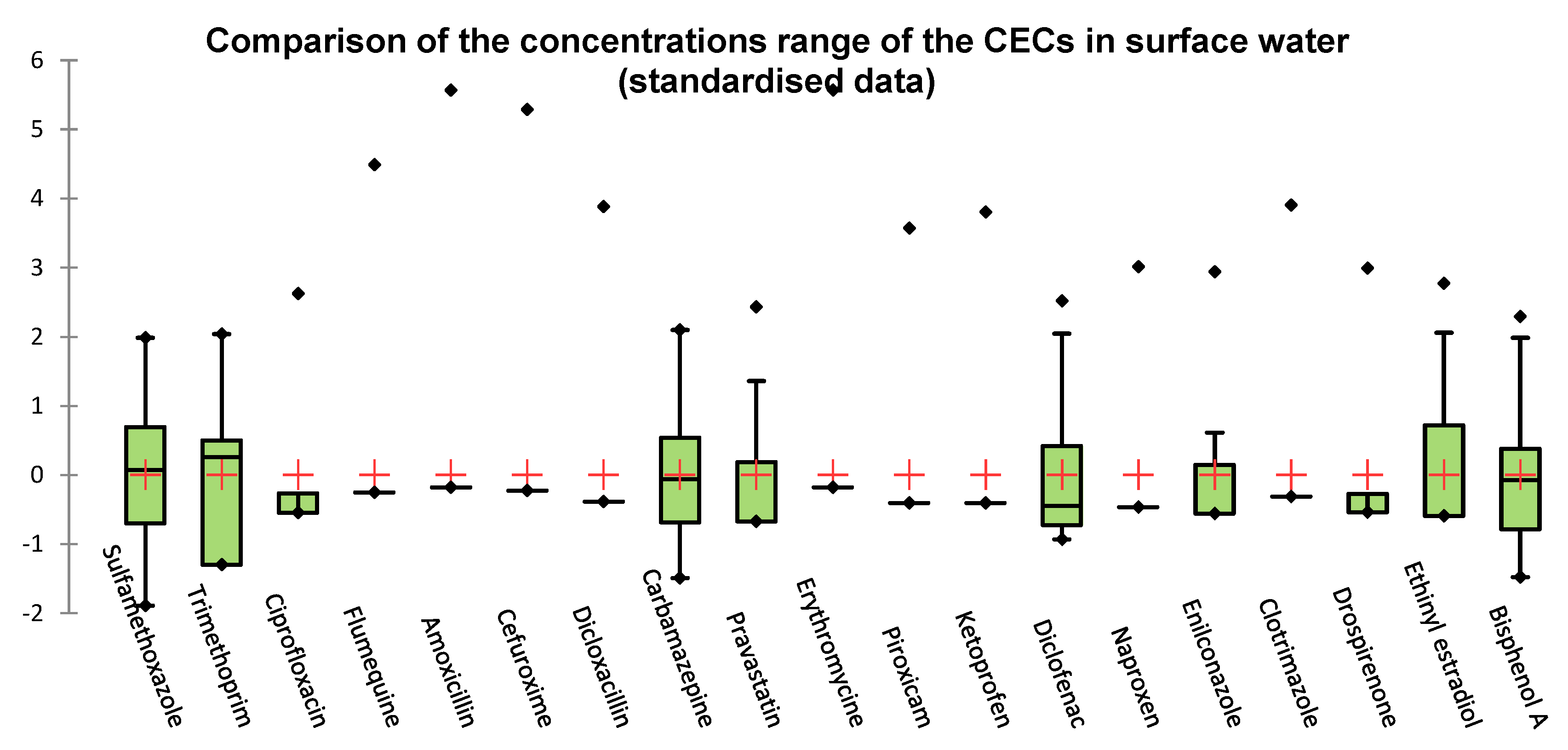
To enable comparisons between variables with different orders of magnitude, the data were standardized. The univariate analysis resulted in a box plot that highlights the variation and presence of extreme values for each substance (Figure 2).
Several substances, such as ethinyl estradiol and bisphenol A, exhibit numerous extreme values, indicating possible sporadic pollution events or high variability in their concentrations. Compounds such as carbamazepine and diclofenac show higher variability compared to others, which may be attributed to diverse pollution sources or varying environmental factors.
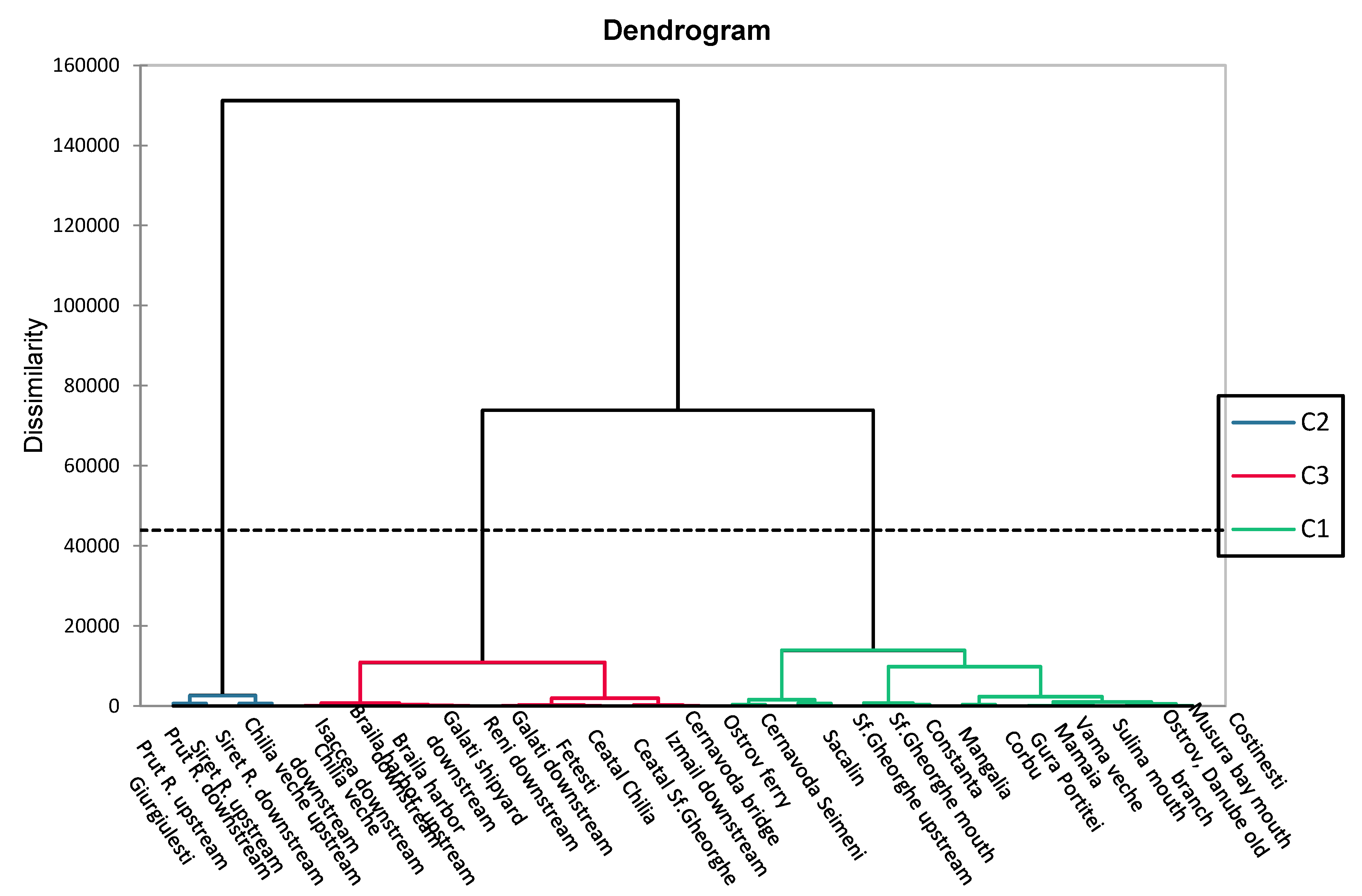
Regarding the spatial distribution, the highest number of pollutants was identified in the tributary rivers Siret and Prut, along with the sampling points corresponding to Ostrov village and the towns of Galați, Giurgiulești, and Reni. In marine water, a significantly lower number of contaminants was found, including sulfamethoxazole, carbamazepine, diclofenac, and bisphenol A. Furthermore, the measured concentrations were lower than those in freshwater samples. The hierarchical clustering analysis (HCA) dendrogram confirmed the patterns among sampling locations based on contaminant concentrations (Figure 3). The analysis revealed three clusters (C1, C2, C3) as follows: cluster C1 (green): Includes locations such as Mangalia, Costinesti, Gura portitei and Galați shipyard downstream, suggesting similarity in contamination patterns; cluster C2 (blue): includes Prut R. upstream, Siret R. upstream, and Chilia veche upstream downstream, which may indicate distinct pollution sources; cluster C3 (red): includes Braila and Galati harbour downstream, Cernavoda Bridge and Reni downstream, suggesting a unique pollution profile. The between-cluster variance is high (81.63%), indicating that the three clusters are well-separated and validating the chosen classification. Clusters 1 and 2 are more similar to each other, as indicated by their lower centroid distances.
The mobility and persistence of pharmaceuticals in aquatic environments are strongly influenced by physicochemical parameters such as pH, temperature, dissolved oxygen, and nutrient concentrations. These parameters affect the solubility, degradation, and adsorption of contaminants, ultimately shaping their spatial distribution. Understanding these interactions is essential for assessing pollution sources and potential environmental risks.
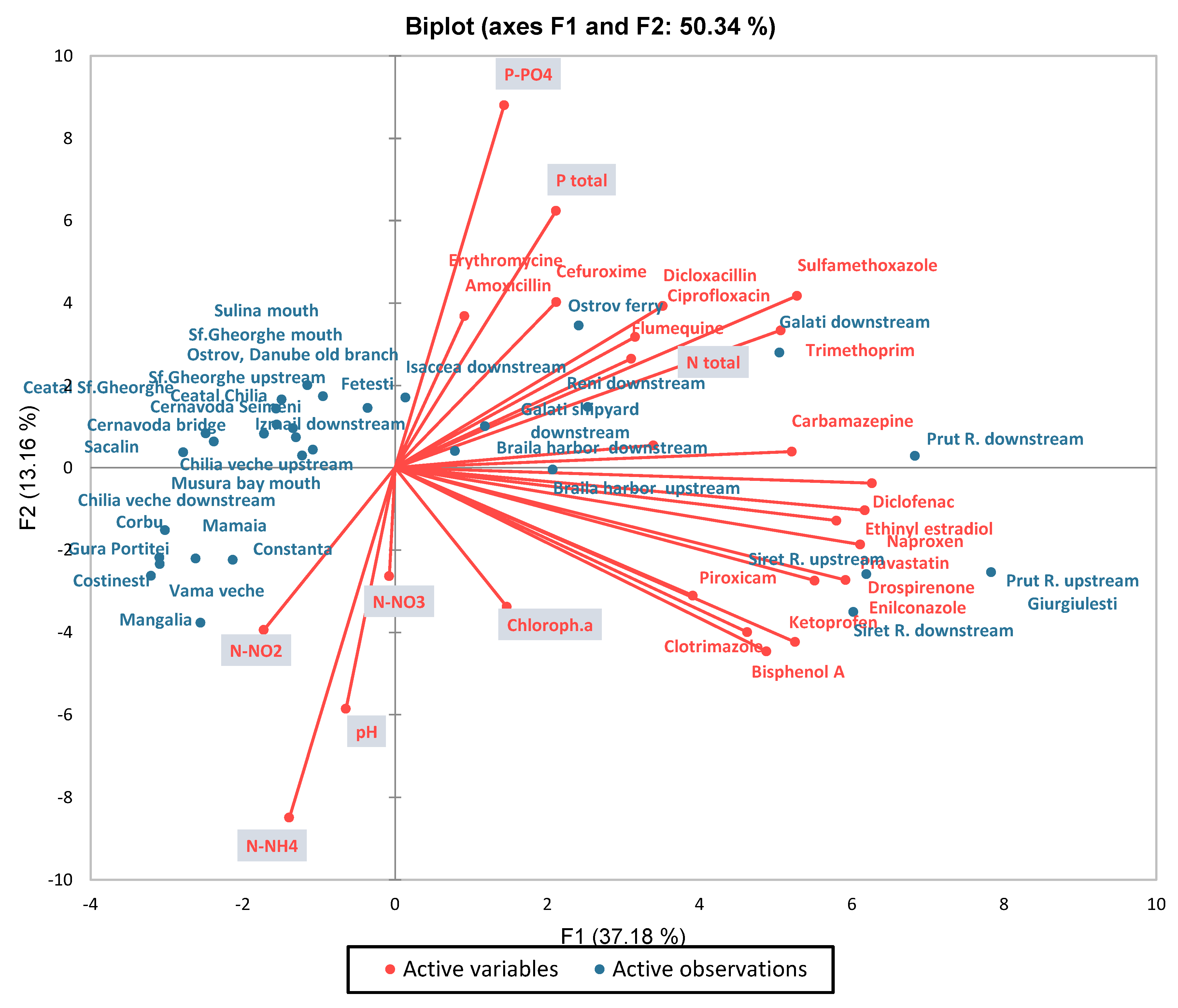
To investigate these relationships, a Principal Component Analysis (PCA) and Random Forest regression models was conducted, examining the correlations between key physicochemical parameters and pharmaceutical pollutants across different sampling sites. The PCA biplot provides an insight into how contaminants cluster together, which locations exhibit higher pollution levels, and which environmental factors may drive these trends (Figure 4).
The axes F1 (37.18%) and F2 (13.16%) together explain 50.34% of the total variance of the dataset’s structure. Nutrient Parameters (N-NO3, N-NO2, N-NH4, P-PO4, P total) are positioned in the negative F1 region, suggesting that they are negatively correlated with many pollutants. Sites like Mangalia and Costinești are aligned with these parameters, indicating potentially nutrient-rich but less polluted environments. The pH is in the negative quadrant, show a reverse correlation with pharmaceuticals contaminants. The PCA confirms that certain locations are CECs pollution hotspots, particularly in tributary rivers and industrialized areas. Sulfamethoxazole, Trimethoprim, Carbamazepine, Bisphenol A, Ethinyl estradiol, Diclofenac form a cluster in the positive F1 direction, suggesting they share common sources or behaviour in the aquatic environment. They tend to group with locations like Siret R. upstream, Prut R. downstream, and Galați downstream, which could be indicative of wastewater discharges.
The PCA analysis also highlights distinct spatial trends in pollution distribution across the sampling sites. Pollution hotspots, such as Prut R. downstream, Siret R. upstream, and Galați downstream, show a strong association with pharmaceutical pollutants, indicating high anthropogenic impact, likely driven by wastewater treatment plant (WWTP) effluents discharges. In contrast, less contaminated sites, including Sulina mouth, Sf. Gheorghe upstream, and Chilia Veche downstream, exhibit lower pollution levels, suggesting they represent more natural water bodies with reduced contamination. The marine area samples appear to be less contaminated compared to those from freshwater sources, due to lower anthropogenic influence or greater dilution effects in the marine environment.
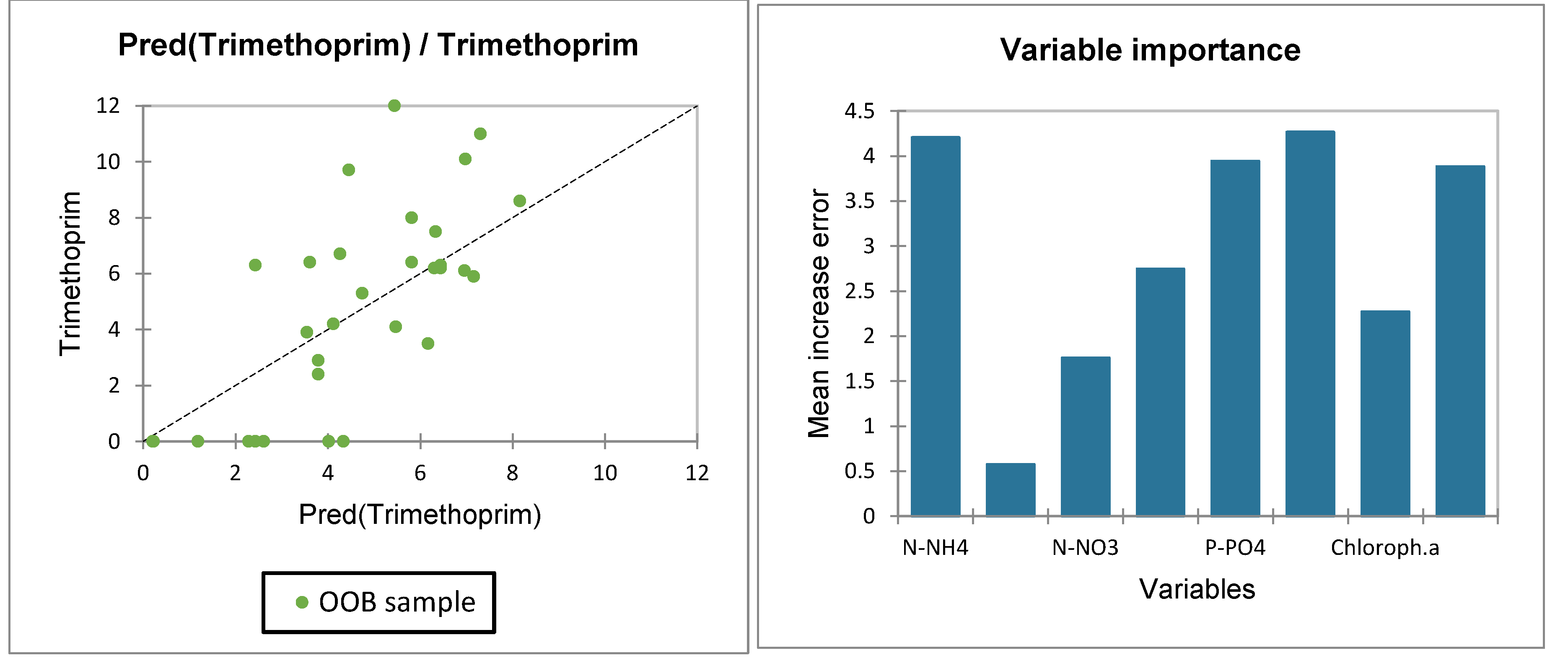
To better understand the relationships between physicochemical parameters and pharmaceutical contamination, a Random Forest regression model was applied. This approach allows for the identification of key environmental factors influencing the distribution of contaminants while handling complex interactions and non-linear patterns in the data. The model was configured with regression-type analysis, random input selection, and a sampling method without replacement. The number of variables (predictors) considered at each tree split (Mtry) was set to 2, selecting two variables at each split, with a sample size of 29. A total of 300 trees were built out of the 500 initially required. The model’s predictive performance was evaluated using the Out-of-Bag (OOB) error, residual analysis, and variable importance measures (Table S3, Suplementary Material).
The scatter plot of observed vs. predicted sulfamethoxazole concentrations reveals a moderate predictive power, with some deviations suggesting potential over- or underestimation (OBB 53.4) (Table S3, Suplementary Material). The variable importance analysis identified P-PO4 (phosphate), pH, total phosphorus (P total), and ammonium nitrogen (N-NH4) as key predictors, while N-NO3 (nitrate) showed negative importance, suggesting it may introduce noise rather than contribute to predictions. These findings highlight the influence of nutrient levels on Sulfamethoxazole persistence in aquatic environments and suggest potential model refinements for improved accuracy.
The Random Forest regression model applied to trimethoprim concentrations (Figure 5) showed an Out-of-Bag (OOB) error of 6.198, indicating a relatively low prediction error. The scatter plot of observed vs. predicted values demonstrates moderate predictive power, with points generally following the 1:1 diagonal. The variable importance analysis highlights P-PO4 (phosphate), total phosphorus (P total), pH, and N-NH4 (ammonium nitrogen) as the most influential parameters affecting trimethoprim concentrations. These findings suggest a strong link between nutrient levels and the presence of trimethoprim in aquatic environments.
The Random Forest regression model for carbamazepine resulted in a high Out-of-Bag (OOB) error of 121.876, indicating substantial prediction uncertainty (Table S3, Suplementary Material). However, the variable importance analysis identifies pH, total phosphorus (P total), phosphate (P-PO4), and chlorophyll-a as the influential parameters affecting carbamazepine concentrations showing that carbamazepine behaviour in aquatic environments is strongly influenced by physicochemical parameters.
An analysis of the relationship between physicochemical properties (pKa, LogP) and Random Forest model performance (OOB error, variable importance) highlights the influence of environmental parameters on the persistence and distribution of pharmaceutical compounds in water (Table S3, Suplementary Material).
Compounds with moderate pKa values (4-6), such as Sulfamethoxazole (SMX, pKa = 5.6), Ketoprofen (KET, pKa = 4.5), and Diclofenac (DCF, pKa = 4.0), show significant correlation with pH (DCF-pH: 5.32; SMX-pH: 5.06), indicating that their solubility and ionization state are strongly pH-dependent. The correlation analysis highlights that compounds with higher pKa and log P values exhibit a positive correlation with OOB error (0.31 and 0.32, respectively), suggesting that more hydrophobic and weakly acidic compounds introduce greater prediction uncertainty (Table S3, Suplementary Material).
Carbamazepine (CBZ), Pravastatin (PRV), and Diclofenac (DCF) correlate positively with P-PO4 and P total; Log P is negatively correlated with N-NH4 (-0.68), indicating that hydrophobic compounds are less influenced by ammonium presence, likely due to stronger sorption to organic matter. pKa negatively correlates with N-NH4 (-0.47) and N-total (-0.48), showing that ionizable compounds are more influenced by nitrogen species (Table S3, Suplementary Material).
The detection of pharmaceutical residues in the Danube River and the Black Sea within our study confirms the increasing concern regarding emerging contaminants (CECs) in aquatic environments. The presence of sulfamethoxazole, trimethoprim, carbamazepine, diclofenac, and bisphenol A in the analyzed samples (Table A1, Appendix A) aligns with findings from previous studies conducted in other European river basins.
Diclofenac, a widely used nonsteroidal anti-inflammatory drug (NSAID), was detected at concentrations reaching up to 132 ng/L in the present study. This finding is consistent with reports from other major European rivers, such as the Rhine and Elbe, where diclofenac concentrations ranged between 50 and 200 ng/L [51,52]. Similarly, a study on the Danube River conducted as part of the Joint Danube Survey (JDS4, 2019-2020) found diclofenac levels exceeding 100 ng/L in several sections, particularly near urban areas with high wastewater discharge [53].
Carbamazepine, an anticonvulsant known for its persistence in aquatic environments, was found in 28 out of 32 sampling sites in this study (Table A1, Appendix A), with concentrations averaging 18.05 ng/L. Research on the Elbe River, Czech Republic and its tributaries reported median carbamazepine concentrations ranging from 12 ng/L to 54.5 ng/L [54]. A study assessing human health risks associated with carbamazepine in surface waters of North America and Europe found that 90th percentile measured environmental concentrations (MECs) ranged from 150 to 220 ng/L, while 90th percentile predicted environmental concentrations (PECs) ranged from 333 to 658 ng/L [55]. The widespread presence of carbamazepine, despite its relatively low usage compared to NSAIDs, suggests its high resistance to conventional wastewater treatment processes and its potential to serve as a tracer of anthropogenic pollution.
Sulfamethoxazole and trimethoprim, commonly used antibiotics, were detected in 31 and 25 sites, respectively, with concentrations reaching 36 ng/L (SMX) and 12 ng/L (TMP) (Table A1, Appendix A). These findings are comparable to those reported in the Danube basin by [23], who identified sulfamethoxazole concentrations ranging from 10 to 50 ng/L in Romanian and Bulgarian sectors of the river. Additionally, a study on the Tiber River in Italy found sulfamethoxazole at similar concentrations (50-70 ng/L), suggesting that antibiotic contamination is a widespread issue in European riverine ecosystems [56].
Bisphenol A (BPA), a known endocrine disruptor, was found in all analyzed samples, with concentrations ranging from 34.5 to 342 ng/L (Table A1, Appendix A). These values are consistent with those reported in other studies, such as those from the Ebro River in Spain (50-450 ng/L) [57]. A comprehensive 19-year study analyzing 5,057 samples from European and North American water bodies found that BPA was detected in 67% of the samples, indicating significant contamination. In European surface waters, reported concentrations varied between 7 ng/L and 300 ng/L, with a median of 29 ng/L in marine waters [58].
The synthetic estrogen 17α-ethinylestradiol (EE2) was also detected in the present study, in low concentrations (1.15-3.05 ng/L) (Table A1, Appendix A), which are consistent with the values reported for surface waters in the UK (1.5–5 ng/L), France (1.0–2.9 ng/L), and Greece (3.0 ng/L) [59]. A review of monitoring studies reports higher EE2 concentrations ranging from 0.2 ng/L in Spain to 101.9 ng/L in Portugal, and median values as 5.6 ng/L in Poland, 2.0 ng/L to 34 ng/L in Italy, 1.5 ng/L to 5 ng/L in the UK, and 0.8 ng/L to 17.2 ng/L in Germany [59]. These values exceed the proposed European environmental quality standard (EQS) of 0.035 ng/L, highlighting the potential risks for aquatic life.

3.4. Microbiological Contaminants

Heterotrophic bacteria were present in all of the samples examined (Table 5), the samples taken from sites 2 (Ostrov, old Danube branch) and 9 (Siret downstream the confluence with Danube) having the highest contamination level, site 2 being classified in Class III – Critical according to the classification set up by ICPDR for bacteriological parameters in bathing water [60].
Heterotrophic bacterial counts in samples taken from sites with codes 3, 4, 5, 8, 10, 12, 15, 19, 22 and 25 show that in these areas the surface waters are also organically contaminated, being classified in the Class II (moderate pollution) of water quality (Table 5) [60]. Heterotrophic bacteria group includes common genus, such as Gram-negatives: Aeromonas, Acinetobacter, Alcaligenes, Citrobacter, Enterobacter, Flavobacterium, Klebsiella, Moraxella Pseudomonas, and Proteus, and Gram-positives: Bacillus and Micrococcus [61]. These bacteria are found in a large variety of the aquatic environments, including water supplies, wastewater, seawater. Thus, the heterotrophic plate count is used as microbiological indicator of the water quality and the efficiency of water treatment procedures [14]. While heterotrophic bacteria are not generally included in risk groups, some of them are reported as opportunistic pathogens, such as Aeromonas spp. (gastroenteritis) and Pseudomonas spp. (skin and lung infections) [62].
Water containing total coliforms may be the result of natural processes rather than fecal contamination. In addition to human discharge fecal pollution, non-fecal sources like local flora and wildlife also contribute to the overall coliform population. In the water environment, coliforms, whether fecal or not, have the potential to not only survive but also to grow if the physical-chemical and biological conditions are favourable. While coliforms by themselves are generally not thought to pose safety risks, their presence in water microbiota suggests that fecal contamination may have taken place, and the presence of the pathogens should be taken into account [63]. In all analysed samples, there were detected the total coliforms. The sites with the highest levels of contamination were those coded 1,9,8,5 and 11 (Class III – Critical), in which the MPN/100 mL of water was higher than 104. The water collected from the site coded 17 presented the most reduced contamination level with total coliforms.
Both heterotrophic bacteria and total coliforms showed a negative correlation with pH, as shown by [64]. High concentrations of heterotrophic bacteria in water can lead to organic contamination or the existence of physical, chemical, and biological conditions that facilitate the growth of these bacteria. The concentration of total coliforms is correlated with contamination of waters by feces, when in a high concentration can increase the risks of pathogens spreading.

4. Conclusions

The water bodies pollution in the large hydrographic basins from diverse sources, including urbanization, agriculture activities, untreated sewage and industrialization, pose a great threat, with potentially severe ecological and human health impacts over time. Effective management and regulatory directives are crucial in order to mitigate this impact and protect water quality. Also, continued research and monitoring are essential to further understand the sources, pathways, and adverse effects of these contaminants, hence ensuring a sustainable environment for both ecosystems and human populations.
The present study provides a comprehensive assessment of surface water contamination in the lower Danube River, the Danube Delta, and the Romanian coastal waters of the Black Sea, highlighting the presence of various pollutants, including heavy metals, nutrients, pharmaceuticals, endocrine disruptors, and microbial contaminants.
The findings indicate that certain sectors of the Danube River and its tributaries, particularly the Siret and Prut rivers, exhibit elevated levels of contamination. Industrial activities, untreated wastewater discharges, and agricultural runoff contribute significantly to the presence of heavy metals and emerging contaminants in these areas. While some metals, such as arsenic and mercury, were found within acceptable ecological limits, others, including manganese, nickel, and lead, exceeded threshold values in specific locations and raising concerns about potential bioaccumulation and ecological impact.
The detection of pharmaceutical residues, particularly diclofenac, carbamazepine, and bisphenol A, confirms the increasing issue of emerging contaminants in surface waters. These substances, often originating from wastewater treatment plants, have been detected at levels that may pose ecological risks. Given their persistence and potential effects on aquatic organisms, continuous monitoring and improved wastewater treatment technologies are necessary to mitigate their impact.
Nutrient pollution, primarily from nitrates and phosphates, remains a major concern, as it contributes to eutrophication, leading to excessive algal growth and oxygen depletion. The presence of high nutrient concentrations in certain areas highlights the urgent need for better management of agricultural runoff and wastewater discharges to prevent further ecological degradation.
Microbiological contamination, evidenced by high levels of fecal coliforms in several sampling sites, suggests a significant impact from untreated sewage and wastewater effluents. The correlation between coliform concentrations and anthropogenic activities underscores the necessity of stricter wastewater management policies and improved sanitation infrastructure to safeguard both environmental and public health.
Overall, this study underscores the importance of continuous water quality monitoring and the need for effective measures to reduce pollution sources. Strengthening environmental policies, modernizing wastewater treatment facilities, and promoting sustainable agricultural practices are crucial steps toward ensuring the long-term protection of water resources in the Danube–Black Sea system. The data obtained provide valuable insights for future research and policy development aimed at preserving the ecological integrity of these interconnected aquatic ecosystems. On going work is carried out on seasonal water quality dynamics and Danube - Black Sea sediment contamination with metals, radioelements and other trace elements.

Supplementary Materials

The following supporting information can be downloaded at the website of this paper posted on Preprints.org.

Author Contributions

Conceptualization, Antoaneta Ene, Liliana Teodorof and Gabriela Bahrim; Data curation, Antoaneta Ene, Liliana Teodorof, Carmen Lidia Chiţescu and Aida Mihaela Vasile; Formal analysis, Adrian Burada, Aida Mihaela Vasile and Daniela Seceleanu-Odor; Funding acquisition, Antoaneta Ene; Investigation, Antoaneta Ene, Liliana Teodorof, Carmen Lidia Chiţescu, Adrian Burada, Cristina Despina, Gabriela Bahrim, Aida Mihaela Vasile, Daniela Seceleanu-Odor and Elena Enachi; Methodology, Antoaneta Ene, Liliana Teodorof, Carmen Lidia Chiţescu, Adrian Burada, Cristina Despina, Gabriela Bahrim, Aida Mihaela Vasile and Elena Enachi; Project administration, Antoaneta Ene and Liliana Teodorof; Resources, Antoaneta Ene and Liliana Teodorof; Software, Antoaneta Ene and Carmen Lidia Chiţescu; Supervision, Antoaneta Ene and Gabriela Bahrim; Validation, Cristina Despina, Daniela Seceleanu-Odor and Elena Enachi; Visualization, Carmen Lidia Chiţescu and Adrian Burada; Writing – original draft, Antoaneta Ene, Liliana Teodorof, Carmen Lidia Chiţescu, Adrian Burada, Cristina Despina and Gabriela Bahrim; Writing – review & editing, Antoaneta Ene, Liliana Teodorof, Carmen Lidia Chiţescu, Aida Mihaela Vasile, Daniela Seceleanu-Odor and Elena Enachi. All authors have read and agreed to the published version of the manuscript.

Funding

This research was performed in the frame of the project with code BSB 27–MONITOX (2018-2021), financed through the Joint Operational Programme Black Sea Basin 2014-2020 of European Union.

Data Availability Statement

Not applicable.

Acknowledgments

We acknowledge the technical support given by the DDNI and INPOLDE (UDJG) research teams during the sampling and analytical investigations.

Conflicts of Interest

The authors declare no conflict of interest.

Appendix A

Table A1. Concentrations of CECs for each sampling site (ng/L); ND= not detected.
Site no. SMX TMP CIP FLU AMX CFX DCX CBZ PRV ERY PIR KET DCF NAP IMZ CLO DRO EE2 BPA
1 28.9 6.4 ND ND 3.8 1.6 3.5 15.4 6.4 4.3 ND ND 28 6.2 8.3 ND ND 1.6 238
2 18.6 ND ND ND ND ND ND 11 ND ND ND ND 18.7 ND 6.2 ND ND ND 186
3 24 8 ND ND ND ND ND 14.9 7 ND ND ND 41.3 ND ND ND ND ND 182
4 15.4 2.4 ND ND ND ND ND 8.4 ND ND ND ND 16 ND ND ND ND ND 164
5 21 6.2 ND ND ND ND ND 10 ND ND ND ND 13.2 ND ND ND ND ND 157
6 26 8.6 ND ND ND ND ND 16.6 18 ND 14.6 ND 69 ND ND ND 1.8 1.8 186
7 18.4 4.1 ND ND ND ND ND 35 6.4 ND ND ND 87 ND ND ND 2.3 ND 173
8 32 6.7 ND ND ND ND ND 30.4 21.4 ND 32 26 112 6.1 27.6 ND 1.8 2.15 297
9 28 10.1 ND ND ND ND ND 37 20.7 ND 28.6 20.8 80 4.9 24.6 6.4 2.05 2.1 310
10 35 11 5.2 6.4 ND 4.9 7 26 6.8 ND 8.9 7.5 87 5.2 6.8 ND 1.04 2.4 138
11 21 6.4 ND ND ND ND ND 12.2 4.3 ND 16 ND 46 ND 10.5 ND 1.75 1.3 142
12 24 12 4.1 ND ND ND ND 38 24.8 ND ND 12.6 132 8.6 31.4 8.2 3.4 3.05 342
13 25 7.5 3.4 4.6 ND ND 9.4 27.8 24 ND ND 8.2 114 6.2 24.6 5 2.6 1.62 317
14 36 6.2 5 ND ND ND 3.6 18.9 16.2 ND 5.6 5.6 95 ND 10.2 ND ND 1.15 156
15 22 5.9 ND ND ND ND 4 20 9 ND ND ND 32 ND ND ND ND ND 141
16 14 6.3 ND ND ND ND ND 16.3 4.2 ND ND ND 12.9 ND ND ND ND ND 92
17 18 6.1 ND ND ND ND ND 12 ND ND ND ND 9.4 ND ND ND ND ND 85
18 11.8 2.9 3.4 ND ND ND ND 17 3.1 ND ND ND 24.8 ND ND ND ND ND 63
19 7.4 4.2 ND ND ND ND ND 6.2 ND ND ND ND 4.6 ND ND ND ND ND 49
20 12.5 3.5 ND ND ND ND ND 8 ND ND ND ND 5.5 ND ND ND ND ND 54
21 14 3.9 3.1 ND ND ND ND 18 ND ND ND ND 25.3 ND ND ND ND ND 48
22 24 9.7 ND ND ND ND ND 10.2 ND ND ND ND 12.8 ND 4.8 ND ND ND 183
23 21 6.3 1.8 ND ND ND ND 26.7 ND ND ND ND 18.4 ND 6.2 ND ND ND 51
24 15.7 5.3 2.6 ND ND ND ND 19.5 ND ND ND ND 21.7 ND ND ND ND ND 34.5
25 3.2 ND ND ND ND ND ND 5.6 ND ND ND ND ND ND ND ND ND ND 87
26 4 ND ND ND ND ND ND ND ND ND ND ND ND ND ND ND ND ND 114
27 ND ND ND ND ND ND ND ND ND ND ND ND ND ND ND ND ND ND 124
28 6.5 ND ND ND ND ND ND 8.6 ND ND ND ND 5.7 ND ND ND ND ND 218
29 7.9 ND ND ND ND ND ND 26.7 ND ND ND ND 14.8 ND ND ND ND ND 237
30 5.2 ND ND ND ND ND ND ND ND ND ND ND 6.2 ND ND ND ND ND 107
31 11.4 ND ND ND ND ND ND 8.9 ND ND ND ND 8.4 ND ND ND ND ND 164
32 10 ND ND ND ND ND ND ND ND ND ND ND ND ND ND ND ND ND 127

References

  1. Sommerwerk Nike, Jürg Bloesch, Christian Baumgartner, Thomas Bittl, Dubravka Čerba, Béla Csányi, Grigore Davideanu, Martin Dokulil, Georg Frank, Iulia Grecu, Thomas Hein, Vladimír Kováč, Iulian Nichersu, Tibor Mikuska, Karin Pall, Momir Paunović, Carmen Postolache, Maja Raković, Cristina Sandu, Martin Schneider-Jacoby, Katharina Stefke, Klement Tockner, Ion Toderaş, Laurenţia Ungureanu. Chapter 3 - The Danube River Basin, In: Rivers of Europe (Second Edition), Editor(s): Klement Tockner, Christiane Zarfl, Christopher T. Robinson, Elsevier, 2022, pp. 81–180, ISBN 9780081026120. [CrossRef]
  2. Bănăduc, D.; Rey, S.; Trichkova, T.; Lenhardt, M.; Curtean-Bănăduc, A. The Lower Danube River—Danube Delta—North West Black Sea: A pivotal area of major interest for the past, present and future of its fish fauna—A short review. Sci. Total Environ. 2016, 545, 137–151. [Google Scholar] [CrossRef] [PubMed]
  3. Chiţescu, C.L.; Ene, A.; Geana, E.-I.; Vasile, A.M.; Ciucure, C.T. Emerging and Persistent Pollutants in the Aquatic Ecosystems of the Lower Danube Basin and North West Black Sea Region—A Review. Appl. Sci. 2021, 11, 9721. [Google Scholar] [CrossRef]
  4. Syeed, M. M., Hossain, M. S., Karim, M. R., Uddin, M. F., Hasan, M.,; Khan, R. H. Surface water quality profiling using the water quality index, pollution index and statistical methods: A critical review. Environmental and Sustainability Indicators 2023, 18, 100247. [Google Scholar] [CrossRef]
  5. Madhav, S., Ahamad, A., Singh, A. K., Kushawaha, J., Chauhan, J. S., Sharma, S., & Singh, P. 2020. Water Pollutants: Sources and Impact on the Environment and Human Health. In Sensors in Water Pollutants Monitoring: Role of Material (Pooja, D., Kumar, P., Singh, P., Patil, S. (Eds.)). Springer, Singapore, 2020, pp 43–62. [CrossRef]
  6. Podlasek, A.; Koda, E.; Kwas, A.; et al. Anthropogenic and Natural Impacts on Surface Water Quality: The Consequences and Challenges at the Nexus of Waste Management Facilities, Industrial Zones, and Protected Areas. Water Resour. Manage. 2024. [Google Scholar] [CrossRef]
  7. Bashir, I. , Lone, F.A., Bhat, R.A., Mir, S.A., Dar, Z.A., Dar, S.A., 2020. Concerns and Threats of Contamination on Aquatic Ecosystems. Bioremediation and Biotechnology 2020, 27, 1–26. [Google Scholar] [CrossRef]
  8. Enachi, E. , Bahrim, G.E., Ene, A. Pharmaceutical compounds and endocrine disruptors in aquatic environments: Ecotoxicological effects and analysis methodology. Annals of the Dunarea de Jos University of Galati. Fasc. II, Mathematics, Physics, Theoretical Mechanics 2019, 42, 172–182. [Google Scholar]
  9. Ghani, S. A. , Hamdona, S., Shakweer, L., El Saharty, A. Spatial distribution and pollution assessment of heavy metals in surface and bottom water along the eastern part of the Egyptian Mediterranean coast: Mar. Pollut. Bull., 2023, 197, 115713.
  10. Ene A., Moraru D.I., Pintilie V., Iticescu C., Georgescu P.L. Metals and natural radioactivity investigation of Danube River water in the lower sector. Romanian Journal of Physics 2024, 69, 702. [Google Scholar] [CrossRef]
  11. Seif, R.A.; Ene, A.; Zakaly, H.M.H.; Sallam, A.M.; Taalab, S.A.; Fnais, M.S.; Saadawi, D.A.; Amer, S.A.; Awad, H.A. Distribution of Heavy Metals along the Mediterranean Shoreline from Baltim to El-Burullus (Egypt): Consequences for Possible Contamination. Minerals 2024, 14, 931. [Google Scholar] [CrossRef]
  12. Teodorof, L.; Ene, A.; Burada, A.; Despina, C.; Seceleanu-Odor, D.; Trifanov, C.; Ibram, O.; Bratfanof, E.; Tudor, M.-I.; Tudor, M.; Cernisencu, I.; Georgescu, L. P.; Iticescu, C. Integrated Assessment of Surface Water Quality in Danube River Chilia Branch. Appl. Sci. 2021, 11, 9172. [Google Scholar] [CrossRef]
  13. Pall, E.; Niculae, M.; Kiss, T. , Șandru, C.D.; Spînu, M. Human impact on the microbiological water quality of the rivers. Journal of Medical Microbiology 2013, 62, 1635–1640. [Google Scholar] [CrossRef]
  14. Allen, M.J.; Edberg, S.C.; Reasoner, D.J. Heterotrophic plate count bacteria—what is their significance in drinking water? International Journal of Food Microbiology 2004, 92(3), 265–274. [Google Scholar] [CrossRef]
  15. EU. Directive 2013/39/EC of the European Parliament and of the Council of 12 August 2013 amending Directives 2000/60/EC and 2008/105/EC as regards priority substances in the field of water policy. Off. J. Eur. Union. 2013, L226, 1–17. [Google Scholar]
  16. European Commission: Commission Implementing Decision (EU) 2022/1307 of 22 July 2022 establishing a watch list of substances for Union-wide monitoring in the field of water policy pursuant to Directive 2008/105/EC of the European Parliament and of the Council. Off. J. Eur. Union 2022, L197, 117–121.
  17. European Commission: Commission Implementing Decision (EU) 2015/495 of 20 March 2015 establishing a watch list of substances for Union-wide monitoring in the field of water policy pursuant to Directive 2008/105/EC of the European Parliament and of the Council (notified under document C(2015) 1756). Off. J. Eur Union 2015, L78, 40–42. Available online: http://data.europa.eu/eli/dec_impl/2015/495/oj (accessed on 6 November 2024).
  18. European Commission: Commission Implementing Decision (EU) 2018/840 of 5 June 2018 establishing a watch list of substances for Union-wide monitoring in the field of water policy pursuant to Directive 2008/105/EC of the European Parliament and of the Council and repealing Commission Implementing Decision (EU) 2015/495 (notified under document C(2018) 3362). Off. J. Eur Union 2018, L141, 9–12. Available online: http://data.europa.eu/eli/dec_impl/2018/840/oj (accessed on 6 November 2024).
  19. European Commission: Commission Implementing Decision (EU) 2019/1942 of 22 November 2019 not approving carbendazim as an existing active substance for use in biocidal products of product-type 9. 2019.
  20. European Commission: Commission Implementing Decision (EU) 2021/348 of 25 February 2021 approving carbendazim as an existing active substance for use in biocidal products of product-types 7 and 10. 2021.
  21. Kern, K. New standards for the chemical quality of water in Europe under the new Directive 2013/39/EU. Journal for European Environmental & Planning Law 2014, 11, 31–48. [Google Scholar]
  22. Gomez Cortes, L., Marinov, D., Sanseverino, I., Navarro Cuenca, A., Niegowska, M., Porcel Rodriguez, E., ... & Lettieri, T. Selection of substances for the 4th Watch List under the Water Framework Directive. Publications Office of the European Union: Luxembourg, 2022, ISBN 978-92-76-55020-4. https://www.waternewseurope.com/wp-content/uploads/2022/08/JRC-Technical-Report.pdf.
  23. Chitescu, C. L., Kaklamanos, G., Nicolau, A. I., & Stolker, A. A. M. L. High sensitive multiresidue analysis of pharmaceuticals and antifungals in surface water using U-HPLC-Q-Exactive Orbitrap HRMS. Application to the Danube river basin on the Romanian territory. Sci. Total Environ. 2015, 532, 501–511. [CrossRef]
  24. Wilkinson, J.L.; Boxall, A.B.A.; Kolpin, D.W.; Leung, K.M.Y.; Lai, R.W.S.; Galbán-Malagón, C.; Adell, A.D.; Mondon, J.; Metian, M.; Marchant, R.A.; et al. Pharmaceutical pollution of the world’s rivers. Proc. Natl. Acad. Sci. 2022, 119, e2113947119. [Google Scholar] [CrossRef]
  25. József, T.; Kiss, S.R.; Muzslay, F.; Máté, O.; Stromájer, G.P.; Stromájer-Rácz, T. Detection and Quantification of Pharmaceutical Residues in the Pest County Section of the River Danube. Water 2023, 15, 1755. [Google Scholar] [CrossRef]
  26. Gurgenidze, D.; Romanovski, V. The Pharmaceutical Pollution of Water Resources Using the Example of the Kura River (Tbilisi, Georgia). Water 2023, 15, 2574. [Google Scholar] [CrossRef]
  27. Jendrzejewska, N.; Karwowska, E. Ciprofloxacin and Imipenem Resistance in Bathing Waters—Preliminary Studies of Great Rudnickie Lake. Appl. Sci. 2024, 14, 6238. [Google Scholar] [CrossRef]
  28. International Commission for the Protection of Danube River (ICPDR), Joint Danube Survey 1 (JDS1) Report 2002. https://www.icpdr.org/tasks-topics/topics/water-quality/joint-danube-survey/joint-danube-survey-1.
  29. International Commission for the Protection of Danube River (ICPDR), Joint Danube Survey 2 (JDS2) Report 2008. https://www.danubesurvey.org/jds2/files/ICPDR_Technical_Report_for_web_low_corrected.pdf.
  30. International Commission for the Protection of Danube River (ICPDR), Joint Danube Survey 3 (JDS3) Report 2015. https://www.danubesurvey.org/jds3/.
  31. International Commission for the Protection of Danube River (ICPDR), Joint Danube Survey 4 (JDS4) Report, 2021. https://www.danubesurvey.org/jds4/files/nodes/documents/jds4_scientific_report_20mb.pdf.
  32. Ene, A.; Denga, Y.; Bogdevich, O.; Zubcov, E. (Eds.) Atlas of Maps; Tehno Press: Iasi, Romania, 2015; Available online: https://www.researchgate.net/publication/305317824_Atlas_of_Maps (accessed on 10 May 2024)ISBN 978-606-687-235-5.
  33. Ene, A., Zubcov, E., Spanos, T., Bogdevich, O., Teodorof, L. MONITOX international network for monitoring of environmental toxicants and risk assessment in the Black Sea Basin: research and interdisciplinary cooperation dimensions. In: 10th International Conference “Sustainable Use and Protection of Animal World in the Context of Climate Change”, 16–17 September 2021, Chisinau, Moldova, pp. 11–17. [CrossRef]
  34. Jitar, O. , Teodosiu, C., Nicoara, M., Plavan, G. Study of heavy metal pollution and bioaccumulation in the Black Sea living environment. Environ. Eng. Manag. J. 2013, 12, 271–276. [Google Scholar]
  35. Enachi, Elena, Ene, Antoaneta, Chiţescu, Lidia, Carmen. Emerging contaminants in the environment – ecotoxicological effects. In Ecotoxicological methodological guide for environmental monitoring: problematics, laboratory techniques and health risk investigation, Tipografia Centrală, Chișinău, Moldova, 2021, pp. 73–96. ISBN 978-9975-157-99-5. https://www.researchgate.net/publication/389499779_Emerging_contaminants_in_the_environment_-_ecotoxicological_effects.
  36. Chiţescu, Lidia, Carmen; Ene, Antoaneta. Chapter 7. High Resolution Mass Spectrometry-based methods for pharmaceuticals monitoring in water, soil and sediment. In High-performance analytical techniques for the monitoring of toxicants in environment. Methodological guide / Tehnici analitice de înaltă performanță pentru monitorizarea substanțelor toxice din mediu. Ghid metodologic (Editor: Antoaneta Ene), Editura Casa Cartii de Stiinta, Cluj Napoca, 2021, ISBN: 978-606-17-1848-1, pp 65–84. https://blacksea-cbc.net/images/e-library/BSB27_MONITOX_-__Methodological_guide_on_high-performance_analytical_techniques_for_the_monitoring_of_toxic_chemicals_in_environment_EN_RO.pdf.
  37. Teodorof, L., Despina, C., Burada, A. Seceleanu-Odor, D., Anuti I. Metode de monitorizare a indicatorilor fizico~chimici în ecosistemele acvatice ale Deltei Dunării. In Ghid metodologic de monitorizare a factorilor hidromofologici, chimici si biologici pentru apele de suprafata din rezervatia Biosferei Delta Dunarii (Editor: Iuliana Mihaela Tudor). Publisher: Centrul de Informare Tehnologică Delta Dunării, Tulcea, Romania, 2015. ISBN: 978-606-93721-8-0.
  38. ISO/IEC 17025 General requirements for the competence of testing and calibration laboratories, https://www.iso.org/standard/66912.html.
  39. Bings, N.H. , Orlandini von Niessen, J.O., Schaper, J.N. 2014. Liquid sample introduction in inductively coupled plasma atomic emission and mass spectrometry — Critical review. Spectrochim. Acta B: At. Spectrosc. 2014, 100, 14–37. [Google Scholar] [CrossRef]
  40. Teodorof, L. , Nastase, C., Anuti, I., Stroe, M. The application of flow injection technology to automating cold vapor mercury analyses in aquatic ecosystems. Adv. Electr. Comput. Eng. 2009, 9, 67–69. [Google Scholar] [CrossRef]
  41. Abebe, Y, Alamirew, T. , Whitehead P., Charles, K., Alemayehu, E. Spatio-temporal variability and potential health risks assessment of heavy metals in the surface water of Awash basin, Ethiopia. Heliyon 2023, 9, e15832. [Google Scholar] [CrossRef]
  42. XLSTAT software (version Basic+, 2023.3.0.1415). https://www.xlstat.com/en/solutions/basic-plus.
  43. Lipps, W.C.; Braun-Howland, E.B.; Baxter, T.E (eds)., 2023. Standard Methods for the Examination of Water and Wastewater. 24th Edition., American Public Health Association (APHA), American Water Works Association (AWWA), Water Environment Federation (WEF), Washington DC: APHA Press, ISBN: 0875532993 / 9780875532998.
  44. *** ISO 4831:2006 (E), Microbiology of food and animal feeding stuffs — Horizontal method for the detection and enumeration of coliforms — Most probable number technique.
  45. Reyjol, Y. , Argillier, C., Bonne, W., Borja, A., Buijse, A. D., Cardoso, A. C., van de Bund, W. Assessing the ecological status in the context of the European Water Framework Directive: where do we go now? Sci. Total Environ. 2014, 497, 332–344. [Google Scholar] [CrossRef]
  46. WATER FRAMEWORK DIRECTIVE - establishing a framework for Community action in the field of water policy (2000/60/EC) Official Journal L 327.
  47. *** Order 161/2006, regarding the classification of surface water quality to determine the ecological status of water bodies, Table no. 6, Elements and biological quality standards, chemical and physico-chemical for setting ecological status of surface waters, Annex C, Elements and chemical, physico-chemical quality standards in water. (published in June 13, 2006), Bucharest [In Romanian]. https://legislatie.just.ro/Public/DetaliiDocument/74255.
  48. Iticescu, C. , Murariu, G., Georgescu, L. P., Burada, A., & Topa, C. M. Seasonal variation of the physico-chemical parameters and Water Quality Index (WQI) of Danube water in the transborder Lower Danube area. Rev. Chim. 2016, 67, 1843–1849. [Google Scholar]
  49. Wiesner, C., Schotzko, N., Černý, J., Guti, G., Davideanu, G., Jepsen, N. Technical report with results from the fish sampling and analyses from the Joint Danube Survey 2007. International Commission for the Protection of the Danube River, Vienna, 2008. 73 pp.
  50. NORMAN. Europe-wide Prioritisation of 966 NORMAN Substances as of 25 July 2016–Combined freshwater/marine water with Data from 2009–2016. 2017. Available online: https://www.norman-network.com/nds/prioritisation/ (accessed on 10 March 2023).
  51. Ternes, T. A. , Joss, A., & Siegrist, H. Peer reviewed: scrutinizing pharmaceuticals and personal care products in wastewater treatment. Environmental science & technology 2004, 38, 392A–399A. [Google Scholar]
  52. Luo, Y. , Guo, W., Ngo, H. H., Nghiem, L. D., Hai, F. I., Zhang, J.,... & Wang, X. C. (2014). A review on the occurrence of micropollutants in the aquatic environment and their fate and removal during wastewater treatment. Sci. Total Environ. 2014, 473, 619–641. [Google Scholar]
  53. Loos, R.; Tavazzi, S.; Mariani, G.; Suurkuusk, G.; Paracchini, B.; Umlauf, G. Analysis of Emerging Organic Contaminants in Water, Fish and Suspended Particulate Matter (SPM) in the Joint Danube Survey Using Solid-Phase Extraction Followed by UHPLC-MS-MS and GC–MS Analysis. Sci. Total Environ. 2017, 607–608, 1201–1212. [Google Scholar] [CrossRef]
  54. Ferencik, M. , Blahova, J., Schovankova, J., Siroka, Z., Svobodova, Z., Kodes, V.,... & Lakdawala, P. Residues of selected anticonvulsive drugs in surface waters of the elbe river basin (czech republic). Water 2022, 14, 4122. [Google Scholar]
  55. Cunningham, V. L. , Perino, C., Vincent, J. D., Hartmann, A., & Bechter, R. Human health risk assessment of carbamazepine in surface waters of North America and Europe. Regulatory Toxicology and Pharmacology 2010, 56, 343–351. [Google Scholar]
  56. Patrolecco, L. , Rauseo, J., Ademollo, N., Grenni, P., Cardoni, M., Levantesi, C.,... & Caracciolo, A. B. Persistence of the antibiotic sulfamethoxazole in river water alone or in the co-presence of ciprofloxacin. Sci. Total Environ. 2018, 640, 1438–1446. [Google Scholar] [PubMed]
  57. Gil-Solsona, R. , Castaño-Ortiz, J. M., Muñoz-Mas, R., Insa, S., Farré, M., Ospina-Alvarez, N.,... & Rodríguez-Mozaz, S. A holistic assessment of the sources, prevalence, and distribution of bisphenol A and analogues in water, sediments, biota and plastic litter of the Ebro Delta (Spain). Environmental Pollution 2022, 314, 120310. [Google Scholar]
  58. Staples, C. , van der Hoeven, N., Clark, K., Mihaich, E., Woelz, J., & Hentges, S. Distributions of concentrations of bisphenol A in North American and European surface waters and sediments determined from 19 years of monitoring data. Chemosphere 2018, 201, 448–458. [Google Scholar]
  59. ICPDR, The Joint Danube Survey 2001, Chapter 4.7 MICROBIOLOGY, pp. 168-150, https://www.icpdr.org/sites/default/files/JDS%2010%20Chapt%204e.pdf.
  60. Tang, Z. , Liu, Z. H., Wang, H., Dang, Z., & Liu, Y. A review of 17α-ethynylestradiol (EE2) in surface water across 32 countries: Sources, concentrations, and potential estrogenic effects. Journal of environmental management 2021, 292, 112804. [Google Scholar]
  61. Amanidaz, N.; Zafarzadeh, A.; Mahvi, A.H. The Interaction between Heterotrophic Bacteria and Coliform, Feacal Coliform, Feacal Streptococci Bacteria in the Water Supply Networks. Iran J. Public Health 2015, 44(12):1685–1692.
  62. LeChevallier, M.W.; Prosser, T.; Stevens, M. Opportunistic Pathogens in Drinking Water Distribution Systems-A Review. Microorganisms 2024, 12, 916. [Google Scholar] [CrossRef]
  63. Banciu, A.R.; Ionica, D.L.; Vaideanu, M.A.; Radulescu, D.M.; Nita-Lazar, M.; Covaliu, C.I. The Occurrence of Potentially Pathogenic and Antibiotic Resistant Gram-Negative Bacteria Isolated from the Danube Delta Ecosystem. Sustainability 2021, 13, 3955. [Google Scholar] [CrossRef]
  64. Kademane, C.; Rajesh, M.; Rajesh K., M.; Vandana, K. Studies on heterotrophic bacteria and total coliforms in relation with environmental parameters of water in Gurupur estuary, off Mangaluru, Karnataka, India, Pollution Research 2018, 37(4), 989-995.
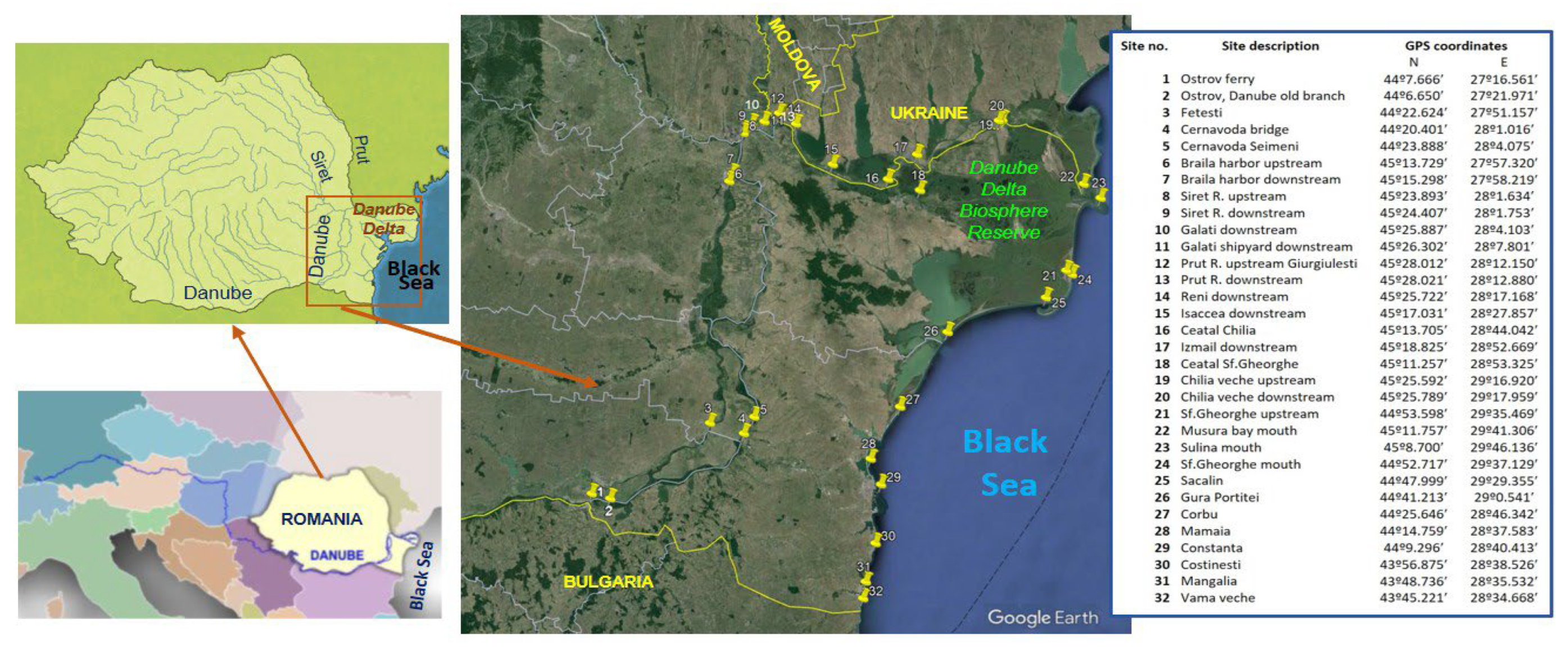
Figure 1. The target area in Romania and coordinates of the sampling sites in the Lower Danube River, Danube Delta and Black Sea Basin.
Preprints 151323 g001
Figure 2. Ranges of concentrations of the determined pollutant in Danube River and Black Sea surface water samples.
Preprints 151323 g002
Figure 3. The hierarchical clustering analysis (HCA) dendrogram.
Preprints 151323 g003
Figure 4. PCA (Principal Component Analysis) biplot for the correlations between physicochemical parameters and pharmaceuticals pollutant concentrations, as well as their spatial distribution across sampling sites.
Preprints 151323 g004
Figure 5. Random Forest regression results for Trimethoprim. (Left) Scatter plot comparing observed and predicted trimethoprim concentrations, where the dashed line represents the ideal 1:1 correlation. (Right) Variable importance analysis indicating the most influential physicochemical parameters affecting trimethoprim concentrations.
Preprints 151323 g005
Table 2. Physicochemical parameters of water in the target region and site classification in ecological classes.
No. Sampling sites N-NH4
mg N/L
N-NO2
mg N/L
N-NO3
mg N/L
N total
mg N/L
P-PO4
mg P/L
P total
mg P/L
Chloroph. a
µg/L
pH
pH unit
1 Ostrov ferry 0.085 0.013 1.130 2.640 0.043 0.116 4.89 8.83
2 Ostrov, Danube old branch 0.051 0.012 1.333 1.940 0.053 0.091 2.93 7.81
3 Fetesti 0.195 0.016 0.944 1.568 0.038 0.103 5.87 7.77
4 Cernavoda bridge 0.068 0.011 1.370 2.788 0.034 0.102 9.91 8.87
5 Cernavoda Seimeni 0.125 0.015 1.148 1.496 0.038 0.095 5.74 8.78
6 Braila harbor upstream 0.100 0.019 0.870 2.936 0.027 0.096 6.72 8.73
7 Braila harbor downstream 0.065 0.016 1.000 2.396 0.038 0.079 5.73 8.81
8 Siret R. upstream 0.253 0.048 1.481 3.172 0.033 0.172 4.4 8.66
9 Siret R. downstream 0.193 0.047 1.611 1.580 0.022 0.107 7.34 8.6
10 Galati downstream 0.085 0.017 0.963 1.388 0.026 0.089 5.56 8.82
11 Galati shipyard downstream 0.069 0.016 1.278 2.188 0.033 0.266 4.35 8.71
12 Prut R. upstream Giurgiulesti 0.075 0.023 0.778 2.152 0.012 0.061 7.72 8.66
13 Prut R. downstream 0.080 0.019 1.019 2.432 0.033 0.140 6.29 8.78
14 Reni downstream 0.080 0.019 1.056 2.564 0.031 0.117 2.83 8.68
15 Isaccea downstream 0.106 0.021 1.037 2.656 0.033 0.205 5.66 8.59
16 Ceatal Chilia 0.086 0.027 1.111 1.964 0.029 0.128 2.41 8.63
17 Izmail downstream 0.083 0.035 0.998 1.564 0.021 0.118 3.20 8.44
18 Ceatal Sf.Gheorghe 0.054 0.044 1.052 1.423 0.032 0.098 3.40 8.52
19 Chilia veche upstream 0.071 0.050 1.031 1.228 0.035 0.121 3.65 8.48
20 Chilia veche downstream 0.086 0.050 1.058 1.325 0.034 0.088 3.69 8.48
21 Sf.Gheorghe upstream 0.068 0.047 1.020 1.264 0.038 0.184 2.96 8.63
22 Musura bay mouth 0.044 0.039 0.881 1.464 0.024 0.064 1.98 8.9
23 Sulina mouth 0.049 0.048 0.996 1.172 0.035 0.164 3.36 8.42
24 Sf.Gheorghe mouth 0.054 0.042 0.963 1.044 0.030 0.139 3.04 8.56
25 Sacalin 0.066 0.041 0.999 1.300 0.029 0.113 4.07 8.48
26 Gura Portitei 0.28 0.035 1.870 2.185 0.006 0.024 1.36 8.99
27 Corbu 0.209 0.029 1.871 2.109 0.006 0.022 2.28 9.01
28 Mamaia 0.198 0.029 0.950 1.177 0.005 0.019 4.40 9.24
29 Constanta 0.335 0.024 0.873 1.232 0.006 0.023 0.78 9.05
30 Costinesti 0.26 0.06 1.250 1.570 0.005 0.020 6.64 8.98
31 Mangalia 0.45 0.044 0.716 1.210 0.005 0.018 17.34 9.23
32 Vama veche 0.29 0.022 0.787 1.099 0.011 0.045 2.11 9.09
Ecological status according to Romanian Order no. 161/2006 [47]
Highest ecological status 0.400 0.010 1.000 1.500 0.100 0.150 25 6.5-8.5
Good ecological status 0.800 0.030 3.000 7.000 0.200 0.400 50
Moderate ecological status 1.200 0.060 5.600 12.000 0.400 0.750 100
Poor ecological status 3.200 0.300 11.200 16.000 0.900 1.200 250
Bad ecological status >3.200 >0.300 >11.200 >16.000 >0.900 >1.200 >250
Table 4. Range of the measured concentrations, PNEC values and the detection frequency of the identified substances.
Compound Abbreviation Min. value ng/L Max. value ng/L Average ng/L Lower PNEC* ng/L
fresh/marine water
No. of positive results
Sulfamethoxazole SMX 3.2 36 18.13 100 / 60 31
Trimethoprim TMP 2.4 12 6.35 100 25
Ciprofloxacin CIP 1.8 5.2 3.58 89 / 8.9 8
Flumequine FLU 4.6 6.4 5.5 1500 / 150 2
Amoxicillin AMX 3.8 - - 78 / 7.8 1
Cefuroxime CFX 1.6 4.9 3.25 1290 / 130 2
Dicloxacillin DCX 3.5 9.6 5.5 5.1 / 0.51 5
Carbamazepine CBZ 5.6 38 18.05 50 28
Pravastatin PRV 3.1 24.8 12.31 4570 / 460 15
Erythromycin ERY 4.3 - - 300 / 30 1
Piroxicam PIR 5.6 28.6 17.62 490 / 49 6
Ketoprofen KET 5.6 26 13.45 2100 / 210 6
Diclofenac DCF 4.6 132 40.75 50 / 5 28
Naproxen NAP 4.9 8.6 6.2 1700 / 170 6
Enilconazole (Imazalil) IMZ 4.8 31.4 14.64 870 / 87 11
Clotrimazole CLO 5 8.2 6.53 30 / 3 3
Drospirenone DRO 1.04 3.4 2.09 120 / 12 8
17α-Ethinylestradiol EE2 1.15 3.05 1.91 0.035 / 0.0035 9
Bisphenol A BPA 34.5 342 155.2 240 / 1600 32
* lower PNEC values according to NORMAN database (https://www.norman-network.com/nds/prioritisation/) [50] and EU watch lists [16,17,18,19,20].
Table 5. Bacteriological contamination of surface water in Danube River and Black Sea.
No. Sampling sites Heterotrophic bacteria, CFU/mL Total coliforms, MPN/100 mL
1 Ostrov ferry 1,760 70,000
2 Ostrov, Danube old branch 12,000 5,000
3 Fetesti 2,700 7,000
4 Cernavoda bridge 2,240 6,000
5 Cernavoda Seimeni 2,300 25,000
6 Braila harbor upstream 390 1,300
7 Braila harbor downstream 110 7,000
8 Siret R. upstream 2,150 60,000
9 Siret R. downstream 5,700 70,000
10 Galati downstream 1,900 2,500
11 Galati shipyard downstream 250 11,000
12 Prut R. upstream Giurgiulesti 1,210 250
13 Prut R. downstream 270 2,500
14 Reni downstream 575 7,000
15 Isaccea downstream 2,050 2,500
16 Ceatal Chilia 435 2,000
17 Izmail downstream 525 10
18 Ceatal Sf. Gheorghe 531 1,300
19 Chilia veche upstream 2,750 7,000
20 Chilia veche downstream 340 600
21 Sf.Gheorghe upstream 715 2,000
22 Musura bay mouth 1,700 250
23 Sulina mouth 125 250
24 Sf.Gheorghe mouth 950 2,500
25 Sacalin 2,400 6,000
26 Gura Portitei 400 600
27 Corbu 65 130
28 Mamaia 72 120
29 Constanta 70 200
30 Costinesti 53 300
31 Mangalia 42 120
32 Vama veche 35 250
Microbiological pollution quality classes for bathing waters [60] Indicator of organic pollution Indicator of fecal pollution
Class I - Low <500 <500
Class II - Moderate 500-10,000 500-10,000
Class III - Critical 10,000 – 100,000 10,000 – 100,000
Class IV- Strong 100,000 – 750,000 100,000 – 1,000,000
Class V - Excessive >750,000 >1,000,000
Disclaimer/Publisher’s Note: The statements, opinions and data contained in all publications are solely those of the individual author(s) and contributor(s) and not of MDPI and/or the editor(s). MDPI and/or the editor(s) disclaim responsibility for any injury to people or property resulting from any ideas, methods, instructions or products referred to in the content.
Copyright: This open access article is published under a Creative Commons CC BY 4.0 license, which permit the free download, distribution, and reuse, provided that the author and preprint are cited in any reuse.
Prerpints.org logo

Preprints.org is a free preprint server supported by MDPI in Basel, Switzerland.

Subscribe

Disclaimer

Terms of Use

Privacy Policy

Privacy Settings

© 2025 MDPI (Basel, Switzerland) unless otherwise stated