

Submitted:
04 March 2025
Posted:
05 March 2025
You are already at the latest version
Abstract
Managing reproductive activity in dairy farms is an important factor in increasing cow productivity and making the farm more economically efficient. The research was carried out in the 5 most important Holstein dairy farms in Romania, during the period 2022-2024. The data obtained were processed and interpreted statistically, compared with the results obtained for these parameters by other researchers. Following the research, average values of milk quantity were recorded ranging from 9749.38 ± 20.88 kg of milk in farm D in 2022 and 15514.01 ± 29.31 kg of milk in farm A in 2024. The age of first calving decreased from one year to the latest in each farm, with the averages falling in the last year between 22.53 months and 24.61 months, and the calving interval decreased with an average value on all farms in 2024 of 401 days. The average duration of exploitation of dairy cows is 4 lactations, and based on the calculation of the efficiency index of reproductive activity, the 5 farms are efficient in terms of using cows for reproduction.
Keywords:
age of first calving
; conception rate
; first calving
; reproductive efficiency
1. Introduction
In the context of a steadily growing human population in the coming decades, it is inevitable that global demand for food will increase [1]. An important part of food supply is insured by animal production, by converting inedible or unpalatable materials for people to milk or meat [2]. The ingestion of milk and dairy products has been demonstrated to engender a plethora of advantages for individuals of all age groups. Milk is a complex foodstuff, containing a variety of nutrients including protein, fat, carbohydrates, vitamins, and minerals [3,4,5,6]. Evidence has demonstrated that the ingestion of milk protein can contribute to the reduction of adipose tissue and body mass [7,8,9,10]. This phenomenon may also be attributable to whey protein's capacity to diminish appetite and enhance satiety [11,12]. It is encouraging to note that the effects in question have been observed in both healthy and overweight subjects [13,14,15,16,17], or diabetic people [18,19]. Cattle are responsible for the production of 81% of the total milk yield, buffaloes for 15%, goats with 2%, sheep 1% and the remaining share is provided by camels, yaks, equines, etc. [20].
A more detailed analysis of the milk produced by cattle reveals that a big part of it is produced by Holstein cows, the breed with the highest milk production. The current mean yield is approximately 11000 kg per lactation [21], with some records demonstrating yields in excess of this threshold. It is noteworthy that there are also some long-lived producers, such as a 14-year-old Holstein cow that has produced a total of no less than 218,000 kg of milk and is still producing [22].
This development can be attributed to the consistent genetic progress that has been observed in the Holstein breed [23]. It should also be mentioned that the actions taken to increase milk production have also had undesirable repercussions on the reproductive parameters of cows, in particular on conception rate [24]. Consequently, discourse among farmers is focused on a significant concern pertaining to reproductive activity, particularly as this has been demonstrated to exhibit a negative correlation with milk production [25,26,27]. Nevertheless, a divergence of opinion is evident. For instance, Santos & Ettema [28] posited that a highly complex correlation exists between elevated milk production and reproductive performance, which necessitates meticulous scrutiny. While other authors posit that inadequate management practices are responsible for the inability of cows to conceive and maintain gestation, irrespective of milk production, this position is not universally held [29].
The age of the first calving is a primary and pivotal factor in the reproductive activity of dairy cows. Its significance is attributable to the fact that its timing is analogous to the cow's entry into production. In an effort to reduce costs, farmers have been known to shorten the non-productive period, that is to say, they lower the age of the first calving [30,31]. Nevertheless, an exaggerated decrease in this parameter can have deleterious effects, such as causing the cow to experience difficulties during parturition or to remain with health conditions. Many authors suggest that the age of the first calve should be less than or equal to 24 months, in order to ensure profitability at the farm level [32,33,34,35].
Another essential reproductive parameter in the reproductive activity is the birth rate. It is reasonable to hypothesize that farmers will desire a high level of this parameter; however, the question must be posed: are twin pregnancies also desired? The response to this issue is negative, according to the findings of the research. Twinning will reduce profitability, through negative effects on calves born as twins [36]. Concurrently, there is an elevated prevalence of pregnancy complications, including abortion, retained placenta, and metritis, among female subjects carrying twins [37]. In the past, it has been established that each twin birth produces an economic loss of about $110 [38,39], such an analysis will not be carried out soon, but the results would be extremely interesting.
A further parameter that exhibits a high degree of correlation with the reproduction management of a dairy farm is the calving interval. The definition of the term under discussion is the time interval between two successive parturitions, the interest of farmers is to keep it as low as possible. It is an established fact that shorter calving intervals naturally result in a higher number of offspring and a higher milk yield per day [40]. Nevertheless, the question of the optimal minimum value remains contentious. The rationale behind this is that a lower minimum value is associated with an elevated risk of developing parparturient disorders [41]. In many countries, selection for improved milk production has increased this range, including: Canada [42], U.K. [43], Spain [44] and the Netherlands [45].
It is imperative to incorporate the postpartum period, specifically the interval between parturition and the subsequent insemination, into the analysis of reproductive indicators. This period between calving and insemination is called the service period [46]. The optimal value of this indicator is 80-90 days, which is to some extent an indicator of reproductive functions [47,48,49,50,51,52].
Any discussion of insemination activity in dairy cows must of course include the number of inseminations per gestation period. As the number increases, so too do the costs on the farm, which in turn has a detrimental effect on profitability. The increasing utilisation of sexed semen is not conducive to the efficacy of this indicator, as the sexing process has been shown to reduce sperm viability [53]. Moreover, as if this fact were not sufficient, the probability of the cow becoming pregnant by increasing the number of spermatozoa in the straw cannot be increased [54,55]. In the contemporary context, the number of inseminations per gestation period on dairy farms necessitates heightened scrutiny to enhance cost efficiency and financial viability.
The overall picture for dairy cows is simple: the desire to improve milk production has driven down the level of reproductive indicators [56,57,58]. The objective of this paper is to analyse the current level of reproductive parameters and establish their correlations. In addition, it will determine the optimal level that ensures optimal activity and maximum profitability of the farm.
2. Materials and Methods
2.1. Farms and Animals
This paper is based on biological material from 5 farms, located in different geographical areas of Romania. The positioning of the farms was not arbitrary; rather, it was meticulously selected to ascertain whether the geographical area and the relief shape exerted any influence on the level of reproduction parameters. However, it should be noted that all of the farms under discussion are engaged in the farming of the same breed of cattle, called Holstein.
In all farms, regardless of the region, we are talking about a herd of more than 500 cows milked 3 times a day. The cows are kept in free stalls, in modern housing with individual resting places on rubber mats. The milking takes place in specially designed side-by-side milking parlours. The size of the parlours varies from 2 x 14 to 2 x 20. Milk yields on the farms analyzed start from an average of about 10 000 kg (Farm E) per standard lactation and reach up to 15000 kg (Farm B). It is evident that the observed production levels are indicative of high-performing cows, whose reproductive activity poses significant management challenges.
2.2. Data for Analysis
The farms under consideration in this paper are part of the Holstein Cow Breeders Association - Romania. This breeding society (Holstein RO) has been awarded national accreditation in order to undertake Official Control of Production. In addition to this, the society is responsible for the establishment and maintenance of the Genealogical Register of the Holstein breed. The association being also member in WHFF (World Holstein Friesian Federation), this finding demonstrates that the trend of the Holstein breed is also being followed at a national level. The primary data on which this paper is based have been provided by Holstein RO. Consequently, they are the result of official control, and thus they are characterised by high accuracy and objectivity.
In the 5 farms included in the study, we aimed to analyse the levels of the following reproductive parameters:
- age of the first calving;
- birth rate;
- calving interval;
- service period;
- number of inseminations per gestation.
Another proposed objective was to calculate the reproductive efficiency indicator. It can be determined using the following formula:
E - the efficiency indicator of using the cows at reproduction
n - the number of parturitions (or lactations)
d - the interval between the first and last parturition (days)
The value of the indicator is considered to be optimal when it is higher than the 85% threshold.
Correlations have also been established between age of the first calving and milk production, reproductive efficiency and the level of certain reproductive or production indicators.
2.3. Statistical Analysis
Statistical analysis was performed by using the R programe, version 4.4.2 and for the graphical illustration of the results the software GraphPad Prism 10. The results were visualised using box plots and bar graphs, and p < 0.05 was considered statistically significant.
2.4. Ethical Review
Cow owners were informed about the purpose of this scientific study. Verbal informed consent was obtained from all farmers participating in the study. To respect farmers' confidentiality, the farms have been coded with letters (A - E).
3. Results
3.1. Age of the First Calving
The age at first calving is a reproductive indicator with particular implications for the reproductive longevity and productivity of dairy cows. However, it is also an efficiency indicator, denoting the proportion of the dry period in the animal's life. The age of introduction to reproduction of young female has decreased significantly over the last 30 years. Nevertheless, it is crucial to emphasise that the onset of the first pregnancy should occur when the cows possess a fully developed pelvis and the body weight reaches 75% of the weight of the adult animals of the same breed. This indicator was analyzed over three years (2022-2024) in 5 farms breeding Holstein cows, located in Romania as shown in Figure 1. From each farm, the existing data in the zootechnical records were analyzed for a sufficiently large, statistically assured number of animals so that the results would be relevant. Table 1 shows the dynamics of age at first calving in days for the 5 farms. A comparative analysis of farms and by year reveals that the highest precocity is recorded in Farm B, located in Eastern Romania, specifically in the region of Moldova. There, the age of first calving decreased from 22.65 months in 2022 to 22.53 months in 2024, with a significant difference between means (p < 0.05). With a coefficient of variability not exceeding 8.94%, the broodstock is also relatively homogeneous.
The study demonstrates that, with regard to average milk yield per standard lactation (305 days), there are particularly favourable outcomes, exhibiting very significant increases over the three-year period analysed (see Table 2).
During the three-year study period, milk yield per standard lactation exhibited an increase on all farms, ranging from 9.52% on Farm A to 21.36% on Farm B. The exception to this upward trend is farm C, where there is a decrease in average production per standard lactation, while the number of cows in the herd is increasing. In general, the correlations between milk yield per standard lactation and age at first calving are weakly positive, except for the situation found on Farm C in 2022 and Farm E in 2024, where the correlations are very weak but in a negative direction. We also note a stronger correlation of 0.25 calculated for the year 2024 for Farm D (Table 3).
3.1. The Interval Between Successive Parturitions
Calving-interval is the indicator that highlights the rhythmicity of reproduction on dairy farms. This was based on the idea that each cow had to produce a calf every year, which was no longer possible with the increase in production through the use of animals with a longer service life, i.e. the interval between calving and fecund insemination. This paradigm shift in Holstein cow breeding is supported by the notion of a prolonged gestation rest period for dairy cows, with consideration given to the lactation phase, during which time the cow's body experiences significant strain. Thus, this lactation phase, superimposed on the transition period, puts the cow's body under particular strain, i.e. recovery after gestation and parturition, negative energy metabolism combined with a capricious appetite, which leads farmers to inseminate cows in the third-fifth heat cycle (Table 4).
As demonstrated in Table 4, the examined herds exhibited an overall upward trend in the calving interval, with increases ranging from 0.04 to 2.4%, except for farm C, where the calving interval declined concurrently with a decrease in milk production. Differences between means ranged from insignificant to distinctly significant. It is also noted that the analyzed effective showed medium to high variability (21.99%).
3.3. Number of Inseminations per Gestation
Figure 2 shows the dynamics of the number of artificial inseminations required to achieve a gestation. For all the farms analyzed the number of AI/gestation increased from year to year; the highest number of AI/gestation was recorded on farm D, i.e. 2.76. The increase in AI/gestation is concomitant with an increase in gestation interval by 2.4% and in the correlation between milk yield and gestation interval (+0.25). The increase in the number of AI/pregnancy at the same time as the increase in the calving-interval may be explained by management deficiencies in performing insemination at the optimal time of estrus.
3.4. Efficiency of Using Cows for Reproduction
Table 5 shows summary indicators of the efficiency of the use of cows for breeding purposes on the farms in the study. Although we are talking about farms with remarkable average yields, the average number of lactations completed for culled cows over the last three years has ranged between 3.84 and 4.38. The indicator of efficiency of using cows for reproduction correlates best on Farm B (93.15%) with the shortest interval between first calving and last calving and an average number of lactations completed below 4. In addition, the efficacy of utilising dairy cows for breeding purposes on this farm is evidenced by the augmentation in average milk production by 21.36%, concomitant with a reduction in the age at first calving of 3.57 days.
4. Discussion
The age of first calving is an indicator most influenced by the appropriate management applied on the farm because the farmer is directly interested in increasing the lifetime production of the animal, but also in obtaining a high number of offspring. Scientists have concluded that young females should have their first parturition by 24 months of age, based on research conducted over the years. If the age of the first calving is too low, there is a risk that the milk quality parameters may be influenced and also the reproductive condition of the cow in question [28]. Whereas more than 30 years ago, the age at first calve was around 31.5 months, by 2022 it will have dropped to 27.3 months [59]. Research conducted on five high-performing dairy farms in Romania revealed an average age at first calving of 715.43 days (23.84 months), with limits between 675.92 ± 1.57 days (22.53 months) in Farm B and 738.31 ± 2.15 days (24.61 months) in Farm A in 2024.
Despite the anticipation of a more robust correlation between milk yield per standard lactation and age at first calving, the data presented in table 3 reveals a weak or non-existent correlation, with the exception of Farm D (0.25), where a substantial increase in milk yield was accompanied by a decline in age at first calving. With regard to average milk yield per standard lactation, the selected farms were distinguished by exceptional yields, in conjunction with effective management and a strong genetic background of Holstein cows. At the level of 2024, a high degree of uniformity within the herds is evident, with the coefficient of variability indicating values ranging from 2.38% to 7.9%. However, notable variations in the average yields per head are observed on Farm E, indicating significant disparities amongst the herds. Significance testing of the differences between the means of 2022 and 2024 revealed significant to highly significant differences (p < 0.001). Among the farms analysed, Farm A is distinguished by its average milk production of 15514.01 ± 29.31 kg. The exceptional average milk yields achieved are attributable to the importation of biological material, notably sexed semen from the most prominent US bulls, in conjunction with the implementation of breeding technology protocols tailored to the specific needs of US farmers. The standards of US farmers are very high, with animals in the top 100 achieving average daily milk yields of 89 kg. The young female inseminates for the first time at around 13 months of age, so that the first parturition is between 23 and 26 months [28,59].
The interval between two parturitions is an indicator dependent on the duration of gestation, which is generally constant, and the service-period (the interval from parturition to the first artificial insemination) which is the main variable. The adjustment of this variable constitutes a fundamental element of a farmer's strategy, ultimately resulting in enhanced productivity and profitability. The main key factors influencing transition management are nutrition and environment. Service-period overlaps with the onset of lactation when the cow mobilizes body reserves to support milk production, body weight is 5-8% lower than at calving and appetite is low (intake is 45% lower); recommended rations with optimal energy, protein, mineral and vitamin levels (energy/protein ratio - 1.0/4.5, phosphorus/calcium - 1.0/1.4, sodium/potassium - 0.7/1.0); providing concentrated feed (more than 50% of the nutritive value of the ration); feed in more frequent feedings, especially concentrates, but not more than 2-2.5 kg/meal; good preparation of cows during the resting period by rational feeding.
The ideal calving interval is defined as being less than 400 days. This particular effort on the part of farmers on the farms that were analysed is identifiable in the three-year study. Farms B (395.85 ± 3.38 days), A (400.1 ± 1.87 days) and E (401.16 ± 3.42 days) achieved average calving-interval values in 2024 closest to the level of efficiency. Testing the difference in means between 2022 and 2024 shows that the differences are significant or distinctly significant (Table 4).
The number of AI/gestation is a pivotal factor in the realm of farm management, particularly in the context of reducing input costs. This is achieved by addressing the utilisation of sexed semen. Although farmers make substantial efforts to reduce the number of inseminations per gestation, Figure 2 shows that the results are very low. In farms B, D, F in 2024 the trend was an increase in the number of inseminations per gestation, concomitant with an increase in the calving interval and in the average production per head. The phenomenon can be elucidated by the observation that dairy cows characterised by elevated productivity levels demonstrate ethologically minimal levels of heat stress. Consequently, the implementation of sensor-based systems to monitor their activity is requisite. Identifying the optimal time of insemination also remains an important factor to improve at farm level.
Efficiency of use of cows for reproduction (E %) is the summary indicator that gives an overview of farms, correlated with the productive longevity of cows, i.e. the average number of lactations and the interval from first to last pregnancy. The study of large herds of culled cows indicated an efficient use of cows for breeding on the farms analysed.
5. Conclusions
Research conducted between 2022 and 2025 on five modern farms with substantial Holstein cows populations revealed that the age at first calving ranged from 22.53 months to 24.6 months in the final year of the study. Furthermore, there was an observed increase in milk yield of up to 21.36%. The herd from Farm B, located in Eastern Romania, showed the highest increase in milk production, had the lowest age at first calving and the average calving interval ranged from 389.8 days to 395.85 days, with an average number of AI per gestation of 1.92, over three years and a very good reproductive efficiency (93.15%).
Author Contributions
Conceptualization, L.V and D.N.E.; methodology, L.V. and D.N.E.; investigation, M.P.M. and D.C.P; data curation, R.A.P and D.N.E; writing—original draft preparation, L.V and D.N.E.; writing—review and editing, L.V and D.N.E.; supervision, L.V. All authors have read and agreed to the published version of the manuscript.
Funding
This research received no external funding.
Institutional Review Board Statement
Not applicable.
Informed Consent Statement
Verbal informed consent was obtained from all farmers participating in the study.
Acknowledgments
The authors would like to thank Holstein Ro Association and the University of Agronomic Sciences and Veterinary Medicine in Bucharest for the financial support for the publication of the article.
Conflicts of Interest
The authors declare no conflict of interest.
References
- van Dijk, M., Morley, T., Rau, M.L. et al. A meta-analysis of projected global food demand and population at risk of hunger for the period 2010–2050. Nat Food 2021, Volume 2, pp. 494–501.
- Smith, J. , Sones K., Grace D., MacMillan S., Tarawali S., Herrero M. Beyond milk, meat, and eggs: Role of livestock in food and nutrition security, Animal Frontiers 2013, Volume 3, pp. 6–13.
- Nicklas, T. A. , O’Neil, C. E., Fulgoni, V. L. The role of dairy in meeting the recommendations for shortfall nutrients in the American diet. The Journal of the American College of Nutrition 2009, Volume 28, pp. 73-81.
- Čuboň, J. , Haščík, P., Kačániová, M. D. Evaluation of raw materials and foodstuffs of animal origin, Slovak Republic: Slovak University of Agriculture in Nitra, pp. 381.
- Keresteš, J. Milk in human nutrition. Bratislava, Slovak Republic: Cad Press, 2016, pp. 649.
- Mihai, B. , Posan P., Marginean G.E., Alexandru M., Vidu L. Study on the trends of milk production and dairy products at european and national level. Scientific Papers. Series D. Animal Science 2023 Vol. LXVI, pp. 309-316.
- Mirmiran, P. , Esmaillzadeh, A., & Azizi, F. Dairy consumption and body mass index: an inverse relationship. International Journal of Obesity 2005, Volume 29(1), pp. 115-121.
- Teegarden, D. The Influence of Dairy Product Consumption on BodyComposition. The Journal of nutrition 2005, Volume 135(12), pp. 2749-2752.
- Zemel, M.B. , Richards, J., Mathis, S., Milstead, A., Gebhardt, L., & Silva, E. Dairy augmentation of total and central fat loss in obese subjects. International journal of obesity 2005, Volume 29(4), pp. 391-397.
- Vergnaud, A.C. , Péneau, S., Chat-Yung, S., Kesse, E., Czernichow, S., Galan, P.,... & Bertrais, S. Dairy consumption and 6-y changes in body weight and waist circumference in middle-aged French adults. The American journal of clinical nutrition 2008, Volume 88(5), pp. 1248-1255.
- Pal, S. , Ellis, V., & Dhaliwal, S. Effects of whey protein isolate on body composition, lipids, insulin and glucose in overweight and obese individuals. British journal of nutrition 2010, Volume 104(5), pp. 716-723.
- Sousa, G.T. , Lira, F.S., Rosa, J.C., de Oliveira, E.P., Oyama, L.M., Santos, R.V., & Pimentel, G. D. Dietary whey protein lessens several risk factors for metabolic diseases: a review. Lipids in health and disease 2012, Volume 11, pp. 1-9.
- Rosell, M. , Håkansson, N. N., & Wolk, A. Association between dairy food consumption and weight change over 9 y in 19 352 perimenopausal women. The American journal of clinical nutrition 2006, Volume 84(6), pp. 1481-1488.
- Faghih, S. H. , Abadi, A. R., Hedayati, M., & Kimiagar, S. M. Comparison of the effects of cows' milk, fortified soy milk, and calcium supplement on weight and fat loss in premenopausal overweight and obese women. Nutrition, metabolism and cardiovascular diseases 2011, Volume 21(7), pp. 499-503.
- Josse, A.R. , Atkinson, S.A., Tarnopolsky, M.A., & Phillips, S.M. Increased consumption of dairy foods and protein during diet-and exercise-induced weight loss promotes fat mass loss and lean mass gain in overweight and obese premenopausal women. The Journal of nutrition 2011, Volume 141(9), pp. 1626-1634.
- Abargouei, A.S. , Janghorbani, M., Salehi-Marzijarani, M., & Esmaillzadeh, A. Effect of dairy consumption on weight and body composition in adults: a systematic review and meta-analysis of randomized controlled clinical trials. International journal of obesity 2012, Volume 36(12), pp. 1485-1493.
- Sanders, T. A. Role of dairy foods in weight management. The American Journal of Clinical Nutrition 2012, Volume 96(4), pp. 687-688.
- Liu, S. , Choi, H.K., Ford, E., Song, Y., Klevak, A., Buring, J. E., & Manson, J. E. A prospective study of dairy intake and the risk of type 2 diabetes in women. Diabetes care 2006, Volume 29(7), pp. 1579-1584.
- Shahar, D. R. , Abel, R., Elhayany, A., Vardi, H., & Fraser, D. Does dairy calcium intake enhance weight loss among overweight diabetic patients?. Diabetes care 2007, Volume 30(3), pp. 485-489.
- Food and Agriculture Organization of The United Nations. Available online: https://www.fao.org/dairy-production-products/production/dairy-animals/en (accessed on 20.01.2025).
- Michigan State University. Available online: https://www.canr.msu.edu/news/history_of_dairy_cow_breeds_holstein (accessed on 20.01.2025).
- Dairy Global. Available online: https://www.dairyglobal.net/dairy/milking/us-holstein-cow-sets-new-lifetime-production-record/ (accessed on 20.01.2025).
- Kőrösi, Z.J.; Holló, G.; Bene, S.; Bognár, L.; Szabó, F. Association of Production and Selected Dimensional Conformation Traits in Holstein Friesian Cows. Animals 2024, 14, 2753. [Google Scholar] [CrossRef] [PubMed]
- Amma Z, Reiczigel J, Fébel H, Solti L. Relationship between Milk Yield and Reproductive Parameters on Three Hungarian Dairy Farms. Vet Sci. 2024, Volume 11(5):218. [CrossRef]
- Nenel R., L. , & Mcgilliard M. L. Interactions of high milk yield and reproductive performance in dairy cows. Journal of dairy science 1993, Volume 76(10), pp. 3257-3268.
- Lucy M., C. Reproductive loss in high-producing dairy cattle: where will it end? Journal of dairy science 2001, Volume 84(6), pp. 1277-1293.
- Butler W., R. Energy balance relationships with follicular development, ovulation and fertility in postpartum dairy cows. Livestock production science 2003, Volume 83(2-3), pp. 211-218.
- Ettema, J.F. , Santos J.E. Impact of age at calving on lactation, reproduction, health, and income in first-parity Holsteins on commercial farms. Journal of dairy science 2004, Volume 87(8), pp. 2730-42.
- Leblanc, S. Assessing the association of the level of milk production with reproductive performance in dairy cattle. Journal of Reproduction and Development 2010, Volume 56(S), pp. S1-S7.
- Abeni, F. , Calamari L., Stefanini L., & Pirlo G. Effects of daily gain in pre-and postpubertal replacement dairy heifers on body condition score, body size, metabolic profile, and future milk production. Journal of Dairy Science 2000, Volume 83(7), pp. 1468-1478.
- Daniels K., M. Dairy heifer mammary development. Annual Tri-State Dairy Nutrition Conference, Grand Wayne Center, Fort Wayne, Indiana, USA, 20-21 April, 2010 (pp. 69-76). Purdue University Press.
- Mourits M. C., M. , Huirne R. B. M., Dijkhuizen A. A., Kristensen A. R., & Galligan, D. T. Economic optimization of dairy heifer management decisions. Agricultural systems 1999, Volume 61(1), pp. 17-31.
- Gabler M., T. & Heinrichs A. J. Dietary protein to metabolizable energy ratios on feed efficiency and structural growth of prepubertal Holstein heifers. Journal of dairy science 2003, Volume 86(1), pp. 268-274.
- Shamay, A. , Werner D., Moallem U., Barash H. & Bruckental I. Effect of nursing management and skeletal size at weaning on puberty, skeletal growth rate, and milk production during first lactation of dairy heifers. Journal of Dairy Science 2005, Volume 88(4), pp. 1460-1469.
- Stevenson J., L. , Rodrigues J. A., Braga F. A., Bitente S., Dalton J. C., Santos J. E. P. & Chebel R. C. Effect of breeding protocols and reproductive tract score on reproductive performance of dairy heifers and economic outcome of breeding programs. Journal of dairy science 2008, Volume 91(9), pp. 3424-3438.
- Fricke, P. M. Twinning in dairy cattle. The professional animal scientist 2001, Volume 17(2), pp. 61-67.
- Del Río, N. S. , Stewart, S., Rapnicki, P., Chang, Y. M., & Fricke, P. M. An observational analysis of twin births, calf sex ratio, and calf mortality in Holstein dairy cattle. Journal of dairy science 2007, Volume 90(3), pp. 1255-1264.
- Eddy, R. G. , Davies, O., & David, C. An economic assessment of twin births in British dairy herds. In American Association of Bovine Practitioners Conference Proceedings 1992, pp. 326-331.
- Beerepoot, G. M. M. , Dykhuizen, A. A., Nielen, Y., & Schukken, Y. H. The economics of naturally occurring twinning in dairy cattle. Journal of dairy science 1992, 75(4), 1044–1051. [Google Scholar]
- Němečková, D. , Stádník, L., & Čítek, J. Associations between milk production level, calving interval length, lactation curve parameters and economic results in Holstein cows. Mljekarstvo: časopis za unaprjeđenje proizvodnje i prerade mlijeka 2015, Volume 65(4), pp. 243-250.
- Sørensen, T.J. , Østergaard, S. Economic consequences of postponed first insemination of cows in a dairy cattle herd. Livestock Production Science 2003, Volume 79 (2-3), pp. 145-153.
- Murray, B. Balancing act – Research shows we are sacrificing fertility for production traits. Ontario MinistryAgric. Food 2003, Publ. 81-093.
- Wall E., S. Brotherstone J. A., Woolliams G. Banos & Coffey M. P. Genetic evaluation of fertility using direct and correlated traits. Journal of Dairy Science 2003, Volume 86, pp. 4093–4102.
- González-Recio, O. , Pérez-Cabal M. A. & Alenda R. Economic value of female fertility and its relationship with profit in Spanish dairy cattle. Journal of dairy science, 2004, Volume 87(9), pp. 3053-3061.
- Nederlands Rundvee Syndicaat. Jaarstatistieken 2005. Cooperatie Rundveeverbetering Delta, Arnhem, The Netherlands.
- Mikolaychik, I. N. , Gorelik, O. V., Nenahov, V. V., Morozova, L. A., & Safronov, S. L. The relationship between the duration of the service period and the milk yield of the Holsteinized black-mottled breed. In IOP Conference Series: Earth and Environmental Science 2021 (Vol. 677, No. 4, p. 042016). IOP Publishing.
- Mymrin, V. , & Loretts, O. Contemporary trends in the formation of economically-beneficial qualities in productive animals. In International Scientific and Practical Conference “Digital agriculture-development strategy” (ISPC 2019), pp. 511-514. Atlantis Press.
- Gridina, S. L. , Gridin, V. F., & Leshonok, O. I. Characterization of high-producing cows by their immunogenetic status. In International scientific and practical conference" Agro-SMART-Smart solutions for agriculture"(Agro-SMART 2018, pp. 253-256. Atlantis Press.
- Chechenikhina, O. S. , Loretts, O. G., Bykova, O. A., Shatskikh, E. V., Gridin, V. F., & Topuriya, L. Y. Productive qualities of cattle in dependence on genetic and paratypic factors. International Journal of Advanced Biotechnology and Research 2018, Volume 9(1), pp. 587-593.
- Tkachenko, I. V. , Gridin, V. F., & Gridina, S. L. Results of researches federal state scientific institution" Ural research institute for agri-culture" on identification of interrelation efficiency cows of the ural type with the immune status. In Hui Yi research leek, raw anger and rational use of natural Zi source of raw material servo, 2016, pp. 85-90.
- Gridina, S. L. , & Shatalina, O. S. Relationship of cattle blood groups and the service period duration. Russian agricultural sciences 2015, Volume 41(4), pp. 271-273.
- Granaci, V. , Focşa, V., Curuliuc, V., & Ciubatco, V. Relația dintre service-period, productivitatea de lapte și manifestarea funcției de reproducție la vaci. In Inovații în zootehnie și siguranța produselor animaliere–realizări și perspective 2021, pp. 175-184).
- Carvalho J., O. , Sartori R., Machado G. M., Mourão G. B. & Dode M. A. N. Quality assessment of bovine cryopreserved sperm after sexing by flow cytometry and their use in in vitro embryo production. Theriogenology 2010, Volume 74(9), pp. 1521-1530.
- Dejarnette J., M. , Leach M. A., Nebel R. L., Marshall C. E., Mccleary C. R. & Moreno J. F. Effects of sex-sorting and sperm dosage on conception rates of Holstein heifers: is comparable fertility of sex-sorted and conventional semen plausible? Journal of dairy science 2011, Volume 94(7), pp. 3477-3483.
- Thomas J., M. , Locke J. W. C., Bonacker R. C., Knickmeyer E. R., Wilson D. J., Vishwanath R.,... & Patterson D. J. Evaluation of SexedULTRA 4M™ sex-sorted semen in timed artificial insemination programs for mature beef cows. Theriogenology 2019, pp. 100-107.
- Washburn, S. P. , Silvia, W. J., Brown, C. H., McDaniel, B. T., & McAllister, A. J. Trends in reproductive performance in southeastern Holstein and Jersey DHI herds. Journal of Dairy Science 2002, Volume 85(1), pp. 244-251.
- De Vries, A. , & Risco, C. A. Trends and seasonality of reproductive performance in Florida and Georgia dairy herds from 1976 to 2002. Journal of Dairy Science 2005, Volume 88(9), pp. 3155-3165.
- Pryce, J. E. , & Harris, B. L. Genetic and economic evaluation of dairy cow body condition score in New Zealand. Interbull Bulletin 2004, Volume 32, pp. 82-82.
- Cuvliuc, A.E. Cercetări privind parametrii fenotipici și genotipici la populația activă a rasei Holstein din România. Doctoral thesis, University of Agronomic Sciences and Veterinary Medicine, Bucharest, 28.02.2022.
- Holstein Association USA. Available online: https://www.holsteinusa.com/holstein_breed/breedhistory.html (accessed on 10.02.2025).
Figure 1.
Location of farms surveyed in Romania.
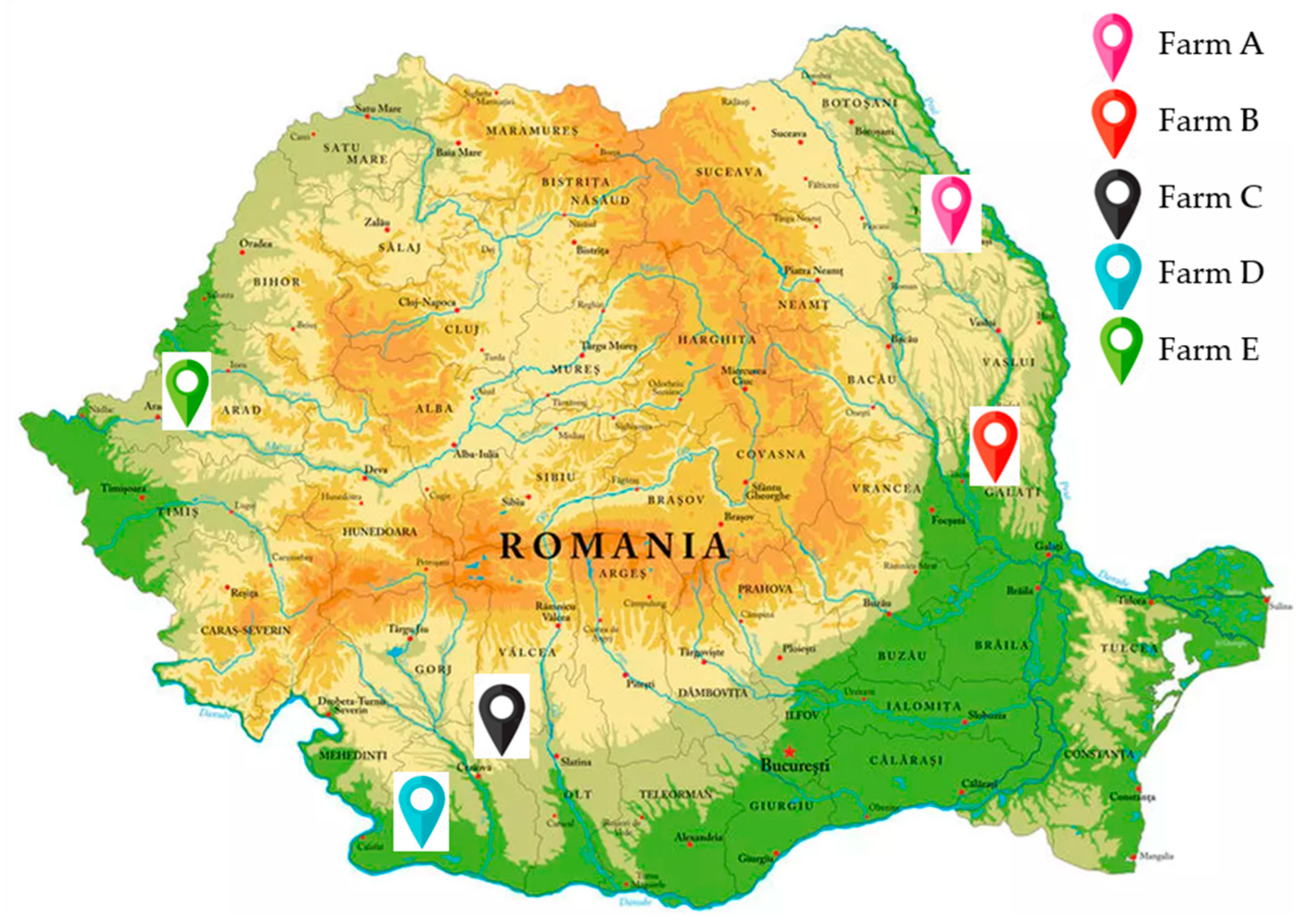
Figure 2.
Dynamics of the number of inseminations per gestation on the farms analyzed over the 3 years.
Figure 2.
Dynamics of the number of inseminations per gestation on the farms analyzed over the 3 years.
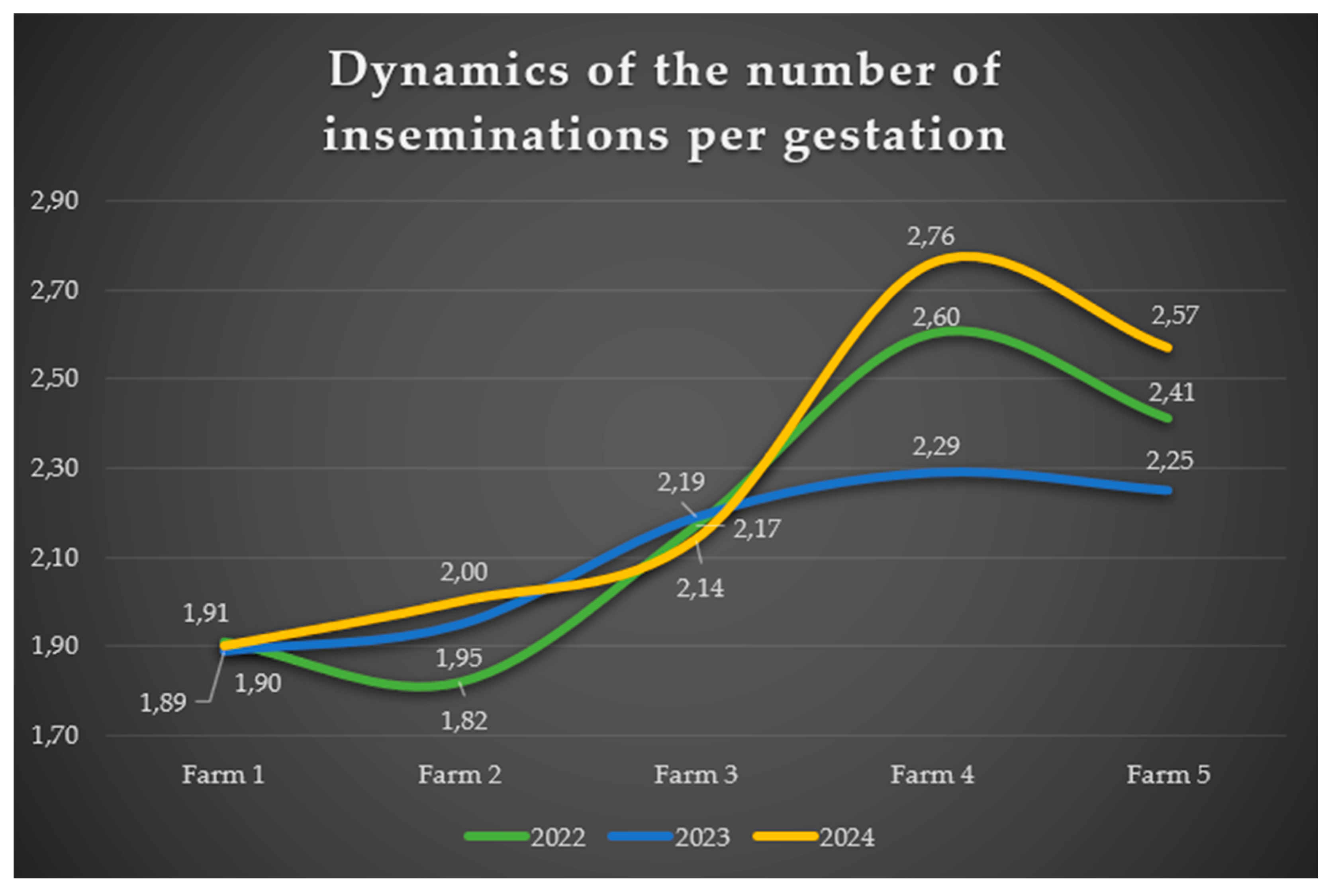

Table 1.
The dynamics of the age at the first calve of Holstein cows (in days).
| Farm studied | Age at the first calve (days) Year of reference |
p-Value | |||
|---|---|---|---|---|---|
| 2022 | 2023 | 2024 | |||
| Farm A | N | 816 | 742 | 796 | |
| X ± SX | 757.36 ± 6.07 | 738.89 ± 2.91 | 738.31 ± 2.15 | 3.11*** | |
| S | 172.26 | 79.08 | 60.53 | ||
| CV(%) | 22.75 | 10.7 | 8.20 | ||
| Farm B | N | 684 | 738 | 809 | |
| X ± SX | 679.49 ± 2.33 | 677.01 ± 1.64 | 675.92 ± 1.57 | 1.27* | |
| S | 60.73 | 44.67 | 44.63 | ||
| CV(%) | 8.94 | 6.60 | 6.60 | ||
| Farm C | N | 454 | 618 | 641 | 3.38*** |
| X ± SX | 731.04 ± 2.68 | 726.71 ± 2.02 | 722.10 ± 1.81 | ||
| S | 42.72 | 45.32 | 43.83 | ||
| CV(%) | 5.84 | 6.24 | 6.07 | ||
| Farm D | N | 424 | 445 | 519 | 1.65** |
| X ± SX | 733.45 ± 5.31 | 710.7 ± 4.07 | 722.82 ± 3.96 | ||
| S | 107.08 | 84.46 | 86.39 | ||
| CV(%) | 5.31 | 11.88 | 11.95 | ||
| Farm E | N | 412 | 595 | 628 | |
| X ± SX | 671.10 ± 5.13 | 703.83 ± 4.23 | 718.04 ± 3.77 | 7.62*** | |
| S | 100.23 | 99.49 | 92.51 | ||
| CV(%) | 14.93 | 14.14 | 12.88 | ||
significant * p < 0,05 ; significantly distinct ** p < 0,01; very significant *** p <0,001.
Table 2.
Milk yield dynamics per standard lactation on Holstein dairy farms.
| Farm studied | Quantity of milk (kg)/305 lactation daysYear of reference | p-Value | |||
| 2022 | 2023 | 2024 | |||
| Farm A | N | 816 | 742 | 796 | |
| X ± SX | 13062.77 ± 10.85 | 14316.3 ± 22.23 | 14306.59 ± 12.7 | 1.21* | |
| S | 310 | 605.5 | 340.65 | ||
| CV(%) | 2.37 | 4.23 | 2.38 | ||
| Farm studied | Quantity of milk (kg)/305 lactation daysYear of reference | p-Value | |||
| Farm B | N | 684 | 738 | 809 | |
| X ± SX | 12783.19 ± 83.72 | 14684.72 ± 19.18 | 15514.01 ± 29.31 | 3.13*** | |
| S | 889.64 | 521.13 | 833.87 | ||
| CV(%) | 17.13 | 3.54 | 5.37 | ||
| Farm C | N | 454 | 618 | 641 | 2.28** |
| X ± SX | 12549.08 ± 44.95 | 12255.60 ± 33.78 | 9731.43 ± 30.72 | ||
| S | 957.86 | 840.47 | 777.9 | ||
| CV(%) | 7.64 | 6.85 | 7.9 | ||
| Farm D | N | 424 | 445 | 519 | 5.98*** |
| X ± SX | 9749.38 ± 20.88 | 10546.93 ± 39.79 | 11163.22 ± 26.97 | ||
| S | 430.71 | 839.35 | 597.4 | ||
| CV(%) | 4.41 | 7.95 | 5.35 | ||
| Farm E | N | 412 | 595 | 628 | |
| X ± SX | 10900.45 ± 21.561 | 11598.05 ± 68.43 | 12042.41 ± 84.37 | 13.11*** | |
| S | 437.81 | 1669.28 | 2114.42 | ||
| CV(%) | 4.02 | 14.39 | 17.55 | ||
significant * p < 0,05 ; significantly distinct ** p < 0,01; very significant *** p <0,001.
Table 3.
Value of phenotypic correlations between milk yield per standard lactation and age at first calving.
Table 3.
Value of phenotypic correlations between milk yield per standard lactation and age at first calving.
| Farm | Value of phenotypic correlations | |
| 2022 | 2024 | |
| Farm A | 0 | 0.05 |
| Farm B | 0.13 | 0.06 |
| Farm C | -0.06 | 0.03 |
| Farm D | 0.01 | 0.25 |
| Farm E | 0 | -0.06 |
Table 4.
Calving interval dynamics of Holstein cows (in days).
| Farm studied | Calving intervalul (days)Year of reference | p-Value | |||
| 2022 | 2023 | 2024 | |||
| Farm A | N | 816 | 742 | 796 | |
| X ± SX | 392.22 ± 1.94 | 396.6 ± 2.54 | 400.1 ± 1.87 | 1.55* | |
| S | 45.97 | 53.88 | 44.62 | ||
| CV(%) | 11.72 | 13.59 | 11.15 | ||
| Farm B | N | 684 | 738 | 809 | |
| X ± SX | 389.80 ± 3.59 | 393.77 ± 3.97 | 395.85 ± 3.38 | ||
| S | 73.57 | 82.76 | 75.53 | 1.56* | |
| CV(%) | 18.87 | 21.02 | 19.08 | ||
| Farm C | N | 454 | 618 | 641 | |
| X ± SX | 404.93 ± 4.47 | 398.44 ± 4.14 | 404.74 ± 3.95 | ||
| S | 78.24 | 78.35 | 75.35 | 0.04 | |
| CV(%) | 19.32 | 19.66 | 18.62 | ||
| Farm D | N | 424 | 445 | 519 | |
| X ± SX | 393.62 ± 4.78 | 375.75 ± 3.85 | 403.10 ± 4.83 | ||
| S | 76.19 | 59.61 | 82.76 | 1.83** | |
| CV(%) | 19.36 | 15.87 | 20.53 | ||
| Farm E | N | 412 | 595 | 628 | |
| X ± SX | 400.61 ± 5.03 | 400.05 ± 4.83 | 401.16 ± 3.42 | ||
| S | 84.75 | 87.95 | 71.31 | 0.10 | |
| CV(%) | 21.15 | 21.99 | 17.78 | ||
significant * p < 0,05 ; significantly distinct ** p < 0,01; very significant *** p <0,001.
Table 5.
Holstein reproductive efficiency indicators (in days).
| Efficiency indicators | Farm studied | ||||
| Farm A | Farm B | Farm C | Farm D | Farm E | |
| Number of cows culled | 544 | 458 | 430 | 198 | 283 |
| Average value of the interval from first to last gestation (years) | 3.45 | 3.09 | 3.17 | 3.18 | 3.74 |
| Average number of completed lactations | 4.19 | 3.88 | 3.84 | 3.98 | 4.38 |
| Efficiency of use in reproduction (%) | 92.43 | 93.15 | 89.69 | 93.64 | 90.35 |
Disclaimer/Publisher’s Note: The statements, opinions and data contained in all publications are solely those of the individual author(s) and contributor(s) and not of MDPI and/or the editor(s). MDPI and/or the editor(s) disclaim responsibility for any injury to people or property resulting from any ideas, methods, instructions or products referred to in the content. |
© 2025 by the authors. Licensee MDPI, Basel, Switzerland. This article is an open access article distributed under the terms and conditions of the Creative Commons Attribution (CC BY) license (http://creativecommons.org/licenses/by/4.0/).
Copyright: This open access article is published under a Creative Commons CC BY 4.0 license, which permit the free download, distribution, and reuse, provided that the author and preprint are cited in any reuse.