
Submitted:
28 June 2025
Posted:
30 June 2025
Read the latest preprint version here
Abstract
The wrong theory of impedance matching theory in microwave absorption research has dominated the field for a long time because it was believed that the theory was supported by experimental reports and was consistent with transmission line theory which is fundamental in electromagnetism. Thus, when the correct wave mechanics theory for microwave absorption opposing impedance theory was recently developed, pointing out that the wrong theory involved a misunderstanding of transmission line theory, and the published experimental data disproved the theory rather than supporting it, little notice was taken with the result that the wrong theory still dominates the field as material scientists are reluctant to acknowledge the new theory. It shows here that in contrast to impedance matching theory, the new wave mechanics theory rediscovers the real microwave absorption mechanism that had already been revealed by transmission line theory and now has been developed further with many new concepts.
Keywords:
wave mechanics theory
; transmission line theory
; microwave absorption film
; theoretical insights
1. Introduction
In the field of microwave absorption material, the film and the material have been confused [1,2,3,4,5,6,7,8], characterized by not distinguishing the input impedance Zin of film from the characteristic impedance of material ZM [9,10]and represented by confusing the interface in its isolated state from that in film [11] and the two parallel interfaces in a film from the interfaces between material particles [12]. In addition, concepts such as first and second reflection losses have been wrongly defined [4,13,14,15,16]. Inaccurate theories such as impedance matching theory [11,17,18,19,20] and the quarter wavelength theory [21,22,23,24] were used to develop the wrong absorption mechanisms for film and material [25,26,27] which have been established over the years since their inadequacies were not recognized and corrected. Over the years, many experiments have been carried out which are described as supporting the wrong theories instead of correcting them even though the inconsistences should have been easy to spot. Material scientists believe that their theories are based on transmission line theory and thus do not accept they can be wrong [28,29,30,31,32,33].
Recently a new theory of wave mechanics has been developed for microwave absorption for film [24,26,34] which identifies and explains the problems in current theories. Indeed, it is found that the experimental data reported previously were in fact inconsistent with the wrong theories which were based on misunderstanding transmission line theory. However, the scientific community continues using the wrong theories within a large number of publications with only a few exceptions [15,35,36,37,38,39,40,41,42,43] mentioning the opposite new theory [44,45,46,47,48,49,50] (Supplementary Materials). Discrediting commonly accepted ideas is often difficult to achieve in a scientific community [51], particularly when a theory had been accepted for many years.
There are two main types of good scientific papers. One is solving problems against the current theory and in so doing pushes science forward. Our work on microwave absorption is in that category and we have established in many publications [9,11,17,18,19,21,22,23,24,25,26,27,34,45,47] from different perspectives that the current dominant theories in the subject are wrong and should be replaced by the new wave mechanics theory. Indeed, when a theory is wrong, it is wrong from every perspective, and a correct theory is correct all perspectives. When undeniable evidence against the accepted theory is identified, however small the matter seems, it deserves serious attention since such an evidence can led to the overturning of a whole theoretical system. In fact, all the deep insights associated with this concerned issue are led by the small fact that we have identified the confusion of the terms “material” and “film” in the current microwave absorption research. In science, nothing is trivial.
The second and more extensive type of research papers involves solving problems using accepted theory. This present work of Parts 1 and 2 addresses the question why the replacement of the wrong theories with the new correct wave mechanics theory has not yet happened in that the current theories still dominant publications while the wave mechanics theory has not been accepted by the research community. This is the important problem needs to be solved. This present work is based on the correct wave mechanics theory. Thus, Parts 1 and 2 of this present work belong to the second type of research that is focused on the problem needs to be solved.
Inadequate papers can easily be published just because they conform to accepted theory. Indeed, it has been estimated that 90% of the published papers are wrong [9,52,53,54,55] and 95% are junk [56], though these views are extreme. [57,58] Though, it can be said that it has become customary nowadays for journals not to encourage authors to point out the mistakes in previous publications and as a result commenting letters have gone out of fashion in modern publication [59,60,61]. As a result, those manuscripts criticizing current theories are not readily accepted, even they have solved real problems and are important because they push science forward [62,63]. As a consequence, uncorrected mistakes in microwave absorption have led to further problems such as the confusion of concepts which has led to the establishment of wrong theories. It is well said that “Scientists are often tardy in fixing basic flaws in their sciences despite the presence of better alternatives [54].
As Planck [51] agreed: “A new scientific truth does not triumph by convincing its opponents and making them see the light, but rather because its opponents eventually die, and a new generation grows up that is familiar with it”. Even in modern time, history repeats itself remarkably. Indeed, “some scientists wondered how a questionable line of research persisted for so long … experts were just too timid to take a stand” [64]. It was argued that peer review is when your peers have the ability to prevent the world from learning about your work and enables the professional class to turn the process of gatekeeping information into a safeguard for their own status [61,65,66,67,68].
This work addresses this problem when applied to microwave absorption and asks why the current inadequate theories still dominant publications and the complete wave mechanics theory has not been accepted by the research community. To address this important issue, this work focuses on showing that the wave mechanics theory conforms with transmission line theory while the wrong theories originate from a misunderstanding of this fundamental electromagnetic theory. A related work [69] focuses on the same problem with perspectives based on interactions offered from DeepSeek. The work uses theories conforming to accepted wave mechanics theory to solve problems in the field of material. Many people believe that a particular theory must be wrong if theoretical and experimental conclusions are in conflict. However, this work demonstrates another perspective which shows the importance of scientific research in that it is possible to draw wrong conclusions from numerous sets of accurate experimental data particularly when the correct theory has not been established.
2. Discussions Based on Transmission Line Theory
2.1. The Transmission Line Theory-Based Wave Mechanics Theory of Microwave Absorption
As shown by Figure 1, the incident microwaves represented by beam i enter the metal-backed film and the entered beam is reflected back-and-forth between the top and the bottom interfaces. r1 the is the reflected beam from the top interface and r2 is the total beam reflected from the bottom interface. Beam r is obtained from the superposition of beams r1 and r2.
In transmission line theory, reflection coefficient RL is obtained from the superposition of individual beams [21,22,70] shown in Figure 1 as
Zin is the input impedance of the film. ZM and Z0 are the characteristic impedances of material and free space, respectively. The permittivity ε0 and the permeability μ0 are of free space, and εr and the μr are the relative permittivity and permeability of material. ν is the frequency, c is the velocity of light in a vacuum. Vk is the voltage of beam k. Thus, the “perfect impedance matching” situation [17] of RL = 0 at Zin = Z0 is the result of microwave penetration rather than an interface phenomenon without penetration.
It is claimed that RL has been used to characterize absorption because “Obviously, there will be different RL calculation methods to characterize the absorber’s absorbing performance. … when calculating the input impedance of the transmission line mode of the lossy absorber, it is assumed that the transmission end point of the EMW is known. … when the absorber is a high loss absorbing material, the EMW is difficult to pass through the absorber, and the input impedance is the characteristic impedance of the absorber. When the absorber is a low-loss absorbing material, EMW will penetrates the absorber and enter the free space. … it is difficult to determine whether the EMW can penetrate the multilayer material for the multilayer absorber … Because it is difficult to know whether the EMW will penetrate the material before the test, it is necessary to assume that the transmission end point of the EMW is known before the next calculation. On the one hand, the premise of this assumption may lead to inaccurate calculation results, on the other hand, the characterization of microwave absorption performance will not be unified. Therefore, in order to facilitate calculation and characterization, the transmission line model with absorber attached on the metal backing is often used.” [71] Different absorbers such as material, films with and without metal-back need different parameters to characterize absorption. RL/dB can only be used to characterize the absorption of metal-backed film but cannot be used to characterize the absorption of material since powerful absorption in metal-backed film does not necessarily signify powerful attenuation of its material [19]. Metal-backed film is related to devices such as Salisbury screen and Jaumann absorber.
RL can be used to characterize metal-backed film whether the penetrated microwaves reach the end interface of the film or not [17]. Thus, That the metal-backed film has been used in microwave absorption research has nothing to do with the extent of penetration. The absorption peaks of film are related to wave cancellation, whether the film is metal-backed or not [47]. The absorption of the film without metal back is related to the absorption from the so-called Fabry-Pérot Resonance although this is not real resonance, rather it is the absorption peak from out-of-phase wave superposition. The back-and-forth reflections between the two parallel interfaces in the film are not resonance oscillations [72]. Indeed the concept of quarter-wavelength resonance [73] has in fact attributed the absorption peak wrongly as material resonance [74].
It is also claimed that “It is noted that no RL peak is found in all the S11-OPEN curves at various thicknesses. This proves that the RL peak cannot appear if the composite has no backed metal plate [75].” However, this conclusion is not justified as the absorption peak of metal-backed film is usually stronger than that of the film without metal back for the reason that some of the microwaves have been leaked from the other side of the film without metal back and thus do not participate in the wave cancelation process [47]. Because RL/dB has been mistakenly taken as a criterion for the absorption of material, the stronger absorption peak found with metal-backed film has led to the false conclusion that RL/dB should be used for material absorption.
In microwave absorption research, εr and the μr of the material is first measured from s11 and s21 of a film without metal-back, then they are used in Eqs. (1) and (2) to calculate the value of RL. [25] For the material CA3.5-4 reported by Guangbin Ji et al [76], εr = 12.35 – j3.08 and μr = 1.14 – j0.12 at ν = 4.00 GHz, and εr = 9.51 – j3.85 and μr = 1.16 – j0.014 at ν = 11.00 GHz. The |RL| values calculated using Eqs. (1) and (2) from these experimental data of εr and μr are plotted in Figure 2.
The incident energy is reflected back to the free space represented by |RL|2. The rest is absorbed by the film represented by A(Film) and thus
The lowest peaks in |RL| in Figure 2 represent the strongest absorptions by the film where beam r is at its weakest positions. It is claimed in the wave mechanics theory of microwave absorption that the absorption peaks occur when beams r1 and r2 are out of phase by π and this condition ensures that beam r is at its local weakest. This result can be verified by numerical calculations using Eqs. (4) - (6), which confirms that |RL| peaks do occur when the phase difference between the reflection coefficient RM of the top interface and that R2 of the bottom interface in Figure 1 is indeed π. [22,25] The phase difference between beams r1 and r2 is the same as that between RM and R2 since both RM and R2 are calculated relative to the incident beam i.
The result shows that the new mechanics theory conforms to transmission line theory using the wave superposition derivation of the formula of RL.
2.2. The Misunderstanding of Transmission Line Theory
In the current dominant theory, it is believed from Eq. (1) that when Zin - Z0 = 0, all the incident microwaves enter the film. Therefore, in the theory it is required by the absorption mechanism that most incident microwaves enter the film and that it is necessary to use material with significant attenuation to absorb the microwave energy along the optical path in the film. However, this theory is untrue [19,47] and it is based on a misinterpretation of transmission line theory. It is true that RL = 0 when Zin =Z0. [17] However, it has been proved that the absorption peak can occur when Zin ≠ Z0 and can occur when |Zin – Z0| reaches its maximum value if the peak is achieved at Zin ≠ Z0. [22] The reason is that being a complex number, the denominator (Zin + Z0) in Eq. (1) cannot be neglected if Zin ≠ Z0. [22] It has further been proved that the absorption mechanism of film is not the same as that of material. The absorption of film does not originate from the attenuation power of the material along the zig-zag optical path. The absorption by the material along the optical path in the film should be A(Material) defined by Eq. (7) other than by Eq. (3). [34] The differences between the absorption of film and the attenuation power of material along its optical path are shown in Figure 3. The absorption of thick film approaches the attenuation power of material [19] as the angular effects of the film are suppressed when d becomes large [25] since beam r2 is vanishing when d is large.
Re(x) is the real part of x.
The power of wave mechanics theory can be demonstrated by the fact that it can simply explain why the absorption peak does not occur exactly when the phase difference of beams r1 and r2 is π[24,26,47]. It can also be proved from the wave mechanics theory that film absorbs microwaves and interface does not[45].
2.3. The Flaws in Impedance Matching Theory Revealed from the Mechanics Theory
Although the term “material” is frequently used in microwave absorption research, what the authors mean by the term can be ambiguous. For example, in the phrase RL/dB is applied to “the material” the term describes the film. However, the problem is not only the ambiguous use of the terms film and material but that confusing the two has led to the wrong theory of impedance matching theory and the wrong absorption mechanism for film.
The problems of the current theories were not identified until the establishment of the wave mechanics theory. In the current theory it is claimed that all the incident microwaves enter the film when Zin = Z0 and define this condition as impedance matching. However, this theory confuses Zin and ZM.[9] When ZM = Z0, the top interface in Figure 1 disappears and all the incident microwaves enter the film while this condition cannot ensure that all the incident waves enter the film since ZM and Z0 can be different even when Zin = Z0.[10] When ZM ≠ Z0, the top interface still exists and not all the incident waves enter the film. The impedance matching theory uses the attenuation power of material to explain the absorption results represented by |RL| and thus it does not account for the fact that all the incident microwaves have been absorbed when Zin = Z0 while not all of the waves enter the film since ZM ≠ Z0,.
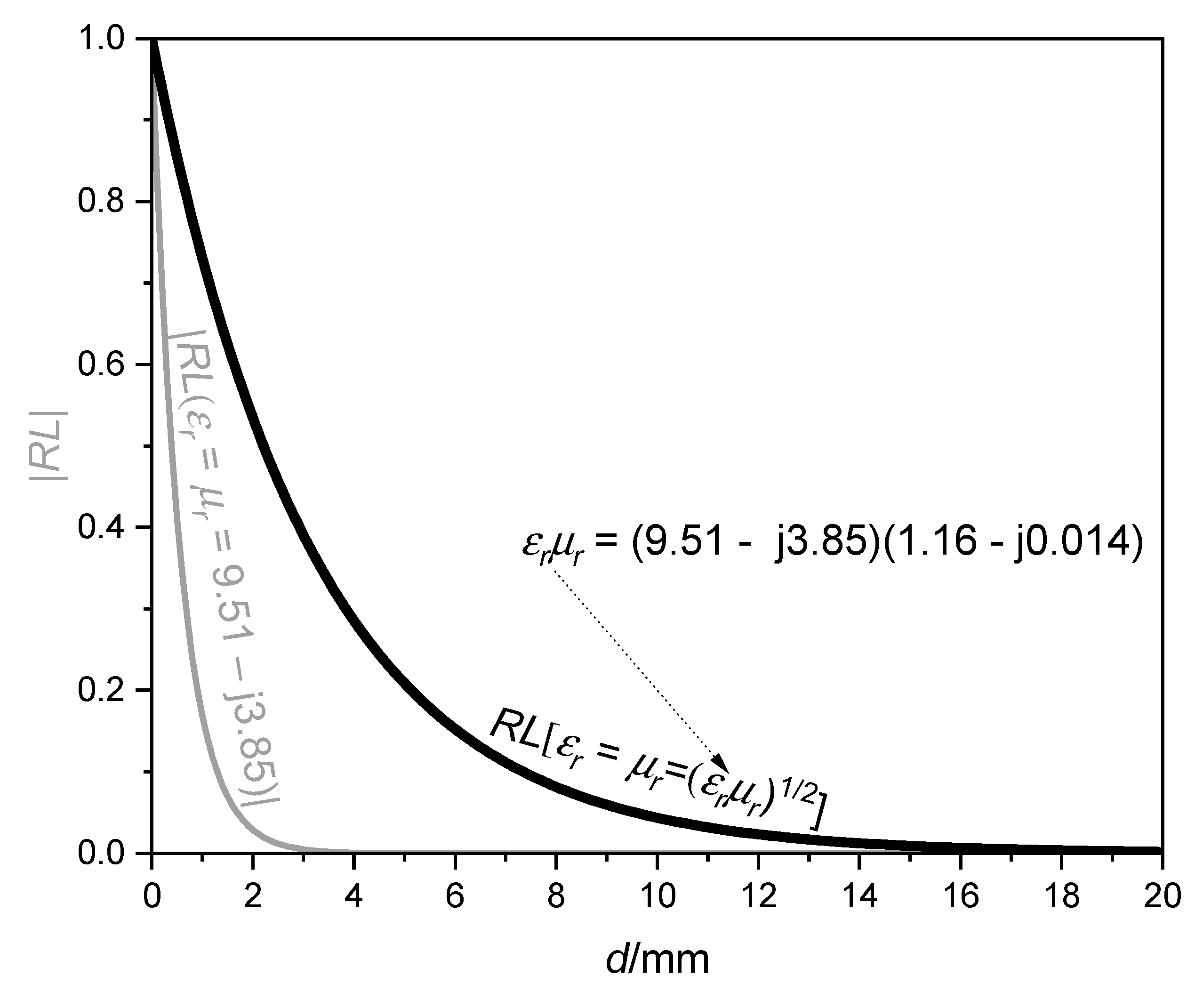
As shown by Figure 3, beam r2 vanishes and |RL| = |RM| when d approaches infinity. Beam r1 vanishes and |RL| = |R2| when ZM = Z0. As shown by Figure 4, |RL| is a monotonic decay function of d at 11 GHz when εr = μr = 5.51 – j3.85 and εr = μr = [(9.51 – j3.85)(1.16 – j0.014)]1/2 to ensure ZM = Z0.
It can be proved generally that |RL| is a monotonic decay function when εr = μr where RM = 0, as shown by Eq. (9). [11,22] Although there may be an absorption peak with Zin = Z0 for film, |RL| = 0 with Zin = Z0 for material can only be achieved when d is infinity.
where εr" and μr" are the imaginary parts of εr and μr, respectively.
The impedance matching theory was established to explain absorption peaks when Zin ≠ Z0. However, as shown by Figure 2, the absorption of the film has a wave shape with absorption peaks while as shown by Figure 4, the accumulated attenuation of material is a monotonic decay function without absorption peak. When Zin ≠ Z0, the absorption peak of the film usually cannot be achieved at the minimum of |Zin - Z0| since the amplitude and the phase conditions for Zin = Z0 cannot be achieved simultaneously [18,46].
In impedance matching theory, microwave penetration is defined by amplitudes of individual beams with the value of |ZM - Z0|. [77] In fact, such penetration should be defined from energy penetration but it cannot be defined for film [11] unless all the incident microwaves enter the film or beam r2 vanishes.
It is believed in the current theory that the absorption peaks shown in Figure 2 are the resonance absorptions of the material [73,74]. This wrong concept leads to the investigation of the relationship between material structure and the value of |RL|, which is not relevant and to the investigation of the relationship between the attenuation power of material αP and the value of |RL|, although in practice these terms are independent. Correct research should be based on clarifying the relationship between material structure and the values of εr and μr, and then investigating what values of εr and μr, can ensure the required value of |RL| [19]. There is no simple relationship between material structure and the value of |RL| nor one relating αP to |RL| as qualitatively discussed in the literature apart from the complex relationship represented by Eq. (1). For example, at constant frequency, αP is a constant while |RL| is a function of d.
As can be seen from Figure 2 there is an absorption peak at d = 2.10 mm and ν = 11.00 GHz with |RL| = 0.018. If this peak originates from material resonance, then it will become stronger if d increases to 5.10 mm. However, the value of |RL| increases to 0.56 at d = 5.10 mm and ν = 11.00 GHz, which indicates a decrease in absorption with increase of film thickness.
This phenomenon can be understood by the wave mechanics theory. There is an absorption peak at d = 2.10 mm and ν = 11.00 GHz because the phase difference of beams r1 and r2 is π. When d increases with fixed ν, this phase difference is no longer π. To keep the phase difference at π, the frequency must decrease to ν = 4.00 GHz when d increases to 5.10 mm according to the inverse relationship between d and ν. [23] Thus, the origin peak at d = 2.10 mm and ν = 11.00 GHz shifts to the position at ν = 4.00 GHz with |RL| = 0.043 when d increases from 2.10 to 5.10 mm. Similarly, the absorption peak at d = 6.10 mm and ν = 11.00 GHz with |RL| = 0.39 shifts to d = 14.90 mm and ν = 4.00 GHz with |RL| = 0.39. The result provides a real example that confirms the validity of the inverse relationship between frequency and film thickness which occurs when εr and μr are insensitive to frequency [23]. The ratios of the shifts of the first two peaks from 11.00 to 4.00 GHz in Figure 2 are both 0.41 within experimental error from 2.10/5.10 and 6.1.0/14.90 since both the peaks shift under the same frequency ratio of 4.00/11.00 = 0.36, quite near 0.41. If both εr and μr were invariant to frequency, the inverse relationship would have been rigorously obeyed.
In impedance matching theory, the strongest absorption peak at |Zin| = |Z0| is described to be the result of the maximum penetration and the strongest attenuation of material, an explanation which has subsequently been proved wrong [19]. The correct explanation can only be provided from wave mechanics theory in which it is shown that all the absorption peaks occur when beams r1 and r2 are out of phase by π and the strongest occurs when the amplitudes of Zin and Z0 are the closest [18]. Impedance matching theory was derived primarily to explain the strongest absorption peak a purpose that has not been achieved and in addition it has also been established that it is incapable of explaining other aspects absorption such as why peaks deviate from occurring at the exact positions of d = nλ/4, n is an integer and λ is wavelength [11,23]. By contrast, the wave mechanics theory can explain every detail, including the exact numerical value of RL, the shape of the RL curve, and revealing simply why the absorption peaks deviate from the positions where beams r1 and r2 are exactly out of phase by π [24,26,47].
While there is no absorption peak from material as microwaves travel further into the material, there are multi-absorption peaks from film as ind[15,35–37icated by the inverse relationship of frequency and film thickness [23]. It can be verified that [15,35,36,37] all the absorption peaks represented by RL/dB are caused by wave cancellation without exception, and can be predicted precisely from the absorption mechanism described in wave mechanics theory. On the other hand, the majority of absorption peaks from a film do not occur at Zin = Z0 as predicted by impedance matching theory which also cannot explain why there are multi-absorption peaks for a specific material. These facts show that the real absorption mechanism originates from wave mechanics theory rather than impedance matching. In fact, the flaws of impedance matching theory can easily be identified from the fact that there are multi-absorption peaks at different film thickness when the frequency is fixed [19].
2.4. The Roles Played by Theoretical Research
The flaws in current theories revealed above have remained unidentified for many years until the new wave mechanics theory [24,26,34] was established. Indeed, these wrong theories still dominate publications because many people cannot believe that accepted theories, such as the current dominant theory for microwave absorption [55], supported by plenty of accumulated experimental data over a long period can possibly be wrong. Many researchers only believe experimental results and regard theoretical research as opinions, which leads to editorial policies such as “Theories, commentaries, and non-systematic reviews are not eligible for preprinting” [78].
To address this, we cite Ziliak and McCloskey “Can so many scientists have been wrong over the eighty years since 1925? Unhappily, yes. The mainstream in science, as any scientist will tell you, is often wrong. Otherwise, come to think of it, science would be complete. Few scientists would make that claim, or would want to. Statistical significance is surely not the only error in modern science, although it has been, as we will show, an exceptionally damaging one. Scientists are often tardy in fixing basic flaws in their sciences despite the presence of better alternatives. Think of the half century it took American geologists to recognize the truth of drifting continents, a theory proposed in 1915 by—of all eminently ignorable people—a German meteorologist. Scientists, after all, are human. What Nietzsche called the ‘twilight of the idols,’ the fear of losing a powerful symbol or god or technology, haunts us all” [54]
Conclusions from experimental results can be wrong and cannot be easily identified without the correct theory. The theory that the Earth moves around the Sun cannot be corrected without the guidance of a new theory which tells us that the experiment observations that seemly support the original theory do in fact disprove it. Without the correct theory, it is difficult to understand from experiment observation that the light object falling at the same speed as that of the heavier object in vacuum, and it is argued that “he and his fellow travelers are proposing a major departure from the way we have done science since the time of Galileo. True, the Italian physicist himself largely engaged in theoretical arguments and thought experiments (he likely never did drop balls from the leaning tower of Pisa)” [79]. Experiments without theory of logic like mathematical reasoning that only accumulate facts is not science [79,80]. In the heyday of alchemy, there was no science other than experimentation.
We end this section with the quote: “they should work together not just to forge a better science, but to counter true pseudoscience: homeopaths and psychics, just to mention a couple of obvious examples, keep making tons of money by fooling people, and damaging their physical and mental health. Those are worthy targets of critical analysis and discourse, and it is the moral responsibility of a public intellectual or academic – be they a scientist or a philosopher – to do their best to improve as much as possible the very same society that affords them the luxury of discussing esoteric points of epistemology or fundamental physics.” [79]
2.5. The Issues Addressed Are of Historical Importance
Correcting published mistakes is becoming difficult in current publication system [59,60]. Works against current theory are usually rejected without external review as exemplified by:
07 Mar 2025:
“Manuscript ID: magnetism-3539037
Title: Theoretical insights manifested by wave mechanics theory of microwave absorption
Received: 4 Mar 2025
…
We regret to inform you that we will not be processing your submission further.
This decision was based on the comments of the Academic Editor who carefully reviewed your paper. You can find the Academic Editor’s comments here: The paper is a preliminary investigation based on trivial analytic relations. The analysis should be at least corroborated by full-wave simulations and measurements on realistically realizable materials.
Submissions sent for peer-review are selected based on discipline, novelty and general significance, in addition to the usual criteria for publication in scholarly journals. Therefore, our decision does not necessarily reflect the quality of your work.
…
Magnetism Editorial Office”
04 Apr 2025
“Dear Yue,
thank you so much for submitting a new manuscript to Qeios!
Please note that we’re unable to proceed with posting the manuscript in its current form. This manuscript raises several important and thought-provoking critiques, but there are a few key issues we’d kindly like to highlight:
- The manuscript makes definitive claims about the correctness of a new theory and the complete invalidity of existing models without providing sufficient empirical validation recognized by the broader scientific community.
- A large portion of the citations reference works authored or co-authored by the submitting authors. While self-citation is, of course, acceptable, its heavy use here may be seen as limiting the theoretical foundation to one research group’s perspective.
- The writing frequently adopts an extremely polemical tone, at times characterizing mainstream research as “junk” or “wrong” without engaging constructively with the existing literature or acknowledging the possibility of co-existing or complementary approaches.
- Certain sections are difficult to follow due to complex sentence structures and heavy use of jargon, which could hinder clarity for a wider audience.
We completely understand the importance of challenging prevailing models and appreciate your efforts to push scientific understanding forward. That said, at Qeios we strive to facilitate open, constructive, and inclusive scholarly discourse. For that reason, as it currently stands, we’re unable to post the manuscript. We trust your kind patience and understanding in this regard, and we’d be happy to consider a revised version that addresses the issues described above :)
We hope this preliminary feedback is helpful, Yue! We’re always here for anything else you might need. In the meantime, we wish you a lovely weekend ahead,
Qeios Team”
08 Apr 2025
“Dear Yue,
thank you for resubmitting your manuscript to Qeios and for your thoughtful reply.
We’ve now had a chance to review the updated version, and we wanted to share some thoughts with you. While we sincerely appreciate your continued efforts, the concerns outlined in our previous message unfortunately still remain.
As we mentioned before, we very much welcome manuscripts that challenge the current scientific consensus – after all, much of what we now accept as established knowledge was once considered heretical. Our post-publication, Open Peer Review model is particularly well suited to encouraging open, forward-looking scientific dialogue of this kind.
That said, as an academic platform, we also have a responsibility to ensure that the content we post meets a basic level of scholarly rigor, and to be mindful of the time and effort of peer reviewers – whose expertise is both highly valuable and limited. For this reason, we can only post and send for review manuscripts that meet certain minimum standards in terms of structure, argumentation, and engagement with the literature.
Challenging established models plays an important role in scientific progress – and we absolutely encourage that. At the same time, when a manuscript is still in an early or informal stage, the most productive path forward is often to seek informal feedback and collaboration from other researchers. This can help refine the work, build a stronger foundation, and ensure it’s ready for meaningful engagement through peer review. Submitting very early-stage ideas into the peer review system too soon can risk straining the process, and ultimately isn’t the most effective route for advancing the work or benefiting the broader academic community.
In the case of your latest submission, we also wanted to gently note that some elements of tone and language still fall short of academic expectations. Strong claims – especially when expressed with inflammatory phrases – can easily come across as dismissive rather than constructive, and may hinder meaningful discussion rather than encourage it.
With all this in mind, we confirm that we won’t be able to proceed with posting or sending this version of your manuscript out for review. Of course, you’re more than welcome to share your work through other platforms or venues that you feel may be more suitable at this stage.
Even when perspectives differ, we deeply respect your views and your commitment to contributing to scientific discourse, Yue. We truly appreciate your continued engagement with Qeios, and we wish you all the very best with your manuscript and future work!
Warmest regards,
Qeios Team”
In fact, this research on the problems of current theories of microwave absorption is serious and the background has been clearly presented with the References section. It is true that the principles involved are not beyond college level. However, the subject is of historical importance as the wrong theories have a huge influence. The papers based on the wrong theories have been continuing to be dominant in various mainstream journals, such as in physics and microwave engineering journals, not just material journals, without mention of the opposite views [1,2,3,5,6,7,28,30,31,32,33,73,81,82,83].
It is true that every mainstream theory has been supported by huge amount of experimental evidence and has been established by the acceptance of the majority, and opinions against established theory are only insisted by the minority. However, the theory of the sun moving round the earth has also supported by experimental observations from thousands of people. Journals should not reject papers against mainstream theory by the name of “insufficient” if they cannot find academic reason to negate the evidence provided in the manuscript. If a theory is wrong, it is wrong in every perspective. If a theory is correct, it should be correct in every perspective. Thus, it should allow the evidence against accepted theory to accumulate. Journals are place where different ideas confront. If firm evidence is not allowed to publish, how can the evidence be accumulated?
“Junk science” is a fact rather than “provoking” language and many papers refer this fact [53,56,84]. That "If you don’t have anything nice to say, don’t say anything at all" [59] has already become a unsaid rule in today’s publication and Letters to correct published mistakes are discouraged by many journals. The reputation of mainstream scientists has been put higher than the reputation of science. When your emphasis on the feeling of mainstream scientists, do you have ever considered the felling of the minority that their serious works were repeatedly rejected without external review for good reason? Should we weigh more of the feeling of mainstream scientists at the expense of the progress of the science. [85] Indeed, “Yes, error detectors can make research less comfortable — but that discomfort is healthy. We should feel responsible for minimizing errors in our work, and worried that we might have missed some”. [59] Journals are places where different ideas confront. 90% of the published papers are wrong[53] and 95% of them are trash [56]. However, the problem is not whether the published view is correct or wrong. [86,87] The problem is that the opposite views have not been seriously faced. [88,89,90,91,92] Scientists peruse trueness, otherwise, taken other careers [93]. “… you should not fool the layman when you’re talking as a scientist. I am not trying to tell you what to do about cheating on your wife, or fooling your girlfriend, or something like that, when you’re not trying to be a scientist, but just trying to be an ordinary human being. We’ll leave those problems up to you and your rabbi. I’m talking about a specific, extra type of integrity that is not lying, but bending over backwards to show how you’re maybe wrong, that you ought to have when acting as a scientist. And this is our responsibility as scientists, certainly to other scientists, and I think to laymen” [94,95].
Correct theories are equally important and there is nothing small in science research. Small inspirations often led to big progress in science. Quntum mechanics is established by the small inspiration of introducing wave-particle duality into the classic wave function resulting Schrödinger equation. The magnificent quantum mechanics is just built on this small inspiration since all the rest work is mathematics to combine the classic particle mechanics and the classic wave mechanics together. Quantum mechanics is just a natural evolution of physics since all the classic theories such as energy conservation, wave superposition, and the classic electromagnetic and the classic wave mechanic principles still valid. What is revolutionary is that various new concepts such as quantization and no classic orbital movement come naturally by the combination the two distinct classic mechanics. On the other hand, wave mechanics theory for microwave absorption [26,27] was established just by the small inspiration that it is found that the current theories of microwave absorption have confused the film with the material. Both quantum mechanics and the wave mechanics theory of microwave absorption show the powerfulness of classic wave mechanics. Just as quantum mechanics, the small inspiration led to the establishment of a new scientific disciplinary theory and the establishment of new concepts beyond common sense, such as all the energy of the beam can be absorbed by film while not all the incident beam penetrates into the film [19]; instead of becoming minimized, beam r2 in Fig. 1 reaches its maximum when absorption of the film reaches its peak position [19,25,45]; the absorption mechanism for film is different from that of material as show by Figure 3 [25,34]; identifying the angular effects of microwave absorption [25]; interface does not absorb microwaves even if εr and μr have their imaginary paprts [45]; the function of interface in film may not be the same as that in its isolated state [11]; and other phenomena that have attracted little attention of contemporary scientists, such as instead of a monotonic decay function, the wave form of absorption curves has been repeatedly reported for film; the finding that all the absorption peaks do not occur at Zin = Z0 is not a result of experimental error, and as shown by Eq. (9), with εr and μr, the film behaves like material when all incident microwave penetrate the film. All these show that the research of this work is deep in different perspectives and the evidence is firmly confirmed by experimental results and established principles of physics.
Views not supported by the majority are not necessarily "without providing sufficient validation or having not provided clear evidence". Clear and sufficient evidence has already been provided to the conclusion that "the current theories in microwave absorption are wrong" as shown by Supplementary Materials IVB in ref. [69]. There are many examples that a correct theory has much less influence than the incorrect theory: “I looked into the subsequent history of this research. The next experiment, and the one after that, never referred to Mr. Young. They never used any of his criteria of putting the corridor on sand, or being very careful. They just went right on running rats in the same old way, and paid no attention to the great discoveries of Mr. Young, and his papers are not referred to, because he didn’t discover anything about the rats. In fact, he discovered all the things you have to do to discover something about rats. But not paying attention to experiments like that is a characteristic of cargo cult science” [94,95]. Yes, the current wrong theories about microwave absorption are accepted by majority as the correct theories, but they are something like cargo cult science [84]: “They’re doing everything right. The form is perfect. It looks exactly the way it looked before. But it doesn’t work. No airplanes land. So I call these things cargo cult science, because they follow all the apparent precepts and forms of scientific investigation, but they’re missing something essential, because the planes don’t land. [94,95]”
It seems reasonable by the argument:“The manuscript makes definitive claims about the correctness of a new theory and the complete invalidity of existing models without providing sufficient empirical validation recognized by the broader scientific community”. That a new theory proposed by minority and have not accepted by the majority for a long time is not necessarily “still in an early or informal stage”, as stated by “I looked into the subsequent history of this research. The next experiment, and the one after that, never referred to Mr. Young. They never used any of his criteria of putting the corridor on sand, or being very careful. They just went right on running rats in the same old way, and paid no attention to the great discoveries of Mr. Young, and his papers are not referred to, because he didn't discover anything about the rats. In fact, he discovered all the things you have to do to discover something about rats. But not paying attention to experiments like that is a characteristic of cargo cult science.” [94] The same issue is raised by Goran Shibakovski that “The current understanding of microwave absorption mechanisms is based on a variety of factors, including the electrical conductivity, permittivity, and permeability of materials. However, if there are claims that the current absorption mechanism for microwave absorption is wrong, it could be due to new findings or advancements in materials science that challenge the established theories.” [96] It is not necessary to negate a theory by new data. It has already clearly demonstrated by this work and the relevant references cited in the work that the conclusion that “the current theories of microwave absorption are completely wrong” can be verified from any published data or any computation based on those data, though the data were used originally to support the theories. Our new conclusion is absolutely correct in the scope of current microwave absorption research. If any published data is forward to support those theories, it can be proved through the recent developed wave mechanics theory of microwave absorption that those provide data in fact disprove the current theories. In fact, experimental results can never negate conclusions from correct theory.
3. Conclusions
The data from ref. [76] have been used to show that published data used to support the current theories of microwave absorption in fact disprove them. The inverse relationship between frequency and film thickness has also been confirmed from experimental data. Conclusive evidence has been provided that microwave absorption is rooted in transmission line theory while the current dominant theories originate from a misinterpretation of this electromagnetism theory. The details of reflection loss, including its exact value and the shape of its curve can be described exactly by the wave mechanics theory. By comparison, such results cannot be achieved by impedance matching theory since it was only devised to explain the absorption peak represented by RL/dB. Nevertheless, it has been proved that even this limited purpose has not been satisfied. The wave mechanics theory is a much more powerful theory to describe all aspects of microwave absorption whether the film behaves as material or not. Unfortunately, the practice of using the wrong theories continues in modern research without open debate on the opposing wave mechanics theory because the wrong concepts have dominated the field for long. This situation might be related to the fact that many concepts established in the new theory, such as the importance of the angular effects unique to film, the fact that beam r2 reaches its maximum at absorption peak position, and that the amplitude of beam b2 can be larger than that of the incident beam, contradict the so-called common sense evoked in the wrong theories.
Supplementary Materials
The following supporting information can be downloaded at the website of this paper posted on Preprints.org.
Data Availability Statement
Data sharing does not apply to this article as no new data were created or analyzed in this study.
References
- Nayani, P.S.; Moradi, M.; Salami, P.; Ra'di, Y. Passive highly dispersive matching network enabling broadband electromagnetic absorption. Nat Commun 2025, 16, 905. [CrossRef]
- Qu, N.; Sun, H.; Sun, Y.; He, M.; Xing, R.; Gu, J.; Kong, J. 2D/2D coupled MOF/Fe composite metamaterials enable robust ultra-broadband microwave absorption. Nat Commun 2024, 15, 5642. [CrossRef]
- Jin, H.; Liu, M.; Wang, L.; You, W.; Pei, K.; Cheng, H.W.; Che, R. Design and fabrication of 1D nanomaterials for electromagnetic wave absorption. Natl Sci Rev 2025, 12, nwae420. [CrossRef]
- Zuo, D.; Jia, Y.; Xu, J.; Fu, J. High-Performance Microwave Absorption Materials: Theory, Fabrication, and Functionalization. Industrial & Engineering Chemistry Research 2023, 62, 14791-14817. [CrossRef]
- Wang, B.; Huang, J.; Liu, G.; Ge, C.; Wang, L.; Xu, K.; Liu, T.; Wang, W.; Wang, L. Design and optimization oriented composition and morphology engineering for MOF derived microwave absorbents. Nano Materials Science 2025, 10.1016/j.nanoms.2024.10.011. [CrossRef]
- Chen, Y.; Quan, B.; Liu, J.; Lu, X.; Lin, L.; Shao, G.; Wen, Y.; Jin, R.; Shen, X.; Huang, X. High-Performance Flexible Microwave Absorption Films with Dynamic Adjustable Macrostructures and Alterable Electromagnetic Field Polarizations. ACS Appl Mater Interfaces 2025, 17, 9748-9759. [CrossRef]
- Xing, L.; Cheng, H.; Li, Y.; Chen, Q.; Liu, C.; Shen, C.; Liu, X. MoS(2) Decorated on 1D MoS(2)@Co/NC@CF Hierarchical Fibrous Membranes for Enhanced Microwave Absorption. Small 2025, 21, e2407337. [CrossRef]
- Song, Q.; Ye, F.; Kong, L.; Shen, Q.; Han, L.; Feng, L.; Yu, G.; Pan, Y.; Li, H. Graphene and MXene Nanomaterials: Toward High-Performance Electromagnetic Wave Absorption in Gigahertz Band Range. Advanced Functional Materials 2020, 30, 2000475. [CrossRef]
- Liu, Y.; Liu, Y.; Drew, M.G.B. Recognizing Problems in Publications Concerned with Microwave Absorption Film and Providing Corrections: A Focused Review. Industrial & Engineering Chemistry Research 2025, 64, 3635–3650. [CrossRef]
- Liu, Y.; Drew, M.G.B.; Li, H.; Liu, Y. An experimental and theoretical investigation into methods concerned with “reflection loss” for microwave absorbing materials. Materials Chemistry and Physics 2020, 243, 122624. [CrossRef]
- Liu, Y.; Drew, M.G.B.; Liu, Y. A physics investigation of impedance matching theory in microwave absorption film— Part 2: Problem analyses. Journal of Applied Physics 2023, 134, 045304. [CrossRef]
- Liu, Y.; Zhao, K.; Drew, M.G.B.; Liu, Y. A theoretical and practical clarification on the calculation of reflection loss for microwave absorbing materials. AIP Advances 2018, 8, e015223. [CrossRef]
- Elmahaishi, M.F.; Azis, R.a.S.; Ismail, I.; Muhammad, F.D. A review on electromagnetic microwave absorption properties: their materials and performance. Journal of Materials Research and Technology 2022, 20, 2188-2220. [CrossRef]
- Andriyanti, W.; Choir Hidayati Nur, M.A.; Puspitarum, D.L.; Sujitno, T.; Suprihatin, H.; Purwanto, S.; Suharyadi, E. Microstructures, magnetic properties and microwave absorption of ion-implanted bismuth ferrite thin films. Physica B: Condensed Matter 2024, 676, 415690. [CrossRef]
- Abu Sanad, A.A.; Mahmud, M.N.; Ain, M.F.; Ahmad, M.A.B.; Yahaya, N.Z.B.; Mohamad Ariff, Z. Theory, Modeling, Measurement, and Testing of Electromagnetic Absorbers: A Review. physica status solidi (a) 2024, 221, 2300828. [CrossRef]
- Cao, M.; Han, C.; Wang, X.; Zhang, M.; Zhang, Y.; Shu, J.; Yang, H.; Fang, X.; Yuan, J. Graphene nanohybrids: excellent electromagnetic properties for the absorbing and shielding of electromagnetic waves. Journal of Materials Chemistry C 2018, 6, 4586-4602. [CrossRef]
- Liu, Y.; Drew, M.G.B.; Liu, Y. A physics investigation of impedance matching theory in microwave absorption film—Part 1: Theory. Journal of Applied Physics 2023, 134, 045303. [CrossRef]
- Liu, Y.; Drew, M.G.B.; Liu, Y. A theoretical exploration of impedance matching coefficients for interfaces and films. Applied Physics A 2024, 130, 212. [CrossRef]
- Liu, Y.; Ding, Y.; Liu, Y.; Drew, M.G.B. Unexpected Results in Microwave Absorption -- Part 1: Different absorption mechanisms for metal-backed film and for material. Surfaces and Interfaces 2023, 40, 103022. [CrossRef]
- Qu, S.; Hou, Y.; Sheng, P. Conceptual-based design of an ultrabroadband microwave metamaterial absorber. Proc Natl Acad Sci U S A 2021, 118, e2110490118. [CrossRef]
- Liu, Y.; Liu, Y.; Drew, M.G.B. A theoretical investigation on the quarter-wavelength model — Part 1:Analysis. Physica Scripta 2021, 96, 125003. [CrossRef]
- Liu, Y.; Liu, Y.; Drew, M.G.B. A theoretical investigation of the quarter-wavelength model-part 2: verification and extension. Physica Scripta 2022, 97, 015806. [CrossRef]
- Liu, Y.; Liu, Y.; Drew, M.G.B. A re-evaluation of the mechanism of microwave absorption in film – Part 3: Inverse relationship. Materials Chemistry and Physics 2022, 290, 126521. [CrossRef]
- Liu, Y.; Liu, Y.; Drew, M.G.B. Wave Mechanics of Microwave Absorption in Films: Multilayered Films. Journal of Electronic Materials 2024, 53, 8154–8170. [CrossRef]
- Liu, Y.; Liu, Y.; Drew, M.G.B. A Re-evaluation of the mechanism of microwave absorption in film – Part 2: The real mechanism. Materials Chemistry and Physics 2022, 291, 126601. [CrossRef]
- Liu, Y.; Liu, Y.; Drew, M.G.B. Wave mechanics of microwave absorption in films: A short review. Optics and Laser Technology 2024, 178, 111211. [CrossRef]
- Liu, Y.; Liu, Y.; Drew, M.G.B. Review of Wave Mechanics Theory for Microwave Absorption by Film. Journal of Molecular Science 2024, 40, 300-305. [CrossRef]
- Lim, D.D.; Ibarra, A.; Lee, J.; Jung, J.; Choi, W.; Gu, G.X. A tunable metamaterial microwave absorber inspired by chameleon's color-changing mechanism. Sci Adv 2025, 11, eads3499. [CrossRef]
- Sharma, S.; Parne, S.R.; Panda, S.S.S.; Gandi, S. Progress in microwave absorbing materials: A critical review. Adv Colloid Interface Sci 2024, 327, 103143. [CrossRef]
- Li, M.; Li, W.; Wang, Y.; Sun, F.; Wang, Q.; Tan, D.; Zhang, R.; Wang, H.; Shao, G.; Liu, Y.; et al. Entropy-driven microwave absorption enhancement in hexagonal (Ba1/3Sr1/3Ca1/3)FeO3 perovskite. Journal of Advanced Ceramics 2025, 14, 9221059. [CrossRef]
- Zhuang, X.; Ning, M.; Pan, L.; Gao, Y.; Zhang, Q.; Mu, C.; Ma, H.; Li, J.; Tan, G.; Man, Q.; et al. Optimized Microwave Absorption and Structural Compression Sensing via Magnetic Fiber-Infused Aerogels with Reduced Graphene Oxide and Carbon Frameworks. ACS Applied Electronic Materials 2025, 7, 601-611. [CrossRef]
- Xu, J.; Gao, T.; Liu, S.; Jiao, Y. Enhanced microwave absorption and thermal conductivity of biomass-derived BCNO materials. Journal of Materials Science: Materials in Electronics 2025, 36, 417. [CrossRef]
- Wu, D.; Fan, C.; Luo, W.; Jin, Y.; He, Q.; Wang, Y. Enhanced interfacial polarization loss induced by hollow engineering of hollow alloyed CoFe-ZIF nanocages/carbon nanofibers for efficient microwave absorption. Inorganic Chemistry Frontiers 2025, 12, 3083-3097. [CrossRef]
- Liu, Y.; Liu, Y.; Drew, M.G.B. Wave mechanics of microwave absorption in films - Distinguishing film from material. Journal of Magnetism and Magnetic Materials 2024, 593, 171850. [CrossRef]
- Choi, J.R.; Cheon, S.J.; Lee, H.J.; Lee, S.-b.; Park, B.; Lee, H. Ultra-wideband electromagnetic wave absorption in mmWave using dual-loss engineered M-type hexaferrite: A wave cancellation approach. Materials & Design 2025, 255, 114220. [CrossRef]
- Li, S.; Guo, S.; Chen, G.; Cui, Y.; Yang, H.; Qiu, J.; Wang, Z.; Dai, M.; Liu, S. Evolution of electron localization with Co2+ variations in Co Fe3−O4 hollow spheres for enhanced wave absorption. Journal of Alloys and Compounds 2025, 1026, 180381. [CrossRef]
- Zhou, Y.; He, P.; Ma, W.; Zuo, P.; Xu, J.; Tang, C.; Zhuang, Q. The Developed Wave Cancellation Theory Contributing to Understand Wave Absorption Mechanism of ZIF Derivatives with Controllable Electromagnetic Parameters. Small 2023, 10.1002/smll.202305277, 2305277. [CrossRef]
- Ray, S.; Panwar, R. Advances in Polymer-Based Microwave Absorbers—From Design Principles to Technological Breakthroughs: A Review. IEEE Journal on Flexible Electronics 2024, 3, 401-417. [CrossRef]
- Green, M.; Chen, X. Recent progress of nanomaterials for microwave absorption. Journal of Materiomics 2019, 5, 503-541. [CrossRef]
- Xia, L.; Feng, Y.; Zhao, B. Intrinsic mechanism and multiphysics analysis of electromagnetic wave absorbing materials: New horizons and breakthrough. Journal of Materials Science & Technology 2022, 130, 136-156. [CrossRef]
- Busti, N.D.; Parra, R.; Sousa Góes, M. Synthesis, Properties, and Applications of Iron Oxides: Versatility and Challenges. In Functional Properties of Advanced Engineering Materials and Biomolecules, 2021; 10.1007/978-3-030-62226-8_13pp. 349-385.
- Lu, J.; Xu, L.; Xie, C.; Zhang, C.; Han, Z.; Ren, Y.; Che, R. Microwave-Driven Dielectric-Magnetic Regulation of Graphite@alpha-MnO(2) Toward Enhanced Electromagnetic Wave Absorption. Adv Sci (Weinh) 2025, 10.1002/advs.202504489, e04489. [CrossRef]
- Li, Q.; Zeng, Y.; Zhang, M.; Jiang, Z.; Xie, Z. The new insight into the microscopic enhancement mechanism of microwave absorption based on the electromagnetic heterogeneous interface of carbon nanocavity. Journal of Colloid and Interface Science 2025, 699, 138210. [CrossRef]
- Liu, Y.; Liu, Y. Microwave absorption mechanism for film. Journal of Molecular Science 2023, 39, 521 - 527. [CrossRef]
- Liu, Y.; Liu, Y.; Drew, M.G.B. A Re-evaluation of the mechanism of microwave absorption in film – Part 1: Energy conservation. Materials Chemistry and Physics 2022, 290, 126576. [CrossRef]
- Liu, Y.; Drew, M.G.B.; Liu, Y. Chapter 4: Fundamental Theory of Microwave Absorption for Films of Porous Nanocomposites: Role of Interfaces in Composite-Fillers. In Porous Nanocomposites for Electromagnetic Interference Shielding, Thomas, S., Paoloni, C., Pai, A.R., Eds. Elsevier: 2024; 10.1016/B978-0-323-90035-5.00013-1pp. 59 - 90.
- Liu, Y.; Ding, Y.; Liu, Y.; Drew, M.G.B. Unexpected results in Microwave absorption -- Part 2:Angular effects and the wave cancellation theory. Surfaces and Interfaces 2023, 40, 103024. [CrossRef]
- Liu, Y.; Ding, Y.; Chen, Q.; Liu, Y. Preparation of NiFe2-xMxO4(M=Ce,Sm,Gd) and microwave absorption properties of its films. Journal of Shenyang Normal University (Natural Science Edition) 2023, 41, 98 -103. [CrossRef]
- Liu, Y.; Yin, X.; Drew, M.G.B.; Liu, Y. Microwave absorption of film explained accurately by wave cancellation theory. Physica B: Condensed Matter 2023, 666, 415108. [CrossRef]
- Liu, Y.; Yin, X.; Drew, M.G.B.; Liu, Y. Reflection Loss is a Parameter for Film, not Material. Non-Metallic Material Science 2023, 5, 38 - 48. [CrossRef]
- Planck, M. Scientific Autobiography and Other Paper; William & Norgate: London, 1950; pp. 192.
- Ioannidis, J.P. Why most published research findings are false. PLoS Med 2005, 2, 124. [CrossRef]
- Honjo, T. https://dataverse.harvard.edu/file.xhtml?fileId=5112613&version=1.1, English translation of the views of Nobel laureate Tasuku Honjo from a Chinese website: “first-class work often overturns the established conclusion, so it is unpopular. The reviewers cannot fully understand your work and will give you many negative comments, …. Articles catering to the trend of the times are easy to be accepted, otherwise, it will take a long time to get recognized” (2000) “If your research can't overturn the established conclusion, science can't progress. Of course, your research will be not recorded in history. The academic world is conservative. If you don't write your paper according to the existing conclusion, it will be very difficult for your paper to be accepted, and you will suffer a lot, but the research that can survive in history is exactly this kind of research.“ (2013) 02 “Kyoto University has a tradition that ‘it is better to be unique than to be the foremost among others.’ …. If you continue to study your findings and expand from there, the world will become very broad. This is my pleasure in doing research. Don’t be in such a practice that when seeing someone else is digging a gold mine, you immediately follow in to join in the fun and become one of the many gold miners. Instead, continue to dig deep along with your own discoveries. In this way, other researchers will come to study your project” (2000). Availabe online: https://www.sohu.com/a/423577113_788170 (accessed on 1, Apr).
- Ziliak, S.T.; McCloskey, D.N. The cult of statistical significance: how the standard error costs us jobs, justice, and lives; The University of Michigan Press: Ann Arbor, 2008; pp. 322.
- Akinay, Y.; Gunes, U.; Çolak, B.; Cetin, T. Recent progress of electromagnetic wave absorbers: A systematic review and bibliometric approach. ChemPhysMater 2023, 2, 197-206. [CrossRef]
- Li, B. "Academic garbage is harmful and public hazard (95% of scientific research papers are garbage). It can be translated into English easily by machine translation. Availabe online: https://www.sohu.com/a/400765429_665896 (accessed on 1, Apr).
- Judo, P. The scientist who faked over 50 studies. Availabe online: https://www.youtube.com/watch?v=z_lB9-4R40o (accessed on Apr 1).
- Judo, P. Academia is BROKEN! - Harvard Fake Data Scandal Explained. Availabe online: https://www.youtube.com/watch?v=d2Tm3Yx4HWI (accessed on Apr 1).
- Vazire, S. A toast to the error detectors. Nature 2020, 577, 9. [CrossRef]
- Saha, M. Review of: Comments on: “A perspective on impedance matching and resonance absorption mechanism for electromagnetic wave absorbing” by Hou et al. [Carbon 222 (2024) 118935]. Qeios 2024, 10.32388/5FRZHG. [CrossRef]
- Young, N.S.; Ioannidis, J.P.; Al-Ubaydli, O. Why current publication practices may distort science. PLoS Med 2008, 5, e201. [CrossRef]
- Wang, J.; Veugelers, R.; Stephan, P.E. Bias Against Novelty in Science: A Cautionary Tale for Users of Bibliometric Indicators. SSRN Electronic Journal 2015, 10.2139/ssrn.2710572. [CrossRef]
- Ioannidis, J.P.; Boyack, K.W.; Small, H.; Sorensen, A.A.; Klavans, R. Bibliometrics: Is your most cited work your best? Nature 2014, 514, 561-562. [CrossRef]
- Harvard calls for retraction of dozens of studies by noted cardiologist, “some scientists wondered how a questionable line of research persisted for so long … experts were just too timid to take a stand”, https://www.staradvertiser.com/2018/10/16/news/harvard-calls-for-retraction-of-dozens-of-studies-by-noted-cardiologist/. New York Times 2018, p 16 Oct 2018.
- Weinstein, E. The Problem With Peer Review. Availabe online: https://www.youtube.com/watch?v=U5sRYsMjiAQ (accessed on 1, Apr).
- Murphy, B.D. Is Science Broken? The Failure of Peer Review. Availabe online: https://www.youtube.com/watch?v=M2ZvEEvTuP8 (accessed on Apr 1).
- Deciderata. Is peer review broken? Availabe online: https://www.youtube.com/watch?v=EZa0Xihih9w (accessed on Apr 1).
- Judo, P. The BROKEN system at the heart of Academia. Availabe online: https://www.youtube.com/watch?v=JxB3yy2H7j4 (accessed on Apr 1).
- Liu, Y.; Drew, M.G.B.; Liu, Y. Theoretical insights manifested by wave mechanics theory of microwave absorption — Part 2: A perspective based on the responses from DeepSeek. Preprints.org 2025, 10.20944/preprints202503.0314.v3. [CrossRef]
- Liu, Y.; Drew, M.G.B.; Li, H.; Liu, Y. A theoretical analysis of the relationships shown from the general experimental results of scattering parameters s11 and s21 -- Exemplified by the film of BaFe12-iCeiO19/polypyrene with i = 0.2, 0.4, 0.6. Journal of Microwave Power and Electromagnetic Energy 2021, 55, 197–218. [CrossRef]
- Wang, T.; Chen, G.; Zhu, J.; Gong, H.; Zhang, L.; Wu, H. Deep understanding of impedance matching and quarter wavelength theory in electromagnetic wave absorption. J Colloid Interface Sci 2021, 595, 1-5. [CrossRef]
- Liu, Y.; Yu, H.; Drew, M.G.B.; Liu, Y. A systemized parameter set applicable to microwave absorption for ferrite based materials. Journal of Materials Science: Materials in Electronics 2018, 29, 1562-1575. [CrossRef]
- Hou, Z.-L.; Gao, X.; Zhang, J.; Wang, G. A perspective on impedance matching and resonance absorption mechanism for electromagnetic wave absorbing. Carbon 2024, 222, 118935. [CrossRef]
- Cheng, J.; Zhang, H.; Ning, M.; Raza, H.; Zhang, D.; Zheng, G.; Zheng, Q.; Che, R. Emerging Materials and Designs for Low- and Multi-Band Electromagnetic Wave Absorbers: The Search for Dielectric and Magnetic Synergy? Advanced Functional Materials 2022, 32, 2200123. [CrossRef]
- Wang, T.; Han, R.; Tan, G.; Wei, J.; Qiao, L.; Li, F. Reflection loss mechanism of single layer absorber for flake-shaped carbonyl-iron particle composite. Journal of Applied Physics 2012, 112, 104903. [CrossRef]
- Chen, X.; Zhou, M.; Zhao, Y.; Gu, W.; Wu, Y.; Tang, S.; Ji, G. Morphology control of eco-friendly chitosan-derived carbon aerogels for efficient microwave absorption at thin thickness and thermal stealth. Green Chemistry 2022, 24, 5280-5290. [CrossRef]
- Liu, Y.; Tian, C.; Wang, F.; Hu, B.; Xu, P.; Han, X.; Du, Y. Dual-pathway optimization on microwave absorption characteristics of core–shell Fe3O4@C microcapsules: Composition regulation on magnetic core and MoS2 nanosheets growth on carbon shell. Chemical Engineering Journal 2023, 461, 141867. [CrossRef]
- Editorial Policies. Availabe online: https://www.researchsquare.com/legal/editorial (accessed on.
- Pigliucci, M. Must science be testable? Availabe online: https://aeon.co/essays/the-string-theory-wars-show-us-how-science-needs-philosophy (accessed on.
- Cao, Z. Is physics an experimental science? This is a big misunderstanding. Availabe online: https://www.sohu.com/a/114689319_373567 (accessed on.
- Singh, P.P.; Dash, A.K.; Nath, G. Dielectric characterization analysis of natural fiber based hybrid composite for microwave absorption in X-band frequency. Applied Physics A 2024, 130, 171. [CrossRef]
- Saikia, S.; Saikia, H.; Bhattacharyya, N.S. Revertible wideband hydrogel-based meta-structure absorber. Applied Physics A 2024, 130, 189. [CrossRef]
- Ma, Z.; Yang, K.; Li, D.; Liu, H.; Hui, S.; Jiang, Y.; Li, S.; Li, Y.; Yang, W.; Wu, H.; et al. The Electron Migration Polarization Boosting Electromagnetic Wave Absorption Based on Ce Atoms Modulated yolk@shell FexN@NGC. Advanced Materials 2024, 36, 2314233. [CrossRef]
- Hanlon, M. Cargo Cult Science. European Review 2013, 21, S51-S55. [CrossRef]
- Cabbolet, M.J.T.F. To All Who Believe in Science as an Open Discussion of New Ideas: A Call for Reforms to Reverse the Politicization of Science. Journal of Academic Ethics 2025, 10.1007/s10805-025-09646-8. [CrossRef]
- Massari, P. When It’s Right to Be Wrong. Availabe online: https://gsas.harvard.edu/news/when-its-right-be-wrong (accessed on.
- Thompson, L. When being wrong is a good thing for science. Availabe online: https://confidenceinresearch.elsevier.com/item/when-being-wrong-is-a-good-thing-for-science (accessed on.
- Thompson, C. Real Heroes Have the Guts to Admit They're Wrong. Availabe online: https://www.wired.com/story/real-heroes-have-the-guts-to-admit-theyre-wrong/ (accessed on.
- Oreskes, N. Science Improves When People Realize They Were Wrong. Availabe online: https://www.scientificamerican.com/article/science-improves-when-people-realize-they-were-wrong/ (accessed on.
- Harris, K. Admitting a Wrong: The Challenge and the Reward. Availabe online: https://owlcation.com/social-sciences/Admitting-a-Wrong-the-Challenge-and-the-Reward (accessed on.
- What it means to be a good scientist: Admitting when you're wrong. Availabe online: https://www.reddit.com/r/science/comments/e0s60/what_it_means_to_be_a_good_scientist_admitting (accessed on.
- Pennock, R.T. Scientific Integrity and the Ethics of 'Utter Honesty'. Availabe online: https://thereader.mitpress.mit.edu/scientific-integrity-and-the-ethics-of-utter-honesty/ (accessed on.
- Bright, L.K. Why Do Scientists Lie? Royal Institute of Philosophy Supplement 2021, 89, 117-129. [CrossRef]
- Feynman, R.P.; Leighton, R. “Surely You’re Joking, Mr. Feynman”; Hutchings, E., Ed. W. W. Norton & Company: New York, 2010.
- Feynman, R. Cargo Cult Science, From a Caltech commencement address given in 1974. Availabe online: https://sites.cs.ucsb.edu/~ravenben/cargocult.html (accessed on.
- Liu, Y. The Accepted Theories Have Been Overturned. Availabe online: https://www.peeref.com/hubs/219 (accessed on.
Figure 1.
A metal backed film with thickness d. i indicates the incident beam and r1 is the reflected beam from the top interface. Part of the incident microwaves enters the film and reflected back-and-forth between the top and bottom interfaces. f1, f2, f3. etc. are the forward beams and b1, b2, etc. are backward beams in the film. r2 is the total reflected beam from the bottom interface. Beam r is the superposition of beams r1 and r2.
Figure 1.
A metal backed film with thickness d. i indicates the incident beam and r1 is the reflected beam from the top interface. Part of the incident microwaves enters the film and reflected back-and-forth between the top and bottom interfaces. f1, f2, f3. etc. are the forward beams and b1, b2, etc. are backward beams in the film. r2 is the total reflected beam from the bottom interface. Beam r is the superposition of beams r1 and r2.
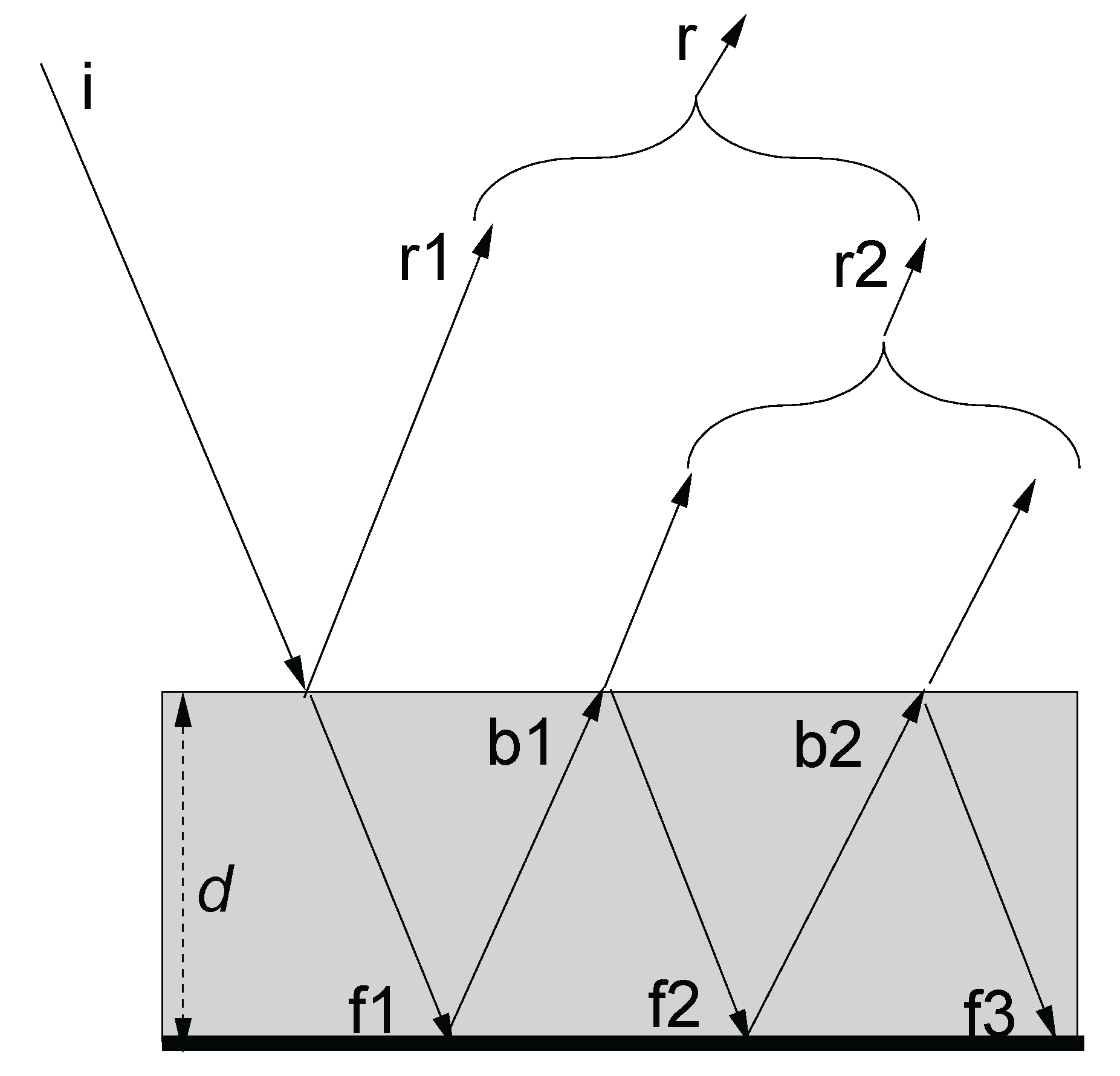
Figure 2.
|RL| for the material CA3.5-4 reported by Guangbin Ji et al [76] measured at 4.00 and 11.00 GHz, respectively.
Figure 2.
|RL| for the material CA3.5-4 reported by Guangbin Ji et al [76] measured at 4.00 and 11.00 GHz, respectively.
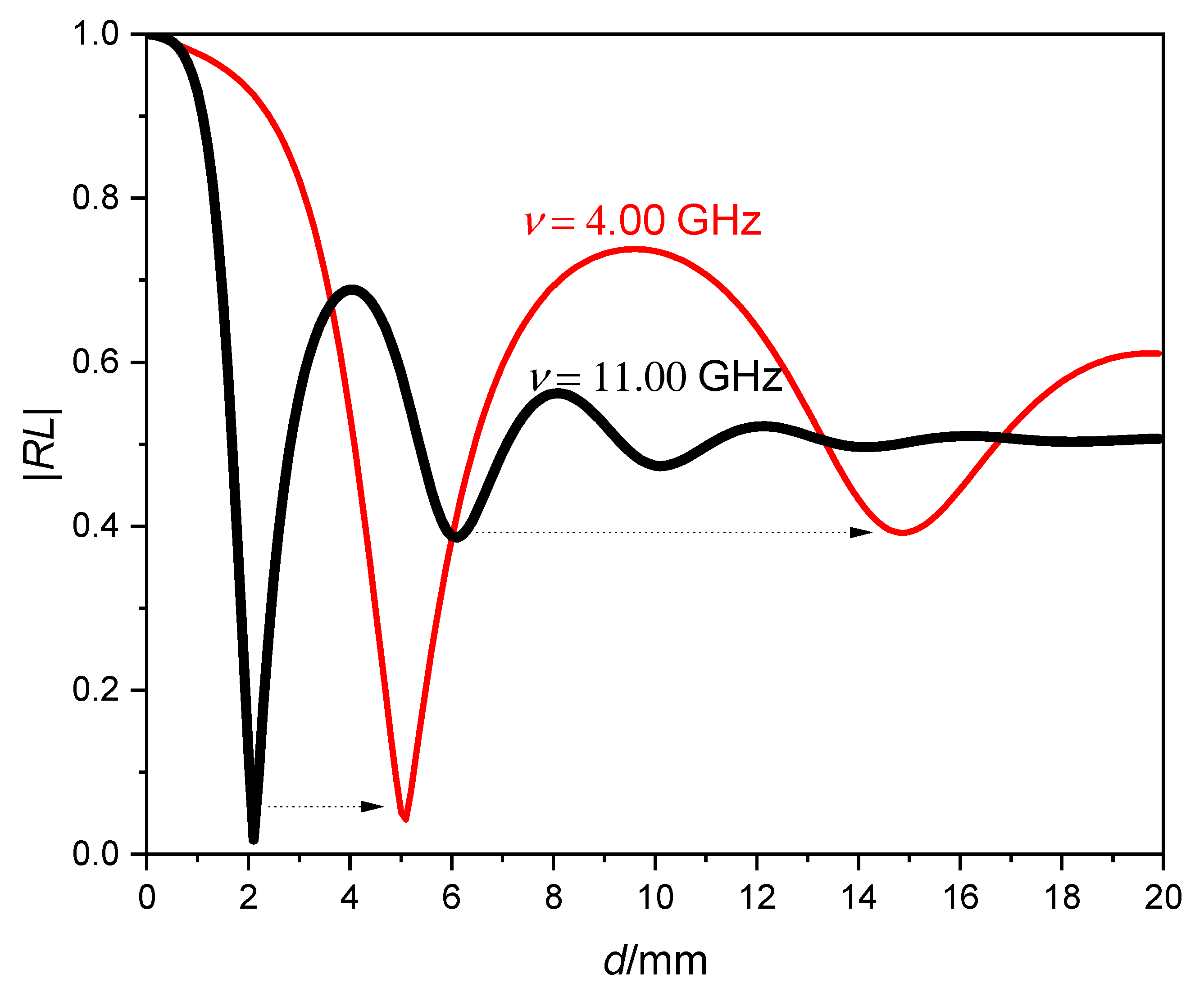
Figure 3.
The difference between the absorption of metal-backed film A(Film) of material CA3.5-4 [76] and the attenuation power of its material A(Material) along the optical path.
Figure 3.
The difference between the absorption of metal-backed film A(Film) of material CA3.5-4 [76] and the attenuation power of its material A(Material) along the optical path.
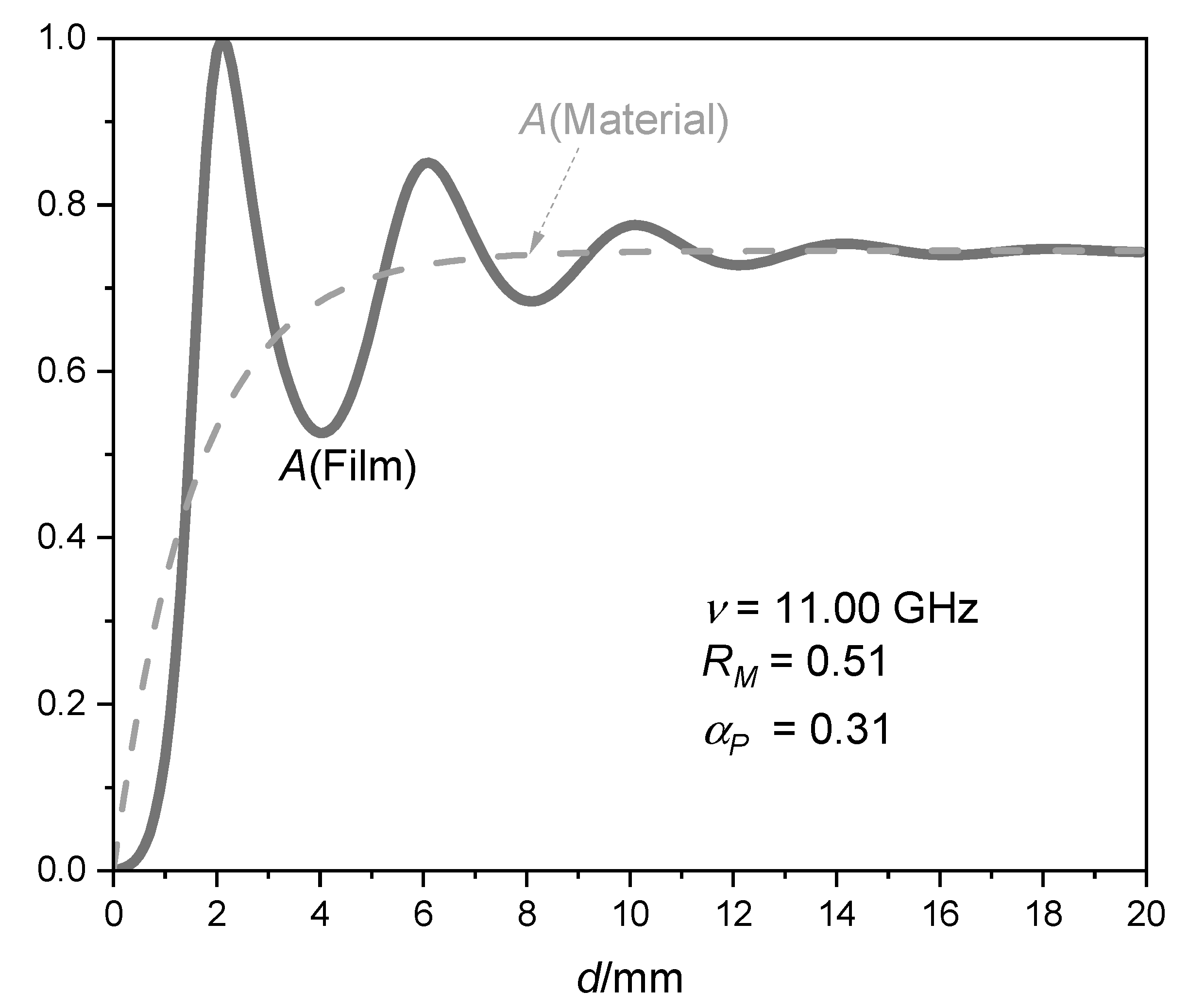
Figure 4.
|RL| calculated by Eq. (1) or (5) with εr = μr = 9.51 – j3.85 and εr = μr = [(9.51 – j3.85)(1.16 – j0.014)]1/2 at 11 GHz. [10].
Figure 4.
|RL| calculated by Eq. (1) or (5) with εr = μr = 9.51 – j3.85 and εr = μr = [(9.51 – j3.85)(1.16 – j0.014)]1/2 at 11 GHz. [10].
Disclaimer/Publisher’s Note: The statements, opinions and data contained in all publications are solely those of the individual author(s) and contributor(s) and not of MDPI and/or the editor(s). MDPI and/or the editor(s) disclaim responsibility for any injury to people or property resulting from any ideas, methods, instructions or products referred to in the content. |
© 2025 by the authors. Licensee MDPI, Basel, Switzerland. This article is an open access article distributed under the terms and conditions of the Creative Commons Attribution (CC BY) license (http://creativecommons.org/licenses/by/4.0/).
Copyright: This open access article is published under a Creative Commons CC BY 4.0 license, which permit the free download, distribution, and reuse, provided that the author and preprint are cited in any reuse.