1. Introduction
The Beijing 2022 Olympic Winter Games highlighted China’s role in global sport and culture. In the midst of COVID-19, the event became a platform for China to project its national identity amid geopolitical tensions. From the 2008 Beijing Summer Olympics to the 2022 Winter Olympicsn [
1], these events have attracted global attention and sparked debates about soft power, cultural representation and ideological competition [
2]. The pandemic presented unprecedented challenges, turning the Winter Olympics into a high-stakes environment where public health risks intersected with political narratives. This situation placed immense pressure on Chinese external media to manage communication risks, counter negative perceptions, and construct a coherent narrative of Chinese values on platforms such as Facebook.
Previous research has examined the role of international sporting events in shaping national image, highlighting their dual function as platforms for cultural diplomacy and sites of ideological contestation [
3,
4]. The 2008 Beijing Olympics were widely analysed for their impact on China’s global reputation, highlighting both the opportunities and limitations of using mega-events for soft power projection. More recently, scholars have explored how pandemic-related disruptions have redefined crisis communication strategies, particularly through social networks [
5]. During health emergencies, platforms such as Twitter and Facebook [
6,
7] have proven to be instrumental in disseminating risk information, although their effectiveness often depends on technical features such as hashtags, mentions and multimedia integration.
However, there remain significant gaps in our understanding. Existing literature has mainly focused on Western corporate or government communication models [
8]. Little research has been done on how state-affiliated media organisations, particularly Chinese external media, implement relationship management principles in cross-cultural contexts during globally watched events. There is a lack of research on the strategies used by Chinese external media to balance diplomatic goals with user engagement in polarised information environments. Also, previous applications of relationship management theory have mostly been in domestic or corporate settings, with limited examination of its applicability to cross-cultural, state-mediated communication during crises.
This study aims to fill these research gaps by examining how Chinese external media used relationship management theory to manage international perceptions on Facebook during the Beijing 2022 Winter Olympics. The article raises two central questions: RQ1 Does the information presentation and dialogue intervention in the content published by Chinese external communication media on Facebook during the Winter Olympics have a combined impact on communication effectiveness of Facebook? RQ2: Does the technical functionality of Facebook act as a mediator between (a) information presentation (b) dialogue intervention and its communication effectiveness? By answering these questions, this study seeks to provide new insights into the strategies and mechanisms of state-affiliated media in managing international perceptions during global events, and to extend the application of relationship management theory to cross-cultural risk communication contexts.
Methodologically, the research employed quantitative content analysis of Facebook posts from six Chinese external media accounts during the Winter Olympics period. Communication effectiveness was operationalized through engagement metrics, while information presentation and dialogue intervention strategies were coded based on semantic framing and interactivity features. Technical mediation variables quantified the frequency and strategic deployment of platform tools. Mediation analysis revealed that transparent information disclosure about pandemic measures directly enhanced engagement, with its effectiveness significantly amplified by audio-visual information. Similarly, dialogue intervention showed a stronger impact when integrated with embedded hyperlinks to official policy documents.
The theoretical contribution of the study lies in the theory of relationship management to cross-cultural risk communication contexts. It clarifies how technical mediation transforms traditional models of organizational-public interaction, providing a new perspective on how relationship management principles adapt to geopolitical communication scenarios. Practically, this research offers evidence-based guidelines for state-aligned media aiming to optimize global engagement. The findings stress the importance of combining scientifically-sound information with platform-specific technical strategies, indicating that media organizations need capabilities in both substantive communication and technical platform knowledge. Moreover, the research highlights the paradoxical requirements of crisis communication in geopolitical contexts: while transparency is crucial for credibility, effective message dissemination often requires careful alignment with platform algorithms through technical mediation.
2. Literature Review
2.1. Communication Effectiveness of Facebook
Social media platforms, based on Web 2.0 concepts and frameworks, enable user - generated content creation and dissemination while facilitating seamless virtual connection, communication, and collaboration among users [
9]. Social media platforms are intrinsically digital, existing solely on the internet or on media or servers with direct internet connectivity [
10]. In the context of international social media, platforms such as Facebook and Twitter have distinguished themselves due to their openness and interactivity [
11]. As of January 2023, Facebook had reached 2.963 billion monthly active users, with nearly 2 billion of these users accessing the platform on a daily basis [
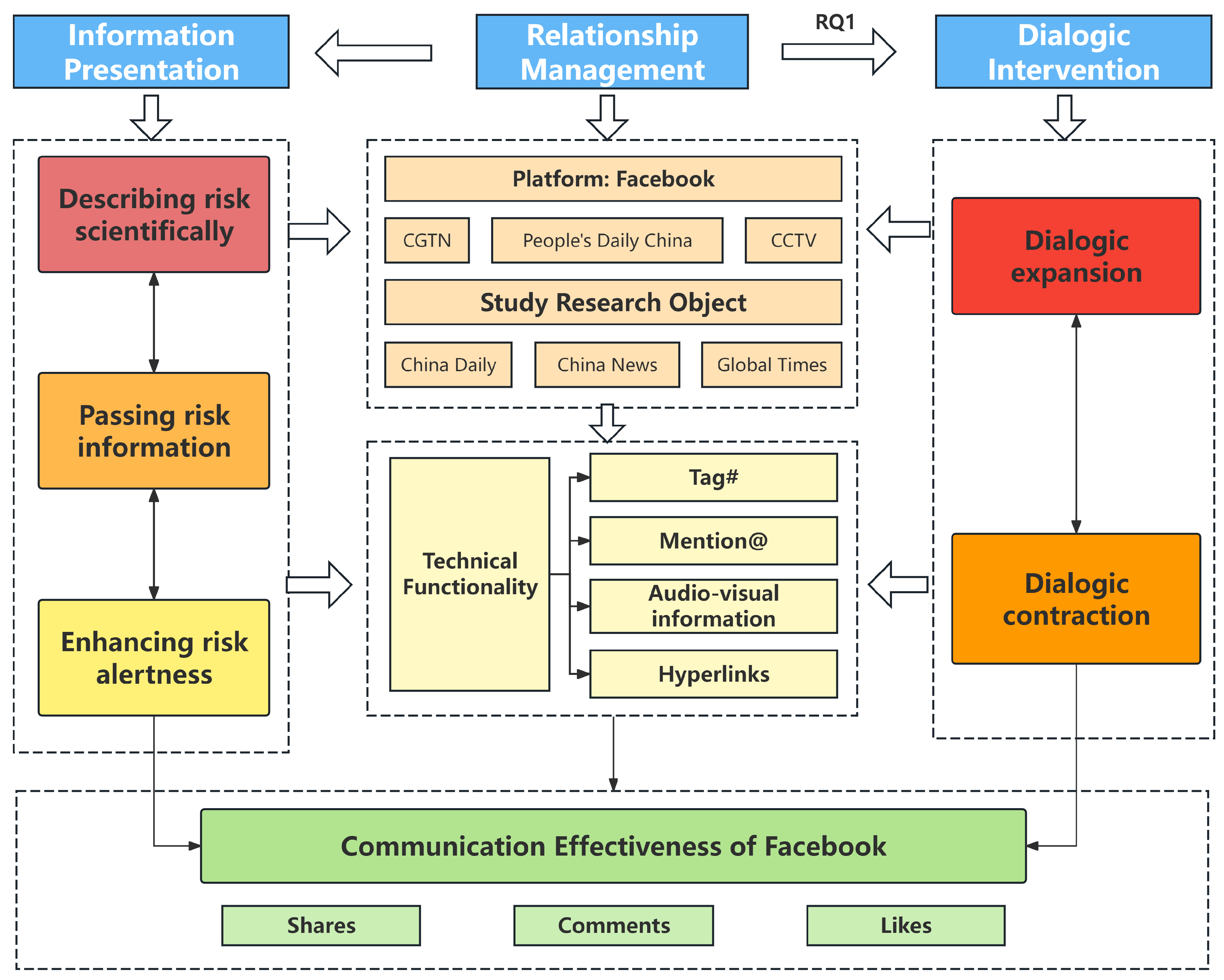
12]. Chinese external media proactively establish an international discourse system and optimise their communication effectiveness. China Daily and other Chinese mainstream media outlets have amassed a following of over 100 million on Facebook. Furthermore, scholars [
13,
14] have pointed out that when Facebook users discuss China, political and COVID-19 related topics often emerge simultaneously, which is not as prominent on other platforms. This study treats communication effectiveness of Facebook as the key factor. Based on Ledingham and Bruning’s relationship management theory, it considers the effects of information presentation and dialogue intervention, and includes the mediating role of the technical features of Facebook. The specific research questions are illustrated in
Figure 1.
2.2. Relationship Management Theory
Relationship management was defined as the process of establishing and maintaining mutually beneficial relationships with the public through the management of the communication process [
15]. Ledingham and Bruning highlighted the importance of both awareness and dialogue as essential elements in the process of relationship building [
16]. Awareness entails the acquisition, dissemination, and comprehension of information. Through the presentation of information, organisations and the public gain insight into one another existence, behaviour, and intentions. Grunig and Hunt first proposed four models of organisational information communication [
15]. They argued that the core factor affecting awareness is the presentation of information, and that effective information presentation can improve the public’s cognition and understanding of the organisation. Dialogue represents a crucial mechanism for relational interaction, underscoring the significance of reciprocal communication. In their intervention system network, Martin and White introduced the concept of dialogue [
17], proposing that dialogue intervention is achieved by selecting different sources of speech or reserving space for negotiation in order to achieve the purpose of persuasion. The process of dialogue intervention represents a pivotal aspect of relationship building. In other words, dialogue is not merely a process of verbal interaction; the specific strategies employed in speech are also a crucial element of dialogue. In light of the above, we link the concepts of relationship management and communication effectiveness of Facebook, drawing on the contributions of the aforementioned scholars, with a view to examining the impact of information presentation and dialogue intervention on communication effectiveness in the context of the global event of the Winter Olympics and the collision of the COVID-19 pandemic.
2.3. Information Presentation
Information is presented in a manner that is consistent with the logical perspectives of risk identification, warning, and control. This entails three varieties about describing risk scientifically, passing risk information and enhancing risk alertness. The knowledge produced by the scientific community and disseminated to the general public is characterised by a high degree of factuality and objectivity [
18]. Furthermore, risks are continuously being precisely predicted and highly determined [
19]. Numbers are the concentrated embodiment of accuracy and intuitiveness with regard to content. In comparison to descriptive terms such as "probably", numerical representations such as "80%" that employ a scientific demonstration of risk can significantly enhance users’ perception of risk and encourage the dissemination of content. The concept of risk is inherently associated with potential loss, whether explicit or implicit. Some scholars, based on an analysis of risk characteristics [
20], have proposed a classification of risk based on three indicators: the impact of risk on people, the severity of risk occurrence, and the possibility of risk occurrence. The perception of risk is frequently the result of the interaction between these three factors. Social media [
21], with its intrinsic capacity for alertness, sensitivity, and risk assessment, has emerged as a crucial instrument for disseminating information to the public regarding the avoidance of potential crises and their adverse consequences. It serves as a vital conduit for risk early warning, akin to a "whistleblower" [
22]. It has been demonstrated that the provision of explanations and interventions by experts and other parties in relation to public opinion incidents can serve to enhance the public’s perception of the prevailing state of public opinion, thereby effectively mitigating the potential harm associated with socialised risks.
2.4. Dialogue Intervention
The objective of dialogue intervention is to achieve a constructive exchange of ideas by selecting different sources of speech or reserving negotiation space to facilitate a mutually beneficial result [
23]. The intervention system is divided into monogloss and heterogloss in accordance with the different speech strategies selected for the various viewpoints [
17]. Subsequent scholars have developed this into two parts: dialogue expansion and dialogue contraction. dialogue expansion is used to describe the act of allowing others to speak in a limited dialogue space, thereby enhancing the persuasiveness of the content being conveyed. In the context of international social media, trust represents a significant concern for users. Scholars such as Williams [
5] have demonstrated that individuals are particularly attuned to information presented on social media platforms. The practice of citing information from reputable sources has been shown to enhance communication effectiveness and foster public trust. In contrast to dialogue expansion, dialogue contraction refers to the media’s intervention in specific events, promoting and expressing their own viewpoints and positions in order to impede others’ voices and influence public opinion. However, as scholar Kwon [
20] notes, guidance with bias and persuasion cannot achieve the desired communication effect, and recognition can only be attained in an equal, voluntary, and non-coercive environment.
2.5. Technical Functionality
Technological intermediaries can be defined as the third-party factors that facilitate connections between variables, thereby influencing or modifying the relationships between these variables. In the context of Facebook, the core technological intermediary elements can be identified as follows: mentions@, tags#, audio-visual information and hyperlinks. These elements are characterised by their technological characteristics and functions. Tags, marked with the "#" symbol, allows users to filter and customise content based on keywords, thereby reducing the time spent searching for specific topics [
22]. The flexibility of creating tags at any time makes it an invaluable tool for discussing current events on Facebook. Mention@ is a unique feature of social platforms. The "@user" syntax allows users to mention specific individuals, indicating that they are discussing them and inviting them to participate in the conversation. This practice can promote the visibility and engagement of the mentioned users and their followers [
24]. Audio-visual information, typically in the form of videos, is an important aspect of social media content. Prior research [
25] has demonstrated that videos tend to contain a greater number of emotional elements and visual cues than text-based information. This makes them more effective at conveying information in a way that is both understandable and professional, enhancing users’ recognition of the usefulness of the content and promoting its dissemination and sharing. Hyperlinks allow users to bypass the platform’s character limit by embedding links to other web pages, enabling the conveyance of richer and more detailed content [
26]. The function of hyperlinks is a topic of contention among scholars. In contrast to the consensus regarding tags # and audio-visual information, scholars hold divergent views on hyperlinks. Gallant and others [
27] posit that hyperlinks on social platforms can facilitate patient learning about health knowledge and promote interaction between doctors and patients, thereby enhancing communication. Conversely, some scholars argue that hyperlinks divert users’ attention to other platforms, reducing user interaction in the original content, thereby exerting a regulatory influence [
28]. The technical functions of social platforms facilitate the comprehension of the public’s internal reactions and operations in response to transient issues. These technical characteristics not only alter the manner in which information is conveyed, rendering dialogue intervention more nuanced and dynamic.
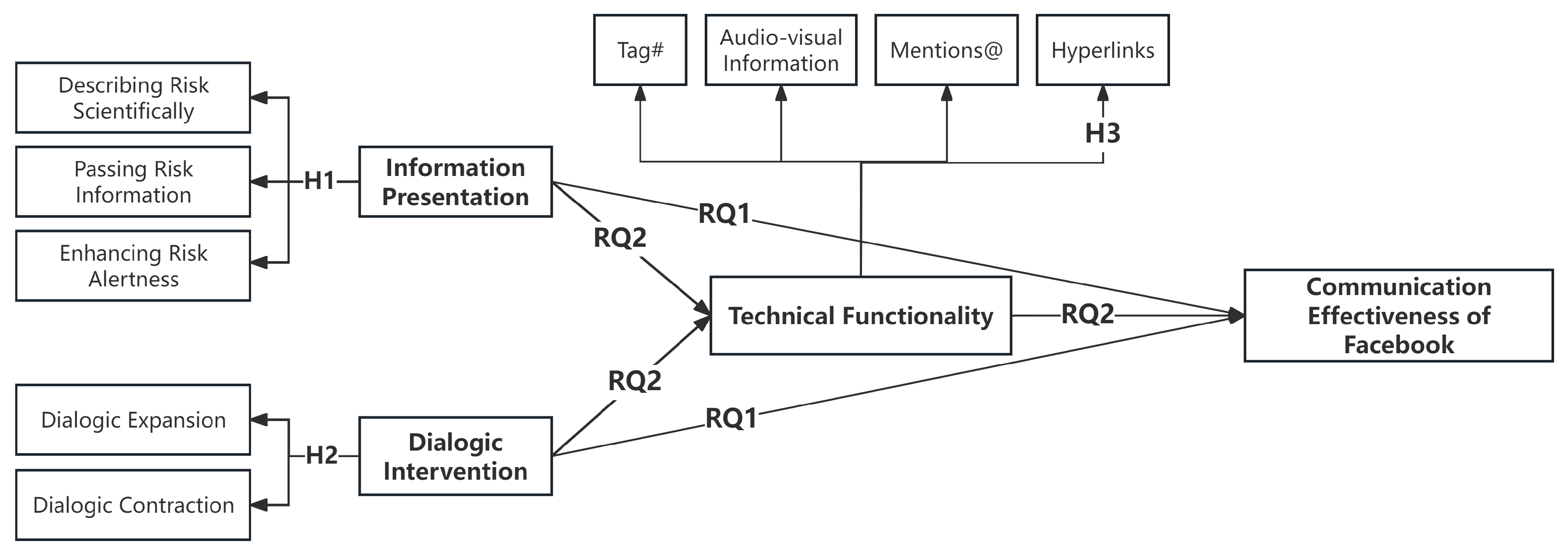
We aim to investigate the factors that influence communication effectiveness of Facebook and the role of technology as an intermediary in the media communication process (see
Figure 2). It employs structural equation modelling to examine the use of Chinese external communication media on Facebook as a case study. We attempt to explore new avenues for Chinese external communication media to communicate externally, with a particular focus on risk communication during the Winter Olympics. Furthermore, it offers insights and guidance for China’s engagement in global communication, challenging prevailing public opinion and elucidating the communication norms of the social media age.
3. Materials and Methods
3.1. Structural Equation Modelling (SEM)
Structural Equation Modelling (SEM) [
29] is a statistical method that analyses the relationships among variables based on their covariance matrix, integrating both factor analysis and path analysis. The method permits the examination of the direct, indirect, and total effects of independent variables on dependent variables.
Sharing is regarded as the most crucial interaction form and thus assigned the highest weight. Based on relevant scholars’ research [
30], sharing, commenting, and liking are assigned values of 0.5, 0.3, and 0.2 respectively. Considering potential analysis biases from different behavior magnitudes, a logarithmic transformation is applied to these values. Notably, as there’s no unified academic view on the weight allocation of commenting and liking [
30,
31], and given that liking requires the least effort with a simple click while commenting and sharing demand more cognitive and behavioral input, this study sets the weight of commenting at 0.3 and liking at 0.2, and then conducts a logarithmic transformation on these weights to ensure data normalization and enhance analysis accuracy. Consequently, the formula for calculating communication effectiveness of Facebook is as follows: communication effectiveness of Facebook = ln(0.5 * Shares + 0.3 * Comments + 0.2 * Likes).
In terms of information presentation, this study, which is based on the research of Gregoria A and Yudarwati et al. [
22], categorises risk communication content into three distinct aspects. These are: the scientific demonstration of risk; the description of risk levels; and the enhancement of risk alertness, which is approached from the perspectives of risk identification, warning, and control. With regard to dialogue intervention, this study makes reference to the research of dialogue theory, which is divided into two categories: dialogue expansion and dialogue contraction. The concept of dialogue expansion assesses the degree to which a text employs direct or indirect speech to express its own views. In contrast, dialogue contraction evaluates the extent to which content integrates self-evaluation with public opinion communication. With regard to the technical functions of Facebook, this study, drawing upon the research [
32], classifies them into four categories based on Facebook’s intrinsic capabilities:tag#, mention@, audio-visual information, and hyperlinks. The following research questions and hypotheses are proposed:
RQ1: Does the information presentation and dialogue intervention in the content published by Chinese external media on social media during the Winter Olympics have a combined impact on the communication effectiveness of Facebook?
H1: (a)Describing risk scientifically, (b)passing risk information and (c)enhancing risk alertness has a positive impact on the communication effectiveness of Facebook.
H2: (a)Dialogue expansion and (b)dialogue contraction has a positive impact on the communication effectiveness of Facebook.
H3: Hyperlinks serves to moderate the relationship (a) between information presentation and the communication effectiveness of Facebook and (b) between dialogue intervention and communication effectiveness of Facebook.
RQ2: Does the technical functionality act as a mediator between (a)information presentation (b)dialogue intervention and its communication effectiveness?
3.2. Data Source
The data collection period was set from 28 January to 20 February 2022, a critical timeframe spanning one week before the opening of the Beijing Winter Olympics to one week before its closing, during which China’s pandemic-related risk communication and event management were under close international scrutiny. Posts were retrieved from nine verified Chinese official media outlets on Facebook using the CrowdTangle API, an official Meta tool for accessing public content (which was active at the time of data collection and later shut down in August 2024). API access was obtained through a formal application process, ensuring full compliance with Facebook’s CrowdTangle Terms of Service and data protection regulations, with documentation and sample code available via the official GitHub repository
https://github.com/CrowdTangle/API. This method yielded 15,931 posts from the nine media outlets, spanning 21 January to 25 February 2022. The data collection process was conducted with strict adherence to relevant international and local data protection laws, including but not limited to GDPR, as well as ethical guidelines, fully complying with Meta’s Terms of Service and data protection regulations. This approach demonstrates a high level of compliance, legality, and academic research rigor.
To isolate pandemic-related risk communication during the targeted Olympic period, posts were filtered to include the keyword "COVID," exclude non-English text, and align with the 28 January–20 February 2022 timeframe. Each post underwent manual review and cleaning to ensure textual accuracy and completeness, resulting in a final dataset of 215 posts from six Chinese official media outlets (CGTN, China Daily, People’s Daily China, CCTV, China News, and Global Times). the aforementioned media platforms have a considerable number of followers, ranging from millions to hundreds of millions. This allows for an estimation of their influence and communication effectiveness on Facebook. This dataset reflects China’s strategic communication during a globally significant event marked by heightened scrutiny, enabling evaluation of the effectiveness of Chinese external media in addressing concurrent health and event-related risks.
The study was conducted by two coders who encoded 215 cleaned Facebook texts. To evaluate the dependability of manual coding, two coders, who had been trained in the operationalisation of variable content, randomly selected over 20% (n=44) of the content information from the sample and conducted pre-coding independently. The reliability of the coding was then tested using SPSS, with Krippendorff’s Alpha coefficient calculated to this end. The results of the pre-coding test are presented below: The reliability for describing risk scientifically is 1, passing risk information and enhancing risk alertness are 0.927 and 0.956, respectively. The reliability for dialogue expansion in the dialogue intervention aspect is 1, and the reliability for dialogue contraction is 0.896. The reliability for the coding of tag#, mention@, hyperlink, and audio-visual information usage in the technical functionality aspect is 1. The inter-coder reliability is above 0.80 and close to 0.90, indicating a high degree of consistency between the two coders’ test results. The data may be utilised for subsequent analysis.
4. Results
This article categorizes and encodes a total of 215 main posts published by six external communication media during the Winter Olympics. Through descriptive statistics of the research samples, the following sample results were obtained, as shown in
Table 1:
On the level of information presentation, describing risk scientifically accounts for 41.1%, and passing information risk only accounts for 40.5%. Neither of these proportions exceeds half, indicating that Chinese external communication media intentionally downplays direct discussions of risks during the Winter Olympics to avoid causing public panic. By reducing the frequency of risk presentation, the media may hope to shift the focus to more positive aspects, thereby maintaining social stability. However, in contrast, 54.9% of the main post content involves enhancing risk alertness, a proportion that exceeds half, indicating that external communication media is still striving to remind the public of current crises and potential consequences. This strategy shows a dual goal in information dissemination: on the one hand, to downplay risks and reduce panic, and on the other hand, to emphasize vigilance to ensure public awareness of crises.
On the level of dialogue intervention, the proportion of dialogue expansion is 40%, which means that Chinese external communication media relies less on external voices to support its own views, resulting in relatively weak extensibility of dialogue space. The media tends to lead with internal viewpoints and reduce interaction with external voices to maintain the unity and authority of information dissemination. In terms of dialogue contraction, 54.42% of the content does not use opinion guidance, indicating that Chinese external communication media chooses not to evaluate others in most cases, focusing more on self-expression. Especially, 28.84% of the content focuses on self-evaluation or promotion, further indicating that external communication media hopes to consolidate its position and viewpoints through self-statement, highlighting its dominant position in information dissemination.
On the level of technical functionailty, 71.6% of the main posts use tag#, indicating that Chinese external communication media has made relatively full use of this important function of Facebook to enhance the visibility and relevance of content. However, the use of mention@ is only 2 cases, accounting for 0.5%, and the sample data is too small to conduct further analysis. This may reflect that in external communication strategies, the media is not inclined to interact directly or mention other accounts. In the use of audio-visual information, only 27.9% of the main posts contain video content, a proportion that is relatively low, showing that in today’s short video-dominated social media environment, the form of external communication media still needs to be further enriched. At the same time, 60% of the main posts use hyperlink functions, indicating that external communication media hopes to guide users to obtain more related information, strengthen the understanding and recognition of the main post content, and thus achieve a deeper communication effect.
This paper employs confirmatory factor analysis to validate the constructs of information presentation and dialogue intervention. The information presentation dimension consists of three variables : describing risk scientifically, passing risk information, enhancing risk alertness, and the dialogue dimension includes two variables : dialogue expansion , dialogue contraction. The model fit analysis (see
Table 2) results show that the goodness of fit index (GFI), comparative fit index (CFI), normed fit index (NFI), Non-Normed fit index(NNFI), adjusted goodness of fit index (AGFI), and incremental fit index (IFI) are all greater than 0.9. Meanwhile, the root mean square error of approximation (RMSEA) is 0.0062, less than 0.08, the root mean square residual (RMR) is less than 0.05, and the standardized root mean square residual (SRMR) is 0.039, also less than 0.10. This indicates that the confirmatory factor analysis model constructed in this study is valid and has a good fit with the collected data, possessing good validity (see
Table 3 and
Table 4). For technical functionality, we removed factors with factor loadings less than 0.4 (tag#). The average variance extracted (AVE) value of the remaining factors is 0.606, and the composite reliability (CR) among groups is 0.735, which is statistically significant.
We employs multiple linear regression to analyze the causal relationship between independent variables and the communication effectiveness of Facebook in
Table 5, thereby testing hypotheses H1a and H1b. The Durbin-Watson (DW) statistic for the independence of residuals ranges from 1.423 to 1.614, all below 2, indicating that residuals are independent and linear regression analysis is feasible. The R² value is 0.306, and the adjusted R² is 0.294, suggesting a good fit of the regression curve.
Describing risk scientifically positively affects communication effectiveness of Facebook (, p=0.007). This implies that when external communication media use numerical or scientific data to describe risks on Facebook, it can enhance the credibility and persuasiveness of the message, thereby improving communication effectiveness. Since audiences tend to trust concrete data and scientific evidence more, this quantified argumentation can effectively reduce uncertainty and strengthen the impact of information dissemination, thus confirming H1a. Passing risk information positively affects the communication effectiveness of Facebook (, p=0.003). By clearly depicting potential losses, audiences can better sense the severity of the crisis, making them more likely to take action or spread the message, thus confirming H1b. Enhancing risk alertness significantly positively impacts the communication effectiveness of Facebook (, p=0.045). Risk alerts can heighten audiences’ awareness and attention, thereby improving communication effectiveness. Informing audiences about crisis management methods not only increases the practicality of the information but also boosts its forwarding and dissemination rates, thus confirming H1c.
Dialogue expansion significantly positively affects the communication effectiveness of Facebook (, p=0.000). This means that when external communication media cite reliable sources to support their viewpoints, it can significantly enhance the credibility and communication effectiveness of the message. Citing credible external sources reduces uncertainty and increases audience trust in the information, thereby expanding its reach and effectiveness, thus confirming H2a. Dialogue contraction does not significantly affect the communication effectiveness of Facebook (, p=0.148), indicating that dialogue contraction does not significantly influence communication effectiveness, thus H2b is not supported. Although dialogue contraction may strengthen message consistency through self-evaluation or promotion, the lack of diverse perspectives supported by external voices may not resonate with audiences, leaving the communication effectiveness unaffected. This suggests that communication strategies relying solely on self-evaluation or promotion without external support may not effectively enhance communication effectiveness.
This paper uses SPSSAU to test Hypothesis 3, in order to verify whether hyperlink can respectively influence the effects of information presentation and dialogue intervention on the communication effectiveness of Facebook. The results show that there is no significant moderating effect of hyperlinks between information presentation and communication effectiveness (p=0.478), indicating that the hyperlink function failed to enhance or weaken the impact of information presentation on communication effectiveness; therefore, Hypothesis 3a is not supported.
However, the results in
Table 6 indicate that hyperlinks play a significant positive moderating role between dialogue intervention and communication effectiveness (
, p=0.012), supporting Hypothesis 3b. This suggests that when using the hyperlink function, the impact of dialogue intervention on communication effectiveness becomes more pronounced. Simple slope graphs further show that as the level of dialogue intervention increases, communication effectiveness of Facebook significantly enhances. In other words, when external communication media use hyperlinks in conjunction with dialogue intervention, they can effectively amplify their communication effectiveness, allowing the message to spread more widely and gain higher recognition, thus supporting Hypothesis 3b. This outcome may be due to the hyperlinks providing additional information resources and background materials, enabling the audience to comprehensively understand the content of the dialogue, thereby improving communication effectiveness.
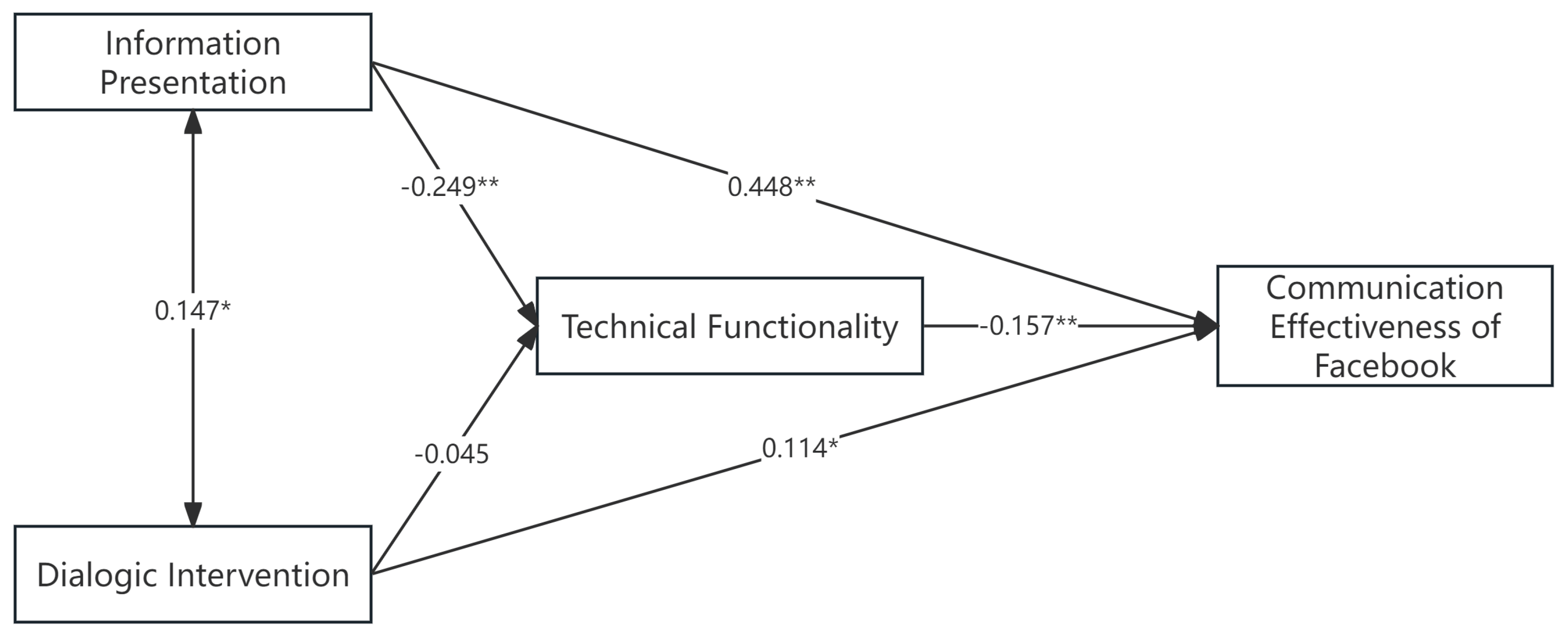
Finally, to examine the mediating role of technical functionality, a structural equation model was established with information presentation and dialogue intervention as independent variables, technical functionality as the mediating variable, and communication effectiveness of Facebook as the dependent variable. The model fit results show that the chi-square to degrees of freedom ratio is less than 3, and the RMSEA value is less than 0.08, indicating that the modified model fits the requirements; the values of GFI, CFI, NFI, AGFI, and IFI are all greater than 0.9, indicating good model fit (see in
Table 7).
To further explore the mechanism of influence of technical functionality, we calculate the total effect and its components of information presentation and dialogue intervention on communication effectiveness of Facebook based on the final structural equation model diagram, as shown in
Table 8. The results show that: the direct effect of information presentation on communication effectiveness of Facebook is 1.993, with an indirect effect of 0.174 through technical functions; the direct effect of dialogue intervention on communication effectiveness of Facebook is 0.340, with no indirect effect through technical functions. Therefore, the structural model as shown in
Figure 3) was modified.
Table 9 provides a comprehensive summary of the validation status of the hypotheses presented in this study.
5. Discussion
In recent years, a number of countries and entities have adopted the use of social media as a means of addressing potential risks and the dissemination of their content [
6]. What factors contribute to the communication effectiveness of Facebook, and what role does its technical functionality play? We, from the perspective of relationship management, selected Facebook and analysed reports related to the Coronavirus Disease 2019 COVID-19 by six Chinese external communication media outlets — CGTN, China Daily, People’s Daily China, CCTV, China News, and Global Times—during the Winter Olympics. The study examined the influence of information presentation (describing risk scientifically, passing risk information and enhancing risk alertness) and dialogue intervention (dialogue expansion, dialogue contraction) on communication effectiveness of Facebook. Additionally, it assessed the mediating role of technical functions (audio-visual information, hyperlink) and presented an analysis of the development landscape of China’s external communication by its communication media in the context of the COVID-19 pandemic.
With regard to the information presentation, all aspects – describing risk scientifically, passing risk information and enhancing risk alertness – had a markedly positive impact on communication effectiveness of Facebook, which is consistent with previous studies [
21,
33]. This indicates that users on international social platforms are attuned to risk perception. Consequently, Chinese media outlets should be transparent about the extent of public concern regarding risks in terms of severity and probability of occurrence to mitigate uncertainties in the public’s life and work. The deployment of warning and prevention posts has been demonstrated to enhance communication effectiveness. In the context of risk perception, the public’s primary recourse in acquiring information pertaining to potential hazards is through media warnings [
34]. Concurrently, the warning information disseminated by the six communication media represents the Chinese government’s risk assessment, which is both precise and authoritative, and has been widely noticed by the international community.
At the level of dialogue intervention, the evidence suggests that the dissemination of information citing reliable sources is more effective. The use of authentic sources not only enhances the reliability and credibility of the content [
34], but also provides a conduit for international users to engage in a certain degree of dialogue, thereby indirectly enhancing their autonomy and facilitating a more nuanced understanding of the content. Nevertheless, research on dialogue contraction is still in its infancy and may inadvertently lead users to perceive information as unduly subjective or biased. This could potentially erode their trust and acceptance of the information, thereby undermining their sense of participation and willingness to interact.
The moderating effect of hyperlinks on information presentation is not statistically significant. The objective of information presentation is to ensure the accuracy and scientific rigour of the information in question. While hyperlinks can facilitate access to additional reference materials or background information, their direct impact on information presentation is minimal. In the context of dialogue intervention, however, hyperlinks play a significant positive moderating role [
27]. The fundamental tenets of dialogue intervention are interactivity and opinion guidance. The objective is to influence the audience’s views and attitudes through communication and discussion. Hyperlinks can direct users to additional information or third-party viewpoints, thus facilitating more in-depth engagement and comprehension. The utilisation of hyperlinks serves to enhance the outcomes of dialogue intervention.
The role of technical functionality in information presentation is of particular significance. The utilisation of video functionality can facilitate the vivid and intuitive display of information content through the utilisation of multiple sensory stimuli, namely vision and hearing. This approach can assist the audience in comprehending complex information more effectively. The study of hyperlinks is consistent with the findings of Gallant [
27], but differs from the perspective of Honey [
28].Hyperlinks enables users to access supplementary materials, thereby expanding the contextual framework of the information and providing a more comprehensive background foundation. The aforementioned technical functions serve to enrich and diversify the presentation of information, thereby enhancing its communication effectiveness.
In contrast, the mediating role of technical functions in dialogue intervention is relatively limited. The essence of dialogue intervention is rooted in textual communication and logical reasoning. The dissemination of interactive and immediate content may not be heavily reliant on complex technical functions to enhance its effects, resulting in a reduced dependence on technical functions to achieve its impact on communication effectiveness.
The findings of this study diverge considerably from those of previous research, indicating that the technical functions of have a detrimental impact on the presentation of information, dialogue intervention, and communication effectiveness. This suggests that the use of audio-visual information and hyperlinks on Facebook may not be conducive to enhancing communication effectiveness. It can be hypothesised that Chinese communication media merely transfer videos published in traditional media and hyperlinks from other media to Facebook without refining and processing the information on the social media main interface. This results in the content quality not meeting user expectations.
We subsequently divided the videos into two categories: Moving videos (45%) and non-moving videos (55%). The results of the variance homogeneity test (Sig = 0.537 > 0.05) indicated that there was no significant difference in the variances between the two samples. The data with equal variances were selected as the result in
Table 10, and the significance level was indicated by Sig=0.002<0.05, which demonstrated a significant difference at the 0.01 level between the video content, which was either moving or npn-moving, and communication effectiveness. A comparison of the means revealed that the communication effectiveness of moving videos was lower than that of non-moving videos, thus further indicating that the moving of videos from traditional media would result in audience aversion. This is the negative effect brought about by technical functionality. As studies posited, it is essential to consider a multitude of factors, including context and motivation, in a comprehensive and continuous manner in order to refine the content of the main posts and thereby attract user attention.
As previously stated, the mention@ function, a distinctive feature of Facebook, is conducive to attracting a larger number of users to participate in discussions and rapidly enhancing the communication effectiveness of Facebook. However, Chinese communication media on Facebook has only one main post, @WHO and @DrTedros, and rarely interacts with domestic or foreign individual accounts. This results in a tendency towards isolation and conservatism in their international media postings. Despite the observation by some scholars that mass @mention does not necessarily facilitate the dissemination of message content, the strategic deployment of @mention can effectively attract relevant interactions and enhance the communication effectiveness of Facebook. The Chinese media sector will need to address the question of how to use the @mention function and which users to @mention in order to optimise the use of international social platforms in the future.
The present study is subject to the following limitations: Firstly, it should be noted that the data presented in this study only covers the period from 28 January to 20 February, when the Winter Olympics concluded. However, as this event took place three years ago, it has significant particularities and shows signs of being dated. We hope to identify events with similar attributes in the future for comparative analysis, so as to better enrich the outcomes of our research. Consequently, it does not encompass the entirety of communication conducted by Chinese communication media prior to the Winter Olympics. The results of this study can only be used as a reference for the phased results of communication effectiveness of Facebook. Secondly, this study, which was based on relationship management theory, only discussed two important factors: information presentation and dialogue intervention. It focused on the role of technical functions but did not consider factors in a comprehensive manner. It also neglected factors such as the number of followers, fan composition, and responding to user feedback. Thirdly, this study was only applied to Facebook. It is yet to be determined whether the research results have special rules and are applicable to other platforms, such as Twitter. Additionally, the coding in this study is based primarily on objective data from the main posts. Subsequent studies would benefit from a more comprehensive approach.
Author Contributions
Conceptualization, L.W. Zhang; Methodology, L.W. Zhang and K.K. Shang; Formal Analysis, L.W. Zhang; Data Curation, L.W. Zhang; Writing—Original Draft Preparation, L.W. Zhang and K.K. Shang; Writing—Review and Editing, K.K. Shang and Y.X. Zhou; Supervision, K. K. Shang and Y.X. Zhou; Funding Acquisition, K.K. Shang. All authors have read and agreed to the published version of the manuscript.
Funding
This research was supported by funding of Social Sciences Fund of Jiangsu Province (24XWB004), Ke-ke Shang is supported by Jiangsu Qing Lan Project.
Data Availability Statement
The original contributions presented in this study are included in the article. For more detailed data, please refer to our public GitHub repository at
https://github.com/wordbomb/fb-covid-beijing2022. If you have further inquiries, you can direct them to the corresponding authors.
Acknowledgments
The author would like to express sincere gratitude to Nirmalya Thakur for organizing this special issue on information. Special thanks are also extended to the reviewers for their insightful comments, which significantly helped refine and focus the paper. Their constructive feedback is greatly appreciated. Additionally, the author wishes to thank the editorial team, including Nirmalya Thakur, Madalina Handrea, Bessie Chen and Madalina Dragan, for their dedication and efforts in bringing this work to fruition.
Conflicts of Interest
The authors declare no conflicts of interest.
Appendix A [
Encoding table of Factors Influencing Communication Effectiveness]
Table A1.
Encoding table of Factors Influencing Communication Effectiveness
Table A1.
Encoding table of Factors Influencing Communication Effectiveness
| Variable Name |
Variable Description |
Encoding |
| Information Presentation |
| Describing Risk Scientifically |
Whether specific numbers are used for analyzing risk |
0: None; 1: Yes |
| Passing Risk Information |
The likelihood of explicit or hidden losses of the subject in a crisis and the magnitude of its losses |
0: None; 1: Yes |
| Enhancing Risk Alertness |
Warning the public about how to avoid potential crises and their negative impacts |
0: None; 1: Yes |
| Dialogic Intervention |
| Dialogic Expansion |
Whether direct or indirect quotations to express its views are used in context |
0: None; 1: Yes |
| Dialogic Contraction |
Whether the content interweaves its own evaluation or influences public opinion, eg."we think COVID-19 was a terrible disaster for humans" |
0: No text, pictures or videos; 1: Text or image or video only; 2: Text image or text video |
| Technical Functionality |
| The Use of Hashtags # |
Whether hashtags # are used in text context |
0: None; 1: Yes |
| The Use of Mention @ |
Whether mention @ are used in text context |
0: None; 1: Yes |
| The Use of Visual Messages |
Whether pictures or videos are used in context |
0: None; 1: Yes |
| The Use of Hyperlinks |
Whether hyperlinks are used in text context |
0: None; 1: Yes |
| Communication Effectiveness of Facebook |
| Communication Effectiveness |
A combination of retweets, comments and likes |
A combination of retweets, comments and likes |
References
- Kanin, D.B. A Political History of the Olympic Games; Routledge: New York, 2019. [Google Scholar]
- Hu, B. Power Discourse,Meaning Export and National Public Relations. Chinese Journal of Journalism & Communication 2008, 05, 14–18. [Google Scholar]
- Verweij, M.; Thompson, M.; et al. Clumsy Solutions for a Complex World: The Case of Climate Change. Public Administration 2006, 84, 817–843. [Google Scholar] [CrossRef]
- Jacobs, R.N.; Sobieraj, S. Narrative and Legitimacy: US Congressional Debates about the Nonprofit Sector. Sociological Theory 2007, 25, 1–25. [Google Scholar] [CrossRef]
- Williams, B.D.; Valero, J.N.; Kim, K. Social Media, Trust, and Disaster: Does Trust in Public and Nonprofit Organizations Explain Social Media Use during a Disaster? Quality & Quantity 2018, 52, 537–550. [Google Scholar]
- Katz, M.; Nandi, N. Social Media and Medical Education in the Context of the COVID-19 Pandemic: Scoping Review. JMIR Medical Education 2021, 7, e25892. [Google Scholar] [CrossRef]
- Thakur, N.; Cui, S.; Khanna, K.; Knieling, V.; Duggal, Y.N.; Shao, M. Investigation of the Gender-Specific Discourse about Online Learning during COVID-19 on Twitter Using Sentiment Analysis, Subjectivity Analysis, and Toxicity Analysis. Computers 2023, 12, 221. [Google Scholar] [CrossRef]
- Daly, P.; Mahdi, S.; Mundir, I.; McCaughey, J.; Amalia, C.S.; Jannah, R.; Horton, B. Social capital and community integration in post-disaster relocation settlements after the 2004 Indian Ocean Tsunami in Indonesia. International Journal of Disaster Risk Reduction 2023, 95, 103861. [Google Scholar] [CrossRef]
- Thakur, N.; Patel, K.A.; Poon, A.; Shah, R.; Azizi, N.; Han, C. A Comprehensive Analysis and Investigation of the Public Discourse on Twitter about Exoskeletons from 2017 to 2023. Journal of Future Internet 2023, 15, 346. [Google Scholar] [CrossRef]
- Messaoudi, C.; Guessoum, Z.; Ben Romdhane, L. Opinion Mining in Online Social Media: A Survey. Social Network Analysis and Mining 2022, 12. [Google Scholar] [CrossRef]
- Thakur, N. Investigating and Analyzing Self-Reporting of Long COVID on Twitter: Findings from Sentiment Analysis. Appl. Syst. Innov. 2023, 6, 92. [Google Scholar] [CrossRef]
- DataReportal. Digital 2023: Global Overview Report. https://datareportal.com/reports/digital-2023-global-overview-report, 2023.
- Han, R.; Tan, X.; Zhang, J. The Opinion Emotional Characteristics and Media Driving Mechanism of China’s Image on International Social Media Platforms. Journal of Nanjing University of Posts and Telecommunications (Social Science Edition) 2023, 25, 10–19. [Google Scholar]
- You, H. Cross-platform Comparative Study of Social Media Mention to Scholarly Papers: A Study of Facebook and Twitter. Information Studies: Theory & Application 2022, 45, 187–194. [Google Scholar]
- Ledingham, J.A.; Bruning, S.D. Relationship management in public relations: dimensions of an organization-public relationship. Public Relations Review 1998, 24, 55–65. [Google Scholar] [CrossRef]
- Ledingham, J.A.; Bruning, S.D. Public Relations as Relationship Management; Lawrence Erlbaum Associates, 2001; pp. 7–68.
- Stewart, M.C.; Wilson, B.G. The dynamic role of social media during Hurricane #Sandy: An introduction of the STREMII model to weather the storm of the crisis lifecycle. Computers in Human Behavior 2016, 54, 639–646. [Google Scholar]
- Finau, G.; Cox, J.; Tarai, J.; Kant, R.; Varea, R.; Titifanue, J. Social media and disaster communication: A case study of Cyclone Winston. Pacific Journalism Review: Te Koakoa 2018, 24, 123–137. [Google Scholar] [CrossRef]
- Engdahl, E.; Lidskog, R. Risk, communication and trust: Towards an emotional understanding of trust. Public understanding of science 2014, 23, 703–717. [Google Scholar] [CrossRef]
- Kwon, K.H.; Shao, C.; Nah, S. Localized social media and civic life: Motivations, trust, and civic participation in local community contexts. Journal of Information Technology & Politics 2020, 18, 55–69. [Google Scholar]
- Lee, H.E.; Cho, J. Social Media Use and Well-Being in People with Physical Disabilities: Influence of SNS and Online Community Uses on Social Support, Depression, and Psychological Disposition. Health Communication 2019, 34, 1043–1052. [Google Scholar] [CrossRef]
- Yudarwati, G.A.; Putranto, I.A.; Delmo, K.M. Examining the Indonesian Government’s Social Media Use for Disaster Risk Communication. Asian Journal of Communication 2021, 32, 1–20. [Google Scholar] [CrossRef]
- Kavada, A. Social Media as Conversation: A Manifesto. Media and Society 2015, 1, 205630511558079. [Google Scholar] [CrossRef]
- Sutton, J.; et al. A Cross-hazard Analysis of Terse Message Retransmission on Twitter. Proceedings of the National Academy of Sciences of the United States of America 2015, 48, 14793–14798. [Google Scholar] [CrossRef] [PubMed]
- Bhalerao, A.A.; Naiknaware, B.R.; Manza, R.R.; Bagal, V.; Bawiskar, S.K. Social Media Mining Using Machine Learning Techniques as a Survey. In Proceedings of the Advances in Computer Science Research. Atlantis Press International BV; 2023; pp. 874–889. [Google Scholar]
- Boyd, D.; Golder, S.; Lotan, G. Tweet, tweet, retweet: Conversational aspects of retweeting on Twitter. In Proceedings of the 43rd Hawaii International Conference on System Sciences. IEEE; 2010; pp. 1–10. [Google Scholar]
- Gallant, L.M.; Lrizarry, C.; Boone, G.; et al. Promoting Participatory Medicine with Social Media: New Media Applications on Hospital Websites that Enhance Health Education and E-patients’ Voices. Journal of Participatory Medicine 2011, 3, 49. [Google Scholar]
- Honey, C.; Herring, S.C. Beyond microblogging: Conversation and collaboration via Twitter. In Proceedings of the 42nd Hawaii International Conference on System Sciences. IEEE; 2009; pp. 1–10. [Google Scholar]
- Hair, J.F.; Hult, G.T.M.; Ringle, C.M.; Sarstedt, M.; Danks, N.P.; Ray, S., An Introduction to Structural Equation Modeling. In Partial Least Squares Structural Equation Modeling (PLS-SEM) Using R: A Workbook; Springer International Publishing, 2021; pp. 1–29.
- Meng, S.; Shang, J.; Zhang, F.; Yang, F.; Liu, M. Research on the Impact of COVID - 19 Science Information Dissemination on Social Media and the Factors Influencing the Choice of Crisis Coping Strategies: An Empirical Analysis Based on Popular Micro - Blog Texts of Scientists’ Groups. Library and Information Service 2022, 66, 91–101. [Google Scholar]
- Kim, C.; Yang, S.U. Like, comment, and share on Facebook: How each behavior differs from the other. Public Relations Review 2017, 43, 441–449. [Google Scholar] [CrossRef]
- Orellana-Rodriguez, C.; Keane, M.T. Attention to news and its dissemination on Twitter: A survey. Computer Science Review 2018, 29, 74–94. [Google Scholar] [CrossRef]
- Hills, T.T. The dark side of information proliferation. Perspectives on Psychological Science 2019, 14, 323–330. [Google Scholar] [CrossRef]
- Malecki, K.M.C.; Keating, J.A.; Safdar, N. Crisis Communication and Public Perception of COVID-19 Risk in the Era of Social Media. Clinical Infectious Diseases 2020, 72, 697–702. [Google Scholar] [CrossRef]
|
Disclaimer/Publisher’s Note: The statements, opinions and data contained in all publications are solely those of the individual author(s) and contributor(s) and not of MDPI and/or the editor(s). MDPI and/or the editor(s) disclaim responsibility for any injury to people or property resulting from any ideas, methods, instructions or products referred to in the content. |
© 2025 by the authors. Licensee MDPI, Basel, Switzerland. This article is an open access article distributed under the terms and conditions of the Creative Commons Attribution (CC BY) license (http://creativecommons.org/licenses/by/4.0/).