
Submitted:
28 February 2025
Posted:
28 February 2025
You are already at the latest version
Abstract
Ship wake detection plays a crucial role in compensating for target detection failures caused by defocusing or displacement in SAR images due to vessel motion. This study addresses the challenge of enhancing wake features in high-resolution spaceborne SAR by exploiting the distinct linear characteristics of wake echoes and the random motion of ocean background clutter. We propose a novel method based on sub-aperture image sequences, which integrates equivalent multi-channel technology to fuse wake and wave information. This approach significantly improves the quality of raw wake images by enhancing linear features and suppressing background noise. The Radon transform is then applied to evaluate the enhanced wake images. Through a combination of principle analysis, enhancement processing, and both subjective and objective evaluations, we conducted experiments using real data from AS01 SAR satellite and compared our method with traditional wake enhancement techniques. The results demonstrate that our method achieves significant wake enhancement and improves the recognition of detail wake features.
Keywords:
high-resolution spaceborne SAR
; sliding spotlight
; wake enhancement
; Radon transform
1. Introduction
Synthetic Aperture Radar (SAR) offers all-weather, day-and-night monitoring capabilities for large oceanic areas, enabling active imaging of critical maritime zones. These features make SAR a vital remote sensing tool for marine target surveillance [1]. There are two approaches for detecting maritime vessels using spaceborne SAR: one is detecting the vessels themselves, and the other is detecting their wakes [2]. The detection and classification of maritime vessel targets have been a global research priority. However, in high sea states, amplified ocean background noise and vessel motion complexity often cause defocusing or positional displacement in SAR images, leading to target detection failures. Due to the wide coverage, distinct features, and prolonged duration of vessel wakes, wake-based target detection offers advantages over direct detection of vessel targets in images, particularly in the discovery of weak targets and acquisition of vessel motion information, thus holding broader application value for maritime security monitoring. The wakes generated by vessel motion on the sea surface typically exhibit distinct geometric characteristics, manifesting various phenomena such as turbulent wakes, Kelvin wakes, and internal wave wakes [3]. For instance, by obtaining the width and direction of turbulent wakes, one can infer the vessel’s width and heading; estimating the wavelength and propagation direction of Kelvin wakes can provide insights into the vessel’s speed and heading, while internal wave wakes also contain characteristic parameters of maritime or subsea moving targets. In certain scenarios, vessel wakes can assist in detecting weak maritime or subsea targets that are difficult to detect in images [4]. The integration and information fusion of vessel and wake detection targets can effectively enhance the reliability and efficiency of spaceborne SAR in maritime surveillance, holding significant importance for maritime safety and ocean environmental protection.
Research on ship wake detection is primarily based on traditional methods, which mainly rely on the image characteristics of wakes and transform the problem into a line feature detection issue under speckle noise. Such methods typically require denoising of the original SAR image, followed by detection of lines using Radon or Hough transforms to obtain wake information. Numerous improved algorithms have emerged to enhance the accuracy of wake detection. Rey et al. combined high-pass filtering with Radon transforms to detect wakes in SEASET images, achieving favorable results [5]. Yang et al. utilized relative total variation techniques to decompose and reconstruct images, detecting wake images using Radon transforms, which can be applied to ship wake detection in complex background SAR images [6]. Biondi et al. investigated ship wake detection by preprocessing original SAR images with low-rank sparse decomposition and using local Radon transforms [7]; Karaku et al. reconstructed wakes in the Radon domain using MAP estimation and GMC sparse regularization to overcome various interferences in SAR images [8]. In recent years, with the rapid development of artificial intelligence technology, methods based on deep learning have gradually been applied to wake detection. Utilizing deep learning algorithms such as YOLO5, wake samples from SAR images are learned and trained automatically to extract features, enabling automatic detection and tracking of ship wakes. Radon transforms are then used for analyzing and extracting ship motion information, and validation with real SAR wake data has shown improvements in wake detection [9,10]. However, deep learning methods face challenges such as insufficient SAR wake samples and noise interference during the process of extracting motion information, particularly in the selection and extraction of peak points in the transformed domain [11]. Despite these advancements, existing methods remain limited by insufficient suppression of sea clutter and dependency on post-imaging processing. Our work addresses these gaps by integrating wake enhancement directly into the SAR imaging pipeline, leveraging sub-aperture sequences to achieve real-time noise reduction.
In principle, the accuracy of wake detection in the aforementioned methods is constrained by the sea surface background noise in SAR images and the linear feature intensity of wakes. Therefore, various preprocessing techniques such as filtering, segmentation, and signal separation are necessary for original SAR images to reduce background noise and enhance the linear feature of wakes, thereby increasing peak intensity in the transformed domain and improving wake detection effectiveness. Spaceborne SAR imaging involves the process of converting echo signals into images, with focusing processing performed in the azimuth direction using Synthetic Aperture Time. The sea surface, as a random rough surface under marine wind conditions, is theoretically composed of large-scale approximately periodic waves overlaid with small-scale ripples and foam. Hence, in SAR images, the sea surface background presents a complex and dynamically changing random texture. However, unlike point targets such as maritime vessels, the linear features of wakes are generally unaffected by the random motion of sea surface scattering points, which would otherwise result in a decrease in azimuth resolution of image pixels. Particularly, with high-resolution SAR employing sliding spotlight mode, the rotation of azimuth scanning angles brings about richer sea surface imaging information, which plays a crucial role in enhancing wake features during imaging processing.
Therefore, this study primarily focuses on enhancing wake processing in high-resolution spaceborne SAR, leveraging the differences in the linear characteristics of wake echoes and the motion characteristics of random ocean background clutter. The research investigates methods for enhancing wake features during imaging processing in sliding spotlight mode, aiming to fundamentally improve the quality of wake images and enhance wake detection performance. Thus, the goal of this study is not to improve traditional wake detection or deep learning algorithms. Based on an analysis of the mechanism and image characteristics of ship wakes in spaceborne SAR, this study proposes a method for enhancing ship wakes based on sub-aperture image sequences, specifically tailored for high-resolution SAR imaging. By employing equivalent multi-channel processing, this method preserves and enhances wake and wave information within sub-aperture images, resulting in clear images with enhanced wake features. Finally, evaluation methods for assessing the effectiveness of ship wake image enhancement are studied and validate that the proposed method can enhance wake detection capabilities, thereby improving the applicability of spaceborne SAR in marine target detection.
2. Enhancement Methods for High-Resolution SAR Ship Wake Processing
2.1. Typical Wake Images in Spaceborne SAR
When maritime vessels move through the ocean, wake ripples are generated on the sea surface due to variations in water density layers, altering the roughness of the ocean surface. The sea surface roughness significantly influences the backscattering characteristics of electromagnetic waves, capturing the micro-dynamic phenomena caused by vessel movement [12]. SAR, as a highly sensitive small-scale wave detector, can measure subtle variations in sea surface roughness, enabling wake detection. Under complex marine conditions, the scattering echoes received by SAR mainly originate from smaller waves with wavelengths close to the transmission wavelength, while larger ocean waves introduce some degree of tilt modulation. Due to the inherent complexity of the sea surface, which is essentially characterized by random and continuous variations, the scattering observed by SAR radar exhibits similar characteristics. Studies have identified various characteristics of ship wakes in SAR images, with these differences being related to radar parameters, imaging angles, ocean conditions, wind speeds, vessel parameters, and motion parameters [13]. Based on the different image characteristics of ship wakes, they can be classified into three categories: surface waves (Kelvin wake or Narrow V-shaped wake), turbulent wakes, and internal wave wakes as follows.
Figure 1.
Typical Ship Wake Image in Spaceborne SAR.
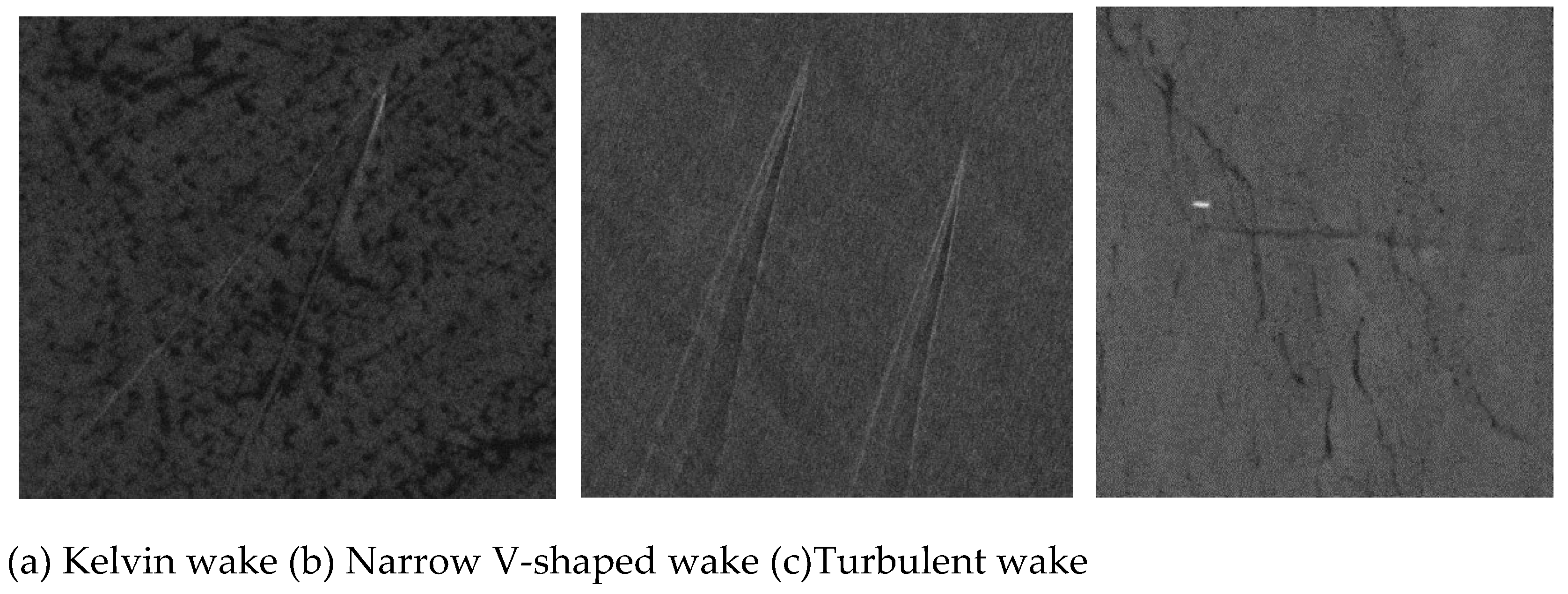
In the above figure, (a) depicts the Kelvin wake phenomenon, characterized by bright line features such as the leftmost bright line, typically located within the range of 16° to 19.5° on both sides of the vessel’s track. (b) shows a typical narrow V-shaped wake of surface waves, also characterized by bright line features, forming bright line features in the wake of the vessel’s movement. Bright lines with an angle of less than 10° from the turbulent wake are usually classified as narrow V-shaped wakes. (c) represents a turbulent wake, characterized by dark line features. In (a) and (b), the vessel target itself is not clearly visible and is almost undetectable. This is because the vessel is in motion along the satellite flight direction, causing changes in the azimuth frequency in SAR imaging processing, leading to defocusing of the target image and a decrease in target echo amplitude [14]. In (c), it can be clearly seen that the radial movement of the vessel causes a change in the Doppler frequency in the imaging processing, resulting in the vessel target image deviating from its actual azimuth coordinate position, but the wake remains in the correct position. Based on the above image analysis, since wakes in SAR images often appear as continuous bright or dark lines of a certain length, using Radon transform can convert the linear features in the image into peaks or valleys in the Radon transform domain, thus transforming the linear wake detection problem in SAR images into a peak/valley extraction problem.
2.2. High-Resolution Spaceborne SAR Wake Imaging
As a typical model of random rough surface scattering, ocean waves exhibit dynamic characteristics due to their complex motion. In SAR imaging, there exists Bragg resonance between the ocean waves and SAR electromagnetic waves. Under moderate incidence angle conditions, certain frequencies of incident electromagnetic waves and waves in the ocean will emit coherent superimposed enhanced echoes, forming Bragg resonance. Therefore, the actual wake structure obtained in imaging exhibits complex phenomena and is influenced by various factors such as ocean environmental parameters, vessel motion parameters or radar parameters, and imaging processing algorithms.
High-resolution spaceborne SAR adopts sliding spotlight mode for imaging. In the sliding spotlight mode, the antenna does not point to a fixed area within the illuminated scene but instead points to a virtual rotation center below the illuminated plane (Rotation Center). The ground projection of the antenna beam essentially slides along the direction of satellite flight within the illuminated scene, as illustrated in the figure below. Therefore, the synthetic aperture time of sliding spotlight SAR is relatively long, reaching the order of seconds or even tens of seconds. This prolonged synthetic aperture time in sliding spotlight mode allows for the collection of more comprehensive information, especially regarding moving targets such as ships and their wakes, resulting in improved imaging quality and wake detection capabilities.
Figure 2.
Sliding Spotlight SAR Imaging.
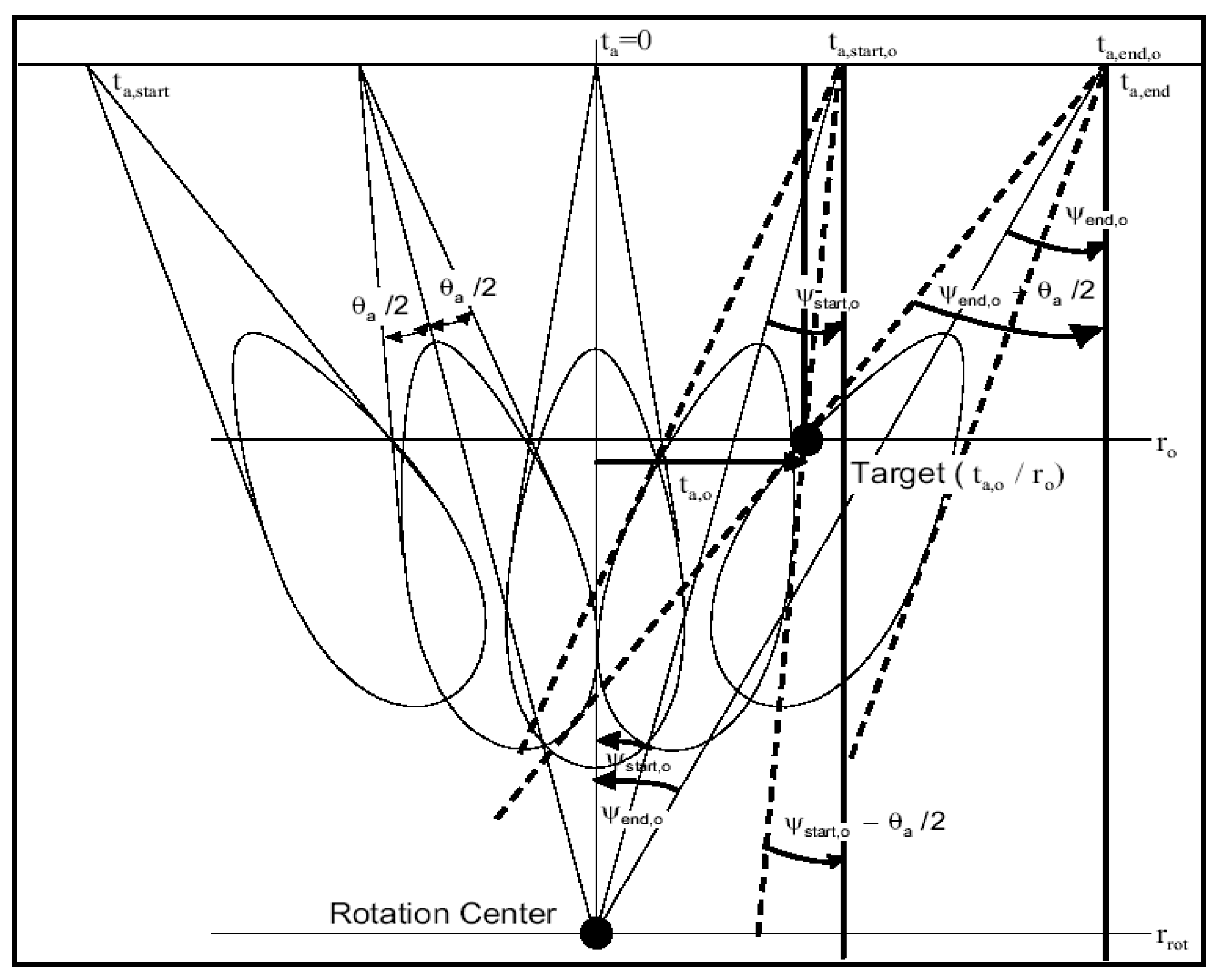
According to the spatial geometry model of spaceborne SAR, the SAR imaging processing can be viewed as a two-dimensional correlation processing to extract the target area’s scattering coefficient using the acquired echo data, which includes range compensation processing and azimuth compensation processing:
1. Range Compensation Processing: This is a one-dimensional shift-invariant process with a known correlation kernel. It compensates for the effects of range migration and focuses the radar signal in the range direction.
2. Azimuth Compensation Processing: Due to the presence of range migration, azimuth compensation processing involves a two-dimensional time-variant correlation process. It compensates for the effects of Doppler shifts caused by the relative motion between the radar platform and the target scene.
Linear chirp scaling and other imaging algorithms are commonly used in SAR processing. After range compression and compensation for various azimuth error factors, the echo signals in the SAR image’s Range-Doppler domain are obtained. Typically, matched filtering is used for azimuth focusing processing. After azimuth Fourier inverse transformation, ignoring the complex constant, the original SAR image is obtained.
In the equations:
- represents the backscattering coefficient of the sea surface, which varies with the azimuthal imaging angle.
- represents the envelope after azimuth antenna transformation.
- represents the envelope after linear frequency modulation compression processing in the range direction.
- represents the effective slant angle.
- represents the reference effective slant angle.
- represents the slant range at the moment of beam center when using the equivalent slant range model.
- represents the azimuth frequency.
- represents the effective velocity.
In the imaging process of high-resolution spaceborne SAR, sliding spotlight mode is commonly employed, where the radar antenna scans in the opposite direction of the flight path, continuously approaching a virtual rotation point. Taking the example with 0.5 meter resolution, the synthetic aperture time reaches 4 seconds, and the antenna rotation angle in the azimuth direction exceeds 3°, causing variations in the sea surface backscattering coefficient of over 2 dB [15]. Therefore, under such conditions, the sea surface backscattering coefficient influenced by antenna direction and surface fluctuations exhibits certain temporal variations. In this scenario, the anisotropic scattering behavior of the sea surface background due to random motion results in the phenomenon of random noise in the sea surface background. The unique motion of scattering points caused by wake formation leads to azimuthal pixel movement and decreased resolution. Consequently, in high-resolution SAR ocean images with long synthetic aperture times, the wave texture appears blurred, and the signal-to-noise ratio is relatively low [16]. The movement of wave texture on the sea surface primarily involves the propagation of wave phase and energy. However, the water body itself undergoes simple reciprocating motion and does not propagate with the waves. Therefore, features such as narrow V-shaped wakes and turbulent wakes formed by vessels remain stable in position and persist for a longer duration in the image, unaffected by various motions’ effects on imaging offsets. Thus, from a fundamental perspective of high-resolution spaceborne SAR imaging, processing of raw echo data with different imaging times and azimuth angles can enhance the typical characteristics of wakes.
2.3. Ship Wake Enhancement Method Based on Equivalent Sequence Images
Many scholars at home and abroad have studied the method of dividing the single-channel azimuth into sub-apertures to effectively obtain signals in the Range-Doppler domain for two or more channels. They utilize multi-channel techniques such as Adaptive Time Integration (ATI), Displaced Phase Center Antenna (DPCA), and Space-Time Adaptive Processing (STAP) to suppress stationary clutter and detect moving targets [17]. Inspired by the enhancement and detection methods for stable point targets in single-channel multi-apertures, a ship wake enhancement method based on Overlap Sub-Aperture Magnitude Images (OSMI) in the azimuth overlap sub-aperture amplitude image sequence is proposed. This method enhances the linear features of wakes in the imaging process to obtain high-quality original images, laying the foundation for subsequent wake detection applications. The following figure depicts the flowchart of the wake enhancement algorithm.
The proposed method begins with inputting a single-look complex (SLC) image, which is then sliced to generate a sequence of sub-aperture images. Next, these sub-aperture images undergo standard deviation and mean equalization processing to ensure that the grayscale values of the equalized images have the same standard deviation and variance. Then, the equalized images are subjected to median filtering to remove noise. Finally, the wake-enhanced image is outputted.
According to Equation (1), during the synthetic aperture time in SAR imaging, ground targets are continuously illuminated, and the azimuth signal exhibits linear frequency modulation characteristics. Therefore, using the correspondence between the azimuth signal spectrum and the azimuth angle, sub-aperture slicing can be achieved in the azimuth frequency domain. By separately imaging each sub-aperture data, equivalent time series images can be obtained. Let the azimuth signal bandwidth be , and the number of sequence images be . Hence, each sub-image has a bandwidth of in the azimuth direction to obtain overlapping sub-images and maintain a certain bandwidth overlap for each sub-aperture image. After slicing the echo signal in the Range-Doppler domain, and performing azimuth inverse Fourier transform, time-series sub-aperture SAR images are obtained.
Before enhancing the linear features, it is necessary to standardize and equalize the sub-sequence images. This is achieved by intensity normalization to achieve relative histogram equalization. Due to the scattering characteristics of the sea surface, the grayscale values of pixels on the sea surface are correlated with the azimuth imaging angle, requiring the elimination of intensity differences caused by antenna pointing and directional patterns. Firstly, the histogram distribution of all sub-sequence images is calculated, and the mean and standard deviation of each image are computed. Histogram intensity normalization is then applied to each image in the OSMI, equalizing the grayscale values based on the mean and standard deviation, ensuring uniformity in terms of standard values and variance across all sub-images. The specific calculation method is as follows:
After adjusting the grayscale values of the -th OSMI image, denoted as , the mean and standard deviation of each transformed image are calculated as follows:
Here, and are the original mean and standard deviation of the image.
The grayscale values of pixels in the sea surface background images change slowly with azimuth imaging angle and imaging time sequence. By normalizing the histogram, the time series curves of each pixel can be obtained. Filtering in this three-dimensional direction can yield sea surface background images and eliminate strong reflection values caused by significant changes in moving ship targets. In practice, the sub-sequence images are converted to dB units, and then median filtering is applied to the OSMI images using the logarithmic operator. The specific formula is as follows [18]:
Here, represents the output result image after enhancement, and the image is represented in dB during the calculation process.
2.4. Evaluation Method for Enhanced Ship Wake Detection Processing
The Radon transform and its various improved algorithms have long been significant methods for detecting ship wakes in spaceborne SAR, receiving extensive attention from scholars worldwide. The detection methods for SAR wakes can be summarized as identifying wakes based on the energy difference between wake targets and sea surface backgrounds. Therefore, this paper evaluates the effectiveness of wake enhancement processing using the Radon algorithm, comparing the changes in wake linear features in the Radon transform domain before and after enhancement to verify the effectiveness of the enhancement algorithm.
The Radon transform is an integral transform that projects the image in space, mapping all pixels in the same direction to the Radon transform domain. The definition of the two-dimensional Radon transform on the plane is as follows [5]:
Here,represents the entire image plane range,is the mask, represents the grayscale value of each pixel, is the Dirac function, is the intercept from the origin to the line, and is the angle between the normal direction of the line and the -axis.
In SAR images, various wakes have grayscale values that differ from the background. The linear features in the original image appear as points in the transform domain. This processing result transforms narrow V wakes and Kelvin wakes in the original image into bright points, while darker turbulent wakes become dark points. Thus, the wake detection problem in SAR images is transformed into the detection of peak/valley points in the transform domain, simplifying the processing process and improving detection accuracy.
For peak detection in wake detection, the search area is typically limited, and a reasonable interval is selected based on the wake direction. A sliding window approach is used, with window size determined by the size of the original image. Setting the window size too small introduces false peak points, while setting it too large may miss true wake peak points. The difference between the detected pixel and the mean of all pixels in each window in the Radon transform domain is calculated, and a threshold is used to determine whether it is a peak value. The threshold can be set to twice the image variance. By traversing the entire image, all peak sequences are obtained, and the corresponding , and representing distance, angle, and peak amplitude. By analyzing the differences in the Radon transform domain before and after enhancement, the effectiveness of the wake enhancement algorithm can be quantitatively assessed, demonstrating its ability to improve the detection of ship wakes in high-resolution spaceborne SAR images.
3. AS01 SAR Satellite Data Experiment and Analysis
3.1. AS01 SAR Satellite Data Processing Experiment
This experiment uses ocean scene images from the AS01 SAR satellite, acquired on February 16, 2024, using the sliding spotlight imaging mode. The AS01 SAR satellite, launched by Skysight Technology Co., Ltd. in July 2023, is equipped with a lightweight X-band two-dimensional phased array SAR payload, and with a maximum resolution of 0.5 meters. According to the product metadata, the range signal bandwidth is 600 MHz, with an incidence angle of 30.57°, and the ground spatial resolution is 0.5 meters. The full-aperture SAR image processing utilizes an azimuth signal bandwidth of 15333 Hz, with the antenna beam rotating 3° in the azimuth direction, resulting in an azimuth resolution of 0.31 meters. SLC data is used as input, and the frequency spectrum is segmented to generate sub-aperture image sequences. The Figure 3 below shows the sub-aperture images, with the horizontal axis representing the range direction and the vertical axis representing the azimuth direction. Since the ship is moving along the azimuth direction, no image displacement of the ship target is observed.
In the provided images, Figure 4(a) represents the original full-resolution SAR image captured by the satellite, while the other images depict sub-aperture images generated using azimuth domain segmentation. Through azimuth domain segmentation, both targets and wakes are imaged sequentially by each sub-aperture, with variations in imaging time and angle. During this timeframe, the motion of the ocean surface results in short correlation times, approximating the ocean surface as noise. However, high correlation still exists for ship targets and large-scale texture features such as ship wakes or large waves.
In the sequence of images, there is a moving ship target, leading to poor imaging effects due to the target’s motion, resulting in significant azimuth defocusing in the full-resolution image. Additionally, the motion of the target on the ocean surface generates wake phenomena, visible as relatively bright wake features in the image. However, coherent speckle noise affects the clarity of the wakes in the image. A comparison of the sub-aperture images reveals significant differences in the ship target itself and ocean wakes at different times and azimuth angles. Despite these differences, the linear wake features in the images are generally preserved.
To enhance the clarity of the wakes and mitigate the effects of noise, the proposed high-resolution SAR wake enhancement algorithm employs histogram intensity normalization to preprocess the image sequence. This step eliminates differences in pixel grayscale values caused by variations in antenna orientation. Subsequently, filtering is applied along the pixel time sequence to reduce random errors, resulting in the enhanced image shown below.
In Figure 5, (a) and (b) respectively represent the original SAR wake image and the result image after equivalent sequence enhancement processing. The horizontal axis represents the range direction, while the vertical axis represents the azimuth direction. Figure 5(c) and (d) depict the corresponding statistical histograms, where the horizontal axis represents grayscale distribution in dB, and the vertical axis represents the histogram statistics for each grayscale.
In (a), coherent noise is evident, and the features of the ship wake are not continuous. Speckle noise and strong reflections caused by complex sea conditions disrupt the wake image, with some areas being obscured by wave noise. Through the enhancement method, the ship’s wake becomes clearly visible. The bright streak persists consistently and has a relatively large contrast with the background. Additionally, some wave features are also clearly visible in the image, and further processing can reveal the distribution of ocean currents. The reduction in noise is evident from the statistical histogram, where the distribution in the enhanced image is more concentrated compared to the original image, demonstrating the effectiveness of the enhancement method. The enhanced image demonstrates clearer wake features and reduced noise, highlighting the effectiveness of the proposed SAR wake enhancement algorithm. This refined image provides improved visibility of ship wakes and enhances the overall utility of SAR imaging in maritime applications.
3.2Performance Evaluation of Enhancement Processing
The evaluation of SAR image enhancement for ship wake can refer to SAR image quality evaluation methods, which are divided into two main categories: subjective evaluation methods and objective evaluation methods. Subjective evaluation is conducted by image interpreters through visual comparison of images before and after processing, based on certain criteria to provide scoring evaluations. The results are heavily influenced by the interpreters’ knowledge and work experience, and usually involve a comprehensive evaluation of scores from multiple interpreters to improve objectivity. Objective evaluation requires establishing parameter indicators for judgment. In this section, the quality of SAR marine images containing ship wakes and sea surface textures is evaluated using grayscale statistical characteristics and information content before and after processing, with evaluations based on equivalent number and information entropy indicators. These information-based image quality indicators are theoretically robust and generally aligned with the visual effects of subjective evaluations. The equivalent number measures the relative intensity of speckle noise in SAR images. It quantifies the image’s ability to identify different backscatter feature regions; a higher equivalent number indicates weaker speckle noise. Information entropy is a measure of uncertainty in random variables or processes, used to evaluate the focusing quality of SAR images. Better focusing results in clearer images, leading to a reduction in image entropy [19]. Based on the image processing results and the objective evaluation results in the Table 1, it can be concluded that the tail enhancement processing results based on OSMI images clearly reveal the ship’s wake. Even small wakes in the upper left part and wave textures in the lower right part can be clearly observed. Additionally, the decrease in information entropy after enhancement indicates an improvement in image focus, with effective details being better reflected, and the features of the wake in the image becoming more prominent. The decrease in equivalent number of looks indicates effective suppression of random speckle noise in the ocean background, which is consistent with the actual visual effect of the image.
Meanwhile, the evaluation method for ship wake enhancement processing based on Radon transform involves detecting the SAR wake image using Radon transform, detecting peaks/valleys in the transformed domain, and comparing the intensity of wake characteristics in the evaluated image to assess the effectiveness of the ship wake enhancement algorithm. Theoretically, the better the wake enhancement processing, the stronger the linear characteristics of the wakes in the image, leading to larger peaks in the corresponding transform space. For the evaluation of ship wake enhancement processing in the pre- and post-processed wake image data in Figure 6, a rectangular mask is used to cover bright spots caused by non-wakes, which may adversely affect the results of the Radon transform-based algorithm. The mask frame is a rectangle centered on the ship, with its size set in the azimuth direction as , is determined based on the expected maximum azimuth offset due to relative motion[20]. To facilitate the display of the Radon transform domain’s effect, the image is rotated by 90° so that the direction of the wakes in the image becomes horizontal. Consequently, the angles corresponding to the wake features in the Radon transform are centered near the middle of the angle axis. In the application of ship wake detection, due to the presence of speckle noise in SAR images, it is usually necessary to use preprocessing methods such as filtering to preprocess the original image, and then carry out relevant transformations and detection processing. In this paper, median filtering is also used to enhance the image wake. The results are shown below.
According to Figure 6, in the original spaceborne SAR image, there is a wake phenomenon at the stern of the ship, and the wake direction extends along the azimuth. Therefore, after converting to the Radon transform domain, as shown in Figure 6(a), there are bright peak points appearing in the regions corresponding to 83°-85° and 90°-92°, which are consistent with the actual wake direction. Comparing Figure 6 (a), Figure 6 (b) and Figure 6 (c), the peak points in the radon transform domain of the original wake image are weaker. After median filtering, there was no significant change. However, after the wake enhancement processing based on OSMI images, the focus of peak points in the Radon transform domain is more pronounced. The intensity of peak points in the Radon transform domain was compared, and the results are shown in the following Table 2.
Based on the wake enhancement processing results of OSMI, the evaluation was conducted using the Radon transform. After the enhancement process, the peak intensity in the Radon domain corresponding to the ship wake was improved by approximately 2.6 dB. This enhancement can contribute to improving the reliability and directional accuracy of wake detection. Furthermore, it can be observed that after filtering processing under complex sea conditions, the intensity of the peaks in the Radon transform domain does not show significant changes, which is similar to the visual effect. The reason for this is that the filtering process mainly reduces speckle noise, while its impact on integral processing in a certain direction, such as the Radon transform, is limited. In wake detection processing, especially under conditions of complex sea states or poor wake imaging conditions, it is necessary to perform clustering on the detected local peak points. This clustering process helps obtain a new set of peak points, and the average values of angle and distance in this set are utilized as the corresponding detection results [21]. In practical applications, using this information, the motion parameters such as the speed and heading of the ship can be calculated based on the offset of the target image in the azimuth direction and the angle of the narrow V-shaped wake. Therefore, the test results of wake detection performance based on AS01 SAR data, are consistent with subjective evaluations and image quality assessments, further validating the effectiveness and practicality of this processing method.
4. Conclusions
Due to the unique characteristics of high sea states on global shipping routes and issues such as defocusing in high-resolution SAR imaging of moving targets, monitoring based solely on ship targets themselves is susceptible to interference, making it difficult to detect and identify ship targets. Ship wakes, as a special and relatively stable image phenomenon caused by ship motion, also contain valuable information such as the speed and direction of ship movement, thus serving as a powerful complement to ship target monitoring. To address the challenges posed by the dynamic nature of ship wakes and sea surface textures under complex sea conditions, we propose a ship wake enhancement method based on azimuth overlap sub-aperture amplitude image sequences using high-resolution spaceborne SAR. By performing histogram normalization and multi-sub-aperture image fusion enhancement processing to the OSMI data, we obtain clearer images with enhanced wakes features. Evaluation methods based on image quality and wake detection performance are investigated, and experiments conducted with AS01 SAR data demonstrate the accuracy and reliability of the proposed wake enhancement method. Subsequent application of various wake detection algorithms on the basis of the enhancement in this study will help improve the accuracy of spaceborne SAR wake detection and provide more significant support for typical situational applications such as ship heading and speed estimation. Further research on wake enhancement in complex sea conditions using high-resolution spaceborne SAR requires investigating the coherence of wake characteristics at the mechanism level, optimizing sub-aperture imaging compensation parameters for wakes, and further improving peak intensity in the transform domain to enhance wake detection capabilities and motion parameter retrieval accuracy in practical applications.
Author Contributions
Conceptualization, X.X.; methodology, L.Y. and P.W.; validation, L.Y. and Y.L.; data curation, Y.L.; writing—original draft preparation, L.Y.; writing—review and editing, Y.L.; visualization, L.Y. and X.X.; supervision, X.X.; All authors have read and agreed to the published version of the manuscript.
Funding
This research received no external funding.
Data Availability Statement
Not applicable.
Acknowledgments
The authors would like to thank the editors and anonymous reviewers for providing invaluable and constructive comments and suggestions.
Conflicts of Interest
The authors declare no conflict of interest.
References
- Kazuo, O. Recent Trend and Advance of Synthetic Aperture Radar with Selected Topics. Remote Sens. 2013, 5, 716–807. [Google Scholar] [CrossRef]
- Baumgartner, S.V.; Krieger, G. Simultaneous High-Resolution Wide-Swath SAR Imaging and Ground Moving Target Indication: Processing Approaches and System Concepts. IEEE J. Sel. Top. Appl. Earth Obs. Remote Sens. 2017, 8, 5015–5029. [Google Scholar] [CrossRef]
- Alpers, W. Theory of radar imaging of internal waves. Nature 1985, 314, 245–247. [Google Scholar] [CrossRef]
- Lyden, J.D.; Hammond, R.R.; Lyzenga, D.R.; et al. Synthetic aperture radar imaging of surface ship wakes. J. Geophys. Res. Ocean. 1988, 93. [Google Scholar]
- Rey, M.T.; Tunaley, J.K.; Folinsbee, J.T.; et al. Application Of Radon Transform Techniques To Wake Detection In Seasat-A SAR Images. IEEE Trans. Geosci. Remote Sens. 1990, 28, 553–560. [Google Scholar] [CrossRef]
- Yang, G.Z.; Yu, J.; Sun, W.D. Ship Wake Detection in Complex Background SAR Images Based on Relative Total Variation. J. Univ. Chin. Acad. Sci. 2017, 34, 734–742. [Google Scholar]
- Biondi, F. A Polarimetric Extension of Low-Rank Plus Sparse Decomposition and Radon Transform for Ship Wake Detection in Synthetic Aperture Radar Images. IEEE 2019. [Google Scholar] [CrossRef]
- Karakus, O.; Rizaev, I.; Achim, A. Ship Wake Detection in SAR Images via Sparse Regularization. IEEE Trans. Geosci. Remote Sens. 2020. [Google Scholar] [CrossRef]
- Wang, H.; Nie, D.; Zuo, Y.; Tang, L.; Zhang, M. Nonlinear Ship Wake Detection in SAR Images Based on Electromagnetic Scattering Model and YOLOv5. Remote Sensing. 2022, 14, 5788. [Google Scholar] [CrossRef]
- Zhong, W.T. Ship Wake Detection Based on YOLOv5[D]. Harbin Engineering University, 2023.
- Wang, H. Research on Ship Wake Detection Method Based on Electromagnetic Scattering Simulation of SAR Image[D]. Xi’an: Xidian University, 2022.
- Rui, D. Submerged Objects Detection Based on Brillouin Scattering. Laser Optoelectron. Prog. 2008. [Google Scholar] [CrossRef]
- Plant, W.J.; Keller, W.C. Evidence of Bragg scattering in microwave Doppler spectra of sea return. J. Geophys. Res. Ocean. 1990, 95, 16299–16310. [Google Scholar] [CrossRef]
- Xing, M.; Su, J.; Wang, G.; Bao, Z. New Parameter Estimation and Detection Algorithm for High-Speed Small Target. IEEE Trans. Aerosp. Electron. Syst. 2011, 47, 214–224. [Google Scholar] [CrossRef]
- Uhlir, P. Microwave Remote Sensing, Volume 2: Radar Remote Sensing and Surface Scattering Radiation Theory[M]. Science Press, 1987.
- Wang, A.M. Research on SAR Imaging Simulation of Marine Ship Wake[D]. Institute of Electronics, Chinese Academy of Sciences, 2003.
- Chen, J.; Yang, W.; Wang, P.B.; et al. Research on Multi-Aspect Observation Spaceborne SAR Technology. J. Radar 2020, 9, 16. [Google Scholar]
- Shen, W.; Hong, W.; Han, B.; et al. Moving Target Detection with Modified Logarithm Background Subtraction and Its Application to the GF-3 Spotlight Mode. Remote Sens. 2019, 11, 1190. [Google Scholar] [CrossRef]
- Wang, J.; Liu, X. SAR Minimum-Entropy Autofocus Using an Adaptive-Order Polynomial Model. IEEE Geosci. Remote Sens. Lett. 2006, 3, 512–516. [Google Scholar] [CrossRef]
- Graziano, M.D.; Errico, D.M.; Rufino, G. Ship heading and velocity analysis by wake detection in SAR images. Acta Astronaut. 2016, 72–82. [Google Scholar] [CrossRef]
- Zhao, T.; Wang, S.T.; Niu, L.; et al. Ship Wake Detection Algorithm Based on SAR Image. J. Shanghai Jiaotong Univ. 2020, 54, 1259–1268. [Google Scholar] [CrossRef]
Figure 3.
Flowchart for the Equivalent Sequence Image Wake Enhancement Method.

Figure 4.
Sub-Aperture Image Sequence Generation.
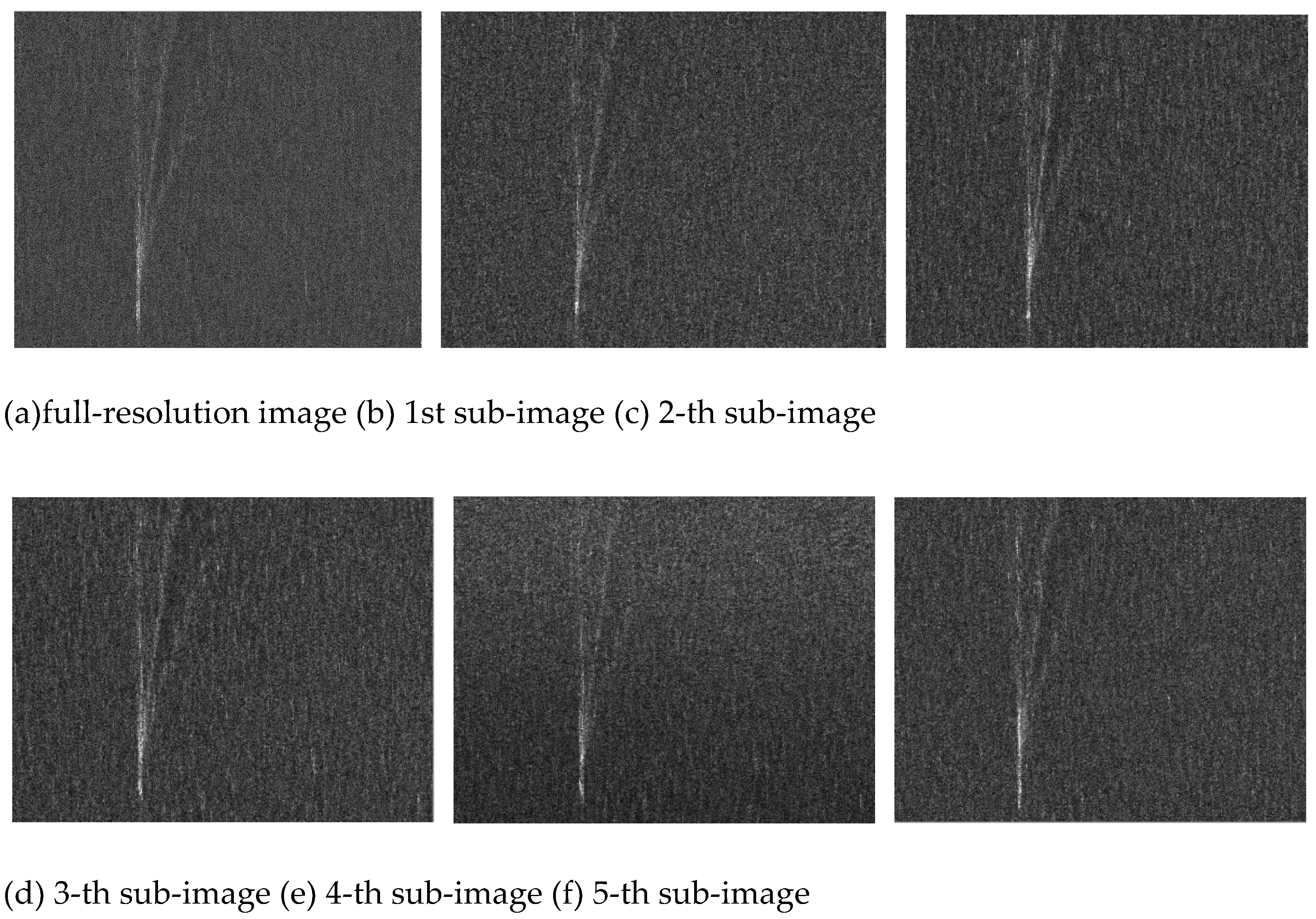
Figure 5.
Comparison of Algorithm Processing Images and Histograms.
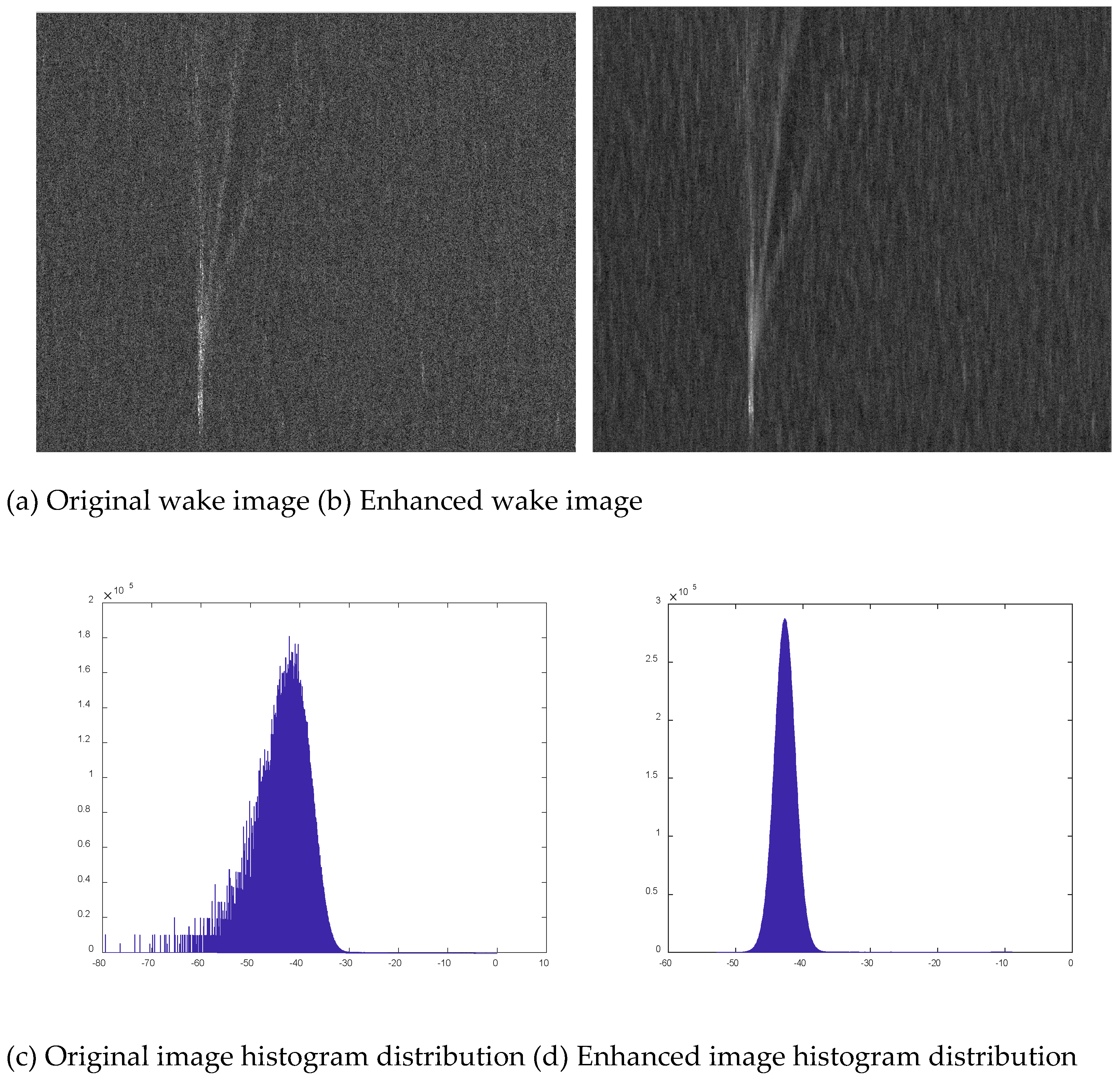
Figure 6.
Comparison of detection performance in Radon transform domain.
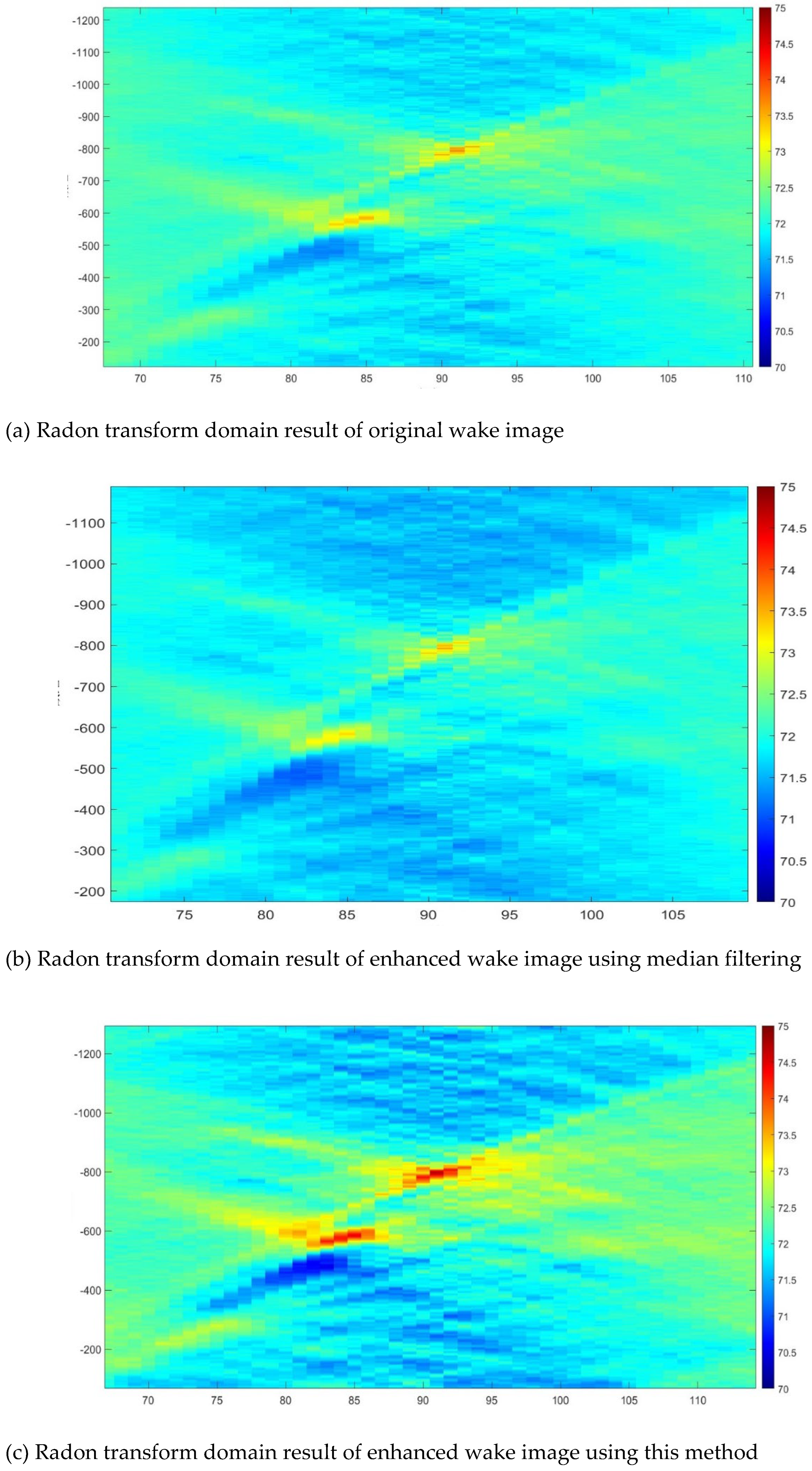

Table 1.
Image quality evaluation results.
| Evaluation Criteria | Original wake image | Enhanced wake image |
| equivalent number | 3.22 | 7.37 |
| Information entropy | 5.21 | 1.71 |
| Visual effect | Dim brightness with unclear wake features Discontinuous wake features |
Improved brightness with clearer wake features Continuous wake features |
Table 2.
Performance evaluation results of wake enhancement.
| Angle Peak point(°) | Intensity of peak point(dB) |
Improvement (dB) |
||
| Left wake | Original image | 85 | 71.83 | / |
| Filtered image | 85 | 71.62 | -0.21 | |
| Enhanced image | 85 | 74.45 | 2.62 | |
| Right wake | Original image | 91 | 71.98 | / |
| Filtered image | 91 | 71.91 | -0.07 | |
| Enhanced image | 91 | 74.68 | 2.70 | |
Disclaimer/Publisher’s Note: The statements, opinions and data contained in all publications are solely those of the individual author(s) and contributor(s) and not of MDPI and/or the editor(s). MDPI and/or the editor(s) disclaim responsibility for any injury to people or property resulting from any ideas, methods, instructions or products referred to in the content. |
© 2025 by the authors. Licensee MDPI, Basel, Switzerland. This article is an open access article distributed under the terms and conditions of the Creative Commons Attribution (CC BY) license (http://creativecommons.org/licenses/by/4.0/).
Copyright: This open access article is published under a Creative Commons CC BY 4.0 license, which permit the free download, distribution, and reuse, provided that the author and preprint are cited in any reuse.


