
Preprint
Article

This version is not peer-reviewed.

Factors, Associated with Mortality in Patients with Chronic Heart Failure

Submitted:

21 February 2025

Posted:

24 February 2025

You are already at the latest version

Abstract

Chronic heart failure (CHF) is one of the leading causes of mortality. Many factors may influence the risk of mortality in patients with CHF. Therefore, predictors of mortality in patients with CHF should be clarified. Aim of the study was to determine predictors of unfavorable prognosis in patients with CHF. Methods. 591 patients (median age 71.0 (64.0-80.0) years, 339 (57.4%) men) with CHF were enrolled into the “Samara Region Registry of CHF” during 1-month period in 2022 at 60 centers. The follow-up period was 18 months. During follow-up period 198 (33.5%) patients died. Results. Prognostic factors associated with mortality in patients with CHF according to the results of multivariate analysis were age (OR 1.034, 95% confidence interval (CI) 1.018-1.051, p<0.001), LVEF < 40% (OR 1.381, 95% CI 1.014-1.880, p=0.040), NYHA IV class (OR 1.932, 95% CI 1.354-2.757), p<0.001), oxygen therapy at outpatients (OR 2.668, 95% CI 1.482-4.802, p=0.001), in-hospital inotropic therapy (OR 1.463, 95% CI 0.972-2.201, p=0.068), ascites (OR 1.543, 95% CI 0.982-2.425, p=0.06), gender (male) (OR 1.354, 95% CI 0.971-1.887, p=0.074). Previous cardiovascular surgery had an inverse relationship with the probability of death (OR 0.481, 95% CI 0.322-0.718, p<0.001). Conclusions. Predictors of mortality in patients with CHF during 18-months follow-up were age, LVEF<40%, NYHA IV class of CHF, oxygen therapy in outpatient, in-hospital inotropic therapy, ascites and male gender. Previous cardiovascular surgery had favourable effect on mortality in these patients.

Keywords: 
;  ;  ;  

1. Introduction

The importance of precise assessment of the severity of chronic heart failure (CHF) increases due to persistent aging of the population, numerous comorbidities in elderly people, and risk of inappropriate therapy. The abovementioned factors contribute to an increase in prevalence of CHF. According to the results of epidemiological studies, the most common diseases leading to heart failure in Russia, Europe and the United States are hypertension in 95.5% of cases and coronary artery disease (CAD) in 69.7% of cases. Patients with CHF usually have poor prognosis: 1-year and 5-year mortality rates after making a diagnose of all types of HF were 20% and 53%, respectively in Olmsted County Cohort [1]. 1-year mortality in patients with heart failure is considered to be from 25% to 75% [2]. Prognosis of patients with CHF can be influenced by different risk factors, mainly left ventricle ejection fraction, gender and significant comorbidities [2]. Nowadays a lot of studies are conducted to estimate predictors of poor prognosis in patients with heart failure [3,4]. Nevertheless, existing data is controversial, which can limit its implementation in real clinical practice. Additional studies devoted to the estimation of predictors of poor outcomes in patients with CHF are of utmost importance. Great attention should be paid to the assessment of leading clinical markers associated with the mortality risk within 1-year after discharge from a hospital, which may improve specialized programs for palliative care.
The aim of the study was to determine predictors of unfavorable prognosis in patients with CHF with NYHA III-IV classes within 18-months after discharge.

2. Materials and Methods

591 patients (median age 71.0 (64.0-80.0) years, 339 (57.4%) men) with CHF were enrolled into the prospective study “Samara Region Registry of CHF” during 1-30 June 2022 at 60 centers within Samara region. As our registry had all-comes design we enrolled all patients with CHF due to coronary artery disease, previous myocardial infarction, valvular heart disease, cardiomyopathies and other heart diseases, without any exclusion.
All enrolled patients had signs and symptoms of CHF with NYHA III-IV classes, despite guideline-recommended medical therapy, if not contraindicated, and at least one additional parameter:
1. More than 1 hospitalization due to CHF in the previous 365 days;
2. Inotropic therapy in history or currently (dobutamine, dopamine, norepinephrine);
3. Left ventricle ejection fraction < 40%;
4. Systolic blood pressure <100 mmHg;
5. Dialysis, including CKD stage 4-5, GFR < 30 ml/min/1.73m2;
6. Implanted cardioverter defibrillator (ICD)/ cardiac resynchronization therapy (CRT)/ pacemaker;
7. Fluid retention and/or an increasing need for diuretics;
8. Need of opioid analgesics after discharge;
9. Waiting list for a heart transplant;
10. Need of oxygen therapy after discharge;
11. Need for inotropic support at the outpatient.
Death certificates were retracted from “Samara Region Death Certificates Database”. The study complies with the standards of Good Clinical Practice and the ethical aspects of the Helsinki Declaration of the World Medical Association. All patients signed an informed consent to participate in the study.
Statistical data processing was carried out using the SPSS Statistics 26.0 (USA) application software package. Quantitative variables were presented as median, 25 and 75 percentiles due to non-normality of the distribution of continuous variables. Differences between the groups for non-normally distributed continuous variables were assessed using the Wilcoxon-Mann-Whitney rank-sum test. Qualitative variables are shown as absolute numbers and percentages of the total patients with the available data for each group. Cox regression analysis was performed to identify the factors associated with death after 1.5 years of follow-up. Statistically significant p-values were considered as less than 0.05.

3. Results

The baseline characteristics of the patients are presented in Table 1. There were only 49 (24.1%) patients under 65 years with CHF. Among patients with CHF, men of the older age prevailed. Interestingly, that more than 25% patient underwent cardiac surgery. Atrial fibrillation as one of the most common arrhythmias was observed in more than 20% of patients. The majority of patients with CHF had CAD, including previous myocardial infarction.
More than 40% of patients had pleural effusion, while more than 25% had low systolic blood pressure (SBP) levels, and more than 10% of patients had ascites (Table 2). More than 10% of patients required inotropic therapy or oxygen, or opioids at outpatients.
Any permanent pacemaker was implanted in 58 (9.8%) patients, ICD in 8 (1.3%), and CRT-D in 12 (2.2%) patients.
During follow-up period of 18 months 198 (33.5%) patients died due to different reasons (Figure 1).
To determine the predictors of unfavourable prognosis all the patients were divided into two groups. Group 1 comprised died patients (n=198), group 2 – survived patients (n=393). The clinical characteristics of patients is shown in Table 3.
We observed significant differences in age, NYHA class of CHF, presence of pleural effusion, history of cardiovascular surgery, inotropic therapy during hospital stay and oxygen therapy at outpatient department between two groups. In order to assess the influence of factors on the risk of death in patients with CHF we used Cox regression, the following proportional risks model was obtained:
hi(t) = h0(t) × exp(0.034 × X1 – 0.323 × X2 + 0.381 × X3 + 0.434× X4 – 0.732× X5 + 0.658 × X6 + 0.981 × X7 + 0.303 × X8)
hi(t) – prognosing risk of crisis for i patient (%); h0(t) – basic risk of death during certain period of time t (%); Х1 – age, X2 – initial LVEF <40% (0 – more than 40%, 1 – less than 40%), X3 – inotropic therapy during hospital stay (0 –no, 1 – yes), X4 – ascites (0 – no, 1 – yes), X5 – previous cardiovascular surgery (0 – no, 1 – yes), X6 –NYHA IV class (0 – yes, 1 – no), X7 – oxygen therapy (0 – no, 1 – yes), X8 – gender (1- male, 0 – female). Overall risk model was statistically significant (p<0.001). The results of multivariate analysis are shown in Table 4.
The basic risk indicators for different follow-up periods are shown in Table 5.

4. Discussion

CHF is the terminal stage of almost all cardiovascular diseases. The mortality rate within 5 years in patients with CHF is 53-67% [1,5]. Prognosis of patients with CHF depends on different clinical, laboratory and other factors. One of the most important factors, associated with poor long-term prognosis in patients with CHF is LVEF. Prognosis of the patients with CHF and mildly reduced ejection fraction is much better, compared to the patients with reduced EF [6,7]. Our results are consistent with abovementioned studies, in our study LVEF <40% was significantly associated with unfavourable prognosis in patients with CHF in univariate and multivariate analysis, and therefore it serves as an independent predictor of mortality.
The overall incidence of heart failure is increasing due to ageing [2]. The prevalence of heart failure is 1-2% in adults with significant increasing with age [2]. According to previously conducted studies, older age is a predictor of mortality in acute and chronic heart failure [8,9]. Our study showed that age is an independent predictor of mortality in patients with heart failure according to the results of multivariate analysis. So our study also supports that age is associated with higher mortality in patients with heart failure.
NYHA class is an important predictor of mortality in patients with acute heart failure [10,11]. The role of NYHA class estimation in patients’ prognosis in CHF cannot be underappreciated. Estimation of NYHA class in patients with HF is very helpful for the diagnosis, management, even for devices implantation decision-making. In our study NYHA class IV of CHF was associated with mortality in patients with CHF.
Interestingly, in our study previous cardiovascular surgery was associated with decreasing of mortality in patients with CHF. Our results differ from results of Nader V. et al. (2023) who did not demonstrate significant influence of coronary revascularization on short-term outcomes in patients with heart failure [12]. They enrolled only patient with acute coronary syndrome with follow-up period 2.5 years. In our study only 64.5% of patients had a history of CAD, which can explain this difference. On the other hand, our results are in line with meta-analysis by Iaconelli A. et al. (2023) who also demonstrated positive effect of coronary revascularization on mortality in patients with heart failure [13]. However, this effect was not substantial and robust and was observed for all-cause and cardiovascular mortality, but not for the composite end-point of hospitalization for HF plus all-cause mortality [13]. The association of previous cardiovascular surgery on mortality of patients with CHF in our study was stronger compared to the study of Iaconelli A. et al., but on the other hand we did not specify the type of cardiovascular surgery and enrolled only patients with CHF.
Oxygen therapy should be used in patients with acute heart failure or acute decompensation of CHF unless the oxygen saturation is less than 90%. At the same time, it is not clear whether this therapy can lead to decreasing of mortality in patient with heart failure. In the study by Alasdair Gray et al. (2008) there was no significant difference in short-term (7-day) mortality between patients with acute cardiogenic pulmonary oedema receiving standard oxygen therapy and non-invasive ventilation [16]. According to results of Nicolas Berbenetz et al. (2019) non-invasive mechanical ventilation significantly reduced hospital mortality in patients with cardiogenic pulmonary oedema compared with oxygen therapy [17]. We can suggest that oxygen therapy in patients with heart failure is much more related to relieving the symptoms of heart failure than to improving the outcomes. On the other hand, patients with CHF who have indications to oxygen therapy are considered to have more severe decompensation of heart failure compared to patients who do not require oxygen therapy. In our study patients with CHF and oxygen therapy in outpatient department had higher long-term mortality compared to patients who had no indications to this therapy. Our study supports the idea that patients with CHF who require oxygen therapy have worse prognosis compared to patients with no indication to oxygen therapy. Our study differs from abovementioned studies in the way of estimating long-term mortality in patients with CHF.
Inotropic agents can be used in patients with heart failure with low cardiac output and hypotension [2]. Inotropic agents are used to relieve symptoms of heart failure. Patients who require inotropic agents in clinical practice have severe heart failure and also are expected to have higher mortality compared to the patients who do not require this therapy. Our study supports this idea, we found that inotropic therapy in hospital is associated with increased long-term mortality in patients with CHF. Anyway, this indicator may be considered as dependent, because we found significant association between inotropic therapy and mortality only for univariate analysis. According to results of multivariate analysis p value was 0.068, but we didn’t exclude this indicator from the final model, because p value was less than 0.1.
Gender is traditionally one of the factors associated with mortality in patients with CHF. Women have the manifestations of CHF later in life, compared to men, at the same time women usually have more comorbidities and lower patient-reported health status than men [18,19]. In our study we found that male gender was associated with unfavourable prognosis in patients with CHF. These findings generally correspond to other studies in the way that survival for women with HF is more favourable than for men [20].

5. Limitations

The presented study is an all-comers registry, so we cannot diminish all biases related to it. We did not estimate the level of some laboratory indicators, namely NT-proBNP, which could have an influence on mortality of patients with CHF.

6. Conclusions

Predictors of mortality in patients with CHF during 18-months follow-up are age, LVEF<40%, NYHA IV class of CHF, oxygen therapy in outpatient, in-hospital inotropic therapy, ascites and male gender. Previous cardiovascular surgery had favourable effect on mortality in these patients.

References

  1. Gerber, Y.; Weston, S.A.; Redfield, M.M.; Chamberlain, A.M.; Manemann, S.M.; Jiang, R.; Killian, J.M.; Roger, V.L. A Contemporary Appraisal of the Heart Failure Epidemic in Olmsted County, Minnesota, 2000 to 2010. JAMA Intern. Med. 2015, 175, 996–1004. [Google Scholar] [CrossRef] [PubMed]
  2. McDonagh, T.A.; Metra, M.; Adamo, M.; Gardner, R.S.; Baumbach, A.; Böhm, M.; Burri, H.; Butler, J.; Čelutkienė, J.; Chioncel, O.; et al. 2021 ESC Guidelines for the diagnosis and treatment of acute and chronic heart failure. Eur Heart J. 2021, 42, 3599–3726. [Google Scholar] [CrossRef] [PubMed]
  3. Szczurek-Wasilewicz, W.; Gąsior, M.; Skrzypek, M.; Kurkiewicz, K.; Szyguła-Jurkiewicz, B. Predictors of one-year mortality in ambulatory patients with advanced heart failure awaiting heart transplantation. Pol. Arch. Intern. Med. 2021, 132, 16151. [Google Scholar] [CrossRef] [PubMed]
  4. Shahim, A.; Hourqueig, M.; Lund, L.H.; Savarese, G.; Oger, E.; Venkateshvaran, A.; Benson, L.; Daubert, J.; Linde, C.; Donal, E.; et al. Long-term outcomes in heart failure with preserved ejection fraction: Predictors of cardiac and non-cardiac mortality. ESC Hear. Fail. 2023, 10, 1835–1846. [Google Scholar] [CrossRef] [PubMed]
  5. Tsao, C.W.; Lyass, A.; Enserro, D.; Larson, M.G.; Ho, J.E.; Kizer, J.R.; Gottdiener, J.S.; Psaty, B.M.; Vasan, R.S. Temporal Trends in the Incidence of and Mortality Associated With Heart Failure With Preserved and Reduced Ejection Fraction. JACC: Hear. Fail. 2018, 6, 678–685. [Google Scholar] [CrossRef] [PubMed]
  6. Chioncel, O.; Lainscak, M.; Seferovic, P.M.; Anker, S.D.; Crespo-Leiro, M.G.; Harjola, V.; Parissis, J.; Laroche, C.; Piepoli, M.F.; Fonseca, C.; et al. Epidemiology and one-year outcomes in patients with chronic heart failure and preserved, mid-range and reduced ejection fraction: an analysis of the ESC Heart Failure Long-Term Registry. Eur. J. Hear. Fail. 2017, 19, 1574–1585. [Google Scholar] [CrossRef] [PubMed]
  7. Vergaro, G.; Ghionzoli, N.; Innocenti, L.; Taddei, C.; Giannoni, A.; Valleggi, A.; Borrelli, C.; Senni, M.; Passino, C.; Emdin, M. Noncardiac Versus Cardiac Mortality in Heart Failure With Preserved, Midrange, and Reduced Ejection Fraction. J. Am. Hear. Assoc. 2019, 8, e013441. [Google Scholar] [CrossRef] [PubMed]
  8. Pocock, S.J.; Ariti, C.A.; McMurray, J.J.; Maggioni, A.; Køber, L.; Squire, I.B.; Swedberg, K.; Dobson, J.; Poppe, K.K.; Whalley, G.A.; et al. Predicting survival in heart failure: a risk score based on 39 372 patients from 30 studies. Eur. Hear. J. 2012, 34, 1404–1413. [Google Scholar] [CrossRef] [PubMed]
  9. Lassus, J.P.; Siirilä-Waris, K.; Nieminen, M.S.; Tolonen, J.; Tarvasmäki, T.; Peuhkurinen, K.; Melin, J.; Pulkki, K.; Harjola, V.-P. Long-term survival after hospitalization for acute heart failure — Differences in prognosis of acutely decompensated chronic and new-onset acute heart failure. Int. J. Cardiol. 2012, 168, 458–462. [Google Scholar] [CrossRef] [PubMed]
  10. Lombardi, C.; Peveri, G.; Cani, D.; Latta, F.; Bonelli, A.; Tomasoni, D.; Sbolli, M.; Ravera, A.; Carubelli, V.; Saccani, N.; et al. In-hospital and long-term mortality for acute heart failure: analysis at the time of admission to the emergency department. ESC Hear. Fail. 2020, 7, 2650–2661. [Google Scholar] [CrossRef] [PubMed]
  11. Asano, R.; Kajimoto, K.; Oka, T.; Sugiura, R.; Okada, H.; Kamishima, K.; Hirata, T.; Sato, N. Association of New York Heart Association functional class IV symptoms at admission and clinical features with outcomes in patients hospitalized for acute heart failure syndromes. Int. J. Cardiol. 2017, 230, 585–591. [Google Scholar] [CrossRef] [PubMed]
  12. Nader, V.; Matta, A.; Kang, R.; Deney, A.; Azar, R.; Rouzaud-Laborde, C.; Kunduzova, O.; Itier, R.; Fournier, P.; Galinier, M.; et al. Mortality rate after coronary revascularization in heart failure patients with coronary artery disease. ESC Hear. Fail. 2023, 10, 2656–2663. [Google Scholar] [CrossRef] [PubMed]
  13. Iaconelli, A.; Pellicori, P.; Dolce, P.; Busti, M.; Ruggio, A.; Aspromonte, N.; D'Amario, D.; Galli, M.; Princi, G.; Caiazzo, E.; et al. Coronary revascularization for heart failure with coronary artery disease: A systematic review and meta-analysis of randomized trials. Eur. J. Hear. Fail. 2023, 25, 1094–1104. [Google Scholar] [CrossRef] [PubMed]
  14. Morales-Rull, J.L.; Bielsa, S.; Conde-Martel, A.; Aramburu-Bodas, O.; Llacer, P.; Quesada, M.A.; Suarez-Pedreira, I.; Manzano, L.; Barquero, M.M.-P.; Porcel, J.M. Pleural effusions in acute decompensated heart failure: Prevalence and prognostic implications. Eur. J. Intern. Med. 2018, 52, 49–53. [Google Scholar] [CrossRef] [PubMed]
  15. Davutoglu, V.; Yildirim, C.; Kucukaslan, H.; Yuce, M.; Sari, I.; Tarakcioglu, M.; Akcay, M.; Cakici, M.; Ceylan, N.; Al, B. Prognostic value of pleural effusion, CA-125 and NT-proBNP in patients with acute decompensated heart failure. Kardiol Pol. 2010, 68, 771–8. [Google Scholar] [PubMed]
  16. Gray, A.; Goodacre, S.; Newby, D.E.; Masson, M.; Sampson, F.; Nicholl, J. Noninvasive Ventilation in Acute Cardiogenic Pulmonary Edema. N. Engl. J. Med. 2008, 359, 142–151. [Google Scholar] [CrossRef] [PubMed]
  17. Berbenetz, N.; Wang, Y.; Brown, J.; Godfrey, C.; Ahmad, M.; Vital, F.M.; Lambiase, P.; Banerjee, A.; Bakhai, A.; Chong, M. Non-invasive positive pressure ventilation (CPAP or bilevel NPPV) for cardiogenic pulmonary oedema. Cochrane Database Syst. Rev. 2019, 2019, CD005351. [Google Scholar] [CrossRef] [PubMed]
  18. Lam, C.S.P.; Arnott, C.; Beale, A.L.; Chandramouli, C.; Hilfiker-Kleiner, D.; Kaye, D.M.; Ky, B.; Santema, B.T.; Sliwa, K.; Voors, A.A. Sex differences in heart failure. Eur Heart J 2019, 40, 3859–3868c. [Google Scholar] [CrossRef] [PubMed]
  19. Khariton, Y.; Nassif, M.E.; Thomas, L.; Fonarow, G.C.; Mi, X.; DeVore, A.D.; Duffy, C.; Sharma, P.P.; Albert, N.M.; Patterson, J.H.; et al. Health Status Disparities by Sex, Race/Ethnicity, and Socioeconomic Status in Outpatients With Heart Failure. J Am Coll Cardiol HF 2018, 6, 465–473. [Google Scholar] [CrossRef] [PubMed]
  20. Roger, V.L.; Weston, S.A.; Redfield, M.M.; Hellermann-Homan, J.P.; Killian, J.; Yawn, B.P.; Jacobsen, S.J. Trends in Heart Failure Incidence and Survival in a Community-Based Population. JAMA 2004, 292, 344–350. [Google Scholar] [CrossRef] [PubMed]
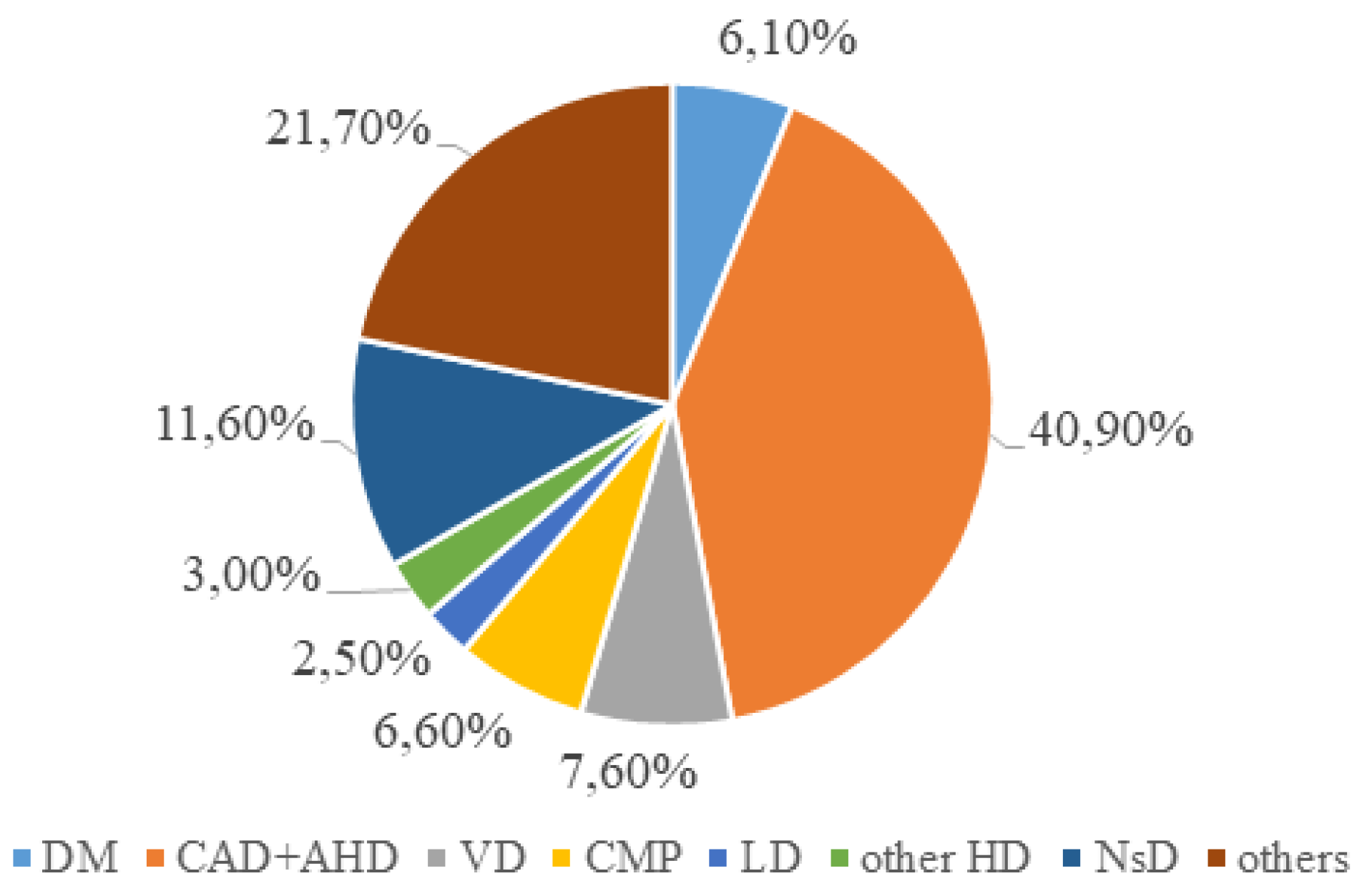
Figure 1. Main reasons of mortality in patients with CHF. DM — diabetes mellitus; CAD — coronary artery disease; AHD — atherosclerotic disease; other HD — other heart diseases; VD — other vascular diseases; CMP — cardiomyopathy; LD — lung diseases; NsD – nervous system diseases.
Preprints 150235 g001
Table 1. Baseline characteristics of patients with CHF.
Indicator n=591
Men, n (%) 339 (57.4)
Age, years 71.0 (64.0-80.0)
NYHA class III, n (%) 506 (85.6)
IV, n (%) 85 (14.4)
CAD, including previous MI, n (%) 381 (64.5)
Cardiomyopathy, n (%) 53 (9,0)
Valvular pathology, n (%) 19 (3,2)
Hypertension, n (%) 9 (1.5)
Others, n (%) 111 (18.8)
Hospitalization within 1 year, n (%) 513 (86.8)
LVEF < 40%, n (%) 229 (37.1)
LBBB, n (%) 108 (17.5)
VT, n (%) 55 (8.9)
AF, n (%) 125 (21.2)
SpO2, % 97 (96;97)
Cancer, n (%) 46 (7.4)
Previous heart surgery, n (%) 160 (25.9)
AF – atrial fibrillation; CAD – coronary artery disease; LVEF – left ventricle ejection fraction; LBBB – left bundle branch block; MI – myocardial infarction; VT – ventricular tachycardia.
Table 2. Complications of patients with CHF.
Indicator n=591
Pleural effusion, n (%) 270 (43.7)
Ascites, n (%) 67 (10.8)
SBP < 100 mmHg, n (%) 160 (27.1)
Inotropic therapy during hospital stay, n (%) 84 (13.6)
Heart transplant waiting list, n (%) 12 (1.9)
Inotropic therapy on outpatient level, n (%) 54 (8.7)
Oxygen therapy on outpatient level, n (%) 25 (4,0)
Opioid analgesics therapy on outpatient level, n (%) 5 (0.8)
Predialysis or dialysis (CKD stage 4-5, GFR less than 30 ml/min/m2), n (%) 23 (3.7)
Table 3. Characteristics of survived and died patients with CHF.
Indicators Group 1
(n=198)
Group 2
(n=393)
p-value
Males, n (%) 110 (55.6%) 229 (58.3%) 0.529
Age, years 75.0 (66.0;83.0) 71.0 (64.0;78.0) 0.001
NYHA class III, n (%) 152 (76.8%) 354 (90.1%)
<0.001
IV, n (%) 46 (23.2%) 39 (9.9%)
LVEF <40%, n (%) 87 (43.9%) 142 (36.1%) 0.062
LBBB, n (%) 43 (21.7%) 65 (16.5%) 0.117
VT, n (%) 17 (8.6%) 38 (9.7%) 0.669
SpO2, % 96.5(96.0;98.0) 97.0(96.0;98.0) 0.338
Implantable devices, n (%) 19 (9.6%) 39 (10.1%) 0.869
Pleural effusion, n (%) 108 (54.8%) 162 (41.3%) 0.002
Ascites, n (%) 28 (14.1%) 39 (9.9%) 0.130
SP < 120 mm Hg 59 (29.8%) 101 (25.8%) 0.298
Previous cardiovascular surgery, n (%) 37 (18.8%) 122 (31.7%) 0.001
Inotropic therapy during hospital stay, n (%) 38 (19.2%) 46 (11.7%) 0.014
Heart transplant
waiting list, n (%)
3 (1.5%) 9 (2.3%) 0.759
Inotropic therapy at outpatient department, n (%) 24 (12.2%) 30 (7.7%) 0.072
Oxygen therapy at outpatient department, n (%) 15 (7.6%) 10 (2.6%) 0.008
Opioids at outpatient department, n (%) 3 (1.5%) 2 (0.5%) 0.340
Predialysis or dialysis (CKD stage 4-5, GFR < 30 ml/min/m2), n (%) 6 (3.0%) 17 (4.3%) 0.506
Cancer, n (%) 19 (9.6%) 27 (6.9%) 0.250
LVEF – left ventricle ejection fraction.
Table 4. Independent predictors of mortality in patients with CHF.
Predictors Multivariate analysis
OR; 95% CI p-value
Age 1.034; 1.018-1.051 <0.001
LVEF < 40% 1.381; 1.014-1.880 0.040
NYHA IV class 1.932; 1.354-2.757 <0.001
Inotropic therapy during hospital stay 1.463; 0.972-2.201 0.068
Oxygen therapy 2.668; 1.482-4.802 0.001
Previous cardiovascular surgery 0.481; 0.322-0.718 <0.001
Ascites 1.543; 0.982-2.425 0.060
Gender 1.354; 0.971-1.887 0.074
NYHA – New York Heart Association; LVEF – left ventricle ejection fraction, CI – confidence interval, OR – odds ratio.
Table 5. Basic risk of crisis for different follow-up periods (maximum follow-up period – 18 months).
Follow-up periods, months Basic risk values h0(t)
3 0,1%
6 0,2%
9 0,2%
12 0,3%
18 0,3%
Disclaimer/Publisher’s Note: The statements, opinions and data contained in all publications are solely those of the individual author(s) and contributor(s) and not of MDPI and/or the editor(s). MDPI and/or the editor(s) disclaim responsibility for any injury to people or property resulting from any ideas, methods, instructions or products referred to in the content.
Copyright: This open access article is published under a Creative Commons CC BY 4.0 license, which permit the free download, distribution, and reuse, provided that the author and preprint are cited in any reuse.
Prerpints.org logo

Preprints.org is a free preprint server supported by MDPI in Basel, Switzerland.

Subscribe

Disclaimer

Terms of Use

Privacy Policy

Privacy Settings

© 2025 MDPI (Basel, Switzerland) unless otherwise stated
