

Submitted:
21 February 2025
Posted:
21 February 2025
You are already at the latest version
Abstract
This semi-systematic review paper discusses four research questions based on findings from the last 10 years: What are the crucial issues in the ongoing debate on the development of electric vehicle (EV) concept? Where are the major conflicting points and focuses between sustainable economy and EVs? How does the mining of metals and minerals follow current zero waste sustainability trends and how prediction of the magnitude of the future demand for EV battery guides strategic decision-making in policies throughout the globe? As it is not easy to currently predict how metals necessary for EV productions will be produced, article suggests a strategy that is diverse regarding its approaches to shaping the sustainable mining and further development of EVs, along with the involvement of urban planning. Using broad literature and published pool of prediction scenarios, we provide a comprehensive assessment of future EV battery raw materials development under a range of scenarios, accounting for factors such as developments in battery technology, variations in the EV fleet composition, sustainability aspects of development of second use and recycling technologies. Additionally, this paper demonstrates how blockchain technology is likely to force mineral and metal supply chains to become significantly more traceable and transparent.
Keywords:
electric vehicle
; mining
; blockchain
; sustainability
1. Introduction
As the global shift towards sustainable transportation continues, understanding the geographical distribution of these critical metals has become increasingly important as the mining of cobalt, lithium, nickel and other critical metals often occurs in regions with weak environmental regulations and human rights protections, leading to the exploitation of workers, contamination of local ecosystems, and displacement of indigenous communities [1]. Furthermore, the energy-intensive nature of metal refining and the potential for toxic waste from mining processes can contribute to green-house gas emissions and other forms of environmental degradation [2,3]. Standardized manufacturing guarantees that electric vehicles (EV) components meet performance and safety standards, while regulations ensure the safe handling of hazardous materials, such as lithium-ion batteries, to protect both workers and the environment [4].
The establishment of uniform laws and regulations for metal trade and recycling is crucial soon to effectively assess and mitigate potential supply risks and social-environmental impacts [5,6]. Standardized frameworks will ensure responsible sourcing, promote sustainability, and enhance the transparency of global metal markets, fostering a more resilient and ethical supply chain [6,7]. While addressing climate change, electric car revolution has a potential to provide negative impact on sustain-able mining and metal industry, increasing pollution die to unsustainable mining and putting extra costs and waste in raw materials extraction necessary for EV production [8,9]. However recent development in blockchain technology and its application across all industries and economy, can bring positive impact on these developments [5,10]. Hereby in addressing critical aspects of electric vehicles development, block-chain technology has readiness level to be applied in all aspects of mining and metal production, logistics and trade [10,11,12]. This paper analyzes the latest publications and predictions on key technologies, battery materials, and global trade up to 2050, offering insights into future mineral demand driven by the electric vehicle fleet and battery chemistry developments. We examine how blockchain can enable environ-mentally friendly metal supply for EVs and enhance transparency in supply chains, enabling standardizations and regulations globally. The research reviews predicted EV battery material demand over the next 25 years, focusing on mining regions, unethical metal production, blockchain adoption, and the impact of the EV revolution on sustainable development and regulations [1,4,7,10].
This paper aims to give answer to the following questions:
- (i)
- What are the crucial issues in the ongoing debate on the development of electric vehicle concept?
- (ii)
- Where are the major conflicting points and focuses between sustainable economy and electric vehicles?
- (iii)
- How does the mining of metals and minerals follow current zero waste sustain-ability trends?
- (iv)
- How prediction of the magnitude of the future demand for EV batteries guides strategic decision-making in policies throughout the globe?
This article recommends a strategy that is diverse regarding its approaches to shaping the sustainable mining and further development of electric vehicles, along with the involvement of blockchain ensuring transparency and sustainability in EV industry.
It is structured as follows:
After introducing the topic, in the second part, focus is given to issues evidenced regarding EVs in nowadays context. The third part analysis the blockchain technology with special emphasize in metals recycling. In the fourth section EVs in road to sustainable economy is examined, including sustainable practices in EV production via resource balanced economy, regulations for sustainability of EV and key challenges in international standardization in EVs field. Finally, conclusions are given.
2. EVs in Today’s Context
The top two global issues that need to be addressed in the coming years are those related to energy and the environment [2,5,9]. EVs are becoming more popular for many reasons, one of them is that their role in lowering greenhouse gas emissions is the most notable [4,10]. Although remanufacturing has been recognized as a practical and sustainable solution to address these problems, there has not been a thorough examination of how Industry 4.0 technologies can best support this process in the literature [12]. The next question is how to quantify the future demand for battery materials due to the shift to electric vehicles [1,10]. Another concern is the growth of demand of electric vehicles and trends in consumption of electric light-duty vehicles [7,9]. Understudied are current developments in mining and metals for environmentally friendly transportation, too. Also, there is still a lack of research on identifying the areas with abundant metal deposits that are essential to produce electric vehicles.
2.1. Towards Industry 4.0 and Beyond
Modern industry stands at the cusp of a new era, referred as Industry 4.0, characterized by the widespread implementation of technologies such as 3D printing, wireless communication, artificial intelligence, and the IoT - Internet of Things [13,14]. This technological evolution has directly impacted the mining industry, as it grapples with the challenges of increased efficiency, safety, and sustainability [10,13]. In the mining sector, demand for EV drove towards urge for deeper mining coupled with the need to optimize these operations under the constraints of the Paris Agreement, made a fundamental shift in mining practices and techniques [6,8,15,16]. To address these challenges, mining companies have turned to innovative solutions, such as the intro-duction of electric vehicles for extraction and transportation at the mining sites, and the integration of smart mine networks powered by blockchain technology [5,11,17,18]. The mining industry’s resilience and adaptability have been on full display, as it embraces the opportunities presented by Industry 4.0 [19,20,21].
However, the transition to a fully digitized and sustainable mining industry faces significant challenges, particularly in the sustainable extraction of materials for EV batteries and ensuring transparency across production, transportation, and trade [8,15,17]. The World Bank has noted the low maturity of those novel industry and high difficulty in implementing these transformative technologies across the sector [22,23,24].
As the mining industry navigates this transition towards a new era of EV, it must not only focus on increased efficiency and productivity, but also on the environmental and social implications of its operations [14,25,26]. The concept of “Mining 4.0” has evolved to encompass not only technological advancements, but also a commitment to environmental sustainability and social responsibility [17,19,27,28]. By aligning their efforts with the principles of a circular economy and sustainable development, mining companies can ensure that the industry’s transformation benefits both the bottom line and the communities in which they operate [3,13,15,28,29].
2.2. Quantifying the Future Demand for Battery Materials in the Shift to EV
The supply chains for the critical minerals used in batteries vary geographically, though a few countries have a dominant role in the production of key minerals [13,25,32,33]. Today, electric vehicle batteries primarily use lithium-ion chemistries for lithium-ion cathode with are NCA (Li-NiCoAl oxide), NMC (Li-NiMnCo oxide), and LFP (Li iron phosphate) [34]. These batteries rely on varying amounts of four critical metals: Li, Ni, Co, and Mn, as identified in studies on mineral criticality for battery cathode materials [35,36]. Additionally, there is discussion about other minerals that may become critical in the next decades as well as for other battery chemistries currently under development [16,19,37,38]. The most significant decision in battery production is the selection of cathode material, which accounts for over half the cost of a battery cell and influences important characteristics like energy density and charging speed [16,26,39,40]. While the anode (typically graphite) and electrolyte (usually Li salt solutions) also face supply chain vulnerabilities, the options for these components are more limited, offering fewer opportunities to mitigate risks by changing technologies [39,40,41]. Due to limited production data, these components were not included in the scope of our evaluation [42,43,44].
2.3. The Rise of EV: Trends in Electric Light-Duty Vehicles
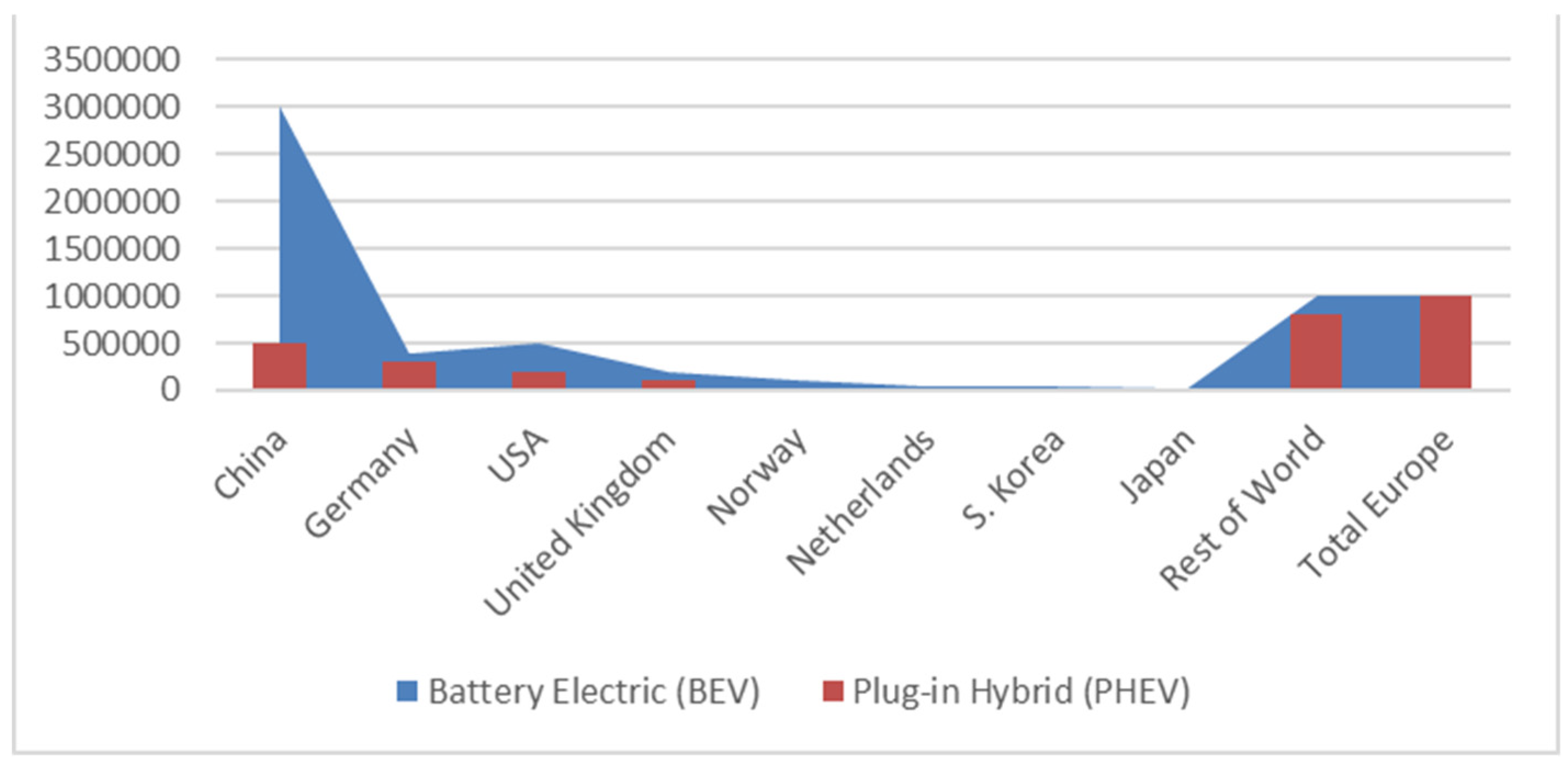
China’s EV market has undoubtedly been a global powerhouse, with the country accounting for half of the world’s electric cars sold in 2024 [36,45,46]. Hence EV industry is emerging in Europe as a highly dynamic bringing new markets and key producers, creating competitiveness on global scale in electric car market that brings continuously development of more affordable models [45,47]. Nowadays China still dominates production and sales of EV on a global market with Europe reaching significant lead in total car sales, large share of existing car inventories [47,48]. Despite the global economic turbulence and supply chain disruptions experienced the EV market in China continued to demonstrate remarkable growth, shattering previous sales records encompassing both battery electric vehicles (BEVs) and plug-in hybrid electric vehicles (PHEVs) [49,50]. The rapid adoption of electric vehicles has been driven by a confluence of factors, including the introduction of new mass-market models, improvements in technical performance, and cost reductions [9,45,48].
The China’s strategic approach to driving the adoption of EVs has been a subject of significant interest and analysis with the electric vehicle sales experienced a remark-able increase in 2022, with battery electric vehicle (BEV) sales growing by 60% compared to 2021, reaching 4.4 million units with plug-in hybrid electric vehicle sales tripled [45,48,51].
At the same time, major EV carmakers, especially in Europe are putting enormous investments and efforts to compete on a global scale promising products such as fully electric fleets, cheaper cars, greater investment integrating vertically with mining industry to enable cheap, fast and sustainable key minerals for battery-making [48,50]. This situation enables global consumers to choose within various options of ever-increasing electric car models that reached 500 in 2022, more than double the options available in 2018 [45,47,51].
The faster growth in plug-in hybrid electric vehicle sales relative to battery electric vehicles requires further research, as plug-in hybrid electric vehicle sales still remain lower overall and are catching up on the post-Covid-19 boom [45,47,51]. Battery electric vehicle sales in China tripled from 2020 to 2023 after moderate growth over 2018-2020, indicating a significant shift in consumer preferences and market dynamics. China’s dominance in the global electric vehicle market is further highlighted by the fact that the country accounted for nearly 60% of all new electric car registrations globally in 2024 [49,51]. China has been the center of attention in the EV space over the past decade, with bold moves to transition towards cleaner transport and energy systems and effectively ensuring its status as the most critical player in the global EV supply chain [50,51]. Despite China’s ambitious goals for developing and deploying electric vehicles, progress has failed to reach planned targets because EV industry challenges, similar to those in Western countries, such as high battery costs, and lack of a clear infrastructure model for vehicle charging [46,48,52,53].
However, Europe has established its own areas of dominance, particularly in the Nordic countries, where EVs accounted for more than half of all cars sold in 2024 [47,54,55]. In Europe, the EV market has been experiencing rapid growth, with the region expected to lead sales of EVs, potentially overtaking China around 2028 [47,55]. Europe’s success in the EV market can be attributed to a combination of factors, including generous subsidies, supportive policies, and a strong focus on sustainable mobility [45,53]. Norway has emerged as a leader in the electrification of transport, with nearly 79% of new passenger cars sold being EVs in 2024 [56].
The regional differences in EV adoption are also reflected in the technology choices made by original equipment manufacturers (OEMs) [2,45,50,51]. While China has maintained its dominance in the supply of critical components, such as battery manufacturing, Europe has been able to establish its own niche in the EV market [48,54,57]. The analysis of the electrification portfolio choices of major automotive manufacturers across different regions suggests a trend towards SUVs for both battery electric vehicles (BEVs) and plug-in hybrid electric vehicles (PHEVs), with regional variations in battery chemistry choices [55,56,57].
Figure 2.
Battery electric and plug-in hybrid vehicle sales across markets in 2023. Modified from [58,59].
The shift towards EVs represents an important transformation in the global automotive industry, driven by the urgent need to address climate change and reduce reliance on fossil fuels [2,9,58,59]. However, the sustainability of this transition de-pends not only on the adoption of EVs but also on establishing a resource-balanced economy that includes the efficient use of critical raw materials and comprehensive recycling strategies, particularly for metals [60,61]. The complexity of the EV industry lies in its heavy reliance on a range of essential metals for batteries and functionality, including Li, Co and Ni, as well as Cu for electrical wiring and Al for light-weight construction [3,16,40,62]. The supply of key metals necessary for development of batteries imposes challenges that are related to geopolitical risks, supply chain vulnerabilities, and environmental concerns related to mining practices, which pose threats to the stable and sustainable supply of these materials [62,63,64].
An example of poor resource management is seen in Colt mining sites in the Democratic Republic of Congo, where mining has led to severe human rights abuses and environmental damage [16,29,64]. Sustainable resource management can be achieved not only through mining but also through circularity and recycling [65,66]. Recycling metals, especially from spent lithium-ion batteries, offers a viable solution to reduce the demand for rare metals and mitigate the environmental impact of mining [65]. Up to today there are two key strategies for obtaining metals necessary for new battery production; (i) recycling spent lithium-ion batteries to recover essential metals, and (ii) vehicle recycling to recover aluminum [61,65,66].
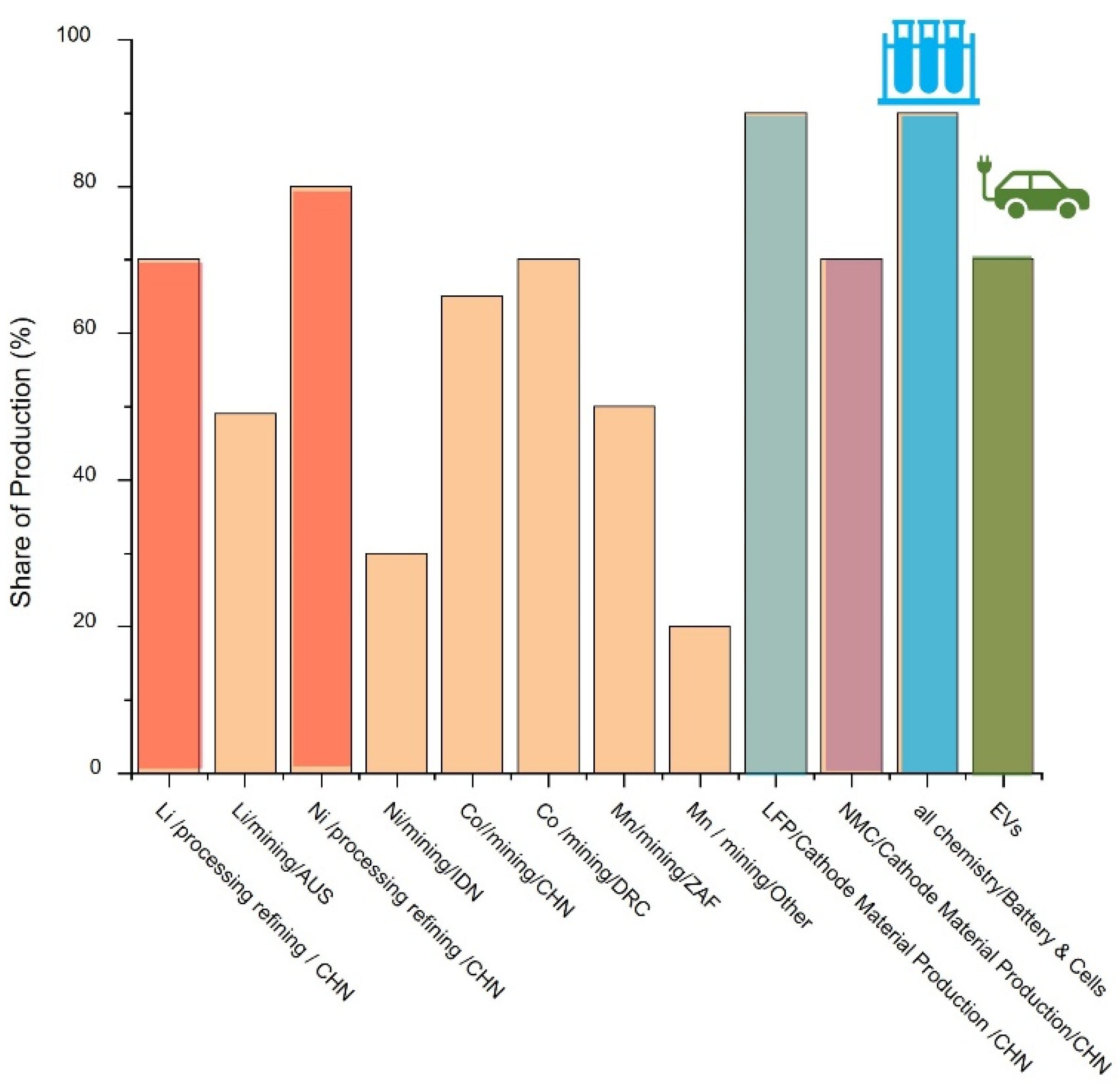
The battery supply chain can be divided into three segments: (i) upstream (mining and extraction of raw materials), (ii) midstream (processing these raw materials into battery-grade components), and (iii) downstream (cell and pack manufacturing, as well as end-of-life recycling and reuse) [66]. In 2020, most of the lithium used in battery production was extracted from Australia (49%), Chile (27%), China (16%), Argentina (7%), and the US (1%), with percentages rounded to the nearest point [65,66,67]. Most countries processed their extracted Li, except Australia, which sent 99% to China and 1% to the U.S. due to its spodumene rock requiring foreign refining. China uses 31% of its raw lithium and Chile uses 3% for non-battery purposes, while the rest is refined into battery-grade Li by China (59%), Chile (29%), Argentina (9%), and the U.S. (3%). Chile’s reported imports and exports exceeded production, causing discrepancies [68,69]. Refined lithium was then traded to China (55%), South Korea (16%), Japan (12%), the U.S. (5%), Canada (1%), and others (12%) [69]. Not all of the Li was used in battery cathode production, with significant portions used in non-battery products such as in 41% in China, 44% in South Korea, 29% in Japan, 95% in the US, and 55% in Canada [70,71].
A significant amount of Co, Ni and Mn is used for products other than batteries [71,72]. Notably, a large amount of Ni and Mn is transformed into non-battery products, limiting the influence of major producers like Indonesia, Australia, and Gabon on battery material supply chains [68,72,73]. There is also considerable uncertainty in the Co and Ni supply both at raw and refined material stages, which resulted in vulnerability index calculation along the supply chain [71,73].
Figure 3.
Distribution of EV Battery and Material Supply. Modified from [73].
Figure 3.
Distribution of EV Battery and Material Supply. Modified from [73].
2.4. Trends in Modern Metal Mining Industry for Sustainable Transportation
Globally, automotive manufacturers are increasingly managing their material supply chains as they design batteries for their vehicles [55,74,75]. The trend will drive significant growth in Li, Co and Ni mining, with global supply chains requiring new resource discoveries, thereby increasing uncertainty around the development of EVs and their crucial battery capacity requirements [55,58]. In our analysis we rely on a most probable trend which will continue domination of Li-NiCoMn oxide (NMC) batteries, and increase demand for over 20 times for Li, in range 17–19 for Co, 28–30 for Ni, and 16–20 for other materials for next 25 years, i.e. by 2050 [34,68,73].
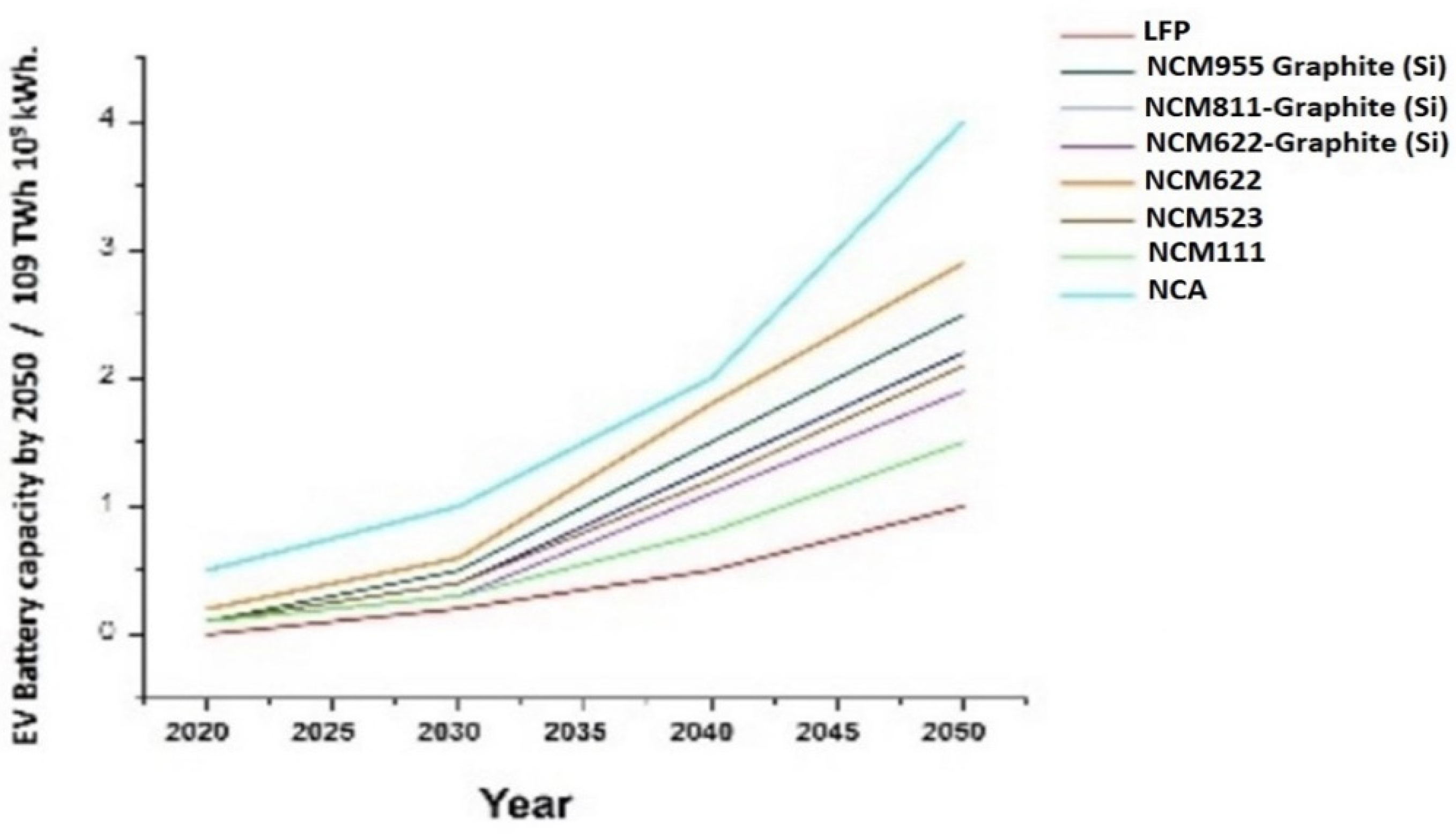
In the case scenario where other battery chemistries, such as lithium iron phosphate or novel Li-S or Li-air batteries, will be adopted at large scale, the demand for Co and Ni would be smaller as presented in Table 1 [71,72]. This table presents the most likely chemical composition of the batteries if the current trend of widespread utilization of lithium nickel cobalt aluminum (NCA) and lithium nickel cobalt manganese (NCM) batteries (referred to as the NCX, with X = either Al or Mn) continues. Battery producers are aiming to replace costly Co with Ni, leading to the development from NCM111 to NCM523, NCM622, and NCM811 batteries (the numbers denote ratios of Ni, Co and Mn) and NCM955 (90% Ni, 5% Co, 5% Mn), expected to be available by 2030 [41,72,74].
The material requirements for batteries in next years depend on the development of battery chemistry and key technologies and formulations. As shown in Figure 4, about 6-12 TWh of battery capacity will be needed annually as result of the growth of the EV fleet and the required battery [9,71,72]. It’s expected that specific energy for battery packs will range from 160 Wh/kg for NCM111 to 202 Wh/kg for NCM955-Graphite (Si) batteries in typical mid-size BEVs, with lifespans expected to increase to 15 years [32,40,41,74]. In the coming decades, the use of LFP (LiFePO4) batteries is expected to grow, as beside their weaker efficiency due to lower energy density, to that of NCA and NCM batteries, they offer advantages like lower production costs due to abundant materials, better safety from improved thermal stability, and a longer lifespan [71,75].
2.5. Identifying the Regions with Abundant Metal Deposits Critical for EV Production
This geographic concentration of supply, coupled with the expected continued growth in electric vehicle adoption, raises concerns about potential supply shortages and price volatility in the future Africa is a currently global powerhouse in the pro-duction and supply of critical minerals essential for the manufacturing of EVs and their battery systems [32,64,75]. The mining of cobalt, often performed in the Democratic Republic of Congo, has been linked to child labor, unsafe working conditions, and environmental degradation [3,27,77,78]. However, the increased demand for Co has also raised concerns about the environmental and social impacts of mining in the region, where children are injured and killed in mines located in areas characterized by poverty, criminality, and corruption [70,78,79].
Graphite is used in Li-ion battery anodes and other EV components and Mozambique and Madagascar are major graphite producers, with significant reserves in Tanzania [80,81]. Manganese is important for EV battery cathodes and other clean technologies, with largest reserves found in South Africa, accounting for almost 44% of glob-al Mn production [72,82]. South Africa also produces nearly 44% of global Cr, which is key for renewable energy plants and nuclear power [83]. Other African continent countries such as DRC, Namibia, and Zambia have significant reserves and for Cu production, which is essential for EV wiring and electrification [84]. While Li production in Africa is currently limited, countries like Mali have significant Li reserves that could be tapped for EV battery manufacturing [68,85]. It is expected that the global EV industry reach a $300 billion (about $920 per person in the US) by 2050, the supply of these critical minerals from Africa will be crucial to sup-port the transition to electric mobility [58,70,73,78].
Metal recycling has a lower environmental impact compared to mining and processing new metals [3,6,71,85]. Advancements in battery technology and increased recycling efforts may help ease supply issues, but they are not a complete solution; only responsible recycling practices - with proper waste management, worker protection, and environmental controls - can ensure true sustainability [65,87,88,89]. In the metal recycling center, inputs and outputs need to be continuously updated, while transportation and logistics details are added as partners contribute along the supply chain route [90,91,92].
3. Blockchain Technology
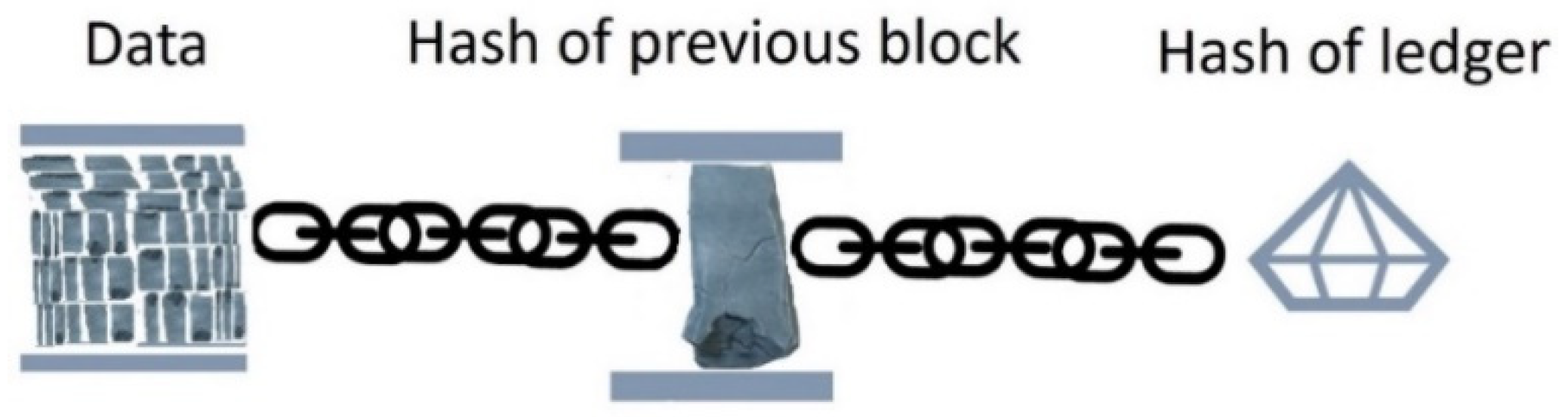
The Blockchain technology, initially developed for cryptocurrency (e.g. Bitcoin), reduces reliance on cash transactions and speeds up processes traditionally delayed by financial institutions [13,18,23]. Cryptography ensures the security and confidentiality of information in many industries and it is significant in mining as it address integrity, non-repudiation, and authentication in data sharing [18,20,94]. Blockchain transactions are verified through nodes, grouped into blocks, and linked via unique identifiers called hashes [21,43]. Each block’s hash is a fingerprint that ensures integrity of data and any change occurring in the block alters its hash, thus ensuring secure, traceable, and immutable records in the blockchain [5,20,21].
Figure 5.
Schematic presentation of traceable hash elements within distributed ledger within block chain.
Figure 5.
Schematic presentation of traceable hash elements within distributed ledger within block chain.
Control and decision-making transition from an individual or group to the whole network of participant in the blockchain is referred to as decentralization [5,94,96]. The need for the decentralized system in blockchain has been developed to overcome vulnerabilities of a traditional, centralized traditional fund transfer system in which bank as a central authority controls the entire transaction process [18,21,97]. To ad-dress such limitations, the idea of a decentralized system is introduced in which data has been utilized to store, record and synchronize transactions at separate places bringing better clarity and improving trust within the stakeholders whilst simultaneously deters participants from applying authority and control over other members of the blockchain network [97,98].
The mineral and metal industry has long faced ethical sourcing challenges due to complex and opaque supply chains obscuring raw material origins and production methods [18,23,98]. Blockchain technology offers potential for transformative improvements in sustainability and transparency in metal mining and recycling industries enabling sustainable practices and reducing potential conflicts [5,20,99,100].
When incorporating used metal mixtures into new vehicles, it is crucial to verify the authenticity and composition of these materials and only with used of blockchain technology it is possible to ensure verification of origin and authenticity of metals used in electric vehicle production [14,17,25,99]. By providing a secure, transparent ledger, blockchain records the provenance, composition, and quality of metal mixtures, preventing the use of counterfeit or substandard materials [14,93]. This traceability supports the sustainable and ethical sourcing of raw materials and enables the tracking of recycling and reuse, promoting a circular economy and reducing environmental impact [5,27,30].
Beyond mineral processing and mining activities, blockchain incorporates supply chain transactions and track items from store to store using verified identities for online banking, ecommerce, and others [24,99,100]. Other applications are e-voting and remote participations of forum where critical decisions are made, health records for more control of data which can improve on health status, copyright protection, decentralized finance to recreate traditional finance system such as loan and insurance applications [5,23,101]. For successful technological development apart from maintaining and safeguarding corporate and personal information it is also important to motivate employees by in their daily duties and in this context blockchain appears as quicker, more effective solution for employer-employee relationship with management of system that contains all credentials of job prospects [23,103,104,105,106]. Such operations are time and money-wise sustainable solutions, checking on job candidates’ training, credentials, work history, or talents [5,13,94,104]. Furthermore, they simplify complex international payroll transmission enabling more efficiently and timely cross-border payments to multinational employees, improving working conditions [11,19,42].
Integrating blockchain technology can significantly enhance the sustainability and transparency of the electric car industry [102,107]. The production of electric vehicles requires significant amount of metals, such as Li, Co and REE, often associated with environmental and social concerns. The most important area where blockchain can contribute to the sustainability of electric cars is the sourcing and traceability of raw materials, particularly metals [39,43,93].
In transportation of metal and EV synchronized nature of blockchain informs global eco-system and opens possibility for faster agreement if there exist changes in trade chain such as a shipping route or timetable [5,17,53,95]. This synchronization simplifies resolution of problems and provides solutions, enabling precise data management within the blockchain and decrease in conflicts. All parties involved in the larger value chain, including raw materials providers, financial institutions, logistic company owners, research laboratories, warehouses, and customers can be part of a single blockchain [5,6,18,96]. This promotes innovation and compliance within all sectors and industries, outside of mining and smelting of recycling metals [10,66,92,97].
Environmental, social, and governance (ESG) challenges, including environmental degradation, human rights violations, and weak governance, persist in global supply chains despite regulations like the EU Conflict Minerals Regulation [18,92,98,107]. Blockchain’s secure, immutable ledger can enhance transparency and accountability by tracing the provenance of raw materials, particularly conflict metals, while its integration with AI can further optimize supply chain efficiency, from ore tracking to worker identification and access control [10,13,18,94].
3.1. Blockchain in Metals Recycling
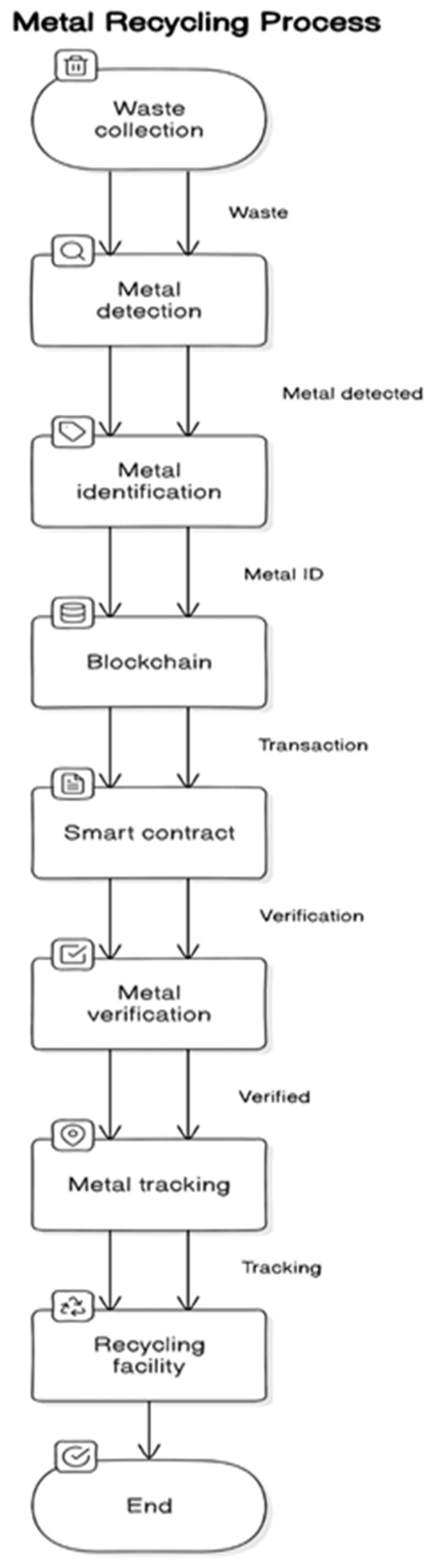
In the sustainable organized recycling metal center inputs and corresponding outputs are continually updated through whole EV production and recycling supply chain [3,6,18,30]. Additionally, transportation information and logistics details from partners along the supply chain are automatically updated and visible to permitted participants with each new transaction [21,26,108]. This allows regulators and end users to verify data as the luck of connectivity between participants outside of institutional system is a key challenge. Proposed system of metal recycling blockchain system, from waste collection towards recycling facility is presented schematically with diagram shown in Figure 6.
Figure 6.
Metal recycling process steps in blockchain from waste collection point towards recycling facility.
Figure 6.
Metal recycling process steps in blockchain from waste collection point towards recycling facility.
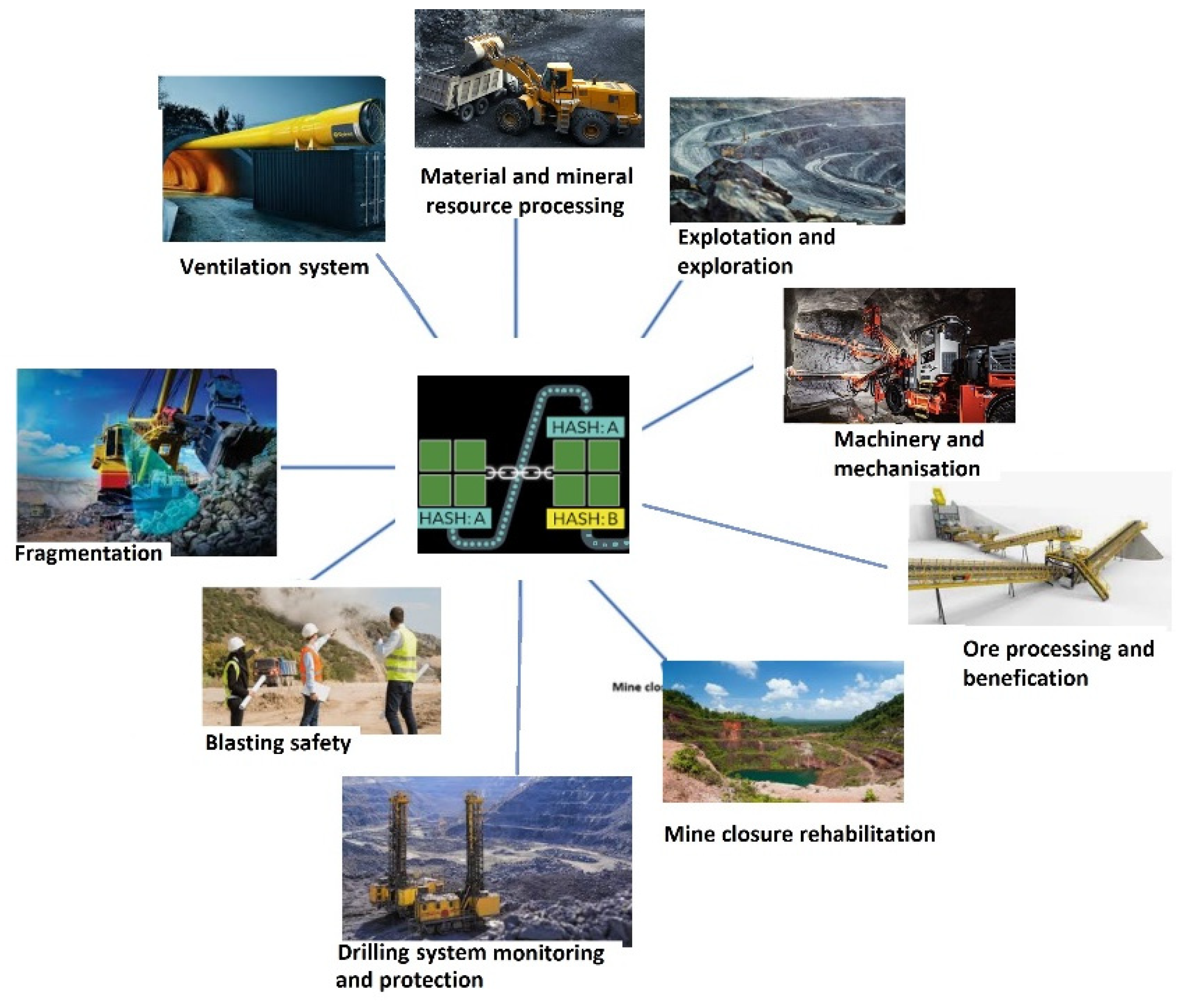
Utilization of blockchain through the whole supply system, from mining industry through production of EV and recycling of metals is solution which addresses a major concern inherent in modern supply chain (SC), that they are designed as standalone and discrete systems that fail to connect actors outside SC institutions [103,106,107]. Recycling EV batteries is crucial for recovering valuable metals like Li, Co, N, and Cu, creating a sustainable supply chain and reducing dependency on limited natural reserves. Recycling of EV batteries minimizes the environmental impact of battery disposal, preventing toxic materials from polluting ecosystems whilst supporting of a circular economy by reintroducing recovered materials into production, promoting sustainability in the EV industry [1,6,52,65,96]. Therefore, blockchain offers solutions for the control of various aspects related to processing of ores and machinery in mining industry, as visually presented in Figure 7.
Figure 7.
Schematic presentation of blocks of the main processing aspects related to safety in mining industry and their interaction with each other in the blockchain sustainability management.
Figure 7.
Schematic presentation of blocks of the main processing aspects related to safety in mining industry and their interaction with each other in the blockchain sustainability management.
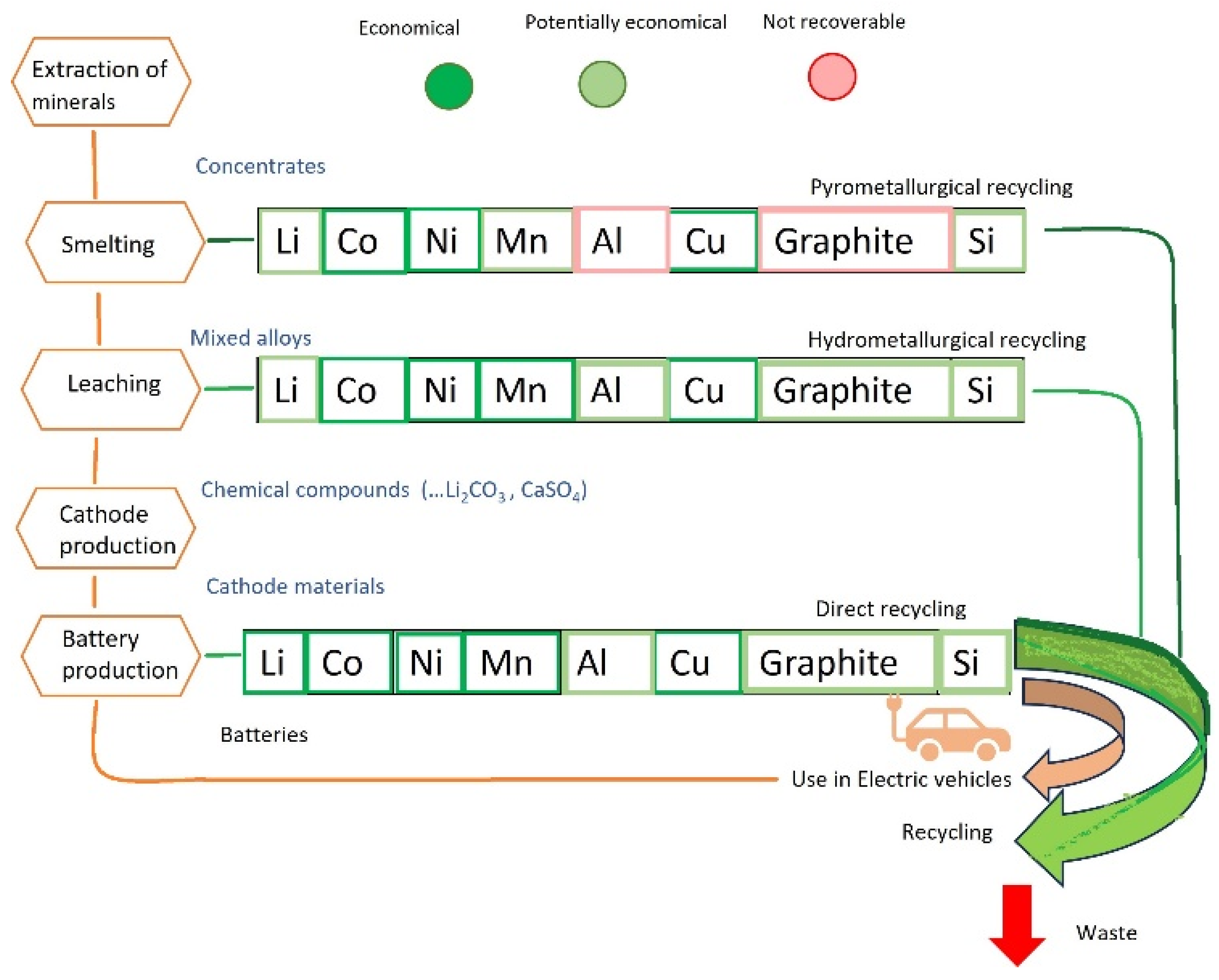
In Figure 8. is presented schematic which illustrates three most possible EV battery recycling loops, through which it is possible to recover metals [66,89,92]. Direct recycling aims to recover cathode materials in the most time-efficient and chemically sustainable way, but current chemical engineering limitations prevent the complete recycling of all metal parts and minerals due to hazardous materials and complex processing steps, such as smelting, which requires hydrometallurgical processing (leaching) [86,100,103,107]
In both pyro- and hydrometallurgical recycling i.e. smelting, cost of lithium recovery can excess realistic price in addition to pyrometallurgical recycling of aluminum that remains in the slag and incinerated graphite [20,101,109].
Figure 8.
Schematic of three recycling scenarios close battery material loops and identify which materials are recovered. In practice, not all materials undergo every processing step. [101,109].
Figure 8.
Schematic of three recycling scenarios close battery material loops and identify which materials are recovered. In practice, not all materials undergo every processing step. [101,109].
4. Electric Vehicles in Road to Sustainable Economy via Blockchain
The blockchain technology can help with the global standardization issues facing the EV industry by offering a transparent and safe way to track and verify compliance across geographical boundaries with the huge potential in real-time tracking of components, materials, and infrastructure within compliance with national and international standards [93,102,104]. Blockchain has the potential to promote transparency and unify billing mechanisms, grid interoperability, and infrastructure resilience through immutable records [5,21,101,105].
4.1. Road to Sustainable Practices in EV Production via Resource Balanced Economy
The transition to electric mobility is not without its challenges as creating sustained market growth with meeting highly ambitious targets requires coordinated efforts from all stakeholders, including governments, the automobile industry, electricity suppliers, and consumers [5,76,99,104,108]. In the early days of development of EV many countries recognized urged for controlled development of innovative technologies that will enable mitigation of fossil used pollutant induced climate change and initially was established [110]. Governments worldwide are supporting adoption of regulations for EV with the United States aiming for 100 million profit from industry by 2030 and California setting a target of 5 million EVs on its roads by the same year [111,112]. The EV Initiative is a multi-governmental policy forum established in 2010 under the Clean Energy Ministerial [113,114]. The primary goal of this initiative was to promote global EV adoption by addressing policy challenges and fostering knowledge-sharing among policymakers, with the Global EV Outlook monitoring progress with enabling insights for acceleration of road transport electrification [114]. The initiative is coordinated by the International Energy Agency [111,112,114].
The linear economic model, centered on throughput and endless growth, has caused resource depletion, massive waste, and unequal wealth distribution, making the implementation of a circular economy essential for achieving sustainable prosperity by aligning the economy, society, and the natural environment [104,115]. Navigating the complexities of a modern economy, including EV grid integration, requires a careful balance between resource allocation and efficient resource use [102,107,116]. Transition of EV industry to a circular economy leveraging transparency, metal recycling and technological innovations can promote sustainable prosperity by harmonizing economic growth with societal and environmental well-being [92,100,107,117].
4.2. Standardization and Regulations for Sustainability of EVs
Standardization is crucial for the widespread adoption and success of EVs, particularly in areas such as critical metals mining and recycling, as well as in ensuring the performance of acoustic equipment, fire retardance, and thermal management [2,9,114,118]. Standardization ensures consistent EV safety standards, reduces system failure risks, and promotes interoperability across brands and models while also applying to production technology and metal recyclability, fostering innovation and lowering adoption costs. [119]. Consistent quality across electric vehicle models and brands globally is another key benefit of standardization, as it establishes bench-marks for performance, durability, and reliability [119,120]. Standardization benefits both manufacturers and producers by simplifying EV maintenance and repair, lowering production costs, improving accessibility to services, and enabling development of a stable market that brings greater investments in the research and development [2,115,118].
Governments and regulatory bodies typically mandate standards for safety of EV and lithium batteries, and it is essential to develop regulations that cover the entire manufacturing, production, and recycling lifecycle, including both benefits and penalties [38,41,119,121]. To facilitate the transition to a more sustainable transportation system, it is vital to ensure the sustainability of the lithium-ion battery supply chain (LIBSC), with standardization playing a key role in establishing consistent practices across the industry. Standardization will enable global harmonization of EV technology, with enabling continuous development of infrastructure and providing the feasibility and interoperability of all subsystems within the overall ecosystem including mining, production, transportation, waste collection and recycling [118,122]. Stake-holders and policymakers are introducing measures to promote the LIBSC’s sustain-able growth even though it is not defined yet since electric vehicle industry is still in its preliminary stages, with relationships among its actors are only beginning to form. While a growing body of literature addresses the content of sustainability assessments, limited research exists on the interactions, governance, and interfaces be-tween supply chain stakeholders conducting these assessments, yet these dynamics are critical for implementing comprehensive, supply chain-wide evaluations [118,122].
Despite the EV industry being relatively new, it already raises concerns related to the utilization of precious metals and the production of flammable lithium-ion batteries. These issues highlight the urgent need to quickly establish safety and sustainability regulations to address potential environmental and safety risks [109,118]. Lithium battery aging is influenced by both external environmental and internal factors, with standardization playing a key role in ensuring consistent performance across various conditions [115,123]. External factors include the battery’s location and operating environment, such as temperature, charge and discharge rate, depth of discharge (DOD), and the cut-off voltage during charging [38,41,123]. Internal factors are driven by three main mechanisms: the loss of lithium inventory (LLI), loss of active material (LAM), and conductivity loss (CL) [124]. LLI involves the formation of the solid electrolyte interphase (SEI) layer, the development of lithium dendrites, and self-discharge, while LAM includes the decomposition of cathode and anode materials and electrolyte breakdown, and CL refers to the aging process that causes the battery’s current collector to degrade and the adhesive to peel off, with standardization of these factors ensuring uniformity in battery performance and lifespan across diverse applications [123,124].
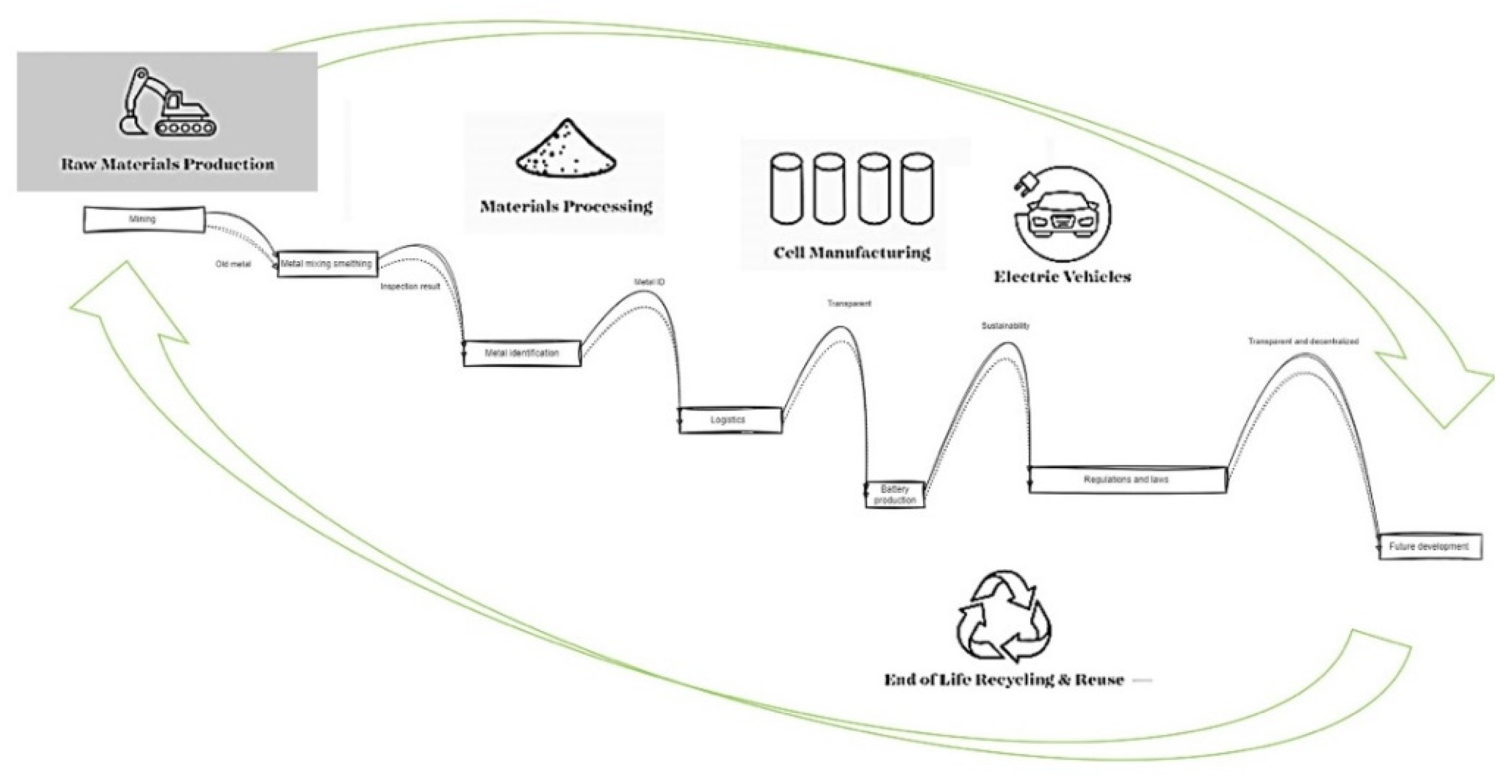
Figure 9.
EVs production and recycling supply chain.
As the industry evolves, implementing regulations and standardization is crucial to ensure responsible growth, minimize negative impacts, and establish minimum criteria for the safety, performance, and recycling processes of EVs [114,118].
Blockchain technology streamlines recycling by enabling efficient recovery of valuable metals, minimizing waste, and improving transparency in the recycling process. Additionally, standardization promotes global compatibility, reduces emissions, ensures safe disposal of hazardous materials, and fosters innovation by setting ambitious targets for efficiency and recyclability, driving competition and research in the industry [113,117,119]. Economic benefits of imposed regulations and standardizations include reduced manufacturing costs, market stability, and improved predictability, supported by the ethical sourcing and efficient use of critical materials, which enable investors to confidently plan long-term projects [120,122]. Global resource optimization ensures the ethical and sustainable use of materials, reducing reliance on environmentally damaging mining practices, aligning with the international cli-mate goals, attracting environmentally focused investors who prioritize sustainability as presented in detail in Table 2.
With global standardization and regulations in the mining and production sector, blockchain can track the ethical sourcing of metals and minerals, ensuring compliance with sustainability and human rights standards [83,90,97]. Recycling streamline processes should verify material recovery, ensure quality control, and certify adherence to environmental and safety standards, thereby supporting a circular economy [86,87,92]. Extreme weather challenges in areas with harsh temperatures or adverse conditions may necessitate specialized standards for EV components like batteries and thermal management systems to ensure optimal performance and durability [123,124]. Standards should ensure that charging infrastructure responds to expected climate change considering local market dynamics such as consumer preferences, incentives, and government policies. Furthermore, it should influence technology adoption by supporting cost-effective manufacturing processes and technology development to make EVs more affordable and appealing for a broader consumer base [5,82,85,125].
The main international documents relevant to EV production are presented in Table 3.
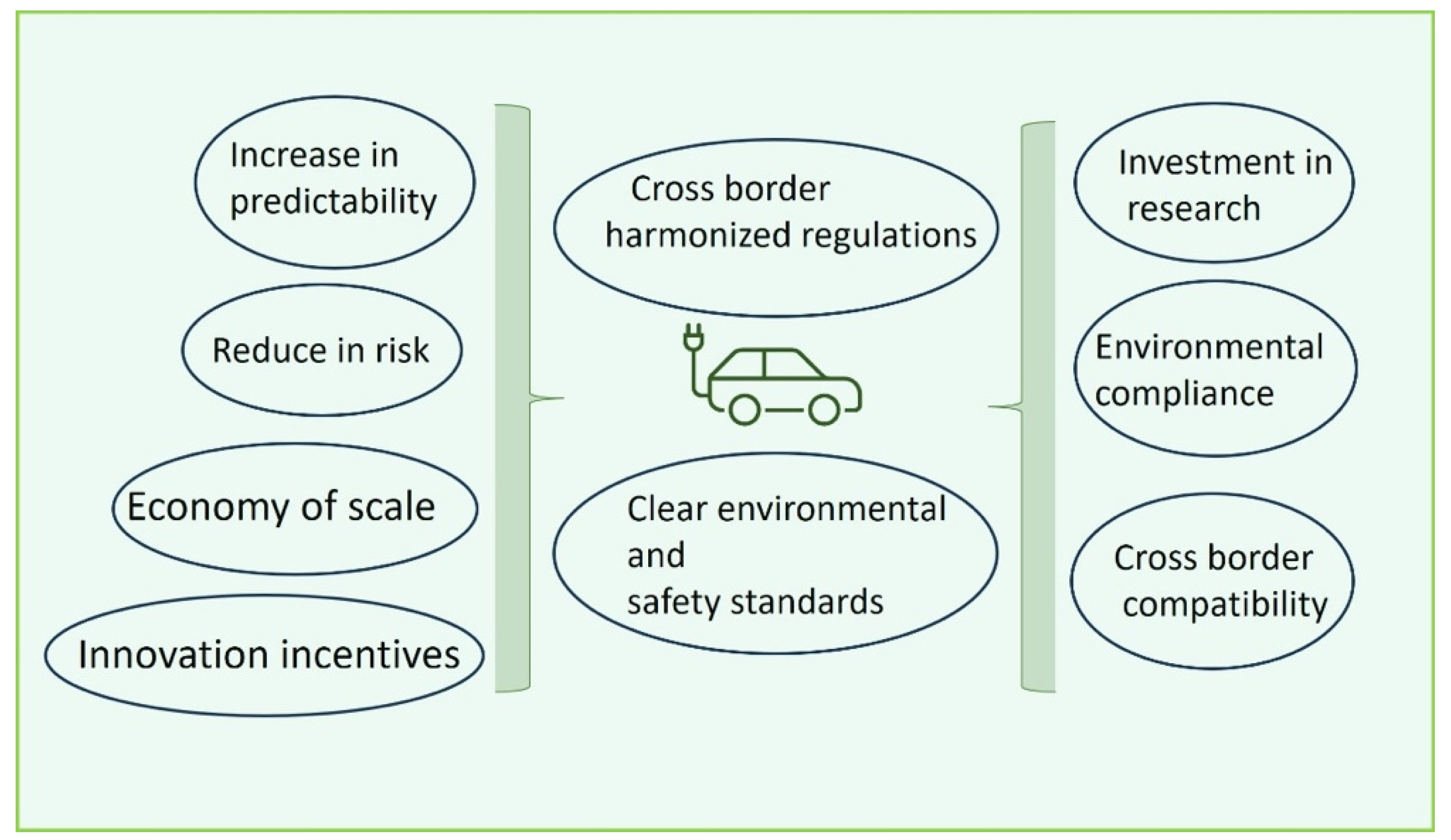
Global regulations and standardization create a stable, scalable, and environmentally responsible framework for the EV sector, fostering long-term investment and growth by enabling predictability, economies of scale, cross-border compatibility, reduced risks, innovation incentives, resource optimization, and environmental compliance as schematically presented in Figure 10.
Figure 10.
Schematic presentation visualizing the concepts of predictability, economies of scale, cross-border compatibility, reduced risk, innovation incentives, resource optimization, and environmental compliance.
Figure 10.
Schematic presentation visualizing the concepts of predictability, economies of scale, cross-border compatibility, reduced risk, innovation incentives, resource optimization, and environmental compliance.
4.3. Key Challenges in International Standardization of EVs
The unification of international standards in the EV industry faces multiple challenges, including diverse regional regulations, infrastructure variances, and grid and electricity variability [88,98,101,107,113]. Different regions have unique regulatory frameworks and safety standards, making it difficult to align international standards [2,110,115,118]. Additionally, charging infrastructure, such as connector standards, power levels, and communication protocols, differs across regions, and the variability in grid infrastructure, voltage levels, and renewable energy integration further complicates standardization [114,119]. Cultural and market differences, including varying consumer preferences, driving habits, and regional demands accompanied by various industry interests and competition among global automotive manufacturers and technology providers may lead to compromises in standardization [118,120]. Hence, the rapid evolution of technologies such as battery advancements, charging infrastructure, vehicle design, and blockchain adds complexity to harmonizing standards across regions [5,110,121]. The diversity of existing regional regulations adds to standardization obstacles due to different regional frameworks and not harmonized safety [113,119]. Additionally, infrastructure variances, such as differences in charging connector standards, power levels, and communication protocols, further complicate the establishment of a unified global standard [6,11,30,54,65]. The variability in electrical grids, voltage levels, and renewable energy integration across regions also poses a challenge, as standards must account for these regional differences [14,120,124].
Utilization of blockchain technology mitigate global standardization challenges in the EV industry by providing a secure, transparent system for tracking and verifying compliance across regions [7,10,120,122]. It enables real-time tracking of materials, components, and infrastructure, ensuring adherence to both local and international standards [14,16,21,53]. Through immutable records, blockchain fosters transparency and harmonizes charging protocols, grid compatibility, and infrastructure resilience in support of faster technological advancements, suitable for different market’s needs.
5. Conclusions
The transition to a sustainable, resource-balanced economy in the EV sector requires a holistic approach, integrating efficient raw material use, advanced recycling, supportive policies, and industry collaboration. Blockchain technology can enhance supply chain transparency, traceability, and responsible sourcing, supporting sustain-ability standards in the metal and mineral industries. However, to address resource scarcity and ensure long-term viability, solutions like material innovation, recycling improvements, and development of alternative materials are necessary. The unification of global standards in the EV industry faces challenges due to regional regulations and infrastructure variances, but blockchain can help harmonize these standards and facilitate the adoption of electric vehicles. Ultimately, blockchain’s role in ensuring compliance and transparency is key to sustainable trade and investment in development of the EV industry.
Author Contributions
Conceptualization, K.D.M. and V.S.B.; methodology, S.S.C.; validation, M.G.; investigation, K.D.M.; resources, K.D.M. and V.S.B.; writing—original draft preparation, K.D.M.; writing—review and editing, M.G.; writing and visualization, S.S.C.; supervision, M.G.
Acknowledgments
The authors would like to acknowledge the grant from Serbian Ministry of Science with project number 451-03-136/2025-03/200051.
Conflicts of Interest
The authors declare no conflicts of interest.
Abbreviations
| EV | Electric vehicle |
| BEVs | Battery Electric Vehicles |
| PHEVs | Plug-In Hybrid Electric Vehicles |
| OEMs | Original Equipment Manufacturers |
| NCA | Lithium Nickel Cobalt Aluminum Batteries |
| NCM | Lithium Nickel Cobalt Manganese Batteries |
| LIBSC | Lithium-Ion Battery Supply Chain |
| DOD | Depth Of Discharge |
| LLI | The Loss Of Lithium Inventory |
| LAM | Loss Of Active Material |
| CL | Conductivity Loss |
References
- Bibra, E. M.; Connelly, E.; Dhir, S.; Drtil, M.; Henriot, P.; Hwang, I.; Le Marois, JB.; McBain, S.; Paoli, L.; Teter, J. Global EV outlook 2022: Securing supplies for an electric future. 2022, 5, 221.
- Perišić, M.; Barceló, E.; Dimic-Misic, K.; Imani, M.; Spasojević Brkić, V. The role of bioeconomy in the future energy scenario: a state-of-the-art review. Sustainability 2022, 14, 560. [Google Scholar] [CrossRef]
- Alvarenga, R. F. D.; Dewulf, J.; Guinée, J.B.; Schulze, R.; Weihed, P.; Bark, G.; Drielsma, J. Towards product-oriented sustainability in the (primary) metal supply sector. Elsevier BV 2019, 145, 40–48. [Google Scholar] [CrossRef]
- Sato, F. E. K.; Furubayashi, T.; Nakata, T. Application of energy and CO2 reduction assessments for end-of-life vehicles recycling in Japan. Applied Energy 2019, 237, 779–794. [Google Scholar] [CrossRef]
- Barceló, E.; Dimić-Mišić, K.; Imani, M.; Spasojević Brkić, V.; Hummel, M.; Gane, P. Regulatory paradigm and challenge for blockchain integration of decentralized systems: Example—renewable energy grids. Sustainability 2023, 15, 2571. [Google Scholar] [CrossRef]
- Gaustad, G.; Krystofik, M.; Bustamante, M.; Badami, K. Circular economy strategies for mitigating critical material supply issues. Resources, Conservation and Recycling 2018, 135, 24–33. [Google Scholar] [CrossRef]
- Church, C.; Crawford, A. Green conflict minerals: The fuels of conflict in the transition to a low-carbon economy. International Institute for Sustainable Development, 2018, 279-304.
- Clausen, E.; Sörensen, A. Required and desired: breakthroughs for future-proofing miner-al and metal extraction. Mineral Economics 2022, 35, 521–537. [Google Scholar] [CrossRef]
- Kurani, K. S. The state of electric vehicle markets, 2017: Growth faces an attention gap, (Policy Brief) 2019. [CrossRef]
- Mahrez, Z.; Sabir, E.; Badidi, E.; Saad, W.; Sadik, M. Smart urban mobility: When mobility systems meet smart data. IEEE Transactions on Intelligent Transportation Systems 2021, 23, 6222–6239. [Google Scholar] [CrossRef]
- Pishdad-Bozorgi, P.; Yoon, J H.; Dass, N. Blockchain-based Information Sharing: A New Opportunity for Construction Supply Chains.2020. [CrossRef]
- Nguyen, D.; Abrantes, B. F. Blockchain Technology and the Future of Accounting and Auditing Services. In Essentials on Dynamic Capabilities for a Contemporary World: Recent Advances and Case Studies. Cham: Springer Nature Switzerland, 2023, 169-190.
- Ghobakhloo, M. Industry 4. 0, digitization, and opportunities for sustainability. Journal of cleaner production 2020, 252, 119869. [Google Scholar] [CrossRef]
- Lazarenko, Y.; Garafonova, O.; Маргасoва, В.Г.; Ткаленкo, Н. Digital Transformation in the Mining Sector: Exploring Global Technology Trends and Managerial Issues. EDP Sciences 2021, 315, 04006–04006. [Google Scholar] [CrossRef]
- Wang, S. Multi-angle Analysis of Electric Vehicles Battery Recycling and Utilization. IOP Publishing 2022, 1011, 012027–012027. [Google Scholar] [CrossRef]
- Helmers, E.; Marx, P. Electric cars: technical characteristics and environmental im-pacts. Springer Science+Business Media 2012, 24, 1–15. [Google Scholar]
- Kiziroglou, M.E.; Boyle, D. E.; Yeatman, E. M.; Cilliers, J. Opportunities for Sensing Systems in Mining. Institute of Electrical and Electronics Engineers 2017, 13, 278–286. [Google Scholar] [CrossRef]
- Ravishankar, B.; Kulkarni, P. When Block Chain and AI Integrates. In 2020 Internation-al Conference on Mainstreaming Block Chain Implementation (ICOMBI),2020, 1-4.
- Sánchez, F.; Hartlieb, P. Innovation in the Mining Industry: Technological Trends and a Case Study of the Challenges of Disruptive Innovation. Springer Science+Business Media 2020, 37, 1385–1399. [Google Scholar] [CrossRef]
- Barnewold, L.; Lottermoser, B G. Identification of digital technologies and digitalisation trends in the mining industry. Elsevier BV 2020, 30, 747–757. [CrossRef]
- Zhang, Z.; Song, X.; Liu, L.; Yin, J.; Wang, Y.; Lan, D. Recent Advances in Blockchain and Artificial Intelligence Integration: Feasibility Analysis, Research Issues, Applications, Challenges, and Future Work. Hindawi Publishing Corporation, 2021, 1-15.
- Filipović, D.; Trolle, A. B. The term structure of interbank risk. Journal of Financial Economics 2013, 109, 707–733. [Google Scholar] [CrossRef]
- Vanmathi, C.; Farouk, A.; Alhammad, S. M.; Mangayarkarasi, R.; Bhattacharya, S.; Kasyapa, M. S. The Role of Blockchain in Transforming Industries Beyond Finance. IEEE Access 2024. [Google Scholar] [CrossRef]
- Su, X.; Xiao, Y.; Liu, S. Analysis on the Impact of Blockchain Technology on the Ac-counting Profession. In 7th International Conference on Economy, Management, Law and Education (EMLE 2021) Atlantis Press., 2021, 10-14.
- Zhironkin, S.; Szurgacz, D. Mining technologies innovative development: economic and sustainable outlook. Energies 2021, 14, 8590–8590. [Google Scholar] [CrossRef]
- Segura-Salazar, J.; Tavares, L M.Sustainability in the Minerals Industry: Seeking a Consensus on Its Meaning. Multidisciplinary Digital Publishing Institute, 2018,10, 1429-1429.
- O’Fairchea llaigh, C. Social Equity and Large Mining Projects: Voluntary Industry Initiatives, Public Regulation and Community Development Agreements. Springer Science+Business Media 2014, 132, 91–103. [Google Scholar]
- Batterham, R. The mine of the future – Even more sustainable. Elsevier BV 2017, 107, 2–7. [Google Scholar] [CrossRef]
- Carvalho, F P. Mining industry and sustainable development: time for change. Wiley-Blackwell 2017, 6, 61–77.
- Jennings, Clinton. An integrated “Mine to Mill” automation methodology applied to Sanbrado.2022, sear.unisq.edu.au/51872/12.
- Zhironkin, Sergey; Dawid, Szurgacz. Mining technologies innovative development: economic and sustainable outlook. Energies 2021, 14, 8590.
- Fortier, S. M.; Nassar, N. T.; Lederer, G. W.; Brainard, J.; Gambogi, J.; McCullough, E. A. Draft critical mineral list—Summary of methodology and background information—US Geological Survey technical input document in response to Secretarial Order No. 3359 (No. 2018-1021). US Geological Survey. 2018. [Google Scholar]
- Crundwell, F. K.; Du Preez, N. B.; Knights, B. D. H. Production of cobalt from copper-cobalt ores on the African Copperbelt–An overview. Minerals Engineering 2020, 156, 106450. [Google Scholar] [CrossRef]
- Jones, Penelope K., Ulrich Stimming, and Alpha A. Lee. Impedance-based forecasting of lithium-ion battery performance amid uneven usage. Nature Communications 2022, 13, 4806. [CrossRef]
- Scrosati, B.; Garche, J. Lithium batteries: Status, prospects and future. Journal of power sources 2010, 195, 2419–2430. [Google Scholar] [CrossRef]
- Zubi, G.; Dufo-López, R.; Carvalho, M.; Pasaoglu, G. The lithium-ion battery: State of the art and future perspectives. Renewable and sustainable energy reviews 2018, 89, 292–308. [Google Scholar] [CrossRef]
- Thatipamula, S.; Malaarachchi, C.; Alam, M. R.; Khan, M. W.; Babarao, R.; Mahmood, N. Non-aqueous rechargeable aluminum-ion batteries (RABs): recent progress and future perspectives. Microstructures 2024, 4, N–A. [Google Scholar] [CrossRef]
- Wang, M.; Liu, K.; Dutta, S.; Alessi, D. S.; Rinklebe, J.; Ok, Y. S.; Tsang, D. C. Recycling of lithium iron phosphate batteries: Status, technologies, challenges, and prospects. Renewable and Sustainable Energy Reviews 2022, 163, 112515. [Google Scholar] [CrossRef]
- Young, K.; Wang, C.; Wang, L. Y.; Strunz, K. Electric vehicle battery technologies. In Electric vehicle integration into modern power networks. New York, NY: Springer New York. 2012, 15-56.
- Konarov, A.; Myung, S. T.; Sun, Y. K. Cathode materials for future electric vehicles and energy storage systems. ACS Energy Letters 2017, 2, 703–708. [Google Scholar] [CrossRef]
- Koech, A. K.; Mwandila, G.; Mulolani, F.; Mwaanga, P. Lithium-ion battery fundamentals and exploration of cathode materials: A review. South African Journal of Chemical Engineering 2024, 50, 321–334. [Google Scholar] [CrossRef]
- Bandhu, K.C.; Litoriya, R.; Lowanshi, P.; Jindal, M.; Chouhan, L.; Jain, S. Making drug supply chain secure traceable and efficient: a Blockchain and smart contract based imple-mentation. Springer Science+Business Media 2022, 82, 23541–23568. [Google Scholar] [CrossRef]
- Song, J.M.; Sung, J.; Park, T. Applications of Blockchain to Improve Supply Chain Traceability. Elsevier BV 2019, 162, 119–122. [Google Scholar] [CrossRef]
- Luyten, S.; Büscher, J.; Driesen, J.; Leemput, N.; Geth, F.; Roy, J. V. Standardization of conductive AC charging infrastructure for electric vehicles. 2013, 1-4.
- Khaleel, M.; Nassar, Y.; El-Khozondar, H. J.; Elmnifi, M.; Rajab, Z.; Yaghoubi, E.; Yaghoubi, E. Electric vehicles in China, Europe, and the United States: Current trend and market comparison. Int. J. Electr. Eng. and Sustain., 2024,1-20.
- Graham, J. D.; Belton, K. B.; Xia, S. How China beat the US in electric vehicle manu-facturing. Issues in Science and Technology 2021, 37, 72–79. [Google Scholar]
- Razmjoo, A.; Ghazanfari, A.; Jahangiri, M.; Franklin, E.; Denai, M.; Marzband, M.; Maheri, A. A comprehensive study on the expansion of electric vehicles in Europe. Applied Sciences 2022, 12, 11656. [Google Scholar] [CrossRef]
- Alatawneh, A.; Torok, A. A predictive modeling framework for forecasting cumulative sales of euro-compliant, battery-electric and autonomous vehicles. Decision Analytics Jour-nal, 2024,100483.
- Yu, R.; Wang, X.; Xu, X.; Zhang, Z. Research on Forecasting Sales of Pure Electric Vehicles in China Based on the Seasonal Autoregressive Integrated Moving Average–Gray Relational Analysis–Support Vector Regression Model. Systems 2024, 12, 486. [Google Scholar] [CrossRef]
- Wang, H.; Feng, K.; Wang, P.; Yang, Y.; Sun, L.; Yang, F.; Chen, W.Q.; Li, J. China’s electric vehicle and climate ambitions jeopardized by surging critical material prices. Nature Communications 2023, 14, 1246. [Google Scholar] [CrossRef]
- Ou, S.; Hao, X.; Lin, Z.; Wang, H.; Bouchard, J.; He, X.Z.; Wu, J.; Zheng, R. Lv.; La-Clair, T. J. Light-duty plug-in electric vehicles in China: An overview on the market and its comparisons to the United States. Renewable and Sustainable Energy Reviews 2019, 112, 747–761. [Google Scholar] [CrossRef]
- Beaudet, A.; Larouche, F.; Amouzegar, K.; Bouchard, P.; Zaghib, K. Key challenges and opportunities for recycling electric vehicle battery materials. Sustainability 2020, 12, 5837. [Google Scholar] [CrossRef]
- Niri, A. J.; Poelzer, G. A.; Zhang, S. E.; Rosenkranz, J.; Pettersson, M.; Ghorbani, Y. Sustainability challenges throughout the electric vehicle battery value chain. Renewable and Sustainable Energy Reviews 2024, 191, 114176. [Google Scholar] [CrossRef]
- Holroyd, Carin. “Corporate social responsibility, Indigenous Peoples and mining in Scandinavia.” Local Communities and the Mining Industry. Routledge, 2023. 103-122.
- Yang, A.; Liu, C.; Yang, D.; Lu, C. Electric vehicle adoption in a mature market: A case study of Norway. Journal of Transport Geography 2023, 106, 103489. [Google Scholar] [CrossRef]
- Patil, G.; Pode, G.; Diouf, B.; Pode, R. Sustainable Decarbonization of Road Transport: Policies, Current Status, and Challenges of Electric Vehicles. Sustainability 2024, 16, 8058. [Google Scholar] [CrossRef]
- Cazzola, P.; Paoli, L.; Teter, J. Trends in the Global Vehicle Fleet: Managing the SUV shift and the EV transition.2023, COI: 20.500.12592/mctpg1.
- Mohammadi, F.; Saif, M. A comprehensive overview of electric vehicle batteries market. e-Prime-Advances in Electrical Engineering, Electronics and Energy 2023, 3, 100127. [Google Scholar] [CrossRef]
- Kok, I.; Hall, D. Battery electric and plug-in hybrid vehicle uptake in European cities. Working paper 2023, 1. [Google Scholar]
- Vega-Muratalla, V. O.; Ramírez-Márquez, C.; Lira-Barragán, L. F.; Ponce-Ortega, J. M. (2024). Review of Lithium as a Strategic Resource for Electric Vehicle Battery Production: Availability, Extraction, and Future Prospects. Resources, 13(11), 148.
- Antony Jose, S.; Dworkin, L.; Montano, S.; Noack, W. C.; Rusche, N.; Williams, D.; Menezes, P. L. Pathways to Circular Economy for Electric Vehicle Batteries. Recycling 2024, 9, 76. [Google Scholar] [CrossRef]
- Rostovski, J. K. How a Battery and Key Metals Shortage Could Halt the Growth of the Electric Vehicle Market. In Global Energy Transition and Sustainable Development Challenges, Vol 2. Scenarios, Materials, and Technology, Cham: Springer Nature Switzerland 2024, 125-140.
- Mancini, L.; Sala, S. Social impact assessment in the mining sector: Review and comparison of indicators frameworks. Elsevier BV 2018, 57, 98–111. [Google Scholar] [CrossRef]
- Mudd, G M. Sustainable/responsible mining and ethical issues related to the Sustainable Development Goals. Geological Society of London 2020, 508, 187–199.
- Leon, E M.; Miller, S E. An applied analysis of the recyclability of electric vehicle battery packs. Elsevier BV 2020, 157, 104593–104593.
- Harper, G.; Sommerville, R.; Kendrick, E.; Driscoll, L L.; Slater, P R.; Stolkin, R.; Wal-ton, A.; Christensen, P.; Heidrich, O.; Lambert, S.; Abbott, A.P.; Ryder, K.S.; Gaines, L.; Anderson, P. A. Recycling lithium-ion batteries from electric vehicles. Nature Portfolio 2019, 575, 75–86.
- Nordqvist, A., Wimmer, M., Grynienko, M. Gravity flow research at the Kiruna sublevel caving mine during the last decade and an outlook into the future. In MassMin 2020: Proceedings of the Eighth International Conference Exhibition on Mass Mining 2020, 505-518.
- Yin, J. Z.; Shi, A.; Yin, H.; Li, K.; Chao, Y. Global lithium product applications, mineral resources, markets and related issues. Global lithium product applications, mineral re-sources, markets and related 2024, 1, 197–217. [Google Scholar]
- Phelps-Barber, Z.; Trench, A.; Groves, D. I. Recent pegmatite-hosted spodumene discoveries in Western Australia: insights for lithium exploration in Australia and globally. Applied Earth Science 2022, 131, 100–113. [Google Scholar] [CrossRef]
- Schlosser, N. Externalized costs of electric automobility: social-ecological conflicts of lithium extraction in Chile (No. 144/2020). Working Paper. 2020. [Google Scholar]
- Winjobi, O.; Kelly, J. C.; Dai, Q. Life-cycle analysis, by global region, of automotive lithium-ion nickel manganese cobalt batteries of varying nickel content. Sustainable Materials and Technologies 2022, 32, e00415. [Google Scholar] [CrossRef]
- Li, Y.; Tan, Z.; Liu, Y.; Lei, C.; He, P.; Li, J.; He, Z.; Cheng, Yi. Past, present and future of high-nickel materials. Nano Energy 2024, 119, 109070. [Google Scholar] [CrossRef]
- Cheng, A. L.; Fuchs, E. R.; Karplus, V. J.; Michalek, J. J. Electric vehicle battery chemistry affects supply chain disruption vulnerabilities. Nature Communications 2024, 15, 2143. [Google Scholar] [CrossRef]
- Chae, O. B.; Adiraju, V. A.; Lucht, B. L. Lithium cyano tris (2, 2, 2-trifluoroethyl) borate as a multifunctional electrolyte additive for high-performance lithium metal batteries. ACS Energy Letters 2021, 6, 3851–3857. [Google Scholar] [CrossRef]
- Clausen, E.; Sörensen, A. Required and desired: breakthroughs for future-proofing min-eral and metal extraction. Springer Science+Business Media 2022, 35, 521–537. [Google Scholar]
- Liu, L.; Wang, S.; Zhang, Z.; Fan, J.; Qi, W.; Chen, S. Fluoroethylene carbonate as an electrolyte additive for improving interfacial stability of high-voltage LiNi 0. 6 Co 0.2 Mn 0.2 O 2 cathode. Ionics 2019, 25, 1035–1043. [Google Scholar]
- Chengjian, X.; Qiang, D.; Gaines, L.; Hu, M.; Arnold, T.; Bernhard, S. Reply to: Concerns about global phosphorus demand for lithium-iron-phosphate batteries in the light electric vehicle sector. Communications Materials,2022, 3. [CrossRef]
- De Putter, T. “Cobalt means conflict”–Congolese cobalt, a critical element in lithium-ion batteries. In Paper presented at the meeting of the Section of Technical Sciences held on 2019, 65, 97–110. [Google Scholar]
- Bernards, N. Child labour, cobalt and the London Metal Exchange: Fetish, fixing and the limits of financialization. Economy and Society 2021, 50, 542–564. [Google Scholar] [CrossRef]
- Mitchell, C.; Deady, E. Graphite resources, and their potential to support battery supply chains, in Africa. British Geological Survey Open Report OR/21/039. 2021. [Google Scholar]
- Ramji, A.; Dayemo, K. Releasing the Pressure: Understanding Upstream Graphite Value Chains and Implications for Supply Diversification.2024, 30pp. [CrossRef]
- Guo, X.; Lu, Y.; Zhang, Q.; Ren, J.; Cai, W. The Geological Characteristics, Resource Potential, and Development Status of Manganese Deposits in Africa. Minerals 2024, 14, 1088. [Google Scholar] [CrossRef]
- Oruko, R. O.; Edokpayi, J. N.; Msagati, T. A.; Tavengwa, N. T.; Ogola, H. J.; Ijoma, G.; Odiyo, J. O. Investigating the chromium status, heavy metal contamination, and ecological risk assessment via tannery waste disposal in sub-Saharan Africa (Kenya and South Africa). Environmental Science and Pollution Research 2021, 28, 42135–42149. [Google Scholar] [CrossRef]
- Mwitwa, J.; German, L.; Muimba-Kankolongo, A.; Puntodewo, A. Governance and sustainability challenges in landscapes shaped by mining: Mining-forestry linkages and impacts in the Copper Belt of Zambia and the DR Congo. Forest policy and economics 2012, 25, 19–30. [Google Scholar] [CrossRef]
- Goodenough, K.; Deady, E.; Shaw, R. Lithium resources, and their potential to support battery supply chains, in Africa. British Geological Survey, (OR/21/037)2021.
- Umair, S.; Björklund, A.; Petersen, E. E. Social impact assessment of informal recycling of electronic ICT waste in Pakistan using UNEP SETAC guidelines. Resources, Conservation and Recycling 2015, 95, 46–57. [Google Scholar] [CrossRef]
- Billy, R. G.; Müller, D. B. Aluminium use in passenger cars poses systemic challenges for recycling and GHG emissions. Resources, Conservation and Recycling 2023, 190, 106827. [Google Scholar] [CrossRef]
- Jones, B.; Elliott, R.; Nguyen-Tien, V. The EV revolution: The road ahead for critical raw materials demand. Elsevier BV 2020, 280, 115072–115072. [Google Scholar] [CrossRef] [PubMed]
- Zeng, A.; Wu, C.; Rasmussen, K D.; Lee, S.; Lundhaug, M.; Müller, D. B.; Tan, J.; Keiding, J. K.;Liu, L.; Dai, T.; Wang, A.;Liu, G. Battery technology and recycling alone will not save the electric mobility transition from future cobalt shortages. Nature Portfolio, 2022,13. [CrossRef]
- Poole, C. J. M.; Basu, S. Systematic Review: Occupational illness in the waste and recycling sector. Occupational Medicine 2017, 67, 626–636. [Google Scholar] [CrossRef] [PubMed]
- Ma, T.; Zhang, Q.; Tang, Y.; Liu, B.; Li, Y.; Wang, L. A review on the industrial chain of recycling critical metals from electric vehicle batteries: Current status, challenges, and policy recommendations. Renewable and Sustainable Energy Reviews 2024, 204, 114806. [Google Scholar] [CrossRef]
- Neumann, J.; Petranikova, M.; Meeus, M.; Gamarra, J. D.; Younesi, R.; Winter, M.; Nowak, S. Recycling of lithium-ion batteries—current state of the art, circular economy, and next generation recycling. Advanced energy materials 2022, 12, 2102917. [Google Scholar] [CrossRef]
- Kang, Y.; Lu, Q. Design and Implementation of Data Sharing Traceability System Based on Blockchain Smart Contract. Hindawi Publishing Corporation, 2021, 1-14. [CrossRef]
- Babaei, A.; Khedmati, M.; Jokar, M.R.A.; Tirkolaee, E.B. Designing an integrated blockchain-enabled supply chain network under uncertainty. Nature Portfolio, 2023,13(1). [CrossRef]
- Yang, R.; Wakefield, R.; Lyu, S.; Jayasuriya, S.; Han, F.; Yi, X.; Yang, X.; Amarasinghe, G.; Chen, J. Public and private blockchain in construction business process and in-formation integration. Elsevier BV 2020, 118, 103276–103276. [Google Scholar] [CrossRef]
- Augustin, N.; Eckhardt, A.; Jong, A. W.D. Understanding decentralized autonomous organizations from the inside. Springer Science+Business Media, 2023,33(1). [CrossRef]
- Leavins, J. R.; Ramaswamy, V. Improving Internal Control Over Fixed Assets with BLOCKCHAIN. 2023, 4. [Google Scholar] [CrossRef]
- Buchholz, P.; Ericsson, M.; Steinbach, V. Breakthrough technologies and innovations along the mineral raw materials supply chain — towards a sustainable and secure supply. Springer Science+Business Media 2022, 35, 345–347. [Google Scholar] [CrossRef]
- Difrancesco, R.M.; Meena, P.; Kumar, G. How blockchain technology improves sustain-able supply chain processes: a practical guide. Springer Science+Business Media 2022, 16, 620–641. [Google Scholar] [CrossRef]
- Saleem, U.; Joshi, B.; Bandyopadhyay, S. Hydrometallurgical Routes to Close the Loop of Electric Vehicle (EV) Lithium-Ion Batteries (LIBs) Value Chain: A Review. Springer Science+Business Media 2023, 9, 950–971. [Google Scholar] [CrossRef]
- Sermpinis, T.; Sermpinis, C. Traceability Decentralization in Supply Chain Management Using Blockchain Technologies. Cornell University. 2018. [CrossRef]
- Sauer, P C.; Seuring, S. Sustainable supply chain management for minerals. Elsevier BV, 2017, 151, 235-249. [CrossRef]
- Gaustad, G.; Krystofik, M.; Bustamante, M L.;Badami, K. Circular economy strategies for mitigating critical material supply issues. Elsevier BV, 2018,135, 24-33. [CrossRef]
- Upadhyay, A.; Mukhuty, S.; Kumar, V.; Kazançoğlu, Y. Blockchain technology and the circular economy: Implications for sustainability and social responsibility. Elsevier BV 2021, 293, 126130–126130. [Google Scholar] [CrossRef]
- Liu, Y.; Chen, S. Application of Blockchain Technology in Agricultural Water Rights Trade Management. Multidisciplinary Digital Publishing Institute 2022, 14, 7017–7017. [Google Scholar] [CrossRef]
- Noudeng, V.; Quan, N. V.; Xuan, T. D. A Future Perspective on Waste Management of Lithium-Ion Batteries for Electric Vehicles in Lao PDR: Current Status and Challenges. Multidisciplinary Digital Publishing Institute 2022, 19, 16169–16169. [Google Scholar] [CrossRef]
- Nygaard, A. The Geopolitical Risk and Strategic Uncertainty of Green Growth after the Ukraine Invasion: How the Circular Economy Can Decrease the Market Power of and Re-source Dependency on Critical Minerals. Springer Nature 2022, 3, 1099–1126. [Google Scholar] [CrossRef]
- Benjaafar, S.; Chen, X.; Taneri, N.; Wan, G. A Permissioned Blockchain Business Model for Green Sourcing. RELX Group (Netherlands). 2021. [CrossRef]
- Xu, J.; Thomas, H. R.; Francis, R. W.; Lum, K. R.; Wang, J.; Liang, B. A review of processes and technologies for the recycling of lithium-ion secondary batteries. Journal of Power Sources 2008, 177, 512–527. [Google Scholar] [CrossRef]
- Wang, Q.; Geng, F.; Zhang, P.; Chen, Y.; He, L.; Cheng, S. A Social Governance Scheme Based on Blockchain. IOP Publishing 2020, 1621, 012103–012103. [Google Scholar] [CrossRef]
- Lutsey, N. Integrating electric vehicles within US and European efficiency regulations. International Council on Clean Transportation 2017, 6, 1–16. [Google Scholar]
- Peng, R.; Tang, J. H. C. G.; Yang, X.; Meng, M.; Zhang, J.; Zhuge, C. Investigating the factors influencing the electric vehicle market share: A comparative study of the European Union and United States. Applied Energy 2024, 355, 122327. [Google Scholar] [CrossRef]
- Sathiyan, S. P.; Pratap, C. B.; Stonier, A. A.; Peter, G.; Sherine, A.; Praghash, K.; Gan-ji, V. Comprehensive assessment of electric vehicle development, deployment, and policy initiatives to reduce GHG emissions: opportunities and challenges. IEEE Access 2022, 10, 53614–53639. [Google Scholar] [CrossRef]
- Florini, A. The International Energy Agency in global energy governance. Global Poli-cy 2011, 2, 40–50. [Google Scholar] [CrossRef]
- Das, H. S.; Rahman, M. M.; Li, S.; Tan, C. W. Electric vehicles standards, charging infrastructure, and impact on grid integration: A technological review. Renewable and Sustainable Energy Reviews 2020, 120, 109618. [Google Scholar] [CrossRef]
- Sanguesa, J. A.; Torres-Sanz, V.; Garrido, P.; Martinez, F. J.; Marquez-Barja, J. M. A review on electric vehicles: Technologies and challenges. Smart Cities 2021, 4, 372–404. [Google Scholar] [CrossRef]
- Bacchetta, A.V. B.; Krümpel, V.; Cullen, E. Transparency with Blockchain and Physical Tracking Technologies: Enabling Traceability in Raw Material Supply Chains. 2021, 5, 1. [CrossRef]
- Green, J. M.; Hartman, B.; Glowacki, P. F. A system-based view of the standards and certification landscape for electric vehicles. World Electric Vehicle Journal 2016, 8, 564–575. [Google Scholar] [CrossRef]
- Brown, S.P.A.; Pyke, D. F.; Steenhof, P.A. Electric vehicles: The role and importance of standards in an emerging market. Elsevier BV 2010, 38, 3797–3806. [Google Scholar] [CrossRef]
- Franzò, S.; Nasca, A. The environmental impact of electric vehicles: A novel life cycle-based evaluation framework and its applications to multi-country scenarios. Journal of Cleaner Production 2021, 315, 128005. [Google Scholar] [CrossRef]
- Saleem, U.; Joshi, B.; Bandyopadhyay, S. Hydrometallurgical Routes to Close the Loop of Electric Vehicle (EV) Lithium-Ion Batteries (LIBs) Value Chain: A Review. Springer Science+Business Media 2023, 9, 950–971. [Google Scholar] [CrossRef]
- Kumar, S.; Lim, W.M.; Sivarajah, U.; Kaur, J. Artificial Intelligence and Blockchain Integration in Business: Trends from a Bibliometric-Content Analysis. Springer Science+Business Media 2022, 25, 871–896. [Google Scholar] [CrossRef]
- Tian, H.; Qin, P.; Li, K.; Zhao, Z. A review of the state of health for lithium-ion batteries: Research status and suggestions. Journal of Cleaner Production 2021, 261, 120813. [Google Scholar] [CrossRef]
- Kumar, G.; Mikkili, S. Advancements in EV international standards: Charging, safety and grid integration with challenges and impacts. International Journal of Green Energy 2024, 21, 2672–2698. [Google Scholar] [CrossRef]
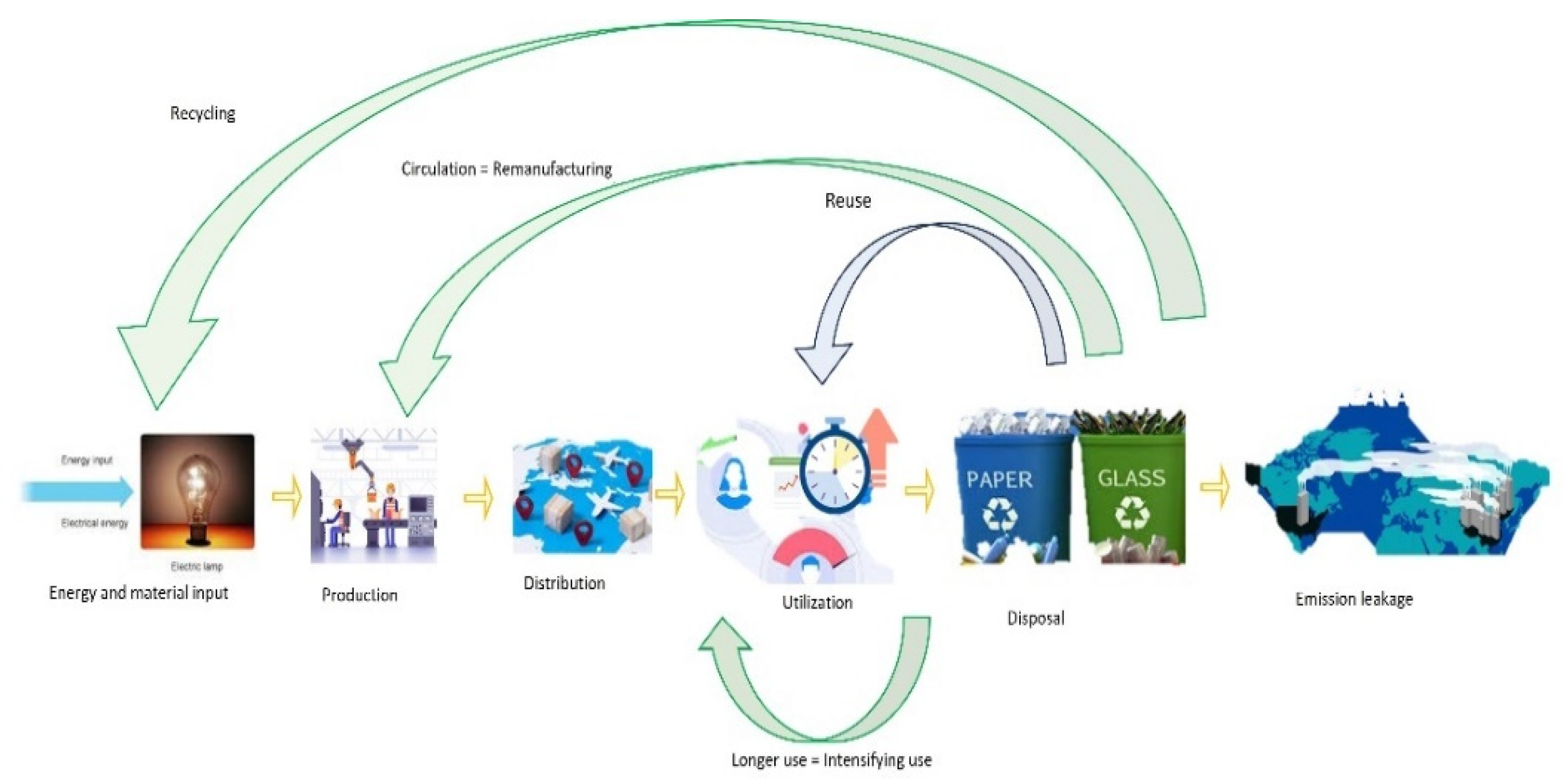
Figure 1.
Schematic presentation of modern mining industry providing energy driven materials.

| Type | Label | Composition (%) | Explanation |
| NCM | NCM 622 | 60/20/20 (Ni/Co/Mn) | Cathode 60% Ni, 20% Co, 20% Mn |
| NCM 523 | 50/20/30 (Ni/Co/Mn) | Cathode 50% Ni, 20% Co, 30% Mn | |
| NCM 111 | 10/10/10 (Ni/Mn/Co) | Cathode Ni, Mn, Co (1:1:1 ratio). | |
| NCM 622-GL | 60/20/20 (Ni/Mn/Co) | Cathode NCM 622 with graphite layer. | |
| NCM 811-GL | 80/10/10 (Ni/Co/Mn) | Cathode 80% Ni, 10% Co, 10% Mn with graphite layer | |
| NCM 955-GL | 90/5/5 (Ni/Mn/Co) | Cathode 90% Ni, 5% Co, 5% Mn with graphite layer | |
| Other | NCA | Li, Ni, Co, Al | Specific weight ratios of Lithium, Nickel, Cobalt, and Aluminum as cathode. |
| LFP | Li-Fe phosphate battery | Lithium Iron Phosphate as cathode. | |
| Graphite (Si) | Graphite anode + Si | Anode is graphite with silicon to enhance performance. | |
| Li-S | Li-S battery | Cathode of Li and S. | |
| Li- | Air lithium-air battery | Lithium used as the anode and Oxygen from the air as the cathode material. |
Table 2.
Key aspects that summarize why standardization and regulations are important for sustainable development of EV.
Table 2.
Key aspects that summarize why standardization and regulations are important for sustainable development of EV.
| Important aspects | Essential Features | Characteristics and explanation | |
|---|---|---|---|
| 1. | Ensuring safety and performance | Consistency in quality within whole production cycle | Standardized manufacturing ensures EV components meet performance and safety standards, safe handling of hazardous materials like lithium-ion batteries to protect workers and the environment. |
| 2. | Facilitating recycling | Materials recovery efficiency with reduction of waste | Battery design standards enable efficient disassembly and extraction of valuable metals like lithium, cobalt, and nickel. |
| 3. | Environmental sustainability | Reducing emissions and managing hazardous materials | Regulations promote environmentally responsible EV production and ensure safe disposal or reuse of toxic substances. |
| 4. | Global compatibility | Regional harmonization with universal production and charging infrastructure. | Cross-border standardization ensures global compatibility, reducing trade barriers, infrastructure costs, and simplifying recycling and repairs. |
| 5. | Promotion of innovation | Intensified research aids in establishing new manufacturing standards |
Regulations set targets for battery efficiency, recycling, and emissions, while standardization ensures fair competition and sustainability |
| 6. | Economic benefits | Decrease in production costs benefits market stability | Standardized components reduce manufacturing costs, while regulations boost market stability and long-term investment in EV production and recycling. |
| 7 | Consumer confidence | Transparency in the transport and production establishes trust in the recycling process. |
Standardized labels and certifications inform consumers on environmental impact and safety, while regulations ensure responsible EV recycling. |
| 8 | Critical material availability | Efficient use of scarce resources with sustainable sourcing | Recycling regulations reduce reliance on mining, while ethical sourcing prevents child labor and environmental harm. |
Table 3.
Key Major regulative documents for EV production and use.
| Category | Number | Description |
|---|---|---|
| Safety | ISO 26262 | Functional safety for automotive systems, focusing on risk management in electrical and electronic systems. |
| IEC 62133 | Safety requirements for portable sealed secondary cells and batteries, ensuring safe operation, handling, and protection from hazards. | |
| Euro NCAP / NHTSA | Vehicle crashworthiness and occupant safety standards, including specific guidelines for EVs. | |
| Charging | IEC 62196 | Specifies physical connectors and protocols for EV charging to ensure global interoperability. |
| CHAdeMO, CCS, Tesla Supercharger | Charging protocols define communication between vehicles and charging stations for fast charging and compatibility. | |
| Environmental and Emission | EU Battery Directive (2006/66/EC) | Ensures proper battery recycling and disposal to minimize environmental impact. |
| U.S. EPA Energy Efficiency Standards | Regulations ensuring EVs meet energy efficiency targets to reduce overall energy consumption. | |
| Management Standards | ISO 9001 | Quality management system standards ensure consistency and quality in manufacturing processes. |
| ISO 14001 | Environmental management standards to reduce ecological impact in manufacturing. | |
| ISO 15118 | Defines communication standards between EVs and charging stations to enable smart charging and grid integration. | |
| Performance Standards | Range and Charging Time Standards | Defines the acceptable range of vehicles on a single charge and the time required for charging. |
| Thermal Management Standards | Sets guidelines for battery cooling and heating systems to maintain optimal battery performance in varying temperatures. |
Disclaimer/Publisher’s Note: The statements, opinions and data contained in all publications are solely those of the individual author(s) and contributor(s) and not of MDPI and/or the editor(s). MDPI and/or the editor(s) disclaim responsibility for any injury to people or property resulting from any ideas, methods, instructions or products referred to in the content. |
© 2025 by the authors. Licensee MDPI, Basel, Switzerland. This article is an open access article distributed under the terms and conditions of the Creative Commons Attribution (CC BY) license (https://creativecommons.org/licenses/by/4.0/).
Copyright: This open access article is published under a Creative Commons CC BY 4.0 license, which permit the free download, distribution, and reuse, provided that the author and preprint are cited in any reuse.


