

Submitted:
19 February 2025
Posted:
20 February 2025
You are already at the latest version
Abstract
The main objective of this study was to analyze the physical fitness parameters in young paddle tennis players. The sample consisted of 18 players (10 boys and 8 girls) aged between 12- and 16-years old belonging to the Technification program for minors of the Valencian Padel Federation. The players completed a test battery that consisted of different tests: CMJ jump, internal and external shoulder rotator strength, manual dynamometry, functional upper body strength (forehand throw, backhand throw, bilateral overhead throw. and serve throw), smash speed, 5x10m agility test and tapas test. Data analysis was carried out with SPSS software for Windows. The results showed that the boys obtained significantly higher values in the tests of dynamometry, speed, agility (tapas test) and throws (forehand, backhand, serve and over the head) and the girls obtained significantly higher values in the test of shoulder external rotation (non-dominant). At the same time, the force variables were significantly and positively related to each other. The CMJ values are also significantly and positively correlated with the variables of shoulder rotation, sprint speed, and medicine ball throws. Regarding agility, significant and positive correlations were found in the tapas test. However, the 5x10m test showed negative and significant correlations with some variables. It has been observed that the results obtained coincide with the results found in other studies carried out with players of the same age in other sports, such as tennis and soccer.
Keywords:
racket sports
; padel
; adolescents
; conditioning
; training
1. Introduction
Padel is a doubles racket sport played on a 20 × 10-metre enclosed court with a central net and perimeter walls of glass or metal mesh (3–4 m high) that allow ball rebounds as part of the game [1,2]. Its rapid global expansion over the past decade, with federations in 150 countries and Spain leading in participation [1,2,3], is driven by its social and recreational appeal, ease of learning, and longer rallies compared to other racket sports [1,4,5].
Padel is characterised by intermittent bouts of moderate-to-high intensity effort [6] and imposes a unique match load on players, differing from singles tennis and more closely resembling doubles tennis [7]. Despite this, it is considered predominantly an aerobic sport [8]. Studies on adult players’ movements indicate they cover 2,000–3,000 metres per match, with approximately 50% of this distance occurring during active play [9,10]. These values vary depending on match competitiveness, temporal factors, and player level [11]. On average, players cover 11 metres per point and around 80 metres per game [10]. Male adult players spend over 50% of the match moving at speeds below 3 km·h⁻¹, with roughly 30% at speeds between 3 and 6 km·h⁻¹ [9,12]. Professional male players predominantly perform lateral and forward movements, frequently executing jumps for split-steps, smashes, and rotations [13].
Game actions and temporal aspects in padel vary according to players’ age, gender, and skill level [14,15], which may also influence physical demands. While padel players perform numerous short, high-intensity movements due to the frequent ball exchanges and the court’s limited dimensions [16], they must also execute pivots and rotations before striking the ball, given the presence of walls that allow for rebounds [17]. Consequently, strength, movement speed, and change-of-direction ability play a crucial role in padel performance.
In this vein, several studies have focused on examining physical parameters in padel players, ranging from junior to professional [18,19,20,21], including amateur players [22,23]. Regarding physical parameters in junior padel players, research has highlighted improvements in strength, power, and agility over a competitive season, with youth players demonstrating significant gains in isometric squat performance, jump height, and core strength after 20 weeks of training [24]. Differences based on gender have also been examined in several studies. Pradas et al. [21] have shown that male players exhibiting superior grip strength, vertical jump power, and lateral movement, while female players excel in reaction time and flexibility. Sánchez-Alcaraz et al. [22] have concluded that males achieve faster sprint times and greater upper-body force. In contrast, [27] et al. have observed that both genders display similar overall fitness levels, males tend to outperform females in jumping ability, and greater padel experience appears to enhance upper-limb throwing strength. Additionally, younger players show lower values in flexibility, gesture speed, and cardiorespiratory capacity compared to older junior players, underscoring the impact of physical maturation [25]. However, given that minors generally exhibit limited physical conditioning, it is particularly relevant to provide data on advanced players. Therefore, the aim of the present study is to analyse the physical fitness parameters of young padel players enrolled in a high-performance training programme, comparing potential differences between sexes and examining the relationships between various physical fitness variables in this population.
2. Materials and Methods
2.1. Participants
The participants were 18 padel players (10 boys and 8 girls) aged between 12 and 16. The players belonged to the Valencian Padel Federation's under-age training programme. Table 1 shows the characteristics of the participants in the study.
2.2. Procedure
First, informed consent was obtained from the Valencian Padel Federation, the sports club where the assessments took place, and the study participants. Data collection was conducted in a single morning session, between 10:00 and 14:00, at an outdoor facility with a temperature of 12°C. After a standardised five-minute warm-up, players completed a series of physical tests organised into four stations: (1) on-court smash test, (2) medicine ball throw test (forehand, backhand, bilateral overhead, and shot-put), (3) strength tests (handgrip dynamometry, countermovement jump, and internal and external shoulder rotators), and (4) agility tests (5x10 shuttle run with changes on the right and left leg, and the tap test). Players were divided into four groups, each assigned to a station, rotating every five minutes with a five-minute rest between stations. Ethical approval for this study was obtained from the Ethics Committee of the University of Extremadura (166//2023).
2.3. Instruments
Various instruments were selected to assess the physical performance of padel players and smash speed, following methodologies from similar research in padel and tennis [28,29,30,31,32,33]:
Countermovement Jump (CMJ): Jump height was measured using a Chronojump contact platform (Chronojump, Barcelona, Spain) and the Chronojump software version 1.7.1.8 for MAC. Participants started from an upright position with hands on their hips and feet shoulder-width apart. Each participant performed two attempts, with a two-minute rest between jumps. The best attempt, measured in centimeters, was recorded for analysis.
Internal and External Shoulder Rotator Strength: A strain gauge was used to assess shoulder rotator strength. Participants lay in a supine position with the elbow flexed at 90° and the shoulder abducted at 90°, keeping the wrist aligned with the forearm. Once positioned, they performed an internal rotation first, returned to the initial position, and then executed an external rotation, repeating the process with the opposite shoulder. Each test was performed twice per shoulder, with rest periods between attempts.
Handgrip Dynamometry: This test assessed maximal isometric strength of the finger flexors using a Smedley III T-18A dynamometer (Takei, Tokyo, Japan), which has a measurement range of 0–100 kg with 0.5 kg increments and an accuracy of ±2 kg. The test was conducted with the arm extended and positioned close to the torso without making contact. Participants exerted maximal force for three seconds. After a familiarization phase with submaximal repetitions, each participant performed two maximal attempts with a two-minute rest between trials. The best result, measured in kilograms, was recorded for analysis.
Upper-body functional strength: Upper-body explosive functional strength was assessed through three medicine ball (2 kg) throw tests, simulating forehand, backhand, overhead bilateral, and serve motions. Participants stood behind the throwing line, with a 15-meter measuring tape placed perpendicular to it on the ground. Two evaluators marked the ball's landing zone, recording distances in 0.10-meter increments. Each throw type was performed twice, with a two-minute rest between attempts. The best attempt, measured in meters, was recorded for analysis.
Forehand/backhand throw: The participant stood sideways to the throwing direction, holding the ball with both hands on the side of the body corresponding to the throwing motion (forehand or backhand). The dominant hand generated force, while the non-dominant hand guided the movement. At the evaluator's signal, the participant threw the ball as far as possible.
Overhead bilateral throw: The participant faced the throwing direction, holding the ball with both hands behind the head. At the evaluator's signal, the participant executed an explosive motion, throwing the ball overhead in a manner similar to a soccer throw-in.
Shot-put throw: The participant stood sideways to the throwing direction, holding the ball in the palm of the dominant hand beside the head. At the evaluator’s signal, they performed an explosive motion, throwing the ball similarly to a shot-put technique.
Smash velocity: The velocity of the shot was gauged using the speed radar, designated the 'Pocket Radar Ball Coach', manufactured by Technology Sport. The player was asked to hit 8 smashes, 2 meters from the net. The radar was placed behind the player at the same hitting height and facing the direction of the ball. The radar measures with a speed range between 40 and 210 km/h with an accuracy of 土 2 km/h. For the analysis, the value of the 6 best shots in km/h were counted.
5x10 agility test: This test assessed change-of-direction ability, speed, and agility. Participants started behind the starting line in an upright position, facing a line 5 meters away. At the evaluator’s signal, they sprinted to the 5-meter line, stepping on it with one foot before making a 180° turn to sprint back to the starting line. The test concluded when the participant crossed the starting line. Each player performed the test twice using their dominant leg for the turn and twice with their non-dominant leg. The fastest time of the two attempts for each leg was recorded for analysis.
Tapas 6R test: This padel-specific agility test, originally named the Tapas 6R Test (Figure 1), was designed to evaluate padel players’ agility. Six balls were placed on flat cones in specific positions: 0.45 m from the lines, walls, net, and baseline. Players started at the center of the service line, within a designated 1×1 m target area where they had to place the collected balls. They followed a set sequence, sprinting to each position, picking up a ball, turning, returning to the target area, and placing the ball without dropping it. Players used their dominant hand for both retrieval and placement. The test ended when the last ball was placed in the target area.
2.4. Statistical Analysis
A descriptive analysis was conducted, including the calculation of mean and standard deviation (M ± SD) for the studied variables. Given the small sample size, the Shapiro-Wilk and Levene tests were used to assess normality and homogeneity of variances for each variable. A Student’s t-test was applied to compare mean differences between genders (male and female). Correlation analysis was performed using Pearson’s r coefficient to examine relationships between different tests and participants' age. Correlation values were classified as Trivial (0–0.1), Small (0.1–0.3), Moderate (0.3–0.5), Large (0.5–0.7), Very Large (0.7–0.9), Nearly Perfect (0.9), and Perfect (1.0) [34]. Statistical significance was set at p < 0.05. All analyses were conducted using SPSS for Windows (Version 25.0, Armonk, NY: IBM Corp.).
3. Results
Table 2 presents the descriptive data of the studied variables based on participants' gender. Significant differences were found, with male players exhibiting higher values in dynamometry (both dominant and non-dominant hand), speed (average and maximum), agility (Tapas test), and throwing performance (forehand, backhand, serve, and overhead). In contrast, female players showed superior performance in the non-dominant shoulder external rotation test.
Table 3 presents the correlation results between the different variables under study. As observed, strength-related variables showed significant positive correlations among themselves. Specifically, handgrip dynamometry values for both the dominant and non-dominant sides correlated significantly and positively with countermovement jump performance, shoulder rotation strength (dominant, non-dominant, internal, and external), smash speed, and medicine ball throws (forehand, backhand, bilateral overhead, and serve). Countermovement jump values also exhibited significant positive correlations with shoulder rotation strength (dominant and non-dominant, internal and external), smash speed, and medicine ball throws (forehand, backhand, bilateral overhead, and serve).
Regarding agility variables, significant positive correlations were found with the Tapas agility test. However, the 5x10 agility test (changes of direction with both the left and right legs) showed significant negative correlations with certain strength variables, such as handgrip dynamometry, medicine ball throws, and shoulder rotation strength.
4. Discussion
The main objective of this research was to analyze the physical fitness parameters of young padel players in a high-performance training program.
First, regarding strength-related variables, boys obtained higher results in both the handgrip dynamometry test and all four types of medicine ball throws. These findings align with previous studies, such as that of Courel-Ibáñez et al. [23], which analyzed the physical fitness levels of young competitive padel players in Andalusia [27]. The average medicine ball throw distances recorded in this study, for both male and female players, were higher than those reported by Sánchez-Alcaraz et al. [22]. These differences may be attributed to the varying skill levels of the samples in both studies. On the other hand, regarding the countermovement jump test, no significant differences were found between boys and girls. This contrasts with the findings of [27], where boys achieved significantly higher values in this variable.
Regarding agility, the results were similar to those reported by Sánchez-Alcaraz et al. [4] in 12- and 13-year-old soccer players, but showed faster times compared to the study by Sánchez-Alcaraz et al. [31], which evaluated 24 tennis players aged 8 to 10 years. These differences may be attributed to the age variation among participants [35,36]. The padel-specific agility test, known as Tapas, revealed significantly better times for boys compared to girls, aligning with the findings of Courel-Ibáñez et al. [23]. Both agility tests (5x10 and Tapas) showed a significant positive correlation, suggesting that this new test could be a valuable tool for assessing agility levels in youth padel players within development programs.
Regarding smash velocity, boys exhibited higher average and maximum speeds than girls. These findings are particularly relevant, since the smash is considered the most decisive shot in padel, being the technical-tactical action that generates the highest number of winning points in amateur and professional padel players [37]. Additionally, smash speed correlated positively and significantly with other physical tests, such as handgrip dynamometry, countermovement jump (CMJ), and medicine ball throws. Other studies have also reported positive correlations between strength, measured through medicine ball throws, and serve speed in young tennis players [38,39]. Similarly, Sánchez-Pay et al. [29] found that higher medicine ball throw results were associated with greater serve speed in wheelchair tennis players. Conversely, some studies suggest that strength and power values do not necessarily correlate with tennis serve speed [29]. Additionally, Hayes et al. [37] observed a positive correlation between CMJ and tennis serve speed, while Fett et al. [36], in a study with 1,016 tennis players (625 boys and 394 girls) aged between 9.4 and 17.9 years, found no correlation between CMJ and tennis serve speed.
This study presents several limitations that should be considered. First, the small sample size limits the generalizability of the results. Additionally, player dominance (left-handed vs. right-handed) was not taken into account, suggesting that future studies should increase the sample size and compare not only by gender but also by other variables such as age, playing level, laterality, court position, etc. Regarding the physical tests, from a biomechanical perspective, no anthropometric measurements of body segments and levers were taken, which could influence the results of the medicine ball throws and smash speed tests. Furthermore, smash speed was assessed through an analytical field test rather than within a competitive match setting.
The findings of this study have important practical applications for training design based on players' physical and technical characteristics. Given the strong relationship between medicine ball throw (MBT) performance and smash speed in padel, it is recommended to incorporate MBT exercises (with and without displacement, with and without jumping, overhead, etc.) into physical conditioning programs to enhance smash performance.
5. Conclusions
Overall, the results of this study indicate that the physical parameters of high-performance youth padel players are comparable to those of athletes of the same age in sports such as tennis or soccer. Additionally, gender differences reveal that male players achieve better results in strength, agility, and smash speed tests, except for shoulder rotation tests, where female players performed better.
Moreover, positive correlations were found between various strength tests and smash speed, suggesting that physical conditioning should include medicine ball throw (MBT) exercises (with and without displacement, with and without jumping, overhead, etc.) to enhance smash performance.
Author Contributions
Conceptualization, I.M-M. and D.M..; methodology, B.J.S-A. and R.C-R; formal analysis, A.S.P., B.J.S-A. and A.E-T; investigation, A.S.P., I.M-M. and D.M.; resources, B.J.S-A, R.C-R and A.E-T; data curation, A.E-T, D.M. and R.C-R.; writing—original draft preparation, I.M-M, D.M. and A.E-T.; writing—review and editing, A.S.P., B.J.S-A., I.M-M, R.C-R; visualization, A.E-T. and R.C-R; supervision, D.M. and B.J.S-A. All authors have read and agreed to the published version of the manuscript.
Funding
This research received no external funding.
Institutional Review Board Statement
The study was conducted in accordance with the Declaration of Helsinki, and approved by the University of Extremadura (166//2023).
Informed Consent Statement
Any research article describing a study involving humans should contain this statement. Please add “Informed consent was obtained from all subjects involved in the study.” OR “Patient consent was waived due to REASON (please provide a detailed justification).” OR “Not applicable.” for studies not involving humans. You might also choose to exclude this statement if the study did not involve humans. Written informed consent for publication must be obtained from participating patients who can be identified (including by the patients themselves). Please state “Written informed consent has been obtained from the patient(s) to publish this paper” if applicable.
Data Availability Statement
Not applicable.
Acknowledgments
Not aplicable
Conflicts of Interest
The authors declare no conflicts of interest.”
References
- Courel-Ibáñez, J.; Sánchez-Alcaraz Martínez, B.J.; Cañas, J. Game performance and length of rally in professional padel players. J Hum Kinet. 2017, 55, 161–9. [Google Scholar] [CrossRef] [PubMed]
- Internacional Padel Federation. International Padel Federation (FIP) Padel Rules of the Game. 2023.
- Gutiérrez-Plaza, G.; Arrufat, S.; Alfonso-Asencio, M. La evolución y el auge del pádel en España: análisis de la cobertura del pádel en grandes medios y su impacto en las audiencias. Padel Scientific Journal. 2025, 3, 79–96. [Google Scholar] [CrossRef]
- Courel-Ibáñez, J.; Sánchez-Alcaraz, B.J.; Muñoz, D.; Pérez-Grijota, F.J.; Herrera-Chaparro, R.; Díaz-García, J. Gender reasons for practicing paddle tennis. Apunts Educacion Fisica y Deportes. 2018, 116–25. [Google Scholar]
- Sánchez-Alcaraz, B.J. Diferencias en las acciones de juego y la estructura temporal en el pádel masculino y femenino de competición. Acción Motriz. 2014, 12, 17–22. [Google Scholar]
- Bartolomé, I.; Córdoba, L.; Crespo, C.; Grijota, F.; Maynar, M.; Muñoz, D. Effects of a paddle match on the urinary excretion of trace minerals in high-level players. Sci Sports. 2016, 31, e131–7. [Google Scholar] [CrossRef]
- Armstrong, C.; Reid, M.; Beale, C.; Girard, O. A Comparison of Match Load Between Padel and Singles and Doubles Tennis. Int J Sports Physiol Perform. 2023, 18, 512–22. [Google Scholar] [CrossRef]
- De Hoyo, M.; Sañudo, B.; Carrasco, L. Physiological demands of competition in paddle. RICYDE Revista Internacional de Ciencias del Deporte [Internet]. Available from: http://www.cafyd.com/REVISTA/00805.pdf. 2007, 3, 53–8. [Google Scholar]
- Amieba, C.; Salinero, J.J. General aspects of paddle tennis competition and its physiological demands [Aspectos generales de la competición del pádel y sus demandas fisiológicas]. AGON International Journal of Sport Sciences. 2013, 3, 60–7. [Google Scholar]
- Ramón-Llín, J.; Guzmán, J.F.; Llana, S.; Vuckovic, G.; Muñoz, D.; Sánchez-Alcaraz, B.J. Análisis de la distancia recorrida en pádel en función del nivel de juego y el número de puntos por partido [Analysis of distance covered in padel based on level of play and number of points per match]. Retos, Nuevas Tendencias en Educacion Fisica Deporte y Recreacion. 2021, 39, 205–9. [Google Scholar] [CrossRef]
- Ramón-Llin, J.; Guzmán, J.; Llana, S.; Vučković, G.; James, N. Comparison of distance covered in paddle in the serve team according to performance level. Journal of Human Sport and Exercise. 2013, 8, S738–42. [Google Scholar] [CrossRef]
- Castillo-Rodríguez, A.; Alvero-Cruz, J.R.; Hernández-Mendo, A.; Fernández-García, J.C. Physical and physiological responses in paddle tennis competition. Int J Perform Anal Sport. 2014, 14, 524–34. [Google Scholar] [CrossRef]
- Priego, J.I.J.I.; Olaso, J.; Llana, S.; Pérez, P.; Gonález, J.C.; Sanchís, M.; et al. Padel: a quantitative study of the shots and movements in the high-performance. Journal of Human Sport and Exercise. 2013, 8, 925–31. [Google Scholar] [CrossRef]
- Almonacid, B.; Martínez, J.; Escudero-Tena, A.; Sánchez-Alcaraz, B.J.; Sánchez-Pay, A.; Muñoz, D. Volumen e intensidad en pádel profesional masculino y femenino. Revista Iberoamericana de Ciencias de la Actividad Física y el Deporte. 2023, 12, 58–70. [Google Scholar] [CrossRef]
- Conde-Ripoll, R.; Muñoz, D.; Escudero-Tena, A.; Courel-Ibáñez, J. Sequential Mapping of Game Patterns in Men and Women Professional Padel Players. Int J Sports Physiol Perform. 2024, 19, 454–62. [Google Scholar] [CrossRef]
- Miralles, R.; Martínez-Gallego, R.; Guzmán, J.; Ramón-Llin, J. Movement patterns and player load: insights from professional padel. Biol Sport [Internet]. 2025; Available from: https://www.termedia.pl/doi/10.5114/biolsport.2025.139856.
- Courel-Ibáñez, J.; Sánchez-Alcaraz, B.J.; Muñoz, D. Exploring game dynamics in padel: implications for assessment and training. J Strength Cond Res. 2019, 33, 1971–7. [Google Scholar] [CrossRef]
- Pradas, F.; García-Giménez, A.; Toro-Román, V.; Ochiana, N.; Castellar, C. Gender differences in neuromuscular, haematological, and urinary responses during padel matches. Int J Environ Res Public Health. 2021, 18. [Google Scholar] [CrossRef]
- Pradas, F.; Sánchez-Pay, A.; Muñoz, D.; Sánchez-Alcaraz, B.J. Gender differences in physical fitness characteristics in professional padel players. Int J Environ Res Public Health. 2021, 18. [Google Scholar] [CrossRef]
- Conde-Ripoll, R.; Martín-Miguel, I.; Escudero-Tena, A.; Bustamante Sánchez, Á. Test de remate en el pádel masculino finlandés: ranking 1-5 vs ranking 10-25. Padel Scientific Journal. 2025, 3, 7–24. [Google Scholar] [CrossRef]
- Bustamante-Sánchez, Á.; Ramírez-Adrados, A.; Iturriaga, T.; Fernández-Elías, V.E. Efectos en la fuerza, salto, tiempo de reacción y percepción de esfuerzo y estrés en competición masculina de pádel top-20 mundial. Padel Scientific Journal. 2024, 2, 7–19. [Google Scholar] [CrossRef]
- Müller, C.B.; Vecchio, F.B. Del. Physical fitness of amateur paddle tennis players: Comparisons between different competitive levels. Motricidade. 2018, 14, 42–51. [Google Scholar] [CrossRef]
- Villanueva Guerrero, O.; Insausti Galilea, J.; Mejías Martínez, M.; Gadea Uribarri, H.; Sola Aguilera, M.; Mainer Pardos, E. Efectos de un programa de entrenamiento de fuerza basado en la velocidad de ejecución en pelotaris U-23. Padel Scientific Journal. 2022, 1, 55–70. [Google Scholar] [CrossRef]
- Ryman Augustsson, S.; Olsson, M.C.; Haglund, E. Changes in Physical Fitness in Youth Padel Players during One Season: A Cohort Study. Sports. 2024, 12, 193. [Google Scholar] [CrossRef] [PubMed]
- Pradas, F.; Toro-Román, V.; Ortega-Zayas, M.A.; Montoya-Suárez, D.; Sánchez-Alcaraz, B.J.; Muñoz, D. Physical Fitness and Upper Limb Asymmetry in Young Padel Players: Differences between Genders and Categories. Int J Environ Res Public Health. 2022, 19. [Google Scholar] [CrossRef] [PubMed]
- Sánchez-Alcaraz, B.J.; Orozco-Ballesta, V.; Courel-Ibáñez, J.; Sánchez-Pay, A. Evaluación de la velocidad, agilidad y fuerza en jóvenes jugadores de pádel. Retos. 2018, 34, 263–6. [Google Scholar] [CrossRef]
- Courel-Ibáñez, J.; Llorca-Miralles, J. Physical fitness in young padel players: A cross-sectional study. Int J Environ Res Public Health. 2021, 18, 1–10. [Google Scholar] [CrossRef]
- Bonato, M.; Maggioni, M.A.; Rossi, C.; Rampichini, S.; La Torre, A.; Merati, G. Relationship between anthropometric or functional characteristics and maximal serve velocity in professional tennis players. J Sports Med Phys Fitness. 2015, 55, 1157–65. [Google Scholar]
- Colomar, J.; Baiget, E.; Corbi, F. Influence of strength, power, and muscular stiffness on stroke velocity in junior tennis players. Front Physiol. 2020, 11. [Google Scholar] [CrossRef]
- Courel-Ibáñez, J.; Herrera-Gálvez, J.J. Fitness testing in padel: Performance differences according to players’ competitive level. Sci Sports. 2020, 35, 11–9. [Google Scholar] [CrossRef]
- Fernandez-Fernandez, J.; Ulbricht, A.; Ferrauti, A. Fitness testing of tennis players: How valuable is it? Br J Sports Med. 2014, 48, i22–31. [Google Scholar] [CrossRef]
- Sánchez-Pay, A.; Courel-Ibáñez, J.; Sánchez-Alcaraz, B.J. Análisis de la condición física en jóvenes jugadoras de tenis. RED Revista de Entrenamiento Deportivo. 2020, 34, 11–9. [Google Scholar]
- Sánchez-Pay, A.; Sanz-Rivas, D. Assessment of the physical condition of the high-level wheelchair tennis player according to competitive level and kind of injury. RICYDE Revista internacional de ciencias del deporte. 2019, 15, 235–48. [Google Scholar] [CrossRef]
- Hopkins, W.G. Measures of reliability in sports medicine and science. Sports Medicine. 2000, 30, 1–15. [Google Scholar] [CrossRef] [PubMed]
- Sánchez-Alcaraz, B.J.; López, G.F.; Pagán, A. Differences in young tennis players ́ agility depending on their playing level. ITF Coaching & Sport Science Review. 2016, 24, 19–21. [Google Scholar]
- Sánchez-Sánchez, J.; Yagüe, J.M.; Fernández, R.C.; Petisco, C. Efectos de un entrenamiento con juegos reducidos sobre la técnica y la condición física de jóvenes futbolistas. [Effects of small-sided games training on technique and physical condition of young footballers]. RICYDE Revista internacional de ciencias del deporte. 2014, 10, 221–34. [Google Scholar] [CrossRef]
- Sánchez-Alcaraz, B.J.; Perez-Puche, D.T.; Pradas, F.; Ramón-Llín, J.; Sánchez-Pay, A.; Muñoz, D. Analysis of performance parameters of the smash in male and female professional padel. Int J Environ Res Public Health [Internet]. Available from: https://www.mdpi.com/1660-4601/17/19/7027. 2020, 17, 7027. [Google Scholar] [CrossRef]
- Fernandez-Fernandez, J.; Nakamura, F.Y.; Moreno-Perez, V.; Lopez-Valenciano, A.; Coso JDel Gallo-Salazar, C. , et al. Age and sex-related upper body performance differences in competitive young tennis players. PLoS One. 2019, 14, e0221761. [Google Scholar] [CrossRef]
- Fett, J.; Ulbricht, A.; Ferrauti, A. Impact of Physical Performance and Anthropometric Characteristics on Serve Velocity in Elite Junior Tennis Players. J Strength Cond Res. 2020, 34, 192–202. [Google Scholar] [CrossRef]
- Hayes, M.J.; Spits, D.R.; Watts, D.G.; Kelly, V.G. Relationship Between Tennis Serve Velocity and Select Performance Measures. J Strength Cond Res. 2021, 35, 190–7. [Google Scholar] [CrossRef]
Figure 1.
Tapas 6R test.
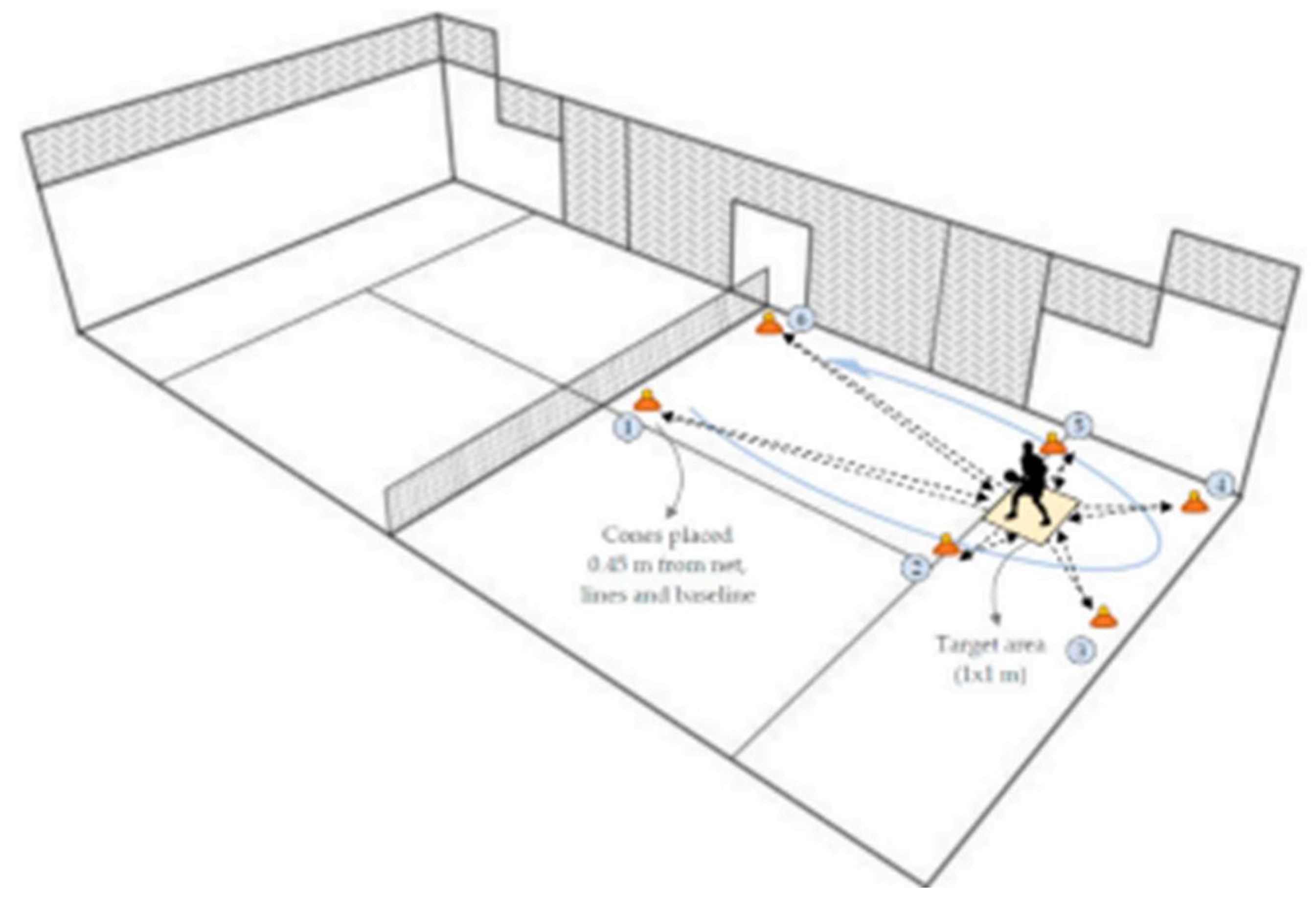

Table 1.
Participants characteristics.
| Male M (S.D.) |
Female M (S.D.) |
|
|---|---|---|
| Number | 10 | 8 |
| Age | 13.50 (1.95) | 14.00 (1.22) |
| Weight (kg) | 54.33 (15.16) | 56.50 (8.86) |
| Weekly hours of training | 4.35 (1.63) | 3.70 (1.09) |
| Experience in padel (ages) | 6.20 (1.61) | 7.20 (3.11) |
| Laterality | 8 right-handed / 2 left-handed | 5 right-handed / 0 left-handed |
Note: N = Number of participants, M = Mean, S.T. = Standar deviation.
Table 2.
Valores medios y deviación típica (DT) según género.
| Male M (SD) |
Female M (SD) |
F | p value | |
|---|---|---|---|---|
| HD D (kg) | 29.42 (11.19) | 29.00 (4.59) | 9.812 | .008** |
| HD ND (kg) | 24.35 (8.88) | 23.65 (3.47) | 32.898 | .000** |
| CMJ (cm) | 27.82 (5.62) | 27.51 (4.10) | 1.26 | .280 |
| AG R (s) | 2.85 (.12) | 2.83 (.10) | .392 | .542 |
| AG L (s) | 2.77 (.27) | 2.90 (.13) | .760 | .399 |
| IR D (kg) | 80.01 (19.86) | 97.10 (21.05) | .000 | .984 |
| ER D (kg) | 78.27 (26.35) | 94.14 (20.76) | .246 | .628 |
| IR ND (kg) | 72.98 (25.99) | 76.81 (15.33) | 2.376 | .147 |
| ER ND (kg) | 74.64 (27.00) | 80.91 (10.30) | 8.459 | .012* |
| Mean V (km/h) | 112.17 (13.39) | 103.63 (5.20) | 8.143 | .021* |
| Max V (km/h) | 127.50 (12.25) | 107.80 (6.21) | 7.652 | .017* |
| AG TAP (s) | 18.84 (1.04) | 19.12 (.67) | 8.012 | .014* |
| MBT Fh (m) | 8.65 (2.49) | 7.48 (.99) | 8.083 | .014* |
| MBT Bh (m) | 8.10 (2.48) | 6.69 (.60) | 11.266 | .004** |
| MBT BI (m) | 6.22 (1.79) | 6.16 (.92) | 10.540 | .006* |
| MBT S (m) | 8.00 (2.25) | 7.41 (.88) | 10.904 | .006* |
Note: M: Mean, SD: Standard deviation, *: p < .005, **: p < .001, HD: Handgrip dynamometry (D: Dominant; ND: Non-dominant), CMJ: Countermovement jump, AG = Agility (R: Right lef; L = Left leg), IR: Shoulder internal rotation (D: Dominant; ND: Non-dominant), ER: External shoulder rotation (D: Dominant; ND: Non-dominant), V: Velocity, AG TAP: Agility tapas; MBT: Medicine ball throw (Fh: Forehand, Bh: Backhand, BI: Bilateral overhead, S: Shot-put).
Table 3.
Pearson correlation between different variables analyzed.
| Variable | HD D | HD ND | CMJ | AG R | AG L | IR D | ER D | IR ND | ER ND | V | AG TAP | MBT Fh | MBT Bh | MBT BI | MBT S |
|---|---|---|---|---|---|---|---|---|---|---|---|---|---|---|---|
| HD D (Kg) | — | ||||||||||||||
| HD ND (kg) | .965** | — | |||||||||||||
| CMJ (cm) | .763** | .808** | — | ||||||||||||
| AG R | -.610* | -.607 | -.399 | — | |||||||||||
| AG L | -.542* | -.653** | -.517* | .393 | — | ||||||||||
| IR D | .749** | .684** | .725** | -.488 | -.120 | — | |||||||||
| ER D | .846** | .762** | .626* | -.540* | -.336 | .860** | — | ||||||||
| IR ND | .878** | .828** | .616* | -.559* | -.535* | .732** | .940** | — | |||||||
| ER ND | .889** | .875** | .657** | -.535* | -.607* | .714** | .890** | .963** | — | ||||||
| V (km/h) | .751* | .777** | .771** | -.372 | -.523 | .420 | .183 | .369 | .544 | — | |||||
| AG TAP | -.703** | -.811** | -.676** | .532* | .599* | -.384 | -.411 | -.542* | -.630* | -.829** | |||||
| MBT Fh (m) | .762** | .788** | .737** | -.529* | -.341 | .642** | .513 | .588* | .639* | .925** | -.742** | — | |||
| MBT Bh (m) | 674** | .757** | .673** | -.522* | -.403 | .433 | .366 | .480 | .558* | .893** | -.833** | .926** | — | ||
| MBT BI (m) | .872** | .859** | .817** | -.532* | -.358 | .812** | .693** | .687** | .735** | .900** | -.743** | .915** | .785** | — | |
| MBT S (m) | .853** | .903** | .831** | -.474 | -.535* | .662** | .650** | .709** | .793** | .883** | -.720** | .889** | .835** | .868** | — |
Nota: HD: Handgrip dynamometry (D: Dominant; ND: Non-dominant), CMJ: Countermovement jump, AG = Agility (R: Right lef; L = Left leg), IR: Shoulder internal rotation (D: Dominant; ND: Non-dominant), ER: External shoulder rotation (D: Dominant; ND: Non-dominant), V: Velocity, AG TAP: Agility tapas; MBT: Medicine ball throw (Fh: Forehand, Bh: Backhand, BI: Bilateral overhead, S: Shot-put).
Disclaimer/Publisher’s Note: The statements, opinions and data contained in all publications are solely those of the individual author(s) and contributor(s) and not of MDPI and/or the editor(s). MDPI and/or the editor(s) disclaim responsibility for any injury to people or property resulting from any ideas, methods, instructions or products referred to in the content. |
© 2025 by the authors. Licensee MDPI, Basel, Switzerland. This article is an open access article distributed under the terms and conditions of the Creative Commons Attribution (CC BY) license (http://creativecommons.org/licenses/by/4.0/).
Copyright: This open access article is published under a Creative Commons CC BY 4.0 license, which permit the free download, distribution, and reuse, provided that the author and preprint are cited in any reuse.


