Preprint
Article

This version is not peer-reviewed.

Differential Psychometric Validation of the Brief Scale of Social Desirability (BSSD-4) in Ecuadorian Youth

A peer-reviewed article of this preprint also exists.

Submitted:

14 February 2025

Posted:

18 February 2025

You are already at the latest version

Abstract

Social desirability is a widely studied phenomenon due to its impact on the validity of self-reported data. This study evaluated the psychometric properties of the Brief Social Desirability Scale (BSSD-4) in Ecuadorian youth, analyzing its reliability, factorial and convergent validity, and measurement invariance by sex, age group, and experiences of dating violence. An instrumental study was conducted with 836 participants (aged 14–26). Reliability was adequate (Ω = 0.75, α = 0.81, CR = 0.759). Confirmatory Factor Analysis showed good fit indices (CFI = 0.98, TLI = 0.97, RMSEA = 0.056, SRMR = 0.037). Convergent validity was acceptable (AVE = 0.50, VIF < 2.01). A network analysis confirmed the unidimensionality of the scale and structural differences between groups. Measurement invariance by sex and age was verified, but differences in the network structure were found based on victimization and perpetration of violence. The BSSD-4 is a valid and reliable instrument for assessing social desirability in Ecuadorian youth, useful for population studies and intergroup comparisons. Further research is recommended to explore its invariance in populations with a history of violence, as differences in scalar invariance were observed.

Keywords: 
;  ;  ;  
Subject: 
Social Sciences  -   Psychology

1. Introduction

Social desirability is a widely studied phenomenon in psychological and social science research due to its impact on the validity of self-reported data. Studies have shown that individuals tend to modify their responses based on cultural norms or social expectations, introducing biases in the measurement of various psychological and behavioral constructs [1,2,3]. This phenomenon is particularly problematic in areas such as the assessment of sexual behaviors [4], ethical decision-making [5], and mental health [6], where social pressure can lead individuals to provide responses that align more closely with social acceptability rather than reality.
Various studies have demonstrated the impact of social desirability on psychological and medical research. In the field of substance use, a meta-analysis found that social desirability bias affects self-reports of drug and alcohol consumption, with correlations ranging from -0.20 to -0.30 between social desirability and reported use [7]. Additionally, social desirability has been shown to influence the reporting of risk behaviors among adolescents, affecting the accuracy of epidemiological studies [8]. In studies on eating behavior, researchers found that children with high levels of social desirability consumed significantly fewer calories from processed foods in an experimental setting (B = -11.58, p = 0.009). Among boys, it was also associated with a reduction in fruit and vegetable intake (B = -6.47, p = 0.010) [9].
Despite the significance of social desirability bias in psychological and social research, no studies have validated specific instruments for measuring it in Ecuadorian populations. Most of the scales used have been developed and validated in other cultural contexts, highlighting the need for adaptation and evaluation within the country [10]. In collectivist contexts such as Ecuador, the impact of social desirability may be even greater. A study in Kazakhstan found that social desirability significantly influenced responses related to well-being and morality, with higher scores observed in countries with collectivist norms [11].

Reliability

Reliability is a fundamental criterion in the evaluation of any psychometric instrument. Several studies have analyzed the reliability of social desirability scales, revealing variations in internal consistency depending on the context and population studied [12].
A study conducted in Uganda assessed the translated version of the Marlowe-Crowne Social Desirability Scale (MCSDS) among individuals with HIV and found acceptable reliability values, with a Total Omega of 0.82 for the Denial domain and 0.69 for the Attribution domain [13]. Similarly, a psychometric study conducted in Kazakhstan using the short version of the MCSDS found low internal consistency scores, questioning the instrument’s unidimensionality in non-Western populations [10].
Furthermore, meta-analyses in environmental psychology research have revealed that the correlation between social desirability scales and self-reported behaviors ranges from 0.06 to 0.11, indicating a small but notable effect that varies depending on context {4}. In a study exploring gender differences in social desirability, women showed higher social approval tendencies, which significantly influenced self-reported dietary habits [12].

Validity

Convergent validity is key to determining whether an instrument effectively measures the theoretical construct for which it was designed [14]. Structural validity is assessed through confirmatory factor analysis (CFA) using fit indices such as the Comparative Fit Index (CFI), Tucker-Lewis Index (TLI), Root Mean Square Error of Approximation (RMSEA), and Standardized Root Mean Square Residual (SRMR) [15].
A study conducted among young Chinese participants (n = 1200) demonstrated that social desirability significantly influenced life satisfaction, mediated by mental toughness and emotional intelligence [16]. Another study in Nepal examined the validity of self-reported healthcare behaviors, finding that the presence of social desirability bias led to overestimation of antenatal care visits when interviews were conducted in the presence of family members [17].
In the clinical domain, a systematic review of social desirability in clinical psychology research highlighted that most studies treat social desirability as a one-dimensional construct, despite evidence suggesting that it consists of two distinct components: impression management and self-deception [8].

Measurement Invariance

Evaluating measurement invariance is essential to ensure that an instrument assesses the same construct across different demographic groups. A study on the Children’s Social Desirability Scale-Short Version (CSD-S) among children and adolescents in the U.S. found that the scale demonstrated strong invariance across ethnic groups but only partial invariance across educational levels, with significant differences in latent scores [18].
Moreover, previous studies on the invariance of social desirability scales have revealed that desirability bias affects the comparison of results across cultural groups, highlighting the importance of validating these instruments in each specific context [19,20,21]. Another study in multi-ethnic populations found that social desirability response patterns varied significantly between Indian and Chinese participants, suggesting that cultural norms influence response tendencies [19]. Additionally, studies have demonstrated that self-reported measures in sensitive domains, such as sexual behavior and substance use, are highly susceptible to social desirability bias, which may lead to underreporting of stigmatized behaviors [7,8].
Additionally, to date, no previous studies have been identified that examine the measurement invariance of the BSSD-4 across different sociodemographic groups, including sex, age group, and experiences of victimization (coercion, detachment, humiliation, sexual, and physical violence), as well as perpetration (coercion, detachment, humiliation, sexual, and physical violence) in the context of dating violence. This research represents a significant contribution by providing evidence on measurement equivalence across these groups, enabling more accurate assessments and valid comparisons in future studies on dating violence.

Network

The network analysis of items has not been extensively explored in previous studies on social desirability scales. However, several studies have suggested the importance of applying this methodology to understand the internal structure of the scales and their interrelationships [22].
In recent studies, the psychometric network-based approach has been used to evaluate various measurement instruments. For example, Caycho-Rodríguez et al. [23] applied a psychometric network model to analyze the internal structure, reliability, and cross-cultural invariance of the Grief Impairment Scale (GIS) in samples from Peru and El Salvador. Their findings indicated that the scale's items formed a unique network structure with high stability and structural consistency, reinforcing the validity of the instrument across different cultural contexts.
Similarly, in the field of rehabilitation, Northcott and Hilari [24] developed and psychometrically evaluated the Stroke Social Network Scale, a scale designed to measure the social network of individuals within the first six months following a stroke. The factor analysis of the scale identified five key subdomains: satisfaction, children, family, friends, and social groups. The scale demonstrated good internal consistency (α = 0.85) and convergent and discriminant validity, distinguishing between individuals with high and low levels of social support.
These studies suggest that network analysis not only provides a more detailed understanding of the internal structure of psychometric instruments but also allows for the exploration of latent relationships between items and enhances the accuracy of evaluating various psychological variables [25,26,27,28,29]. Given the growing evidence in different fields of psychology and health [30,31,32], applying this methodology to social desirability scales could offer new insights into the dynamics of the items and their impact on measuring this dimension.

Objectives and Hypotheses

Given the impact of social desirability on the validity of self-reported data, this study aims to evaluate the psychometric properties of the Brief Social Desirability Scale (BSSD-4) in Ecuadorian youth, focusing on assessing reliability, validity, and measurement invariance by sex, age group, and experiences of dating violence victimization and perpetration. This evaluation will help to determine how the BSSD-4 performs across different sociodemographic variables and ensure that it provides consistent and valid measurements.
The specific objectives of the study are as follows: 1) To assess the reliability of the BSSD-4 by calculating internal consistency. 2) To analyze the factorial structure of the scale through both exploratory and confirmatory factor analysis. 3) To verify its convergent validity by examining the Average Variance Extracted (AVE). 4) To examine the measurement invariance of the BSSD-4 across different sociodemographic groups, including sex, age group, and experiences of victimization (coercion, detachment, humiliation, sexual, and physical violence) as well as perpetration (coercion, detachment, humiliation, sexual, and physical violence) in the context of dating. 5) To analyze the centrality and clustering measures of the items in the Brief Social Desirability Scale (BSSD-4) among Ecuadorian youth, considering differences by sex. 6) To compare the network structure of the BSSD-4 items between age groups (14-21 years and 22-26 years) to identify variations in item connectivity and cohesion.
The hypotheses of the study are as follows: H1. The BSSD-4 will demonstrate high internal consistency, with reliability coefficients (such as Composite Reliability, McDonald's Ordinal Omega, Ordinal Cronbach's Alpha, and Guttman's Lambda 6) exceeding 0.70. H2. The BSSD-4 will be unidimensional and will show an excellent factorial fit, with Comparative Fit Index (CFI) and Tucker-Lewis Index (TLI) values greater than 0.95, and with the Root Mean Square Error of Approximation (RMSEA) and Standardized Root Mean Square Residual (SRMR) values lower than 0.08. H3. The BSSD-4 will demonstrate adequate convergent validity, with an Average Variance Extracted (AVE) value greater than 0.50, indicating that the items of the scale share a significant amount of common variance. H4. The BSSD-4 will exhibit measurement invariance across different sociodemographic groups, including sex, age group, and experiences of dating violence victimization (coercion, detachment, humiliation, sexual, and physical violence) and perpetration (coercion, detachment, humiliation, sexual, and physical violence), suggesting that the scale measures the same construct consistently across these groups. H5. There are significant differences in the centrality and clustering measures of the BSSD-4 items between male and female Ecuadorian youth, suggesting a distinct network structure by sex. H6. The network structure of the BSSD-4 items varies between age groups (14-21 years and 22-26 years), with younger participants exhibiting higher sparsity and lower item connectivity.

2. Materials and Methods

2.1. Research Design

The instrumental research was carried out in two phases, adhering to current standards for the validation of educational and psychological tests [33], as well as the guidelines for the adaptation and translation of existing tests [34,35,36,37]. In the first phase, the linguistic adaptation of the original test was conducted through an iterative translation process carried out by experts [38]. In the second phase, evidence of reliability, validity, and measurement invariance was gathered, considering factors such as sex, age group, and both victimization and perpetration of dating violence.

2.2. Participants

The study included a valid sample of 836 participants. A non-probabilistic convenience sampling was conducted [39], whose age had a median of 21 years and a mean of 20.78 years, with a standard deviation of 2.65 years. The minimum recorded age was 14 years, while the maximum was 26 years. Regarding percentile distribution, 25% of the participants were 19 years old or younger, 50% were 21 years old, and 75% were up to 23 years old. When grouping participants by age range, it was observed that 58.5% were between 14 and 21 years old (n = 489), while 41.5% were between 22 and 26 years old (n = 347). These data reflected a higher representation of young individuals in the study group.
Regarding the sex variable, 48.3% of the participants were men (n = 404), while 51.7% were women (n = 432). In terms of ethnicity, the majority of participants identified as mestizo (89.7%), followed by Indigenous (6.5%), Afro-Ecuadorian (1.4%), White (1.2%), Montubio (0.8%), and other ethnicities (0.4%).

2.3. Measures

2.3.1. Ad-Hoc Sociodemographic Survey

An ad hoc sociodemographic data survey was administered to collect the age, sex and ethnicity of the participants.

2.3.2. Scale of Social Desirability

Se utilizó la versión original de 33 ítems de la Escala de Deseabilidad Social de Marlowe y Crowne de Ferrando & Chico [40]. La deseabilidad social se evaluó mediante opciones de respuesta binarias (verdadero o falso) y se obtuvo una puntuación total, donde valores más altos reflejaban mayores niveles de deseabilidad social (rango = 0–33).

2.3.3. Dating Violence Questionnaire for Victimization and Perpetration (DVQ-VP)

Rodríguez Franco et al. [41], serves as a dual-function assessment instrument with two subscales. One subscale measures violence experienced by individuals, while the other evaluates violence committed within romantic relationships. Both subscales are organized around five identical dimensions that explore different aspects of dating violence. Beyond its use in detecting and assessing violence, the DVQ-VP offers valuable insights into the reciprocal nature of victimization and perpetration. The details of each subscale are outlined below:
Dating Violence Questionnaire for Victimization (DVQ-R): Was utilized to assess experiences of dating violence victimization by the current partner. It consists of 20 items that evaluate five types of victimization: physical (e.g., "Has your partner ever hit you?"), sexual (e.g., "Does your partner persist in touching you in ways or places you don’t like or want?"), humiliation (e.g., "Does your partner criticize, belittle, or undermine your self-esteem?"), detachment (e.g., "Does your partner refuse to take responsibility in the relationship?"), and coercion (e.g., "Has your partner ever physically restrained you?"). Each type of victimization is measured using four items on a five-point Likert scale ranging from 0 (never) to 4 (all the time).
Dating Violence Questionnaire for Perpetration (DVQ-RP): Is a modified version of the DVQ-R, adapted to assess aggression directed towards the partner. It includes 20 items that evaluate five types of dating violence perpetration: physical (e.g., "Have you ever hit your partner?"), sexual (e.g., "Do you persist in touching your partner in ways or places they don’t want or like?"), humiliation (e.g., "Do you criticize, belittle, or undermine your partner’s self-esteem?"), detachment (e.g., "Do you fail to acknowledge any responsibility in the relationship?"), and coercion (e.g., "Have you ever physically restrained your partner?").

2.3.4. Adverse Childhood Experiences Abuse Short Form (ACE-ASF)

The form consists of 8 Likert-type items. In the exploratory factor analysis conducted in the research by Meinck et al. [42], a two-factor structure was established, distinguishing between physical/emotional abuse and sexual abuse. The confirmatory factor analysis showed that this model fit the data well, with the following fit indices: [χ²(df) = 60.526(19); RMSEA = 0.036; CFI/TLI = 0.990/0.986], indicating an excellent fit of the model to the empirical data. Additionally, metric invariance between sexes was confirmed, meaning the instrument's measurements were consistent across different gender groups. Regarding internal consistency, the sexual abuse scale showed high reliability (α = .83), while the physical/emotional abuse scale demonstrated moderate consistency with a value of α = .57 [42].

2.4. Linguistic Equivalence of the Scale of Social Desirability

The linguistic adaptation of the Scale of Social Desirability to the Ecuadorian context was carried out through an iterative translation process conducted by specialists. In the first stage, two translated versions of the original English questionnaire were created. In the second stage, these two translations were combined with a third version derived from the Spanish version of the Scale of Social Desirability to develop a document that was evaluated by three bilingual experts: one linguist and two psychologists specializing in dating violence. The experts analyzed each item and selected the most appropriate option based on three criteria: equivalence (similarity or correspondence to the original), clarity (ease of understanding), and linguistic familiarity (common usage of Spanish in Ecuador). Additionally, they could provide comments or suggestions. To avoid bias, the order of the translations was counterbalanced across items. In the third stage, the experts’ responses were independently compared to identify discrepancies. In the fourth stage, the authors reached a consensus on the final version of each item. Subsequently, this finalized version was reviewed by a group of university students, who provided feedback that allowed for minor adjustments in grammar and meaning. It is important to note that none of the participants involved in this preliminary process took part in subsequent studies on the instrument’s reliability and validity.

2.5. Procedure

The study was conducted following the ethical guidelines of the Helsinki Declaration and was approved by the Human Research Ethics Committee of the Pontificia Universidad Católica del Ecuador under Protocol No PV-14-2022. Data collection was carried out through face-to-face surveys, where participants completed the self-report form using pencil and paper.
After obtaining the necessary permissions from the educational institutions, participants were invited to take part in the study. They were informed about the research's purpose and significance, emphasizing the voluntary nature of their participation and their right to withdraw or change their minds at any stage. Each participant signed an informed consent form, ensuring they understood and accepted the terms of their involvement.

2.6. Statistical Analysis

The analyses were performed using R version 4.4.3 [43] and JASP version 0.19.3. Regarding the first objective, to analyze the reliability of the Scale of Social Desirability in the Ecuadorian youth population, item descriptive statistics such as mean, standard deviation, skewness, and kurtosis were calculated. Normality was assessed using the Shapiro-Wilk test [51,52,53]. Additionally, reliability estimates [44,45], such as Guttman Lambda 6 (G6), as well as the Greatest Lower Bound (GLB), were used to measure the internal consistency of the questionnaire, considering total variance, covariances between items, and residual errors. The Average Interitem Correlation (AIC) was also calculated to assess the average correlation between items. Descriptive measures, including mean, standard deviation, and 95% confidence intervals for each reliability estimate, were reported to evaluate the precision and stability of the results.
Regarding the second objective, to analyze the structural validity of the Scale of Social Desirability through Confirmatory Factor Analysis (CFA), the factor structure of the questionnaire was examined using the Lavaan statistical package [46]. Since the data did not meet the assumption of multivariate normality [47,48], the diagonally weighted least squares estimator (DWLS) was applied [49]. Fit indices were evaluated using a comparative fit index (CFI) of .95 and a standardized root mean square residual (SRMR) of .08, which were established as the optimal model fit criteria [50,51,52]. Reliability of the factors was further assessed using Cronbach's alpha and McDonald's omega coefficients [53].
Regarding the third objective, to assess convergent validity, the Average Variance Extracted (AVE) was used. This indicator provides evidence of the scale's validity, with reference values for AVE ≥ .500 [54]. The statistical analyses included Composite Reliability (CR > 0.70) and Variance Inflation Factor (VIF < 10) [55].
To address the fourth objective, to examine the invariance of the Scale of Social Desirability model by sex age group, victimization and perpetration of dating violence, configural, metric, scalar, and strict invariance models were tested [56,57,58,59,60]. This analysis ensured that the questionnaire is equally applicable and valid for both men and women, avoiding gender-related biases among participants.
Finally, a network analysis [61,62,63] was conducted to explore the relationships and centrality of items within the questionnaire. Measures of centrality (betweenness, closeness, strength, and expected influence) and clustering methods (Barrat, Onnela, WS, and Zhang) were employed to provide additional insights into the questionnaire’s structure and the interconnections between its components. These analyses contribute to a comprehensive understanding of the Scale of Social Desirability psychometric properties, ensuring its reliability, validity, and applicability for the Ecuadorian youth population.

3. Results

First, a single-factor model was evaluated using the 33 original items of the Social Desirability Scale. The results (Supplementary Table 1) showed that each item (D1 to D33) had a factor loading reflecting its relationship with the latent factor (F1). Most items had statistically significant factor loadings (p < 0.05), suggesting an adequate representation of the construct. However, items D18 and D20 did not reach statistical significance (p > 0.05), and item D20 even showed a negative loading, indicating that these elements might not be suitable for measuring social desirability.
Additionally, the items with the highest factor loadings (D3, D5, D12, D23, D28, and D30) were identified, all exceeding the 0.50 threshold (Supplementary Table 1). These items were considered the most representative of the construct, as they showed a strong association with social desirability. Based on these findings, the number of items was reduced, selecting those that best explained the variance of the latent factor.
To validate the reduced model, a new factor analysis was conducted using the selected six-item version (D3, D5, D12, D23, D28, and D30). The results (Supplementary Table 2) showed that the factor loadings for these items ranged from 0.440 to 0.751, indicating a strong relationship with the social desirability factor. Moreover, all estimates were statistically significant (p < 0.05), reinforcing the reliability of the reduced model. However, items D12 and D30 were removed in a third version of the model, as their factor loadings were below 0.50.
Regarding fit indices, the original 33-item model showed moderate fit, with a Comparative Fit Index (CFI) of 0.738, a Tucker-Lewis Index (TLI) of 0.72, and a Root Mean Square Error of Approximation (RMSEA) of 0.056, indicating an acceptable fit (Supplementary Table 1). In contrast, the reduced six-item model showed significantly improved fit, with a CFI of 0.980 and a TLI of 0.966, values that indicate excellent model fit to the data (Supplementary Table 2).
These results suggest that the reduced version of the Brief Scale of Social Desirability (BSSD-4) is an efficient and valid measure for assessing social desirability in Ecuadorian youth (Supplementary Table 3, Figure 1). The removal of less representative items optimized the factorial structure without compromising construct validity, making it a valuable tool for future research in this field.
The selected items in Model 3 of the Social Desirability Scale (Table Supplementary 3) exhibited non-normal distributions (Shapiro-Wilk, p < .001). Items D1 (Item 3 original scale: Sometimes I struggle to get to work if I’m not in the mood) (m = 0.252, md = 0, SD = 0.435, min = 0, max = 1), D2 (Item 5 original scale: Sometimes I doubt my ability to succeed in life) (m = 0.371, md = 0, SD = 0.483, min = 0, max = 1), and D3 (Item 23 original scale: At times I feel clumsy) (m = 0.273, md = 0, SD = 0.446, min = 0, max = 1) showed positive skewness (1.142, 0.536, and 1.022, respectively), indicating that most responses were concentrated in the lower values. Additionally, their negative kurtosis values (-0.697, -1.717, and -0.957) suggested flatter distributions. In contrast, item D4 (Item 28 original scale: Sometimes I have felt quite jealous of the good fortune of others) (m = 0.550, md = 1.000, SD = 0.498, min = 0, max = 1) showed negative skewness (-0.202) and lower kurtosis (-1.964), suggesting a higher concentration of responses at the higher values. These results indicated that participants tended to respond with extreme values, which may have been influenced by social desirability.
The Table 1 presented the psychometric validation results of the Brief Social Desirability Scale (BSSD-4) in Ecuadorian youth, highlighting the instrument's reliability and validity. The standardized factor loadings were relatively high, particularly for items D2 (0.832) and D1 (0.685), indicating good representation of these items by their corresponding factor. The value for D2 (R² = 0.692) reflected a higher explanation of variance for this item. Reliability indices, such as the composite reliability (CR) and McDonald's Omega ordinal coefficient (ωₒ), showed good values (ωₒ > 0.7), suggesting high internal consistency. The ordinal Cronbach's Alpha (αₒ) for D1 was adequate (αₒ = 0.809), further supporting the instrument's reliability. Additionally, the average variance extracted (AVE = 0.500) was acceptable, and the low VIF values indicated no problematic multicollinearity among the items. These results confirmed the reliability and validity of the BSSD-4 for measuring social desirability in this group of Ecuadorian youth.
The factor model 3 for the Brief Scale of Social Desirability (BSSD-4) in young Ecuadorians shows an excellent fit to the data (Figure 1). This is supported by the high values of the Comparative Fit Index (CFI), Tucker-Lewis Index (TLI), Non-Normed Fit Index (NNFI), and Normed Fit Index (NFI), all exceeding 0.95. Furthermore, the Root Mean Square Error of Approximation (RMSEA) and Standardized Root Mean Square Residual (SRMR) indicate a good fit, with values below 0.05 and 0.08, respectively.
The sex-based invariance analysis showed that the configural, metric, scalar, and strict models demonstrated good fit. The configural invariance test indicated a non-significant difference (χ2 (2) = 4.804, p = .091), suggesting that the factorial structure was equivalent between men and women (CFI = .993, TLI = .959, RMSEA = .058, SRMR = .037). Metric invariance was also supported (χ2 (7) = 7.966, p=.336), indicating that factor loadings were similar (CFI = .998, TLI = .996, RMSEA = .018, SRMR = .042). Likewise, scalar and strict invariance showed no significant differences (χ2 (6) = 10.845, p=.093), suggesting that item intercepts and residual variances were equivalent across groups (CFI = .988, TLI = .977, RMSEA = .044, SRMR = .043) (Table 2).
Regarding age groups, configural invariance showed a good fit (χ2 (2) = 5.339, p = .069), indicating that the factorial structure remained consistent between individuals aged 14–21 and those aged 22–26 (CFI = .992, TLI = .954, RMSEA = .063, SRMR = .041). The metric, scalar, and strict models also demonstrated adequate fit (χ2 (7) = 9.523, p = .217), suggesting no significant measurement differences in dating violence across age groups (CFI = .994, TLI = .990, RMSEA = .029, SRMR = .046).
For the victimization dimensions, the results for coercion-victimization indicated that the configural model had an acceptable fit (χ2 (2) = 5.676, p=.059), but the metric model showed a slight decrease in fit (χ2 (12) = 19.560, p=.076), although not statistically significant (CFI = .984, TLI = .976, RMSEA = .046, SRMR = .059). Scalar and strict invariance remained within acceptable ranges (χ2 (10) = 16.830, p=.078), suggesting that coercion-victimization levels were similar across different types of violence (CFI = .986, TLI = .974, RMSEA = .048, SRMR = .045). Similarly, for detachment-victimization, the invariance models showed no significant differences (χ2 (10) = 11.374, p = .329), indicating stability in measuring this form of violence (CFI = .997, TLI = .995, RMSEA = .002, SRMR = .044).
Regarding perpetration, the results for coercion-perpetration invariance indicated that the configural model had a good fit (χ2 (2) = 5.569, p = .062), but metric invariance showed a less favorable fit (χ2 (12) = 24.371, p = .018), suggesting differences in factor loadings between groups (CFI = .975, TLI = .962, RMSEA = .059, SRMR = .054). However, the scalar and strict models showed better fit (χ2 (10) = 13.185, p=.214), indicating measurement stability for coercion-perpetration (CFI = .994, TLI = .988, RMSEA = .033, SRMR = .045). Other perpetration dimensions, such as humiliation, detachment, sexual violence, and physical violence, showed adequate fit levels, indicating stability in measuring these forms of violence.
Finally, when comparing general perpetration and victimization, the metric and structural models demonstrated appropriate psychometric properties. However, scalar invariance for victimization (χ2 (6) = 17.667, p = .007) revealed some significant differences (CFI = .971, TLI = .942, RMSEA = .066, SRMR = .054), suggesting that item intercepts varied based on experiences of violence. Similarly, scalar invariance for perpetration showed a significant difference (χ2 (6) = 13.293, p=.039), indicating that the factorial structure of violence perpetration was not fully equivalent across groups (CFI = .979, TLI = .958, RMSEA = .052, SRMR = .059).
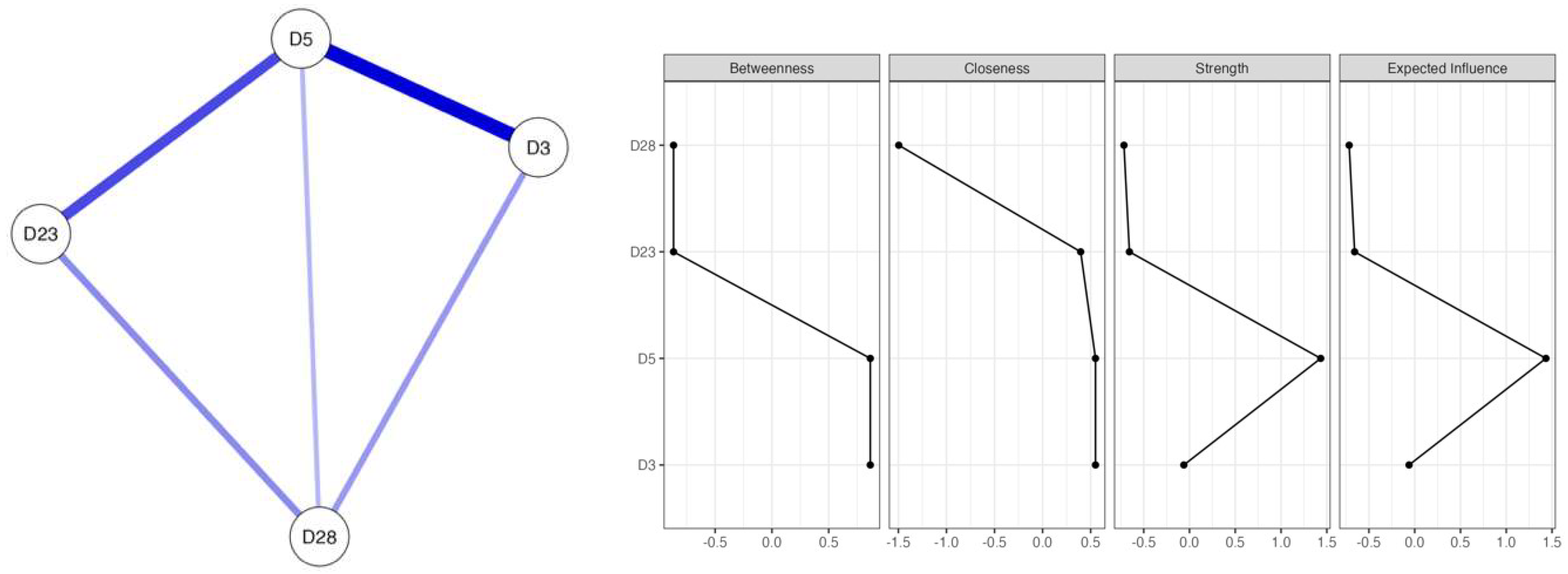
In the network analysis of the BSSD-4 items among Ecuadorian youth, four nodes and five nonzero edges were identified out of a total of six possible, resulting in a sparsity of 0.167 (Supplementary Table 4 and Figure 2). Regarding centrality measures by variable, item D23 showed a betweenness of -0.866, a closeness of 0.396, a strength of -0.656, and an expected influence of -0.656. Item D28 exhibited a betweenness of -0.866, a closeness of -1.496, a strength of -0.716, and an expected influence of -0.716. Meanwhile, item D3 had a betweenness of 0.866, a closeness of 0.550, a strength of -0.061, and an expected influence of -0.061. Finally, item D5 showed a betweenness of 0.866, a closeness of 0.550, a strength of 1.433, and an expected influence of 1.433.
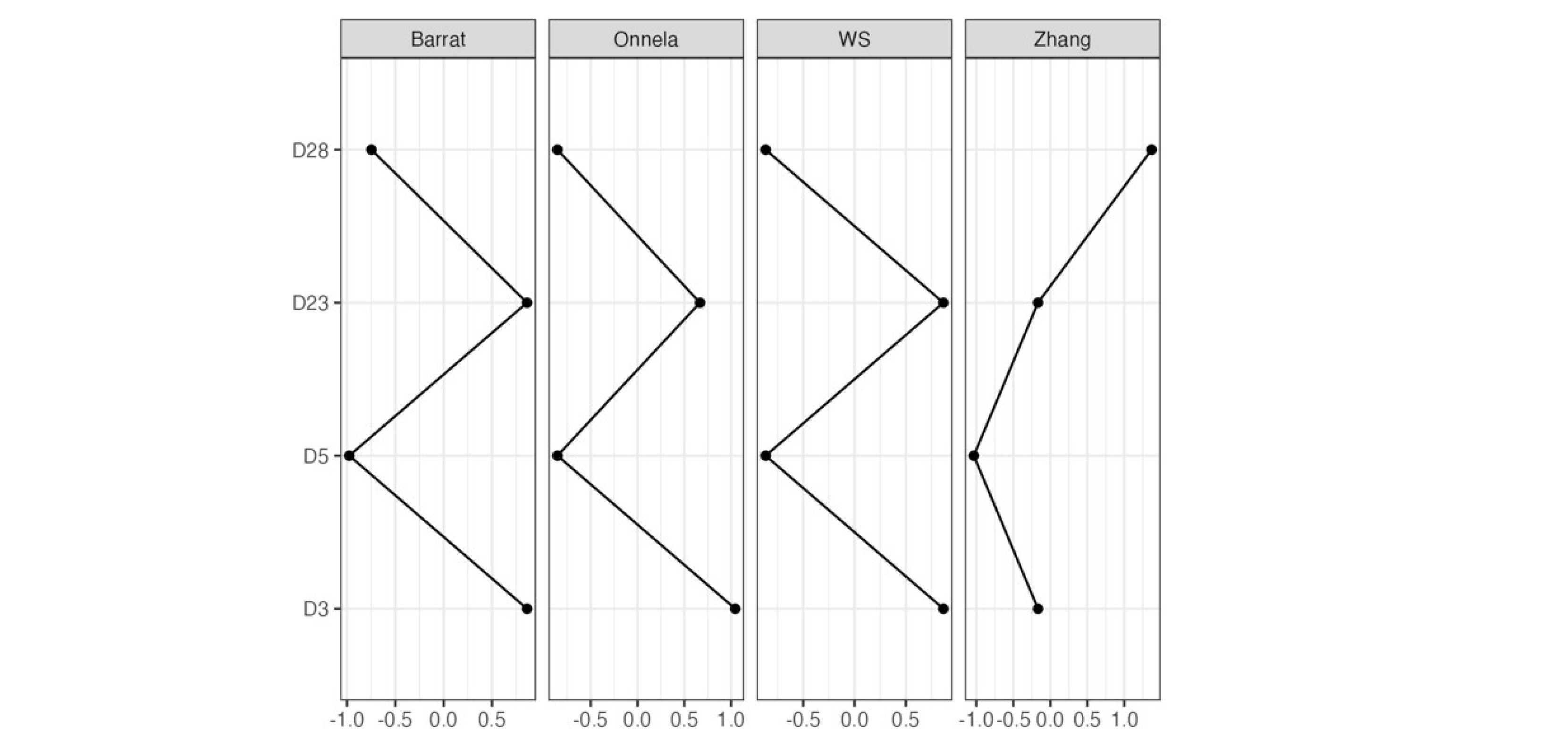
Regarding clustering measures by variable, item D3 presented values of 0.862 in Barrat, 1.044 in Onnela, 0.866 in WS, and -0.167 in Zhang. Item D5 exhibited values of -0.977 in Barrat, -0.856 in Onnela, -0.866 in WS, and -1.034 in Zhang. Item D23 had values of 0.862 in Barrat, 0.667 in Onnela, 0.866 in WS, and -0.167 in Zhang. Lastly, item D28 showed values of -0.748 in Barrat, -0.856 in Onnela, -0.866 in WS, and 1.369 in Zhang. In the weight matrix, item D3 had a weight of 0.219 with D5 and 0.344 with D28. Item D5 exhibited a weight of 0.195 with D23 and 0.138 with D28. Item D23 had a weight of 0.483 with D28. There were no weights between items D3 and D23, nor between D3 and D5, nor between D23 and D28.
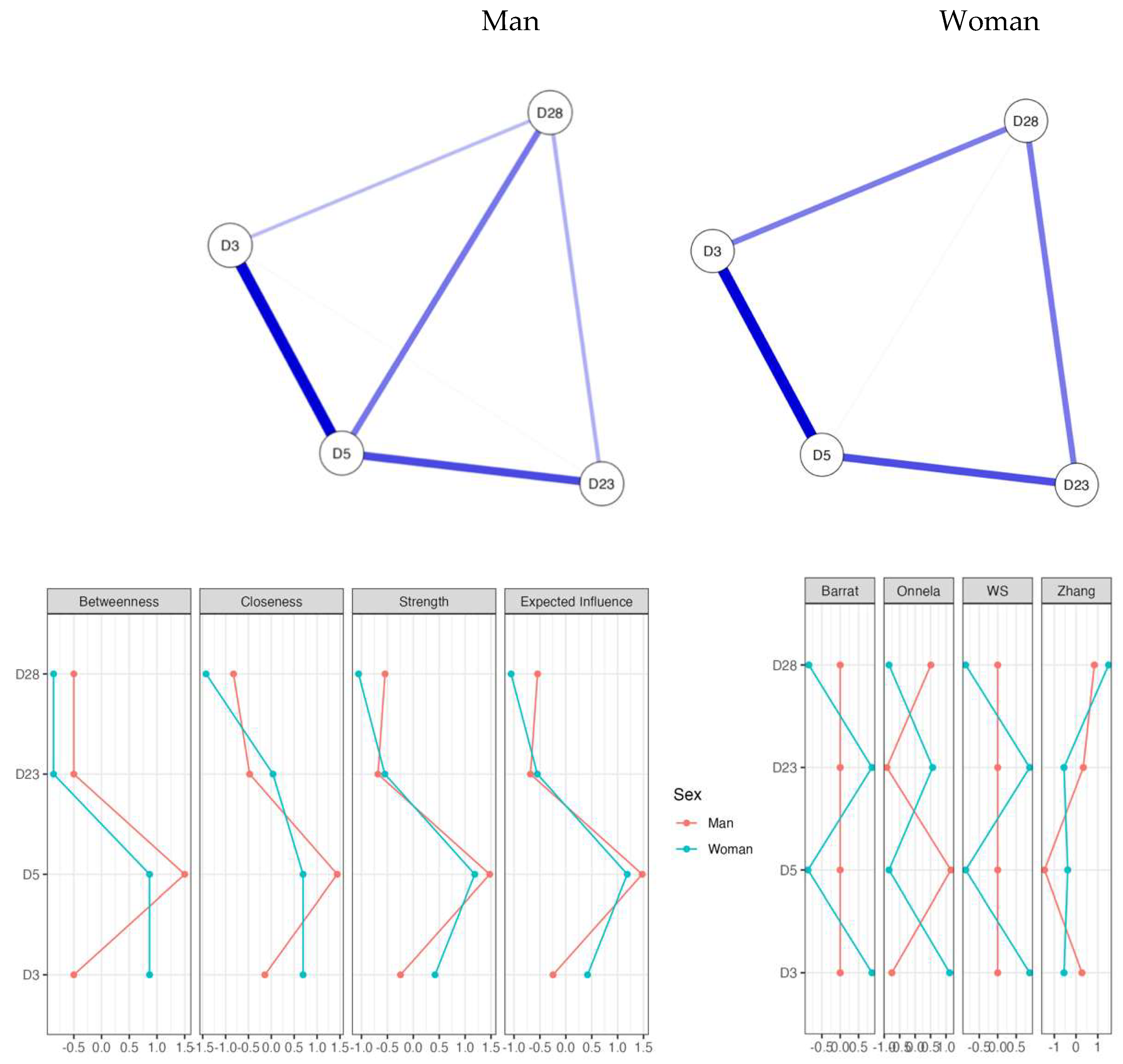
In the network analysis of the BSSD-4 items in Ecuadorian youth, four nodes were identified for both males and females. For males, six non-zero edges were found out of a possible six, resulting in a sparsity of 0 (Supplementary Table 5 and Figure 3).
For females, five non-zero edges were found out of a possible six, with a sparsity of 0.167. Regarding centrality measures by variable, item D23 showed a betweenness of -0.500, closeness of -0.473, strength of -0.683, and expected influence of -0.683 for males. For females, the same item showed a betweenness of -0.866, closeness of 0.037, strength of -0.549, and expected influence of -0.549. Item D28 showed a betweenness of -0.500, closeness of -0.826, strength of -0.545, and expected influence of -0.545 for males, while for females, it showed a betweenness of -0.866, closeness of -1.426, strength of -1.056, and expected influence of -1.056. On the other hand, item D3 showed a betweenness of -0.500, closeness of -0.141, strength of -0.247, and expected influence of -0.247 for males, while for females, it showed a betweenness of 0.866, closeness of 0.695, strength of 0.420, and expected influence of 0.420. Finally, item D5 showed a betweenness of 1.500, closeness of 1.440, strength of 1.475, and expected influence of 1.475 for males, while for females, it showed a betweenness of 0.866, closeness of 0.695, strength of 1.186, and expected influence of 1.186.
Regarding clustering measures by variable, item D3 showed values of 0.000 in Barrat, -0.751 in Onnela, 0.000 in WS, and 0.274 in Zhang for males. For females, the same item showed values of 0.866 in Barrat, 1.119 in Onnela, 0.866 in WS, and -0.556 in Zhang. Item D5 showed values of 0.000 in Barrat, 1.157 in Onnela, 0.000 in WS, and -1.451 in Zhang for males, while for females, it showed values of -0.878 in Barrat, -0.844 in Onnela, -0.866 in WS, and -0.384 in Zhang. Item D23 showed values of 0.000 in Barrat, -0.915 in Onnela, 0.000 in WS, and 0.335 in Zhang for males, and for females, it showed values of 0.866 in Barrat, 0.568 in Onnela, 0.866 in WS, and -0.556 in Zhang. Finally, item D28 showed values of 0.000 in Barrat, 0.510 in Onnela, 0.000 in WS, and 0.842 in Zhang for males, while for females, it showed values of -0.854 in Barrat, -0.844 in Onnela, -0.866 in WS, and 1.495 in Zhang.
In the weight matrix, item D3 had a weight of 0.147 with D5 and 0.330 with D28 for males, while for females, it showed a weight of 0.265 with D5 and 0.351 with D28. Item D5 showed a weight of 0.127 with D23 and 0.249 with D28 for males, and for females, it showed a weight of 0.257 with D23 and 0.019 with D28. Item D23 showed a weight of 0.462 with D28 for males, while for females, it showed a weight of 0.501 with D28. No weights were found between items D3 and D23 in either sex. In conclusion, the network analysis of the items of the Brief Social Desirability Scale (BSSD-4) in Ecuadorian youth by sex revealed significant differences in centrality and clustering measures between males and females. The items showed different levels of connection and cohesion in the network, which could have implications for the interpretation and use of the scale in future research.
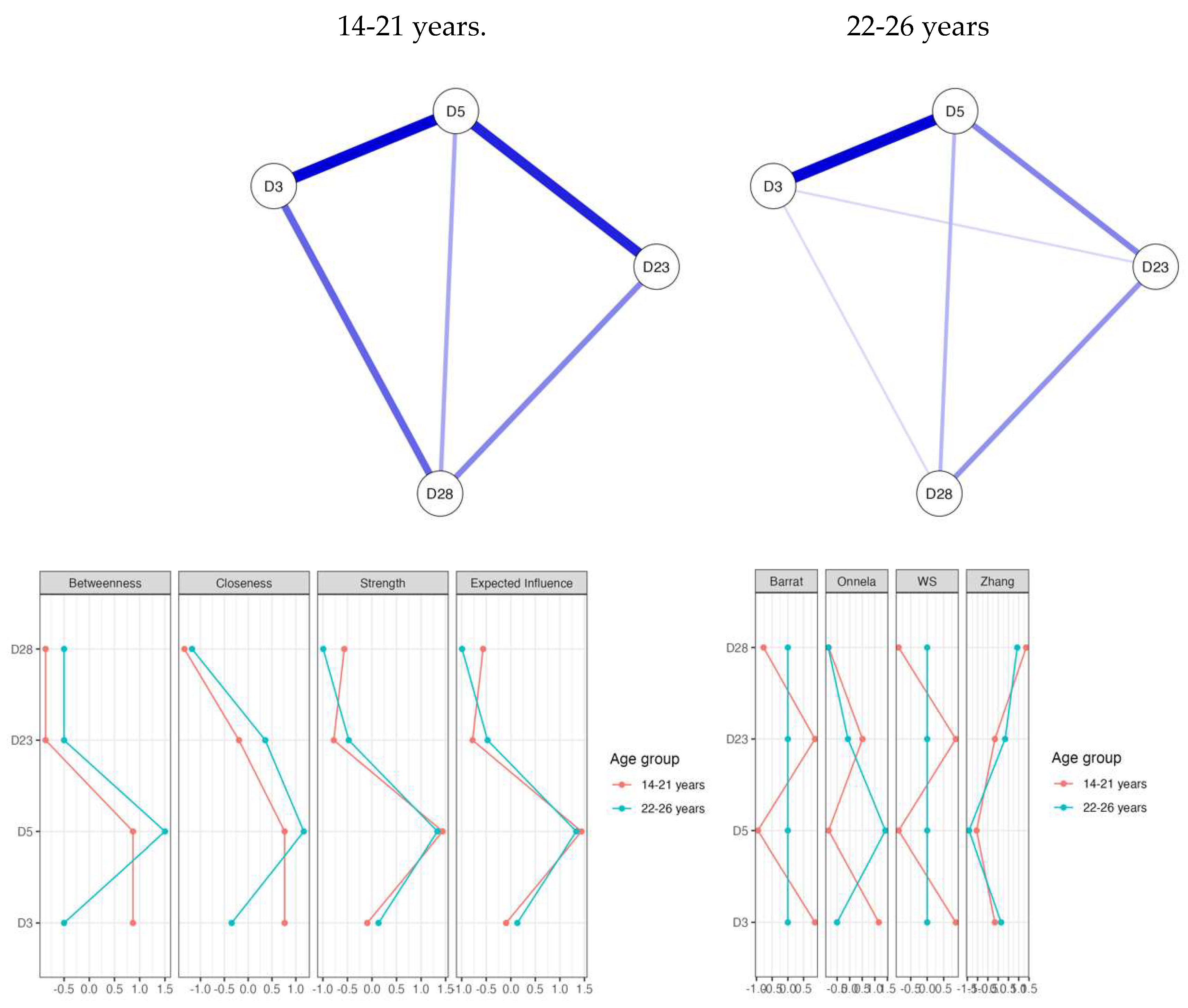
In the network analysis of the BSSD-4 items in Ecuadorian youth, significant differences were identified between the age groups of 14-21 years and 22-26 years. For the 14-21 age group, four nodes and five non-null edges were found out of a possible six, resulting in a sparsity of 0.167. In contrast, the 22-26 age group showed four nodes and six non-null edges, with a sparsity of (Supplementary Table 6 and Figure 4).
Regarding centrality measures, item D23 showed a betweenness of -0.866, closeness of -0.193, strength of -0.778, and expected influence of -0.778 in the 14-21 group, while in the 22-26 group, it had a betweenness of -0.500, closeness of 0.358, strength of -0.473, and expected influence of -0.473. Item D28 had a betweenness of -0.866, closeness of -1.338, strength of -0.563, and expected influence of -0.563 in the 14-21 group, whereas in the 22-26 group, it showed a betweenness of -0.500, closeness of -1.179, strength of -0.992, and expected influence of -0.992. Item D3 showed a betweenness of 0.866, closeness of 0.766, strength of -0.096, and expected influence of -0.096 in the 14-21 group, and in the 22-26 group, a betweenness of -0.500, closeness of -0.346, strength of 0.133, and expected influence of 0.133. Finally, item D5 showed a betweenness of 0.866, closeness of 0.766, strength of 1.438, and expected influence of 1.438 in the 14-21 group, while in the 22-26 group, it had a betweenness of 1.500, closeness of 1.167, strength of 1.332, and expected influence of 1.332. In terms of clustering measures, item D3 had values of 0.864 in Barrat, 1.159 in Onnela, 0.866 in WS, and -0.159 in Zhang for the 14-21 group. In the 22-26 group, it showed values of 0.000 in Barrat, -0.502 in Onnela, 0.000 in WS, and 0.144 in Zhang. Item D5 had values of -0.954 in Barrat, -0.835 in Onnela, -0.866 in WS, and -1.045 in Zhang for the 14-21 group, whereas in the 22-26 group, it showed values of 0.000 in Barrat, 1.421 in Onnela, 0.000 in WS, and -1.414 in Zhang. Item D23 showed values of 0.864 in Barrat, 0.511 in Onnela, 0.866 in WS, and -0.159 in Zhang for the 14-21 group, and 0.000 in Barrat, -0.067 in Onnela, 0.000 in WS, and 0.340 in Zhang for the 22-26 group.
Finally, item D28 had values of -0.773 in Barrat, -0.835 in Onnela, -0.866 in WS, and 1.363 in Zhang for the 14-21 group, while in the 22-26 group, it showed values of 0.000 in Barrat, -0.852 in Onnela, 0.000 in WS, and 0.930 in Zhang. In the weight matrix, item D3 had a weight of 0.198 with D5 and 0.360 with D28 in the 14-21 group, while in the 22-26 group, it showed a weight of 0.235 with D5, 0.086 with D23, and 0.266 with D28. Item D5 had a weight of 0.253 with D23 and 0.141 with D28 in the 14-21 group, while in the 22-26 group, it showed a weight of 0.083 with D23 and 0.159 with D28. Item D23 had a weight of 0.415 with D28 in the 14-21 group, while in the 22-26 group, it showed a weight of 0.547 with D28. No weights were found between items D3 and D23 in the 14-21 group, nor between D3 and D5, or between D23 and D28 in the 22-26 group.
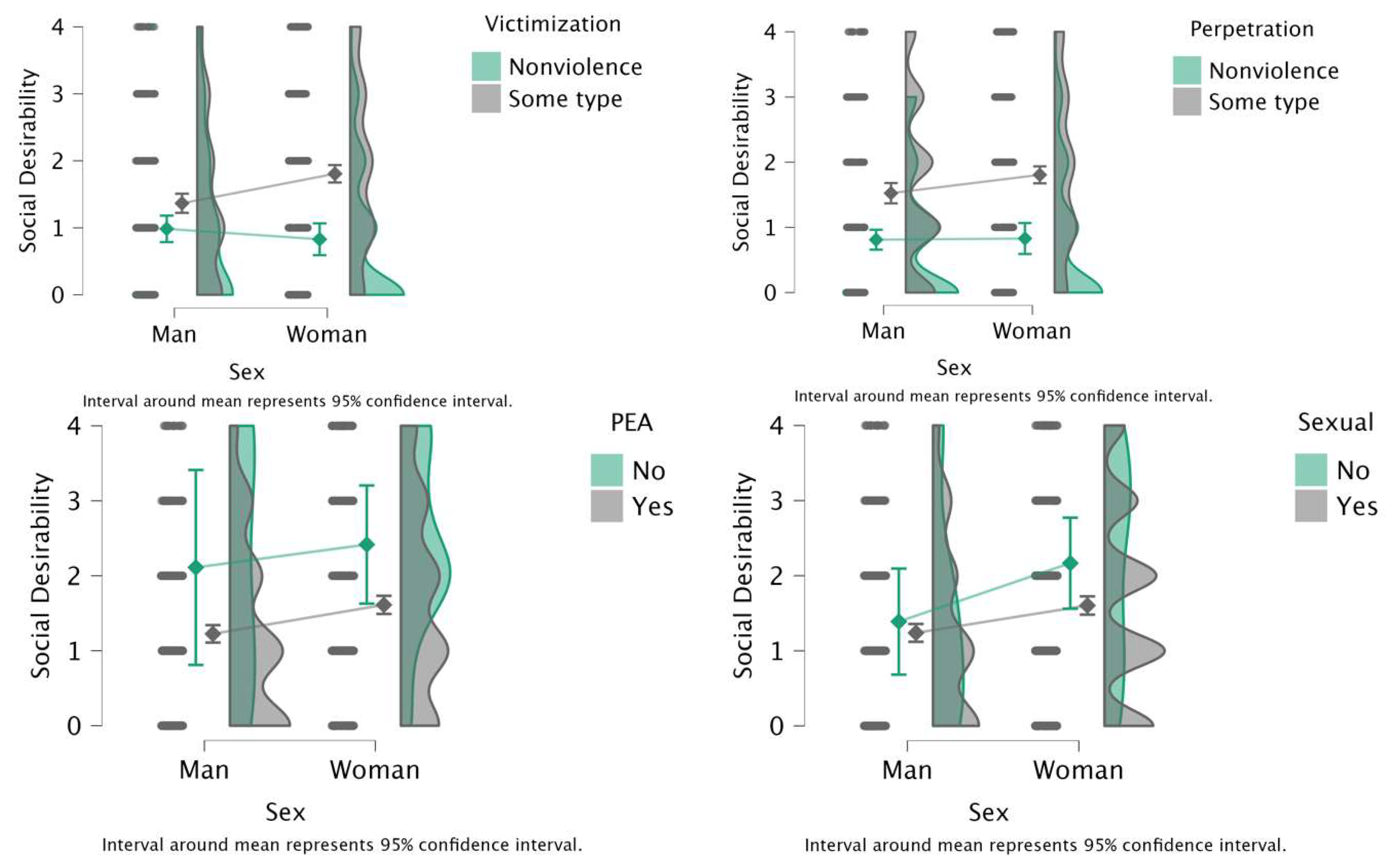
The analysis of social desirability based on gender revealed significant differences between men and women. Men had a median of 1, with an interquartile range between 0 and 2, while women also had a median of 1 but with a higher interquartile range, between 1 and 3. The average social desirability score for men was 1.245 (95% CI: 1.128 - 1.362), whereas for women, it was 1.634 (95% CI: 1.514 - 1.754), indicating that women tended to score higher in social desirability than men (Supplementary Table 7).
Regarding age groups, participants aged 14 to 21 had a median of 1, with an interquartile range between 0 and 2, and an average score of 1.497 (95% CI: 1.385 - 1.609). In contrast, participants aged 22 to 26 also had a median of 1 and a similar interquartile range, though with a lower average score of 1.375 (95% CI: 1.245 - 1.505).
When analyzing social desirability in relation to victimization in dating violence, men who did not report victimization had an average score of 0.931 (95% CI: 0.763 - 1.099), whereas those who experienced some form of victimization had a higher average of 1.379 (95% CI: 1.236 - 1.521) (Figure 5). Among women, those without victimization experiences had an average score of 0.877 (95% CI: 0.641 - 1.112), while those who had experienced victimization reached an average of 1.778 (95% CI: 1.651 - 1.905).
Regarding the perpetration of dating violence, men who did not engage in violent acts had an average score of 0.785 (95% CI: 0.644 - 0.925), whereas those who perpetrated violence had a significantly higher average of 1.517 (95% CI: 1.367 - 1.668) (Figure 5). Among women, non-perpetrators had an average of 0.877 (95% CI: 0.641 - 1.112), while perpetrators had an average of 1.778 (95% CI: 1.651 - 1.905).
Analyzing the relationship with adverse childhood experiences, men who did not report childhood violence had lower social desirability scores compared to those who reported sporadic or repeated experiences. For example, men without childhood violence (V1 = coercion) had an average score of 1.185 (95% CI: 1.004 - 1.367), whereas those with repeated experiences had an average of 1.537 (95% CI: 1.216 - 1.858). Among women, a similar trend was observed, with an average score of 1.675 (95% CI: 1.479 - 1.872) for those who did not report childhood violence and 1.422 (95% CI: 1.015 - 1.830) for those with repeated experiences.
This pattern was consistent across other types of childhood violence (V3 = humiliation, V4 = sexual, V5 = physical), where both men and women with repeated experiences of violence had higher social desirability scores compared to those who had not experienced such violence. In the case of physical violence (V5 = physical), men without this experience had an average score of 1.231 (95% CI: 1.098 - 1.363), whereas those with repeated violence had an average of 2.000 (95% CI: 1.394 - 2.606). Among women, the values ranged from 1.634 (95% CI: 1.502 - 1.766) for those without violence to 2.200 (95% CI: 0.581 - 3.819) for those who reported repeated violence.
Finally, regarding childhood violence perpetration (P1 = coercion, P2 = detachment, P3 = humiliation), social desirability scores were higher among those who had repeatedly perpetrated violence. Among men, those who had not perpetrated violence had an average score of 1.156 (95% CI: 1.022 - 1.289), whereas repeated perpetrators had an average of 1.450 (95% CI: 0.872 - 2.028). Among women, the scores ranged from 1.603 (95% CI: 1.464 - 1.741) for non-perpetrators to 2.000 (95% CI: 1.229 - 2.771) for those with repeated perpetration. In conclusion, the results showed that social desirability varied based on gender, age, victimization and perpetration in dating violence, as well as adverse childhood experiences. Overall, women, younger individuals, and those with a history of violence both as victims and perpetrators exhibited higher levels of social desirability (for more details, see Supplementary Table 7 and Supplementary Figures 1–4).

4. Discussion

The main objective was to assess the psychometric properties of the Brief Social Desirability Scale (BSSD-4) in Ecuadorian youth, focusing on evaluating the reliability, validity, and invariance of the measure by sex, age group, and experiences of victimization and perpetration of dating violence.

Reliability

The BSSD-4 was expected to demonstrate high internal consistency (H1), with reliability coefficients above 0.70. The results support this hypothesis, as reliability indices such as the Composite Reliability Coefficient (CR = 0.759), McDonald’s Ordinal Omega (ωₒ = 0.750), and the Ordinal Cronbach’s Alpha (αₒ = 0.809) exceeded the 0.70 threshold. These values are consistent with previous studies emphasizing the importance of using robust reliability measures in social desirability scales [2,8,18,42]. Moreover, the internal consistency of the BSSD-4 is comparable to that of other validated scales in similar cultural contexts [10,20].

Unidimensionality and Factor Fit

It was expected that the BSSD-4 would be unidimensional and exhibit excellent factor fit, with CFI and TLI values exceeding 0.95, and RMSEA and SRMR values below 0.08. The results support this expectation, as the four-item model showed an excellent fit (CFI = 0.980, TLI = 0.966, RMSEA = 0.056, SRMR = 0.037). These findings align with previous research highlighting the importance of unidimensionality in brief scales [14,15]. Furthermore, the removal of items with low factor loadings (D12 and D30) improved the factor structure without compromising construct validity, reinforcing the efficiency of the shortened version [21].

Convergent Validity

Hypothesis H3 posited that the BSSD-4 would demonstrate adequate convergent validity, with an AVE greater than 0.50. The results support this hypothesis, as the AVE was 0.500, indicating that the items share a significant amount of common variance. This finding is consistent with previous studies using AVE as an indicator of convergent validity [14,15]. Additionally, the standardized factor loadings (range: 0.545–0.832) reinforce the proper representation of the items within the underlying construct [22].

Invariance

Hypothesis H4 proposed that the BSSD-4 would exhibit measurement invariance across different sociodemographic groups, including sex, age group, and experiences of victimization and perpetration of dating violence. The results confirmed this hypothesis, as configural, metric, scalar, and strict invariance were found for both sex and age groups. These findings are consistent with previous studies emphasizing the importance of invariance in group comparisons [18,19].
Regarding sex, the BSSD-4 demonstrated strong measurement invariance, with all levels of invariance (configural, metric, scalar, and strict) being met. The fit indices for scalar and strict invariance were acceptable (X²(6) = 10.845, p = .093, CFI = .988, TLI = .977, RMSEA = .044, SRMR = .043), suggesting that men and women interpret the items similarly. Similarly, across age groups (14-21 years vs. 22-26 years), measurement invariance was established at all levels (X²(6) = 8.463, p = .206, CFI = .994, TLI = .989, RMSEA = .031, SRMR = .041), reinforcing the robustness of the instrument across different developmental stages.
However, when considering experiences of victimization and perpetration, slight variations in scalar invariance were observed [41]. For instance, coercion-victimization demonstrated full metric invariance but showed a minor deviation in scalar invariance (X²(10) = 16.830, p = .078, CFI = .986, TLI = .974, RMSEA = .048, SRMR = .045). Similarly, coercion-perpetration met configural and metric invariance, but scalar invariance was weaker (X²(12) = 24.371, p = .018, CFI = .975, TLI = .962, RMSEA = .059, SRMR = .054). These findings suggest that individuals with different levels of exposure to dating violence may interpret certain items differently, particularly regarding the severity or frequency of coercion-related behaviors. This pattern was also observed in victimization (X²(6) = 17.667, p = .007, CFI = .971, TLI = .942, RMSEA = .066, SRMR = .054) and perpetration (X²(6) = 13.293, p = .039, CFI = .979, TLI = .958, RMSEA = .052, SRMR = .059), indicating potential response biases linked to lived experiences of dating violence.
Additionally, no previous studies have been identified that examine the measurement invariance of the BSSD-4 across different sociodemographic groups, including sex, age group, and experiences of victimization (coercion, detachment, humiliation, sexual, and physical violence), as well as perpetration (coercion, detachment, humiliation, sexual, and physical violence) in the context of dating violence [41]. This research represents a significant contribution by providing empirical evidence on measurement equivalence across these groups. By demonstrating that the BSSD-4 maintains consistent measurement properties across diverse populations, this study enables more accurate assessments and valid comparisons in future research on dating violence, thereby enhancing the reliability of findings and informing targeted intervention strategies.

Differences in Network Structure by Sex

Hypothesis H5 suggested that there would be significant differences in the centrality and clustering measures of the BSSD-4 items between men and women. The results support this hypothesis, as differences in the network structure between sexes were identified. For example, item D5 showed higher centrality in men, while item D28 had greater influence in women. These differences may reflect variations in the expression of social desirability according to gender, which is consistent with studies highlighting the role of social desirability bias in self-reported responses [5,12,64,65].

Variability in Network Structure by Age Group

Hypothesis H6 proposed that the network structure of the BSSD-4 items would vary between age groups (14-21 years and 22-26 years), with greater dispersion and lower connectivity in the younger participants. The results partially support this hypothesis, as greater dispersion was observed in the 14-21 age group, but no significant differences were found in overall connectivity. These findings are consistent with studies suggesting that social desirability may vary according to developmental stage [10,19].
On the other hand, the results of this study have important theoretical and practical implications. First, the BSSD-4 is confirmed as a valid and reliable tool for measuring social desirability in Ecuadorian youth, making it a useful resource for future research in psychology and social sciences [8,20]. Second, the identification of differences in the network structure by sex and age suggests that social desirability may be influenced by sociocultural and developmental factors, which should be considered when interpreting results [5,12,66].
Furthermore, the measurement invariance supports the use of the BSSD-4 in various sociodemographic contexts, facilitating its application in comparative studies [18,19]. However, the observed differences in scalar invariance for victimization and perpetration of violence suggest the need for future research to explore how these experiences affect the measurement of social desirability [41].

Limitations and Future Research

Although this study provides strong evidence on the psychometric properties of the BSSD-4, it has some limitations. First, the sample was limited to Ecuadorian youth, which may affect the generalization of the results to other populations. Future studies could validate the scale in different cultural contexts [10]. Second, the cross-sectional design does not allow for establishing causal relationships between social desirability and other variables, such as victimization or perpetration of violence. Longitudinal studies could address this limitation [41]. Finally, it is recommended to explore the role of social desirability in other psychological constructs, such as emotional well-being or prosocial behavior, using network analysis approaches [22,25]. This would provide a deeper understanding of how social desirability interacts with other factors in the development of youth.

5. Conclusions

This study has successfully demonstrated that the Brief Social Desirability Scale (BSSD-4) is a valid and reliable tool for assessing social desirability in Ecuadorian youth. The results have confirmed its high internal consistency, unidimensionality, convergent validity, and invariance across various sociodemographic groups. Furthermore, differences in the item network structure according to sex and age have been observed, suggesting that social desirability may be influenced by sociocultural and developmental factors. These findings open new opportunities for applying the BSSD-4 in future research, taking into account gender and age differences, as well as its potential impact on behavior and perceptions of violence.
For future research, we recommend conducting a systematic review and meta-analysis on the reliability and psychometric properties validation of the Brief Social Desirability Scale (BSSD-4) in different contexts and university populations [67]. Such a study would provide a comprehensive evaluation of the instrument's reliability across various studies and contexts, shedding light on its consistency and applicability in academic settings. Additionally, investigating the prevalence of social desirability in different populations [68] could offer valuable insights into how this social trend manifests in diverse groups, contributing to a deeper understanding of its implications for personal and social development.
Furthermore, a promising direction for future research would be to explore factorial invariance [69,70,71] within the BSSD-4. This type of analysis is crucial for determining whether the measurement model remains stable across different groups, such as gender, age, or cultural contexts. Establishing invariance ensures that the instrument measures social desirability equivalently across subgroups, enhancing the generalizability of the findings.

Supplementary Materials

The following supporting information can be downloaded at the website of this paper posted on Preprints.org.

Author Contributions

Contribution to the conception and design: A.R.; Contribution to data collection: A.R., L.B.-B., H.S., J.H.D. and F.J.R.-D.; Contribution to data analysis and interpretation: A.R., and L.B.-B.; Drafting and/or revising the article: A.R., L.B.-B., and F.J.R.-D. Approval of the final version for publication: A.R., L.B.-B., J.H.D. and F.J.R.-D.; Obtaining authorization for the scale: J.H.D. All authors have read and agreed to the published version of the manuscript.

Funding

This research was financed by the Universidad Politécnica Salesiana Sede Cuenca, Ecuador.

Institutional Review Board Statement

All procedures conducted in this study involving human participants adhered to the ethical standards established by the ethics committee. This study was approved by the Human Research Ethics Committee of the Pontifical Catholic University of Ecuador (code 046-UIO-2022). This research is derived from the research project entitled “Prevalence and risk factors of dating violence among Ecuadorian adolescents and university students and evaluation of the effectiveness of psychological intervention with virtual reality in reducing anxiety, depression and post-traumatic stress derived from violence”, under the direction of Dr. Andres Ramirez, with the support of the Research Group in Psychology (GIPSI-SIB) of the Salesian Polytechnic University (Universidad Politécnica Salesiana), Cuenca, Ecuador.

Informed Consent Statement

Informed consent was obtained from all subjects involved in this study.

Data Availability Statement

The data supporting this research are publicly available and can be obtained by emailing the first author of this article.

Acknowledgments

The authors would like to thank the Universidad Politécnica Salesiana, Ecuador, and especially to Juan Cárdenas Tapia.

Conflicts of Interest

The authors declare no conflicts of interest.

Abbreviations

The following abbreviations are used in this manuscript:
BSD-5 Brief Scale of Social Desirability
AVE Average Variance Extracted
HTMT Heterotrait-Monotrait Ratio
CR Composite Reliability
VIF Variance Inflation Factor
CFI Comparative ft index
TLI: Tucker-Lewis Index
GFI Goodness of Fit Index
RMSEA Root Mean Square Error of Approximation
SRMR Standardized Root Mean Square Residual

Appendix A

Brief Scale of Social Desirability (BSD-5) in Young Ecuadorians

Below, you will see a series of sentences that are related to personal attitudes. Read each one carefully and decide if your usual way of being is similar (True) or not (False) to the content of the sentence. Do not leave any sentence unanswered. True False
Ítems Question Falso True
1 A veces me cuesta ponerme a trabajar si no me encuentro con ánimos.
2 Algunas veces dudo de mi habilidad para triunfar en la vida.
3 En algunas ocasiones siento que soy torpe.
4 En algunas ocasiones me he sentido bastante celoso de la buena fortuna de los demás.
Note. The items were taken from the original version [42]. For the version that presented the best factorial adjustment Brief Scale of Social Desirability (BSD-5) in young Ecuadorians, the items with the highest factor loadings were selected.

References

  1. Vergés, A. On the Desirability of Social Desirability Measures in Substance Use Research. J. Stud. Alcohol Drugs 2022, 83, 582–586. [Google Scholar] [CrossRef] [PubMed]
  2. Leng, C.H.; Huang, H.Y.; Yao, G. A Social Desirability Item Response Theory Model: Retrieve-Deceive-Transfer. Psychometrika 2020, 85, 56–74. [Google Scholar] [CrossRef]
  3. Nazari, S.; Leite, W.L.; Huggins-Manley, A.C. A Comparison of Person-Fit Indices to Detect Social Desirability Bias. Educ. Psychol. Meas. 2023, 83, 907–928. [Google Scholar] [CrossRef]
  4. Vesely, S.; Klöckner, C.A. Social Desirability in Environmental Psychology Research: Three Meta-Analyses. Front. Psychol. 2020, 11, 1395. [Google Scholar] [CrossRef] [PubMed]
  5. Yang, J.; Ming, X.; Wang, Z.; Adams, S.M. Are Sex Effects on Ethical Decision-Making Fake or Real? A Meta-Analysis on the Contaminating Role of Social Desirability Response Bias. Psychol. Rep. 2017, 120, 25–48. [Google Scholar] [CrossRef]
  6. Payne, B.A. The Problem of Social Desirability Bias When Measuring Desire for Adolescent Pregnancy. BJOG 2018, 125, 1337. [Google Scholar] [CrossRef]
  7. King, B.M. The Influence of Social Desirability on Sexual Behavior Surveys: A Review. Arch. Sex Behav. 2022, 51, 1495–1501. [Google Scholar] [CrossRef] [PubMed]
  8. Perinelli, E.; Gremigni, P. Use of Social Desirability Scales in Clinical Psychology: A Systematic Review. J. Clin. Psychol. 2016, 72, 534–551. [Google Scholar] [CrossRef]
  9. Bou Malham, P.; Saucier, G. The Conceptual Link between Social Desirability and Cultural Normativity. Int. J. Psychol. 2016, 51, 474–480. [Google Scholar] [CrossRef]
  10. Nurumov, K.; Hernández-Torrano, D.; Ait Si Mhamed, A.; Ospanova, U. Measuring Social Desirability in Collectivist Countries: A Psychometric Study in a Representative Sample From Kazakhstan. Front. Psychol. 2022, 13, 822931. [Google Scholar] [CrossRef]
  11. Busch, H. Evidence of an Indirect Effect of Generativity on Fear of Death Through Ego-Integrity Considering Social Desirability. Omega (Westport) 2024, 88, 998–1015. [Google Scholar] [CrossRef]
  12. Tang, J.S.; Haslam, R.L.; Ashton, L.M.; Fenton, S.; Collins, C.E. Gender Differences in Social Desirability and Approval Biases, and Associations with Diet Quality in Young Adults. Appetite 2022, 175, 106035. [Google Scholar] [CrossRef] [PubMed]
  13. Adong, J.; Fatch, R.; Emenyonu, N.I.; Cheng, D.M.; Muyindike, W.R.; Ngabirano, C.; Kekibiina, A.; Woolf-King, S.E.; Samet, J.H.; Hahn, J.A. Social Desirability Bias Impacts Self-Reported Alcohol Use Among Persons With HIV in Uganda. Alcohol Clin. Exp. Res. 2019, 43, 2591–2598. [Google Scholar] [CrossRef] [PubMed]
  14. Chin, C.L.; Yao, G. Convergent Validity. In Encyclopedia of Quality of Life and Well-Being Research; Maggino, F., Ed.; Springer: Cham, Switzerland, 2023. [Google Scholar] [CrossRef]
  15. Cheung, G.W.; Cooper-Thomas, H.D.; Lau, R.S.; Wang, L.C. Reporting reliability, convergent and discriminant validity with structural equation modeling: A review and best-practice recommendations. Asia Pac. J. Manag. 2024, 41, 745–783. [Google Scholar] [CrossRef]
  16. Thorne-Lyman, A.L.; Lama, T.P.; Heidkamp, R.A.; Munos, M.K.; Manandhar, P.; Khatry, S.K.; Bryce, E.; LeClerq, S.C.; Katz, J. How Does Social Desirability Bias Influence Survey-Based Estimates of the Use of Antenatal Care in Rural Nepal? A Validation Study. BMJ Open 2023, 13, e071511. [Google Scholar] [CrossRef]
  17. Fernández, E.; Kiageri, V.; Guharajan, D.; Day, A. Social Desirability Bias Against Admitting Anger: Bias in the Test-Taker or Bias in the Test? J. Pers. Assess. 2019, 101, 644–652. [Google Scholar] [CrossRef] [PubMed]
  18. Ng, Z.J.; Lin, S.; Niu, L.; Cipriano, C. Measurement Invariance of the Children's Social Desirability Scale-Short Version (CSD-S) Across Gender, Grade Level, and Race/Ethnicity. Assessment 2024. [Google Scholar] [CrossRef]
  19. Teh, W.L.; Abdin, E.; P.V., A.; Siva Kumar, F.D.; Roystonn, K.; Wang, P.; Shafie, S.; Chang, S.; Jeyagurunathan, A.; Vaingankar, J.A.; et al. Measuring Social Desirability Bias in a Multi-Ethnic Cohort Sample: Its Relationship with Self-Reported Physical Activity, Dietary Habits, and Factor Structure. BMC Public Health 2023, 23, 415. [Google Scholar] [CrossRef]
  20. Lanz, L.; Thielmann, I.; Gerpott, F.H. Are Social Desirability Scales Desirable? A Meta-Analytic Test of the Validity of Social Desirability Scales in the Context of Prosocial Behavior. J. Pers. 2022, 90, 203–221. [Google Scholar] [CrossRef]
  21. Leng, C.-H.; He, J.; Cai, L.; Xie, K. A Social Desirability Item Response Theory Model: Retrieve-Deceive-Transfer. Psychometrika 2020, 85, 56–74. [Google Scholar] [CrossRef]
  22. Wu, L.; Ren, L.; Wang, Y.; Zhang, K.; Fang, P.; Liu, X.; Yang, Q.; Wang, X.; Wu, S.; Peng, J. The Item Network and Domain Network of Burnout in Chinese Nurses. BMC Nurs. 2021, 20, 147. [Google Scholar] [CrossRef] [PubMed]
  23. Caycho-Rodríguez, T.; Travezaño-Cabrera, A.; Ventura-León, J.; Vilca, L.W.; Baños-Chaparro, J.; Yupanqui-Lorenzo, D.E.; Valencia, P.D.; Torales, J.; Carbajal-León, C.; Lobos-Rivera, M.E.; et al. New Psychometric Evidence of the Grief Impairment Scale (GIS) in People Who Have Experienced the Death of a Loved One From a Network Psychometric Approach in Two Latin American Countries. Omega (Westport) 2024, 31. [Google Scholar] [CrossRef] [PubMed]
  24. Northcott, S.; Hilari, K. Stroke Social Network Scale: Development and Psychometric Evaluation of a New Patient-Reported Measure. Clin. Rehabil. 2013, 27, 823–833. [Google Scholar] [CrossRef]
  25. Guyon, H.; Falissard, B.; Kop, J.L. Modeling psychological attributes in psychology—An epistemological discussion: Network analysis vs. latent variables. Front. Psychol. 2017, 8, 798. [Google Scholar] [CrossRef] [PubMed]
  26. Choi, K.W.; Batchelder, A.W.; Ehlinger, P.P.; Safren, S.A.; O'Cleirigh, C. Applying network analysis to psychological comorbidity and health behavior: Depression, PTSD, and sexual risk in sexual minority men with trauma histories. J. Consult. Clin. Psychol. 2017, 85, 1158–1170. [Google Scholar] [CrossRef]
  27. McNally, R.J. Network analysis of psychopathology: controversies and challenges. Annu. Rev. Clin. Psychol. 2021, 17, 31–53. [Google Scholar] [CrossRef]
  28. Azadi, F.; Dayri, S.; Kordbagheri, A.; et al. Psychometric properties of the Mindfulness in Teaching Scale in a sample of Iranian teachers: Insight from a network analysis approach. Mindfulness 2024, 15, 2277–2290. [Google Scholar] [CrossRef]
  29. Bulut, H.C.; Bulut, O.; Clelland, A. A psychometric network analysis approach for detecting item wording effects in self-report measures across subgroups. Field Methods 2024, 1–13. [Google Scholar] [CrossRef]
  30. Caycho-Rodríguez, T.; Travezaño-Cabrera, A.; Torales, J.; Barrios, I.; Vilca, L.W.; Samaniego-Pinho, A.; et al. Psychometric network analysis of the Patient Health Questionnaire-4 (PHQ-4) in Paraguayan general population. Psicologia: Reflexão e Crítica 2024, 37, 15. [Google Scholar] [CrossRef]
  31. Thompson, A.; Pollet, T.V. An exploratory psychometric network analysis of loneliness scales in a sample of older adults. Curr. Psychol. 2024, 43, 5428–5442. [Google Scholar] [CrossRef]
  32. Chen, Y.; Liu, T.H.; Xia, Y.; Ma, Z. Psychometric properties of the Chinese version of 20-item Zimbardo Time Perspective Inventory (C-ZTPI-20) in Chinese adolescent population. Psychol. Res. Behav. Manag. 2024, 17, 1271–1282. [Google Scholar] [CrossRef] [PubMed]
  33. Arias, A.; Sireci, S. Validez y Validación para Pruebas Educativas y Psicológicas: Teoría y Recomendaciones. Rev. Iberoam. Psicol. 2021, 14, 11–22. [Google Scholar] [CrossRef]
  34. Muñiz, J.; Elosua, P.; Hambleton, R.K. Directrices para la traducción y adaptación de los tests: Segunda edición. Psicothema 2013, 25, 151–157. [Google Scholar] [CrossRef]
  35. Cruchinho, P.; López-Franco, M.D.; Capelas, M.L.; Almeida, S.; Bennett, P.M.; Miranda da Silva, M.; Gaspar, F. Translation, Cross-Cultural Adaptation, and Validation of Measurement Instruments: A Practical Guideline for Novice Researchers. J. Multidiscip. Healthc. 2024, 17, 2701–2728. [Google Scholar] [CrossRef]
  36. Moore, G.; Campbell, M.; Copeland, L.; Craig, P.; Movsisyan, A.; Hoddinott, P.; Evans, R. Adapting Interventions to New Contexts—The ADAPT Guidance. BMJ 2021, 374, n1679. [Google Scholar] [CrossRef]
  37. Brauer, K.; Ranger, J.; Ziegler, M. Confirmatory Factor Analyses in Psychological Test Adaptation and Development: A Nontechnical Discussion of the WLSMV Estimator. Psychol. Test Adapt. Dev. 2023, 4, 4–12. [Google Scholar] [CrossRef]
  38. Elosua, P.; Mujika, J.; Almeida, L.S.; Hermosilla, D. Judgmental-Analytical Procedures for Adapting Tests: Adaptation to Spanish of the Reasoning Tests Battery. Rev. Latinoam. Psicol. 2014, 46, 117–126. [Google Scholar] [CrossRef]
  39. Teodoro Dantas Sartori, J. Determining the Confidence Interval for Non-Probabilistic Surveys: Method Proposal and Validation. Commun. Stat.-Theory Methods 2024, 1–9. [Google Scholar] [CrossRef]
  40. Ferrando, P.J.; Chico, E. Adaptación y análisis psicométrico de la escala de deseabilidad social de Marlowe y Crowne. Psicothema 2000, 12, 383–389. [Google Scholar]
  41. Rodríguez-Franco, L.; Juarros-Basterretxea, J.; Paíno Quesada, S.; Herrero, J.; Rodríguez-Díaz, F.J. Dating Violence Questionnaire for Victimization and Perpetration (DVQ-VP): An interdependence analysis of self-reports. Int. J. Clin. Health Psychol. 2022, 22, 100276. [Google Scholar] [CrossRef]
  42. Meinck, F.; Cosma, A.P.; Mikton, C.; Baban, A. Psychometric Properties of the Adverse Childhood Experiences Abuse Short Form (ACE-ASF) Among Romanian High School Students. Child Abuse & Neglect 2017, 72, 326–337. [Google Scholar] [CrossRef]
  43. R Core Team. R: A language and environment for statistical computing. (Version 4.1) [Computer software]. 2022; Retrieved from (R packages retrieved from CRAN snapshot 2023-04-07). [Google Scholar]
  44. Shapiro, S.S.; Wilk, M.B. An analysis of variance test for normality (complete samples). Biometrika 1965, 52, 591–611. [Google Scholar] [CrossRef]
  45. Monter-Pozos, A.; González-Estrada, E. On Testing the Skew Normal Distribution by Using Shapiro–Wilk Test. J. Comput. Appl. Math. 2024, 440, 115649. [Google Scholar] [CrossRef]
  46. Demir, S. Comparison of Normality Tests in Terms of Sample Sizes under Different Skewness and Kurtosis Coefficients. Int. J. Assess. Tools Educ. 2022, 9, 397–409. [Google Scholar] [CrossRef]
  47. Malkewitz, C.P.; Schwall, P.; Meesters, C.; Hardt, J. Estimating reliability: A comparison of Cronbach's α, McDonald's ωt and the greatest lower bound. Soc. Sci. Human. Open 2023, 7, 100368. [Google Scholar] [CrossRef]
  48. Pfadt, J.M.; Sijtsma, K. Statistical Properties of Lower Bounds and Factor Analysis Methods for Reliability Estimation. In Quantitative Psychology. IMPS 2021, Springer Proceedings in Mathematics & Statistics; Wiberg, M., Molenaar, D., González, J., Kim, J.S., Hwang, H., Eds.; Springer: Cham, 2022; Volume 393, pp. 57–71. [Google Scholar] [CrossRef]
  49. Rosseel, Y.; Loh, W.W. A structural after measurement approach to structural equation modeling. Psychol. Methods 2024, 29, 561–588. [Google Scholar] [CrossRef]
  50. DiStefano, C.; Shi, D.; Morgan, G.B. Collapsing categories is often more advantageous than modeling sparse data: Investigations in the CFA framework. Struct. Equ. Modeling 2021, 28, 237–249. [Google Scholar] [CrossRef]
  51. Shi, D.; DiStefano, C.; Zheng, X.; Liu, R.; Jiang, Z. Fitting latent growth models with small sample sizes and non-normal missing data. Int. J. Behav. Dev. 2021, 45, 179–192. [Google Scholar] [CrossRef]
  52. Du, H.; Bentler, P.M. Distributionally weighted least squares in structural equation modeling. Psychol. Methods 2022, 27, 519–540. [Google Scholar] [CrossRef]
  53. Cho, G.; Hwang, H.; Sarstedt, M.; Ringle, C.M. Cutoff criteria for overall model fit indexes in generalized structured component analysis. J. Mark. Anal. 2020, 8, 189–202. [Google Scholar] [CrossRef]
  54. Hu, L.; Bentler, P.M. Cutoff criteria for fit indexes in covariance structure analysis: Conventional criteria versus new alternatives. Struct. Equ. Model. 1999, 6, 1–55. [Google Scholar] [CrossRef]
  55. Shi, D.; Maydeu-Olivares, A. The Effect of Estimation Methods on SEM Fit Indices. Educ. Psychol. Meas. 2020, 80, 421–445. [Google Scholar] [CrossRef] [PubMed]
  56. Revelle, W. Psych: Procedures for psychological, psychometric, and personality research [R package]. 2019. [Google Scholar]
  57. Cheung, G.W.; Wang, C. Current Approaches for Assessing Convergent and Discriminant Validity with SEM: Issues and Solutions. Acad. Manag. Proc. 2017, 2017, 12706. [Google Scholar] [CrossRef]
  58. Kalnins, A.; Praitis Hill, K. The VIF Score. What Is It Good For? Absolutely Nothing. Organizational Research Methods 2025, 28, 58–75. [Google Scholar] [CrossRef]
  59. De Winter, J.C.; Gosling, S.D.; Potter, J. Comparing the Pearson and Spearman correlation coefficients across distributions and sample sizes: A tutorial using simulations and empirical data. Psychol. Methods 2016, 21, 273. [Google Scholar] [CrossRef]
  60. Christodoulou, A.; Michaelides, M.; Karekla, M. Network analysis: A new psychometric approach to examine the underlying ACT model components. J. Contextual Behav. Sci. 2019, 12, 285–289. [Google Scholar] [CrossRef]
  61. Borsboom, D.; Deserno, M.K.; Rhemtulla, M.; et al. Network analysis of multivariate data in psychological science. Nat. Rev. Methods Primers 2021, 1, 58. [Google Scholar] [CrossRef]
  62. Epskamp, S.; Maris, G.; Waldorp, L.J.; Borsboom, D. Network psychometrics. In The Wiley Handbook of Psychometric Testing: A Multidisciplinary Reference on Survey, Scale and Test Development; 2018; pp. 953–986. [Google Scholar] [CrossRef]
  63. Hevey, D. Network analysis: A brief overview and tutorial. Health Psychol. Behav. Med. 2018, 6, 301–328. [Google Scholar] [CrossRef]
  64. Bernardi, R.A.; Guptill, S.T. Social Desirability Response Bias, Gender, and Factors Influencing Organizational Commitment: An International Study. J. Bus. Ethics 2008, 81, 797–809. [Google Scholar] [CrossRef]
  65. Piedmont, R.L. Social Desirability Bias. In Encyclopedia of Quality of Life and Well-Being Research; Maggino, F., Ed.; Springer: Cham, 2023. [Google Scholar] [CrossRef]
  66. Latkin, C.A.; Edwards, C.; Davey-Rothwell, M.A.; Tobin, K.E. The Relationship between Social Desirability Bias and Self-Reports of Health, Substance Use, and Social Network Factors among Urban Substance Users in Baltimore, Maryland. Addict. Behav. 2017, 73, 133–136. [Google Scholar] [CrossRef]
  67. Burgos-Benavides, L.; Cano-Lozano, M.C.; Ramírez, A.; Rodríguez-Díaz, F.J. Instruments of Child-to-Parent Violence: Systematic Review and Meta-Analysis. Healthcare 2023, 11, 3192. [Google Scholar] [CrossRef] [PubMed]
  68. Burgos-Benavides, L.; Cano-Lozano, M.C.; Ramírez, A.; Contreras, L.; Rodríguez-Díaz, F.J. To What Extent is Child-to-Parent Violence Known in Latin America? A Systematic Review and Meta-analysis. Rev. Iberoam. Psicol. Salud 2024, 15, 80–95. [Google Scholar] [CrossRef]
  69. Burgos-Benavides, L.; Cano-Lozano, M.C.; Ramírez, A.; León, S.P.; Medina-Maldonado, V.; Rodríguez-Díaz, F.J. Assessment of Adolescents in Child-to-Parent Violence: Invariance, Prevalence, and Reasons. Children 2024, 11, 845. [Google Scholar] [CrossRef] [PubMed]
  70. Millsap, R.E.; Olivera-Aguilar, M. Investigating measurement invariance using confirmatory factor analysis. In Handbook of Structural Equation Modeling; Hoyle, R.H., Ed.; The Guilford Press: New York, NY, USA, 2012; pp. 380–392. [Google Scholar]
  71. Ramírez, A.; Medina-Maldonado, V.; Burgos-Benavides, L.; Alfaro-Urquiola, A.L.; Sinchi, H.; Herrero Díez, J.; Rodríguez-Diaz, F.J. Validation of the Psychometric Properties of the Conflict Resolution Styles Inventory in the University Population. Soc. Sci. 2024, 13, 615. [Google Scholar] [CrossRef]
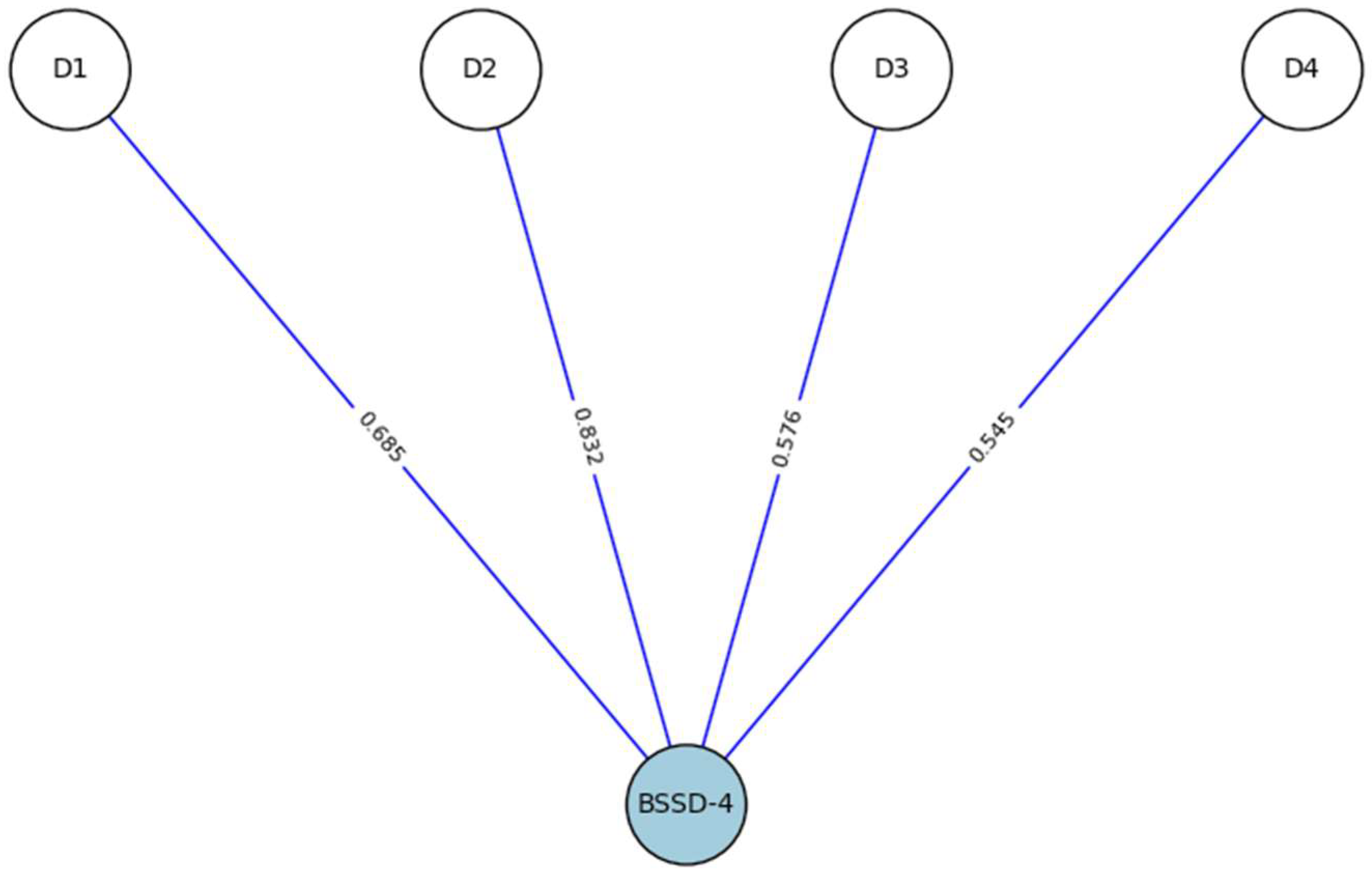
Figure 1. Model plot of the Brief Scale of Social Desirability (BSSD-4) in young Ecuadorians. Note: D1 = Sometimes I find it hard to get to work if I don't feel up to it; D2 = Sometimes I doubt my ability to succeed in life; D3 = Sometimes I feel that I am clumsy; D4 =I have sometimes felt quite jealous of the good fortune of others. The factor model demonstrates an excellent fit to the data, as the CFI, TLI, NNFI, and NFI indices are all above 0.95. Additionally, the RMSEA and SRMR indicate a good fit (< 0.05 and < 0.08, respectively).
Preprints 149435 g001
Figure 2. Network Analysis, Centrality, and Clustering of the Items of the Brief Scale of Social Desirability.
Preprints 149435 g002aPreprints 149435 g002b
Figure 3. Network Analysis, Centrality, and Clustering of the Items of the Brief Scale of Social Desirability (BSSD-4) in Young Ecuadorians by Sex.
Preprints 149435 g003
Figure 4. Network Analysis, Centrality, and Clustering of the Items of the Brief Scale of Social Desirability (BSSD-4) in Young Ecuadorians by Age Group.
Preprints 149435 g004
Figure 5. Differences in Social Desirability by Sex in Victimization/Perpetration of Dating Violence and Dimensions of Adverse Childhood Experience Abuse. Nota. PEA = Physical and Emotional Abuse/Sexual (Adverse Childhood Experience Abuse).
Preprints 149435 g005
Table 1. Factor loadings, reliability and validity of the Brief Scale of Social Desirability (BSSD-4) in young Ecuadorians.
Mean Std. Deviation Std. Est. (all) CR ωo αo G6 VIF AVE
D1 0.252 0.435 0.685 .759 0.750 .809 .711 2.01 .500
D2 0.371 0.483 0.832
D3 0.273 0.446 0.576
D4 0.550 0.498 0.545
Note: D3 original scale: Sometimes it's hard for me to get to work if I'm not in the right mood; D5 original scale: Sometimes I doubt my ability to succeed in life; D23 original scale: Occasionally, I feel like I'm clumsy; D28 original scale: Sometimes, I've felt quite jealous of other people's good fortune; CR = Composite Reliability; ωₒ = McDonald's Ordinal Omega; αₒ = Ordinal Cronbach's Alpha; G6 = Guttman's Lambda 6.
Table 2. Measures of Invariance by Sex, Age group, dimensions of dating violence (Victimization and Perpetration).
Model X2 df p CFI TLI RMSEA SRMR
SEX (Man and Woman)
MI ↔ CO 4.804 2 .091 .993 .959 .058 (.000 - .127) .037
MI ↔ ME 7.966 7 .336 .998 .996 .018 (.000 - .065) .042
MI ↔ SC 10.845 6 .093 .988 .977 .044 (.000 - .085) .043
AGE GROUP (14 -21 years and 22 - 26 years)
MI ↔ CO 5.339 2 .069 .992 .954 .063 (.000 - .131) .041
MI ↔ ME 9.523 7 .217 .994 .990 .029 (.000 - .071) .046
MI ↔ SC 8.463 6 .206 .994 .989 .031 (.000 - .076) .041
COERCIÓN - VICTIMIZATION (Sporadic, Repeated and Nonviolent)
MI ↔ CO 5.676 2 .059 .992 .931 .079 (.000 - .158) .038
MI ↔ ME 19.560 12 .076 .984 .976 .046 (.000 - .082) .059
MI ↔ SC 16.830 10 .078 .986 .974 .048 (.000 - .087) .045
DETACHMENT -VICTIMIZATION (Sporadic, Repeated and Nonviolent)
MI ↔ CO 4.299 2 .117 .995 .957 .062 (.000 - .145) .041
MI ↔ SC 11.374 10 .329 .997 .995 .002 (.000 - .069) .044
COERCIÓN - PERPETRATION (Sporadic, Repeated and Nonviolent)
MI ↔ CO 5.569 2 .062 .993 .935 .078 (.000 - .157) .043
MI ↔ ME 24.371 12 .018 .975 .962 .059 (.024 - .093) .054
MI ↔ SC 13.185 10 .214 .994 .988 .033 (.000 - .075) .045
VICTIMIZATION (Some type of victimization and non-violence)
MI ↔ ME 8.422 7 .297 .996 .994 .021 (.000 - .065) .047
MI ↔ SC 17.667 6 .007 .971 .942 .066 (.032 - .103) .054
HUMILIATION - PERPETRATION (Sporadic, Repeated and Nonviolent)
MI ↔ CO 4.438 2 .109 .995 .955 .064 (.000 - .146) .038
MI ↔ ME 19.514 12 .077 .985 .977 .046 (.000 - .082) .038
DETACHMENT - PERPETRATION (Sporadic, Repeated and Nonviolent)
MI ↔ ME 13.499 12 .334 .997 .995 .021 (.000 - .064) .049
MI ↔ SC 11.715 10 .305 .996 .993 .024 (.000 - .070) .043
PHYSICAL - PERPETRATION (Sporadic, Repeated and Nonviolent)
MI ↔ CO 4.513 2 .105 .995 .952 .065 (.000 - .147) .041
MI ↔ SC 10.093 10 .432 .999 .999 .006 (.000 - .063) .042
PERPETRATION (Some type of victimization and non-violence)
MI ↔ ME 7.999 7 .333 .997 .995 .018 (.000 - .063) .050
MI ↔ SC 13.293 6 .039 .979 .958 .052 (.011 - .090) .059
Note: MI = Measures of Invariance, CO = Configural, ME = Metric, SC = Scalar, ST = Strict, STR = Structural.
Disclaimer/Publisher’s Note: The statements, opinions and data contained in all publications are solely those of the individual author(s) and contributor(s) and not of MDPI and/or the editor(s). MDPI and/or the editor(s) disclaim responsibility for any injury to people or property resulting from any ideas, methods, instructions or products referred to in the content.
Copyright: This open access article is published under a Creative Commons CC BY 4.0 license, which permit the free download, distribution, and reuse, provided that the author and preprint are cited in any reuse.
Prerpints.org logo

Preprints.org is a free preprint server supported by MDPI in Basel, Switzerland.

Subscribe

Disclaimer

Terms of Use

Privacy Policy

Privacy Settings

© 2025 MDPI (Basel, Switzerland) unless otherwise stated