

Submitted:
02 March 2026
Posted:
06 March 2026
You are already at the latest version
Abstract
Since its establishment, quantum mechanics has developed for a century and has a very large theoretical system, but the phenomenon of quantum mechanics still lacks a generally accepted explanation, which undoubtedly shows that the existing theoretical system is incomplete. Inspired by ancient Chinese philosophy, we propose a theoretical framework in this paper, which provides a new perspective for explaining quantum mechanical phenomena including superposition and entanglement. In addition, the proposed framework contributes to a profound understanding of the law of conservation of energy. We show through examples how basic superposition states and entangled states are constructed. Our work can inspire people to think deeply about the mysteries of nature, especially quantum mechanical phenomena.
Keywords:
quantum mechanics
; quantum superposition
; quantum entanglement
; law of conservation of energy
1. Introduction
The establishment of quantum mechanics is undoubtedly one of the greatest progress made by human beings in exploring the mysteries of nature in recent hundreds of years. However, after a century of exploration, the fundamental principles behind quantum mechanics phenomena (e.g., quantum superposition and quantum entanglement) remain unknown [1]; In other words, although quantum mechanics phenomena have been described mathematically in some detail, no one can clearly explain why they can be described in this way. In fact, ancient Chinese philosophers represented by Confucius and Laozi put forward insightful theories thousands of years ago [2]. Unfortunately, few scientists pay attention to ancient Chinese Philosophy in this era, hence it is difficult to establish a rational worldview.
Quantum superposition, or superposition for short, is a peculiar quantum mechanics phenomenon, which indicates that a quantum system (quantum state) can be in multiple different states simultaneously [3]. The most common case is the superposition of two different states, and one of the most famous examples is “Schrdinger’s cat”, which can be vividly expressed as “a cat can be both alive and dead at the same time” [4].
Quantum entanglement, abbreviated as entanglement, is a quantum mechanics phenomenon built on superposition. In other words, the existence of superposition states is the prerequisite for the existence of entanglement. An entangled system is a composite of two or more subsystems, the properties of all subsystems are integrated into a holistic property, and the properties of each subsystem cannot be described separately, only the properties of the whole system can be described [3]. When one of the subsystems is observed, the state of the other subsystems will change immediately without any time delay, which is a shocking and unsettling phenomenon as it goes against human common sense [3]. Entanglement is one of the core resources of various quantum information processing tasks, such as and quantum computing, quantum cryptography and quantum communications [5,6].
From the existing fundamental theories of quantum mechanics, it can be seen that mathematically characterizing the basic phenomena of quantum mechanics does not seem very difficult; however, as mentioned earlier, the scientific community has not provided a clear answer to what forces cause these phenomena to occur. We believe that relying solely on scientific exploration cannot find universally accepted answers, and thus we have turned our attention to ancient Chinese philosophy. Chinese philosophy centers on the I Ching (also called the Book of Changes), which is the source of Chinese civilization [7]. To be precise, it is the origin of human civilization. The core theory in the I Ching is the supreme summary of the laws governing the operation of all things in the universe, which can undoubtedly eliminate all human concerns about the mysteries of nature.
We firmly believe that for quantum mechanics phenomena, reasonable explanations can certainly be found from the I Ching. Therefore, in recent years, we have devoted to studying the core theories of the I Ching and striving to find the desired answer. In this paper, we will first introduce some basic theories in the book of changes, and then propose a theoretical framework based on these theories, including the interpretations of the existing basic quantum mechanics principles such as quantum measurements, superposition and entanglement. Our work will not only help reduce people’s confusion about quantum mechanics phenomena, but also promote a deeper exploration of the mysteries of the universe.
2. The Proposed Theoretical Framework
The I Ching points out that everything in the universe comes from the fusion and transformation of two opposite things, and collectively call these two opposite things yin and yang [7]. The relationship between yin and yang can be briefly described as: yin and yang are opposite and balanced (balance means that they are equal in quantity), with yin containing yang and yang containing yin, constantly transforming into each other [7]. These are the core theories of the I Ching.
Let us now consider two typical opposites: existence and non-existence. Based on human common sense, at the beginning of the universe, there must have been nothing at all, that is, the origin of the universe was empty; In other words, the empty state is the starting state of the universe. However, the birth of countless things in the universe indicates that the origin of the universe is all-encompassing.
Based on the above theory, we can conclude that “emptiness” gives rise to the two opposite things that can be observed, yin and yang, and then through the interaction and transformation of yin and yang, countless substances are formed. For clarity, let us take the one-dimensional number axis as an example to illustrate, as shown in Figure 1. Obviously, the positive and negative half axes of the number axis are two opposite things, like yin and yang, while the number 0 in the middle represents “emptiness”.
For any number x on the number axis, there is always an opposite number . Obviously, the two numbers are symmetrically distributed on both sides of 0, and the combined result of the two is always 0, that is
Similarly, for a two-dimensional coordinate system, it is easy to know that the two opposite points can be expressed as
Here we use the form of column vector to express, of course, row vector is also feasible. By analogy, for a three-dimensional coordinate system, the two opposite points can be expressed as
Just like in a one-dimensional coordinate system, two opposite points in a two-dimensional or three-dimensional coordinate system are symmetrical on both sides of the point 0 (it is also feasible to call it a zero vector.) Further, for a d-dimensional coordinate system, one can get
2.1. Quantum Systems
Since the concept of energy and the law of conservation of energy were proposed, the scientific community has gradually accepted them, and currently it is widely believed that matter is derived from energy, with very few questioning its rationality. Here we would like to consider the law of conservation of energy through the essential theories of the I Ching. According to the yin-yang theory, energy must be divided into positive energy and negative energy (one belonging to yin and the other to yang), which constantly transform into each other, and the total positive and negative energy in the universe always maintain balance (so that the total energy is zero). The law of conservation of energy states that energy cannot be generated out of thin air [8], which actually means that energy must be divided into positive energy and negative energy, but negative energy is not mentioned.
Due to the balance between yin and yang in the entire universe and they are constantly transforming into each other, when a certain amount of yin is transformed into yang, there must be an equal amount of yang transformed into yin. The sub-figure (a) in Figure 2shows the balance of yin and yang, with the black and white areas representing yin and yang, respectively. Sub-figure (b) in Figure shows a brief process of yin-yang transformation. The area marked as ABO, originally belonging to yin, transforms into yang, while at the same time, the area marked as OCD, originally belonging to yang, becomes yin, such that yin and yang remain balanced. By the way, positive and negative energy, of course, follow these rules.
The I Ching points out that all things in the universe are interconnected and influence each other [7], which can be glimpsed from Newton’s law of universal gravitation in classical physics. For a simple example, as shown in Figure 3, A, B, C, D, and E respectively represent several objects in the universe. When the position of object A changes (e.g., moving to the position O), the gravitational force between A and all other objects in the universe, including B, C, D, and E, will change, potentially leading to changes in their states. That is to say, the changes in object A will more or less affect all other objects in the universe. By the way, both the law of universal gravitation and quantum entanglement are phenomena, and our thinking cannot be limited to these surface phenomena.
Based on the above discussion, if we consider the entire universe as a quantum system, then any object within it can be considered as a subsystem of it. To simplify the expression, in what follows we will use Dirac symbols to represent vectors. For Equation (4), if we use to represent , to represent , and to represent the zero vector then we can express Equation (4) as
It is obvious that
Since a subsystem cannot be completely independent of other subsystems, it inevitably continuously exchanges energy with some other subsystems. Based on the yin-yang theory, we can represent the state of a subsystem as
where the coefficients and can be assumed to be positive variables determined by the subsystem’s evolution process (the same below). From the process of the change in coefficients, it can be seen that “when yin (yang) reaches its extreme, yang (yin) will arise.” If the energy exchange between the system and the external systems is negligible, we can assume that the subsystem is independent, in which case the coefficients and are constants. Assuming represents the positive energy of the subsystem , and represents the negative energy of , then it is easy to see that
- If , it means that there is more positive energy than negative energy, and positive energy can be observed.
- If , it means that there is more negative energy than positive energy, and negative energy can be observed.
- If , the subsystem is in a neutral state (the state of yin-yang balance) and cannot be observed.
It should be noted that when and ( and ), the subsystem can be observed. By the way, any subsystem can be divided into countless subsystems with different energies, which can be either positive or negative. For a simple example, , where the subsystem with energy of 10 is split into 7 subsystems with energies of and , respectively. Obviously, this illustrates the principle of “there is yang in yin, and there is yin in yang” (or “yin contains yang, yang contains yin”). In this way, the yin-yang symbol can be further obtained from Figure 2, as shown in Figure 4.
2.2. Quantum Measurements
As discussed above, a subsystem can only be observed when it is in a state of yin-yang imbalance. Now consider an important question: how do people observe the existence of a subsystem? According to the existing measurement theory in quantum mechanics, observation requires the use of measurement operators. At this point, we face a new question: where do measurement operators come from? As before, we continue our discussion based on yin-yang theory. In fact, a measurement operator can also be regarded as a quantum subsystem. Let us label it as , similar to Equation (7), we can then get
where and can be assumed as positive variables that vary over time and can be assumed as constants under ideal conditions (the energy exchange with the external environment can be ignored.)
The process of using measurement operators (observation subsystems) to measure subsystems (observed subsystems) is essentially the interaction between two subsystems, which belong to the relationship of yin and yang. Obviously, the observed subsystem can also be called the observation subsystem, while the observation subsystem can be called the observed subsystem. By the way, a person’s observation results may be the outcome of his observed subsystems being influenced by other observed subsystems. If the observed subsystem is represented as
where the assumptions about the coefficients here are the same as those in Eq. 8, then the interaction result between the two systems can be expressed as
It is easy to see that
- if , through the observation subsystem , one can observe the observed subsystem .
- if , one can observe the opposite state of the observed subsystem .
- if , the observation subsystem (the observed subsystem) does not exist, in which case there is no doubt that there is no interaction between subsystems.
In real life, the views on the same thing vary from person to person, for example, some people give positive evaluations while others give negative evaluations, and the evaluations differ in degree (people show different levels of emotion toward the same thing). In addition, some people maintain an almost neutral stance. What are the reasons for these phenomena? In fact, the measuring instruments used by humans are merely measuring mediums, while humans themselves are the terminals for observing natural phenomena. Each person has a measurement system and a database, which vary from person to person, resulting in different perspectives on the same thing.
By the way, the entire universe does not exist (cannot be observed) due to the balance between yin and yang, while countless subsystems in the state of yin-yang imbalance can be observed and the intensity of the observation results may be determined by the coefficients in Equation (10). The former belongs to “nothingness” or “non-existence”, while the latter belongs to “existence”, indicating that “non-existence” contains “existence”, which is a typical case of “yin contains yang, yang contains yin”.
2.3. Quantum Superposition
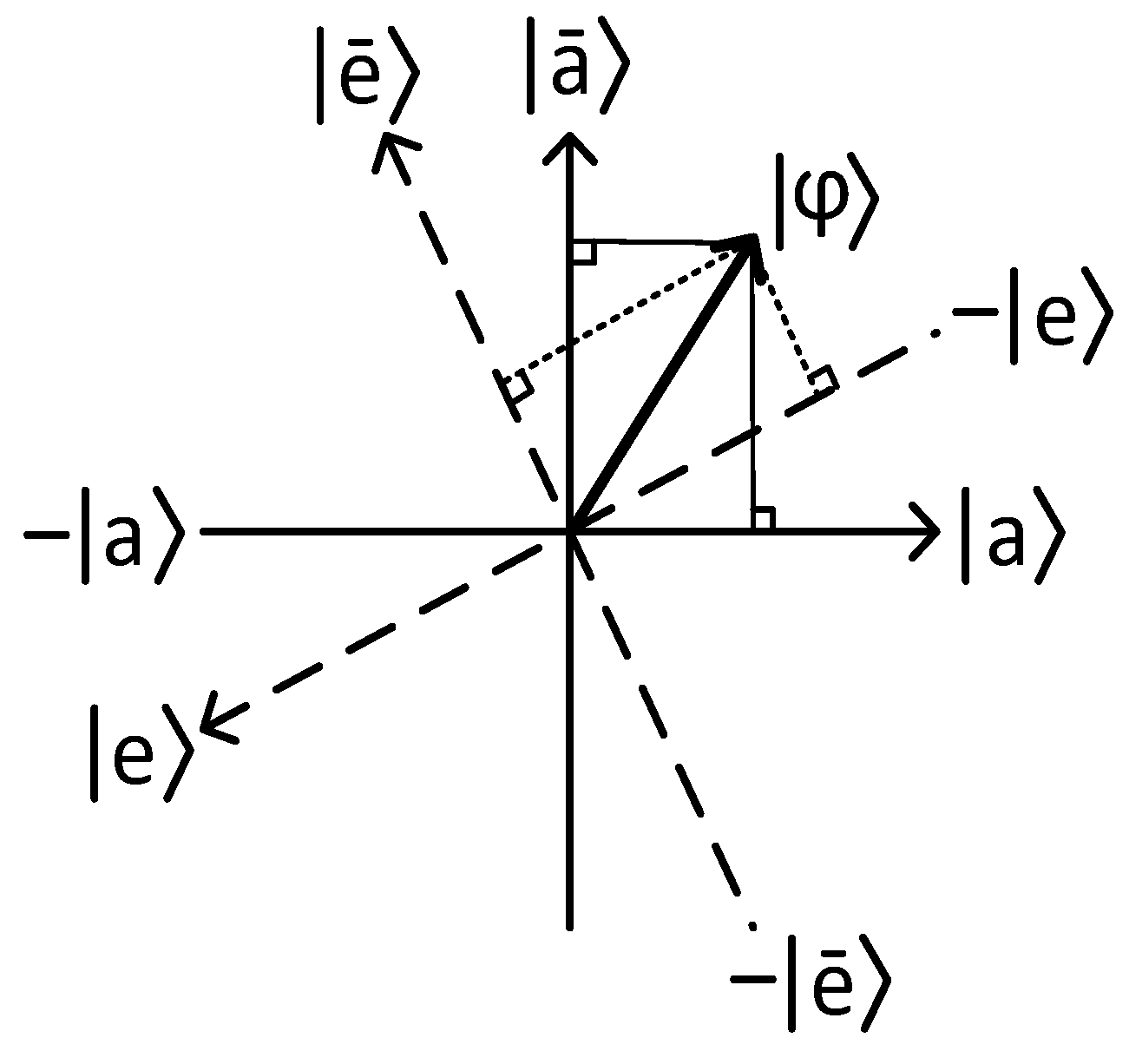
Quantum superposition can be briefly described as a subsystem being composed of a superposition of multiple other subsystems. As mentioned before, a subsystem can be decomposed into countless subsystems with different energies. A simple case is to decompose it according to a Cartesian coordinate system (or an orthonormal basis). For an arbitrary observable subsystem, denoted as , it can be represented using a set of orthonormal bases. Two simple examples are shown in Figure 5, which illustrates two different coordinate systems (we can regard a subsystem as a vector for ease of understanding). In this figure, and are two different orthonormal basis, and the state can be represented as
In what follows, for the convenience of expression, we will appropriately adopt existing mathematical characterizations. Let us assume there is a subsystem given by
where is an orthonormal basis. Let the coefficients , then one can get
Furthermore, by setting , one can get the quantum state
which is one of the most common and simplest superposition states in the field of quantum information. Based on existing quantum measurement theory, through the measurement basis , both and can be observed with a probability of half. However, according to the quantum measurement theory mentioned above, observing the result does not necessarily mean that the original state of the subsystem is ; it could also be .
2.4. Quantum Entanglement
The phenomenon of quantum entanglement reflects the interaction between different subsystems in the universe, and this interaction seems to be unrestricted by time and space, potentially indicating that all things in the universe are interconnected. The most basic form of entanglement is the entanglement between two objects, where a change in the state of one object immediately causes a change in the state of the other. Let us assume there are two ideal subsystems (independent of each other and almost unaffected by the external environment), and , given by
where can be assumed to be complex numbers and can be assumed to be positive integers. The composite system composed of these two systems is
Under the condition that none of the coefficients in the four terms are equal to 0, the following two entangled states can be observed from the composite system:
Since all subsystems in the universe interact with each other and change together as a whole, we can roughly compare them here to a huge entangled state, given by
where . This formula embodies the principles of “yin-yang balance” and “yin contains yang, yang contains yin”.
3. Conclusions
We have considered the existing principles of quantum mechanics based on the core theories in the Book of Changes, and proposed a new theoretical framework, including our views on quantum systems, quantum measurements, quantum superposition, and quantum entanglement. We have shown that all things in the universe originate from nothingness, what we see and hear stems from our local observation of the things with imbalanced energy. As for what force created the basic rules that govern the operation of all things in the universe, this is a very thought-provoking question.
References
- Ji, Z. X.; Zhang, H. G. Entanglement swapping theory and beyond. arXiv 2009.02555. 2020. [Google Scholar]
- Ji, Z. X.; Zhang, H. G. Security proof of quantum cryptography against entanglement-measurement attack. arXiv 2012.14275. 2020. [Google Scholar]
- Nielsen, M. A.; Chuang, I. L. Quantum Computation and Quantum Information; Cambridge University Press, 2000. [Google Scholar]
- Schro¨dinger, E. Die gegenwa¨rtige Situation in der Quantenmechanik. Naturwissenschaften 1935, 23(50), 844–849. [Google Scholar] [CrossRef]
- Zhang, H. G.; Ji, Z. X.; et al. Survey on quantum information security. China Communications 2019, 16(10), 1–36. [Google Scholar] [CrossRef]
- Ji, Z. X.; Fan, P. R.; Zhang, H. G. Entanglement swapping for Bell states and Greenberger–Horne–Zeilinger states in qubit systems. Physica A: Statistical Mechanics and its Applications 2022, 585, 126400. [Google Scholar] [CrossRef]
- Zeng, S. Q.; Liu, J. Z. The I Ching is really easy; Shaanxi Normal University Press, 2009. [Google Scholar]
- Halliday, D.; Resnick, R.; Walker, J. Fundamentals of Physics[M]; Wiley, 2013. [Google Scholar]
- Bell, J. S. On the Einstein Podolsky Rosen paradox. Physics Physique Fizika 1964, 1(3), 195. [Google Scholar] [CrossRef]
Figure 1.

Figure 2.
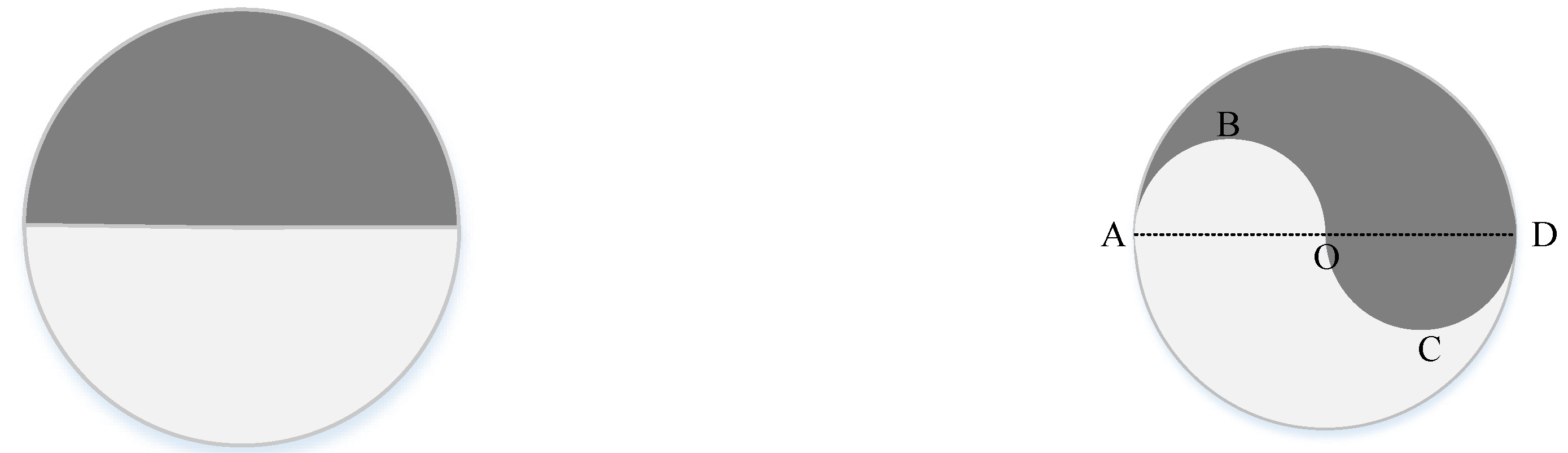
Figure 3.
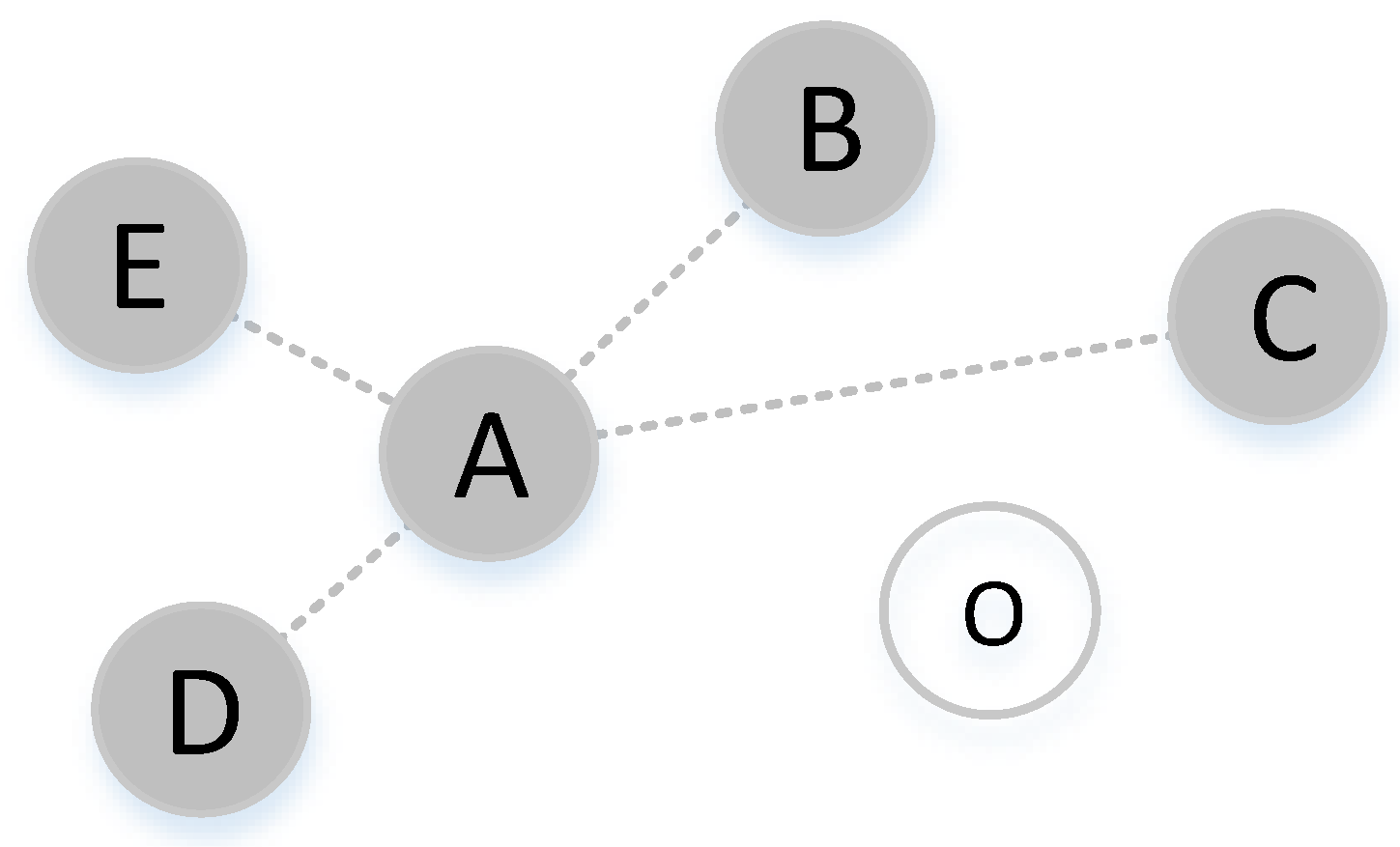
Figure 4.

Figure 5.
Disclaimer/Publisher’s Note: The statements, opinions and data contained in all publications are solely those of the individual author(s) and contributor(s) and not of MDPI and/or the editor(s). MDPI and/or the editor(s) disclaim responsibility for any injury to people or property resulting from any ideas, methods, instructions or products referred to in the content. |
© 2026 by the authors. Licensee MDPI, Basel, Switzerland. This article is an open access article distributed under the terms and conditions of the Creative Commons Attribution (CC BY) license (http://creativecommons.org/licenses/by/4.0/).
Copyright: This open access article is published under a Creative Commons CC BY 4.0 license, which permit the free download, distribution, and reuse, provided that the author and preprint are cited in any reuse.


