

Submitted:
14 February 2025
Posted:
14 February 2025
You are already at the latest version
Abstract
Despite the wide approval of the primeval atom concept (proposed by Georges Lemaitre) and the corresponding Big Bang theory among the scientific community and researchers, still there are several open questions with no answers. Among these questions are: what is the origin of the primeval atom? What caused this atom to explode? where was that explosion actually happened? and why our universe is a matter based universe? This paper proposes possible answers to these questions via: 1-Generalizing the idea of the primeval atom to be primeval particle, 2-Suggesting a possible formation of the proposed primeval particle, in particular, suggesting its formation from masses inside black holes, 3-Suggesting a possible way of the initiation of the original explosion in the Big Bang theory, 4-Demonstrating why some universes are matter based universes and others are anti-matter based universes, and 5-Confirming the necessity of the existence of a fourth spatial dimension.
Keywords:
The Primeval atom
; The Big Bang theory
; Newtonian gravity
; Black holes
This paper proposes possible answers to these questions via:
Generalizing the idea of the primeval atom to be primeval particle,
Suggesting a possible formation of the proposed primeval particle, in particular, suggesting its formation from masses inside black holes,
Suggesting a possible way of the initiation of the original explosion in the Big Bang theory,
Demonstrating why some universes are matter based universes and others are anti-matter based universes, and
Confirming the necessity of the existence of a fourth spatial dimension.
1. Introduction
Nowadays, and after the discovery of the expansion of our universe by Edwin Hubble [1,2], the idea of Georges Lemaitre [4,5,6,7] or the “primeval atom” together with the “Big Bang explosion” [8,9] are well accepted within the scientific community. A nice article was published about this subject in Ref. [10]. The primeval atom had infinite density (the singularity) or more precisely the Planck density at the very beginning or at the birth of our universe (at the Planck epoch) [11]. Despite such approval, still the following questions have no answers:
- What is the origine of the primeval atom?
- What caused the primeval atom to explode?
- Where did the primeval atom explode?
As it was proven by Hubbel, that the universe is expanding, therefore, backward in time, the idea of the primeval atom appeared. i.e., the universe was started at a singular point. Moreover, the equations of the theory of general relativity, informs us that at the beginning, gravity was working in a repulsive manner [12,13].
The death of an arbitrary star (or the super nova) collapses the star to itself forming huge, massive object that led to either Neutron star of black hole (the name was originally given by Laplace [12]). But the following question is still open: up to which limit the black hole mass will compress increasing its density? It has to be noted that small black holes could evaporate over time via the Hawking radiation hypotheses [12]; however, this does not affect huge black holes.
Recalling, the well-known theories of gravity (Newtonian gravity or Einstein’s general relativity or others), there is a singularity when the distance tends to zero or at the center of black holes. The author in Ref. [14] proposed generalization of the Newtonian gravity demonstrating that black holes introduce internal boundaries to our universe. This will avoid dealing with the singularity in the equations of mathematical physics. Recalling Ref. [14], the author demonstrated that:
- Our 3D universe is topologically infinite and embedded inside 4D spatial hyper-space, and
- The internal boundaries (cavities) introduced by black holes are closed spheres from our 3D perspective, whereas they are open in the 4th spatial dimension of the hyper-space.
In this paper, we will suggest possible answers to these raised open questions about the primeval atom and the Big Bang theory. Moreover, we will propose also a possible answer to why some universes are mater-based and others are anti-mater-based universes.
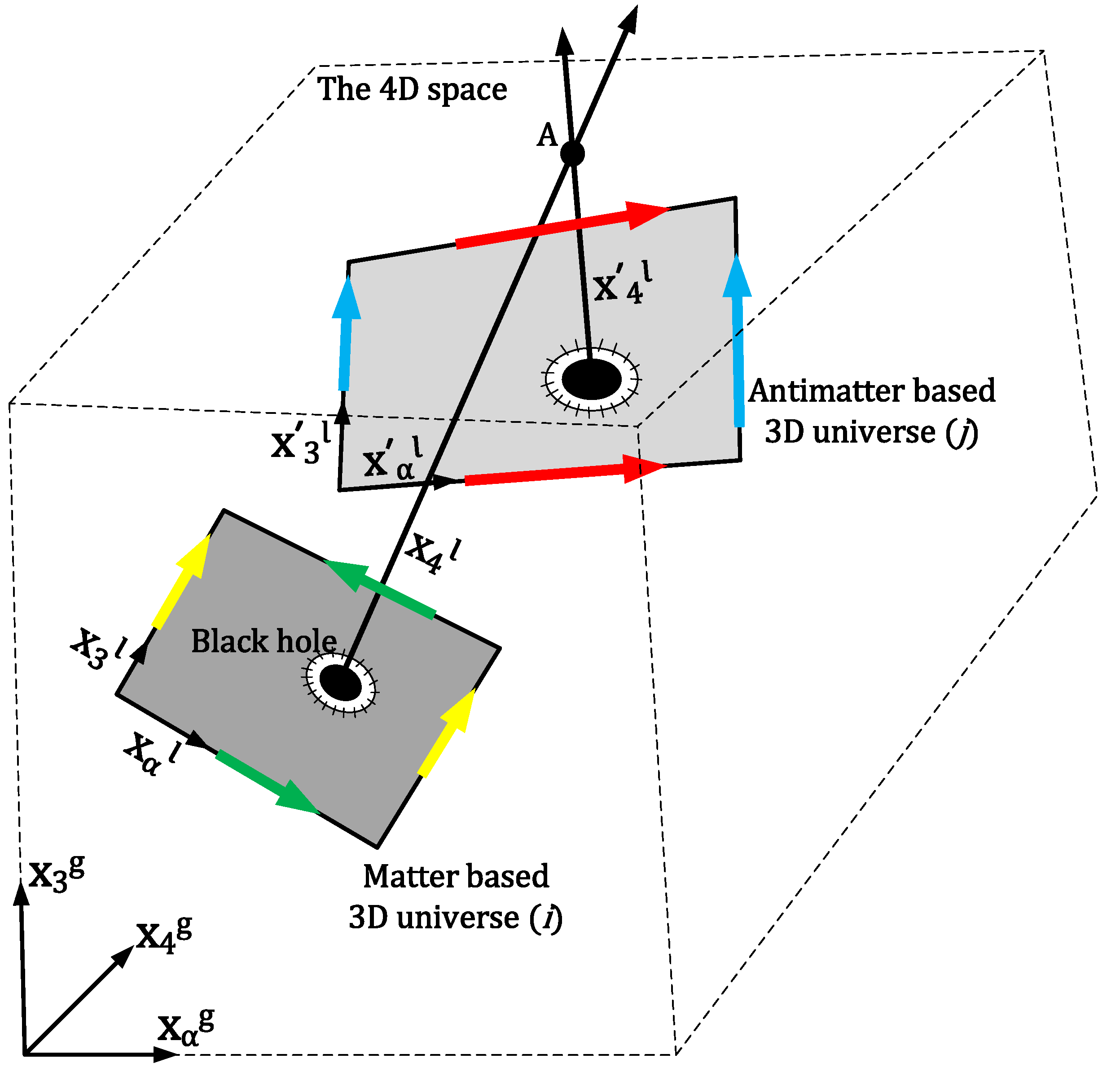
Figure 1.
Our 3D universe and a nearby 3D universe in the 4D hyper-space container [14].
Figure 1.
Our 3D universe and a nearby 3D universe in the 4D hyper-space container [14].
2. The Cosmos from Ref. [14] Perspective
In this section the cosmological model presented in Ref. [14] is briefly reviewed. Keeping in mind, we use the index notation in figure (1) with (α=1,2), to allow us to represent 3D volumetric universes as 2D planners’ ones and 4D hyper-space universe as 3D volume. This will help us visualize and recall the followings conclusions as were presented in Ref. [14]:
- Our universe is topologically infinite. This is demonstrated in figure (1) using the topological notation via the colored arrows. For example, in figure (1), we consider two 3D universes: the universe (i) and the universe (j). The universe (i) is considered to be a matter-based universe (such as our universe). Alternatively, the universe (j) is considered to be an anti-matter-based universe. It has to be noted that (and without losing the generality), the universe (i) is considered to embed mobius band (this is only for the sake of generality, and also to match the author’s own belief). Each universe has its local axis (dimensions) xαl and x3l.
- All 3D universes (for example universe (i) and universe (j) in figure (1)) are embedded in 4D hyper-space universe with global axis xig (i=1 to 4) or xαg, x3g, x4g.
- Black holes represent internal cavities (boundaries) to the 3D universes. These cavities are closed from our 3D perspective (as human beings); whereas They are open along the x4l direction. Using the idea of the index notations in drawings, these spherical cavities could be represented as circles as shown in figure (1).
- All nearby universes affect each other by a gravitational filed in the 4D hyper-space (we previously in Ref. [14] regarded this as a possible explanation of the dark matter) and it is defined by the proposed generalized form of Newtonian gravity (equation (19) in Ref. [14]), which is recalled herein as:
- is the gravitational force at the source point ξ having a unit mass,
- is the well-known universal gravitational constant,
- is a set of boundary integral terms of gravitational potential. Mainly, these boundary terms are over the internal universe boundaries caused by black holes,
- is the three-dimensional density (of units: [M]/[L]3) of the object located at the field point Xk ,
- is the four-dimensional density (of units: [M]/[L]3×([L] along the 4th dimension)) of the object located at the field point Xm ,
- is the three-dimensional Euclidean distance between the source point ξ and the filed point Xk,
- is the forth-dimensional Euclidean distance between the source point ξ and the filed point Xm,
- is unit directional vector between the source point ξ and the filed point Xp, where p=k, m, …
3. The Planck Units
Planck units [12] are the minimum dimensions or time span or mass could be found in our 3D universe. For example, Planck length (lp) is equal to 1.616255×10⁻³⁵ meter. Planck time (tp) is equal to 5.391247×10-44 second, Planck temperature (Tp) is equal to 1.416784×1033 Kelven and Planck mass (mp) is equal to 2.176434×10⁻⁸ kg. From these units we can compute the maximum possible density in our 3D universe which is the Planck density (ρp):
4. The Proposed Idea: The Symmetric Pealing Process
Consider a dying star, after its supernova, it will form a black hole and consider it to have a mass M. According to Ref. [14], this black hole creates a closed internal boundary to our 3D universe, therefore, it could be considered as isolated 3D small volume inside the 4D hyper-space container universe. According to the huge gravitational potential of masses inside black holes, it will shrink decreasing in volume and increasing its density until it reaches the Planck density, with minimum volume Vmin and with the mass M. By analogy to the cause of Casmir effect [12], this consequently increases the amount of negative energy in the isolated volume inside the blackhole, pushing gravity to work in a repulsive way when a threshold limit is triggered. The gravitational potential is even higher as the black hole mass radius becomes smaller. In such a case the volume of the star cannot shrink more as in such a case, its density will exceed the Planck density limit which is impossible (this is the mentioned threshold). Therefore, the only way to shrink more is to start to lose (or to repel) some atoms, decreasing both M and Vmin, keeping the maximum density. This could happen under the following constraints:
- This operation should be symmetric with respect to the three local axes x1l, x2l, x3l, or with respect to the global axes xαg, x3g, x4g, and
- The generated set of atoms or particle should be repelled from the black hole mass, escaping its huge gravity.
We will discuss now the proposed symmetric pealing idea, ensuring satisfaction of each of these constraints.
According to the previous description, the mass inside the black hole should lose few atoms in order to maintain the increase of gravitational potential and without exceeding the Planck density threshold. This prosses should be done within the symmetry rules of our universe. To demonstrate this process, we first explain the proposed symmetric pealing idea for two-dimensional virtual (imaginary) infinite universe with spatial dimensions x1 and x2 only, as shown in figure (2). All creatures in this universe feel movements along x1 and x2 directions only. Consider having a black hole with mass M. The mass M in this case is a circular disk of radius r. According to Ref. [14], this black hole creates an internal circular boundary to this 2D universe as shown in figure (2-a). Consider also that this black hole reached its maximum density (the Planck density) and consequently its minimum volume (in this case: minimum area). Hence a tiny circular ring along the disk boundary, possibly, of width lp (the Planck length) should be pealed under the repulsive gravity (due to the increase of the negative energy level inside the black hole area or domain). In order to do this process in a symmetric way, these pealed atoms or ring should escape along the x3 direction (an extra spatial dimension to this virtual universe) ensuring the symmetry of the process. It has to be noted that the trajectory and the speed of this particle (the tiny ring) could be computed by laws of mechanics and gravity, however, the interest of this paper is to present the idea only. Such a trajectory should look like the path in figure (2-b) due to the gravitational field of the black hole disk. Due to the high momentum and gravity, this tiny ring will end up to small, tiny disk, similar in shape to the original one inside the black hole. It will move way along the extra x3 spatial direction with high speed to escape the gravity of the black hole. This demonstrates the need for extra spatial dimension in order to perform the proposed process.
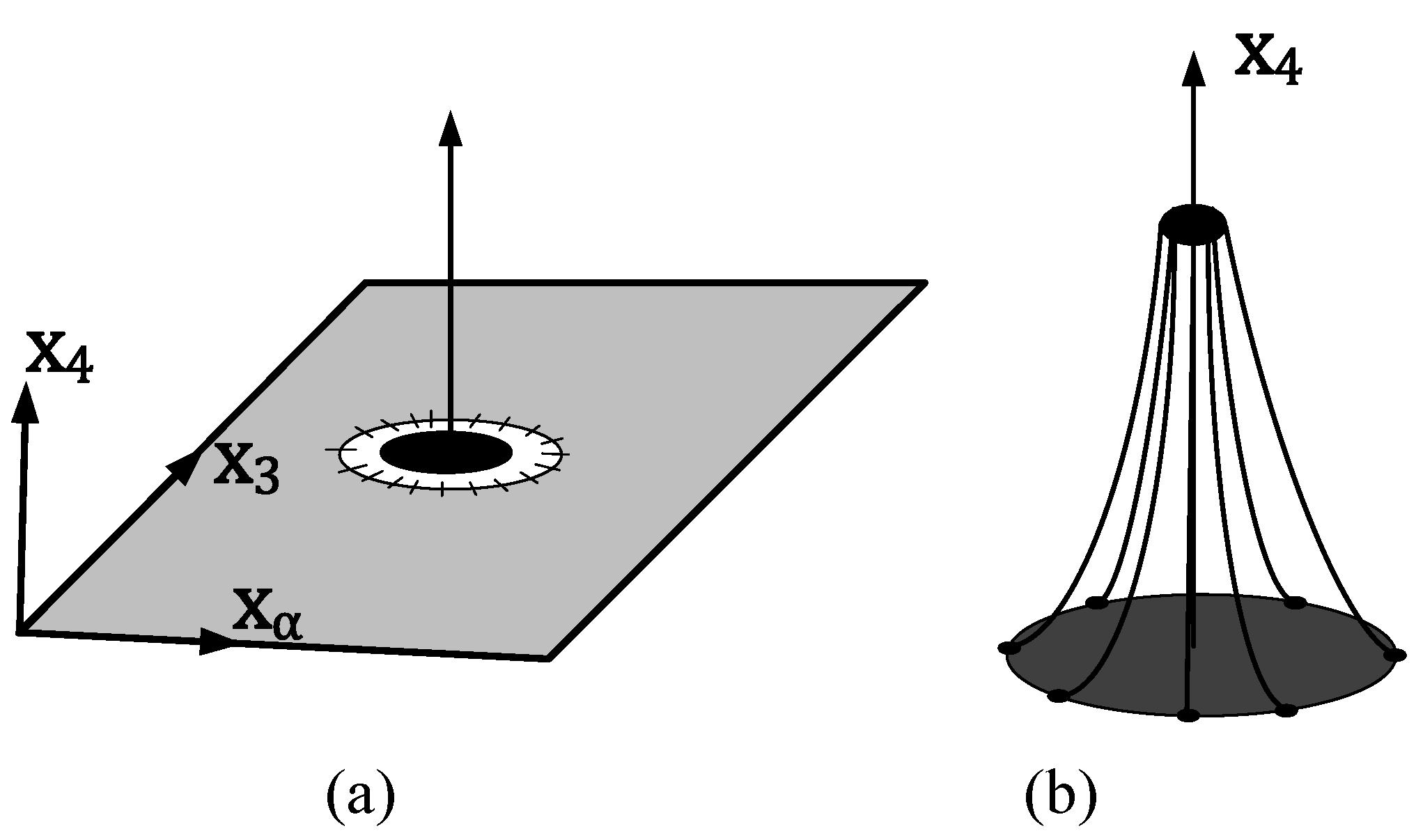
Now, we could easily generalize this idea for our 3D universe. Using the idea of the tensor notation, we can generalize figure (2) to figure (3), in which the index α=1,2, i.e. the coordinate xα represents both x1 and x2 at the same time. In this case, the fourth spatial dimension x4 is a must for carrying out the proposed symmetric pealing process. It is worth noting that generating the primeval particle (3D sphere) from the 3D sphere of the mass inside the black hole should be carried out in a symmetric way (only) along the existence of the proposed 4th spatial dimension. In topology, this could be done in a straightforward way via the well-known Hopf fiberation process [15].
Figure 2.
The virtual 2D universe and the proposed pealing of the primeval disk in the x3 direction.
Figure 2.
The virtual 2D universe and the proposed pealing of the primeval disk in the x3 direction.
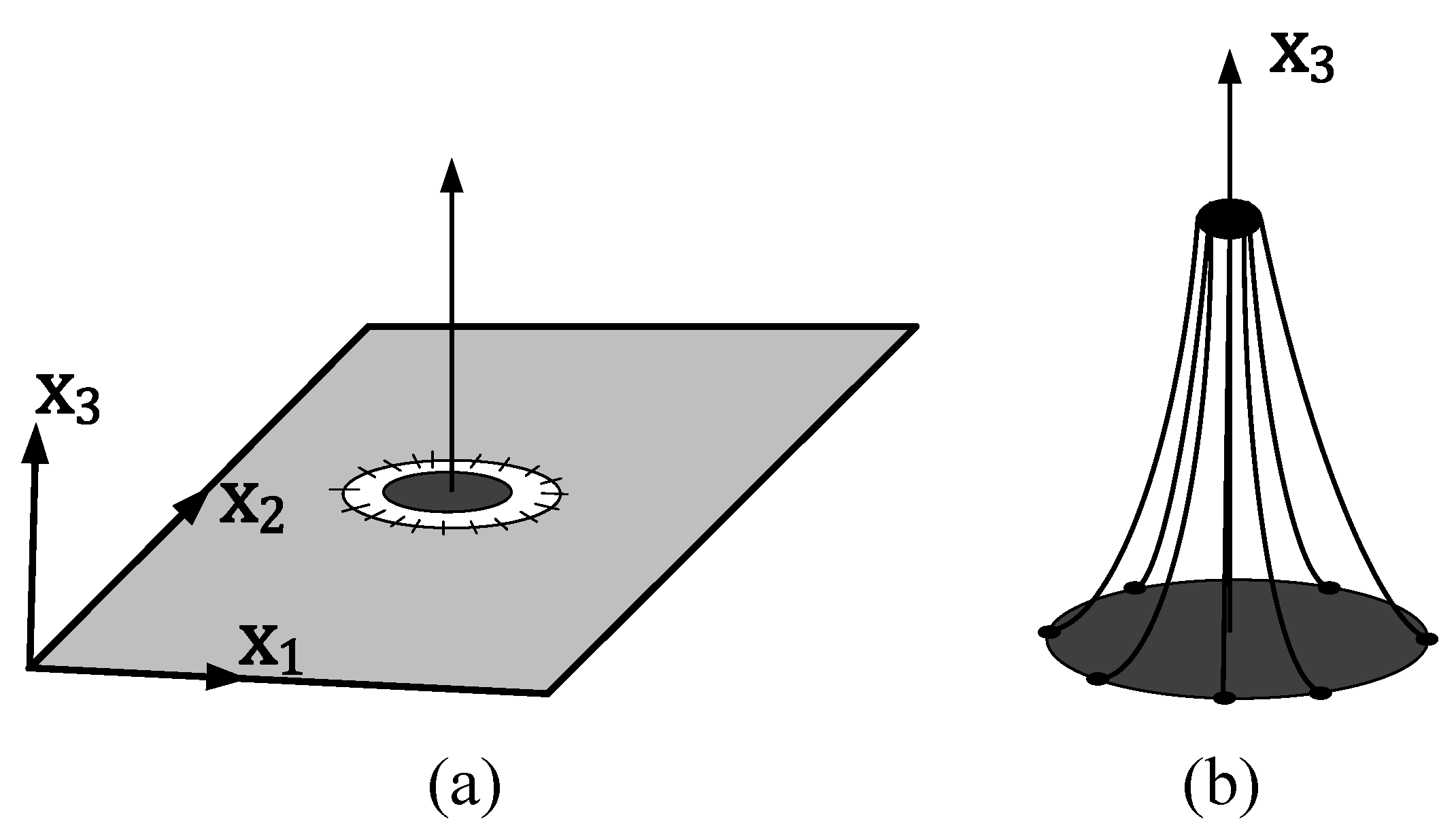
Figure 3.
Our 3D universe and the proposed pealing of the primeval particle in the x4 direction.
It has to be noted that:
- The generalized primeval particle, presented in this paper, has a Planck density which confirms the assumptions of the well-known primeval atom theory at the beginning of our universe (at the Planck epoch) [12].
- Due to the symmetry of the proposed process, and due to the gravitational field, all the pealed particles will be unified again in one particle which is the proposed primeval particle.
- In order that the generated primeval particle escapes the huge gravitational field of the black hole, its speed should be very high (might be higher than the speed of light). It has to be noted that, this escape process is carried out in the hyper-space 4D universe, therefore the 4th dimensional gravitational field should be considered as in equation (1).
- From the former explanation, gravity inside black holes is attractive along the well-known the three spatial dimensions of our universe. This will increase the amount of negative energy inside the black hole closed internal domain; leading gravity to work in a repulsive way along the extra 4th spatial dimension of our container hyper-space universe. In other words, in order to maintain the increase of gravitational potential and keeping the maximum Planck density of a black hole mass, gravity should force the mentioned symmetric pealing process to occur, and it also should repel away the proposed generalized primeval particle along additional extra spatial dimension (x4). It has to be noted that, this also confirms the well-know primeval atom theory, which indicates with the help of the equation of the theory of general relativity, that at the early universe age, gravity was repulsive [12,13].
5. A Proposed Possible Formation of the Big Bang and the Birth of Universes
Now, we will consider figure (1) again, if the proposed pealing process is done in two different universes (approximately) at the same time, generating two primeval particles with masses m1 and m2 speeding away within the 4D hyper-space universe. The following possibilities could be formed:
Possibility (1): both m1 and m2 will never meet at single point,
Possibility (2): m1 and m2 are generated from two universes of the same type (either matter-based or anti-matter-based universes). In this case, a collision will occur, leading to change in the direction and the speed of m1 and m2, and
Possibility (3): m1 and m2 are generated from two universes of different types (i.e. one is from a matter-based universe, and another is from anti-matter-based universe). In this possibility, both m1 and m2 will meet at a single point A as shown in figure (1). In this case, a huge explosion will occur, leading to initiate the Big Bang explosion and new universe is proposed to be born.
It has to be noted that:
- In possibility (3): depending on the angle of collision, speed and size of both m1 and m2, the type of the newly born universe could be determined. This point needs further research, however, if both m1 and m2 perfectly faced each other, and in case of m1 is bigger than m2, we propose the born universe will be of the same type of the universe that generated m1, and vise versa,
- Possibility (3) could be formed after series of possibilities (2) and/or (1) had happened,
- Due to the 4D gravitational field between different 3D universes, a possible relative movement between these universes might happen, moreover due to the movement of black holes within the 3D universes, this will ensure that possibility (3) is rare to occur.
6. Conclusions
This paper generalized the idea of the primeval atom theory. Due to the increase of negative energy, it was demonstrated that black holes could repel primeval particles with very high speed within the domain of the container 4D hyper-space universe. This agrees with the fact that gravity sometimes works in a repulsive way, especially at the beginning of the universe. If primeval particles from different universe types (matter-based type and anti-matter-based type) meet, the Big Bang explosion is triggered, leading to the birth of new universe which follows, in type, the bigger primeval particle mass. It was demonstrated that these primeval particles should have the Planck density in the Planck epoch. The paper highlights the necessity of the existence of the 4th spatial dimension in order that the primeval particle to be formed without demolishing the symmetry of our universe.
References
- E. Hubble, A Relation between Distance and Radial Velocity among Extra-Galactic Nebulae, Proc. Nat. Acad. Sci. 15, 168 (1929). [CrossRef]
- E. Hubble, The realm of nebulae, Yale University Press, 1936; Dover Publications, (1958).
- G. Lemaître, The expanding universe, M.N.R.A.S. 41, 491 (1931).
- G. Lemaître, The beginning of the world from the point of view of quantum theory, Nature 127, 706 (1931). [CrossRef]
- G. Lemaître, Evolution of the expanding universe, Proc. Nat. Acad. Sci. 20, 12 (1934). [CrossRef]
- G. Lemaître, The primeval atom: An essay on cosmogony, Van Nostrand Company, (1950).
- H.S. Kragh, & D. Lambert, The Context of Discovery: Lemaître and the Origin of the Primeval-Atom Universe. Annals of Science, 64(4), 445–470, (2007). [CrossRef]
- https://simple.wikipedia.org/wiki/Big_Bang.
- https://map.gsfc.nasa.gov/universe/bb_theory.html.
- M. Gleiser, The priest who proved Einstein wrong, Big Think, (2023): https://bigthink.com/13-8/lemaitre-priest-proved-einstein-wrong/.
- The Planck epoch: https://simple.wikipedia.org/wiki/Planck_epoch.
- Joseph Silk, A short history of the universe, Scientific American Library, A division of HPHLP, New York, 1994. [CrossRef]
- Your Daily Equation #29: Repulsive Gravity, Dark Energy, and Accelerated Expansion, by Prof Brian Greene: https://www.youtube.com/watch?v=xrghLYc_QXI.
- Youssef, F. Youssef F. Rashed (2024). 'A discussion on our universe boundaries', Journal of the Egyptian Society for Basic Sciences-Physics, 1(2), pp. 83-97. [CrossRef]
- Originally published on 22 December 2023:Youssef F. Rashed. (2023). A Discussion on Our Universe Boundaries. Qeios. [CrossRef]
- Hopf fibration https://en.wikipedia.org/wiki/Hopf_fibration.
Disclaimer/Publisher’s Note: The statements, opinions and data contained in all publications are solely those of the individual author(s) and contributor(s) and not of MDPI and/or the editor(s). MDPI and/or the editor(s) disclaim responsibility for any injury to people or property resulting from any ideas, methods, instructions or products referred to in the content. |
© 2025 by the authors. Licensee MDPI, Basel, Switzerland. This article is an open access article distributed under the terms and conditions of the Creative Commons Attribution (CC BY) license (http://creativecommons.org/licenses/by/4.0/).
Copyright: This open access article is published under a Creative Commons CC BY 4.0 license, which permit the free download, distribution, and reuse, provided that the author and preprint are cited in any reuse.


