

Submitted:
13 February 2025
Posted:
13 February 2025
You are already at the latest version
Abstract
Shape memory alloys are the key to sustainable technology and future industries. One of the most highlighted alloys around these times is Nitinol. It has special properties to work in extreme conditions and it can be specially projected for specific tasks. The Nickel-Titanium alloy is tested by NASA to build a new type of wheel to be used for future rovers which will be send to Mars. Other recently known devices to be built using this material are stents, root canal files, arches, bone implants used in medicine, aerospace gas turbines engines, thermal bimorph od dynamic actuators used in engineering, innovative SC brace or seismic retrofit applications in seismology and the list can continue. The purpose of this paper is to introduce the ungular actuator that has as a main component a Nitinol spring. In the theoretical part we identified the newest solutions in the sphere of Nitinol devices and presented them though the perspective of bibliometric maps obtained with the software VOSviewer. We focused on articles which analyze and improve the NiTi alloy in order to create a wider applicability range for it, studies over the already existing devices, testing models, novel applications and devices which utilize it and papers identifying new applications for actual NiTi devices/ equipment. Conclusions on the subject are that the industry is more and more interested in the shape memory materials and are open to investing in the research of the Nitinol. The presented device was physically developed and tested at the University Ștefan cel Mare of Suceava. Some results on the testing of the device are presented and discussed in this paper.
Keywords:
Smart memory alloy
; Nitinol
; actuator
; engineering
; bibliometric
; VOSviewer
1. Introduction
The latest trends express more and more the need to adapt, to reuse and to repair due to the huge impact human production and consuming has over our planet. Our ancestors were used to live modestly and respecting the limits of the nature, but in today`s market of offer and request the bigger the economy the bigger and more negative are the effects on land, water and air. This is the reason we selected Nitinol, a material that can be used for the same action multiple times.
In recent years the industry requests innovative solutions and materials to be used in actuators. One of the most researched branches nowadays are the shape memory alloy actuators. For example, the Nitinol actuators can be produced in multiple configurations and models depending on the alloy shape among other devices or equipment.
We focused on articles which analyze and improve the NiTi alloy in order to create a wider applicability range for it, studies over the already existing devices, testing models, novel applications and devices whom utilize it and papers identifying new applications for actual NiTi devices/ equipment.
2. State of the Art
In this paper we combined and analyzed 145 articles which include nitinol researches in its various shapes and forms. The purpose of this article is to highlight the new trends in the field of nitinol devices/ equipment/ forms/ applications through the bibliometric maps and to present a new actuator built with Nitinol.
Using the classification method, we highlighted the main forms of used NiTi and their main applications and domains. The article also brings up the innovative elements developed around the world by various institutes and laboratories over the last 6 years.
This article is structured in seven parts: the introduction places the theme of Nitinol, then in the state of the art the selected articles are represented with the purpose they have on the implemented system. In the third part the material and methods used are placed followed by the fourth part of the theoretical analysis of the articles. The fifth section is analyzing the resulting bibliometric maps from the network and temporal perspective. The following part presents the use of a Nitinol memorized spring to build an angular actuator. Finally, discussions and conclusions are identified in order to evolve to future directions of this research.
3. Materials and Methods
We selected the platform Web of Science and IEEE due to their wide variety of articles and its complexity. The selected articles are from the area of Nitinol devices and equipment, from two time periods and the wide category includes the other one. There have been made multiple analysis in this article and they involve a certain number of articles.
The included researches resulted through articles filtrations on Web of Science on the Nitinol published in the areas of Web of Science:
- Materials Science Multidisciplinary;
- Engineering Biomedical;
- Engineering Electrical Electronic;
- Engineering Manufacturing;
- Engineering Multidisciplinary;
- Orthopedics;
- Robotics;
- Engineering aerospace;
- Engineering Industrial.
The extensions RIS (for the 145 articles) extensions were downloaded and used in the VOSviewer software [156] to generate network visualization bibliometric maps, density and the overlay visualization map.
The software VOSviewer [156] uses network data generates multiple types of bibliometric maps. The maps can be visualized and explored for more detailed perspectives providing access to every element identified in the map. The generated maps ca be recreated by anyone using the program with the condition to apply the same rules.
The advantages of such an analysis are:
- to provide original content;
- to observe connections and similitudes among the article;
- to guide to specific content the researcher highlighting the novel path in the area;
- to explore the evolution of a certain theme in time.
4. Theoretical Analysis
In this section we are presenting three classifications, respectively first one is the classification after the generalized main objective, one after the form of the used Nitinol and after the main domain of application.
4.1. Classification after the Generalized Main Objective
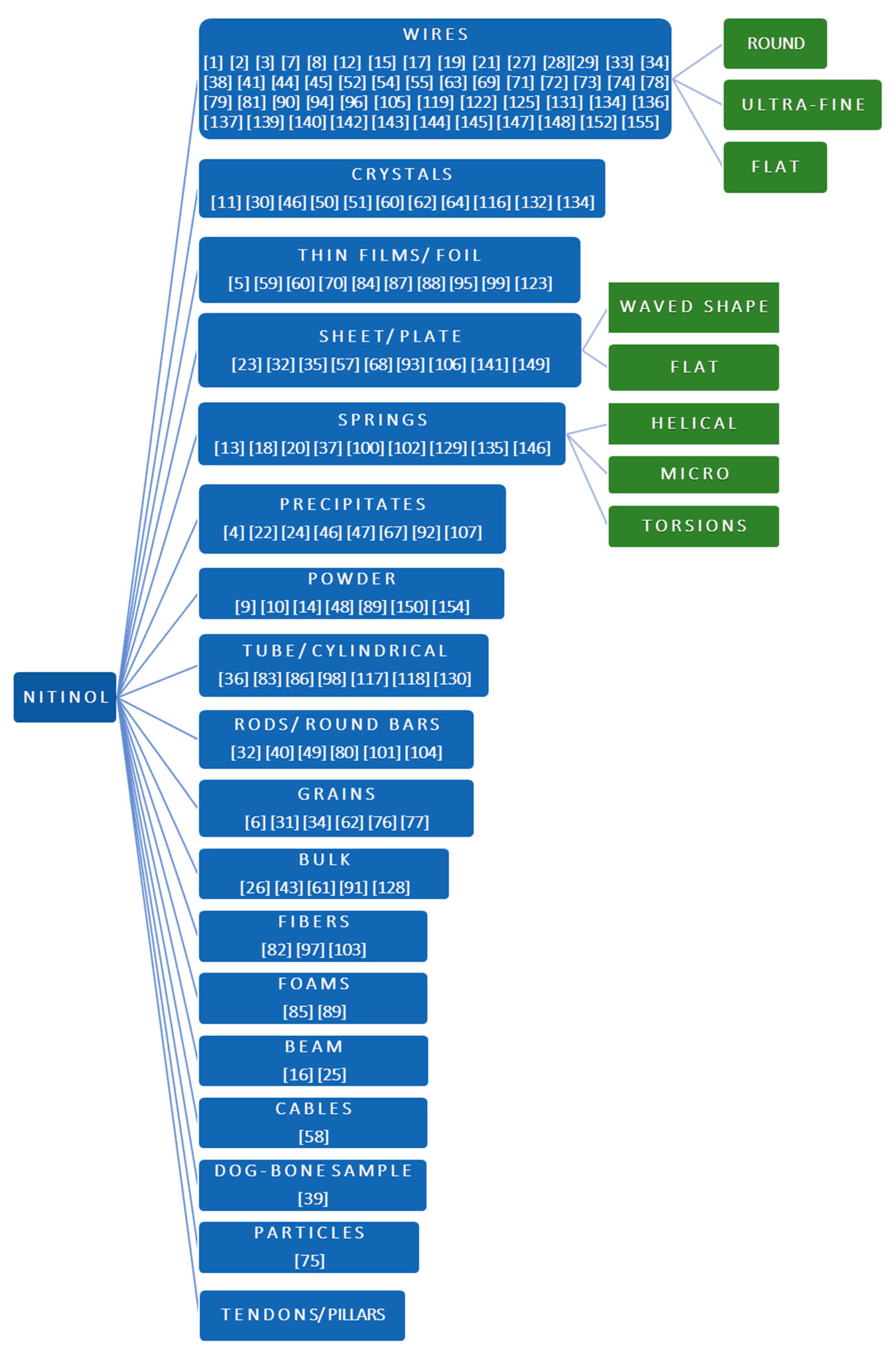
Every studied article contains one or multiple types of Nitinol in different structures and compositions projected to have certain characteristics and to respond in electrical or thermal field. In Figure 1 are presented 19 forms of Nitinol with the articles they were found in.
We conceived this classification in order to provide a clear orientation for all the researchers who want to easily identify specific information regarding a certain type of nitinol. Firstly, we identified the main objective of every analyzed article and then simplified them and integrated them in one of the 7 categories presented in Table 1.
From a total of 147 articles 38% are focused on studying and testing the Nitinol alloy on different levels: dynamic fracture performances, evolution during cooling and heating on molecular level, martensite variant reorientation process, torsion and bending deformation modes, to capture the shear strain field, etc. A percentage of 21% from the researchers are studying/ testing the device/ equipment/ applications such as the micro-lattices/stents, MEMS applications, welding, actuators, biomedical devices, electrochemical micromachining, chips, power laser actuation, cement mortar beams and so on.
Another 19% of them work to improve the characteristics of already existing devices/ equipment/ applications/ model/ process on medical robots, reduction of the surface defects, reversible bending on electrical actuators, effectiveness of Auricchio model, minimize hysteresis, lower prices, obtain useful transformation temperatures, rise spring actuation performance, wastewater recovery, adhesion increase, etc. Also 10% build a new device/ equipment/ applications/ model like: ankle rehabilitation robot, applications on the material behavior and lifespan, develop additive manufacturing, micropump diaphragm, form fit connection, 3D models and built numerical simulation.
A reduced percentage of articles, 6,13% of them are testing models/ strategies on devices based on Nitinol: The Auricchio model, numerical one, three-dimensional phenomenological constitutive model and diffraction computed tomography. The smallest percentage, 1,36% and 2,72 % of the papers work to develop a new formula of Nitinol, respectively to improve the fabrication of devices using Nitinol.
4.2. Classification After the Nitinol form
Every studied article contains one or multiple forms of Nitinol in different structures and compositions projected to have certain characteristics and to respond in electrical or thermal field.
We conceived this classification in order to provide a clear orientation for all the researchers who want to easily identify specific information regarding a certain type of Nitinol. In the following Figure 1 are listed 19 forms of Nitinol with the articles they were found in.
Figure 1.
Forms of Nitinol.
4.3. Classification After the Application Domain
Nitinol has such a wide variety of applications due to its shape memory feature activated at temperature changes, superelasticity (pseudoelasticity), corrosion resistance, anti-toxicity, good shock absorption characteristics, large range of temperature response depending on the atomic percentages of the Nickel and Titan and so on.
The medical field takes the first place when it comes to researches in the area of Nitinol applications and studies. Then the engineering field with a wide variety of devices, then civil engineering, robotics and so on. Definitely the charts would be different if we would compile multiple publication platforms. The following classification lists some of the identified utilization fields and the main applications of the Nitinol:
-
Medical:
- ◾
- Blood pressure sensors on the head of a pin;
- ◾
- Root canal files;
- ◾
- Arches, stents;
- ◾
- Spinal and dental implants;
- ◾
- Vascular stent;
- ◾
- Eyeglass frame;
- ◾
- Micro-stent;
- ◾
- Bone implant;
- ◾
- Orthodontic wires;
- ◾
- Minimally invasive surgical devices;
- ◾
- Robotic needle insertion;
- ◾
- Stents;
- ◾
- Valves;
- ◾
- Muscles.
-
Engineering:
- ◾
- Rotary actuator;
- ◾
- Actuator;
- ◾
- Aerospace gas turbine engines;
- ◾
- Dynamic actuators
- ◾
- Actuators used for helicopter active rotor blade control;
- ◾
- Thermal bimorph actuators;
- ◾
- Sensor-less actuator.
-
Civil Engineering Industry:
- ◾
- High damping materials;
- ◾
- Thin-wall structures;
- ◾
- Grate;
- ◾
- Micro-lattice;
- ◾
- NiTi foil for welding.
-
Robotics:
- ◾
- Artificial muscle;
- ◾
- Micro-actuators;
- ◾
- Bionic manipulator.
-
Automotives:
- ◾
- Actuators;
- ◾
- Motors;
- ◾
- MEMS.
-
Seismology:
- ◾
- Innovative SC brace;
- ◾
- Seismic retrofit applications.
- Constructions: Cement mortar beams.
- Mechanical: Pressure sensors.
5. Bibliometric Simulation Analysis
5.1. Network Visualization
Thousands of elements are presented under multiple perspectives and environments, which slowly evolve under the name of development and evolution in science. The following Figure 2 highlights 480 items which have been present in our 110 analyzed articles at least for 5 times.
In order to clarify the presentation new increased the number of appearances per item to at least 10 appearances and now the map in Figure 3 is presenting the 74 most used items in the selected articles.
Shape memory alloy (Figure 4) as an item is identified in cluster 4 and it occurs 374 (adding up the SMA) times. The shape memory alloy we selected, Nitinol, has the property to change its shape to the memorated form when activated in electrical and thermal fields and then return to the initial one.
As examples of smart materials, we can name NiTi (Nickel-Titanium), Fe-Mn-Si (Iron- Manganese- Silicon), Cu-Al-Ni (Copper-Aluminium-Nickel), and so on. The item Nitinol (NiTi alloy, NiTi) (Figure 5) occurs 176 times in among the selected papers. Nitinol is an alloy that depending on the report of Nickel and Titanium rewinds to its memorized shape at a certain temperature. Nitinol can be identified as elastic or superelastic, in shapes such as: wires (ultra-fine, round or flat), plates (flat or waved), springs (helical, micro, flat or torsion) or rods. Nitinol has wide applications in automotives, aerospace, medical industries, electric field and so on.
Actuators are known to be present in science and industry for a very long time. From soft ones, electric, hydraulic, pneumatic, magnetic, mechanic or 3D printed ones they have various applications in the fields of energy, medicine, automotives, robotics and so on with the purpose of improving the mobility and the functionality of a certain device or system. The performance metrics that characterize an actuator are force, speed, energy efficiency, acceleration, followed by durability, operating conditions, volume and mass. Considering its robustness, weight and other details we may select a specific actuator for a certain task.
Actuators are worldwide used to convert energy into mechanical force. In actuators a wide variety of materials may be identified, from classic metals to polymers and even memory form materials. In this article we highlight, among a variety of devices and equipment, the type of actuators developed using Nitinol.
5.2. Temporal Analysis
We are always discussing evolution and development and analyzing then through the filter of past. All the subjects have a starting point, and our study identified a focused starting point on the theme of Nitinol in 2018 with 6 articles appropriate for our research which focus on the following elements: force variation [102], laser welding [103], numerical simulation [105], NiTi joints [106], micromechanical modeling [107]. In the purple dots we can observe the items: actuator, spacer, electrostatic flapping wing ac, soft robotic gripper, frequency jump and so on in completion to the preview mentioned elements.
In 2019 we identified 20 papers on the Nitinol and they compile subjects such as: actuators performance increase [82], nanomechanical testing [83], biomedical applications [84], Voronoi-based reconstruction [85], uniaxial loading [86], SMA/Kapton composites [87], thermal-mechanical cycling training [88], anisotropic compressive strength [89], actuation systems [90], adhesion work [91] and so on.
From the year 2020, the 24 identified articles highlight self-centering energy-dissipation braces [58], micromechanical strain partitioning [61], two-step PT [62], novel NiTi smart structures [65], post heat treatment methods [67], machining accuracy [68], critical loading conditions [71], graded materials [73], non-recoverable strain [76], Bionic manipulator [78], e-mobility [81], etc. With the dark green we can observe more specific items like fiber, actuator, application, voltage, martensitic transformation, layer, etc. to help sustain the developed system.
In 2021 a number of 28 papers decay of Ni4Ti3 and Ni3Ti precipitates [31], Micro Electro Mechanical System [33], Cyclic shear loading [34], Torsional loading [35], interfacial shear strength [38], welding [40], the elastocaloric effect [42], lath martensites and dislocations [46], biocompatibility [47].
From 2022, we selected 30 researches WEDM machining [3], Ni4Ti3 precipitates [4], reversible SMA-FRP soft actuators [7], MEMS [10], X-ray diffraction [12], high accuracy [16], vacuum environment [19], micro-lattices/stents [22], elastocaloric air cooler [23], Scanning and light beam deflection [25], critical energy release rate [26], Low speed drive system [28], super-elasticity of NiTi SMA [29], yield surface [30]. Last year focuses (with yellow) on more precise things like soft robotics, viscosity, thermo, mode controller.
In 2023 were identified 20 articles that are focused on: actuators [116,117,118,120], vibration dampers [119], microactuators [121,123], lightweight actuators [122], Nitinol experimenting stands [124,125], temperature reglation to increase performance [120,126,128], hight load SMA actuators [127], haptic wearable devices [133], independent actuation [130] and so on.
Last year, 2024, helped us to identify soft robotics, actuators and origami structures [137], structural elements [138], deep-sea manipulation [139], heat engine [140], Nitinol texturing in single or two layers [141], twisting wrist actuator [143], actuators for payloads displacement [145], servomechanism of a rotator-type joint [147], Flapping Wing Micro Aerial Vehicles [152], photoactuator [153], etc.
Figure 7.
Overlay visualization 2018 - 2024.

6. Practical Application. Nitinol Spring Angular Actuator
6.1. Methodology
The NiTi alloy was the emerging point in the experiments. Multiple samples were purchased such as classical Nitinol springs, superelestic springs and memorized plates. In the angular actuator was used a 50%Ni and 50%Ti spring (Figure 8).
Nitinol springs are resistant to damp environments or chemicals without degrading rapidly and are also corrosion resistant. They can be made from both classic and super-elastic Nitinol. Nitinol springs are used in various fields including medical devices (such as stents and guide wires), robotics and aerospace. Their ability to adapt and recover after deformation makes them valuable in complex systems.
Characteristics of the Nitinol:
- ♣
- Wire diameter: 1 mm;
- ♣
- Diameter of the coil: 6 mm;
- ♣
- Total length: 76,2 mm;
- ♣
- Stretching capacity: x 4
- ♣
- Transition temperature: 45 ⁰C.
6.2. Constructive Description
The actuator (Figure 9) consists of a Nitinol spring (15) with a coil diameter of 1.15 mm, a rest length of 30 mm, a coil circumference of 6 mm and a 30 mm reserve (12) from which the system can be tensioned or relieved, a compensating steel spring (6), a spring clamping system (11) and a spring tension and spring contraction monitoring system. The axis of rotation of the actuator (16), on which the adjusting rod (17) is installed, and the two supports for supporting the steel and Nitinol springs (14) are mounted perpendicular to the base plate (13).
In the construction of the angular actuator test stand, we used a heat-resistant vessel (1) in which we placed the actuator in liquid media (3). The liquid was heated by means of a thermocouple (2) mounted on the rim of the thermal vessel. The temperature variation was measured with a thermometer (5) attached to the holder (8), and the protractor (9) for visualizing the angle of displacement of the indicator needle (10) is mounted on the holder (7). The indicator needle is located on the end of its holder (4) which is clamped in the support plate (18).
The Nitinol spring is memorized so that at a temperature above 40⁰ C it expands, and at temperatures lower than the previous value it returns to its original shape.
6.3. Description of Actuator’s Operation
The data was acquired using the experimental stand presented in Figure 14. The actuator is positioned in the heat-resistant vessel (1) which creates the favorable operating environment by storing the fluid (water). Using the thermowell (2) the temperature of the fluid will be controlled to observe the behavior of the Nitinol (15) in stages, the expansion of the spring with increasing temperature and the contraction of the steel spring (6).
In the second part, the thermoplunger is taken out of the immersion (water) medium (3) for cooling and contraction of the Nitinol spring and detensioning of the steel spring, respectively.
The temperature of 30 ⁰C will be considered as the starting point of the Nitinol spring deflection, and after the temperature of 90 ⁰C the spring will not deflect. The liquid temperature was raised to 95 ⁰C, but there was no further reaction after this threshold. The ambient temperature at the time the experiment was started was 20 ⁰C.
Several displacement positions of the Nitinol spring-loaded actuator are shown in the following Figure 10, the initial position at 0, 10⁰, 20⁰, and 158⁰ displacements.
7. Experimental Data Collection
For data acquisition, the stand was submerged in water and, by varying the temperature, the Nitinol spring causes the actuator to contract and relax, or angular displacement.
The following Figure 11 shows the characteristic of actuator displacement as a function of heating temperature. The amount of displacement is relatively small between 20 ⁰C and 40 ⁰C, but the displacement visibly increases with temperature. A jump occurs between 50 ⁰C and 60 ⁰C when the displacement increases from 26⁰ to 40⁰. The characteristic emphasizes the sudden displacement that the actuator makes when the liquid medium reaches a temperature of 80 ⁰C and 150 ⁰, respectively. At 90 ⁰C the displacement reaches 158⁰. Even if the temperature was raised to 95 ⁰C the displacement angle remained the same.
The characteristic of the angular displacement of the actuator (Figure 12) as a function of cooling temperature shows the constant angular displacement of the actuator up to a temperature of 60 ⁰C at which the Nitinol spring contracts to an angle of 50o, followed by continuous cooling with small contact jumps until it returns completely to its initial position at 20 ⁰C.
8. Discussions and Conclusions
The theoretical analysis conducted at point 4 in our research contains 3 classifications. The first one (section 4.1.) is the one after the main objective of the selected papers and we generalized it so it would fit in one of the 7 categories. This allows us to provide a more focused perspective over the Nitinol researches. The majority of authors are concentrating on the studying and testing of the alloy with the purpose to offer higher efficiency, better characteristics, improved rearmament and so on to make the Nitinol better known and more used on the market. The classification after the form (section 4.2.) of Nitinol used help the researchers that would consult our paper to easily identify the articles that addresses the use of a specific form of Nitinol.
The classification after the application domain (section 4.3.) we included a reduced part of the devices/ equipment/ applications that were developed in the selected articles. A large part of them is in the domain of the medical/ biomedical field such as: orthodontic wire, root canal files, valves, stents, micro stent, robotic needle, spinal and dental implants, etc. Another domain which highlights the deep research into the Nitinol area is engineering with actuators, aerospace gas turbines, thermal bimorph actuators and so on, then some civil engineering industry examples were identified: grates, micro-lattice, thin wall structures, etc.
The bibliometric simulation analysis from point 5 gives us the visual perspective using bibliometric maps and generating network visualizations, temporal and geographical analysis. On a broad approach the network visualization exhibits all the items most identified on the titles and abstracts of the selected articles. We highlighted some of the items we find more important: ”smart memory alloy”, ”NiTi”, ”application”, ”device”, ”actuator”, ”performance”. The temporal perspective includes all this elements and positions then in different moments of research. For example the element ”application” is predominantly identified around 2020, while the focus on the cooling process has been increased around 2022. Among the years the interest for the Nitinol has increased and its development is continuous providing new solutions to improve and discover novel devices and applications.
One of the most relevant maps that we inserted in this article is the overlay visualization map which contains the 147 selected articles from 1018 to 2024 from the platform Web of Science. This map is relevant because revels the evolution of Nitinol in the researches and highlights the main subjects that have been reached on this topic in each year.
The behavior of the angular actuator upon heating with a heat gun, i.e., natural cooling of the Nitinol spring in liquid medium is visible in Figure 20 which was obtained by polynomial interpolation of the points to order 3. It is concluded that at the temperature of 90 oC the maximum angle of displacement, i.e. 158o, is reached in a time of about 45 minutes and the return from the temperature of 95 oC to that of 20 oC, i.e. to the initial position is after 207 minutes, reaching the memorized shape.
Figure 13.
Behavior of the angular actuator during natural heating and natural cooling of the nitinol spring in liquid medium. The red curve represents the displacement with increasing temperature and the blue curve represents the displacement with cooling.
Figure 13.
Behavior of the angular actuator during natural heating and natural cooling of the nitinol spring in liquid medium. The red curve represents the displacement with increasing temperature and the blue curve represents the displacement with cooling.
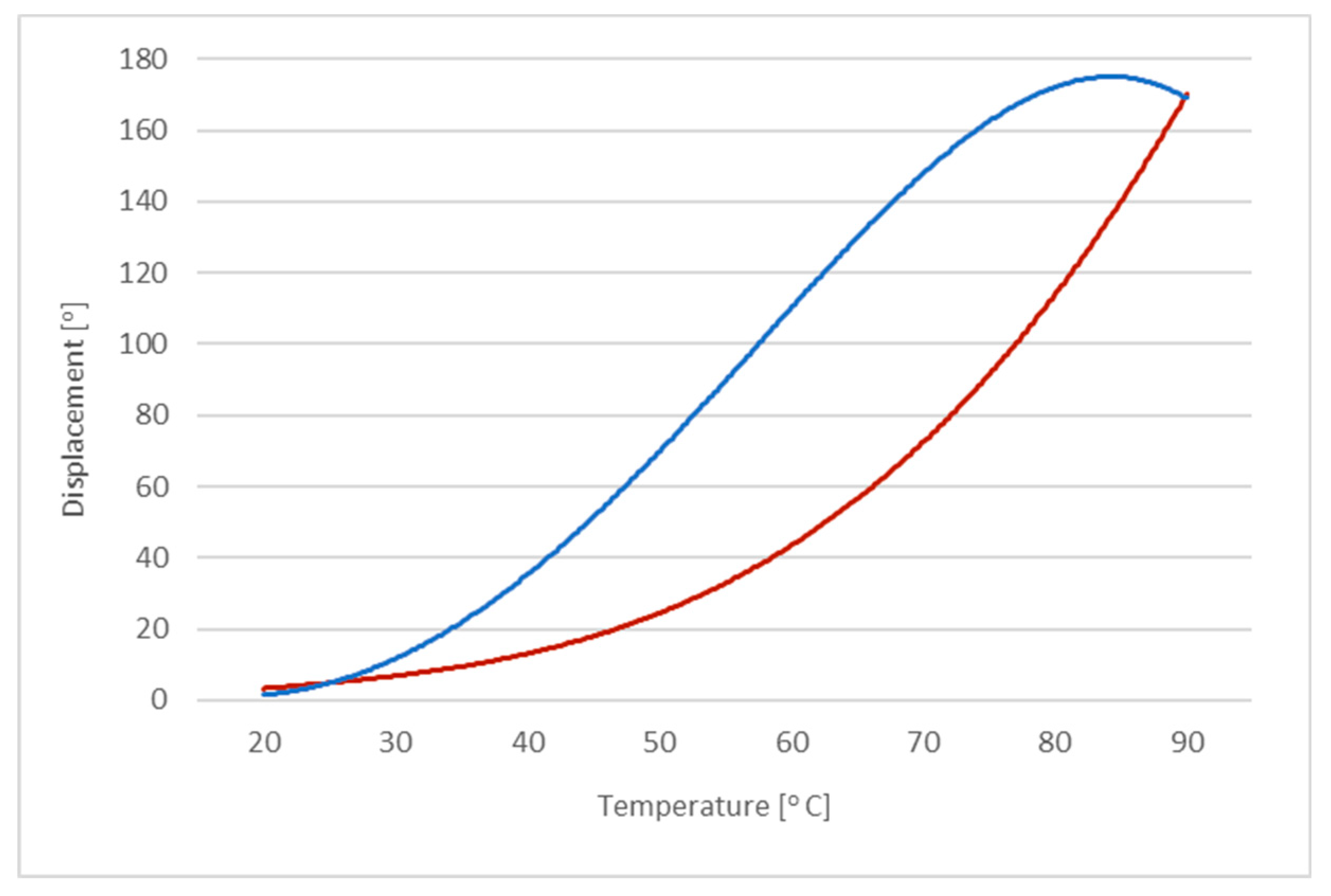
Analyzing the heating displacement curve, it can be observed that in the range 20 oC -30 oC, the displacement in relation to the temperature increase occurs slowly and at insignificant values. After the temperature of 30 oC the actuator changes its behavior, the displacement occurs linearly up to the temperature of 75o C, every 10o increase in temperature by 10o a displacement of 30o occurs. After a temperature of 70 oC the displacement stabilizes, its variation with temperature being very small.
8. Future Directions
This research has its roots in older studies and researches from our laboratory, such as: devices with intelligent materials [108] used in energetics, special actuators [102], electro and thermomechanical actuators [109] linear heliothermic actuator [110], electromechanical micropump [111] and we used Nitinol to study its lifespan [18] and to develop special actuators and materials with shape memory [112], clutch type thermocouple [113], Nitinol operated Micropump [114], a locking system [115] and we hope it will result in the development of newer devices and equipment with applications in electrical engineering.
Shape memory alloys or smart materials are used in small and large scale structures in multiple fields such as robotics, engineering, medical devices, automotives, aeronautics, aerospace, mechanical engineering, power plants and biomedical fields (microsensors, stents, cement mortar beams, artificial muscle, micro-actuators, bionic manipulator, etc.).
In future research we can identify the form of Nitinol that is appropriate for each applicability domain. There are certain connections between the type of used Nitinol, related to its elasticity and durability, and the shapes it used in certain applications.
In the perspective of a more precise research there could be made a classification after the chemical composition/ formula of the Nitinol alloy, but this is out of our expertise area. This article can be also extended increasing the number of the analyzed articles, analyze a higher number of items or finding various classifications appropriate for a review.
The future of the research in this area is taking fast steps and the trends are always going to change. The industries are more and more interested to invest in researches that use smart materials as an alternative for the classic ones. Our future directions are leading to more deepen and precise research in the field of Nitinol devices.
Author Contributions
Conceptualization, L.D.M., O.V.G. and M.P.; methodology, L.D.M.; software, O.V.G. and M.P.; validation, L.D.M., O.V.G. and M.P.; formal analysis, L.D.M. and O.V.G.; investigation, L.D.M. and M.P.; resources, L.D.M., O.V.G. and M.P.; data curation, O.V.G.; writing—original draft preparation, L.D.M., O.V.G. and M.P.; writing—review and editing, O.V.G. and M.P.; visualization, O.V.G.; supervision, L.D.M.; project administration, L.D.M.; funding acquisition, M.P. All authors have read and agreed to the published version of the manuscript.
Funding
This paper has been financially supported within the project entitled “DECIDE – Development through entrepreneurial education and innovative doctoral and postdoctoral research, project code POCU/380/6/13/125031, project co-financed from the European Social Fund through the 2014-2020 Operational Program Human Capital”.
Institutional Review Board Statement
Not applicable.
Informed Consent Statement
Not applicable.
Data Availability Statement
Not applicable.
Conflicts of Interest
The authors declare no conflict of interest.
References
- Dezaki, M.L.; Bodaghi, M.; Serjouei, A.; Afazov, S.; Zolfagharian, A. Adaptive reversible composite-based shape memory alloy soft actuators. Sensors Actuators A: Phys. 2022, 345. [Google Scholar] [CrossRef]
- Karimi, S.; Konh, B. Kinematics modelling and dynamics analysis of an SMA-actuated active flexible needle for feedback-controlled manipulation in phantom. Med Eng. Phys. 2022, 107, 103846–103846. [Google Scholar] [CrossRef] [PubMed]
- Chaudhari, R.; Prajapati, P.; Khanna, S.; Vora, J.; Patel, V.K.; Pimenov, D.Y.; Giasin, K. Multi-Response Optimization of Al2O3 Nanopowder-Mixed Wire Electrical Discharge Machining Process Parameters of Nitinol Shape Memory Alloy. Materials 2022, 15, 2018. [Google Scholar] [CrossRef]
- Zhang, D.; Hu, Z.; Li, Y.; Cong, W. Excellent damping properties and their correlations with the microstructures in the NiTi alloys fabricated by laser-directed energy deposition. J. Manuf. Process. 2022, 84, 965–976. [Google Scholar] [CrossRef]
- Sahu, A.; Palani, I.; Singh, V. Investigation on fabrication of NiTi based strain gauge using laser decal transfer based µ-3D printing. Manuf. Lett. 2022, 32, 49–53. [Google Scholar] [CrossRef]
- Cui, Y.; Zeng, X.; Tan, V.B.; Zhang, Z. Experimental and numerical studies of NiTi dynamic fracture behaviors under the impact loading. Int. J. Mech. Sci. 2022, 235. [Google Scholar] [CrossRef]
- Britz, R.; Motzki, P. Analysis and evaluation of bundled SMA actuator wires. Sensors Actuators A: Phys. 2022, 333. [Google Scholar] [CrossRef]
- Zhang, M.; Duan, Y.; Fang, X.; Zhang, H.; Jiao, G.; Li, Y.; Huang, K. Tailoring the superelasticity of NiTi alloy fabricated by directed energy deposition through the variation of residual stress. Mater. Des. 2022, 224. [Google Scholar] [CrossRef]
- Chekotu, J.C.; Kinahan, D.; Goodall, R.; Brabazon, D. Influence of Structural Porosity and Martensite Evolution on Mechanical Characteristics of Nitinol via In-Silico Finite Element Approach. Materials 2022, 15, 5365. [Google Scholar] [CrossRef]
- Kannan, R.R.; Sivabharathy, M.; Lenin, N. Shape memory effect of Cu Al1-nitinol/MWCNT nanocomposites for actuators in MEMS. Sensors Actuators A: Phys. 2021, 334, 113327. [Google Scholar] [CrossRef]
- Liu, S.; Ke, C.; Cao, S.; Ma, X.; Zhao, Z.; Li, Y.; Zhang, X. An atomistic study of self-accommodation martensite morphologies and microstructure evolution during forward and reverse martensitic transformations in single crystal and bicrystal NiTi alloys. Comput. Mater. Sci. 2022, 210. [Google Scholar] [CrossRef]
- Kong, X.; Hao, S.; Ren, Y.; Yang, Y.; Feng, B.; Guo, F.; Yang, Q.; Huang, B.; Cui, L. Interactions between martensitic NiTi shape memory alloy and Nb nanowires in composite wire during tensile deformation. Compos. Part B: Eng. 2022, 234. [Google Scholar] [CrossRef]
- Zhang, Y.; Yu, C.; Zhu, Y.; Kan, Q.; Kang, G. Thermo-mechanically coupled deformation of pseudoelastic NiTi SMA helical spring. Int. J. Mech. Sci. 2022, 236. [Google Scholar] [CrossRef]
- Safaei, K.; Nematollahi, M.; Bayati, P.; Kordizadeh, F.; Andani, M.T.; Abedi, H.; Poorganji, B.; Elahinia, M. On the crystallographic texture and torsional behavior of NiTi shape memory alloy processed by laser powder bed fusion: Effect of build orientation. Addit. Manuf. 2022, 59. [Google Scholar] [CrossRef]
- Sun, G.; Liu, H.; Liu, W.; Yang, W. Development, simulation, and validation of sliding self-centering steel brace with NiTi SMA wires. Eng. Struct. 2022, 256, 114069. [Google Scholar] [CrossRef]
- Rao, Z.; Wang, X.; Leng, J.; Yan, Z.; Yan, X. Design methodology of the Ni50Ti50 shape memory alloy beam actuator: Heat treatment, training and numerical simulation. Mater. Des. 2022, 217. [Google Scholar] [CrossRef]
- Hau, C.T.; Gouwanda, D.; Gopalai, A.A.; Low, C.Y.; Hanapiah, F.A. Gamification and Control of Nitinol Based Ankle Rehabilitation Robot. Biomimetics 2021, 6, 53. [Google Scholar] [CrossRef]
- Dumitru, C.; Milici, L.D.; Pentiuc, R.D.; Atănăsoae, P.; Ungureanu, C.; Hopulele, E. Experimental Analysis on the Impact of Current on the Strength and Lifespan of a Ni-Ti Element. Appl. Sci. 2022, 12, 3185. [Google Scholar] [CrossRef]
- Pu, Z.; Du, D.; Wang, K.; Liu, G.; Zhang, D.; Zhang, H.; Xi, R.; Wang, X.; Chang, B. Study on the NiTi shape memory alloys in-situ synthesized by dual-wire-feed electron beam additive manufacturing. Addit. Manuf. 2022, 56. [Google Scholar] [CrossRef]
- Wang, J.; Huang, B.; Gu, X.; Zhu, J.; Zhang, W. Actuation performance of machined helical springs from NiTi shape memory alloy. Int. J. Mech. Sci. 2022, 236. [Google Scholar] [CrossRef]
- Zhang, Y.; Kang, G.; Miao, H.; Yu, C. Cyclic degeneration of elastocaloric effect for NiTi shape memory alloy: Experimental observation and constitutive model. Int. J. Solids Struct. 2022, 248. [Google Scholar] [CrossRef]
- Xiong, Z.; Li, H.; Yang, H.; Yang, Y.; Liu, Y.; Cui, L.; Li, X.; Masseling, L.; Shen, L.; Hao, S. Micro laser powder bed fusion of NiTi alloys with superior mechanical property and shape recovery function. Addit. Manuf. 2022, 57. [Google Scholar] [CrossRef]
- Li, X.; Cheng, S.; Sun, Q. A compact NiTi elastocaloric air cooler with low force bending actuation. Appl. Therm. Eng. 2022, 215. [Google Scholar] [CrossRef]
- Lu, H.; Ma, H.; Cai, W.; Luo, X.; Qu, S.; Wang, J.; Lupoi, R.; Yin, S.; Yang, C. Altered phase transformation behaviors and enhanced bending shape memory property of NiTi shape memory alloy via selective laser melting. J. Mech. Work. Technol. 2022, 303. [Google Scholar] [CrossRef]
- Gangwar, K.; Jayachandran, S.; Sahu, A.; Singh, A.; Palani, I. Influence of pre-strain on attributes of Ni-rich NiTi/ Kapton polyimide bimorph for flexible mirrors. Sensors Actuators A: Phys. 2022, 341. [Google Scholar] [CrossRef]
- Fazeli, S.; Izadifar, M.; Dolado, J.S.; Ramazani, A.; Sadrnezhaad, S.K. Atomistic study of the effect of crystallographic orientation on the twinning and detwinning behavior of NiTi shape memory alloys. Comput. Mater. Sci. 2022, 203. [Google Scholar] [CrossRef]
- Maimani, F.; Calderón, A.A.; Yang, X.; Rigo, A.; Ge, J.Z.; Pérez-Arancibia, N.O. A 7-mg miniature catalytic-combustion engine for millimeter-scale robotic actuation. Sensors Actuators A: Phys. 2022, 341. [Google Scholar] [CrossRef]
- Rajoriya, S.; Mishra, S.S. Size, length, temperature and loading range effects on deformation response of NiTi SMA wire: an analytical study. Innov. Infrastruct. Solutions 2022, 7, 1–15. [Google Scholar] [CrossRef]
- Jiang, H.M.; Yu, C.; Kan, Q.; Xu, B.; Ma, C.; Kang, G. Effect of hydrogen on super-elastic behavior of NiTi shape memory alloy wires: Experimental observation and diffusional-mechanically coupled constitutive model. J. Mech. Behav. Biomed. Mater. 2022, 132, 105276. [Google Scholar] [CrossRef]
- Zhang, Y.; Jiang, S.; Zhao, G.; Guo, K. Transformation yield surface of nanocrystalline NiTi shape memory alloy. Int. J. Mech. Sci. 2022, 222. [Google Scholar] [CrossRef]
- Bhardwaj, A.; Ojha, M.; Garudapalli, A.; Gupta, A.K. Microstructural, mechanical and strain hardening behaviour of NiTi alloy subjected to constrained groove pressing and ageing treatment. J. Mech. Work. Technol. 2021, 294, 117132. [Google Scholar] [CrossRef]
- McCue, I.D.; Valentino, G.M.; Trigg, D.B.; Lennon, A.M.; Hebert, C.E.; Seker, D.P.; Nimer, S.M.; Mastandrea, J.P.; Trexler, M.M.; Storck, S.M. Controlled shape-morphing metallic components for deployable structures. Mater. Des. 2021, 208, 109935. [Google Scholar] [CrossRef]
- Singh, S.; Resnina, N.; Belyaev, S.; Jinoop, A.; Shukla, A.; Palani, I.; Paul, C.; Bindra, K. Investigations on NiTi shape memory alloy thin wall structures through laser marking assisted wire arc based additive manufacturing. J. Manuf. Process. 2021, 66, 70–80. [Google Scholar] [CrossRef]
- Tyc, O.; Molnárová, O.; Šittner, P. Effect of microstructure on fatigue of superelastic NiTi wires. Int. J. Fatigue 2021, 152, 106400. [Google Scholar] [CrossRef]
- Liu, W.; Sun, G.; Chen, L.; Kong, J. Experimental investigation into NiTi shape memory alloy panels under cyclic shear loading. Eng. Struct. 2021, 245, 112958. [Google Scholar] [CrossRef]
- Safaei, K.; Nematollahi, M.; Bayati, P.; Dabbaghi, H.; Benafan, O.; Elahinia, M. Torsional behavior and microstructure characterization of additively manufactured NiTi shape memory alloy tubes. Eng. Struct. 2021, 226. [Google Scholar] [CrossRef]
- Shayanfard, P.; Heller, L.; Šandera, P.; Šittner, P. Numerical analysis of NiTi actuators with stress risers: The role of bias load and actuation temperature. Eng. Fract. Mech. 2021, 244. [Google Scholar] [CrossRef]
- Eyer, P.; Dittus, J.; Trauth, A.; Coutandin, S.; Fleischer, J.; Weidenmann, K. Improvement of the adhesion in functional NiTi wire/polymer composites made by additive manufacturing. Compos. Struct. 2021, 275. [Google Scholar] [CrossRef]
- Jape, S.; Young, B.; Haghgouyan, B.; Hayrettin, C.; Baxevanis, T.; Lagoudas, D.; Karaman, I. Actuation-Induced stable crack growth in near-equiatomic nickel-titanium shape memory alloys: Experimental and numerical analysis. Int. J. Solids Struct. 2021, 221, 165–179. [Google Scholar] [CrossRef]
- Oliveira, J.; Shen, J.; Escobar, J.; Salvador, C.; Schell, N.; Zhou, N.; Benafan, O. Laser welding of H-phase strengthened Ni-rich NiTi-20Zr high temperature shape memory alloy. Mater. Des. 2021, 202. [Google Scholar] [CrossRef]
- Karna, P.; Prabu, S.S.M.; Karthikeyan, S.; Mithun, R.; Jayachandran, S.; Resnina, N.; Belyaev, S.; Palani, I. Investigations on laser actuation and life cycle characteristics of NiTi shape memory alloy bimorph for non-contact functional applications. Sensors Actuators A: Phys. 2021, 321. [Google Scholar] [CrossRef]
- Cissé, C.; Zaeem, M.A. Design of NiTi-based shape memory microcomposites with enhanced elastocaloric performance by a fully thermomechanical coupled phase-field model. Mater. Des. 2021, 207. [Google Scholar] [CrossRef]
- Ko, W.-S.; Jeon, J.B. Atomistic simulations on orientation dependent martensitic transformation during nanoindentation of NiTi shape-memory alloys. Comput. Mater. Sci. 2021, 187. [Google Scholar] [CrossRef]
- Sedlák, P.; Frost, M.; Ševčík, M.; Seiner, H. 3D spatial reconstruction of macroscopic austenite–martensite transition zones in NiTi wires induced by tension and twisting using diffraction/scattering computed tomography. Int. J. Solids Struct. 2021, 228. [Google Scholar] [CrossRef]
- Yang, Y.; Wu, Z.; Shen, B.; Wu, M.; Yuan, Z.; Wang, C.; Zhang, L. Graded functionality obtained in NiTi shape memory alloy via a repetitive laser processing strategy. J. Mech. Work. Technol. 2021, 296. [Google Scholar] [CrossRef]
- Liu, S.; Lin, Y.; Han, L.; Wang, X.; Zhao, G.; Wang, G. Atomistic simulation of microstructure evolution of NiTi single crystals in bending deformation. Comput. Mater. Sci. 2021, 199. [Google Scholar] [CrossRef]
- Guo, S.; Wu, T.; Kwak, M.; Lu, W.; Ma, W.; Liu, Q.; Liu, H.; Meng, Q.; Liu, G.; Cheng, X.; et al. Achieving a combination of decent biocompatibility and large near-linear-elastic deformation behavior in shell-core-like structural TiNb/NiTi composite. J. Mech. Behav. Biomed. Mater. 2021, 123, 104789. [Google Scholar] [CrossRef]
- Islam, M.; Bayati, P.; Nematollahi, M.; Jahadakbar, A.; Elahinia, M.; Haghshenas, M. Strain rate dependent micromechanical properties of NiTi shape memory alloys: Laser powder bed fusion versus casting. Forces Mech. 2021, 5. [Google Scholar] [CrossRef]
- Mehrpouya, M.; Gisario, A.; Lavvafi, H.; Dehghanghadikolaei, Darafsheh, A. Chapter 8 - Laser welding of nickel-titanium (Ni-Ti) shape memory alloys, Editor(s): J. Paulo Davim, Kapil Gupta, Kapil Gupta, J. Paulo Davim, In Handbooks in Advanced Manufacturing, Advanced Welding and Deforming 2021, Elsevier, Pages 203-230.
- Lv, C.; Wang, G.; Zhang, X.; Luo, B.; Luo, N.; Wu, F.; Wu, H.-A.; Tan, F.; Zhao, J.; Liu, C.; et al. Spalling modes and mechanisms of shocked nanocrystalline NiTi at different loadings and temperatures. Mech. Mater. 2021, 161. [Google Scholar] [CrossRef]
- Owusu-Danquah, J.; Saleeb, A.; Soudah, M. Cyclic pseudoelastic training and two-way shape memory behavior of a NiTi alloy with small irrecoverable plastic strains:numerical modeling. Int. J. Solids Struct. 2021, 217-218, 178–192. [Google Scholar] [CrossRef]
- Varughese, K.; El-Hacha, R. Experimental free vibrations test of steel braced frames reinforced with NiTi shape memory alloy wires. Structures 2021, 29, 1165–1172. [Google Scholar] [CrossRef]
- Guo, S.; Zhang, H.; Chen, Y.; Liu, Q.; Wu, R.; Ma, W.; Liu, H.; Meng, Q.; Liu, G.; Cheng, X.; et al. A sandwich-structured Nb/NiTi composite with good bio-compatibility, near-linear-elastic deformation and large elastic admissible strain. Compos. Part B: Eng. 2021, 207. [Google Scholar] [CrossRef]
- Marandi, L.; Sen, I. In-vitro mechanical behavior and high cycle fatigue characteristics of NiTi-based shape memory alloy wire. Int. J. Fatigue 2021, 148. [Google Scholar] [CrossRef]
- Khan, S.; Pydi, Y.S.; Prabu, S.M.; Palani, I.; Singh, P. Development and actuation analysis of shape memory alloy reinforced composite fin for aerodynamic application. Sensors Actuators A: Phys. 2021, 331. [Google Scholar] [CrossRef]
- Sibirev, A.; Belyaev, S.; Resnina, N. The influence of counter-body stiffness on working parameters of NiTi actuator. Sensors Actuators A: Phys. 2021, 319. [Google Scholar] [CrossRef]
- LePage, W.S.; Shaw, J.A.; Daly, S.H. Effects of texture on the functional and structural fatigue of a NiTi shape memory alloy. Int. J. Solids Struct. 2021, 221, 150–164. [Google Scholar] [CrossRef]
- Chen, J.; Fang, C.; Wang, W.; Liu, Y. Variable-friction self-centering energy-dissipation braces (VF-SCEDBs) with NiTi SMA cables for seismic resilience. J. Constr. Steel Res. 2020, 175. [Google Scholar] [CrossRef]
- Cavaleiro, A.J.; Ramos, A.S.; Fernandes, F.M.B.; Schell, N.; Vieira, M.T. Follow-up structural evolution of Ni/Ti reactive nano and microlayers during diffusion bonding of NiTi to Ti6Al4V in a synchrotron beamline. J. Mater. Process. Technol. 2020, 275, 116354. [Google Scholar] [CrossRef]
- Zhao, W.; Lin, P.; Lin, T.; He, P.; Liu, Y.; Long, W.; Li, J. Low temperature joining of NiTi shape memory alloy with Au-Si isothermal solidification. J. Manuf. Process. 2020, 58, 1034–1038. [Google Scholar] [CrossRef]
- Yang, Z.; Wang, H.; Huang, Y.; Ye, X.; Li, J.; Zhang, C.; Li, H.; Pang, B.; Tian, Y.; Huang, C.; et al. Strain rate dependent mechanical response for monoclinic NiTi shape memory alloy: Micromechanical decomposition and model validation via neutron diffraction. Mater. Des. 2020, 191. [Google Scholar] [CrossRef]
- Zhou, T.; Yu, C.; Kang, G.; Kan, Q.; Fang, D. A crystal plasticity based constitutive model accounting for R phase and two-step phase transition of polycrystalline NiTi shape memory alloys. Int. J. Solids Struct. 2020, 193-194, 503–526. [Google Scholar] [CrossRef]
- Varughese, K.; El-Hacha, R. Design and behaviour of steel braced frame reinforced with NiTi SMA wires. Eng. Struct. 2020, 212. [Google Scholar] [CrossRef]
- Xie, X.; Kang, G.; Kan, Q.; Yu, C. Phase-field theory based finite element simulation on thermo-mechanical cyclic deformation of polycrystalline super-elastic NiTi shape memory alloy. Comput. Mater. Sci. 2020, 184. [Google Scholar] [CrossRef]
- Wang, X.; Yu, J.; Liu, J.; Chen, L.; Yang, Q.; Wei, H.; Sun, J.; Wang, Z.; Zhang, Z.; Zhao, G.; et al. Effect of process parameters on the phase transformation behavior and tensile properties of NiTi shape memory alloys fabricated by selective laser melting. Addit. Manuf. 2020, 36, 101545. [Google Scholar] [CrossRef]
- Lu, B.; Cui, X.; Jin, G.; Dong, M.; Fang, Y.; Wen, X.; Ma, W. Effect of La2O3 addition on mechanical properties and wear behaviour of NiTi alloy fabricated by direct metal deposition. Opt. Laser Technol. 2020, 129. [Google Scholar] [CrossRef]
- Fu, J.; Hu, Z.; Song, X.; Zhai, W.; Long, Y.; Li, H.; Fu, M. Micro selective laser melting of NiTi shape memory alloy: Defects, microstructures and thermal/mechanical properties. Opt. Laser Technol. 2020, 131. [Google Scholar] [CrossRef]
- Ao, S.; Li, K.; Liu, W.; Qin, X.; Wang, T.; Dai, Y.; Luo, Z. Electrochemical micromachining of NiTi shape memory alloy with ethylene glycol–NaCl electrolyte containing ethanol. J. Manuf. Process. 2020, 53, 223–228. [Google Scholar] [CrossRef]
- Belyaev, S.; Resnina, N.; Rakhimov, T.; Andreev, V. Martensite stabilisation effect in Ni-rich NiTi shape memory alloy with different structure and martensitic transformations. Sensors Actuators A: Phys. 2020, 305. [Google Scholar] [CrossRef]
- Askari-Naeini, F.G.; Taghizadeh, M.; Mohri, M.; Nili-Ahmadabadi, M. On the microstructure and mechanical properties of a two-way shape memory NiTi/NiTiCu bi-layer diaphragm. Mater. Des. 2020, 188, 108464. [Google Scholar] [CrossRef]
- Racek, J.; Šittner, P. Environmental fatigue of superelastic NiTi wire with two surface finishes. J. Mech. Behav. Biomed. Mater. 2020, 111, 104028. [Google Scholar] [CrossRef]
- Ruvinov, I.; Zamani, N.; Zhou, N.Y.; Khan, M.I. Novel laser processed shape memory alloy actuator design with an embedded strain gauge sensor using dual resistance measurements. Part II: Recurrent neural network-based position and force estimation. Sensors Actuators A: Phys. 2020, 313, 112188. [Google Scholar] [CrossRef]
- Rodrigues, P.F.; Fernandes, F.B.; Magalhães, R.; Camacho, E.; Lopes, A.; Paula, A.; Basu, R.; Schell, N. Thermo-mechanical characterization of NiTi orthodontic archwires with graded actuating forces. J. Mech. Behav. Biomed. Mater. 2020, 107, 103747. [Google Scholar] [CrossRef] [PubMed]
- Barros, C.D.d.R.; Gomes, J.A.d.C.P. Strain induced localized corrosion of NiTi, NiTiCo and NiTiCr alloys in 0.9% NaCl. J. Mech. Behav. Biomed. Mater. 2020, 112, 104015. [Google Scholar] [CrossRef] [PubMed]
- Zhao, Y.; Li, J.; Guo, K.; Sivalingam, V.; Sun, J. Study on chip formation characteristics in turning NiTi shape memory alloys. J. Manuf. Process. 2020, 58, 787–795. [Google Scholar] [CrossRef]
- Polatidis, E.; Šmíd, M.; Kuběna, I.; Hsu, W.-N.; Laplanche, G.; Van Swygenhoven, H. Deformation mechanisms in a superelastic NiTi alloy: An in-situ high resolution digital image correlation study. Mater. Des. 2020, 191. [Google Scholar] [CrossRef]
- Ebrahimi, P.; Arghavani, J.; Naghdabadi, R.; McGarry, J.P. On the effect of detwinning-induced plasticity in compressive cyclic loading of NiTi shape memory alloys. Mech. Mater. 2020, 148, 103451. [Google Scholar] [CrossRef]
- Zeng, Z.; Oliveira, J.; Ao, S.; Zhang, W.; Cui, J.; Yan, S.; Peng, B. Fabrication and characterization of a novel bionic manipulator using a laser processed NiTi shape memory alloy. Opt. Laser Technol. 2020, 122. [Google Scholar] [CrossRef]
- Schuleit, M.; Theren, B.; Maack, P.; Kuhlenkötter, B.; Esen, C. Investigation of minimal strokes of NiTi shape memory wires using laser activation. Procedia CIRP 2020, 94, 542–545. [Google Scholar] [CrossRef]
- Kaya, E.; Kaya, I. Tool wear progression of PCD and PCBN cutting tools in high speed machining of NiTi shape memory alloy under various cutting speeds. Diam. Relat. Mater. 2020, 105, 107810. [Google Scholar] [CrossRef]
- Schuleit, M.; Becher, M.; Franke, F.; Maaß, B.; Esen, C. Development of form-fit connection for NiTi shape memory wire actuators using laser processing. Procedia CIRP 2020, 94, 546–550. [Google Scholar] [CrossRef]
- Mingear, J.; Zhang, B.; Hartl, D.; Elwany, A. Effect of process parameters and electropolishing on the surface roughness of interior channels in additively manufactured nickel-titanium shape memory alloy actuators. Addit. Manuf. 2019, 27, 565–575. [Google Scholar] [CrossRef]
- Wassel, E.; Dietze, M.; Laghrissi, A.; Klöhn, F.; Weyrich, T.; Es-Souni, M. Processing of nanotubes on NiTi-shape memory alloys and their modification with photografted anti-adhesive polymer brushes. Towards smart implant surfaces. Mater. Des. 2019, 182. [Google Scholar] [CrossRef]
- Lin, H.-C.; Chang, Y.-L.; Han, Y.-Y.; Yang, K.-C.; Chen, M.-C. Atomic Layer Deposited Al2O3 Films on NiTi Shape Memory Alloys for Biomedical Applications. Procedia Manuf. 2019, 37, 431–437. [Google Scholar] [CrossRef]
- A. , T.; N., M.; G., M.; J., M.; Th., B.; D., L. A numerical study of “functional fatigue” of closed-cell NiTi shape memory foams. Mech. Mater. 2019, 131, 11–21. [Google Scholar] [CrossRef]
- Dhala, S.; Mishra, S.; Tewari, A.; Alankar, A. Modeling of finite deformation of pseudoelastic NiTi shape memory alloy considering various inelasticity mechanisms. International Journal of Plasticity 2018, 115, 216–237. [Google Scholar] [CrossRef]
- Jayachandran, S.; Akash, K.; Prabu, S.M.; Manikandan, M.; Muralidharan, M.; Brolin, A.; Palani, I. Investigations on performance viability of NiTi, NiTiCu, CuAlNi and CuAlNiMn shape memory alloy/Kapton composite thin film for actuator application. Compos. Part B: Eng. 2019, 176. [Google Scholar] [CrossRef]
- Li, X.; Chen, X.; Zhang, C.; Luo, J. Preparation of self-lubricating NiTi alloy and its self-adaptive behavior. Tribol. Int. 2019, 130, 43–51. [Google Scholar] [CrossRef]
- Zhang, X.; Wei, L. Processing and damping capacity of NiTi foams with laminated pore architecture. J. Mech. Behav. Biomed. Mater. 2019, 96, 108–117. [Google Scholar] [CrossRef]
- Boschetto, A.; Bottini, L.; Costanza, G.; Tata, M.E. Shape Memory Activated Self-Deployable Solar Sails: Small-Scale Prototypes Manufacturing and Planarity Analysis by 3D Laser Scanner. Actuators 2019, 8, 38. [Google Scholar] [CrossRef]
- Chen, L.; Li, Y.; Xiao, B.; Zheng, Q.; Gao, Y.; Zhao, S.; Wang, Z. First-principles calculation on the adhesion strength, fracture mechanism, interfacial bonding of the NiTi (111)//α-Al2O3 (0001) interfaces. Mater. Des. 2019, 183. [Google Scholar] [CrossRef]
- Panton, B.; Michael, A.; Zhou, Y.; Khan, M. Effects of post-processing on the thermomechanical fatigue properties of laser modified NiTi. Int. J. Fatigue 2019, 118, 307–315. [Google Scholar] [CrossRef]
- Lesota, A.; Sibirev, A.; Rubanik, V.; Resnina, N.; Belyaev, S. Initiation of the shape memory effect by temperature variation or ultrasonic vibrations in the NiTi shape memory alloy after different preliminary deformation. Sensors Actuators A: Phys. 2019, 286, 1–3. [Google Scholar] [CrossRef]
- Chen, Y.; Tyc, O.; Kadeřávek, L.; Molnárová, O.; Heller, L.; Šittner, P. Temperature and microstructure dependence of localized tensile deformation of superelastic NiTi wires. Mater. Des. 2019, 174. [Google Scholar] [CrossRef]
- Knick, C.R.; Smith, G.L.; Morris, C.J.; Bruck, H.A. Rapid and low power laser actuation of sputter-deposited NiTi shape memory alloy (SMA) MEMS thermal bimorph actuators. Sensors Actuators A: Phys. 2019, 291, 48–57. [Google Scholar] [CrossRef]
- Heller, L.; Šittner, P.; Sedlák, P.; Seiner, H.; Tyc, O.; Kadeřávek, L.; Sedmák, P.; Vronka, M. Beyond the strain recoverability of martensitic transformation in NiTi. Int. J. Plast. 2019, 116, 232–264. [Google Scholar] [CrossRef]
- Fazeli, S.; Sadrnezhaad, S.K. Molecular dynamics simulation of plastic deformation and interfacial delamination of NiTi/Ag bilayer by cyclic-nanoindentation: Effects of crystallographic orientation of substrate. Comput. Mater. Sci. 2019, 168, 229–245. [Google Scholar] [CrossRef]
- Ponikarova, I.; Belyaev, S.; Resnina, N. Degradation of two-way shape memory effect due to the relaxation of internal oriented stress in NiTi alloy on holding at 640÷700 K. Mech. Mater. 2019, 138, 103174. [Google Scholar] [CrossRef]
- Ainslie, K.; Knick, C.; Smith, G.; Li, J.; Troxel, C.; Mehta, A.; Kukreja, R. Controlling shape memory effects in NiTi thin films grown on Ru seed layer. Sensors Actuators A: Phys. 2019, 294, 133–139. [Google Scholar] [CrossRef]
- Gédouin, P.-A.; Pino, L.; Chirani, S.A.; Calloch, S.; Delaleau, E.; Bourgeot, J.-M. R-phase shape memory alloy helical spring based actuators: Modeling and experiments. Sensors Actuators A: Phys. 2019, 289, 65–76. [Google Scholar] [CrossRef]
- . Prabu, S.M.; Perugu, C.S.; H.C., M.; Jangde, A.; Khan, S.; Jayachandran, S.; Manikandan, M.; Kumar, P.A.; Kailas, S.V.; Palani, I. Exploring the functional and corrosion behavior of friction stir welded NiTi shape memory alloy. J. Manuf. Process. 2019, 47, 119–128. [Google Scholar] [CrossRef]
- Cernusca, D.; Milici, D.L.; Poienar, M. Development of special actuators using smart materials. 2016 International Conference and Exposition on Electrical and Power Engineering (EPE). LOCATION OF CONFERENCE, RomaniaDATE OF CONFERENCE; pp. 567–570.
- Lee, K.-J.; Lee, J.-H.; Jung, C.-Y.; Choi, E. Crack-closing performance of NiTi and NiTiNb fibers in cement mortar beams using shape memory effects. Compos. Struct. 2018, 202, 710–718. [Google Scholar] [CrossRef]
- Mehrpouya, M.; Gisario, A.; Elahinia, M. Laser welding of NiTi shape memory alloy: A review. J. Manuf. Process. 2018, 31, 162–186. [Google Scholar] [CrossRef]
- Ammar, O.; Dieng, L.; Haddar, N. Modeling of strain rate effect on the pseudoelastic behavior of NiTi SMA using a simple thermomechanical coupling model. Mech. Mater. 2018, 124, 7–17. [Google Scholar] [CrossRef]
- Mehrpouya, M.; Gisario, A.; Brotzu, A.; Natali, S. Laser welding of NiTi shape memory sheets using a diode laser. Opt. Laser Technol. 2018, 108, 142–149. [Google Scholar] [CrossRef]
- Solomou, A.; Zhao, G.; Boluki, S.; Joy, J.K.; Qian, X.; Karaman, I.; Arróyave, R.; Lagoudas, D.C. Multi-objective Bayesian materials discovery: Application on the discovery of precipitation strengthened NiTi shape memory alloys through micromechanical modeling. Materials & Design 2018, 160, 810–827. [Google Scholar] [CrossRef]
- Toader, V.E.; Milici, L.D.; Ungureanu, C.; Bejenar, C.; Grosu, O.V. Analysis of a Low-Speed Drive System Using Intelligent Materials. Actuators 2021, 11, 10. [Google Scholar] [CrossRef]
- Toader, V.E.; Poienar, M.; Cernușcă, D. ; Study of smart materials used in the development of new types of electro and thermomechanical actuators, Conferinţa tehnico-ştiinţifică a studenţilor, masteranzilor şi doctoranzilor 2019, Pages 134-137, Moldova.
- Romanescu, A.N.; Poienar, M.; Cenusa, M.; Nitan, I. Performance analysis of a linear heliothermic actuator. 2017 International Conference on Modern Power Systems (MPS). LOCATION OF CONFERENCE, RomaniaDATE OF CONFERENCE; pp. 1–4.
- Cernusca, D.; Milici, L.D.; Poienar, M. Researches on the Realization of a Electromechanical Micropump. 2018 International Conference and Exposition on Electrical And Power Engineering (EPE). LOCATION OF CONFERENCE, RomaniaDATE OF CONFERENCE; pp. 0270–0273.
- Cernusca, D.; Milici, D.L.; Ungureanu, C. Theoretical and experimental contribution of using special actuators and materials with shape memory. 2016 International Conference and Exposition on Electrical and Power Engineering (EPE). LOCATION OF CONFERENCE, RomaniaDATE OF CONFERENCE; pp. 171–174.
- Cernusca, D.; Milici, D.L.; Pentiuc, R.D.; Hopulele, E. Research on the Realization of a Nitinol Clutch Type Thermocouple. 2020 International Conference and Exposition on Electrical And Power Engineering (EPE). LOCATION OF CONFERENCE, RomaniaDATE OF CONFERENCE; pp. 078–081.
- Toader, V.E.; Bejenar, C.; Paval, M.; Cernusca, D.; Grosu, O.V. Considerations Regarding a Nitinol (Ni-Ti)-operated Micropump. 2021 International Conference on Applied and Theoretical Electricity (ICATE). LOCATION OF CONFERENCE, RomaniaDATE OF CONFERENCE; pp. 1–4.
- Cernusca, D.; Milici, D.L.; Paval, M.; Hopulele, E.; Toader, E.V.; Cernusca, P. Design, Implementation and Testing of a Locking System. 2021 International Conference on Applied and Theoretical Electricity (ICATE). LOCATION OF CONFERENCE, RomaniaDATE OF CONFERENCE; pp. 1–4.
- Wu, Z.; Liu, B.; Wei, J.; Yang, Y.; Zhang, X.; Deng, J. Design of Porous Shape Memory Alloys with Small Mechanical Hysteresis. Crystals 2022, 13, 34. [Google Scholar] [CrossRef]
- Khan, L.A.; McCarthy, E.; Muilwijk, C.; Ahad, I.U.; Brabazon, D. Analysis of nitinol actuator response under controlled conductive heating regimes. Results Eng. 2023, 18. [Google Scholar] [CrossRef]
- Sibirev, A.V.; Belyaev, S.P.; Resnina, N.N. Influence of temperature range on NiTi SMA actuator performance during thermal cycling, Material Science 2023, 13, 3. [CrossRef]
- Singh, S.; Palani, I.; Dehgahi, S.; Paul, C.; Prashanth, K.; Qureshi, A. Influence of the interlayer temperature on structure and properties of CMT wire arc additive manufactured NiTi structures. J. Alloy. Compd. 2023, 966. [Google Scholar] [CrossRef]
- Sibirev, A.; Belyaev, S.; Resnina, N. Improvement of the NiTi actuator performance stability by decreasing its operating temperature range. Sensors Actuators A: Phys. 2023, 363. [Google Scholar] [CrossRef]
- Fuaad, M.R.A.; Hasan, M.N.; Asri, M.I.A.; Ali, M.S.M. Microactuators technologies for biomedical applications. Microsyst. Technol. 2023, 29, 953–984. [Google Scholar] [CrossRef]
- Chen, P.; Liu, Y.; Min, N.; Wang, M.; Cai, X.; Jin, M.; Jin, X. Enhanced two way shape memory effect in nanocrystalline NiTi shape memory alloy wires. Scr. Mater. 2023, 236. [Google Scholar] [CrossRef]
- Kim, S.; Bergbreiter, S. 3D-Printed Adaptive Microgripper Driven by Thin-Film NiTi Actuators. 2023 IEEE International Conference on Robotics and Automation (ICRA). LOCATION OF CONFERENCE, United KingdomDATE OF CONFERENCE; pp. 5445–5451.
- Nicholson, D.E.; Benafan, O.; Bigelow, G.S.; Pick, D.; Demblon, A.; Mabe, J.H.; Karaman, I.; Van Doren, B.; Forbes, D.; Sczerzenie, F.; et al. Standardization of Shape Memory Alloys from Material to Actuator. Shape Mem. Superelasticity 2023, 9, 353–363. [Google Scholar] [CrossRef]
- Hartwich, J.; Sławski, S.; Kciuk, M.; Duda, S. Determination of Thin NiTi Wires’ Mechanical Properties during Phase Transformations. Sensors 2023, 23, 1153. [Google Scholar] [CrossRef] [PubMed]
- Sibirev, A.V.; Belyaev, S.P.; Resnina, N.N. Influence of temperature range on NiTi SMA actuator performance during thermal cycling. Letters on materials 2023, 13(3). [CrossRef]
- Thüsing, K.; Hofer, A.; Pagel, K.; Weck, C.; Drossel, W.-G. High Load NiTi Shape Memory Alloy Actuators: A Study of Cyclic Behavior. ASME 2023 Conference on Smart Materials, Adaptive Structures and Intelligent Systems. LOCATION OF CONFERENCE, United StatesDATE OF CONFERENCE;
- Muniraj, L.; Ardron, M.; Reuben, R.L.; Hand, D.P. Laser-Induced Forward Transfer of Ni-rich NiTi Alloys for Shape Memory Applications. J. Laser Micro/Nanoengineering 2023, 18, 94–99. [Google Scholar] [CrossRef]
- Shukla, S.; Barjibhe, R. Experimental and numerical Comparison of traditional spring DVA and shape memory alloy actuated DVA for fixed beam vibration control. Mater. Today: Proc. 2023. [Google Scholar] [CrossRef]
- Li, C.; Zhang, L.; Zhang, X.; Liu, G.; Zhao, J. A compliant actuator for steering the needle within tissue with feedback of FBG-based shape sensing. Sensors Actuators A: Phys. 2023, 356. [Google Scholar] [CrossRef]
- Oguntosin, V. Design of a color changing shape memory actuator. Sci. Talks 2023, 5. [Google Scholar] [CrossRef]
- Dang, P.; Zhou, Y.; Pang, J.; Ding, X.; Sun, J.; Lookman, T.; Xue, D. Achieving stable actuation response and elastocaloric effect in a nanocrystalline Ti50Ni40Cu10 alloy. Scr. Mater. 2022, 226. [Google Scholar] [CrossRef]
- Liu, Q.; Ghodrat, S.; Huisman, G.; Jansen, K.M. Shape memory alloy actuators for haptic wearables: A review. Mater. Des. 2023, 233. [Google Scholar] [CrossRef]
- Kennedy, S.; Shougat, R.E.U.; Perkins, E. Robust self-sensing shape memory alloy actuator using a machine learning approach. Sensors Actuators A: Phys. 2023, 354. [Google Scholar] [CrossRef]
- Shukla, S.; Barjibhe, R. An experimental and numerical comparison of traditional spring DVA in parallel and shape memory alloy actuated DVA in series and parallel for fixed beam vibration control. Mater. Today: Proc. 2023. [Google Scholar] [CrossRef]
- Durante, F.; Raparelli, T.; Zobel, P.B. Three-Degree-of-Freedom Cable-Driven Parallel Manipulator with Self-Sensing Nitinol Actuators. Robotics 2024, 13, 93. [Google Scholar] [CrossRef]
- Islam, N.; Gonzalez, M.B.; Tabassum, S.; Billah, K.M.M. 3D Printed Shape Memory Alloy Wire Embedded Actuator. 2024 IEEE 17th Dallas Circuits and Systems Conference (DCAS). LOCATION OF CONFERENCE, United StatesDATE OF CONFERENCE; pp. 1–5.
- Hedrick, A.; Kabutz, H.; Smith, L.; MacCurdy, R.; Jayaram, K. Femtosecond Laser Fabricated Nitinol Living Hinges for Millimeter-Sized Robots. IEEE Robot. Autom. Lett. 2024, 9, 5449–5455. [Google Scholar] [CrossRef]
- Zuo, Z.; He, X.; Wang, H.; Shao, Z.; Liu, J.; Zhang, Q.; Pan, F.; Wen, L. A Nitinol-Embedded Wearable Soft Robotic Gripper for Deep-Sea Manipulation: A Wearable Device for Deep-Sea Delicate Operation. IEEE Robot. Autom. Mag. 2024, 31, 96–107. [Google Scholar] [CrossRef]
- Satpute, S.N.; Sake, S.A.; Sardesai, P.P.; Sawant, P.S.; Sarode, A.V.; Sadegaonkar, V.G.; Iwaniec, M.; Narina, R.; Dombale, A.; Kulkarni, N.S. Nitinol Based heat Engine for Solar Energy Harvesting. 2024 IEEE 19th International Conference on the Perspective Technologies and Methods in MEMS Design (MEMSTECH). LOCATION OF CONFERENCE, UkraineDATE OF CONFERENCE; pp. 97–101.
- Ryu, C.; Prabu, S.M.; Palani, I.; Nguyen, A.P.; Bin In, J. Improving the actuation behavior of nitinol shape memory alloys by nanosecond laser surface texturing. Opt. Laser Technol. 2024, 176. [Google Scholar] [CrossRef]
- Liu, Q.; Ghodrat, S.; Jansen, K.M. Design and modelling of a reversible shape memory alloy torsion hinge actuator. Mater. Des. 2023, 237. [Google Scholar] [CrossRef]
- Pathan, M.; Devaramani, R.; Adinarayanappa, S.M. Modelling, simulation, and experiments of 4D printed twisting actuator. Mater. Today: Proc. 2023, 101, 43–50. [Google Scholar] [CrossRef]
- Fischer, M.; Santoro, L.A.; Bruk, S.; Henkel, K.; Hüttner, R.; Körbitz, R.; Brinkmann, F.; Spickenheuer, A.; Kühnert, I.; Hampe, J.; et al. Friction testing of tube-guided electrically heated Nitinol shape-memory alloy wires. Tribol. Int. 2023, 191. [Google Scholar] [CrossRef]
- Copaci, D.; Palenzuela, A.L.; Moreno, L.; Martínez, S.; Balaguer, C. Characterization and control of Shape Memory Alloy-based actuators for heavy payloads displacement. Results Eng. 2024, 24. [Google Scholar] [CrossRef]
- Almeida, D.I.R.; Rodríguez, L.F.M. Experimental oscillation and regulation control strategy for 1-DOF mechanical rotational systems with an antagonistic SMA actuator. Results Eng. 2024, 23. [Google Scholar] [CrossRef]
- Zuñiga, S.; Bravo, D.; Rengifo, C. Design and construction of a servomechanism using a memory alloy linear actuator. HardwareX 2024, 20, e00587. [Google Scholar] [CrossRef] [PubMed]
- Shihora, N.; Simaan, N. The friction-limited end-effector motion resolution of tendon-actuated and continuum robots. Mech. Mach. Theory 2024, 203. [Google Scholar] [CrossRef]
- Boni, C.; Galuppi, L. A kinematics-based single-actuator setup for constant-curvature bending tests in extremely large deformations. Extreme Mech. Lett. 2024, 73. [Google Scholar] [CrossRef]
- Bertolini, R.; Khademzadeh, S.; Ghiotti, A.; Bruschi, S. Machining Effect On The Surface Integrity And SE Of Additively Manufactured And Heat-Treated Nitinol. Procedia CIRP 2024, 123, 47–52. [Google Scholar] [CrossRef]
- Rodinò, S.; Maletta, C. Design considerations and applications of shape memory alloy-based actuation in morphing structures: A systematic review. Prog. Eng. Sci. 2024, 1. [Google Scholar] [CrossRef]
- Singh, A.J.; Wala, S.; Ladakhan, S.H.; Sreesha, R.B.; Adinarayanappa, S.M. Design and fabrication of shape memory alloy based 4D-printed actuator for FWMAV: A performance study. Mater. Today: Proc. 2023, 101, 22–29. [Google Scholar] [CrossRef]
- Wei, L.; Ma, D.; Xie, D.; Jing, P.; Leng, Y. The performance and stability of NiTi photoactuator utilizing photothermal effect of TiN films with tilted columnar structure. Sensors Actuators A: Phys. 2024, 368. [Google Scholar] [CrossRef]
- Dzogbewu, T.C.; de Beer, D.J. Additive manufacturing of NiTi shape memory alloy and its industrial applications. Heliyon 2023, 10, e23369. [Google Scholar] [CrossRef]
- Leal, M.L.; Pino, L.; Barati, M.; Saint-Sulpice, L.; Daniel, L.; Chirani, S.A. Modeling of functional fatigue of SMA-based actuators under thermomechanical loading and Joule heating. Int. J. Fatigue 2023, 179. [Google Scholar] [CrossRef]
- VOSviewer software official web page. https://www.vosviewer.c.
Figure 2.
Network visualization for items identified at least 5 times.
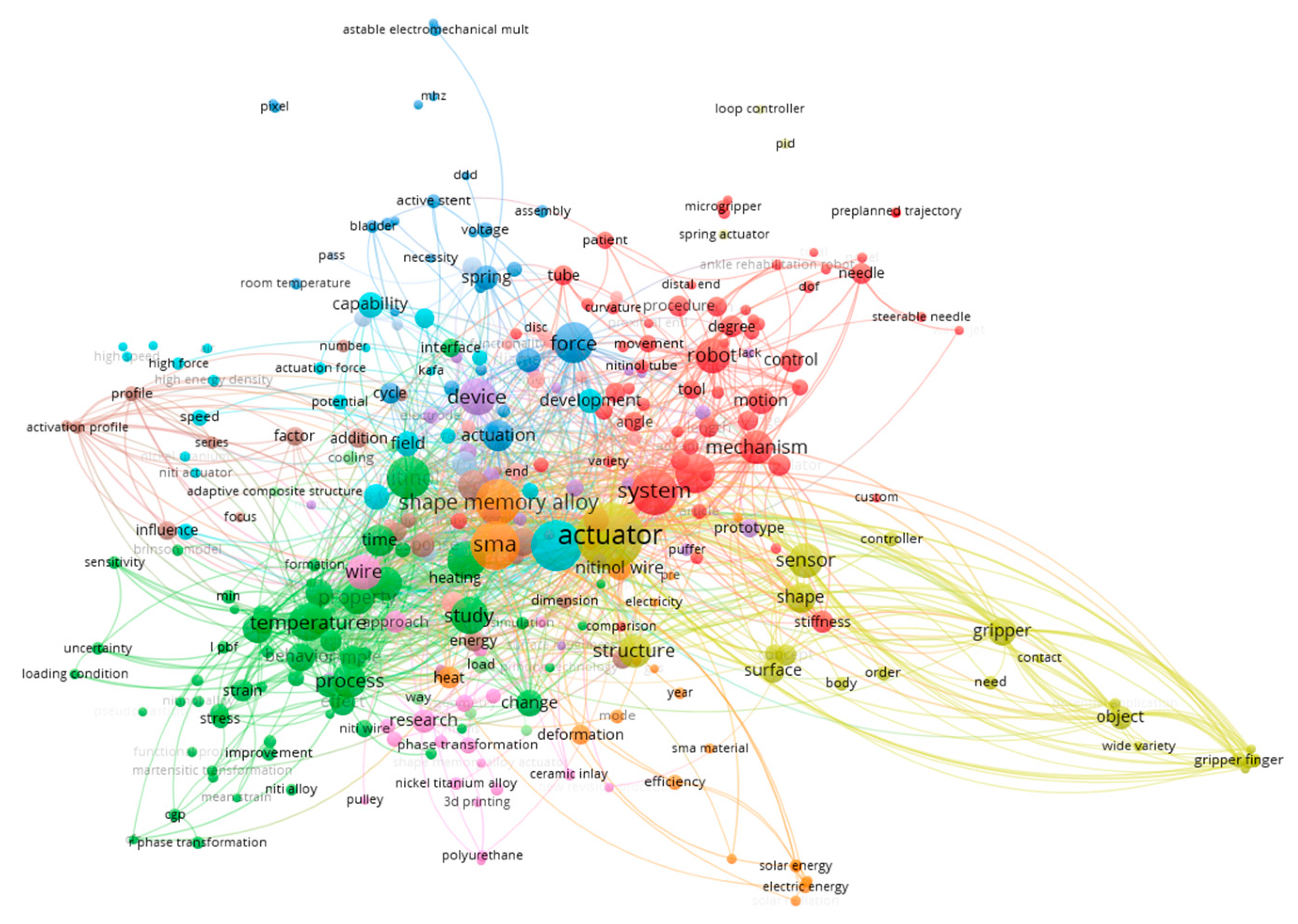
Figure 3.
Network visualization of the items with at least 15 occurrences.

Figure 4.
Network visualization highlighting the item Smart Memory Alloy.
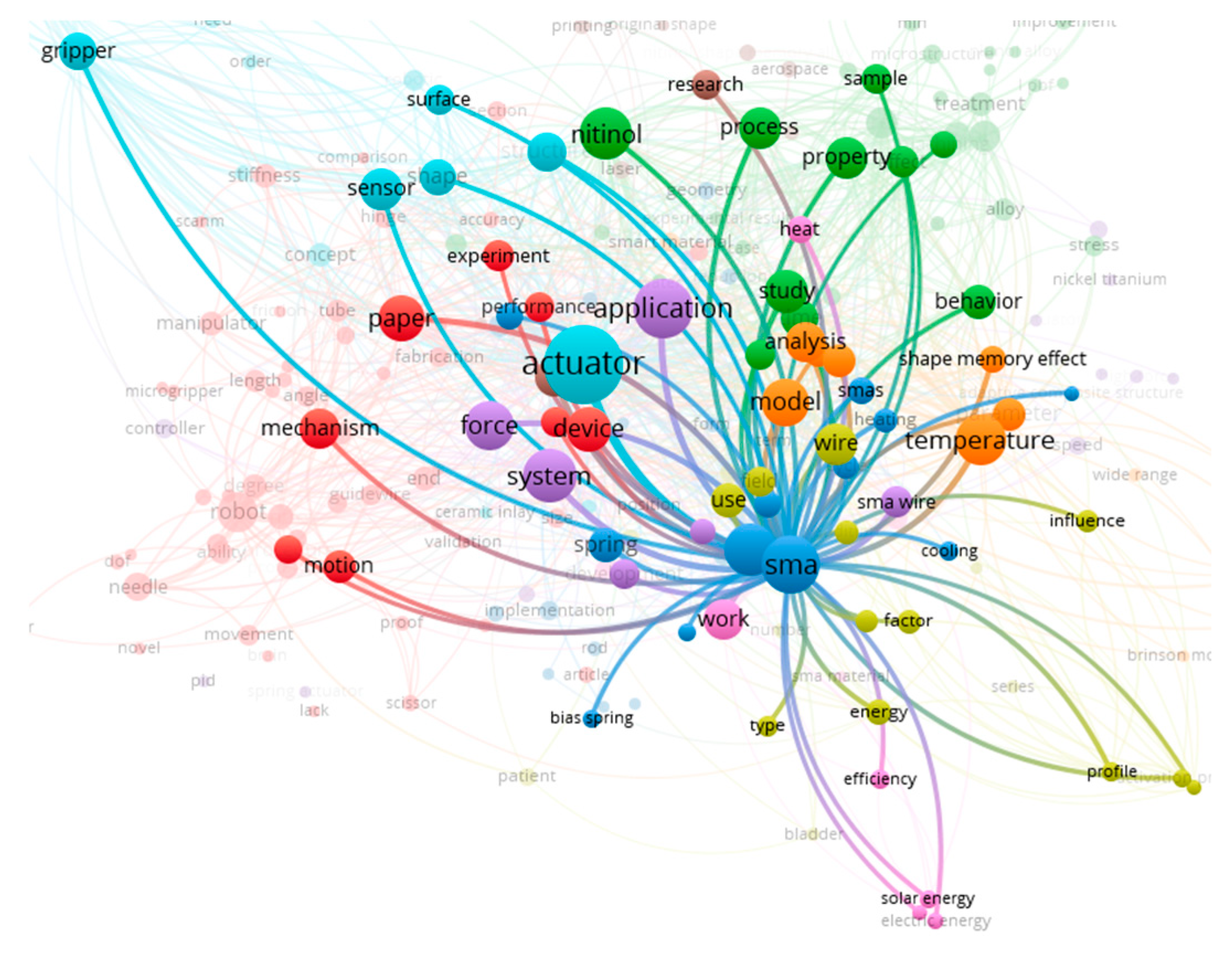
Figure 5.
Network visualization highlighting the item NiTi.
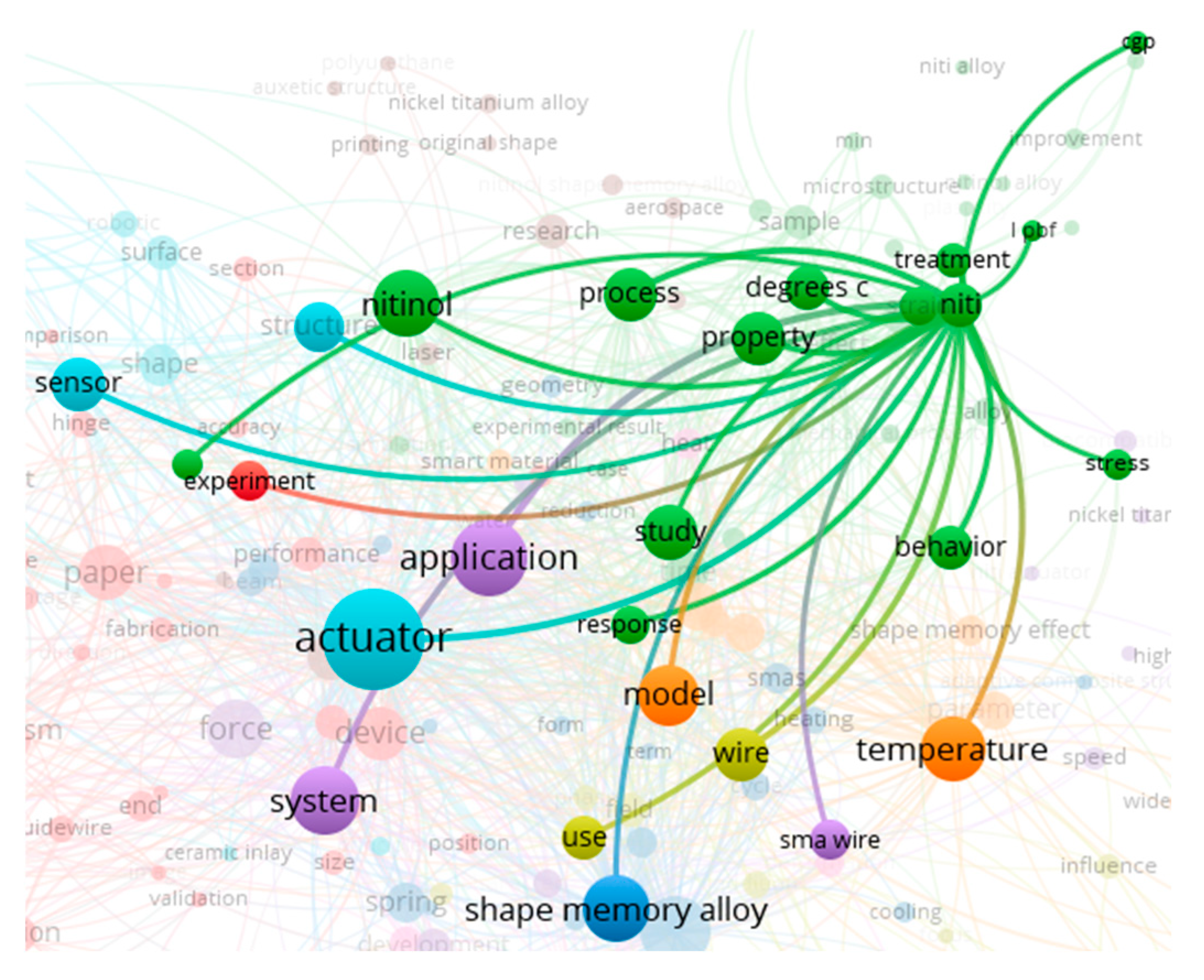
Figure 6.
Network visualization highlighting the item Actuator.
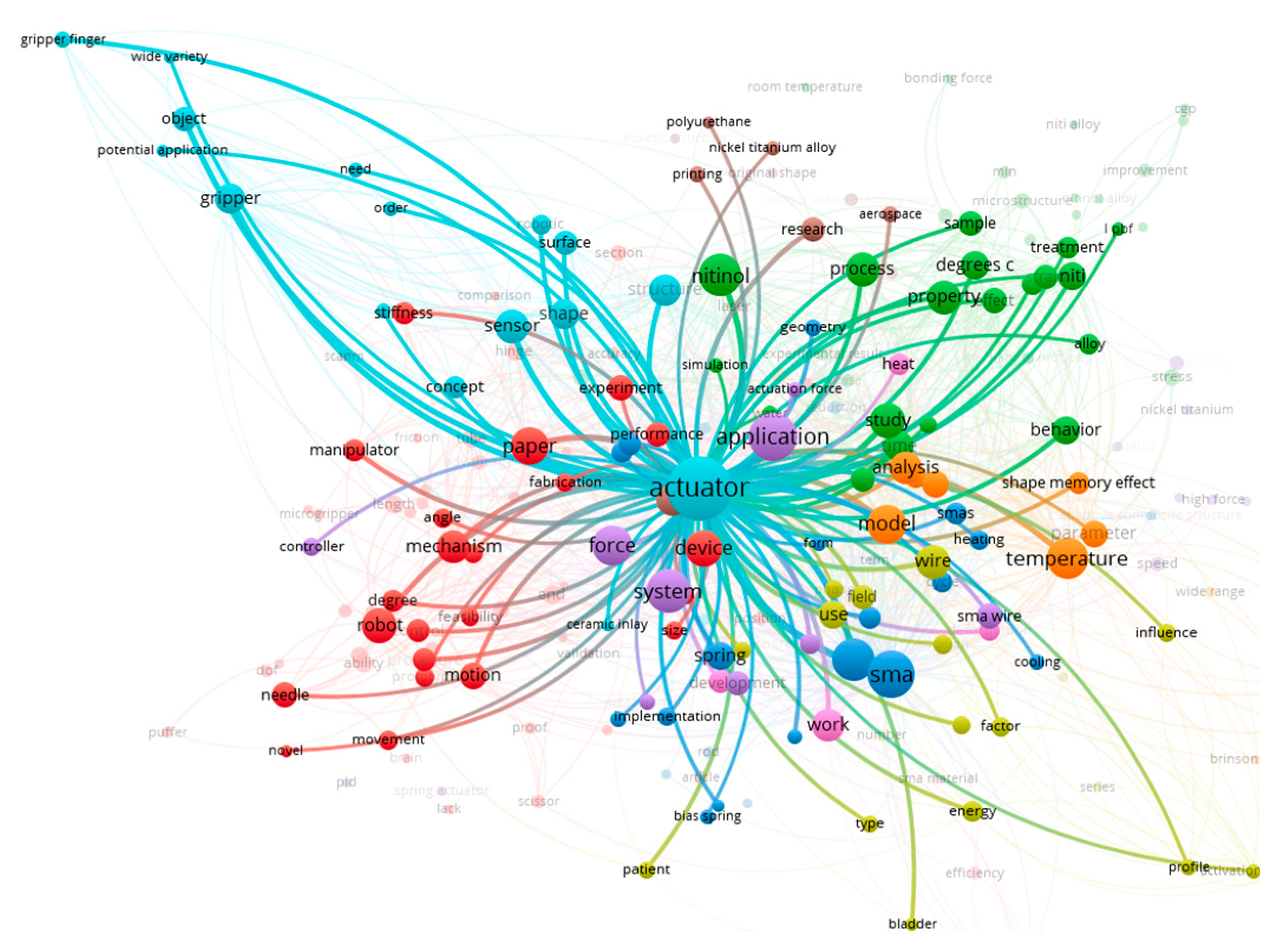
Figure 8.
Nitinol spring.
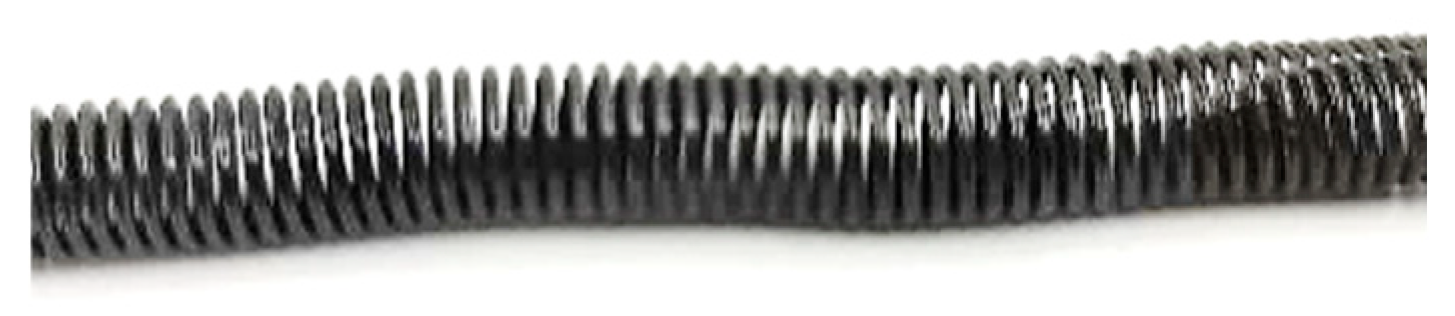
Figure 9.
Nitinol actuator.
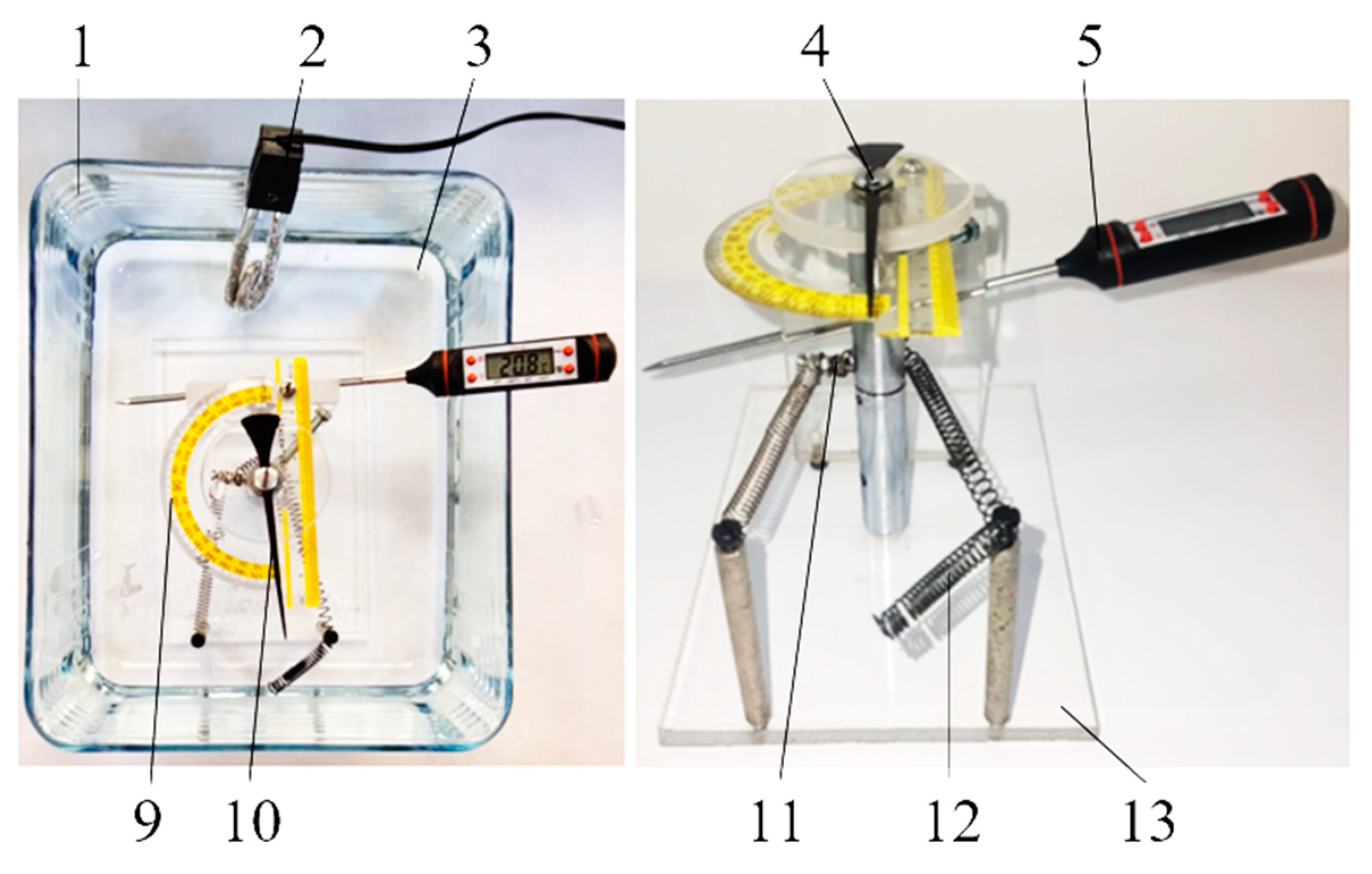
Figure 10.
Angular displacement of the angular actuator on heating.
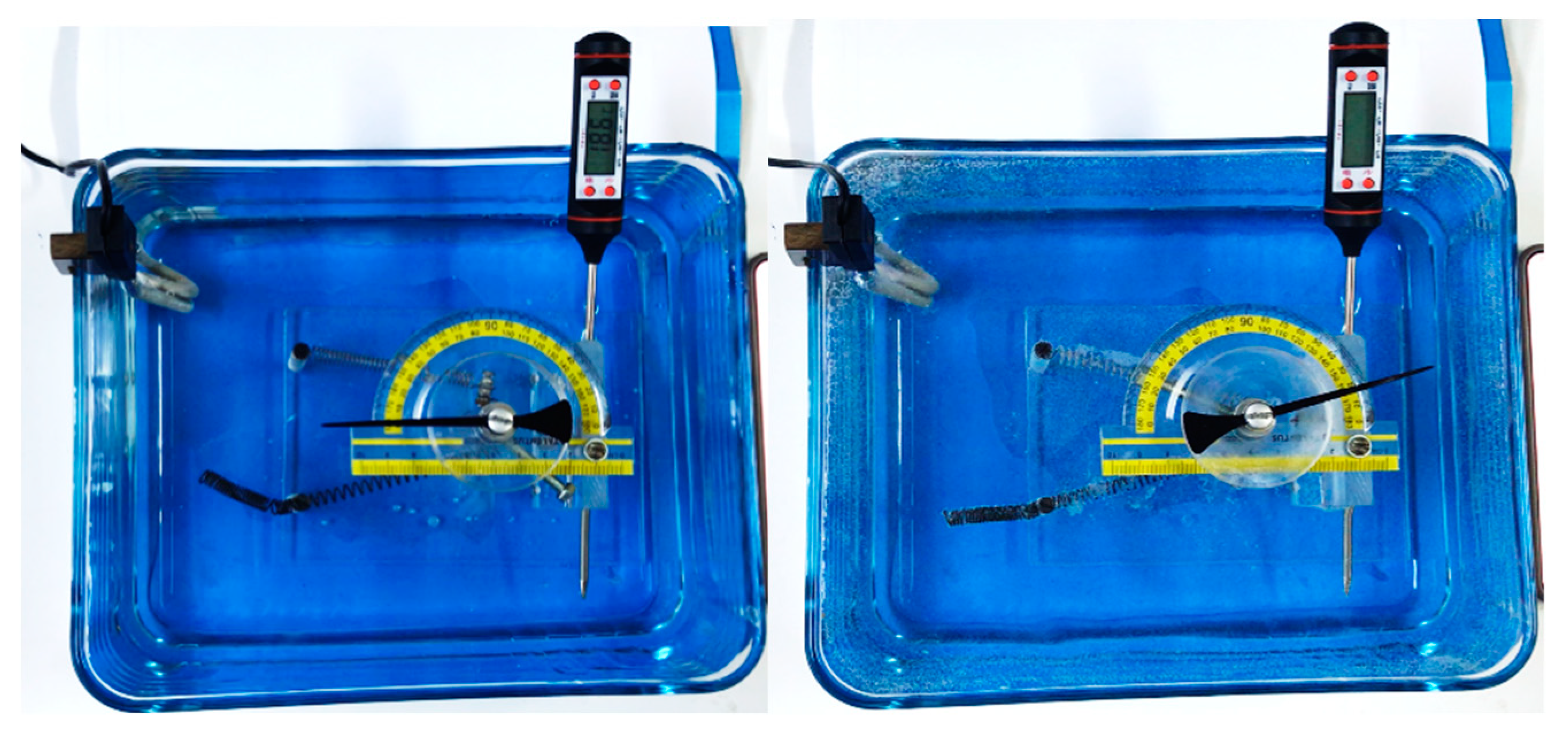
Figure 11.
Characteristics of the actuator displacement versus heating temperature.
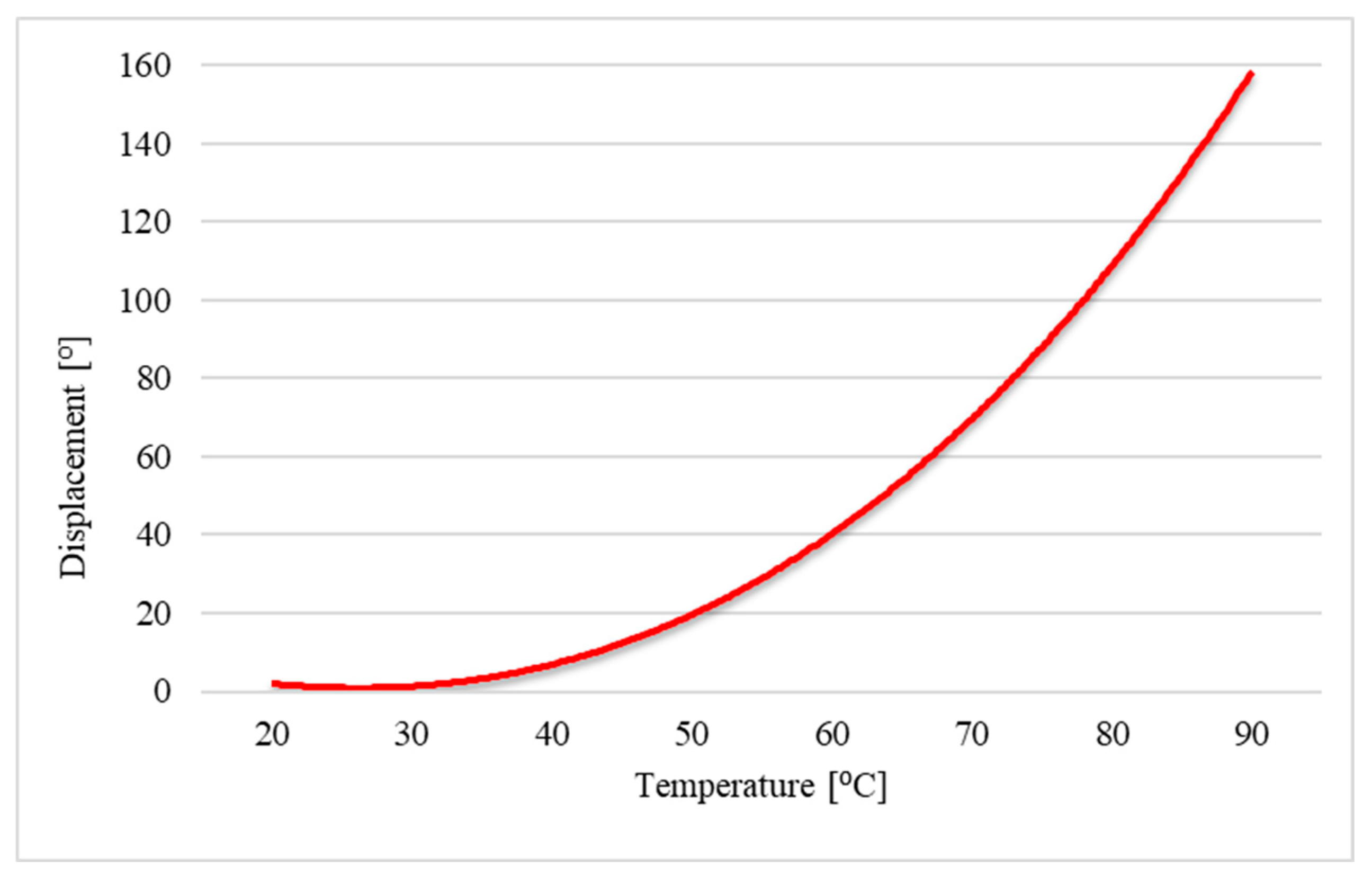
Figure 12.
Actuator angular displacement versus cooling temperature characteristic.
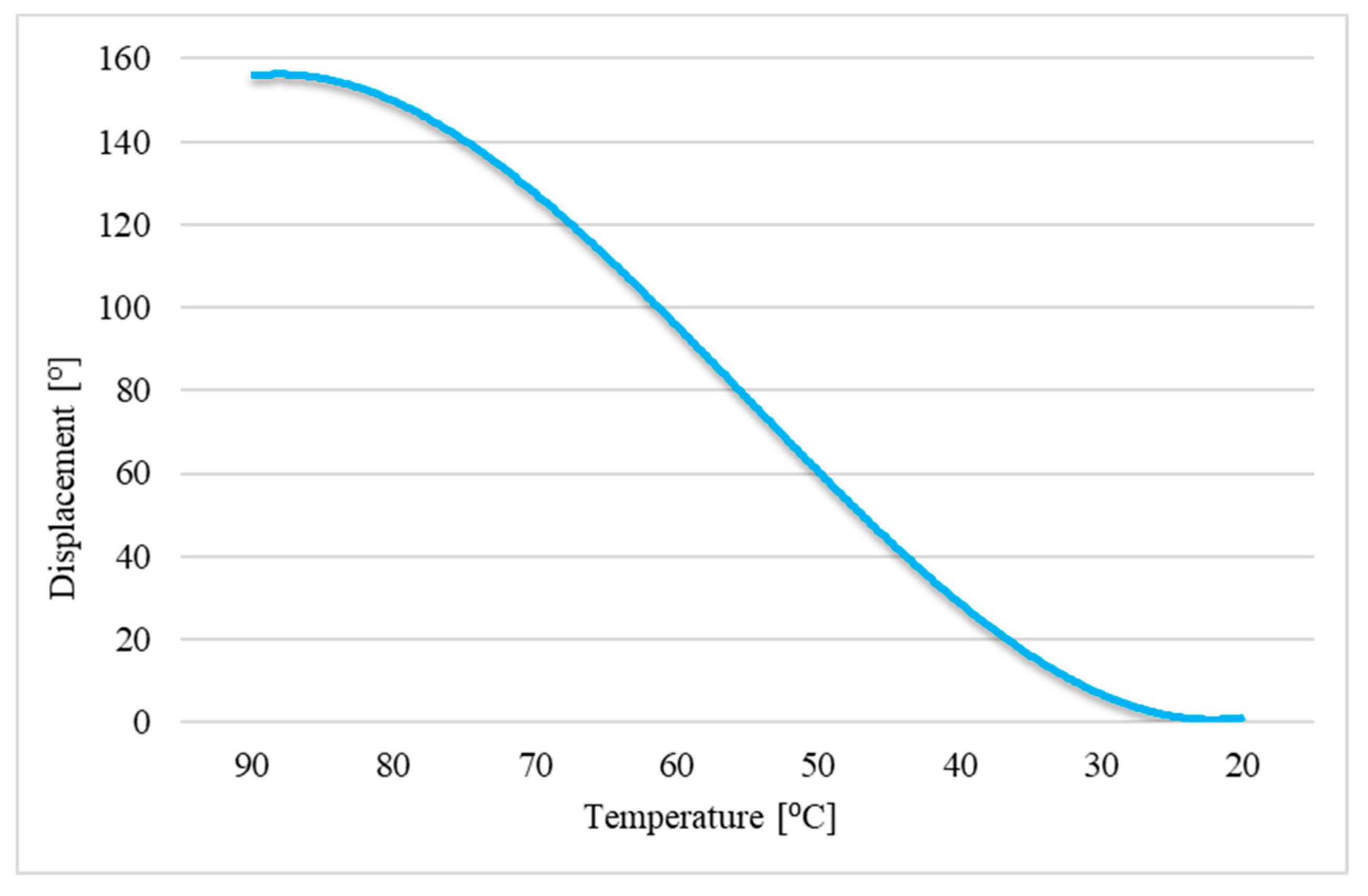

Table 1.
Classification after the generalized main objective.
| Generalized main objective | Reference |
|---|---|
| To improve the device fabrication | [5,153] |
| To fabricate new NiTi alloys | [4,23,150,154] |
| To test models/ strategies on a device based on Nitinol | [9,21,27,44,143,144,148,149,155] |
| To build a new device/ equipment/ application/ model | [17,18,32,33,70,81,82,85,105,131,136,139,140,147,151,152] |
| To improve the characteristics of an already existing device/ equipment/ application/ model/ process | [1,2,3,7,8,10,15,20,28,31,38,59,63,72,80,104,106,107,121,127,130,132,134,135,137,141,142,146] |
| To study/ test device/ equipment/ applications | [22,25,29,37,39,40,41,42,53,54,68,75,83,87,90,94,95,96,98,101,102,103,117,118,121,122,123,126,129,138,145] |
| To study/ test the NiTi alloy | [6,11,12,13,14,16,19,24,26,30,34,35,36,43,45,46,47,48,49,50,51,52,55,56,57,58,60,61,62,64,65,66,67,69,71,73,74,76,77,78,79,84,86,88,89,91,92,93,97,99,100,116,119,120,125,128] |
Disclaimer/Publisher’s Note: The statements, opinions and data contained in all publications are solely those of the individual author(s) and contributor(s) and not of MDPI and/or the editor(s). MDPI and/or the editor(s) disclaim responsibility for any injury to people or property resulting from any ideas, methods, instructions or products referred to in the content. |
© 2025 by the authors. Licensee MDPI, Basel, Switzerland. This article is an open access article distributed under the terms and conditions of the Creative Commons Attribution (CC BY) license (http://creativecommons.org/licenses/by/4.0/).
Copyright: This open access article is published under a Creative Commons CC BY 4.0 license, which permit the free download, distribution, and reuse, provided that the author and preprint are cited in any reuse.


