
Submitted:
11 February 2025
Posted:
13 February 2025
You are already at the latest version
Abstract
Given that there is a huge gap between environmental concerns and actual recycling behaviour, it is important to determine township consumers’ actual recycling behaviour in order to develop sustainable recycling campaigns in townships. Studies have pointed out the significance of consumer engagement in driving actual recycling behaviour as part of climate change. Studies on recycling behaviour in South African townships are limited. The collection of waste in South African townships is less effective than in the urban areas. As a result of this, consumers dispose of their waste informally in the spaces between their houses and shacks. An online survey was conducted among township consumers in South Africa which showed that a positive attitude towards recycling, and perceived behavioral control had a positive and significant effect on consumers’ intention to engage in recycling, whereas subjective norms had no effect. The recycling attitude, personal norms, subjective norms, facilitating conditions and environmental concerns were found to influence consumers’ actual recycling behavior Furthermore, the users’ intention to engage in recycling was found to mediate the relationship between recycling attitude, perceived behavioral control, facilitating conditions and personal norms, and actual recycling behavior.
Keywords:
recycling engagement
; actual recycling behavior
; extended theory of planned behavior
1. Introduction
All over the world the rapidly growing population has increased the consumption of packaged goods resulting in increased general waste. This is tr of South Africa as well. The household waste generation in South Africa and globally is at its highest level ever and an is of great concern. Endless efforts have been put in place around the globe to encourage sustainable behavior; however, to little effect. The recycling habits of consumers have simply not kept up with the huge generation of waste [1]. In 2015 waste accounted for 13% of municipal solid waste globally [2]. In South Africa, 55 million tonnes of waste were produced in 2018 with only 11% of this being diverted into landfill sites [3]. If not addressed, the increasing waste generation could cause more harm not only to the economy but also to the health and living conditions of the people of the country. Recycling supports environmental protection by reducing carbon emissions [4] however, South Africa recorded 10% of waste recycling in 2018 [5].
Recycling is a strategy that is used to reduce the negative effect of waste on the environment [6]. The high rate of waste requires that consumers’ attitudes be determined in order to understand how consumers can be engaged with recycling with the intention to influence their actual recycling behavior. The recycling behavior of consumers in South Africa has steadily decreased, with fewer and fewer consumers in townships being involved in recycling. Strydom [5] proved that in South Africa, urban consumers are more involved in recycling behavior while those in townships are less involved d to the limitations in the provision of refuse and sanitation services [7,8]. Conradie et al. [9], for example, state bluntly that townships consumers generally do not have access to refuse and sanitation services. Municipal services in South African townships are inconvenient for customers, often not accessible and costly [10]. Conradie et al. [9] and Smith [11] cite the lack of access to facilities needed for recycling purposes as an inhibiting factor for township consumers’ getting involved in recycling.
Recycling involves the conversion of waste into reusable materials that are then brought back into the industrial processes [12]. Recycling is a useful and sustainable production method that can be used to reduce pollution, thereby effectively addressing environmental concerns [13]. Discarded waste that is not recycled can cause significant environmental problems [14]. A more effective way of reducing household waste is required which might involve the recycling of packages in their daily life [15].
Consumers have embraced sustainable consumption in response to climatic change – something that has resulted in a shortage of raw materials [16]. Consumers have also become aware of the conseq(UE)nces of unsustainable behavior on the climate and the economy [17]. As such they have started to adopt sustainable consumption which promote low-carbon lifestyles which not only include purchasing environmentally conscious products but also sustainable behavior such as recycling [18]. Consumers have often become consciously aware of the significance of “reduce, reuse and recycle” [19].
Given that there is a huge gap between environmental concerns and actual recycling behavior, it is important that township consumers engage with recycling and develop actual recycling behavior to create sustainable recycling campaigns in townships. Studies have pointed to the significance of consumer engagement in driving recycling behavior as part of climate change [20,21,22,23]. Yet very few studies investigated recycling user engagement in South Africa while none of these studies have investigated township consumer recycling engagement behavior, focusing instead on the urban areas [5,26,27]. Studies focusing on recycling behavior mainly determine the factors influencing recycling behavior [5,24,25]. To achieve the objective of this study, which is to determine the influence of user recycling engagement on actual recycling, the study adopted the extended theory of planned behavior.
The collection of waste in South African townships is less effective and inefficient [28] compared to traditionally white suburbs which receive better services [5,29]. Consumers residing in South African township areas generally dispose of their waste informally in the streets or between their houses and shacks d to the lack of refuse and sanitation services [7,8,30]. Two of the biggest townships in South Africa, Soweto and Alexandra, fall within the parameter of the City of Johannesburg. a. The City of Johannesburg generates more than 1.5 million tons of general waste annually with the average life span of general waste being 10 years in landfill sites [31]. Consumer engagement with household waste recycling refers to how affectionately, cognately and behaviorally present consumers are as well as how dedicated they are to the recycling of household items [32]. Although there are ample studies of consumer engagement, there are only a few empirical studies on engagement from a recycling perspective. Yet, it is crucial for individual households to feel engaged for the recycling process to work [33].
2. Literature Review
Townships were established during the apartheid era when people were segregated according to the colour of their skin. Black people were not allowed to live in the cities and urban areas but could only live in townships. Township areas were far from cities and residents were required to travel quite a distance to the closest shopping area. The residents in the townships did not have the opportunities and advantages associated with life in cities, since they were geographically, materially and psychologically excluded [34]. Townships dwellers were and are still excluded from quality service delivery, with poor waste management service delivery [35] resulting in many residents living in unhealthy and even life-threatening conditions. Providing such services could involve them into recycling which could minimize the unhealthy conditions by diverting packages from landfill [36].
2.1. The Extended Theory of Planned Behavior (TPB)
The theory of planned behavior (TPB) is used to explain why individual consumers engage in a specific targeted behavior [37]. TPB was developed by Icek Ajzen [38] in 1991 and is an extension of the theory of reasoned action. TPB is widely regarded as one of the most popular and validated social-cognitive models of human behavior [39]. The theory postulates that behavior is guided by an individual’s intention to perform a particular act and is a function of three main factors: attitude toward the behavior, subjective norms (SN), and perceived behavioral control (PBC) [38]. The theory is considered one of the most influential in explaining people’s behavior [40] and has been applied in many studies and different contexts producing differing findings [41,42,43,44] and has thus been validated as a relevant model for studying recycling behavior.
TPB is preferred in most studies d to its flexibility in incorporating other factors determining behavior [16,45]. However, TPB also has its limitations, and therefore studies have extended the TPB model and demonstrated its ability to predict consumer behavior [40] to enhance its predictive power [46]. This study has adopted the extended TPB to explain the influence of recycling user engagement on actual recycling behavior.
Previous studies identified different factors explaining recycling behavior with no consensus among them [47]. This could be d to the different contexts of these investigations and the fact that recycling behavior is being studied across interdisciplinary research areas.
2.2. Recycling Engagement
The term “engagement” has been used to describe the nature of specific interactions and/or interactive experiences by individual consumers. In most studies consumer engagement denotes a tool that can be used to create, build and enhance consumer relationships [48]. Engagement is a multidimensional construct that is dynamic in nature and emerges at different levels of intensity over time [48]. Engagement has been applied in different contexts including brand communities’ engagement [47,48], engagement in online communities [49,50], social and online communities [51,52,53], and advertising [54]. The literature review brought to light different contexts, subjects and conceptualization of the concept [55,56]. The concept of engagement has been used widely in different domains including psychology, political science, organizational behavior and sociology [57] as well as how people engage in specific behaviors [58]. This study apply engagement in a consumer behavior context, specifically recycling behavior.
The recycling process involves an individual collecting and processing of the materials for use in the production of new products instead of throwing them away [15]. Recycling behavior draws from considerable efforts by an individual through the sorting, preparing, and storing of the waste, which is some form of engagement, and is influenced by a series of factors [60].
Engaging consumers in specific activities over time leads to contin(UE)d and committed behavior. Engaging consumers is associated with positive behaviors such as stronger consumer-brand relationships, increased satisfaction and loyalty, as well as increased purchasing [61]. Most research studies on consumer engagement focus on brand communities’ engagement and social media engagement. This study focuses on engaging consumers in recycling and how this can influence actual recycling behavior. Engaging consumers in recycling can lead to increased recycling activities. Wang et al. [63], like Meng et al. [64], noted the importance of actively engaging consumers in recycling as an effective waste management strategy by identifying and classifying waste into compost, glass, paper, metal, and plastic. Engaging consumers into recycling by developing waste sorting engagement is an enabler for sustainable resource recovery, reduces landfill space, and increases recycling rates [64]. It should be noted that high intention to recycle might not lead to actual recycling [65]. Oke et al. [46] opined that the buying behavior patterns of consumers influences how they engage with recycling implying the differences in consumer recycling behavior. However, it proved that there was a link between user engagement and recycling behavior [66]. Woodard and Rossouw [68] also agree that community engagement has a significant impact on the level of recycling in communities and encourages specific behavior change.
2.2.1. Recycling Attitude (RA) and Actual Recycling Behavior (AB)
Ajzen [38] defines attitude as relating to human behavior in which an individual is either favourable or unfavourable towards a specific action. It is important to study attitude since it plays an important role in decision making [38], and when people are favourable towards a particular action, it leads to positive conseq(UE)nces [68]. In the context of recycling, attitude refers to a favourable disposition or emotion toward recycling. Attitude was proven to be a key component in understanding pro-environmental behavior and to have a positive relationship with recycling intention [69,70]. Attitude was also found to moderate the relationship between personal norms and recycling behavior [71]. Razali et al. [73] found that attitude has little influence on waste separation behavior while other studies found attitude to have a significant influence on recycling behavior [73,74,75,76].
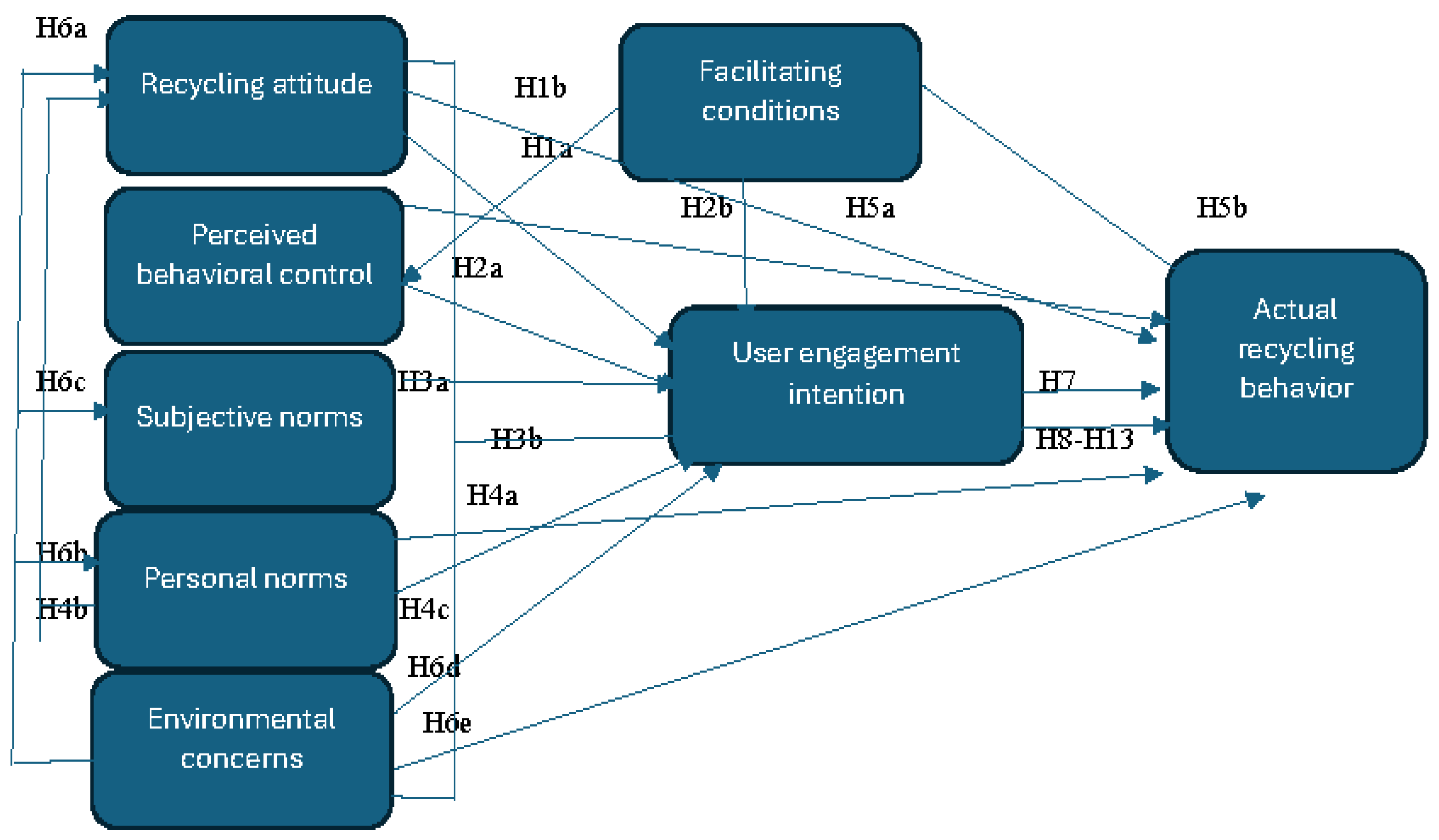
H1a
. Recycling attitude (RA) has a positive and significant relationship with user intention to engage in recycling
H1b.
Recycling attitude (RA) has a positive and significant relationship with actual recycling behavior (AB).
H10.
Consumers’ intention to engage in recycling mediates the relationship between recycling attitude and actual recycling behavior (AB).
2.2.2. Perceived Behavioral Control [PBC] and Actual Recycling Behavior (AB)
Ajzen [38] defines perceived behavioral control (PBC) as referring to the perception consumers have about the ease or difficulty of a specific action. Perceived behavioral control differ among individual consumers depending on their perception of their ability or inability to perform a specific action [16]. It reflects consumers past experiences and the associated obstacles with performing an action [73]. Existing studies have presented conflicting findings on the effect of perceived behavioral control on individual consumers’ intention to engage in recycling with some demonstrating the effect that perceived behavioral control have on recycling engagement intentions [37,73,77,78] while others show an insignificant impact [79] demonstrating the need for further investigations of these relationships in different contexts. Kumar [79] reported a stronger relationship between perceived behavioral control and user intention to engage in recycling while Cho [37] reported that individual consumers with strong perceived behavioral control exhibited a stronger intention to engage in recycling. Perceived behavioral control was found to have a positive significant effect on actual recycling behavior (AB) via user intention to engage in recycling [73].
H2a.
Perceived behavioral control (PBC) has a positive and significant relationship with user intention to engage in recycling ((UE)).
H2b.
Recycling attitude (RA) has a positive and significant relationship with perceived behavioral control (PBC).
H9.
Consumers’ intention to engage in recycling mediates the relationship between recycling attitude and actual recycling behavior (AB).
2.2.3. Subjective Norms [SN] and Actual Recycling Behavior (AB)
Subjective norms are defined by Ajzen [38] as referring to the social pressures individual consumers perceive pushing them to act or not to act in a particular way. It captures the feelings that an individual has from the social pressures about a given behavior which includes restrictions from family, friends, the law and regulations [16]. The presence of subjective norms in consumer behavior signifies the importance of significant others in influencing individual consumers to perform a certain action. The more positive the subjective norms are, the more influence it has on actual recycling behavior [80,81]. The relationship between subjective norms and behavioral intentions has been confirmed in existing studies [73,77]. Fang et al. [83] as well as Gholamrezai et al. [84] confirmed that subjective norms have an influence on pro-environmental behavior, and thus recycling behavior. Khan et al. [80] and Wang et al. [85] highlighted the significant impact that subjective norms have on recycling intention. However, Cho [37] could not confirm a significant and positive relationship between subjective norms and recycling intention. The mediation effect of subjective norms (SN) on actual recycling behavior (AB) via user intention to engage in recycling ((UE)) was supported by Pakpour, Zeidi, Emamjomeh, Asefzadeh Pearson [73] and Wang, Wang, Zhao & Yang [85].
H3a.
Subjective norms (SN) have a positive and significant relationship with user intention to engage in recycling ((UE)).
H3b.
Subjective norms (SN) have a positive and significant relationship with actual recycling behavior (AB).
H12.
Consumers’ intention to engage inrecyclingmediates the relationship between subjective norms (SN) and actual recycling behavior (AB).
2.2.4. Personal Norms (PN) and Actual Recycling Behavior (AB)
Personal norms refer to an ethical obligation to act or refrain from acting in a specific manner [86], an element considered the most influential determinant of norm-oriented behavior [82]. Strong personal norms increase the likelihood of environmentally friendly behavior [87]. Fang et al. [83] reported that personal norms were highly associated with the intention to recycle. Shi et al. [89] found that people with a sense of moral obligation regarding the environment were more likely to engage in reduction behaviors. In this study, personal norms are defined as an individual’s sense of moral obligation towards recycling. When personal norms are activated, people feel a moral obligation to use reusable product packages. Botetzagias et al. [90] confirmed the effect of personal moral norms on recycling intention. Song et al. [91] found that personal norms strongly influence consumers’ behavioral intention. He and Zhan [92] and Van der Werff and Steg [93] indicated the mediation role of personal norms in the adoption of electric vehicle and pro-environmental behavior.
H4a.
Personal norms (PN) have a positive and significant relationship with user intention to engage in recycling ((UE)).
H4b.
Personal norms (PN) have a positive and significant relationship with recycling attitude (RA).
H4c.
Personal norms (PN) have a positive and significant relationship with actual recycling behavior (AB).
H11.
Consumers’ intention to engage in recycling mediates the relationship between personal norms and actual recycling behavior (AB).
2.2.5. Facilitating Conditions (FC) and Actual Recycling Behavior (AB)
The importance of facilitating conditions (FC) was proposed by Schwartz [87] who arg(UE)d that such conditions were necessary for a particular behavior to be exhibited and to determine if such would occur or not [94]. This included the necessary resources needed to facilitate a certain favourable behavior [95]. Facilitating conditions consist of factors such as time, cost, and the necessary bins and sorting facilities that are needed for recycling purposes [96,97]. The presence and absence of these conditions greatly influence consumer behavior towards recycling [98]. Linder et al. [99] arg(UE)d for the need to determine the explanatory potential of recycling facilities on consumers' recycling behavior. Bervell et al. [100] found an insignificant relationship between facilitating conditions and behavioral intention. Studies have supported the mediating effects of facilitating conditions on intention with Khalil et al. [101] stating that a lack of facilitating conditions moderated the relationship intention and actual behavior while others reported no such effect [102].
H5a.
Facilitating conditions (FC) have a positive and significant relationship with user intention to engage in recycling ((UE)).
H5b.
Facilitating conditions (FC) have a positive and significant relationship with actual recycling behavior (AB).
H5c.
Facilitating conditions (FC) have a positive and significant relationship with perceived behavioral control (PBC).
H8.
Consumers’ intention to engage in recycling mediate the relationship between facilitating conditions (FC) and actual recycling behavior (AB).
2.2.6. Environmental Concerns (EC) and Actual Recycling Behavior (AB)
Environmental concern (EC) refers to the attitude an individual consumer has regarding the environment and their concerns about its degradation [102]. It measures the level of awareness of environmental problems and the efforts needed to address these challenges [103]. Paul et al. [16] highlighted the importance of investigating the relationship between environmental concerns and recycling behavior stating that the higher the public concerns about the environment, the more environmentally conscious people become. Hartmann and Apaolaza-Ibáñez [105] also claim that the more concerned the public is about the environment, the more they adopt a positive attitude towards environmentally friendly behavior.
Testing the indirect effect of environmental concerns Hartmann & Apaolaza-Ibáñez [105] proved a significant relationship with individual behavioral intentions. Koklic et al. [107] found the relationship between environmental concerns and behavioral intention to be mediated by personal norms. Botetzagias et al., [90] and Song et al. [91] reported the direct and indirect influence that environmental concerns have on consumers’ behavioral intention through personal norms. Kotyza et al., 108], citing that those environmental concerns have a high predictive power towards behavioral intention. The relationship between environmental concerns (EC) and subjective norms (SN) was confirmed by Borusiak et al., [109].
H6a.
Environmental concerns (EC) have a positive and significant relationship with recycling attitude (RA).
H6b.
Environmental concerns (EC) have a positive and significant relationship with personal norms (PN).
H6c.
Environmental concerns (EC) have a positive and significant relationship with subjective norms (SN).
H6d.
Environmental concerns (EC) have a positive and significant relationship with user intention to engage in recycling ((UE)).
H6e.
Environmental concerns (EC) have a positive and significant relationship with actual recycling behavior (AB).
2.2.7. Recycling User Engagement and Actual Recycling Behavior (AB)
Ajzen [38] defined a consumer’s behavioral intention as the level at which they are willing to try harder and the extent to which they plan to exert an effort to perform a certain action. The individual consumer’s behavioral intention can predict their specific behavior, which is also influenced by individual attitude, perceived behavioral control, and personal norms [37]. Thoo et al. [1] as well as Kumar [79] concluded that consumers’ recycling intention has a positive relationship with actual recycling behavior. Thoo et al. [1] further found that a consumer’s intention to do recycling had a mediating effect on the relationship between attitude, subjective norms, perceived behavioral control and actual recycling behavior. As indicated by Cho [37], when consumers are highly motivated to recycle, they will be more likely to engage in actual recycling behavior.
H7.
Consumers’ intention to engage in recycling has a significant relationship with actual recycling behavior (AB).
Figure 1.
Conceptual model.
3. Materials and Methods
3.1. Target Population
The sample ideal for this study was South African township dwellers. Townships in South Africa are home to a diverse population consisting of people from different races, ethnic groups and age groups [110,111]. Townships in South Africa have been largely ignored by municipalities and receive minimal service delivery [19,35]. Although recycling occurs in townships, the large amount of general waste lying on township streets and vacant areas calls for action to increase recycling behavior by individual consumers living in these townships [112].
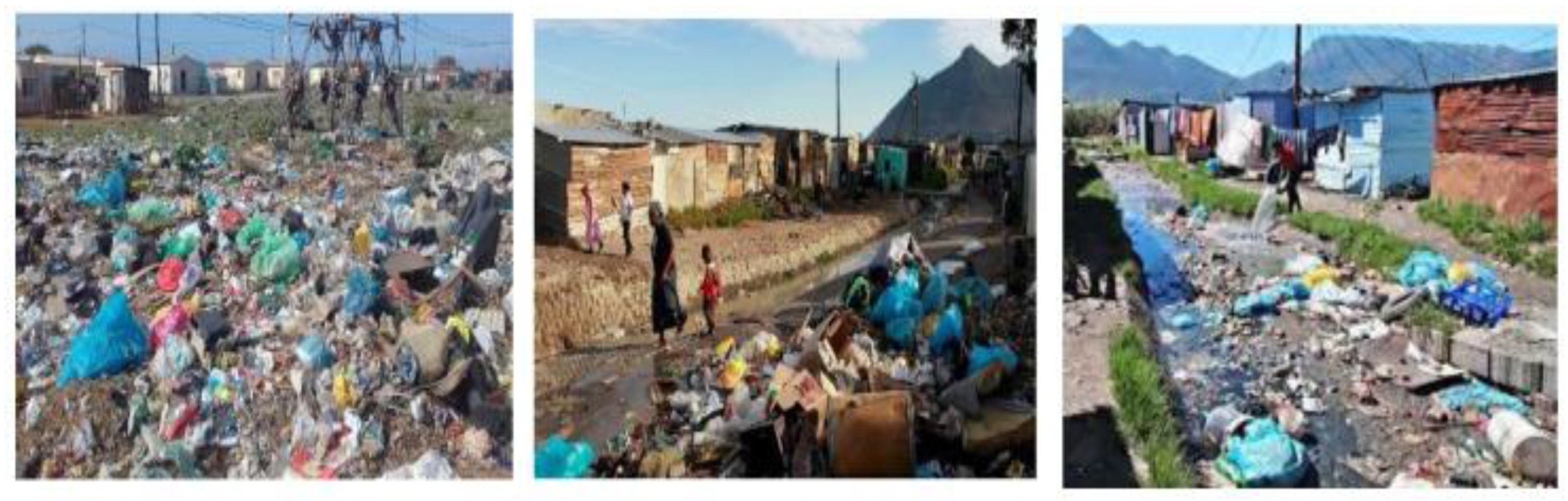
Source: [113]
The sample for this study consisted of male and female respondents between the ages of 18 and 65. The study had eight constructs consisting of 3 items for recycling attitude, 7 items for perceived behavioral control, 4 items for subjective norms, 3 items for user engagement intention, 4 items for actual recycling behavior, 3 items for environmental concerns, 5 items for personal norms and 4 items for facilitating conditions. All together there were 33 items. The respondents totalled 411 and were considered as recommended by Adeniran & Shakantu [114].
From Table 1, one can see that most respondents were male, between 18 and 29 years old, unmarried, with a post- school qualification and earning an income of up to $264.
3.2. Measures
The measurement scales for this study were sourced from validated studies. The scales were measured using a 7-point Likert scale which was operationalized to measure the recycling behavior of township consumers.
The measurement items had 7 items for perceived behavioral control [115], 3 items for attitude [116], 4 items for subjective norms [117] 3 items for environmental concerns [118], 5 items for personal norms [119], 4 items for facilitating conditions [120], 3 items for recycling engagement intention [121], and 4 items for actual recycling behavior [117]. All the q(UE)stionnaire items were measured using a 7-point Likert scale.
3.3. Data Analysis
SPSS Amos 27 software was used to test the conceptual model developed for the study. The analysis included the confirmatory factor analysis (CFA) and was done to assess the quality and accuracy of the measurement model and to test validity and reliability. Further analysis included structural equation modelling (SEM) which was used to test the proposed research model and the hypotheses. SEM is considered useful when testing complex relationships since it runs the multiple regression equations simultaneously and accounts for the measurement error in the model [122].
4. Results
4.1. Validity and Reliability
The reliability of the scale was computed through Cronbach's α using IBM SPSS 28. The Cronbach's α for each item ranged from 0.819 to 0.902, which was greater than the recommended threshold of 0.7 [122]. The Cronbach's α for recycling attitude was 0.847; for perceived behavioral control = 0.835; subjective norms = 0.883; user engagement intention = 0.902; actual recycling behavior = 0.819; environmental concerns = 0.890; personal norms = 0.825; and facilitating conditions = 0.821.
The model conceptualised for this study was assessed for fitness. This was done before the hypotheses were tested. The measurement model was assessed through confirmatory factor analysis (CFA) and multiple fit criteria using the model fit indices. The indices produced satisfactory val(UE)s of ꭕ2 = 509.49; df = 247, ꭕ2/df = 2.06; CFI = 0.96; TLI = 0.95; RMSEA = 0.051 as supported by Kline [123] who state that the goodness-of-fit index (GFI), CFI, TLI, IFI, relative fit index (RFI) and NFI, must be greater than or equal to 0.9 to show a good model fit and that any val(UE) greater than 0.8 can marginally be accepted. The model fit indices appear in Table 2.
Hair et al. [124] suggested a threshold of 0.70 for factor loading, 0.70 for construct reliability and 0.50 for average variance extracted (AVE) should be attained as criteria that can be used to assess the constructs’ validity and the reliability of the measurement model. The construct validity was achieved through convergent and discriminant validity, as supported by [124]. Two approaches were used to achieve this. The factor loadings were all above 0.5, the average variance extracted was also above 0.5 and the composite reliabilities were also above 0.7, thus indicating that the measurement model has sufficient convergent validity [125]. Table 3 below shows the reliability and validity val(UE)s.
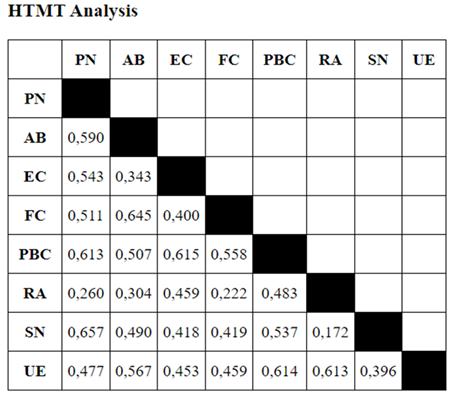
To measure the discriminate validity, the heterotrait-monotrait (HTMT) ratio was used, which showed that all the ratios were lower than the acceptable val(UE)s of 0.85 [122].
The Harman single-factor model was used to test for common method bias. The model showed poor model fit - fit (ꭕ2/df = 8 000; CFI = 0.59; TLI = 0.57; RMSEA = 0.131; SRMR = 0.101). These val(UE)s of the indices demonstrated that the common method bias was not significant and did not threaten any validity.

Table 3.
Internal and external validity testing.
| Construct | Item | Factor loadings | Cronbach’s alpha | Composite reliability | Average variance extracted |
|---|---|---|---|---|---|
| RA | RA 1 | 0.863 | 0.847 | 0.859 | 0.671 |
| RA 1 | 0.701 | ||||
| RA 1 | 0.788 | ||||
| PBC | PBC 1 | 0.782 | 0.835 | 0.842 | 0.576 |
| PBC 2 | 0.760 | ||||
| PBC 3 | 0.776 | ||||
| PBC 4 | 0.844 | ||||
| SN | SN 1 | 0.845 | 0.833 | 0.877 | 0.725 |
| SN 2 | 0.777 | ||||
| SN 3 | 0.873 | ||||
| PN | PN 1 | 0.797 | 0.825 | 0.829 | 0.619 |
| PN 2 | 0.695 | ||||
| PN 3 | 0.779 | ||||
| EC | EC 1 | 0.867 | 0.890 | 0.894 | 0.738 |
| EC 2 | 0.807 | ||||
| EC 3 | 0.856 | ||||
| FC | FC 1 | 0.810 | 0.876 | 0.835 | 0.630 |
| FC 2 | 0.657 | ||||
| FC 3 | 0.792 | ||||
| I | I 1 | 0.864 | 0.902 | 0.906 | 0.763 |
| I 2 | 0.827 | ||||
| I 3 | 0.885 | ||||
| ARB | ARB 1 | 0.600 | 0.758 | 0.770 | 0.532 |
| ARB 2 | 0.781 | ||||
| ARB 3 | 0.635 |
Table 4.
HTMT analysis.
 |
4.2. Hypothesis Testing: Direct Relationships
H1a: Recycling attitude (RA) has a positive and significant relationship with user intention to engage in recycling (UE). This hypothesis is supported (t =6.836, p<0.001). The standardised beta coefficient (0.499) indicates that recycling attitude explains about 50% of the variation in user intention to engage in recycling.
H1b: Recycling attitude (RA) has a positive and significant relationship with user intention to engage in recycling (UE). This hypothesis is also supported with a p-values of 0.007 and a standardised beta coefficient of 0.177 (t=2.565). The effect of recycling attitude on actual recycling behavior (AB) is about 17%.
H2a: Perceived behavioral control (PBC) has a positive and significant relationship with user intention to engage in recycling (UE). This hypothesis is also supported with a p-values of 0.001 and a standardised beta coefficient of 0.253 (t=3.163). The effect of perceived behavioral control on user intention to engage in recycling is about 25%.
H2b: Perceived behavioral control (PBC) has a positive and significant relationship with user intention to engage in recycling (UE). This hypothesis is also rejected with a p-values of 0.986 and a standardised beta coefficient of 0.004 (t=0.044).
H3a: Subjective norms (SN) have a positive and significant relationship with user intention to engage in recycling (UE). This null hypothesis is rejected (Std β=0.076, t=1.462, p=0.143). This implies that subjective norms do not significantly explain user intention to engage in recycling.
H3b: Subjective norms (SN) have a positive and significant relationship with actual recycling behavior (AB). This hypothesis is supported (t=2.491, p=0.013). The standardised beta (0.142) shows that subjective norms explain about 14% of actual recycling behavior.
H4a: Personal norms (PN) have a positive and significant relationship with user intention to engage in recycling (UE). This hypothesis is supported (t=3.017, p=0.001). The standardised beta of 0.181 shows an 18% contribution towards explaining user intention.
H4b: Personal norms (PN) have a positive and significant relationship with actual recycling behavior (AB). This hypothesis is supported (t=12.180, p<0.001). The standardised beta of 0.609 shows a contribution of 61% towards subjective norms.
H4c: Personal norms (PN) have a positive and significant relationship with actual recycling behavior (AB). This hypothesis is supported (t=6.379, p<0.000). The standardised beta of 0.421 shows a contribution of 42% towards subjective norms.
H5a: Facilitating conditions (FC) have a positive and significant relationship with user intention to engage in recycling (UE). This hypothesis is supported (t=4.818, p<0.001). The standardised beta (0.318) indicates that facilitation conditions explain about 32% of user intention.
H5b: Facilitating conditions (FC) have a positive and significant relationship with actual recycling behavior (AB). This hypothesis is supported (t=7.515, p=0.001). The standardised beta (0.496) indicates that facilitating conditions have an effect of 50% towards explaining actual recycling behavior.
H5c: Facilitating conditions (FC) have a positive and significant relationship with perceived behavioral control (PBC). This hypothesis is supported (t=12.378, p <0.001). The standardised beta (0.557) indicates that facilitating conditions have an effect of 56% towards explaining perceived behavioral control.
H6a: Environmental concerns (EC) have a positive and significant relationship with recycling attitude (RA). This hypothesis is supported (t=6.896, p=0.001). The standardised beta (0.462) shows a 46% contribution of environmental concerns towards explaining the variation in recycling attitude.
H6b: Environmental concerns (EC) have a positive and significant relationship with personal norms (PN). This hypothesis is supported (t=10.840, p=0.001). The standardised beta of 0.542 shows that the effect of environmental concerns on explaining personal norms is stronger than the effect of EC on UE (54%).
H6c: Environmental concerns (EC) have a positive and significant relationship with subjective norms (SN). This hypothesis is supported (t=7.207, p<0.001). The standardised beta of 0.418 shows a medium effect that environmental concerns have towards subjective norms.
H6d: The hypothesis that environmental concerns (EC) have a positive and significant relationship with user intention to engage in recycling (UE) was accepted (Std β=0.278, t=3.159, p=0.001).
H6c: The hypothesis that environmental concerns (EC) have a positive and significant relationship with actual recycling behavior (AB) was accepted (Std β=0.115, t=3.159, p=0.001).
H7: Consumer intention to engage in recycling (UE) has a significant relationship with actual recycling behavior (AB). This hypothesis is supported (t=4.029, p<0.001). The beta coefficient of 0.274 implies that user intention explains about 27% towards actual recycling behavior.
4.3. Hypotheses Testing: Indirect Relationships
H8: The relationship between recycling attitude (RA) and actual recycling behavior (AB) is mediated by user intention to engage in recycling (UE). The hypothesis is supported (indirect effect=0.156, t=3.184, p<0.001).
H9: The relationship between perceived behavioral control (PBC) and actual recycling behavior (AB) is mediated by user intention to engage in recycling (UE). The hypothesis is supported (indirect effect=0.078, t=2.600, p<0.001).
H10: The relationship between subjective norms (SN) and actual recycling behavior (AB) is mediated by user intention to engage in recycling (UE). The hypothesis is not supported (indirect effect=0.0018, t=1.385, p=0.104).
H11: The relationship between personal norms (PN) and actual recycling behavior (AB) is mediated by user intention to engage in recycling (UE). The hypothesis is supported (indirect effect=0.033, t=1.941, p=0.007).
H12: The relationship between facilitating conditions (FC) and actual recycling behavior (AB) is mediated by user intention to engage in recycling (UE). The hypothesis is supported (indirect effect=0.042, t=2.333, p=0.001).
H13: The relationship between environmental concerns (EC) and actual recycling behavior (AB) is mediated by user intention to engage in recycling (UE). The hypothesis is not supported (indirect effect=-0.016, t=-0.727, p=0.364).
Figure 2 below shows the results of the hypotheses presented above:
5. Discussion and Implications
This study used the extended theory of planned behavior to investigate the recycling engagement intention and actual recycling behavior of township consumers in South Africa. The study proposed 15 direct hypotheses, and 6 indirect hypotheses. The results of hypotheses H1a and H1b testing confirmed the association between recycling attitude and actual recycling behavior. Compared to other variables in the TPB model, the association showed a stronger effect, with predictive power of 50%, validating that changing individual consumer attitude can influence someone’s intention to engage in recycling and actual recycling behavior. The effect towards user intention to engage in recycling is stronger than for actual recycling behavior. The results are supported by Alhassan, Kwakwa & Owusu-Sekyere [69] and Razali, Daud, Weng-Wai & Jiram [73]. Cho [37] as well as de Leeuw, Valois, Ajzen & Schmidt [126] found that attitude had a significant effect on the intention to adopt recycling behavior. Contradicting studies, however, found that recycling attitude have little influence while others reported that it did not even have an association with user intention to engage in recycling [72]. Of the variables with a direct relationship with user intention to engage in recycling, recycling attitude explains 50% of user intention to engage in recycling while perceived behavioral control, personal norms, facilitating conditions and environmental concerns explain 25%, 18% and 32% and 28% respectively.
H2a shows a positive association between perceived behavioral control (PBC) and user intention to engage in recycling which supports hypothesis H2a. The effect that PBC has on the user intention to engage in recycling is much lower than the effect that recycling attitude (RA) has on the user intention to engage in recycling. Individual consumers are influenced by their ability to have control over their recycling behavior. The effect of PBC on user intention to engage in recycling is widely supported in existing studies [37,69,73].
The significant effect on the relationship between subjective norms (SN) and actual recycling behavior (H3c) demonstrates that the subjective norms of individual consumers should be used to influence them to engage in actual recycling. These results support the findings in existing studies [82,83]. For example, Song et al. [91] found SN to be the most influential determinant of AB. The influence of SN on AB is supported by de Leeuw, Valois, Ajzen & Schmidt [126].
A positive association is also shown between personal norms (PN) and actual recycling behavior (H4c) which implies that PN do influence consumers to engage in actual recycling. This demonstrates that consumers feel obligated to engaged in recycling. This study however found that PN have a very strong association of 60% with subjective norms (SN), more than it has with actual recycling behavior (42%). The results are in line with the findings of Han, Hsu, & Sheu [82] and Moser [88].
H5b a positive association between (FC) and AB. This validates the notion that consumers’ actual recycling behavior depends on available facilities. FC has the strongest predictive power of 50% towards actual recycling behavior. The association between FC and UE is weaker compared to the association between FC and AB demonstrating that the more available the facilities need for recycling purposes, the more likely consumers can recycle (Ertz, Huang, Jo, Karakas, & Sarig¨ollü) [97] and Robinson [98].
A positive relationship between EC and AB (H6e) was found, but lower than that of EC and RA (H6a), as indicated by 46% predictive power of EC regarding RA. EC predict UE with a predicting power of 0.278, more than with AB with a predicting power of 0.115. Another strong and positive relationship was found between EC and PN, which showed that EC has a 54% predictive power regarding PN. It appears that consumers who are concerned about the environment feel obligated to recycle, implying that increasing environmental awareness and knowledge about the environment is likely to increase consumers’ intention to engage in recycling. This assertion is supported in existing studies Paul et al., [16] and Botetzagias, et al., [90]. EC was found to have an insignificant effect on subjective norms (SN) (H6c), a finding also supported by Botetzagias, et al., [90].
UE shows an association with (AB), supporting H7. This validates existing reports that intention as a relationship with behavior as proven in existing studies Thoo et al., [1] and Cho [37].
Regarding the mediation effect of EU on the relationship between RA, PN, FC and EC with AB, RA a stronger effect (0.156).
The hypotheses testing the mediation of user intention to engage in recycling with recycling attitude (RA) (H8), perceived behavioral control (PBC) (H9), personal norms (PN) (H11) and facilitating conditions (FC) (H12), were all accepted except for H10 and H12. RA a stronger effect (0.156). These findings are in line with the findings of Thoo et al. [1] as well as Taufique, & Vaithianathan [127] and Sultan, Tarafder, Pearson, & Henryks [128]. The insignificant mediation effect of UE on the relationship between SN and AB was by Taufique, & Vaithianathan [127] and differs from Razali et al., [73] and Dixit, & Badgaiyan [129].
6. Conclusion
6.1. Theoretical Recommendations
This study proposes theoretical contributions to enhance insights in recycling behavior, especially in the context of South African townships. The study adopted the extended theory of planned behavior (ETPB) to investigate township consumers’ actual recycling behavior. By applying the ETPB model, the study validated its applicability in explaining the recycling behavior of township consumers.
This study found that recycling attitude, subjective norms, personal norms, facilitating conditions and environmental concerns all had a positive and significant effect on actual recycling behavior whereas perceived behavioral control was found to have had no such effect. Existing studies did not apply these concepts to the recycling behavior of township dwellers, and this study therefore fills a gap in this regard. This study confirms that by enhancing the facilitating conditions, changing the personal norms and recycling attitude of township consumers, their actual recycling behavior could be increased. The study also adds to current knowledge since it could not confirm the effect of perceived behavioral control of consumers’ intention to engage in recycling – something which was found in existing studies Botetzagias et al., [90]. The unique contribution of this study lies in the finding that social norms can predict actual recycling behavior and not user intention to engage in recycling.
This demonstrates that extending the theory of planned behavior could help explain consumer intention to engage in recycling. Of the constructs that were tested to determine the factors driving township consumers to engage in actual recycling, facilitating conditions, personal norms and recycling attitude had the highest predictive power of 50%, 42% and 18% respectively. This is supported in current studies that produced similar findings Chan, & Bishop [76] but also differ from others than produced higher predictive power. Cho [37] state that the various strengths of the theory of planned behavior differ in different contexts. This study contributes to the validation that other factors such as personal norms, facilitating conditions and environmental concerns also influence township consumers’ actual recycling behavior.
This study has demonstrated that the non-TPB constructs such as personal norms and facilitating conditions also mediate the relationship between user engagement intention to recycle and actual recycling behavior as does perceive behavioral control and recycling attitude. This implies the need to also consider additional factors in determining township consumers’ recycling behavior.
6.2. Practical Recommendations
This study has practical implications for policy makers, government, municipalities and concerned organizations. The study has confirmed the effect of recycling attitude, subjective norms, personal norms, facilitating conditions and environmental concerns on consumers’ actual recycling behavior. Therefore, policy makers, and municipalities should invest efforts in changing township consumers’ attitude towards recycling, enhancing facilitating services as well as taking cognisance of people’s personal norms. This would require that they give more information and communicate more clearly about recycling and its impact on society, the environment and climate change.
Township consumers generally feel obligated to engage in recycling. This implies that they have a strong sense of morality that will compel them to engage in recycling. Since personal norms are associated with the intention to engage in recycling, government and municipalities could ensure that they legislate the involvement of individual consumers in recycling. For example, it could be made law that anyone dumping in the streets, or any unlawful public space, will be prosecuted
Since this study found that facilitating conditions influence consumer intention to engage in recycling and their actual recycling behavior, government and municipalities should consider making it a priority to provide facilitating resources needed for recycling purposes since this will motivate and encourage township consumers to recycle. This requires that facilities such as recycling bins, bags and others be made available to each individual family in a township.
Since the relationship between environmental concerns and actual recycling behavior was found to be significant, municipalities could continuously communicate the effect of recycling on the environment to ensure that township consumers stay aware of the negative effect of not getting engaged in recycling and for them to gain further knowledge on the importance of recycling. Communication efforts could also be directed towards encouraging people to become actively involved in recycling.
The study has confirmed that TPB constructs such as recycling attitude and perceived behavioral control mediate the relationship between user engagement intention and actual recycling behavior except for personal norms. The non-TPB construct, facilitating conditions, was also found to mediate the relationship between user engagement intention and actual recycling behavior. Municipalities, government and organizations involved in recycling could change consumer attitude and make available much-needed resources such as recycling bins, bags and other necessary things to increase actual recycling behavior.
6.3. Limitation and Directions for Future Research
This study has several limitations. The first limitation relates to the participants of the study, namely township consumers in South Africa. Township consumers do not represent all consumers in South Africa since it excludes consumers in rural, urban and other locations. Future studies could investigate participants from different regions and possible compare their recycling behavior to determine any differences among them.
The second limitation relates to the theoretical model that is explained by 44% of the variance of consumers’intention to engage in recycling as well as 47% of the variance of actual recycling behavior which means that there are other factors that could explain consumers’ intention to engage in recycling and their actual recycling behavior. Future studies could identify additional factors that could influence consumers’ recycling behavior.
The third limitation relates to the adoption of the extended theory of planned behavior to investigate the recycling behavior of township consumers. Future studies could also adopt other models to explore the is and may well find them to be more effective.
Author Contributions
KM.
Funding
This research received no external funding.
Institutional Review Board Statement
This study was approved by the Research Ethics Committee at Unisa Department of Marketing and Retail Management. (Ref #:2018_ MRM_006; approval date: 23 March 2022).
Informed Consent Statement
Not applicable.
Data Availability Statement
The data presented in this study are available on request from the corresponding author.
Conflicts of Interest
The author declares no conflict of interest.
References
- Thoo, A.C.; Tee, S.J.; Huam, H.T.; Mas’od, A. Determinants of recycling behavior in higher education institution. Social Responsibility Journal 2022, 18, 1660–1676. [Google Scholar] [CrossRef]
- American Marketing Association. People recycle more when they know what recyclable waste becomes. 2019. Available online: www.sciencedaily.com/releases/2019/05/190516103712.htm [accessed 3 December 2024].
- Department of Environmental Affairs. State of Waste Report South Africa. 2018. Available online: http://sawic.environment.gov.za/?menu=346 [accessed 30 August 2024].
- Xia, Z.; Gu, Y.; Li, J.; Xie, J.; Liu, F.; Wen, X.; Tian, X.; Zhang, C. Do behavioral interventions enhance waste recycling practices? Evidence from an extended meta-analysis. Journal of Cleaner Production 2023, 385, 135695. [Google Scholar] [CrossRef]
- Strydom, W. Applying the theory of planned behavior to recycling behavior in South Africa. Recycling 2018, 3, 1–20. [Google Scholar] [CrossRef]
- Varotto, A.; Spagnolli, A. Psychological strategies to promote household recycling: a systematic review with meta-analysis of validated field interventions. Journal of Environmental Psychology 2017, 51, 168–188. [Google Scholar] [CrossRef]
- Froestad, J. Environmental health problems in Hout Bay: The challenge of generalising trust in South Africa. Journal of Southern African Studies 2005, 31, 333–56. [Google Scholar] [CrossRef]
- Henry, R.K.; Yongsheng, Z.; Jun, D. Municipal solid waste management challenges in developing countries: Kenyan case study. Waste Management 2006, 26, 92–100. [Google Scholar] [CrossRef]
- Conradie, B.; Hansen, I.L.; Oosthuizen, M. Experiences with and the viability of a recycling pilot project in a Cape Town township. Development Southern Africa 2019, 36, 99–110. [Google Scholar] [CrossRef]
- Smith, E.E. Attitudes and practices of households toward waste management and recycling in Nelson Mandela Bay. Journal of Contemporary Management 2020, 17, 573–60. [Google Scholar] [CrossRef]
- Denner, C. Assessment of barriers preventing recycling practices among bars and eateries in central South Africa. Dissertation, University of the Free State, Bloemfontein, 2016. [Google Scholar]
- Kamleitner, B.; Thürridl, C.; Martin, B.A. Cinderella story: How past identity salience boosts demand for repurposed products. Journal of Marketing 2019, 83, 76–92. [Google Scholar] [CrossRef]
- Abrishami, S.; Shirali, A.; Sharples, N.; Kartal, G.E.; Macintyre, L.; Doustdar, O. Textile Recycling and Recovery: An eco-friendly perspective on textile and garment industries challenges. Textile Research Journal 2024, 94, 2815–2834. [Google Scholar] [CrossRef]
- Adu-Gyamfi, G.; Asamoah, A.N.; Nketiah, E.; Obuobi, B.; Adjei, M.; Cudjoe, D.; Zhu, B. Reducing waste management challenges: empirical assessment of waste sorting intention among corporate employees in Ghana. Journal of Retailing and Consumer Services 2023, 72, 103261. [Google Scholar] [CrossRef]
- Juliana, N.; Lada, S.; Chekima, B.; Abdul Adis, A.A. Exploring determinants shaping recycling behavior using an extended theory of planned behavior model: An empirical study of households in Sabah, Malaysia. Sustainability 2022, 14, 4628. [Google Scholar] [CrossRef]
- Paul, J.; Modi, A.; Patel, J. A Predicting green product consumption using theory of planned behavior and reasoned action. Journal of Retailing and Consumer Services 2016, 29, 123–134. [Google Scholar] [CrossRef]
- Vergura, D.T.; Zerbini, C.; Luceri, B.; Palladino, R. Investigating sustainable consumption behaviors: a bibliometric analysis. British Food Journal 2023, 125, 253–276. [Google Scholar] [CrossRef]
- Hailemariam, A.; Erdiaw-Kwasie, M.O. Towards a circular economy: Implications for emission reduction and environmental sustainability. Business Strategy and the Environment 2023, 32, 1951–1965. [Google Scholar] [CrossRef]
- Winterich, K.P.; Nenkov, G.Y.; Gonzales, G.E. Knowing what it makes: How product transformation salience increases recycling. Journal of Marketing 2019, 83, 21–37. [Google Scholar] [CrossRef]
- Ertz, M.; Addar, W.; Orghemmi, C.; Takaffoli, M. Overview of factors influencing consumer engagement with plastic recycling. WIREs Energy Environ 2023, 1–30. [Google Scholar] [CrossRef]
- Hazen, B.T.; Mollenkopf, D.A.; Wang, Y. Remanufacturing for the circular economy: An examination of consumer switching behavior. Business Strategy and the Environment 2017, 26, 451–464. [Google Scholar] [CrossRef]
- Hunka, A.D.; Linder, M.; Habibi, S. Determinants of consumer demand for circular economy products. A case for reuse and remanufacturing for sustainable development. Business Strategy and the Environment 2021, 30, 535–550. [Google Scholar] [CrossRef]
- Mishra, J.L.; Hopkinson, P.G.; Tidridge, G. Val creation from circular economy-led closed loop supply chains: A case study of fast-moving consumer goods. Production Planning and Control: The Management of Operations 2018, 29, 509–521. [Google Scholar] [CrossRef]
- Arli, D.; Badejo, A.; Carlini, J.; France, C.; Jebarajakirthy, C.; Knox, K.; Pentecost, R.; Perkins, H.; Thaichon, P.; Sarker, T.; Wright, O. Predicting intention to recycle on the basis of the theory of planned behavior. International Journal of Nonprofit and Voluntary Sector Marketing 2019, 25, 1–14. [Google Scholar]
- Vilkaite-Vaitone, N.; Jeseviciute-Ufartiene, L. Predicting textile recycling through the lens of the theory of planned behavior. Sustainability 2021, 13, 11559. [Google Scholar] [CrossRef]
- Jiyane, E.; Schoeman, T. Recycling Behavior of Students at a Tertiary Institution in South Africa. 18th Johannesburg International Conference on Science, Engineering, Technology & Waste Management (SETWM-20), Johannesburg, South Africa, Nov. 16-17, 2020. [Google Scholar]
- Danson, G.; Hancocks, J. Attitude and practices of consumers towards recycling of household waste in Mandela. Bay. Dissertation, Nelson Mandela University, Gqeberha, 2018. [Google Scholar]
- Pewa, M.K.P. Household waste management in a South African township. Thesis, University of Hull, 2019. [Google Scholar]
- Schwan, A. Recycling: Why do South Africans care so little about it. 2023. Available online at: https://www.thesouthafrican.com/news/www-thesouthafrican-news-recycling-is-not-on-our-minds-03-may-2023/ [accessed 4 February 2024].
- Haywood, L.K.; Kapwata, T.; Oelofse, S.; Breetzke, G.; Wright, C.Y. Waste Disposal Practices in Low-Income Settlements of South Africa. Int. J. Environ. Res. Public Health 2021, 18, 8176. [Google Scholar] [CrossRef] [PubMed]
- Polasi, T.; Matinise, S.; Oelofse, S. South African municipal waste management systems: challenges and solutions. The International Environmental Technology Centre (IETC). 2020. Available online at: file:///C:/Users/makhikm/Downloads/SAM%20(3).pdf [accessed 24 February 2024].
- Erst, M.; Addar, W.; Orghemmi, C.; TakaffoliTakaffoli, M. Overview of factors influencing consumer engagement with plastic recycling. WIREs Energy Environment 2023, 12, e493. [Google Scholar]
- Helmefalk, M.; Palmquist, A.; Rosenlund, J. Understanding the mechanisms of household and stakeholder engagement in a recycling ecosystem: The SDL perspective. Waste Management 2023, 160, 1–11. [Google Scholar] [CrossRef]
- Bond, P. Cities of Gold, Townships of Coal: Essays on South Africa's New Urban Crisis; Africa World Press: Trenton, New Jersey, 2000. [Google Scholar]
- Jürgens, U.; Donaldson, R.; Rule, J.; Bäh, J. Townships in South African cities: Literature review and research perspectives. Habitat International 2013, 39, 256–260. [Google Scholar] [CrossRef]
- Govender, T.; Barnes, J.M.; Pieper, C.H. Contribution of water pollution from inadequate sanitation and housing quality to diarrheal disease in low-cost housing settlements of Cape Town, South Africa. American Journal of Public Health 2011, 101, e4–e9. [Google Scholar] [CrossRef]
- Cho, M. Campus sustainability: An integrated model of college students’ recycling behavior on campus. International Journal of Sustainability in Higher Education 2019, 20, 1042–1060. [Google Scholar] [CrossRef]
- Ajzen, I. The theory of planned behavior. Organizational Behavior and Human Decision Processes 1991, 50, 179–211. [Google Scholar] [CrossRef]
- Pan, J.; Liu, P. Exploring waste separation using an extended theory of planned behavior: A comparison between adults and children. Frontiers in Psychology 2024, 15, 1337969. [Google Scholar] [CrossRef]
- Nguyen, V.H.; Nguyen, T.H.; Mai, L.H.; Nguyen, T.T.P.; Nguyen, T.M.L.; Nguyen, T.P.L. The factors affecting Vietnamese people’s sustainable tourism intention: an empirical study with extended the theory of planned behavior (TPB). Foresight Journal 2023, 25, 844–860.aly. [Google Scholar] [CrossRef]
- Testa, R.; Galati, A.; Schifani, G.; Di Trapani, A.M.; Migliore, G. Culinary tourism experiences in agri-tourism destinations and sustainable consumption: understanding Italian tourists’ motivations. Sustainability 2019, 11, 4588. [Google Scholar] [CrossRef]
- Han, H.; Meng, B.; Kim, W. Emerging bicycle tourism and the theory of planned behavior. Journal of Sustainable Tourism 2016, 25, 292–309. [Google Scholar] [CrossRef]
- Yuriev, A.; Dahmen, M.; Paillé, P; Boiral, O.; Guillaumie, L. Pro-environmental behaviors through the lens of the theory of planned behavior: A scoping review. Resour. Conserv. Recycl. 2020, 155, 104660. [Google Scholar] [CrossRef]
- Fan, X.; Ye, J. Determinants of consumers’ apparel recycling behavior intention using the extended norm activation model and the theory of planned behavior: an empirical study from China. Environment, Developent & Sustainability 2024. [Google Scholar]
- Xie, X.; Qin, S.; Gou, Z.; Yi, M. Can green building promote pro-environmental behaviors? The psychological model and design strategy. Sustainability 2020, 12, 7714. [Google Scholar] [CrossRef]
- Oke, A.; McDonald, S.; Korobilis-Magas, E.; Osobajo, O.A.; Awuzie, B.O. Reframing recycling behavior through consumers’ perceptions: An exploratory investigation. Sustainability 2021, 13, 13849. [Google Scholar] [CrossRef]
- Brodie, R.J.; Ilic, A.; Juric, B.; Hollebeek, L. Consumer engagement in a virtual brand community: An exploratory analysis. Journal of Business Research 2023, 66, 105–114. [Google Scholar] [CrossRef]
- Hollebeek, L.D.; Juric, B.; Tang, W. Virtual brand community engagement practices: a refined typology and model. Journal of Services Marketing 2017, 31, 204–217. [Google Scholar] [CrossRef]
- Hollenbeck, C.R.; Kaikati, A.M. Consumers’ use of brands to reflect their actual and ideal selves on Facebook. International Journal of Research in Marketing 2012, 29, 395–405. [Google Scholar] [CrossRef]
- Langaro, D.; Rita, P.; Salgiro, M. Do social networking sites contribute for building brands? Evaluating the impact of users' participation on brand awareness and brand attitude. Journal of Marketing Communications 2018, 24, 146–168. [Google Scholar] [CrossRef]
- Dessart, L. Social media engagement: a model of antecedents and relational outcomes. Journal of Marketing Management 2017, 33, 375–399. [Google Scholar] [CrossRef]
- Coelho, A.; Bairrada, C.; Peres, F. Brand communities’ relational outcomes, through brand love. Journal of Product & Brand Management 2019, 28, 154–165. [Google Scholar]
- Baldus, B.J.; Voorhees, C.; Calantone, R. Online brand community engagement: Scale development and validation. Journal of Business Research 2019, 68, 978–985. [Google Scholar] [CrossRef]
- Dessart, L.; Veloutsou, C.; Morgan-Thomas, A. Consumer engagement in online brand communities: a social media perspective. Journal of Product & Brand Management 2015, 24, 28–42. [Google Scholar]
- Calder, B.J.; Malthouse, E.C.; Schaedel, U. An experimental study of the relationship between online engagement and advertising effectiveness. Journal of Interactive Marketing 2009, 23, 321–331. [Google Scholar] [CrossRef]
- Eigenraam, A.W.; Eelen, J.; van Lin, A.; Verlegh, P.W.J. A consumer-based taxonomy of digital customer engagement practices. Journal of Interactive Marketing 2018, 44, 102–121. [Google Scholar] [CrossRef]
- Hollebeek, L.D.; Glynn, M.S.; Brodie, R.J. Consumer brand engagement in social media: conceptualization, scale development and validation. Journal of Interactive Marketing 2014, 28, 149–165. [Google Scholar] [CrossRef]
- Brodie, R.J.; Hollebeek, L.D.; Juri´c, B.; Ili´C, A. Customer engagement: Conceptual domain, fundamental propositions, and implications for research. J. Serv. Res. 2011, 14, 252–271. [Google Scholar] [CrossRef]
- Jaakkola, E.; Alexander, M. Role of customer engagement behavior in val co-creation: a service system perspective. Journal of Service Research 17, 247–261. [CrossRef]
- Knickmeyer, D. Social factors influencing household waste separation: A literature review on good practices to improve the recycling performance of urban areas. Journal of Cleaner Production 2020, 245, 118605. [Google Scholar] [CrossRef]
- Boldero, J. The prediction of household recycling of newspapers: The role of attitudes, intentions, and situational factors. Journal of Applied Soc. Psychology 1995, 25, 440–462. [Google Scholar] [CrossRef]
- Laroche, M.; Habibi, M.R.; Richard, M. To be or not to be in social media: How brand loyalty is affected by social media? International Journal of Information Management 2013, 33, 76–82. [Google Scholar] [CrossRef]
- Wang, X.; Wang, W.; Guan, Y. A joint use of energy evaluation, carbon footprint and economic analysis for sustainability assessment of grain system in China during 2000–2015. Journal of Integrative Agriculture 2018, 17, 2822–283. [Google Scholar] [CrossRef]
- Meng, X.; Tan, X.; Wang, Y.; Wen, Z.; Tao, Y.; Qian, Y. Investigation on decision-making mechanism of residents’ household solid waste classification and recycling behaviors. Resources, Conservation and Recycling 2019, 140, 224–234. [Google Scholar] [CrossRef]
- Fan, B.; Yang, W.; Shen, X. A comparison study of ‘motivation–intention–behavior’ model on household solid waste sorting in China and Singapore. Journal of Cleaner Production 2019, 211, 442–454. [Google Scholar] [CrossRef]
- Schanes, K.; Dobernig, K.; Gozet, B. Food waste matters: A systematic review of household food waste practices and their policy implications. Journal of Cleaner Production 2018, 182, 978e991. [Google Scholar] [CrossRef]
- Stephen, A.; Sciandra, M.R.; Inman, J. The effects of content characteristics on consumer engagement with branded social media content on Facebook. Marketing Science Institute Working Paper Series, Report No. 15-110. 2015.
- Woodard, R.; Rossouw, A. Increasing recycling through effective resident engagement at multiple occupancy housing developments: The waste its mine its your project. ISWA 2015 World Congress Antwerp; 2015; pp. 450–460. [Google Scholar]
- Alhassan, H.; Kwakwa, P.A.; Owusu-Sekyere, E. Households’ source separation behavior and solid waste disposal options in Ghana’s Millennium City. Journal of Environ. Management 2020, 259, 110055. [Google Scholar] [CrossRef]
- Garg, S.; Ahmad, A.; Madsen, D.Ø.; Sohail, S.S. Sustainable behavior with respect to managing e-wastes: factors influencing e-waste management among young consumers. International Journal of Environmental Research and Public Health 2023, 20, 1–15. [Google Scholar] [CrossRef]
- Ofstad, S.P.; Tobolova, M.; Nayum, A.; Klöckner, C.A. Understanding the mechanisms behind changing people’s recycling behavior at work by applying a comprehensive action determination model. Sustainability 2017, 9, 204. [Google Scholar] [CrossRef]
- Hopper, J.R.; Nielsen, J.M. Recycling as altruistic behavior: Normative and behavioral strategies to expand participation in a community recycling program. Environment and Behavior 1991, 23, 195–220. [Google Scholar] [CrossRef]
- Razali, F.; Daud, D.; Weng-Wai, C.; Jiram, W.R.A. Waste separation at source behavior among Malaysian households: the theory of planned behavior with moral norm. Journal of Cleaner Production 2020, 271, 122025. [Google Scholar] [CrossRef]
- Sabbir, M.; Raziuddin Taufiq, R.; Nomi, M. Consumers’ reverse exchange behavior and e-waste recycling to promote sustainable post-consumption behavior. Asia Pacific Journal of Marketing and Logistics 2023, 35, 2484–2500. [Google Scholar] [CrossRef]
- Pakpour, A.H.; Zeidi, I.M.; Emamjomeh, M.M.; Asefzadeh, S.; Pearson, H. Household waste behaviors among a community sample in Iran: an application of the theory of planned behavior. Waste Management 2014, 34, 980–986. [Google Scholar] [CrossRef] [PubMed]
- Chan, L.; Bishop, B.A. Moral basis for recycling: extending the theory of planned behavior. Journal of Environmental Psychology 2013, 36, 96–102. [Google Scholar] [CrossRef]
- Wan, C.; Cheung, R.; Shen, G.Q. Recycling attitude and behavior in university campus: a case study in Hong Kong. Facilities 2012, 30, 630–646. [Google Scholar] [CrossRef]
- Dong, B.; Ge, J. What affects consumers’ intention to recycle retired EV batteries in China? Journal of Cleaner Production 2022, 359, 132065. [Google Scholar] [CrossRef]
- Kumar, A. Exploring young adults’ e-waste recycling behavior using an extended theory of planned behavior model: a cross-cultural study. Resources, Conservation and Recycling 2019, 141, 378–389. [Google Scholar] [CrossRef]
- Khan, F.; Ahmed, W.; Najmi, A. Understanding consumers’ behavior intentions towards dealing with the plastic waste: perspective of a developing country. Resour. Conserv. Recycl. 2019, 142, 49–58. [Google Scholar] [CrossRef]
- Khare, A. Antecedents to green buying behavior: a study on consumers in an emerging economy. Mark. Intell. Plan 2015, 33, 309–329. [Google Scholar] [CrossRef]
- Han, H.; Hsu, L.T.; Sheu, C. Application of the theory of planned behavior to green hotel choice: Testing the effect of environmentally friendly activities. Tour Manag 2010, 31, 325–334. [Google Scholar] [CrossRef]
- Fang, W.-T.; Huang, M.-H.; Cheng, B.-Y.; Chiu, R.-J.; Chiang, Y.-T.; Hsu, C.-W.; Ng, E. Applying a comprehensive action determination model to examine the recycling behavior of Taipei city residents. Sustainability 2021, 13, 490. [Google Scholar] [CrossRef]
- Gholamrezai, S.; Aliabadi, V.; Ataei, P. Understanding the pro-environmental behavior among green poultry farmers: application of behavioral theories. Environ. Dev. Sustain 2021, 23, 16100–16118. [Google Scholar] [CrossRef]
- Wang, S.; Wang, J.; Zhao, S.; Yang, S. Information publicity and resident’s waste separation behavior: an empirical study based on the norm activation model. Waste Management 2019, 87, 33–42. [Google Scholar] [CrossRef]
- Bamberg, S.; Moser, G. Twenty years after Hines, Hungerford, and Tomera: a new meta-analysis of psycho-social determinants of pro-environmental behavior. Journal of Environmental Psychology 2007, 27, 14–25. [Google Scholar] [CrossRef]
- Schwartz, S.H. Normative influences on altruism. Adv. Exp. Soc. Psychol. 1977, 10, 221–279. [Google Scholar]
- Moser, A.K. Thinking green, buying green? Drivers of pro-environmental purchasing behavior. Journal of Consumer Market 2015, 32, 167–175. [Google Scholar] [CrossRef]
- Shi, H.; Fan, J.; Zhao, D. Predicting household PM2.5-reduction behavior in Chinese urban areas: an integrative model of theory of planned behavior and norm activation theory. Journal of Cleaner Production 2017, 145, 64–73. [Google Scholar] [CrossRef]
- Botetzagias, I.; Dima, A.F.; Malesios, C. Extending the theory of planned behavior in the context of recycling: The role of moral norms and of demographic predictors. Resources, Conservation and Recycling 2015, 95, 58–67. [Google Scholar] [CrossRef]
- Song, J.; Cai, L.; Yn, K.F.; Wang, X. Exploring consumers’ usage intention of reusable express packaging: An extended norm activation model. Journal of Retailing and Consumer Services 2023, 72, 103265. [Google Scholar] [CrossRef]
- He, X.; Zhan, W. How to activate moral norm to adopt electric vehicles in China? An empirical study based on extended norm activation theory. Journal Cleaner Production 2018, 172, 3546–3556. [Google Scholar] [CrossRef]
- Van der Werff, E.; Steg, L. One model to predict them all: predicting energy behaviors with the norm activation model. Energy Res. Social Sci. 2015, 6, 8–14. [Google Scholar] [CrossRef]
- Gardner, B.; Lally, P.; Rebar, A.L. Does habit weaken the relationship between intention and behavior? Revisiting the habit-intention interaction hypothesis. Soc. Personal. Psychol. Compass 2020, 14, e12553. [Google Scholar] [CrossRef]
- Ng, B.-Y.; Rahim, M.A. Socio-behavioral study of home computer users’ intention to practice security. 2005, pp. 234–247. Available online: https://aisel.aisnet.org/cgi/viewcontent.cgi?article=1132&context=pacis2005 [accessed 10 November 2024].
- Ibrahim, A.; Knox, K.; Rundle-Thiele, S.; Arli, D. Segmenting a water use market: theory of interpersonal behavior insights. Social Marketing Quarterly 2018, 24, 3–17. [Google Scholar] [CrossRef]
- Ertz, M.; Huang, R.; Jo, M.S.; Karakas, F.; Sarig¨ollü, E. From single use to multi-use: study of consumers’ behavior toward consumption of reusable containers. J. Environ. Manag. 2017, 193, 334–344. [Google Scholar] [CrossRef] [PubMed]
- Robinson, J. Triandis’ Theory of Interpersonal Behavior in understanding software piracy behavior in the South African context. Master’s thesis, University of the Witwatersrand, Johannesburg, South Africa, WIReDSpace. 2010. [Google Scholar]
- Linder, N.; Rosenthal, S.; Sörqvist, P.; Barthel, S. Internal and external factors' influence on recycling: Insights from a laboratory experiment with observed behavior. Frontiers in Psychology 2021, 12, 699410. [Google Scholar] [CrossRef]
- Bervell, B.; Kumar, J.A.; Arkorful, V.; Agyapong, E.M.; Osman, S. Remodelling the role of facilitating conditions for Google Classroom acceptance: A revision of UTAUT2. Australasian Journal of Educational Technology 2021, 38, 115–135. [Google Scholar] [CrossRef]
- Khalil, M.S.; Abdullah, S.H.; Abd Manaf, L.; Sharaai, A.H.; Nabegu, A.B. Examining the moderating role of perceived lack of facilitating conditions on household recycling intention in Kano, Nigeria. Recycling 2024, 2, 18. [Google Scholar] [CrossRef]
- Meena, R.; Sarabhai, S. Extrinsic motivators driving adults purchase intention on mobile apps: The mediating role of self-efficacy and facilitating conditions. Journal of Marketing Communications 2024, online. [Google Scholar] [CrossRef]
- Lee Y-k Kim, S.; Kim, M.-s.; Choi, J.-g. Antecedents and interrelationships of three types of pro-environmental behavior. Journal of Business Research 2014, 67, 2097–2105. [Google Scholar] [CrossRef]
- Dunlap, R.; Jones, R. Environmental Concern: Conceptual and Measurement Isss. In Handbook of environmental sociology; Dunlap, R., Michelson, W., Eds.; Greenwood: London, 2002. [Google Scholar]
- Hartmann, P.; Apaolaza-Ibáñez, V. Consumer attitude and purchase intention toward green energy brands: The roles of psychological benefits and environmental concern. Journal of Business Research 2012, 65, 1254–1263. [Google Scholar] [CrossRef]
- Wang, S.; Fan, J.; Zhao, D.; Yang, S.; Fu, Y. Predicting consumers’ intention to adopt hybrid electric vehicles: using an extended version of the theory of planned behavior model. Transportation 2016, 43, 123–143. [Google Scholar] [CrossRef]
- Koklic, M.K.; Golob, U.; Podnar, K.; Zabkar, V. The interplay of past consumption, attitudes and personal norms in organic food buying. Appetite 2019, 137, 27–34. [Google Scholar] [CrossRef]
- Kotyza, P.; Cabelkova, I.; Pierański, B.; Malec, K.; Borusiak, B.; Smutka, L.; Nagy, S.; Gawel, A.; Bernardo López Lluch, D.; Kis, K.; Gál, J.; Gálová, J.; Mravcová, A.; Knezevic, B.; Hlaváček, M. The predictive power of environmental concern perceived behavioral control and social norms in shaping pro-environmental intentions: a multicountry study. Front. Ecol. Evol 2024, 12, 1289139. [Google Scholar] [CrossRef]
- Borusiak, B.; Szymkowiak, A.; Horska, E.; Raszka, N.; Żelichowska, E. Towards building sustainable consumption: A study of second-hand buying intentions. Sustainability 2020, 12, 875. [Google Scholar] [CrossRef]
- Salimi, M. Effects of environmental concerns and green knowledge on green product consumptions with an emphasis on mediating role of perceived behavioral control, perceived val, attitude, and subjective norm. International Transaction Journal of Engineering, Management, and Applied Sciences & Technologies 2019, 10, 651–661. [Google Scholar]
- Cilliers, J.O. High inventory levels: The raison d’être of township retailers. South African Journal of Economic and Management Sciences 2018, 21, 1–13. [Google Scholar] [CrossRef]
- Dlamini, M.V. Perceptions of informal local traders on the influence of emerging markets: Umlazi and Kwa-Mashu townships. Master’s dissertation, University of KwaZulu-Natal, 2015. [Google Scholar]
- Rasmeni, Z.Z.; Madyira, D.M. A review of the current municipal solid waste management practices in Johannesburg City townships. Procedia Manufacturing 2019, 35, 1025–1031. [Google Scholar] [CrossRef]
- Adeniran, A.A.; Shakantu, W. The health and environmental impact of plastic waste disposal in South African townships: A review. Int. J. Environ. Res. Public Health 2022, 19, 779. [Google Scholar] [CrossRef]
- Boomsma, A. The robustness of maximum likelihood estimation in structural equation models. In Structural modelling by example; Cuttance, P., Ecob, R., Eds.; Cambridge University Press, 1987; pp. 160–188. [Google Scholar]
- Shukla, S.A. Study on millennial purchase intention of green products in India: Applying extended theory of planned behavior model. Journal of Asia-Pacific Business 2019, 20, 322–350. [Google Scholar] [CrossRef]
- McCarty, J.A.; Shrum, L.J. The recycling of solid wastes: Personal vals, val orientations, and attitudes about recycling as antecedents of recycling behavior. J. Bus. Res. 1994, 30, 53–62. [Google Scholar] [CrossRef]
- Wu, L.; Zhu, Y.; Zhai, J. Understanding waste management behavior among university students in China: Environmental knowledge, personal norms, and the theory of planned behavior. Frontier Psychology 2022, 12, 771723. [Google Scholar] [CrossRef] [PubMed]
- Dobbelstein, T.; Lochner, C. Factors influencing purchase intention for recycled products: A comparative analysis of Germany and South Africa. Sustainable Development 2023, 31, 2256–2277. [Google Scholar] [CrossRef]
- Iriyadi, S.B.; Puspitasari, R. Consumer intentions to reduce food waste in all-you-can-eat restaurants based on personal norm activation. Heliyon 2023, 9, e13399. [Google Scholar] [CrossRef]
- Chen, B.; Lee, J. Household waste separation intention and the importance of public policy. International Trade, Politics and Development 2020, 4, 61–79. [Google Scholar] [CrossRef]
- Kumar, P. Theory of Planned Behavior Approach to Understand the Purchasing Behavior for Environmentally Sustainable Products. Indian Institute of Management, Ahmedabad-380 015, W.P. No. 2012-12-08. 2012. [Google Scholar]
- Kline, R. Principles and Practice of Structural Equation Modelling; Guilford Press: New York, 2011. [Google Scholar]
- Hair, J.F.; Anderson, R.E.; Tatham, R.L.; Black, W.C. Multivariate Data Analysis, 5th edition.; Prentice-Hall: Upper Saddle River, NJ, 1998. [Google Scholar]
- Malhotra, N.K. Marketing research: An applied orientation, 7th edition; Pearson Education: England, 2019. [Google Scholar]
- de Leeuw, A.; Valois, P.; Ajzen, I.; Schmidt, P. Using the theory of planned behavior to identify key beliefs underlying pro-environmental behavior in high-school students: Implications for educational interventions. J. Environ. Psychol. 2015, 42, 128–138. [Google Scholar] [CrossRef]
- Taufiq, K.M.R.; Vaithianathan, S.A. A fresh look at understanding green consumer behavior among young urban indian consumers through the lens of theory of planned behavior. Journal of Cleaner Production 2018, 183, 46–55. [Google Scholar] [CrossRef]
- Sultan, P.; Tarafder, T.; Pearson, D.; Henryks, J. Intention-behavior gap and perceived behavioral control-behavior gap in theory of planned behavior: moderating roles of communication, satisfaction and trust in organic food consumption. Food Quality and Preference 2020, 81, 103838. [Google Scholar] [CrossRef]
- Dixit, S.; Badgaiyan, A.J. Towards improved understanding of reverse logistics -examining mediating role of return intention. Resources, Conservation and Recycling 2016, 107, 115–128. [Google Scholar] [CrossRef]
- .Largo-Wight, E.; Bian, H.; Lange, L. An empirical test of an expanded version of the theory of planned behavior in predicting recycling behavior on campus. American Journal of Health Education 2012, 43, 66–73. [Google Scholar] [CrossRef]
Figure 2.
Path model.
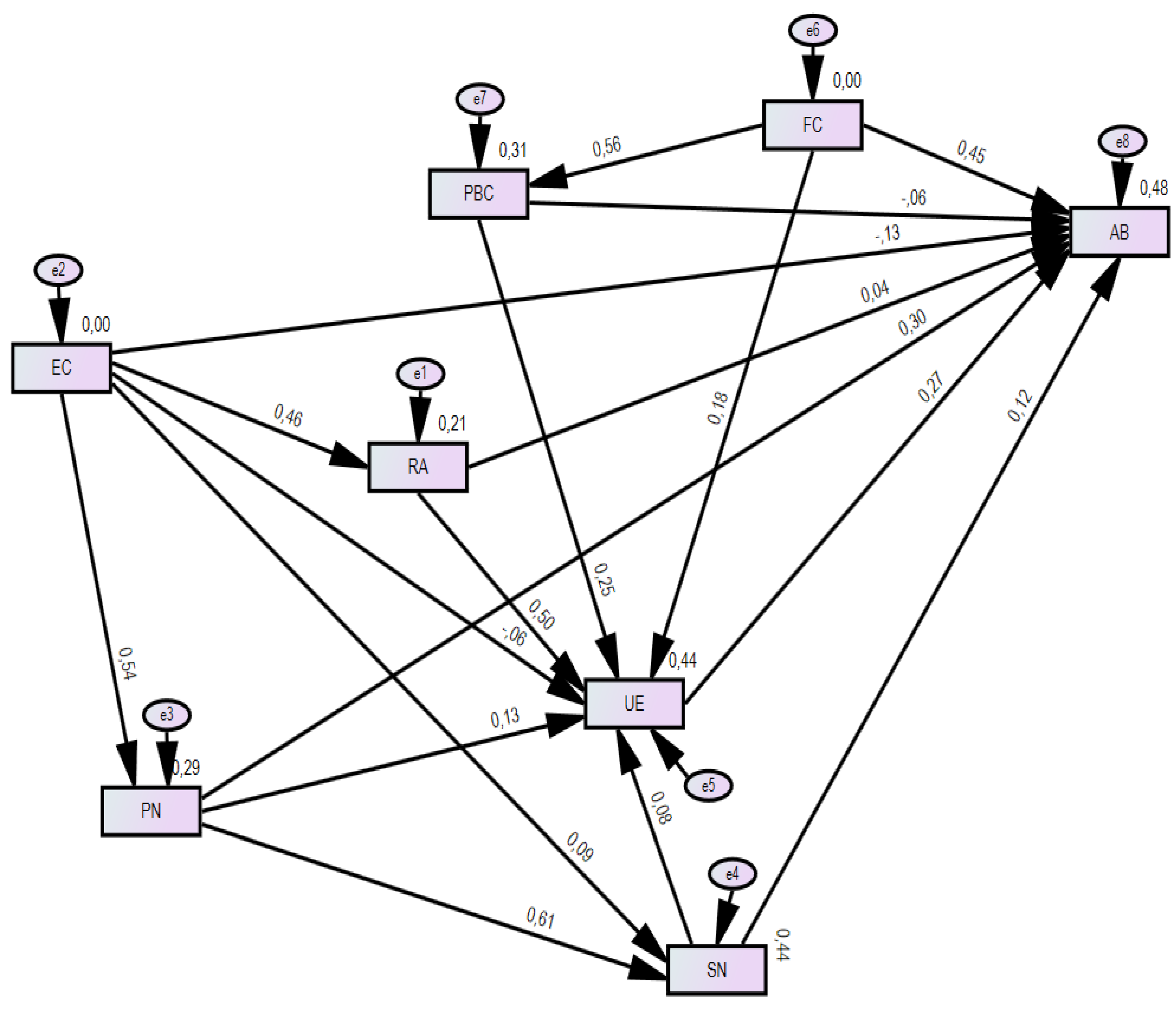
Table 1.
Demographics data.
| Criterion | Val | n | % |
|---|---|---|---|
| Gender | Male | 275 | 66,9% |
| Female | 136 | 33,1% | |
| Total | 411 | 100,0% | |
| Age | 18–24 years | 116 | 28,2% |
| 25–29 years | 111 | 27,0% | |
| 30–40 years | 145 | 35,3% | |
| 41–50 years | 28 | 6,8% | |
| 51-59 | 7 | 1,7% | |
| 60+ | 4 | 1,0% | |
| Total | 411 | 100,0% | |
| Marital status | Married | 96 | 23,4% |
| Unmarried | 315 | 76,6% | |
| Total | 411 | 100,0% | |
| Level of education | Did not complete high school | 11 | 2,7% |
| Completed Grade 12/matric | 154 | 37,5% | |
| Completed short courses | 25 | 6,1% | |
| Post-school qualification – diploma or certificate | 119 | 29,0% | |
| Post-school qualification – degree | 102 | 24,8% | |
| Total | 411 | 100,0% | |
| Income | R0 - R2,500 [$132] | 103 | 25,1% |
| R2,501 [$132] - R5,000 [$264] | 69 | 16,8% | |
| R5,001 [$264] - R7,500 [$397] | 68 | 16,5% | |
| R7,501 [397] - R12,500 [$661] | 64 | 15,6% | |
| R12,501 [$661] - R20,000 [$1058] | 65 | 15,8% | |
| More than R20,000 [$1058] | 42 | 10,2% | |
| Total | 411 | 100,0% |
Table 2.
Model fit indices.
| Indices | CMIN | df | CMIN/df | GFI | NFI | TLI | CFI | RMSEA | SRMR |
|---|---|---|---|---|---|---|---|---|---|
| Val(UE)s | 509.49 | 247 | 2.063 | 0.91 | 0.93 | 0.95 | 0.96 | 0.051 | 0.046 |
Table 5.
Direct relationships.
| Hypotheses | Standard beta coefficient | S.E. | t-values | p-values | Decision |
|---|---|---|---|---|---|
| H1a | 0.499 | 0.073 | 6.836 | 0.001 | Supported |
| H1b | 0,177 | 0.073 | 2.565 | 0.001 | Supported |
| H2a | 0.253 | 0.080 | 3.163 | 0.001 | Supported |
| H2b | 0.004 | 0.080 | 0.044 | 0.986 | Rejected |
| H3a | 0.076 | 0.052 | 1.462 | 0.143 | Rejected |
| H3b | 0.142 | 0.057 | 2.491 | 0.013 | Supported |
| H4a | 0.181 | 0.060 | 3.017 | 0.001 | Supported |
| H4b | 0.609 | 0.050 | 12.180 | 0.001 | Supported |
| H4c | 0.421 | 0.060 | 6.379 | 0.000 | Supported |
| H5a | 0.318 | 0.066 | 4.818 | 0.001 | Supported |
| H5b | 0.496 | 0.066 | 7.515 | 0.001 | Supported |
| H5c | 0.557 | 0.045 | 12.378 | 0.001 | Supported |
| H6a | 0.462 | 0.067 | 6.896 | 0.001 | Supported |
| H6b | 0.542 | 0.050 | 10.840 | 0.001 | Supported |
| H6c | 0.418 | 0.058 | 7.207 | 0.001 | Supported |
| H6d | 0.278 | 0.088 | 3.159 | 0.001 | Supported |
| H6e | 0.115 | 0.063 | 1.825 | 0.056 | Supported |
| H7 | 0.274 | 0.068 | 4.029 | 0.001 | Supported |
Table 6.
Indirect relationships.
| Path | Total effect | Direct effect | Indirect effect | S.E. | t-val | p-val | Decision |
|---|---|---|---|---|---|---|---|
| H8: RA → I → AB | 0.203 | 0.047 | 0.156 | 0.049 | 3.184 | 0.001 | Supported |
| H9: PBC → I → AB | 0.005 | -0.073 | 0.078 | 0.030 | 2.600 | 0.001 | Supported |
| H10: SN → I → AB | 0.119 | 0.102 | 0.018 | 0.013 | 1.385 | 0.104 | Rejected |
| H11: PN → I → AB | 0.382 | 0.270 | 0.033 | 0.017 | 1.941 | 0.007 | Supported |
| H12: FC → I → AB | 0.434 | 0.390 | 0.042 | 0.018 | 2.333 | 0.001 | Supported |
| H13: EC → I → AB | 0.185 | -0.133 | -0.016 | 0.022 | -0.727 | 0.364 | Rejected |
Disclaimer/Publisher’s Note: The statements, opinions and data contained in all publications are solely those of the individual author(s) and contributor(s) and not of MDPI and/or the editor(s). MDPI and/or the editor(s) disclaim responsibility for any injury to people or property resulting from any ideas, methods, instructions or products referred to in the content. |
© 2025 by the authors. Licensee MDPI, Basel, Switzerland. This article is an open access article distributed under the terms and conditions of the Creative Commons Attribution (CC BY) license (http://creativecommons.org/licenses/by/4.0/).
Copyright: This open access article is published under a Creative Commons CC BY 4.0 license, which permit the free download, distribution, and reuse, provided that the author and preprint are cited in any reuse.


